Disclosure of Invention
In view of this, the present application provides a method and an apparatus for detecting a malicious program, so that detection of the malicious program can be effectively achieved without constructing a complex program feature database.
In order to solve the above technical problem, the present application discloses a malicious program detection method, including:
acquiring an API called by a user program, and inserting a first AOP section into the API;
when the API is called by the user program to run, collecting running context information of the API through the first AOP section;
judging whether the API is an illegal API or not according to the running context information;
and determining whether the user program is a malicious program or not according to the judgment result.
Preferably, the determining whether the user program is a malicious program according to the determination result includes:
when the API is an illegal API, judging whether the API is called by a legal calling program, wherein the legal calling program is a high-authority program, and the high-authority program at least comprises a sandbox, a core library, a language interpreter or a third-party library;
when the API is called by a legal calling program or the API is a legal API, determining that the user program is not a malicious program;
and when the API is not called by a legal calling program, determining that the user program is a malicious program.
Preferably, a second AOP section is inserted into a legal calling program in advance, and the second AOP section defines the relevant information of the legal calling program which legally calls the illegal API;
the judging whether the API is called by a legal calling program comprises the following steps:
and when the related information of the legal calling program defined by the second AOP section is acquired, judging whether a calling source in a calling chain of the API is the legal calling program corresponding to the related information of the legal calling program.
Preferably, a third AOP section is inserted into a legal calling program in advance, and the third AOP section defines an illegal API legally called by the legal calling program;
the judging whether the API is called by a legal calling program comprises the following steps:
and judging whether an illegal API legally called by the third AOP section is obtained or not and whether the API is the illegal API legally called or not, if so, indicating that the API is called by a legal calling program, otherwise, indicating that the API is not called by the legal calling program.
Preferably, the obtaining an API called by a user program and inserting an AOP section into the API includes:
and after the initialization of the high-authority program is finished, acquiring an API called by the user program, and inserting an AOP (automatic optic plane) section into the API.
A malware detection apparatus comprising:
the section inserting module is used for acquiring an API called by a user program and inserting a first AOP section into the API;
the information acquisition module is used for acquiring the running context information of the API through the first AOP section when the API is called by the user program to run;
the judging module is used for judging whether the API is an illegal API or not according to the running context information;
and the determining module is used for determining whether the user program is a malicious program according to the judgment result of the judging module.
Preferably, the determining module comprises:
the judging unit is used for judging whether the API is called by a legal calling program when the judging module judges that the API is an illegal API, wherein the legal calling program is a high-authority program, and the high-authority program at least comprises a sandbox, a core library, a voice interpreter or a third-party library;
a determining unit, configured to determine that the user program is not a malicious program when the determining unit determines that the API is called by a legitimate calling program; and when the judging unit judges that the API is not called by a legal calling program or the judging module judges that the API is a legal API, determining that the user program is a malicious program.
Preferably, the apparatus further comprises:
the first presetting module is used for inserting a second AOP section into a legal calling program in advance, and the second AOP section defines the relevant information of the legal calling program for legally calling the illegal API;
the judgment unit is specifically configured to:
and when the related information of the legal calling program defined by the second AOP section is acquired, judging whether a calling source in the API calling chain is the legal calling program corresponding to the related information of the legal calling program.
Preferably, the apparatus further comprises:
the second presetting module is used for inserting a third AOP section into a legal calling program in advance, and the third AOP section defines an illegal API legally called by the legal calling program;
the judgment unit is specifically configured to:
and judging whether an illegal API legally called by the third AOP section is obtained or not and whether the API is the illegal API legally called or not, if so, indicating that the API is called by a legal calling program, otherwise, indicating that the API is not called by the legal calling program.
Preferably, the section insertion module is specifically configured to, after the initialization of the high-authority program is completed, obtain an API called by the user program, and insert the first AOP section in the API.
Compared with the prior art, the application can obtain the following technical effects:
the method has the advantages that a cloud platform malicious program feature database does not need to be constructed, the detection difficulty is reduced, the user program is not invasive, the problem that an attacker bypasses code scanning by using an obfuscation technology is solved, and the effective detection of the malicious program is realized.
Of course, it is not necessary for any one product to achieve all of the above-described technical effects simultaneously.
Detailed Description
Embodiments of the present application will be described in detail with reference to the drawings and examples, so that how to implement technical means to solve technical problems and achieve technical effects of the present application can be fully understood and implemented.
In a typical configuration, a computing device includes one or more processors (CPUs), input/output interfaces, network interfaces, and memory.
The memory may include forms of volatile memory in a computer readable medium, Random Access Memory (RAM) and/or non-volatile memory, such as Read Only Memory (ROM) or flash memory (flash RAM). Memory is an example of a computer-readable medium.
Computer-readable media, including both non-transitory and non-transitory, removable and non-removable media, may implement information storage by any method or technology. The information may be computer readable instructions, data structures, modules of a program, or other data. Examples of computer storage media include, but are not limited to, phase change memory (PRAM), Static Random Access Memory (SRAM), Dynamic Random Access Memory (DRAM), other types of Random Access Memory (RAM), Read Only Memory (ROM), Electrically Erasable Programmable Read Only Memory (EEPROM), flash memory or other memory technology, compact disc read only memory (CD-ROM), Digital Versatile Discs (DVD) or other optical storage, magnetic cassettes, magnetic tape magnetic disk storage or other magnetic storage devices, or any other non-transmission medium that can be used to store information that can be accessed by a computing device. As defined herein, computer readable media does not include non-transitory computer readable media (transient media), such as modulated data signals and carrier waves.
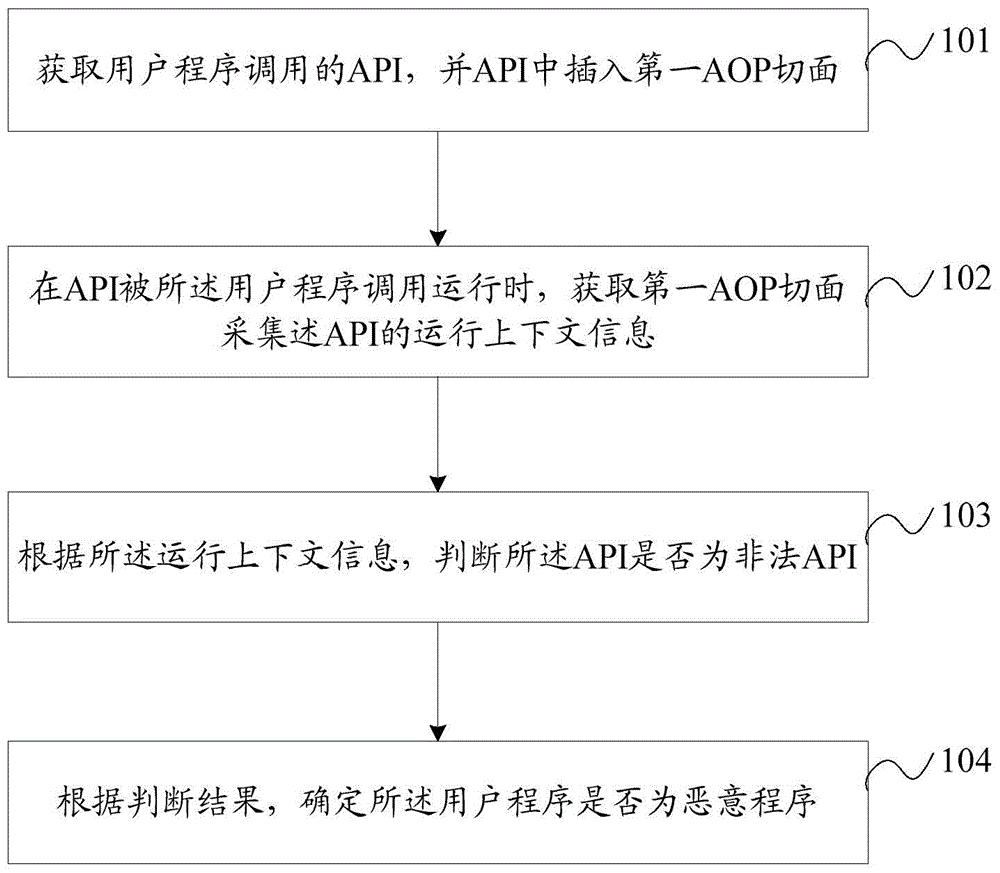
Fig. 1 is a flowchart of an embodiment of a malicious program detection method provided in an embodiment of the present application, where the method may include the following steps:
101: acquiring an API called by a user program, and inserting a first AOP (Aspect oriented programming) section into the API.
102: and when the API is called by the user program to run, collecting the running context information of the API through the first AOP section.
103: and judging whether the API is an illegal API or not according to the running context information.
104: and determining whether the user program is a malicious program or not according to the judgment result.
And when the judgment result shows that the API is an illegal API, determining that the user program is a malicious program, and when the judgment result shows that the API is a legal API, determining that the user program is not the malicious program.
In practical application, the embodiment of the application is specifically applied to a cloud computing platform, and the user program is a program uploaded by a cloud tenant on the cloud computing platform. The cloud computing platform provides an API (application programming interface) for calling user programs of different cloud tenants so that the user programs can run on the cloud computing platform.
The API called by the user program can be obtained in advance before the user program runs; the user program may be scanned in advance to obtain the API to be called by the user program.
Or after the user program runs, it calls an API each time, that is, obtains the called API, for example, when the user program is a Java program, the API is loaded while running, when a Java interpreter interprets an instruction sequence for executing the Java program, the API is loaded only when a certain API is executed for the first time, the first AOP cut plane injection timing uses the support function of Java on the cut plane programming AOP, when the Java interpreter executes a certain API for the first time to prepare loading, the loading action of the API is intercepted, the cut plane is injected in the API at this time, and then the interpreter continues to load and run the API.
When the user program is judged not to be the malicious program, the user program can be continuously executed.
In the code loading stage, when the user program is read, the API required to be called by the user program can be obtained. Therefore, the AOP section can be inserted into the API called by the user program in the embodiment of the application.
AOP is a new programming paradigm that aims to separate code sections to achieve isolation of code sections with low coupling in program logic. With AOP, instead of modifying program byte code or assembly code files, AOP slices can be inserted into the code and the code interpreted for execution. By the AOP, the method does not have any invasiveness to the user program, namely, the user is not required to modify own codes, the user is not required to provide program source codes for the cloud service provider, the program language core API depended by the user is not modified at all (the section injection is finished in the memory, the API file is not modified actually), the intellectual property of a third-party library and a language standard library function can be prevented from being infringed, and the source codes of the cloud tenant program are not required to be modified and checked and modified.
The inserted first AOP section is compiled into monitoring logic, and when the API is called to run, the first AOP section is run, so that the running context information of the API can be collected.
Through the running context information acquired by the first AOP section, whether the running context information is the running context information of a preset illegal API can be judged, so that whether the API called by the user program is the illegal API can be determined, and if the running context information is the illegal API, the user program can be determined to be a malicious program; if not, it may be determined that the user program is not a malicious program.
The running context information of the API may include a type of the API, a name of a calling method, a value of a specific parameter of the method, a value of a return value of the method, and the like.
In the embodiment of the application, for any user program, the first AOP section can be inserted into the called API, so that the called API runs through the first AOP section when running, that is, the running context information of the API is acquired, and thus, according to the running context information, it can be determined whether the called API is an illegal API, and further, it can be effectively determined whether the user program is a malicious program. The method has the advantages that a cloud platform malicious program feature database does not need to be established, no invasion is caused to the user program, the problem that an attacker bypasses code scanning by using an obfuscation technology is solved, and the effective detection of the malicious program is realized.
The illegal API as well as the legitimate API may be preset. In a cloud computing platform, cloud tenants are isolated from each other through a security isolation technology, such as a sandbox. The security isolation technology defines a legal API (application programming interface), namely an API in the sandbox, which is allowed to be called by the isolated cloud tenant, and an API prohibited from running, namely an API outside the sandbox, so that the illegal API can be the API prohibited from running, which is defined according to a security policy file of the security isolation technology.
In the schematic diagram shown in fig. 2, the security isolation technology is a sandbox, and the cloud tenant can only allow to call APIs that the sandbox allows to operate, that is, legal APIs. Outside the sandbox is a defined prohibited running API.
Further, some APIs with high operational risk in the call-prohibited API, such as accessing a password file, scanning other user files, initiating a network connection, etc., may be used, so that the illegal API may be specifically a dangerous API in the call-prohibited API.
After the malicious program breaks through the security isolation protection by using the vulnerability, the malicious program can obtain the calling authority of part or all of illegal API operations, load the highest-authority payload, scan the local file, download and execute the external program, execute the local command and other dangerous operations, and try to close the security management by using the illegal APIs so as to further penetrate the security management.
Therefore, in the embodiment of the present application, when the API acquired by the first AOP section is used to run the context information, and it can be determined that the called API is an illegal API, it can be determined that the user program is a malicious program. Current user programs do not have the right to perform certain operations.
Judging whether the API is an illegal API according to the operation context information can be specifically judged according to rules and heuristics.
In practical applications, during the execution of the user program, due to high-authority programs such as a language interpreter, a core library, a sandbox or a third-party library, the user program may be triggered to call some illegal APIs. That is, in the process of executing the user program, the high-authority programs are called for execution, and the high-authority programs may call illegal APIs, so that the calling source of the APIs called by the user program is the high-authority program.
And the high-authority program calling the illegal API is allowed and does not represent that the user program is a malicious program. Namely, a legal calling program which legally calls the illegal API exists.
For example, some of the securely isolated APIs that are prohibited from running, such as the DefineClass () in java, are executable by the java interpreter and sandbox, but cannot be invoked by the user program itself.
Therefore, in order to avoid the problem of false detection, in another embodiment of the present application, as shown in fig. 3, the method for detecting a malicious program may include the following steps:
301: and acquiring an API called by a user program, and inserting a first AOP section into the API.
302: and when the API is called by the user program to run, collecting the running context information of the API through the AOP section.
303: and judging whether the API is an illegal API or not according to the running context information, if so, executing step 304, and if not, executing step 305.
304: and judging whether the API is called by a legal calling program, if so, executing step 305, and if not, executing step 306.
The legal calling program is a high-authority program, and the high-authority program at least comprises a sandbox, a core library, a voice interpreter or a third-party library and the like.
The third-party library is also called third-party API, which is realized on the basis of system library API, and can be considered to be formed by combining several system library APIs and related codes, and the user can use the third-party library legally.
305: determining that the user program is not a malicious program.
306: determining that the user program is a malicious program.
Once it is determined that the calling program calls the API, it can be determined that the user program is not a malicious program, so that false detection can be avoided.
Wherein, whether the API called by the user program is called by a legal calling program can be realized by a plurality of possible ways is judged:
in one possible implementation, the analysis may be performed by extracting a call chain of the API. It is determined whether the calling source of the API is a user program or a predefined legitimate calling program, such as a language interpreter, sandbox, etc.
The whole calling chain of the API can be extracted through a reflection mechanism or by analyzing the whole system calling stack, the legality of each caller is checked up step by step from the direct caller of the API, the detection rule is that a predefined high-authority program which can legally call an illegal API, such as a third-party library or a sandbox, is detected, the detection is stopped, the calling source of the API is a legal calling program, and if the user program is detected, the detection is also stopped, and the user program breaks through the security isolation and directly calls the API. Therefore, whether the called API is an illegal API can be further judged through the running context information acquired by the AOP section.
Of course, the operation of judging whether the API is called by the legal calling program may also be executed after the API of the user program is acquired;
when the API is called by a legal calling program, the user program can be directly determined not to be a malicious program;
and when the API is not called by a legal calling program, inserting the first AOP section into the API.
Since not all high-rights programs are allowed to call illegal APIs.
Therefore, as another embodiment, a second AOP section may be inserted into a legitimate caller in advance, where the second AOP section defines information about the legitimate caller that legitimately calls an illegitimate API; and once the user triggers and calls the API by calling the legal calling program, executing a second AOP section in the legal calling program so as to obtain the relevant information of the legal calling program. And then analyzing whether a calling source in a calling chain of the API is a legal calling program corresponding to the related information of the legal calling program, if so, indicating that the calling of the API is legal and the user program is not judged to be a malicious program.
Specifically, in step 304, the determining whether the API is called by a legal calling program may include:
and when the related information of the legal calling program is acquired through the second AOP section, judging whether a calling source in the API calling chain is the legal calling program corresponding to the related information of the legal calling program.
If so, it may be determined that the user program is not a malicious program, and if not, it may be determined that the user program is a malicious program.
And checking the legality of each caller from the direct caller of the API step by step, and according to a detection rule, if the detected calling source is a legal calling program corresponding to the related information of the legal calling program, judging that the user program is not a malicious program. And if the detected calling source is the user program, the user program is a malicious program.
In addition, since high-privilege programs do not allow all illegal APIs to be called. Some APIs are very dangerous in nature, such as the Set Security Manager (Set Security Manager) API in Java, which should not be called by any user program or high-rights program.
As yet another example, a third AOP section may be inserted in advance in a legitimate caller through AOP, the third AOP section defining illegitimate APIs that the legitimate caller allows to invoke legally. And once the user program calls a legal calling program, the third AOP section is operated to obtain an illegal API which can be legally called by the legal calling program. Therefore, if the obtained API called by the user program is an illegal API which is legally called and defined by the third AOP section, the fact that the user program is not a malicious program is indicated, and the called API is called through the legal calling program and is allowed.
Specifically, in step 304, the determining whether the API is called by a legal calling program may include:
and judging whether an illegal API legally called defined by the third AOP section is obtained or not and whether the API is the illegal API legally called defined by the third AOP section is obtained or not, if so, indicating that the API is called by a legal calling program, otherwise, indicating that the API is not called by the legal calling program.
In this embodiment, if the API called by the user program is called by the legal calling program, it is also unnecessary to analyze the call chain of the API, and only the third AOP section needs to be inserted into the legal calling program in advance, and the illegal API called by the legal calling program can be obtained by operating the third AOP section.
If the legally called illegal API is obtained and the called API of the user program is the legally called illegal API, the fact that the API of the user program is called through the legally called program is indicated, and therefore the fact that the user program is not a malicious program can be determined; otherwise, the program is a malicious program.
Furthermore, in yet another embodiment of the embodiments of the present application:
because some high-authority programs, such as sandboxes, generally complete the operation of calling the illegal API during initialization, and after jumping to the user program, the situation that the sandbox executes the illegal API hardly exists, in the embodiment of the present application, the obtaining of the API called by the user program may specifically be:
and after the initialization of the high-authority program is finished, acquiring an API called by the user program, and inserting an AOP (automatic optic plane) section into the API. Thereby avoiding unnecessary operations and simplifying the detection operation.
The embodiment of the application can be applied to various cloud scenes, such as app engine in PaaS (Platform-as-a-Service), open MR (open map Service) open map in open data processing Service, and the like.
The user program can be java, python, c + + and the like on the PaaS platform, and can be a section of data analysis code and the like in the open data processing service.
The insertion operation of the AOP section, taking a java program as an example, can be assisted based on a java byte code driver library java ssist, a loading process of a user program in a loader can be intercepted by using a java language to a support interface entity package interface of the AOP, and a generated AOP section is inserted into a called API in the loading process.
The AOP section is triggered to collect the running context information of the API when the API is called. And may trigger analysis of the run context information.
The python program, with its support of the AOP, may also cooperate with the bytecode-driven package of python to generate AOP slices and perform slice insertion.
Even for a C language program, an API call of the C program can be intercepted by utilizing a ptrace system call so as to insert an AOP section in the API.
Fig. 4 is a schematic structural diagram of an embodiment of a malicious program detection apparatus according to an embodiment of the present disclosure, where the apparatus may include:
a section insertion module 401, configured to obtain an API called by a user program, and insert a first AOP section into the API;
an information collecting module 402, configured to collect, through the first AOP section, running context information of the API when the API is called by the user program to run;
a judging module 403, configured to judge whether the API is an illegal API according to the running context information;
a determining module 404, configured to determine whether the user program is a malicious program according to the determination result of the determining module 403.
When the API is an illegal API, it may be determined that the user program is a malicious program, and when the API is a legal API, it may be determined that the user program is not a malicious program.
In the embodiment of the application, for any user program, the AOP section can be inserted into the called API, so that the called API runs when running, that is, the running context information of the API is acquired, and thus, according to the running context information, it can be determined whether the called API is an illegal API, and further, it can be effectively determined whether the user program is a malicious program. The method has the advantages that a cloud platform malicious program feature database does not need to be established, no invasion is caused to the user program, the problem that an attacker bypasses code scanning by using an obfuscation technology is solved, and the effective detection of the malicious program is realized.
The API called by the user program may be obtained in advance before the user program runs, or after the user program runs.
The illegal API as well as the legitimate API may be preset. In a cloud computing platform, cloud tenants are isolated from each other through a security isolation technology, such as a sandbox. The security isolation technology defines a legal API which is allowed to be called by the isolated cloud tenant and an API which is forbidden to be called, so that the illegal API can be the API which is forbidden to be called and is defined according to the security policy file of the security isolation technology.
Further, some APIs with high operational risk in the call-prohibited API, such as accessing a password file, scanning other user files, initiating a network connection, etc., may be used, so that the illegal API may be specifically a dangerous API in the call-prohibited API.
In practical applications, due to high-authority programs such as a language interpreter, a core library, a sandbox or a third-party library, some illegal APIs may be called by a user program, so that the calling source of the illegal APIs is the high-authority program. And the high-authority program calling the illegal API is allowed and does not represent that the user program is a malicious program. Namely, a legal calling program which legally calls the illegal API exists.
Therefore, in order to avoid the problem of false detection, in another embodiment of the present application, as shown in fig. 5, the determining module 404 may include:
a determining unit 501, configured to determine, when the determining module 403 determines that the API is an illegal API, whether the API is called by a legal calling program, where the legal calling program is a high-authority program, and the high-authority program at least includes a sandbox, a core library, a voice interpreter, or a third-party library;
a determining unit 502, configured to determine that the user program is not a malicious program when the determining unit 501 determines that the API is called by a legitimate calling program; when the determining unit 501 determines that the API is not called by a legitimate calling program, or the determining module 403 determines that the API is a legitimate API, it is determined that the user program is a malicious program.
The judging unit judges whether the API called by the user program is called by a high-authority program and can be realized in multiple possible modes:
in one possible implementation, the analysis may be performed by extracting a call chain of the API. It is determined whether the calling source of the API is a user program or a legitimate calling program such as a language interpreter, sandbox, etc.
Since not all high-rights programs will call the illegal API, or high-rights programs will call all of the illegal APIs. Some APIs are very dangerous in nature, for example, an API of a security manager (Set security manager) in Java is closed, and such API should not be called by any user program or high-authority program, so that when the API called by the user program is determined to be an illegal API and is a preset dangerous API, it may be directly determined that the user program is a malicious program.
As still another embodiment, as illustrated in fig. 6, the apparatus may further include:
the first presetting module 601 is configured to insert a second AOP section in a legal calling program in advance, where the second AOP section defines relevant information of the legal calling program for legally calling an illegal API;
the determining unit 501 is specifically configured to:
and when the related information of the legal calling program defined by the second AOP section is acquired, judging whether a calling source in the API calling chain is the legal calling program corresponding to the related information of the legal calling program.
If so, it may be determined that the user program is not a malicious program, and if not, it may be determined that the user program is a malicious program.
In addition, as still another embodiment, as shown in fig. 7, the apparatus may further include:
a second presetting module 701, configured to insert a third AOP section into a legal calling program in advance, where the third AOP section defines an illegal API legally called by the legal calling program;
the determining unit 501 may specifically be configured to:
and judging whether an illegal API legally called by the third AOP section is obtained or not and whether the API is the illegal API legally called or not, if so, indicating that the API is called by a legal calling program, otherwise, indicating that the API is not called by the legal calling program.
In this embodiment, if the API called by the user program is called by the legal calling program, it is also unnecessary to analyze the call chain of the API, and only the third AOP section needs to be inserted into the legal calling program in advance, and the illegal API called by the legal calling program can be obtained by operating the third AOP section.
If the legally called illegal API is obtained and the called API of the user program is the legally called illegal API, the fact that the API of the user program is called through the legally called program is indicated, and therefore the fact that the user program is not a malicious program can be determined; otherwise, the program is a malicious program.
In addition, since the operation of calling the illegal API by the high-authority program, such as the sandbox, is completed during initialization, and after the user program is skipped, the sandbox and the like rarely execute the illegal API, in the embodiment of the present application, the section insertion module is specifically configured to obtain the API called by the user program after the initialization of the legal calling program is completed, and insert the first AOP section into the API.
As used in the specification and in the claims, certain terms are used to refer to particular components. As one skilled in the art will appreciate, manufacturers may refer to a component by different names. This specification and claims do not intend to distinguish between components that differ in name but not function. In the following description and in the claims, the terms "include" and "comprise" are used in an open-ended fashion, and thus should be interpreted to mean "include, but not limited to. "substantially" means within an acceptable error range, and a person skilled in the art can solve the technical problem within a certain error range to substantially achieve the technical effect. Furthermore, the term "coupled" is intended to encompass any direct or indirect electrical coupling. Thus, if a first device couples to a second device, that connection may be through a direct electrical coupling or through an indirect electrical coupling via other devices and couplings. The description which follows is a preferred embodiment of the present application, but is made for the purpose of illustrating the general principles of the application and not for the purpose of limiting the scope of the application. The protection scope of the present application shall be subject to the definitions of the appended claims.
It is also noted that the terms "comprises," "comprising," or any other variation thereof, are intended to cover a non-exclusive inclusion, such that a good or system that comprises a list of elements does not include only those elements but may include other elements not expressly listed or inherent to such good or system. Without further limitation, an element defined by the phrase "comprising an … …" does not exclude the presence of other like elements in a commodity or system that includes the element.
The foregoing description shows and describes several preferred embodiments of the present application, but as aforementioned, it is to be understood that the application is not limited to the forms disclosed herein, but is not to be construed as excluding other embodiments and is capable of use in various other combinations, modifications, and environments and is capable of changes within the scope of the application as described herein, commensurate with the above teachings, or the skill or knowledge of the relevant art. And that modifications and variations may be effected by those skilled in the art without departing from the spirit and scope of the application, which is to be protected by the claims appended hereto.