Disclosure of Invention
In view of this, the present application provides a new technical solution, which can solve the technical problem of secret divulgence prevention without affecting the normal use of the data file.
In order to achieve the above purpose, the present application provides the following technical solutions:
according to a first aspect of the present application, a method for protecting a data file is provided, which is applied to a terminal device, and includes:
when the data file is detected to be generated on the terminal equipment, determining the confidentiality grade of the data file;
if the confidentiality rating indicates that the data file is a confidential file, storing the data file in a specified virtual storage area;
and generating a stub file at the original storage position of the data file, wherein the stub file is used for recording the reference authority of the data file and the storage position of the data file in the virtual storage area.
According to a second aspect of the present application, a method for reading a data file is provided, which is applied to a terminal device, and includes:
when a clicking event of a user about a stub file is monitored, determining whether the user has the authority to access the data file according to the consulting authority recorded by the stub file;
if the user has the authority of accessing the data file, starting a virtual application program corresponding to the data file;
accessing, by the virtual application, the data file stored at the storage location of the virtual storage area recorded by the stub file.
According to a third aspect of the present application, a protection apparatus for a data file is provided, which is applied to a terminal device, and includes:
the first determining module is used for determining the confidentiality grade of the data file and the original storage position of the data file when the data file is detected to be generated on the terminal equipment;
a storage module, configured to store the data file in a designated virtual storage area if the confidentiality rating determined by the first determination module indicates that the data file is a confidential file;
and the stub generating module is used for generating a stub file at the original storage position determined by the first determining module, wherein the stub file is used for recording the reference authority of the data file and the storage position of the data file in the virtual storage area.
According to a fourth aspect of the present application, there is provided an apparatus for reading a data file, the apparatus comprising:
a fourth determining module, configured to determine, when a click event of a user on the stub file generated by the stub generating module is monitored, whether the user has an authority to access the data file according to a reference authority recorded in the stub file;
the starting module is used for starting the virtual application program corresponding to the data file if the fourth determining module determines that the user has the authority of accessing the data file;
and the access module is used for accessing the data file stored in the storage position of the virtual storage area recorded by the stub file through the virtual application program started by the starting module.
According to a fifth aspect of the present application, a terminal device is provided, the terminal device comprising:
a processor; a memory for storing the processor-executable instructions;
the processor is used for determining the confidentiality grade of the data file when the data file is detected to be generated on the terminal equipment;
if the confidentiality rating indicates that the data file is a confidential file, storing the data file in a specified virtual storage area;
and generating a stub file at the original storage position of the data file, wherein the stub file is used for recording the reference authority of the data file and the storage position of the data file in the virtual storage area.
According to a sixth aspect of the present application, a terminal device is presented, the terminal device comprising:
a processor; a memory for storing the processor-executable instructions;
the processor is used for determining whether the user has the authority to access the data file according to the consulting authority recorded by the stub file when the clicking event of the user about the stub file is monitored;
if the user has the authority of accessing the data file, starting a virtual application program corresponding to the data file;
accessing, by the virtual application, the data file stored at a storage location of a virtual storage area recorded by the stub file
According to the technical scheme, when the data file is determined to be the confidential file, the data file is stored in the designated virtual storage area, so that any operation on the data file stored in the virtual storage area can be isolated in a virtual environment, and the data file is prevented from being divulged; the stub file is generated at the original storage position of the data file, and the stub file only records the reference authority of the data file and the storage position of the data file in the virtual storage area and does not carry any data of the data file, so that all operations of a user on the stub file do not have any influence on the data file.
Detailed Description
Reference will now be made in detail to the exemplary embodiments, examples of which are illustrated in the accompanying drawings. When the following description refers to the accompanying drawings, like numbers in different drawings represent the same or similar elements unless otherwise indicated. The embodiments described in the following exemplary embodiments do not represent all embodiments consistent with the present application. Rather, they are merely examples of apparatus and methods consistent with certain aspects of the present application, as detailed in the appended claims.
The terminology used herein is for the purpose of describing particular embodiments only and is not intended to be limiting of the application. As used in this application and the appended claims, the singular forms "a", "an", and "the" are intended to include the plural forms as well, unless the context clearly indicates otherwise. It should also be understood that the term "and/or" as used herein refers to and encompasses any and all possible combinations of one or more of the associated listed items.
It is to be understood that although the terms first, second, third, etc. may be used herein to describe various information, such information should not be limited to these terms. These terms are only used to distinguish one type of information from another. For example, first information may also be referred to as second information, and similarly, second information may also be referred to as first information, without departing from the scope of the present application. The word "if" as used herein may be interpreted as "at … …" or "when … …" or "in response to a determination", depending on the context.
When the data file is determined to be the confidential file, the data file is stored in the designated virtual storage area, so that any operation on the data file stored in the virtual storage area can be isolated in a virtual environment, and the data file is prevented from being divulged; the stub file is generated at the original storage position of the data file, and the stub file only records the reference authority of the data file and the storage position of the data file in the virtual storage area and does not carry any data of the data file, so that all operations of a user on the stub file do not have any influence on the data file.
For further explanation of the present application, the following examples are provided:
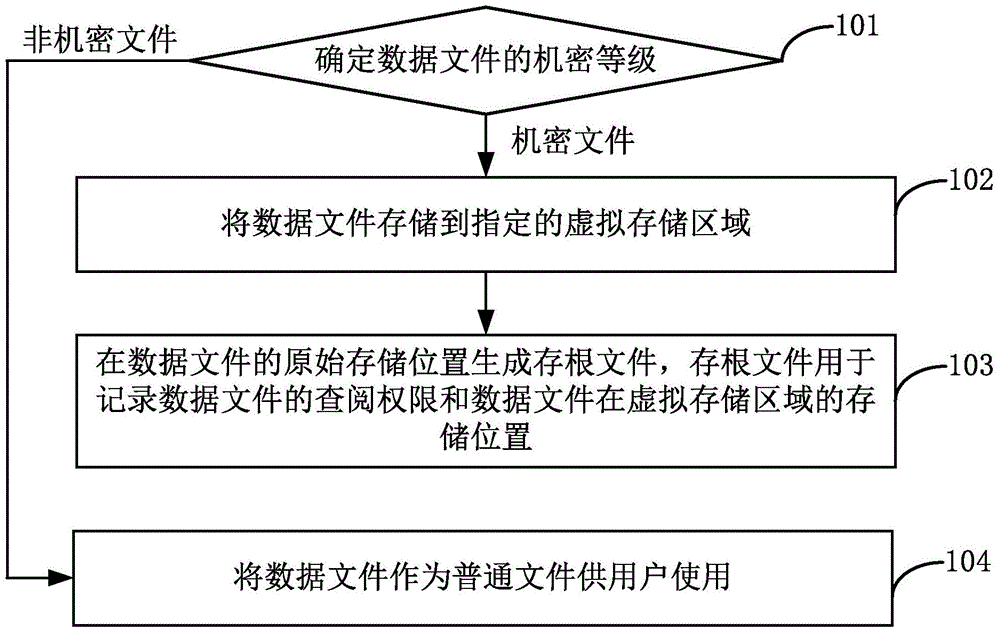
FIG. 1 shows a flow diagram of a method of protecting a data file according to an example embodiment of the invention; the method can be applied to terminal equipment, as shown in fig. 1, and comprises the following steps:
step 101, when detecting that the data file is generated on the terminal device, determining the confidentiality grade of the data file, if the confidentiality grade indicates that the data file is the confidential file, executing step 102, and if the confidentiality grade indicates that the data file is the non-confidential file, executing step 104.
In an embodiment, the data file may be generated on the terminal device by means of copying, creating, downloading, and the like. In one embodiment, the confidentiality level of the data file may be set by the user's confidentiality level of the data file, for example, the confidentiality level may be set to a level of 0, 1, or 2, and different confidentiality levels may indicate the confidentiality level of the data file, for example, level 0 indicates that the user does not need to take security measures for the data file, level 1 indicates that the user needs to take security measures for the data file, or, for example, level 0 indicates that the user does not need to take security measures for the data file, level 1 indicates that the user needs to take security measures for the data file on the terminal device, and level 2 indicates that the user needs to take security measures for the data file on both the terminal device and the cloud server.
In an embodiment, content information of the data file may be determined first, the content information may be matched with a first preset condition, and the confidentiality level of the data file may be determined according to a first result of the matching, for example, the first preset condition may include a plurality of key phrases, such as "encryption", "privacy", "non-public", and the like, if it is detected that the content information of the data file includes "encryption", the confidentiality level of the data file may be determined to be level 1 according to the first result of the matching after the "encryption" is matched with the first preset condition, and if the content information does not include the key phrases, the confidentiality level of the data file may be determined to be level 0 according to the first result of the matching; in another embodiment, the file name of the data file may be determined first, the file name may be matched with a second preset condition, and the confidentiality rating of the data file may be determined according to a second result of the matching, for example, the second preset condition may include a plurality of key words, such as "secret", "encryption", and the like, if it is detected that the file name of the data file includes "secret", for example, the file name includes "secret", after the "secret" is matched with the second preset condition, the confidentiality rating of the data file may be determined to be level 1 according to the second result of the matching, and if the file name does not include the key words, the confidentiality rating of the data file may be determined to be level 0 according to the second result of the matching.
Step 102, storing the data file in the designated virtual storage area, and executing step 103.
In an embodiment, the virtual storage area may be a specific disk array portion on a disk of the terminal device for storing a data file that needs to be secured, when a user needs to access the data file stored in the virtual storage area, a virtual application program isolated from an operating system of the terminal device (which may include storage isolation, memory isolation, and the like) may be started through a virtualization technique, and the data file stored in the virtual storage area is accessed through the virtual application program, so that any operation on the data file stored in the virtual storage area may be isolated in a virtual environment, and the data file is prevented from being compromised.
In another embodiment, the virtual storage area may be a specific disk array portion on the disk of the cloud server, where the specific disk array portion is used to store a data file that needs to be secured, when a terminal device of a user cannot store the data file or cannot take security measures on the data file, a virtual application program isolated from an operating system of the terminal device (which may include storage isolation, memory isolation, and the like) may be started through a virtualization technique, and the data file stored in the virtual storage area on the cloud server is accessed through the virtual application program, so that any operation on the data file stored in the virtual storage area is isolated in a virtual environment of the cloud server, and the data file is prevented from being compromised.
Step 103, generating a stub file at the original storage position of the data file, where the stub file is used to record the reference authority of the data file and the storage position of the data file in the virtual storage area, and ending the process.
In an embodiment, when a user clicks the stub file, it may be determined whether the user has a reference authority or not, only when the user is ensured to have the reference authority, the storage location of the data file in the virtual storage area may be known, and then the data file is referred from the storage location of the virtual storage area; if the user does not have the reference authority, the user's reference operation may be denied.
And step 104, taking the data file as a common file for the user to use, and ending the process.
In one embodiment, the reading of the common file can be referred to the description of the prior art, and the disclosure will not be described in detail.
As can be seen from the above description, in the embodiment of the present invention, when the data file is determined to be a confidential file, the data file is stored in the designated virtual storage area, so that any operation on the data file stored in the virtual storage area can be isolated in a virtual environment, and the data file is prevented from being compromised; the stub file is generated at the original storage position of the data file, and the stub file only records the reference authority of the data file and the storage position of the data file in the virtual storage area and does not carry any data of the data file, so that all operations of a user on the stub file do not have any influence on the data file.
Fig. 2 is a flowchart illustrating a method for protecting a data file according to another exemplary embodiment of the present invention, as shown in fig. 2, including the following steps:
step 201, when a first instruction that a user needs to share a data file to a shared user specified by the user is monitored, determining user information of the shared user.
In an embodiment, when a user can share a data file to other users, the sharing of the stub file to a designated shared user can be started through a client application program of the terminal device or a sharing key of the stub file. In an embodiment, the user information may include an account of the shared user in the client application program, or may include an email box through which the shared user can receive the data file, that is, the application does not limit an address included in the user information and through which the data file can be received, as long as the shared user can receive the data file.
Step 202, determining whether the shared user has sharing authority according to the user information, executing step 203 when determining that the shared user has sharing authority, and prompting that the shared user cannot share if the shared user does not have sharing authority.
And step 203, uploading the data file to a cloud server for storage.
In an embodiment, the user may upload the data file to the cloud server for backup storage, and may upload the stub file to the cloud server through a client application program of the terminal device or an upload key of the stub file.
Step 204, sending a second instruction for instructing the shared user to receive the data file to the shared user according to the user information, after the shared user confirms to receive the data file through the terminal device of the shared user, generating a stub file of the data file on the terminal device of the shared user, and acquiring the data file from the virtual storage area of the cloud server by the terminal device of the shared user according to the stub file.
In this embodiment, when a data file needs to be shared, a second instruction for instructing the shared user to receive the data file is sent to the shared user according to the user information, and after the shared user confirms that the data file is received through the terminal device of the shared user, a stub file of the data file is generated on the terminal device of the shared user, so that sharing of the data file needing to be kept secret is achieved through virtual sharing of the stub file.
FIG. 3 shows a flow diagram of a method of reading a data file according to an exemplary embodiment of the invention; as shown in fig. 3, the method comprises the following steps:
step 301, when a click event of a user about the stub file is monitored, determining whether the user has the authority to access the data file according to the reference authority recorded by the stub file, if the user has the authority to access the data file, executing step 302, and if the user does not have the authority to access the data file, prompting the user that the user does not have the access authority, and ending the process.
In an embodiment, a click event of a user about a stub file may be monitored through a client application installed on a terminal device, where the client application needs the user with login permission to log in, and in an embodiment, the click event may be a double-click open event of the stub file, or an open event after a menu is triggered. In one embodiment, the client application may log a stub file so that it can determine whether the clicked file is a stub file or a normal data file.
Step 302, starting the virtual application program corresponding to the data file, and executing step 303.
Step 303, accessing the data file through the virtual application program at the storage location of the virtual storage area, and ending the process.
In step 302 and step 303, in an embodiment, the virtual application is an application after virtualization of control management software installed on the terminal device, and may be isolated from an operating system of the terminal device, and in an embodiment, the isolation between the virtual application and the operating system may include storage isolation from the operating system, memory isolation from the operating system, and the like, so that any operation on a data file by a user may be ensured to be isolated in a virtual environment determined by the virtual application, and an illegal user is prevented from acquiring any data resource in the virtual application through outside the virtual application. In one embodiment, the user's access to the data file through the virtual application may include normal reading, editing, using a clipboard, and the like.
In this embodiment, after determining that the user has the right to access the data file, the data file is accessed through the virtual application program at the storage location of the virtual storage area, so that any operation on the data file by the user can be ensured to be isolated in the virtual environment determined by the virtual application program, and an illegal user is prevented from acquiring any data resource in the virtual application program through the outside of the virtual application program.
FIG. 4 shows a flow diagram of a method of reading a data file according to yet another exemplary embodiment of the present invention; in this embodiment, the stub file is stored in the terminal device, and the data file is stored in the virtual storage area of the cloud server, so as to exemplarily explain how the terminal device obtains the data file from the cloud server through the stub file, as shown in fig. 4, the method includes the following steps:
step 401, after detecting that a user clicks a stub file and opens the stub file, the terminal device starts a Remote Desktop Protocol (RDP) component according to information recorded by the stub file, and connects to the cloud server through the RDP component.
Step 402, the terminal device transmits information recorded by the stub file to the cloud server through the RDP component.
In an embodiment, the data information recorded by the stub file is encrypted by the client application program, and the encrypted data information records the data file corresponding to the stub file, the user right for viewing the data file, the circulation process of data file sharing, and the related history record for using the data file.
In step 403, after the cloud server verifies the transmitted information, the cloud server starts a remote virtualization program on the terminal device, and opens a data file stored on the cloud server according to the virtual storage location recorded by the stub file.
In one embodiment, the transmitted information may include the user authority of the client application program, information that the user needs authentication, and a virtual storage path of the data file requested to be opened on the cloud server.
In step 404, the cloud server maps the document editor to the terminal device.
In an embodiment, the cloud server may create a new editable file through a document editor (e.g., word), and transmit the entire visual form of the editable file to the local of the terminal device, so that a remote document editor may be mapped on the terminal device.
Step 405, the terminal device operates the data file stored on the cloud server by using the document editor.
In one embodiment, the operation on the data file may include viewing, editing the content of the data file, copying the data file, and the like, and the specific operation on the data file is not limited by the present disclosure.
In an exemplary scenario, after the shared user receives the stub file through the embodiment shown in fig. 2, when the shared user needs to obtain the data file from the cloud server according to the stub file, the data file may be obtained from the virtual storage area of the cloud server through this embodiment. In another exemplary scenario, if the disk of the terminal device is limited by the storage space or the disk of the terminal device is not provided with a virtual storage area, the data file is stored in the virtual storage area of the cloud server, in this case, when the user of the terminal device needs to obtain the data file from the remote server according to the stub file, the data file may also be obtained from the virtual storage area of the cloud server through the embodiment. In another exemplary scenario, when a user needs to operate a data file from a cloud server through different terminal devices, the method may also be used to remotely read the data file, for example, the user generates a stub file of the data file on the terminal device a, stores the data file in a virtual storage area of the terminal device a, and when the user sends the stub file from the terminal device a to the terminal device B, and after the terminal device a uploads the data file to the cloud server, if the user needs to read the data file from the terminal device B, the data file may be operated from the cloud server through this embodiment.
Through the embodiment, due to the fact that the cost for achieving Citrix XenApp and other application virtualization in the prior art is high, any Windows operating system can be used by the application virtualization scheme based on the RDP, the remote application virtualization technology is achieved by the aid of the remote desktop RDP, the RDP control component, the message hook and the window cutting technology, dependency on the operating system is avoided, and therefore the cloud server can adopt any Windows operating system, and high flexibility is achieved.
On the basis of the embodiments shown in fig. 1 to fig. 4, when a data file is operated by a user, the operation performed by the user on the data file may also be monitored by a client application installed on the terminal device; in an embodiment, the operation of the user on the data file may be performed by the user on the terminal device, or may be performed by a document editor mapped to the terminal device by the cloud server, so that all the behaviors of the user on the data file, such as opening, operation, and circulation of the data file, can be effectively monitored and managed.
Corresponding to the above-mentioned method for protecting data files, the present application also proposes a schematic structure diagram of a terminal device according to an exemplary embodiment of the present application, shown in fig. 5. Referring to fig. 5, at the hardware level, the terminal device includes a processor, an internal bus, a network interface, a memory, and a non-volatile memory, but may also include hardware required by other services. The processor reads the corresponding computer program from the nonvolatile memory into the memory and then runs the computer program to form a protection device of the data file on the logic level. Of course, besides the software implementation, the present application does not exclude other implementations, such as logic devices or a combination of software and hardware, and the like, that is, the execution subject of the following processing flow is not limited to each logic unit, and may also be hardware or logic devices.
The present application also proposes a schematic structural diagram of a terminal device according to another exemplary embodiment of the present application shown in fig. 6, corresponding to the method of reading a data file described above. Referring to fig. 6, at the hardware level, the terminal device includes a processor, an internal bus, a network interface, a memory, and a non-volatile memory, but may also include hardware required by other services. The processor reads the corresponding computer program from the nonvolatile memory into the memory and then runs the computer program to form a device for reading the data file on a logic level. Of course, besides the software implementation, the present application does not exclude other implementations, such as logic devices or a combination of software and hardware, and the like, that is, the execution subject of the following processing flow is not limited to each logic unit, and may also be hardware or logic devices.
FIG. 7 is a schematic diagram of a data file protection apparatus according to an exemplary embodiment of the present invention; as shown in fig. 7, in a software implementation, the protection device for the data file may include: a first determination module 71, a storage module 72, and a stub generation module 73. Wherein:
the first determining module 71 is configured to determine a confidentiality level of a data file and an original storage location of the data file when it is detected that the data file is generated on the terminal device;
a storage module 72 for storing the data file into a designated virtual storage area if the confidentiality rating determined by the first determination module 71 indicates that the data file is a confidential file;
and a stub generating module 73, configured to generate a stub file at the original storage location determined by the first determining module 71, where the stub file is used to record the reference authority of the data file and the storage location of the data file in the virtual storage area.
Fig. 8 is a schematic structural diagram of a data file protection apparatus according to another exemplary embodiment of the present invention, and based on the embodiment shown in fig. 7, the first determining module 71 may include:
a first determination unit 711 for determining content information of the data file;
a first matching unit 712 for matching the content information determined by the first determining unit 711 with a first preset condition and determining a confidentiality level of the data file according to a first result of the matching; and/or the presence of a gas in the gas,
a second determining unit 713 for determining a file name of the data file;
the second matching unit 714 is configured to match the file name determined by the second determining unit 713 with a second preset condition, and determine the confidentiality level of the data file according to a second result of the matching.
In an embodiment, the apparatus may further comprise:
a second determining module 74, configured to determine user information of the shared user when a first instruction that the user needs to share the data file stored in the storage module 72 to the shared user device specified by the user is monitored;
a sending module 75, configured to send a second instruction for instructing the shared user to receive the data file to the shared user according to the user information determined by the second determining module 74, and after the shared user confirms that the data file is received through the corresponding terminal device, generate a stub file of the data file on the terminal device of the shared user.
In an embodiment, the apparatus may further comprise:
a third determination module 76 for determining whether the shared user has the sharing right using the user information determined by the second determination module 74;
and an uploading module 77, configured to upload the data file to the cloud server for storage when the third determining module 76 determines that the shared user has the sharing right, so that the shared user acquires the data file from the virtual storage area of the cloud server according to the stub file.
In an embodiment, the apparatus may further comprise:
the monitoring module 78 monitors the operation of the data file by the user through the client application installed on the terminal device when the data file stored in the storage module 72 is operated by the user.
FIG. 9 illustrates a schematic structural diagram of an apparatus for reading a data file according to an exemplary embodiment of the present invention; in a software embodiment, as shown in fig. 9, the means for reading the data file may comprise: a fourth determination module 91, a start module 92, and an access module 93; wherein:
a fourth determining module 91, configured to determine whether the user has an authority to access the data file according to the reference authority recorded in the stub file when a click event of the user on the stub file is monitored;
a starting module 92, configured to start a virtual application corresponding to the data file if the fourth determining module 91 determines that the user has the right to access the data file;
and an accessing module 93, configured to access, by the virtual application started by the starting module 92, the data file stored in the storage location of the virtual storage area recorded in the stub file.
Fig. 10 is a schematic structural diagram illustrating an apparatus for reading a data file according to still another exemplary embodiment of the present invention; on the basis of the embodiment shown in fig. 9, the access module 93 may include:
the network connection unit 931 is configured to connect to the cloud server through the remote desktop protocol component according to the information recorded by the stub file;
the transmission unit 932 is configured to transmit information recorded by the stub file to the cloud server through the remote desktop protocol component, so that the cloud server starts a remote virtualization program on the terminal device after the information recorded by the storage file is verified, and maps a document editor of the data file stored on the cloud server to the terminal device according to a virtual storage location recorded by the stub file;
an operation unit 933, configured to operate, by using the document editor, the data file stored on the cloud server.
The embodiment shows that when the data file is determined to be the confidential file, the data file is stored in the designated virtual storage area, so that any operation on the data file stored in the virtual storage area can be isolated in a virtual environment, and the data file is prevented from being leaked; the stub file is generated at the original storage position of the data file, and the stub file only records the reference authority of the data file and the storage position of the data file in the virtual storage area and does not carry any data of the data file, so that all operations of a user on the stub file do not have any influence on the data file.
Other embodiments of the present application will be apparent to those skilled in the art from consideration of the specification and practice of the invention disclosed herein. This application is intended to cover any variations, uses, or adaptations of the invention following, in general, the principles of the application and including such departures from the present disclosure as come within known or customary practice within the art to which the invention pertains. It is intended that the specification and examples be considered as exemplary only, with a true scope and spirit of the application being indicated by the following claims.
It should also be noted that the terms "comprises," "comprising," or any other variation thereof, are intended to cover a non-exclusive inclusion, such that a process, method, article, or apparatus that comprises a list of elements does not include only those elements but may include other elements not expressly listed or inherent to such process, method, article, or apparatus. Without further limitation, an element defined by the phrase "comprising an … …" does not exclude the presence of other like elements in a process, method, article, or apparatus that comprises the element.
The above description is only exemplary of the present application and should not be taken as limiting the present application, as any modification, equivalent replacement, or improvement made within the spirit and principle of the present application should be included in the scope of protection of the present application.