CN106715519B - Conjugated polymers - Google Patents
Conjugated polymers Download PDFInfo
- Publication number
- CN106715519B CN106715519B CN201580049548.8A CN201580049548A CN106715519B CN 106715519 B CN106715519 B CN 106715519B CN 201580049548 A CN201580049548 A CN 201580049548A CN 106715519 B CN106715519 B CN 106715519B
- Authority
- CN
- China
- Prior art keywords
- polymer
- groups
- group
- polymers
- organic
- Prior art date
- Legal status (The legal status is an assumption and is not a legal conclusion. Google has not performed a legal analysis and makes no representation as to the accuracy of the status listed.)
- Active
Links
Classifications
-
- C—CHEMISTRY; METALLURGY
- C08—ORGANIC MACROMOLECULAR COMPOUNDS; THEIR PREPARATION OR CHEMICAL WORKING-UP; COMPOSITIONS BASED THEREON
- C08G—MACROMOLECULAR COMPOUNDS OBTAINED OTHERWISE THAN BY REACTIONS ONLY INVOLVING UNSATURATED CARBON-TO-CARBON BONDS
- C08G61/00—Macromolecular compounds obtained by reactions forming a carbon-to-carbon link in the main chain of the macromolecule
- C08G61/12—Macromolecular compounds containing atoms other than carbon in the main chain of the macromolecule
- C08G61/122—Macromolecular compounds containing atoms other than carbon in the main chain of the macromolecule derived from five- or six-membered heterocyclic compounds, other than imides
- C08G61/123—Macromolecular compounds containing atoms other than carbon in the main chain of the macromolecule derived from five- or six-membered heterocyclic compounds, other than imides derived from five-membered heterocyclic compounds
-
- C—CHEMISTRY; METALLURGY
- C08—ORGANIC MACROMOLECULAR COMPOUNDS; THEIR PREPARATION OR CHEMICAL WORKING-UP; COMPOSITIONS BASED THEREON
- C08G—MACROMOLECULAR COMPOUNDS OBTAINED OTHERWISE THAN BY REACTIONS ONLY INVOLVING UNSATURATED CARBON-TO-CARBON BONDS
- C08G61/00—Macromolecular compounds obtained by reactions forming a carbon-to-carbon link in the main chain of the macromolecule
- C08G61/12—Macromolecular compounds containing atoms other than carbon in the main chain of the macromolecule
- C08G61/122—Macromolecular compounds containing atoms other than carbon in the main chain of the macromolecule derived from five- or six-membered heterocyclic compounds, other than imides
- C08G61/123—Macromolecular compounds containing atoms other than carbon in the main chain of the macromolecule derived from five- or six-membered heterocyclic compounds, other than imides derived from five-membered heterocyclic compounds
- C08G61/126—Macromolecular compounds containing atoms other than carbon in the main chain of the macromolecule derived from five- or six-membered heterocyclic compounds, other than imides derived from five-membered heterocyclic compounds with a five-membered ring containing one sulfur atom in the ring
-
- C—CHEMISTRY; METALLURGY
- C08—ORGANIC MACROMOLECULAR COMPOUNDS; THEIR PREPARATION OR CHEMICAL WORKING-UP; COMPOSITIONS BASED THEREON
- C08J—WORKING-UP; GENERAL PROCESSES OF COMPOUNDING; AFTER-TREATMENT NOT COVERED BY SUBCLASSES C08B, C08C, C08F, C08G or C08H
- C08J5/00—Manufacture of articles or shaped materials containing macromolecular substances
- C08J5/04—Reinforcing macromolecular compounds with loose or coherent fibrous material
- C08J5/10—Reinforcing macromolecular compounds with loose or coherent fibrous material characterised by the additives used in the polymer mixture
-
- H—ELECTRICITY
- H10—SEMICONDUCTOR DEVICES; ELECTRIC SOLID-STATE DEVICES NOT OTHERWISE PROVIDED FOR
- H10K—ORGANIC ELECTRIC SOLID-STATE DEVICES
- H10K85/00—Organic materials used in the body or electrodes of devices covered by this subclass
- H10K85/10—Organic polymers or oligomers
- H10K85/111—Organic polymers or oligomers comprising aromatic, heteroaromatic, or aryl chains, e.g. polyaniline, polyphenylene or polyphenylene vinylene
- H10K85/113—Heteroaromatic compounds comprising sulfur or selene, e.g. polythiophene
-
- H—ELECTRICITY
- H10—SEMICONDUCTOR DEVICES; ELECTRIC SOLID-STATE DEVICES NOT OTHERWISE PROVIDED FOR
- H10K—ORGANIC ELECTRIC SOLID-STATE DEVICES
- H10K85/00—Organic materials used in the body or electrodes of devices covered by this subclass
- H10K85/20—Carbon compounds, e.g. carbon nanotubes or fullerenes
- H10K85/211—Fullerenes, e.g. C60
- H10K85/215—Fullerenes, e.g. C60 comprising substituents, e.g. PCBM
-
- H—ELECTRICITY
- H10—SEMICONDUCTOR DEVICES; ELECTRIC SOLID-STATE DEVICES NOT OTHERWISE PROVIDED FOR
- H10K—ORGANIC ELECTRIC SOLID-STATE DEVICES
- H10K85/00—Organic materials used in the body or electrodes of devices covered by this subclass
- H10K85/40—Organosilicon compounds, e.g. TIPS pentacene
-
- C—CHEMISTRY; METALLURGY
- C08—ORGANIC MACROMOLECULAR COMPOUNDS; THEIR PREPARATION OR CHEMICAL WORKING-UP; COMPOSITIONS BASED THEREON
- C08G—MACROMOLECULAR COMPOUNDS OBTAINED OTHERWISE THAN BY REACTIONS ONLY INVOLVING UNSATURATED CARBON-TO-CARBON BONDS
- C08G2261/00—Macromolecular compounds obtained by reactions forming a carbon-to-carbon link in the main chain of the macromolecule
- C08G2261/10—Definition of the polymer structure
- C08G2261/12—Copolymers
- C08G2261/122—Copolymers statistical
-
- C—CHEMISTRY; METALLURGY
- C08—ORGANIC MACROMOLECULAR COMPOUNDS; THEIR PREPARATION OR CHEMICAL WORKING-UP; COMPOSITIONS BASED THEREON
- C08G—MACROMOLECULAR COMPOUNDS OBTAINED OTHERWISE THAN BY REACTIONS ONLY INVOLVING UNSATURATED CARBON-TO-CARBON BONDS
- C08G2261/00—Macromolecular compounds obtained by reactions forming a carbon-to-carbon link in the main chain of the macromolecule
- C08G2261/10—Definition of the polymer structure
- C08G2261/14—Side-groups
- C08G2261/141—Side-chains having aliphatic units
- C08G2261/1412—Saturated aliphatic units
-
- C—CHEMISTRY; METALLURGY
- C08—ORGANIC MACROMOLECULAR COMPOUNDS; THEIR PREPARATION OR CHEMICAL WORKING-UP; COMPOSITIONS BASED THEREON
- C08G—MACROMOLECULAR COMPOUNDS OBTAINED OTHERWISE THAN BY REACTIONS ONLY INVOLVING UNSATURATED CARBON-TO-CARBON BONDS
- C08G2261/00—Macromolecular compounds obtained by reactions forming a carbon-to-carbon link in the main chain of the macromolecule
- C08G2261/10—Definition of the polymer structure
- C08G2261/14—Side-groups
- C08G2261/146—Side-chains containing halogens
-
- C—CHEMISTRY; METALLURGY
- C08—ORGANIC MACROMOLECULAR COMPOUNDS; THEIR PREPARATION OR CHEMICAL WORKING-UP; COMPOSITIONS BASED THEREON
- C08G—MACROMOLECULAR COMPOUNDS OBTAINED OTHERWISE THAN BY REACTIONS ONLY INVOLVING UNSATURATED CARBON-TO-CARBON BONDS
- C08G2261/00—Macromolecular compounds obtained by reactions forming a carbon-to-carbon link in the main chain of the macromolecule
- C08G2261/10—Definition of the polymer structure
- C08G2261/18—Definition of the polymer structure conjugated
-
- C—CHEMISTRY; METALLURGY
- C08—ORGANIC MACROMOLECULAR COMPOUNDS; THEIR PREPARATION OR CHEMICAL WORKING-UP; COMPOSITIONS BASED THEREON
- C08G—MACROMOLECULAR COMPOUNDS OBTAINED OTHERWISE THAN BY REACTIONS ONLY INVOLVING UNSATURATED CARBON-TO-CARBON BONDS
- C08G2261/00—Macromolecular compounds obtained by reactions forming a carbon-to-carbon link in the main chain of the macromolecule
- C08G2261/30—Monomer units or repeat units incorporating structural elements in the main chain
- C08G2261/32—Monomer units or repeat units incorporating structural elements in the main chain incorporating heteroaromatic structural elements in the main chain
- C08G2261/322—Monomer units or repeat units incorporating structural elements in the main chain incorporating heteroaromatic structural elements in the main chain non-condensed
- C08G2261/3229—Monomer units or repeat units incorporating structural elements in the main chain incorporating heteroaromatic structural elements in the main chain non-condensed containing nitrogen and sulfur as heteroatoms
-
- C—CHEMISTRY; METALLURGY
- C08—ORGANIC MACROMOLECULAR COMPOUNDS; THEIR PREPARATION OR CHEMICAL WORKING-UP; COMPOSITIONS BASED THEREON
- C08G—MACROMOLECULAR COMPOUNDS OBTAINED OTHERWISE THAN BY REACTIONS ONLY INVOLVING UNSATURATED CARBON-TO-CARBON BONDS
- C08G2261/00—Macromolecular compounds obtained by reactions forming a carbon-to-carbon link in the main chain of the macromolecule
- C08G2261/30—Monomer units or repeat units incorporating structural elements in the main chain
- C08G2261/32—Monomer units or repeat units incorporating structural elements in the main chain incorporating heteroaromatic structural elements in the main chain
- C08G2261/322—Monomer units or repeat units incorporating structural elements in the main chain incorporating heteroaromatic structural elements in the main chain non-condensed
- C08G2261/323—Monomer units or repeat units incorporating structural elements in the main chain incorporating heteroaromatic structural elements in the main chain non-condensed containing combinations of different heteroatoms other than nitrogen and oxygen or nitrogen and sulfur
-
- C—CHEMISTRY; METALLURGY
- C08—ORGANIC MACROMOLECULAR COMPOUNDS; THEIR PREPARATION OR CHEMICAL WORKING-UP; COMPOSITIONS BASED THEREON
- C08G—MACROMOLECULAR COMPOUNDS OBTAINED OTHERWISE THAN BY REACTIONS ONLY INVOLVING UNSATURATED CARBON-TO-CARBON BONDS
- C08G2261/00—Macromolecular compounds obtained by reactions forming a carbon-to-carbon link in the main chain of the macromolecule
- C08G2261/30—Monomer units or repeat units incorporating structural elements in the main chain
- C08G2261/32—Monomer units or repeat units incorporating structural elements in the main chain incorporating heteroaromatic structural elements in the main chain
- C08G2261/324—Monomer units or repeat units incorporating structural elements in the main chain incorporating heteroaromatic structural elements in the main chain condensed
- C08G2261/3243—Monomer units or repeat units incorporating structural elements in the main chain incorporating heteroaromatic structural elements in the main chain condensed containing one or more sulfur atoms as the only heteroatom, e.g. benzothiophene
-
- C—CHEMISTRY; METALLURGY
- C08—ORGANIC MACROMOLECULAR COMPOUNDS; THEIR PREPARATION OR CHEMICAL WORKING-UP; COMPOSITIONS BASED THEREON
- C08G—MACROMOLECULAR COMPOUNDS OBTAINED OTHERWISE THAN BY REACTIONS ONLY INVOLVING UNSATURATED CARBON-TO-CARBON BONDS
- C08G2261/00—Macromolecular compounds obtained by reactions forming a carbon-to-carbon link in the main chain of the macromolecule
- C08G2261/30—Monomer units or repeat units incorporating structural elements in the main chain
- C08G2261/32—Monomer units or repeat units incorporating structural elements in the main chain incorporating heteroaromatic structural elements in the main chain
- C08G2261/324—Monomer units or repeat units incorporating structural elements in the main chain incorporating heteroaromatic structural elements in the main chain condensed
- C08G2261/3246—Monomer units or repeat units incorporating structural elements in the main chain incorporating heteroaromatic structural elements in the main chain condensed containing nitrogen and sulfur as heteroatoms
-
- C—CHEMISTRY; METALLURGY
- C08—ORGANIC MACROMOLECULAR COMPOUNDS; THEIR PREPARATION OR CHEMICAL WORKING-UP; COMPOSITIONS BASED THEREON
- C08G—MACROMOLECULAR COMPOUNDS OBTAINED OTHERWISE THAN BY REACTIONS ONLY INVOLVING UNSATURATED CARBON-TO-CARBON BONDS
- C08G2261/00—Macromolecular compounds obtained by reactions forming a carbon-to-carbon link in the main chain of the macromolecule
- C08G2261/30—Monomer units or repeat units incorporating structural elements in the main chain
- C08G2261/32—Monomer units or repeat units incorporating structural elements in the main chain incorporating heteroaromatic structural elements in the main chain
- C08G2261/324—Monomer units or repeat units incorporating structural elements in the main chain incorporating heteroaromatic structural elements in the main chain condensed
- C08G2261/3247—Monomer units or repeat units incorporating structural elements in the main chain incorporating heteroaromatic structural elements in the main chain condensed containing combinations of different heteroatoms other than nitrogen and oxygen or nitrogen and sulfur
-
- C—CHEMISTRY; METALLURGY
- C08—ORGANIC MACROMOLECULAR COMPOUNDS; THEIR PREPARATION OR CHEMICAL WORKING-UP; COMPOSITIONS BASED THEREON
- C08G—MACROMOLECULAR COMPOUNDS OBTAINED OTHERWISE THAN BY REACTIONS ONLY INVOLVING UNSATURATED CARBON-TO-CARBON BONDS
- C08G2261/00—Macromolecular compounds obtained by reactions forming a carbon-to-carbon link in the main chain of the macromolecule
- C08G2261/30—Monomer units or repeat units incorporating structural elements in the main chain
- C08G2261/34—Monomer units or repeat units incorporating structural elements in the main chain incorporating partially-aromatic structural elements in the main chain
- C08G2261/344—Monomer units or repeat units incorporating structural elements in the main chain incorporating partially-aromatic structural elements in the main chain containing heteroatoms
-
- C—CHEMISTRY; METALLURGY
- C08—ORGANIC MACROMOLECULAR COMPOUNDS; THEIR PREPARATION OR CHEMICAL WORKING-UP; COMPOSITIONS BASED THEREON
- C08G—MACROMOLECULAR COMPOUNDS OBTAINED OTHERWISE THAN BY REACTIONS ONLY INVOLVING UNSATURATED CARBON-TO-CARBON BONDS
- C08G2261/00—Macromolecular compounds obtained by reactions forming a carbon-to-carbon link in the main chain of the macromolecule
- C08G2261/40—Polymerisation processes
- C08G2261/41—Organometallic coupling reactions
- C08G2261/414—Stille reactions
-
- C—CHEMISTRY; METALLURGY
- C08—ORGANIC MACROMOLECULAR COMPOUNDS; THEIR PREPARATION OR CHEMICAL WORKING-UP; COMPOSITIONS BASED THEREON
- C08G—MACROMOLECULAR COMPOUNDS OBTAINED OTHERWISE THAN BY REACTIONS ONLY INVOLVING UNSATURATED CARBON-TO-CARBON BONDS
- C08G2261/00—Macromolecular compounds obtained by reactions forming a carbon-to-carbon link in the main chain of the macromolecule
- C08G2261/50—Physical properties
- C08G2261/51—Charge transport
-
- C—CHEMISTRY; METALLURGY
- C08—ORGANIC MACROMOLECULAR COMPOUNDS; THEIR PREPARATION OR CHEMICAL WORKING-UP; COMPOSITIONS BASED THEREON
- C08G—MACROMOLECULAR COMPOUNDS OBTAINED OTHERWISE THAN BY REACTIONS ONLY INVOLVING UNSATURATED CARBON-TO-CARBON BONDS
- C08G2261/00—Macromolecular compounds obtained by reactions forming a carbon-to-carbon link in the main chain of the macromolecule
- C08G2261/50—Physical properties
- C08G2261/51—Charge transport
- C08G2261/514—Electron transport
-
- C—CHEMISTRY; METALLURGY
- C08—ORGANIC MACROMOLECULAR COMPOUNDS; THEIR PREPARATION OR CHEMICAL WORKING-UP; COMPOSITIONS BASED THEREON
- C08G—MACROMOLECULAR COMPOUNDS OBTAINED OTHERWISE THAN BY REACTIONS ONLY INVOLVING UNSATURATED CARBON-TO-CARBON BONDS
- C08G2261/00—Macromolecular compounds obtained by reactions forming a carbon-to-carbon link in the main chain of the macromolecule
- C08G2261/50—Physical properties
- C08G2261/64—Solubility
-
- C—CHEMISTRY; METALLURGY
- C08—ORGANIC MACROMOLECULAR COMPOUNDS; THEIR PREPARATION OR CHEMICAL WORKING-UP; COMPOSITIONS BASED THEREON
- C08G—MACROMOLECULAR COMPOUNDS OBTAINED OTHERWISE THAN BY REACTIONS ONLY INVOLVING UNSATURATED CARBON-TO-CARBON BONDS
- C08G2261/00—Macromolecular compounds obtained by reactions forming a carbon-to-carbon link in the main chain of the macromolecule
- C08G2261/90—Applications
- C08G2261/91—Photovoltaic applications
-
- C—CHEMISTRY; METALLURGY
- C08—ORGANIC MACROMOLECULAR COMPOUNDS; THEIR PREPARATION OR CHEMICAL WORKING-UP; COMPOSITIONS BASED THEREON
- C08G—MACROMOLECULAR COMPOUNDS OBTAINED OTHERWISE THAN BY REACTIONS ONLY INVOLVING UNSATURATED CARBON-TO-CARBON BONDS
- C08G2261/00—Macromolecular compounds obtained by reactions forming a carbon-to-carbon link in the main chain of the macromolecule
- C08G2261/90—Applications
- C08G2261/92—TFT applications
-
- C—CHEMISTRY; METALLURGY
- C08—ORGANIC MACROMOLECULAR COMPOUNDS; THEIR PREPARATION OR CHEMICAL WORKING-UP; COMPOSITIONS BASED THEREON
- C08G—MACROMOLECULAR COMPOUNDS OBTAINED OTHERWISE THAN BY REACTIONS ONLY INVOLVING UNSATURATED CARBON-TO-CARBON BONDS
- C08G2261/00—Macromolecular compounds obtained by reactions forming a carbon-to-carbon link in the main chain of the macromolecule
- C08G2261/90—Applications
- C08G2261/95—Use in organic luminescent diodes
-
- H—ELECTRICITY
- H10—SEMICONDUCTOR DEVICES; ELECTRIC SOLID-STATE DEVICES NOT OTHERWISE PROVIDED FOR
- H10K—ORGANIC ELECTRIC SOLID-STATE DEVICES
- H10K10/00—Organic devices specially adapted for rectifying, amplifying, oscillating or switching; Organic capacitors or resistors having potential barriers
- H10K10/40—Organic transistors
- H10K10/46—Field-effect transistors, e.g. organic thin-film transistors [OTFT]
- H10K10/462—Insulated gate field-effect transistors [IGFETs]
- H10K10/484—Insulated gate field-effect transistors [IGFETs] characterised by the channel regions
-
- H—ELECTRICITY
- H10—SEMICONDUCTOR DEVICES; ELECTRIC SOLID-STATE DEVICES NOT OTHERWISE PROVIDED FOR
- H10K—ORGANIC ELECTRIC SOLID-STATE DEVICES
- H10K30/00—Organic devices sensitive to infrared radiation, light, electromagnetic radiation of shorter wavelength or corpuscular radiation
- H10K30/30—Organic devices sensitive to infrared radiation, light, electromagnetic radiation of shorter wavelength or corpuscular radiation comprising bulk heterojunctions, e.g. interpenetrating networks of donor and acceptor material domains
-
- H—ELECTRICITY
- H10—SEMICONDUCTOR DEVICES; ELECTRIC SOLID-STATE DEVICES NOT OTHERWISE PROVIDED FOR
- H10K—ORGANIC ELECTRIC SOLID-STATE DEVICES
- H10K30/00—Organic devices sensitive to infrared radiation, light, electromagnetic radiation of shorter wavelength or corpuscular radiation
- H10K30/50—Photovoltaic [PV] devices
-
- H—ELECTRICITY
- H10—SEMICONDUCTOR DEVICES; ELECTRIC SOLID-STATE DEVICES NOT OTHERWISE PROVIDED FOR
- H10K—ORGANIC ELECTRIC SOLID-STATE DEVICES
- H10K50/00—Organic light-emitting devices
- H10K50/10—OLEDs or polymer light-emitting diodes [PLED]
- H10K50/11—OLEDs or polymer light-emitting diodes [PLED] characterised by the electroluminescent [EL] layers
-
- H—ELECTRICITY
- H10—SEMICONDUCTOR DEVICES; ELECTRIC SOLID-STATE DEVICES NOT OTHERWISE PROVIDED FOR
- H10K—ORGANIC ELECTRIC SOLID-STATE DEVICES
- H10K50/00—Organic light-emitting devices
- H10K50/10—OLEDs or polymer light-emitting diodes [PLED]
- H10K50/14—Carrier transporting layers
- H10K50/15—Hole transporting layers
-
- H—ELECTRICITY
- H10—SEMICONDUCTOR DEVICES; ELECTRIC SOLID-STATE DEVICES NOT OTHERWISE PROVIDED FOR
- H10K—ORGANIC ELECTRIC SOLID-STATE DEVICES
- H10K50/00—Organic light-emitting devices
- H10K50/10—OLEDs or polymer light-emitting diodes [PLED]
- H10K50/14—Carrier transporting layers
- H10K50/16—Electron transporting layers
-
- H—ELECTRICITY
- H10—SEMICONDUCTOR DEVICES; ELECTRIC SOLID-STATE DEVICES NOT OTHERWISE PROVIDED FOR
- H10K—ORGANIC ELECTRIC SOLID-STATE DEVICES
- H10K50/00—Organic light-emitting devices
- H10K50/10—OLEDs or polymer light-emitting diodes [PLED]
- H10K50/17—Carrier injection layers
-
- H—ELECTRICITY
- H10—SEMICONDUCTOR DEVICES; ELECTRIC SOLID-STATE DEVICES NOT OTHERWISE PROVIDED FOR
- H10K—ORGANIC ELECTRIC SOLID-STATE DEVICES
- H10K50/00—Organic light-emitting devices
- H10K50/10—OLEDs or polymer light-emitting diodes [PLED]
- H10K50/17—Carrier injection layers
- H10K50/171—Electron injection layers
-
- H—ELECTRICITY
- H10—SEMICONDUCTOR DEVICES; ELECTRIC SOLID-STATE DEVICES NOT OTHERWISE PROVIDED FOR
- H10K—ORGANIC ELECTRIC SOLID-STATE DEVICES
- H10K85/00—Organic materials used in the body or electrodes of devices covered by this subclass
- H10K85/10—Organic polymers or oligomers
- H10K85/151—Copolymers
-
- Y—GENERAL TAGGING OF NEW TECHNOLOGICAL DEVELOPMENTS; GENERAL TAGGING OF CROSS-SECTIONAL TECHNOLOGIES SPANNING OVER SEVERAL SECTIONS OF THE IPC; TECHNICAL SUBJECTS COVERED BY FORMER USPC CROSS-REFERENCE ART COLLECTIONS [XRACs] AND DIGESTS
- Y02—TECHNOLOGIES OR APPLICATIONS FOR MITIGATION OR ADAPTATION AGAINST CLIMATE CHANGE
- Y02E—REDUCTION OF GREENHOUSE GAS [GHG] EMISSIONS, RELATED TO ENERGY GENERATION, TRANSMISSION OR DISTRIBUTION
- Y02E10/00—Energy generation through renewable energy sources
- Y02E10/50—Photovoltaic [PV] energy
- Y02E10/549—Organic PV cells
Landscapes
- Chemical & Material Sciences (AREA)
- Health & Medical Sciences (AREA)
- Chemical Kinetics & Catalysis (AREA)
- Medicinal Chemistry (AREA)
- Polymers & Plastics (AREA)
- Organic Chemistry (AREA)
- Engineering & Computer Science (AREA)
- Materials Engineering (AREA)
- Manufacturing & Machinery (AREA)
- Nanotechnology (AREA)
- Polyoxymethylene Polymers And Polymers With Carbon-To-Carbon Bonds (AREA)
- Electroluminescent Light Sources (AREA)
- Compositions Of Macromolecular Compounds (AREA)
- Photovoltaic Devices (AREA)
- Light Receiving Elements (AREA)
Abstract
本发明涉及新型共轭聚合物,其含有一种或多种5,6‑二氟‑苯并[1,2,5]噻二唑‑4,7‑基单元(下文中称为"FF‑BTZ"单元)和两种或更多种不同的桥接二噻吩单元;涉及其制备方法和其中使用的离析物或中间体;涉及含有它们的聚合物共混物、混合物和配制剂;涉及聚合物、聚合物共混物、混合物和配制剂作为有机半导体在制备或用于制备有机电子(OE)器件、尤其有机光生伏打(OPV)器件和有机光检测器(OPD)中的用途,和涉及含有这些聚合物、聚合物共混物、混合物或配制剂的或由其制备的OE、OPV和OPD器件。The present invention relates to novel conjugated polymers containing one or more 5,6-difluoro-benzo[1,2,5]thiadiazole-4,7-based units (hereinafter referred to as "FF- BTZ" units) and two or more different bridged dithiophene units; relate to processes for their preparation and educts or intermediates used therein; relate to polymer blends, mixtures and formulations containing them; relate to polymers , the use of polymer blends, mixtures and formulations as organic semiconductors in the preparation of or for the preparation of organic electronic (OE) devices, especially organic photovoltaic (OPV) devices and organic photodetectors (OPD), and related to OE, OPV and OPD devices containing or prepared from these polymers, polymer blends, mixtures or formulations.
Description
技术领域technical field
本发明涉及新型共轭聚合物,其含有一种或多种5,6-二氟-苯并[1,2,5]噻二唑-4,7-基单元(下文中称为"FF-BTZ"单元)和两种或更多种不同的桥接二噻吩单元;涉及其制备方法和其中使用的离析物或中间体;涉及含有它们的聚合物共混物、混合物和配制剂;涉及聚合物、聚合物共混物、混合物和配制剂作为有机半导体在制备或用于制备有机电子(OE)器件、尤其有机光生伏打(OPV)器件和有机光检测器(OPD)中的用途,和涉及含有这些聚合物、聚合物共混物、混合物或配制剂的或由其制备的OE、OPV和OPD器件。The present invention relates to novel conjugated polymers containing one or more 5,6-difluoro-benzo[1,2,5]thiadiazol-4,7-yl units (hereinafter referred to as "FF- BTZ" units) and two or more different bridged dithiophene units; relate to processes for their preparation and educts or intermediates used therein; relate to polymer blends, mixtures and formulations containing them; relate to polymers , the use of polymer blends, mixtures and formulations as organic semiconductors in the preparation of or for the preparation of organic electronic (OE) devices, especially organic photovoltaic (OPV) devices and organic photodetectors (OPD), and related to OE, OPV and OPD devices containing or prepared from these polymers, polymer blends, mixtures or formulations.
背景background
近年来已经开发了有机半导体(OSC)材料以生产更普适、成本更低的电子器件。这些材料可以应用于许多器件或设备中,包括例如有机场效应晶体管(OFET)、有机发光二极管(OLED)、有机光检测器(OPD)、有机光生伏打(OPV)电池、传感器、储存元件和逻辑电路。有机半导体材料通常以薄层的形式存在于电子器件中,例如厚度为50-300nm。Organic semiconductor (OSC) materials have been developed in recent years to produce more ubiquitous, lower cost electronic devices. These materials can be used in many devices or devices including, for example, organic field effect transistors (OFETs), organic light emitting diodes (OLEDs), organic photodetectors (OPDs), organic photovoltaic (OPV) cells, sensors, storage elements and logic circuit. Organic semiconductor materials are typically present in electronic devices in thin layers, eg 50-300 nm thick.
一个特别重要的领域是有机光生伏打(OPV)器件。共轭聚合物已经用于OPV中,因为它们允许通过溶液加工技术生产器件,例如旋转流延、浸涂或喷墨印刷方法。与用于制备无机薄膜器件的蒸发技术相比,溶液加工能以更廉价和更大的规模进行。目前,基于聚合物的光生伏打器件达到了高于8%的效率。A particularly important area is organic photovoltaic (OPV) devices. Conjugated polymers have been used in OPVs as they allow the production of devices by solution processing techniques such as spin casting, dip coating or inkjet printing methods. Solution processing can be performed at a cheaper and larger scale than evaporation techniques used to fabricate inorganic thin-film devices. Currently, polymer-based photovoltaic devices achieve efficiencies higher than 8%.
但是,在现有技术中公开的用于OPV或OPD器件中的聚合物仍然需要进一步改进,例如更低的带隙,更好的加工性,尤其是从溶液加工,更高的OPV电池效率,以及更高的稳定性。However, polymers disclosed in the prior art for use in OPV or OPD devices still require further improvements, such as lower band gaps, better processability, especially from solution processing, higher OPV cell efficiency, and higher stability.
因此,仍然需要有机半导体(OSC)聚合物,其是易于合成的,尤其是通过适用于大规模生产的方法合成,并显示优良的结构组织和成膜性能,显示优良的电子性能,尤其是高的电荷载流子迁移率,优良的加工性,尤其是在有机溶剂中的高溶解度,以及在空气中的高稳定性。尤其是当用于OPV电池中时,需要具有低带隙的OSC材料,其与现有技术的聚合物相比能通过光活性层实现改进的光吸收性能,并可以实现更高的电池效率。Therefore, there is still a need for organic semiconductor (OSC) polymers that are easy to synthesize, especially by methods suitable for large-scale production, and exhibit excellent structural organization and film-forming properties, exhibit excellent electronic properties, especially high Excellent charge carrier mobility, excellent processability, especially high solubility in organic solvents, and high stability in air. Especially when used in OPV cells, there is a need for OSC materials with low band gaps, which can achieve improved light absorption properties through photoactive layers and can achieve higher cell efficiencies compared to state-of-the-art polymers.
本发明的一个目的是提供用作有机半导体材料的化合物,其是易于合成的,尤其是易于通过适合于大规模生产的方法合成,其尤其显示优良的加工性、高稳定性、在有机溶剂中的优良溶解度、高的电荷载流子迁移率以及低的带隙。本发明的另一个目的是扩展技术人员可使用的OSC材料的候选范围。本发明的其它目的可以从以下详细描述清楚地理解。It is an object of the present invention to provide compounds for use as organic semiconductor materials, which are easy to synthesize, especially by methods suitable for large-scale production, which exhibit in particular excellent processability, high stability, in organic solvents excellent solubility, high charge carrier mobility, and low band gap. Another object of the present invention is to expand the candidate range of OSC materials available to the skilled person. Other objects of the present invention will be apparent from the following detailed description.
本发明人发现,一个或多个上述目的可以通过提供共轭聚合物实现,此共轭聚合物含有一种或多种FF-BTZ单元和两种或更多种不同的桥接二噻吩单元,其中这些聚合物是无规共聚物。The inventors have found that one or more of the above objects can be achieved by providing conjugated polymers containing one or more FF-BTZ units and two or more different bridged dithiophene units, wherein These polymers are random copolymers.
惊奇地发现,含有一种或多种FF-BTZ单元和两种或更多种不同的桥接的二噻吩单元的无规供体-受体共聚物能提供多个优点。例如,它们具有提高的在常规有机溶剂(尤其是非氯代溶剂)中的溶解度范围,这导致更好的加工性,并显示优良的固态组织以实现有效的电荷传输。除了FF-BTZ单元之外,在聚合物主链中引入电子受体单元能实现提高的光吸收性能。It has surprisingly been found that random donor-acceptor copolymers containing one or more FF-BTZ units and two or more different bridged dithiophene units can provide several advantages. For example, they have an increased solubility range in conventional organic solvents (especially non-chlorinated solvents), which leads to better processability, and exhibit excellent solid state organization for efficient charge transport. In addition to FF-BTZ units, the introduction of electron acceptor units in the polymer backbone enables enhanced light absorption properties.
简述:Brief description:
本发明涉及共轭聚合物,其含有至少一种式A的单元(FF-BTZ单元)和至少两种选自式D的特定单元:The present invention relates to conjugated polymers containing at least one unit of formula A (FF-BTZ unit) and at least two specific units selected from formula D:
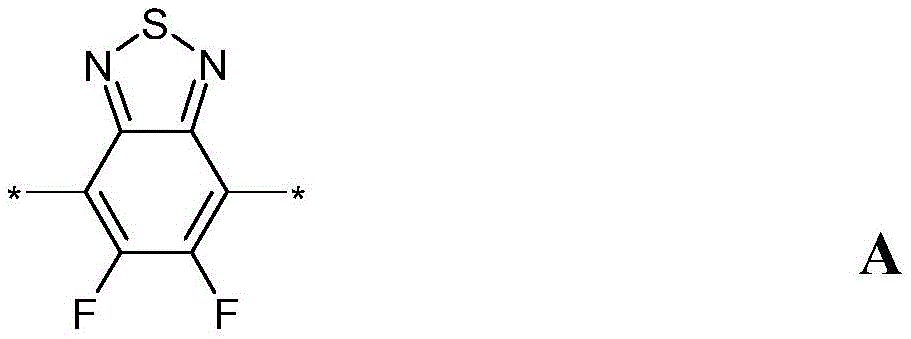
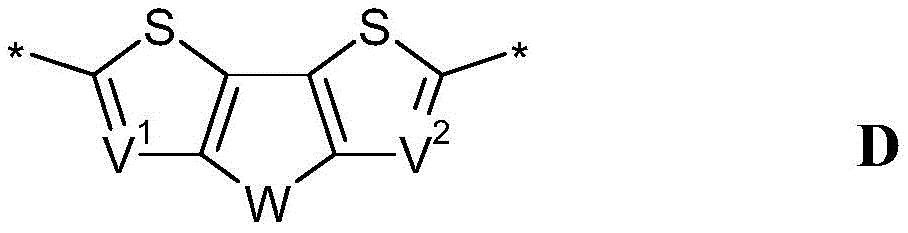
其中各基团彼此独立地和在每次出现时相同或不同地具有以下含义:wherein the radicals, independently of one another and at each occurrence, have the same or different meanings as follows:
V1是C或NR1,V 1 is C or NR 1 ,
V2是C或NR2,V 2 is C or NR 2 ,
W是S、O、CR3R4、SiR3R4、GeR3R4、NR3,W is S, O, CR 3 R 4 , SiR 3 R 4 , GeR 3 R 4 , NR 3 ,
R1-4是H,卤素,CN,或者直链、支化或环状的具有1-30个碳原子的烷基,其中一个或多个CH2基团任选地被-O-、-S-、-C(=O)-、-C(=S)-、-C(=O)-O-、-O-C(=O)-、-NR0-、-SiR0R00-、-CF2-、-CHR0=CR00-、-CY1=CY2-或-C≡C-以使得O和/或S原子彼此不直接连接的方式代替,其中一个或多个H原子任选地被F、Cl、Br、I或CN代替,和其中一个或多个CH2或CH3基团任选地被阳离子基团或阴离子基团代替;或表示饱和的或不饱和的非芳族的碳环或杂环基团,或表示芳基、杂芳基、芳氧基或杂芳氧基,上述每个环状基团具有5-20个环原子,是单环或多环的,任选地含有稠合环,并且是未取代的或被一个或多个相同或不同的基团RS取代,R 1-4 is H, halogen, CN, or a straight-chain, branched or cyclic alkyl group of 1-30 carbon atoms, wherein one or more CH 2 groups are optionally replaced by -O-, - S-, -C(=O)-, -C(=S)-, -C(=O)-O-, -OC(=O)-, -NR 0 -, -SiR 0 R 00 -, - CF 2 -, -CHR 0 =CR 00 -, -CY 1 =CY 2 - or -C≡C- are replaced in such a way that the O and/or S atoms are not directly connected to each other, wherein one or more H atoms are optionally is replaced by F, Cl, Br, I or CN, and wherein one or more CH2 or CH3 groups are optionally replaced by cationic or anionic groups; or means saturated or unsaturated non-aromatic carbocyclic or heterocyclic group, or represents an aryl group, a heteroaryl group, an aryloxy group or a heteroaryloxy group, each of the aforementioned cyclic groups has 5-20 ring atoms and is monocyclic or polycyclic, optionally contain fused rings and are unsubstituted or substituted with one or more groups R S of the same or different groups,
RS是卤素,-CN,-NC,-NCO,-NCS,-OCN,-SCN,-C(=O)NR0R00,-C(=O)X0,-C(=O)R0,-NH2,-NR0R00,-SH,-SR0,-SO3H,-SO2R0,-OH,-NO2,-CF3,-SF5,任选被取代的硅烷基,具有1-40个碳原子的任选被取代和任选含有一个或多个杂原子的碳基或烃基,R S is halogen, -CN, -NC, -NCO, -NCS, -OCN, -SCN, -C(=O) NR0R00 , -C( = O) X0 , -C(=O)R 0 , -NH2 , -NR0R00 , -SH , -SR0 , -SO3H , -SO2R0 , -OH , -NO2 , -CF3 , -SF5 , optionally substituted Silyl, optionally substituted carbon or hydrocarbyl having 1 to 40 carbon atoms and optionally containing one or more heteroatoms,
Y1、Y2是H、F、Cl或CN,Y 1 , Y 2 are H, F, Cl or CN,
X0是卤素,X 0 is halogen,
R0、R00是H或具有1-24个碳原子的烷基。R 0 , R 00 are H or an alkyl group having 1-24 carbon atoms.
本发明还涉及半导体聚合物,其含有一种或多种式A单元、一种或多种选自式D或D1*-D8*的单元、以及一种或多种与式A和D或D1*-D8*不同且具有电子供体性质的额外单元(下文中称为"供体单元")。The present invention also relates to semiconducting polymers containing one or more units of formula A, one or more units selected from formula D or D1*-D8*, and one or more units of formula A and D or D1 *-D8* Additional units that are different and have electron-donor properties (hereinafter referred to as "donor units").
本发明还涉及半导体聚合物,其含有一种或多种式A单元、一种或多种选自式D或D1*-D8*的单元、以及一种或多种与式A、D和D1*-D8*不同且具有电子受体性质的单元(下文中称为"受体单元")。The present invention also relates to semiconducting polymers containing one or more units of formula A, one or more units selected from formula D or D1*-D8*, and one or more units of formula A, D and D1 *-D8* units that are different and have electron acceptor properties (hereinafter referred to as "acceptor units").
本发明还涉及半导体聚合物,其含有一种或多种式A单元,一种或多种选自式D1*-D8*的单元,任选地一种或多种额外的供体单元和任选地一种或多种额外的受体单元,和另外含有位于所述式A单元、所述式D或D1*-D8*的单元、所述任选的供体单元和所述任选的受体单元之间的一种或多种额外特定单元(下文中称为"间隔单元"),从而防止所述式A和D或D1*-D8*的单元、任选的供体单元和任选的受体单元在聚合物链中彼此直接连接。The present invention also relates to semiconducting polymers comprising one or more units of formula A, one or more units selected from formulae D1*-D8*, optionally one or more additional donor units and any optionally one or more additional acceptor units, and additionally containing units located in said formula A unit, said formula D or D1*-D8*, said optional donor unit and said optional One or more additional specific units (hereinafter referred to as "spacer units") between acceptor units, thereby preventing the units of formulae A and D or D1*-D8*, optional donor units and any Selected acceptor units are directly linked to each other in the polymer chain.
选择间隔单元,使得它们不会起到对于式D或D1*-D8*单元和额外供体单元而言的电子受体的作用,和使得它们起到对于式A单元和额外受体单元而言的电子供体的作用。优选的间隔单元例如是噻吩-2,5-二基或二噻吩-2,5'-二基,其中噻吩环任选地在3-位和/或4-位上被如式D或D1*-D8*中所定义的基团R2取代。The spacer units are chosen so that they do not function as electron acceptors for the units of formula D or D1*-D8* and the additional donor units, and such that they function as electron acceptors for the units of formula A and the additional acceptor units the role of electron donor. Preferred spacer units are, for example, thiophene-2,5-diyl or dithiophene-2,5'-diyl, in which the thiophene ring is optionally substituted in the 3- and/or 4-position as in the formula D or D1* -The group R 2 as defined in D8* is substituted.
间隔单元可以例如通过以下方式被引入共聚物中:使得含有侧挂一个、两个或更多个间隔单元的式A或D或D1*-D8*单元的单体与和其连接的反应性基团进行共聚,或使得基本上由一个或多个间隔单元组成的单体与和其连接的反应性基团进行共聚。Spacer units can be introduced into the copolymer, for example, by allowing a monomer of formula A or D or D1*-D8* units with pendant one, two or more spacer units to be attached to a reactive group attached thereto. groups, or monomers consisting essentially of one or more spacer units are copolymerized with reactive groups attached thereto.
本发明还涉及根据本发明的聚合物作为电子供体或p-型半导体的用途。The invention also relates to the use of the polymers according to the invention as electron donors or p-type semiconductors.
本发明还涉及根据本发明的聚合物作为电子供体组分在半导体材料、聚合物共混物、器件或器件的部件中的用途。The present invention also relates to the use of the polymers according to the invention as electron-donor components in semiconductor materials, polymer blends, devices or parts of devices.
本发明还涉及混合物或聚合物共混物,其含有一种或多种根据本发明的聚合物和一种或多种额外化合物,所述额外化合物优选选自具有一种或多种以下性能的化合物:半导性能,电荷传输性能,空穴传输性能,电子传输性能,空穴阻断性能,电子阻断性能,导电性能,光电导性能和发光性能。The invention also relates to mixtures or polymer blends comprising one or more polymers according to the invention and one or more additional compounds, preferably selected from the group consisting of one or more of the following properties Compounds: semiconducting properties, charge transport properties, hole transport properties, electron transport properties, hole blocking properties, electron blocking properties, electrical conductivity, photoconductivity and luminescence properties.
本发明还涉及混合物或聚合物共混物,其含有根据本发明的一种或多种聚合物作为电子供体组分,和还含有一种或多种具有电子受体性质的化合物或聚合物。The present invention also relates to mixtures or polymer blends which contain one or more polymers according to the invention as electron-donor component, and also one or more compounds or polymers having electron-acceptor properties .
本发明还涉及混合物或聚合物共混物,其含有一种或多种根据本发明的聚合物和一种或多种n-型有机半导体化合物或聚合物,后者优选选自富勒烯或被取代的富勒烯。The invention also relates to mixtures or polymer blends comprising one or more polymers according to the invention and one or more n-type organic semiconducting compounds or polymers, the latter preferably being selected from fullerenes or Substituted fullerenes.
本发明还涉及本发明的聚合物、聚合物共混物或混合物用作半导体材料、电荷传输材料、导电材料、光电导材料或发光材料的用途,或用于光学器件、电光器件、电子器件、电致发光器件或光致发光器件中的用途,或用于这些器件中的部件中、或者用于包含这些器件或部件的组装体中的用途。The invention also relates to the use of the polymers, polymer blends or mixtures of the invention as semiconductor materials, charge transport materials, conductive materials, photoconductive materials or luminescent materials, or in optical devices, electro-optical devices, electronic devices, Use in electroluminescent devices or photoluminescent devices, or in components within these devices, or in assemblies comprising these devices or components.
本发明还涉及半导体材料、电荷传输材料、导电材料、光电导材料或发光材料,其含有根据本发明的聚合物、聚合物共混物或混合物。The present invention also relates to semiconductor materials, charge transport materials, conductive materials, photoconductive materials or luminescent materials comprising polymers, polymer blends or mixtures according to the invention.
本发明还涉及配制剂,其含有一种或多种根据本发明的聚合物、聚合物共混物或混合物和一种或多种溶剂,溶剂优选选自有机溶剂。The invention also relates to formulations containing one or more polymers, polymer blends or mixtures according to the invention and one or more solvents, preferably selected from organic solvents.
本发明还涉及光学器件、电光器件、电子器件、电致发光器件或光致发光器件,或其部件,或包含它们的组装体,其是使用根据本发明的配制剂制备的。The invention also relates to optical, electro-optical, electronic, electroluminescent or photoluminescent devices, or parts thereof, or assemblies comprising them, which are prepared using the formulations according to the invention.
本发明还涉及光学器件、电光器件、电子器件、电致发光器件或光致发光器件,或其部件,或包含它们的组装体,其含有根据本发明的聚合物、聚合物共混物或混合物,或含有根据本发明的半导体材料、电荷传输材料、导电材料、光电导材料或发光材料。The present invention also relates to optical, electro-optical, electronic, electroluminescent or photoluminescent devices, or parts thereof, or assemblies comprising them, comprising polymers, polymer blends or mixtures according to the invention , or contain a semiconductor material, charge transport material, conductive material, photoconductive material or luminescent material according to the present invention.
光学器件、电光器件、电子器件、电致发光器件和光致发光器件不受限制地包括:有机场效应晶体管(OFET),有机薄膜晶体管(OTFT),有机发光二极管(OLED),有机发光晶体管(OLET),有机光生伏打器件(OPV),有机光检测器(OPD),有机太阳能电池,染料敏化太阳能电池(DSSC),基于钙钛矿的太阳能电池,激光二极管,肖特基二极管,光电导体和光检测器。Optical, electro-optical, electronic, electroluminescent, and photoluminescent devices include, without limitation: Organic Field Effect Transistors (OFETs), Organic Thin Film Transistors (OTFTs), Organic Light Emitting Diodes (OLEDs), Organic Light Emitting Transistors (OLETs) ), organic photovoltaic devices (OPVs), organic photodetectors (OPDs), organic solar cells, dye-sensitized solar cells (DSSCs), perovskite-based solar cells, laser diodes, Schottky diodes, photoconductors and light detectors.
优选的器件是OFET、OTFT、OPV、OPD和OLED,特别是本体异质结(BHJ)OPV或倒装BHJOPV。Preferred devices are OFETs, OTFTs, OPVs, OPDs and OLEDs, especially bulk heterojunction (BHJ) OPVs or flip-chip BHJOPVs.
还优选的是根据本发明的化合物、组合物或聚合物共混物作为染料在DSSC或基于钙钛矿的太阳能电池中的用途,以及含有本发明化合物、组合物或聚合物共混物的DSSC或基于钙钛矿的太阳能电池。Also preferred is the use of the compounds, compositions or polymer blends according to the invention as dyes in DSSC or perovskite based solar cells, and DSSCs containing the compounds, compositions or polymer blends according to the invention Or perovskite-based solar cells.
上所器件的部件不受限制地包括:电荷注入层,电荷传输层,夹层,平面化层,抗静电膜,聚合物电解质膜(PEM),导电基底和导电图案。The components of the above device include, without limitation, charge injection layers, charge transport layers, interlayers, planarization layers, antistatic films, polymer electrolyte membranes (PEMs), conductive substrates, and conductive patterns.
含有这种器件或部件的组装体不受限制地包括:集成电路(IC),射频识别(RFID)标签或者含有它们的安全标识或安全器件,平板显示器或其背光,电子照相器件,电子照相记录器件,有机储存器件,传感器器件,生物传感器和生物芯片。Assemblies containing such devices or components include, without limitation: integrated circuits (ICs), radio frequency identification (RFID) tags or security labels or security devices containing them, flat panel displays or their backlights, electrophotographic devices, electrophotographic records devices, organic memory devices, sensor devices, biosensors and biochips.
另外,本发明的聚合物、聚合物共混物、混合物和配制剂可以作为电极材料用于电池中和用于部件或器件中,用于检测和区分DNA序列。Additionally, the polymers, polymer blends, mixtures and formulations of the present invention can be used as electrode materials in batteries and in components or devices for the detection and differentiation of DNA sequences.
本发明还涉及本体异质结,其含有混合物或由混合物形成,所述混合物含有一种或多种根据本发明的聚合物和一种或多种n-型有机半导体化合物,所述n-型有机半导体化合物优选选自富勒烯或被取代的富勒烯。本发明还涉及本体异质结(BHJ)OPV器件或倒装BHJ OPV器件,其含有这种本体异质结。The invention also relates to bulk heterojunctions comprising or formed from a mixture comprising one or more polymers according to the invention and one or more n-type organic semiconducting compounds, said n-type The organic semiconductor compound is preferably selected from fullerenes or substituted fullerenes. The present invention also relates to a bulk heterojunction (BHJ) OPV device or flip-chip BHJ OPV device containing such a bulk heterojunction.
术语和定义:Terms and Definitions:
本文使用的术语“聚合物”应当理解为具有高的相对分子量的分子,其结构主要包含实际上或概念上衍生自具有低相对分子量的分子的单元的多次重复(Pure Appl.Chem.,1996,68,2291)。术语“低聚物”应当理解为具有中等相对分子量的分子,其结构主要包含实际上或概念上衍生自具有较低相对分子量的分子的单元的少量重复(Pure Appl.Chem.,1996,68,2291)。在如本发明中所用的优选含义内,聚合物应当理解为具有>1个、即至少2个重复单元、优选≥5个重复单元的化合物,低聚物应当理解为意指具有>1且<10、优选<5个重复单元的化合物。The term "polymer" as used herein is to be understood as a molecule of high relative molecular weight, the structure of which consists essentially of multiple repetitions of units derived practically or conceptually from molecules of low relative molecular weight (Pure Appl. Chem., 1996 , 68, 2291). The term "oligomer" should be understood as a molecule of medium relative molecular weight, the structure of which mainly comprises a small number of repetitions of units derived in fact or conceptually from molecules of lower relative molecular weight (Pure Appl. Chem., 1996, 68, 2291). Within the preferred meaning as used in the present invention, polymers are understood to mean compounds having >1, ie at least 2 repeating units, preferably ≥5 repeating units, oligomers are understood to mean compounds having >1 and < 10. Compounds with <5 repeating units are preferred.
另外,如本文所用,术语“聚合物”应当理解为意指包括一类或多类独特重复单元(分子的最小结构单元)的骨架(也称为“主链”)的分子,且包括通常已知的术语“低聚物”、“共聚物”、“均聚物”、“无规聚合物”等。另外,应当理解术语“聚合物”除聚合物本身外还包含来自伴随该聚合物合成的引发剂、催化剂和其它元素的残余物,其中这类残余物应当理解为未共价引入到聚合物上。另外,尽管通常在聚合后提纯方法期间除去,这类残余物和其它元素通常与聚合物混合或共混合,以致它们在容器之间或者在溶剂或分散介质之间转移时通常留在聚合物中。Additionally, as used herein, the term "polymer" should be understood to mean a molecule that includes a backbone (also referred to as the "backbone") of one or more types of unique repeating units (the smallest structural unit of the molecule), and includes molecules that have typically been Known terms "oligomer", "copolymer", "homopolymer", "random polymer" and the like. In addition, it should be understood that the term "polymer" includes, in addition to the polymer itself, residues from initiators, catalysts and other elements accompanying the synthesis of the polymer, wherein such residues are understood to be not covalently incorporated into the polymer . Additionally, although typically removed during post-polymerization purification processes, such residues and other elements are typically mixed or co-mixed with the polymer such that they typically remain in the polymer when transferred between vessels or between solvents or dispersion media .
如本文所用,在显示聚合物或重复单元的式子中,例如在式A或D单元或式IV的聚合物或它们的子式中,星号(*)应当理解为意指与相邻单元或聚合物主链的端基之间的化学连接。在环、例如苯环或噻吩环中,星号(*)应当理解为意指与相邻环稠合的碳原子。As used herein, in a formula showing a polymer or repeating unit, for example in a unit of formula A or D or a polymer of formula IV or subformulae thereof, an asterisk (*) should be understood to mean adjacent units or chemical linkages between the end groups of the polymer backbone. In a ring, such as a benzene ring or a thiophene ring, an asterisk (*) should be understood to mean a carbon atom fused to the adjacent ring.
本文所用的术语“重复单元”和“单体单元”互换地使用,且应当理解为意指重复结构单元(CRU),其是最小结构单元,其重复构成规则的大分子、规则的低聚物分子、规则的嵌段或规则的链(Pure Appl.Chem.,1996,68,2291)。如本文中进一步使用,术语“单元”应当理解为意指结构单元本身可以是重复单元或者可以与其它单元一起形成结构重复单元。As used herein, the terms "repeating unit" and "monomer unit" are used interchangeably and should be understood to mean a repeating structural unit (CRU), which is the smallest structural unit that repeats to form regular macromolecules, regular oligomers molecules, regular blocks or regular chains (Pure Appl. Chem., 1996, 68, 2291). As further used herein, the term "unit" should be understood to mean that a structural unit may itself be a repeating unit or may together with other units form a structural repeating unit.
本文所用的“端基”应当理解为意指终止聚合物主链的基团。表述“在主链的末端位置上”应当理解为意指在一侧与这样的端基相连并在另一侧上与另一重复单元相连的二价单元或重复单元。此类端基包括封端基团,或者连接在不参与聚合反应的形成聚合物主链的单体上的反应性基团,例如具有如下文所定义的R5或R6的含义的基团。As used herein, "terminal group" should be understood to mean a group that terminates the polymer backbone. The expression "in a terminal position of the main chain" should be understood to mean a divalent unit or repeating unit which is attached to such an end group on one side and to another repeating unit on the other side. Such end groups include end capping groups, or reactive groups attached to monomers that do not participate in the polymerization reaction forming the polymer backbone, such as groups having the meaning of R5 or R6 as defined below .
本文所用的术语“封端基团”应当理解为意指连接在聚合物主链的端基上或者替代端基的基团。封端基团可以通过封端方法引入聚合物中。封端可以例如通过聚合物主链的端基与单官能化合物(“封端剂”)例如烷基-或芳基卤化物、烷基-或芳基锡烷或者烷基-或芳基硼酸酯反应而进行。封端剂可以例如在聚合反应之后加入。或者,封端剂可以在聚合反应之前或期间就地加入反应混合物中。封端剂的就地添加也可以用于终止聚合反应,因此控制所形成的聚合物的分子量。典型的封端基团例如是H、苯基和低级烷基。The term "end-capping group" as used herein should be understood to mean a group attached to or in place of a terminal group of the polymer backbone. End-capping groups can be introduced into the polymer by end-capping methods. Termination can be accomplished, for example, by end groups of the polymer backbone with monofunctional compounds ("capping agents") such as alkyl- or aryl halides, alkyl- or arylstannanes, or alkyl- or arylboronic acids ester reaction. The capping agent can be added, for example, after the polymerization reaction. Alternatively, the capping agent can be added to the reaction mixture in situ before or during the polymerization reaction. In situ addition of capping agents can also be used to terminate the polymerization reaction, thus controlling the molecular weight of the polymer formed. Typical capping groups are, for example, H, phenyl and lower alkyl.
本文所用的术语“小分子”意指通常不包含能反应形成聚合物的反应性基团的单体化合物,且其被指定以单体形式使用。与此相比,除非另外指出,术语“单体”意指带有一个或多个能反应形成聚合物的反应性官能团的单体化合物。As used herein, the term "small molecule" means a monomeric compound that generally does not contain a reactive group capable of reacting to form a polymer, and which is designated for use in monomeric form. In contrast, unless otherwise indicated, the term "monomer" means a monomeric compound bearing one or more reactive functional groups capable of reacting to form a polymer.
本文所用的术语“供体”或“供”和“受体”或“受”分别应当理解为意指电子供体或电子受体。“电子供体”应当理解为意指将电子供给另一化合物或化合物的另一原子基团的化学主体。“电子受体”应当理解为意指接收从另一化合物或化合物的另一原子基团转移给它的电子的化学主体。也参见International Union of Pure and Applied Chemistry,Compendium of Chemical Technology,Gold Book,版本2.3.2,2012年8月19日,第477和480页。As used herein, the terms "donor" or "donor" and "acceptor" or "acceptor" should be understood to mean electron donor or electron acceptor, respectively. "Electron donor" should be understood to mean a chemical host that donates electrons to another compound or another atomic group of a compound. "Electron acceptor" is understood to mean a chemical host that accepts an electron transferred to it from another compound or another atomic group of a compound. See also International Union of Pure and Applied Chemistry, Compendium of Chemical Technology, Gold Book, Version 2.3.2, August 19, 2012, pp. 477 and 480.
本文所用的术语“n-型”或“n-型半导体”应当理解为意指其中导电电子密度超过可迁移空穴密度的外质半导体,术语“p-型”或“p-型半导体”应当理解为意指其中可迁移空穴密度超过导电电子密度的外质半导体(也参见J.Thewlis,Concise Dictionary ofPhysics,Pergamon Press,Oxford,1973)。As used herein, the term "n-type" or "n-type semiconductor" shall be understood to mean an extrinsic semiconductor in which the density of conducting electrons exceeds the density of transportable holes, and the term "p-type" or "p-type semiconductor" shall It is understood to mean an extrinsic semiconductor in which the density of transportable holes exceeds the density of conducting electrons (see also J. Thewlis, Concise Dictionary of Physics, Pergamon Press, Oxford, 1973).
本文所用的术语“离去基团”应当理解为意指从被认为是参与指定反应的分子的残余部分或主要部分的那部分中的原子上脱离的原子或基团(其可以是带电或不带电的)(还参见Pure Appl.Chem.,1994,66,1134)。As used herein, the term "leaving group" should be understood to mean an atom or group (which may be charged or uncharged) that departs from an atom in that portion of the molecule that is believed to participate in the remainder or major portion of the given reaction. charged) (see also Pure Appl. Chem., 1994, 66, 1134).
本文所用的术语“共轭”应当理解为意指主要包含具有sp2-杂化(或还任选sp-杂化)的碳原子且这些碳原子还可以被杂原子替代的化合物(例如聚合物)。在最简单的情况下,这例如是具有交替C-C单键和双键(或三键)的化合物,还包括具有诸如1,4-亚苯基的芳族单元的化合物。就这点而言,术语“主要”应当理解为意指具有可导致共轭中断的天然(自发)存在的缺陷或由于设计而包括在内的缺陷的化合物仍被认为是共轭化合物。The term "conjugated" as used herein should be understood to mean compounds (eg polymers) comprising predominantly carbon atoms having sp2 -hybridization (or optionally also sp-hybridization) which may also be replaced by heteroatoms ). In the simplest case, this is for example a compound with alternating CC single and double bonds (or triple bonds), but also compounds with aromatic units such as 1,4-phenylene. In this regard, the term "predominantly" should be understood to mean that a compound that has a naturally (spontaneous) defect that can lead to interruption of conjugation, or a defect that is included by design, is still considered a conjugated compound.
除非另外指出,本文所用的分子量是作为数均分子量Mn或重均分子量MW给出,其通过凝胶渗透色谱法(GPC)在洗脱溶剂如四氢呋喃、三氯甲烷(TCM、氯仿)、氯苯或1,2,4-三氯苯中相对于聚苯乙烯标准测定。除非另外指出,1,2,4-三氯苯用作溶剂。聚合度,也称为重复单元的总数n,应当理解为意指作为n=Mn/MU给出的数均聚合度,其中Mn是数均分子量,且MU是单个重复单元的分子量,参见J.M.G.Cowie,Polymers:Chemistry&Physics of ModernMaterials,Blackie,Glasgow,1991。Unless otherwise indicated, molecular weights used herein are given as number average molecular weight Mn or weight average molecular weight MW by gel permeation chromatography (GPC) in elution solvents such as tetrahydrofuran, chloroform (TCM, chloroform), Determined relative to polystyrene standards in chlorobenzene or 1,2,4-trichlorobenzene. 1,2,4-Trichlorobenzene was used as solvent unless otherwise indicated. The degree of polymerization, also referred to as the total number of repeating units n, is understood to mean the number-average degree of polymerization given as n= Mn / MU , where Mn is the number-average molecular weight and MU is the molecular weight of a single repeating unit , see JMG Cowie, Polymers: Chemistry & Physics of Modern Materials, Blackie, Glasgow, 1991.
本文所用的术语“碳基”应当理解为意指任何包含至少一个碳原子的任何单价或多价有机基团结构部分,其不具有任何非碳原子(例如-C≡C-),或者所述碳原子任选地与至少一个非碳原子例如B、N、O、S、P、Si、Se、As、Te或Ge组合(例如羰基等)。The term "carbonyl" as used herein should be understood to mean any moiety of any monovalent or polyvalent organic group containing at least one carbon atom that does not have any non-carbon atoms (eg -C≡C-), or the The carbon atoms are optionally combined with at least one non-carbon atom such as B, N, O, S, P, Si, Se, As, Te or Ge (eg carbonyl, etc.).
本文所用的术语“烃基”应当理解为意指碳基,其还包含一个或多个H原子且任选地包含一个或多个杂原子例如B、N、O、S、P、Si、Se、As、Te或Ge。The term "hydrocarbyl" as used herein should be understood to mean a carbon radical further comprising one or more H atoms and optionally one or more heteroatoms such as B, N, O, S, P, Si, Se, As, Te or Ge.
本文所用的术语“杂原子”应当理解为意指有机化合物中不为H或碳原子的原子,优选应当理解为意指B、N、O、S、P、Si、Se、As、Te或Ge。The term "heteroatom" as used herein should be understood to mean atoms in organic compounds that are not H or carbon atoms, preferably B, N, O, S, P, Si, Se, As, Te or Ge .
包含3个或更多个碳原子的链的碳基或烃基可以是直链、支化和/或环状的,并且可以包括螺连接的环和/或稠合环。A carbon or hydrocarbyl group containing a chain of 3 or more carbon atoms may be straight chain, branched and/or cyclic, and may include spiro linked rings and/or fused rings.
优选的碳基和烃基包括各自任选被取代且具有1-40、优选1-25、非常优选1-18个碳原子的烷基、烷氧基、硫烷基、烷基羰基、烷氧基羰基、烷基羰氧基和烷氧基羰氧基,此外包括具有6-40、优选6-25个碳原子的任选被取代的芳基或芳氧基,此外包括各自任选被取代且具有6-40、优选7-40个碳原子的烷基芳氧基、芳基羰基、芳氧基羰基、芳基羰氧基和芳氧基羰氧基,其中所有这些基团任选地包含一个或多个杂原子,所述杂原子优选选自B、N、O、S、P、Si、Se、As、Te和Ge。Preferred carbon and hydrocarbyl groups include alkyl, alkoxy, sulfanyl, alkylcarbonyl, alkoxy, each optionally substituted and having 1-40, preferably 1-25, very preferably 1-18 carbon atoms carbonyl, alkylcarbonyloxy and alkoxycarbonyloxy, further including optionally substituted aryl or aryloxy having 6 to 40, preferably 6 to 25 carbon atoms, further including each optionally substituted and Alkylaryloxy, arylcarbonyl, aryloxycarbonyl, arylcarbonyloxy and aryloxycarbonyloxy having 6 to 40, preferably 7 to 40 carbon atoms, all of which optionally contain One or more heteroatoms, preferably selected from B, N, O, S, P, Si, Se, As, Te and Ge.
进一步优选的碳基和烃基包括例如:C1-C40烷基、C1-C40氟烷基、C1-C40烷氧基或氧杂烷基、C2-C40链烯基、C2-C40炔基、C3-C40烯丙基、C4-C40烷二烯基、C4-C40多烯基、C2-C40酮基团、C2-C40酯基团、C6-C18芳基、C6-C40烷基芳基、C6-C40芳基烷基、C4-C40环烷基、C4-C40环烯基等。在前述基团中,分别优选C1-C20烷基、C1-C20氟烷基、C2-C20链烯基、C2-C20炔基、C3-C20烯丙基、C4-C20烷二烯基、C2-C20酮基团、C2-C20酯基团、C6-C12芳基和C4-C20多烯基。Further preferred carbon and hydrocarbyl groups include, for example: C 1 -C 40 alkyl, C 1 -C 40 fluoroalkyl, C 1 -C 40 alkoxy or oxaalkyl, C 2 -C 40 alkenyl, C 2 -C 40 alkynyl, C 3 -C 40 allyl, C 4 -C 40 alkadienyl, C 4 -C 40 polyalkenyl, C 2 -C 40 ketone group, C 2 -C 40 Ester group, C 6 -C 18 aryl, C 6 -C 40 alkylaryl, C 6 -C 40 arylalkyl, C 4 -C 40 cycloalkyl, C 4 -C 40 cycloalkenyl, etc. . Among the aforementioned groups, C 1 -C 20 alkyl, C 1 -C 20 fluoroalkyl, C 2 -C 20 alkenyl, C 2 -C 20 alkynyl, C 3 -C 20 allyl are respectively preferred , C 4 -C 20 alkadienyl groups, C 2 -C 20 ketone groups, C 2 -C 20 ester groups, C 6 -C 12 aryl groups and C 4 -C 20 polyalkenyl groups.
还包括具有碳原子的基团与具有杂原子的基团的组合,例如被硅烷基、优选三烷基硅烷基取代的炔基,优选乙炔基。Also included are combinations of groups with carbon atoms and groups with heteroatoms, such as alkynyl groups, preferably ethynyl groups, substituted with silyl groups, preferably trialkylsilyl groups.
碳基或烃基可以是无环基团或环状基团。如果碳基或烃基是无环基团,则它可以是直链或支化的。如果碳基或烃基是环状基团,则它可以是非芳族的碳环或杂环基团,或者芳基或杂芳基。The carbon or hydrocarbyl group may be an acyclic group or a cyclic group. If the carbon or hydrocarbyl group is an acyclic group, it may be straight chain or branched. If a carbocyclic or hydrocarbyl group is a cyclic group, it may be a non-aromatic carbocyclic or heterocyclic group, or an aryl or heteroaryl group.
如上下文所提及的非芳族碳环基团是饱和或不饱和的,且优选具有4-30个环碳原子。如上下文所提及的非芳族杂环基团优选具有4-30个环碳原子,其中一个或多个碳环原子任选地被杂原子、优选选自N、O、S、Si和Se的杂原子替代,或者被-S(O)-或-S(O)2-基团替代。非芳族碳环和杂环基团是单环或多环的,也可以包含稠合环,优选包含1、2、3或4个稠合或未稠合的环,且任选地被一个或多个基团L取代,其中:Non-aromatic carbocyclic groups as mentioned above and below are saturated or unsaturated and preferably have from 4 to 30 ring carbon atoms. Non-aromatic heterocyclic groups as mentioned above and below preferably have from 4 to 30 ring carbon atoms, wherein one or more carbon ring atoms are optionally replaced by heteroatoms, preferably selected from N, O, S, Si and Se is replaced by a heteroatom of , or by -S(O)- or -S(O) 2 - groups. Non-aromatic carbocyclic and heterocyclic groups are monocyclic or polycyclic and may also contain fused rings, preferably 1, 2, 3 or 4 rings, fused or unfused, optionally surrounded by a or more groups L-substituted where:
L选自卤素、-CN、-NC、-NCO、-NCS、-OCN、-SCN、-C(=O)NR0R00、-C(=O)X0、-C(=O)R0、-NH2、-NR0R00、-SH、-SR0、-SO3H、-SO2R0、-OH、-NO2、-CF3、-SF5、任选被取代的硅烷基,或者具有1-40个碳原子且任选地被取代和任选地包含一个或多个杂原子的碳基或烃基,优选的是具有1-20个碳原子且任选氟化的烷基、烷氧基、硫烷基、烷基羰基、烷氧基羰基、烷基羰氧基或烷氧基羰氧基,X0是卤素,优选F、Cl或Br,且R0、R00具有上下文给出的含义,优选表示H或具有1-12个碳原子的烷基。L is selected from halogen, -CN, -NC, -NCO, -NCS, -OCN, -SCN, -C(=O)NR 0 R 00 , -C(=O)X 0 , -C(=O)R 0 , -NH2 , -NR0R00 , -SH , -SR0 , -SO3H , -SO2R0 , -OH , -NO2 , -CF3 , -SF5 , optionally substituted Silyl, or carbon or hydrocarbyl having 1-40 carbon atoms and optionally substituted and optionally containing one or more heteroatoms, preferably 1-20 carbon atoms and optionally fluorinated alkyl, alkoxy, sulfanyl, alkylcarbonyl, alkoxycarbonyl, alkylcarbonyloxy or alkoxycarbonyloxy, X 0 is halogen, preferably F, Cl or Br, and R 0 , R 00 has the meaning given in the context and preferably represents H or an alkyl group having 1 to 12 carbon atoms.
优选的取代基L选自卤素,最优选F,或者具有1-12个碳原子的烷基、烷氧基、氧杂烷基、硫烷基、氟烷基和氟烷氧基,或者具有2-12个碳原子的链烯基或炔基。Preferred substituents L are selected from halogen, most preferably F, or alkyl, alkoxy, oxaalkyl, sulfanyl, fluoroalkyl and fluoroalkoxy having 1 to 12 carbon atoms, or 2 -Alkenyl or alkynyl of 12 carbon atoms.
优选的非芳族碳环或杂环基团是四氢呋喃、茚满、吡喃、吡咯烷、哌啶、环戊烷、环己烷、环庚烷、环戊酮、环己酮、二氢呋喃-2-酮、四氢吡喃-2-酮和氧杂庚环-2-酮。Preferred non-aromatic carbocyclic or heterocyclic groups are tetrahydrofuran, indan, pyran, pyrrolidine, piperidine, cyclopentane, cyclohexane, cycloheptane, cyclopentanone, cyclohexanone, dihydrofuran -2-one, tetrahydropyran-2-one and oxepan-2-one.
如上下文所提及的芳基优选具有4-30个环碳原子,是单环或多环的,并且还可以包含稠合环,优选包含1、2、3或4个稠合或未稠合的环,且任选地被一个或多个如上文所定义的基团L取代。Aryl groups as mentioned above and below preferably have 4 to 30 ring carbon atoms, are monocyclic or polycyclic, and may also contain fused rings, preferably 1, 2, 3 or 4 fused or unfused and is optionally substituted with one or more groups L as defined above.
如上下文所提及的杂芳基优选具有4-30个环碳原子,其中一个或多个碳环原子被杂原子替代,优选选自N、O、S、Si和Se,是单环或多环的,并且还可以包含稠合环,优选包含1、2或3或4个稠合或未稠合的环,且任选地被一个或多个如上文所定义的基团L取代。Heteroaryl groups as mentioned above and below preferably have from 4 to 30 ring carbon atoms, wherein one or more carbon ring atoms are replaced by heteroatoms, preferably selected from N, O, S, Si and Se, monocyclic or polycyclic cyclic, and may also comprise fused rings, preferably 1, 2 or 3 or 4 rings, fused or unfused, and optionally substituted by one or more groups L as defined above.
本文所用的“亚芳基”应当理解为意指二价芳基,“亚杂芳基”应当理解为意指二价杂芳基,包括如上下文所给出的芳基和杂芳基的所有优选含义。As used herein, "arylene" should be understood to mean a divalent aryl group, and "heteroarylene" should be understood to mean a divalent heteroaryl group, including all of aryl and heteroaryl groups as given above and below Preferred meaning.
优选的芳基和杂芳基是苯基,其中一个或多个CH基团另外可以被N替代,萘,噻吩,硒吩,噻吩并噻吩,二噻吩并噻吩,芴和


烷基或烷氧基,即其中末端CH2基团被-O-替代,可以是直链或支化的。其优选是直链的,具有2、3、4、5、6、7、8、12或16个碳原子,相应地优选是乙基、丙基、丁基、戊基、己基、庚基、辛基、十二烷基或十六烷基,乙氧基、丙氧基、丁氧基、戊氧基、己氧基、庚氧基、辛氧基、十二烷氧基或十六烷氧基,例如还有甲基、壬基、癸基、十一烷基、十三烷基、十四烷基、十五烷基、壬氧基、癸氧基、十一烷氧基、十三烷氧基或十四烷氧基。Alkyl or alkoxy, ie in which the terminal CH2 group is replaced by -O-, may be straight chain or branched. It is preferably straight-chain, having 2, 3, 4, 5, 6, 7, 8, 12 or 16 carbon atoms, correspondingly preferably ethyl, propyl, butyl, pentyl, hexyl, heptyl, Octyl, dodecyl or hexadecyl, ethoxy, propoxy, butoxy, pentyloxy, hexyloxy, heptyloxy, octyloxy, dodecyloxy or hexadecyl Oxyl, for example also methyl, nonyl, decyl, undecyl, tridecyl, tetradecyl, pentadecyl, nonyloxy, decyloxy, undecyloxy, deca Trialkoxy or tetradecyloxy.
链烯基,即其中一个或多个CH2基团被-CH=CH-替代,可以是直链或支化的。其优选是直链的,具有2-10个碳原子,相应地优选是乙烯基,丙-1-或丙-2-烯基,丁-1-、2-或丁-3-烯基,戊-1-、2-、3-或戊-4-烯基,己-1-、2-、3-、4-或己-5-烯基,庚-1-、2-、3-、4-、5-或庚-6-烯基,辛-1-、2-、3-、4-、5-、6-或辛-7-烯基,壬-1-、2-、3-、4-、5-、6-、7-或壬-8-烯基,癸-1-、2-、3-、4-、5-、6-、7-、8-或癸-9-烯基。Alkenyl groups, ie in which one or more CH2 groups are replaced by -CH=CH-, may be straight chain or branched. It is preferably straight-chain, having 2 to 10 carbon atoms, correspondingly preferably vinyl, prop-1- or prop-2-enyl, but-1-, 2- or but-3-enyl, pentyl -1-, 2-, 3- or pent-4-enyl, hex-1-, 2-, 3-, 4- or hex-5-enyl, hept-1-, 2-, 3-, 4 -, 5- or hept-6-enyl, oct-1-, 2-, 3-, 4-, 5-, 6- or oct-7-enyl, non-1-, 2-, 3-, 4-, 5-, 6-, 7- or non-8-enyl, dec-1-, 2-, 3-, 4-, 5-, 6-, 7-, 8- or dec-9-ene base.
尤其优选的链烯基是C2-C7-1E-链烯基、C4-C7-3E-链烯基、C5-C7-4-链烯基、C6-C7-5-链烯基和C7-6-链烯基,特别是C2-C7-1E-链烯基、C4-C7-3E-链烯基和C5-C7-4-链烯基。特别优选的链烯基的实例是乙烯基、1E-丙烯基、1E-丁烯基、1E-戊烯基、1E-己烯基、1E-庚烯基、3-丁烯基、3E-戊烯基、3E-己烯基、3E-庚烯基、4-戊烯基、4Z-己烯基、4E-己烯基、4Z-庚烯基、5-己烯基、6-庚烯基等。通常优选具有至多5个碳原子的基团。Especially preferred alkenyl groups are C2 - C7-1E-alkenyl, C4 - C7-3E -alkenyl, C5 - C7-4 -alkenyl, C6 - C7-5 -alkenyl and C7-6-alkenyl, in particular C2 - C7-1E-alkenyl, C4 - C7-3E -alkenyl and C5 - C7-4 -alkenyl base. Examples of particularly preferred alkenyl groups are vinyl, 1E-propenyl, 1E-butenyl, 1E-pentenyl, 1E-hexenyl, 1E-heptenyl, 3-butenyl, 3E-pentenyl Alkenyl, 3E-hexenyl, 3E-heptenyl, 4-pentenyl, 4Z-hexenyl, 4E-hexenyl, 4Z-heptenyl, 5-hexenyl, 6-heptenyl Wait. Groups having up to 5 carbon atoms are generally preferred.
氧杂烷基,即其中一个CH2基团被-O-替代,优选例如是直链2-氧杂丙基(=甲氧基甲基),2-氧杂丁基(=乙氧基甲基)或3-氧杂丁基(=2-甲氧基乙基),2-、3-或4-氧杂戊基,2-、3-、4-或5-氧杂己基,2-、3-、4-、5-或6-氧杂庚基,2-、3-、4-、5-、6-或7-氧杂辛基,2-、3-、4-、5-、6-、7-或8-氧杂壬基或者2-、3-、4-、5-、6-、7-、8-或9-氧杂癸基。Oxaalkyl, i.e. where one CH2 group is replaced by -O-, preferably straight chain 2-oxapropyl (=methoxymethyl), 2-oxabutyl (=ethoxymethyl) group) or 3-oxetanyl (=2-methoxyethyl), 2-, 3- or 4-oxopentyl, 2-, 3-, 4- or 5-oxhexyl, 2- , 3-, 4-, 5- or 6-oxeptyl, 2-, 3-, 4-, 5-, 6- or 7-oxa-octyl, 2-, 3-, 4-, 5- , 6-, 7- or 8-oxanonyl or 2-, 3-, 4-, 5-, 6-, 7-, 8- or 9-oxadecyl.
在其中一个CH2基团被-O-替代且一个CH2被-C(O)-替代的烷基中,这些基团优选是相邻的。相应地,这些基团一起形成羰氧基-C(O)-O-或氧羰基-O-C(O)-。优选,该基团是直链的且具有2-6个碳原子。相应地,优选是乙酰氧基、丙酰氧基、丁酰氧基、戊酰氧基、己酰氧基、乙酰氧基甲基、丙酰氧基甲基、丁酰氧基甲基、戊酰氧基甲基、2-乙酰氧基乙基、2-丙酰氧基乙基、2-丁酰氧基乙基、3-乙酰氧基丙基、3-丙酰氧基丙基、4-乙酰氧基丁基、甲氧基羰基、乙氧基羰基、丙氧基羰基、丁氧基羰基、戊氧基羰基、甲氧基羰基甲基、乙氧基羰基甲基、丙氧基羰基甲基、丁氧基羰基甲基、2-(甲氧基羰基)乙基、2-(乙氧基羰基)乙基、2-(丙氧基羰基)乙基、3-(甲氧基羰基)丙基、3-(乙氧基羰基)丙基、4-(甲氧基羰基)-丁基。In alkyl groups in which one CH2 group is replaced by -O- and one CH2 group is replaced by -C(O)-, these groups are preferably adjacent. Accordingly, these groups together form carbonyloxy-C(O)-O- or oxycarbonyl-OC(O)-. Preferably, the group is straight chain and has 2-6 carbon atoms. Accordingly, preference is given to acetoxy, propionyloxy, butyryloxy, valeryloxy, hexanoyloxy, acetoxymethyl, propionyloxymethyl, butyryloxymethyl, pentanoyloxy Acyloxymethyl, 2-acetoxyethyl, 2-propionyloxyethyl, 2-butyryloxyethyl, 3-acetoxypropyl, 3-propionyloxypropyl, 4 -Acetoxybutyl, methoxycarbonyl, ethoxycarbonyl, propoxycarbonyl, butoxycarbonyl, pentoxycarbonyl, methoxycarbonylmethyl, ethoxycarbonylmethyl, propoxycarbonyl Methyl, butoxycarbonylmethyl, 2-(methoxycarbonyl)ethyl, 2-(ethoxycarbonyl)ethyl, 2-(propoxycarbonyl)ethyl, 3-(methoxycarbonyl) ) propyl, 3-(ethoxycarbonyl)propyl, 4-(methoxycarbonyl)-butyl.
其中两个或更多个CH2基团被-O-和/或-C(O)O-替代的烷基可以是直链或支化的。其优选是直链的且具有3-12个碳原子。相应地,优选是双-羧基-甲基、2,2-双-羧基-乙基、3,3-双-羧基-丙基、4,4-双-羧基-丁基、5,5-双-羧基-戊基、6,6-双-羧基-己基、7,7-双-羧基-庚基、8,8-双-羧基-辛基、9,9-双-羧基-壬基、10,10-双-羧基-癸基、双-(甲氧基羰基)-甲基、2,2-双-(甲氧基羰基)-乙基、3,3-双-(甲氧基羰基)-丙基、4,4-双-(甲氧基羰基)-丁基、5,5-双-(甲氧基羰基)-戊基、6,6-双-(甲氧基羰基)-己基、7,7-双-(甲氧基羰基)-庚基、8,8-双-(甲氧基羰基)-辛基、双-(乙氧基羰基)-甲基、2,2-双-(乙氧基羰基)-乙基、3,3-双-(乙氧基羰基)-丙基、4,4-双-(乙氧基羰基)-丁基、5,5-双-(乙氧基羰基)-己基。Alkyl groups in which two or more CH2 groups are replaced by -O- and/or -C(O)O- may be straight chain or branched. It is preferably straight-chain and has 3 to 12 carbon atoms. Accordingly, preference is given to bis-carboxy-methyl, 2,2-bis-carboxy-ethyl, 3,3-bis-carboxy-propyl, 4,4-bis-carboxy-butyl, 5,5-bis -Carboxyl-pentyl, 6,6-bis-carboxy-hexyl, 7,7-bis-carboxy-heptyl, 8,8-bis-carboxy-octyl, 9,9-bis-carboxy-nonyl, 10 ,10-bis-carboxy-decyl, bis-(methoxycarbonyl)-methyl, 2,2-bis-(methoxycarbonyl)-ethyl, 3,3-bis-(methoxycarbonyl) -propyl, 4,4-bis-(methoxycarbonyl)-butyl, 5,5-bis-(methoxycarbonyl)-pentyl, 6,6-bis-(methoxycarbonyl)-hexyl , 7,7-bis-(methoxycarbonyl)-heptyl, 8,8-bis-(methoxycarbonyl)-octyl, bis-(ethoxycarbonyl)-methyl, 2,2-bis -(Ethoxycarbonyl)-ethyl, 3,3-bis-(ethoxycarbonyl)-propyl, 4,4-bis-(ethoxycarbonyl)-butyl, 5,5-bis-( ethoxycarbonyl)-hexyl.
硫烷基,即其中一个CH2基团被-S-替代,优选是直链的硫甲基(-SCH3)、1-硫乙基(-SCH2CH3)、1-硫丙基(=-SCH2CH2CH3)、1-(硫丁基)、1-(硫戊基)、1-(硫己基)、1-(硫庚基)、1-(硫辛基)、1-(硫壬基)、1-(硫癸基)、1-(硫十一烷基)或1-(硫十二烷基),其中与sp2杂化的乙烯基碳原子相邻的CH2基团优选被替代。Sulfanyl, i.e. where one CH 2 group is replaced by -S-, preferably straight chain thiomethyl (-SCH 3 ), 1-thioethyl (-SCH 2 CH 3 ), 1-thiopropyl ( =-SCH 2 CH 2 CH 3 ), 1-(thiobutyl), 1-(thiopentyl), 1-(thiohexyl), 1-(thioheptyl), 1-(thiooctyl), 1 -(thiononyl), 1-(thiodecyl), 1-(thioundecyl), or 1-(thiododecyl), where the CH adjacent to the sp hybridized vinyl carbon atom 2 groups are preferably substituted.
氟烷基优选是全氟烷基CiF2i+1,其中i是1-15的整数,特别是CF3、C2F5、C3F7、C4F9、C5F11、C6F13、C7F15或C8F17,非常优选C6F13,或部分氟化的烷基,优选具有1-15个碳原子,特别是1,1-二氟烷基,上述所有基团都是直链或支化的。Fluoroalkyl is preferably a perfluoroalkyl C i F 2i+1 , where i is an integer from 1 to 15, especially CF 3 , C 2 F 5 , C 3 F 7 , C 4 F 9 , C 5 F 11 , C 6 F 13 , C 7 F 15 or C 8 F 17 , very preferably C 6 F 13 , or partially fluorinated alkyl, preferably with 1 to 15 carbon atoms, especially 1,1-difluoroalkyl, All of the abovementioned groups are straight-chain or branched.
优选"氟烷基"表示部分氟化(即,非全氟化)的烷基。Preferably "fluoroalkyl" refers to a partially fluorinated (ie, not perfluorinated) alkyl group.
烷基、烷氧基、链烯基、氧杂烷基、硫烷基、羰基和羰氧基可以是非手性基团或手性基团。特别优选的手性基团例如是:2-丁基(=1-甲基丙基),2-甲基丁基,2-甲基戊基,3-甲基戊基,2-乙基己基,2-丁基己基,2-丁基辛基,2-己基癸基,2-辛基十二烷基,2-丙基戊基,特别是2-甲基丁基,2-甲基丁氧基,2-甲基戊氧基,3-甲基-戊氧基,2-乙基-己氧基,2-丁基辛氧基,2-己基癸氧基,2-辛基十二烷氧基,1-甲基己氧基,2-辛基氧基,2-氧杂-3-甲基丁基,3-氧杂-4-甲基-戊基,4-甲基己基,2-己基,2-辛基,2-壬基,2-癸基,2-十二烷基,6-甲氧基-辛氧基,6-甲基辛氧基,6-甲基辛酰基-氧基,5-甲基庚氧基-羰基,2-甲基丁酰氧基,3-甲基戊酰氧基,4-甲基己酰氧基,2-氯-丙酰氧基,2-氯-3-甲基丁酰氧基,2-氯-4-甲基-戊酰氧基,2-氯-3-甲基戊酰氧基,2-甲基-3-氧杂戊基,2-甲基-3-氧杂-己基,1-甲氧基丙基-2-氧基,1-乙氧基丙基-2-氧基,1-丙氧基丙基-2-氧基,1-丁氧基丙基-2-氧基,2-氟辛基氧基,2-氟癸氧基,1,1,1-三氟-2-辛基氧基,1,1,1-三氟-2-辛基,2-氟甲基辛基氧基。非常优选的是2-乙基己基,2-丁基辛基,2-己基癸基,2-辛基十二烷基,2-己基,2-辛基,2-辛基氧基,1,1,1-三氟-2-己基,1,1,1-三氟-2-辛基和1,1,1-三氟-2-辛基氧基。Alkyl, alkoxy, alkenyl, oxaalkyl, sulfanyl, carbonyl, and carbonyloxy groups can be achiral or chiral. Particularly preferred chiral groups are, for example: 2-butyl (=1-methylpropyl), 2-methylbutyl, 2-methylpentyl, 3-methylpentyl, 2-ethylhexyl , 2-butylhexyl, 2-butyloctyl, 2-hexyldecyl, 2-octyldodecyl, 2-propylpentyl, especially 2-methylbutyl, 2-methylbutyl Oxy, 2-methylpentyloxy, 3-methyl-pentyloxy, 2-ethyl-hexyloxy, 2-butyloctyloxy, 2-hexyldecyloxy, 2-octyldodecyl Alkoxy, 1-methylhexyloxy, 2-octyloxy, 2-oxa-3-methylbutyl, 3-oxa-4-methyl-pentyl, 4-methylhexyl, 2-hexyl, 2-octyl, 2-nonyl, 2-decyl, 2-dodecyl, 6-methoxy-octyloxy, 6-methyloctyloxy, 6-methyloctanoyl -oxy, 5-methylheptyloxy-carbonyl, 2-methylbutyryloxy, 3-methylvaleryloxy, 4-methylhexanoyloxy, 2-chloro-propionyloxy, 2-Chloro-3-methylbutyryloxy, 2-chloro-4-methyl-valeryloxy, 2-chloro-3-methylvaleryloxy, 2-methyl-3-oxopentyl base, 2-methyl-3-oxa-hexyl, 1-methoxypropyl-2-oxy, 1-ethoxypropyl-2-oxy, 1-propoxypropyl-2- Oxy, 1-butoxypropyl-2-oxy, 2-fluorooctyloxy, 2-fluorodecyloxy, 1,1,1-trifluoro-2-octyloxy, 1,1 , 1-Trifluoro-2-octyl, 2-fluoromethyloctyloxy. Very preferred are 2-ethylhexyl, 2-butyloctyl, 2-hexyldecyl, 2-octyldodecyl, 2-hexyl, 2-octyl, 2-octyloxy, 1, 1,1-Trifluoro-2-hexyl, 1,1,1-trifluoro-2-octyl and 1,1,1-trifluoro-2-octyloxy.
优选的非手性支化基团是异丙基,异丁基(=甲基丙基),异戊基(=3-甲基丁基),叔丁基,异丙氧基,2-甲基-丙氧基和3-甲基丁氧基。Preferred achiral branching groups are isopropyl, isobutyl (=methylpropyl), isoamyl (=3-methylbutyl), tert-butyl, isopropoxy, 2-methyl yl-propoxy and 3-methylbutoxy.
在一个优选实施方案中,烷基彼此独立地选自具有1-30个碳原子且其中一个或多个H原子任选被F替代的伯、仲或叔烷基或烷氧基,或者是任选烷基化或烷氧基化且具有4-30个环原子的芳基、芳氧基、杂芳基或杂芳氧基。非常优选的这类基团选自下式:In a preferred embodiment, the alkyl groups are independently of each other selected from primary, secondary or tertiary alkyl or alkoxy groups having 1 to 30 carbon atoms in which one or more H atoms are optionally replaced by F, or any An aryl, aryloxy, heteroaryl or heteroaryloxy group which is alkylated or alkoxylated and has 4 to 30 ring atoms is selected. Very preferred such groups are selected from the formula:

其中“ALK”表示任选氟化的和优选直链的烷基或烷氧基,其具有1-20、优选1-12个碳原子,在叔基团的情况下非常优选具有1-9个碳原子,且虚线表示与这些基团所连接的环的连接。在这些基团中,尤其优选其中所有ALK子基团都相同的那些。where "ALK" denotes an optionally fluorinated and preferably straight-chain alkyl or alkoxy group having 1 to 20, preferably 1 to 12 carbon atoms, very preferably 1 to 9 carbon atoms in the case of tertiary groups carbon atoms, and dashed lines indicate linkages to the rings to which these groups are attached. Of these groups, those in which all ALK subgroups are the same are particularly preferred.
如本文所使用,如果芳基(氧基)或杂芳基(氧基)是"烷基化或烷氧基化的",则这表示其被一个或多个具有1-20个碳原子的直链或支化的烷基或烷氧基取代,并且其中一个或多个H原子任选地被F原子取代。As used herein, if an aryl (oxy) or heteroaryl (oxy) group is "alkylated or alkoxylated," this means that it is substituted by one or more radicals having 1-20 carbon atoms Linear or branched alkyl or alkoxy substituted, and wherein one or more H atoms are optionally substituted with F atoms.
在上文和下文中,Y1和Y2彼此独立地是H、F、Cl或CN。In the above and below, Y 1 and Y 2 are independently of each other H, F, Cl or CN.
在本文中,-CO-、-C(=O)-和-C(O)-将理解为表示羰基,即具有以下结构的基团:
在本文中,C=CR1R2将理解为表示亚基团,即具有以下结构的基团:In this context, C=CR 1 R 2 will be understood to mean a subgroup, ie a group having the following structure:

这里使用的"卤素"包括F、Cl、Br或I,优选F、Cl或Br。表示在环或链上的取代基的卤素原子优选是F或Cl,非常优选F。表示在单体中的反应性基团的卤素原子优选是Br或I。"Halogen" as used herein includes F, Cl, Br or I, preferably F, Cl or Br. The halogen atom representing the substituent on the ring or chain is preferably F or Cl, very preferably F. The halogen atom representing the reactive group in the monomer is preferably Br or I.
详细描述:Detailed Description:
本发明的聚合物是易于合成的,并显示有利的性能。它们显示优良的对于器件生产工艺的加工性,在有机溶剂中的高溶解度,和尤其适用于使用溶液加工技术的大规模生产方法。同时,从本发明单体和电子供体单体衍生的共聚物显示低的带隙,高的电荷载流子迁移率,在BHJ太阳能电池中的高的外部量子效率,当用于例如与富勒烯的p/n-型共混物中时的优良形态,高的氧化稳定性,在电子器件中的长寿命,并且是有前景的用于有机电子OE器件的材料,尤其是用于具有高功率转化效率的OPV器件。The polymers of the present invention are easy to synthesize and exhibit advantageous properties. They exhibit excellent processability for device production processes, high solubility in organic solvents, and are particularly suitable for large-scale production methods using solution processing techniques. At the same time, copolymers derived from the monomers of the present invention and electron donor monomers show low band gaps, high charge carrier mobility, high external quantum efficiency in BHJ solar cells, when used for example with rich Excellent morphology, high oxidative stability, long lifetime in electronic devices, and a promising material for organic electronic OE devices, especially for organic electronic OE devices OPV devices with high power conversion efficiency.
本发明的聚合物尤其适合作为p-型半导体用于制备p-型和n-型半导体的共混物,这些共混物适用于BHJ光生伏打器件中。The polymers of the present invention are particularly suitable as p-type semiconductors for the preparation of blends of p-type and n-type semiconductors suitable for use in BHJ photovoltaic devices.
另外,本发明的聚合物显示以下有利的性能:In addition, the polymers of the present invention exhibit the following advantageous properties:
i)聚合物主链的无规性质实现了改进的溶解熵,尤其是在非卤代溶剂中,从而获得改进的聚合物溶解性。i) The random nature of the polymer backbone enables improved entropy of dissolution, especially in non-halogenated solvents, resulting in improved polymer solubility.
ii)在聚合物主链中的桥接二噻吩单元的变化提供了HOMO能量水平精细调节,从而降低了在活性层中在聚合物和n-型材料(即,富勒烯、石墨烯、金属氧化物)之间的电子转移过程中的能量损失。ii) Variation of the bridging dithiophene units in the polymer backbone provides fine tuning of the HOMO energy level, thereby reducing the bridging of the polymer and n-type materials (i.e., fullerenes, graphene, metal oxides) in the active layer. energy loss during electron transfer between substances).
iii)在聚合物主链中的额外的电子受体单元(A1)提供了LUMO能量水平精细调节,从而降低了在活性层中在聚合物和n-型材料(即,富勒烯、石墨烯、金属氧化物)之间的电子转移过程中的能量损失。iii) The additional electron acceptor unit (A 1 ) in the polymer backbone provides fine tuning of the LUMO energy level, thereby reducing the amount of energy in the active layer in polymers and n-type materials (i.e., fullerenes, graphite, etc.). energy loss during electron transfer between alkenes, metal oxides).
iv)间隔(Sp1)单元提供额外的在聚合物主链中的无序、柔性和自由旋转,实现了改进的溶解熵,尤其是在非卤代溶剂中,同时保持在聚合物主链中的充足结构顺序,从而获得改进的聚合物溶解性。iv) Spacer (Sp 1 ) units provide additional disorder, flexibility and free rotation in the polymer backbone, enabling improved entropy of dissolution, especially in non-halogenated solvents, while remaining in the polymer backbone sufficient structural order to obtain improved polymer solubility.
v)间隔(Sp1)单元可以各自具有多于一个溶剂化基团,使得在非卤代溶剂中具有更高的聚合物溶解度,这是由于按照每个重复单元计具有增加数目的溶剂化基团。v) The spacer (Sp 1 ) units may each have more than one solvating group, resulting in higher polymer solubility in non-halogenated solvents due to an increased number of solvating groups per repeating unit group.
在本发明的一个优选实施方案中,式D单元是选自以下子式:In a preferred embodiment of the present invention, the unit of formula D is selected from the following subformulae:

其中R1-4是如上下文中所定义的。wherein R 1-4 are as defined in the context.
优选的是式D1*、D2*、D3*和D4*的单元,非常优选式D1*、D2*和D3*的单元。Preferred are units of the formulae D1*, D2*, D3* and D4*, very preferred are units of the formulae D1*, D2* and D3*.
优选,聚合物含有至少一种式A和至少两种选自不同的式D1*-D8*的不同单元。Preferably, the polymer contains at least one of formula A and at least two different units selected from different formulae D1*-D8*.
优选,在式D和D1*-D8*中的R1和R2是H。Preferably, R 1 and R 2 in formulae D and D1*-D8* are H.
优选,在式D和D1*-D8*中的R3和R4是与H不同的。Preferably, R3 and R4 in formulas D and D1* -D8 * are different from H.
优选,在式D和D1*-D8*中的R1-4,当与H不同时是选自以下基团:Preferably, R 1-4 in formula D and D1*-D8*, when different from H, is selected from the following groups:
-直链、支化或环状的具有1-50个、优选1-30个碳原子的烷基,其任选地被氟化,- straight-chain, branched or cyclic alkyl groups having 1 to 50, preferably 1 to 30 carbon atoms, optionally fluorinated,
-直链或支化的具有1-30个碳原子的烷基、烷氧基或硫烷基烷基,和直链或支化的具有2-30个碳原子的烷基羰基、烷基羰氧基或烷氧基羰基,每个上述基团是未取代的或被一个或多个F原子取代,- straight-chain or branched alkyl, alkoxy or sulfanylalkyl having 1 to 30 carbon atoms, and straight-chain or branched alkylcarbonyl, alkylcarbonyl having 2 to 30 carbon atoms oxy or alkoxycarbonyl, each of the above groups being unsubstituted or substituted with one or more F atoms,
-芳基、杂芳基、芳氧基和杂芳氧基,每个所述基团任选地被氟化、烷基化或烷氧基化,并且具有4-30个环原子,- aryl, heteroaryl, aryloxy and heteroaryloxy groups, each of said groups being optionally fluorinated, alkylated or alkoxylated and having 4 to 30 ring atoms,
-直链、支化或环状具有1-50个、优选2-30个碳原子的烷基,其中一个或多个CH2或CH3基团被阳离子基团或阴离子基团代替。- Linear, branched or cyclic alkyl groups having 1 to 50, preferably 2 to 30 carbon atoms, wherein one or more CH2 or CH3 groups are replaced by cationic or anionic groups.
如果R1-R4中的一个或多个表示芳基(氧基)或杂芳基(氧基),则其优选选自苯基,吡咯,呋喃,吡啶,噻唑,噻吩,噻吩并[3,2-b]噻吩或噻吩并[2,3-b]噻吩,它们各自是任选地被氟化、烷基化或烷氧基化的。If one or more of R 1 -R 4 represents aryl (oxy) or heteroaryl (oxy), it is preferably selected from phenyl, pyrrole, furan, pyridine, thiazole, thiophene, thieno[3 ,2-b]thiophene or thieno[2,3-b]thiophene, each of which is optionally fluorinated, alkylated or alkoxylated.
阳离子基团优选选自:


优选的阳离子基团是选自四烷基铵、四烷基


进一步优选的阳离子基团是选自下式:Further preferred cationic groups are selected from the formula:


其中R1'、R2'、R3'和R4'彼此独立地表示H,具有1-12个碳原子的直链或支化烷基,或非芳族的碳环或杂环状基团,或芳基或杂芳基,上述基团各自具有3-20个、优选5-15个环原子,是单环或多环的,和任选地被下文定义的一个或多个相同或不同的取代基RS取代,或表示与相应基团R1-4之间的连接。wherein R 1 ', R 2 ', R 3 ' and R 4 ' independently of one another represent H, a straight-chain or branched alkyl group having 1 to 12 carbon atoms, or a non-aromatic carbocyclic or heterocyclic group groups, or aryl or heteroaryl groups, each having 3 to 20, preferably 5 to 15 ring atoms, monocyclic or polycyclic, and optionally one or more of the same or Different substituents R S are substituted, or represent linkages with corresponding groups R 1-4 .
在上式的阳离子基团中,基团R1'、R2'、R3'和R4'中的任何一个(如果它们代替CH3基团的话)可以表示与基团R1之间的连接,或两个相邻基团R1'、R2'、R3'或R4'(如果它们代替CH3基团的话)可以表示与相应基团R1-4之间的连接。In the cationic group of the above formula, any one of the groups R 1 ', R 2 ', R 3 ' and R 4 ' (if they replace the CH 3 group) may represent a bond with the group R 1 A link, or two adjacent groups R 1 ', R 2 ', R 3 ' or R 4 ' (if they replace a CH 3 group) may represent a link to the corresponding group R 1-4 .
阴离子基团优选选自硼酸根、酰亚胺、磷酸根、磺酸根、硫酸根、琥珀酸根、环烷酸根或羧酸根,非常优选选自磷酸根、磺酸根或羧酸根。The anionic groups are preferably selected from borates, imides, phosphates, sulfonates, sulfates, succinates, naphthenates or carboxylates, very preferably from phosphates, sulfonates or carboxylates.
在一个优选实施方案中,除了式A单元和选自式D和D1*-D8*的单元之外,聚合物还含有一种或多种选自下式的间隔单元Sp:In a preferred embodiment, in addition to units of formula A and units selected from formula D and D1*-D8*, the polymer contains one or more spacer units Sp selected from the following formulae:


其中R11和R12彼此独立地表示H或具有如上下文中所定义的RS的含义之一。wherein R 11 and R 12 independently of each other represent H or have one of the meanings of R S as defined above and below.
优选的间隔单元是选自式Sp1、Sp4、Sp6,其中优选R11和R12中的一个是H,或R11和R12都是H。Preferred spacer units are selected from the formulae Sp1, Sp4 , Sp6, wherein preferably one of R11 and R12 is H, or both R11 and R12 are H.
在另一个优选实施方案中,除了式A单元和选自式D和D1*-D8*的单元之外,聚合物还含有一种或多种选自下式的亚芳基或杂亚芳基单元,优选其具有电子供体性质:In another preferred embodiment, in addition to units of formula A and units selected from formulae D and D1*-D8*, the polymer contains one or more arylene or heteroarylene groups selected from formulae unit, preferably it has electron-donor properties:


其中R11、R12、R13、R14、R15、R16、R17和R18彼此独立地表示H,或具有如上下文中所定义的RS的含义之一。wherein R 11 , R 12 , R 13 , R 14 , R 15 , R 16 , R 17 and R 18 independently of each other represent H, or have one of the meanings of R S as defined in the context.
优选的额外供体单元是选自式D1,D10,D19,D22,D25,D35,D36,D37,D38,D44,D84,D93,D94,D103,D108,D111,D137,D139,D140或D141,其中优选R11、R12、R13和R14中的至少一个是与H不同的。Preferred additional donor units are selected from formula D1, D10, D19, D22, D25, D35, D36, D37, D38, D44, D84, D93, D94, D103, D108, D111, D137, D139, D140 or D141, Among them, preferably at least one of R 11 , R 12 , R 13 and R 14 is different from H.
在另一个优选实施方案中,除了式A单元和选自式D和D1*-D8*的单元之外,聚合物还含有一种或多种选自下式的亚芳基或杂亚芳基单元,优选其具有电子受体性质,In another preferred embodiment, in addition to units of formula A and units selected from formulae D and D1*-D8*, the polymer contains one or more arylene or heteroarylene groups selected from formulae unit, preferably it has electron acceptor properties,


其中R11、R12、R13、R14、R15和R16彼此独立地表示H,或具有如上下文中所定义的RS的含义之一。wherein R 11 , R 12 , R 13 , R 14 , R 15 and R 16 independently of each other represent H, or have one of the meanings of R S as defined in the context.
优选的额外受体单元是选自式A1、A2、A3、A20、A41、A48、A74、A85或A94,其中优选R11、R12、R13和R14中的至少一个是与H不同的。Preferred additional acceptor units are selected from formula A1, A2, A3, A20, A41, A48, A74, A85 or A94, wherein preferably at least one of R 11 , R 12 , R 13 and R 14 is different from H .
进一步优选的额外受体单元是选自式A1,其中R11和R12是H。A further preferred additional acceptor unit is selected from formula A1, wherein R11 and R12 are H.
优选的聚合物是选自下式:Preferred polymers are selected from the formula:


其中各基团彼此独立地和在每次出现时相同或不同地具有以下含义:wherein the radicals, independently of one another and at each occurrence, have the same or different meanings as follows:
W1-4选自S、O、CR3R4、SiR3R4、GeR3R4和NR3,优选选自CR3R4、SiR3R4和NR3,其中W1、W2、W3和W4中的至少两个是彼此不同的,W 1-4 is selected from S, O, CR 3 R 4 , SiR 3 R 4 , GeR 3 R 4 and NR 3 , preferably selected from CR 3 R 4 , SiR 3 R 4 and NR 3 , wherein W 1 , W 2 , at least two of W 3 and W 4 are different from each other,
R1-4具有上下文中给出的式D和D1*-D8*中的含义或优选含义之一,R 1-4 have one of the meanings or preferred meanings in formula D and D1*-D8* given in the context,
Sp1、Sp2是选自式Sp1至Sp16的间隔单元,Sp 1 , Sp 2 are spacer units selected from the formula Sp1 to Sp16,
A1-3是具有5-20个环原子的亚芳基或杂亚芳基,其是单环或多环的,任选地含有稠合环,并且是未取代的或被一个或多个相同或不同的如上所定义的基团RS取代,其优选具有电子受体性质,和优选选自式A1-A94,非常优选选自式A1、A2、A3、A20、A41、A48、A74、A85和A94,A 1-3 are arylene or heteroarylene groups having 5-20 ring atoms, which are monocyclic or polycyclic, optionally containing fused rings, and are unsubstituted or replaced by one or more The same or different groups R S as defined above are substituted, which preferably have electron acceptor properties, and are preferably selected from the formulae A1-A94, very preferably from the formulae A1, A2, A3, A20, A41, A48, A74, A85 and A94,
a、b、c、d、e、f是>0且≤1,其中a+b或a+b+c+d或a+b+c+d+e+f是1,a, b, c, d, e, f are >0 and ≤1, where a+b or a+b+c+d or a+b+c+d+e+f is 1,
n是>1的整数。n is an integer >1.
非常优选的是选自式I至V的聚合物。Very preferred are polymers selected from formulae I to V.
尤其优选的是选自以下子式的聚合物:Especially preferred are polymers selected from the following sub-formulas:


其中R21-R24彼此独立地具有对于R3给出的含义之一,并且a、b、c、d和n是如上文所定义的。wherein R 21 to R 24 independently of one another have one of the meanings given for R 3 and a, b, c, d and n are as defined above.
在式I至X的聚合物和它们的子式中,每个a、b、c、d、e和f优选是0.1-0.9。In the polymers of formulae I to X and their subformulae, each of a, b, c, d, e and f is preferably from 0.1 to 0.9.
在式I至X的聚合物和它们的子式中,每个a、b、c、d、e和f具有基本相同的数值。In the polymers of formulae I to X and their subformulae, each of a, b, c, d, e and f has substantially the same numerical value.
在本发明的共轭聚合物中,重复单元的总数n优选是2-10,000。重复单元的总数n优选是≥5,非常优选≥10,最优选≥50,并且优选≤500,非常优选≤1000,最优选≤2000,包括n的上述下限和上限的任何组合。In the conjugated polymer of the present invention, the total number n of repeating units is preferably 2 to 10,000. The total number n of repeating units is preferably > 5, very preferably > 10, most preferably > 50, and preferably < 500, very preferably < 1000, most preferably < 2000, including any combination of the above lower and upper limits for n.
本发明的聚合物优选是统计或无规共聚物。The polymers of the present invention are preferably statistical or random copolymers.
进一步优选的是根据本发明的共轭聚合物,其选自式P:Further preferred are conjugated polymers according to the invention, which are selected from formula P:
R31-链-R32PR 31 - Chain - R 32 P
其中“链”表示聚合物链,其选自式I至X或它们的子式,并且R31和R32彼此独立地具有如上文所定义的RS的含义之一,或彼此独立地表示H,F,Br,Cl,I,-CH2Cl,-CHO,-CR'=CR"2,-SiR'R"R"',-SiR'X'X",-SiR'R"X',-SnR'R"R"',-BR'R",-B(OR')(OR"),-B(OH)2,-O-SO2-R',-C≡CH,-C≡C-SiR'3,-ZnX'或封端基团,X'和X"表示卤素,R'、R"和R'"彼此独立地具有在式D中给出的R0的含义之一,优选表示具有1-12个碳原子的烷基,并且R'、R"和R'"中的两个也可以与和它们连接的相应杂原子一起形成具有2-20个碳原子的环硅烷基、环锡烷基、环硼烷或环硼酸酯基团。wherein "chain" denotes a polymer chain selected from formulae I to X or their subformulae and R 31 and R 32 independently of each other have one of the meanings of R S as defined above, or independently of each other represent H , F, Br, Cl, I, -CH 2 Cl, -CHO, -CR'=CR" 2 , -SiR'R"R"',-SiR'X'X",-SiR'R"X', -SnR'R"R"', -BR'R", -B(OR')(OR"), -B(OH) 2 , -O-SO 2 -R', -C≡CH, -C≡ C-SiR' 3 , -ZnX' or end-capping group, X' and X" represent halogen, R', R" and R'" independently of each other have one of the meanings of R 0 given in formula D, Preferably represents an alkyl group having 1 to 12 carbon atoms, and two of R', R" and R'" may also form, together with the corresponding heteroatom to which they are attached, a cyclosilyl group having 2 to 20 carbon atoms , cyclostannyl, cycloborane or cycloboronate groups.
优选的封端基团R31和R32是H,C1-20烷基,或任选取代的C6-12芳基或C2-10杂芳基,非常优选H或苯基。Preferred end capping groups R 31 and R 32 are H, C 1-20 alkyl, or optionally substituted C 6-12 aryl or C 2-10 heteroaryl, very preferably H or phenyl.
共轭聚合物可以例如通过一种或多种选自下式的单体按照芳基-芳基偶联反应共聚制备:Conjugated polymers can be prepared, for example, by the copolymerization of one or more monomers selected from the following formulae according to an aryl-aryl coupling reaction:
R33-A-R34 MIR 33 -AR 34 MI
R33-D-R34 MIIR 33 -DR 34 MII
R33-Sp1-R34 MIIIR 33 -Sp 1 -R 34 MIII
R33-Sp2-R34 MIVR 33 -Sp 2 -R 34 MIV
R33-A1-R34 MVR33- A1 - R34MV
R33-Sp2-R34 MVIR 33 -Sp 2 -R 34 MVI
其中至少一种单体选自式MI,并且至少两种单体是选自式MII,wherein at least one monomer is selected from formula MI, and at least two monomers are selected from formula MII,
A表示式A的单元,A represents a unit of formula A,
D表示式D或D1*-D8*的单元,D represents a unit of formula D or D1*-D8*,
Sp1,2表示如式I至X中所定义的间隔单元,Sp 1,2 represents a spacer unit as defined in formulae I to X,
A1,2表示如式I至X中所定义的受体单元,A 1,2 represents an acceptor unit as defined in formulae I to X,
R33和R34彼此独立地选自H,其优选是活化C-H键;Cl,Br,I,O-甲苯磺酸酯,O-三氟甲磺酸酯,O-甲磺酸酯,O-全氟丁基磺酸酯,-SiMe2F,-SiMeF2,-O-SO2Z1,-B(OZ2)2,-CZ3=C(Z3)2,-C≡CH,-C≡CSi(Z1)3,-ZnX0和-Sn(Z4)3,其中X0是卤素,优选Cl、Br或I;Z1-4是选自烷基,优选C1-10烷基,和芳基,优选C6-12芳基,其各自是任选被取代的,并且两个基团Z2也可以与B和O原子一起形成具有2-20个碳原子的环硼酸酯基团。R 33 and R 34 are independently of each other selected from H, which is preferably an activated CH bond; Cl, Br, I, O-toluenesulfonate, O-trifluoromethanesulfonate, O-methanesulfonate, O- Perfluorobutanesulfonate, -SiMe 2 F, -SiMeF 2 , -O-SO 2 Z 1 , -B(OZ 2 ) 2 , -CZ 3 =C(Z 3 ) 2 , -C≡CH, - C≡CSi(Z 1 ) 3 , -ZnX 0 and -Sn(Z 4 ) 3 , wherein X 0 is halogen, preferably Cl, Br or I; Z 1-4 is selected from alkyl, preferably C 1-10 alkane radicals, and aryl radicals, preferably C 6-12 aryl radicals, each of which is optionally substituted, and the two radicals Z 2 can also form, together with the B and O atoms, a cyclic boronic acid having 2-20 carbon atoms ester group.
具有式MI至MVII的单体可以互相共聚,和/或与其它合适的共聚单体共聚。Monomers of formulae MI to MVII may be copolymerized with each other and/or with other suitable comonomers.
本发明的聚合物可以根据本领域技术人员已知且描述于文献中的方法或类似方法合成。其它制备方法可由实施例中获得。The polymers of the present invention can be synthesized according to methods known to those skilled in the art and described in the literature or analogous methods. Other preparation methods can be obtained from the examples.
例如,聚合物可以适当地通过芳基-芳基偶联反应制备,例如Yamamoto偶联、C-H活化偶联、Suzuki偶联、Stille偶联、Sonogashira偶联、Heck偶联或Buchwald偶联。尤其优选Suzuki偶联、Stille偶联和Yamamoto偶联。用于聚合形成聚合物的重复单元的单体可根据本领域技术人员已知的方法制备。For example, polymers can be suitably prepared by aryl-aryl coupling reactions such as Yamamoto coupling, C-H activation coupling, Suzuki coupling, Stille coupling, Sonogashira coupling, Heck coupling or Buchwald coupling. Especially preferred are Suzuki coupling, Stille coupling and Yamamoto coupling. The monomers used to polymerize to form the repeating units of the polymer can be prepared according to methods known to those skilled in the art.
聚合物优选是从选自如上所述式MI至MVII的单体制备的。The polymers are preferably prepared from monomers selected from the group consisting of formulae MI to MVII as described above.
本发明的另一个方面是一种制备聚合物的方法,其中一种或多种相同或不同的选自式MI至MVII的单体彼此之间和/或与一种或多种共聚单体在聚合反应中进行偶联,优选在芳基-芳基偶联反应中进行偶联。Another aspect of the present invention is a process for the preparation of a polymer wherein one or more identical or different monomers selected from formulae MI to MVII are present with each other and/or with one or more comonomers Coupling is carried out in a polymerization reaction, preferably in an aryl-aryl coupling reaction.
上下文所述方法中使用的优选的芳基-芳基偶联和聚合方法是Yamamoto偶联、Kumada偶联、Negishi偶联、Suzuki偶联、Stille偶联、Sonogashira偶联、Heck偶联、C-H活化偶联、Ullmann偶联或Buchwald偶联。尤其优选Suzuki偶联、Negishi偶联、Stille偶联和Yamamoto偶联。Suzuki偶联描述于例如WO 00/53656A1中。Negishi偶联描述于例如J.Chem.Soc.,Chem.Commun.,1977,683-684中。Yamamoto偶联描述于例如T.Yamamoto等人,Prog.Polym.Sci.,1993,17,1153-1205,或者WO 2004/022626A1中。Stille偶联描述于例如Z.Bao等人,J.Am.Chem.Soc.,1995,117,12426-12435中。C-H活化描述于例如M.Leclerc等,Angew.Chem.Int.Ed.2012,51,2068–2071中。例如,当使用Yamamoto偶联时,优选使用具有2个反应性卤化物基团的单体。当使用Suzuki偶联时,优选使用具有2个反应性硼酸或硼酸酯基团或者2个反应性卤化物基团的单体。当使用Stille偶联时,优选使用具有2个反应性锡烷基团或者2个反应性卤化物基团的单体。当使用Negishi偶联时,优选使用具有2个反应性有机锌基团或2个反应性卤化物基团的单体。当通过C-H活化聚合合成线性聚合物时,优选使用如上所述的单体,其中至少一个反应性基团是活化的氢键。Preferred aryl-aryl coupling and polymerization methods used in the methods described above and below are Yamamoto coupling, Kumada coupling, Negishi coupling, Suzuki coupling, Stille coupling, Sonogashira coupling, Heck coupling, C-H activation Coupling, Ullmann coupling or Buchwald coupling. Especially preferred are Suzuki coupling, Negishi coupling, Stille coupling and Yamamoto coupling. Suzuki coupling is described, for example, in WO 00/53656A1. Negishi coupling is described, for example, in J. Chem. Soc., Chem. Commun., 1977, 683-684. Yamamoto coupling is described, for example, in T. Yamamoto et al., Prog. Polym. Sci., 1993, 17, 1153-1205, or in WO 2004/022626A1. Stille coupling is described, for example, in Z. Bao et al., J. Am. Chem. Soc., 1995, 117, 12426-12435. C-H activation is described, for example, in M. Leclerc et al., Angew. Chem. Int. Ed. 2012, 51, 2068-2071. For example, when using Yamamoto coupling, it is preferred to use monomers having 2 reactive halide groups. When using Suzuki coupling, it is preferred to use monomers having 2 reactive boronic acid or boronic ester groups or 2 reactive halide groups. When Stille coupling is used, monomers with 2 reactive stannane groups or 2 reactive halide groups are preferably used. When Negishi coupling is used, monomers with 2 reactive organozinc groups or 2 reactive halide groups are preferably used. When synthesizing linear polymers by C-H activated polymerization, it is preferred to use monomers as described above, wherein at least one of the reactive groups is an activated hydrogen bond.
优选的催化剂,尤其是用于Suzuki、Negishi或Stille偶联的催化剂,是选自Pd(0)配合物或Pd(II)盐。优选的Pd(0)配合物是带有至少一个膦配体的那些,例如Pd(Ph3P)4。另一个优选的膦配体是三(邻-甲苯基)膦,即Pd(o-Tol3P)4。优选的Pd(II)盐包括乙酸钯,即Pd(OAc)2,或反-二(μ-乙酰基)-二[o-(二-邻-甲苯基膦酰基)苄基]二钯(II)。或者,Pd(0)配合物可以通过Pd(0)二亚苄基丙酮配合物如三(二亚苄基丙酮)二钯(0)、双(二亚苄基丙酮)钯(0)或Pd(II)盐如乙酸钯与膦配体如三苯基膦、三(邻-甲苯基)膦、三(邻-甲氧基苯基)膦或三(叔丁基)膦混合而制备。Suzuki聚合是在碱例如碳酸钠、碳酸钾、碳酸铯、氢氧化锂、磷酸钾或有机碱例如四乙基碳酸铵或四乙基氢氧化铵的存在下进行的。Yamamoto聚合反应使用Ni(0)配合物,例如双(1,5-环辛二烯基)镍(0)。Preferred catalysts, especially for Suzuki, Negishi or Stille couplings, are selected from Pd(0) complexes or Pd(II) salts. Preferred Pd(0) complexes are those bearing at least one phosphine ligand, eg Pd(Ph3P )4 . Another preferred phosphine ligand is tris(o-tolyl)phosphine, ie Pd(o-Tol3P )4 . Preferred Pd(II) salts include palladium acetate, i.e. Pd(OAc) 2 , or trans-bis(μ-acetyl)-bis[o-(bis-o-tolylphosphono)benzyl]dipalladium(II) ). Alternatively, the Pd(0) complex can be obtained via a Pd(0) dibenzylideneacetone complex such as tris(dibenzylideneacetone)dipalladium(0), bis(dibenzylideneacetone)palladium(0) or Pd (II) Salts such as palladium acetate are prepared by mixing with phosphine ligands such as triphenylphosphine, tris(o-tolyl)phosphine, tris(o-methoxyphenyl)phosphine or tris(tert-butyl)phosphine. Suzuki polymerization is carried out in the presence of a base such as sodium carbonate, potassium carbonate, cesium carbonate, lithium hydroxide, potassium phosphate or an organic base such as tetraethylammonium carbonate or tetraethylammonium hydroxide. Yamamoto polymerization uses Ni(0) complexes such as bis(1,5-cyclooctadienyl)nickel(0).
Suzuki、Stille或C-H活化偶联聚合可以用于制备均聚物以及统计、交替和嵌段无规共聚物。统计、无规嵌段共聚物或嵌段共聚物可以例如由上述单体制备,其中反应性基团之一是卤素,且另一个反应性基团是C-H活化键、硼酸、硼酸衍生物基团或和烷基锡烷。统计、交替和嵌段共聚物的合成详细地描述于例如WO 03/048225 A2或WO 2005/014688 A2中。Suzuki, Stille or C-H activated coupling polymerization can be used to prepare homopolymers as well as statistical, alternating and block random copolymers. Statistical, random block copolymers or block copolymers can be prepared, for example, from the above monomers, wherein one of the reactive groups is a halogen and the other reactive group is a C-H activated bond, boronic acid, a boronic acid derivative group or and alkylstannane. The synthesis of statistical, alternating and block copolymers is described in detail in eg WO 03/048225 A2 or WO 2005/014688 A2.
作为代替上述卤素的另一个选择,可以使用具有式-O-SO2Z1的离去基团,其中Z1是如上定义的。这种离去基团的具体例子是甲苯磺酸酯、甲磺酸酯和三氟甲磺酸酯。As another alternative to the above halogens, a leaving group having the formula -O - SO2Z1 can be used, wherein Z1 is as defined above. Specific examples of such leaving groups are tosylate, mesylate and triflate.
合适和优选的制备本发明聚合物的方法显示在以下反应路线中。Suitable and preferred methods of preparing the polymers of the present invention are shown in the following reaction schemes.
制备具有式A的BTZ-F2单体的一般方法可以参见例如WO 2011/060526 A1。A general method for preparing BTZ-F 2 monomers of formula A can be found, for example, in WO 2011/060526 A1.
具有式D的二噻吩单体的合成方法可以例如参见Macromolecules,2007,40(26),Organometallics 2011,30,3233–3236,Macromolecules,2007,40(6)和J.Am.Chem.Soc.2008,130,13167–13176。Methods for the synthesis of dithiophene monomers of formula D can be found, for example, in Macromolecules, 2007, 40(26), Organometallics 2011, 30, 3233-3236, Macromolecules, 2007, 40(6) and J.Am.Chem.Soc.2008 , 130, 13167–13176.
无规共聚物的合成方法例如参见以下路线1至3,其中A1、Sp1、W1-3、a、b、c、d和n是如上文所定义的,RG1和RG2表示对于R33所定义的反应性基团。Methods for the synthesis of random copolymers see, for example, Schemes 1 to 3 below, wherein A 1 , Sp 1 , W 1-3 , a, b, c, d and n are as defined above, and RG 1 and RG 2 represent for A reactive group as defined by R 33 .
RG1和RG2基团是优选在缩聚反应中互补的,例如Suzuki偶联、Stille偶联、Sonogashira偶联、Heck偶联、Negishi偶联或C-H活化偶联。反应性基团优选选自由Cl、Br、I、O-甲苯磺酸酯、O-三氟甲磺酸酯、O-甲磺酸酯和O-全氟丁基磺酸酯组成的第一组反应性基团,和由-SiMe2F、-SiMeF2、-O-SO2Z1,-B(OZ2)2、-CZ3=C(Z3)2、-C≡CH、-C≡CSi(Z1)3、-ZnX0和-Sn(Z4)3组成的第二组反应性基团,其中X和Z1-4是如上文所定义的。The RG 1 and RG 2 groups are preferably complementary in polycondensation reactions such as Suzuki coupling, Stille coupling, Sonogashira coupling, Heck coupling, Negishi coupling or CH activation coupling. The reactive group is preferably selected from the first group consisting of Cl, Br, I, O-toluenesulfonate, O-trifluoromethanesulfonate, O-methanesulfonate and O-perfluorobutylsulfonate Reactive groups, and from -SiMe 2 F, -SiMeF 2 , -O-SO 2 Z 1 , -B(OZ 2 ) 2 , -CZ 3 =C(Z 3 ) 2 , -C≡CH, -C ≡ A second group of reactive groups consisting of CSi(Z 1 ) 3 , -ZnX 0 and -Sn(Z 4 ) 3 , where X and Z 1-4 are as defined above.
路线1route 1

路线2route 2


路线3route 3

优选的聚合条件获得交替聚合物,其特别优选用于OTFT应用,而制备的统计嵌段共聚物是优选用于OPV和OPD应用。优选的缩聚反应是Suzuki偶联、Stille偶联、Sonogashira偶联、Heck偶联或Buchwald偶联,Negishi偶联或C-H活化偶联,其中第一组的反应性基团是由-Cl、-Br、-I、O-甲苯磺酸酯、O-三氟甲磺酸酯、O-甲磺酸酯和O-全氟丁基磺酸酯组成,第二组的反应性基团是由-H、-SiR2F、-SiRF2、-B(OR)2、-CR=CHR’、-C≡CH、-ZnX、-MgX和-Sn(R)3组成。如果Yamamoto偶联反应用于制备聚合物,则反应性单体末端同时独立地由-Cl、-Br、-I、O-甲苯磺酸酯、O-三氟甲磺酸酯、O-甲磺酸酯和O-全氟丁基磺酸酯组成。Preferred polymerization conditions result in alternating polymers, which are particularly preferred for OTFT applications, while statistical block copolymers prepared are preferred for OPV and OPD applications. Preferred polycondensation reactions are Suzuki coupling, Stille coupling, Sonogashira coupling, Heck coupling or Buchwald coupling, Negishi coupling or CH activated coupling, wherein the reactive groups of the first group are composed of -Cl, -Br , -I, O-toluenesulfonate, O-trifluoromethanesulfonate, O-methanesulfonate and O-perfluorobutylsulfonate, the second group of reactive groups is composed of -H , -SiR 2 F, -SiRF 2 , -B(OR) 2 , -CR=CHR', -C≡CH, -ZnX, -MgX, and -Sn(R) 3 . If the Yamamoto coupling reaction is used to prepare the polymer, the reactive monomer ends are simultaneously independently composed of -Cl, -Br, -I, O-toluenesulfonate, O-trifluoromethanesulfonate, O-methanesulfonate ester and O-perfluorobutanesulfonate.
本发明的其它方面是制备如上文和下文所述聚合物的新型方法,以及其中使用的新型单体。Other aspects of the present invention are novel methods of preparing polymers as described above and below, and novel monomers used therein.
本发明的聚合物也可以用于混合物或聚合物共混物中,例如与单体化合物一起或与具有电荷传输、半导体、导电、光电导和/或发光半导体性能的其它聚合物一起,或例如与具有空穴阻断、电子阻断性能的聚合物一起,在OLED器件、OPV器件或基于钙钛矿的太阳能电池中用作夹层、电荷阻断层、电荷传输层。因此,本发明的另一个方面涉及聚合物共混物,其含有一种或多种根据本发明的聚合物和一种或多种具有一种或多种上述性能的其它聚合物。这些共混物可以通过现有技术中以及本领域技术人员公知的常规方法制备。通常,聚合物彼此混合,或溶解于合适的溶剂以及组合的溶液中。The polymers of the invention may also be used in mixtures or polymer blends, for example with monomeric compounds or with other polymers having charge transport, semiconducting, conducting, photoconducting and/or light emitting semiconducting properties, or for example Together with polymers with hole blocking and electron blocking properties, they are used as interlayers, charge blocking layers, charge transport layers in OLED devices, OPV devices or perovskite-based solar cells. Accordingly, another aspect of the present invention relates to polymer blends comprising one or more polymers according to the present invention and one or more other polymers having one or more of the above properties. These blends can be prepared by conventional methods known in the art and well known to those skilled in the art. Typically, the polymers are mixed with each other, or dissolved in suitable solvents and combined solutions.
本发明的另一个方面涉及配制剂,其含有一种或多种如上文和下文所述的聚合物、聚合物共混物或混合物以及一种或多种有机溶剂。Another aspect of the present invention relates to formulations comprising one or more polymers, polymer blends or mixtures as described above and below and one or more organic solvents.
优选的溶剂是脂族烃,氯代烃,芳族烃,酮,醚,和它们的混合物。可使用的额外溶剂包括1,2,4-三甲基苯,1,2,3,4-四甲基苯,戊基苯,均三甲苯,枯烯,伞花烃,环己基苯,二乙基苯,四氢化萘,十氢化萘,2,6-二甲基吡啶,2-氟-间-二甲苯,3-氟-邻-二甲苯,2-氯苯并三氟化物,N,N-二甲基甲酰胺,2-氯-6-氟甲苯,2-氟茴香醚,茴香醚,2,3-二甲基吡嗪,4-氟茴香醚,3-氟茴香醚,3-三氟-甲基茴香醚,2-甲基茴香醚,苯乙醚,4-甲基茴香醚,3-甲基茴香醚,4-氟-3-甲基茴香醚,2-氟苯甲腈,4-氟藜芦醚,2,6-二甲基茴香醚,3-氟苯甲腈,2,5-二甲基茴香醚,2,4-二甲基茴香醚,苯甲腈,3,5-二甲基-茴香醚,N,N-二甲基苯胺,苯甲酸乙基酯,1-氟-3,5-二甲氧基苯,1-甲基萘,N-甲基吡咯烷酮,3-氟苯并-三氟化物,苯并三氟化物,二
尤其优选的溶剂的例子不受限制地包括:二氯甲烷,三氯甲烷,四氯甲烷,氯苯,邻-二氯苯,1,2,4-三氯苯,1,2-二氯乙烷,1,1,1-三氯乙烷,1,1,2,2-四氯乙烷,1,8-二碘辛烷,1-氯萘,1,8-辛烷-二硫醇,茴香醚,2,5-二甲基茴香醚,2,4-二甲基茴香醚,甲苯,邻-二甲苯,间-二甲苯,对-二甲苯,邻-、间-和对-二甲苯异构体的混合物,1,2,4-三甲基苯,均三甲苯,环己烷,1-甲基萘,2-甲基萘,1,2-二甲基萘,四氢化萘,十氢化萘,二氢化茚,1-甲基-4-(1-甲基乙烯基)-环己烯(d-苧烯),6,6-二甲基-2-亚甲基双环[3.1.1]庚烷(β–蒎烯),苯甲酸甲基酯,苯甲酸乙基酯,硝基苯,苯甲醛,四氢呋喃,1,4-二

聚合物在溶液中的浓度优选是0.1-10重量%,更优选0.5-5重量%。任选地,溶液还含有一种或多种粘合剂以调节流变性能,参见例如WO2005/055248A1。The concentration of the polymer in the solution is preferably 0.1-10% by weight, more preferably 0.5-5% by weight. Optionally, the solution also contains one or more binders to adjust the rheological properties, see eg WO2005/055248A1.
在合适的混合和老化之后,这些溶液按照以下分类之一评价:完全溶液,边界溶液,或不溶性的。绘制轮廓线以显示溶解度参数-氢键限制,从而区分溶解性和不溶性。在溶解度范围内的‘完全’溶剂可以选自文献值,例如参见"Crowley,J.D.,Teague,G.S.Jr和Lowe,J.W.Jr.,Journal of Paint Technology,1966,38(496),296"。也可以使用溶剂共混物,并可以参见"溶剂,W.H.Ellis,Federation of Societies for Coatings Technology,第9-10页,1986"确认。此工序可以得到‘非’溶剂的共混物,其将同时溶解本发明的聚合物,虽然希望在共混物中具有至少一种真溶剂。After suitable mixing and aging, these solutions were rated according to one of the following classifications: complete solution, boundary solution, or insoluble. Contours are drawn to show the solubility parameter-hydrogen bond limit to differentiate solubility from insolubility. 'Complete' solvents in the solubility range can be selected from literature values, see for example "Crowley, J.D., Teague, G.S.Jr and Lowe, J.W.Jr., Journal of Paint Technology, 1966, 38(496), 296". Solvent blends can also be used, and can be identified in "Solvents, W.H. Ellis, Federation of Societies for Coatings Technology, pp. 9-10, 1986". This procedure can result in a blend of 'non' solvents that will simultaneously dissolve the polymers of the present invention, although it is desirable to have at least one true solvent in the blend.
本发明的聚合物也可以用于在如上文和下文所述的器件中的带图案的OSC层中。对于现代微电子中的应用,通常希望产生小的结构或图案以降低成本(更大的器件/单元面积)和能耗。含有本发明聚合物的薄层的图案化可以例如通过光刻法、电子束石印法或激光图案化法进行。The polymers of the present invention may also be used in patterned OSC layers in devices as described above and below. For applications in modern microelectronics, it is often desirable to create small structures or patterns to reduce cost (larger device/unit area) and power consumption. The patterning of the thin layer containing the polymers of the invention can be carried out, for example, by photolithography, electron beam lithography or laser patterning.
为了在电子或光电器件中用作薄层,本发明的聚合物、聚合物共混物或配制剂可以通过任何合适的方法沉积。器件的液体涂覆比真空沉积技术更理想。尤其优选溶液沉积方法。本发明配制剂能使用许多液体涂覆技术。优选的沉积技术包括但不限于:浸涂、旋涂、喷墨印刷、喷嘴印刷、凸版印刷、丝网印刷、凹版印刷、刮片涂覆、辊筒印刷、逆转辊印刷、平版印刷、干平版印刷、柔版印刷、网印刷、喷涂、幕涂、刷涂、狭缝式染料涂覆或移印。For use as thin layers in electronic or optoelectronic devices, the polymers, polymer blends or formulations of the present invention may be deposited by any suitable method. Liquid coating of devices is more desirable than vacuum deposition techniques. A solution deposition method is particularly preferred. The formulations of the present invention can use a number of liquid coating techniques. Preferred deposition techniques include, but are not limited to: dip coating, spin coating, ink jet printing, nozzle printing, letterpress printing, screen printing, gravure printing, doctor blade coating, roll printing, reverse roll printing, lithography, dry lithography Printing, flexo printing, screen printing, spray coating, curtain coating, brush coating, slot dye coating or pad printing.
当需要制备高分辨率的层和器件时,喷墨印刷是特别优选的。本发明选择的配制剂可以通过喷墨印刷或微分散施用到预制的器件基底上。可以使用优选的工业压电印刷头、例如但不限于由Aprion,Hitachi-Koki,InkJet Technology,On Target Technology,Picojet,Spectra,Trident,Xaar提供的那些,将有机半导体层施用到基底上。另外,可以使用半工业头、例如由Brother,Epson,Konica,Seiko Instruments Toshiba TEC生产的那些,或单喷嘴微分散器,例如由Microdrop和Microfab生产的那些。Inkjet printing is particularly preferred when high resolution layers and devices need to be produced. Selected formulations of the present invention can be applied to prefabricated device substrates by ink jet printing or microdispersion. The organic semiconducting layer can be applied to the substrate using preferred industrial piezoelectric print heads such as, but not limited to, those offered by Aprion, Hitachi-Koki, InkJet Technology, On Target Technology, Picojet, Spectra, Trident, Xaar. Additionally, semi-industrial heads, such as those produced by Brother, Epson, Konica, Seiko Instruments Toshiba TEC, or single-nozzle microdispersers, such as those produced by Microdrop and Microfab, can be used.
为了通过喷墨印刷或微分散施用,应当将聚合物首先溶解于合适的溶剂中。溶剂必须满足上述要求,并且必须对于所选择的印刷头没有任何有害影响。另外,溶剂应当具有>100℃的沸点,优选>140℃,更优选>150℃,从而防止由在印刷头内部的溶液干燥引起的操作问题。除了上述溶剂之外,合适的溶剂包括被取代的和未取代的二甲苯衍生物,二-C1-2-烷基甲酰胺,被取代的和未取代的茴香醚,以及其它酚-醚衍生物,被取代的杂环化合物,例如被取代的吡啶、吡嗪、嘧啶、吡咯烷酮,被取代的和未被取代的N,N-二-C1-2烷基苯胺,以及其它氟代或氯代的芳族化合物。For application by ink jet printing or microdispersion, the polymer should first be dissolved in a suitable solvent. The solvent must meet the above requirements and must not have any detrimental effect on the selected print head. Additionally, the solvent should have a boiling point of >100°C, preferably >140°C, more preferably >150°C, to prevent operational problems caused by drying of the solution inside the printhead. In addition to the above solvents, suitable solvents include substituted and unsubstituted xylene derivatives, di- C1-2 -alkylcarboxamides, substituted and unsubstituted anisoles, and other phenol-ether derivatives compounds, substituted heterocyclic compounds such as substituted pyridines, pyrazines, pyrimidines, pyrrolidones, substituted and unsubstituted N,N-di-C 1-2 alkylanilines, and other fluoro or chloro Generation of aromatic compounds.
用于通过喷墨印刷沉积本发明聚合物的优选溶剂包括苯衍生物,其具有被一个或多个取代基取代的苯环,其中在一个或多个取代基中的碳原子总数是至少3。例如,苯衍生物可以被丙基或三个甲基取代,在任一种情况下总共有至少3个碳原子。这些溶剂能使得形成含有溶剂与化合物或聚合物的喷墨流体,其减少或防止喷射器的堵塞和在喷洒期间的组分分离。溶剂可以包括选自以下例子的那些:十二烷基苯,1-甲基-4-叔丁基苯,萜品醇,苧烯,异杜烯,萜品油烯,伞花烃,二乙基苯。溶剂可以是溶剂混合物,其是两种或更多种溶剂的组合,其中每种溶剂优选具有>100℃的沸点,更优选>140℃。这些溶剂也改进在沉积层中的成膜,并减少在层中的缺陷。Preferred solvents for deposition of the polymers of the present invention by ink jet printing include benzene derivatives having a benzene ring substituted with one or more substituents, wherein the total number of carbon atoms in the one or more substituents is at least 3. For example, a benzene derivative can be substituted with propyl or three methyl groups, in either case having a total of at least 3 carbon atoms. These solvents enable the formation of inkjet fluids containing solvents and compounds or polymers that reduce or prevent clogging of the injector and separation of components during spraying. The solvent may include those selected from the following examples: dodecylbenzene, 1-methyl-4-tert-butylbenzene, terpineol, limonene, isodurene, terpinene, cymene, diethyl base benzene. The solvent may be a solvent mixture, which is a combination of two or more solvents, wherein each solvent preferably has a boiling point of >100°C, more preferably >140°C. These solvents also improve film formation in the deposited layer and reduce defects in the layer.
喷墨流体(即溶剂、粘合剂和半导体化合物的混合物)优选具有在20℃下的粘度为1-100mPa.s,更优选1-50mPa.s,最优选1-30mPa.s。The ink jet fluid (ie mixture of solvent, binder and semiconducting compound) preferably has a viscosity at 20°C of 1-100 mPa.s, more preferably 1-50 mPa.s, most preferably 1-30 mPa.s.
本发明的聚合物、聚合物共混物,混合物和配制剂可以另外含有一种或多种其它组分或添加剂,例如选自表面活性化合物,润滑剂,润湿剂,分散剂,疏水剂,粘合剂,流动改进剂,消泡剂,脱气剂,反应性或非反应性的稀释剂,助剂,着色剂,染料或颜料,敏化剂,稳定剂,纳米粒子或抑制剂。The polymers, polymer blends, mixtures and formulations of the present invention may additionally contain one or more other components or additives, for example selected from surface-active compounds, lubricants, wetting agents, dispersing agents, hydrophobic agents, Binders, flow improvers, defoamers, air release agents, reactive or non-reactive diluents, auxiliaries, colorants, dyes or pigments, sensitizers, stabilizers, nanoparticles or inhibitors.
本发明的聚合物、聚合物共混物和混合物可以作为电荷传输材料、半导体材料、导电材料、光电导材料或发光材料用于光学、电光、电子、电致发光或光致发光的部件或器件中。在这些器件中,本发明的聚合物、聚合物共混物或混合物通常作为薄层或膜施用。The polymers, polymer blends and mixtures of the present invention can be used as charge transport materials, semiconductor materials, conductive materials, photoconductive materials or light emitting materials in optical, electro-optical, electronic, electroluminescent or photoluminescent components or devices middle. In these devices, the polymers, polymer blends or mixtures of the present invention are typically applied as thin layers or films.
因此,本发明也提供聚合物、聚合物共混物、混合物或层在电子器件中的用途。配制剂可以用作在各种器件和装置中的高迁移率半导体材料。配制剂可以例如以半导体层或膜的形式使用。因此,在另一个方面中,本发明提供用于电子器件中的半导体层,此半导体层含有本发明的聚合物、混合物或聚合物共混物。层或膜的厚度可以小于约30微米。对于各种电子器件应用,厚度可以小于约1微米。所述层可以例如通过任何上述溶液涂覆或印刷技术沉积到例如电子器件的一部分上。Accordingly, the present invention also provides the use of polymers, polymer blends, mixtures or layers in electronic devices. The formulations can be used as high mobility semiconductor materials in various devices and devices. The formulations can be used, for example, in the form of semiconducting layers or films. Accordingly, in another aspect, the present invention provides a semiconducting layer for use in an electronic device, the semiconducting layer comprising a polymer, mixture or polymer blend of the present invention. The thickness of the layer or film may be less than about 30 microns. For various electronic device applications, the thickness can be less than about 1 micron. The layer may be deposited, eg, on a portion of an electronic device, eg, by any of the above-mentioned solution coating or printing techniques.
本发明另外提供电子器件,其含有根据本发明的聚合物、聚合物共混物,混合物或有机半导体层。尤其优选的器件是OFET、TFT、IC、逻辑电路、电容器、RFID标签、OLED、OLET、OPED、OPV、OPD、太阳能电池、激光二极管、光电导体、光检测器、电子照相器件、电子照相记录器件、有机储存器件、传感器器件、电荷注入层、肖特基二极管、平面化层、抗静电膜、导电基底和导电图案。The present invention additionally provides electronic devices comprising a polymer, polymer blend, mixture or organic semiconductor layer according to the invention. Particularly preferred devices are OFETs, TFTs, ICs, logic circuits, capacitors, RFID tags, OLEDs, OLETs, OPEDs, OPVs, OPDs, solar cells, laser diodes, photoconductors, photodetectors, electrophotographic devices, electrophotographic recording devices , organic memory devices, sensor devices, charge injection layers, Schottky diodes, planarization layers, antistatic films, conductive substrates and conductive patterns.
尤其优选的电子器件是OFET、OLED、OPV和OPD器件,特别是本体异质结(BHJ)OPV器件。在OFET中,例如在漏极与源极之间的活性半导体通道可以包含本发明的层。作为另一实例,在OLED器件中,电荷(空穴或电子)注入或传输层可以包含本发明的层。Especially preferred electronic devices are OFET, OLED, OPV and OPD devices, especially bulk heterojunction (BHJ) OPV devices. In an OFET, for example, the active semiconductor channel between the drain and source may comprise the layers of the present invention. As another example, in an OLED device, a charge (hole or electron) injection or transport layer may comprise the layers of the present invention.
对于在OPV或OPD器件中的使用,本发明的聚合物优选用于配制剂中,此配制剂优选包含或含有一种或多种p-型(电子供体)半导体和一种或多种n-型(电子受体)半导体,更优选基本上由、非常优选完全由一种或多种p-型(电子供体)半导体和一种或多种n-型(电子受体)半导体组成。p-型半导体是由至少一种本发明的聚合物构成。n-型半导体可以是无机材料,例如氧化锌(ZnOx),氧化锌锡(ZTO),氧化钛(TiOx),氧化钼(MoOx),氧化镍(NiOx),或硒化镉(CdSe);或有机材料,例如石墨烯或富勒烯(一种共轭聚合物)或被取代的富勒烯,例如(6,6)-苯基-丁酸甲基酯衍生的甲烷并C60富勒烯,也称为"PCBM-C60"或"C60PCBM",参见例如Science 1995,270,1789,和具有如下所示的结构,或与例如C70富勒烯基团或有机聚合物结构类似的化合物(参见例如Coakley,K.M.和McGehee,M.D.Chem.Mater.2004,16,4533)。For use in OPV or OPD devices, the polymers of the invention are preferably used in formulations which preferably comprise or contain one or more p-type (electron donor) semiconductors and one or more n -type (electron acceptor) semiconductors, more preferably consist essentially, very preferably entirely, of one or more p-type (electron donor) semiconductors and one or more n-type (electron acceptor) semiconductors. The p-type semiconductor is composed of at least one polymer of the present invention. The n-type semiconductor may be an inorganic material such as zinc oxide (ZnO x ), zinc tin oxide (ZTO), titanium oxide (TiO x ), molybdenum oxide (MoO x ), nickel oxide (NiO x ), or cadmium selenide ( CdSe); or organic materials such as graphene or fullerenes (a conjugated polymer) or substituted fullerenes such as (6,6)-phenyl-butyric acid methyl ester derived methanoC 60 fullerene, also known as "PCBM-C 60 " or "C 60 PCBM", see e.g. Science 1995, 270, 1789, and has the structure shown below, or with e.g. C 70 fullerene groups or organic Compounds with similar polymer structures (see eg Coakley, KM and McGehee, MD Chem. Mater. 2004, 16, 4533).

优选地,本发明聚合物与n-型半导体例如式XII的富勒烯或被取代的富勒烯共混以形成在OPV或OPD器件中的活性层,其中,Preferably, the polymers of the present invention are blended with n-type semiconductors such as fullerenes of formula XII or substituted fullerenes to form active layers in OPV or OPD devices, wherein,

Cn表示由n个碳原子组成的富勒烯,任选地在内部捕捉一种或多种原子,C n represents a fullerene consisting of n carbon atoms, optionally capturing one or more atoms internally,
加合物1是初级加合物,其通过任何连接附接于富勒烯Cn上,Adduct 1 is the primary adduct, which is attached to the fullerene C by any linkage,
加合物2是第二加合物,或多种第二加合物组合,其通过任何连接附接于富勒烯Cn上,Adduct 2 is a second adduct, or combination of second adducts, attached to the fullerene C by any linkage ,
k是≥1的整数,k is an integer ≥ 1,
和and
l是0,≥1的整数,或>0的非整数。l is 0, an integer ≥ 1, or a non-integer > 0.
在式XII及其子式中,k优选表示1、2、3或4,非常优选1或2。In formula XII and its subformulae, k preferably represents 1, 2, 3 or 4, very preferably 1 or 2.
在式XII及其子式中的富勒烯Cn可以由任何数目n的碳原子组成。优选在式XII及其子式的化合物中,组成富勒烯Cn的碳原子数目n是60、70、76、78、82、84、90、94或96,非常优选60或70。The fullerene Cn in formula XII and its subformulae can consist of any number n of carbon atoms. Preferably in the compounds of formula XII and its subformulae, the number n of carbon atoms constituting the fullerene Cn is 60, 70, 76, 78, 82, 84, 90, 94 or 96, very preferably 60 or 70.
在式XII及其子式中的富勒烯Cn优选选自碳基富勒烯、内嵌富勒烯或其混合物,非常优选选自碳基富勒烯。The fullerenes C n in formula XII and its subformulae are preferably selected from carbon-based fullerenes, endofullerenes or mixtures thereof, very preferably from carbon-based fullerenes.
合适且优选的碳基富勒烯包括但不限于:(C60-Ih)[5,6]富勒烯、(C70-D5h)[5,6]富勒烯、(C76-D2*)[5,6]富勒烯、(C84-D2*)[5,6]富勒烯、(C84-D2d)[5,6]富勒烯,或者上述碳基富勒烯中两种或更多种的混合物。Suitable and preferred carbon-based fullerenes include, but are not limited to: (C 60-Ih )[5,6]fullerene, (C 70-D5h )[5,6]fullerene, (C 76-D2* )[5,6]fullerene, (C 84-D2* )[5,6]fullerene, (C 84-D2d )[5,6]fullerene, or two of the above carbon-based fullerenes a mixture of one or more.
内嵌富勒烯优选是金属富勒烯。合适且优选的金属富勒烯包括但不限于La@C60、La@C82、Y@C82、Sc3N@C80、Y3N@C80、Sc3C2@C80或者上述金属富勒烯中两种或更多种的混合物。The endofullerene is preferably a metallofullerene. Suitable and preferred metallofullerenes include but are not limited to La@ C60 , La@ C82 , Y@ C82 , Sc3N @ C80 , Y3N @ C80 , Sc3C2 @ C80 or the above Mixtures of two or more of metallofullerenes.
优选富勒烯Cn是在[6,6]和/或[5,6]键处被取代的,优选在至少一个[6,6]键上被取代。Preferably the fullerene C n is substituted at [6,6] and/or [5,6] bonds, preferably at least one [6,6] bond.
初级和第二加合物,即在式XII及其子式中的"加合物",优选选自下式:The primary and secondary adducts, ie "adducts" in formula XII and subformulae thereof, are preferably selected from the following formulae:


其中Cn如式XII中所定义,wherein Cn is as defined in formula XII,
ArS1、ArS2彼此独立地表示具有5-20个、优选5-15个环原子的亚芳基或亚杂芳基,其是单环或多环的,并且其任选地被一个或多个相同或不同的取代基取代,所述取代基具有如上下文中所定义的RS的含义之一,Ar S1 , Ar S2 independently of one another represent an arylene or heteroarylene group having 5 to 20, preferably 5 to 15 ring atoms, which is monocyclic or polycyclic and which is optionally surrounded by one or more substituted with the same or different substituents having one of the meanings of R as defined above and below,
RS1、RS2、RS3、RS4、RS5和RS6彼此独立地表示H,CN,或具有如上下文中所定义的RS的含义之一。R S1 , R S2 , R S3 , R S4 , R S5 and R S6 independently of each other represent H, CN, or have one of the meanings of R S as defined in the context.
优选的式XII化合物是选自以下的子式:Preferred compounds of formula XII are subformulae selected from:


其中Cn、k和l是如式XII中所定义,和wherein C n , k and l are as defined in formula XII, and
RS1、RS2、RS3、RS4、RS5和RS6彼此独立地表示H,或具有如上文和下文所定义的RS的含义之一。R S1 , R S2 , R S3 , R S4 , R S5 and R S6 independently of one another represent H, or have one of the meanings of R S as defined above and below.
本发明的聚合物也优选与其它类型的n-型半导体混合,例如石墨烯,金属氧化物,例如ZnOx、TiOx、ZTO、MoOx、NiOx,量子点,例如CdSe或CdS,或共轭聚合物,例如聚萘二酰亚胺或聚苝二酰亚胺,例如参见WO2013142841A1,从而形成在OPV或OPD器件中的活性层。The polymers of the invention are also preferably mixed with other types of n-type semiconductors, such as graphene, metal oxides, such as ZnOx, TiOx, ZTO, MoOx, NiOx, quantum dots, such as CdSe or CdS, or conjugated polymers, For example polynaphthalimide or polyperylene diimide, see eg WO2013142841A1, to form active layers in OPV or OPD devices.
器件优选进一步包含在透明或半透明基底上在活性层一侧上的第一透明或半透明电极,和在活性层另一侧上的第二金属或半透明电极。The device preferably further comprises a first transparent or translucent electrode on one side of the active layer on a transparent or translucent substrate, and a second metal or translucent electrode on the other side of the active layer.
优选地,本发明的活性层进一步与其它有机和无机化合物混合以增强器件性能。例如,金属颗粒如Au或Ag纳米颗粒或者Au或Ag纳米棱柱用于增强由于近场效应(即电浆效应)导致的光收获,例如参见Adv.Mater.2013,25(17),2385–2396和Adv.Ener.Mater.10.1002/aenm.201400206;分子掺杂剂,例如2,3,5,6-四氟-7,7,8,8-四氰基喹啉二甲烷用于增强光导率,例如参见Adv.Mater.2013,25(48),7038–7044;或者由UV吸收剂和/或抗自由基剂和/或抗氧化剂组成的稳定剂,例如2-羟基二苯甲酮、2-羟基苯基苯并三唑、草酰替苯胺、羟基苯基三嗪、部花青、位阻酚、N-芳基-硫吗啉、N-芳基-硫吗啉-1-氧化物、N-芳基-硫吗啉-1,1-二氧化物、N-芳基-噻唑烷、N-芳基-噻唑烷-1-氧化物、N-芳基-噻唑烷-1,1-二氧化物和1,4-二氮杂二环[2.2.2]辛烷,例如参见WO2012095796 A1和WO2013021971 A1。Preferably, the active layer of the present invention is further mixed with other organic and inorganic compounds to enhance device performance. For example, metal particles such as Au or Ag nanoparticles or Au or Ag nanoprisms are used to enhance light harvesting due to near field effects (ie plasmonic effects), see eg Adv. Mater. 2013, 25(17), 2385-2396 and Adv.Ener.Mater.10.1002/aenm.201400206; Molecular dopants such as 2,3,5,6-tetrafluoro-7,7,8,8-tetracyanoquinolinodimethane are used to enhance optical conductivity 2013, 25(48), 7038-7044; or stabilizers consisting of UV absorbers and/or anti-radical and/or antioxidants, such as 2-hydroxybenzophenone, 2 -Hydroxyphenylbenzotriazole, oxalanilide, hydroxyphenyltriazine, merocyanine, hindered phenol, N-aryl-thiomorpholine, N-aryl-thiomorpholine-1-oxide , N-aryl-thiomorpholine-1,1-dioxide, N-aryl-thiazolidine, N-aryl-thiazolidine-1-oxide, N-aryl-thiazolidine-1,1 - Dioxide and 1,4-diazabicyclo[2.2.2]octane, see for example WO2012095796 A1 and WO2013021971 A1.
器件优选可以进一步包含UV至可见光转化层,例如参见J.Mater.Chem.2011,21,12331,或者NIR至可见光或IR至NIR光转化层,例如参见J.Appl.Phys.2013,113,124509。The device may preferably further comprise a UV to visible light conversion layer, eg see J.Mater.Chem. 2011, 21, 12331, or a NIR to visible or IR to NIR light conversion layer, eg see J.Appl.Phys.2013,113,124509 .
进一步优选地,OPV或OPD器件包含在活性层与第一或第二电极之间的一个或多个其它缓冲层,所述缓冲层充当空穴传输层和/或电子阻挡层,其包含材料如金属氧化物,例如ZTO、MoOx、NiOx,掺杂的共轭聚合物,例如PEDOT:PSS和聚吡咯-聚苯乙烯磺酸酯(PPy:PSS),共轭聚合物,例如聚三芳基胺(PTAA),有机化合物,例如被取代的三芳基胺衍生物,例如N,N′-二苯基-N,N′-双(1-萘基)(1,1′-联苯)-4,4′二胺(NPB)、N,N'-二苯基-N,N'-(3-甲基苯基)-1,1'-联苯-4,4'-二胺(TPD),石墨烯基材料,例如氧化石墨烯和石墨烯量子点;或者作为空穴阻挡层和/或电子传输层,其包含材料如金属氧化物,例如ZnOx、TiOx、AZO(铝掺杂的氧化锌),盐,例如LiF、NaF、CsF,共轭聚合物电解质,例如聚[3-(6-三甲基铵己基)噻吩]、聚(9,9-双(2-乙基己基)-芴]-b-聚[3-(6-三甲基铵己基)噻吩]或聚[(9,9-双(3′-(N,N-二甲基氨基)丙基)-2,7-芴)-alt-2,7-(9,9–二辛基芴)],聚合物,例如聚(乙烯亚胺),或交联的含N化合物衍生物,或者有机化合物,例如三(8-喹啉)-铝(III)(Alq3)、菲咯啉衍生物,或者C60或C70基富勒烯,例如参见Adv.Energy Mater.2012,2,82–86。Further preferably, the OPV or OPD device comprises one or more other buffer layers between the active layer and the first or second electrode, said buffer layer acting as a hole transport layer and/or an electron blocking layer comprising materials such as Metal oxides such as ZTO, MoO x , NiO x , doped conjugated polymers such as PEDOT:PSS and polypyrrole-polystyrene sulfonate (PPy:PSS), conjugated polymers such as polytriaryl Amines (PTAA), organic compounds such as substituted triarylamine derivatives such as N,N'-diphenyl-N,N'-bis(1-naphthyl)(1,1'-biphenyl)- 4,4'-diamine (NPB), N,N'-diphenyl-N,N'-(3-methylphenyl)-1,1'-biphenyl-4,4'-diamine (TPD ), graphene-based materials such as graphene oxide and graphene quantum dots; or as hole blocking layers and/or electron transport layers comprising materials such as metal oxides such as ZnO x , TiO x , AZO (aluminum doped zinc oxide), salts such as LiF, NaF, CsF, conjugated polymer electrolytes such as poly[3-(6-trimethylammoniumhexyl)thiophene], poly(9,9-bis(2-ethylhexyl) )-fluorene]-b-poly[3-(6-trimethylammoniumhexyl)thiophene] or poly[(9,9-bis(3′-(N,N-dimethylamino)propyl)-2 ,7-fluorene)-alt-2,7-(9,9-dioctylfluorene)], polymers such as poly(ethyleneimine), or crosslinked derivatives of N-containing compounds, or organic compounds such as Tris(8-quinoline)-aluminum(III) ( Alq3 ), phenanthroline derivatives, or C60 or C70 based fullerenes, see eg Adv. Energy Mater. 2012, 2, 82-86.
在本发明聚合物与富勒烯或改性富勒烯的共混物或混合物中,聚合物:富勒烯之比优选是按重量计的5:1至1:5,更优选是按重量计的2:1至1:3,最优选按重量计的1:1至1:2。还可以包含5-95重量%的聚合物粘合剂。粘合剂的实例包括聚苯乙烯(PS)、聚丙烯(PP)和聚甲基丙烯酸甲酯(PMMA)。In blends or mixtures of the polymers of the present invention and fullerenes or modified fullerenes, the polymer:fullerene ratio is preferably from 5:1 to 1:5 by weight, more preferably by weight 2:1 to 1:3 by weight, most preferably 1:1 to 1:2 by weight. 5-95% by weight of polymeric binder may also be included. Examples of adhesives include polystyrene (PS), polypropylene (PP), and polymethyl methacrylate (PMMA).
为了生产在BHJ OPV器件中的薄层,本发明的聚合物、聚合物共混物或混合物可以通过任何合适的方法沉积。器件的液体涂覆比真空沉积技术更理想。尤其优选溶液沉积方法。本发明配制剂能使用许多液体涂覆技术。优选的沉积技术包括但不限于浸涂、旋涂、喷墨印刷、喷嘴印刷、凸版印刷、丝网印刷、凹版印刷、刮片涂覆、辊筒印刷、逆转辊印刷、平版印刷、干平版印刷、柔版印刷、网印刷、喷涂、幕涂、刷涂、狭缝式染料涂覆或移印。对于OPV器件和模件的生产,优选与挠性基底相容的区域印刷方法,例如狭缝式染料涂覆、喷涂等。To produce thin layers in BHJ OPV devices, the polymers, polymer blends or mixtures of the present invention can be deposited by any suitable method. Liquid coating of devices is more desirable than vacuum deposition techniques. A solution deposition method is particularly preferred. The formulations of the present invention can use a number of liquid coating techniques. Preferred deposition techniques include, but are not limited to, dip coating, spin coating, ink jet printing, nozzle printing, letterpress printing, screen printing, gravure printing, doctor blade coating, roll printing, reverse roll printing, lithography, dry lithography , flexographic printing, screen printing, spray coating, curtain coating, brush coating, slot dye coating or pad printing. For the production of OPV devices and modules, area printing methods compatible with flexible substrates, such as slot dye coating, spray coating, etc., are preferred.
优选制备合适的溶液或配制剂,其含有本发明聚合物与富勒烯或改性富勒烯例如PCBM的共混物或混合物。当制备这种配制剂时,应选择合适的溶剂以确保p-型和n-型这两种组分都完全溶解,并考虑所选择的印刷方法引入的边界条件(例如流变性能)。Suitable solutions or formulations are preferably prepared containing blends or mixtures of the polymers of the invention with fullerenes or modified fullerenes such as PCBM. When preparing such formulations, a suitable solvent should be selected to ensure complete dissolution of both the p-type and n-type components, taking into account the boundary conditions (eg rheological properties) introduced by the chosen printing method.
有机溶剂通常用于该目的。典型的溶剂可以是芳族溶剂、卤代溶剂或氯代溶剂,包括氯代芳族溶剂。实例包括但不限于:二氯甲烷,三氯甲烷,四氯甲烷,氯苯,邻-二氯苯,1,2,4-三氯苯,1,2-二氯乙烷,1,1,1-三氯乙烷,1,1,2,2-四氯乙烷,1,8-二碘辛烷,1-氯萘,1,8-辛-二硫醇,茴香醚,2,5-二甲基茴香醚,2,4-二甲基茴香醚,甲苯,邻-二甲苯,间-二甲苯,对-二甲苯,二甲苯邻-、间-和对-异构体的混合物,1,2,4-三甲基苯,均三甲苯,环己烷,1-甲基萘,2-甲基萘,1,2-二甲基萘,四氢化萘,十氢化萘,茚满,1-甲基-4-(1-甲基乙烯基)-环己烯(d-苧烯),6,6-二甲基-2-亚甲基二环[3.1.1]庚烷(β-蒎烯),苯甲酸甲酯,苯甲酸乙酯,硝基苯,苯甲醛,四氢呋喃,1,4-二

OPV器件可以例如是在文献中已知的任何类型(例如参见Waldauf等人,Appl.Phys.Lett.,2006,89,233517)。The OPV device may eg be of any type known in the literature (see eg Waldauf et al., Appl. Phys. Lett., 2006, 89, 233517).
第一个优选的本发明OPV器件包含以下层(按照从下至上的顺序):A first preferred OPV device of the present invention comprises the following layers (in order from bottom to top):
-任选地,基底,- optionally, a substrate,
-用作阳极的高功函电极,其优选包含金属氧化物如ITO和FTO,- high work function electrodes used as anodes, preferably comprising metal oxides such as ITO and FTO,
-任选的导电聚合物层或空穴传输层,其优选包含有机聚合物或聚合物共混物,例如PEDOT:PSS(聚(3,4-乙烯二氧噻吩):聚(苯乙烯磺酸酯)),取代的三芳基胺衍生物,例如TBD(N,N’-二苯基-N-N’-双(3-甲基苯基)-1,1’联苯-4,4’-二胺)或NBD(N,N’-二苯基-N-N’-双(1-萘基苯基)-1,1’联苯-4,4’-二胺),- an optional conductive polymer layer or hole transport layer, which preferably comprises an organic polymer or polymer blend, for example PEDOT:PSS (poly(3,4-ethylenedioxythiophene):poly(styrenesulfonic acid) ester)), substituted triarylamine derivatives such as TBD(N,N'-diphenyl-N-N'-bis(3-methylphenyl)-1,1'biphenyl-4,4' -diamine) or NBD (N,N'-diphenyl-N-N'-bis(1-naphthylphenyl)-1,1'biphenyl-4,4'-diamine),
-包含至少一种p型有机半导体和至少一种n型有机半导体的层,也称为“光活性层”,其可以例如作为p型/n型双层或作为不同的p型层和n型层存在,或者作为p型和n型半导体的共混物存在,形成BHJ,- a layer comprising at least one p-type organic semiconductor and at least one n-type organic semiconductor, also called "photoactive layer", which can be for example as a p-type/n-type bilayer or as different p-type and n-type layers layer exists, or as a blend of p-type and n-type semiconductors, forming a BHJ,
-任选地,具有电子传输性能的层,其例如包含LiF、TiOx、ZnOx、PFN、聚(乙烯亚胺)或者交联的含氮化合物衍生物或菲咯啉衍生物,- optionally, a layer with electron-transporting properties comprising, for example, LiF, TiO x , ZnO x , PFN, poly(ethyleneimine) or cross-linked nitrogen-containing compound derivatives or phenanthroline derivatives,
-用作阴极的低功函电极,其优选包含金属,例如铝,- a low work function electrode used as a cathode, which preferably contains a metal such as aluminium,
其中电极中的至少一个,优选阳极,是对可见光和/或NIR光而言透明的,和wherein at least one of the electrodes, preferably the anode, is transparent to visible and/or NIR light, and
其中至少一个p-型半导体是根据本发明的聚合物。At least one of the p-type semiconductors is a polymer according to the invention.
第二个优选的本发明OPV器件是倒装OPV器件,且包含以下层(按照从下至上的顺序):A second preferred OPV device of the present invention is a flip-chip OPV device and comprises the following layers (in order from bottom to top):
-任选地,基底,- optionally, a substrate,
-用作阴极的高功函金属或金属氧化物电极,其包含例如ITO和FTO,- high work function metal or metal oxide electrodes used as cathodes, comprising for example ITO and FTO,
-具有空穴阻挡性能的层,其优选包含金属氧化物例如TiOx或ZnOx,或者包含有机化合物,例如聚合物如聚乙烯亚胺或者交联的含氮化合物衍生物或菲咯啉衍生物,- a layer with hole-blocking properties, which preferably comprises metal oxides such as TiO x or ZnO x , or organic compounds such as polymers such as polyethyleneimine or crosslinked nitrogen-containing compound derivatives or phenanthroline derivatives ,
-位于电极之间的包含至少一个p型和至少一个n型有机半导体的光活性层,其可以例如作为p型/n型双层或作为不同的p型层和n型层存在,或者作为p型和n型半导体的共混物存在,形成BHJ,- a photoactive layer comprising at least one p-type and at least one n-type organic semiconductor between the electrodes, which may be present, for example, as a p-type/n-type bilayer or as different p-type and n-type layers, or as p-type A blend of type and n-type semiconductors exists, forming a BHJ,
-任选的导电聚合物层或空穴传输层,其优选包含有机聚合物或聚合物共混物,例如PEDOT:PSS,或者取代的三芳基胺衍生物,例如TBD或NBD,- an optional conductive polymer layer or hole transport layer, which preferably comprises an organic polymer or polymer blend, such as PEDOT:PSS, or a substituted triarylamine derivative, such as TBD or NBD,
-用作阳极的电极,其包含高功函金属,例如银,- electrodes used as anodes containing high work function metals such as silver,
其中电极中的至少一个,优选阴极,是对可见光和/或NIR光而言透明的,和wherein at least one of the electrodes, preferably the cathode, is transparent to visible light and/or NIR light, and
其中至少一个p-型半导体是根据本发明的聚合物。At least one of the p-type semiconductors is a polymer according to the invention.
在本发明的OPV器件中,p型和n型半导体材料优选选自如上文所述的材料,例如聚合物/富勒烯体系或聚合物/聚合物体系。In the OPV device of the present invention, the p-type and n-type semiconductor materials are preferably selected from materials as described above, eg polymer/fullerene systems or polymer/polymer systems.
当活性层沉积于基底上时,它形成以纳米级水平相分离的BHJ。关于纳米级相分离的讨论,参见Dennler等人,Proceedings of the IEEE,2005,93(8),1429,或Hoppe等人,Adv.Func.Mater,2004,14(10),1005。然后可能需要任选退火步骤以优化共混物形态和进而优化OPV器件性能。When the active layer is deposited on the substrate, it forms BHJs that phase separate at the nanoscale level. For a discussion of nanoscale phase separation, see Dennler et al., Proceedings of the IEEE, 2005, 93(8), 1429, or Hoppe et al., Adv. Func. Mater, 2004, 14(10), 1005. An optional annealing step may then be required to optimize blend morphology and thus OPV device performance.
使器件性能优化的另一方法是制备用于制造OPV(BHJ)器件的配制剂,其可以包含具有高沸点的添加剂以促进正确方式的相分离。1,8-辛-二硫醇、1,8-二碘辛烷、硝基苯、1-氯萘、N,N-二甲基甲酰胺、二甲基乙酰胺、二甲亚砜和其它添加剂已用于得到高效率太阳能电池。实例公开于J.Peet等,Nat.Mater.,2007,6,497,或Fréchet等人,J.Am.Chem.Soc.,2010,132,7595-7597中。Another approach to optimize device performance is to prepare formulations for the fabrication of OPV (BHJ) devices, which may contain additives with high boiling points to promote phase separation in the correct manner. 1,8-octane-dithiol, 1,8-diiodooctane, nitrobenzene, 1-chloronaphthalene, N,N-dimethylformamide, dimethylacetamide, dimethylsulfoxide and others Additives have been used to obtain high efficiency solar cells. Examples are disclosed in J. Peet et al., Nat. Mater., 2007, 6, 497, or Fréchet et al., J. Am. Chem. Soc., 2010, 132, 7595-7597.
本发明的聚合物、聚合物共混物、混合物和层也适合在OFET中用作半导体通道。因此,本发明也提供OFET,其包含栅极、绝缘(或栅绝缘)层、源极、漏极和用于连接源极和漏极的有机半导体通道,其中有机半导体通道含有根据本发明的聚合物、聚合物共混物、混合物或有机半导体层。OFET的其它特征是本领域技术人员熟知的。The polymers, polymer blends, mixtures and layers of the present invention are also suitable for use as semiconductor channels in OFETs. Accordingly, the present invention also provides an OFET comprising a gate, an insulating (or gate insulating) layer, a source, a drain, and an organic semiconductor channel for connecting the source and drain, wherein the organic semiconductor channel contains a polymer according to the present invention compounds, polymer blends, mixtures or organic semiconductor layers. Other features of OFETs are well known to those skilled in the art.
其中OSC材料作为薄膜布置于栅极介电层与漏极和源极之间的OFET是通常已知的,例如描述于US 5,892,244、US 5,998,804、US 6,723,394和背景部分中引用的参考文献中。由于所述优点,例如利用本发明化合物的溶解性能的低成本生产和因此大表面的加工性,这些FET的优选应用例如是集成电路、TFT显示器和安全应用。OFETs in which the OSC material is arranged as a thin film between the gate dielectric and the drain and source are generally known, eg described in US 5,892,244, US 5,998,804, US 6,723,394 and references cited in the background section. Preferred applications of these FETs are, for example, integrated circuits, TFT displays and security applications, due to the advantages, such as low-cost production utilizing the solubility properties of the compounds of the invention and thus processability of large surfaces.
OFET器件中的栅极、源极和漏极以及绝缘层和半导层可以按照任何顺序布置,条件是源极和漏极通过绝缘层与栅极分开,栅极和半导体层都接触绝缘层,且源极和漏极都接触半导体层。The gate, source and drain, and insulating and semiconducting layers in an OFET device can be arranged in any order, provided that the source and drain are separated from the gate by an insulating layer, and both the gate and the semiconducting layer are in contact with the insulating layer, And both the source electrode and the drain electrode are in contact with the semiconductor layer.
根据本发明的OFET器件优选包含:The OFET device according to the present invention preferably comprises:
-源极,- source,
-漏极,- drain,
-栅极,- gate,
-半导体层,- semiconductor layers,
-一层或多层栅极绝缘层,- one or more gate insulating layers,
-任选地,基底,- optionally, a substrate,
其中半导体层优选含有根据本发明的聚合物、聚合物共混物或混合物。Wherein the semiconducting layer preferably contains the polymer, polymer blend or mixture according to the invention.
OFET器件可以是顶栅式器件或底栅式器件。OFET器件的合适结构和生产方法是本领域技术人员已知的,且描述于文献例如US 2007/0102696A1中。The OFET device can be a top-gate device or a bottom-gate device. Suitable structures and production methods for OFET devices are known to those skilled in the art and are described in documents such as US 2007/0102696 A1.
栅极绝缘层优选包含含氟聚合物,例如市售的Cytop


在安全应用中,具有本发明半导体材料的OFET和其它器件例如晶体管或二极管可以用于RFID标签或安全标识,从而鉴定并防止有价值文件如钞票、信用卡或ID卡、国家ID文件、证件或任何具有币值的产品如邮票、票、股票、支票等的伪造。In security applications, OFETs and other devices such as transistors or diodes with the semiconductor materials of the present invention can be used in RFID tags or security signs to authenticate and prevent valuable documents such as banknotes, credit or ID cards, national ID documents, documents or any Counterfeiting of products with monetary value such as stamps, tickets, stocks, checks, etc.
或者,根据本发明的聚合物、聚合物共混物和混合物可以用于OLED中,例如作为活性显示材料用于平板显示器应用中,或者作为平板显示器如液晶显示器的背光。普通OLED是使用多层结构实现的。发射层通常夹在一层或多层电子传输层和/或空穴传输层之间。通过施加电压,电子和空穴作为电荷载流子移向发射层,在那里,它们的重组导致发射层中所含生光团单元激发并且由此发光。Alternatively, the polymers, polymer blends and mixtures according to the invention can be used in OLEDs, eg as active display materials in flat panel display applications, or as backlights for flat panel displays such as liquid crystal displays. Ordinary OLEDs are implemented using a multilayer structure. The emissive layer is typically sandwiched between one or more electron transport layers and/or hole transport layers. By applying a voltage, electrons and holes move as charge carriers to the emissive layer, where their recombination leads to excitation of the luminophore units contained in the emissive layer and thus to luminescence.
本发明的聚合物、聚合物共混物和混合物可以用于缓冲层、电子或空穴传输层、电子或空穴阻断层和发射层中的一层或多层中,对应于其电子和/或光学性能。另外,如果本发明的化合物、材料和膜本身显示电致发光性能或含有电致发光基团或化合物,则它们在发射层中的应用是尤其有利的。合适的用于OLED中的单体、低聚和聚合的化合物或材料的选择、表征以及加工是本领域技术人员通常已知的,参见例如Müller等人,Synth.Metals,2000,111-112,31-34,Alcala,J.Appl.Phys.,2000,88,7124-7128和其中引用的文献。The polymers, polymer blends and mixtures of the present invention may be used in one or more of buffer layers, electron or hole transport layers, electron or hole blocking layers and emissive layers, corresponding to their electron and /or optical properties. In addition, the use of the compounds, materials and films of the invention in emissive layers is particularly advantageous if they exhibit electroluminescent properties themselves or contain electroluminescent groups or compounds. The selection, characterization and processing of suitable monomeric, oligomeric and polymeric compounds or materials for use in OLEDs are generally known to those skilled in the art, see eg Müller et al., Synth. Metals, 2000, 111-112, 31-34, Alcala, J. Appl. Phys., 2000, 88, 7124-7128 and references cited therein.
根据另一用途,本发明的聚合物、聚合物共混物和混合物,尤其是显示出光致发光性能的那些,可以用作光源材料,例如用于显示器中,如EP 0 889 350 A1或C.Weder等人,Science,1998,279,835-837所述。According to another use, the polymers, polymer blends and mixtures of the invention, especially those exhibiting photoluminescent properties, can be used as light source materials, for example in displays, as in EP 0 889 350 A1 or C. Weder et al., Science, 1998, 279, 835-837.
本发明的另一方面涉及本发明聚合物的氧化和还原形式。电子的损失或获得导致形成高度离域化的离子形式,其具有高导电率。这可以在暴露于普通掺杂剂时发生。合适的掺杂剂和掺杂方法是本领域技术人员已知的,例如参见EP 0 528 662、US 5,198,153或WO96/21659。Another aspect of the present invention relates to oxidized and reduced forms of the polymers of the present invention. The loss or gain of electrons results in the formation of highly delocalized ionic forms, which have high electrical conductivity. This can occur when exposed to common dopants. Suitable dopants and doping methods are known to those skilled in the art, see eg EP 0 528 662, US 5,198,153 or WO 96/21659.
掺杂方法通常意味着在氧化还原反应中将半导体材料用氧化剂或还原剂处理以在材料中形成离域的离子中心,其中相应的抗衡离子衍生自所用的掺杂剂。合适的掺杂方法包括例如在大气压或降低的压力下暴露于掺杂蒸气下,在含有掺杂剂的溶液中电化学掺杂,使掺杂剂与待热扩散的半导体材料接触,和将掺杂剂离子植入半导体材料中。Doping methods generally mean treating the semiconductor material with an oxidizing or reducing agent in a redox reaction to form delocalized ionic centers in the material, where the corresponding counter ions are derived from the dopant used. Suitable doping methods include, for example, exposure to doping vapors at atmospheric or reduced pressure, electrochemical doping in a solution containing the dopant, contacting the dopant with the semiconductor material to be thermally diffused, and incorporating the dopant. Dopant ions are implanted into semiconductor materials.
当电子作为载流子时,合适的掺杂剂例如是:卤素(例如I2、Cl2、Br2、ICl、ICl3、IBr和IF),路易斯酸(例如PF5、AsF5、SbF5、BF3、BCl3、SbCl5、BBr3和SO3),质子酸,有机酸或氨基酸(例如HF、HCl、HNO3、H2SO4、HClO4、FSO3H和ClSO3H),过渡金属化合物(例如FeCl3、FeOCl、Fe(ClO4)3、Fe(4-CH3C6H4SO3)3、TiCl4、ZrCl4、HfCl4、NbF5、NbCl5、TaCl5、MoF5、MoCl5、WF5、WCl6、UF6和LnCl3(其中Ln为镧系元素)),阴离子(例如Cl-、Br-、I-、I3 -、HSO4 -、SO4 2-、NO3 -、ClO4 -、BF4 -、PF6 -、AsF6 -、SbF6 -、FeCl4 -、Fe(CN)6 3-,和各种磺酸的阴离子,例如芳基-SO3 -)。当空穴用作载流子时,掺杂剂的实例是阳离子(例如H+、Li+、Na+、K+、Rb+和Cs+),碱金属(例如Li、Na、K、Rb和Cs),碱土金属(例如Ca、Sr和Ba),O2,XeOF4,(NO2 +)(SbF6 -),(NO2 +)(SbCl6 -),(NO2 +)(BF4 -),AgClO4,H2IrCl6,La(NO3)3.6H2O,FSO2OOSO2F,Eu,乙酰胆碱,R4N+(R是烷基),R4P+(R是烷基),R6As+(R是烷基)和R3S+(R是烷基)。When electrons are used as charge carriers, suitable dopants are, for example: halogens (eg I 2 , Cl 2 , Br 2 , ICl, ICl 3 , IBr and IF), Lewis acids (eg PF 5 , AsF 5 , SbF 5 ) , BF 3 , BCl 3 , SbCl 5 , BBr 3 and SO 3 ), protic acids, organic acids or amino acids (eg HF, HCl, HNO 3 , H 2 SO 4 , HClO 4 , FSO 3 H and ClSO 3 H), Transition metal compounds (eg FeCl 3 , FeOCl, Fe(ClO 4 ) 3 , Fe(4-CH 3 C 6 H 4 SO 3 ) 3 , TiCl 4 , ZrCl 4 , HfCl 4 , NbF 5 , NbCl 5 , TaCl 5 , MoF 5 , MoCl 5 , WF 5 , WCl 6 , UF 6 and LnCl 3 (wherein Ln is a lanthanide), anions (eg Cl - , Br - , I - , I 3 - , HSO 4 - , SO 4 2 ) - , NO 3 - , ClO 4 - , BF 4 - , PF 6 - , AsF 6 - , SbF 6 - , FeCl 4 - , Fe(CN) 6 3- , and anions of various sulfonic acids, such as aryl- SO 3 - ). When holes are used as carriers, examples of dopants are cations (eg H + , Li + , Na + , K + , Rb + and Cs + ), alkali metals (eg Li, Na, K, Rb and Cs ), alkaline earth metals (eg Ca, Sr and Ba), O 2 , XeOF 4 , (NO 2 + )(SbF 6 - ), (NO 2 + )(SbCl 6 - ), (NO 2 + )(BF 4 - ), AgClO 4 , H 2 IrCl 6 , La(NO 3 ) 3 .6H 2 O, FSO 2 OOSO 2 F, Eu, acetylcholine, R 4 N + (R is alkyl), R 4 P + (R is alkane group), R6As + (R is alkyl) and R3S + ( R is alkyl).
本发明聚合物的导电形式可以在应用中用作有机“金属”,包括但不限于在OLED应用中的电荷注入层和ITO平面化层,用于平板显示器和触屏的膜,抗静电膜,印刷导电基底,在电子应用如印刷电路板和聚光器中的图案或管。Conductive forms of the polymers of the present invention can be used as organic "metals" in applications including, but not limited to, charge injection layers and ITO planarization layers in OLED applications, films for flat panel displays and touch screens, antistatic films, Printed conductive substrates, patterns or tubes in electronic applications such as printed circuit boards and concentrators.
本发明的聚合物、聚合物共混物和混合物也可以适用于有机等离子体发射二极管(OPED)中,参见例如Koller等,Nat.Photonics,2008,2,684。The polymers, polymer blends and mixtures of the present invention may also be suitable for use in organic plasma emitting diodes (OPEDs), see eg Koller et al., Nat. Photonics, 2008, 2,684.
根据另一用途,本发明的聚合物可以单独地或与其它材料一起用于LCD或OLED器件中的配向层中或用作配向层,例如US2003/0021913中所述。本发明电荷传输聚合物的使用可以提高配向层的导电率。当用于LCD中,这种提高的导电率能降低在可切换LCD电池中的不利的残余dc效应并抑制图像粘滞,或者例如在铁电体LCD中降低通过转换铁电体LC的自发极化电荷而产生的残余电荷。当用于包含在配向层上提供的发光材料的OLED器件中时,这种提高的导电率能增强发光材料的电致发光。本发明的聚合物具有介晶或液晶性质,可以形成如上所述的取向的各向异性膜,这尤其可以用作配向层以诱导或改进在所述各向异性膜上提供的液晶介质中的配向。本发明的聚合物也可以与可光异构化的化合物和/或发色团组合用于光配向层中或者用作光配向层,参见US 2003/0021913A1。According to another use, the polymers of the present invention can be used alone or together with other materials in or as alignment layers in LCD or OLED devices, eg as described in US2003/0021913. The use of the charge transport polymer of the present invention can improve the conductivity of the alignment layer. When used in LCDs, this increased conductivity can reduce undesired residual dc effects and suppress image sticking in switchable LCD cells, or, for example, in ferroelectric LCDs, by reducing the spontaneous emission of ferroelectric LCs by switching Residual charge generated by the chemical charge. When used in an OLED device comprising a luminescent material provided on an alignment layer, this increased conductivity can enhance the electroluminescence of the luminescent material. The polymers of the present invention have mesogenic or liquid crystal properties and can form oriented anisotropic films as described above, which can be used in particular as an alignment layer to induce or improve the liquid crystal medium provided on the anisotropic film. alignment. The polymers of the invention can also be used in or as photoalignment layers in combination with photoisomerisable compounds and/or chromophores, see US 2003/0021913 A1.
根据另一用途,本发明的聚合物、聚合物共混物和混合物,尤其是它们的水溶性衍生物(例如具有极性或离子侧基)或离子掺杂形式,可以用作用于检测和辨别DNA序列的化学传感器或材料。这类用途参见例如L.Chen,D.W.McBranch,H.Wang,R.Helgeson,F.Wudl和D.G.Whitten,Proc.Natl.Acad.Sci.U.S.A.,1999,96,12287;D.Wang,X.Gong,P.S.Heeger,F.Rininsland,G.C.Bazan和A.J.Heeger,Proc.Natl.Acad.Sci.U.S.A.,2002,99,49;N.DiCesare,M.R.Pinot,K.S.Schanze和J.R.Lakowicz,Langmuir,2002,18,7785;D.T.McQuade,A.E.Pullen,T.M.Swager,Chem.Rev.,2000,100,2537。According to another use, the polymers, polymer blends and mixtures of the invention, especially their water-soluble derivatives (eg with polar or ionic pendant groups) or ion-doped forms, can be used for detection and discrimination Chemical sensors or materials for DNA sequences. See, for example, L. Chen, D. W. McBranch, H. Wang, R. Helgeson, F. Wudl and D. G. Whitten, Proc. Natl. Acad. Sci. U.S.A., 1999, 96, 12287; D. Wang, X. Gong , P.S.Heeger, F.Rininsland, G.C.Bazan and A.J.Heeger, Proc.Natl.Acad.Sci.U.S.A., 2002, 99, 49; ; D.T. McQuade, A.E. Pullen, T.M. Swager, Chem. Rev., 2000, 100, 2537.
除非本文另外明确指明,本文所用的术语的复数形式在本文中应当理解包括单数形式,反之亦然。Plural forms of terms used herein should be understood to include the singular and vice versa unless the context clearly dictates otherwise.
在本申请的整个说明书和权利要求中,措辞“包含”和“含有”以及该措辞的变体,例如“包含”,意指“包括但不限于”,且不意欲(且不)排除其它组分。Throughout the specification and claims of this application, the words "comprising" and "comprising" and variations of the word, such as "comprising", mean "including but not limited to" and are not intended (and do not) exclude other groups point.
应理解的是,可以对本发明的前述实施方案作出变化,而仍落在本发明的范围内。除非另外指出,本说明书中公开的各个特征均可以被用于相同、等同或类似目的的备选特征替代。因此,除非另外指明,所公开的每个特征仅为一系列等同或类似特征的一个举例。It is to be understood that changes may be made to the foregoing embodiments of the invention while remaining within the scope of the invention. Unless stated otherwise, each feature disclosed in this specification may be replaced by alternative features serving the same, equivalent or similar purpose. Thus, unless indicated otherwise, each feature disclosed is only one example of a series of equivalent or similar features.
本说明书中公开的所有特征可以按照任意组合形式组合,其中这类特征和/或步骤中的至少一些相互排斥的组合除外。特别地,本发明的优选特征可以适用于本发明的所有方面,并且可以按照任意组合形式使用。同样,在非必要的组合中所述的特征可以分别使用(不组合)。All features disclosed in this specification may be combined in any combination, except combinations where at least some of such features and/or steps are mutually exclusive. In particular, preferred features of the invention may be applied to all aspects of the invention and may be used in any combination. Likewise, features described in non-essential combinations may be used separately (not in combination).
在上下文中,除非另外指出,百分数是重量%,温度以℃给出。介电常数ε的值(“电容率”)指在20℃和1000Hz下取得的值。In the context, unless otherwise indicated, percentages are % by weight and temperatures are given in °C. The value of the dielectric constant ε ("permittivity") refers to the value taken at 20°C and 1000 Hz.
下面参考以下实施例更详细地描述本发明,所述实施例仅仅是示例性的,并不限制本发明的范围。The present invention is described in more detail below with reference to the following examples, which are merely exemplary and do not limit the scope of the present invention.
实施例Example
A)聚合物实施例A) Polymer Examples
实施例1-聚合物P1(EH=2-乙基己基)Example 1 - Polymer P1 (EH=2-ethylhexyl)

向20cm3微波管形瓶中加入7,7-二-(2-乙基-己基)-2,5-二-三甲基锡烷基-7H-3,4-二硫杂-7-硅杂-环戊[a]并环戊二烯(148.9mg;0.2000mmol;1.000当量)、4,4-二-(2-乙基-己基)-2,6-二-三甲基锡烷基-4H-环戊[2,1-b;3,4-b']二噻吩(145.7mg;0.2000mmol;1.000当量)、4,7-二溴-5,6-二氟-苯并[1,2,5]噻二唑(128.0mg;0.3880mmol;1.9400当量)、三(二亚苄基丙酮)-二钯(0)(7.0mg;0.0080mmol;0.0400当量)和三-邻甲苯基膦(14.0mg;0.0460mmol;0.230当量)。将容器排空和用氮气吹扫三次,并加入已脱气的甲苯(20.00cm3),然后将反应混合物再脱气10分钟。将反应混合物加热到100℃和在此温度下搅拌4小时50分钟。使反应混合物冷却到65℃,并沉淀到搅拌的甲醇(100cm3)中。通过过滤收集聚合物,并用甲醇洗涤(2x 50cm3)以得到固体。聚合物随后用丙酮、石油醚(40-60℃)、环己烷、氯仿和氯苯进行索格利特萃取。将氯仿和氯苯级分在真空下浓缩到20cm3,沉淀到搅拌的甲醇(250cm3)中,并过滤收集以得到黑色固体。To a 20cm microwave vial was added 7,7-bis-( 2 -ethyl-hexyl)-2,5-di-trimethylstannyl-7H-3,4-dithia-7-silicon Hetero-cyclopent[a]cyclopentadiene (148.9 mg; 0.2000 mmol; 1.000 equiv), 4,4-bis-(2-ethyl-hexyl)-2,6-di-trimethylstannyl -4H-cyclopenta[2,1-b; 3,4-b']dithiophene (145.7 mg; 0.2000 mmol; 1.000 equiv), 4,7-dibromo-5,6-difluoro-benzo[1 ,2,5]thiadiazole (128.0 mg; 0.3880 mmol; 1.9400 equiv), tris(dibenzylideneacetone)-dipalladium(0) (7.0 mg; 0.0080 mmol; 0.0400 equiv), and tris-o-tolylphosphine (14.0 mg; 0.0460 mmol; 0.230 equiv). The vessel was evacuated and purged with nitrogen three times, and degassed toluene (20.00 cm 3 ) was added, then the reaction mixture was degassed for an additional 10 minutes. The reaction mixture was heated to 100°C and stirred at this temperature for 4 hours and 50 minutes. The reaction mixture was cooled to 65°C and precipitated into stirring methanol (100 cm 3 ). The polymer was collected by filtration and washed with methanol (2 x 50 cm 3 ) to give a solid. The polymer was then subjected to Soxhlet extraction with acetone, petroleum ether (40-60°C), cyclohexane, chloroform and chlorobenzene. The chloroform and chlorobenzene fractions were concentrated under vacuum to 20 cm 3 , precipitated into stirred methanol (250 cm 3 ), and collected by filtration to give a black solid.
氯仿固体(75.0mg,产率:32%),GPC(50℃,氯苯)Mn=33.5kg.mol-1,Mw=124.8kg.mol-1,PDI=3.73。Chloroform solid (75.0 mg, yield: 32%), GPC (50°C, chlorobenzene) M n =33.5 kg.mol -1 , M w =124.8 kg.mol -1 , PDI=3.73.
氯苯固体(139.0mg,产率:60%),GPC(50℃,氯苯)Mn=95.9kg.mol-1,Mw=304.6kg.mol-1,PDI=3.18。Chlorobenzene solid (139.0 mg, yield: 60%), GPC (50°C, chlorobenzene) M n =95.9 kg.mol -1 , M w =304.6 kg.mol -1 , PDI=3.18.
实施例2-聚合物P2Example 2 - Polymer P2

向20cm3微波管形瓶中加入7,7-二-(2-乙基-己基)-2,5-二-三甲基锡烷基-7H-3,4-二硫杂-7-硅杂-环戊[a]并环戊二烯(297.8mg;0.4000mmol;2.000当量)、4,4-二-(2-乙基-己基)-2,6-二-三甲基锡烷基-4H-环戊[2,1-b;3,4-b']二噻吩(145.7mg;0.2000mmol;1.000当量)、4,7-二溴-5,6-二氟-苯并[1,2,5]噻二唑(192.0mg;0.5820mmol;2.9100当量)、三(二亚苄基丙酮)二钯(0)(7.0mg;0.0080mmol;0.0400当量)和三-邻甲苯基膦(14.0mg;0.0460mmol;0.230当量)。将容器排空和用氮气吹扫三次,并加入已脱气的甲苯(20.00cm3),然后将反应混合物再脱气10分钟。将反应混合物加热到100℃和在此温度下搅拌1小时50分钟。使反应混合物冷却到65℃,并沉淀到搅拌的甲醇(100cm3)中。通过过滤收集聚合物,并用甲醇洗涤(2x 50cm3)以得到固体。聚合物随后用丙酮、石油醚(40-60℃)、环己烷、氯仿和氯苯进行索格利特萃取。将氯仿和氯苯级分在真空下浓缩到20cm3,沉淀到搅拌的甲醇(250cm3)中,并过滤收集以得到黑色固体。To a 20cm microwave vial was added 7,7-bis-( 2 -ethyl-hexyl)-2,5-di-trimethylstannyl-7H-3,4-dithia-7-silicon Hetero-cyclopent[a]cyclopentadiene (297.8 mg; 0.4000 mmol; 2.000 equiv), 4,4-bis-(2-ethyl-hexyl)-2,6-di-trimethylstannyl -4H-cyclopenta[2,1-b; 3,4-b']dithiophene (145.7 mg; 0.2000 mmol; 1.000 equiv), 4,7-dibromo-5,6-difluoro-benzo[1 ,2,5]thiadiazole (192.0 mg; 0.5820 mmol; 2.9100 equiv), tris(dibenzylideneacetone)dipalladium(0) (7.0 mg; 0.0080 mmol; 0.0400 equiv) and tris-o-tolylphosphine ( 14.0 mg; 0.0460 mmol; 0.230 equiv). The vessel was evacuated and purged with nitrogen three times, and degassed toluene (20.00 cm 3 ) was added, then the reaction mixture was degassed for an additional 10 minutes. The reaction mixture was heated to 100°C and stirred at this temperature for 1 hour and 50 minutes. The reaction mixture was cooled to 65°C and precipitated into stirring methanol (100 cm 3 ). The polymer was collected by filtration and washed with methanol (2 x 50 cm 3 ) to give a solid. The polymer was then subjected to Soxhlet extraction with acetone, petroleum ether (40-60°C), cyclohexane, chloroform and chlorobenzene. The chloroform and chlorobenzene fractions were concentrated under vacuum to 20 cm 3 , precipitated into stirred methanol (250 cm 3 ), and collected by filtration to give a black solid.
氯仿固体(36.0mg),GPC(50℃,氯苯)Mn=15.8kg.mol-1,Mw=49.3kg.mol-1,PDI=3.12。Chloroform solid (36.0 mg), GPC (50°C, chlorobenzene) Mn = 15.8 kg.mol -1 , Mw = 49.3 kg.mol -1 , PDI = 3.12.
氯苯固体(42.0mg),GPC(50℃,氯苯)Mn=57.6kg.mol-1,Mw=436.5kg.mol-1,PDI=7.58。Chlorobenzene solid (42.0 mg), GPC (50°C, chlorobenzene) M n =57.6 kg.mol -1 , M w =436.5 kg.mol -1 , PDI=7.58.
对比例1-聚合物C1Comparative Example 1 - Polymer C1

向20cm3微波管形瓶中加入7,7-二-(2-乙基-己基)-2,5-二-三甲基锡烷基-7H-3,4-二硫杂-7-硅杂-环戊[a]并环戊二烯(297.8mg;0.4000mmol;1.000当量)、4,7-二溴-5,6-二氟-苯并[1,2,5]噻二唑(128.0mg;0.3880mmol;0.9700当量)、三(二亚苄基丙酮)-二钯(0)(7.0mg;0.0080mmol;0.0200当量)和三-邻甲苯基膦(14.0mg;0.0460mmol;0.110当量)。将容器排空和用氮气吹扫三次,并加入已脱气的甲苯(20.00cm3),然后将反应混合物再脱气10分钟。将反应混合物加热到100℃和在此温度下搅拌1小时35分钟。使反应混合物冷却到65℃,并沉淀到搅拌的甲醇(100cm3)中。通过过滤收集聚合物,并用甲醇洗涤(2x 50cm3)以得到固体。聚合物随后用丙酮、石油醚(40-60℃)、环己烷、氯仿和氯苯进行索格利特萃取。将氯苯级分在真空下浓缩到20cm3,沉淀到搅拌的甲醇(250cm3)中,并过滤收集以得到黑色固体。To a 20cm microwave vial was added 7,7-bis-( 2 -ethyl-hexyl)-2,5-di-trimethylstannyl-7H-3,4-dithia-7-silicon Hetero-cyclopenta[a]cyclopentadiene (297.8 mg; 0.4000 mmol; 1.000 equiv), 4,7-dibromo-5,6-difluoro-benzo[1,2,5]thiadiazole ( 128.0 mg; 0.3880 mmol; 0.9700 equiv), tris(dibenzylideneacetone)-dipalladium(0) (7.0 mg; 0.0080 mmol; 0.0200 equiv), and tris-o-tolylphosphine (14.0 mg; 0.0460 mmol; 0.110 equiv) ). The vessel was evacuated and purged with nitrogen three times, and degassed toluene (20.00 cm 3 ) was added, then the reaction mixture was degassed for an additional 10 minutes. The reaction mixture was heated to 100°C and stirred at this temperature for 1 hour 35 minutes. The reaction mixture was cooled to 65°C and precipitated into stirring methanol (100 cm 3 ). The polymer was collected by filtration and washed with methanol (2 x 50 cm 3 ) to give a solid. The polymer was then subjected to Soxhlet extraction with acetone, petroleum ether (40-60°C), cyclohexane, chloroform and chlorobenzene. The chlorobenzene fraction was concentrated under vacuum to 20 cm 3 , precipitated into stirred methanol (250 cm 3 ), and collected by filtration to give a black solid.
氯苯固体(34.0mg,产率:14%),GPC(50℃,氯苯)Mn=5.4kg.mol-1,Mw=10.2kg.mol-1,PDI=1.89。Chlorobenzene solid (34.0 mg, yield: 14%), GPC (50°C, chlorobenzene) M n =5.4 kg.mol -1 , M w =10.2 kg.mol -1 , PDI=1.89.
不溶性固体(161mg,产率:69%)。Insoluble solid (161 mg, yield: 69%).
对比例2-聚合物C2Comparative Example 2 - Polymer C2

PCPDTBT及其制备方法例如描述在US 2007/0017571A1中。PCPDTBT and its preparation are described, for example, in US 2007/0017571 A1.
对比例3-聚合物C3Comparative Example 3 - Polymer C3

PDTSBT及其制备方法例如描述在J.Am.Chem.Soc.,2008,130(48),16144–16145中。PDTSBT and its preparation are described, for example, in J.Am.Chem.Soc., 2008, 130(48), 16144-16145.
对比例4-聚合物C4Comparative Example 4 - Polymer C4

向1000cm3圆底烧瓶中加入7,7-二-(2-乙基-己基)-2,5-二-三甲基锡烷基-7H-3,4-二硫杂-7-硅杂-环戊[a]并环戊二烯(4.20g;5.640mmol;4.82当量)、4,4-二-(2-乙基-己基)-2,6-二-三甲基锡烷基-4H-环戊[2,1-b;3,4-b']二噻吩(0.85g;1.170mmol;1.00当量)、4,7-二溴-5,6-二氟-苯并[1,2,5]噻二唑(1.87g;6.400mmol;5.47当量)、三(二亚苄基丙酮)二钯(0)(175.0mg;0.191mmol;0.163当量)和三苯基膦(440.0mg;1.678mmol;1.434当量)。将容器排空和用氩气吹扫5次,并加入已脱气的甲苯(850cm3),然后将反应混合物再脱气15分钟。将反应混合物加热到120℃和在此温度下搅拌60小时。使反应混合物在真空下浓缩和再溶解在邻二氯苯中,用二乙基二硫代氨基甲酸钠三水合物水溶液(1000cm3)、水(1000cm3)洗涤,并在真空下浓缩。然后将此溶液沉淀到搅拌的甲醇(400cm3)中并通过过滤收集。聚合物随后用甲醇、丙酮、二氯甲烷和1,2-二氯苯进行索格利特萃取。将1,2-二氯苯级分在真空下浓缩到100cm3,沉淀到搅拌的甲醇(250cm3)中,并过滤收集以得到黑色固体。To a 1000cm round bottom flask was added 7,7-bis-(2-ethyl-hexyl)-2,5-bis-trimethylstannyl-7H-3,4-dithia-7-sila - Cyclopenta[a]cyclopentadiene (4.20 g; 5.640 mmol; 4.82 equiv), 4,4-bis-(2-ethyl-hexyl)-2,6-di-trimethylstannyl- 4H-cyclopenta[2,1-b; 3,4-b']dithiophene (0.85 g; 1.170 mmol; 1.00 equiv), 4,7-dibromo-5,6-difluoro-benzo[1, 2,5] Thiadiazole (1.87 g; 6.400 mmol; 5.47 equiv), tris(dibenzylideneacetone)dipalladium(0) (175.0 mg; 0.191 mmol; 0.163 equiv) and triphenylphosphine (440.0 mg; 1.678 mmol; 1.434 equiv). The vessel was evacuated and purged with argon 5 times, and degassed toluene (850 cm 3 ) was added, then the reaction mixture was degassed for an additional 15 minutes. The reaction mixture was heated to 120°C and stirred at this temperature for 60 hours. The reaction mixture was concentrated in vacuo and redissolved in o-dichlorobenzene, washed with aqueous sodium diethyldithiocarbamate trihydrate (1000 cm 3 ), water (1000 cm 3 ), and concentrated in vacuo. This solution was then precipitated into stirred methanol (400 cm 3 ) and collected by filtration. The polymer was then subjected to Soxhlet extraction with methanol, acetone, dichloromethane and 1,2-dichlorobenzene. The 1,2-dichlorobenzene fraction was concentrated under vacuum to 100 cm 3 , precipitated into stirred methanol (250 cm 3 ), and collected by filtration to give a black solid.
1,2-二氯苯固体(2.91g,产率:79%),GPC(50℃,氯苯)Mn=20.9kg.mol-1,Mw=46.3kg.mol-1,PDI=2.22。1,2-Dichlorobenzene solid (2.91 g, yield: 79%), GPC (50°C, chlorobenzene) M n =20.9 kg.mol- 1 , M w =46.3 kg.mol- 1 , PDI=2.22 .
B)应用实施例B) Application Examples
本体异质结有机光生伏打器件(OPV)Bulk Heterojunction Organic Photovoltaics (OPV)
在购自LUMTEC Corporation的预图案化的ITO玻璃基底(13Ω/sq.)上制造有机光生伏打(OPV)器件。将基底在超声槽中用普通溶剂(丙酮、异丙醇、去离子水)进行清洁。将被聚(苯乙烯磺酸)掺杂的导电聚合物聚(亚乙基二氧基噻吩)[Clevios VPAI 4083(H.C.Starck)]与去离子水按照1:1的比率混合。在旋涂以达到20nm的厚度之前,将此溶液用0.45μm滤纸过滤。在旋涂工艺之前将基底暴露于臭氧,从而确保优良的润湿性能。然后将膜在140℃下在氮气氛中退火30分钟,在此工艺的剩余时间内使它们保持在氮气氛中。制备活性材料溶液(即聚合物+PCBM)并搅拌过夜,从而完全溶解溶质。将薄膜在氮气氛中进行旋涂或刮涂以达到使用轮廓曲线仪(profilometer)测得的100-500nm之间的活性层厚度。接着进行短暂干燥以确保除去任何残余溶剂。Organic photovoltaic (OPV) devices were fabricated on pre-patterned ITO glass substrates (13 Ω/sq.) purchased from LUMTEC Corporation. The substrates were cleaned with common solvents (acetone, isopropanol, deionized water) in an ultrasonic bath. The conductive polymer poly(ethylenedioxythiophene) doped with poly(styrenesulfonic acid) [Clevios VPAI 4083 (H.C. Starck)] was mixed with deionized water in a ratio of 1:1. This solution was filtered with 0.45 μm filter paper before spin coating to achieve a thickness of 20 nm. The substrate was exposed to ozone prior to the spin coating process, ensuring excellent wetting properties. The films were then annealed at 140° C. in a nitrogen atmosphere for 30 minutes, keeping them in the nitrogen atmosphere for the remainder of the process. A solution of active material (ie polymer + PCBM) was prepared and stirred overnight to completely dissolve the solute. The films were spin- or knife-coated in a nitrogen atmosphere to achieve active layer thicknesses between 100-500 nm using a profilometer. A brief drying was followed to ensure removal of any residual solvent.
典型地,将旋涂膜在热板上于23℃干燥10分钟,和将刮涂膜在热板上于70℃干燥2分钟。作为生产器件的最后一个步骤,将Ca(30nm)/Al(125nm)阴极经由荫罩板进行加热蒸发以限定出单元。使用Keithley2400SMU检测电流-电压特性,同时通过Newport SolarSimulator以100mW.cm–2白光照射这些太阳能电池。阳光模拟器装配有AM1.5G滤光器。使用Si光电二极管校准光照强度。所有器件的制备和表征在干燥氮气气氛下进行。Typically, the spin-coated films were dried on a hot plate at 23°C for 10 minutes, and the drawdown films were dried on a hot plate at 70°C for 2 minutes. As a final step in the production of the device, the Ca(30nm)/Al(125nm) cathode was heated and evaporated through a shadow mask to define the cells. The current-voltage characteristics were detected using a Keithley 2400 SMU, while these solar cells were illuminated with 100 mW.cm -2 white light through the Newport SolarSimulator. The sunlight simulator is equipped with an AM1.5G filter. Light intensity was calibrated using Si photodiodes. The preparation and characterization of all devices were carried out under a dry nitrogen atmosphere.
功率转换效率是使用以下表达式计算的:Power conversion efficiency is calculated using the following expression:

其中FF定义为:where FF is defined as:

对于从邻二氯苯溶液按照所示总固体浓度涂覆的聚合物与富勒烯PC60BM的共混物(除非另有说明),OPV器件特性显示在表1中。OPV device characteristics are shown in Table 1 for blends of polymer and fullerene PC 60 BM coated from ortho-dichlorobenzene solution at the indicated total solids concentrations (unless otherwise stated).
表1.光生伏打电池特性Table 1. Photovoltaic cell characteristics

可见,与未氟化的对比例C2-C4相比,根据本发明的聚合物实施例P1和P2显示Voc的显著增加。也可见,与交替和区域规则性的对比聚合物C1-C3相比,无规聚合物P1和P2显示提高的溶解性。通过无规化和氟化的组合,如聚合物P2所示,能够改进Voc和溶解性,且同时保持在BHJ共混物中的优良形态。It can be seen that the polymer examples P1 and P2 according to the invention show a significant increase in Voc compared to the non-fluorinated comparative examples C2-C4. It can also be seen that the random polymers P1 and P2 show improved solubility compared to the alternating and regioregular comparative polymers C1-C3. By a combination of randomization and fluorination, as shown by polymer P2, Voc and solubility can be improved while maintaining the excellent morphology in the BHJ blend.
Claims (21)


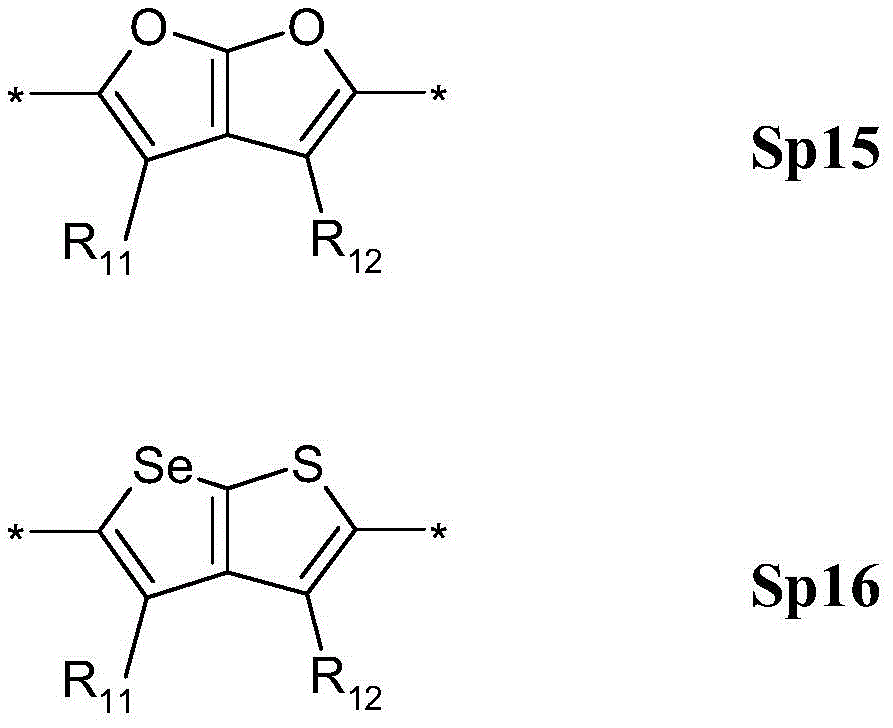


Applications Claiming Priority (3)
| Application Number | Priority Date | Filing Date | Title |
|---|---|---|---|
| EP14003212 | 2014-09-16 | ||
| EP14003212.9 | 2014-09-16 | ||
| PCT/EP2015/001700 WO2016041615A1 (en) | 2014-09-16 | 2015-08-18 | Conjugated polymers |
Publications (2)
| Publication Number | Publication Date |
|---|---|
| CN106715519A CN106715519A (en) | 2017-05-24 |
| CN106715519B true CN106715519B (en) | 2020-09-11 |
Family
ID=51564422
Family Applications (1)
| Application Number | Title | Priority Date | Filing Date |
|---|---|---|---|
| CN201580049548.8A Active CN106715519B (en) | 2014-09-16 | 2015-08-18 | Conjugated polymers |
Country Status (9)
| Country | Link |
|---|---|
| US (1) | US20170256728A1 (en) |
| EP (1) | EP3194526A1 (en) |
| JP (1) | JP2017529440A (en) |
| KR (1) | KR20170057354A (en) |
| CN (1) | CN106715519B (en) |
| AU (1) | AU2015317410A1 (en) |
| BR (1) | BR112017005061A2 (en) |
| TW (1) | TW201625710A (en) |
| WO (1) | WO2016041615A1 (en) |
Cited By (1)
| Publication number | Priority date | Publication date | Assignee | Title |
|---|---|---|---|---|
| US12317737B2 (en) | 2018-03-09 | 2025-05-27 | Lg Chem, Ltd. | Polymer and organic solar cell including the same |
Families Citing this family (7)
| Publication number | Priority date | Publication date | Assignee | Title |
|---|---|---|---|---|
| CN109715696B (en) * | 2016-09-16 | 2022-03-04 | 康宁股份有限公司 | Fused thiophene-arylthiadiazole polymers, methods of making the same, and uses thereof |
| EP3523835B1 (en) * | 2016-10-05 | 2022-11-16 | Raynergy Tek Inc. | Organic photodetector |
| WO2018226536A1 (en) | 2017-06-08 | 2018-12-13 | Corning Incorporated | Doping of other polymers into organic semi-conducting polymers |
| WO2019030382A1 (en) * | 2017-08-11 | 2019-02-14 | Merck Patent Gmbh | Organic semiconducting polymer |
| CN111384267B (en) * | 2018-12-29 | 2021-09-10 | Tcl科技集团股份有限公司 | Preparation method of graphene quantum dot film, light-emitting diode and preparation method of light-emitting diode |
| JP7215970B2 (en) * | 2019-06-28 | 2023-01-31 | 富士フイルム株式会社 | Photoelectric conversion device, image pickup device, optical sensor, material for photoelectric conversion device, compound |
| TWI759149B (en) * | 2021-03-18 | 2022-03-21 | 位速科技股份有限公司 | Perovskite Optoelectronics |
Family Cites Families (4)
| Publication number | Priority date | Publication date | Assignee | Title |
|---|---|---|---|---|
| WO2007121252A2 (en) * | 2006-04-11 | 2007-10-25 | Konarka Technologies, Inc. | Tandem photovoltaic cells |
| CN102124046A (en) * | 2008-08-18 | 2011-07-13 | 加利福尼亚大学董事会 | Active materials for photoelectric devices and devices that use the materials |
| PT2501698T (en) * | 2009-11-18 | 2018-07-23 | Nat Res Council Canada | FLUORATE MONOMERS, OLIGOMERS AND POLYMERS FOR USE IN ORGANIC ELECTRONIC DEVICES |
| KR101847232B1 (en) * | 2010-10-22 | 2018-05-28 | 라이너지 테크 인코포레이션 | Conjugated polymers and their use in optoelectronic devices |
-
2015
- 2015-08-18 AU AU2015317410A patent/AU2015317410A1/en not_active Abandoned
- 2015-08-18 KR KR1020177010194A patent/KR20170057354A/en not_active Withdrawn
- 2015-08-18 CN CN201580049548.8A patent/CN106715519B/en active Active
- 2015-08-18 EP EP15754119.4A patent/EP3194526A1/en not_active Withdrawn
- 2015-08-18 WO PCT/EP2015/001700 patent/WO2016041615A1/en not_active Ceased
- 2015-08-18 JP JP2017514677A patent/JP2017529440A/en active Pending
- 2015-08-18 US US15/511,379 patent/US20170256728A1/en not_active Abandoned
- 2015-08-18 BR BR112017005061A patent/BR112017005061A2/en not_active IP Right Cessation
- 2015-09-14 TW TW104130299A patent/TW201625710A/en unknown
Cited By (1)
| Publication number | Priority date | Publication date | Assignee | Title |
|---|---|---|---|---|
| US12317737B2 (en) | 2018-03-09 | 2025-05-27 | Lg Chem, Ltd. | Polymer and organic solar cell including the same |
Also Published As
| Publication number | Publication date |
|---|---|
| TW201625710A (en) | 2016-07-16 |
| KR20170057354A (en) | 2017-05-24 |
| AU2015317410A1 (en) | 2017-04-27 |
| WO2016041615A1 (en) | 2016-03-24 |
| US20170256728A1 (en) | 2017-09-07 |
| JP2017529440A (en) | 2017-10-05 |
| BR112017005061A2 (en) | 2017-12-05 |
| EP3194526A1 (en) | 2017-07-26 |
| CN106715519A (en) | 2017-05-24 |
Similar Documents
| Publication | Publication Date | Title |
|---|---|---|
| CN104169347B (en) | Conjugated polymer | |
| CN105324460B (en) | Conjugated polymer | |
| CN106458808B (en) | fullerene derivatives | |
| CN104245787B (en) | Conjugated polymers | |
| CN106795068B (en) | fullerene mixture | |
| CN104395372B (en) | Conjugated polymer | |
| CN106715518B (en) | conjugated polymer | |
| CN105764957B (en) | Polycyclic polymers containing thiophene units, methods for their production and uses | |
| CN104136484B (en) | Conjugated polymers | |
| CN106715519B (en) | Conjugated polymers | |
| CN108779128B (en) | organic semiconductor | |
| CN104380493A (en) | Organic semiconductors | |
| CN106164127A (en) | Organic semiconductor compound | |
| CN104105734A (en) | Conjugated polymers | |
| CN108602826A (en) | [1,5]Naphthyridine compounds and polymers as semiconductors | |
| CN105765028A (en) | Conjugated polymers | |
| CN104854175A (en) | Polymer comprising a thiadiazol group, the production of such polymer and its use in organic electronic devices | |
| KR102541669B1 (en) | Thiadiazolopyridine polymers, their synthesis and their use | |
| CN112424966B (en) | organic semiconductor | |
| KR20170012402A (en) | Tetra-aryl indacenodithiophene-based polycyclic polymers and their use | |
| CN110998888B (en) | organic semiconducting polymers | |
| JP7518087B2 (en) | Organic Semiconductors |
Legal Events
| Date | Code | Title | Description |
|---|---|---|---|
| PB01 | Publication | ||
| PB01 | Publication | ||
| SE01 | Entry into force of request for substantive examination | ||
| SE01 | Entry into force of request for substantive examination | ||
| TA01 | Transfer of patent application right | ||
| TA01 | Transfer of patent application right |
Effective date of registration: 20200814 Address after: 2nd floor, No.60, 2nd Road, Hsinchu Science Industrial Park, Taiwan, China Applicant after: POLYERA Corp. Address before: Darmstadt Applicant before: MERCK PATENT GmbH |
|
| GR01 | Patent grant | ||
| GR01 | Patent grant |