CN106905367B - Electron transport material or electron injection material, organic electroluminescent element, display device, and lighting device - Google Patents
Electron transport material or electron injection material, organic electroluminescent element, display device, and lighting device Download PDFInfo
- Publication number
- CN106905367B CN106905367B CN201710099748.5A CN201710099748A CN106905367B CN 106905367 B CN106905367 B CN 106905367B CN 201710099748 A CN201710099748 A CN 201710099748A CN 106905367 B CN106905367 B CN 106905367B
- Authority
- CN
- China
- Prior art keywords
- ring
- chemical
- formula
- following formula
- added
- Prior art date
- Legal status (The legal status is an assumption and is not a legal conclusion. Google has not performed a legal analysis and makes no representation as to the accuracy of the status listed.)
- Active
Links
Images

Classifications
-
- C—CHEMISTRY; METALLURGY
- C07—ORGANIC CHEMISTRY
- C07F—ACYCLIC, CARBOCYCLIC OR HETEROCYCLIC COMPOUNDS CONTAINING ELEMENTS OTHER THAN CARBON, HYDROGEN, HALOGEN, OXYGEN, NITROGEN, SULFUR, SELENIUM OR TELLURIUM
- C07F5/00—Compounds containing elements of Groups 3 or 13 of the Periodic Table
- C07F5/02—Boron compounds
- C07F5/027—Organoboranes and organoborohydrides
-
- C—CHEMISTRY; METALLURGY
- C07—ORGANIC CHEMISTRY
- C07F—ACYCLIC, CARBOCYCLIC OR HETEROCYCLIC COMPOUNDS CONTAINING ELEMENTS OTHER THAN CARBON, HYDROGEN, HALOGEN, OXYGEN, NITROGEN, SULFUR, SELENIUM OR TELLURIUM
- C07F9/00—Compounds containing elements of Groups 5 or 15 of the Periodic Table
- C07F9/02—Phosphorus compounds
- C07F9/547—Heterocyclic compounds, e.g. containing phosphorus as a ring hetero atom
- C07F9/6564—Heterocyclic compounds, e.g. containing phosphorus as a ring hetero atom having phosphorus atoms, with or without nitrogen, oxygen, sulfur, selenium or tellurium atoms, as ring hetero atoms
- C07F9/6568—Heterocyclic compounds, e.g. containing phosphorus as a ring hetero atom having phosphorus atoms, with or without nitrogen, oxygen, sulfur, selenium or tellurium atoms, as ring hetero atoms having phosphorus atoms as the only ring hetero atoms
- C07F9/65685—Heterocyclic compounds, e.g. containing phosphorus as a ring hetero atom having phosphorus atoms, with or without nitrogen, oxygen, sulfur, selenium or tellurium atoms, as ring hetero atoms having phosphorus atoms as the only ring hetero atoms the ring phosphorus atom being part of a phosphine oxide or thioxide
-
- C—CHEMISTRY; METALLURGY
- C07—ORGANIC CHEMISTRY
- C07F—ACYCLIC, CARBOCYCLIC OR HETEROCYCLIC COMPOUNDS CONTAINING ELEMENTS OTHER THAN CARBON, HYDROGEN, HALOGEN, OXYGEN, NITROGEN, SULFUR, SELENIUM OR TELLURIUM
- C07F9/00—Compounds containing elements of Groups 5 or 15 of the Periodic Table
- C07F9/02—Phosphorus compounds
- C07F9/547—Heterocyclic compounds, e.g. containing phosphorus as a ring hetero atom
- C07F9/6564—Heterocyclic compounds, e.g. containing phosphorus as a ring hetero atom having phosphorus atoms, with or without nitrogen, oxygen, sulfur, selenium or tellurium atoms, as ring hetero atoms
- C07F9/6571—Heterocyclic compounds, e.g. containing phosphorus as a ring hetero atom having phosphorus atoms, with or without nitrogen, oxygen, sulfur, selenium or tellurium atoms, as ring hetero atoms having phosphorus and oxygen atoms as the only ring hetero atoms
- C07F9/657163—Heterocyclic compounds, e.g. containing phosphorus as a ring hetero atom having phosphorus atoms, with or without nitrogen, oxygen, sulfur, selenium or tellurium atoms, as ring hetero atoms having phosphorus and oxygen atoms as the only ring hetero atoms the ring phosphorus atom being bound to at least one carbon atom
-
- C—CHEMISTRY; METALLURGY
- C09—DYES; PAINTS; POLISHES; NATURAL RESINS; ADHESIVES; COMPOSITIONS NOT OTHERWISE PROVIDED FOR; APPLICATIONS OF MATERIALS NOT OTHERWISE PROVIDED FOR
- C09B—ORGANIC DYES OR CLOSELY-RELATED COMPOUNDS FOR PRODUCING DYES, e.g. PIGMENTS; MORDANTS; LAKES
- C09B57/00—Other synthetic dyes of known constitution
-
- C—CHEMISTRY; METALLURGY
- C09—DYES; PAINTS; POLISHES; NATURAL RESINS; ADHESIVES; COMPOSITIONS NOT OTHERWISE PROVIDED FOR; APPLICATIONS OF MATERIALS NOT OTHERWISE PROVIDED FOR
- C09K—MATERIALS FOR MISCELLANEOUS APPLICATIONS, NOT PROVIDED FOR ELSEWHERE
- C09K11/00—Luminescent materials, e.g. electroluminescent or chemiluminescent
- C09K11/06—Luminescent materials, e.g. electroluminescent or chemiluminescent containing organic luminescent materials
-
- H—ELECTRICITY
- H10—SEMICONDUCTOR DEVICES; ELECTRIC SOLID-STATE DEVICES NOT OTHERWISE PROVIDED FOR
- H10D—INORGANIC ELECTRIC SEMICONDUCTOR DEVICES
- H10D30/00—Field-effect transistors [FET]
- H10D30/60—Insulated-gate field-effect transistors [IGFET]
- H10D30/67—Thin-film transistors [TFT]
-
- H—ELECTRICITY
- H10—SEMICONDUCTOR DEVICES; ELECTRIC SOLID-STATE DEVICES NOT OTHERWISE PROVIDED FOR
- H10K—ORGANIC ELECTRIC SOLID-STATE DEVICES
- H10K50/00—Organic light-emitting devices
- H10K50/10—OLEDs or polymer light-emitting diodes [PLED]
- H10K50/14—Carrier transporting layers
- H10K50/15—Hole transporting layers
-
- H—ELECTRICITY
- H10—SEMICONDUCTOR DEVICES; ELECTRIC SOLID-STATE DEVICES NOT OTHERWISE PROVIDED FOR
- H10K—ORGANIC ELECTRIC SOLID-STATE DEVICES
- H10K50/00—Organic light-emitting devices
- H10K50/10—OLEDs or polymer light-emitting diodes [PLED]
- H10K50/14—Carrier transporting layers
- H10K50/16—Electron transporting layers
-
- H—ELECTRICITY
- H10—SEMICONDUCTOR DEVICES; ELECTRIC SOLID-STATE DEVICES NOT OTHERWISE PROVIDED FOR
- H10K—ORGANIC ELECTRIC SOLID-STATE DEVICES
- H10K50/00—Organic light-emitting devices
- H10K50/10—OLEDs or polymer light-emitting diodes [PLED]
- H10K50/17—Carrier injection layers
-
- H—ELECTRICITY
- H10—SEMICONDUCTOR DEVICES; ELECTRIC SOLID-STATE DEVICES NOT OTHERWISE PROVIDED FOR
- H10K—ORGANIC ELECTRIC SOLID-STATE DEVICES
- H10K50/00—Organic light-emitting devices
- H10K50/10—OLEDs or polymer light-emitting diodes [PLED]
- H10K50/17—Carrier injection layers
- H10K50/171—Electron injection layers
-
- H—ELECTRICITY
- H10—SEMICONDUCTOR DEVICES; ELECTRIC SOLID-STATE DEVICES NOT OTHERWISE PROVIDED FOR
- H10K—ORGANIC ELECTRIC SOLID-STATE DEVICES
- H10K85/00—Organic materials used in the body or electrodes of devices covered by this subclass
- H10K85/60—Organic compounds having low molecular weight
- H10K85/649—Aromatic compounds comprising a hetero atom
- H10K85/653—Aromatic compounds comprising a hetero atom comprising only oxygen as heteroatom
-
- H—ELECTRICITY
- H10—SEMICONDUCTOR DEVICES; ELECTRIC SOLID-STATE DEVICES NOT OTHERWISE PROVIDED FOR
- H10K—ORGANIC ELECTRIC SOLID-STATE DEVICES
- H10K85/00—Organic materials used in the body or electrodes of devices covered by this subclass
- H10K85/60—Organic compounds having low molecular weight
- H10K85/649—Aromatic compounds comprising a hetero atom
- H10K85/657—Polycyclic condensed heteroaromatic hydrocarbons
-
- H—ELECTRICITY
- H10—SEMICONDUCTOR DEVICES; ELECTRIC SOLID-STATE DEVICES NOT OTHERWISE PROVIDED FOR
- H10K—ORGANIC ELECTRIC SOLID-STATE DEVICES
- H10K85/00—Organic materials used in the body or electrodes of devices covered by this subclass
- H10K85/60—Organic compounds having low molecular weight
- H10K85/649—Aromatic compounds comprising a hetero atom
- H10K85/657—Polycyclic condensed heteroaromatic hydrocarbons
- H10K85/6572—Polycyclic condensed heteroaromatic hydrocarbons comprising only nitrogen in the heteroaromatic polycondensed ring system, e.g. phenanthroline or carbazole
-
- H—ELECTRICITY
- H10—SEMICONDUCTOR DEVICES; ELECTRIC SOLID-STATE DEVICES NOT OTHERWISE PROVIDED FOR
- H10K—ORGANIC ELECTRIC SOLID-STATE DEVICES
- H10K85/00—Organic materials used in the body or electrodes of devices covered by this subclass
- H10K85/60—Organic compounds having low molecular weight
- H10K85/658—Organoboranes
-
- C—CHEMISTRY; METALLURGY
- C09—DYES; PAINTS; POLISHES; NATURAL RESINS; ADHESIVES; COMPOSITIONS NOT OTHERWISE PROVIDED FOR; APPLICATIONS OF MATERIALS NOT OTHERWISE PROVIDED FOR
- C09K—MATERIALS FOR MISCELLANEOUS APPLICATIONS, NOT PROVIDED FOR ELSEWHERE
- C09K2211/00—Chemical nature of organic luminescent or tenebrescent compounds
- C09K2211/10—Non-macromolecular compounds
- C09K2211/1003—Carbocyclic compounds
- C09K2211/1007—Non-condensed systems
-
- C—CHEMISTRY; METALLURGY
- C09—DYES; PAINTS; POLISHES; NATURAL RESINS; ADHESIVES; COMPOSITIONS NOT OTHERWISE PROVIDED FOR; APPLICATIONS OF MATERIALS NOT OTHERWISE PROVIDED FOR
- C09K—MATERIALS FOR MISCELLANEOUS APPLICATIONS, NOT PROVIDED FOR ELSEWHERE
- C09K2211/00—Chemical nature of organic luminescent or tenebrescent compounds
- C09K2211/10—Non-macromolecular compounds
- C09K2211/1003—Carbocyclic compounds
- C09K2211/1011—Condensed systems
-
- C—CHEMISTRY; METALLURGY
- C09—DYES; PAINTS; POLISHES; NATURAL RESINS; ADHESIVES; COMPOSITIONS NOT OTHERWISE PROVIDED FOR; APPLICATIONS OF MATERIALS NOT OTHERWISE PROVIDED FOR
- C09K—MATERIALS FOR MISCELLANEOUS APPLICATIONS, NOT PROVIDED FOR ELSEWHERE
- C09K2211/00—Chemical nature of organic luminescent or tenebrescent compounds
- C09K2211/10—Non-macromolecular compounds
- C09K2211/1018—Heterocyclic compounds
- C09K2211/1025—Heterocyclic compounds characterised by ligands
- C09K2211/1029—Heterocyclic compounds characterised by ligands containing one nitrogen atom as the heteroatom
-
- C—CHEMISTRY; METALLURGY
- C09—DYES; PAINTS; POLISHES; NATURAL RESINS; ADHESIVES; COMPOSITIONS NOT OTHERWISE PROVIDED FOR; APPLICATIONS OF MATERIALS NOT OTHERWISE PROVIDED FOR
- C09K—MATERIALS FOR MISCELLANEOUS APPLICATIONS, NOT PROVIDED FOR ELSEWHERE
- C09K2211/00—Chemical nature of organic luminescent or tenebrescent compounds
- C09K2211/10—Non-macromolecular compounds
- C09K2211/1018—Heterocyclic compounds
- C09K2211/1025—Heterocyclic compounds characterised by ligands
- C09K2211/1096—Heterocyclic compounds characterised by ligands containing other heteroatoms
-
- H—ELECTRICITY
- H10—SEMICONDUCTOR DEVICES; ELECTRIC SOLID-STATE DEVICES NOT OTHERWISE PROVIDED FOR
- H10K—ORGANIC ELECTRIC SOLID-STATE DEVICES
- H10K2102/00—Constructional details relating to the organic devices covered by this subclass
-
- Y—GENERAL TAGGING OF NEW TECHNOLOGICAL DEVELOPMENTS; GENERAL TAGGING OF CROSS-SECTIONAL TECHNOLOGIES SPANNING OVER SEVERAL SECTIONS OF THE IPC; TECHNICAL SUBJECTS COVERED BY FORMER USPC CROSS-REFERENCE ART COLLECTIONS [XRACs] AND DIGESTS
- Y02—TECHNOLOGIES OR APPLICATIONS FOR MITIGATION OR ADAPTATION AGAINST CLIMATE CHANGE
- Y02E—REDUCTION OF GREENHOUSE GAS [GHG] EMISSIONS, RELATED TO ENERGY GENERATION, TRANSMISSION OR DISTRIBUTION
- Y02E10/00—Energy generation through renewable energy sources
- Y02E10/50—Photovoltaic [PV] energy
- Y02E10/549—Organic PV cells
Landscapes
- Chemical & Material Sciences (AREA)
- Organic Chemistry (AREA)
- Physics & Mathematics (AREA)
- Materials Engineering (AREA)
- Engineering & Computer Science (AREA)
- Spectroscopy & Molecular Physics (AREA)
- General Health & Medical Sciences (AREA)
- Molecular Biology (AREA)
- Health & Medical Sciences (AREA)
- Biochemistry (AREA)
- Life Sciences & Earth Sciences (AREA)
- Optics & Photonics (AREA)
- Electroluminescent Light Sources (AREA)
- Photovoltaic Devices (AREA)
- Low-Molecular Organic Synthesis Reactions Using Catalysts (AREA)
- Thin Film Transistor (AREA)
Abstract
Description
本申请是分案申请,母案的申请号:201580001402.6,申请日:2015年02月18日,名称:多环芳香族化合物。This application is a divisional application, the application number of the parent case: 201580001402.6, the filing date: February 18, 2015, and the name: polycyclic aromatic compounds.
技术领域technical field
本发明涉及一种电子传输材料或电子注入材料、有机电场发光元件、显示装置及照明装置。The present invention relates to an electron transport material or electron injection material, an organic electroluminescent element, a display device and a lighting device.
背景技术Background technique
从前,使用进行电场发光的发光元件的显示装置因可实现小电力化或薄型化而得到各种研究,进而,包含有机材料的有机电场发光元件因容易轻量化或大型化而得到积极研究。尤其,关于具有作为光的三原色之一的蓝色等的发光特性的有机材料的开发,及关于具备空穴、电子等的电荷传输能力(具有成为半导体或超导体的可能性)的有机材料的开发,迄今为止,不论高分子化合物、低分子化合物均得到积极研究。Conventionally, various studies have been conducted on display devices using light-emitting elements that perform electroluminescence to achieve low power consumption and thinning. Further, organic electroluminescence elements including organic materials have been actively studied because they are easy to reduce in weight or increase in size. In particular, development of organic materials having light-emitting properties such as blue, which is one of the three primary colors of light, and development of organic materials having charge transport capabilities such as holes and electrons (possibly becoming semiconductors or superconductors) , So far, both high molecular compounds and low molecular compounds have been actively studied.
有机电致发光(Electroluminescence,EL)元件具有如下的结构,所述结构包括:包含阳极及阴极的一对电极,及配置于所述一对电极间、且包含有机化合物的一层或多层。在包含有机化合物的层中,有发光层,或者传输或注入空穴、电子等电荷的电荷传输/注入层等,且已开发有适合于这些层的各种有机材料。An organic electroluminescence (EL) element has the following structure, and the structure includes a pair of electrodes including an anode and a cathode, and one or more layers disposed between the pair of electrodes and including an organic compound. Among the layers containing organic compounds, there are light-emitting layers, charge transport/injection layers that transport or inject charges such as holes and electrons, and the like, and various organic materials suitable for these layers have been developed.
作为发光层用材料,例如开发有苯并芴系化合物等(国际公开第2004/061047号公报)。另外,作为空穴传输材料,例如开发有三苯基胺系化合物等(日本专利特开2001-172232号公报)。另外,作为电子传输材料,例如开发有蒽系化合物等(日本专利特开2005-170911号公报)。As a material for a light-emitting layer, for example, a benzofluorene-based compound has been developed (International Publication No. 2004/061047). In addition, as a hole transport material, for example, a triphenylamine-based compound or the like has been developed (Japanese Patent Laid-Open No. 2001-172232). In addition, as electron transport materials, for example, anthracene-based compounds and the like have been developed (Japanese Patent Laid-Open No. 2005-170911).
另外,近年来,作为用于有机EL元件或有机薄膜太阳电池的材料,还报告有对三苯基胺衍生物进行改良而成的材料(国际公开第2012/118164号公报)。所述材料为如下的材料,其特征在于:参考已实用化的N,N'-二苯基-N,N'-双(3-甲基苯基)-1,1'-联苯-4,4'-二胺(TPD),使构成三苯基胺的芳香环彼此连结,由此提高其平面性。在所述文献中对例如NO连结系化合物(63页的化合物1)的电荷传输特性进行了评价,但并未记载NO连结系化合物以外的材料的制造方法,另外,若所连结的元素不同,则化合物整体的电子状态不同,因此自NO连结系化合物以外的材料所获得的特性也仍然未知。此种化合物的例子在别处也可看到(国际公开第2011/107186号公报)。例如,具有三重态激子的能量(T1)大的共轭结构的化合物因可发出波长更短的磷光,故作为蓝色的发光层用材料有益。另外,作为夹持发光层的电子传输材料或空穴传输材料,还需要具有T1大的新颖共轭结构的化合物。In addition, in recent years, a material obtained by improving a triphenylamine derivative has also been reported as a material used for an organic EL element or an organic thin-film solar cell (International Publication No. 2012/118164). The material is the following material, characterized in that: with reference to the practical N,N'-diphenyl-N,N'-bis(3-methylphenyl)-1,1'-biphenyl-4 ,4'-diamine (TPD) improves the planarity by linking the aromatic rings constituting triphenylamine with each other. This document evaluates, for example, the charge transport properties of NO-linked compounds (compound 1 on page 63), but does not describe methods for producing materials other than NO-linked compounds, and if the elements to be linked are different, Since the electronic state of the entire compound is different, the properties obtained from materials other than the NO-linked compound are still unknown. Examples of such compounds can be found elsewhere (International Publication No. 2011/107186). For example, a compound having a conjugated structure with a large triplet exciton energy (T1) is useful as a material for a blue light-emitting layer because it can emit phosphorescence with a shorter wavelength. In addition, as an electron transport material or a hole transport material sandwiching the light-emitting layer, a compound having a novel conjugated structure with a large T1 is also required.
有机EL元件的主体材料通常为利用单键或磷原子或硅原子将多个苯或咔唑等现有的芳香环连结而成的分子。其原因在于:通过将多个共轭系比较小的芳香环加以连结,主体材料所需的大的最高占据分子轨道(Highest Occupied Molecular Orbital,HOMO)-最低未占分子轨道(Lowest Unoccupied Molecular Orbital,LUMO)间隙(薄膜中的带隙Eg)得到担保。进而,在使用磷光材料或热活性型延迟荧光材料的有机EL元件的主体材料中,还需要高的三重态激发能量(ET),但通过将施体性或接受性的芳香环或取代基连结于分子上,而使三重态激发状态(T1)的单占分子轨道(Singly Occupied Molecular Orbital,SOMO)1及SOMO2局部存在化,并减小两轨道间的交换相互作用,由此可提升三重态激发能量(ET)。但是,共轭系小的芳香环的氧化还原稳定性并不充分,将连结有现有的芳香环的分子用作主体材料的元件的寿命并不充分。另一方面,具有扩张π共轭系的多环芳香族化合物通常氧化还原稳定性优异,但HOMO-LUMO间隙(薄膜中的带隙Eg)或三重态激发能量(ET)低,因此被认为不适合主体材料。The host material of the organic EL element is usually a molecule in which a plurality of existing aromatic rings such as benzene or carbazole are linked by a single bond, a phosphorus atom, or a silicon atom. The reason is that by connecting a plurality of conjugated systems with relatively small aromatic rings, the large highest occupied molecular orbital (Highest Occupied Molecular Orbital, HOMO) required for the host material - the Lowest Unoccupied Molecular Orbital (Lowest Unoccupied Molecular Orbital, LUMO) gap (bandgap Eg in the film) is guaranteed. Furthermore, in the host material of an organic EL element using a phosphorescent material or a thermally active delayed fluorescent material, a high triplet excitation energy (E T ) is also required, but by adding a donor or acceptor aromatic ring or substituent Linked to the molecule, the single-occupied molecular orbital (Singly Occupied Molecular Orbital, SOMO)1 and SOMO2 of the triplet excited state (T1) are localized, and the exchange interaction between the two orbitals is reduced, thereby improving the triplet state excitation energy ( ET ). However, the oxidation-reduction stability of the aromatic ring with a small conjugated system is not sufficient, and the life of a device using a molecule having a conventional aromatic ring bonded as a host material is not sufficient. On the other hand, polycyclic aromatic compounds with extended π-conjugated systems are generally excellent in redox stability, but have low HOMO-LUMO gap (bandgap Eg in the film) or triplet excitation energy (E T ), so it is considered that Not suitable for body material.
[现有技术文献][Prior Art Literature]
[专利文献][Patent Literature]
[专利文献1]国际公开第2004/061047号公报[Patent Document 1] International Publication No. 2004/061047
[专利文献2]日本专利特开2001-172232号公报[Patent Document 2] Japanese Patent Laid-Open No. 2001-172232
[专利文献3]日本专利特开2005-170911号公报[Patent Document 3] Japanese Patent Laid-Open No. 2005-170911
[专利文献4]国际公开第2012/118164号公报[Patent Document 4] International Publication No. 2012/118164
[专利文献5]国际公开第2011/107186号公报[Patent Document 5] International Publication No. 2011/107186
发明内容SUMMARY OF THE INVENTION
[发明所欲解决的课题][Problems to be solved by the invention]
如上所述,作为用于有机EL元件的材料,已开发有各种材料,但为了增加有机EL元件用材料的选择项,而期望开发一种包含与现有的材料不同的化合物的材料。尤其,自专利文献1~专利文献4中所报告的NO连结系化合物以外的材料所获得的有机EL特性或其制造方法仍然未知。As described above, various materials have been developed as materials for organic EL elements, but in order to increase the options of materials for organic EL elements, it is desired to develop a material containing a compound different from existing materials. In particular, organic EL properties obtained from materials other than the NO-linked compounds reported in Patent Documents 1 to 4 and methods for producing the same are still unknown.
[解决问题的技术手段][Technical means to solve the problem]
本发明人等人为了解决所述课题而努力研究的结果,发现了一种利用硼原子与氧原子等将多个芳香族环连结而成的新颖的多环芳香族化合物,并成功制造出所述多环芳香族化合物。另外,发现通过将含有所述多环芳香族化合物的层配置于一对电极间来构成有机EL元件,而可获得优异的有机EL元件,从而完成了本发明。即,本发明提供如下的多环芳香族化合物或其多聚体,进而提供含有如下的多环芳香族化合物或其多聚体的有机EL元件用材料。As a result of diligent studies to solve the above-mentioned problems, the inventors of the present invention have discovered a novel polycyclic aromatic compound in which a plurality of aromatic rings are linked by boron atoms, oxygen atoms, etc., and have successfully produced the The polycyclic aromatic compound. In addition, the inventors found that an excellent organic EL element can be obtained by arranging a layer containing the polycyclic aromatic compound between a pair of electrodes to constitute an organic EL element, thereby completing the present invention. That is, the present invention provides the following polycyclic aromatic compounds or their multimers, and further provides materials for organic EL devices containing the following polycyclic aromatic compounds or their multimers.
[1][1]
一种多环芳香族化合物或多环芳香族化合物的多聚体,所述多环芳香族化合物由下述通式(1)表示,所述多环芳香族化合物的多聚体具有多个由下述通式(1)所表示的结构。A polycyclic aromatic compound or a multimer of a polycyclic aromatic compound, the polycyclic aromatic compound is represented by the following general formula (1), and the multimer of the polycyclic aromatic compound has a plurality of A structure represented by the following general formula (1).
[化10][Chemical 10]

(所述式(1)中,(In the formula (1),
A环、B环及C环分别独立地为芳基环或杂芳基环,这些环中的至少一个氢可被取代,Ring A, ring B and ring C are each independently an aryl ring or a heteroaryl ring, and at least one hydrogen in these rings may be substituted,
Y1为B、P、P=O、P=S、Al、Ga、As、Si-R或Ge-R,所述Si-R及Ge-R的R为芳基或烷基,Y 1 is B, P, P=O, P=S, Al, Ga, As, Si-R or Ge-R, and R of said Si-R and Ge-R is aryl or alkyl,
X1及X2分别独立地为O、N-R、S或Se,所述N-R的R为可被取代的芳基、可被取代的杂芳基或烷基,另外,所述N-R的R可通过连结基或单键而与所述A环、B环和/或C环键结,且X 1 and X 2 are each independently O, NR, S or Se, R of the NR is an aryl group that can be substituted, a heteroaryl group that can be substituted or an alkyl group, in addition, the R of the NR can be through a linking group or a single bond to the A ring, B ring and/or C ring, and
由式(1)所表示的化合物或结构中的至少一个氢可由卤素或重氢取代)At least one hydrogen in the compound or structure represented by formula (1) may be substituted by halogen or deuterium)
[2][2]
根据所述[1]所记载的多环芳香族化合物或其多聚体,其中A环、B环及C环分别独立地为芳基环或杂芳基环,这些环中的至少一个氢可由经取代或未经取代的芳基、经取代或未经取代的杂芳基、经取代或未经取代的二芳基氨基、经取代或未经取代的二杂芳基氨基、经取代或未经取代的芳基杂芳基氨基、经取代或未经取代的烷基、经取代或未经取代的烷氧基、或者经取代或未经取代的芳氧基取代,另外,这些环具有与包含Y1、X1及X2的所述式中央的缩合二环结构共有键结的5元环或6元环,The polycyclic aromatic compound or multimer thereof according to the above [1], wherein the A ring, the B ring and the C ring are each independently an aryl ring or a heteroaryl ring, and at least one hydrogen in these rings can be selected from substituted or unsubstituted aryl, substituted or unsubstituted heteroaryl, substituted or unsubstituted diarylamino, substituted or unsubstituted diheteroarylamino, substituted or unsubstituted Substituted arylheteroarylamino, substituted or unsubstituted alkyl, substituted or unsubstituted alkoxy, or substituted or unsubstituted aryloxy, in addition, these rings have A 5-membered ring or a 6-membered ring that is bonded in common to the condensed bicyclic structure in the center of the formula comprising Y 1 , X 1 and X 2 ,
Y1为B、P、P=O、P=S、Al、Ga、As、Si-R或Ge-R,所述Si-R及Ge-R的R为芳基或烷基,Y 1 is B, P, P=O, P=S, Al, Ga, As, Si-R or Ge-R, and R of said Si-R and Ge-R is aryl or alkyl,
X1及X2分别独立地为O、N-R、S或Se,所述N-R的R为可由烷基取代的芳基、可由烷基取代的杂芳基或烷基,另外,所述N-R的R可通过-O-、-S-、-C(-R)2-或单键而与所述A环、B环和/或C环键结,所述-C(-R)2-的R为氢或烷基,X 1 and X 2 are each independently O, NR, S or Se, and R of the NR is an aryl group that can be substituted by an alkyl group, a heteroaryl group that can be substituted by an alkyl group, or an alkyl group, in addition, the R of the NR is Can be bonded to the A ring, B ring and/or C ring through -O-, -S-, -C(-R) 2 - or a single bond, the R of the -C(-R) 2 - is hydrogen or alkyl,
由式(1)所表示的化合物或结构中的至少一个氢可由卤素或重氢取代,且At least one hydrogen in the compound or structure represented by formula (1) may be substituted by halogen or deuterium, and
在多聚体的情况下为具有2个或3个由通式(1)所表示的结构的二聚体或三聚体。In the case of a multimer, it is a dimer or trimer having two or three structures represented by the general formula (1).
[3][3]
根据所述[1]所记载的多环芳香族化合物,其由下述通式(2)表示。The polycyclic aromatic compound according to the above [1], which is represented by the following general formula (2).
[化11][Chemical 11]

(所述式(2)中,(In the formula (2),
R1、R2、R3、R4、R5、R6、R7、R8、R9、R10及R11分别独立地为氢、芳基、杂芳基、二芳基氨基、二杂芳基氨基、芳基杂芳基氨基、烷基、烷氧基或芳氧基,这些中的至少一个氢可由芳基、杂芳基或烷基取代,另外,R1~R11中的邻接的基彼此可键结并与a环、b环或c环一同形成芳基环或杂芳基环,所形成的环中的至少一个氢可由芳基、杂芳基、二芳基氨基、二杂芳基氨基、芳基杂芳基氨基、烷基、烷氧基或芳氧基取代,这些中的至少一个氢可由芳基、杂芳基或烷基取代,R 1 , R 2 , R 3 , R 4 , R 5 , R 6 , R 7 , R 8 , R 9 , R 10 and R 11 are each independently hydrogen, aryl, heteroaryl, diarylamino, Diheteroarylamino, arylheteroarylamino, alkyl, alkoxy or aryloxy, at least one of these hydrogens may be substituted by aryl, heteroaryl or alkyl, and in R 1 to R 11 The adjacent groups of the two groups can be bonded to each other and form an aryl ring or a heteroaryl ring together with the a ring, the b ring or the c ring, and at least one hydrogen in the formed ring can be an aryl group, a heteroaryl group, a diarylamino group , substituted with diheteroarylamino, arylheteroarylamino, alkyl, alkoxy or aryloxy, at least one of these hydrogens may be substituted with aryl, heteroaryl or alkyl,
Y1为B、P、P=O、P=S、Al、Ga、As、Si-R或Ge-R,所述Si-R及Ge-R的R为碳数为6~12的芳基或碳数为1~6的烷基,Y 1 is B, P, P=O, P=S, Al, Ga, As, Si-R or Ge-R, and R of the Si-R and Ge-R is an aryl group having 6 to 12 carbon atoms or an alkyl group with 1 to 6 carbon atoms,
X1及X2分别独立地为O、N-R、S或Se,所述N-R的R为碳数为6~12的芳基、碳数为2~15的杂芳基或碳数为1~6的烷基,另外,所述N-R的R可通过-O-、-S-、-C(-R)2-或单键而与所述a环、b环和/或c环键结,所述-C(-R)2-的R为碳数为1~6的烷基,且X 1 and X 2 are each independently O, NR, S or Se, and R of the NR is an aryl group having 6 to 12 carbon atoms, a heteroaryl group having 2 to 15 carbon atoms, or a carbon number of 1 to 6. In addition, the R of the NR can be bonded to the a ring, the b ring and/or the c ring through -O-, -S-, -C(-R) 2 - or a single bond, so R of the -C(-R) 2 - is an alkyl group having 1 to 6 carbon atoms, and
由式(2)所表示的化合物中的至少一个氢可由卤素或重氢取代)At least one hydrogen in the compound represented by the formula (2) may be substituted by halogen or deuterium)
[4][4]
根据所述[3]所记载的多环芳香族化合物,其中R1、R2、R3、R4、R5、R6、R7、R8、R9、R10及R11分别独立地为氢、碳数为6~30的芳基、碳数为2~30的杂芳基或二芳基氨基(其中,芳基为碳数为6~12的芳基),另外,R1~R11中的邻接的基彼此可键结并与a环、b环或c环一同形成碳数为9~16的芳基环或碳数为6~15的杂芳基环,所形成的环中的至少一个氢可由碳数为6~10的芳基取代,The polycyclic aromatic compound according to the above [3], wherein R 1 , R 2 , R 3 , R 4 , R 5 , R 6 , R 7 , R 8 , R 9 , R 10 and R 11 are each independently Ground is hydrogen, an aryl group having 6 to 30 carbon atoms, a heteroaryl group having 2 to 30 carbon atoms, or a diarylamino group (wherein, the aryl group is an aryl group having 6 to 12 carbon atoms), and R 1 The adjacent groups in ~R 11 can be bonded to each other and together with a ring, b ring or c ring form an aryl ring with 9 to 16 carbon atoms or a heteroaryl ring with 6 to 15 carbon atoms, the formed At least one hydrogen in the ring may be substituted by an aryl group having 6 to 10 carbon atoms,
Y1为B、P、P=O、P=S或Si-R,所述Si-R的R为碳数为6~10的芳基或碳数为1~4的烷基,Y 1 is B, P, P=O, P=S or Si-R, and R of the Si-R is an aryl group with 6-10 carbon atoms or an alkyl group with 1-4 carbon atoms,
X1及X2分别独立地为O、N-R或S,所述N-R的R为碳数为6~10的芳基或碳数为1~4的烷基,且X 1 and X 2 are each independently O, NR or S, and R of the NR is an aryl group having 6 to 10 carbon atoms or an alkyl group having 1 to 4 carbon atoms, and
由式(2)所表示的化合物中的至少一个氢可由卤素或重氢取代。At least one hydrogen in the compound represented by formula (2) may be substituted with halogen or deuterium.
[5][5]
根据所述[1]至[4]中任一项所记载的多环芳香族化合物或其多聚体,其中所述卤素为氟。The polycyclic aromatic compound or a multimer thereof according to any one of the above [1] to [4], wherein the halogen is fluorine.
[6][6]
根据所述[1]所记载的多环芳香族化合物,其由下述式(1-1)、下述式(1-2)、下述式(1-4)、下述式(1-10)、下述式(1-49)、下述式(1-81)、下述式(1-91)、下述式(1-100)、下述式(1-141)、下述式(1-151)、下述式(1-176)、下述式(1-411)、下述式(1-447)、下述式(1-501)、下述式(1-601)或下述式(1-701)表示。The polycyclic aromatic compound according to the above [1], which is represented by the following formula (1-1), the following formula (1-2), the following formula (1-4), and the following formula (1- 10), the following formula (1-49), the following formula (1-81), the following formula (1-91), the following formula (1-100), the following formula (1-141), the following formula Formula (1-151), following formula (1-176), following formula (1-411), following formula (1-447), following formula (1-501), following formula (1-601) ) or the following formula (1-701).
[化12][Chemical 12]

[7][7]
根据所述[1]所记载的多环芳香族化合物,其由下述式(1-21)、下述式(1-23)、下述式(1-24)、下述式(1-50)、下述式(1-152)、下述式(1-201)、下述式(1-401)、下述式(1-422)、下述式(1-1048)、下述式(1-1049)、下述式(1-1050)、下述式(1-1069)、下述式(1-1084)、下述式(1-1090)、下述式(1-1092)、下述式(1-1101)、下述式(1-1102)、下述式(1-1103)、下述式(1-1145)、下述式(1-1152)、下述式(1-1159)、下述式(1-1187)、下述式(1-1190)、下述式(1-1191)、下述式(1-1192)、下述式(1-1201)、下述式(1-1210)、下述式(1-1247)、下述式(1-1250)、下述式(1-1251)、下述式(1-1252)或下述式(1-1271)表示。The polycyclic aromatic compound according to the above [1], which is represented by the following formula (1-21), the following formula (1-23), the following formula (1-24), and the following formula (1- 50), the following formula (1-152), the following formula (1-201), the following formula (1-401), the following formula (1-422), the following formula (1-1048), the following formula Formula (1-1049), following formula (1-1050), following formula (1-1069), following formula (1-1084), following formula (1-1090), following formula (1-1092) ), the following formula (1-1101), the following formula (1-1102), the following formula (1-1103), the following formula (1-1145), the following formula (1-1152), the following formula (1-1159), following formula (1-1187), following formula (1-1190), following formula (1-1191), following formula (1-1192), following formula (1-1201) , the following formula (1-1210), the following formula (1-1247), the following formula (1-1250), the following formula (1-1251), the following formula (1-1252) or the following formula ( 1-1271) said.
[化13][Chemical 13]

[化14][Chemical 14]

[8][8]
根据所述[1]所记载的多环芳香族化合物,其由下述式(1-1-1)、下述式(1-79)、下述式(1-142)、下述式(1-152-2)、下述式(1-158)、下述式(1-159)、下述式(1-721)、下述式(1-1006)、下述式(1-1104)、下述式(1-1149)、下述式(1-1150)、下述式(1-1301)、下述式(1-1351)、下述式(1-2305)、下述式(1-2626)、下述式(1-2657)、下述式(1-2662)、下述式(1-2665)、下述式(1-2676)、下述式(1-2678)、下述式(1-2679)、下述式(1-2680)、下述式(1-2681)、下述式(1-2682)、下述式(1-2683)、下述式(1-2691)、下述式(1-2699)、下述式(1-3588)、下述式(1-3654)、下述式(1-3690)、下述式(1-3806)、下述式(1-3824)、下述式(1-4114)、下述式(1-4150)、下述式(1-4341)、下述式(1-4346)、下述式(1-4401)、下述式(1-4421-1)表示。The polycyclic aromatic compound according to the above [1], which is represented by the following formula (1-1-1), the following formula (1-79), the following formula (1-142), the following formula ( 1-152-2), following formula (1-158), following formula (1-159), following formula (1-721), following formula (1-1006), following formula (1-1104) ), the following formula (1-1149), the following formula (1-1150), the following formula (1-1301), the following formula (1-1351), the following formula (1-2305), the following formula (1-2626), following formula (1-2657), following formula (1-2662), following formula (1-2665), following formula (1-2676), following formula (1-2678) , the following formula (1-2679), the following formula (1-2680), the following formula (1-2681), the following formula (1-2682), the following formula (1-2683), the following formula ( 1-2691), the following formula (1-2699), the following formula (1-3588), the following formula (1-3654), the following formula (1-3690), the following formula (1-3806), The following formula (1-3824), the following formula (1-4114), the following formula (1-4150), the following formula (1-4341), the following formula (1-4346), the following formula (1 -4401), represented by the following formula (1-4421-1).
[化15][Chemical 15]

[化16][Chemical 16]

[9][9]
一种有机元件用材料,其包括根据所述[1]至[8]中任一项所记载的多环芳香族化合物或其多聚体。A material for an organic element comprising the polycyclic aromatic compound or a multimer thereof according to any one of the above [1] to [8].
[10][10]
根据所述[9]所记载的有机元件用材料,其中所述有机元件用材料为有机电场发光元件用材料、有机场效晶体管用材料或有机薄膜太阳电池用材料。The material for an organic element according to the above [9], wherein the material for an organic element is a material for an organic electroluminescence element, a material for an organic field effect transistor, or a material for an organic thin film solar cell.
[11][11]
根据所述[10]所记载的有机电场发光元件用材料,其为发光层用材料。The material for an organic electroluminescence element according to the above [10], which is a material for a light-emitting layer.
[12][12]
根据所述[10]所记载的有机电场发光元件用材料,其为电子注入层用材料或电子传输层用材料。The material for an organic electroluminescence element according to the above [10], which is a material for an electron injection layer or a material for an electron transport layer.
[13][13]
根据所述[10]所记载的有机电场发光元件用材料,其为空穴注入层用材料或空穴传输层用材料。The material for an organic electroluminescence element according to the above [10], which is a material for a hole injection layer or a material for a hole transport layer.
[14][14]
一种有机电场发光元件,其包括:一对电极,包含阳极及阴极;以及发光层,配置于所述一对电极间、且含有根据所述[11]所记载的发光层用材料。An organic electroluminescence element comprising: a pair of electrodes including an anode and a cathode; and a light-emitting layer disposed between the pair of electrodes and containing the material for a light-emitting layer according to the above [11].
[15][15]
一种有机电场发光元件,其包括:一对电极,包含阳极及阴极;发光层,配置于所述一对电极间;以及电子注入层和/或电子传输层,配置于所述阴极及所述发光层之间,且含有根据所述[12]所记载的电子注入层用材料和/或电子传输层用材料。An organic electroluminescence element, comprising: a pair of electrodes including an anode and a cathode; a light-emitting layer disposed between the pair of electrodes; and an electron injection layer and/or an electron transport layer disposed between the cathode and the cathode Between the light-emitting layers, the material for an electron injection layer and/or the material for an electron transport layer according to the above [12] is contained.
[16][16]
一种有机电场发光元件,其包括:一对电极,包含阳极及阴极;发光层,配置于所述一对电极间;空穴注入层和/或空穴传输层,配置于所述阳极及所述发光层之间,且含有根据所述[13]所记载的空穴注入层用材料或空穴传输层用材料。An organic electroluminescence element, comprising: a pair of electrodes, including an anode and a cathode; a light-emitting layer, disposed between the pair of electrodes; a hole injection layer and/or a hole transport layer, disposed between the anode and the Between the light-emitting layers, the material for a hole injection layer or the material for a hole transport layer according to the above [13] is contained.
[17][17]
根据所述[14]至[16]中任一项所记载的有机电场发光元件,其还包括配置于所述阴极与所述发光层之间的电子传输层和/或电子注入层,所述电子传输层及电子注入层的至少一层含有选自由羟基喹啉系金属络合物、吡啶衍生物、菲咯啉衍生物、硼烷衍生物及苯并咪唑衍生物所组成的群组中的至少一种。The organic electroluminescence element according to any one of [14] to [16], further comprising an electron transport layer and/or an electron injection layer disposed between the cathode and the light-emitting layer, the At least one layer of the electron transport layer and the electron injection layer contains a compound selected from the group consisting of hydroxyquinoline-based metal complexes, pyridine derivatives, phenanthroline derivatives, borane derivatives and benzimidazole derivatives at least one.
[18][18]
根据所述[17]所记载的有机电场发光元件,其中所述电子传输层和/或电子注入层进而含有选自由碱金属、碱土金属、稀土金属、碱金属的氧化物、碱金属的卤化物、碱土金属的氧化物、碱土金属的卤化物、稀土金属的氧化物、稀土金属的卤化物、碱金属的有机络合物、碱土金属的有机络合物及稀土金属的有机络合物所组成的群组中的至少一种。The organic electroluminescence element according to the above [17], wherein the electron transport layer and/or the electron injection layer further contains a compound selected from the group consisting of alkali metals, alkaline earth metals, rare earth metals, oxides of alkali metals, and halides of alkali metals , Oxides of alkaline earth metals, halides of alkaline earth metals, oxides of rare earth metals, halides of rare earth metals, organic complexes of alkali metals, organic complexes of alkaline earth metals and organic complexes of rare earth metals at least one of the groups.
[19][19]
一种显示装置,其包括根据所述[14]至[18]中任一项所记载的有机电场发光元件。A display device including the organic electroluminescence element according to any one of the above [14] to [18].
[20][20]
一种照明装置,其包括根据所述[14]至[18]中任一项所记载的有机电场发光元件。A lighting device comprising the organic electroluminescence element according to any one of the above [14] to [18].
[21][twenty one]
一种制造根据所述[1]所记载的由下述通式(1)所表示的多环芳香族化合物、或具有多个由下述通式(1)所表示的结构的多环芳香族化合物的多聚体的方法,其包括如下的反应步骤:使用选自由Y1的卤化物、Y1的氨基化卤化物、Y1的烷氧基化物及Y1的芳氧基化物所组成的群组中的试剂与视需要的布忍斯特碱(Bronsted base),通过连续的芳香族亲电子取代反应,而利用所述Y1使下述中间物中的A环与B环及C环键结。Production of a polycyclic aromatic compound represented by the following general formula (1) according to the above [1], or a polycyclic aromatic compound having a plurality of structures represented by the following general formula (1) A method for a multimer of a compound, comprising the reaction step of using a compound selected from the group consisting of Y 1 halide, Y 1 aminated halide, Y 1 alkoxylate and Y 1 aryloxylate The reagents in the group and the optional Bronsted base are subjected to continuous aromatic electrophilic substitution reaction, and the Y 1 is used to bond the A ring with the B ring and the C ring in the following intermediate Knot.
[化17][Chemical 17]

[22][twenty two]
一种制造根据所述[1]所记载的由下述通式(1)所表示的多环芳香族化合物、或具有多个由下述通式(1)所表示的结构的多环芳香族化合物的多聚体的方法,其包括如下的反应步骤:Production of a polycyclic aromatic compound represented by the following general formula (1) according to the above [1], or a polycyclic aromatic compound having a plurality of structures represented by the following general formula (1) A method for a multimer of a compound, comprising the following reaction steps:
使用有机碱性化合物对下述中间物中的X1与X2之间的氢原子进行邻位金属化;Ortho-metallation of the hydrogen atom between X 1 and X 2 in the following intermediates using an organic basic compound;
使用选自由Y1的卤化物、Y1的氨基化卤化物、Y1的烷氧基化物及Y1的芳氧基化物所组成的群组中的试剂将所述金属与Y1加以交换;以及exchanging the metal with Y 1 using a reagent selected from the group consisting of Y 1 halide, Y 1 aminated halide, Y 1 alkoxylate, and Y 1 aryloxylate; as well as
使用布忍斯特碱,通过连续的芳香族亲电子取代反应而利用所述Y1来使B环与C环键结。The B ring and the C ring are bonded by the Y 1 through a continuous aromatic electrophilic substitution reaction using a Brynster base.
[化18][Chemical 18]

[23][twenty three]
根据所述[21]或[22]所记载的制造方法,其进而添加路易斯酸来促进反应。According to the production method according to the above [21] or [22], a Lewis acid is further added to promote the reaction.
[24][twenty four]
根据所述[21]至[23]中任一项所记载的制造方法,其还包括事先将中间物中的X1与X2之间的氢原子加以卤化的反应步骤。The production method according to any one of the above [21] to [23], further comprising a reaction step of halogenating the hydrogen atom between X 1 and X 2 in the intermediate in advance.
[发明的效果][Effect of invention]
根据本发明的优选的形态,可提供例如可用作有机EL元件用材料的新颖的多环芳香族化合物,通过使用所述多环芳香族化合物,而可提供优异的有机EL元件。According to a preferred aspect of the present invention, for example, a novel polycyclic aromatic compound useful as a material for organic EL elements can be provided, and by using the polycyclic aromatic compound, an excellent organic EL element can be provided.
具体而言,本发明人等人发现利用硼、磷、氧、氮、硫等异质元素将芳香环连结而成的多环芳香族化合物具有大的HOMO-LUMO间隙(薄膜中的带隙Eg)与高的三重态激发能量(ET)。可认为其原因在于:含有异质元素的6元环的芳香族性低,因此伴随共轭系的扩张的HOMO-LUMO间隙的减少得到抑制,且因异质元素的电子扰动而使三重态激发状态(T1)的SOMO1及SOMO2局部存在化。另外,本发明的含有异质元素的多环芳香族化合物通过三重态激发状态(T1)中的SOMO1及SOMO2的局部存在化,而减小两轨道间的交换相互作用,因此三重态激发状态(T1)与单重态激发状态(S1)的能量差小,显示出热活性型延迟荧光,故作为有机EL元件的荧光材料也有用。另外,具有高的三重态激发能量(ET)的材料作为磷光有机EL元件或利用热活性型延迟荧光的有机EL元件的电子传输层或空穴传输层也有用。进而,这些多环芳香族化合物通过取代基的导入,而可任意地变动HOMO与LUMO的能量,因此可对应于周边材料而使电离电位或电子亲和力最佳化。Specifically, the present inventors found that polycyclic aromatic compounds in which aromatic rings are linked by heteroelements such as boron, phosphorus, oxygen, nitrogen, and sulfur have a large HOMO-LUMO gap (the band gap Eg in the thin film). ) and high triplet excitation energy (E T ). This is considered to be due to the fact that the 6-membered ring containing the hetero element has low aromaticity, so the reduction of the HOMO-LUMO gap accompanying the expansion of the conjugated system is suppressed, and the triplet state is excited by the electronic disturbance of the hetero element. SOMO1 and SOMO2 in state (T1) are locally present. In addition, the hetero-element-containing polycyclic aromatic compound of the present invention reduces the exchange interaction between the two orbitals by the localization of SOMO1 and SOMO2 in the triplet excited state (T1), so the triplet excited state ( The energy difference between T1) and the singlet excited state (S1) is small, and thermally active delayed fluorescence is exhibited, so it is also useful as a fluorescent material for organic EL elements. In addition, a material having a high triplet excitation energy ( ET ) is also useful as an electron transport layer or a hole transport layer of a phosphorescent organic EL element or an organic EL element utilizing thermally active delayed fluorescence. Furthermore, these polycyclic aromatic compounds can arbitrarily vary the energies of HOMO and LUMO by introducing a substituent, so that ionization potential or electron affinity can be optimized according to surrounding materials.
附图说明Description of drawings
图1是表示本实施形态的有机EL元件的概略剖面图。FIG. 1 is a schematic cross-sectional view showing an organic EL element of the present embodiment.
[符号的说明][Explanation of symbols]
100:有机电场发光元件100: Organic electroluminescent element
101:基板101: Substrate
102:阳极102: Anode
103:空穴注入层103: Hole injection layer
104:空穴传输层104: hole transport layer
105:发光层105: Light Emitting Layer
106:电子传输层106: Electron Transport Layer
107:电子注入层107: Electron injection layer
108:阴极108: Cathode
具体实施方式Detailed ways
1.多环芳香族化合物及其多聚体1. Polycyclic aromatic compounds and their polymers
本申请发明为由下述通式(1)所表示的多环芳香族化合物、或具有多个由下述通式(1)所表示的结构的多环芳香族化合物的多聚体。本申请发明优选为由下述通式(2)所表示的多环芳香族化合物、或具有多个由下述通式(2)所表示的结构的多环芳香族化合物的多聚体。The present invention is a multimer of a polycyclic aromatic compound represented by the following general formula (1) or a polycyclic aromatic compound having a plurality of structures represented by the following general formula (1). The present invention is preferably a polycyclic aromatic compound represented by the following general formula (2) or a multimer of a polycyclic aromatic compound having a plurality of structures represented by the following general formula (2).
[化19][Chemical 19]

通式(1)中的A环、B环及C环分别独立地为芳基环或杂芳基环,这些环中的至少一个氢可由取代基取代。所述取代基优选为经取代或未经取代的芳基、经取代或未经取代的杂芳基、经取代或未经取代的二芳基氨基、经取代或未经取代的二杂芳基氨基、经取代或未经取代的芳基杂芳基氨基(具有芳基与杂芳基的氨基)、经取代或未经取代的烷基、经取代或未经取代的烷氧基、或者经取代或未经取代的芳氧基。作为这些基具有取代基时的取代基,可列举:芳基、杂芳基或烷基。另外,所述芳基环或杂芳基环优选为具有与包含Y1、X1及X2的通式(1)中央的缩合二环结构(以下,也将所述结构称为“D结构”)共有键结的5元环或6元环。The A ring, the B ring and the C ring in the general formula (1) are each independently an aryl ring or a heteroaryl ring, and at least one hydrogen in these rings may be substituted by a substituent. The substituents are preferably substituted or unsubstituted aryl, substituted or unsubstituted heteroaryl, substituted or unsubstituted diarylamino, substituted or unsubstituted diheteroaryl amino, substituted or unsubstituted arylheteroarylamino (amino groups with aryl and heteroaryl), substituted or unsubstituted alkyl, substituted or unsubstituted alkoxy, or Substituted or unsubstituted aryloxy. As a substituent when these groups have a substituent, an aryl group, a heteroaryl group, or an alkyl group is mentioned. In addition, the aryl ring or heteroaryl ring preferably has a condensed bicyclic structure with the center of the general formula (1) including Y 1 , X 1 and X 2 (hereinafter, the structure is also referred to as "D structure"). ”) a 5- or 6-membered ring with a shared bond.
此处,所谓“缩合二环结构(D结构)”,是指通式(1)的中央所示的包含Y1、X1及X2而构成的2个饱和烃环缩合而成的结构。另外,所谓“与缩合二环结构共有键结的6元环”,例如如所述通式(2)中所示般,是指在所述D结构中缩合的a环(苯环(6元环))。另外,所谓“(A环)芳基环或杂芳基环具有所述6元环”,是指仅由所述6元环形成A环、或以包含所述6元环的方式在所述6元环中进而缩合其他环等来形成A环。换言之,此处所述的“具有6元环的(A环)芳基环或杂芳基环”是指构成A环的全部或一部分的6元环在所述D结构中缩合。关于“B环(b环)”、“C环(c环)”、及“5元环”,相同的说明也适用。Here, the "condensed bicyclic structure (D structure)" refers to a structure in which two saturated hydrocarbon rings including Y 1 , X 1 and X 2 shown in the center of the general formula (1) are condensed. In addition, "a 6-membered ring that shares a bond with a condensed bicyclic structure" means, for example, as shown in the general formula (2), a ring (a benzene ring (a 6-membered ring) condensed in the D structure. ring)). In addition, "(A ring) aryl ring or heteroaryl ring has the 6-membered ring" means that the A ring is formed only from the 6-membered ring, or the 6-membered ring is included in the above-mentioned 6-membered ring. The 6-membered ring is further condensed with other rings to form the A ring. In other words, the "(A ring) aryl ring or heteroaryl ring having a 6-membered ring" as used herein means that all or a part of the 6-membered rings constituting the A ring are condensed in the D structure. The same description applies to "B ring (b ring)", "C ring (c ring)", and "5-membered ring".
通式(1)中的A环(或B环、C环)对应于通式(2)中的a环与其取代基R1~R3(或b环与其取代基R4~R7、c环与其取代基R8~R11)。即,通式(2)对应于选择“具有6元环的A环~C环”作为通式(1)的A环~C环者。以所述含义,由小文字的a~c来表示通式(2)的各环。The A ring (or B ring, C ring) in the general formula (1) corresponds to the a ring and its substituents R 1 to R 3 (or the b ring and its substituents R 4 to R 7 , c ) in the general formula (2). ring and its substituents R 8 to R 11 ). That is, general formula (2) corresponds to selecting "ring A to ring C having a 6-membered ring" as ring A to ring C of general formula (1). Each ring of the general formula (2) is represented by the small letters a to c in the above meanings.
通式(2)中,a环、b环及c环的取代基R1~R11中的邻接的基彼此可键结并与a环、b环或c环一同形成芳基环或杂芳基环,所形成的环中的至少一个氢可由芳基、杂芳基、二芳基氨基、二杂芳基氨基、芳基杂芳基氨基、烷基、烷氧基或芳氧基取代,这些中的至少一个氢可由芳基、杂芳基或烷基取代。因此,由通式(2)所表示的多环芳香族化合物根据a环、b环及c环中的取代基的相互的键结形态,如下述式(2-1)及式(2-2)所示,构成化合物的环结构会变化。各式中的A'环、B'环及C'环分别对应于通式(1)中的A环、B环及C环。In the general formula (2), adjacent groups among the substituents R 1 to R 11 of the a-ring, b-ring and c-ring may be bonded to each other to form an aryl ring or a heteroaryl ring together with the a-ring, b-ring or c-ring base ring, at least one hydrogen in the formed ring may be substituted by aryl, heteroaryl, diarylamino, diheteroarylamino, arylheteroarylamino, alkyl, alkoxy or aryloxy, At least one of these hydrogens may be substituted by aryl, heteroaryl or alkyl. Therefore, the polycyclic aromatic compound represented by the general formula (2) has the following formulas (2-1) and (2-2) according to the mutual bonding form of the substituents in the a ring, the b ring and the c ring. ), the ring structure of the compound will change. The A' ring, the B' ring and the C' ring in each formula correspond to the A ring, the B ring and the C ring in the general formula (1), respectively.
[化20][hua 20]
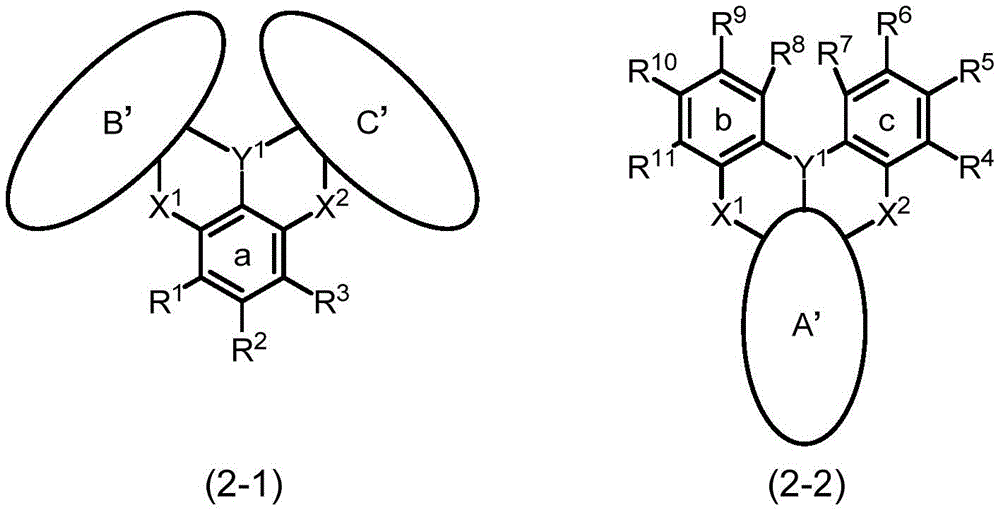
若以通式(2)进行说明,则所述式(2-1)及式(2-2)中的A'环、B'环及C'环表示取代基R1~R11中的邻接的基彼此键结并分别与a环、b环及c环一同形成的芳基环或杂芳基环(也可称为其他环结构在a环、b环或c环中缩合而成的缩合环)。再者,虽然式中未表示,但也存在a环、b环及c环全部变化成A'环、B'环及C'环的化合物。另外,如根据所述式(2-1)及式(2-2)而可知般,例如b环的R8与c环的R7、b环的R11与a环的R1、c环的R4与a环的R3等并不符合“邻接的基彼此”,这些不会进行键结。即,“邻接的基”是指在同一环上邻接的基。In general formula (2), A' ring, B' ring and C' ring in the above formula (2-1) and formula (2-2) represent adjacent substituents R 1 to R 11 The aryl ring or heteroaryl ring is formed by bonding with each other and with the a ring, the b ring and the c ring respectively (also known as the condensation of other ring structures in the a ring, the b ring or the c ring). ring). In addition, although not shown in a formula, there exists a compound in which all a ring, b ring and c ring are changed into A' ring, B' ring and C' ring. In addition, as can be understood from the above formulas (2-1) and (2-2), for example, R 8 of the b ring, R 7 of the c ring, R 11 of the b ring, R 1 of the a ring, and c ring The R 4 and R 3 of a ring, etc. do not conform to "adjacent groups to each other", and these will not be bonded. That is, "adjacent groups" refer to groups adjacent to each other on the same ring.
由所述式(2-1)或式(2-2)所表示的化合物对应于例如后述的作为具体的化合物所列举的如由式(1-2)~式(1-17)所表示的化合物。即,例如为具有苯环、吲哚环、吡咯环、苯并呋喃环或苯并噻吩环对于作为a环(或b环或c环)的苯环进行缩合而形成的A'环(或B'环或C'环)的化合物,所形成的缩合环A'(或缩合环B'或缩合环C')分别为萘环、咔唑环、吲哚环、二苯并呋喃环或二苯并噻吩环。The compound represented by the above-mentioned formula (2-1) or formula (2-2) corresponds to, for example, those represented by formula (1-2) to formula (1-17) which are listed as specific compounds described later. compound of. That is, for example, an A' ring (or B ring) having a benzene ring, an indole ring, a pyrrole ring, a benzofuran ring, or a benzothiophene ring is formed by condensing a benzene ring which is a ring (or a b ring or a c ring). 'ring or C' ring), the formed condensed ring A' (or condensed ring B' or condensed ring C') is naphthalene ring, carbazole ring, indole ring, dibenzofuran ring or diphenyl ring respectively And thiophene ring.
通式(1)中的Y1为B、P、P=O、P=S、Al、Ga、As、Si-R或Ge-R,所述Si-R及Ge-R的R为芳基或烷基。在P=O、P=S、Si-R或Ge-R的情况下,与A环、B环或C环进行键结的原子为P、Si或Ge。Y1优选为B、P、P=O、P=S或Si-R,特别优选为B。所述说明也同样适用于通式(2)中的Y1。Y 1 in the general formula (1) is B, P, P=O, P=S, Al, Ga, As, Si-R or Ge-R, and R of the Si-R and Ge-R is an aryl group or alkyl. In the case of P=O, P=S, Si-R or Ge-R, the atom bonded to the A ring, the B ring or the C ring is P, Si or Ge. Y 1 is preferably B, P, P=O, P=S or Si—R, particularly preferably B. The description also applies to Y 1 in the general formula (2).
通式(1)中的X1及X2分别独立地为O、N-R、S或Se,所述N-R的R为可被取代的芳基、可被取代的杂芳基或烷基,所述N-R的R可通过连结基或单键而与所述B环和/或C环键结,作为连结基,优选为-O-、-S-或-C(-R)2-。再者,所述“-C(-R)2-”的R为氢或烷基。所述说明也同样适用于通式(2)中的X1及X2。X 1 and X 2 in the general formula (1) are independently O, NR, S or Se, R of the NR is a substituted aryl group, a substituted heteroaryl group or an alkyl group, the R of NR may be bonded to the B ring and/or the C ring through a linking group or a single bond, and the linking group is preferably -O-, -S- or -C(-R) 2 -. Moreover, R of the said "-C(-R) 2 -" is hydrogen or an alkyl group. The above description also applies to X 1 and X 2 in the general formula (2).
此处,通式(1)中的“N-R的R通过连结基或单键而与所述A环、B环和/或C环键结”的规定对应于通式(2)中“N-R的R通过-O-、-S-、-C(-R)2-或单键而与所述a环、b环和/或c环键结”的规定。Here, the definition of "R of NR is bonded to the A ring, B ring and/or C ring through a linking group or a single bond" in the general formula (1) corresponds to "NR in the general formula (2)" R is bonded to the a-ring, b-ring and/or c-ring via -O-, -S-, -C(-R) 2- or a single bond".
所述规定可由如下的化合物来表现,所述化合物由下述式(2-3-1)表示、且具有X1或X2被导入至缩合环B'及缩合环C'中的环结构。即,例如为具有其他环以导入X1(或X2)的方式对于作为通式(2)中的b环(或c环)的苯环进行缩合而形成的B'环(或C'环)的化合物。所述化合物对应于例如后述的作为具体的化合物所列举的如由式(1-451)~式(1-462)所表示的化合物、及如由式(1-1401)~式(1-1460)所表示的化合物,所形成的缩合环B'(或缩合环C')例如为吩噁嗪环、吩噻嗪环或吖啶环。The regulation can be expressed by a compound represented by the following formula (2-3-1) and having a ring structure in which X 1 or X 2 is introduced into the condensed ring B' and the condensed ring C'. That is, for example, it is a B' ring (or C' ring formed by condensing a benzene ring which is a b ring (or a c ring) in the general formula (2) so as to have another ring to introduce X 1 (or X 2 ). )compound of. The compound corresponds to, for example, the compounds represented by the formula (1-451) to the formula (1-462) and the compounds represented by the formula (1-1401) to the formula (1- 1460), the formed condensed ring B' (or condensed ring C') is, for example, a phenoxazine ring, a phenothiazine ring or an acridine ring.
另外,所述规定也可由如下的化合物来表现,所述化合物由下述式(2-3-2)或式(2-3-3)表示、且具有X1和/或X2被导入至缩合环A'中的环结构。即,例如为具有其他环以导入X1(和/或X2)的方式对于作为通式(2)中的a环的苯环进行缩合而形成的A'环的化合物。所述化合物对应于例如后述的作为具体的化合物所列举的如由式(1-471)~(1-479)所表示的化合物,所形成的缩合环A'例如为吩噁嗪环、吩噻嗪环或吖啶环。In addition, the regulation may be expressed by a compound represented by the following formula (2-3-2) or formula (2-3-3) and having X 1 and/or X 2 introduced into Ring structure in condensed ring A'. That is, for example, it is a compound which has an A' ring formed by condensing the benzene ring which is the a ring in General formula ( 2 ) so that X1 (and/or X2 ) may be introduced into another ring. The compounds correspond to, for example, compounds represented by the formulae (1-471) to (1-479) exemplified as specific compounds described later, and the condensed ring A' formed is, for example, a phenoxazine ring, a phenoxazine ring, and a Thiazine ring or acridine ring.
[化21][Chemical 21]
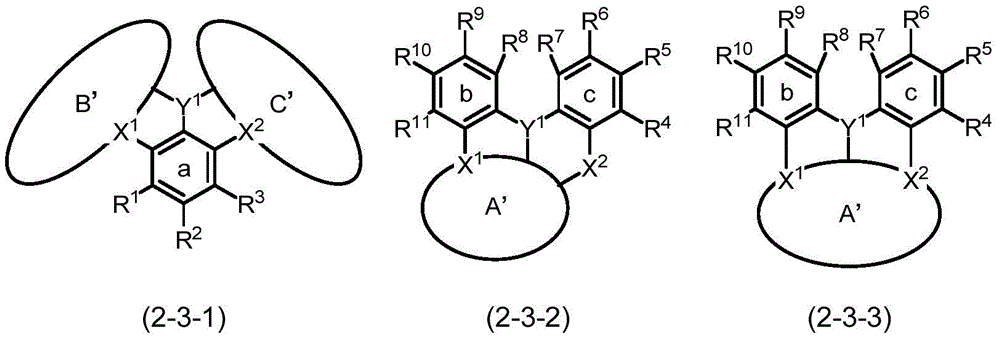
作为通式(1)的A环、B环及C环的“芳基环”例如可列举碳数为6~30的芳基环,优选为碳数为6~16的芳基环,更优选为碳数为6~12的芳基环,特别优选为碳数为6~10的芳基环。再者,所述“芳基环”对应于通式(2)中所规定的“R1~R11中的邻接的基彼此键结并与a环、b环或c环一同形成的芳基环”,另外,a环(或b环、c环)已包含碳数为6的苯环,因此5元环在其中进行缩合而成的缩合环的合计碳数9成为下限的碳数。Examples of the "aryl ring" of ring A, ring B, and ring C of the general formula (1) include aryl rings having 6 to 30 carbon atoms, preferably aryl rings having 6 to 16 carbon atoms, and more preferably is an aryl ring having 6 to 12 carbon atoms, particularly preferably an aryl ring having 6 to 10 carbon atoms. In addition, the said "aryl ring" corresponds to an aryl group formed by "R 1 to R 11 adjacent to each other and formed together with a ring, b ring or c ring as defined in the general formula (2). ring", and since the a ring (or the b ring and the c ring) already includes a benzene ring having 6 carbon atoms, the total number of carbon atoms of the condensed ring in which the 5-membered ring is condensed is 9, which is the lower limit of the carbon number.
作为具体的“芳基环”,可列举:作为单环系的苯环,作为二环系的联苯环,作为缩合二环系的萘环,作为三环系的联三苯环(间联三苯、邻联三苯、对联三苯),作为缩合三环系的苊环、芴环、非那烯环、菲环,作为缩合四环系的三亚苯环、芘环、并四苯环,作为缩合五环系的苝环、并五苯环等。Specific examples of the "aryl ring" include a benzene ring as a monocyclic system, a biphenyl ring as a bicyclic system, a naphthalene ring as a condensed bicyclic system, a triphenyl ring as a tricyclic system (inter- Triphenyl, o-triphenyl, para-triphenyl), acenaphthylene ring, fluorene ring, phenarene ring, phenanthrene ring as condensed tricyclic ring system, triphenylene ring, pyrene ring, naphthacene ring as condensed tetracyclic ring system , as the perylene ring, pentacene ring, etc. of the condensed pentacyclic ring system.
作为通式(1)的A环、B环及C环的“杂芳基环”例如可列举碳数为2~30的杂芳基环,优选为碳数为2~25的杂芳基环,更优选为碳数为2~20的杂芳基环,进而更优选为碳数为2~15的杂芳基环,特别优选为碳数为2~10的杂芳基环。另外,作为“杂芳基环”,例如可列举除碳以外含有1个~5个选自氧、硫及氮中的杂原子作为环构成原子的杂环等。再者,所述“杂芳基环”对应于通式(2)中所规定的“R1~R11中的邻接的基彼此键结并与a环、b环或c环一同形成的杂芳基环”,另外,a环(或b环、c环)已包含碳数为6的苯环,因此5元环在其中进行缩合而成的缩合环的合计碳数6成为下限的碳数。Examples of the "heteroaryl ring" of ring A, ring B, and ring C of the general formula (1) include a heteroaryl ring having 2 to 30 carbon atoms, and preferably a heteroaryl ring having 2 to 25 carbon atoms. , a heteroaryl ring having 2 to 20 carbon atoms is more preferred, a heteroaryl ring having 2 to 15 carbon atoms is still more preferred, and a heteroaryl ring having 2 to 10 carbon atoms is particularly preferred. Moreover, as a "heteroaryl ring", the heterocyclic ring etc. which contain 1-5 heteroatoms selected from oxygen, sulfur, and nitrogen as ring constituent atoms other than carbon are mentioned, for example. In addition, the said "heteroaryl ring" corresponds to a heterocyclic group formed by "a ring, b ring or c ring in which adjacent groups of R 1 to R 11 are bonded to each other as defined in the general formula (2). "Aryl ring", in addition, the a ring (or the b ring, the c ring) already contains a benzene ring with 6 carbon atoms, so the total carbon number of the condensed ring formed by condensing the 5-membered ring therein is the lower limit of the carbon number of 6. .
作为具体的“杂芳基环”,例如可列举:吡咯环、噁唑环、异噁唑环、噻唑环、异噻唑环、咪唑环、噁二唑环、噻二唑环、三唑环、四唑环、吡唑环、吡啶环、嘧啶环、哒嗪环、吡嗪环、三嗪环、吲哚环、异吲哚环、1H-吲唑环、苯并咪唑环、苯并噁唑环、苯并噻唑环、1H-苯并三唑环、喹啉环、异喹啉环、噌啉环、喹唑啉环、喹噁啉环、酞嗪环、萘啶环、嘌呤环、蝶啶环、咔唑环、吖啶环、吩噁噻环、吩噁嗪环、吩噻嗪环、吩嗪环、吲嗪环、呋喃环、苯并呋喃环、异苯并呋喃环、二苯并呋喃环、噻吩环、苯并噻吩环、二苯并噻吩环、呋咱环、噁二唑环、噻蒽环等。Specific examples of "heteroaryl rings" include pyrrole rings, oxazole rings, isoxazole rings, thiazole rings, isothiazole rings, imidazole rings, oxadiazole rings, thiadiazole rings, triazole rings, Tetrazole ring, pyrazole ring, pyridine ring, pyrimidine ring, pyridazine ring, pyrazine ring, triazine ring, indole ring, isoindole ring, 1H-indazole ring, benzimidazole ring, benzoxazole Ring, benzothiazole ring, 1H-benzotriazole ring, quinoline ring, isoquinoline ring, cinnoline ring, quinazoline ring, quinoxaline ring, phthalazine ring, naphthyridine ring, purine ring, pteridine ring pyridine ring, carbazole ring, acridine ring, phenoxthiazine ring, phenoxazine ring, phenothiazine ring, phenazine ring, indolizine ring, furan ring, benzofuran ring, isobenzofuran ring, diphenyl And furan ring, thiophene ring, benzothiophene ring, dibenzothiophene ring, furan ring, oxadiazole ring, thianthrene ring, etc.
所述“芳基环”或“杂芳基环”中的至少一个氢可由作为第1取代基的经取代或未经取代的“芳基”、经取代或未经取代的“杂芳基”、经取代或未经取代的“二芳基氨基”、经取代或未经取代的“二杂芳基氨基”、经取代或未经取代的“芳基杂芳基氨基”、经取代或未经取代的“烷基”、经取代或未经取代的“烷氧基”、或者经取代或未经取代的“芳氧基”取代,作为所述第1取代基的“芳基”或“杂芳基”、“二芳基氨基”的芳基、“二杂芳基氨基”的杂芳基、“芳基杂芳基氨基”的芳基与杂芳基、及“芳氧基”的芳基可列举所述“芳基环”或“杂芳基环”的一价的基。At least one hydrogen in the "aryl ring" or "heteroaryl ring" can be substituted or unsubstituted "aryl", substituted or unsubstituted "heteroaryl" as the first substituent , substituted or unsubstituted "diarylamino", substituted or unsubstituted "diheteroarylamino", substituted or unsubstituted "arylheteroarylamino", substituted or unsubstituted Substituted "alkyl", substituted or unsubstituted "alkoxy", or substituted or unsubstituted "aryloxy", as the first substituent "aryl" or " "heteroaryl", "diarylamino" aryl, "diheteroarylamino" heteroaryl, "arylheteroarylamino" aryl and heteroaryl, and "aryloxy" Examples of the aryl group include monovalent groups of the above-mentioned "aryl ring" or "heteroaryl ring".
另外,作为第1取代基的“烷基”可为直链及支链的任一种,例如可列举碳数为1~24的直链烷基或碳数为3~24的支链烷基。优选为碳数为1~18的烷基(碳数为3~18的支链烷基),更优选为碳数为1~12的烷基(碳数为3~12的支链烷基),进而更优选为碳数为1~6的烷基(碳数为3~6的支链烷基),特别优选为碳数为1~4的烷基(碳数为3~4的支链烷基)。In addition, the "alkyl group" as the first substituent may be either a straight chain or a branched chain, for example, a straight chain alkyl group having 1 to 24 carbon atoms or a branched chain alkyl group having 3 to 24 carbon atoms. . Preferably it is an alkyl group having 1 to 18 carbon atoms (branched alkyl group having 3 to 18 carbon atoms), and more preferably an alkyl group having 1 to 12 carbon atoms (branched alkyl group having 3 to 12 carbon atoms) , and more preferably an alkyl group having 1 to 6 carbon atoms (branched chain alkyl group having 3 to 6 carbon atoms), particularly preferably an alkyl group having 1 to 4 carbon atoms (branched chain alkyl group having 3 to 4 carbon atoms) alkyl).
作为具体的烷基,可列举:甲基、乙基、正丙基、异丙基、正丁基、异丁基、仲丁基、叔丁基、正戊基、异戊基、新戊基、叔戊基、正己基、1-甲基戊基、4-甲基-2-戊基、3,3-二甲基丁基、2-乙基丁基、正庚基、1-甲基己基、正辛基、叔辛基、1-甲基庚基、2-乙基己基、2-丙基戊基、正壬基、2,2-二甲基庚基、2,6-二甲基-4-庚基、3,5,5-三甲基己基、正癸基、正十一基、1-甲基癸基、正十二基、正十三基、1-己基庚基、正十四基、正十五基、正十六基、正十七基、正十八基、正二十基等。Specific alkyl groups include methyl, ethyl, n-propyl, isopropyl, n-butyl, isobutyl, sec-butyl, tert-butyl, n-pentyl, isopentyl, and neopentyl , tert-amyl, n-hexyl, 1-methylpentyl, 4-methyl-2-pentyl, 3,3-dimethylbutyl, 2-ethylbutyl, n-heptyl, 1-methyl Hexyl, n-octyl, tert-octyl, 1-methylheptyl, 2-ethylhexyl, 2-propylpentyl, n-nonyl, 2,2-dimethylheptyl, 2,6-dimethyl Base-4-heptyl, 3,5,5-trimethylhexyl, n-decyl, n-undecyl, 1-methyldecyl, n-dodecyl, n-tridecyl, 1-hexylheptyl, Regular fourteen bases, regular fifteen bases, regular sixteen bases, regular seventeen bases, regular eighteen bases, regular twenty bases, etc.
另外,作为第1取代基的“烷氧基”例如可列举碳数为1~24的直链的烷氧基或碳数为3~24的支链的烷氧基。优选为碳数为1~18的烷氧基(碳数为3~18的支链的烷氧基),更优选为碳数为1~12的烷氧基(碳数为3~12的支链的烷氧基),进而更优选为碳数为1~6的烷氧基(碳数为3~6的支链的烷氧基),特别优选为碳数为1~4的烷氧基(碳数为3~4的支链的烷氧基)。Moreover, as a "alkoxy group" of a 1st substituent, a C1-C24 linear alkoxy group or a C3-C24 branched alkoxy group is mentioned, for example. Preferably it is an alkoxy group having 1 to 18 carbon atoms (branched alkoxy group having 3 to 18 carbon atoms), and more preferably an alkoxy group having 1 to 12 carbon atoms (branched alkoxy group having 3 to 12 carbon atoms). chain alkoxy), more preferably an alkoxy group having 1 to 6 carbon atoms (branched alkoxy group having 3 to 6 carbon atoms), particularly preferably an alkoxy group having 1 to 4 carbon atoms (branched alkoxy group having 3 to 4 carbon atoms).
作为具体的烷氧基,可列举:甲氧基、乙氧基、丙氧基、异丙氧基、丁氧基、异丁氧基、仲丁氧基、叔丁氧基、戊氧基、己氧基、庚氧基、辛氧基等。Specific alkoxy groups include methoxy, ethoxy, propoxy, isopropoxy, butoxy, isobutoxy, sec-butoxy, tert-butoxy, pentyloxy, Hexyloxy, heptyloxy, octyloxy, etc.
作为第1取代基的经取代或未经取代的“芳基”、经取代或未经取代的“杂芳基”、经取代或未经取代的“二芳基氨基”、经取代或未经取代的“二杂芳基氨基”、经取代或未经取代的“芳基杂芳基氨基”、经取代或未经取代的“烷基”、经取代或未经取代的“烷氧基”、或者经取代或未经取代的“芳氧基”如说明为经取代或未经取代般,这些中的至少一个氢可由第2取代基取代。作为所述第2取代基,例如可列举芳基、杂芳基或烷基,这些的具体例可参照所述“芳基环”或“杂芳基环”的一价的基、及作为第1取代基的“烷基”的说明。另外,在作为第2取代基的芳基或杂芳基中,这些中的至少一个氢由苯基等芳基(具体例为以上所述者)或甲基等烷基(具体例为以上所述者)取代者也包含于作为第2取代基的芳基或杂芳基中。作为其一例,当第2取代基为咔唑基时,9位上的至少一个氢由苯基等芳基或甲基等烷基取代的咔唑基也包含于作为第2取代基的杂芳基中。Substituted or unsubstituted "aryl", substituted or unsubstituted "heteroaryl", substituted or unsubstituted "diarylamino", substituted or unsubstituted as 1st substituent Substituted "diheteroarylamino", substituted or unsubstituted "arylheteroarylamino", substituted or unsubstituted "alkyl", substituted or unsubstituted "alkoxy" , or substituted or unsubstituted "aryloxy" as described as substituted or unsubstituted, at least one of these hydrogens may be substituted with a second substituent. Examples of the second substituent include an aryl group, a heteroaryl group, or an alkyl group. For specific examples of these, refer to the monovalent group of the "aryl ring" or "heteroaryl ring", and the second substituent. 1 Description of "alkyl" of substituents. In addition, in the aryl group or heteroaryl group as the second substituent, at least one hydrogen among these is an aryl group such as a phenyl group (specific examples are those described above) or an alkyl group such as a methyl group (specific examples are the above-mentioned ones). The substituted ones mentioned above are also included in the aryl group or heteroaryl group as the second substituent. As an example, when the second substituent is a carbazolyl group, a carbazolyl group in which at least one hydrogen at the 9-position is substituted with an aryl group such as a phenyl group or an alkyl group such as a methyl group is also included in the heteroaryl group as the second substituent. base.
作为通式(2)的R1~R11中的芳基、杂芳基、二芳基氨基的芳基,二杂芳基氨基的杂芳基,芳基杂芳基氨基的芳基与杂芳基,或芳氧基的芳基,可列举通式(1)中所说明的“芳基环”或“杂芳基环”的一价的基。另外,作为R1~R11中的烷基或烷氧基,可参照所述通式(1)的说明中的作为第1取代基的“烷基”或“烷氧基”的说明。进而,作为针对这些基的取代基的芳基、杂芳基或烷基也相同。另外,作为R1~R11中的邻接的基彼此键结并与a环、b环或c环一同形成芳基环或杂芳基环时的针对这些环的取代基的杂芳基、二芳基氨基、二杂芳基氨基、芳基杂芳基氨基、烷基、烷氧基或芳氧基,及作为进一步的取代基的芳基、杂芳基或烷基也相同。In R 1 to R 11 of the general formula (2), an aryl group, a heteroaryl group, an aryl group of a diarylamino group, a heteroaryl group of a diheteroarylamino group, an aryl group and a heteroaryl group of an arylheteroarylamino group The aryl group or the aryl group of the aryloxy group includes the monovalent group of the "aryl ring" or "heteroaryl ring" described in the general formula (1). In addition, as the alkyl group or the alkoxy group in R 1 to R 11 , the description of the “alkyl group” or the “alkoxy group” as the first substituent in the description of the general formula (1) can be referred to. Furthermore, the same applies to the aryl group, heteroaryl group or alkyl group as a substituent to these groups. In addition, when adjacent groups of R 1 to R 11 are bonded to each other and form an aryl ring or a heteroaryl ring together with the a ring, the b ring, or the c ring, the heteroaryl group, the dicyclic The same goes for arylamino, diheteroarylamino, arylheteroarylamino, alkyl, alkoxy or aryloxy, and aryl, heteroaryl or alkyl as further substituents.
通式(1)的Y1中的Si-R及Ge-R的R为芳基或烷基,可列举作为所述芳基或烷基所述者。特别优选为碳数为6~10的芳基(例如苯基、萘基等)、碳数为1~4的烷基(例如甲基、乙基等)。所述说明也同样适用于通式(2)中的Y1。R in Si-R and Ge-R in Y 1 of the general formula (1) is an aryl group or an alkyl group, and those described as the above-mentioned aryl group or alkyl group can be exemplified. Particularly preferred are aryl groups having 6 to 10 carbon atoms (eg, phenyl, naphthyl, etc.), and alkyl groups having 1 to 4 carbon atoms (eg, methyl, ethyl, etc.). The description also applies to Y 1 in the general formula (2).
通式(1)的X1及X2中的N-R的R为可由所述第2取代基取代的芳基、杂芳基或烷基,芳基或杂芳基中的至少一个氢例如可由烷基取代。作为所述芳基、杂芳基或烷基,可列举所述的芳基、杂芳基或烷基。特别优选为碳数为6~10的芳基(例如苯基、萘基等)、碳数为2~15的杂芳基(例如咔唑基等)、碳数为1~4的烷基(例如甲基、乙基等)。所述说明也同样适用于通式(2)中的X1及X2。R of NR in X 1 and X 2 of the general formula (1) is an aryl group, a heteroaryl group or an alkyl group which may be substituted by the second substituent, and at least one hydrogen in the aryl group or the heteroaryl group may be, for example, an alkane group. base substitution. As said aryl group, heteroaryl group or alkyl group, said aryl group, heteroaryl group or alkyl group can be mentioned. Particularly preferred are aryl groups having 6 to 10 carbon atoms (eg, phenyl, naphthyl, etc.), heteroaryl groups having 2 to 15 carbon atoms (eg, carbazolyl, etc.), and alkyl groups having 1 to 4 carbon atoms ( such as methyl, ethyl, etc.). The above description also applies to X 1 and X 2 in the general formula (2).
作为通式(1)中的连结基的“-C(-R)2-”的R为氢或烷基,作为所述烷基,可列举所述的烷基。特别优选为碳数为1~4的烷基(例如甲基、乙基等)。所述说明也同样适用于作为通式(2)中的连结基的“-C(-R)2-”。R of "-C(-R) 2 -" as the linking group in the general formula (1) is hydrogen or an alkyl group, and the alkyl group includes the above-mentioned alkyl groups. In particular, an alkyl group having 1 to 4 carbon atoms (eg, methyl group, ethyl group, etc.) is preferable. The above description also applies to "-C(-R) 2 -" as the linking group in the general formula (2).
另外,本申请发明为具有多个由通式(1)所表示的单位结构的多环芳香族化合物的多聚体,优选为具有多个由通式(2)所表示的单位结构的多环芳香族化合物的多聚体。多聚体优选为二聚体~六聚体,更优选为二聚体~三聚体,特别优选为二聚体。多聚体只要是在一个化合物中具有多个所述单元结构的形态即可,例如除利用单键、碳数为1~3的亚烷基、亚苯基、亚萘基等连结基使多个所述单元结构键结而成的形态以外,可为以由多个单元结构共有所述单元结构中所含有的任意的环(A环、B环或C环,a环、b环或c环)的方式进行键结的形态,另外,也可为以所述单元结构中所含有的任意的环(A环、B环或C环,a环、b环或c环)彼此进行缩合的方式进行键结的形态。In addition, the present invention is a multimer of a polycyclic aromatic compound having a plurality of unit structures represented by the general formula (1), preferably a polycyclic compound having a plurality of unit structures represented by the general formula (2). Multimers of aromatic compounds. The multimer is preferably a dimer to a hexamer, more preferably a dimer to a trimer, and particularly preferably a dimer. The multimer may be in the form of having a plurality of the above-mentioned unit structures in one compound. In addition to the form in which each of the unit structures is bonded, any ring (A ring, B ring, or C ring, a ring, b ring, or c ring, a ring, b ring, or c ring) contained in the unit structure may be shared by a plurality of unit structures. In addition, it may be a form in which any rings (A ring, B ring or C ring, a ring, b ring or c ring) contained in the unit structure are condensed with each other. form of bonding.
作为此种多聚体,例如可列举由下述式(2-4)、式(2-4-1)、式(2-4-2)、式(2-5-1)~式(2-5-4)或式(2-6)所表示的多聚体化合物。由下述式(2-4)所表示的多聚体化合物例如对应于如由后述的式(1-21)所表示的化合物。即,若以通式(2)进行说明,则为以共有作为a环的苯环的方式,在一个化合物中具有多个由通式(2)所表示的单元结构的多聚体化合物。另外,由下述式(2-4-1)所表示的多聚体化合物例如对应于如由后述的式(1-2665)所表示的化合物。即,若以通式(2)进行说明,则为以共有作为a环的苯环的方式,在一个化合物中具有两个由通式(2)所表示的单元结构的多聚体化合物。另外,由下述式(2-4-2)所表示的多聚体化合物例如对应于如由后述的式(1-2666)所表示的化合物。即,若以通式(2)进行说明,则为以共有作为a环的苯环的方式,在一个化合物中具有两个由通式(2)所表示的单元结构的多聚体化合物。另外,由下述式(2-5-1)~式(2-5-4)所表示的多聚体化合物例如对应于如由后述的式(1-22)~式(1-25)所表示的化合物。即,若以通式(2)进行说明,则为以共有作为b环(或c环)的苯环的方式,在一个化合物中具有多个由通式(2)所表示的单元结构的多聚体化合物。另外,由下述式(2-6)所表示的多聚体化合物例如对应于如由后述的式(1-31)~式(1-37)所表示的化合物。即,若以通式(2)进行说明,则为以例如作为某一单元结构的b环(或a环、c环)的苯环与作为某一单元结构的b环(或a环、c环)的苯环进行缩合的方式,在一个化合物中具有多个由通式(2)所表示的单元结构的多聚体化合物。Examples of such a multimer include the following formulas (2-4), (2-4-1), (2-4-2), and (2-5-1) to (2) -5-4) or a multimeric compound represented by formula (2-6). The multimeric compound represented by the following formula (2-4) corresponds to, for example, a compound represented by the following formula (1-21). That is, when the general formula (2) is described, it is a multimeric compound having a plurality of unit structures represented by the general formula (2) in one compound so as to share the benzene ring as the a ring. In addition, the multimeric compound represented by the following formula (2-4-1) corresponds to, for example, a compound represented by the following formula (1-2665). That is, when the general formula (2) is described, it is a multimeric compound having two unit structures represented by the general formula (2) in one compound so as to share a benzene ring as the a ring. In addition, the multimeric compound represented by the following formula (2-4-2) corresponds to, for example, a compound represented by the following formula (1-2666). That is, when the general formula (2) is described, it is a multimeric compound having two unit structures represented by the general formula (2) in one compound so as to share a benzene ring as the a ring. In addition, the multimeric compounds represented by the following formulae (2-5-1) to (2-5-4) correspond to, for example, the following formulae (1-22) to (1-25) represented compound. That is, when the general formula (2) is described, it is a compound having a plurality of unit structures represented by the general formula (2) in one compound so as to share the benzene ring as the b ring (or the c ring). polymer compound. In addition, the multimeric compound represented by the following formula (2-6) corresponds to, for example, a compound represented by the following formula (1-31) to (1-37). That is, when the general formula (2) is described, for example, a benzene ring of b ring (or a ring, c ring) as a certain unit structure and b ring (or a ring, c ring) as a certain unit structure A multimer compound having a plurality of unit structures represented by the general formula (2) in one compound in which the benzene ring of the ring) is condensed.
[化22][Chemical 22]

多聚体化合物可为将由式(2-4)、式(2-4-1)或式(2-4-2)所表现的多聚化形态与由式(2-5-1)~式(2-5-4)的任一者或式(2-6)所表现的多聚化形态组合而成的多聚体,也可为将由式(2-5-1)~式(2-5-4)的任一者所表现的多聚化形态与由式(2-6)所表现的多聚化形态组合而成的多聚体,也可为将由式(2-4)、式(2-4-1)或式(2-4-2)所表现的多聚化形态与由式(2-5-1)~式(2-5-4)的任一者所表现的多聚化形态,及由式(2-6)所表现的多聚化形态组合而成的多聚体。The multimer compound may be a multimerized form represented by formula (2-4), formula (2-4-1) or formula (2-4-2) and formula (2-5-1) to formula (2-4-2) A polymer obtained by combining any one of (2-5-4) or the multimerization form represented by formula (2-6) may be a combination of formulas (2-5-1) to (2- 5-4) A polymer formed by combining the multimerization form expressed by any one of the formula (2-6) and the multimerization form expressed by the formula (2-6) may be a combination of the formula (2-4) and the formula. The multimerization form expressed by (2-4-1) or the formula (2-4-2) is the same as the polymorphism expressed by any one of the formulas (2-5-1) to (2-5-4). A polymerized form, and a multimer formed by combining the multimerized forms represented by formula (2-6).
另外,由通式(1)或通式(2)所表示的多环芳香族化合物及其多聚体的化学结构中的氢的全部或一部分可为重氢。In addition, all or a part of hydrogen in the chemical structure of the polycyclic aromatic compound represented by the general formula (1) or the general formula (2) and a multimer thereof may be deuterium.
另外,由通式(1)或通式(2)所表示的多环芳香族化合物及其多聚体的化学结构中的氢的全部或一部分可为卤素。例如,在式(1)中,A环、B环、C环(A环~C环为芳基环或杂芳基环)、针对A环~C环的取代基、Y1为Si-R或Ge-R时的R(=烷基、芳基)、以及X1及X2为N-R时的R(=烷基、芳基)中的氢可由卤素取代,这些之中,可列举芳基或杂芳基中的全部或一部分的氢由卤素取代的形态。卤素为氟、氯、溴或碘,优选为氟、氯或溴,更优选为氯。In addition, all or a part of hydrogen in the chemical structure of the polycyclic aromatic compound represented by the general formula (1) or the general formula (2) and a multimer thereof may be halogen. For example, in formula (1), ring A, ring B, ring C (rings A to C are aryl rings or heteroaryl rings), substituents for rings A to C, Y 1 is Si—R Or hydrogen in R (=alkyl, aryl) when Ge-R and R (=alkyl, aryl) when X 1 and X 2 are NR may be substituted by halogen, and among these, aryl can be exemplified Or a form in which all or a part of hydrogens in the heteroaryl group are substituted with halogen. Halogen is fluorine, chlorine, bromine or iodine, preferably fluorine, chlorine or bromine, more preferably chlorine.
另外,本发明的多环芳香族化合物及其多聚体可用作有机元件用材料。作为有机元件,例如可列举:有机电场发光元件、有机场效晶体管或有机薄膜太阳电池等。尤其,在有机电场发光元件中,作为发光层的掺杂剂材料,优选为Y1为B、X1及X2为N-R的化合物,Y1为B、X1为O、X2为N-R的化合物,Y1为B、X1及X2为O的化合物,作为发光层的主体材料,优选为Y1为B、X1为O、X2为N-R的化合物,Y1为B、X1及X2为O的化合物,作为电子传输材料,可优选地使用Y1为B、X1及X2为O的化合物,Y1为P=O、X1及X2为O的化合物。In addition, the polycyclic aromatic compound of the present invention and its multimer can be used as a material for organic elements. As an organic element, an organic electroluminescent element, an organic field effect transistor, an organic thin film solar cell, etc. are mentioned, for example. In particular, in the organic electroluminescence element, as the dopant material of the light-emitting layer, a compound in which Y 1 is B, X 1 and X 2 are NR, Y 1 is B, X 1 is O, and X 2 is NR is preferable. Compound, Y 1 is B, X 1 and X 2 are compounds of O, as the host material of the light-emitting layer, preferably Y 1 is B, X 1 is O, X 2 is NR, Y 1 is B, X 1 And the compound in which X 2 is O, as the electron transport material, a compound in which Y 1 is B, X 1 and X 2 are O, Y 1 is P=O, and X 1 and X 2 are O can be preferably used.
作为本发明的多环芳香族化合物及其多聚体的更具体的例子,例如可列举:由下述式(1-1)~式(1-825)所表示的化合物、由下述式(1-1001)~式(1-1281)所表示的化合物、由下述式(1-1301)~式(1-1311)所表示的化合物、由下述式(1-1351)~式(1-1361)所表示的化合物、及由下述式(1-1401)~式(1-1460)所表示的化合物。More specific examples of the polycyclic aromatic compound of the present invention and its multimer include compounds represented by the following formulas (1-1) to (1-825), compounds represented by the following formulas ( Compounds represented by 1-1001) to formula (1-1281), compounds represented by following formulas (1-1301) to (1-1311), compounds represented by following formulas (1-1351) to (1) A compound represented by -1361) and a compound represented by the following formulae (1-1401) to (1-1460).
[化23][Chemical 23]

[化24][Chemical 24]

[化25][Chemical 25]

[化26][Chemical 26]

[化27][Chemical 27]

[化28][Chemical 28]

[化29][Chemical 29]

[化30][Chemical 30]

[化31][Chemical 31]

[化32][Chemical 32]

[化33][Chemical 33]

[化34][Chemical 34]

[化35][Chemical 35]

[化36][Chemical 36]

[化37][Chemical 37]

[化38][Chemical 38]

[化39][Chemical 39]

[化40][Chemical 40]

[化41][Chemical 41]

[化42][Chemical 42]

[化43][Chemical 43]

[化44][Chemical 44]

[化45][Chemical 45]

[化46][Chemical 46]

[化47][Chemical 47]

[化48][Chemical 48]

[化49][Chemical 49]

[化50][Chemical 50]

[化51][Chemical 51]

[化52][Chemical 52]

[化53][Chemical 53]

[化54][Chemical 54]

[化55][Chemical 55]

[化56][Chemical 56]

[化57][Chemical 57]

[化58][Chemical 58]

[化59][Chemical 59]

[化60][Chemical 60]

[化61][Chemical 61]

[化62][Chemical 62]

[化63][Chemical 63]

[化64][Chemical 64]

[化65][Chemical 65]

[化66][Chemical 66]

[化67][Chemical 67]

[化68][Chemical 68]

[化69][Chemical 69]

[化70][Chemical 70]

[化71][Chemical 71]

[化72][Chemical 72]

[化73][Chemical 73]

作为本发明的多环芳香族化合物及其多聚体的更具体的例子,例如可列举:由下述式(1-2001)~式(1-2299)所表示的化合物、由下述式(1-2301)~式(1-2616)所表示的化合物、由下述式(1-2621)~式(1-2705)所表示的化合物、由下述式(1-3581)~式(1-3828)所表示的化合物、由下述式(1-3831)~式(1-4033)所表示的化合物、由下述式(1-4041)~式(1-4288)所表示的化合物、及由下述式(1-4301)~式(1-4349)所表示的化合物。More specific examples of the polycyclic aromatic compound of the present invention and its multimer include compounds represented by the following formulas (1-2001) to (1-2299), compounds represented by the following formulas ( Compounds represented by 1-2301) to (1-2616), compounds represented by the following formulas (1-2621) to (1-2705), and compounds represented by the following formulas (1-3581) to (1) -3828) compounds, compounds represented by the following formulae (1-3831) to (1-4033), compounds represented by the following formulae (1-4041) to (1-4288), and compounds represented by the following formulae (1-4301) to (1-4349).
[化74][Chemical 74]

[化75][Chemical 75]

[化76][Chemical 76]

[化77][Chemical 77]
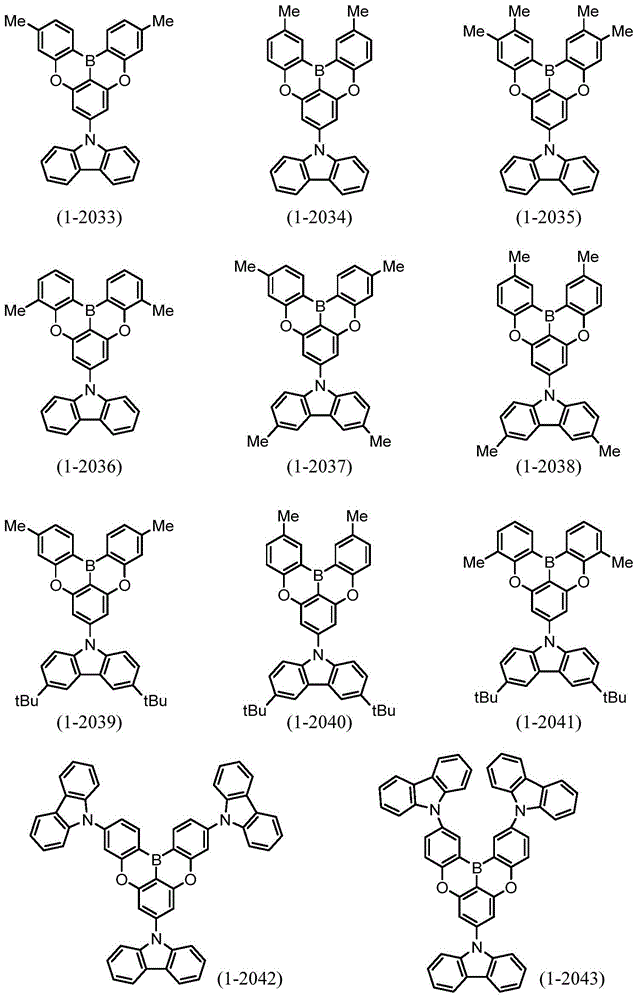
[化78][Chemical 78]

[化79][Chemical 79]

[化80][Chemical 80]

[化81][Chemical 81]

[化82][Chemical 82]

[化83][Chemical 83]

[化84][Chemical 84]

[化85][Chemical 85]

[化86][Chemical 86]

[化87][Chemical 87]

[化88][Chemical 88]

[化89][Chemical 89]

[化90][Chemical 90]

[化91][Chemical 91]

[化92][Chemical 92]

[化93][Chemical 93]

[化94][Chemical 94]

[化95][Chemical 95]

[化96][Chemical 96]

[化97][Chemical 97]

[化98][Chemical 98]

[化99][Chemical 99]

[化100][Chemical 100]

[化101][Chemical 101]

[化102][Chemical 102]

[化103][Chemical 103]

[化104][Chemical 104]

[化105][Chemical 105]

[化106][Chemical 106]

[化107][Chemical 107]

[化108][Chemical 108]

[化109][Chemical 109]

[化110][Chemical 110]

[化111][Chemical 111]

[化112][Chemical 112]

[化113][Chemical 113]

[化114][Chemical 114]

[化115][Chemical 115]

[化116][Chemical 116]

[化117][Chemical 117]

[化118][Chemical 118]

[化119][Chemical 119]

[化120][Chemical 120]

[化121][Chemical 121]

[化122][Chemical 122]

[化123][Chemical 123]

[化124][Chemical 124]

[化125][Chemical 125]

[化126][Chemical 126]

[化127][Chemical 127]

[化128][Chemical 128]

[化129][Chemical 129]

[化130][Chemical 130]

[化131][Chemical 131]

[化132][Chemical 132]

[化133][Chemical 133]

[化134][Chemical 134]

[化135][Chemical 135]

[化136][Chemical 136]

[化137][Chemical 137]

[化138][Chemical 138]

[化139][Chemical 139]

[化140][Chemical 140]

[化141][Chemical 141]

[化142][Chemical 142]

[化143][Chemical 143]

[化144][Chemical 144]

[化145][Chemical 145]

[化146][Chemical 146]

[化147][Chemical 147]

[化148][Chemical 148]

[化149][Chemical 149]

[化150][Chemical 150]

[化151][Chemical 151]

[化152][hua 152]

[化153][Chemical 153]

[化154][Chemical 154]

[化155][Chemical 155]
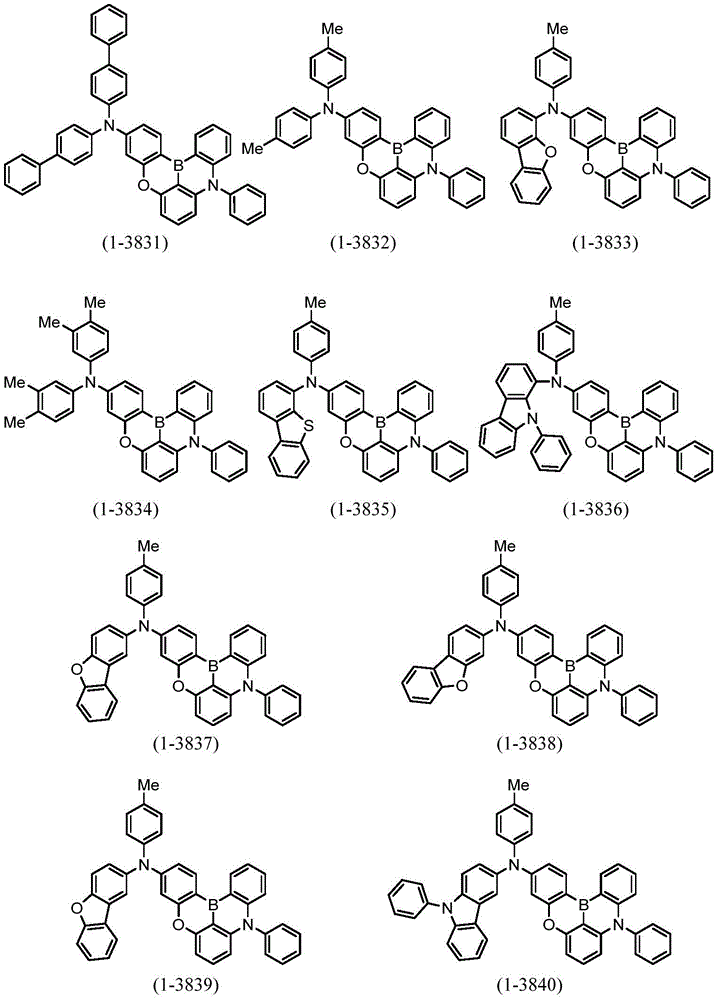
[化156][Chemical 156]

[化157][Chemical 157]

[化158][Chemical 158]

[化159][Chemical 159]

[化160][Chemical 160]

[化161][Chemical 161]

[化162][hua 162]

[化163][Chemical 163]

[化164][Chemical 164]

[化165][Chemical 165]

[化166][Chemical 166]

[化167][Chemical 167]

[化168][Chemical 168]

[化169][Chemical 169]

[化170][Chemical 170]

[化171][Chemical 171]

[化172][Chemical 172]

[化173][Chemical 173]

[化174][Chemical 174]

[化175][Chemical 175]

[化176][Chemical 176]

[化177][Chemical 177]

[化178][Chemical 178]

[化179][Chemical 179]

[化180][Chemical 180]

[化181][Chemical 181]

[化182][Chemical 182]

[化183][Chemical 183]

[化184][Chemical 184]

[化185][Chemical 185]

[化186][Chemical 186]

[化187][Chemical 187]

[化188][Chemical 188]

[化189][Chemical 189]

[化190][Chemical 190]

[化191][Chemical 191]

[化192][Chemical 192]

[化193][Chemical 193]

[化194][Chemical 194]

[化195][Chemical 195]

[化196][Chemical 196]

另外,本发明的多环芳香族化合物及其多聚体通过在A环、B环及C环(a环、b环及c环)的至少一个中的相对于Y1的对位上导入苯氧基、咔唑基或二苯基氨基,而可期待T1能量的提升(大概提升0.01eV~0.1eV)。尤其,当Y1为B(硼)、X1及X2为O或N-R(R如所述说明般)时,通过在相对于B(硼)的对位上导入苯氧基,作为A环、B环及C环(a环、b环及c环)的苯环上的HOMO在相对于硼的间位上进一步局部存在化,LUMO在相对于硼的邻位及对位上局部存在化,因此可特别期待T1能量的提升。In addition, the polycyclic aromatic compound of the present invention and its multimer are obtained by introducing benzene into the para position with respect to Y 1 in at least one of the A ring, the B ring and the C ring (a ring, b ring and c ring). An oxy group, a carbazolyl group or a diphenylamino group can be expected to increase the T1 energy (approximately 0.01eV to 0.1eV increase). In particular, when Y 1 is B (boron), and X 1 and X 2 are O or NR (R is as described above), a phenoxy group is introduced at the para position with respect to B (boron) to form a ring A. , HOMO on the benzene ring of B ring and C ring (a ring, b ring and c ring) is further localized in the meta position relative to boron, and LUMO is localized in the ortho and para positions relative to boron , so the improvement of T1 energy can be particularly expected.
作为此种具体例,例如可列举由下述式(1-4401)~式(1-4422)所表示的化合物、及由下述式(1-4501)~式(1-4522)所表示的化合物。Examples of such specific examples include compounds represented by the following formulae (1-4401) to (1-4422) and compounds represented by the following formulae (1-4501) to (1-4522). compound.
再者,式中的R为烷基,可为直链及支链的任一种,例如可列举碳数为1~24的直链烷基或碳数为3~24的支链烷基。优选为碳数为1~18的烷基(碳数为3~18的支链烷基),更优选为碳数为1~12的烷基(碳数为3~12的支链烷基),进而更优选为碳数为1~6的烷基(碳数为3~6的支链烷基),特别优选为碳数为1~4的烷基(碳数为3~4的支链烷基)。另外,作为R,此外可列举苯基。In addition, R in the formula is an alkyl group, which may be either a straight chain or a branched chain, for example, a straight chain alkyl group having 1 to 24 carbon atoms or a branched chain alkyl group having 3 to 24 carbon atoms. Preferably it is an alkyl group having 1 to 18 carbon atoms (branched alkyl group having 3 to 18 carbon atoms), and more preferably an alkyl group having 1 to 12 carbon atoms (branched alkyl group having 3 to 12 carbon atoms) , and more preferably an alkyl group having 1 to 6 carbon atoms (branched chain alkyl group having 3 to 6 carbon atoms), particularly preferably an alkyl group having 1 to 4 carbon atoms (branched chain alkyl group having 3 to 4 carbon atoms) alkyl). Moreover, as R, a phenyl group is mentioned.
另外,“PhO-”为苯氧基,所述苯基例如可如式(1-4421-1)般由直链或支链的烷基取代,例如可由碳数为1~24的直链烷基或碳数为3~24的支链烷基、碳数为1~18的烷基(碳数为3~18的支链烷基)、碳数为1~12的烷基(碳数为3~12的支链烷基)、碳数为1~6的烷基(碳数为3~6的支链烷基)、碳数为1~4的烷基(碳数为3~4的支链烷基)取代。In addition, "PhO-" is a phenoxy group, and the phenyl group may be substituted with a straight-chain or branched alkyl group as in formula (1-4421-1), for example, a straight-chain alkane having 1 to 24 carbon atoms. group or branched alkyl group with 3 to 24 carbon atoms, alkyl group with 1 to 18 carbon atoms (branched chain alkyl group with 3 to 18 carbon atoms), alkyl group with 1 to 12 carbon atoms (carbon number of 3-12 branched chain alkyl group), C1-6 alkyl group (C3-6 branched alkyl group), C1-4 alkyl group (C3-4 alkyl group) branched chain alkyl) substituted.
[化197][Chemical 197]

[化198][Chemical 198]

另外,作为本发明的多环芳香族化合物及其多聚体的具体例,可列举在由所述式(1-1)~(1-825)、式(1-1001)~式(1-1281)、式(1-1301)~式(1-1311)、式(1-1351)~式(1-1361)、式(1-1401)~式(1-1460)、式(1-2001)~式(1-2299)、式(1-2301)~式(1-2616)、式(1-2621)~式(1-2705)、式(1-3581)~式(1-3828)、式(1-3831)~式(1-4033)、式(1-4041)~式(1-4288)、式(1-4301)~式(1-4349)、式(1-4401)~式(1-4422)、及式(1-4501)~式(1-4522)所表示的化合物中,化合物中的1个或多个芳香环中的至少一个氢由1个或多个烷基或芳基取代的化合物,更优选为可列举由1个~2个碳数为1~12的烷基或碳数为6~10的芳基取代的化合物。In addition, as specific examples of the polycyclic aromatic compound of the present invention and a multimer thereof, the formulas (1-1) to (1-825) and the formulas (1-1001) to (1- 1281), formula (1-1301) ~ formula (1-1311), formula (1-1351) ~ formula (1-1361), formula (1-1401) ~ formula (1-1460), formula (1-2001) ) to formula (1-2299), formula (1-2301) to formula (1-2616), formula (1-2621) to formula (1-2705), formula (1-3581) to formula (1-3828) , formula (1-3831) ~ formula (1-4033), formula (1-4041) ~ formula (1-4288), formula (1-4301) ~ formula (1-4349), formula (1-4401) ~ In the compounds represented by formula (1-4422) and formulas (1-4501) to (1-4522), at least one hydrogen in one or more aromatic rings in the compound is composed of one or more alkyl groups The compound substituted with an aryl group is more preferably a compound substituted with one to two alkyl groups having 1 to 12 carbon atoms or aryl groups having 6 to 10 carbon atoms.
具体而言,可列举由以下的式(1-1-R)~式(1-4401-R)所表示的化合物。下述式中的R分别独立地为碳数为1~12的烷基或碳数为6~10的芳基,优选为碳数为1~4的烷基或苯基,n分别独立地为0~2,优选为1。Specifically, the compound represented by the following formula (1-1-R) - formula (1-4401-R) is mentioned. R in the following formula is each independently an alkyl group having 1 to 12 carbon atoms or an aryl group having 6 to 10 carbon atoms, preferably an alkyl group or phenyl group having 1 to 4 carbon atoms, and n is each independently 0 to 2, preferably 1.
[化199][Chemical 199]

[化200][Chemical 200]

[化201][Chemical 201]

[化202][Chemical 202]

[化203][Chemical 203]

[化204][Chemical 204]
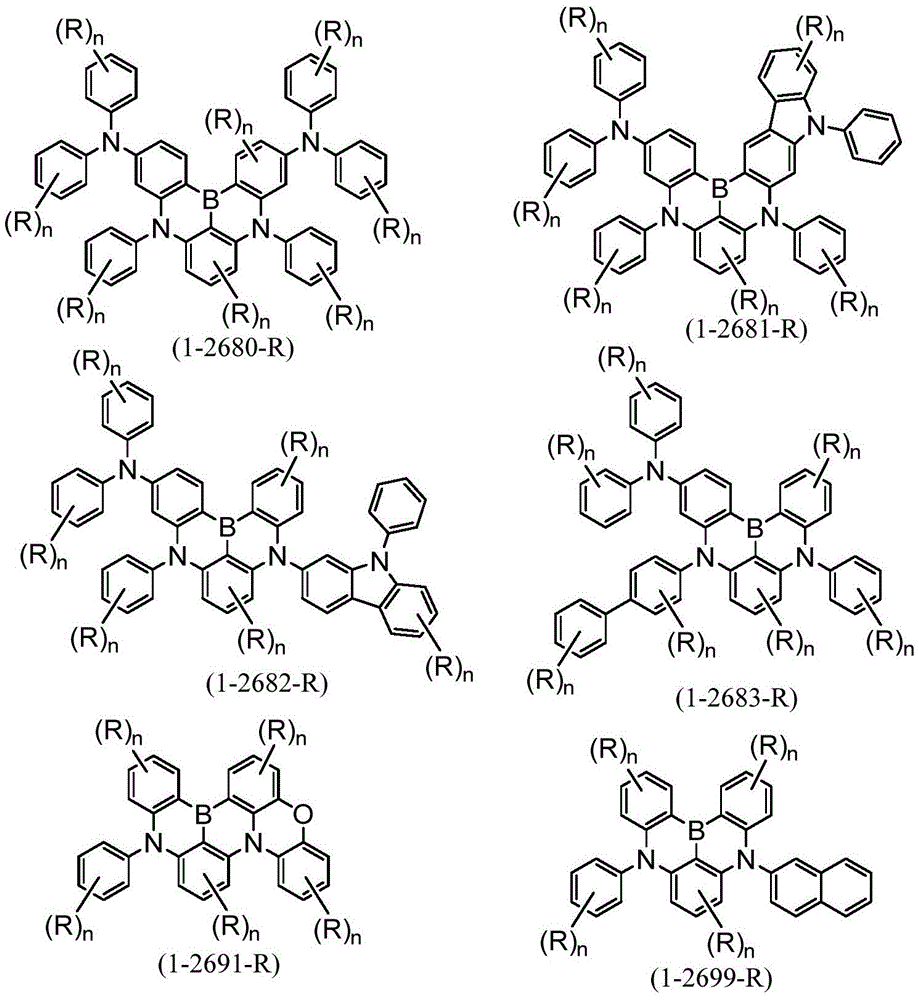
[化205][Chemical 205]

[化206][Chemical 206]

[化207][Chemical 207]

另外,作为本发明的多环芳香族化合物及其多聚体的具体例,可列举化合物中的1个或多个苯基或1个亚苯基中的至少一个氢由1个或多个碳数为1~4的烷基,优选为碳数为1~3的烷基(优选为1个或多个甲基)取代的化合物,更优选为可列举1个苯基的邻位上的氢(2个部位之中,2个部位均,优选为任何一部位)或1个亚苯基的邻位上的氢(最多4个部位之中,4个部位均,优选为任何一部位)由甲基取代的化合物。In addition, as a specific example of the polycyclic aromatic compound and its multimer of the present invention, one or more phenyl groups in the compound or at least one hydrogen in one phenylene group is composed of one or more carbon atoms. An alkyl group having 1 to 4 carbon atoms, preferably a compound substituted with an alkyl group having 1 to 3 carbon atoms (preferably one or more methyl groups), more preferably a hydrogen at the ortho position of one phenyl group (Among the 2 sites, both sites are preferably any of the sites) or the hydrogen at the ortho position of one phenylene (out of the maximum of 4 sites, all of the 4 sites are preferably any of the sites) by Methyl substituted compounds.
作为此种化合物,可列举在由所述式(1-1)~式(1-825)所表示的化合物、由式(1-1001)~式(1-1281)所表示的化合物、由式(1-1301)~式(1-1311)所表示的化合物、由式(1-1351)~式(1-1361)所表示的化合物、由式(1-1401)~式(1-1460)所表示的化合物、由式(1-2001)~式(1-2299)所表示的化合物、由式(1-2301)~式(1-2619)所表示的化合物、由式(1-2621)~式(1-2705)所表示的化合物、由式(1-3581)~式(1-3828)所表示的化合物、由式(1-3831)~式(1-4033)所表示的化合物、由式(1-4041)~式(1-4288)所表示的化合物、及由式(1-4301)~式(1-4349)所表示的化合物中的含有苯基或亚苯基的化合物中,其1个或多个苯基或1个亚苯基中的至少一个氢由碳数为1~4的烷基,优选为1个或多个碳数为1~3的烷基(优选为1个或多个甲基)取代的化合物,更优选为可列举1个苯基的邻位上的氢(2个部位之中,2个部位均,优选为任何一部位)或1个亚苯基的邻位上的氢(最多4个部位之中,4个部位均,优选为任何一部位)由甲基取代的化合物。Examples of such compounds include compounds represented by the above formulae (1-1) to (1-825), compounds represented by the formulae (1-1001) to (1-1281), and compounds represented by the formulae (1-1281). Compounds represented by (1-1301) to formula (1-1311), compounds represented by formulas (1-1351) to (1-1361), compounds represented by formulas (1-1401) to (1-1460) Compounds represented, compounds represented by formulas (1-2001) to (1-2299), compounds represented by formulas (1-2301) to (1-2619), compounds represented by formulas (1-2621) to the compound represented by the formula (1-2705), the compound represented by the formula (1-3581) to the formula (1-3828), the compound represented by the formula (1-3831) to the formula (1-4033), Among the compounds represented by the formulae (1-4041) to (1-4288) and the compounds represented by the formulas (1-4301) to (1-4349) containing a phenyl group or a phenylene group , at least one hydrogen in one or more phenyl groups or one phenylene group is an alkyl group with a carbon number of 1 to 4, preferably one or more alkyl groups with a carbon number of 1 to 3 (preferably One or more methyl) substituted compounds, more preferably a hydrogen at the ortho position of a phenyl group (among the two positions, both positions are preferably any position) or a phenylene A compound in which the hydrogen at the ortho position of the group (among four positions, all of the four positions are preferably any position) is substituted with a methyl group.
尤其,可列举由式(1-1)、式(1-41)、式(1-42)、式(1-45)、式(1-50)、式(1-79)、式(1-83)、式(1-84)、式(1-91)、式(1-94)、式(1-95)、式(1-97)、式(1-151)、式(1-152)、式(1-1021)~式(1-1036)、式(1-1037)、式(1-1038)、式(1-1039)、式(1-1048)、式(1-1049)、式(1-1050)、式(1-1077)、式(1-1078)、式(1-1079)、式(1-1187)、式(1-1190)、式(1-1191)及式(1-1192)所表示的化合物中的1个或多个苯基或1个亚苯基中的至少一个氢由1个或多个碳数为1~4的烷基,优选为碳数为1~3的烷基(优选为1个或多个甲基)取代的化合物,更优选为可列举1个苯基的邻位上的氢(2个部位之中,2个部位均,优选为任何一部位)或1个亚苯基的邻位上的氢(最多4个部位之中,4个部位均,优选为任何一部位)由甲基取代的化合物。In particular, formula (1-1), formula (1-41), formula (1-42), formula (1-45), formula (1-50), formula (1-79), formula (1) -83), formula (1-84), formula (1-91), formula (1-94), formula (1-95), formula (1-97), formula (1-151), formula (1- 152), formula (1-1021) to formula (1-1036), formula (1-1037), formula (1-1038), formula (1-1039), formula (1-1048), formula (1-1049) ), formula (1-1050), formula (1-1077), formula (1-1078), formula (1-1079), formula (1-1187), formula (1-1190), formula (1-1191) and at least one hydrogen in one or more phenyl groups or one phenylene group in the compound represented by the formula (1-1192) consists of one or more alkyl groups with 1 to 4 carbon atoms, preferably carbon Compounds substituted with 1 to 3 alkyl groups (preferably one or more methyl groups), more preferably hydrogen at the ortho position of one phenyl group (among the two positions, both positions are Preferably, it is a compound in which hydrogen at the ortho position of one phenylene group (out of a maximum of 4 positions, all 4 positions, preferably any position) is substituted with a methyl group.
通过利用甲基等取代化合物中的末端的苯基或对亚苯基的邻位上的至少一个氢,邻接的芳香环彼此容易正交且共轭变弱,结果可提高三重态激发能量(ET)。By substituting at least one hydrogen at the ortho position of the terminal phenyl group or p-phenylene group in the compound with a methyl group or the like, the adjacent aromatic rings are easily orthogonal to each other and the conjugation becomes weak, and as a result, the triplet excitation energy (E T ).
具体而言,可列举:由以下的式(1-1-1)所表示的化合物、及由式(1-41-1)~式(1-1192-9)所表示的化合物。Specifically, the compound represented by the following formula (1-1-1), and the compound represented by the formula (1-41-1) - formula (1-1192-9) are mentioned.
[化208][Chemical 208]

[化209][Chemical 209]

[化210][hua 210]

[化211][hua 211]

[化212][hua 212]

[化213][hua 213]

[化214][hua 214]

[化215][hua 215]

[化216][hua 216]

[化217][hua 217]

[化218][hua 218]

[化219][Chemical 219]

[化220][Chemical 220]

[化221][Chemical 221]

[化222][Chemical 222]

[化223][Chemical 223]
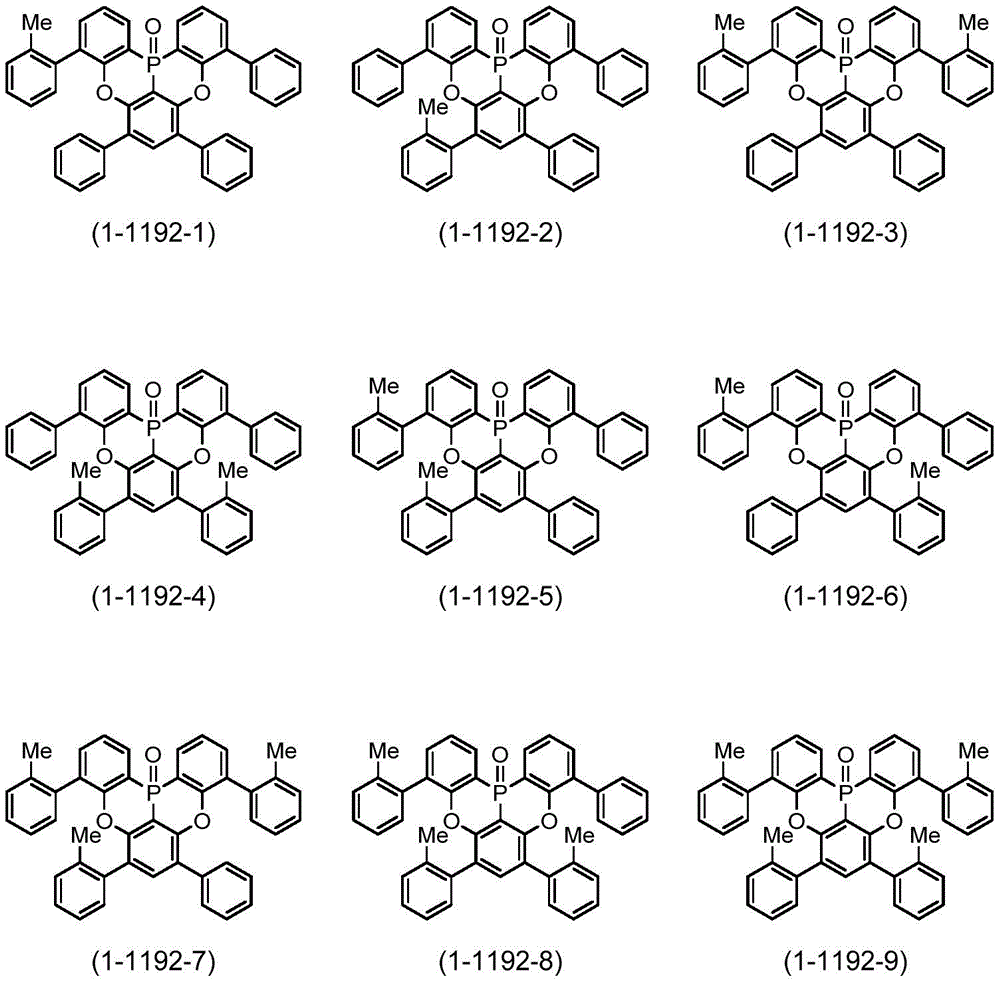
2.多环芳香族化合物及其多聚体的制造方法2. Production method of polycyclic aromatic compound and multimer thereof
由通式(1)或通式(2)所表示的多环芳香族化合物及其多聚体基本上首先利用键结基(含有X1或X2的基)使A环(a环)与B环(b环)及C环(c环)键结,由此制造中间物(第1反应),其后,利用键结基(含有Y1的基)使A环(a环)、B环(b环)及C环(c环)键结,由此可制造最终产物(第2反应)。在第1反应中,例如若为醚化反应,则可利用亲核取代反应、乌尔曼反应(Ullmann Reaction)等一般的反应,若为氨基化反应,则可利用布赫瓦尔德-哈特维希反应(Buchwald-Hartwig Reaction)等一般的反应。另外,在第2反应中,可利用串联式杂夫里德耳-夸夫特反应(Tandem Hetero-Friedel-Crafts Reaction)(连续的芳香族亲电子取代反应,以下相同)。The polycyclic aromatic compound represented by the general formula (1) or the general formula (2) and multimers thereof are basically first made of a linking group (a group containing X 1 or X 2 ) with the A ring (a ring) and the The B ring (b ring) and the C ring (c ring) are bonded to produce an intermediate ( 1st reaction), and then the A ring (a ring) and B The ring (b ring) and the C ring (c ring) are bonded to produce the final product (second reaction). In the first reaction, for example, in the case of etherification, general reactions such as nucleophilic substitution reaction and Ullmann reaction can be used, and in the case of amination reaction, Buchwald-Hart can be used Vichy reaction (Buchwald-Hartwig Reaction) and other general reactions. In addition, in the second reaction, a tandem Hetero-Friedel-Crafts reaction (Tandem Hetero-Friedel-Crafts Reaction) (continuous aromatic electrophilic substitution reaction, the same applies hereinafter) can be used.
如下述流程(1)或流程(2)所示,第2反应为导入键结A环(a环)、B环(b环)及C环(c环)的Y1的反应,作为例子,以下表示Y1为硼原子、X1及X2为氧原子的情况。首先,利用正丁基锂、仲丁基锂或叔丁基锂等对X1与X2之间的氢原子进行邻位金属化。继而,添加三氯化硼或三溴化硼等,进行锂-硼的金属交换后,添加N,N-二异丙基乙胺等布忍斯特碱,由此进行串联式硼杂夫里德耳-夸夫特反应(Tandem Bora-Friedel-Crafts Reaction),而可获得目标物。在第2反应中,为了促进反应,也可添加三氯化铝等路易斯酸。As shown in the following scheme (1) or scheme (2), the second reaction is a reaction of introducing Y 1 to which the A ring (a ring), the B ring (b ring) and the C ring (c ring) are bonded. As an example, The following shows the case where Y 1 is a boron atom, and X 1 and X 2 are oxygen atoms. First, the hydrogen atom between X 1 and X 2 is ortho-metallated with n-butyllithium, sec-butyllithium, tert-butyllithium, or the like. Next, boron trichloride, boron tribromide, etc. are added to perform lithium-boron metal exchange, and then a Brünster base such as N,N-diisopropylethylamine is added to perform tandem borzafried. Ear-Quaft reaction (Tandem Bora-Friedel-Crafts Reaction), and obtain the target. In the second reaction, in order to accelerate the reaction, a Lewis acid such as aluminum trichloride may be added.
[化224][Chemical 224]
流程(1)Process(1)

流程(2)Process (2)

再者,所述流程(1)或流程(2)主要表示由通式(1)或通式(2)所表示的多环芳香族化合物的制造方法,关于其多聚体,可通过使用具有多个A环(a环)、B环(b环)及C环(c环)的中间物来制造。详细情况在下述流程(3)~流程(5)中进行说明。在此情况下,将所使用的丁基锂等试剂的量设为2倍量、3倍量,由此可获得目标物。In addition, the above-mentioned scheme (1) or scheme (2) mainly shows the production method of the polycyclic aromatic compound represented by the general formula (1) or the general formula (2). A plurality of intermediates of A ring (a ring), B ring (b ring) and C ring (c ring) are produced. Details are described in the following flow (3) to (5). In this case, the target substance can be obtained by setting the amount of the reagent such as butyllithium to be used as double or triple.
[化225][Chemical 225]
流程(3)Process (3)

流程(4)Process (4)


在所述流程中,通过邻位金属化而朝所期望的位置上导入锂,但可如下述流程(6)及流程(7)般在欲导入锂的位置上导入溴原子等,并还通过卤素-金属交换而朝所期望的位置上导入锂。In the above-mentioned scheme, lithium is introduced into a desired position by ortho-metallization, but bromine atoms or the like may be introduced at the position where lithium is to be introduced as in the following scheme (6) and scheme (7), and also through Lithium is introduced to the desired position by halogen-metal exchange.
[化226][Chemical 226]
流程(6)Process(6)

流程(7)Process(7)

另外,关于流程(3)中所说明的多聚体的制造方法,也可如所述流程(6)及流程(7)般在欲导入锂的位置上导入溴原子或氯原子等卤素,并还通过卤素-金属交换而朝所期望的位置上导入锂(下述流程(8)、流程(9)及流程(10))。In addition, with regard to the method for producing a multimer described in the scheme (3), a halogen such as a bromine atom or a chlorine atom may be introduced into the position where lithium is to be introduced, as in the above-mentioned schemes (6) and (7). Lithium was also introduced into desired positions by halogen-metal exchange (the following scheme (8), scheme (9) and scheme (10)).
[化227][Chemical 227]
流程(8)Process (8)

流程(9)Process(9)

根据所述方法,即便是如因取代基的影响而无法进行邻位金属化的例子,也可合成目标物而有用。According to this method, even in cases where ortho-metallation cannot be performed due to the influence of substituents, it is useful to synthesize the target product.
通过适宜选择所述合成法,还适宜选择所使用的原料,而可合成在所期望的位置上具有取代基,Y1为硼原子、X1及X2为氧原子的多环芳香族化合物及其多聚体。By appropriately selecting the synthesis method and the raw materials used, it is possible to synthesize a polycyclic aromatic compound having a substituent at a desired position, wherein Y 1 is a boron atom, and X 1 and X 2 are oxygen atoms. its polymers.
其次,将Y1为硼原子、X1及X2为氮原子的情况作为例子而示于下述流程(11)及流程(12)中。与X1及X2为氧原子的情况同样地,首先,利用正丁基锂等对X1与X2之间的氢原子进行邻位金属化。继而,添加三溴化硼等,进行锂-硼的金属交换后,添加N,N-二异丙基乙胺等布忍斯特碱,由此进行串联式硼杂夫里德耳-夸夫特反应,而可获得目标物。此处,为了促进反应,也可添加三氯化铝等路易斯酸。Next, the case where Y 1 is a boron atom and X 1 and X 2 are nitrogen atoms is shown in the following scheme (11) and scheme (12) as an example. As in the case where X 1 and X 2 are oxygen atoms, first, the hydrogen atom between X 1 and X 2 is ortho-metallated with n-butyllithium or the like. Next, boron tribromide or the like is added to perform lithium-boron metal exchange, and then a Brünster base such as N,N-diisopropylethylamine is added to perform tandem borzafriedel-quaft. reaction to obtain the target. Here, in order to promote the reaction, a Lewis acid such as aluminum trichloride may be added.
[化228][Chemical 228]
流程(11)Process(11)

流程(12)Process(12)

另外,关于Y1为硼原子、X1及X2为氮原子时的多聚体,也可如所述流程(6)及流程(7)般在欲导入锂的位置上导入溴原子或氯原子等卤素,并还通过卤素-金属交换而朝所期望的位置上导入锂(下述流程(13)、流程(14)及流程(15))。In addition, with regard to the multimer in which Y 1 is a boron atom and X 1 and X 2 are nitrogen atoms, a bromine atom or chlorine can also be introduced at the position where lithium is to be introduced as in the above-mentioned scheme (6) and scheme (7). Atoms and other halogens are also introduced into desired positions by halogen-metal exchange (the following scheme (13), scheme (14) and scheme (15)).
[化229][Chemical 229]
流程(13)Process(13)

流程(14)Process(14)

继而,将Y1为硫化磷、氧化磷或磷原子,X1及X2为氧原子的情况作为例子而示于下述流程(16)~流程(19)中。与以上所述同样地,首先利用正丁基锂等对X1与X2之间的氢原子进行邻位金属化。继而,依次添加三氯化磷、硫,最后添加三氯化铝等路易斯酸及N,N-二异丙基乙胺等布忍斯特碱,由此进行串联式磷杂夫里德耳-夸夫特反应(Tandem Phospha-Friedel-Crafts Reaction),而可获得Y1为硫化磷的化合物。另外,利用间氯过苯甲酸(m-CPBA)对所获得的硫化磷化合物进行处理,由此可获得Y1为氧化磷的化合物,然后利用三乙基膦进行处理,由此可获得Y1为磷原子的化合物。Next, the case where Y 1 is phosphorus sulfide, phosphorus oxide, or a phosphorus atom, and X 1 and X 2 are oxygen atoms are shown as examples in the following schemes (16) to (19). In the same manner as described above, firstly, the hydrogen atom between X 1 and X 2 is ortho-metallated with n-butyllithium or the like. Then, phosphorous trichloride and sulfur are added successively, and finally Lewis acids such as aluminum trichloride and Brünster bases such as N,N-diisopropylethylamine are added, thereby carrying out a series-type phosphafriedel-quart. Crafts reaction (Tandem Phospha-Friedel-Crafts Reaction), and Y 1 can be obtained as phosphorus sulfide compound. In addition, by treating the obtained phosphorus sulfide compound with m-chloroperbenzoic acid (m-CPBA), a compound in which Y 1 is phosphorus oxide can be obtained, and then by treating with triethylphosphine, Y 1 can be obtained A compound of phosphorus atom.
[化230][Chemical 230]
流程(16)Process(16)

流程(17)Process(17)

流程(18)Process(18)

流程(19)Process(19)

另外,关于Y1为硫化磷、X1及X2为氧原子时的多聚体,也可如所述流程(6)及流程(7)般在欲导入锂的位置上导入溴原子或氯原子等卤素,并还通过卤素-金属交换而朝所期望的位置上导入锂(下述流程(20)、流程(21)及流程(22))。另外,以所述方式形成的Y1为硫化磷、X1及X2为氧原子时的多聚体也如所述流程(18)及流程(19)般,利用间氯过苯甲酸(m-CPBA)进行处理,由此可获得Y1为氧化磷的化合物,然后利用三乙基膦进行处理,由此可获得Y1为磷原子的化合物。In addition, regarding the multimer when Y 1 is phosphorus sulfide and X 1 and X 2 are oxygen atoms, a bromine atom or chlorine can also be introduced at the position where lithium is to be introduced as in the above-mentioned scheme (6) and scheme (7). Atoms and other halogens are introduced, and lithium is introduced into a desired position by halogen-metal exchange (the following scheme (20), scheme (21) and scheme (22)). In addition, the multimer formed in the above-described manner when Y 1 is phosphorus sulfide, and X 1 and X 2 are oxygen atoms is also similar to the above-mentioned scheme (18) and scheme (19), using m-chloroperbenzoic acid (m -CPBA), thereby obtaining a compound in which Y 1 is phosphorus oxide, and then treating with triethylphosphine, thereby obtaining a compound in which Y 1 is a phosphorus atom.
[化231][hua 231]
流程(20)Process(20)

流程(21)Process(21)

此处,记载了Y1为B、P、P=O或P=S,X1及X2为O或NR的例子,但通过适宜变更原料,也可合成Y1为Al、Ga、As、Si-R或Ge-R,或X1及X2为S的化合物。Here, the example in which Y 1 is B, P, P = O, or P=S, and X 1 and X 2 are O or NR is described. Si-R or Ge-R, or a compound in which X 1 and X 2 are S.
以上的反应中所使用的溶剂的具体例为叔丁基苯或二甲苯等。Specific examples of the solvent used in the above reaction are tert-butylbenzene, xylene, and the like.
另外,通式(2)中,a环、b环及c环的取代基R1~R11中的邻接的基彼此可键结并与a环、b环或c环一同形成芳基环或杂芳基环,所形成的环中的至少一个氢可由芳基或杂芳基取代。因此,由通式(2)所表示的多环芳香族化合物根据a环、b环及c环中的取代基的相互的键结形态,如下述流程(23)及流程(24)的式(2-1)及式(2-2)所示,构成化合物的环结构会变化。这些化合物可通过将所述流程(1)~流程(19)中所示的合成法应用于下述流程(23)及流程(24)中所示的中间物来合成。In addition, in the general formula (2), adjacent groups among the substituents R 1 to R 11 of the a-ring, b-ring and c-ring may be bonded to each other to form an aryl ring or an aryl ring together with the a-ring, b-ring or c-ring. Heteroaryl rings in which at least one hydrogen in the formed ring can be substituted with an aryl or heteroaryl group. Therefore, the polycyclic aromatic compound represented by the general formula (2) is as shown in the formula ( As shown in 2-1) and formula (2-2), the ring structure constituting the compound changes. These compounds can be synthesized by applying the synthesis methods shown in the above-mentioned Schemes (1) to (19) to the intermediates shown in the following Schemes (23) and (24).
[化232][hua 232]
流程(23)Process(23)

流程(24)Process(24)

所述式(2-1)及式(2-2)中的A′环、B′环及C′环表示取代基R1~R11中的邻接的基彼此键结并分别与a环、b环及c环一同形成的芳基环或杂芳基环(也可称为其他环结构在a环、b环或c环中缩合而成的稠环)。再者,虽然式中未表示,但还存在a环、b环及c环全部变化成A′环、B′环及C′环的化合物。The A' ring, the B' ring and the C' ring in the formula (2-1) and the formula (2-2) represent that adjacent groups in the substituents R 1 to R 11 are bonded to each other and are respectively connected to the a ring, The aryl ring or heteroaryl ring formed by the b ring and the c ring together (may also be referred to as a condensed ring formed by condensing other ring structures in the a ring, the b ring or the c ring). In addition, although not shown in the formula, there are also compounds in which the a ring, the b ring and the c ring are all changed into the A' ring, the B' ring and the C' ring.
另外,通式(2)中的“N-R的R通过-O-、-S-、-C(-R)2-或单键而与所述a环、b环和/或c环键结”的规定可由如下的化合物来表现,所述化合物由下述流程(25)的式(2-3-1)表示、且具有X1或X2被导入至稠环B′及稠环C′中的环结构,或由式(2-3-2)或式(2-3-3)表示、且具有X1或X2被导入至稠环A′中的环结构。这些化合物可通过将所述流程(1)~流程(19)中所示的合成法应用于下述流程(25)中所示的中间物来合成。In addition, in the general formula (2), "R of NR is bonded to the a-ring, b-ring and/or c-ring through -O-, -S-, -C(-R) 2 - or a single bond" The stipulation can be expressed by a compound represented by the formula (2-3-1) of the following scheme (25) and having X 1 or X 2 introduced into the fused ring B' and the fused ring C' , or a ring structure represented by formula (2-3-2) or formula (2-3-3) and having X 1 or X 2 introduced into the fused ring A'. These compounds can be synthesized by applying the synthesis methods shown in the above-mentioned schemes (1) to (19) to the intermediates shown in the following scheme (25).
[化233][hua 233]
流程(25)Process(25)

另外,在所述流程(1)~流程(17)及流程(20)~流程(25)的合成法中,表示在添加三氯化硼或三溴化硼等之前,利用丁基锂等对X1与X2之间的氢原子(或卤素原子)进行邻位金属化,由此进行串联式杂夫里德耳-夸夫特反应的例子,但也可不进行利用丁基锂等的邻位金属化,而通过三氯化硼或三溴化硼等的添加来进行反应。In addition, in the synthesis methods of the above-mentioned Scheme (1) to Scheme (17) and Scheme (20) to Scheme (25), it means that before adding boron trichloride, boron tribromide, etc., butyllithium or the like is used to The hydrogen atom (or halogen atom) between X 1 and X 2 is subjected to ortho-metallization, thereby carrying out an example of a tandem Hetfriedel-Quaft reaction, but it is not necessary to carry out ortho-metalation using butyllithium or the like. metallization, and the reaction proceeds by addition of boron trichloride, boron tribromide, or the like.
另外,在Y1为磷系的情况下,如下述流程(26)或流程(27)所示,利用正丁基锂、仲丁基锂或叔丁基锂等对X1与X2(下述式中为O)之间的氢原子进行邻位金属化,继而添加双(二乙氨基)氯膦,进行锂-磷的金属交换后,添加三氯化铝等路易斯酸,由此进行串联式磷杂夫里德耳-夸夫特反应,而可获得目标物。所述反应方法在国际公开第2010/104047号公报(例如27页)中也有记载。In addition, when Y 1 is phosphorus-based, as shown in the following scheme (26) or scheme (27), X 1 and X 2 (below In the above formula, the hydrogen atom between O) is metallized at the ortho position, then bis(diethylamino)chlorophosphine is added, and after the metal exchange of lithium-phosphorus is carried out, a Lewis acid such as aluminum trichloride is added, thereby connecting in series The target compound can be obtained by the phosphafrider-Quaft reaction. The reaction method is also described in International Publication No. WO 2010/104047 (eg, page 27).
[化234][hua 234]
流程(26)Process(26)

[化235][Chemical 235]
流程(27)Process(27)

再者,在所述流程(26)或流程(27)中,相对于中间物1的摩尔量,使用2倍、3倍的摩尔量的丁基锂等邻位金属化试剂,由此也可合成多聚体化合物。另外,在欲导入锂等金属的位置上事先导入溴原子或氯原子等卤素,然后进行卤素-金属交换,由此可朝所期望的位置上导入金属。Furthermore, in the process (26) or the process (27), relative to the molar amount of the intermediate 1, 2 times or 3 times the molar amount of butyllithium and other ortho-metalating reagents are used, which can also be used. Synthesis of polymeric compounds. In addition, by introducing a halogen such as a bromine atom or a chlorine atom in advance into a position where a metal such as lithium is to be introduced, and then performing halogen-metal exchange, a metal can be introduced into a desired position.
再者,作为所述流程(1)~流程(27)中所使用的邻位金属化试剂,可列举:甲基锂、正丁基锂、仲丁基锂、叔丁基锂等烷基锂,二异丙基酰胺锂、四甲基哌啶化锂、六甲基二硅胺化锂、六甲基二硅胺化钾等有机碱性化合物。Furthermore, as the ortho-metalating reagent used in the above-mentioned schemes (1) to (27), alkyl lithiums such as methyllithium, n-butyllithium, sec-butyllithium, and tert-butyllithium can be exemplified. , Lithium diisopropylamide, lithium tetramethylpiperidine, lithium hexamethyldisilazide, potassium hexamethyldisilazide and other organic basic compounds.
再者,作为所述流程(1)~流程(27)中所使用的金属-Y1的金属交换试剂,可列举:Y1的三氟化物、Y1的三氯化物、Y1的三溴化物、Y1的三碘化物等Y1的卤化物,CIPN(NEt2)2等Y1的氨基化卤化物,Y1的烷氧基化物,Y1的芳氧基化物等。In addition, as the metal-exchange reagent of metal-Y 1 used in the above-mentioned schemes (1) to (27), the trifluoride of Y 1 , the trichloride of Y 1 , the tribromide of Y 1 can be mentioned. Compounds, triiodides of Y 1 and other halides of Y 1 , CIPN(NEt 2 ) 2 and other aminated halides of Y 1 , alkoxylates of Y 1 , aryloxylates of Y 1 , etc.
再者,作为所述流程(1)~流程(27)中所使用的布忍斯特碱,可列举:N,N-二异丙基乙胺、三乙胺、2,2,6,6-四甲基哌啶、1,2,2,6,6-五甲基哌啶、N,N-二甲基苯胺、N,N-二甲基甲苯胺、2,6-二甲吡啶、四苯基硼酸钠、四苯基硼酸钾、三苯基硼烷、四苯基硅烷、Ar4BNa、Ar4BK、Ar3B、Ar4Si(再者,Ar为苯基等芳基)等。In addition, N,N-diisopropylethylamine, triethylamine, 2,2,6,6- Tetramethylpiperidine, 1,2,2,6,6-pentamethylpiperidine, N,N-dimethylaniline, N,N-dimethyltoluidine, 2,6-lutidine, tetra Sodium phenylborate, potassium tetraphenylborate, triphenylborane, tetraphenylsilane, Ar 4 BNa, Ar 4 BK, Ar 3 B, Ar 4 Si (in addition, Ar is an aryl group such as phenyl), etc. .
作为所述流程(1)~流程(27)中所使用的路易斯酸,可列举:AlCl3、AlBr3、AlF3、BF3·OEt2、BCl3、BBr3、GaCl3、GaBr3、InCl3、InBr3、In(OTf)3、SnCl4、SnBr4、AgOTf、ScCl3、Sc(OTf)3、ZnCl2、ZnBr2、Zn(OTf)2、MgCl2、MgBr2、Mg(OTf)2、LiOTf、NaOTf、KOTf、Me3SiOTf、Cu(OTf)2、CuCl2、YCl3、Y(OTf)3、TiCl4、TiBr4、ZrCl4、ZrBr4、FeCl3、FeBr3、CoCl3、CoBr3等。As the Lewis acid used in the above-mentioned schemes (1) to (27), AlCl 3 , AlBr 3 , AlF 3 , BF 3 ·OEt 2 , BCl 3 , BBr 3 , GaCl 3 , GaBr 3 , InCl 3 , InBr 3 , In(OTf) 3 , SnCl 4 , SnBr 4 , AgOTf, ScCl 3 , Sc(OTf) 3 , ZnCl 2 , ZnBr 2 , Zn(OTf) 2 , MgCl 2 , MgBr 2 , Mg(OTf) 2 , LiOTf, NaOTf, KOTf, Me 3 SiOTf, Cu(OTf) 2 , CuCl 2 , YCl 3 , Y(OTf) 3 , TiCl 4 , TiBr 4 , ZrCl 4 , ZrBr 4 , FeCl 3 , FeBr 3 , CoCl 3 , CoBr 3 and so on.
在所述流程(1)~流程(27)中,为了促进串联式杂夫里德耳-夸夫特反应,也可使用布忍斯特碱或路易斯酸。其中,当使用Y1的三氟化物、Y1的三氯化物、Y1的三溴化物、Y1的三碘化物等Y1的卤化物时,随着芳香族亲电子取代反应的进行,而生成氟化氢、氯化氢、溴化氢、碘化氢等酸,因此使用捕捉酸的布忍斯特碱有效。另一方面,当使用Y1的氨基化卤化物、Y1的烷氧基化物时,随着芳香族亲电子取代反应的进行,而生成胺、醇,因此在多数情况下,无需使用布忍斯特碱,但因氨基或烷氧基的脱离能力低,故使用促进其脱离的路易斯酸有效。In the above-mentioned schemes (1) to (27), in order to promote the tandem Zafriedel-Quaft reaction, a Brynster base or a Lewis acid can also be used. Among them, when using a halide of Y 1 such as Y 1 trifluoride, Y 1 trichloride, Y 1 tribromide, Y 1 triiodide, etc., with the progress of the aromatic electrophilic substitution reaction, Since acids such as hydrogen fluoride, hydrogen chloride, hydrogen bromide, and hydrogen iodide are generated, it is effective to use a Brynster base that captures acids. On the other hand, when the amine halide of Y 1 and the alkoxylate of Y 1 are used, amines and alcohols are generated with the progress of the aromatic electrophilic substitution reaction, so in many cases, it is not necessary to use Bruns It is a special base, but it is effective to use a Lewis acid that promotes the removal of amino groups or alkoxy groups because of its low ability to remove amino groups or alkoxy groups.
另外,在本发明的多环芳香族化合物或其多聚体中,还包含至少一部分的氢原子由重氢取代者或由氟或氯等卤素取代者,此种化合物等通过所期望的部位使用经重氢化、氟化或氯化的原料,而可与所述同样地合成。In addition, in the polycyclic aromatic compound of the present invention or a multimer thereof, at least a part of the hydrogen atoms are substituted with deuterium or with halogen such as fluorine or chlorine, and such compounds are used through a desired site. Deuterated, fluorinated or chlorinated starting materials can be synthesized in the same manner as described above.
本发明的多环芳香族化合物及其多聚体可用作有机元件用材料。作为有机元件,例如可列举:有机电场发光元件、有机场效晶体管或有机薄膜太阳电池等。The polycyclic aromatic compound of the present invention and its multimer can be used as a material for organic elements. As an organic element, an organic electroluminescent element, an organic field effect transistor, an organic thin film solar cell, etc. are mentioned, for example.
3.有机电场发光元件3. Organic electroluminescence element
本发明的多环芳香族化合物及其多聚体例如可用作有机电场发光元件的材料。以下,根据图式对本实施形态的有机EL元件进行详细说明。图1是表示本实施形态的有机EL元件的概略剖面图。The polycyclic aromatic compound of the present invention and a multimer thereof can be used, for example, as a material for an organic electroluminescence element. Hereinafter, the organic EL element of the present embodiment will be described in detail based on the drawings. FIG. 1 is a schematic cross-sectional view showing an organic EL element of the present embodiment.
<有机电场发光元件的结构><Structure of organic electroluminescence element>
图1所示的有机电场发光元件100包括:基板101、设置于基板101上的阳极102、设置于阳极102上的空穴注入层103、设置于空穴注入层103上的空穴传输层104、设置于空穴传输层104上的发光层105、设置于发光层105上的电子传输层106、设置于电子传输层106上的电子注入层107、以及设置于电子注入层107上的阴极108。The
再者,有机电场发光元件100也可使制作顺序相反而形成例如以下的构成,所述构成包括:基板101、设置于基板101上的阴极108、设置于阴极108上的电子注入层107、设置于电子注入层107上的电子传输层106、设置于电子传输层106上的发光层105、设置于发光层105上的空穴传输层104、设置于空穴传输层104上的空穴注入层103、以及设置于空穴注入层103上的阳极102。In addition, the
所述各层并非全部是不可或缺的层,将最小构成单元设为包含阳极102与发光层105及阴极108的构成,空穴注入层103、空穴传输层104、电子传输层106、电子注入层107是可任意设置的层。另外,所述各层可分别包含单一层,也可包含多层。The above-mentioned layers are not all indispensable layers, and the minimum structural unit is a structure including the
作为构成有机电场发光元件的层的形态,除所述“基板/阳极/空穴注入层/空穴传输层/发光层/电子传输层/电子注入层/阴极”的构成形态以外,也可为“基板/阳极/空穴传输层/发光层/电子传输层/电子注入层/阴极”、“基板/阳极/空穴注入层/发光层/电子传输层/电子注入层/阴极”、“基板/阳极/空穴注入层/空穴传输层/发光层/电子注入层/阴极”、“基板/阳极/空穴注入层/空穴传输层/发光层/电子传输层/阴极”、“基板/阳极/发光层/电子传输层/电子注入层/阴极”、“基板/阳极/空穴传输层/发光层/电子注入层/阴极”、“基板/阳极/空穴传输层/发光层/电子传输层/阴极”、“基板/阳极/空穴注入层/发光层/电子注入层/阴极”、“基板/阳极/空穴注入层/发光层/电子传输层/阴极”、“基板/阳极/发光层/电子传输层/阴极”、“基板/阳极/发光层/电子注入层/阴极”的构成形态。As the form of the layer constituting the organic electroluminescence element, other than the above-mentioned structural form of "substrate/anode/hole injection layer/hole transport layer/light emitting layer/electron transport layer/electron injection layer/cathode" "substrate/anode/hole transport layer/light-emitting layer/electron transport layer/electron injection layer/cathode", "substrate/anode/hole injection layer/light-emitting layer/electron transport layer/electron injection layer/cathode", "substrate/anode/hole injection layer/light-emitting layer/electron transport layer/electron injection layer/cathode" /anode/hole injection layer/hole transport layer/light-emitting layer/electron injection layer/cathode", "substrate/anode/hole injection layer/hole transport layer/light-emitting layer/electron transport layer/cathode", "substrate /anode/light-emitting layer/electron transport layer/electron injection layer/cathode", "substrate/anode/hole transport layer/light-emitting layer/electron injection layer/cathode", "substrate/anode/hole transport layer/light-emitting layer/ Electron transport layer/cathode", "substrate/anode/hole injection layer/light-emitting layer/electron injection layer/cathode", "substrate/anode/hole injection layer/light-emitting layer/electron transport layer/cathode", "substrate/ Anode/light-emitting layer/electron transport layer/cathode" and "substrate/anode/light-emitting layer/electron injection layer/cathode".
<有机电场发光元件中的基板><Substrate in organic electroluminescence element>
基板101是成为有机电场发光元件100的支撑体,通常使用石英、玻璃、金属、塑料等。基板101根据目的而形成为板状、膜状或片状,例如可使用玻璃板、金属板、金属箔、塑料膜、塑料片等。其中,优选为玻璃板及聚酯、聚甲基丙烯酸酯、聚碳酸酯、聚砜等的透明的合成树脂制的板。若为玻璃基板,则可使用钠钙玻璃或无碱玻璃等,另外,厚度也只要是足以保持机械强度的厚度即可,因此例如只要有0.2mm以上即可。厚度的上限值例如为2mm以下,优选为1mm以下。关于玻璃的材质,因来自玻璃的溶出离子越少越好,故优选为无碱玻璃,由于施加了SiO2等的隔离涂层的钠钙玻璃也有市售,因此可使用所述钠钙玻璃。另外,为了提高阻气性,也可在基板101的至少一面上设置细密的氧化硅膜等阻气膜,尤其在将阻气性低的合成树脂制的板、膜或片用作基板101的情况下,优选为设置阻气膜。The
<有机电场发光元件中的阳极><Anode in organic electroluminescence element>
阳极102发挥朝发光层105中注入空穴的作用。再者,当在阳极102与发光层105之间设置有空穴注入层103和/或空穴传输层104时,经由这些层朝发光层105中注入空穴。The
作为形成阳极102的材料,可列举无机化合物及有机化合物。作为无机化合物,例如可列举:金属(铝、金、银、镍、钯、铬等)、金属氧化物(铟的氧化物、锡的氧化物、铟-锡氧化物(Indium Tin Oxide,ITO)、铟-锌氧化物(Indium Zinc Oxide,IZO)等)、卤化金属(碘化铜等)、硫化铜、碳黑、ITO玻璃或奈塞玻璃等。作为有机化合物,例如可列举:聚(3-甲基噻吩)等聚噻吩、聚吡咯、聚苯胺等导电性聚合物等。此外,可自用作有机电场发光元件的阳极的物质中适宜选择来使用。As a material for forming the
透明电极的电阻只要可对发光元件的发光供给足够的电流即可,因此并无限定,但就发光元件的消耗电力的观点而言,理想的是低电阻。例如,若为300Ω/□以下的ITO基板,则作为元件电极发挥功能,但现在还可供给10Ω/□左右的基板,因此特别理想的是使用例如100Ω/□~5Ω/□,优选为50Ω/□~5Ω/□的低电阻品。ITO的厚度可配合电阻值而任意地选择,但通常在50nm~300nm之间使用的情况多。The resistance of the transparent electrode is not limited as long as a sufficient current can be supplied to the light-emitting element to emit light, but from the viewpoint of the power consumption of the light-emitting element, it is preferably low. For example, if it is an ITO substrate of 300Ω/□ or less, it functions as an element electrode, but a substrate of about 10Ω/□ is currently available. Therefore, it is particularly desirable to use, for example, 100Ω/□ to 5Ω/□, preferably 50Ω/□ □~5Ω/□ low resistance product. Although the thickness of ITO can be arbitrarily selected according to the resistance value, it is usually used between 50 nm and 300 nm in many cases.
<有机电场发光元件中的空穴注入层、空穴传输层><Hole injection layer and hole transport layer in organic electroluminescence element>
空穴注入层103是发挥将自阳极102移动而来的空穴高效地注入至发光层105内或空穴传输层104内的作用的层。空穴传输层104是发挥将自阳极102所注入的空穴、或自阳极102经由空穴注入层103所注入的空穴高效地传输至发光层105的作用的层。空穴注入层103及空穴传输层104分别将空穴注入·传输材料的一种或两种以上加以层叠、混合而形成,或者由空穴注入·传输材料与高分子粘结剂的混合物形成。另外,也可向空穴注入·传输材料中添加如氯化铁(III)般的无机盐来形成层。The
作为空穴注入·传输性物质,必须在已被供给电场的电极间高效地注入·传输来自正极的空穴,理想的是空穴注入效率高、且高效地传输所注入的空穴。因此,优选为电离电位小、且空穴迁移率大、进而稳定性优异、制造时及使用时不易产生成为陷阱的杂质的物质。As a hole injecting/transporting substance, it is necessary to efficiently inject and transport holes from the positive electrode between electrodes to which an electric field is supplied, and it is desirable to have high hole injection efficiency and efficiently transport the injected holes. Therefore, a substance having a small ionization potential and a large hole mobility, and furthermore excellent in stability, and which is less likely to generate impurities that become traps during production and use, is preferable.
作为形成空穴注入层103及空穴传输层104的材料,可使用由所述通式(1)所表示的多环芳香族化合物或其多聚体。另外,可自从前以来在光导电材料中作为空穴的电荷传输材料所惯用的化合物,用于p型半导体、有机电场发光元件的空穴注入层及空穴传输层的公知的材料中选择使用任意的材料。这些材料的具体例为咔唑衍生物(N-苯基咔唑、聚乙烯咔唑等)、双(N-芳基咔唑)或双(N-烷基咔唑)等双咔唑衍生物、三芳基胺衍生物(主链或侧链上具有芳香族三级氨基的聚合物、1,1-双(4-二-对甲苯基氨基苯基)环己烷、N,N'-二苯基-N,N'-二(3-甲基苯基)-4,4'-二氨基联苯、N,N'-二苯基-N,N'-二萘基-4,4'-二氨基联苯、N,N'-二苯基-N,N'-二(3-甲基苯基)-4,4'-二苯基-1,1'-二胺、N,N'-二萘基-N,N'-二苯基-4,4'-二苯基-1,1'-二胺、N4,N4'-二苯基-N4,N4'-双(9-苯基-9H-咔唑-3-基)-[1,1'-联苯]-4,4'-二胺、N4,N4,N4',N4'-四[1,1'-联苯]-4-基)-[1,1'-联苯]-4,4'-二胺、4,4',4”-三(3-甲基苯基(苯基)氨基)三苯基胺等三苯基胺衍生物、星爆状胺衍生物等)、二苯乙烯衍生物、酞青衍生物(无金属、铜酞青等)、吡唑啉衍生物、腙系化合物、苯并呋喃衍生物或噻吩衍生物、噁二唑衍生物、喹噁啉衍生物(例如1,4,5,8,9,12-六氮杂三亚苯-2,3,6,7,10,11-六碳腈等)、卟啉衍生物等杂环化合物、聚硅烷等。聚合物系中,优选为侧链上具有所述单体的聚碳酸酯或苯乙烯衍生物、聚乙烯咔唑及聚硅烷等,但只要是形成发光元件的制作所需的薄膜,可自阳极注入空穴,进而可传输空穴的化合物,则并无特别限定。As a material for forming the
另外,有机半导体的导电性因其掺杂而受到强烈影响这一点也为人所知。此种有机半导体基质物质包含供电子性良好的化合物、或吸电子接受性良好的化合物。为了掺杂电子供应物质,已知有四氰基醌二甲烷(TCNQ)或2,3,5,6-四氟四氰基-1,4-苯醌二甲烷(F4TCNQ)等强电子接受体(例如,参照文献《M.Pfeiffer,A.Beyer,T.Fritz,K.Leo,《应用物理学快报(Appl.Phys.Lett.)》,73(22),3202-3204(1998)》及文献《J.Blochwitz,M.Pheiffer,T.Fritz,K.Leo,《应用物理学快报(Appl.Phys.Lett.)》,73(6),729-731(1998)》)。这些通过供电子型基础物质(空穴传输物质)中的电子移动过程而生成所谓的空穴。基础物质的传导性根据空穴的数量及迁移率而产生相当大的变化。作为具有空穴传输特性的基质物质,已知有例如联苯胺衍生物(TPD等)或星爆状胺衍生物(TDATA等)、或者特定的金属酞青(特别是锌酞青(ZnPc)等)(日本专利特开2005-167175号公报)。In addition, it is also known that the conductivity of organic semiconductors is strongly affected by doping. Such an organic semiconductor host substance contains a compound having a good electron donating property or a compound having a good electron withdrawing property. For doping electron donating substances, strong electron acceptors such as tetracyanoquinodimethane (TCNQ) or 2,3,5,6-tetrafluorotetracyano-1,4-benzoquinodimethane (F4TCNQ) are known (See, for example, M. Pfeiffer, A. Beyer, T. Fritz, K. Leo, Appl. Phys. Lett., 73(22), 3202-3204 (1998) and Literature "J. Blochwitz, M. Pheiffer, T. Fritz, K. Leo, "Appl. Phys. Lett.", 73 (6), 729-731 (1998) "). These generate so-called holes through a process of electron movement in an electron-donating base substance (hole-transporting substance). The conductivity of the base material varies considerably depending on the number and mobility of holes. As a host substance having hole transport properties, for example, benzidine derivatives (TPD, etc.), starburst amine derivatives (TDATA, etc.), or specific metal phthalocyanines (in particular, zinc phthalocyanine (ZnPc), etc., are known. ) (Japanese Patent Laid-Open No. 2005-167175).
<有机电场发光元件中的发光层><Light-emitting layer in organic electroluminescence element>
发光层105是通过在已被供给电场的电极间,使自阳极102所注入的空穴与自阴极108所注入的电子再结合而发光的层。作为形成发光层105的材料,只要是由空穴与电子的再结合而得到激发来发光的化合物(发光性化合物)即可,优选为可形成稳定的薄膜形状、且在固体状态下显示强的发光(荧光)效率的化合物。在本发明中,作为发光层用的材料,可使用由所述通式(1)所表示的多环芳香族化合物或其多聚体。The light-emitting
发光层可为单一层,也可包含多层,且分别由发光层用材料(主体材料、掺杂剂材料)形成。主体材料与掺杂剂材料分别可为一种,也可为多种的组合。掺杂剂材料可包含于整个主体材料内,也可包含于部分主体材料内。作为掺杂方法,可通过与主体材料的共蒸镀法来形成,也可事先与主体材料混合后同时蒸镀。The light-emitting layer may be a single layer or may include a plurality of layers, and each may be formed of a light-emitting layer material (host material, dopant material). The host material and the dopant material may be one type, respectively, or a combination of two types. The dopant material may be contained within the entire host material, or may be contained within a portion of the host material. As a doping method, it may be formed by a co-evaporation method with a host material, or it may be mixed with a host material in advance and then vapor-deposited at the same time.
主体材料的使用量根据主体材料的种类而不同,只要配合所述主体材料的特性来决定即可。主体材料的使用量的基准优选为整个发光层用材料的50wt%(重量百分比)~99.999wt%,更优选为80wt%~99.95wt%,进而更优选为90wt%~99.9wt%。由所述通式(1)所表示的多环芳香族化合物或其多聚体也可用作主体材料。The amount of the main body material used varies depending on the type of the main body material, and may be determined according to the characteristics of the main body material. The basis of the amount of the host material used is preferably 50 wt % (weight percent) to 99.999 wt % of the entire material for the light-emitting layer, more preferably 80 wt % to 99.95 wt %, and still more preferably 90 wt % to 99.9 wt %. A polycyclic aromatic compound represented by the general formula (1) or a multimer thereof can also be used as the host material.
掺杂剂材料的使用量根据掺杂剂材料的种类而不同,只要配合所述掺杂剂材料的特性来决定即可。掺杂剂的使用量的基准优选为整个发光层用材料的0.001wt%~50wt%,更优选为0.05wt%~20wt%,进而更优选为0.1wt%~10wt%。若为所述范围,则例如就可防止浓度淬灭现象的观点而言优选。由所述通式(1)所表示的多环芳香族化合物或其多聚体也可用作掺杂剂材料。The usage-amount of the dopant material varies depending on the type of the dopant material, and may be determined according to the properties of the dopant material. The reference amount of the dopant used is preferably 0.001 to 50 wt % of the entire material for the light-emitting layer, more preferably 0.05 to 20 wt %, and still more preferably 0.1 to 10 wt %. Within this range, it is preferable from the viewpoint of preventing the concentration quenching phenomenon, for example. The polycyclic aromatic compound represented by the general formula (1) or a multimer thereof can also be used as a dopant material.
作为可与由所述通式(1)所表示的多环芳香族化合物或其多聚体并用的主体材料,可列举自从前以来作为发光体而为人所知的蒽或芘等缩合环衍生物、双苯乙烯基蒽衍生物或二苯乙烯基苯衍生物等双苯乙烯基衍生物、四苯基丁二烯衍生物、环戊二烯衍生物、芴衍生物、苯并芴衍生物等。Examples of the host material that can be used in combination with the polycyclic aromatic compound represented by the general formula (1) or a multimer thereof include condensed ring derivatives such as anthracene and pyrene, which are conventionally known as light-emitting bodies. , bis-styryl anthracene derivatives or bis-styryl benzene derivatives and other bis-styryl derivatives, tetraphenyl butadiene derivatives, cyclopentadiene derivatives, fluorene derivatives, benzofluorene derivatives, etc. .
另外,作为可与由所述通式(1)所表示的多环芳香族化合物或其多聚体并用的掺杂剂材料,并无特别限定,可使用已知的化合物,且可对应于所期望的发光色而自各种材料中选择。具体而言,例如可列举:菲、蒽、芘、并四苯、并五苯、苝、萘并芘、二苯并芘、红荧烯及
若对每种发色光进行例示,则作为蓝色掺杂剂材料~蓝绿色掺杂剂材料,可列举:萘、蒽、菲、芘、三亚苯、苝、芴、茚、
另外,作为绿色掺杂剂材料~黄色掺杂剂材料,可列举香豆素衍生物、邻苯二甲酰亚胺衍生物、萘二甲酰亚胺衍生物、紫环酮衍生物、吡咯并吡咯衍生物、环戊二烯衍生物、吖啶酮衍生物、喹吖啶酮衍生物及红荧烯等并四苯衍生物等,进而,还可列举如下的化合物作为适宜的例子:向作为所述蓝色掺杂剂材料~蓝绿色掺杂剂材料所例示的化合物中导入芳基、杂芳基、芳基乙烯基、氨基、氰基等可长波长化的取代基而成的化合物。In addition, examples of green dopant materials to yellow dopant materials include coumarin derivatives, phthalimide derivatives, naphthalimide derivatives, perone derivatives, and pyrrolo Pyrrole derivatives, cyclopentadiene derivatives, acridone derivatives, quinacridone derivatives, naphthacene derivatives such as rubrene, etc., and further, the following compounds can be mentioned as suitable examples: The compounds exemplified by the blue-green dopant material to the blue-green dopant material are compounds in which a substituent capable of increasing the wavelength, such as an aryl group, a heteroaryl group, an arylvinyl group, an amino group, and a cyano group, is introduced.
进而,作为橙色掺杂剂材料~红色掺杂剂材料,可列举双(二异丙基苯基)苝四羧酸酰亚胺等萘二甲酰亚胺衍生物,紫环酮衍生物,将乙酰丙酮或苯甲酰丙酮与菲咯啉等作为配体的Eu络合物等稀土类络合物,4-(二氰基亚甲基)-2-甲基-6-(对二甲基氨基苯乙烯基)-4H-吡喃或其类似物,镁酞青、铝氯酞青等金属酞青衍生物,罗丹明化合物,脱氮黄素衍生物,香豆素衍生物,喹吖啶酮衍生物,吩噁嗪衍生物、噁嗪衍生物、喹唑啉衍生物、吡咯并吡啶衍生物、方酸内鎓盐衍生物、紫蒽酮衍生物、吩嗪衍生物、吩噁嗪酮衍生物及噻二唑并芘衍生物等,进而,还可列举如下的化合物作为适宜的例子:向作为所述蓝色掺杂剂材料~蓝绿色掺杂剂材料及绿色掺杂剂材料~黄色掺杂剂材料所例示的化合物中导入芳基、杂芳基、芳基乙烯基、氨基、氰基等可长波长化的取代基而成的化合物。Furthermore, examples of the orange-colored dopant material to the red-colored dopant material include naphthalimide derivatives such as bis(diisopropylphenyl)perylenetetracarboxyimide, perone derivatives, and Rare earth complexes such as Eu complexes with acetylacetone or benzoylacetone and phenanthroline as ligands, 4-(dicyanomethylene)-2-methyl-6-(p-dimethylene) Aminostyryl)-4H-pyran or its analogs, metal phthalocyanine derivatives such as magnesium phthalocyanine, aluminum chlorophthalocyanine, rhodamine compounds, deazaflavin derivatives, coumarin derivatives, quinacridine Ketone derivatives, phenoxazine derivatives, oxazine derivatives, quinazoline derivatives, pyrrolopyridine derivatives, squaraine derivatives, violanthrone derivatives, phenazine derivatives, phenoxazinones Derivatives, thiadiazolopyrene derivatives, etc., and further, the following compounds can be mentioned as suitable examples: The compound exemplified by the dopant material is a compound in which a substituent capable of increasing the wavelength, such as an aryl group, a heteroaryl group, an arylvinyl group, an amino group, and a cyano group, is introduced.
此外,作为掺杂剂,可自化学工业2004年6月号第13页、及其中所列举的参考文献等中所记载的化合物等中适宜选择来使用。In addition, as a dopant, it can select and use suitably from the compound etc. which were described in the chemical industry June, 2004 issue, page 13, and the reference documents listed there.
所述掺杂剂材料之中,特别优选为具有二苯乙烯结构的胺、苝衍生物、硼烷衍生物、芳香族胺衍生物、香豆素衍生物、吡喃衍生物或芘衍生物。Among the dopant materials, amines having a stilbene structure, perylene derivatives, borane derivatives, aromatic amine derivatives, coumarin derivatives, pyran derivatives, or pyrene derivatives are particularly preferred.
具有二苯乙烯结构的胺例如由下述式表示。The amine having a stilbene structure is represented by the following formula, for example.
[化236][Chemical 236]

所述式中,Ar1为源自碳数为6~30的芳基的m价的基,Ar2及Ar3分别独立地为碳数为6~30的芳基,Ar1~Ar3的至少一个具有二苯乙烯结构,Ar1~Ar3可被取代,且m为1~4的整数。In the above formula, Ar 1 is an m-valent group derived from an aryl group having 6 to 30 carbon atoms, Ar 2 and Ar 3 are each independently an aryl group having 6 to 30 carbon atoms, and Ar 1 to Ar 3 are each independently an aryl group having 6 to 30 carbon atoms. At least one has a stilbene structure, Ar 1 to Ar 3 may be substituted, and m is an integer of 1 to 4.
具有二苯乙烯结构的胺更优选为由下述式所表示的二氨基二苯乙烯。The amine having a stilbene structure is more preferably diaminostilbene represented by the following formula.
[化237][hua 237]

所述式中,Ar2及Ar3分别独立地为碳数为6~30的芳基,Ar2及Ar3可被取代。In the above formula, Ar 2 and Ar 3 are each independently an aryl group having 6 to 30 carbon atoms, and Ar 2 and Ar 3 may be substituted.
碳数为6~30的芳基的具体例可列举:苯、萘、苊、芴、非那烯、菲、蒽、荧蒽、三亚苯、芘、
具有二苯乙烯结构的胺的具体例可列举:N,N,N',N'-四(4-联苯基)-4,4'-二氨基二苯乙烯、N,N,N',N'-四(1-萘基)-4,4'-二氨基二苯乙烯、N,N,N',N'-四(2-萘基)-4,4'-二氨基二苯乙烯、N,N'-二(2-萘基)-N,N'-二苯基-4,4'-二氨基二苯乙烯、N,N'-二(9-菲基)-N,N'-二苯基-4,4'-二氨基二苯乙烯、4,4'-双[4”-双(二苯基氨基)苯乙烯基]-联苯、1,4-双[4'-双(二苯基氨基)苯乙烯基]-苯、2,7-双[4'-双(二苯基氨基)苯乙烯基]-9,9-二甲基芴、4,4'-双(9-乙基-3-咔唑乙烯基)-联苯、4,4'-双(9-苯基-3-咔唑乙烯基)-联苯等。Specific examples of amines having a stilbene structure include N,N,N',N'-tetrakis(4-biphenyl)-4,4'-diaminostilbene, N,N,N', N'-tetrakis(1-naphthyl)-4,4'-diaminostilbene, N,N,N',N'-tetrakis(2-naphthyl)-4,4'-diaminostilbene , N,N'-bis(2-naphthyl)-N,N'-diphenyl-4,4'-diaminostilbene, N,N'-bis(9-phenanthrenyl)-N,N '-Diphenyl-4,4'-diaminostilbene, 4,4'-bis[4"-bis(diphenylamino)styryl]-biphenyl, 1,4-bis[4' -Bis(diphenylamino)styryl]-benzene, 2,7-bis[4'-bis(diphenylamino)styryl]-9,9-dimethylfluorene, 4,4'- Bis(9-ethyl-3-carbazolevinyl)-biphenyl, 4,4'-bis(9-phenyl-3-carbazolevinyl)-biphenyl, and the like.
另外,也可使用日本专利特开2003-347056号公报、及日本专利特开2001-307884号公报等中所记载的具有二苯乙烯结构的胺。Moreover, the amine which has a stilbene structure as described in Unexamined-Japanese-Patent No. 2003-347056, Unexamined-Japanese-Patent No. 2001-307884, etc. can also be used.
作为苝衍生物,例如可列举:3,10-双(2,6-二甲基苯基)苝、3,10-双(2,4,6-三甲基苯基)苝、3,10-二苯基苝、3,4-二苯基苝、2,5,8,11-四-叔丁基苝、3,4,9,10-四苯基苝、3-(1'-芘基)-8,11-二(叔丁基)苝、3-(9'-蒽基)-8,11-二(叔丁基)苝、3,3'-双(8,11-二(叔丁基)苝基)等。Examples of perylene derivatives include 3,10-bis(2,6-dimethylphenyl)perylene, 3,10-bis(2,4,6-trimethylphenyl)perylene, 3,10 -Diphenylperylene, 3,4-diphenylperylene, 2,5,8,11-tetra-tert-butylperylene, 3,4,9,10-tetraphenylperylene, 3-(1'-pyrene base)-8,11-bis(tert-butyl)perylene, 3-(9'-anthryl)-8,11-bis(tert-butyl)perylene, 3,3'-bis(8,11-bis( tert-butyl) perylene group) and the like.
另外,也可使用日本专利特开平11-97178号公报、日本专利特开2000-133457号公报、日本专利特开2000-26324号公报、日本专利特开2001-267079号公报、日本专利特开2001-267078号公报、日本专利特开2001-267076号公报、日本专利特开2000-34234号公报、日本专利特开2001-267075号公报、及日本专利特开2001-217077号公报等中所记载的苝衍生物。In addition, Japanese Patent Laid-Open No. 11-97178, Japanese Patent Laid-Open No. 2000-133457, Japanese Patent Laid-Open No. 2000-26324, Japanese Patent Laid-Open No. 2001-267079, and Japanese Patent Laid-Open No. 2001 can also be used. - those described in Japanese Patent Laid-Open No. 267078, Japanese Patent Laid-Open No. 2001-267076, Japanese Patent Laid-Open No. 2000-34234, Japanese Patent Laid-Open No. 2001-267075, and Japanese Patent Laid-Open No. 2001-217077, etc. Perylene derivatives.
作为硼烷衍生物,例如可列举:1,8-二苯基-10-(二均三甲苯基硼基)蒽、9-苯基-10-(二均三甲苯基硼基)蒽、4-(9'-蒽基)二均三甲苯基硼基萘、4-(10'-苯基-9'-蒽基)二均三甲苯基硼基萘、9-(二均三甲苯基硼基)蒽、9-(4'-联苯基)-10-(二均三甲苯基硼基)蒽、9-(4'-(N-咔唑基)苯基)-10-(二均三甲苯基硼基)蒽等。As borane derivatives, for example, 1,8-diphenyl-10-(bis-mesitylboronyl)anthracene, 9-phenyl-10-(bis-mesysylboronyl)anthracene, 4 -(9'-Anthracenyl)Dimesitrylborylnaphthalene, 4-(10'-phenyl-9'-anthryl)dimesysylboronnaphthalene, 9-(Dimesitylboron base) anthracene, 9-(4'-biphenyl)-10-(dimesitylboryl)anthracene, 9-(4'-(N-carbazolyl)phenyl)-10-(dihomosyl) Trimethylboronyl) anthracene and so on.
另外,也可使用国际公开第2000/40586号手册等中所记载的硼烷衍生物。In addition, borane derivatives described in International Publication No. 2000/40586 pamphlet and the like can also be used.
芳香族胺衍生物例如由下述式表示。The aromatic amine derivative is represented by the following formula, for example.
[化238][hua 238]

所述式中,Ar4为源自碳数为6~30的芳基的n价的基,Ar5及Ar6分别独立地为碳数为6~30的芳基,Ar4~Ar6可被取代,且n为1~4的整数。In the above formula, Ar 4 is an n-valent group derived from an aryl group having 6 to 30 carbon atoms, Ar 5 and Ar 6 are each independently an aryl group having 6 to 30 carbon atoms, and Ar 4 to Ar 6 may be is substituted, and n is an integer of 1-4.
尤其,更优选为如下的芳香族胺衍生物:Ar4为源自蒽、
碳数为6~30的芳基的具体例可列举:苯、萘、苊、芴、非那烯、菲、蒽、荧蒽、三亚苯、芘、
作为芳香族胺衍生物,作为


另外,作为芘系,例如可列举:N,N,N',N'-四苯基芘-1,6-二胺、N,N,N',N'-四(对甲苯基)芘-1,6-二胺、N,N,N',N'-四(间甲苯基)芘-1,6-二胺、N,N,N',N'-四(4-异丙基苯基)芘-1,6-二胺、N,N,N',N'-四(3,4-二甲基苯基)芘-1,6-二胺、N,N'-二苯基-N,N'-二(对甲苯基)芘-1,6-二胺、N,N'-二苯基-N,N'-双(4-乙基苯基)芘-1,6-二胺、N,N'-二苯基-N,N'-双(4-乙基苯基)芘-1,6-二胺、N,N'-二苯基-N,N'-双(4-异丙基苯基)芘-1,6-二胺、N,N'-二苯基-N,N'-双(4-叔丁基苯基)芘-1,6-二胺、N,N'-双(4-异丙基苯基)-N,N'-二(对甲苯基)芘-1,6-二胺、N,N,N',N'-四(3,4-二甲基苯基)-3,8-二苯基芘-1,6-二胺、N,N,N,N-四苯基芘-1,8-二胺、N,N'-双(联苯-4-基)-N,N'-二苯基芘-1,8-二胺、N1,N6-二苯基-N1,N6-双-(4-三甲基硅烷基-苯基)-1H,8H-芘-1,6-二胺等。Moreover, as a pyrene series, for example, N,N,N',N'-tetraphenylpyrene-1,6-diamine, N,N,N',N'-tetrakis(p-tolyl)pyrene- 1,6-Diamine, N,N,N',N'-tetrakis(m-tolyl)pyrene-1,6-diamine, N,N,N',N'-tetrakis(4-isopropylbenzene) base) pyrene-1,6-diamine, N,N,N',N'-tetrakis(3,4-dimethylphenyl)pyrene-1,6-diamine, N,N'-diphenyl -N,N'-bis(p-tolyl)pyrene-1,6-diamine, N,N'-diphenyl-N,N'-bis(4-ethylphenyl)pyrene-1,6- Diamine, N,N'-diphenyl-N,N'-bis(4-ethylphenyl)pyrene-1,6-diamine, N,N'-diphenyl-N,N'-bis (4-Isopropylphenyl)pyrene-1,6-diamine, N,N'-diphenyl-N,N'-bis(4-tert-butylphenyl)pyrene-1,6-diamine , N,N'-bis(4-isopropylphenyl)-N,N'-bis(p-tolyl)pyrene-1,6-diamine, N,N,N',N'-tetra(3 ,4-Dimethylphenyl)-3,8-diphenylpyrene-1,6-diamine, N,N,N,N-tetraphenylpyrene-1,8-diamine, N,N'-Bis(biphenyl-4-yl)-N,N'-diphenylpyrene-1,8 - diamine, N1, N6 - diphenyl-N1, N6 -bis-(4-triamine Methylsilyl-phenyl)-1H,8H-pyrene-1,6-diamine, etc.
另外,作为蒽系,例如可列举:N,N,N,N-四苯基蒽-9,10-二胺、N,N,N',N'-四(对甲苯基)蒽-9,10-二胺、N,N,N',N'-四(间甲苯基)蒽-9,10-二胺、N,N,N',N'-四(4-异丙基苯基)蒽-9,10-二胺、N,N'-二苯基-N,N'-二(对甲苯基)蒽-9,10-二胺、N,N'-二苯基-N,N'-二(间甲苯基)蒽-9,10-二胺、N,N'-二苯基-N,N'-双(4-乙基苯基)蒽-9,10-二胺、N,N'-二苯基-N,N'-双(4-乙基苯基)蒽-9,10-二胺、N,N'-二苯基-N,N'-双(4-异丙基苯基)蒽-9,10-二胺、N,N'-二苯基-N,N'-双(4-叔丁基苯基)蒽-9,10-二胺、N,N'-双(4-异丙基苯基)-N,N'-二(对甲苯基)蒽-9,10-二胺、2,6-二-叔丁基-N,N,N',N'-四(对甲苯基)蒽-9,10-二胺、2,6-二-叔丁基-N,N'-二苯基-N,N'-双(4-异丙基苯基)蒽-9,10-二胺、2,6-二-叔丁基-N,N'-双(4-异丙基苯基)-N,N'-二(对甲苯基)蒽-9,10-二胺、2,6-二环己基-N,N'-双(4-异丙基苯基)-N,N'-二(对甲苯基)蒽-9,10-二胺、2,6-二环己基-N,N'-双(4-异丙基苯基)-N,N'-双(4-叔丁基苯基)蒽-9,10-二胺、9,10-双(4-二苯基氨基-苯基)蒽、9,10-双(4-二(1-萘基氨基)苯基)蒽、9,10-双(4-二(2-萘基氨基)苯基)蒽、10-二-对甲苯基氨基-9-(4-二-对甲苯基氨基-1-萘基)蒽、10-二苯基氨基-9-(4-二苯基氨基-1-萘基)蒽、10-二苯基氨基-9-(6-二苯基氨基-2-萘基)蒽等。In addition, as anthracene series, for example, N,N,N,N-tetraphenylanthracene-9,10-diamine, N,N,N',N'-tetrakis(p-tolyl)anthracene-9, 10-Diamine, N,N,N',N'-tetra(m-tolyl)anthracene-9,10-diamine, N,N,N',N'-tetrakis(4-isopropylphenyl) Anthracene-9,10-diamine, N,N'-diphenyl-N,N'-bis(p-tolyl)anthracene-9,10-diamine, N,N'-diphenyl-N,N '-Bis(m-tolyl)anthracene-9,10-diamine, N,N'-diphenyl-N,N'-bis(4-ethylphenyl)anthracene-9,10-diamine, N ,N'-diphenyl-N,N'-bis(4-ethylphenyl)anthracene-9,10-diamine, N,N'-diphenyl-N,N'-bis(4-iso Propylphenyl)anthracene-9,10-diamine, N,N'-diphenyl-N,N'-bis(4-tert-butylphenyl)anthracene-9,10-diamine, N,N '-Bis(4-isopropylphenyl)-N,N'-bis(p-tolyl)anthracene-9,10-diamine, 2,6-di-tert-butyl-N,N,N', N'-tetra(p-tolyl)anthracene-9,10-diamine, 2,6-di-tert-butyl-N,N'-diphenyl-N,N'-bis(4-isopropylbenzene) base) anthracene-9,10-diamine, 2,6-di-tert-butyl-N,N'-bis(4-isopropylphenyl)-N,N'-bis(p-tolyl)anthracene- 9,10-Diamine, 2,6-Dicyclohexyl-N,N'-bis(4-isopropylphenyl)-N,N'-bis(p-tolyl)anthracene-9,10-diamine , 2,6-dicyclohexyl-N,N'-bis(4-isopropylphenyl)-N,N'-bis(4-tert-butylphenyl)anthracene-9,10-diamine, 9 ,10-bis(4-diphenylamino-phenyl)anthracene, 9,10-bis(4-bis(1-naphthylamino)phenyl)anthracene, 9,10-bis(4-bis(2- Naphthylamino)phenyl)anthracene, 10-di-p-tolylamino-9-(4-di-p-tolylamino-1-naphthyl)anthracene, 10-diphenylamino-9-(4-diphenylamino) Phenylamino-1-naphthyl)anthracene, 10-diphenylamino-9-(6-diphenylamino-2-naphthyl)anthracene, etc.
另外,此外可列举:[4-(4-二苯基氨基-苯基)萘-1-基]-二苯基胺、[6-(4-二苯基氨基-苯基)萘-2-基]-二苯基胺、4,4'-双[4-二苯基氨基萘-1-基]联苯、4,4'-双[6-二苯基氨基萘-2-基]联苯、4,4”-双[4-二苯基氨基萘-1-基]-对联三苯、4,4”-双[6-二苯基氨基萘-2-基]-对联三苯等。In addition, [4-(4-diphenylamino-phenyl)naphthalene-1-yl]-diphenylamine, [6-(4-diphenylamino-phenyl)naphthalene-2- yl]-diphenylamine, 4,4'-bis[4-diphenylaminonaphthalen-1-yl]biphenyl, 4,4'-bis[6-diphenylaminonaphthalen-2-yl]biphenyl Benzene, 4,4"-bis[4-diphenylaminonaphthalen-1-yl]-p-terphenyl, 4,4"-bis[6-diphenylaminonaphthalen-2-yl]-p-terphenyl, etc. .
另外,也可使用日本专利特开2006-156888号公报等中所记载的芳香族胺衍生物。In addition, aromatic amine derivatives described in Japanese Patent Laid-Open No. 2006-156888 and the like can also be used.
作为香豆素衍生物,可列举:香豆素-6、香豆素-334等。As a coumarin derivative, coumarin-6, coumarin-334, etc. are mentioned.
另外,也可使用日本专利特开2004-43646号公报、日本专利特开2001-76876号公报、及日本专利特开平6-298758号公报等中所记载的香豆素衍生物。In addition, coumarin derivatives described in Japanese Patent Laid-Open No. 2004-43646, Japanese Patent Laid-Open No. 2001-76876, and Japanese Patent Laid-Open No. Hei 6-298758 can also be used.
作为吡喃衍生物,可列举下述的DCM、DCJTB等。As a pyran derivative, the following DCM, DCJTB, etc. are mentioned.
[化239][Chemical 239]

另外,也可使用日本专利特开2005-126399号公报、日本专利特开2005-097283号公报、日本专利特开2002-234892号公报、日本专利特开2001-220577号公报、日本专利特开2001-081090号公报、及日本专利特开2001-052869号公报等中所记载的吡喃衍生物。In addition, Japanese Patent Laid-Open No. 2005-126399, Japanese Patent Laid-Open No. 2005-097283, Japanese Patent Laid-Open No. 2002-234892, Japanese Patent Laid-Open No. 2001-220577, and Japanese Patent Laid-Open No. 2001 can also be used - Pyran derivatives described in Gazette No. 081090, Japanese Patent Laid-Open No. 2001-052869, and the like.
<有机电场发光元件中的电子注入层、电子传输层><Electron injection layer and electron transport layer in organic electroluminescence element>
电子注入层107是发挥将自阴极108移动而来的电子高效地注入至发光层105内或电子传输层106内的作用的层。电子传输层106是发挥将自阴极108所注入的电子、或自阴极108经由电子注入层107所注入的电子高效地传输至发光层105的作用的层。电子传输层106及电子注入层107分别将电子传输·注入材料的一种或两种以上加以层叠、混合而形成,或者由电子传输·注入材料与高分子粘结剂的混合物形成。The
所谓电子注入·传输层,是指掌管自阴极注入电子,进而传输电子的层,理想的是电子注入效率高、且高效地传输所注入的电子。因此,优选为电子亲和力大、且电子迁移率大、进而稳定性优异,制造时及使用时不易产生成为陷阱的杂质的物质。但是,在考虑了空穴与电子的传输平衡的情况下,当主要发挥可高效地阻止来自阳极的空穴未再结合而流向阴极侧的作用时,即便电子传输能力并不那么高,也与电子传输能力高的材料同等地具有提升发光效率的效果。因此,本实施形态中的电子注入·传输层也可还包含可高效地阻止空穴的移动的层的功能。The electron injection/transport layer refers to a layer in charge of injecting electrons from the cathode and transporting electrons, and it is desirable that the electron injection efficiency is high and the injected electrons are efficiently transported. Therefore, it is preferable to use a substance that has a high electron affinity, high electron mobility, and furthermore excellent stability, and which does not easily generate impurities that become traps at the time of production and use. However, taking into account the transport balance between holes and electrons, if the main function is to effectively prevent holes from the anode from flowing to the cathode side without recombining, even if the electron transport ability is not so high, it is not as high as possible. A material with high electron transport capability equally has the effect of improving the luminous efficiency. Therefore, the electron injection/transport layer in the present embodiment may further include the function of a layer that can efficiently block the movement of holes.
作为形成电子传输层106或电子注入层107的材料(电子传输材料),可使用由所述通式(1)所表示的多环芳香族化合物或其多聚体。另外,可自从前以来在光导电材料中作为电子传递化合物所惯用的化合物、用于有机电场发光元件的电子注入层及电子传输层的公知的化合物中任意地选择来使用。As a material (electron transport material) for forming the
作为用于电子传输层或电子注入层的材料,优选为含有选自如下化合物中的至少一种:含有包含选自碳、氢、氧、硫、硅及磷中的一种以上的原子的芳香环或杂芳香环的化合物,吡咯衍生物及其稠环衍生物,以及具有电子接受性氮的金属络合物。具体而言,可列举:萘、蒽等稠环系芳香环衍生物,以4,4'-双(二苯基乙烯基)联苯为代表的苯乙烯基系芳香环衍生物,紫环酮衍生物,香豆素衍生物,萘二甲酰亚胺衍生物,蒽醌或联苯醌等醌衍生物,氧化磷衍生物,咔唑衍生物及吲哚衍生物等。作为具有电子接受性氮的金属络合物,例如可列举:羟基苯基噁唑络合物等羟基唑络合物、甲亚胺络合物、环庚三烯酚酮金属络合物、黄酮醇金属络合物及苯并喹啉金属络合物等。这些材料可单独使用,也可与不同的材料混合使用。The material used for the electron transport layer or the electron injection layer preferably contains at least one compound selected from the group consisting of an aromatic compound containing at least one atom selected from the group consisting of carbon, hydrogen, oxygen, sulfur, silicon, and phosphorus. Ring or heteroaromatic ring compounds, pyrrole derivatives and their condensed ring derivatives, and metal complexes with electron-accepting nitrogen. Specifically, fused-ring aromatic ring derivatives such as naphthalene and anthracene, styryl aromatic ring derivatives represented by 4,4'-bis(diphenylvinyl)biphenyl, and violone Derivatives, coumarin derivatives, naphthalimide derivatives, quinone derivatives such as anthraquinone or diphenoquinone, phosphorus oxide derivatives, carbazole derivatives and indole derivatives, etc. Examples of metal complexes having electron-accepting nitrogen include hydroxyazole complexes such as hydroxyphenyloxazole complexes, methanimine complexes, cycloheptatrienol ketone metal complexes, and flavonoids. Alcohol metal complexes and benzoquinoline metal complexes, etc. These materials can be used alone or in combination with different materials.
另外,作为其他电子传递化合物的具体例,可列举:吡啶衍生物、萘衍生物、蒽衍生物、菲咯啉衍生物、紫环酮衍生物、香豆素衍生物、萘二甲酰亚胺衍生物、蒽醌衍生物、联苯醌衍生物、二苯基醌衍生物、苝衍生物、噁二唑衍生物(1,3-双[(4-叔丁基苯基)1,3,4-噁二唑基]亚苯基等)、噻吩衍生物、三唑衍生物(N-萘基-2,5-二苯基-1,3,4-三唑等)、噻二唑衍生物、8-羟基喹啉衍生物的金属络合物、羟基喹啉系金属络合物、喹噁啉衍生物、喹噁啉衍生物的聚合物、苯并唑类化合物、镓络合物、吡唑衍生物、全氟化亚苯基衍生物、三嗪衍生物、吡嗪衍生物、苯并喹啉衍生物(2,2'-双(苯并[h]喹啉-2-基)-9,9'-螺二芴等)、咪唑并吡啶衍生物、硼烷衍生物、苯并咪唑衍生物(三(N-苯基苯并咪唑-2-基)苯等)、苯并噁唑衍生物、苯并噻唑衍生物、喹啉衍生物、三联吡啶等寡聚吡啶衍生物、联吡啶衍生物、三联吡啶衍生物(1,3-双(4'-(2,2':6'2”-三联吡啶))苯等)、萘啶衍生物(双(1-萘基)-4-(1,8-萘啶-2-基)苯基氧化膦等)、醛连氮衍生物、咔唑衍生物、吲哚衍生物、氧化磷衍生物、双苯乙烯基衍生物等。In addition, specific examples of other electron-transporting compounds include pyridine derivatives, naphthalene derivatives, anthracene derivatives, phenanthroline derivatives, perone derivatives, coumarin derivatives, and naphthalimide Derivatives, Anthraquinone Derivatives, Diphenoquinone Derivatives, Diphenylquinone Derivatives, Perylene Derivatives, Oxadiazole Derivatives (1,3-bis[(4-tert-butylphenyl)1,3, 4-oxadiazolyl]phenylene, etc.), thiophene derivatives, triazole derivatives (N-naphthyl-2,5-diphenyl-1,3,4-triazole, etc.), thiadiazole derivatives compounds, metal complexes of 8-hydroxyquinoline derivatives, quinoline-based metal complexes, quinoxaline derivatives, polymers of quinoxaline derivatives, benzoxazole-based compounds, gallium complexes, Pyrazole derivatives, perfluorinated phenylene derivatives, triazine derivatives, pyrazine derivatives, benzoquinoline derivatives (2,2'-bis(benzo[h]quinolin-2-yl) -9,9'-spirobifluorene, etc.), imidazopyridine derivatives, borane derivatives, benzimidazole derivatives (tris(N-phenylbenzimidazol-2-yl)benzene, etc.), benzox azole derivatives, benzothiazole derivatives, quinoline derivatives, oligopyridine derivatives such as terpyridine, bipyridine derivatives, terpyridine derivatives (1,3-bis(4'-(2,2':6 '2"-terpyridine)) benzene, etc.), naphthyridine derivatives (bis(1-naphthyl)-4-(1,8-naphthyridin-2-yl)phenylphosphine oxide, etc.), aldazine derivatives compounds, carbazole derivatives, indole derivatives, phosphorus oxide derivatives, bis-styryl derivatives, etc.
另外,还可使用具有电子接受性氮的金属络合物,例如可列举:羟基喹啉系金属络合物或羟基苯基噁唑络合物等羟基唑络合物、甲亚胺络合物、环庚三烯酚酮金属络合物、黄酮醇金属络合物及苯并喹啉金属络合物等。In addition, metal complexes having electron-accepting nitrogen can also be used, and examples thereof include hydroxyazole complexes such as hydroxyquinoline-based metal complexes and hydroxyphenyloxazole complexes, and methimine complexes. , cycloheptatrienol ketone metal complexes, flavonol metal complexes and benzoquinoline metal complexes, etc.
所述材料可单独使用,也可与不同的材料混合使用。The materials may be used alone or in admixture with different materials.
所述材料之中,优选为羟基喹啉系金属络合物、联吡啶衍生物、菲咯啉衍生物或硼烷衍生物。Among the materials, quinoline-based metal complexes, bipyridine derivatives, phenanthroline derivatives, or borane derivatives are preferred.
羟基喹啉系金属络合物是由下述通式(E-1)所表示的化合物。The quinoline-based metal complex is a compound represented by the following general formula (E-1).
[化240][Chemical 240]

式中,R1~R6为氢或取代基,M为Li、Al、Ga、Be或Zn,n为1~3的整数。In the formula, R 1 to R 6 are hydrogen or a substituent, M is Li, Al, Ga, Be or Zn, and n is an integer of 1 to 3.
作为羟基喹啉系金属络合物的具体例,可列举:8-羟基喹啉锂、三(8-羟基喹啉)铝、三(4-甲基-8-羟基喹啉)铝、三(5-甲基-8-羟基喹啉)铝、三(3,4-二甲基-8-羟基喹啉)铝、三(4,5-二甲基-8-羟基喹啉)铝、三(4,6-二甲基-8-羟基喹啉)铝、双(2-甲基-8-羟基喹啉)(苯酚)铝、双(2-甲基-8-羟基喹啉)(2-甲基苯酚)铝、双(2-甲基-8-羟基喹啉)(3-甲基苯酚)铝、双(2-甲基-8-羟基喹啉)(4-甲基苯酚)铝、双(2-甲基-8-羟基喹啉)(2-苯基苯酚)铝、双(2-甲基-8-羟基喹啉)(3-苯基苯酚)铝、双(2-甲基-8-羟基喹啉)(4-苯基苯酚)铝、双(2-甲基-8-羟基喹啉)(2,3-二甲基苯酚)铝、双(2-甲基-8-羟基喹啉)(2,6-二甲基苯酚)铝、双(2-甲基-8-羟基喹啉)(3,4-二甲基苯酚)铝、双(2-甲基-8-羟基喹啉)(3,5-二甲基苯酚)铝、双(2-甲基-8-羟基喹啉)(3,5-二-叔丁基苯酚)铝、双(2-甲基-8-羟基喹啉)(2,6-二苯基苯酚)铝、双(2-甲基-8-羟基喹啉)(2,4,6-三苯基苯酚)铝、双(2-甲基-8-羟基喹啉)(2,4,6-三甲基苯酚)铝、双(2-甲基-8-羟基喹啉)(2,4,5,6-四甲基苯酚)铝、双(2-甲基-8-羟基喹啉)(1-萘酚)铝、双(2-甲基-8-羟基喹啉)(2-萘酚)铝、双(2,4-二甲基-8-羟基喹啉)(2-苯基苯酚)铝、双(2,4-二甲基-8-羟基喹啉)(3-苯基苯酚)铝、双(2,4-二甲基-8-羟基喹啉)(4-苯基苯酚)铝、双(2,4-二甲基-8-羟基喹啉)(3,5-二甲基苯酚)铝、双(2,4-二甲基-8-羟基喹啉)(3,5-二-叔丁基苯酚)铝、双(2-甲基-8-羟基喹啉)铝-μ-氧代-双(2-甲基-8-羟基喹啉)铝、双(2,4-二甲基-8-羟基喹啉)铝-μ-氧代-双(2,4-二甲基-8-羟基喹啉)铝、双(2-甲基-4-乙基-8-羟基喹啉)铝-μ-氧代-双(2-甲基-4-乙基-8-羟基喹啉)铝、双(2-甲基-4-甲氧基-8-羟基喹啉)铝-μ-氧代-双(2-甲基-4-甲氧基-8-羟基喹啉)铝、双(2-甲基-5-氰基-8-羟基喹啉)铝-μ-氧代-双(2-甲基-5-氰基-8-羟基喹啉)铝、双(2-甲基-5-三氟甲基-8-羟基喹啉)铝-μ-氧代-双(2-甲基-5-三氟甲基-8-羟基喹啉)铝、双(10-羟基苯并[h]喹啉)铍等。Specific examples of the quinoline-based metal complex include lithium 8-quinolinate, tris(8-quinoline) aluminum, tris(4-methyl-8-quinoline) aluminum, tris(4-methyl-8-quinoline) aluminum, 5-Methyl-8-hydroxyquinoline)aluminum, tris(3,4-dimethyl-8-hydroxyquinoline)aluminum, tris(4,5-dimethyl-8-hydroxyquinoline)aluminum, tris(4,5-dimethyl-8-hydroxyquinoline)aluminum (4,6-Dimethyl-8-hydroxyquinoline)aluminum, bis(2-methyl-8-hydroxyquinoline)(phenol)aluminum, bis(2-methyl-8-hydroxyquinoline)(2 -Cresol)aluminum, bis(2-methyl-8-hydroxyquinoline)(3-methylphenol)aluminum, bis(2-methyl-8-hydroxyquinoline)(4-methylphenol)aluminum , bis(2-methyl-8-hydroxyquinoline)(2-phenylphenol)aluminum, bis(2-methyl-8-hydroxyquinoline)(3-phenylphenol)aluminum, bis(2-methylphenol) yl-8-hydroxyquinoline)(4-phenylphenol)aluminum, bis(2-methyl-8-hydroxyquinoline)(2,3-dimethylphenol)aluminum, bis(2-methyl-8 -Hydroxyquinoline)(2,6-dimethylphenol)aluminum, bis(2-methyl-8-hydroxyquinoline)(3,4-dimethylphenol)aluminum, bis(2-methyl-8 -Hydroxyquinoline)(3,5-dimethylphenol)aluminum, bis(2-methyl-8-hydroxyquinoline)(3,5-di-tert-butylphenol)aluminum, bis(2-methylphenol) -8-hydroxyquinoline)(2,6-diphenylphenol)aluminum, bis(2-methyl-8-hydroxyquinoline)(2,4,6-triphenylphenol)aluminum, bis(2- Methyl-8-hydroxyquinoline)(2,4,6-trimethylphenol)aluminum, bis(2-methyl-8-hydroxyquinoline)(2,4,5,6-tetramethylphenol) Aluminum, Bis(2-methyl-8-hydroxyquinoline)(1-naphthol)aluminum, Bis(2-methyl-8-hydroxyquinoline)(2-naphthol)aluminum, Bis(2,4- Dimethyl-8-hydroxyquinoline)(2-phenylphenol)aluminum, bis(2,4-dimethyl-8-hydroxyquinoline)(3-phenylphenol)aluminum, bis(2,4- Dimethyl-8-hydroxyquinoline)(4-phenylphenol)aluminum, bis(2,4-dimethyl-8-hydroxyquinoline)(3,5-dimethylphenol)aluminum, bis(2 ,4-dimethyl-8-hydroxyquinoline)(3,5-di-tert-butylphenol)aluminum, bis(2-methyl-8-hydroxyquinoline)aluminum-μ-oxo-bis(2 -Methyl-8-hydroxyquinoline)aluminum, bis(2,4-dimethyl-8-hydroxyquinoline)aluminum-μ-oxo-bis(2,4-dimethyl-8-hydroxyquinoline) ) aluminum, bis(2-methyl-4-ethyl-8-hydroxyquinoline) aluminum-μ-oxo-bis(2-methyl-4-ethyl-8-hydroxyquinoline) aluminum, bis( 2-Methyl-4-methoxy-8-hydroxyquinoline)aluminum-μ-oxo-bis(2-methyl-4-methoxy-8-hydroxyquinoline)aluminum, bis(2-methyl) Al-5-cyano-8-hydroxyquinoline)aluminum-μ-oxo-bis(2-methyl-5-cyano-8-hydroxyquinoline)aluminum, bis(2-methyl-5-tris Fluoromethyl-8-hydroxyquinoline)aluminum-μ-oxo-bis(2-methyl-5-trifluoromethyl-8- Hydroxyquinoline) aluminum, bis(10-hydroxybenzo[h]quinoline) beryllium, etc.
联吡啶衍生物是由下述通式(E-2)所表示的化合物。The bipyridine derivative is a compound represented by the following general formula (E-2).
[化241][hua 241]

式中,G表示单一的结合键或n价的连结基,n为2~8的整数。另外,未用于吡啶-吡啶或吡啶-G的键结的碳也可被取代。In the formula, G represents a single bond or an n-valent linking group, and n is an integer of 2 to 8. In addition, carbons not used for the pyridine-pyridine or pyridine-G bond may also be substituted.
作为通式(E-2)的G,例如可列举以下的结构式。再者,下述结构式中的R分别独立地为氢、甲基、乙基、异丙基、环己基、苯基、1-萘基、2-萘基、联苯基或联三苯基。As G of general formula (E-2), the following structural formula is mentioned, for example. Furthermore, R in the following structural formula is each independently hydrogen, methyl, ethyl, isopropyl, cyclohexyl, phenyl, 1-naphthyl, 2-naphthyl, biphenyl or triphenyl.
[化242][hua 242]

作为吡啶衍生物的具体例,可列举:2,5-双(2,2'-吡啶-6-基)-1,1-二甲基-3,4-二苯基噻咯、2,5-双(2,2'-吡啶-6-基)-1,1-二甲基-3,4-二均三甲苯基噻咯、2,5-双(2,2'-吡啶-5-基)-1,1-二甲基-3,4-二苯基噻咯、2,5-双(2,2'-吡啶-5-基)-1,1-二甲基-3,4-二均三甲苯基噻咯、9,10-二(2,2'-吡啶-6-基)蒽、9,10-二(2,2'-吡啶-5-基)蒽、9,10-二(2,3'-吡啶-6-基)蒽、9,10-二(2,3'-吡啶-5-基)蒽、9,10-二(2,3'-吡啶-6-基)-2-苯基蒽、9,10-二(2,3'-吡啶-5-基)-2-苯基蒽、9,10-二(2,2'-吡啶-6-基)-2-苯基蒽、9,10-二(2,2'-吡啶-5-基)-2-苯基蒽、9,10-二(2,4'-吡啶-6-基)-2-苯基蒽、9,10-二(2,4'-吡啶-5-基)-2-苯基蒽、9,10-二(3,4'-吡啶-6-基)-2-苯基蒽、9,10-二(3,4'-吡啶-5-基)-2-苯基蒽、3,4-二苯基-2,5-二(2,2'-吡啶-6-基)噻吩、3,4-二苯基-2,5-二(2,3'-吡啶-5-基)噻吩、6',6”-二(2-吡啶基)2,2':4',4”:2”,2”'-四联吡啶等。Specific examples of pyridine derivatives include 2,5-bis(2,2'-pyridin-6-yl)-1,1-dimethyl-3,4-diphenylsilole, 2,5 -Bis(2,2'-pyridin-6-yl)-1,1-dimethyl-3,4-dimesitylsilole, 2,5-bis(2,2'-pyridine-5- base)-1,1-dimethyl-3,4-diphenylsilole, 2,5-bis(2,2'-pyridin-5-yl)-1,1-dimethyl-3,4 -Dimesitylsilole, 9,10-bis(2,2'-pyridin-6-yl)anthracene, 9,10-bis(2,2'-pyridin-5-yl)anthracene, 9,10 -Bis(2,3'-pyridin-6-yl)anthracene, 9,10-bis(2,3'-pyridin-5-yl)anthracene, 9,10-bis(2,3'-pyridin-6- base)-2-phenylanthracene, 9,10-bis(2,3'-pyridin-5-yl)-2-phenylanthracene, 9,10-bis(2,2'-pyridin-6-yl) -2-phenylanthracene, 9,10-bis(2,2'-pyridin-5-yl)-2-phenylanthracene, 9,10-bis(2,4'-pyridin-6-yl)-2 -Phenylanthracene, 9,10-bis(2,4'-pyridin-5-yl)-2-phenylanthracene, 9,10-bis(3,4'-pyridin-6-yl)-2-benzene Anthracene, 9,10-bis(3,4'-pyridin-5-yl)-2-phenylanthracene, 3,4-diphenyl-2,5-bis(2,2'-pyridine-6- base)thiophene, 3,4-diphenyl-2,5-bis(2,3'-pyridin-5-yl)thiophene, 6',6"-bis(2-pyridyl)2,2':4 ',4": 2",2"'-tetrapyridine, etc.
菲咯啉衍生物是由下述通式(E-3-1)或通式(E-3-2)所表示的化合物。The phenanthroline derivative is a compound represented by the following general formula (E-3-1) or general formula (E-3-2).
[化243][hua 243]

式中,R1~R8为氢或取代基,邻接的基可相互键结而形成稠环,G表示单一的结合键或n价的连结基,n为2~8的整数。另外,作为通式(E-3-2)的G,例如可列举与联吡啶衍生物一栏中所说明的G相同的。In the formula, R 1 to R 8 are hydrogen or a substituent, adjacent groups may be bonded to each other to form a condensed ring, G represents a single bond or an n-valent linking group, and n is an integer of 2 to 8. Moreover, as G of general formula (E-3-2), the same as G demonstrated in the column of bipyridine derivative is mentioned, for example.
作为菲咯啉衍生物的具体例,可列举:4,7-二苯基-1,10-菲咯啉、2,9-二甲基-4,7-二苯基-1,10-菲咯啉、9,10-二(1,10-菲咯啉-2-基)蒽、2,6-二(1,10-菲咯啉-5-基)吡啶、1,3,5-三(1,10-菲咯啉-5-基)苯、9,9'-二氟-双(1,10-菲咯啉-5-基)、2,9-二甲基-4,7-联苯-1,10-菲咯啉(2,9-dimethyl-4,7-diphenyl-1,10-phenanthroline)或1,3-双(2-苯基-1,10-菲咯啉-9-基)苯等。Specific examples of phenanthroline derivatives include 4,7-diphenyl-1,10-phenanthroline, 2,9-dimethyl-4,7-diphenyl-1,10-phenanthroline Roroline, 9,10-bis(1,10-phenanthrolin-2-yl)anthracene, 2,6-bis(1,10-phenanthrolin-5-yl)pyridine, 1,3,5-tris (1,10-phenanthrolin-5-yl)benzene, 9,9'-difluoro-bis(1,10-phenanthrolin-5-yl), 2,9-dimethyl-4,7- Biphenyl-1,10-phenanthroline (2,9-dimethyl-4,7-diphenyl-1,10-phenanthroline) or 1,3-bis(2-phenyl-1,10-phenanthroline-9) - base) benzene, etc.
尤其,对将菲咯啉衍生物用于电子传输层、电子注入层的情况进行说明。为了获得长时间稳定的发光,期望一种热稳定性或薄膜形成性优异的材料,优选为菲咯啉衍生物之中,取代基本身具有三维立体结构、或者通过与菲咯啉骨架的立体排斥或与邻接取代基的立体排斥而具有三维立体结构,或者连结有多个菲咯啉骨架。进而,当连结多个菲咯啉骨架时,更优选为连结单元中含有共轭键、经取代或未经取代的芳香族烃、经取代或未经取代的芳香杂环的化合物。In particular, the case where a phenanthroline derivative is used for the electron transport layer and the electron injection layer will be described. In order to obtain stable light emission over a long period of time, a material excellent in thermal stability and thin film formation is desired, and among phenanthroline derivatives, the substituent itself has a three-dimensional structure, or a steric repulsion with the phenanthroline skeleton is desired. Or it has a three-dimensional structure by steric repulsion with an adjacent substituent, or a plurality of phenanthroline skeletons are connected. Furthermore, when connecting a plurality of phenanthroline skeletons, the connecting unit is more preferably a compound containing a conjugated bond, a substituted or unsubstituted aromatic hydrocarbon, and a substituted or unsubstituted aromatic heterocycle.
硼烷衍生物是由下述通式(E-4)所表示的化合物,详细情况在日本专利特开2007-27587号公报中有揭示。The borane derivative is a compound represented by the following general formula (E-4), and details are disclosed in Japanese Patent Laid-Open No. 2007-27587.
[化244][Chemical 244]

式中,R11及R12分别独立地为氢、烷基、可被取代的芳基、经取代的硅烷基、可被取代的含有氮的杂环、或氰基的至少一者,R13~R16分别独立地为可被取代的烷基、或可被取代的芳基,X为可被取代的亚芳基,Y为可被取代的碳数为16以下的芳基、经取代的硼基、或可被取代的咔唑基,且n分别独立地为0~3的整数。In the formula, R 11 and R 12 are each independently at least one of hydrogen, alkyl, aryl that can be substituted, silyl that can be substituted, heterocycle that can be substituted nitrogen, or cyano, R 13 ~R 16 is independently a substituted alkyl group or a substituted aryl group, X is a substituted arylene group, and Y is a substituted aryl group with 16 or less carbon atoms, a substituted aryl group, and a substituted aryl group. A boron group or a carbazolyl group which may be substituted, and n is each independently an integer of 0 to 3.
由所述通式(E-4)所表示的化合物之中,优选为由下述通式(E-4-1)所表示的化合物,更优选为由下述通式(E-4-1-1)~通式(E-4-1-4)所表示的化合物。作为具体例,可列举:9-[4-(4-二均三甲苯基硼基萘-1-基)苯基]咔唑、9-[4-(4-二均三甲苯基硼基萘-1-基)萘-1-基]咔唑等。Among the compounds represented by the general formula (E-4), the compounds represented by the following general formula (E-4-1) are preferable, and the compounds represented by the following general formula (E-4-1) are more preferable. -1) to a compound represented by the general formula (E-4-1-4). Specific examples include: 9-[4-(4-bis-mesysylboron-1-yl)phenyl]carbazole, 9-[4-(4-bis-mesysylboron-naphthalene] -1-yl)naphthalene-1-yl]carbazole and the like.
[化245][Chemical 245]

式中,R11及R12分别独立地为氢、烷基、可被取代的芳基、经取代的硅烷基、可被取代的含有氮的杂环、或氰基的至少一者,R13~R16分别独立地为可被取代的烷基、或可被取代的芳基,R21及R22分别独立地为氢、烷基、可被取代的芳基、经取代的硅烷基、可被取代的含有氮的杂环、或氰基的至少一者,X1为可被取代的碳数为20以下的亚芳基,n分别独立地为0~3的整数,且m分别独立地为0~4的整数。In the formula, R 11 and R 12 are each independently at least one of hydrogen, alkyl, aryl that can be substituted, silyl that can be substituted, heterocycle that can be substituted nitrogen, or cyano, R 13 ~R 16 are each independently a substituted alkyl group or a substituted aryl group, R 21 and R 22 are each independently hydrogen, an alkyl group, a substituted aryl group, a substituted silyl group, a substituted aryl group, At least one of a substituted nitrogen-containing heterocycle or a cyano group, X 1 is a substituted arylene group having 20 or less carbon atoms, n is each independently an integer of 0 to 3, and m is each independently is an integer from 0 to 4.
[化246][Chemical 246]

各式中,R31~R34分别独立地为甲基、异丙基或苯基的任一者,而且,R35及R36分别独立地为氢、甲基、异丙基或苯基的任一者。In each formula, R 31 to R 34 are each independently any one of methyl, isopropyl or phenyl, and R 35 and R 36 are each independently hydrogen, methyl, isopropyl or phenyl either.
由所述通式(E-4)所表示的化合物之中,优选为由下述通式(E-4-2)所表示的化合物,更优选为由下述通式(E-4-2-1)所表示的化合物。Among the compounds represented by the general formula (E-4), the compounds represented by the following general formula (E-4-2) are preferable, and the compounds represented by the following general formula (E-4-2) are more preferable. The compound represented by -1).
[化247][Chemical 247]

式中,R11及R12分别独立地为氢、烷基、可被取代的芳基、经取代的硅烷基、可被取代的含有氮的杂环、或氰基的至少一者,R13~R16分别独立地为可被取代的烷基、或可被取代的芳基,X1为可被取代的碳数为20以下的亚芳基,且n分别独立地为0~3的整数。In the formula, R 11 and R 12 are each independently at least one of hydrogen, alkyl, aryl that can be substituted, silyl that can be substituted, heterocycle that can be substituted nitrogen, or cyano, R 13 ~R 16 is each independently a substituted alkyl group or a substituted aryl group, X 1 is a substituted arylene group with a carbon number of 20 or less, and n is each independently an integer from 0 to 3 .
[化248][Chemical 248]

式中,R31~R34分别独立地为甲基、异丙基或苯基的任一者,而且,R35及R36分别独立地为氢、甲基、异丙基或苯基的任一者。In the formula, R 31 to R 34 are each independently any one of methyl, isopropyl or phenyl, and R 35 and R 36 are each independently any of hydrogen, methyl, isopropyl or phenyl. one.
由所述通式(E-4)所表示的化合物之中,优选为由下述通式(E-4-3)所表示的化合物,更优选为由下述通式(E-4-3-1)或通式(E-4-3-2)所表示的化合物。Among the compounds represented by the general formula (E-4), the compounds represented by the following general formula (E-4-3) are preferable, and the compounds represented by the following general formula (E-4-3) are more preferable. -1) or a compound represented by the general formula (E-4-3-2).
[化249][Chemical 249]

式中,R11及R12分别独立地为氢、烷基、可被取代的芳基、经取代的硅烷基、可被取代的含有氮的杂环、或氰基的至少一者,R13~R16分别独立地为可被取代的烷基、或可被取代的芳基,X1为可被取代的碳数为10以下的亚芳基,Y1为可被取代的碳数为14以下的芳基,且n分别独立地为0~3的整数。In the formula, R 11 and R 12 are each independently at least one of hydrogen, alkyl, aryl that can be substituted, silyl that can be substituted, heterocycle that can be substituted nitrogen, or cyano, R 13 ~R 16 are each independently a substituted alkyl group or a substituted aryl group, X 1 is a substituted arylene group with a carbon number of 10 or less, and Y 1 is a substituted carbon number with 14 In the following aryl groups, n is each independently an integer of 0 to 3.
[化250][Chemical 250]

各式中,R31~R34分别独立地为甲基、异丙基或苯基的任一者,而且,R35及R36分别独立地为氢、甲基、异丙基或苯基的任一者。In each formula, R 31 to R 34 are each independently any one of methyl, isopropyl or phenyl, and R 35 and R 36 are each independently hydrogen, methyl, isopropyl or phenyl either.
苯并咪唑衍生物是由下述通式(E-5)所表示的化合物。The benzimidazole derivative is a compound represented by the following general formula (E-5).
[化251][hua 251]

式中,Ar1~Ar3分别独立地为氢或可被取代的碳数为6~30的芳基。尤其,优选为Ar1为可被取代的蒽基的苯并咪唑衍生物。In the formula, Ar 1 to Ar 3 are each independently hydrogen or a substituted aryl group having 6 to 30 carbon atoms. In particular, a benzimidazole derivative in which Ar 1 is an anthracenyl group which may be substituted is preferred.
碳数为6~30的芳基的具体例为苯基、1-萘基、2-萘基、苊-1-基、苊-3-基、苊-4-基、苊-5-基、芴-1-基、芴-2-基、芴-3-基、芴-4-基、芴-9-基、非那烯-1-基、非那烯-2-基、1-菲基、2-菲基、3-菲基、4-菲基、9-菲基、1-蒽基、2-蒽基、9-蒽基、荧蒽-1-基、荧蒽-2-基、荧蒽-3-基、荧蒽-7-基、荧蒽-8-基、三亚苯-1-基、三亚苯-2-基、芘-1-基、芘-2-基、芘-4-基、


苯并咪唑衍生物的具体例为1-苯基-2-(4-(10-苯基蒽-9-基)苯基)-1H-苯并[d]咪唑、2-(4-(10-(萘-2-基)蒽-9-基)苯基)-1-苯基-1H-苯并[d]咪唑、2-(3-(10-(萘-2-基)蒽-9-基)苯基)-1-苯基-1H-苯并[d]咪唑、5-(10-(萘-2-基)蒽-9-基)-1,2-二苯基-1H-苯并[d]咪唑、1-(4-(10-(萘-2-基)蒽-9-基)苯基)-2-苯基-1H-苯并[d]咪唑、2-(4-(9,10-二(萘-2-基)蒽-2-基)苯基)-1-苯基-1H-苯并[d]咪唑、1-(4-(9,10-二(萘-2-基)蒽-2-基)苯基)-2-苯基-1H-苯并[d]咪唑、5-(9,10-二(萘-2-基)蒽-2-基)-1,2-二苯基-1H-苯并[d]咪唑。Specific examples of benzimidazole derivatives are 1-phenyl-2-(4-(10-phenylanthracene-9-yl)phenyl)-1H-benzo[d]imidazole, 2-(4-(10 -(Naphthalen-2-yl)anthracene-9-yl)phenyl)-1-phenyl-1H-benzo[d]imidazole, 2-(3-(10-(naphthalen-2-yl)anthracene-9 -yl)phenyl)-1-phenyl-1H-benzo[d]imidazole, 5-(10-(naphthalen-2-yl)anthracene-9-yl)-1,2-diphenyl-1H- Benz[d]imidazole, 1-(4-(10-(naphthalen-2-yl)anthracene-9-yl)phenyl)-2-phenyl-1H-benzo[d]imidazole, 2-(4 -(9,10-Bis(naphthalen-2-yl)anthracene-2-yl)phenyl)-1-phenyl-1H-benzo[d]imidazole, 1-(4-(9,10-bis( Naphthalene-2-yl)anthracene-2-yl)phenyl)-2-phenyl-1H-benzo[d]imidazole, 5-(9,10-bis(naphthalen-2-yl)anthracene-2-yl )-1,2-diphenyl-1H-benzo[d]imidazole.
在电子传输层或电子注入层中,进而可包含可将形成电子传输层或电子注入层的材料还原的物质。所述还原性物质只要是具有一定的还原性的物质,则可使用各种物质,例如可适宜地使用选自由碱金属、碱土金属、稀土金属、碱金属的氧化物、碱金属的卤化物、碱土金属的氧化物、碱土金属的卤化物、稀土金属的氧化物、稀土金属的卤化物、碱金属的有机络合物、碱土金属的有机络合物及稀土金属的有机络合物所组成的群组中的至少一者。The electron transport layer or the electron injection layer may further contain a substance that can reduce the material forming the electron transport layer or the electron injection layer. As the reducing substance, various substances can be used as long as it has a certain reducibility, for example, a substance selected from the group consisting of alkali metals, alkaline earth metals, rare earth metals, Oxides of alkaline earth metals, halides of alkaline earth metals, oxides of rare earth metals, halides of rare earth metals, organic complexes of alkali metals, organic complexes of alkaline earth metals and organic complexes of rare earth metals at least one of the groups.
作为优选的还原性物质,可列举Na(功函数为2.36eV)、K(功函数为2.28eV)、Rb(功函数为2.16eV)或Cs(功函数为1.95eV)等碱金属,或者Ca(功函数为2.9eV)、Sr(功函数为2.0eV~2.5eV)或Ba(功函数为2.52eV)等碱土金属,特别优选为功函数为2.9eV以下的还原性物质。这些还原性物质之中,更优选的还原性物质是K、Rb或Cs的碱金属,进而更优选为Rb或Cs,最优选为Cs。这些碱金属的还原能力特别高,通过向形成电子传输层或电子注入层的材料中添加比较少量的这些碱金属,可谋求有机EL元件中的发光亮度的提升或长寿命化。另外,作为功函数为2.9eV以下的还原性物质,两种以上的所述碱金属的组合也优选,特别优选为包含Cs的组合,例如Cs与Na、Cs与K、Cs与Rb、或Cs与Na及K的组合。通过包含Cs,可有效率地发挥还原能力,通过添加至形成电子传输层或电子注入层的材料中,可谋求有机EL元件中的发光亮度的提升或长寿命化。Preferable reducing substances include alkali metals such as Na (work function: 2.36 eV), K (work function: 2.28 eV), Rb (work function: 2.16 eV), Cs (work function: 1.95 eV), etc., or Ca Alkaline earth metals such as (work function: 2.9 eV), Sr (work function: 2.0 eV to 2.5 eV), or Ba (work function: 2.52 eV) are particularly preferred as reducing substances with a work function of 2.9 eV or less. Among these reducing substances, more preferable reducing substances are alkali metals of K, Rb or Cs, more preferably Rb or Cs, and most preferably Cs. These alkali metals have particularly high reducing power, and by adding a relatively small amount of these alkali metals to the material forming the electron transport layer or the electron injection layer, it is possible to improve the luminous brightness or prolong the life of the organic EL element. In addition, as a reducing substance having a work function of 2.9 eV or less, a combination of two or more of the above-mentioned alkali metals is also preferable, and a combination including Cs, such as Cs and Na, Cs and K, Cs and Rb, or Cs, is particularly preferable. Combination with Na and K. By including Cs, the reducing ability can be effectively exhibited, and by adding it to the material forming the electron transport layer or the electron injection layer, it is possible to improve the light emission brightness or prolong the life of the organic EL element.
<有机电场发光元件中的阴极><Cathode in organic electroluminescence element>
阴极108是发挥经由电子注入层107及电子传输层106而将电子注入至发光层105的作用者。The
作为形成阴极108的材料,若为可将电子高效地注入至有机层的物质,则并无特别限定,可使用与形成阳极102的材料相同的材料。其中,优选为锡、铟、钙、铝、银、铜、镍、铬、金、铂、铁、锌、锂、钠、钾、铯及镁等金属或这些的合金(镁-银合金、镁-铟合金、氟化锂/铝等的铝-锂合金等)等。为了提高电子注入效率来提升元件特性,有效的是锂、钠、钾、铯、钙、镁或包含这些低功函数金属的合金。但是,这些低功函数金属通常在大气中不稳定的情况多。为了改善所述点,已知有例如向有机层中掺杂微量的锂、铯或镁,并使用稳定性高的电极的方法。作为其他掺杂剂,还可使用如氟化锂、氟化铯、氧化锂及氧化铯般的无机盐。但是,并不限定于这些。The material for forming the
进而,可列举如下的优选例:为了保护电极而将铂、金、银、铜、铁、锡、铝及铟等金属,或使用这些金属的合金,及二氧化硅、二氧化钛及氮化硅等无机物,聚乙烯醇,氯乙烯,烃系高分子化合物等进行层叠。这些电极的制作方法只要为电阻加热蒸镀、电子束蒸镀、溅镀、离子镀及涂布等可取得导通的方法,则也无特别限制。Further, preferable examples include the use of metals such as platinum, gold, silver, copper, iron, tin, aluminum, and indium, or alloys using these metals, and silicon dioxide, titanium dioxide, silicon nitride, and the like to protect electrodes. Inorganic substances, polyvinyl alcohol, vinyl chloride, hydrocarbon-based polymer compounds, etc. are laminated. The production method of these electrodes is not particularly limited as long as it is a method that can achieve conduction, such as resistance heating vapor deposition, electron beam vapor deposition, sputtering, ion plating, and coating.
<可用于各层的粘结剂><Adhesives that can be used for each layer>
用于以上的空穴注入层、空穴传输层、发光层、电子传输层及电子注入层的材料可单独地形成各层,也可分散于作为高分子粘结剂的聚氯乙烯、聚碳酸酯、聚苯乙烯、聚(N-乙烯咔唑)、聚甲基丙烯酸甲酯、聚甲基丙烯酸丁酯、聚酯、聚砜、聚苯醚、聚丁二烯、烃树脂、酮树脂、苯氧基树脂、聚酰胺、乙基纤维素、乙酸乙烯酯树脂、丙烯腈-丁二烯-苯乙烯(Acrylonitrile Butadiene Styrene,ABS)树脂、聚氨基甲酸酯树脂等溶剂可溶性树脂,或者酚树脂、二甲苯树脂、石油树脂、脲树脂、三聚氰胺树脂、不饱和聚酯树脂、醇酸树脂、环氧树脂、硅酮树脂等硬化性树脂等中来使用。The materials used for the above hole injection layer, hole transport layer, light emitting layer, electron transport layer and electron injection layer may be formed individually for each layer, or may be dispersed in polyvinyl chloride, polycarbonate as a polymer binder. ester, polystyrene, poly(N-vinylcarbazole), polymethyl methacrylate, polybutyl methacrylate, polyester, polysulfone, polyphenylene ether, polybutadiene, hydrocarbon resin, ketone resin, Solvent-soluble resins such as phenoxy resin, polyamide, ethyl cellulose, vinyl acetate resin, acrylonitrile-butadiene-styrene (ABS) resin, polyurethane resin, or phenol resin , xylene resin, petroleum resin, urea resin, melamine resin, unsaturated polyester resin, alkyd resin, epoxy resin, silicone resin and other curable resins.
<有机电场发光元件的制作方法><Method for producing organic electroluminescence element>
构成有机电场发光元件的各层可通过利用蒸镀法、电阻加热蒸镀、电子束蒸镀、溅镀、分子层叠法、印刷法、旋涂法或浇铸法、涂布法等方法将应构成各层的材料制成薄膜来形成。以所述方式形成的各层的膜厚并无特别限定,可对应于材料的性质而适宜设定,但通常为2nm~5000nm的范围。膜厚通常可利用石英振荡式膜厚测定装置等来测定。当利用蒸镀法进行薄膜化时,其蒸镀条件根据材料的种类、作为膜的目标的结晶结构及缔合结构等而不同。蒸镀条件通常优选为在舟皿加热温度+50℃~+400℃、真空度10-6Pa~10-3Pa、蒸镀速度0.01nm/sec~50nm/sec、基板温度-150℃~+300℃、膜厚2nm~5μm的范围内适宜设定。The layers constituting the organic electroluminescence element can be formed by methods such as vapor deposition, resistance heating vapor deposition, electron beam vapor deposition, sputtering, molecular lamination, printing, spin coating, casting, coating, and the like. The material of each layer is formed as a thin film. The film thickness of each layer formed as described above is not particularly limited and can be appropriately set according to the properties of the material, but is usually in the range of 2 nm to 5000 nm. The film thickness can usually be measured by a quartz oscillation type film thickness measuring apparatus or the like. When thinning is performed by the vapor deposition method, the vapor deposition conditions differ depending on the type of material, the intended crystal structure and association structure of the film, and the like. The vapor deposition conditions are generally preferably: boat heating temperature +50°C to +400°C, vacuum degree 10 -6 Pa to 10 -3 Pa, vapor deposition rate 0.01nm/sec to 50nm/sec, substrate temperature -150°C to + 300° C. and a film thickness of 2 nm to 5 μm are appropriately set.
其次,作为制作有机电场发光元件的方法的一例,对包括阳极/空穴注入层/空穴传输层/包含主体材料与掺杂剂材料的发光层/电子传输层/电子注入层/阴极的有机电场发光元件的制作方法进行说明。在适当的基板上,利用蒸镀法等形成阳极材料的薄膜来制作阳极后,在所述阳极上形成空穴注入层及空穴传输层的薄膜。在其上对主体材料与掺杂剂材料进行共蒸镀而形成薄膜来作为发光层,在所述发光层上形成电子传输层、电子注入层,进而利用蒸镀法等形成包含阴极用物质的薄膜来作为阴极,由此获得作为目标的有机电场发光元件。再者,在所述有机电场发光元件的制作中,也可使制作顺序相反,而以阴极、电子注入层、电子传输层、发光层、空穴传输层、空穴注入层、阳极的顺序制作。Next, as an example of a method of fabricating an organic electroluminescence device, an organic electroluminescence layer including an anode/hole injection layer/hole transport layer/light emitting layer including a host material and a dopant material/electron transport layer/electron injection layer/cathode A method of producing the electroluminescence element will be described. On a suitable substrate, a thin film of an anode material is formed by vapor deposition or the like to form an anode, and then thin films of a hole injection layer and a hole transport layer are formed on the anode. A host material and a dopant material are co-evaporated thereon to form a thin film as a light-emitting layer, an electron transport layer and an electron injection layer are formed on the light-emitting layer, and a cathode material containing a cathode material is formed by vapor deposition or the like. The thin film is used as a cathode, thereby obtaining the target organic electroluminescence element. Furthermore, in the fabrication of the organic electroluminescence element, the fabrication sequence may be reversed, and the cathode, electron injection layer, electron transport layer, light-emitting layer, hole transport layer, hole injection layer, and anode may be fabricated in the order of .
当对以所述方式获得的有机电场发光元件施加直流电压时,只要将阳极作为+的极性来施加,将阴极作为-的极性来施加即可,若施加2V~40V左右的电压,则可自透明或半透明的电极侧(阳极或阴极、及双方)观测发光。另外,所述有机电场发光元件在施加有脉冲电流或交流电流的情况下也发光。再者,施加的交流的波形可任意。When applying a DC voltage to the organic electroluminescence element obtained in the above manner, it is sufficient to apply the anode as the polarity of + and the cathode as the polarity of -. When a voltage of about 2V to 40V is applied, Light emission can be observed from the transparent or translucent electrode side (anode or cathode, and both). In addition, the organic electroluminescence element emits light even when a pulse current or an alternating current is applied. In addition, the waveform of the alternating current to be applied may be arbitrary.
<有机电场发光元件的应用例><Application example of organic electroluminescence element>
另外,本发明还可应用于具备有机电场发光元件的显示装置或具备有机电场发光元件的照明装置等。In addition, the present invention can also be applied to a display device including an organic electroluminescence element, a lighting device including an organic electroluminescence element, and the like.
具备有机电场发光元件的显示装置或照明装置可通过将本实施形态的有机电场发光元件与公知的驱动装置连接等公知的方法来制造,且可适宜使用直流驱动、脉冲驱动、交流驱动等公知的驱动方法来进行驱动。A display device or lighting device including an organic electroluminescence element can be produced by a known method such as connecting the organic electroluminescence element of the present embodiment to a known driving device, and known methods such as DC driving, pulse driving, and AC driving can be suitably used. Drive method to drive.
作为显示装置,例如可列举:彩色平板显示器等面板显示器、挠性彩色有机电场发光(EL)显示器等挠性显示器等(例如,参照日本专利特开平10-335066号公报、日本专利特开2003-321546号公报、日本专利特开2004-281086号公报等)。另外,作为显示器的显示方式,例如可列举矩阵和/或分段方式等。再者,矩阵显示与分段显示可在相同的面板中共存。Examples of display devices include panel displays such as color flat panel displays, flexible displays such as flexible color organic electroluminescence (EL) displays, and the like (for example, see Japanese Patent Laid-Open No. 321546, Japanese Patent Laid-Open No. 2004-281086, etc.). Moreover, as a display system of a display, a matrix and/or a segment system, etc. are mentioned, for example. Furthermore, matrix display and segment display can coexist on the same panel.
所谓矩阵,是指将用于显示的像素二维地配置成格子状或马赛克状等而成,其由像素的集合来显示文字或图像。像素的形状或尺寸是根据用途来决定。例如在个人计算机、监视器、电视机的图像及文字显示中,通常使用一边为300μm以下的四边形的像素,另外,在如显示面板般的大型显示器的情况下,使用一边为mm级的像素。在单色显示的情况下,只要排列相同颜色的像素即可,在彩色显示的情况下,使红、绿、蓝的像素并列来进行显示。在此情况下,典型的有三角型与条纹型。而且,作为所述矩阵的驱动方法,可为线序(line-sequential)驱动方法或有源矩阵的任一者。线序驱动有结构简单这一优点,但在考虑了动作特性的情况下,有时有源矩阵更优异,因此驱动方法还必须根据用途而区分使用。A matrix is formed by two-dimensionally arranging pixels for display in a lattice shape or a mosaic shape, and displays characters or images as a set of pixels. The shape or size of the pixel is determined according to the usage. For example, in the display of images and characters in personal computers, monitors, and televisions, quadrilateral pixels with one side of 300 μm or less are generally used, and in the case of large-scale displays such as display panels, pixels with one side of the millimeter order are used. In the case of monochrome display, pixels of the same color need only be arranged, and in the case of color display, red, green, and blue pixels are displayed in parallel. In this case, triangular and striped types are typical. Further, as the driving method of the matrix, either a line-sequential driving method or an active matrix may be used. Line-sequential driving has the advantage of a simple structure. However, when the operating characteristics are considered, the active matrix may be better. Therefore, the driving method must be used according to the application.
在分段方式(类型)中,以显示事先所决定的信息的方式形成图案,并使所决定的区域发光。例如可列举:数字时钟或温度计中的时刻或温度显示、声频机器或电磁炉等的动作状态显示及汽车的面板显示等。In the segment method (type), a pattern is formed so as to display information determined in advance, and the determined area is made to emit light. For example, the time or temperature display in a digital clock or a thermometer, the operation state display of an audio equipment or an induction cooker, etc., and the panel display of a car, etc. are mentioned.
作为照明装置,例如可列举:室内照明等的照明装置、液晶显示装置的背光源等(例如,参照日本专利特开2003-257621号公报、日本专利特开2003-277741号公报、日本专利特开2004-119211号公报等)。背光源主要为了提升不进行自发光的显示装置的视觉辨认性而使用,其用于液晶显示装置、时钟、声频装置、汽车面板、显示板及标识等。尤其,作为液晶显示装置之中,薄型化正成为课题的个人计算机用途的背光源,若考虑到现有方式的背光源因包含荧光灯或导光板而难以薄型化,则使用了本实施形态的发光元件的背光源具有薄型、轻量的特征。Examples of lighting devices include lighting devices such as indoor lighting, backlights for liquid crystal display devices, and the like (for example, refer to Japanese Patent Laid-Open No. 2003-257621, Japanese Patent Laid-Open No. 2003-277741, and Japanese Patent Laid-Open Publication No. 2003-277741). Gazette No. 2004-119211, etc.). Backlights are mainly used to improve the visibility of display devices that do not emit light, and are used in liquid crystal display devices, clocks, audio devices, automotive panels, display panels, signs, and the like. In particular, among the liquid crystal display devices, as a backlight for personal computers, where thinning is becoming a problem, considering that the conventional backlights include fluorescent lamps and light guide plates, it is difficult to reduce the thickness, and the light emission of this embodiment is used. The backlight of the component is thin and lightweight.
4.其他有机元件4. Other organic components
除所述有机电场发光元件以外,本发明的多环芳香族化合物及其多聚体可用于有机场效晶体管或有机薄膜太阳电池等的制作。In addition to the organic electroluminescence element, the polycyclic aromatic compound of the present invention and its multimer can be used for the production of organic field effect transistors, organic thin film solar cells, and the like.
有机场效晶体管是利用通过电压输入所产生的电场来控制电流的晶体管,除源电极与漏电极以外,设置有栅电极。若对栅电极施加电压,则产生电场,可任意地阻断在源电极与漏电极间流动的电子(或空穴)的流动来控制电流。与单一晶体管(双极晶体管)相比,场效晶体管容易小型化,而常用作构成集成电路等的元件。The organic field effect transistor is a transistor that controls current using an electric field generated by a voltage input, and has a gate electrode in addition to a source electrode and a drain electrode. When a voltage is applied to the gate electrode, an electric field is generated, and the flow of electrons (or holes) flowing between the source electrode and the drain electrode can be interrupted arbitrarily to control the current. Compared with a single transistor (bipolar transistor), a field effect transistor is easily miniaturized, and is often used as an element constituting an integrated circuit or the like.
有机场效晶体管的结构通常只要使源电极及漏电极与使用本发明的多环芳香族化合物及其多聚体所形成的有机半导体活性层接触来设置,进而隔着与有机半导体活性层接触的绝缘层(介电体层)来设置栅电极即可。作为其元件结构,例如可列举以下的结构。The structure of the organic field effect transistor is usually provided only so that the source electrode and the drain electrode are in contact with the organic semiconductor active layer formed by using the polycyclic aromatic compound of the present invention and its multimer, and the organic semiconductor active layer is in contact with the organic semiconductor active layer. An insulating layer (dielectric layer) may be used to provide the gate electrode. As an element structure, the following structures are mentioned, for example.
(1)基板/栅电极/绝缘体层/源电极·漏电极/有机半导体活性层(1) Substrate/gate electrode/insulator layer/source electrode/drain electrode/organic semiconductor active layer
(2)基板/栅电极/绝缘体层/有机半导体活性层/源电极·漏电极(2) Substrate/gate electrode/insulator layer/organic semiconductor active layer/source electrode/drain electrode
(3)基板/有机半导体活性层/源电极·漏电极/绝缘体层/栅电极(3) Substrate/Organic semiconductor active layer/source electrode/drain electrode/insulator layer/gate electrode
(4)基板/源电极·漏电极/有机半导体活性层/绝缘体层/栅电极(4) Substrate/source electrode/drain electrode/organic semiconductor active layer/insulator layer/gate electrode
如此构成的有机场效晶体管可用作有源矩阵驱动方式的液晶显示器、或有机电致发光显示器的像素驱动转换元件等。The organic field effect transistor thus constructed can be used as a liquid crystal display of an active matrix driving method, a pixel drive conversion element of an organic electroluminescence display, or the like.
有机薄膜太阳电池具有在玻璃等透明基板上层叠有ITO等的阳极、空穴传输层、光电转换层、电子传输层、阴极的结构。光电转换层在阳极侧具有p型半导体层,在阴极侧具有n型半导体层。本发明的多环芳香族化合物及其多聚体对应于其物性,可用作空穴传输层、p型半导体层、n型半导体层、电子传输层的材料。在有机薄膜太阳电池中,本发明的多环芳香族化合物及其多聚体可作为空穴传输材料或电子传输材料而发挥功能。有机薄膜太阳电池除所述以外,也可适宜具备空穴阻挡层、电子阻挡层、电子注入层、空穴注入层、平滑化层等。在有机薄膜太阳电池中,可适宜选择用于有机薄膜太阳电池的已知的材料来组合使用。The organic thin film solar cell has a structure in which an anode such as ITO, a hole transport layer, a photoelectric conversion layer, an electron transport layer, and a cathode are stacked on a transparent substrate such as glass. The photoelectric conversion layer has a p-type semiconductor layer on the anode side and an n-type semiconductor layer on the cathode side. The polycyclic aromatic compound of the present invention and its multimer can be used as a material for a hole transport layer, a p-type semiconductor layer, an n-type semiconductor layer, and an electron transport layer according to its physical properties. In an organic thin film solar cell, the polycyclic aromatic compound of the present invention and its multimer can function as a hole transport material or an electron transport material. In addition to the above, the organic thin film solar cell may suitably include a hole blocking layer, an electron blocking layer, an electron injection layer, a hole injection layer, a smoothing layer, and the like. In the organic thin film solar cell, known materials for organic thin film solar cells can be appropriately selected and used in combination.
[实施例][Example]
以下,通过实施例来更具体地说明本发明,但本发明并不限定于这些实施例。首先,以下对多环芳香族化合物的合成例进行说明。Hereinafter, the present invention will be described in more detail by way of examples, but the present invention is not limited to these examples. First, a synthesis example of a polycyclic aromatic compound will be described below.
合成例(1)Synthesis Example (1)
5,9-二氧杂-13b-硼杂萘并[3,2,1-de]蒽的合成Synthesis of 5,9-dioxa-13b-borananaphtho[3,2,1-de]anthracene
[化252][hua 252]

首先,在氮气环境下,且在0℃下向加入有二苯氧基苯(0.26g)及邻二甲苯(3.0ml)的烧瓶中添加1.6M的正丁基锂己烷溶液(0.75ml)。搅拌30分钟后,升温至70℃为止,进而搅拌4小时。在氮气气流下,且在100℃下进行加热搅拌,由此将己烷馏去后,冷却至-20℃为止并添加三溴化硼(0.114ml),然后搅拌1小时。升温至室温为止并搅拌1小时后,添加N,N-二异丙基乙胺(0.342ml)并在120℃下加热搅拌5小时。其后,追加N,N-二异丙基乙胺(0.171ml),使用硅酸镁短程管柱(Florisil short path column)进行过滤,并将溶剂减压馏去而获得粗精制物。使用甲醇对粗精制物进行清洗,由此获得作为白色固体的由式(1-1)所表示的化合物(0.121g)。First, a 1.6M n-butyllithium hexane solution (0.75ml) was added to a flask charged with diphenoxybenzene (0.26g) and o-xylene (3.0ml) under a nitrogen atmosphere at 0°C . After stirring for 30 minutes, the temperature was raised to 70° C. and further stirred for 4 hours. Under a nitrogen stream, heating and stirring at 100°C was performed to distill off hexane. Then, after cooling to -20°C, boron tribromide (0.114 ml) was added, followed by stirring for 1 hour. After warming up to room temperature and stirring for 1 hour, N,N-diisopropylethylamine (0.342 ml) was added, and the mixture was heated and stirred at 120° C. for 5 hours. Then, N,N-diisopropylethylamine (0.171 ml) was added, it filtered using a magnesium silicate short-path column (Florisil short path column), and the solvent was distilled off under reduced pressure to obtain a crude product. The crude product was washed with methanol to obtain the compound (0.121 g) represented by the formula (1-1) as a white solid.
[化253][hua 253]

通过核磁共振(Nuclear Magnetic Resonance,NMR)测定来确认所获得的化合物的结构。The structure of the obtained compound was confirmed by nuclear magnetic resonance (NMR) measurement.
1H-NMR(400MHz,CDCl3):δ=8.69(dd,2H),7.79(t,1H),7.70(ddd,2H),7.54(dt,2H),7.38(ddd,2H),7.22(d,2H)。 1 H-NMR (400 MHz, CDCl 3 ): δ=8.69 (dd, 2H), 7.79 (t, 1H), 7.70 (ddd, 2H), 7.54 (dt, 2H), 7.38 (ddd, 2H), 7.22 ( d, 2H).
合成例(2)Synthesis example (2)
15b-硼杂-5,9-二氧杂菲并[1,2,3-ij]四芬的合成Synthesis of 15b-bora-5,9-dioxaphenanthro[1,2,3-ij]tetraphene
[化254][hua 254]

首先,在氮气环境下,且在室温下向加入有碘化铜(I)(19.7mg)、α-吡啶甲酸(26.2mg)、磷酸钾(0.429g)、间苯二酚(57.5mg)及二甲基亚砜(2.0ml)的烧瓶中添加1-溴萘(0.154ml)。在90℃下加热搅拌33.5小时后,在室温下添加1N氨水(3.0ml),利用甲苯对水层进行三次萃取后,将溶剂减压馏去。利用硅胶管柱色谱法(展开液:甲苯)对所获得的固体进行精制,而获得作为白色固体的1,3-双(1-萘氧基)苯(0.155g)。First, copper(I) iodide (19.7 mg), α-picolinic acid (26.2 mg), potassium phosphate (0.429 g), resorcinol (57.5 mg) and To a flask of dimethyl sulfoxide (2.0 ml) was added 1-bromonaphthalene (0.154 ml). After heating and stirring at 90° C. for 33.5 hours, 1N aqueous ammonia (3.0 ml) was added at room temperature, the aqueous layer was extracted three times with toluene, and the solvent was distilled off under reduced pressure. The obtained solid was purified by silica gel column chromatography (developing solution: toluene) to obtain 1,3-bis(1-naphthyloxy)benzene (0.155 g) as a white solid.
[化255][hua 255]

在氮气环境下,且在0℃下向加入有1,3-双(1-萘氧基)苯(4.45g)及邻二甲苯(36ml)的烧瓶中滴加1.6M的正丁基锂己烷溶液(9.0ml)。升温至70℃为止并搅拌4小时后,进而升温至100℃为止后将己烷馏去。冷却至0℃为止后添加三溴化硼(1.37ml)并搅拌2小时后,升温至室温为止并搅拌12小时。再次冷却至0℃为止并添加N,N-二异丙基乙胺(6.16ml)后,升温至120℃为止并搅拌8小时。在0℃下添加N,N-二异丙基乙胺(3.08ml)后,使用硅酸镁短程管柱进行过滤,并将溶剂减压馏去而获得粗产物。使用甲醇与乙腈进行清洗,由此获得作为白色固体的由式(1-2)所表示的化合物(0.405g)。To a flask charged with 1,3-bis(1-naphthyloxy)benzene (4.45g) and o-xylene (36ml) was added dropwise 1.6M n-butyllithium hexane at 0°C under nitrogen atmosphere alkane solution (9.0 ml). After heating up to 70 degreeC and stirring for 4 hours, it heated up to 100 degreeC, and hexane was distilled off. After cooling to 0°C, boron tribromide (1.37 ml) was added, and the mixture was stirred for 2 hours, and then heated to room temperature and stirred for 12 hours. After cooling to 0°C again and adding N,N-diisopropylethylamine (6.16 ml), the temperature was raised to 120°C and stirred for 8 hours. After adding N,N-diisopropylethylamine (3.08 ml) at 0°C, it was filtered using a magnesium silicate short-path column, and the solvent was distilled off under reduced pressure to obtain a crude product. By washing with methanol and acetonitrile, the compound (0.405 g) represented by the formula (1-2) was obtained as a white solid.
[化256][hua 256]

通过NMR测定来确认所获得的化合物的结构。The structure of the obtained compound was confirmed by NMR measurement.
1H-NMR(400MHz,CDCl3):δ=8.82-8.85(m,2H),8.71(d,2H),7.94-7.97(m,2H),7.89(t,1H),7.78(d,2H),7.66-7.71(m,4H),7.48(d,2H)。 1 H-NMR (400 MHz, CDCl 3 ): δ=8.82-8.85 (m, 2H), 8.71 (d, 2H), 7.94-7.97 (m, 2H), 7.89 (t, 1H), 7.78 (d, 2H) ), 7.66-7.71 (m, 4H), 7.48 (d, 2H).
合成例(3)Synthesis example (3)
2,12-二苯基-5,9-二氧杂-13b-硼杂萘并[3,2,1-de]蒽的合成Synthesis of 2,12-diphenyl-5,9-dioxa-13b-bora naphtho[3,2,1-de]anthracene
[化257][hua 257]

在氮气环境下,向1,3-二溴苯(25g)、[1,1'-联苯]-4-醇(39.7g)及碳酸钾(58.6g)的N-甲基吡咯烷酮(N-Methylpyrrolidone,NMP)(120ml)溶液中添加碘化铜(I)(1.0g)及乙酰丙酮铁(III)(3.7g),升温至150℃为止后搅拌4小时。将反应液冷却至室温为止,通过利用铺满硅藻土的桐山漏斗的抽吸过滤来去除通过添加乙酸乙酯及氨水所析出的盐。对滤液进行分液,将有机层的溶剂减压馏去后,溶解于乙酸乙酯中,并添加庚烷,由此进行再沉淀。进而在硅胶短程管柱(展开液:经加热的氯苯)中通过,利用乙酸乙酯/庚烷使将溶剂减压馏去所获得的固体进行再沉淀,而获得1,3-双([1,1'-联苯]-4-基氧基)苯(33.0g)。To 1,3-dibromobenzene (25g), [1,1'-biphenyl]-4-ol (39.7g) and potassium carbonate (58.6g) in N-methylpyrrolidone (N- Copper (I) iodide (1.0 g) and iron (III) acetylacetonate (3.7 g) were added to a solution of Methylpyrrolidone (NMP) (120 ml), and the temperature was raised to 150°C, followed by stirring for 4 hours. The reaction liquid was cooled to room temperature, and the salt precipitated by adding ethyl acetate and ammonia water was removed by suction filtration using a Kiriyama funnel covered with diatomaceous earth. The filtrate was liquid-separated, and after the solvent of the organic layer was distilled off under reduced pressure, it was dissolved in ethyl acetate, and heptane was added to perform reprecipitation. Furthermore, the solid obtained by depressurizing distillation of the solvent with ethyl acetate/heptane was passed through a silica gel short-path column (developing solution: heated chlorobenzene) and reprecipitated to obtain 1,3-bis([ 1,1'-Biphenyl]-4-yloxy)benzene (33.0 g).
[化258][hua 258]

在氮气环境下,且在0℃下向加入有1,3-双([1,1'-联苯]-4-基氧基)苯(30.0g)及邻二甲苯(500ml)的烧瓶中添加2.6M的正丁基锂己烷溶液(29.2ml)。滴加结束后,升温至70℃为止并搅拌1小时,进而升温至100℃为止后将己烷馏去。在室温下搅拌一夜后,冷却至-30℃为止并添加三溴化硼(8.4ml),然后在室温下进行升温并搅拌1小时。其后,再次冷却至0℃为止并添加N,N-二异丙基乙胺(25.0ml),在室温下搅拌至发热结束后,在120℃下加热搅拌4小时。将反应液冷却至室温为止,通过抽吸过滤来提取所析出的结晶,并利用乙酸钠水溶液进行清洗。进而,依次利用庚烷、乙酸乙酯及甲醇进行清洗,由此获得由式(1-151)所表示的化合物(16.6g)。To a flask charged with 1,3-bis([1,1'-biphenyl]-4-yloxy)benzene (30.0 g) and o-xylene (500 ml) at 0°C under nitrogen atmosphere A 2.6M solution of n-butyllithium in hexane (29.2ml) was added. After completion of the dropwise addition, the temperature was raised to 70° C. and stirred for 1 hour, and the temperature was further raised to 100° C., and then hexane was distilled off. After stirring at room temperature overnight, the mixture was cooled to -30°C, boron tribromide (8.4 ml) was added, and the temperature was raised at room temperature, followed by stirring for 1 hour. Then, it cooled to 0 degreeC again, N,N- diisopropylethylamine (25.0 ml) was added, it stirred at room temperature until heat generation was complete|finished, and it heated and stirred at 120 degreeC for 4 hours. The reaction liquid was cooled to room temperature, and the precipitated crystals were extracted by suction filtration, and washed with an aqueous sodium acetate solution. Furthermore, the compound (16.6g) represented by formula (1-151) was obtained by washing|cleaning with heptane, ethyl acetate, and methanol in this order.
[化259][hua 259]

通过NMR测定来确认所获得的化合物的结构。The structure of the obtained compound was confirmed by NMR measurement.
1H-NMR(400MHz,CDCl3):δ=8.96(m,2H),7.97(dd,2H),7.83(t,1H),7.74(m,4H),7.64(d,2H),7.51(t,4H),7.40(t,2H),7.28(d,2H)。 1 H-NMR (400 MHz, CDCl 3 ): δ=8.96 (m, 2H), 7.97 (dd, 2H), 7.83 (t, 1H), 7.74 (m, 4H), 7.64 (d, 2H), 7.51 ( t, 4H), 7.40 (t, 2H), 7.28 (d, 2H).
合成例(4)Synthesis example (4)
6,8-二苯基-5,9-二氧杂-13b-硼杂萘并[3,2,1-de]蒽的合成Synthesis of 6,8-diphenyl-5,9-dioxa-13b-borananaphtho[3,2,1-de]anthracene
[化260][hua 260]

在160℃下,对加入有1,5-二溴-2,4-二氟苯(30.0g)、苯酚(31.2g)、碳酸钾(45.7g)及NMP(150ml)的烧瓶进行加热搅拌。将反应液冷却至室温为止,将NMP减压馏去后,添加水及甲苯进行分液。将溶剂减压馏去后,利用硅胶短程管柱(展开液:庚烷/甲苯=1(容积比))进行精制,由此获得((4,6-二溴-1,3-亚苯基)双(氧基))二苯(44.0g)。The flask to which 1,5-dibromo-2,4-difluorobenzene (30.0 g), phenol (31.2 g), potassium carbonate (45.7 g) and NMP (150 ml) were charged was heated and stirred at 160°C. The reaction liquid was cooled to room temperature, and after NMP was distilled off under reduced pressure, water and toluene were added for liquid separation. After the solvent was distilled off under reduced pressure, it was purified with a silica gel short-path column (developing solution: heptane/toluene=1 (volume ratio)) to obtain ((4,6-dibromo-1,3-phenylene) ) bis(oxy))diphenyl (44.0 g).
[化261][hua 261]

在氮气环境下,向((4,6-二溴-1,3-亚苯基)双(氧基))二苯(44.0g)、苯基硼酸(34.8g)、碳酸钠(60.6g)、甲苯(500ml)、异丙醇(100ml)及水(100ml)的悬浮溶液中添加Pd(PPh3)4(5.5g),并在回流温度下搅拌8小时。将反应液冷却至室温为止,添加水及甲苯进行分液,并将有机层的溶剂减压馏去。使所获得的固体溶解于经加热的氯苯中,并在硅胶短程管柱(展开液:甲苯)中通过。将适量的溶剂馏去后,添加庚烷,由此进行再沉淀,而获得4',6'-二苯氧基-1,1':3',1”-联三苯(41.0g)。Under nitrogen atmosphere, to ((4,6-dibromo-1,3-phenylene)bis(oxy))diphenyl (44.0g), phenylboronic acid (34.8g), sodium carbonate (60.6g) Pd(PPh 3 ) 4 (5.5 g) was added to a suspension solution of , toluene (500 ml), isopropanol (100 ml) and water (100 ml), followed by stirring at reflux temperature for 8 hours. The reaction liquid was cooled to room temperature, water and toluene were added for liquid separation, and the solvent of the organic layer was distilled off under reduced pressure. The obtained solid was dissolved in heated chlorobenzene, and passed through a silica gel short-path column (developing solution: toluene). After distilling off an appropriate amount of the solvent, heptane was added to perform reprecipitation to obtain 4',6'-diphenoxy-1,1':3',1"-triphenyl (41.0 g).
[化262][hua 262]

在氮气环境下,且在0℃下向加入有4',6'-二苯氧基-1,1':3',1”-联三苯(30.0g)及邻二甲苯(300ml)的烧瓶中添加2.6M的正丁基锂己烷溶液(29.0ml)。滴加结束后,升温至70℃为止并搅拌4小时,进而升温至100℃为止后将己烷馏去。冷却至-50℃为止并添加三溴化硼(8.4ml),然后在室温下进行升温并搅拌1小时。其后,再次冷却至0℃为止并添加N,N-二异丙基乙胺(25.0ml),在室温下搅拌至发热结束后,在120℃下加热搅拌4小时。将反应液冷却至室温为止,并利用甲苯对有机物进行萃取。向所获得的甲苯溶液中添加水来进行分液,并将溶剂减压馏去。使所获得的固体溶解于氯苯中后,将适量的溶剂减压馏去,并添加庚烷,由此进行再沉淀。进而,将庚烷替换成乙酸乙酯并同样地进行再沉淀,由此获得由式(1-91)所表示的化合物(4.2g)。To a mixture of 4',6'-diphenoxy-1,1':3',1"-triphenyl (30.0 g) and o-xylene (300 ml) was added at 0°C under nitrogen atmosphere. A 2.6M n-butyllithium hexane solution (29.0ml) was added to the flask. After the dropwise addition, the temperature was raised to 70°C and stirred for 4 hours, and then the hexane was distilled off to 100°C. Cooled to -50 After adding boron tribromide (8.4 ml) at room temperature, the temperature was raised at room temperature and stirred for 1 hour. After that, it was cooled to 0 °C again, and N,N-diisopropylethylamine (25.0 ml) was added. After stirring at room temperature until the end of the heat generation, it was heated and stirred at 120° C. for 4 hours. The reaction solution was cooled to room temperature, and the organic matter was extracted with toluene. Water was added to the obtained toluene solution for liquid separation, and the The solvent was distilled off under reduced pressure. After the solid obtained was dissolved in chlorobenzene, an appropriate amount of solvent was distilled off under reduced pressure, and heptane was added to reprecipitate thus. Then, heptane was replaced with ethyl acetate and the same Reprecipitation was carried out to obtain the compound (4.2 g) represented by the formula (1-91).
[化263][hua 263]

通过NMR测定来确认所获得的化合物的结构。The structure of the obtained compound was confirmed by NMR measurement.
1H-NMR(400MHz,CDCl3):δ=8.74(d,2H),8.00(s,1H),7.81(d,4H),7.69(t,2H),7.54(t,4H),7.49(m,2H),7.37-7.46(m,4H)。 1 H-NMR (400 MHz, CDCl 3 ): δ=8.74 (d, 2H), 8.00 (s, 1H), 7.81 (d, 4H), 7.69 (t, 2H), 7.54 (t, 4H), 7.49 ( m, 2H), 7.37-7.46 (m, 4H).
合成例(5)Synthesis Example (5)
6,8-二(9H-咔唑-9-基)-5,9-二氧杂-13b-硼杂萘并[3,2,1-de]蒽的合成Synthesis of 6,8-bis(9H-carbazol-9-yl)-5,9-dioxa-13b-bora naphtho[3,2,1-de]anthracene
[化264][hua 264]

在氮气环境下,将1,5-二溴-2,4-二氟苯(600.0g)、咔唑(81.1g)、碳酸钾(91.0g)及NMP(300ml)的溶液加热至155℃并搅拌4小时。将反应液冷却至室温为止,添加水来使无机盐溶解,并通过抽吸过滤来提取有机物。利用乙酸乙酯进行清洗后,溶解于经加热的邻二氯苯中,然后在硅胶短程管柱(展开液:邻二氯苯)中通过。将溶剂减压馏去后,进而利用乙酸乙酯进行清洗,而获得9,9'-(4,6-二溴-1,3-亚苯基)双(9H-咔唑)(108.0g)。Under nitrogen, a solution of 1,5-dibromo-2,4-difluorobenzene (600.0 g), carbazole (81.1 g), potassium carbonate (91.0 g) and NMP (300 ml) was heated to 155°C and Stir for 4 hours. The reaction liquid was cooled to room temperature, water was added to dissolve the inorganic salt, and the organic matter was extracted by suction filtration. After washing with ethyl acetate, the mixture was dissolved in heated o-dichlorobenzene, and then passed through a short-path silica gel column (developing solution: o-dichlorobenzene). After the solvent was evaporated under reduced pressure, it was further washed with ethyl acetate to obtain 9,9'-(4,6-dibromo-1,3-phenylene)bis(9H-carbazole) (108.0 g) .
[化265][hua 265]

在氮气环境下,向9,9'-(4,6-二溴-1,3-亚苯基)双(9H-咔唑)(50.0g)、苯酚(10.0g)及碳酸钾(49.0g)的NMP(200ml)溶液中添加碘化铜(I)(0.84g)及乙酰丙酮铁(III)(3.1g),升温至150℃为止并搅拌4小时。将反应液冷却至室温为止,添加乙酸乙酯及氨水来进行分液,并将有机层的溶剂减压馏去。继而,利用硅胶管柱色谱法(展开液:甲苯/庚烷=1(容积比))来进行精制后,利用庚烷对将溶剂减压馏去所获得的固体进行清洗,而获得9,9'-(4,6-二苯氧基-1,3-亚苯基)双(9H-咔唑)(16.8g)。To 9,9'-(4,6-dibromo-1,3-phenylene)bis(9H-carbazole) (50.0g), phenol (10.0g) and potassium carbonate (49.0g) under nitrogen atmosphere ) in NMP (200 ml) were added copper iodide (I) (0.84 g) and iron (III) acetylacetonate (3.1 g), and the temperature was raised to 150° C. and stirred for 4 hours. The reaction liquid was cooled to room temperature, ethyl acetate and ammonia water were added for liquid separation, and the solvent of the organic layer was distilled off under reduced pressure. Then, after purification by silica gel column chromatography (developing solution: toluene/heptane=1 (volume ratio)), the solid obtained by depressurizing the solvent was washed with heptane to obtain 9,9. '-(4,6-Diphenoxy-1,3-phenylene)bis(9H-carbazole) (16.8 g).
[化266][hua 266]

在氮气环境下,且在0℃下向加入有9,9'-(4,6-二苯氧基-1,3-亚苯基)双(9H-咔唑)(16.5g)及邻二甲苯(150ml)的烧瓶中添加2.6M的正丁基锂己烷溶液(11.2ml)。滴加结束后,升温至70℃为止并搅拌4小时,进而升温至100℃为止后将己烷馏去。冷却至-50℃为止并添加三溴化硼(3.2ml),然后在室温下进行升温并搅拌1小时。其后,再次冷却至0℃为止并添加N,N-二异丙基乙胺(25.0ml),在室温下搅拌至发热结束后,在120℃下加热搅拌4小时。将反应液冷却至室温为止,添加乙酸钠水溶液及乙酸乙酯来进行分液。通过抽吸过滤来提取通过将溶剂减压馏去所析出的固体,并利用庚烷进行清洗。自所获得的固体的氯苯溶液中减压馏去适量的溶剂,进而添加乙酸乙酯进行再沉淀,由此获得由式(1-100)所表示的化合物(9.5g)。9,9'-(4,6-diphenoxy-1,3-phenylene)bis(9H-carbazole) (16.5g) and o-diphenylene were added under nitrogen at 0°C. A 2.6M solution of n-butyllithium in hexane (11.2ml) was added to a toluene (150ml) flask. After completion of the dropwise addition, the temperature was raised to 70° C., stirred for 4 hours, and further heated to 100° C., and then hexane was distilled off. After cooling to -50°C, boron tribromide (3.2 ml) was added, and the mixture was heated at room temperature and stirred for 1 hour. Then, it cooled to 0 degreeC again, N,N- diisopropylethylamine (25.0 ml) was added, it stirred at room temperature until heat generation was complete|finished, and it heated and stirred at 120 degreeC for 4 hours. The reaction liquid was cooled to room temperature, and an aqueous sodium acetate solution and ethyl acetate were added for liquid separation. The solid precipitated by depressurizing distillation of the solvent was extracted by suction filtration, and washed with heptane. From the obtained solid chlorobenzene solution, an appropriate amount of solvent was distilled off under reduced pressure, and ethyl acetate was further added for reprecipitation to obtain a compound (9.5 g) represented by formula (1-100).
[化267][hua 267]

通过NMR测定来确认所获得的化合物的结构。The structure of the obtained compound was confirmed by NMR measurement.
1H-NMR(400MHz,CDCl3):δ=8.77(d,2H),8.25(s,1H),8.21(d,4H),7.61(t,2H),7.42(m,6H),7.33(m,8H),7.10(d,2H)。 1 H-NMR (400MHz, CDCl 3 ): δ=8.77(d,2H), 8.25(s,1H), 8.21(d,4H), 7.61(t,2H), 7.42(m,6H), 7.33( m, 8H), 7.10(d, 2H).
合成例(6)Synthesis Example (6)
N6,N6,N8,N8-四苯基-5,9-二氧杂-13b-硼杂萘并[3,2,1-de]蒽-6,8-二胺的合成Synthesis of N 6 ,N 6 ,N 8 ,N 8 -tetraphenyl-5,9-dioxa-13b-borazaphtho[3,2,1-de]anthracene-6,8-diamine
[化268][hua 268]

将加入有((4,6-二溴-1,3-亚苯基)双(氧基))二苯(45.0g)、二苯基胺(45.0g)、Pd(dba)2(1.2g)、(4-(N,N-二甲氨基)苯基)二-叔丁基膦(A-taPhos)(1.1g)、NaOtBu(25.7g)及甲苯(250ml)的烧瓶加热至100℃,并搅拌4小时。将反应液冷却至室温为止,添加水及乙酸乙酯来进行分液后,将溶剂减压馏去。继而,利用硅胶管柱色谱法(展开液:甲苯/庚烷=1(容积比))来进行精制,溶解于乙酸乙酯中后添加庚烷,由此进行再沉淀,而获得4,6-二苯氧基-N1,N1,N3,N3-四苯基苯-1,3-二胺(17.6g)。((4,6-dibromo-1,3-phenylene)bis(oxy))diphenyl (45.0g), diphenylamine (45.0g), Pd(dba) 2 (1.2g) will be added ), (4-(N,N-dimethylamino)phenyl)di-tert-butylphosphine (A- ta Phos) (1.1g), NaOtBu (25.7g) and toluene (250ml) in a flask heated to 100°C , and stirred for 4 hours. The reaction liquid was cooled to room temperature, and water and ethyl acetate were added for liquid separation, and then the solvent was distilled off under reduced pressure. Next, it was purified by silica gel column chromatography (developing solution: toluene/heptane=1 (volume ratio)), dissolved in ethyl acetate, and then heptane was added to reprecipitate to obtain 4,6- Diphenoxy - N1,N1,N3,N3 - tetraphenylbenzene - 1,3 - diamine (17.6 g).
[化269][hua 269]

在氮气环境下,且在0℃下向加入有4,6-二苯氧基-N1,N1,N3,N3-四苯基苯-1,3-二胺(17.5g)及邻二甲苯(130ml)的烧瓶中添加2.6M的正丁基锂己烷溶液(11.8ml)。滴加结束后,升温至70℃为止并搅拌4小时,进而升温至100℃为止后将己烷馏去。冷却至-50℃为止并添加三溴化硼(3.4ml),然后在室温下进行升温并搅拌1小时。其后,再次冷却至0℃为止并添加N,N-二异丙基乙胺(10.0ml),在室温下搅拌至发热结束后,在120℃下加热搅拌4小时。将反应液冷却至室温为止,添加乙酸钠水溶液及乙酸乙酯来进行分液。通过将溶剂减压馏去而析出后,利用硅胶管柱色谱法(展开液:庚烷/甲苯=3/2(容积比))来进行精制。进而溶解于氯苯中后,将适量的溶剂减压馏去,由此进行再沉淀,而获得由式(1-141)所表示的化合物(5.5g)。4,6-Diphenoxy - N1,N1,N3,N3 - tetraphenylbenzene - 1,3 - diamine (17.5 g) and To a flask of o-xylene (130 ml) was added a 2.6M solution of n-butyllithium in hexane (11.8 ml). After completion of the dropwise addition, the temperature was raised to 70° C., stirred for 4 hours, and further heated to 100° C., and then hexane was distilled off. After cooling to -50°C, boron tribromide (3.4 ml) was added, and the mixture was heated at room temperature and stirred for 1 hour. Then, it cooled to 0 degreeC again, N,N- diisopropylethylamine (10.0 ml) was added, it stirred at room temperature until heat generation was complete|finished, and it heated and stirred at 120 degreeC for 4 hours. The reaction liquid was cooled to room temperature, and an aqueous sodium acetate solution and ethyl acetate were added for liquid separation. After precipitation by depressurizing distillation of the solvent, it was purified by silica gel column chromatography (developing solution: heptane/toluene=3/2 (volume ratio)). Further, after dissolving in chlorobenzene, a suitable amount of the solvent was distilled off under reduced pressure to perform reprecipitation to obtain a compound (5.5 g) represented by the formula (1-141).
[化270][Chemical 270]

通过NMR测定来确认所获得的化合物的结构。The structure of the obtained compound was confirmed by NMR measurement.
1H-NMR(400MHz,CDCl3):δ=8.60(d,2H),7.80(s,1H),7.55(t,2H),7.30(t,2H),7.22(m,8H),7.12(m,8H),7.02(d,2H),6.94(t,4H)。 1 H-NMR (400 MHz, CDCl 3 ): δ=8.60 (d, 2H), 7.80 (s, 1H), 7.55 (t, 2H), 7.30 (t, 2H), 7.22 (m, 8H), 7.12 ( m, 8H), 7.02 (d, 2H), 6.94 (t, 4H).
合成例(7)Synthesis Example (7)
5,13-二苯基-5,13-二氢-7,11-二氧杂-18b-硼杂非那烯并[2,1-b:8,9-b']二咔唑的合成Synthesis of 5,13-diphenyl-5,13-dihydro-7,11-dioxa-18b-borapheneno[2,1-b:8,9-b']dicarbazole
[化271][hua 271]

在氮气环境下,将加入有9H-咔唑-2-醇(25.0g)、碘苯(30.6g)、Pd(dba)2(2.4g)、1M三叔丁基膦甲苯溶液(8.2ml)、NaOtBu(33.0g)及1,2,4-三甲基苯(250ml)的烧瓶加热至120℃为止并搅拌6小时。将反应液冷却至室温为止,添加水及乙酸乙酯后,添加稀盐酸进行中和。将溶剂减压馏去后,利用硅胶管柱色谱法(展开液:甲苯/庚烷=1(容积比))来进行精制,进而利用庚烷进行清洗,由此获得9-苯基-9H-咔唑-2-醇(30.8g)。Under nitrogen atmosphere, 9H-carbazol-2-ol (25.0g), iodobenzene (30.6g), Pd(dba) 2 (2.4g), 1M tri-tert-butylphosphine toluene solution (8.2ml) were added , NaOtBu (33.0 g), and a flask of 1,2,4-trimethylbenzene (250 ml) were heated to 120° C. and stirred for 6 hours. The reaction liquid was cooled to room temperature, and after adding water and ethyl acetate, diluted hydrochloric acid was added for neutralization. After the solvent was distilled off under reduced pressure, it was purified by silica gel column chromatography (developing solution: toluene/heptane=1 (volume ratio)), and washed with heptane to obtain 9-phenyl-9H- Carbazol-2-ol (30.8 g).
[化272][hua 272]

在氮气环境下,向9-苯基-9H-咔唑-2-醇(30.7g)、1,3-二溴苯(12.7g)及碳酸钾(30.0g)的NMP(150ml)溶液中添加碘化铜(I)(0.51g)及乙酰丙酮铁(III)(1.9g),升温至150℃为止并搅拌8小时。将反应液冷却至室温为止,添加乙酸乙酯及氨水来进行分液,并将有机层的溶剂减压馏去。继而,利用硅胶管柱色谱法(展开液:甲苯/庚烷=4/6(容积比))来进行精制,而获得1,3-双((9-苯基-9H-咔唑-2-基)氧基)苯(22.0g)。To a solution of 9-phenyl-9H-carbazol-2-ol (30.7 g), 1,3-dibromobenzene (12.7 g) and potassium carbonate (30.0 g) in NMP (150 ml) under nitrogen atmosphere were added Copper (I) iodide (0.51 g) and iron (III) acetylacetonate (1.9 g) were heated to 150° C. and stirred for 8 hours. The reaction liquid was cooled to room temperature, ethyl acetate and ammonia water were added for liquid separation, and the solvent of the organic layer was distilled off under reduced pressure. Next, it was purified by silica gel column chromatography (developing solution: toluene/heptane=4/6 (volume ratio)) to obtain 1,3-bis((9-phenyl-9H-carbazole-2- oxy)benzene (22.0 g).
[化273][hua 273]

在氮气环境下,且在0℃下向加入有1,3-双((9-苯基-9H-咔唑-2-基)氧基)苯(22.0g)及叔丁基苯(120ml)的烧瓶中添加2.6M的正丁基锂己烷溶液(15.0ml)。滴加结束后,升温至70℃为止并搅拌4小时,进而升温至100℃为止后将己烷馏去。冷却至-50℃为止并添加三溴化硼(11g),然后在室温下进行升温并搅拌1小时。其后,再次冷却至0℃为止并添加N,N-二异丙基乙胺(9.6g),在室温下搅拌至发热结束后,在120℃下加热搅拌2小时。将反应液冷却至室温为止,通过抽吸过滤来提取通过添加乙酸钠水溶液所产生的析出物。依次利用庚烷、乙酸乙酯、甲醇进行清洗,进而利用经回流的氯苯进行清洗,由此获得由式(1-10)所表示的化合物(6.8g)。To this were added 1,3-bis((9-phenyl-9H-carbazol-2-yl)oxy)benzene (22.0 g) and tert-butylbenzene (120 ml) under nitrogen at 0°C To the flask was added a 2.6M solution of n-butyllithium in hexane (15.0ml). After completion of the dropwise addition, the temperature was raised to 70° C., stirred for 4 hours, and further heated to 100° C., and then hexane was distilled off. After cooling to -50 degreeC and adding boron tribromide (11g), it heated up at room temperature, and stirred for 1 hour. Then, it cooled to 0 degreeC again, N,N- diisopropylethylamine (9.6g) was added, it stirred at room temperature until heat generation was complete|finished, and it heated and stirred at 120 degreeC for 2 hours. The reaction liquid was cooled to room temperature, and the precipitate produced by adding an aqueous sodium acetate solution was extracted by suction filtration. The compound (6.8 g) represented by formula (1-10) was obtained by washing with heptane, ethyl acetate, and methanol in this order, and further washing with refluxed chlorobenzene.
[化274][hua 274]

通过NMR测定来确认所获得的化合物的结构。The structure of the obtained compound was confirmed by NMR measurement.
1H-NMR(400MHz,CDCl3):δ=9.61(s,2H),8.42(m,2H),7.64-7.77(m,9H),7.52-7.58(m,2H),7.42-7.51(m,8H),7.13(d,2H)。 1 H-NMR (400 MHz, CDCl 3 ): δ=9.61 (s, 2H), 8.42 (m, 2H), 7.64-7.77 (m, 9H), 7.52-7.58 (m, 2H), 7.42-7.51 (m , 8H), 7.13(d, 2H).
合成例(8)Synthesis Example (8)
N3,N3,N11,N11-四苯基-5,9-二氧杂-13b-硼杂萘并[3,2,1-de]蒽-3,11-二胺的合成Synthesis of N 3 , N 3 , N 11 , N 11 -tetraphenyl-5,9-dioxa-13b-borazaphtho[3,2,1-de]anthracene-3,11-diamine
[化275][Chemical 275]

将加入有二苯基胺(41.0g)、3-溴酚(40.0g)、Pd(dba)2(0.7g)、A-taPhos(0.6g)、NaOtBu(56.0g)及甲苯(400ml)的烧瓶加热至80℃,并搅拌1小时。将反应液冷却至室温为止后,添加水及乙酸乙酯来进行分液,并将溶剂减压馏去。利用硅胶管柱色谱法(展开液:甲苯/庚烷=1(容积比))来进行精制,并利用庚烷对所获得的固体进行清洗,由此获得3-(二苯基氨基)苯酚(69.5g)。Diphenylamine (41.0g), 3-bromophenol (40.0g), Pd(dba) 2 (0.7g), A- ta Phos (0.6g), NaOtBu (56.0g) and toluene (400ml) will be added The flask was heated to 80 °C and stirred for 1 h. After cooling the reaction liquid to room temperature, water and ethyl acetate were added for liquid separation, and the solvent was distilled off under reduced pressure. 3-(diphenylamino)phenol ( 69.5g).
[化276][hua 276]

在氮气环境下,向3-(二苯基氨基)苯酚(34.1g)、1,3-二溴苯(14.0g)及碳酸钾(33.0g)的NMP(150ml)溶液中添加碘化铜(I)(0.56g)及乙酰丙酮铁(III)(2.1g),升温至150℃为止并搅拌10小时。将反应液冷却至室温为止,添加乙酸乙酯及氨水来进行分液,并将有机层的溶剂减压馏去。继而,利用硅胶管柱色谱法(展开液:甲苯/庚烷=4/6(容积比))来进行精制,而获得3,3'-(1,3-亚苯基双(氧基))双(N,N-二苯基苯胺)(27.0g)。To a solution of 3-(diphenylamino)phenol (34.1 g), 1,3-dibromobenzene (14.0 g) and potassium carbonate (33.0 g) in NMP (150 ml) under nitrogen atmosphere was added copper iodide ( I) (0.56g) and iron (III) acetylacetonate (2.1g), heated up to 150 degreeC, and stirred for 10 hours. The reaction liquid was cooled to room temperature, ethyl acetate and ammonia water were added for liquid separation, and the solvent of the organic layer was distilled off under reduced pressure. Next, it was purified by silica gel column chromatography (developing solution: toluene/heptane=4/6 (volume ratio)) to obtain 3,3′-(1,3-phenylenebis(oxy)) Bis(N,N-diphenylaniline) (27.0 g).
[化277][hua 277]

在氮气环境下,且在0℃下向加入有3,3'-(1,3-亚苯基双(氧基))双(N,N-二苯基苯胺)(27.0g)及二甲苯(150ml)的烧瓶中添加2.6M的正丁基锂己烷溶液(18.3ml)。滴加结束后,升温至70℃为止并搅拌4小时,进而升温至100℃为止后将己烷馏去。冷却至-50℃为止并添加三溴化硼(13.6g),然后在室温下进行升温并搅拌1小时。其后,再次冷却至0℃为止并添加N,N-二异丙基乙胺(11.7g),在室温下搅拌至发热结束后,在120℃下加热搅拌2小时。将反应液冷却至室温为止,通过抽吸过滤来提取通过添加乙酸钠水溶液所产生的析出物。使所获得的固体溶解于邻二氯苯中后,进行浓缩,由此进行再沉淀,而获得由式(1-176)所表示的化合物(6.2g)。To this was added 3,3'-(1,3-phenylenebis(oxy))bis(N,N-diphenylaniline) (27.0 g) and xylene at 0°C under nitrogen atmosphere A 2.6M solution of n-butyllithium in hexane (18.3ml) was added to a (150ml) flask. After completion of the dropwise addition, the temperature was raised to 70° C., stirred for 4 hours, and further heated to 100° C., and then hexane was distilled off. After cooling to -50°C, boron tribromide (13.6 g) was added, followed by heating at room temperature and stirring for 1 hour. Then, it cooled to 0 degreeC again, N,N- diisopropylethylamine (11.7g) was added, it stirred at room temperature until heat generation was complete|finished, and it heated and stirred at 120 degreeC for 2 hours. The reaction liquid was cooled to room temperature, and the precipitate produced by adding an aqueous sodium acetate solution was extracted by suction filtration. After dissolving the obtained solid in o-dichlorobenzene, the compound (6.2 g) represented by the formula (1-176) was obtained by reprecipitation by concentration.
[化278][hua 278]

通过NMR测定来确认所获得的化合物的结构。The structure of the obtained compound was confirmed by NMR measurement.
1H-NMR(400MHz,CDCl3):δ=8.35(d,2H),7.61(t,1H),7.34(t,8H),7.23(d,8H),7.15(t,4H),7.02(m,4H),6.98(m,2H)。 1 H-NMR (400MHz, CDCl 3 ): δ=8.35(d,2H), 7.61(t,1H), 7.34(t,8H), 7.23(d,8H), 7.15(t,4H), 7.02( m, 4H), 6.98 (m, 2H).
合成例(9)Synthesis Example (9)
9-(5,9-二氧杂-13b-硼杂萘并[3,2,1-de]蒽-7-基)-9H-咔唑的合成Synthesis of 9-(5,9-dioxa-13b-boraznaphtho[3,2,1-de]anthracene-7-yl)-9H-carbazole
[化279][hua 279]

在氮气环境下,将加入有1,3-二溴-5-氟苯(50.0g)、咔唑(39.5g)、碳酸铯(96.2g)及二甲基亚砜(Dimethyl sulfoxide,DMSO)(500ml)的烧瓶加热至150℃并搅拌10小时。将反应液冷却至室温为止,通过抽吸过滤来提取添加水后析出的沉淀物。利用硅胶管柱色谱法(展开液:甲苯/庚烷=1/10(容积比))来对所获得的固体精制后,自甲苯/庚烷混合溶剂进行再结晶,由此获得9-(3,5-二溴苯基)-9H-咔唑(49.0g)。Under nitrogen atmosphere, 1,3-dibromo-5-fluorobenzene (50.0 g), carbazole (39.5 g), cesium carbonate (96.2 g) and dimethyl sulfoxide (DMSO) ( 500ml) flask was heated to 150°C and stirred for 10 hours. The reaction liquid was cooled to room temperature, and the precipitate deposited after the addition of water was extracted by suction filtration. The obtained solid was purified by silica gel column chromatography (developing solution: toluene/heptane=1/10 (volume ratio)), and then recrystallized from a toluene/heptane mixed solvent to obtain 9-(3 , 5-dibromophenyl)-9H-carbazole (49.0 g).
[化280][hua 280]

在氮气环境下,向苯酚(21.1g)、9-(3,5-二溴苯基)-9H-咔唑(30.0g)及碳酸钾(41.3g)的NMP(240ml)溶液中添加碘化铜(I)(0.71g)及乙酰丙酮铁(III)(2.6g),升温至150℃为止并搅拌6小时。将反应液冷却至室温为止后,添加甲苯,并使用铺满硅藻土的桐山漏斗进行抽吸过滤。向滤液中添加饱和氯化钠来进行分液后,将有机层减压馏去,并利用硅胶管柱色谱法(展开液:甲苯/庚烷=2/1(容积比))来进行精制,由此获得9-(3,5-二苯氧基苯基)-9H-咔唑(27.3g)。To a solution of phenol (21.1 g), 9-(3,5-dibromophenyl)-9H-carbazole (30.0 g) and potassium carbonate (41.3 g) in NMP (240 ml) under nitrogen atmosphere was added iodide Copper (I) (0.71 g) and iron (III) acetylacetonate (2.6 g) were heated to 150° C. and stirred for 6 hours. After cooling the reaction liquid to room temperature, toluene was added, and suction filtration was performed using a Kiriyama funnel covered with diatomaceous earth. After adding saturated sodium chloride to the filtrate for liquid separation, the organic layer was distilled off under reduced pressure and purified by silica gel column chromatography (developing solution: toluene/heptane=2/1 (volume ratio)), Thus, 9-(3,5-diphenoxyphenyl)-9H-carbazole (27.3 g) was obtained.
[化281][hua 281]

在氮气环境下,且在0℃下向加入有9-(3,5-二苯氧基苯基)-9H-咔唑(10.0g)及二甲苯(100ml)的烧瓶中添加1.6M的正丁基锂己烷溶液(16.1ml)。滴加结束后,升温至70℃为止并搅拌4小时,进而升温至100℃为止后将己烷馏去。冷却至-50℃为止并添加三溴化硼(2.7ml),然后在室温下进行升温并搅拌1小时。其后,再次冷却至0℃为止并添加N,N-二异丙基乙胺(8.1ml),在室温下搅拌至发热结束后,在120℃下加热搅拌8小时。将反应液冷却至室温为止,添加乙酸钠水溶液及甲苯来进行分液后,将溶剂减压馏去。自甲苯使所获得的固体进行再结晶,由此获得由式(1-49)所表示的化合物(1.7g)。To a flask charged with 9-(3,5-diphenoxyphenyl)-9H-carbazole (10.0 g) and xylene (100 ml) was added 1.6 M normal Butyllithium in hexane (16.1 ml). After completion of the dropwise addition, the temperature was raised to 70° C., stirred for 4 hours, and further heated to 100° C., and then hexane was distilled off. After cooling to -50°C, boron tribromide (2.7 ml) was added, the temperature was raised at room temperature, and the mixture was stirred for 1 hour. Then, it cooled to 0 degreeC again, N,N- diisopropylethylamine (8.1 ml) was added, it stirred at room temperature until heat generation was complete|finished, and it heated and stirred at 120 degreeC for 8 hours. The reaction liquid was cooled to room temperature, and aqueous sodium acetate solution and toluene were added for liquid separation, and then the solvent was distilled off under reduced pressure. The obtained solid was recrystallized from toluene, whereby the compound (1.7 g) represented by the formula (1-49) was obtained.
[化282][hua 282]

通过NMR测定来确认所获得的化合物的结构。The structure of the obtained compound was confirmed by NMR measurement.
1H-NMR(400MHz,CDCl3):δ=8.75(d,2H),8.18(d,2H),7.75(t,2H),7.71(d,2H),7.58(d,2H),7.50(s,2H),7.42-7.49(m,4H),7.35(t,2H)。 1 H-NMR (400MHz, CDCl 3 ): δ=8.75(d,2H), 8.18(d,2H), 7.75(t,2H), 7.71(d,2H), 7.58(d,2H), 7.50( s, 2H), 7.42-7.49 (m, 4H), 7.35 (t, 2H).
合成例(10)Synthesis Example (10)
10-(5,9-二氧杂-13b-硼杂萘并[3,2,1-de]蒽-7-基)-10H-吩噁嗪的合成Synthesis of 10-(5,9-dioxa-13b-boraznaphtho[3,2,1-de]anthracene-7-yl)-10H-phenoxazine
[化283][hua 283]

在氮气环境下,将1-溴-3,5-二氟苯(23.0g)、苯酚(33.6g)、碳酸钾(49.4g)及NMP(150ml)的溶液加热至170℃并搅拌10小时。将反应液冷却至室温为止,添加甲苯及饱和氯化钠水溶液来进行分液,并将溶剂减压馏去。继而,利用硅胶管柱色谱法(展开液:庚烷)来进行精制,而获得((5-溴-1,3-亚苯基)双(氧基))二苯(35.9g)。Under nitrogen, a solution of 1-bromo-3,5-difluorobenzene (23.0 g), phenol (33.6 g), potassium carbonate (49.4 g) and NMP (150 ml) was heated to 170°C and stirred for 10 hours. The reaction liquid was cooled to room temperature, toluene and a saturated aqueous sodium chloride solution were added for liquid separation, and the solvent was distilled off under reduced pressure. Next, it purified by silica gel column chromatography (developing solution: heptane) to obtain ((5-bromo-1,3-phenylene)bis(oxy))diphenyl (35.9 g).
[化284][hua 284]

在氮气环境下,将加入有((5-溴-1,3-亚苯基)双(氧基))二苯(14.0g)、吩噁嗪(8.3g)、Pd(dba)2(0.71g)、A-taPhos(0.98g)、NaOtBu(5.9g)及邻二甲苯(100ml)的烧瓶加热至120℃并搅拌1小时。将反应液冷却至室温为止后,添加水及甲苯来进行分液,并将溶剂减压馏去。利用硅胶管柱色谱法(展开液:甲苯/庚烷=1/5(容积比))来对所获得的固体进行精制,由此获得10-(3,5-二苯氧基苯基)-10H-吩噁嗪(18.0g)。Under nitrogen, ((5-bromo-1,3-phenylene)bis(oxy))diphenyl (14.0 g), phenoxazine (8.3 g), Pd(dba) 2 (0.71 g) were added g) A flask of A- ta Phos (0.98g), NaOtBu (5.9g) and o-xylene (100ml) was heated to 120°C and stirred for 1 hour. After cooling the reaction liquid to room temperature, water and toluene were added for liquid separation, and the solvent was distilled off under reduced pressure. The obtained solid was purified by silica gel column chromatography (developing solution: toluene/heptane=1/5 (volume ratio)) to obtain 10-(3,5-diphenoxyphenyl)- 10H-phenoxazine (18.0 g).
[化285][Chemical 285]

在氮气环境下,且在0℃下向加入有10-(3,5-二苯氧基苯基)-10H-吩噁嗪(10.0g)及二甲苯(100ml)的烧瓶中添加1.6M的正丁基锂己烷溶液(15.5ml)。滴加结束后,升温至70℃为止并搅拌4小时,进而升温至100℃为止后将己烷馏去。冷却至-50℃为止并添加三溴化硼(2.6ml),然后在室温下进行升温并搅拌1小时。其后,再次冷却至0℃为止并添加N,N-二异丙基乙胺(7.8ml),在室温下搅拌至发热结束后,在120℃下加热搅拌8小时。将反应液冷却至室温为止,添加乙酸钠水溶液及甲苯来进行分液后,将溶剂减压馏去。利用硅胶管柱色谱法(展开液:甲苯/庚烷=1/10(容积比))来对所获得的固体进行精制,进而自甲苯进行再结晶,由此获得由式(1-81)所表示的化合物(1.8g)。To a flask charged with 10-(3,5-diphenoxyphenyl)-10H-phenoxazine (10.0 g) and xylene (100 ml) was added 1.6 M of n-Butyllithium in hexane (15.5ml). After completion of the dropwise addition, the temperature was raised to 70° C., stirred for 4 hours, and further heated to 100° C., and then hexane was distilled off. After cooling to -50°C, boron tribromide (2.6 ml) was added, and the mixture was heated at room temperature and stirred for 1 hour. Then, it cooled to 0 degreeC again, N,N- diisopropylethylamine (7.8 ml) was added, it stirred at room temperature until heat generation was complete|finished, and it heated and stirred at 120 degreeC for 8 hours. The reaction liquid was cooled to room temperature, and aqueous sodium acetate solution and toluene were added for liquid separation, and then the solvent was distilled off under reduced pressure. The obtained solid was purified by silica gel column chromatography (developing solution: toluene/heptane=1/10 (volume ratio)), and further recrystallized from toluene to obtain the compound represented by the formula (1-81). The indicated compound (1.8 g).
[化286][hua 286]

通过NMR测定来确认所获得的化合物的结构。The structure of the obtained compound was confirmed by NMR measurement.
1H-NMR(400MHz,CDCl3):δ=8.73(d,2H),7.75(t,2H),7.56(d,2H),7.44(t,2H),7.25(s,2H),6.57-6.80(m,6H),6.13(br,2H)。 1 H-NMR (400 MHz, CDCl 3 ): δ=8.73(d, 2H), 7.75(t, 2H), 7.56(d, 2H), 7.44(t, 2H), 7.25(s, 2H), 6.57- 6.80 (m, 6H), 6.13 (br, 2H).
合成例(11)Synthesis Example (11)
5,9-二甲基-5,9-二氢-5,9-二氮杂-13b-硼杂萘并[3,2,1-de]蒽的合成Synthesis of 5,9-dimethyl-5,9-dihydro-5,9-diaza-13b-borazaphtho[3,2,1-de]anthracene
[化287][hua 287]

在氮气环境下,且在0℃下向N1,N3-二甲基-N1,N3-二苯基苯-1,3-二胺(2.9g)的叔丁基苯(20ml)溶液中添加1.6M的正丁基锂己烷溶液(25.0ml)。升温至100℃为止并将己烷馏去,进而加热搅拌21小时。冷却至-40℃为止并添加四氢呋喃(Tetrahydrofuran,THF)(10ml)后,添加三溴化硼(1.9ml),历时1小时升温至室温为止后,冷却至0℃为止并添加N,N-二异丙胺(5.2ml),然后使用硅酸镁短程管柱进行过滤。将溶剂减压馏去后,利用乙腈进行清洗,由此获得作为黄绿色固体的由式(1-411)所表示的化合物(0.96g)。To N1,N3 - dimethyl - N1,N3 - diphenylbenzene - 1,3-diamine (2.9g) in tert-butylbenzene (20ml) at 0°C under nitrogen atmosphere To the solution was added a 1.6M solution of n-butyllithium in hexane (25.0ml). The temperature was raised to 100°C, hexane was distilled off, and the mixture was further heated and stirred for 21 hours. After cooling to -40°C, adding tetrahydrofuran (THF) (10ml), adding boron tribromide (1.9ml), warming up to room temperature over 1 hour, cooling to 0°C and adding N,N-di isopropylamine (5.2 ml), then filtered using a short path column of magnesium silicate. After the solvent was distilled off under reduced pressure, the compound (0.96 g) represented by the formula (1-411) was obtained as a yellow-green solid by washing with acetonitrile.
[化288][Chemical 288]

通过NMR测定来确认所获得的化合物的结构。The structure of the obtained compound was confirmed by NMR measurement.
1H-NMR(400MHz,CDCl3):δ=8.73(dd,2H),7.75(t,1H),7.67(m,2H),7.57(dd,2H),7.29(m,2H),7.00(d,2H),3.91(s,6H)。 1 H-NMR (400 MHz, CDCl 3 ): δ=8.73 (dd, 2H), 7.75 (t, 1H), 7.67 (m, 2H), 7.57 (dd, 2H), 7.29 (m, 2H), 7.00 ( d, 2H), 3.91 (s, 6H).
合成例(12)Synthesis Example (12)
5,9-二氧杂-13b-硫代磷杂萘并[3,2,1-de]蒽的合成Synthesis of 5,9-dioxa-13b-thiophosphanaphtho[3,2,1-de]anthracene
[化289][Chemical 289]

在氮气环境下,且在0℃下向间二苯氧基苯(5.25g)的苯(60mL)溶液中添加1.6M的正丁基锂的己烷溶液(15.0mL)。在70℃下进行升温,搅拌4小时后,添加冷却至0℃为止的三氯化磷(4.12g)。加热至80℃为止并搅拌1小时后,添加硫(1.15g),进而在80℃下搅拌1小时。再次冷却至0℃为止并添加三氯化铝(18.7g)及N,N-二异丙基乙胺(6.20g)后,升温至80℃为止并搅拌20小时。冷却至室温为止后,将反应液添加至1,4-二氮杂双环[2.2.2]辛烷(31.4g)的二氯甲烷(300ml)溶液中。继而使用铺满硅藻土的桐山漏斗进行抽吸过滤,利用硅胶短程管柱(展开液:二氯甲烷)来对将溶剂减压馏去所获得的黄褐色的油状物质进行精制。将溶剂减压馏去并使用乙腈对粗产物进行清洗,由此获得白色固体的由式(1-701)所表示的化合物(3.56g)。To a solution of m-diphenoxybenzene (5.25 g) in benzene (60 mL) was added a 1.6 M solution of n-butyllithium in hexane (15.0 mL) at 0°C under nitrogen atmosphere. After raising the temperature at 70°C and stirring for 4 hours, phosphorus trichloride (4.12 g) cooled to 0°C was added. After heating to 80 degreeC and stirring for 1 hour, sulfur (1.15g) was added, and it stirred at 80 degreeC for 1 hour. It cooled to 0 degreeC again, and after adding aluminum trichloride (18.7g) and N,N- diisopropylethylamine (6.20g), it heated up to 80 degreeC, and stirred for 20 hours. After cooling to room temperature, the reaction liquid was added to a dichloromethane (300 ml) solution of 1,4-diazabicyclo[2.2.2]octane (31.4 g). Then, suction filtration was performed using a Kiriyama funnel covered with diatomaceous earth, and the yellowish brown oily substance obtained by depressurizing the solvent was purified by a silica gel short-path column (developing solution: dichloromethane). The solvent was distilled off under reduced pressure, and the crude product was washed with acetonitrile to obtain the compound (3.56 g) represented by the formula (1-701) as a white solid.
[化290][hua 290]

通过NMR测定来确认所获得的化合物的结构。The structure of the obtained compound was confirmed by NMR measurement.
1H-NMR(400MHz,CDCl3):δ=8.14(m,2H),7.55(m,2H),7.53(t,1H),7.35-7.37(m,4H),7.12(dd,2H)。 1 H-NMR (400 MHz, CDCl 3 ): δ = 8.14 (m, 2H), 7.55 (m, 2H), 7.53 (t, 1H), 7.35-7.37 (m, 4H), 7.12 (dd, 2H).
1H NMR(CDCl3中的δppm);7.13(dd,2H,J=4.4Hz,8.0Hz),7.34-7.40(m,4H),7.53(t,1H,J=8.0Hz),7.55(ddd,2H,J=0.8Hz,1.6Hz,7.6Hz),8.15(ddd,2H,J=1.6Hz,7.6Hz,13.2Hz) 1 H NMR (δ ppm in CDCl 3 ); 7.13 (dd, 2H, J=4.4Hz, 8.0Hz), 7.34-7.40 (m, 4H), 7.53 (t, 1H, J=8.0Hz), 7.55 (ddd ,2H,J=0.8Hz,1.6Hz,7.6Hz),8.15(ddd,2H,J=1.6Hz,7.6Hz,13.2Hz)
13C NMR(CDCl3中的δppm);102.5(d,1C,J=82.8Hz),112.8(d,2C,J=4.8Hz),119.7(d,2C,J=92.4Hz),119.8(d,2C,J=5.8Hz),125.1(d,2C,J=10.6Hz),129.0(d,2C,J=6.7Hz),132.9(2C),133.2,155.7(2C),156.1(2C) 13 C NMR (δ ppm in CDCl 3 ); 102.5 (d, 1C, J=82.8 Hz), 112.8 (d, 2C, J=4.8 Hz), 119.7 (d, 2C, J=92.4 Hz), 119.8 (d ,2C,J=5.8Hz),125.1(d,2C,J=10.6Hz),129.0(d,2C,J=6.7Hz),132.9(2C),133.2,155.7(2C),156.1(2C)
合成例(13)Synthesis Example (13)
5,9-二氧杂-13b-氧代磷杂萘并[3,2,1-de]蒽的合成Synthesis of 5,9-dioxa-13b-oxophosphanaphtho[3,2,1-de]anthracene
[化291][hua 291]

在0℃下,向5,9-二氧杂-13b-硫代磷杂萘并[3,2,1-de]蒽(1.79g)的二氯甲烷(100mL)溶液中添加间氯过苯甲酸(m-CPBA)(1.61g)后,在室温下搅拌22小时。添加饱和亚硫酸钠水溶液(10.0ml)并在室温下进行搅拌后,滤取不溶物,并进行分液。将溶剂减压馏去,利用硅胶短程管柱(展开液:二氯甲烷/乙酸乙酯=1(容积比))来进行精制后,使用己烷对所获得的粗产物进行清洗,由此获得由式(1-601)所表示的化合物(1.07g)。To a solution of 5,9-dioxa-13b-thiophosphanaphtho[3,2,1-de]anthracene (1.79 g) in dichloromethane (100 mL) was added m-chloroperbenzene at 0°C After formic acid (m-CPBA) (1.61 g), it was stirred at room temperature for 22 hours. After adding a saturated aqueous sodium sulfite solution (10.0 ml) and stirring at room temperature, the insoluble matter was collected by filtration and liquid-separated. The solvent was depressurized and purified by a silica gel short-path column (developing solution: dichloromethane/ethyl acetate=1 (volume ratio)), and then the obtained crude product was washed with hexane to obtain The compound (1.07 g) represented by formula (1-601).
[化292][hua 292]

通过NMR测定来确认所获得的化合物的结构。The structure of the obtained compound was confirmed by NMR measurement.
1H-NMR(400MHz,CDCl3):δ=8.22(m,2H),7.64(dd,2H),7.62(t,1H),7.39-7.43(m,4H),7.17(dd,2H)。 1 H-NMR (400 MHz, CDCl 3 ): δ = 8.22 (m, 2H), 7.64 (dd, 2H), 7.62 (t, 1H), 7.39-7.43 (m, 4H), 7.17 (dd, 2H).
另外,在0℃下,向13b-硫代磷杂-5,9-二氧杂萘并[3,2,1-de]蒽(1.79g,5.55mmol)及二氯甲烷(100mL)中添加间氯过苯甲酸(1.24g,77wt%,5.55mmol)并在室温下进行搅拌。22小时后,在0℃下添加间氯过苯甲酸(0.373g,77wt%,1.66mmol)并在室温下进行搅拌。1小时后,添加亚硫酸钠饱和溶液(10.0ml)并在室温下进行搅拌。通过过滤来去除不溶物,将二氯甲烷层分开后,利用二氯甲烷对水层进行萃取。使所获得的有机层合并来进行浓缩后,将二氯甲烷及乙酸乙酯用作展开溶剂,利用硅胶短程管柱来进行精制,并在减压下将滤液的溶剂馏去。使用己烷对所获得的粗产物进行清洗,由此获得作为白色固体的由式(1-601)所表示的化合物(1.07g,产率为63%)。Separately, 13b-thiophospha-5,9-dioxa naphtho[3,2,1-de]anthracene (1.79 g, 5.55 mmol) and dichloromethane (100 mL) were added at 0°C m-chloroperbenzoic acid (1.24 g, 77 wt%, 5.55 mmol) and stirred at room temperature. After 22 hours, m-chloroperbenzoic acid (0.373 g, 77 wt%, 1.66 mmol) was added at 0°C and stirred at room temperature. After 1 hour, a saturated solution of sodium sulfite (10.0 ml) was added and stirred at room temperature. The insoluble matter was removed by filtration, the dichloromethane layer was separated, and the aqueous layer was extracted with dichloromethane. After the obtained organic layers were combined and concentrated, dichloromethane and ethyl acetate were used as developing solvents, and the mixture was purified by a silica gel short-path column, and the solvent of the filtrate was distilled off under reduced pressure. The obtained crude product was washed with hexane, whereby the compound represented by the formula (1-601) (1.07 g, 63% yield) was obtained as a white solid.
通过NMR测定来确认所获得的化合物的结构。The structure of the obtained compound was confirmed by NMR measurement.
1H NMR(CDCl3中的δppm);7.16(dd,2H,J=4.0Hz,8.4Hz),7.37-7.44(m,4H),7.61(t,1H,J=8.4Hz),7.62(dd,2H,J=1.6Hz,7.6Hz),8.21(ddd,2H,J=1.6Hz,7.6Hz,12.0Hz) 1 H NMR (δ ppm in CDCl 3 ); 7.16 (dd, 2H, J=4.0 Hz, 8.4 Hz), 7.37-7.44 (m, 4H), 7.61 (t, 1 H, J=8.4 Hz), 7.62 (dd ,2H,J=1.6Hz,7.6Hz),8.21(ddd,2H,J=1.6Hz,7.6Hz,12.0Hz)
13C NMR(CDCl3中的δppm);103.7(d,1C,J=98.2Hz),112.2(d,2C,J=4.8Hz),117.6(d,2C,J=116.3Hz),119.9(d,2C,J=5.8Hz),124.5(d,2C,J=11.5Hz),129.4(d,2C,J=4.8Hz),133.6(2C),134.1,156.6(2C),157.4(2C) 13 C NMR (δ ppm in CDCl 3 ); 103.7 (d, 1C, J=98.2 Hz), 112.2 (d, 2C, J=4.8 Hz), 117.6 (d, 2C, J=116.3 Hz), 119.9 (d ,2C,J=5.8Hz),124.5(d,2C,J=11.5Hz),129.4(d,2C,J=4.8Hz),133.6(2C),134.1,156.6(2C),157.4(2C)
合成例(14)Synthesis Example (14)
5,9-二氧杂-13b-磷杂萘并[3,2,1-de]蒽的合成Synthesis of 5,9-dioxa-13b-phosphanaphtho[3,2,1-de]anthracene
[化293][hua 293]

在氮气环境下,向加入有5,9-二氧杂-13b-硫代磷杂萘并[3,2,1-de]蒽(0.32g)及经除气的邻二甲苯(3.0mL)的烧瓶中添加三乙基膦(0.168g)后,在120℃下搅拌21小时。将溶剂及副产的三乙基硫化膦减压馏去,而获得由式(1-501)所表示的化合物(0.08g)。To this was added 5,9-dioxa-13b-thiophosphanaphtho[3,2,1-de]anthracene (0.32 g) and degassed o-xylene (3.0 mL) under nitrogen After adding triethylphosphine (0.168 g) to the flask of , the mixture was stirred at 120° C. for 21 hours. The solvent and by-produced triethylphosphine sulfide were distilled off under reduced pressure to obtain a compound (0.08 g) represented by the formula (1-501).
[化294][hua 294]

通过NMR测定来确认所获得的化合物的结构。The structure of the obtained compound was confirmed by NMR measurement.
1H-NMR(400MHz,CDCl3):δ=7.77(m,2H),7.33(m,2H),7.25(m,1H),7.18-7.22(m,4H),6.93(dd,2H)。 1 H-NMR (400 MHz, CDCl 3 ): δ=7.77 (m, 2H), 7.33 (m, 2H), 7.25 (m, 1H), 7.18-7.22 (m, 4H), 6.93 (dd, 2H).
另外,在氮气环境下,向5,9-二氧杂-13b-硫代磷杂萘并[3,2,1-de]蒽(0.322g,1.00mmol)及经除气的邻二甲苯(6.0mL)中添加三乙基膦(0.130g,1.10mmol),并在120℃下进行搅拌。14小时后,在减压下将溶剂及副产的三乙基硫化膦馏去,由此获得作为白色固体的由式(1-501)所表示的化合物(0.283g,产率为97%)。Separately, 5,9-dioxa-13b-thiophosphanaphtho[3,2,1-de]anthracene (0.322 g, 1.00 mmol) and degassed o-xylene ( 6.0 mL) was added with triethylphosphine (0.130 g, 1.10 mmol), followed by stirring at 120°C. After 14 hours, the solvent and by-produced triethylphosphine sulfide were distilled off under reduced pressure to obtain the compound (0.283 g, 97% yield) represented by the formula (1-501) as a white solid. .
通过NMR测定来确认所获得的化合物的结构。The structure of the obtained compound was confirmed by NMR measurement.
1H NMR(CDCl3中的δppm);6.94(dd,2H,J=2.0Hz,8.4Hz),7.18-7.22(m,4H),7.25(dt,1H,J=1.2Hz,8.4Hz),7.33(ddd,2H,J=0.8Hz,1.6Hz,7.6Hz),7.77(ddd,2H,J=1.6Hz,6.4Hz,7.6Hz) 1 H NMR (δ ppm in CDCl 3 ); 6.94 (dd, 2H, J=2.0Hz, 8.4Hz), 7.18-7.22 (m, 4H), 7.25 (dt, 1H, J=1.2Hz, 8.4Hz), 7.33(ddd,2H,J=0.8Hz,1.6Hz,7.6Hz),7.77(ddd,2H,J=1.6Hz,6.4Hz,7.6Hz)
13C NMR(CDCl3中的δppm);107.2(d,1C,J=4.8Hz),112.5(2C),118.7(2C),121.5(d,2C,J=28.0Hz),124.6(d,2C,J=3.8Hz),129.7(d,2C,J=4.8Hz),129.8,129.9(2C),153.7(d,2C,J=8.7Hz),154.5(d,2C,J=6.8Hz) 13 C NMR (δ ppm in CDCl 3 ); 107.2 (d, 1C, J=4.8 Hz), 112.5 (2C), 118.7 (2C), 121.5 (d, 2C, J=28.0 Hz), 124.6 (d, 2C ,J=3.8Hz),129.7(d,2C,J=4.8Hz),129.8,129.9(2C),153.7(d,2C,J=8.7Hz),154.5(d,2C,J=6.8Hz)
合成例(15)Synthesis Example (15)
7,11-二氧杂-17c-硼杂菲并[2,3,4-no]四芬的合成Synthesis of 7,11-dioxa-17c-boraphenanthro[2,3,4-no]tetraphene
[化295][hua 295]

首先,在氮气环境下,向加入有碘化铜(4.9g)、α-吡啶甲酸(6.3g)、磷酸钾(101.9g)、间苯二酚(12.8g)及二甲基亚砜(DMSO)(400ml)的烧瓶中添加2-溴萘(50.6g),并在130℃下加热搅拌17小时。反应停止后,将反应液冷却至0℃为止,添加1N氨水(160ml),并添加甲苯来进行分液。利用甲醇对将溶剂减压馏去所获得的固体进行清洗,由此获得作为白色固体的1,3-双(2-萘氧基)苯(34.5g)。First, under nitrogen atmosphere, copper iodide (4.9 g), α-picolinic acid (6.3 g), potassium phosphate (101.9 g), resorcinol (12.8 g) and dimethyl sulfoxide (DMSO) were added to ) (400 ml) was added with 2-bromonaphthalene (50.6 g), followed by heating and stirring at 130° C. for 17 hours. After the reaction was stopped, the reaction liquid was cooled to 0° C., 1N aqueous ammonia (160 ml) was added, and toluene was added for liquid separation. The solid obtained by depressurizing distillation of the solvent was washed with methanol to obtain 1,3-bis(2-naphthyloxy)benzene (34.5 g) as a white solid.
[化296][hua 296]

在氮气环境下,将加入有1,3-双(2-萘氧基)苯(1.8g)及叔丁基苯(15ml)的烧瓶冷却至0℃为止,并滴加1.6M的正丁基锂己烷溶液(4.7ml)。滴加结束后,在90℃下加热搅拌0.5小时,由此将己烷馏去,在所述温度下进而加热搅拌3.5小时。其后,将反应液冷却至-40℃为止,添加三溴化硼(0.95ml)后搅拌2小时。进而在室温下搅拌13小时后,冷却至0℃为止并添加N,N-二异丙基乙胺(1.74ml)。进而在100℃下加热搅拌24小时后,使用硅酸镁短程管柱进行过滤,并将溶剂减压馏去。使用乙腈对所获得的固体进行清洗,由此获得由式(1-4)所表示的化合物(0.6g)。Under a nitrogen atmosphere, the flask to which 1,3-bis(2-naphthyloxy)benzene (1.8 g) and tert-butylbenzene (15 ml) were added was cooled to 0°C, and 1.6 M n-butyl was added dropwise. Lithium hexane solution (4.7ml). After completion of the dropwise addition, the mixture was heated and stirred at 90° C. for 0.5 hours to distill off hexane, and the mixture was further heated and stirred at the temperature for 3.5 hours. Then, the reaction liquid was cooled to -40 degreeC, boron tribromide (0.95 ml) was added, and it stirred for 2 hours. Furthermore, after stirring at room temperature for 13 hours, it cooled to 0 degreeC, and N,N- diisopropylethylamine (1.74 ml) was added. Further, after heating and stirring at 100° C. for 24 hours, filtration was performed using a magnesium silicate short-path column, and the solvent was distilled off under reduced pressure. The obtained solid was washed with acetonitrile, whereby the compound (0.6 g) represented by the formula (1-4) was obtained.
[化297][hua 297]

通过NMR测定来确认所获得的化合物的结构。The structure of the obtained compound was confirmed by NMR measurement.
1H-NMR(400MHz,CDCl3):δ=8.16(d,2H),7.91(d,2H),7.80(t,1H),7.76(d,2H),7.74(d,2H),7.42(dd,2H),7.39(d,2H),7.09(dd,2H)。 1 H-NMR (400MHz, CDCl 3 ): δ=8.16(d,2H), 7.91(d,2H), 7.80(t,1H), 7.76(d,2H), 7.74(d,2H), 7.42( dd, 2H), 7.39 (d, 2H), 7.09 (dd, 2H).
合成例(16)Synthesis Example (16)
N,N,5,9-四苯基-5,9-二氢-5,9-二氮杂-13b-硼杂萘并[3,2,1-de]蒽-7-胺的合成Synthesis of N,N,5,9-tetraphenyl-5,9-dihydro-5,9-diaza-13b-borazaphtho[3,2,1-de]anthracene-7-amine
[化298][hua 298]

在氮气环境下,并在室温下向加入有N1,N1,N3,N3,N5,N5-六苯基-1,3,5-苯三胺(11.6g,20mmol)及邻二氯苯(120ml)的烧瓶中添加三溴化硼(3.78ml,40mmol)后,在170℃下加热搅拌48小时。其后,在60℃下且在减压下将反应溶液馏去。使用硅酸镁短程管柱进行过滤,并将溶剂减压馏去而获得粗产物。使用己烷对粗产物进行清洗,由此获得作为黄色固体的由式(1-447)所表示的化合物(11.0g)。To this was added N 1 , N 1 , N 3 , N 3 , N 5 , N 5 -hexaphenyl-1,3,5-benzenetriamine (11.6 g, 20 mmol) and After adding boron tribromide (3.78 ml, 40 mmol) to a flask of o-dichlorobenzene (120 ml), the mixture was heated and stirred at 170° C. for 48 hours. Then, the reaction solution was distilled off under reduced pressure at 60 degreeC. Filtration was carried out using a magnesium silicate short-path column, and the solvent was distilled off under reduced pressure to obtain a crude product. The crude product was washed with hexane to obtain the compound (11.0 g) represented by the formula (1-447) as a yellow solid.
[化299][hua 299]

通过NMR测定来确认所获得的化合物的结构。The structure of the obtained compound was confirmed by NMR measurement.
1H-NMR(400MHz,CDCl3):δ=8.89(dd,2H),7.47(t,4H),7.39(m,4H),7.24(m,6H),7.10(m,4H),6.94(m,6H),6.72(d,2H),5.22(m,2H)。 1 H-NMR (400 MHz, CDCl 3 ): δ=8.89 (dd, 2H), 7.47 (t, 4H), 7.39 (m, 4H), 7.24 (m, 6H), 7.10 (m, 4H), 6.94 ( m, 6H), 6.72 (d, 2H), 5.22 (m, 2H).
另外,在氮气环境下,且在室温下向N1,N1,N3,N3,N5,N5-六苯基苯-1,3,5-三胺(11.6g,20mmol)及邻二氯苯(ODCB,120mL)中添加三溴化硼(3.78mL,40mmol)后,在170℃下加热搅拌48小时。其后,在60℃下且在减压下将反应溶液馏去。使用硅酸镁短程管柱进行过滤,并将溶剂减压馏去而获得粗产物。使用己烷对粗产物进行清洗,由此获得作为黄色固体的由式(1-447)所表示的化合物(11.0g,产率为94%)。Separately, under nitrogen atmosphere and at room temperature, to N 1 , N 1 , N 3 , N 3 , N 5 , N 5 -hexaphenylbenzene-1,3,5-triamine (11.6 g, 20 mmol) and After adding boron tribromide (3.78 mL, 40 mmol) to o-dichlorobenzene (ODCB, 120 mL), the mixture was heated and stirred at 170° C. for 48 hours. Then, the reaction solution was distilled off under reduced pressure at 60 degreeC. Filtration was carried out using a magnesium silicate short-path column, and the solvent was distilled off under reduced pressure to obtain a crude product. The crude product was washed with hexane, whereby the compound represented by the formula (1-447) (11.0 g, 94% yield) was obtained as a yellow solid.
通过NMR测定来确认所获得的化合物的结构。The structure of the obtained compound was confirmed by NMR measurement.
1H NMR(400MHz,CDCl3)δ5.62(brs,2H),6.71(d,2H),6.90-6.93(m,6H),7.05-7.09(m,4H),7.20-7.27(m,6H),7.33-7.38(m,4H),7.44-7.48(m,4H),8.90(dd,2H) 1 H NMR (400MHz, CDCl 3 ) δ 5.62 (brs, 2H), 6.71 (d, 2H), 6.90-6.93 (m, 6H), 7.05-7.09 (m, 4H), 7.20-7.27 (m, 6H) ),7.33-7.38(m,4H),7.44-7.48(m,4H),8.90(dd,2H)
13C NMR(101MHz,CDCl3)δ98.4(2C),116.8(2C),119.7(2C),123.5(2C),125.6(4C),128.1(2C),128.8(4C),130.2(4C),130.4(2C),130.7(4C),134.8(2C),142.1(2C),146.6(2C),147.7(2C),147.8(2C),151.1 13 C NMR (101 MHz, CDCl 3 ) δ 98.4(2C), 116.8(2C), 119.7(2C), 123.5(2C), 125.6(4C), 128.1(2C), 128.8(4C), 130.2(4C) , 130.4(2C), 130.7(4C), 134.8(2C), 142.1(2C), 146.6(2C), 147.7(2C), 147.8(2C), 151.1
合成例(17)Synthesis Example (17)
3,11-二苯基-5,9-二氧杂-13b-硼杂萘并[3,2,1-de]蒽的合成Synthesis of 3,11-diphenyl-5,9-dioxa-13b-bora naphtho[3,2,1-de]anthracene
[化300][Chemical 300]

在氮气环境下,且在170℃下将加入有2-溴-1,3-二氟苯(12.0g)、[1,1'-联苯]-3-醇(23.0g)、碳酸钾(34.0g)及NMP(130ml)的烧瓶加热搅拌10小时。反应停止后,将反应液冷却至室温为止,并添加水及甲苯来进行分液。将溶剂减压馏去后,利用硅胶管柱色谱法(展开液:庚烷/甲苯=7/3(容积比))来进行精制,由此获得3,3”-((2-溴-1,3-亚苯基)双(氧基))二-1,1'-联苯(26.8g)。2-Bromo-1,3-difluorobenzene (12.0 g), [1,1'-biphenyl]-3-ol (23.0 g), potassium carbonate ( 34.0 g) and a flask of NMP (130 ml) were heated and stirred for 10 hours. After the reaction was stopped, the reaction liquid was cooled to room temperature, and water and toluene were added for liquid separation. After the solvent was distilled off under reduced pressure, it was purified by silica gel column chromatography (developing solution: heptane/toluene=7/3 (volume ratio)) to obtain 3,3"-((2-bromo-1 ,3-phenylene)bis(oxy))bis-1,1'-biphenyl (26.8 g).
[化301][Chemical 301]

在氮气环境下,将加入有3,3”-((2-溴-1,3-亚苯基)双(氧基))二-1,1'-联苯(14.0g)及二甲苯(100ml)的烧瓶冷却至-40℃为止,并滴加2.6M的正丁基锂己烷溶液(11.5ml)。滴加结束后,升温至室温为止,然后再次冷却至-40℃为止并添加三溴化硼(3.3ml)。升温至室温为止并搅拌13小时后,冷却至0℃为止并添加N,N-二异丙基乙胺(9.7ml),然后在130℃下加热搅拌5小时。将反应液冷却至室温为止,添加利用冰浴进行了冷却的乙酸钠水溶液并进行搅拌,通过抽吸过滤来提取所析出的固体。依次利用水、甲醇及庚烷对所获得的固体进行清洗,进而自氯苯进行再结晶,由此获得由式(1-152)所表示的化合物(8.9g)。Under nitrogen, 3,3"-((2-bromo-1,3-phenylene)bis(oxy))bis-1,1'-biphenyl (14.0 g) and xylene ( 100ml) flask was cooled to -40°C, and 2.6M n-butyllithium hexane solution (11.5ml) was added dropwise. After the dropwise addition, the temperature was raised to room temperature, then cooled to -40°C again and added with three Boron bromide (3.3 ml) was heated to room temperature and stirred for 13 hours, then cooled to 0°C and added with N,N-diisopropylethylamine (9.7 ml), followed by heating and stirring at 130°C for 5 hours. The reaction solution was cooled to room temperature, an aqueous sodium acetate solution cooled by an ice bath was added and stirred, and the precipitated solid was extracted by suction filtration. The obtained solid was washed successively with water, methanol and heptane, Furthermore, the compound (8.9g) represented by Formula (1-152) was obtained by recrystallization from chlorobenzene.
[化302][Chemical 302]

通过NMR测定来确认所获得的化合物的结构。The structure of the obtained compound was confirmed by NMR measurement.
1H-NMR(400MHz,CDCl3):δ=8.75(d,2H),7.75-7.84(m,7H),7.65(d,2H),7.53(t,4H),7.44(t,2H),7.25(d,2H)。 1 H-NMR (400 MHz, CDCl 3 ): δ=8.75(d, 2H), 7.75-7.84(m, 7H), 7.65(d, 2H), 7.53(t, 4H), 7.44(t, 2H), 7.25(d, 2H).
合成例(18)Synthesis Example (18)
2,6,8,12-四苯基-5,9-二氧杂-13b-硼杂萘并[3,2,1-de]蒽的合成Synthesis of 2,6,8,12-Tetraphenyl-5,9-dioxa-13b-borazaphtho[3,2,1-de]anthracene
[化303][Chemical 303]

在氮气环境下,且在回流温度下将加入有1,5-溴-2,4-二氟苯(90.0g)、苯基硼酸(88.6g)、磷酸三钾(154.0g)、Pd-132(庄信万丰(Johnson Matthey))(1.6g)、甲苯(900ml)、异丙醇(300ml)及水(150ml)的烧瓶加热搅拌1小时。反应停止后,将反应液冷却至室温为止,并添加水来进行分液。将溶剂减压馏去后,利用硅胶短程管柱(展开液:庚烷/甲苯=1(容积比))来进行精制,由此获得4',6'-二氟-1,1':3',1”-联三苯(86.0g)。1,5-Bromo-2,4-difluorobenzene (90.0 g), phenylboronic acid (88.6 g), tripotassium phosphate (154.0 g), Pd-132 will be added under nitrogen atmosphere at reflux temperature (Johnson Matthey) (1.6 g), toluene (900 ml), isopropanol (300 ml) and water (150 ml) in a flask with heating and stirring for 1 hour. After the reaction was stopped, the reaction liquid was cooled to room temperature, and water was added for liquid separation. After the solvent was distilled off under reduced pressure, it was purified with a silica gel short-path column (developing solution: heptane/toluene=1 (volume ratio)) to obtain 4',6'-difluoro-1,1':3 ',1"-Terphenyl (86.0 g).
[化304][Chemical 304]

在氮气环境下,将加入有4',6'-二氟-1,1':3',1”-联三苯(35.0g)及THF(200ml)的烧瓶冷却至-78℃为止,并滴加1M的仲丁基锂环己烷溶液(138ml)。搅拌30分钟后,滴加溴(23.0g)。滴加结束后,添加亚硫酸钠水溶液,在室温下进行搅拌,并添加水及甲苯来进行分液。向将溶剂减压馏去所获得的油状的粗精制物中添加庚烷,由此进行再沉淀,而获得5'-溴-4',6'-二氟-1,1':3',1”-联三苯(41.7g)。Under nitrogen atmosphere, the flask containing 4',6'-difluoro-1,1':3',1"-triphenyl (35.0 g) and THF (200 ml) was cooled to -78°C, and 1M sec-butyllithium cyclohexane solution (138ml) was added dropwise. After stirring for 30 minutes, bromine (23.0g) was added dropwise. After the dropwise addition was completed, an aqueous sodium sulfite solution was added, stirred at room temperature, and water and toluene were added to Separation was performed. To the crude oily product obtained by depressurizing the solvent, heptane was added to reprecipitate to obtain 5'-bromo-4',6'-difluoro-1,1'. : 3',1"-triphenyl (41.7 g).
[化305][Chemical 305]

在氮气环境下,且在200℃下将加入有5'-溴-4',6'-二氟-1,1':3',1”-联三苯(23.0g)、[1,1'-联苯]-4-醇(25.0g)、碳酸钾(37.0g)及NMP(120ml)的烧瓶加热搅拌2小时。反应停止后,将反应液冷却至室温为止,将NMP减压馏去后,添加水及甲苯来进行分液。将溶剂减压馏去后,利用硅胶管柱色谱法(展开液:庚烷/甲苯=7/3(容积比))来进行精制。进而溶解于乙酸乙酯中后,添加庚烷,由此进行再沉淀,而获得4',6'-双([1,1'-联苯]-4-基氧基)-5'-溴-1,1':3',1”-联三苯(38.2g)。5'-Bromo-4',6'-difluoro-1,1':3',1"-triphenyl (23.0 g), [1,1 A flask of '-biphenyl]-4-ol (25.0g), potassium carbonate (37.0g) and NMP (120ml) was heated and stirred for 2 hours. After the reaction was stopped, the reaction solution was cooled to room temperature, and NMP was distilled off under reduced pressure Then, water and toluene were added to carry out liquid separation. After the solvent was depressurized, it was purified by silica gel column chromatography (developing solution: heptane/toluene=7/3 (volume ratio)). Further, it was dissolved in acetic acid. 4',6'-bis([1,1'-biphenyl]-4-yloxy)-5'-bromo-1,1 was obtained by reprecipitation by adding heptane after ethyl ester. ': 3',1"-triphenyl (38.2 g).
[化306][Chemical 306]

在氮气环境下,将加入有4',6'-双([1,1'-联苯]-4-基氧基)-5'-溴-1,1':3',1”-联三苯(19.0g)及二甲苯(200ml)的烧瓶冷却至-40℃为止,并滴加1.0M的仲丁基锂环己烷溶液(31.0ml)。滴加结束后,升温至约60℃为止并进行减压蒸馏,再次冷却至-40℃为止并添加三溴化硼(3.3ml)。升温至室温为止并搅拌0.5小时后,冷却至0℃为止并添加N,N-二异丙基乙胺(9.7ml),在130℃下进行升温并加热搅拌3小时。将反应液冷却至室温为止,添加利用冰浴进行了冷却的乙酸钠水溶液并进行搅拌,通过抽吸过滤来提取所析出的固体。依次利用水、甲醇及庚烷对所获得的固体进行清洗,进而利用加热至回流温度为止的甲苯、加热至回流温度为止的氯苯进行清洗,而获得由式(1-1048)所表示的化合物(9.2g)。Under nitrogen, 4',6'-bis([1,1'-biphenyl]-4-yloxy)-5'-bromo-1,1':3',1"-biphenyl The flask of triphenyl (19.0g) and xylene (200ml) was cooled to -40°C, and 1.0M sec-butyllithium cyclohexane solution (31.0ml) was added dropwise. After the dropwise addition, the temperature was raised to about 60°C Distilled under reduced pressure, cooled to -40°C again and added boron tribromide (3.3 ml). The temperature was raised to room temperature and stirred for 0.5 hours, then cooled to 0°C and N,N-diisopropyl was added Ethylamine (9.7 ml) was heated and stirred at 130° C. for 3 hours. The reaction solution was cooled to room temperature, an ice-cooled aqueous sodium acetate solution was added and stirred, and the precipitate was extracted by suction filtration. The solid obtained is washed sequentially with water, methanol and heptane, and then washed with toluene heated to the reflux temperature and chlorobenzene heated to the reflux temperature to obtain the solid obtained by the formula (1-1048). The indicated compound (9.2 g).
[化307][Chemical 307]

通过NMR测定来确认所获得的化合物的结构。The structure of the obtained compound was confirmed by NMR measurement.
1H-NMR(400MHz,CDCl3):δ=9.00(m,2H),8.03(s,1H),7.96(dd,2H),7.84(d,4H),7.75(d,4H),7.50-7.60(m,10H),7.46(t,2H),7.40(t,2H)。 1 H-NMR (400 MHz, CDCl 3 ): δ=9.00 (m, 2H), 8.03 (s, 1H), 7.96 (dd, 2H), 7.84 (d, 4H), 7.75 (d, 4H), 7.50- 7.60(m, 10H), 7.46(t, 2H), 7.40(t, 2H).
合成例(19)Synthesis Example (19)
3,6,8,11-四苯基-5,9-二氧杂-13b-硼杂萘并[3,2,1-de]蒽的合成Synthesis of 3,6,8,11-Tetraphenyl-5,9-dioxa-13b-boranaphtho[3,2,1-de]anthracene
[化308][Chemical 308]

在氮气环境下,且在200℃下将加入有5'-溴-4',6'-二氟-1,1':3',1”-联三苯(23.0g)、[1,1'-联苯]-3-醇(25.0g)、碳酸钾(37.0g)及NMP(120ml)的烧瓶加热搅拌2小时。反应停止后,将反应液冷却至室温为止,将NMP减压馏去后,添加水及甲苯来进行分液。将溶剂减压馏去后,利用硅胶管柱色谱法(展开液:庚烷/甲苯=7/3(容积比))来进行精制,进而利用庚烷进行清洗,由此获得4',6'-双([1,1'-联苯]-3-基氧基)-5'-溴-1,1':3',1”-联三苯(40.0g)。5'-Bromo-4',6'-difluoro-1,1':3',1"-triphenyl (23.0 g), [1,1 A flask of '-biphenyl]-3-ol (25.0g), potassium carbonate (37.0g) and NMP (120ml) was heated and stirred for 2 hours. After the reaction was stopped, the reaction solution was cooled to room temperature, and NMP was distilled off under reduced pressure After that, water and toluene were added for liquid separation. After the solvent was distilled off under reduced pressure, it was purified by silica gel column chromatography (developing solution: heptane/toluene=7/3 (volume ratio)), and further, heptane was used for purification. Washing was performed to obtain 4',6'-bis([1,1'-biphenyl]-3-yloxy)-5'-bromo-1,1':3',1"-bitriphenyl (40.0 g).
[化309][Chemical 309]

在氮气环境下,将加入有4',6'-双([1,1'-联苯]-3-基氧基)-5'-溴-1,1':3',1”-联三苯(20.0g)及二甲苯(150ml)的烧瓶冷却至-40℃为止,并滴加1.0M的仲丁基锂环己烷溶液(33.0ml)。滴加结束后,升温至约60℃为止并进行减压蒸馏,再次冷却至-40℃为止并添加三溴化硼(3.5ml)。升温至室温为止并搅拌0.5小时后,冷却至0℃为止并添加N,N-二异丙基乙胺(10.8ml),升温至120℃为止后加热搅拌3小时。将反应液冷却至室温为止,添加利用冰浴进行了冷却的乙酸钠水溶液并进行搅拌,通过抽吸过滤来提取所析出的固体。依次利用水、甲醇及庚烷对所获得的固体进行清洗,进而利用加热至回流温度为止的乙酸乙酯、加热至回流温度为止的氯苯进行清洗,而获得由式(1-1049)所表示的化合物(10.0g)。Under nitrogen, 4',6'-bis([1,1'-biphenyl]-3-yloxy)-5'-bromo-1,1':3',1"-biphenyl The flask of triphenyl (20.0g) and xylene (150ml) was cooled to -40°C, and a 1.0M sec-butyllithium cyclohexane solution (33.0ml) was added dropwise. After the dropwise addition, the temperature was raised to about 60°C Distilled under reduced pressure, cooled to -40°C again, and added boron tribromide (3.5 ml). After heating to room temperature and stirring for 0.5 hours, it was cooled to 0°C and N,N-diisopropyl was added. Ethylamine (10.8 ml) was heated and stirred for 3 hours until the temperature was raised to 120° C. The reaction solution was cooled to room temperature, an aqueous sodium acetate solution cooled in an ice bath was added and stirred, and the precipitated precipitate was extracted by suction filtration. Solid. The obtained solid is washed successively with water, methanol and heptane, and then washed with ethyl acetate heated to the reflux temperature and chlorobenzene heated to the reflux temperature to obtain the formula (1-1049) The represented compound (10.0 g).
[化310][Chemical 310]

通过NMR测定来确认所获得的化合物的结构。The structure of the obtained compound was confirmed by NMR measurement.
1H-NMR(400MHz,CDCl3):δ=8.76(d,2H),7.98(s,1H),7.82(d,4H),7.71(d,4H),7.64(m,4H),7.55(t,4H),7.50(t,4H),7.40-7.47(m,4H)。 1 H-NMR (400 MHz, CDCl 3 ): δ=8.76 (d, 2H), 7.98 (s, 1H), 7.82 (d, 4H), 7.71 (d, 4H), 7.64 (m, 4H), 7.55 ( t, 4H), 7.50 (t, 4H), 7.40-7.47 (m, 4H).
合成例(20)Synthesis Example (20)
3,6,8,11-四苯基-5,9-二氧杂-13b-硼杂萘并[3,2,1-de]蒽的合成Synthesis of 3,6,8,11-Tetraphenyl-5,9-dioxa-13b-boranaphtho[3,2,1-de]anthracene
[化311][Chemical 311]

在氮气环境下,且在200℃下将加入有5'-溴-4',6'-二氟-1,1':3',1”-联三苯(23.0g)、[1,1'-联苯]-2-醇(25.0g)、碳酸钾(37.0g)及NMP(120ml)的烧瓶加热搅拌4小时。反应停止后,将反应液冷却至室温为止,将NMP减压馏去后,添加水及甲苯来进行分液。将溶剂减压馏去后,利用硅胶管柱色谱法(展开液:庚烷/甲苯=7/3(容积比))来进行精制,而获得4',6'-双([1,1'-联苯]-2-基氧基)-5'-溴-1,1':3',1”-联三苯(38.2g)。5'-Bromo-4',6'-difluoro-1,1':3',1"-triphenyl (23.0 g), [1,1 A flask of '-biphenyl]-2-ol (25.0 g), potassium carbonate (37.0 g) and NMP (120 ml) was heated and stirred for 4 hours. After the reaction was stopped, the reaction solution was cooled to room temperature, and NMP was distilled off under reduced pressure Then, water and toluene were added to carry out liquid separation. After the solvent was distilled off under reduced pressure, it was purified by silica gel column chromatography (developing solution: heptane/toluene=7/3 (volume ratio)) to obtain 4' ,6'-bis([1,1'-biphenyl]-2-yloxy)-5'-bromo-1,1':3',1"-triphenyl (38.2 g).
[化312][Chemical 312]

在氮气环境下,将加入有4',6'-双([1,1'-联苯]-2-基氧基)-5'-溴-1,1':3',1”-联三苯(20.0g)及二甲苯(150ml)的烧瓶冷却至-40℃为止,并滴加1.0M的仲丁基锂环己烷溶液(33.0ml)。滴加结束后,升温至约60℃为止并将沸点低于二甲苯的成分减压馏去,再次冷却至-40℃为止并添加三溴化硼(3.5ml)。升温至室温为止并搅拌0.5小时后,冷却至0℃为止并添加N,N-二异丙基乙胺(10.8ml),升温至130℃为止并加热搅拌4小时。将反应液冷却至室温为止,添加利用冰浴进行了冷却的乙酸钠水溶液并进行搅拌,通过抽吸过滤来提取所析出的固体。依次利用水、甲醇及庚烷对所获得的固体进行清洗,进而自甲苯进行再结晶,由此获得由式(1-1050)所表示的化合物(14.1g)。Under nitrogen, 4',6'-bis([1,1'-biphenyl]-2-yloxy)-5'-bromo-1,1':3',1"-biphenyl The flask of triphenyl (20.0g) and xylene (150ml) was cooled to -40°C, and a 1.0M sec-butyllithium cyclohexane solution (33.0ml) was added dropwise. After the dropwise addition, the temperature was raised to about 60°C The components with boiling points lower than xylene were distilled off under reduced pressure until the temperature was reduced to -40°C, and boron tribromide (3.5 ml) was added. N,N-diisopropylethylamine (10.8 ml) was heated to 130° C. and stirred with heating for 4 hours. The reaction solution was cooled to room temperature, and an aqueous sodium acetate solution cooled in an ice bath was added and stirred. The precipitated solid was extracted by suction filtration. The obtained solid was washed successively with water, methanol and heptane, and further recrystallized from toluene to obtain a compound (14.1 g) represented by the formula (1-1050). ).
[化313][Chemical 313]

通过NMR测定来确认所获得的化合物的结构。The structure of the obtained compound was confirmed by NMR measurement.
1H-NMR(400MHz,CDCl3):δ=8.78(d,2H),7.81(s,1H),7.68(d,2H),7.48(t,2H),7.38(d,4H),7.35(d,4H),7.27(m,2H),7.19(m,6H),7.10(t,4H)。 1 H-NMR (400MHz, CDCl 3 ): δ=8.78(d,2H), 7.81(s,1H), 7.68(d,2H), 7.48(t,2H), 7.38(d,4H), 7.35( d, 4H), 7.27 (m, 2H), 7.19 (m, 6H), 7.10 (t, 4H).
合成例(21)Synthesis Example (21)
6,8-二苯基-N3,N3,N11,N11-四-对甲苯基-5,9-二氧杂-13b-硼杂萘并[3,2,1-de]蒽-3,11-二胺的合成6,8-Diphenyl-N 3 ,N 3 ,N 11 ,N 11 -tetra-p-tolyl-5,9-dioxa-13b-bora naphtho[3,2,1-de]anthracene Synthesis of -3,11-diamine
[化314][Chemical 314]

将加入有二-对甲苯基胺(36.0g)、3-溴酚(30.0g)、Pd-132(庄信万丰)(0.6g)、NaOtBu(42.0g)及甲苯(300ml)的烧瓶加热至90℃,并搅拌1小时。将反应液冷却至室温为止后,添加水及乙酸乙酯来进行分液。进而利用硅胶管柱色谱法(展开液:甲苯/庚烷=1/1(容积比))来进行精制,利用庚烷对所获得的固体进行清洗,由此获得3-(二-对甲苯基氨基)苯酚(60.0g)。A flask charged with di-p-tolylamine (36.0 g), 3-bromophenol (30.0 g), Pd-132 (Johnson Matthey) (0.6 g), NaOtBu (42.0 g) and toluene (300 ml) was heated to 90°C and stirred for 1 hour. After cooling the reaction liquid to room temperature, water and ethyl acetate were added for liquid separation. Further, it was purified by silica gel column chromatography (developing solution: toluene/heptane=1/1 (volume ratio)), and the obtained solid was washed with heptane to obtain 3-(di-p-tolyl group). amino)phenol (60.0 g).
[化315][Chemical 315]

在氮气环境下,且在回流温度下将加入有1,5-二溴-2,4-二氟苯(30.0g)、苯基硼酸(29.6g)、Pd(PPh3)4(2.6g)、磷酸三钾(51.0g)、甲苯(400ml)、异丙醇(100ml)及水(50ml)的烧瓶加热搅拌5小时。将反应液冷却至室温为止,并添加水及甲苯来进行分液。继而,利用硅胶管柱色谱法(展开液:庚烷)来进行精制,而获得4',6'-二氟-1,1':3',1”-联三苯(25.0g)。1,5-Dibromo-2,4-difluorobenzene (30.0 g), phenylboronic acid (29.6 g), Pd(PPh 3 ) 4 (2.6 g) will be added under nitrogen at reflux temperature , Tripotassium phosphate (51.0 g), toluene (400 ml), isopropanol (100 ml) and water (50 ml) in a flask with heating and stirring for 5 hours. The reaction liquid was cooled to room temperature, and water and toluene were added for liquid separation. Next, it purified by silica gel column chromatography (developing solution: heptane) to obtain 4',6'-difluoro-1,1':3',1"-triphenyl (25.0 g).
[化316][Chemical 316]

在氮气环境下,且在200℃下将加入有3-(二-对甲苯基氨基)苯酚(28.7g)、4',6'-二氟-1,1':3',1”-联三苯(12.0g)、碳酸钾(19.0g)及NMP(120ml)的烧瓶加热搅拌5小时。将反应液冷却至室温为止,并添加水及乙酸乙酯来进行分液。继而,利用硅胶管柱色谱法(展开液:甲苯/庚烷=4/6(容积比))来进行精制,而获得3,3'-([1,1':3',1”-联三苯]-4',6'-二基双(氧基))双(N,N-二-对甲苯基苯胺)(33.0g)。3-(di-p-tolylamino)phenol (28.7 g), 4',6'-difluoro-1,1':3',1"-bifluoro-1,1':3',1"-biphenyl was added under nitrogen at 200°C. The flask of triphenyl (12.0g), potassium carbonate (19.0g) and NMP (120ml) was heated and stirred for 5 hours. The reaction solution was cooled to room temperature, and water and ethyl acetate were added to carry out liquid separation. Then, use a silica gel tube Column chromatography (developing solution: toluene/heptane=4/6 (volume ratio)) was carried out to obtain 3,3'-([1,1':3',1"-triphenyl]-4 ',6'-Diylbis(oxy))bis(N,N-di-p-tolylaniline) (33.0 g).
[化317][Chemical 317]

在氮气环境下,且在0℃下向加入有3,3'-([1,1':3',1”-联三苯]-4',6'-二基双(氧基))双(N,N-二-对甲苯基苯胺)(27.0g)及二甲苯(150ml)的烧瓶中添加2.6M的正丁基锂己烷溶液(18.3ml)。滴加结束后,升温至70℃为止并搅拌4小时,进而升温至100℃为止后将己烷馏去。冷却至-50℃为止并添加三溴化硼(13.6g),然后在室温下进行升温并搅拌1小时。其后,再次冷却至0℃为止并添加N,N-二异丙基乙胺(11.7g),在室温下搅拌至发热结束后,升温至120℃为止并加热搅拌1小时。将反应液冷却至室温为止,并添加乙酸钠水溶液及乙酸乙酯来进行分液。继而,利用硅胶管柱色谱法(展开液:甲苯/庚烷=3/7(容积比))来进行精制,进而利用活性碳管柱色谱法(展开液:甲苯)来进行精制。使将溶剂减压馏去所获得的固体溶解于氯苯中,并添加庚烷,由此进行再沉淀,而获得由式(1-1145)所表示的化合物(2.5g)。To this was added 3,3'-([1,1':3',1"-triphenyl]-4',6'-diylbis(oxy)) under nitrogen at 0°C A 2.6M n-butyllithium hexane solution (18.3ml) was added to a flask containing bis(N,N-di-p-tolylaniline) (27.0g) and xylene (150ml). After the dropwise addition, the temperature was raised to 70 The temperature was raised to 100°C, and then the hexane was distilled off. After cooling to -50°C, boron tribromide (13.6 g) was added, and the temperature was raised at room temperature, followed by stirring for 1 hour. , cooled to 0°C again, added N,N-diisopropylethylamine (11.7g), stirred at room temperature until the end of heat generation, heated to 120°C and heated and stirred for 1 hour. Cool the reaction solution to room temperature Then, the sodium acetate aqueous solution and ethyl acetate were added to carry out liquid separation. Then, it was purified by silica gel column chromatography (developing solution: toluene/heptane=3/7 (volume ratio)), and then activated carbon tube was used for purification. Purification by column chromatography (developing solution: toluene). The solid obtained by distilling off the solvent under reduced pressure is dissolved in chlorobenzene, and heptane is added to reprecipitate to obtain the formula (1-1145). The represented compound (2.5 g).
[化318][Chemical 318]

通过NMR测定来确认所获得的化合物的结构。The structure of the obtained compound was confirmed by NMR measurement.
1H-NMR(400MHz,CDCl3):δ=8.34(d,2H),7.79(s,1H),7.71(d,4H),7.43(t,4H),7.34(t,2H),7.05-7.15(m,16H),6.90(m,4H),2.34(s,12H)。 1 H-NMR (400 MHz, CDCl 3 ): δ=8.34(d, 2H), 7.79(s, 1H), 7.71(d, 4H), 7.43(t, 4H), 7.34(t, 2H), 7.05- 7.15 (m, 16H), 6.90 (m, 4H), 2.34 (s, 12H).
合成例(22)Synthesis Example (22)
9-(4-(5,9-二氧杂-13b-硼杂萘并[3,2,1-de]蒽-7-基)苯基)-9H-咔唑的合成Synthesis of 9-(4-(5,9-dioxa-13b-boronanaphtho[3,2,1-de]anthracene-7-yl)phenyl)-9H-carbazole
[化319][Chemical 319]

在氮气环境下,且在回流温度下将加入有((5-溴-1,3-亚苯基)双(氧基))二苯(27.0g)、(4-(9H-咔唑-9-基)苯基)硼酸(25.0g)、磷酸三钾(34.0g)、Pd-132(庄信万丰)(0.3g)、甲苯(400ml)、异丙醇(100ml)及水(50ml)的烧瓶加热搅拌1小时。反应停止后,将反应液冷却至室温为止,并添加水来进行分液。将溶剂减压馏去后,利用硅胶短程管柱(展开液:甲苯)来进行精制,由此获得9-(3',5'-二苯氧基-[1,1'-联苯]-4-基)-9H-咔唑(38.0g)。((5-Bromo-1,3-phenylene)bis(oxy))diphenyl (27.0 g), (4-(9H-carbazole-9) were added under nitrogen at reflux temperature. -yl)phenyl)boronic acid (25.0g), tripotassium phosphate (34.0g), Pd-132 (Johnson Matthey) (0.3g), toluene (400ml), isopropanol (100ml) and water (50ml) The flask was heated and stirred for 1 hour. After the reaction was stopped, the reaction liquid was cooled to room temperature, and water was added for liquid separation. After the solvent was distilled off under reduced pressure, it was purified with a silica gel short-path column (developing solution: toluene) to obtain 9-(3',5'-diphenoxy-[1,1'-biphenyl]- 4-yl)-9H-carbazole (38.0 g).
[化320][Chemical 320]

在氮气环境下,且在0℃下向加入有9-(3',5'-二苯氧基-[1,1'-联苯]-4-基)-9H-咔唑(19.0g)及二甲苯(130ml)的烧瓶中添加1.0M的仲丁基锂环己烷溶液(39.6ml)。滴加结束后,升温至70℃为止并搅拌3小时后,将沸点低于二甲苯的成分减压馏去。冷却至-50℃为止并添加三溴化硼(4.3ml),升温至室温为止后搅拌0.5小时。其后,再次冷却至0℃为止并添加N,N-二异丙基乙胺(13.1ml),在室温下搅拌至发热结束后,升温至120℃为止并加热搅拌2小时。将反应液冷却至室温为止,通过抽吸过滤来提取依次添加利用冰浴进行了冷却的乙酸钠水溶液、庚烷所产生的固体。依次利用水、甲苯对所获得的固体进行清洗后,利用经回流的乙酸乙酯进行清洗。进而自氯苯进行再结晶,由此获得由式(1-50)所表示的化合物(15.6g)。To this was added 9-(3',5'-diphenoxy-[1,1'-biphenyl]-4-yl)-9H-carbazole (19.0 g) under nitrogen at 0°C A 1.0M sec-butyllithium cyclohexane solution (39.6 ml) was added to a flask containing xylene (130 ml). After completion of the dropwise addition, the temperature was raised to 70° C. and stirred for 3 hours, and then the components having a boiling point lower than xylene were distilled off under reduced pressure. After cooling to -50°C, boron tribromide (4.3 ml) was added, and the temperature was raised to room temperature, followed by stirring for 0.5 hours. Then, it cooled to 0 degreeC again, N,N- diisopropylethylamine (13.1 ml) was added, it stirred at room temperature until heat generation was complete|finished, and it heated up to 120 degreeC, and heated and stirred for 2 hours. The reaction liquid was cooled to room temperature, and a solid obtained by sequentially adding an aqueous sodium acetate solution cooled with an ice bath and heptane was extracted by suction filtration. The obtained solid was washed with water and toluene in this order, and then washed with refluxed ethyl acetate. Furthermore, the compound (15.6g) represented by Formula (1-50) was obtained by recrystallization from chlorobenzene.
[化321][Chemical 321]

通过NMR测定来确认所获得的化合物的结构。The structure of the obtained compound was confirmed by NMR measurement.
1H-NMR(400MHz,CDCl3):δ=8.73(d,2H),8.17(d,2H),8.01(d,2H),7.74(m,4H),7.60(d,2H),7.58(s,2H),7.53(d,2H),7.40-7.48(m,4H),7.32(t,2H)。 1 H-NMR (400 MHz, CDCl 3 ): δ=8.73 (d, 2H), 8.17 (d, 2H), 8.01 (d, 2H), 7.74 (m, 4H), 7.60 (d, 2H), 7.58 ( s, 2H), 7.53 (d, 2H), 7.40-7.48 (m, 4H), 7.32 (t, 2H).
合成例(23)Synthesis Example (23)
9-(4-(5,9-二氧杂-13b-硼杂萘并[3,2,1-de]蒽-2-基)苯基)-9H-咔唑的合成Synthesis of 9-(4-(5,9-dioxa-13b-boronanaphtho[3,2,1-de]anthracene-2-yl)phenyl)-9H-carbazole
[化322][Chemical 322]

在氮气环境下向1-溴-3-氟苯(50.0g)、苯酚(30.0g)及碳酸钾(79.0g)的NMP(300ml)溶液中添加碘化铜(I)(1.6g)及乙酰丙酮铁(III)(6.1g),升温至150℃为止并搅拌4小时。将反应液冷却至室温为止,通过使用铺满硅藻土的桐山漏斗的抽吸过滤来去除通过添加乙酸乙酯及氨水所析出的盐。对滤液进行分液,将有机层的溶剂减压馏去后,利用硅胶短程管柱(展开液:甲苯/庚烷=2/8(容积比))来进行精制,而获得1-氟-3-苯氧基苯(41.0g)。To a solution of 1-bromo-3-fluorobenzene (50.0 g), phenol (30.0 g) and potassium carbonate (79.0 g) in NMP (300 ml) under nitrogen atmosphere were added copper(I) iodide (1.6 g) and acetyl Iron (III) acetone (6.1 g) was heated to 150°C and stirred for 4 hours. The reaction liquid was cooled to room temperature, and the salt precipitated by adding ethyl acetate and ammonia water was removed by suction filtration using a Kiriyama funnel covered with diatomaceous earth. The filtrate was separated, and the solvent of the organic layer was distilled off under reduced pressure, followed by purification with a silica gel short-path column (developing solution: toluene/heptane=2/8 (volume ratio)) to obtain 1-fluoro-3 - Phenoxybenzene (41.0 g).
[化323][Chemical 323]

在150℃下,将加入有4'-溴-[1,1'-联苯]-4-醇(25.0g)、咔唑(18.5g)、Pd(dba)2、1M的三叔丁基膦甲苯溶液(4.0ml)、NaOtBu(24.0g)及1,2,4-三甲基苯(300ml)的烧瓶加热搅拌2小时。将反应液冷却至室温为止后,通过抽吸过滤来提取添加稀盐酸所析出的固体。对所获得的固体进行水洗,并利用硅胶短程管柱(氯苯/乙酸乙酯/乙醇=5/4/1(容积比))来进行精制。利用氯苯对将溶剂减压馏去所获得的固体进行清洗。进而,溶解于氯苯中,并添加乙酸乙酯及乙醇,由此进行再沉淀,而获得4'-(9H-咔唑-9-基)-[1,1'-联苯]-4-醇(29.3g)。At 150°C, 4'-bromo-[1,1'-biphenyl]-4-ol (25.0 g), carbazole (18.5 g), Pd(dba) 2 , 1M tri-tert-butyl were added A flask of phosphine toluene solution (4.0 ml), NaOtBu (24.0 g) and 1,2,4-trimethylbenzene (300 ml) was stirred with heating for 2 hours. After cooling the reaction liquid to room temperature, the solid precipitated by adding dilute hydrochloric acid was extracted by suction filtration. The obtained solid was washed with water and purified with a silica gel short-path column (chlorobenzene/ethyl acetate/ethanol=5/4/1 (volume ratio)). The solid obtained by depressurizing distillation of the solvent was washed with chlorobenzene. Furthermore, it was dissolved in chlorobenzene, and ethyl acetate and ethanol were added to perform reprecipitation to obtain 4'-(9H-carbazol-9-yl)-[1,1'-biphenyl]-4- Alcohol (29.3 g).
[化324][Chemical 324]

在氮气环境下,且在200℃下将加入有1-氟-3-苯氧基苯(16.3g)、4'-(9H-咔唑-9-基)-[1,1'-联苯]-4-醇(29.0g)、碳酸钾(29.0g)及NMP(150ml)的烧瓶加热搅拌4小时。在所述时间点反应的进行迟缓,因此追加碳酸铯(31.0g),进而加热搅拌8小时。反应停止后,将反应液冷却至室温为止,将NMP减压馏去后,添加水及乙酸乙酯来进行分液。将溶剂减压馏去后,利用硅胶管柱色谱法(展开液:庚烷/甲苯=8/2(容积比))来进行精制,而获得9-(4'-(3-苯氧基苯氧基)-[1,1'-联苯]-4-基)-9H-咔唑(37.1g)。1-Fluoro-3-phenoxybenzene (16.3 g), 4'-(9H-carbazol-9-yl)-[1,1'-biphenyl were added under nitrogen at 200°C A flask of ]-4-ol (29.0 g), potassium carbonate (29.0 g) and NMP (150 ml) was stirred with heating for 4 hours. Since the progress of the reaction was slow at the time point, cesium carbonate (31.0 g) was added, and the mixture was further heated and stirred for 8 hours. After the reaction was terminated, the reaction liquid was cooled to room temperature, and after NMP was distilled off under reduced pressure, water and ethyl acetate were added and liquid-separated. After the solvent was distilled off under reduced pressure, it was purified by silica gel column chromatography (developing solution: heptane/toluene=8/2 (volume ratio)) to obtain 9-(4′-(3-phenoxybenzene) oxy)-[1,1'-biphenyl]-4-yl)-9H-carbazole (37.1 g).
[化325][Chemical 325]
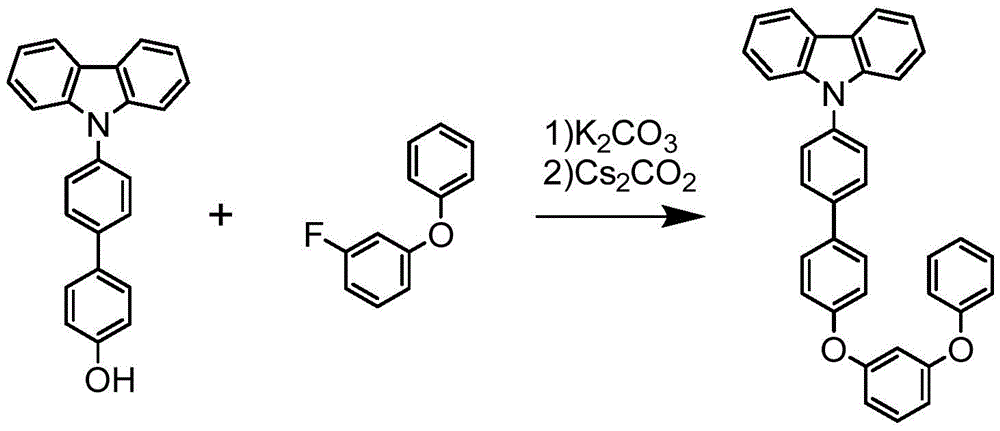
在氮气环境下,且在0℃下向加入有9-(4'-(3-苯氧基苯氧基)-[1,1'-联苯]-4-基)-9H-咔唑(18.0g)及二甲苯(130ml)的烧瓶中添加1.0M的仲丁基锂环己烷溶液(37.5ml)。滴加结束后,升温至70℃为止并搅拌4小时后,将沸点低于二甲苯的成分减压馏去。冷却至-50℃为止并添加三溴化硼(4.0ml),在室温下进行升温并搅拌0.5小时。其后,再次冷却至0℃为止并添加N,N-二异丙基乙胺(13.4ml),在室温下搅拌至发热结束后,升温至120℃为止并加热搅拌2小时。将反应液冷却至室温为止,依次添加利用冰浴进行了冷却的乙酸钠水溶液、乙酸乙酯,并通过抽吸过滤来提取所产生的固体。利用经回流的乙酸乙酯对所获得的固体进行清洗,继而,利用硅胶短程管柱(展开液:经加热的氯苯)来进行精制。进而自氯苯进行再结晶,由此获得由式(1-1101)所表示的化合物(6.9g)。9-(4'-(3-phenoxyphenoxy)-[1,1'-biphenyl]-4-yl)-9H-carbazole ( 18.0 g) and xylene (130 ml) were added to a 1.0 M sec-butyllithium cyclohexane solution (37.5 ml). After completion of the dropwise addition, the temperature was raised to 70° C. and stirred for 4 hours, and then the components having a boiling point lower than xylene were distilled off under reduced pressure. After cooling to -50°C, boron tribromide (4.0 ml) was added, the temperature was raised at room temperature, and the mixture was stirred for 0.5 hours. Then, after cooling to 0 degreeC again, N,N- diisopropylethylamine (13.4 ml) was added, and after stirring at room temperature until heat generation was complete|finished, it heated up to 120 degreeC, and heated and stirred for 2 hours. The reaction liquid was cooled to room temperature, an aqueous sodium acetate solution and ethyl acetate which had been cooled in an ice bath were added in this order, and the resulting solid was extracted by suction filtration. The obtained solid was washed with refluxed ethyl acetate, and then purified with a silica gel short-path column (developing solution: heated chlorobenzene). Furthermore, the compound (6.9g) represented by Formula (1-1101) was obtained by recrystallization from chlorobenzene.
[化326][Chemical 326]

通过NMR测定来确认所获得的化合物的结构。The structure of the obtained compound was confirmed by NMR measurement.
1H-NMR(400MHz,CDCl3):δ=8.98(m,1H),8.80(d,1H),8.18(d,2H),8.04(dd,1H),7.96(d,2H),7.84(t,1H),7.72-7.78(m,3H),7.70(d,1H),7.60(d,1H),7.54(d,2H),7.43-7.48(m,3H),7.26-7.34(m,4H)。 1 H-NMR (400 MHz, CDCl 3 ): δ=8.98 (m, 1H), 8.80 (d, 1H), 8.18 (d, 2H), 8.04 (dd, 1H), 7.96 (d, 2H), 7.84 ( t,1H),7.72-7.78(m,3H),7.70(d,1H),7.60(d,1H),7.54(d,2H),7.43-7.48(m,3H),7.26-7.34(m, 4H).
合成例(24)Synthesis Example (24)
9-(4-(5,9-二氧杂-13b-硼杂萘并[3,2,1-de]蒽-3-基)苯基)-9H-咔唑的合成Synthesis of 9-(4-(5,9-dioxa-13b-boronanaphtho[3,2,1-de]anthracene-3-yl)phenyl)-9H-carbazole
[化327][Chemical 327]

在氮气环境下,且在200℃下将加入有1-溴-3-氟苯(50.0g)、苯酚(30.0g)、碳酸钾(80.0g)及NMP(300ml)的烧瓶加热搅拌12小时。将反应液冷却至室温为止,将NMP减压馏去后,添加水及乙酸乙酯来进行分液。将有机层的溶剂减压馏去后,利用硅胶短程管柱(展开液:甲苯/庚烷=2/8(容积比))来进行精制,而获得1-溴-3-苯氧基苯(58.2g)。A flask charged with 1-bromo-3-fluorobenzene (50.0 g), phenol (30.0 g), potassium carbonate (80.0 g) and NMP (300 ml) was heated and stirred at 200°C for 12 hours under nitrogen atmosphere. The reaction liquid was cooled to room temperature, and after NMP was distilled off under reduced pressure, water and ethyl acetate were added and liquid-separated. After the solvent of the organic layer was depressurized, it was purified by a silica gel short-path column (developing solution: toluene/heptane=2/8 (volume ratio)) to obtain 1-bromo-3-phenoxybenzene ( 58.2g).
[化328][Chemical 328]

在回流温度下,将加入有3-溴酚(10.0g)、(4-(9H-咔唑-9-基)苯基)硼酸(18.5g)、Pd-132(庄信万丰)(0.2g)、磷酸三钾(25.0g)、甲苯(200ml)、异丙醇(50ml)及水(25ml)的烧瓶加热搅拌1小时。将反应液冷却至室温为止后,添加水及甲苯来进行分液。继而,利用硅胶短程管柱(展开液:经加热的氯苯)来进行精制,利用经回流的庚烷对将溶剂减压馏去所获得的固体进行清洗,而获得4'-(9H-咔唑-9-基)-[1,1'-联苯]-3-醇(18.5g)。At reflux temperature, 3-bromophenol (10.0 g), (4-(9H-carbazol-9-yl)phenyl)boronic acid (18.5 g), Pd-132 (Johnson Matthey) (0.2 g) A flask of tripotassium phosphate (25.0 g), toluene (200 ml), isopropanol (50 ml) and water (25 ml) was heated and stirred for 1 hour. After cooling the reaction liquid to room temperature, water and toluene were added for liquid separation. Next, it was purified with a silica gel short-path column (developing solution: heated chlorobenzene), and the solid obtained by depressurizing the solvent was washed with refluxed heptane to obtain 4′-(9H-carbamate). oxazol-9-yl)-[1,1'-biphenyl]-3-ol (18.5 g).
[化329][Chemical 329]

在氮气环境下,向1-溴-3-苯氧基苯(12.5g)、4'-(9H-咔唑-9-基)-[1,1'-联苯]-3-醇(18.5g)及碳酸钾(14.0g)的NMP(100ml)溶液中添加碘化铜(I)(0.3g)及乙酰丙酮铁(III)(1.1g),升温至160℃为止并搅拌6小时。将反应液冷却至室温为止,将NMP减压馏去后,通过使用铺满硅藻土的桐山漏斗的抽吸过滤来去除通过添加乙酸乙酯及氨水所析出的固体。对滤液进行分液,将有机层的溶剂减压馏去后,利用硅胶管柱色谱法(展开液:甲苯/庚烷=3/7(容积比))来进行精制,而获得9-(3'-(3-苯氧基苯氧基)-[1,1'-联苯]-4-基)-9H-咔唑(21.0g)。To 1-bromo-3-phenoxybenzene (12.5 g), 4'-(9H-carbazol-9-yl)-[1,1'-biphenyl]-3-ol (18.5 g) under nitrogen atmosphere g) Copper (I) iodide (0.3 g) and iron (III) acetylacetonate (1.1 g) were added to a NMP (100 ml) solution of potassium carbonate (14.0 g) and the temperature was raised to 160° C. and stirred for 6 hours. The reaction liquid was cooled to room temperature, and NMP was distilled off under reduced pressure. Then, the solid precipitated by adding ethyl acetate and ammonia water was removed by suction filtration using a Kiriyama funnel covered with diatomaceous earth. The filtrate was liquid-separated, and the solvent of the organic layer was distilled off under reduced pressure, followed by purification by silica gel column chromatography (developing solution: toluene/heptane=3/7 (volume ratio)) to obtain 9-(3 '-(3-Phenoxyphenoxy)-[1,1'-biphenyl]-4-yl)-9H-carbazole (21.0 g).
[化330][Chemical 330]

在氮气环境下,且在0℃下向加入有9-(3'-(3-苯氧基苯氧基)-[1,1'-联苯]-4-基)-9H-咔唑(21.0g)及二甲苯(130ml)的烧瓶中添加1.0M的仲丁基锂环己烷溶液(43.8ml)。滴加结束后,升温至70℃为止并搅拌3小时后,将沸点低于二甲苯的成分减压馏去。冷却至-50℃为止并添加三溴化硼(4.7ml),在室温下进行升温并搅拌0.5小时。其后,再次冷却至0℃为止并添加N,N-二异丙基乙胺(14.6ml),在室温下搅拌至发热结束后,升温至130℃为止并加热搅拌2小时。将反应液冷却至室温为止,依次添加利用冰浴进行了冷却的乙酸钠水溶液、庚烷,通过抽吸过滤来提取所产生的固体。利用经回流的乙酸乙酯对所获得的固体进行清洗,继而,自氯苯进行再结晶,由此获得由式(1-1102)所表示的化合物(13.6g)。9-(3'-(3-phenoxyphenoxy)-[1,1'-biphenyl]-4-yl)-9H-carbazole ( 21.0 g) and xylene (130 ml) were added to a 1.0 M sec-butyllithium cyclohexane solution (43.8 ml). After completion of the dropwise addition, the temperature was raised to 70° C. and stirred for 3 hours, and then the components having a boiling point lower than xylene were distilled off under reduced pressure. After cooling to -50°C, boron tribromide (4.7 ml) was added, the temperature was raised at room temperature, and the mixture was stirred for 0.5 hours. Then, it cooled to 0 degreeC again, N,N- diisopropylethylamine (14.6 ml) was added, and after stirring at room temperature until heat generation was complete|finished, it heated up to 130 degreeC and heated and stirred for 2 hours. The reaction liquid was cooled to room temperature, an aqueous sodium acetate solution and heptane cooled in an ice bath were added in this order, and the resulting solid was extracted by suction filtration. The obtained solid was washed with refluxed ethyl acetate and then recrystallized from chlorobenzene to obtain a compound (13.6 g) represented by the formula (1-1102).
[化331][Chemical 331]

通过NMR测定来确认所获得的化合物的结构。The structure of the obtained compound was confirmed by NMR measurement.
1H-NMR(400MHz,CDCl3):δ=8.81(d,1H),8.75(d,1H),8.18(d,2H),8.00(d,2H),7.89(m,1H),7.83(t,1H),7.71-7.77(m,4H),7.58(d,1H),7.53(d,2H),7.41-7.48(m,3H),7.26-7.34(m,4H)。 1 H-NMR (400MHz, CDCl 3 ): δ=8.81(d,1H), 8.75(d,1H), 8.18(d,2H), 8.00(d,2H), 7.89(m,1H), 7.83( t, 1H), 7.71-7.77 (m, 4H), 7.58 (d, 1H), 7.53 (d, 2H), 7.41-7.48 (m, 3H), 7.26-7.34 (m, 4H).
合成例(25)Synthesis Example (25)
9-(4-(5,9-二氧杂-13b-硼杂萘并[3,2,1-de]蒽-4-基)苯基)-9H-咔唑的合成Synthesis of 9-(4-(5,9-dioxa-13b-boronanaphtho[3,2,1-de]anthracene-4-yl)phenyl)-9H-carbazole
[化332][Chemical 332]

在回流温度下,将加入有2-溴酚(10.0g)、(4-(9H-咔唑-9-基)苯基)硼酸(18.2g)、Pd-132(庄信万丰)(0.2g)、磷酸三钾(25.0g)、甲苯(200ml)、异丙醇(50ml)及水(25ml)的烧瓶加热搅拌1小时。将反应液冷却至室温为止后,添加水及甲苯来进行分液。继而,利用硅胶短程管柱(展开液:经加热的甲苯)来进行精制后,利用经回流的庚烷对将溶剂减压馏去所获得的固体进行清洗,而获得4'-(9H-咔唑-9-基)-[1,1'-联苯]-2-醇(18.7g)。At reflux temperature, 2-bromophenol (10.0 g), (4-(9H-carbazol-9-yl)phenyl)boronic acid (18.2 g), Pd-132 (Johnson Matthey) (0.2 g) were added g) A flask of tripotassium phosphate (25.0 g), toluene (200 ml), isopropanol (50 ml) and water (25 ml) was heated and stirred for 1 hour. After cooling the reaction liquid to room temperature, water and toluene were added for liquid separation. Next, after purification by a silica gel short-path column (developing solution: heated toluene), the solid obtained by depressurizing the solvent was washed with refluxed heptane to obtain 4'-(9H-carbamate). oxazol-9-yl)-[1,1'-biphenyl]-2-ol (18.7 g).
[化333][Chemical 333]

在氮气环境下,向1-溴-3-苯氧基苯(12.6g)、4'-(9H-咔唑-9-基)-[1,1'-联苯]-2-醇(18.7g)及碳酸钾(14.0g)的NMP(100ml)溶液中添加碘化铜(I)(0.5g)及乙酰丙酮铁(III)(1.8g),升温至150℃为止并搅拌6小时。将反应液冷却至室温为止,将NMP减压馏去后,通过使用铺满硅藻土的桐山漏斗的抽吸过滤来去除通过添加乙酸乙酯及氨水所析出的固体。对滤液进行分液,将有机层的溶剂减压馏去后,利用硅胶管柱色谱法(展开液:甲苯/庚烷=3/7(容积比))来进行精制,而获得9-(2'-(3-苯氧基苯氧基)-[1,1'-联苯]-4-基)-9H-咔唑(20.0g)。To 1-bromo-3-phenoxybenzene (12.6 g), 4'-(9H-carbazol-9-yl)-[1,1'-biphenyl]-2-ol (18.7 g) under nitrogen atmosphere g) Copper (I) iodide (0.5 g) and iron (III) acetylacetonate (1.8 g) were added to a NMP (100 ml) solution of potassium carbonate (14.0 g) and the temperature was raised to 150° C. and stirred for 6 hours. The reaction liquid was cooled to room temperature, and NMP was distilled off under reduced pressure. Then, the solid precipitated by adding ethyl acetate and ammonia water was removed by suction filtration using a Kiriyama funnel covered with diatomaceous earth. The filtrate was liquid-separated, and the solvent of the organic layer was distilled off under reduced pressure, followed by purification by silica gel column chromatography (developing solution: toluene/heptane=3/7 (volume ratio)) to obtain 9-(2 '-(3-Phenoxyphenoxy)-[1,1'-biphenyl]-4-yl)-9H-carbazole (20.0 g).
[化334][Chemical 334]

在氮气环境下,且在0℃下向加入有9-(2'-(3-苯氧基苯氧基)-[1,1'-联苯]-4-基)-9H-咔唑(20.0g)及二甲苯(130ml)的烧瓶中添加1.0M的仲丁基锂环己烷溶液(41.7ml)。滴加结束后,升温至70℃为止并搅拌3小时后,将沸点低于二甲苯的成分减压馏去。冷却至-50℃为止并添加三溴化硼(4.5ml),升温至室温为止后搅拌0.5小时。其后,再次冷却至0℃为止并添加N,N-二异丙基乙胺(13.9ml),在室温下搅拌至发热结束后,升温至130℃为止并加热搅拌3小时。将反应液冷却至室温为止,依次添加利用冰浴进行了冷却的乙酸钠水溶液、庚烷,通过抽吸过滤来提取所产生的固体。利用经回流的乙酸乙酯对所获得的固体进行清洗后,溶解于氯苯中,并添加庚烷,由此进行再沉淀,而获得由式(1-1103)所表示的化合物(8.5g)。9-(2'-(3-phenoxyphenoxy)-[1,1'-biphenyl]-4-yl)-9H-carbazole ( 20.0 g) and xylene (130 ml) were added to a 1.0 M sec-butyllithium cyclohexane solution (41.7 ml). After completion of the dropwise addition, the temperature was raised to 70° C. and stirred for 3 hours, and then the components having a boiling point lower than xylene were distilled off under reduced pressure. After cooling to -50°C, boron tribromide (4.5 ml) was added, and the temperature was raised to room temperature, followed by stirring for 0.5 hours. Then, after cooling to 0 degreeC again, N,N- diisopropylethylamine (13.9 ml) was added, and after stirring at room temperature until heat generation was complete|finished, it heated up to 130 degreeC, and heated and stirred for 3 hours. The reaction liquid was cooled to room temperature, an aqueous sodium acetate solution and heptane cooled in an ice bath were added in this order, and the resulting solid was extracted by suction filtration. The obtained solid was washed with refluxed ethyl acetate, dissolved in chlorobenzene, added with heptane, and reprecipitated to obtain a compound (8.5 g) represented by formula (1-1103) .
[化335][Chemical 335]

通过NMR测定来确认所获得的化合物的结构。The structure of the obtained compound was confirmed by NMR measurement.
1H-NMR(400MHz,CDCl3):δ=8.77(t,2H),8.19(d,2H),7.96(d,2H),7.86(d,1H),7.80(t,1H),7.72-7.77(m,3H),7.59(d,3H),7.54(t,1H),7.47(t,2H),7.44(t,1H),7.33(t,2H),7.26(m,1H),7.19(d,1H)。 1 H-NMR (400 MHz, CDCl 3 ): δ=8.77(t, 2H), 8.19(d, 2H), 7.96(d, 2H), 7.86(d, 1H), 7.80(t, 1H), 7.72- 7.77(m, 3H), 7.59(d, 3H), 7.54(t, 1H), 7.47(t, 2H), 7.44(t, 1H), 7.33(t, 2H), 7.26(m, 1H), 7.19 (d, 1H).
合成例(26)Synthesis Example (26)
9-(4-(5,9-二氧杂-13b-硼杂萘并[3,2,1-de]蒽-8-基)苯基)-9H-咔唑的合成Synthesis of 9-(4-(5,9-dioxa-13b-boronanaphtho[3,2,1-de]anthracene-8-yl)phenyl)-9H-carbazole
[化336][Chemical 336]

在氮气环境下,且在200℃下将加入有1-溴-2,4-二氟苯(46.6g)、苯酚(50.0g)、碳酸钾(133.0g)及NMP(300ml)的烧瓶加热搅拌8小时。将反应液冷却至室温为止,将NMP减压馏去后,添加水及乙酸乙酯来进行分液。将有机层的溶剂减压馏去后,利用硅胶管柱色谱法(展开液:甲苯/庚烷=2/8(容积比))来进行精制,而获得((4-溴-1,3-亚苯基)双(氧基))二苯(58.2g)。A flask containing 1-bromo-2,4-difluorobenzene (46.6 g), phenol (50.0 g), potassium carbonate (133.0 g) and NMP (300 ml) was heated and stirred at 200°C under nitrogen atmosphere 8 hours. The reaction liquid was cooled to room temperature, and after NMP was distilled off under reduced pressure, water and ethyl acetate were added and liquid-separated. After the solvent of the organic layer was distilled off under reduced pressure, it was purified by silica gel column chromatography (developing solution: toluene/heptane=2/8 (volume ratio)) to obtain ((4-bromo-1,3- Phenylene)bis(oxy))diphenyl (58.2 g).
[化337][Chemical 337]

在回流温度下,将加入有((4-溴-1,3-亚苯基)双(氧基))二苯(15.0g)、(4-(9H-咔唑-9-基)苯基)硼酸(13.9g)、Pd-132(庄信万丰)(0.2g)、磷酸三钾(19.0g)、甲苯(200ml)、异丙醇(50ml)及水(25ml)的烧瓶加热搅拌2小时。将反应液冷却至室温为止后,添加水及甲苯来进行分液。继而,利用硅胶管柱色谱法(展开液:甲苯/庚烷混合溶剂)来进行精制,而获得9-(2',4'-二苯氧基-[1,1'-联苯]-4-基)-9H-咔唑(20.0g)。此时,参考《有机化学实验入门(1)-物质处理法与分离精制法-》化学同人股份有限公司出版、第94页中所记载的方法,缓慢地增加展开液中的甲苯的比率来使目标物溶出。At reflux temperature, ((4-bromo-1,3-phenylene)bis(oxy))diphenyl (15.0 g), (4-(9H-carbazol-9-yl)phenyl was added ) boric acid (13.9g), Pd-132 (Johnson Matthey) (0.2g), tripotassium phosphate (19.0g), toluene (200ml), isopropanol (50ml) and water (25ml) in a flask, heated and stirred for 2 Hour. After cooling the reaction liquid to room temperature, water and toluene were added for liquid separation. Next, it was purified by silica gel column chromatography (developing solution: toluene/heptane mixed solvent) to obtain 9-(2',4'-diphenoxy-[1,1'-biphenyl]-4). -yl)-9H-carbazole (20.0 g). In this case, refer to the method described in "Introduction to Organic Chemistry Experiments (1) - Substance Treatment Method and Separation and Purification Method -" published by Chemical Doujin Co., Ltd. on page 94, and gradually increase the ratio of toluene in the developing solution to make target dissolution.
[化338][Chemical 338]

在氮气环境下,且在0℃下向加入有9-(2',4'-二苯氧基-[1,1'-联苯]-4-基)-9H-咔唑(20.0g)及二甲苯(130ml)的烧瓶中添加1.0M的仲丁基锂环己烷溶液(41.7ml)。滴加结束后,升温至70℃为止并搅拌3小时后,将沸点低于二甲苯的成分减压馏去。冷却至-50℃为止并添加三溴化硼(4.5ml),升温至室温为止后搅拌0.5小时。其后,再次冷却至0℃为止并添加N,N-二异丙基乙胺(13.9ml),在室温下搅拌至发热结束后,升温至130℃为止并加热搅拌3小时。将反应液冷却至室温为止,依次添加利用冰浴进行了冷却的乙酸钠水溶液、庚烷,通过抽吸过滤来提取所产生的固体。利用经回流的乙酸乙酯对所获得的固体进行清洗,继而,自氯苯进行再结晶,由此获得由式(1-1092)所表示的化合物(12.9g)。To this was added 9-(2',4'-diphenoxy-[1,1'-biphenyl]-4-yl)-9H-carbazole (20.0 g) under nitrogen at 0°C A 1.0M sec-butyllithium cyclohexane solution (41.7ml) was added to a flask containing xylene (130ml). After completion of the dropwise addition, the temperature was raised to 70° C. and stirred for 3 hours, and then the components having a boiling point lower than xylene were distilled off under reduced pressure. After cooling to -50°C, boron tribromide (4.5 ml) was added, and the temperature was raised to room temperature, followed by stirring for 0.5 hours. Then, after cooling to 0 degreeC again, N,N- diisopropylethylamine (13.9 ml) was added, and after stirring at room temperature until heat generation was complete|finished, it heated up to 130 degreeC, and heated and stirred for 3 hours. The reaction liquid was cooled to room temperature, an aqueous sodium acetate solution and heptane cooled in an ice bath were added in this order, and the resulting solid was extracted by suction filtration. The obtained solid was washed with refluxed ethyl acetate and then recrystallized from chlorobenzene to obtain a compound (12.9 g) represented by the formula (1-1092).
[化339][Chemical 339]

通过NMR测定来确认所获得的化合物的结构。The structure of the obtained compound was confirmed by NMR measurement.
1H-NMR(400MHz,CDCl3):δ=8.75(d,2H),8.19(d,2H),8.02(m,3H),7.70-7.78(m,4H),7.54-7.62(m,4H),7.38-7.50(m,5H),7.32(t,2H)。 1 H-NMR (400 MHz, CDCl 3 ): δ=8.75 (d, 2H), 8.19 (d, 2H), 8.02 (m, 3H), 7.70-7.78 (m, 4H), 7.54-7.62 (m, 4H) ), 7.38-7.50 (m, 5H), 7.32 (t, 2H).
合成例(27)Synthesis Example (27)
9-(5,9-二氧杂-13b-硼杂萘并[3,2,1-de]蒽-7-基)-9'-苯基-9H,9'H-3,3'-联咔唑的合成9-(5,9-dioxa-13b-boraznaphtho[3,2,1-de]anthracene-7-yl)-9'-phenyl-9H,9'H-3,3'- Synthesis of Bicarbazole
[化340][Chemical 340]

在回流温度下,将加入有(9-苯基-9H-咔唑-3-基)硼酸(50.0g)、3-溴-9H-咔唑(39.0g)、Pd-132(庄信万丰)(1.2g)、碳酸钠(46.1g)、甲苯(400ml)、乙醇(100ml)及水(100ml)的烧瓶加热搅拌2小时。将反应液冷却至室温为止后,添加水及甲苯来进行分液。继而,利用氨基修饰硅胶(NH DM1020:富士西利西亚(Fuji silysia)制造)管柱色谱法(展开液:甲苯)来进行精制,而获得9-苯基-9H,9'H-3,3'-联咔唑(52.0g)。At reflux temperature, (9-phenyl-9H-carbazol-3-yl)boronic acid (50.0 g), 3-bromo-9H-carbazole (39.0 g), Pd-132 (Johnson Matthey) were added ) (1.2 g), sodium carbonate (46.1 g), toluene (400 ml), ethanol (100 ml) and water (100 ml) in a flask with heating and stirring for 2 hours. After cooling the reaction liquid to room temperature, water and toluene were added for liquid separation. Next, it was purified by column chromatography (developing solution: toluene) of amino-modified silica gel (NH DM1020: manufactured by Fuji Silysia) to obtain 9-phenyl-9H,9'H-3,3' - Bicarbazole (52.0 g).
[化341][Chemical 341]

将加入有((5-溴-1,3-亚苯基)双(氧基))二苯(29.2g)、9-苯基-9H,9'H-3,3'-联咔唑(35.0g)、Pd(dba)2(0.5g)、二环己基(1-甲基-2,2-二苯基环丙基)膦(Cy-cBRIDP)(0.9g)、NaOtBu(24.7g)及二甲苯(300ml)的烧瓶加热至150℃,并搅拌17小时。将反应液冷却至室温为止,添加水来进行分液后,将溶剂减压馏去。继而,利用硅胶管柱色谱法(展开液:甲苯/庚烷=1/4(容积比))来进行精制,而获得9-(3,5-二苯氧基苯基)-9'-苯基-9H,9'H-3,3'-联咔唑(46.5g)。((5-Bromo-1,3-phenylene)bis(oxy))diphenyl (29.2g), 9-phenyl-9H,9'H-3,3'-bicarbazole ( 35.0g), Pd(dba) 2 (0.5g), Dicyclohexyl (1-methyl-2,2-diphenylcyclopropyl)phosphine (Cy-cBRIDP) (0.9g), NaOtBu (24.7g) and xylene (300 ml) in a flask heated to 150°C and stirred for 17 hours. The reaction liquid was cooled to room temperature, water was added for liquid separation, and then the solvent was distilled off under reduced pressure. Next, it was purified by silica gel column chromatography (developing solution: toluene/heptane=1/4 (volume ratio)) to obtain 9-(3,5-diphenoxyphenyl)-9'-benzene yl-9H,9'H-3,3'-bicarbazole (46.5 g).
[化342][Chemical 342]

在氮气环境下,且在0℃下向加入有9-(3,5-二苯氧基苯基)-9'-苯基-9H,9'H-3,3'-联咔唑(20.0g)及二甲苯(100ml)的烧瓶中添加1.0M的仲丁基锂环己烷溶液(28.5ml)。滴加结束后,升温至70℃为止并搅拌3小时后,将沸点低于二甲苯的成分减压馏去。冷却至-50℃为止并添加三溴化硼(3.4ml),升温至室温为止后搅拌0.5小时。其后,再次冷却至0℃为止并添加N,N-二异丙基乙胺(10.4ml),在室温下搅拌至发热结束后,升温至130℃为止并加热搅拌4小时。将反应液冷却至室温为止,依次添加利用冰浴进行了冷却的乙酸钠水溶液、甲苯来进行分液。利用硅胶管柱色谱法(展开液:甲苯/庚烷=1/1(容积比))来进行精制后,使将溶剂减压馏去所获得的固体溶解于甲苯中,并添加庚烷,由此进行再沉淀,而获得由式(1-1069)所表示的化合物(1.0g)。9-(3,5-diphenoxyphenyl)-9'-phenyl-9H,9'H-3,3'-bicarbazole (20.0 g) A 1.0M sec-butyllithium cyclohexane solution (28.5 ml) was added to a flask containing xylene (100 ml). After completion of the dropwise addition, the temperature was raised to 70° C. and stirred for 3 hours, and then the components having a boiling point lower than xylene were distilled off under reduced pressure. After cooling to -50°C, boron tribromide (3.4 ml) was added, and the temperature was raised to room temperature, followed by stirring for 0.5 hours. Then, after cooling to 0 degreeC again, N,N- diisopropylethylamine (10.4 ml) was added, and after stirring at room temperature until heat generation was complete|finished, it heated up to 130 degreeC, and heated and stirred for 4 hours. The reaction liquid was cooled to room temperature, and an aqueous solution of sodium acetate cooled in an ice bath and toluene were sequentially added for liquid separation. After purification by silica gel column chromatography (developing solution: toluene/heptane=1/1 (volume ratio)), the solid obtained by depressurizing the solvent was dissolved in toluene, and heptane was added to obtain the This was reprecipitated to obtain a compound (1.0 g) represented by the formula (1-1069).
[化343][Chemical 343]

通过NMR测定来确认所获得的化合物的结构。The structure of the obtained compound was confirmed by NMR measurement.
1H-NMR(400MHz,CDCl3):δ=8.76(dd,2H),8.48(s,2H),8.26(t,2H),7.73-7.86(m,6H),7.58-7.67(m,6H),7.41-7.57(m,9H),7.38(t,1H),7.33(m,1H)。 1 H-NMR (400 MHz, CDCl 3 ): δ=8.76 (dd, 2H), 8.48 (s, 2H), 8.26 (t, 2H), 7.73-7.86 (m, 6H), 7.58-7.67 (m, 6H) ), 7.41-7.57 (m, 9H), 7.38 (t, 1H), 7.33 (m, 1H).
合成例(28)Synthesis Example (28)
8-(萘-1-基)-5,9-二氧杂-13b-硼杂萘并[3,2,1-de]蒽的合成Synthesis of 8-(Naphthalen-1-yl)-5,9-dioxa-13b-bora naphtho[3,2,1-de]anthracene
[化344][Chemical 344]

在回流温度下,将加入有((4-溴-1,3-亚苯基)双(氧基))二苯(25.0g)、1-萘硼酸(13.9g)、Pd-132(庄信万丰)(0.1g)、碳酸钾(20.2g)、溴化四丁基铵(TBAB)(0.7g)、索米克斯(Solmix)A-11(200ml)及水(50ml)的烧瓶加热搅拌2小时。将反应液冷却至室温为止后,添加水及甲苯来进行分液。继而,利用硅胶管柱色谱法(展开液:甲苯/庚烷混合溶剂)来进行精制。此时,缓慢地增加展开液中的甲苯的比率来使目标物溶出。进而,自Solmix A-11/甲苯混合溶剂进行再结晶,而获得1-(2,4-二苯氧基苯基)萘(22.9g)。At reflux temperature, ((4-bromo-1,3-phenylene)bis(oxy))diphenyl (25.0 g), 1-naphthaleneboronic acid (13.9 g), Pd-132 (Johnson Johnson) were added Wanfeng) (0.1g), potassium carbonate (20.2g), tetrabutylammonium bromide (TBAB) (0.7g), Solmix A-11 (200ml) and water (50ml) in a flask heated Stir for 2 hours. After cooling the reaction liquid to room temperature, water and toluene were added for liquid separation. Next, it purified by silica gel column chromatography (developing solution: toluene/heptane mixed solvent). At this time, the ratio of toluene in the developing solution was gradually increased to dissolve the target substance. Furthermore, it recrystallized from Solmix A-11/toluene mixed solvent to obtain 1-(2,4-diphenoxyphenyl)naphthalene (22.9 g).
[化345][Chemical 345]

在氮气环境下,且在0℃下向加入有1-(2,4-二苯氧基苯基)萘(13.0g)及二甲苯(100ml)的烧瓶中添加1.6M的正丁基锂己烷溶液(22.6ml)。滴加结束后,升温至80℃为止并搅拌4小时后,将沸点低于二甲苯的成分减压馏去。冷却至-50℃为止并添加三溴化硼(3.8ml),升温至室温为止后搅拌0.5小时。其后,再次冷却至0℃为止并添加N,N-二异丙基乙胺(11.7ml),在室温下搅拌至发热结束后,升温至120℃为止并加热搅拌4小时。将反应液冷却至室温为止,依次添加利用冰浴进行了冷却的乙酸钠水溶液、甲苯来进行分液。继而,自甲苯/庚烷进行再结晶,由此获得由式(1-1084)所表示的化合物(4.0g)。To a flask charged with 1-(2,4-diphenoxyphenyl)naphthalene (13.0 g) and xylene (100 ml) was added 1.6 M n-butyllithium hexane at 0°C under nitrogen atmosphere alkane solution (22.6 ml). After completion of the dropwise addition, the temperature was raised to 80° C. and stirred for 4 hours, and then the components having a boiling point lower than xylene were distilled off under reduced pressure. After cooling to -50°C, boron tribromide (3.8 ml) was added, and the temperature was raised to room temperature, followed by stirring for 0.5 hours. Then, after cooling to 0 degreeC again, N,N- diisopropylethylamine (11.7 ml) was added, and after stirring at room temperature until heat generation was complete|finished, it heated up to 120 degreeC, and heated and stirred for 4 hours. The reaction liquid was cooled to room temperature, and an aqueous solution of sodium acetate cooled in an ice bath and toluene were sequentially added for liquid separation. Then, the compound (4.0 g) represented by formula (1-1084) was obtained by recrystallization from toluene/heptane.
[化346][Chemical 346]

通过NMR测定来确认所获得的化合物的结构。The structure of the obtained compound was confirmed by NMR measurement.
1H-NMR(400MHz,CDCl3):δ=8.87(m,2H),7.98(d,2H),7.85(d,1H),7.75(t,1H),7.67(d,1H),7.62(m,3H),7.51(m,2H),7.30-7.43(m,4H),7.02(d,1H)。 1 H-NMR (400 MHz, CDCl 3 ): δ=8.87 (m, 2H), 7.98 (d, 2H), 7.85 (d, 1H), 7.75 (t, 1H), 7.67 (d, 1H), 7.62 ( m, 3H), 7.51 (m, 2H), 7.30-7.43 (m, 4H), 7.02 (d, 1H).
合成例(29)Synthesis Example (29)
8-(芘-1-基)-5,9-二氧杂-13b-硼杂萘并[3,2,1-de]蒽的合成Synthesis of 8-(Pyrene-1-yl)-5,9-dioxa-13b-bora naphtho[3,2,1-de]anthracene
[化347][Chemical 347]

在回流温度下,将加入有((4-溴-1,3-亚苯基)双(氧基))二苯(12.0g)、1-芘硼酸(9.5g)、Pd-132(庄信万丰)(0.03g)、碳酸钾(9.7g)、TBAB(3.4g)、Solmix A-11(60ml)及水(24ml)的烧瓶加热搅拌1小时。将反应液冷却至室温为止后,添加水及甲苯来进行分液。继而,利用硅胶短程管柱(展开液:甲苯)来进行精制,进而,自Solmix A-11/乙酸乙酯混合溶剂进行再结晶,而获得1-(2,4-二苯氧基苯基)芘(13.3g)。At reflux temperature, ((4-bromo-1,3-phenylene)bis(oxy))diphenyl (12.0 g), 1-pyreneboronic acid (9.5 g), Pd-132 (Johnson Johnson) were added Wanfeng) (0.03g), potassium carbonate (9.7g), TBAB (3.4g), Solmix A-11 (60ml) and water (24ml) in a flask with heating and stirring for 1 hour. After cooling the reaction liquid to room temperature, water and toluene were added for liquid separation. Next, it was purified by a silica gel short-path column (developing solution: toluene), and further, it was recrystallized from Solmix A-11/ethyl acetate mixed solvent to obtain 1-(2,4-diphenoxyphenyl) Pyrene (13.3g).
[化348][Chemical 348]

在氮气环境下,且在0℃下向加入有1-(2,4-二苯氧基苯基)芘(12.5g)及二甲苯(100ml)的烧瓶中添加1.6M的正丁基锂己烷溶液(18.2ml)。滴加结束后,升温至80℃为止并搅拌4小时后,将沸点低于二甲苯的成分减压馏去。冷却至-50℃为止并添加三溴化硼(3.1ml),升温至室温为止后搅拌0.5小时。其后,再次冷却至0℃为止并添加N,N-二异丙基乙胺(9.4ml),在室温下搅拌至发热结束后,升温至120℃为止并加热搅拌4小时。将反应液冷却至室温为止,依次添加利用冰浴进行了冷却的乙酸钠水溶液、庚烷,通过抽吸过滤来提取所析出的固体。依次利用水、Solmix A11进行清洗后,自二甲苯进行再结晶。进而,自氯苯进行再结晶,由此获得由式(1-1090)所表示的化合物(3.3g)。To a flask charged with 1-(2,4-diphenoxyphenyl)pyrene (12.5g) and xylene (100ml) was added 1.6M n-butyllithium hexane at 0°C under nitrogen atmosphere alkane solution (18.2 ml). After completion of the dropwise addition, the temperature was raised to 80° C. and stirred for 4 hours, and then the components having a boiling point lower than xylene were distilled off under reduced pressure. After cooling to -50°C, boron tribromide (3.1 ml) was added, and the temperature was raised to room temperature, followed by stirring for 0.5 hours. Then, it cooled to 0 degreeC again, N,N- diisopropylethylamine (9.4 ml) was added, it stirred at room temperature until heat generation was complete|finished, and it heated up to 120 degreeC, and heated and stirred for 4 hours. The reaction liquid was cooled to room temperature, an aqueous sodium acetate solution and heptane cooled in an ice bath were added in this order, and the precipitated solid was extracted by suction filtration. After washing with water and Solmix A11 in this order, recrystallization was performed from xylene. Furthermore, the compound (3.3g) represented by Formula (1-1090) was obtained by recrystallization from chlorobenzene.
[化349][Chemical 349]

通过NMR测定来确认所获得的化合物的结构。The structure of the obtained compound was confirmed by NMR measurement.
1H-NMR(400MHz,CDCl3):δ=8.76(d,1H),8.71(d,1H),8.32(d,1H),8.23(d,1H),8.18(m,4H),7.95-8.05(m,4H),7.79(t,1H),7.64(d,1H),7.45(m,3H),7.35(t,1H),6.97(d,1H)。 1 H-NMR (400 MHz, CDCl 3 ): δ=8.76(d,1H), 8.71(d,1H), 8.32(d,1H), 8.23(d,1H), 8.18(m,4H), 7.95- 8.05(m, 4H), 7.79(t, 1H), 7.64(d, 1H), 7.45(m, 3H), 7.35(t, 1H), 6.97(d, 1H).
合成例(30)Synthesis Example (30)
3,6,8,11-四苯基-5,9-二氧杂-13b-硫代磷杂萘并[3,2,1-de]蒽的合成Synthesis of 3,6,8,11-Tetraphenyl-5,9-dioxa-13b-thiophosphanaphtho[3,2,1-de]anthracene
[化350][Chemical 350]

在氮气环境下,将加入有4',6'-双([1,1'-联苯]-2-基氧基)-5'-溴-1,1':3',1”-联三苯(17.0g)及二甲苯(150ml)的烧瓶冷却至-40℃为止,并滴加1.0M的仲丁基锂环己烷溶液(27.1ml)。滴加结束后,升温至约80℃为止并将沸点低于二甲苯的成分减压蒸馏后,冷却至-10℃为止并添加三氯化磷(3.5ml)。升温至80℃为止并搅拌1小时后,添加硫(12.2g),进而加热搅拌1小时。继而,暂时冷却至-10℃为止并添加氯化铝(24.6g)及N,N-二异丙基乙胺(11.0ml)后,升温至120℃为止并加热搅拌12小时。将反应液冷却至室温为止,然后将反应液添加至1,4-二氮杂双环[2.2.2]辛烷的甲苯溶液中并进行搅拌。添加水、甲苯及乙酸乙酯来进行分液后,将溶剂减压馏去。继而,使所获得的粗制物溶解于甲苯中,滤取通过添加庚烷所析出的固体,并利用硅胶管柱色谱法(展开液:甲苯/庚烷混合溶剂)来对滤液进行精制。此时,缓慢地增加展开液中的甲苯的比率来使目标物溶出。进而,利用乙酸乙酯进行清洗,而获得由式(1-1252)所表示的化合物(4.7g)。Under nitrogen, 4',6'-bis([1,1'-biphenyl]-2-yloxy)-5'-bromo-1,1':3',1"-biphenyl The flask of triphenyl (17.0g) and xylene (150ml) was cooled to -40°C, and a 1.0M sec-butyllithium cyclohexane solution (27.1ml) was added dropwise. After the dropwise addition, the temperature was raised to about 80°C After distilling under reduced pressure the components whose boiling point is lower than xylene, it was cooled to -10°C, and phosphorus trichloride (3.5 ml) was added. After heating up to 80°C and stirring for 1 hour, sulfur (12.2 g) was added, It was further heated and stirred for 1 hour. Then, it was once cooled to -10°C, and after adding aluminum chloride (24.6 g) and N,N-diisopropylethylamine (11.0 ml), the temperature was raised to 120°C and heated and stirred for 12 hours. The reaction solution was cooled to room temperature, then the reaction solution was added to a toluene solution of 1,4-diazabicyclo[2.2.2]octane and stirred. Water, toluene and ethyl acetate were added for separation. After the liquid, the solvent was distilled off under reduced pressure. Then, the obtained crude product was dissolved in toluene, and the solid precipitated by adding heptane was collected by filtration and subjected to silica gel column chromatography (developing solution: toluene/heptane). mixed solvent) to purify the filtrate. At this time, slowly increase the ratio of the toluene in the developing solution to elute the target substance. And then, utilize ethyl acetate to clean, and obtain a compound represented by formula (1-1252) (4.7g).
[化351][Chemical 351]

合成例(31)Synthesis Example (31)
3,6,8,11-四苯基-5,9-二氧杂-13b-氧代磷杂萘并[3,2,1-de]蒽的合成Synthesis of 3,6,8,11-Tetraphenyl-5,9-dioxa-13b-oxophosphanaphtho[3,2,1-de]anthracene
[化352][Chemical 352]

在0℃下,向由所述式(1-1252)所表示的化合物(4.7g)的二氯甲烷(150mL)溶液中添加m-CPBA(1.9g)后,升温至室温为止并搅拌5小时。添加饱和亚硫酸钠水溶液并在室温下进行搅拌后,滤取不溶物,进而进行分液。将溶剂减压馏去,利用硅胶管柱色谱法(展开液:甲苯/乙酸乙酯混合溶剂)来进行精制。此时,缓慢地增加展开液中的乙酸乙酯的比率来使目标物溶出。将溶剂减压馏去,使所获得的固体溶解于甲苯中,并添加庚烷,由此进行再沉淀,而获得由式(1-1192)所表示的化合物(1.1g)。After adding m-CPBA (1.9 g) to a solution of the compound (4.7 g) represented by the formula (1-1252) in dichloromethane (150 mL) at 0°C, the temperature was raised to room temperature and stirred for 5 hours . After adding a saturated aqueous sodium sulfite solution and stirring at room temperature, the insoluble matter was collected by filtration and further separated into liquids. The solvent was evaporated under reduced pressure and purified by silica gel column chromatography (developing solution: toluene/ethyl acetate mixed solvent). At this time, the ratio of ethyl acetate in the developing solution was gradually increased to dissolve the target substance. The solvent was distilled off under reduced pressure, the obtained solid was dissolved in toluene, and heptane was added to perform reprecipitation to obtain a compound (1.1 g) represented by the formula (1-1192).
[化353][Chemical 353]

通过NMR测定来确认所获得的化合物的结构。The structure of the obtained compound was confirmed by NMR measurement.
1H-NMR(400MHz,CDCl3):δ=8.29(m,2H),7.56(d,2H),7.53(s,1H),7.47(t,2H),7.16-7.23(m,12H),7.07-7.10(m,8H)。 1 H-NMR (400 MHz, CDCl 3 ): δ=8.29 (m, 2H), 7.56 (d, 2H), 7.53 (s, 1H), 7.47 (t, 2H), 7.16-7.23 (m, 12H), 7.07-7.10 (m, 8H).
合成例(32)Synthesis Example (32)
5,9-二苯基-5,9-二氢-5,9-二氮杂-13b-硼杂萘并[3,2,1-de]蒽的合成Synthesis of 5,9-diphenyl-5,9-dihydro-5,9-diaza-13b-borazaphtho[3,2,1-de]anthracene
[化354][Chemical 354]

在氮气环境下,且在80℃下将加入有二苯基胺(66.0g)、1-溴-2,3-二氯苯(40.0g)、Pd-132(庄信万丰)(1.3g)、NaOtBu(43.0g)及二甲苯(400ml)的烧瓶加热搅拌2小时后,升温至120℃为止,进而加热搅拌3小时。将反应液冷却至室温为止后,添加水及乙酸乙酯,通过抽吸过滤来提取所析出的固体。继而,利用硅胶短程管柱(展开液:经加热的甲苯)来进行精制。利用庚烷对将溶剂减压馏去所获得的固体进行清洗,由此获得2-氯-N1,N1,N3,N3-四苯基苯-1,3-二胺(65.0g)。Diphenylamine (66.0 g), 1-bromo-2,3-dichlorobenzene (40.0 g), Pd-132 (Johnson Matthey) (1.3 g) were added under nitrogen atmosphere at 80°C ), NaOtBu (43.0 g), and a flask of xylene (400 ml) were heated and stirred for 2 hours, then the temperature was raised to 120° C., and further heated and stirred for 3 hours. After cooling the reaction liquid to room temperature, water and ethyl acetate were added, and the precipitated solid was extracted by suction filtration. Next, purification was performed using a silica gel short-path column (developing solution: heated toluene). The solid obtained by depressurizing distillation of the solvent was washed with heptane to obtain 2-chloro-N 1 ,N 1 ,N 3 ,N 3 -tetraphenylbenzene-1,3-diamine (65.0 g ).
[化355][Chemical 355]

在氮气环境下,且在-30℃下向加入有2-氯-N1,N1,N3,N3-四苯基苯-1,3-二胺(20.0g)及叔丁基苯(150ml)的烧瓶中添加1.7M的叔丁基锂戊烷溶液(27.6ml)。滴加结束后,升温至60℃为止并搅拌2小时后,将沸点低于叔丁基苯的成分减压馏去。冷却至-30℃为止并添加三溴化硼(5.1ml),升温至室温为止后搅拌0.5小时。其后,再次冷却至0℃为止并添加N,N-二异丙基乙胺(15.6ml),在室温下搅拌至发热结束后,升温至120℃为止并加热搅拌3小时。将反应液冷却至室温为止,依次添加利用冰浴进行了冷却的乙酸钠水溶液、庚烷来进行分液。继而,利用硅胶短程管柱(添加液:甲苯)来进行精制后,使将溶剂减压馏去所获得的固体溶解于甲苯中,并添加庚烷进行再沉淀,而获得由式(1-401)所表示的化合物(6.0g)。To this was added 2 -chloro-N1,N1,N3,N3 - tetraphenylbenzene - 1,3 - diamine (20.0 g) and tert-butylbenzene under nitrogen atmosphere at -30°C A 1.7M solution of tert-butyllithium in pentane (27.6ml) was added to a (150ml) flask. After completion of the dropwise addition, the temperature was raised to 60° C. and stirred for 2 hours, and then the components having a lower boiling point than t-butylbenzene were distilled off under reduced pressure. After cooling to -30°C, boron tribromide (5.1 ml) was added, and the temperature was raised to room temperature, followed by stirring for 0.5 hours. Then, it cooled to 0 degreeC again, N,N- diisopropylethylamine (15.6 ml) was added, it stirred at room temperature until heat generation was complete|finished, and it heated up to 120 degreeC, and heated and stirred for 3 hours. The reaction liquid was cooled to room temperature, and an aqueous sodium acetate solution and heptane cooled in an ice bath were sequentially added and liquid-separated. Next, after purification by a silica gel short-path column (additive liquid: toluene), the solid obtained by depressurizing the solvent was dissolved in toluene, and heptane was added to reprecipitate, to obtain a compound represented by the formula (1-401). ) represented by the compound (6.0 g).
[化356][Chemical 356]

通过NMR测定来确认所获得的化合物的结构。The structure of the obtained compound was confirmed by NMR measurement.
1H-NMR(400MHz,CDCl3):δ=8.94(d,2H),7.70(t,4H),7.60(t,2H),7.42(t,2H),7.38(d,4H),7.26(m,3H),6.76(d,2H),6.14(d,2H)。 1 H-NMR (400 MHz, CDCl 3 ): δ=8.94 (d, 2H), 7.70 (t, 4H), 7.60 (t, 2H), 7.42 (t, 2H), 7.38 (d, 4H), 7.26 ( m, 3H), 6.76(d, 2H), 6.14(d, 2H).
合成例(33)Synthesis Example (33)
9-([1,1'-联苯]-4-基)-5,12-二苯基-5,9-二氢-5,9-二氮杂-13b-硼杂萘并[3,2,1-de]蒽的合成9-([1,1'-Biphenyl]-4-yl)-5,12-diphenyl-5,9-dihydro-5,9-diaza-13b-boronanaphtho[3, Synthesis of 2,1-de]Anthracene
[化357][Chemical 357]

在氮气环境下,且在80℃下将加入有二苯基胺(37.5g)、1-溴-2,3-二氯苯(50.0g)、Pd-132(庄信万丰)(0.8g)、NaOtBu(32.0g)及二甲苯(500ml)的烧瓶加热搅拌4小时后,升温至120℃为止,进而加热搅拌3小时。将反应液冷却至室温为止后,添加水及乙酸乙酯来进行分液。继而,利用硅胶管柱色谱法(展开液:甲苯/庚烷=1/20(容积比))来进行精制,而获得2,3-二氯-N,N-二苯基苯胺(63.0g)。Diphenylamine (37.5g), 1-bromo-2,3-dichlorobenzene (50.0g), Pd-132 (Johnson Matthey) (0.8g) were added under nitrogen atmosphere at 80°C ), NaOtBu (32.0 g), and xylene (500 ml) in a flask with heating and stirring for 4 hours, then the temperature was raised to 120° C., and further heating and stirring were performed for 3 hours. After cooling the reaction liquid to room temperature, water and ethyl acetate were added for liquid separation. Then, it was purified by silica gel column chromatography (developing solution: toluene/heptane=1/20 (volume ratio)) to obtain 2,3-dichloro-N,N-diphenylaniline (63.0 g) .
[化358][Chemical 358]

在氮气环境下,且在120℃下将加入有2,3-二氯-N,N-二苯基苯胺(16.2g)、二([1,1'-联苯]-4-基)胺(15.0g)、Pd-132(庄信万丰)(0.3g)、NaOtBu(6.7g)及二甲苯(150ml)的烧瓶加热搅拌1小时。将反应液冷却至室温为止后,添加水及乙酸乙酯来进行分液。继而,利用硅胶短程管柱(展开液:经加热的甲苯)来进行精制,进而利用庚烷/乙酸乙酯=1(容积比)混合溶剂进行清洗,由此获得N1,N1-二([1,1'-联苯]-4-基)-2-氯-N3,N3-二苯基苯-1,3-二胺(22.0g)。2,3-Dichloro-N,N-diphenylaniline (16.2 g), bis([1,1'-biphenyl]-4-yl)amine were added under nitrogen at 120°C (15.0 g), Pd-132 (Johnson Matthey) (0.3 g), NaOtBu (6.7 g) and xylene (150 ml) in a flask with heating and stirring for 1 hour. After cooling the reaction liquid to room temperature, water and ethyl acetate were added for liquid separation. Next, it was purified with a silica gel short-path column (developing solution: heated toluene), and washed with a mixed solvent of heptane/ethyl acetate=1 (volume ratio) to obtain N 1 ,N 1 -bis( [1,1'-biphenyl]-4-yl)-2-chloro-N3,N3 - diphenylbenzene - 1,3-diamine (22.0 g).
[化359][Chemical 359]

在氮气环境下,且在-30℃下向加入有N1,N1-二([1,1'-联苯]-4-基)-2-氯-N3,N3-二苯基苯-1,3-二胺(22.0g)及叔丁基苯(130ml)的烧瓶中添加1.6M的叔丁基锂戊烷溶液(37.5ml)。滴加结束后,升温至60℃为止并搅拌1小时后,将沸点低于叔丁基苯的成分减压馏去。冷却至-30℃为止并添加三溴化硼(6.2ml),升温至室温为止后搅拌0.5小时。其后,再次冷却至0℃为止并添加N,N-二异丙基乙胺(12.8ml),在室温下搅拌至发热结束后,升温至120℃为止并加热搅拌2小时。将反应液冷却至室温为止,依次添加利用冰浴进行了冷却的乙酸钠水溶液、乙酸乙酯来进行分液。继而,利用硅胶短程管柱(展开液:经加热的氯苯)来进行精制。利用经回流的庚烷及经回流的乙酸乙酯进行清洗后,进而自氯苯进行再沉淀,由此获得由式(1-1152)所表示的化合物(5.1g)。To this was added N 1 ,N 1 -bis([1,1'-biphenyl]-4-yl)-2-chloro-N 3 ,N 3 -diphenyl under nitrogen at -30°C To a flask of benzene-1,3-diamine (22.0 g) and tert-butylbenzene (130 ml), a 1.6 M tert-butyllithium pentane solution (37.5 ml) was added. After completion of the dropwise addition, the temperature was raised to 60° C. and stirred for 1 hour, and then the components having a lower boiling point than t-butylbenzene were distilled off under reduced pressure. After cooling to -30°C, boron tribromide (6.2 ml) was added, and the temperature was raised to room temperature, followed by stirring for 0.5 hours. Then, it cooled to 0 degreeC again, N,N- diisopropylethylamine (12.8 ml) was added, it stirred at room temperature until heat generation was complete|finished, and it heated up to 120 degreeC, and heated and stirred for 2 hours. The reaction liquid was cooled to room temperature, and an aqueous sodium acetate solution and ethyl acetate which were cooled in an ice bath were sequentially added and liquid-separated. Next, purification was performed using a silica gel short-path column (developing solution: heated chlorobenzene). After washing with refluxed heptane and refluxed ethyl acetate, the compound (5.1 g) represented by the formula (1-1152) was obtained by further reprecipitation from chlorobenzene.
[化360][hua360]

通过NMR测定来确认所获得的化合物的结构。The structure of the obtained compound was confirmed by NMR measurement.
1H-NMR(400MHz,CDCl3):δ=9.17(s,1H),8.99(d,1H),7.95(d,2H),7.68-7.78(m,7H),7.60(t,1H),7.40-7.56(m,10H),7.36(t,1H),7.30(m,2H),6.95(d,1H),6.79(d,1H),6.27(d,1H),6.18(d,1H)。 1 H-NMR (400MHz, CDCl 3 ): δ=9.17(s, 1H), 8.99(d, 1H), 7.95(d, 2H), 7.68-7.78(m, 7H), 7.60(t, 1H), 7.40-7.56(m, 10H), 7.36(t, 1H), 7.30(m, 2H), 6.95(d, 1H), 6.79(d, 1H), 6.27(d, 1H), 6.18(d, 1H) .
合成例(34)Synthesis Example (34)
5,9,11,15-四苯基-5,9,11,15-四氢-5,9,11,15-四氮杂-19b,20b-二硼杂萘并[3,2,1-de:1',2',3'-jk]并五苯的合成5,9,11,15-Tetraphenyl-5,9,11,15-tetrahydro-5,9,11,15-tetraaza-19b,20b-diboronanaphtho[3,2,1 -de: Synthesis of 1',2',3'-jk]pentacene
[化361][hua361]

在氮气环境下,且在120℃下将加入有2,3-二氯-N,N-二苯基苯胺(36.0g)、N1,N3-二苯基苯-1,3-二胺(12.0g)、Pd-132(庄信万丰)(0.3g)、NaOtBu(11.0g)及二甲苯(150ml)的烧瓶加热搅拌3小时。将反应液冷却至室温为止后,添加水及乙酸乙酯来进行分液。继而,利用硅胶管柱色谱法(展开液:甲苯/庚烷混合溶剂)来进行精制。此时,缓慢地增加展开液中的甲苯的比率来使目标物溶出。进而,利用活性碳管柱色谱法(展开液:甲苯)来进行精制,由此获得N1,N1'-(1,3-亚苯基)双(2-氯-N1,N3,N3-三苯基苯-1,3-二胺)(22.0g)。2,3-Dichloro-N,N - diphenylaniline (36.0 g), N1,N3 - diphenylbenzene-1,3-diamine were added under nitrogen atmosphere at 120°C (12.0 g), Pd-132 (Johnson Matthey) (0.3 g), NaOtBu (11.0 g) and xylene (150 ml) in a flask with heating and stirring for 3 hours. After cooling the reaction liquid to room temperature, water and ethyl acetate were added for liquid separation. Next, it purified by silica gel column chromatography (developing solution: toluene/heptane mixed solvent). At this time, the ratio of toluene in the developing solution was gradually increased to dissolve the target substance. Further, it was purified by activated carbon column chromatography (developing solution: toluene) to obtain N 1 ,N 1′ -(1,3-phenylene)bis(2-chloro-N 1 ,N 3 , N3 - triphenylbenzene-1,3-diamine) (22.0 g).
[化362][hua362]

在氮气环境下,且在-30℃下向加入有N1,N1'-(1,3-亚苯基)双(2-氯-N1,N3,N3-三苯基苯-1,3-二胺)(22.0g)及叔丁基苯(150ml)的烧瓶中添加1.6M的叔丁基锂戊烷溶液(42.0ml)。滴加结束后,升温至60℃为止并搅拌5小时后,将沸点低于叔丁基苯的成分减压馏去。冷却至-30℃为止并添加三溴化硼(7.6ml),升温至室温为止后搅拌0.5小时。其后,再次冷却至0℃为止并添加N,N-二异丙基乙胺(18.9ml),在室温下搅拌至发热结束后,升温至120℃为止并加热搅拌2小时。将反应液冷却至室温为止,添加利用冰浴进行了冷却的乙酸钠水溶液,并滤取所析出的固体。对滤液进行分液,利用硅胶管柱色谱法(展开液:甲苯/庚烷=1(容积比))来对有机层进行精制。使将溶剂减压馏去所获得的固体溶解于氯苯中,并添加乙酸乙酯,由此进行再沉淀,而获得由式(1-422)所表示的化合物(0.6g)。To this was added N 1 ,N 1′ -(1,3-phenylene)bis(2-chloro-N 1 ,N 3 ,N 3 -triphenylbenzene- 1,3-diamine) (22.0 g) and tert-butylbenzene (150 ml) were added 1.6 M tert-butyllithium pentane solution (42.0 ml). After completion of the dropwise addition, the temperature was raised to 60° C. and stirred for 5 hours, and then the components having a lower boiling point than t-butylbenzene were distilled off under reduced pressure. After cooling to -30°C, boron tribromide (7.6 ml) was added, and the temperature was raised to room temperature, followed by stirring for 0.5 hours. Then, it cooled to 0 degreeC again, N,N- diisopropylethylamine (18.9 ml) was added, it stirred at room temperature until heat generation was complete|finished, and it heated up to 120 degreeC, and heated and stirred for 2 hours. The reaction liquid was cooled to room temperature, an aqueous sodium acetate solution cooled in an ice bath was added, and the precipitated solid was collected by filtration. The filtrate was liquid-separated, and the organic layer was purified by silica gel column chromatography (developing solution: toluene/heptane=1 (volume ratio)). The solid obtained by depressurizing distillation of the solvent was dissolved in chlorobenzene, and ethyl acetate was added for reprecipitation to obtain a compound (0.6 g) represented by the formula (1-422).
[化363][hua363]

通过NMR测定来确认所获得的化合物的结构。The structure of the obtained compound was confirmed by NMR measurement.
1H-NMR(400MHz,DMSO-d6):δ=10.38(s,1H),9.08(d,2H),7.81(t,4H),7.70(t,2H),7.38-7.60(m,14H),7.30(t,2H),7.18(d,4H),6.74(d,2H),6.07(d,2H),6.02(d,2H),5.78(s,1H)。 1 H-NMR (400MHz, DMSO-d6): δ=10.38(s, 1H), 9.08(d, 2H), 7.81(t, 4H), 7.70(t, 2H), 7.38-7.60(m, 14H) , 7.30(t, 2H), 7.18(d, 4H), 6.74(d, 2H), 6.07(d, 2H), 6.02(d, 2H), 5.78(s, 1H).
合成例(35)Synthesis Example (35)
N1-(5,9-二苯基-5,9-二氢-5,9-二氮杂-13b-硼杂萘并[3,2,1-de]蒽-3-基)-N1,N3,N3-三苯基苯-1,3-二胺的合成N 1 -(5,9-diphenyl-5,9-dihydro-5,9-diaza-13b-borazaphtho[3,2,1-de]anthracene-3-yl)-N Synthesis of 1 ,N 3 ,N 3 -triphenylbenzene-1,3-diamine
[化364][hua364]

在由式(1-422)所表示的化合物(0.6g)的硅胶管柱色谱精制中,分离取出含有所述衍生物的馏分。进而,利用经回流的庚烷进行清洗后,自氯苯/乙酸乙酯进行再沉淀,由此获得由式(1-1159)所表示的化合物(1.1g)。In the purification by silica gel column chromatography of the compound (0.6 g) represented by the formula (1-422), a fraction containing the derivative was separated out. Furthermore, after washing with refluxed heptane, the compound (1.1 g) represented by the formula (1-1159) was obtained by reprecipitation from chlorobenzene/ethyl acetate.
[化365][hua365]

通过NMR测定来确认所获得的化合物的结构。The structure of the obtained compound was confirmed by NMR measurement.
1H-NMR(400MHz,DMSO-d6):δ=8.78(d,1H),8.66(d,1H),7.69(t,2H),7.59(t,1H),7.59(t,2H),7.49(m,2H),7.40(d,2H),7.22-7.32(m,10H),7.18(t,1H),6.97-7.07(m,9H),6.89(d,1H),6.60-6.70(m,4H),6.11(s,1H),5.96(m,2H)。 1 H-NMR (400MHz, DMSO-d6): δ=8.78(d,1H), 8.66(d,1H), 7.69(t,2H), 7.59(t,1H), 7.59(t,2H), 7.49 (m, 2H), 7.40(d, 2H), 7.22-7.32(m, 10H), 7.18(t, 1H), 6.97-7.07(m, 9H), 6.89(d, 1H), 6.60-6.70(m , 4H), 6.11 (s, 1H), 5.96 (m, 2H).
合成例(36)Synthesis Example (36)
9-苯基-9H-5-氧杂-9-氮杂-13b-硼杂萘并[3,2,1-de]蒽的合成Synthesis of 9-Phenyl-9H-5-oxa-9-aza-13b-borazaphtho[3,2,1-de]anthracene
[化366][Chemical 366]

在氮气环境下,且在180℃下将加入有1-溴-2-氯-3-氟苯(25.0g)、苯酚(12.3g)、碳酸钾(33.0g)及NMP(150ml)的烧瓶加热搅拌4小时。将反应液冷却至室温为止,将NMP减压馏去后,添加水及乙酸乙酯来进行分液。继而,利用硅胶短程管柱(展开液:甲苯/庚烷=1/1(容积比))来进行精制,而获得1-溴-2-氯-3-苯氧基苯(32.0g)。A flask charged with 1-bromo-2-chloro-3-fluorobenzene (25.0 g), phenol (12.3 g), potassium carbonate (33.0 g) and NMP (150 ml) was heated at 180°C under nitrogen atmosphere Stir for 4 hours. The reaction liquid was cooled to room temperature, and after NMP was distilled off under reduced pressure, water and ethyl acetate were added and liquid-separated. Then, it purified by a silica gel short-path column (developing solution: toluene/heptane=1/1 (volume ratio)), and 1-bromo-2-chloro-3-phenoxybenzene (32.0g) was obtained.
[化367][Chemical 367]

在氮气环境下,且在80℃下将加入有二苯基胺(21.0g)、1-溴-2-氯-3-苯氧基苯(32.0g)、Pd-132(庄信万丰)(0.4g)、NaOtBu(16.0g)及二甲苯(200ml)的烧瓶加热搅拌4小时。将反应液冷却至室温为止后,添加水及乙酸乙酯来进行分液。继而,利用硅胶管柱色谱法(展开液:甲苯/庚烷=2/8(容积比))来进行精制,进而自庚烷进行再沉淀,而获得2-氯-3-苯氧基-N,N-二苯基苯胺(35.0g)。Diphenylamine (21.0 g), 1-bromo-2-chloro-3-phenoxybenzene (32.0 g), Pd-132 (Johnson Matthey) were added under nitrogen atmosphere at 80°C (0.4 g), NaOtBu (16.0 g) and xylene (200 ml) in a flask with heating and stirring for 4 hours. After cooling the reaction liquid to room temperature, water and ethyl acetate were added for liquid separation. Next, it was purified by silica gel column chromatography (developing solution: toluene/heptane=2/8 (volume ratio)), and further reprecipitated from heptane to obtain 2-chloro-3-phenoxy-N , N-diphenylaniline (35.0 g).
[化368][Chemical 368]

在氮气环境下,且在-30℃下向加入有2-氯-3-苯氧基-N,N-二苯基苯胺(16.0g)及叔丁基苯(150ml)的烧瓶中添加1.7M的叔丁基锂戊烷溶液(26.5ml)。滴加结束后,升温至15℃为止并搅拌2小时,再次冷却至-30℃为止并添加三溴化硼(4.9ml)。继而,一面进行减压一面升温至60℃为止,然后将沸点低于叔丁基苯的成分减压馏去。其后,冷却至0℃为止并添加N,N-二异丙基乙胺(15.0ml),在室温下搅拌至发热结束后,升温至120℃为止并加热搅拌1小时。将反应液冷却至室温为止,依次添加利用冰浴进行了冷却的乙酸钠水溶液、乙酸乙酯来进行分液。利用硅胶管柱色谱法(展开液:甲苯/庚烷混合溶剂)来进行精制。此时,缓慢地增加展开液中的甲苯的比率来使目标物溶出。进而,利用活性碳管柱色谱法(展开液:甲苯)来进行精制,而获得由式(1-1201)所表示的化合物(0.8g)。To a flask charged with 2-chloro-3-phenoxy-N,N-diphenylaniline (16.0g) and tert-butylbenzene (150ml) was added 1.7M under nitrogen at -30°C of tert-butyllithium in pentane (26.5 ml). After completion of the dropwise addition, the temperature was raised to 15°C, and the mixture was stirred for 2 hours, cooled to -30°C again, and boron tribromide (4.9 ml) was added. Then, the temperature was raised to 60° C. while reducing the pressure, and then the components having a lower boiling point than t-butylbenzene were distilled off under reduced pressure. Then, after cooling to 0 degreeC, N,N- diisopropylethylamine (15.0 ml) was added, and after stirring at room temperature until heat generation was complete|finished, it heated up to 120 degreeC, and heated and stirred for 1 hour. The reaction liquid was cooled to room temperature, and an aqueous sodium acetate solution and ethyl acetate which were cooled in an ice bath were sequentially added and liquid-separated. Purification was performed by silica gel column chromatography (developing solution: toluene/heptane mixed solvent). At this time, the ratio of toluene in the developing solution was gradually increased to dissolve the target substance. Furthermore, it refine|purified by activated carbon column chromatography (developing solution: toluene), and obtained the compound (0.8g) represented by Formula (1-1201).
[化369][Chemical 369]

通过NMR测定来确认所获得的化合物的结构。The structure of the obtained compound was confirmed by NMR measurement.
1H-NMR(400MHz,CDCl3):δ=8.92(d,1H),8.78(d,1H),7.70(t,2H),7.66(t,1H),7.61(t,1H),7.53(m,2H),7.47(t,1H),7.37(m,3H),7.27(t,1H),7.11(d,1H),6.80(d,1H),6.31(d,1H)。 1 H-NMR (400MHz, CDCl 3 ): δ=8.92(d,1H), 8.78(d,1H), 7.70(t,2H), 7.66(t,1H), 7.61(t,1H), 7.53( m, 2H), 7.47(t, 1H), 7.37(m, 3H), 7.27(t, 1H), 7.11(d, 1H), 6.80(d, 1H), 6.31(d, 1H).
合成例(37)Synthesis Example (37)
N,N,9-三苯基-9H-5-氧杂-9-氮杂-13b-硼杂萘并[3,2,1-de]蒽-3-胺的合成Synthesis of N,N,9-triphenyl-9H-5-oxa-9-aza-13b-boraznaphtho[3,2,1-de]anthracene-3-amine
[化370][Chemical 370]

在氮气环境下,且在180℃下将加入有1-溴-2-氯-3-氟苯(20.0g)、3-(二苯基氨基)苯酚(27.4g)、碳酸钾(26.4g)及NMP(150ml)的烧瓶加热搅拌6小时。将反应液冷却至室温为止,将NMP减压馏去后,添加水及甲苯来进行分液。继而,利用硅胶管柱色谱法(展开液:甲苯/庚烷=2/1(容积比))来进行精制,而获得3-(3-溴-2-氯苯氧基)-N,N'-二苯基苯胺(31.6g)。1-Bromo-2-chloro-3-fluorobenzene (20.0 g), 3-(diphenylamino)phenol (27.4 g), potassium carbonate (26.4 g) were added under nitrogen at 180°C. and NMP (150 ml) in a flask with heating and stirring for 6 hours. The reaction liquid was cooled to room temperature and NMP was distilled off under reduced pressure, and then water and toluene were added for liquid separation. Next, it was purified by silica gel column chromatography (developing solution: toluene/heptane=2/1 (volume ratio)) to obtain 3-(3-bromo-2-chlorophenoxy)-N,N' - Diphenylaniline (31.6 g).
[化371][Chemical 371]

在氮气环境下,且在回流温度下将加入有二苯基胺(13.0g)、3-(3-溴-2-氯苯氧基)-N,N'-二苯基苯胺(31.6g)、Pd-132(庄信万丰)(0.5g)、NaOtBu(10.1g)及1,2,4-三甲基苯(150ml)的烧瓶加热搅拌1小时。将反应液冷却至室温为止后,通过抽吸过滤来去除不溶性的盐。继而,利用活性碳短程管柱(展开液:甲苯)来进行精制,进而利用硅胶管柱色谱法(展开液:甲苯/庚烷=1/6(容积比))来进行精制,而获得2-氯-3-(3-二苯基氨基)苯氧基-N,N-二苯基苯胺(26.3g)。Diphenylamine (13.0 g), 3-(3-bromo-2-chlorophenoxy)-N,N'-diphenylaniline (31.6 g) were added under nitrogen at reflux temperature , Pd-132 (Johnson Matthey) (0.5 g), NaOtBu (10.1 g) and 1,2,4-trimethylbenzene (150 ml) in a flask with heating and stirring for 1 hour. After cooling the reaction liquid to room temperature, insoluble salt was removed by suction filtration. Next, it was purified by an activated carbon short-path column (developing solution: toluene), and further purified by silica gel column chromatography (developing solution: toluene/heptane=1/6 (volume ratio)) to obtain 2- Chloro-3-(3-diphenylamino)phenoxy-N,N-diphenylaniline (26.3 g).
[化372][hua372]

在氮气环境下,且在-30℃下向加入有2-氯-3-(3-二苯基氨基)苯氧基-N,N-二苯基苯胺(26.3g)及叔丁基苯(150ml)的烧瓶中添加1.6M的叔丁基锂戊烷溶液(31.4ml)。滴加结束后,升温至室温为止并搅拌一夜,再次冷却至-30℃为止并添加三溴化硼(5.4ml)。继而,一面进行减压一面升温至60℃为止,然后将沸点低于叔丁基苯的成分减压馏去。其后,冷却至0℃为止并添加N,N-二异丙基乙胺(17.0ml),在室温下搅拌至发热结束后,升温至120℃为止并加热搅拌5.5小时。将反应液冷却至室温为止,依次添加利用冰浴进行了冷却的乙酸钠水溶液、乙酸乙酯来进行分液。利用硅胶管柱色谱法(展开液:甲苯)来进行精制,进而自甲苯进行再结晶,而获得由式(1-1210)所表示的化合物(0.6g)。2-Chloro-3-(3-diphenylamino)phenoxy-N,N-diphenylaniline (26.3 g) and tert-butylbenzene ( A 1.6M solution of t-butyllithium in pentane (31.4ml) was added to a 150ml) flask. After completion of the dropwise addition, the temperature was raised to room temperature, and the mixture was stirred overnight, cooled to -30°C again, and boron tribromide (5.4 ml) was added. Then, the temperature was raised to 60° C. while reducing the pressure, and then the components having a lower boiling point than t-butylbenzene were distilled off under reduced pressure. Then, after cooling to 0 degreeC, N,N- diisopropylethylamine (17.0 ml) was added, and after stirring at room temperature until heat generation was complete|finished, it heated up to 120 degreeC, and heated and stirred for 5.5 hours. The reaction liquid was cooled to room temperature, and an aqueous sodium acetate solution and ethyl acetate which were cooled in an ice bath were sequentially added and liquid-separated. Purification was performed by silica gel column chromatography (developing solution: toluene), and further recrystallization was performed from toluene to obtain a compound (0.6 g) represented by formula (1-1210).
[化373][Chemical 373]

通过NMR测定来确认所获得的化合物的结构。The structure of the obtained compound was confirmed by NMR measurement.
1H-NMR(400MHz,CDCl3):δ=8.81(d,1H),8.57(d,1H),7.70(t,2H),7.61(t,1H),7.44(m,2H),7.37(t,6H),7.12-7.30(m,7H),7.03(m,2H),6.92(d,1H),6.76(d,1H),6.26(d,1H)。 1 H-NMR (400MHz, CDCl 3 ): δ=8.81(d,1H), 8.57(d,1H), 7.70(t,2H), 7.61(t,1H), 7.44(m,2H), 7.37( t, 6H), 7.12-7.30 (m, 7H), 7.03 (m, 2H), 6.92 (d, 1H), 6.76 (d, 1H), 6.26 (d, 1H).
合成例(38)Synthesis Example (38)
5,11-二苯基-6,10-二氧杂-16b-硼杂蒽[3,2,1-de]并四苯的合成Synthesis of 5,11-diphenyl-6,10-dioxa-16b-boranthene[3,2,1-de]naphthacene
[化374][Chemical 374]

在氮气环境下,向利用《应用化学国际版(Angew.Chem.Int.Ed.)》2013,52,10598-10601中记载的方法所合成的1-苯基萘-2-醇(20.0g)、1,3-二溴苯(9.7g)及碳酸钾(23.0g)的NMP(100ml)溶液中添加碘化铜(I)(0.8g)及乙酰丙酮铁(III)(3.0g),升温至150℃为止并搅拌6小时。将反应液冷却至室温为止,通过利用铺满硅藻土的桐山漏斗的抽吸过滤来去除通过添加氨水所析出的盐。向滤液中添加乙酸乙酯来进行分液后,利用硅胶管柱色谱法(展开液:甲苯/庚烷=3/7)来进行精制,由此获得1,3-双((1-苯基萘-2-基)氧基)苯(12.0g)。To 1-phenylnaphthalen-2-ol (20.0 g) synthesized by the method described in "Applied Chemistry International Edition (Angew. Chem. Int. Ed.)" 2013, 52, 10598-10601 under nitrogen atmosphere , 1,3-dibromobenzene (9.7g) and potassium carbonate (23.0g) in NMP (100ml) solution were added copper iodide (I) (0.8g) and iron acetylacetonate (III) (3.0g), heated to 150°C with stirring for 6 hours. The reaction liquid was cooled to room temperature, and the salt precipitated by adding ammonia water was removed by suction filtration using a Kiriyama funnel covered with diatomaceous earth. After adding ethyl acetate to the filtrate for liquid separation, it was purified by silica gel column chromatography (developing solution: toluene/heptane=3/7) to obtain 1,3-bis((1-phenyl) Naphthalen-2-yl)oxy)benzene (12.0 g).
[化375][Chemical 375]

在氮气环境下,且在0℃下向加入有1,3-双((1-苯基萘-2-基)氧基)苯(12.0g)及邻二甲苯(100ml)的烧瓶中添加2.6M的正丁基锂己烷溶液(24.5ml)。滴加结束后,升温至70℃为止并搅拌2小时后,将沸点低于二甲苯的成分减压馏去。冷却至-50℃为止并添加三溴化硼(4.9ml),升温至室温为止后搅拌0.5小时。其后,再次冷却至0℃为止并添加N,N-二异丙基乙胺(8.1ml),在室温下搅拌至发热结束后,升温至120℃为止并加热搅拌3小时。进而为了促进反应而添加氯化铝(6.2g),并在130℃下加热搅拌2小时。将反应液冷却至室温为止,对添加利用冰浴进行了冷却的乙酸钠水溶液所产生的悬浮液直接进行分液。继而,通过抽吸过滤来提取通过向有机层中添加庚烷所产生的固体。依次利用经回流的乙酸乙酯、甲苯、氯苯对所获得的固体进行清洗,而获得由式(1-1271)所表示的化合物(5.3g)。To a flask charged with 1,3-bis((1-phenylnaphthalen-2-yl)oxy)benzene (12.0 g) and o-xylene (100 ml) at 0°C under nitrogen atmosphere was added 2.6 M in n-butyllithium hexane (24.5ml). After completion of the dropwise addition, the temperature was raised to 70° C. and stirred for 2 hours, and then the components having a boiling point lower than xylene were distilled off under reduced pressure. After cooling to -50°C, boron tribromide (4.9 ml) was added, and the temperature was raised to room temperature, followed by stirring for 0.5 hours. Then, it cooled to 0 degreeC again, N,N- diisopropylethylamine (8.1 ml) was added, and after stirring at room temperature until heat generation was complete|finished, it heated up to 120 degreeC, and heated and stirred for 3 hours. Furthermore, in order to promote the reaction, aluminum chloride (6.2 g) was added, and the mixture was heated and stirred at 130° C. for 2 hours. The reaction liquid was cooled to room temperature, and the suspension obtained by adding an aqueous sodium acetate solution cooled in an ice bath was directly separated into liquids. Then, the solid produced by adding heptane to the organic layer was extracted by suction filtration. The obtained solid was washed with refluxed ethyl acetate, toluene, and chlorobenzene in this order to obtain a compound (5.3 g) represented by formula (1-1271).
[化376][Chemical 376]

通过NMR测定来确认所获得的化合物的结构。The structure of the obtained compound was confirmed by NMR measurement.
1H-NMR(400MHz,CDCl3):δ=9.56(s,2H),8.28(d,2H),7.74(m,2H),7.50-7.66(m,15H),6.90(d,2H)。 1 H-NMR (400 MHz, CDCl 3 ): δ=9.56 (s, 2H), 8.28 (d, 2H), 7.74 (m, 2H), 7.50-7.66 (m, 15H), 6.90 (d, 2H).
合成例(39)Synthesis Example (39)
5,9-二硫杂-13b-硼杂萘并[3,2,1-de]蒽的合成Synthesis of 5,9-dithia-13b-borananaphtho[3,2,1-de]anthracene
[化377][Chemical 377]

在氮气环境下,将2-溴-1,3-二氟苯(23.6g)、苯硫醇(27.2g)、碳酸钾(67.0g)及NMP(150ml)的溶液加热至180℃并搅拌12小时。将反应液冷却至室温为止,将NMP减压馏去后,添加水及乙酸乙酯来进行分液。继而,利用硅胶管柱色谱法(展开液:甲苯/庚烷=1/9(容积比))来进行精制。使所获得的粗精制品溶解于甲苯中,并添加庚烷来进行再沉淀,由此获得(2-溴-1,3-亚苯基)双(苯基硫烷)(9.5g)。Under nitrogen, a solution of 2-bromo-1,3-difluorobenzene (23.6g), benzenethiol (27.2g), potassium carbonate (67.0g) and NMP (150ml) was heated to 180°C and stirred for 12 Hour. The reaction liquid was cooled to room temperature, and after NMP was distilled off under reduced pressure, water and ethyl acetate were added and liquid-separated. Next, it purified by silica gel column chromatography (developing solution: toluene/heptane=1/9 (volume ratio)). The obtained crude product was dissolved in toluene, and heptane was added for reprecipitation to obtain (2-bromo-1,3-phenylene)bis(phenylsulfane) (9.5 g).
[化378][Chemical 378]

在氮气环境下,将加入有(2-溴-1,3-亚苯基)双(苯基硫烷)(9.5g)及二甲苯(100ml)的烧瓶冷却至-40℃为止,并滴加1.0M的仲丁基锂环己烷溶液(26.7ml)。滴加结束后,升温至约60℃为止并将沸点低于二甲苯的成分减压馏去,再次冷却至-40℃为止并添加三溴化硼(2.9ml)。升温至室温为止并搅拌0.5小时后,冷却至0℃为止并添加N,N-二异丙基乙胺(8.9ml),升温至120℃为止并加热搅拌2小时。将反应液冷却至室温为止,添加利用冰浴进行了冷却的乙酸钠水溶液及乙酸乙酯来进行分液。通过向将溶剂减压馏去所获得的油状物质中添加庚烷来进行再沉淀,利用经回流的乙酸乙酯对所获得的固体进行清洗,由此获得由式(1-201)所表示的化合物(4.6g)。Under a nitrogen atmosphere, the flask to which (2-bromo-1,3-phenylene)bis(phenylsulfane) (9.5 g) and xylene (100 ml) were added was cooled to -40°C, and added dropwise. 1.0M solution of sec-butyllithium in cyclohexane (26.7ml). After completion of the dropwise addition, the temperature was raised to about 60°C, the components having a boiling point lower than xylene were distilled off under reduced pressure, and the mixture was cooled to -40°C again, and boron tribromide (2.9 ml) was added. After heating up to room temperature and stirring for 0.5 hours, it was cooled to 0°C, N,N-diisopropylethylamine (8.9 ml) was added, and the temperature was raised to 120°C, followed by heating and stirring for 2 hours. The reaction liquid was cooled to room temperature, and an aqueous sodium acetate solution and ethyl acetate cooled in an ice bath were added and liquid-separated. Reprecipitation was performed by adding heptane to the oily substance obtained by depressurizing the solvent, and the obtained solid was washed with refluxed ethyl acetate, whereby the formula (1-201) represented by the formula (1-201) was obtained. Compound (4.6g).
[化379][Chemical 379]

通过NMR测定来确认所获得的化合物的结构。The structure of the obtained compound was confirmed by NMR measurement.
1H-NMR(400MHz,CDCl3):δ=8.30(d,2H),7.72(d,2H),7.54-7.62(m,4H),7.50(t,1H),7.43(t,2H)。 1 H-NMR (400 MHz, CDCl 3 ): δ = 8.30 (d, 2H), 7.72 (d, 2H), 7.54-7.62 (m, 4H), 7.50 (t, 1H), 7.43 (t, 2H).
合成例(40)Synthesis Example (40)
9,10,19,20-四氧杂-4b,14b-二硼杂二萘并[1,2,3-fg:1',2',3'-qr]并五苯的合成Synthesis of 9,10,19,20-tetraoxa-4b,14b-diborazadinaphtho[1,2,3-fg:1',2',3'-qr]pentacene
[化380][Chemical 380]

在氮气环境下,且在140℃下将加入有1,4-二溴-2,3,5,6-四氟苯(6.24g)、苯酚(9.53g)、碳酸钾(14.0g)及NMP(20ml)的烧瓶加热搅拌18小时。将反应液冷却至室温为止,并添加饱和食盐水及甲苯来进行分液。将溶剂减压馏去后,利用硅胶短程管柱(展开液:甲苯)来进行精制。将溶剂减压馏去,使用甲醇对粗精制物进行清洗,由此获得1,4-二溴-2,3,5,6-四苯氧基苯(9.64g)。1,4-Dibromo-2,3,5,6-tetrafluorobenzene (6.24g), phenol (9.53g), potassium carbonate (14.0g) and NMP were added under nitrogen at 140°C (20 ml) flask was heated and stirred for 18 hours. The reaction liquid was cooled to room temperature, and saturated brine and toluene were added for liquid separation. After the solvent was distilled off under reduced pressure, it was purified by a silica gel short-path column (developing solution: toluene). The solvent was evaporated under reduced pressure, and the crude product was washed with methanol to obtain 1,4-dibromo-2,3,5,6-tetraphenoxybenzene (9.64 g).
[化381][Chemical 381]

在氮气环境下,且在0℃下向1,4-二溴-2,3,5,6-四苯氧基苯(0.604g)的叔丁基苯(3.0ml)溶液中添加1.6M的正丁基锂己烷溶液(0.610ml)。搅拌1小时后,升温至室温为止,并添加叔丁基苯(4.0ml)。冷却至-50℃为止并添加三溴化硼(0.105ml),然后搅拌30分钟。升温至0℃为止并搅拌30分钟后,升温至60℃为止并搅拌10小时。其后,冷却至0℃为止并添加N,N-二异丙基乙胺(0.350ml),在回流温度下加热搅拌17小时。将反应液冷却至室温为止后,使用硅酸镁短程管柱进行过滤。将溶剂减压馏去后,利用己烷进行清洗,由此获得作为淡橙色固体的7-溴-6,8-二苯氧基-5,9-二氧杂-13b-硼杂萘并[3,2,1-de]蒽(0.106g)。To a solution of 1,4-dibromo-2,3,5,6-tetraphenoxybenzene (0.604g) in tert-butylbenzene (3.0ml) was added 1.6M of n-Butyllithium in hexane (0.610 ml). After stirring for 1 hour, the temperature was raised to room temperature, and tert-butylbenzene (4.0 ml) was added. After cooling to -50°C, boron tribromide (0.105 ml) was added, followed by stirring for 30 minutes. After heating up to 0 degreeC and stirring for 30 minutes, it heated up to 60 degreeC, and stirred for 10 hours. Then, it cooled to 0 degreeC, N,N- diisopropylethylamine (0.350 ml) was added, and it heated and stirred at reflux temperature for 17 hours. After cooling the reaction solution to room temperature, it was filtered using a short-path column of magnesium silicate. After the solvent was evaporated under reduced pressure, 7-bromo-6,8-diphenoxy-5,9-dioxa-13b-boronaphtho[ was obtained as a pale orange solid by washing with hexane. 3,2,1-de]Anthracene (0.106g).
[化382][Chemical 382]

在氮气环境下,且在-50℃下向7-溴-6,8-二苯氧基-5,9-二氧杂-13b-硼杂萘并[3,2,1-de]蒽(0.103g)的叔丁基苯(2.5ml)溶液中添加1.1M的仲丁基锂己烷溶液(1.98ml)。搅拌30分钟后,升温至0℃为止并搅拌2小时。再次冷却至-50℃为止并添加三溴化硼(0.220ml),升温至室温为止后搅拌30分钟。其后,添加N,N-二异丙基乙胺(65.9μl),在回流温度下加热搅拌11小时。将反应液冷却至室温为止,利用铺满硅藻土的玻璃过滤器来进行抽吸过滤,将溶剂减压馏去而获得粗产物。使用己烷与氯仿进行清洗,由此获得作为橙色固体的由式(1-21)所表示的化合物(4.10mg)。Under nitrogen atmosphere, and at -50 °C to 7-bromo-6,8-diphenoxy-5,9-dioxa-13b-boronaphtho[3,2,1-de]anthracene ( To a solution of 0.103 g) in tert-butylbenzene (2.5 ml) was added a 1.1 M solution of sec-butyllithium in hexane (1.98 ml). After stirring for 30 minutes, the temperature was raised to 0°C and stirred for 2 hours. After cooling to -50°C again, boron tribromide (0.220 ml) was added, and the temperature was raised to room temperature, followed by stirring for 30 minutes. Then, N,N-diisopropylethylamine (65.9 microliters) was added, and it heated and stirred at reflux temperature for 11 hours. The reaction liquid was cooled to room temperature, suction filtration was performed using a glass filter covered with celite, and the solvent was distilled off under reduced pressure to obtain a crude product. The compound (4.10 mg) represented by the formula (1-21) was obtained as an orange solid by washing with hexane and chloroform.
[化383][Chemical 383]

通过NMR测定来确认所获得的化合物的结构。The structure of the obtained compound was confirmed by NMR measurement.
1H NMR(CDCl3中的δppm);8.80(dd,J=1.6,7.8Hz,4H),7.83(ddd,J=1.6,6.0,8.4Hz,4H),7.81(dd,J=2.0,8.4Hz,4H),7.46(ddd,J=2.0,6.0,7.8Hz,4H)。 1 H NMR (δ ppm in CDCl 3 ); 8.80 (dd, J=1.6, 7.8 Hz, 4H), 7.83 (ddd, J=1.6, 6.0, 8.4 Hz, 4H), 7.81 (dd, J=2.0, 8.4 Hz, 4H), 7.46 (ddd, J=2.0, 6.0, 7.8 Hz, 4H).
LRMS(EI+)m/z 462(M+)LRMS(EI+)m/z 462(M + )
合成例(41)及合成例(42)Synthesis Example (41) and Synthesis Example (42)
19b,20b-二硼杂-5,9,11,15-四氧杂二萘并[3,2,1-de:1',2',3'-jk]并五苯的合成Synthesis of 19b,20b-dibora-5,9,11,15-tetraoxadinaphtho[3,2,1-de:1',2',3'-jk]pentacene
[化384][Chemical 384]

4b,13b-二硼杂-5,9,16,20-四氧杂二萘并[3,2,1-de:3',2',1'-pq]戊芬的合成Synthesis of 4b,13b-dibora-5,9,16,20-tetraoxadinaphtho[3,2,1-de:3',2',1'-pq]pentaphene
[化385][Chemical 385]

在氮气环境下,且在室温下向苯酚(12.3g,0.130mol)、碳酸钾(18.0g,0.130mol)及N-甲基吡咯烷酮(NMP,250mL)中添加1-溴-2,6-二氟苯(25.2g,0.130mol),并在120℃下加热搅拌160小时。其后,将NMP减压馏去后,添加甲苯。使用硅胶短程管柱进行过滤,并将溶剂减压馏去,由此获得作为淡红色的液体的2-溴-1-氟-3-苯氧基苯(26.4g,产率为76%)。To phenol (12.3 g, 0.130 mol), potassium carbonate (18.0 g, 0.130 mol), and N-methylpyrrolidone (NMP, 250 mL) was added 1-bromo-2,6-bis under nitrogen at room temperature Fluorobenzene (25.2 g, 0.130 mol), and heated and stirred at 120° C. for 160 hours. Then, after depressurizingly distilling NMP, toluene was added. Filtration was carried out using a silica gel short-path column, and the solvent was distilled off under reduced pressure to obtain 2-bromo-1-fluoro-3-phenoxybenzene (26.4 g, 76% yield) as a pale red liquid.
[化386][Chemical 386]
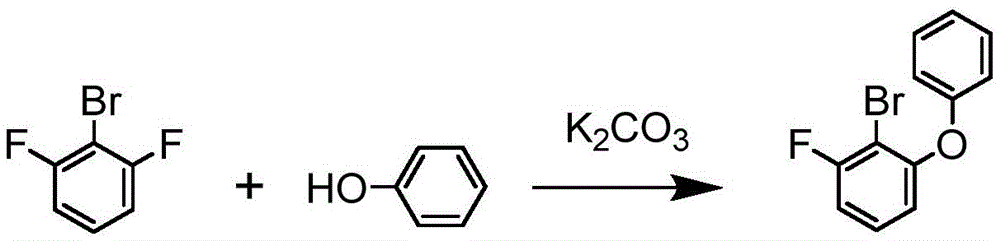
在氮气环境下,且在室温下向间苯二酚(14.4g,14.4mmol)、碳酸钾(3.97g,28.7mmol)及NMP(57.4mL)中添加2-溴-1-氟-3-苯氧基苯(7.67g,28.7mmol),在150℃下加热搅拌160小时后,在160℃下加热搅拌22小时。其后,将NMP减压馏去后,添加甲苯。使用硅酸镁短程管柱进行过滤,将溶剂减压馏去而获得粗产物。使用甲苯进行再结晶,由此获得作为白色固体的1,3-双(2-溴-3-苯氧基苯氧基)苯(5.35g,产率为62%)。To resorcinol (14.4 g, 14.4 mmol), potassium carbonate (3.97 g, 28.7 mmol) and NMP (57.4 mL) was added 2-bromo-1-fluoro-3-benzene under nitrogen and at room temperature Oxybenzene (7.67 g, 28.7 mmol) was heated and stirred at 150°C for 160 hours, and then heated and stirred at 160°C for 22 hours. Then, after depressurizingly distilling NMP, toluene was added. Filtration was carried out using a magnesium silicate short-path column, and the solvent was distilled off under reduced pressure to obtain a crude product. Recrystallization was performed using toluene, whereby 1,3-bis(2-bromo-3-phenoxyphenoxy)benzene (5.35 g, 62% yield) was obtained as a white solid.
[化387][Chemical 387]

在氮气环境下,且在-42℃下向1,3-双(2-溴-3-苯氧基苯氧基)苯(0.302g,0.50mmol)及叔丁基苯(5.0mL)中添加丁基锂的己烷溶液(0.688mL,1.64M,1.1mmol)后,在室温下搅拌22小时。在-42℃下添加三溴化硼(0.142mL,1.5mmol),并在50℃下搅拌3小时。在70℃下搅拌17小时后,在减压下,且在0℃下将反应溶液的10%馏去。在0℃下添加N,N-二异丙基乙胺(0.348mL,2.0mmol),在150℃下加热搅拌20小时后,使用硅酸镁短程管柱进行过滤,将溶剂减压馏去而获得粗产物。使用二氯甲烷及乙腈进行清洗,由此获得白色固体。继而,使用乙酸乙酯进行再结晶,由此获得作为白色固体的由式(1-24)所表示的化合物(19.2mg,产率为8.3%)。进而,将滤液的溶剂减压馏去,由此以1:5的混合物的形态获得作为淡黄色的固体的由式(1-24)所表示的化合物与由式(1-23)所表示的化合物(30.8mg,产率为13%)。根据这些结果,而算出由式(1-24)所表示的化合物的产率为11%(24.3mg),由式(1-23)所表示的化合物的产率为11%(25.7mg)。To 1,3-bis(2-bromo-3-phenoxyphenoxy)benzene (0.302 g, 0.50 mmol) and tert-butylbenzene (5.0 mL) were added under nitrogen atmosphere at -42°C A solution of butyllithium in hexane (0.688 mL, 1.64 M, 1.1 mmol) was then stirred at room temperature for 22 hours. Boron tribromide (0.142 mL, 1.5 mmol) was added at -42°C and stirred at 50°C for 3 hours. After stirring at 70°C for 17 hours, 10% of the reaction solution was distilled off at 0°C under reduced pressure. N,N-diisopropylethylamine (0.348 mL, 2.0 mmol) was added at 0°C, and after heating and stirring at 150°C for 20 hours, filtration was carried out using a magnesium silicate short-path column, and the solvent was distilled off under reduced pressure to obtain a solution. A crude product is obtained. A white solid was obtained by washing with dichloromethane and acetonitrile. Next, recrystallization was performed using ethyl acetate, whereby the compound represented by formula (1-24) (19.2 mg, 8.3% yield) was obtained as a white solid. Furthermore, the solvent of the filtrate was distilled off under reduced pressure, whereby the compound represented by the formula (1-24) and the compound represented by the formula (1-23) were obtained as pale yellow solids in the form of a 1:5 mixture. Compound (30.8 mg, 13% yield). From these results, the yield of the compound represented by the formula (1-24) was calculated to be 11% (24.3 mg), and the yield of the compound represented by the formula (1-23) was calculated to be 11% (25.7 mg).
[化388][Chemical 388]

通过NMR测定来确认由式(1-24)所表示的化合物的结构。The structure of the compound represented by formula (1-24) was confirmed by NMR measurement.
1H NMR(CDCl3中的δppm);10.13(s,1H),8.92(dd,J=1.6,8.0Hz,2H),7.82(t,J=8.0Hz,2H),7.78(ddd,J=1.6,6.8,8.0Hz,2H),7.62(d,J=7.6Hz,4H),7.51-7.54(m,4H),6.98(s,1H)。 1 H NMR (δ ppm in CDCl 3 ); 10.13 (s, 1H), 8.92 (dd, J=1.6, 8.0 Hz, 2H), 7.82 (t, J=8.0 Hz, 2H), 7.78 (ddd, J= 1.6, 6.8, 8.0 Hz, 2H), 7.62 (d, J=7.6 Hz, 4H), 7.51-7.54 (m, 4H), 6.98 (s, 1H).
LRMS(EI+)m/z 462(M+)LRMS(EI+)m/z 462(M + )
通过NMR测定来确认由式(1-23)所表示的化合物的结构。The structure of the compound represented by formula (1-23) was confirmed by NMR measurement.
1H NMR(DMSO-D6中的δppm);8.92(d,J=8.8Hz,1H),8.77(dd,J=1.6,7.6Hz,1H),8.57(d,J=8.4Hz,1H),7.93(t,J=8.0Hz,1H),7.81(ddd,J=1.6,7.2,8.4Hz,1H),7.67(t,J=8.0Hz,1H),7.58-7.63(m,2H),7.47-7.50(m,3H),7.35(dd,J=1.6,8.4Hz,1H),7.31(t,J=8.0Hz,1H),7.28(d,J=8.4Hz,1H),7.19(t,J=8.0Hz,2H)。 1 H NMR (δppm in DMSO-D6); 8.92 (d, J=8.8 Hz, 1H), 8.77 (dd, J=1.6, 7.6 Hz, 1H), 8.57 (d, J=8.4 Hz, 1H), 7.93(t,J=8.0Hz,1H),7.81(ddd,J=1.6,7.2,8.4Hz,1H),7.67(t,J=8.0Hz,1H),7.58-7.63(m,2H),7.47 -7.50(m,3H),7.35(dd,J=1.6,8.4Hz,1H),7.31(t,J=8.0Hz,1H),7.28(d,J=8.4Hz,1H),7.19(t, J=8.0Hz, 2H).
LRMS(EI+)m/z 462(M+)LRMS(EI+)m/z 462(M + )
合成例(43)Synthesis Example (43)
2,6,8,12-四苯基-5,9-二氧杂-13b-硫代磷杂萘并[3,2,1-de]蒽的合成Synthesis of 2,6,8,12-Tetraphenyl-5,9-dioxa-13b-thiophosphanaphtho[3,2,1-de]anthracene
[化389][Chemical 389]

首先,在氮气环境下,且在0℃下向4',6'-双([1,1'-联苯]-4-基氧基)-5'-溴-1,1':3',1”-联三苯(terphenyl)(12.9g,20.0mmol)及苯(36mL)中添加丁基锂的己烷溶液(12.2mL,1.64M,20.0mmol),并在室温下搅拌1小时。在0℃下添加三氯化磷(1.90mL,22.0mmol)后在80℃下搅拌1小时。在减压下将溶剂馏去,添加硫(0.770g,24.0mmol)及邻二氯苯(60mL),并在80℃下搅拌1小时。在-70℃下添加三氯化铝(18.6g,0.140mol)并在0℃下添加N,N-二异丙基乙胺(8.20mL,48.0mmol),然后在100℃下搅拌16小时。冷却至室温为止后,将反应液添加至1,4-二氮杂双环[2.2.2]辛烷(31.4g,0.280mol)的二氯甲烷(300ml)溶液中。继而,使用铺满硅藻土的玻璃过滤器进行抽吸过滤,并在减压下将滤液的溶剂馏去。溶解于甲苯中,使用铺满硅胶的玻璃过滤器进行抽吸过滤后,将滤液的溶剂减压馏去。溶解于二氯甲烷中并添加水后,将二氯甲烷层分开并利用二氯甲烷对水层进行萃取。将溶剂减压馏去,使用己烷、甲醇、乙腈、乙酸乙酯对粗产物进行清洗,由此获得作为白色固体的由式(1-1250)所表示的化合物(0.723g)。First, 4',6'-bis([1,1'-biphenyl]-4-yloxy)-5'-bromo-1,1':3' under nitrogen atmosphere and at 0°C , 1"-terphenyl (12.9 g, 20.0 mmol) and benzene (36 mL) were added with a hexane solution of butyllithium (12.2 mL, 1.64 M, 20.0 mmol), followed by stirring at room temperature for 1 hour. Phosphorus trichloride (1.90 mL, 22.0 mmol) was added at 0° C., followed by stirring at 80° C. for 1 hour. The solvent was distilled off under reduced pressure, and sulfur (0.770 g, 24.0 mmol) and o-dichlorobenzene (60 mL) were added. ), and stirred for 1 hour at 80° C. Aluminium trichloride (18.6 g, 0.140 mol) was added at -70° C. and N,N-diisopropylethylamine (8.20 mL, 48.0 mmol) was added at 0° C. ), then stirred at 100° C. for 16 hours. After cooling to room temperature, the reaction solution was added to 1,4-diazabicyclo[2.2.2]octane (31.4 g, 0.280 mol) in dichloromethane (300 ml). ) solution. Then, suction filtration was carried out using a glass filter covered with celite, and the solvent of the filtrate was distilled off under reduced pressure. Dissolved in toluene, suction filtration was carried out using a glass filter covered with silica gel Afterwards, the solvent of the filtrate was distilled off under reduced pressure. After being dissolved in dichloromethane and adding water, the dichloromethane layer was separated and the aqueous layer was extracted with dichloromethane. The solvent was distilled off under reduced pressure, using hexane, The crude product was washed with methanol, acetonitrile, and ethyl acetate to obtain the compound (0.723 g) represented by the formula (1-1250) as a white solid.
[化390][Chemical 390]

通过NMR测定来确认所获得的化合物的结构。The structure of the obtained compound was confirmed by NMR measurement.
1H NMR(CDCl3中的δppm);7.33(dd,JHP=6.2Hz,J=8.7Hz,2H),7.38-7.55(m,12H),7.68(d,J=7.2Hz,4H),7.63(d,J=7.3Hz,4H),7.71(s,1H),7.74(dd,JHP=2.2Hz,J=8.7Hz,2H),8.41(dd,JHP=13.4Hz,J=2.2Hz,2H)。 1 H NMR (δ ppm in CDCl 3 ); 7.33 (dd, J HP = 6.2 Hz, J = 8.7 Hz, 2H), 7.38-7.55 (m, 12H), 7.68 (d, J = 7.2 Hz, 4H), 7.63(d,J=7.3Hz,4H),7.71(s,1H),7.74(dd, JHP =2.2Hz,J=8.7Hz,2H),8.41(dd, JHP =13.4Hz,J=2.2 Hz, 2H).
13C NMR(CDCl3中的δppm);103.2(d,JCP=81.9Hz),119.9(d,JCP=81.4Hz,2C),120.3(2C),126.9(2C),127.0(4C),127.3(d,JCP=7.3Hz,2C),127.8(2C),128.0(2C),128.4(4C),129.1(4C),129.6(4C),131.7(2C),135.9,136.0(2C),138.6(d,JCP=10.1Hz,2C),139.3(2C),151.8(2C),155.2(2C)。 13 C NMR (δ ppm in CDCl 3 ); 103.2 (d, J CP = 81.9 Hz), 119.9 (d, J CP = 81.4 Hz, 2C), 120.3 (2C), 126.9 (2C), 127.0 (4C), 127.3(d, J CP = 7.3Hz, 2C), 127.8(2C), 128.0(2C), 128.4(4C), 129.1(4C), 129.6(4C), 131.7(2C), 135.9, 136.0(2C), 138.6 (d, J CP = 10.1 Hz, 2C), 139.3 (2C), 151.8 (2C), 155.2 (2C).
合成例(44)Synthesis Example (44)
2,6,8,12-四苯基-5,9-二氧杂-13b-氧代磷杂萘并[3,2,1-de]蒽的合成Synthesis of 2,6,8,12-Tetraphenyl-5,9-dioxa-13b-oxophosphanaphtho[3,2,1-de]anthracene
[化391][Chemical 391]

在0℃下,向由所述式(1-1250)所表示的化合物(0.633g,1.01mmol)及二氯甲烷(100mL)中添加间氯过苯甲酸(0.247g,77wt%,1.10mmol),并在室温下进行搅拌。6小时后,在0℃下添加间氯过苯甲酸(44.9mg,77wt%,0.200mmol)并在室温下进行搅拌。14小时后,添加亚硫酸钠饱和溶液(10.0ml)并在室温下进行搅拌。通过过滤来去除不溶物,将二氯甲烷层分开后,利用二氯甲烷对水层进行萃取。使所获得的有机层合并来进行浓缩后,将二氯甲烷及乙酸乙酯用作展开溶剂,利用硅胶短程管柱来进行精制,并在减压下将滤液的溶剂馏去。使用甲醇对所获得的粗产物进行清洗,由此获得作为白色固体的由式(1-1190)所表示的化合物(0.580g)。To the compound represented by the formula (1-1250) (0.633 g, 1.01 mmol) and dichloromethane (100 mL) were added m-chloroperbenzoic acid (0.247 g, 77 wt%, 1.10 mmol) at 0°C , and stirred at room temperature. After 6 hours, m-chloroperbenzoic acid (44.9 mg, 77 wt%, 0.200 mmol) was added at 0°C and stirred at room temperature. After 14 hours, a saturated solution of sodium sulfite (10.0 ml) was added and stirred at room temperature. The insoluble matter was removed by filtration, the dichloromethane layer was separated, and the aqueous layer was extracted with dichloromethane. After the obtained organic layers were combined and concentrated, dichloromethane and ethyl acetate were used as developing solvents, and the mixture was purified by a silica gel short-path column, and the solvent of the filtrate was distilled off under reduced pressure. The obtained crude product was washed with methanol, whereby the compound (0.580 g) represented by the formula (1-1190) was obtained as a white solid.
[化392][Chemical 392]

通过NMR测定来确认所获得的化合物的结构。The structure of the obtained compound was confirmed by NMR measurement.
1H NMR(CDCl3中的δppm);7.37-7.56(m,14H),7.62(d,J=7.3Hz,4H),7.69(d,J=7.9Hz,4H),7.79(s,1H),7.80(dd,J=2.3,8.7Hz,2H),8.44(dd,J=2.3Hz,2H)。 1 H NMR (δ ppm in CDCl 3 ); 7.37-7.56 (m, 14H), 7.62 (d, J=7.3Hz, 4H), 7.69 (d, J=7.9Hz, 4H), 7.79 (s, 1H) , 7.80 (dd, J=2.3, 8.7 Hz, 2H), 8.44 (dd, J=2.3 Hz, 2H).
13C NMR(CDCl3中的δppm);104.0(d,JCP=97.3Hz),117.6(d,JCP=116.6Hz,2C),120.4(2C),126.3(2C),127.0(4C),127.4(d,JCP=4.8Hz,2C),127.7(2C),127.9(2C),128.4(4C),129.0(4C),129.6(4C),132.4(2C),136.0,136.7(2C),138.0(d,JCP=10.6Hz,2C),139.3(2C),152.1(2C),156.7(2C)。 13 C NMR (δ ppm in CDCl 3 ); 104.0 (d, J CP = 97.3 Hz), 117.6 (d, J CP = 116.6 Hz, 2C), 120.4 (2C), 126.3 (2C), 127.0 (4C), 127.4(d, J CP = 4.8Hz, 2C), 127.7(2C), 127.9(2C), 128.4(4C), 129.0(4C), 129.6(4C), 132.4(2C), 136.0, 136.7(2C), 138.0 (d, J CP = 10.6 Hz, 2C), 139.3 (2C), 152.1 (2C), 156.7 (2C).
合成例(45)Synthesis Example (45)
2,12-二苯基-5,9-二氧杂-13b-硫代磷杂萘并[3,2,1-de]蒽的合成Synthesis of 2,12-diphenyl-5,9-dioxa-13b-thiophosphanaphtho[3,2,1-de]anthracene
[化393][Chemical 393]

首先,在氮气环境下,且在0℃下向1,3-双([1,1'-联苯]-4-基氧基)苯(6.22g,15.0mmol)及苯(120mL)中添加丁基锂的己烷溶液(11.0mL,1.64M,18.0mmol),并在70℃下搅拌18小时。在0℃下添加三氯化磷(1.76mL,22.5mmol)后在80℃下搅拌2小时。在减压下将溶剂馏去后,添加硫(0.866g,27.0mmol)及邻二氯苯(60mL),并在80℃下搅拌1小时。在-95℃下添加三氯化铝(14.0g,105mmol)并在0℃下添加N,N-二异丙基乙胺(6.18mL,36.0mmol),然后在80℃下搅拌16小时。冷却至室温为止后,将反应混合液添加至1,4-二氮杂双环[2.2.2]辛烷(23.6g,210mmol)的二氯甲烷(300ml)溶液中。继而,使用铺满硅藻土的玻璃过滤器进行抽吸过滤,并利用硅胶短程管柱(展开液:二氯甲烷)来进行精制。将溶剂减压馏去并使用甲醇及甲苯对粗产物进行清洗,由此获得作为白色固体的由式(1-1247)所表示的化合物(1.31g)。First, 1,3-bis([1,1'-biphenyl]-4-yloxy)benzene (6.22 g, 15.0 mmol) and benzene (120 mL) were added under nitrogen atmosphere at 0°C butyllithium in hexanes (11.0 mL, 1.64 M, 18.0 mmol) and stirred at 70°C for 18 hours. Phosphorus trichloride (1.76 mL, 22.5 mmol) was added at 0°C, followed by stirring at 80°C for 2 hours. After the solvent was distilled off under reduced pressure, sulfur (0.866 g, 27.0 mmol) and o-dichlorobenzene (60 mL) were added, and the mixture was stirred at 80° C. for 1 hour. Aluminum trichloride (14.0 g, 105 mmol) was added at -95°C and N,N-diisopropylethylamine (6.18 mL, 36.0 mmol) was added at 0°C, followed by stirring at 80°C for 16 hours. After cooling to room temperature, the reaction mixture was added to a solution of 1,4-diazabicyclo[2.2.2]octane (23.6 g, 210 mmol) in dichloromethane (300 ml). Next, suction filtration was performed using a glass filter covered with celite, and purification was performed using a silica gel short-path column (developing solution: dichloromethane). The solvent was distilled off under reduced pressure, and the crude product was washed with methanol and toluene to obtain the compound (1.31 g) represented by the formula (1-1247) as a white solid.
[化394][Chemical 394]

通过NMR测定来确认所获得的化合物的结构。The structure of the obtained compound was confirmed by NMR measurement.
1H NMR(CDCl3中的δppm);7.17(dd,JHP=4.1Hz,J=8.2Hz,2H),7.41(tt,J=1.4,7.3Hz,2H),7.46(dd,JHP=2.3Hz,J=8.7Hz,2H),7.49(dd,J=7.3,8.0Hz,4H),7.57(t,J=8.2Hz 1H),7.63(d,J=8.0Hz,4H),7.78(dd,J=2.3,8.7Hz,2H),8.39(dd J=2.3Hz,JHP=13.5Hz,2H)。 1 H NMR (δ ppm in CDCl 3 ); 7.17 (dd, J HP = 4.1 Hz, J = 8.2 Hz, 2H), 7.41 (tt, J = 1.4, 7.3 Hz, 2H), 7.46 (dd, J HP = 2.3Hz, J=8.7Hz, 2H), 7.49(dd, J=7.3, 8.0Hz, 4H), 7.57(t, J=8.2Hz 1H), 7.63(d, J=8.0Hz, 4H), 7.78( dd, J=2.3, 8.7 Hz, 2H), 8.39 (dd J=2.3 Hz, J HP =13.5 Hz, 2H).
13C NMR(CDCl3中的δppm);102.4(d,JCP=82.4Hz),112.9(d,JCP=4.8Hz,2C),120.1(d,JCP=92Hz,2C),120.3(d,JCP=6.7Hz 2C),127.0(4C),127.5(d,JCP=5.8Hz,2C),127.9(2C),129.1(4C),131.7(JCP=1.9Hz,2C),133.3,138.5(JCP=11.5Hz,2C),139.3(2C),155.1(JCP=2.9Hz,2C),156.2(2C)。 13 C NMR (δ ppm in CDCl 3 ); 102.4 (d, J CP = 82.4 Hz), 112.9 (d, J CP = 4.8 Hz, 2C), 120.1 (d, J CP = 92 Hz, 2C), 120.3 (d , J CP = 6.7Hz 2C), 127.0 (4C), 127.5 (d, J CP = 5.8Hz, 2C), 127.9 (2C), 129.1 (4C), 131.7 (J CP = 1.9Hz, 2C), 133.3, 138.5 (J CP = 11.5 Hz, 2C), 139.3 (2C), 155.1 (J CP = 2.9 Hz, 2C), 156.2 (2C).
合成例(46)Synthesis Example (46)
2,12-二苯基-5,9-二氧杂-13b-氧代磷杂萘并[3,2,1-de]蒽的合成Synthesis of 2,12-diphenyl-5,9-dioxa-13b-oxophosphanaphtho[3,2,1-de]anthracene
[化395][Chemical 395]

在0℃下,向由式(1-1247)所表示的化合物(2.45g,5.17mmol)及二氯甲烷(500mL)中添加间氯过苯甲酸(1.16g,77wt%,5.16mmol),并在室温下进行搅拌。5小时后,在0℃下添加间氯过苯甲酸(0.350g,77wt%,1.56mmol)并在室温下进行搅拌。16小时后,添加亚硫酸钠饱和溶液(20.0ml)并在室温下进行搅拌。将二氯甲烷层分开后,利用二氯甲烷对水层进行萃取。使所获得的有机层合并来进行浓缩后,将二氯甲烷及二氯甲烷/乙酸乙酯=1(容积比)用作展开溶剂并利用硅胶短程管柱来进行精制。在减压下将所获得的滤液馏去,而获得作为白色固体的由式(1-1187)所表示的化合物(2.32g)。To the compound represented by the formula (1-1247) (2.45 g, 5.17 mmol) and dichloromethane (500 mL) were added m-chloroperbenzoic acid (1.16 g, 77 wt%, 5.16 mmol) at 0°C, and Stir at room temperature. After 5 hours, m-chloroperbenzoic acid (0.350 g, 77 wt%, 1.56 mmol) was added at 0°C and stirred at room temperature. After 16 hours, a saturated solution of sodium sulfite (20.0 ml) was added and stirred at room temperature. After separating the dichloromethane layer, the aqueous layer was extracted with dichloromethane. After the obtained organic layers were combined and concentrated, dichloromethane and dichloromethane/ethyl acetate = 1 (volume ratio) were used as a developing solvent, and purification was carried out with a silica gel short-path column. The obtained filtrate was distilled off under reduced pressure to obtain the compound (2.32 g) represented by the formula (1-1187) as a white solid.
[化396][Chemical 396]

通过NMR测定来确认所获得的化合物的结构。The structure of the obtained compound was confirmed by NMR measurement.
1H NMR(CDCl3中的δppm);7.20(dd,JHP=4.1Hz,J=8.5Hz,2H),7.41(tt,J=1.4,7.4Hz,2H),7.48(d,J=7.4Hz,2H),7.52(d,J=8.7Hz,4H),7.62(dd,J=1.4,7.5Hz,4H),7.64(t,J=8.5Hz,1H),7.83(dd,J=2.2,8.7Hz,2H),8.41(dd,JHP=12.4Hz,J=2.2Hz,2H)。 1 H NMR (δ ppm in CDCl 3 ); 7.20 (dd, J HP = 4.1 Hz, J = 8.5 Hz, 2H), 7.41 (tt, J = 1.4, 7.4 Hz, 2H), 7.48 (d, J = 7.4 Hz, 2H), 7.52(d, J=8.7Hz, 4H), 7.62(dd, J=1.4, 7.5Hz, 4H), 7.64(t, J=8.5Hz, 1H), 7.83(dd, J=2.2 , 8.7 Hz, 2H), 8.41 (dd, J HP = 12.4 Hz, J = 2.2 Hz, 2H).
13C NMR(CDCl3中的δppm);103.6(d,JCP=97.8Hz),112.4(d,JCP=4.8Hz,2C),118.0(d,JCP=116.0Hz,2C),120.5(d,JCP=6.7Hz,2C),127.1(4C),127.5(d,JCP=5.8Hz,2C),128.0(2C),129.2(4C),132.6(2C),134.3,138.0(d,JCP=10.5Hz,2C),139.5(2C),156.8(2C),156.8(d,JCP=6.9Hz,2C)。 13 C NMR (δppm in CDCl 3 ); 103.6 (d, J CP = 97.8 Hz), 112.4 (d, J CP = 4.8 Hz, 2C), 118.0 (d, J CP = 116.0 Hz, 2C), 120.5 ( d, J CP = 6.7Hz, 2C), 127.1(4C), 127.5(d, J CP = 5.8Hz, 2C), 128.0(2C), 129.2(4C), 132.6(2C), 134.3, 138.0(d, J CP = 10.5 Hz, 2C), 139.5 (2C), 156.8 (2C), 156.8 (d, J CP =6.9 Hz, 2C).
合成例(47)Synthesis Example (47)
3,6,8,11-四苯基-5,9-二氧杂-13b-硫代磷杂萘并[3,2,1-de]蒽的合成Synthesis of 3,6,8,11-Tetraphenyl-5,9-dioxa-13b-thiophosphanaphtho[3,2,1-de]anthracene
[化397][Chemical 397]

首先,在氮气环境下,且在0℃下向4',6'-双([1,1'-联苯-3-基氧基])-5'-溴-1,1';3',1”-联三苯(12.9g,20.0mmol)及苯(70mL)中添加丁基锂的己烷溶液(12.2mL,1.64M,20.0mmol),并搅拌2小时。在0℃下添加三氯化磷(1.92mL,22.0mmol)并在80℃下搅拌1小时。在减压下将溶剂馏去,添加硫(0.769g,24.0mmol)及邻二氯苯(60mL),并在80℃下搅拌1小时。在-95℃下添加三氯化铝(18.7g,140mmol)并在0℃下添加N,N-二异丙基乙胺(8.20mL,48.0mmol),然后在100℃下搅拌16小时。冷却至室温为止后,将反应液添加至1,4-二氮杂双环[2.2.2]辛烷(31.4g,280mmol)的二氯甲烷(300ml)溶液中。继而,使用铺满硅藻土的玻璃过滤器进行抽吸过滤,在减压下对滤液进行浓缩后,使用甲苯进行稀释,然后通过过滤来去除不溶物。将滤液的溶剂减压馏去后,利用硅胶短程管柱(展开液:二氯甲烷)来进行精制。将溶剂减压馏去后,利用硅胶短程管柱(展开液:甲苯)来进行精制。将溶剂减压馏去并使用乙腈及己烷对粗产物进行清洗,由此获得作为白色固体的由式(1-1251)所表示的化合物(1.22g)。First, 4',6'-bis([1,1'-biphenyl-3-yloxy])-5'-bromo-1,1';3' was added to 4',6'-bis([1,1'-biphenyl-3-yloxy])-5'-bromo-1,1'; , 1"-triphenyl (12.9 g, 20.0 mmol) and benzene (70 mL) were added with a solution of butyllithium in hexane (12.2 mL, 1.64 M, 20.0 mmol), and stirred for 2 hours. At 0 °C, triphenyl lithium was added. Phosphorus chloride (1.92 mL, 22.0 mmol) was stirred at 80° C. for 1 hour. The solvent was distilled off under reduced pressure, sulfur (0.769 g, 24.0 mmol) and o-dichlorobenzene (60 mL) were added, and the mixture was heated at 80° C. Stir for 1 hour at -95°C. Add aluminum trichloride (18.7 g, 140 mmol) at -95°C and N,N-diisopropylethylamine (8.20 mL, 48.0 mmol) at 0°C, then at 100°C Stirred for 16 hours. After cooling to room temperature, the reaction solution was added to a solution of 1,4-diazabicyclo[2.2.2]octane (31.4 g, 280 mmol) in dichloromethane (300 ml). The glass filter filled with diatomaceous earth is suction filtered, and after the filtrate is concentrated under reduced pressure, it is diluted with toluene, and then insolubles are removed by filtration. After the solvent of the filtrate is distilled off under reduced pressure, a silica gel short-path tube is used. Column (developing solution: dichloromethane) for purification. After the solvent was distilled off under reduced pressure, purification was carried out using a silica gel short-path column (developing solution: toluene). The product was washed, whereby the compound (1.22 g) represented by the formula (1-1251) was obtained as a white solid.
[化398][Chemical 398]

通过NMR测定来确认所获得的化合物的结构。The structure of the obtained compound was confirmed by NMR measurement.
1H NMR(CDCl3中的δppm);7.40-7.50(m,10H),7.52(dd,J=7.2Hz,7.6Hz,4H),7.59(d,J=7.2Hz,4H),7.63(ddd,JHP=1.8Hz,J=1.8Hz,8.0Hz,2H),7.67-7.70(m,5H),8.26(dd,JHP=12.8Hz,J=8.0Hz,2H)。 1 H NMR (δ ppm in CDCl 3 ); 7.40-7.50 (m, 10H), 7.52 (dd, J=7.2Hz, 7.6Hz, 4H), 7.59 (d, J=7.2Hz, 4H), 7.63 (ddd , J HP = 1.8 Hz, J = 1.8 Hz, 8.0 Hz, 2H), 7.67-7.70 (m, 5H), 8.26 (dd, J HP = 12.8 Hz, J = 8.0 Hz, 2H).
13C NMR(CDCl3中的δppm);103.5(d,JCP=80.5Hz),117.9(d,JCP=93.9Hz,2C),118.2(d,JCP=5.8Hz,2C),124.2(d,JCP=11.5Hz,2C),126.9(d,JCP=5.8Hz,2C),127.3(4C),127.7(2C),128.4(4C),128.6(2C),129.0(4C),129.3(d,JCP=5.8Hz,2C),129.6(4C),135.9,136.1(2C),139.0(2C),146.3(2C),151.7(2C),156.1(2C)。 13 C NMR (δ ppm in CDCl 3 ); 103.5 (d, J CP = 80.5 Hz), 117.9 (d, J CP = 93.9 Hz, 2C), 118.2 (d, J CP = 5.8 Hz, 2C), 124.2 ( d, J CP = 11.5Hz, 2C), 126.9 (d, J CP = 5.8Hz, 2C), 127.3 (4C), 127.7 (2C), 128.4 (4C), 128.6 (2C), 129.0 (4C), 129.3 (d, J CP = 5.8 Hz, 2C), 129.6(4C), 135.9, 136.1(2C), 139.0(2C), 146.3(2C), 151.7(2C), 156.1(2C).
合成例(48)Synthesis Example (48)
3,6,8,11-四苯基-5,9-二氧杂-13b-氧代磷杂萘并[3,2,1-de]蒽的合成Synthesis of 3,6,8,11-Tetraphenyl-5,9-dioxa-13b-oxophosphanaphtho[3,2,1-de]anthracene
[化399][Chemical 399]

在0℃下,向由所述式(1-1251)所表示的化合物(1.12g,1.79mmol)及二氯甲烷(150mL)中添加间氯过苯甲酸(0.404g,77wt%,1.79mmol),并在室温下进行搅拌。5小时后,在0℃下添加间氯过苯甲酸(0.674g,77wt%,0.391mmol)并在室温下进行搅拌。16小时后,添加亚硫酸钠饱和溶液(10ml)及水(40ml)并在室温下进行搅拌。通过过滤来去除不溶物,将二氯甲烷层分开后,利用二氯甲烷对水层进行萃取。使所获得的有机层合并来进行浓缩后,将二氯甲烷及二氯甲烷/乙酸乙酯=1(容积比)用作展开溶剂,利用硅胶短程管柱来进行精制,并在减压下将滤液的溶剂馏去。使用甲醇对所获得的粗产物进行清洗,由此获得作为白色固体的由式(1-1191)所表示的化合物(1.04g)。To the compound represented by the formula (1-1251) (1.12 g, 1.79 mmol) and dichloromethane (150 mL) were added m-chloroperbenzoic acid (0.404 g, 77 wt%, 1.79 mmol) at 0°C , and stirred at room temperature. After 5 hours, m-chloroperbenzoic acid (0.674 g, 77 wt%, 0.391 mmol) was added at 0°C and stirred at room temperature. After 16 hours, a saturated solution of sodium sulfite (10 ml) and water (40 ml) were added and stirred at room temperature. The insoluble matter was removed by filtration, the dichloromethane layer was separated, and the aqueous layer was extracted with dichloromethane. After the obtained organic layers were combined and concentrated, dichloromethane and dichloromethane/ethyl acetate = 1 (volume ratio) were used as a developing solvent, and the mixture was purified by a silica gel short-path column, and the mixture was purified under reduced pressure. The solvent of the filtrate was distilled off. The obtained crude product was washed with methanol, whereby the compound (1.04 g) represented by the formula (1-1191) was obtained as a white solid.
[化400][Chemical 400]

通过NMR测定来确认所获得的化合物的结构。The structure of the obtained compound was confirmed by NMR measurement.
1H NMR(CDCl3中的δppm);7.40-7.50(m,10H),7.53(t,J=7.1Hz,4H),7.61(d,J=6.9Hz,4H),7.64(dt,JHP=1.9Hz,J=1.9Hz,8.0Hz,2H),7.69(d,J=7.1Hz,4H),7.77(s,1H),8.32(dd,JHP=11.7Hz,J=8.0Hz,2H)。 1 H NMR (δ ppm in CDCl 3 ); 7.40-7.50 (m, 10H), 7.53 (t, J=7.1 Hz, 4H), 7.61 (d, J=6.9 Hz, 4H), 7.64 (dt, J HP =1.9Hz, J=1.9Hz, 8.0Hz, 2H), 7.69(d, J=7.1Hz, 4H), 7.77(s, 1H), 8.32(dd, J HP =11.7Hz, J=8.0Hz, 2H ).
13C NMR(CDCl3中的δppm);104.3(d,JCP=96.8Hz),115.9(d,JCP=117.9Hz,2C),118.2(d,JCP=5.8Hz,2C),123.5(d,JCP=10.5Hz,2C),126.3(d,JCP=4.8Hz,2C),127.3(4C),127.7(2C),128.5(4C),128.6(2C),129.0(4C),129.6(4C),129.7(d,JCP=8.6Hz,2C),136.1,136.7(2C),139.0(2C),146.9(2C),152.2(2C),157.7(2C)。 13 C NMR (δppm in CDCl 3 ); 104.3 (d, J CP = 96.8 Hz), 115.9 (d, J CP = 117.9 Hz, 2C), 118.2 (d, J CP = 5.8 Hz, 2C), 123.5 ( d, J CP = 10.5Hz, 2C), 126.3(d, J CP = 4.8Hz, 2C), 127.3(4C), 127.7(2C), 128.5(4C), 128.6(2C), 129.0(4C), 129.6 (4C), 129.7 (d, J CP = 8.6 Hz, 2C), 136.1, 136.7 (2C), 139.0 (2C), 146.9 (2C), 152.2 (2C), 157.7 (2C).
合成例(49)Synthesis Example (49)
4-(5,9-二氧杂-13b-硼杂萘并[3,2,1-de]蒽-7-基)-N,N-二苯基苯胺的合成Synthesis of 4-(5,9-dioxa-13b-borazaphtho[3,2,1-de]anthracene-7-yl)-N,N-diphenylaniline
[化401][Chemical 401]

在氮气环境下,将加入有((5-溴-1,3-亚苯基)双(氧基))二苯(5.0g)、N,N-二苯基-4-(4,4,5,5-四甲基-1,3,2-二氧杂硼烷-2-基)苯胺(5.7g)、Pd-132(0.31g)、碳酸钾(4.1g)、溴化四丁基铵(TBAB)(0.24g)、甲苯(40ml)及水(5ml)的烧瓶加热至回流温度并搅拌4小时。将反应液冷却至室温为止后,添加水及甲苯来进行分液,并将溶剂减压馏去。使所获得的固体溶解于甲苯中,并利用硅胶短程管柱来进行精制。进而,利用硅胶管柱色谱法(展开液:甲苯/庚烷=1/2(容积比))来进行精制,由此获得3,5-二苯氧基-N,N-二苯基-[1,1'-联苯]-4-胺(7.2g)。Under nitrogen, ((5-bromo-1,3-phenylene)bis(oxy))diphenyl (5.0 g), N,N-diphenyl-4-(4,4, 5,5-Tetramethyl-1,3,2-dioxaboran-2-yl)aniline (5.7g), Pd-132 (0.31g), potassium carbonate (4.1g), tetrabutyl bromide A flask of ammonium (TBAB) (0.24g), toluene (40ml) and water (5ml) was heated to reflux temperature and stirred for 4 hours. After cooling the reaction liquid to room temperature, water and toluene were added for liquid separation, and the solvent was distilled off under reduced pressure. The obtained solid was dissolved in toluene and purified with a silica gel short-path column. Furthermore, 3,5-diphenoxy-N,N-diphenyl-[ 1,1'-Biphenyl]-4-amine (7.2 g).
[化402][Chemical 402]

在氮气环境下,且在0℃下向加入有3,5-二苯氧基-N,N-二苯基-[1,1'-联苯]-4-胺(7.2g)及二甲苯(72ml)的烧瓶中添加1.6M的正丁基锂己烷溶液(9.8ml)。滴加结束后,升温至70℃为止并搅拌3小时后,将沸点低于二甲苯的成分减压馏去。冷却至-30℃为止并添加三溴化硼(1.6ml),升温至室温为止后搅拌30分钟。其后,再次冷却至0℃为止并添加N,N-二异丙基乙胺(5.0ml),在室温下搅拌至发热结束后,在120℃下加热搅拌2小时。将反应液冷却至室温为止,添加水及甲苯来进行分液后,将溶剂减压馏去。使所获得的固体溶解于甲苯中,并利用硅胶短程管柱来进行精制。继而,利用硅胶管柱色谱法(展开液:甲苯/庚烷=1/4(容积比))来进行精制,进而利用庚烷来进行再沉淀,由此获得由式(1-79)所表示的化合物(1.5g)。To this was added 3,5-diphenoxy-N,N-diphenyl-[1,1'-biphenyl]-4-amine (7.2 g) and xylene at 0°C under nitrogen atmosphere A 1.6M solution of n-butyllithium in hexane (9.8ml) was added to a (72ml) flask. After completion of the dropwise addition, the temperature was raised to 70° C. and stirred for 3 hours, and then the components having a boiling point lower than xylene were distilled off under reduced pressure. After cooling to -30°C, boron tribromide (1.6 ml) was added, and the temperature was raised to room temperature, followed by stirring for 30 minutes. Then, it cooled to 0 degreeC again, N,N- diisopropylethylamine (5.0 ml) was added, it stirred at room temperature until heat generation was complete|finished, and it heated and stirred at 120 degreeC for 2 hours. The reaction liquid was cooled to room temperature, water and toluene were added for liquid separation, and then the solvent was distilled off under reduced pressure. The obtained solid was dissolved in toluene and purified with a silica gel short-path column. Next, it was purified by silica gel column chromatography (developing solution: toluene/heptane = 1/4 (volume ratio)), and further reprecipitated by heptane, thereby obtaining represented by formula (1-79) The compound (1.5g).
[化403][Chemical 403]

通过NMR测定来确认所获得的化合物的结构。The structure of the obtained compound was confirmed by NMR measurement.
1H-NMR(400MHz,CDCl3):δ=8.70(dd,2H),7.72(t,2H),7.66(d,2H),7.56(d,2H),7.46(s,2H),7.40(t,2H),7.30(t,4H),7.19(m,6H),7.08(t,2H)。 1 H-NMR (400 MHz, CDCl 3 ): δ=8.70 (dd, 2H), 7.72 (t, 2H), 7.66 (d, 2H), 7.56 (d, 2H), 7.46 (s, 2H), 7.40 ( t, 2H), 7.30 (t, 4H), 7.19 (m, 6H), 7.08 (t, 2H).
合成例(50)Synthesis Example (50)
4-(5,9-二氧杂-13b-硼杂萘并[3,2,1-de]蒽-7-基)-N,N-二苯基萘-1-胺的合成Synthesis of 4-(5,9-dioxa-13b-borananaphtho[3,2,1-de]anthracene-7-yl)-N,N-diphenylnaphthalen-1-amine
[化404][Chemical 404]

在氮气环境下,将加入有4-溴-N,N-二苯基萘-1-胺(30.0g)、双(频哪醇合)二硼(24.4g)、(1,1'-双(二苯基膦基)二茂铁)二氯钯(II)(PdCl2(dppf)·CH2Cl2)(2.0g)、乙酸钾(23.6g)及环戊基甲醚(300ml)的烧瓶加热至回流温度并搅拌4小时。将反应液冷却至室温为止后,添加水及乙酸乙酯来进行分液,并将溶剂减压馏去。使所获得的固体溶解于甲苯中,并利用活性碳短程管柱来进行精制。进而,利用庚烷来进行再沉淀,由此获得N,N-二苯基-4-(4,4,5,5-四甲基-1,3,2-二氧杂硼烷-2-基)萘-1-胺(33.0g)。Under nitrogen, 4-bromo-N,N-diphenylnaphthalen-1-amine (30.0 g), bis(pinacol)diboron (24.4 g), (1,1'-bis(1,1'-bis) were added (diphenylphosphino)ferrocene)dichloropalladium(II) (PdCl 2 (dppf)·CH 2 Cl 2 ) (2.0 g), potassium acetate (23.6 g) and cyclopentyl methyl ether (300 ml) The flask was heated to reflux temperature and stirred for 4 hours. After cooling the reaction liquid to room temperature, water and ethyl acetate were added for liquid separation, and the solvent was distilled off under reduced pressure. The obtained solid was dissolved in toluene and purified by an activated carbon short-path column. Further, by reprecipitation with heptane, N,N-diphenyl-4-(4,4,5,5-tetramethyl-1,3,2-dioxaborane-2- yl)naphthalene-1-amine (33.0 g).
[化405][Chemical 405]

在氮气环境下,将加入有((5-溴-1,3-亚苯基)双(氧基))二苯(5.0g)、N,N-二苯基-4-(4,4,5,5-四甲基-1,3,2-二氧杂硼烷-2-基)萘-1-胺(7.4g)、Pd-132(0.31g)、碳酸钾(4.1g)、溴化四丁基铵(TBAB)(0.24g)、甲苯(40ml)及水(5ml)的烧瓶加热至回流温度并搅拌4小时。将反应液冷却至室温为止后,添加水及甲苯来进行分液,并将溶剂减压馏去。使所获得的固体溶解于甲苯中,并利用硅胶短程管柱来进行精制。进而,利用硅胶管柱色谱法(展开液:甲苯/庚烷=1/2(容积比))来进行精制,由此获得4-(3,5-二苯氧基)-N,N-二苯基萘-1-胺(7.7g)。Under nitrogen, ((5-bromo-1,3-phenylene)bis(oxy))diphenyl (5.0 g), N,N-diphenyl-4-(4,4, 5,5-Tetramethyl-1,3,2-dioxaboran-2-yl)naphthalene-1-amine (7.4g), Pd-132 (0.31g), potassium carbonate (4.1g), bromine A flask of tetrabutylammonium (TBAB) (0.24g), toluene (40ml) and water (5ml) was heated to reflux temperature and stirred for 4 hours. After cooling the reaction liquid to room temperature, water and toluene were added for liquid separation, and the solvent was distilled off under reduced pressure. The obtained solid was dissolved in toluene and purified with a silica gel short-path column. Furthermore, it was purified by silica gel column chromatography (developing solution: toluene/heptane=1/2 (volume ratio)) to obtain 4-(3,5-diphenoxy)-N,N-di Phenylnaphthalen-1-amine (7.7 g).
[化406][Chemical 406]

在氮气环境下,且在0℃下向加入有4-(3,5-二苯氧基)-N,N-二苯基萘-1-胺(7.0g)及二甲苯(105ml)的烧瓶中添加1.6M的正丁基锂己烷溶液(8.7ml)。滴加结束后,升温至70℃为止并搅拌3小时后,将沸点低于二甲苯的成分减压馏去。冷却至-30℃为止并添加三溴化硼(1.4ml),升温至室温为止后搅拌30分钟。其后,再次冷却至0℃为止并添加N,N-二异丙基乙胺(5.3ml),在室温下搅拌至发热结束后,在120℃下加热搅拌2小时。将反应液冷却至室温为止,添加水及甲苯来进行分液后,将溶剂减压馏去。使所获得的固体溶解于甲苯中,并利用硅胶短程管柱来进行精制。继而,利用硅胶管柱色谱法(展开液:甲苯/庚烷=1/4(容积比))来进行精制,进而,依次利用甲醇溶液、庚烷来进行再沉淀,由此获得由式(1-2305)所表示的化合物(0.9g)。To a flask charged with 4-(3,5-diphenoxy)-N,N-diphenylnaphthalen-1-amine (7.0 g) and xylene (105 ml) at 0°C under nitrogen atmosphere To this was added a 1.6M solution of n-butyllithium in hexane (8.7ml). After completion of the dropwise addition, the temperature was raised to 70° C. and stirred for 3 hours, and then the components having a boiling point lower than xylene were distilled off under reduced pressure. After cooling to -30°C, boron tribromide (1.4 ml) was added, and the temperature was raised to room temperature, followed by stirring for 30 minutes. Then, it cooled to 0 degreeC again, N,N- diisopropylethylamine (5.3 ml) was added, it stirred at room temperature until heat generation was complete|finished, and it heated and stirred at 120 degreeC for 2 hours. The reaction liquid was cooled to room temperature, water and toluene were added for liquid separation, and then the solvent was distilled off under reduced pressure. The obtained solid was dissolved in toluene and purified with a silica gel short-path column. Next, it was purified by silica gel column chromatography (developing solution: toluene/heptane = 1/4 (volume ratio)), and further, reprecipitated with methanol solution and heptane in this order, whereby the formula (1) was obtained. -2305) represented by the compound (0.9 g).
[化407][Chemical 407]

通过NMR测定来确认所获得的化合物的结构。The structure of the obtained compound was confirmed by NMR measurement.
1H-NMR(400MHz,CDCl3):δ=8.73(dd,2H),8.08(m,2H),7.73(t,2H),7.57(d,2H),7.54(d,1H),7.37-6.46(m,7H),7.24(m,4H),7.11(d,4H),6.97(t,2H)。 1 H-NMR (400 MHz, CDCl 3 ): δ=8.73 (dd, 2H), 8.08 (m, 2H), 7.73 (t, 2H), 7.57 (d, 2H), 7.54 (d, 1H), 7.37- 6.46 (m, 7H), 7.24 (m, 4H), 7.11 (d, 4H), 6.97 (t, 2H).
合成例(51)Synthesis Example (51)
4-(5,9-二氧杂-13b-硼杂萘并[3,2,1-de]蒽-6-基)-N,N-二苯基苯胺的合成Synthesis of 4-(5,9-dioxa-13b-boraznaphtho[3,2,1-de]anthracene-6-yl)-N,N-diphenylaniline
[化408][Chemical 408]

在氮气环境下,且在室温下将加入有5,9-二氧杂-13b-硼杂萘并[3,2,1-de]蒽(9.0g)、N-溴琥珀酰亚胺(6.5g)及THF(180ml)的烧瓶搅拌3小时。将反应液冷却至室温为止后,添加水来使盐分溶解,并通过抽吸过滤来提取目标物。进而,利用甲醇进行清洗,由此获得5,9-二氧杂-13b-硼杂萘并[3,2,1-de]蒽的溴体及二溴体的混合物(10.9g)。5,9-dioxa-13b-boronanaphtho[3,2,1-de]anthracene (9.0 g), N-bromosuccinimide (6.5 g) were added at room temperature under nitrogen. g) and the flask of THF (180 ml) were stirred for 3 hours. After cooling the reaction liquid to room temperature, water was added to dissolve the salt, and the target substance was extracted by suction filtration. Furthermore, it wash|cleaned with methanol, and the mixture (10.9g) of the bromine body and the dibromo body of 5,9-dioxa-13b-bora naphtho[3,2,1-de]anthracene was obtained.
[化409][Chemical 409]

在氮气环境下,将加入有5,9-二氧杂-13b-硼杂萘并[3,2,1-de]蒽(2.0g)的溴体及二溴体的混合物、N,N-二苯基-4-(4,4,5,5-四甲基-1,3,2-二氧杂硼烷-2-基)苯胺(2.1g)、Pd-132(0.12g)、碳酸钾(1.6g)、溴化四丁基铵(TBAB)(0.09g)、甲苯(24ml)及水(4ml)的烧瓶加热至回流温度并搅拌5小时。将反应液冷却至室温为止后,添加水及甲苯来进行分液,并将溶剂减压馏去。使所获得的固体溶解于甲苯中,并利用硅胶短程管柱来进行精制。继而,利用硅胶管柱色谱法(展开液:甲苯/庚烷=1/4(容积比))来进行精制,进而自甲苯进行再结晶,由此获得由式(1-1104)所表示的化合物(0.9g)。Under a nitrogen atmosphere, a mixture of bromine and dibromide, N,N- Diphenyl-4-(4,4,5,5-tetramethyl-1,3,2-dioxaboran-2-yl)aniline (2.1 g), Pd-132 (0.12 g), carbonic acid A flask of potassium (1.6 g), tetrabutylammonium bromide (TBAB) (0.09 g), toluene (24 ml) and water (4 ml) was heated to reflux temperature and stirred for 5 hours. After cooling the reaction liquid to room temperature, water and toluene were added for liquid separation, and the solvent was distilled off under reduced pressure. The obtained solid was dissolved in toluene and purified with a silica gel short-path column. Next, purification by silica gel column chromatography (developing solution: toluene/heptane = 1/4 (volume ratio)), and further recrystallization from toluene to obtain a compound represented by formula (1-1104) (0.9g).
[化410][Chemical 410]

通过NMR测定来确认所获得的化合物的结构。The structure of the obtained compound was confirmed by NMR measurement.
1H-NMR(400MHz,CDCl3):δ=8.72(m,2H),7.91(d,1H),7.65-7.75(m,4H),7.57(d,1H),7.50(d,1H),7.39(m,2H),7.30(m,5H),7.22(m,6H),7.25(t,2H)。 1 H-NMR (400MHz, CDCl 3 ): δ=8.72(m, 2H), 7.91(d, 1H), 7.65-7.75(m, 4H), 7.57(d, 1H), 7.50(d, 1H), 7.39 (m, 2H), 7.30 (m, 5H), 7.22 (m, 6H), 7.25 (t, 2H).
合成例(52)Synthesis Example (52)
4,4'-(5,9-二氧杂-13b-硼杂萘并[3,2,1-de]蒽-6,8-二基)双(N,N-二苯基苯胺)的合成4,4'-(5,9-dioxa-13b-boraznaphtho[3,2,1-de]anthracene-6,8-diyl)bis(N,N-diphenylaniline) synthesis
[化411][Chemical 411]

在所述合成例(51)中,利用硅胶管柱色谱法(展开液:甲苯/庚烷=1/4(容积比))来进行精制,并分离取出相当于所述化合物的带(band),进而自甲苯进行再结晶,由此获得由式(1-142)所表示的化合物(0.2g)。In the synthesis example (51), purification was carried out by silica gel column chromatography (developing solution: toluene/heptane = 1/4 (volume ratio)), and a band corresponding to the compound was separated out. , and further recrystallized from toluene to obtain a compound (0.2 g) represented by the formula (1-142).
通过NMR测定来确认所获得的化合物的结构。The structure of the obtained compound was confirmed by NMR measurement.
1H-NMR(400MHz,CDCl3):δ=8.73(d,2H),8.01(s,1H),7.70(m,6H),7.52(d,2H),7.40(t,2H),7.19-7.35(m,20H),7.06(t,4H)。 1 H-NMR (400 MHz, CDCl 3 ): δ=8.73(d, 2H), 8.01(s, 1H), 7.70(m, 6H), 7.52(d, 2H), 7.40(t, 2H), 7.19- 7.35(m, 20H), 7.06(t, 4H).
合成例(53)Synthesis Example (53)
2,12-二(9H-咔唑基-9-基)-5,9-二氧杂-13b-硼杂萘并[3,2,1-de]蒽的合成Synthesis of 2,12-bis(9H-carbazolyl-9-yl)-5,9-dioxa-13b-bora naphtho[3,2,1-de]anthracene
[化412][Chemical 412]

在氮气环境下,且在130℃下将加入有9-(4-溴苯基)-9H-咔唑(109.7g)、间苯二酚(15.0g)、碘化铜(2.6g)、Fe(acac)3(57.7g)、碳酸钾(75.3g)、及NMP(150ml)的烧瓶加热搅拌56小时。将反应液冷却至室温为止,添加乙酸乙酯后,利用铺满硅藻土的桐山漏斗进行过滤,而将固体成分去除。向滤液中添加水来进行分液后,利用硅胶管柱色谱法(展开液:甲苯/庚烷=1/10(容积比))来进行精制。进而,自甲苯/庚烷混合溶剂进行再结晶,由此获得1,3-双(4-(9H-咔唑-9-基)苯氧基)苯(15.0g)。9-(4-Bromophenyl)-9H-carbazole (109.7 g), resorcinol (15.0 g), copper iodide (2.6 g), Fe A flask of (acac) 3 (57.7 g), potassium carbonate (75.3 g), and NMP (150 ml) was stirred with heating for 56 hours. The reaction liquid was cooled to room temperature, and ethyl acetate was added, followed by filtration through a Kiriyama funnel covered with diatomaceous earth to remove solid content. After adding water to the filtrate to carry out liquid separation, it was purified by silica gel column chromatography (developing solution: toluene/heptane=1/10 (volume ratio)). Further, 1,3-bis(4-(9H-carbazol-9-yl)phenoxy)benzene (15.0 g) was obtained by recrystallization from a toluene/heptane mixed solvent.
[化413][Chemical 413]

在氮气环境下,且在0℃下向加入有1,3-双(4-(9H-咔唑-9-基)苯氧基)苯(13.5g)及二甲苯(105ml)的烧瓶中添加1.6M的正丁基锂己烷溶液(16.0ml)。滴加结束后,升温至80℃为止并搅拌4小时后,将沸点低于二甲苯的成分减压馏去。冷却至-60℃为止并添加三溴化硼(2.6ml),升温至室温为止后搅拌30分钟。其后,再次冷却至0℃为止并添加N,N-二异丙基乙胺(7.9ml),在室温下搅拌至发热结束后,在120℃下加热搅拌3小时。将反应液冷却至室温为止,添加乙酸钾水溶液及庚烷来进行抽吸过滤。依次利用水、Solmix对所获得的固体进行清洗,然后自氯苯进行再结晶,由此获得由式(1-158)所表示的化合物(5.6g)。To a flask charged with 1,3-bis(4-(9H-carbazol-9-yl)phenoxy)benzene (13.5g) and xylene (105ml) under nitrogen atmosphere at 0°C 1.6M solution of n-butyllithium in hexane (16.0ml). After completion of the dropwise addition, the temperature was raised to 80° C. and stirred for 4 hours, and then the components having a boiling point lower than xylene were distilled off under reduced pressure. After cooling to -60°C, boron tribromide (2.6 ml) was added, and the temperature was raised to room temperature, followed by stirring for 30 minutes. Then, it cooled to 0 degreeC again, N,N- diisopropylethylamine (7.9 ml) was added, it stirred at room temperature until heat generation was complete|finished, and it heated and stirred at 120 degreeC for 3 hours. The reaction liquid was cooled to room temperature, an aqueous potassium acetate solution and heptane were added, and suction filtration was performed. The obtained solid was washed with water and Solmix in this order, and then recrystallized from chlorobenzene to obtain a compound (5.6 g) represented by the formula (1-158).
[化414][Chemical 414]

通过NMR测定来确认所获得的化合物的结构。The structure of the obtained compound was confirmed by NMR measurement.
1H-NMR(400MHz,CDCl3):δ=8.68(m,2H),8.06(m,4H),7.92(t,1H),7.89(dd,2H),7.80(d,2H),7.38(m,6H),7.20(m,8H)。 1 H-NMR (400 MHz, CDCl 3 ): δ=8.68 (m, 2H), 8.06 (m, 4H), 7.92 (t, 1H), 7.89 (dd, 2H), 7.80 (d, 2H), 7.38 ( m, 6H), 7.20 (m, 8H).
合成例(54)Synthesis Example (54)
3,11-二(9H-咔唑基-9-基)-5,9-二氧杂-13b-硼杂萘并[3,2,1-de]蒽的合成Synthesis of 3,11-bis(9H-carbazolyl-9-yl)-5,9-dioxa-13b-bora naphtho[3,2,1-de]anthracene
[化415][Chemical 415]

在氮气环境下,且在130℃下将加入有9-(3-溴苯基)-9H-咔唑(131.7g)、间苯二酚(15.0g)、碘化铜(2.6g)、Fe(acac)3(115.4g)、碳酸钾(75.3g)、及NMP(350ml)的烧瓶加热搅拌30小时。将反应液冷却至室温为止,添加水及乙酸乙酯后,利用铺满硅藻土的桐山漏斗进行过滤,而将固体成分去除。向滤液中添加水来进行分液后,利用硅胶管柱色谱法(展开液:甲苯/庚烷=1/10(容积比))来进行精制,由此获得1,3-双(3-(9H-咔唑-9-基)苯氧基)苯(11.6g)。9-(3-Bromophenyl)-9H-carbazole (131.7 g), resorcinol (15.0 g), copper iodide (2.6 g), Fe A flask of (acac) 3 (115.4 g), potassium carbonate (75.3 g), and NMP (350 ml) was stirred with heating for 30 hours. The reaction liquid was cooled to room temperature, water and ethyl acetate were added, and the solid content was removed by filtration through a Kiriyama funnel covered with diatomaceous earth. After adding water to the filtrate for liquid separation, it was purified by silica gel column chromatography (developing solution: toluene/heptane=1/10 (volume ratio)) to obtain 1,3-bis(3-( 9H-carbazol-9-yl)phenoxy)benzene (11.6 g).
[化416][Chemical 416]

在氮气环境下,且在0℃下向加入有1,3-双(3-(9H-咔唑-9-基)苯氧基)苯(11.6g)及二甲苯(100ml)的烧瓶中添加1.6M的正丁基锂己烷溶液(13.5ml)。滴加结束后,升温至80℃为止并搅拌4小时后,将沸点低于二甲苯的成分减压馏去。冷却至-60℃为止并添加三溴化硼(2.2ml),升温至室温为止后搅拌30分钟。其后,再次冷却至0℃为止并添加N,N-二异丙基乙胺(6.8ml),在室温下搅拌至发热结束后,在120℃下加热搅拌3小时。将反应液冷却至室温为止,添加乙酸钾水溶液及庚烷来进行抽吸过滤。依次利用水、Solmix对所获得的固体进行清洗,然后自氯苯进行再结晶,由此获得由式(1-159)所表示的化合物(3.0g)。To a flask charged with 1,3-bis(3-(9H-carbazol-9-yl)phenoxy)benzene (11.6 g) and xylene (100 ml) at 0°C under nitrogen atmosphere 1.6M solution of n-butyllithium in hexane (13.5ml). After completion of the dropwise addition, the temperature was raised to 80° C. and stirred for 4 hours, and then the components having a boiling point lower than xylene were distilled off under reduced pressure. After cooling to -60°C, boron tribromide (2.2 ml) was added, and the temperature was raised to room temperature, followed by stirring for 30 minutes. Then, it cooled to 0 degreeC again, N,N- diisopropylethylamine (6.8 ml) was added, it stirred at room temperature until heat generation was complete|finished, and it heated and stirred at 120 degreeC for 3 hours. The reaction liquid was cooled to room temperature, an aqueous potassium acetate solution and heptane were added, and suction filtration was performed. The obtained solid was washed with water and Solmix in this order, and then recrystallized from chlorobenzene to obtain a compound (3.0 g) represented by the formula (1-159).
[化417][Chemical 417]

通过NMR测定来确认所获得的化合物的结构。The structure of the obtained compound was confirmed by NMR measurement.
1H-NMR(400MHz,CDCl3):δ=8.96(d,2H),8.19(d,4H),7.87(m,3H),7.70(m,6H),7.49(t,4H),7.36(t,4H),7.33(d,2H)。 1 H-NMR (400 MHz, CDCl 3 ): δ=8.96 (d, 2H), 8.19 (d, 4H), 7.87 (m, 3H), 7.70 (m, 6H), 7.49 (t, 4H), 7.36 ( t, 4H), 7.33(d, 2H).
合成例(55)Synthesis Example (55)
3,11-二-邻甲苯基-(5,9-二氧杂-13b-硼杂萘并[3,2,1-de]蒽的合成Synthesis of 3,11-Bis-o-tolyl-(5,9-dioxa-13b-bora-naphtho[3,2,1-de]anthracene
[化418][Chemical 418]

在回流温度下,将加入有3-碘苯酚(25.0g)、邻甲苯基硼酸(18.5g)、Pd(PPh3)4(3.9g)、碳酸钾(47.1g)、甲苯(150ml)、叔丁醇(30ml)及水(10ml)的烧瓶加热搅拌1小时。将反应液冷却至室温为止后,添加甲苯来进行抽吸过滤,而将无机盐去除。向滤液中添加稀盐酸来进行分液后,利用活性碳短程管柱(展开液:甲苯)来进行精制。进而,利用硅胶管柱色谱法(展开液:甲苯/乙酸乙酯=1/1(容积比))来进行精制,而获得2'-甲基-[1,1'-联苯]-3-醇(14.8g)。At reflux temperature, 3-iodophenol (25.0 g), o-tolyl boronic acid (18.5 g), Pd(PPh 3 ) 4 (3.9 g), potassium carbonate (47.1 g), toluene (150 ml), tert. A flask of butanol (30 ml) and water (10 ml) was heated and stirred for 1 hour. After cooling the reaction liquid to room temperature, toluene was added and suction filtration was performed to remove inorganic salts. After adding dilute hydrochloric acid to the filtrate to carry out liquid separation, it was purified by an activated carbon short-path column (developing solution: toluene). Further, it was purified by silica gel column chromatography (developing solution: toluene/ethyl acetate=1/1 (volume ratio)) to obtain 2'-methyl-[1,1'-biphenyl]-3- Alcohol (14.8 g).
[化419][Chemical 419]

在氮气环境下,向1,3-二溴苯(10.0g)、2'-甲基-[1,1'-联苯]-3-醇(18.0g)及碳酸钾(23.4g)的NMP(30ml)溶液中添加碘化铜(I)(0.4g)及乙酰丙酮铁(III)(1.5g),升温至200℃为止并搅拌6小时。将反应液冷却至室温为止,将NMP减压馏去后,添加水及甲苯来进行分液。继而,利用硅胶管柱色谱法(展开液:甲苯/庚烷=1/5(容积比))来进行精制,而获得1,3-双(2'-甲基-[1,1'-联苯]-3-基)氧基)苯(8.4g)。To NMP of 1,3-dibromobenzene (10.0 g), 2'-methyl-[1,1'-biphenyl]-3-ol (18.0 g) and potassium carbonate (23.4 g) under nitrogen To the solution (30 ml), copper iodide (I) (0.4 g) and iron (III) acetylacetonate (1.5 g) were added, and the temperature was raised to 200° C. and stirred for 6 hours. The reaction liquid was cooled to room temperature and NMP was distilled off under reduced pressure, and then water and toluene were added for liquid separation. Next, it was purified by silica gel column chromatography (developing solution: toluene/heptane = 1/5 (volume ratio)) to obtain 1,3-bis(2'-methyl-[1,1'-biphenyl]) Benzene]-3-yl)oxy)benzene (8.4 g).
[化420][Chemical 420]

在氮气环境下,且在0℃下向加入有1,3-双(2'-甲基-[1,1'-联苯]-3-基)氧基)苯(8.4g)及二甲苯(50ml)的烧瓶中添加1.6M的正丁基锂己烷溶液(13.1ml)。滴加结束后,升温至70℃为止并搅拌3小时后,将沸点低于二甲苯的成分减压馏去。冷却至-50℃为止并添加三溴化硼(2.2ml),升温至室温为止后搅拌0.5小时。其后,再次冷却至0℃为止并添加N,N-二异丙基乙胺(6.6ml),在室温下搅拌至发热结束后,升温至130℃为止并加热搅拌3小时。将反应液冷却至室温为止,依次添加利用冰浴进行了冷却的乙酸钠水溶液、庚烷,并通过抽吸过滤来提取所产生的固体。利用庚烷对所获得的固体进行清洗,进而自甲苯进行再结晶,由此获得由式(1-152-2)所表示的化合物(1.0g)。To this was added 1,3-bis(2'-methyl-[1,1'-biphenyl]-3-yl)oxy)benzene (8.4 g) and xylene at 0°C under nitrogen atmosphere A 1.6M solution of n-butyllithium in hexane (13.1 ml) was added to a (50 ml) flask. After completion of the dropwise addition, the temperature was raised to 70° C. and stirred for 3 hours, and then the components having a boiling point lower than xylene were distilled off under reduced pressure. After cooling to -50°C, boron tribromide (2.2 ml) was added, and the temperature was raised to room temperature, followed by stirring for 0.5 hours. Then, after cooling to 0 degreeC again, N,N- diisopropylethylamine (6.6 ml) was added, and after stirring at room temperature until heat generation was complete|finished, it heated up to 130 degreeC, and heated and stirred for 3 hours. The reaction liquid was cooled to room temperature, an aqueous sodium acetate solution and heptane cooled in an ice bath were added in this order, and the resulting solid was extracted by suction filtration. The obtained solid was washed with heptane and further recrystallized from toluene to obtain a compound (1.0 g) represented by formula (1-152-2).
[化421][Chemical 421]

通过NMR测定来确认所获得的化合物的结构。The structure of the obtained compound was confirmed by NMR measurement.
1H-NMR(400MHz,CDCl3):δ=8.75(d,2H),7.81(t,1H),7.54(m,2H),7.28-7.40(m,8H),7.25(m,4H),2.39(s,6H)。 1 H-NMR (400 MHz, CDCl 3 ): δ=8.75 (d, 2H), 7.81 (t, 1H), 7.54 (m, 2H), 7.28-7.40 (m, 8H), 7.25 (m, 4H), 2.39(s, 6H).
合成例(56)Synthesis Example (56)
5,9-二氧杂-19b-硼杂二苯并[a,c]萘并[1,2,3-hi]并四苯的合成Synthesis of 5,9-dioxa-19b-boradibenzo[a,c]naphtho[1,2,3-hi]naphthacene
[化422][Chemical 422]

在氮气环境下,向2-溴三亚苯(25.0g)、3-苯氧基苯酚(19.7g)及碳酸钾(45.0g)的NMP(150ml)溶液中添加碘化铜(I)(0.8g)及乙酰丙酮铁(III)(5.8g),并在180℃下加热搅拌6小时。将NMP减压馏去后,添加水及甲苯来进行分液。继而,利用硅胶管柱色谱法(展开液:甲苯/庚烷=1/5(容积比))来进行精制,而获得2-(3-苯氧基苯氧基)三亚苯(23.3g)。To a solution of 2-bromotriphenylene (25.0 g), 3-phenoxyphenol (19.7 g) and potassium carbonate (45.0 g) in NMP (150 ml) under nitrogen atmosphere was added copper(I) iodide (0.8 g) ) and iron (III) acetylacetonate (5.8 g), and heated and stirred at 180° C. for 6 hours. After the NMP was distilled off under reduced pressure, water and toluene were added for liquid separation. Next, it purified by silica gel column chromatography (developing solution: toluene/heptane=1/5 (volume ratio)) to obtain 2-(3-phenoxyphenoxy)triphenylene (23.3 g).
[化423][Chemical 423]

在氮气环境下,且在0℃下向加入有2-(3-苯氧基苯氧基)三亚苯(23.3g)及二甲苯(200ml)的烧瓶中添加1.6M的正丁基锂己烷溶液(38.8ml)。滴加结束后,升温至70℃为止并搅拌3小时后,将沸点低于二甲苯的成分减压馏去。冷却至-50℃为止并添加三溴化硼(11.6ml),升温至室温为止后搅拌0.5小时。其后,再次冷却至0℃为止并添加N,N-二异丙基乙胺(19.3ml),在室温下搅拌至发热结束后,升温至130℃为止并加热搅拌3小时。将反应液冷却至室温为止,添加利用冰浴进行了冷却的乙酸钠水溶液,并通过抽吸过滤来提取所产生的固体。自所获得的固体的邻二氯苯溶液进行再结晶,由此获得由式(1-1006)所表示的化合物(4.8g)。To a flask charged with 2-(3-phenoxyphenoxy)triphenylene (23.3g) and xylene (200ml) was added 1.6M n-butyllithium hexane at 0°C under nitrogen atmosphere solution (38.8ml). After completion of the dropwise addition, the temperature was raised to 70° C. and stirred for 3 hours, and then the components having a boiling point lower than xylene were distilled off under reduced pressure. After cooling to -50°C, boron tribromide (11.6 ml) was added, and the temperature was raised to room temperature, followed by stirring for 0.5 hours. Then, it cooled to 0 degreeC again, N,N- diisopropylethylamine (19.3 ml) was added, it stirred at room temperature until heat generation was complete|finished, and it heated up to 130 degreeC and heated and stirred for 3 hours. The reaction liquid was cooled to room temperature, an aqueous sodium acetate solution cooled in an ice bath was added, and the resulting solid was extracted by suction filtration. The compound (4.8 g) represented by formula (1-1006) was obtained by recrystallization from the obtained solid o-dichlorobenzene solution.
[化424][Chemical 424]
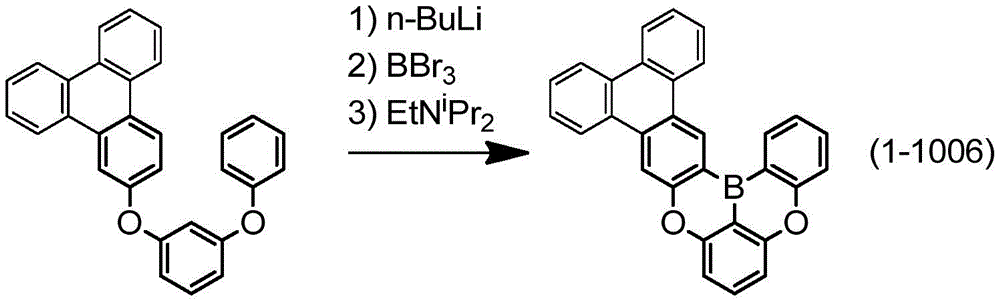
通过NMR测定来确认所获得的化合物的结构。The structure of the obtained compound was confirmed by NMR measurement.
1H-NMR(400MHz,CDCl3):δ=10.00(s,1H),8.97(d,1H),8.86(d,1H),8.75(d,1H),8.72(s,1H),8.67(m,2H),7.86(t,1H),7.67-7.83(m,5H),7.63(d,1H),7.56(t,1H),7.31(d,1H),7.28(d,1H)。 1 H-NMR (400MHz, CDCl 3 ): δ=10.00(s,1H), 8.97(d,1H), 8.86(d,1H), 8.75(d,1H), 8.72(s,1H), 8.67( m, 2H), 7.86(t, 1H), 7.67-7.83(m, 5H), 7.63(d, 1H), 7.56(t, 1H), 7.31(d, 1H), 7.28(d, 1H).
合成例(57)Synthesis Example (57)
9-(萘-1-基)-7,11-二氧杂-17c-硫代磷杂菲并[2,3,4-no]四芬的合成Synthesis of 9-(naphthalen-1-yl)-7,11-dioxa-17c-thiophosphaphenanthro[2,3,4-no]tetrafen
[化425][Chemical 425]

在氮气环境下,且在回流温度下将加入有1-溴-3,5-二氟苯(25.0g)、1-萘硼酸(24.0g)、Pd-132(1.8g)、碳酸钾(41.2g)、甲苯(200ml)、乙醇(50ml)及水(50ml)的烧瓶加热搅拌1小时。将反应液冷却至室温为止后,添加水及甲苯来进行分液。进而,利用硅胶管柱色谱法(展开液:甲苯/庚烷=1/4(容积比))来进行精制,而获得1-(3,5-二氟苯基)萘(32.0g)。1-Bromo-3,5-difluorobenzene (25.0 g), 1-naphthaleneboronic acid (24.0 g), Pd-132 (1.8 g), potassium carbonate (41.2 g) were added under nitrogen at reflux temperature g) A flask of toluene (200 ml), ethanol (50 ml) and water (50 ml) was heated and stirred for 1 hour. After cooling the reaction liquid to room temperature, water and toluene were added for liquid separation. Further, it was purified by silica gel column chromatography (developing solution: toluene/heptane=1/4 (volume ratio)) to obtain 1-(3,5-difluorophenyl)naphthalene (32.0 g).
[化426][Chemical 426]

在氮气环境下,且在200℃下将加入有1-(3,5-二氟苯基)萘(13.0g)、2-萘酚(25.0g)、碳酸钠(39.9g)及NMP(100ml)的烧瓶加热搅拌14小时。将反应液冷却至室温为止后,添加水、甲苯、乙酸乙酯来进行分液。继而,利用硅胶管柱色谱法(展开液:甲苯/庚烷=1/1(容积比))来进行精制,进而利用庚烷/甲苯混合溶剂来进行再沉淀,由此获得2,2'-((5-(萘-1-基)-1,3-亚苯基)双(氧基))二萘(20.0g)。1-(3,5-Difluorophenyl)naphthalene (13.0 g), 2-naphthol (25.0 g), sodium carbonate (39.9 g) and NMP (100 ml) were added under nitrogen at 200°C ) flask was heated and stirred for 14 hours. After cooling the reaction liquid to room temperature, water, toluene, and ethyl acetate were added and liquid-separated. Next, it was purified by silica gel column chromatography (developing solution: toluene/heptane=1/1 (volume ratio)), and further reprecipitated by a heptane/toluene mixed solvent to obtain 2,2′- ((5-(Naphthalen-1-yl)-1,3-phenylene)bis(oxy))dinaphthalene (20.0 g).
[化427][Chemical 427]

在氮气环境下,且在0℃下向加入有2,2'-((5-(萘-1-基)-1,3-亚苯基)双(氧基))二萘(7.7g)及甲苯(120ml)的烧瓶中添加1.6M的正丁基锂己烷溶液(9.9ml)。滴加结束后,升温至70℃为止并搅拌4小时。暂时冷却至-50℃为止并添加双(二乙基氨基)氯膦(5.0ml),升温至100℃为止并搅拌0.5小时。其后,再次冷却至-20℃为止并添加硫(1.0g),在室温下搅拌一夜。向反应液中添加水,并利用甲苯/乙酸乙酯混合溶液进行萃取。将溶剂减压馏去后,利用经加热的庚烷进行清洗,由此获得(4-(萘-1-基)-2,6-双(萘-2-基氧基)-1-(N,N,N',N'-四乙基二氨基硫代磷杂)苯(6.8g)。To this was added 2,2'-((5-(naphthalen-1-yl)-1,3-phenylene)bis(oxy))dinaphthalene (7.7 g) under nitrogen at 0°C A 1.6 M n-butyllithium hexane solution (9.9 ml) was added to a flask containing toluene (120 ml). After completion of the dropwise addition, the temperature was raised to 70° C. and stirred for 4 hours. Once cooled to -50°C, bis(diethylamino)chlorophosphine (5.0 ml) was added, the temperature was raised to 100°C, and the mixture was stirred for 0.5 hours. Then, it cooled to -20 degreeC again, sulfur (1.0g) was added, and it stirred at room temperature overnight. Water was added to the reaction liquid, followed by extraction with a toluene/ethyl acetate mixed solution. After the solvent was depressurized and washed with heated heptane, (4-(naphthalen-1-yl)-2,6-bis(naphthalen-2-yloxy)-1-(N ,N,N',N'-tetraethyldiaminothiophospha)benzene (6.8g).
[化428][Chemical 428]

在氮气环境下,且在155℃下将加入有(4-(萘-1-基)-2,6-双(萘-2-基氧基)-1-(N,N,N',N'-四乙基二氨基硫代磷杂)苯(5.8g)、氯化铝(3.3g)及邻二氯苯(120ml)的烧瓶加热搅拌10小时。将反应液冷却至室温为止后,添加水及甲苯来进行分液。继而,利用硅胶管柱色谱法(展开液:甲苯)来进行精制,由此获得由式(1-4114)所表示的化合物(1.0g)。(4-(naphthalen-1-yl)-2,6-bis(naphthalen-2-yloxy)-1-(N,N,N',N under nitrogen atmosphere at 155°C A flask of '-tetraethyldiaminothiophospha)benzene (5.8 g), aluminum chloride (3.3 g) and o-dichlorobenzene (120 ml) was heated and stirred for 10 hours. After cooling the reaction solution to room temperature, adding Then, the compound (1.0 g) represented by the formula (1-4114) was obtained by purification by silica gel column chromatography (developing solution: toluene).
[化429][Chemical 429]

通过NMR测定来确认所获得的化合物的结构。The structure of the obtained compound was confirmed by NMR measurement.
1H-NMR(400MHz,CDCl3):δ=9.10(br,1H),7.80-8.20(m,20H)。 1 H-NMR (400 MHz, CDCl 3 ): δ=9.10 (br, 1H), 7.80-8.20 (m, 20H).
合成例(58)Synthesis Example (58)
9-(萘-1-基)-7,11-二氧杂-17c-氧代磷杂菲并[2,3,4-no]四芬的合成Synthesis of 9-(Naphthalen-1-yl)-7,11-dioxa-17c-oxophosphaphenanthro[2,3,4-no]tetraphene
[化430][Chemical 430]

在0℃下,向合成例(57)中所获得的9-(萘-1-基)-7,11-二氧杂-17c-硫代磷杂菲并[2,3,4-no]四芬(1.0g)的二氯甲烷(80mL)溶液中添加间氯过苯甲酸(m-CPBA)(0.8g)后,在室温下搅拌1小时。添加饱和亚硫酸钠水溶液并在室温下进行搅拌后,利用甲苯/乙酸乙酯混合溶液来进行分液。将溶剂减压馏去后,利用硅胶管柱色谱法(展开液:甲苯/乙酸乙酯=4/1(容积比))来进行精制,并将含有目标物的馏分的溶剂减压馏去,由此进行再沉淀,而获得由式(1-3654)所表示的化合物(0.5g)。To 9-(naphthalen-1-yl)-7,11-dioxa-17c-thiophosphaphenanthro[2,3,4-no] obtained in Synthesis Example (57) at 0°C After adding m-chloroperbenzoic acid (m-CPBA) (0.8 g) to a solution of tetrafen (1.0 g) in dichloromethane (80 mL), the mixture was stirred at room temperature for 1 hour. After adding a saturated aqueous sodium sulfite solution and stirring at room temperature, liquid separation was carried out with a toluene/ethyl acetate mixed solution. After the solvent was distilled off under reduced pressure, it was purified by silica gel column chromatography (developing solution: toluene/ethyl acetate = 4/1 (volume ratio)), and the solvent of the fraction containing the target object was distilled off under reduced pressure, Thereby, reprecipitation was performed to obtain the compound (0.5 g) represented by the formula (1-3654).
[化431][Chemical 431]

通过NMR测定来确认所获得的化合物的结构。The structure of the obtained compound was confirmed by NMR measurement.
1H-NMR(400MHz,CDCl3):δ=8.19(br,1H),8.14(br,1H),7.92-8.00(m,4H),7.89(br,1H),7.78(br,1H),7.30-7.76(m,12H),7.05(br,1H)。 1 H-NMR (400MHz, CDCl 3 ): δ=8.19(br,1H), 8.14(br,1H), 7.92-8.00(m,4H), 7.89(br,1H), 7.78(br,1H), 7.30-7.76 (m, 12H), 7.05 (br, 1H).
合成例(59)Synthesis Example (59)
7-(萘-1-基)-5,9-二氧杂-15b-硫代磷杂菲并[1,2,3-ij]四芬的合成Synthesis of 7-(naphthalen-1-yl)-5,9-dioxa-15b-thiophosphaphenanthro[1,2,3-ij]tetraphene
[化432][Chemical 432]

在氮气环境下,且在200℃下将加入有1-(3,5-二氟苯基)萘(13.9g)、1-萘酚(25.0g)、碳酸钾(39.9g)及NMP(100ml)的烧瓶加热搅拌24小时。将反应液冷却至室温为止后,添加水及甲苯来进行分液。继而,利用硅胶管柱色谱法(展开液:甲苯/庚烷=1/4(容积比))来进行精制,进而自庚烷/甲苯混合溶液进行再结晶,由此获得1,1'-((5-(萘-1-基)-1,3-亚苯基)双(氧基))二萘(15.0g)。1-(3,5-Difluorophenyl)naphthalene (13.9g), 1-naphthol (25.0g), potassium carbonate (39.9g) and NMP (100ml) were added under nitrogen at 200°C ) flask was heated and stirred for 24 hours. After cooling the reaction liquid to room temperature, water and toluene were added for liquid separation. Next, it was purified by silica gel column chromatography (developing solution: toluene/heptane=1/4 (volume ratio)), and further recrystallized from a heptane/toluene mixed solution to obtain 1,1′-( (5-(Naphthalen-1-yl)-1,3-phenylene)bis(oxy))dinaphthalene (15.0 g).
[化433][Chemical 433]

在氮气环境下,且在0℃下向加入有1,1'-((5-(萘-1-基)-1,3-亚苯基)双(氧基))二萘(7.7g)及甲苯(120ml)的烧瓶中添加1.6M的正丁基锂己烷溶液(9.9ml)。滴加结束后,升温至70℃为止并搅拌4小时。暂时冷却至-50℃为止并添加双(二乙基氨基)氯膦(5.0ml),升温至室温为止并搅拌2小时。其后,再次冷却至-20℃为止并添加硫(1.0g),在室温下搅拌一夜。向反应液中添加水,并利用甲苯进行萃取。继而,利用硅胶短程管柱(甲苯)来进行精制,由此获得(4-(萘-1-基)-2,6-双(萘-1-基氧基)-1-(N,N,N',N'-四乙基二氨基硫代磷杂)苯(5.4g)。To this was added 1,1'-((5-(naphthalen-1-yl)-1,3-phenylene)bis(oxy))dinaphthalene (7.7 g) under nitrogen at 0°C A 1.6 M n-butyllithium hexane solution (9.9 ml) was added to a flask containing toluene (120 ml). After completion of the dropwise addition, the temperature was raised to 70° C. and stirred for 4 hours. It was cooled to -50 degreeC temporarily, bis (diethylamino) chlorophosphine (5.0 ml) was added, it heated up to room temperature, and it stirred for 2 hours. Then, it cooled to -20 degreeC again, sulfur (1.0g) was added, and it stirred at room temperature overnight. Water was added to the reaction liquid, followed by extraction with toluene. Next, it was purified with a silica gel short-path column (toluene) to obtain (4-(naphthalen-1-yl)-2,6-bis(naphthalen-1-yloxy)-1-(N,N, N',N'-tetraethyldiaminothiophospha)benzene (5.4 g).
[化434][Chemical 434]

在氮气环境下,且在130℃下将加入有(4-(萘-1-基)-2,6-双(萘-1-基氧基)-1-(N,N,N',N'-四乙基二氨基硫代磷杂)苯(5.4g)、氯化铝(3.4g)及邻二氯苯(120ml)的烧瓶加热搅拌2小时。将反应液冷却至室温为止后,添加水及甲苯来进行分液。继而,利用硅胶管柱色谱法(展开液:甲苯/庚烷=3/1(容积比))来进行精制,由此获得由式(1-4150)所表示的化合物(1.0g)。(4-(naphthalen-1-yl)-2,6-bis(naphthalen-1-yloxy)-1-(N,N,N',N under nitrogen atmosphere at 130°C A flask of '-tetraethyldiaminothiophospha)benzene (5.4 g), aluminum chloride (3.4 g) and o-dichlorobenzene (120 ml) was heated and stirred for 2 hours. After cooling the reaction solution to room temperature, added Water and toluene were used for liquid separation. Then, by silica gel column chromatography (developing solution: toluene/heptane = 3/1 (volume ratio)), a compound represented by formula (1-4150) was obtained. Compound (1.0 g).
[化435][Chemical 435]

通过NMR测定来确认所获得的化合物的结构。The structure of the obtained compound was confirmed by NMR measurement.
1H-NMR(400MHz,CDCl3):δ=8.60(d,2H),8.25(m,2H),8.03(br,1H),7.85-7.99(m,6H),7.66(m,4H),7.50-7.62(m,6H)。 1 H-NMR (400 MHz, CDCl 3 ): δ=8.60 (d, 2H), 8.25 (m, 2H), 8.03 (br, 1H), 7.85-7.99 (m, 6H), 7.66 (m, 4H), 7.50-7.62 (m, 6H).
合成例(60)Synthesis Example (60)
7-(萘-1-基)-5,9-二氧杂-15b-氧代磷杂菲并[1,2,3-ij]四芬的合成Synthesis of 7-(naphthalen-1-yl)-5,9-dioxa-15b-oxophosphaphenanthro[1,2,3-ij]tetraphene
[化436][Chemical 436]

在0℃下,向合成例(59)中所获得的7-(萘-1-基)-5,9-二氧杂-15b-硫代磷杂菲并[1,2,3-ij]四芬(1.0g)的二氯甲烷(80mL)溶液中添加间氯过苯甲酸(m-CPBA)(1.0g)后,在室温下搅拌1小时。添加饱和亚硫酸钠水溶液并在室温下进行搅拌后,利用甲苯/乙酸乙酯混合溶液来进行分液。将溶剂减压馏去后,自氯苯进行再结晶,由此获得由式(1-3690)所表示的化合物(0.5g)。To the 7-(naphthalen-1-yl)-5,9-dioxa-15b-thiophosphaphenanthro[1,2,3-ij] obtained in Synthesis Example (59) at 0°C m-chloroperbenzoic acid (m-CPBA) (1.0 g) was added to a solution of tetrafen (1.0 g) in dichloromethane (80 mL), followed by stirring at room temperature for 1 hour. After adding a saturated aqueous sodium sulfite solution and stirring at room temperature, liquid separation was carried out with a toluene/ethyl acetate mixed solution. After the solvent was distilled off under reduced pressure, the compound (0.5 g) represented by the formula (1-3690) was obtained by recrystallization from chlorobenzene.
[化437][Chemical 437]

通过NMR测定来确认所获得的化合物的结构。The structure of the obtained compound was confirmed by NMR measurement.
1H-NMR(400MHz,CDCl3):δ=8.64(d,2H),8.28(t,2H),7.85-8.05(m,7H),7.68(m,4H),7.48-7.62(m,6H)。 1 H-NMR (400 MHz, CDCl 3 ): δ=8.64 (d, 2H), 8.28 (t, 2H), 7.85-8.05 (m, 7H), 7.68 (m, 4H), 7.48-7.62 (m, 6H) ).
合成例(61)Synthesis Example (61)
9-(4-(5,9-二氧杂-13b-氧代磷杂萘并[3,2,1-de]蒽-8-基)苯基)-9H-咔唑的合成Synthesis of 9-(4-(5,9-dioxa-13b-oxophosphanaphtho[3,2,1-de]anthracene-8-yl)phenyl)-9H-carbazole
[化438][Chemical 438]

在氮气环境下,且在室温下将加入有5,9-二氧杂-13b-硫代磷杂萘并[3,2,1-de]蒽(3.5g)、N-溴琥珀酰亚胺(7.7g)及DMF(60ml)的烧瓶搅拌3小时。将反应液冷却至室温为止后,添加水来使盐分溶解,并通过抽吸过滤来提取目标物。继而,利用硅胶管柱色谱法(展开液:甲苯/乙酸乙酯=3/1(容积比))来进行精制,由此获得8-溴-5,9-二氧杂-13b-氧代磷杂萘并[3,2,1-de]蒽(2.9g)。5,9-dioxa-13b-thiophosphanaphtho[3,2,1-de]anthracene (3.5 g), N-bromosuccinimide will be added under nitrogen at room temperature (7.7 g) and DMF (60 ml) in a flask with stirring for 3 hours. After cooling the reaction liquid to room temperature, water was added to dissolve the salt, and the target substance was extracted by suction filtration. Next, 8-bromo-5,9-dioxa-13b-oxophosphorus was obtained by purification by silica gel column chromatography (developing solution: toluene/ethyl acetate=3/1 (volume ratio)) Hetero[3,2,1-de]anthracene (2.9 g).
[化439][Chemical 439]

在氮气环境下,且在回流温度下将加入有8-溴-5,9-二氧杂-13b-氧代磷杂萘并[3,2,1-de]蒽(1.6g)、(4-(9H-咔唑-9-基)苯基)硼酸(1.3g)、Pd-132(0.03g)、碳酸钠(1.1g)、甲苯(40ml)、乙醇(10ml)及水(10ml)的烧瓶加热搅拌4小时。将反应液冷却至室温为止后,添加水及甲苯来进行分液。继而,利用硅胶管柱色谱法(展开液:甲苯/乙酸乙酯=2/1(容积比))来进行精制。将含有目标物的馏分的溶剂减压馏去,由此进行再沉淀,而获得由式(1-3588)所表示的化合物(1.2g)。8-Bromo-5,9-dioxa-13b-oxophosphanaphtho[3,2,1-de]anthracene (1.6g), (4 -(9H-carbazol-9-yl)phenyl)boronic acid (1.3g), Pd-132 (0.03g), sodium carbonate (1.1g), toluene (40ml), ethanol (10ml) and water (10ml) The flask was heated with stirring for 4 hours. After cooling the reaction liquid to room temperature, water and toluene were added for liquid separation. Next, it purified by silica gel column chromatography (developing solution: toluene/ethyl acetate=2/1 (volume ratio)). The compound (1.2 g) represented by formula (1-3588) was obtained by reprecipitation by depressurizing distillation of the solvent of the fraction containing the target object.
[化440][Chemical 440]
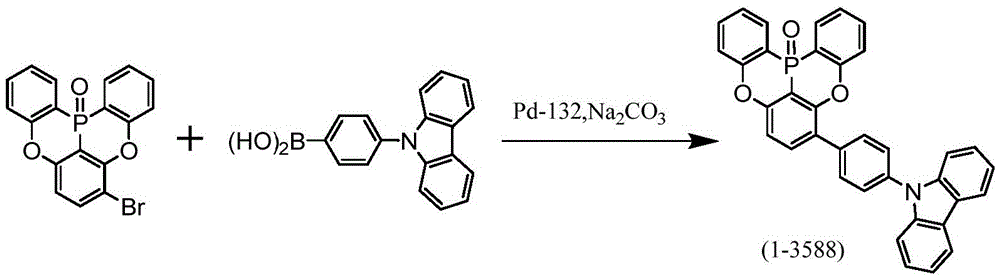
通过NMR测定来确认所获得的化合物的结构。The structure of the obtained compound was confirmed by NMR measurement.
1H-NMR(400MHz,CDCl3):δ=8.21-8.30(m,2H),8.18(d,2H),7.87(d,2H),7.80(d,1H),7.73(d,2H),7.67(t,1H),7.63(d,1H),7.56(d,2H),7.29-7.50(m,9H)。 1 H-NMR (400 MHz, CDCl 3 ): δ=8.21-8.30(m, 2H), 8.18(d, 2H), 7.87(d, 2H), 7.80(d, 1H), 7.73(d, 2H), 7.67 (t, 1H), 7.63 (d, 1H), 7.56 (d, 2H), 7.29-7.50 (m, 9H).
合成例(62)Synthesis Example (62)
4-(5,9-二氧杂-13b-氧代磷杂萘并[3,2,1-de]蒽-8-基)喹啉的合成Synthesis of 4-(5,9-dioxa-13b-oxophosphanaphtho[3,2,1-de]anthracene-8-yl)quinoline
[化441][Chemical 441]

在氮气环境下,且在回流温度下将加入有8-溴-5,9-二氧杂-13b-氧代磷杂萘并[3,2,1-de]蒽(1.5g)、4-喹啉硼酸(0.8g)、Pd-132(0.03g)、碳酸钠(1.0g)、甲苯(40ml)、乙醇(10ml)及水(10ml)的烧瓶加热搅拌2小时。将反应液冷却至室温为止后,添加水及甲苯来进行分液。继而,利用活性氧化铝管柱色谱法(展开液:甲苯/乙酸乙酯混合溶剂)来进行精制。此时,参考《有机化学实验入门(1)-物质处理法与分离精制法-》化学同人股份有限公司出版、第94页中所记载的方法,缓慢地增加展开液中的乙酸乙酯的比率来使目标物溶出。将含有目标物的馏分的溶剂减压馏去,由此进行再沉淀,而获得由式(1-3824)所表示的化合物(0.8g)。8-Bromo-5,9-dioxa-13b-oxophosphanaphtho[3,2,1-de]anthracene (1.5 g), 4- A flask of quinolineboronic acid (0.8 g), Pd-132 (0.03 g), sodium carbonate (1.0 g), toluene (40 ml), ethanol (10 ml) and water (10 ml) was heated and stirred for 2 hours. After cooling the reaction liquid to room temperature, water and toluene were added for liquid separation. Next, it purified by activated alumina column chromatography (developing solution: toluene/ethyl acetate mixed solvent). In this case, refer to the method described in "Introduction to Organic Chemistry Experiments (1) - Substance Treatment Method and Separation and Purification Method -" published by Chemical Doujin Co., Ltd. on page 94, and slowly increase the ratio of ethyl acetate in the developing solution. to dissolve the target substance. The compound (0.8 g) represented by formula (1-3824) was obtained by reprecipitation by depressurizing distillation of the solvent of the fraction containing the target object.
[化442][Chemical 442]

通过NMR测定来确认所获得的化合物的结构。The structure of the obtained compound was confirmed by NMR measurement.
1H-NMR(400MHz,CDCl3):δ=9.00-9.10(m,1H),8.19-8.32(m,4H),7.26-7.95(m,10H),6.68-6.98(m,1H)。 1 H-NMR (400 MHz, CDCl 3 ): δ=9.00-9.10 (m, 1H), 8.19-8.32 (m, 4H), 7.26-7.95 (m, 10H), 6.68-6.98 (m, 1H).
合成例(63)Synthesis Example (63)
3-(4-(5,9-二氧杂-13b-氧代磷杂萘并[3,2,1-de]蒽-8-基)苯基)吡啶的合成Synthesis of 3-(4-(5,9-dioxa-13b-oxophosphanaphtho[3,2,1-de]anthracene-8-yl)phenyl)pyridine
[化443][Chemical 443]

在氮气环境下,且在回流温度下将加入有8-溴-5,9-二氧杂-13b-氧代磷杂萘并[3,2,1-de]蒽(1.7g)、(4-(吡啶-3-基)苯基)硼酸(1.0g)、Pd-132(0.03g)、碳酸钠(1.2g)、甲苯(40ml)、乙醇(10ml)及水(10ml)的烧瓶加热搅拌4小时。将反应液冷却至室温为止后,添加水及甲苯来进行分液。继而,利用活性氧化铝管柱色谱法(展开液:甲苯/乙酸乙酯混合溶剂)来进行精制。此时,缓慢地增加展开液中的乙酸乙酯的比率来使目标物溶出。将含有目标物的馏分的溶剂减压馏去,由此进行再沉淀,而获得由式(1-3806)所表示的化合物(1.4g)。8-Bromo-5,9-dioxa-13b-oxophospha naphtho[3,2,1-de]anthracene (1.7g), (4 A flask of -(pyridin-3-yl)phenyl)boronic acid (1.0g), Pd-132 (0.03g), sodium carbonate (1.2g), toluene (40ml), ethanol (10ml) and water (10ml) was heated with stirring 4 hours. After cooling the reaction liquid to room temperature, water and toluene were added for liquid separation. Next, it purified by activated alumina column chromatography (developing solution: toluene/ethyl acetate mixed solvent). At this time, the ratio of ethyl acetate in the developing solution was gradually increased to dissolve the target substance. The compound (1.4 g) represented by formula (1-3806) was obtained by reprecipitation by depressurizing distillation of the solvent of the fraction containing the target object.
[化444][Chemical 444]

通过NMR测定来确认所获得的化合物的结构。The structure of the obtained compound was confirmed by NMR measurement.
1H-NMR(400MHz,CDCl3):δ=8.96(m,1H),8.64(m,1H),8.18-8.29(m,2H),7.98(m,1H),7.71-7.78(m,5H),7.66(t,1H),7.58(t,1H),7.37-7.49(m,4H),7.26-7.37(m,2H)。 1 H-NMR (400 MHz, CDCl 3 ): δ=8.96 (m, 1H), 8.64 (m, 1H), 8.18-8.29 (m, 2H), 7.98 (m, 1H), 7.71-7.78 (m, 5H) ), 7.66(t, 1H), 7.58(t, 1H), 7.37-7.49(m, 4H), 7.26-7.37(m, 2H).
合成例(64)及合成例(65)Synthesis Example (64) and Synthesis Example (65)
3,7-二苯基-3,7-二氢-3,7-二氮杂-11b-硼杂萘并[3,2,1-no]四芬的合成Synthesis of 3,7-diphenyl-3,7-dihydro-3,7-diaza-11b-borazaphtho[3,2,1-no]tetraphene
[化445][Chemical 445]

9-(萘-2-基)-5-苯基-5,9-二氢-5,9-二氮杂-13b-硼杂萘并[3,2,1-de]蒽的合成Synthesis of 9-(naphthalen-2-yl)-5-phenyl-5,9-dihydro-5,9-diaza-13b-borazaphtho[3,2,1-de]anthracene
[化446][Chemical 446]

在氮气环境下,且在120℃下将加入有2,3-二氯-N,N-二苯基苯胺(15.0g)、N-苯基萘-1-胺(10.0g)、Pd-132(0.3g)、NaOtBu(6.9g)及二甲苯(100ml)的烧瓶加热搅拌1小时。将反应液冷却至室温为止后,添加水及乙酸乙酯来进行分液。继而,利用硅胶短程管柱(展开液:甲苯/庚烷=1/1(容积比))来进行精制,进而利用庚烷溶剂进行再沉淀,由此获得2-氯-N1-(萘-2-基)-N1,N3,N3-三苯基苯-1,3-二胺(18.0g)。2,3-Dichloro-N,N-diphenylaniline (15.0 g), N-phenylnaphthalen-1-amine (10.0 g), Pd-132 were added under nitrogen atmosphere at 120°C (0.3 g), NaOtBu (6.9 g) and xylene (100 ml) in a flask with heating and stirring for 1 hour. After cooling the reaction liquid to room temperature, water and ethyl acetate were added for liquid separation. Next, it was purified by a silica gel short-path column (developing solution: toluene/heptane=1/1 (volume ratio)), and further reprecipitated by a heptane solvent to obtain 2-chloro-N 1 -(naphthalene- 2 -yl) -N1 ,N3,N3 - triphenylbenzene-1,3-diamine (18.0 g).
[化447][Chemical 447]

在氮气环境下,一面利用冰浴进行冷却,一面向加入有2-氯-N1-(萘-2-基)-N1,N3,N3-三苯基苯-1,3-二胺(18.0g)及叔丁基苯(150ml)的烧瓶中添加1.6M的叔丁基锂戊烷溶液(45.3ml)。滴加结束后,升温至60℃为止并搅拌2小时后,将沸点低于叔丁基苯的成分减压馏去。冷却至-50℃为止并添加三溴化硼(6.8ml),升温至室温为止后搅拌0.5小时。其后,再次利用冰浴进行冷却并添加N,N-二异丙基乙胺(12.5ml)。在室温下搅拌至发热结束后,升温至120℃为止并加热搅拌1小时。将反应液冷却至室温为止,依次添加利用冰浴进行了冷却的乙酸钠水溶液、乙酸乙酯来进行分液。继而,利用硅胶管柱色谱法(展开液:甲苯/庚烷=3/7)来进行精制。进而利用经加热的庚烷进行清洗后,进而自甲苯/乙酸乙酯混合溶液进行再沉淀,由此获得由式(1-2657)所表示的化合物(3.2g)。另外,利用活性碳管柱色谱法(展开液:甲苯/庚烷=1/1)来对所述再沉淀的滤液进行精制后,利用庚烷/乙酸乙酯混合溶剂进行再沉淀,由此获得由式(1-2699)所表示的化合物(0.1g)。Under a nitrogen atmosphere, 2-chloro-N 1 -(naphthalen-2-yl)-N 1 ,N 3 ,N 3 -triphenylbenzene-1,3-di was added while cooling with an ice bath. To a flask of amine (18.0 g) and tert-butylbenzene (150 ml) was added a 1.6 M solution of tert-butyllithium in pentane (45.3 ml). After completion of the dropwise addition, the temperature was raised to 60° C. and stirred for 2 hours, and then the components having a lower boiling point than t-butylbenzene were distilled off under reduced pressure. After cooling to -50°C, boron tribromide (6.8 ml) was added, and the temperature was raised to room temperature, followed by stirring for 0.5 hours. Then, it cooled with an ice bath again, and N,N- diisopropylethylamine (12.5 ml) was added. After stirring at room temperature until the heat generation was completed, the temperature was raised to 120° C., and the mixture was heated and stirred for 1 hour. The reaction liquid was cooled to room temperature, and an aqueous sodium acetate solution and ethyl acetate cooled in an ice bath were sequentially added and liquid-separated. Next, it purified by silica gel column chromatography (developing solution: toluene/heptane=3/7). Further, after washing with heated heptane, the compound (3.2 g) represented by the formula (1-2657) was obtained by reprecipitation from a toluene/ethyl acetate mixed solution. In addition, the reprecipitated filtrate was purified by activated carbon column chromatography (developing solution: toluene/heptane=1/1), and then reprecipitated with a heptane/ethyl acetate mixed solvent to obtain The compound (0.1 g) represented by the formula (1-2699).
[化448][Chemical 448]

通过NMR测定来确认所获得的化合物(1-2657)的结构。The structure of the obtained compound (1-2657) was confirmed by NMR measurement.
1H-NMR(400MHz,CDCl3):δ=8.94(m,1H),8.50(d,1H),7.80(m,1H),7.77(d,1H),7.70(m,4H),7.61(m,2H),7.46(m,2H),7.35-7.44(m,5H),7.25(m,1H),7.03(t,1H),6.95(d,1H),6.77(d,1H),6.23(d,1H),6.18(d,1H)。 1 H-NMR (400 MHz, CDCl 3 ): δ=8.94 (m, 1H), 8.50 (d, 1H), 7.80 (m, 1H), 7.77 (d, 1H), 7.70 (m, 4H), 7.61 ( m, 2H), 7.46(m, 2H), 7.35-7.44(m, 5H), 7.25(m, 1H), 7.03(t, 1H), 6.95(d, 1H), 6.77(d, 1H), 6.23 (d, 1H), 6.18 (d, 1H).
通过NMR测定来确认所获得的化合物(1-2699)的结构。The structure of the obtained compound (1-2699) was confirmed by NMR measurement.
1H-NMR(400MHz,CDCl3):δ=8.97(m,2H),8.18(d,1H),8.03(d,1H),7.92(m,2H),7.70(t,2H),7.56-66(m,3H),7.36-48(m,5H),7.20-7.32(m,3H),6.78(t,2H),6.15(m,2H)。 1 H-NMR (400 MHz, CDCl 3 ): δ=8.97 (m, 2H), 8.18 (d, 1H), 8.03 (d, 1H), 7.92 (m, 2H), 7.70 (t, 2H), 7.56- 66 (m, 3H), 7.36-48 (m, 5H), 7.20-7.32 (m, 3H), 6.78 (t, 2H), 6.15 (m, 2H).
合成例(66)Synthesis Example (66)
N3,N3,N11,N11,5,9-六苯基-5,9-二氮杂-13b-硼杂萘并[3,2,1-de]蒽-3,11-二胺的合成N 3 ,N 3 ,N 11 ,N 11 ,5,9-hexaphenyl-5,9-diaza-13b-borazaphtho[3,2,1-de]anthracene-3,11-di Amine synthesis
[化449][Chemical 449]

在氮气环境下,且在回流温度下将加入有3-硝基苯胺(25.0g)、碘苯(81.0g)、碘化铜(3.5g)、碳酸钾(100.0g)及邻二氯苯(250ml)的烧瓶加热搅拌14小时。将反应液冷却至室温为止后,添加氨水来进行分液。继而,利用硅胶管柱色谱法(展开液:甲苯/庚烷=3/7(容积比))来进行精制,由此获得3-硝基-N,N-二苯基苯胺(44.0g)。3-Nitroaniline (25.0 g), iodobenzene (81.0 g), copper iodide (3.5 g), potassium carbonate (100.0 g) and o-dichlorobenzene ( 250ml) flask was heated and stirred for 14 hours. After cooling the reaction liquid to room temperature, ammonia water was added for liquid separation. Then, it purified by silica gel column chromatography (developing solution: toluene/heptane=3/7 (volume ratio)) to obtain 3-nitro-N,N-diphenylaniline (44.0 g).
[化450][Chemical 450]

在氮气环境下,添加利用冰浴进行了冷却的乙酸并进行搅拌。以反应温度不会显著上升的程度,向所述溶液中分步添加3-硝基-N,N-二苯基苯胺(44.0g)。添加结束后,在室温下搅拌30分钟,并确认原料的消失。反应结束后,通过倾析来提取上清液后利用碳酸钠进行中和,并利用乙酸乙酯进行萃取。继而,利用硅胶管柱色谱法(展开液:甲苯/庚烷=9/1(容积比))来进行精制。自加入有目标物的馏分中将溶剂减压馏去,并添加庚烷,由此进行再沉淀,而获得N1,N1-二苯基苯-1,3-二胺(36.0g)。Under a nitrogen atmosphere, acetic acid cooled with an ice bath was added and stirred. To the solution was added 3-nitro-N,N-diphenylaniline (44.0 g) stepwise to such an extent that the reaction temperature did not rise significantly. After completion of the addition, the mixture was stirred at room temperature for 30 minutes, and the disappearance of the raw materials was confirmed. After completion of the reaction, the supernatant was extracted by decantation, neutralized with sodium carbonate, and extracted with ethyl acetate. Next, it purified by silica gel column chromatography (developing solution: toluene/heptane=9/1 (volume ratio)). The solvent was depressurizingly distilled from the fraction to which the target object was added, and by adding heptane, reprecipitation was performed, and N 1 ,N 1 -diphenylbenzene-1,3-diamine (36.0 g) was obtained.
[化451][Chemical 451]

在氮气环境下,且在120℃下将加入有N1,N1-二苯基苯-1,3-二胺(60.0g)、Pd-132(1.3g)、NaOtBu(33.5g)及二甲苯(300ml)的烧瓶加热搅拌。向所述溶液中缓慢地滴加溴苯(36.2g)的二甲苯(50ml)溶液,滴加结束后,加热搅拌1小时。将反应液冷却至室温为止后,添加水及乙酸乙酯来进行分液。继而,利用硅胶管柱色谱法(展开液:甲苯/庚烷=5/5(容积比))来进行精制,由此获得N1,N1,N3-三苯基苯-1,3-二胺(73.0g)。Under nitrogen atmosphere and at 120°C, N 1 ,N 1 -diphenylbenzene-1,3-diamine (60.0 g), Pd-132 (1.3 g), NaOtBu (33.5 g) and diamine were added A flask of toluene (300 ml) was heated with stirring. A solution of bromobenzene (36.2 g) in xylene (50 ml) was slowly added dropwise to the solution, and the solution was heated and stirred for 1 hour after completion of the dropwise addition. After cooling the reaction liquid to room temperature, water and ethyl acetate were added for liquid separation. Next, it was purified by silica gel column chromatography (developing solution: toluene/heptane=5/5 (volume ratio)) to obtain N 1 ,N 1 ,N 3 -triphenylbenzene-1,3- Diamine (73.0 g).
[化452][Chemical 452]

在氮气环境下,且在120℃下将加入有N1,N1,N3-三苯基苯-1,3-二胺(20.0g)、1-溴-2,3-二氯苯(6.4g)、Pd-132(0.2g)、NaOtBu(6.8g)及二甲苯(70ml)的烧瓶加热搅拌2小时。将反应液冷却至室温为止后,添加水及乙酸乙酯来进行分液。继而,利用硅胶管柱色谱法(展开液:甲苯/庚烷=4/6(容积比))来进行精制,由此获得N1,N1'-(2-氯-1,3-亚苯基)双(N1,N3,N3-三苯基苯-1,3-二胺)(15.0g)。Under nitrogen atmosphere and at 120°C, N 1 ,N 1 ,N 3 -triphenylbenzene-1,3-diamine (20.0 g), 1-bromo-2,3-dichlorobenzene ( 6.4 g), Pd-132 (0.2 g), NaOtBu (6.8 g) and xylene (70 ml) in a flask with heating and stirring for 2 hours. After cooling the reaction liquid to room temperature, water and ethyl acetate were added for liquid separation. Next, it was purified by silica gel column chromatography (developing solution: toluene/heptane=4/6 (volume ratio)) to obtain N 1 ,N 1′ -(2-chloro-1,3-phenylene) base)bis(N1,N3,N3 - triphenylbenzene - 1,3 - diamine) (15.0 g).
[化453][Chemical 453]

在氮气环境下,一面利用冰浴进行冷却,一面向加入有N1,N1'-(2-氯-1,3-亚苯基)双(N1,N3,N3-三苯基苯-1,3-二胺)(12.0g)及叔丁基苯(100ml)的烧瓶中添加1.7M的叔丁基锂戊烷溶液(18.1ml)。滴加结束后,升温至60℃为止并搅拌2小时后,将沸点低于叔丁基苯的成分减压馏去。冷却至-50℃为止并添加三溴化硼(2.9ml),升温至室温为止后搅拌0.5小时。其后,再次利用冰浴进行冷却并添加N,N-二异丙基乙胺(5.4ml)。在室温下搅拌至发热结束后,升温至120℃为止并加热搅拌3小时。将反应液冷却至室温为止,依次添加利用冰浴进行了冷却的乙酸钠水溶液、乙酸乙酯,滤取不溶性的固体后进行分液。继而,利用硅胶管柱色谱法(展开液:甲苯/庚烷=5/5)来进行精制。进而利用经加热的庚烷、乙酸乙酯进行清洗后,利用甲苯/乙酸乙酯混合溶剂进行再沉淀,由此获得由式(1-2680)所表示的化合物(2.0g)。N 1 ,N 1′ -(2-chloro-1,3-phenylene)bis(N 1 ,N 3 ,N 3 -triphenylene) was added to the nitrogen atmosphere while cooling with an ice bath. A 1.7M tert-butyllithium pentane solution (18.1 ml) was added to a flask containing benzene-1,3-diamine) (12.0 g) and t-butylbenzene (100 ml). After completion of the dropwise addition, the temperature was raised to 60° C. and stirred for 2 hours, and then the components having a lower boiling point than t-butylbenzene were distilled off under reduced pressure. After cooling to -50°C, boron tribromide (2.9 ml) was added, and the temperature was raised to room temperature, followed by stirring for 0.5 hours. Then, it cooled with an ice bath again, and N,N- diisopropylethylamine (5.4 ml) was added. After stirring at room temperature until the heat generation was completed, the temperature was raised to 120° C., and the mixture was heated and stirred for 3 hours. The reaction liquid was cooled to room temperature, an aqueous sodium acetate solution and ethyl acetate which were cooled in an ice bath were added in this order, and the insoluble solid was collected by filtration, followed by liquid separation. Next, it purified by silica gel column chromatography (developing solution: toluene/heptane=5/5). Further, after washing with heated heptane and ethyl acetate, the compound (2.0 g) represented by the formula (1-2680) was obtained by reprecipitation with a toluene/ethyl acetate mixed solvent.
[化454][Chemical 454]

通过NMR测定来确认所获得的化合物的结构。The structure of the obtained compound was confirmed by NMR measurement.
1H-NMR(400MHz,CDCl3):δ=8.65(d,2H),7.44(t,4H),7.33(t,2H),7.20(m,12H),7.13(t,1H),7.08(m,8H),7.00(t,4H),6.89(dd,2H),6.16(m,2H),6.03(d,2H)。 1 H-NMR (400 MHz, CDCl 3 ): δ=8.65 (d, 2H), 7.44 (t, 4H), 7.33 (t, 2H), 7.20 (m, 12H), 7.13 (t, 1H), 7.08 ( m, 8H), 7.00 (t, 4H), 6.89 (dd, 2H), 6.16 (m, 2H), 6.03 (d, 2H).
合成例(67)Synthesis Example (67)
9-([1,1'-联苯]-4-基)-N,N,5,12-四苯基-5,9-二氢-5,9-二氮杂-13b-硼杂萘并[3,2,1-de]蒽-3-胺的合成9-([1,1'-biphenyl]-4-yl)-N,N,5,12-tetraphenyl-5,9-dihydro-5,9-diaza-13b-borinaphthalene Synthesis of [3,2,1-de]anthracene-3-amine
[化455][Chemical 455]

在氮气环境下,且在90℃下将加入有N1,N1,N3-三苯基苯-1,3-二胺(51.7g)、1-溴-2,3-二氯苯(35.0g)、Pd-132(0.6g)、NaOtBu(22.4g)及二甲苯(350ml)的烧瓶加热搅拌2小时。将反应液冷却至室温为止后,添加水及乙酸乙酯来进行分液。继而,利用硅胶管柱色谱法(展开液:甲苯/庚烷=5/5(容积比))来进行精制,由此获得N1-(2,3-二氯苯基)-N1,N3,N3-三苯基苯-1,3-二胺(61.8g)。Under nitrogen atmosphere and at 90°C, N 1 ,N 1 ,N 3 -triphenylbenzene-1,3-diamine (51.7 g), 1-bromo-2,3-dichlorobenzene ( A flask of 35.0 g), Pd-132 (0.6 g), NaOtBu (22.4 g) and xylene (350 ml) was heated and stirred for 2 hours. After cooling the reaction liquid to room temperature, water and ethyl acetate were added for liquid separation. Next, it was purified by silica gel column chromatography (developing solution: toluene/heptane=5/5 (volume ratio)) to obtain N 1 -(2,3-dichlorophenyl)-N 1 ,N 3 ,N3 - triphenylbenzene-1,3-diamine (61.8 g).
[化456][Chemical 456]

在氮气环境下,且在120℃下将加入有N1-(2,3-二氯苯基)-N1,N3,N3-三苯基苯-1,3-二胺(15.0g)、二([1,1'-联苯]-4-基)胺(10.0g)、Pd-132(0.2g)、NaOtBu(4.5g)及二甲苯(70ml)的烧瓶加热搅拌1小时。将反应液冷却至室温为止后,添加水及甲苯来进行分液。继而,利用硅胶短程管柱(展开液:甲苯)来进行精制。利用乙酸乙酯/庚烷混合溶剂对所获得的油状物进行再沉淀,由此获得N1,N1-二([1,1'-联苯]-4-基)-2-氯-N3-(3-(二苯基氨基)苯基)-N3-苯基苯-1,3-二胺(18.5g)。Under nitrogen atmosphere and at 120°C, N 1 -(2,3-dichlorophenyl)-N 1 ,N 3 ,N 3 -triphenylbenzene-1,3-diamine (15.0 g) was added ), bis([1,1'-biphenyl]-4-yl)amine (10.0 g), Pd-132 (0.2 g), NaOtBu (4.5 g) and xylene (70 ml) in a flask with heating and stirring for 1 hour. After cooling the reaction liquid to room temperature, water and toluene were added for liquid separation. Next, purification was performed using a silica gel short-path column (developing solution: toluene). The obtained oil was reprecipitated with an ethyl acetate/heptane mixed solvent to obtain N 1 ,N 1 -bis([1,1'-biphenyl]-4-yl)-2-chloro-N 3- (3-(diphenylamino)phenyl) -N3 -phenylbenzene-1,3-diamine (18.5 g).
[化457][Chemical 457]

在氮气环境下,一面利用冰浴进行冷却,一面向加入有N1,N1-二([1,1'-联苯]-4-基)-2-氯-N3-(3-(二苯基氨基)苯基)-N3-苯基苯-1,3-二胺(18.0g)及叔丁基苯(130ml)的烧瓶中添加1.7M的叔丁基锂戊烷溶液(27.6ml)。滴加结束后,升温至60℃为止并搅拌3小时后,将沸点低于叔丁基苯的成分减压馏去。冷却至-50℃为止并添加三溴化硼(4.5ml),升温至室温为止后搅拌0.5小时。其后,再次利用冰浴进行冷却并添加N,N-二异丙基乙胺(8.2ml)。在室温下搅拌至发热结束后,升温至120℃为止并加热搅拌1小时。将反应液冷却至室温为止,依次添加利用冰浴进行了冷却的乙酸钠水溶液、乙酸乙酯来进行分液。继而,溶解于经加热的氯苯中,并利用硅胶短程管柱(展开液:经加热的甲苯)来进行精制。进而自氯苯进行再结晶,由此获得由式(1-2679)所表示的化合物(3.0g)。N 1 ,N 1 -bis([1,1'-biphenyl]-4-yl)-2-chloro-N 3 -(3-( Diphenylamino)phenyl)-N 3 -phenylbenzene-1,3-diamine (18.0 g) and tert-butylbenzene (130 ml) were added 1.7 M tert-butyllithium pentane solution (27.6 ml). After completion of the dropwise addition, the temperature was raised to 60° C. and stirred for 3 hours, and then the components having a lower boiling point than t-butylbenzene were distilled off under reduced pressure. After cooling to -50°C, boron tribromide (4.5 ml) was added, and the temperature was raised to room temperature, followed by stirring for 0.5 hours. Then, it cooled with an ice bath again, and N,N- diisopropylethylamine (8.2 ml) was added. After stirring at room temperature until the heat generation was completed, the temperature was raised to 120° C., and the mixture was heated and stirred for 1 hour. The reaction liquid was cooled to room temperature, and an aqueous sodium acetate solution and ethyl acetate which were cooled in an ice bath were sequentially added and liquid-separated. Then, it melt|dissolved in heated chlorobenzene, and refine|purified by a silica gel short-path column (developing solution: heated toluene). Further, by recrystallization from chlorobenzene, a compound (3.0 g) represented by the formula (1-2679) was obtained.
[化458][Chemical 458]

通过NMR测定来确认所获得的化合物的结构。The structure of the obtained compound was confirmed by NMR measurement.
1H-NMR(400MHz,CDCl3):δ=9.09(m,1H),8.79(d,1H),7.93(d,2H),7.75(d,2H),7.72(d,2H),7.67(m,1H),7.52(t,2H),7.40-7.50(m,7H),7.27-7.38(m,2H),7.19-7.26(m,7H),7.11(m,4H),7.03(t,2H),6.96(dd,1H),6.90(d,1H),6.21(m,2H),6.12(d,1H)。 1 H-NMR (400 MHz, CDCl 3 ): δ=9.09 (m, 1H), 8.79 (d, 1H), 7.93 (d, 2H), 7.75 (d, 2H), 7.72 (d, 2H), 7.67 ( m, 1H), 7.52(t, 2H), 7.40-7.50(m, 7H), 7.27-7.38(m, 2H), 7.19-7.26(m, 7H), 7.11(m, 4H), 7.03(t, 2H), 6.96 (dd, 1H), 6.90 (d, 1H), 6.21 (m, 2H), 6.12 (d, 1H).
合成例(68)及合成例(69)Synthesis Example (68) and Synthesis Example (69)
N,N,5,9,11-五苯基-9,11-二氢-5H-5,9,11-三氮杂-16b-硼杂茚并[2,1-b]萘并[1,2,3-fg]蒽-3-胺的合成N,N,5,9,11-Pentaphenyl-9,11-dihydro-5H-5,9,11-triaza-16b-boraindeno[2,1-b]naphtho[1 Synthesis of ,2,3-fg]anthracene-3-amine
[化459][Chemical 459]

N,N,5-三苯基-9-(9-苯基-9H-咔唑-2-基)-5,9-二氢-5H-5,9-二氮杂-13b-硼杂萘并[3,2,1-de]蒽-3-胺的合成N,N,5-Triphenyl-9-(9-phenyl-9H-carbazol-2-yl)-5,9-dihydro-5H-5,9-diaza-13b-borinaphthalene Synthesis of [3,2,1-de]anthracene-3-amine
[化460][hua 460]

在氮气环境下,且在120℃下将加入有2-溴-9-苯基-9H-咔唑(10.0g)、苯胺(3.5g)、Pd-132(0.2g)、NaOtBu(4.5g)及二甲苯(100ml)的烧瓶加热搅拌4小时。将反应液冷却至室温为止后,添加水及乙酸乙酯来进行分液,进而利用稀盐酸对有机层进行清洗,而将未反应的苯胺去除。继而,利用硅胶管柱色谱法(展开液:甲苯/庚烷=4/6(容积比))来进行精制,由此获得N,9-二苯基-9H-咔唑-2-胺(10.4g)。2-Bromo-9-phenyl-9H-carbazole (10.0 g), aniline (3.5 g), Pd-132 (0.2 g), NaOtBu (4.5 g) were added under nitrogen at 120°C and xylene (100 ml) in a flask with heating and stirring for 4 hours. After cooling the reaction liquid to room temperature, water and ethyl acetate were added for liquid separation, and the organic layer was further washed with dilute hydrochloric acid to remove unreacted aniline. Next, it was purified by silica gel column chromatography (developing solution: toluene/heptane=4/6 (volume ratio)) to obtain N,9-diphenyl-9H-carbazol-2-amine (10.4 g).
[化461][Chemical 461]

在氮气环境下,且在120℃下将加入有N1-(2,3-二氯苯基)-N1,N3,N3-三苯基苯-1,3-二胺(14.0g)、N,9-二苯基-9H-咔唑-2-胺(10.4g)、Pd-132(0.2g)、NaOtBu(4.1g)及二甲苯(90ml)的烧瓶加热搅拌1小时。将反应液冷却至室温为止后,添加水及甲苯来进行分液。继而,利用硅胶管柱色谱法(展开液:甲苯/庚烷=4/6(容积比))来进行精制,由此获得2-氯-N1-(3-(二苯基氨基)苯基)-N1,N3-二苯基-N3-(9-苯基-9H-咔唑-2-基)苯-1,3-二胺(18.5g)。Under nitrogen atmosphere and at 120°C, N 1 -(2,3-dichlorophenyl)-N 1 ,N 3 ,N 3 -triphenylbenzene-1,3-diamine (14.0 g) was added ), N,9-diphenyl-9H-carbazol-2-amine (10.4 g), Pd-132 (0.2 g), NaOtBu (4.1 g) and xylene (90 ml) in a flask with heating and stirring for 1 hour. After cooling the reaction liquid to room temperature, water and toluene were added for liquid separation. Next, it was purified by silica gel column chromatography (developing solution: toluene/heptane=4/6 (volume ratio)) to obtain 2-chloro-N 1 -(3-(diphenylamino)phenyl) ) -N1 ,N3 - diphenyl-N3-( 9 -phenyl-9H-carbazol-2-yl)benzene-1,3-diamine (18.5 g).
[化462][hua462]

在氮气环境下,一面利用冰浴进行冷却,一面向加入有2-氯-N1-(3-(二苯基氨基)苯基)-N1,N3-二苯基-N3-(9-苯基-9H-咔唑-2-基)苯-1,3-二胺(18.0g)及叔丁基苯(100ml)的烧瓶中添加1.7M的叔丁基锂戊烷溶液(27.2ml)。滴加结束后,升温至60℃为止并搅拌3小时后,将沸点低于叔丁基苯的成分减压馏去。冷却至-50℃为止并添加三溴化硼(4.4ml),升温至室温为止后搅拌0.5小时。其后,再次利用冰浴进行冷却并添加N,N-二异丙基乙胺(8.1ml)。在室温下搅拌至发热结束后,升温至120℃为止并加热搅拌1小时。将反应液冷却至室温为止,通过抽吸过滤来提取通过添加利用冰浴进行了冷却的乙酸钠水溶液及乙酸乙酯所析出的沉淀物。继而,溶解于经加热的氯苯中,并利用硅胶短程管柱(展开液:经加热的甲苯)来进行精制。利用经加热的庚烷进行清洗后,利用氯苯/乙酸乙酯混合溶剂来进行再沉淀,由此获得由式(1-2681)所表示的化合物(3.0g)。Under a nitrogen atmosphere, while cooling with an ice bath, 2-chloro-N 1 -(3-(diphenylamino)phenyl)-N 1 ,N 3 -diphenyl-N 3 -( To a flask of 9-phenyl-9H-carbazol-2-yl)benzene-1,3-diamine (18.0 g) and tert-butylbenzene (100 ml) was added a 1.7 M tert-butyllithium pentane solution (27.2 ml). After completion of the dropwise addition, the temperature was raised to 60° C. and stirred for 3 hours, and then the components having a lower boiling point than t-butylbenzene were distilled off under reduced pressure. After cooling to -50°C, boron tribromide (4.4 ml) was added, and the temperature was raised to room temperature, followed by stirring for 0.5 hours. Then, it cooled with an ice bath again, and N,N- diisopropylethylamine (8.1 ml) was added. After stirring at room temperature until the heat generation was completed, the temperature was raised to 120° C., and the mixture was heated and stirred for 1 hour. The reaction liquid was cooled to room temperature, and the precipitate deposited by adding an aqueous sodium acetate solution and ethyl acetate cooled in an ice bath was extracted by suction filtration. Then, it melt|dissolved in heated chlorobenzene, and refine|purified by a silica gel short-path column (developing solution: heated toluene). After washing with heated heptane, the compound (3.0 g) represented by the formula (1-2681) was obtained by reprecipitation with a chlorobenzene/ethyl acetate mixed solvent.
将反应液冷却至室温为止,依次利用活性碳管柱色谱法(展开液:甲苯/庚烷=5/5(容积比))、硅胶管柱色谱法(甲苯/庚烷=4/6(容积比))来对如下的滤液进行精制,所述滤液为提取通过添加利用冰浴进行了冷却的乙酸钠水溶液及乙酸乙酯所析出的沉淀物时的滤液。进而,依次利用庚烷/乙酸乙酯混合溶剂、庚烷/甲苯混合溶剂进行再沉淀,由此获得由式(1-2682)所表示的化合物(0.6g)。The reaction solution was cooled to room temperature, followed by activated carbon column chromatography (developing solution: toluene/heptane=5/5 (volume ratio)) and silica gel column chromatography (toluene/heptane=4/6 (volume ratio) The following filtrate was purified by extracting the precipitate which was precipitated by adding an aqueous sodium acetate solution and ethyl acetate cooled by an ice bath. Furthermore, the compound (0.6g) represented by Formula (1-2682) was obtained by performing reprecipitation with a heptane/ethyl acetate mixed solvent and a heptane/toluene mixed solvent in this order.
[化463][hua463]

通过NMR测定来确认所获得的化合物(1-2681)的结构。The structure of the obtained compound (1-2681) was confirmed by NMR measurement.
1H-NMR(400MHz,CDCl3):δ=9.57(s,1H),8.93(d,1H),8.26(d,1H),7.61(t,2H),7.10-7.50(m,25H),7.04(m,3H),6.59(s,1H),6.25(m,1H),6.10(t,2H)。 1 H-NMR (400MHz, CDCl 3 ): δ=9.57(s, 1H), 8.93(d, 1H), 8.26(d, 1H), 7.61(t, 2H), 7.10-7.50(m, 25H), 7.04 (m, 3H), 6.59 (s, 1H), 6.25 (m, 1H), 6.10 (t, 2H).
通过NMR测定来确认所获得的化合物(1-2682)的结构。The structure of the obtained compound (1-2682) was confirmed by NMR measurement.
1H-NMR(400MHz,CDCl3):δ=8.86(d,1H),8.73(d,1H),8.43(d,1H),8.24(d,1H),7.31-7.56(m,13H),7.29(dd,1H),7.12-24(m,8H),7.10(m,4H),7.02(t,2H),6.94(dd,1H),6.79(d,1H),6.16(m,2H),6.07(d,1H)。 1 H-NMR (400MHz, CDCl 3 ): δ=8.86(d,1H), 8.73(d,1H), 8.43(d,1H), 8.24(d,1H), 7.31-7.56(m,13H), 7.29(dd,1H),7.12-24(m,8H),7.10(m,4H),7.02(t,2H),6.94(dd,1H),6.79(d,1H),6.16(m,2H) , 6.07(d, 1H).
合成例(70)Synthesis Example (70)
12-甲基-N,N,5-三苯基-9-(对甲苯基)-5,9-二氢-5,9-二氮杂-13b-硼杂萘并[3,2,1-de]蒽-3-胺的合成12-Methyl-N,N,5-triphenyl-9-(p-tolyl)-5,9-dihydro-5,9-diaza-13b-boraznaphtho[3,2,1 Synthesis of -de]anthracene-3-amine
[化464][hua464]

在氮气环境下,且在120℃下将加入有N1-(2,3-二氯苯基)-N1,N3,N3-三苯基苯-1,3-二胺(15.0g)、二-对甲苯基胺(6.1g)、Pd-132(0.2g)、NaOtBu(4.5g)及二甲苯(70ml)的烧瓶加热搅拌1小时。将反应液冷却至室温为止后,添加水及乙酸乙酯来进行分液。继而,利用硅胶管柱色谱法(展开液:甲苯/庚烷=4/6(容积比))来进行精制。将含有目标物的馏分减压馏去,由此进行再沉淀,而获得2-氯-N1-(3-(二苯基氨基)苯基)-N1-苯基-N3,N3-二-对甲苯基苯-1,3-二胺(15.0g)。Under nitrogen atmosphere and at 120°C, N 1 -(2,3-dichlorophenyl)-N 1 ,N 3 ,N 3 -triphenylbenzene-1,3-diamine (15.0 g) was added ), di-p-tolylamine (6.1 g), Pd-132 (0.2 g), NaOtBu (4.5 g) and xylene (70 ml) in a flask with heating and stirring for 1 hour. After cooling the reaction liquid to room temperature, water and ethyl acetate were added for liquid separation. Next, it purified by silica gel column chromatography (developing solution: toluene/heptane=4/6 (volume ratio)). The fraction containing the target product was distilled off under reduced pressure, whereby reprecipitation was performed to obtain 2-chloro-N 1 -(3-(diphenylamino)phenyl)-N 1 -phenyl-N 3 ,N 3 - Di-p-tolylbenzene-1,3-diamine (15.0 g).
[化465][hua465]

在氮气环境下,一面利用冰浴进行冷却,一面向加入有2-氯-N1-(3-(二苯基氨基)苯基)-N1-苯基-N3,N3-二-对甲苯基苯-1,3-二胺(15.0g)及叔丁基苯(100ml)的烧瓶中添加1.6M的叔丁基锂戊烷溶液(29.2ml)。滴加结束后,升温至60℃为止并搅拌2小时后,将沸点低于叔丁基苯的成分减压馏去。冷却至-50℃为止并添加三溴化硼(4.4ml),升温至室温为止后搅拌0.5小时。其后,再次利用冰浴进行冷却并添加N,N-二异丙基乙胺(8.1ml)。在室温下搅拌至发热结束后,升温至120℃为止并加热搅拌2小时。将反应液冷却至室温为止,依次添加利用冰浴进行了冷却的乙酸钠水溶液、乙酸乙酯来进行分液。继而,利用硅胶管柱色谱法(展开液:甲苯/庚烷=4/6)来进行精制。进而,利用经加热的庚烷进行清洗后,利用甲苯/乙酸乙酯混合溶剂来进行再沉淀,由此获得由式(1-2626)所表示的化合物(2.0g)。Under a nitrogen atmosphere, while cooling with an ice bath, 2-chloro-N 1 -(3-(diphenylamino)phenyl)-N 1 -phenyl-N 3 ,N 3 -di- To a flask containing p-tolylbenzene-1,3-diamine (15.0 g) and t-butylbenzene (100 ml), a 1.6 M t-butyllithium pentane solution (29.2 ml) was added. After completion of the dropwise addition, the temperature was raised to 60° C. and stirred for 2 hours, and then the components having a lower boiling point than t-butylbenzene were distilled off under reduced pressure. After cooling to -50°C, boron tribromide (4.4 ml) was added, and the temperature was raised to room temperature, followed by stirring for 0.5 hours. Then, it cooled with an ice bath again, and N,N- diisopropylethylamine (8.1 ml) was added. After stirring at room temperature until the heat generation was completed, the temperature was raised to 120° C., and the mixture was heated and stirred for 2 hours. The reaction liquid was cooled to room temperature, and an aqueous sodium acetate solution and ethyl acetate which were cooled in an ice bath were sequentially added and liquid-separated. Next, it purified by silica gel column chromatography (developing solution: toluene/heptane=4/6). Furthermore, after washing with heated heptane, the compound (2.0 g) represented by the formula (1-2626) was obtained by reprecipitation with a toluene/ethyl acetate mixed solvent.
[化466][Chemical 466]

通过NMR测定来确认所获得的化合物的结构。The structure of the obtained compound was confirmed by NMR measurement.
1H-NMR(400MHz,CDCl3):δ=8.74(d,1H),8.64(m,1H),7.42-7.50(m,4H),7.35(t,1H),7.15-7.25(m,10H),7.10(d,4H),7.02(t,2H),7.94(dd,1H),6.68(d,1H),6.20(m,1H),6.11(d,1H),6.04(d,1H),2.52(s,3H),2.48(s,3H)。 1 H-NMR (400 MHz, CDCl 3 ): δ=8.74 (d, 1H), 8.64 (m, 1H), 7.42-7.50 (m, 4H), 7.35 (t, 1H), 7.15-7.25 (m, 10H) ), 7.10(d, 4H), 7.02(t, 2H), 7.94(dd, 1H), 6.68(d, 1H), 6.20(m, 1H), 6.11(d, 1H), 6.04(d, 1H) , 2.52(s, 3H), 2.48(s, 3H).
合成例(71)Synthesis Example (71)
5-([1,1'-联苯]-4-基)-N,N,9-三苯基-5,9-二氢-5,9-二氮杂-13b-硼杂萘并[3,2,1-de]蒽-3-胺的合成5-([1,1'-Biphenyl]-4-yl)-N,N,9-triphenyl-5,9-dihydro-5,9-diaza-13b-boronaphtho[ Synthesis of 3,2,1-de]anthracene-3-amine
[化467][Chemical 467]

在氮气环境下,且在100℃下将加入有N1,N1-二苯基苯-1,3-二胺(12.0g)、4-溴-1,1'-联苯(30.2g)、Pd-132(0.3g)、NaOtBu(6.6g)及二甲苯(100ml)的烧瓶加热搅拌2小时。将反应液冷却至室温为止后,添加水及乙酸乙酯来进行分液。继而,利用硅胶管柱色谱法(展开液:甲苯/庚烷=4/6(容积比))来进行精制。利用庚烷对将溶剂减压馏去所获得的固体进行清洗,而获得N1,([1,1'-联苯]-4-基)-N3,N3-二苯基苯-1,3-二胺(17.4g)。Under nitrogen atmosphere and at 100°C, N 1 ,N 1 -diphenylbenzene-1,3-diamine (12.0 g), 4-bromo-1,1'-biphenyl (30.2 g) were added , Pd-132 (0.3 g), NaOtBu (6.6 g) and xylene (100 ml) in a flask with heating and stirring for 2 hours. After cooling the reaction liquid to room temperature, water and ethyl acetate were added for liquid separation. Next, it purified by silica gel column chromatography (developing solution: toluene/heptane=4/6 (volume ratio)). The solid obtained by depressurizing distillation of the solvent was washed with heptane to obtain N 1 ,([1,1′-biphenyl]-4-yl)-N 3 ,N 3 -diphenylbenzene-1 , 3-diamine (17.4 g).
[化468][Chemical 468]

在氮气环境下,且在120℃下将加入有2,3-二氯-N,N-二苯基苯胺(12.0g)、N1,([1,1'-联苯]-4-基)-N3,N3-二苯基苯-1,3-二胺(15.0g)、Pd-132(0.3g)、NaOtBu(5.5g)及二甲苯(100ml)的烧瓶加热搅拌1小时。将反应液冷却至室温为止后,添加水及乙酸乙酯来进行分液。继而,利用硅胶管柱色谱法(展开液:甲苯/庚烷=4/6(容积比))来进行精制,由此获得N1-([1,1'-联苯]-4-基)-2-氯-N1-(3-(二苯基氨基)苯基)-N3,N3-二苯基苯-1,3-二胺(20.2g)。2,3-Dichloro-N,N - diphenylaniline (12.0 g), N1,([1,1'-biphenyl]-4-yl were added under nitrogen at 120°C. )-N 3 ,N 3 -diphenylbenzene-1,3-diamine (15.0 g), Pd-132 (0.3 g), NaOtBu (5.5 g) and xylene (100 ml) in a flask with heating and stirring for 1 hour. After cooling the reaction liquid to room temperature, water and ethyl acetate were added for liquid separation. Next, it was purified by silica gel column chromatography (developing solution: toluene/heptane=4/6 (volume ratio)) to obtain N 1 -([1,1'-biphenyl]-4-yl) -2-Chloro - N1-(3-(diphenylamino)phenyl) -N3 ,N3 - diphenylbenzene-1,3-diamine (20.2 g).
[化469][Chemical 469]

在氮气环境下,一面利用冰浴进行冷却,一面向加入有N1-([1,1'-联苯]-4-基)-2-氯-N1-(3-(二苯基氨基)苯基)-N3,N3-二苯基苯-1,3-二胺(16.0g)及叔丁基苯(100ml)的烧瓶中添加1.6M的叔丁基锂戊烷溶液(26.1ml)。滴加结束后,升温至60℃为止并搅拌2小时后,将沸点低于叔丁基苯的成分减压馏去。冷却至-50℃为止并添加三溴化硼(4.0ml),升温至室温为止后搅拌0.5小时。其后,再次利用冰浴进行冷却并添加N,N-二异丙基乙胺(8.1ml)。在室温下搅拌至发热结束后,升温至120℃为止并加热搅拌2小时。将反应液冷却至室温为止,通过抽吸过滤来提取通过依次添加利用冰浴进行了冷却的乙酸钠水溶液、乙酸乙酯所析出的沉淀。继而,利用硅胶管柱色谱法(展开液:甲苯/庚烷=4/6)来进行精制。利用经加热的庚烷进行清洗后,利用氯苯/乙酸乙酯混合溶剂来进行再沉淀,由此获得由式(1-2683)所表示的化合物(2.7g)。Under a nitrogen atmosphere, N 1 -([1,1'-biphenyl]-4-yl)-2-chloro-N 1 -(3-(diphenylamino) was added while cooling with an ice bath. )phenyl)-N 3 ,N 3 -diphenylbenzene-1,3-diamine (16.0 g) and tert-butylbenzene (100 ml) were added 1.6 M tert-butyllithium pentane solution (26.1 ml). After completion of the dropwise addition, the temperature was raised to 60° C. and stirred for 2 hours, and then the components having a lower boiling point than t-butylbenzene were distilled off under reduced pressure. After cooling to -50°C, boron tribromide (4.0 ml) was added, and the temperature was raised to room temperature, followed by stirring for 0.5 hours. Then, it cooled with an ice bath again, and N,N- diisopropylethylamine (8.1 ml) was added. After stirring at room temperature until the heat generation was completed, the temperature was raised to 120° C., and the mixture was heated and stirred for 2 hours. The reaction liquid was cooled to room temperature, and the precipitate deposited by sequentially adding an aqueous sodium acetate solution cooled with an ice bath and ethyl acetate was extracted by suction filtration. Next, it purified by silica gel column chromatography (developing solution: toluene/heptane=4/6). After washing with heated heptane, the compound (2.7 g) represented by the formula (1-2683) was obtained by reprecipitation with a chlorobenzene/ethyl acetate mixed solvent.
[化470][Chemical 470]

通过NMR测定来确认所获得的化合物的结构。The structure of the obtained compound was confirmed by NMR measurement.
1H-NMR(400MHz,CDCl3):δ=8.87(d,1H),8.74(d,1H),7.68(t,2H),7.64(d,2H),7.58(m,3H),7.50(t,2H),7.36-7.44(m,4H),7.16-7.28(m,8H),7.10(m,4H),6.97(m,3H),6.72(d,1H),6.22(m,2H),6.10(d,1H)。 1 H-NMR (400MHz, CDCl 3 ): δ=8.87(d,1H), 8.74(d,1H), 7.68(t,2H), 7.64(d,2H), 7.58(m,3H), 7.50( t,2H),7.36-7.44(m,4H),7.16-7.28(m,8H),7.10(m,4H),6.97(m,3H),6.72(d,1H),6.22(m,2H) , 6.10(d, 1H).
合成例(72)Synthesis Example (72)
16-苯基-16H-8-氧杂-12b,16-二氮杂-4b-硼杂二苯并[a,j]苝的合成Synthesis of 16-Phenyl-16H-8-oxa-12b,16-diaza-4b-boradibenzo[a,j]perylene
[化471][Chemical 471]

在氮气环境下,且在120℃下将加入有2,3-二氯-N,N-二苯基苯胺(18.0g)、10H-吩噁嗪(15.0g)、Pd-132(0.4g)、NaOtBu(8.3g)及二甲苯(100ml)的烧瓶加热搅拌1小时。将反应液冷却至室温为止后,添加水及乙酸乙酯来进行分液。继而,利用硅胶管柱色谱法(展开液:甲苯)来进行精制。自含有目标物的馏分中将溶剂减压馏去,并添加庚烷,由此进行再沉淀,而获得2-氯-3-(10H-吩噁嗪-10-基)-N,N-二苯基苯胺(23.0g)。2,3-Dichloro-N,N-diphenylaniline (18.0 g), 10H-phenoxazine (15.0 g), Pd-132 (0.4 g) were added under nitrogen at 120°C , NaOtBu (8.3 g) and a flask of xylene (100 ml) were heated and stirred for 1 hour. After cooling the reaction liquid to room temperature, water and ethyl acetate were added for liquid separation. Next, it purified by silica gel column chromatography (developing solution: toluene). The solvent was depressurized from the fraction containing the target object, and heptane was added to reprecipitate to obtain 2-chloro-3-(10H-phenoxazin-10-yl)-N,N-di Phenylaniline (23.0 g).
[化472][化472]

在氮气环境下,一面利用冰浴进行冷却,一面向加入有2-氯-3-(10H-吩噁嗪-10-基)-N,N-二苯基苯胺(20.0g)及叔丁基苯(150ml)的烧瓶中添加1.6M的叔丁基锂戊烷溶液(54.0ml)。滴加结束后,升温至60℃为止并搅拌3小时后,将沸点低于叔丁基苯的成分减压馏去。冷却至-50℃为止并添加三溴化硼(8.2ml),升温至室温为止后搅拌0.5小时。其后,再次利用冰浴进行冷却并添加N,N-二异丙基乙胺(15.1ml)。在室温下搅拌至发热结束后,升温至120℃为止并加热搅拌2小时。将反应液冷却至室温为止,依次添加利用冰浴进行了冷却的乙酸钠水溶液、乙酸乙酯来进行分液。继而,利用硅胶管柱色谱法(展开液:甲苯/庚烷=3/7)来进行精制,进而利用活性碳管柱色谱法(展开液:甲苯/庚烷=5/5(容积比))来进行精制。利用氯苯/乙酸乙酯混合溶剂来进行再沉淀,由此获得由式(1-2691)所表示的化合物(2.8g)。Under a nitrogen atmosphere, 2-chloro-3-(10H-phenoxazin-10-yl)-N,N-diphenylaniline (20.0 g) and tert-butyl group were added while cooling with an ice bath. A 1.6M solution of tert-butyllithium in pentane (54.0ml) was added to a benzene (150ml) flask. After completion of the dropwise addition, the temperature was raised to 60° C. and stirred for 3 hours, and then the components having a lower boiling point than t-butylbenzene were distilled off under reduced pressure. After cooling to -50°C, boron tribromide (8.2 ml) was added, the temperature was raised to room temperature, and the mixture was stirred for 0.5 hours. Then, it cooled with an ice bath again, and N,N- diisopropylethylamine (15.1 ml) was added. After stirring at room temperature until the heat generation was completed, the temperature was raised to 120° C., and the mixture was heated and stirred for 2 hours. The reaction liquid was cooled to room temperature, and an aqueous sodium acetate solution and ethyl acetate which were cooled in an ice bath were sequentially added and liquid-separated. Next, it was purified by silica gel column chromatography (developing solution: toluene/heptane=3/7), and further by activated carbon column chromatography (developing solution: toluene/heptane=5/5 (volume ratio)) to refine. The compound (2.8 g) represented by formula (1-2691) was obtained by reprecipitation using a chlorobenzene/ethyl acetate mixed solvent.
[化473][Chemical 473]

通过NMR测定来确认所获得的化合物的结构。The structure of the obtained compound was confirmed by NMR measurement.
1H-NMR(400MHz,CDCl3):δ=8.73(d,1H),8.20(d,1H),7.65-7.80(m,3H),7.56-7.64(d,2H),7.38-7.54(m,3H),7.20-7.37(m,3H),7.16(m,1H),7.11(m,1H),7.05(t,1H),6.97(t,1H),6.77(d,1H),6.27(d,1H)。 1 H-NMR (400 MHz, CDCl 3 ): δ=8.73 (d, 1H), 8.20 (d, 1H), 7.65-7.80 (m, 3H), 7.56-7.64 (d, 2H), 7.38-7.54 (m ,3H),7.20-7.37(m,3H),7.16(m,1H),7.11(m,1H),7.05(t,1H),6.97(t,1H),6.77(d,1H),6.27( d, 1H).
合成例(73)Synthesis Example (73)
9-([1,1'-联苯]-3-基)-N,N,5,11-四苯基-5,9-二氢-5,9-二氮杂-13b-硼杂萘并[3,2,1-de]蒽-3-胺的合成9-([1,1'-biphenyl]-3-yl)-N,N,5,11-tetraphenyl-5,9-dihydro-5,9-diaza-13b-borinaphthalene Synthesis of [3,2,1-de]anthracene-3-amine
[化474][Chemical 474]

在氮气环境下,且在120℃下将加入有[1,1'-联苯]-3-胺(19.0g)、4-溴-1,1'-联苯(25.0g)、Pd-132(0.8g)、NaOtBu(15.5g)及二甲苯(200ml)的烧瓶加热搅拌6小时。将反应液冷却至室温为止后,添加水及乙酸乙酯来进行分液。继而,利用硅胶管柱色谱法(展开液:甲苯/庚烷=5/5(容积比))来进行精制。利用庚烷对将溶剂减压馏去所获得的固体进行清洗,而获得二([1,1'-联苯]-3-基)胺(30.0g)。[1,1'-biphenyl]-3-amine (19.0 g), 4-bromo-1,1'-biphenyl (25.0 g), Pd-132 were added under nitrogen atmosphere at 120°C (0.8 g), NaOtBu (15.5 g) and xylene (200 ml) in a flask with heating and stirring for 6 hours. After cooling the reaction liquid to room temperature, water and ethyl acetate were added for liquid separation. Next, it purified by silica gel column chromatography (developing solution: toluene/heptane=5/5 (volume ratio)). The solid obtained by depressurizing distillation of the solvent was washed with heptane to obtain bis([1,1'-biphenyl]-3-yl)amine (30.0 g).
[化475][Chemical 475]

在氮气环境下,且在120℃下将加入有N1-(2,3-二氯苯基)-N1,N3,N3-三苯基苯-1,3-二胺(15.0g)、二([1,1'-联苯]-3-基)胺(10.0g)、Pd-132(0.2g)、NaOtBu(4.5g)及二甲苯(70ml)的烧瓶加热搅拌1小时。将反应液冷却至室温为止后,添加水及乙酸乙酯来进行分液。继而,利用硅胶管柱色谱法(展开液:甲苯/庚烷=5/5(容积比))来进行精制。将含有目标物的馏分减压馏去,由此进行再沉淀,而获得N1,N1-二([1,1'-联苯]-3-基)-2-氯-N3-(3-(二苯基氨基)苯基)-N3-苯基苯-1,3-二胺(20.3g)。Under nitrogen atmosphere and at 120°C, N 1 -(2,3-dichlorophenyl)-N 1 ,N 3 ,N 3 -triphenylbenzene-1,3-diamine (15.0 g) was added ), bis([1,1'-biphenyl]-3-yl)amine (10.0 g), Pd-132 (0.2 g), NaOtBu (4.5 g) and xylene (70 ml) in a flask with heating and stirring for 1 hour. After cooling the reaction liquid to room temperature, water and ethyl acetate were added for liquid separation. Next, it purified by silica gel column chromatography (developing solution: toluene/heptane=5/5 (volume ratio)). The fraction containing the target product was distilled off under reduced pressure, whereby reprecipitation was performed to obtain N 1 ,N 1 -bis([1,1'-biphenyl]-3-yl)-2-chloro-N 3 -( 3-(diphenylamino)phenyl) -N3 -phenylbenzene-1,3-diamine (20.3 g).
[化476][Chemical 476]

在氮气环境下,一面利用冰浴进行冷却,一面向加入有N1,N1-二([1,1'-联苯]-3-基)-2-氯-N3-(3-(二苯基氨基)苯基)-N3-苯基苯-1,3-二胺(20.0g)及叔丁基苯(150ml)的烧瓶中添加1.6M的叔丁基锂戊烷溶液(32.6ml)。滴加结束后,升温至60℃为止并搅拌2小时后,将沸点低于叔丁基苯的成分减压馏去。冷却至-50℃为止并添加三溴化硼(5.0ml),升温至室温为止后搅拌0.5小时。其后,再次利用冰浴进行冷却并添加N,N-二异丙基乙胺(9.0ml)。在室温下搅拌至发热结束后,升温至120℃为止并加热搅拌1.5小时。将反应液冷却至室温为止,依次添加利用冰浴进行了冷却的乙酸钠水溶液、乙酸乙酯来进行分液。继而,利用硅胶管柱色谱法(展开液:甲苯/庚烷=5/5)来进行精制。进而,利用甲苯/庚烷混合溶剂、氯苯/乙酸乙酯混合溶剂来进行再沉淀,由此获得由式(1-2676)所表示的化合物(5.0g)。N 1 ,N 1 -bis([1,1'-biphenyl]-3-yl)-2-chloro-N 3 -(3-( Diphenylamino)phenyl)-N 3 -phenylbenzene-1,3-diamine (20.0 g) and tert-butylbenzene (150 ml) were added 1.6 M tert-butyllithium pentane solution (32.6 M ml). After completion of the dropwise addition, the temperature was raised to 60° C. and stirred for 2 hours, and then the components having a lower boiling point than t-butylbenzene were distilled off under reduced pressure. After cooling to -50°C, boron tribromide (5.0 ml) was added, and the temperature was raised to room temperature, followed by stirring for 0.5 hours. Then, it cooled with an ice bath again, and N,N- diisopropylethylamine (9.0 ml) was added. After stirring at room temperature until heat generation was completed, the temperature was raised to 120° C., followed by heating and stirring for 1.5 hours. The reaction liquid was cooled to room temperature, and an aqueous sodium acetate solution and ethyl acetate which were cooled in an ice bath were sequentially added and liquid-separated. Next, it purified by silica gel column chromatography (developing solution: toluene/heptane=5/5). Further, the compound (5.0 g) represented by the formula (1-2676) was obtained by reprecipitation using a toluene/heptane mixed solvent and a chlorobenzene/ethyl acetate mixed solvent.
[化477][Chemical 477]

通过NMR测定来确认所获得的化合物的结构。The structure of the obtained compound was confirmed by NMR measurement.
1H-NMR(400MHz,CDCl3):δ=8.93(d,1H),8.77(d,1H),7.84(m,1H),7.77(t,1H),7.68(m,3H),7.33-7.50(m,12H),7.30(t,1H),7.22(m,7H),7.11(m,4H),7.03(m,3H),6.97(dd,1H),6.20(m,2H),6.11(d,1H)。 1 H-NMR (400 MHz, CDCl 3 ): δ=8.93(d,1H), 8.77(d,1H), 7.84(m,1H), 7.77(t,1H), 7.68(m,3H), 7.33- 7.50(m, 12H), 7.30(t, 1H), 7.22(m, 7H), 7.11(m, 4H), 7.03(m, 3H), 6.97(dd, 1H), 6.20(m, 2H), 6.11 (d, 1H).
合成例(74)Synthesis Example (74)
5-氧杂-9-硫杂-13b-硼杂萘并[3,2,1-de]蒽的合成Synthesis of 5-oxa-9-thia-13b-bora naphtho[3,2,1-de]anthracene
[化478][Chemical 478]

在氮气环境下,将加入有1-溴-3-苯氧基苯(28.5g)、苯硫醇(11.7ml)、碘化铜(Ⅰ)(2.2g)、碳酸钾(32.0g)及NMP(120ml)的烧瓶加热至170℃为止并搅拌6小时。将反应液冷却至室温为止,将NMP减压馏去后,添加氨水及乙酸乙酯来进行分液。继而,利用硅胶管柱色谱法(展开液:甲苯/庚烷=1/9(容积比))来进行精制,由此获得(3-苯氧基苯基)(苯基)硫烷(23.0g)。Under nitrogen atmosphere, 1-bromo-3-phenoxybenzene (28.5g), benzenethiol (11.7ml), copper(I) iodide (2.2g), potassium carbonate (32.0g) and NMP were added (120 ml) flask was heated to 170°C and stirred for 6 hours. The reaction liquid was cooled to room temperature, and after NMP was distilled off under reduced pressure, ammonia water and ethyl acetate were added and liquid-separated. Next, it was purified by silica gel column chromatography (developing solution: toluene/heptane=1/9 (volume ratio)) to obtain (3-phenoxyphenyl)(phenyl)sulfane (23.0 g). ).
[化479][Chemical 479]

在氮气环境下,且在0℃下向加入有(3-苯氧基苯基)(苯基)硫烷(20.0g)及二甲苯(250ml)的烧瓶中添加1.0M的仲丁基锂环己烷溶液(75.0ml)。滴加结束后,升温至70℃为止并搅拌2小时后,将沸点低于二甲苯的成分减压馏去。冷却至-50℃为止并添加三溴化硼(8.2ml),然后在室温下进行升温并搅拌0.5小时。其后,再次冷却至0℃为止并添加N,N-二异丙基乙胺(24.9ml),在室温下搅拌至发热结束后,升温至120℃为止并加热搅拌2小时。将反应液冷却至室温为止,依次添加利用冰浴进行了冷却的乙酸钠水溶液、乙酸乙酯来进行分液。继而,利用硅胶管柱色谱法(展开液:甲苯/庚烷=1/9)来进行精制。向所获得的油状物质中添加庚烷来进行再沉淀后,利用乙酸乙酯/庚烷混合溶剂来进行再沉淀,由此获得由式(1-1351)所表示的化合物(4.4g)。To a flask charged with (3-phenoxyphenyl)(phenyl)sulfane (20.0 g) and xylene (250 ml) was added 1.0 M sec-butyllithium ring at 0°C under nitrogen atmosphere Hexane solution (75.0 ml). After completion of the dropwise addition, the temperature was raised to 70° C. and stirred for 2 hours, and then the components having a boiling point lower than xylene were distilled off under reduced pressure. After cooling to -50°C, boron tribromide (8.2 ml) was added, and the mixture was heated at room temperature and stirred for 0.5 hours. Then, it cooled to 0 degreeC again, N,N- diisopropylethylamine (24.9 ml) was added, it stirred at room temperature until heat generation was complete|finished, and it heated up to 120 degreeC and heated and stirred for 2 hours. The reaction liquid was cooled to room temperature, and an aqueous sodium acetate solution and ethyl acetate which were cooled in an ice bath were sequentially added and liquid-separated. Next, it purified by silica gel column chromatography (developing solution: toluene/heptane=1/9). After adding heptane to the obtained oily substance to perform reprecipitation, the compound (4.4 g) represented by the formula (1-1351) was obtained by reprecipitation using an ethyl acetate/heptane mixed solvent.
[化480][Chemical 480]

通过NMR测定来确认所获得的化合物的结构。The structure of the obtained compound was confirmed by NMR measurement.
1H-NMR(400MHz,CDCl3):δ=8.72(d,1H),8.58(d,1H),7.65-7.75(m,3H),7.53-7.61(m,2H),7.47(m,2H),7.38(t,1H),7.34(d,1H)。 1 H-NMR (400 MHz, CDCl 3 ): δ=8.72 (d, 1H), 8.58 (d, 1H), 7.65-7.75 (m, 3H), 7.53-7.61 (m, 2H), 7.47 (m, 2H) ), 7.38(t, 1H), 7.34(d, 1H).
合成例(75)Synthesis Example (75)
9-苯基-9H-5-硫杂-9-氮杂-13b-硼杂萘并[3,2,1-de]蒽的合成Synthesis of 9-phenyl-9H-5-thia-9-aza-13b-borazaphtho[3,2,1-de]anthracene
[化481][Chemical 481]

在氮气环境下,将1-溴-2-氯-3-氟苯(27.4g)、苯硫醇(13.3ml)、碳酸钾(36.0g)及NMP(150ml)加热至120℃为止并搅拌2小时。将反应液冷却至室温为止,将NMP减压馏去后,添加氨水及乙酸乙酯来进行分液。继而,利用硅胶管柱色谱法(展开液:庚烷)来进行精制,由此获得(3-溴-2-氯苯基)(苯基)硫烷(27.4g)。Under nitrogen atmosphere, 1-bromo-2-chloro-3-fluorobenzene (27.4g), benzenethiol (13.3ml), potassium carbonate (36.0g) and NMP (150ml) were heated to 120°C and stirred for 2 Hour. The reaction liquid was cooled to room temperature, and after NMP was distilled off under reduced pressure, ammonia water and ethyl acetate were added and liquid-separated. Next, it was purified by silica gel column chromatography (developing solution: heptane) to obtain (3-bromo-2-chlorophenyl)(phenyl)sulfane (27.4 g).
[化482][Chemical 482]

在氮气环境下,且在90℃下将加入有(3-溴-2-氯苯基)(苯基)硫烷(27.4g)、二苯基胺(11.0g)、Pd-132(0.4g)、NaOtBu(8.0g)及二甲苯(120ml)的烧瓶加热搅拌1.5小时。将反应液冷却至室温为止后,添加水及乙酸乙酯来进行分液。继而,利用硅胶管柱色谱法(展开液:甲苯/庚烷=1/9(容积比))来进行精制,由此获得2-氯-N,N-二苯基-3-(苯硫基)苯胺(19.0g)。(3-Bromo-2-chlorophenyl)(phenyl)sulfane (27.4g), diphenylamine (11.0g), Pd-132 (0.4g) were added under nitrogen atmosphere at 90°C. ), NaOtBu (8.0 g) and xylene (120 ml) in a flask with heating and stirring for 1.5 hours. After cooling the reaction liquid to room temperature, water and ethyl acetate were added for liquid separation. Next, it was purified by silica gel column chromatography (developing solution: toluene/heptane=1/9 (volume ratio)) to obtain 2-chloro-N,N-diphenyl-3-(phenylthio) ) aniline (19.0 g).
[化483][Chemical 483]

在氮气环境下,一面利用冰浴进行冷却,一面向加入有2-氯-N,N-二苯基-3-(苯硫基)苯胺(19.0g)及叔丁基苯(150ml)的烧瓶中添加1.7M的叔丁基锂戊烷溶液(30.0ml)。滴加结束后,升温至25℃为止并搅拌1小时后,将沸点低于叔丁基苯的成分减压馏去。冷却至-50℃为止并添加三溴化硼(5.6ml),升温至室温为止后搅拌0.5小时。其后,再次利用冰浴进行冷却并添加N,N-二异丙基乙胺(19.8ml)。在室温下搅拌至发热结束后,升温至120℃为止并加热搅拌2小时。将反应液冷却至室温为止,依次添加利用冰浴进行了冷却的乙酸钠水溶液、乙酸乙酯来进行分液。继而,利用硅胶管柱色谱法(展开液:甲苯/庚烷=3/7)来进行精制。进而,利用活性碳管柱色谱法(展开液:甲苯/庚烷=5/5(容积比))来进行精制,由此获得由式(1-1301)所表示的化合物(0.1g)。A flask containing 2-chloro-N,N-diphenyl-3-(phenylthio)aniline (19.0 g) and tert-butylbenzene (150 ml) was placed in a nitrogen atmosphere while cooling with an ice bath. To this was added a 1.7M solution of tert-butyllithium in pentane (30.0 ml). After completion of the dropwise addition, the temperature was raised to 25° C. and stirred for 1 hour, and then the components having a lower boiling point than t-butylbenzene were distilled off under reduced pressure. After cooling to -50°C, boron tribromide (5.6 ml) was added, and the temperature was raised to room temperature, followed by stirring for 0.5 hours. Then, it cooled with an ice bath again, and N,N- diisopropylethylamine (19.8 ml) was added. After stirring at room temperature until the heat generation was completed, the temperature was raised to 120° C., and the mixture was heated and stirred for 2 hours. The reaction liquid was cooled to room temperature, and an aqueous sodium acetate solution and ethyl acetate which were cooled in an ice bath were sequentially added and liquid-separated. Next, it purified by silica gel column chromatography (developing solution: toluene/heptane=3/7). Further, it was purified by activated carbon column chromatography (developing solution: toluene/heptane=5/5 (volume ratio)) to obtain a compound (0.1 g) represented by formula (1-1301).
[化484][Chemical 484]

通过NMR测定来确认所获得的化合物的结构。The structure of the obtained compound was confirmed by NMR measurement.
1H-NMR(400MHz,CDCl3):δ=8.66(d,1H),8.59(d,1H),7.70(m,3H),7.62(t,1H),7.42-7.54(m,3H),7.37(m,3H),7.32(d,1H),7.27(m,1H),6.80(d,1H),6.51(d,1H)。 1 H-NMR (400MHz, CDCl 3 ): δ=8.66(d,1H), 8.59(d,1H), 7.70(m,3H), 7.62(t,1H), 7.42-7.54(m,3H), 7.37(m, 3H), 7.32(d, 1H), 7.27(m, 1H), 6.80(d, 1H), 6.51(d, 1H).
合成例(76)Synthesis Example (76)
2,12-二氯-5,9-二氧杂-13b-硫代磷杂萘并[3,2,1-de]蒽的合成Synthesis of 2,12-dichloro-5,9-dioxa-13b-thiophosphanaphtho[3,2,1-de]anthracene
[化485][Chemical 485]

在200℃下,将加入有2-溴-1,3-二氟苯(12.0g)、4-氯酚(25.0g)、碳酸钾(38.4g)及NMP(150ml)的烧瓶加热搅拌6小时。将反应液冷却至室温为止,将NMP减压馏去后,添加水及甲苯来进行分液。继而,利用硅胶管柱色谱法(展开液:庚烷/甲苯=4/1(容积比))来进行精制,进而自庚烷溶液进行再结晶,由此获得4,4'-((2-溴-1,3-亚苯基)双(氧基))双(氯苯)(21.0g)。A flask containing 2-bromo-1,3-difluorobenzene (12.0 g), 4-chlorophenol (25.0 g), potassium carbonate (38.4 g) and NMP (150 ml) was heated and stirred at 200° C. for 6 hours . The reaction liquid was cooled to room temperature and NMP was distilled off under reduced pressure, and then water and toluene were added for liquid separation. Next, it was purified by silica gel column chromatography (developing solution: heptane/toluene=4/1 (volume ratio)), and further recrystallized from the heptane solution to obtain 4,4′-((2- Bromo-1,3-phenylene)bis(oxy))bis(chlorobenzene) (21.0 g).
[化486][Chemical 486]

在氮气环境下,且在-75℃下向加入有4,4'-((2-溴-1,3-亚苯基)双(氧基))双(氯苯)(5.0g)及甲苯(50ml)的烧瓶中添加1.6M的正丁基锂己烷溶液(7.6ml)。滴加结束后,搅拌1小时后添加双(二乙基氨基)氯膦(5.1ml),升温至-20℃为止并搅拌1小时。其后,添加硫(0.9g),并在室温下搅拌一夜。向反应液中添加水,并利用甲苯进行萃取。继而,利用硅胶管柱色谱法(展开液:甲苯/乙酸乙酯=4/1(容积比))来进行精制。进而自庚烷溶液进行再结晶,由此获得2,6-双(4-氯苯氧基)-1-(N,N,N',N'-四乙基二氨基硫代磷杂)苯(4.6g)。To this was added 4,4'-((2-bromo-1,3-phenylene)bis(oxy))bis(chlorobenzene) (5.0 g) and toluene at -75°C under nitrogen atmosphere A 1.6M solution of n-butyllithium in hexane (7.6ml) was added to a (50ml) flask. After completion of the dropwise addition, after stirring for 1 hour, bis(diethylamino)chlorophosphine (5.1 ml) was added, and the temperature was raised to -20°C, followed by stirring for 1 hour. Then, sulfur (0.9 g) was added, and it stirred at room temperature overnight. Water was added to the reaction liquid, followed by extraction with toluene. Next, it purified by silica gel column chromatography (developing solution: toluene/ethyl acetate=4/1 (volume ratio)). Further, it was recrystallized from a heptane solution to obtain 2,6-bis(4-chlorophenoxy)-1-(N,N,N',N'-tetraethyldiaminothiophospha)benzene (4.6g).
[化487][Chemical 487]

在氮气环境下,且在150℃下将加入有2,6-双(4-氯苯氧基)-1-(N,N,N',N'-四乙基二氨基硫代磷杂)苯(3.6g)、氯化铝(3.9g)及邻二氯苯(120ml)的烧瓶加热搅拌6小时。将反应液冷却至室温为止后,添加水来进行分液。继而,利用硅胶管柱色谱法(展开液:甲苯/乙酸乙酯=2/1(容积比))来进行精制,由此获得由式(1-4341)所表示的化合物(1.5g)。2,6-bis(4-chlorophenoxy)-1-(N,N,N',N'-tetraethyldiaminothiophosphine) was added under nitrogen at 150°C A flask of benzene (3.6 g), aluminum chloride (3.9 g) and o-dichlorobenzene (120 ml) was stirred with heating for 6 hours. After cooling the reaction liquid to room temperature, water was added for liquid separation. Next, the compound (1.5 g) represented by formula (1-4341) was obtained by purification by silica gel column chromatography (developing solution: toluene/ethyl acetate=2/1 (volume ratio)).
[化488][Chemical 488]

通过NMR测定来确认所获得的化合物的结构。The structure of the obtained compound was confirmed by NMR measurement.
1H-NMR(400MHz,CDCl3):δ=8.01(dd,2H),7.56(t,1H),7.52(dd,2H),7.32(m,2H),7.15(m,2H)。 1 H-NMR (400 MHz, CDCl 3 ): δ=8.01 (dd, 2H), 7.56 (t, 1H), 7.52 (dd, 2H), 7.32 (m, 2H), 7.15 (m, 2H).
合成例(77)Synthesis Example (77)
3,11-二氯-5,9-二氧杂-13b-硫代磷杂萘并[3,2,1-de]蒽的合成Synthesis of 3,11-Dichloro-5,9-dioxa-13b-thiophosphanaphtho[3,2,1-de]anthracene
[化489][Chemical 489]

在200℃下,将加入有2-溴-1,3-二氟苯(12.0g)、3-氯酚(25.0g)、碳酸钾(38.4g)及NMP(150ml)的烧瓶加热搅拌6小时。将反应液冷却至室温为止,将NMP减压馏去后,添加水及甲苯来进行分液。继而,利用硅胶管柱色谱法(展开液:庚烷/甲苯=4/1(容积比))来进行精制,进而自庚烷溶液进行再结晶,由此获得3,3'-((2-溴-1,3-亚苯基)双(氧基))双(氯苯)(22.0g)。A flask containing 2-bromo-1,3-difluorobenzene (12.0 g), 3-chlorophenol (25.0 g), potassium carbonate (38.4 g) and NMP (150 ml) was heated and stirred at 200° C. for 6 hours . The reaction liquid was cooled to room temperature and NMP was distilled off under reduced pressure, and then water and toluene were added for liquid separation. Next, it was purified by silica gel column chromatography (developing solution: heptane/toluene=4/1 (volume ratio)), and further recrystallized from the heptane solution to obtain 3,3′-((2- Bromo-1,3-phenylene)bis(oxy))bis(chlorobenzene) (22.0 g).
[化490][Chemical 490]

在氮气环境下,且在-75℃下向加入有3,3'-((2-溴-1,3-亚苯基)双(氧基))双(氯苯)(6.5g)及甲苯(70ml)的烧瓶中添加1.6M的正丁基锂己烷溶液(10.0ml)。滴加结束后,搅拌1小时后添加双(二乙基氨基)氯膦(5.0ml),升温至-20℃为止并搅拌1小时。其后,添加硫(1.0g),在室温下搅拌一夜。向反应液中添加水,并利用甲苯进行萃取。继而,利用硅胶管柱色谱法(展开液:甲苯/乙酸乙酯=4/1(容积比))来进行精制。进而自庚烷溶液进行再结晶,由此获得2,6-双(3-氯苯氧基)-1-(N,N,N',N'-四乙基二氨基硫代磷杂)苯(6.8g)。To this was added 3,3'-((2-bromo-1,3-phenylene)bis(oxy))bis(chlorobenzene) (6.5 g) and toluene at -75°C under nitrogen atmosphere A 1.6 M n-butyllithium hexane solution (10.0 ml) was added to a flask (70 ml). After completion of the dropwise addition, after stirring for 1 hour, bis(diethylamino)chlorophosphine (5.0 ml) was added, and the temperature was raised to -20°C, followed by stirring for 1 hour. Then, sulfur (1.0 g) was added, and it stirred at room temperature overnight. Water was added to the reaction liquid, followed by extraction with toluene. Next, it purified by silica gel column chromatography (developing solution: toluene/ethyl acetate=4/1 (volume ratio)). Further, it was recrystallized from a heptane solution to obtain 2,6-bis(3-chlorophenoxy)-1-(N,N,N',N'-tetraethyldiaminothiophospha)benzene (6.8g).
[化491][Chemical 491]

在氮气环境下,且在150℃下将加入有2,6-双(3-氯苯氧基)-1-(N,N,N',N'-四乙基二氨基硫代磷杂)苯(4.6g)、氯化铝(7.2g)及邻二氯苯(100ml)的烧瓶加热搅拌7小时。将反应液冷却至室温为止后,添加水来进行分液。继而,自氯苯溶液进行再结晶,由此获得由式(1-4346)所表示的化合物(2.2g)。2,6-bis(3-chlorophenoxy)-1-(N,N,N',N'-tetraethyldiaminothiophosphine) was added under nitrogen at 150°C A flask of benzene (4.6 g), aluminum chloride (7.2 g) and o-dichlorobenzene (100 ml) was stirred with heating for 7 hours. After cooling the reaction liquid to room temperature, water was added for liquid separation. Then, the compound (2.2 g) represented by formula (1-4346) was obtained by recrystallization from the chlorobenzene solution.
[化492][Chemical 492]

通过NMR测定来确认所获得的化合物的结构。The structure of the obtained compound was confirmed by NMR measurement.
1H-NMR(400MHz,CDCl3):δ=8.0(m,2H),7.56(t,1H),7.35-7.42(m,4H),7.15(m,2H)。 1 H-NMR (400 MHz, CDCl 3 ): δ=8.0 (m, 2H), 7.56 (t, 1H), 7.35-7.42 (m, 4H), 7.15 (m, 2H).
合成例(78)Synthesis Example (78)
9,10,19,20-四氧杂-4b,14b-二硫代磷杂二萘并[1,2,3-fg:1',2',3'-qr]并五苯的合成Synthesis of 9,10,19,20-tetraoxa-4b,14b-dithiophosphadinaphtheno[1,2,3-fg:1',2',3'-qr]pentacene
[化493][hua493]

在氮气环境下,且在140℃下将加入有1,4-二溴-2,3,5,6-四氟苯(6.24g)、苯酚(9.53g)、碳酸钾(14.0g)及NMP(20ml)的烧瓶加热搅拌18小时。将反应液冷却至室温为止,添加饱和食盐水及甲苯来进行分液。将溶剂减压馏去后,利用硅胶短程管柱(展开液:甲苯)来进行精制。将溶剂减压馏去,并使用甲醇对粗精制物进行清洗,由此获得1,4-二溴-2,3,5,6-四苯氧基苯(9.64g)。1,4-Dibromo-2,3,5,6-tetrafluorobenzene (6.24g), phenol (9.53g), potassium carbonate (14.0g) and NMP were added under nitrogen at 140°C (20 ml) flask was heated and stirred for 18 hours. The reaction liquid was cooled to room temperature, and saturated brine and toluene were added for liquid separation. After the solvent was distilled off under reduced pressure, it was purified by a silica gel short-path column (developing solution: toluene). The solvent was evaporated under reduced pressure, and the crude product was washed with methanol to obtain 1,4-dibromo-2,3,5,6-tetraphenoxybenzene (9.64 g).
[化494][Chemical 494]

在氮气环境下,且在0℃下向1,4-二溴-2,3,5,6-四苯氧基苯(0.604g)的二乙醚(4.0ml)溶液中添加1.6M的正丁基锂己烷溶液(1.52ml)。搅拌1小时后,升温至室温为止并搅拌1小时。将溶剂减压馏去后,冷却至0℃为止并添加四氢呋喃(5.0ml)及双(二乙基氨基)氯膦(0.590ml),然后搅拌1小时。升温至室温为止并搅拌1小时后,添加硫(80.1mg),并搅拌1小时。将溶剂减压馏去后,利用甲醇进行清洗,由此获得作为白色固体的1,4-双(N,N,N',N'-四乙基二氨基磷杂)-2,3,5,6-四苯氧基苯(0.685g)。To a solution of 1,4-dibromo-2,3,5,6-tetraphenoxybenzene (0.604g) in diethyl ether (4.0ml) was added 1.6M n-butyl at 0°C under nitrogen atmosphere Lithium hexane solution (1.52ml). After stirring for 1 hour, the temperature was raised to room temperature and stirred for 1 hour. After the solvent was evaporated under reduced pressure, the mixture was cooled to 0°C, tetrahydrofuran (5.0 ml) and bis(diethylamino)chlorophosphine (0.590 ml) were added, and the mixture was stirred for 1 hour. After raising the temperature to room temperature and stirring for 1 hour, sulfur (80.1 mg) was added and the mixture was stirred for 1 hour. After the solvent was evaporated under reduced pressure, 1,4-bis(N,N,N',N'-tetraethyldiaminophosphati)-2,3,5 was obtained as a white solid by washing with methanol. ,6-tetraphenoxybenzene (0.685g).
[化495][Chemical 495]

在氮气环境下,向1,4-双(N,N,N',N'-四乙基二氨基磷杂)-2,3,5,6-四苯氧基苯(0.172g)的邻二氯苯(2.4ml)溶液中添加氯化铝(0.160g)。在140℃下加热搅拌3小时后,升温至150℃为止并加热搅拌3小时。将反应液冷却至室温为止,然后注入至利用冰浴进行了冷却的磷酸缓冲液(3.0ml)中,继而添加氯仿与二氯甲烷来进行分液。将溶剂减压馏去后,使用二氯甲烷进行清洗,由此获得作为淡黄色固体的由式(1-721)所表示的化合物(42.6mg)。Under nitrogen atmosphere, ortho 1,4-bis(N,N,N',N'-tetraethyldiaminophosphati)-2,3,5,6-tetraphenoxybenzene (0.172 g) was added to the To a solution of dichlorobenzene (2.4 ml) was added aluminum chloride (0.160 g). After heating and stirring at 140° C. for 3 hours, the temperature was raised to 150° C. and heating and stirring were performed for 3 hours. The reaction liquid was cooled to room temperature, poured into a phosphate buffer solution (3.0 ml) cooled in an ice bath, and then chloroform and dichloromethane were added for liquid separation. After the solvent was distilled off under reduced pressure, the compound (42.6 mg) represented by the formula (1-721) was obtained as a pale yellow solid by washing with dichloromethane.
[化496][Chemical 496]

通过NMR测定来确认所获得的化合物的结构。The structure of the obtained compound was confirmed by NMR measurement.
1H NMR(CDCl3中的δppm);8.16(dd,JHP=13.2Hz,J=7.4Hz,4H),7.61(dd,J=7.4,8.0Hz,4H),7.53(dd,JHP=6.2Hz,J=8.0Hz,4H),7.42(t,J=7.4Hz,4H)。 1 H NMR (δppm in CDCl 3 ); 8.16 (dd, J HP = 13.2 Hz, J = 7.4 Hz, 4H), 7.61 (dd, J = 7.4, 8.0 Hz, 4H), 7.53 (dd, J HP = 6.2Hz, J=8.0Hz, 4H), 7.42 (t, J=7.4Hz, 4H).
LRMS(DART)m/z 567([M+H]+)LRMS(DART)m/z 567([M+H] + )
合成例(79)Synthesis Example (79)
3,6,13,16-四丁基-9,10,19,20-四氧杂-4b,14b-二硼杂二萘并[1,2,3-fg:1',2',3'-qr]并五苯的合成3,6,13,16-Tetrabutyl-9,10,19,20-tetraoxa-4b,14b-diborazadinaphtho[1,2,3-fg: 1',2',3 Synthesis of '-qr]pentacene
[化497][Chemical 497]

在氮气环境下,且在140℃下将加入有1,4-二溴-2,3,5,6-四氟苯(3.08g)、4-丁基苯酚(7.70ml)、碳酸钾(6.91g)及NMP(20ml)的烧瓶加热搅拌33小时。将反应液冷却至室温为止,添加饱和食盐水及甲苯来进行分液。将溶剂减压馏去后,利用硅胶短程管柱(展开液:甲苯)来进行精制。将溶剂减压馏去,并使用甲醇对粗精制物进行清洗,由此获得1,4-二溴-2,3,5,6-四(4-丁基苯氧基)苯(4.13g)。1,4-Dibromo-2,3,5,6-tetrafluorobenzene (3.08g), 4-butylphenol (7.70ml), potassium carbonate (6.91 g) were added under nitrogen at 140°C. g) and a flask of NMP (20 ml) with heating and stirring for 33 hours. The reaction liquid was cooled to room temperature, and saturated brine and toluene were added for liquid separation. After the solvent was distilled off under reduced pressure, it was purified by a silica gel short-path column (developing solution: toluene). The solvent was evaporated under reduced pressure, and the crude product was washed with methanol to obtain 1,4-dibromo-2,3,5,6-tetrakis(4-butylphenoxy)benzene (4.13 g) .
[化498][Chemical 498]

在氮气环境下,且在0℃下向1,4-二溴-2,3,5,6-四(4-丁基苯氧基)苯(0.414g)的甲苯(3.0ml)溶液中添加1.6M的正丁基锂己烷溶液(0.612ml)。升温至室温为止并搅拌1小时后,将溶剂减压馏去。冷却至0℃为止并添加邻二氯苯(4.0ml)及三溴化硼(0.118ml),升温至60℃为止后搅拌3小时。冷却至0℃为止并添加N,N-二异丙基乙胺(0.350ml)后,在140℃下加热搅拌16小时。将反应液冷却至室温为止,然后注入至利用冰浴进行了冷却的乙酸钠水溶液中,继而添加氯仿来进行分液。将溶剂减压馏去后,使用氯仿进行再结晶,由此获得作为橙色固体的由式(1-1149)所表示的化合物(67.9mg)。To a solution of 1,4-dibromo-2,3,5,6-tetrakis(4-butylphenoxy)benzene (0.414g) in toluene (3.0ml) was added under nitrogen atmosphere at 0°C 1.6M solution of n-butyllithium in hexane (0.612ml). After warming up to room temperature and stirring for 1 hour, the solvent was distilled off under reduced pressure. After cooling to 0°C, o-dichlorobenzene (4.0 ml) and boron tribromide (0.118 ml) were added, and the temperature was raised to 60°C, followed by stirring for 3 hours. After cooling to 0°C and adding N,N-diisopropylethylamine (0.350 ml), the mixture was heated and stirred at 140°C for 16 hours. The reaction liquid was cooled to room temperature, poured into an aqueous sodium acetate solution cooled in an ice bath, and then chloroform was added for liquid separation. After the solvent was distilled off under reduced pressure, the compound (67.9 mg) represented by the formula (1-1149) was obtained as an orange solid by recrystallization using chloroform.
[化499][Chemical 499]

通过NMR测定来确认所获得的化合物的结构。The structure of the obtained compound was confirmed by NMR measurement.
1H NMR(CDCl3中的δppm);8.37(d,J=2.0Hz,4H),7.54(d,J=8.4Hz,4H),7.48(dd,J=2.0Hz,8.4Hz,4H),2.78(t,J=7.6Hz,8H),1.77(m,8H),1.50(sex,J=7.3Hz,8H),1.03(t,J=7.3Hz,12H)。 1 H NMR (δ ppm in CDCl 3 ); 8.37 (d, J=2.0 Hz, 4H), 7.54 (d, J=8.4 Hz, 4H), 7.48 (dd, J=2.0 Hz, 8.4 Hz, 4H), 2.78 (t, J=7.6 Hz, 8H), 1.77 (m, 8H), 1.50 (sex, J=7.3 Hz, 8H), 1.03 (t, J=7.3 Hz, 12H).
LRMS(DART)m/z 686(M+)LRMS(DART)m/z 686(M + )
合成例(80)Synthesis Example (80)
10-甲基-5,9,11,15-四氧杂-19b,20b-二硼杂二萘并[3,2,1-de:1',2',3'-jk]并五苯的合成10-Methyl-5,9,11,15-tetraoxa-19b,20b-diborazadinaphtho[3,2,1-de:1',2',3'-jk]pentacene Synthesis
[化500][Chemical 500]

在氮气环境下,且在室温下向苯酚(12.3g,0.130mol)、碳酸钾(18.0g,0.130mol)及N-甲基吡咯烷酮(NMP,250mL)中添加1-溴-2,6-二氟苯(25.2g,0.130mol),并在120℃下加热搅拌160小时。其后,将NMP减压馏去后,添加甲苯。使用硅胶短程管柱进行过滤,并将溶剂减压馏去,由此获得作为淡红色的液体的2-溴-1-氟-3-苯氧基苯(26.4g,产率为76%)。To phenol (12.3 g, 0.130 mol), potassium carbonate (18.0 g, 0.130 mol), and N-methylpyrrolidone (NMP, 250 mL) was added 1-bromo-2,6-bis under nitrogen at room temperature Fluorobenzene (25.2 g, 0.130 mol), and heated and stirred at 120° C. for 160 hours. Then, after depressurizingly distilling NMP, toluene was added. Filtration was carried out using a silica gel short-path column, and the solvent was distilled off under reduced pressure to obtain 2-bromo-1-fluoro-3-phenoxybenzene (26.4 g, 76% yield) as a pale red liquid.
[化501][Chemical 501]

在氮气环境下,且在室温下向2-甲基间苯二酚(6.03g,49mmol)、碳酸钾(53.7g,0.39mol)及NMP(0.400L)中添加2-溴-1-氟-3-苯氧基苯(27.3g,97.1mmol),在150℃下加热搅拌30小时后,在160℃下加热搅拌18小时,然后在170℃下加热搅拌26小时。其后,将NMP减压馏去后,添加水及甲苯来进行分液。使用硅胶短程管柱对有机层进行过滤,并将溶剂减压馏去而获得粗产物。使用甲苯进行再结晶,由此获得作为白色固体的1,3-双(2-溴-3-苯氧基苯氧基)-2-甲基苯(1号结晶:10.44g,71%纯度,2号结晶:3.73g,68%纯度,合计产率为33%)。To 2-methylresorcinol (6.03 g, 49 mmol), potassium carbonate (53.7 g, 0.39 mol) and NMP (0.400 L) was added 2-bromo-1-fluoro- 3-phenoxybenzene (27.3 g, 97.1 mmol) was heated and stirred at 150°C for 30 hours, then heated and stirred at 160°C for 18 hours, and then heated and stirred at 170°C for 26 hours. Then, after depressurizingly distilling NMP, water and toluene were added and liquid-separated. The organic layer was filtered using a silica gel short-path column, and the solvent was distilled off under reduced pressure to obtain a crude product. Recrystallization using toluene gave 1,3-bis(2-bromo-3-phenoxyphenoxy)-2-methylbenzene as a white solid (crystal No. 1: 10.44 g, 71% purity, Crystal No. 2: 3.73 g, 68% purity, total yield 33%).
[化502][Chemical 502]

在氮气环境下,且在0℃下向1,3-双(2-溴-3-苯氧基苯氧基)-2-甲基苯(0.228g,0.25mmol,纯度为68%)及邻二氯苯(4.0mL)中添加丁基锂的己烷溶液(0.335mL,1.64M,0.55mmol)后,在室温下搅拌21小时。其后,在0℃下进而添加丁基锂的己烷溶液(0.152mL,1.64M,0.25mmol)后,在室温下搅拌4小时。在0℃下添加三溴化硼(99.2μL,1.05mmol),在室温下搅拌5小时后,在0℃下添加N,N-二异丙基乙胺(0.174mL,1.0mmol)。在氮气气流下,且在100℃下加热搅拌1小时,由此将己烷馏去后,在170℃下加热搅拌24小时。将溶剂减压馏去,并使用甲苯及乙腈进行清洗,由此获得作为白色固体的由式(1-1150)所表示的化合物(24.0mg,产率为20%)。To 1,3-bis(2-bromo-3-phenoxyphenoxy)-2-methylbenzene (0.228 g, 0.25 mmol, 68% purity) and o- A hexane solution of butyllithium (0.335 mL, 1.64 M, 0.55 mmol) was added to dichlorobenzene (4.0 mL), followed by stirring at room temperature for 21 hours. Then, a hexane solution of butyllithium (0.152 mL, 1.64 M, 0.25 mmol) was further added at 0°C, followed by stirring at room temperature for 4 hours. Boron tribromide (99.2 μL, 1.05 mmol) was added at 0°C, and after stirring at room temperature for 5 hours, N,N-diisopropylethylamine (0.174 mL, 1.0 mmol) was added at 0°C. The mixture was heated and stirred at 100° C. for 1 hour under a nitrogen stream to distill off hexane, and then heated and stirred at 170° C. for 24 hours. The solvent was evaporated under reduced pressure and washed with toluene and acetonitrile to obtain the compound (24.0 mg, 20% yield) represented by the formula (1-1150) as a white solid.
[化503][Chemical 503]

通过NMR测定来确认所获得的化合物的结构。The structure of the obtained compound was confirmed by NMR measurement.
1H-NMR(CDCl3中的δppm);10.03(s,1H),8.93(d,2H),7.82(t,2H),7.76(t,2H),7.61(d,2H),7.51(t,2H),7.33(d,2H),7.28(d,2H),2.84(s,3H)。 1 H-NMR (δ ppm in CDCl 3 ); 10.03 (s, 1H), 8.93 (d, 2H), 7.82 (t, 2H), 7.76 (t, 2H), 7.61 (d, 2H), 7.51 (t , 2H), 7.33 (d, 2H), 7.28 (d, 2H), 2.84 (s, 3H).
LRMS(DART)calcd for C31H18B2O4[(M+H)+]:477.1,实测值(found):477.2LRMS(DART) calcd for C 31 H 18 B 2 O 4 [(M+H) + ]: 477.1, found: 477.2
合成例(81)Synthesis Example (81)
2,12-二甲基-N,N,5,9-四-对甲苯基-5,13-二氢-5,9-二氮杂-13b-硼杂萘并[3,2,1-de]蒽-7-胺的合成2,12-Dimethyl-N,N,5,9-tetra-p-tolyl-5,13-dihydro-5,9-diaza-13b-boraznaphtho[3,2,1- Synthesis of de]anthracene-7-amine
[化504][Chemical 504]

首先,在氮气环境下,且在室温下向N1,N1,N3,N3,N5,N5-六(4-甲基苯基)-1,3,5-苯三胺(16.6g,25mmol)及邻二氯苯(150ml)中添加三溴化硼(4.73ml,50mmol)后,在170℃下加热搅拌20小时。其后,在60℃下且在减压下将反应溶液馏去。使用硅酸镁短程管柱进行过滤,并将溶剂减压馏去而获得粗产物。使用己烷对所述粗产物进行清洗,然后使用甲苯对所获得的固体进行清洗,由此获得作为黄色固体的由式(1-2662)所表示的化合物(8.08g)。First, under nitrogen atmosphere and at room temperature, to N 1 , N 1 , N 3 , N 3 , N 5 , N 5 -hexa(4-methylphenyl)-1,3,5-benzenetriamine ( After adding boron tribromide (4.73 ml, 50 mmol) to 16.6 g, 25 mmol) and o-dichlorobenzene (150 ml), the mixture was heated and stirred at 170° C. for 20 hours. Then, the reaction solution was distilled off under reduced pressure at 60 degreeC. Filtration was carried out using a magnesium silicate short-path column, and the solvent was distilled off under reduced pressure to obtain a crude product. The crude product was washed with hexane, and then the obtained solid was washed with toluene, whereby the compound (8.08 g) represented by the formula (1-2662) was obtained as a yellow solid.
[化505][Chemical 505]

通过NMR测定来确认所获得的化合物的结构。The structure of the obtained compound was confirmed by NMR measurement.
1H-NMR(400MHz,CDCl3):δ=2.27(s,6H),2.39(s,6H),2.50(s,6H),5.48(brs,2H),6.68(d,2H),6.83(ddd,4H),6.89(ddd,4H),7.07(ddd,4H),7.17(dd,2H),7.25(ddd,4H),8.68(sd,2H)。 1 H-NMR (400MHz, CDCl 3 ): δ=2.27(s, 6H), 2.39(s, 6H), 2.50(s, 6H), 5.48(brs, 2H), 6.68(d, 2H), 6.83( ddd, 4H), 6.89 (ddd, 4H), 7.07 (ddd, 4H), 7.17 (dd, 2H), 7.25 (ddd, 4H), 8.68 (sd, 2H).
13C-NMR(101MHz,CDCl3):δ=20.78(2C),21.06(2C),21.11(2C),96.5(2C),116.7(2C),126.0(4C),128.2(2C),129.3(4C),129.9(4C),131.1(4C),131.3(2C),133.0(2C),134.6(2C),137.6(2C),139.8(2C),143.9(2C),145.9(2C),148.0(2C),151.0。 13 C-NMR (101 MHz, CDCl 3 ): δ=20.78(2C), 21.06(2C), 21.11(2C), 96.5(2C), 116.7(2C), 126.0(4C), 128.2(2C), 129.3( 4C), 129.9(4C), 131.1(4C), 131.3(2C), 133.0(2C), 134.6(2C), 137.6(2C), 139.8(2C), 143.9(2C), 145.9(2C), 148.0( 2C), 151.0.
合成例(82)Synthesis Example (82)
9,11-二苯基-4b,11,15b,19b-四氢-9H-9,11,19b-三氮杂-4b,15b-二硼杂苯并[3,4]菲并[2,1,10,9-fghi]并五苯的合成9,11-Diphenyl-4b,11,15b,19b-tetrahydro-9H-9,11,19b-triaza-4b,15b-diborabenzo[3,4]phenanthro[2, Synthesis of 1,10,9-fghi]pentacene
[化506][Chemical 506]

首先,在高压釜内,并在氮气环境下,且在室温下向N,N,5,9-四苯基-5,13-二氢-5,9-二氮杂-13b-硼杂萘并[3,2,1-de]蒽-7-胺(0.294g,0.5mmol)及邻二氯苯(3.0ml)中添加三溴化硼(0.142ml,1.5mmol)后,在260℃下加热搅拌48小时。其后,添加N,N-二异丙基乙胺(0.775ml,4.5mmol),使用硅酸镁短程管柱进行过滤,并将溶剂减压馏去而获得粗产物。使用乙酸乙酯对粗产物进行清洗,由此获得作为黄色固体的由式(1-2665)所表示的化合物(0.118g)。First, in an autoclave, under nitrogen atmosphere, and at room temperature, to N,N,5,9-tetraphenyl-5,13-dihydro-5,9-diaza-13b-boronaphthalene Boron tribromide (0.142 ml, 1.5 mmol) was added to [3,2,1-de]anthracene-7-amine (0.294 g, 0.5 mmol) and o-dichlorobenzene (3.0 ml), and the mixture was heated at 260° C. Heat and stir for 48 hours. Then, N,N-diisopropylethylamine (0.775 ml, 4.5 mmol) was added, it filtered using a magnesium silicate short-path column, and the solvent was distilled off under reduced pressure to obtain a crude product. The crude product was washed with ethyl acetate to obtain the compound (0.118 g) represented by the formula (1-2665) as a yellow solid.
[化507][Chemical 507]

通过NMR测定来确认所获得的化合物的结构。The structure of the obtained compound was confirmed by NMR measurement.
1H-NMR(400MHz,CDCl3):δ=5.24(s,1H),6.81(d,2H),7.12-7.18(m,6H),7.34(td,2H),7.41-7.49(m,8H),7.45(ddd,2H),8.31(dd,2H),8.81(dd,2H),8.91(dd,2H)。 1 H-NMR (400 MHz, CDCl 3 ): δ=5.24 (s, 1H), 6.81 (d, 2H), 7.12-7.18 (m, 6H), 7.34 (td, 2H), 7.41-7.49 (m, 8H) ), 7.45(dd, 2H), 8.31(dd, 2H), 8.81(dd, 2H), 8.91(dd, 2H).
HRMS(DART)m/z[M+H]+Calcd for C42H28B2N3 596.2483,观察值(observed)596.2499。HRMS (DART) m/z [M + H] + Calcd for C42H28B2N3 596.2483 , observed 596.2499 .
合成例(83)Synthesis Example (83)
3,6,14,17-四甲基-9,11-二-对甲苯基-4b,11,15b,19b-四氢-9H-9,11,19b-三氮杂-4b,15b-二硼杂苯并[3,4]菲并[2,1,10,9-fghi]并五苯的合成3,6,14,17-Tetramethyl-9,11-di-p-tolyl-4b,11,15b,19b-tetrahydro-9H-9,11,19b-triaza-4b,15b-di Synthesis of Borabenzo[3,4]phenanthro[2,1,10,9-fghi]pentacene
[化508][Chemical 508]

首先,在高压釜内,并在氮气环境下,且在室温下向N1,N1,N3,N3,N5,N5-六(4-甲基苯基)-1,3,5-苯三胺(0.322g,0.5mmol)及邻二氯苯(3.0ml)中添加三苯基硼烷(0.730g,3.0mmol)、三溴化硼(0.284ml,3.0mmol)后,在260℃下加热搅拌20小时。其后,添加N,N-二异丙基乙胺(1.55ml,9.1mmol),使用硅酸镁短程管柱进行过滤,将溶剂减压馏去而获得粗产物。使用己烷对所述粗产物进行清洗,并使用乙酸乙酯对所获得的固体进行清洗,由此获得作为黄色固体的由式(1-2678)所表示的化合物(0.188g)。First, in an autoclave, under nitrogen atmosphere, and at room temperature, to N 1 , N 1 , N 3 , N 3 , N 5 , N 5 -hexa(4-methylphenyl)-1,3, Triphenylborane (0.730 g, 3.0 mmol) and boron tribromide (0.284 ml, 3.0 mmol) were added to 5-benzenetriamine (0.322 g, 0.5 mmol) and o-dichlorobenzene (3.0 ml), and then The mixture was heated and stirred at 260°C for 20 hours. Then, N,N-diisopropylethylamine (1.55 ml, 9.1 mmol) was added, it filtered using a magnesium silicate short-path column, and the solvent was distilled off under reduced pressure to obtain a crude product. The crude product was washed with hexane, and the obtained solid was washed with ethyl acetate, whereby the compound (0.188 g) represented by the formula (1-2678) was obtained as a yellow solid.
[化509][Chemical 509]

通过NMR测定来确认所获得的化合物的结构。The structure of the obtained compound was confirmed by NMR measurement.
1H-NMR(400MHz,CDCl3):δ=2.45(s,6H),2.65(s,6H),2.58(s,6H),5.24(brs,1H),6.74(d,2H),6.97(d,4H),7.15-7.27(m,6H),7.34(dd,2H),8.18(d,2H),8.58(d,2H),8.68(d,2H)。 1 H-NMR (400MHz, CDCl 3 ): δ=2.45(s, 6H), 2.65(s, 6H), 2.58(s, 6H), 5.24(brs, 1H), 6.74(d, 2H), 6.97( d, 4H), 7.15-7.27 (m, 6H), 7.34 (dd, 2H), 8.18 (d, 2H), 8.58 (d, 2H), 8.68 (d, 2H).
HRMS(DART)m/z[M+H]+Calcd for C48H40B2N3 680.3424,观察值(observed)680.3404。HRMS (DART) m/z [M+H] + Calcd for C 48 H 40 B 2 N 3 680.3424, observed 680.3404.
合成例(84)Synthesis Example (84)
7-苯氧基-5,9-二氧杂-13b-硼杂萘并[3,2,1-de]蒽的合成Synthesis of 7-phenoxy-5,9-dioxa-13b-bora naphtho[3,2,1-de]anthracene
[化510][Chemical 510]

在氮气环境下,且在室温下向苯酚(6.35g,67.5mmol)、碳酸钾(9.33g,67.5mmol)及N-甲基吡咯烷酮(NMP,80mL)中添加1-溴-2,4,6-三氟苯(1.77mL,15.0mol),并在150℃下加热搅拌20小时。添加水及甲苯来进行分液后,使用硅胶短程管柱对有机层进行过滤。将溶剂减压馏去并利用甲醇进行清洗,由此获得作为白色的固体的1-溴-2,4,6-三苯氧基苯(5.33g,产率为82%)。To phenol (6.35 g, 67.5 mmol), potassium carbonate (9.33 g, 67.5 mmol) and N-methylpyrrolidone (NMP, 80 mL) was added 1-bromo-2,4,6 under nitrogen at room temperature -Trifluorobenzene (1.77 mL, 15.0 mol), and stirred with heating at 150°C for 20 hours. After adding water and toluene for liquid separation, the organic layer was filtered using a silica gel short-path column. The solvent was evaporated under reduced pressure and washed with methanol to obtain 1-bromo-2,4,6-triphenoxybenzene (5.33 g, 82% yield) as a white solid.
[化511][Chemical 511]

在氮气环境下,且在0℃下向1-溴-2,4,6-三苯氧基苯(0.217g,0.5mmol)及叔丁基苯(2.0mL)中添加丁基锂的己烷溶液(0.335mL,1.64M,0.55mmol)后,在室温下搅拌3.5小时。其后,在0℃下添加三溴化硼(71.1μL,0.75mmol),在室温下搅拌12.5小时后,在0℃下添加N,N-二异丙基乙胺(0.174mL,1.0mmol)。在氮气气流下,且在100℃下加热搅拌1小时,由此将己烷馏去后,在120℃下加热搅拌5小时。在150℃下加热搅拌16.5小时后,将溶剂减压馏去。添加甲苯后,使用硅胶短程管柱进行过滤,并将溶剂减压馏去而获得粗产物。使用乙腈进行清洗,由此获得作为白色固体的由式(1-4401)所表示的化合物(0.101g,产率为56%)。To 1-bromo-2,4,6-triphenoxybenzene (0.217 g, 0.5 mmol) and tert-butylbenzene (2.0 mL) was added butyllithium in hexanes at 0 °C under nitrogen atmosphere After the solution (0.335 mL, 1.64 M, 0.55 mmol), it was stirred at room temperature for 3.5 hours. Then, boron tribromide (71.1 μL, 0.75 mmol) was added at 0° C., and after stirring at room temperature for 12.5 hours, N,N-diisopropylethylamine (0.174 mL, 1.0 mmol) was added at 0° C. . Heating and stirring were carried out at 100° C. for 1 hour under a nitrogen stream to distill off hexane, followed by heating and stirring at 120° C. for 5 hours. After heating and stirring at 150°C for 16.5 hours, the solvent was distilled off under reduced pressure. After adding toluene, it filtered using a silica gel short-path column, and the solvent was distilled off under reduced pressure to obtain a crude product. By washing with acetonitrile, the compound (0.101 g, 56% yield) represented by the formula (1-4401) was obtained as a white solid.
[化512][hua512]

通过NMR测定来确认所获得的化合物的结构。The structure of the obtained compound was confirmed by NMR measurement.
1H-NMR(CDCl3中的δppm);δ=8.67(dd,2H),7.68(ddd,2H),7.50-7.66(m,4H),7.38(ddd,2H),7.25(td,1H),7.19(dd,2H),7.19(s,2H)。 1 H-NMR (δ ppm in CDCl 3 ); δ = 8.67 (dd, 2H), 7.68 (ddd, 2H), 7.50-7.66 (m, 4H), 7.38 (ddd, 2H), 7.25 (td, 1H) , 7.19(dd, 2H), 7.19(s, 2H).
LRMS(DART)calcd for C24H16B1O3[(M+H)+]:363.1,实测值(found):363.1LRMS (DART) calcd for C 24 H 16 B 1 O 3 [(M+H) + ]: 363.1, found (found): 363.1
合成例(85):Synthesis Example (85):
3,11-二甲基-7-(间甲苯氧基)-5,9-二氧杂-13b-硼杂萘并[3,2,1-de]蒽的合成Synthesis of 3,11-Dimethyl-7-(m-tolyloxy)-5,9-dioxa-13b-bora naphtho[3,2,1-de]anthracene
[化513][Chemical 513]

在氮气环境下,且在室温下向间甲酚(5.76g,32mmol)、碳酸钾(4.42g,32mmol)及N-甲基吡咯烷酮(NMP,30mL)中添加1-溴-2,4,6-三氟苯(1.50g,7.1mmol),并在150℃下加热搅拌48小时。添加水及甲苯来进行分液后,使用硅胶短程管柱对有机层进行过滤。将溶剂减压馏去,由此获得作为无色的液体的1-溴-2,4,6-三(间甲苯氧基)苯(3.29g,产率为97%)。To m-cresol (5.76 g, 32 mmol), potassium carbonate (4.42 g, 32 mmol) and N-methylpyrrolidone (NMP, 30 mL) was added 1-bromo-2,4,6 under nitrogen and at room temperature -Trifluorobenzene (1.50 g, 7.1 mmol), and stirred with heating at 150°C for 48 hours. After adding water and toluene for liquid separation, the organic layer was filtered using a silica gel short-path column. The solvent was evaporated under reduced pressure to obtain 1-bromo-2,4,6-tris(m-tolyloxy)benzene (3.29 g, 97% yield) as a colorless liquid.
通过NMR测定来确认所获得的化合物的结构。The structure of the obtained compound was confirmed by NMR measurement.
1H-NMR(CDCl3中的δppm);δ=7.21(t,2H),7.15(t,1H),6.93(d,2H),6.80-6.88(m,5H),6.74(s,1H),6.73(d,1H),6.36(s,2H),2.33(s,6H),2.28(s,3H)。 1 H-NMR (δ ppm in CDCl 3 ); δ = 7.21 (t, 2H), 7.15 (t, 1H), 6.93 (d, 2H), 6.80-6.88 (m, 5H), 6.74 (s, 1H) , 6.73(d, 1H), 6.36(s, 2H), 2.33(s, 6H), 2.28(s, 3H).
[化514][Chemical 514]

在氮气环境下,且在0℃下向1-溴-2,4,6-三(间甲苯氧基)苯(0.146g,0.31mmol)及叔丁基苯(1.0mL)中添加丁基锂的己烷溶液(0.205mL,1.64M,0.34mmol)后,在室温下搅拌10小时。其后,在0℃下添加三溴化硼(44.1μL,0.47mmol),在室温下搅拌5小时后,在0℃下添加N,N-二异丙基乙胺(0.108mL,0.62mmol)。在150℃下加热搅拌27小时后,在0℃下添加N,N-二异丙基乙胺(0.108mL,0.62mmol)。添加甲苯后,使用硅酸镁短程管柱进行过滤,并将溶剂减压馏去而获得粗产物。使用乙腈对粗产物进行清洗,由此获得作为白色固体的由式(1-4421-1)所表示的化合物(57.0mg,产率为45%)。To 1-bromo-2,4,6-tris(m-tolyloxy)benzene (0.146 g, 0.31 mmol) and tert-butylbenzene (1.0 mL) was added butyllithium at 0°C under nitrogen atmosphere hexane solution (0.205 mL, 1.64 M, 0.34 mmol), and stirred at room temperature for 10 hours. Then, boron tribromide (44.1 μL, 0.47 mmol) was added at 0° C., and after stirring at room temperature for 5 hours, N,N-diisopropylethylamine (0.108 mL, 0.62 mmol) was added at 0° C. . After heating and stirring at 150°C for 27 hours, N,N-diisopropylethylamine (0.108 mL, 0.62 mmol) was added at 0°C. After adding toluene, it filtered using a magnesium silicate short-path column, and the solvent was distilled off under reduced pressure to obtain a crude product. The crude product was washed with acetonitrile, whereby the compound represented by the formula (1-4421-1) (57.0 mg, 45% yield) was obtained as a white solid.
[化515][Chemical 515]

通过NMR测定来确认所获得的化合物的结构。The structure of the obtained compound was confirmed by NMR measurement.
1H-NMR(CDCl3中的δppm);δ=8.51(d,2H),7.26-7.33(m,3H),7.18(d,2H),6.97-7.06(m,3H),6.76(s,2H),2.50(s,6H),2.39(s,3H)。 1 H-NMR (δ ppm in CDCl 3 ); δ = 8.51 (d, 2H), 7.26-7.33 (m, 3H), 7.18 (d, 2H), 6.97-7.06 (m, 3H), 6.76 (s, 2H), 2.50 (s, 6H), 2.39 (s, 3H).
LRMS(EI+)m/z 404(M+)LRMS(EI+)m/z 404(M + )
合成例(86):Synthesis example (86):
2,12-二丁基-5,9-二氧杂-13b-硼杂萘并[3,2,1-de]蒽的合成Synthesis of 2,12-dibutyl-5,9-dioxa-13b-bora naphtho[3,2,1-de]anthracene
[化516][Chemical 516]

在氮气环境下,且在室温下向对丁基苯酚(13.8mL,90mmol)、碳酸钾(12.4g,90mmol)及N-甲基吡咯烷酮(NMP,120mL)中添加1-溴-2,6-二氟苯(3.36mL,30mmol),并在150℃下加热搅拌84小时。添加水及甲苯来进行分液后,使用硅胶短程管柱对有机层进行过滤。将溶剂减压馏去,由此获得作为褐色的液体的1-溴-2,6-双(对丁基苯氧基)苯(9.46g,产率为70%)。To p-butylphenol (13.8 mL, 90 mmol), potassium carbonate (12.4 g, 90 mmol) and N-methylpyrrolidone (NMP, 120 mL) was added 1-bromo-2,6- Difluorobenzene (3.36 mL, 30 mmol) was stirred with heating at 150°C for 84 hours. After adding water and toluene for liquid separation, the organic layer was filtered using a silica gel short-path column. The solvent was evaporated under reduced pressure to obtain 1-bromo-2,6-bis(p-butylphenoxy)benzene (9.46 g, 70% yield) as a brown liquid.
通过NMR测定来确认所获得的化合物的结构。The structure of the obtained compound was confirmed by NMR measurement.
1H-NMR(CDCl3中的δppm);δ=7.16(d,4H),7.11(t,1H),6.95(d,4H),6.63(d,2H),2.60(t,4H),1.60(m,4H),1.36(m,4H),0.93(t,6H)。 1 H-NMR (δppm in CDCl 3 ); δ=7.16(d,4H), 7.11(t,1H), 6.95(d,4H), 6.63(d,2H), 2.60(t,4H), 1.60 (m, 4H), 1.36 (m, 4H), 0.93 (t, 6H).
[化517][Chemical 517]

在氮气环境下,且在0℃下向1-溴-2,6-双(对丁基苯氧基)苯(0.453g,1.0mmol)及叔丁基苯(4.0mL)中添加丁基锂的己烷溶液(0.671mL,1.64M,1.1mmol)后,在室温下搅拌2小时。其后,在0℃下添加三溴化硼(0.142mL,1.5mmol),在室温下搅拌20小时后,在0℃下添加N,N-二异丙基乙胺(0.348mL,2.0mmol)。在氮气气流下,且在100℃下加热搅拌2小时,由此将己烷馏去后,在130℃下加热搅拌8小时。在150℃下加热搅拌20小时后,在0℃下添加N,N-二异丙基乙胺(0.348mL,2.0mmol)。添加甲苯后,使用硅酸镁短程管柱进行过滤,并将溶剂减压馏去而获得粗产物。使用乙腈对粗产物进行清洗,由此获得作为白色固体的由式(1-1-1)所表示的化合物(0.130mg,产率为34%)。To 1-bromo-2,6-bis(p-butylphenoxy)benzene (0.453 g, 1.0 mmol) and tert-butylbenzene (4.0 mL) was added butyllithium at 0 °C under nitrogen atmosphere hexane solution (0.671 mL, 1.64 M, 1.1 mmol), and stirred at room temperature for 2 hours. Then, boron tribromide (0.142 mL, 1.5 mmol) was added at 0°C, and after stirring at room temperature for 20 hours, N,N-diisopropylethylamine (0.348 mL, 2.0 mmol) was added at 0°C. . Under a nitrogen stream, the mixture was heated and stirred at 100° C. for 2 hours to distill off hexane, and then heated and stirred at 130° C. for 8 hours. After heating and stirring at 150°C for 20 hours, N,N-diisopropylethylamine (0.348 mL, 2.0 mmol) was added at 0°C. After the addition of toluene, filtration was performed using a magnesium silicate short-path column, and the solvent was distilled off under reduced pressure to obtain a crude product. The crude product was washed with acetonitrile to obtain the compound represented by the formula (1-1-1) as a white solid (0.130 mg, 34% yield).
[化518][Chemical 518]

通过NMR测定来确认所获得的化合物的结构。The structure of the obtained compound was confirmed by NMR measurement.
1H-NMR(CDCl3中的δppm);δ=8.46(s,2H),7.76(t,1H),7.54(d,2H),7.47(d,2H),7.19(d,2H),2.82(t,4H),1.75(m,4H),1.46(m,4H),1.00(t,6H)。 1 H-NMR (δ ppm in CDCl 3 ); δ = 8.46(s, 2H), 7.76(t, 1H), 7.54(d, 2H), 7.47(d, 2H), 7.19(d, 2H), 2.82 (t, 4H), 1.75 (m, 4H), 1.46 (m, 4H), 1.00 (t, 6H).
LRMS(EI+)m/z 382(M+)LRMS(EI+)m/z 382(M + )
通过适宜变更原料的化合物,并以依据所述合成例的方法,而可合成本发明的其他多环芳香族化合物。Other polycyclic aromatic compounds of the present invention can be synthesized by appropriately changing the compound of the starting material and by the method according to the above-mentioned synthesis example.
以下,为了更详细地说明本发明而表示各实施例,但本发明并不限定于这些实施例。Hereinafter, although each Example is shown in order to demonstrate this invention in detail, this invention is not limited to these Examples.
制作实施例1及实施例2的有机EL元件,并分别测定以可获得100cd/m2的亮度的电流密度进行驱动时的外部量子效率。将所制作的有机EL元件中的各层的材料构成示于下述表1中。The organic EL elements of Example 1 and Example 2 were produced, and the external quantum efficiencies at the time of driving at a current density at which a luminance of 100 cd/m 2 was obtained were measured, respectively. The material composition of each layer in the produced organic EL element is shown in Table 1 below.
[表1][Table 1]

表1中,“HI”为N4,N4'-二苯基-N4,N4'-双(9-苯基-9H-咔唑-3-基)-[1,1'-联苯]-4,4'-二胺,“HAT-CN”为1,4,5,8,9,12-六氮杂三亚苯六碳腈,“HT”为N-([1,1'-联苯]-4-基)-N-(4-(9-苯基-9H-咔唑-3-基)苯基)-[1,1'-联苯]-4-胺,“BH1”为9-苯基-10-(4-苯基萘-1-基)蒽,“ET-2”为9-(4'-(二均三甲苯基硼基)-[1,1'-联萘]-4-基)-9H-咔唑,“ET-1”为5,5'-(2-苯基蒽-9,10-二基)二-2,2'-联吡啶(以后的表中也相同)。以下表示化学结构。In Table 1, "HI" is N 4 ,N 4' -diphenyl-N 4 ,N 4' -bis(9-phenyl-9H-carbazol-3-yl)-[1,1'-biphenyl] Benzene]-4,4'-diamine, "HAT-CN" is 1,4,5,8,9,12-hexaazatribenzenehexacarbonitrile, "HT" is N-([1,1'-Biphenyl]-4-yl)-N-(4-(9-phenyl-9H-carbazol-3-yl)phenyl)-[1,1'-biphenyl]-4-amine,"BH1" is 9-phenyl-10-(4-phenylnaphthalen-1-yl)anthracene, "ET-2" is 9-(4'-(dimesitylboronyl)-[1,1'- Binaphthyl]-4-yl)-9H-carbazole, "ET-1" is 5,5'-(2-phenylanthracene-9,10-diyl)di-2,2'-bipyridine (hereafter the same in the table). The chemical structures are shown below.
[化519][Chemical 519]

<实施例1><Example 1>
<将化合物(1-176)用于发光层的掺杂剂材料的元件><Element using compound (1-176) as dopant material for light-emitting layer>
以将通过溅镀来制膜成180nm的厚度的ITO研磨至150nm为止所获得的26mm×28mm×0.7mm的玻璃基板(光科学(Opto Science)(股份)制造)作为透明支撑基板。将所述透明支撑基板固定于市售的蒸镀装置(昭和真空(股份)制造)的基板固定器上,然后安装加入有HI的钼制蒸镀用舟皿、加入有HAT-CN的钼制蒸镀用舟皿、加入有HT的钼制蒸镀用舟皿、加入有BH1的钼制蒸镀用舟皿、加入有本发明的化合物(1-176)的钼制蒸镀用舟皿、加入有ET-2的钼制蒸镀用舟皿、加入有ET-1的钼制蒸镀用舟皿、加入有LiF的钼制蒸镀用舟皿及加入有铝的钨制蒸镀用舟皿。A glass substrate (manufactured by Opto Science Co., Ltd.) of 26 mm×28 mm×0.7 mm obtained by grinding ITO to a thickness of 180 nm by sputtering was used as a transparent support substrate. The transparent support substrate was fixed to a substrate holder of a commercially available vapor deposition apparatus (manufactured by Showa Vacuum Co., Ltd.), and then a molybdenum-made vapor deposition boat containing HI and a molybdenum-made HAT-CN added boat were mounted. A boat for vapor deposition, a boat for vapor deposition made of molybdenum to which HT was added, a boat for vapor deposition made of molybdenum to which BH1 was added, a boat for vapor deposition made of molybdenum to which the compound (1-176) of the present invention was added, Molybdenum vapor deposition boat with ET-2 added, molybdenum vapor deposition boat added with ET-1, molybdenum vapor deposition boat added with LiF, and tungsten vapor deposition boat added with aluminum dish.
在透明支撑基板的ITO膜上依次形成下述各层。将真空槽减压至5×10⁻⁴Pa为止,首先,对加入有HI的蒸镀用舟皿进行加热、且以使膜厚成为65nm的方式进行蒸镀来形成空穴注入层1,继而,对加入有HAT-CN的蒸镀用舟皿进行加热、且以使膜厚成为5nm的方式进行蒸镀来形成空穴注入层2。进而,对加入有HT的蒸镀用舟皿进行加热、且以使膜厚成为60nm的方式进行蒸镀来形成空穴传输层。继而,对加入有BH1的蒸镀用舟皿与加入有化合物(1-176)的蒸镀用舟皿同时进行加热、且以使膜厚成为25nm的方式进行蒸镀来形成发光层。以使BH1与化合物(1-176)的重量比大致成为80对20的方式调节蒸镀速度。继而,对加入有ET-2的蒸镀用舟皿进行加热、且以使膜厚成为20nm的方式进行蒸镀来形成电子传输层2,进而对加入有ET-1的蒸镀用舟皿进行加热并将电子传输层1形成为膜厚为10nm。各层的蒸镀速度为0.01nm/sec~1nm/sec。The following layers were sequentially formed on the ITO film of the transparent support substrate. The vacuum chamber was depressurized to 5×10 −4 Pa. First, the boat for vapor deposition to which HI was added was heated and vapor-deposited so as to have a film thickness of 65 nm to form the hole injection layer 1 , and then The hole injection layer 2 was formed by heating the boat for vapor deposition to which HAT-CN was added, and vapor-depositing so that the film thickness might be 5 nm. Furthermore, the boat for vapor deposition to which HT was added was heated and vapor-deposited so that the film thickness might be 60 nm to form a hole transport layer. Next, the boat for vapor deposition to which BH1 was added and the boat for vapor deposition to which the compound (1-176) was added were simultaneously heated, and vapor-deposited so that the film thickness might be 25 nm to form a light-emitting layer. The vapor deposition rate was adjusted so that the weight ratio of BH1 and compound (1-176) would be approximately 80 to 20. Next, the boat for vapor deposition to which ET-2 was added was heated and vapor-deposited so as to have a film thickness of 20 nm to form the electron transport layer 2, and the boat for vapor deposition to which ET-1 was added was further processed. The electron transport layer 1 was heated and formed to have a film thickness of 10 nm. The vapor deposition rate of each layer was 0.01 nm/sec to 1 nm/sec.
其后,对加入有LiF的蒸镀用舟皿进行加热、且以使膜厚成为1nm的方式以0.01nm/sec~0.1nm/sec的蒸镀速度进行蒸镀。继而,对加入有铝的蒸镀用舟皿进行加热、且以使膜厚成为100nm的方式以0.01nm/sec~2nm/sec的蒸镀速度进行蒸镀,由此形成阴极,而获得有机EL元件。Then, the boat for vapor deposition containing LiF was heated, and vapor deposition was performed at a vapor deposition rate of 0.01 nm/sec to 0.1 nm/sec so that the film thickness would be 1 nm. Next, the boat for vapor deposition to which aluminum was added was heated and vapor-deposited at a vapor deposition rate of 0.01 nm/sec to 2 nm/sec so that the film thickness would be 100 nm, thereby forming a cathode and obtaining an organic EL element.
若将ITO电极作为阳极,将LiF/铝电极作为阴极,并施加直流电压,则可获得在约437nm处具有峰顶的蓝色发光。亮度100cd/m2下的外部量子效率为3.39%。When the ITO electrode was used as the anode and the LiF/aluminum electrode was used as the cathode, and a DC voltage was applied, blue light emission with a peak at about 437 nm was obtained. The external quantum efficiency at a luminance of 100cd/m 2 is 3.39%.
<实施例2><Example 2>
<将化合物(1-100)用于发光层的掺杂剂材料的元件><Element using compound (1-100) as dopant material for light-emitting layer>
将作为发光层的掺杂剂材料的化合物(1-176)替换成化合物(1-100),除此以外,以依据实施例1的方法获得有机EL元件。若对两电极施加直流电压,则可获得在约457nm处具有峰顶的蓝色发光。亮度100cd/m2下的外部量子效率为2.78%。An organic EL element was obtained by the method according to Example 1, except that the compound (1-176), which is the dopant material of the light-emitting layer, was replaced with the compound (1-100). When a DC voltage was applied to both electrodes, blue light emission having a peak at about 457 nm was obtained. The external quantum efficiency at a luminance of 100cd/m 2 is 2.78%.
进而,制作实施例3及实施例4的有机EL元件,并分别测定以可获得100cd/m2的亮度的电流密度进行驱动时的外部量子效率。将所制作的有机EL元件中的各层的材料构成示于下述表2中。Furthermore, the organic EL elements of Example 3 and Example 4 were produced, and the external quantum efficiencies when driven at a current density at which a luminance of 100 cd/m 2 was obtained were measured. The material composition of each layer in the produced organic EL element is shown in Table 2 below.
[表2][Table 2]

表2中,“TBB”为N4,N4,N4',N4'-四([1,1'-联苯]-4-基)-[1,1'-联苯]-4,4'-二胺,“CBP”为4,4'-二(9H-咔唑基-9-基)-1,1'-联苯,“TPBi”为1,3,5-三(1-苯基-1H-苯并[d]咪唑-2-基)苯。以下表示化学结构。In Table 2, "TBB" is N 4 , N 4 , N 4 ', N 4 '-tetrakis([1,1'-biphenyl]-4-yl)-[1,1'-biphenyl]-4 ,4'-diamine, "CBP" is 4,4'-bis(9H-carbazolyl-9-yl)-1,1'-biphenyl, "TPBi" is 1,3,5-tris(1 - Phenyl-1H-benzo[d]imidazol-2-yl)benzene. The chemical structures are shown below.
[化520][Chemical 520]

<实施例3><Example 3>
<将化合物(1-141)用于发光层的掺杂剂材料的元件><Element using compound (1-141) as dopant material for light-emitting layer>
以将通过溅镀来制膜成180nm的厚度的ITO研磨至150nm为止所获得的26mm×28mm×0.7mm的玻璃基板(光科学(股份)制造)作为透明支撑基板。将所述透明支撑基板固定于市售的蒸镀装置(昭和真空(股份)制造)的基板固定器上,然后安装加入有HAT-CN的钼制蒸镀用舟皿、加入有TBB的钼制蒸镀用舟皿、加入有CBP的钼制蒸镀用舟皿、加入有本发明的化合物(1-141)的钼制蒸镀用舟皿、加入有TPBi的钼制蒸镀用舟皿、加入有LiF的钼制蒸镀用舟皿及加入有铝的钨制蒸镀用舟皿。A glass substrate of 26 mm×28 mm×0.7 mm (manufactured by Optical Science Co., Ltd.) obtained by grinding ITO to a thickness of 180 nm by sputtering to 150 nm was used as a transparent support substrate. The transparent support substrate was fixed to a substrate holder of a commercially available vapor deposition apparatus (manufactured by Showa Vacuum Co., Ltd.), and then a molybdenum-made vapor deposition boat containing HAT-CN and a molybdenum-made TBB-filled boat were mounted. A boat for vapor deposition, a boat for vapor deposition made of molybdenum containing CBP, a boat for vapor deposition made of molybdenum containing the compound (1-141) of the present invention, a boat for vapor deposition made of molybdenum containing TPBi, A boat for vapor deposition made of molybdenum added with LiF and a boat for vapor deposition made of tungsten added with aluminum.
在透明支撑基板的ITO膜上依次形成下述各层。将真空槽减压至5×10⁻⁴Pa为止,首先,对加入有HAT-CN的蒸镀用舟皿进行加热、且以使膜厚成为10nm的方式进行蒸镀来形成空穴注入层,继而,对加入有TBB的蒸镀用舟皿进行加热、且以使膜厚成为30nm的方式进行蒸镀来形成空穴传输层。继而,对加入有CBP的蒸镀用舟皿与加入有化合物(1-141)的蒸镀用舟皿同时进行加热、且以使膜厚成为30nm的方式进行蒸镀来形成发光层。以使CBP与化合物(1-141)的重量比大致成为80对20的方式调节蒸镀速度。继而,对加入有TPBi的蒸镀用舟皿进行加热、且以使膜厚成为50nm的方式进行蒸镀来形成电子传输层。各层的蒸镀速度为0.01nm/sec~1nm/sec。The following layers were sequentially formed on the ITO film of the transparent support substrate. The vacuum chamber was depressurized to 5×10 -4 Pa, first, the HAT-CN-added boat for vapor deposition was heated and vapor-deposited so that the film thickness became 10 nm to form a hole injection layer, Next, the boat for vapor deposition to which TBB was added was heated and vapor-deposited so that the film thickness might be 30 nm to form a hole transport layer. Next, the boat for vapor deposition to which CBP was added and the boat for vapor deposition to which the compound (1-141) was added were simultaneously heated and vapor-deposited so that the film thickness might be 30 nm to form a light-emitting layer. The vapor deposition rate was adjusted so that the weight ratio of CBP and compound (1-141) would be approximately 80 to 20. Next, the boat for vapor deposition to which TPBi was added was heated and vapor-deposited so that the film thickness might be 50 nm to form an electron transport layer. The vapor deposition rate of each layer was 0.01 nm/sec to 1 nm/sec.
其后,对加入有LiF的蒸镀用舟皿进行加热、且以使膜厚成为1nm的方式以0.01nm/sec~0.1nm/sec的蒸镀速度进行蒸镀。继而,对加入有铝的蒸镀用舟皿进行加热、且以使膜厚成为100nm的方式以0.01nm/sec~2nm/sec的蒸镀速度进行蒸镀,由此形成阴极,而获得有机EL元件。Then, the boat for vapor deposition containing LiF was heated, and vapor deposition was performed at a vapor deposition rate of 0.01 nm/sec to 0.1 nm/sec so that the film thickness would be 1 nm. Next, the boat for vapor deposition to which aluminum was added was heated and vapor-deposited at a vapor deposition rate of 0.01 nm/sec to 2 nm/sec so that the film thickness would be 100 nm, thereby forming a cathode and obtaining an organic EL element.
若将ITO电极作为阳极,将LiF/铝电极作为阴极,并施加直流电压,则可获得在约534nm处具有峰顶的绿色发光。亮度100cd/m2下的外部量子效率为6.29%。When the ITO electrode was used as the anode and the LiF/aluminum electrode was used as the cathode, and a DC voltage was applied, green emission with a peak at about 534 nm was obtained. The external quantum efficiency at a luminance of 100cd/m 2 is 6.29%.
<实施例4><Example 4>
<将化合物(1-81)用于发光层的掺杂剂材料的元件><Element using compound (1-81) as dopant material for light-emitting layer>
将作为发光层的掺杂剂材料的化合物(1-141)替换成化合物(1-81),除此以外,以依据实施例3的方法获得有机EL元件。若对两电极施加直流电压,则可获得在约512nm处具有峰顶的绿色发光。亮度100cd/m2下的外部量子效率为8.37%。An organic EL element was obtained by the method according to Example 3, except that the compound (1-141), which is the dopant material of the light-emitting layer, was replaced with the compound (1-81). When a DC voltage was applied to both electrodes, green light emission with a peak at about 512 nm was obtained. The external quantum efficiency at a luminance of 100cd/m 2 is 8.37%.
进而,制作实施例5的有机EL元件,并测定以可获得1000cd/m2或100cd/m2的亮度的电流密度进行驱动时的外部量子效率。将所制作的有机EL元件中的各层的材料构成示于下述表3中。Furthermore, the organic EL element of Example 5 was produced, and the external quantum efficiency at the time of driving at a current density at which a luminance of 1000 cd/m 2 or 100 cd/m 2 was obtained was measured. The material composition of each layer in the produced organic EL element is shown in Table 3 below.
[表3][table 3]

表3中,“Ir(PPy)3”为三(2-苯基吡啶)铱(III)。以下表示化学结构。In Table 3, "Ir(PPy) 3 " is tris(2-phenylpyridine)iridium(III). The chemical structures are shown below.
[化521][Chemical 521]

<实施例5><Example 5>
<将化合物(1-91)用于发光层的主体材料的元件><Device using compound (1-91) as host material for light-emitting layer>
以将通过溅镀来制膜成180nm的厚度的ITO研磨至150nm为止所获得的26mm×28mm×0.7mm的玻璃基板(光科学(股份)制造)作为透明支撑基板。将所述透明支撑基板固定于市售的蒸镀装置(昭和真空(股份)制造)的基板固定器上,然后安装加入有HAT-CN的钼制蒸镀用舟皿、加入有TBB的钼制蒸镀用舟皿、加入有本发明的化合物(1-91)的钼制蒸镀用舟皿、加入有Ir(PPy)3的钼制蒸镀用舟皿、加入有TPBi的钼制蒸镀用舟皿、加入有LiF的钼制蒸镀用舟皿及加入有铝的钨制蒸镀用舟皿。A glass substrate of 26 mm×28 mm×0.7 mm (manufactured by Optical Science Co., Ltd.) obtained by grinding ITO to a thickness of 180 nm by sputtering to 150 nm was used as a transparent support substrate. The transparent support substrate was fixed to a substrate holder of a commercially available vapor deposition apparatus (manufactured by Showa Vacuum Co., Ltd.), and then a molybdenum-made vapor deposition boat containing HAT-CN and a molybdenum-made TBB-filled boat were mounted. Boat for vapor deposition, boat for vapor deposition made of molybdenum to which compound (1-91) of the present invention was added, boat for vapor deposition made of molybdenum to which Ir(PPy) 3 was added, and vapor deposition made of molybdenum to which TPBi was added A boat, a boat for vapor deposition made of molybdenum added with LiF, and a boat for vapor deposition made of tungsten added with aluminum were used.
在透明支撑基板的ITO膜上依次形成下述各层。将真空槽减压至5×10⁻⁴Pa为止,首先,对加入有HAT-CN的蒸镀用舟皿进行加热、且以使膜厚成为10nm的方式进行蒸镀来形成空穴注入层,继而,对加入有TBB的蒸镀用舟皿进行加热、且以使膜厚成为30nm的方式进行蒸镀来形成空穴传输层。继而,对加入有化合物(1-91)的蒸镀用舟皿与加入有Ir(PPy)3的蒸镀用舟皿同时进行加热、且以使膜厚成为30nm的方式进行蒸镀来形成发光层。以使化合物(1-91)与Ir(PPy)3的重量比大致成为95对5的方式调节蒸镀速度。继而,对加入有TPBi的蒸镀用舟皿进行加热、且以使膜厚成为50nm的方式进行蒸镀来形成电子传输层。各层的蒸镀速度为0.01nm/sec~1nm/sec。The following layers were sequentially formed on the ITO film of the transparent support substrate. The vacuum chamber was depressurized to 5×10 -4 Pa, first, the HAT-CN-added boat for vapor deposition was heated and vapor-deposited so that the film thickness became 10 nm to form a hole injection layer, Next, the boat for vapor deposition to which TBB was added was heated and vapor-deposited so that the film thickness might be 30 nm to form a hole transport layer. Next, the boat for vapor deposition to which the compound (1-91) was added and the boat for vapor deposition to which Ir(PPy) 3 was added were simultaneously heated and vapor-deposited so that the film thickness might be 30 nm to form light emission. Floor. The vapor deposition rate was adjusted so that the weight ratio of compound (1-91) and Ir(PPy) 3 would be approximately 95 to 5. Next, the boat for vapor deposition to which TPBi was added was heated and vapor-deposited so that the film thickness might be 50 nm to form an electron transport layer. The vapor deposition rate of each layer was 0.01 nm/sec to 1 nm/sec.
其后,对加入有LiF的蒸镀用舟皿进行加热、且以使膜厚成为1nm的方式以0.01nm/sec~0.1nm/sec的蒸镀速度进行蒸镀。继而,对加入有铝的蒸镀用舟皿进行加热、且以使膜厚成为100nm的方式以0.01nm/sec~2nm/sec的蒸镀速度进行蒸镀,由此形成阴极,而获得有机EL元件。Then, the boat for vapor deposition containing LiF was heated, and vapor deposition was performed at a vapor deposition rate of 0.01 nm/sec to 0.1 nm/sec so that the film thickness would be 1 nm. Next, the boat for vapor deposition to which aluminum was added was heated and vapor-deposited at a vapor deposition rate of 0.01 nm/sec to 2 nm/sec so that the film thickness would be 100 nm, thereby forming a cathode and obtaining an organic EL element.
若将ITO电极作为阳极,将LiF/铝电极作为阴极,并施加直流电压,则可获得在约512nm处具有峰顶的绿色发光。亮度1000cd/m2下的外部量子效率为10.88%。另外,亮度100cd/m2下的外部量子效率为14.76%。When the ITO electrode was used as the anode and the LiF/aluminum electrode was used as the cathode, and a DC voltage was applied, green emission with a peak at about 512 nm was obtained. The external quantum efficiency at a luminance of 1000cd/m 2 is 10.88%. In addition, the external quantum efficiency at a luminance of 100 cd/m 2 was 14.76%.
进而,制作实施例6~实施例14的有机EL元件,并测定以可获得1000cd/m2或100cd/m2的亮度的电流密度进行驱动时的外部量子效率。将所制作的有机EL元件中的各层的材料构成示于下述表4中。Furthermore, the organic EL elements of Examples 6 to 14 were produced, and the external quantum efficiency when driven at a current density at which a luminance of 1000 cd/m 2 or 100 cd/m 2 was obtained was measured. The material composition of each layer in the produced organic EL element is shown in Table 4 below.
[表4][Table 4]

<实施例6><Example 6>
<将化合物(1-152)用于发光层的主体材料的元件><Device using compound (1-152) as host material for light-emitting layer>
将作为发光层的主体材料的化合物(1-91)替换成化合物(1-152),除此以外,以依据实施例5的方法获得有机EL元件。若对两电极施加直流电压,则可获得在约512nm处具有峰顶的绿色发光。亮度1000cd/m2下的外部量子效率为9.36%。另外,亮度100cd/m2下的外部量子效率为13.26%。An organic EL element was obtained by the method according to Example 5, except that the compound (1-91), which is the host material of the light-emitting layer, was replaced with the compound (1-152). When a DC voltage was applied to both electrodes, green light emission with a peak at about 512 nm was obtained. The external quantum efficiency at a luminance of 1000cd/m 2 is 9.36%. In addition, the external quantum efficiency at a luminance of 100 cd/m 2 was 13.26%.
<实施例7><Example 7>
<将化合物(1-1048)用于发光层的主体材料的元件><Device using compound (1-1048) as host material for light-emitting layer>
将作为发光层的主体材料的化合物(1-91)替换成化合物(1-1048),除此以外,以依据实施例5的方法获得有机EL元件。若对两电极施加直流电压,则可获得在约512nm处具有峰顶的绿色发光。亮度1000cd/m2下的外部量子效率为9.50%。另外,亮度100cd/m2下的外部量子效率为12.43%。An organic EL element was obtained by the method according to Example 5, except that the compound (1-91), which is the host material of the light-emitting layer, was replaced with the compound (1-1048). When a DC voltage was applied to both electrodes, green light emission with a peak at about 512 nm was obtained. The external quantum efficiency at a luminance of 1000cd/m 2 is 9.50%. In addition, the external quantum efficiency at a luminance of 100 cd/m 2 was 12.43%.
<实施例8><Example 8>
<将化合物(1-1049)用于发光层的主体材料的元件><Device using compound (1-1049) as host material for light-emitting layer>
将作为发光层的主体材料的化合物(1-91)替换成化合物(1-1049),除此以外,以依据实施例5的方法获得有机EL元件。若对两电极施加直流电压,则可获得在约512nm处具有峰顶的绿色发光。亮度1000cd/m2下的外部量子效率为6.54%。另外,亮度100cd/m2下的外部量子效率为7.44%。An organic EL element was obtained by the method according to Example 5, except that the compound (1-91), which is the host material of the light-emitting layer, was replaced with the compound (1-1049). When a DC voltage was applied to both electrodes, green light emission with a peak at about 512 nm was obtained. The external quantum efficiency at a luminance of 1000cd/m 2 is 6.54%. In addition, the external quantum efficiency at a luminance of 100 cd/m 2 was 7.44%.
<实施例9><Example 9>
<将化合物(1-1050)用于发光层的主体材料的元件><Device using compound (1-1050) as host material for light-emitting layer>
将作为发光层的主体材料的化合物(1-91)替换成化合物(1-1050),除此以外,以依据实施例5的方法获得有机EL元件。若对两电极施加直流电压,则可获得在约512nm处具有峰顶的绿色发光。亮度1000cd/m2下的外部量子效率为10.98%。另外,亮度100cd/m2下的外部量子效率为12.32%。An organic EL element was obtained by the method according to Example 5, except that the compound (1-91), which is the host material of the light-emitting layer, was replaced with the compound (1-1050). When a DC voltage was applied to both electrodes, green light emission with a peak at about 512 nm was obtained. The external quantum efficiency at a luminance of 1000cd/m 2 is 10.98%. In addition, the external quantum efficiency at a luminance of 100 cd/m 2 was 12.32%.
<实施例10><Example 10>
<将化合物(1-100)用于发光层的主体材料的元件><Device using compound (1-100) as host material for light-emitting layer>
将作为发光层的主体材料的化合物(1-91)替换成化合物(1-100),除此以外,以依据实施例5的方法获得有机EL元件。若对两电极施加直流电压,则可获得在约512nm处具有峰顶的绿色发光。亮度1000cd/m2下的外部量子效率为5.73%。另外,亮度100cd/m2下的外部量子效率为8.75%。An organic EL element was obtained by the method according to Example 5, except that the compound (1-91), which is the host material of the light-emitting layer, was replaced with the compound (1-100). When a DC voltage was applied to both electrodes, green light emission with a peak at about 512 nm was obtained. The external quantum efficiency at a luminance of 1000cd/m 2 is 5.73%. In addition, the external quantum efficiency at a luminance of 100 cd/m 2 was 8.75%.
<实施例11><Example 11>
<将化合物(1-49)用于发光层的主体材料的元件><Device using compound (1-49) as host material for light-emitting layer>
将作为发光层的主体材料的化合物(1-91)替换成化合物(1-49),除此以外,以依据实施例5的方法获得有机EL元件。若对两电极施加直流电压,则可获得在约512nm处具有峰顶的绿色发光。亮度1000cd/m2下的外部量子效率为7.33%。另外,亮度100cd/m2下的外部量子效率为10.36%。An organic EL element was obtained by the method according to Example 5, except that the compound (1-91), which is the host material of the light-emitting layer, was replaced with the compound (1-49). When a DC voltage was applied to both electrodes, green light emission with a peak at about 512 nm was obtained. The external quantum efficiency at a luminance of 1000 cd/m 2 is 7.33%. In addition, the external quantum efficiency at a luminance of 100 cd/m 2 was 10.36%.
<实施例12><Example 12>
<将化合物(1-176)用于发光层的主体材料的元件><Device using compound (1-176) as host material for light-emitting layer>
将作为发光层的主体材料的化合物(1-91)替换成化合物(1-176),除此以外,以依据实施例5的方法获得有机EL元件。若对两电极施加直流电压,则可获得在约512nm处具有峰顶的绿色发光。亮度1000cd/m2下的外部量子效率为10.74%。另外,亮度100cd/m2下的外部量子效率为11.77%。An organic EL element was obtained by the method according to Example 5, except that the compound (1-91), which is the host material of the light-emitting layer, was replaced with the compound (1-176). When a DC voltage was applied to both electrodes, green light emission with a peak at about 512 nm was obtained. The external quantum efficiency at a luminance of 1000cd/m 2 is 10.74%. In addition, the external quantum efficiency at a luminance of 100 cd/m 2 was 11.77%.
<实施例13><Example 13>
<将化合物(1-1069)用于发光层的主体材料的元件><Device using compound (1-1069) as host material for light-emitting layer>
将作为发光层的主体材料的化合物(1-91)替换成化合物(1-1069),除此以外,以依据实施例5的方法获得有机EL元件。若对两电极施加直流电压,则可获得在约512nm处具有峰顶的绿色发光。亮度1000cd/m2下的外部量子效率为8.96%。另外,亮度100cd/m2下的外部量子效率为11.80%。An organic EL element was obtained by the method according to Example 5, except that the compound (1-91), which is the host material of the light-emitting layer, was replaced with the compound (1-1069). When a DC voltage was applied to both electrodes, green light emission with a peak at about 512 nm was obtained. The external quantum efficiency at a luminance of 1000cd/m 2 is 8.96%. In addition, the external quantum efficiency at a luminance of 100 cd/m 2 was 11.80%.
<实施例14><Example 14>
<将化合物(1-1201)用于发光层的主体材料的元件><Device using compound (1-1201) as host material for light-emitting layer>
将作为发光层的主体材料的化合物(1-91)替换成化合物(1-1201),除此以外,以依据实施例5的方法获得有机EL元件。若对两电极施加直流电压,则可获得在约512nm处具有峰顶的绿色发光。亮度1000cd/m2下的外部量子效率为10.14%。另外,亮度100cd/m2下的外部量子效率为12.17%。An organic EL element was obtained by the method according to Example 5, except that the compound (1-91), which is the host material of the light-emitting layer, was replaced with the compound (1-1201). When a DC voltage was applied to both electrodes, green light emission with a peak at about 512 nm was obtained. The external quantum efficiency at a luminance of 1000cd/m 2 is 10.14%. In addition, the external quantum efficiency at a luminance of 100 cd/m 2 was 12.17%.
进而,制作实施例15及实施例16的有机EL元件,并分别测定以可获得1000cd/m2的亮度的电流密度进行驱动时的外部量子效率。将所制作的有机EL元件中的各层的材料构成示于下述表5中。Furthermore, the organic EL elements of Example 15 and Example 16 were produced, and the external quantum efficiency when driven at a current density at which a luminance of 1000 cd/m 2 was obtained was measured. The material composition of each layer in the produced organic EL element is shown in Table 5 below.
[表5][table 5]

<实施例15><Example 15>
<将化合物(1-1145)用于发光层的掺杂剂材料的元件><Element using compound (1-1145) as dopant material for light-emitting layer>
以将通过溅镀来制膜成180nm的厚度的ITO研磨至150nm为止所获得的26mm×28mm×0.7mm的玻璃基板(光科学(股份)制造)作为透明支撑基板。将所述透明支撑基板固定于市售的蒸镀装置(昭和真空(股份)制造)的基板固定器上,然后安装加入有HI的钼制蒸镀用舟皿、加入有HAT-CN的钼制蒸镀用舟皿、加入有HT的钼制蒸镀用舟皿、加入有BH1的钼制蒸镀用舟皿、加入有本发明的化合物(1-1145)的钼制蒸镀用舟皿、加入有ET-2的钼制蒸镀用舟皿、加入有ET-1的钼制蒸镀用舟皿、加入有LiF的钼制蒸镀用舟皿及加入有铝的钨制蒸镀用舟皿。A glass substrate of 26 mm×28 mm×0.7 mm (manufactured by Optical Science Co., Ltd.) obtained by grinding ITO to a thickness of 180 nm by sputtering to 150 nm was used as a transparent support substrate. The transparent support substrate was fixed to a substrate holder of a commercially available vapor deposition apparatus (manufactured by Showa Vacuum Co., Ltd.), and then a molybdenum-made vapor deposition boat containing HI and a molybdenum-made HAT-CN added boat were mounted. A boat for vapor deposition, a boat for vapor deposition made of molybdenum to which HT was added, a boat for vapor deposition made of molybdenum to which BH1 was added, a boat for vapor deposition made of molybdenum to which the compound of the present invention (1-1145) was added, Molybdenum vapor deposition boat with ET-2 added, molybdenum vapor deposition boat added with ET-1, molybdenum vapor deposition boat added with LiF, and tungsten vapor deposition boat added with aluminum dish.
在透明支撑基板的ITO膜上依次形成下述各层。将真空槽减压至5×10⁻⁴Pa为止,首先,对加入有HI的蒸镀用舟皿进行加热、且以使膜厚成为40nm的方式进行蒸镀来形成空穴注入层1,继而,对加入有HAT-CN的蒸镀用舟皿进行加热、且以使膜厚成为5nm的方式进行蒸镀来形成空穴注入层2。进而,对加入有HT的蒸镀用舟皿进行加热、且以使膜厚成为25nm的方式进行蒸镀来形成空穴传输层。继而,对加入有BH1的蒸镀用舟皿与加入有化合物(1-1145)的蒸镀用舟皿同时进行加热、且以使膜厚成为20nm的方式进行蒸镀来形成发光层。以使BH1与化合物(1-1145)的重量比大致成为95对5的方式调节蒸镀速度。继而,对加入有ET-2的蒸镀用舟皿进行加热、且以使膜厚成为20nm的方式进行蒸镀来形成电子传输层2,进而对加入有ET-1的蒸镀用舟皿进行加热并将电子传输层1形成为膜厚为10nm。各层的蒸镀速度为0.01nm/sec~1nm/sec。The following layers were sequentially formed on the ITO film of the transparent support substrate. The vacuum chamber was depressurized to 5×10 −4 Pa, first, the boat for vapor deposition to which HI was added was heated and vapor-deposited so as to have a film thickness of 40 nm to form the hole injection layer 1 , and then The hole injection layer 2 was formed by heating the boat for vapor deposition to which HAT-CN was added, and vapor-depositing so that the film thickness might be 5 nm. Furthermore, the boat for vapor deposition to which HT was added was heated and vapor-deposited so that the film thickness might be 25 nm to form a hole transport layer. Next, the boat for vapor deposition to which BH1 was added and the boat for vapor deposition to which the compound (1-1145) was added were simultaneously heated and vapor-deposited so that the film thickness might be 20 nm to form a light-emitting layer. The vapor deposition rate was adjusted so that the weight ratio of BH1 and compound (1-1145) would be approximately 95 to 5. Next, the boat for vapor deposition to which ET-2 was added was heated and vapor-deposited so as to have a film thickness of 20 nm to form the electron transport layer 2 , and the boat for vapor deposition to which ET-1 was added was further processed. The electron transport layer 1 was heated and formed to have a film thickness of 10 nm. The vapor deposition rate of each layer was 0.01 nm/sec to 1 nm/sec.
其后,对加入有LiF的蒸镀用舟皿进行加热、且以使膜厚成为1nm的方式以0.01nm/sec~0.1nm/sec的蒸镀速度进行蒸镀。继而,对加入有铝的蒸镀用舟皿进行加热、且以使膜厚成为100nm的方式以0.01nm/sec~2nm/sec的蒸镀速度进行蒸镀,由此形成阴极,而获得有机EL元件。Then, the boat for vapor deposition containing LiF was heated, and vapor deposition was performed at a vapor deposition rate of 0.01 nm/sec to 0.1 nm/sec so that the film thickness would be 1 nm. Next, the boat for vapor deposition to which aluminum was added was heated and vapor-deposited at a vapor deposition rate of 0.01 nm/sec to 2 nm/sec so that the film thickness would be 100 nm, thereby forming a cathode and obtaining an organic EL element.
若将ITO电极作为阳极,将LiF/铝电极作为阴极,并施加直流电压,则可获得在约449nm处具有峰顶的蓝色发光。亮度1000cd/m2下的外部量子效率为4.75%。When the ITO electrode was used as the anode and the LiF/aluminum electrode was used as the cathode, and a DC voltage was applied, blue light emission with a peak at about 449 nm was obtained. The external quantum efficiency at a luminance of 1000cd/m 2 is 4.75%.
<实施例16><Example 16>
<将化合物(1-401)用于发光层的掺杂剂材料的元件><A device using compound (1-401) as a dopant material for a light-emitting layer>
将作为发光层的掺杂剂材料的化合物(1-1145)替换成化合物(1-401),除此以外,以依据实施例15的方法获得有机EL元件。若对两电极施加直流电压,则可获得在约458nm处具有峰顶的蓝色发光。亮度1000cd/m2下的外部量子效率为4.33%。An organic EL element was obtained by the method according to Example 15, except that the compound (1-1145), which is the dopant material of the light-emitting layer, was replaced with the compound (1-401). When a DC voltage was applied to both electrodes, blue light emission having a peak at about 458 nm was obtained. The external quantum efficiency at a luminance of 1000cd/m 2 is 4.33%.
进而,制作实施例17~实施例19的有机EL元件,并测定以可获得1000cd/m2的亮度的电流密度进行驱动时的外部量子效率。将所制作的有机EL元件中的各层的材料构成示于下述表6中。Furthermore, the organic EL elements of Examples 17 to 19 were produced, and the external quantum efficiency when driven at a current density at which a luminance of 1000 cd/m 2 was obtained was measured. The material composition of each layer in the produced organic EL element is shown in Table 6 below.
[表6][Table 6]

表6中,“TcTa”为三(4-咔唑基-9-基苯基)胺。以下表示化学结构。In Table 6, "TcTa" is tris(4-carbazolyl-9-ylphenyl)amine. The chemical structures are shown below.
[化522][Chemical 522]

<实施例17><Example 17>
<将化合物(1-1101)用于发光层的主体材料的元件><Device using compound (1-1101) as host material for light-emitting layer>
以将通过溅镀来制膜成180nm的厚度的ITO研磨至150nm为止的26mm×28mm×0.7mm的玻璃基板(光科学(股份))作为透明支撑基板。将所述透明支撑基板固定于市售的蒸镀装置(长州产业(股份))的基板固定器上,然后安装加入有HAT-CN的钽制蒸镀用坩埚、加入有TBB的钽制蒸镀用坩埚、加入有TcTa的钽制蒸镀用坩埚、加入有本发明的化合物(1-1101)的钽制蒸镀用坩埚、加入有Ir(PPy)3的钽制蒸镀用坩埚、加入有TPBi的钽制蒸镀用坩埚、加入有LiF的钽制蒸镀用坩埚及加入有铝的氮化铝制蒸镀用坩埚。A glass substrate (Optics Co., Ltd.) of 26 mm×28 mm×0.7 mm which was polished to 150 nm from ITO formed into a thickness of 180 nm by sputtering was used as a transparent support substrate. The transparent support substrate was fixed to a substrate holder of a commercially available vapor deposition apparatus (Changzhou Sangyo Co., Ltd.), and then a tantalum vapor deposition crucible containing HAT-CN, a tantalum vapor deposition crucible containing TBB were mounted. Plating crucible, tantalum vapor deposition crucible charged with TcTa, tantalum vapor deposition crucible charged with the compound of the present invention (1-1101), tantalum vapor deposition crucible charged with Ir(PPy) 3 , tantalum vapor deposition crucible charged There are tantalum vapor deposition crucibles with TPBi, tantalum vapor deposition crucibles with LiF added, and aluminum nitride vapor deposition crucibles with aluminum added.
在透明支撑基板的ITO膜上依次形成下述各层。将真空槽减压至2.0×10⁻⁴Pa为止,首先,对加入有HAT-CN的蒸镀用坩埚进行加热、且以使膜厚成为10nm的方式进行蒸镀,继而,对加入有TBB的蒸镀用坩埚进行加热、且以使膜厚成为20nm的方式进行蒸镀,进而对加入有TcTa的蒸镀用坩埚进行加热、且以使膜厚成为20nm的方式进行蒸镀,由此形成包含三层的空穴注入层及空穴传输层。继而,对加入有本发明的化合物(1-1101)的蒸镀用坩埚与加入有Ir(PPy)3的蒸镀用坩埚同时进行加热、且以使膜厚成为30nm的方式进行蒸镀来形成发光层。以使本发明的化合物(1-1101)与Ir(PPy)3的重量比大致成为95对5的方式调节蒸镀速度。继而,对加入有TPBi的蒸镀用舟皿进行加热、且以使膜厚成为50nm的方式进行蒸镀来形成电子传输层。各层的蒸镀速度为0.01nm/sec~1nm/sec。The following layers were sequentially formed on the ITO film of the transparent support substrate. The vacuum chamber was depressurized to 2.0×10 −4 Pa. First, the vapor deposition crucible containing HAT-CN was heated and vapor-deposited so that the film thickness would be 10 nm. The vapor deposition crucible was heated and vapor-deposited so that the film thickness might be 20 nm, and the vapor deposition crucible containing TcTa was further heated and vapor-deposited so that the film thickness might become 20 nm. Three-layer hole injection layer and hole transport layer. Next, the crucible for vapor deposition to which the compound (1-1101) of the present invention was added and the crucible for vapor deposition to which Ir(PPy) 3 was added were heated simultaneously, and vapor-deposited so that the film thickness might be 30 nm to form. light-emitting layer. The vapor deposition rate was adjusted so that the weight ratio of the compound (1-1101) of the present invention and Ir(PPy) 3 would be approximately 95 to 5. Next, the boat for vapor deposition to which TPBi was added was heated and vapor-deposited so that the film thickness might be 50 nm to form an electron transport layer. The vapor deposition rate of each layer was 0.01 nm/sec to 1 nm/sec.
其后,对加入有LiF的蒸镀用坩埚进行加热、且以使膜厚成为1nm的方式以0.01nm/sec~0.1nm/sec的蒸镀速度进行蒸镀。继而,对加入有铝的蒸镀用坩埚进行加热、且以使膜厚成为100nm的方式进行蒸镀来形成阴极。此时,以使蒸镀速度成为0.1nm/sec~2nm/sec的方式进行蒸镀来形成阴极而获得有机电场发光元件。Then, the crucible for vapor deposition containing LiF was heated, and vapor deposition was performed at a vapor deposition rate of 0.01 nm/sec to 0.1 nm/sec so that the film thickness would be 1 nm. Next, the crucible for vapor deposition containing aluminum was heated, and vapor deposition was performed so that the film thickness might be 100 nm to form a cathode. At this time, vapor deposition was performed so that a vapor deposition rate might become 0.1 nm/sec - 2 nm/sec, a cathode was formed, and an organic electroluminescent element was obtained.
若将ITO电极作为阳极,将LiF/铝电极作为阴极,并施加直流电压,则可获得在约512nm处具有峰顶的绿色发光。亮度1000cd/m2下的外部量子效率为10.09%。When the ITO electrode was used as the anode and the LiF/aluminum electrode was used as the cathode, and a DC voltage was applied, green emission with a peak at about 512 nm was obtained. The external quantum efficiency at a luminance of 1000cd/m 2 is 10.09%.
<实施例18><Example 18>
<将化合物(1-1102)用于发光层的主体材料的元件><Device using compound (1-1102) as host material for light-emitting layer>
将作为发光层的主体材料的化合物(1-1101)替换成化合物(1-1102),除此以外,以依据实施例17的方法获得有机EL元件。若对两电极施加直流电压,则可获得在约512nm处具有峰顶的绿色发光。亮度1000cd/m2下的外部量子效率为7.99%。An organic EL element was obtained by the method according to Example 17, except that the compound (1-1101), which is the host material of the light-emitting layer, was replaced with the compound (1-1102). When a DC voltage was applied to both electrodes, green light emission with a peak at about 512 nm was obtained. The external quantum efficiency at a luminance of 1000cd/m 2 is 7.99%.
<实施例19><Example 19>
<将化合物(1-1103)用于发光层的主体材料的元件><Device using compound (1-1103) as host material for light-emitting layer>
将作为发光层的主体材料的化合物(1-1101)替换成化合物(1-1103),除此以外,以依据实施例17的方法获得有机EL元件。若对两电极施加直流电压,则可获得在约512nm处具有峰顶的绿色发光。亮度1000cd/m2下的外部量子效率为9.05%。An organic EL element was obtained by the method according to Example 17, except that the compound (1-1101), which is the host material of the light-emitting layer, was replaced with the compound (1-1103). When a DC voltage was applied to both electrodes, green light emission with a peak at about 512 nm was obtained. The external quantum efficiency at a luminance of 1000 cd/m 2 is 9.05%.
进而,制作实施例20及实施例21的有机EL元件,并测定以可获得1000cd/m2的亮度的电流密度进行驱动时的外部量子效率。将所制作的有机EL元件中的各层的材料构成示于下述表7中。Furthermore, the organic EL elements of Example 20 and Example 21 were produced, and the external quantum efficiency when driven at a current density at which a luminance of 1000 cd/m 2 was obtained was measured. The material composition of each layer in the produced organic EL element is shown in Table 7 below.
[表7][Table 7]


表7中,“ET-3”为3-(3-10-(萘-2-基)蒽-9-基)苯基)吡啶。以下表示化学结构。In Table 7, "ET-3" is 3-(3-10-(naphthalen-2-yl)anthracene-9-yl)phenyl)pyridine. The chemical structures are shown below.
[化523][Chemical 523]

<实施例20><Example 20>
<将化合物(1-1192)用于电子传输层的元件><Element using compound (1-1192) for electron transport layer>
以将通过溅镀来制膜成180nm的厚度的ITO研磨至150nm为止的26mm×28mm×0.7mm的玻璃基板(光科学(股份))作为透明支撑基板。将所述透明支撑基板固定于市售的蒸镀装置(长州产业(股份))的基板固定器上,然后安装加入有HAT-CN的钽制蒸镀用坩埚、加入有TBB的钽制蒸镀用坩埚、加入有TcTa的钽制蒸镀用坩埚、加入有CBP的钽制蒸镀用坩埚、加入有Ir(PPy)3的钽制蒸镀用坩埚、加入有本发明的化合物(1-1192)的钽制蒸镀用坩埚、加入有ET-3的钽制蒸镀用坩埚、加入有LiF的钽制蒸镀用坩埚及加入有铝的氮化铝制蒸镀用坩埚。A glass substrate (Optics Co., Ltd.) of 26 mm×28 mm×0.7 mm which was polished to 150 nm from ITO formed into a thickness of 180 nm by sputtering was used as a transparent support substrate. The transparent support substrate was fixed to a substrate holder of a commercially available vapor deposition apparatus (Changzhou Sangyo Co., Ltd.), and then a tantalum vapor deposition crucible containing HAT-CN, a tantalum vapor deposition crucible containing TBB were mounted. Plating crucible, tantalum vapor deposition crucible added with TcTa , tantalum vapor deposition crucible added with CBP, tantalum vapor deposition crucible added with Ir(PPy) , compound (1- 1192) tantalum vapor deposition crucibles, tantalum vapor deposition crucibles charged with ET-3, tantalum vapor deposition crucibles charged with LiF, and aluminum nitride vapor deposition crucibles charged with aluminum.
在透明支撑基板的ITO膜上依次形成下述各层。将真空槽减压至2.0×10⁻⁴Pa为止,首先,对加入有HAT-CN的蒸镀用坩埚进行加热、且以使膜厚成为10nm的方式进行蒸镀,继而,对加入有TBB的蒸镀用坩埚进行加热、且以使膜厚成为20nm的方式进行蒸镀,进而对加入有TcTa的蒸镀用坩埚进行加热、且以使膜厚成为10nm的方式进行蒸镀,由此形成包含三层的空穴注入层及空穴传输层。继而,对加入有CBP的蒸镀用坩埚与加入有Ir(PPy)3的蒸镀用坩埚同时进行加热、且以使膜厚成为30nm的方式进行蒸镀来形成发光层。以使CBP与Ir(PPy)3的重量比大致成为95对5的方式调节蒸镀速度。继而,对加入有本发明的化合物(1-1192)的蒸镀用坩埚进行加热、且以使膜厚成为50nm的方式进行蒸镀来形成电子传输层。各层的蒸镀速度为0.01nm/sec~1nm/sec。The following layers were sequentially formed on the ITO film of the transparent support substrate. The vacuum chamber was depressurized to 2.0×10 −4 Pa. First, the vapor deposition crucible containing HAT-CN was heated and vapor-deposited so that the film thickness would be 10 nm. The vapor deposition crucible was heated and vapor-deposited so that the film thickness would be 20 nm, and the vapor deposition crucible containing TcTa was further heated and vapor-deposited so that the film thickness might become 10 nm. Three-layer hole injection layer and hole transport layer. Next, the crucible for vapor deposition containing CBP and the crucible for vapor deposition containing Ir(PPy) 3 were heated at the same time, and vapor-deposited so that the film thickness might be 30 nm to form a light-emitting layer. The vapor deposition rate was adjusted so that the weight ratio of CBP and Ir(PPy) 3 would be approximately 95 to 5. Next, the crucible for vapor deposition containing the compound (1-1192) of the present invention was heated and vapor-deposited so that the film thickness might be 50 nm to form an electron transport layer. The vapor deposition rate of each layer was 0.01 nm/sec to 1 nm/sec.
其后,对加入有LiF的蒸镀用坩埚进行加热、且以使膜厚成为1nm的方式以0.01nm/sec~0.1nm/sec的蒸镀速度进行蒸镀。继而,对加入有铝的蒸镀用坩埚进行加热、且以使膜厚成为100nm的方式进行蒸镀来形成阴极。此时,以使蒸镀速度成为0.1nm/sec~2nm/sec的方式进行蒸镀来形成阴极而获得有机电场发光元件。Then, the crucible for vapor deposition containing LiF was heated, and vapor deposition was performed at a vapor deposition rate of 0.01 nm/sec to 0.1 nm/sec so that the film thickness would be 1 nm. Next, the crucible for vapor deposition containing aluminum was heated, and vapor deposition was performed so that the film thickness might be 100 nm to form a cathode. At this time, vapor deposition was performed so that a vapor deposition rate might become 0.1 nm/sec - 2 nm/sec, a cathode was formed, and an organic electroluminescent element was obtained.
若将ITO电极作为阳极,将LiF/铝电极作为阴极,并施加直流电压,则可获得在约512nm处具有峰顶的绿色发光。亮度1000cd/m2下的外部量子效率为13.49%。When the ITO electrode was used as the anode and the LiF/aluminum electrode was used as the cathode, and a DC voltage was applied, green emission with a peak at about 512 nm was obtained. The external quantum efficiency at a luminance of 1000cd/m 2 is 13.49%.
<实施例21><Example 21>
<将化合物(1-1192)用于电子传输层1、将ET-3用于电子传输层2的元件><Element using compound (1-1192) for electron transport layer 1 and ET-3 for electron transport layer 2>
蒸镀10nm的化合物(1-1192)作为电子传输层1后,蒸镀40nm的ET-3作为电子传输层2,由此将电子传输层变成两层,除此以外,以依据实施例20的方法获得有机EL元件。若对两电极施加直流电压,则可获得在约512nm处具有峰顶的绿色发光。亮度1000cd/m2下的外部量子效率为11.54%。After evaporating 10 nm of compound (1-1192) as the electron transport layer 1, 40 nm of ET-3 was evaporated as the electron transport layer 2, thereby changing the electron transport layer into two layers, other than that according to Example 20 method to obtain organic EL elements. When a DC voltage was applied to both electrodes, green light emission with a peak at about 512 nm was obtained. The external quantum efficiency at a luminance of 1000cd/m 2 is 11.54%.
进而,制作实施例22的有机EL元件,并测定以可获得1000cd/m2的亮度的电流密度进行驱动时的外部量子效率。将所制作的有机EL元件中的各层的材料构成示于下述表8中。Furthermore, the organic EL element of Example 22 was produced, and the external quantum efficiency at the time of driving at a current density at which a luminance of 1000 cd/m 2 was obtained was measured. The material composition of each layer in the produced organic EL element is shown in Table 8 below.
[表8][Table 8]

表8中,“BH2”为1,3-二(芘-1-基)苯,“ET-4”为3,9-二(萘-2-基)螺[苯并[a]芴-11,9'-芴]。以下表示化学结构。In Table 8, "BH2" is 1,3-bis(pyrene-1-yl)benzene, and "ET-4" is 3,9-bis(naphthalen-2-yl)spiro[benzo[a]fluorene-11 ,9'-fluorene]. The chemical structures are shown below.
[化524][Chemical 524]

<实施例22><Example 22>
<将化合物(1-447)用于发光层的掺杂剂材料的元件><A device using compound (1-447) as a dopant material for a light-emitting layer>
以将通过溅镀来制膜成180nm的厚度的ITO研磨至150nm为止的26mm×28mm×0.7mm的玻璃基板(光科学(股份))作为透明支撑基板。将所述透明支撑基板固定于市售的蒸镀装置(长州产业(股份))的基板固定器上,然后安装加入有HI的钽制蒸镀用坩埚、加入有HAT-CN的钽制蒸镀用坩埚、加入有HT的钽制蒸镀用坩埚、加入有BH2的钽制蒸镀用坩埚、加入有本发明的化合物(1-447)的钽制蒸镀用坩埚、加入有ET-4的钽制蒸镀用坩埚、加入有ET-3的钽制蒸镀用坩埚、加入有LiF的钽制蒸镀用坩埚及加入有铝的氮化铝制蒸镀用坩埚。A glass substrate (Optics Co., Ltd.) of 26 mm×28 mm×0.7 mm which was polished to 150 nm from ITO formed into a thickness of 180 nm by sputtering was used as a transparent support substrate. The transparent support substrate was fixed on a substrate holder of a commercially available vapor deposition apparatus (Changzhou Sangyo Co., Ltd.), and then a tantalum vapor deposition crucible containing HI and a tantalum vapor deposition crucible containing HAT-CN were mounted. Plating crucible, HT-filled tantalum vapor deposition crucible, BH2-filled tantalum vapor deposition crucible, tantalum vapor deposition crucible filled with compound (1-447) of the present invention, ET-4 added The tantalum vapor deposition crucible, the tantalum vapor deposition crucible added with ET-3, the tantalum vapor deposition crucible added with LiF, and the aluminum nitride vapor deposition crucible added with aluminum.
在透明支撑基板的ITO膜上依次形成下述各层。将真空槽减压至2.0×10⁻⁴Pa为止,首先,对加入有HI的蒸镀用坩埚进行加热、且以使膜厚成为40nm的方式进行蒸镀,继而,对加入有HAT-CN的蒸镀用坩埚进行加热、且以使膜厚成为5nm的方式进行蒸镀,进而对加入有HT的蒸镀用坩埚进行加热、且以使膜厚成为25nm的方式进行蒸镀,由此形成包含三层的空穴注入层及空穴传输层。继而,对加入有BH2的蒸镀用坩埚与加入有本发明的化合物(1-447)的蒸镀用坩埚同时进行加热、且以使膜厚成为20nm的方式进行蒸镀来形成发光层。以使BH2与本发明的化合物(1-447)的重量比大致成为95对5的方式调节蒸镀速度。继而,对加入有ET-4的蒸镀用坩埚进行加热、且以使膜厚成为20nm的方式进行蒸镀,继而,对加入有ET-3的蒸镀用坩埚进行加热、且以使膜厚成为10nm的方式进行蒸镀,由此形成包含两层的电子传输层。各层的蒸镀速度为0.01nm/sec~1nm/sec。The following layers were sequentially formed on the ITO film of the transparent support substrate. The vacuum chamber was depressurized to 2.0×10 −4 Pa. First, the crucible for vapor deposition to which HI was added was heated and vapor-deposited so that the film thickness would be 40 nm. The vapor deposition crucible was heated so that the film thickness might be 5 nm, and the vapor deposition crucible to which HT was added was heated so that the film thickness might become 25 nm. Three-layer hole injection layer and hole transport layer. Next, the vapor deposition crucible containing BH 2 and the vapor deposition crucible containing the compound (1-447) of the present invention were heated at the same time, and vapor-deposited so that the film thickness might be 20 nm to form a light-emitting layer. The vapor deposition rate was adjusted so that the weight ratio of BH2 and the compound (1-447) of the present invention would be approximately 95 to 5. Next, the crucible for vapor deposition containing ET-4 was heated and vapor deposition was performed so that the film thickness would be 20 nm, and then the crucible for vapor deposition containing ET-3 was heated, and the film thickness was adjusted to 20 nm. It vapor-deposited so that it might become 10 nm, and formed the electron transport layer which consists of two layers. The vapor deposition rate of each layer was 0.01 nm/sec to 1 nm/sec.
其后,对加入有LiF的蒸镀用坩埚进行加热、且以使膜厚成为1nm的方式以0.01nm/sec~0.1nm/sec的蒸镀速度进行蒸镀。继而,对加入有铝的蒸镀用坩埚进行加热、且以使膜厚成为100nm的方式进行蒸镀来形成阴极。此时,以使蒸镀速度成为0.1nm/sec~2nm/sec的方式进行蒸镀来形成阴极而获得有机电场发光元件。Then, the crucible for vapor deposition containing LiF was heated, and vapor deposition was performed at a vapor deposition rate of 0.01 nm/sec to 0.1 nm/sec so that the film thickness would be 1 nm. Next, the crucible for vapor deposition containing aluminum was heated, and vapor deposition was performed so that the film thickness might be 100 nm to form a cathode. At this time, vapor deposition was performed so that a vapor deposition rate might become 0.1 nm/sec - 2 nm/sec, a cathode was formed, and an organic electroluminescent element was obtained.
若将ITO电极作为阳极,将LiF/铝电极作为阴极,并施加直流电压,则可获得在约457nm处具有峰顶的蓝色发光。亮度1000cd/m2下的外部量子效率为6.15%。When the ITO electrode was used as the anode and the LiF/aluminum electrode was used as the cathode, and a DC voltage was applied, blue light emission with a peak at about 457 nm was obtained. The external quantum efficiency at a luminance of 1000 cd/m 2 is 6.15%.
进而,制作实施例23~实施例27的有机EL元件,并测定以可获得1000cd/m2的亮度的电流密度进行驱动时的外部量子效率。将所制作的有机EL元件中的各层的材料构成示于下述表9中。Furthermore, the organic EL elements of Examples 23 to 27 were produced, and the external quantum efficiency when driven at a current density at which a luminance of 1000 cd/m 2 was obtained was measured. The material composition of each layer in the produced organic EL element is shown in Table 9 below.
[表9][Table 9]


表9中,“BD1”为7,7-二甲基-N5,N9-二苯基-N5,N9-双(4-(三甲基硅烷基)苯基)-7H-苯并[c]芴-5,9-二胺。以下表示化学结构。In Table 9 , "BD1" is 7,7-dimethyl- N5 ,N9-diphenyl- N5 , N9 -bis(4-(trimethylsilyl)phenyl)-7H-benzene And [c]fluorene-5,9-diamine. The chemical structures are shown below.
[化525][Chemical 525]

<实施例23><Example 23>
<将化合物(1-50)用于电子传输层1/将ET-1用于电子传输层2的元件><Element using compound (1-50) for electron transport layer 1 / ET-1 for electron transport layer 2>
以将通过溅镀来制膜成180nm的厚度的ITO研磨至150nm为止的26mm×28mm×0.7mm的玻璃基板(光科学(股份))作为透明支撑基板。将所述透明支撑基板固定于市售的蒸镀装置(长州产业(股份))的基板固定器上,然后安装加入有HI的钽制蒸镀用坩埚、加入有HAT-CN的钽制蒸镀用坩埚、加入有HT的钽制蒸镀用坩埚、加入有BH1的钽制蒸镀用坩埚、加入有BD1的钽制蒸镀用坩埚、加入有本发明的化合物(1-50)的钽制蒸镀用坩埚、加入有ET-1的钽制蒸镀用坩埚、加入有ET-3的钽制蒸镀用坩埚、加入有LiF的钽制蒸镀用坩埚及加入有铝的氮化铝制蒸镀用坩埚。A glass substrate (Optics Co., Ltd.) of 26 mm×28 mm×0.7 mm which was polished to 150 nm from ITO formed into a thickness of 180 nm by sputtering was used as a transparent support substrate. The transparent support substrate was fixed on a substrate holder of a commercially available vapor deposition apparatus (Changzhou Sangyo Co., Ltd.), and then a tantalum vapor deposition crucible containing HI and a tantalum vapor deposition crucible containing HAT-CN were mounted. Plating crucible, HT-filled tantalum vapor deposition crucible, BH1-filled tantalum vapor deposition crucible, BD1-filled tantalum vapor deposition crucible, tantalum filled with the compound (1-50) of the present invention Vapor deposition crucible, tantalum vapor deposition crucible added with ET-1, tantalum vapor deposition crucible added with ET-3, tantalum vapor deposition crucible added with LiF, and aluminum nitride added with aluminum Crucible for vapor deposition.
在透明支撑基板的ITO膜上依次形成下述各层。将真空槽减压至2.0×10⁻⁴Pa为止,首先,对加入有HI的蒸镀用坩埚进行加热、且以使膜厚成为40nm的方式进行蒸镀,继而,对加入有HAT-CN的蒸镀用坩埚进行加热、且以使膜厚成为5nm的方式进行蒸镀,进而对加入有HT的蒸镀用坩埚进行加热、且以使膜厚成为25nm的方式进行蒸镀,由此形成包含三层的空穴注入层及空穴传输层。继而,对加入有BH1的蒸镀用坩埚与加入有BD1的蒸镀用坩埚同时进行加热、且以使膜厚成为20nm的方式进行蒸镀来形成发光层。以使BH1与BD1的重量比大致成为95对5的方式调节蒸镀速度。继而,对加入有本发明的化合物(1-50)的蒸镀用坩埚进行加热、且以使膜厚成为10nm的方式进行蒸镀,继而,对加入有ET-1的蒸镀用坩埚进行加热、且以使膜厚成为20nm的方式进行蒸镀,由此形成包含两层的电子传输层。各层的蒸镀速度为0.01nm/sec~1nm/sec。The following layers were sequentially formed on the ITO film of the transparent support substrate. The vacuum chamber was depressurized to 2.0×10 −4 Pa. First, the crucible for vapor deposition to which HI was added was heated and vapor-deposited so that the film thickness would be 40 nm. The vapor deposition crucible was heated so that the film thickness might be 5 nm, and the vapor deposition crucible to which HT was added was heated so that the film thickness might become 25 nm. Three-layer hole injection layer and hole transport layer. Next, the vapor deposition crucible containing BH1 and the vapor deposition crucible containing BD1 were heated at the same time, and vapor-deposited so that the film thickness might be 20 nm to form a light-emitting layer. The vapor deposition rate was adjusted so that the weight ratio of BH1 and BD1 would be approximately 95 to 5. Next, the crucible for vapor deposition to which the compound (1-50) of the present invention was added was heated, and vapor deposition was performed so that the film thickness would be 10 nm, and then the crucible for vapor deposition to which ET-1 was added was heated. And vapor-deposited so that a film thickness might become 20 nm, the electron transport layer which consists of two layers was formed. The vapor deposition rate of each layer was 0.01 nm/sec to 1 nm/sec.
其后,对加入有LiF的蒸镀用坩埚进行加热、且以使膜厚成为1nm的方式以0.01nm/sec~0.1nm/sec的蒸镀速度进行蒸镀。继而,对加入有铝的蒸镀用坩埚进行加热、且以使膜厚成为100nm的方式进行蒸镀来形成阴极。此时,以使蒸镀速度成为0.1nm/sec~2nm/sec的方式进行蒸镀来形成阴极而获得有机电场发光元件。Then, the crucible for vapor deposition containing LiF was heated, and vapor deposition was performed at a vapor deposition rate of 0.01 nm/sec to 0.1 nm/sec so that the film thickness would be 1 nm. Next, the crucible for vapor deposition containing aluminum was heated, and vapor deposition was performed so that the film thickness might be 100 nm to form a cathode. At this time, vapor deposition was performed so that a vapor deposition rate might become 0.1 nm/sec - 2 nm/sec, a cathode was formed, and an organic electroluminescent element was obtained.
若将ITO电极作为阳极,将LiF/铝电极作为阴极,并施加直流电压,则可获得在约456nm处具有峰顶的蓝色发光。亮度1000cd/m2下的外部量子效率为8.08%。When the ITO electrode was used as the anode and the LiF/aluminum electrode was used as the cathode, and a DC voltage was applied, blue light emission with a peak at about 456 nm was obtained. The external quantum efficiency at a luminance of 1000cd/m 2 is 8.08%.
<实施例24><Example 24>
<将化合物(1-49)用于电子传输层1、将ET-1用于电子传输层2的元件><Element using compound (1-49) for electron transport layer 1 and ET-1 for electron transport layer 2>
除将电子传输层1替换成化合物(1-49)以外,以依据实施例23的方法获得有机EL元件。若对两电极施加直流电压,则可获得在约456nm处具有峰顶的蓝色发光。亮度1000cd/m2下的外部量子效率为8.86%。An organic EL element was obtained in the same manner as in Example 23, except that the electron transport layer 1 was replaced with compound (1-49). When a DC voltage was applied to both electrodes, blue light emission having a peak at about 456 nm was obtained. The external quantum efficiency at a luminance of 1000cd/m 2 is 8.86%.
<实施例25><Example 25>
<将化合物(1-50)用于电子传输层1、将ET-3用于电子传输层2的元件><Element using compound (1-50) for electron transport layer 1 and ET-3 for electron transport layer 2>
除将电子传输层2替换成ET-3以外,以依据实施例23的方法获得有机EL元件。若对两电极施加直流电压,则可获得在约456nm处具有峰顶的蓝色发光。亮度1000cd/m2下的外部量子效率为8.16%。An organic EL element was obtained in the same manner as in Example 23 except that the electron transport layer 2 was replaced with ET-3. When a DC voltage was applied to both electrodes, blue light emission having a peak at about 456 nm was obtained. The external quantum efficiency at a luminance of 1000cd/m 2 is 8.16%.
<实施例26><Example 26>
<将化合物(1-49)用于电子传输层1、将ET-3用于电子传输层2的元件><Element using compound (1-49) for electron transport layer 1 and ET-3 for electron transport layer 2>
除将电子传输层1替换成化合物(1-49)、将电子传输层2替换成ET-3以外,以依据实施例23的方法获得有机EL元件。若对两电极施加直流电压,则可获得在约456nm处具有峰顶的蓝色发光。亮度1000cd/m2下的外部量子效率为8.94%。An organic EL element was obtained in the same manner as in Example 23, except that the electron transport layer 1 was replaced with compound (1-49) and the electron transport layer 2 was replaced with ET-3. When a DC voltage was applied to both electrodes, blue light emission having a peak at about 456 nm was obtained. The external quantum efficiency at a luminance of 1000cd/m 2 is 8.94%.
<实施例27><Example 27>
<将化合物(1-50)用于电子传输层1的元件><Element using compound (1-50) for electron transport layer 1>
除去除电子传输层2,并将电子传输层1的膜厚变成30nm以外,以依据实施例23的方法获得有机EL元件。若对两电极施加直流电压,则可获得在约456nm处具有峰顶的蓝色发光。亮度1000cd/m2下的外部量子效率为4.63%。An organic EL element was obtained by the method according to Example 23 except that the electron transport layer 2 was removed and the film thickness of the electron transport layer 1 was changed to 30 nm. When a DC voltage was applied to both electrodes, blue light emission having a peak at about 456 nm was obtained. The external quantum efficiency at a luminance of 1000cd/m 2 is 4.63%.
<实施例28><Example 28>
<将化合物(1-1050)用于电子传输层1的元件><Element using compound (1-1050) for electron transport layer 1>
除去除电子传输层2,并将电子传输层1的膜厚变成30nm以外,以依据实施例23的方法获得有机EL元件。若对两电极施加直流电压,则可获得在约456nm处具有峰顶的蓝色发光。亮度1000cd/m2下的外部量子效率为3.39%。An organic EL element was obtained by the method according to Example 23 except that the electron transport layer 2 was removed and the film thickness of the electron transport layer 1 was changed to 30 nm. When a DC voltage was applied to both electrodes, blue light emission having a peak at about 456 nm was obtained. The external quantum efficiency at a luminance of 1000cd/m 2 is 3.39%.
<实施例29><Example 29>
<将化合物(1-1102)用于电子传输层1的元件><Element using compound (1-1102) for electron transport layer 1>
除去除电子传输层2,并将电子传输层1的膜厚变成30nm以外,以依据实施例23的方法获得有机EL元件。若对两电极施加直流电压,则可获得在约456nm处具有峰顶的蓝色发光。亮度1000cd/m2下的外部量子效率为4.54%。An organic EL element was obtained by the method according to Example 23 except that the electron transport layer 2 was removed and the film thickness of the electron transport layer 1 was changed to 30 nm. When a DC voltage was applied to both electrodes, blue light emission having a peak at about 456 nm was obtained. The external quantum efficiency at a luminance of 1000cd/m 2 is 4.54%.
<实施例30><Example 30>
<将化合物(1-1050)用于电子传输层1、将ET-1用于电子传输层2的元件><Element using compound (1-1050) for electron transport layer 1 and ET-1 for electron transport layer 2>
除将电子传输层1替换成化合物(1-1050)以外,以依据实施例23的方法获得有机EL元件。若对两电极施加直流电压,则可获得在约456nm处具有峰顶的蓝色发光。亮度1000cd/m2下的外部量子效率为7.88%。An organic EL element was obtained in the same manner as in Example 23 except that the electron transport layer 1 was replaced with Compound (1-1050). When a DC voltage was applied to both electrodes, blue light emission having a peak at about 456 nm was obtained. The external quantum efficiency at a luminance of 1000cd/m 2 is 7.88%.
<实施例31><Example 31>
<将化合物(1-1102)用于电子传输层1、将ET-1用于电子传输层2的元件><Element using compound (1-1102) for electron transport layer 1 and ET-1 for electron transport layer 2>
除将电子传输层1替换成化合物(1-1102)以外,以依据实施例23的方法获得有机EL元件。若对两电极施加直流电压,则可获得在约456nm处具有峰顶的蓝色发光。亮度1000cd/m2下的外部量子效率为8.54%。An organic EL element was obtained in the same manner as in Example 23, except that the electron transport layer 1 was replaced with the compound (1-1102). When a DC voltage was applied to both electrodes, blue light emission having a peak at about 456 nm was obtained. The external quantum efficiency at a luminance of 1000cd/m 2 is 8.54%.
进而,制作实施例32~实施例34的有机EL元件,并测定以可获得1000cd/m2的亮度的电流密度进行驱动时的外部量子效率。将所制作的有机EL元件中的各层的材料构成示于下述表10中。Furthermore, the organic EL elements of Examples 32 to 34 were produced, and the external quantum efficiency when driven at a current density at which a luminance of 1000 cd/m 2 was obtained was measured. The material composition of each layer in the produced organic EL element is shown in Table 10 below.
[表10][Table 10]

<实施例32><Example 32>
<将化合物(1-422)用于发光层的掺杂剂材料、将化合物(1-49)用于电子传输层的元件><The element using the compound (1-422) as the dopant material for the light-emitting layer and the compound (1-49) for the electron transport layer>
以将通过溅镀来制膜成180nm的厚度的ITO研磨至150nm为止的26mm×28mm×0.7mm的玻璃基板(光科学(股份))作为透明支撑基板。将所述透明支撑基板固定于市售的蒸镀装置(长州产业(股份))的基板固定器上,然后安装加入有HI的钽制蒸镀用坩埚、加入有HAT-CN的钽制蒸镀用坩埚、加入有HT的钽制蒸镀用坩埚、加入有BH1的钽制蒸镀用坩埚、加入有本发明的化合物(1-422)的钽制蒸镀用坩埚、加入有本发明的化合物(1-49)的钽制蒸镀用坩埚、加入有ET-1的钽制蒸镀用坩埚、加入有LiF的钽制蒸镀用坩埚及加入有铝的氮化铝制蒸镀用坩埚。A glass substrate (Optics Co., Ltd.) of 26 mm×28 mm×0.7 mm which was polished to 150 nm from ITO formed into a thickness of 180 nm by sputtering was used as a transparent support substrate. The transparent support substrate was fixed on a substrate holder of a commercially available vapor deposition apparatus (Changzhou Sangyo Co., Ltd.), and then a tantalum vapor deposition crucible containing HI and a tantalum vapor deposition crucible containing HAT-CN were mounted. Plating crucible, tantalum vapor deposition crucible containing HT, tantalum vapor deposition crucible containing BH1, tantalum vapor deposition crucible containing compound (1-422) of the present invention, tantalum vapor deposition crucible containing Compound (1-49) crucible for vapor deposition made of tantalum, crucible for vapor deposition made of tantalum containing ET-1, crucible for vapor deposition made of tantalum containing LiF, and crucible for vapor deposition made of aluminum nitride containing aluminum .
在透明支撑基板的ITO膜上依次形成下述各层。将真空槽减压至2.0×10⁻⁴Pa为止,首先,对加入有HI的蒸镀用坩埚进行加热、且以使膜厚成为40nm的方式进行蒸镀,继而,对加入有HAT-CN的蒸镀用坩埚进行加热、且以使膜厚成为5nm的方式进行蒸镀,进而对加入有HT的蒸镀用坩埚进行加热、且以使膜厚成为25nm的方式进行蒸镀,由此形成包含三层的空穴注入层及空穴传输层。继而,对加入有BH1的蒸镀用坩埚与加入有本发明的化合物(1-422)的蒸镀用坩埚同时进行加热、且以使膜厚成为20nm的方式进行蒸镀来形成发光层。以使BH1与本发明的化合物(1-422)的重量比大致成为95对5的方式调节蒸镀速度。继而,对加入有本发明的化合物(1-49)的蒸镀用坩埚进行加热、且以使膜厚成为10nm的方式进行蒸镀,继而,对加入有ET-1的蒸镀用坩埚进行加热、且以使膜厚成为20nm的方式进行蒸镀,由此形成包含两层的电子传输层。各层的蒸镀速度为0.01nm/sec~1nm/sec。The following layers were sequentially formed on the ITO film of the transparent support substrate. The vacuum chamber was depressurized to 2.0×10 −4 Pa. First, the crucible for vapor deposition to which HI was added was heated and vapor-deposited so that the film thickness would be 40 nm. The vapor deposition crucible was heated so that the film thickness might be 5 nm, and the vapor deposition crucible to which HT was added was heated so that the film thickness might become 25 nm. Three-layer hole injection layer and hole transport layer. Next, the vapor deposition crucible containing BH1 was heated simultaneously with the vapor deposition crucible containing the compound (1-422) of the present invention, and vapor deposition was performed so that the film thickness might be 20 nm to form a light-emitting layer. The vapor deposition rate was adjusted so that the weight ratio of BH1 and the compound (1-422) of the present invention would be approximately 95 to 5. Next, the crucible for vapor deposition to which the compound (1-49) of the present invention was added was heated, and vapor deposition was performed so that the film thickness might be 10 nm, and then the crucible for vapor deposition to which ET-1 was added was heated. And vapor-deposited so that a film thickness might become 20 nm, the electron transport layer which consists of two layers was formed. The vapor deposition rate of each layer was 0.01 nm/sec to 1 nm/sec.
其后,对加入有LiF的蒸镀用坩埚进行加热、且以使膜厚成为1nm的方式以0.01nm/sec~0.1nm/sec的蒸镀速度进行蒸镀。继而,对加入有铝的蒸镀用坩埚进行加热、且以使膜厚成为100nm的方式进行蒸镀来形成阴极。此时,以使蒸镀速度成为0.1nm/sec~2nm/sec的方式进行蒸镀来形成阴极而获得有机电场发光元件。Then, the crucible for vapor deposition containing LiF was heated, and vapor deposition was performed at a vapor deposition rate of 0.01 nm/sec to 0.1 nm/sec so that the film thickness would be 1 nm. Next, the crucible for vapor deposition containing aluminum was heated, and vapor deposition was performed so that the film thickness might be 100 nm to form a cathode. At this time, vapor deposition was performed so that a vapor deposition rate might become 0.1 nm/sec - 2 nm/sec, a cathode was formed, and an organic electroluminescent element was obtained.
若将ITO电极作为阳极,将LiF/铝电极作为阴极,并施加直流电压,则可获得在约479nm处具有峰顶的蓝色发光。此时的CIE色度为(x,y)=(0.096,0.189),亮度1000cd/m2下的外部量子效率为4.74%。When the ITO electrode was used as the anode and the LiF/aluminum electrode was used as the cathode, and a DC voltage was applied, blue light emission with a peak at about 479 nm was obtained. The CIE chromaticity at this time was (x, y)=(0.096, 0.189), and the external quantum efficiency at a luminance of 1000 cd/m 2 was 4.74%.
<实施例33><Example 33>
<将化合物(1-1152)用于发光层的掺杂剂材料、将化合物(1-49)用于电子传输层的元件><The element using the compound (1-1152) for the dopant material of the light-emitting layer and the compound (1-49) for the electron transport layer>
将作为发光层的掺杂剂材料的化合物(1-422)替换成化合物(1-1152),除此以外,以依据实施例32的方法获得有机EL元件。若对两电极施加直流电压,则可获得在约465nm处具有峰顶的蓝色发光。此时的CIE色度为(x,y)=(0.127,0.099),亮度1000cd/m2下的外部量子效率为5.47%。An organic EL element was obtained by the method according to Example 32, except that the compound (1-422), which is the dopant material of the light-emitting layer, was replaced with the compound (1-1152). When a DC voltage is applied to both electrodes, blue light emission having a peak at about 465 nm can be obtained. The CIE chromaticity at this time was (x, y)=(0.127, 0.099), and the external quantum efficiency at a luminance of 1000 cd/m 2 was 5.47%.
<实施例34><Example 34>
<将化合物(1-1159)用于发光层的掺杂剂材料、将化合物(1-49)用于电子传输层的元件><The element using the compound (1-1159) as a dopant material for the light-emitting layer and the compound (1-49) for the electron transport layer>
将作为发光层的掺杂剂材料的化合物(1-422)替换成化合物(1-1159),除此以外,以依据实施例32的方法获得有机EL元件。若对两电极施加直流电压,则可获得在约465nm处具有峰顶的蓝色发光。此时的CIE色度为(x,y)=(0.140,0.057),亮度1000cd/m2下的外部量子效率为6.92%。An organic EL element was obtained by the method according to Example 32, except that the compound (1-422), which is the dopant material of the light-emitting layer, was replaced with the compound (1-1159). When a DC voltage is applied to both electrodes, blue light emission having a peak at about 465 nm can be obtained. The CIE chromaticity at this time was (x, y)=(0.140, 0.057), and the external quantum efficiency at a luminance of 1000 cd/m 2 was 6.92%.
进而,制作实施例35~实施例53的有机EL元件,并测定以可获得1000cd/m2的亮度的电流密度进行驱动时的外部量子效率。将所制作的有机EL元件中的各层的材料构成示于下述表11中。Furthermore, the organic EL elements of Examples 35 to 53 were produced, and the external quantum efficiency when driven at a current density at which a luminance of 1000 cd/m 2 was obtained was measured. The material composition of each layer in the produced organic EL element is shown in Table 11 below.
[表11][Table 11]


表11中,“ET-5”为9-(7-(二均三甲苯基硼基)-9,9-二甲基-9H-芴-2-基)-3,6-二甲基-9H-咔唑,“ET-6”为5,5'-((2-苯基蒽-9,10-二基)双(3,1-亚苯基))双(3-甲基吡啶)。以下将化学结构与用于阴极的“Liq”一并表示。In Table 11, "ET-5" is 9-(7-(dimesitylboronyl)-9,9-dimethyl-9H-fluoren-2-yl)-3,6-dimethyl- 9H-carbazole, "ET-6" is 5,5'-((2-phenylanthracene-9,10-diyl)bis(3,1-phenylene))bis(3-methylpyridine) . The chemical structure is shown below together with "Liq" for the cathode.
[化526][Chemical 526]

<实施例35><Example 35>
<将化合物(1-79)用于发光层的掺杂剂材料的元件><A device using compound (1-79) as a dopant material for a light-emitting layer>
以将通过溅镀来制膜成180nm的厚度的ITO研磨至150nm为止的26mm×28mm×0.7mm的玻璃基板(光科学(股份))作为透明支撑基板。将所述透明支撑基板固定于市售的蒸镀装置(长州产业(股份))的基板固定器上,然后安装加入有HI的钽制蒸镀用坩埚、加入有HAT-CN的钽制蒸镀用坩埚、加入有HT的钽制蒸镀用坩埚、加入有BH1的钽制蒸镀用坩埚、加入有本发明的化合物(1-79)的钽制蒸镀用坩埚、加入有ET-5的钽制蒸镀用坩埚、加入有ET-6的钽制蒸镀用坩埚、加入有Liq的氮化铝制蒸镀用坩埚、加入有镁的氮化铝制坩埚及加入有银的氮化铝制蒸镀用坩埚。A glass substrate (Optics Co., Ltd.) of 26 mm×28 mm×0.7 mm which was polished to 150 nm from ITO formed into a thickness of 180 nm by sputtering was used as a transparent support substrate. The transparent support substrate was fixed on a substrate holder of a commercially available vapor deposition apparatus (Changzhou Sangyo Co., Ltd.), and then a tantalum vapor deposition crucible containing HI and a tantalum vapor deposition crucible containing HAT-CN were mounted. Plating crucible, Tantalum vapor deposition crucible containing HT, Tantalum vapor deposition crucible containing BH1, Tantalum vapor deposition crucible containing compound (1-79) of the present invention, ET-5 charged tantalum vapor deposition crucible, tantalum vapor deposition crucible with ET-6, aluminum nitride vapor deposition crucible with Liq, aluminum nitride crucible with magnesium, and silver nitride Crucible for vapor deposition made of aluminum.
在透明支撑基板的ITO膜上依次形成下述各层。将真空槽减压至2.0×10⁻⁴Pa为止,首先,对加入有HI的蒸镀用坩埚进行加热、且以使膜厚成为40nm的方式进行蒸镀,继而,对加入有HAT-CN的蒸镀用坩埚进行加热、且以使膜厚成为5nm的方式进行蒸镀,进而对加入有HT的蒸镀用坩埚进行加热、且以使膜厚成为25nm的方式进行蒸镀,由此形成包含三层的空穴注入层及空穴传输层。继而,对加入有BH1的蒸镀用坩埚与加入有本发明的化合物(1-79)的蒸镀用坩埚同时进行加热、且以使膜厚成为20nm的方式进行蒸镀来形成发光层。以使BH1与本发明的化合物(1-79)的重量比大致成为95对5的方式调节蒸镀速度。继而,对加入有ET-5的蒸镀用坩埚进行加热、且以使膜厚成为5nm的方式进行蒸镀,继而,对加入有ET-6的蒸镀用坩埚进行加热、且以使膜厚成为25nm的方式进行蒸镀,由此形成包含两层的电子传输层。各层的蒸镀速度为0.01nm/sec~1nm/sec。The following layers were sequentially formed on the ITO film of the transparent support substrate. The vacuum chamber was depressurized to 2.0×10 −4 Pa. First, the crucible for vapor deposition to which HI was added was heated and vapor-deposited so that the film thickness would be 40 nm. The vapor deposition crucible was heated so that the film thickness might be 5 nm, and the vapor deposition crucible to which HT was added was heated so that the film thickness might become 25 nm. Three-layer hole injection layer and hole transport layer. Next, the vapor deposition crucible containing BH1 and the vapor deposition crucible containing the compound (1-79) of the present invention were heated simultaneously, and vapor-deposited so that the film thickness might be 20 nm to form a light-emitting layer. The vapor deposition rate was adjusted so that the weight ratio of BH1 and the compound (1-79) of the present invention would be approximately 95 to 5. Next, the vapor deposition crucible containing ET-5 was heated and vapor deposition was performed so that the film thickness would be 5 nm, and then the vapor deposition crucible containing ET-6 was heated, and the film thickness was adjusted to 5 nm. It vapor-deposited so that it might become 25 nm, and formed the electron transport layer which consists of two layers. The vapor deposition rate of each layer was 0.01 nm/sec to 1 nm/sec.
其后,对加入有Liq的蒸镀用坩埚进行加热、且以使膜厚成为1nm的方式以0.01nm/sec~0.1nm/sec的蒸镀速度进行蒸镀。继而,对加入有镁的坩埚及加入有银的坩埚同时进行加热、且以使膜厚成为100nm的方式进行蒸镀来形成阴极,而获得有机电场发光元件。此时,以使镁与银的原子数比成为10对1的方式在0.1nm/sec~10nm/sec之间调节蒸镀速度。Then, the crucible for vapor deposition containing Liq was heated, and vapor deposition was performed at a vapor deposition rate of 0.01 nm/sec to 0.1 nm/sec so that the film thickness would be 1 nm. Next, the crucible containing magnesium and the crucible containing silver were heated simultaneously, and vapor-deposited so that the film thickness might be 100 nm to form a cathode, thereby obtaining an organic electroluminescence element. At this time, the vapor deposition rate was adjusted between 0.1 nm/sec and 10 nm/sec so that the atomic ratio of magnesium and silver would be 10 to 1.
若将ITO电极作为阳极,将镁/银电极作为阴极,并施加直流电压,则可获得在约455nm处具有峰顶的蓝色发光。此时的CIE色度为(x,y)=(0.148,0.065),亮度1000cd/m2下的外部量子效率为3.54%。When the ITO electrode was used as the anode and the magnesium/silver electrode was used as the cathode, and a DC voltage was applied, blue light emission with a peak at about 455 nm was obtained. The CIE chromaticity at this time was (x, y)=(0.148, 0.065), and the external quantum efficiency at a luminance of 1000 cd/m 2 was 3.54%.
<实施例36><Example 36>
<将化合物(1-2305)用于发光层的掺杂剂材料的元件><Element using compound (1-2305) as dopant material for light-emitting layer>
将作为发光层的掺杂剂材料的化合物(1-79)替换成化合物(1-2305),除此以外,以依据实施例35的方法获得有机EL元件。若对两电极施加直流电压,则可获得在约459nm处具有峰顶的蓝色发光。此时的CIE色度为(x,y)=(0.142,0.113),亮度1000cd/m2下的外部量子效率为4.50%。An organic EL element was obtained by the method according to Example 35, except that the compound (1-79), which is the dopant material of the light-emitting layer, was replaced with the compound (1-2305). When a DC voltage was applied to both electrodes, blue light emission having a peak at about 459 nm was obtained. The CIE chromaticity at this time was (x, y)=(0.142, 0.113), and the external quantum efficiency at a luminance of 1000 cd/m 2 was 4.50%.
<实施例37><Example 37>
<将化合物(1-2680)用于发光层的掺杂剂材料的元件><A device using compound (1-2680) as a dopant material for a light-emitting layer>
将作为发光层的掺杂剂材料的化合物(1-79)替换成化合物(1-2680),除此以外,以依据实施例35的方法获得有机EL元件。若对两电极施加直流电压,则可获得在约455nm处具有峰顶的蓝色发光。此时的CIE色度为(x,y)=(0.142,0.051),亮度1000cd/m2下的外部量子效率为6.14%。An organic EL element was obtained by the method according to Example 35, except that the compound (1-79), which is the dopant material of the light-emitting layer, was replaced with the compound (1-2680). When a DC voltage is applied to both electrodes, blue light emission having a peak at about 455 nm can be obtained. The CIE chromaticity at this time was (x, y)=(0.142, 0.051), and the external quantum efficiency at a luminance of 1000 cd/m 2 was 6.14%.
<实施例38><Example 38>
<将化合物(1-2679)用于发光层的掺杂剂材料的元件><A device using compound (1-2679) as a dopant material for a light-emitting layer>
将作为发光层的掺杂剂材料的化合物(1-79)替换成化合物(1-2679),除此以外,以依据实施例35的方法获得有机EL元件。若对两电极施加直流电压,则可获得在约463nm处具有峰顶的蓝色发光。此时的CIE色度为(x,y)=(0.129,0.084),亮度1000cd/m2下的外部量子效率为6.42%。An organic EL element was obtained by the method according to Example 35, except that the compound (1-79), which is the dopant material of the light-emitting layer, was replaced with the compound (1-2679). When a DC voltage was applied to both electrodes, blue light emission with a peak at about 463 nm was obtained. The CIE chromaticity at this time was (x, y)=(0.129, 0.084), and the external quantum efficiency at a luminance of 1000 cd/m 2 was 6.42%.
<实施例39><Example 39>
<将化合物(1-422)用于发光层的掺杂剂材料的元件><Element using compound (1-422) as dopant material for light-emitting layer>
将作为发光层的掺杂剂材料的化合物(1-79)替换成化合物(1-422),除此以外,以依据实施例35的方法获得有机EL元件。若对两电极施加直流电压,则可获得在约464nm处具有峰顶的蓝色发光。此时的CIE色度为(x,y)=(0.127,0.094),亮度1000cd/m2下的外部量子效率为5.66%。An organic EL element was obtained by the method according to Example 35, except that the compound (1-79), which is the dopant material of the light-emitting layer, was replaced with the compound (1-422). When a DC voltage was applied to both electrodes, blue light emission having a peak at about 464 nm was obtained. The CIE chromaticity at this time was (x, y)=(0.127, 0.094), and the external quantum efficiency at a luminance of 1000 cd/m 2 was 5.66%.
<实施例40><Example 40>
<将化合物(1-447)用于发光层的掺杂剂材料的元件><A device using compound (1-447) as a dopant material for a light-emitting layer>
将作为发光层的掺杂剂材料的化合物(1-79)替换成化合物(1-447),除此以外,以依据实施例35的方法获得有机EL元件。若对两电极施加直流电压,则可获得在约449nm处具有峰顶的蓝色发光。此时的CIE色度为(x,y)=(0.148,0.041),亮度1000cd/m2下的外部量子效率为4.49%。An organic EL element was obtained by the method according to Example 35, except that the compound (1-79), which is the dopant material of the light-emitting layer, was replaced with the compound (1-447). When a DC voltage was applied to both electrodes, blue light emission having a peak at about 449 nm was obtained. The CIE chromaticity at this time was (x, y)=(0.148, 0.041), and the external quantum efficiency at a luminance of 1000 cd/m 2 was 4.49%.
<实施例41><Example 41>
<将化合物(1-1145)用于发光层的掺杂剂材料的元件><Element using compound (1-1145) as dopant material for light-emitting layer>
将作为发光层的掺杂剂材料的化合物(1-79)替换成化合物(1-1145),除此以外,以依据实施例35的方法获得有机EL元件。若对两电极施加直流电压,则可获得在约451nm处具有峰顶的蓝色发光。此时的CIE色度为(x,y)=(0.146,0.059),亮度1000cd/m2下的外部量子效率为6.50%。An organic EL element was obtained by the method according to Example 35, except that the compound (1-79), which is the dopant material of the light-emitting layer, was replaced with the compound (1-1145). When a DC voltage was applied to both electrodes, blue light emission with a peak at about 451 nm was obtained. The CIE chromaticity at this time was (x, y)=(0.146, 0.059), and the external quantum efficiency at a luminance of 1000 cd/m 2 was 6.50%.
<实施例42><Example 42>
<将化合物(1-1104)用于发光层的掺杂剂材料的元件><Element using compound (1-1104) as dopant material for light-emitting layer>
将作为发光层的掺杂剂材料的化合物(1-79)替换成化合物(1-1104),除此以外,以依据实施例35的方法获得有机EL元件。若对两电极施加直流电压,则可获得在约462nm处具有峰顶的蓝色发光。此时的CIE色度为(x,y)=(0.145,0.144),亮度1000cd/m2下的外部量子效率为2.75%。An organic EL element was obtained by the method according to Example 35, except that the compound (1-79), which is the dopant material of the light-emitting layer, was replaced with the compound (1-1104). When a DC voltage was applied to both electrodes, blue light emission with a peak at about 462 nm was obtained. The CIE chromaticity at this time was (x, y)=(0.145, 0.144), and the external quantum efficiency at a luminance of 1000 cd/m 2 was 2.75%.
<实施例43><Example 43>
<将化合物(1-142)用于发光层的掺杂剂材料的元件><Element using compound (1-142) as dopant material for light-emitting layer>
将作为发光层的掺杂剂材料的化合物(1-79)替换成化合物(1-142),除此以外,以依据实施例35的方法获得有机EL元件。若对两电极施加直流电压,则可获得在约470nm处具有峰顶的蓝色发光。此时的CIE色度为(x,y)=(0.140,0.196),亮度1000cd/m2下的外部量子效率为3.85%。An organic EL element was obtained by the method according to Example 35, except that the compound (1-79), which is the dopant material of the light-emitting layer, was replaced with the compound (1-142). When a DC voltage was applied to both electrodes, blue light emission having a peak at about 470 nm was obtained. The CIE chromaticity at this time was (x, y)=(0.140, 0.196), and the external quantum efficiency at a luminance of 1000 cd/m 2 was 3.85%.
<实施例44><Example 44>
<将化合物(1-2681)用于发光层的掺杂剂材料的元件><A device using compound (1-2681) as a dopant material for a light-emitting layer>
将作为发光层的掺杂剂材料的化合物(1-79)替换成化合物(1-2681),除此以外,以依据实施例35的方法获得有机EL元件。若对两电极施加直流电压,则可获得在约465nm处具有峰顶的蓝色发光。此时的CIE色度为(x,y)=(0.127,0.091),亮度1000cd/m2下的外部量子效率为5.25%。An organic EL element was obtained by the method according to Example 35, except that the compound (1-79), which is the dopant material of the light-emitting layer, was replaced with the compound (1-2681). When a DC voltage is applied to both electrodes, blue light emission having a peak at about 465 nm can be obtained. The CIE chromaticity at this time was (x, y)=(0.127, 0.091), and the external quantum efficiency at a luminance of 1000 cd/m 2 was 5.25%.
<实施例45><Example 45>
<将化合物(1-2682)用于发光层的掺杂剂材料的元件><A device using compound (1-2682) as a dopant material for a light-emitting layer>
将作为发光层的掺杂剂材料的化合物(1-79)替换成化合物(1-2682),除此以外,以依据实施例35的方法获得有机EL元件。若对两电极施加直流电压,则可获得在约457nm处具有峰顶的蓝色发光。此时的CIE色度为(x,y)=(0.139,0.059),亮度1000cd/m2下的外部量子效率为5.83%。An organic EL element was obtained by the method according to Example 35, except that the compound (1-79), which is the dopant material of the light-emitting layer, was replaced with the compound (1-2682). When a DC voltage was applied to both electrodes, blue light emission having a peak at about 457 nm was obtained. The CIE chromaticity at this time was (x, y)=(0.139, 0.059), and the external quantum efficiency at a luminance of 1000 cd/m 2 was 5.83%.
<实施例46><Example 46>
<将化合物(1-422)用于发光层的掺杂剂材料的元件><Element using compound (1-422) as dopant material for light-emitting layer>
将作为发光层的掺杂剂材料的化合物(1-79)替换成化合物(1-422),除此以外,以依据实施例35的方法获得有机EL元件。若对两电极施加直流电压,则可获得在约478nm处具有峰顶的蓝色发光。此时的CIE色度为(x,y)=(0.096,0.184),亮度1000cd/m2下的外部量子效率为5.53%。An organic EL element was obtained by the method according to Example 35, except that the compound (1-79), which is the dopant material of the light-emitting layer, was replaced with the compound (1-422). When a DC voltage was applied to both electrodes, blue light emission having a peak at about 478 nm was obtained. The CIE chromaticity at this time was (x, y)=(0.096, 0.184), and the external quantum efficiency at a luminance of 1000 cd/m 2 was 5.53%.
<实施例47><Example 47>
<将化合物(1-1210)用于发光层的掺杂剂材料的元件><Element using compound (1-1210) as dopant material for light-emitting layer>
将作为发光层的掺杂剂材料的化合物(1-79)替换成化合物(1-1210),除此以外,以依据实施例35的方法获得有机EL元件。若对两电极施加直流电压,则可获得在约439nm处具有峰顶的蓝色发光。此时的CIE色度为(x,y)=(0.155,0.029),亮度1000cd/m2下的外部量子效率为4.38%。An organic EL element was obtained by the method according to Example 35, except that the compound (1-79), which is the dopant material of the light-emitting layer, was replaced with the compound (1-1210). When a DC voltage was applied to both electrodes, blue light emission having a peak at about 439 nm was obtained. The CIE chromaticity at this time was (x, y)=(0.155, 0.029), and the external quantum efficiency at a luminance of 1000 cd/m 2 was 4.38%.
<实施例48><Example 48>
<将化合物(1-1201)用于发光层的掺杂剂材料的元件><Element using compound (1-1201) as dopant material for light-emitting layer>
将作为发光层的掺杂剂材料的化合物(1-79)替换成化合物(1-1201),除此以外,以依据实施例35的方法获得有机EL元件。若对两电极施加直流电压,则可获得在约439nm处具有峰顶的蓝色发光。此时的CIE色度为(x,y)=(0.153,0.042),亮度1000cd/m2下的外部量子效率为3.67%。An organic EL element was obtained by the method according to Example 35, except that the compound (1-79), which is the dopant material of the light-emitting layer, was replaced with the compound (1-1201). When a DC voltage was applied to both electrodes, blue light emission having a peak at about 439 nm was obtained. The CIE chromaticity at this time was (x, y)=(0.153, 0.042), and the external quantum efficiency at a luminance of 1000 cd/m 2 was 3.67%.
<实施例49><Example 49>
<将化合物(1-2626)用于发光层的掺杂剂材料的元件><Element using compound (1-2626) as dopant material for light-emitting layer>
将作为发光层的掺杂剂材料的化合物(1-79)替换成化合物(1-2626),除此以外,以依据实施例35的方法获得有机EL元件。若对两电极施加直流电压,则可获得在约462nm处具有峰顶的蓝色发光。此时的CIE色度为(x,y)=(0.131,0.078),亮度1000cd/m2下的外部量子效率为5.66%。An organic EL element was obtained by the method according to Example 35, except that the compound (1-79), which is the dopant material of the light-emitting layer, was replaced with the compound (1-2626). When a DC voltage was applied to both electrodes, blue light emission with a peak at about 462 nm was obtained. The CIE chromaticity at this time was (x, y)=(0.131, 0.078), and the external quantum efficiency at a luminance of 1000 cd/m 2 was 5.66%.
<实施例50><Example 50>
<将化合物(1-2683)用于发光层的掺杂剂材料的元件><A device using compound (1-2683) as a dopant material for a light-emitting layer>
将作为发光层的掺杂剂材料的化合物(1-79)替换成化合物(1-2683),除此以外,以依据实施例35的方法获得有机EL元件。若对两电极施加直流电压,则可获得在约456nm处具有峰顶的蓝色发光。此时的CIE色度为(x,y)=(0.140,0.057),亮度1000cd/m2下的外部量子效率为5.64%。An organic EL element was obtained by the method according to Example 35, except that the compound (1-79), which is the dopant material of the light-emitting layer, was replaced with the compound (1-2683). When a DC voltage was applied to both electrodes, blue light emission having a peak at about 456 nm was obtained. The CIE chromaticity at this time was (x, y)=(0.140, 0.057), and the external quantum efficiency at a luminance of 1000 cd/m 2 was 5.64%.
<实施例51><Example 51>
<将化合物(1-2657)用于发光层的掺杂剂材料的元件><A device using compound (1-2657) as a dopant material for a light-emitting layer>
将作为发光层的掺杂剂材料的化合物(1-79)替换成化合物(1-2657),除此以外,以依据实施例35的方法获得有机EL元件。若对两电极施加直流电压,则可获得在约466nm处具有峰顶的蓝色发光。此时的CIE色度为(x,y)=(0.124,0.125),亮度1000cd/m2下的外部量子效率为5.28%。An organic EL element was obtained by the method according to Example 35, except that the compound (1-79), which is the dopant material of the light-emitting layer, was replaced with the compound (1-2657). When a DC voltage was applied to both electrodes, blue light emission having a peak at about 466 nm was obtained. The CIE chromaticity at this time was (x, y)=(0.124, 0.125), and the external quantum efficiency at a luminance of 1000 cd/m 2 was 5.28%.
<实施例52><Example 52>
<将化合物(1-2699)用于发光层的掺杂剂材料的元件><A device using compound (1-2699) as a dopant material for a light-emitting layer>
将作为发光层的掺杂剂材料的化合物(1-79)替换成化合物(1-2699),除此以外,以依据实施例35的方法获得有机EL元件。若对两电极施加直流电压,则可获得在约459nm处具有峰顶的蓝色发光。此时的CIE色度为(x,y)=(0.133,0.091),亮度1000cd/m2下的外部量子效率为5.18%。An organic EL element was obtained by the method according to Example 35, except that the compound (1-79), which is the dopant material of the light-emitting layer, was replaced with the compound (1-2699). When a DC voltage was applied to both electrodes, blue light emission having a peak at about 459 nm was obtained. The CIE chromaticity at this time was (x, y)=(0.133, 0.091), and the external quantum efficiency at a luminance of 1000 cd/m 2 was 5.18%.
<实施例53><Example 53>
<将化合物(1-2676)用于发光层的掺杂剂材料的元件><A device using compound (1-2676) as a dopant material for a light-emitting layer>
将作为发光层的掺杂剂材料的化合物(1-79)替换成化合物(1-2676),除此以外,以依据实施例35的方法获得有机EL元件。若对两电极施加直流电压,则可获得在约459nm处具有峰顶的蓝色发光。此时的CIE色度为(x,y)=(0.124,0.111),亮度1000cd/m2下的外部量子效率为6.82%。An organic EL element was obtained by the method according to Example 35, except that the compound (1-79), which is the dopant material of the light-emitting layer, was replaced with the compound (1-2676). When a DC voltage was applied to both electrodes, blue light emission having a peak at about 459 nm was obtained. The CIE chromaticity at this time was (x, y)=(0.124, 0.111), and the external quantum efficiency at a luminance of 1000 cd/m 2 was 6.82%.
<比较例1><Comparative Example 1>
<将比较化合物1用于发光层的掺杂剂材料的元件><A device using comparative compound 1 as a dopant material for a light-emitting layer>
比较化合物1在国际公开第2012/118164号公报的63页中作为化合物1而得到揭示。将作为发光层的掺杂剂材料的化合物(1-79)替换成(比较化合物1),除此以外,以依据实施例35的方法获得有机EL元件。若对两电极施加直流电压,则可获得在约471nm处具有峰顶的蓝色发光。此时的CIE色度为(x,y)=(0.145,0.170),亮度1000cd/m2下的外部量子效率为3.67%。Comparative Compound 1 is disclosed as Compound 1 on page 63 of International Publication No. WO 2012/118164. An organic EL element was obtained by the method according to Example 35, except that Compound (1-79), which is a dopant material of the light-emitting layer, was replaced with (Comparative Compound 1). When a DC voltage was applied to both electrodes, blue light emission with a peak at about 471 nm was obtained. The CIE chromaticity at this time was (x, y)=(0.145, 0.170), and the external quantum efficiency at a luminance of 1000 cd/m 2 was 3.67%.
[化527][Chemical 527]

进而,制作实施例54~实施例61的有机EL元件,并测定以可获得1000cd/m2的亮度的电流密度进行驱动时的外部量子效率。将所制作的有机EL元件中的各层的材料构成示于下述表12中。Furthermore, the organic EL elements of Examples 54 to 61 were produced, and the external quantum efficiency when driven at a current density at which a luminance of 1000 cd/m 2 was obtained was measured. The material composition of each layer in the produced organic EL element is shown in Table 12 below.
[表12][Table 12]

<实施例54><Example 54>
<将化合物(1-3588)用于电子传输层1的磷光发光元件><Phosphorescent light-emitting element using compound (1-3588) for electron transport layer 1>
以将通过溅镀来制膜成180nm的厚度的ITO研磨至150nm为止的26mm×28mm×0.7mm的玻璃基板(光科学(股份))作为透明支撑基板。将所述透明支撑基板固定于市售的蒸镀装置(长州产业(股份))的基板固定器上,然后安装加入有HAT-CN的钽制蒸镀用坩埚、加入有TBB的钽制蒸镀用坩埚、加入有TcTa的钽制蒸镀用坩埚、加入有CBP的钽制蒸镀用坩埚、加入有Ir(PPy)3的钽制蒸镀用坩埚、加入有本发明的化合物(1-3588)的钽制蒸镀用坩埚、加入有ET-1的钽制蒸镀用坩埚、加入有LiF的钽制蒸镀用坩埚及加入有铝的氮化铝制蒸镀用坩埚。A glass substrate (Optics Co., Ltd.) of 26 mm×28 mm×0.7 mm which was polished to 150 nm from ITO formed into a thickness of 180 nm by sputtering was used as a transparent support substrate. The transparent support substrate was fixed to a substrate holder of a commercially available vapor deposition apparatus (Changzhou Sangyo Co., Ltd.), and then a tantalum vapor deposition crucible containing HAT-CN, a tantalum vapor deposition crucible containing TBB were mounted. Plating crucible, tantalum vapor deposition crucible added with TcTa , tantalum vapor deposition crucible added with CBP, tantalum vapor deposition crucible added with Ir(PPy) , compound (1- 3588) tantalum vapor deposition crucible, tantalum vapor deposition crucible charged with ET-1, tantalum vapor deposition crucible charged with LiF, and aluminum nitride vapor deposition crucible charged with aluminum.
在透明支撑基板的ITO膜上依次形成下述各层。将真空槽减压至2.0×10⁻⁴Pa为止,首先,对加入有HAT-CN的蒸镀用坩埚进行加热、且以使膜厚成为5nm的方式进行蒸镀,继而,对加入有TBB的蒸镀用坩埚进行加热、且以使膜厚成为55nm的方式进行蒸镀,进而对加入有TcTa的蒸镀用坩埚进行加热、且以使膜厚成为10nm的方式进行蒸镀,由此形成包含三层的空穴注入层及空穴传输层。继而,对加入有CBP的蒸镀用坩埚与加入有Ir(PPy)3的蒸镀用坩埚同时进行加热、且以使膜厚成为30nm的方式进行蒸镀来形成发光层。以使CBP与Ir(PPy)3的重量比大致成为95对5的方式调节蒸镀速度。继而,对加入有本发明的化合物(1-3588)的蒸镀用坩埚进行加热、且以使膜厚成为5nm的方式进行蒸镀,继而,对加入有ET-1的蒸镀用坩埚进行加热、且以使膜厚成为35nm的方式进行蒸镀,由此形成包含两层的电子传输层。各层的蒸镀速度为0.01nm/sec~1nm/sec。The following layers were sequentially formed on the ITO film of the transparent support substrate. The vacuum chamber was depressurized to 2.0×10 −4 Pa. First, the vapor deposition crucible containing HAT-CN was heated and vapor-deposited so that the film thickness would be 5 nm. The vapor deposition crucible was heated and vapor-deposited so that the film thickness would be 55 nm, and the vapor deposition crucible containing TcTa was further heated and vapor-deposited so that the film thickness might become 10 nm. Three-layer hole injection layer and hole transport layer. Next, the crucible for vapor deposition containing CBP and the crucible for vapor deposition containing Ir(PPy) 3 were heated at the same time, and vapor-deposited so that the film thickness might be 30 nm to form a light-emitting layer. The vapor deposition rate was adjusted so that the weight ratio of CBP and Ir(PPy) 3 would be approximately 95 to 5. Next, the crucible for vapor deposition to which the compound (1-3588) of the present invention was added was heated, and vapor deposition was performed so that the film thickness would be 5 nm, and then, the crucible for vapor deposition to which ET-1 was added was heated. And vapor-deposited so that a film thickness might become 35 nm, the electron transport layer which consists of two layers was formed. The vapor deposition rate of each layer was 0.01 nm/sec to 1 nm/sec.
其后,对加入有LiF的蒸镀用坩埚进行加热、且以使膜厚成为1nm的方式以0.01nm/sec~0.1nm/sec的蒸镀速度进行蒸镀。继而,对加入有铝的蒸镀用坩埚进行加热、且以使膜厚成为100nm的方式进行蒸镀来形成阴极。此时,以使蒸镀速度成为0.1nm/sec~2nm/sec的方式进行蒸镀来形成阴极而获得有机电场发光元件。Then, the crucible for vapor deposition containing LiF was heated, and vapor deposition was performed at a vapor deposition rate of 0.01 nm/sec to 0.1 nm/sec so that the film thickness would be 1 nm. Next, the crucible for vapor deposition containing aluminum was heated, and vapor deposition was performed so that the film thickness might be 100 nm to form a cathode. At this time, vapor deposition was performed so that a vapor deposition rate might become 0.1 nm/sec - 2 nm/sec, a cathode was formed, and an organic electroluminescent element was obtained.
若将ITO电极作为阳极,将LiF/铝电极作为阴极,并施加直流电压,则可获得在约510nm处具有峰顶的绿色发光。亮度1000cd/m2下的外部量子效率为7.94%。When the ITO electrode was used as the anode and the LiF/aluminum electrode was used as the cathode, and a DC voltage was applied, green emission with a peak at about 510 nm was obtained. The external quantum efficiency at a luminance of 1000cd/m 2 is 7.94%.
<实施例55><Example 55>
<将化合物(1-1192)用于电子传输层1的磷光发光元件><Phosphorescence light-emitting element using compound (1-1192) for electron transport layer 1>
将作为电子传输层1的化合物(1-3588)替换成化合物(1-1192),除此以外,以依据实施例54的方法获得有机EL元件。若对两电极施加直流电压,则可获得在约510nm处具有峰顶的绿色发光。亮度1000cd/m2下的外部量子效率为11.08%。An organic EL element was obtained by the method according to Example 54, except that the compound (1-3588) as the electron transport layer 1 was replaced with the compound (1-1192). When a DC voltage is applied to both electrodes, green light emission having a peak at about 510 nm can be obtained. The external quantum efficiency at a luminance of 1000cd/m 2 is 11.08%.
<实施例56><Example 56>
<将化合物(1-3824)用于电子传输层1的磷光发光元件><Phosphorescence light-emitting element using compound (1-3824) for electron transport layer 1>
将作为电子传输层1的化合物(1-3588)替换成化合物(1-3824),除此以外,以依据实施例54的方法获得有机EL元件。若对两电极施加直流电压,则可获得在约510nm处具有峰顶的绿色发光。亮度1000cd/m2下的外部量子效率为14.75%。An organic EL element was obtained by the method according to Example 54, except that the compound (1-3588) as the electron transport layer 1 was replaced with the compound (1-3824). When a DC voltage is applied to both electrodes, green light emission having a peak at about 510 nm can be obtained. The external quantum efficiency at a luminance of 1000cd/m 2 is 14.75%.
<实施例57><Example 57>
<将化合物(1-3806)用于电子传输层1的磷光发光元件><Phosphorescent light-emitting element using compound (1-3806) for electron transport layer 1>
将作为电子传输层1的化合物(1-3588)替换成化合物(1-3806),除此以外,以依据实施例54的方法获得有机EL元件。若对两电极施加直流电压,则可获得在约510nm处具有峰顶的绿色发光。亮度1000cd/m2下的外部量子效率为14.06%。An organic EL element was obtained by the method according to Example 54, except that the compound (1-3588) as the electron transport layer 1 was replaced with the compound (1-3806). When a DC voltage is applied to both electrodes, green light emission having a peak at about 510 nm can be obtained. The external quantum efficiency at a luminance of 1000cd/m 2 is 14.06%.
<实施例58><Example 58>
<将化合物(1-601)用于电子传输层1的磷光发光元件><Phosphorescent light-emitting element using compound (1-601) for electron transport layer 1>
将作为电子传输层1的化合物(1-3588)替换成化合物(1-601),除此以外,以依据实施例54的方法获得有机EL元件。若对两电极施加直流电压,则可获得在约510nm处具有峰顶的绿色发光。亮度1000cd/m2下的外部量子效率为11.50%。An organic EL element was obtained by the method according to Example 54, except that the compound (1-3588) as the electron transport layer 1 was replaced with the compound (1-601). When a DC voltage is applied to both electrodes, green light emission having a peak at about 510 nm can be obtained. The external quantum efficiency at a luminance of 1000cd/m 2 is 11.50%.
<实施例59><Example 59>
<将化合物(1-152)用于发光层的主体、将化合物(1-601)用于电子传输层1的磷光发光元件><Phosphorescent light-emitting element using compound (1-152) as host of light-emitting layer and compound (1-601) as electron transport layer 1 >
将作为发光层的主体的CBP替换成化合物(1-152)、将作为电子传输层1的化合物(1-3588)替换成化合物(1-601),除此以外,以依据实施例54的方法获得有机EL元件。若对两电极施加直流电压,则可获得在约510nm处具有峰顶的绿色发光。亮度1000cd/m2下的外部量子效率为17.24%。The method of Example 54 was carried out except that CBP, which is the host of the light-emitting layer, was replaced by compound (1-152), and compound (1-3588), which was the electron transport layer 1, was replaced by compound (1-601). An organic EL element was obtained. When a DC voltage is applied to both electrodes, green light emission having a peak at about 510 nm can be obtained. The external quantum efficiency at a luminance of 1000cd/m 2 is 17.24%.
<实施例60><Example 60>
<将化合物(1-49)用于电子传输层2的磷光发光元件><Phosphorescent light-emitting element using compound (1-49) for electron transport layer 2>
将作为电子传输层1的化合物(1-3588)替换成化合物(1-49),除此以外,以依据实施例54的方法获得有机EL元件。若对两电极施加直流电压,则可获得在约510nm处具有峰顶的绿色发光。亮度1000cd/m2下的外部量子效率为12.63%。An organic EL element was obtained by the method according to Example 54, except that the compound (1-3588) as the electron transport layer 1 was replaced with the compound (1-49). When a DC voltage is applied to both electrodes, green light emission having a peak at about 510 nm can be obtained. The external quantum efficiency at a luminance of 1000cd/m 2 is 12.63%.
<实施例61><Example 61>
<将化合物(1-152)用于发光层的主体、将化合物(1-49)用于电子传输层1的磷光发光元件><Phosphorescent light-emitting element using compound (1-152) as host of light-emitting layer and compound (1-49) as electron transport layer 1 >
将作为发光层的主体的CBP替换成化合物(1-152)、将作为电子传输层1的化合物(1-3588)替换成化合物(1-49),除此以外,以依据实施例54的方法获得有机EL元件。若对两电极施加直流电压,则可获得在约510nm处具有峰顶的绿色发光。亮度1000cd/m2下的外部量子效率为12.55%。The method of Example 54 was carried out except that CBP, which is the host of the light-emitting layer, was replaced by compound (1-152), and compound (1-3588), which was the electron transport layer 1, was replaced by compound (1-49). An organic EL element was obtained. When a DC voltage is applied to both electrodes, green light emission having a peak at about 510 nm can be obtained. The external quantum efficiency at a luminance of 1000cd/m 2 is 12.55%.
<比较例2><Comparative Example 2>
<将比较化合物1用于电子传输层1的磷光发光元件><Phosphorescent light-emitting element using comparative compound 1 for electron transport layer 1>
将作为电子传输层1的化合物(1-3588)替换成比较化合物1,除此以外,以依据实施例54的方法获得有机EL元件。若对两电极施加直流电压,则可获得在约510nm处具有峰顶的绿色发光。亮度1000cd/m2下的外部量子效率为7.50%。An organic EL element was obtained by the method according to Example 54, except that the compound (1-3588) as the electron transport layer 1 was replaced with the comparative compound 1. When a DC voltage is applied to both electrodes, green light emission having a peak at about 510 nm can be obtained. The external quantum efficiency at a luminance of 1000cd/m 2 is 7.50%.
进而,制作实施例62~实施例64的有机EL元件,并测定以可获得1000cd/m2的亮度的电流密度进行驱动时的外部量子效率。将所制作的有机EL元件中的各层的材料构成示于下述表13中。Furthermore, the organic EL elements of Examples 62 to 64 were produced, and the external quantum efficiency when driven at a current density at which a luminance of 1000 cd/m 2 was obtained was measured. The material composition of each layer in the produced organic EL element is shown in Table 13 below.
[表13][Table 13]

表13中,“4CzIPN”为2,4,5,6-四(9H-咔唑-9-基)异邻苯二腈,“T2T”为2,4,6-三([1,1'-联苯]-3-基)-1,3,5-三嗪。以下表示化学结构。In Table 13, "4CzIPN" is 2,4,5,6-tetrakis(9H-carbazol-9-yl)isophthalonitrile, and "T2T" is 2,4,6-tris([1,1' -biphenyl]-3-yl)-1,3,5-triazine. The chemical structures are shown below.
[化528][Chemical 528]

<实施例62><Example 62>
<将化合物(1-152)用于发光层的主体材料的热活化延迟荧光(Thermally-Activated Delayed Fluorescence,TADF)有机EL元件><Thermally-Activated Delayed Fluorescence (TADF) Organic EL Device Using Compound (1-152) as Host Material of Light Emitting Layer>
以将通过溅镀来制膜成180nm的厚度的ITO研磨至150nm为止的26mm×28mm×0.7mm的玻璃基板(光科学(股份))作为透明支撑基板。将所述透明支撑基板固定于市售的蒸镀装置(长州产业(股份))的基板固定器上,然后安装加入有HAT-CN的钽制蒸镀用坩埚、加入有TBB的钽制蒸镀用坩埚、加入有TcTa的钽制蒸镀用坩埚、加入有本发明的化合物(1-152)的钽制蒸镀用坩埚、加入有4CzIPN的钽制蒸镀用坩埚、加入有T2T的钽制蒸镀用坩埚、加入有ET-1的钽制蒸镀用坩埚、加入有LiF的钽制蒸镀用坩埚及加入有铝的氮化铝制蒸镀用坩埚。A glass substrate (Optics Co., Ltd.) of 26 mm×28 mm×0.7 mm which was polished to 150 nm from ITO formed into a thickness of 180 nm by sputtering was used as a transparent support substrate. The transparent support substrate was fixed to a substrate holder of a commercially available vapor deposition apparatus (Changzhou Sangyo Co., Ltd.), and then a tantalum vapor deposition crucible containing HAT-CN, a tantalum vapor deposition crucible containing TBB were mounted. Plating crucible, tantalum vapor deposition crucible containing TcTa, tantalum vapor deposition crucible containing the compound (1-152) of the present invention, tantalum vapor deposition crucible containing 4CzIPN, tantalum containing T2T A vapor deposition crucible, a tantalum vapor deposition crucible containing ET-1, a tantalum vapor deposition crucible containing LiF, and an aluminum nitride vapor deposition crucible containing aluminum.
在透明支撑基板的ITO膜上依次形成下述各层。将真空槽减压至2.0×10⁻⁴Pa为止,首先,对加入有HAT-CN的蒸镀用坩埚进行加热、且以使膜厚成为5nm的方式进行蒸镀,继而,对加入有TBB的蒸镀用坩埚进行加热、且以使膜厚成为55nm的方式进行蒸镀,进而对加入有TcTa的蒸镀用坩埚进行加热、且以使膜厚成为10nm的方式进行蒸镀,由此形成包含三层的空穴注入层及空穴传输层。继而,对加入有本发明的化合物(1-152)的蒸镀用坩埚与加入有4CzIPN的蒸镀用坩埚同时进行加热、且以使膜厚成为20nm的方式进行蒸镀来形成发光层。以使化合物(1-152)与4CzIPN的重量比大致成为95对5的方式调节蒸镀速度。继而,对加入有T2T的蒸镀用坩埚进行加热、且以使膜厚成为5nm的方式进行蒸镀,继而,对加入有ET-1的蒸镀用坩埚进行加热、且以使膜厚成为25nm的方式进行蒸镀,由此形成包含两层的电子传输层。各层的蒸镀速度为0.01nm/sec~1nm/sec。The following layers were sequentially formed on the ITO film of the transparent support substrate. The vacuum chamber was depressurized to 2.0×10 −4 Pa. First, the vapor deposition crucible containing HAT-CN was heated and vapor-deposited so that the film thickness would be 5 nm. The vapor deposition crucible was heated and vapor-deposited so that the film thickness would be 55 nm, and the vapor deposition crucible containing TcTa was further heated and vapor-deposited so that the film thickness might become 10 nm. Three-layer hole injection layer and hole transport layer. Next, the vapor deposition crucible containing the compound (1-152) of the present invention was heated simultaneously with the vapor deposition crucible containing 4CzIPN, and vapor deposition was performed so that the film thickness might be 20 nm to form a light-emitting layer. The vapor deposition rate was adjusted so that the weight ratio of compound (1-152) and 4CzIPN would be approximately 95 to 5. Next, the vapor deposition crucible containing T2T was heated and vapor deposition was performed so that the film thickness would be 5 nm, and then the vapor deposition crucible containing ET-1 was heated so that the film thickness might be 25 nm. Evaporation was carried out in a manner to form an electron transport layer consisting of two layers. The vapor deposition rate of each layer was 0.01 nm/sec to 1 nm/sec.
其后,对加入有LiF的蒸镀用坩埚进行加热、且以使膜厚成为1nm的方式以0.01nm/sec~0.1nm/sec的蒸镀速度进行蒸镀。继而,对加入有铝的蒸镀用坩埚进行加热、且以使膜厚成为100nm的方式进行蒸镀来形成阴极。此时,以使蒸镀速度成为0.1nm/sec~2nm/sec的方式进行蒸镀来形成阴极而获得有机电场发光元件。Then, the crucible for vapor deposition containing LiF was heated, and vapor deposition was performed at a vapor deposition rate of 0.01 nm/sec to 0.1 nm/sec so that the film thickness would be 1 nm. Next, the crucible for vapor deposition containing aluminum was heated, and vapor deposition was performed so that the film thickness might be 100 nm to form a cathode. At this time, vapor deposition was performed so that a vapor deposition rate might become 0.1 nm/sec - 2 nm/sec, a cathode was formed, and an organic electroluminescent element was obtained.
若将ITO电极作为阳极,将LiF/铝电极作为阴极,并施加直流电压,则可获得在约508nm处具有峰顶的绿色发光。亮度1000cd/m2下的外部量子效率为15.02%。When the ITO electrode was used as the anode and the LiF/aluminum electrode was used as the cathode, and a DC voltage was applied, green emission with a peak at about 508 nm was obtained. The external quantum efficiency at a luminance of 1000cd/m 2 is 15.02%.
<实施例63><Example 63>
<将化合物(1-152)用于发光层的主体材料、将化合物(1-49)用于电子传输层1的TADF(热活化延迟荧光)有机EL元件><TADF (thermally activated delayed fluorescence) organic EL element using compound (1-152) as host material for light-emitting layer and compound (1-49) as electron transport layer 1 >
将作为电子传输层1的T2T替换成化合物(1-49),除此以外,以依据实施例62的方法获得有机EL元件。若对两电极施加直流电压,则可获得在约508nm处具有峰顶的绿色发光。亮度1000cd/m2下的外部量子效率为13.25%。An organic EL element was obtained by the method according to Example 62, except that T2T as the electron transport layer 1 was replaced with the compound (1-49). When a DC voltage is applied to both electrodes, green light emission having a peak at about 508 nm can be obtained. The external quantum efficiency at a luminance of 1000cd/m 2 is 13.25%.
<实施例64><Example 64>
<将化合物(1-152)用于发光层的主体材料的TADF(热活化延迟荧光)有机EL元件><TADF (thermally activated delayed fluorescence) organic EL element using compound (1-152) as host material of light-emitting layer>
将作为电子传输层1的T2T替换成ET-5,除此以外,以依据实施例62的方法获得有机EL元件。若对两电极施加直流电压,则可获得在约508nm处具有峰顶的绿色发光。亮度1000cd/m2下的外部量子效率为11.5%。An organic EL element was obtained by the method according to Example 62, except that T2T as the electron transport layer 1 was replaced with ET-5. When a DC voltage is applied to both electrodes, green light emission having a peak at about 508 nm can be obtained. The external quantum efficiency at a luminance of 1000 cd/m 2 is 11.5%.
进而,制作实施例65的有机EL元件,并测定以可获得100cd/m2的亮度的电流密度进行驱动时的外部量子效率。将所制作的有机EL元件中的各层的材料构成示于下述表14中。Furthermore, the organic EL element of Example 65 was produced, and the external quantum efficiency at the time of driving at a current density at which a luminance of 100 cd/m 2 was obtained was measured. The material composition of each layer in the produced organic EL element is shown in Table 14 below.
[表14][Table 14]

表14中,“mCP”为1,3-二(9H-咔唑-9-基)苯。以下表示化学结构。In Table 14, "mCP" is 1,3-bis(9H-carbazol-9-yl)benzene. The chemical structures are shown below.
[化529][Chemical 529]

<实施例65><Example 65>
<将化合物(1-81)用于发光层的掺杂剂材料的TADF有机EL元件><TADF organic EL element using compound (1-81) as dopant material for light-emitting layer>
以将通过溅镀来制膜成180nm的厚度的ITO研磨至150nm为止所获得的26mm×28mm×0.7mm的玻璃基板(光科学(股份))作为透明支撑基板。将所述透明支撑基板固定于市售的蒸镀装置(昭和真空(股份)制造)的基板固定器上,然后安装加入有HAT-CN的钼制蒸镀用舟皿、加入有TBB的钼制蒸镀用舟皿、加入有TcTa的钼制蒸镀用舟皿、加入有mCP的钼制蒸镀用舟皿、加入有本发明的化合物(1-81)的钼制蒸镀用舟皿、加入有TPBi的钼制蒸镀用舟皿、加入有LiF的钼制蒸镀用舟皿及加入有铝的钨制蒸镀用舟皿。A 26 mm×28 mm×0.7 mm glass substrate (Optics Co., Ltd.) obtained by grinding ITO to a thickness of 180 nm by sputtering was used as a transparent support substrate. The transparent support substrate was fixed to a substrate holder of a commercially available vapor deposition apparatus (manufactured by Showa Vacuum Co., Ltd.), and then a molybdenum-made vapor deposition boat containing HAT-CN and a molybdenum-made TBB-filled boat were mounted. A boat for vapor deposition, a boat for vapor deposition made of molybdenum to which TcTa was added, a boat for vapor deposition made of molybdenum to which mCP was added, a boat for vapor deposition made of molybdenum to which the compound (1-81) of the present invention was added, A molybdenum-made vapor deposition boat to which TPBi was added, a molybdenum-made vapor deposition boat to which LiF was added, and a tungsten-made vapor deposition boat to which aluminum was added.
在透明支撑基板的ITO膜上依次形成下述各层。将真空槽减压至5×10⁻⁴Pa为止,首先,对加入有HAT-CN的蒸镀用舟皿进行加热、且以使膜厚成为10nm的方式进行蒸镀,继而,对加入有TBB的蒸镀用舟皿进行加热、且以使膜厚成为60nm的方式进行蒸镀,进而对加入有TcTa的蒸镀用舟皿进行加热、且以使膜厚成为10nm的方式进行蒸镀,由此形成包含三层的空穴注入层及空穴传输层。继而,对加入有mCP的蒸镀用舟皿与加入有化合物(1-81)的蒸镀用舟皿同时进行加热、且以使膜厚成为30nm的方式进行蒸镀来形成发光层。以使mCP与化合物(1-81)的重量比大致成为80对20的方式调节蒸镀速度。继而,对加入有TPBi的蒸镀用舟皿进行加热、且以使膜厚成为50nm的方式进行蒸镀来形成电子传输层。各层的蒸镀速度为0.01nm/sec~1nm/sec。The following layers were sequentially formed on the ITO film of the transparent support substrate. The vacuum chamber was depressurized to 5×10 -4 Pa, first, the boat for vapor deposition to which HAT-CN was added was heated and vapor-deposited so that the film thickness became 10 nm, and then, TBB was added to the vapor deposition. The vapor deposition boat was heated so that the film thickness might be 60 nm, and the vapor deposition boat added with TcTa was heated and vapor deposited so that the film thickness might become 10 nm. This formation includes three layers of hole injection layer and hole transport layer. Next, the boat for vapor deposition to which the mCP was added and the boat for vapor deposition to which the compound (1-81) was added were heated simultaneously, and vapor-deposited so that the film thickness might be 30 nm to form a light-emitting layer. The vapor deposition rate was adjusted so that the weight ratio of mCP and compound (1-81) would be approximately 80 to 20. Next, the boat for vapor deposition to which TPBi was added was heated and vapor-deposited so that the film thickness might be 50 nm to form an electron transport layer. The vapor deposition rate of each layer was 0.01 nm/sec to 1 nm/sec.
其后,对加入有LiF的蒸镀用舟皿进行加热、且以使膜厚成为1nm的方式以0.01nm/sec~0.1nm/sec的蒸镀速度进行蒸镀。继而,对加入有铝的蒸镀用舟皿进行加热、且以使膜厚成为100nm的方式以0.01nm/sec~2nm/sec的蒸镀速度进行蒸镀,由此形成阴极,而获得有机EL元件。Then, the boat for vapor deposition containing LiF was heated, and vapor deposition was performed at a vapor deposition rate of 0.01 nm/sec to 0.1 nm/sec so that the film thickness would be 1 nm. Next, the boat for vapor deposition to which aluminum was added was heated and vapor-deposited at a vapor deposition rate of 0.01 nm/sec to 2 nm/sec so that the film thickness would be 100 nm, thereby forming a cathode and obtaining an organic EL element.
若将ITO电极作为阳极,将LiF/铝电极作为阴极,并施加直流电压,则可获得在约506nm处具有峰顶的绿色发光。亮度100cd/m2下的外部量子效率为13.66%。When the ITO electrode was used as the anode and the LiF/aluminum electrode was used as the cathode, and a DC voltage was applied, green emission with a peak at about 506 nm was obtained. The external quantum efficiency at a luminance of 100cd/m 2 is 13.66%.
进而,制作实施例66~实施例69的有机EL元件,并测定以可获得1000cd/m2的亮度的电流密度进行驱动时的外部量子效率。将所制作的有机EL元件中的各层的材料构成示于下述表15中。Furthermore, the organic EL elements of Examples 66 to 69 were produced, and the external quantum efficiency when driven at a current density at which a luminance of 1000 cd/m 2 was obtained was measured. The material composition of each layer in the produced organic EL element is shown in Table 15 below.
[表15][Table 15]

<实施例66><Example 66>
<将化合物(1-3824)用于电子传输层1的元件><Element using compound (1-3824) for electron transport layer 1>
以将通过溅镀来制膜成180nm的厚度的ITO研磨至150nm为止的26mm×28mm×0.7mm的玻璃基板(光科学(股份))作为透明支撑基板。将所述透明支撑基板固定于市售的蒸镀装置(长州产业(股份))的基板固定器上,然后安装加入有HI的钽制蒸镀用坩埚、加入有HAT-CN的钽制蒸镀用坩埚、加入有HT的钽制蒸镀用坩埚、加入有BH1的钽制蒸镀用坩埚、加入有BD1的钽制蒸镀用坩埚、加入有本发明的化合物(1-3824)的钽制蒸镀用坩埚、加入有ET-1的钽制蒸镀用坩埚、加入有LiF的钽制蒸镀用坩埚及加入有铝的氮化铝制蒸镀用坩埚。A glass substrate (Optics Co., Ltd.) of 26 mm×28 mm×0.7 mm which was polished to 150 nm from ITO formed into a thickness of 180 nm by sputtering was used as a transparent support substrate. The transparent support substrate was fixed on a substrate holder of a commercially available vapor deposition apparatus (Changzhou Sangyo Co., Ltd.), and then a tantalum vapor deposition crucible containing HI and a tantalum vapor deposition crucible containing HAT-CN were mounted. Plating crucible, HT-filled tantalum vapor deposition crucible, BH1-filled tantalum vapor deposition crucible, BD1-filled tantalum vapor deposition crucible, tantalum filled with the compound (1-3824) of the present invention A vapor deposition crucible, a tantalum vapor deposition crucible containing ET-1, a tantalum vapor deposition crucible containing LiF, and an aluminum nitride vapor deposition crucible containing aluminum.
在透明支撑基板的ITO膜上依次形成下述各层。将真空槽减压至2.0×10⁻⁴Pa为止,首先,对加入有HI的蒸镀用坩埚进行加热、且以使膜厚成为40nm的方式进行蒸镀,继而,对加入有HAT-CN的蒸镀用坩埚进行加热、且以使膜厚成为5nm的方式进行蒸镀,进而对加入有HT的蒸镀用坩埚进行加热、且以使膜厚成为25nm的方式进行蒸镀,由此形成包含三层的空穴注入层及空穴传输层。继而,对加入有BH1的蒸镀用坩埚与加入有BD1的蒸镀用坩埚同时进行加热、且以使膜厚成为20nm的方式进行蒸镀来形成发光层。以使BH1与BD1的重量比大致成为95对5的方式调节蒸镀速度。继而,对加入有本发明的化合物(1-3824)的蒸镀用坩埚进行加热、且以使膜厚成为5nm的方式进行蒸镀,继而,对加入有ET-1的蒸镀用坩埚进行加热、且以使膜厚成为25nm的方式进行蒸镀,由此形成包含两层的电子传输层。各层的蒸镀速度为0.01nm/sec~1nm/sec。The following layers were sequentially formed on the ITO film of the transparent support substrate. The vacuum chamber was depressurized to 2.0×10 −4 Pa, first, the crucible for vapor deposition to which HI was added was heated, and vapor deposition was performed so that the film thickness might be 40 nm, and then, the HAT-CN was added to the crucible for vapor deposition. The vapor deposition crucible was heated and vapor-deposited so that the film thickness would be 5 nm, and the vapor deposition crucible to which HT was added was further heated and vapor-deposited so that the film thickness might become 25 nm, thereby forming a composition containing Three-layer hole injection layer and hole transport layer. Next, the vapor deposition crucible containing BH1 and the vapor deposition crucible containing BD1 were heated at the same time, and vapor-deposited so that the film thickness might be 20 nm to form a light-emitting layer. The vapor deposition rate was adjusted so that the weight ratio of BH1 and BD1 would be approximately 95 to 5. Next, the crucible for vapor deposition containing the compound (1-3824) of the present invention was heated, and vapor deposition was performed so that the film thickness might be 5 nm, and then, the crucible for vapor deposition containing ET-1 was heated And vapor-deposited so that a film thickness might become 25 nm, the electron transport layer which consists of two layers was formed. The vapor deposition rate of each layer was 0.01 nm/sec to 1 nm/sec.
其后,对加入有LiF的蒸镀用坩埚进行加热、且以使膜厚成为1nm的方式以0.01nm/sec~0.1nm/sec的蒸镀速度进行蒸镀。继而,对加入有铝的蒸镀用坩埚进行加热、且以使膜厚成为100nm的方式进行蒸镀来形成阴极。此时,以使蒸镀速度成为0.1nm/sec~2nm/sec的方式进行蒸镀来形成阴极而获得有机电场发光元件。Then, the crucible for vapor deposition containing LiF was heated, and vapor deposition was performed at a vapor deposition rate of 0.01 nm/sec to 0.1 nm/sec so that the film thickness would be 1 nm. Next, the crucible for vapor deposition containing aluminum was heated, and vapor deposition was performed so that the film thickness might be 100 nm to form a cathode. At this time, vapor deposition was performed so that a vapor deposition rate might become 0.1 nm/sec - 2 nm/sec, a cathode was formed, and an organic electroluminescent element was obtained.
若将ITO电极作为阳极,将LiF/铝电极作为阴极,并施加直流电压,则可获得在约455nm处具有峰顶的蓝色发光。亮度1000cd/m2下的外部量子效率为5.31%。When the ITO electrode was used as the anode and the LiF/aluminum electrode was used as the cathode, and a DC voltage was applied, blue light emission with a peak at about 455 nm was obtained. The external quantum efficiency at a luminance of 1000cd/m 2 is 5.31%.
<实施例67><Example 67>
<将化合物(1-3806)用于电子传输层1的元件><Element using compound (1-3806) for electron transport layer 1>
将作为电子传输层1的化合物(1-3824)替换成化合物(1-3806),除此以外,以依据实施例66的方法获得有机EL元件。若对两电极施加直流电压,则可获得在约455nm处具有峰顶的蓝色发光。亮度1000cd/m2下的外部量子效率为4.84%。An organic EL element was obtained by the method according to Example 66, except that the compound (1-3824) as the electron transport layer 1 was replaced with the compound (1-3806). When a DC voltage is applied to both electrodes, blue light emission having a peak at about 455 nm can be obtained. The external quantum efficiency at a luminance of 1000cd/m 2 is 4.84%.
<实施例68><Example 68>
<将化合物(1-601)用于电子传输层1的元件><Element using compound (1-601) for electron transport layer 1>
将作为电子传输层1的化合物(1-3824)替换成化合物(1-601),除此以外,以依据实施例66的方法获得有机EL元件。若对两电极施加直流电压,则可获得在约455nm处具有峰顶的蓝色发光。亮度1000cd/m2下的外部量子效率为6.47%。An organic EL element was obtained by the method according to Example 66, except that the compound (1-3824) as the electron transport layer 1 was replaced with the compound (1-601). When a DC voltage is applied to both electrodes, blue light emission having a peak at about 455 nm can be obtained. The external quantum efficiency at a luminance of 1000cd/m 2 is 6.47%.
<实施例69><Example 69>
<将化合物(1-701)用于电子传输层1的元件><Element using compound (1-701) for electron transport layer 1>
将作为电子传输层1的化合物(1-3824)替换成化合物(1-701),除此以外,以依据实施例66的方法获得有机EL元件。若对两电极施加直流电压,则可获得在约455nm处具有峰顶的蓝色发光。亮度1000cd/m2下的外部量子效率为6.55%。An organic EL element was obtained by the method according to Example 66, except that the compound (1-3824) as the electron transport layer 1 was replaced with the compound (1-701). When a DC voltage is applied to both electrodes, blue light emission having a peak at about 455 nm can be obtained. The external quantum efficiency at a luminance of 1000cd/m 2 is 6.55%.
进而,制作实施例70~实施例80的有机EL元件,并测定以可获得1000cd/m2的亮度的电流密度进行驱动时的外部量子效率。将所制作的有机EL元件中的各层的材料构成示于下述表16中。Furthermore, the organic EL elements of Examples 70 to 80 were produced, and the external quantum efficiency when driven at a current density at which a luminance of 1000 cd/m 2 was obtained was measured. The material composition of each layer in the produced organic EL element is shown in Table 16 below.
[表16][Table 16]

表16中,“BD2”为N1,N6-双(二苯并[b,d]呋喃-4-基)-N1,N6-二苯基芘-1,6-二胺,“BD3”为N1,N6-双(5'-氟-[1,1':3',1”-联三苯]-4'-基)-N1,N6-二苯基芘-1,6-二胺,“ET-7”为3-甲基-(5-(3-(10-萘-1-基)蒽-9-基)苯基)吡啶。以下表示化学结构。In Table 16, "BD2" is N 1 ,N 6 -bis(dibenzo[b,d]furan-4-yl)-N 1 ,N 6 -diphenylpyrene-1,6-diamine, "BD3" is N 1 ,N 6 -bis(5'-fluoro-[1,1':3',1"-triphenyl]-4'-yl)-N 1 ,N 6 -diphenylpyrene- 1,6-Diamine, "ET-7" is 3-methyl-(5-(3-(10-naphthalen-1-yl)anthracene-9-yl)phenyl)pyridine. The chemical structure is shown below.
[化530][Chemical 530]

<实施例70><Example 70>
<将化合物(1-3690)用于电子传输层1的元件><Element using compound (1-3690) for electron transport layer 1>
以将通过溅镀来制膜成180nm的厚度的ITO研磨至150nm为止的26mm×28mm×0.7mm的玻璃基板(光科学(股份))作为透明支撑基板。将所述透明支撑基板固定于市售的蒸镀装置(长州产业(股份))的基板固定器上,然后安装加入有HI的钽制蒸镀用坩埚、加入有HAT-CN的钽制蒸镀用坩埚、加入有HT的钽制蒸镀用坩埚、加入有BH1的钽制蒸镀用坩埚、加入有BD1的钽制蒸镀用坩埚、加入有本发明的化合物(1-3690)的钽制蒸镀用坩埚、加入有ET-6的钽制蒸镀用坩埚、加入有Liq的氮化铝制蒸镀用坩埚、加入有镁的氮化铝制坩埚及加入有银的氮化铝制蒸镀用坩埚。A glass substrate (Optics Co., Ltd.) of 26 mm×28 mm×0.7 mm which was polished to 150 nm from ITO formed into a thickness of 180 nm by sputtering was used as a transparent support substrate. The transparent support substrate was fixed on a substrate holder of a commercially available vapor deposition apparatus (Changzhou Sangyo Co., Ltd.), and then a tantalum vapor deposition crucible containing HI and a tantalum vapor deposition crucible containing HAT-CN were mounted. Plating crucible, HT-filled tantalum vapor deposition crucible, BH1-filled tantalum vapor deposition crucible, BD1-filled tantalum vapor deposition crucible, tantalum filled with the compound (1-3690) of the present invention Vapor deposition crucibles, ET-6 added tantalum vapor deposition crucibles, Liq added aluminum nitride vapor deposition crucibles, magnesium added aluminum nitride crucibles, and silver added aluminum nitride crucibles Crucible for vapor deposition.
在透明支撑基板的ITO膜上依次形成下述各层。将真空槽减压至2.0×10⁻⁴Pa为止,首先,对加入有HI的蒸镀用坩埚进行加热、且以使膜厚成为40nm的方式进行蒸镀,继而,对加入有HAT-CN的蒸镀用坩埚进行加热、且以使膜厚成为5nm的方式进行蒸镀,进而对加入有HT的蒸镀用坩埚进行加热、且以使膜厚成为25nm的方式进行蒸镀,由此形成包含三层的空穴注入层及空穴传输层。继而,对加入有BH1的蒸镀用坩埚与加入有BD1的蒸镀用坩埚同时进行加热、且以使膜厚成为20nm的方式进行蒸镀来形成发光层。以使BH1与BD1的重量比大致成为95对5的方式调节蒸镀速度。继而,对加入有本发明的化合物(1-3690)的蒸镀用坩埚进行加热、且以使膜厚成为5nm的方式进行蒸镀,继而,对加入有ET-6的蒸镀用坩埚进行加热、且以使膜厚成为25nm的方式进行蒸镀,由此形成包含两层的电子传输层。各层的蒸镀速度为0.01nm/sec~1nm/sec。The following layers were sequentially formed on the ITO film of the transparent support substrate. The vacuum chamber was depressurized to 2.0×10 −4 Pa. First, the crucible for vapor deposition to which HI was added was heated and vapor-deposited so that the film thickness would be 40 nm. The vapor deposition crucible was heated so that the film thickness might be 5 nm, and the vapor deposition crucible to which HT was added was heated so that the film thickness might become 25 nm. Three-layer hole injection layer and hole transport layer. Next, the vapor deposition crucible containing BH1 and the vapor deposition crucible containing BD1 were heated at the same time, and vapor-deposited so that the film thickness might be 20 nm to form a light-emitting layer. The vapor deposition rate was adjusted so that the weight ratio of BH1 and BD1 would be approximately 95 to 5. Next, the crucible for vapor deposition to which the compound (1-3690) of the present invention was added was heated, and vapor deposition was performed so that the film thickness might be 5 nm, and then, the crucible for vapor deposition to which ET-6 was added was heated. And vapor-deposited so that a film thickness might become 25 nm, the electron transport layer which consists of two layers was formed. The vapor deposition rate of each layer is 0.01 nm/sec to 1 nm/sec.
其后,对加入有Liq的蒸镀用坩埚进行加热、且以使膜厚成为1nm的方式以0.01nm/sec~0.1nm/sec的蒸镀速度进行蒸镀。继而,对加入有镁的坩埚及加入有银的坩埚同时进行加热、且以使膜厚成为100nm的方式进行蒸镀来形成阴极,而获得有机电场发光元件。此时,以使镁与银的原子数比成为10对1的方式在0.1nm/sec~10nm/sec之间调节蒸镀速度。Then, the crucible for vapor deposition containing Liq was heated, and vapor deposition was performed at a vapor deposition rate of 0.01 nm/sec to 0.1 nm/sec so that the film thickness would be 1 nm. Next, the crucible containing magnesium and the crucible containing silver were heated simultaneously, and vapor-deposited so that the film thickness might be 100 nm to form a cathode, thereby obtaining an organic electroluminescence element. At this time, the vapor deposition rate was adjusted between 0.1 nm/sec and 10 nm/sec so that the atomic ratio of magnesium and silver would be 10 to 1.
若将ITO电极作为阳极,将镁/银电极作为阴极,并施加直流电压,则可获得在约456nm处具有峰顶的蓝色发光。When the ITO electrode was used as the anode and the magnesium/silver electrode was used as the cathode, and a DC voltage was applied, blue light emission with a peak at about 456 nm was obtained.
<实施例71><Example 71>
<将化合物(1-1187)用于电子传输层1的元件><Element using compound (1-1187) for electron transport layer 1>
将作为电子传输层1的化合物(1-3690)替换成化合物(1-1187),除此以外,以依据实施例70的方法获得有机EL元件。若对两电极施加直流电压,则可获得在约456nm处具有峰顶的蓝色发光。An organic EL element was obtained by the method according to Example 70, except that the compound (1-3690) as the electron transport layer 1 was replaced with the compound (1-1187). When a DC voltage was applied to both electrodes, blue light emission having a peak at about 456 nm was obtained.
<实施例72><Example 72>
<将化合物(1-1191)用于电子传输层1的元件><Element using compound (1-1191) for electron transport layer 1>
将作为电子传输层1的化合物(1-3690)替换成化合物(1-1191),除此以外,以依据实施例70的方法获得有机EL元件。若对两电极施加直流电压,则可获得在约456nm处具有峰顶的蓝色发光。An organic EL element was obtained by the method according to Example 70, except that the compound (1-3690) as the electron transport layer 1 was replaced with the compound (1-1191). When a DC voltage was applied to both electrodes, blue light emission having a peak at about 456 nm was obtained.
<实施例73><Example 73>
<将化合物(1-1006)用于电子传输层1的元件><Element using compound (1-1006) for electron transport layer 1>
将作为电子传输层1的化合物(1-3690)替换成化合物(1-1006),除此以外,以依据实施例70的方法获得有机EL元件。若对两电极施加直流电压,则可获得在约456nm处具有峰顶的蓝色发光。亮度1000cd/m2下的外部量子效率为6.68%。An organic EL element was obtained by the method according to Example 70, except that the compound (1-3690) as the electron transport layer 1 was replaced with the compound (1-1006). When a DC voltage was applied to both electrodes, blue light emission having a peak at about 456 nm was obtained. The external quantum efficiency at a luminance of 1000cd/m 2 is 6.68%.
<实施例74><Example 74>
<将化合物(1-152-2)用于电子传输层1的元件><Element using compound (1-152-2) for electron transport layer 1>
将作为电子传输层1的化合物(1-3690)替换成化合物(1-152-2),除此以外,以依据实施例70的方法获得有机EL元件。若对两电极施加直流电压,则可获得在约456nm处具有峰顶的蓝色发光。亮度1000cd/m2下的外部量子效率为7.56%。An organic EL element was obtained by the method according to Example 70, except that the compound (1-3690) as the electron transport layer 1 was replaced with the compound (1-152-2). When a DC voltage was applied to both electrodes, blue light emission having a peak at about 456 nm was obtained. The external quantum efficiency at a luminance of 1000cd/m 2 is 7.56%.
<实施例75><Example 75>
<将化合物(1-601)用于电子传输层1的元件><Element using compound (1-601) for electron transport layer 1>
将作为电子传输层1的化合物(1-3690)替换成化合物(1-601),除此以外,以依据实施例70的方法获得有机EL元件。若对两电极施加直流电压,则可获得在约456nm处具有峰顶的蓝色发光。亮度1000cd/m2下的外部量子效率为5.78%。An organic EL element was obtained by the method according to Example 70, except that the compound (1-3690) as the electron transport layer 1 was replaced with the compound (1-601). When a DC voltage was applied to both electrodes, blue light emission having a peak at about 456 nm was obtained. The external quantum efficiency at a luminance of 1000cd/m 2 is 5.78%.
<实施例76><Example 76>
<将化合物(1-3654)用于电子传输层1的元件><Element using compound (1-3654) for electron transport layer 1>
将作为电子传输层1的化合物(1-3690)替换成化合物(1-3654),除此以外,以依据实施例70的方法获得有机EL元件。若对两电极施加直流电压,则可获得在约456nm处具有峰顶的蓝色发光。An organic EL element was obtained by the method according to Example 70, except that the compound (1-3690) as the electron transport layer 1 was replaced with the compound (1-3654). When a DC voltage was applied to both electrodes, blue light emission having a peak at about 456 nm was obtained.
<实施例77><Example 77>
<将化合物(1-49)用于电子传输层1的元件><Element using compound (1-49) for electron transport layer 1>
将作为电子传输层1的化合物(1-3690)替换成化合物(1-49),除此以外,以依据实施例70的方法获得有机EL元件。若对两电极施加直流电压,则可获得在约456nm处具有峰顶的蓝色发光。亮度1000cd/m2下的外部量子效率为6.73%。An organic EL element was obtained by the method according to Example 70, except that the compound (1-3690) as the electron transport layer 1 was replaced with the compound (1-49). When a DC voltage was applied to both electrodes, blue light emission having a peak at about 456 nm was obtained. The external quantum efficiency at a luminance of 1000cd/m 2 is 6.73%.
<实施例78><Example 78>
<将化合物(1-49)用于电子传输层1的元件><Element using compound (1-49) for electron transport layer 1>
将作为发光层的掺杂剂材料的BD1替换成BD2,除此以外,以依据实施例77的方法获得有机EL元件。若对两电极施加直流电压,则可获得在约454nm处具有峰顶的蓝色发光。亮度1000cd/m2下的外部量子效率为6.10%。An organic EL element was obtained by the method according to Example 77, except that BD1, which is a dopant material of the light-emitting layer, was replaced with BD2. When a DC voltage was applied to both electrodes, blue light emission having a peak at about 454 nm was obtained. The external quantum efficiency at a luminance of 1000 cd/m 2 is 6.10%.
<实施例79><Example 79>
<将化合物(1-49)用于电子传输层1的元件><Element using compound (1-49) for electron transport layer 1>
将作为发光层的掺杂剂材料的BD1替换成BD3,除此以外,以依据实施例77的方法获得有机EL元件。若对两电极施加直流电压,则可获得在约456nm处具有峰顶的蓝色发光。亮度1000cd/m2下的外部量子效率为6.28%。An organic EL element was obtained by the method according to Example 77, except that BD1, which is the dopant material of the light-emitting layer, was replaced with BD3. When a DC voltage was applied to both electrodes, blue light emission having a peak at about 456 nm was obtained. The external quantum efficiency at a luminance of 1000cd/m 2 is 6.28%.
<实施例80><Example 80>
<将化合物(1-3588)用于电子传输层1的元件><Element using compound (1-3588) for electron transport layer 1>
将作为电子传输层1的化合物(1-3690)替换成化合物(1-3588)、将作为电子传输层2的ET-6替换成ET-7,除此以外,以依据实施例70的方法获得有机EL元件。若对两电极施加直流电压,则可获得在约456nm处具有峰顶的蓝色发光。亮度1000cd/m2下的外部量子效率为5.33%。Obtained by the method according to Example 70, except that compound (1-3690) as electron transport layer 1 was replaced with compound (1-3588) and ET-6 as electron transport layer 2 was replaced with ET-7 Organic EL element. When a DC voltage was applied to both electrodes, blue light emission having a peak at about 456 nm was obtained. The external quantum efficiency at a luminance of 1000 cd/m 2 is 5.33%.
<比较例3><Comparative Example 3>
<将比较化合物2用于电子传输层1的元件><The element using the comparative compound 2 for the electron transport layer 1>
比较化合物2在国际公开第2011/107186号公报的99页中作为化合物(H10)而得到揭示。将作为电子传输层1的化合物(1-3690)替换成(比较化合物2),除此以外,以依据实施例70的方法获得有机EL元件。若对两电极施加直流电压,则可获得在约456nm处具有峰顶的蓝色发光。亮度1000cd/m2下的外部量子效率为5.10%。Comparative compound 2 is disclosed as compound (H10) on page 99 of International Publication No. WO 2011/107186. An organic EL element was obtained by the method according to Example 70, except that the compound (1-3690) as the electron transport layer 1 was replaced with (Comparative Compound 2). When a DC voltage was applied to both electrodes, blue light emission having a peak at about 456 nm was obtained. The external quantum efficiency at a luminance of 1000 cd/m 2 was 5.10%.
[化531][Chemical 531]

[产业上的可利用性][Industrial Availability]
在本发明中,通过提供新颖的多环芳香族化合物,而可增加有机EL元件用材料的选择项。另外,通过将新颖的多环芳香族化合物用作有机电场发光元件用材料,而可提供优异的有机EL元件、具备其的显示装置及具备其的照明装置等。In the present invention, the selection of materials for organic EL elements can be increased by providing a novel polycyclic aromatic compound. In addition, by using a novel polycyclic aromatic compound as a material for an organic electroluminescence element, an excellent organic EL element, a display device including the same, a lighting device including the same, and the like can be provided.
Claims (10)


Applications Claiming Priority (5)
| Application Number | Priority Date | Filing Date | Title |
|---|---|---|---|
| JP2014028750 | 2014-02-18 | ||
| JP2014206049 | 2014-10-07 | ||
| JP2014-206049 | 2014-10-07 | ||
| JP2014-028750 | 2014-12-22 | ||
| CN201580001402.6A CN105431439B (en) | 2014-02-18 | 2015-02-18 | Polycyclic aromatic compound, method for producing same, material for organic device, and application thereof |
Related Parent Applications (1)
| Application Number | Title | Priority Date | Filing Date |
|---|---|---|---|
| CN201580001402.6A Division CN105431439B (en) | 2014-02-18 | 2015-02-18 | Polycyclic aromatic compound, method for producing same, material for organic device, and application thereof |
Publications (2)
| Publication Number | Publication Date |
|---|---|
| CN106905367A CN106905367A (en) | 2017-06-30 |
| CN106905367B true CN106905367B (en) | 2020-11-17 |
Family
ID=53493456
Family Applications (5)
| Application Number | Title | Priority Date | Filing Date |
|---|---|---|---|
| CN202010825045.8A Pending CN111909189A (en) | 2014-02-18 | 2015-02-18 | Polycyclic aromatic compound and its multimer, organic electroluminescence element, display device and lighting device |
| CN202010825044.3A Pending CN111892615A (en) | 2014-02-18 | 2015-02-18 | Polycyclic aromatic compound, organic electroluminescence element, display device, and lighting device |
| CN201710099748.5A Active CN106905367B (en) | 2014-02-18 | 2015-02-18 | Electron transport material or electron injection material, organic electroluminescent element, display device, and lighting device |
| CN201580001402.6A Active CN105431439B (en) | 2014-02-18 | 2015-02-18 | Polycyclic aromatic compound, method for producing same, material for organic device, and application thereof |
| CN202010547046.0A Active CN111662314B (en) | 2014-02-18 | 2015-02-18 | Polycyclic aromatic compound or condensation polymer thereof, organic electroluminescent element, display device, and lighting device |
Family Applications Before (2)
| Application Number | Title | Priority Date | Filing Date |
|---|---|---|---|
| CN202010825045.8A Pending CN111909189A (en) | 2014-02-18 | 2015-02-18 | Polycyclic aromatic compound and its multimer, organic electroluminescence element, display device and lighting device |
| CN202010825044.3A Pending CN111892615A (en) | 2014-02-18 | 2015-02-18 | Polycyclic aromatic compound, organic electroluminescence element, display device, and lighting device |
Family Applications After (2)
| Application Number | Title | Priority Date | Filing Date |
|---|---|---|---|
| CN201580001402.6A Active CN105431439B (en) | 2014-02-18 | 2015-02-18 | Polycyclic aromatic compound, method for producing same, material for organic device, and application thereof |
| CN202010547046.0A Active CN111662314B (en) | 2014-02-18 | 2015-02-18 | Polycyclic aromatic compound or condensation polymer thereof, organic electroluminescent element, display device, and lighting device |
Country Status (6)
| Country | Link |
|---|---|
| EP (2) | EP3109253B1 (en) |
| JP (1) | JP5935199B2 (en) |
| KR (5) | KR20160119683A (en) |
| CN (5) | CN111909189A (en) |
| TW (1) | TWI636056B (en) |
| WO (1) | WO2015102118A1 (en) |
Families Citing this family (466)
| Publication number | Priority date | Publication date | Assignee | Title |
|---|---|---|---|---|
| TWI636056B (en) * | 2014-02-18 | 2018-09-21 | 學校法人關西學院 | Polycyclic aromatic compound and method for production the same, material for organic device and application thereof |
| US10680186B2 (en) | 2015-03-09 | 2020-06-09 | Kwansei Gakuin Educational Foundation | Polycyclic aromatic compound and light emitting layer-forming composition |
| TWI688137B (en) * | 2015-03-24 | 2020-03-11 | 學校法人關西學院 | Organic electric field light-emitting element, display device and lighting device |
| JP6696971B2 (en) * | 2015-03-25 | 2020-05-20 | 学校法人関西学院 | Polycyclic aromatic compound and composition for forming light emitting layer |
| CN107925006B (en) * | 2015-07-24 | 2020-09-01 | 柯尼卡美能达株式会社 | Organic electroluminescent element, display device, and lighting device |
| JP2017028217A (en) * | 2015-07-28 | 2017-02-02 | 三星ディスプレイ株式會社Samsung Display Co.,Ltd. | Material for organic electroluminescent element and organic electroluminescent element using the same |
| CN106469738B (en) * | 2015-08-21 | 2020-02-14 | 群创光电股份有限公司 | Electronic device and manufacturing method thereof |
| CN113937228A (en) * | 2015-12-01 | 2022-01-14 | 株式会社半导体能源研究所 | Light-emitting element, light-emitting device, electronic equipment and lighting device |
| EP3176161A1 (en) * | 2015-12-02 | 2017-06-07 | Umicore AG & Co. KG | Buchwald-hartwig arylation method for the preparation of tertiary amines |
| CN108137618B (en) * | 2015-12-04 | 2020-09-15 | 广州华睿光电材料有限公司 | D-A type compound and its application |
| US10336772B2 (en) | 2015-12-28 | 2019-07-02 | Samsung Electronics Co., Ltd. | Bicarbazole compound, material for organic light-emitting device including bicarbazole compound, and organic light-emitting device including bicarbazole compound |
| JP6611825B2 (en) * | 2016-01-21 | 2019-11-27 | 学校法人関西学院 | Polycyclic aromatic compounds |
| JP6927497B2 (en) * | 2016-02-10 | 2021-09-01 | 学校法人関西学院 | Delayed fluorescent organic electroluminescent device |
| WO2017164093A1 (en) * | 2016-03-23 | 2017-09-28 | コニカミノルタ株式会社 | π-CONJUGATED BORON COMPOUND, ELECTRONIC DEVICE, AND METHODS RESPECTIVELY FOR PRODUCING TRIARYLBORANE AND INTERMEDIATE THEREOF |
| WO2017188111A1 (en) * | 2016-04-26 | 2017-11-02 | 学校法人関西学院 | Organic electroluminescent element |
| JP6835078B2 (en) * | 2016-05-13 | 2021-02-24 | コニカミノルタ株式会社 | Materials for organic electroluminescence devices, organic electroluminescence devices, display devices and lighting devices |
| CN106467554A (en) * | 2016-07-29 | 2017-03-01 | 江苏三月光电科技有限公司 | A kind of boracic organic electroluminescent compounds and its application |
| CN108610357A (en) * | 2016-07-29 | 2018-10-02 | 江苏三月光电科技有限公司 | A kind of high efficiency boracic organic electroluminescent compounds and its application |
| US10686141B2 (en) | 2016-09-07 | 2020-06-16 | Kwansei Gakuin Educational Foundation | Polycyclic aromatic compound |
| US11407774B2 (en) | 2016-09-07 | 2022-08-09 | Kwansei Gakuin Educational Foundation | Polycyclic aromatic compound |
| TWI732946B (en) | 2016-09-29 | 2021-07-11 | 日商住友化學股份有限公司 | Light-emitting elements and compositions useful in the manufacture of the light-emitting elements |
| JP7030302B2 (en) | 2016-10-28 | 2022-03-07 | 学校法人関西学院 | Boronic acid or boronic acid ester, or a method for producing a polycyclic aromatic compound or a polycyclic aromatic multimer compound using them. |
| WO2018095397A1 (en) * | 2016-11-23 | 2018-05-31 | 广州华睿光电材料有限公司 | Organic compound containing boron and uses thereof, organic mixture, and organic electronic device |
| CN110049990B (en) * | 2016-12-16 | 2022-09-13 | 学校法人关西学院 | Polycyclic aromatic amino compound, material for organic element, organic electroluminescent element, display device, and lighting device |
| US20190372023A1 (en) * | 2017-02-09 | 2019-12-05 | Kwansei Gakuin Education Foundation | Organic electroluminescent element |
| KR20190114999A (en) | 2017-02-09 | 2019-10-10 | 가꼬우 호징 관세이 가쿠잉 | Organic electroluminescent element |
| CN106831875B (en) * | 2017-02-15 | 2019-04-19 | 黑龙江大学 | Thermally excited delayed fluorescence host materials based on phosphine heteroaryl derivatives and their preparation methods and applications |
| CN110383521A (en) * | 2017-02-16 | 2019-10-25 | 学校法人关西学院 | Organic electric-field light-emitting element |
| US20200035922A1 (en) | 2017-03-31 | 2020-01-30 | Idemitsu Kosan Co., Ltd. | Organic electroluminescence element and electronic device |
| JP2018174279A (en) * | 2017-03-31 | 2018-11-08 | 国立大学法人九州大学 | Organic semiconductor laser element |
| EP3564249B1 (en) | 2017-05-02 | 2021-01-20 | LG Chem, Ltd. | Novel compound and organic light emitting device using same |
| JP7202572B2 (en) | 2017-05-16 | 2023-01-12 | 学校法人関西学院 | polycyclic aromatic compound |
| KR101876763B1 (en) * | 2017-05-22 | 2018-07-11 | 머티어리얼사이언스 주식회사 | Organic compound and organic electroluminescent device comprising the same |
| JP7018171B2 (en) * | 2017-05-30 | 2022-02-10 | 学校法人関西学院 | Polycyclic aromatic compounds with alkenyl groups and their multimers |
| US11021568B2 (en) | 2017-06-30 | 2021-06-01 | Sumitomo Chemical Company, Limited | Polymer compound and light emitting device using the same |
| KR102633060B1 (en) * | 2017-06-30 | 2024-02-02 | 가꼬우 호징 관세이 가쿠잉 | organic electroluminescent device |
| US11600790B2 (en) | 2017-07-07 | 2023-03-07 | Kwansei Gakuin Educational Foundation | Polycyclic aromatic compound for organic electroluminescent device |
| CN107417715A (en) * | 2017-07-14 | 2017-12-01 | 瑞声科技(南京)有限公司 | A kind of electroluminescent organic material and its luminescent device |
| CN107501311A (en) * | 2017-07-14 | 2017-12-22 | 瑞声科技(南京)有限公司 | Electroluminescent organic material and its luminescent device |
| KR102701483B1 (en) * | 2017-08-17 | 2024-08-30 | 가꼬우 호징 관세이 가쿠잉 | Organic electroluminescent device |
| WO2019052940A1 (en) * | 2017-09-12 | 2019-03-21 | Cynora Gmbh | Organic molecules, in particular for use in optoelectronic devices |
| US12239016B2 (en) | 2017-09-19 | 2025-02-25 | Lg Chem, Ltd. | Organic light emitting element |
| KR102418331B1 (en) * | 2017-09-25 | 2022-07-08 | 삼성디스플레이 주식회사 | Silicone contaiing compound and organic electroluminescence device including the same |
| KR102117765B1 (en) * | 2017-09-28 | 2020-06-02 | 주식회사 엘지화학 | Multicyclic compound and organic light emitting device comprising the same |
| CN111212844B (en) * | 2017-10-13 | 2023-08-25 | 学校法人关西学院 | Dimer compound, material for organic device, organic electroluminescent device, display device, and lighting device |
| KR102544981B1 (en) * | 2017-10-16 | 2023-06-21 | 삼성디스플레이 주식회사 | Organic light emitting device and light emitting apparatus including the same |
| WO2019102936A1 (en) | 2017-11-24 | 2019-05-31 | 学校法人関西学院 | Material for organic device and organic electroluminescent element using same |
| KR102618236B1 (en) * | 2017-12-11 | 2023-12-26 | 가꼬우 호징 관세이 가쿠잉 | Deuterium substituted polycyclic aromatic compound |
| JP7264392B2 (en) * | 2017-12-11 | 2023-04-25 | 学校法人関西学院 | Deuterium-substituted polycyclic aromatic compounds |
| CN109956870A (en) * | 2017-12-14 | 2019-07-02 | 南京卡文迪许生物工程技术有限公司 | A kind of synthetic method of roxadustat and intermediate compound thereof |
| KR102674465B1 (en) | 2017-12-25 | 2024-06-11 | 가꼬우 호징 관세이 가쿠잉 | Compounds containing boron as a spiro atom and their high molecular compounds |
| WO2019132028A1 (en) * | 2017-12-28 | 2019-07-04 | 出光興産株式会社 | Novel compound and organic electroluminescent element |
| US12146087B2 (en) | 2017-12-28 | 2024-11-19 | Idemitsu Kosan Co., Ltd. | Compound and organic electroluminescence device |
| JP7044547B2 (en) * | 2017-12-28 | 2022-03-30 | 出光興産株式会社 | New compounds and organic electroluminescence devices |
| JP7340171B2 (en) | 2018-01-24 | 2023-09-07 | 学校法人関西学院 | organic electroluminescent device |
| US11139438B2 (en) | 2018-01-24 | 2021-10-05 | Kwansei Gakuin Educational Foundation | Organic electroluminescent element |
| JP2021061262A (en) * | 2018-02-05 | 2021-04-15 | 学校法人関西学院 | Organic electroluminescent element using light emitting material of polycyclic aromatic compound |
| JP6940046B2 (en) | 2018-02-23 | 2021-09-22 | エルジー・ケム・リミテッド | Heterocyclic compounds and organic light emitting devices containing them |
| JP6738063B2 (en) * | 2018-04-12 | 2020-08-12 | 学校法人関西学院 | Cycloalkyl-substituted polycyclic aromatic compound |
| JP7398711B2 (en) * | 2018-04-12 | 2023-12-15 | 学校法人関西学院 | Fluorine-substituted polycyclic aromatic compounds |
| KR20240113603A (en) | 2018-04-12 | 2024-07-22 | 가꼬우 호징 관세이 가쿠잉 | Cycloalkyl-substituted polycyclic aromatic compound |
| KR102716501B1 (en) | 2018-04-12 | 2024-10-14 | 삼성디스플레이 주식회사 | Heterocyclic compound and organic light emitting device comprising the same |
| JP6506456B1 (en) | 2018-05-21 | 2019-04-24 | 住友化学株式会社 | Composition for light emitting device and light emitting device containing the same |
| KR20190138477A (en) | 2018-06-05 | 2019-12-13 | 에스에프씨 주식회사 | organic light-emitting diode with High efficiency and low voltage |
| JP7445923B2 (en) * | 2018-06-06 | 2024-03-08 | 学校法人関西学院 | Tertiary alkyl-substituted polycyclic aromatic compound |
| KR102679314B1 (en) * | 2018-06-08 | 2024-06-28 | 에스에프씨 주식회사 | organic light-emitting diode with High efficiency |
| KR102690280B1 (en) | 2018-06-11 | 2024-07-30 | 가꼬우 호징 관세이 가쿠잉 | Polycyclic aromatic compounds and their multimers |
| US12225818B2 (en) | 2018-06-11 | 2025-02-11 | Lg Chem, Ltd. | Organic light-emitting device |
| CN111602258B (en) * | 2018-06-11 | 2023-11-07 | 株式会社Lg化学 | organic light emitting devices |
| KR102648402B1 (en) | 2018-06-12 | 2024-03-18 | 삼성디스플레이 주식회사 | Condensed-cyclic compound and organic light emitting device including the same |
| WO2019239897A1 (en) * | 2018-06-14 | 2019-12-19 | 学校法人関西学院 | Electron transport material or electron injection material containing alkyl-substituted polycyclic aromatic compound |
| KR102704187B1 (en) * | 2018-06-20 | 2024-09-10 | 삼성디스플레이 주식회사 | Organic electroluminescence device and silicon-containing compound for organic electroluminescence device |
| KR102659436B1 (en) | 2018-06-27 | 2024-04-23 | 삼성디스플레이 주식회사 | Condensed compound and organic light-emitting device including the same |
| EP3587423A1 (en) | 2018-06-27 | 2020-01-01 | Idemitsu Kosan Co., Ltd. | Organic compounds and an organic electroluminescence device comprising the same |
| KR102053569B1 (en) * | 2018-07-03 | 2019-12-11 | 주식회사 엘지화학 | Multicyclic compound and organic light emitting device comprising the same |
| KR102209926B1 (en) | 2018-07-03 | 2021-02-01 | 주식회사 엘지화학 | Polycyclic compound and organic light emitting device comprising the same |
| KR102692181B1 (en) | 2018-07-12 | 2024-08-06 | 에스에프씨 주식회사 | organic light-emitting diode with High efficiency and low voltage |
| WO2020017931A1 (en) * | 2018-07-19 | 2020-01-23 | 주식회사 엘지화학 | Polycyclic compound and organic light-emitting device comprising same |
| KR102260883B1 (en) * | 2018-07-19 | 2021-06-07 | 엘지디스플레이 주식회사 | Organic electroluminescent device |
| US12108659B2 (en) | 2018-07-19 | 2024-10-01 | Lg Display Co., Ltd. | Organic electroluminescent device |
| KR102675914B1 (en) * | 2018-07-20 | 2024-06-17 | 엘지디스플레이 주식회사 | Head Mounted Display Device and Display Panel Therein |
| KR102575479B1 (en) | 2018-07-31 | 2023-09-08 | 삼성디스플레이 주식회사 | Organic electroluminescence device and polycyclic compound for organic electroluminescence device |
| US12156467B2 (en) | 2018-08-15 | 2024-11-26 | Idemitsu Kosan Co., Ltd. | Organic electroluminescence device and electronic appliance using the same |
| KR102721590B1 (en) * | 2018-08-17 | 2024-10-23 | 엘지디스플레이 주식회사 | Organic light emitting diode device |
| US20220093868A1 (en) * | 2018-08-20 | 2022-03-24 | Lg Chem, Ltd. | Organic light emitting diode |
| CN112585778B (en) * | 2018-08-23 | 2025-04-04 | 国立大学法人九州大学 | Organic light-emitting element, composition and film |
| JP7325731B2 (en) * | 2018-08-23 | 2023-08-15 | 国立大学法人九州大学 | organic electroluminescence element |
| KR102794854B1 (en) | 2018-08-23 | 2025-04-11 | 가꼬우 호징 관세이 가쿠잉 | Organic electroluminescent device, display device, lighting device, composition for forming light-emitting layer, and compound |
| CN112997334A (en) | 2018-08-31 | 2021-06-18 | 学校法人关西学院 | Organic electroluminescent element using luminescent material of polycyclic aromatic compound |
| KR102714927B1 (en) | 2018-09-21 | 2024-10-10 | 삼성디스플레이 주식회사 | Organic light emitting device and apparatus comprising the same |
| WO2020075769A1 (en) | 2018-10-09 | 2020-04-16 | 出光興産株式会社 | Organic electroluminescent element and electronic device using same |
| WO2020075757A1 (en) * | 2018-10-09 | 2020-04-16 | 出光興産株式会社 | Organic electroluminescence element and electronic device using same |
| WO2020075784A1 (en) * | 2018-10-09 | 2020-04-16 | 出光興産株式会社 | Organic electroluminescent element and electronic device using same |
| US12171141B2 (en) | 2018-10-09 | 2024-12-17 | Idemitsu Kosan Co., Ltd. | Organic electroluminescence device and electronic apparatus provided with the same |
| US20220169656A1 (en) | 2018-10-09 | 2022-06-02 | Idemitsu Kosan Co., Ltd. | Novel compound, organic electroluminescence device and electronic apparatus |
| US12284915B2 (en) | 2018-10-09 | 2025-04-22 | Idemitsu Kosan Co., Ltd. | Organic electroluminescence device and electronic apparatus provided with the same |
| US12433162B2 (en) | 2018-10-09 | 2025-09-30 | Idemitsu Kosan Co., Ltd. | Compound, organic electroluminescence device, and electronic apparatus |
| JP7251711B2 (en) * | 2018-10-12 | 2023-04-04 | エルジー・ケム・リミテッド | organic light emitting device |
| CN113227107A (en) * | 2018-10-18 | 2021-08-06 | 学校法人关西学院 | Polycyclic aromatic compound |
| WO2020085829A1 (en) * | 2018-10-26 | 2020-04-30 | Rohm And Haas Electronic Materials Korea Ltd. | A plurality of light-emitting materials and organic electroluminescent device comprising the same |
| KR102739202B1 (en) | 2018-11-06 | 2024-12-06 | 삼성디스플레이 주식회사 | Organic electroluminescence device and polycyclic compound for organic electroluminescence device |
| EP3651225A1 (en) | 2018-11-09 | 2020-05-13 | Idemitsu Kosan Co., Ltd. | Novel organic compounds and an organic electroluminescence device comprising the same |
| CN113330595B (en) * | 2018-11-15 | 2025-02-14 | 学校法人关西学院 | Organic electroluminescent element, display device and lighting device |
| KR102640489B1 (en) | 2018-11-16 | 2024-02-26 | 에스에프씨 주식회사 | Novel boron compounds and Organic light emitting diode including the same |
| CN113015738A (en) * | 2018-11-19 | 2021-06-22 | Sfc株式会社 | Novel boron compound and organic light-emitting element including the same |
| KR102640485B1 (en) * | 2018-11-20 | 2024-02-26 | 에스에프씨 주식회사 | Novel boron compounds and Organic light emitting diode including the same |
| US11456428B2 (en) * | 2018-11-21 | 2022-09-27 | Sfc Co., Ltd. | Indolocarbazole derivatives and organic electroluminescent devices using the same |
| CN112585776B (en) * | 2018-11-26 | 2025-02-28 | 株式会社Lg化学 | Organic light-emitting devices |
| KR102713389B1 (en) | 2018-11-29 | 2024-10-08 | 삼성디스플레이 주식회사 | Organic electroluminescence device and polycyclic compound for organic electroluminescence device |
| KR102469873B1 (en) * | 2018-12-07 | 2022-11-23 | 주식회사 엘지화학 | Organic light emitting device |
| KR102745916B1 (en) * | 2018-12-10 | 2024-12-26 | 삼성디스플레이 주식회사 | Organic electroluminescence device and polycyclic compound for organic electroluminescence device |
| KR102719524B1 (en) | 2018-12-10 | 2024-10-22 | 삼성디스플레이 주식회사 | Organic electroluminescence device and polycyclic compound for organic electroluminescence device |
| KR102725258B1 (en) * | 2018-12-18 | 2024-11-04 | 삼성디스플레이 주식회사 | Organic light emitting device comprising heterocyclic compound with B and N |
| KR102775175B1 (en) | 2018-12-20 | 2025-03-05 | 삼성디스플레이 주식회사 | Organometallic compound and organic light emitting device comprising the same |
| JP7468857B2 (en) | 2018-12-27 | 2024-04-16 | 学校法人関西学院 | Polycyclic aromatic compounds, materials for organic devices, organic electroluminescence elements, display devices and lighting devices |
| WO2020145725A1 (en) | 2019-01-11 | 2020-07-16 | 주식회사 엘지화학 | Compound and organic light-emitting element comprising same |
| KR102858390B1 (en) * | 2019-01-11 | 2025-09-15 | 삼성디스플레이 주식회사 | Organic electroluminescence device and polycyclic compound for organic electroluminescence device |
| CN112888695B (en) * | 2019-01-18 | 2023-12-22 | 株式会社Lg化学 | Compounds and organic light-emitting diodes containing the same |
| KR102541446B1 (en) | 2019-01-22 | 2023-06-09 | 삼성디스플레이 주식회사 | Organic light-emitting device and display including the same |
| CN112867723B (en) * | 2019-01-23 | 2024-01-26 | 株式会社Lg化学 | Compounds and organic light-emitting diodes containing the same |
| KR102767901B1 (en) | 2019-01-29 | 2025-02-18 | 삼성디스플레이 주식회사 | Organic electroluminescence device and polycyclic compound for organic electroluminescence device |
| KR102745909B1 (en) | 2019-02-01 | 2024-12-24 | 삼성디스플레이 주식회사 | Organic electroluminescence device and display device including the same |
| KR102716023B1 (en) * | 2019-02-07 | 2024-10-11 | 가꼬우 호징 관세이 가쿠잉 | polycyclic aromatic compounds |
| JP7283688B2 (en) * | 2019-02-12 | 2023-05-30 | 学校法人関西学院 | organic electroluminescent device |
| KR102714692B1 (en) | 2019-02-13 | 2024-10-07 | 가꼬우 호징 관세이 가쿠잉 | Polycyclic aromatic compounds and multimers of the same |
| CN112823162B (en) * | 2019-02-13 | 2023-12-22 | 株式会社Lg化学 | Boron-containing compound and organic light-emitting element containing the same |
| US20200274075A1 (en) * | 2019-02-25 | 2020-08-27 | Samsung Display Co., Ltd. | Heterocyclic compound and organic light-emitting device including the same |
| JP7689325B2 (en) | 2019-03-07 | 2025-06-06 | 学校法人関西学院 | Polycyclic aromatic compounds and their polymers |
| WO2020184834A1 (en) | 2019-03-08 | 2020-09-17 | 주식회사 엘지화학 | Heterocyclic compound and organic light emitting device comprising same |
| CN111718364A (en) * | 2019-03-19 | 2020-09-29 | 赛诺拉有限公司 | Organic molecules for optoelectronic devices |
| KR20200115795A (en) * | 2019-03-26 | 2020-10-08 | 삼성디스플레이 주식회사 | Organic light emitting device and electronic apparatus |
| JP6934967B2 (en) * | 2019-03-29 | 2021-09-15 | 住友化学株式会社 | Light emitting element and composition for light emitting element |
| CN113646914B (en) | 2019-03-29 | 2022-12-02 | 住友化学株式会社 | Light-emitting element and method for producing same, and composition for light-emitting element and method for producing same |
| JP6894025B2 (en) * | 2019-03-29 | 2021-06-23 | 住友化学株式会社 | Light emitting element and its manufacturing method, light emitting element composition and its manufacturing method |
| JP6827135B2 (en) | 2019-03-29 | 2021-02-10 | 住友化学株式会社 | Light emitting element and composition for light emitting element |
| JP6902640B2 (en) | 2019-03-29 | 2021-07-14 | 住友化学株式会社 | Light emitting element and its manufacturing method, light emitting element composition and its manufacturing method |
| KR102776379B1 (en) | 2019-04-09 | 2025-03-10 | 삼성디스플레이 주식회사 | Condensed-cyclic compound and organic light emittind device including the same |
| KR102770946B1 (en) | 2019-04-12 | 2025-02-24 | 삼성디스플레이 주식회사 | Organic electroluminescence device and polycyclic compound for organic electroluminescence device |
| KR102352576B1 (en) * | 2019-04-15 | 2022-01-18 | 머티어리얼사이언스 주식회사 | An organic compound and an organic light emitting diode |
| CN113454093B (en) | 2019-04-22 | 2025-02-07 | 学校法人关西学院 | Compound, material for organic element, ink composition, organic electroluminescent element, display device and lighting device |
| CN114026101A (en) * | 2019-04-26 | 2022-02-08 | 出光兴产株式会社 | Polycyclic compound and organic electroluminescent device comprising polycyclic compound or composition |
| WO2020218558A1 (en) * | 2019-04-26 | 2020-10-29 | 学校法人関西学院 | Compound, material for organic device, composition for forming light-emitting layer, organic field-effect transistor, organic thin-film solar cell, organic electroluminescent element, display device, and illumination device |
| KR102808659B1 (en) * | 2019-05-13 | 2025-05-16 | 삼성디스플레이 주식회사 | Organic molecules for optoelectronic devices |
| CN118742080A (en) * | 2019-05-15 | 2024-10-01 | 株式会社Lg化学 | Organic light-emitting devices |
| JP2020191442A (en) * | 2019-05-17 | 2020-11-26 | 学校法人関西学院 | Organic electroluminescent device |
| KR102666982B1 (en) * | 2019-05-20 | 2024-05-20 | 삼성디스플레이 주식회사 | Compound and Organic light emitting device comprising same |
| CN113795498B (en) * | 2019-05-24 | 2024-12-17 | 材料科学有限公司 | Organic compound and organic electroluminescent element comprising same |
| JP7620282B2 (en) * | 2019-05-29 | 2025-01-23 | 学校法人関西学院 | Polycyclic aromatic compounds |
| KR20200139287A (en) | 2019-06-03 | 2020-12-14 | 삼성디스플레이 주식회사 | Organic electroluminescence device and fused polycyclic compound for organic electroluminescence device |
| JP7599167B2 (en) * | 2019-06-07 | 2024-12-13 | 学校法人関西学院 | Amino-substituted polycyclic aromatic compounds |
| JP7302813B2 (en) * | 2019-06-07 | 2023-07-04 | 学校法人関西学院 | polycyclic aromatic compounds |
| KR102727032B1 (en) | 2019-06-10 | 2024-11-07 | 삼성디스플레이 주식회사 | Carbocyclic compound and organic light emitting device including the same |
| US12552984B2 (en) * | 2019-06-12 | 2026-02-17 | Sfc Co., Ltd. | Organic electroluminescent device |
| KR102191018B1 (en) * | 2019-06-12 | 2020-12-14 | 에스에프씨 주식회사 | Organic electroluminescent device |
| KR102796253B1 (en) | 2019-06-13 | 2025-04-17 | 삼성디스플레이 주식회사 | Heterocyclic compound and organic light emitting device comprising the same |
| JP7624646B2 (en) * | 2019-06-13 | 2025-01-31 | 学校法人関西学院 | Polycyclic aromatic compounds |
| KR20250119652A (en) | 2019-06-14 | 2025-08-07 | 가꼬우 호징 관세이 가쿠잉 | Polycyclic Compounds |
| KR102785333B1 (en) | 2019-06-19 | 2025-03-26 | 삼성디스플레이 주식회사 | Organic electroluminescence device and fused polycyclic compound for organic electroluminescence device |
| JP7679953B2 (en) | 2019-06-21 | 2025-05-20 | 学校法人関西学院 | Polycyclic aromatic compounds |
| CN112110943A (en) * | 2019-06-21 | 2020-12-22 | 南京高光半导体材料有限公司 | Long-life deep blue fluorescent doped material and OLED organic electroluminescent device |
| KR102779449B1 (en) | 2019-06-21 | 2025-03-12 | 삼성디스플레이 주식회사 | Organic electroluminescence device and compound for organic electroluminescence device |
| JP7239924B2 (en) * | 2019-06-25 | 2023-03-15 | 学校法人関西学院 | Organic electroluminescence device, display device and lighting device, and compound |
| KR102786579B1 (en) | 2019-06-28 | 2025-03-27 | 삼성디스플레이 주식회사 | Organic electroluminescence device and polycyclic compound for organic electroluminescence device |
| KR102786853B1 (en) | 2019-07-08 | 2025-03-28 | 삼성디스플레이 주식회사 | Organic electroluminescence device and fused polycyclic compound for organic electroluminescence device |
| US12439821B2 (en) | 2019-07-08 | 2025-10-07 | Samsung Display Co., Ltd. | Light emitting device and fused polycyclic compound for light emitting device |
| KR102790294B1 (en) * | 2019-07-08 | 2025-04-07 | 삼성디스플레이 주식회사 | Organic electroluminescence device and fused polycyclic compound for organic electroluminescence device |
| EP3763719A1 (en) * | 2019-07-11 | 2021-01-13 | Cynora Gmbh | Organic molecules for optoelectronic devices |
| WO2021010770A1 (en) | 2019-07-17 | 2021-01-21 | 에스에프씨 주식회사 | Novel boron compound and organic light-emitting device comprising same |
| US20230034026A1 (en) * | 2019-07-25 | 2023-02-02 | Samsung Display Co., Ltd. | Organic electroluminescent device emitting green light |
| KR102148296B1 (en) | 2019-07-29 | 2020-08-26 | 에스에프씨주식회사 | Organic light emitting diode including boron compounds |
| US11944005B2 (en) | 2019-07-30 | 2024-03-26 | Samsung Display Co., Ltd. | Organic molecules in particular for use in optoelectronic devices |
| KR102880247B1 (en) * | 2019-07-30 | 2025-11-04 | 삼성디스플레이 주식회사 | Organic electroluminescence device and polycyclic compound for organic electroluminescence device |
| KR102796254B1 (en) | 2019-07-30 | 2025-04-17 | 삼성디스플레이 주식회사 | Organometallic compound and organic light emitting device comprising the same |
| JP7267868B2 (en) * | 2019-07-30 | 2023-05-02 | 住友化学株式会社 | Method for producing boron-containing condensed ring compound |
| WO2021020931A1 (en) * | 2019-07-31 | 2021-02-04 | 주식회사 엘지화학 | Compound and organic light emitting device comprising same |
| KR102239440B1 (en) | 2019-07-31 | 2021-04-13 | 주식회사 엘지화학 | Multicyclic compound and organic light emitting device comprising the same |
| KR102792573B1 (en) | 2019-08-05 | 2025-04-09 | 삼성디스플레이 주식회사 | Organometallic compound and organic light emitting device comprising the same |
| KR102890854B1 (en) | 2019-08-12 | 2025-11-27 | 삼성디스플레이 주식회사 | Organic electroluminescence device and fused polycyclic compound for organic electroluminescence device |
| KR102751244B1 (en) * | 2019-08-22 | 2025-01-06 | 주식회사 엘지화학 | Novel compound and organic light emitting device comprising the same |
| JP7650018B2 (en) | 2019-08-30 | 2025-03-24 | 学校法人関西学院 | Polycyclic aromatic compounds |
| CN113727985B (en) * | 2019-09-10 | 2024-04-16 | 株式会社Lg化学 | Compound and organic light emitting device comprising the same |
| KR102556834B1 (en) | 2019-10-01 | 2023-07-19 | 삼성디스플레이 주식회사 | Organic electroluminescence device |
| KR102460911B1 (en) | 2019-10-01 | 2022-11-01 | 삼성디스플레이 주식회사 | Organic electroluminescence device |
| KR102508499B1 (en) * | 2019-10-04 | 2023-03-10 | 삼성디스플레이 주식회사 | Organic light emitting device and device with same |
| KR102505881B1 (en) | 2019-10-04 | 2023-03-06 | 삼성디스플레이 주식회사 | Organic light-emitting device and apparatus including the same |
| KR102813995B1 (en) | 2019-10-10 | 2025-05-30 | 삼성디스플레이 주식회사 | Organic electroluminescence device and polycyclic compound for organic electroluminescence device |
| KR20210043466A (en) * | 2019-10-11 | 2021-04-21 | 가꼬우 호징 관세이 가쿠잉 | Polycyclic aromatic compounds, materials for organic devices, organic electroluminescent devices, display apparatuses and lighting apparatuses |
| JP2021063074A (en) | 2019-10-16 | 2021-04-22 | 学校法人関西学院 | Cyano-substituted polycyclic aromatic compound |
| US11968898B2 (en) | 2019-10-24 | 2024-04-23 | Lg Display Co., Ltd. | Organic light emitting diode and organic light emitting device including the same |
| KR102875305B1 (en) * | 2019-10-24 | 2025-10-23 | 엘지디스플레이 주식회사 | Organic light emitting diode and organic light emitting device including the same |
| US11919914B2 (en) | 2019-10-25 | 2024-03-05 | Universal Display Corporation | Organic electroluminescent materials and devices |
| CN112707923B (en) * | 2019-10-25 | 2025-06-03 | 环球展览公司 | Organic electroluminescent materials and devices |
| US12545690B2 (en) | 2019-10-25 | 2026-02-10 | Universal Display Corporation | Organic electroluminescent materials and devices |
| US12522565B2 (en) | 2019-10-25 | 2026-01-13 | Universal Display Corporation | Organic electroluminescent materials and devices |
| KR102666981B1 (en) | 2019-10-28 | 2024-05-20 | 삼성디스플레이 주식회사 | Compound and light emitting device comprising same |
| KR102811397B1 (en) | 2019-11-07 | 2025-05-23 | 삼성디스플레이 주식회사 | Organic electroluminescence device and polycyclic compound for organic electroluminescence device |
| KR102806909B1 (en) | 2019-11-08 | 2025-05-15 | 삼성디스플레이 주식회사 | Organic electroluminescence device and polycyclic compound for organic electroluminescence device |
| EP3825343A1 (en) | 2019-11-19 | 2021-05-26 | Rohm and Haas Electronic Materials LLC | Tunable refractive index polymers |
| CN110981899B (en) * | 2019-11-20 | 2023-02-03 | 苏州久显新材料有限公司 | Polycyclic organoboron derivatives and electronic devices |
| KR102728644B1 (en) | 2019-11-21 | 2024-11-13 | 삼성디스플레이 주식회사 | Condensed compound and organic light-emitting device including the same |
| CN112838168A (en) | 2019-11-22 | 2021-05-25 | 学校法人关西学院 | Organic electroluminescent element, display device, lighting device, and benzanthracene compound |
| CN110818738B (en) * | 2019-11-22 | 2023-05-30 | 西安交通大学 | Thermally activated delayed fluorescence material based on ether bond conformation locking triphenylphosphine oxide receptor |
| KR102815240B1 (en) | 2019-11-25 | 2025-06-04 | 삼성디스플레이 주식회사 | Condensed-cyclic compound and organic light emitting device including the same |
| KR102810570B1 (en) | 2019-11-25 | 2025-05-23 | 삼성디스플레이 주식회사 | Organic electroluminescence device and organometallic compound for organic electroluminescence device |
| KR102829238B1 (en) | 2019-11-26 | 2025-07-04 | 삼성디스플레이 주식회사 | Compound and light emitting device comprising same |
| US11943998B2 (en) * | 2019-11-28 | 2024-03-26 | Lg Display Co., Ltd. | Organic light emitting diode and organic light emitting device including the same |
| KR102855864B1 (en) * | 2019-11-28 | 2025-09-05 | 엘지디스플레이 주식회사 | Organic light emitting diode and organic light emitting device including the same |
| KR102437216B1 (en) * | 2019-11-29 | 2022-08-29 | 주식회사 엘지화학 | Organic light emitting device |
| KR20210067946A (en) * | 2019-11-29 | 2021-06-08 | 주식회사 엘지화학 | Organic light emitting device |
| CN113924307B (en) * | 2019-11-29 | 2024-08-20 | 株式会社Lg化学 | Polycyclic compound and organic light-emitting element containing the same |
| KR20210067844A (en) | 2019-11-29 | 2021-06-08 | 주식회사 엘지화학 | Compound and organic light emitting device comprising same |
| KR102806106B1 (en) | 2019-12-10 | 2025-05-13 | 삼성디스플레이 주식회사 | Organic electroluminescence device and polycyclic compound for organic electroluminescence device |
| KR102908941B1 (en) | 2019-12-13 | 2026-01-09 | 삼성디스플레이 주식회사 | Organic electroluminescence device and fused polycyclic compound for organic electroluminescence device |
| JP7538596B2 (en) * | 2019-12-13 | 2024-08-22 | エスケーマテリアルズジェイエヌシー株式会社 | Polycyclic aromatic compounds |
| CN111116623B (en) * | 2019-12-18 | 2021-04-27 | 武汉华星光电半导体显示技术有限公司 | Thermal activation delayed fluorescence green light high polymer material and preparation method thereof |
| KR102827180B1 (en) | 2019-12-18 | 2025-07-01 | 삼성디스플레이 주식회사 | Heterocyclic compound and organic light emitting device including the same |
| EP4079736A4 (en) | 2019-12-18 | 2024-02-28 | Wuhan China Star Optoelectronics Semiconductor Display Technology Co., Ltd. | THERMALLY ACTIVATED GREEN LIGHT POLYMER MATERIAL WITH DELAYED FLUORESCENCE AND METHOD FOR PRODUCING SAME |
| KR20210080216A (en) | 2019-12-19 | 2021-06-30 | 가꼬우 호징 관세이 가쿠잉 | Organic electroluminescent devices and anthracene compounds |
| EP4083033B1 (en) | 2019-12-25 | 2025-02-19 | NIPPON STEEL Chemical & Material Co., Ltd. | Organic electroluminescent element |
| CN111138494B (en) | 2019-12-31 | 2022-12-09 | 武汉天马微电子有限公司 | Compound, display panel and display device |
| KR102834034B1 (en) * | 2020-01-03 | 2025-07-16 | 듀폰스페셜티머터리얼스코리아 유한회사 | A plurality of organic electroluminescent materials and organic electroluminescent device comprising the same |
| KR102864638B1 (en) | 2020-01-14 | 2025-09-25 | 삼성디스플레이 주식회사 | Organometallic compound and organic light emitting device comprising the same |
| JP7679955B2 (en) * | 2020-01-17 | 2025-05-20 | 学校法人関西学院 | Polycyclic aromatic compounds |
| KR102815486B1 (en) | 2020-01-17 | 2025-06-02 | 삼성디스플레이 주식회사 | Organic electroluminescence device and fused polycyclic compound for organic electroluminescence device |
| KR102629455B1 (en) * | 2020-01-22 | 2024-01-24 | 주식회사 엘지화학 | Novel compound and organic light emitting device comprising the same |
| KR102703930B1 (en) | 2020-01-23 | 2024-09-06 | 에스에프씨 주식회사 | Novel Organic compounds and Organic light emitting diode including the same |
| JP7691060B2 (en) | 2020-01-27 | 2025-06-11 | 学校法人関西学院 | Organic electroluminescent device and anthracene compound |
| JP6716145B1 (en) | 2020-02-13 | 2020-07-01 | 株式会社フラスク | Boron-containing compound and organic EL device |
| KR102239994B1 (en) * | 2020-02-13 | 2021-04-14 | 에스에프씨주식회사 | Novel boron compounds and Organic light emitting diode including the same |
| KR102752780B1 (en) | 2020-02-18 | 2025-01-13 | 삼성디스플레이 주식회사 | Organic electroluminescence device and polycyclic compound for organic electroluminescence device |
| KR102837761B1 (en) | 2020-02-19 | 2025-07-24 | 삼성디스플레이 주식회사 | Organic electroluminescence device and polycyclic compound for organic electroluminescence device |
| KR102720071B1 (en) | 2020-02-26 | 2024-10-23 | 삼성디스플레이 주식회사 | Compound and light emitting device comprising the same |
| KR102329815B1 (en) * | 2020-02-27 | 2021-11-19 | 경희대학교 산학협력단 | Organic optoelectronic device including the same |
| EP4116393B1 (en) * | 2020-03-03 | 2026-04-01 | Hodogaya Chemical Co., Ltd. | Organic electroluminescent element |
| KR102896853B1 (en) * | 2020-03-05 | 2025-12-05 | 삼성전자주식회사 | Organic light emitting device |
| KR102822921B1 (en) * | 2020-03-05 | 2025-06-20 | 삼성디스플레이 주식회사 | A condensed-cyclic compound and organic light emitting device including the same |
| EP3876296A1 (en) | 2020-03-05 | 2021-09-08 | Samsung Electronics Co., Ltd. | Organic light-emitting device |
| TW202200529A (en) | 2020-03-13 | 2022-01-01 | 德商麥克專利有限公司 | Materials for organic electroluminescent devices |
| EP4121432A1 (en) | 2020-03-17 | 2023-01-25 | Merck Patent GmbH | Heteroaromatic compounds for organic electroluminescent devices |
| KR102947762B1 (en) * | 2020-03-18 | 2026-04-02 | 가부시키가이샤 큐럭스 | Compounds, luminescent materials, and organic light-emitting devices |
| KR102928790B1 (en) | 2020-03-19 | 2026-02-20 | 에스에프씨 주식회사 | Novel boron compound and Organic light emitting diode including the same |
| KR102819805B1 (en) | 2020-03-19 | 2025-06-13 | 삼성디스플레이 주식회사 | Organic electroluminescence device and condensed cyclic compound for organic electroluminescence device |
| EP4122937A4 (en) * | 2020-03-23 | 2024-02-28 | SFC Co., Ltd. | POLYCYCLIC AROMATIC COMPOUND AND ORGANOELECTROLUMINescent DEVICE THEREFROM |
| JP7216754B2 (en) | 2020-03-31 | 2023-02-01 | 住友化学株式会社 | COMPOSITION AND LIGHT-EMITTING DEVICE CONTAINING THE SAME |
| TW202138542A (en) | 2020-03-31 | 2021-10-16 | 日商日鐵化學材料股份有限公司 | Organic electroluminescent element |
| TW202138543A (en) * | 2020-03-31 | 2021-10-16 | 日商日鐵化學材料股份有限公司 | Organic electroluminescent device |
| KR102922215B1 (en) | 2020-03-31 | 2026-02-04 | 삼성디스플레이 주식회사 | Organic electroluminescence device and fused polycyclic compound for organic electroluminescence device |
| JP7742829B2 (en) * | 2020-03-31 | 2025-09-22 | 日鉄ケミカル&マテリアル株式会社 | Organic electroluminescent device |
| KR20210123215A (en) | 2020-04-02 | 2021-10-13 | 에스에프씨 주식회사 | Novel boron compound and Organic light emitting diode including the same |
| WO2021210501A1 (en) | 2020-04-15 | 2021-10-21 | 国立大学法人九州大学 | Boron-containing compound, luminescent material, and luminescent element including same |
| JP7510516B2 (en) | 2020-04-16 | 2024-07-03 | エスエフシー カンパニー リミテッド | NOVEL BORON COMPOUND AND ORGANIC LIGHT-EMITTING DEVICE COMPRISING THE SAME |
| JP7658987B2 (en) * | 2020-04-22 | 2025-04-08 | 三星ディスプレイ株式會社 | Organic molecules, use of organic molecules, compositions, optoelectronic devices and methods for producing optoelectronic devices |
| US12584067B2 (en) | 2020-04-22 | 2026-03-24 | Idemitsu Kosan Co. , Ltd. | Compound, material for organic electroluminescent element, organic electroluminescent element, and electronic equipment |
| JP7547072B2 (en) | 2020-04-22 | 2024-09-09 | 出光興産株式会社 | Compound, material for organic electroluminescence device, organic electroluminescence device and electronic device |
| KR102827472B1 (en) | 2020-04-29 | 2025-07-02 | 삼성디스플레이 주식회사 | Organic electroluminescence device and compound for organic electroluminescence device |
| JP7705124B2 (en) * | 2020-05-13 | 2025-07-09 | 学校法人関西学院 | Polycyclic aromatic compounds |
| KR102839497B1 (en) * | 2020-05-25 | 2025-07-28 | 삼성디스플레이 주식회사 | Light emitting device comprising heterocyclic compound and electronic apparatus comprising the device |
| KR102840570B1 (en) * | 2020-05-25 | 2025-07-31 | 삼성디스플레이 주식회사 | Light emitting device comprising condensed cyclic compound and electronic apparatus comprising the device |
| KR102851578B1 (en) * | 2020-05-28 | 2025-08-28 | 삼성디스플레이 주식회사 | light emitting device including condensed cyclic compound and electronic device including the light emitting device |
| KR102847865B1 (en) * | 2020-05-28 | 2025-08-20 | 삼성디스플레이 주식회사 | Organic electroluminescence device and polycyclic compound for organic electroluminescence device |
| KR102836100B1 (en) * | 2020-05-28 | 2025-07-21 | 삼성디스플레이 주식회사 | Organic electroluminescence device and polycyclic compound for organic electroluminescence device |
| KR102866751B1 (en) * | 2020-06-09 | 2025-10-01 | 삼성디스플레이 주식회사 | light emitting device including condensed cyclic compound and electronic device including the light emitting device |
| KR102847487B1 (en) | 2020-06-11 | 2025-08-21 | 삼성디스플레이 주식회사 | Organic electroluminescence device and fused polycyclic compound for organic electroluminescence device |
| KR20210156915A (en) * | 2020-06-18 | 2021-12-28 | 삼성디스플레이 주식회사 | Organic electroluminescence device and fused polycyclic compound for organic electroluminescence device |
| KR20230029927A (en) | 2020-06-29 | 2023-03-03 | 메르크 파텐트 게엠베하 | Heteroaromatic compounds for organic electroluminescent devices |
| KR20230028315A (en) | 2020-06-29 | 2023-02-28 | 메르크 파텐트 게엠베하 | Heterocyclic compounds for organic electroluminescent devices |
| KR102865402B1 (en) * | 2020-06-30 | 2025-09-25 | 주식회사 엘지화학 | Novel compound and organic light emitting device comprising the same |
| KR102866750B1 (en) * | 2020-07-02 | 2025-09-30 | 삼성디스플레이 주식회사 | condensed cyclic compound and light emitting device including the same |
| KR102680192B1 (en) | 2020-07-10 | 2024-06-28 | 주식회사 엘지화학 | Composition, depositing source, organic electroluminescent device comprising same and method of manufacturung same |
| KR102864637B1 (en) | 2020-07-15 | 2025-09-25 | 삼성디스플레이 주식회사 | light emitting device including condensed cyclic compound and electronic device including the light emitting device |
| JP7573833B2 (en) * | 2020-07-20 | 2024-10-28 | 学校法人関西学院 | Polycyclic aromatic compounds |
| US12096687B2 (en) | 2020-07-22 | 2024-09-17 | Rohm And Haas Electronic Materials Korea Ltd. | Plurality of light-emitting materials, organic electroluminescent compound, and organic electroluminescent device comprising the same |
| CN115885599A (en) | 2020-07-22 | 2023-03-31 | 默克专利有限公司 | Materials for Organic Electroluminescent Devices |
| EP4185574A1 (en) | 2020-07-22 | 2023-05-31 | Merck Patent GmbH | Materials for organic electroluminescent devices |
| JP2022024744A (en) | 2020-07-28 | 2022-02-09 | 住友化学株式会社 | Composition and light-emitting element |
| KR102900610B1 (en) | 2020-07-31 | 2025-12-19 | 삼성디스플레이 주식회사 | Organic electroluminescence device and polycyclic compound for organic electroluminescence device |
| KR102866749B1 (en) | 2020-08-12 | 2025-09-30 | 삼성디스플레이 주식회사 | light emitting device including condensed cyclic compound and electronic device including the light emitting device |
| JP7808800B2 (en) * | 2020-08-12 | 2026-01-30 | 学校法人関西学院 | Polycyclic aromatic compounds |
| JP7631068B2 (en) * | 2020-08-13 | 2025-02-18 | 三星電子株式会社 | Fused ring compound, composition, material for organic electroluminescent device, electronic device, and organic electroluminescent device |
| US20230329110A1 (en) * | 2020-08-21 | 2023-10-12 | Samsung Display Co., Ltd. | Organic molecules for optoelectronic devices |
| EP4200306B1 (en) * | 2020-08-24 | 2025-07-09 | Samsung Display Co., Ltd. | Benzo[b][1,4]benzazaborinine for optoelectronic devices |
| KR102881326B1 (en) | 2020-08-28 | 2025-11-10 | 닛테츠 케미컬 앤드 머티리얼 가부시키가이샤 | organic electroluminescent devices |
| DE102021122804A1 (en) * | 2020-09-04 | 2022-03-10 | Rohm And Haas Electronic Materials Korea Ltd. | Organic electroluminescent device |
| JP7634219B2 (en) * | 2020-09-07 | 2025-02-21 | 学校法人関西学院 | Polycyclic aromatic compounds |
| KR102876673B1 (en) | 2020-09-18 | 2025-10-28 | 삼성디스플레이 주식회사 | Light emitting device and polycyclic compound for light emitting device |
| KR20220038211A (en) | 2020-09-18 | 2022-03-28 | 삼성디스플레이 주식회사 | Heterocyclic compound, hole transport composition comprising the same, light emitting device comprising the same and method for manufacturing the same, and electonic apparatus |
| KR102919367B1 (en) | 2020-09-18 | 2026-01-28 | 삼성디스플레이 주식회사 | organic electroluminescent devices |
| KR102875088B1 (en) | 2020-09-18 | 2025-10-24 | 삼성디스플레이 주식회사 | Organic electroluminescence device and fused polycyclic compound for organic electroluminescence device |
| KR102822338B1 (en) * | 2020-09-21 | 2025-06-18 | 삼성전자주식회사 | Organic light emitting device |
| CN112174992B (en) * | 2020-09-30 | 2023-05-02 | 清华大学 | Luminescent material, application thereof and organic electroluminescent device comprising luminescent material |
| US12284905B2 (en) | 2020-10-06 | 2025-04-22 | Samsung Display Co., Ltd. | Light emitting device |
| WO2022078431A1 (en) * | 2020-10-14 | 2022-04-21 | 浙江光昊光电科技有限公司 | Organic compound and use thereof in photoelectric field |
| US12435267B2 (en) | 2020-10-16 | 2025-10-07 | Samsung Display Co., Ltd. | Organic electroluminescence device and polycyclic compound for organic electroluminescence device |
| KR20230091092A (en) | 2020-10-20 | 2023-06-22 | 닛테츠 케미컬 앤드 머티리얼 가부시키가이샤 | Light emitting materials, and organic electroluminescent devices |
| KR102885005B1 (en) | 2020-10-20 | 2025-11-13 | 삼성디스플레이 주식회사 | Light emitting device |
| US12454643B2 (en) | 2020-11-04 | 2025-10-28 | Samsung Display Co., Ltd. | Light emitting device |
| KR102892095B1 (en) | 2020-11-05 | 2025-11-27 | 삼성디스플레이 주식회사 | Condensed cyclic compound, organic light emitting device including the same and electronic device including the organic light emitting device |
| KR102884407B1 (en) * | 2020-11-10 | 2025-11-10 | 엘지디스플레이 주식회사 | Organic light emitting diode and organic light emitting device including the same |
| KR20220063369A (en) | 2020-11-10 | 2022-05-17 | 엘지디스플레이 주식회사 | Organic light emitting diode and organic light emitting device including the same |
| KR20220064474A (en) | 2020-11-11 | 2022-05-19 | 삼성디스플레이 주식회사 | Light emitting device |
| KR102874469B1 (en) * | 2020-11-11 | 2025-10-22 | 삼성디스플레이 주식회사 | Electroluminescence device |
| KR102832006B1 (en) | 2020-11-13 | 2025-07-09 | 주식회사 엘지화학 | Compound and organic light emitting device comprising same |
| KR102832007B1 (en) | 2020-11-13 | 2025-07-08 | 주식회사 엘지화학 | Compound and organic light emitting device comprising same |
| KR102924034B1 (en) * | 2020-11-25 | 2026-02-10 | 삼성디스플레이 주식회사 | Light emitting device and polycyclic compound for the same |
| KR102849800B1 (en) | 2020-11-26 | 2025-08-22 | 주식회사 엘지화학 | Compound and organic light emitting device comprising same |
| TW202237797A (en) | 2020-11-30 | 2022-10-01 | 德商麥克專利有限公司 | Materials for organic electroluminescent devices |
| CN112480156B (en) * | 2020-12-03 | 2022-02-22 | 中国科学院长春应用化学研究所 | Fused ring compound containing boron atom and sulfur atom, and preparation method and application thereof |
| KR20220078797A (en) * | 2020-12-03 | 2022-06-13 | 삼성디스플레이 주식회사 | Organometallic compound, light emitting device including the same and electronic apparatus including the device |
| KR102901954B1 (en) * | 2020-12-11 | 2025-12-19 | 삼성디스플레이 주식회사 | Light emitting device |
| KR20220084871A (en) * | 2020-12-14 | 2022-06-21 | 솔루스첨단소재 주식회사 | Organic light-emitting compound and organic electroluminescent device using the same |
| KR20220086224A (en) * | 2020-12-16 | 2022-06-23 | 솔루스첨단소재 주식회사 | Organic light-emitting compound and organic electroluminescent device using the same |
| KR102917094B1 (en) | 2020-12-23 | 2026-01-27 | 삼성디스플레이 주식회사 | Light emitting device |
| WO2022139525A1 (en) | 2020-12-24 | 2022-06-30 | 주식회사 엘지화학 | Organic light-emitting device including organic compound |
| CN115989725B (en) | 2020-12-24 | 2026-03-27 | 株式会社Lg化学 | Compounds and organic light-emitting devices containing them |
| US12240817B2 (en) | 2020-12-25 | 2025-03-04 | Samsung Electronics Co., Ltd. | Heterocyclic compound, organic light-emitting device including heterocyclic compound, and electronic apparatus including organic light-emitting device |
| KR102865710B1 (en) | 2020-12-29 | 2025-09-26 | 엘지디스플레이 주식회사 | Luminescent compound and organic light emitting device having the compound |
| KR102909869B1 (en) | 2020-12-30 | 2026-01-09 | 삼성디스플레이 주식회사 | Organic electroluminescence device and polycyclic compound for organic electroluminescence device |
| KR102819367B1 (en) * | 2021-01-04 | 2025-06-10 | 주식회사 엘지화학 | Novel compound and organic light emitting device comprising the same |
| JP7601459B2 (en) * | 2021-01-04 | 2024-12-17 | エルジー・ケム・リミテッド | Novel compound and organic light-emitting device using the same |
| CN112920211A (en) * | 2021-02-02 | 2021-06-08 | 吉林奥来德光电材料股份有限公司 | Boron-containing polycyclic aromatic compound, preparation method thereof and organic electroluminescent device |
| KR102938523B1 (en) | 2021-02-08 | 2026-03-13 | 삼성디스플레이 주식회사 | Light emitting device |
| KR102939860B1 (en) | 2021-02-17 | 2026-03-16 | 삼성디스플레이 주식회사 | Light-emitting device including condensed-cyclic compound and electronic device including the same |
| EP4060758A3 (en) * | 2021-02-26 | 2023-03-29 | Universal Display Corporation | Organic electroluminescent materials and devices |
| JP7810961B2 (en) * | 2021-02-26 | 2026-02-04 | 国立大学法人九州大学 | Narrow Bandwidth Emitting Materials |
| EP4059915B1 (en) * | 2021-02-26 | 2025-12-24 | Universal Display Corporation | Organic electroluminescent materials and devices |
| CN113072570B (en) * | 2021-03-01 | 2022-11-22 | 北京大学深圳研究生院 | Thermally activated delayed red light fluorescent material, organic electroluminescent device and display device |
| WO2022183900A1 (en) * | 2021-03-01 | 2022-09-09 | 北京大学深圳研究生院 | Organic light-emitting device having thermally activated delayed fluorescent material as light-emitting layer material |
| KR102749489B1 (en) * | 2021-03-09 | 2024-12-31 | 주식회사 엘지화학 | Novel compound and organic light emitting device comprising the same |
| KR102858771B1 (en) * | 2021-03-09 | 2025-09-10 | 주식회사 엘지화학 | Novel compound and organic light emitting device comprising the same |
| KR20220126479A (en) * | 2021-03-09 | 2022-09-16 | 주식회사 엘지화학 | Novel compound and organic light emitting device using same |
| KR102875407B1 (en) | 2021-03-11 | 2025-10-22 | 주식회사 엘지화학 | Compound and organic light emitting device comprising same |
| CN115073503A (en) * | 2021-03-12 | 2022-09-20 | Sfc株式会社 | Polycyclic compound and organic electroluminescent device using the same |
| WO2022196612A1 (en) | 2021-03-15 | 2022-09-22 | 学校法人関西学院 | Polycyclic aromatic compound |
| KR20220130276A (en) | 2021-03-16 | 2022-09-27 | 삼성디스플레이 주식회사 | A heterocyclic compound, light emitting device and electronic apparatus |
| KR102940863B1 (en) | 2021-03-16 | 2026-03-19 | 삼성디스플레이 주식회사 | Light emitting diode and condensed polycyclic compound for the same |
| KR20220131398A (en) | 2021-03-17 | 2022-09-28 | 삼성디스플레이 주식회사 | light emitting element |
| KR102914864B1 (en) | 2021-03-17 | 2026-01-19 | 삼성디스플레이 주식회사 | Light emitting device including heterocyclic compound and electronic apparatus including the light emitting device |
| KR20220132715A (en) | 2021-03-23 | 2022-10-04 | 삼성디스플레이 주식회사 | Organometallic compound, light emitting device comprising the same and electonic apparatus comprising the light emitting device |
| EP4068404A1 (en) | 2021-03-31 | 2022-10-05 | Idemitsu Kosan Co., Ltd. | An organic electroluminescence device comprising a light emitting layer comprising three different compounds and an electronic equipment comprising said organic electroluminescence device |
| KR102915422B1 (en) | 2021-04-07 | 2026-01-20 | 삼성디스플레이 주식회사 | Heterocyclic compound, light emitting device including the same and electronic apparatus including the light emitting device |
| KR20220139470A (en) | 2021-04-07 | 2022-10-17 | 삼성디스플레이 주식회사 | Light emitting diode |
| KR20220140063A (en) | 2021-04-08 | 2022-10-18 | 에스에프씨 주식회사 | Novel boron compounds and organic light emitting diode including the same |
| WO2022214507A1 (en) | 2021-04-09 | 2022-10-13 | Merck Patent Gmbh | Materials for organic electroluminescent devices |
| TW202309243A (en) | 2021-04-09 | 2023-03-01 | 德商麥克專利有限公司 | Materials for organic electroluminescent devices |
| EP4320648A1 (en) | 2021-04-09 | 2024-02-14 | Merck Patent GmbH | Materials for organic electroluminescent devices |
| EP4079742B1 (en) | 2021-04-14 | 2026-04-01 | UDC Ireland Limited | Metal complexes |
| KR20220142937A (en) | 2021-04-15 | 2022-10-24 | 가꼬우 호징 관세이 가쿠잉 | Polycyclic aromatic compounds |
| KR102923907B1 (en) | 2021-04-15 | 2026-02-04 | 주식회사 엘지화학 | Novel compound and organic light emitting device comprising the same |
| KR20220145931A (en) | 2021-04-19 | 2022-10-31 | 삼성디스플레이 주식회사 | Organic electroluminescence device |
| US20240301282A1 (en) * | 2021-04-28 | 2024-09-12 | Toray Industries, Inc. | Polycyclic aromatic compound, color conversion composition, color conversion sheet, light source unit, display and lighting device |
| JP2022175141A (en) * | 2021-05-13 | 2022-11-25 | 株式会社Kyulux | Compound, light-emitting material and organic light-emitting element |
| WO2022240219A1 (en) * | 2021-05-14 | 2022-11-17 | 에스에프씨 주식회사 | Novel organic compound and organic light-emitting device comprising same |
| KR20220156748A (en) * | 2021-05-19 | 2022-11-28 | 김진우 | Novel organic compounds and an organic electroluminescent device comprising the same |
| US12552816B2 (en) | 2021-05-26 | 2026-02-17 | Samsung Display Co., Ltd. | Light emitting diode |
| KR20220159851A (en) | 2021-05-26 | 2022-12-05 | 에스에프씨 주식회사 | Boron compound comprising hetero aromatic ring and manufacturing method for Boron dopant using the same |
| KR20220166188A (en) | 2021-06-09 | 2022-12-16 | 에스케이머티리얼즈제이엔씨 주식회사 | Polycyclic Aromatic Compound |
| CN115477662A (en) | 2021-06-15 | 2022-12-16 | 学校法人关西学院 | Polycyclic aromatic compound and application thereof |
| KR20230005025A (en) | 2021-06-30 | 2023-01-09 | 삼성디스플레이 주식회사 | Organic electroluminescence device and fused polycyclic compound for organic electroluminescence device |
| JP7779671B2 (en) | 2021-07-05 | 2025-12-03 | エスケーマテリアルズジェイエヌシー株式会社 | Anthracene Compounds |
| DE112022003409A5 (en) | 2021-07-06 | 2024-05-23 | MERCK Patent Gesellschaft mit beschränkter Haftung | MATERIALS FOR ORGANIC ELECTROLUMINESCENCE DEVICES |
| KR102660175B1 (en) | 2021-07-07 | 2024-04-25 | 주식회사 엘지화학 | Compound and organic light emitting device comprising the same |
| JPWO2023286670A1 (en) * | 2021-07-16 | 2023-01-19 | ||
| KR20230014930A (en) | 2021-07-21 | 2023-01-31 | 삼성디스플레이 주식회사 | Light emitting device |
| KR20230025535A (en) | 2021-08-05 | 2023-02-22 | 에스에프씨 주식회사 | organic light-emitting device comprising the same |
| CN115724865B (en) * | 2021-08-26 | 2025-09-19 | 吉林奥来德光电材料股份有限公司 | Boron compound, luminescent material and organic electroluminescent device |
| KR20240058919A (en) | 2021-09-13 | 2024-05-03 | 메르크 파텐트 게엠베하 | Materials for organic electroluminescent devices |
| KR20230041845A (en) | 2021-09-16 | 2023-03-27 | 삼성디스플레이 주식회사 | Light emitting device and electronic apparatus including the same |
| CN115819444A (en) | 2021-09-17 | 2023-03-21 | 学校法人关西学院 | Polycyclic aromatic compound, organic electroluminescent element, display device, and lighting device |
| CN115843191B (en) * | 2021-09-18 | 2024-10-18 | 北京夏禾科技有限公司 | Organic electroluminescent devices |
| EP4409620A1 (en) | 2021-09-28 | 2024-08-07 | Merck Patent GmbH | Materials for electronic devices |
| KR20240075872A (en) | 2021-09-28 | 2024-05-29 | 메르크 파텐트 게엠베하 | Materials for Electronic Devices |
| EP4410071A1 (en) | 2021-09-28 | 2024-08-07 | Merck Patent GmbH | Materials for electronic devices |
| WO2023052313A1 (en) | 2021-09-28 | 2023-04-06 | Merck Patent Gmbh | Materials for electronic devices |
| KR102916757B1 (en) * | 2021-10-12 | 2026-01-22 | 엘지디스플레이 주식회사 | Organic light emitting diode and organic light emitting device including thereof |
| US20240431133A1 (en) | 2021-11-17 | 2024-12-26 | Sfc Co., Ltd. | Organic light-emitting device with high efficiency and low voltage characteristics |
| WO2023090783A1 (en) | 2021-11-17 | 2023-05-25 | 에스에프씨 주식회사 | Organic light-emitting device having high efficiency and long lifespan |
| CN117343078A (en) | 2021-11-25 | 2024-01-05 | 北京夏禾科技有限公司 | Organic electroluminescent materials and devices |
| TW202340422A (en) * | 2021-12-02 | 2023-10-16 | 國立大學法人九州大學 | Delayed fluorescence material, laser oscillation material, and laser element |
| CN116249423A (en) | 2021-12-08 | 2023-06-09 | 学校法人关西学院 | Polycyclic aromatic compound, organic electroluminescent device, display device, and lighting device |
| EP4199130A1 (en) | 2021-12-15 | 2023-06-21 | Idemitsu Kosan Co.,Ltd. | An organic electroluminescence device comprising a light emitting layer comprising three different compounds and an electronic equipment comprising said organic electroluminescence device |
| CN116284070B (en) * | 2021-12-20 | 2025-06-13 | 江苏三月科技股份有限公司 | A boron-containing organic compound and an organic electroluminescent device prepared therefrom |
| CN116917299A (en) * | 2022-01-13 | 2023-10-20 | 株式会社Lg化学 | Polycyclic compounds and organic light-emitting devices containing the same |
| KR20230119604A (en) | 2022-02-07 | 2023-08-16 | 가꼬우 호징 관세이 가쿠잉 | Organic Electroluminescent Device |
| KR20230121231A (en) | 2022-02-10 | 2023-08-18 | 삼성디스플레이 주식회사 | Condensed-cylic compound, light emitting device including the condensed-cyclic compound and electronic apparatus including the light emitting device |
| US20250171683A1 (en) | 2022-02-17 | 2025-05-29 | Nippon Steel Chemical & Material Co., Ltd. | Emission material, and organic electroluminescent device |
| CN114456202B (en) * | 2022-02-17 | 2023-11-14 | 中国科学院长春应用化学研究所 | Fused ring compound containing four boron atoms, preparation method thereof and electroluminescent device |
| US20250113730A1 (en) | 2022-02-25 | 2025-04-03 | Nippon Steel Chemical & Material Co., Ltd. | Material for organic electroluminescent element, and organic electroluminescent element |
| CN117440960A (en) | 2022-03-11 | 2024-01-23 | 株式会社Lg化学 | Compounds and organic light-emitting devices containing the same |
| WO2023172111A1 (en) | 2022-03-11 | 2023-09-14 | 주식회사 엘지화학 | Compound and organic light-emitting device comprising same |
| KR20230136039A (en) | 2022-03-17 | 2023-09-26 | 가꼬우 호징 관세이 가쿠잉 | Polycyclic Aromatic Compound |
| KR20230140484A (en) | 2022-03-22 | 2023-10-06 | 가꼬우 호징 관세이 가쿠잉 | Polycyclic aromatic compounds |
| KR20240167643A (en) | 2022-04-01 | 2024-11-27 | 도레이 카부시키가이샤 | Compound, light-emitting element material using the same and light-emitting element, photoelectric conversion element material, color conversion composition, color conversion sheet, light source unit, display device, lighting device |
| CN118923233A (en) | 2022-04-28 | 2024-11-08 | 默克专利有限公司 | Material for organic electroluminescent device |
| CN114716467B (en) * | 2022-05-18 | 2024-01-26 | 上海钥熠电子科技有限公司 | Boron-nitrogen-containing heterocyclic compounds and their applications in organic electroluminescent devices |
| WO2023228005A1 (en) * | 2022-05-24 | 2023-11-30 | Idemitsu Kosan Co., Ltd. | Compound and an organic electroluminescence device comprising the compound |
| CN117143122B (en) * | 2022-05-31 | 2025-07-25 | 江苏三月科技股份有限公司 | A boron-containing organic compound and an organic electroluminescent device prepared therefrom |
| CN119452060A (en) | 2022-07-11 | 2025-02-14 | 默克专利有限公司 | Materials for electronic devices |
| KR20250044774A (en) | 2022-08-09 | 2025-04-01 | 메르크 파텐트 게엠베하 | Materials for organic electroluminescent devices |
| KR20240047307A (en) | 2022-10-04 | 2024-04-12 | 고쿠리츠 다이가쿠 호진 교토 다이가쿠 | Polycyclic Aromatic Compound |
| KR20240050295A (en) | 2022-10-11 | 2024-04-18 | 고쿠리츠 다이가쿠 호진 교토 다이가쿠 | Polycyclic aromatic compounds |
| CN117886836A (en) | 2022-10-14 | 2024-04-16 | 国立大学法人京都大学 | Polycyclic aromatic compound, organic electroluminescent element, display device and lighting device |
| KR20240052689A (en) | 2022-10-14 | 2024-04-23 | 고쿠리츠 다이가쿠 호진 교토 다이가쿠 | Polycyclic aromatic compounds |
| KR20240054189A (en) | 2022-10-18 | 2024-04-25 | 고쿠리츠 다이가쿠 호진 교토 다이가쿠 | Polycyclic aromatic compounds |
| KR20250095609A (en) | 2022-10-27 | 2025-06-26 | 도레이 카부시키가이샤 | Compounds, light-emitting device materials, light-emitting devices, display devices and lighting devices |
| KR20240081436A (en) | 2022-11-30 | 2024-06-07 | 고쿠리츠 다이가쿠 호진 교토 다이가쿠 | Polycyclic aromatic compounds |
| TW202440819A (en) | 2022-12-16 | 2024-10-16 | 德商麥克專利有限公司 | Formulation of an organic functional material |
| KR20250124161A (en) | 2022-12-16 | 2025-08-19 | 고쿠리츠 다이가쿠 호진 교토 다이가쿠 | polycyclic aromatic compounds |
| CN120380877A (en) | 2022-12-19 | 2025-07-25 | 默克专利有限公司 | Material for electronic devices |
| TW202438505A (en) | 2022-12-19 | 2024-10-01 | 德商麥克專利有限公司 | Materials for organic electroluminescent devices |
| KR20250126107A (en) | 2022-12-20 | 2025-08-22 | 메르크 파텐트 게엠베하 | Method for producing deuterated aromatic compounds |
| KR20240099101A (en) | 2022-12-21 | 2024-06-28 | 고쿠리츠 다이가쿠 호진 교토 다이가쿠 | Polycyclic aromatic compounds |
| KR20240099100A (en) | 2022-12-21 | 2024-06-28 | 고쿠리츠 다이가쿠 호진 교토 다이가쿠 | Polycyclic aromatic compounds |
| WO2024135278A1 (en) | 2022-12-22 | 2024-06-27 | 日鉄ケミカル&マテリアル株式会社 | Compound, material for organic electroluminescent element, and organic electroluminescent element |
| KR20250121591A (en) | 2022-12-22 | 2025-08-12 | 닛테츠 케미컬 앤드 머티리얼 가부시키가이샤 | organic electroluminescent devices |
| JP2024091479A (en) | 2022-12-22 | 2024-07-04 | 国立大学法人京都大学 | Polycyclic aromatic compounds |
| WO2024166913A1 (en) | 2023-02-07 | 2024-08-15 | 国立大学法人京都大学 | Polycyclic aromatic compound |
| JP2024112771A (en) | 2023-02-08 | 2024-08-21 | 国立大学法人京都大学 | Polycyclic aromatic compounds |
| KR20240126838A (en) | 2023-02-14 | 2024-08-21 | 고쿠리츠 다이가쿠 호진 교토 다이가쿠 | Polycyclic aromatic compounds |
| KR20240126839A (en) | 2023-02-14 | 2024-08-21 | 고쿠리츠 다이가쿠 호진 교토 다이가쿠 | Polycyclic aromatic compounds |
| KR20240134743A (en) | 2023-03-01 | 2024-09-10 | 가꼬우 호징 관세이 가쿠잉 | Polycyclic aromatic compounds |
| EP4431516A1 (en) * | 2023-03-15 | 2024-09-18 | Idemitsu Kosan Co., Ltd | Compound and an organic electroluminescence device comprising the compound |
| KR20240141631A (en) | 2023-03-20 | 2024-09-27 | 고쿠리츠 다이가쿠 호진 교토 다이가쿠 | Polycyclic aromatic compounds |
| KR20240149342A (en) | 2023-04-05 | 2024-10-14 | 타쿠지 하타케야마 | Polycyclic aromatic compounds |
| KR20240152743A (en) | 2023-04-13 | 2024-10-22 | 고쿠리츠 다이가쿠 호진 교토 다이가쿠 | Polycyclic aromatic compounds |
| KR20240155787A (en) | 2023-04-20 | 2024-10-29 | 가꼬우 호징 관세이 가쿠잉 | Polycyclic aromatic compounds |
| KR20240155785A (en) | 2023-04-20 | 2024-10-29 | 가꼬우 호징 관세이 가쿠잉 | Polycyclic aromatic compounds |
| WO2024218109A1 (en) | 2023-04-20 | 2024-10-24 | Merck Patent Gmbh | Materials for electronic devices |
| KR20240158134A (en) | 2023-04-26 | 2024-11-04 | 에스에프씨 주식회사 | The Method of Producing Organic light emitting diode |
| KR20240168865A (en) | 2023-05-23 | 2024-12-02 | 에스케이머티리얼즈제이엔씨 주식회사 | Polycyclic aromatic compounds, organic electroluminescent element, display device and lighting apparatus |
| KR20240168864A (en) | 2023-05-23 | 2024-12-02 | 에스케이머티리얼즈제이엔씨 주식회사 | Polycyclic aromatic compounds, organic electroluminescent element, display device and lighting apparatus |
| EP4720070A1 (en) | 2023-05-25 | 2026-04-08 | Merck Patent GmbH | Tris[1,2,4]triazolo[1,5-a:1',5'-c:1'',5''-e][1,3,5]triazine derivatives for use in organic electroluminescent devices |
| KR20240171012A (en) | 2023-05-29 | 2024-12-06 | 고쿠리츠 다이가쿠 호진 교토 다이가쿠 | Polycyclic aromatic compounds |
| KR20240172067A (en) | 2023-05-31 | 2024-12-09 | 고쿠리츠 다이가쿠 호진 교토 다이가쿠 | Polycyclic aromatic compounds |
| KR20240172688A (en) | 2023-05-31 | 2024-12-10 | 고쿠리츠 다이가쿠 호진 교토 다이가쿠 | Polycyclic aromatic compounds |
| KR20240175314A (en) | 2023-06-12 | 2024-12-19 | 고쿠리츠 다이가쿠 호진 교토 다이가쿠 | Polycyclic aromatic compounds |
| KR20240175697A (en) | 2023-06-13 | 2024-12-20 | 고쿠리츠 다이가쿠 호진 교토 다이가쿠 | Polycyclic aromatic compounds |
| KR20240176070A (en) | 2023-06-13 | 2024-12-23 | 고쿠리츠 다이가쿠 호진 교토 다이가쿠 | Polycyclic aromatic compound |
| KR20240176066A (en) | 2023-06-14 | 2024-12-23 | 가꼬우 호징 관세이 가쿠잉 | Polycyclic aromatic compounds |
| KR20250000473A (en) | 2023-06-26 | 2025-01-03 | 고쿠리츠 다이가쿠 호진 교토 다이가쿠 | Polycyclic aromatic compounds |
| CN119192209A (en) | 2023-06-27 | 2024-12-27 | 学校法人关西学院 | Polycyclic aromatic compound, material for organic device, organic electroluminescent element, display device and lighting device |
| CN119241574A (en) | 2023-07-03 | 2025-01-03 | 国立大学法人京都大学 | Polycyclic aromatic compound, organic electroluminescent element, display device and lighting device |
| KR20260044229A (en) | 2023-07-27 | 2026-04-01 | 메르크 파텐트 게엠베하 | Materials for organic light-emitting devices and organic sensors |
| KR20250023292A (en) | 2023-08-09 | 2025-02-18 | 고쿠리츠 다이가쿠 호진 교토 다이가쿠 | Polycyclic aromatic compounds |
| CN119504805A (en) | 2023-08-25 | 2025-02-25 | 国立大学法人京都大学 | Polycyclic aromatic compound, organic electroluminescent element, and display device or lighting device |
| CN121753522A (en) | 2023-08-30 | 2026-03-27 | 默克专利有限公司 | Material for organic light emitting device |
| WO2025045843A1 (en) | 2023-08-30 | 2025-03-06 | Merck Patent Gmbh | Materials for organic light-emitting devices |
| WO2025045851A1 (en) | 2023-08-30 | 2025-03-06 | Merck Patent Gmbh | Materials for organic light-emitting devices |
| WO2025083015A1 (en) | 2023-10-19 | 2025-04-24 | Merck Patent Gmbh | Materials for organic electroluminescent devices |
| KR20250061619A (en) | 2023-10-26 | 2025-05-08 | 에스케이머티리얼즈제이엔씨 주식회사 | Compounds and organic electroluminescent devices comprising the same |
| KR20250065542A (en) | 2023-11-03 | 2025-05-13 | 에스케이머티리얼즈제이엔씨 주식회사 | Polycyclic aromatic compounds |
| WO2025119821A1 (en) | 2023-12-05 | 2025-06-12 | Merck Patent Gmbh | Material composition for organic electroluminescent devices |
| WO2025119813A1 (en) | 2023-12-06 | 2025-06-12 | Merck Patent Gmbh | Materials for organic electroluminescent devices |
| WO2025132547A1 (en) | 2023-12-21 | 2025-06-26 | Merck Patent Gmbh | Mechanochemical method for deuterating organic compounds |
| WO2025132551A1 (en) | 2023-12-22 | 2025-06-26 | Merck Patent Gmbh | Materials for electronic devices |
| KR20250101860A (en) | 2023-12-27 | 2025-07-04 | 에스케이머티리얼즈제이엔씨 주식회사 | Polycyclic aromatic compound and organic electroluminescent element |
| KR20250135112A (en) | 2024-03-04 | 2025-09-12 | 에스케이머티리얼즈제이엔씨 주식회사 | Polycyclic aromatic compound and organic electroluminescent element |
| WO2025195961A1 (en) | 2024-03-19 | 2025-09-25 | Merck Patent Gmbh | Organic light-emitting devices |
| KR20250141629A (en) | 2024-03-19 | 2025-09-29 | 에스케이머티리얼즈제이엔씨 주식회사 | Polycyclic aromatic compound and organic electroluminescent element |
| WO2025210013A1 (en) | 2024-04-04 | 2025-10-09 | Merck Patent Gmbh | Compounds for electronic devices, in particular compounds for oleds |
| KR20250173951A (en) | 2024-06-03 | 2025-12-11 | 에스케이머티리얼즈제이엔씨 주식회사 | Polycyclic aromatic compounds |
| WO2026008710A1 (en) | 2024-07-05 | 2026-01-08 | Merck Patent Gmbh | Cyclic silicon compounds for organic electroluminescent devices |
| KR20260016874A (en) | 2024-07-25 | 2026-02-04 | 에스케이머티리얼즈제이엔씨 주식회사 | Polycyclic aromatic compounds |
| KR20260015733A (en) | 2024-07-25 | 2026-02-03 | 에스케이머티리얼즈제이엔씨 주식회사 | Polycyclic aromatic compounds |
| WO2026041632A1 (en) | 2024-08-21 | 2026-02-26 | Merck Patent Gmbh | Heterocyclic materials for organic light-emitting devices |
| WO2026048982A1 (en) * | 2024-08-30 | 2026-03-05 | 国立大学法人京都大学 | Polycyclic aromatic compound |
| WO2026073855A1 (en) | 2024-10-01 | 2026-04-09 | Merck Patent Gmbh | Silicon compounds for organic electroluminescent devices |
Citations (4)
| Publication number | Priority date | Publication date | Assignee | Title |
|---|---|---|---|---|
| US20090295275A1 (en) * | 2005-09-12 | 2009-12-03 | Merck Patent Gmbh | Compounds for organic electronic devices |
| CN102782894A (en) * | 2010-03-02 | 2012-11-14 | 默克专利有限公司 | Compounds for electronic devices |
| JP2012234873A (en) * | 2011-04-28 | 2012-11-29 | Konica Minolta Holdings Inc | Organic electroluminescent element material, organic electroluminescent element, display device, and lighting device |
| CN103502252A (en) * | 2011-03-03 | 2014-01-08 | 国立大学法人九州大学 | Novel compound, charge transport material, and organic device |
Family Cites Families (32)
| Publication number | Priority date | Publication date | Assignee | Title |
|---|---|---|---|---|
| JPH01245087A (en) | 1987-12-11 | 1989-09-29 | Idemitsu Kosan Co Ltd | Organic electroluminescence element |
| JPH07119407B2 (en) | 1989-03-20 | 1995-12-20 | 出光興産株式会社 | Electroluminescent device |
| JP3278975B2 (en) | 1993-04-16 | 2002-04-30 | チッソ株式会社 | Coumarin derivatives |
| JP3804715B2 (en) | 1997-09-24 | 2006-08-02 | 三井化学株式会社 | Organic electroluminescence device |
| JP3794827B2 (en) | 1998-07-02 | 2006-07-12 | 三井化学株式会社 | Hydrocarbon compounds and organic electroluminescent devices |
| JP3792052B2 (en) | 1998-07-15 | 2006-06-28 | 三井化学株式会社 | Hydrocarbon compounds and organic electroluminescent devices |
| JP3794840B2 (en) | 1998-10-30 | 2006-07-12 | 三井化学株式会社 | Hydrocarbon compounds and organic electroluminescent devices |
| US6767654B2 (en) | 1999-01-08 | 2004-07-27 | Chisso Corporation | Organic electroluminescent device |
| JP4652516B2 (en) | 1999-03-09 | 2011-03-16 | 株式会社林原生物化学研究所 | Pyran derivatives |
| JP4544732B2 (en) | 1999-03-09 | 2010-09-15 | 株式会社林原生物化学研究所 | Pyran derivatives |
| JP3840003B2 (en) | 1999-08-11 | 2006-11-01 | 株式会社林原生物化学研究所 | Organic electroluminescence device |
| JP3604596B2 (en) | 1999-09-01 | 2004-12-22 | 株式会社林原生物化学研究所 | Organic electroluminescent device |
| JP3735703B2 (en) | 1999-12-21 | 2006-01-18 | 大阪大学長 | Electroluminescence element |
| JP3789272B2 (en) | 2000-02-01 | 2006-06-21 | 三井化学株式会社 | Organic electroluminescence device |
| JP3789281B2 (en) | 2000-03-16 | 2006-06-21 | 三井化学株式会社 | Hydrocarbon compounds and organic electroluminescent devices |
| JP3792097B2 (en) | 2000-03-16 | 2006-06-28 | 三井化学株式会社 | Hydrocarbon compounds and organic electroluminescent devices |
| JP3792099B2 (en) | 2000-03-23 | 2006-06-28 | 三井化学株式会社 | Hydrocarbon compounds and organic electroluminescent devices |
| JP3792100B2 (en) | 2000-03-23 | 2006-06-28 | 三井化学株式会社 | Hydrocarbon compounds and organic electroluminescent devices |
| JP2001307884A (en) | 2000-04-26 | 2001-11-02 | Toray Ind Inc | Light emitting element |
| JP4754699B2 (en) | 2000-11-07 | 2011-08-24 | 株式会社林原生物化学研究所 | Pyran derivatives |
| JP2003347056A (en) | 2002-05-30 | 2003-12-05 | Fuji Photo Film Co Ltd | Light emitting element |
| JP3796468B2 (en) | 2002-07-11 | 2006-07-12 | 株式会社林原生物化学研究所 | Organic electroluminescence device |
| US20040131881A1 (en) | 2002-12-31 | 2004-07-08 | Eastman Kodak Company | Complex fluorene-containing compounds for use in OLED devices |
| JP4683882B2 (en) | 2003-08-29 | 2011-05-18 | 株式会社半導体エネルギー研究所 | PYRANE DERIVATIVE AND ITS MANUFACTURING METHOD, AND LIGHT EMITTING ELEMENT AND LIGHT EMITTING DEVICE USING PYRAN DERIVATIVE. |
| JP4413577B2 (en) | 2003-10-27 | 2010-02-10 | 株式会社半導体エネルギー研究所 | PYRANE DERIVATIVE AND LIGHT EMITTING ELEMENT, LIGHT EMITTING DEVICE, AND ELECTRONIC DEVICE USING THE SAME |
| DE10357044A1 (en) | 2003-12-04 | 2005-07-14 | Novaled Gmbh | Process for doping organic semiconductors with quinonediimine derivatives |
| JP2005170911A (en) | 2003-12-15 | 2005-06-30 | Idemitsu Kosan Co Ltd | Aromatic compound and organic electroluminescence device using the same |
| JP4653469B2 (en) | 2004-12-01 | 2011-03-16 | 出光興産株式会社 | Organic electroluminescence device |
| WO2010104047A1 (en) | 2009-03-11 | 2010-09-16 | 国立大学法人京都大学 | Polycyclic aromatic compound |
| DE102009048791A1 (en) * | 2009-10-08 | 2011-04-14 | Merck Patent Gmbh | Materials for organic electroluminescent devices |
| US10622567B2 (en) * | 2012-07-10 | 2020-04-14 | Merck Patent Gmbh | Materials for organic electroluminescent devices |
| TWI636056B (en) * | 2014-02-18 | 2018-09-21 | 學校法人關西學院 | Polycyclic aromatic compound and method for production the same, material for organic device and application thereof |
-
2015
- 2015-02-17 TW TW104105627A patent/TWI636056B/en active
- 2015-02-18 CN CN202010825045.8A patent/CN111909189A/en active Pending
- 2015-02-18 EP EP15733314.7A patent/EP3109253B1/en active Active
- 2015-02-18 KR KR1020157036632A patent/KR20160119683A/en not_active Ceased
- 2015-02-18 CN CN202010825044.3A patent/CN111892615A/en active Pending
- 2015-02-18 KR KR1020177030864A patent/KR101955648B1/en active Active
- 2015-02-18 CN CN201710099748.5A patent/CN106905367B/en active Active
- 2015-02-18 CN CN201580001402.6A patent/CN105431439B/en active Active
- 2015-02-18 WO PCT/JP2015/054426 patent/WO2015102118A1/en not_active Ceased
- 2015-02-18 CN CN202010547046.0A patent/CN111662314B/en active Active
- 2015-02-18 KR KR1020197006205A patent/KR102058028B1/en active Active
- 2015-02-18 EP EP18154644.1A patent/EP3345911B1/en active Active
- 2015-02-18 KR KR1020167032180A patent/KR101886773B1/en active Active
- 2015-02-18 JP JP2015555894A patent/JP5935199B2/en active Active
- 2015-02-18 KR KR1020177030863A patent/KR101955647B1/en active Active
Patent Citations (4)
| Publication number | Priority date | Publication date | Assignee | Title |
|---|---|---|---|---|
| US20090295275A1 (en) * | 2005-09-12 | 2009-12-03 | Merck Patent Gmbh | Compounds for organic electronic devices |
| CN102782894A (en) * | 2010-03-02 | 2012-11-14 | 默克专利有限公司 | Compounds for electronic devices |
| CN103502252A (en) * | 2011-03-03 | 2014-01-08 | 国立大学法人九州大学 | Novel compound, charge transport material, and organic device |
| JP2012234873A (en) * | 2011-04-28 | 2012-11-29 | Konica Minolta Holdings Inc | Organic electroluminescent element material, organic electroluminescent element, display device, and lighting device |
Non-Patent Citations (4)
| Title |
|---|
| Synthesis of Dibenzochalcogenaborins and Systematic Comparisons of Their Optical Properties by Changing a Bridging Chalcogen Atom;Junji Kobayashi等;《Chem. Asian J.》;20081119;第4卷;第42-49页 * |
| Synthesis, Structure, and Properties of 4,8,12-Trioxa-12c-phospha-4,8,12,12c-tetrahydrodibenzo-[cd,mn]pyrene, a Molecular Pyroelectric;Frederik C. Krebs等;《J. Am. Chem. Soc.》;19971231;第119卷;第1208-1216页 * |
| Tandem Phospha-Friedel-Crafts Reaction toward Curved π-Conjugated Frameworks with a Phosphorus Ring Junction;Takuji Hatakeyama等;《ORGANIC LETTERS》;20110324;第13卷;第2130-2133页 * |
| Theoretical Design of π-Conjugated Heteropolycyclic Compounds Containing a Tricoordinated Boron Center;Truong Ba Tai等;《 J. Phys. Chem. C》;20130703;第117卷;第14999-15008页 * |
Also Published As
| Publication number | Publication date |
|---|---|
| KR20170122296A (en) | 2017-11-03 |
| TWI636056B (en) | 2018-09-21 |
| KR101955647B1 (en) | 2019-03-07 |
| EP3109253A1 (en) | 2016-12-28 |
| EP3345911A1 (en) | 2018-07-11 |
| EP3345911B1 (en) | 2018-11-28 |
| KR102058028B1 (en) | 2019-12-20 |
| CN111662314A (en) | 2020-09-15 |
| KR20160134881A (en) | 2016-11-23 |
| KR20190025065A (en) | 2019-03-08 |
| CN111662314B (en) | 2021-10-26 |
| EP3109253A4 (en) | 2017-08-16 |
| CN111892615A (en) | 2020-11-06 |
| EP3109253B1 (en) | 2018-10-24 |
| KR20170121345A (en) | 2017-11-01 |
| CN111909189A (en) | 2020-11-10 |
| JP5935199B2 (en) | 2016-06-15 |
| KR101886773B1 (en) | 2018-08-08 |
| TW201538513A (en) | 2015-10-16 |
| KR101955648B1 (en) | 2019-03-07 |
| WO2015102118A1 (en) | 2015-07-09 |
| CN106905367A (en) | 2017-06-30 |
| CN105431439A (en) | 2016-03-23 |
| CN105431439B (en) | 2020-09-25 |
| JPWO2015102118A1 (en) | 2017-03-23 |
| KR20160119683A (en) | 2016-10-14 |
Similar Documents
| Publication | Publication Date | Title |
|---|---|---|
| CN106905367B (en) | Electron transport material or electron injection material, organic electroluminescent element, display device, and lighting device | |
| CN107851724B (en) | Organic electroluminescent element, display device, and lighting device | |
| CN110719914B (en) | Polycyclic aromatic compound, material for organic element, organic electroluminescent element, display device, and lighting device | |
| CN108473511B (en) | Polycyclic aromatic compound, material for organic device, light-emitting element, and device | |
| JP7197861B2 (en) | organic electroluminescent device | |
| CN110692146B (en) | Organic electroluminescent element, and display device or lighting device | |
| CN104245670B (en) | Luminescent layer material, organic electric field luminescence component, display device and lighting device | |
| CN104768929B (en) | Benzofluorene compound, material for light-emitting layer using same, organic electroluminescent element, display device, and lighting device | |
| CN110383521A (en) | Organic electric-field light-emitting element | |
| CN107793441A (en) | Polycyclc aromatic compound | |
| CN110049990B (en) | Polycyclic aromatic amino compound, material for organic element, organic electroluminescent element, display device, and lighting device | |
| TWI770328B (en) | Compounds having boron as spiro atoms, polymer compounds thereof, materials for organic elements, organic electroluminescence elements, display devices and lighting devices | |
| CN103917516B (en) | Benzofluorene compound, material for light-emitting layer using same, organic electroluminescent element, display device, and lighting device | |
| CN103917516A (en) | Benzofluorene compound, material for light emitting layer using same, and organic electroluminescent device |
Legal Events
| Date | Code | Title | Description |
|---|---|---|---|
| PB01 | Publication | ||
| PB01 | Publication | ||
| SE01 | Entry into force of request for substantive examination | ||
| SE01 | Entry into force of request for substantive examination | ||
| GR01 | Patent grant | ||
| GR01 | Patent grant | ||
| TR01 | Transfer of patent right | ||
| TR01 | Transfer of patent right |
Effective date of registration: 20210521 Address after: Hyogo Patentee after: Kansai College Patentee after: Aisikai new material Jayne wisdom Co.,Ltd. Address before: No. 155, ichikamachi, shanghara, nishiko, Hyogo, Japan Patentee before: Kansai College Patentee before: JNC Corp. |