Application of methyl salicylate glucoside in preparation of medicines for preventing and/or treating systemic lupus erythematosus and complications thereof
Technical Field
The invention relates to a novel pharmacological action of methyl salicylate glucoside compounds and pharmaceutically acceptable salts thereof, and application of the methyl salicylate glucoside compounds and pharmaceutically acceptable salts thereof in preparing medicaments for preventing and treating systemic lupus erythematosus and complications thereof; belongs to the technical field of medicine.
Technical Field
Systemic Lupus Erythematosus (SLE) is an autoimmune connective tissue disease characterized primarily pathologically by the production of autoantibodies and the deposition of immune complexes, a chronic disease that is difficult to cure and seriously harms human health. Systemic lupus erythematosus is clinically manifested as systemic tissue damage, the most prominent of which is the so-called facial rash (butterfly spot). In addition to skin, Systemic Lupus Erythematosus (SLE) usually affects almost all vital tissues (such as joints) and organs (such as heart, liver, brain, kidney and lung), and the blood system and central nervous system are often also the major parts of the body. According to the estimation of the lupus foundation, the number of patients suffering from systemic lupus erythematosus is not less than 150 ten thousand, and the number of newly added cases per year is up to 1.6 ten thousand. There are also approximately 100 and 500 million people afflicted with systemic lupus erythematosus in China and worldwide. Systemic lupus erythematosus is a chronic disease that consumes a large amount of medical resources. In the United states, the annual average treatment costs for patients with systemic lupus erythematosus (hospitalization, outpatient and pharmacy) are $ 29,232, far greater than for other chronic disease patients who are not systemic lupus erythematosus.
Clinically, the common medicines for systemic lupus erythematosus mainly comprise non-steroidal anti-inflammatory drugs, antimalarial drugs, glucocorticoids, immunosuppressants and biological agents. The medicines can only relieve symptoms to a certain extent, cannot completely cure diseases, and have the defects of large toxic and side effects and more adverse reactions.
Therefore, the research on the systemic lupus erythematosus treatment drug not only has great social benefits, but also can obviously reduce the economic burden of the countries and families, and is very urgent and necessary.
A class of methyl salicylate glucoside compounds is disclosed in Chinese invention patent application (the name of the invention is 'methyl salicylate glucoside compound, a synthesis method and application thereof', application number: 200910082224.0; publication number CN 101863934A; published Japanese 2010-10-20), and the application of the compounds in preparing antipyretic, anti-inflammatory and analgesic drugs is disclosed. The application of the traditional Chinese medicine composition in preparing products for preventing and/or treating systemic lupus erythematosus and complications thereof is not disclosed.
Disclosure of Invention
The invention aims to solve the technical problem of providing an application of methyl salicylate glucoside compounds and pharmaceutically acceptable salts thereof in preparing products for preventing and/or treating systemic lupus erythematosus and complications thereof.
In order to solve the technical problems, the invention provides the following technical scheme:
the first aspect of the technical scheme of the invention provides an application of methyl salicylate glucoside compounds shown in a general formula (1) and pharmaceutically acceptable salts thereof in preparing products for preventing and/or treating systemic lupus erythematosus and complications thereof;
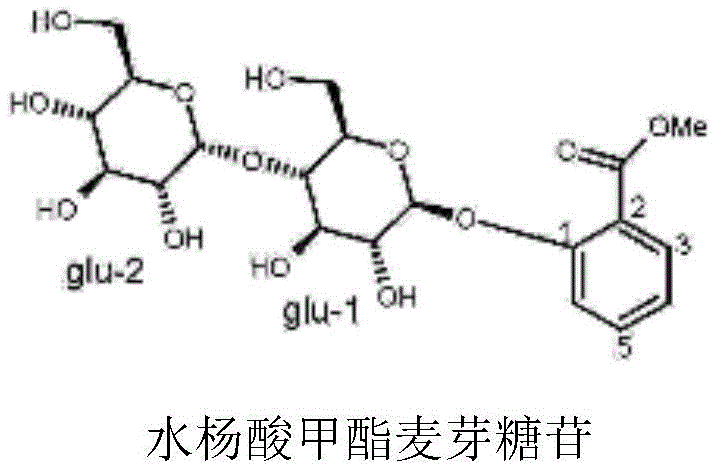
r is selected from disaccharide or trisaccharide consisting of monosaccharide and monosaccharide, wherein the monosaccharide comprises glucose, fructose and galactose; further, the disaccharide includes lactose, maltose, sucrose.
Wherein, the preventing and/or treating systemic lupus erythematosus and the complications thereof are selected from immune dysfunction, lupus arthritis, lupus nephritis and lupus spleen injury; the product comprises medicines, foods and health products.
The second aspect of the technical proposal of the invention provides the application of a pharmaceutical composition in preparing products for preventing and/or treating systemic lupus erythematosus and complications thereof, which is characterized in that the pharmaceutical composition contains a therapeutically effective dose of a compound shown as a general formula (I) and a pharmaceutically acceptable carrier or auxiliary material,
r is selected from disaccharide or trisaccharide consisting of monosaccharide and monosaccharide, wherein the monosaccharide comprises glucose, fructose and galactose; further, the disaccharide comprises lactose, maltose and sucrose.
Wherein, the preventing and/or treating systemic lupus erythematosus and the complications thereof are selected from immune dysfunction, lupus arthritis, lupus nephritis and lupus spleen injury; the product comprises medicines, foods and health products.
Furthermore, the pharmaceutical composition according to the second aspect of the present invention further includes a pharmaceutical composition prepared by combining with other active substances in any ratio.
Further, the pharmaceutical composition is selected from the following dosage forms: solution, suspension, lyophilized powder for injection, emulsion, pill, capsule, powder, sustained release preparation, controlled release preparation, sustained release preparation and microsome delivery system.
The pharmaceutical composition according to the second aspect of the present invention, formulated in a known manner, is administered to a subject using several routes including, but not limited to, parenteral, oral, topical, intradermal, intramuscular, intraperitoneal, subcutaneous, intravenous, intranasal routes.
The methyl salicylate glucoside compound can be prepared by a known method.
The pharmaceutical compositions of methyl salicylate glycosides of the present invention optionally may be formulated by any conventional method with one or more pharmaceutically acceptable carriers and/or excipients. Thus, the methyl salicylate glycosides and pharmaceutically acceptable salts thereof may be formulated, for example, for inhalation or insufflation (either through the mouth or nose) or for oral, buccal, parenteral or rectal administration.
The pharmaceutical compositions of the methyl salicylate glycosides may also be in the form of solutions, suspensions, emulsions, pills, capsules, powders, controlled release or sustained release formulations. These formulations will contain a therapeutically effective amount of the methyl salicylate glycoside compound, preferably in purified form, and an appropriate amount of carrier to provide a form suitable for administration to a patient.
The beneficial technical effects are as follows:
the invention establishes a mouse systemic lupus erythematosus model by intraperitoneal injection of pristane, screens the modeled mice in the 1 st month after modeling, eliminates the mice with unsuccessful models, randomly groups the mice with successful models, and starts to perform drug intervention on the 45 th day after preparing the models. In the whole experimental period, the expression levels of autoantibodies such as DNA in the serum of the lupus mice are dynamically measured every other month, and meanwhile, the arthritis-like pathological process of the lupus mice is effectively monitored. At month 6 after model preparation, mouse serum and major internal organs were collected, and DL0309 was evaluated for its effective alleviation and therapeutic effects on the pathological course of lupus mice on the level of spleen injury and renal function injury. Through the experiments, the invention discovers for the first time that the methyl salicylate glucoside compound has the effects of reducing the expression level of autoantibodies and inflammatory factors in lupus mice and improving the immune function; has the function of slowing down the lupus arthritis-like pathological process; has effects in reducing immune complex deposition in kidney tissue of lupus mouse, and improving kidney function of lupus mouse; has the function of protecting the spleen function of a lupus mouse, and can be applied to preparing products for preventing, relieving and/or treating systemic lupus erythematosus and complications thereof such as immune dysfunction, lupus arthritis, lupus nephritis, lupus spleen injury and the like.
The methyl salicylate glucoside compound is a monomer compound extracted and separated from the traditional Chinese herbal medicine phyllanthus urinaria, and has the advantages of low toxicity, simple extraction process, mature synthetic route and the like; the raw material resources are wide, and the preparation method is easy to realize mass preparation and has good application and development prospects.
Drawings
FIG. 1. Effect of DL0309 on Pristane-induced expression of auto DNA antibodies in lupus mice (A: IgG type DNA autoantibodies; B: IgM type DNA autoantibodies).
FIG. 2 is a graph showing the effect of DL0309 on the expression of Sm autoantibodies in pristine-induced lupus mice (A: IgG type Sm autoantibody; B: IgM type Sm autoantibody).
FIG. 3 is a graph showing the effect of DL0309 on pristine-induced expression of histone antibodies in lupus mice (A: IgG type histone autoantibodies; B: IgM type histone autoantibodies).
FIG. 4 effect of DL0309 on IL-6(A) and total IgG (B) expression in pristane-induced lupus mice.
Figure 5 effect of DL0309 on pristane-induced hindfoot volume in lupus mice.
FIG. 6 shows the effect of DL0309 on the improvement of hindlimb joint deformity and swelling in lupus mice under X-ray radiography.
FIG. 7 is a graph showing the improvement of kidney function of mice with Pristane-induced lupus by DL0309 (A: the content of creatinine in serum; B: the ratio of total protein to creatinine in urine sample).
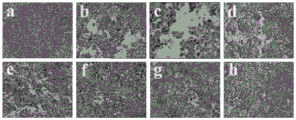
FIG. 8 shows the histopathological examination of the kidney (H & E staining) (a-control group; b-model group; c-model group; d-aspirin group; E-prednisone group; f-low dose group; g-medium dose group; H-high dose group).
FIG. 9 shows the histopathological examination of the kidney (PAS staining) (a-control group; b-model group; c-model group; d-aspirin group; e-prednisone group; f-low dose group; g-medium dose group; h-high dose group).
FIG. 10 deposition of total IgG complexes in kidney tissue.
FIG. 11 deposition of C3 complement complex in kidney tissue.
Figure 12 effect of DL0309 on spleen index in lupus mice.
FIG. 13 spleen histopathological examination (H & E staining) (a-control group; b-model group; c-model group; d-DL0309 low dose group; E-DL0309 medium dose group; f-DL0309 high dose group; g-aspirin group; H-prednisone group)
Detailed Description
The invention further provides the pharmacological action and the pharmaceutical application of the methyl salicylate glucoside compound in preventing, relieving and/or treating systemic lupus erythematosus and complications thereof in vivo.
The following examples illustrate the invention in more detail and are not intended to limit the invention in any way.
Experimental example 1: the mouse model of systemic lupus erythematosus induced by pristane (pristine) is a classical, widely recognized mouse model, which is commonly used to evaluate the pharmacological actions of anti-lupus drugs. The mice were housed, divided and dosed as follows: inbred BALB/c female mice (SPF grade, 7-8 weeks old) were purchased from Beijing Wintonlifys laboratory animal technology, Inc. (Certification No.: SCXK (Jing) 2012-0001; No. 11400700048526). BALB/c mice are raised in the central barrier system of the animal laboratory of the institute of medicine of Chinese medical science, 5-7 mice/cage from 1 week before modeling to 6 months after the end of the experiment. The breeding conditions are as follows: constant temperature of 25 ℃, relative humidity of 50 percent, regular feed and free drinking water, and 12h light/dark alternate cycle.
At month 1 after the model creation, the model mice were screened for the expression level of autoantibodies in vivo, and the model mice were randomly grouped into 12 mice/group. Control group, model group, DL0309 low dose group (200mg/kg body weight), DL0309 medium dose group (400mg/kg body weight), DL0309 high dose group (800mg/kg body weight), positive drug aspirin group (303mg/kg body weight), and positive drug prednisone group (5mg/kg body weight), respectively. Oral administration was carried out at the above dose 1 time/day starting on day 45 after molding. The administration volumes were all 0.2mL/10g body weight. Wherein the control group and the model group were simultaneously administered an equal volume of CMC-Na solution.
(one) the effect of DL0309 on Pristane-induced expression of self-DNA antibodies in lupus mice was examined.
At month 1, 2, … 6 after molding, blood was taken by tail snip, and serum and blood cells were separated. The levels of DNA, Sm and histone antibodies in the serum samples were determined by ELISA. Plotting dynamic curves of relative expression levels of the autoantibodies such as self-DNA, Sm and histone antibodies in each group of serum samples over time (see FIGS. 1, 2 and 3), and the mean increase in expression levels of the autoantibodies in IgG and IgM forms in the serum of lupus model mice ([ P ])<0.05 or P<0.01); DL0309 with middle and high dose, positive medicine aspirin and prednisone can reduce the increase of the expression level of DNA-IgG/IgM, Sm-IgG/IgM and histone-IgG/IgM autoantibodies in lupus mouse, and the difference from the model group has statistical significance (#P<0.05,##P<0.01 or###P<0.001), indicating that oral administration of compound DL0309 is effective in inhibiting autoantibody production in lupus mice.
(II) detecting the influence of DL0309 on the level of inflammatory cytokine IL-6 in serum of pristane-induced lupus mice.
At month 2 after molding (i.e., day 15 after drug dry prognosis), the expression level of IL-6 in the serum of each group of mice was determined (see FIG. 4A). IL-6, an important inflammatory mediator, was detected in lupus model mice serum with significantly high expression (. about.P)<0.01); high dose DL0309, positive medicine aspirin and prednisone can reduce the IL-6 expression level in the serum of lupus mouse obviously (#P<0.05 or##P<0.01), indicating that orally administered compound DL0309 is effective in inhibiting the expression of inflammatory cytokines in lupus mice.
(III) detecting the influence of DL0309 on serum total IgG level of a pristane-induced lupus mouse.
At 1, 2, … 6 months after molding, the total IgG content in the serum of each group of mice was determined by ELISA (see fig. 4B). The total IgG content in the serum of lupus mice gradually increased with the passage of time, and the content showed significant difference (P) compared with the control group at the 2 nd month after the model building<0.01); middle and high dose DL0309, positive medicine aspirin and prednisone can reduce the expression level of total IgG in the serum of lupus mouse obviously (#P<0.05 or##P<0.01)。
(IV) detecting the influence of DL0309 on the degree of foot swelling of pristane-induced lupus mice.
In the 6 th month after the model building, the same position of the hind paw of the mouse is scribed by an independent experimenter, the hind paw of the mouse is immersed in the liquid of the measuring cup, the scribed position is kept level with the liquid level, and the volume of the hind paw of the mouse is measured and recorded by a small animal toe volume measuring instrument (see fig. 5). Mean volume of hind paw of lupus mice was significantly elevated relative to control group (. about.P)<0.01); middle and high dose DL0309, positive medicine aspirin and prednisone can reduce the volume of lupus mouse hind foot obviously#P<0.05 or##P<0.01), indicating that orally administered Compound DL0309 is effective in inhibiting lupusDegree of swelling of hind paw in mice.
(V) detecting the influence of DL0309 on the arthritis-like pathological process of the pristane-induced lupus mice.
At month 6 after molding, the hind limbs of the mice were observed under X-ray. Obvious deformity can be seen in hind feet of lupus model mice under X-ray, and obvious swelling at ankles can be observed; in the middle and high dose DL0309 group, no obvious phenomena are observed in the positive medicine aspirin and the prednisone group (see figure 6), which shows that orally administered compound DL0309 can effectively relieve arthritis-like pathological process of lupus mice.
(VI) detecting the influence of DL0309 on the creatinine content in the serum of the Pristane-induced lupus mice.
At month 6 after molding, mouse serum was collected and creatinine content in the serum was measured by the SOD enzyme method (see FIG. 7A). The creatinine content in the blood serum of the lupus model mouse is obviously increased; high dose DL0309, positive medicine aspirin and prednisone can effectively reduce creatinine content in blood serum.
Seventhly, the influence of DL0309 on the total protein content in urine of a pristane-induced lupus mouse is detected.
At 6 months after molding, urine of mice is collected, the creatinine content in the urine is determined by an SOD enzyme method, and the total protein content in the urine is determined by a BCA method. By calculating the ratio of the two (see fig. 7B), the total protein content in the unit creatinine in the urine of the mouse with lupus model can be obviously increased; high dose of DL0309, positive drug aspirin and prednisone can effectively reduce the content of total protein in unit creatinine.
(VIII) detecting the influence of DL0309 on the pathological changes of kidney of a pristane-induced lupus mouse.
At month 6 after molding, kidneys of each group of mice were collected and subjected to pathological examination. After H & E staining (see figure 8), observation under a mirror shows that a large amount of inflammatory cells infiltrate in kidney tissues of lupus model mice, mesangium becomes wide, and capillary walls become thick, thus showing typical glomerulonephritis characteristics; high dose DL0309, positive medicine aspirin and prednisone can obviously improve the pathological change of lupus mouse. Through PAS dyeing (see figure 9), the observation under a mirror shows that capillary vessel loops in normal mice glomeruli are thin and clear, capillary vessel loops in glomeruli with lupus lesion are obviously thickened, glomerular swelling causes renal capsule stenosis, and pathological changes such as basement membrane disorder, renal tubule thickening and the like can be seen; high dose DL0309, positive medicine aspirin and prednisone can obviously improve the pathological change of lupus mouse. The protection effect of DL0309 on lupus mouse kidney injury is proved in the pathological aspect of the experiment.
(nine) the effect of DL0309 on pristane-induced immune complex deposition in kidney tissues of lupus mice was examined.
At month 6 after molding, the kidneys of each group of mice were collected and subjected to indirect immunofluorescence staining. Under the observation of a 200-fold fluorescence microscope (see figure 10), kidney tissues, particularly glomerular parts of lupus model mice can be excited to emit strong red fluorescence, which indicates that a large amount of total IgG compound is deposited at the glomerular parts; high dose of DL0309, positive medicine aspirin and prednisone can obviously reduce the deposition of total IgG compound in kidney tissue of lupus mouse. When observed under a 400-time confocal laser microscope (see figure 11), the glomerulus of the lupus model mouse can be excited to emit strong green fluorescence, which indicates that a large amount of C3 complement complex is deposited at the glomerulus part; high dose of DL0309, positive drug aspirin and prednisone can obviously reduce the deposition of C3 complement complex in kidney tissue of lupus mouse. The experiment proves that DL0309 can reduce the deposition of immune complex in kidney tissue of lupus mouse, and further explains the mechanism of DL0309 for protecting kidney function of lupus mouse.
(ten) detecting the influence of DL0309 on spleen index and spleen pathological changes of a pristane-induced lupus mouse.
At month 6 after molding, spleens of mice were collected, and spleen indices of the respective groups of mice were calculated as spleen weight to body weight (see fig. 12). The spleen index of lupus model mice is nearly doubled compared with that of the control group<0.01); high dose of DL0309, positive drug aspirin and prednisone can significantly reduce the increase of spleen index in lupus mice (#P<0.05 or##P<0.01), which shows that DL0309 can obviously protect spleen of lupus mouseThe application is as follows. The above conclusions were also further confirmed by histopathological examination. Observed under the mirror (figure 13), the cells in the spleen tissue of the lupus model mouse abnormally proliferate, and the white marrow structure of the spleen proliferates and expands in a nodular way; the positive drugs aspirin, prednisone and DL0309 can obviously improve the pathological change.
The results of whole animal experiments show that the methyl salicylate glucoside compounds have the effects of reducing the expression level of autoantibodies and inflammatory factors in lupus mice and improving the immune function; has the function of slowing down the lupus arthritis-like pathological process; has effects in reducing immune complex deposition in kidney tissue of lupus mouse, and improving kidney function of lupus mouse; has the function of protecting spleen function of lupus mice.
In conclusion, the methyl salicylate glucoside compound has the effects of preventing, relieving and/or treating systemic lupus erythematosus and complications thereof, is a monomer compound extracted and separated from the traditional Chinese herbal medicine Yunnan Baizhu, and has the advantages of low toxicity, simple extraction process, mature synthesis route and the like; the raw material resources are wide, the preparation is easy for mass production, the application and development prospect is good, and the preparation method can be applied to the preparation of products for preventing, relieving and/or treating systemic lupus erythematosus and immune dysfunction, lupus arthritis, lupus nephritis, lupus spleen injury and other complications.