CN106928219B - Nitrogen-containing fused heterocyclic compound, preparation method, intermediate, composition and application - Google Patents
Nitrogen-containing fused heterocyclic compound, preparation method, intermediate, composition and application Download PDFInfo
- Publication number
- CN106928219B CN106928219B CN201611265083.2A CN201611265083A CN106928219B CN 106928219 B CN106928219 B CN 106928219B CN 201611265083 A CN201611265083 A CN 201611265083A CN 106928219 B CN106928219 B CN 106928219B
- Authority
- CN
- China
- Prior art keywords
- substituted
- unsubstituted
- group
- compound
- independently
- Prior art date
- Legal status (The legal status is an assumption and is not a legal conclusion. Google has not performed a legal analysis and makes no representation as to the accuracy of the status listed.)
- Active
Links
- 238000002360 preparation method Methods 0.000 title claims abstract description 46
- QJGQUHMNIGDVPM-UHFFFAOYSA-N nitrogen group Chemical group [N] QJGQUHMNIGDVPM-UHFFFAOYSA-N 0.000 title claims abstract description 28
- 150000002391 heterocyclic compounds Chemical class 0.000 title claims abstract description 26
- 239000000203 mixture Substances 0.000 title abstract description 38
- 230000005764 inhibitory process Effects 0.000 claims abstract description 28
- 239000003814 drug Substances 0.000 claims abstract description 20
- 150000003839 salts Chemical class 0.000 claims abstract description 20
- 210000004881 tumor cell Anatomy 0.000 claims abstract description 9
- 150000001875 compounds Chemical class 0.000 claims description 344
- -1 Silyl Chemical group 0.000 claims description 179
- 150000003254 radicals Chemical class 0.000 claims description 122
- 238000006243 chemical reaction Methods 0.000 claims description 94
- 238000000034 method Methods 0.000 claims description 64
- 125000002924 primary amino group Chemical group [H]N([H])* 0.000 claims description 61
- 125000005842 heteroatom Chemical group 0.000 claims description 60
- 239000001257 hydrogen Substances 0.000 claims description 52
- 229910052739 hydrogen Inorganic materials 0.000 claims description 52
- 125000001495 ethyl group Chemical group [H]C([H])([H])C([H])([H])* 0.000 claims description 49
- 229910052736 halogen Inorganic materials 0.000 claims description 49
- 125000002887 hydroxy group Chemical group [H]O* 0.000 claims description 49
- 150000002367 halogens Chemical class 0.000 claims description 47
- 125000002496 methyl group Chemical group [H]C([H])([H])* 0.000 claims description 47
- 125000000217 alkyl group Chemical group 0.000 claims description 46
- 125000004435 hydrogen atom Chemical group [H]* 0.000 claims description 43
- 125000001424 substituent group Chemical group 0.000 claims description 37
- 125000000592 heterocycloalkyl group Chemical group 0.000 claims description 36
- 238000006467 substitution reaction Methods 0.000 claims description 35
- 229910052799 carbon Inorganic materials 0.000 claims description 30
- IJGRMHOSHXDMSA-UHFFFAOYSA-N Atomic nitrogen Chemical compound N#N IJGRMHOSHXDMSA-UHFFFAOYSA-N 0.000 claims description 28
- 125000006239 protecting group Chemical group 0.000 claims description 28
- 229910052757 nitrogen Inorganic materials 0.000 claims description 27
- 125000002023 trifluoromethyl group Chemical group FC(F)(F)* 0.000 claims description 27
- 150000001721 carbon Chemical group 0.000 claims description 24
- 125000001072 heteroaryl group Chemical group 0.000 claims description 24
- 239000003960 organic solvent Substances 0.000 claims description 23
- 125000004432 carbon atom Chemical group C* 0.000 claims description 21
- 229910052717 sulfur Inorganic materials 0.000 claims description 21
- 125000003545 alkoxy group Chemical group 0.000 claims description 20
- 125000001449 isopropyl group Chemical group [H]C([H])([H])C([H])(*)C([H])([H])[H] 0.000 claims description 20
- 229910052760 oxygen Inorganic materials 0.000 claims description 19
- 125000004093 cyano group Chemical group *C#N 0.000 claims description 16
- 125000000753 cycloalkyl group Chemical group 0.000 claims description 16
- 229910052698 phosphorus Inorganic materials 0.000 claims description 16
- 239000011669 selenium Substances 0.000 claims description 16
- 229910000077 silane Inorganic materials 0.000 claims description 15
- 229910052710 silicon Inorganic materials 0.000 claims description 15
- 125000000304 alkynyl group Chemical group 0.000 claims description 14
- 125000004433 nitrogen atom Chemical group N* 0.000 claims description 14
- 125000000999 tert-butyl group Chemical group [H]C([H])([H])C(*)(C([H])([H])[H])C([H])([H])[H] 0.000 claims description 14
- 125000003342 alkenyl group Chemical group 0.000 claims description 13
- 238000006268 reductive amination reaction Methods 0.000 claims description 13
- 229910052711 selenium Inorganic materials 0.000 claims description 13
- HSFWRNGVRCDJHI-UHFFFAOYSA-N alpha-acetylene Natural products C#C HSFWRNGVRCDJHI-UHFFFAOYSA-N 0.000 claims description 11
- 125000002534 ethynyl group Chemical group [H]C#C* 0.000 claims description 11
- 125000001436 propyl group Chemical group [H]C([*])([H])C([H])([H])C([H])([H])[H] 0.000 claims description 11
- PXGOKWXKJXAPGV-UHFFFAOYSA-N Fluorine Chemical compound FF PXGOKWXKJXAPGV-UHFFFAOYSA-N 0.000 claims description 10
- 229910052731 fluorine Inorganic materials 0.000 claims description 10
- 239000011737 fluorine Substances 0.000 claims description 10
- 239000001301 oxygen Substances 0.000 claims description 10
- 239000011593 sulfur Substances 0.000 claims description 10
- 125000003006 2-dimethylaminoethyl group Chemical group [H]C([H])([H])N(C([H])([H])[H])C([H])([H])C([H])([H])* 0.000 claims description 9
- NINIDFKCEFEMDL-UHFFFAOYSA-N Sulfur Chemical compound [S] NINIDFKCEFEMDL-UHFFFAOYSA-N 0.000 claims description 9
- QVGXLLKOCUKJST-UHFFFAOYSA-N atomic oxygen Chemical compound [O] QVGXLLKOCUKJST-UHFFFAOYSA-N 0.000 claims description 9
- 125000001559 cyclopropyl group Chemical group [H]C1([H])C([H])([H])C1([H])* 0.000 claims description 9
- 125000000956 methoxy group Chemical group [H]C([H])([H])O* 0.000 claims description 9
- 125000000022 2-aminoethyl group Chemical group [H]C([*])([H])C([H])([H])N([H])[H] 0.000 claims description 8
- OAICVXFJPJFONN-UHFFFAOYSA-N Phosphorus Chemical compound [P] OAICVXFJPJFONN-UHFFFAOYSA-N 0.000 claims description 8
- BUGBHKTXTAQXES-UHFFFAOYSA-N Selenium Chemical compound [Se] BUGBHKTXTAQXES-UHFFFAOYSA-N 0.000 claims description 8
- 125000004202 aminomethyl group Chemical group [H]N([H])C([H])([H])* 0.000 claims description 8
- 239000003638 chemical reducing agent Substances 0.000 claims description 8
- 125000001301 ethoxy group Chemical group [H]C([H])([H])C([H])([H])O* 0.000 claims description 8
- 239000011574 phosphorus Substances 0.000 claims description 8
- 230000008569 process Effects 0.000 claims description 8
- 239000010703 silicon Substances 0.000 claims description 8
- BLRPTPMANUNPDV-UHFFFAOYSA-N Silane Chemical group [SiH4] BLRPTPMANUNPDV-UHFFFAOYSA-N 0.000 claims description 7
- XUIMIQQOPSSXEZ-UHFFFAOYSA-N Silicon Chemical compound [Si] XUIMIQQOPSSXEZ-UHFFFAOYSA-N 0.000 claims description 7
- 239000003795 chemical substances by application Substances 0.000 claims description 7
- 229920006395 saturated elastomer Polymers 0.000 claims description 7
- 125000001494 2-propynyl group Chemical group [H]C#CC([H])([H])* 0.000 claims description 6
- OKTJSMMVPCPJKN-UHFFFAOYSA-N Carbon Chemical group [C] OKTJSMMVPCPJKN-UHFFFAOYSA-N 0.000 claims description 6
- 125000001995 cyclobutyl group Chemical group [H]C1([H])C([H])([H])C([H])(*)C1([H])[H] 0.000 claims description 6
- 125000005343 heterocyclic alkyl group Chemical group 0.000 claims description 6
- 125000004206 2,2,2-trifluoroethyl group Chemical group [H]C([H])(*)C(F)(F)F 0.000 claims description 5
- UFHFLCQGNIYNRP-UHFFFAOYSA-N Hydrogen Chemical compound [H][H] UFHFLCQGNIYNRP-UHFFFAOYSA-N 0.000 claims description 5
- 238000006482 condensation reaction Methods 0.000 claims description 5
- 229940043378 cyclin-dependent kinase inhibitor Drugs 0.000 claims description 5
- 125000006222 dimethylaminomethyl group Chemical group [H]C([H])([H])N(C([H])([H])[H])C([H])([H])* 0.000 claims description 5
- 201000010099 disease Diseases 0.000 claims description 5
- 208000037265 diseases, disorders, signs and symptoms Diseases 0.000 claims description 5
- 238000006460 hydrolysis reaction Methods 0.000 claims description 5
- 125000004043 oxo group Chemical group O=* 0.000 claims description 5
- 125000004777 2-fluoroethyl group Chemical group [H]C([H])(F)C([H])([H])* 0.000 claims description 4
- 125000000954 2-hydroxyethyl group Chemical group [H]C([*])([H])C([H])([H])O[H] 0.000 claims description 4
- GAWIXWVDTYZWAW-UHFFFAOYSA-N C[CH]O Chemical group C[CH]O GAWIXWVDTYZWAW-UHFFFAOYSA-N 0.000 claims description 4
- 230000002159 abnormal effect Effects 0.000 claims description 4
- 125000002915 carbonyl group Chemical group [*:2]C([*:1])=O 0.000 claims description 4
- 125000000113 cyclohexyl group Chemical group [H]C1([H])C([H])([H])C([H])([H])C([H])(*)C([H])([H])C1([H])[H] 0.000 claims description 4
- 230000022983 regulation of cell cycle Effects 0.000 claims description 4
- 125000006432 1-methyl cyclopropyl group Chemical group [H]C([H])([H])C1(*)C([H])([H])C1([H])[H] 0.000 claims description 3
- 125000001511 cyclopentyl group Chemical group [H]C1([H])C([H])([H])C([H])([H])C([H])(*)C1([H])[H] 0.000 claims description 3
- 125000003538 pentan-3-yl group Chemical group [H]C([H])([H])C([H])([H])C([H])(*)C([H])([H])C([H])([H])[H] 0.000 claims description 3
- 239000008194 pharmaceutical composition Substances 0.000 claims description 3
- UCPYLLCMEDAXFR-UHFFFAOYSA-N triphosgene Chemical compound ClC(Cl)(Cl)OC(=O)OC(Cl)(Cl)Cl UCPYLLCMEDAXFR-UHFFFAOYSA-N 0.000 claims description 3
- 125000004778 2,2-difluoroethyl group Chemical group [H]C([H])(*)C([H])(F)F 0.000 claims description 2
- 125000000069 2-butynyl group Chemical group [H]C([H])([H])C#CC([H])([H])* 0.000 claims description 2
- 125000003635 2-dimethylaminoethoxy group Chemical group [H]C([H])([H])N(C([H])([H])[H])C([H])([H])C([H])([H])O* 0.000 claims description 2
- 125000004200 2-methoxyethyl group Chemical group [H]C([H])([H])OC([H])([H])C([H])([H])* 0.000 claims description 2
- 125000003903 2-propenyl group Chemical group [H]C([*])([H])C([H])=C([H])[H] 0.000 claims description 2
- 238000006069 Suzuki reaction reaction Methods 0.000 claims description 2
- 238000007259 addition reaction Methods 0.000 claims description 2
- 238000005915 ammonolysis reaction Methods 0.000 claims description 2
- 230000008878 coupling Effects 0.000 claims description 2
- 238000010168 coupling process Methods 0.000 claims description 2
- 238000005859 coupling reaction Methods 0.000 claims description 2
- 125000004186 cyclopropylmethyl group Chemical group [H]C([H])(*)C1([H])C([H])([H])C1([H])[H] 0.000 claims description 2
- 125000001153 fluoro group Chemical group F* 0.000 claims description 2
- 230000003301 hydrolyzing effect Effects 0.000 claims description 2
- 125000004029 hydroxymethyl group Chemical group [H]OC([H])([H])* 0.000 claims description 2
- 238000004519 manufacturing process Methods 0.000 claims description 2
- 125000004184 methoxymethyl group Chemical group [H]C([H])([H])OC([H])([H])* 0.000 claims description 2
- 125000006533 methyl amino methyl group Chemical group [H]N(C([H])([H])[H])C([H])([H])* 0.000 claims description 2
- 125000000325 methylidene group Chemical group [H]C([H])=* 0.000 claims description 2
- 150000002431 hydrogen Chemical class 0.000 claims 8
- RWRDLPDLKQPQOW-UHFFFAOYSA-N Pyrrolidine Chemical compound C1CCNC1 RWRDLPDLKQPQOW-UHFFFAOYSA-N 0.000 claims 3
- 125000005843 halogen group Chemical group 0.000 claims 2
- 125000000026 trimethylsilyl group Chemical group [H]C([H])([H])[Si]([*])(C([H])([H])[H])C([H])([H])[H] 0.000 claims 2
- 229940126074 CDK kinase inhibitor Drugs 0.000 claims 1
- 102100034770 Cyclin-dependent kinase inhibitor 3 Human genes 0.000 claims 1
- 101000945639 Homo sapiens Cyclin-dependent kinase inhibitor 3 Proteins 0.000 claims 1
- 239000002671 adjuvant Substances 0.000 claims 1
- 239000002875 cyclin dependent kinase inhibitor Substances 0.000 claims 1
- 125000002467 phosphate group Chemical group [H]OP(=O)(O[H])O[*] 0.000 claims 1
- 230000002265 prevention Effects 0.000 claims 1
- 210000004027 cell Anatomy 0.000 abstract description 93
- 230000000694 effects Effects 0.000 abstract description 21
- 229940079593 drug Drugs 0.000 abstract description 18
- 206010006187 Breast cancer Diseases 0.000 abstract description 14
- 208000026310 Breast neoplasm Diseases 0.000 abstract description 14
- 230000002401 inhibitory effect Effects 0.000 abstract description 13
- 108010025464 Cyclin-Dependent Kinase 4 Proteins 0.000 abstract description 10
- 108010025468 Cyclin-Dependent Kinase 6 Proteins 0.000 abstract description 9
- 230000035755 proliferation Effects 0.000 abstract description 9
- 239000012453 solvate Substances 0.000 abstract description 8
- 102000003903 Cyclin-dependent kinases Human genes 0.000 abstract description 7
- 108090000266 Cyclin-dependent kinases Proteins 0.000 abstract description 7
- 239000002207 metabolite Substances 0.000 abstract description 7
- 229940002612 prodrug Drugs 0.000 abstract description 7
- 239000000651 prodrug Substances 0.000 abstract description 7
- 241000699670 Mus sp. Species 0.000 abstract description 6
- 238000001727 in vivo Methods 0.000 abstract description 5
- 241001465754 Metazoa Species 0.000 abstract description 4
- 230000001413 cellular effect Effects 0.000 abstract description 3
- 102000004190 Enzymes Human genes 0.000 abstract description 2
- 108090000790 Enzymes Proteins 0.000 abstract description 2
- 238000010521 absorption reaction Methods 0.000 abstract description 2
- 210000001853 liver microsome Anatomy 0.000 abstract description 2
- 230000002503 metabolic effect Effects 0.000 abstract description 2
- 102000013701 Cyclin-Dependent Kinase 4 Human genes 0.000 abstract 2
- 102000013698 Cyclin-Dependent Kinase 6 Human genes 0.000 abstract 2
- HBAQYPYDRFILMT-UHFFFAOYSA-N 8-[3-(1-cyclopropylpyrazol-4-yl)-1H-pyrazolo[4,3-d]pyrimidin-5-yl]-3-methyl-3,8-diazabicyclo[3.2.1]octan-2-one Chemical class C1(CC1)N1N=CC(=C1)C1=NNC2=C1N=C(N=C2)N1C2C(N(CC1CC2)C)=O HBAQYPYDRFILMT-UHFFFAOYSA-N 0.000 abstract 1
- YMWUJEATGCHHMB-UHFFFAOYSA-N Dichloromethane Chemical compound ClCCl YMWUJEATGCHHMB-UHFFFAOYSA-N 0.000 description 250
- OKKJLVBELUTLKV-UHFFFAOYSA-N Methanol Chemical compound OC OKKJLVBELUTLKV-UHFFFAOYSA-N 0.000 description 138
- 238000004895 liquid chromatography mass spectrometry Methods 0.000 description 87
- ZMXDDKWLCZADIW-UHFFFAOYSA-N N,N-Dimethylformamide Chemical compound CN(C)C=O ZMXDDKWLCZADIW-UHFFFAOYSA-N 0.000 description 74
- 239000000243 solution Substances 0.000 description 73
- 239000007787 solid Substances 0.000 description 61
- 125000000246 pyrimidin-2-yl group Chemical group [H]C1=NC(*)=NC([H])=C1[H] 0.000 description 60
- XEKOWRVHYACXOJ-UHFFFAOYSA-N Ethyl acetate Chemical compound CCOC(C)=O XEKOWRVHYACXOJ-UHFFFAOYSA-N 0.000 description 52
- 238000005160 1H NMR spectroscopy Methods 0.000 description 51
- 239000002904 solvent Substances 0.000 description 43
- 206010028980 Neoplasm Diseases 0.000 description 41
- OKKJLVBELUTLKV-MZCSYVLQSA-N Deuterated methanol Chemical compound [2H]OC([2H])([2H])[2H] OKKJLVBELUTLKV-MZCSYVLQSA-N 0.000 description 36
- IAZDPXIOMUYVGZ-UHFFFAOYSA-N Dimethylsulphoxide Chemical compound CS(C)=O IAZDPXIOMUYVGZ-UHFFFAOYSA-N 0.000 description 36
- 230000002829 reductive effect Effects 0.000 description 35
- 238000010898 silica gel chromatography Methods 0.000 description 35
- 238000012360 testing method Methods 0.000 description 34
- JGFZNNIVVJXRND-UHFFFAOYSA-N N,N-diisopropylethylamine Substances CCN(C(C)C)C(C)C JGFZNNIVVJXRND-UHFFFAOYSA-N 0.000 description 30
- RYHBNJHYFVUHQT-UHFFFAOYSA-N 1,4-Dioxane Chemical compound C1COCCO1 RYHBNJHYFVUHQT-UHFFFAOYSA-N 0.000 description 29
- HEDRZPFGACZZDS-MICDWDOJSA-N Trichloro(2H)methane Chemical compound [2H]C(Cl)(Cl)Cl HEDRZPFGACZZDS-MICDWDOJSA-N 0.000 description 29
- IAZDPXIOMUYVGZ-WFGJKAKNSA-N Dimethyl sulfoxide Chemical compound [2H]C([2H])([2H])S(=O)C([2H])([2H])[2H] IAZDPXIOMUYVGZ-WFGJKAKNSA-N 0.000 description 28
- WEVYAHXRMPXWCK-UHFFFAOYSA-N Acetonitrile Chemical compound CC#N WEVYAHXRMPXWCK-UHFFFAOYSA-N 0.000 description 27
- 238000001914 filtration Methods 0.000 description 24
- 238000001704 evaporation Methods 0.000 description 23
- 125000003277 amino group Chemical group 0.000 description 21
- 238000003756 stirring Methods 0.000 description 21
- XLYOFNOQVPJJNP-UHFFFAOYSA-N water Substances O XLYOFNOQVPJJNP-UHFFFAOYSA-N 0.000 description 20
- VEXZGXHMUGYJMC-UHFFFAOYSA-N Hydrochloric acid Chemical compound Cl VEXZGXHMUGYJMC-UHFFFAOYSA-N 0.000 description 19
- UIIMBOGNXHQVGW-UHFFFAOYSA-M Sodium bicarbonate Chemical compound [Na+].OC([O-])=O UIIMBOGNXHQVGW-UHFFFAOYSA-M 0.000 description 19
- FPQQSJJWHUJYPU-UHFFFAOYSA-N 3-(dimethylamino)propyliminomethylidene-ethylazanium;chloride Chemical compound Cl.CCN=C=NCCCN(C)C FPQQSJJWHUJYPU-UHFFFAOYSA-N 0.000 description 18
- ZMANZCXQSJIPKH-UHFFFAOYSA-N Triethylamine Chemical compound CCN(CC)CC ZMANZCXQSJIPKH-UHFFFAOYSA-N 0.000 description 18
- LMDZBCPBFSXMTL-UHFFFAOYSA-N 1-Ethyl-3-(3-dimethylaminopropyl)carbodiimide Substances CCN=C=NCCCN(C)C LMDZBCPBFSXMTL-UHFFFAOYSA-N 0.000 description 17
- VYPSYNLAJGMNEJ-UHFFFAOYSA-N Silicium dioxide Chemical compound O=[Si]=O VYPSYNLAJGMNEJ-UHFFFAOYSA-N 0.000 description 17
- 239000000741 silica gel Substances 0.000 description 17
- 229910002027 silica gel Inorganic materials 0.000 description 17
- XKRFYHLGVUSROY-UHFFFAOYSA-N Argon Chemical compound [Ar] XKRFYHLGVUSROY-UHFFFAOYSA-N 0.000 description 16
- 238000001035 drying Methods 0.000 description 16
- NPZTUJOABDZTLV-UHFFFAOYSA-N hydroxybenzotriazole Substances O=C1C=CC=C2NNN=C12 NPZTUJOABDZTLV-UHFFFAOYSA-N 0.000 description 16
- 239000012043 crude product Substances 0.000 description 15
- WYURNTSHIVDZCO-UHFFFAOYSA-N Tetrahydrofuran Chemical compound C1CCOC1 WYURNTSHIVDZCO-UHFFFAOYSA-N 0.000 description 14
- 238000005516 engineering process Methods 0.000 description 14
- PMZURENOXWZQFD-UHFFFAOYSA-L Sodium Sulfate Chemical compound [Na+].[Na+].[O-]S([O-])(=O)=O PMZURENOXWZQFD-UHFFFAOYSA-L 0.000 description 13
- 238000004440 column chromatography Methods 0.000 description 13
- 238000002474 experimental method Methods 0.000 description 13
- 238000001816 cooling Methods 0.000 description 12
- 238000007865 diluting Methods 0.000 description 12
- 238000010790 dilution Methods 0.000 description 12
- 239000012895 dilution Substances 0.000 description 12
- 239000000706 filtrate Substances 0.000 description 12
- 229910052796 boron Inorganic materials 0.000 description 11
- 125000001997 phenyl group Chemical group [H]C1=C([H])C([H])=C(*)C([H])=C1[H] 0.000 description 11
- RTZKZFJDLAIYFH-UHFFFAOYSA-N Diethyl ether Chemical compound CCOCC RTZKZFJDLAIYFH-UHFFFAOYSA-N 0.000 description 10
- WSFSSNUMVMOOMR-UHFFFAOYSA-N Formaldehyde Chemical compound O=C WSFSSNUMVMOOMR-UHFFFAOYSA-N 0.000 description 10
- 108091000080 Phosphotransferase Proteins 0.000 description 10
- 150000001299 aldehydes Chemical class 0.000 description 10
- 238000001514 detection method Methods 0.000 description 10
- 239000002609 medium Substances 0.000 description 10
- 102000020233 phosphotransferase Human genes 0.000 description 10
- 239000011541 reaction mixture Substances 0.000 description 10
- 230000004614 tumor growth Effects 0.000 description 10
- 125000000391 vinyl group Chemical group [H]C([*])=C([H])[H] 0.000 description 10
- 238000005406 washing Methods 0.000 description 10
- 108091007914 CDKs Proteins 0.000 description 9
- LFQSCWFLJHTTHZ-UHFFFAOYSA-N Ethanol Chemical compound CCO LFQSCWFLJHTTHZ-UHFFFAOYSA-N 0.000 description 9
- JUJWROOIHBZHMG-UHFFFAOYSA-N Pyridine Chemical compound C1=CC=NC=C1 JUJWROOIHBZHMG-UHFFFAOYSA-N 0.000 description 9
- 125000004429 atom Chemical group 0.000 description 9
- 229920002554 vinyl polymer Polymers 0.000 description 9
- 102100036252 Cyclin-dependent kinase 4 Human genes 0.000 description 8
- XTHFKEDIFFGKHM-UHFFFAOYSA-N Dimethoxyethane Chemical compound COCCOC XTHFKEDIFFGKHM-UHFFFAOYSA-N 0.000 description 8
- WMFOQBRAJBCJND-UHFFFAOYSA-M Lithium hydroxide Chemical compound [Li+].[OH-] WMFOQBRAJBCJND-UHFFFAOYSA-M 0.000 description 8
- CDBYLPFSWZWCQE-UHFFFAOYSA-L Sodium Carbonate Chemical compound [Na+].[Na+].[O-]C([O-])=O CDBYLPFSWZWCQE-UHFFFAOYSA-L 0.000 description 8
- 229910052786 argon Inorganic materials 0.000 description 8
- 125000003118 aryl group Chemical group 0.000 description 8
- 230000022131 cell cycle Effects 0.000 description 8
- 239000012046 mixed solvent Substances 0.000 description 8
- 125000004076 pyridyl group Chemical group 0.000 description 8
- UMJPVWFIBILILQ-UHFFFAOYSA-N 3-methyl-2-propan-2-ylbutanamide Chemical compound CC(C)C(C(C)C)C(N)=O UMJPVWFIBILILQ-UHFFFAOYSA-N 0.000 description 7
- QGZKDVFQNNGYKY-UHFFFAOYSA-N Ammonia Chemical compound N QGZKDVFQNNGYKY-UHFFFAOYSA-N 0.000 description 7
- 102100026804 Cyclin-dependent kinase 6 Human genes 0.000 description 7
- 238000004364 calculation method Methods 0.000 description 7
- 238000010438 heat treatment Methods 0.000 description 7
- 239000012044 organic layer Substances 0.000 description 7
- 239000000126 substance Substances 0.000 description 7
- 238000004809 thin layer chromatography Methods 0.000 description 7
- KCXVZYZYPLLWCC-UHFFFAOYSA-N EDTA Chemical compound OC(=O)CN(CC(O)=O)CCN(CC(O)=O)CC(O)=O KCXVZYZYPLLWCC-UHFFFAOYSA-N 0.000 description 6
- ZRALSGWEFCBTJO-UHFFFAOYSA-N Guanidine Chemical compound NC(N)=N ZRALSGWEFCBTJO-UHFFFAOYSA-N 0.000 description 6
- FFDGPVCHZBVARC-UHFFFAOYSA-N N,N-dimethylglycine Chemical compound CN(C)CC(O)=O FFDGPVCHZBVARC-UHFFFAOYSA-N 0.000 description 6
- HEMHJVSKTPXQMS-UHFFFAOYSA-M Sodium hydroxide Chemical compound [OH-].[Na+] HEMHJVSKTPXQMS-UHFFFAOYSA-M 0.000 description 6
- YXFVVABEGXRONW-UHFFFAOYSA-N Toluene Chemical compound CC1=CC=CC=C1 YXFVVABEGXRONW-UHFFFAOYSA-N 0.000 description 6
- 150000001408 amides Chemical class 0.000 description 6
- 125000002619 bicyclic group Chemical group 0.000 description 6
- 102000023732 binding proteins Human genes 0.000 description 6
- 108091008324 binding proteins Proteins 0.000 description 6
- 239000000872 buffer Substances 0.000 description 6
- FJDQFPXHSGXQBY-UHFFFAOYSA-L caesium carbonate Chemical compound [Cs+].[Cs+].[O-]C([O-])=O FJDQFPXHSGXQBY-UHFFFAOYSA-L 0.000 description 6
- 229910000024 caesium carbonate Inorganic materials 0.000 description 6
- 125000004122 cyclic group Chemical group 0.000 description 6
- 238000010511 deprotection reaction Methods 0.000 description 6
- RAXXELZNTBOGNW-UHFFFAOYSA-N imidazole Natural products C1=CNC=N1 RAXXELZNTBOGNW-UHFFFAOYSA-N 0.000 description 6
- 125000002950 monocyclic group Chemical group 0.000 description 6
- 229910000069 nitrogen hydride Inorganic materials 0.000 description 6
- 239000012074 organic phase Substances 0.000 description 6
- SCVFZCLFOSHCOH-UHFFFAOYSA-M potassium acetate Chemical compound [K+].CC([O-])=O SCVFZCLFOSHCOH-UHFFFAOYSA-M 0.000 description 6
- BWHMMNNQKKPAPP-UHFFFAOYSA-L potassium carbonate Chemical compound [K+].[K+].[O-]C([O-])=O BWHMMNNQKKPAPP-UHFFFAOYSA-L 0.000 description 6
- 229910000030 sodium bicarbonate Inorganic materials 0.000 description 6
- 235000017557 sodium bicarbonate Nutrition 0.000 description 6
- 239000000758 substrate Substances 0.000 description 6
- PXQLVRUNWNTZOS-UHFFFAOYSA-N sulfanyl Chemical class [SH] PXQLVRUNWNTZOS-UHFFFAOYSA-N 0.000 description 6
- YLQBMQCUIZJEEH-UHFFFAOYSA-N tetrahydrofuran Natural products C=1C=COC=1 YLQBMQCUIZJEEH-UHFFFAOYSA-N 0.000 description 6
- CYPYTURSJDMMMP-WVCUSYJESA-N (1e,4e)-1,5-diphenylpenta-1,4-dien-3-one;palladium Chemical compound [Pd].[Pd].C=1C=CC=CC=1\C=C\C(=O)\C=C\C1=CC=CC=C1.C=1C=CC=CC=1\C=C\C(=O)\C=C\C1=CC=CC=C1.C=1C=CC=CC=1\C=C\C(=O)\C=C\C1=CC=CC=C1 CYPYTURSJDMMMP-WVCUSYJESA-N 0.000 description 5
- QTBSBXVTEAMEQO-UHFFFAOYSA-M Acetate Chemical compound CC([O-])=O QTBSBXVTEAMEQO-UHFFFAOYSA-M 0.000 description 5
- 101001074035 Homo sapiens Zinc finger protein GLI2 Proteins 0.000 description 5
- 102000001253 Protein Kinase Human genes 0.000 description 5
- 102100035558 Zinc finger protein GLI2 Human genes 0.000 description 5
- 238000004458 analytical method Methods 0.000 description 5
- 239000007864 aqueous solution Substances 0.000 description 5
- 239000011203 carbon fibre reinforced carbon Substances 0.000 description 5
- 238000004113 cell culture Methods 0.000 description 5
- 238000004128 high performance liquid chromatography Methods 0.000 description 5
- UVNXNSUKKOLFBM-UHFFFAOYSA-N imidazo[2,1-b][1,3,4]thiadiazole Chemical compound N1=CSC2=NC=CN21 UVNXNSUKKOLFBM-UHFFFAOYSA-N 0.000 description 5
- 125000000959 isobutyl group Chemical group [H]C([H])([H])C([H])(C([H])([H])[H])C([H])([H])* 0.000 description 5
- 239000010410 layer Substances 0.000 description 5
- 238000005259 measurement Methods 0.000 description 5
- VNWKTOKETHGBQD-UHFFFAOYSA-N methane Natural products C VNWKTOKETHGBQD-UHFFFAOYSA-N 0.000 description 5
- 239000011259 mixed solution Substances 0.000 description 5
- 125000004123 n-propyl group Chemical group [H]C([H])([H])C([H])([H])C([H])([H])* 0.000 description 5
- 239000003208 petroleum Substances 0.000 description 5
- 108060006633 protein kinase Proteins 0.000 description 5
- UMJSCPRVCHMLSP-UHFFFAOYSA-N pyridine Natural products COC1=CC=CN=C1 UMJSCPRVCHMLSP-UHFFFAOYSA-N 0.000 description 5
- 239000012279 sodium borohydride Substances 0.000 description 5
- 229910000033 sodium borohydride Inorganic materials 0.000 description 5
- IKHGUXGNUITLKF-UHFFFAOYSA-N Acetaldehyde Chemical compound CC=O IKHGUXGNUITLKF-UHFFFAOYSA-N 0.000 description 4
- QTBSBXVTEAMEQO-UHFFFAOYSA-N Acetic acid Chemical compound CC(O)=O QTBSBXVTEAMEQO-UHFFFAOYSA-N 0.000 description 4
- ZOXJGFHDIHLPTG-UHFFFAOYSA-N Boron Chemical compound [B] ZOXJGFHDIHLPTG-UHFFFAOYSA-N 0.000 description 4
- 102000016736 Cyclin Human genes 0.000 description 4
- 108050006400 Cyclin Proteins 0.000 description 4
- 108010024986 Cyclin-Dependent Kinase 2 Proteins 0.000 description 4
- 102100036239 Cyclin-dependent kinase 2 Human genes 0.000 description 4
- DTQVDTLACAAQTR-UHFFFAOYSA-N Trifluoroacetic acid Chemical compound OC(=O)C(F)(F)F DTQVDTLACAAQTR-UHFFFAOYSA-N 0.000 description 4
- VORIUEAZEKLUSJ-UHFFFAOYSA-M [(6-chlorobenzotriazol-1-yl)oxy-(dimethylamino)methylidene]-dimethylazanium;trifluoroborane;fluoride Chemical compound [F-].FB(F)F.C1=C(Cl)C=C2N(OC(N(C)C)=[N+](C)C)N=NC2=C1 VORIUEAZEKLUSJ-UHFFFAOYSA-M 0.000 description 4
- 125000003172 aldehyde group Chemical group 0.000 description 4
- 238000003556 assay Methods 0.000 description 4
- 125000005605 benzo group Chemical group 0.000 description 4
- 230000012820 cell cycle checkpoint Effects 0.000 description 4
- 125000000336 imidazol-5-yl group Chemical group [H]N1C([H])=NC([H])=C1[*] 0.000 description 4
- 238000011081 inoculation Methods 0.000 description 4
- 239000000543 intermediate Substances 0.000 description 4
- 239000007791 liquid phase Substances 0.000 description 4
- 125000000250 methylamino group Chemical group [H]N(*)C([H])([H])[H] 0.000 description 4
- VLKZOEOYAKHREP-UHFFFAOYSA-N n-Hexane Chemical compound CCCCCC VLKZOEOYAKHREP-UHFFFAOYSA-N 0.000 description 4
- 238000001543 one-way ANOVA Methods 0.000 description 4
- XHXFXVLFKHQFAL-UHFFFAOYSA-N phosphoryl trichloride Chemical compound ClP(Cl)(Cl)=O XHXFXVLFKHQFAL-UHFFFAOYSA-N 0.000 description 4
- IVDFJHOHABJVEH-UHFFFAOYSA-N pinacol Chemical compound CC(C)(O)C(C)(C)O IVDFJHOHABJVEH-UHFFFAOYSA-N 0.000 description 4
- 239000000047 product Substances 0.000 description 4
- 239000000376 reactant Substances 0.000 description 4
- 230000001105 regulatory effect Effects 0.000 description 4
- 125000002914 sec-butyl group Chemical group [H]C([H])([H])C([H])([H])C([H])(*)C([H])([H])[H] 0.000 description 4
- 229910000029 sodium carbonate Inorganic materials 0.000 description 4
- 239000012321 sodium triacetoxyborohydride Substances 0.000 description 4
- 239000007858 starting material Substances 0.000 description 4
- 238000010626 work up procedure Methods 0.000 description 4
- ASOKPJOREAFHNY-UHFFFAOYSA-N 1-Hydroxybenzotriazole Chemical compound C1=CC=C2N(O)N=NC2=C1 ASOKPJOREAFHNY-UHFFFAOYSA-N 0.000 description 3
- WHPFEQUEHBULBW-UHFFFAOYSA-N 2,4-dichloro-5-fluoropyrimidine Chemical compound FC1=CN=C(Cl)N=C1Cl WHPFEQUEHBULBW-UHFFFAOYSA-N 0.000 description 3
- BDVDXNYOCBUMNP-UHFFFAOYSA-N 6-(2-chloro-5-fluoropyrimidin-4-yl)-4-fluoro-2-methyl-1-propan-2-ylbenzimidazole Chemical compound C1=C2N(C(C)C)C(C)=NC2=C(F)C=C1C1=NC(Cl)=NC=C1F BDVDXNYOCBUMNP-UHFFFAOYSA-N 0.000 description 3
- WFDIJRYMOXRFFG-UHFFFAOYSA-N Acetic anhydride Chemical compound CC(=O)OC(C)=O WFDIJRYMOXRFFG-UHFFFAOYSA-N 0.000 description 3
- PAYRUJLWNCNPSJ-UHFFFAOYSA-N Aniline Chemical compound NC1=CC=CC=C1 PAYRUJLWNCNPSJ-UHFFFAOYSA-N 0.000 description 3
- 238000011729 BALB/c nude mouse Methods 0.000 description 3
- WKBOTKDWSSQWDR-UHFFFAOYSA-N Bromine atom Chemical compound [Br] WKBOTKDWSSQWDR-UHFFFAOYSA-N 0.000 description 3
- 102100040428 Chitobiosyldiphosphodolichol beta-mannosyltransferase Human genes 0.000 description 3
- 206010009944 Colon cancer Diseases 0.000 description 3
- 108010025454 Cyclin-Dependent Kinase 5 Proteins 0.000 description 3
- 102100036883 Cyclin-H Human genes 0.000 description 3
- 102100024109 Cyclin-T1 Human genes 0.000 description 3
- 108091016115 Cyclin-T1 Proteins 0.000 description 3
- 102100032857 Cyclin-dependent kinase 1 Human genes 0.000 description 3
- 101710106279 Cyclin-dependent kinase 1 Proteins 0.000 description 3
- 102100026810 Cyclin-dependent kinase 7 Human genes 0.000 description 3
- 102100024457 Cyclin-dependent kinase 9 Human genes 0.000 description 3
- 102100026805 Cyclin-dependent-like kinase 5 Human genes 0.000 description 3
- 101000891557 Homo sapiens Chitobiosyldiphosphodolichol beta-mannosyltransferase Proteins 0.000 description 3
- 101000713120 Homo sapiens Cyclin-H Proteins 0.000 description 3
- 101000911952 Homo sapiens Cyclin-dependent kinase 7 Proteins 0.000 description 3
- 101000980930 Homo sapiens Cyclin-dependent kinase 9 Proteins 0.000 description 3
- YNBADRVTZLEFNH-UHFFFAOYSA-N Methyl nicotinate Natural products COC(=O)C1=CC=CN=C1 YNBADRVTZLEFNH-UHFFFAOYSA-N 0.000 description 3
- 101100059444 Mus musculus Ccnb1 gene Proteins 0.000 description 3
- CHJJGSNFBQVOTG-UHFFFAOYSA-N N-methyl-guanidine Natural products CNC(N)=N CHJJGSNFBQVOTG-UHFFFAOYSA-N 0.000 description 3
- 238000005481 NMR spectroscopy Methods 0.000 description 3
- MUBZPKHOEPUJKR-UHFFFAOYSA-N Oxalic acid Chemical compound OC(=O)C(O)=O MUBZPKHOEPUJKR-UHFFFAOYSA-N 0.000 description 3
- GLUUGHFHXGJENI-UHFFFAOYSA-N Piperazine Chemical compound C1CNCCN1 GLUUGHFHXGJENI-UHFFFAOYSA-N 0.000 description 3
- KWYUFKZDYYNOTN-UHFFFAOYSA-M Potassium hydroxide Chemical compound [OH-].[K+] KWYUFKZDYYNOTN-UHFFFAOYSA-M 0.000 description 3
- 102100029008 Putative HTLV-1-related endogenous sequence Human genes 0.000 description 3
- FAPWRFPIFSIZLT-UHFFFAOYSA-M Sodium chloride Chemical class [Na+].[Cl-] FAPWRFPIFSIZLT-UHFFFAOYSA-M 0.000 description 3
- 125000004414 alkyl thio group Chemical group 0.000 description 3
- 239000002585 base Substances 0.000 description 3
- 125000001164 benzothiazolyl group Chemical group S1C(=NC2=C1C=CC=C2)* 0.000 description 3
- GDTBXPJZTBHREO-UHFFFAOYSA-N bromine Substances BrBr GDTBXPJZTBHREO-UHFFFAOYSA-N 0.000 description 3
- 229910052794 bromium Inorganic materials 0.000 description 3
- 201000011510 cancer Diseases 0.000 description 3
- KXDHJXZQYSOELW-UHFFFAOYSA-N carbonic acid monoamide Natural products NC(O)=O KXDHJXZQYSOELW-UHFFFAOYSA-N 0.000 description 3
- 238000003570 cell viability assay Methods 0.000 description 3
- 239000012295 chemical reaction liquid Substances 0.000 description 3
- KRKNYBCHXYNGOX-UHFFFAOYSA-N citric acid Chemical compound OC(=O)CC(O)(C(O)=O)CC(O)=O KRKNYBCHXYNGOX-UHFFFAOYSA-N 0.000 description 3
- 208000029742 colonic neoplasm Diseases 0.000 description 3
- 239000003085 diluting agent Substances 0.000 description 3
- 125000002147 dimethylamino group Chemical group [H]C([H])([H])N(*)C([H])([H])[H] 0.000 description 3
- SWSQBOPZIKWTGO-UHFFFAOYSA-N dimethylaminoamidine Natural products CN(C)C(N)=N SWSQBOPZIKWTGO-UHFFFAOYSA-N 0.000 description 3
- 108700003601 dimethylglycine Proteins 0.000 description 3
- 238000000605 extraction Methods 0.000 description 3
- 239000008098 formaldehyde solution Substances 0.000 description 3
- 150000007529 inorganic bases Chemical class 0.000 description 3
- 239000007788 liquid Substances 0.000 description 3
- 230000001404 mediated effect Effects 0.000 description 3
- 229960001238 methylnicotinate Drugs 0.000 description 3
- 150000007522 mineralic acids Chemical class 0.000 description 3
- 238000002156 mixing Methods 0.000 description 3
- 229940078490 n,n-dimethylglycine Drugs 0.000 description 3
- UZWDCWONPYILKI-UHFFFAOYSA-N n-[5-[(4-ethylpiperazin-1-yl)methyl]pyridin-2-yl]-5-fluoro-4-(7-fluoro-2-methyl-3-propan-2-ylbenzimidazol-5-yl)pyrimidin-2-amine Chemical group C1CN(CC)CCN1CC(C=N1)=CC=C1NC1=NC=C(F)C(C=2C=C3N(C(C)C)C(C)=NC3=C(F)C=2)=N1 UZWDCWONPYILKI-UHFFFAOYSA-N 0.000 description 3
- 150000007524 organic acids Chemical class 0.000 description 3
- 150000007530 organic bases Chemical class 0.000 description 3
- 125000004430 oxygen atom Chemical group O* 0.000 description 3
- YJVFFLUZDVXJQI-UHFFFAOYSA-L palladium(ii) acetate Chemical compound [Pd+2].CC([O-])=O.CC([O-])=O YJVFFLUZDVXJQI-UHFFFAOYSA-L 0.000 description 3
- 229960005141 piperazine Drugs 0.000 description 3
- 235000011056 potassium acetate Nutrition 0.000 description 3
- 229910000027 potassium carbonate Inorganic materials 0.000 description 3
- 235000011181 potassium carbonates Nutrition 0.000 description 3
- 238000002953 preparative HPLC Methods 0.000 description 3
- 238000004537 pulping Methods 0.000 description 3
- 238000010791 quenching Methods 0.000 description 3
- 238000010992 reflux Methods 0.000 description 3
- BEOOHQFXGBMRKU-UHFFFAOYSA-N sodium cyanoborohydride Chemical compound [Na+].[B-]C#N BEOOHQFXGBMRKU-UHFFFAOYSA-N 0.000 description 3
- 238000007920 subcutaneous administration Methods 0.000 description 3
- 238000003786 synthesis reaction Methods 0.000 description 3
- OSQKXDAYZVUTSQ-UHFFFAOYSA-N tert-butyl 2-amino-5-methyl-7,8-dihydro-5H-1,6-naphthyridine-6-carboxylate Chemical compound NC1=NC=2CCN(C(C=2C=C1)C)C(=O)OC(C)(C)C OSQKXDAYZVUTSQ-UHFFFAOYSA-N 0.000 description 3
- QUIMTYRHYYSQHL-UHFFFAOYSA-N tert-butyl 2-amino-7-methyl-7,8-dihydro-5H-1,6-naphthyridine-6-carboxylate Chemical compound NC1=NC=2CC(N(CC=2C=C1)C(=O)OC(C)(C)C)C QUIMTYRHYYSQHL-UHFFFAOYSA-N 0.000 description 3
- LFKDJXLFVYVEFG-UHFFFAOYSA-N tert-butyl carbamate Chemical compound CC(C)(C)OC(N)=O LFKDJXLFVYVEFG-UHFFFAOYSA-N 0.000 description 3
- KJAMZCVTJDTESW-UHFFFAOYSA-N tiracizine Chemical compound C1CC2=CC=CC=C2N(C(=O)CN(C)C)C2=CC(NC(=O)OCC)=CC=C21 KJAMZCVTJDTESW-UHFFFAOYSA-N 0.000 description 3
- WLPUWLXVBWGYMZ-UHFFFAOYSA-N tricyclohexylphosphine Chemical compound C1CCCCC1P(C1CCCCC1)C1CCCCC1 WLPUWLXVBWGYMZ-UHFFFAOYSA-N 0.000 description 3
- WSLDOOZREJYCGB-UHFFFAOYSA-N 1,2-Dichloroethane Chemical compound ClCCCl WSLDOOZREJYCGB-UHFFFAOYSA-N 0.000 description 2
- OIXUJRCCNNHWFI-UHFFFAOYSA-N 1,2-dioxane Chemical compound C1CCOOC1 OIXUJRCCNNHWFI-UHFFFAOYSA-N 0.000 description 2
- MYFKLQFBFSHBPA-UHFFFAOYSA-N 1-chloro-2-methylsulfanylethane Chemical compound CSCCCl MYFKLQFBFSHBPA-UHFFFAOYSA-N 0.000 description 2
- IKYCZJWFFNJGLT-UHFFFAOYSA-N 1-cyclopentyl-4-fluoro-2-methyl-6-(4,4,5,5-tetramethyl-1,3,2-dioxaborolan-2-yl)benzimidazole Chemical compound CC1=NC2=C(F)C=C(B3OC(C)(C)C(C)(C)O3)C=C2N1C1CCCC1 IKYCZJWFFNJGLT-UHFFFAOYSA-N 0.000 description 2
- GJETZNKIBZNKQB-UHFFFAOYSA-N 1-cyclopropyl-4-fluoro-2-methyl-6-(4,4,5,5-tetramethyl-1,3,2-dioxaborolan-2-yl)benzimidazole Chemical compound CC1=NC2=C(F)C=C(B3OC(C)(C)C(C)(C)O3)C=C2N1C1CC1 GJETZNKIBZNKQB-UHFFFAOYSA-N 0.000 description 2
- VOXZDWNPVJITMN-ZBRFXRBCSA-N 17β-estradiol Chemical compound OC1=CC=C2[C@H]3CC[C@](C)([C@H](CC4)O)[C@@H]4[C@@H]3CCC2=C1 VOXZDWNPVJITMN-ZBRFXRBCSA-N 0.000 description 2
- RBZRMBCLZMEYEH-UHFFFAOYSA-N 1h-pyrazol-1-ium-1-carboximidamide;chloride Chemical compound Cl.NC(=N)N1C=CC=N1 RBZRMBCLZMEYEH-UHFFFAOYSA-N 0.000 description 2
- HNSKIVCIXGGRBA-UHFFFAOYSA-N 2-[2-[[4-(3-tert-butyl-7-fluoro-2-methylbenzimidazol-5-yl)-5-fluoropyrimidin-2-yl]amino]-7,8-dihydro-5H-1,6-naphthyridin-6-yl]ethanol Chemical compound Cc1nc2c(F)cc(cc2n1C(C)(C)C)-c1nc(Nc2ccc3CN(CCO)CCc3n2)ncc1F HNSKIVCIXGGRBA-UHFFFAOYSA-N 0.000 description 2
- YRXIMPFOTQVOHG-UHFFFAOYSA-N 2-[methyl-[(2-methylpropan-2-yl)oxycarbonyl]amino]acetic acid Chemical compound OC(=O)CN(C)C(=O)OC(C)(C)C YRXIMPFOTQVOHG-UHFFFAOYSA-N 0.000 description 2
- 125000004105 2-pyridyl group Chemical group N1=C([*])C([H])=C([H])C([H])=C1[H] 0.000 description 2
- NHQDETIJWKXCTC-UHFFFAOYSA-N 3-chloroperbenzoic acid Chemical compound OOC(=O)C1=CC=CC(Cl)=C1 NHQDETIJWKXCTC-UHFFFAOYSA-N 0.000 description 2
- ZSHGVMYLGGANKU-UHFFFAOYSA-N 3-hydroxycyclobutane-1-carboxylic acid Chemical compound OC1CC(C(O)=O)C1 ZSHGVMYLGGANKU-UHFFFAOYSA-N 0.000 description 2
- AXFYFNCPONWUHW-UHFFFAOYSA-N 3-hydroxyisovaleric acid Chemical compound CC(C)(O)CC(O)=O AXFYFNCPONWUHW-UHFFFAOYSA-N 0.000 description 2
- ALRHLSYJTWAHJZ-UHFFFAOYSA-N 3-hydroxypropionic acid Chemical compound OCCC(O)=O ALRHLSYJTWAHJZ-UHFFFAOYSA-N 0.000 description 2
- VHYFNPMBLIVWCW-UHFFFAOYSA-N 4-Dimethylaminopyridine Chemical compound CN(C)C1=CC=NC=C1 VHYFNPMBLIVWCW-UHFFFAOYSA-N 0.000 description 2
- ZVFJFEGSVJUASC-UHFFFAOYSA-N 4-fluoro-2-methyl-1-propan-2-ylbenzimidazole Chemical compound C1=CC=C2N(C(C)C)C(C)=NC2=C1F ZVFJFEGSVJUASC-UHFFFAOYSA-N 0.000 description 2
- UZOVYGYOLBIAJR-UHFFFAOYSA-N 4-isocyanato-4'-methyldiphenylmethane Chemical compound C1=CC(C)=CC=C1CC1=CC=C(N=C=O)C=C1 UZOVYGYOLBIAJR-UHFFFAOYSA-N 0.000 description 2
- NTSLROIKFLNUIJ-UHFFFAOYSA-N 5-Ethyl-2-methylpyridine Chemical compound CCC1=CC=C(C)N=C1 NTSLROIKFLNUIJ-UHFFFAOYSA-N 0.000 description 2
- UAJWWWJGTHFEKY-UHFFFAOYSA-N 6-(2-chloro-5-fluoropyrimidin-4-yl)-1-cyclopropyl-4-fluoro-2-methylbenzimidazole Chemical compound CC1=NC2=C(F)C=C(C=3C(=CN=C(Cl)N=3)F)C=C2N1C1CC1 UAJWWWJGTHFEKY-UHFFFAOYSA-N 0.000 description 2
- JRMBZZYRXVFIDK-UHFFFAOYSA-N 6-bromo-1-cyclopropyl-4-fluoro-2-methylbenzimidazole Chemical compound CC1=NC2=C(F)C=C(Br)C=C2N1C1CC1 JRMBZZYRXVFIDK-UHFFFAOYSA-N 0.000 description 2
- KDCGOANMDULRCW-UHFFFAOYSA-N 7H-purine Chemical compound N1=CNC2=NC=NC2=C1 KDCGOANMDULRCW-UHFFFAOYSA-N 0.000 description 2
- DLFVBJFMPXGRIB-UHFFFAOYSA-N Acetamide Chemical compound CC(N)=O DLFVBJFMPXGRIB-UHFFFAOYSA-N 0.000 description 2
- NLXLAEXVIDQMFP-UHFFFAOYSA-N Ammonia chloride Chemical class [NH4+].[Cl-] NLXLAEXVIDQMFP-UHFFFAOYSA-N 0.000 description 2
- VHUUQVKOLVNVRT-UHFFFAOYSA-N Ammonium hydroxide Chemical compound [NH4+].[OH-] VHUUQVKOLVNVRT-UHFFFAOYSA-N 0.000 description 2
- 241000269627 Amphiuma means Species 0.000 description 2
- DRSHXJFUUPIBHX-UHFFFAOYSA-N COc1ccc(cc1)N1N=CC2C=NC(Nc3cc(OC)c(OC)c(OCCCN4CCN(C)CC4)c3)=NC12 Chemical compound COc1ccc(cc1)N1N=CC2C=NC(Nc3cc(OC)c(OC)c(OCCCN4CCN(C)CC4)c3)=NC12 DRSHXJFUUPIBHX-UHFFFAOYSA-N 0.000 description 2
- BVKZGUZCCUSVTD-UHFFFAOYSA-L Carbonate Chemical compound [O-]C([O-])=O BVKZGUZCCUSVTD-UHFFFAOYSA-L 0.000 description 2
- 230000004543 DNA replication Effects 0.000 description 2
- ROSDSFDQCJNGOL-UHFFFAOYSA-N Dimethylamine Chemical compound CNC ROSDSFDQCJNGOL-UHFFFAOYSA-N 0.000 description 2
- ZHNUHDYFZUAESO-UHFFFAOYSA-N Formamide Chemical compound NC=O ZHNUHDYFZUAESO-UHFFFAOYSA-N 0.000 description 2
- VZCYOOQTPOCHFL-OWOJBTEDSA-N Fumaric acid Chemical compound OC(=O)\C=C\C(O)=O VZCYOOQTPOCHFL-OWOJBTEDSA-N 0.000 description 2
- MHAJPDPJQMAIIY-UHFFFAOYSA-N Hydrogen peroxide Chemical compound OO MHAJPDPJQMAIIY-UHFFFAOYSA-N 0.000 description 2
- WTDHULULXKLSOZ-UHFFFAOYSA-N Hydroxylamine hydrochloride Chemical compound Cl.ON WTDHULULXKLSOZ-UHFFFAOYSA-N 0.000 description 2
- 238000004566 IR spectroscopy Methods 0.000 description 2
- SIKJAQJRHWYJAI-UHFFFAOYSA-N Indole Chemical compound C1=CC=C2NC=CC2=C1 SIKJAQJRHWYJAI-UHFFFAOYSA-N 0.000 description 2
- AFVFQIVMOAPDHO-UHFFFAOYSA-N Methanesulfonic acid Chemical compound CS(O)(=O)=O AFVFQIVMOAPDHO-UHFFFAOYSA-N 0.000 description 2
- YNAVUWVOSKDBBP-UHFFFAOYSA-N Morpholine Chemical compound C1COCCN1 YNAVUWVOSKDBBP-UHFFFAOYSA-N 0.000 description 2
- 241000699666 Mus <mouse, genus> Species 0.000 description 2
- JLTDJTHDQAWBAV-UHFFFAOYSA-N N,N-dimethylaniline Chemical compound CN(C)C1=CC=CC=C1 JLTDJTHDQAWBAV-UHFFFAOYSA-N 0.000 description 2
- UZUCFTPPULEGQO-UHFFFAOYSA-N N-[4-(3-cyclopropyl-7-fluoro-2-methylbenzimidazol-5-yl)-5-fluoropyrimidin-2-yl]-6-[2-(dimethylamino)ethyl]-7,8-dihydro-5H-1,6-naphthyridin-2-amine Chemical compound CN(C)CCN1CCc2nc(Nc3ncc(F)c(n3)-c3cc(F)c4nc(C)n(C5CC5)c4c3)ccc2C1 UZUCFTPPULEGQO-UHFFFAOYSA-N 0.000 description 2
- 241000208125 Nicotiana Species 0.000 description 2
- 235000002637 Nicotiana tabacum Nutrition 0.000 description 2
- UXRZLDREKITWRO-UHFFFAOYSA-N P(c1ccccc1)c1ccccc1.CC1(C)c2ccccc2Oc2ccccc12 Chemical compound P(c1ccccc1)c1ccccc1.CC1(C)c2ccccc2Oc2ccccc12 UXRZLDREKITWRO-UHFFFAOYSA-N 0.000 description 2
- KDLHZDBZIXYQEI-UHFFFAOYSA-N Palladium Chemical compound [Pd] KDLHZDBZIXYQEI-UHFFFAOYSA-N 0.000 description 2
- NBIIXXVUZAFLBC-UHFFFAOYSA-N Phosphoric acid Chemical compound OP(O)(O)=O NBIIXXVUZAFLBC-UHFFFAOYSA-N 0.000 description 2
- KYQCOXFCLRTKLS-UHFFFAOYSA-N Pyrazine Chemical compound C1=CN=CC=N1 KYQCOXFCLRTKLS-UHFFFAOYSA-N 0.000 description 2
- 239000012980 RPMI-1640 medium Substances 0.000 description 2
- KEAYESYHFKHZAL-UHFFFAOYSA-N Sodium Chemical compound [Na] KEAYESYHFKHZAL-UHFFFAOYSA-N 0.000 description 2
- WQDUMFSSJAZKTM-UHFFFAOYSA-N Sodium methoxide Chemical compound [Na+].[O-]C WQDUMFSSJAZKTM-UHFFFAOYSA-N 0.000 description 2
- QAOWNCQODCNURD-UHFFFAOYSA-N Sulfuric acid Chemical compound OS(O)(=O)=O QAOWNCQODCNURD-UHFFFAOYSA-N 0.000 description 2
- 229910052783 alkali metal Inorganic materials 0.000 description 2
- 229910000102 alkali metal hydride Inorganic materials 0.000 description 2
- 150000008046 alkali metal hydrides Chemical class 0.000 description 2
- 150000008044 alkali metal hydroxides Chemical class 0.000 description 2
- 235000011114 ammonium hydroxide Nutrition 0.000 description 2
- MWPLVEDNUUSJAV-UHFFFAOYSA-N anthracene Chemical compound C1=CC=CC2=CC3=CC=CC=C3C=C21 MWPLVEDNUUSJAV-UHFFFAOYSA-N 0.000 description 2
- 239000003242 anti bacterial agent Substances 0.000 description 2
- 230000000259 anti-tumor effect Effects 0.000 description 2
- 229940088710 antibiotic agent Drugs 0.000 description 2
- 239000002246 antineoplastic agent Substances 0.000 description 2
- 229940041181 antineoplastic drug Drugs 0.000 description 2
- 230000006907 apoptotic process Effects 0.000 description 2
- 125000003785 benzimidazolyl group Chemical group N1=C(NC2=C1C=CC=C2)* 0.000 description 2
- 125000000499 benzofuranyl group Chemical group O1C(=CC2=C1C=CC=C2)* 0.000 description 2
- WPYMKLBDIGXBTP-UHFFFAOYSA-N benzoic acid Chemical compound OC(=O)C1=CC=CC=C1 WPYMKLBDIGXBTP-UHFFFAOYSA-N 0.000 description 2
- 125000004196 benzothienyl group Chemical group S1C(=CC2=C1C=CC=C2)* 0.000 description 2
- 125000004541 benzoxazolyl group Chemical group O1C(=NC2=C1C=CC=C2)* 0.000 description 2
- 230000015572 biosynthetic process Effects 0.000 description 2
- 230000000903 blocking effect Effects 0.000 description 2
- 239000007853 buffer solution Substances 0.000 description 2
- YJFWSHYYDTVDIC-UHFFFAOYSA-N butane-2,3-diamine;hydrochloride Chemical compound Cl.CC(N)C(C)N YJFWSHYYDTVDIC-UHFFFAOYSA-N 0.000 description 2
- 125000003739 carbamimidoyl group Chemical group C(N)(=N)* 0.000 description 2
- 125000003178 carboxy group Chemical group [H]OC(*)=O 0.000 description 2
- 230000004663 cell proliferation Effects 0.000 description 2
- 230000003833 cell viability Effects 0.000 description 2
- 239000003153 chemical reaction reagent Substances 0.000 description 2
- 230000000052 comparative effect Effects 0.000 description 2
- 238000007405 data analysis Methods 0.000 description 2
- 230000007547 defect Effects 0.000 description 2
- RAFNCPHFRHZCPS-UHFFFAOYSA-N di(imidazol-1-yl)methanethione Chemical compound C1=CN=CN1C(=S)N1C=CN=C1 RAFNCPHFRHZCPS-UHFFFAOYSA-N 0.000 description 2
- XBDQKXXYIPTUBI-UHFFFAOYSA-N dimethylselenoniopropionate Natural products CCC(O)=O XBDQKXXYIPTUBI-UHFFFAOYSA-N 0.000 description 2
- 238000006911 enzymatic reaction Methods 0.000 description 2
- 238000011067 equilibration Methods 0.000 description 2
- QUPDWYMUPZLYJZ-UHFFFAOYSA-N ethyl Chemical compound C[CH2] QUPDWYMUPZLYJZ-UHFFFAOYSA-N 0.000 description 2
- 230000005284 excitation Effects 0.000 description 2
- 230000014509 gene expression Effects 0.000 description 2
- 230000012010 growth Effects 0.000 description 2
- 125000000623 heterocyclic group Chemical group 0.000 description 2
- 125000002883 imidazolyl group Chemical group 0.000 description 2
- 238000000338 in vitro Methods 0.000 description 2
- 125000003453 indazolyl group Chemical group N1N=C(C2=C1C=CC=C2)* 0.000 description 2
- 125000001041 indolyl group Chemical group 0.000 description 2
- 239000003112 inhibitor Substances 0.000 description 2
- SUMDYPCJJOFFON-UHFFFAOYSA-N isethionic acid Chemical compound OCCS(O)(=O)=O SUMDYPCJJOFFON-UHFFFAOYSA-N 0.000 description 2
- 125000002183 isoquinolinyl group Chemical group C1(=NC=CC2=CC=CC=C12)* 0.000 description 2
- 125000001786 isothiazolyl group Chemical group 0.000 description 2
- JVTAAEKCZFNVCJ-UHFFFAOYSA-N lactic acid Chemical compound CC(O)C(O)=O JVTAAEKCZFNVCJ-UHFFFAOYSA-N 0.000 description 2
- 238000002796 luminescence method Methods 0.000 description 2
- BDAGIHXWWSANSR-UHFFFAOYSA-N methanoic acid Natural products OC=O BDAGIHXWWSANSR-UHFFFAOYSA-N 0.000 description 2
- OKKJLVBELUTLKV-VMNATFBRSA-N methanol-d1 Chemical compound [2H]OC OKKJLVBELUTLKV-VMNATFBRSA-N 0.000 description 2
- 125000004108 n-butyl group Chemical group [H]C([H])([H])C([H])([H])C([H])([H])C([H])([H])* 0.000 description 2
- DUUADMGTZDJNRI-UHFFFAOYSA-N n-cyclopropylacetamide Chemical compound CC(=O)NC1CC1 DUUADMGTZDJNRI-UHFFFAOYSA-N 0.000 description 2
- 125000000449 nitro group Chemical group [O-][N+](*)=O 0.000 description 2
- 230000036961 partial effect Effects 0.000 description 2
- 239000000546 pharmaceutical excipient Substances 0.000 description 2
- 125000004592 phthalazinyl group Chemical group C1(=NN=CC2=CC=CC=C12)* 0.000 description 2
- LPNYRYFBWFDTMA-UHFFFAOYSA-N potassium tert-butoxide Chemical compound [K+].CC(C)(C)[O-] LPNYRYFBWFDTMA-UHFFFAOYSA-N 0.000 description 2
- 108090000765 processed proteins & peptides Proteins 0.000 description 2
- 108090000623 proteins and genes Proteins 0.000 description 2
- 125000003373 pyrazinyl group Chemical group 0.000 description 2
- LJXQPZWIHJMPQQ-UHFFFAOYSA-N pyrimidin-2-amine Chemical compound NC1=NC=CC=N1 LJXQPZWIHJMPQQ-UHFFFAOYSA-N 0.000 description 2
- 230000000171 quenching effect Effects 0.000 description 2
- 125000001567 quinoxalinyl group Chemical group N1=C(C=NC2=CC=CC=C12)* 0.000 description 2
- 239000011535 reaction buffer Substances 0.000 description 2
- 238000011160 research Methods 0.000 description 2
- YGSDEFSMJLZEOE-UHFFFAOYSA-N salicylic acid Chemical compound OC(=O)C1=CC=CC=C1O YGSDEFSMJLZEOE-UHFFFAOYSA-N 0.000 description 2
- OLRJXMHANKMLTD-UHFFFAOYSA-N silyl Chemical compound [SiH3] OLRJXMHANKMLTD-UHFFFAOYSA-N 0.000 description 2
- 208000000649 small cell carcinoma Diseases 0.000 description 2
- 239000012312 sodium hydride Substances 0.000 description 2
- 229910000104 sodium hydride Inorganic materials 0.000 description 2
- GEHJYWRUCIMESM-UHFFFAOYSA-L sodium sulfite Chemical compound [Na+].[Na+].[O-]S([O-])=O GEHJYWRUCIMESM-UHFFFAOYSA-L 0.000 description 2
- MFRIHAYPQRLWNB-UHFFFAOYSA-N sodium tert-butoxide Chemical compound [Na+].CC(C)(C)[O-] MFRIHAYPQRLWNB-UHFFFAOYSA-N 0.000 description 2
- HPALAKNZSZLMCH-UHFFFAOYSA-M sodium;chloride;hydrate Chemical class O.[Na+].[Cl-] HPALAKNZSZLMCH-UHFFFAOYSA-M 0.000 description 2
- 125000003003 spiro group Chemical group 0.000 description 2
- 239000011550 stock solution Substances 0.000 description 2
- 239000000725 suspension Substances 0.000 description 2
- LVCYIRQQPQEBSD-UHFFFAOYSA-N tert-butyl 2-amino-7,8-dihydro-5h-1,6-naphthyridine-6-carboxylate Chemical compound NC1=CC=C2CN(C(=O)OC(C)(C)C)CCC2=N1 LVCYIRQQPQEBSD-UHFFFAOYSA-N 0.000 description 2
- 238000010998 test method Methods 0.000 description 2
- VZGDMQKNWNREIO-UHFFFAOYSA-N tetrachloromethane Chemical compound ClC(Cl)(Cl)Cl VZGDMQKNWNREIO-UHFFFAOYSA-N 0.000 description 2
- FYSNRJHAOHDILO-UHFFFAOYSA-N thionyl chloride Chemical compound ClS(Cl)=O FYSNRJHAOHDILO-UHFFFAOYSA-N 0.000 description 2
- JOXIMZWYDAKGHI-UHFFFAOYSA-N toluene-4-sulfonic acid Chemical compound CC1=CC=C(S(O)(=O)=O)C=C1 JOXIMZWYDAKGHI-UHFFFAOYSA-N 0.000 description 2
- VZCYOOQTPOCHFL-UHFFFAOYSA-N trans-butenedioic acid Natural products OC(=O)C=CC(O)=O VZCYOOQTPOCHFL-UHFFFAOYSA-N 0.000 description 2
- 238000012546 transfer Methods 0.000 description 2
- CSRZQMIRAZTJOY-UHFFFAOYSA-N trimethylsilyl iodide Chemical compound C[Si](C)(C)I CSRZQMIRAZTJOY-UHFFFAOYSA-N 0.000 description 2
- RIOQSEWOXXDEQQ-UHFFFAOYSA-N triphenylphosphine Chemical compound C1=CC=CC=C1P(C=1C=CC=CC=1)C1=CC=CC=C1 RIOQSEWOXXDEQQ-UHFFFAOYSA-N 0.000 description 2
- BRLQWZUYTZBJKN-VKHMYHEASA-N (-)-Epichlorohydrin Chemical compound ClC[C@H]1CO1 BRLQWZUYTZBJKN-VKHMYHEASA-N 0.000 description 1
- WARNBRCCTAPTBI-CYBMUJFWSA-N (2R)-2-[3-(dimethylamino)propyl]-5,6,7,8-tetrahydro-1H-1,6-naphthyridin-2-amine Chemical compound CN(C)CCC[C@]1(NC=2CCNCC=2C=C1)N WARNBRCCTAPTBI-CYBMUJFWSA-N 0.000 description 1
- VLHQXRIIQSTJCQ-ZCFIWIBFSA-N (2r)-2-[methyl-[(2-methylpropan-2-yl)oxycarbonyl]amino]propanoic acid Chemical compound OC(=O)[C@@H](C)N(C)C(=O)OC(C)(C)C VLHQXRIIQSTJCQ-ZCFIWIBFSA-N 0.000 description 1
- HAKVNWBUOCSHTR-UHFFFAOYSA-N (9,9-dimethylxanthen-1-yl)-diphenylphosphane Chemical compound C=12C(C)(C)C3=CC=CC=C3OC2=CC=CC=1P(C=1C=CC=CC=1)C1=CC=CC=C1 HAKVNWBUOCSHTR-UHFFFAOYSA-N 0.000 description 1
- FZENGILVLUJGJX-NSCUHMNNSA-N (E)-acetaldehyde oxime Chemical compound C\C=N\O FZENGILVLUJGJX-NSCUHMNNSA-N 0.000 description 1
- BJEPYKJPYRNKOW-REOHCLBHSA-N (S)-malic acid Chemical compound OC(=O)[C@@H](O)CC(O)=O BJEPYKJPYRNKOW-REOHCLBHSA-N 0.000 description 1
- 125000004502 1,2,3-oxadiazolyl group Chemical group 0.000 description 1
- 125000004511 1,2,3-thiadiazolyl group Chemical group 0.000 description 1
- 125000001399 1,2,3-triazolyl group Chemical group N1N=NC(=C1)* 0.000 description 1
- 125000004504 1,2,4-oxadiazolyl group Chemical group 0.000 description 1
- 125000004506 1,2,5-oxadiazolyl group Chemical group 0.000 description 1
- 125000004517 1,2,5-thiadiazolyl group Chemical group 0.000 description 1
- 125000004521 1,3,4-thiadiazol-2-yl group Chemical group S1C(=NN=C1)* 0.000 description 1
- 125000004520 1,3,4-thiadiazolyl group Chemical group 0.000 description 1
- 125000003363 1,3,5-triazinyl group Chemical group N1=C(N=CN=C1)* 0.000 description 1
- YRIZYWQGELRKNT-UHFFFAOYSA-N 1,3,5-trichloro-1,3,5-triazinane-2,4,6-trione Chemical compound ClN1C(=O)N(Cl)C(=O)N(Cl)C1=O YRIZYWQGELRKNT-UHFFFAOYSA-N 0.000 description 1
- WORJRXHJTUTINR-UHFFFAOYSA-N 1,4-dioxane;hydron;chloride Chemical compound Cl.C1COCCO1 WORJRXHJTUTINR-UHFFFAOYSA-N 0.000 description 1
- VVRAEFREEYUDFH-UHFFFAOYSA-N 1-[ethenyl(methyl)phosphoryl]ethene Chemical compound C=CP(=O)(C)C=C VVRAEFREEYUDFH-UHFFFAOYSA-N 0.000 description 1
- XXFUZSHTIOFGNV-UHFFFAOYSA-N 1-bromoprop-1-yne Chemical compound CC#CBr XXFUZSHTIOFGNV-UHFFFAOYSA-N 0.000 description 1
- 125000001462 1-pyrrolyl group Chemical group [*]N1C([H])=C([H])C([H])=C1[H] 0.000 description 1
- LXFQSRIDYRFTJW-UHFFFAOYSA-M 2,4,6-trimethylbenzenesulfonate Chemical compound CC1=CC(C)=C(S([O-])(=O)=O)C(C)=C1 LXFQSRIDYRFTJW-UHFFFAOYSA-M 0.000 description 1
- JCXZKUZXVQKENT-UHFFFAOYSA-N 2-(4-methylpiperazin-1-ium-1-yl)acetate Chemical compound CN1CCN(CC(O)=O)CC1 JCXZKUZXVQKENT-UHFFFAOYSA-N 0.000 description 1
- GRWPTSXPZYCYOM-UHFFFAOYSA-N 2-(dimethylamino)acetaldehyde Chemical compound CN(C)CC=O GRWPTSXPZYCYOM-UHFFFAOYSA-N 0.000 description 1
- VRPJIFMKZZEXLR-UHFFFAOYSA-N 2-[(2-methylpropan-2-yl)oxycarbonylamino]acetic acid Chemical compound CC(C)(C)OC(=O)NCC(O)=O VRPJIFMKZZEXLR-UHFFFAOYSA-N 0.000 description 1
- LXUHSYHOCVICKJ-UHFFFAOYSA-N 2-[2-[[4-(3-cyclopropyl-7-fluoro-2-methylbenzimidazol-5-yl)-5-fluoropyrimidin-2-yl]amino]-7,8-dihydro-5H-1,6-naphthyridin-6-yl]acetamide Chemical compound C1(CC1)N1C(=NC2=C1C=C(C=C2F)C1=NC(=NC=C1F)NC1=NC=2CCN(CC=2C=C1)CC(=O)N)C LXUHSYHOCVICKJ-UHFFFAOYSA-N 0.000 description 1
- IVKYJVDFJKEXIH-UHFFFAOYSA-N 2-[[4-(3-cyclopropyl-7-fluoro-2-methylbenzimidazol-5-yl)-5-fluoropyrimidin-2-yl]amino]-N-[2-(dimethylamino)ethyl]-N-methyl-7,8-dihydro-5H-1,6-naphthyridine-6-carboxamide Chemical compound CN(C)CCN(C)C(=O)N1CCc2nc(Nc3ncc(F)c(n3)-c3cc(F)c4nc(C)n(C5CC5)c4c3)ccc2C1 IVKYJVDFJKEXIH-UHFFFAOYSA-N 0.000 description 1
- QPIOVNJLOVNTMW-UHFFFAOYSA-N 2-bromo-n,n-dimethylacetamide Chemical compound CN(C)C(=O)CBr QPIOVNJLOVNTMW-UHFFFAOYSA-N 0.000 description 1
- REXUYBKPWIPONM-UHFFFAOYSA-N 2-bromoacetonitrile Chemical compound BrCC#N REXUYBKPWIPONM-UHFFFAOYSA-N 0.000 description 1
- LDLCZOVUSADOIV-UHFFFAOYSA-N 2-bromoethanol Chemical compound OCCBr LDLCZOVUSADOIV-UHFFFAOYSA-N 0.000 description 1
- NAMYKGVDVNBCFQ-UHFFFAOYSA-N 2-bromopropane Chemical compound CC(C)Br NAMYKGVDVNBCFQ-UHFFFAOYSA-N 0.000 description 1
- 125000002941 2-furyl group Chemical group O1C([*])=C([H])C([H])=C1[H] 0.000 description 1
- MFNXWZGIFWJHMI-UHFFFAOYSA-N 2-methyl-2-[(2-methylpropan-2-yl)oxycarbonylamino]propanoic acid Chemical compound CC(C)(C)OC(=O)NC(C)(C)C(O)=O MFNXWZGIFWJHMI-UHFFFAOYSA-N 0.000 description 1
- 125000004398 2-methyl-2-butyl group Chemical group CC(C)(CC)* 0.000 description 1
- 125000004918 2-methyl-2-pentyl group Chemical group CC(C)(CCC)* 0.000 description 1
- 125000004922 2-methyl-3-pentyl group Chemical group CC(C)C(CC)* 0.000 description 1
- 125000004493 2-methylbut-1-yl group Chemical group CC(C*)CC 0.000 description 1
- 125000005916 2-methylpentyl group Chemical group 0.000 description 1
- BSKHPKMHTQYZBB-UHFFFAOYSA-N 2-methylpyridine Chemical compound CC1=CC=CC=N1 BSKHPKMHTQYZBB-UHFFFAOYSA-N 0.000 description 1
- 125000000389 2-pyrrolyl group Chemical group [H]N1C([*])=C([H])C([H])=C1[H] 0.000 description 1
- 125000000175 2-thienyl group Chemical group S1C([*])=C([H])C([H])=C1[H] 0.000 description 1
- MGADZUXDNSDTHW-UHFFFAOYSA-N 2H-pyran Chemical compound C1OC=CC=C1 MGADZUXDNSDTHW-UHFFFAOYSA-N 0.000 description 1
- XKPFLKWPESVZJF-UHFFFAOYSA-M 3,3,3-trifluoropropane-1-sulfonate Chemical compound [O-]S(=O)(=O)CCC(F)(F)F XKPFLKWPESVZJF-UHFFFAOYSA-M 0.000 description 1
- JHUUPUMBZGWODW-UHFFFAOYSA-N 3,6-dihydro-1,2-dioxine Chemical compound C1OOCC=C1 JHUUPUMBZGWODW-UHFFFAOYSA-N 0.000 description 1
- 125000003682 3-furyl group Chemical group O1C([H])=C([*])C([H])=C1[H] 0.000 description 1
- 125000004917 3-methyl-2-butyl group Chemical group CC(C(C)*)C 0.000 description 1
- 125000004919 3-methyl-2-pentyl group Chemical group CC(C(C)*)CC 0.000 description 1
- 125000004921 3-methyl-3-pentyl group Chemical group CC(CC)(CC)* 0.000 description 1
- 125000003542 3-methylbutan-2-yl group Chemical group [H]C([H])([H])C([H])(*)C([H])(C([H])([H])[H])C([H])([H])[H] 0.000 description 1
- 125000005917 3-methylpentyl group Chemical group 0.000 description 1
- 125000003349 3-pyridyl group Chemical group N1=C([H])C([*])=C([H])C([H])=C1[H] 0.000 description 1
- 125000001397 3-pyrrolyl group Chemical group [H]N1C([H])=C([*])C([H])=C1[H] 0.000 description 1
- 125000001541 3-thienyl group Chemical group S1C([H])=C([*])C([H])=C1[H] 0.000 description 1
- OSWFIVFLDKOXQC-UHFFFAOYSA-N 4-(3-methoxyphenyl)aniline Chemical compound COC1=CC=CC(C=2C=CC(N)=CC=2)=C1 OSWFIVFLDKOXQC-UHFFFAOYSA-N 0.000 description 1
- MCFBUIIRFZBRCU-UHFFFAOYSA-N 4-[1-[5-[6-(trifluoromethyl)-1h-benzimidazol-2-yl]pyridin-2-yl]piperidin-4-yl]oxycyclohexane-1-carboxylic acid Chemical compound C1CC(C(=O)O)CCC1OC1CCN(C=2N=CC(=CC=2)C=2NC3=CC(=CC=C3N=2)C(F)(F)F)CC1 MCFBUIIRFZBRCU-UHFFFAOYSA-N 0.000 description 1
- BFQSQUAVMNHOEF-UHFFFAOYSA-N 4-bromo-2,6-difluoroaniline Chemical compound NC1=C(F)C=C(Br)C=C1F BFQSQUAVMNHOEF-UHFFFAOYSA-N 0.000 description 1
- HUSPISQCNSLJSR-UHFFFAOYSA-N 4-fluoro-2-methyl-1-propan-2-yl-6-(4,4,5,5-tetramethyl-1,3,2-dioxaborolan-2-yl)benzimidazole Chemical compound C1=C2N(C(C)C)C(C)=NC2=C(F)C=C1B1OC(C)(C)C(C)(C)O1 HUSPISQCNSLJSR-UHFFFAOYSA-N 0.000 description 1
- 125000004920 4-methyl-2-pentyl group Chemical group CC(CC(C)*)C 0.000 description 1
- 125000000339 4-pyridyl group Chemical group N1=C([H])C([H])=C([*])C([H])=C1[H] 0.000 description 1
- IVRRXDHMXUTYPQ-UHFFFAOYSA-N 6-(2-chloro-5-fluoropyrimidin-4-yl)-1-cyclopentyl-4-fluoro-2-methylbenzimidazole Chemical compound ClC1=NC=C(C(=N1)C=1C=C(C2=C(N(C(=N2)C)C2CCCC2)C=1)F)F IVRRXDHMXUTYPQ-UHFFFAOYSA-N 0.000 description 1
- XVDWZIXZMYBLBR-UHFFFAOYSA-N 6-bromo-1-cyclopentyl-4-fluoro-2-methylbenzimidazole Chemical compound CC1=NC2=C(F)C=C(Br)C=C2N1C1CCCC1 XVDWZIXZMYBLBR-UHFFFAOYSA-N 0.000 description 1
- SJQZRZLUEGCXFN-UHFFFAOYSA-N 6-bromo-4-fluoro-2-methyl-1-propan-2-ylbenzimidazole Chemical compound C1=C(Br)C=C2N(C(C)C)C(C)=NC2=C1F SJQZRZLUEGCXFN-UHFFFAOYSA-N 0.000 description 1
- 125000004939 6-pyridyl group Chemical group N1=CC=CC=C1* 0.000 description 1
- PBCZSGKMGDDXIJ-HQCWYSJUSA-N 7-hydroxystaurosporine Chemical compound N([C@H](O)C1=C2C3=CC=CC=C3N3C2=C24)C(=O)C1=C2C1=CC=CC=C1N4[C@H]1C[C@@H](NC)[C@@H](OC)[C@]3(C)O1 PBCZSGKMGDDXIJ-HQCWYSJUSA-N 0.000 description 1
- PBCZSGKMGDDXIJ-UHFFFAOYSA-N 7beta-hydroxystaurosporine Natural products C12=C3N4C5=CC=CC=C5C3=C3C(O)NC(=O)C3=C2C2=CC=CC=C2N1C1CC(NC)C(OC)C4(C)O1 PBCZSGKMGDDXIJ-UHFFFAOYSA-N 0.000 description 1
- CYJRNFFLTBEQSQ-UHFFFAOYSA-N 8-(3-methyl-1-benzothiophen-5-yl)-N-(4-methylsulfonylpyridin-3-yl)quinoxalin-6-amine Chemical compound CS(=O)(=O)C1=C(C=NC=C1)NC=1C=C2N=CC=NC2=C(C=1)C=1C=CC2=C(C(=CS2)C)C=1 CYJRNFFLTBEQSQ-UHFFFAOYSA-N 0.000 description 1
- 239000005711 Benzoic acid Substances 0.000 description 1
- 125000000882 C2-C6 alkenyl group Chemical group 0.000 description 1
- 125000003601 C2-C6 alkynyl group Chemical group 0.000 description 1
- JGLMVXWAHNTPRF-CMDGGOBGSA-N CCN1N=C(C)C=C1C(=O)NC1=NC2=CC(=CC(OC)=C2N1C\C=C\CN1C(NC(=O)C2=CC(C)=NN2CC)=NC2=CC(=CC(OCCCN3CCOCC3)=C12)C(N)=O)C(N)=O Chemical compound CCN1N=C(C)C=C1C(=O)NC1=NC2=CC(=CC(OC)=C2N1C\C=C\CN1C(NC(=O)C2=CC(C)=NN2CC)=NC2=CC(=CC(OCCCN3CCOCC3)=C12)C(N)=O)C(N)=O JGLMVXWAHNTPRF-CMDGGOBGSA-N 0.000 description 1
- 239000004215 Carbon black (E152) Substances 0.000 description 1
- 208000005623 Carcinogenesis Diseases 0.000 description 1
- 102000005483 Cell Cycle Proteins Human genes 0.000 description 1
- 108010031896 Cell Cycle Proteins Proteins 0.000 description 1
- ZAMOUSCENKQFHK-UHFFFAOYSA-N Chlorine atom Chemical compound [Cl] ZAMOUSCENKQFHK-UHFFFAOYSA-N 0.000 description 1
- HTJDQJBWANPRPF-UHFFFAOYSA-N Cyclopropylamine Chemical compound NC1CC1 HTJDQJBWANPRPF-UHFFFAOYSA-N 0.000 description 1
- 108020004414 DNA Proteins 0.000 description 1
- 230000005971 DNA damage repair Effects 0.000 description 1
- 230000006820 DNA synthesis Effects 0.000 description 1
- FEWJPZIEWOKRBE-JCYAYHJZSA-N Dextrotartaric acid Chemical compound OC(=O)[C@H](O)[C@@H](O)C(O)=O FEWJPZIEWOKRBE-JCYAYHJZSA-N 0.000 description 1
- 239000006144 Dulbecco’s modified Eagle's medium Substances 0.000 description 1
- 241000282326 Felis catus Species 0.000 description 1
- 230000010190 G1 phase Effects 0.000 description 1
- AVXURJPOCDRRFD-UHFFFAOYSA-N Hydroxylamine Chemical compound ON AVXURJPOCDRRFD-UHFFFAOYSA-N 0.000 description 1
- LIJUCWLALFXGCL-UHFFFAOYSA-N N-[4-(3-tert-butyl-7-fluoro-2-methylbenzimidazol-5-yl)-5-fluoropyrimidin-2-yl]-5,6,7,8-tetrahydro-1,6-naphthyridin-2-amine Chemical compound Cc1nc2c(F)cc(cc2n1C(C)(C)C)-c1nc(Nc2ccc3CNCCc3n2)ncc1F LIJUCWLALFXGCL-UHFFFAOYSA-N 0.000 description 1
- MFUOGVLBFMRPIR-UHFFFAOYSA-N N-[4-(3-tert-butyl-7-fluoro-2-methylbenzimidazol-5-yl)-5-fluoropyrimidin-2-yl]-6-(2-chloroethyl)-7,8-dihydro-5H-1,6-naphthyridin-2-amine Chemical compound Cc1nc2c(F)cc(cc2n1C(C)(C)C)-c1nc(Nc2ccc3CN(CCCl)CCc3n2)ncc1F MFUOGVLBFMRPIR-UHFFFAOYSA-N 0.000 description 1
- HFKMNAUFISJBSK-UHFFFAOYSA-N N-[5-fluoro-4-(7-fluoro-2-methyl-3-propan-2-ylbenzimidazol-5-yl)pyrimidin-2-yl]-5,6,7,8-tetrahydro-1,6-naphthyridin-2-amine Chemical compound FC=1C(=NC(=NC=1)NC1=NC=2CCNCC=2C=C1)C=1C=C(C2=C(N(C(=N2)C)C(C)C)C=1)F HFKMNAUFISJBSK-UHFFFAOYSA-N 0.000 description 1
- PCNDJXKNXGMECE-UHFFFAOYSA-N Phenazine Natural products C1=CC=CC2=NC3=CC=CC=C3N=C21 PCNDJXKNXGMECE-UHFFFAOYSA-N 0.000 description 1
- ABLZXFCXXLZCGV-UHFFFAOYSA-N Phosphorous acid Chemical compound OP(O)=O ABLZXFCXXLZCGV-UHFFFAOYSA-N 0.000 description 1
- OFOBLEOULBTSOW-UHFFFAOYSA-N Propanedioic acid Natural products OC(=O)CC(O)=O OFOBLEOULBTSOW-UHFFFAOYSA-N 0.000 description 1
- 239000012979 RPMI medium Substances 0.000 description 1
- 241000700159 Rattus Species 0.000 description 1
- VMHLLURERBWHNL-UHFFFAOYSA-M Sodium acetate Chemical compound [Na+].CC([O-])=O VMHLLURERBWHNL-UHFFFAOYSA-M 0.000 description 1
- KDYFGRWQOYBRFD-UHFFFAOYSA-N Succinic acid Natural products OC(=O)CCC(O)=O KDYFGRWQOYBRFD-UHFFFAOYSA-N 0.000 description 1
- FEWJPZIEWOKRBE-UHFFFAOYSA-N Tartaric acid Natural products [H+].[H+].[O-]C(=O)C(O)C(O)C([O-])=O FEWJPZIEWOKRBE-UHFFFAOYSA-N 0.000 description 1
- AYFVYJQAPQTCCC-UHFFFAOYSA-N Threonine Natural products CC(O)C(N)C(O)=O AYFVYJQAPQTCCC-UHFFFAOYSA-N 0.000 description 1
- 239000004473 Threonine Substances 0.000 description 1
- 102000044209 Tumor Suppressor Genes Human genes 0.000 description 1
- 108700025716 Tumor Suppressor Genes Proteins 0.000 description 1
- 102000001742 Tumor Suppressor Proteins Human genes 0.000 description 1
- 108010040002 Tumor Suppressor Proteins Proteins 0.000 description 1
- LXRZVMYMQHNYJB-UNXOBOICSA-N [(1R,2S,4R)-4-[[5-[4-[(1R)-7-chloro-1,2,3,4-tetrahydroisoquinolin-1-yl]-5-methylthiophene-2-carbonyl]pyrimidin-4-yl]amino]-2-hydroxycyclopentyl]methyl sulfamate Chemical compound CC1=C(C=C(S1)C(=O)C1=C(N[C@H]2C[C@H](O)[C@@H](COS(N)(=O)=O)C2)N=CN=C1)[C@@H]1NCCC2=C1C=C(Cl)C=C2 LXRZVMYMQHNYJB-UNXOBOICSA-N 0.000 description 1
- SZPWXAOBLNYOHY-UHFFFAOYSA-N [C]1=CC=NC2=CC=CC=C12 Chemical group [C]1=CC=NC2=CC=CC=C12 SZPWXAOBLNYOHY-UHFFFAOYSA-N 0.000 description 1
- IKHGUXGNUITLKF-XPULMUKRSA-N acetaldehyde Chemical compound [14CH]([14CH3])=O IKHGUXGNUITLKF-XPULMUKRSA-N 0.000 description 1
- 235000011054 acetic acid Nutrition 0.000 description 1
- 125000000641 acridinyl group Chemical group C1(=CC=CC2=NC3=CC=CC=C3C=C12)* 0.000 description 1
- 230000009471 action Effects 0.000 description 1
- 230000004913 activation Effects 0.000 description 1
- 125000005073 adamantyl group Chemical group C12(CC3CC(CC(C1)C3)C2)* 0.000 description 1
- 150000001335 aliphatic alkanes Chemical class 0.000 description 1
- 125000001931 aliphatic group Chemical group 0.000 description 1
- 150000001340 alkali metals Chemical class 0.000 description 1
- 150000004703 alkoxides Chemical class 0.000 description 1
- BJEPYKJPYRNKOW-UHFFFAOYSA-N alpha-hydroxysuccinic acid Natural products OC(=O)C(O)CC(O)=O BJEPYKJPYRNKOW-UHFFFAOYSA-N 0.000 description 1
- 230000004075 alteration Effects 0.000 description 1
- 229910000147 aluminium phosphate Inorganic materials 0.000 description 1
- BIIVYFLTOXDAOV-YVEFUNNKSA-N alvocidib Chemical compound O[C@@H]1CN(C)CC[C@@H]1C1=C(O)C=C(O)C2=C1OC(C=1C(=CC=CC=1)Cl)=CC2=O BIIVYFLTOXDAOV-YVEFUNNKSA-N 0.000 description 1
- 229950010817 alvocidib Drugs 0.000 description 1
- 150000001412 amines Chemical class 0.000 description 1
- CHKQALUEEULCPZ-UHFFFAOYSA-N amino 2,4,6-trimethylbenzenesulfonate Chemical compound CC1=CC(C)=C(S(=O)(=O)ON)C(C)=C1 CHKQALUEEULCPZ-UHFFFAOYSA-N 0.000 description 1
- 238000007098 aminolysis reaction Methods 0.000 description 1
- 229910021529 ammonia Inorganic materials 0.000 description 1
- 238000010171 animal model Methods 0.000 description 1
- 125000000732 arylene group Chemical group 0.000 description 1
- CBHOOMGKXCMKIR-UHFFFAOYSA-N azane;methanol Chemical compound N.OC CBHOOMGKXCMKIR-UHFFFAOYSA-N 0.000 description 1
- 238000005815 base catalysis Methods 0.000 description 1
- 125000005870 benzindolyl group Chemical group 0.000 description 1
- 235000010233 benzoic acid Nutrition 0.000 description 1
- 125000005878 benzonaphthofuranyl group Chemical group 0.000 description 1
- 125000005874 benzothiadiazolyl group Chemical group 0.000 description 1
- 125000004600 benzothiopyranyl group Chemical group S1C(C=CC2=C1C=CC=C2)* 0.000 description 1
- 125000003354 benzotriazolyl group Chemical group N1N=NC2=C1C=CC=C2* 0.000 description 1
- 125000004622 benzoxazinyl group Chemical group O1NC(=CC2=C1C=CC=C2)* 0.000 description 1
- 239000011230 binding agent Substances 0.000 description 1
- 230000004071 biological effect Effects 0.000 description 1
- 230000037396 body weight Effects 0.000 description 1
- 238000009835 boiling Methods 0.000 description 1
- ZADPBFCGQRWHPN-UHFFFAOYSA-N boronic acid Chemical compound OBO ZADPBFCGQRWHPN-UHFFFAOYSA-N 0.000 description 1
- 208000030224 brain astrocytoma Diseases 0.000 description 1
- KDYFGRWQOYBRFD-NUQCWPJISA-N butanedioic acid Chemical compound O[14C](=O)CC[14C](O)=O KDYFGRWQOYBRFD-NUQCWPJISA-N 0.000 description 1
- 125000004369 butenyl group Chemical group C(=CCC)* 0.000 description 1
- 125000000484 butyl group Chemical group [H]C([*])([H])C([H])([H])C([H])([H])C([H])([H])[H] 0.000 description 1
- 125000000480 butynyl group Chemical group [*]C#CC([H])([H])C([H])([H])[H] 0.000 description 1
- 230000036952 cancer formation Effects 0.000 description 1
- 125000000609 carbazolyl group Chemical group C1(=CC=CC=2C3=CC=CC=C3NC12)* 0.000 description 1
- 231100000504 carcinogenesis Toxicity 0.000 description 1
- 230000003197 catalytic effect Effects 0.000 description 1
- 230000030833 cell death Effects 0.000 description 1
- 125000003636 chemical group Chemical group 0.000 description 1
- 239000000460 chlorine Substances 0.000 description 1
- 229910052801 chlorine Inorganic materials 0.000 description 1
- 238000004587 chromatography analysis Methods 0.000 description 1
- 235000015165 citric acid Nutrition 0.000 description 1
- 238000010835 comparative analysis Methods 0.000 description 1
- 238000007796 conventional method Methods 0.000 description 1
- 125000000392 cycloalkenyl group Chemical group 0.000 description 1
- 125000002993 cycloalkylene group Chemical group 0.000 description 1
- 125000000582 cycloheptyl group Chemical group [H]C1([H])C([H])([H])C([H])([H])C([H])([H])C([H])(*)C([H])([H])C1([H])[H] 0.000 description 1
- 125000000596 cyclohexenyl group Chemical group C1(=CCCCC1)* 0.000 description 1
- 125000006547 cyclononyl group Chemical group [H]C1([H])C([H])([H])C([H])([H])C([H])([H])C([H])([H])C([H])(*)C([H])([H])C([H])([H])C1([H])[H] 0.000 description 1
- 125000000640 cyclooctyl group Chemical group [H]C1([H])C([H])([H])C([H])([H])C([H])([H])C([H])(*)C([H])([H])C([H])([H])C1([H])[H] 0.000 description 1
- 230000003111 delayed effect Effects 0.000 description 1
- 230000003831 deregulation Effects 0.000 description 1
- 238000013461 design Methods 0.000 description 1
- 238000011161 development Methods 0.000 description 1
- KWZWNVAHEQHCTQ-UHFFFAOYSA-N diacetyloxyboranyl acetate Chemical compound CC(=O)OB(OC(C)=O)OC(C)=O KWZWNVAHEQHCTQ-UHFFFAOYSA-N 0.000 description 1
- YNHIGQDRGKUECZ-UHFFFAOYSA-N dichloropalladium;triphenylphosphanium Chemical compound Cl[Pd]Cl.C1=CC=CC=C1[PH+](C=1C=CC=CC=1)C1=CC=CC=C1.C1=CC=CC=C1[PH+](C=1C=CC=CC=1)C1=CC=CC=C1 YNHIGQDRGKUECZ-UHFFFAOYSA-N 0.000 description 1
- LXCYSACZTOKNNS-UHFFFAOYSA-N diethoxy(oxo)phosphanium Chemical compound CCO[P+](=O)OCC LXCYSACZTOKNNS-UHFFFAOYSA-N 0.000 description 1
- MJUJXFBTEFXVKU-UHFFFAOYSA-N diethyl phosphonate Chemical compound CCOP(=O)OCC MJUJXFBTEFXVKU-UHFFFAOYSA-N 0.000 description 1
- 230000029087 digestion Effects 0.000 description 1
- ACHABJPIRMAIRY-UHFFFAOYSA-N dimethylphosphane;hydrochloride Chemical compound [Cl-].C[PH2+]C ACHABJPIRMAIRY-UHFFFAOYSA-N 0.000 description 1
- 239000007884 disintegrant Substances 0.000 description 1
- 238000004821 distillation Methods 0.000 description 1
- 230000005059 dormancy Effects 0.000 description 1
- 230000000857 drug effect Effects 0.000 description 1
- 239000003995 emulsifying agent Substances 0.000 description 1
- 230000007608 epigenetic mechanism Effects 0.000 description 1
- 229960005309 estradiol Drugs 0.000 description 1
- 229940011871 estrogen Drugs 0.000 description 1
- 239000000262 estrogen Substances 0.000 description 1
- PQJJJMRNHATNKG-UHFFFAOYSA-N ethyl bromoacetate Chemical compound CCOC(=O)CBr PQJJJMRNHATNKG-UHFFFAOYSA-N 0.000 description 1
- 238000011156 evaluation Methods 0.000 description 1
- 239000000945 filler Substances 0.000 description 1
- 239000012065 filter cake Substances 0.000 description 1
- 235000019253 formic acid Nutrition 0.000 description 1
- 238000009472 formulation Methods 0.000 description 1
- 125000002485 formyl group Chemical group [H]C(*)=O 0.000 description 1
- 238000007710 freezing Methods 0.000 description 1
- 230000008014 freezing Effects 0.000 description 1
- 239000001530 fumaric acid Substances 0.000 description 1
- 235000011087 fumaric acid Nutrition 0.000 description 1
- ZZUFCTLCJUWOSV-UHFFFAOYSA-N furosemide Chemical compound C1=C(Cl)C(S(=O)(=O)N)=CC(C(O)=O)=C1NCC1=CC=CO1 ZZUFCTLCJUWOSV-UHFFFAOYSA-N 0.000 description 1
- 239000007789 gas Substances 0.000 description 1
- 230000030279 gene silencing Effects 0.000 description 1
- 238000007429 general method Methods 0.000 description 1
- 230000008303 genetic mechanism Effects 0.000 description 1
- 206010073071 hepatocellular carcinoma Diseases 0.000 description 1
- 125000005549 heteroarylene group Chemical group 0.000 description 1
- 231100000086 high toxicity Toxicity 0.000 description 1
- 229930195733 hydrocarbon Natural products 0.000 description 1
- 238000005984 hydrogenation reaction Methods 0.000 description 1
- 239000005457 ice water Substances 0.000 description 1
- 125000002962 imidazol-1-yl group Chemical group [*]N1C([H])=NC([H])=C1[H] 0.000 description 1
- 150000002460 imidazoles Chemical class 0.000 description 1
- 125000004857 imidazopyridinyl group Chemical group N1C(=NC2=C1C=CC=N2)* 0.000 description 1
- PZOUSPYUWWUPPK-UHFFFAOYSA-N indole Natural products CC1=CC=CC2=C1C=CN2 PZOUSPYUWWUPPK-UHFFFAOYSA-N 0.000 description 1
- RKJUIXBNRJVNHR-UHFFFAOYSA-N indolenine Natural products C1=CC=C2CC=NC2=C1 RKJUIXBNRJVNHR-UHFFFAOYSA-N 0.000 description 1
- 125000003406 indolizinyl group Chemical group C=1(C=CN2C=CC=CC12)* 0.000 description 1
- 238000002347 injection Methods 0.000 description 1
- 239000007924 injection Substances 0.000 description 1
- 238000007918 intramuscular administration Methods 0.000 description 1
- 238000001990 intravenous administration Methods 0.000 description 1
- PNDPGZBMCMUPRI-UHFFFAOYSA-N iodine Chemical compound II PNDPGZBMCMUPRI-UHFFFAOYSA-N 0.000 description 1
- 229940045996 isethionic acid Drugs 0.000 description 1
- 125000005990 isobenzothienyl group Chemical group 0.000 description 1
- 125000004491 isohexyl group Chemical group C(CCC(C)C)* 0.000 description 1
- 125000004594 isoindolinyl group Chemical group C1(NCC2=CC=CC=C12)* 0.000 description 1
- 125000001972 isopentyl group Chemical group [H]C([H])([H])C([H])(C([H])([H])[H])C([H])([H])C([H])([H])* 0.000 description 1
- 125000004628 isothiazolidinyl group Chemical group S1N(CCC1)* 0.000 description 1
- 239000004310 lactic acid Substances 0.000 description 1
- 235000014655 lactic acid Nutrition 0.000 description 1
- 238000002386 leaching Methods 0.000 description 1
- XGZVUEUWXADBQD-UHFFFAOYSA-L lithium carbonate Chemical compound [Li+].[Li+].[O-]C([O-])=O XGZVUEUWXADBQD-UHFFFAOYSA-L 0.000 description 1
- 229910052808 lithium carbonate Inorganic materials 0.000 description 1
- 231100000053 low toxicity Toxicity 0.000 description 1
- 239000000314 lubricant Substances 0.000 description 1
- RMGJCSHZTFKPNO-UHFFFAOYSA-M magnesium;ethene;bromide Chemical compound [Mg+2].[Br-].[CH-]=C RMGJCSHZTFKPNO-UHFFFAOYSA-M 0.000 description 1
- VZCYOOQTPOCHFL-UPHRSURJSA-N maleic acid Chemical compound OC(=O)\C=C/C(O)=O VZCYOOQTPOCHFL-UPHRSURJSA-N 0.000 description 1
- 239000011976 maleic acid Substances 0.000 description 1
- 239000001630 malic acid Substances 0.000 description 1
- 235000011090 malic acid Nutrition 0.000 description 1
- 230000003211 malignant effect Effects 0.000 description 1
- 238000004949 mass spectrometry Methods 0.000 description 1
- 108010082117 matrigel Proteins 0.000 description 1
- 230000007246 mechanism Effects 0.000 description 1
- 229940098779 methanesulfonic acid Drugs 0.000 description 1
- RMIODHQZRUFFFF-UHFFFAOYSA-N methoxyacetic acid Chemical compound COCC(O)=O RMIODHQZRUFFFF-UHFFFAOYSA-N 0.000 description 1
- ZQAUNTSBAZCVIO-UHFFFAOYSA-N methoxyphosphonamidic acid Chemical compound COP(N)(O)=O ZQAUNTSBAZCVIO-UHFFFAOYSA-N 0.000 description 1
- AMIVNKVBDFJAFD-UHFFFAOYSA-N methyl 2-(chloromethyl)pyridine-3-carboxylate Chemical compound COC(=O)C1=CC=CN=C1CCl AMIVNKVBDFJAFD-UHFFFAOYSA-N 0.000 description 1
- YDCHPLOFQATIDS-UHFFFAOYSA-N methyl 2-bromoacetate Chemical compound COC(=O)CBr YDCHPLOFQATIDS-UHFFFAOYSA-N 0.000 description 1
- ZXUQEPZWVQIOJE-UHFFFAOYSA-N methyl 2-chloro-2-oxoacetate Chemical compound COC(=O)C(Cl)=O ZXUQEPZWVQIOJE-UHFFFAOYSA-N 0.000 description 1
- KLHWBYHFWALOIJ-UHFFFAOYSA-N methyl 2-methylpyridine-3-carboxylate Chemical compound COC(=O)C1=CC=CN=C1C KLHWBYHFWALOIJ-UHFFFAOYSA-N 0.000 description 1
- TUJJDUMNJRNYGZ-UHFFFAOYSA-N methyl 6-chloro-2-(chloromethyl)pyridine-3-carboxylate Chemical compound COC(=O)C1=CC=C(Cl)N=C1CCl TUJJDUMNJRNYGZ-UHFFFAOYSA-N 0.000 description 1
- 150000004702 methyl esters Chemical class 0.000 description 1
- SCLFRABIDYGTAZ-UHFFFAOYSA-N methylphosphonic acid dichloride Chemical compound CP(Cl)(Cl)=O SCLFRABIDYGTAZ-UHFFFAOYSA-N 0.000 description 1
- 230000027939 micturition Effects 0.000 description 1
- 230000011278 mitosis Effects 0.000 description 1
- 230000000394 mitotic effect Effects 0.000 description 1
- 238000012544 monitoring process Methods 0.000 description 1
- DILRJUIACXKSQE-UHFFFAOYSA-N n',n'-dimethylethane-1,2-diamine Chemical compound CN(C)CCN DILRJUIACXKSQE-UHFFFAOYSA-N 0.000 description 1
- HVOYZOQVDYHUPF-UHFFFAOYSA-N n,n',n'-trimethylethane-1,2-diamine Chemical compound CNCCN(C)C HVOYZOQVDYHUPF-UHFFFAOYSA-N 0.000 description 1
- AJNZZMSMXMTYPB-UHFFFAOYSA-N n-(4-bromo-2,6-difluorophenyl)-n'-cyclopropylethanimidamide Chemical compound C1CC1N=C(C)NC1=C(F)C=C(Br)C=C1F AJNZZMSMXMTYPB-UHFFFAOYSA-N 0.000 description 1
- PSZYNBSKGUBXEH-UHFFFAOYSA-N naphthalene-1-sulfonic acid Chemical compound C1=CC=C2C(S(=O)(=O)O)=CC=CC2=C1 PSZYNBSKGUBXEH-UHFFFAOYSA-N 0.000 description 1
- 125000001624 naphthyl group Chemical group 0.000 description 1
- 125000004593 naphthyridinyl group Chemical group N1=C(C=CC2=CC=CN=C12)* 0.000 description 1
- 208000002154 non-small cell lung carcinoma Diseases 0.000 description 1
- 231100000252 nontoxic Toxicity 0.000 description 1
- 230000003000 nontoxic effect Effects 0.000 description 1
- 238000011580 nude mouse model Methods 0.000 description 1
- 235000015097 nutrients Nutrition 0.000 description 1
- 238000005457 optimization Methods 0.000 description 1
- 235000005985 organic acids Nutrition 0.000 description 1
- 230000010355 oscillation Effects 0.000 description 1
- 230000002018 overexpression Effects 0.000 description 1
- 235000006408 oxalic acid Nutrition 0.000 description 1
- 125000000160 oxazolidinyl group Chemical group 0.000 description 1
- 125000005968 oxazolinyl group Chemical group 0.000 description 1
- 125000000466 oxiranyl group Chemical group 0.000 description 1
- 229910052763 palladium Inorganic materials 0.000 description 1
- PIBWKRNGBLPSSY-UHFFFAOYSA-L palladium(II) chloride Chemical compound Cl[Pd]Cl PIBWKRNGBLPSSY-UHFFFAOYSA-L 0.000 description 1
- FJKROLUGYXJWQN-UHFFFAOYSA-N papa-hydroxy-benzoic acid Natural products OC(=O)C1=CC=C(O)C=C1 FJKROLUGYXJWQN-UHFFFAOYSA-N 0.000 description 1
- 229940124531 pharmaceutical excipient Drugs 0.000 description 1
- 239000012071 phase Substances 0.000 description 1
- 125000004934 phenanthridinyl group Chemical group C1(=CC=CC2=NC=C3C=CC=CC3=C12)* 0.000 description 1
- 125000004625 phenanthrolinyl group Chemical group N1=C(C=CC2=CC=C3C=CC=NC3=C12)* 0.000 description 1
- 125000001791 phenazinyl group Chemical group C1(=CC=CC2=NC3=CC=CC=C3N=C12)* 0.000 description 1
- 125000001484 phenothiazinyl group Chemical group C1(=CC=CC=2SC3=CC=CC=C3NC12)* 0.000 description 1
- 125000001644 phenoxazinyl group Chemical group C1(=CC=CC=2OC3=CC=CC=C3NC12)* 0.000 description 1
- 238000007747 plating Methods 0.000 description 1
- 125000003367 polycyclic group Chemical group 0.000 description 1
- 229910000028 potassium bicarbonate Inorganic materials 0.000 description 1
- 235000015497 potassium bicarbonate Nutrition 0.000 description 1
- 239000011736 potassium bicarbonate Substances 0.000 description 1
- NTTOTNSKUYCDAV-UHFFFAOYSA-N potassium hydride Chemical compound [KH] NTTOTNSKUYCDAV-UHFFFAOYSA-N 0.000 description 1
- 229910000105 potassium hydride Inorganic materials 0.000 description 1
- TYJJADVDDVDEDZ-UHFFFAOYSA-M potassium hydrogencarbonate Chemical compound [K+].OC([O-])=O TYJJADVDDVDEDZ-UHFFFAOYSA-M 0.000 description 1
- 229940086066 potassium hydrogencarbonate Drugs 0.000 description 1
- 238000004262 preparative liquid chromatography Methods 0.000 description 1
- 238000012746 preparative thin layer chromatography Methods 0.000 description 1
- 125000004368 propenyl group Chemical group C(=CC)* 0.000 description 1
- 235000019260 propionic acid Nutrition 0.000 description 1
- 125000002568 propynyl group Chemical group [*]C#CC([H])([H])[H] 0.000 description 1
- 102000004169 proteins and genes Human genes 0.000 description 1
- 125000001042 pteridinyl group Chemical group N1=C(N=CC2=NC=CN=C12)* 0.000 description 1
- 238000000746 purification Methods 0.000 description 1
- 125000000561 purinyl group Chemical group N1=C(N=C2N=CNC2=C1)* 0.000 description 1
- 125000004307 pyrazin-2-yl group Chemical group [H]C1=C([H])N=C(*)C([H])=N1 0.000 description 1
- 125000003226 pyrazolyl group Chemical group 0.000 description 1
- 125000002206 pyridazin-3-yl group Chemical group [H]C1=C([H])C([H])=C(*)N=N1 0.000 description 1
- 125000002098 pyridazinyl group Chemical group 0.000 description 1
- 125000004527 pyrimidin-4-yl group Chemical group N1=CN=C(C=C1)* 0.000 description 1
- 125000004528 pyrimidin-5-yl group Chemical group N1=CN=CC(=C1)* 0.000 description 1
- 125000002294 quinazolinyl group Chemical group N1=C(N=CC2=CC=CC=C12)* 0.000 description 1
- IUVKMZGDUIUOCP-BTNSXGMBSA-N quinbolone Chemical compound O([C@H]1CC[C@H]2[C@H]3[C@@H]([C@]4(C=CC(=O)C=C4CC3)C)CC[C@@]21C)C1=CCCC1 IUVKMZGDUIUOCP-BTNSXGMBSA-N 0.000 description 1
- 125000002943 quinolinyl group Chemical group N1=C(C=CC2=CC=CC=C12)* 0.000 description 1
- 230000025053 regulation of cell proliferation Effects 0.000 description 1
- 230000008439 repair process Effects 0.000 description 1
- 230000028617 response to DNA damage stimulus Effects 0.000 description 1
- 229960004889 salicylic acid Drugs 0.000 description 1
- 239000012047 saturated solution Substances 0.000 description 1
- 125000003607 serino group Chemical class [H]N([H])[C@]([H])(C(=O)[*])C(O[H])([H])[H] 0.000 description 1
- 238000007086 side reaction Methods 0.000 description 1
- 230000019491 signal transduction Effects 0.000 description 1
- 239000002356 single layer Substances 0.000 description 1
- 239000001632 sodium acetate Substances 0.000 description 1
- 235000017281 sodium acetate Nutrition 0.000 description 1
- QDRKDTQENPPHOJ-UHFFFAOYSA-N sodium ethoxide Chemical compound [Na+].CC[O-] QDRKDTQENPPHOJ-UHFFFAOYSA-N 0.000 description 1
- 229910052938 sodium sulfate Inorganic materials 0.000 description 1
- 235000011152 sodium sulphate Nutrition 0.000 description 1
- 235000010265 sodium sulphite Nutrition 0.000 description 1
- 238000007619 statistical method Methods 0.000 description 1
- 125000005017 substituted alkenyl group Chemical group 0.000 description 1
- 125000000446 sulfanediyl group Chemical group *S* 0.000 description 1
- 239000000375 suspending agent Substances 0.000 description 1
- 239000007939 sustained release tablet Substances 0.000 description 1
- 229950009390 symclosene Drugs 0.000 description 1
- 238000010189 synthetic method Methods 0.000 description 1
- 239000003826 tablet Substances 0.000 description 1
- 239000011975 tartaric acid Substances 0.000 description 1
- 235000002906 tartaric acid Nutrition 0.000 description 1
- 238000003419 tautomerization reaction Methods 0.000 description 1
- YLVBQXDOZNNNAH-UHFFFAOYSA-N tert-butyl 2-[[4-(3-cyclopropyl-7-fluoro-2-methylbenzimidazol-5-yl)-5-fluoropyrimidin-2-yl]amino]-7,8-dihydro-5H-1,6-naphthyridine-6-carboxylate Chemical compound Cc1nc2c(F)cc(cc2n1C1CC1)-c1nc(Nc2ccc3CN(CCc3n2)C(=O)OC(C)(C)C)ncc1F YLVBQXDOZNNNAH-UHFFFAOYSA-N 0.000 description 1
- JSOMVCDXPUXKIC-UHFFFAOYSA-N tert-butyl 3-oxopyrrolidine-1-carboxylate Chemical compound CC(C)(C)OC(=O)N1CCC(=O)C1 JSOMVCDXPUXKIC-UHFFFAOYSA-N 0.000 description 1
- OEQRZPWMXXJEKU-ZCFIWIBFSA-N tert-butyl n-[(2r)-1-oxopropan-2-yl]carbamate Chemical compound O=C[C@@H](C)NC(=O)OC(C)(C)C OEQRZPWMXXJEKU-ZCFIWIBFSA-N 0.000 description 1
- GOQZIPJCBUYLIR-UHFFFAOYSA-N tert-butyl n-[n-[(2-methylpropan-2-yl)oxycarbonyl]-n'-(trifluoromethylsulfonyl)carbamimidoyl]carbamate Chemical group CC(C)(C)OC(=O)NC(=NS(=O)(=O)C(F)(F)F)NC(=O)OC(C)(C)C GOQZIPJCBUYLIR-UHFFFAOYSA-N 0.000 description 1
- LPQZERIRKRYGGM-UHFFFAOYSA-N tert-butyl pyrrolidine-1-carboxylate Chemical compound CC(C)(C)OC(=O)N1CCCC1 LPQZERIRKRYGGM-UHFFFAOYSA-N 0.000 description 1
- LJVACBMLEAKKMC-UHFFFAOYSA-N tert-butyl(2-oxoethyl)carbamic acid Chemical compound CC(C)(C)N(C(O)=O)CC=O LJVACBMLEAKKMC-UHFFFAOYSA-N 0.000 description 1
- 150000003512 tertiary amines Chemical class 0.000 description 1
- 239000012085 test solution Substances 0.000 description 1
- 125000001712 tetrahydronaphthyl group Chemical group C1(CCCC2=CC=CC=C12)* 0.000 description 1
- 125000003554 tetrahydropyrrolyl group Chemical group 0.000 description 1
- 125000003831 tetrazolyl group Chemical group 0.000 description 1
- 238000011287 therapeutic dose Methods 0.000 description 1
- 230000001225 therapeutic effect Effects 0.000 description 1
- 238000002560 therapeutic procedure Methods 0.000 description 1
- 238000009210 therapy by ultrasound Methods 0.000 description 1
- 125000005308 thiazepinyl group Chemical group S1N=C(C=CC=C1)* 0.000 description 1
- 125000000437 thiazol-2-yl group Chemical group [H]C1=C([H])N=C(*)S1 0.000 description 1
- 125000000335 thiazolyl group Chemical group 0.000 description 1
- 125000001544 thienyl group Chemical group 0.000 description 1
- 230000000699 topical effect Effects 0.000 description 1
- 238000007832 transition metal-catalyzed coupling reaction Methods 0.000 description 1
- 125000004306 triazinyl group Chemical group 0.000 description 1
- 125000001425 triazolyl group Chemical group 0.000 description 1
- 230000005760 tumorsuppression Effects 0.000 description 1
- 238000002604 ultrasonography Methods 0.000 description 1
- 238000010792 warming Methods 0.000 description 1
- 230000003442 weekly effect Effects 0.000 description 1
- 239000000080 wetting agent Substances 0.000 description 1
- 125000004933 β-carbolinyl group Chemical group C1(=NC=CC=2C3=CC=CC=C3NC12)* 0.000 description 1
- DGVVWUTYPXICAM-UHFFFAOYSA-N β‐Mercaptoethanol Chemical compound OCCS DGVVWUTYPXICAM-UHFFFAOYSA-N 0.000 description 1
Classifications
-
- C—CHEMISTRY; METALLURGY
- C07—ORGANIC CHEMISTRY
- C07D—HETEROCYCLIC COMPOUNDS
- C07D471/00—Heterocyclic compounds containing nitrogen atoms as the only ring hetero atoms in the condensed system, at least one ring being a six-membered ring with one nitrogen atom, not provided for by groups C07D451/00 - C07D463/00
- C07D471/02—Heterocyclic compounds containing nitrogen atoms as the only ring hetero atoms in the condensed system, at least one ring being a six-membered ring with one nitrogen atom, not provided for by groups C07D451/00 - C07D463/00 in which the condensed system contains two hetero rings
- C07D471/04—Ortho-condensed systems
-
- A—HUMAN NECESSITIES
- A61—MEDICAL OR VETERINARY SCIENCE; HYGIENE
- A61P—SPECIFIC THERAPEUTIC ACTIVITY OF CHEMICAL COMPOUNDS OR MEDICINAL PREPARATIONS
- A61P35/00—Antineoplastic agents
-
- C—CHEMISTRY; METALLURGY
- C07—ORGANIC CHEMISTRY
- C07F—ACYCLIC, CARBOCYCLIC OR HETEROCYCLIC COMPOUNDS CONTAINING ELEMENTS OTHER THAN CARBON, HYDROGEN, HALOGEN, OXYGEN, NITROGEN, SULFUR, SELENIUM OR TELLURIUM
- C07F5/00—Compounds containing elements of Groups 3 or 13 of the Periodic Table
- C07F5/02—Boron compounds
- C07F5/025—Boronic and borinic acid compounds
-
- C—CHEMISTRY; METALLURGY
- C07—ORGANIC CHEMISTRY
- C07F—ACYCLIC, CARBOCYCLIC OR HETEROCYCLIC COMPOUNDS CONTAINING ELEMENTS OTHER THAN CARBON, HYDROGEN, HALOGEN, OXYGEN, NITROGEN, SULFUR, SELENIUM OR TELLURIUM
- C07F7/00—Compounds containing elements of Groups 4 or 14 of the Periodic Table
- C07F7/02—Silicon compounds
- C07F7/08—Compounds having one or more C—Si linkages
- C07F7/0803—Compounds with Si-C or Si-Si linkages
- C07F7/081—Compounds with Si-C or Si-Si linkages comprising at least one atom selected from the elements N, O, halogen, S, Se or Te
- C07F7/0812—Compounds with Si-C or Si-Si linkages comprising at least one atom selected from the elements N, O, halogen, S, Se or Te comprising a heterocyclic ring
-
- C—CHEMISTRY; METALLURGY
- C07—ORGANIC CHEMISTRY
- C07F—ACYCLIC, CARBOCYCLIC OR HETEROCYCLIC COMPOUNDS CONTAINING ELEMENTS OTHER THAN CARBON, HYDROGEN, HALOGEN, OXYGEN, NITROGEN, SULFUR, SELENIUM OR TELLURIUM
- C07F7/00—Compounds containing elements of Groups 4 or 14 of the Periodic Table
- C07F7/02—Silicon compounds
- C07F7/08—Compounds having one or more C—Si linkages
- C07F7/0803—Compounds with Si-C or Si-Si linkages
- C07F7/081—Compounds with Si-C or Si-Si linkages comprising at least one atom selected from the elements N, O, halogen, S, Se or Te
- C07F7/0812—Compounds with Si-C or Si-Si linkages comprising at least one atom selected from the elements N, O, halogen, S, Se or Te comprising a heterocyclic ring
- C07F7/0816—Compounds with Si-C or Si-Si linkages comprising at least one atom selected from the elements N, O, halogen, S, Se or Te comprising a heterocyclic ring said ring comprising Si as a ring atom
-
- C—CHEMISTRY; METALLURGY
- C07—ORGANIC CHEMISTRY
- C07F—ACYCLIC, CARBOCYCLIC OR HETEROCYCLIC COMPOUNDS CONTAINING ELEMENTS OTHER THAN CARBON, HYDROGEN, HALOGEN, OXYGEN, NITROGEN, SULFUR, SELENIUM OR TELLURIUM
- C07F7/00—Compounds containing elements of Groups 4 or 14 of the Periodic Table
- C07F7/02—Silicon compounds
- C07F7/08—Compounds having one or more C—Si linkages
- C07F7/0803—Compounds with Si-C or Si-Si linkages
- C07F7/0825—Preparations of compounds not comprising Si-Si or Si-cyano linkages
- C07F7/083—Syntheses without formation of a Si-C bond
-
- C—CHEMISTRY; METALLURGY
- C07—ORGANIC CHEMISTRY
- C07F—ACYCLIC, CARBOCYCLIC OR HETEROCYCLIC COMPOUNDS CONTAINING ELEMENTS OTHER THAN CARBON, HYDROGEN, HALOGEN, OXYGEN, NITROGEN, SULFUR, SELENIUM OR TELLURIUM
- C07F9/00—Compounds containing elements of Groups 5 or 15 of the Periodic Table
- C07F9/02—Phosphorus compounds
- C07F9/547—Heterocyclic compounds, e.g. containing phosphorus as a ring hetero atom
- C07F9/6561—Heterocyclic compounds, e.g. containing phosphorus as a ring hetero atom containing systems of two or more relevant hetero rings condensed among themselves or condensed with a common carbocyclic ring or ring system, with or without other non-condensed hetero rings
-
- C—CHEMISTRY; METALLURGY
- C07—ORGANIC CHEMISTRY
- C07F—ACYCLIC, CARBOCYCLIC OR HETEROCYCLIC COMPOUNDS CONTAINING ELEMENTS OTHER THAN CARBON, HYDROGEN, HALOGEN, OXYGEN, NITROGEN, SULFUR, SELENIUM OR TELLURIUM
- C07F9/00—Compounds containing elements of Groups 5 or 15 of the Periodic Table
- C07F9/02—Phosphorus compounds
- C07F9/547—Heterocyclic compounds, e.g. containing phosphorus as a ring hetero atom
- C07F9/6564—Heterocyclic compounds, e.g. containing phosphorus as a ring hetero atom having phosphorus atoms, with or without nitrogen, oxygen, sulfur, selenium or tellurium atoms, as ring hetero atoms
- C07F9/6581—Heterocyclic compounds, e.g. containing phosphorus as a ring hetero atom having phosphorus atoms, with or without nitrogen, oxygen, sulfur, selenium or tellurium atoms, as ring hetero atoms having phosphorus and nitrogen atoms with or without oxygen or sulfur atoms, as ring hetero atoms
- C07F9/6584—Heterocyclic compounds, e.g. containing phosphorus as a ring hetero atom having phosphorus atoms, with or without nitrogen, oxygen, sulfur, selenium or tellurium atoms, as ring hetero atoms having phosphorus and nitrogen atoms with or without oxygen or sulfur atoms, as ring hetero atoms having one phosphorus atom as ring hetero atom
- C07F9/65842—Cyclic amide derivatives of acids of phosphorus, in which one nitrogen atom belongs to the ring
-
- Y—GENERAL TAGGING OF NEW TECHNOLOGICAL DEVELOPMENTS; GENERAL TAGGING OF CROSS-SECTIONAL TECHNOLOGIES SPANNING OVER SEVERAL SECTIONS OF THE IPC; TECHNICAL SUBJECTS COVERED BY FORMER USPC CROSS-REFERENCE ART COLLECTIONS [XRACs] AND DIGESTS
- Y02—TECHNOLOGIES OR APPLICATIONS FOR MITIGATION OR ADAPTATION AGAINST CLIMATE CHANGE
- Y02P—CLIMATE CHANGE MITIGATION TECHNOLOGIES IN THE PRODUCTION OR PROCESSING OF GOODS
- Y02P20/00—Technologies relating to chemical industry
- Y02P20/50—Improvements relating to the production of bulk chemicals
- Y02P20/55—Design of synthesis routes, e.g. reducing the use of auxiliary or protecting groups
Landscapes
- Chemical & Material Sciences (AREA)
- Organic Chemistry (AREA)
- Health & Medical Sciences (AREA)
- Life Sciences & Earth Sciences (AREA)
- General Health & Medical Sciences (AREA)
- Molecular Biology (AREA)
- Biochemistry (AREA)
- General Chemical & Material Sciences (AREA)
- Pharmacology & Pharmacy (AREA)
- Animal Behavior & Ethology (AREA)
- Nuclear Medicine, Radiotherapy & Molecular Imaging (AREA)
- Public Health (AREA)
- Veterinary Medicine (AREA)
- Medicinal Chemistry (AREA)
- Chemical Kinetics & Catalysis (AREA)
- Pharmaceuticals Containing Other Organic And Inorganic Compounds (AREA)
- Nitrogen Condensed Heterocyclic Rings (AREA)
Abstract
The invention discloses a nitrogen-containing fused heterocyclic compound, a preparation method, an intermediate, a composition and application. The nitrogen-containing fused heterocyclic compound shown as the formula I, pharmaceutically acceptable salts, enantiomers, diastereoisomers, tautomers, solvates, metabolites or prodrugs thereof have high selectivity on CDK4 and CDK6 at a molecular level, high inhibitory activity on CDK4 and CDK6 at a cellular level, good inhibitory activity on breast cancer cells at a cellular level, obvious proliferation inhibition on tumor cells related to cyclin-dependent kinase activity at an animal level, good stability on liver microsomes of human and mice, no obvious inhibition on metabolic enzymes, good in vivo absorption quality of large and small mice, high in bioavailability and good in drug forming property.
Description
Technical Field
The invention relates to a nitrogen-containing fused heterocyclic compound, a preparation method, an intermediate, a composition and application.
Background
Tumors are a class of Cell Cycle Diseases (CCD), and modulation or blocking of the Cell Cycle is one of the ways to treat tumors. Many molecules have been discovered to be involved in cell cycle regulation, among which Cyclin-Dependent Kinases (CDKs) are core molecules of cell cycle regulatory networks. CDKs are catalytic subunits, are a class of serine (Ser)/threonine (Thr) kinases, are important signal transduction molecules in cells, and participate in the growth, proliferation, dormancy or apoptosis of cells in a CDK-cyclin complex formed by cyclins. Cyclin-regulated proteins play an important role in the regulation of cell proliferation, and in tumor cells, cyclin and CDK aberrations in the G1 phase are most frequent, and there may be multiple mechanisms involved in these changes. These changes often cause tumorigenesis through activation of tumor genes and silencing of tumor suppressor genes. Malignant cells influence the expression of cell cycle regulatory proteins through genetic and epigenetic mechanisms, causing overexpression of cyclins and loss of expression of CDK inhibitors, with consequent deregulation of CDK activity.
Cell cycle checkpoint (cell cycle checkpoint) refers to a site that controls the rate-limiting site in the cell proliferation cycle, and is responsible for determining the integrity of DNA synthesis, monitoring DNA replication, DNA damage repair, blocking cells from entering the mitotic phase, and precisely regulating the progression of the cell cycle to prevent errors in the proliferation cycle, prior to DNA replication and mitosis. In response to DNA damage, cells activate cell cycle checkpoints, cause cell cycle blockages, repair damaged DNA, or induce cell death by apoptosis or by stopping growth. Cell cycle blockade often occurs at the G1/S or G2/M junctions, and cell cycle checkpoint regulatory molecules are also novel targets for anti-tumor drugs.
Among the drugs developed, the first generation CDK inhibitors, represented by flavopiridol, UCN-01, etc., are "pan-CDK" inhibitors, which block all subtypes of the CDK family in an equivalent manner, exhibit relatively high toxicity in clinical trials, and sometimes fail to achieve an effective therapeutic dose, thus motivating the development of selective CDK inhibitors, which are expected to improve the selectivity of therapy and prevent normal cells from being damaged by some side effects. In recent years, selective CDK inhibitors and the like have been reported and entered clinical trials. Therefore, the search and discovery of specific cell cycle regulators with high efficiency and low toxicity is a popular field for the research of antitumor drugs.
Disclosure of Invention
The invention aims to solve the problem that the existing cell cycle regulator has the defects of large clinical side effect due to low specificity, poor selectivity and the like, or has the defects of high selectivity and poor activity, and provides a nitrogen-containing fused heterocyclic compound, a preparation method, an intermediate, a composition and application.
The invention provides a nitrogen-containing fused heterocyclic compound shown as a formula I, a pharmaceutically acceptable salt, an enantiomer, a diastereomer, a tautomer, a solvate, a metabolite or a prodrug thereof;
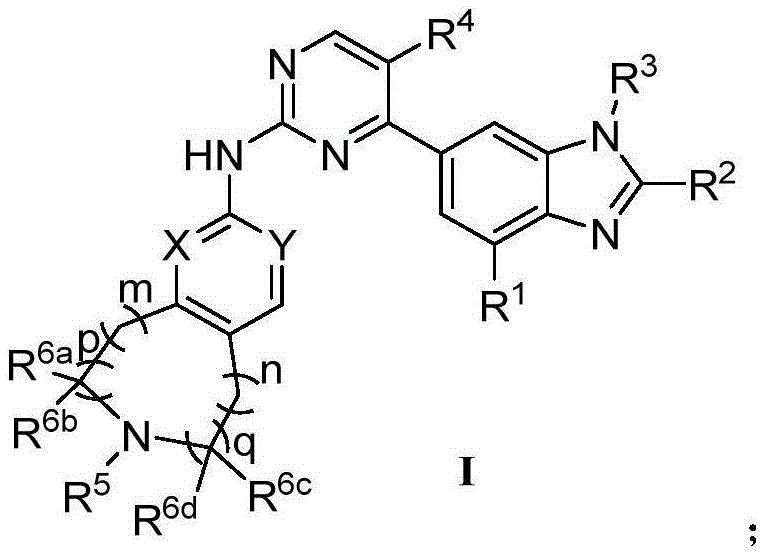
wherein p and q are independently 0 or 1;
m and n are independently 0, 1 or 2;
x and Y are independently CH or N;
ring (C) The N atom in (1) is in an oxidized state or a non-oxidized state;
preferably, at least one of p and q is 1 (e.g., m is 0, 1 or 2 when p and q are both 1, and n is 0; or n is 0, 1 or 2 when p and q are both 1, and m is 0; or q is 1 when p is 0, and m and n are independently 0, 1 or 2; or q is 0 when p is 1, and m and n are independently 0, 1 or 2);
R1is hydrogen, hydroxy, cyano, mercapto, substituted or unsubstituted C2~C20Alkenyl, substituted or unsubstituted C2~C20Alkynyl, halogen (e.g. fluorine), substituted or unsubstituted C1~C20Alkyl (e.g. methyl, trifluoromethyl), C1~C20Alkanemercapto, substituted or unsubstituted C1~C20Alkoxy (e.g. methoxy), substituted or unsubstituted C3~C12Cycloalkyl (e.g. cyclopropyl), substituted or unsubstituted C1~C9Heterocycloalkyl, or "C1~C20Alkyl mono-, di-or unsubstituted amino; wherein, said "C1~C20Two substituents in the alkyl-disubstituted amino group "are the same or different;
R2is hydrogen, hydroxy, substituted or unsubstituted C2~C20Alkenyl, substituted or unsubstituted C2~C20Alkynyl, halogen, substituted or unsubstituted C1~C20Alkyl (e.g. methyl), substituted or unsubstituted C1~C20Alkoxy (e.g. methoxy), substituted or unsubstituted C1~C20Alkanethiol (e.g. methylmercapto), substituted or unsubstituted C3~C12Cycloalkyl (e.g. cyclopropyl), cyano, "C1~C20Alkyl mono-, di-or unsubstituted amino "or Wherein, said "C1~C20Two substituents in the alkyl-disubstituted amino group "are the same or different;
R3is hydrogen, substituted or unsubstituted C1~C20Alkyl (e.g. methyl, ethyl, isopropyl, tert-butyl, 1-ethylpropyl, 1-cyclopropylethyl, 2-fluoroethyl, 2, 2-difluoroethyl, 2,2, 2-trifluoroethyl, 1-methyl-2, 2, 2-trifluoroethyl or cyclopropylmethyl), substituted or unsubstituted C2~C20Alkenyl, substituted or unsubstituted C2~C20Alkynyl, substituted or unsubstituted C3~C12Cycloalkyl radicals (e.g. 1-methylcyclopropyl, cyclopropyl, 3-oxocyclobutyl, 3-hydroxycyclobutyl, 3-fluorocyclobutyl, 3-difluorocyclobutaneAlkyl, cyclobutyl, cyclopentyl, cyclohexyl or ) Or substituted or unsubstituted C1~C9Heterocycloalkyl (e.g. C)3~C5Heterocycloalkyl group, more preferably C3A heterocycloalkyl group; and also for example 3-oxetanyl, 3-methyl-3-azetidinyl); wherein the heterocycloalkyl is connected with other groups through carbon atoms, the heteroatom of the heterocycloalkyl is O, N or one or more of S, the number of the heteroatoms is 1-3, and when the heteroatom is N, the C can be further used1~C3Substituted by alkyl groups, the heteroatom being in a position para to the carbon atom to which the other group is attached (e.g. R)3Is composed of
 );
);
The R is1、R2And R3"substituted or unsubstituted C" of1~C20Alkyl group, substituted or unsubstituted C2~C20Alkenyl "," substituted or unsubstituted C2~C20Alkynyl group "," substituted or unsubstituted C1~C20Alkoxy "," substituted or unsubstituted C1~C9Heterocycloalkyl "," substituted or unsubstituted C3~C12Cycloalkyl "and" substituted or unsubstituted C1~C20The "substitution" in "alkylmercapto group" is independently substituted with one or more of the following groups, which are the same or different when a plurality of substituents are present: halogen (e.g. fluorine, which may be 1,2 or 3), hydroxy, oxo (e.g. C)3、C4Or C5Cycloalkyl having an oxo group attached thereto, e.g. ) Mercapto, cyano, amino, nitro, C1~C20Alkyl (e.g. methyl), C2~C20Alkenyl radical, C2~C20Alkynyl, C1~C20Alkoxy radical, C1~C20Alkanemercapto group, C3~C12Cycloalkyl (e.g. cyclopropyl) and "C1~C20Alkyl mono-, di-or unsubstituted amino; wherein, said "C1~C20Two substituents in the alkyl-disubstituted amino group "are the same or different;
R4is hydrogen, halogen (e.g. fluorine), C1~C6Alkyl radical, C1~C3Alkoxy (e.g. methoxy), cyano or
Said R2And R4R in (1)7Independently hydrogen, hydroxy, C1~C6Alkyl (e.g. methyl or ethyl), substituted or unsubstituted C3~C8Cycloalkyl (e.g. cyclobutyl, cyclopropyl or 4-methylcyclohexyl), C1~C6Alkoxy or "C1~C6Alkyl mono-, di-or unsubstituted amino; wherein, said "substituted or unsubstituted C3~C8Cycloalkyl "being said to" substituted "by C1~C6Alkyl substituted; said "C1~C6Two substituents in the alkyl-disubstituted amino group "are the same or different;
said R1And said R4At least one of which is halogen;
R5is hydrogen, substituted or unsubstituted C1~C20Alkyl (e.g., substituted or unsubstituted C)1~C6Alkyl, preferably substituted or unsubstituted methyl, ethyl or propyl; as another example, a substituted or unsubstituted n-propyl or isopropyl group; as another example, a substituted or unsubstituted 2-methylpropyl group; as another example, a substituted or unsubstituted 1, 2-dimethylpropyl group; for example 2-methoxyethyl, 2-hydroxyethyl, 2-fluoroethyl, 2,2, 2-trifluoroethyl, dimethylaminomethyl or 2-dimethylamino-ethyl), substituted or unsubstituted C2~C20Alkenyl radicals (e.g. ethyl)Alkenyl), substituted or unsubstituted C2~C20Alkynyl (e.g. ethynyl, 2-butynyl or 2-propynyl), substituted or unsubstituted C3~C12Cycloalkyl (e.g. of ) Substituted or unsubstituted C1~C9Heterocycloalkyl (e.g., tetrahydropyrrolyl,
 ) Substituted or unsubstituted C1~C9Heteroaryl, substituted or unsubstituted C3~C12Aryl, heteroaryl, and heteroaryl,
 Said "C1~C9Heterocycloalkyl "is attached through carbon atoms and other groups therein;
said R5In each R8Independently is hydroxy, substituted or unsubstituted C1~C20Alkyl (said "substituted or unsubstituted C)1~C20Alkyl is "preferably" substituted or unsubstituted C1~C6Alkyl group ", further preferably" substituted or unsubstituted methyl or ethyl group "; e.g. dimethylaminomethyl), substituted or unsubstituted C2~C20Alkenyl (e.g. vinyl), substituted or unsubstituted C2~C20Alkynyl (e.g. ethynyl), substituted or unsubstituted C3~C12Cycloalkyl, substituted or unsubstituted C1~C9Heteroaryl, substituted or unsubstituted C3~C12Aryl, substituted or unsubstituted C1~C9Heterocycloalkyl (e.g. phenyl) ) Substituted or unsubstituted C1~C20Alkoxy (e.g. methoxy or ethoxy) or
 Wherein, said "C1~C9Heterocycloalkyl "is attached through a carbon atom or heteroatom and another group therein;
said R5In each R9Independently hydrogen, hydroxy, substituted or unsubstituted C1~C20Alkyl (e.g., methyl, ethyl, isopropyl, aminomethyl, hydroxymethyl, hydroxyethyl, methylaminomethyl, dimethylaminomethyl, 2-dimethylamino-ethyl, methyl, ethyl, isopropyl, methyl, isopropyl, methyl, aminomethyl, 2-methyl, aminomethyl, 2-methyl, 2-methyl, aminomethyl, 2-methyl, 2-ethyl, 2-methyl, 2-amino-ethyl, methyl, 2-ethyl, methyl-ethyl, aminomethyl, 2-amino-ethyl, 2, methyl-ethyl, methyl-amino-ethyl, aminomethyl, 2, methyl-ethyl, aminomethyl, 2-ethyl, 2,
 Or methoxymethyl; said "C1~C20Alkyl "may be methyl, ethyl,
 Or
Or ) Substituted or unsubstituted C2~C20Alkenyl (e.g. vinyl), substituted or unsubstituted C2~C20Alkynyl (e.g. ethynyl), substituted or unsubstituted C3~C12Cycloalkyl radicals (e.g. cyclobutyl,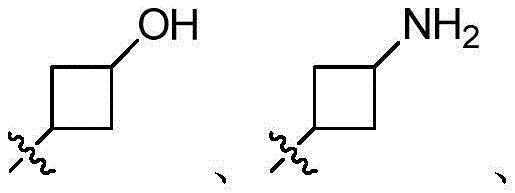
 Or 4-methylcyclohexyl), substituted or unsubstituted C1~C20Alkoxy (e.g. 2-dimethylamino-ethoxy; said "C1~C20Alkoxy "may be methoxy or ethoxy), substituted or unsubstituted C3~C12Aryl, substituted or unsubstituted C1~C9Heteroaryl, or substituted or unsubstituted C1~C9Heterocycloalkyl (e.g. phenyl)

 ) Or is
 Wherein, said "C1~C9Heterocycloalkyl "is attached through a carbon atom or heteroatom and another group therein;
said R8And R9Each R in (1)10aAnd R10bIndependently hydrogen, halogen, substituted or unsubstituted C1~C20Alkyl (e.g. 2-dimethylamino-ethyl or 2-hydroxyethyl; wherein "C" is defined herein1~C20Alkyl "may be ethyl), substituted or unsubstituted C2~C20Alkenyl, substituted or unsubstituted C2~C20Alkynyl, substituted or unsubstituted C3~C12Cycloalkyl, substituted or unsubstituted C1~C9Heteroaryl, substituted or unsubstituted C3~C12Aryl, substituted or unsubstituted C1~C9Heterocycloalkyl (e.g. phenyl) ) (ii) a Wherein, said "C1~C9Heterocycloalkyl "is attached through a carbon atom or heteroatom and another group therein;
said R5、R8、R9、R10aAnd R10bEach of the "substituted or unsubstituted C" s mentioned in (1)1~C20Alkyl group, substituted or unsubstituted C2~C20Alkenyl "," substituted or unsubstituted C2~C20Alkynyl group "," substituted or unsubstituted C3~C12Cycloalkyl "," substituted or unsubstituted C1~C9Heterocycloalkyl "," substituted or unsubstituted C3~C12Aryl group, substituted or unsubstituted C1~C9Heteroaryl group, substituted or unsubstituted C1~C20Alkanemercapto "and" substituted or unsubstituted C1~C20The "substitution" in "alkoxy" is independently substituted with one or more of the following groups, which when present are the same or different: C1~C20alkyl (e.g. methyl, isopropyl), C2~C20Alkenyl (e.g. vinyl), C2~C20Alkynyl (e.g. 2-propynyl), hydroxy, nitro, carboxyl, aldehyde, mercapto, trifluoromethyl, C1~C20Silane radicals (e.g. silane
 Wherein R issi1、Rsi2、Rsi3Each independently is C1~C3Alkyl, e.g. methyl), halogen (e.g. fluoro, which may be 1,2 or 3), cyano, C1~C20Alkoxy (e.g. methoxy), C3~C12Cycloalkyl, substituted or unsubstituted C1~C9Saturated or unsaturated heterocycloalkyl (said "substituted" being substituted by one or more substituents which, when present, are identical or different, methylene, oxo, thio, halogen, trifluoromethyl, hydroxy, -PO (OH)2、-PO(ORps)2Propinyl substituted or unsubstituted C1~C20Alkyl, ethynyl substituted or unsubstituted C1~C20Alkyl radical, C1~C6Alkenyl radical, C1~C20Alkynyl, -B (OH)2and-B (OR)bs)2Wherein R ispsAnd RbsIndependently is C1~C6Alkyl, e.g. methyl, ethyl or propyl, said C1~C20Alkyl radicalCan be C1~C6Alkyl groups such as methyl, ethyl or propyl; unsaturated heterocycloalkyl radicals such as
 Saturated heterocycloalkyl radicals such as

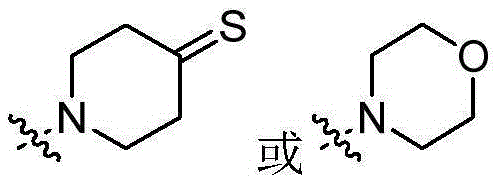 )、
)、 Thioureido group, C3~C12Aryl radical, C1~C9A heteroaryl group,

 -SeR19and-SF5(ii) a Wherein the heteroatom may be oxidized and the N atom may be quaternized; wherein said "heterocycloalkyl" is attached via a carbon atom or a heteroatom and another group therein;
 the N atom in (1) is in an oxidized state or a non-oxidized state;
wherein R is11aAnd R11bIndependently hydrogen, halogen, substituted or unsubstituted C1~C20Alkyl (e.g. substituted or unsubstituted C)1~C6Alkyl, preferably substituted or unsubstituted C1、C2Or C3An alkyl group; and also for example-CF3(ii) a And also for example hydroxyethyl, 2-dimethylaminoethyl), substituted orUnsubstituted C2~C20Alkenyl (e.g. 2-propenyl), substituted or unsubstituted C2~C20Alkynyl (e.g. 2-propynyl), substituted or unsubstituted C3~C12Cycloalkyl, substituted or unsubstituted C1~C9Heterocycloalkyl (e.g. phenyl) Said substituent being, for example, "C1~C20Alkyl "), guanidino, thioureido, substituted or unsubstituted C3~C12Aryl, substituted or unsubstituted C1~C9A heteroaryl group,
 -SeR26or-SF5(ii) a Wherein the heteroatom may be oxidized and the N atom may be quaternized; wherein said "heterocycloalkyl" is attached to another group through a carbon atom or a heteroatom; or,
 in R11a、R11bAnd N to which they are attached together form
 Wherein t and u are independently 1,2 or 3, RcIs C (R)cs)2、NRcs、O、S、Si(Rcs)2Or Se, each RcsIndependently H, C1~C6Alkyl (e.g., methyl, ethyl, propyl, or isopropyl), or B (OH)2(ii) a Or,
 in R11a、R11bAnd N to which they are attached together form
 Wherein v and w are independently 1,2 or 3, RchIs CH or PH2,RcxIs CH2O, S or ═ N-OH, RcxPreferably with RchConnection (e.g. of
 ),RhcIs H or C1~C6Alkyl (e.g. methyl, ethyl or propyl), preferably when R ischWhen is P, RhcIs C1~C6An alkyl group; or,
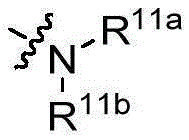 in R11a、R11bAnd N to which they are attached together form
 Wherein v1 and w1 are independently 1,2 or 3, Rc1And Rc2Independently O, NH or N-CN;
wherein, R is11aAnd R11bThe "substituted or unsubstituted C" as described in (1)1~C20Alkyl group, substituted or unsubstituted C2~C20Alkenyl "," substituted or unsubstituted C2~C20Alkynyl group "," substituted or unsubstituted C3~C12Cycloalkyl "," substituted or unsubstituted C1~C9Heterocycloalkyl "," substituted or unsubstituted C3~C12Aryl "and" substituted or unsubstituted C1~C9The "substitution" in "heteroaryl is independently substituted with one or more of the following groups, which are the same or different when a plurality of substituents are present: c1~C20Alkyl radical, C2~C20Alkenyl (e.g. vinyl), C2~C20Alkynyl (such as ethynyl), hydroxy, nitro, carboxyl, aldehyde group, mercapto, C1~C20Silane radicals (e.g. silane Wherein R issi1、Rsi2、Rsi3Each independently is C1~C3Alkyl, such as methyl), halogen,
 Trifluoromethyl, cyano, C1~C20Alkoxy radical, C3~C12Cycloalkyl radical, C1~C9Heterocycloalkyl radical, C3~C12Aryl radical, C1~C9A heteroaryl group,

 -SeR26、
 and-SF5(ii) a Wherein the heteroatom may be oxidized and the N atom may be quaternized; wherein said "heterocycloalkyl" is attached to another group through a carbon atom or a heteroatom;
wherein each R is12Independently of one another hydrogen, halogen, C1~C20Alkyl (e.g. methyl), C2~C20Alkenyl radical, C2~C20Alkynyl, hydroxy, -CF3、-SF5、C1~C20Alkoxy (e.g. methoxy or ethoxy) or
Wherein R is13Is hydrogen, C1~C20Alkyl (e.g. methyl), C2~C20Alkenyl radical, C2~C20Alkynyl, hydroxy, -CF3、-SF5Or
Wherein each R is14Independently of one another, halogen, C1~C20Alkyl radical, C2~C20Alkenyl radical, C2~C20Alkynyl, hydroxy, -CF3、-SF5、C1~C20Alkoxy or
Wherein each R is15、R16aAnd R16bIndependently hydrogen, halogen, hydroxyl, cyano, nitro, amino, aldehyde, C1~C20Alkoxy radical, C1~C20Alkanemercapto group, C1~C20Alkyl (e.g. methyl), C2~C20Alkenyl radical, C2~C20Alkynyl, alkynyl, -CF3、-SF5、C3~C12Cycloalkyl radicals, or "C1~C20Alkyl substituted or unsubstituted C1~C9Heterocycloalkyl "(e.g. phenyl)
 ) (ii) a Wherein, said "C1~C9Heterocycloalkyl "is attached through a carbon atom or heteroatom and another group therein;
wherein R is17aIndependently hydrogen, halogen, hydroxyl, cyano, nitro, amino, aldehyde, C1~C20Alkoxy radical, C1~C20Alkanemercapto group, C1~C20Alkyl (e.g. methyl), C2~C20Alkenyl radical, C2~C20Alkynyl, -CF3、-SF5、-SeR26、 C3~C12Cycloalkyl radicals or "C1~C20Alkyl substituted or unsubstituted C1~C9Heterocycloalkyl "(e.g. phenyl)
 ) (ii) a Wherein, said "C1~C9Heterocycloalkyl "is attached through a carbon atom or heteroatom and another group therein;
wherein R is17bIndependently hydrogen, halogen, hydroxyl, cyano, nitro, amino, aldehyde, C1~C20Alkoxy radical, C1~C20Alkyl radical, C2~C20Alkenyl radical, C2~C20Alkynyl, -CF3、-SF5、 -OR28、C3~C12Cycloalkyl radicals or "C1~C20Alkyl substituted or unsubstituted C1~C9Heterocycloalkyl "; wherein, said "C1~C9Heterocycloalkyl "is attached through a carbon atom or heteroatom and another group therein;
or, R17aAnd R17bTo carbon atoms, nitrogen atoms, or the like bound thereto Together form a substituted or unsubstituted C1~C9A heterocycloalkyl group; wherein "substituted or unsubstituted C1~C9The "substitution" in "heterocycloalkyl group is independently substituted with one or more of the following groups, which are the same or different when a plurality of substituents are present: c1~C20Alkyl radical, C2~C20Alkenyl (e.g. vinyl), C2~C20Alkynyl (such as ethynyl), hydroxy, nitro, carboxyl, aldehyde group, mercapto, C1~C20Silane radicals (e.g. silane
 Wherein,Rsi1、Rsi2、Rsi3Each independently is C1~C3Alkyl, such as methyl), halogen,
 Trifluoromethyl, cyano, C1~C20Alkoxy radical, C3~C12Cycloalkyl radical, C1~C9Heterocycloalkyl radical, C3~C12Aryl radical, C1~C9A heteroaryl group,
 -SeR26、
 and-SF5(ii) a Wherein, said "substituted or unsubstituted C1~C9Heterocycloalkyl "is attached through a carbon atom or heteroatom and another group therein;
wherein R is18aAnd R18bIndependently hydrogen, halogen, hydroxy, cyano, C1~C20Alkoxy radical, C1~C20Alkyl radical, C2~C20Alkenyl radical, C2~C20Alkynyl, -CF3、-SF5、C3~C12Cycloalkyl radicals or "C1~C20Alkyl substituted or unsubstituted C1~C9Heterocycloalkyl "; wherein, said "C1~C9Heterocycloalkyl "is attached through a carbon atom or heteroatom and another group therein;
or, R18a、R18bTogether with the heteroatom to which they are attached form a substituted or unsubstituted C1~C9A heterocycloalkyl group; wherein "substituted or unsubstituted C1~C9The "substitution" of heterocycloalkyl "is independently by one or more of the following groups, when more than one substituent is presentWhen, the substituents are the same or different: c1~C20Alkyl radical, C2~C20Alkenyl (e.g. vinyl), C2~C20Alkynyl (such as ethynyl), hydroxy, nitro, carboxyl, aldehyde group, mercapto, C1~C20Silane radicals (e.g. silane Wherein R issi1、Rsi2、Rsi3Each independently is C1~C3Alkyl, such as methyl), halogen,
 Trifluoromethyl, cyano, C1~C20Alkoxy radical, C3~C12Cycloalkyl radical, C1~C9Heterocycloalkyl radical, C3~C12Aryl radical, C1~C9A heteroaryl group,
 -SeR26、
 and-SF5(ii) a Wherein, said "C1~C9Heterocycloalkyl "is attached through a carbon atom or heteroatom and another group therein;
wherein R is19Is C1~C20Alkyl radical, C2~C20Alkenyl radical, C2~C20Alkynyl, C3~C12Cycloalkyl radical, C1~C9Heterocycloalkyl radical, C3~C12Aryl radical, C1~C9A heteroaryl group;
wherein, R is20Independently of one another hydrogen, halogen, C1~C20Alkyl radical, C2~C20Alkenyl radical, C2~C20Alkynyl, hydroxyl,-CF3、-SF5、C3~C5Heteroaryl (wherein the number of heteroatoms is 1 to 3 and the heteroatom is O, N or S, e.g. )、C1~C20Alkoxy or
Wherein, R is11aAnd R11bR in (1)21Independently of one another, halogen, C1~C20Alkyl radical, C2~C20Alkenyl radical, C2~C20Alkynyl, hydroxy, -CF3、-SF5、C1~C20Alkoxy or
Wherein, R is22、R23aAnd R23bIndependently hydrogen, halogen, hydroxyl, cyano, nitro, amino, aldehyde, C1~C20Alkoxy radical, C1~C20Alkanemercapto group, C1~C20Alkyl radical, C2~C20Alkenyl radical, C2~C20Alkynyl, alkynyl, -CF3、-SF5、C3~C12Cycloalkyl radicals, or "C1~C20Alkyl substituted or unsubstituted C1~C9Heterocycloalkyl "; wherein, said "C1~C9Heterocycloalkyl "is attached through a carbon atom or heteroatom and another group therein;
wherein, R is24aIndependently hydrogen, halogen, hydroxyl, cyano, nitro, amino, aldehyde, C1~C20Alkoxy radical, C1~C20Alkanemercapto group, C1~C20Alkyl (e.g. methyl), C2~C20Alkenyl radical, C2~C20Alkynyl, -CF3、-SF5、 -SeR31,C3~C12Cycloalkyl radicals or "C1~C20Alkyl substituted or unsubstituted C1~C9Heterocycloalkyl "; wherein, said "C1~C9Heterocycloalkyl "is attached through a carbon atom or heteroatom and another group therein;
wherein, R is24bIndependently hydrogen, halogen, hydroxyl, cyano, nitro, amino, aldehyde, C1~C20Alkoxy radical, C1~C20Alkyl (e.g. methyl), C2~C20Alkenyl radical, C2~C20Alkynyl, -CF3、-SF5、 -OR32、C3~C12Cycloalkyl radicals or "C1~C20Alkyl substituted or unsubstituted C1~C9Heterocycloalkyl "(e.g. phenyl)
 ) (ii) a Wherein, said "C1~C9Heterocycloalkyl "is attached through a carbon atom or heteroatom and another group therein;
or, R24aAnd R24bTogether with the carbon and nitrogen atoms to which they are attached form a substituted or unsubstituted C1~C9A heterocycloalkyl group; wherein "substituted or unsubstituted C1~C9The "substitution" in "heterocycloalkyl group is independently substituted with one or more of the following groups, which are the same or different when a plurality of substituents are present: halogen, hydroxyl, cyano, nitro, amino, aldehyde group,Carboxy, mercapto, C1~C20Silyl radical, C1~C20Alkoxy radical, C1~C20Alkyl (e.g. methyl), C2~C20Alkenyl (e.g. vinyl), C2~C20Alkynyl (e.g. ethynyl), -CF3、-SF5、 -OR32、
 C3~C12Cycloalkyl radical, C1~C9Heterocycloalkyl radical, C3~C12Aryl radical, C1~C9A heteroaryl group,

 -SeR31、“C1~C20Alkyl monosubstituted, disubstituted or unsubstituted amino' and-SF5(ii) a Wherein, said "substituted or unsubstituted C1~C9Heterocycloalkyl "is attached through a carbon atom or heteroatom and another group therein;
wherein, R is25aAnd R25bIndependently hydrogen, halogen, hydroxy, cyano, C1~C20Alkoxy (e.g. ethoxy), C1~C20Alkyl (e.g. methyl), C2~C20Alkenyl radical, C2~C20Alkynyl, -CF3、-SF5、C3~C12Cycloalkyl radicals or "C1~C20Alkyl substituted or unsubstituted C1~C9Heterocycloalkyl "(e.g. phenyl) Or
Or ) (ii) a Wherein, said "C1~C9Heterocycloalkyl "is attached through a carbon atom or heteroatom and another group therein;
or, R25aAnd R25bTogether with the heteroatom to which they are attached form a substituted or unsubstituted C1~C9A heterocycloalkyl group; wherein "substituted or unsubstituted C1~C9The "substitution" in "heterocycloalkyl group is independently substituted with one or more of the following groups, which are the same or different when a plurality of substituents are present: halogen, hydroxy, cyano, nitro, amino, aldehyde, carboxyl, mercapto, C1~C20Silyl radical, C1~C20Alkoxy radical, C1~C20Alkyl (e.g. methyl), C2~C20Alkenyl (e.g. vinyl), C2~C20Alkynyl (e.g. ethynyl), -CF3、-SF5、 -OR32、
 C3~C12Cycloalkyl radical, C1~C9Heterocycloalkyl radical, C3~C12Aryl radical, C1~C9A heteroaryl group,

 -SeR31、“C1~C20Alkyl monosubstituted, disubstituted or unsubstituted amino' and-SF5(ii) a Wherein, said "C1~C9Heterocycloalkyl "is attached through a carbon atom or heteroatom and another group therein;
wherein, R is26Independently is C1~C20Alkyl radical, C2~C20Alkenyl radical, C2~C20Alkynyl, C3~C12Cycloalkyl radical, C1~C9Heterocycloalkyl radical, C3~C12Aryl or C1~C9A heteroaryl group;
wherein, R is27aAnd R27bIndependently hydrogen, halogen, hydroxy, cyano, aldehyde, C1~C20Alkoxy radical, C2~C20Alkenyl radical, C2~C20Alkynyl, -CF3、-SF5、C3~C12Cycloalkyl, substituted or unsubstituted C1~C9Heterocycloalkyl (e.g. phenyl) )、
)、 Or substituted or unsubstituted C1~C20Alkyl (e.g. C)1~C6Alkyl, preferably methyl, ethyl or propyl); wherein, said "substituted or unsubstituted C1~C20Alkyl "and" substituted or unsubstituted C1~C9The "substitution" in "heterocycloalkyl group is independently substituted with one or more of the following groups, which are the same or different when a plurality of substituents are present: halogen, C1~C20Alkoxy radical, C1~C20Alkanethiol and C1~C20A silane group; wherein, said "C1~C9Heterocycloalkyl "is attached through a carbon atom or heteroatom and another group therein;
wherein, R is28Independently is C1~C20Alkyl radical, C2~C20Alkenyl radical, C2~C20Alkynyl, alkynyl,Or, substituted or unsubstituted C1~C20A silane group; wherein, said "substituted or unsubstituted C1~C20The substituent in the silyl radical being C2~C20Alkenyl or C2~C20An alkynyl group;
wherein, R is29aAnd R29bIndependently is hydrogen, halogen, hydroxy, cyano, aldehyde, C1~C20Alkoxy radical, C2~C20Alkenyl radical, C2~C20Alkynyl, -CF3、-SF5、C3~C12Cycloalkyl, substituted or unsubstituted C1~C9Heterocycloalkyl (e.g. phenyl) ) Or, substituted or unsubstituted C1~C20An alkyl group; wherein, said "substituted or unsubstituted C1~C20Alkyl "and" substituted or unsubstituted C1~C9The "substitution" in "heterocycloalkyl group is independently substituted with one or more of the following groups, which are the same or different when a plurality of substituents are present: halogen, C1~C20Alkoxy radical, C1~C20Alkanethiol and C1~C20A silane group; wherein, said "C1~C9Heterocycloalkyl "is attached through carbon atoms and other groups therein;
wherein, R is30Independently hydrogen, hydroxy, halogen substituted or unsubstituted C1~C20Alkyl, or, C1~C20Alkyl mono-, di-or unsubstituted amino;
wherein, R is31Independently hydrogen, cyano, nitro, hydroxy, C1~C20Alkyl radical, C2~C20Alkenyl radical, C2~C20Alkynyl, C3~C12Cycloalkyl radical, C1~C9Heterocycloalkyl radical, C6~C12Aryl, or C1~C9A heteroaryl group;
wherein, R is32Independently is C1~C20Alkyl radical, C2~C20Alkenyl radical, C2~C20Alkynyl, or, substituted or unsubstituted C1~C20A silane group; wherein, said "substituted or unsubstituted C1~C20The substituent in the silyl radical being C2~C20Alkenyl or C2~C20An alkynyl group;
wherein each R is33aAnd R33bIndependently hydrogen, hydroxy, cyano, nitro, halogen, C1~C20Alkyl radical, C2~C20Alkenyl radical, C2~C20Alkynyl, C1~C20Alkoxy radical, C3~C12Cycloalkyl radical, C1~C9Heterocycloalkyl radical, C6~C12Aryl, or C1~C9A heteroaryl group;
R6a、R6b、R6cand R6dIndependently hydrogen, hydroxy, C1~C20Alkyl radical, C3~C12Cycloalkyl or C3~C12Heterocycloalkyl, but said R is6aAnd said R6bNot simultaneously being hydroxyl, R6cAnd said R6dNot being hydroxyl at the same time; or, R6a、R6bThe carbon to which they are attached forms a carbonyl group; or, R6c、R6dThe carbon to which they are attached forms a carbonyl group;
the hetero atoms in the heterocycloalkyl and the heteroaryl are 1-7 and are selected from one or more of oxygen, nitrogen, phosphorus, sulfur, selenium, boron and silicon;
and, said compound I is not any of the following:

preferably, the above-mentioned "substituted or unsubstituted C2~C20Alkenyl "and" C2~C20C in alkenyl ″)2~C20Alkenyl is independently C2~C12An alkenyl group; more preferably, the above-mentioned "substituted or unsubstituted C2~C20C in alkenyl ″)2~C20Alkenyl is independently C2~C6An alkenyl group.
Preferably, the above-mentioned "substituted or unsubstituted C2~C20Alkynyl "and" C2~C20C in alkynyl2~C20Alkynyl is independently C2~C12An alkynyl group; more preferably, the above-mentioned "substituted or unsubstituted C2~C20C in alkynyl2~C20Alkynyl is independently C2~C6Alkynyl.
Preferably, the above-mentioned "substituted or unsubstituted C1~C20Alkyl group "," C1~C20Alkyl "and" C1~C20C in alkyl monosubstituted, disubstituted or unsubstituted amino1~C20Alkyl is independently C1~C12An alkyl group; more preferably, the above-mentioned "substituted or unsubstituted C1~C20C in alkyl2~C20Alkyl is independently C1~C6An alkyl group; most preferably, the above-mentioned "substituted or unsubstituted C1~C20C in alkyl2~C20Alkyl is independently C1~C3An alkyl group.
Preferably, the above-mentioned "substituted or unsubstituted C1~C20Alkanemercapto "and" C1~C20C in alkanemercapto1~C20Alkanethiol independently is C1~C12An alkylmercapto group; more preferably, the above-mentioned "substituted or unsubstituted C1~C20C in alkanemercapto2~C20Alkanethiol independently is C1~C6An alkylmercapto group; most preferably, the above-mentioned "substituted or unsubstituted C1~C20C in alkanemercapto2~C20Alkanethiol independently is C1~C3An alkanethiol group.
Preferably, the above-mentioned "substituted or unsubstituted C1~C20Alkoxy "and" C1~C20C in alkoxy ″)1~C20Alkoxy is independently C1~C12An alkoxy group; more preferably, the above-mentioned "substituted or unsubstituted C1~C20C in alkoxy ″)1~C20Alkoxy is independently C1~C6An alkoxy group; most preferably, the above-mentioned "substituted or unsubstituted C1~C20C in alkoxy ″)1~C20Alkoxy is independently C1~C3An alkoxy group.
Preferably, the above-mentioned "C" is1~C20Silyl groups "independently being" C1~C12Silane groups "; more preferably, "C" as defined above1~C20Silyl groups "independently being" C1~C6Silane groups "; most preferably, the above-mentioned "C1~C20Silyl groups "independently being" C1~C3Silane groups ".
Preferably, the above-mentioned "substituted or unsubstituted C3~C12C in cycloalkyl3~C12Cycloalkyl is independently C3~C8A cycloalkyl group; more preferably, the above-mentioned "substituted or unsubstituted C3~C12C in cycloalkyl3~C12Cycloalkyl is independently C3~C6A cycloalkyl group.
Preferably, the above-mentioned "substituted or unsubstituted C1~C9C in heterocycloalkyl1~C9Heterocycloalkyl is independently "a heteroatom of one or more of boron, silicon, oxygen, sulfur, selenium, nitrogen and phosphorus, the number of heteroatoms being 1-4 (e.g. 1-3)" C3~C8A heterocycloalkyl group; preferably, the above-mentioned "substituted or unsubstituted C1~C9C in heterocycloalkyl1~C9Heterocycloalkyl is independently "heteroatom is boron, siliconOne or more of oxygen, sulfur, selenium, nitrogen and phosphorus, the number of hetero atoms is 1-4 (for example, 1-3)' C3~C5A heterocycloalkyl group.
Preferably, the above-mentioned "substituted or unsubstituted C1~C9C in heteroaryl1~C9Heteroaryl is independently C1~C6A heteroaryl group; more preferably, the above-mentioned "substituted or unsubstituted C1~C9C in heteroaryl1~C9Heteroaryl is independently 'heteroatom is one or more of boron, silicon, oxygen, sulfur, selenium, nitrogen and phosphorus, and the number of heteroatoms is 1-4' C1~C6A heteroaryl group.
Preferably, the above-mentioned "substituted or unsubstituted C3~C12C in aryl3~C12Aryl is independently C6~C10And (4) an aryl group.
In certain embodiments, the above definition is preferably as follows:
in the compound I, preferably, p is 1, q is 1, m is 0 or 1, and n is 0.
In the compound I, preferably, X is N.
In the compound I, preferably, R is1Is halogen or trifluoromethyl.
In the compound I, preferably, R is2Is C1~C6An alkyl group.
In the compound I, preferably, R is3Is substituted or unsubstituted C1~C6Alkyl, or, substituted or unsubstituted C3~C8A cycloalkyl group.
In the compound I, preferably, R is4Is halogen.
In the compound I, preferably, R is5Is hydrogen, substituted or unsubstituted C1~C6Alkyl, aryl, heteroaryl, and heteroaryl,

In the compound I, preferably, R is8Independently is substituted or unsubstituted C1~C6Alkyl, or, C1~C6An alkoxy group.
In the compound I, preferably, R is9Is vinyl, substituted or unsubstituted C1~C6Alkyl, substituted or unsubstituted C3~C8Cycloalkyl, substituted or unsubstituted "hetero atom is one or more of oxygen, sulfur and nitrogen, the number of hetero atoms is 1 to 4, heterocycloalkyl group having 3 to 8 carbon atoms", substituted or unsubstituted C1~C6Alkoxy or
In the compound I, preferably, R is10aAnd R10bIndependently hydrogen, or, substituted or unsubstituted C1~C6An alkyl group.
In the compound I, preferably, R is5、R8、R9、R10aAnd R10bThe "substituted or unsubstituted C" as described in (1)1~C20Alkyl group, substituted or unsubstituted C3~C12Cycloalkyl "," substituted or unsubstituted C1~C9Heterocycloalkyl "and" substituted or unsubstituted C1~C20The "substitution" in "alkoxy" is independently substituted with one or more of the following groups, which when present are the same or different: hydroxy, halogen, C1~C3Alkoxy, "substituted or unsubstituted C1~C9Saturated or unsaturated heterocycloalkyl "and
in the compound I, preferably, R is11aAnd R11bIndependently is hydrogen, or, C1~C6An alkyl group.
In the compound I, preferably, R is12Is hydroxy, C1~C6Alkoxy or
In the compound I, preferably, R is27aAnd R27bIndependently is C1~C6An alkyl group.
In the compound I, preferably, R is6a、R6b、R6cAnd R6dIndependently is hydrogen; or, R6cAnd R6dAnd the carbon to which they are attached form a carbonyl group.
In certain embodiments, the above definition is preferably as follows:
p is preferably 1.
q is preferably 1.
n is preferably 0.
m is preferably 1.
X is preferably N.
Y is preferably CH.
Ring (C) The N atom in (1) is preferably in an oxidized or unoxidized state;
R6a、R6b、R6cand R6dPreferably hydrogen.
R1Preferably halogen (e.g. fluorine).
R2Preferably C1~C6An alkyl group.
R3Preferably substituted or unsubstituted C1~C20Alkyl (e.g. isopropyl or tert-butyl)Butyl), or, substituted or unsubstituted C3~C12Cycloalkyl (e.g. 1-methylcyclopropyl or cyclopropyl).
R4Preferably halogen (e.g. fluorine).
R5Preferably substituted C1~C20Alkyl (e.g., substituted ethyl; also e.g., substituted isopropyl).
Said R5The "substituted C" as described in (1)1~C20The "substitution" described in the "alkyl group" is preferably substituted with one or more of the following groups, and when a plurality of substituents are present, the substituents are the same or different: substituted or unsubstituted C1~C9A saturated or unsaturated heterocycloalkyl group,
 The N atom in (1) is in an oxidized state or a non-oxidized state.
Preferably, R11aAnd R11bIndependently hydrogen, substituted or unsubstituted C1~C20Alkyl (e.g. substituted or unsubstituted C)1~C6Alkyl, preferably substituted or unsubstituted C1、C2Or C3An alkyl group; and also for example-CF3(ii) a E.g. hydroxyethyl, 2-dimethylaminoethyl), or, Or,
Or, in R11a、R11bAnd N to which they are attached together form
 Wherein t and u are independently 1,2 or 3, RcIs C (R)cs)2、NRcs、O、S、Si(Rcs)2Or Se, each RcsIndependently H, C1~C6Alkyl (e.g., methyl, ethyl, propyl, or isopropyl), or B (OH)2(ii) a Or,
 in R11a、R11bAnd N to which they are attached together form
 Wherein v and w are independently 1,2 or 3, RchIs CH or PH2,RcxIs CH2O, S or ═ N-OH, RcxPreferably with RchConnection (e.g. of
 ),RhcIs H or C1~C6Alkyl (e.g. methyl, ethyl or propyl), preferably when R ischWhen is P, RhcIs C1~C6An alkyl group.
Preferably, R15Is C1~C6An alkyl group.
Preferably, R11aAnd R11bThe "substituted or unsubstituted C" as described in (1)1~C20The "substitution" in "alkyl is independently substituted with one or more of the following groups, which are the same or different when a plurality of substituents are present: hydroxy, C1~C6Silane group,
R24aPreferably hydrogen.
R24bPreferably C1~C6An alkyl group.
Preferably, R25aAnd R25bIndependently is hydroxy or C1~C6Alkoxy groups (e.g., ethoxy groups).
Preferably, R27aAnd R27bIndependently is C1~C6An alkyl group.
Preferably, the compound I in the present invention is any one of the following compounds:


the nitrogen-containing fused heterocyclic compound related to the present invention can exhibit tautomerism, structural isomerism and stereoisomerism. The invention includes any tautomeric or structural or stereoisomeric form and mixtures thereof, which are highly selective for CDK4 and CDK6 and have high inhibitory activity against them, and at the same time, have good inhibitory activity against breast cancer cells, and the effect is not limited to any one isomeric or mixture thereof.
The nitrogen-containing fused heterocyclic compounds of the present invention can be prepared by various methods well known to those skilled in the art of organic synthesis and pharmaceutical chemistry, and can be synthesized by the methods described hereinafter, together with synthetic methods known in the art of organic chemistry or variations thereon as understood by those skilled in the art.
The process for producing a nitrogen-containing fused heterocyclic compound of the present invention can produce the compound of the present invention from readily available starting materials using the following general methods and procedures. It will be understood that when typical or preferred process operating conditions (i.e., reaction temperature, time, mole ratios of reactants, solvents, pressures, etc.) are given; other process conditions may also be used unless otherwise indicated. Optimum reaction conditions may vary with the particular reactants or solvents used, but these conditions can be determined by one skilled in the art by routine optimization procedures.
The process for the preparation of the nitrogen-containing fused heterocyclic compounds of the present invention described herein can be monitored according to any suitable method known in the art. The production of the product is monitored, for example, by nuclear magnetic resonance, infrared spectroscopy, spectrophotometry or mass spectrometry, HPLC or thin layer chromatography.
The preparation method of the nitrogen-containing fused heterocyclic compound can involve the protection and deprotection of a plurality of chemical groups. The need for protection and deprotection, and the choice of an appropriate protecting group, can be readily determined by those skilled in the art, and the chemistry of the protecting group is found, for example, in Greene et al, Protective Groups in Organic Synthesis, second edition, Wiley & Sons,1991, which is incorporated herein by reference in its entirety.
The preparation described herein can be carried out in a suitable solvent, which is readily selected by a person skilled in the art of organic synthesis. Suitable solvents are substantially free of side reactions with the starting materials, intermediates or products at the temperatures at which the reactions described are carried out, which can range from the freezing point of the solvent to the boiling point of the solvent, and a given reaction can be carried out in one solvent or a mixture of solvents. Depending on the particular reaction step, a solvent suitable for the particular reaction step may be selected.
On the basis, the invention also provides a preparation method of the nitrogen-containing fused heterocyclic compound, which is any one of the following methods, by particularly preferably (but not limited to reagents and solvents in reaction conditions):
the method comprises the following steps:
when R is5In the case of hydrogen, the process for the preparation of the compounds of formula I comprises the following steps: obtaining 1C by Suzuki coupling reaction, and reacting the compound shown as the formula 1C with Performing Buchwald coupling, and removing a protecting group to obtain a compound shown in a formula I; PG on the compound represented by formula 1D is a protecting group;

wherein, X, Y, m, n, p, q and R are1、R2、R3、R4、R6a、R6b、R6cAnd R6dAre all as described above;
PG in said compound of formula 1D may be any of the various conventional amino protecting groups in the art, preferably Boc for the purpose of protecting the amino group in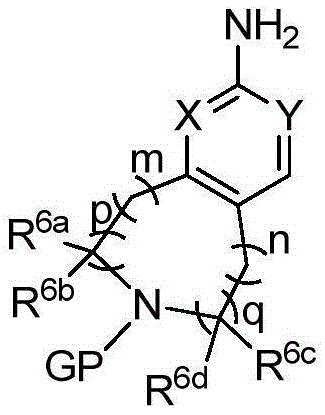 When reacting with the compound 1C, certain active groups (such as amino) on the compound do not participate in the reaction;
the conditions of the reaction for removing the protecting group can be the conventional conditions for removing various protecting groups in the field, such as the conditions of hydrolysis reaction, aminolysis reaction, hydrogenation reaction and the like;
after the reaction for removing the protecting group is finished, preferably, the method can further comprise the operation of post-treatment; the methods and conditions of the work-up may be those conventional in the art for such post-reaction work-up, and are preferably: washing, drying, filtering and evaporating a solvent of a reaction system, and then carrying out column chromatography; or evaporating the solvent of the reaction system, washing and filtering; or evaporating the reaction system to remove the solvent, and carrying out thin-layer chromatography;
the conditions of the substitution reaction or the transition metal catalyzed coupling reaction may be any of those conventional in the art for such reactions; the substitution reaction can be carried out under the conditions of heating, pressurization, acid-base catalysis and the like;
wherein the conditions of the method for the reaction of each step in the reaction scheme may be carried out according to the conventional conditions of the method for these reactions in the art;
the second method comprises the following steps:
when R is5When the compound is hydrogen, the preparation method of the compound shown in the formula I comprises the following steps: 1C in the first method is subjected to ammonolysis and then is subjected to Reacting to obtain 2A, and removing a protecting group to obtain a compound shown in a formula I;

the X, Y, m, n, p, q and R1、R2、R3、R4、R6a、R6b、R6cAnd R6dAre all as described above;
the third method comprises the following steps:
when R is5Is composed of And R is11Is substituted or unsubstituted C1~C6Alkyl, or, substituted or unsubstituted C3~C8When the compound is cycloalkyl, the preparation method of the compound shown in the formula I comprises the following steps: reacting compound 3A with a condensing agent (e.g., HOBt and EDCI) in an organic solvent (e.g., one or more of 1, 4-dioxane, dichloromethane, and DMF) in the presence of a condensing agent
 Carrying out condensation reaction to obtain a compound I; the conditions of the condensation reaction may be those conventional in the art for such reactions;

the X, Y, m, n, p, q and R1、R2、R3、R4、R11、R6a、R6b、R6cAnd R6dAre all as described above;
the method four comprises the following steps:
when R is5Is composed of The preparation method of the compound shown in the formula I comprises the following steps: reacting compound 4A with an organic solvent (e.g., tetrahydrofuran) in the presence of a base (e.g., pyridine)
 Carrying out a reaction to obtain a compound 4B, and then carrying out a hydrolysis reaction on the compound 4B to obtain a compound I; the conditions for the amide reaction and hydrolysis reaction may be those conventional in the art for such reactions;

the X, Y, m, n, p, q and R1、R2、R3、R4、R6a、R6b、R6c、R6dAnd R8Are all as described above;
the method five comprises the following steps:
when R is5Is composed of R11Is substituted C1~C6Alkyl or C3~C8Cycloalkyl and the substituents are
 R13bWhen the compound is H, the preparation method of the compound shown in the formula I comprises the following steps: reacting compound 5A with an organic solvent (e.g., one or more of 1, 4-dioxane, dichloromethane, and DMF) in the presence of a condensing agent (e.g., HOBt and EDCI)
 Reacting to obtain a compound 5B, and then removing a protecting group on amino to obtain a compound I; the conditions for the amide reaction and deprotection reaction may be those conventional in the art for such reactions; said R13aNH-(CH2)n1-C (═ O) -i.e. said R5(ii) a The- (CH)2)n1-i.e. said substituted C1~C6Alkyl or C3~C8A cycloalkyl group;

the X, Y, m, n, p, q and R1、R2、R3、R4、n1、R6a、R6b、R6c、R6dAnd R13aAre all as described above;
PG in said compound of formula 5B may be any of the various conventional amino protecting groups in the art, preferably Boc for the purpose of protecting the amino group in And are combined withWhen the substance 5A is reacted, some reactive groups (such as amino groups) on the substance do not participate in the reaction;
the method six:
when R is5Is composed of R11Is substituted C1~C6Alkyl or C3~C8Cycloalkyl and the substituents are
 R13aAnd R13bWhen neither is H, the preparation method of the compound shown in the formula I comprises the following steps: reacting compound 6A with an organic solvent (e.g., one or more of 1, 4-dioxane, dichloromethane, and DMF) in the presence of a condensing agent (e.g., HOBt and EDCI)
 Reacting to obtain a compound 6B, removing a protecting group on amino, and then performing reductive amination to obtain a compound I; the conditions of the amide reaction, deprotection reaction and reductive amination can be the conditions conventional in the reaction in the field; said
 Namely said R5;

The X, Y, m, n, p, q and R1、R2、R3、R4、R6a、R6b、R6c、R6d、R13aAnd R13bAre all as described above;
PG in said compound of formula 6B may be any of the various conventional amino protecting groups in the art, preferably Boc for the purpose of protecting the amino group in When reacting with the compound 6A, certain active groups (such as amino) on the compound do not participate in the reaction;
the method comprises the following steps:
when R is5Is composed of R11Is substituted C1~C6Alkyl or C3~C8Cycloalkyl and the substituents are
 R13aAnd R13bMeanwhile, the compound shown in the formula I can be prepared by the following method: reacting compound 7A with an organic solvent (e.g., one or more of 1, 4-dioxane, dichloromethane, and DMF) in the presence of a condensing agent (e.g., HOBt and EDCI)
 Reacting to obtain a compound 7B, removing a protecting group on amino, and then performing reductive amination to obtain a compound I; the conditions of the amide reaction, deprotection reaction and reductive amination can be the conditions conventional in the reaction in the field; said
 Namely said R5;

The X, Y, m, n, p, q and R1、R2、R3、R4、R6a、R6b、R6c、R6dAnd R13aAre all as described above;
PG in said compound of formula 7B may be any of the various conventional amino protecting groups in the art, preferably Boc for the purpose of protecting the amino group in When reacting with the compound I, certain active groups (such as amino) on the compound I do not participate in the reaction;
the method eight:
when R is5Is substituted or unsubstituted C1~C6Alkyl, substituted or unsubstituted C3~C8Cycloalkyl (e.g. of ) Substituted or unsubstituted C3~C8When the compound is heterocyclic alkyl, the preparation method of the compound shown in the formula I comprises the following steps: compounds 8A and R are prepared by reacting compound(s) 8A with R in an organic solvent (e.g., DMF and/or 1, 4-dioxane) in the presence of a base (e.g., N-diisopropylethylamine)5Carrying out substitution reaction on the-X to obtain a compound I; the conditions of the substitution reaction may be those conventional in the art for such reactions; x is halogen (e.g. bromine) or CH3SO3-;

The X, Y, m, n, p, q and R1、R2、R3、R4、R5、R6a、R6b、R6cAnd R6dAre all as described above;
the method comprises the following steps:
when R is5Is substituted or unsubstituted C1~C6Alkyl, substituted or unsubstituted C3~C8Cycloalkyl (e.g. of ) Or, substituted or unsubstituted C3~C8When the compound is heterocyclic alkyl, the preparation method of the compound shown in the formula I comprises the following steps: in an organic solvent (e.g., one or more of 1, 2-dichloroethane, methanol, and dioxane), in a reducing agent (e.g., triacetoxyboron)Sodium hydride and/or sodium cyanoborohydride) with R5aPerforming reductive amination reaction on the CHO to obtain a compound I; the conditions of the reductive amination reaction may be those conventional in the art for such reactions; said R5aCH2-namely said R5;

The X, Y, m, n, p, q and R1、R2、R3、R4、R5、R6a、R6b、R6cAnd R6dAre all as described above;
the method comprises the following steps:
when R is5Is substituted C1~C6Alkyl, substituted C3~C8Cycloalkyl, or, substituted C3~C8Heterocycloalkyl, and the substituents are R16When the compound is hydroxyl, the preparation method of the compound shown in the formula I comprises the following steps: compounds 10A and R are prepared by reacting compound 10A with R in the presence of a base (e.g., N-diisopropylethylamine) in an organic solvent (e.g., one or more of DMF, dichloromethane, and 1, 4-dioxane)5b-OC(=O)-(CH2)n2Carrying out substitution reaction on the-X, and hydrolyzing to obtain a compound I; the conditions for the substitution reaction and the hydrolysis reaction may be those conventional in the art for such reactions; x is halogen (e.g. bromine) or CH3SO3-; said R5bIs C1~C6Alkyl (e.g., methyl); the- (CH)2)n2-namely said R5C substituted in (A)1~C6Alkyl (which may be branched or straight chain), substituted C3~C8Cycloalkyl, or substituted C3~C8A heterocycloalkyl group; said
 Namely said R5;

The X, Y, Z, m, n, p, q and R1、R2、R3、R4、n2、R6a、R6b、R6cAnd R6dAre all as described above;
the method eleven comprises the following steps:
when R is5Is substituted C1~C6Alkyl, substituted C3~C8Cycloalkyl and the substituents are (wherein, R13aAnd R13bAt least one is hydrogen) or hydroxy, or, unsubstituted C3~C8When the compound is heterocyclic alkyl, the preparation method of the compound shown in the formula I comprises the following steps: compound 11A is reacted with PG-R in the presence of a reducing agent (e.g., sodium triacetoxyborohydride and/or sodium cyanoborohydride) in an organic solvent (e.g., one or more of 1, 2-dichloroethane, methanol, and/or dioxane)5cPerforming reductive amination reaction on the-CHO, and removing a protecting group to obtain a compound I; the conditions of the reductive amination reaction and deprotection may be conditions conventional to such reactions in the art; said R5cCH2-namely said R5;

The X, Y, Z, m, n, p, q and R1、R2、R3、R4、n2、R6a、R6b、R6cAnd R6dAre all as described above;
in the compound shown as the formula 11BPG of (a) may be any of the various conventional amino protecting groups in the art, preferably Boc, for the purpose of protecting PG-R5c-CHO is reacted with compound 11A so that some reactive groups (e.g. amino groups) thereon do not participate in the reaction;
the method twelve:
when R is5Is composed of R11Is composed of
 And R is12aAnd R12bIndependently is substituted or unsubstituted C1~C20When the compound is alkyl, the preparation method of the compound shown in the formula I comprises the following steps: in an organic solvent, in the presence of triphosgene, carrying out condensation reaction on the compound 11A and substituted or unsubstituted amino to obtain a compound I; said R12aNR12b-C (═ O) -i.e. said R5;

The X, Y, Z, m, n, p, q and R1、R2、R3、R4、n2、R6a、R6b、R6cAnd R6dAre all as described above;
the method thirteen comprises the following steps:
when R is5Is substituted C1~C20Alkyl, or substituted C1~C9Heterocycloalkyl, the substituents being C1~C20Alkyl radical, C2~C20Alkenyl radical, C2~C20Alkynyl, substituted C1~C9Heterocycloalkyl, or, C3~C12Cycloalkyl radical, and R13aAnd R13bIndependently is hydrogen, C1~C20Alkyl radical, C2~C20Alkenyl radical, C2~C20Alkynyl, C3~C12Cycloalkyl, boronic, phosphonic, guanidino, thioureido groups,
 The preparation method of the compound shown in the formula I comprises the following steps: reacting compound 13A with PG-NR in an organic solvent in the presence of a reducing agent13a-(CH2) n-CHO is subjected to reductive amination reaction, then protecting groups are removed, and a compound I is obtained through substitution reaction; said R13aNR13b-(CH2) n-is said R5(ii) a LG on the compound shown in the formula is a leaving group.

The X, Y, m, n, p, q and R1、R2、R3、R4、R5、R6a、R6b、R6cAnd R6dAre all as described above;
the method is fourteen:
when R is5Is substituted C1~C20Alkyl, or substituted C1~C9Heterocycloalkyl, the substituents being C1~C20Alkyl radical, C2~C20Alkenyl radical, C2~C20Alkynyl, substituted C1~C9Heterocycloalkyl, or, C3~C12Cycloalkyl radical, and R14a、R14bAnd R14cIndependently is hydrogen, C1~C20Alkyl radical, C2~C20Alkenyl radical, C2~C20Alkynyl, C3~C12Cycloalkyl, boronic, phosphonic, guanidino, thioureido groups,
 The preparation method of the compound shown in the formula I comprises the following steps: reacting compound 14A with PG-NR in an organic solvent in the presence of a reducing agent14a-(CH2) n-CHO is subjected to reductive amination reaction to remove protecting group, and then the protecting group is reacted with PG-NR14b-(CH2) n-CHO is subjected to reductive amination reaction, protecting groups are removed, and a compound I is obtained through substitution reaction; said R14bNR14c-(CH2)n-R14aNamely said R5(ii) a LG on the compound shown in the formula is a leaving group.

The X, Y, m, n, p, q and R1、R2、R3、R4、R5、R6a、R6b、R6cAnd R6dAre all as described above;
fifteen methods:
when R is5Is substituted C1~C20Alkyl, or substituted C1~C9Heterocycloalkyl, the substituents being C1~C20Alkyl radical, C2~C20Alkenyl radical, C2~C20Alkynyl, substituted C1~C9Heterocycloalkyl, or, C3~C12Cycloalkyl radical, and R13aAnd R13bIndependently is hydrogen, C1~C20Alkyl radical, C2~C20Alkenyl radical, C2~C20Alkynyl, C3~C12Cycloalkyl, boronic, phosphonic, guanidino, thioureido groups,
 The preparation method of the compound shown in the formula I comprisesThe method comprises the following steps: reacting compound 15A with LG- (CH) in an organic solvent in the presence of a reducing agent2) Performing substitution reaction on n-CN, and performing addition reaction to obtain a compound I; LG on the compound shown in the formula is a leaving group.

The X, Y, m, n, p, q and R1、R2、R3、R4、R5、R6a、R6b、R6cAnd R6dAre all as described above;
after the preparation method of the nitrogen-containing fused heterocyclic compound is finished, the preparation method preferably further comprises the operation of post-treatment; the methods and conditions of the work-up may be those conventional in the art for such post-reaction work-up, and are preferably: washing, drying, filtering and evaporating a solvent of a reaction system, and then carrying out column chromatography; or evaporating the solvent of the reaction system, washing and filtering; or evaporating the reaction system to remove the solvent, and carrying out thin layer chromatography.
The invention also provides a compound II, which is any one of the following compounds:


wherein m, n, p, q, X, Y, R1、R2、R3、R4、R5、R5a、R5b、R5c、R6a、R6b、R6c、R6d、R8、R13aAnd PG are as described above.
Preferably, the compound II is any one of the following compounds:

the invention also provides the application of the nitrogen-containing fused heterocyclic compound, the pharmaceutically acceptable salt, the enantiomer, the diastereomer, the tautomer, the solvate, the metabolite or the prodrug thereof in preparing a medicament for preventing or treating diseases related to abnormal cell cycle regulation; the "disease associated with abnormal cell cycle regulation" is preferably a "disease associated with abnormal cyclin-dependent kinase (preferably CDK4 and/or CDK 6)", more preferably a tumor, most preferably a malignant tumor (e.g. breast cancer).
The invention also provides application of the nitrogen-containing fused ring compound, the pharmaceutically acceptable salt, the enantiomer, the diastereomer, the tautomer, the solvate, the metabolite or the prodrug thereof in preparation of cyclin-dependent kinase (preferably CDK4 and/or CDK6) inhibitors.
The invention also provides the application of the nitrogen-containing fused ring compound, the pharmaceutically acceptable salt, the enantiomer, the diastereomer, the tautomer, the solvate, the metabolite or the prodrug thereof in preparing the medicines with the tumor cell inhibiting activity; the tumor cell is preferably a cancer cell; the cancer cell is preferably a breast cancer cell; the breast cancer cells are preferably one or more of breast cancer cells MCF-7, T-47D and ZR-75-1.
The invention also provides a pharmaceutical composition, which comprises the nitrogen-containing fused heterocyclic compound, the pharmaceutically acceptable salt thereof, the enantiomer thereof, the diastereomer thereof, the tautomer thereof, the solvate thereof, the metabolite thereof or the prodrug thereof, and at least one pharmaceutical adjuvant;
the dosage of the nitrogen-containing fused heterocyclic compound, a pharmaceutically acceptable salt thereof, an enantiomer thereof, a diastereomer thereof, a tautomer thereof, a solvate thereof, a metabolite thereof, or a prodrug thereof may be a therapeutically effective amount.
The choice of the pharmaceutical excipients depends on the administration route and the action characteristics, and can be generally fillers, diluents, binders, wetting agents, disintegrants, lubricants, emulsifiers, suspending agents and the like which are conventional in the art.
The pharmaceutical compositions may be administered by oral, injectable (intravenous, intramuscular, subcutaneous and intracoronary), sublingual, buccal, rectal, urethral, vaginal, nasal, inhalation or topical routes, the preferred route being oral.
In the present invention, unless otherwise indicated, the following terms appearing in the specification and claims of the invention have the following meanings:
the term "halogen" is preferably fluorine, chlorine, bromine, iodine, more preferably fluorine.
The term "C1~C20Alkyl "means a branched and straight chain saturated aliphatic hydrocarbon group containing 1 to 20 carbon atoms, and the alkyl group may be independently optionally substituted with one or more substituents described herein. Specific examples thereof include, but are not limited to: methyl (Me, -CH)3) Ethyl (Et, -CH)2CH3) N-propyl (n-Pr, -CH)2CH2CH3) Isopropyl (i-Pr, -CH (CH)3)2) N-butyl (n-Bu, -CH)2CH2CH2CH3) 2-methylpropyl or isobutyl (i-Bu, -CH)2CH(CH3)2) 1-methylpropyl or sec-butyl (s-Bu, -CH (CH)3)CH2CH3) Tert-butyl (t-Bu, -C (CH)3)3) N-pentyl (-CH)2CH2CH2CH2CH3) 2-pentyl (-CH (CH)3)CH2CH2CH3) 3-pentyl (-CH (CH)2CH3)2) 2-methyl-2-butyl (-C (CH)3)2CH2CH3) 3-methyl-2-butyl (-CH (CH)3)CH(CH3)2) 3-methyl-1-butyl (-CH)2CH2CH(CH3)2) 2-methyl-1-butyl (-CH)2CH(CH3)CH2CH3) N-hexyl (-CH)2CH2CH2CH2CH2CH3) 4-methylpentyl (-CH)2CH2CH2CH(CH3)CH3) 3-methylpentyl (-CH)2CH2CH(CH3)CH2CH3) 2-methylpentyl (-CH)2CH(CH3)CH2CH2CH3) 2-hexyl (-CH (CH)3)CH2CH2CH2CH3) 3-hexyl (-CH (CH)2CH3)(CH2CH2CH3) 3, 3-dimethylbutyl (-CH)2CH2CH2(CH3)2CH3)2, 2-dimethylbutyl (-CH)2C(CH3)2CH2CH3) 2-methyl-2-pentyl (-C (CH)3)2CH2CH2CH3) 3-methyl-2-pentyl (-CH (CH)3)CH(CH3)CH2CH3) 4-methyl-2-pentyl (-CH (CH)3)CH2CH(CH3)2) 3-methyl-3-pentyl (-C (CH)3)(CH2CH3)2) 2-methyl-3-pentyl (-CH (CH)2CH3)CH(CH3)2)2, 3-dimethyl-2-butyl (-C (CH)3)2CH(CH3)2) 3, 3-dimethyl-2-butyl (-CH (CH)3)C(CH3)3) N-heptyl, n-octyl, and the like.
As used herein, the term "alkenyl" refers to a straight, branched, or cyclic nonaromatic hydrocarbon radical containing the specified number of carbon atoms and at least one carbon-carbon double bond. Preferably, there is one carbon-carbon double bond, and up to four non-aromatic carbon-carbon double bonds may be present. Thus, "C2-12Alkenyl "means alkenyl having 2 to 12 carbon atoms. "C2-6Alkenyl "means alkenyl having 2 to 6 carbon atoms and includes ethenyl, propenyl, butenyl, 2-methylbutenyl and cyclohexenyl. The linear, branched, or cyclic portion of the alkenyl group may contain a double bond, and may be substituted if indicated as a substituted alkenyl group.
The term "alkynyl" refers to a straight, branched, or cyclic hydrocarbon group containing the specified number of carbon atoms and at least one carbon-carbon triple bond. Where up to three carbon-carbon triple bonds may be present. Thus, "C2-12Alkynyl "refers to alkynyl groups having 2-12 carbon atoms. "C2-6Alkynyl "refers to alkynyl groups having 2-6 carbon atoms and includes, but is not limited to, ethynyl, propynyl, butynyl, and 3-methylbutynyl.
The term "C1~C20Alkoxy "denotes C attached via an oxygen bridge1~C20An alkyl group; said C1~C20Alkyl is as defined above.
The term "C1~C20Alkanethiol "denotes C attached via a sulfur bridge1~C20An alkyl group; said C1~C20Alkyl is as defined above.
The term "C1~C20Silyl "denotes C linked by a silicon bridge1~C20An alkyl group; said C1~C20Alkyl is as defined above.
The term "C3~C12Cycloalkyl "denotes a cyclic hydrocarbon group containing from 3 to 12 carbon atoms which can form a ring, which may be saturated or partially unsaturated (containing 1 or 2 double bonds, but none of the rings having a completely conjugated pi-electron system), and which does not contain heteroatoms; a monocyclic ring comprising 3 to 12 carbon atoms or a bicyclic or tricyclic ring comprising 7 to 12 carbon atoms (including spiro, bridged and fused ring systems); wherein one or more of the ring hydrogen atoms are independently optionally substituted with one or more substituents described herein, and the carbon atoms may be oxidized. The carbocycle having 7 to 12 atoms may be bicyclo [4,5 ]],[5,5],[5,6]Or [6,6 ]]The system, the carbocycle having 9 or 10 atoms at the same time, may be bicyclo [5,6 ]]Or [6,6 ]]And (4) preparing the system. Suitable cycloalkyl groups include, but are not limited to, cycloalkyl, cycloalkenyl and cycloalkynyl groups, such as: cyclopropyl, cyclobutyl, cyclopentyl, cyclohexyl. 1-cyclopentyl-1-alkenyl, 1-cyclopentyl-2-alkenyl, 1-cyclopentyl-3-alkenyl, cyclohexyl, 1-cyclohexyl-1-alkenyl, 1-cyclohexyl-2-alkenyl, 1-cyclohexyl-3-alkenyl, cyclohexadiAlkenyl, cycloheptyl, cyclooctyl, cyclononyl, cyclodecyl, cycloundecyl, cyclododecyl, adamantyl and the like. Depending on the structure, cycloalkyl groups can be monovalent or divalent groups, i.e., cycloalkylene.
The term "heterocycloalkyl" denotes a 3-to 10-membered monocyclic or polycyclic group (including spiro, bridged and fused rings) containing 1 to 6 heteroatoms (selected from one or more of N, S, B, P, Si, O or Se), wherein each ring may contain one or more double bonds, but none of the rings has a fully conjugated pi-electron system; the heteroatoms may or may not be substituted and the N atoms may be quaternized. The heterocyclic ring system may be attached to the main structure at any heteroatom or carbon atom that results in the formation of a stable compound. One or more hydrogen atoms on the ring are independently optionally substituted with one or more substituents described herein. For example a 3-7 membered ring monocyclic ring (1-6 carbon atoms and 1-3 heteroatoms selected from N, O, P, B, Si, S, Se, where N, S, B, P or Se are optionally substituted by one or more oxygen atoms to give a ring system like NO, NO2,BOH,SO,SO2,PO,PO2The group of SeO, simultaneously with-CH2-a group may be optionally substituted by-C (═ O) -, -C (═ S) -or-C (═ N) -; -SH2The-group may optionally be substituted by-S (═ O) -, -S (═ O)2-, -S (═ N) -or-S (═ N)2-substitution; when the ring is a three-membered ring, in which there is only one heteroatom), or a bicyclic ring of 7 to 10 atoms (4 to 9 carbon atoms and 1 to 3 heteroatoms selected from N, O, P, B, Si, S, where N, S, B or P is optionally substituted with one or more oxygen atoms to give a ring such as NO, NO2, BOH, SO2,PO,PO2The group of SeO, simultaneously with-CH2The group may optionally be replaced by-C (═ O) -. Depending on the structure, the heterocyclic group may be a monovalent group or a divalent group, i.e., a heterocyclylene group. In some embodiments, the N atom in the nitrogen-containing heterocycle is oxidized to form an oxynitride.
The term "heteroaryl" denotes a 3-10 membered monocyclic or polycyclic aromatic system comprising 1-6 heteroatoms (selected from one or more of N, S, B, P, Si, O or Se), wherein bicyclic, tricyclic or tetracyclic is heteroaromaticThe aromatic ring system forming a ring in fused form, N, S, B, P or Se being optionally substituted by one or more oxygen atoms to give compounds such as NO, SO2、BOH、PO、PO2The group of SeO, the N atom may be quaternized, and one or more hydrogen atoms on the ring are independently optionally substituted with one or more substituents described herein. The heteroaryl radical may be attached to the main structure at any heteroatom or carbon atom that results in the formation of a stable compound. Heteroaryl groups include, but are not limited to, monocyclic of 3 to 7 atoms, bicyclic of 7 to 10 atoms, or tricyclic of 10 to 15 atoms. The bicyclic ring having 7 to 10 atoms may be bicyclo [4,5 ]],[5,5],[5,6]Or [6,6 ]]The tricyclic ring having 10 to 15 atoms may be a tricyclic [5,5,6 ]],[5,7,6]Or [6,5,6 ]]And (4) preparing the system. Depending on the structure, heteroaryl groups can be monovalent or divalent, i.e., heteroarylene. Heteroaryl groups include, but are not limited to: 2-furyl group, 3-furyl group, N-imidazolyl group, 2-imidazolyl group, 4-imidazolyl group, 5-imidazolyl group, 3-isoxazolyl group, 4-isoxazolyl group, 5-isoxazolyl group, 2-oxazolyl group, 4-oxazolyl group, 5-oxazolyl group, 4-methylisoxazol-5-yl group, N-pyrrolyl group, 2-pyrrolyl group, 3-pyrrolyl group, 2-pyridyl group, 3-pyridyl group, 4-pyridyl group, 2-pyrimidinyl group, 4-pyrimidinyl group, pyrimidin-5-yl group, pyridazinyl group (e.g., 3-pyridazinyl group) group, 2-thiazolyl group, 4-thiazolyl group, 5-thiazolyl group, tetrazolyl group (e.g., 5-tetrazolyl group), triazolyl group (e.g., 2-triazolyl group and 5-triazolyl group), 2-thienyl, 3-thienyl, pyrazolyl (e.g. 2-pyrazolyl), isothiazolyl, 1,2, 3-oxadiazolyl, 1,2, 5-oxadiazolyl, 1,2, 4-oxadiazolyl, 1,2, 3-triazolyl, 1,2, 3-thiadiazolyl, 1,3, 4-thiadiazolyl, 1,2, 5-thiadiazolyl, 1,3, 4-thiadiazol-2-yl, pyrazinyl, pyrazin-2-yl, 1,3, 5-triazinyl, benzo [ d ] d]Thiazol-2-yl, imidazo [1,5-a ]]Pyridin-6-yl, benzimidazolyl, benzoxazolyl, quinoxalinyl, 1, 8-naphthyridinyl, benzofuranyl, benzothienyl, benzothiazolyl, indolyl (e.g., 2-indolyl) yl, purinyl, quinolinyl (e.g., 2-quinolinyl, 3-quinolinyl, 4-quinolinyl), isoquinolinyl (e.g., 1-isoquinolinyl, 3-isoquinolinyl, or 4-isoquinolinyl), tetrahydronaphthyl, benzopyrazolyl, acridinyl, benzimidazolyl, benzindolyl, benzisoxazinyl, benzo [4,6 ] benzo]ImidazoleAnd [1,2-a ]]Pyridyl, benzo [ d ]]Imidazole [2,1-b ]]Thiazolyl, benzofuranyl, benzonaphthofuranyl, benzothiadiazolyl, benzothiazolyl, benzothiophenyl, benzotriazolyl, benzothiopyranyl, benzoxazinyl, benzoxazolyl, benzothiazolyl, β -carbolinyl, carbazolyl, phthalazinyl, dibenzofuranyl, imidazopyridinyl, imidazothiazolyl, indazolyl, indolizinyl, indolyl, isobenzothienyl, isoindolinyl, isoquinolinyl, isothiazolidinyl, isothiazolyl, naphthyridinyl, decahydroindolyl, decahydroisoindolyl, oxazolidinedionyl, oxazolidinyl, oxazolopyridinyl, oxazolinyl, oxiranyl, theadinylphenyl, phenanthridinyl, phenanthrolinyl, phenazinyl, phenothiazinyl, phenoxazinyl, phthalazinyl, pteridinyl, pyridopyridinyl, quinazolinyl, quinoxalinyl, thiophenyl, triazinyl, 2H-pyrrolo [3,4-c ]]Pyridyl, pyrazolo [2',1':2,3]Oxazolo [4,5-c]Pyridyl, imidazo [2',1':2, 3)]Thiazolo [4,5-c ]]Pyridyl, imidazo [2',1':2, 3)]Thiazolo [4,5-b]Pyridyl, imidazo [2',1':2, 3)]Thiazolo [5,4-b ]]Pyridyl, pyrazolo [2',1':2,3]Thiazolo [4,5-b]Pyrazinyl, 1H-benzo [4,5 ]]Thieno [2,3-d ]]Imidazolyl, 1-methyl-1H-benzo [4,5 ]]Thieno [2,3-d ]]Imidazolyl, imidazo [2',1':2,3]Thiazolo [4,5-b]Pyrazinyl, imidazo [2',1':2, 3)]Thiazolo [5,4-b ]]Pyridyl, imidazo [2',1':2, 3)]Thiazolo [4,5-c ]]Pyridyl, 1H-benzo [ f ]]Imidazo [4,5-b ]][1,4]Thiazepinyl, and the like.
The term "aryl" denotes monocyclic, bicyclic, and tricyclic carbon ring systems wherein at least one ring system is aromatic, each ring system containing 3 to 7 atoms, and one or more hydrogen atoms in the ring are independently optionally substituted with one or more substituents described herein. The term "aryl" may be used interchangeably with the term "aromatic ring", such as, but not limited to, phenyl, naphthyl, and anthracene. Depending on the structure, the aryl group can be a monovalent group or a divalent group, i.e., an arylene group.
The term "pharmaceutically acceptable salt" denotes a salt formed from a suitable non-toxic organic acid, inorganic acid, organic base or inorganic base and compound I, which retains the biological activity of compound I. The organic acid may be any of various organic acids capable of forming a salt, which are conventional in the art, and is preferably one or more of methanesulfonic acid, p-toluenesulfonic acid, maleic acid, fumaric acid, citric acid, tartaric acid, malic acid, lactic acid, formic acid, acetic acid, propionic acid, trifluoroacetic acid, oxalic acid, succinic acid, benzoic acid, isethionic acid, naphthalenesulfonic acid, and salicylic acid. The inorganic acid may be any of various inorganic acids capable of forming a salt, which are conventional in the art, and preferably one or more of hydrochloric acid, sulfuric acid and phosphoric acid. The organic base can be various organic bases which are conventional in the field and can form salts, and one or more of pyridine, imidazole, pyrazine, indole, purine, tertiary amine and aniline is/are preferable. The tertiary amine organic base is preferably triethylamine and/or N, N-diisopropylethylamine. The aniline organic base is preferably N, N-dimethylaniline. The pyridine organic base is preferably one or more of pyridine, picoline, 4-dimethylamino pyridine and 2-methyl-5-ethyl pyridine. The inorganic base may be any of various inorganic bases capable of forming a salt, which are conventional in the art, and preferably one or more of alkali metal hydride, alkali metal hydroxide, alkali metal alkoxide, potassium carbonate, sodium carbonate, lithium carbonate, cesium carbonate, potassium hydrogen carbonate and sodium hydrogen carbonate. The alkali metal hydride is preferably sodium hydride and/or potassium hydride. The alkali metal hydroxide is preferably one or more of sodium hydroxide, potassium hydroxide and lithium hydroxide. The alkoxide of the alkali metal is preferably one or more of sodium methoxide, sodium ethoxide, potassium tert-butoxide and sodium tert-butoxide.
In the present invention, the "solvate" refers to a substance formed by the compound I and a suitable solvent. The solvent is preferably water or an organic solvent.
The above preferred conditions can be arbitrarily combined to obtain preferred embodiments of the present invention without departing from the common general knowledge in the art.
The reagents and starting materials used in the present invention are commercially available.
The positive progress effects of the invention are as follows: the compound has high selectivity on CDK4 and CDK6 at a molecular level, high inhibitory activity on CDK4 and CDK6, better inhibitory activity on breast cancer cells at a cell level, obvious proliferation inhibition on tumor cells related to cyclin-dependent kinase activity at an animal level, good stability on liver microsomes of human, mice and the like, no obvious inhibition on metabolic enzymes, good in vivo absorption property of rats and mice, high in bioavailability and better in drug forming property.
Detailed Description
The invention is further illustrated by the following examples, which are not intended to limit the scope of the invention. The experimental methods without specifying specific conditions in the following examples were selected according to the conventional methods and conditions, or according to the commercial instructions.
The structures of all compounds of the invention can be determined by nuclear magnetic resonance1H NMR) and/or mass spectrometric detection (MS).1H NMR chemical shifts (. delta.) are recorded by PPM (10)-6). NMR was performed on a Bruker AVANCE-400 spectrometer.
LC-MS was determined by Agilent 1200HPLC/6120 mass spectrometer.
The thin-layer silica gel plate is a tobacco stage yellow sea HSGF254 or Qingdao GF254 silica gel plate. The column chromatography generally uses 200-mesh and 300-mesh silica gel of the yellow sea of the tobacco Taiwan as a carrier.
Preparation example 1

The first step is as follows:
6-bromo-4-fluoro-1-isopropyl-2-methyl-benzimidazole (200mg,0.73765mmol) (compound shown in formula 1-a), pinacol diboride (280mg,1.1mmol), tricyclohexylphosphorus (37mg,0.1320mmol), potassium acetate (218mg,2.221mmol) and palladium acetate (19mg,0.1148mmol) were added to dimethyl sulfoxide (2mL), and the mixture was heated to 90 ℃ under nitrogen protection for 2 hours. Cooling to room temperature, diluting the reaction solution with 10mL ethyl acetate, filtering, washing the filtrate with saturated saline solution, drying with anhydrous sodium sulfate, concentrating the organic phase, and performing silica gel column chromatography (0-50% of ethyl acetate/n-hexane) to obtain a compound 4-fluoro-1-isopropyl-2 shown in formula 1-b-methyl-6- (4,4,5, 5-tetramethyl-1, 3, 2-dioxaborolan-2-yl) -benzimidazole (180mg,0.5657 mmol). LC-MS M/z (M + H)+=319.2。
The second step is that:
2, 4-dichloro-5-fluoropyrimidine (110mg,0.65880mmol) (a compound represented by the formula 1-b), 4-fluoro-1-isopropyl-2-methyl-6- (4,4,5, 5-tetramethyl-1, 3, 2-dioxaborolan-2-yl) -benzimidazole (180mg,0.5657mmol), (bis (triphenylphosphine)) palladium dichloride (30mg) was added to 2M sodium carbonate solution (1mL) and ethylene glycol dimethyl ether (3mL), and the mixture was heated to 85 ℃ under nitrogen protection for reaction for 2 hours. After cooling to room temperature, the reaction solution was diluted with 10mL of ethyl acetate, washed with saturated brine, dried over anhydrous sodium sulfate, and the organic phase was concentrated and recrystallized from acetonitrile, and then filtered to obtain the compound 6- (2-chloro-5-fluoro-pyrimidin-4-yl) -4-fluoro-1-isopropyl-2-methyl-benzimidazole (135mg,0.4183mmol) represented by formula 1-c. LC-MS M/z (M + H)+=323.2。
The third step:
6- (2-chloro-5-fluoro-pyrimidin-4-yl) -4-fluoro-1-isopropyl-2-methyl-benzimidazole (110mg,0.3409mmol) (a compound represented by formula 1-c), tert-butyl 2-amino-7, 8-dihydro-1, 6-naphthyridine-6-carboxylate (85mg,0.3410mmol), cesium carbonate (222mg,1.1507mmol), 4, 5-bis diphenylphosphine-9, 9-dimethylxanthene (17mg,0.02938mmol), tris (dibenzylideneacetone) dipalladium (13mg) were added to 1, 4-dioxane (3ml), and the mixture was heated to 110 ℃ under nitrogen protection for 12 hours. Cooling to room temperature, diluting the reaction solution with 10mL ethyl acetate, filtering, concentrating the filtrate, and performing silica gel column chromatography (dichloromethane/methanol 0-10%) to obtain a compound tert-butyl 2- [ [ 5-fluoro-4- (7-fluoro-3-isopropyl-2-methyl-benzimidazol-5-yl) pyrimidin-2-yl ] as shown in a formula 1-d]Amino group]-7, 8-dihydro-5 hydro-1, 6-naphthyridine-6-carboxylic acid ester (110mg,0.2054 mmol). LC-MS M/z (M + H)+=536.2。
Preparation example 2

The first step is as follows:
methyl 2-methylnicotinate (1.9)g,13.0mmol) (compound shown in formula 2-a) and trichloroisocyanuric acid (3.7g, 16.0mmol) (compound shown in formula 2-b) are dissolved in dichloromethane (50mL), stirred at room temperature for 18 hours, then a saturated sodium bicarbonate aqueous solution is added into the reaction solution, dichloromethane is extracted (30mL x 2), dichloromethane layers are combined, dried by anhydrous sodium sulfate, filtered, and the filtrate is purified by column chromatography (silica gel, petroleum ether/ethyl acetate is 100% -75%) to obtain the compound 2- (chloromethyl) methyl nicotinate (1.9g,10.3mmol) shown in formula 2-c as a light yellow solid. LC-MS M/z (M + H)+=186。
The second step is that:
dissolving 2- (chloromethyl) nicotinic acid methyl ester (1.9g,10mmol) (the compound shown in formula 2-c) and m-chloroperoxybenzoic acid (2g,11.6mmol) in dichloromethane (50mL), stirring at room temperature for 16 hours, then adding saturated sodium bicarbonate aqueous solution into the reaction solution, extracting with dichloromethane (60mL x 2), combining dichloromethane layers, drying with anhydrous sodium sulfate, filtering, and purifying the filtrate by column chromatography (silica gel, petroleum ether/ethyl acetate ═ 100% to 0%) to obtain the compound 2- (chloromethyl) nicotinic acid methyl ester 1-oxide shown in formula 2-d (15g,7.4mmol) and light yellow solid. LC-MS M/z (M + H)+=202.2。
The third step:
dissolving 2- (chloromethyl) methyl nicotinate 1-oxide (1.9g,9.4mmol) (the compound shown in formula 2-d) in phosphorus oxychloride (9mL), heating to reflux and stirring for 5 hours, cooling, pouring into ice water, adding saturated sodium bicarbonate aqueous solution, extracting with dichloromethane (60mL x 2), combining dichloromethane layers, drying with anhydrous sodium sulfate, filtering, and purifying the filtrate by column chromatography (silica gel, petroleum ether/ethyl acetate ═ 100% -0%) to obtain the compound shown in formula 2-e, namely 6-chloro-2- (chloromethyl) methyl nicotinate (0.88g,4.0mmol) and light yellow solid. LC-MS M/z (M + H)+=240.2。
The fourth step:
6-chloro-2- (chloromethyl) nicotinic acid methyl ester (70mg,0.32mmol) (compound represented by the formula 2-e) and N ', N' -dimethylethylenediamine (50mg,0.57mmol) (compound represented by the formula 2-f) were dissolved in tetrahydrofuran (10mL), stirred at room temperature for 16 hours, then concentrated, and applied to a thin layer chromatography plate (silica gel, dichloromethane)Alkane/methanol (10/1)) to obtain a compound 2-chloro-6- (2- (dimethylamino) ethyl) -6, 7-dihydro-5H-pyrrolo [3, 4-b) as shown in formula 2-g]Pyridin-5-one (40mg,0.17mmol), light yellow solid. LC-MS M/z (M + H)+=240.2。
Preparation example 3

The first step is as follows:
6-bromo-4-fluoro-1-cyclopentyl-2-methyl-benzimidazole (200mg,0.6729mmol) (compound shown in formula 3-a), pinacol diboride (260mg,1.1mmol), tricyclohexylphosphorus (37mg,0.1320mmol), potassium acetate (218mg,2.221mmol) and palladium acetate (19mg,0.1148mmol) were added to dimethyl sulfoxide (2mL), and the mixture was heated to 90 ℃ under nitrogen for 2 hours. After cooling to room temperature, diluting the reaction solution with 10mL of ethyl acetate, filtering, washing the filtrate with saturated saline solution, drying the filtrate with anhydrous sodium sulfate, concentrating the organic phase, and performing silica gel column chromatography (0-50% of ethyl acetate/n-hexane) to obtain a compound 4-fluoro-1-cyclopentyl-2-methyl-6- (4,4,5, 5-tetramethyl-1, 3, 2-dioxaborolan-2-yl) -benzimidazole (180mg,0.523mmol) shown in the formula 3-b. LC-MS M/z (M + H)+=345.2。
The second step is that:
adding 2, 4-dichloro-5-fluoropyrimidine (110mg,0.65880mmol), 4-fluoro-1-cyclopentyl-2-methyl-6- (4,4,5, 5-tetramethyl-1, 3, 2-dioxaborolan-2-yl) -benzimidazole (180mg,0.523mmol) (the compound shown in formula 3-b), and (bis (triphenylphosphine) palladium dichloride (30mg) into 2M sodium carbonate solution (1mL) and ethylene glycol dimethyl ether (3mL), heating to 85 ℃ under the protection of nitrogen, reacting for 2 hours, cooling to room temperature, diluting the reaction liquid with 10mL ethyl acetate, washing with saturated saline, drying with anhydrous sodium sulfate, concentrating an organic phase, recrystallizing with acetonitrile, and filtering to obtain the compound shown in formula 3-c, namely 6- (2-chloro-5-fluoro-pyrimidin-4-yl) - 4-fluoro-1-cyclopentyl-2-methyl-benzimidazole (135mg,0.37 mmol). LC-MS M/z (M + H)+=349.8。
The third step:
reacting 5- (2-chloro-5-fluoropyrimidin-4-yl)) -1-cyclopentyl-7-fluoro-2-methyl-1H-benzo [ d]Imidazole) (360mg, 1.03mmol) (a compound represented by the formula 3-c) was dissolved in 5mL dioxane, and 2-amino-7, 8-dihydro-1, 6-naphthyridine-6 (5H) -t-butyl methanesulfonate (257mg, 1.03mmol), tris (dibenzylideneacetone) dipalladium (94mg, 0.10mmol), 4, 5-bis-diphenylphosphine-9, 9-dimethylxanthene (119mg, 0.21mmol), cesium carbonate (504mg, 1.55mmol), argon protected, stirred at 110 ℃ for 18 hours. Filtered and the solvent evaporated under reduced pressure. The residue was purified by silica gel column chromatography to obtain 340mg of a yellow solid of the compound represented by the formula 3-d in a yield of 82%. LC-MS M/z (M + H)+=548.2。
Preparation example 4

The first step is as follows:
dissolving cyclopropylamine (30g, 525.5mmol) and diisopropylacetamide (80g, 790.6mmol) in dichloromethane (200ml), cooling to 0 ℃, slowly dropwise adding acetic anhydride (115g, 1126mmol), after dropwise addition, raising to room temperature, stirring at room temperature for 16 hours, evaporating the solvent under reduced pressure, adding ethyl acetate and potassium carbonate (144g, 1050mmol), stirring at room temperature for 16 hours, filtering, and evaporating the solvent under reduced pressure to obtain 55g of the compound N-cyclopropylacetamide shown in the formula 4-c.
The second step is that:
N-Cyclopropylacetamide (54g, 544.7mmol), 4-bromo-2, 6-difluoroaniline (54.6g, 263mmol) and N, N-diisopropylethylamine (50.8g, 393mmol) were dissolved in toluene (250ml), phosphorus oxychloride (40.3g, 263mmol) was slowly added dropwise, heated to 100 deg.C and stirred for 16 h. The solvent is evaporated by reduced pressure, the solution is cooled to room temperature, dichloromethane is heated, saturated solution of sodium bicarbonate is used for washing, an organic layer is dried by anhydrous sodium sulfate, concentration is carried out, ethyl acetate is pulped, filtration is carried out, and solid drying is carried out, so that 43.6g of N' - (4-bromo-2, 6-difluoro-phenyl) -N-cyclopropyl-acetamidine shown as a compound shown in the formula 4-d is obtained. LC-MS M/z (M + H)+=289.1,291.1。
The third step:
n' - (4-bromo-2, 6-difluoro-phenyl) -N-cyclopropyl-acetamidine (43.6g, 151mmol) was dissolved in N, N-dimethylAdding potassium tert-butoxide (28g, 249.5mmol) slowly into formamide (300ml), heating to 100 ℃ and stirring for 3 hours, cooling to room temperature, adding 1.5L of water, filtering, washing with water, distilling the solid under reduced pressure to remove water, pulping with a mixed solvent of dichloromethane/petroleum ether (1/2), and filtering to obtain 35g of the compound 6-bromo-1-cyclopropyl-4-fluoro-2-methyl-benzimidazole of the formula 4-f. LC-MS M/z (M + H)+=269.1,271.1。
The fourth step:
6-bromo-1-cyclopropyl-4-fluoro-2-methyl-benzimidazole (15g, 55.7mmol), bisphenopinacol boronate (16g, 63mmol), potassium acetate (10g, 102mmol), tricyclohexylphosphorus (1.5g, 5.3mmol) and palladium acetate (1g, 4.45mmol) were dissolved in DMSO (60ml), warmed to 80 ℃ under argon and stirred for 16 h. Cooling the reaction liquid to room temperature, filtering, diluting with water, extracting with dichloromethane, drying an organic layer with anhydrous sodium sulfate, concentrating to obtain a crude product, pulping with ethyl acetate, filtering to obtain a partial product, concentrating the filtrate, purifying by column chromatography (petroleum ether/ethyl diacid accounts for 100% to 25%) to obtain a partial product, and mixing to obtain 5g of the compound 1-cyclopropyl-4-fluoro-2-methyl-6- (4,4,5, 5-tetramethyl-1, 3, 2-dioxaborolan-2-yl) benzimidazole shown as the formula 4-e. LC-MS M/z (M + H)+=317.2。
The fifth step:
1-cyclopropyl-4-fluoro-2-methyl-6- (4,4,5, 5-tetramethyl-1, 3, 2-dioxaborolan-2-yl) benzimidazole (5g, 15.8mmol), 2, 4-dichloro-5-fluoro-pyrimidine (3g, 18.0mmol), sodium carbonate (3g, 28.3mmol) and dichlorobistriphenylphosphine palladium (550mg, 0.83mmol) were dissolved in a mixed solution of ethylene glycol dimethyl ether (70ml) and water (10ml), warmed to 80 ℃ under argon and stirred for 16 hours. Cooling the reaction liquid to room temperature, filtering, distilling under reduced pressure to remove ethylene glycol dimethyl ether, diluting with water, extracting with dichloromethane, drying the organic layer with anhydrous sodium sulfate, concentrating to obtain a crude product, pulping with acetonitrile, filtering, and drying to obtain 4.5g of a compound 6- (2-chloro-5-fluoro-pyrimidin-4-yl) -1-cyclopropyl-4-fluoro-2-methyl-benzimidazole shown in the formula 4-g. LC-MS M/z (M + H)+=321.2。
And a sixth step:
6- (2-chloro-5-fluoro-pyrimidin-4-yl) -1-cyclopropyl-4-fluoro-2-methyl-benzimidazole (4.5 g)14mmol), tert-butyl 2-amino-7, 8-dihydro-5H-1, 6-naphthyridine-6-carboxylate (3.8g, 15mmol), cesium carbonate (9g, 27.6mmol), tris (dibenzylideneacetone) dipalladium (900mg, 0.98mmol) and 4, 5-bis-diphenylphosphine-9, 9-dimethylxanthene (500mg, 0.86mmol) were dissolved in dioxane (100ml), warmed to 90 ℃ under argon protection and stirred for 16 hours. Vacuum distilling to remove solvent, diluting with mixed solvent of dichloromethane and methanol, filtering, drying the filtrate with anhydrous sodium sulfate, concentrating, and purifying by column chromatography (dichloromethane/methanol is 100% to 90%) to obtain compound tert-butyl 2- ((5-fluoro-4- (7-fluoro-3-cyclopropyl-2-methyl-benzimidazol-5-yl) pyrimidin-2-yl) amino) -7, 8-dihydro-5 hydro-1, 6-naphthyridine-6-carboxylate 7g as formula 4-h. LC-MS M/z (M + H)+=534.2。
Preparation example 5

A mixture (3.0g, 11.4mmol) of tert-butyl 2-amino-7-methyl-7, 8-dihydro-5H-1, 6-naphthyridine-6-carboxylate and tert-butyl 2-amino-5-methyl-7, 8-dihydro-5H-1, 6-naphthyridine-6-carboxylate (compounds shown as formulas 5-a and 5-b, available from KERMANDA) was prepared in chiral liquid phase to give four isomers, respectively: tert-butyl 2-amino-5-methyl-7, 8-dihydro-5H-1, 6-naphthyridine-6-carboxylate (Peak 1, 0.5658g), tert-butyl 2-amino-5-methyl-7, 8-dihydro-5H-1, 6-naphthyridine-6-carboxylate (Peak 3, 0.6884g), tert-butyl 2-amino-7-methyl-7, 8-dihydro-5H-1, 6-naphthyridine-6-carboxylate (Peak2, 0.4281g), tert-butyl 2-amino-7-methyl-7, 8-dihydro-5H-1, 6-naphthyridine-6-carboxylate (Peak 4, 0.6460 g). LC-MS M/z (M + H)+=264.2。
Preparation example 6

The first step is as follows:
DIPEA (1.757g,13.59mmol) and 2-bromoethanol (1.446g,11.57mmol) were charged to a suspension of N- [4- (3-tert-butyl-7-fluoro-2-methyl-benzimidazol-5-yl) -5-fluoro-pyrimidin-2-yl ] -5,6,7, 8-tetrahydro-1, 6-naphthyridin-2-amine (1.3g,2.892mmol) (compound of formula 2-a) in anhydrous DMF (22mL) at room temperature under argon. The resulting reaction mixture was warmed to 85 ℃ and stirred for 12 hours. TLC showed most of the starting material had reacted. The reaction mixture was cooled to room temperature and diluted with 20mL of water. The precipitated solid was filtered, and the filter cake was washed with water (10mL x 3) and dried in vacuo to give a yellow solid represented by formula 3-b, compound 2- [2- [ [4- (3-tert-butyl-7-fluoro-2-methyl-benzimidazol-5-yl) -5-fluoro-pyrimidin-2-yl ] amino ] -7, 8-dihydro-5H-1, 6-naphthyridin-6-yl ] ethanol (1.1g,2.229mmol), as a pale yellow solid.
1H NMR(400MHz,Chloroform-d)δ8.40(d,J=3.8Hz,1H),8.39(d,J=1.3Hz,1H),8.23(d,J=8.4Hz,1H),7.93(s,1H),7.75(d,J=11.2Hz,1H),7.36(d,J=8.5Hz,1H),3.78–3.72(m,2H),3.70(s,2H),2.95(dd,J=10.7,4.6Hz,4H),2.88(s,3H),2.80–2.75(m,2H),1.91(s,9H)。
LC-MS m/z:(M+H)+=494.2。
The second step is that:
thionyl chloride (7.954g,66.86mmol) was added to a suspension of 2- [2- [ [4- (3-tert-butyl-7-fluoro-2-methyl-benzimidazol-5-yl) -5-fluoro-pyrimidin-2-yl ] amino ] -7, 8-dihydro-5H-1, 6-naphthyridin-6-yl ] ethanol (1.1g,2.229mmol) (compound of formula 3-b) in dichloromethane (40mL) at room temperature under argon protection. The resulting mixture was stirred at room temperature for 16 hours. LCMS showed the reaction was complete. The solvent was removed by distillation under the reduced pressure. The solid residue was dissolved in 100mL of a mixed solvent of methylene chloride and methanol (10:1, v/v). The organic phase was washed to neutrality with saturated aqueous sodium bicarbonate and then with saturated brine (50 mL. times.2). The separated organic phase was evaporated to dryness on a rotary evaporator and the residue was purified by biotage preparative liquid chromatography (methanol/dichloromethane ═ 1% to 5%, v/v,10g silica gel column) to give the compound N- [4- (3-tert-butyl-7-fluoro-2-methyl-benzimidazol-5-yl) -5-fluoro-pyrimidin-2-yl ] -6- (2-chloroethyl) -7, 8-dihydro-5H-1, 6-naphthyridin-2-amine (600mg,1.172mmol) as a yellow solid as shown in formula 3-c.
1H NMR(400MHz,Chloroform-d)δ8.41–8.36(m,2H),8.22(d,J=8.5Hz,1H),7.91(s,1H),7.75(d,J=11.4Hz,1H),7.35(d,J=8.4Hz,1H),3.72–3.67(m,4H),3.00–2.90(m,6H),2.87(s,3H),1.91(s,9H)。
LC-MS m/z:(M+H)+=512.2。
Example 3:

n- [ 5-fluoro-4- (7-fluoro-3-isopropyl-2-methyl-benzimidazol-5-yl) pyrimidin-2-yl]-5,6,7, 8-tetrahydro-1, 6-naphthyridine-2-amine (70mg,0.1607mmol) (compound represented by formula I-1), 2-bromopropane (40mg,0.32523mmol), N, N-diisopropylethylamine (50mg) was added to 1mL of DMF, and the mixture was heated to 90 ℃ for reaction for 12 hours. Concentrating the reaction solution, and performing silica gel column chromatography (dichloromethane/methanol is 0-10%) to obtain a compound N- [ 5-fluoro-4- (7-fluoro-3-isopropyl-2-methyl-benzimidazole-5-yl) pyrimidine-2-yl shown as I-3]-6-isopropyl-7, 8-dihydro-5 hydro-1, 6-naphthyridin-2-amine (30mg,0.06281 mmol).1H-NMR(400MHz,DMSO-d6)δ=9.90(s,1H),8.68(d,1H,J=3.6Hz),8.32(d,1H,J=1.2Hz),8.06(d,1H,J=8.4Hz),7.69(d,1H,J=12.4Hz),7.48(d,1H,J=1.2Hz),4.82-4.89(m,1H),3.63(s,2H),2.81(br,4H),1.97-2.04(m,1H),1.64(d,6H,J=6.8Hz),1.08(d,6H,J=6.0Hz).LC-MS:m/z:(M+H)+=478.2。
Example 4:

the first step is as follows:
n- [ 5-fluoro-4- (7-fluoro-3-isopropyl-2-methyl-benzimidazol-5-yl) pyrimidin-2-yl]-5,6,7, 8-tetrahydro-1, 6-naphthyridine-2-amine (80mg,0.1837mmol) (compound of formula I-1), N-Boc-sarcosine (46mg,0.24312mmol) (compound of formula I-3-a), HOBt (25mg,0.18502mmol), EDCI (36mg,0.18779mmol) were added to 1mL DMF and stirred at room temperature for 12 hours. Concentrating the reaction solution, and performing silica gel column chromatography (0-10% of dichloromethane/methanol) to obtain a compound tert-butyl N- [2- [2- [ [ 5-fluoro-4- (7-fluoro-3-isopropyl) as shown in the formula I-4-bYl-2-methyl-benzimidazol-5-yl) pyrimidin-2-yl]Amino group]-7, 8-dihydro-5 hydro-1, 6-naphthyridin-6-yl]-2-oxyethyl group]-N-methyl-carbamate (50mg,0.08241 mmol). LC-MS M/z (M + H)+=607.2。
The second step is that:
tert-butyl N- [2- [2- [ [ 5-fluoro-4- (7-fluoro-3-isopropyl-2-methyl-benzimidazol-5-yl) pyrimidin-2-yl]Amino group]-7, 8-dihydro-5 hydro-1, 6-naphthyridin-6-yl]-2-oxyethyl group]-N-methyl-carbamate (50mg,0.08241mmol) (compound of formula I-4-b) was added to 2M HCl/MeOH solution (2ml) and stirred at room temperature for 1 hour. Concentrating to obtain compound 1- [2- [ [ 5-fluoro-4- (7-fluoro-3-isopropyl-2-methyl-benzimidazole-5-yl) pyrimidine-2-yl ] as shown in formula I-4]Amino group]-7, 8-dihydro-5 hydro-1, 6-naphthyridin-6-yl]-2- (methylamino) ethanone (30mg,0.05922 mmol).1H-NMR(400MHz,CD3OD)δ=8.96-8.97(m,1H),8.62(s,1H),8.22-8.26(m,2H),7.56(dd,1H,J=8.8,2.8Hz),5.16-5.23(m,1H),4.87(s,1H),4.78(s,1H),4.32(s,1H),4.27(s,1H),4.08(t,1H,J=6.0Hz),3.92(t,1H,J=6.0Hz),3.37-3.38(m,2H),3.24-3.27(m,2H),3.02(s,3H),2.82(d,3H,J=2.8Hz),1.84(d,6H,J=6.8Hz).LC-MS:m/z:(M+H)+=507.2。
Example 5:

n- [ 5-fluoro-4- (7-fluoro-3-isopropyl-2-methyl-benzimidazol-5-yl) pyrimidin-2-yl]-5,6,7, 8-tetrahydro-1, 6-naphthyridine-2-amine (80mg,0.1837mmol) (compound represented by formula I-1), N, N-dimethylglycine (20.5mg,0.199mmol), HOBt (25mg,0.18502mmol), EDCI (36mg,0.18779mmol) were added to 1mL of DMF, respectively, and stirred at room temperature for 12 hours. Concentrating the reaction solution, and performing silica gel column chromatography (0-10% of dichloromethane/methanol) to obtain a compound 2- (dimethylamino) -1- [2- [ [ 5-fluoro-4- (7-fluoro-3-isopropyl-2-methyl-benzimidazole-5-yl) pyrimidine-2-yl ] as shown in the formula I-5]Amino group]-7, 8-dihydro-5 hydro-1, 6-naphthyridin-6-yl]Ethanone (10mg,0.01921 mmol).1H-NMR(400MHz,CD3OD)δ=8.50(d,1H,J=3.6Hz),8.26-8.30(m,2H),7.78(d,1H,J=12Hz),7.56(d,1H,J=8.4Hz),4.86-4.90(m,2H),4.86(s,2H),4.71(s,1H),3.92(t,2H,J=5.6Hz),3.00(t,1H,J=5.6Hz),2.92(t,1H,J=5.6Hz),2.69(s,3H),2.35(s,3H),2.34(s,3H),1.74(d,6H,J=7.2Hz).LC-MS:m/z:(M+H)+=521.2。
Example 6:

n- [ 5-fluoro-4- (7-fluoro-3-isopropyl-2-methyl-benzimidazol-5-yl) pyrimidin-2-yl]-5,6,7, 8-tetrahydro-1, 6-naphthyridine-2-ammonia (80mg,0.1837mmol) (compound represented by formula I-1), 2-methoxyacetic acid (18mg,0.1998mmol), HOBt (25mg,0.18502mmol), EDCI (36mg,0.18779mmol) were added to 1mL of DMF and stirred at room temperature for 12 hours. Concentrating the reaction solution, and performing silica gel column chromatography (0-10% of dichloromethane/methanol) to obtain a compound 1- [2- [ [ 5-fluoro-4- (7-fluoro-3-isopropyl-2-methyl-benzimidazole-5-yl) pyrimidine-2-yl ] as shown in the formula I-6]Amino group]-7, 8-dihydro-5 hydro-1, 6-naphthyridin-6-yl]-2-methoxyethanone (60mg,0.1182 mmol).1H-NMR(400MHz,CD3OD)δ=8.54(d,1H,J=3.6Hz),8.33(s,1H),8.23-8.27(m,1H),7.76(d,1H,J=11.6Hz),7.57(d,1H,J=8.4Hz),4.87-4.96(m,1H),4.70(s,1H),4.67(s,1H),4.30(s,1H),4.28(s,1H),3.92(t,1H,J=5.6Hz),3.82(t,1H,J=5.6Hz),3.46(s,1.8H),3.44(s,1.2H),2.98(t,1H,J=5.6Hz),2.93(t,1H,J=5.6Hz),2.71(s,3H),1.73(d,6H,J=7.6Hz).LC-MS:m/z:(M+H)+=508.2。
Example 8:

n- [ 5-fluoro-4- (7-fluoro-3-isopropyl-2-methyl-benzimidazol-5-yl) pyrimidin-2-yl]-5,6,7, 8-tetrahydro-1, 6-naphthyridine-2-amine (80mg,0.1837mmol), (the compound represented by formula I-1), 20mg of an aqueous formaldehyde solution, 128mg of sodium triacetoxyborohydride were added to 3mL of dioxane, and stirred at room temperature for 12 hours. Concentrating the reaction solution, and performing silica gel column chromatography (0-10% of dichloromethane/methanol) to obtain a compound N- [ 5-fluoro-4- (7-fluoro-3-isopropyl-2-methyl-benzimidazole) shown as a formula I-8-5-yl) pyrimidin-2-yl]-6-methyl-7, 8-dihydro-5 hydro-1, 6-naphthyridin-2-amine (40mg,0.08899 mmol).1H-NMR(400MHz,CD3OD)δ=8.54(d,1H,J=4Hz),8.33(d,1H,J=1.2Hz),8.22(d,1H,J=8.4Hz),7.52(d,1H,J=8.4Hz),4.85-4.96(m,1H),3.75(s,2H),2.98-3.03(m,4H),2.71(s,3H),2.59(s,3H),1.33(d,6H,J=7.2Hz).LC-MS:m/z:(M+H)+=450.2。
Example 9:

n- [ 5-fluoro-4- (7-fluoro-3-isopropyl-2-methyl-benzimidazol-5-yl) pyrimidin-2-yl]-5,6,7, 8-tetrahydro-1, 6-naphthyridine-2-amine (80mg,0.1837mmol) (compound represented by formula I-1), 3-hydroxypropionic acid (18mg,0.1998mmol), HOBt (25mg,0.18502mmol), EDCI (36mg,0.18779mmol) were added to 1mL of DMF and stirred at room temperature for 12 hours. Concentrating the reaction solution, and performing silica gel column chromatography (0-10% of dichloromethane/methanol) to obtain a compound 1- [2- [ [ 5-fluoro-4- (7-fluoro-3-isopropyl-2-methyl-benzimidazole-5-yl) pyrimidine-2-yl ] as shown in the formula I-9]Amino group]-7, 8-dihydro-5 hydro-1, 6-naphthyridin-6-yl]-3-hydroxyacetone (8mg,0.01576 mmol).1H-NMR(400MHz,DMSO-d6)δ=10.05(d,1H,J=10Hz),8.70(d,1H,J=4Hz),8.32(s,1H),8.13(m,1H),7.71(d,1H,J=12.4Hz),7.60-7.63(m,1H),4.83-4.89(m,1H),4.69(s,1H)),4.62(s,1H),3.81-3.83(m,2H),3.68-3.69(m,2H),2.91(t,1H,J=5.6Hz),2.80(t,1H,J=5.6Hz),2.66(s,3H),2.60-2.63(m,2H).LC-MS:m/z:(M+H)+=508.2。
Example 10:

the first step is as follows:
n- [ 5-fluoro-4- (7-fluoro-3-isopropyl-2-methyl-benzimidazol-5-yl) pyrimidin-2-yl]-5,6,7, 8-tetrahydro-1, 6-naphthyridine-2-amine (80mg,0.1837mmol) (compound represented by formula I-1), pyridine (120mg,1.517mmol), methyl oxalyl chloride (50mg,0.40813mmol) (compound represented by formula I-10-a) was added to 10mLIn THF, the mixture was stirred at room temperature for 12 hours. Concentrating the reaction solution, and performing silica gel column chromatography (0-10% of dichloromethane/methanol) to obtain a compound 2- [2- [ [ 5-fluoro-4- (7-fluoro-3-isopropyl-2-methyl-benzimidazole-5-yl) pyrimidine-2-yl ] as shown in the formula I-10-b]- (2-methoxy-2-oxoacetyl) amino]-7, 8-dihydro-5 hydro-1, 6-naphthyridin-6-yl]-methyl 2-glyoxylate (100mg,0.1646 mmol). LC-MS M/z (M + H)+=608.2。
The second step is that:
2- [2- [ [ 5-fluoro-4- (7-fluoro-3-isopropyl-2-methyl-benzimidazol-5-yl) pyrimidin-2-yl]- (2-methoxy-2-oxoacetyl) amino]-7, 8-dihydro-5 hydro-1, 6-naphthyridin-6-yl]Methyl-2-glyoxylate (100mg,0.1646mmol) (the compound represented by the formula I-10-b), lithium hydroxide (40mg) and water (0.5mL) were each added to 3mL of methanol and stirred at room temperature for 12 hours. Concentrating the reaction solution, and performing silica gel column chromatography (0-10% of dichloromethane/methanol) to obtain a compound 2- [2- [ [ 5-fluoro-4- (7-fluoro-3-isopropyl-2-methyl-benzimidazole-5-yl) pyrimidine-2-yl ] as shown in the formula I-10]Amino group]-7, 8-dihydro-5 hydro-1, 6-naphthyridin-6-yl]-methyl 2-glyoxylate (70mg,0.1342 mmol).1H-NMR(400MHz,DMSO-d6)δ=10.10(d,1H,J=7.2Hz),8.69(d,1H,J=4Hz),8.32(d,1H,J=1.2Hz),8.14-8.18(m,1H),7.61-7.72(m,2H),4.82-4.89(m,1H),4.68(s,1H),4.60(s,1H),3.87-3.88(m,4H),3.75(t,1H,J=5.6Hz),2.88-2.92(m,2H),2.65(s,3H),1.64(d,6H,J=6.8Hz).LC-MS:m/z:(M+H)+=522.2。
Example 12:

reacting N- (5-fluoro-4- (4-fluoro-1-isopropyl-2-methyl-1H-benzo [ d)]Imidazole-6-yl) pyrimidin-2-yl) -5,6,7,8-4 h-1, 6-naphthyridin-2-amine (80mg,0.18mmol) (a compound represented by formula I-1), 2,2, 2-trifluoroethylmethanesulfonate (60mg,0.26mmol) and diisopropylethylamine (60mg,0.46mmol) were dissolved in N, N-dimethylformamide (3mL), stirred at 90 ℃ for 16 hours, cooled to room temperature, filtered, the residue was dissolved in dichloromethane, filtered, eluted with dichloromethane for more than 30 minutes, leached with dichloromethane, dissolved with methanol, eluted with ultrasound for more than 30 minutes, filtered to obtain a compound represented by formula I-12The compound N- (5-fluoro-4- (4-fluoro-1-isopropyl-2-methyl-1H-benzo [ d)]Imidazol-6-yl) pyrimidin-2-yl) -6- (2,2, 2-trifluoroethyl) -5,6,7,8-4 hydro-1, 6-naphthyridin-2-amine (45mg) as a pale yellow solid.1H-NMR(400MHz,DMSO-d6)δ=9.97(s,1H),8.68(d,1H,J=4.0Hz),8.31(d,1H,J=1.2Hz),8.08(d,1H,J=8.4Hz),7.71(d,1H,J=12.4Hz),7.48(d,1H,J=8.4Hz),4.83-4.88(m,1H),3.82(s,2H),3.40(q,2H,J=10.4Hz),3.04(t,2H,J=6.0Hz),2.86(t,2H,J=6.0Hz),2.66(s,3H),1.64(d,6H,J=6.8Hz).LC-MS:m/z:(M+H)+=518.2。
Example 13:

the first step is as follows:
reacting 6- (2-chloro-5-fluoro-pyrimidin-4-yl) -4-fluoro-1-isopropyl-2-methyl-1 h-benzo [ d]Imidazole (100mg,0.31mmol) (Compound represented by formula 1-c), 2-amino-7, 8-dihydropyrido [4,3-d ]]Pyrimidine-6 (5-hydro) -tert-butyl carbonate (100mg,0.4mmol) (the compound shown in formula I-13-a), tris (dibenzylideneacetone) dipalladium (50mg,0.05mmol),4, 5-bis diphenylphosphine-9, 9-dimethylxanthene (30mg,0.05mmol) and cesium carbonate (326mg,1mmol) are dissolved in 1, 4-dioxane (6mL), then the temperature is raised to 100 ℃ under the protection of argon gas and stirring is carried out for 18 hours, and the mixture is concentrated and subjected to column chromatography (dichloromethane/methanol: 0% to 10%) to obtain the compound 2- ((5-fluoro-4- (4-fluoro-1-isopropyl-2-methyl-1-hydro-benzo [ d ] shown in formula I-13-b]Imidazol-6-yl) pyrimidin-2-yl) amino) -7, 8-dihydropyrido [4,3-d]Pyrimidine-6 (5 hydro) -carbonate tert-butyl ester (45mg) as a pale yellow solid. LC-MS M/z (M + H)+=537.2。
The second step is that:
2- ((5-fluoro-4- (4-fluoro-1-isopropyl-2-methyl-1-hydro-benzo [ d)]Imidazol-6-yl) pyrimidin-2-yl) amino) -7, 8-dihydropyrido [4,3-d]Dissolving pyrimidine-6 (5H) -tert-butyl carbonate (45mg,0.08mmol) (the compound shown in the formula I-13-b) in tetrahydrofuran (2mL), adding tetrahydrofuran solution (4M) of hydrochloric acid, stirring at room temperature for 1 hour, and concentrating to obtain the compound shown in the formula I-13, namely nitrogen- (5-fluoro-4- (4-fluoro-1-isopropyl-2-methyl-1H-benzo [ d)]Imidazol-6-yl) Pyrimidin-2-yl) -5,6,7, 8-tetrahydropyrido [4,3-d]Pyrimidin-2-ylamino hydrochloride (40mg) as a pale yellow solid.1H-NMR(400MHz,DMSO-d6)δ=10.67(s,1H),9.59(s,1H),8.78(d,1H,J=3.6Hz),8.53(s,1H),8.39(s,1H),7.92(d,1H,J=11.6Hz),4.90-4.94(m,1H),4.29(t,2H,J=4.8Hz),3.51(q,2H,J=6.0Hz),3.06(t,2H,J=6.4Hz),2.75(s,3H),1.65(d,6H,J=6.8Hz).LC-MS m/z:(M+H)+=437.2。
Example 14:

reacting N- (5-fluoro-4- (4-fluoro-1-isopropyl-2-methyl-1-hydro-benzo [ d)]Imidazol-6-yl) pyrimidin-2-yl) -5,6,7, 8-tetrahydropyrido [4,3-d]Pyrimidine-2-amino hydrochloride (30mg,0.06mmol) (Compound of formula I-13), N, N-dimethylglycine (8mg,0.08mmol),1- (3-dimethylaminopropyl) -3-ethylcarbodiimide hydrochloride (30mg,0.16mmol), 1-hydroxybenzotriazole (30mg,0.22mmol) and diisopropylacetamide (100mg,0.78mmol) were dissolved in 1, 4-dioxane (4mL) and stirred at room temperature for 16 h3OH 10/1) by injection chromatography (C18, H)2O/CH3OH 100% to 5%) to obtain compound 2-dimethylamino-1- (2- ((5-fluoro-4- (4-fluoro-1-isopropyl-2-methyl-1 hydro-benzo [ d) as shown in formula I-14]Imidazol-6-yl) pyrimidin-2-yl) amino) -7, 8-dihydropyrido [4,3-d]Pyrimidin-6 (5h) -yl) acetamide (9mg), as a pale yellow solid.1H-NMR(400MHz,CDCl3)δ=8.54-8.55(m,1H),8.44(s,1H),8.22-8.25(m,1H),8.15(s,1H),7.90-7.95(m,1H),4.73-4.85(m,3H),3.97(t,2H,J=6.0Hz),3.24-3.26(m,2H),2.98-3.08(m,2H),2.72(s,3H),2.30-2.33(m,6H),1.73(d,6H,J=6.8Hz).LC-MS:m/z:(M+H)+=522.3。
Example 15:

the first step is as follows:
reacting 6- (2-chloro-5-fluoro)Adding (500mg,1.55mmol) of (4-pyrimidyl) -4-fluoro-1-isopropyl-2-methyl-benzimidazole (a compound shown in a formula 1-c), ammonia water (5mL, 35%) and 1, 4-dioxane (5mL) into a sealed tube, stirring at 100 ℃ for 16 hours, concentrating, diluting with dichloromethane (30mL), performing ultrasonic treatment for 30 minutes, filtering, leaching filter residues with dichloromethane, and drying to obtain a compound shown in a formula I-15-a, namely 5-fluoro-4- (4-fluoro-1-isopropyl-2-methyl-1H-benzo [ d ]]Imidazol 6-yl) pyrimidin-2-amine (280mg,0.92mmol, light yellow solid. LC-MS M/z (M + H)+=304.2。
The second step is that:
2-chloro-6- (2- (dimethylamino) ethyl) -6, 7-dihydro-5H-pyrrolo [3, 4-b)]Pyridin-5-one (40mg,0.17mmol) (Compound of formula 2-g), 5-fluoro-4- (4-fluoro-1-isopropyl-2-methyl-1H-benzo [ d]Imidazole 6-yl) pyrimidin-2-amine (60mg,0.19mmol) (compound of formula I-15-a), tris (dibenzylideneacetone) dipalladium (30mg,0.03mmol),4, 5-bis diphenylphosphino-9, 9-dimethylxanthene (20mg,0.04mmol) and cesium carbonate (120mg,0.37mmol) were dissolved in 1, 4-dioxane (6mL), heated to 100 ℃ under argon and stirred for 18 hours, concentrated by column chromatography (dichloromethane/methanol: 0 to 10 percent) to obtain a compound 6- (2- (dimethylamino) ethyl) -2- ((5-fluoro-4- (4-fluoro-1-isopropyl-2-methyl-1H-benzo [ d) shown as a formula I-15]Imidazol-6-yl) pyrimidin-2-yl) amino) -6, 7-dihydro-5H-pyrrolo [3,4-b]Pyridin-5-one (45mg,0.09mmol), light yellow solid.1H-NMR(400MHz,CDCl3)δ=8.62(d,1H,J=8.8Hz),8.44(s,1H),8.50(d,1H,J=3.6Hz),8.40(s,1H),8.24(d,1H,J=1.2Hz),8.09(d,1H,J=11.6Hz),7.80(d,1H,J=11.6Hz),4.74-4.79(m,1H),4.53(s,2H),3.89(t,2H,J=7.8Hz),2.86(t,2H,J=6.4Hz),2.72(s,3H),2.51(s,6H),1.75(d,6H,J=6.8Hz).LC-MS m/z:(M+H)+=507.9。
Example 17:

the first step is as follows:
reacting N- (5-fluoro-4- (7-fluoro-1-isopropyl-2-methyl-1H-benzo [ d)]Imidazol-5-yl) pyrimidin-2-yl) -5,6,7, 8-tetrahydro-1, 6-naphthalenePyridine-2-amine (80mg,0.18mmol) (compound represented by formula I-1), N-Boc-glycine (39mg,0.22mmol) (compound represented by formula I-17-a), HOBt (30mg,0.22mmol), EDCI (42mg,0.22mmol) were added to 1mL DMF and stirred at room temperature for 12 hours. And concentrating the reaction solution, and performing silica gel column chromatography (dichloromethane/methanol is 0-10%) to obtain a compound shown as a formula I-17-b, wherein the yellow solid is 43 mg. The yield thereof was found to be 39%.1H-NMR(400MHz,CDCl3)δ=8.45(d,1H,J=3.6Hz),8.34(dd,1H,J=8.5,3.3Hz),8.17-8.21(m,2H),7.79(d,1H,J=11.7Hz),7.48(d,0.66H,J=8.6Hz),7.43(d,0.44H,J=8.6Hz),5.57(s,1H),4.76(s,1H),4.71-4.79(m,1H),4.56(s,1H),4.10(t,2H,J=3.2Hz),3.98(t,1H,J=6.0Hz),3.75(t,1H,J=5.9Hz),3.00(t,1H,J=6.0Hz),2.96(t,1H,J=6.0Hz),2.71(s,3H),1.73(d,J=6.9Hz,6H),1.48(s,9H).LC-MS:m/z:(M+H)+=593.2。
The second step is that:
reacting (2- (2- ((5-fluoro-4-) 7-fluoro-1-isopropyl-2-methyl-1H-benzo [ d)]Imidazol-5-yl) pyridin-2-yl) amine) -7, 8-dihydro-1, 6-naphthyridin-6 (5H) -yl) -2-oxoethyl) carbamic acid tert-butyl ester (43mg, 0.23mmol) (compound represented by formula I-17-b) was dissolved in 5mL dioxane, 4N HCl in dioxane (1mL) was added dropwise, and stirred at room temperature for 4 hours. The solvent was evaporated to dryness under reduced pressure, saturated sodium bicarbonate solution was added, extraction was performed with dichloromethane, and the solvent was evaporated to dryness under reduced pressure to obtain the compound represented by formula I-17, 21mg of yellow solid, with a yield of 59%.1H-NMR(400MHz,CD3OD)δ=8.94(s,1H),8.58(s,1H),8.20(t,2H,J=9.3Hz),7.56(d,1H,J=8.8Hz),5.14-5.15(m,1H),4.78(s,2H),4.17(s,1H),4.14(s,1H),4.08(s,1H),3.92(s,1H),3.24(s,2H),2.97(s,3H),1.83(d,6H,J=6.9Hz).LC-MS:m/z:(M+H)+=493.2。
Example 19:

n- [ 5-fluoro-4- (7-fluoro-3-isopropyl-2-methyl-benzimidazol-5-yl) pyrimidin-2-yl]-5,6,7, 8-tetrahydro-1, 6-naphthyridine-2-amine (200mg,0.46mmol) (compound of formula I-1), methyl bromoacetate (281mg,1.837mmol) (of formula I-1)I-18-aThe compounds shown in (A) to (B)N, N-diisopropylethylamine (178mg) was added to 10mL of 1, 4-dioxane, and the temperature was raised to 90 ℃ to react for 12 hours. Concentrating the reaction solution, and performing silica gel column chromatography (0-10% of dichloromethane/methanol) to obtain a compound N- [ 5-fluoro-4- (7-fluoro-3-isopropyl-2-methyl-benzimidazole-5-yl) pyrimidine-2-yl shown in a formula I-19]-6-acetic acid methyl ester-7, 8-dihydro-5 hydro-1, 6-naphthyridin-2-amine (130mg, 0.256 mmol).1H-NMR(400MHz,CD3OD)δ=8.53(d,J=3.9Hz,1H),8.32(s,1H),8.16(d,J=8.5Hz,1H),7.75(d,J=12.2Hz,1H),7.46(d,J=8.5Hz,1H),4.89-4.95(m,1H),3.77-3.81(m,2H),3.78(s,3H),3.62(s,0.5H),3.51(s,1.5H),2.97-3.02(m,4H),2.70(s,3H),1.73(d,6H,J=6.9Hz).LC-MS m/z:(M+H)+=508.2。
Example 20:

n- [ 5-fluoro-4- (7-fluoro-3-isopropyl-2-methyl-benzimidazol-5-yl) pyrimidin-2-yl]-6-2-acetic acid methyl ester-7, 8-dihydro-5 hydro-1, 6-naphthyridin-2-amine (100mg,0.197mmol) (compound shown in formula I-19), LiOH (42mg), H2O (10mL) was added to MeOH (10mL) and the reaction was allowed to warm to 75 deg.C for 1 h. Filtering and washing the reaction solution to obtain a compound N- [ 5-fluoro-4- (7-fluoro-3-isopropyl-2-methyl-benzimidazole-5-yl) pyrimidine-2-yl as shown in the formula I-20]-6-2-acetic acid-7, 8-dihydro-5 hydro-1, 6-naphthyridin-2-amine (70mg,0.14 mmol).1H-NMR(400MHz,DMSO-d6)δ=10.00(s,1H),8.69(d,J=4.3Hz,1H),8.32(s,1H),8.09(d,J=8.7Hz,1H),7.71(d,J=11.7Hz,1H),7.50(d,J=8.5Hz,1H),4.83-4.88(m,1H),3.87(s,2H),3.04(s,2H),2.90(s,2H),2.66(s,3H),2.00-2.04(m,2H),1.64(s,6H,6.8Hz).LC-MS:m/z:(M+H)+=495.2。
Example 21:

2- ((4- (1-cyclopentyl-7-fluoro-2-methyl-1H-benzo [ d)]Imidazol-5-yl) -5-fluoropyrimidin-2-yl) amino) -7, 8-dihydro-1, 6-naphthalenePyridine-6 (5H) -carboxylic acid tert-butyl ester (340mg, 0.61mmol) (compound represented by formula 3-d) was dissolved in 5mL dioxane, 4N HCl dioxane solution (1mL) was added dropwise, and stirred at room temperature for 4 hours. The solvent was evaporated to dryness under reduced pressure, saturated sodium bicarbonate solution was added, extraction was performed with dichloromethane, and the solvent was evaporated to dryness under reduced pressure to give the compound represented by formula I-21 as a yellow solid 230mg with a yield of 82%.1H-NMR(400MHz,DMSO-d6)δ=9.83(s,1H),8.67(d,1H,J=3.8Hz),8.12(s,1H),8.02(d,1H,J=7.6Hz),7.73(d,1H,J=12.1Hz),7.39-7.45(m,1H),5.06–4.90(m,1H),4.41(s,1H),3.82(s,1H),3.58(s,1H),3.18(s,2H),3.03(s,1H),2.66(s,3H),2.11-2.20(m,4H),1.96-2.01(m,2H),1.83–1.69(m,2H).LC-MS:m/z:(M+H)+=461.9。
Example 22:

the first step is as follows:
n- [ 5-fluoro-4- (7-fluoro-3-cyclopentyl-2-methyl-benzimidazol-5-yl) pyrimidin-2-yl ] -5,6,7, 8-tetrahydro-1, 6-naphthyridine-2-amine (90mg,0.195mmol) (compound shown in formula I-21), N-Boc-sarcosine (46mg,0.24312mmol), HOBt (25mg,0.18502mmol), EDCI (36mg,0.18779mmol) was added to 1ml of DMMF, and stirred at room temperature for 12 hours. After the reaction solution is concentrated, performing silica gel column chromatography (0-10% of dichloromethane/methanol) to obtain a compound N- [2- [2- [ [ 5-fluoro-4- (7-fluoro-3-cyclopentyl-2-methyl-benzimidazole-5-yl) pyrimidine-2-yl ] amino ] -7, 8-dihydro-5-hydro-1, 6-naphthyridin-6-yl ] -2-oxyethyl ] -N-methyl-tert-butyl carbamate (100mg,0.158mmol) shown in the formula I-22-a.
The second step is that:
n- [2- [2- [ [ 5-fluoro-4- (7-fluoro-3-cyclopentyl-2-methyl-benzimidazol-5-yl) pyrimidin-2-yl ] amino ] -7, 8-dihydro-5 hydro-1, 6-naphthyridin-6-yl ] -2-oxoethyl ] -N-methyl-carbamic acid tert-butyl ester (100mg,0.158mmol) (compound of formula I-22-a) was added to 2M HCl/MeOH solution (2ml) and stirred at room temperature for 1 hour. Concentrating to obtain a compound 1- [2- [ [ 5-fluoro-4- (7-fluoro-3-cyclopentyl-2-methyl-benzimidazole-5-yl) pyrimidine-2-yl ] amino ] -7, 8-dihydro-5-hydro-1, 6-naphthyridin-6-yl ] -2- (methylamino) ethanone (70mg,0.1314mmol) shown in the formula I-22-b.
The third step:
1- [2- [ [ 5-fluoro-4- (7-fluoro-3-cyclopentyl-2-methyl-benzimidazol-5-yl) pyrimidin-2-yl]Amino group]-7, 8-dihydro-5 hydro-1, 6-naphthyridin-6-yl]-2- (methylamino) ethanone (70mg,0.1314mmol) (compound represented by formula I-22-b), formalin 30mg, sodium triacetoxyborohydride 128mg were added to 3mL dioxane, and stirred at room temperature for 12 hours. Concentrating the reaction solution, and performing silica gel column chromatography (0-10% of dichloromethane/methanol) to obtain a compound 2- (dimethylamino) -1- [2- [ [ 5-fluoro-4- (7-fluoro-3-cyclopentyl-2-methyl-benzimidazole-5-yl) pyrimidine-2-yl ] as shown in the formula I-22]Amino group]-7, 8-dihydro-5 hydro-1, 6-naphthyridin-6-yl]Ethanone (40mg,0.08899 mmol).1H-NMR(CD3OD)δ=8.50(d,1H,J=3.6Hz),8.23-8.27(m,1H),8.17(s,1H),7.77-7.80(m,1H),7.55(d,1H,J=8.4Hz),4.96-5.02(m,2H),4.77(s,1H),4.70(s,1H),3.90-3.94(m,2H),2.90-3.01(m,2H),2.70(s,3H),2.35(s,4H),2.33(s,2H),2.27(s,4H),2.06-2.09(m,2H),1.87-1.90(s,2H).LC-MS:m/z(M+H)+=547.2。
Example 23:

n- [ 5-fluoro-4- (7-fluoro-3-isopropyl-2-methyl-benzimidazol-5-yl) pyrimidin-2-yl]-5,6,7, 8-tetrahydro-1, 6-naphthyridine-2-amine (80mg,0.1837mmol) (compound represented by formula I-1), 4-methyl-1-piperazineacetic acid (32mg,0.20mmol), HOBt (25mg,0.18502mmol), EDCI (36mg,0.18779mmol) were added to 1mL DMF and stirred at room temperature for 12 hours. Concentrating the reaction solution, and performing silica gel column chromatography (0-10% of dichloromethane/methanol) to obtain a compound 1- [2- [ [ 5-fluoro-4- (7-fluoro-3-isopropyl-2-methyl-benzimidazole-5-yl) pyrimidine-2-yl ] as shown in the formula I-23]Amino group]-7, 8-dihydro-5 hydro-1, 6-naphthyridin-6-yl]-2- (4-methylpiperazin-1-yl) ethanone (60mg,0.104 mmol).1H-NMR(DMSO-d6)δ=9.99-10.02(m,1H),8.69(d,1H,J=4Hz),8.30(s,1H),8.11-8.16(m,1H),7.70(d,1H,J=12Hz),7.55-7.72(m,1H),4.81-4.89(m,1H),4.75(s,1H),4.60(s,1H),3.77-3.88(m,2H),3.23-3.25(m,2H),2.90-2.95(m,1H),2.65(s,3H),2.33-2.43(m,6H),2.16(s,2H),2.09(s,1H),1.64(d,6H,J=6.8Hz).LC-MS:m/z(M+H)+=576.2。
Example 26:

n- [ 5-fluoro-4- (7-fluoro-3-isopropyl-2-methyl-benzimidazol-5-yl) pyrimidin-2-yl]-5,6,7, 8-tetrahydro-1, 6-naphthyridine-2-amine (compound represented by formula I-1) (80mg,0.1837mmol), 3-hydroxy-3-methylbutyric acid (28mg,0.237mmol), HOBt (25mg,0.18502mmol), EDCI (36mg,0.18779mmol) were added to 1mL DMF and stirred at room temperature for 12 hours. Concentrating the reaction solution, and performing silica gel column chromatography (0-10% of dichloromethane/methanol) to obtain a compound 1- [2- [ [ 5-fluoro-4- (7-fluoro-3-isopropyl-2-methyl-benzimidazole-5-yl) pyrimidine-2-yl ] as shown in the formula I-26]Amino group]-7, 8-dihydro-5 hydro-1, 6-naphthyridin-6-yl]-3-hydroxy-3-methyl-butanone (10mg,0.019 mmol).1H-NMR(DMSO-d6)δ=10.06(d,1H,J=11.2Hz),8.70(d,1H,J=4Hz),8.32(s,1H),8.12–8.15(m,1H),7.70(d,1H,J=12Hz),7.57–7.63(m,1H),4.81–4.87(m,2H),4.73(s,1H),4.65(s,1H),3.82–3.88(m,2H),2.89–2.92(m,1H),2.79–2.82(m,1H),2.66 2.57–2.59(m,3H),1.64(d,6H,J=6.8Hz),1.21(s,3H),1.19(s,3H).LC-MS:m/z(M+H)+=536.2。
Example 27:

the first step is as follows:
n- (5-fluoro-4- (7-fluoro-3-isopropyl-2-methyl-benzimidazol-5-yl) pyrimidin-2-yl) -5,6,7, 8-tetrahydro-1, 6-naphthyridin-2-amine (110mg,0.25mmol) (compound shown in formula I-1), N-tert-butoxycarbonyl-2-methylalanine (100mg,0.49mmol), EDCI (60mg,0.31mmol), HOBt (40mg,0.29mmol) and diisopropylacetamide (500mg,3.87mmol) were dissolved in DMF (4mL) and stirred at room temperature for 16 hours. Concentrating the reaction solution, and purifying by silica gel column chromatography (DCM/CH3OH 0-10%) to obtain the compound tert-butyl as shown in formula I-27-a(1- (2- ((5-fluoro-4- (4-fluoro-1-isopropyl-2-methyl-1-hydro-benzo [ d)]Imidazol-6-yl) pyrimidin-2-yl) amino) -7, 8-dihydro-1, 6-naphthyridin-6 (5h) -yl) 2-methyl-1-propanecarbo-2-yl) amide (70mg) as a light yellow solid. LC-MS M/z (M + H)+=621.1。
The second step is that:
tert-butyl (1- (2- ((5-fluoro-4- (4-fluoro-1-isopropyl-2-methyl-1-hydro-benzo [ d ]))]Imidazol-6-yl) pyrimidin-2-yl) amino) -7, 8-dihydro-1, 6-naphthyridin-6 (5-hydro) -yl 2-methyl-1-propylcarbon-2-yl amide (70mg,0.11mmol) (compound of formula I-27-a) was dissolved in 1, 4-dioxane (4mL), 1, 2-dioxane solution (4M) of hydrochloric acid was added, stirred at room temperature for 16 hours, filtered, dissolved in water, adjusted to pH 7 with aqueous sodium bicarbonate solution, extracted with a mixed solution of dichloromethane and methanol, and the organic layer was concentrated to obtain compound 2-amino-1- (2- ((5-fluoro-4- (4-fluoro-1-isopropyl-2-methyl-1-hydro-benzo-,) of formula I-27-b d]Imidazol-6-yl) pyrimidin-2-yl) amino) -7, 8-dihydro-1, 6-naphthyridin-6 (5h) -yl) -2-methylpropyl-1-one (40 mg). LC-MS M/z (M + H)+=521.2。
The third step:
2-amino-1- (2- ((5-fluoro-4- (4-fluoro-1-isopropyl-2-methyl-1-hydro-benzo [ d)]Imidazol-6-yl) pyrimidin-2-yl) amino) -7, 8-dihydro-1, 6-naphthyridin-6 (5h) -yl) -2-methylpropyl-1-one (40mg,0.077mmol) (compound represented by formula I-27-b) was dissolved in dioxane (4mL), an aqueous formaldehyde solution (10mg,0.33mmol) was slowly added dropwise and stirred at room temperature for 1 hour, then sodium borohydride acetate (60mg,0.28mmol) was added and stirred for 16 hours. Quenching with water, adjusting pH to 7 with sodium bicarbonate aqueous solution, extracting with dichloromethane, drying the organic layer with anhydrous sodium sulfate, purifying by thin layer chromatography (DCM/CH3OH ═ 10/1) to obtain crude product, dissolving the crude product with dimethyl sulfoxide, filtering, eluting the residue with methanol, and drying to obtain 2- (methylamino) -1- (2- ((5-fluoro-4- (4-fluoro-1-isopropyl-2-methyl-1-hydrobenzo [ d ] as compound I-27]Imidazol-6-yl) pyrimidin-2-yl) amino) -7, 8-dihydro-1, 6-naphthyridin-6 (5h) -yl) -2-methylpropyl-1-one (15mg) as a yellow solid.1H-NMR(CDCl3)δ8.44(d,1H,J=4.0Hz),8.29(d,1H,J=6.8Hz),8.22(s,1H),7.92-8.01(m,1H),7.81(d,1H,J=11.6Hz),7.42-7.50(m,1H),5.40-5.44(m,1H),4.73-4.81(m,2H),4.51-4.54(m,1H),3.96-3.98(m,1H),2.96(t,2H,J=4.4Hz),2.72(s,3H),2.18-2.26(m,6H),1.74(d,6H,J=7.2Hz),1.28-1.32(m,6H).LC-MSm/z:(M+H)+=548.9。
Example 28:


tert-butyl 2- ((5-fluoro-4- (7-fluoro-3-cyclopropyl-2-methyl-benzimidazol-5-yl) pyrimidin-2-yl) amino) -7, 8-dihydro-5 h-1, 6-naphthyridine-6-carboxylate (7g, 13.1mmol) was dissolved in dioxane (40ml), dioxane solution (2M, 30ml) of hydrochloric acid was added, stirred at room temperature for 16 hours, concentrated, slurried with dichloromethane to give N- (5-fluoro-4- (7-fluoro-3-cyclopropyl-2-methyl-benzimidazol-5-yl) pyrimidin-2-yl) -5,6 as a compound of formula I-28, 5.5g of 7, 8-tetrahydro-1, 6-naphthyridine-2-amino hydrochloride.1H-NMR(DMSO-d6)δ11.0(s,1H),10.0(s,2H),8.87(d,1H,J=3.2Hz),8.29(s,1H),8.08(d,1H,J=8.8Hz),7.92-7.95(m,2H),4.29(s,2H),3.55-3.60(m,1H),3.46-3.49(m,2H),3.19(t,2H,J=6.0Hz),2.82(s,3H),1.31-1.36(m,2H),1.20-1.22(m,2H)。LC-MS m/z:(M+H)+=434.2。
Example 29:

n- (5-fluoro-4- (7-fluoro-3-cyclopropyl-2-methyl-benzimidazol-5-yl) pyrimidin-2-yl) -5,6,7, 8-tetrahydro-1, 6-naphthyridin-2-amine (100mg,0.25mmol) (a compound represented by formula I-28), N, N-dimethylglycine (100mg,0.49mmol), EDCI (60mg,0.31mmol), HOBt (40mg,0.29mmol) and diisopropylacetamide (500mg,3.87mmol) were dissolved in a mixed solution of DMF (4mL) and dichloromethane (4mL) and stirred for 16 hours while warming to 60 ℃. The reaction solution was concentrated and chromatographed on silica gel column (DCM/CH)3OH/NH3.CH3OH ═ 100/10/1), and purifying to obtain a compound represented by formula I-29, i.e., tert- (1- (2- ((4- (3-cyclopropyl-7-fluoro-2-methyl-benzimidazol-5-yl) -5-fluoro-pyrimidin-2-yl) amino-7, 8-dihydro-5H-1, 6-naphthyridin-6-yl) -2- (dimethylamino) -ethanone (70mg), which is a pale yellow solid.1H-NMR(CDCl3+CD3OD)δ8.37(s,1H),8.23(d,1H,J=8.0Hz),8.11(s,1H),7.72(d,1H,J=11.2Hz),7.44-7.46(m,1H),4.64-4.67(m,2H),3.82-3.85(m,2H),3.25-3.31(m,4H),2.86-2.92(m,2H),2.66(s,3H),2.31(s,6H),1.28-1.35(m,2H),1.08-1.10(m,2H).LC-MS m/z:(M+H)+=519.2。
Example 30:

n- (5-fluoro-4- (7-fluoro-3-cyclopropyl-2-methyl-benzimidazol-5-yl) pyrimidin-2-yl) -5,6,7, 8-tetrahydro-1, 6-naphthyridin-2-amine (100mg,0.25mmol) (a compound represented by formula I-28), N, N-morpholin-4-ylacetic acid (100mg,0.49mmol), EDCI (60mg,0.31mmol), HOBt (40mg,0.29mmol) and diisopropylacetamide (500mg,3.87mmol) were dissolved in DMF (4mL) and stirred at room temperature for 16 hours, the reaction solution was concentrated and then subjected to silica gel column chromatography (DCM/CH)3OH 100% to 90%) to give a compound represented by formula I-30 (1- (2- ((4- (3-cyclopropyl-7-fluoro-2-methyl-benzimidazol-5-yl) -5-fluoro-pyrimidin-2-yl) amino-7, 8-dihydro-5H-1, 6-naphthyridin-6-yl) -2-morpholine-ethanone (20mg) as a pale yellow solid.1H-NMR(CDCl3)δ8.44-8.46(m,1H),8.30-8.33(m,1H),8.16-8.18(m,1H),8.09(s,1H),7.78-7.82(m,1H),7.50-7.52(m,1H),4.74-4.79(m,2H),3.92-3.95(m,2H),3.75-3.77(m,2H),3.67-3.72(m,1H),3.31-3.35(m,3H),2.94-3.05(m,2H),2.76(s,3H),2.55-2.57(m,4H),1.33-1.38(m,2H),1.13-1.17(m,2H).LC-MS m/z:(M+H)+=561.2。
Example 31:

3-Hydroxycyclobutylformic acid (26mg,0.22391mmol), N- [ 5-fluoro-4- (7-fluoro-3-)Isopropyl-2-methyl-benzimidazol-5-yl) pyrimidin-2-yl]-5,6,7, 8-tetrahydro-1, 6-naphthyridine-2-amine (80mg,0.1837mmol) (compound represented by formula I-28), 1-hydroxybenzotriazole (25mg,0.185mmol), 1- (3-dimethylaminopropyl) -3-ethylcarbodiimide hydrochloride (36mg,0.18779mmol) was added to 1mL of DMF and stirred at room temperature for 12 hours. Concentrating the reaction solution, and performing silica gel column chromatography (dichloromethane/methanol 0-10%) to obtain a compound [2- [ [ 5-fluoro-4- (7-fluoro-3-isopropyl-2-methyl-benzimidazol-5-yl) pyrimidin-2-yl ]]Amino group]-7, 8-dihydro-5 hydro-1, 6-naphthyridin-6-yl]- (3-hydroxycyclobutyl) methanone (50mg,0.09370 mmol).1H-NMR(DMSO-d6)δ10.05(d,1H,J=12Hz),8.69(d,1H,J=3.6Hz),8.32(s,1H),8.13(d,1H,J=8.4Hz),7.71(d,1H,J=12.4Hz),7.60(d,1H,J=16.4Hz),5.07(s,1H),4.84-4.88(m,1H),4.57-4.61(m,2H),3.99(s,1H),3.71-3.81(m,2H),2.83-2.90(m,3H),2.68(s,3H),2.38-2.42(m,2H),1.93-2.03(m,2H),1.64(d,6H,J=6.8Hz).LC-MS:m/z:(M+H)+=534.2。
Example 32:

3-Hydroxycyclobutylformic acid (26mg,0.22391mmol), N- [ 5-fluoro-4- (7-fluoro-3-isopropyl-2-methyl-benzimidazol-5-yl) pyrimidin-2-yl]-5,6,7, 8-tetrahydro-1, 6-naphthyridine-2-amine (80mg,0.1837mmol) (compound represented by formula I-28), 1-hydroxybenzotriazole (25mg,0.185mmol), 1- (3-dimethylaminopropyl) -3-ethylcarbodiimide hydrochloride (36mg,0.18779mmol) was added to 1mL of DMF and stirred at room temperature for 12 hours. Concentrating the reaction solution, and performing silica gel column chromatography (dichloromethane/methanol 0-10%) to obtain a compound [2- [ [ 5-fluoro-4- (7-fluoro-3-isopropyl-2-methyl-benzimidazol-5-yl) pyrimidin-2-yl ]]Amino group]-7, 8-dihydro-5 hydro-1, 6-naphthyridin-6-yl]- (3-hydroxycyclobutyl) methanone (50mg,0.09370 mmol).1H-NMR(DMSO-d6)δ10.05(d,1H,J=12Hz),8.69(d,1H,J=3.6Hz),8.32(s,1H),8.13(d,1H,J=8.4Hz),7.71(d,1H,J=12.4Hz),7.60(d,1H,J=16.4Hz),5.07(s,1H),4.84-4.88(m,1H),4.57-4.61(m,2H),3.99(s,1H),3.71-3.81(m,2H),2.83-2.90(m,3H),2.68(s,3H),2.38-2.42(m,2H),1.93-2.03(m,2H),1.64(d,6H,J=6.8Hz).LC-MS:m/z:(M+H)+=534.2。
Example 37:


n- (5-fluoro-4- (7-fluoro-3-cyclopropyl-2-methyl-benzimidazol-5-yl) pyrimidin-2-yl) -5,6,7, 8-tetrahydro-1, 6-naphthyridin-2-amine (100mg,0.23mmol) (compound shown in formula I-28), 2-bromo-N, N-dimethylacetamide (50mg,0.30mmol) and diisopropylacetamide (200mg,1.55mmol) were dissolved in DMF (2mL) and warmed to 90 ℃ and stirred for 16 hours. Cooling the reaction solution, diluting with water, extracting with ethyl acetate, concentrating the organic layer, and subjecting to silica gel chromatography (DCM/CH)3OH ═ 10/1) was purified, and then the crude product was slurried with ethyl acetate to give a compound represented by the formula I-37 (2- (2- ((4- (3-cyclopropyl-7-fluoro-2-methyl-benzimidazol-5-yl) -5-fluoro-pyrimidin-2-yl) amino) -7, 8-dihydro-5H-1, 6-naphthyridin-6-yl) -acetamide (5mg) as a pale yellow solid.1H-NMR(CDCl3)δ8.43(d,1H,J=3.6Hz),8.23(d,1H,J=8.4Hz),8.19(s,1H),8.06(s,1H),7.80(d,1H,J=12.0Hz),7.40(d,1H,J=8.0Hz),3.75(s,2H),3.43(s,2H),3.32-3.33(m,1H),3.15(s,3H),2.96-3.01(m,6H),2.76(s,3H),1.33-1.38(m,2H),1.13-1.17(m,2H).LC-MS m/z:(M+H)+=519.2。
Example 52:

n- (5-fluoro-4- (7-fluoro-3-cyclopropyl-2-methyl-benzimidazol-5-yl) pyrimidin-2-yl) -5,6,7, 8-tetrahydro-1, 6-naphthyridin-2-amine (1g,2.3mmol) (a compound represented by formula I-28), 2- (dimethylamino) acetaldehyde (600mg,6.9mmol) was dissolved in dichloromethane, sodium borohydride acetate (1.5g, 7.1mmol) was slowly added, and heating, refluxing and stirring were performed for 16 hours. The reaction solution was concentrated and chromatographed on silica gel column (DCM/CH)3OH/NH3.CH3OH ═ 100/10/2) was purified to give a compound represented by formula I-52, N- (4- (3-cyclopropyl-7-fluoro-2-methyl-benzimidazol-5-yl) -5-fluoro-pyrimidin-2-yl) 6- (2-dimethylaminoethyl) -7, 8-dihydro-5H-1, 6-naphthyridin-2-amine (1.1g), as a pale yellow solid.1H-NMR(CDCl3)δ8.43(d,1H,J=3.6Hz),8.26(d,1H,J=8.8Hz),8.19(s,1H),7.80(d,1H,J=11.6Hz),7.42(d,1H,J=8.4Hz),3.72(s,2H),3.31-3.34(m,1H),3.10(t,2H,J=6.4Hz),2.92-2.98(m,6H),2.76(s,3H),2.74(s,6H),1.33-1.38(m,2H),1.13-1.17(m,2H).LC-MS m/z:(M+H)+=505.2。
Example 61:

n- (5-fluoro-4- (7-fluoro-3-cyclopropyl-2-methyl-benzimidazol-5-yl) pyrimidin-2-yl) -5,6,7, 8-tetrahydro-1, 6-naphthyridin-2-amine (100mg,0.23mmol) (a compound represented by formula I-28), bis (trichloromethyl) carbonate (40mg,0.13mmol) and DIPEA (120mg, 0.93mmol) were dissolved in dichloromethane, stirred at room temperature for 1 hour, then N, N, N' -trimethylethylenediamine (50mg, 0.49mmol) was added, and stirred at room temperature for 16 hours. Concentrating the reaction solution, diluting with dichloromethane and water, separating, concentrating water layer, and performing column chromatography (C18, H)2O/CH3OH 100% to 90%) and then purified by thin layer chromatography (DCM/CH3OH ═ 10/1) to give compound 2- ((4- (3-cyclopropyl-7-fluoro-2-methyl-benzimidazol-5-yl) -5-fluoro-pyrimidin-2-yl) amino) -N- (2-dimethylaminoethyl) -N-methyl-7, 8-dihydro-5H-1, 6-naphthyridine-6-carboxamide (10mg) as a pale yellow solid as shown in formula I-61.1H-NMR(400M Hz,CD3OD)δ8.45(d,1H,J=4.4Hz),7.93(d,1H,J=8.0Hz),7.79(s,1H),7.43(d,1H,J=12.0Hz),7.27(d,1H,J=8.0Hz),4.28(s,2H),3.52-3.55(m,4H),3.24-3.27(m,1H),3.04-3.07(m,5H),2.80-8.83(m,2H),2.72(s,6H),2.58(s,3H),1.22-1.24(m,2H),0.95-0.98(m,2H).LC-MS m/z:(M+H)+=562.3。
Example 62:

the first step is as follows:
n- (5-fluoro-4- (7-fluoro-3-cyclopropyl-2-methyl-benzimidazol-5-yl) pyrimidin-2-yl) -5,6,7, 8-tetrahydro-1, 6-naphthyridin-2-amine (110mg,0.23mmol) (compound represented by formula I-28), BOC-N-methyl-D-alanine (60mg,0.29mmol), EDCI (60mg,0.31mmol), HOBt (50mg,0.37mmol) and diisopropylacetamide (100mg,0.77mmol) were dissolved in DMF (4mL) and stirred at room temperature for 16 hours, the reaction was concentrated and then chromatographed on silica gel column (DCM/CH)30-10% of OH, and purifying to obtain a compound N- ((1R) - (2- (2- ((5-fluoro-4- (7-fluoro-3-isopropyl-2-methyl-benzimidazole-5-yl) pyrimidine-2-yl) amino) -7, 8-dihydro-5H-1, 6-naphthyridin-6-yl) -1-methyl-2-oxo-ethyl) -N-methylcarbamic acid tert-butyl ester (130mg) shown as a formula I-62-a, wherein the compound is light yellow solid. LC-MSm/z (M + H)+=607.2。
The second step is that:
n- ((1R) - (2- (2- ((5-fluoro-4- (7-fluoro-3-isopropyl-2-methyl-benzimidazol-5-yl) pyrimidin-2-yl) amino) -7, 8-dihydro-5H-1, 6-naphthyridin-6-yl) -1-methyl-2-oxo-ethyl) -N-methylcarbamic acid tert-butyl ester (120mg,0.19mmol) (compound of formula I-62-a) was dissolved in 1, 4-dioxane (4mL), 1, 2-dioxane solution (4M) of hydrochloric acid was added, stirring was carried out at room temperature for 16 hours, filtration was carried out, dissolved in water, aqueous sodium bicarbonate was added to adjust the pH to 7, extracting with mixed solution of dichloromethane and methanol, and concentrating organic solvent to obtain compound (2R) -1- (2- ((5-fluoro-4- (7-fluoro-3-isopropyl-2-methyl-benzimidazole-5-yl) pyrimidine-2-yl) amino) -7, 8-dihydro-1, 6-naphthyridin-6-yl) -2- (methylamino) propyl-1-ketone (110mg) shown in formula I-62-b. LC-MS M/z (M + H)+=507.2。
The third step:
(2R) -1- (2- ((5-fluoro-4- (7-fluoro-3-isopropyl-2-methyl-benzimidazol-5-yl) pyrimidin-2-yl) amino) -7, 8-dihydro-1, 6-naphthyridin-6-yl) -2- (methylamino) propyl-1-one (110mg,0.21mmol) (compound represented by formula I-62-b) was dissolved in methanol (4mL), an aqueous formaldehyde solution (10mg,0.33mmol) was slowly added dropwise and stirred at room temperature for 1 hour, then sodium cyanoborohydride (50mg,0.44mmol) was added and stirred for 16 hours, concentrated and purified by column chromatography (DCM/CH)3OH/NH3.CH3OH 10/1/0.2) to obtain a crude product, and purifying the crude product by a preparative liquid phase to obtain a compound (2R) -2- (methylamino) -1- (2- ((5-fluoro-4- (7-fluoro-3-isopropyl-2-methyl-benzimidazol-5-yl) pyrimidin-2-yl) amino) -7, 8-dihydro-5H-1, 6-naphthyridin-6-yl) propyl-1 one (30mg) shown in formula I-62 as a yellow solid.1H-NMR(400M Hz,CD3OD)δ8.55(d,1H,J=3.6Hz),8.33(d,1H,J=1.2Hz),8.28(t,1H,J=7.2Hz),7.80(d,1H,J=12.0Hz),7.61-7.64(m,1H),4.88-4.96(m,2H),4.66-4.75(m,1H),4.45-4.49(m,1H),3.85-4.11(m,2H),3.03-3.11(m,1H),2.95-2.98(m,1H),2.84(d,6H,J=3.6Hz),2.71(s,3H),1.74(d,6H,J=6.8Hz),1.50-1.56(m,3H).LC-MS m/z:(M+H)+=535.2。
Example 72:

the first step is as follows:
reacting N- (5-fluoro-4- (7-fluoro-1-isopropyl-2-methyl-1H-benzo [ d)]Imidazol-5-yl) pyrimidin-2-yl) -5,6,7, 8-tetrahydro-1, 6-naphthyridin-2-amine (200mg,0.46mmol) (a compound represented by formula I-1) was dissolved in 5mL of methanol, and 1-t-butoxycarbonyl-3-pyrrolidone (170mg, 0.92mmol) and sodium triacetoxyborohydride (146mg, 0.92mmol) were added, followed by stirring at room temperature for 16 hours. The solvent was evaporated to dryness under reduced pressure, a saturated sodium bicarbonate solution was added, extraction was performed with dichloromethane, and the solvent was evaporated to dryness under reduced pressure. The residue was purified by silica gel column chromatography to give 170mg of a yellow solid of the compound represented by the formula I-72-a in a yield of 61%. LC-MS 604.9[ M + H ]]+.
The second step is that:
3- (2- ((5-fluoro-4- (4-fluoro-1-isopropyl-2-methyl-1H-benzo [ d)]Imidazol-6-yl) pyrimidin-2-yl) amino) -7, 8-dihydro-1, 6-naphthyridin-6 (5H) -yl) pyrrolidine-1-carboxylic acid tert-butyl ester (compound of formula I-72-a) (170mg, 0.28mmol) was dissolved in 5mL dioxane, 4N HCl in dioxane (1mL) was added dropwise and stirred at room temperature for 4 hours. Evaporating the solvent under reduced pressure, adding saturated sodium bicarbonate solution, extracting with dichloromethane, and evaporating the solvent under reduced pressure to obtain compound shown as formula I-72-b138mg of a yellow solid, yield 97%. LC-MS 504.9[ M + H ]]+.
The third step:
reacting N- (5-fluoro-4- (4-fluoro-1-isopropyl-2-methyl-1H-benzo [ d)]Imidazol-6-yl) pyrimidin-2-yl) -6- (pyrrolidin-3-yl) -5,6,7, 8-tetrahydro-1, 6-naphthyridin-2-amine (compound represented by formula I-72-b) (138mg, 0.27mmol) was dissolved in 5mL dioxane, and sodium hydroxide (55mg, 1.37mmol) and bromopropyne (32mg, 0.27mmol) were added and stirred at room temperature for 2 hours. The solvent was evaporated to dryness under reduced pressure, and the residue was purified by silica gel column chromatography to give a compound represented by the formula I-72 in the form of a yellow solid (55 mg) with a yield of 38%.1H NMR(400MHz,CDCl3)δ8.43(d,J=3.8Hz,1H),8.23(dd,J=9.2,4.8Hz,2H),7.99(s,1H),7.80(d,J=12.2Hz,1H),7.39(d,J=8.5Hz,1H),4.75(dt,J=14.0,7.0Hz,1H),3.69(s,2H),3.49(d,J=2.2Hz,2H),3.27–3.05(m,2H),3.00(d,J=7.9Hz,2H),2.97–2.75(m,4H),2.74–2.68(m,3H),2.28(t,J=2.3Hz,1H),2.20(dd,J=13.0,6.3Hz,1H),1.92(dd,J=12.9,6.4Hz,2H),1.73(d,J=7.0Hz,6H).LC-MS:m/z:(M+H)+=542.9.
Example 73:

the first step is as follows:
n- (5-fluoro-4- (7-fluoro-3-cyclopropyl-2-methyl-benzimidazol-5-yl) pyrimidin-2-yl) -5,6,7, 8-tetrahydro-1, 6-naphthyridin-2-amine (100mg,0.23mmol) (a compound represented by formula I-28), 2(R) -2-chloromethyl oxirane (30mg,0.32mmol) and DIPEA (100mg,0.77mmol) were dissolved in N, N-dimethylformamide (4ml), heated to 80 ℃ and stirred for 16 hours. The reaction solution was concentrated and chromatographed on silica gel column (DCM/CH)3And OH (10/1) is purified to obtain the compound (S) -N- (4- (1-cyclopropyl-4-fluoro-2-methyl-1H-benzimidazole-6-yl) -5-fluoropyrimidine-2-yl) -6- (epoxy-2-ylmethyl) -5,6,7, 8-tetrahydro-1, 6-naphthyridine-2-amine (30mg) shown as the formula I-73-a, which is light yellow solid. LC-MS M/z (M + H)+=490.2。
The second step is that:
(S) -N- (4- (1-cyclopropyl-4-fluoro-2-methyl-1H-benzimidazol-6-yl)-5-Fluoropyrimidin-2-yl) -6- (epoxy-2-ylmethyl) -5,6,7, 8-tetrahydro-1, 6-naphthyridin-2-amine (30mg,0.06mmol) (compound shown as formula I-73-a), dimethylamine (10mg,0.22mmol) was dissolved in ethanol (5ml), heated to 60 ℃ and stirred for 4 hours. The reaction solution was concentrated and chromatographed on silica gel column (DCM/CH)3OH ═ 10/1) was purified to give compound (S) -1- (2- ((4- (1-cyclopropyl-4-fluoro-2-methyl-1H-benzimidazol-6-yl) -5-fluoropyrimidin-2-yl) amino) -7, 8-dihydro-1, 6-naphthyridin-6 (5H) -yl) -3- (dimethylamino) propyl-2-ol (10mg) shown in formula I-73 as a pale yellow solid.1H NMR(400MHz,CDCl3)δ8.37(d,J=3.7Hz,1H),8.19(d,J=8.5Hz,1H),8.13(s,1H),7.77-7.70(m,1H),7.40(d,J=8.6Hz,1H),4.35(m,1H),3.77(s,2H),3.23(d,J=15.2Hz,2H),3.06-2.91(m,5H),2.87(s,6H),2.72-2.62(m,5H),1.34-1.29(m,2H),1.10(t,J=8.0Hz,2H).LC-MS m/z:(M+H)+=534.9。
Example 77:

the first step is as follows:
n- (5-fluoro-4- (7-fluoro-3-cyclopropyl-2-methyl-benzimidazol-5-yl) pyrimidin-2-yl) -5,6,7, 8-tetrahydro-1, 6-naphthyridin-2-amine (100mg,0.23mmol) (a compound represented by formula I-28), N-Boc-D-alaninaldehyde (100mg,0.58mmol) was dissolved in dichloromethane, sodium borohydride acetate (200mg, 0.94mmol) was slowly added, and heating, refluxing and stirring were performed for 16 hours. The reaction solution was concentrated and chromatographed on silica gel column (DCM/CH)3OH/NH3.CH3OH ═ 100/10/2) was purified to give the compound shown in formula I-77-a, N- (4- (3-tert-butyl-N- ((1R) -2- (2- ((4- (3-cyclopropyl-7-fluoro-2-methyl-benzimidazol-5-yl) -5-fluoro-pyrimidin-2-yl) amino) -7, 8-dihydro-5H-1, 6-naphthyridin-6-yl) -1-methyl-ethyl) carbonate (60mg), light yellow solid LC-MS M/z (M + H)+=591.2。
Second step of
tert-butyl-N- ((1R) -2- (2- ((4- (3-cyclopropyl-7-fluoro-2-methyl-benzimidazol-5-yl) -5-fluoro-pyrimidin-2-yl) amino) -7, 8-dihydro-5H-1, 6-naphthyridin-6-yl) -1-methyl-ethyl) carbonate (60mg,0.2mmol) (conversion as shown in formula I-77-a)Compound) was dissolved in dichloromethane (4mL), a1, 2-dioxane solution (4M, 1mL) of hydrochloric acid was added, stirred at room temperature for 4 hours, concentrated and dissolved in dichloromethane, stirred at room temperature for 30mins, filtered and dried to give the compound 6- ((2R) -aminopropyl) -N- (4- (3-cyclopropyl-7-fluoro-2-methyl-benzimidazol-5-yl) -5-fluoro-pyrimidin-2-yl) -7, 8-dihydro-5H-1, 6-naphthyridin-2-amino hydrochloride (60mg) represented by formula I-77 as a pale yellow solid.1H NMR(400MHz,CD3OD)δ8.98(d,J=3.3Hz,1H),8.58(s,1H),8.27(d,J=11.2Hz,1H),8.22(d,J=9.1Hz,1H),7.59(d,J=9.0Hz,1H),4.75-4.44(m,2H),4.08(M,1H),3.95-3.82(m,1H),3.80-3.73(m,2H),3.67-3.48(m,4H),3.04(s,3H),1.54(M,5H),1.42–1.34(m,2H).LC-MS:m/z:(M+H)+=490.9。
Example 80:

dissolving 6- ((2R) -aminopropyl) -N- (4- (3-cyclopropyl-7-fluoro-2-methyl-benzimidazol-5-yl) -5-fluoro-pyrimidin-2-yl) -7, 8-dihydro-5H-1, 6-naphthyridine-2-amine (50mg,0.21mmol) (the compound shown in the formula I-77) in methanol (6mL), slowly dropwise adding aqueous formaldehyde (20mg,0.67mmol), then adding sodium borohydride acetate (50mg,0.24mmol), heating to 60 ℃, stirring for 16 hours, concentrating, purifying by column chromatography (DCM/CH3OH/NH3.CH3OH ═ 10/1/0.2) to obtain a crude product, and purifying the crude product by a preparative liquid phase to obtain the compound shown in the formula I-80, namely N- (4- (3-cyclopropyl-7-yl) -7 -fluoro-2-methyl-benzimidazol-5-yl) -5-fluoro-pyrimidin-2-yl) -6- ((2R) -2- (dimethylaminopropyl) -7, 8-dihydro-5H-1, 6-naphthyridin-2-amine (25mg), light yellow solid.1H NMR(400MHz,CD3OD)δ8.52(d,J=3.9Hz,1H),8.26(s,1H),8.18(d,J=8.5Hz,1H),7.80(d,J=12.1Hz,1H),7.52(d,J=8.6Hz,1H),3.87(d,J=14.7Hz,1H),3.78-3.65(m,2H),3.46(m,1H),3.14-3.04(m,1H),3.02-2.88(m,4H),2.80(s,6H),2.75(s,3H),2.68(m,1H),1.36(d,J=7.0Hz,2H),1.31(d,J=6.6Hz,3H),1.21-1.14(m,2H).LC-MS:m/z:(M+H)+=519.0。
Example 95:

the first step is as follows:
potassium carbonate (75mg,0.55mmol) and N- (5-fluoro-4- (4-fluoro-1-isopropyl-2-methyl-1H-benzo [ d)]Imidazol-6-yl) pyrimidin-2-yl) -5,6,7, 8-tetrahydro-1, 6-naphthyridin-2-amine (120mg, 0.275mmol) was added to 15ml of N, N-dimethylformamide, followed by ethyl bromoacetate (75mg, 0.45mmol), and the resulting mixture was stirred at room temperature overnight. Evaporating the reaction solution under reduced pressure, and purifying by silica gel column chromatography to obtain compound 2- (2- ((5-fluoro-4- (4-fluoro-1-isopropyl-2-methyl-1H-benzo [ d) shown in formula I-95-a]Imidazol-6-yl) pyrimidin-2-yl) amino) -7,8 dihydro-1, 6-naphthyridin-6 (5H) -yl) acetic acid ethyl ester (100mg) as a pale yellow solid. LC-MS M/z (M + H)+=522
The second step is that:
2- (2- ((5-fluoro-4- (4-fluoro-1-isopropyl-2-methyl-1H-benzo [ d)]Imidazol-6-yl) pyrimidin-2-yl) amino) -7,8 dihydro-1, 6-naphthyridin-6 (5H) -yl) acetic acid ethyl ester was dissolved in 15ml dry dichloromethane, 2ml DIBAL-H (1mol/L solution in toluene) was added at-78 ℃ and stirred at this temperature for 3H. Then quenching with methanol, adding 2ml saturated ammonium chloride, stirring at room temperature for 10 min, drying the organic layer with sodium sulfate, and concentrating to obtain 2- (2- ((5-fluoro-4- (4-fluoro-1-isopropyl-2-methyl-1H-benzo [ d) as shown in formula I-95-b]Imidazol-6-yl) pyrimidin-2-yl) amino) -7, 8-dihydro-1, 6-naphthyridin-6 (5H) -yl) acetaldehyde, and the crude product was used in the next step without purification. LC-MS M/z (M + H)+=478
The third step:
2- (2- ((5-fluoro-4- (4-fluoro-1-isopropyl-2-methyl-1H-benzo [ d)]Imidazol-6-yl) pyrimidin-2-yl) amino) -7, 8-dihydro-1, 6-naphthyridin-6 (5H) -yl) acetaldehyde (80mg,0.167mmol), sodium acetate (100mg,0.73mmol) and hydroxylamine hydrochloride (70mg, 1mmol) were added to 15ml ethanol and heated to 80 ℃ and stirred for 2H. Evaporating the reaction solution under reduced pressure, and purifying by silica gel column chromatography to obtain compound 2- (2- ((5-fluoro-4- (4-fluoro-1-isopropyl-2-methyl-1H-benzo [ d) shown in formula I-95]Imidazol-6-yl) pyrimidin-2-yl) amino) -7, 8-dihydro-1, 6-naphthyridin-6 (5H) -yl) acetaldoxime (28mg) as a pale yellow solid.1H NMR(400MHz,CD3OD)δ8.48(d,J=3.8Hz,1H),8.28(d,J=0.9Hz,1H),8.22(d,J=8.5Hz,1H),7.78(d,J=11.9Hz,1H),7.55–7.42(m,1.44H),6.90(t,J=4.5Hz,0.3H),4.89–4.83(m,1H),3.71(d,J=10.8Hz,2H),3.58(d,J=4.5Hz,1H),3.36(d,J=6.1Hz,2H),3.06–2.89(m,4H),2.69(s,3H),1.74(t,J=6.5Hz,6H).LC-MS:m/z:(M+H)+=493
Example 97:

the first step is as follows:
tert-butyl-N- [ N-tert-butoxycarbonyl-N' - (trifluoromethylsulfonyl) formamidinyl]Carbamic acid (80mg,0.21mmol),6- (2-aminoethyl) -N- (5-fluoro-4- (4-fluoro-1-isopropyl-2-methyl-1H-benzo [ d ]]Imidazol-6-yl) pyrimidin-2-yl) -5,6,7, 8-tetrahydro-1, 6-naphthyridin-2-amine hydrochloride (100mg,0.21mol) and triethylamine (0.5ml) were added to 15ml of N, N-dimethylformamide and stirred at room temperature overnight. Evaporating the reaction solution under reduced pressure, and purifying by silica gel column chromatography to obtain compound tert-butyl-N- [ N-tert-butoxycarbonyl-N' - [2- [2- [ [ 5-fluoro-4- (7-fluoro-3-isopropyl-2-methylbenzimidazole-5-yl) pyrimidin-2-yl]Amino group]-7, 8-dihydro-5H-1, 6-naphthyridin-6-yl]Ethyl radical]Amidino group]Carbamic acid (130mg) as a pale yellow solid. LC-MS M/z (M + H)+=721
The second step is that:
tert-butyl-N- [ N-tert-butoxycarbonyl-N' - [2- [2- [ [ 5-fluoro-4- (7-fluoro-3-isopropyl-2-methylbenzimidazol-5-yl) pyrimidin-2-yl ] methyl ester]Amino group]-7, 8-dihydro-5H-1, 6-naphthyridin-6-yl]Ethyl radical]Amidino group]Carbamic acid (120mg,0.166mmol) was added to 5ml of dichloromethane, and 5ml of trifluoroacetic acid was added under ice bath. Stirred at room temperature for 3h. Evaporating the solvent under reduced pressure, and separating and purifying by high performance liquid chromatography to obtain compound 2- (2- (2- ((5-fluoro-4- (4-fluoro-1-isopropyl-2-methyl-1H-benzo [ d) ] shown in formula I-97]Imidazol-6-yl) pyrimidin-2-yl) amino) -7, 8-dihydro-1, 6-naphthyridin-6 (5H) -yl) ethyl) guanidine (50mg) as a pale yellow solid.1H NMR(400MHz,CD3OD)δ8.53(d,J=3.9Hz,1H),8.32(d,J=1.2Hz,1H),8.26(s,1H),8.16(d,J=8.5Hz,1H),7.77(d,J=12.8Hz,1H),7.50(d,J=8.6Hz,1H),4.93(d,J=6.9Hz,1H),3.73(s,2H),3.48–3.41(m,2H),2.97(s,4H),2.84(t,J=5.7Hz,2H),2.71(s,3H),1.73(d,J=6.9Hz,6H).LC-MS:m/z:(M+H)+=521
Example 107:

triethylamine (0.5ml) and N- (5-fluoro-4- (4-fluoro-1-isopropyl-2-methyl-1H-benzo [ d)]Imidazol-6-yl) pyrimidin-2-yl) -6- (2- (methylamino) ethyl) -5,6,7, 8-tetrahydro-1, 6-naphthyridin-2-amine hydrochloride (100mg, 0.203mmol) was added to 15ml of dry dichloromethane followed by dimethyl phosphine chloride 30mg,0.2667mmol) and the resulting mixture was stirred at room temperature for 3h. Evaporating the reaction solution under reduced pressure, and performing silica gel column chromatography (DCM/CH)3OH/NH3.CH3OH (10/1/0.2) is purified to obtain the compound N- (2- (2- ((5-fluoro-4- (4-fluoro-1-isopropyl-2-methyl-1H-benzo [ d) shown as the formula I-107)]Imidazol-6-yl) pyrimidin-2-yl) amino) -7, 8-dihydro-1, 6-naphthyridin-6 (5H) -yl) ethyl) -N, P, P-dimethylphosphonamide (40mg) as a pale yellow solid.1H NMR(400MHz,CDCl3)δ8.44(d,J=3.8Hz,1H),8.22(dd,J=17.5,9.9Hz,3H),7.78(d,J=11.6Hz,1H),7.39(d,J=8.5Hz,1H),4.83-4.67(m,1H),3.77(s,2H),3.29(dd,J=15.9,7.0Hz,2H), 3.00(s,4H),2.83-2.77(m,2H),2.72(d,J=11.8Hz,6H),1.74(t,J=9.7Hz,6H),1.50(d,J=13.2Hz,6H).LC-MS:m/z:(M+H)+=569。
Example 110:

reacting N- (5-fluoro-4- (4-fluoro-1-isopropyl-2-methyl-1H-benzo [ d)]Imidazol-6-yl) pyrimidin-2-yl) -6- (2- (methylamino) ethyl) -5,6,7, 8-tetrahydro-1, 6-naphthyridin-2-amine hydrochloride (100mg,0.2mmol), diisopropylethylamine (0.5ml) and thiocarbonyldiimidazole (74mg,0.41mmol) were added to 15ml of N, N-dimethylformamide and stirred at 50 ℃ for 3h. Mixing the reactionCooling to room temperature, adding 10ml ammonia water into the above reactant, stirring at room temperature overnight, evaporating the reaction solution under reduced pressure, and purifying by silica gel column chromatography to obtain compound 1- (2- (2- ((5-fluoro-4- (4-fluoro-1-isopropyl-2-methyl-1H-benzo [ d ] as shown in formula I-110)]Imidazol-6-yl) pyrimidin-2-yl) amino) -7, 8-dihydro-1, 6-naphthyridin-6 (5H) -yl) ethyl) -1-methylthiourea (24mg) as a pale yellow solid.1H NMR(400MHz,DMSO-d6)δ9.95(s,1H),8.68(d,J=3.9Hz,1H),8.32(s,1H),8.07(d,J=8.5Hz,1H),7.70(d,J=12.0Hz,1H),7.45(d,J=8.5Hz,1H),7.25(s,1H),4.85(dt,J=13.9,7.0Hz,1H),3.64(s,2H),3.11(d,J=19.9Hz,2H),2.86(d,J=11.9Hz,4H),2.72(t,J=6.5Hz,2H),2.65(s,3H),1.64(d,J=6.9Hz,6H).LC-MS:m/z:(M+H)+=552
Example 132:

reacting 6- (2-aminoethyl) -N- (5-fluoro-4- (4-fluoro-1-isopropyl-2-methyl-1H-benzo [ d ]]Imidazol-6-yl) pyrimidin-2-yl) -5,6,7, 8-tetrahydro-1, 6-naphthyridin-2-amine hydrochloride (120mg,0.25mol) and 1H-pyrazole-1-carboxamidine hydrochloride (73mg, 0.5mmol) were dissolved in N, N-dimethylformamide (5ml), diisopropylethylamine (350mg,2.7mmol) was then added, and the resulting mixture was stirred at room temperature overnight. Evaporating the solvent under reduced pressure, and separating and purifying by high performance liquid chromatography to obtain compound 1- (2- (2- ((5-fluoro-4- (4-fluoro-1-isopropyl-2-methyl-1H-benzo [ d) shown in formula I-132)]Imidazol-6-yl) pyrimidin-2-yl) amino) -7, 8-dihydro-1, 6-naphthyridin-6 (5H) -yl) ethyl) guanidine (28mg) as a pale yellow solid.1H NMR(400MHz,CD3OD)δ8.51(d,J=4.0Hz,1H),8.38(s,2H),8.29(d,J=1.1Hz,1H),8.13(d,J=8.5Hz,1H),7.71(d,J=12.7Hz,1H),7.44(d,J=8.5Hz,1H),4.93(d,J=7.0Hz,0H),3.69(s,0H),3.45(t,J=5.6Hz,2H),2.93(s,4H),2.82(t,J=5.6Hz,2H),2.69(s,3H),1.72(d,J=6.9Hz,6H).LC-MS:m/z:(M+H)+=521.
Example 133:

the first step is as follows:
reacting N- (5-fluoro-4- (4-fluoro-1-isopropyl-2-methyl-1H-benzo [ d)]Imidazol-6-yl) pyrimidin-2-yl) -6- (2- (methylamino) ethyl) -5,6,7, 8-tetrahydro-1, 6-naphthyridin-2-amine hydrochloride (90mg,0.15mmol), tert-butyl (2-oxoethyl) carbamic acid (50mg,0.31mmol) and triethylamine (1ml) were added to 25ml of dichloromethane, then adding sodium borohydride acetate (65mg,0.3mmol), stirring the formed reaction mixture at room temperature overnight, evaporating the reaction solution to dryness under reduced pressure, and purifying the residue by silica gel column chromatography to obtain the compound (2- ((2- (2- ((5-fluoro-4- (4-fluoro-1-isopropyl-2-methyl-1H-benzo [ d) as shown in the formula I-133-a.]Imidazol-6-yl) pyrimidin-2-yl) amino) -7, 8-dihydro-1, 6-naphthyridin-6 (5H) -yl) ethyl) (methyl) amino) ethyl) carbamic acid tert-butyl ester (80mg) as a light yellow solid. LC-MS M/z (M + H)+=636.
The second step is that:
2- ((2- (2- ((5-fluoro-4- (4-fluoro-1-isopropyl-2-methyl-1H-benzo [ d)]Imidazol-6-yl) pyrimidin-2-yl) amino) -7, 8-dihydro-1, 6-naphthyridin-6 (5H) -yl) ethyl) (methyl) amino) ethyl) carbamic acid tert-butyl ester (90mg,0.14mmol) was dissolved in methanol (3ml), 4ml of 4 mol/L1, 4-dioxane hydrochloride was added, and the resulting solution was reacted at room temperature for 2H. The reaction mixture is decompressed and evaporated to dryness to obtain a compound N1- (2- (2- ((5-fluoro-4- (4-fluoro-1-isopropyl-2-methyl-1H-benzo [ d) shown in a formula I-133-b]Imidazol-6-yl) pyrimidin-2-yl) amino) -7, 8-dihydro-1, 6-naphthyridin-6 (5H) -yl) ethyl) -N1 dimethylethane-1, 2-diamine hydrochloride (80mg) as a white solid. LC-MS M/z (M + H)+=536
The third step:
mixing N1- (2- (2- ((5-fluoro-4- (4-fluoro-1-isopropyl-2-methyl-1H-benzo [ d)]Imidazol-6-yl) pyrimidin-2-yl) amino) -7, 8-dihydro-1, 6-naphthyridin-6 (5H) -yl) ethyl) -N1 dimethylethane-1, 2-diamine hydrochloride (80mg,0.15mmol) and 1H-pyrazole-1-carboxamidine hydrochloride (45mg, 0.3mmol) were dissolved in N, N-dimethylformamide (5ml), diisopropylethylamine (350mg,2.7mmol) was then added and the resulting mixture was stirred at room temperature overnight. Evaporating the solvent to dryness under reduced pressure, and separating and purifying by high performance liquid chromatography to obtain the compound shown as formula I-133Compound 1- (2- ((2- (2- ((5-fluoro-4- (4-fluoro-1-isopropyl-2-methyl-1H-benzo [ d)]Imidazol-6-yl) pyrimidin-2-yl) amino) -7, 8-dihydro-1, 6-naphthyridin-6 (5H) -yl) ethyl) (methyl) amino) ethyl) guanidine (29mg) as a pale yellow solid.1H NMR(400MHz,CD3OD)δ8.54(d,J=3.9Hz,1H),8.40(s,1H),8.31(d,J=1.0Hz,1H),8.22(d,J=8.5Hz,1H),7.78(d,J=12.0Hz,1H),7.54(d,J=8.6Hz,1H),4.93(d,J=6.9Hz,1H),3.97(s,2H),3.37(t,J=5.7Hz,2H),3.21(t,J=6.0Hz,2H),3.07(t,J=5.7Hz,2H),3.02(t,J=6.2Hz,2H),2.86(t,J=6.1Hz,2H),2.77(t,J=5.7Hz,2H),2.71(s,3H),2.42(s,3H),1.73(d,J=6.9Hz,6H).LC-MS:m/z:(M+H)+=578
Example 135:

reacting N- (5-fluoro-4- (4-fluoro-1-isopropyl-2-methyl-1H-benzo [ d)]Imidazol-6-yl) pyrimidin-2-yl) -6- (2- (methylamino) ethyl) -5,6,7, 8-tetrahydro-1, 6-naphthyridin-2-amine hydrochloride (100mg,0.2mmol), diisopropylethylamine (0.5ml) and thiocarbonyldiimidazole (74mg,0.41mmol) were added to 15ml of N, N-dimethylformamide, and stirring for 3H at 50 ℃, cooling the reaction mixture to room temperature, adding 30ml of methanol into the reactant, stirring at room temperature overnight, evaporating the reaction solution under reduced pressure, and purifying by silica gel column chromatography to obtain the compound N- (2- (2- ((5-fluoro-4- (4-fluoro-1-isopropyl-2-methyl-1H-benzo [ d) shown in the formula I-135.]Imidazol-6-yl) pyrimidin-2-yl) amino) -7, 8-dihydro-1, 6-naphthyridin-6 (5H) -yl) ethyl) -N-methyl-1H-imidazole-1-carbothioamide (21mg) as a light yellow solid.1H NMR(400MHz,DMSO-d6)δ10.09(s,1H),8.71(d,J=3.9Hz,1H),8.31(s,1H),8.16(d,J=8.6Hz,1H),7.88(s,1H),7.70(d,J=12.2Hz,1H),7.45(d,J=8.3Hz,1H),7.23(s,1H),7.00(s,1H),5.37(s,2H),4.90–4.76(m,1H),3.89–3.75(m,2H),3.55(d,J=3.7Hz,4H),3.05–2.95(m,5H),2.65(s,3H),1.60(d,J=6.9Hz,6H).LC-MS:m/z:(M+H)+=603
Example 137:

the first step is as follows:
diisopropylethylamine (0.5ml) and N- (5-fluoro-4- (4-fluoro-1-isopropyl-2-methyl-1H-benzo [ d)]Imidazol-6-yl) pyrimidin-2-yl) -5,6,7, 8-tetrahydro-1, 6-naphthyridin-2-amine (132mg, 0.3mmol) was added to 15ml of N, N-dimethylformamide followed by bromoacetonitrile (72mg, 0.6mmol) and the resulting mixture stirred at room temperature for 2 h. Evaporating the reaction solution under reduced pressure, and purifying by silica gel column chromatography to obtain compound 2- (2- ((5-fluoro-4- (4-fluoro-1-isopropyl-2-methyl-1H-benzo [ d) shown in formula I-137-a]Imidazol-6-yl) pyrimidin-2-yl) amino) -7, 8-dihydro-1, 6-naphthyridin-6 (5H) -yl) acetonitrile (120mg) as a pale yellow solid. LC-MS M/z (M + H)+=475
The second step is that:
2- (2- ((5-fluoro-4- (4-fluoro-1-isopropyl-2-methyl-1H-benzo [ d)]Imidazol-6-yl) pyrimidin-2-yl) amino) -7, 8-dihydro-1, 6-naphthyridin-6 (5H) -yl) acetonitrile (120mg,0.253mmol) was added to a mixed solvent consisting of 20ml of ethanol and 20ml of tetrahydrofuran, followed by addition of 0.5ml of 50% aqueous hydroxylamine solution and stirring at 80 ℃ overnight. Evaporating the reaction solution under reduced pressure, and purifying by silica gel column chromatography to obtain compound 2- (2- ((5-fluoro-4- (4-fluoro-1-isopropyl-2-methyl-1H-benzo [ d) shown in formula I-137]Imidazol-6-yl) pyrimidin-2-yl) amino) -7, 8-dihydro-1, 6-naphthyridin-6 (5H) -yl) -N' -hydroxyacetamidine (85mg) as a pale yellow solid.1H NMR(400MHz,CD3OD)δ8.47(d,J=3.9Hz,1H),8.27(d,J=0.9Hz,1H),8.19(d,J=8.5Hz,1H),7.75(d,J=11.5Hz,1H),7.43(d,J=8.5Hz,1H),4.87(d,J=7.0Hz,1H),3.64(s,2H),3.20(s,2H),2.96(d,J=5.2Hz,2H),2.88(t,J=5.6Hz,2H),2.69(s,3H),1.73(d,J=6.9Hz,6H).LC-MS:m/z:(M+H)+=508
Example (b): 153

Sequentially adding N- [4- (3-tert-butyl-7-fluoro-2-methyl-benzimidazole-5-yl) -5-fluoro-pyrimidine-2 into a dry flask at room temperature under the protection of argon-yl]-6- (2-chloroethyl) -7, 8-dihydro-5H-1, 6-naphthyridin-2-amine (50mg,0.09766mmol) (compound of formula 3-c), anhydrous acetonitrile (1mL) and morpholine (85mg,0.9766 mmol). The reaction mixture was heated to 80 ℃ and stirred for 12 hours. LCMS showed the reaction was complete. The reaction mixture was cooled to room temperature and concentrated on a rotary evaporator. The resulting residue was purified by preparative TLC (silica gel, dichloromethane/methanol ═ 10:1, v/v) to give the compound N- [4- (3-tert-butyl-7-fluoro-2-methyl-benzoimidazol-5-yl) -5-fluoro-pyrimidin-2-yl) as a yellow solid as shown in I-153]-6- (2-diethylaminoethyl) -7, 8-dihydro-5H-1, 6-naphthyridin-2-amine (12.8mg,0.0227mmol), light yellow solid.1H NMR(400MHz,Chloroform-d)δ8.41(d,J=3.8Hz,1H),8.38(d,J=1.2Hz,1H),8.32(br.s,1H),8.24(d,J=8.5Hz,1H),7.74(d,J=11.3Hz,1H),7.35(d,J=8.5Hz,1H),3.84–3.68(m,6H),3.02–2.93(m,4H),2.87(s,3H),2.85–2.79(m,2H),2.75–2.69(m,2H),2.66–2.59(m,4H),1.90(s,9H)。LC-MS m/z:(M+H)+=563.40。
Example (b): 155

The first step is as follows:
vinyl magnesium bromide (25ml,0.7mmol/L) was added to a solution of methylphosphonic dichloride (1g,7.52mmol) in tetrahydrofuran at-78 degrees for a period of more than half an hour. The resulting mixed solution was stirred at this temperature for 3.5 hours. Then the temperature was raised to 0 ℃ and stirring was continued for 1 hour. The reaction was quenched with 20ml of saturated ammonium chloride solution. The resulting mixture was filtered through a silica gel column and eluted with 10% 7M ammonia methanol in dichloromethane. The obtained filtrate is concentrated to obtain a crude product which is a colorless viscous liquid. 0.1g, yield 10%. Used directly in the next step. LC-MS M/z (M + H)+=117
The second step is that:
methyldivinylphosphine oxide (20mg, 0.17mmol) and 6- (2-aminoethyl) -N- (4- (1- (tert-butyl) -4-fluoro-2-methyl-1H-benzo [ d]Imidazol-6-yl) -5-fluoropyrimidin-2-yl) -5,6,7, 8-tetrahydro-1, 6-naphthyridin-2-amine (50mg, 0.1mmol) was added to tetrahydrofuranTo a mixed solvent of pyran (6ml) and water (2ml), 0.5ml of triethylamine was added, and the mixture was refluxed overnight. The reaction mixture was evaporated to dryness under reduced pressure, and the resulting crude product was purified by preparative high performance liquid chromatography to give 1- (2- (2- ((4- (1- (tert-butyl) -4-fluoro-2-methyl-1H-benzo [ d ] c-a-l) ethyl acetate]Imidazol-6-yl) -5-fluoropyrimidin-2-yl) amino) -7, 8-dihydro-1, 6-naphthyridin-6 (5H) -yl) ethyl) -4-methyl-1, 4-azaphosphorinane 4-oxide (8mg) as a yellow solid in 12% yield.1H NMR(400MHz,CDCl3)δ8.43(d,J=8.2Hz,2H),8.26(d,J=8.1Hz,1H),7.77(d,J=10.9Hz,1H), 7.42(d,J=8.6Hz,1H),3.74(s,2H),2.98(s,6H),2.83(m,9H),1.95(t,13H),1.57(d,J=12.9Hz,3H).LC-MS m/z:(M+H)+=609
Example (b): 187

The first step is as follows:
reacting N- (5-fluoro-4- (4-fluoro-1-isopropyl-2-methyl-1H-benzo [ d)]Imidazol-6-yl) pyrimidin-2-yl) -5,6,7, 8-tetrahydro-1, 6-naphthyridin-2-amine (400mg,0.918mmol) and diisopropylethylamine (1ml) were added to a mixed solvent composed of 10ml of N, N-dimethylformamide and 20ml of acetonitrile, followed by addition of 2-chloroethylmethyl sulfide (0.6ml), and stirred at 70 ℃ overnight. Then, 2-chloroethylmethylthioether (0.6ml) was added thereto, and the mixture was stirred at 70 ℃ overnight. Concentrating the above mixture under reduced pressure, and purifying by silica gel column chromatography to obtain compound N- (5-fluoro-4- (4-fluoro-1-isopropyl-2-methyl-1H-benzo [ d)]Imidazol-6-yl) pyrimidin-2-yl) -6- (2- (methylthio) ethyl) -5,6,7, 8-tetrahydro-1, 6-naphthyridin-2-amine (210mg) as a yellow solid. LC-MS M/z (M + H)+=510
The second step is that:
reacting N- (5-fluoro-4- (4-fluoro-1-isopropyl-2-methyl-1H-benzo [ d)]Imidazol-6-yl) pyrimidin-2-yl) -6- (2- (methylthio) ethyl) -5,6,7, 8-tetrahydro-1, 6-naphthyridin-2-amine (100mg,0.1962mmol) was added to 10ml of dichloromethane, followed by m-chloroperoxybenzoic acid (42mg,0.188mmol) and stirred at room temperature overnight. Concentrating the above mixture under reduced pressure, and purifying by silica gel column chromatographyReacting to obtain a compound N- (5-fluoro-4- (4-fluoro-1-isopropyl-2-methyl-1H-benzo [ d) shown as a formula I-187-b]Imidazol-6-yl) pyrimidin-2-yl) -6- (2- (methylsulfonyl) ethyl) -5,6,7, 8-tetrahydro-1, 6-naphthyridin-2-amine (80mg) as a pale yellow solid. LC-MS M/z (M + H)+=526
The third step:
reacting N- (5-fluoro-4- (4-fluoro-1-isopropyl-2-methyl-1H-benzo [ d)]Imidazol-6-yl) pyrimidin-2-yl) -6- (2- (methylsulfonyl) ethyl) -5,6,7, 8-tetrahydro-1, 6-naphthyridin-2-amine (90mg, 0.17mmol) and 2- [ (aminooxy) sulfonyl]-1,3, 5-trimethylbenzene (60mg,0.28mmol) was added to a mixture solvent composed of 10ml of dichloromethane and 10ml of acetonitrile, and stirred at room temperature overnight. Evaporating the solvent under reduced pressure, separating and purifying the obtained crude product by high performance liquid chromatography to obtain N- [ 5-fluoro-4- (7-fluoro-3-isopropyl-2-methylbenzimidazole-5-yl) pyrimidine-2-yl as shown in formula I-187]-6- [2- (methylsulfonylimide) ethyl]-7, 8-dihydro-5H-1, 6-naphthyridin-2-amine; 2,4, 6-Trimethylbenzenesulfonate (30mg), pale yellow solid.1H NMR(400MHz,CD3OD)δ8.56(d,J=3.8Hz,1H),8.40–8.29(m,2H),7.79(d,J=11.8Hz,1H),7.60(d,J=8.8Hz,1H),6.88(s,2H),4.92(d,J=6.9Hz,2H),4.78(s, 1H),4.07(s,4H),3.76–3.61(m,1H),3.52–3.39(m,2H),3.28(dd,J=14.5,9.5Hz,1H),2.82(d,J=3.3Hz,3H),2.71(s,3H),2.63(s,6H),2.24(s,3H),1.73(d,J=6.9Hz,6H).LC-MS:m/z:(M+H)+=541
Example (b): 197

A mixture of (2- ((2- (2- ((4- (1- (tert-butyl) -4-fluoro-2-methyl-1H-benzo [ d))]Imidazol-6-yl) -5-fluoropyrimidin-2 (5H) -yl) ethyl) (methyl) amino) ethyl) phosphonic acid diethyl ester (100mg,0.15mmol) was added to 10mL of dichloromethane, followed by addition of trimethylsilyl iodide (0.2mL), and the resulting mixture was stirred at room temperature overnight. The reaction mixture is evaporated to dryness under reduced pressure, and the obtained crude product is separated and purified by a preparative high performance liquid chromatography to obtain (2- ((2- (2- ((4- (1- (tert-butyl) -4-fluoro-2-methyl-1H-benzo [ d)]Imidazol-6-yl) -5-fluoropyrimidin-2-yl) amino) -7, 8-dihydro-1, 6-naphthyridine-6(5H) -yl) ethyl) (methyl) amino) ethyl) phosphonic acid (50mg) as a pale yellow solid in 54% yield.1H NMR(400MHz,MeOD)δ8.47(d,J=3.8Hz,1H),8.41(d,J=1.1Hz,1H),8.17(d,J=8.6Hz,1H),8.08(s,1H),7.75(d,J=11.5Hz,1H),7.51(d,J=8.6Hz,1H),3.87(s,2H),3.24(m,4H),3.13–3.00(m,6H),2.85(s,3H),2.80(s,3H),2.04–1.82(m,12H).LC-MS:m/z:(M+H)+=615
Example (b): 204

Dissolving N- (4- (3-cyclopropyl-7-fluoro-2-methyl-benzimidazol-5-yl) -5-fluoro-pyrimidin-2-yl) 6- (2-dimethylaminoethyl) -7, 8-dihydro-5H-1, 6-naphthyridin-2-amine (100mg, 0.198mmol) in hydrogen peroxide (5ml), stirring at room temperature for about 1 hour, adding an aqueous solution of sodium sulfite to quench the reaction, distilling under reduced pressure to remove water, dissolving the solid in a mixed solvent of dichloromethane and methanol, filtering, and performing high-efficiency liquid phase treatment on the filtrate to obtain the compound 2- (2- ((4- (3-cyclopropyl-7-fluoro-2-methyl-benzimidazol-5-yl) 5-fluoro-pyrimidin-2-yl) shown in the formula I-205 ) Amino) 6-oxo-7, 8-dihydro-5H-1, 6-naphthyridin-6-yl) N, N-dimethyl-ethylamino-oxy (30mg), as a pale yellow solid.1H NMR(400MHz,MeOD)δ8.61-8.47(br,2H),8.02(s,1H),7.52-7.30(br,2H),4.60-4.40(br,4H),4.14-3.85(m,2H),3.56-3.70(br, 4H),3.48-3.35(m,2H),3.02-2.85(m,1H),2.55(s,3H),1.30-1.15(m,2H),1.05-0.84(m,2H).LC-MS:m/z:(M+H)+=537
Example (b): 205

Diethyl phosphonate (50mg,0.36mmol), triethylamine (0.5ml) and N- (5-fluoro-4- (4-fluoro-1-isopropyl-2-methyl-1H-benzo [ d ]]Imidazol-6-yl) pyrimidin-2-yl) -6- (2- (methylamino) ethyl) -5,6,7, 8-tetrahydro-1, 6-naphthyridin-2-amine (120mg,0.24mmol) was added to a mixed solvent of 10ml acetonitrile, 10ml carbon tetrachloride and 5ml dichloromethane, stirred at room temperature overnight, the reaction mixture was filtered, and the filtrate was evaporated to dryness under reduced pressureAnd separating and purifying the obtained crude product by a preparative high performance liquid chromatography to obtain (2- (2- ((5-fluoro-4- (4-fluoro-1-isopropyl-2-methyl-1H-benzo [ d)]Imidazol-6-yl) pyrimidin-2-yl) amino) -7, 8-dihydro-1, 6-naphthyridin-6 (5H) -yl) ethyl) (methyl) phosphoramidate (90mg) as a pale yellow solid in 58% yield.1H NMR(400MHz,CDCl3)δ8.44(d,J=3.8Hz,1H),8.28(d,J=8.5Hz,1H),8.23(d,J=1.1Hz,1H),7.80(d,J=11.7Hz,1H),7.42(d,J=8.6Hz,1H),4.76(dd,J=13.9,6.9Hz,1H),4.10–3.99(m,4H),3.94(dt,J=14.2,6.8Hz,2H),3.83(s,2H),3.38(m,2H),3.05(s,3H),2.86(t,J=6.9Hz,2H),2.76–2.69(m,5H),1.74(d,J=7.1Hz,6H),1.37–1.27(t,6H).
LC-MS m/z:(M+H)+=607。
TABLE 1 list of examples


Effect example 1
The test method comprises the following steps:
CDK kinase inhibitory Activity assay The Ultra technique screens test compounds on CDK4/CycD3, CDK6/CycD3 and CDK2/CycA2 kinases, respectively, at a concentration of ATP in Km. During the test, the initial concentration of the tested compound is 3333nM, each tested compound is selected to have 10 dilution gradients, the dilution gradient is 3 times, and each concentration is detected in 2 multiple wells.
CDK4/CycD3, CDK6/CycD3 and CDK2/CycA2, purchased from Carna Biosciences, inc; dimethyl sulfoxide, ATP, DTT solutions were purchased from Sigma-Aldrich; EDTA solution, purchased from GIBCO; detection Buffer,10 × and
 ultra Europium-anti-phosphorus-eIF 4E-binding protein 1(Thr37/46) and
 Ultra ULightTMeIF4E-bindingprotein 1(Thr37/46) Peptide, available from Perkinelmer.
The testing steps are as follows:
1. taking 10mM stock solution of test compound, using DMSO to obtain 100 × initial concentration of compound in a 96-well compound plate, and then using the concentration of compound as a first concentration, using DMSO to perform 3-fold gradient dilution to obtain 10 concentrations; then, 1 mul of gradient diluent is respectively added into 19 mul of 1 Xreaction buffer solution to prepare 5 Xcompound for standby; transfer 2 μ l of 5 × compound from 96 well plates into 384 well plates; mu.l of the following liquids were added to the no compound control wells: mu.l DMSO was added to 19ul of 1 × reaction buffer; mu.l of 250mM EDTA was added to Min control wells.
2. Kinase, substrate and ATP were mixed with 1 Xreaction buffer to prepare 2.5 Xenzyme/substrate mixture and 2.5 XATP solution, respectively. In the experiment, the final concentration of CDK4/CycD3 kinase was: 0.76 ng/. mu.l, ATP final concentration: 80 mu M; the final concentration of CDK6/CycD3 kinase was: 0.5 ng/. mu.l, ATP final concentration: 50 mu M; final concentrations of CDK2/CycA2 kinase were: 0.86 ng/. mu.l, ATP final concentration: 15 μm; the final concentration of CDK2/CycE1 kinase is 1.016 ng/ul, ATP final concentration is 20 uM; adding 2.5 Xenzyme/substrate mixture to 384-well plate, and incubating for 5 min at room temperature; then, 2.5 XATP solution was added thereto, and the reaction was carried out at room temperature for 30 minutes.
3. By using Detection Buffer,1 × preparation 2 ×
 Ultra Europium-anti-phosphorus-eIF 4E-binding protein 1(Thr37/46) for use. After the enzyme reaction was carried out for 30 minutes, 10mM EDTA was added to the 384-well plate and the reaction was carried out at room temperature for 5 minutes. Then is added to
 Ultra Europium-anti-phosphorus-eIF 4E-binding protein 1(Thr37/46) was reacted at room temperature for 1 hour.
4. Placing the 384-well plate in a HERAEUS Multifuge X1R centrifuge for 2 minutes at 2000 rpm; the data were measured on envision (tm) using laser light of 337nM wavelength as excitation light, RFU665nM and RFU615nM were measured and analyzed using RFU665nM/RFU615nM × 10000 as final data.
5. The corresponding IC50(half maximum inhibition concentration) was calculated by log (inhibition) vs. pressure-Variable slope (four parameters) curve fitting of the data using Graphpad Prism 5.0.
The test results are shown in Table 3.
TABLE 2 comparative examples A to F and LY2835219 structures


TABLE 3 results of Activity test for kinase levels


Effect example 2
MCF-7, T-47D, ZR-75-1, COLO 205 and A549 cell proliferation inhibition experiments Luminescent Cell Viability Assay method. Experiments are carried out on human breast cancer MCF-7, T-47D and ZR-75-1 cells, human colon cancer COLO 205 cells and human non-small cell cancer A549 cells, the proliferation inhibition effect of the compound on five cells is detected by a CellTiter method, in the detection process, the initial concentration of the tested compound is 10 mu M, 10 gradient dilution concentrations are selected for the compounds of each embodiment, the gradient dilution multiple is 3 times, and 2 multiple holes are detected in each concentration.
Mcf-7 cells, purchased from ATCC, Cat. No. HTB-22;
T-47D was purchased from ATCC under accession number HTB-133;
ZR-75-1 was purchased from Shanghai cell Bank, cat # TCTU 126;
COLO 205 human colon cancer cells, purchased from the cell bank of the culture Collection of the typical culture Collection of Chinese academy of sciences/cell resource center of the Shanghai Life sciences research institute of Chinese academy of sciences, catalog number TCHUL 02;
a549 human non-small cell carcinoma cells purchased from ATCC under accession number CCL-185TM;

RPMI-1640 was purchased from Life technologies, Cat # A1049101;
F-12K Nutrient mix was purchased from Life technologies, cat No. 21127-;
FBS was purchased from Life technologies, cat # 10099-;
antibiotics were purchased from Life technologies, cat # 10378-;
PBS was purchased from Life technologies, cat # 10010-;
dimethyl sulfoxide, purchased from Sigma-Aldrich, cat #: d8418;
384-well cell culture plates, Corning, cat No.: 3570.
the testing steps are as follows:
1. respectively taking normally cultured human breast cancer cells, normally cultured COLO 205 human colon cancer cells of the 12 th generation and normally cultured A549 cells of the 7 th generation, and plating the cells on a 384-well plate according to a certain cell density; the density of MCF-7 and T-47D cell plates is 500cells/well, the density of ZR-75-1, the density of COLO 205 cells and A549 cells plates is 250cells/well, and the cell culture plate is placed at 37 ℃ and 5% CO2Cultured under the conditions of (1) for 24 hours.
2. After 1 day in the plates of human breast cancer cells, one plate was used to measure the background Celltiter value, which was designated as Control D1. Adding medicines into other plates: a cell control group was set. The initial concentration of the test compound is 10 mu M, and the test is carried out by sequentially diluting the test compound by 10 gradients, wherein the gradient dilution is 3 times, and each concentration is detected by 2 multiple wells.
2', COLO 205 cells and A549 cells were plated for 24 hours, and then the prepared concentration gradient drugs were added to the corresponding cell wells, respectively. Control Conctrol was a corresponding medium solution without drug, containing 0.2% DMSO. The background value of the wells without drug treatment was recorded as Blank. The cell culture plates were placed at 37 ℃ with COLO 205 cells in 5% CO2A549 cells cultured under the conditions of (1) for 6 days in 5% CO2Cultured for 4 days.
3. Human breast cancer cells: after the test compound is treated for 6 days, 50 mu.l of CellTiter detection solution is added into each hole, the mixture is fully mixed by oscillation for 2min, centrifuged, kept stand and balanced for 10 min for detection, and the fluorescence signal is recorded, wherein the Drug group is marked as Drug D7, and the cell Control group is marked as Control D7.
COLO 205 cells and a549 cells: the plate was removed from the incubator and allowed to equilibrate at room temperature for 30 minutes. Add 50. mu.l of the mixture to each well after equilibration at room temperature Shaking the Luminecent Cell Viability Assay reaction solution at 700rpm for 2 minutes at room temperature, and then placing the microplate in a HERAEUS Multifuge X1R centrifuge for 1 minute at 2000 rpm; after equilibration at room temperature for 10 minutes, at EnVisionTMThe fluorescence signal value was determined as above.
4. Log (inhibition) vs. stress-Variable slope (four parameters) curve fitting was performed on the data using Graphpad Prism 5.0 to calculate the corresponding IC50(half maximal inhibitory concentration)。
The test results are shown in Table 4. The structures of comparative examples A to F were described in example 1 with reference to the effects.
TABLE 4 results of Activity measurements at the cellular level


Effect example 3
U87, MGU251, K562, THP1, HepG2, SK-HEP-1, SNU-5, N87, H1975, H1993, CFPAC1, PANC-1, LNCap and PC-3 cell strains in vitro proliferation inhibition experiments are adopted Luminescent Cell Viability Assay method. Experiments on U87, MGU251, K562, THP1, HepG2, SK-HEP-1, SNU-5, N87, H1975, H1993, CFPAC1, PANC-1, LNCap and PC-3 cells, the proliferation inhibition of the compounds on the cells is detected by a method of CellTiter, in the detection process, the initial concentration of the tested compounds is selected to be 10 mu M, 10 gradient dilution concentrations are selected for the compounds of each embodiment, the gradient dilution multiple is 3 times, and the detection is carried out by 2 duplicate wells per concentration.
U87MG human brain astrocytoma cell line was purchased from ATCC under accession number HTB-14;
k-562 cells, purchased from the China academy of sciences type culture Collection cell Bank, cat # TCTU 191;
PANC-1 cells purchased from the china academy of sciences type culture collection committee cell bank, cat # TCHu 98;
THP1 cells, purchased from ATCC under accession number TIB-202;
HepG2 human hepatoma cell line was purchased from ATCC under accession number HB-8065;
SK-HEP-1 cells, purchased from China academy of sciences type culture Collection cell Bank, Cat # TCTU 109;
SNU-5 cells were purchased from ATCC, cat # CRL-5973;
n87 cells were purchased from ATCC under accession number CRL-5822;
h1975 human non-small cell lung carcinoma cells purchased from ATCC under accession number CRL-5908;
h1993 cells, purchased from ATCC under accession number CRL-5909;
CFPAC1 cells, purchased from ATCC, cat # CRL-1918
MGU251 cells, purchased from the china academy of sciences type culture collection cell bank, cat # TCHu 58;
LNCap is available from ATCC under accession number CRL-1740;
PC-3 cells, purchased from shanghai cell bank, cat # TCHu 158;
RPMI-1640 medium was purchased from Life technologies, cat # A1049101;
IMDM medium was purchased from Life technologies, cat # 12440;
DMEM medium was purchased from Life technologies, cat 11995;
MEM medium was purchased from Life technologies, cat # 51200;
FBS was purchased from Life technologies, cat # 10099;
antibiotics, purchased from Life technologies, cat # 10378;
PBS was purchased from Life technologies, cat # 10010;
beta-mercaptoethanol was purchased from Life technologies, cat # 1150809;
F-12K is available from Life technologies, cat # 21127022;
HepG2 was purchased from ATCC under accession number HB-8065; u87MG was purchased from ATCC under accession number HTB-14; PC-3 was purchased from Shanghai cell Bank, cat # TCTU 158; a kit for detecting cell viability by luminescence method, purchased from Promega, cat #: g7573; 384 well cell culture plates, purchased from Corning, cat #: 3570; 96-well compound plates, purchased from Nunc, cat # s: 267245.
the testing steps are as follows:
1. taking U87MG (with DMED medium, 11 th generation, 12 th generation and 13 th generation), MGU251 (4 th generation), K562 (10 th generation, cell plate density 125cells/well), THP1 (6 th generation, 8 th generation and 10 th generation), HepG2 (with DMED medium, 7 th generation, 10 th generation and 13 th generation), SK-HEP-1 (7 th generation), SNU-5 (5 th generation), respectively, n87 (in 1640 medium, passage 11 of Assay1, passage 12 of Assay2, passage 13 of Assay 3), H1975 (in RPMI medium, passage 6, passage 9, passage 11), H1993 (passage 8), CFPAC1 (in IMDM medium, passage 9 of Assay1, passage 10 of Assay2, passage 12 of Assay 3), PANC-1 (passage 5), LNCap (passage 7, passage 10 and passage 12, cell plate density 625cells/well), PC-3 (passage 8), plated in 384 well plates at a cell density of 250 cells/well.
2. After plate 1D, one plate was used to measure the background Celltiter value, which was designated as Control D1. Adding medicines into other plates: a cell control group was set. The initial concentration of the test compound is 10 mu M, and the test is carried out by sequentially diluting the test compound by 10 gradients, wherein the gradient dilution is 3 times, and each concentration is detected by 2 multiple wells.
3. After several days of test compound treatment (4 days for U87MG cells, 6 days for MGU251 cells, 4 days for K562 cells, 4 days for THP1 cells, 4 days for HepG2 cells, 4 days for SK-HEP-1 cells, 6 days for SNU-5 cells, 4 days for N87 cells, 4 days for H1975 cells, 6 days for H1993 cells, 4 days for CFPAC1 cells, 4 days for PANC-1 cells, 6 days for LNCap cells, and 6 days for PC-3 cells), 50ul CellTiter test solution was added to each well, mixed well by shaking for 2min, centrifuged, left to equilibrate for 10 min, and then the fluorescence signal was recorded, Drug group designated Drug D7, and cell Control group designated Control D7.
4. Log (inhibition) vs. stress-Variable slope (four parameters) curve fitting was performed on the data using Graphpad Prism 5.0 to calculate the corresponding IC50(half maximal inhibitory concentration)。
The test results are shown in tables 5 and 6.
TABLE 5 Activity data of different tumor cells I-52

TABLE 6 Activity data of different tumor cells I-63


Effect example 4 (study of in vivo efficacy of the Compound on human Breast cancer MCF-7 cell subcutaneous xenograft tumor BALB/c nude mouse model)
Purpose of the experiment:
evaluating the in vivo efficacy of the test drug on a human breast cancer MCF-7 cell subcutaneous xenograft tumor BALB/c nude mouse model.
Experiment design:
64 BALB/c nude mice, 6-8 weeks old, 18-22 g in weight, female, were provided by Shanghai Sphere-BikKa laboratory animals Co., Ltd and the experiments were performed as shown in Table 7.
TABLE 7 in vivo efficacy Experimental animal groups and dosing regimens


Note: n is a radical of1The number of mice in each group
The administration volume: according to the weight of the mouse, 10. mu.l/g. If body weight is lost more than 15%, the dosage regimen should be adjusted accordingly. Experimental methods
1, cell culture: human breast cancer cell strain MCF-7 is cultured in vitro in a monolayer way, and the culture conditions refer to technical instructions of suppliers or references. Passage was performed twice a week with conventional digestion treatment with pancreatin-EDTA. When the saturation degree of the cells is 80-90% and the quantity reaches the requirement, collecting the cells, counting and inoculating.
2, estrogen tablet inoculation and urination: 2 days prior to cell inoculation, the left back of each mouse was inoculated with a sustained-release tablet of β -estradiol. Animals were urinated 1 week after inoculation, 3 times a week, and daily if necessary.
3, tumor cell inoculation: 0.2ml of 10X 106One MCF-7 cell was inoculated subcutaneously in the right back of each nude mouse (PBS: Matrigel ═ 1: 1). The average tumor volume reaches 195mm3Group administration was started (see table 7).
4, formulation of test substances, see table 8.
TABLE 8 test substance preparation method


Note: the drug needs to be gently mixed well before administration to the animal.
Tumor measurement and experimental indices: the experimental index is to investigate whether the tumor growth is inhibited, delayed or cured. Tumor diameters were measured twice weekly using a vernier caliper. The formula for tumor volume is: v is 0.5a × b2And a and b represent the major and minor diameters of the tumor, respectively. The tumor suppressor therapeutic effect of the compound was evaluated as TGI (%) or relative tumor proliferation rate T/C (%). TGI (%), reflecting the rate of tumor growth inhibition. Calculation of TGI (%): TGI (%) ═ 1 (average tumor volume at the end of administration of a certain treatment group-average tumor volume at the start of administration of the treatment group))/(average tumor volume at the end of treatment of the solvent control group-average tumor volume at the start of treatment of the solvent control group) × 100%. Relative tumor proliferation rate T/C (%): the calculation formula is as follows: T/C%RTV/CRTV×100%(TRTV: treatment group RTV; cRTV: solvent control RTV). Calculating Relative Tumor Volume (RTV) according to the tumor measurement result, wherein the calculation formula is that RTV is Vt/V0In which V is0When administered in groups (i.e. d)0) Measurement of the mean tumor volume, VtMean tumor volume at a certain measurement, TRTVAnd CRTVThe same day data was taken. At the end of the experiment, the tumor weight was measured and the tumor weight inhibition rate IR (%) was calculated; the calculation formula is as follows: IR (%) (1-Tw/Vw) × 100, Tw: mean tumor weight in treatment groups, Vw: mean tumor weights of the solvent control groups. 6, data summarization and statistical analysis: the treatment groups showed the best treatment effect at day 19 after the administration at the end of the trial, and therefore were statistically scored based on this dataAnalysis to assess differences between groups. The comparisons between the two groups were analyzed using T-test, the comparisons between the three or more groups were analyzed using one-way ANOVA, and if the variances were not uniform, the tests were performed using the Games-Howell method. If the variance is homogeneous, analysis is carried out by the Dunnet (2-sized) method. All data analyses were performed with SPSS 19.0. p is a radical of<0.05 was considered to have a significant difference.
Results of the experiment
1, comparison between the two treatment groups relative to the control group, see table 9.
TABLE 9 evaluation of the drug efficacy of the compounds in the inhibition of MCF-8 xenograft tumor growth

Note: a. tumor growth inhibition is mediated by T/C and TGI (%) - [1- (T)6/13/19-T0)/(V6/13/19-V0)]X 100) calculation;
b.p values each dose group was compared to the vehicle group pairwise using T-test based on tumor volume.
Each treatment group showed inhibition of tumor growth on days 6,13 and 19 after administration compared to the control group. The mean tumor volume of the solvent control group tumor-bearing mice reached 840mm 19 days after the administration3Compared with the test substances I-52, I-63 and LY2835219, the drug effect under different dosing conditions is statistically significant under the T-test. The tumor growth inhibition rates (TGI) of the compound I-52 at 25, 50 and 100mg/kg reach 86.41%, 100.18% and 104.95% respectively, and the tumor weight Inhibition Rates (IR) are 72.92%, 81.93% and 86.35% respectively; the tumor growth inhibition rates (TGI) of the compound I-63 at 10, 25 and 50mg/kg respectively reach 78.82%, 104.88% and 117.45%, and the tumor weight Inhibition Rates (IR) are 60.42%, 83.38% and 92.26%; LY2835219 achieved 82.66% Tumor Growth Inhibition (TGI) and 56.18% tumor weight Inhibition (IR) at 50 mg/kg. The difference of each administration group and the vehicle group by using T-test has statistical significance (p is less than 0.05).
2, comparative analysis of drugs I-52 and I-63 at a dose of 50mg/kg, see Table 10.
TABLE 10 comparison of tumor-inhibiting efficacy of MCF-7 xenograft tumor model at 50mg/kg dose
(calculated based on tumor volume on day 19 post-dose)

Note: a. mean ± SEM;
b. tumor growth inhibition is mediated by T/C and TGI (%) - [1- (T)19-T0)/(V19-V0)]X 100) calculation;
c.p values were calculated from tumor volumes;
d. comparing the I-52 group with 50mg/kg group as a control;
e. comparison was performed with LY2835219,50mg/kg group as control.
When one-way ANOVA or T-test analysis of 50mg/kg groups of two compounds were compared, the results showed significant differences in tumor suppression (p < 0.05) among the three compounds in the model at the same dose (Table 10)
3, dose-effect analysis of drugs I-52 and I-63, see Table 11.
TABLE 11 comparison of antitumor efficacy of I-52 and I-63 doses in MCF-7 xenograft tumor model
(calculated based on tumor volume on day 19 post-dose)

Note: a. mean ± SEM;
b. tumor growth inhibition is mediated by T/C and TGI (%) - [1- (T)19-T0)/(V19-V0)]X 100) calculation;
c.p values were calculated from tumor volumes;
d. comparing the I-52,25mg/kg group as a control;
e. comparing the I-52,100mg/kg group as a control;
f. comparing the group I-63,10mg/kg as a control;
g. the I-63,50mg/kg group was used as a control for comparison.
When the one-way ANOVA analysis was compared for each of the three dose groups of Compound I-52. The results show that the tumor-inhibiting effect of the low dose and the medium and high dose groups of compound I-52 was significantly different (p < 0.05) at different doses, but no significant difference was observed between the medium and high dose groups (table 10).
When the one-way ANOVA analysis was compared for each of the three dose groups of Compound I-63. The results show that the antitumor effect of compound I-63 was significantly different (p < 0.05) at different doses (Table 11).
Effect example 5
The test method comprises the following steps:
CDK kinase inhibitory Activity assay The Ultra technique screens test compounds on CDK1/CycB, CDK5/p25, CDK7/CycH/MAT1 and CDK9/CycT1 kinases, respectively, at an ATP concentration of Km. During the test, the initial concentration of the tested compound is 3333nM, each tested compound is selected to have 10 dilution gradients, the dilution gradient is 3 times, and each concentration is detected in 2 multiple wells.
CDK1/CycB, CDK5/p25 and CDK7/CycH/MAT1, available from Carna Biosciences, Inc., CDK9/CycT1 from Lifetech; dimethyl sulfoxide, ATP, DTT solutions were purchased from Sigma-Aldrich; EDTA solution, purchased from GIBCO; detection Buffer,10 × and
 ultra Europium-anti-phosphorus-eIF 4E-binding protein 1(Thr37/46) and
 Ultra ULightTMeIF4E-bindingprotein 1(Thr37/46) Peptide, available from Perkinelmer.
The testing steps are as follows:
1. taking 10mM stock solution of test compound, using DMSO to obtain 100 × initial concentration of compound in a 96-well compound plate, and then using the concentration of compound as a first concentration, using DMSO to perform 3-fold gradient dilution to obtain 10 concentrations; then, 1 mul of gradient diluent is respectively added into 19 mul of 1 Xreaction buffer solution to prepare 5 Xcompound for standby; transfer 2 μ l of 5 × compound from 96 well plates into 384 well plates; mu.l of the following liquids were added to the no compound control wells: mu.l of DMSO was added to 19. mu.l of 1 × reaction buffer; mu.l of 250mM EDTA was added to Min control wells.
2. Kinase, substrate and ATP were mixed with 1 Xreaction buffer to prepare 2.5 Xenzyme/substrate mixture and 2.5 XATP solution, respectively. In the experiment, the final concentration of CDK1/CycB kinase was: 3.20 ng/. mu.l, ATP final concentration: 12 mu M; the final concentration of CDK5/p25 kinase was: 0.0334 ng/. mu.l, ATP final concentration: 4 mu M; the final concentration of CDK7/CycH/MAT1 kinase was: 1.93 ng/. mu.l, ATP final concentration: 20 μm; the final concentration of CDK9/CycT1 kinase is 0.60 ng/. mu.l, and the final concentration of ATP is 12. mu.M; adding 2.5 Xenzyme/substrate mixture to 384-well plate, and incubating for 5 min at room temperature; then, 2.5 XATP solution was added thereto, and the reaction was carried out at room temperature for 30 minutes.
3. By using Detection Buffer,1 × preparation 2 ×
 Ultra Europium-anti-phosphorus-eIF 4E-binding protein 1(Thr37/46) for use. After the enzyme reaction was carried out for 30 minutes, 10mM EDTA was added to the 384-well plate and the reaction was carried out at room temperature for 5 minutes. Then is added to
 Ultra Europium-anti-phosphorus-eIF 4E-binding protein 1(Thr37/46) was reacted at room temperature for 1 hour.
4. Placing the 384-well plate in a HERAEUS Multifuge X1R centrifuge for 2 minutes at 2000 rpm; the data were measured on envision (tm) using laser light of 337nM wavelength as excitation light, RFU665nM and RFU615nM were measured and analyzed using RFU665nM/RFU615nM × 10000 as final data.
5. The corresponding IC50(half maximum inhibition concentration) was calculated by log (inhibition) vs. pressure-Variable slope (four parameters) curve fitting of the data using Graphpad Prism 5.0.
The test results are shown in Table 12.
TABLE 12 results of Activity test for kinase levels


Claims (10)
1. A nitrogen-containing fused heterocyclic compound shown as a formula I, a pharmaceutically acceptable salt thereof, an enantiomer thereof, a diastereomer thereof or a tautomer thereof;

wherein p and q are independently 1;
m is 0 or 1, n is 0;
x is N, Y is CH or N;
ring (C) The N atom in (1) is in an oxidized state or a non-oxidized state;
R1is hydrogen, hydroxy, halogen-substituted C1~C20An alkyl group;
R2is unsubstituted C1~C20An alkyl group;
R3is substituted or unsubstituted C1~C20Alkyl, substituted or unsubstituted C3~C12Cycloalkyl, or substituted or unsubstituted C1~C9A heterocycloalkyl group; wherein R is3The heterocycloalkyl is connected with other groups through carbon atoms in the heterocycloalkyl, the heteroatom of the heterocycloalkyl is O, N or one or more of S, and the number of the heteroatoms is 1-3;
the R is3"substituted or unsubstituted C" of1~C20Alkyl group, substituted or unsubstituted C1~C9Heterocycloalkyl "and" substituted or unsubstituted C3~C12The "substitution" in "cycloalkyl is independently by one or more of the following groups, which when present are the same or different: halogen, hydroxy, oxo, C1~C20Alkyl and C3~C12A cycloalkyl group;
R4is halogen;
said R1And said R4At least one of which is halogen;
R5is hydrogen, substituted or unsubstituted C1~C20Alkyl, substituted or unsubstituted C2~C20Alkynyl, substituted or unsubstituted C1~C9A heterocycloalkyl group, Said "C1~C9Heterocycloalkyl "is attached through carbon atoms and other groups therein;
said R5In each R8Independently is substituted or unsubstituted C2~C20Alkenyl, substituted or unsubstituted C3~C12Cycloalkyl, substituted or unsubstituted C1~C9Heterocycloalkyl, unsubstituted C1~C20Alkoxy or Wherein, said "C1~C9Heterocycloalkyl "is attached through a carbon atom or heteroatom and another group therein;
said R5In each R9Independently is substituted or unsubstituted C1~C20Alkyl, substituted or unsubstituted C2~C20Alkynyl, substituted or unsubstituted C3~C12Cycloalkyl, substituted or unsubstituted C1~C20Alkoxy, substituted or unsubstituted C1~C9Heterocycloalkyl, or Wherein, said "C1~C9Heterocycloalkyl "is attached through a carbon atom or heteroatom and another group therein;
said R8And R9Each R in (1)10aAnd R10bIndependently is substituted or unsubstituted C1~C20An alkyl group;
said R5、R8、R9、R10aAnd R10bEach of the "substituted or unsubstituted C" s mentioned in (1)1~C20Alkyl group, substituted or unsubstituted C2~C20Alkenyl "," substituted or unsubstituted C2~C20Alkynyl group "," substituted or unsubstituted C3~C12Cycloalkyl "," substituted or unsubstituted C1~C9Heterocycloalkyl ", and" substituted or unsubstituted C1~C20The "substitution" in "alkoxy" is independently substituted with one or more of the following groups, which when present are the same or different: C1~C20alkyl radical, C2~C20Alkynyl, hydroxyl,C1~C20Silyl, halogen, C1~C20Alkoxy radical, C3~C12Cycloalkyl, substituted or unsubstituted C1~C9A saturated or unsaturated heterocycloalkyl group,
 Wherein "substituted or unsubstituted C1~C9The "substitution" in "saturated or unsaturated heterocycloalkyl group is a substitution with one or more of the following groups, which are the same or different when a plurality of substituents are present: methylene, oxo, hydroxy, -PO (OH)2、-PO(ORps)2Ethynyl substituted or unsubstituted C1~C20Alkyl and-B (OH)2Wherein R ispsIndependently is C1~C6An alkyl group; the heterocyclic alkyl is connected with other groups through carbon atoms or heteroatoms;
 the N atom in (1) is in an oxidized state or a non-oxidized state;
wherein R is11aAnd R11bIndependently hydrogen, substituted or unsubstituted C1~C20Alkyl, substituted or unsubstituted C2~C20Alkenyl, substituted or unsubstituted C2~C20Alkynyl, alkynyl, Or,
Or, in R11a、R11bAnd N to which they are attached together form
 Wherein t and u are independently 2, RcIs S, Si (R)cs)2Or Se, each RcsIndependently is H or C1~C6An alkyl group; or,
 in R11a、R11bAnd N to which they are attached together form
 Wherein v1 and w1 are independently 2, Rc1And Rc2Independently is O or NH;
wherein, R is11aAnd R11bThe "substituted or unsubstituted C" as described in (1)1~C20Alkyl group, substituted or unsubstituted C2~C20Alkenyl "and" substituted or unsubstituted C2~C20The "substitution" in alkynyl "is independently substituted with one or more of the following groups, which are the same or different when a plurality of substituents are present: c1~C20Alkyl radical, C2~C20Alkenyl radical, C2~C20Alkynyl, hydroxy, C1~C20Silane group,
Wherein each R is12Independently is hydroxy, C1~C20Alkoxy or
Wherein each R is14Independently is C1~C20An alkyl group;
wherein each R is15、R16aAnd R16bIndependently hydrogen or cyano;
wherein R is17aIndependently hydrogen, or amino;
wherein R is17bIndependently is a hydroxyl group;
wherein, R is20Independently is C3~C5Heteroaryl or
Wherein, R is22Is hydrogen;
wherein, R is24aIndependently is amino or C1~C20An alkyl group;
wherein, R is24bIndependently hydrogen, or hydroxy;
wherein, R is25aAnd R25bIndependently is hydroxy, C1~C20Alkoxy or C1~C20An alkyl group;
wherein, R is27aAnd R27bIndependently hydrogen, Or unsubstituted C1~C20An alkyl group;
wherein, R is29aAnd R29bIndependently is hydrogen;
R6a、R6b、R6cand R6dIndependently is hydrogen or C1~C20An alkyl group; or, R6c、R6dThe carbon to which they are attached forms a carbonyl group;
said R5、R8、R9、R10aAnd R10bThe heteroatom in the heterocycloalkyl is 1-7 and is selected from one or more of oxygen, nitrogen, phosphorus, sulfur, selenium and silicon; the hetero atom in the heteroaryl is 1-7 and is selected from one or more of oxygen, nitrogen, phosphorus, sulfur, selenium and silicon;
and, said compound I is not any of the following:


2. the nitrogen-containing fused heterocyclic compound according to claim 1, wherein each of said "substituted or unsubstituted C" s is a pharmaceutically acceptable salt thereof, an enantiomer thereof, a diastereomer thereof, or a tautomer thereof2~C20Alkenyl "and" C2~C20C in alkenyl ″)2~C20Alkenyl is independently C2~C12An alkenyl group;
and/or, each of said "substituted or unsubstituted C2~C20Alkynyl "and" C2~C20C in alkynyl2~C20Alkynyl is independently C2~C12An alkynyl group;
and/or, each of said "substituted or unsubstituted C1~C20Alkyl group "," C1~C20Alkyl "and" C1~C20C in alkyl monosubstituted, disubstituted or unsubstituted amino1~C20Alkyl is independently C1~C12An alkyl group;
and/or, each of said "substituted or unsubstituted C1~C20Alkoxy "and" C1~C20C in alkoxy ″)1~C20Alkoxy is independently C1~C12An alkoxy group;
and/or, each of said "C" s1~C20Silyl groups "independently being" C1~C12Silane groups ";
and/or, each of said "substituted or unsubstituted C3~C12C in cycloalkyl3~C12Cycloalkyl is independently C3~C8A cycloalkyl group;
and/or, said R5、R8、R9、R10aAnd R10bEach of the "substituted or unsubstituted C" s mentioned in (1)1~C9C in heterocycloalkyl1~C9Heterocycloalkyl is independently one or more "heteroatoms are silicon, oxygen, sulfur, selenium, nitrogen and phosphorus, the number of heteroatoms is 1-4" C3~C8A heterocycloalkyl group.
3. The nitrogen-containing fused heterocyclic compound according to claim 1, wherein each of said "substituted or unsubstituted C" s is a pharmaceutically acceptable salt thereof, an enantiomer thereof, a diastereomer thereof, or a tautomer thereof2~C20Alkenyl "and" C2~C20C in alkenyl ″)2~C20Alkenyl is independently C2~C6An alkenyl group;
and/or, each of said "substituted or unsubstituted C2~C20Alkynyl "and" C2~C20C in alkynyl2~C20Alkynyl is independently C2~C6An alkynyl group;
and/or, each of said "substituted or unsubstituted C1~C20Alkyl group "," C1~C20Alkyl "and" C1~C20C in alkyl monosubstituted, disubstituted or unsubstituted amino1~C20Alkyl is independently C1~C6An alkyl group;
and/or, each of said "substituted or unsubstituted C1~C20Alkoxy "and" C1~C20C in alkoxy ″)1~C20Alkoxy is independently C1~C6An alkoxy group;
and/or, each of said "C" s1~C20Silyl groups "independently being" C1~C6Silane groups ";
and/or, each of said "substituted or unsubstituted C3~C12C in cycloalkyl3~C12Cycloalkyl is independently C3~C6A cycloalkyl group;
and/or, said R5、R8、R9、R10aAnd R10bEach of the "substituted or unsubstituted C" s mentioned in (1)1~C9C in heterocycloalkyl1~C9Heterocycloalkyl is independently one or more "heteroatoms are silicon, oxygen, sulfur, selenium, nitrogen and phosphorus, the number of heteroatoms is 1-4" C3~C5A heterocycloalkyl group.
4. The nitrogen-containing fused heterocyclic compound according to claim 1, wherein when p and q are both 1, n is 0 and m is 0;
and/or, R1Halogen in (1) is fluorine;
and/or, R1Halogen-substituted C in (1)1~C20Alkyl is trifluoromethyl;
and/or, R2Unsubstituted C in (A)1~C20Alkyl is methyl;
and/or, R3Substituted or unsubstituted C in (1)1~C20Alkyl is methyl, ethyl, isopropyl, tert-butyl, 1-ethylpropyl, 1-cyclopropylethyl, 2-fluoroethyl, 2, 2-difluoroethyl, 2,2, 2-trifluoroethyl, 1-methyl-2, 2, 2-trifluoroethyl or cyclopropylmethyl;
and/or, R3Substituted or unsubstituted C in (1)3~C12Cycloalkyl is 1-methylcyclopropyl, cyclopropyl, 3-oxocyclobutyl, 3-hydroxycyclobutyl, 3-fluorocyclobutyl, 3-difluorocyclobutyl, cyclobutyl, cyclopentyl, cyclohexyl or
And/or, R3Substituted or unsubstituted C in (1)1~C9Heterocycloalkyl is 3-oxetanyl or 3-methyl-3-azetidinyl;
and/or, when said R is3Is substituted or unsubstituted C1~C9When the hetero atom is N, said N is C1~C3Alkyl substituted;
and/or, when said R is3"substituted or unsubstituted C" of1~C20Alkyl group, substituted or unsubstituted C1~C9Heterocycloalkyl "and" substituted or unsubstituted C3~C12When said "substituted" in cycloalkyl "is independently substituted with halo, said halo is fluoro;
and/or, when said R is3"substituted or unsubstituted C" of1~C20Alkyl "" substituted or unsubstituted C1~C9Heterocycloalkyl "and" substituted or unsubstituted C3~C12Said "substituted" in cycloalkyl "is independently by C1~C20When substituted by alkyl, said C1~C20Alkyl is methyl;
and/or, when said R is3"substituted or unsubstituted C" of1~C20Alkyl group, substituted or unsubstituted C1~C9Heterocycloalkyl "and" substituted or unsubstituted C3~C12Said "substituted" in cycloalkyl "is independently by C3~C12When cycloalkyl is substituted, said C3~C12Cycloalkyl is cyclopropyl;
and/or, R4Halogen in (1) is fluorine;
and/or, R5Substituted or unsubstituted C in (1)1~C20Alkyl is 2-methoxyethyl, 2-hydroxyethyl, 2-fluoroethyl, 2,2, 2-trifluoroethyl, dimethylaminomethyl or 2-dimethylamino-ethyl;
and/or, R5Substituted or unsubstituted of (1)C2~C20Alkynyl is ethynyl, 2-butynyl or 2-propynyl;
and/or, R5Substituted or unsubstituted C in (1)1~C9The heterocyclic alkyl is tetrahydropyrrole,
And/or, R8Substituted or unsubstituted C in (1)1~C9Heterocycloalkyl is

And/or, R8Unsubstituted C in (A)1~C20Alkoxy is methoxy or ethoxy;
and/or, R9Substituted or unsubstituted C in (1)1~C20The alkyl group is methyl, ethyl, isopropyl, aminomethyl, hydroxymethyl, hydroxyethyl, methylaminomethyl, dimethylaminomethyl, 2-dimethylamino-ethyl, methyl, ethyl, propyl, isopropyl, methyl, 2-amino-ethyl, methyl, ethyl, 2-amino-ethyl, 2-ethyl, 2-amino-ethyl, 2-ethyl, n-,
 Or methoxymethyl;
and/or, R9Substituted or unsubstituted C in (1)3~C12The cycloalkyl is cyclobutyl,
 Or 4-methylcyclohexyl;
and/or, R9Substituted or unsubstitutedC of (A)1~C20Alkoxy is 2-dimethylamino-ethoxy;
and/or, R9Substituted or unsubstituted C in (1)1~C9Heterocycloalkyl is

And/or, R10aAnd R10bSubstituted or unsubstituted C in (1)1~C20Alkyl is independently 2-dimethylamino-ethyl or 2-hydroxyethyl;
and/or, when said R is5、R8、R9、R10aAnd R10bEach of the "substituted or unsubstituted C" s mentioned in (1)1~C20Alkyl group, substituted or unsubstituted C2~C20Alkenyl "," substituted or unsubstituted C2~C20Alkynyl group "," substituted or unsubstituted C3~C12Cycloalkyl "," substituted or unsubstituted C1~C9Heterocycloalkyl ", and" substituted or unsubstituted C1~C20The "substitution" of "for alkoxy" is independently by C1~C20When substituted by alkyl, said C1~C20Alkyl is methyl or isopropyl;
and/or, when said R is5、R8、R9、R10aAnd R10bEach of the "substituted or unsubstituted C" s mentioned in (1)1~C20Alkyl group, substituted or unsubstituted C2~C20Alkenyl "," substituted or unsubstituted C2~C20Alkynyl group "," substituted or unsubstituted C3~C12Cycloalkyl "," substituted or unsubstituted C1~C9Heterocycloalkyl "and" substituted or unsubstituted C1~C20The "substitution" of "for alkoxy" is independently by C2~C20Alkynyl substitutionWhen, C is said2~C20Alkynyl is 2-propynyl;
and/or, when said R is5、R8、R9、R10aAnd R10bEach of the "substituted or unsubstituted C" s mentioned in (1)1~C20Alkyl group, substituted or unsubstituted C2~C20Alkenyl "," substituted or unsubstituted C2~C20Alkynyl group "," substituted or unsubstituted C3~C12Cycloalkyl "," substituted or unsubstituted C1~C9Heterocycloalkyl "and" substituted or unsubstituted C1~C20When said "substituted" in alkoxy "is independently substituted with a halogen, said halogen is fluorine;
and/or, when said R is5、R8、R9、R10aAnd R10bEach of the "substituted or unsubstituted C" s mentioned in (1)1~C20Alkyl group, substituted or unsubstituted C2~C20Alkenyl "," substituted or unsubstituted C2~C20Alkynyl group "," substituted or unsubstituted C3~C12Cycloalkyl "," substituted or unsubstituted C1~C9Heterocycloalkyl "and" substituted or unsubstituted C1~C20The "substitution" of "for alkoxy" is independently by C1~C20When substituted by silane groups, said C1~C20The silane group is trimethylsilyl;
and/or, when said R is5、R8、R9、R10aAnd R10bEach of the "substituted or unsubstituted C" s mentioned in (1)1~C20Alkyl group, substituted or unsubstituted C2~C20Alkenyl "," substituted or unsubstituted C2~C20Alkynyl group "," substituted or unsubstituted C3~C12Cycloalkyl "," substituted or unsubstituted C1~C9Heterocycloalkyl "and" substituted or unsubstituted C1~C20The "substituted" in "alkoxy group is independently substituted or unsubstitutedC of (A)1~C9When saturated or unsaturated heterocycloalkyl is present, said C1~C9Unsaturated heterocycloalkyl is
And/or, when said R is5、R8、R9、R10aAnd R10bEach of the "substituted or unsubstituted C" s mentioned in (1)1~C20Alkyl group, substituted or unsubstituted C2~C20Alkenyl "," substituted or unsubstituted C2~C20Alkynyl group "," substituted or unsubstituted C3~C12Cycloalkyl "," substituted or unsubstituted C1~C9Heterocycloalkyl "and" substituted or unsubstituted C1~C20The "substituted" in the "alkoxy group" is independently C which is substituted or unsubstituted1~C9When saturated or unsaturated heterocycloalkyl is present, said C1~C9Saturated heterocycloalkyl is

And/or, R11aAnd R11bSubstituted or unsubstituted C in (1)1~C20Alkyl is independently-CF3Hydroxyethyl or 2-dimethylaminoethyl;
and/or, R11aAnd R11bSubstituted or unsubstituted C in (1)2~C20Alkenyl is independently 2-propenyl;
and/or, R11aAnd R11bSubstituted or unsubstituted C in (1)2~C20Alkynyl is independently 2-propynyl;
and/or, RcsC in (1)1~C6Alkyl is methyl, ethyl, propyl or isopropyl;
and/or when R11aAnd R11bThe "substituted or unsubstituted C" as described in (1)1~C20Alkyl group, substituted or unsubstituted C2~C20Alkenyl "and" substituted or unsubstituted C2~C20When said "substitution" of alkynyl "is independently substituted, said C1~C20The silane group is trimethylsilyl;
and/or, R12C in (1)1~C20Alkoxy is methoxy or ethoxy;
and/or, R20C in (1)3~C5Heteroaryl is
And/or, R25aAnd R25bC in (1)1~C20Alkoxy is independently ethoxy;
and/or, R27aAnd R27bUnsubstituted C in (A)1~C20Alkyl is methyl, ethyl or propyl.
5. A nitrogen-containing fused heterocyclic compound, a pharmaceutically acceptable salt thereof, an enantiomer thereof, a diastereomer thereof, or a tautomer thereof, which is characterized by being any one of the following compounds:


6. the method for producing a nitrogen-containing fused heterocyclic compound according to any one of claims 1 to 5, which is any one of the following methods:
the method comprises the following steps:
when R is5In the case of hydrogen, the process for the preparation of the compounds of formula I comprises the following steps: obtaining 1C by Suzuki coupling reaction, and reacting the compound shown as the formula 1C with Performing Buchwald coupling, and removing a protecting group to obtain a compound shown in a formula I;
 and PG on the compound represented by formula 1D is a protecting group; in the first method, m, n, p, q, X, Y and R are1、R2、R3、R4、R6a、R6b、R6cAnd R6dIs as defined in any one of claims 1 to 5;

the second method comprises the following steps:
when R is5When the compound is hydrogen, the preparation method of the compound shown in the formula I comprises the following steps: 1C after ammonolysis with Reacting to obtain 2A, and removing a protecting group to obtain a compound shown in a formula I;
 and PG on the compound represented by formula 2B is a protecting group; in the second method, m, n, p, q, X, Y and the R1、R2、R3、R4、R6a、R6b、R6cAnd R6dIs as defined in any one of claims 1 to 5;

the third method comprises the following steps:
when R is5Is composed of And R is11Is substituted or unsubstituted C1~C6Alkyl, or, substituted or unsubstituted C3~C8When the compound is cycloalkyl, the preparation method of the compound shown in the formula I comprises the following steps: reacting the compound 3A with a condensing agent in an organic solvent in the presence of the condensing agent
 Carrying out condensation reaction to obtain a compound I; in the third method, m, n, p, q, X, Y and R are1、R2、R3、R4、R6a、R6b、R6cAnd R6dIs as defined in any one of claims 1 to 5;

the method four comprises the following steps:
when R is5Is composed of The preparation method of the compound shown in the formula I comprises the following steps: reacting compound 4A with an organic solvent in the presence of a base
 Carrying out a reaction to obtain a compound 4B, and then carrying out a hydrolysis reaction on the compound 4B to obtain a compound I; in the fourth method, m, n, p, q, X, Y and R are8、R1、R2、R3、R4、R6a、R6b、R6cAnd R6dIs as defined in any one of claims 1 to 5;

the method eight:
when R is5Is substituted or unsubstituted C1~C6Alkyl, substituted or unsubstituted C3~C8When the compound is heterocyclic alkyl, the preparation method of the compound shown in the formula I comprises the following steps: reacting compound 8A with R in an organic solvent in the presence of a base5Carrying out substitution reaction on the-X to obtain a compound I; r5-in XX is halogen or CH3SO3-; in the eighth method, in the compound shown as the formula 8A and the compound shown as the formula I, m, n, p, q, X, Y and R are1、R2、R3、R4、R6a、R6b、R6cAnd R6dIs as defined in any one of claims 1 to 5;

the method comprises the following steps:
when R is5Is substituted or unsubstituted C1~C6When the compound is alkyl, the preparation method of the compound shown in the formula I comprises the following steps: reacting a compound 9A with R in an organic solvent in the presence of a reducing agent5aPerforming reductive amination reaction on the CHO to obtain a compound I; r5aCH2-namely said R5(ii) a In the ninth method, m, n, p, q, X, Y and R are1、R2、R3、R4、R6a、R6b、R6cAnd R6dIs as defined in any one of claims 1 to 5;

the method comprises the following steps:
when R is5Is substituted C1~C6Alkyl, and the substituent is R16When the compound is hydroxyl, the preparation method of the compound shown in the formula I comprises the following steps: reacting compound 10A with R in an organic solvent in the presence of a base5b-OC(=O)-(CH2)n2Carrying out substitution reaction on the-X, and hydrolyzing to obtain a compound I; r5b-OC(=O)-(CH2)n2X in X is halogenOr CH3SO3-; said R5bIs C1~C6An alkyl group; the- (CH)2)n2-namely said R5C substituted in (A)1~C6An alkyl group; said
 Namely said R5(ii) a In method ten, m, n, p, q, X, Y, R described in the compound represented by formula 10A, the compound represented by formula 8B and the compound represented by formula I1、R2、R3、R4、R6a、R6b、R6cAnd R6dIs as defined in any one of claims 1 to 5;

the method twelve:
when R is5Is composed of R11Is composed of
 And R is12aAnd R12bIndependently is substituted or unsubstituted C1~C20When the compound is alkyl, the preparation method of the compound shown in the formula I comprises the following steps: in an organic solvent, in the presence of triphosgene, carrying out condensation reaction on the compound 11A and substituted or unsubstituted amino to obtain a compound I; r12aNR12b-C (═ O) -i.e. said R5(ii) a In method twelve, the m, n, p, q, X, Y and R1、R2、R3、R4、R6a、R6b、R6cAnd R6dIs as defined in any one of claims 1 to 5;

the method thirteen comprises the following steps:
when R is5Is substituted C1~C20Alkyl, the substituent being And R is13aAnd R13bIndependently is hydrogen, C1~C20Alkyl radical, C2~C20Alkenyl radical, C2~C20Alkynyl, phosphate group,
 The preparation method of the compound shown in the formula I comprises the following steps: reacting compound 13A with PG-NR in an organic solvent in the presence of a reducing agent13a-(CH2) n-CHO is subjected to reductive amination reaction, then protecting groups are removed, and a compound I is obtained through substitution reaction; r13aNR13b-(CH2) n-is said R5(ii) a LG on the compound shown in the formula is a leaving group; PG on the compound represented by the formula is a protecting group;

the X, Y, m, n, p, q and R1、R2、R3、R4、R6a、R6b、R6cAnd R6dIs as defined in any one of claims 1 to 5;
fifteen methods:
when R is5Is substituted C1~C20Alkyl, the substituent being R17bIndependently of one another is hydroxy, R17aWhen independently amino, the compound shown as the formula IThe preparation method comprises the following steps: reacting compound 15A with LG- (CH) in an organic solvent in the presence of a reducing agent2) Performing substitution reaction on n-CN, and performing addition reaction to obtain a compound I; LG on the compound shown in the formula is a leaving group;
 namely said R5;

The X, Y, m, n, p, q and R1、R2、R3、R4、R6a、R6b、R6cAnd R6dIs as defined in any one of claims 1 to 5.
7. A compound, characterized in that it is any one of the following compounds:

wherein m, n, p, q, X, Y, R1、R2、R3、R4、R6a、R6b、R6c、R6d、R8And PG are as defined in claim 6.
8. Use of the nitrogen-containing fused heterocyclic compound, a pharmaceutically acceptable salt thereof, an enantiomer thereof, a diastereomer thereof, or a tautomer thereof according to any one of claims 1 to 5, for the preparation of a medicament for the prevention or treatment of a disease associated with abnormal cell cycle regulation, or for the inhibition of tumor cells.
9. Use of the nitrogen-containing fused heterocyclic compound, a pharmaceutically acceptable salt thereof, an enantiomer thereof, a diastereomer thereof, or a tautomer thereof according to any one of claims 1 to 5 for producing a cyclin-dependent kinase inhibitor.
10. A pharmaceutical composition comprising the nitrogen-containing fused heterocyclic compound, a pharmaceutically acceptable salt thereof, an enantiomer thereof, a diastereomer thereof or a tautomer thereof of any one of claims 1 to 5, and at least one pharmaceutically acceptable adjuvant.
Applications Claiming Priority (6)
| Application Number | Priority Date | Filing Date | Title |
|---|---|---|---|
| CN201511028799 | 2015-12-31 | ||
| CN2015110287996 | 2015-12-31 | ||
| CN201610516637 | 2016-07-01 | ||
| CN2016105166375 | 2016-07-01 | ||
| CN2016108774048 | 2016-09-30 | ||
| CN201610877404 | 2016-09-30 |
Publications (2)
| Publication Number | Publication Date |
|---|---|
| CN106928219A CN106928219A (en) | 2017-07-07 |
| CN106928219B true CN106928219B (en) | 2021-08-20 |
Family
ID=59224673
Family Applications (1)
| Application Number | Title | Priority Date | Filing Date |
|---|---|---|---|
| CN201611265083.2A Active CN106928219B (en) | 2015-12-31 | 2016-12-30 | Nitrogen-containing fused heterocyclic compound, preparation method, intermediate, composition and application |
Country Status (6)
| Country | Link |
|---|---|
| US (2) | US10662186B2 (en) |
| EP (1) | EP3398947B1 (en) |
| JP (1) | JP6663021B2 (en) |
| CN (1) | CN106928219B (en) |
| ES (1) | ES2994614T3 (en) |
| WO (1) | WO2017114512A1 (en) |
Families Citing this family (11)
| Publication number | Priority date | Publication date | Assignee | Title |
|---|---|---|---|---|
| CN106928219B (en) | 2015-12-31 | 2021-08-20 | 上海医药集团股份有限公司 | Nitrogen-containing fused heterocyclic compound, preparation method, intermediate, composition and application |
| JOP20190024A1 (en) | 2016-08-26 | 2019-02-19 | Gilead Sciences Inc | Substituted pyrrolizine compounds and uses thereof |
| CN108727368B (en) * | 2017-04-14 | 2022-05-03 | 上海医药集团股份有限公司 | Nitrogen-containing fused heterocyclic compound, preparation method, intermediate, composition and application thereof |
| JP7050165B2 (en) | 2018-02-26 | 2022-04-07 | ギリアード サイエンシーズ, インコーポレイテッド | Substituted pyrrolidine compounds as HBV replication inhibitors |
| GEP20227433B (en) * | 2018-04-26 | 2022-10-25 | Pfizer | 2-amino-pyridine or 2-amino-pyrimidine derivatives as cyclin dependent kinase inhibitors |
| CN111454260B (en) * | 2020-05-25 | 2023-02-28 | 贵州大学 | A class of 1,2,3,4-tetrahydro-β-carboline compounds containing isopropanolamine substructure and its preparation method and application |
| WO2022113003A1 (en) | 2020-11-27 | 2022-06-02 | Rhizen Pharmaceuticals Ag | Cdk inhibitors |
| WO2022149057A1 (en) | 2021-01-05 | 2022-07-14 | Rhizen Pharmaceuticals Ag | Cdk inhibitors |
| CN114907343A (en) * | 2021-02-10 | 2022-08-16 | 上海医药集团股份有限公司 | Salt and crystal form of nitrogen-containing fused heterocyclic compound, preparation method, pharmaceutical composition and application thereof |
| CN115124525A (en) * | 2021-03-26 | 2022-09-30 | 上海医药集团股份有限公司 | Crystal form of salt of nitrogen-containing fused heterocyclic compound and preparation method and application thereof |
| CN115650968B (en) * | 2022-12-27 | 2023-03-21 | 英矽智能科技(上海)有限公司 | Novel pyridazinone compounds as CDK selective inhibitors |
Citations (6)
| Publication number | Priority date | Publication date | Assignee | Title |
|---|---|---|---|---|
| CN101522026A (en) * | 2006-10-06 | 2009-09-02 | Irm责任有限公司 | Protein kinase inhibitors and methods for using thereof |
| WO2010075074A1 (en) * | 2008-12-22 | 2010-07-01 | Eli Lilly And Company | Protein kinase inhibitors |
| CN102531949A (en) * | 2010-12-29 | 2012-07-04 | 中国医学科学院药物研究所 | Substituted benzamide compounds and preparation method and application thereof |
| CN103304572A (en) * | 2012-03-09 | 2013-09-18 | 上海医药集团股份有限公司 | 3-cyanoquinoline compound as well as pharmaceutical composition and application thereof |
| CN105294683A (en) * | 2014-07-26 | 2016-02-03 | 广东东阳光药业有限公司 | CDK small-molecule inhibitor compounds and application thereof |
| CN106188038A (en) * | 2015-06-01 | 2016-12-07 | 中国科学院上海药物研究所 | One class has the compound of kinase inhibiting activity, preparation method and purposes |
Family Cites Families (4)
| Publication number | Priority date | Publication date | Assignee | Title |
|---|---|---|---|---|
| MXPA04005939A (en) * | 2002-01-22 | 2005-01-25 | Warner Lambert Co | 2-(PYRIDIN-2-YLAMINO)-PYRIDO[2,3d]PYRIMIDIN-7-ONES. |
| TWI398252B (en) | 2006-05-26 | 2013-06-11 | 諾華公司 | Pyrrolopyrimidine compound and use thereof |
| CA2654670A1 (en) | 2006-07-06 | 2008-01-10 | Boehringer Ingelheim International Gmbh | New compounds |
| CN106928219B (en) | 2015-12-31 | 2021-08-20 | 上海医药集团股份有限公司 | Nitrogen-containing fused heterocyclic compound, preparation method, intermediate, composition and application |
-
2016
- 2016-12-30 CN CN201611265083.2A patent/CN106928219B/en active Active
- 2016-12-30 WO PCT/CN2016/113887 patent/WO2017114512A1/en not_active Ceased
- 2016-12-30 US US16/067,158 patent/US10662186B2/en active Active
- 2016-12-30 EP EP16881301.2A patent/EP3398947B1/en active Active
- 2016-12-30 JP JP2018534536A patent/JP6663021B2/en active Active
- 2016-12-30 ES ES16881301T patent/ES2994614T3/en active Active
-
2020
- 2020-04-15 US US16/848,942 patent/US10988476B2/en not_active Expired - Fee Related
Patent Citations (6)
| Publication number | Priority date | Publication date | Assignee | Title |
|---|---|---|---|---|
| CN101522026A (en) * | 2006-10-06 | 2009-09-02 | Irm责任有限公司 | Protein kinase inhibitors and methods for using thereof |
| WO2010075074A1 (en) * | 2008-12-22 | 2010-07-01 | Eli Lilly And Company | Protein kinase inhibitors |
| CN102531949A (en) * | 2010-12-29 | 2012-07-04 | 中国医学科学院药物研究所 | Substituted benzamide compounds and preparation method and application thereof |
| CN103304572A (en) * | 2012-03-09 | 2013-09-18 | 上海医药集团股份有限公司 | 3-cyanoquinoline compound as well as pharmaceutical composition and application thereof |
| CN105294683A (en) * | 2014-07-26 | 2016-02-03 | 广东东阳光药业有限公司 | CDK small-molecule inhibitor compounds and application thereof |
| CN106188038A (en) * | 2015-06-01 | 2016-12-07 | 中国科学院上海药物研究所 | One class has the compound of kinase inhibiting activity, preparation method and purposes |
Also Published As
| Publication number | Publication date |
|---|---|
| EP3398947A1 (en) | 2018-11-07 |
| WO2017114512A1 (en) | 2017-07-06 |
| EP3398947A4 (en) | 2019-08-07 |
| CN106928219A (en) | 2017-07-07 |
| US20190010153A1 (en) | 2019-01-10 |
| EP3398947B1 (en) | 2024-08-28 |
| EP3398947C0 (en) | 2024-08-28 |
| ES2994614T3 (en) | 2025-01-27 |
| US20200239470A1 (en) | 2020-07-30 |
| US10662186B2 (en) | 2020-05-26 |
| US10988476B2 (en) | 2021-04-27 |
| JP2019500389A (en) | 2019-01-10 |
| JP6663021B2 (en) | 2020-03-11 |
Similar Documents
| Publication | Publication Date | Title |
|---|---|---|
| CN106928219B (en) | Nitrogen-containing fused heterocyclic compound, preparation method, intermediate, composition and application | |
| TWI912604B (en) | 2,5-disubstituted 3-methyl pyrazines and 2,5,6-trisubstituted 3-methyl pyrazines as allosteric shp2 inhibitors | |
| CN113061132B (en) | Condensed ring lactam compound, preparation method and application | |
| CA3189912A1 (en) | Bicyclic compounds, compositions and use thereof | |
| ES2649144T3 (en) | Heteroaromatic compounds and their use as dopamine D1 ligands | |
| AU2015320142B2 (en) | Novel imidazopyridazine compounds and their use | |
| CN110036004A (en) | Inhibitors of cyclin-dependent kinase 7 (CDK7) | |
| CN117304183A (en) | Five-membered and six-membered nitrogen-containing compound, intermediate thereof, preparation method and application | |
| US20120309739A1 (en) | Akt / pkb inhibitors | |
| WO2014113191A1 (en) | Hedgehog pathway signaling inhibitors and therapeutic applications thereof | |
| CN108264512B (en) | Nitrogen-containing fused heterocyclic compound, preparation method, intermediate, composition and application thereof | |
| CA3107365A1 (en) | Pyrazine compounds and uses thereof | |
| AU2016333508A1 (en) | New pyrrolo[2,3-d]pyrimidine derivatives as dual DYRK1/CLK1 inhibitors | |
| CN121358736A (en) | PI3K inhibitors and their uses | |
| KR20160086930A (en) | Pyrrolopyrrolone derivatives and their use as bet inhibitors | |
| WO2015058084A1 (en) | Heterocyclic compounds and methods of use | |
| US20250144094A1 (en) | Thiophene ulk1/2 inhibitors and their use thereof | |
| JP2015508775A5 (en) | ||
| CN111689991B (en) | Substituted heteroaryl compounds, compositions and uses thereof | |
| EP4358954A1 (en) | Cdk2 inhibitors and methods of using the same | |
| KR20140139023A (en) | 6-(4-(1-amino-3-hydroxycyclobutyl)phenyl)-5-phenyl(furo, thieno or pyrrolo)[2,3-d]pyrimidin-4-one derivatives for the treatment of cancer | |
| CN114195771B (en) | Multi-kinase inhibitors and uses thereof | |
| CN110734436A (en) | Pyrimidine or pyrazine ring compounds and application thereof | |
| US20250179073A1 (en) | Tricyclic heterocycle compounds as iap antagonists | |
| CN108727368B (en) | Nitrogen-containing fused heterocyclic compound, preparation method, intermediate, composition and application thereof |
Legal Events
| Date | Code | Title | Description |
|---|---|---|---|
| PB01 | Publication | ||
| PB01 | Publication | ||
| SE01 | Entry into force of request for substantive examination | ||
| SE01 | Entry into force of request for substantive examination | ||
| GR01 | Patent grant | ||
| GR01 | Patent grant |