Method for separating noise sources in automobile crane control room
Technical Field
The invention relates to the field of noise detection, in particular to a method for separating noise sources in an automobile crane control room.
Background
When the automobile crane performs lifting operation, a large amount of noise is generated in a power system, a transmission system and a hydraulic system of the automobile crane. The noise can be transmitted into the control room through air transmission or structural radiation and the like, so that the comfort in the control room is influenced, the noise in the control room is too high, the fatigue feeling of an operator can be accelerated, the working efficiency and the working quality of the operator are reduced, and the accuracy and the safety of the control action of the operator are directly influenced. Therefore, the main noise components in the control room need to be analyzed, so that the noise is reduced in a targeted manner, and the comfort in the control room is improved.
At present, the analysis of noise sources in a control room during the lifting operation of an automobile crane is mainly performed by a frequency spectrum analysis method or separation depending on personal experience of an engineer. The method for analyzing the frequency spectrum can analyze the main peak frequency influencing the control indoor noise, further preliminarily deducing which noise source the peak frequency is possibly caused by, and cannot judge the contribution of various noise sources to the control indoor noise; the separation method relying on the personal experience of the engineer has high requirements on the technical capability and experience of the engineer, and the specific contribution of various noise sources cannot be obtained, so that the targeted, rapid and effective optimization and modification of the noise environment in the control room cannot be performed.
Disclosure of Invention
Aiming at the problems in the prior art, the invention provides the method for separating the operating indoor noise source of the automobile crane, which can accurately analyze the main noise source influencing the operating indoor noise value, thereby adopting a reasonable noise reduction scheme aiming at the characteristics of the main noise source.
In order to achieve the purpose, the invention adopts a method for separating the noise sources in the control room of the automobile crane, which comprises the following steps:
(1) obtaining the sound pressure level L of the noise in the control room under the standard working condition0;
(2) Obtaining a test value L of the sound pressure level of noise in a control room generated by separating the flow of high-pressure hydraulic oil1;
(3) Test value L of noise sound pressure level in control room for obtaining noise of separated steel wire rope reel2;
(4) Test value L of noise sound pressure level in control room for separating noise of winch speed reducer is obtained3;
(5) Obtaining a test value for separating the noise level of the noise in the control room of the hydraulic motor
(51) Firstly, obtaining a test value L of the noise sound pressure level in a control room for separating hydraulic noise, steel wire rope reel noise and winch speed reducer noise4;
(52) Secondly, obtaining a test value L of the sound pressure level of the noise in the control room for separating the hydraulic motor noise, the hydraulic noise, the steel wire rope reel noise and the winch speed reducer noise5;
(6) Obtaining a test value L of the sound pressure level of the noise in the control room for separating the noise of the main pump6;
(7) Obtaining a test value L for separating engine exhaust noise and manipulating indoor noise sound pressure level7;
(8) Obtaining a test value L for separating the noise level of the noise in the control room of the fan of an engine8;
(9) Obtaining a test value L for separating the noise sound pressure level in the control room of the combustion noise of the engine9;
(10) Test value L of noise sound pressure level in control room for separating mechanical noise of power assembly is obtained10;
(11) According to the test value of the sound pressure level of the noise in the control room of the automobile crane
L0、L1、L2、L3、L4、L5、L6、L7、L8、L9And L10Obtaining the separated noise sound pressure level and the noise energy contribution ratio through calculation; and determining a main noise source according to the noise sound pressure level and the noise energy contribution ratio.
As a further improvement of the above, the noise sound pressure level includes:
operating room noise sound pressure level S generated by high pressure hydraulic oil flow1,
By the formula
Calculating to obtain;
control indoor noise sound pressure level S of wire rope reel noise
2From the formula
Calculating to obtain;
control indoor noise sound pressure level S of winch speed reducer noise
3From the formula
Manipulation of hydraulic motor noise indoor noise sound pressure level S
4By the formula
Calculating to obtain;
manipulating the noise of the main pump the sound pressure level S of the noise in the room
5By the formula
Calculating to obtain;
manipulation of engine exhaust noise indoor noise sound pressure level S
6By the formula
Calculating to obtain;
manipulation of engine fan noise indoor noise sound pressure level S
7By the formula
Calculating to obtain;
manipulation of engine combustion noise indoor noise sound pressure level S
8From the formula
Calculating to obtain;
operating room noise sound pressure level S of mechanical noise of power assembly9From the formula S9=L10And (6) calculating.
As a further improvement of the above, the noise energy contribution ratio includes:
hydraulic noise contribution ratio K generated by high-pressure hydraulic oil flow
1: by the formula
Calculating to obtain;
wire rope drum noise contribution ratio K
2: by the formula
Calculating to obtain;
mechanical noise contribution ratio K of hoisting speed reducer
3: by the formula
Calculating to obtain;
noise contribution ratio K of hydraulic motor
4: by the formula
Calculating to obtain;
main pump noise contribution ratio K
5: by the formula
Calculating to obtain;
engine exhaust noise contribution ratio K
6: by the formula
Calculating to obtain;
engine fan noise contribution ratio K
7: by the formula
Calculating to obtain;
engine combustion noise contribution ratio K
8: by the formula
Calculating to obtain;
mechanical noise contribution ratio K of power assembly
9From the formula
And (6) calculating.
Compared with the prior art, the method for separating the noise source in the control room of the automobile crane has the following beneficial effects:
1) the method for separating the noise sources in the control room of the automobile crane tests the noise level in the control room by combining the standard working condition experiment with the special working condition experiment, thereby separating and calculating the noise sound pressure level of each noise source and the contribution amount of the noise in the control room, and providing necessary data support for the noise reduction in the control room.
2) According to the method for separating the operating indoor noise sources of the automobile crane, the main noise sources influencing the operating indoor noise value are accurately analyzed according to the contribution of each noise source to the operating indoor noise, so that a reasonable noise reduction scheme is adopted according to the characteristics of the main noise sources.
3) The operability is high; the invention discloses a method for separating noise sources in an automobile crane control room, which is a method combining standard working condition experiments and special working condition experiments, and has strong pertinence and high operability of the special working conditions.
4) The accuracy is high; the method for separating the noise sources in the control room of the automobile crane, provided by the invention, has the advantages that the analysis of the noise components in the control room is based on the test, and the result obtained by combining with the calculation of relevant theories such as acoustics and the like has high precision, so that an engineer can carry out targeted noise reduction on the control room, and meanwhile, necessary data support is provided for the research and development of a new product control room acoustic environment.
5) The portability is good; the method for separating the indoor noise source for the automobile crane operation provided by the invention is suitable for the operation working conditions of hook lifting and hook falling under the series of models, the operation working conditions of telescopic arm, rotation, lifting and falling arm and the like of the series of models, and the method for separating the indoor noise source for the automobile crane operation can be referred to for the component analysis of the indoor noise of the automobile crane and the all-terrain crane of other different power transmission systems.
Drawings
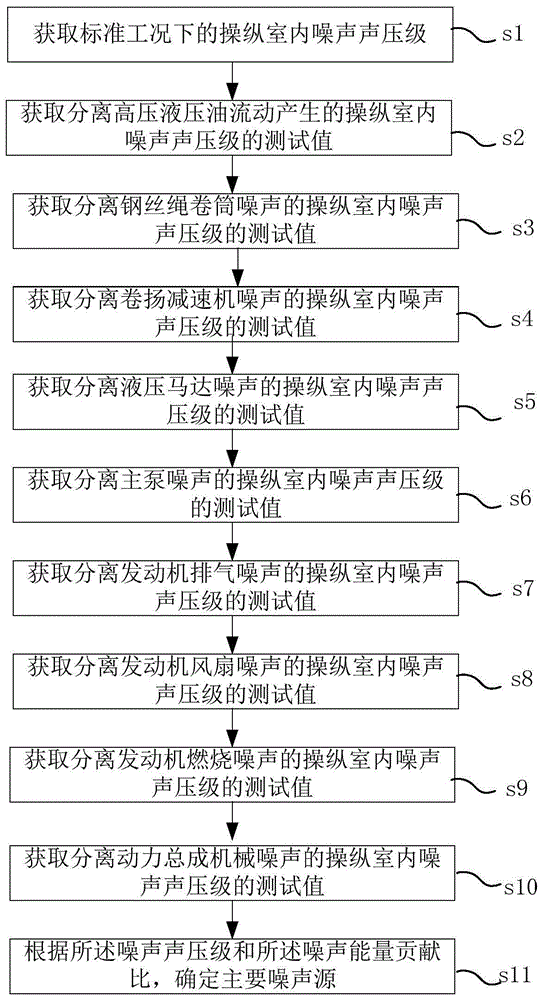
FIG. 1 is a flow chart of the method for separating the noise sources in the control room of the automobile crane.
Detailed Description
In order to make the objects, technical solutions and advantages of the present invention more apparent, the present invention will be further described in detail with reference to the accompanying drawings and examples. It should be understood, however, that the description herein of specific embodiments is only intended to illustrate the invention and not to limit the scope of the invention.
Referring to fig. 1, fig. 1 is a flow chart of a method for separating noise sources in an operating room of an automobile crane according to the present invention. The invention discloses a method for separating an indoor noise source for operating an automobile crane, which comprises the following steps:
(s1) obtaining the operating room noise sound pressure level L under the standard working condition0;
(s2) obtaining a test value L of the sound pressure level of noise in the operating room resulting from the separation of the flows of the high-pressure hydraulic oil1;
(s3) obtaining detached rope drum noiseControl the test value L of the sound pressure level of the indoor noise2;
(s4) obtaining a test value L of the sound pressure level of the noise in the control room for separating the noise of the hoisting speed reducer3;
(s5) obtaining a test value for the operating room noise sound pressure level separating the hydraulic motor noise
(51) Firstly, obtaining a test value L of the noise sound pressure level in a control room for separating hydraulic noise, steel wire rope reel noise and winch speed reducer noise4;
(52) Secondly, obtaining a test value L of the sound pressure level of the noise in the control room for separating the hydraulic motor noise, the hydraulic noise, the steel wire rope reel noise and the winch speed reducer noise5;
(s6) obtaining a test value L of a sound pressure level of steering room noise separating the main pump noise6;
(s7) obtaining a test value L of the operating room noise sound pressure level separating the engine exhaust noise7;
(s8) obtaining a test value L for the operating room noise sound pressure level separating the engine fan noise8;
(s9) obtaining a test value L for the operating room noise sound pressure level separating the engine combustion noise9;
(s10) obtaining a test value L for the noise pressure level in the cabin operating the mechanical noise of the decoupled powertrain10;
(s11) determining the test value of the noise sound pressure level in the operating room of the truck crane
L0、L1、L2、L3、L4、L5、L6、L7、L8、L9And L10Obtaining the separated noise sound pressure level and the noise energy contribution ratio through calculation; and determining a main noise source according to the noise sound pressure level and the noise energy contribution ratio.
Example 1: obtaining the sound pressure level L of the noise in the control room under the standard working condition0:
Description of standard working conditions: the engine is ignited, the gearbox is in a hoisting operation power takeoff gear, the hoisting operation power takeoff is hung, a main pump power takeoff shaft is combined with the gearbox, an accelerator is stepped to the rated speed of the engine, a hoisting operation operating handle is in the maximum opening degree, and the hook lifting and falling working conditions under the basic arm and no-load state are carried out.
Recording data: operating indoor noise sound pressure level L under standard working condition0。
Example 2: separating and calculating hydraulic noise special experiment generated by high-pressure hydraulic oil flow to obtain test value L of sound pressure level of noise in control room generated by separating high-pressure hydraulic oil flow1;
Preparation work before the test: the pipelines and hydraulic valves in the hydraulic system are enclosed and packaged by fiberglass sound absorbing materials in order to cut off the path of the hydraulic noise propagating into the control cabin.
Description of test conditions: and the working condition is consistent with the standard working condition.
Recording data: test value L for separating noise sound pressure level in control room generated by high-pressure hydraulic oil flow1。
According to the acoustic theory, calculating the sound pressure level S of the noise in the control room generated by the flow of the high-pressure hydraulic oil
1,
Calculating the hydraulic noise contribution ratio K generated by the flow of the high-pressure hydraulic oil according to a noise contribution calculation formula in the acoustic theory
1:
Example 3: separating and calculating special experiments for noise of the steel wire rope reel, and obtaining a test value L of noise sound pressure level in a control room for separating the noise of the steel wire rope reel2;
Preparation work before the test: and (3) dismantling the fixed connection between the hoisting speed reducer and the steel wire rope reel, and aiming at separating the noise of the steel wire rope reel.
Test conditions are as follows: and the winch speed reducer is in accordance with the standard working condition, and when the winch speed reducer is tested, the winch speed reducer operates in no-load mode because the winch speed reducer is disconnected from the steel wire rope winding drum, and the steel wire rope winding drum does not operate, so that no noise of the steel wire rope winding drum is transmitted to the control room.
Recording data: test value L of noise sound pressure level in control room for separating noise of steel wire rope reel2。
According to the acoustic theory, calculate
Control indoor noise sound pressure level S of wire rope reel noise
2:
Calculating the noise contribution ratio K of the steel wire rope drum according to a noise contribution calculation formula in the acoustic theory
2:
Example 4: separating and calculating special experiment for noise of the hoisting speed reducer to obtain test value L of noise sound pressure level in the control room for separating the noise of the hoisting speed reducer3;
Preparation work before the test: and (3) dismantling the fixed connection between the hydraulic motor and the hoisting speed reducer, and aiming at separating the noise of the hoisting speed reducer from the noise of the steel wire rope reel.
Test conditions are as follows: the hydraulic motor is in no-load operation, the hoisting speed reducer and the steel wire rope reel do not operate, and therefore no noise of the hoisting speed reducer and the noise of the steel wire rope reel are transmitted to the control room.
Recording data: test value L of noise sound pressure level in control room for separating noise of winch speed reducer3。
According to an acoustic theory, calculating the sound pressure level S of the noise in the control room of the winch speed reducer
3:
According to a noise contribution calculation formula in an acoustic theory, the mechanical noise contribution of the hoisting speed reducerRatio K
3:
Example 5: separating and calculating a special experiment for the noise of the hydraulic motor to obtain a test value of the sound pressure level of the noise in the control room for separating the noise of the hydraulic motor;
the experimental working conditions for separating and calculating the noise of the hydraulic motor are carried out in two steps.
The first step is as follows: separating hydraulic noise, steel wire rope reel noise and winch speed reducer noise, and obtaining a test value L of noise sound pressure level in a control room for separating hydraulic noise, steel wire rope reel noise and winch speed reducer noise4;
Preparation work before the test: and (3) sealing and packaging the pipeline and the hydraulic valve in the hydraulic system by using sound-absorbing materials such as glass fiber and the like, and removing the fixed connection between the hydraulic motor and the winch speed reducer.
Test conditions are as follows: and the working condition is consistent with the standard working condition.
Recording data: test value L of noise sound pressure level in control room of hydraulic noise, steel wire rope reel noise and winch speed reducer noise4;
The second step is that: separating hydraulic motor noise, hydraulic noise, steel wire rope reel noise and hoisting speed reducer noise, and obtaining a test value L of noise pressure level in a control room for separating hydraulic motor noise, hydraulic noise, steel wire rope reel noise and hoisting speed reducer noise5;
Test conditions are as follows: the engine is ignited, the gearbox is in a power take-off gear, the main pump power take-off shaft is combined with the gearbox, the rotating speed of the engine is a rated rotating speed, the engine runs stably, and the operating handle keeps in place. Because the operating handle keeps the normal position, the main pump idle running at this moment, but the discharge capacity is 0, no high-pressure hydraulic oil flows in the hydraulic system, the hydraulic motor does not work, and the hoisting mechanism does not work.
Recording data: test value L of noise pressure level in control room of noise of hydraulic motor, hydraulic noise, noise of steel wire rope reel and noise of winch speed reducer5;
According to the acousticsTo calculate the operating room noise sound pressure level S of the hydraulic motor noise
4:
Calculating the hydraulic motor noise contribution ratio K according to the formula of noise contribution in the acoustic theory
4: by the formula
Calculating to obtain;
example 6: separating and calculating a special experiment for the noise of the main pump to obtain a test value L of the sound pressure level of the noise in the control room for separating the noise of the main pump6;
Test conditions are as follows: the engine is ignited, the gearbox is in a power take-off gear, the main pump power take-off shaft and the gearbox are in a disengaged state, the rotating speed of the engine is a rated rotating speed, and the engine stably runs. Because the main pump power takeoff and the gearbox are in a disengaged state, the power from the engine cannot be transmitted to the hydraulic system, and further the hoisting mechanism cannot be driven to work. The working condition is used for separating main pump noise, hydraulic motor noise, hydraulic noise, steel wire rope reel noise and winch speed reducer noise.
Recording data: test value L of sound pressure level of noise in control room of main pump noise6。
According to the acoustic theory, calculating the sound pressure level S of the noise in the control room of the main pump
5:
Calculating the noise contribution ratio K of the main pump according to a calculation formula about the noise contribution in the acoustic theory
5:
Example 7: separating and calculating special experiments of engine exhaust noise to obtain test value L of noise sound pressure level in control room for separating engine exhaust noise7;
Preparation work before the test: an acoustic absorbing material such as glass fiber is wrapped on the engine exhaust muffler in order to further attenuate the propagation of exhaust noise into the cabin.
Test conditions are as follows: consistent with the separate calculation of main pump noise for example 6.
Recording data: obtaining a test value L for separating engine exhaust noise and manipulating indoor noise sound pressure level7;。
Calculating the operating room noise sound pressure level S of the engine exhaust noise according to the acoustic theory
6:
Calculating the contribution ratio K of the exhaust noise of the engine according to a calculation formula about the noise contribution amount in the acoustic theory
6: by the formula
And (6) calculating.
Example 8: separating and calculating special experiments for noise of the engine fan to obtain a test value L of the sound pressure level of the noise in the control room for separating the noise of the engine fan8;
Preparation work before the test: removing the fan of the engine
Test conditions are as follows: consistent with the separate calculation of main pump noise for example 6.
Recording data: test value L for noise pressure level in control room of engine fan noise8。
Calculating the operating room noise sound pressure level S of the engine fan noise according to the acoustic theory
7:
Calculating the noise contribution ratio K of the fan of the engine according to a calculation formula about the noise contribution amount in the acoustic theory
7:
Example 8: separation and meteringCalculating the combustion noise of the engine to obtain a test value L of the noise sound pressure level in the control room for separating the combustion noise of the engine9;
Test conditions are as follows: in accordance with the test conditions of example 6
Recording data: obtaining a test value L for separating the noise sound pressure level in the control room of the combustion noise of the engine9;
Calculating the noise pressure level S in the control room of the combustion noise of the engine according to the acoustic theory
8:
Calculating the combustion noise contribution ratio K of the engine according to a calculation formula about the noise contribution amount in the acoustic theory
8:
Example 9: separating the mechanical noise of the power assembly and obtaining the test value L of the sound pressure level of the noise in the control room for separating the mechanical noise of the power assembly10;
Preparation work before the test: in accordance with the preliminary work before the test of example 8, the engine fan was removed
Test conditions are as follows: the engine is ignited, the gearbox is in a power takeoff gear, the main pump power takeoff shaft and the gearbox are in a disengaged state, the rotating speed of the engine is a rated rotating speed, after the engine runs stably, the engine is shut down, the power assembly slides, and the noise of the control cabin after the engine is shut down is tested. In this case, only the mechanical noise generated by the powertrain (engine and transmission) during coasting is present
Recording data: test value L of sound pressure level of noise in control room of mechanical noise of power assembly10The mechanical noise of the power assembly is transmitted to the noise sound pressure level in the control room.
Operating room noise sound pressure level S of mechanical noise of power assembly9From the formula S9=L10And (6) calculating.
According to a calculation formula about noise contribution in acoustic theory, a dynamic totalResultant mechanical noise contribution ratio K
9From the formula
And (6) calculating.
In practical application, based on the method of embodiments 1 to 9, which combines the standard condition experiment and the special condition experiment, the control room noise level is tested, so that the noise sound pressure level of each noise source is separated and calculated, and the contribution amount of the control room noise is compared, thereby providing necessary data support for the noise reduction in the control room. As in table 1 below:
table 1:
as can be seen from Table 1, when the automobile crane is in the hook lifting working condition, the noise generated by the hydraulic system has the largest contribution to the noise in the operating room, wherein the noise generated by the main pump has the largest contribution (54.32%), and is the most dominant noise source. And then, main factors influencing noise generated by the operation of the main pump are analyzed, and a noise reduction scheme is designed in a targeted mode, so that the noise in the control room is reduced.
The above description is only for the purpose of illustrating the preferred embodiments of the present invention and is not to be construed as limiting the invention, and any modifications, equivalents or improvements made within the spirit and principle of the present invention should be included in the scope of the present invention.