CN1069351C - Fibers made from feathers and methods for their production as well as compositions comprising said fibers - Google Patents
Fibers made from feathers and methods for their production as well as compositions comprising said fibers Download PDFInfo
- Publication number
- CN1069351C CN1069351C CN96194574A CN96194574A CN1069351C CN 1069351 C CN1069351 C CN 1069351C CN 96194574 A CN96194574 A CN 96194574A CN 96194574 A CN96194574 A CN 96194574A CN 1069351 C CN1069351 C CN 1069351C
- Authority
- CN
- China
- Prior art keywords
- fiber
- feather
- fibers
- separator
- water
- Prior art date
- Legal status (The legal status is an assumption and is not a legal conclusion. Google has not performed a legal analysis and makes no representation as to the accuracy of the status listed.)
- Expired - Fee Related
Links
Images


Classifications
-
- D—TEXTILES; PAPER
- D21—PAPER-MAKING; PRODUCTION OF CELLULOSE
- D21H—PULP COMPOSITIONS; PREPARATION THEREOF NOT COVERED BY SUBCLASSES D21C OR D21D; IMPREGNATING OR COATING OF PAPER; TREATMENT OF FINISHED PAPER NOT COVERED BY CLASS B31 OR SUBCLASS D21G; PAPER NOT OTHERWISE PROVIDED FOR
- D21H13/00—Pulp or paper, comprising synthetic cellulose or non-cellulose fibres or web-forming material
- D21H13/10—Organic non-cellulose fibres
- D21H13/28—Organic non-cellulose fibres from natural polymers
- D21H13/34—Protein fibres
-
- D—TEXTILES; PAPER
- D01—NATURAL OR MAN-MADE THREADS OR FIBRES; SPINNING
- D01B—MECHANICAL TREATMENT OF NATURAL FIBROUS OR FILAMENTARY MATERIAL TO OBTAIN FIBRES OF FILAMENTS, e.g. FOR SPINNING
- D01B3/00—Mechanical removal of impurities from animal fibres
-
- D—TEXTILES; PAPER
- D01—NATURAL OR MAN-MADE THREADS OR FIBRES; SPINNING
- D01B—MECHANICAL TREATMENT OF NATURAL FIBROUS OR FILAMENTARY MATERIAL TO OBTAIN FIBRES OF FILAMENTS, e.g. FOR SPINNING
- D01B9/00—Other mechanical treatment of natural fibrous or filamentary material to obtain fibres or filaments
-
- D—TEXTILES; PAPER
- D01—NATURAL OR MAN-MADE THREADS OR FIBRES; SPINNING
- D01C—CHEMICAL OR BIOLOGICAL TREATMENT OF NATURAL FILAMENTARY OR FIBROUS MATERIAL TO OBTAIN FILAMENTS OR FIBRES FOR SPINNING; CARBONISING RAGS TO RECOVER ANIMAL FIBRES
- D01C3/00—Treatment of animal material, e.g. chemical scouring of wool
-
- D—TEXTILES; PAPER
- D06—TREATMENT OF TEXTILES OR THE LIKE; LAUNDERING; FLEXIBLE MATERIALS NOT OTHERWISE PROVIDED FOR
- D06L—DRY-CLEANING, WASHING OR BLEACHING FIBRES, FILAMENTS, THREADS, YARNS, FABRICS, FEATHERS OR MADE-UP FIBROUS GOODS; BLEACHING LEATHER OR FURS
- D06L4/00—Bleaching fibres, filaments, threads, yarns, fabrics, feathers or made-up fibrous goods; Bleaching leather or furs
- D06L4/10—Bleaching fibres, filaments, threads, yarns, fabrics, feathers or made-up fibrous goods; Bleaching leather or furs using agents which develop oxygen
-
- D—TEXTILES; PAPER
- D06—TREATMENT OF TEXTILES OR THE LIKE; LAUNDERING; FLEXIBLE MATERIALS NOT OTHERWISE PROVIDED FOR
- D06M—TREATMENT, NOT PROVIDED FOR ELSEWHERE IN CLASS D06, OF FIBRES, THREADS, YARNS, FABRICS, FEATHERS OR FIBROUS GOODS MADE FROM SUCH MATERIALS
- D06M19/00—Treatment of feathers
-
- D—TEXTILES; PAPER
- D21—PAPER-MAKING; PRODUCTION OF CELLULOSE
- D21C—PRODUCTION OF CELLULOSE BY REMOVING NON-CELLULOSE SUBSTANCES FROM CELLULOSE-CONTAINING MATERIALS; REGENERATION OF PULPING LIQUORS; APPARATUS THEREFOR
- D21C5/00—Other processes for obtaining cellulose, e.g. cooking cotton linters ; Processes characterised by the choice of cellulose-containing starting materials
Landscapes
- Engineering & Computer Science (AREA)
- Textile Engineering (AREA)
- General Chemical & Material Sciences (AREA)
- Life Sciences & Earth Sciences (AREA)
- Chemical & Material Sciences (AREA)
- Mechanical Engineering (AREA)
- Wood Science & Technology (AREA)
- Chemical Kinetics & Catalysis (AREA)
- Molecular Biology (AREA)
- Animal Husbandry (AREA)
- Zoology (AREA)
- Health & Medical Sciences (AREA)
- Paper (AREA)
- Chemical Or Physical Treatment Of Fibers (AREA)
- Nonwoven Fabrics (AREA)
- Artificial Filaments (AREA)
- Preliminary Treatment Of Fibers (AREA)
- Woven Fabrics (AREA)
- Springs (AREA)
- Treatments For Attaching Organic Compounds To Fibrous Goods (AREA)
- Filtering Materials (AREA)
- Solid-Sorbent Or Filter-Aiding Compositions (AREA)
- Bedding Items (AREA)
Abstract
由羽毛制得的纤维或纤维浆粕可制成多种终产品。这种终产品的例子是纸,纸状产品,无纺布和纺织纤维,绝缘材料、过滤材料、挤压件和复合纸以及复合板。还包括由羽毛制成纤维的方法。
Fibers or fiber pulp obtained from feathers can be made into a variety of end products. Examples of such end products include paper, paper-like products, nonwoven and textile fibers, insulation materials, filter materials, extrusions, composite papers, and composite boards. Also included is a method for producing fibers from feathers.
Description
发明背景Background of the invention
发明领域field of invention
随着美国和其它国家的家禽消耗量的增加,家禽产量不断增长,这就伴随着导致了处置家禽所产生的废品量的增长。本发明涉及产品以及制造工艺,其是在纤维生产中利用这些废品中的一种,羽毛。这种纤维广泛用于许多种产品中。As consumption of poultry in the United States and other countries increases, poultry production continues to grow, which in turn leads to an increase in the amount of waste produced by disposing of poultry. The present invention relates to products and manufacturing processes which utilize one of these waste products, feathers, in fiber production. Such fibers are used in a wide variety of products.
现有技术的描述Description of prior art
目前,羽毛是一种难以处置的废品。例如先将羽毛水解,然后干燥,磨成粉末作为家畜,主要是鸡的饲料添加剂。然而这是一种相当昂贵的加工过程,并产生需求量较少的低质量蛋白产品,也偶尔采用其它的处置方式,例如燃烧或埋掉,但这些方法对环境有害,并为此受到严格禁止。Currently, feathers are a difficult waste product to dispose of. For example, the feathers are firstly hydrolyzed, then dried, and ground into powder as a feed additive for livestock, mainly chickens. However, this is a rather expensive process and produces a low quality protein product that is in less demand. Other disposal methods such as burning or burying are also occasionally used, but these methods are harmful to the environment and are strictly prohibited for this reason .
还没报导过任何由羽毛制成的有用制品或是羽毛的其它用途。因此本发明不仅提供了新颖的产品和方法,还解决了废物处理方面的对环境污染比较敏感的问题。No useful articles made from feathers or other uses of feathers have been reported. The present invention therefore not only provides novel products and methods, but also solves the problem of waste disposal which is sensitive to environmental pollution.
意识到羽毛废品是可用纤维的潜在资源后,就开始通过生产制造各种商品的研究以证明和开发其商业用途。最初的项目是由羽毛纤维浆粕制造纸张,其具有额外的环保益处。由于纸产品主要由纤维素制成,随着采用羽毛生产的纸制品对羽毛需求的增加,对植物资源的需求也增加。通常纸浆是通过机械和/或化学地浸渍植物以产生造纸用的纤维,然后将该纤维收集并加工而成。该浆粕然后用于生产纸和纸制品。因此本发明除解决了一个重要的废品处理问题,还提供了一种减轻森林资源压力的方法,因为目前森林中的木材是生产大量纸制品的唯一的原材料来源。本发明提供了一种替代这些材料的资源,与采用木材作原料相比,这种原料资源产生很少的废品且工艺简单。考虑到羽毛用于有用产品中,羽毛已成为主要的家禽副产品,而不再是与环保有关的难以处理的问题。Realizing that feather waste was a potential source of usable fiber, research began to prove and develop its commercial use through the production of various commodities. The initial project is to make paper from feather fiber pulp, which has additional environmental benefits. As paper products are primarily made of cellulose, as the demand for feathers increases for paper products made from feathers, the demand for plant resources also increases. Typically pulp is produced by mechanically and/or chemically impregnating plants to produce paper-making fibers, which are then collected and processed. The pulp is then used to produce paper and paper products. Therefore, besides solving an important waste disposal problem, the present invention also provides a method of relieving pressure on forest resources, since wood in forests is currently the only source of raw material for the production of large quantities of paper products. The present invention provides an alternative resource to these materials which produces less waste and is simpler to process than using wood as a raw material. Considering that feathers are used in useful products, feathers have become a major poultry by-product rather than an intractable problem with regard to environmental protection.
本发明概述SUMMARY OF THE INVENTION
根据本发明提出一种由羽毛制成纤维的方法,所述方法包括以下步骤:Propose according to the present invention a kind of method that is made fiber by feather, described method comprises the following steps:
a)收集羽毛原材料,a) Collect feather raw material,
b)在极性水溶有机溶剂中清洗所述羽毛,b) washing said feathers in a polar water-soluble organic solvent,
c)重复上述清理步骤,c) Repeat the cleaning steps above,
d)将溶剂从上述羽毛上除去,和d) removing solvent from said feathers, and
e)将纤维从羽干上除去。e) The fibers are removed from the feather shaft.
本发明的还提出了一种根据上述方法所制成的纤维,以及包括所述纤维的组合物The present invention also proposes a fiber made according to the above method, and a composition comprising the fiber
下面参照附图描述本发明的实施例,以更容易理解本发明的目的和优点。Embodiments of the present invention are described below with reference to the accompanying drawings for easier understanding of objects and advantages of the present invention.
附图简述Brief description of the drawings
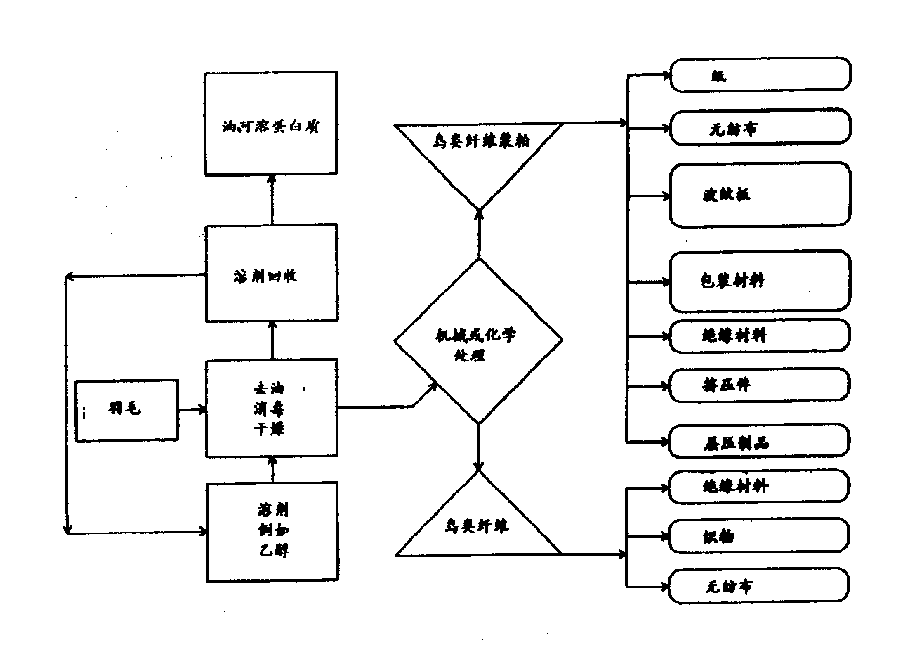
图1所示的是由羽毛制成纤维的基本步骤以及纤维和纤维浆粕的一些用途的示意图;Figure 1 shows a schematic diagram of the basic steps for making fibers from feathers and some uses of fibers and fiber pulp;
图2是具有圆柱形底部的圆锥形分离器的示图,该分离器带有一圆锥形盖,分离出的纤维可通过该圆锥形盖排出;Figure 2 is a schematic view of a conical separator having a cylindrical bottom with a conical cover through which separated fibers can be discharged;
图3是A)一个具有与外圆柱同心的内输入管的分离器和B)利用与外圆柱同心的逐级扩张的圆形断面对A)分离器改型的分离器的附图;Fig. 3 is A) a separator with an inner inlet pipe concentric with the outer cylinder and B) a drawing of a separator modified from the A) separator using a circular section concentric with the outer cylinder that expands step by step;
图4是梳刷式分离器的示图(侧视和顶视图)。Figure 4 is a view (side and top view) of a brush separator.
发明详述Detailed description of the invention
羽毛可用来生产替代现有的纤维素、丝和有机聚合物等的纤维。通过单独利用纤维或将其与其它纤维组合形成制造多种终产品的原料,可生产出多种产品,包括绝缘物质,织物和过滤材料等,但不限于此。通过添加粘合剂,胶粘剂和浆料助剂可增强纤维,或通过用其它助剂,例如染料,媒染剂,增白剂或氧化还原试剂等进行改性。本发明的纤维由于其容易得到和充足的来源而具有优势。此外,纤维或纤维混合物的物理特性根据纤维或纤维组合物的长度或组分很容易地进行改变。例如,从结构上讲,羽毛纤维有天然的大约50微米间隔的节点。这些节点在生产均匀长度为40~50μm的纤维时是潜在的裂开位置。此外不同种类的羽毛长度不同,家禽羽毛纤维长度近似为2cm,而外来鸟类,例如孔雀或鸵鸟的羽毛纤维为4至5cm或更长。羽毛纤维比其它天然纤维更薄,这可使产品有光滑细腻的表面。Feathers can be used to produce fibers that replace existing cellulose, silk, and organic polymers. A variety of products can be produced including, but not limited to, insulation, fabrics, and filter materials, by utilizing the fibers alone or in combination with other fibers to form a raw material for the manufacture of a variety of end products. Fibers can be reinforced by adding binders, adhesives and size aids, or by modification with other aids such as dyes, mordants, brighteners or redox agents. The fibers of the present invention are advantageous due to their ready availability and plentiful sources. In addition, the physical properties of the fibers or fiber mixtures are readily altered depending on the length or composition of the fibers or fiber composition. Structurally, for example, feather fibers have natural nodes approximately 50 microns apart. These nodes are potential cleavage sites when producing fibers with a uniform length of 40-50 μm. In addition, different species of feathers have different lengths, poultry feather fibers are approximately 2 cm long, while exotic birds such as peacocks or ostriches have feather fibers of 4 to 5 cm or longer. Feather fibers are thinner than other natural fibers, which gives the product a smooth and fine finish.
由于所有鸟类的羽毛都具有生产有用纤维所必需的特点,因此可使用任何鸟类的羽毛。羽毛由许多细长的紧密平行排列的羽支构成,羽支在逐渐变尖的中空羽干的两侧形成毛羽。所述羽支有羽小支,其上又有未端为钩状翅钩的羽纤支,羽小支与相邻羽支的羽小支相互连结以将羽支连成连续的毛羽。羽毛废品中包括不溶纤维,可溶蛋白质,脂肪和水。羽毛的不溶纤维部分主要包括角蛋白和蛋白胶原。Feathers of any bird can be used since the feathers of all birds possess the characteristics necessary for the production of useful fibers. Feathers consist of many elongated, closely spaced, parallel barbs forming hairy sides on either side of a hollow shaft that tapers. The barbs have barbules, on which there are barbs with hook-shaped wing hooks at the ends, and the barbs are connected with the barbules of adjacent barbs to connect the barbs into continuous hairs. Feather waste includes insoluble fiber, soluble protein, fat and water. The insoluble fiber portion of feathers mainly consists of keratin and collagen proteins.
如果不想用任何特殊的方法来处理羽毛,根据本发明,在生产有用纤维时采用图1中所提供的步骤来处理羽毛是有效的。任何鸟类的羽毛都可用于本发明的实践中,然而由于鸡是目前能获得羽毛的主要来源,本发明将参照鸡毛进行描述。所述方法包括五个基本步骤:If one does not wish to treat the feathers in any particular way, it is effective in accordance with the present invention to use the steps provided in Figure 1 for the treatment of feathers in the production of useful fibers. Feathers from any bird species may be used in the practice of the present invention, however since chickens are currently the primary source of available feathers, the present invention will be described with reference to chicken feathers. The method includes five basic steps:
a)收集原材料羽毛;a) collecting raw feathers;
b)在有机溶剂中清洗羽毛;b) cleaning feathers in organic solvents;
c)重复清洗步骤;c) repeating the washing step;
d)干燥羽毛;d) dry feathers;
e)将纤维从羽毛干上除去。e) The fibers are removed from the feather shaft.
原材料羽毛收集之后,对其进行处理以除去油或脂肪,并对纤维进行消毒和部分脱水。在有机溶剂中进行搅拌清洗,优选是极性有机溶剂,例如约95%的乙醇中清洗约一个小时,溶剂的量为每磅羽毛近似1.0至1.5加仑溶剂。通过更有效的搅动可以调节较低的溶剂/固体比到必要的值以有效地进行去除油。此外还可在清洗溶剂中以约0.5%(V/V)的比例加入表面活性剂,例如多乙氧基醚(polysorbate80)等。After the raw feathers are collected, they are processed to remove oil or fat, and the fibers are sterilized and partially dehydrated. The agitated wash is performed in an organic solvent, preferably a polar organic solvent, such as about 95% ethanol, for about one hour at approximately 1.0 to 1.5 gallons of solvent per pound of feathers. The lower solvent/solids ratio can be adjusted to the value necessary for effective oil removal through more efficient agitation. In addition, a surfactant, such as polysorbate 80, can be added to the cleaning solvent at a ratio of about 0.5% (V/V).
从第一溶剂中取出后,进行第二清洗步骤以将可溶蛋白质除去,并进一步对羽毛进行消毒。研究发现在乙醇洗液(约70%)或其它有机溶剂或灭菌溶剂(例如叠氮化钠溶液)和/或混合物中,以每磅羽毛近似1.0至1.5加仑的溶剂量清洗一个小时是有效的。然后对羽毛进行干燥或以其它方式与溶剂分离。残留的溶剂通过干燥,例如在强制气体(forced-air)烘干机中在约60至约120℃的温度范围内干燥约6个小时去除,干燥时间取决于烘干机的效率。也可采用其它类似的干燥技术。After removal from the first solvent, a second washing step is performed to remove soluble proteins and further sanitize the feathers. Studies have found that washing with approximately 1.0 to 1.5 gallons of solvent per pound of feathers for one hour is effective in ethanol washes (approximately 70%) or other organic solvents or sterilizing solvents (such as sodium azide solution) and/or mixtures of. The feathers are then dried or otherwise separated from the solvent. Residual solvent is removed by drying, for example, in a forced-air dryer at a temperature ranging from about 60 to about 120° C. for about 6 hours, depending on the efficiency of the dryer. Other similar drying techniques can also be used.
在清洗步骤之后,采用机械式粉碎或剪切方法将纤维从羽干上除去。纤维长度,颗粒尺寸和颗粒分布规模决定了应采用哪种适当的切碎装置。例如剥绒毛机产生长纤维(约2.5cm)Waring搅拌器产生中等长度的纤维(约1.5cm),Wiley碾磨机产生短长度纤维(<1.5cm)。使用这些设备将纤维从其它物质中分离开来是大家熟知的,并属于本领域的普通技术范围。它们可用于由羽毛制备纤维,而对已知工序无需或只需很少的改动。After the washing step, the fibers are removed from the shaft by mechanical shredding or shearing. Fiber length, particle size and particle distribution scale determine which appropriate shredding device should be used. For example, delinting machines produce long fibers (about 2.5 cm), Waring blenders produce medium length fibers (about 1.5 cm), and Wiley mills produce short length fibers (<1.5 cm). The use of these devices to separate fibers from other substances is well known and within the ordinary skill in the art. They can be used to prepare fibers from feathers with little or no modification to known procedures.
在优选实施例中,利用一种高速恒流量离心式磨碎机,例如Brinkman离心式磨碎机(Brinkmann设备公司Westbury,NY)。在磨碎之前,先将羽毛喂入一个疏松机或切碎机以使长纤维变短,因此提高了磨碎机的速度和效率。羽毛喂入碾磨室中,碾磨室中有一在带大孔洞的隔离罩内旋转的转子。转子具有彼此间距足够大的齿,纤维首先经过转子齿间的间隙,然后通过隔离罩上的孔洞,孔洞的直径与最大的纤维长度近似相同。磨碎的羽毛纤维和羽干颗料的混合物由离心力驱动通过隔离罩。羽毛在磨碎机中的处理产生一种混合物,该混合物被送入一个或多个分离器以将纤维从混合物中分离出来。In a preferred embodiment, a high speed constant flow centrifugal attritor such as the Brinkman centrifugal attritor (Brinkmann Equipment Company, Westbury, NY) is utilized. Before grinding, the feathers are fed to a fluffer or shredder to shorten the long fibers, thus increasing the speed and efficiency of the grinder. The feathers are fed into the milling chamber, which has a rotor that rotates in a cage with large holes. The rotor has teeth sufficiently spaced from each other that the fibers first pass through the gaps between the rotor teeth and then through the holes in the shroud, the diameter of which is approximately the same as the maximum fiber length. The mixture of ground feather fibers and shaft particles is driven through the enclosure by centrifugal force. Processing of the feathers in the attritor produces a mixture that is sent to one or more separators to separate the fibers from the mixture.
利用剥绒毛机(如Temming和Grunert所述。Temming-Linters:Technicai Information on Cotton Cellulose。1973.Peter TemmingAG,Gluckstodt,此处引为参考)或其它机械式分离技术,这取决于纤维的最终用途,可将羽毛纤维和羽干分离开来,如图2,3和4所示。混合物中的羽干材料的出现会产生更膨松的、粒状的轻质材料,这在生产过滤材料时是优选的。另一方面,除去它去产生更光滑更紧密的产品。Utilizing a delinting machine (as described by Temming and Grunert. Temming-Linters: Technicai Information on Cotton Cellulose. 1973. Peter Temming AG, Gluckstodt, cited here by reference) or other mechanical separation techniques, depending on the end use of the fibers, Feather fibers and shafts can be separated as shown in Figures 2, 3 and 4. The presence of feather material in the mix results in a more bulky, grainy, lightweight material, which is preferred when producing filter materials. On the other hand, removing it yields a smoother, tighter product.
在如图2所示的圆锥形分离器中,磨碎的羽毛纤维和羽干颗粒混合物在气体压力作用下通过位于圆柱形底部A的进口喂入。然后混合物绕圆柱形底部加速运动,直至混合物的纤维部分达到垂直方向的平衡,即重力和向下的牵引力与同上的气流平衡(此处定义的牵引力是对气流的阻力)。当牵引力小于提升羽干颗粒所必需的力时,将进行分离:即较轻的纤维向上进入分离器的圆锥形部分,并迫使其通过出口B离开分离器,而较重的羽干颗粒或者留在圆柱形部分中,或者,若其到达圆锥部分,较大的颗粒由向心力带出并沿侧壁落下。可选择的出口C用于在处理过程中循环包含纤维而未被分离出的羽干颗粒。In a conical separator as shown in Figure 2, a mixture of ground feather fibers and shaft particles is fed under gas pressure through an inlet located at the bottom A of the cylinder. The mixture is then accelerated around the cylindrical bottom until the fibrous portion of the mixture reaches equilibrium in the vertical direction, ie gravity and downward traction are balanced against airflow as above (traction is defined here as resistance to airflow). Separation occurs when the pulling force is less than that necessary to lift the feather particles: the lighter fibers enter the conical section of the separator upwards and are forced out of the separator through outlet B, while the heavier feather particles either remain In the cylindrical section, or, if it reaches the conical section, the larger particles are carried out by the centripetal force and fall along the side wall. An optional outlet C is used to recycle the feather shaft particles containing fibers which have not been separated out during processing.
图3A和3B示出的分离器主要由两个同心中空圆柱体构成:外圆筒(1)和内输入管(2)。分离器在连有收集单元(C)的底部和顶部都是密封的,在内管(2)和外圆筒(1)之间有密封垫。通过在B点采用真空或迫使空气通过点A而使空气流过系统。或者,也可反过来,即在A点实施真空或迫使气体通过点B使系统有效工作。The separator shown in Figures 3A and 3B is essentially composed of two concentric hollow cylinders: an outer cylinder (1) and an inner inlet tube (2). The separator is sealed at the bottom and top where the collecting unit (C) is connected, and there is a gasket between the inner tube (2) and the outer cylinder (1). Air is flowed through the system by applying a vacuum at point B or by forcing air through point A. Alternatively, it can be reversed, applying a vacuum at point A or forcing gas through point B to make the system work efficiently.
通过入口管A将磨碎的羽毛纤维和羽干颗粒的混合物送入分离器。输入管有足够的长度,使所有颗粒与气流同速空气携带的颗粒根据空气阻力(D)和质量(M)即D/M比率而分离。当混合物的颗粒到达内管的底端时,它们或者连续向下进入C处密封的收集单元(重的羽干颗粒)或向上到达外圆筒并在B点离开系统(较轻的纤维颗粒)。决定颗粒运行路径的关键因素取决于其在内管端部处粒子的惯性是否太大以至于其不能旋转至外管上方。The mixture of ground feather fibers and shaft particles is fed into the separator through inlet pipe A. The inlet pipe is of sufficient length so that all particles are at the same velocity as the airflow. Airborne particles are separated according to air resistance (D) and mass (M), ie the D/M ratio. When the particles of the mixture reach the bottom end of the inner tube, they either continue down into a sealed collection unit at C (heavy plume particles) or up to the outer cylinder and exit the system at point B (lighter fibrous particles) . The key factor in determining the path of the particle is whether the particle's inertia at the end of the inner tube is too large to rotate above the outer tube.
用一与外圆筒同心的、逐渐扩张的圆形截面D替代内管的下部可形成所述分离器的改型,即单管阶梯状分离器(图3B),圆形截面叠置于外圆筒内,每一部分作为一分离区,圆形截面尺寸递减,其中G=内输入管A的直径。A modification of the separator can be formed by replacing the lower part of the inner tube with a gradually expanding circular section D concentric with the outer cylinder, that is, a single-tube stepped separator (Figure 3B), with the circular section superimposed on the outer tube. In the cylinder, each part is used as a separation zone, and the size of the circular section decreases, where G=the diameter of the inner input pipe A.
图4所示的梳/刷式分离器将纤维从羽毛纤维和羽干颗粒的混合物中分离出来。混合物从顶端入口A喂入,纤维通过旋转刷l和梳2的相互作用进行梳理。混合物然后穿过一竖直挡板3,由风扇4产生的气压推动纤维通过挡板。挡板部分的竖直开口足够大使纤维通过挡板而羽干颗粒不能通过。挡板两侧的刷子阻止纤维陷在竖直开口之间阻塞挡板。纤维通过出口B排出,而较大的羽干颗粒通过底出口C排出。The comb/brush separator shown in Figure 4 separates fibers from the mixture of feather fibers and shaft particles. The mixture is fed from the top inlet A, and the fibers are combed by the interaction of rotating
通过连接两个或多个分离器,即将出口B连接到入口A上形成多级结构。分离器可以是相同的也可以是不同的,也可以连接到磨碎机形成一个连续系统。分离系统的其它变量包括气流速度,空气压力和真空压力。这些参数根据诸如混合物尺寸或装置尺寸很容易进行调整。这些参数的调节在本领域技术范围之内是可行的。作为技术示例的装置可用于将纤维从羽干材料中有效地分离出来。A multistage structure is formed by connecting two or more separators, ie connecting outlet B to inlet A. The separators can be the same or different and can be connected to the grinder to form a continuous system. Other variables of the separation system include air velocity, air pressure and vacuum pressure. These parameters are easily adjusted according to factors such as mixture size or device size. Adjustment of these parameters is within the skill of the art. The device as an example of technology can be used to efficiently separate fibers from feather shaft material.
纤维还可通过机械打击进行进一步处理,例如用Hollender击碎轮击打,直至纤维松软柔顺、易弯曲。通过改变打击和压缩条件可按需求改变这些特性以及纤维长度。或者将纤维进行化学处理,用氧化还原试剂,例如10%的过氧化氢化学处理约1小时。此时,该纤维可用于生产产品,或进一步处理产生浆粕。The fibers can also be further processed by mechanically beating them, for example with a Hollender crushing wheel, until the fibers are pliable and pliable. These properties, as well as the fiber length, can be varied as desired by varying the impact and compression conditions. Alternatively, the fibers are chemically treated with a redox agent, such as 10% hydrogen peroxide, for about 1 hour. At this point, the fiber can be used to produce products, or further processed to produce pulp.
由剪切羽毛得到的纤维,混合物中有羽干和羽支,该纤维可产生较粗的绝缘性。去除羽干材料的纤维可产生适于衣服的良好的绝缘性。将羽干从羽支材料中分离出来可产生例如在过滤塔中有用的无纺布纤维。开口容器包装有纤维材料,通过挡板或隔膜在每端将其固定。此外通过将羽支纺成纱线,经编织后形成织物。A fiber obtained from sheared feathers, with a shaft and barbs in the mixture, which produces coarser insulation. Defiberizing the feather shaft material results in good insulation for clothing. Separation of the shafts from the barb material produces nonwoven fibers useful, for example, in filter towers. Open-ended containers are packed with fibrous material, secured at each end by baffles or membranes. In addition, by spinning barbs into yarns, fabrics are formed after weaving.
将纤维与水和/或其它浸湿剂或选择的添加剂混合得到纤维浆粕,根据产品最终用途制造生产产品。通过改变所采用的特殊添加剂可由浆粕制成不同种类和质量的产品。可用的润湿剂是离子和非离子表面活性剂,例如十二烷基磺酸钠和多乙氧基醚。The fibers are mixed with water and/or other wetting agents or additives of choice to obtain a fiber pulp, which is manufactured according to the end use of the product. Different types and qualities of products can be made from pulp by changing the special additives used. Useful wetting agents are ionic and nonionic surfactants, such as sodium laurylsulfonate and polysorbates.
将浆粕与水和/或其它润湿剂以所需量混合而产生纤维浆粥(pulp sluries)。这些浆粥可调成各种稠度以适于各种用途,包括挤压形成各种形状和尺寸的物品,例如浅盘,容器、花瓶,管,柜架或杆。也可滚动并压缩浆粥而制成类似于颗粒板的薄片或板。与适当的泡沫试剂例如PoroforBSH相结合,会产生多种用于添充,包装和绝缘的轻质添料。纤维浆粥也可用于生产无纺布纤维,例如,选择性过滤材料和普通的吸附剂。The pulp is mixed with water and/or other wetting agents in the desired amount to produce pulp slurries. These porridges can be adjusted to various consistencies for various uses, including extrusion to form articles of various shapes and sizes, such as platters, containers, vases, tubes, shelves or rods. Porridge can also be rolled and compressed to make sheets or boards similar to particle board. In combination with a suitable foam agent such as Porofor(R) BSH, a variety of lightweight additions for filling, packaging and insulation are produced. Fiber pulp porridge can also be used to produce fibers for nonwovens, for example, selective filter materials and general adsorbents.
添加剂如媒染剂和染料(例如,二氧化钛和氧化铁);粘合剂(例如淀粉和酪蛋白),发泡剂;硬化剂,化学上浆助剂(例如二聚酮乳剂);填充料,以及其它植物(例如洋麻,棉屑,木质纤维素)或动物(例如骨胶原)纤维均可使用。这些添加剂对本领域技术人员是熟知的,并可根据最终产品的要求改变。也可按需使用化学交联试剂,润湿剂和/或氧化还原试剂。Additives such as mordants and dyes (e.g., titanium dioxide and iron oxides); binders (e.g., starch and casein), foaming agents; hardeners, chemical sizing aids (e.g., diketone emulsions); fillers, and others Vegetable (eg kenaf, cotton dust, lignocellulose) or animal (eg collagen) fibers can be used. These additives are well known to those skilled in the art and may vary according to the requirements of the final product. Chemical crosslinking agents, wetting agents and/or redox agents may also be used as desired.
可利用已有的技术和工艺生产感兴趣的产品。这些步骤在本领域中是熟知的。上述的纤维浆粥直接放入已建立的生产图表中。纸产品可如Smook,G.A.(Handbook for Pulp & Paper Technologists.1989.Canadean Pulp and paper Assocication,Montreal(纸浆工艺手册,1989,加拿大纸浆协会,蒙特利尔))或Clark,Jd’A(PulpTechnology and Treatment for Paper(纸浆工艺和处理),2nd ed.1985,Miller Freeman Publications,Inc.,San Francisco)所描述的那样,生产印刷用纸张,工业用纸张,特殊纸张和薄纸。根据Higham,R.R.A.(A Handbook of Paperboard and Board.1970.Vol.I:Manufacturing Technology;and 1971.Vol Ⅱ:Technology ofConversion and Vsago,Business Books limited,London)或Chamberlain,M.R.和Bowler,J.F.(Dictionary of Concerting.1992.Blackie Academic & Professional,London)可在现有的波纹机器中直接由纸制品制成诸如纸板的波纹材料。根据Higham或Chanberlain和Bowler,Supra,可调整纤维浆粥的稠度以适于挤制,压制以形成各种形状和尺寸的物品,例如浅盘,容器,花瓶,管,框架或杆。滚动并压缩纤维浆粕以形成诸如颗粒板的薄片或板。将纤维浆粕与适当的发泡剂相混合以产生多种轻质的用于填充包装和绝缘的填料。纤维浆粕也可用于生产选择性过滤材料和普通吸附剂,如Nachinkin,O.I.(polymeric Microlilters.1991.Ellis Horwool,New York)所述。Products of interest can be produced using existing technologies and processes. These steps are well known in the art. The fibrous pulp porridge mentioned above drops directly into the established production chart. Paper products can be such as Smook, G.A. (Handbook for Pulp & Paper Technologists.1989.Canadean Pulp and paper Association, Montreal (Pulp Technology Handbook, 1989, Canadian Pulp Association, Montreal)) or Clark, Jd'A (PulpTechnology and Treatment for Paper (Pulp Technology and Treatment), 2nd ed. 1985, Miller Freeman Publications, Inc., San Francisco) for the production of printing paper, industrial paper, specialty paper and tissue paper. According to Higham, R.R.A. (A Handbook of Paperboard and Board. 1970. Vol. I: Manufacturing Technology; and 1971. Vol Ⅱ: Technology of Conversion and Vsago, Business Books limited, London) or Chamberlain, M.R. and Bowler, J.F. (Dictionary of Concerting .1992.Blackie Academic & Professional, London) Corrugated materials such as cardboard can be made directly from paper products in existing corrugating machines. According to Higham or Chanberlain and Bowler, Supra, the consistency of the fibrous pulp can be adjusted to suit extrusion, pressing to form articles of various shapes and sizes, such as platters, containers, vases, tubes, frames or rods. The fiber pulp is rolled and compressed to form sheets or boards such as particle board. Fiber pulp is mixed with suitable blowing agents to produce a variety of lightweight fillers for filling packaging and insulation. Fiber pulp can also be used to produce selective filter materials and general adsorbents as described by Nachinkin, O.I. (polymeric Microlilters. 1991. Ellis Horwool, New York).
下面的例子只是想进一步说明本发明,而不是限制由权利要求书所界定的本发明范围。The following example is only intended to further illustrate the present invention, rather than limit the scope of the present invention defined by the claims.
例子example
例1example 1
纤维的准备fiber preparation
在500ml 95%的乙醇中搅拌清洗10g羽毛并对其消毒,时间约一小时,将清洗过的羽毛从清洗溶液中取出,在500m(70%的乙醇中进一步清洗并消毒一小时。从第二清洗溶液中取出之后,将羽毛干燥,然后送过包含10个网孔挡板的商用Wiley磨碎机。再将所得到的材料穿过包含20个网孔的挡板的Wiley磨碎机。Stir and clean 10g of feathers in 500ml of 95% ethanol and sterilize it for about one hour, take out the cleaned feathers from the cleaning solution, further clean and sterilize for one hour in 500ml (70% ethanol. From the second After removal from the washing solution, the feathers were dried and passed through a commercial Wiley attritor containing a 10 mesh baffle.The resulting material was then passed through a Wiley attritor containing a 20 mesh baffle.
例2Example 2
纤维浆粕的准备Preparation of Fiber Pulp
将大约5g的商用酪胶(Elmer’s Glue,Borden Co.,Columbus,OH)加入到5克水中混和,然后加入10克乙醇,将溶液进行声(sonicated)处理以除去气泡,并与例1中所述的10克纤维混合形成纤维浆粥。About 5 g of commercial casein gum (Elmer's Glue, Borden Co., Columbus, OH) was added to 5 g of water and mixed, then 10 g of ethanol was added, and the solution was sonicated to remove air bubbles, and compared with that in Example 1 10 grams of the fibers described above were mixed to form a fiber pulp porridge.
例3Example 3
由纤维浆粕制备纸张Preparation of paper from fiber pulp
将例2制得的浆粥均匀地铺放在薄的12×″12″聚乙烯塑料层上,并叠放在一具有刮刀的11″×11″×1/4″的有机玻璃板上,以一12″×1″×1/8″直边均匀捣实,并整夜用空气干燥。在塑料层上喷洒一层乙醇每平方英寸0.5~10吨压力下通过2层带聚乙烯内膜的有机玻璃层之间的液压将其干燥。在压制后,从产品上移去聚乙烯层。此工艺足以产生8″×11″的纸张。Spread the gruel prepared in Example 2 evenly on a thin 12 × "12" polyethylene plastic layer, and stack it on a 11 " × 11 " × 1/4 " plexiglass plate with a scraper to A 12" x 1" x 1/8" straight edge was evenly tamped and air dried overnight. Spray a layer of ethanol on the plastic layer and dry it by hydraulic pressure between 2 layers of plexiglass layers with polyethylene inner film under pressure of 0.5-10 tons per square inch. After pressing, the polyethylene layer is removed from the product. This process is sufficient to produce 8″×11″ paper.
例4.Example 4.
由纤维浆粕制备组合物Preparation of composition from fiber pulp
将5g羽毛经过例1所述的清洗,消毒和干燥之后,放入高速,商用Waring粉碎机中,并剪切2.5分钟。使混合物由6″小风扇吹入2′×2′×10′家用筛子制成的箱子获得无羽干纤维部分。8′以上的纤维被收集起来。将一磅这种纤维放在Hollander击碎轮中打击三个小时,其在20加仑水中含有约0.5ml吐温。然后将捣碎的纤维浆粥收集起来(注意:有时用过氧化氢对纤维进行进一步的化学处理使纤维变白并增强纤维的浆状特性)。样品在强制气流烘箱中,在105℃下整夜干燥。大约8克经干燥的纤维浆粕与2克有洋麻,0.5g酪胶溶液和300ml的水在Waring混和器中混和击打5分钟。然后将浆粥倒入槽的12″×12″聚乙烯塑料薄膜上,并由11″×11″×1/4″的有机玻璃板盖住。浆粥沿聚乙烯膜用一刮刀使其均匀分布并用12″×1″×1/8″直边捣实。浆粥整夜用空气干燥。将一层乙醇喷在乙烯膜上,然后在每平方英寸约0.5~10吨的压力下在2层带聚乙烯薄膜的有机玻璃板间的液压下干燥。从产品上移去聚乙烯,产生羽毛/洋麻纤维组合物层。After 5 g of feathers were washed, sterilized and dried as described in Example 1, they were placed in a high speed, commercial Waring shredder and sheared for 2.5 minutes. The mixture was blown by a 6" small fan into a box made of a 2' x 2' x 10' household sieve to obtain a featherless fiber fraction. Fibers above 8' were collected. One pound of this fiber was crushed in a Hollander Three hours in the round, which contains about 0.5ml Tween in 20 gallons of water. The mashed fiber pulp is then collected (note: sometimes the fibers are further chemically treated with hydrogen peroxide to whiten and strengthen the fibers) Pulp-like characteristics of fiber). The sample was dried overnight at 105°C in a forced air oven. About 8 grams of dried fiber pulp was mixed with 2 grams of kenaf, 0.5 g of casein solution and 300 ml of water in Waring The mixer was mixed and beat for 5 minutes. The gruel was then poured into the trough on a 12" x 12" polyethylene plastic film and covered with a 11" x 11" x 1/4" plexiglass plate. The pulp was spread evenly along the polyethylene film with a spatula and tamped with a 12" x 1" x 1/8" straight edge. The pulp was air dried overnight. Hydraulically dried between 2 layers of plexiglass sheets with polyethylene film under a pressure of about 0.5 to 10 tons per square inch. The polyethylene was removed from the product to produce a feather/kenaf composite layer.
虽然上述例子描述了由手进行的工艺,对大批量生产而言,机械工艺是优选的。这些工艺在上述参考文献中均有描述,此处都引为参考,纤维和纤维浆粕组合物可用在这些工艺中,无需或只需很少的改动。While the above examples describe processes performed by hand, for mass production, mechanical processes are preferred. These processes are described in the above references, all of which are incorporated herein by reference, and the fibers and fiber pulp compositions can be used in these processes with little or no modification.
Claims (30)
Applications Claiming Priority (2)
| Application Number | Priority Date | Filing Date | Title |
|---|---|---|---|
| US08/471,349 US5705030A (en) | 1993-12-29 | 1995-06-06 | Fiber and fiber products produced from feathers |
| US08/471,349 | 1995-06-06 |
Publications (2)
| Publication Number | Publication Date |
|---|---|
| CN1188520A CN1188520A (en) | 1998-07-22 |
| CN1069351C true CN1069351C (en) | 2001-08-08 |
Family
ID=23871284
Family Applications (1)
| Application Number | Title | Priority Date | Filing Date |
|---|---|---|---|
| CN96194574A Expired - Fee Related CN1069351C (en) | 1995-06-06 | 1996-05-17 | Fibers made from feathers and methods for their production as well as compositions comprising said fibers |
Country Status (15)
| Country | Link |
|---|---|
| US (1) | US5705030A (en) |
| EP (1) | EP0832316B1 (en) |
| JP (1) | JP3818663B2 (en) |
| KR (1) | KR100457357B1 (en) |
| CN (1) | CN1069351C (en) |
| AT (1) | ATE221931T1 (en) |
| AU (1) | AU694364B2 (en) |
| BR (1) | BR9608532A (en) |
| DE (1) | DE69622864T2 (en) |
| DK (1) | DK0832316T3 (en) |
| ES (1) | ES2180773T3 (en) |
| IL (1) | IL118582A (en) |
| PT (1) | PT832316E (en) |
| WO (1) | WO1996039551A1 (en) |
| ZA (1) | ZA964745B (en) |
Families Citing this family (36)
| Publication number | Priority date | Publication date | Assignee | Title |
|---|---|---|---|---|
| US5786282A (en) * | 1997-02-25 | 1998-07-28 | Barnhardt Manufacturing Company | Opened wet processed intermediate natural fiber product suitable for formation into end use fiber products with long-lasting antimicrobial properties and method |
| US6027608A (en) * | 1998-10-06 | 2000-02-22 | Origin Technology, Inc | Conversion of avian feather-waste stream to useful products |
| FR2805181B1 (en) * | 2000-02-21 | 2004-12-10 | Christian Monjarret | CALIBRATION, BY SIEVING, OF FEATHERS, DOWN, WOOD NEEDLES, OR THE LIKE KEEPING SUSPENDED IN A FLUID |
| EP1356154A2 (en) * | 2000-11-08 | 2003-10-29 | Tyson Foods, Inc. | Feather processing method and product |
| US20020148572A1 (en) * | 2000-11-08 | 2002-10-17 | Tyson Foods, Inc. | Feather molding method and product |
| US20040124151A1 (en) * | 2000-12-12 | 2004-07-01 | Maxim, Llc, A Limited Liability Corporation | Fibrous protein adsorption of heavy metals |
| US6685838B2 (en) | 2000-12-12 | 2004-02-03 | Maxim Llc | Keratin protein adsorption of heavy metals |
| US6827948B2 (en) * | 2001-10-23 | 2004-12-07 | Steen Research Llc | Method and compositions for processing poultry feathers |
| CN1224741C (en) * | 2003-01-24 | 2005-10-26 | 张立文 | Feathery-needle fiber weaved article and its production method |
| US20050153118A1 (en) * | 2003-09-10 | 2005-07-14 | Carlo Licata | Production of pulp and materials utilizing pulp from fibrous proteins |
| US20050148703A1 (en) * | 2003-12-31 | 2005-07-07 | Barone Justin R. | Polymer composites containing keratin |
| US20050191479A1 (en) * | 2004-03-01 | 2005-09-01 | Harder Reginald B. | Reinforced panel |
| US20050205226A1 (en) * | 2004-03-16 | 2005-09-22 | Harder Reginald B | Reinforced board |
| CN1311132C (en) * | 2004-05-14 | 2007-04-18 | 王正顺 | Process for making special type paper by utilizing fowl feather |
| EP1607430A1 (en) | 2004-06-09 | 2005-12-21 | Nederlandse Organisatie voor toegepast-natuurwetenschappelijk Onderzoek TNO | Fibre-reinforced polymer composites and processes for preparing the same |
| WO2007092493A2 (en) * | 2006-02-08 | 2007-08-16 | Winn William E | System and method for processing fiber |
| US20080236716A1 (en) * | 2007-03-30 | 2008-10-02 | Bergman Brian R | Elastomer Having Feather Material |
| AR061179A1 (en) * | 2007-06-04 | 2008-08-06 | Ciancaglini Y Asoc S A R | A HYDROCARBON SEQUESTRATIVE PRODUCT, METHOD FOR OBTAINING THE PRODUCT, METHOD FOR THE HYDROCARBON SEQUESTRATION AND PROVISION FOR THE HYDROCARBON SEQUESTRATION. |
| JP5283170B2 (en) * | 2008-12-11 | 2013-09-04 | 農工大ティー・エル・オー株式会社 | Manufacturing method of feather molded body |
| US8393057B2 (en) * | 2010-11-01 | 2013-03-12 | Kwong Lung Enterprise Co., Ltd. | Method for mixing short staple and down cluster by a dry processing |
| US8841361B2 (en) | 2011-02-07 | 2014-09-23 | Bridgestone Corporation | Keratin in rubber applications |
| ITPN20130017A1 (en) * | 2013-03-28 | 2014-09-29 | Pontarolo Engineering Spa | PROCEDURE FOR THE CONSTRUCTION OF INSULATING PANELS AND RELATIVE PANEL. |
| US9706789B2 (en) | 2015-01-30 | 2017-07-18 | The United States Of America, As Represented By The Secretary Of Agriculture | Use of nitrogen-containing compounds as plasticizers for peptide-based biopolymers and uses thereof |
| CN104651983A (en) * | 2015-02-03 | 2015-05-27 | 天津科技大学 | Method for separating feather fibers from poultry feather raw material |
| WO2016125041A1 (en) * | 2015-02-03 | 2016-08-11 | Nawani Neelu | A method for removal of metals from aqueous solutions using bio adsorbents |
| CN105887213B (en) * | 2016-05-05 | 2018-01-12 | 安徽工程大学 | A kind of preparation method and applications of purple willow chicken feather fibers |
| CN106049181B (en) * | 2016-07-19 | 2018-08-03 | 长乐巧通工业设计有限公司 | A kind of preparation method of anti-sticking glass pulp material |
| US10821384B2 (en) * | 2017-08-28 | 2020-11-03 | Ronie Reuben | Down feather filter medium |
| WO2020079133A1 (en) | 2018-10-17 | 2020-04-23 | Bioextrax Ab | Process for production of keratin microfibers and protein hydrolysate from poultry feathers via microbial hydrolysis |
| CN110257922A (en) * | 2019-07-19 | 2019-09-20 | 苏州盛天力离心机制造有限公司 | Feather washing dehydration all-in-one machine |
| KR102569613B1 (en) * | 2021-01-20 | 2023-08-22 | 항주 초이스 임포트앤엑스포트 코 엘티 | Manufacturing method for down fiber using feather and down fiber therefrom |
| CN113109209A (en) * | 2021-03-31 | 2021-07-13 | 杭州融凯盛科技有限公司 | Method for detecting thickness of thick porridge in Lyocell production system |
| KR102426144B1 (en) * | 2021-08-18 | 2022-07-28 | 주식회사 메사캠프 | Manufacturing method for padding used feather and padding manufactured by the same that |
| CN114790600B (en) * | 2022-04-26 | 2023-05-09 | 嘉兴市云龙服饰科技股份有限公司 | Three-layer sweat-releasing thermal fabric and preparation method thereof |
| WO2024052848A1 (en) * | 2022-09-08 | 2024-03-14 | Borsoi S.R.L. | Machine for the separation of a padding from a lining of padded textile articles |
| CN117101823A (en) * | 2023-10-08 | 2023-11-24 | 江苏新汉菱生物工程股份有限公司 | Feather crushing equipment for amino acid production |
Citations (2)
| Publication number | Priority date | Publication date | Assignee | Title |
|---|---|---|---|---|
| US2809400A (en) * | 1954-07-23 | 1957-10-15 | Fybradown Corp | Apparatus for producing feather fibres |
| US4169706A (en) * | 1975-07-18 | 1979-10-02 | Ernst Kruchen | Method of cleaning poultry feathers |
Family Cites Families (20)
| Publication number | Priority date | Publication date | Assignee | Title |
|---|---|---|---|---|
| US328680A (en) * | 1885-10-20 | Machine for reducing quills | ||
| US1583822A (en) * | 1925-09-17 | 1926-05-11 | Yaffe Simcha | Machine for breaking and softening feathers |
| US2501184A (en) * | 1944-04-06 | 1950-03-21 | Lawrence Richard Bruce Inc | Method of dyeing keratinous fibers |
| US2706143A (en) * | 1952-05-17 | 1955-04-12 | Alexander Smith Inc | Process for treating feathers |
| US2714767A (en) * | 1952-10-03 | 1955-08-09 | Edward R Frederick | Feather treating apparatus |
| US2657432A (en) * | 1952-10-15 | 1953-11-03 | August J Naab | Apparatus for removing barbs from the quills of feathers |
| US2805914A (en) * | 1954-06-09 | 1957-09-10 | Edward R Frederick | Alpha-hydroxy-adipaldehyde treatment of chicken feathers to enhance filling power, water repellancy, etc. |
| US3384445A (en) * | 1964-04-27 | 1968-05-21 | Dow Chemical Co | Dry cleaning method |
| DE1535969B1 (en) * | 1966-06-16 | 1973-01-04 | Henkel & Cie Gmbh | METHOD FOR CLEANING UP VERY DIRTY POULTRY FEATHERS |
| DE2532158B2 (en) * | 1975-07-18 | 1977-08-25 | Kruchen Betten, Bettwaren- und Bett federnfabnk GmbH, 4404 Telgte | CLEANING PROCEDURES FOR POULTRY FEATHERS |
| JPS5643410A (en) * | 1979-09-11 | 1981-04-22 | Mitsubishi Rayon Co Ltd | Trerating method of feather |
| JPS57149506A (en) * | 1981-03-06 | 1982-09-16 | Noguchi Naoichi | Feather treating apparatus |
| DE3224028A1 (en) * | 1982-06-28 | 1983-12-29 | Weise, Gustav, 8000 München | Fibre-like structure made of poultry feathers and process for this purpose |
| IT1187684B (en) * | 1985-07-08 | 1987-12-23 | Montefluos Spa | PROCEDURE FOR THE PREPARATION OF VULCANIZABLE FLUOROELASTOMERS AND PRODUCTS SO OBTAINED |
| IT1233697B (en) * | 1989-06-02 | 1992-04-14 | Cinelli Piume Spa | METHOD AND SYSTEM FOR THE AUTOMATIC AND CONTINUOUS WASHING OF FEATHERS |
| JPH03152278A (en) * | 1989-11-10 | 1991-06-28 | France Bed Co Ltd | Treatment of feather |
| CH682756A5 (en) * | 1991-11-06 | 1993-11-15 | Descom Engineering Raimund Jet | Textile fibre reprocessing , used to mfr. e.g. wall paper - forms a fibre sludge for fermentation and sepn. cleaning, followed by drying and beating and fibre length sorting |
| JPH0616957A (en) * | 1992-07-03 | 1994-01-25 | Ishihara Chem Co Ltd | Organic pigment composed of fine powder of feathers |
| KR950001581A (en) * | 1993-06-12 | 1995-01-03 | 이헌조 | LCD manufacturing method of light shielding film |
| WO1995018252A1 (en) * | 1993-12-29 | 1995-07-06 | The United States Of America, Represented By The Secretary Of Agriculture | Fiber and fiber products produced from feathers |
-
1995
- 1995-06-06 US US08/471,349 patent/US5705030A/en not_active Expired - Lifetime
-
1996
- 1996-05-17 AU AU57975/96A patent/AU694364B2/en not_active Ceased
- 1996-05-17 CN CN96194574A patent/CN1069351C/en not_active Expired - Fee Related
- 1996-05-17 ES ES96914695T patent/ES2180773T3/en not_active Expired - Lifetime
- 1996-05-17 WO PCT/US1996/007196 patent/WO1996039551A1/en not_active Ceased
- 1996-05-17 DE DE69622864T patent/DE69622864T2/en not_active Expired - Lifetime
- 1996-05-17 PT PT96914695T patent/PT832316E/en unknown
- 1996-05-17 DK DK96914695T patent/DK0832316T3/en active
- 1996-05-17 AT AT96914695T patent/ATE221931T1/en active
- 1996-05-17 KR KR1019970708245A patent/KR100457357B1/en not_active Expired - Fee Related
- 1996-05-17 BR BR9608532A patent/BR9608532A/en not_active IP Right Cessation
- 1996-05-17 EP EP96914695A patent/EP0832316B1/en not_active Expired - Lifetime
- 1996-05-17 JP JP50060697A patent/JP3818663B2/en not_active Expired - Fee Related
- 1996-06-05 IL IL11858296A patent/IL118582A/en not_active IP Right Cessation
- 1996-06-06 ZA ZA9604745A patent/ZA964745B/en unknown
Patent Citations (2)
| Publication number | Priority date | Publication date | Assignee | Title |
|---|---|---|---|---|
| US2809400A (en) * | 1954-07-23 | 1957-10-15 | Fybradown Corp | Apparatus for producing feather fibres |
| US4169706A (en) * | 1975-07-18 | 1979-10-02 | Ernst Kruchen | Method of cleaning poultry feathers |
Also Published As
| Publication number | Publication date |
|---|---|
| KR100457357B1 (en) | 2005-01-27 |
| IL118582A (en) | 1998-12-06 |
| ATE221931T1 (en) | 2002-08-15 |
| PT832316E (en) | 2002-12-31 |
| BR9608532A (en) | 1999-06-15 |
| JPH11512151A (en) | 1999-10-19 |
| DE69622864D1 (en) | 2002-09-12 |
| AU5797596A (en) | 1996-12-24 |
| DK0832316T3 (en) | 2002-12-02 |
| EP0832316A4 (en) | 1998-09-16 |
| US5705030A (en) | 1998-01-06 |
| WO1996039551A1 (en) | 1996-12-12 |
| EP0832316A1 (en) | 1998-04-01 |
| MX9708886A (en) | 1998-06-30 |
| KR19990014900A (en) | 1999-02-25 |
| CN1188520A (en) | 1998-07-22 |
| ES2180773T3 (en) | 2003-02-16 |
| EP0832316B1 (en) | 2002-08-07 |
| DE69622864T2 (en) | 2003-03-27 |
| JP3818663B2 (en) | 2006-09-06 |
| IL118582A0 (en) | 1996-10-16 |
| AU694364B2 (en) | 1998-07-16 |
| ZA964745B (en) | 1997-12-08 |
Similar Documents
| Publication | Publication Date | Title |
|---|---|---|
| CN1188520A (en) | Fibers and fiber products made from feathers | |
| US4270552A (en) | Process and apparatus for producing paper reconstituted tobacco | |
| US5656129A (en) | Method of producing fibers from a straw and board products made therefrom | |
| US5527432A (en) | Method of dry separating fibers from paper making waste sludge and fiber product thereof | |
| CN1289735C (en) | Apparatus and method for dry manufacture of short and long fiber nonwoven webs | |
| CN1030624A (en) | Make the method for paper pulp by bamboo | |
| HU220481B1 (en) | A nonwoven product consisting of a mixture of cellulose fibers and long hydrophilic fibers and a method for producing this nonwoven product | |
| US6027608A (en) | Conversion of avian feather-waste stream to useful products | |
| CN105780564A (en) | Technology for producing high-strength cardboard paper from waste carton boxes | |
| CN111118956A (en) | Production method of regenerated high-strength corrugated base paper with ultralow gram weight | |
| CN104080972A (en) | Method for treating waste paper | |
| AU682080B2 (en) | Deinking of recycled pulp | |
| MXPA00012457A (en) | Process for recycling paper broke containing wet strength additives. | |
| DE10301495A1 (en) | Dried, isolated, cross-linked cellulose pulp fibers | |
| WO1995018252A1 (en) | Fiber and fiber products produced from feathers | |
| CA2217853C (en) | Fiber and fiber products produced from feathers | |
| CN110130144B (en) | Squid bone fiber-containing paper and preparation method thereof | |
| US20020079074A1 (en) | Feather processing method and product | |
| US20020148572A1 (en) | Feather molding method and product | |
| MXPA97008886A (en) | Fiber and fiber products produced from plu | |
| JPH0823118B2 (en) | Non-woven sheet made of ramie hemp cellulose fiber and method for producing the same | |
| US12286755B2 (en) | Binder and formed body producing method | |
| JP2569407B2 (en) | Algin-based fiber entangled body and method for producing the same | |
| JP2024518828A (en) | Hybrid flame retardant heat insulating material and its manufacturing method | |
| JP2021091998A (en) | Method for forming fiber assembly and device for forming fiber assembly |
Legal Events
| Date | Code | Title | Description |
|---|---|---|---|
| C06 | Publication | ||
| PB01 | Publication | ||
| C10 | Entry into substantive examination | ||
| SE01 | Entry into force of request for substantive examination | ||
| C14 | Grant of patent or utility model | ||
| GR01 | Patent grant | ||
| C17 | Cessation of patent right | ||
| CF01 | Termination of patent right due to non-payment of annual fee |
Granted publication date: 20010808 Termination date: 20120517 |