CN1069491A - 2-(Piperidin-1-yl)ethanol derivatives, their preparation and their therapeutic use - Google Patents
2-(Piperidin-1-yl)ethanol derivatives, their preparation and their therapeutic use Download PDFInfo
- Publication number
- CN1069491A CN1069491A CN92105067A CN92105067A CN1069491A CN 1069491 A CN1069491 A CN 1069491A CN 92105067 A CN92105067 A CN 92105067A CN 92105067 A CN92105067 A CN 92105067A CN 1069491 A CN1069491 A CN 1069491A
- Authority
- CN
- China
- Prior art keywords
- milliliters
- compound
- gram
- add
- mole
- Prior art date
- Legal status (The legal status is an assumption and is not a legal conclusion. Google has not performed a legal analysis and makes no representation as to the accuracy of the status listed.)
- Pending
Links
Classifications
-
- C—CHEMISTRY; METALLURGY
- C07—ORGANIC CHEMISTRY
- C07D—HETEROCYCLIC COMPOUNDS
- C07D401/00—Heterocyclic compounds containing two or more hetero rings, having nitrogen atoms as the only ring hetero atoms, at least one ring being a six-membered ring with only one nitrogen atom
- C07D401/02—Heterocyclic compounds containing two or more hetero rings, having nitrogen atoms as the only ring hetero atoms, at least one ring being a six-membered ring with only one nitrogen atom containing two hetero rings
- C07D401/12—Heterocyclic compounds containing two or more hetero rings, having nitrogen atoms as the only ring hetero atoms, at least one ring being a six-membered ring with only one nitrogen atom containing two hetero rings linked by a chain containing hetero atoms as chain links
-
- C—CHEMISTRY; METALLURGY
- C07—ORGANIC CHEMISTRY
- C07D—HETEROCYCLIC COMPOUNDS
- C07D401/00—Heterocyclic compounds containing two or more hetero rings, having nitrogen atoms as the only ring hetero atoms, at least one ring being a six-membered ring with only one nitrogen atom
- C07D401/02—Heterocyclic compounds containing two or more hetero rings, having nitrogen atoms as the only ring hetero atoms, at least one ring being a six-membered ring with only one nitrogen atom containing two hetero rings
- C07D401/06—Heterocyclic compounds containing two or more hetero rings, having nitrogen atoms as the only ring hetero atoms, at least one ring being a six-membered ring with only one nitrogen atom containing two hetero rings linked by a carbon chain containing only aliphatic carbon atoms
-
- A—HUMAN NECESSITIES
- A61—MEDICAL OR VETERINARY SCIENCE; HYGIENE
- A61P—SPECIFIC THERAPEUTIC ACTIVITY OF CHEMICAL COMPOUNDS OR MEDICINAL PREPARATIONS
- A61P25/00—Drugs for disorders of the nervous system
-
- A—HUMAN NECESSITIES
- A61—MEDICAL OR VETERINARY SCIENCE; HYGIENE
- A61P—SPECIFIC THERAPEUTIC ACTIVITY OF CHEMICAL COMPOUNDS OR MEDICINAL PREPARATIONS
- A61P25/00—Drugs for disorders of the nervous system
- A61P25/18—Antipsychotics, i.e. neuroleptics; Drugs for mania or schizophrenia
-
- A—HUMAN NECESSITIES
- A61—MEDICAL OR VETERINARY SCIENCE; HYGIENE
- A61P—SPECIFIC THERAPEUTIC ACTIVITY OF CHEMICAL COMPOUNDS OR MEDICINAL PREPARATIONS
- A61P25/00—Drugs for disorders of the nervous system
- A61P25/28—Drugs for disorders of the nervous system for treating neurodegenerative disorders of the central nervous system, e.g. nootropic agents, cognition enhancers, drugs for treating Alzheimer's disease or other forms of dementia
Landscapes
- Health & Medical Sciences (AREA)
- Chemical & Material Sciences (AREA)
- Organic Chemistry (AREA)
- Engineering & Computer Science (AREA)
- Bioinformatics & Cheminformatics (AREA)
- Biomedical Technology (AREA)
- Neurology (AREA)
- Neurosurgery (AREA)
- Nuclear Medicine, Radiotherapy & Molecular Imaging (AREA)
- General Health & Medical Sciences (AREA)
- General Chemical & Material Sciences (AREA)
- Chemical Kinetics & Catalysis (AREA)
- Pharmacology & Pharmacy (AREA)
- Life Sciences & Earth Sciences (AREA)
- Animal Behavior & Ethology (AREA)
- Medicinal Chemistry (AREA)
- Public Health (AREA)
- Veterinary Medicine (AREA)
- Psychiatry (AREA)
- Hospice & Palliative Care (AREA)
- Pharmaceuticals Containing Other Organic And Inorganic Compounds (AREA)
- Plural Heterocyclic Compounds (AREA)
- Hydrogenated Pyridines (AREA)
Abstract
以纯旋光异构体或两种对映体的混合物形式存 在的通式(Ⅰ)化合物,式中R1代表氢,卤原子,或甲 基,R2代表一个或两个选自氢,卤素原子,(C1-C4) 烷基,羟基,(C1-C4)烷氧基,三氟甲基,乙酰氨基和 甲基磺酰氨基的取代基,而X代表CH2基,Y代表 CH2,(CH2)2或CO基,或者X代表CO基团,Y代 表CH2基团。此化合物用作治疗药物。

A compound of general formula (I) existing in the form of a pure optical isomer or a mixture of two enantiomers, wherein R represents hydrogen, a halogen atom, or a methyl group, and R represents one or two selected from hydrogen, a halogen atom , (C 1 -C 4 ) alkyl, hydroxyl, (C 1 -C 4 ) alkoxy, trifluoromethyl, acetamido and methylsulfonylamino substituents, while X represents CH 2 groups, Y represents CH 2 , (CH 2 ) 2 or CO group, or X represents a CO group, Y represents a CH 2 group. This compound is used as a therapeutic drug.
Description
The objective of the invention is 2-(piperidines-1-yl) alcohol derivative, its preparation method and its application in treatment.
Compound of the present invention has logical formula I:

Wherein:
R
1Represent hydrogen, halogen atom, or methyl,
R
2Represent one or two to be selected from hydrogen atom, halogen atom, (C
1-4) alkyl, hydroxyl, (C
1-4) alkoxyl group, trifluoromethyl, the substituting group in the amino group of kharophen and sulfonyloxy methyl, and
Perhaps, X represents CH
2Base, Y represents CH
2, (CH
2)
2Or the CO base,
Perhaps, X represents the CO base, and Y represents CH
2Base, but do not comprise R in the logical formula I
1And R
2On behalf of hydrogen atom and X and Y, each respectively represent CH
2The compound of base, this compound be existing the description in the EP-481853 patent application.
The molecule of logical formula I representative has asymmetric carbon atoms, and compound of the present invention can exist with the form of mixtures of pure enantiomorph or enantiomorph.At last, compound of the present invention can be with free alkali, or the form of itself and the additive salt that forms in pharmaceutically acceptable acid provides.These different forms all are somes of the present invention.
Compound of the present invention can prepare by reaction formula 1:
Reaction formula 1

Make the reaction of logical formula II compound and logical formula III compound, obtained logical formula IV compound; In logical formula II, perhaps, A represents CH
2Group and B represent CH
2Or (CH
2)
2Group; Perhaps, A or B represent CH
2Group, another represents 1,3-dioxolane-2,2-two bases; In logical formula III, R
1As defined above.
Then, with reductive agent such as POTASSIUM BOROHYDRIDE the ketone in the compound (IV) is reduced.
If A represents CH
2Base and B represent CH
2Or (CH
2)
2Base, (I a) compound is just represented CH corresponding to X in the logical formula I to the formula that then obtains thus
2Base and Y represent CH
2Or (CH
2)
2The compound of base.
If A or B represent CH
2Base, and another represents 1,3-dioxolane-2,2-two bases, then can be in acidic medium the hydrolysis general formula (I is compound a), so just can obtain in the logical formula I X or Y and represent CH
2Group, and another represents the compound of CO base.
The initial compounds of logical formula II is known, perhaps can be by producing with currently known methods or the similar method of the above method of document, and the example of described document has: J.Org.Chem., 22,1376(1957); C.A.52,8138a, (1958); C.R.Acad.Sci., 255,956(1962); United States Patent (USP) 4,254,127; European patent application EP-12643 and EP-481853; French patent application FR-2459795.
For example, available general formula (V) compound is as starting raw material, and wherein V or W represent CH
2Base, and its another represent the CO base.For A and the B that obtains in the logical formula II respectively represents CH
2The compound of base can utilize the CO base in hydrazine reduction-type (V) compound in the presence of alkali, and then removes protecting group on the piperidine ring nitrogen by debenzylation.For A or the B that obtains in the logical formula II represents CH
2Base, and its another represent 1,3-dioxolane-2, the compound of 2-two bases can be in the presence of the 4-toluene sulfonic acide, make the CO base of ethylene glycol and formula (V) compound play ketal reaction, and then removes protecting group on the piperidines nitrogen by debenzylation.
A and B respectively represent CH in the formula II
2Base, and R
2The compound that is not hydrogen is a new compound, and this compounds constitutes some of the present invention as synthetic intermediate.They can be produced by the method shown in following reaction formula 2 and 3.
Reaction formula 2 explanation and C.R.Acad.Sci., 255,956(1962) described in the method similar methods.At first, make logical formula VI ester and general formula (VII) benzyl cyanide, in the presence of sodium amide, react; In formula VI, Alk represents (C
1-4) alkyl, in formula (VII), R
2As defined above.Reaction result has obtained general formula (VIII) enol; then in acidic medium, handled; so that obtain general formula (IX) ketone; then; for example; in the presence of potassium hydroxide and triglycol, make it reduction with hydrazine hydrate, obtain general formula (X) compound; at last; make this compound by catalytic hydrogenation, or go the method for protecting group, promptly make it to react with trichloroethyl chloroformate by chemistry; then formed product is handled with zinc in acetic acid again; slough benzyl, obtain general formula (II ') compound, this compound is respectively represented CH corresponding to A and B in the logical formula II
2The compound of group.
Reaction formula 2

Reaction formula 3 explanation and J.Org.Chem., 22,1376, the method similar methods described in (1957) at first, reacts the phenyl aldehyde of formula (XI) 4-picoline and general formula (XII) in diacetyl oxide; R in the formula (XII)
2As defined above.Reaction result is to have obtained general formula (X III) compound, makes it to carry out catalytic hydrogenation again.
Reaction formula 3

Logical formula VI, (VII), the initial compounds of (XI) and (XII) all can obtain commercial.
The preparation details of some particular compound provides in the following embodiments.
The initial compounds of logical formula III also is known, or can be according to producing with the method similar methods described in currently known methods or the document, and the example of described document has: European patent application EP-0351282 and J.Med.Chem., and 29,2433(1986).
Therefore, for example, available R
1Suitably the quinoline that replaces-2(1H)-ketone will it catalytic hydrogenation obtains accordingly 3 as starting raw material, and 4-dihydroquinoline-2(1H)-ketone in the presence of aluminum chloride, is reacted with chloroacetyl chloride again, obtains leading to the compound of formula III.
At last, each enantiomorph of The compounds of this invention can be produced by racemic modification according to ordinary method, for example by forming additive salt with a kind of optically pure chiral acid, and fractional crystallization and discharge alkali.
Each following embodiment describes the preparation of compounds more of the present invention in detail.Trace analysis, infrared spectra and nuclear magnetic resonance spectrum have all been affirmed the structure of resulting compound.Listed numbering in the table of numbering corresponding to the back of the compound of indication in the title brace.
The embodiment that indicates with Roman number and the numbering of compound are corresponding to the initial 4-(2-styroyl of general formula (II ')) piperidines, the embodiment that indicates with Arabic numerals and the numbering of compound are corresponding to the final compound of logical formula I.
Embodiment I (compound III)
4-(2-(4-fluorophenyl) ethyl) piperidines, hydrochloride
I .1. 2-(4-fluorophenyl)-and 3-hydroxyl-3-(1-(phenmethyl)-piperidin-4-yl) third-2-alkene nitrile
In 500 milliliters of round-bottomed flasks, add 13.5 gram (0.1 mole) 4-fluorophenyl acetonitriles, 50 milliliters of toluene and 4.4 gram sodium amides.At room temperature stirred the mixture 30 minutes, and added the 1-(phenmethyl of 27.2 grams (0.11 mole) again with a dropping funnel) piperidines-4-carboxylic acid, ethyl ester.After adding, with mixture heating up to 80 ℃ 3 hours.In an ice bath, cool off then, add 300 ml waters, stirred 30 minutes, add 15 milliliters of acetate again.Obtain yellow mercury oxide, filtering separation washes with water, and is dry in the presence of Vanadium Pentoxide in FLAKES.Obtain the compound of 17.6 grams, be directly used in next step reaction.
I .2. 2-(4-fluorophenyl)-and 1-(1-(phenmethyl) piperidin-4-yl) ethyl ketone
One 500 milliliters round-bottomed flasks are placed in ice-water bath, in bottle, add 25 ml waters, 50 milliliters of vitriol oils and 50 milliliters of acetate, add again 24.4 the gram (0.072 mole) the 2-(4-fluorophenyl)-3-hydroxyl-3-(1-(phenmethyl) piperidin-4-yl) third-2-alkene nitrile.Reflux 12 hours.Again round-bottomed flask is cooled off in ice-water bath, in one 1 liter erlenmeyer flask, add 200 ml waters, again the mixture for preparing is above poured into wherein at leisure, add 200 milliliters of vinyl acetic monomers and 200 milliliters of ammoniacal liquor then, the pH value is transferred to 9.Decant is collected organic phase, with 150 milliliters of ethyl acetate extraction waters three times.Merge organic phase, it is inferior till the pH value is 7 to 8 to give a baby a bath on the third day after its birth with 150 ml waters.The organic phase dried over sodium sulfate is filtered, and under reduced pressure steams vinyl acetic monomer.Obtain 20.7 gram oily compounds at last, be directly used in next step.
I .3. 4-(2-(4-fluorophenyl) ethyl)-and the 1-(phenmethyl) piperidines
The 2-(4-fluorophenyl that in one 1 liter round-bottomed flask, adds 62 grams (0.199 mole))-and 1-(1-(phenmethyl) piperidin-4-yl) solution of ethyl ketone in 400 milliliters of ethanol.The hydrazine hydrate that adds 11.6 milliliters (0.23 moles) again, and reflux 2.5 hours.In ice bath, cool off it, then with solution concentration to half volume.Product generation crystallization.Add 400 ml waters again, stir, filter the throw out of white.Make the precipitation dehydration, dry in the moisture eliminator of Vanadium Pentoxide in FLAKES is arranged.Obtain the hydrazone intermediate of 73.3 grams.Take out in the triglycol that wherein 64.8 grams (about 0.199 mole) are placed on 300 milliliters, add 30 gram potassium hydroxide again.Promptly being heated to 200 ℃ kept 1 hour.Promptly in ice, cool off it again.Add 600 ml waters then, use ethyl acetate extraction three times.Organic phase is washed with saturated sodium-chloride water solution.Use dried over sodium sulfate again, under reduced pressure steam solvent then.Obtain a kind of dark bay oily matter, chromatography purification on silicagel column.Obtain the light oily matter of 36.68 grams, be directly used in next step reaction.
I .4. 4-(2-(4-fluorophenyl) ethyl) piperidines, hydrochloride
4-(2-(4-fluorophenyl) ethyl that in a Pa Er (Parr) device, adds 9.8 grams (about 0.033 mole))-and the 1-(phenmethyl) piperidines solution and 10 milliliters of normal aqueous hydrochloric acids in 100 milliliters of ethanol.The palladium charcoal that adds 1 gram 10%.0.35 MPa pressure and 50 ℃ of following hydrogenation 6 hours.Remove by filter catalyzer, water and washing with alcohol add 2 milliliters of concentrated hydrochloric acids again.Evaporating mixture, and with ethanol/toluene mixed solution azeotropic drying it.Evaporation once more adds 100 milliliters of tetrahydrofuran (THF)s again in residue.Stirred 15 minutes, and observed and begin to occur precipitation.Add 20 milliliters of isopropyl ethers, restir 15 minutes.Filter out solid apace, then drying in the moisture eliminator of Vanadium Pentoxide in FLAKES is arranged.Obtain 5 at last and digest compound.Fusing point is 131-132 ℃.
Embodiment II (compound IV)
4-(2-(4-chloro-phenyl-) ethyl) piperidines, acetate
II .1. 2-(4-chloro-phenyl-)-and 3-hydroxyl-3-(1-(phenmethyl) piperidin-4-yl) third-2-alkene nitrile
The 4-chlorobenzene acetonitrile that in one 500 milliliters round-bottomed flask, adds 30.3 grams (0.2 mole), 100 milliliters of toluene and 8.8 gram sodium amides.At room temperature stirred the mixture 30 minutes, and added the 1-(phenmethyl of 49.4 grams (about 0.2 mole) then with a dropping funnel) solution of piperidines-4-carboxylic acid, ethyl ester in 40 milliliters of toluene.After adding, with mixture heating up to 80 ℃ 3 hours.In ice bath, cool off then, add 800 ml waters, stirred 30 minutes, add 15 milliliters of acetate again.Obtain throw out, filtering separation washes with water, and drying in the presence of the Vanadium Pentoxide in FLAKES is being arranged.Obtain 65.67 at last and digest compound, be directly used in next step.
II .2. 2-(4-chloro-phenyl-)-and 1-(1-(phenmethyl) piperidin-4-yl) ethyl ketone
One 500 milliliters round-bottomed flask is placed in the ice-water bath, add 50 ml waters, 100 milliliters of vitriol oils add 100 milliliters of acetic acid again, stir down, add the 2-(4-chloro-phenyl-of 30.21 grams (0.086 mole) again)-3-hydroxyl-3 (1-(phenmethyl) piperidin-4-yl) third-2-alkene nitrile.Reflux 12 hours.In one 1 liter erlenmeyer flask, add 200 milliliters of ice, the mixture for preparing is above added wherein at leisure, add 400 milliliters of ammoniacal liquor again, the pH value is transferred to 8-9.Stir the mixture in an ice bath, the precipitation that filtering separation forms washes with water, again drying in the presence of the Vanadium Pentoxide in FLAKES is being arranged.Obtain 28.75 at last and digest compound, be directly used in next step.
II .3. 4-(2-(4-chloro-phenyl-) ethyl)-and the 1-(phenmethyl) piperidines
The 2-(4-chloro-phenyl-that in one 500 milliliters round-bottomed flask, adds 26.26 grams (0.08 mole))-and 1-(1-(phenmethyl) piperidin-4-yl) solution of ethyl ketone in 160 milliliters of ethanol.The hydrazine hydrate that adds 4.7 milliliters (0.093 moles), and reflux 1.5 hours.In an ice bath, cool off it, then with solution concentration to half volume.Product generation crystallization.Add 160 ml waters and 200 milliliters of vinyl acetic monomers then, stir it, tell organic phase, water extracts once again, washs organic phase with saturated sodium-chloride water solution again, with dried over sodium sulfate it, decompression is evaporating solvent down, obtains the oily crystalline hydrazone intermediate of 28.3 grams, oily matter spontaneous crystallization.130 milliliters triglycol is added in the hydrazone intermediate, added 14 gram potassium hydroxide again.Mixture is heated to 200 ℃ rapidly to be kept 1 hour.Cooling rapidly in ice bath again.Add 260 ml waters, use ethyl acetate extraction five times.Wash organic phase with saturated sodium-chloride water solution, with dried over sodium sulfate it, vapourisation under reduced pressure solvent then.Obtain a kind of chestnut color oily matter of 27.07 grams at last, be directly used in next step reaction.
II .4.4-(2-(4-chloro-phenyl-) ethyl) piperidines, acetate
4-(2-(4-chloro-phenyl-) ethyl that in one 500 milliliters round-bottomed flask, adds 10.7 grams (0.034 mole))-and the 1-(phenmethyl) piperidines, the trichloroethyl chloroformate of 14.4 grams (0.068 mole), 0.5 gram salt of wormwood and 100 milliliters of toluene.Mixture heating up was refluxed 5 hours, after cooling, add 200 ml waters, stir it, tell water, use ethyl acetate extraction, wash organic phase with saturated sodium-chloride water solution, with dried over sodium sulfate it, the vapourisation under reduced pressure solvent obtains 21.7 oily matter that restrain, and it is added in 500 milliliters of round-bottomed flasks, the zinc powder that adds 150 milliliters of acetate and 9.13 grams (0.139 mole) spends the night the mixture stirring.Filter zinc, decompression is evaporated filtrate down, grinds residue with ether, and filter and tell solid, with the ether washing, drying in the presence of Vanadium Pentoxide in FLAKES.At last, isolate 7.6 gram crude products.Fusing point is: 155 ℃.
Embodiment III (compound VII)
4-(2-(4-p-methoxy-phenyl) ethyl) piperidines, hydrochloride
III .1. 4-(2-(4-p-methoxy-phenyl) vinyl) piperidines
In a round-bottomed flask, add 46.56 grams, the 4-picoline of promptly 48.6 milliliters (0.5 moles), 122.5 grams, the 4-methoxybenzaldehyde of promptly 109.5 milliliters (0.9 moles) and 50 ml acetic anhydride heat this mixture 3.5 hours at 180 ℃.At room temperature place and spend the night concentrating under reduced pressure.With ether wash residual thing for several times, drying and in the presence of Vanadium Pentoxide in FLAKES.At last, obtain 35 and digest compound, fusing point is 122-123 ℃, is directly used in next step reaction.
III .2. 4-(2-(4-p-methoxy-phenyl) ethyl) piperidines, hydrochloride
4-(2-(4-p-methoxy-phenyl) vinyl that in a Pa Er (Parr) flask, adds 35 grams (0.166 mole)) piperidines, the mixture of the hydrochloric acid of 175 milliliters of ethanol and 175 milliliters of 1N and 3 grams, 10% palladium charcoal were about 0.35 MPa pressure and 50 ℃ of following hydrogenation 14 hours.Catalyzer is told in filtration, and with washing with alcohol it, vapourisation under reduced pressure solvent again.Remove trace water residual in the residue with the method that forms azeotrope with toluene, with ether wash residual thing, and in the presence of Vanadium Pentoxide in FLAKES drying.Obtain 36.08 and digest compound.In Virahol, digest compound and carry out recrystallization, having in the presence of the Vanadium Pentoxide in FLAKES 3, in 80 ℃ of dryings it.Obtain 2.53 and digest compound, fusing point is 178-179 ℃.
Embodiment IV (compound VIII)
4-(2-(4-trifluoromethyl) ethyl) piperidines, hydrochloride
IV .1. 4-(2-(4-trifluoromethyl) vinyl) piperidines
In a round-bottomed flask, add 46.56 grams, the 4-picoline of promptly 48.6 milliliters (0.5 moles), 104.47 grams, the 4-trifluoromethylated benzaldehyde of promptly 81.9 milliliters (0.6 moles) and 50 ml acetic anhydride, and with this mixture 180 ℃ of heating 7.25 hours.Concentrating under reduced pressure it.In 100 milliliters of isopropyl ethers, grind residue, dehydration and drying in the presence of Vanadium Pentoxide in FLAKES.Obtain 73.65 and digest compound, fusing point is 72 ℃.Be directly used in next step reaction.
IV .2. 4-(2-(4-trifluoromethyl) ethyl) piperidines, hydrochloride adds 73.15 gram (0.293 mole) 4-(2-(4-trifluoromethyl) vinyl in a Pa Er flask) piperidines, the mixture of the hydrochloric acid of 350 milliliters of ethanol and 350 milliliters of 1N and 5 grams, 10% palladium charcoal were about 0.35 MPa pressure and 50 ℃ of following hydrogenation 8 hours.Catalyzer is told in filtration, and with washing with alcohol it, the vapourisation under reduced pressure solvent, with ether wash residual thing, drying in the presence of Vanadium Pentoxide in FLAKES.Obtain 37.2 and digest compound.Digest compound to 3 and carry out recrystallization in 30 milliliters of toluene, this compound is dissolved in 30 milliliters of ether, dehydration is also having in the presence of the Vanadium Pentoxide in FLAKES, in 80 ℃ of dryings, obtains 2.72 and digests compound.Fusing point is 166-167 ℃.
Embodiment V (compound XI V)
N-(4-(2-(piperidin-4-yl) ethyl) phenyl) ethanamide, hydrochloride
V .1. 4-(2-(4-nitrophenyl) vinyl) pyridine
The 4-nitrobenzaldehyde that adds 15.11 grams (0.1 mole) in a round-bottomed flask, 9.3 restrain the 4-picoline and 15 ml acetic anhydride of (0.1 mole), and this mixture was heated 7 hours in oil bath (bathing temperature is 180 ℃).Concentrating under reduced pressure adds sherwood oil and grinds it in residue.Solid is told in filtration, drying.
V .2.4-(2-(pyridin-4-yl) ethyl) aniline
The product that adds previous step in a Pa Er flask adds 140 milliliters of ethanol again, the hydrochloric acid of 100 milliliters of 1N and 3 grams, 10% palladium charcoal, and hydrogenation 8 hours under about 0.28 MPa pressure and room temperature.Filter to isolate catalyzer, evaporated filtrate, usefulness toluene and alcohol and water form the method dried residue of azeotrope, and grind it with ether.Get 10.3 gram products after the drying.Fusing point is 108-110 ℃.
V .3. N-(4-(2-(pyridin-4-yl) ethyl) phenyl) ethanamide
In a round-bottomed flask, add 5 gram (0.025 mole) 4-(2-(pyridin-4-yl) ethyls) aniline and 25 milliliters of methylene dichloride, at room temperature stirred the mixture 5 minutes, get a solution,, at room temperature stirred the mixture again 2 hours in wherein adding 10 milliliters of acetic anhydride.Filter to isolate throw out, add 50 ml waters in precipitation, add weak ammonia again, stirred 30 minutes, white depositions is told in filtration, washes with water, drying in the presence of Vanadium Pentoxide in FLAKES again.
Obtain 5.35 and digest compound.
Fusing point: 178 ℃.
V .4. N-(4-(2-(piperidin-4-yl) ethyl) phenyl) ethanamide, hydrochloride
In a Pa Er flask, add 5.25 gram N-(4-(2-(pyridin-4-yl) ethyl) phenyl) solution of ethanamide in the mixture of 50 milliliters and 25 milliliters 1N hydrochloric acid, add 0.5 and restrain 10% palladium charcoal, 0.35 MPa pressure and 50 ℃ of following hydrogenation 16 hours.Catalyzer is told in filtration, evaporating solvent, and the mixture of adding ethanol and ether grinds it in residue.Filter, drying in the presence of Vanadium Pentoxide in FLAKES obtains 5.2 and restrains products.With 1 gram product recrystallization in the propyl alcohol that contains 1% concentrated hydrochloric acid.Obtain 0.68 and digest compound, fusing point: 256-258 ℃.
Embodiment VI (compound XI)
4-(2-(3,5-difluorophenyl) ethyl) piperidines, hydrochloride
VI .1.4-(2-(3,5-difluorophenyl) vinyl) pyridine
Adding 25 gram (0.176 moles) 3 in a round-bottomed flask, the 5-difluorobenzaldehyde, 16.37 gram (0.176 mole) 4-picoline and 20 milliliters of acetate heat mixture 7 hours in oil bath (bathing warm: 180 ℃).Vapourisation under reduced pressure falls solvent and gets an oily matter, obtains crystallization after the cooling.In this residue, add 50 milliliters of isopropyl ethers and grind this mixture, filter and tell solid, with the isopropyl ether washing, drying in the presence of Vanadium Pentoxide in FLAKES.Obtain 30.94 gram products.Fusing point: 114 ℃.
VI .2. 4-(2-(3,5-difluorophenyl) ethyl) piperidines, hydrochloride
In a Pa Er flask, add 30.90 gram (0.142 mole) 4-(2-(3,5-difluorophenyl) vinyl) pyridine, 140 milliliters of ethanol, the palladium charcoal of 140 milliliters of 1N hydrochloric acid and 2.5 grams 10%, hydrogenation is 14 hours under 0.35 MPa pressure.Catalyzer is told in filtration, evaporated filtrate, and the method that forms azeotrope by toluene and alcohol, water is removed the alcohol and water in the residue, and dried residue in the presence of Vanadium Pentoxide in FLAKES obtains 30.88 and digests compound then.In 60 milliliters toluene, digest compound and carry out recrystallization 1.5, through ether washing, drying in the presence of Vanadium Pentoxide in FLAKES then.Isolate the pure hydrochloride of 1.28 grams at last.Fusing point: 161-162 ℃.
Below table 1 provide the chemical structure and the physical properties of some compounds of general formula (II ').
In " salt " hurdle, HCl represents hydrochloride, and AcOH represents acetate; In " m.p.(℃) " hurdle,
The expression crude product, promptly not purified, and also its structure is still proved conclusively without elemental microanalysis.
Table 1
The 4-(2-styroyl of general formula (II ')) piperidines

Embodiment 1(compound 3)
(±)-6-(1-hydroxyl-2-(4-(2-(4-fluorophenyl) ethyl) piperidines-1-yl) ethyl)-3, the 4-dihydroquinoline-2-(1H)-ketone
In a round-bottomed flask, add 4.5 gram (0.02 mole) 6-(chloracetyl)-3,4-dihydroquinoline-2(1H)-ketone, 100 milliliters of ethanol and 20 ml waters.Add 4.9 gram (0.02 mole) 4-(2-(4-fluorophenyl) ethyls) piperidine hydrochlorate, and then add the yellow soda ash of 4 grams (about 0.04 mole), reflux 1.25 hours.After making its cooling, add 9 gram POTASSIUM BOROHYDRIDE.Restir 2 hours is at room temperature placed then and is spent the night.Add 200 ml waters, stirred 1 hour, filter out the throw out of formation.Wash throw out up hill and dale with water, dehydration, and in the moisture eliminator that is placed with Vanadium Pentoxide in FLAKES drying.The product that obtains is through the silica gel chromatography purifying, the mixed solution wash-out of methylene chloride with 9/1, and recrystallization in 90 milliliters of ethanol then is placed on drying in the moisture eliminator of Vanadium Pentoxide in FLAKES, again 80 ℃ of vacuum-dryings.Obtain 5.33 and digest compound.
Fusing point: 159-160 ℃.
Embodiment 2(compound 4)
(±)-6-(1-hydroxyl-2-(4-(2-(4-chloro-phenyl-) ethyl) piperidines-1-yl) ethyl)-3, the 4-dihydroquinoline-2(1H)-ketone
2.1. piperidines 4-(2-(4-chloro-phenyl-) ethyl), hydrochloride
4-(2-(4-chloro-phenyl-) ethyl that in a round-bottomed flask, adds 25.14 grams (0.08 mole))-and the 1-(phenmethyl) piperidines solution and 8.4 milliliters of (0.088 mole) Vinyl chloroformates in 100 milliliters of anhydrous methylene chlorides, reflux 3.5 hours.Steam solvent, and on silicagel column the chromatography purification residue, use the isopropyl ether wash-out.Recovery obtains a kind of light oily matter, to wherein adding 50 milliliters of 30%(volumes) aqueous sodium hydroxide solution and 100 milliliters of ethanol.Mixture was heated 26 hours at 80 ℃.Be evaporated to dried, then in wherein adding 100 ml waters and 100 milliliters of saturated sodium-chloride water solutions.With ethyl acetate extraction three times, wash organic phase with saturated sodium-chloride water solution then, till the pH value is neutrality.In organic phase, add 5 milliliters of concentrated hydrochloric acids, be evaporated to driedly then, obtain a kind of crystalline product.Remove with the azeotropism of ethanol and water and to anhydrate, in throw out, add ether then, filter, with the ether washing, drying in the moisture eliminator of Vanadium Pentoxide in FLAKES is arranged again.Obtain 8.35 gram hydrochlorides, be directly used in next step reaction.
(2.2. ±)-6-(1-hydroxyl-2-(4-(2-(4-chloro-phenyl-) ethyl) piperidines-1-yl) ethyl)-3, the 4-dihydroquinoline-2(1H)-ketone
In 500 milliliters of round-bottomed flasks, add 3.35 gram (0.015 mole) 6-chloracetyl-3; 4-dihydroquinoline-2(1H)-ketone, 3.90 gram (0.015 mole) 4-(2-(4-chloro-phenyl-) ethyls) solution of yellow soda ash in 80 milliliters of ethanol and 20 ml waters of piperidine hydrochlorate and 4.24 grams (0.04 mole).Reflux 1 hour.Treat its cool to room temperature, add 7.25 gram POTASSIUM BOROHYDRIDE, stir, place then and spend the night.Add 160 ml waters, stir, filter the collecting precipitation thing.Wash dehydration, drying in the moisture eliminator of Vanadium Pentoxide in FLAKES is arranged with water.With product recrystallization in 350 milliliters of ethanol of gained, and then in 80 milliliters of propyl alcohol recrystallization.Obtain 4.12 and digest compound.
Fusing point: 189-190 ℃.
Embodiment 3(compound 18)
(±)-8-fluoro-6-(1-hydroxyl-2-(4-(2-(4-fluorophenyl) ethyl) piperidines-1-yl)-3, the 4-dihydroquinoline-2(1H)-ketone
In a round-bottomed flask, add 3.6 gram (0.015 mole) 6-(chloracetyl)-8-fluoro-3; the 4-dihydroquinoline-2(1H)-ketone; 3.65 gram (0.015 mole) 4-(2-(4-fluorophenyl) ethyl) piperidine hydrochlorate and the solution of 3 gram (about 0.03 mole) yellow soda ash in the mixed solution of 80 milliliters of ethanol and 20 ml waters; reflux 1.25 hours; cooling adds 7 gram POTASSIUM BOROHYDRIDE then.Stir after 3 hours the mixture placement is spent the night.Add 160 ml waters, stirred 30 minutes, filter the collecting precipitation thing then, wash with water, dry in the moisture eliminator of Vanadium Pentoxide in FLAKES is arranged, chromatography purification on silicagel column then, the mixed solution wash-out of methylene chloride with 9/1.Recrystallized product in 70 milliliters of Virahols is having in the presence of the potassium hydroxide then, in 80 ℃ of dryings, gets 2.93 and digests compound.
Fusing point: 163-164 ℃.
Embodiment 4(compound 10)
(±)-6-(1-hydroxyl-2-(4-(3-hydrocinnamyl) piperidines-1-yl) ethyl)-3, the 4-dihydroquinoline-2(1H)-ketone
In 500 milliliters of round-bottomed flasks, add 3.35 gram (0.015 mole) 6-(chloracetyl)-3; 4-dihydroquinoline-the 2(1H)-solution of ketone in 100 milliliters of ethanol and 20 ml waters, 3.05 gram (0.015 mole) 4-(3-hydrocinnamyl) yellow soda ash of piperidines and 2.12 grams (0.02 mole).Reflux 1 hour.Be cooled to room temperature, add 6.4 gram POTASSIUM BOROHYDRIDE then.Stir, allow mixture at room temperature place then and spend the night.Add 200 ml waters, stir, filter out the precipitation of formation, wash with water fully, again drying in the moisture eliminator of Vanadium Pentoxide in FLAKES is arranged, recrystallization in ethanol then.After the drying, obtain 4.04 and digest compound.
Fusing point: 164-165 ℃.
Embodiment 5(compound 11)
(±)-6-(1-hydroxyl-2-(4-(2-phenyl-2-oxoethyl) piperidines-1-yl) ethyl)-3, the 4-dihydroquinoline-2(1H)-ketone
5.1. ethyl ketone 1-phenyl-2-(1-(phenmethyl) piperidin-4-yl)
In 500 milliliters of round-bottomed flasks, add magnesium chips and 40 milliliters of ether of 2.35 grams (0.0966 grammeatom), slowly stir the mixture, add 1 milliliter of bromobenzene, add iodine crystal then.Speed stirring, under reflux temperature, add the mixed solution of 9.2 milliliters of bromobenzenes (adding up to 0.0966 mole) and 20 milliliters of ether.Keep and refluxed 30 minutes, allow the mixture cool to room temperature then.Slowly add 10 gram (0.0466 mole) 1-(phenmethyls) solution of piperidines-4-acetonitrile in 10 milliliters of ether, heating simultaneously keeps slight and refluxes.Keep and refluxed 3.25 hours.Allow mixture in ice-water bath, cool off, slowly add 100 ml waters, add the hydrochloric acid of 50 milliliters of 5N then, at room temperature stirred 1.5 hours.Separate out precipitation, filter and collect, and wash with water.After drying in the presence of the Vanadium Pentoxide in FLAKES, obtain 15.8 gram products, be directly used in next step reaction.
5.2. piperidines 4-((2-phenyl-1,3-dioxolane-2-yl) methyl)-1-(phenmethyl)
1-phenyl-2-(1-(phenmethyl) piperidin-4-yl that in a round-bottomed flask, adds 15.8 grams (0.0466 mole)) solution of ethyl ketone in 150 milliliters of toluene.Add 30 gram (27 milliliters) ethylene glycol and 16 gram 4-toluene sulfonic acides.Installed reflux 3.5 hours with Dean-Rodney Stark (Dean-Stark).Under reduced pressure steam toluene, add 150 milliliters of vinyl acetic monomers, add 50 milliliters of 30%(volumes then) ammoniacal liquor.Stir, decant is used ethyl acetate extraction again, merges organic phase, with the saturated nacl aqueous solution washing, uses dried over sodium sulfate, under reduced pressure steams solvent.Obtain 14.56 gram oily matter, be directly used in next step reaction.
5.3. 4-((2-phenyl-1,3-dioxolane-2-yl) methyl) piperidines
In a Pa Er device, add 14.56 gram (0.043 mole) 4-((2-phenyl-1,3-dioxolane-2-yl) methyl)-1-(phenmethyls) solution of piperidines in 100 milliliters of ethanol and 20 ml waters.The palladium charcoal that adds 1 gram 10%.0.35 MPa pressure and 50 ℃ of following hydrogenation 5 hours.Catalyzer is told in filtration, and water and washing with alcohol are collected filtrate, and the vapourisation under reduced pressure solvent obtains 10.26 gram oily matter, is directly used in next step reaction.
(5.4. ±)-6-(1-hydroxyl-2-(4-((2-phenyl-1,3-dioxolane-2-yl) methyl) piperidines-1-yl) ethyl)-3, the 4-dihydroquinoline-2(1H)-ketone
In 500 milliliters of round-bottomed flasks; add 5.13 gram (0.0207 mole) 4-((2-phenyl-1; 3-dioxolane-2-yl) solution of piperidines in 100 milliliters of ethanol and 20 ml waters methyl); 4.64 gram (0.0207 mole) 6-(chloracetyl)-3, the yellow soda ash of 4-dihydroquinoline-2(1H)-ketone and 2.2 grams (0.0207 mole).Mixture was heated 1.25 hours at 80 ℃.The 9.8 gram POTASSIUM BOROHYDRIDE that add to the room temperature to be cooled.Continue at room temperature to stir, mixture is placed spent the night then.Add 200 ml waters.Stir, filter out the beige throw out of formation then.Wash dehydration with water.Obtain the wet compound of 7.54 grams, be directly used in next step reaction.
(5.5. ±)-6-(1-hydroxyl-2-(4-(2-phenyl-2-oxoethyl)-piperidines-1-yl) ethyl)-3, the 4-dihydroquinoline-2(1H)-ketone
In 500 milliliters of round-bottomed flasks, add 7.54 gram (0.0173 mole) 6-(1-hydroxyl-2-(4-((2-phenyl-1,3-dioxolane-2-yl) methyl) piperidines-1-yl) ethyl)-3, the 4-dihydroquinoline-2(1H)-ketone.Make it to be suspended in 150 milliliters of normal aqueous hydrochloric acids, add 50 milliliters of ethanol, 80 ℃ of heating 1 hour, then 100 ℃ of heating 1 hour.Be evaporated to driedly, obtain a kind of gluey residue, add 25 milliliters of ethanol more therein, the ammoniacal liquor of 25 milliliters of vinyl acetic monomers and 150 milliliters of ammoniacal liquor (26 to 28%(volume)) mixed solution.At room temperature stirred 1 hour, and filtered the maroon throw out that obtains then.Drying in the moisture eliminator of Vanadium Pentoxide in FLAKES is arranged, on silicagel column chromatography purification then.Methylene chloride mixed solution wash-out with 9/1.Product recrystallization to obtaining in 45 milliliters of propyl alcohol.Obtain 1.45 and digest compound.
Fusing point: 186-187 ℃.
Embodiment 6(compound 13)
(±)-6-(1-hydroxyl-2-(4-(2-(4-fluorophenyl)-1-oxoethyl) piperidines-1-yl) ethyl)-3, the 4-dihydroquinoline-2(1H)-ketone
6.1. the 2-(4-fluorophenyl)-and 3-hydroxyl-3-(1-(phenmethyl) piperidin-4-yl) third-2-alkene nitrile
In 500 milliliters of round-bottomed flasks, add 13.5 gram (0.1 mole) (4-fluorophenyl) acetonitriles, 50 milliliters of toluene and 4.4 gram sodium amides.At room temperature stirred the mixture 30 minutes, and added 27.2 gram (0.11 mole) 1-(phenmethyls with a dropping funnel then) piperidines-4-carboxylic acid, ethyl ester.After adding, mixture was heated 3 hours at 80 ℃.In ice bath, cool off then, add 300 ml waters, stirred 30 minutes, add 15 milliliters of acetate.Obtain the xanchromatic throw out, filtration is told, and washes with water, again drying in the presence of the Vanadium Pentoxide in FLAKES is being arranged.Obtain 17.6 and digest compound, be directly used in next step reaction.
6.2. the 2-(4-fluorophenyl)-and 1-(1-(phenmethyl) piperidin-4-yl) ethyl ketone
500 milliliters of round-bottomed flasks are placed in the ice-water bath, add 25 ml waters, 50 milliliters of vitriol oils and 50 milliliters of acetate add 24.4 gram (0.072 mole) 2-(4-fluorophenyls again)-3-hydroxyl-3-(1-(phenmethyl) piperidin-4-yl) third-2-alkene nitrile.Reflux 12 hours.Flask is placed in the ice-water bath cools off.In one 1 liter erlenmeyer flask, add 200 ml waters, the mixture for preparing is previously added wherein at leisure, add 200 milliliters of vinyl acetic monomers and 200 milliliters of ammoniacal liquor, the pH value is transferred to 9.Decant is collected organic phase, with 150 milliliters of ethyl acetate extraction waters three times.Merge organic phase, with 150 ml waters washing three times, till the pH value is 7 to 8.Use the dried over sodium sulfate organic phase, filter, and the vapourisation under reduced pressure vinyl acetic monomer.Obtain 20.7 gram oily matter, be directly used in next step reaction.
6.3. piperidines 4-(2-((4-fluorophenyl) methyl)-1,3-dioxolane-2-yl)-1-(phenmethyl)
In 500 milliliters of round-bottomed flasks that Dean-Rodney Stark (Dean-Stark) device is housed, the 2-(4-fluorophenyl that adds 10.35 grams (0.033 mole))-and 1-(1-(phenmethyl) piperidin-4-yl) ethyl ketone, 100 milliliters of toluene, 20 gram ethylene glycol and 10.35 gram 4-toluene sulfonic acides reflux mixture heating up 1.75 hours.Steam toluene, again 200 milliliters of vinyl acetic monomers are added in the residue.The ammoniacal liquor that adds 100 milliliter 30%, decant goes out organic phase, with 100 ml waters washing three times, drying.The vapourisation under reduced pressure solvent.Obtain 13.4 gram oily matter, be directly used in next step reaction.
6.4. 4-(2-((4-fluorophenyl) methyl)-1,3-dioxolane-2-yl) piperidines
In a Pa Er device, add 13.4 gram (0.033 mole) 4-(2-((4-fluorophenyl) methyl)-1,3-dioxolane-2-yl)-the 1-(phenmethyl)-solution of piperidines in 100 milliliters of ethanol and 20 ml waters, the palladium charcoal that adds 2 grams 10% was 0.35 MPa hydrogen pressure and 50 ℃ of following hydrogenation 5 hours.Catalyzer is told in filtration, water and washing with alcohol it, vapourisation under reduced pressure filtrate, and under vacuum dried residue.Obtain the crystallizable compound of 9.74 gram oilies, be directly used in next step reaction.
(6.5. ±)-6-(1-hydroxyl-2-(4-(2-(4-fluorophenyl)-1,3-dioxolane-2-yl) piperidines-1-yl) ethyl)-3, the 4-dihydroquinoline-2(1H)-ketone
In 500 milliliters of round-bottomed flasks, add 4.37 gram (0.0165 mole) 4-(2-((4-fluorophenyl) methyl)-1, the 3-dioxolane-2-yl) solution of piperidines in 80 milliliters of ethanol and 20 ml waters.The 6-(chloracetyl that adds 3.69 grams (0.0165 mole))-3, the 4-dihydroquinoline-2(1H)-and ketone and 2 gram (about 0.02 mole) yellow soda ash, reflux 50 minutes.Cooling mixture adds 8.56 gram POTASSIUM BOROHYDRIDE then.Continue at room temperature to stir, and at room temperature mixture is placed and spent the night.Add 160 ml waters and stirred 30 minutes.Throw out is told in filtration, washes with water.Obtain the wet product of 8.14 grams, be directly used in next step reaction.
Ethyl (6.6. ±)-6-(1-hydroxyl-2-(4-(2-(4-fluorophenyl)-1-oxoethyl) piperidines-1-yl))-3, the 4-dihydroquinoline-2(1H)-ketone
In 500 milliliters of round-bottomed flasks, add 7.5 gram (0.0165 mole) 6-(1-hydroxyl-2-(4-(2-(4-fluorophenyl)-1,3-dioxolane-2-yl) ethyl piperidines-1-yl))-3, the 4-dihydroquinoline-2(1H)-ketone, make it to be suspended in 150 milliliters of normal aqueous hydrochloric acids.Add 50 milliliters of ethanol, stirred 1 hour down at 80 ℃.Cooling is evaporated to dried then.With 25 milliliters of ethanol, 25 milliliters of vinyl acetic monomers and 150 milliliters of ammoniacal liquor (26-28%(volume) ammoniacal liquor) mixed solution be added in the crystalline residue.At room temperature stirred 2 hours, and filtered, in residue, add ethanol again.Stir, add less water, filter to isolate insolubles, desciccate in the moisture eliminator of Vanadium Pentoxide in FLAKES is arranged, chromatography purified product on silicagel column then, the mixed solution wash-out of methylene chloride/vinyl acetic monomer with 70/15/15.Recrystallized product in 10 milliliters of propyl alcohol after the drying, obtains 0.8 and digests compound.
Fusing point: 171-172 ℃.
Embodiment 7(compound 15)
(±)-8-fluoro-6-(1-hydroxyl-2-(4-(2-styroyl) piperidines-1-yl) ethyl)-3, the 4-dihydroquinoline-2(1H)-ketone
7.1. the N-(2-fluorophenyl)-3-phenyl third-2-alkene acid amides
A round-bottomed flask that fills the solution of 33.3 gram (0.3 mole) 2-fluoroanilines in 300 milliliters of toluene is placed in the ice bath.Add 25.5 milliliters of pyridines, and then the solution of Dropwise 50 gram (0.3 mole) phenyl third-2-alkene acyl chlorides in 300 milliliters of toluene, flask remained in the ice bath stirred 1 hour, allowing mixture at room temperature place then spends the night, leach formed throw out, water and petroleum ether are dry in the moisture eliminator of Vanadium Pentoxide in FLAKES is arranged again successively.Obtain 36.2 and digest compound.
Fusing point: 116 ℃.
7.2. 8-fluorine quinoline-2(1H)-ketone
N-(2-fluorophenyl with 34 grams (0.141 mole))-3-phenyl third-2-alkene acid amides is suspended in 180 milliliters of chlorobenzenes.Under agitation, short run ground adds 93 gram (0.7 mole) aluminum chloride wherein.Mixture heating up was refluxed 3.5 hours.Cool off a little, stir down at leisure mixture is poured in 1 liter the mixture of ice and water, successively the throw out that obtains of water and petroleum ether.It is dry in the moisture eliminator of Vanadium Pentoxide in FLAKES is arranged.Obtain 22.5 and digest compound.Fusing point: 193 ℃.
7.3. 8-fluoro-3, the 4-dihydroquinoline-2(1H)-ketone
22 gram (0.134 mole) 8-fluorine quinoline-2(1H)-ketone is added in the mixed solution of 100 milliliters of ethanol and 50 milliliters of normal aqueous hydrochloric acids, contains the palladium charcoal of 2 grams 10% in the mixed solution.0.35 MPa pressure and 50 ℃ of following hydrogenation 10 hours.Filtered while hot suspension is used the hot ethanol washing catalyst.There are some white crystals to separate out in the filtrate.Its evaporate to dryness, grind residue with a small amount of sherwood oil.Filter dehydration, drying in moisture eliminator then.Obtain 17.85 and digest compound.Fusing point: 140 ℃.
7.4. the 6-(chloracetyl)-and 8-fluoro-3, the 4-dihydroquinoline-2(1H)-ketone
In 500 milliliters of round-bottomed flasks, add the aluminum chloride of 42.4 grams (0.318 mole), 30 milliliters of methylene dichloride, 23.9 grams i.e. the chloroacetyl chloride of 17 milliliters (0.212 moles).At room temperature stirred 30 minutes, and also added to short run 17.5 gram (0.106 mole) 8-fluoro-3 then apace, the 4-dihydroquinoline-2(1H)-ketone.80 ℃ of heating 3.5 hours.Get a grey black solution, it is poured in 1 liter of mixture of ice and water at leisure.Stirred 15 minutes, and filtered the collecting precipitation thing, wash with water fully, dehydration, dry in moisture eliminator again.Obtain 25 and digest compound.Fusing point: 194 ℃.
(7.5. ±)-8-fluoro-6-(1-hydroxyl-2-(4-(2-styroyl) piperidines-1-yl) ethyl)-3, the 4-dihydroquinoline-2(1H)-ketone
In a round-bottomed flask, add the 6-(chloracetyl of 3.62 grams (0.015 mole))-8-fluoro-3, the 4-dihydroquinoline-2(1H)-and ketone, 3.38 gram (0.015 mole) 4-(2-styroyls) piperidine hydrochlorate and 4 gram (about 0.04 mole) yellow soda ash.Add 80 milliliters of ethanol and 20 ml waters, reflux 1 hour.Cooling once adds 7 gram POTASSIUM BOROHYDRIDE then, at room temperature stirs 2.5 hours.Add 150 ml waters, stir, filter the throw out that forms.Drying, recrystallization in 50 milliliters of Virahols.Obtain 2.5 gram solids.Fusing point: 138-140 ℃.
Embodiment 8(compound 17)
(±)-8-fluoro-6-(1-hydroxyl-2-(4-(2-(3-fluorophenyl) ethyl) piperidines-1-yl) ethyl)-3, the 4-dihydroquinoline-2(1H)-ketone
In a round-bottomed flask, add 3.6 gram (0.015 mole) 6-(chloracetyl)-8-fluoro-3; the 4-dihydroquinoline-2(1H)-ketone; 3.6 piperidine hydrochlorate gram (0.015 mole) 4-(2-(3-fluorophenyl) ethyl); 3 gram (about 0.03 mole) yellow soda ash; and the mixed solution of 80 milliliters of ethanol and 20 ml waters, reflux 1.5 hours.Cooling adds 7 gram POTASSIUM BOROHYDRIDE then.At room temperature stir and spend the night, mixture is poured in 160 ml waters, stirred 1 hour.Leach the throw out of formation, wash with water, dehydration, dry in the moisture eliminator of Vanadium Pentoxide in FLAKES is arranged.Obtain 4.9 gram products, chromatography purification on silicagel column, the mixed solution wash-out of methylene chloride with 9/1.Obtain the crystallizable product of 4 gram oilies, recrystallization in 30 milliliters of Virahols.Obtain the pure compound of 2.4 grams after the drying.
Fusing point: 116-117 ℃.
Embodiment 9(compound 9,9a and 9b)
(±) 6-(1-hydroxyl-2-(4-(2-(4-(trifluoromethyl) phenyl) ethyl) piperidines-1-yl) ethyl)-3, the 4-dihydroquinoline-2(1H)-ketone and their (-) and (+) enantiomorph
(9.1. ±) 6-(1-hydroxyl-2-(4-(2-(4-(trifluoromethyl) phenyl) ethyl) piperidines-1-yl) ethyl)-3, the 4-dihydroquinoline-2(1H)-ketone
In one 1 liter round-bottomed flask, add 22.3 gram (0.1 mole) 6-(chloracetyl)-3; the 4-dihydroquinoline-2(1H)-ketone; 29.3 piperidine hydrochlorate gram (0.1 mole) 4-(2-(4-(trifluoromethyl) phenyl) ethyl); 21.2 the yellow soda ash of gram (0.2 mole); 400 milliliters of ethanol and 100 ml waters, mixture heated 1 hour in oil bath (bathe temperature: 120 ℃).Be placed in the cooling bath then and cool off, again mixture is poured in 800 ml waters, filter and tell chestnut color throw out, wash with water, take out this ketone intermediate of 4 grams for using it for anything else.
In remaining ketone intermediate, add 400 milliliters of ethanol and 100 ml waters, add 80 gram POTASSIUM BOROHYDRIDE again, at room temperature stirred the mixture again two days.Mixture is poured in 800 ml waters, stirred 30 minutes, leach throw out, wash with water, drying in the presence of the Vanadium Pentoxide in FLAKES is being arranged.Obtain 34.64 gram products, recrystallization in 440 milliliters of Virahols is having in the presence of the Vanadium Pentoxide in FLAKES after the drying, obtains 31.18 and restrains products.Get 20 gram products for separating its enantiomorph, remaining 11.18 gram is made last recrystallization in 120 milliliters of Virahols.In the presence of being arranged, Vanadium Pentoxide in FLAKES after the drying, isolates 9.94 gram purified products at last.Fusing point: 163-164 ℃.
(9.2.-)-6-(1-hydroxyl-2-(4-(2-(4-(trifluoromethyl) phenyl) ethyl) piperidines-1-yl) ethyl)-3, the 4-dihydroquinoline-2(1H)-ketone
In an erlenmeyer flask, add 20 gram (0.0448 mole) (±) 6-(1-hydroxyl-2-(4-(2-(4-(trifluoromethyl) phenyl) ethyl) piperidines-1-yl) ethyls)-3, the 4-dihydroquinoline-2(1H)-ketone, the L(+ of 6.8 grams (0.0448 mole)) phenylglycollic acid and 100 milliliters of ethanol.Stir the mixture of caking voluntarily, reflux, and add ethanol till the salt dissolving, need 1500 milliliters of ethanol approximately.Filtered while hot reheats filtrate so that dissolution precipitation thing again adds 60 milliliters of ethanol, so that the solution of being infused clearly, does not at room temperature add and stirs ground and placed 4 hours.Leach the crystallization of formation, use a little washing with alcohol, dry in the presence of Vanadium Pentoxide in FLAKES again.Obtain 14.56 gram products, recrystallization twice in ethanol, obtains 7.09 gram salt.Fusing point: 234-234.5 ℃.
Promptly in methylene dichloride, make alkali free with ordinary method, isolate organic phase with ammonia aqueous solution, behind the evaporating solvent, recrystallization alkali in 50 milliliters of propyl alcohol, dry in the presence of Vanadium Pentoxide in FLAKES again.
Separation at last obtains 4.34 and digests compound.
Fusing point: 172-173 ℃.
〔α〕
20 D=-34.0°(c=1.0;CHCl
3)。
(9.3.+)-6-(1-hydroxyl-2-(4-(2-(4-(trifluoromethyl) phenyl) ethyl) piperidines-1-yl) ethyl)-3, the 4-dihydroquinoline-2(1H)-ketone
All mother liquors of previous step are collected, and evaporating solvent adds methylene dichloride and ammoniacal liquor in the residue after evaporation, isolate organic phase, evaporating solvent.Obtain the alkali of 15 grams (0.0336 mole), make it to be suspended in 100 milliliters of ethanol, add 5.11 gram D(-) phenylglycollic acid, mixture heating up is refluxed, add ethanol till the salt dissolving, need 1300 milliliters of ethanol approximately.Filtered while hot reheats filtrate so that dissolution precipitation allows solution at room temperature not stir and placed 4 hours.Leach the crystallization of formation, with the washing with alcohol of a little, and dry in the presence of Vanadium Pentoxide in FLAKES.Obtain 10.96 gram products, make product recrystallization twice in ethanol, obtain 6.11 gram salt.Fusing point: 234-235 ℃.
Promptly in methylene dichloride, make alkali free with ordinary method with ammonia soln.After isolating organic phase and evaporating solvent, recrystallization alkali in 50 milliliters of propyl alcohol, dry in the presence of Vanadium Pentoxide in FLAKES again.
Isolate 3.78 at last and digest compound.
Fusing point: 174-175 ℃.
〔α〕
20 D=+35.0°(c=1.0;CHCl
3)
Embodiment 10(compound 51)
(±) 6-(1-hydroxyl-2-(4-(2-(4-(kharophen) phenyl) ethyl) piperidines-1-yl) ethyl)-3, the 4-dihydroquinoline-2(1H)-ketone
In a round-bottomed flask, add 3.35 gram (0.015 mole) 6-(chloracetyl)-3; the 4-dihydroquinoline-2(1H)-ketone; 4.23 acetamide hydrochloride gram (0.015 mole) N-(4-(2-(piperidin-4-yl) ethyl) phenyl); 3.18 gram (0.03 mole) yellow soda ash; 80 milliliters of ethanol and 20 ml waters reflux mixture heating up 2 hours.After cooling, add 7 gram POTASSIUM BOROHYDRIDE, at room temperature stir and spend the night.Add 160 ml waters, stirred 30 minutes, filter to isolate throw out, wash after drying with water.
Obtain 5.5 gram products, recrystallize in propyl alcohol is again 90 ℃ of dryings.
Obtain 3.8 at last and digest compound.
Fusing point: 205-206 ℃.
Embodiment 11(compound 39)
(±) 6-(1-hydroxyl-2-(4-(2-styroyl) piperidines-1-yl) ethyl)-and 7-fluoro-3, the 4-dihydroquinoline-2(1H)-ketone
11.1. the N-(3-fluorophenyl)-3-phenyl third-2-alkene acid amides
In an erlenmeyer flask, add 30 gram (0.27 mole) 3-fluoroanilines, 300 milliliters of toluene and 25 milliliters of pyridines, flask is placed in the ice bath and cools off, and drips the solution of 3-phenyl third-2-alkene acyl chlorides in 300 milliliters of toluene of 45 grams (0.27 mole) then.Make temperature be no more than 10 ℃ simultaneously.Mixture restir 15 minutes in ice bath at room temperature stirs then and spends the night.Throw out is told in filtration, adds 50 ml waters, vigorous stirring 1 hour in filtrate.Throw out is told in filtration, washes with water, and is dry in the presence of Vanadium Pentoxide in FLAKES.Obtain 51 gram products.Fusing point: 115 ℃.
11.2. 7-fluorine quinoline-2(1H)-ketone
In a round-bottomed flask, add 51 gram (0.211 mole) N-(3-fluorophenyls)-3-phenyl third-2-alkene acid amides and 200 milliliters of chlorobenzenes, short run ground adds 140 gram (1.05 moles) aluminum chloride then, places after mixture heating up refluxed 4 hours and spends the night.
Mixture is poured in the frozen water mixed solution, filtered, wash solid with water, more once, make it dry in atmosphere with petroleum ether.Obtain 34 and digest compound.
11.3. 7-fluoro-3, the 4-dihydroquinoline-2(1H)-ketone
In a Pa Er flask, add 34 gram (0.208 mole) 7-fluorine quinoline-2(1H)-ketone, 150 milliliters of ethanol, the palladium charcoal of 50 milliliters of 1N hydrochloric acid and 3 grams 10% was 0.42 MPa pressure and 50 ℃ of following hydrogenation 16 hours.Catalyzer is told in filtration, and evaporated filtrate grinds white residue with 50 milliliters of ethanol.Filtering separation, dry in the presence of Vanadium Pentoxide in FLAKES again.Obtain 27.03 gram products, be directly used in next step reaction.
11.4. the 6-(chloracetyl)-and 7-fluoro-3, the 4-dihydroquinoline-2(1H)-ketone
Add 65 gram (0.49 mole) aluminum chloride in 500 milliliters of round-bottomed flasks, 50 milliliters of methylene dichloride and 26 milliliters of (0.327 mole) chloroacetyl chlorides at room temperature stirred the mixture 30 minutes.Then, add 27 gram (0.163 mole) 7-fluoro-3 in the mode of short run, the 4-dihydroquinoline-2(1H)-and ketone, mixture heating up refluxed 4 hours, and at room temperature placed and spend the night.Mixture is slowly poured in 300 milliliters of frozen water, stirred the mixture 10 minutes, filter to isolate throw out, wash with water, use hexane wash again, dehydration, dry in the presence of Vanadium Pentoxide in FLAKES.Obtain 38 gram products, be directly used in next step reaction.
(11.5. ±) 6-(1-hydroxyl-2-(4-(2-styroyl) piperidines-1-yl) ethyl)-and 7-fluoro-3, the 4-dihydroquinoline-2(1H)-ketone
In a round-bottomed flask, add 3.6 gram (0.015 mole) 6-(chloracetyl) 7-fluoro-3; the 4-dihydroquinoline-2(1H)-ketone; 3.38 piperidine hydrochlorate gram 4-(2-styroyl); 3.18 gram (0.03 mole) yellow soda ash; 160 ml waters; 40 ml waters and 50 milliliters of N, dinethylformamide at room temperature stirred the mixture 3 days.Add 7 gram POTASSIUM BOROHYDRIDE, at room temperature stir the mixture and spend the night.Mixture is poured in 350 ml waters, stirred 30 minutes, filter to isolate throw out, drying is used purification by silica gel column chromatography, the methylene chloride mixed solution wash-out with 9/1, and recrystallization in 60 milliliters of propyl alcohol, dry in the presence of Vanadium Pentoxide in FLAKES.Obtain 1.48 at last and digest compound.
Fusing point: 199-200 ℃.
Embodiment 12(compound 36)
(±) 6-(1-hydroxyl-2-(4-(2-(2-aminomethyl phenyl) ethyl) piperidines-1-yl) ethyl)-and 8-methyl-3, the 4-dihydroquinoline-2(1H)-ketone
12.1.N-(2-aminomethyl phenyl)-3-phenyl third-2-alkene acid amides
In the round-bottomed flask of 2 liters of a refrigerative in ice bath, add 32.15 gram (0.3 mole) 2-aminotoluenes, 300 milliliters of toluene and 25.5 milliliters of pyridines, the solution of Dropwise 50 gram (0.3 mole) 3-phenyl third-2-alkene acyl chlorides in 300 milliliters of toluene then.Remove ice bath, at room temperature stirred the mixture 3.5 hours, and place and spend the night.Obtain a kind of white precipitate, filtering separation washes throw out with water for several times, and is dry in the presence of Vanadium Pentoxide in FLAKES more then with the ether washing, obtains 69.47 and digests compound.
Fusing point: 166 ℃.
12.2. the 8-toluquinoline-2(1H)-ketone
In one 2 liters round-bottomed flask, add 67.5 gram (0.284 mole) N-(2-aminomethyl phenyls)-3-phenyl third-2-alkene acid amides, 370 milliliters of chlorobenzenes stir the mixture, and add the aluminum chloride of 188.1 grams (1.409 moles) in the short run mode.Mixture heating up was refluxed 4 hours, place then and spend the night.Mixture is poured in 1 liter of frozen water at leisure, leached chestnut color throw out, wash with water for several times, use hexane wash again, dry in the presence of Vanadium Pentoxide in FLAKES.Obtain 42.76 and digest compound.
Fusing point: 224 ℃.
12.3. 8-methyl-3, the 4-dihydroquinoline-2(1H)-ketone
In a Pa Er flask, add 42.76 gram (0.266 mole) 8-toluquinolines-2(1H)-ketone, 200 milliliters of ethanol, the palladium charcoal of 100 milliliters of 1N hydrochloric acid and 4.2 grams 10% was 0.25 MPa pressure and 50 ℃ of following hydrogenation 15 hours.Filtered while hot is isolated catalyzer, and with the hot ethanol washing, evaporated filtrate is used the petroleum ether residue, and is dry in the presence of Vanadium Pentoxide in FLAKES again.Obtain 38.15 gram products, be directly used in next step reaction.
Fusing point: 131-132 ℃.
12.4. the 6-(chloracetyl)-and 8-methyl-3, the 4-dihydroquinoline-2(1H)-ketone
Add 57.21 gram (0.429 mole) aluminum chloride in 500 milliliters of round-bottomed flasks, 45 milliliters of methylene dichloride and 32.32 grams i.e. 22.8 milliliters of (0.0286 mole) chloroacetyl chlorides, at room temperature stir the mixture 30 minutes.Then, add 23.02 gram (0.286 mole) 8-methyl-3 in the mode of short run, the 4-dihydroquinoline-2(1H)-and ketone, reflux mixture 3.5 hours.Mixture is poured in 1 liter of frozen water, stirred the mixture 10 minutes, leach chestnut color throw out, wash throw out with water for several times, wash it with sherwood oil again, dehydration, drying in the presence of Vanadium Pentoxide in FLAKES.Obtain 33.45 gram products, be directly used in next step reaction.
(12.5. ±)-6-(1-hydroxyl-2-(4-(2-(2-aminomethyl phenyl) ethyl) piperidines-1-yl) ethyl)-and 8-methyl-3, the 4-dihydroquinoline-2(1H)-ketone
In 500 milliliters of round-bottomed flasks, add 3.56 gram (0.015 mole) 6-(chloracetyl)-8-methyl-3; the 4-dihydroquinoline-2(1H)-ketone; 3.6 piperidine hydrochlorate gram (0.015 mole) 4-(2-(2-aminomethyl phenyl) ethyl); 4.24 gram (0.04 mole) yellow soda ash; 100 milliliters of ethanol and 20 ml waters, reflux mixture 1 hour.Cooling mixture adds 7.16 gram POTASSIUM BOROHYDRIDE, at room temperature stirs the mixture and spends the night.Add 200 ml waters, stirred 30 minutes.Leach throw out, drying, chromatography purification on silicagel column, the mixed solution wash-out of methylene chloride with 9/1.Obtain 4.09 gram products recrystallizations in 130 milliliters of propyl alcohol, dry in the presence of Vanadium Pentoxide in FLAKES, obtain 3.68 gram products, again in 325 milliliters of ethanol the second time recrystallization.
Obtain 3.29 at last and digest compound.
Fusing point: 185-186 ℃.
Embodiment 13(compound 40)
(±)-6-(1-hydroxyl-2-(4-(2-(3,5-difluorophenyl) ethyl) piperidines-1-yl) ethyl)-3, the 4-dihydroquinoline-2(1H)-ketone
In a round-bottomed flask, add 3.35 gram (0.015 mole) 6-(chloracetyl)-3; the 4-dihydroquinoline-2(1H)-ketone, 3.9 gram (0.015 mole) 4-(2-(3,5-difluorophenyl) ethyls) piperidine hydrochlorate; 80 milliliters of ethanol and 20 ml waters reflux mixture heating up 2 hours.Cooling mixture adds 7 gram POTASSIUM BOROHYDRIDE, at room temperature stirs and spends the night.Add 160 ml waters, stirred 15 minutes, leach throw out, wash with water, use hexane wash again, drying, chromatography purification on silicagel column, methylene chloride mixed solution wash-out with 9/1.Obtain 3.7 gram products, recrystallization in 60 milliliters of ethanol.After the drying, obtain 3.08 and digest compound.
Fusing point: 173-174 ℃.
Following table provides the chemical structure and the physical properties of some compounds of logical formula I.All compound all is a racemic modification, 9a and 9b compound exception, and they correspondingly are the left-handed and dextral enantiomorphs of compound 9.
In " salt " hurdle, "-" expression compound is the alkali form, and " fum. " expression compound is a reaction butene dioic acid salt form, and " ox. " expression compound is the oxalate form.
Table 2
The compound of logical formula I
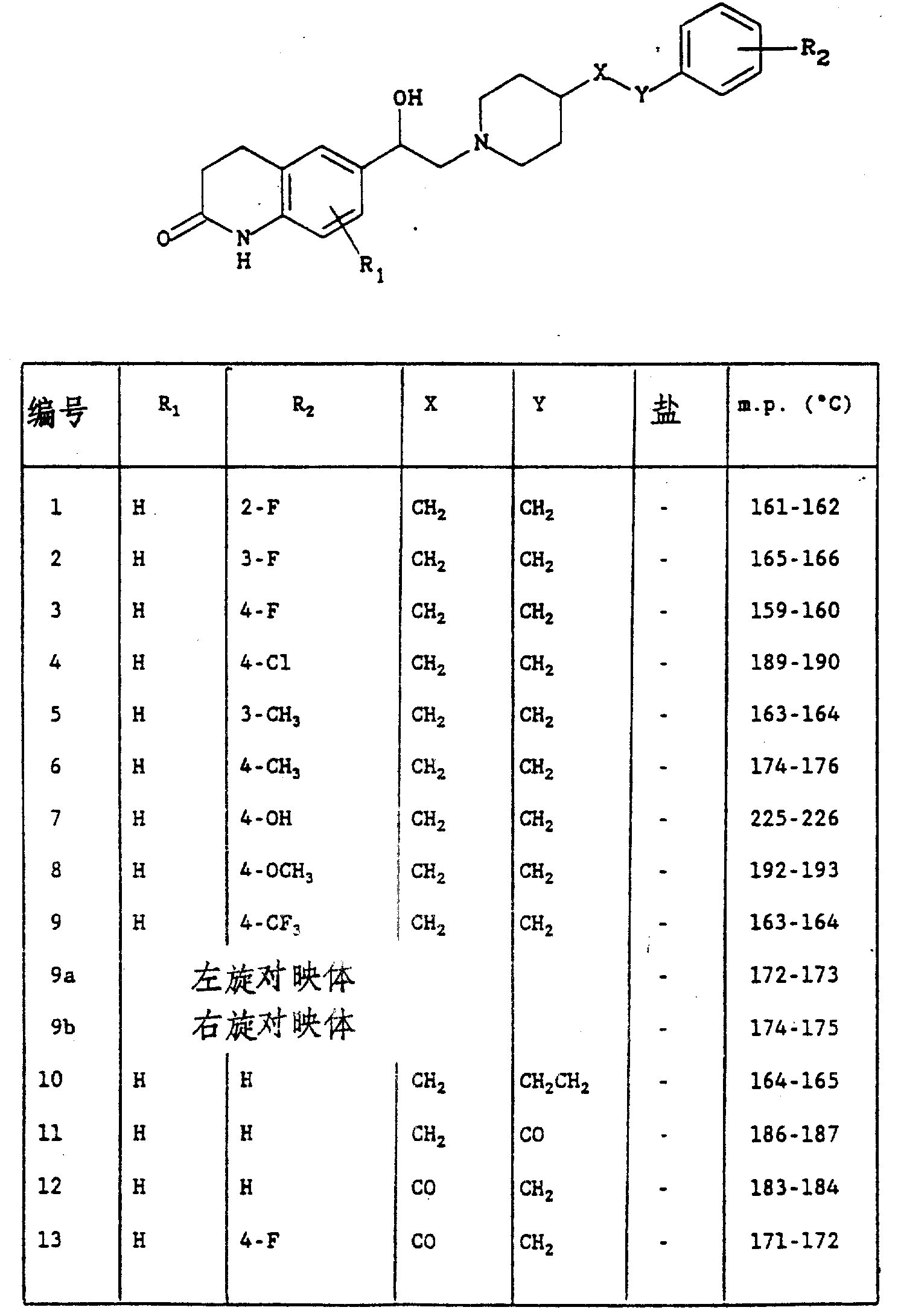


The compounds of this invention had carried out pharmacological testing, and test shows that they can be used as the active substance of nerve protection medicine.
Specifically, the neuroprotective activity of The compounds of this invention, according to being similar to BrainResearch, 522, (1990), and the method described in the 290-307, verified in the local asphyxia model by the mesencephalic arteries of ligation mouse.
Utilize electrocoagulation to block behind the mesencephalic arteries under halothane anesthesia six days, anesthetized mice takes out and the pallium that blocks homonymy again, after the tissue homogenateization, by derive from New England Nuclear (
3H) PK 11195 compounds are by measuring periphery benzene (also) phenodiazine
 (ω
3) raising of density in site, estimate the scope that brain blocks.Treat processing in the following time by the intraperitoneal administration: 5 minutes, 3 hours, 6 hours, 18 hours and 24 hours.
(ω
3) raising of density in site, estimate the scope that brain blocks.Treat processing in the following time by the intraperitoneal administration: 5 minutes, 3 hours, 6 hours, 18 hours and 24 hours.
Compounds more of the present invention can make periphery benzene (also) phenodiazine during with the dosed administration of 10 mg/kg
 The density in site reduce about 70%.
According to people such as Schoemaker at Eur.J.Pharmacol., 176, the 249-250(1990) method described in, also to The compounds of this invention carried out suppressing (
3H) Ifenprodil ((
3H) ifenprodil) with the responsive acceptor bonded test of the polyamines of rat cerebral cortex.
The Sprague-Dawley male rat of 150 to 230 grams is put to death, take out pallium, use Ultra-Turrax
TM(Ikawerk) or Polytron
TM(Kinematica) device, homogenize in the Tris-HCl damping fluid of the ice-cold 50mM of 20 times of volumes (pH=7.4,0 ℃ under).
Tissue homogenate by centrifugal 10 minutes washed twice under 45000 * g, is suspended in throw out in the fresh damping fluid again.Final throw out is suspended in the same buffer of 20 times of volumes.
Get this suspension of 100 microlitre portions, make it with 1nM (
3H) Ifenprodil (specific activity: be 1000 microlitres at final volume together 30 to 35Ci/ mmoles), the GBR 12909(ResearchBiochemicals Inc. that 3 micromoles (μ M) are arranged, Natick, MA, USA) exist down, be with or without the competition material and exist down, in 0 ℃ of following incubation 120 minutes.Then, mixture with the Tris-HCl damping fluid of 5 milliliters of ice-cold 50mM (under 0 ℃, pH=7.4) dilution, serous coat is by with the pretreated Whatman GF/B of 0.05% polymine
TMThe filter filtered and recycled is used 5 milliliters ice-cold buffer washed twice then.
Measure non-specific binding with 10 μ M Ifenprodils,, calculate IC according to the methods analyst data of routine
50Concentration, promptly suppress 50% (
3H) Ifenprodil bonded concentration.IC
50Value is in 2nM to 10 μ M(2 * 10
-9To 1 * 10
-5M) change between.
The compounds of this invention also carried out suppressing (
3The test of the σ of Ifenprodil and rat cerebral cortex (sigma) receptors bind H) (people such as Schoemaker, Eur.J.Pharmacol., 183,1670(1990)).
After the Sprague-Dawley male rat execution with 150 to 230 grams, its pallium is used Ultra-Turrax in the Tris-HCl damping fluid (pH=7.4 under 0 ℃) of the ice-cold 50mM of 20 times of volumes
TM(Ikawerk) or Polytron
TM(Kinematica) device carries out homogenate.
Tissue homogenate by centrifugal 10 minutes washed twice under 45000 * g, is suspended in throw out in the fresh damping fluid again.Final throw out is suspended in the identical damping fluid of 20 times of volumes.
With this suspension of 100 microlitre portions with 0.5nM (
3H) Ifenprodil (specific activity: be 1000 microlitres at final volume together 30 to 35Ci/ mmoles), be with or without the competition material and exist down, in 37 ℃ of following incubations 30 minutes.Then, serous coat passes through with the pretreated Whatman GF/B of 0.05% polymine
TMThe filter filtered and recycled is used 5 milliliters ice-cold buffer washed twice then.Ifenprodil with 10 μ M is measured non-specific binding, according to the methods analyst data of routine, calculates IC
50Concentration, promptly suppress 50% (
3H) Ifenprodil bonded concentration.
The IC of The compounds of this invention
50Value is 2.5 to 800nM(2.5 * 10
-9To 8 * 10
-7M) change between.
At last, the maximum that mouse is caused by super electroshock with regard to the The compounds of this invention activity of fainting from fear is tested.
E.A.Swinyard and J.H.Woodhead be at Antiepileptic Drugs, Raven Press, and New York, 1982, among the 111-126 this test method is described.
Test compound through the intraperitoneal administration after 30 minutes, by wearing Corneal electrode, is applied one electric current (0.4 second, 60 milliamperes, 50 hertz) afterwards immediately, note writing down the quantity (convulsions extends into rear solid end) that the mouse of fainting from fear occurs.The result is with AD
50Promptly protect the dosage of 50% animal to represent, calculating is according to J.T.Lichtfield and F.Wilcoxon(J.Pharm.Exp.Ther., 96, and 99-113(1949)) method, every gives that 3-4 dosage carries out in one group 8 to 10 mouse.In this test, the AD of compounds effective
50During the administration of value intraperitoneal about 10 mg/kg.
The result who tests with The compounds of this invention shows, the disease that they can be used for the treatment of and prevent cerebral disorders for example to be caused by local asphyxia, heart failure or respiratory insufficiency, cerebral thrombosis or embolism; Be used for the treatment of the dementia that multiple infarctions causes; Be used for the treatment of senile dementia, for example Alzheimer's dementia or Pick's disease; Be used for the treatment of olivopontocerebellar atrophy and other neurodegenerative disease, for example, Huntington Chorea; Be used for the treatment of schizophrenia; Be used for the treatment of cranium or spinal trauma; Be used for the treatment of various convulsions states, as antiemetic, and treatment AIDS(sees Science when treating some cancer with Platinol, 250,1593(1990)).
For this reason, they can combine with various suitable vehicle, with the various medicament forms that are suitable for enteron aisle or parenterai administration tablet for example, sugar-pill, capsule, wafer, suppository, the solution of oral or injection or suspension etc. provide, and they contain the dosage that allows to take every day 1 to 1000 milligram of active substance.
Claims (5)
1, the form with pure optically active isomer or two kinds of mixture of enantiomers exists, and is free alkali or itself and the logical formula I compound of the additive salt that forms of acceptable acid pharmaceutically,

Wherein: R
1Represent hydrogen, halogen atom or methyl,
R
2Represent one or two to be selected from hydrogen, halogen atom, (C
1-4) alkyl, hydroxyl, (C
1-4) alkoxyl group, trifluoromethyl, the substituting group of kharophen and sulfonyloxy methyl amino,
And,
Perhaps X represents CH
2Group, Y represents CH
2, (CH
2)
2Or CO,
Perhaps X represents CO, and Y represents CH
2, but do not comprise R in the formula I
1With
R
2On behalf of hydrogen atom and X and Y, each respectively represent CH
2The compound of group.
2, according to the compound of claim 1, in the case, this compound is 6-(1-hydroxyl-2-(4-(2-(4-(trifluoromethyl) phenyl) ethyl) piperidines-1-yl) ethyl)-3, the 4-dihydroquinoline-2(1H)-ketone, and its left-handed and dextrorotation enantiomorph.
3, the preparation method of the compound of claim 1 is characterized in that, by logical formula II compound and the reaction of logical formula III compound, to obtain logical formula IV compound:
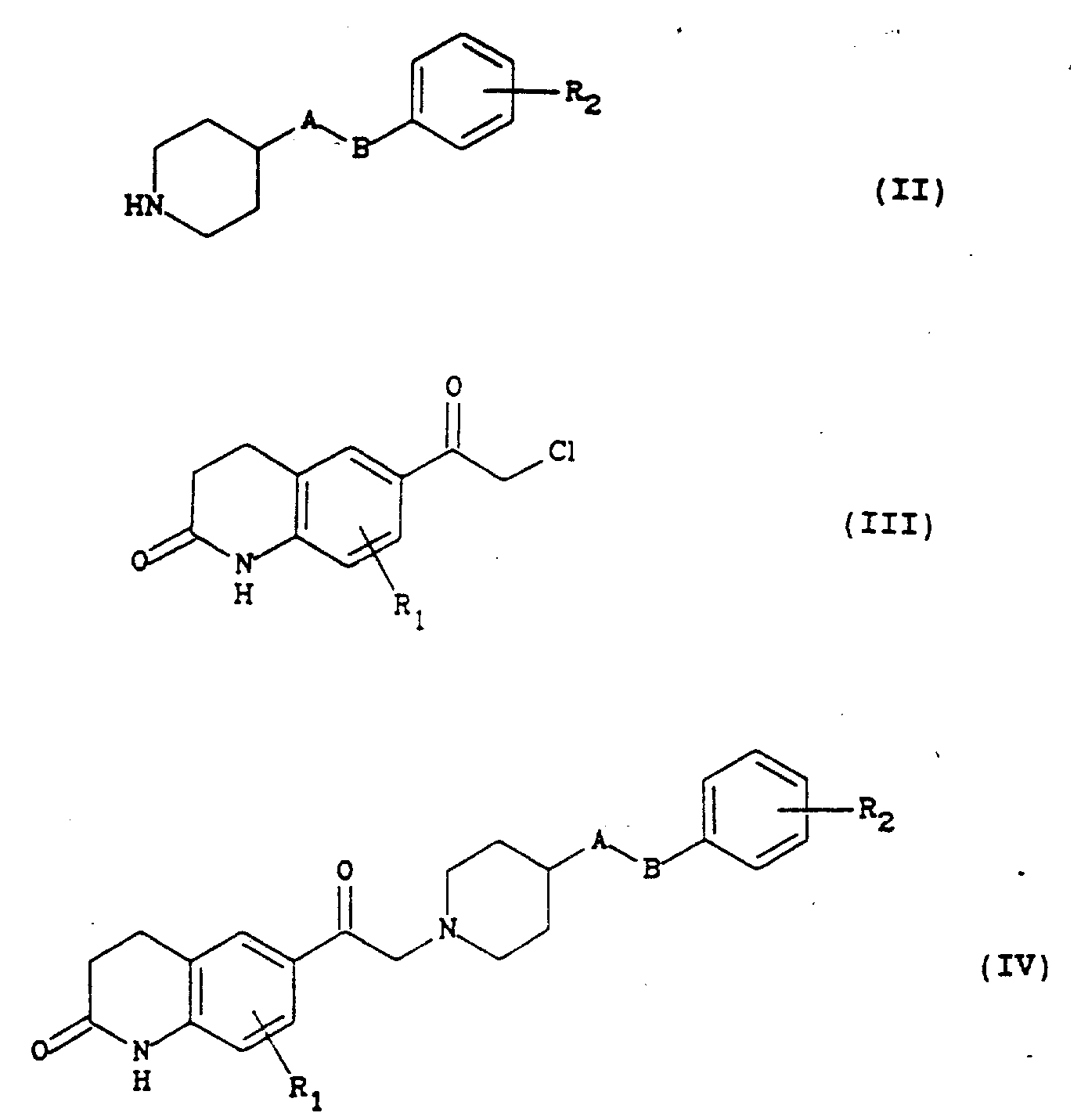
Wherein: in the logical formula II,
Perhaps, A is CH
2Base, B are CH
2Or (CH
2)
2Base,
Perhaps, A or B are CH
2Base, and another is 1,3-dioxolane-2,2-two bases,
R
2As defined in claim 1,
In the logical formula III,
R
1As defined in claim 1, then the ketone in the formula IV is reduced into alcohol functional group, and, need, with 1,3-dioxolane-2,2-two bases are hydrolyzed into the CO base.
4, a kind of medicament production is characterized in that, it is made up of the compound of one of claim 1 and 2.
5, a kind of pharmaceutical composition is characterized in that, it contains the compound and the vehicle of one of claim 1 and 2.
Applications Claiming Priority (6)
| Application Number | Priority Date | Filing Date | Title |
|---|---|---|---|
| FR9107936A FR2678270B1 (en) | 1991-06-27 | 1991-06-27 | DERIVATIVES OF 2- (PIPERIDIN-1-YL) ETHANOL, THEIR PREPARATION AND THEIR THERAPEUTIC APPLICATION. |
| FR9107936 | 1991-06-27 | ||
| FR9107934A FR2678265B1 (en) | 1991-06-27 | 1991-06-27 | DERIVATIVES OF 4- (2-PHENYLETHYL) PIPERIDINE, THEIR PREPARATION AND THEIR THERAPEUTIC APPLICATION. |
| FR9107934 | 1991-06-27 | ||
| FR9204507A FR2689891B3 (en) | 1992-04-13 | 1992-04-13 | DERIVATIVES OF 2- (PIPERIDIN-1-YL) ETHANOL, THEIR PREPARATION AND THEIR THERAPEUTIC APPLICATION. |
| FR9204507 | 1992-04-13 |
Publications (1)
| Publication Number | Publication Date |
|---|---|
| CN1069491A true CN1069491A (en) | 1993-03-03 |
Family
ID=27252473
Family Applications (1)
| Application Number | Title | Priority Date | Filing Date |
|---|---|---|---|
| CN92105067A Pending CN1069491A (en) | 1991-06-27 | 1992-06-26 | 2-(Piperidin-1-yl)ethanol derivatives, their preparation and their therapeutic use |
Country Status (14)
| Country | Link |
|---|---|
| EP (1) | EP0524846A1 (en) |
| JP (1) | JPH05186460A (en) |
| KR (1) | KR930000505A (en) |
| CN (1) | CN1069491A (en) |
| AU (1) | AU644296B2 (en) |
| CA (1) | CA2072520A1 (en) |
| CZ (1) | CZ199992A3 (en) |
| FI (1) | FI922979A7 (en) |
| HU (1) | HUT61743A (en) |
| IE (1) | IE922090A1 (en) |
| IL (1) | IL102334A0 (en) |
| MX (1) | MX9203452A (en) |
| NO (1) | NO922521L (en) |
| NZ (1) | NZ243337A (en) |
Cited By (1)
| Publication number | Priority date | Publication date | Assignee | Title |
|---|---|---|---|---|
| CN103896835A (en) * | 2014-04-20 | 2014-07-02 | 武汉珈瑜科技有限公司 | Quinolinone derivatives and application thereof |
Families Citing this family (12)
| Publication number | Priority date | Publication date | Assignee | Title |
|---|---|---|---|---|
| WO1994001403A1 (en) * | 1992-07-08 | 1994-01-20 | Shell Internationale Research Maatschappij B.V. | Piperidine derivatives |
| DK0666854T3 (en) * | 1992-10-30 | 1997-04-28 | Pfizer | Neuroprotective 3,4-dihydro-2 (1H) -quinolone compounds |
| FR2727864B1 (en) * | 1994-12-12 | 1997-04-04 | Synthelabo | USE OF LIGANDS FROM THE PERIPHERAL BINDING SITES FOR BENZODIAZEPINES FOR THE PREPARATION OF DRUGS USEFUL IN THE TREATMENT OF PERIPHERAL NEUROPATHIES |
| ZA9610745B (en) * | 1995-12-22 | 1997-06-24 | Warner Lambert Co | 4-Subsituted piperidine analogs and their use as subtype selective nmda receptor antagonists |
| ZA9610738B (en) | 1995-12-22 | 1997-06-24 | Warner Lambert Co | Subtype selective nmda receptor ligands and the use thereof |
| ZA9610736B (en) * | 1995-12-22 | 1997-06-27 | Warner Lambert Co | 2-Substituted piperidine analogs and their use as subtypeselective nmda receptor antagonists |
| ZA9610741B (en) | 1995-12-22 | 1997-06-24 | Warner Lambert Co | 4-Substituted piperidine analogs and their use as subtype selective nmda receptor antagonists |
| WO1999058117A1 (en) * | 1998-05-13 | 1999-11-18 | Sanofi-Synthelabo | Use of compounds for reducing apoptosis |
| FR2778564B1 (en) * | 1998-05-13 | 2001-07-13 | Sanofi Sa | USE OF COMPOUNDS REDUCING APOPTOSIS |
| DE69932449T2 (en) | 1998-12-18 | 2007-03-15 | Scios Inc., Fremont | AGONISTS AND ANTAGONISTS OF BENZODIAZEPIN RECEPTORS OF THE PERIPHERAL TYPE |
| EP1736474A4 (en) * | 2004-04-07 | 2010-04-21 | Kyowa Hakko Kirin Co Ltd | Piperidine derivative |
| WO2025198588A1 (en) * | 2024-03-20 | 2025-09-25 | Bridgene Biosciences, Inc. | Preparation of compound and crystalline forms thereof |
Family Cites Families (6)
| Publication number | Priority date | Publication date | Assignee | Title |
|---|---|---|---|---|
| CN1030415A (en) * | 1987-02-20 | 1989-01-18 | 山之内制药株式会社 | Saturated heterocycle carboxamide derivatives and its preparation method |
| FR2640266B2 (en) * | 1988-07-12 | 1992-07-10 | Synthelabo | INDOLONES-2, QUINOLEINONES-2, BENZO (B) AZEPINONES-2 AND BENZIMIDAZOLONES-2 DERIVATIVES OF (HYDROXY-1 PIPERIDINYL-2 ALKYL), THEIR PREPARATION AND THEIR THERAPEUTIC APPLICATION |
| JP2969359B2 (en) * | 1989-01-13 | 1999-11-02 | 武田薬品工業株式会社 | Cyclic amine compounds |
| FR2644786B1 (en) * | 1989-03-21 | 1993-12-31 | Adir Cie | NOVEL 4-FLUORO-4 BENZOIC DERIVATIVES, PROCESSES FOR THEIR PREPARATION AND THE PHARMACEUTICAL COMPOSITIONS CONTAINING THEM |
| JPH03130263A (en) * | 1989-07-19 | 1991-06-04 | Eisai Co Ltd | Optically active naphthylethanol derivative |
| FR2668149B1 (en) * | 1990-10-18 | 1994-09-23 | Synthelabo | 1- (3,4-DIHYDRO-2-OXO-1H-QUINOLEIN-6-YL) -2- [4- (2-PHENYL-ETHYL) PIPERIDIN-1-YL] ETHANOL, ITS PREPARATION AND THERAPEUTIC APPLICATION . |
-
1992
- 1992-06-24 EP EP92401769A patent/EP0524846A1/en not_active Withdrawn
- 1992-06-25 KR KR1019920011122A patent/KR930000505A/en not_active Withdrawn
- 1992-06-26 CN CN92105067A patent/CN1069491A/en active Pending
- 1992-06-26 CA CA002072520A patent/CA2072520A1/en not_active Abandoned
- 1992-06-26 JP JP4168943A patent/JPH05186460A/en active Pending
- 1992-06-26 IL IL102334A patent/IL102334A0/en unknown
- 1992-06-26 HU HU9202138A patent/HUT61743A/en unknown
- 1992-06-26 FI FI922979A patent/FI922979A7/en unknown
- 1992-06-26 MX MX9203452A patent/MX9203452A/en unknown
- 1992-06-26 AU AU18589/92A patent/AU644296B2/en not_active Ceased
- 1992-06-26 NZ NZ243337A patent/NZ243337A/en unknown
- 1992-06-26 CZ CS921999A patent/CZ199992A3/en unknown
- 1992-06-26 NO NO92922521A patent/NO922521L/en unknown
- 1992-07-01 IE IE209092A patent/IE922090A1/en not_active Application Discontinuation
Cited By (1)
| Publication number | Priority date | Publication date | Assignee | Title |
|---|---|---|---|---|
| CN103896835A (en) * | 2014-04-20 | 2014-07-02 | 武汉珈瑜科技有限公司 | Quinolinone derivatives and application thereof |
Also Published As
| Publication number | Publication date |
|---|---|
| KR930000505A (en) | 1993-01-15 |
| HUT61743A (en) | 1993-03-01 |
| AU644296B2 (en) | 1993-12-02 |
| EP0524846A1 (en) | 1993-01-27 |
| IL102334A0 (en) | 1993-01-14 |
| FI922979L (en) | 1992-12-28 |
| CZ199992A3 (en) | 1993-01-13 |
| AU1858992A (en) | 1993-01-07 |
| NO922521L (en) | 1992-12-28 |
| FI922979A0 (en) | 1992-06-26 |
| MX9203452A (en) | 1994-01-31 |
| CA2072520A1 (en) | 1992-12-28 |
| JPH05186460A (en) | 1993-07-27 |
| HU9202138D0 (en) | 1992-10-28 |
| NZ243337A (en) | 1994-03-25 |
| FI922979A7 (en) | 1992-12-28 |
| IE922090A1 (en) | 1992-12-30 |
| NO922521D0 (en) | 1992-06-26 |
Similar Documents
| Publication | Publication Date | Title |
|---|---|---|
| CN1041726C (en) | 1.3-Dihydro-2H-Imidazo{4,5-6} Quinolin-2-One derivatives. | |
| CN1028104C (en) | Carbostyril derivatives | |
| CN1064356C (en) | New Piperazine, piperidine and 1,2,5,6-tetrahydropyridine compounds, process for preparation thereof and pharmaceutical compositions containing them | |
| CN1309704C (en) | Anthranilamide and its use as medicine | |
| CN1030766C (en) | Serotonin 5HTIA agonists | |
| CN1285578C (en) | Substituted benzoic acid amides and their application in inhibiting angiogenesis | |
| CN1094490C (en) | Quinol-2(1H)-one derivatives as serotonin antagonists | |
| CN1247571C (en) | Novel 2H -pyridazine-3-one derivatives, pharmaceutical compositions containing the same and a process for the preparation of the active ingredient | |
| CN100347164C (en) | Benzofuryl derivatives and their use | |
| CN1092422A (en) | Medicine | |
| CN1143953A (en) | Certain fused N-pyrrolecarboxanilides; a new class of brain GABA receptor ligands | |
| CN1124960A (en) | Indole derivatives as 5-HT/A and/or 5-HT2 ligands | |
| CN1109471A (en) | Derivative of imidazol-4yl-piperidine, preparation of same and application of same in treatment | |
| CN1044094A (en) | 2-aminopyrimidinone derivatives | |
| CN88101642A (en) | Piperazinyl-heterogeneous ring compound | |
| CN1367169A (en) | Substituted 6,6-Hetero-dicycloderivative | |
| CN1069491A (en) | 2-(Piperidin-1-yl)ethanol derivatives, their preparation and their therapeutic use | |
| CN1678614A (en) | Novel polymorphs of N-methyl-N(3-{3-[2-thienylcarbonyl]-pyrazole-[1,5-α]-pyrimidin-7-yl}phenyl)acetamide and related combinations thereof Objects and methods | |
| CN1268352A (en) | Method for preparing medicinal prepns. contg. 6-heterocycle-4-amino-1,3,4,5-tetrabenzo [cd] indole | |
| CN1105358A (en) | N-substituted azabicycloheptane derivatives, the preparation and use thereof | |
| CN1221734A (en) | Novel naphthalene compounds, process for their preparation and pharmaceutical compositions containing them | |
| CN1050604C (en) | Compound with antipsychotic effect | |
| CN1031619C (en) | Oxazolidinone derivatives for the preparation of drugs | |
| CN1105360A (en) | 1-[2H-1-Benzopyran-2-on-8-yl]-piperazine derivatives | |
| CN1099032A (en) | Benzoxazine derivatives, their preparation and their use in medicine |
Legal Events
| Date | Code | Title | Description |
|---|---|---|---|
| C06 | Publication | ||
| PB01 | Publication | ||
| C01 | Deemed withdrawal of patent application (patent law 1993) | ||
| WD01 | Invention patent application deemed withdrawn after publication |