CN106978672B - Method and laminate for making laminates - Google Patents
Method and laminate for making laminates Download PDFInfo
- Publication number
- CN106978672B CN106978672B CN201710023053.9A CN201710023053A CN106978672B CN 106978672 B CN106978672 B CN 106978672B CN 201710023053 A CN201710023053 A CN 201710023053A CN 106978672 B CN106978672 B CN 106978672B
- Authority
- CN
- China
- Prior art keywords
- layer
- nonwoven material
- shrinkage
- layers
- filaments
- Prior art date
- Legal status (The legal status is an assumption and is not a legal conclusion. Google has not performed a legal analysis and makes no representation as to the accuracy of the status listed.)
- Active
Links
Images


Classifications
-
- B—PERFORMING OPERATIONS; TRANSPORTING
- B32—LAYERED PRODUCTS
- B32B—LAYERED PRODUCTS, i.e. PRODUCTS BUILT-UP OF STRATA OF FLAT OR NON-FLAT, e.g. CELLULAR OR HONEYCOMB, FORM
- B32B5/00—Layered products characterised by the non- homogeneity or physical structure, i.e. comprising a fibrous, filamentary, particulate or foam layer; Layered products characterised by having a layer differing constitutionally or physically in different parts
- B32B5/14—Layered products characterised by the non- homogeneity or physical structure, i.e. comprising a fibrous, filamentary, particulate or foam layer; Layered products characterised by having a layer differing constitutionally or physically in different parts characterised by a layer differing constitutionally or physically in different parts, e.g. denser near its faces
- B32B5/145—Variation across the thickness of the layer
-
- D—TEXTILES; PAPER
- D04—BRAIDING; LACE-MAKING; KNITTING; TRIMMINGS; NON-WOVEN FABRICS
- D04H—MAKING TEXTILE FABRICS, e.g. FROM FIBRES OR FILAMENTARY MATERIAL; FABRICS MADE BY SUCH PROCESSES OR APPARATUS, e.g. FELTS, NON-WOVEN FABRICS; COTTON-WOOL; WADDING ; NON-WOVEN FABRICS FROM STAPLE FIBRES, FILAMENTS OR YARNS, BONDED WITH AT LEAST ONE WEB-LIKE MATERIAL DURING THEIR CONSOLIDATION
- D04H13/00—Other non-woven fabrics
-
- B—PERFORMING OPERATIONS; TRANSPORTING
- B32—LAYERED PRODUCTS
- B32B—LAYERED PRODUCTS, i.e. PRODUCTS BUILT-UP OF STRATA OF FLAT OR NON-FLAT, e.g. CELLULAR OR HONEYCOMB, FORM
- B32B27/00—Layered products comprising a layer of synthetic resin
- B32B27/12—Layered products comprising a layer of synthetic resin next to a fibrous or filamentary layer
-
- B—PERFORMING OPERATIONS; TRANSPORTING
- B32—LAYERED PRODUCTS
- B32B—LAYERED PRODUCTS, i.e. PRODUCTS BUILT-UP OF STRATA OF FLAT OR NON-FLAT, e.g. CELLULAR OR HONEYCOMB, FORM
- B32B27/00—Layered products comprising a layer of synthetic resin
- B32B27/32—Layered products comprising a layer of synthetic resin comprising polyolefins
-
- B—PERFORMING OPERATIONS; TRANSPORTING
- B32—LAYERED PRODUCTS
- B32B—LAYERED PRODUCTS, i.e. PRODUCTS BUILT-UP OF STRATA OF FLAT OR NON-FLAT, e.g. CELLULAR OR HONEYCOMB, FORM
- B32B3/00—Layered products comprising a layer with external or internal discontinuities or unevennesses, or a layer of non-planar shape; Layered products comprising a layer having particular features of form
- B32B3/26—Layered products comprising a layer with external or internal discontinuities or unevennesses, or a layer of non-planar shape; Layered products comprising a layer having particular features of form characterised by a particular shape of the outline of the cross-section of a continuous layer; characterised by a layer with cavities or internal voids ; characterised by an apertured layer
- B32B3/263—Layered products comprising a layer with external or internal discontinuities or unevennesses, or a layer of non-planar shape; Layered products comprising a layer having particular features of form characterised by a particular shape of the outline of the cross-section of a continuous layer; characterised by a layer with cavities or internal voids ; characterised by an apertured layer characterised by a layer having non-uniform thickness
-
- B—PERFORMING OPERATIONS; TRANSPORTING
- B32—LAYERED PRODUCTS
- B32B—LAYERED PRODUCTS, i.e. PRODUCTS BUILT-UP OF STRATA OF FLAT OR NON-FLAT, e.g. CELLULAR OR HONEYCOMB, FORM
- B32B37/00—Methods or apparatus for laminating, e.g. by curing or by ultrasonic bonding
- B32B37/06—Methods or apparatus for laminating, e.g. by curing or by ultrasonic bonding characterised by the heating method
-
- B—PERFORMING OPERATIONS; TRANSPORTING
- B32—LAYERED PRODUCTS
- B32B—LAYERED PRODUCTS, i.e. PRODUCTS BUILT-UP OF STRATA OF FLAT OR NON-FLAT, e.g. CELLULAR OR HONEYCOMB, FORM
- B32B37/00—Methods or apparatus for laminating, e.g. by curing or by ultrasonic bonding
- B32B37/14—Methods or apparatus for laminating, e.g. by curing or by ultrasonic bonding characterised by the properties of the layers
- B32B37/144—Methods or apparatus for laminating, e.g. by curing or by ultrasonic bonding characterised by the properties of the layers using layers with different mechanical or chemical conditions or properties, e.g. layers with different thermal shrinkage, layers under tension during bonding
-
- B—PERFORMING OPERATIONS; TRANSPORTING
- B32—LAYERED PRODUCTS
- B32B—LAYERED PRODUCTS, i.e. PRODUCTS BUILT-UP OF STRATA OF FLAT OR NON-FLAT, e.g. CELLULAR OR HONEYCOMB, FORM
- B32B37/00—Methods or apparatus for laminating, e.g. by curing or by ultrasonic bonding
- B32B37/30—Partial laminating
-
- B—PERFORMING OPERATIONS; TRANSPORTING
- B32—LAYERED PRODUCTS
- B32B—LAYERED PRODUCTS, i.e. PRODUCTS BUILT-UP OF STRATA OF FLAT OR NON-FLAT, e.g. CELLULAR OR HONEYCOMB, FORM
- B32B38/00—Ancillary operations in connection with laminating processes
- B32B38/0036—Heat treatment
-
- B—PERFORMING OPERATIONS; TRANSPORTING
- B32—LAYERED PRODUCTS
- B32B—LAYERED PRODUCTS, i.e. PRODUCTS BUILT-UP OF STRATA OF FLAT OR NON-FLAT, e.g. CELLULAR OR HONEYCOMB, FORM
- B32B5/00—Layered products characterised by the non- homogeneity or physical structure, i.e. comprising a fibrous, filamentary, particulate or foam layer; Layered products characterised by having a layer differing constitutionally or physically in different parts
- B32B5/02—Layered products characterised by the non- homogeneity or physical structure, i.e. comprising a fibrous, filamentary, particulate or foam layer; Layered products characterised by having a layer differing constitutionally or physically in different parts characterised by structural features of a fibrous or filamentary layer
- B32B5/022—Non-woven fabric
-
- B—PERFORMING OPERATIONS; TRANSPORTING
- B32—LAYERED PRODUCTS
- B32B—LAYERED PRODUCTS, i.e. PRODUCTS BUILT-UP OF STRATA OF FLAT OR NON-FLAT, e.g. CELLULAR OR HONEYCOMB, FORM
- B32B5/00—Layered products characterised by the non- homogeneity or physical structure, i.e. comprising a fibrous, filamentary, particulate or foam layer; Layered products characterised by having a layer differing constitutionally or physically in different parts
- B32B5/02—Layered products characterised by the non- homogeneity or physical structure, i.e. comprising a fibrous, filamentary, particulate or foam layer; Layered products characterised by having a layer differing constitutionally or physically in different parts characterised by structural features of a fibrous or filamentary layer
- B32B5/08—Layered products characterised by the non- homogeneity or physical structure, i.e. comprising a fibrous, filamentary, particulate or foam layer; Layered products characterised by having a layer differing constitutionally or physically in different parts characterised by structural features of a fibrous or filamentary layer the fibres or filaments of a layer being of different substances, e.g. conjugate fibres, mixture of different fibres
-
- B—PERFORMING OPERATIONS; TRANSPORTING
- B32—LAYERED PRODUCTS
- B32B—LAYERED PRODUCTS, i.e. PRODUCTS BUILT-UP OF STRATA OF FLAT OR NON-FLAT, e.g. CELLULAR OR HONEYCOMB, FORM
- B32B5/00—Layered products characterised by the non- homogeneity or physical structure, i.e. comprising a fibrous, filamentary, particulate or foam layer; Layered products characterised by having a layer differing constitutionally or physically in different parts
- B32B5/02—Layered products characterised by the non- homogeneity or physical structure, i.e. comprising a fibrous, filamentary, particulate or foam layer; Layered products characterised by having a layer differing constitutionally or physically in different parts characterised by structural features of a fibrous or filamentary layer
- B32B5/12—Layered products characterised by the non- homogeneity or physical structure, i.e. comprising a fibrous, filamentary, particulate or foam layer; Layered products characterised by having a layer differing constitutionally or physically in different parts characterised by structural features of a fibrous or filamentary layer characterised by the relative arrangement of fibres or filaments of different layers, e.g. the fibres or filaments being parallel or perpendicular to each other
-
- B—PERFORMING OPERATIONS; TRANSPORTING
- B32—LAYERED PRODUCTS
- B32B—LAYERED PRODUCTS, i.e. PRODUCTS BUILT-UP OF STRATA OF FLAT OR NON-FLAT, e.g. CELLULAR OR HONEYCOMB, FORM
- B32B5/00—Layered products characterised by the non- homogeneity or physical structure, i.e. comprising a fibrous, filamentary, particulate or foam layer; Layered products characterised by having a layer differing constitutionally or physically in different parts
- B32B5/22—Layered products characterised by the non- homogeneity or physical structure, i.e. comprising a fibrous, filamentary, particulate or foam layer; Layered products characterised by having a layer differing constitutionally or physically in different parts characterised by the presence of two or more layers which are next to each other and are fibrous, filamentary, formed of particles or foamed
- B32B5/24—Layered products characterised by the non- homogeneity or physical structure, i.e. comprising a fibrous, filamentary, particulate or foam layer; Layered products characterised by having a layer differing constitutionally or physically in different parts characterised by the presence of two or more layers which are next to each other and are fibrous, filamentary, formed of particles or foamed one layer being a fibrous or filamentary layer
- B32B5/26—Layered products characterised by the non- homogeneity or physical structure, i.e. comprising a fibrous, filamentary, particulate or foam layer; Layered products characterised by having a layer differing constitutionally or physically in different parts characterised by the presence of two or more layers which are next to each other and are fibrous, filamentary, formed of particles or foamed one layer being a fibrous or filamentary layer another layer next to it also being fibrous or filamentary
-
- B—PERFORMING OPERATIONS; TRANSPORTING
- B32—LAYERED PRODUCTS
- B32B—LAYERED PRODUCTS, i.e. PRODUCTS BUILT-UP OF STRATA OF FLAT OR NON-FLAT, e.g. CELLULAR OR HONEYCOMB, FORM
- B32B7/00—Layered products characterised by the relation between layers; Layered products characterised by the relative orientation of features between layers, or by the relative values of a measurable parameter between layers, i.e. products comprising layers having different physical, chemical or physicochemical properties; Layered products characterised by the interconnection of layers
- B32B7/02—Physical, chemical or physicochemical properties
- B32B7/027—Thermal properties
- B32B7/028—Heat-shrinkability
-
- B—PERFORMING OPERATIONS; TRANSPORTING
- B32—LAYERED PRODUCTS
- B32B—LAYERED PRODUCTS, i.e. PRODUCTS BUILT-UP OF STRATA OF FLAT OR NON-FLAT, e.g. CELLULAR OR HONEYCOMB, FORM
- B32B7/00—Layered products characterised by the relation between layers; Layered products characterised by the relative orientation of features between layers, or by the relative values of a measurable parameter between layers, i.e. products comprising layers having different physical, chemical or physicochemical properties; Layered products characterised by the interconnection of layers
- B32B7/04—Interconnection of layers
-
- B—PERFORMING OPERATIONS; TRANSPORTING
- B32—LAYERED PRODUCTS
- B32B—LAYERED PRODUCTS, i.e. PRODUCTS BUILT-UP OF STRATA OF FLAT OR NON-FLAT, e.g. CELLULAR OR HONEYCOMB, FORM
- B32B7/00—Layered products characterised by the relation between layers; Layered products characterised by the relative orientation of features between layers, or by the relative values of a measurable parameter between layers, i.e. products comprising layers having different physical, chemical or physicochemical properties; Layered products characterised by the interconnection of layers
- B32B7/04—Interconnection of layers
- B32B7/05—Interconnection of layers the layers not being connected over the whole surface, e.g. discontinuous connection or patterned connection
-
- D—TEXTILES; PAPER
- D01—NATURAL OR MAN-MADE THREADS OR FIBRES; SPINNING
- D01D—MECHANICAL METHODS OR APPARATUS IN THE MANUFACTURE OF ARTIFICIAL FILAMENTS, THREADS, FIBRES, BRISTLES OR RIBBONS
- D01D5/00—Formation of filaments, threads, or the like
- D01D5/08—Melt spinning methods
- D01D5/088—Cooling filaments, threads or the like, leaving the spinnerettes
-
- D—TEXTILES; PAPER
- D04—BRAIDING; LACE-MAKING; KNITTING; TRIMMINGS; NON-WOVEN FABRICS
- D04H—MAKING TEXTILE FABRICS, e.g. FROM FIBRES OR FILAMENTARY MATERIAL; FABRICS MADE BY SUCH PROCESSES OR APPARATUS, e.g. FELTS, NON-WOVEN FABRICS; COTTON-WOOL; WADDING ; NON-WOVEN FABRICS FROM STAPLE FIBRES, FILAMENTS OR YARNS, BONDED WITH AT LEAST ONE WEB-LIKE MATERIAL DURING THEIR CONSOLIDATION
- D04H1/00—Non-woven fabrics formed wholly or mainly of staple fibres or like relatively short fibres
- D04H1/40—Non-woven fabrics formed wholly or mainly of staple fibres or like relatively short fibres from fleeces or layers composed of fibres without existing or potential cohesive properties
- D04H1/42—Non-woven fabrics formed wholly or mainly of staple fibres or like relatively short fibres from fleeces or layers composed of fibres without existing or potential cohesive properties characterised by the use of certain kinds of fibres insofar as this use has no preponderant influence on the consolidation of the fleece
- D04H1/4374—Non-woven fabrics formed wholly or mainly of staple fibres or like relatively short fibres from fleeces or layers composed of fibres without existing or potential cohesive properties characterised by the use of certain kinds of fibres insofar as this use has no preponderant influence on the consolidation of the fleece using different kinds of webs, e.g. by layering webs
-
- D—TEXTILES; PAPER
- D04—BRAIDING; LACE-MAKING; KNITTING; TRIMMINGS; NON-WOVEN FABRICS
- D04H—MAKING TEXTILE FABRICS, e.g. FROM FIBRES OR FILAMENTARY MATERIAL; FABRICS MADE BY SUCH PROCESSES OR APPARATUS, e.g. FELTS, NON-WOVEN FABRICS; COTTON-WOOL; WADDING ; NON-WOVEN FABRICS FROM STAPLE FIBRES, FILAMENTS OR YARNS, BONDED WITH AT LEAST ONE WEB-LIKE MATERIAL DURING THEIR CONSOLIDATION
- D04H3/00—Non-woven fabrics formed wholly or mainly of yarns or like filamentary material of substantial length
- D04H3/005—Synthetic yarns or filaments
- D04H3/007—Addition polymers
-
- D—TEXTILES; PAPER
- D04—BRAIDING; LACE-MAKING; KNITTING; TRIMMINGS; NON-WOVEN FABRICS
- D04H—MAKING TEXTILE FABRICS, e.g. FROM FIBRES OR FILAMENTARY MATERIAL; FABRICS MADE BY SUCH PROCESSES OR APPARATUS, e.g. FELTS, NON-WOVEN FABRICS; COTTON-WOOL; WADDING ; NON-WOVEN FABRICS FROM STAPLE FIBRES, FILAMENTS OR YARNS, BONDED WITH AT LEAST ONE WEB-LIKE MATERIAL DURING THEIR CONSOLIDATION
- D04H3/00—Non-woven fabrics formed wholly or mainly of yarns or like filamentary material of substantial length
- D04H3/018—Non-woven fabrics formed wholly or mainly of yarns or like filamentary material of substantial length characterised by the shape
-
- D—TEXTILES; PAPER
- D04—BRAIDING; LACE-MAKING; KNITTING; TRIMMINGS; NON-WOVEN FABRICS
- D04H—MAKING TEXTILE FABRICS, e.g. FROM FIBRES OR FILAMENTARY MATERIAL; FABRICS MADE BY SUCH PROCESSES OR APPARATUS, e.g. FELTS, NON-WOVEN FABRICS; COTTON-WOOL; WADDING ; NON-WOVEN FABRICS FROM STAPLE FIBRES, FILAMENTS OR YARNS, BONDED WITH AT LEAST ONE WEB-LIKE MATERIAL DURING THEIR CONSOLIDATION
- D04H3/00—Non-woven fabrics formed wholly or mainly of yarns or like filamentary material of substantial length
- D04H3/08—Non-woven fabrics formed wholly or mainly of yarns or like filamentary material of substantial length characterised by the method of strengthening or consolidating
- D04H3/14—Non-woven fabrics formed wholly or mainly of yarns or like filamentary material of substantial length characterised by the method of strengthening or consolidating with bonds between thermoplastic yarns or filaments produced by welding
- D04H3/147—Composite yarns or filaments
-
- D—TEXTILES; PAPER
- D04—BRAIDING; LACE-MAKING; KNITTING; TRIMMINGS; NON-WOVEN FABRICS
- D04H—MAKING TEXTILE FABRICS, e.g. FROM FIBRES OR FILAMENTARY MATERIAL; FABRICS MADE BY SUCH PROCESSES OR APPARATUS, e.g. FELTS, NON-WOVEN FABRICS; COTTON-WOOL; WADDING ; NON-WOVEN FABRICS FROM STAPLE FIBRES, FILAMENTS OR YARNS, BONDED WITH AT LEAST ONE WEB-LIKE MATERIAL DURING THEIR CONSOLIDATION
- D04H3/00—Non-woven fabrics formed wholly or mainly of yarns or like filamentary material of substantial length
- D04H3/08—Non-woven fabrics formed wholly or mainly of yarns or like filamentary material of substantial length characterised by the method of strengthening or consolidating
- D04H3/16—Non-woven fabrics formed wholly or mainly of yarns or like filamentary material of substantial length characterised by the method of strengthening or consolidating with bonds between thermoplastic filaments produced in association with filament formation, e.g. immediately following extrusion
-
- D—TEXTILES; PAPER
- D04—BRAIDING; LACE-MAKING; KNITTING; TRIMMINGS; NON-WOVEN FABRICS
- D04H—MAKING TEXTILE FABRICS, e.g. FROM FIBRES OR FILAMENTARY MATERIAL; FABRICS MADE BY SUCH PROCESSES OR APPARATUS, e.g. FELTS, NON-WOVEN FABRICS; COTTON-WOOL; WADDING ; NON-WOVEN FABRICS FROM STAPLE FIBRES, FILAMENTS OR YARNS, BONDED WITH AT LEAST ONE WEB-LIKE MATERIAL DURING THEIR CONSOLIDATION
- D04H5/00—Non woven fabrics formed of mixtures of relatively short fibres and yarns or like filamentary material of substantial length
- D04H5/06—Non woven fabrics formed of mixtures of relatively short fibres and yarns or like filamentary material of substantial length strengthened or consolidated by welding-together thermoplastic fibres, filaments, or yarns
-
- B—PERFORMING OPERATIONS; TRANSPORTING
- B32—LAYERED PRODUCTS
- B32B—LAYERED PRODUCTS, i.e. PRODUCTS BUILT-UP OF STRATA OF FLAT OR NON-FLAT, e.g. CELLULAR OR HONEYCOMB, FORM
- B32B2250/00—Layers arrangement
- B32B2250/02—2 layers
-
- B—PERFORMING OPERATIONS; TRANSPORTING
- B32—LAYERED PRODUCTS
- B32B—LAYERED PRODUCTS, i.e. PRODUCTS BUILT-UP OF STRATA OF FLAT OR NON-FLAT, e.g. CELLULAR OR HONEYCOMB, FORM
- B32B2250/00—Layers arrangement
- B32B2250/03—3 layers
-
- B—PERFORMING OPERATIONS; TRANSPORTING
- B32—LAYERED PRODUCTS
- B32B—LAYERED PRODUCTS, i.e. PRODUCTS BUILT-UP OF STRATA OF FLAT OR NON-FLAT, e.g. CELLULAR OR HONEYCOMB, FORM
- B32B2250/00—Layers arrangement
- B32B2250/20—All layers being fibrous or filamentary
-
- B—PERFORMING OPERATIONS; TRANSPORTING
- B32—LAYERED PRODUCTS
- B32B—LAYERED PRODUCTS, i.e. PRODUCTS BUILT-UP OF STRATA OF FLAT OR NON-FLAT, e.g. CELLULAR OR HONEYCOMB, FORM
- B32B2262/00—Composition or structural features of fibres which form a fibrous or filamentary layer or are present as additives
- B32B2262/02—Synthetic macromolecular fibres
- B32B2262/0253—Polyolefin fibres
-
- B—PERFORMING OPERATIONS; TRANSPORTING
- B32—LAYERED PRODUCTS
- B32B—LAYERED PRODUCTS, i.e. PRODUCTS BUILT-UP OF STRATA OF FLAT OR NON-FLAT, e.g. CELLULAR OR HONEYCOMB, FORM
- B32B2262/00—Composition or structural features of fibres which form a fibrous or filamentary layer or are present as additives
- B32B2262/02—Synthetic macromolecular fibres
- B32B2262/0276—Polyester fibres
- B32B2262/0284—Polyethylene terephthalate [PET] or polybutylene terephthalate [PBT]
-
- B—PERFORMING OPERATIONS; TRANSPORTING
- B32—LAYERED PRODUCTS
- B32B—LAYERED PRODUCTS, i.e. PRODUCTS BUILT-UP OF STRATA OF FLAT OR NON-FLAT, e.g. CELLULAR OR HONEYCOMB, FORM
- B32B2262/00—Composition or structural features of fibres which form a fibrous or filamentary layer or are present as additives
- B32B2262/12—Conjugate fibres, e.g. core/sheath or side-by-side
-
- B—PERFORMING OPERATIONS; TRANSPORTING
- B32—LAYERED PRODUCTS
- B32B—LAYERED PRODUCTS, i.e. PRODUCTS BUILT-UP OF STRATA OF FLAT OR NON-FLAT, e.g. CELLULAR OR HONEYCOMB, FORM
- B32B2307/00—Properties of the layers or laminate
- B32B2307/50—Properties of the layers or laminate having particular mechanical properties
- B32B2307/54—Yield strength; Tensile strength
-
- B—PERFORMING OPERATIONS; TRANSPORTING
- B32—LAYERED PRODUCTS
- B32B—LAYERED PRODUCTS, i.e. PRODUCTS BUILT-UP OF STRATA OF FLAT OR NON-FLAT, e.g. CELLULAR OR HONEYCOMB, FORM
- B32B2307/00—Properties of the layers or laminate
- B32B2307/70—Other properties
- B32B2307/732—Dimensional properties
-
- B—PERFORMING OPERATIONS; TRANSPORTING
- B32—LAYERED PRODUCTS
- B32B—LAYERED PRODUCTS, i.e. PRODUCTS BUILT-UP OF STRATA OF FLAT OR NON-FLAT, e.g. CELLULAR OR HONEYCOMB, FORM
- B32B2307/00—Properties of the layers or laminate
- B32B2307/70—Other properties
- B32B2307/732—Dimensional properties
- B32B2307/734—Dimensional stability
- B32B2307/736—Shrinkable
-
- B—PERFORMING OPERATIONS; TRANSPORTING
- B32—LAYERED PRODUCTS
- B32B—LAYERED PRODUCTS, i.e. PRODUCTS BUILT-UP OF STRATA OF FLAT OR NON-FLAT, e.g. CELLULAR OR HONEYCOMB, FORM
- B32B2323/00—Polyalkenes
- B32B2323/04—Polyethylene
-
- B—PERFORMING OPERATIONS; TRANSPORTING
- B32—LAYERED PRODUCTS
- B32B—LAYERED PRODUCTS, i.e. PRODUCTS BUILT-UP OF STRATA OF FLAT OR NON-FLAT, e.g. CELLULAR OR HONEYCOMB, FORM
- B32B2323/00—Polyalkenes
- B32B2323/10—Polypropylene
Landscapes
- Engineering & Computer Science (AREA)
- Textile Engineering (AREA)
- Physics & Mathematics (AREA)
- Thermal Sciences (AREA)
- Mechanical Engineering (AREA)
- Nonwoven Fabrics (AREA)
- Laminated Bodies (AREA)
Abstract
本发明涉及一种用于制造层压体的方法,该层压体具有重叠设置的至少两个无纺布材料层,所述无纺布材料层由连续长丝构成。产生第一无纺布材料层,该第一无纺布材料层沿其表面伸展方向的收缩能力或收缩潜力比第二无纺布材料层高,其中,第一无纺布材料层借助于纺粘方法和/或借助于熔喷方法由多组分长丝产生。由多组分长丝和/或由单组分长丝产生第二无纺布材料层,并且将该第二无纺布材料层与第一无纺布材料层直接面式地组合或拼合。将所述两个无纺布材料层的组合体加固,使得在组合体的表面上分布地设有加固区域和非加固区域。在加固之后,激活第一无纺布材料层的收缩,从而第一无纺布材料层的收缩导致第二无纺布材料层的非加固区域横向于、尤其是垂直于组合体的表面伸展方向移动或者说抬起。
The invention relates to a method for producing a laminate having at least two layers of non-woven material arranged on top of one another, the layers of non-woven material being composed of continuous filaments. A first non-woven material layer is produced which has a higher shrinkage capacity or shrinkage potential in the direction of its surface extension than the second non-woven material layer, wherein the first non-woven material layer is spun by means of spinning. The cohesive process and/or by means of the meltblowing process are produced from multicomponent filaments. The second nonwoven material layer is produced from the multicomponent filaments and/or from the monocomponent filaments, and is directly combined or joined together with the first nonwoven material layer. The combination of the two non-woven material layers is reinforced such that reinforced areas and non-reinforced areas are distributed on the surface of the combination. After reinforcement, the shrinkage of the first nonwoven material layer is activated, so that the shrinkage of the first nonwoven material layer results in the non-reinforced regions of the second nonwoven material layer transversely, in particular perpendicularly, to the direction of surface extension of the assembly Move or lift.
Description
技术领域technical field
本发明涉及一种用于制造层压体的方法,该层压体具有重叠设置的至少两个无纺布材料层,所述无纺布材料层由连续长丝、特别是由热塑性塑料制成的连续长丝构成,其中,将重叠设置的所述至少两个无纺布材料层的组合体加固,使得在组合体的表面上分布地设有加固区域和非加固区域。本发明还涉及一种层压体,该层压体具有重叠设置的至少两个无纺布材料层,所述无纺布材料层由连续长丝构成。在本发明的范围内使用由连续长丝制成的无纺布材料层。已知的是,连续长丝基于它们的几乎连续的长度而与堆垛纤维不同,所述堆垛纤维具有例如10mm至60mm的远远较小的长度。The invention relates to a method for producing a laminate having at least two layers of non-woven material arranged on top of one another, the layers of non-woven material being produced from continuous filaments, in particular from thermoplastics The continuous filament is formed, wherein the composite body of the at least two non-woven material layers arranged overlappingly is reinforced, so that reinforced regions and non-reinforced regions are distributed on the surface of the composite body. The invention also relates to a laminate having at least two layers of non-woven material arranged on top of one another, the layers of non-woven material being composed of continuous filaments. Within the scope of the present invention, layers of nonwoven material made of continuous filaments are used. It is known that continuous filaments, on the basis of their nearly continuous length, differ from stacking fibers, which have a much smaller length, eg 10 mm to 60 mm.
背景技术Background technique
在实践中通常希望的是能产生具有大体积特点的无纺布产品或者说无纺布材料层。这些无纺布产品应具有相对大的厚度和/或比较大的体积。对此的可能性在于,促使无纺布材料或无纺布材料层具有“3D结构”,该“3D结构”具有明显的横向于或垂直于无纺布材料的表面(沿z方向)的结构定向。In practice, it is generally desirable to produce nonwoven products or layers of nonwoven material that are characterized by large volumes. These nonwoven products should have a relatively large thickness and/or a relatively large volume. The possibility for this is to induce the non-woven material or the non-woven material layer to have a “3D structure” with a distinct structure transversely or perpendicularly to the surface of the non-woven material (in the z direction) Orientation.
这样的“3D结构”在由现有技术已知的措施中特别是通过压制无纺布材料或无纺布材料-组合体来实现。为此,例如可以使用具有波浪形纤维的无纺布材料。无纺布材料的压制一方面导致3D结构的实现,然而另一方面,在压制区域中也减小了无纺布材料厚度并且此外在速度和可达到的产品宽度方面对压制方法构成了限制。尤其在单位面积重量较小时,可达到的厚度通常不令人满意。以上述方式处理的无纺布材料通常压力稳定性不足或者说在压力受载之后在受载区域中表现出恢复能力不足。Such "3D structures" are achieved in the measures known from the prior art, in particular by pressing the nonwoven material or the nonwoven material combination. For this purpose, for example, nonwoven materials with wavy fibers can be used. On the one hand, the pressing of the non-woven material leads to the realization of 3D structures, but on the other hand, the non-woven material thickness is also reduced in the pressing region and, moreover, the pressing method is limited in terms of speed and achievable product width. Especially at low basis weights, the achievable thicknesses are often unsatisfactory. Nonwoven materials treated in the manner described above generally have insufficient pressure stability or, after pressure loading, exhibit insufficient recovery in the loaded region.
发明内容SUMMARY OF THE INVENTION
因此,本发明的技术问题在于,给出一种开头所述类型的方法,在该方法中能够避免上述缺点并且能够利用简单且耗费少的方式产生这样的层压体,该层压体具有大的体积和/或大的厚度并且同时具有高的压力稳定性以及好的恢复能力。本发明的另一技术问题在于,给出一种相应的层压体。The technical problem underlying the present invention is therefore to provide a method of the type mentioned at the outset, in which the above-mentioned disadvantages can be avoided and in a simple and inexpensive manner such laminates can be produced, which have large high volume and/or large thickness and at the same time have high pressure stability and good recovery ability. Another technical problem of the present invention is to provide a corresponding laminate.
为了解决所述技术问题,本发明教导一种用于制造层压体的方法,该层压体具有重叠设置的至少两个无纺布材料层,该无纺布材料层由连续长丝、特别是由热塑性塑料制成的连续长丝构成,In order to solve the technical problem, the present invention teaches a method for producing a laminate having at least two layers of non-woven material arranged one above the other, the layers of non-woven material being composed of continuous filaments, in particular It consists of continuous filaments made of thermoplastics,
产生第一无纺布材料层,该第一无纺布材料层沿其表面伸展方向的收缩能力或收缩潜力比第二无纺布材料层高,其中,第一无纺布材料层借助于纺粘方法和/或借助于熔喷方法由多组分长丝、特别是由双组分长丝产生,A first non-woven material layer is produced which has a higher shrinkage capacity or shrinkage potential in the direction of its surface extension than the second non-woven material layer, wherein the first non-woven material layer is spun by means of spinning. produced from multicomponent filaments, in particular from bicomponent filaments, by a sticky process and/or by means of a meltblown process,
由多组分长丝、特别是由双组分长丝和/或由单组分长丝产生第二无纺布材料层,并且将该第二无纺布材料层与第一无纺布材料层直接面式地组合、更确切地说拼合,特别是优选将该第二无纺布材料层直接铺设在第一无纺布材料层上,A second layer of nonwoven material is produced from multicomponent filaments, in particular from bicomponent filaments and/or from monocomponent filaments, and the second layer of nonwoven material is combined with the first nonwoven material The layers are combined directly on the surface, to be more precise, it is particularly preferred to lay the second non-woven material layer directly on the first non-woven material layer,
将直接重叠设置的所述至少两个或所述两个无纺布材料层的组合体加固,使得在组合体的表面上分布地设有加固区域和非加固区域,并且在加固之后,激活第一无纺布材料层的收缩,从而第一无纺布材料层的收缩导致第二无纺布材料层的非加固区域横向于、尤其是垂直于组合体的表面伸展方向移动或者说抬起。The at least two or the combination of the two non-woven material layers arranged directly overlapping is reinforced, so that reinforced areas and non-reinforced areas are distributed on the surface of the combination, and after the reinforcement, the first step is activated. The shrinkage of a non-woven material layer, and thus the shrinkage of the first non-woven material layer, causes the non-reinforced regions of the second non-woven material layer to move or lift transversely, in particular perpendicular to the direction of surface extension of the composite.
本发明的一种非常值得推荐的实施方式的特征在于,将第一无纺布材料层作为纺粘型无纺布借助于纺粘方法产生。本发明的该实施方式已被证明完全可行。用于第一无纺布材料层的多组分长丝或双组分长丝借助于纺粘装置或者说喷丝板纺粘并且随后优选为了冷却而引导通过冷却装置。在冷却装置中,将长丝有利地用流体介质、特别是冷却空气冷却。在本发明的范围内,将由冷却装置排出的长丝随后引导通过拉伸装置,借助所述拉伸装置将长丝拉伸。特别是通过调节拉伸参数可以实现:由长丝形成的第一无纺布材料层的收缩潜力比第二无纺布材料层高。拉伸的长丝紧随其后在铺设装置上、优选在铺设网带上铺设成第一无纺布材料层。按照一种优选的实施方式,在拉伸装置和铺设装置之间中间连接有至少一个扩散器作为铺设单元,将长丝引导通过铺设单元。在本发明的范围内,所述至少一个扩散器具有对置的参照长丝流动方向发散的侧壁。本发明的一种特别推荐的实施方式的特征在于,包括冷却装置和拉伸装置的组合体构成为封闭系统。在该封闭的组合体中,除了在冷却装置中供应冷却介质或冷却空气之外不从外面另外供应空气。这样的封闭系统对于产生第一无纺布材料层来说在本发明的范围内被证明完全可行。原则上可以将第一无纺布材料层也借助于熔喷方法制成。A very preferred embodiment of the invention is characterized in that the first nonwoven material layer is produced as a spunbond nonwoven by means of a spunbond method. This embodiment of the present invention has proven to be fully feasible. The multicomponent filaments or bicomponent filaments for the first nonwoven material layer are spunbonded by means of a spunbonding device or spinneret and then passed through a cooling device, preferably for cooling. In the cooling device, the filaments are advantageously cooled with a fluid medium, in particular cooling air. Within the scope of the present invention, the filaments discharged from the cooling device are subsequently guided through a drawing device, by means of which the filaments are drawn. In particular, by adjusting the stretching parameters, it can be achieved that the shrinkage potential of the first nonwoven material layer formed from the filaments is higher than that of the second nonwoven material layer. The stretched filaments are subsequently laid on a laying device, preferably on a laying mesh belt, to form a first layer of nonwoven material. According to a preferred embodiment, at least one diffuser is interposed between the stretching device and the laying device as a laying unit, which guides the filaments through the laying unit. Within the scope of the present invention, the at least one diffuser has opposing side walls that diverge with reference to the filament flow direction. A particularly preferred embodiment of the invention is characterized in that the combination comprising the cooling device and the stretching device is formed as a closed system. In this closed assembly, no additional air is supplied from the outside, apart from the supply of cooling medium or cooling air in the cooling device. Such a closed system has proven to be completely feasible within the scope of the present invention for producing the first layer of nonwoven material. In principle, the first nonwoven material layer can also be produced by means of the meltblowing method.
按照本发明的方法的另一种非常值得推荐的实施方式的特征在于,第二无纺布材料层作为纺粘型无纺布借助于纺粘方法产生。上述对于第一无纺布材料层给出的说明或者其特征也适于该纺粘方法或所属的纺粘装置。按照另一种实施方案,第二无纺布材料层借助于熔喷方法产生。Another highly preferred embodiment of the method according to the invention is characterized in that the second nonwoven material layer is produced as a spunbond nonwoven by means of a spunbond method. The descriptions given above for the first nonwoven material layer or the characteristics thereof also apply to the spunbonding method or the associated spunbonding device. According to another embodiment, the second layer of nonwoven material is produced by means of a meltblowing method.
如上述已经说明的那样,尤其对于制造第一无纺布材料层而言纺粘方法被证明特别可行。已表明,按照本发明的技术问题利用按照本发明的收缩在如下情况下特别功能可靠且高效地得以解决,即,使用描述的封闭组合体以及附加地按照特别优选的实施方案在拉伸装置和铺设装置之间使用至少一个扩散器。已经表明,经由纺粘方法的拉伸参数可以非常有针对性地调节或控制第一无纺布材料层的收缩潜力。As already explained above, the spunbonding method has proven to be particularly feasible, in particular for the production of the first layer of nonwoven material. It has been found that the technical problem according to the invention is solved with the shrinking according to the invention in a particularly functionally reliable and efficient manner when using the described closure assembly and additionally according to a particularly preferred embodiment in the stretching device and the At least one diffuser is used between laying devices. It has been shown that the shrinkage potential of the first nonwoven material layer can be adjusted or controlled in a very targeted manner via the stretching parameters of the spunbond process.
建议,(较强烈收缩的)第一无纺布材料层与(较少量收缩的)第二无纺布材料层的单位面积重量的比值为25:75至75:25。这优选也适于在三层式或更多层式层压体中的两个相应的无纺布材料层的比值。有利的是,在由所述两个无纺布材料层构成的组合体中的第一无纺布材料层的质量是组合体总质量的70%。本发明的一种推荐的实施方式的特征在于,将第一无纺布材料层作为预加固或加固的无纺布材料层来使用。在此,将第一无纺布材料层优选热预加固或加固,例如利用砑光机热预加固或加固。所述热预加固或加固在此有利地利用敞开的砑光机结构进行。It is recommended that the ratio of the weight per unit area of the (more strongly shrunk) first nonwoven material layer to the (less less shrunk) second nonwoven material layer be 25:75 to 75:25. This preferably also applies to the ratio of the two corresponding layers of nonwoven material in the three-layer or more layer laminate. Advantageously, the mass of the first non-woven material layer in the combination of the two non-woven material layers is 70% of the total mass of the combination. A preferred embodiment of the invention is characterized in that the first nonwoven material layer is used as a pre-reinforced or reinforced nonwoven material layer. Here, the first layer of nonwoven material is preferably thermally pre-consolidated or consolidated, for example by means of a calender. The thermal preconsolidation or consolidation is advantageously carried out here with an open calender structure.
在本发明的范围内,所述两个无纺布材料层的不同的收缩能力或不同的收缩潜力通过用于所述两个无纺布材料层的连续长丝的不同原料和/或通过在产生或者说纺粘用于所述两个无纺布材料层的连续长丝时的不同工艺条件和/或通过所述两个无纺布材料层的连续长丝的不同长丝横截面和/或通过连续长丝在所述两个无纺布材料层中的不同定向来调节。Within the scope of the present invention, the different shrinkage capacities or the different shrinkage potentials of the two nonwoven material layers are caused by the different raw materials used for the continuous filaments of the two nonwoven material layers and/or by the Different process conditions when producing or spunbonding the continuous filaments for the two layers of nonwoven material and/or different filament cross-sections and/or through the continuous filaments of the two layers of nonwoven material Or by different orientations of the continuous filaments in the two layers of nonwoven material.
按照本发明的方法的一种特别推荐的实施方式的特征在于,第一无纺布材料层沿机器方向(MD)的收缩能力或收缩潜力大于该第一无纺布材料层横向于机器方向(CD)的收缩能力或收缩潜力。“机器方向”在此特别是意为在产生或纺粘第一无纺布材料层时第一无纺布材料层的生产方向或输送方向。在制造第一无纺布材料层时,将用于该无纺布材料层的长丝有利地铺设在运动的铺设装置上并且优选铺设在运动的铺设带或铺设网带上。“机器方向”于是特别是意为该铺设装置或铺设网带的输送方向。“横向于机器方向(CD)”特别是意为横向于该输送方向的方向。A particularly preferred embodiment of the method according to the invention is characterized in that the shrinkage capacity or shrinkage potential of the first layer of nonwoven material in the machine direction (MD) is greater than that of the first layer of nonwoven material transversely to the machine direction (MD). CD) contractility or contractility potential. "Machine direction" here means in particular the production direction or the transport direction of the first nonwoven material layer when producing or spunbonding the first nonwoven material layer. During the production of the first layer of nonwoven material, the filaments for this layer of nonwoven material are advantageously laid on a moving laying device and preferably on a moving laying belt or laying mesh belt. "Machine direction" then in particular means the conveying direction of the laying device or laying mesh belt. "Cross-machine direction (CD)" in particular means a direction transverse to the conveying direction.
特别优选的是按照本发明的方法的如下一种实施方式,在该实施方式中,使用第一无纺布材料层,在该第一无纺布材料层中,沿机器方向(MD)的收缩能力(收缩潜力)与横向于机器方向(CD)的收缩能力(收缩潜力)的比值为1:1至3:1、优选1.1:1至1.6:1并且特别优选1.1:1至1.5:1。当在此和随后说到收缩能力或收缩潜力时,这特别是意为在激活温度时的收缩能力或收缩潜力,在热激活时加热或加温到所述激活温度。“收缩能力或收缩潜力”另外意为第一无纺布材料层的自由收缩或者说第一无纺布材料层在没有任何妨碍/机械妨碍收缩的情况下的自由收缩。按照本发明的特别推荐的实施方式,第一无纺布材料层沿机器方向的收缩潜力比沿横向于机器方向的收缩潜力高10至60%、优选15至50%。Particularly preferred is an embodiment of the method according to the invention in which a first layer of nonwoven material is used in which the shrinkage in the machine direction (MD) is The ratio of capacity (shrinkage potential) to cross-machine direction (CD) shrinkage capacity (shrinkage potential) is 1:1 to 3:1, preferably 1.1:1 to 1.6:1 and particularly preferably 1.1:1 to 1.5:1. When referring to shrinkage capacity or shrinkage potential here and hereafter, this means in particular the shrinkage capacity or shrinkage potential at the activation temperature, which is heated or warmed during thermal activation. "Shrinkage capacity or shrinkage potential" additionally means the free shrinkage of the first nonwoven material layer or the free shrinkage of the first nonwoven material layer without any hindrance/mechanical hindrance to the shrinkage. According to a particularly preferred embodiment of the invention, the shrinkage potential of the first layer of nonwoven material in the machine direction is 10 to 60%, preferably 15 to 50% higher than the shrinkage potential in the cross-machine direction.
收缩潜力推荐按照下述测量方法来测量:将边长为100mm(正方形100mmx100mm)的正方形无纺布样品在热流体中在激活温度时加热1分钟。例如空气、水、硅油或类似流体介质适于作为流体。在取出和冷却无纺布样品之后测量收缩的长度、确切来说沿机器方向(MD)和横向于机器方向(CD)测量收缩的长度。所述收缩按相对于100mm的百分比给出。当无纺布样品在收缩之后沿测量方向长为60mm时,无纺布样品沿该方向收缩了40%。以这种方式可以测得和给出收缩潜力沿两个方向MD/CD的比值。The shrinkage potential is recommended to be measured according to the following measurement method: A square nonwoven sample with a side length of 100 mm (square 100 mm x 100 mm) is heated in a hot fluid for 1 minute at activation temperature. For example air, water, silicone oil or similar fluid media are suitable as fluids. The length of the shrinkage, specifically the length of the shrinkage in the machine direction (MD) and the cross-machine direction (CD), is measured after removing and cooling the nonwoven sample. The shrinkage is given as a percentage relative to 100mm. When the nonwoven sample was 60 mm long in the measurement direction after shrinking, the nonwoven sample was shrunk by 40% in this direction. In this way the MD/CD ratio of the contractile potential in both directions can be measured and given.
值得推荐的是,第一无纺布材料层在激活温度时沿机器方向(MD)的收缩潜力为20至80%。按照本发明的一种实施方式,沿机器方向(MD)和/或横向于、特别是垂直于机器方向(CD)的收缩潜力仅在相应的总收缩潜力的10至80%、优选10至50%的范围内。因此例如当第一无纺布材料层沿机器方向具有50%的收缩潜力并且使用该收缩潜力的50%时,那么该无纺布材料层沿机器方向的最终长度是初始长度的75%、亦即具有小了25%的长度。第二无纺布材料层的非加固区域横向于、尤其是垂直于组合体表面伸展方向(沿z方向)的移动或者说抬起仅在(较强烈收缩的)第一无纺布材料层和(较少量收缩的)第二无纺布材料层之间的收缩潜力差足够时才令人满意地实现。就此而言已被证明可行的是,第二无纺布材料层在激活温度时的收缩能力是第一无纺布材料层的收缩潜力的最大50%、优选最大30%并且优选最大20%。当第一无纺布材料层具有例如50%的收缩潜力时,(较少量收缩的)第二无纺布材料层优选具有低于10%的收缩潜力。推荐的是,(较少量收缩的)第二无纺布材料层在激活温度时具有0至50%、优选0至20%并且特别优选0至10%的收缩潜力。It is recommended that the shrinkage potential in the machine direction (MD) of the first layer of nonwoven material at the activation temperature is between 20 and 80%. According to one embodiment of the invention, the shrinkage potential in the machine direction (MD) and/or transversely, in particular cross-machine direction (CD), is only 10 to 80%, preferably 10 to 50%, of the corresponding total shrinkage potential %In the range. Thus for example when the first layer of nonwoven material has a shrinkage potential of 50% in the machine direction and 50% of this shrinkage potential is used, then the final length of the layer of nonwoven material in the machine direction is 75% of the original length, also That is, it has a length that is 25% smaller. The movement or lift of the non-reinforced region of the second layer of nonwoven material transversely, in particular perpendicular to the direction of extension (in the z-direction) of the surface of the composite body, only occurs when the (more strongly shrunk) first layer of nonwoven material and This is satisfactorily achieved only when the difference in shrinkage potential between the (lesser shrinking) second layers of nonwoven material is sufficient. In this regard, it has proven feasible that the shrinkage capacity of the second nonwoven material layer at the activation temperature is at most 50%, preferably at most 30% and preferably at most 20% of the shrinkage potential of the first nonwoven material layer. While the first layer of nonwoven material has, for example, a shrinkage potential of 50%, the second layer of (lesserly shrunk) nonwoven material preferably has a shrinkage potential of less than 10%. It is recommended that the (less shrinking) second layer of nonwoven material has a shrinkage potential at the activation temperature of 0 to 50%, preferably 0 to 20% and particularly preferably 0 to 10%.
按照本发明的方法的一种特别推荐的实施方式的特征在于,第一无纺布材料层由具有皮芯结构的多组分长丝、特别是双组分长丝来产生。有利的是,在芯组分的熔点和皮组分的熔点之间的差大于5℃、按照一种优选的实施方式大于10℃。在本发明的范围内,芯组分由或主要由取自如下组的塑料制成,亦即“聚酯、聚烯烃、聚乳酸”。作为聚酯在此优选使用聚对苯二甲酸乙二醇酯(PET),并且作为聚烯烃推荐使用聚丙烯(PP)。此外,在本发明的范围内,第一无纺布材料层的多组分长丝或双组分长丝的皮组分由或主要由取自如下组的塑料制成,亦即“聚烯烃、聚酯-共聚物、聚乳酸-共聚物(CoPLA)”。作为聚烯烃在此有利地使用聚乙烯(PE),并且作为聚酯-共聚物优选使用聚对苯二甲酸乙二醇酯-共聚物(CoPET)。用于第一无纺布材料层的多组分长丝或双组分长丝的优选的皮芯组合是PET/PE、PET/PP、PET/CoPET、PLA/CoPLA以及PLA/PP。芯组分与皮组分的质量比值按照一种优选实施方式为50:50至90:10。在根据本发明的方法的范围内,皮芯结构的该质量比值在生产期间可以在不停下机器的情况下自由改变。A particularly preferred embodiment of the method according to the invention is characterized in that the first nonwoven material layer is produced from multicomponent filaments, in particular bicomponent filaments, having a sheath-core structure. Advantageously, the difference between the melting point of the core component and the melting point of the sheath component is greater than 5°C, according to a preferred embodiment greater than 10°C. Within the scope of the present invention, the core component is made or mainly made of plastics taken from the group "polyester, polyolefin, polylactic acid". Polyethylene terephthalate (PET) is preferably used here as polyester, and polypropylene (PP) is recommended as polyolefin. Furthermore, within the scope of the present invention, the sheath component of the multicomponent or bicomponent filaments of the first nonwoven material layer is made or mainly consists of plastics taken from the group of "polyolefins" , polyester-copolymer, polylactic acid-copolymer (CoPLA)". Polyethylene (PE) is advantageously used here as polyolefin, and polyethylene terephthalate copolymer (CoPET) is preferably used as polyester copolymer. Preferred sheath-core combinations of multicomponent filaments or bicomponent filaments for the first layer of nonwoven material are PET/PE, PET/PP, PET/CoPET, PLA/CoPLA and PLA/PP. According to a preferred embodiment, the mass ratio of core component to sheath component is 50:50 to 90:10. Within the scope of the method according to the invention, this mass ratio of the skin-core structure can be freely changed during production without stopping the machine.
在本发明的范围内,第二无纺布材料层由具有皮芯结构和/或侧侧(side-to-side)结构的多组分长丝、特别是双组分长丝产生。当第二无纺布材料层的多组分长丝或双组分长丝按照特别优选的实施方式具有皮芯结构时,芯推荐由取自如下组的塑料制成,亦即“聚酯、聚乳酸(PLA)、聚烯烃”。作为聚酯在此优选使用聚对苯二甲酸乙二醇酯(PET)。作为用于芯组分的聚烯烃特别推荐聚丙烯(PP)。作为用于第二无纺布材料层的多组分长丝或双组分长丝的皮组分优选使用取自如下组的塑料,亦即“聚酯-共聚物、聚乳酸-共聚物(CoPLA)、聚烯烃”。作为聚烯烃在此尤其推荐聚乙烯。作为聚酯-共聚物有利地使用聚对苯二甲酸乙二醇酯-共聚物(CoPET)。当为第二无纺布材料层使用具有皮芯结构的双组分长丝时,按照一种实施方式,芯组分和皮组分都由聚烯烃、特别是聚丙烯和/或聚乙烯制成。芯组分优选由聚丙烯制成并且皮组分有利地要么由聚乙烯要么由聚丙烯制成,该聚丙烯不同于芯组分的聚丙烯。用于第二无纺布材料层的多组分长丝或双组分长丝按照一种实施方式也可以具有侧侧配置。在该实施方式中,被证明可行的是,两个侧组分由聚烯烃、尤其是聚丙烯和/或聚乙烯制成。原则上,也可以为第二无纺布材料层的长丝使用单组分长丝。所述单组分长丝推荐由聚烯烃、优选聚乙烯或聚丙烯制成。Within the scope of the present invention, the second nonwoven material layer is produced from multicomponent filaments, in particular bicomponent filaments, having a sheath-core structure and/or a side-to-side structure. When the multicomponent filaments or bicomponent filaments of the second nonwoven material layer have, according to a particularly preferred embodiment, a sheath-core structure, the core is preferably made of plastics from the group of "polyester, Polylactic acid (PLA), polyolefins". Polyethylene terephthalate (PET) is preferably used here as polyester. Polypropylene (PP) is particularly recommended as the polyolefin for the core component. Plastics from the group "polyester-copolymer, polylactic acid-copolymer (polyester-copolymer, polylactic acid-copolymer (polyester-copolymer, polylactic acid-copolymer ( CoPLA), polyolefins". Polyethylene is particularly recommended here as polyolefin. Polyethylene terephthalate-copolymer (CoPET) is advantageously used as polyester-copolymer. When bicomponent filaments with a sheath-core structure are used for the second nonwoven material layer, according to one embodiment, both the core and sheath components are made of polyolefins, in particular polypropylene and/or polyethylene. to make. The core component is preferably made of polypropylene and the sheath component is advantageously made of either polyethylene or polypropylene, which is different from the polypropylene of the core component. According to one embodiment, the multicomponent filaments or bicomponent filaments for the second nonwoven material layer can also have a side-to-side configuration. In this embodiment, it has proven feasible for the two side components to consist of polyolefins, in particular polypropylene and/or polyethylene. In principle, it is also possible to use monocomponent filaments for the filaments of the second nonwoven material layer. The monocomponent filaments are preferably made of polyolefin, preferably polyethylene or polypropylene.
接下来为第一无纺布材料层和第二无纺布材料层的双组分长丝给出三种特别优选的实施方式:Three particularly preferred embodiments are given next for the bicomponent filaments of the first and second nonwoven material layers:
在这些实施方式中,较强烈收缩的第一无纺布材料层的双组分长丝的材料组合相应于较少量收缩的第二无纺布材料层的材料组合。第一无纺布材料层的较高的收缩能力在此优选通过在制造长丝时的纺粘条件或拉伸条件和/或通过芯或皮组分的份额和/或通过在各单个塑料之间的区别来调节。有利的是,尤其在用于第一和第二无纺布材料层的材料组合相同时,各层的不同收缩潜力通过在产生长丝时的纺粘条件或拉伸条件来调节并且推荐地通过长丝速度来调节。特别是,(较强烈收缩的)第一无纺布材料层的特征是在产生长丝时较小的长丝速度(m/min),而(较少量收缩的)第二无纺布材料层的特征是在制造长丝时的较高的长丝速度(m/min)。第一无纺布材料层的在产生长丝时的长丝速度例如为1000至3000m/min,并且在制造第二无纺布材料层的长丝时的长丝速度推荐大于或明显大于3000m/min。但是原则上也可以以其它方式调节所述两个无纺布材料层的不同收缩潜力。在为第一无纺布材料层和为第二无纺布材料层所使用的塑料组分方面的其它实施方式从如下表格中获得:In these embodiments, the material combination of the bicomponent filaments of the more strongly shrunk first layer of nonwoven material corresponds to the material combination of the lesserly shrunk second layer of nonwoven material. The higher shrinkage capacity of the first nonwoven material layer is preferably achieved by the spunbonding or stretching conditions during the production of the filaments and/or by the proportion of the core or sheath components and/or by the combination of the individual plastics. to adjust the difference. Advantageously, especially when the material combinations for the first and second nonwoven material layers are the same, the different shrinkage potentials of the individual layers are regulated by the spunbonding or stretching conditions when producing the filaments and preferably by Filament speed can be adjusted. In particular, the (more strongly shrunk) first layer of nonwoven material is characterized by a lower filament speed (m/min) during filament production, while the (lesserly shrunk) second nonwoven material The layer is characterized by a higher filament speed (m/min) when making the filament. The filament speed of the first layer of nonwoven material when producing the filaments is, for example, 1000 to 3000 m/min, and the filament speed when producing the filaments of the second layer of nonwoven material is recommended to be greater or significantly greater than 3000 m/min. min. In principle, however, the different shrinkage potentials of the two layers of nonwoven material can also be adjusted in other ways. Further embodiments with regard to the plastic components used for the first non-woven material layer and for the second non-woven material layer are obtained from the following tables:

在该表格中,除了无纺布材料层由双组分长丝(芯/皮或侧/侧)构成之外,无纺布材料层也由以“单”为特征的单组分长丝来实施。第一无纺布材料层的较强烈的收缩能力在此优选通过在产生双组分长丝时的纺粘条件或拉伸条件和/或通过芯或皮组分的份额和/或通过无纺布材料层的双组分长丝的横截面来调节。要强调的是,在所有上述列举的实施方式中,第一无纺布材料层的长丝的外表面由如下的塑料或由塑料类型(例如聚乙烯)制成,即,其在相应配设的第二无纺布材料层的长丝的外表面上也存在。在此,所述各塑料不一定相同,并且两种聚乙烯可以彼此不同,例如在熔点等方面。在长丝的外表面上设计相同的塑料类型在本发明的范围内是特别优选的。这在更下面还要进一步说明。In this table, in addition to the layer of nonwoven material consisting of bicomponent filaments (core/sheath or side/side), the layer of nonwoven material also consists of monocomponent filaments characterized by "mono" implement. The higher shrinkage capacity of the first nonwoven material layer is preferably achieved by the spunbonding or stretching conditions in the production of the bicomponent filaments and/or by the proportion of the core or sheath components and/or by the nonwoven The cross-section of the bicomponent filaments of the cloth material layer is adjusted. It should be emphasized that in all the above-listed embodiments, the outer surface of the filaments of the first layer of nonwoven material is made of a plastic or of a plastic type (eg polyethylene) that is provided in the corresponding The filaments of the second layer of nonwoven material are also present on the outer surface. Here, the respective plastics are not necessarily identical, and the two polyethylenes may differ from each other, eg in melting point and the like. It is particularly preferred within the scope of the present invention to design the same plastic type on the outer surface of the filaments. This is explained further below.
按照本发明,将由所述两个无纺布材料层构成的组合体加固、确切来说如此加固,使得在组合体的表面上分布地设有加固区域和非加固区域。按照本发明的推荐的实施方式,由所述两个无纺布材料层构成的组合体的加固实施为热加固。在本发明的范围内,在所述热加固时第一无纺布材料层的连续长丝与第二无纺布材料层的连续长丝熔合。连续长丝的熔合点于是形成层压体的加固区域。有利的是,由所述至少两个无纺布材料层或由所述两个无纺布材料层构成的组合体的加固借助于至少一个砑光机来执行。此外,在本发明的范围内,砑光机的(第一)砑光机辊具有压制面和无压制面区域。砑光机的第二辊(对应辊)于是有利地平坦或基本平坦地构成。第一砑光机辊的相邻压制面的距离优选至少为0.5mm、优选至少1mm并且有利地最大10mm、推荐最大5mm。各压制面可以通过圆点、椭圆、菱形和类似形状以及也由连续的或中断的线来形成。在此,压制面可以直地或弯曲地、均匀或不均匀地设置和/或主要沿机器方向(MD)和/或横向于机器方向(CD)设置。热加固也可以借助于热流体、特别是借助于热空气进行。原则上,化学加固和/或机械加固(特别是通过缠结、例如通过水刺缠结)是可行的。在此可确保,所述加固(如所述那样)不整面实现。According to the invention, the combination of the two layers of nonwoven material is reinforced, to be precise, such that reinforced regions and non-reinforced regions are distributed over the surface of the combination. According to a preferred embodiment of the invention, the consolidation of the combination of the two layers of nonwoven material is carried out as thermal consolidation. Within the scope of the invention, the continuous filaments of the first layer of nonwoven material are fused to the continuous filaments of the second layer of nonwoven material during the thermal consolidation. The fusion points of the continuous filaments then form reinforced areas of the laminate. Advantageously, the consolidation of the at least two layers of nonwoven material or the combination of the two layers of nonwoven material is carried out by means of at least one calender. Furthermore, within the scope of the present invention, the (first) calender roll of the calender has a pressing surface and an area without pressing surface. The second roll (corresponding roll) of the calender is then advantageously formed flat or substantially flat. The distance between adjacent pressing surfaces of the first calender roll is preferably at least 0.5 mm, preferably at least 1 mm and advantageously at most 10 mm, preferably at most 5 mm. The pressing surfaces can be formed by dots, ovals, diamonds and similar shapes and also by continuous or interrupted lines. In this case, the pressing surfaces can be arranged straight or curved, uniformly or non-uniformly and/or mainly in the machine direction (MD) and/or transverse to the machine direction (CD). Thermal consolidation can also be carried out by means of thermal fluids, in particular by means of hot air. In principle, chemical reinforcement and/or mechanical reinforcement, in particular by entanglement, for example by hydroentanglement, are possible. In this case, it can be ensured that the reinforcement (as described) does not take place over the entire surface.
在本发明的范围内,热激活第一无纺布材料层的收缩。所述热激活优选借助于至少一种热流体和/或通过与热表面接触来进行。优选的是,在后提到的实施方案中,较强烈收缩的第一无纺布材料层与热表面接触。热表面尤其可以是辊的组成部分。推荐如下实施热激活,使得第一无纺布材料层的收缩均匀地在层的表面上进行。按照被证明可行的实施方式,在(尤其是具有热表面的辊的)热表面下游连接有(尤其是具有较冷表面的第二辊的)较冷表面。在上述辊的优选使用中,推荐的是,具有较冷表面的第二辊相比于第一辊具有较小的圆周速度。通过该方式,收缩的量可以相对简单地控制。所述热激活按照一种实施方式可以在热空气场中进行,例如在拉幅机炉内进行。为了热激活,可以将由所述两个无纺布材料层构成的组合体引导通过炉。所述热激活也可以借助于紫外光、微波辐射和/或激光辐射进行。要强调的是,所述热激活在按照本发明的方法的范围内不仅可以“在生产线内(inline)”直接在实现前面的方法步骤之后执行,也可以“在生产线外(offline)”并且因此与前面的方法步骤去耦地进行。所述热激活因此原则上也可以“在生产线外”在另一时间和另一地点进行。然后可以将还未热激活并且因此还不是非常大体积的层压体以简单且节省空间的方式运送至该加工地点。Within the scope of the present invention, the shrinkage of the first layer of nonwoven material is thermally activated. The thermal activation preferably takes place by means of at least one thermal fluid and/or by contact with a hot surface. Preferably, in the latter-mentioned embodiment, the more strongly shrunk first layer of nonwoven material is in contact with the hot surface. The hot surface can in particular be an integral part of the roll. It is recommended that the thermal activation be carried out so that the shrinkage of the first layer of nonwoven material takes place uniformly on the surface of the layer. According to a proven embodiment, a cooler surface (especially of a second roller with a cooler surface) is connected downstream of the hot surface (especially of the roll with the hot surface). In the preferred use of the above-mentioned rolls, it is recommended that the second roll, which has a cooler surface, has a lower peripheral speed than the first roll. In this way, the amount of shrinkage can be controlled relatively simply. According to one embodiment, the thermal activation can be carried out in a hot air field, for example in a tenter furnace. For thermal activation, the combination of the two layers of nonwoven material can be guided through an oven. The thermal activation can also be carried out by means of UV light, microwave radiation and/or laser radiation. It should be emphasized that within the scope of the method according to the invention, the thermal activation can be carried out not only "inline" directly after the implementation of the preceding method steps, but also "offline" and thus It is performed decoupled from the preceding method steps. The thermal activation can therefore in principle also take place "off the line" at another time and at another location. The laminate, which has not yet been thermally activated and is therefore not yet very bulky, can then be transported to the processing site in a simple and space-saving manner.
推荐的是,所述热激活的激活温度处于80℃至170℃之间、优选80℃至160℃之间。按照一种实施方式,激活温度为90℃至140℃、特别是110℃至130℃。当按照一种优选实施方式第一无纺布材料层具有带有由聚对苯二甲酸乙二醇酯(PET)制成的芯组分和由聚烯烃、特别是聚乙烯或聚丙烯制成的皮组分的双组分长丝时,激活温度有利地为90℃至140℃、并且特别是100℃至140℃。在具有双组分长丝的第一无纺布材料层的一种实施方式中(该双组分长丝的芯组分由聚对苯二甲酸乙二醇酯(PET)制成并且其皮组分由聚对苯二甲酸乙二醇酯-共聚物(CoPET)制成),激活温度优选为100℃至160℃。当第一无纺布材料层具有带有由聚乳酸(PLA)制成的芯组分和由聚烯烃、尤其是聚乙烯或聚丙烯制成的皮组分的双组分长丝时,激活温度有利地为80℃至130℃。It is recommended that the activation temperature for the thermal activation is between 80°C and 170°C, preferably between 80°C and 160°C. According to one embodiment, the activation temperature is from 90°C to 140°C, in particular from 110°C to 130°C. When, according to a preferred embodiment, the first nonwoven material layer has a core component made of polyethylene terephthalate (PET) and made of polyolefin, in particular polyethylene or polypropylene In the case of bicomponent filaments of the sheath component, the activation temperature is advantageously between 90°C and 140°C, and in particular between 100°C and 140°C. In one embodiment of the first nonwoven material layer with bicomponent filaments (the core component of the bicomponent filaments is made of polyethylene terephthalate (PET) and its sheath is The components are made of polyethylene terephthalate-copolymer (CoPET)), and the activation temperature is preferably 100°C to 160°C. When the first nonwoven material layer has bicomponent filaments with a core component made of polylactic acid (PLA) and a sheath component made of polyolefin, in particular polyethylene or polypropylene, the activation The temperature is advantageously 80°C to 130°C.
在本发明的范围内,在激活或热激活收缩之后,(进一步的)加固由所述至少两个无纺布材料层或所述两个无纺布材料层构成的组合体。在此,所述加固优选实施为热加固,例如借助于热空气或者借助于微波辐射或红外辐射。按照一种特别推荐的实施方式,所述(进一步的)加固或所述(进一步的)热加固借助于至少一个砑光机进行。在本发明的范围内,在所述(进一步的)热加固时,超过了在至少一个无纺布材料层、优选两个无纺布材料层的长丝表面上的塑料的熔点或软化点。通过在激活收缩之后的所述进一步的加固或热加固,在激活或热激活时产生的组合体3D状态几乎得以稳定。Within the scope of the present invention, after the activation or heat-activated shrinkage, the (further) consolidation of the at least two nonwoven material layers or the combination of the two nonwoven material layers is performed. Here, the reinforcement is preferably implemented as thermal reinforcement, for example by means of hot air or by means of microwave radiation or infrared radiation. According to a particularly preferred embodiment, the (further) consolidation or the (further) thermal consolidation is carried out by means of at least one calender. Within the scope of the invention, the melting point or softening point of the plastic on the filament surface of at least one nonwoven material layer, preferably both nonwoven material layers, is exceeded during the (further) thermal consolidation. The 3D state of the composite produced upon activation or thermal activation is almost stabilized by said further reinforcement or thermal reinforcement after activation shrinkage.
为了解决所述技术问题,本发明还教导这样一种层压体,其具有由连续长丝构成的重叠设置的或直接重叠设置的至少两个无纺布材料层,所述连续长丝特别是由热塑性塑料制成,其中,第一无纺布材料层构成为纺粘型无纺布层或构成为熔喷层并且具有多组分长丝、特别是双组分长丝,其中,设置在第一无纺布材料层上的第二无纺布材料层具有多组分长丝——特别是双组分长丝——和/或单组分长丝,其中,第一无纺布材料层基于热收缩而沿其表面伸展方向收缩地构成。该收缩导致第二无纺布材料层的区域横向于、尤其是垂直于由第一和第二无纺布材料层构成的组合体的表面伸展方向移动或者说抬起地构成。由此,组合体获得相对明显的沿z方向或横向于、尤其是垂直于由所述两个无纺布材料层构成的组合体的表面的纤维定向。在本发明的范围内,由所述两个无纺布材料层构成的层压体在第一较强烈收缩的无纺布材料层的外侧上平整或平坦地构成。“外侧”在此意为第一无纺布材料层的不与第二无纺布材料层连接的一侧。相比于第二无纺布材料层的外侧,第一无纺布材料层的所谓的外侧优选较平整或较平坦并且特别是明显较平整或平坦。In order to solve the technical problem, the present invention also teaches a laminate having at least two layers of non-woven material, which consist of continuous filaments, which are arranged one above the other or directly one above the other, in particular Made of thermoplastic, wherein the first nonwoven material layer is designed as a spunbond nonwoven layer or as a meltblown layer and has multicomponent filaments, in particular bicomponent filaments, wherein the The second nonwoven material layer on the first nonwoven material layer has multicomponent filaments, in particular bicomponent filaments, and/or monocomponent filaments, wherein the first nonwoven material The layer is designed to shrink in the direction of extension of its surface due to thermal shrinkage. This shrinkage causes the region of the second nonwoven material layer to be displaced or raised transversely, in particular perpendicular to the direction of extension of the surface of the combination of the first and second nonwoven material layers. As a result, the assembly obtains a relatively pronounced fiber orientation in the z-direction or transversely, in particular perpendicular to the surface of the assembly composed of the two layers of nonwoven material. Within the scope of the invention, the laminate of the two layers of non-woven material is formed flat or flat on the outside of the first, more strongly shrunk, layer of non-woven material. "Outer side" here means the side of the first layer of nonwoven material which is not connected to the second layer of nonwoven material. The so-called outer side of the first nonwoven material layer is preferably flatter or flatter and in particular significantly flatter or flatter than the outer side of the second nonwoven material layer.
在本发明的范围内,重叠设置的或直接重叠设置的所述至少两个或所述两个无纺布材料层的组合体被加固,使得在组合体的表面上分布地设有加固区域和非加固区域。另外,在本发明的范围内,第一无纺布材料层的收缩导致第二无纺布材料层的非加固区域横向于、尤其是垂直于组合体的表面伸展方向移动或者说抬起地构成。Within the scope of the present invention, the at least two or the combination of the two non-woven material layers arranged on top of each other or directly on top of each other is reinforced such that the surface of the combination is provided with reinforcement areas and Unreinforced area. In addition, within the scope of the present invention, the shrinkage of the first layer of non-woven material causes the non-reinforced region of the second layer of non-woven material to be displaced or raised transversely, in particular perpendicular to the direction of surface extension of the composite. .
在本发明的范围内特别有意义的一种特别优选的实施方式的特征在于,在第一无纺布材料层的连续长丝的外表面上的至少一种塑料组分或各塑料组分相应于在第二无纺布材料层的连续长丝的外表面上的一种塑料组分或各塑料组分。由此特别是在组合体的加固或热加固方面获得优点。按照一种推荐的实施方式,在第一无纺布材料层的连续长丝的外表面上的一种塑料组分或各塑料组分和在第二无纺布材料层的连续长丝的外表面上的一种塑料组分或各塑料组分是聚烯烃、特别是聚乙烯或聚丙烯。按照本发明的另一种实施方式,在第一无纺布材料层的连续长丝的外表面上的一种塑料组分或各塑料组分和在第二无纺布材料层的连续长丝的外表面上的一种塑料组分或各塑料组分是聚酯的共聚物、尤其是聚对苯二甲酸乙二醇酯的共聚物(CoPET)或者聚乳酸的共聚物(CoPLA)。A particularly preferred embodiment of particular interest within the scope of the present invention is characterized in that at least one plastic component or plastic components on the outer surface of the continuous filaments of the first nonwoven material layer are corresponding A plastic component or components on the outer surface of the continuous filaments of the second layer of nonwoven material. Advantages are thereby obtained in particular with regard to the strengthening or thermal strengthening of the composite. According to a preferred embodiment, a plastic component or plastic components on the outer surface of the continuous filaments of the first layer of nonwoven material and on the outer surface of the continuous filaments of the second layer of nonwoven material A plastic component or components on the surface are polyolefins, in particular polyethylene or polypropylene. According to another embodiment of the invention, a plastic component or plastic components on the outer surface of the continuous filaments of the first layer of nonwoven material and the continuous filaments of the second layer of nonwoven material A plastic component or plastic components on the outer surface of the ® is a copolymer of polyester, especially a copolymer of polyethylene terephthalate (CoPET) or a copolymer of polylactic acid (CoPLA).
按照本发明的特别推荐的实施方式,在第一无纺布材料层的连续长丝的外表面上的一种或各塑料组分的熔点高于第一无纺布材料层的收缩能被激活或能被热激活时的温度(激活温度)。有利的是,第一无纺布材料层的连续长丝实施为具有皮芯结构的多组分长丝、特别是双组分长丝,并且优选所述连续长丝的皮组分的熔点高于第一无纺布材料层的收缩能被激活或能被热激活时的温度。本发明的一种非常推荐的实施方式的特征在于,第一无纺布材料层的收缩能被激活或被激活时的温度(激活温度)低于经受收缩激活的无纺布材料层-组合体的熔点最低的塑料组分的熔点至少5℃、优选至少10℃并且特别优选至少15℃。按照一种推荐的实施方案,激活温度低于无纺布材料层-组合体的熔点最低的塑料组分的熔点至多30℃、优选至多25℃。原则上,激活温度也可以高于无纺布材料层-组合体的熔点最低的塑料组分的熔点至多25℃。According to a particularly preferred embodiment of the invention, the shrinkage energy of the plastic component or components on the outer surface of the continuous filaments of the first nonwoven material layer is activated above the melting point of the first nonwoven material layer Or the temperature at which it can be thermally activated (activation temperature). Advantageously, the continuous filaments of the first nonwoven material layer are implemented as multicomponent filaments, in particular bicomponent filaments, with a sheath-core structure, and preferably the sheath component of the continuous filaments has a high melting point The temperature at which shrinkage of the first layer of nonwoven material can be activated or thermally activated. A very preferred embodiment of the invention is characterized in that the shrinkage of the first layer of nonwoven material can be activated or the temperature at which it is activated (activation temperature) is lower than that of the nonwoven material layer-combination subjected to shrinkage activation The melting point of the plastic component with the lowest melting point is at least 5°C, preferably at least 10°C and particularly preferably at least 15°C. According to a preferred embodiment, the activation temperature is at most 30° C., preferably at most 25° C., below the melting point of the plastic component with the lowest melting point of the nonwoven material layer-combination. In principle, the activation temperature can also be up to 25° C. above the melting point of the plastic component with the lowest melting point of the nonwoven material layer-combination.
按照本发明,将重叠设置的所述两个无纺布材料层的组合体加固,使得在组合体的表面上分布地设有加固区域和非加固区域。在本发明的范围内,在组合体的两个加固区域之间的平均的最小距离大于1mm、优选大于1.5mm并且非常优选大于2mm。According to the invention, the combination of the two non-woven material layers arranged one above the other is reinforced, so that reinforced areas and non-reinforced areas are distributed on the surface of the combination. Within the scope of the invention, the average minimum distance between the two reinforcement regions of the composite is greater than 1 mm, preferably greater than 1.5 mm and very preferably greater than 2 mm.
有利的是,层压体(制成的层压体)的厚度D为0.2至10mm、优选0.2至8mm。一种推荐的实施方案的特征在于,层压体(制成的层压体)的厚度D低于2mm、优选低于1.8mm并且特别优选低于1.5mm。一种被证明可行的实施方式的特征在于,层压体(制成的层压体)的厚度D小于1.3mm、推荐小于1mm。具有所述厚度的组合体或者说层压体尤其用于卫生用途。对于其他应用,层压体(制成的层压体)然而也可以具有超过1mm或超过2mm的厚度。该厚度在此按照标准DIN EN 29073-2(1992)、方法A利用0.5kPa的接触压力来测量。“制成的层压体”此外尤其是意为这样的层压体,在该层压体中,收缩已经完成并且也已经紧随其后优选(进一步)对由无纺布材料层构成的组合体实施加固。在产生具有上述推荐厚度的层压体时,第一无纺布材料层的收缩有利地在激活温度时激活,该激活温度低于最低熔化的使用在组合体中的塑料的熔点优选至少5℃、特别优选至少10℃并且更是特别优选至少15℃。上述特殊的具有所述厚度并且具有推荐的激活温度的组合体或者说层压体特别是用于卫生目的。Advantageously, the thickness D of the laminate (the finished laminate) is 0.2 to 10 mm, preferably 0.2 to 8 mm. A preferred embodiment is characterized in that the thickness D of the laminate (the finished laminate) is below 2 mm, preferably below 1.8 mm and particularly preferably below 1.5 mm. A proven embodiment is characterized in that the thickness D of the laminate (the finished laminate) is less than 1.3 mm, preferably less than 1 mm. Assemblies or laminates having the stated thicknesses are used in particular for hygienic applications. For other applications, the laminate (the finished laminate) can however also have a thickness in excess of 1 mm or in excess of 2 mm. The thickness is measured here according to the standard DIN EN 29073-2 (1992), method A with a contact pressure of 0.5 kPa. “Prepared laminate” furthermore means in particular a laminate in which shrinkage has been completed and also followed, preferably (further) combinations of layers of nonwoven material Body reinforcement. When producing laminates having the thickness recommended above, the shrinkage of the first layer of nonwoven material is advantageously activated at an activation temperature which is preferably at least 5°C below the melting point of the lowest melting plastic used in the assembly , particularly preferably at least 10°C and even more particularly preferably at least 15°C. The above-mentioned special assemblies or laminates with the stated thickness and with the recommended activation temperature are used in particular for hygienic purposes.
本发明的另一种实施方式的特征在于,层压体(制成的层压体)的厚度D为0.5至8mm、优选1至6mm。厚度D又按照上述特殊的测量方法来测量。在这些层压体中,按照推荐的实施方式,激活温度高于使用在组合体中的最低熔化的塑料的熔点至多25℃。该实施方式的层压体有利地用于技术封装。Another embodiment of the invention is characterized in that the thickness D of the laminate (the finished laminate) is 0.5 to 8 mm, preferably 1 to 6 mm. The thickness D is again measured according to the above-mentioned special measurement method. In these laminates, according to the recommended embodiment, the activation temperature is at most 25°C above the melting point of the lowest melting plastic used in the assembly. The laminate of this embodiment is advantageously used in technical packaging.
本发明的一种特别推荐的实施方式的特征在于,层压体(制成的层压体)沿机器方向(MD)的最大抗拉强度与层压体横向于机器方向(CD)的最大抗拉强度的比值为2.5:1至1.2:1。具有在该范围内的最大抗拉强度比值MD/CD的层压体在本发明的范围内被证明为特别可行的。有利的是,按照本发明的用于制造层压体的方法如此控制,使得实现在该范围内的MD/CD比值。最大抗拉强度按照DIN EN29073-3(1992)来测量。A particularly preferred embodiment of the invention is characterized in that the maximum tensile strength of the laminate (the finished laminate) in the machine direction (MD) and the maximum tensile strength of the laminate in the transverse machine direction (CD) The ratio of tensile strength is 2.5:1 to 1.2:1. Laminates having a maximum tensile strength ratio MD/CD within this range have proven to be particularly feasible within the scope of the present invention. Advantageously, the method according to the invention for producing laminates is controlled such that MD/CD ratios in this range are achieved. The maximum tensile strength is measured according to DIN EN 29073-3 (1992).
按照本发明的一种实施方式,按照本发明的层压体具有至少三个无纺布材料层或三个无纺布材料层。在此,一种推荐的实施方式的特征在于,按照本发明的层压体是至少三层式的层压体或者三层式的层压体,其具有两个外部的收缩或较强烈收缩的层以及一个中间的不收缩或较少量收缩的层。另一种优选的实施方式的特征在于,层压体是至少三层式的层压体或者三层式的层压体,其具有两个外部的不收缩或较少量收缩的层以及一个中间的收缩或较强烈收缩的层。按照一种优选的实施方案,层压体的所述三个层分别由多组分长丝或双组分长丝构成。推荐的是,所述三个层的所述多组分长丝或双组分长丝在外表面上分别具有相同的塑料。有利的是,在所述三个层的长丝的外表面上的塑料是聚烯烃、优选相同的聚烯烃。在此,作为聚烯烃优选使用聚乙烯或聚丙烯。有利的是,所有三个层的多组分长丝或双组分长丝以皮芯结构构成并且于是推荐的是所有三个层的多组分长丝或双组分长丝的皮组分由相同塑料制成。优选的是,所有皮组分由聚烯烃、优选相同的聚烯烃、尤其是聚乙烯或聚丙烯制成。According to one embodiment of the invention, the laminate according to the invention has at least three layers of non-woven material or three layers of non-woven material. In this case, a preferred embodiment is characterized in that the laminate according to the invention is at least a three-layer laminate or a three-layer laminate which has two outer shrinkage or more strongly shrinkage layer and an intermediate layer with no or less shrinkage. A further preferred embodiment is characterized in that the laminate is at least a three-layer laminate or a three-layer laminate with two outer non-shrinking or less shrinking layers and an intermediate layer shrinkage or more strongly shrinking layers. According to a preferred embodiment, the three layers of the laminate consist, respectively, of multicomponent filaments or bicomponent filaments. It is recommended that the multicomponent filaments or bicomponent filaments of the three layers each have the same plastic on the outer surface. Advantageously, the plastic on the outer surfaces of the filaments of the three layers is a polyolefin, preferably the same polyolefin. Here, polyethylene or polypropylene is preferably used as the polyolefin. Advantageously, the multicomponent or bicomponent filaments of all three layers are formed in a sheath-core structure, and the sheath component of the multicomponent filaments or bicomponent filaments of all three layers is then recommended. Made of the same plastic. Preferably, all sheath components are made of polyolefin, preferably the same polyolefin, especially polyethylene or polypropylene.
在三层式的层压体中例如也可以实现如下三个层:由具有皮芯结构PET/PE的双组分长丝构成的收缩或较强烈收缩的第一无纺布材料层利用;具有双组分长丝的不收缩或较少量收缩的第二无纺布材料层该双组分长丝具有皮芯结构PET/PE;并且由具有皮芯结构PP/PE的双组分长丝构成的不收缩或较少量收缩的第三无纺布材料层。本发明基于如下认识,在这样的层压体中,聚对苯二甲酸乙二醇酯的收缩力、刚度和耐温性与外部设置的聚烯烃层的柔软触感有利地相结合。这导致一种具有优化的压力稳定性的产品。In a three-layer laminate, for example, the following three layers can also be realized: the use of a shrunk or relatively strongly shrunk first nonwoven material layer consisting of bicomponent filaments with a sheath-core structure of PET/PE; Non-shrinking or less shrinking second non-woven material layer of bicomponent filaments, the bicomponent filaments having a sheath-core structure PET/PE; and consisting of bicomponent filaments having a sheath-core structure PP/PE A third layer of non-woven material is formed that does not shrink or shrink to a lesser extent. The invention is based on the recognition that, in such laminates, the shrinkage force, stiffness and temperature resistance of polyethylene terephthalate are advantageously combined with the soft touch of the externally arranged polyolefin layer. This results in a product with optimized pressure stability.
本发明基于以下认识,按照本发明产生的层压体一方面可以相对大体积地构成并且因此具有比较大的厚度,并且另一方面尽管如此也具有令人满意的稳定性或压力稳定性。与多种由现有技术已知的无纺布产品不同,按照本发明的层压体几乎表现出在负载作用时较稳定的厚度,并且在这样的负载作用时,层压体的塑性变形比较小。层压体区域具有在受载之后或在压力受载之后的突出的恢复能力。这种有利的特性也可以在层压体的单位面积重量相对小时实现。按照本发明产生的层压体另外是足够刚性并且可机加工的。The invention is based on the finding that the laminates produced according to the invention can be designed relatively bulky on the one hand and thus have a relatively large thickness, and on the other hand have a satisfactory stability or pressure stability nonetheless. In contrast to many nonwoven products known from the prior art, the laminates according to the invention exhibit an almost constant thickness under loading and, under such loading, the plastic deformation of the laminates is comparable Small. The laminate regions have outstanding recovery after loading or after pressure loading. This advantageous property can also be achieved at relatively small basis weights of the laminates. The laminates produced according to the present invention are additionally sufficiently rigid and machinable.
按照本发明的方法的另外的突出之处还在于如下优点,能以简单的方式实现在相对高的生产速度时在不中断生产过程的情况下层压体的连续生产。用于产生各个无纺布材料层的参数的调节在本方法期间能够是非常可变且灵活的并且因此可以产生可变的最终产品,而无须中断制造方法。用于收缩的激活步骤也可以在参数方面毫无问题地改变。按照本发明的方法能以简单的方式“在生产线内”执行并且也可毫无问题地“在生产线外”实现。因此,收缩的激活可以无问题地与原本的层压体制造脱耦。总而言之可确定,按照本发明的具有非常有利的3D结构化表面以及大的体积和大的厚度的层压体可以在层压体的令人满意的压力稳定性的情况下以简单、耗费少并且成本低的方式制成。在制造过程期间,无纺布材料层或产生的层压体的不同参数能够可变地并且灵活地被调节。The method according to the invention is further distinguished by the advantage that continuous production of laminates can be achieved in a simple manner at relatively high production speeds without interrupting the production process. The adjustment of the parameters for producing the individual layers of nonwoven material can be very variable and flexible during the process and thus can produce variable end products without interrupting the manufacturing process. The activation steps used for shrinkage can also be changed in terms of parameters without problems. The method according to the invention can be carried out "in-line" in a simple manner and can also be implemented "out-of-line" without problems. Thus, the activation of shrinkage can be decoupled from the original laminate production without problems. All in all, it was established that laminates according to the invention with a very advantageous 3D structured surface as well as a large volume and a large thickness can be produced simply, cost-effectively and with a satisfactory pressure stability of the laminate. Made in a low-cost way. During the manufacturing process, different parameters of the nonwoven material layer or the resulting laminate can be adjusted variably and flexibly.
附图说明Description of drawings
接下来根据仅示出一个实施例的视图进一步阐述本发明。其中以示意图示出:The invention is explained in more detail below on the basis of views showing only one embodiment. It is shown in a schematic diagram:
图1示出用于产生用于按照本发明的层压体的以纺粘型无纺布形式的无纺布材料层的装置的竖直剖视图,1 shows a vertical cross-sectional view of an apparatus for producing a layer of nonwoven material in the form of a spunbond nonwoven for a laminate according to the invention,
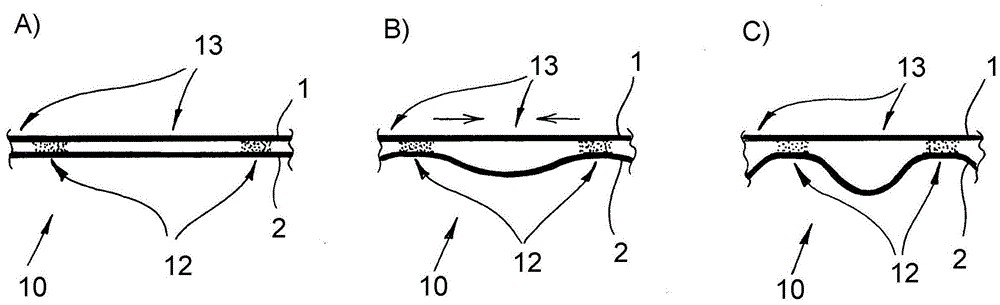
图2示出按照本发明的由第一无纺布材料层和第二无纺布材料层构成的层压体的剖视图,其中,图2中的A)示出在收缩激活之前,图2中的B)示出在收缩激活期间以及图2中的C)示出在收缩激活之后,2 shows a cross-sectional view of a laminate according to the invention consisting of a first layer of non-woven material and a second layer of non-woven material, wherein A) in FIG. 2 shows before shrink activation, FIG. 2 B) shows during systolic activation and Figure 2 C) shows after systolic activation,
图3示出按照本发明的层压体的透视图,其中,图3中的A)示出在收缩激活之前以及图3中的B)示出在收缩激活之后,和Figure 3 shows a perspective view of a laminate according to the invention, wherein A) in Figure 3 shows before shrink activation and Figure 3 B) shows after shrink activation, and
图4示出按照本发明的三层式的层压体的剖视图,其中,图4中的A)示出在收缩激活之前以及图4中的B)示出在收缩激活之后。Figure 4 shows a cross-sectional view of a three-layer laminate according to the invention, wherein A) in Figure 4 shows before shrink activation and Figure 4 B) shows after shrink activation.
具体实施方式Detailed ways
图1示出用于产生用于按照本发明的层压体的以纺粘型无纺布(纺粘的网)形式的无纺布材料层(1、2)的装置。利用该装置按照纺粘方法制造连续长丝并且将其铺设成纺粘型无纺布。借助于纺粘装置3,长丝1‘、更确切地说连续长丝被纺成并且随后优选地并且在该实施例中为了冷却而引导通过冷却装置4。在冷却装置4下游连接有带有拉伸井7的拉伸装置6。在冷却装置4上优选地并且在该实施例中连接有中间通道5,该中间通道将冷却装置4与拉伸装置6连接。值得推荐并且在该实施例中,沿长丝1‘的流动方向在拉伸装置6下游连接有扩散器8。FIG. 1 shows an apparatus for producing layers ( 1 , 2 ) of nonwoven material in the form of spunbond nonwovens (spunbond webs) for laminates according to the invention. Using this device, continuous filaments are produced according to the spunbond method and laid down into a spunbond nonwoven. By means of the spunbonding device 3 , the
按照非常推荐的实施方式并且在该实施例中,由冷却装置4和拉伸装置6构成的组合体或者由冷却装置4、中间通道5和拉伸装置6构成的组合体构成为封闭的系统。在该封闭的组合体中,除了在冷却装置4中供应冷却空气之外不从外面另外供应空气。According to a highly recommended embodiment and in this example, the combination of cooling device 4 and stretching
在按照图1的实施例中,紧接着拉伸装置6之后设有仅一个扩散器8。原则上,在此也可以相继连接两个或更多个扩散器。从拉伸装置6中排出的长丝1‘引导通过扩散器8并且随后优选地并且在该实施例中在铺设网带9上铺设成无纺布材料层1、2。按照本发明的一种特别推荐的实施方式,将按照本发明的层压体10的两个无纺布材料层1、2利用图1所示的装置作为纺粘型无纺布产生。原则上,可以将一个无纺布材料层1、2或者但是也可以将两个无纺布材料层1、2按照熔喷方法作为熔喷-无纺布来制造。In the embodiment according to FIG. 1 , only one
将铺设在图1所示的铺设网带9上的无纺布材料层1、2然后供应给进一步加工装置。有利的是,(各单个)无纺布材料层1、2在它们被铺设之后被预加固、更确切地说在按照图1的实施例中借助于砑光机11预加固。优选地,一个(单独的)无纺布材料层1、2在使用敞开的砑光机结构的情况下被砑光。紧接于此,将该无纺布材料层1、2有利地与一个另外的无纺布材料层1、2组合成一个按照本发明的组合体或者说层压体。所述另外的无纺布材料层1、2按照优选的实施方式同样可以利用图1所示类型的装置来产生并且例如(在生产线内地)在已经产生的无纺布材料层1、2上铺设成由两个无纺布材料层1、2构成的组合体。该组合体于是在按照本发明的方法的范围内利用如下措施加固,即,加固区域12和非加固区域13被分布地设置在组合体的表面上。The
图2示出由第一无纺布材料层1和第二无纺布材料层2构成的组合体。第一无纺布材料层1在此具有比第二无纺布材料层2高的收缩能力或收缩潜力。在图2中的A)中示出在收缩激活之前的组合体。由这两个无纺布材料层1、2构成的组合体已经被加固,从而存在加固区域12或者说加固点和非加固区域13。按照优选的实施方式并且在该实施例中将所述加固实施为热加固,并且在加固区域12中或者说在加固点中这两个无纺布材料层1、2的连续长丝彼此熔合。由这两个无纺布材料层1、2构成的组合体然后被热激活或者说加热到激活温度。由此,具有较高收缩潜力的第一无纺布材料层1收缩。这通过图2中的B)中的箭头表示。基于该收缩或者说基于加固区域12的该聚拢,使第二无纺布材料层2的非加固区域横向于、特别是垂直于组合体的表面伸展方向移动或者说抬起。图2中的C)示出组合体在热收缩之后的结束状态。可看到,基于收缩激活或基于收缩,存在组合体或者说层压体10的明显的3D结构,该3D结构具有明显的横向于、特别是垂直于层压体10表面的z分量。FIG. 2 shows a combination of a
图3中的A)示出由两个无纺布材料层1、2构成的组合体在已经加固的状态下的透视图,该组合体具有加固区域12和非加固区域13。图3中的B)示出在收缩激活之后的该组合体,该组合体具有第二无纺布材料层2的向上移动的非加固区域13。A) in FIG. 3 shows a perspective view of a combined body of two
在图4中示出由三个无纺布材料层1、2、14构成的组合体的剖视图。在此,中间的无纺布材料层1的收缩能力或收缩潜力比两个处于外部的无纺布材料层2、14高。这两个不收缩或较少收缩的外部的无纺布材料层2、14在该实施例中可以相同。原则上,然而也可使用不同于外部无纺布材料层的无纺布材料层2、14。在图4中的A)中示出在收缩激活之前的组合体。由这三个无纺布材料层1、2、14构成的组合体已被加固,从而存在加固区域12或者说加固点和非加固区域13。所述三层式的组合体然后被热激活或者加热到激活温度。由此,具有较高收缩潜力的中间无纺布材料层1收缩。这如在图2中通过箭头表示的那样。基于收缩或者说基于加固区域12的聚拢,使这两个外部无纺布材料层2、14的非加固区域横向于、尤其是垂直于组合体的表面伸展方向移动或者说抬起。在图4中的B)中示出组合体已经在热收缩之后的结束状态。FIG. 4 shows a cross-sectional view of an assembly consisting of three layers of
Claims (20)
Applications Claiming Priority (2)
| Application Number | Priority Date | Filing Date | Title |
|---|---|---|---|
| EP16151573.9A EP3192910B1 (en) | 2016-01-15 | 2016-01-15 | Method for manufacturing a laminate and laminate |
| EP16151573.9 | 2016-01-15 |
Publications (2)
| Publication Number | Publication Date |
|---|---|
| CN106978672A CN106978672A (en) | 2017-07-25 |
| CN106978672B true CN106978672B (en) | 2020-02-21 |
Family
ID=55174558
Family Applications (1)
| Application Number | Title | Priority Date | Filing Date |
|---|---|---|---|
| CN201710023053.9A Active CN106978672B (en) | 2016-01-15 | 2017-01-13 | Method and laminate for making laminates |
Country Status (13)
| Country | Link |
|---|---|
| US (1) | US11383481B2 (en) |
| EP (1) | EP3192910B1 (en) |
| KR (1) | KR102022760B1 (en) |
| CN (1) | CN106978672B (en) |
| AR (1) | AR107284A1 (en) |
| BR (1) | BR102017000615B1 (en) |
| DK (1) | DK3192910T3 (en) |
| ES (1) | ES2750692T3 (en) |
| MX (1) | MX375369B (en) |
| MY (1) | MY172438A (en) |
| PL (1) | PL3192910T3 (en) |
| RU (1) | RU2650377C1 (en) |
| SI (1) | SI3192910T1 (en) |
Families Citing this family (9)
| Publication number | Priority date | Publication date | Assignee | Title |
|---|---|---|---|---|
| US11826230B2 (en) | 2015-07-31 | 2023-11-28 | The Procter & Gamble Company | Package of absorbent articles utilizing a shaped nonwoven |
| EP3239378B1 (en) | 2016-04-29 | 2019-02-13 | Reifenhäuser GmbH & Co. KG Maschinenfabrik | Device and method for the manufacture of material from continuous filaments |
| ES3066061T3 (en) | 2017-03-15 | 2026-05-11 | Samsonite Ip Holdings Sarl | Biaxially oriented thermoplastic polymer laminate films for luggage articles and methods of making the same |
| CZ2018647A3 (en) * | 2018-11-23 | 2020-06-03 | Reifenhäuser GmbH & Co. KG Maschinenfabrik | Bulky nonwoven fabric with increased compressibility and improved regenerative ability |
| EP3966030B1 (en) * | 2019-05-10 | 2024-08-28 | FARE' S.p.A. | Process for the production of a multilayer fabric |
| DE102019208734B4 (en) | 2019-06-14 | 2026-05-07 | Adidas Ag | Method for producing an abrasion-resistant material |
| DE102020132437A1 (en) | 2019-12-10 | 2021-06-10 | The Procter & Gamble Company | Nonwoven webs with visually perceptible patterns and improved texture perception |
| CZ2020105A3 (en) * | 2020-02-29 | 2021-09-08 | Pfnonwovens Holding S.R.O. | Laminated nonwoven fabric |
| CN111411449B (en) * | 2020-04-13 | 2021-06-11 | 苏州经结纬面料科技有限公司 | Fold melt-blown fabric preparation device and preparation method thereof |
Citations (3)
| Publication number | Priority date | Publication date | Assignee | Title |
|---|---|---|---|---|
| CN1265017A (en) * | 1998-05-29 | 2000-08-30 | 东洋卫材股份有限公司 | Disposable underpants and method of mfg. them |
| CN1333849A (en) * | 1999-01-08 | 2002-01-30 | 卡尔·弗罗伊登伯格公司 | Flat nonwoven fiber aggregate with three-dimensional structure and method for its production |
| CN1606502A (en) * | 2001-12-21 | 2005-04-13 | 纳幕尔杜邦公司 | High bulk composite sheets and method for preparing |
Family Cites Families (14)
| Publication number | Priority date | Publication date | Assignee | Title |
|---|---|---|---|---|
| US5393599A (en) * | 1992-01-24 | 1995-02-28 | Fiberweb North America, Inc. | Composite nonwoven fabrics |
| JPH07104603A (en) * | 1993-10-05 | 1995-04-21 | Kureha Tec Kk | Roll cleaning felt |
| US6613704B1 (en) * | 1999-10-13 | 2003-09-02 | Kimberly-Clark Worldwide, Inc. | Continuous filament composite nonwoven webs |
| DE10105784A1 (en) * | 2001-02-07 | 2002-08-08 | Fleissner Gerold | Water-needled composite nonwoven made of staple and continuous fibers and manufacturing process |
| DE10133772B4 (en) | 2001-07-16 | 2007-10-25 | Carl Freudenberg Kg | Three-dimensionally structured fibrous sheet with high liquid absorption and method for its production and its use |
| DE10135111C2 (en) | 2001-07-19 | 2003-06-26 | Freudenberg Carl Kg | Composite, process for its production and its use |
| US7005395B2 (en) * | 2002-12-12 | 2006-02-28 | Invista North America S.A.R.L. | Stretchable composite sheets and processes for making |
| US7588818B2 (en) * | 2002-12-16 | 2009-09-15 | Invista North America S.A R.L. | High bulk composite sheets |
| DE10338196A1 (en) * | 2003-08-20 | 2005-05-12 | Reifenhaeuser Masch | Process for producing a nonwoven fabric |
| US20050095943A1 (en) * | 2003-10-30 | 2005-05-05 | Kimberly-Clark Worldwide, Inc. | Cross machine direction extensible nonwoven webs |
| EP1967628B2 (en) * | 2007-03-08 | 2013-07-17 | Reifenhäuser GmbH & Co. KG Maschinenfabrik | Method and device for producing spinning fleece |
| DE102007062941B4 (en) * | 2007-12-21 | 2012-10-18 | Surface Technologies Gmbh & Co. Kg | Process for producing a laminate |
| DE102007062600A1 (en) * | 2007-12-21 | 2009-06-25 | Akzenta Paneele + Profile Gmbh | Method for producing a decorative laminate |
| JP5842353B2 (en) * | 2010-04-13 | 2016-01-13 | Jnc株式会社 | Bulky nonwoven fabric |
-
2016
- 2016-01-15 ES ES16151573T patent/ES2750692T3/en active Active
- 2016-01-15 DK DK16151573.9T patent/DK3192910T3/en active
- 2016-01-15 SI SI201630391T patent/SI3192910T1/en unknown
- 2016-01-15 PL PL16151573T patent/PL3192910T3/en unknown
- 2016-01-15 EP EP16151573.9A patent/EP3192910B1/en active Active
-
2017
- 2017-01-03 AR ARP170100006A patent/AR107284A1/en active IP Right Grant
- 2017-01-05 KR KR1020170001937A patent/KR102022760B1/en active Active
- 2017-01-05 MX MX2017000243A patent/MX375369B/en active IP Right Grant
- 2017-01-09 US US15/401,127 patent/US11383481B2/en active Active
- 2017-01-10 MY MYPI2017700088A patent/MY172438A/en unknown
- 2017-01-11 BR BR102017000615-8A patent/BR102017000615B1/en active IP Right Grant
- 2017-01-13 RU RU2017101018A patent/RU2650377C1/en active
- 2017-01-13 CN CN201710023053.9A patent/CN106978672B/en active Active
Patent Citations (3)
| Publication number | Priority date | Publication date | Assignee | Title |
|---|---|---|---|---|
| CN1265017A (en) * | 1998-05-29 | 2000-08-30 | 东洋卫材股份有限公司 | Disposable underpants and method of mfg. them |
| CN1333849A (en) * | 1999-01-08 | 2002-01-30 | 卡尔·弗罗伊登伯格公司 | Flat nonwoven fiber aggregate with three-dimensional structure and method for its production |
| CN1606502A (en) * | 2001-12-21 | 2005-04-13 | 纳幕尔杜邦公司 | High bulk composite sheets and method for preparing |
Also Published As
| Publication number | Publication date |
|---|---|
| DK3192910T3 (en) | 2019-10-14 |
| EP3192910B1 (en) | 2019-07-24 |
| BR102017000615B1 (en) | 2019-04-30 |
| KR102022760B1 (en) | 2019-09-18 |
| BR102017000615A2 (en) | 2017-07-25 |
| US11383481B2 (en) | 2022-07-12 |
| RU2650377C1 (en) | 2018-04-11 |
| PL3192910T3 (en) | 2019-12-31 |
| MY172438A (en) | 2019-11-25 |
| SI3192910T1 (en) | 2019-10-30 |
| US20170203539A1 (en) | 2017-07-20 |
| EP3192910A1 (en) | 2017-07-19 |
| ES2750692T3 (en) | 2020-03-26 |
| KR20170085961A (en) | 2017-07-25 |
| AR107284A1 (en) | 2018-04-18 |
| MX375369B (en) | 2025-03-06 |
| MX2017000243A (en) | 2018-07-04 |
| CN106978672A (en) | 2017-07-25 |
Similar Documents
| Publication | Publication Date | Title |
|---|---|---|
| CN106978672A (en) | Method and layered product for manufacturing layered product | |
| KR100404344B1 (en) | Flat nonwoven fiber aggregate with three-dimensional structure and method for its production | |
| US5443606A (en) | Post-treatment of laminated nonwoven cellulosic fiber webs | |
| US10711109B2 (en) | Method of making a semifinished product | |
| US5244482A (en) | Post-treatment of nonwoven webs | |
| US5441550A (en) | Post-treatment of laminated nonwoven cellulosic fiber webs | |
| CN114108189B (en) | Method for producing a laminate and laminate | |
| EP0586936B1 (en) | Nonwoven fabric made with multicomponent polymeric strands including a blend of polyolefin and ethylene alkyl acrylate copolymer | |
| KR101319183B1 (en) | Spunbond nonwoven fabric having an improved property and preparing method thereof | |
| US20030203162A1 (en) | Methods for making nonwoven materials on a surface having surface features and nonwoven materials having surface features | |
| EP0586937B2 (en) | Nonwoven fabric made with multicomponent polymeric strands including a blend of polyolefin and elastomeric thermoplastic material | |
| US10737459B2 (en) | Hydraulically treated nonwoven fabrics and method of making the same | |
| US10767296B2 (en) | Multi-denier hydraulically treated nonwoven fabrics and method of making the same | |
| BR112018000662B1 (en) | HYDRO-WIND COMPOSITE IMAGED WITH LOW LIFT RELEASE AND PROCESS TO FORM THE SAME | |
| CZ2016612A3 (en) | A spunbonded non-woven fabric for the acquisition distribution layer and an absorbent product | |
| CN110352270A (en) | Method and apparatus for producing nonwoven fabrics made of fibers | |
| WO2024238352A1 (en) | Process for bonding and heat setting nonwoven webs | |
| HK1013967B (en) | Post-treatment of laminated nonwoven webs |
Legal Events
| Date | Code | Title | Description |
|---|---|---|---|
| PB01 | Publication | ||
| PB01 | Publication | ||
| SE01 | Entry into force of request for substantive examination | ||
| SE01 | Entry into force of request for substantive examination | ||
| GR01 | Patent grant | ||
| GR01 | Patent grant | ||
| TR01 | Transfer of patent right | ||
| TR01 | Transfer of patent right |
Effective date of registration: 20200226 Address after: Troisdorf, Germany Co-patentee after: Pf non woven fabric Holding Co., Ltd Patentee after: Machine factory of leffinhauser Co., Ltd Address before: Troisdorf, Germany Patentee before: REIFENHAEUSER GMBH & CO. KG MASCHINENFABRIK |