CN106987525B - Stable dry powder compositions comprising bioactive microorganisms and/or bioactive materials and methods of making the same - Google Patents
Stable dry powder compositions comprising bioactive microorganisms and/or bioactive materials and methods of making the same Download PDFInfo
- Publication number
- CN106987525B CN106987525B CN201710034705.9A CN201710034705A CN106987525B CN 106987525 B CN106987525 B CN 106987525B CN 201710034705 A CN201710034705 A CN 201710034705A CN 106987525 B CN106987525 B CN 106987525B
- Authority
- CN
- China
- Prior art keywords
- formulation
- temperature
- composition
- protein
- drying
- Prior art date
- Legal status (The legal status is an assumption and is not a legal conclusion. Google has not performed a legal analysis and makes no representation as to the accuracy of the status listed.)
- Expired - Fee Related
Links
Images


Classifications
-
- C—CHEMISTRY; METALLURGY
- C12—BIOCHEMISTRY; BEER; SPIRITS; WINE; VINEGAR; MICROBIOLOGY; ENZYMOLOGY; MUTATION OR GENETIC ENGINEERING
- C12N—MICROORGANISMS OR ENZYMES; COMPOSITIONS THEREOF; PROPAGATING, PRESERVING, OR MAINTAINING MICROORGANISMS; MUTATION OR GENETIC ENGINEERING; CULTURE MEDIA
- C12N1/00—Microorganisms; Compositions thereof; Processes of propagating, maintaining or preserving microorganisms or compositions thereof; Processes of preparing or isolating a composition containing a microorganism; Culture media therefor
- C12N1/04—Preserving or maintaining viable microorganisms
-
- A—HUMAN NECESSITIES
- A01—AGRICULTURE; FORESTRY; ANIMAL HUSBANDRY; HUNTING; TRAPPING; FISHING
- A01N—PRESERVATION OF BODIES OF HUMANS OR ANIMALS OR PLANTS OR PARTS THEREOF; BIOCIDES, e.g. AS DISINFECTANTS, AS PESTICIDES OR AS HERBICIDES; PEST REPELLANTS OR ATTRACTANTS; PLANT GROWTH REGULATORS
- A01N1/00—Preservation of bodies of humans or animals, or parts thereof
- A01N1/10—Preservation of living parts
-
- A—HUMAN NECESSITIES
- A23—FOODS OR FOODSTUFFS; TREATMENT THEREOF, NOT COVERED BY OTHER CLASSES
- A23K—FODDER
- A23K10/00—Animal feeding-stuffs
- A23K10/10—Animal feeding-stuffs obtained by microbiological or biochemical processes
- A23K10/16—Addition of microorganisms or extracts thereof, e.g. single-cell proteins, to feeding-stuff compositions
- A23K10/18—Addition of microorganisms or extracts thereof, e.g. single-cell proteins, to feeding-stuff compositions of live microorganisms
-
- A—HUMAN NECESSITIES
- A23—FOODS OR FOODSTUFFS; TREATMENT THEREOF, NOT COVERED BY OTHER CLASSES
- A23K—FODDER
- A23K20/00—Accessory food factors for animal feeding-stuffs
-
- A—HUMAN NECESSITIES
- A23—FOODS OR FOODSTUFFS; TREATMENT THEREOF, NOT COVERED BY OTHER CLASSES
- A23K—FODDER
- A23K50/00—Feeding-stuffs specially adapted for particular animals
- A23K50/40—Feeding-stuffs specially adapted for particular animals for carnivorous animals, e.g. cats or dogs
- A23K50/42—Dry feed
-
- A—HUMAN NECESSITIES
- A23—FOODS OR FOODSTUFFS; TREATMENT THEREOF, NOT COVERED BY OTHER CLASSES
- A23K—FODDER
- A23K50/00—Feeding-stuffs specially adapted for particular animals
- A23K50/80—Feeding-stuffs specially adapted for particular animals for aquatic animals, e.g. fish, crustaceans or molluscs
-
- A—HUMAN NECESSITIES
- A61—MEDICAL OR VETERINARY SCIENCE; HYGIENE
- A61K—PREPARATIONS FOR MEDICAL, DENTAL OR TOILETRY PURPOSES
- A61K47/00—Medicinal preparations characterised by the non-active ingredients used, e.g. carriers or inert additives; Targeting or modifying agents chemically bound to the active ingredient
- A61K47/46—Ingredients of undetermined constitution or reaction products thereof, e.g. skin, bone, milk, cotton fibre, eggshell, oxgall or plant extracts
-
- A—HUMAN NECESSITIES
- A61—MEDICAL OR VETERINARY SCIENCE; HYGIENE
- A61P—SPECIFIC THERAPEUTIC ACTIVITY OF CHEMICAL COMPOUNDS OR MEDICINAL PREPARATIONS
- A61P31/00—Antiinfectives, i.e. antibiotics, antiseptics, chemotherapeutics
-
- A—HUMAN NECESSITIES
- A61—MEDICAL OR VETERINARY SCIENCE; HYGIENE
- A61P—SPECIFIC THERAPEUTIC ACTIVITY OF CHEMICAL COMPOUNDS OR MEDICINAL PREPARATIONS
- A61P37/00—Drugs for immunological or allergic disorders
- A61P37/02—Immunomodulators
-
- C—CHEMISTRY; METALLURGY
- C07—ORGANIC CHEMISTRY
- C07K—PEPTIDES
- C07K14/00—Peptides having more than 20 amino acids; Gastrins; Somatostatins; Melanotropins; Derivatives thereof
- C07K14/001—Peptides having more than 20 amino acids; Gastrins; Somatostatins; Melanotropins; Derivatives thereof by chemical synthesis
-
- C—CHEMISTRY; METALLURGY
- C12—BIOCHEMISTRY; BEER; SPIRITS; WINE; VINEGAR; MICROBIOLOGY; ENZYMOLOGY; MUTATION OR GENETIC ENGINEERING
- C12N—MICROORGANISMS OR ENZYMES; COMPOSITIONS THEREOF; PROPAGATING, PRESERVING, OR MAINTAINING MICROORGANISMS; MUTATION OR GENETIC ENGINEERING; CULTURE MEDIA
- C12N1/00—Microorganisms; Compositions thereof; Processes of propagating, maintaining or preserving microorganisms or compositions thereof; Processes of preparing or isolating a composition containing a microorganism; Culture media therefor
- C12N1/20—Bacteria; Culture media therefor
-
- C—CHEMISTRY; METALLURGY
- C12—BIOCHEMISTRY; BEER; SPIRITS; WINE; VINEGAR; MICROBIOLOGY; ENZYMOLOGY; MUTATION OR GENETIC ENGINEERING
- C12N—MICROORGANISMS OR ENZYMES; COMPOSITIONS THEREOF; PROPAGATING, PRESERVING, OR MAINTAINING MICROORGANISMS; MUTATION OR GENETIC ENGINEERING; CULTURE MEDIA
- C12N11/00—Carrier-bound or immobilised enzymes; Carrier-bound or immobilised microbial cells; Preparation thereof
- C12N11/02—Enzymes or microbial cells immobilised on or in an organic carrier
-
- C—CHEMISTRY; METALLURGY
- C12—BIOCHEMISTRY; BEER; SPIRITS; WINE; VINEGAR; MICROBIOLOGY; ENZYMOLOGY; MUTATION OR GENETIC ENGINEERING
- C12N—MICROORGANISMS OR ENZYMES; COMPOSITIONS THEREOF; PROPAGATING, PRESERVING, OR MAINTAINING MICROORGANISMS; MUTATION OR GENETIC ENGINEERING; CULTURE MEDIA
- C12N11/00—Carrier-bound or immobilised enzymes; Carrier-bound or immobilised microbial cells; Preparation thereof
- C12N11/02—Enzymes or microbial cells immobilised on or in an organic carrier
- C12N11/04—Enzymes or microbial cells immobilised on or in an organic carrier entrapped within the carrier, e.g. gel or hollow fibres
-
- A—HUMAN NECESSITIES
- A23—FOODS OR FOODSTUFFS; TREATMENT THEREOF, NOT COVERED BY OTHER CLASSES
- A23K—FODDER
- A23K20/00—Accessory food factors for animal feeding-stuffs
- A23K20/10—Organic substances
- A23K20/174—Vitamins
-
- A—HUMAN NECESSITIES
- A23—FOODS OR FOODSTUFFS; TREATMENT THEREOF, NOT COVERED BY OTHER CLASSES
- A23K—FODDER
- A23K20/00—Accessory food factors for animal feeding-stuffs
- A23K20/10—Organic substances
- A23K20/189—Enzymes
-
- A—HUMAN NECESSITIES
- A23—FOODS OR FOODSTUFFS; TREATMENT THEREOF, NOT COVERED BY OTHER CLASSES
- A23K—FODDER
- A23K40/00—Shaping or working-up of animal feeding-stuffs
- A23K40/30—Shaping or working-up of animal feeding-stuffs by encapsulating; by coating
-
- A—HUMAN NECESSITIES
- A23—FOODS OR FOODSTUFFS; TREATMENT THEREOF, NOT COVERED BY OTHER CLASSES
- A23L—FOODS, FOODSTUFFS OR NON-ALCOHOLIC BEVERAGES, NOT OTHERWISE PROVIDED FOR; PREPARATION OR TREATMENT THEREOF
- A23L29/00—Foods or foodstuffs containing additives; Preparation or treatment thereof
- A23L29/06—Enzymes
-
- A—HUMAN NECESSITIES
- A23—FOODS OR FOODSTUFFS; TREATMENT THEREOF, NOT COVERED BY OTHER CLASSES
- A23L—FOODS, FOODSTUFFS OR NON-ALCOHOLIC BEVERAGES, NOT OTHERWISE PROVIDED FOR; PREPARATION OR TREATMENT THEREOF
- A23L33/00—Modifying nutritive qualities of foods; Dietetic products; Preparation or treatment thereof
- A23L33/10—Modifying nutritive qualities of foods; Dietetic products; Preparation or treatment thereof using additives
- A23L33/135—Bacteria or derivatives thereof, e.g. probiotics
-
- A—HUMAN NECESSITIES
- A23—FOODS OR FOODSTUFFS; TREATMENT THEREOF, NOT COVERED BY OTHER CLASSES
- A23L—FOODS, FOODSTUFFS OR NON-ALCOHOLIC BEVERAGES, NOT OTHERWISE PROVIDED FOR; PREPARATION OR TREATMENT THEREOF
- A23L33/00—Modifying nutritive qualities of foods; Dietetic products; Preparation or treatment thereof
- A23L33/10—Modifying nutritive qualities of foods; Dietetic products; Preparation or treatment thereof using additives
- A23L33/15—Vitamins
-
- A—HUMAN NECESSITIES
- A23—FOODS OR FOODSTUFFS; TREATMENT THEREOF, NOT COVERED BY OTHER CLASSES
- A23L—FOODS, FOODSTUFFS OR NON-ALCOHOLIC BEVERAGES, NOT OTHERWISE PROVIDED FOR; PREPARATION OR TREATMENT THEREOF
- A23L33/00—Modifying nutritive qualities of foods; Dietetic products; Preparation or treatment thereof
- A23L33/40—Complete food formulations for specific consumer groups or specific purposes, e.g. infant formula
-
- A—HUMAN NECESSITIES
- A61—MEDICAL OR VETERINARY SCIENCE; HYGIENE
- A61K—PREPARATIONS FOR MEDICAL, DENTAL OR TOILETRY PURPOSES
- A61K47/00—Medicinal preparations characterised by the non-active ingredients used, e.g. carriers or inert additives; Targeting or modifying agents chemically bound to the active ingredient
- A61K47/30—Macromolecular organic or inorganic compounds, e.g. inorganic polyphosphates
- A61K47/36—Polysaccharides; Derivatives thereof, e.g. gums, starch, alginate, dextrin, hyaluronic acid, chitosan, inulin, agar or pectin
-
- A—HUMAN NECESSITIES
- A61—MEDICAL OR VETERINARY SCIENCE; HYGIENE
- A61K—PREPARATIONS FOR MEDICAL, DENTAL OR TOILETRY PURPOSES
- A61K47/00—Medicinal preparations characterised by the non-active ingredients used, e.g. carriers or inert additives; Targeting or modifying agents chemically bound to the active ingredient
- A61K47/30—Macromolecular organic or inorganic compounds, e.g. inorganic polyphosphates
- A61K47/36—Polysaccharides; Derivatives thereof, e.g. gums, starch, alginate, dextrin, hyaluronic acid, chitosan, inulin, agar or pectin
- A61K47/38—Cellulose; Derivatives thereof
-
- A—HUMAN NECESSITIES
- A61—MEDICAL OR VETERINARY SCIENCE; HYGIENE
- A61K—PREPARATIONS FOR MEDICAL, DENTAL OR TOILETRY PURPOSES
- A61K47/00—Medicinal preparations characterised by the non-active ingredients used, e.g. carriers or inert additives; Targeting or modifying agents chemically bound to the active ingredient
- A61K47/30—Macromolecular organic or inorganic compounds, e.g. inorganic polyphosphates
- A61K47/42—Proteins; Polypeptides; Degradation products thereof; Derivatives thereof, e.g. albumin, gelatin or zein
-
- A—HUMAN NECESSITIES
- A61—MEDICAL OR VETERINARY SCIENCE; HYGIENE
- A61K—PREPARATIONS FOR MEDICAL, DENTAL OR TOILETRY PURPOSES
- A61K9/00—Medicinal preparations characterised by special physical form
- A61K9/06—Ointments; Bases therefor; Other semi-solid forms, e.g. creams, sticks, gels
-
- A—HUMAN NECESSITIES
- A61—MEDICAL OR VETERINARY SCIENCE; HYGIENE
- A61K—PREPARATIONS FOR MEDICAL, DENTAL OR TOILETRY PURPOSES
- A61K9/00—Medicinal preparations characterised by special physical form
- A61K9/14—Particulate form, e.g. powders, Processes for size reducing of pure drugs or the resulting products, Pure drug nanoparticles
- A61K9/141—Intimate drug-carrier mixtures characterised by the carrier, e.g. ordered mixtures, adsorbates, solid solutions, eutectica, co-dried, co-solubilised, co-kneaded, co-milled, co-ground products, co-precipitates, co-evaporates, co-extrudates, co-melts; Drug nanoparticles with adsorbed surface modifiers
- A61K9/143—Intimate drug-carrier mixtures characterised by the carrier, e.g. ordered mixtures, adsorbates, solid solutions, eutectica, co-dried, co-solubilised, co-kneaded, co-milled, co-ground products, co-precipitates, co-evaporates, co-extrudates, co-melts; Drug nanoparticles with adsorbed surface modifiers with inorganic compounds
-
- A—HUMAN NECESSITIES
- A61—MEDICAL OR VETERINARY SCIENCE; HYGIENE
- A61K—PREPARATIONS FOR MEDICAL, DENTAL OR TOILETRY PURPOSES
- A61K9/00—Medicinal preparations characterised by special physical form
- A61K9/14—Particulate form, e.g. powders, Processes for size reducing of pure drugs or the resulting products, Pure drug nanoparticles
- A61K9/141—Intimate drug-carrier mixtures characterised by the carrier, e.g. ordered mixtures, adsorbates, solid solutions, eutectica, co-dried, co-solubilised, co-kneaded, co-milled, co-ground products, co-precipitates, co-evaporates, co-extrudates, co-melts; Drug nanoparticles with adsorbed surface modifiers
- A61K9/146—Intimate drug-carrier mixtures characterised by the carrier, e.g. ordered mixtures, adsorbates, solid solutions, eutectica, co-dried, co-solubilised, co-kneaded, co-milled, co-ground products, co-precipitates, co-evaporates, co-extrudates, co-melts; Drug nanoparticles with adsorbed surface modifiers with organic macromolecular compounds
-
- A—HUMAN NECESSITIES
- A61—MEDICAL OR VETERINARY SCIENCE; HYGIENE
- A61K—PREPARATIONS FOR MEDICAL, DENTAL OR TOILETRY PURPOSES
- A61K9/00—Medicinal preparations characterised by special physical form
- A61K9/14—Particulate form, e.g. powders, Processes for size reducing of pure drugs or the resulting products, Pure drug nanoparticles
- A61K9/19—Particulate form, e.g. powders, Processes for size reducing of pure drugs or the resulting products, Pure drug nanoparticles lyophilised, i.e. freeze-dried, solutions or dispersions
-
- Y—GENERAL TAGGING OF NEW TECHNOLOGICAL DEVELOPMENTS; GENERAL TAGGING OF CROSS-SECTIONAL TECHNOLOGIES SPANNING OVER SEVERAL SECTIONS OF THE IPC; TECHNICAL SUBJECTS COVERED BY FORMER USPC CROSS-REFERENCE ART COLLECTIONS [XRACs] AND DIGESTS
- Y02—TECHNOLOGIES OR APPLICATIONS FOR MITIGATION OR ADAPTATION AGAINST CLIMATE CHANGE
- Y02A—TECHNOLOGIES FOR ADAPTATION TO CLIMATE CHANGE
- Y02A40/00—Adaptation technologies in agriculture, forestry, livestock or agroalimentary production
- Y02A40/80—Adaptation technologies in agriculture, forestry, livestock or agroalimentary production in fisheries management
- Y02A40/81—Aquaculture, e.g. of fish
- Y02A40/818—Alternative feeds for fish, e.g. in aquacultures
Landscapes
- Health & Medical Sciences (AREA)
- Chemical & Material Sciences (AREA)
- Life Sciences & Earth Sciences (AREA)
- Engineering & Computer Science (AREA)
- General Health & Medical Sciences (AREA)
- Zoology (AREA)
- Bioinformatics & Cheminformatics (AREA)
- Polymers & Plastics (AREA)
- Medicinal Chemistry (AREA)
- Organic Chemistry (AREA)
- Genetics & Genomics (AREA)
- Pharmacology & Pharmacy (AREA)
- Public Health (AREA)
- Animal Behavior & Ethology (AREA)
- Veterinary Medicine (AREA)
- Wood Science & Technology (AREA)
- Epidemiology (AREA)
- Food Science & Technology (AREA)
- Microbiology (AREA)
- Biotechnology (AREA)
- Biochemistry (AREA)
- Biomedical Technology (AREA)
- Animal Husbandry (AREA)
- General Engineering & Computer Science (AREA)
- Inorganic Chemistry (AREA)
- Nutrition Science (AREA)
- Virology (AREA)
- Tropical Medicine & Parasitology (AREA)
- Molecular Biology (AREA)
- Proteomics, Peptides & Aminoacids (AREA)
- Mycology (AREA)
- Birds (AREA)
- Chemical Kinetics & Catalysis (AREA)
- General Chemical & Material Sciences (AREA)
- Botany (AREA)
- Biophysics (AREA)
- Gastroenterology & Hepatology (AREA)
- Dispersion Chemistry (AREA)
- Insects & Arthropods (AREA)
- Physiology (AREA)
Abstract
本发明涉及包含生物活性微生物和/或生物活性材料的稳定干粉组合物及其制造方法。具体而言,本发明涉及将活的或死的微生物和/或生物活性材料包埋在保护性干燥制剂基质中,其中所述制剂包括生物活性微生物或材料、制剂稳定剂和保护剂。通过使用或不使用真空将所有固体组分分散在溶液中,并将溶液冷却至高于其凝固温度的温度来制备制剂。方法包括制剂以所需温度和时间段的初级干燥步骤,以及在最大真空和升高的温度下的加速二级干燥步骤,以达到干燥材料的最终所需水活度。
The present invention relates to stable dry powder compositions comprising biologically active microorganisms and/or biologically active materials and methods for their manufacture. Specifically, the present invention relates to entrapping live or dead microorganisms and/or bioactive materials in a protective dry formulation matrix, wherein the formulation includes bioactive microorganisms or materials, formulation stabilizers, and protective agents. The formulation is prepared by dispersing all solid components in solution, with or without vacuum, and cooling the solution to a temperature above its solidification temperature. The method includes a primary drying step of the formulation at the desired temperature and time period, and an accelerated secondary drying step at maximum vacuum and elevated temperature to achieve the final desired water activity of the dried material.
Description
本申请为国际申请日2010年5月26日、国际申请号PCT/US2010/036098于2011年12月29日进入中国国家阶段、申请号201080029392.4、发明名称“包含生物活性微生物和/或生物活性材料的稳定干粉组合物及其制造方法”的分案申请。This application has the international filing date of May 26, 2010, the international application number PCT/US2010/036098 entered the Chinese national phase on December 29, 2011, the application number 201080029392.4, and the name of the invention "contains biologically active microorganisms and/or biologically active materials. The stable dry powder composition and its manufacturing method" divisional application.
与相关申请的交叉参考CROSS-REFERENCE TO RELATED APPLICATIONS
本申请要求分别于2009年5月26日和2009年7月6日在美国专利和商标局(UnitedStates Patent and Trademark Office)提交的美国临时申请No.61/181,248和61/223,295的优先权,所述申请的内容在此以所有目的引为参考。This application claims priority to U.S. Provisional Application Nos. 61/181,248 and 61/223,295, filed in the United States Patent and Trademark Office on May 26, 2009 and July 6, 2009, respectively. The contents of said application are hereby incorporated by reference for all purposes.
技术领域technical field
本发明属于在高的温度和湿度条件中保护生物活性微生物和/或材料的领域。具体来说,本发明涉及将活的微生物和/或生物活性材料包埋在保护性干燥制剂基质中。The present invention is in the field of protecting biologically active microorganisms and/or materials in high temperature and humidity conditions. In particular, the present invention relates to the entrapment of live microorganisms and/or bioactive materials in a protective dry formulation matrix.
背景技术Background technique
生物活性微生物例如活的或死的细菌和病毒,或生物活性材料例如蛋白质、维生素、矿物质、激素和细胞,当在高的温度和湿度条件下储存时通常不稳定。例如,许多可商购的益生细菌例如鼠李糖乳杆菌(lactobacillus rhamnosus),当储存在室温(约25℃)和环境气氛下时,可能不到两周就失去一个对数以上的生存力。在从培养容器(例如发酵罐)收获后干燥并保护这些生物活性微生物的常用方法是将活细胞的浓缩液滴在液氮中,然后将冷冻珠储存在-80℃冰箱中,用于以后的冷冻干燥或运输到其他地点。冷冻干燥是用于干燥敏感性生物活性材料的主要方法。其他方法例如喷雾干燥、临界流体干燥和脱水干燥,一般不适合于敏感性生物活性物质例如活的或减毒的细菌和病毒,这是因为在这些方法中使用的高干燥温度会引起对微生物本身的显著伤害。此外,它们不能将材料充分干燥至产品稳定所需的特定残余湿度要求,因此可能需要通过其他手段执行附加的干燥步骤。Biologically active microorganisms such as live or dead bacteria and viruses, or biologically active materials such as proteins, vitamins, minerals, hormones and cells, are generally unstable when stored under high temperature and humidity conditions. For example, many commercially available probiotic bacteria, such as lactobacillus rhamnosus, may lose more than one log of viability in less than two weeks when stored at room temperature (about 25°C) and ambient atmosphere. A common method for drying and protecting these bioactive microorganisms after harvesting from a culture vessel, such as a fermentor, is to drop a concentrated drop of viable cells in liquid nitrogen and then store the frozen beads in a -80°C freezer for later use Freeze dry or transport to another location. Freeze drying is the primary method used to dry sensitive biologically active materials. Other methods such as spray drying, critical fluid drying, and dehydration drying are generally not suitable for sensitive biologically active substances such as live or attenuated bacteria and viruses because the high drying temperatures used in these methods can cause damage to the microorganisms themselves. significant damage. In addition, they cannot sufficiently dry the material to the specific residual humidity requirements required for product stabilization, so additional drying steps may be required by other means.
在冷冻干燥中,通常将生物活性微生物或材料在保护剂溶液或悬液中混合,冷冻,然后通过在完全真空下升华来脱水。冷冻干燥方法的低温减少了生物活性物质的降解反应,使最终干燥形式中活性的丧失降到最低。然而,对低于零度的温度的要求是能量密集性的,并且冷冻材料的表面积与体积比低需要使用长干燥时间(每个批次周期长达数天)。冷冻干燥方法的缓慢干燥也促进冰晶形成,其能够损坏敏感性生物活性物质或使其变性。出于这种原因,生物活性微生物或材料例如病毒、细菌和具有细胞壁或脂质膜的细胞,对冷冻干燥方法提出了重大的挑战。In freeze-drying, biologically active microorganisms or materials are typically mixed in a protectant solution or suspension, frozen, and then dehydrated by sublimation under full vacuum. The low temperature of the freeze-drying process reduces degradation reactions of the biologically active substance, minimizing the loss of activity in the final dried form. However, the requirement for sub-zero temperatures is energy intensive and the low surface area to volume ratio of the frozen material necessitates the use of long drying times (up to several days per batch cycle). The slow drying of freeze-drying methods also promotes ice crystal formation, which can damage or denature sensitive biologically active substances. For this reason, biologically active microorganisms or materials such as viruses, bacteria and cells with cell walls or lipid membranes present a significant challenge to freeze-drying methods.
减少冰晶结构形成的一种选择方案是相生物活性物质液添加低温保护剂。这样的保护剂是添加到制剂中用于在冷冻期间保护细胞膜和细胞内蛋白质并在储存期间提高稳定性的高度可溶的化学物质。常用于活的细菌和病毒的稳定剂包括高浓度糖类例如蔗糖、甘油或山梨糖醇以及细胞材料或生物活性物质(Morgan等,2006;Capela等,2006)。然而,这样的保护剂不能充分穿透到细胞中以保护细胞内容积中的活性组分。因此,对于开发使干燥损失降到最低同时实现干燥材料的足够储存稳定性的最佳干燥方法和制剂,仍是重大的挑战。An option to reduce the formation of ice crystal structures is to add cryoprotectants to the bioactive substance solution. Such protectants are highly soluble chemicals added to formulations to protect cell membranes and intracellular proteins during freezing and to improve stability during storage. Stabilizers commonly used for live bacteria and viruses include high concentrations of carbohydrates such as sucrose, glycerol or sorbitol as well as cellular material or biologically active substances (Morgan et al., 2006; Capela et al., 2006). However, such protective agents do not penetrate sufficiently into cells to protect active components in the intracellular volume. Therefore, there remains a significant challenge to develop optimal drying methods and formulations that minimize drying losses while achieving adequate storage stability of the dried material.
与冷冻干燥相关的一些问题,已通过在液体状态下组合使用某些制剂和真空干燥得以解决。Annear(Annear 1962)开发了在糖和氨基酸溶液中包含细菌的制剂以及包含沸腾和泡沫形成的真空干燥方法。Roser等(美国专利6,964,771)公开了通过泡沫形成进行干燥的类似概念,其包括液体浓缩步骤,然后在真空下将浓缩的溶液(糖浆)进行沸腾和发泡。为了减少在沸腾步骤期间可能发生的氧化和变性损伤,Bronshtein(美国专利No.5,766,520、7,153,472)引入了含有糖类和表面活性剂的改进的保护性配方。保护性溶液的干燥还包括在中度真空下浓缩、然后施加强真空以引起剩余水起泡沸腾来形成干燥的稳定泡沫的逐步方法。在消除沸腾步骤的尝试中,Busson和Schroeder(美国专利No.6,534,087)提出了使用真空烤箱,在不沸腾的情况下,通过施加高于30托的非常温和的真空压力,在液态制剂中对不敏感生物活性物质的干燥方法。在不使材料沸腾的情况下达到一定水平的干燥后,施加高于20℃的热,并且在仅仅几个小时后就收获到干燥的材料。Some of the problems associated with freeze-drying have been addressed by using certain formulations in combination with vacuum drying in the liquid state. Annear (Annear 1962) developed formulations containing bacteria in sugar and amino acid solutions and vacuum drying methods involving boiling and foam formation. Roser et al. (US Pat. No. 6,964,771) discloses a similar concept for drying by foam formation, which involves a liquid concentration step followed by boiling and foaming of the concentrated solution (syrup) under vacuum. To reduce oxidative and denaturing damage that can occur during the boiling step, Bronshtein (US Pat. Nos. 5,766,520, 7,153,472) introduced improved protective formulations containing carbohydrates and surfactants. Drying of the protective solution also includes a stepwise process of concentrating under moderate vacuum and then applying a strong vacuum to cause the remaining water to bubble and boil to form a dry stable foam. In an attempt to eliminate the boiling step, Busson and Schroeder (US Patent No. 6,534,087) proposed the use of a vacuum oven, without boiling, by applying very mild vacuum pressures above 30 Torr in liquid formulations Drying methods for sensitive biologically active substances. After reaching a certain level of drying without boiling the material, heat above 20°C was applied and the dried material was harvested after only a few hours.
这种其中生物活性溶液在整个干燥过程中维持在液体状态下的干燥方法类型,由于沸腾期间液体的对流和由起泡表面提供的增加的表面积而具有干燥更快的优点。然而,沸腾和起泡需要输入大量的热来提供溶液必需的喷发。这样的干燥方法不是非常适合于干燥敏感性生物物质,例如活病毒、细胞或细菌,这是因为施加的热加速了能够破坏生物材料的活性或生存力的酶过程(例如蛋白水解)和化学过程(例如氧化和自由基攻击)。This type of drying method in which the biologically active solution is maintained in a liquid state throughout the drying process has the advantage of faster drying due to the convection of the liquid during boiling and the increased surface area provided by the foaming surface. However, boiling and foaming require a large input of heat to provide the necessary eruption of the solution. Such drying methods are not very suitable for drying sensitive biological substances, such as live viruses, cells or bacteria, because the applied heat accelerates enzymatic processes (eg proteolysis) and chemical processes that can destroy the activity or viability of the biological material (eg oxidation and free radical attack).
上面描述的干燥方法在其放大到大规模工业过程的能力方面也受到限制。免除冷冻需要在比常规冷冻干燥或喷雾冷冻干燥方法循环更低的真空水平下(>7托)执行方法。上述方法的最显著缺点是不能控制和限制泡沫在容器、盘或小瓶中的膨胀。不能控制的喷发和往往过量的泡沫形成使得在实践上不可能产生工业规模的方法。沸腾步骤的喷发和起泡性质导致一部分材料被溅射到容器壁上并进入干燥仓室。为了减弱沸腾期间的喷发,Bronshtein(美国专利No.6,884,866、6,306,345)提出了特殊的室和受控的温度/压力施加方案,其将过热降低到可接受的水平。包含喷发和过度起泡的另一种方法描述在美国专利申请No.2008/0229609中,其中将生物活性溶液装在覆盖有透气膜的容器或袋子中。同样地,这些方案难以在工业水平下执行,并且它们难以使用不同制剂可靠地重复。The drying methods described above are also limited in their ability to scale up to large-scale industrial processes. Freezing-free requires performing methods at lower vacuum levels (>7 Torr) than conventional freeze-drying or spray freeze-drying method cycles. The most significant disadvantage of the above method is the inability to control and limit the expansion of the foam in the container, tray or vial. Uncontrolled eruptions and often excessive foam formation make it practically impossible to produce an industrial-scale process. The eruptive and foaming nature of the boiling step causes a portion of the material to be sputtered onto the vessel walls and into the drying chamber. To attenuate eruptions during boiling, Bronshtein (US Pat. Nos. 6,884,866, 6,306,345) proposed special chambers and a controlled temperature/pressure application scheme that reduced superheat to acceptable levels. Another method involving hairspray and excessive foaming is described in US Patent Application No. 2008/0229609, wherein the bioactive solution is contained in a container or bag covered with a breathable membrane. Likewise, these protocols are difficult to perform at an industrial level, and they are difficult to replicate reliably using different formulations.
对于能够在液体状态下干燥的适合的保护性制剂,以及特别是在高于冷冻的温度下用于干燥生物活性微生物例如活的或死的病毒、细菌和细胞的可工业上放大规模的方法,仍存在着需求。特别是对于也适合于制药工业之外的应用例如食品和农业的具有成本效益的可放大规模的干燥方法,存在着需求。为了提供足够的干燥而不暴露于高温,需要保护性制剂和温和的干燥方法。需要能够保护在高的温度和湿度条件下储存的这些生物物质的组合物。正如下文所描述的,本发明为所有这些挑战提供了解决方法。For suitable protective formulations capable of drying in the liquid state, and particularly at temperatures above freezing, an industrially scalable method for drying biologically active microorganisms such as live or dead viruses, bacteria and cells, There is still demand. In particular, there is a need for a cost-effective, scalable drying process that is also suitable for applications outside the pharmaceutical industry, such as food and agriculture. To provide adequate drying without exposure to high temperatures, protective formulations and gentle drying methods are required. There is a need for compositions that can protect these biomasses when stored under high temperature and humidity conditions. As described below, the present invention provides solutions to all these challenges.
发明内容SUMMARY OF THE INVENTION
本发明包括用于保护储存中的生物活性材料的组合物和方法,所述生物活性材料例如肽、蛋白质、激素、维生素、矿物质、药物、杀微生物剂、杀真菌剂、除草剂、杀虫剂、杀精子剂、核酸、抗体、疫苗和/或生物活性微生物例如细菌(益生的或其他)、病毒和/或细胞悬液。干燥方法提供了包含生物活性微生物或材料、制剂稳定剂和保护剂的制剂的可控膨胀过程。所述制剂通过将所有固体组分在真空或不在真空下分散在溶液中来制备。将溶液冷却至高于其凝固温度的温度并在真空下干燥成干燥组合物,其表现出意想不到的高稳定性。所述方法包括制剂在所需温度和时间段下的初级干燥步骤,以及在最大真空和升高的温度下的加速二级干燥步骤,以达到干燥材料的最终期望的水活度。The present invention includes compositions and methods for protecting biologically active materials, such as peptides, proteins, hormones, vitamins, minerals, pharmaceuticals, microbicides, fungicides, herbicides, insecticides, in storage agents, spermicides, nucleic acids, antibodies, vaccines and/or biologically active microorganisms such as bacteria (probiotic or otherwise), viruses and/or cell suspensions. The drying method provides a controlled expansion process of the formulation containing the biologically active microorganism or material, formulation stabilizers and protective agents. The formulations are prepared by dispersing all solid components in solution with or without vacuum. The solution was cooled to a temperature above its freezing temperature and dried under vacuum to a dry composition which exhibited unexpectedly high stability. The method includes a primary drying step of the formulation at the desired temperature and time period, and an accelerated secondary drying step at maximum vacuum and elevated temperature to achieve the final desired water activity of the dried material.
在一个实施方案中,所述制剂包含足够量的其中包埋有微生物的制剂稳定剂。适合的制剂稳定剂的实例包括但不限于邻苯二甲酸醋酸纤维素(CAP)、羧甲基纤维素、果胶、藻酸钠、藻酸盐、羟丙基甲基纤维素(HPMC)、甲基纤维素、角叉菜聚糖、瓜尔胶、阿拉伯胶、黄原胶、刺槐豆胶、脱乙酰壳多糖和脱乙酰壳多糖衍生物、胶原蛋白、聚羟基乙酸、淀粉和改性淀粉、环糊精和寡糖(菊粉、麦芽糖糊精、葡聚糖等);及其组合。In one embodiment, the formulation comprises a sufficient amount of a formulation stabilizer with microorganisms embedded therein. Examples of suitable formulation stabilizers include, but are not limited to, cellulose acetate phthalate (CAP), carboxymethyl cellulose, pectin, sodium alginate, alginate, hydroxypropyl methylcellulose (HPMC), Methylcellulose, carrageenan, guar gum, gum arabic, xanthan gum, locust bean gum, chitosan and chitosan derivatives, collagen, polyglycolic acid, starch and modified starch , cyclodextrins and oligosaccharides (inulin, maltodextrin, dextran, etc.); and combinations thereof.
在一个具体实施方案中,优选的制剂稳定剂是藻酸钠。优选,以总干物质的重量百分数计,制剂包含0.1-10%、优选1-6%、更优选2-4%的制剂稳定剂。在另一个实施方案中,制剂稳定剂包含藻酸钠和寡糖的混合物,其中藻酸钠/寡糖的重量比为1:1-10、更优选为1:1-5。在本发明的另一个实施方案中,制剂稳定剂与二价金属离子进行交联以形成坚实的水凝胶。In a specific embodiment, the preferred formulation stabilizer is sodium alginate. Preferably, the formulation comprises 0.1-10%, preferably 1-6%, more preferably 2-4%, of formulation stabilizer, based on weight percent of total dry matter. In another embodiment, the formulation stabilizer comprises a mixture of sodium alginate and oligosaccharides, wherein the weight ratio of sodium alginate/oligosaccharide is 1:1-10, more preferably 1:1-5. In another embodiment of the present invention, the formulation stabilizer is cross-linked with divalent metal ions to form a solid hydrogel.
在另一个实施方案中,制剂包含相当量的其中包埋有微生物的保护剂。适合的保护剂的实例包括但不限于蛋白质,例如人和牛血清白蛋白、卵清蛋白、明胶、免疫球蛋白、分离的大豆蛋白、小麦蛋白、脱脂奶粉、酪蛋白酸盐、乳清蛋白和任何蛋白水解物;糖类,包括单糖(例如半乳糖、D-甘露糖、山梨糖等)、二糖(例如乳糖、海藻糖、蔗糖等);氨基酸,例如赖氨酸、谷氨酸单钠、甘氨酸、丙氨酸、精氨酸或组氨酸以及疏水氨基酸(色氨酸、酪氨酸、亮氨酸、苯丙氨酸等);甲胺例如甜菜碱;赋形剂盐类例如硫酸镁;多元醇例如三元或更多元糖醇(例如甘油、赤藓糖醇、丙三醇、阿拉伯糖醇、木糖醇、山梨糖醇和甘露糖醇);丙二醇;聚乙二醇;普卢兰尼克(Pluronics);表面活性剂;及其组合。In another embodiment, the formulation comprises a substantial amount of a protective agent with microorganisms embedded therein. Examples of suitable protectants include, but are not limited to, proteins such as human and bovine serum albumin, ovalbumin, gelatin, immunoglobulins, isolated soy protein, wheat protein, skimmed milk powder, caseinate, whey protein and any Protein hydrolyzates; carbohydrates, including monosaccharides (eg, galactose, D-mannose, sorbose, etc.), disaccharides (eg, lactose, trehalose, sucrose, etc.); amino acids, such as lysine, monosodium glutamate , glycine, alanine, arginine or histidine and hydrophobic amino acids (tryptophan, tyrosine, leucine, phenylalanine, etc.); methylamines such as betaine; excipient salts such as sulfuric acid Magnesium; polyhydric alcohols such as trihydric or more polysaccharide alcohols (eg, glycerol, erythritol, glycerol, arabitol, xylitol, sorbitol, and mannitol); propylene glycol; polyethylene glycol; Pluronics; surfactants; and combinations thereof.
在一个优选实施方案中,保护剂包含二糖、蛋白质和蛋白水解物的混合物。在具体实施方案中,优选的保护剂是海藻糖、大豆蛋白分离物或乳清蛋白及其水解物的混合物。优选,以总干物质的重量百分数计,制剂包含10-90%的海藻糖、0.1-30%的大豆蛋白分离物或乳清蛋白以及0.1-30%的大豆或乳清蛋白水解物。优选,20-80%的海藻糖、0.1-20%的大豆蛋白分离物或乳清蛋白以及1-20%的大豆或乳清蛋白水解物,更优选为40-80%的海藻糖、0.1-20%的大豆蛋白分离物或乳清蛋白以及1-20%的大豆或乳清蛋白水解物。In a preferred embodiment, the protectant comprises a mixture of disaccharides, proteins and protein hydrolysates. In particular embodiments, preferred protectants are trehalose, soy protein isolate or mixtures of whey protein and hydrolyzates thereof. Preferably, the formulation comprises 10-90% trehalose, 0.1-30% soy protein isolate or whey protein and 0.1-30% soy or whey protein hydrolyzate, by weight percent of total dry matter. Preferably, 20-80% trehalose, 0.1-20% soy protein isolate or whey protein and 1-20% soy or whey protein hydrolyzate, more preferably 40-80% trehalose, 0.1- 20% soy protein isolate or whey protein and 1-20% soy or whey protein hydrolyzate.
本发明的方法典型地包括在或不在真空下,将生物活性微生物(例如活的或死的疫苗、细菌、藻类、病毒和/或细胞悬液)或生物活性材料(例如肽、蛋白质、激素、维生素、矿物质、药物、杀微生物剂、杀真菌剂、除草剂、杀虫剂、杀精子剂、核酸、抗体、疫苗)的浓缩溶液或干粉,与稳定剂和保护剂混合成均匀制剂,将制剂冷却至高于其凝固温度的温度,以及在真空下、在高于20℃的货架温度下进行干燥。根据本发明,干燥方法可以包含在20℃或更高的货架温度下进行初级真空干燥,然后将制剂在最高真空和升高的温度下进行加速二级干燥到足以将干燥制剂的水活度降低至0.3Aw或更低的时间。The methods of the present invention typically involve the addition of biologically active microorganisms (eg, live or dead vaccines, bacteria, algae, viruses and/or cell suspensions) or biologically active materials (eg, peptides, proteins, hormones, Vitamins, minerals, drugs, microbicides, fungicides, herbicides, insecticides, spermicides, nucleic acids, antibodies, vaccines) concentrated solutions or dry powders, mixed with stabilizers and protective agents to form a homogeneous preparation, The formulation is cooled to a temperature above its freezing temperature and dried under vacuum at a shelf temperature above 20°C. According to the present invention, the drying method may comprise primary vacuum drying at a shelf temperature of 20°C or higher, followed by accelerated secondary drying of the formulation at a maximum vacuum and elevated temperature sufficient to reduce the water activity of the dried formulation to 0.3Aw or less.
在混合方法的一个实施方案中,生物活性微生物或材料采取干燥的稳定化形式,并与干燥的稳定剂和保护剂进一步干法掺混。然后将该干燥掺混物加到水中,并在适当的真空和搅拌下混合,以提供所需密度的均匀浆液。In one embodiment of the mixing method, the biologically active microorganism or material is in a dry stabilized form and is further dry blended with dry stabilizers and protectants. The dry blend is then added to water and mixed under suitable vacuum and agitation to provide a uniform slurry of the desired density.
在混合方法的另一个实施方案中,生物活性微生物或材料采取浓缩的溶液或糊的形式。将溶液与所有其他制剂成分混合,然后加到水中。In another embodiment of the hybrid method, the biologically active microorganism or material is in the form of a concentrated solution or paste. Mix the solution with all other formulation ingredients and add to the water.
在混合方法的另一个实施方案中,生物活性微生物或材料采取干粉的形式。将干粉与所有其他制剂成分混合,然后加到水中。In another embodiment of the mixing method, the biologically active microorganism or material is in the form of a dry powder. Mix dry powder with all other formulation ingredients and add to water.
在混合方法的另一个实施方案中,将干燥的生物活性微生物或材料与仅仅一部分制剂成分混合,并将该混合物加到预制悬液中,所述悬液由向水添加其余制剂成分来制备。In another embodiment of the mixing method, the dried bioactive microorganism or material is mixed with only a portion of the formulation ingredients, and the mixture is added to a pre-made suspension prepared by adding the remaining formulation ingredients to water.
在干燥方法的优选实施方案中,将生物活性微生物在真空下混合在包含制剂稳定剂和保护剂的溶液中。在一个具体实施方案中,生物活性微生物包含活细菌(例如益生细菌)。适合的微生物的实例包括但不限于酵母例如酵母属(Saccharomyces)、德巴利酵母属(Debaromyces)、假丝酵母属(Candida)、毕赤酵母属(Pichia)和球拟酵母属(Torulopsis),霉菌例如曲霉属(Aspergillus)、根霉属(Rhizopus)、毛霉属(Mucor)、青霉属(Penicillium)和球拟酵母属(Torulopsis),以及细菌例如双歧杆菌属(Bifidobacterium)、梭菌属(Clostridium)、梭形杆菌属(Fusobacterium)、蜜蜂球菌属(Melissococcus)、丙酸杆菌属(Propionibacterium)、链球菌属(Streptococcus)、肠球菌属(Enterococcus)、乳球菌属(Lactococcus)、考克氏菌属(Kocuria)、葡萄球菌属(Staphylococcus)、消化链球菌属(Peptostreptococcus)、芽孢杆菌属(Bacillus)、片球菌属(Pediococcus)、微球菌属(Micrococcus)、明串珠菌属(Leuconostoc)、魏斯氏菌属(Weissella)、气球菌属(Aerococcus)、酒球菌属(Oenococcus)和乳杆菌属(Lactobacillus)。适合的益生微生物的具体实例由下列物种、包括这些物种中的所有培养生物型代表:黑曲霉(Aspergillus niger),米曲霉(A.oryzae),凝结芽孢杆菌(Bacilluscoagulans),缓慢芽孢杆菌(B.lentus),地衣芽孢杆菌(B.licheniformis),肠膜芽抱杆菌(B.mesentericus),短小芽孢杆菌(B.pumilus),枯草芽孢杆菌(B.subtilis),纳豆芽孢杆菌(B.natto),嗜淀粉拟杆菌(Bacteroides amylophilus),多毛拟杆菌(Bac.capillosus),栖瘤胃拟杆菌(Bac.ruminicola),猪拟杆菌(Bac.suis),青春双歧杆菌(Bifidobacteriumadolescentis),动物双歧杆菌(B.animalis),短双歧杆菌(B.breve),两歧双歧杆菌(B.bifidum),婴儿双歧杆菌(B.infantis),乳双歧杆菌(B.lactis),长双歧杆菌(B.longum),假长双歧杆菌(B.pseudolongum),嗜热双歧杆菌(B.thermophilum),Candidapintolepesii,丁酸梭菌(Clostridium butyricum),乳脂肠球菌(Enterococcuscremoris),双乙酰乳酸肠球菌(E.diacetylactis),屎肠球菌(E.faecium),中间肠球菌(E.intermedius),乳酸肠球菌(E.lactis),E.muntdi,嗜热肠球菌(E.thermophilus),大肠埃希氏杆菌(Escherichia coli),脆壁克鲁维酵母(Kluyveromyces fragilis),嗜酸乳杆菌(Lactobacillus acidophilus),消化乳杆菌(L.alimentarius),噬淀粉乳杆菌(L.amylovorus),卷曲乳杆菌(L.crispatus4),短乳杆菌(L.brevis),干酪乳杆菌(L.case4),弯曲乳杆菌(L.curvatus),纤维二糖乳杆菌(L.cellobiosus),德氏乳杆菌保加利亚亚种(L.delbrueckii ss.bulgaricus),香肠乳杆菌(L farciminis),发酵乳杆菌(L.fermentum),加氏乳杆菌(L.gasseri),瑞士乳杆菌(L.helveticus),乳酸乳杆菌(L.lactis),植物乳杆菌(L.plantarum),约氏乳杆菌(L.johnsonii),罗伊氏乳杆菌(L.reuteri),鼠李糖乳杆菌(L.rhamnosus),清酒乳杆菌(L.sakei),唾液乳杆菌(L.salivarius),肠膜明串珠菌(Leuconostoc mesenteroides),啤酒(有害)片球菌(P.cereviseae(damnosus)),乳酸片球菌(Pediococcus acidilactici),戊糖片球菌(P.pentosaceus),费氏丙酸杆菌(Propionibacterium freudenreichii),薛氏丙酸杆菌(Prop.shermanii),酿酒酵母(Saccharomyces cereviseae),肉葡萄球菌(Staphylococcuscarnosus),木糖葡萄球菌(Staph.xylosus),婴儿链球菌(Streptococcus infantarius),唾液链球菌嗜热亚种(Strep.salivarius ss.thermophilus),嗜热链球菌(Strep.Thermophilus)和乳酸链球菌(Strep.lactis)。In a preferred embodiment of the drying method, the biologically active microorganisms are mixed under vacuum in a solution comprising formulation stabilizers and protectants. In a specific embodiment, the biologically active microorganisms comprise live bacteria (eg, probiotic bacteria). Examples of suitable microorganisms include, but are not limited to, yeasts such as Saccharomyces, Debaromyces, Candida, Pichia and Torulopsis, Molds such as Aspergillus, Rhizopus, Mucor, Penicillium and Torulopsis, and bacteria such as Bifidobacterium, Clostridium Genus Clostridium, Fusobacterium, Melissococcus, Propionibacterium, Streptococcus, Enterococcus, Lactococcus, Kocuria, Staphylococcus, Peptostreptococcus, Bacillus, Pediococcus, Micrococcus, Leuconostoc ), Weissella, Aerococcus, Oenococcus and Lactobacillus. Specific examples of suitable probiotic microorganisms are represented by the following species, including all cultured biotypes within these species: Aspergillus niger, A. oryzae, Bacillus coagulans, B. lentus lentus), Bacillus licheniformis (B.licheniformis), Bacillus mesentericus (B.mesentericus), Bacillus pumilus (B.pumilus), Bacillus subtilis (B.subtilis), Bacillus natto (B.natto) , Bacteroides amylophilus, Bac. capillosus, Bac. ruminicola, Bac. suis, Bifidobacterium adolescentis, Bifidobacterium adolescentis (B.animalis), Bifidobacterium breve (B.breve), Bifidobacterium bifidum (B.bifidum), Bifidobacterium infantis (B.infantis), Bifidobacterium lactis (B.lactis), Bifidobacterium longum B. longum, B. pseudolongum, B. thermophilus, Candidapintolepesii, Clostridium butyricum, Enterococcus cremoris, Diacetolactate Enterococcus (E.diacetylactis), Enterococcus faecium (E.faecium), Enterococcus intermedius (E.intermedius), Enterococcus lactis (E.lactis), E.muntdi, Enterococcus thermophilus (E.thermophilus), Escherichia coli Escherichia coli, Kluyveromyces fragilis, Lactobacillus acidophilus, L.alimentarius, L.amylovorus, Lactobacillus crispatus (L.crispatus4), L.brevis, L.case4, L.curvatus, L.cellobiosus, L. delbrueckii species (L.delbrueckii ss.bulgaricus), Lactobacillus sausage (L farciminis), Lactobacillus fermentum (L.fermentum), Lactobacillus gasseri (L.gasseri) ), L. helveticus, L. lactis, L. plantarum, L. johnsonii, L. reuteri, L. rhamnosus, L. sakei, L. salivarius, Leuconostoc mesenteroides, P. cereviseae ( damnosus), Pediococcus acidilactici, P. pentosaceus, Propionibacterium freudenreichii, Prop. shermanii, Saccharomyces cereviseae, Staphylococcus carnosus, Staph. xylosus, Streptococcus infantarius, Streptococcus salivarius ss.thermophilus, Strep. Thermophilus and Streptococcus lactis (Strep. lactis).
在优选方法中,将制剂在真空下在室温(例如从20℃至30℃)混合。在混合至均质后,将制剂冷却至高于制剂的凝固温度的温度。典型地,将制剂冷却至-10℃至+10℃之间,更优选将制剂冷却至-5℃至+5℃之间。在优选实施方案中,然后将冷却的制剂转移到干燥仓室中,在其中施加热(20℃或更高)并同时将初始真空压力控制在维持原始的预冷却温度的水平处。典型地,适宜的真空压力低于7托但是不低于3托。在这些优选条件下,制剂的受控膨胀和随后制剂更快的初级干燥得以实现。为了加速二级干燥,施加最大真空压力,并且供热温度可以进一步升高至30℃至60℃。为了最大化最终产品的稳定性,优选将制剂干燥到足以使制剂的水活度降低至Aw=0.3或更低的时间。在本发明的优选实施方案中,二级干燥包含在低于1托的压力下、在特别优选实施方案中在低于0.2托的压力下除去水。In a preferred method, the formulations are mixed under vacuum at room temperature (eg, from 20°C to 30°C). After mixing to homogeneity, the formulation is cooled to a temperature above the solidification temperature of the formulation. Typically, the formulation is cooled to between -10°C to +10°C, more preferably the formulation is cooled to between -5°C to +5°C. In a preferred embodiment, the cooled formulation is then transferred to a drying chamber where heat (20°C or higher) is applied while the initial vacuum pressure is controlled at a level that maintains the original pre-cooling temperature. Typically, suitable vacuum pressures are below 7 Torr but not below 3 Torr. Under these preferred conditions, controlled expansion of the formulation and subsequent faster primary drying of the formulation is achieved. To accelerate secondary drying, maximum vacuum pressure is applied, and the heating temperature can be further increased to 30°C to 60°C. To maximize the stability of the final product, the formulation is preferably dried for a time sufficient to reduce the water activity of the formulation to Aw = 0.3 or lower. In a preferred embodiment of the present invention, the secondary drying comprises removing water at a pressure below 1 Torr, in a particularly preferred embodiment below 0.2 Torr.
湿制剂可以采取0.05至10mm范围的黏稠浆液或水凝胶粒子的形式。干燥制剂可以作为薄片直接使用,或碾磨成平均粒径约10μm至约1000μm的粉末。制剂可以作为浓缩粉剂、作为复溶液体(例如饮料)直接给药于动物、包括人类,或者它可以以薄片或粉末形式掺入到现有的食品或饲料产品中。Wet formulations can take the form of viscous slurries or hydrogel particles ranging from 0.05 to 10 mm. The dried formulation can be used directly as flakes, or milled to a powder having an average particle size of about 10 μm to about 1000 μm. The formulation can be administered directly to animals, including humans, as a concentrated powder, as a reconstituted liquid (eg, a beverage), or it can be incorporated into existing food or feed products in flake or powder form.
附图说明Description of drawings
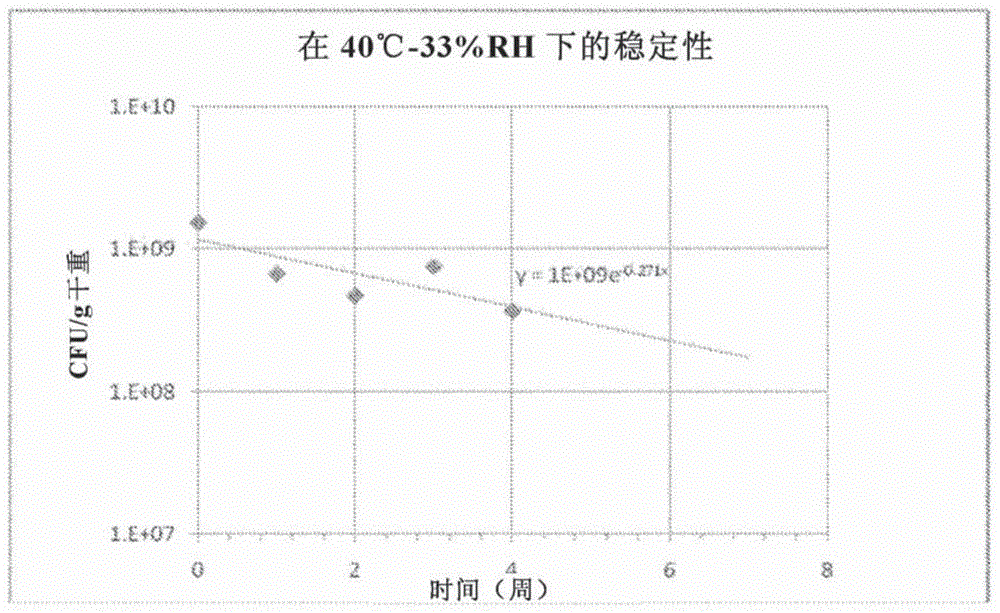
图1显示了在40℃和33%相对湿度下进行储存的益生细菌鼠李糖乳杆菌(L.rhamnosus)的稳定性趋势。Figure 1 shows the stability trend of the probiotic bacterium L. rhamnosus stored at 40°C and 33% relative humidity.
图2显示了以二级干燥步骤的Aw为0.28结束的配制过程的加工温度和累计生存力损失。Figure 2 shows the processing temperature and cumulative viability loss for the formulation process ending with an Aw of 0.28 for the secondary drying step.
图3显示了不同制剂稳定剂对储存稳定性的影响。Figure 3 shows the effect of different formulation stabilizers on storage stability.
图4显示了藻酸盐粘度对真空下制剂膨胀的影响。Figure 4 shows the effect of alginate viscosity on formulation expansion under vacuum.
图5显示了稳定剂的不同组合对细菌生存力的影响。Figure 5 shows the effect of different combinations of stabilizers on bacterial viability.
图6显示了制剂密度对真空下膨胀速率的影响。Figure 6 shows the effect of formulation density on expansion rate under vacuum.
图7显示了制剂预冷却温度对真空下膨胀的影响。Figure 7 shows the effect of formulation pre-cooling temperature on expansion under vacuum.
图8显示了初级干燥步骤期间真空压力对制剂温度的影响。Figure 8 shows the effect of vacuum pressure on formulation temperature during the primary drying step.
图9显示了真空压力对制剂干燥速率的影响。Figure 9 shows the effect of vacuum pressure on the drying rate of the formulation.
图10显示了使用本发明的制剂和方法干燥的益生细菌嗜酸乳杆菌(L.acidophilus)在37℃和33%相对湿度下储存的稳定性。Figure 10 shows the storage stability of the probiotic bacterium L. acidophilus dried using the formulations and methods of the present invention at 37°C and 33% relative humidity.
图11显示了从本发明的水凝胶制剂生产稳定干燥制剂的方法的流程图。Figure 11 shows a flow diagram of a method for producing stable dry formulations from hydrogel formulations of the present invention.
具体实施方式Detailed ways
定义definition
应该理解,在本文中使用的术语仅仅是出于描述具体实施方案的目的,而不打算是限制性的。当在本说明书和权利要求书中使用时,不带具体数量的指称包括其复数形式,除非内容明确指出不是如此。因此,例如指称“蛋白”包括单一蛋白或两种以上蛋白的组合;指称“酶”、“维生素”、“细菌”等包括单一种或几种的混合物,等等。It is to be understood that the terminology used herein is for the purpose of describing particular embodiments only and is not intended to be limiting. As used in this specification and the claims, references without specific numbers include the plural unless the content clearly dictates otherwise. Thus, for example, reference to "protein" includes a single protein or a combination of two or more proteins; reference to "enzyme", "vitamin", "bacteria", etc. includes a single one or a mixture of several, and so on.
在本发明的描述和权利要求中,下列术语将按照下面提出的定义使用。In describing and claiming the present invention, the following terms will be used in accordance with the definitions set forth below.
“环境”室温或条件是给定环境中任何给定时间的室温或条件。典型地,环境室温是22-25℃,环境气压和环境湿度容易测量,并且随着一年中的时节、天气和气候条件、纬度等而变。An "ambient" room temperature or condition is the room temperature or condition at any given time in a given environment. Typically, ambient room temperature is 22-25°C, ambient air pressure and ambient humidity are easily measured, and vary with time of year, weather and climatic conditions, latitude, and the like.
“脱气”是指当气体分压高于所施加的压力时,液体中的气体从溶液释放。这不是沸腾,并通常可以在压力高于使溶液沸腾的压力下发生。例如,瓶装碳酸软饮料含有高分压的CO2。除去瓶盖使分压降低,饮料剧烈发泡(它脱气,但是没有沸腾)。"Degassing" refers to the release of gas in a liquid from a solution when the partial pressure of the gas is higher than the applied pressure. This is not boiling, and can usually occur at pressures higher than that which boils the solution. For example, bottled carbonated soft drinks contain high partial pressures of CO2 . Removing the cap lowered the partial pressure and the beverage foamed vigorously (it degassed, but did not boil).
“沸腾”是指当液体的温度高于其沸点时发生的从液态到气态的快速相变。沸点是液体的蒸汽压等于所施加的压力时的温度。当向已经处于其沸点的液体加热时,沸腾可以特别剧烈。"Boiling" refers to the rapid phase transition from liquid to gas that occurs when the temperature of a liquid is above its boiling point. Boiling point is the temperature at which the vapor pressure of a liquid equals the applied pressure. Boiling can be particularly violent when heating a liquid that is already at its boiling point.
在干燥制剂组合物的情形中,“水活度”或“Aw”是指水的可利用度,并代表了系统中水的能量状态。它被定义为样品上方的水蒸汽压除以同样温度下纯水的蒸汽压。纯蒸馏水的水活度恰好为1或Aw=1.0。In the context of dry formulation compositions, "water activity" or "Aw" refers to the availability of water and represents the energy state of water in the system. It is defined as the water vapor pressure above the sample divided by the vapor pressure of pure water at the same temperature. Pure distilled water has a water activity of exactly 1 or Aw=1.0.
在储存稳定性的情形中,“相对湿度”或“RH”是指给定温度下空气中水蒸气的量。相对湿度通常低于使空气饱和所需的湿度,并用饱和湿度的百分率表示。In the context of storage stability, "relative humidity" or "RH" refers to the amount of water vapor in the air at a given temperature. Relative humidity is usually below the humidity required to saturate the air and is expressed as a percentage of saturated humidity.
对于本文描述的方法来说,“初级干燥”是指从开始施加真空的时间至开始二级干燥的时间点所发生的干燥。典型地,初级干燥的主体通过大量蒸发来进行,同时产物温度保持明显低于热源的温度。For the purposes of the methods described herein, "primary drying" refers to drying that occurs from the time vacuum is initiated to the time secondary drying is initiated. Typically, the bulk of the primary drying is carried out by bulk evaporation, while the product temperature is kept significantly below the temperature of the heat source.
对于本文描述的方法来说,“二级干燥”是指在温度高于制剂的凝固温度并接近热源的温度时进行的干燥步骤。在典型的制剂干燥方法中,二级干燥步骤将制剂的水活度降低至Aw为0.3或更低。For the purposes of the methods described herein, "secondary drying" refers to a drying step performed at a temperature above the solidification temperature of the formulation and close to the temperature of the heat source. In a typical formulation drying process, a secondary drying step reduces the water activity of the formulation to an Aw of 0.3 or less.
“生物活性微生物”或“生物活性微生物或制剂”是指活的或死的微生物制备物,其处于允许微生物的生物活性明确有效的形式下。“作为干粉的活微生物”是指其中至少10%W/W是活细菌的细菌生物质。“作为干粉的死微生物”是指其中至少99.999%是死细菌的细菌生物质。"Bioactive microorganism" or "bioactive microorganism or preparation" refers to a live or dead microbial preparation in a form that allows the biological activity of the microorganism to be clearly effective. "Live microorganisms as dry powder" refers to bacterial biomass of which at least 10% W/W are live bacteria. "Dead microorganisms as dry powder" refers to bacterial biomass of which at least 99.999% are dead bacteria.
“生物活性材料”、“生物活性组合物”、“生物学活性材料”或“生物活性制剂”是指处于允许生物活性成分的生物活性明确有效的形式下的制备物。这样的生物活性材料包括但不限于肽、蛋白质、激素、维生素、矿物质、药物、杀微生物剂、杀真菌剂、除草剂、杀虫剂、杀精子剂、核酸、抗体和疫苗。"Bioactive material," "bioactive composition," "biologically active material," or "biologically active formulation" refers to a preparation in a form that allows the biological activity of a biologically active ingredient to be unequivocally effective. Such bioactive materials include, but are not limited to, peptides, proteins, hormones, vitamins, minerals, drugs, microbicides, fungicides, herbicides, pesticides, spermicides, nucleic acids, antibodies, and vaccines.
“稳定剂”是指添加到制剂中以增加湿制剂的粘度或形成水凝胶的化合物或材料。适合的稳定剂的实例包括但不限于多糖,例如邻苯二甲酸醋酸纤维素(CAP)、羧甲基纤维素、果胶、藻酸钠、藻酸盐、羟丙基甲基纤维素(HPMC)、甲基纤维素、角叉菜聚糖、瓜尔胶、阿拉伯胶、黄原胶、刺槐豆胶、脱乙酰壳多糖和脱乙酰壳多糖衍生物、胶原蛋白、聚羟基乙酸、淀粉和改性淀粉、环糊精和寡糖(菊粉、麦芽糖糊精、棉籽糖、葡聚糖等)及其组合。"Stabilizer" refers to a compound or material that is added to a formulation to increase the viscosity of a wet formulation or to form a hydrogel. Examples of suitable stabilizers include, but are not limited to, polysaccharides such as cellulose acetate phthalate (CAP), carboxymethyl cellulose, pectin, sodium alginate, alginate, hydroxypropyl methylcellulose (HPMC). ), methylcellulose, carrageenan, guar gum, gum arabic, xanthan gum, locust bean gum, chitosan and chitosan derivatives, collagen, polyglycolic acid, starch and modified Starch, cyclodextrin and oligosaccharides (inulin, maltodextrin, raffinose, glucan, etc.) and combinations thereof.
“保护剂”一般是指所添加的用于确保或增加生物活性材料在干燥过程中和之后的稳定性、或用于干粉产品的长期储存稳定性的化合物或材料。适合的保护剂一般容易溶解在溶液中,并且在与水接触后不变稠或不聚合。适合的保护剂在下文中描述,并且包括但不限于蛋白质例如人和牛血清白蛋白、乳清蛋白、大豆蛋白、酪蛋白酸盐、明胶、免疫球蛋白,糖类包括单糖(半乳糖、D-甘露糖、山梨糖等)、二糖(乳糖、海藻糖、蔗糖等),氨基酸例如谷氨酸单钠、赖氨酸、甘氨酸、丙氨酸、精氨酸或组氨酸以及疏水氨基酸(色氨酸、酪氨酸、亮氨酸、苯丙氨酸等);甲胺例如甜菜碱;赋形剂盐例如硫酸镁;多元醇例如三元或更多元糖醇(例如甘油、赤藓糖醇、丙三醇、阿拉伯糖醇、木糖醇、山梨糖醇和甘露糖醇);丙二醇;聚乙二醇;普卢兰尼克;表面活性剂;及其组合。"Protective agent" generally refers to a compound or material added to ensure or increase the stability of the biologically active material during and after drying, or for long-term storage stability of the dry powder product. Suitable preservatives are generally readily soluble in solution and do not thicken or polymerize upon contact with water. Suitable protective agents are described below and include, but are not limited to, proteins such as human and bovine serum albumin, whey protein, soy protein, caseinates, gelatin, immunoglobulins, carbohydrates including monosaccharides (galactose, D- mannose, sorbose, etc.), disaccharides (lactose, trehalose, sucrose, etc.), amino acids such as monosodium glutamate, lysine, glycine, alanine, arginine or histidine and hydrophobic amino acids (chromophore) amino acid, tyrosine, leucine, phenylalanine, etc.); methylamines such as betaine; excipient salts such as magnesium sulfate; polyhydric alcohols such as trihydric or more polysaccharide alcohols (eg glycerol, erythrose) alcohol, glycerol, arabitol, xylitol, sorbitol, and mannitol); propylene glycol; polyethylene glycol; pluronic; surfactants; and combinations thereof.
“稳定的”制剂或组合物是其中的生物活性微生物或材料在储存后基本上保持其生存力和/或生物活性的制剂或组合物。稳定性可以在选定温度和湿度条件下测量选定的时间段。预期货架寿命可以在材料被实际储存该时间段之前使用趋势分析来估算。例如,对于活细菌来说,稳定性被定义为在预定的温度、湿度和时间段条件下损失1个对数CFU/g干燥制剂所花费的时间。A "stable" formulation or composition is one in which the biologically active microorganism or material substantially retains its viability and/or biological activity after storage. Stability can be measured for a selected period of time under selected temperature and humidity conditions. Expected shelf life can be estimated using trend analysis before the material is actually stored for that period of time. For example, for live bacteria, stability is defined as the time it takes to lose 1 log CFU/g of dry formulation under predetermined conditions of temperature, humidity and time period.
对于细菌来说,“生存力”是指在适合于细菌生长的营养培养基上形成菌落的能力(CFU或菌落形成单位)。对于病毒来说,生存力是指在适合的宿主细胞中感染和繁殖、导致在宿主细胞层上形成噬斑的能力。For bacteria, "viability" refers to the ability to form colonies (CFU or colony forming units) on a nutrient medium suitable for bacterial growth. For viruses, viability refers to the ability to infect and multiply in a suitable host cell, resulting in the formation of plaques on the host cell layer.
本发明的组合物和方法解决了提供成本效率合算并且可工业放大规模的干燥方法、以生产在干燥状态下寿命显著延长的含有生物活性微生物或材料的干燥制剂的问题,所述生物活性微生物或材料例如活的或死的疫苗、细菌、藻类、病毒和/或细胞悬液、肽、蛋白质、激素、维生素、矿物质、药物、杀微生物剂、杀真菌剂、除草剂、杀虫剂、杀精子剂、核酸、抗体、疫苗。本发明提供了在溶液中包含生物活性微生物或材料以及稳定剂和保护剂的制剂,将所述制剂冷却至高于其凝固温度的温度,以及通过在减压方案下同时向组合物供热除去水分以使制剂稳定。The compositions and methods of the present invention address the problem of providing a cost-effective and industrially scalable drying process to produce dry formulations containing biologically active microorganisms or materials that have a significantly extended life in the dry state, the biologically active microorganisms or Materials such as live or dead vaccines, bacteria, algae, viruses and/or cell suspensions, peptides, proteins, hormones, vitamins, minerals, drugs, microbicides, fungicides, herbicides, pesticides, Sperm preparations, nucleic acids, antibodies, vaccines. The present invention provides formulations comprising biologically active microorganisms or materials and stabilizers and protective agents in solution, cooling the formulation to a temperature above its freezing temperature, and removing moisture by simultaneously applying heat to the composition under a reduced pressure regime to stabilize the formulation.
微生物在干燥过程期间的大多数生存力丧失可归因于冷冻-融化应激和冰晶形成、高渗和氧化应激、以及气泡空化期间与溶液在低干燥压力和高温下的“沸腾”相关的剪切力和能量释放的组合。本发明提供了使干燥期间的损失降到最低并在其后的严苛储存条件下保护生物活性微生物的制剂和可工业放大规模的干燥方法。Most of the loss of viability of microorganisms during the drying process can be attributed to freeze-thaw stress and ice crystal formation, hypertonic and oxidative stress, and bubble cavitation associated with "boiling" of solutions at low drying pressures and high temperatures combination of shear force and energy release. The present invention provides formulations and drying methods that are industrially scalable to minimize losses during drying and protect biologically active microorganisms during subsequent harsh storage conditions.
本发明的组合物Compositions of the present invention
本发明包括生物活性微生物或材料、稳定剂和保护剂在黏稠溶液中的制剂组合物。已发现,本发明的制剂与不使用预冷却进行干燥的非黏稠或浓缩制剂相比,在其物理结构和功能方面具有内在差别。例如,现有技术的制剂最初进行“发泡”以促进有效干燥。发泡步骤通常引起溶液的剧烈沸腾和喷发,这是在液体状态下进行真空干燥不可避免的结果,因此在小瓶或容器中仅能实现非常低的材料装载能力(参见例如美国专利No.6,534.087,其中最终发泡产品的厚度小于2mm)。本发明的组合物和干燥方法仅允许制剂的有限和受控膨胀,因此能够获得高得多的单位干燥面积的材料载量,并因此能够容易地放大规模至生产大量材料。The present invention includes formulation compositions of biologically active microorganisms or materials, stabilizers and protectants in viscous solutions. The formulations of the present invention have been found to have inherent differences in their physical structure and function compared to non-viscous or concentrated formulations that are dried without pre-cooling. For example, prior art formulations were initially "foamed" to promote efficient drying. The foaming step typically causes vigorous boiling and eruption of the solution, an unavoidable consequence of vacuum drying in the liquid state, so only very low material loading capacities can be achieved in vials or containers (see, e.g., U.S. Patent No. 6,534.087, Wherein the thickness of the final foamed product is less than 2mm). The compositions and drying methods of the present invention allow only limited and controlled expansion of the formulation, thus enabling much higher material loadings per dry area, and thus being easily scaled up to produce large quantities of material.
单细胞微生物已经显示出特别受益于本发明的制剂和干燥方法。在一个实施方案中,本发明的生物活性微生物是益生细菌。制剂按照本发明的组成和方法来制备,包括获得浓缩溶液、糊剂、冷冻珠或干粉形式的活益生细菌。在真空下将益生细菌与稳定剂和保护剂混合,将黏稠制剂冷却至高于其凝固温度的温度,施加足够的真空压力以维持该预冷却温度,并供应20℃以上的热源以促进除水。通过将热从制剂传导出去和/或由水蒸发所引起的潜热丧失,可以维持制剂的预冷却温度。为了进一步加速干燥过程,在高达0.1托的更高真空和高达70℃的升高的温度下进行二级干燥步骤,以提供具有Aw为0.3或更低的水活度的最终组合物。这样的组合物在40℃和33%RH的储存条件下能够保持稳定60天或以上(参见图1)。已经显示,本发明详细说明的方法导致了细胞出人意料的保持其生存力的能力,其超过了现有的干燥方法。在本发明的整个干燥方法过程中,初始生存力的丧失仅为0.3个对数(参见图2)。Unicellular microorganisms have been shown to benefit particularly from the formulation and drying methods of the present invention. In one embodiment, the bioactive microorganisms of the present invention are probiotic bacteria. Formulations are prepared according to the compositions and methods of the present invention, including obtaining live probiotic bacteria in the form of concentrated solutions, pastes, frozen beads or dry powders. The probiotic bacteria are mixed with stabilizers and protectants under vacuum, the viscous formulation is cooled to a temperature above its freezing temperature, sufficient vacuum pressure is applied to maintain this pre-cooling temperature, and a heat source above 20°C is supplied to facilitate water removal. The pre-cooling temperature of the formulation can be maintained by conduction of heat away from the formulation and/or loss of latent heat due to evaporation of water. To further accelerate the drying process, a secondary drying step is performed at higher vacuum up to 0.1 Torr and elevated temperature up to 70°C to provide final compositions with water activity of Aw of 0.3 or less. Such compositions are stable for 60 days or more under storage conditions of 40°C and 33% RH (see Figure 1). It has been shown that the methods detailed in the present invention result in an unexpected ability of cells to maintain their viability, exceeding existing drying methods. During the entire drying process of the present invention, the loss of initial viability was only 0.3 log (see Figure 2).
用于制备稳定的干粉组合物的制剂Formulations for the preparation of stable dry powder compositions
与用于制备本发明的干粉组合物的优选微生物或材料混合的组成成分,包括稳定剂和保护剂。这样的组成成分,当与优选的生物活性微生物或材料混合时,可以按照本发明的方法加工,以提供大量用于所述微生物的储存和施用的稳定的干燥组合物。制剂稳定剂可以包括多糖和寡糖的混合物。优选的多糖、特别是用于使活微生物稳定的多糖,是藻酸盐。这是因为意外地发现,在降低敏感性生物物质例如益生物质的干燥损失方面,藻酸盐优于其他多糖例如果胶和阿拉伯胶(图3)。优选使用藻酸盐还因为它在温和温度下与无毒性金属形成水凝胶的特性。还发现藻酸盐通过为制剂提供适合的粘度并允许制剂在特定粘度下受控膨胀,在真空下有效地稳定制剂(图4)。The ingredients for admixture with the preferred microorganisms or materials used to prepare the dry powder compositions of the present invention include stabilizers and protectants. Such constituent ingredients, when mixed with the preferred biologically active microorganisms or materials, can be processed according to the methods of the present invention to provide stable dry compositions in large quantities for storage and application of the microorganisms. Formulation stabilizers may include mixtures of polysaccharides and oligosaccharides. A preferred polysaccharide, especially for the stabilization of living microorganisms, is alginate. This is because alginate was unexpectedly found to be superior to other polysaccharides such as pectin and acacia in reducing drying loss of sensitive biological substances such as prebiotics (Figure 3). The use of alginate is also preferred because of its hydrogel-forming properties with non-toxic metals at mild temperatures. Alginate was also found to be effective in stabilizing formulations under vacuum by providing the formulation with a suitable viscosity and allowing controlled expansion of the formulation at a specific viscosity (Figure 4).
还发现,将寡糖与藻酸盐组合进一步有助于制剂的总体稳定性。图5显示了藻酸盐和寡糖的不同组合对储存稳定性的影响。在对益生细菌的长期储存效果方面,藻酸盐与菊粉的组合是优选组合。在本发明的一个实施方案中,至少一种制剂稳定剂优选为能够通过与金属离子交联形成牢固水凝胶的树胶。It has also been found that combining oligosaccharides with alginate further contributes to the overall stability of the formulation. Figure 5 shows the effect of different combinations of alginate and oligosaccharides on storage stability. The combination of alginate and inulin is the preferred combination in terms of long-term storage effects on probiotic bacteria. In one embodiment of the present invention, the at least one formulation stabilizer is preferably a gum capable of forming strong hydrogels by cross-linking with metal ions.
本发明的保护剂可以包括各种蛋白质、肽、糖、糖醇和氨基酸。保护剂优选为在凝固温度(例如-20℃)下不使制剂中的生物活性材料结晶和/或去稳定的保护剂。包括两种或以上不同保护剂,对于抑制晶体形成以及使干燥的生物活性材料制剂在储存条件下长时间稳定,可能是有益的。The protective agent of the present invention may include various proteins, peptides, sugars, sugar alcohols and amino acids. The protectant is preferably one that does not crystallize and/or destabilize the bioactive material in the formulation at the freezing temperature (eg -20°C). Inclusion of two or more different protective agents may be beneficial for inhibiting crystal formation and for long-term stability of the dried bioactive material formulation under storage conditions.
湿制剂可以包含相当量的总固形物(组成成分减去溶剂例如水)。总固形物的主要部分可以由生物活性材料、稳定剂和保护剂构成。例如,生物活性材料存在于制剂中的浓度可以在约2-50重量%、稳定剂约1-20重量%、保护剂约20-80重量%的范围内。在另一个实例中,稳定剂存在于制剂中的浓度可以在约0.5-10重量%、保护剂约10-40重量%的范围内。优选,湿制剂应该具有约5%至80%之间、更优选约30%至60%之间的固形物含量。本发明的制剂的粘度典型地高于1000厘泊(cP),更优选高于10,000cP并低于450,000,最优选高于30,000cP并低于100,000cP。Wet formulations may contain substantial amounts of total solids (components minus solvents such as water). A major portion of the total solids can be made up of bioactive materials, stabilizers, and protectants. For example, the biologically active material may be present in the formulation at a concentration in the range of about 2-50% by weight, about 1-20% by weight of the stabilizer, and about 20-80% by weight of the protectant. In another example, the stabilizer may be present in the formulation at a concentration in the range of about 0.5-10% by weight and the protectant about 10-40% by weight. Preferably, the wet formulation should have a solids content of between about 5% and 80%, more preferably between about 30% and 60%. The viscosity of the formulations of the present invention is typically above 1000 centipoise (cP), more preferably above 10,000 cP and below 450,000, most preferably above 30,000 cP and below 100,000 cP.
本发明制剂的粘度可以高达450,000cP,只要保护剂完全溶解在溶液中即可。取决于生物活性材料的温度和渗透压敏感性,可以在升高的温度下获得含有大量总固形物的高度黏稠和均匀的悬液。例如,可以将含有30-60%总固形物的活细胞制剂在约35-40℃的升高的温度下混合,并且混合一直进行到所有保护剂完全溶解为止。The viscosity of the formulations of the present invention can be as high as 450,000 cP as long as the protectant is completely dissolved in solution. Depending on the temperature and osmotic pressure sensitivity of the bioactive material, highly viscous and homogeneous suspensions containing large amounts of total solids can be obtained at elevated temperatures. For example, a live cell preparation containing 30-60% total solids can be mixed at an elevated temperature of about 35-40°C, and mixing is continued until all protective agents are completely dissolved.
制备稳定的干燥制剂的方法Method for preparing stable dry formulations
用于保存生物活性微生物的稳定的干燥制剂的制备方法,包括以浓缩溶液、糊剂、冷冻珠或干粉形式(稳定化的或其他方式)获得特定微生物的活培养物。通过在真空下将生物活性微生物或材料与稳定剂和保护剂在溶液中混合来制备制剂,将制剂冷却至高于其凝固温度不超过10℃的温度,并通过在减压并同时向制剂供热的条件下蒸发水分对制剂进行干燥。Methods for the preparation of stable dry formulations for the preservation of biologically active microorganisms, including obtaining live cultures of specific microorganisms in the form of concentrated solutions, pastes, frozen beads or dry powders (stabilized or otherwise). The formulation is prepared by mixing the biologically active microorganism or material in solution with stabilizers and protective agents under vacuum, cooling the formulation to a temperature not more than 10°C above its freezing temperature, and by applying heat to the formulation under reduced pressure The preparation was dried by evaporating moisture under the conditions.
例如,在一个实施方案中,将包含生物活性微生物或材料、制剂稳定剂和保护剂的制剂在约10-50托的中度真空下、在溶液中混合至均匀。图6显示了制剂的不同密度对其在真空下的膨胀的影响。在制剂组成成分在溶液中混合期间导入空气,即使在相对高的真空压力下也引起过度并且不可控制的发泡。本发明的真空步骤下的混合,通过取消在制剂溶液中导入空气或气体,从而消除溶液的过度和不可控制的发泡,来解决这个问题。For example, in one embodiment, a formulation comprising bioactive microorganisms or materials, formulation stabilizers, and protectants is mixed in solution to homogeneity under a moderate vacuum of about 10-50 Torr. Figure 6 shows the effect of different densities of formulations on their swelling under vacuum. The introduction of air during mixing of the formulation components in solution causes excessive and uncontrollable foaming even at relatively high vacuum pressures. The mixing under the vacuum step of the present invention solves this problem by eliminating the introduction of air or gas into the formulation solution, thereby eliminating excessive and uncontrollable foaming of the solution.
然后将溶液冷却至高于其凝固点(通常在-5℃至+5℃之间)的温度。图7显示了制剂溶液的预冷却对其在真空压力下的膨胀的影响。令人吃惊并且出乎意料地发现,当溶液温度被降低到高于其凝固温度不超过10℃时,即使在相对较高的真空压力下也能有效消除沸腾,并且制剂的膨胀得到更好的控制。正如可以从图7看到的,只要制剂被冷却至+5℃、优选为-3℃,就可以施加3托的真空压力而没有过量发泡。The solution is then cooled to a temperature above its freezing point (usually between -5°C and +5°C). Figure 7 shows the effect of pre-cooling of a formulation solution on its expansion under vacuum pressure. It was surprisingly and unexpectedly found that when the temperature of the solution was lowered to no more than 10°C above its solidification temperature, boiling was effectively eliminated even at relatively high vacuum pressures and the expansion of the formulation was better. control. As can be seen from Figure 7, a vacuum pressure of 3 Torr can be applied without excessive foaming as long as the formulation is cooled to +5°C, preferably -3°C.
一旦冷却,然后将制剂在足够的真空(例如约3托)下干燥,以维持初级干燥步骤期间的预冷却温度。图8显示了施加的真空压力对制剂溶液的温度的影响。在高于8托的相对高的真空压力下,制剂温度增加至高于6℃,并将继续朝向架子或仓室温度快速升高。同时,溶液将继续发泡并进一步膨胀。该实施方案与上面讨论的现有技术(参见例如美国专利No.6,534,087,其中施加的真空压力在3-7托之间,甚至更高)的区别在于施加了更强的真空压力(<3托),同时控制了制剂的膨胀。该方法产生明显更快的干燥速率(参见图9),并能够获得高的制剂装载容量。在这个实施方案中,甚至在低得多的真空压力下也能消除过量发泡和沸腾,这是因为本发明的方法提供了a)在真空下膨胀受控的特殊组合物,b)方法消除了混合期间将空气引入制剂,c)制剂的显著预冷却。Once cooled, the formulation is then dried under sufficient vacuum (eg, about 3 Torr) to maintain the pre-cooling temperature during the primary drying step. Figure 8 shows the effect of applied vacuum pressure on the temperature of the formulation solution. At relatively high vacuum pressures above 8 Torr, the formulation temperature increases to above 6°C and will continue to rise rapidly towards the shelf or bin temperature. At the same time, the solution will continue to foam and expand further. This embodiment differs from the prior art discussed above (see, eg, US Patent No. 6,534,087, where the applied vacuum pressure is between 3-7 Torr, or even higher) in that a stronger vacuum pressure (<3 Torr is applied) ) while controlling the swelling of the formulation. This method produces significantly faster drying rates (see Figure 9) and enables high formulation loading capacities. In this embodiment, excess foaming and boiling can be eliminated even at much lower vacuum pressures because the method of the present invention provides a) a specific composition with controlled expansion under vacuum, b) the method eliminates Introducing air into the formulation during mixing, c) significant pre-cooling of the formulation.
现有技术中的典型方法涉及过量发泡和/或溅射和剧烈沸腾,其能损伤敏感生物物质并对工业规模放大造成困难。此外,对黏稠浆液的完全和有效脱气是困难的,并可能需要长时间。在本发明中,通过首先在温和的真空下实行整个混合过程,以便从一开始就消除夹带的气体导入制剂,来解决这些障碍。然后轻柔地除去可能残留在制剂中的任何少量可溶性气体,允许制剂在低真空下适度膨胀。使制剂达到高于其凝固温度的温度的附加预冷却步骤,提供了对膨胀率的附加控制,从而允许与现有技术所能提供的相比高得多的每单位干燥面积的装载容量。在初级干燥阶段完成后,稳定化的干燥制剂可以保持在升高的二级干燥温度(高达70℃)和低于0.2托的真空压力下,以在非常短的时间内完成制剂干燥。Typical methods in the prior art involve excessive foaming and/or sputtering and vigorous boiling, which can damage sensitive biological materials and make industrial scale-up difficult. Furthermore, complete and effective degassing of viscous slurries is difficult and can take a long time. In the present invention, these obstacles are addressed by first carrying out the entire mixing process under a mild vacuum to eliminate entrained gas from the introduction of the formulation from the outset. Any small amounts of soluble gas that may have remained in the formulation were then gently removed, allowing the formulation to swell moderately under low vacuum. The additional pre-cooling step, which brings the formulation to a temperature above its freezing temperature, provides additional control over the expansion ratio, allowing for a much higher loading capacity per unit dry area than can be provided by the prior art. After the primary drying stage is complete, the stabilized dry formulation can be held at elevated secondary drying temperatures (up to 70°C) and vacuum pressures below 0.2 Torr to complete formulation drying in a very short time.
本发明的另一个实施方案提供了用于保存生物活性微生物或材料的水凝胶制剂组合物的制备方法。例如,将含有干粉形式的益生细菌、稳定剂和保护剂的制剂在溶液中混合,通过加入金属离子或二价阳离子交联成水凝胶,然后在如上所述的低真空和温度下进行干燥。制剂的预冷却温度,可以通过将热从制剂传导出去和/或由于水蒸发造成的潜热丧失来维持。Another embodiment of the present invention provides a method of making a hydrogel formulation composition for preserving biologically active microorganisms or materials. For example, a formulation containing probiotic bacteria, stabilizers and protectants in dry powder form is mixed in solution, cross-linked into a hydrogel by addition of metal ions or divalent cations, and then dried under low vacuum and temperature as described above . The pre-cooling temperature of the formulation can be maintained by conduction of heat away from the formulation and/or loss of latent heat due to water evaporation.
例如,在本发明的一个具体实施方案中,制剂在溶液中保包含活益生细菌的浓缩的新鲜或冷冻或干燥培养物,所述溶液包含1至2.5%藻酸钠(优选1.5%藻酸钠)、1%至约5%菊粉(优选2.5%菊粉)、20%至60%海藻糖(优选40%海藻糖)和3%至15%酪蛋白水解物(优选8%酪蛋白水解物)。将制剂在真空下、在略高于室温的温度(典型在25℃-37℃之间)下混合,直至所有组分完全溶解。For example, in one embodiment of the invention, the formulation maintains a concentrated fresh or frozen or dried culture comprising live probiotic bacteria in a solution comprising 1 to 2.5% sodium alginate (preferably 1.5% sodium alginate) ), 1% to about 5% inulin (preferably 2.5% inulin), 20% to 60% trehalose (preferably 40% trehalose) and 3% to 15% casein hydrolyzate (preferably 8% casein hydrolyzate) ). The formulations are mixed under vacuum at a temperature slightly above room temperature (typically between 25°C-37°C) until all components are completely dissolved.
在本发明的另一个实施方案中,将所有成分在升高的温度下溶解在溶液中,然后将浆液冷却至0℃至-5℃之间的温度,并将活微生物的干粉混合在其中,直至所有组分完全溶解。为了促进活微生物干粉的混合并防止结块,可以向干粉添加少量海藻糖(含有相等部分的干粉和海藻糖的混合物通常就足矣)。In another embodiment of the present invention, all ingredients are dissolved in a solution at elevated temperature, then the slurry is cooled to a temperature between 0°C and -5°C, and the dry powder of living microorganisms is mixed therein, until all components are completely dissolved. To facilitate mixing of the dry powder of live microorganisms and prevent caking, a small amount of trehalose can be added to the dry powder (a mixture containing equal parts of dry powder and trehalose is usually sufficient).
将制剂浆液以约200g/sq ft的载量铺展在托盘上,并将托盘置于冷冻干燥机中的架子上。将架子温度调整到0至-5℃(优选-2℃),并使浆液冷却至该温度。然后施加1至5托(优选3托)的真空压力,并将架子温度增加到20至45℃(优选30℃)用于传导性传热。在初级蒸发步骤期间,将制剂温度维持在约温度0至-5℃,以防止样品凝固。当产品温度达到约+10℃时,在0.l托的最大真空和40℃的架子温度下开始二级干燥步骤。整个干燥过程进行约4小时,然后收获产品,其水活度为Aw-0.3或更低。The formulation slurry was spread on trays at a loading of about 200 g/sq ft and the trays were placed on racks in a freeze dryer. Adjust the shelf temperature to 0 to -5°C (preferably -2°C) and allow the slurry to cool to this temperature. A vacuum pressure of 1 to 5 Torr (preferably 3 Torr) is then applied and the shelf temperature is increased to 20 to 45°C (preferably 30°C) for conductive heat transfer. During the primary evaporation step, the formulation temperature was maintained at about
在本发明的另一个实施方案中,将装载了的托盘在冷室中预冷却至-2℃,然后立即装入真空烤箱干燥机中进行辐射性传热。然后如上所述实施初级和二级干燥步骤,进行传导性传热。In another embodiment of the present invention, the loaded trays are pre-cooled to -2°C in a cold room and then immediately loaded into a vacuum oven dryer for radiative heat transfer. The primary and secondary drying steps are then carried out as described above for conductive heat transfer.
制备制剂Preparation of preparations
本发明的制剂可以包含配制在含有制剂稳定剂和保护剂的溶液或悬液中的新鲜、冷冻或干燥的活微生物。在冷却并与生物活性微生物混合之前,可以将制剂稳定剂和/或高浓度保护剂在搅拌下溶解在加热的水性溶液中。微生物、例如培养的病毒或细菌,可以通过离心或过滤进行浓缩并与培养基分离开,然后直接混合在本发明的制剂中,或添加常规的低温保护剂,滴入液氮中,并将小的冷冻珠子储存在-80℃下,直到混合在制剂中之前。或者,可以将冷冻珠冷冻干燥,碾磨成细粉,包装在不透气袋子中,并冷冻储存直到混合到本发明的制剂中之前。在本发明的一个实施方案中,制剂中的全部水提供在浓缩的活生物体的液体中,并将活生物体悬液维持在略高于室温的温度下。将制剂稳定剂和保护剂的干燥组分掺合在一起,然后缓慢添加到活生物体的温悬液中。将制剂悬液在温和真空下在行星式拌和机中轻柔搅拌,直到所有组分完全分散并获得均匀的浆液。The formulations of the present invention may comprise fresh, frozen or dried live microorganisms formulated in solutions or suspensions containing formulation stabilizers and protectants. The formulation stabilizer and/or high concentration protectant can be dissolved in the heated aqueous solution with agitation prior to cooling and mixing with the bioactive microorganism. Microorganisms, such as cultured viruses or bacteria, can be concentrated and separated from the culture medium by centrifugation or filtration and then directly mixed into the formulations of the invention, or conventional cryoprotectants are added, dropped into liquid nitrogen, and small The frozen beads are stored at -80 °C until before mixing in the formulation. Alternatively, frozen beads can be freeze-dried, ground to a fine powder, packaged in air-tight bags, and stored frozen until prior to mixing into the formulations of the present invention. In one embodiment of the invention, all of the water in the formulation is provided in the concentrated living organism liquid and the living organism suspension is maintained at a temperature slightly above room temperature. The dry components of the formulation stabilizer and protectant are blended together and then slowly added to a warm suspension of living organisms. The formulation suspension was gently stirred in a planetary mixer under mild vacuum until all components were completely dispersed and a homogeneous slurry was obtained.
在本发明的另一个实施方案中,生物活性微生物处于干粉形式,并与制剂成分干式预混,然后将得到的干燥混合物添加到温度略高于室温的水中。In another embodiment of the present invention, the biologically active microorganisms are in dry powder form and dry premixed with the formulation ingredients, and the resulting dry mixture is then added to water at a temperature slightly above room temperature.
生物活性微生物或材料可以提供任何生物活性,例如酶活性、诱导免疫应答、细胞增殖、感染、抑制细胞生长、刺激细胞生长、治疗效应、药理效应、抗微生物效应和/或其他活性。生物活性微生物或材料可以是可用作疫苗或治疗药剂的递送介质的非活细胞或脂质体。本发明的生物活性微生物可以是活病毒和活的减毒病毒等。Biologically active microorganisms or materials can provide any biological activity, such as enzymatic activity, induction of an immune response, cell proliferation, infection, cell growth inhibition, cell growth stimulation, therapeutic effect, pharmacological effect, antimicrobial effect, and/or other activity. Bioactive microorganisms or materials can be non-viable cells or liposomes that can be used as delivery vehicles for vaccines or therapeutic agents. The biologically active microorganisms of the present invention may be live viruses, live attenuated viruses, and the like.
制剂稳定剂为制剂提供结构稳定性,和/或为生物活性微生物提供物理和化学保护益处。稳定剂可以为制剂提供增稠的粘度,并对其在真空压力下的膨胀性质提供更好控制,并增加本发明的干燥制剂组合物的结构强度。Formulation stabilizers provide structural stability to the formulation, and/or provide physical and chemical protection benefits to biologically active microorganisms. Stabilizers can provide thickened viscosity to the formulation and better control of its swelling properties under vacuum pressure and increase the structural strength of the dry formulation compositions of the present invention.
保护剂可以包括各种蛋白质、蛋白水解物、糖、糖醇和氨基酸。例如,糖例如蔗糖或海藻糖能够物理围绕生物活性材料以促进整个干燥过程中分子结构的保持,并为干燥状态下的无定形基质提供结构刚性。保护剂可以替代干燥过程中水合丧失的水,以防止对细胞膜的损伤和酶的变性。保护剂的其他功能可以包括保护生物活性材料以免暴露于损害性的光、氧气、氧化剂和水分。大多数保护剂可以在约0.1重量%至约60重量%的量下容易地溶解在溶液中。Protective agents may include various proteins, protein hydrolyzates, sugars, sugar alcohols and amino acids. For example, sugars such as sucrose or trehalose can physically surround the bioactive material to facilitate retention of molecular structure throughout the drying process and provide structural rigidity to the amorphous matrix in the dry state. Preservatives can replace water lost from hydration during drying to prevent damage to cell membranes and denaturation of enzymes. Other functions of protective agents may include protecting biologically active materials from exposure to damaging light, oxygen, oxidants, and moisture. Most protectants are readily soluble in solution in amounts ranging from about 0.1% to about 60% by weight.
制剂的预冷却Pre-cooling of the formulation
在施加干燥方法的真空压力之前,本发明的制剂可以被预冷却,以提供益处例如制剂浆液的进一步增稠、更好地控制制剂在低真空压力下的膨胀、生物活性微生物或材料的稳定化、和/或增强制剂组成成分穿过细胞膜透。冷却可以通过本技术领域已知的任何适合技术来施加。例如,可以通过与冷表面接触和传导、失去潜热等来进行冷却。典型地,将制剂装在容器中或铺展在金属盘上,并将其放置成与控温表面或仓室相接触,在那里它们与受控温度平衡。典型地,本发明的制剂可以预冷却到高于凝固温度的温度(例如-5℃至+5℃之间)。The formulations of the present invention may be pre-cooled prior to applying the vacuum pressure of the drying process to provide benefits such as further thickening of formulation slurries, better control of formulation expansion under low vacuum pressures, stabilization of biologically active microorganisms or materials , and/or enhance the permeation of formulation components across cell membranes. Cooling can be applied by any suitable technique known in the art. For example, cooling may occur by contact and conduction with cold surfaces, loss of latent heat, and the like. Typically, the formulations are contained in containers or spread out on metal pans and placed in contact with a temperature-controlled surface or chamber where they equilibrate with a controlled temperature. Typically, the formulations of the present invention may be pre-cooled to a temperature above the freezing temperature (eg, between -5°C and +5°C).
制剂的初级干燥Primary drying of formulations
用于保存生物活性微生物例如活的或减毒的生物体的典型方法包括冷冻和真空条件的组合,其能够导致膜损伤和细胞组成成分的变性。现有技术讲授了使用较高真空压力(例如低于100托)、添加特殊低温保护剂、获得稠溶液(浆)的浓缩步骤、和/或较高的初始温度来防止冷冻。本发明的制剂和方法参数的使用克服了这些限制,并允许每单位干燥面积较高的装载量,显著提高了工业产量。Typical methods for preserving biologically active microorganisms, such as live or attenuated organisms, include a combination of freezing and vacuum conditions, which can lead to membrane damage and denaturation of cellular constituents. The prior art teaches the use of higher vacuum pressures (eg, below 100 Torr), addition of special cryoprotectants, concentration steps to obtain thick solutions (slurry), and/or higher initial temperatures to prevent freezing. The use of the formulations and process parameters of the present invention overcomes these limitations and allows higher loadings per unit of drying area, significantly increasing industrial throughput.
本发明的制剂通过蒸发进行干燥。从制剂周围的气态环境中除去溶剂(水分)可以通过冷凝和干燥来驱动。溶剂从制剂的蒸发可以在低真空压力下提供加速的制剂初级干燥。制剂的受控膨胀通过将溶剂快速转移出制剂,加速了制剂的初级干燥。制剂的受控膨胀通过在施加干燥真空时对残留溶解气体进行轻柔脱气(不是沸腾)来实现。因为空化和剪切力与沸腾期间的气泡形成有关,和/或制剂可能从容器溢出或对生物活性微生物具有不利影响,因此希望不使制剂沸腾或过度发泡。The formulations of the present invention are dried by evaporation. The removal of solvent (moisture) from the gaseous environment surrounding the formulation can be driven by condensation and drying. Evaporation of the solvent from the formulation can provide accelerated primary drying of the formulation at low vacuum pressure. The controlled swelling of the formulation accelerates the primary drying of the formulation by rapidly transferring the solvent out of the formulation. Controlled expansion of the formulation is achieved by gentle degassing (not boiling) of residual dissolved gases while applying a drying vacuum. Because cavitation and shear forces are associated with bubble formation during boiling, and/or the formulation may spill from the container or have an adverse effect on biologically active microorganisms, it is desirable not to boil or over-foam the formulation.
随着初级干燥的进行,制剂结构被稳定化。干燥室中供应的热补偿了由溶剂蒸发引起的潜热丧失,并将制剂温度维持在高于其凝固温度10℃之内。在初级干燥过程期间的某些点处,溶剂蒸发速率减慢,并且由于干燥室中热的超量供应,制剂温度开始增加。该点指示了本发明中初级干燥步骤的结束。当从制剂中驱除溶剂时,溶液中的保护剂变得浓缩并且更稠,直到它停止像液体一样流动。无定形和/或玻璃样制剂保存稳定的制剂结构。As primary drying proceeds, the formulation structure is stabilized. The heat supplied in the drying chamber compensates for the latent heat loss caused by solvent evaporation and maintains the formulation temperature within 10°C above its freezing temperature. At some point during the primary drying process, the solvent evaporation rate slows and the temperature of the formulation begins to increase due to the oversupply of heat in the drying chamber. This point indicates the end of the primary drying step in the present invention. As the solvent is driven off the formulation, the protectant in solution becomes concentrated and thicker until it stops flowing like a liquid. Amorphous and/or glass-like formulations preserve stable formulation structures.
二级干燥secondary drying
结构稳定的制剂的二级干燥移除剩余的滞留或结合水分,并提供了在环境温度下长时间储存稳定的组合物。二级干燥包括施加数小时至数日的升高的温度和强真空。在优选实施方案中,完成二级干燥步骤所需的时间长度是初级干燥步骤时间的两倍。优选地,在二级干燥步骤结束时,制剂的水活度低于0.3的Aw。干燥温度可以在约室温至约70℃的范围内。用于许多生物活性微生物的典型的二级干燥方法包括将温度从约30℃升高至约40℃并保持约30分钟至约24小时(优选为约30分钟至约4小时),以提供水活度低于0.3的Aw的稳定的干燥制剂组合物。在二级干燥的一个具体实施方案中,以能够进一步保存活生物物质例如活微生物的活性的速率,将干燥温度从初级干燥条件缓慢升高。在二级干燥过程中可以提供强真空,以加速除水速率,降低残留的水分含量。二级干燥期间的真空可以低于1托,优选低于约0.2托。Secondary drying of structurally stable formulations removes residual entrapped or bound moisture and provides compositions that are storage stable for extended periods of time at ambient temperatures. Secondary drying involves the application of elevated temperature and strong vacuum for hours to days. In a preferred embodiment, the length of time required to complete the secondary drying step is twice the time of the primary drying step. Preferably, at the end of the secondary drying step, the water activity of the formulation is below an Aw of 0.3. The drying temperature may range from about room temperature to about 70°C. A typical secondary drying process for many biologically active microorganisms involves raising the temperature from about 30°C to about 40°C and holding for about 30 minutes to about 24 hours (preferably about 30 minutes to about 4 hours) to provide water Stable dry formulation compositions with Aw activity below 0.3. In one specific embodiment of secondary drying, the drying temperature is slowly increased from primary drying conditions at a rate that further preserves the activity of living biological material, eg, living microorganisms. A strong vacuum can be provided during the secondary drying process to accelerate the rate of water removal and reduce the residual moisture content. The vacuum during secondary drying may be below 1 Torr, preferably below about 0.2 Torr.
本发明的干燥方法产生了包裹在无定形玻璃样基质中的生物活性微生物或生物活性材料,由于无定形玻璃样组合物中化合物和其他分子的活动性的极大降低,从而防止蛋白质解折叠并显著减缓了分子的相互作用和交叉反应性。只要无定形固体处于低于其玻璃态转变温度的温度下并且残留水分保持相对低(即低于0.3的Aw),不稳定的生物活性微生物就能保持相对稳定。应该指出,获得玻璃态不是长期稳定性的必要条件,因为某些生物活性微生物或材料可能在更晶体性状态下表现得更好。The drying method of the present invention yields bioactive microorganisms or bioactive materials encapsulated in an amorphous glass-like matrix, preventing protein unfolding and preventing protein unfolding due to the greatly reduced mobility of compounds and other molecules in the amorphous glass-like composition. Significantly slows molecular interactions and cross-reactivity. As long as the amorphous solid is at a temperature below its glass transition temperature and the residual moisture remains relatively low (ie, an Aw below 0.3), labile bioactive microorganisms can remain relatively stable. It should be noted that obtaining a glassy state is not a requirement for long-term stability, as some bioactive microorganisms or materials may perform better in a more crystalline state.
干粉的制备Preparation of dry powder
干燥制剂可以整块使用,切成所需形状和大小,或压碎和碾磨成自由流动粉末以提供便利的下游加工例如湿法或干法成团、成粒、制片、压实、球化或任何其他种类的递送方法。用于压碎、碾磨、研磨或粉碎的方法在本技术领域中是公知的。例如,可以使用锤式碾磨机、冲击式碾磨机、喷射式碾磨机、销棒式碾磨机、Wiley碾磨机或类似的碾磨装置。优选粒径小于约1000μm,优选小于500μm。Dry formulations can be used monolithic, cut into desired shapes and sizes, or crushed and milled into free-flowing powders to provide convenient downstream processing such as wet or dry agglomeration, granulation, tableting, compaction, pelletizing chemical or any other kind of delivery method. Methods for crushing, milling, grinding or pulverizing are well known in the art. For example, hammer mills, impact mills, jet mills, pin mills, Wiley mills, or similar milling devices can be used. Preferably the particle size is less than about 1000 [mu]m, preferably less than 500 [mu]m.
本文描述的组合物和方法保存了包裹的生物活性微生物或生物活性材料的生物活性。例如,通过将组合物置于升高的温度(例如40℃)和高湿度(例如33%RH)下并测量制剂的生物活性来测试所述组合物的稳定性。以活益生细菌为例,这些研究的结果证实了配制在这些制剂中的细菌,在至少60天内稳定(参见图1)。稳定性被定义为一个对数CFU/g效力丧失所用的时间。这样的制剂甚至在使用高浓度生物活性材料时也是稳定的。因此,这些制剂的优点在于它们可以在室温或高于室温的温度下长时间运输和储存。The compositions and methods described herein preserve the biological activity of the encapsulated biologically active microorganisms or biologically active materials. For example, the stability of the composition is tested by exposing the composition to elevated temperature (eg, 40°C) and high humidity (eg, 33% RH) and measuring the biological activity of the formulation. Using live probiotic bacteria as an example, the results of these studies confirmed that the bacteria formulated in these formulations were stable for at least 60 days (see Figure 1). Stability was defined as the time to loss of potency at one log CFU/g. Such formulations are stable even when high concentrations of biologically active materials are used. Therefore, the advantage of these formulations is that they can be transported and stored at or above room temperature for extended periods of time.
实施例Example
提供了下面的实施例对本要求保护的发明进行说明,但不对其构成限制。The following examples are provided to illustrate, but not limit, the claimed invention.
实施例1Example 1
干燥预混制剂的制备:Preparation of dry premixes:
按照表1制备了几种制剂预混物。海藻糖从Cargill Minneapolis,MN获得。大豆蛋白分离物从Fearn Natural Foods,Mequon,WI获得。乳清蛋白浓缩物从Agri-Mark Inc.,Middlebury,VT获得。酪蛋白水解物从Marcor,Carlstadt,NJ获得,藻酸钠从ISP Corp.,Wayne,NJ获得。将所有成分合并在一起并均匀混合(表1)。Several formulation premixes were prepared according to Table 1. Trehalose was obtained from Cargill Minneapolis, MN. Soy protein isolate was obtained from Fearn Natural Foods, Mequon, WI. Whey protein concentrate was obtained from Agri-Mark Inc., Middlebury, VT. Casein hydrolyzate was obtained from Marcor, Carlstadt, NJ, and sodium alginate was obtained from ISP Corp., Wayne, NJ. All ingredients were combined and mixed well (Table 1).
表1.制剂预混物组成(重量百分比)Table 1. Formulation premix composition (weight percent)
实施例2Example 2
含有益生细菌的稳定干粉:Stable dry powder with probiotic bacteria:
将嗜酸乳杆菌(Lactobacillus acidophilus)(来自实验室发酵收获的100g冷冻浓缩物)在37℃下融化。在有夹套的双行星式混合机(DPM,1qt,Ross Engineering,Inc.Savannah,GA)中,向益生细菌的融化浆液缓慢加入蛋白水解物预混物(100g,表1)。混合在温和真空(25托)下、在40RPM和37℃下执行10分钟。将均匀浆液以200g/sq ft的载量均匀铺展在托盘上,并将托盘置于冷冻干燥机(25SRC型,Virtis,Gardiner,NY)中的架子上。将架子温度设置在高于浆液-5℃的凝固温度,以冷却但不凝固浆液。当制剂温度达到约-1℃时施加真空压力(3托)。当真空达到约7托时浆液开始轻柔除气。当真空达到3托时,将架子温度升高至50℃。在初级干燥步骤的前50分钟期间,制剂温度保持在约-1℃至约+5℃。一旦制剂温度升高至+10℃后,就开始二级干燥步骤。施加0.1托的最大真空,同时架子温度仍继续维持在50℃。二级干燥步骤继续进行另外100分钟,这时终止干燥过程,并将干燥制剂从冷冻干燥机中取出。当通过Hygropalm Aw1仪器(Rotonic Instrument Corp.,Huntington,NY.)测量时,该点处干燥制剂的水活度是Aw=0.23。Lactobacillus acidophilus (100 g frozen concentrate from laboratory fermentation harvest) was thawed at 37°C. In a jacketed double planetary mixer (DPM, 1 qt, Ross Engineering, Inc. Savannah, GA), the protein hydrolysate premix (100 g, Table 1) was slowly added to the thawed slurry of probiotic bacteria. Mixing was performed under mild vacuum (25 Torr) at 40 RPM and 37°C for 10 minutes. The homogenous slurry was spread evenly on a tray at a capacity of 200 g/sq ft and the tray was placed on a rack in a freeze dryer (Model 25SRC, Virtis, Gardiner, NY). Set the shelf temperature at -5°C above the solidification temperature of the slurry to cool but not solidify the slurry. Vacuum pressure (3 Torr) was applied when the formulation temperature reached about -1°C. The slurry began to outgas gently when the vacuum reached about 7 Torr. When the vacuum reached 3 Torr, increase the shelf temperature to 50°C. During the first 50 minutes of the primary drying step, the formulation temperature was maintained at about -1°C to about +5°C. Once the formulation temperature has risen to +10°C, the secondary drying step begins. A maximum vacuum of 0.1 Torr was applied while the shelf temperature continued to be maintained at 50°C. The secondary drying step continued for an additional 100 minutes, at which point the drying process was terminated and the dried formulation was removed from the freeze dryer. The water activity of the dry formulation at this point was Aw=0.23 when measured by the Hygropalm Awl instrument (Rotonic Instrument Corp., Huntington, NY.).
配制、制备和干燥过程期间的生存力损失显示在图9中。制剂制备期间的生存力损失是0.26log,干燥过程期间是0.34log,总累计损失为0.6log。The loss of viability during the formulation, preparation and drying process is shown in FIG. 9 . The loss of viability during formulation preparation was 0.26 log and during the drying process was 0.34 log for a total cumulative loss of 0.6 log.
图10显示了干燥制剂在37℃和33%RH的加速储存条件下的储存稳定性。在这些储存条件下4周后,在本发明的制剂中稳定化的益生细菌的生存力损失仅为0.8log。Figure 10 shows the storage stability of dry formulations under accelerated storage conditions at 37°C and 33% RH. After 4 weeks under these storage conditions, the loss of viability of the stabilized probiotic bacteria in the formulation of the invention was only 0.8 log.
实施例3Example 3
水凝胶制剂的制备:Preparation of Hydrogel Formulations:
按照实施例2、但是使用表1的乳清蛋白预混物,制备了浓缩的益生菌浆液。向该浆液加入0.5g磷酸氢钙,然后加入0.5g葡萄糖酸内酯。在接下来的2小时内允许浆液在室温下硬化,以形成固体水凝胶。使用可商购切片机/切碎机将坚固凝胶切成细长的丝。以200g/sqft的载量将细丝装载在托盘上,并置于冷冻干燥机中按照实施例2中所述干燥。在建立起0.1托的最大真空后4小时,将干燥的产品从冷冻干燥机取出。制剂的水活度(Aw)为0.05(通过HygroPalm Aw1,Rotonic Huntington,NY测量)。使用标准的锤式碾磨设备将干燥制剂进一步研磨成细粉,并通过50-250微米筛网筛分。图11显示了从本发明的水凝胶制剂生产稳定干燥制剂的方法的流程图。Concentrated probiotic slurries were prepared following Example 2, but using the whey protein premixes of Table 1 . To this slurry was added 0.5 g of dibasic calcium phosphate followed by 0.5 g of gluconolactone. The slurry was allowed to harden at room temperature over the next 2 hours to form a solid hydrogel. The firm gel was cut into elongated filaments using a commercially available slicer/chopper. Filaments were loaded onto trays at a loading of 200 g/sqft and placed in a freeze dryer to dry as described in Example 2. The dried product was removed from the
实施例4Example 4
益生宠物食品的制备:Preparation of probiotic pet food:
将可商购的狗的球粒状宠物食品在对流烤箱中干燥至水活度为0.1,然后用按照实施例3中所述制备的稳定的益生菌干燥制剂进行包衣。向干燥球粒喷洒约5%基于脂肪的屏水层(40%鸡脂肪、40%可可脂和20%蜂蜡的混合物),在鼓式拌合机中与干粉制剂(通常为总宠物食品的0.1-0.5%,其提供了108CFU/g)混合,最后喷洒另一部分基于脂肪的屏水层包衣。包衣的总量约为(宠物食品的)15%。包衣时间约为30分钟。Commercially available dog pellet pet food was dried in a convection oven to a water activity of 0.1 and then coated with the stabilized dry probiotic formulation prepared as described in Example 3. Spray dry pellets with about 5% fat-based water barrier (mixture of 40% chicken fat, 40% cocoa butter and 20% beeswax) in a drum blender with a dry powder formulation (usually 0.1 of the total pet food -0.5%, which provides 10 8 CFU/g) mixed and finally sprayed with another part of the fat based water barrier coating. The total amount of coating was about 15% (of the pet food). The coating time is about 30 minutes.
实施例5Example 5
具有几种益生微生物的鱼饲料的制备:Preparation of fish feed with several probiotic microorganisms:
使用几种益生菌的混合物制备了本发明的鱼用球粒饲料。按照实施例2中所述制备了含有鼠李糖乳杆菌(L.rhamnosus)、嗜酸乳杆菌(L.acidophilus)和乳双歧杆菌(Bifidobacterium lactis)的混合物的稳定的干燥益生菌制剂。首先将鲑鱼用的可商购起始饲料(Zeigler Bros.,Gardners,PA)在对流烤箱中干燥至水活度为0.1,然后在鼓式拌合机中用益生菌制剂包衣。首先向球粒(100g)喷洒约5重量%的基于脂肪的屏水层(40%鱼油、40%可可脂和20%蜂蜡的混合物),然后与1g稳定的干燥益生菌制剂混合(以获得107cfu/g饲料的剂量),最后喷洒另一部分基于脂肪的屏水层包衣。包衣的总量约为鱼饲料的10%。The pellet feed for fish of the present invention was prepared using a mixture of several probiotics. A stable dry probiotic formulation containing a mixture of L. rhamnosus, L. acidophilus and Bifidobacterium lactis was prepared as described in Example 2. Commercially available starter feed for salmon (Zeigler Bros., Gardners, PA) was first dried in a convection oven to a water activity of 0.1 and then coated with the probiotic formulation in a drum mixer. The pellets (100 g) were first sprayed with about 5% by weight of a fat-based water barrier (mixture of 40% fish oil, 40% cocoa butter and 20% beeswax) and then mixed with 1 g of the stabilized dry probiotic formulation (to obtain 10 7 cfu/g feed), and finally sprayed with another part of the fat-based water barrier coating. The total amount of coating is about 10% of the fish feed.
实施例6Example 6
含有本发明的干燥制剂的婴儿配方奶粉:Infant formula containing the dry formulation of the present invention:
按照实施例2制备含有乳杆菌GG(Lactobacillus GG)(Valio Corp,芬兰)的稳定的干燥制剂,然后筛分成两种粒径的组(高于50μm和低于150μm)。通过将99g Nutramigen(Mead Johnson;Evansville,IL)与0.1g小尺寸粒子(低于50μm)混合,制备了婴儿配方奶粉。最终产品每100g婴儿配方奶粉含约108cfu乳杆菌GG。A stable dry formulation containing Lactobacillus GG (Valio Corp, Finland) was prepared as in Example 2 and then sieved into two particle size groups (above 50 μm and below 150 μm). Infant formula was prepared by mixing 99 g of Nutramigen (Mead Johnson; Evansville, IL) with 0.1 g of small size particles (below 50 μm). The final product contains approximately 108 cfu of Lactobacillus GG per 100 g of infant formula.
实施例7Example 7
含有酶的稳定干粉:Stabilized dry powder containing enzymes:
通过在温和真空下将60g蛋白水解物制剂预混物(表1)与40g Savinase(Novozymes,丹麦)在100g水溶液中混合,制备了含40重量%Savinase的水凝胶制剂。将湿制剂在真空烤箱中,在50℃的干燥温度下干燥。为了确定干燥制剂的装载和储存稳定性,将干燥样品精确称重(<100mg)在微量离心管中。加入200μl二甲基亚砜(DMSO)。通过涡旋振荡使制剂溶解在DMSO缓冲液中。向该样品加入0.8ml含有0.05N NaOH、0.5%SDS和0.075M柠檬酸(三钠盐)的溶液。将管在45℃下超声10分钟,然后以5,000rpm短暂离心10分钟。将透明的DMSO/NaOH/SDS/柠檬酸盐溶液的等份加入到微量滴定板的孔中,并使用Bradford测定方法分析蛋白质含量。稳定酶制剂的储存稳定性明显高于不含本发明制剂的干酶。A hydrogel formulation containing 40 wt% Savinase was prepared by mixing 60 g of protein hydrolysate formulation premix (Table 1) with 40 g of Savinase (Novozymes, Denmark) in 100 g of aqueous solution under mild vacuum. The wet formulation was dried in a vacuum oven at a drying temperature of 50°C. To determine the loading and storage stability of dry formulations, dry samples were accurately weighed (<100 mg) in microcentrifuge tubes. 200 μl dimethyl sulfoxide (DMSO) was added. The formulations were dissolved in DMSO buffer by vortexing. To this sample was added 0.8 ml of a solution containing 0.05N NaOH, 0.5% SDS and 0.075M citric acid (trisodium salt). Tubes were sonicated at 45°C for 10 minutes, then briefly centrifuged at 5,000 rpm for 10 minutes. Aliquots of clear DMSO/NaOH/SDS/citrate solutions were added to the wells of microtiter plates and analyzed for protein content using the Bradford assay. The storage stability of the stable enzyme preparation is significantly higher than that of dry enzyme without the preparation of the present invention.
实施例8Example 8
含有维生素A的稳定干粉:Stable dry powder with vitamin A:
通过在25托真空下将50g大豆蛋白制剂预混物(表1)与50g维生素A粉末(BASFCorp.,Florham Park,NJ)在100g水溶液中混合,制备了含有50重量%维生素A的水凝胶制剂。将湿制剂预冷却至-5℃,然后以200g/sq ft的载量铺展在托盘上,并在真空烤箱中在3托的初始真空压力和70℃的温度下进行干燥,随后一旦制剂温度达到5℃就执行70℃下0.2托的最大真空步骤。A hydrogel containing 50 wt% vitamin A was prepared by mixing 50 g of soy protein formulation premix (Table 1) with 50 g of vitamin A powder (BASF Corp., Florham Park, NJ) in 100 g of aqueous solution under 25 torr vacuum preparation. The wet formulation was pre-cooled to -5°C, then spread on trays at a load of 200 g/sq ft and dried in a vacuum oven at an initial vacuum pressure of 3 Torr and a temperature of 70°C, subsequently once the formulation temperature reached A maximum vacuum step of 0.2 Torr at 70°C was performed at 5°C.
实施例9Example 9
侵袭性物种诱饵的制备Preparation of Invasive Species Bait
按照本发明制备了含有杀虫剂的特别针对侵袭性物种的球粒状诱饵。向200gm水加入表1的乳清蛋白预混物。向该溶液加入90gm鱼藤酮和0.5gm磷酸氢钙,然后加入0.5gm葡萄糖酸内酯。允许浆液在室温下固化2小时以上。通过切片机/切碎机将坚固凝胶切成细长的丝。将细丝装载在托盘上,并置于真空烤箱干燥机中。在水活度达到0.10后停止干燥。将干燥制剂研磨成对于特定靶向物种来说适合于诱饵尺寸规格的尺寸分布。Insecticide-containing pellet baits are prepared in accordance with the present invention especially for invasive species. The whey protein premix of Table 1 was added to 200 gm of water. To this solution was added 90 gm rotenone and 0.5 gm dibasic calcium phosphate followed by 0.5 gm gluconolactone. The slurry was allowed to cure for more than 2 hours at room temperature. Cut the firm gel into thin filaments by means of a slicer/chopper. Filaments were loaded on trays and placed in a vacuum oven dryer. Drying was stopped after the water activity reached 0.10. The dried formulation is ground to a size distribution suitable for the bait size specification for the particular targeted species.
实施例10Example 10
制备在水溶性制剂中受保护的杀虫剂:To prepare insecticides protected in water-soluble formulations:
通过本发明的方法制备了杀虫剂的受保护的可溶性颗粒制剂,所述杀虫剂原本在储存期间将被制剂中的其他成分分解。向200g水加入表1的大豆蛋白预混物。向该溶液加入80g敏感的配制过的杀虫剂的干燥制剂。将浆液转移到真空烤箱干燥机,并干燥至水活度为0.1。将干燥制剂研磨至所需尺寸并包装。Protected soluble granular formulations of pesticides that would otherwise be broken down by other ingredients in the formulation during storage are prepared by the method of the present invention. The soy protein premix of Table 1 was added to 200 g of water. To this solution was added 80 g of a dry formulation of sensitive formulated pesticide. The slurry was transferred to a vacuum oven dryer and dried to a water activity of 0.1. The dry formulation is ground to the desired size and packaged.
实施例11Example 11
在水不溶性制剂中制备受保护的杀虫剂:Preparation of protected insecticides in water-insoluble formulations:
使用本发明的制剂和方法制备了杀虫剂的受保护的不可溶颗粒制剂,否则所述杀虫剂在储存期间将被制剂中的其他成分分解。向200g水加入表1的大豆蛋白预混物。向该溶液加入90g敏感杀虫剂的干燥制剂和0.5g磷酸氢钙,然后加入0.55g葡萄糖酸内酯。允许浆液在室温下硬化2小时以上,然后通过切片机/切碎机将其切成细长的丝。将细丝装载在托盘上,并在真空烤箱干燥机中干燥至水活度达到0.1。将干燥制剂进一步研磨至所需尺寸分布并包装。Use of the formulations and methods of the present invention produces protected insoluble particulate formulations of pesticides that would otherwise be broken down by other ingredients in the formulation during storage. The soy protein premix of Table 1 was added to 200 g of water. To this solution was added 90 g of dry formulation of sensitive insecticide and 0.5 g of calcium hydrogen phosphate, followed by 0.55 g of gluconolactone. The slurry was allowed to harden at room temperature for more than 2 hours before being cut into thin filaments by a slicer/chopper. Filaments were loaded on trays and dried in a vacuum oven dryer to a water activity of 0.1. The dry formulation is further ground to the desired size distribution and packaged.
实施例12Example 12
将10克干燥的鼠李糖乳杆菌GG(Lactobacillus Rhamnosus GG)与100g实施例1的蛋白水解物预混物(表1)混合。在35℃下,在有夹套的双行星式混合机中,向100gm去离子水缓慢加入该干燥混合物,并以40rpm混合10分钟。将均匀浆液以100gm/sq ft的载量均匀铺展在托盘上,并将托盘置于冷冻干燥机(25SRC型,Virtis,Gardiner,NY)中的架子上。将架子温度设置在5℃以冷却浆液。施加真空以将压力降低至3托,此时将架子温度升高至30℃。2小时后,将压力进一步降低至150毫托,架子温度仍保持在30℃。继续再干燥3小时,这时产品温度已升高至架子温度的2℃范围内。然后从冷冻干燥机中取出干燥产物,通过Hygropalm Aw1仪器测量该时间点处干燥制剂的水活度。测量并记录配制、制备和干燥过程期间生存力的损失。在32℃和20%RH的加速储存条件下进行干燥制剂的储存稳定性测试。10 grams of dried Lactobacillus Rhamnosus GG were mixed with 100 grams of the protein hydrolysate premix of Example 1 (Table 1). The dry mixture was slowly added to 100 gm of deionized water in a jacketed double planetary mixer at 35°C and mixed at 40 rpm for 10 minutes. The homogenous slurry was spread evenly on a tray at a loading of 100 gm/sq ft, and the tray was placed on a rack in a freeze dryer (Model 25SRC, Virtis, Gardiner, NY). The rack temperature was set at 5°C to cool the slurry. Vacuum was applied to reduce the pressure to 3 Torr, at which point the shelf temperature was raised to 30°C. After 2 hours, the pressure was further reduced to 150 mTorr and the shelf temperature was still maintained at 30°C. Drying was continued for an additional 3 hours, at which point the product temperature had risen to within 2°C of the shelf temperature. The dried product was then removed from the freeze dryer and the water activity of the dried formulation at this time point was measured by a Hygropalm Awl instrument. Loss of viability during formulation, preparation and drying processes is measured and recorded. Storage stability testing of dry formulations was performed under accelerated storage conditions of 32°C and 20% RH.
下面显示了在30℃下进行的试验以及在40℃下进行的重复试验的结果。The results of the tests carried out at 30°C and the repeated tests carried out at 40°C are shown below.

实施例13Example 13
将20克干燥的鼠李糖乳杆菌GG(Lactobacillus Rhamnosus GG)与100g实施例1的乳清蛋白预混物混合。在35℃下,在有夹套的双行星式混合机中,向100gm去离子水缓慢加入该干燥混合物,并以40rpm混合10分钟。将均匀浆液以100gm/sq ft的载量均匀铺展在托盘上,并将托盘置于冷冻干燥机(25SRC型,Virtis,Gardiner,NY)中的架子上。将架子温度设置在5℃以冷却浆液。施加真空以将压力降低至3托,此时将架子温度升高至30℃。2小时后,将压力进一步降低至150毫托,架子温度仍保持在30℃。继续再干燥3小时,这时产品温度已升高至架子温度的2℃范围内。然后从冷冻干燥机中取出干燥产物,通过HygropalmAw1仪器测量该时间点处干燥制剂的水活度。测量并记录配制、制备和干燥过程期间生存力的损失。20 grams of dried Lactobacillus Rhamnosus GG was mixed with 100 grams of the whey protein premix of Example 1 . The dry mixture was slowly added to 100 gm of deionized water in a jacketed double planetary mixer at 35°C and mixed at 40 rpm for 10 minutes. The homogenous slurry was spread evenly on a tray at a loading of 100 gm/sq ft, and the tray was placed on a rack in a freeze dryer (Model 25SRC, Virtis, Gardiner, NY). The rack temperature was set at 5°C to cool the slurry. Vacuum was applied to reduce the pressure to 3 Torr, at which point the shelf temperature was raised to 30°C. After 2 hours, the pressure was further reduced to 150 mTorr and the shelf temperature was still maintained at 30°C. Drying was continued for an additional 3 hours, at which point the product temperature had risen to within 2°C of the shelf temperature. The dried product was then removed from the freeze dryer and the water activity of the dried formulation at this time point was measured by the HygropalmAwl instrument. Loss of viability during formulation, preparation and drying processes is measured and recorded.
在32℃和20%RH的加速储存条件下进行干燥制剂的储存稳定性测试。Storage stability testing of dry formulations was performed under accelerated storage conditions of 32°C and 20% RH.
下面显示了在30℃下进行的试验以及在40℃下进行的重复试验的结果:The results of the test conducted at 30°C and the repeated test conducted at 40°C are shown below:

实施例14Example 14
将10克干燥的嗜酸乳杆菌(Lactobacillus acidophilis)与10gm海藻糖混合并暂时放在一边,同时将65.3gm海藻糖、3gm藻酸钠、5gm菊粉和16.7gm乳清水解物作为干粉混合在一起,并缓慢加入到有夹套的双行星式混合机中的100gm 35℃去离子水中,并以40rpm混合5分钟。向该浆液加入嗜酸乳杆菌和海藻糖干燥预混物,并在35℃下再继续混合5分钟。将均匀浆液以100gm/sq ft的载量均匀铺展在托盘上,并将托盘置于冷冻干燥机(25SRC型,Virtis,Gardiner,NY)中的架子上。将架子温度设置在5℃以冷却浆液。施加真空以将压力降低至3托,此时将架子温度升高至30℃。2小时后,将压力进一步降低至150毫托,架子温度仍保持在30℃。继续再干燥3小时,这时产品温度已升高至架子温度的2℃范围内。从冷冻干燥机中取出干燥产物,使用Hygropalm Aw1仪器测量该时间点处干燥制剂的水活度。测量并记录配制、制备和干燥过程期间生存力的损失。在32℃和20%RH的加速储存条件下进行干燥制剂的储存稳定性测试。下表中显示了干燥机维持在30℃下的试验结果并与干燥机维持在50℃下的结果进行比较。10 g of dried Lactobacillus acidophilis was mixed with 10 gm trehalose and temporarily set aside, while 65.3 gm trehalose, 3 gm sodium alginate, 5 gm inulin and 16.7 gm whey hydrolyzate were mixed as dry powder in together and slowly added to 100 gm 35°C deionized water in a jacketed double planetary mixer and mixed at 40 rpm for 5 minutes. To this slurry was added the Lactobacillus acidophilus and Trehalose dry premix and mixing was continued for an additional 5 minutes at 35°C. The homogenous slurry was spread evenly on a tray at a loading of 100 gm/sq ft, and the tray was placed on a rack in a freeze dryer (Model 25SRC, Virtis, Gardiner, NY). The rack temperature was set at 5°C to cool the slurry. Vacuum was applied to reduce the pressure to 3 Torr, at which point the shelf temperature was raised to 30°C. After 2 hours, the pressure was further reduced to 150 mTorr and the shelf temperature was still maintained at 30°C. Drying was continued for an additional 3 hours, at which point the product temperature had risen to within 2°C of the shelf temperature. The dried product was removed from the freeze dryer and the water activity of the dried formulation at this time point was measured using a Hygropalm Awl instrument. Loss of viability during formulation, preparation and drying processes is measured and recorded. Storage stability testing of dry formulations was performed under accelerated storage conditions of 32°C and 20% RH. The table below shows the results of the test with the dryer maintained at 30°C and compared to the results of the dryer maintained at 50°C.

实施例15Example 15
将10克干燥的嗜酸乳杆菌(Lactobacillus acidophilis)与10gm海藻糖混合并暂时放在一边,同时将65.3gm海藻糖、3gm藻酸钠、5gm菊粉和16.7gm乳清水解物作为干粉混合在一起,并缓慢加入到有夹套的双行星式混合机中的100gm 50℃去离子水中,并以40rpm混合5分钟。将浆液冷却至4℃。向该冷却浆液加入嗜酸乳杆菌和海藻糖预混物,并在4℃下再继续混合5分钟。将均匀浆液以100gm/sq ft的载量均匀铺展在托盘上,并将托盘置于冷冻干燥机(25SRC型,Virtis,Gardiner,NY)中的架子上。将架子温度设置在5℃以维持冷却浆液的温度。施加真空以将压力降低至3托,此时将架子温度升高至30℃。2小时后,将压力进一步降低至150毫托,架子温度仍保持在30℃。继续再干燥3小时,这时产品温度已升高至架子温度的2℃范围内。从冷冻干燥机中取出干燥产物。当使用Hygropalm Aw1仪器测量时,该时间点处干燥制剂的水活度为Aw=0.23。配制、制备和干燥过程期间生存力的损失合计为0.6log。10 g of dried Lactobacillus acidophilis was mixed with 10 gm trehalose and temporarily set aside, while 65.3 gm trehalose, 3 gm sodium alginate, 5 gm inulin and 16.7 gm whey hydrolyzate were mixed as dry powder in together and slowly added to 100 gm 50°C deionized water in a jacketed double planetary mixer and mixed at 40 rpm for 5 minutes. The slurry was cooled to 4°C. To this cooled slurry was added the Lactobacillus acidophilus and trehalose premix and mixing was continued for an additional 5 minutes at 4°C. The homogenous slurry was spread evenly on a tray at a loading of 100 gm/sq ft, and the tray was placed on a rack in a freeze dryer (Model 25SRC, Virtis, Gardiner, NY). The shelf temperature was set at 5°C to maintain the temperature of the cooling slurry. Vacuum was applied to reduce the pressure to 3 Torr, at which point the shelf temperature was raised to 30°C. After 2 hours, the pressure was further reduced to 150 mTorr and the shelf temperature was still maintained at 30°C. Drying was continued for an additional 3 hours, at which point the product temperature had risen to within 2°C of the shelf temperature. Remove the dried product from the freeze dryer. The water activity of the dry formulation at this time point was Aw=0.23 when measured using the Hygropalm Awl instrument. The loss of viability during the formulation, preparation and drying process totaled 0.6 log.
实施例16Example 16
在有夹套的双行星式混合机中,向35℃100gm去离子水缓慢加入100克大豆预混物,并以40rpm混合10分钟。在20rpm混合下缓慢加入10克干燥的乳双歧杆菌(Bifidobacterium lactis)Bb-12,并将浆液继续混合5分钟。将均匀浆液以100gm/sq ft的载量均匀铺展在托盘上,并将托盘置于冷冻干燥机(25SRC型,Virtis,Gardiner,NY)中的架子上。将架子温度设置在5℃以冷却浆液。施加真空以将压力降低至3托,此时将架子温度升高至30℃。2小时后,将压力进一步降低至150毫托,架子温度仍保持在30℃。再继续干燥3小时,这时产品温度已升高至架子温度的2℃范围内。从冷冻干燥机中取出干燥产物,并且当使用Hygropalm Aw1仪器测量时,该时间点处干燥制剂的水活度为Aw=0.26。配制、制备和干燥过程期间生存力的损失合计为0.7log。In a jacketed double planetary mixer, 100 grams of soy premix was slowly added to 100 gm deionized water at 35°C and mixed at 40 rpm for 10 minutes. 10 grams of dried Bifidobacterium lactis Bb-12 were added slowly with mixing at 20 rpm and the slurry was continued to mix for 5 minutes. The homogenous slurry was spread evenly on a tray at a loading of 100 gm/sq ft, and the tray was placed on a rack in a freeze dryer (Model 25SRC, Virtis, Gardiner, NY). The rack temperature was set at 5°C to cool the slurry. Vacuum was applied to reduce the pressure to 3 Torr, at which point the shelf temperature was raised to 30°C. After 2 hours, the pressure was further reduced to 150 mTorr and the shelf temperature was still maintained at 30°C. Drying was continued for an additional 3 hours, at which point the product temperature had risen to within 2°C of the shelf temperature. The dried product was removed from the freeze dryer and the water activity of the dried formulation at this time point was Aw=0.26 when measured using the Hygropalm Awl instrument. The loss of viability during the formulation, preparation and drying process totaled 0.7 log.
干燥制剂在32℃和20%RH的加速储存条件下的储存稳定性测试显示,在本发明的制剂中稳定化的益生细菌的生存力损失在4周后仅为0.7log。Storage stability testing of the dry formulation under accelerated storage conditions at 32°C and 20% RH showed that the loss of viability of the stabilized probiotic bacteria in the formulation of the present invention was only 0.7 log after 4 weeks.
实施例17Example 17
在25英寸真空下,除了在Ross混合机中进行混合之外,使用与实施例1相同的参数获得了1.2gm/cc的浆液密度。当使用Hygropalm Aw1仪器测量时,该时间点处干燥制剂的水活度为Aw=0.26。配制、制备和干燥过程期间生存力的损失合计为0.5log。A slurry density of 1.2 gm/cc was obtained using the same parameters as in Example 1 under 25 inches of vacuum, except that the mixing was performed in a Ross mixer. The water activity of the dry formulation at this time point was Aw=0.26 when measured using the Hygropalm Awl instrument. The loss of viability during the formulation, preparation and drying processes totaled 0.5 log.
干燥制剂在32℃和20%RH的加速储存条件下的储存稳定性测试显示,在本发明的制剂中稳定化的益生细菌的生存力损失在4周后仅为0.7log。Storage stability testing of the dry formulation under accelerated storage conditions at 32°C and 20% RH showed that the loss of viability of the stabilized probiotic bacteria in the formulation of the present invention was only 0.7 log after 4 weeks.
实施例18Example 18
向有夹套的双行星式混合机加入100克LGG细菌(含10%固形物,其余为水)的新鲜液体浓缩物,并加温至35℃。向其缓慢加入100g乳清预混物(表1)。将得到的浆液以40rpm混合10分钟。将均匀浆液以100gm/sq ft的载量均匀铺展在托盘上,并将托盘置于冷冻干燥机(25SRC型,Virtis,Gardiner,NY)中的架子上。将架子温度设置在5℃以冷却浆液。施加真空以将压力降低至3托,此时将架子温度升高至30℃。2小时后,将压力进一步降低至150毫托,架子温度仍保持在30℃。继续再干燥3小时,这时产品温度已升高至架子温度的2℃范围内。从冷冻干燥机中取出干燥产物。当使用Hygropalm Aw1仪器测量时,该时间点处干燥制剂的水活度为Aw=0.25。配制、制备和干燥过程期间生存力的损失合计为0.5log。干燥制剂在32℃和20%RH的加速储存条件下的储存稳定性测试显示,在本发明的制剂中稳定化的益生细菌的生存力损失在4周后仅为0.4log。100 grams of fresh liquid concentrate of LGG bacteria (10% solids, balance water) was added to a jacketed double planetary mixer and warmed to 35°C. To this was slowly added 100 g of the whey premix (Table 1). The resulting slurry was mixed for 10 minutes at 40 rpm. The homogenous slurry was spread evenly on a tray at a loading of 100 gm/sq ft, and the tray was placed on a rack in a freeze dryer (Model 25SRC, Virtis, Gardiner, NY). The rack temperature was set at 5°C to cool the slurry. Vacuum was applied to reduce the pressure to 3 Torr, at which point the shelf temperature was raised to 30°C. After 2 hours, the pressure was further reduced to 150 mTorr and the shelf temperature was still maintained at 30°C. Drying was continued for an additional 3 hours, at which point the product temperature had risen to within 2°C of the shelf temperature. Remove the dried product from the freeze dryer. The water activity of the dry formulation at this time point was Aw=0.25 when measured using the Hygropalm Awl instrument. The loss of viability during the formulation, preparation and drying processes totaled 0.5 log. Storage stability testing of the dry formulation under accelerated storage conditions at 32°C and 20% RH showed that the loss of viability of the stabilized probiotic bacteria in the formulation of the present invention was only 0.4 log after 4 weeks.
实施例19Example 19
将鼠李糖乳杆菌(Lactobacillus Rhamnosus)GG(LGG)的100克未融化的冷冻浓缩物与100g蛋白水解物预混物添加到有夹套的双行星式混合机(DPM,1pt,RossEngineering,Inc.,Savannah,GA)中。该过程也可以通过首先融化冷冻浓缩物来进行。混合在40RPM和37℃下进行10分钟。测量均匀浆液的粘度(Brookfield粘度计,型号为LVDVE115,Brookfield Engineering Laboratories,Inc.),然后以100g/sq ft的载量均匀铺展在托盘上。高粘度范围的粘度参数是:300g样品在400mL Pyrex烧杯中,33-37℃,64号主轴,1.0RPM速度,不使用支腿(guard-leg)操作。然后将托盘装入-4℃冰箱冷却30分钟。在冷却后,使用冷冻干燥机(25SRC型,Virtis,Gardiner,NY)开始干燥,在整个过程中将架子温度设定在30℃,使用2800毫托压力至少2.5小时。在至少2.5小时后,将压力降低至100毫托,继续至少2.5小时。使用两个不同批次的LGG发酵物重复该实验,并包括在加入水解物预混物之前将一个批次用3%DMV清洗并使用去离子水重构。100 grams of unthawed frozen concentrate of Lactobacillus Rhamnosus GG (LGG) and 100 grams of protein hydrolysate premix were added to a jacketed double planetary mixer (DPM, 1 pt, Ross Engineering, Inc. ., Savannah, GA). This process can also be carried out by first thawing the frozen concentrate. Mixing was performed at 40 RPM and 37°C for 10 minutes. The viscosity of the homogenous slurry was measured (Brookfield viscometer, model LVDVE115, Brookfield Engineering Laboratories, Inc.) and then spread uniformly on a tray at a loading of 100 g/sq ft. The viscosity parameters for the high viscosity range are: 300 g sample in a 400 mL Pyrex beaker, 33-37°C, spindle No. 64, 1.0 RPM speed, no guard-leg operation. The trays were then placed in a -4°C refrigerator to cool for 30 minutes. After cooling, drying was initiated using a freeze dryer (Model 25SRC, Virtis, Gardiner, NY), with the shelf temperature set at 30°C throughout the process, using 2800 mTorr pressure for at least 2.5 hours. After at least 2.5 hours, reduce the pressure to 100 mTorr for at least 2.5 hours. The experiment was repeated using two different batches of LGG fermentation and included one batch was washed with 3% DMV and reconstituted with deionized water prior to addition of the hydrolyzate premix.

中等粘度范围的粘度参数是:300g样品在400mL Pyrex烧杯中,33-37℃,64号主轴,5.0RPM速度,不使用支腿操作。The viscosity parameters for the mid-viscosity range are: 300 g sample in a 400 mL Pyrex beaker, 33-37°C, spindle No. 64, 5.0 RPM speed, operating without outriggers.

实施例20Example 20
将鼠李糖乳杆菌(Lactobacillus Rhamnosus)GG(LGG)的100克冷冻浓缩物在37℃下融化,并添加到有夹套的双行星式混合机(DPM,1pt,Ross Engineering,Inc.,Savannah,GA)。向其加入100g蛋白水解物预混物。也可以使用未融化的冷冻浓缩物。在40RPM和37℃下混合10分钟,然后将浆液以100g/sq ft的载量均匀铺展在托盘上。然后将托盘装入-4℃冰箱冷却30分钟。在冷却后,使用冷冻干燥机(25SRC型,Virtis,Gardiner,NY)开始干燥,在整个过程中将架子温度设定在30℃,使用2800毫托压力至少2.5小时。在至少2.5小时后,将压力降低至100毫托继续至少2.5小时。对10g干燥(粉末状)LGG材料实施该同样的过程,将其混合在100g蛋白水解物中。然后将该干燥混合物缓慢添加到有夹套的双行星式混合机中的90g去离子水中。100 grams of frozen concentrate of Lactobacillus Rhamnosus GG (LGG) was thawed at 37°C and added to a jacketed double planetary mixer (DPM, 1 pt, Ross Engineering, Inc., Savannah , GA). To this was added 100 g of protein hydrolysate premix. Unthawed frozen concentrate can also be used. Mix at 40 RPM and 37°C for 10 minutes, then spread the slurry evenly on the tray at a loading of 100 g/sq ft. The trays were then placed in a -4°C refrigerator to cool for 30 minutes. After cooling, drying was initiated using a freeze dryer (Model 25SRC, Virtis, Gardiner, NY), with the shelf temperature set at 30°C throughout the process, using 2800 mTorr pressure for at least 2.5 hours. After at least 2.5 hours, reduce the pressure to 100 mTorr for at least 2.5 hours. This same procedure was performed on 10 g of dry (powdered) LGG material, which was mixed in 100 g of protein hydrolysate. The dry mixture was then slowly added to 90 g of deionized water in a jacketed double planetary mixer.

实施例21Example 21
含有酶的稳定干粉Stabilized dry powder with enzymes
将40克干粉形式的蛋白水解酶(Novozymes,丹麦)与60g大豆预混物(表1)混合。将该干燥混合物缓慢加入到有夹套的双行星式混合机中的100gm 35℃去离子水中,并以40rpm混合10分钟。将均匀浆液以100gm/sq ft的载量均匀铺展在托盘上,并将托盘置于冷冻干燥机(25SRC型,Virtis,Gardiner,NY)中的架子上。将架子温度设置在5℃以冷却浆液。施加真空以将压力降低至3托,此时将架子温度升高至60℃。1小时后,将压力进一步降低至150毫托,架子温度仍保持在60℃。再继续干燥1小时,这时产品温度已升高至架子温度的2℃范围内。从冷冻干燥机中取出干燥产物。为了确定干燥制剂的装载和储存稳定性,将干燥样品精确称重(<100mg)在微量离心管中,并加入200μg二甲基亚砜(DMSO)。通过涡旋振荡使制剂溶解在DMSO缓冲液中。向该样品加入0.8ml含有0.05N NaOH、0.5%SDS和0.075M柠檬酸(三钠盐)的溶液。将管在45℃下超声10分钟,然后以5,000rpm短暂离心10分钟。将透明的DMSO/NaOH/SDS/柠檬酸盐溶液等份加入到微量滴定板的孔中,并使用Bradford测定方法分析蛋白质含量。稳定酶制剂的储存稳定性明显高于不含本发明制剂的干酶。40 g of proteolytic enzymes (Novozymes, Denmark) in dry powder form were mixed with 60 g of soy premix (Table 1). The dry mixture was slowly added to 100 gm of 35°C deionized water in a jacketed double planetary mixer and mixed at 40 rpm for 10 minutes. The homogenous slurry was spread evenly on a tray at a loading of 100 gm/sq ft, and the tray was placed on a rack in a freeze dryer (Model 25SRC, Virtis, Gardiner, NY). The rack temperature was set at 5°C to cool the slurry. Vacuum was applied to reduce the pressure to 3 Torr, at which point the shelf temperature was raised to 60°C. After 1 hour, the pressure was further reduced to 150 mTorr and the shelf temperature was still maintained at 60°C. Drying was continued for an additional hour, at which point the product temperature had risen to within 2°C of the shelf temperature. Remove the dried product from the freeze dryer. To determine the loading and storage stability of dry formulations, dry samples were accurately weighed (<100 mg) in microcentrifuge tubes and 200 μg of dimethyl sulfoxide (DMSO) was added. The formulations were dissolved in DMSO buffer by vortexing. To this sample was added 0.8 ml of a solution containing 0.05N NaOH, 0.5% SDS and 0.075M citric acid (trisodium salt). Tubes were sonicated at 45°C for 10 minutes, then briefly centrifuged at 5,000 rpm for 10 minutes. Aliquots of clear DMSO/NaOH/SDS/citrate solutions were added to wells of microtiter plates and analyzed for protein content using the Bradford assay. The storage stability of the stable enzyme preparation is significantly higher than that of dry enzyme without the preparation of the present invention.
参考文献references
本文引用的参考文献的内容在此为所有目的引为参考。The contents of the references cited herein are hereby incorporated by reference for all purposes.
6,964,771在干燥的发泡玻璃基质中稳定地掺入物质的方法(Method for stablyincorporating substances within dry,foamed glass matrices)。1997年9月。Roser等。6,964,771 Method for stably incorporating substances within dry, foamed glass matrices. September 1997. Roser et al.
5,766,520通过形成制剂来保存(Preservation by formulation formation)。1998年6月。Bronshtein5,766,520 Preservation by formulation formation. June 1998. Bronshtein
6,534,087制备药物组合物的方法(Process for preparing a pharmaceuticalcomposition)。2001年6月。Busson和Schroeder。6,534,087 Process for preparing a pharmaceutical composition. June 2001. Busson and Schroeder.
6,884,866批量干燥和诱导气泡成核作用的效果(Bulk drying and the effectsof inducing bubble nucleation)。2005年4月。Bronshtein.6,884,866 Bulk drying and the effects of inducing bubble nucleation. April 2005. Bronshtein.
7,153,472用于在疏水载体中储存和递送的活细胞的保存和配制(Preservationand formulation of living cells for storage and delivery in hydrophobiccarriers)。2006年12月。Bronshtein7,153,472 Preservation and formulation of living cells for storage and delivery in hydrophobic carriers. December 2006. Bronshtein
20080229609通过汽化进行保存(Preservation by Vaporization)。2005年6月.Bronshtein20080229609 Preservation by Vaporization. June 2005. Bronshtein
6,306,345用于在环境温度下保存敏感性生物材料的工业规模的屏障技术(Industrial scale barrier technology for preservation of sensitive biologicalmaterials at ambient temperatures)。2001年10月。Bronshtein等。6,306,345 Industrial scale barrier technology for preservation of sensitive biologicalmaterials at ambient temperatures. October 2001. Bronshtein et al.
Morgan,C.A.,Herman,N.,White,P.A.,Vesey,G.2006.通过干燥保存微生物:综述(Preservation of micro-organisms by drying:a review)。J.Microbiol.Methods.66(2):183-93。Morgan, C.A., Herman, N., White, P.A., Vesey, G. 2006. Preservation of micro-organisms by drying: a review. J. Microbiol. Methods. 66(2): 183-93.
Capela,P.,Hay,T.K.C,&Shah,N.P.2006.低温保护剂、益生元和微包囊对酸奶和冷冻干燥酸奶中益生生物体的存活的影响(Effect of cryoprotectants,prebiotics andmicroencapsulation on survival of probiotic organisms in yoghurt and freeze-dried yoghurt),Food Research International,39(3)203-211。Capela, P., Hay, T.K.C, & Shah, N.P. 2006. Effect of cryoprotectants, prebiotics and microencapsulation on survival of probiotic organisms in yogurt and freeze-dried yogurt in yoghurt and freeze-dried yoghurt), Food Research International, 39(3) 203-211.
Annear,1962.通过从液态干燥来保存钩端螺旋体(The Preservation ofLeptospires by Drying From the Liquid State),J.Gen.Microbiol,27:341-343。Annear, 1962. The Preservation of Leptospires by Drying From the Liquid State, J. Gen. Microbiol, 27:341-343.
Claims (25)
Applications Claiming Priority (5)
| Application Number | Priority Date | Filing Date | Title |
|---|---|---|---|
| US18124809P | 2009-05-26 | 2009-05-26 | |
| US61/181,248 | 2009-05-26 | ||
| US22329509P | 2009-07-06 | 2009-07-06 | |
| US61/223,295 | 2009-07-06 | ||
| CN2010800293924A CN102459568A (en) | 2009-05-26 | 2010-05-26 | Stable dry powder composition comprising bioactive microorganisms and/or bioactive materials and method for its manufacture |
Related Parent Applications (1)
| Application Number | Title | Priority Date | Filing Date |
|---|---|---|---|
| CN2010800293924A Division CN102459568A (en) | 2009-05-26 | 2010-05-26 | Stable dry powder composition comprising bioactive microorganisms and/or bioactive materials and method for its manufacture |
Publications (2)
| Publication Number | Publication Date |
|---|---|
| CN106987525A CN106987525A (en) | 2017-07-28 |
| CN106987525B true CN106987525B (en) | 2020-10-27 |
Family
ID=43223330
Family Applications (2)
| Application Number | Title | Priority Date | Filing Date |
|---|---|---|---|
| CN201710034705.9A Expired - Fee Related CN106987525B (en) | 2009-05-26 | 2010-05-26 | Stable dry powder compositions comprising bioactive microorganisms and/or bioactive materials and methods of making the same |
| CN2010800293924A Pending CN102459568A (en) | 2009-05-26 | 2010-05-26 | Stable dry powder composition comprising bioactive microorganisms and/or bioactive materials and method for its manufacture |
Family Applications After (1)
| Application Number | Title | Priority Date | Filing Date |
|---|---|---|---|
| CN2010800293924A Pending CN102459568A (en) | 2009-05-26 | 2010-05-26 | Stable dry powder composition comprising bioactive microorganisms and/or bioactive materials and method for its manufacture |
Country Status (17)
| Country | Link |
|---|---|
| US (3) | US20120135017A1 (en) |
| EP (1) | EP2435554B1 (en) |
| JP (1) | JP5841527B2 (en) |
| KR (1) | KR101799983B1 (en) |
| CN (2) | CN106987525B (en) |
| AU (1) | AU2010254235B2 (en) |
| BR (1) | BRPI1013809B1 (en) |
| CA (1) | CA2763074C (en) |
| DK (1) | DK2435554T3 (en) |
| ES (1) | ES2643148T3 (en) |
| MX (1) | MX2011012586A (en) |
| MY (1) | MY157343A (en) |
| NZ (1) | NZ597053A (en) |
| PL (1) | PL2435554T3 (en) |
| RU (1) | RU2567668C2 (en) |
| SG (1) | SG176253A1 (en) |
| WO (1) | WO2010138522A2 (en) |
Families Citing this family (130)
| Publication number | Priority date | Publication date | Assignee | Title |
|---|---|---|---|---|
| WO2007079147A2 (en) | 2005-12-28 | 2007-07-12 | Advanced Bionutrition Corporation | A delivery vehicle for probiotic bacteria comprising a dry matrix of polysaccharides, saccharides and polyols in a glass form and methods of making same |
| US8968721B2 (en) | 2005-12-28 | 2015-03-03 | Advanced Bionutrition Corporation | Delivery vehicle for probiotic bacteria comprising a dry matrix of polysaccharides, saccharides and polyols in a glass form and methods of making same |
| EP2117354B1 (en) | 2006-12-18 | 2018-08-08 | Advanced BioNutrition Corp. | A dry food product containing live probiotic |
| WO2010111565A2 (en) | 2009-03-27 | 2010-09-30 | Advanced Bionutrition Corporation | Microparticulated vaccines for the oral or nasal vaccination and boostering of animals including fish |
| EP2435554B1 (en) | 2009-05-26 | 2017-07-26 | Advanced Bionutrition Corporation | Stable dry powder composition comprising biologically active microorganisms and/or bioactive materials and methods of making |
| US20110070334A1 (en) | 2009-09-20 | 2011-03-24 | Nagendra Rangavajla | Probiotic Stabilization |
| US9504750B2 (en) | 2010-01-28 | 2016-11-29 | Advanced Bionutrition Corporation | Stabilizing composition for biological materials |
| PL2529004T3 (en) | 2010-01-28 | 2017-12-29 | Advanced Bionutrition Corporation | Dry glassy composition comprising a bioactive material |
| WO2012018639A2 (en) | 2010-07-26 | 2012-02-09 | Biomatrica, Inc. | Compositions for stabilizing dna, rna and proteins in saliva and other biological samples during shipping and storage at ambient temperatures |
| EP2598660B1 (en) | 2010-07-26 | 2017-03-15 | Biomatrica, INC. | Compositions for stabilizing dna, rna and proteins in blood and other biological samples during shipping and storage at ambient temperatures |
| AR082682A1 (en) | 2010-08-13 | 2012-12-26 | Advanced Bionutrition Corp | STABILIZING DRY STORAGE COMPOSITION FOR BIOLOGICAL MATERIALS |
| JP5654408B2 (en) * | 2011-04-08 | 2015-01-14 | 日清ペットフード株式会社 | Dry pet food |
| US9788563B2 (en) | 2011-04-15 | 2017-10-17 | Pepsico, Inc. | Encapsulation system for protection of probiotics during processing |
| BR112013033565B1 (en) * | 2011-06-30 | 2021-06-29 | Chr. Hansen A/S | DRY COMPOSITION, NEWBORN POWDER, FORMULA, MILK, FOOD PRODUCT OR DIETARY SUPPLEMENT |
| CN102498926A (en) * | 2011-10-08 | 2012-06-20 | 金乡县益佳康生物科技有限责任公司 | Production method of liquid lyophilized strain of agaric |
| KR20190077104A (en) | 2011-12-02 | 2019-07-02 | 프레리 아쿠아 테크 | Microbial-based process for high-quality protein concentrate |
| ITMI20120131A1 (en) * | 2012-02-01 | 2013-08-02 | Probiotical Spa | MULTILAYER MICROCAPSULATED PROBIOTIC BACTERIA, THEIR PRODUCTION AND USE |
| DK2885395T3 (en) * | 2012-08-20 | 2020-11-30 | Chr Hansen As | Method for freeze-drying a bacterial-containing concentrate |
| CN103652322B (en) * | 2012-09-21 | 2016-02-10 | 临沂思科生物科技有限公司 | A kind of preparation method of lactobacteria-containing composite probiotics feed additive |
| CA2931835C (en) * | 2012-11-29 | 2021-02-23 | Progel Pty Ltd | Microparticles comprising a probiotic, cross-linkable reagent, a denatured protein, polyol plasticiser and trehalose |
| JP6230796B2 (en) * | 2013-03-08 | 2017-11-15 | 日清食品ホールディングス株式会社 | Freeze-dried bacteria sample and production method thereof |
| RU2015154102A (en) * | 2013-05-20 | 2017-06-28 | Байовиш Текнолоджиз, Инк. | COMPOSITIONS FOR SEWAGE TREATMENT ON THE BASIS OF MICRO-ORGANISMS AND METHODS OF APPLICATION |
| US11274144B2 (en) | 2013-06-13 | 2022-03-15 | Research Institute At Nationwide Children's Hospital | Compositions and methods for the removal of biofilms |
| WO2015002729A2 (en) * | 2013-06-13 | 2015-01-08 | Biomatrica, Inc. | Cell stabilization |
| CN103431024A (en) * | 2013-07-31 | 2013-12-11 | 中国水产科学研究院南海水产研究所 | Low-sugar and low-calorie cryoprotectant for minced fillet and application of cryoprotectant |
| US10624934B2 (en) | 2014-03-06 | 2020-04-21 | Research Institute At Nationwide Children's Hospital | Prebiotic formulations |
| JP6754694B2 (en) | 2014-03-06 | 2020-09-16 | リサーチ インスティチュート アット ネイションワイド チルドレンズ ホスピタル | Probiotic formulations and methods for use |
| CN106231907B (en) * | 2014-04-09 | 2019-10-18 | Sds生物技术株式会社 | Microbial pesticide composition, method for producing same, and method for stabilizing microbial pesticide |
| ES2786373T3 (en) | 2014-06-10 | 2020-10-09 | Biomatrica Inc | Platelet stabilization at room temperatures |
| RU2549971C1 (en) * | 2014-07-01 | 2015-05-10 | Федеральное казённое учреждение здравоохранения Ставропольский научно-исследовательский противочумный институт Федеральной службы по надзору в сфере защиты прав потребителей и благополучия человека | Method of preserving immunoperoxidase conjugate |
| EP3180440A4 (en) | 2014-08-11 | 2018-01-10 | Butamax Advanced Biofuels LLC | Yeast preparations and methods of making the same |
| CA2958053A1 (en) | 2014-08-12 | 2016-02-18 | The Regents Of The University Of California | Trehalose hydrogels for stabilization and delivery of proteins |
| CN104351938B (en) * | 2014-10-21 | 2017-08-01 | 吉林农业大学 | A kind of preparation method of food-grade enteric-coated microcapsule |
| US10252928B2 (en) | 2014-10-31 | 2019-04-09 | BiOWiSH Technologies, Inc. | Method for reducing cyanuric acid in recreational water systems |
| RU2722036C2 (en) * | 2015-02-11 | 2020-05-26 | Превтек Майкробиа Инк. | Improved dry matrix for embedding viable escherichia coli, a method for production thereof and use thereof |
| CN106063523A (en) * | 2015-04-20 | 2016-11-02 | 上海绿奥生物科技有限公司 | Promote NEW TYPE OF COMPOSITE probiotic bacteria polysaccharide gum and the application thereof of Penaeus vannamei growth |
| CN104770576A (en) * | 2015-04-22 | 2015-07-15 | 张奎昌 | Preparation method for inclusion compound of probiotics-beta-cyclodextrin or derivative thereof |
| FR3035328B1 (en) * | 2015-04-24 | 2019-08-23 | Maat Pharma | PROCESS FOR PREPARING A MICROBIOTE FECAL SAMPLE |
| US10081562B2 (en) | 2015-05-05 | 2018-09-25 | BiOWiSH Technologies, Inc. | Microbial compositions and methods for denitrification at high dissolved oxygen levels |
| PY1639434A (en) | 2015-06-25 | 2018-08-01 | Ascus Biosciences Inc | PROCEDURES, APPARATUS AND SYSTEMS FOR THE ANALYSIS OF MICROORGANISM STRAINS FROM COMPLEX AND HETEROGENEOUS COMMUNITIES. PREDICTION AND IDENTIFICATION OF RELATIONSHIPS..//. |
| US10851399B2 (en) | 2015-06-25 | 2020-12-01 | Native Microbials, Inc. | Methods, apparatuses, and systems for microorganism strain analysis of complex heterogeneous communities, predicting and identifying functional relationships and interactions thereof, and selecting and synthesizing microbial ensembles based thereon |
| US10632157B2 (en) | 2016-04-15 | 2020-04-28 | Ascus Biosciences, Inc. | Microbial compositions and methods of use for improving fowl production |
| US9938558B2 (en) | 2015-06-25 | 2018-04-10 | Ascus Biosciences, Inc. | Methods, apparatuses, and systems for analyzing microorganism strains from complex heterogeneous communities, predicting and identifying functional relationships and interactions thereof, and selecting and synthesizing microbial ensembles based thereon |
| CN106306346B (en) * | 2015-06-26 | 2021-06-22 | 上海转基因研究中心 | Method for raising live pigs without using feed antibiotics |
| WO2017001590A1 (en) | 2015-06-30 | 2017-01-05 | Nestec S.A. | Composition suitable for protecting microorganisms |
| US20180207067A1 (en) | 2015-07-14 | 2018-07-26 | Research Institute at Nationwide Children's Hospit al | Novel formulation for the elimination of cariogenic and opportunistic pathogens within the oral cavity |
| EP3117822A1 (en) * | 2015-07-17 | 2017-01-18 | AB-Biotics, S.A. | Self-film-forming composition for oral care |
| MY194231A (en) | 2015-07-29 | 2022-11-23 | Advanced Bionutrition Corp | Stable dry probiotic compositions for special dietary uses |
| US12558395B2 (en) | 2015-07-29 | 2026-02-24 | Advanced Bionutrition Corp. | Stable dry probiotic compositions for special dietary uses |
| WO2017023863A1 (en) | 2015-07-31 | 2017-02-09 | Research Institute At Nationwide Children's Hospital | Peptides and antibodies for the removal of biofilms |
| WO2017044473A1 (en) | 2015-09-11 | 2017-03-16 | Novozymes Bioag A/S | Stable inoculant compositions and methods for producing same |
| EP3365027B1 (en) | 2015-10-14 | 2022-03-30 | Research Institute at Nationwide Children's Hospital | Hu specific antibodies and their use in inhibiting biofilm |
| WO2017079211A1 (en) | 2015-11-02 | 2017-05-11 | BiOWiSH Technologies, Inc. | Compositions and methods of use for reducing evaporative loss from swimming pools and spas |
| CN108289948A (en) * | 2015-11-27 | 2018-07-17 | 日东电工株式会社 | The manufacturing method of oral administration pharmaceutical vaccine compositions and oral administration pharmaceutical vaccine compositions |
| AU2016365214B2 (en) * | 2015-12-04 | 2021-02-25 | Advanced Bionutrition Corp. | Stable dry compositions having no or little sugars |
| KR20250047404A (en) | 2015-12-08 | 2025-04-03 | 바이오매트리카 인코포레이티드 | Reduction of erythrocyte sedimentation rate |
| CN106562036B (en) * | 2015-12-24 | 2020-08-14 | 陕西正能农牧科技有限责任公司 | A kind of boar feed and preparation method thereof |
| MX392304B (en) | 2016-01-07 | 2025-03-24 | Native Microbials Inc | METHODS FOR IMPROVING MILK PRODUCTION BY ADMINISTRATION OF MICROBIAL CONSORTIUMS. |
| CN105602867B (en) * | 2016-01-18 | 2018-11-02 | 黑龙江省科学院微生物研究所 | A kind of Slow-growing Soybean rhizobia protective agent |
| CN105519520B (en) * | 2016-01-21 | 2018-01-09 | 中国人民解放军第四军医大学 | A kind of tissue specimen preserving fluid |
| RU2624241C1 (en) * | 2016-03-25 | 2017-07-03 | Акционерное Общество "ГенТерра" | Solid phase carrier for immobilization and/or storage of biological samples containing nucleic acids |
| MX391417B (en) | 2016-04-15 | 2025-03-21 | Native Microbials Inc | METHODS FOR IMPROVING AGRICULTURAL POULTRY PRODUCTION BY ADMINISTRATION OF MICROBIAL CONSORTIUMS OR PURIFIED STRAINS THEREOF. |
| CN106178381A (en) * | 2016-07-04 | 2016-12-07 | 四川行之智汇知识产权运营有限公司 | A kind of oil stain remover based on microorganism |
| CN105999288A (en) * | 2016-07-20 | 2016-10-12 | 安徽东方帝维生物制品股份有限公司 | Swine erysipelas live vaccine heat-resistant protective agent, preparation method and application |
| US11246308B2 (en) | 2016-12-20 | 2022-02-15 | Tissue Testing Technologies Llc | Ice-free preservation of large volume tissue samples for viable, functional tissue banking |
| AU2017388535A1 (en) | 2016-12-28 | 2019-07-25 | Native Microbials, Inc. | Methods, apparatuses, and systems for microorganism strain analysis of complex heterogeneous communities with tracer analytics, determination of functional relationships and interactions thereof, and synthesis of microbial ensembles including dosed microbial ensembles and inoculative microbial ensembles |
| CA3048246A1 (en) | 2016-12-28 | 2018-07-05 | Ascus Biosciences, Inc. | Methods, apparatuses, and systems for analyzing complete microorganism strains in complex heterogeneous communities, determining functional relationships and interactions thereof, and identifying and synthesizing bioreactive modificators based thereon |
| CN108633288A (en) * | 2017-01-20 | 2018-10-09 | 综合微色谱系统有限责任公司 | Thermostable β-glucuronidase preparation |
| UY37708A (en) | 2017-04-28 | 2018-10-31 | Ascus Biosciences Inc | METHODS TO COMPLEMENT DIETS WITH HIGH CONSUMPTION OF GRAINS AND / OR HIGH ENERGY VALUE IN RUMINANTS, THROUGH THE ADMINISTRATION OF A SYNTHETIC BIOENSAMBLE OF MICROBIES, OR PURIFIED VINTAGES OF THE SAME |
| GB201708932D0 (en) * | 2017-06-05 | 2017-07-19 | Probi Ab | Microbial compositions |
| KR101999693B1 (en) * | 2017-06-13 | 2019-07-15 | 부산대학교 산학협력단 | Acid-resistant Hydrogel Formulation for Delivering Probiotics, and Compositions for Delivering Probiotics Comprising the Same |
| CN107300616B (en) * | 2017-06-20 | 2019-02-01 | 广东云天抗体生物科技有限公司 | A kind of freeze-drying formula of liquid and its application |
| WO2019014338A1 (en) * | 2017-07-11 | 2019-01-17 | Universal Stabilization Technologies, Inc. | Method for preserving biopharmaceuticals |
| US11589579B2 (en) * | 2017-09-22 | 2023-02-28 | Biotenzz Gesellschaft Für Biotechnologie Mbh | Polymeric particles containing microorganisms |
| UY37939A (en) | 2017-10-18 | 2019-04-30 | Ascus Biosciences Inc | INCREASE IN CORRAL BIRD PRODUCTION THROUGH THE ADMINISTRATION OF A SYNTHETIC BIO-ASSEMBLY OF MICROBES OR PURIFIED VINTAGES OF THE SAME |
| US20210299247A1 (en) * | 2017-11-01 | 2021-09-30 | Merck Sharp & Dohme Corp. | Stable formulations of cytomegalovirus |
| CN107815429B (en) * | 2017-11-14 | 2021-05-18 | 北京好实沃生物技术有限公司 | Granulation-resistant lactobacillus preparation and preparation method thereof |
| CN108157661A (en) * | 2017-12-30 | 2018-06-15 | 天津赫莱恩特生物科技有限公司 | A kind of feed addictive for improving antibody titer and preparation method thereof |
| CN111683525B (en) * | 2018-02-15 | 2022-06-24 | 日本水产株式会社 | Feeding device for cephalopoda, feeding method and cephalopoda |
| CN108504648A (en) * | 2018-03-19 | 2018-09-07 | 金华银河生物科技有限公司 | A kind of covalent embedding method and lactobacillus preparation of lactic acid bacteria |
| CN108517002A (en) * | 2018-04-20 | 2018-09-11 | 命之本源医疗科技(北京)有限公司 | A kind of stabilizer of stem cell culture supernatant secretory protein |
| CN108277160B (en) * | 2018-04-22 | 2021-08-06 | 物力(江西)农业技术有限公司 | Microbial freeze-drying protective agent |
| CN108514079B (en) * | 2018-04-28 | 2021-10-29 | 山东润泽制药有限公司 | A kind of preparation method of natto freeze-dried powder |
| JP7677793B2 (en) * | 2018-05-04 | 2025-05-15 | セーホーエル.ハンセン アクティーゼルスカブ | Improved recovery of nitrate reductase activity |
| WO2019232026A1 (en) | 2018-05-29 | 2019-12-05 | BiOWiSH Technologies, Inc. | Compositions and methods for improving survivability of aquatic animals |
| US11268079B2 (en) | 2018-08-01 | 2022-03-08 | Integrated Micro-Chromatography Systems, Inc. | Compositions of beta-glucuronidase enzyme blends with enhanced enzymatic activity and methods of preparation thereof |
| CN109022283A (en) * | 2018-08-14 | 2018-12-18 | 华侨大学 | A kind of method of stable liquid photosynthetic bacteria active bacteria formulation |
| US11421210B2 (en) | 2018-10-08 | 2022-08-23 | Integrated Micro-Chromatography Systems, Inc. | Chimeric and other variant beta-glucuronidase enzymes with enhanced properties |
| EP3870154A4 (en) | 2018-10-22 | 2022-07-27 | Research Institute at Nationwide Children's Hospital | COMPOSITIONS AND METHODS FOR THE PREVENTION AND TREATMENT OF ANTIBIOTICS INDUCED DISEASES USING BIOFILM STATE PROBIOTICS |
| CN109198319A (en) * | 2018-10-30 | 2019-01-15 | 天津商业大学 | A kind of sour jujube fruit flesh and jujube kernel compound solid beverage and preparation method thereof |
| CN109182231A (en) * | 2018-11-14 | 2019-01-11 | 哈尔滨美华生物技术股份有限公司 | A kind of lactic acid bacteria culturers long term storage method |
| JP2022509793A (en) * | 2018-11-21 | 2022-01-24 | エボニック オペレーションズ ゲーエムベーハー | Dried biological compositions and methods thereof |
| CN111280181A (en) * | 2018-12-07 | 2020-06-16 | 成都特普生物科技股份有限公司 | Powder moistening microbial inoculum for directional culture and preservation of microorganisms |
| KR102093378B1 (en) * | 2019-03-25 | 2020-03-26 | 대한민국 | Manufacturing method of solid-type starter of Saccharomyces cerevisiae Y204 |
| BR112021020162A2 (en) * | 2019-04-10 | 2022-05-10 | Native Microbials Inc | Methods and systems for stabilizing and preserving microbes |
| EP3979830B1 (en) | 2019-06-03 | 2025-11-26 | Research Institute at Nationwide Children's Hospital | Formulations for the treatment of neurodevelopmental deficiencies induced by necrotizing enterocolitis |
| CN110452887B (en) * | 2019-07-18 | 2020-08-25 | 广东海大集团股份有限公司畜牧水产研究中心 | Phage protective agent and application thereof |
| US20220408747A1 (en) * | 2019-10-10 | 2022-12-29 | Chr. Hansen A/S | Control of eyes formation in swiss type cheese and continental cheese type |
| WO2021163212A1 (en) | 2020-02-10 | 2021-08-19 | Native Microbials, Inc. | Microbial compositions and methods of use for canine enteropathy and dysbiosis |
| CA3172321A1 (en) | 2020-05-01 | 2021-11-04 | Farzaneh REZAEI | Stable liquid formulations for nitrogen-fixing microorganisms |
| TWI758750B (en) | 2020-06-17 | 2022-03-21 | 財團法人食品工業發展研究所 | Method for manufacturing water-in-oil-in-water multipleemulsion |
| CN111826324A (en) * | 2020-08-05 | 2020-10-27 | 厦门惠盈动物科技有限公司 | Preparation method of lactobacillus rhamnosus powder |
| US12453805B2 (en) | 2020-09-24 | 2025-10-28 | Everest Medical Innovation GmbH | Cryoprotective compositions, surgical kits, and methods for protection of a surgical site during cryosurgery |
| US12426594B2 (en) | 2020-09-24 | 2025-09-30 | Everest Medical Innovation GmbH | Cryoprotective compositions and methods for protection of a surgical site during cryosurgery |
| CN112106883B (en) * | 2020-09-27 | 2022-05-06 | 烟台中宠食品股份有限公司 | Preparation method of pet dried food rich in probiotics |
| EP4058056A1 (en) * | 2020-10-07 | 2022-09-21 | Valneva Sweden AB | Cholera vaccine formulation |
| WO2022112551A1 (en) | 2020-11-30 | 2022-06-02 | Chr. Hansen A/S | Method for preparing bacterial products |
| US20240026281A1 (en) | 2020-11-30 | 2024-01-25 | Chr. Hansen A/S | Stabilised lactic acid bacteria compositions |
| CN112574919B (en) * | 2020-12-18 | 2022-11-18 | 广州市微生物研究所有限公司 | Mycosporin secretion type probiotic agent as well as preparation method and application thereof |
| CN112852666A (en) * | 2021-01-19 | 2021-05-28 | 新疆河润水业有限责任公司 | Preparation method of microbial agent and microbial fertilizer prepared by adopting microbial agent |
| CN113142306A (en) * | 2021-02-04 | 2021-07-23 | 贝因美(杭州)食品研究院有限公司 | Preparation method of infant formula milk powder |
| CN112899204B (en) * | 2021-03-19 | 2022-06-28 | 杭州百芮生物科技有限公司 | Probiotic freeze-dried shell composite protective agent and application thereof |
| CA3216136A1 (en) * | 2021-04-30 | 2022-11-03 | Aaron Blake Cowley | Compositions for preserving anaerobic microorganisms and methods of making and using the same |
| CN118475254A (en) | 2021-11-29 | 2024-08-09 | 科·汉森有限公司 | Composition for improving stability of bacteria |
| EP4440338A1 (en) | 2021-11-29 | 2024-10-09 | Chr. Hansen A/S | Improved stability of microbial compositions, and manufacturing methods therefore |
| CN114196579A (en) * | 2021-12-13 | 2022-03-18 | 张峰 | Formaldehyde microbial purification ware that building ventilation engineering used |
| CN114672446B (en) * | 2022-05-31 | 2022-08-12 | 广东海洋大学 | Preparation method and application of clostridium butyricum preparation |
| CN115074280B (en) * | 2022-06-27 | 2023-11-21 | 微康益生菌(苏州)股份有限公司 | Streptococcus thermophilus freeze-dried powder with high fermentation activity and preparation method and application thereof |
| CN114854651B (en) * | 2022-07-06 | 2022-09-30 | 广东顺德鼎一生物科技有限公司 | Micrococcus compositus preparation and preparation method and application thereof |
| CN115039766B (en) * | 2022-08-13 | 2022-11-18 | 中国农业科学院北京畜牧兽医研究所 | Normal-temperature boar semen diluent |
| CN115350140B (en) * | 2022-09-06 | 2024-09-06 | 广东宏远集团药业有限公司 | Sodium nitroprusside composition for injection and preparation method thereof |
| CN115491309B (en) * | 2022-09-19 | 2023-06-16 | 江西省科学院微生物研究所(江西省流域生态研究所) | Lactic acid bacteria fermentation stabilizer and preparation method and application method thereof |
| CN116121074A (en) * | 2023-03-16 | 2023-05-16 | 亩巴贝农业科技有限公司 | Three-layer embedding method for improving stability of microorganism bacteria and application thereof |
| CN116349780A (en) * | 2023-03-27 | 2023-06-30 | 武汉新华扬生物股份有限公司 | A composition for improving the acid and temperature resistance of enzyme preparations and its application |
| CN116602394A (en) * | 2023-05-12 | 2023-08-18 | 扬州日兴生物科技股份有限公司 | Preparation method of environment-friendly chitosan functional microspheres |
| WO2025013066A1 (en) * | 2023-07-13 | 2025-01-16 | Innoterra Bioscience Private Limited | A bioformulation and a method for controlling pathogen and enhanced growth in banana |
| CN118634639B (en) * | 2024-07-05 | 2025-11-21 | 郑州大学 | Preparation method of biological filler for ammonia degradation |
| CN118880480B (en) * | 2024-10-08 | 2025-01-24 | 南京东万生物技术有限公司 | Preparation method of freeze-dried collagen fiber |
| CN121064861B (en) * | 2025-11-10 | 2026-04-17 | 福建德绿新材料科技有限公司 | Soil conditioner with functions of water retention, ventilation and microbial load and preparation thereof |
| CN121182722B (en) * | 2025-11-24 | 2026-03-06 | 华中科技大学 | A freeze-dried powder of Bacillus belye HY16 fermentation broth, its preparation method and application |
Citations (2)
| Publication number | Priority date | Publication date | Assignee | Title |
|---|---|---|---|---|
| WO2007079147A2 (en) * | 2005-12-28 | 2007-07-12 | Advanced Bionutrition Corporation | A delivery vehicle for probiotic bacteria comprising a dry matrix of polysaccharides, saccharides and polyols in a glass form and methods of making same |
| WO2008076975A1 (en) * | 2006-12-18 | 2008-06-26 | Advanced Bionutrition Corporation | A dry food product containing live probiotic |
Family Cites Families (185)
| Publication number | Priority date | Publication date | Assignee | Title |
|---|---|---|---|---|
| US3241977A (en) | 1962-01-02 | 1966-03-22 | Gen Foods Corp | Effervescent beverage powders |
| GB1232057A (en) | 1968-10-07 | 1971-05-19 | ||
| US3897307A (en) | 1974-10-23 | 1975-07-29 | Hansens Lab Inc | Stabilized dry cultures of lactic acid-producing bacteria |
| PT71926B (en) | 1979-10-29 | 1982-03-31 | Merck & Co Inc | Process for preparing a liquid vaccine comprising a stabilizer |
| JPS57114527A (en) | 1979-10-29 | 1982-07-16 | Merck & Co Inc | Vaccine stabilizer |
| US4337242A (en) | 1980-02-05 | 1982-06-29 | Merck & Co., Inc. | Vaccine stabilizer containing L-glutamic acid and L-arginine |
| RU1212045C (en) * | 1984-01-24 | 1994-12-30 | Всесоюзный научно-исследовательский и технологический институт биологической промышленности | Protecting atmosphere for preparing dry virus vaccine |
| US4656767A (en) | 1986-02-18 | 1987-04-14 | Tarrant Thomas G | Cable tag |
| EP0259739A1 (en) | 1986-09-10 | 1988-03-16 | Rhone-Poulenc Inc. | Improved stability of freeze-dried cultures |
| ES2052685T3 (en) | 1987-03-17 | 1994-07-16 | Akzo Nv | METHOD TO PRODUCE A FREE ADJUVANT. |
| US5340742A (en) | 1988-09-07 | 1994-08-23 | Omegatech Inc. | Process for growing thraustochytrium and schizochytrium using non-chloride salts to produce a microfloral biomass having omega-3-highly unsaturated fatty acids |
| US6451567B1 (en) | 1988-09-07 | 2002-09-17 | Omegatech, Inc. | Fermentation process for producing long chain omega-3 fatty acids with euryhaline microorganisms |
| CA2017507C (en) | 1989-05-25 | 1996-11-12 | Gary Van Nest | Adjuvant formulation comprising a submicron oil droplet emulsion |
| GB9002003D0 (en) | 1990-01-29 | 1990-03-28 | Ici Plc | Stabilized cultures of microorganisms |
| US5407957A (en) | 1990-02-13 | 1995-04-18 | Martek Corporation | Production of docosahexaenoic acid by dinoflagellates |
| EP0471904A1 (en) | 1990-05-09 | 1992-02-26 | Milpak, Inc. | Instant yogurt composition and process |
| US5262187A (en) | 1990-06-28 | 1993-11-16 | The Pillsbury Company | Low-fat cereal-grain food composition |
| US5658767A (en) | 1991-01-24 | 1997-08-19 | Martek Corporation | Arachidonic acid and methods for the production and use thereof |
| TW209174B (en) | 1991-04-19 | 1993-07-11 | Takeda Pharm Industry Co Ltd | |
| US5227373A (en) * | 1991-10-23 | 1993-07-13 | Bristol-Myers Squibb Co. | Lyophilized ifosfamide compositions |
| JP2558203B2 (en) | 1992-06-18 | 1996-11-27 | ラウエル エックハルト | Lyophilized product of microorganism-containing medium and method for producing the same |
| US5981719A (en) | 1993-03-09 | 1999-11-09 | Epic Therapeutics, Inc. | Macromolecular microparticles and methods of production and use |
| AU2215995A (en) | 1994-04-07 | 1995-10-30 | Akzo Nobel N.V. | Freeze-dried compositions comprising rna |
| US6290991B1 (en) | 1994-12-02 | 2001-09-18 | Quandrant Holdings Cambridge Limited | Solid dose delivery vehicle and methods of making same |
| US6586006B2 (en) | 1994-08-04 | 2003-07-01 | Elan Drug Delivery Limited | Solid delivery systems for controlled release of molecules incorporated therein and methods of making same |
| AUPM823094A0 (en) | 1994-09-16 | 1994-10-13 | Goodman Fielder Limited | Probiotic compositions |
| US6309671B1 (en) | 1995-04-14 | 2001-10-30 | Inhale Therapeutic Systems | Stable glassy state powder formulations |
| AU5346296A (en) | 1995-04-17 | 1996-11-07 | Japan As Represented By Director-General Of Agency Of Industrial Science And Technology | Novel microorganisms capable of producing highly unsaturated fatty acids and process for producing highly unsaturated fa tty acids by using the microorganisms |
| GB9508691D0 (en) | 1995-04-28 | 1995-06-14 | Pafra Ltd | Stable compositions |
| US6964771B1 (en) | 1995-06-07 | 2005-11-15 | Elan Drug Delivery Limited | Method for stably incorporating substances within dry, foamed glass matrices |
| US5976580A (en) | 1995-06-07 | 1999-11-02 | Novus International, Inc. | Nutrient formulation and process for enhancing the health, livability, cumulative weight gain or feed efficiency in poultry and other animals |
| DE69628007T2 (en) | 1995-06-07 | 2003-11-27 | Elan Drug Delivery Ltd., Ruddington | METHOD FOR STABLY WORKING IN SUBSTANCES INTO DRY FOAMED GLASS MATERIALS AND COMPOSITIONS PRODUCED IN THIS WAY |
| US6267958B1 (en) | 1995-07-27 | 2001-07-31 | Genentech, Inc. | Protein formulation |
| DE19539574A1 (en) * | 1995-10-25 | 1997-04-30 | Boehringer Mannheim Gmbh | Preparations and processes for stabilizing biological materials by means of drying processes without freezing |
| US5958455A (en) | 1996-02-09 | 1999-09-28 | Quadrant Holdings Cambridge Ltd | Oral solid dosage forms, methods of making same and compositions thereof |
| US6509146B1 (en) | 1996-05-29 | 2003-01-21 | Universal Preservation Technologies, Inc. | Scalable long-term shelf preservation of sensitive biological solutions and suspensions |
| EP1015826A2 (en) | 1996-05-29 | 2000-07-05 | Universal Preservation Technologies, Inc. | Long-term shelf preservation by vitrification |
| US5766520A (en) | 1996-07-15 | 1998-06-16 | Universal Preservation Technologies, Inc. | Preservation by foam formation |
| DE69737063T2 (en) | 1996-07-23 | 2007-07-19 | Nagase Chemtex Corp. | PROCESS FOR THE PREPARATION OF DECOSAHEXAIC ACID AND DECOSAPENT ACID |
| US5715774A (en) | 1996-10-31 | 1998-02-10 | Aquatic Bioenhancement Systems | Animal feedstocks comprising harvested algal turf and a method of preparing and using the same |
| US6468782B1 (en) | 1996-12-05 | 2002-10-22 | Quadrant Healthcare (Uk) Limited | Methods of preserving prokaryotic cells and compositions obtained thereby |
| DK0862863T4 (en) | 1997-01-09 | 2008-12-01 | Nestle Sa | Cereal product containing probiotics |
| US6726934B1 (en) | 1997-10-09 | 2004-04-27 | Vanderbilt University | Micro-particulate and nano-particulate polymeric delivery system |
| JP4549529B2 (en) | 1998-01-30 | 2010-09-22 | サイオス,インコーポレーテッド | Controlled release delivery of peptides or proteins |
| US6338856B1 (en) | 1998-02-27 | 2002-01-15 | Texas Tech University | Seaweed supplement diet for enhancing immune response in mammals and poultry |
| GB9808922D0 (en) * | 1998-04-24 | 1998-06-24 | Cantab Pharmaceuticals Res Ltd | Virus preparations |
| US6423345B2 (en) | 1998-04-30 | 2002-07-23 | Acusphere, Inc. | Matrices formed of polymer and hydrophobic compounds for use in drug delivery |
| US6306345B1 (en) | 1998-05-06 | 2001-10-23 | Universal Preservation Technologies, Inc. | Industrial scale barrier technology for preservation of sensitive biological materials at ambient temperatures |
| IL143197A0 (en) | 1998-11-20 | 2002-04-21 | Rtp Pharma Inc | Dispersible phospholipid stabilized microparticles |
| US6190701B1 (en) | 1999-03-17 | 2001-02-20 | Peter M. Ronai | Composition and method for stable injectable liquids |
| ES2290028T3 (en) | 1999-05-04 | 2008-02-16 | Anhydro Limited | METHOD FOR THE CONSERVATION OF VIRUSES AND MICOPLASM. |
| US6592663B1 (en) * | 1999-06-09 | 2003-07-15 | Ricoh Company Ltd. | Production of a GaN bulk crystal substrate and a semiconductor device formed on a GaN bulk crystal substrate |
| CA2382061A1 (en) | 1999-08-19 | 2001-02-22 | Victor Bronshtein | Preservation of bacterial cells at ambient temperatures |
| IL148247A0 (en) | 1999-08-24 | 2002-09-12 | Teva Pharma | A vaccine composition and method of using the same |
| ES2162746B1 (en) | 1999-10-21 | 2003-02-16 | Lipotec Sa | MICROCAPSULES FOR THE STABILIZATION OF COSMETIC, PHARMACEUTICAL OR FOOD PRODUCTS. |
| FR2801316B1 (en) | 1999-11-18 | 2005-03-25 | Rhodia Food | PROCESS FOR DRYING BACTERIA |
| DE19962427A1 (en) | 1999-12-22 | 2001-07-12 | Nutrinova Gmbh | Encapsulated multifunctional, biologically active food component, process for their production and their application |
| US6338866B1 (en) | 2000-02-15 | 2002-01-15 | Applied Food Biotechnology, Inc. | Pet foods using algal or fungal waste containing fatty acids |
| GB0005839D0 (en) * | 2000-03-10 | 2000-05-03 | Provita Eurotech Ltd | Storage and delivery of micro-organisms |
| US6368602B1 (en) | 2000-06-16 | 2002-04-09 | Hadasit Medical Research Services And Development Ltd | Mucosal immunization against hepatitis A virus (HAV) through rectal administration of HAV vaccine |
| PL203804B1 (en) | 2000-06-27 | 2009-11-30 | Hoffmann La Roche | Method for preparing a composition |
| US6653062B1 (en) | 2000-07-26 | 2003-11-25 | Wisconsin Alumni Research Foundation | Preservation and storage medium for biological materials |
| US6592863B2 (en) | 2000-08-22 | 2003-07-15 | Nestec S.A. | Nutritional composition |
| US6537666B1 (en) | 2000-10-23 | 2003-03-25 | Universal Preservation Technologies, Inc. | Methods of forming a humidity barrier for the ambient temperature preservation of sensitive biologicals |
| US7153472B1 (en) | 2000-11-22 | 2006-12-26 | Quadrant Drug Delivery Limited | Preservation and formulation of bioactive materials for storage and delivery in hydrophobic carriers |
| US6872357B1 (en) | 2000-11-22 | 2005-03-29 | Quadrant Drug Delivery Limited | Formulation of preservation mixtures containing sensitive biologicals to be stabilized for ambient temperature storage by drying |
| AU2002248192A1 (en) | 2000-12-15 | 2002-08-12 | Stratagene | Room temperature stable competent cells |
| KR20040018319A (en) | 2000-12-18 | 2004-03-03 | 프로비오헬쓰 엘엘씨 | Probiotic compounds derived from lactobacillus casei strain ke01 |
| AUPR272901A0 (en) | 2001-01-25 | 2001-02-22 | Gainful Plan Limited | Method of preparing biological materials and preparations produced using same |
| FI109602B (en) | 2001-01-25 | 2002-09-13 | Valio Oy | Probiotkombination |
| DE10107659B4 (en) | 2001-02-19 | 2008-03-13 | Lts Lohmann Therapie-Systeme Ag | Mucoadhesive disintegratable drug preparation for drug administration in veterinary and human medicine |
| US6790453B2 (en) | 2001-03-14 | 2004-09-14 | Mccormick & Company, Inc. | Encapsulation compositions and process for preparing the same |
| EP1541036A1 (en) | 2001-03-23 | 2005-06-15 | Advanced Bionutrition Corporation | Algae feeds for aquaculture and agriculture |
| AU2002303744B2 (en) | 2001-05-14 | 2008-04-17 | Dsm Ip Assets B.V. | A method of improving the flavor, tenderness and overall consumer acceptability of poultry meat |
| US20030017192A1 (en) * | 2001-06-19 | 2003-01-23 | Hanny Kanafani | Process for producing extended shelf-life ready-to-use milk compositions containing probiotics |
| US20040038825A1 (en) * | 2001-08-10 | 2004-02-26 | Leland Jarrod Ethan | Water soluble uv-protective coatings for biological pesticides and process for making same |
| CA2459141A1 (en) | 2001-08-27 | 2003-03-06 | Advanced Bionutrition Corporation | Delivery of disease control in aquaculture and agriculture using nutritional feeds containing bioactive proteins produced by viruses |
| AUPR750501A0 (en) | 2001-09-05 | 2001-09-27 | Gauci, Mark | Products comprising quantum of bioparticles and method for production thereof |
| US7550647B2 (en) | 2001-09-14 | 2009-06-23 | Advanced Bionutrition | Transfected shrimp as production systems for therapeutic proteins |
| US6884866B2 (en) | 2001-10-19 | 2005-04-26 | Avant Immunotherapeutics, Inc. | Bulk drying and the effects of inducing bubble nucleation |
| EP1446023B1 (en) | 2001-11-12 | 2009-02-25 | Mars, Incorporated | Foodstuff for cats and dogs |
| AU2002346424A1 (en) | 2001-11-19 | 2003-06-10 | Becton, Dickinson And Company | Pharmaceutical compositions in particulate form |
| EP1344458A1 (en) | 2002-03-12 | 2003-09-17 | Société des Produits Nestlé S.A. | Probiotic delivery system |
| US7396548B2 (en) | 2002-03-19 | 2008-07-08 | Advanced Bionutrition Corporation | Microalgal feeds containing arachidonic acid and their production and use |
| US6861410B1 (en) | 2002-03-21 | 2005-03-01 | Chiron Corporation | Immunological adjuvant compositions |
| US20050241011A1 (en) | 2002-04-09 | 2005-10-27 | Allnut F C T | Enclosed aquacultural systems for production of purified recombinant proteins |
| WO2003087335A2 (en) | 2002-04-11 | 2003-10-23 | Medimmune Vaccines, Inc. | Preservation of bioactive materials by spray drying |
| WO2003087327A2 (en) | 2002-04-11 | 2003-10-23 | Medimmune Vaccines, Inc. | Preservation of bioactive materials by freeze dried foam |
| AU2003224952A1 (en) | 2002-04-15 | 2003-11-03 | Thomas F. C. Allnutt | Incorporation of anaerobic bacteria in feed formulation |
| EP1496751A1 (en) | 2002-04-16 | 2005-01-19 | Vitalstate Canada Ltd. | Delivery systems for functional ingredients |
| WO2003086454A1 (en) | 2002-04-18 | 2003-10-23 | Akzo Nobel N.V. | Antigen-loaded chitosan microparticles for oral vaccination |
| GB0212975D0 (en) | 2002-06-06 | 2002-07-17 | Mars Uk Ltd | Mammalian animal composition |
| AU2003239484A1 (en) | 2002-06-11 | 2003-12-22 | Advanced Bionutrition Corporation | Zooplankton enrichment with probionts and prebionts and uses thereof |
| US20100120014A1 (en) | 2002-06-18 | 2010-05-13 | Victor Bronshtein | Stability Drying |
| CA2490866A1 (en) | 2002-06-26 | 2004-01-08 | Advanced Bionutrition Corporation | Viruses and virus-like particles for multiple antigen and target display |
| GB2399084B (en) | 2002-07-30 | 2007-01-31 | Univ Liverpool | Porous beads and method of production thereof |
| AU2003261866A1 (en) | 2002-09-05 | 2004-03-29 | Kowa Co., Ltd. | Heavy metal adsorbent composition |
| US20050266069A1 (en) | 2002-09-06 | 2005-12-01 | Simmons Donald L | Stable probiotic microsphere compositions and their methods of preparation |
| US6900173B2 (en) | 2002-09-11 | 2005-05-31 | Kenneth A. Martin | Perioperative multivitamin protein bar for use in preparing an individual for fast surgical recovery |
| US20060120999A1 (en) | 2002-09-16 | 2006-06-08 | Dhar Arun K | Protein and peptide expression for passive immunity |
| EP1562623A1 (en) | 2002-09-16 | 2005-08-17 | Kerry Group Services Ltd | Method of treating or preventing obeisity and lipid metabolism disorders and compositions for use therein |
| EP1569508A4 (en) | 2002-10-24 | 2007-06-27 | Advanced Bionutrition Corp | SHRIMPS AND SHRIMP PRODUCTION |
| CA2503946C (en) | 2002-11-01 | 2016-08-16 | Glaxosmithkline Biologicals S.A. | Drying process |
| NZ539900A (en) | 2002-11-07 | 2008-03-28 | Advanced Bionutrition Corp | Nutraceuticals and method of feeding aquatic animals |
| AU2003291713A1 (en) | 2002-11-14 | 2004-06-03 | Advanced Bionutrition Corp. | Feed suitable for culturing rotifers, larval shrimp, and marine filter feeders |
| US7122370B2 (en) | 2003-01-14 | 2006-10-17 | Randolph Stanley Porubcan | Formulations to increase in vivo survival of probiotic bacteria and extend their shelf-life |
| US20070082008A1 (en) | 2003-03-07 | 2007-04-12 | Advanced Bionutrition Corporation | Feed formulation for terrestrial and aquatic animals |
| US20060265766A1 (en) | 2003-03-19 | 2006-11-23 | Advanced Bionutrition Corporation | Fish and the production thereof |
| WO2004091307A2 (en) | 2003-04-08 | 2004-10-28 | Advanced Bionutriton Corporation | Feed additives against diseasse infection in terrestrial and aquatic animals |
| US20040241313A1 (en) | 2003-05-27 | 2004-12-02 | Ravi Nana | Food composition and food bars |
| DE10328180A1 (en) | 2003-06-16 | 2005-01-13 | Südzucker AG Mannheim/Ochsenfurt | Use of isomalt as prebiotic |
| CA2529055C (en) | 2003-06-19 | 2013-10-15 | Advanced Bionutrition Corp. | Improved absorption of fat-soluble nutrients |
| GB0314624D0 (en) | 2003-06-23 | 2003-07-30 | Advanced Bionutrition Europ Lt | Inflammatory disease treatment |
| JP2007522085A (en) * | 2003-06-27 | 2007-08-09 | スミスクライン・ビーチャム・コーポレイション | Stabilized topotecan liposome compositions and methods |
| US8871266B2 (en) * | 2003-10-01 | 2014-10-28 | Commonwealth Scientific & Industrial Research Organisation | Probiotic storage and delivery |
| US7754223B2 (en) | 2003-10-07 | 2010-07-13 | Eurogentec Sa | Piscirickettsia salmonis antigens and use thereof |
| US20050100559A1 (en) | 2003-11-07 | 2005-05-12 | The Procter & Gamble Company | Stabilized compositions comprising a probiotic |
| ES2235642B2 (en) * | 2003-12-18 | 2006-03-01 | Gat Formulation Gmbh | CONTINUOUS MULTI-MICROENCAPSULATION PROCESS FOR THE IMPROVEMENT OF STABILITY AND STORAGE OF BIOLOGICALLY ACTIVE INGREDIENTS. |
| WO2005060937A1 (en) * | 2003-12-23 | 2005-07-07 | Chr. Hansen A/S | Compressed tablets comprising viable probiotic microorganisms |
| US7544720B2 (en) | 2004-01-28 | 2009-06-09 | Conopco, Inc. | Porous polymeric materials and method of production thereof |
| US20080194504A1 (en) | 2004-02-06 | 2008-08-14 | Advanced Bionutrition Corporation | Rna-Mediated Interference to Control Disease in Terrestrial and Aquaculture Animals |
| US20070031534A1 (en) | 2004-02-27 | 2007-02-08 | Hajime Tsujimoto | Pet food for reducing food allergy reactions |
| GB0404586D0 (en) | 2004-03-01 | 2004-04-07 | Britannia Pharmaceuticals Ltd | Improvements in or relating to organic materials |
| US7973148B2 (en) | 2004-04-15 | 2011-07-05 | Advanced Bionutrition Corporation | Crustacean expression vector |
| GB0409795D0 (en) | 2004-04-30 | 2004-06-09 | Glaxosmithkline Biolog Sa | Drying method |
| KR20050105669A (en) | 2004-05-03 | 2005-11-08 | 전정욱 | Probiotic composition |
| KR20050106559A (en) | 2004-05-04 | 2005-11-10 | 삼성전자주식회사 | Method for outputting document form sheet |
| WO2005115341A2 (en) | 2004-05-27 | 2005-12-08 | Advanced Bionutrition Corporation | Microparticles for oral delivery |
| EP1750760B1 (en) | 2004-06-02 | 2017-06-28 | Universal Stabilization Technologies, Inc. | Preservation by vaporization |
| EP1616486A1 (en) | 2004-07-13 | 2006-01-18 | Friesland Brands B.V. | Powdered compositions containing an edible oil and their use in food products |
| US7282194B2 (en) | 2004-10-05 | 2007-10-16 | Gp Medical, Inc. | Nanoparticles for protein drug delivery |
| ITMI20042189A1 (en) | 2004-11-16 | 2005-02-16 | Anidral Srl | COMPOSITION BASED ON PROBIOTIC BACTERIA AND ITS USE IN THE PREVENTION OF E-OR IN THE TREATMENT OF PATHOLOGIES AND-OR RESPIRATORY INFECTIONS AND IN THE IMPROVEMENT OF INTESTINAL FUNCTIONALITY |
| GB0502661D0 (en) | 2005-02-09 | 2005-03-16 | Stabilitech Ltd | A desiccated product |
| CN101227900A (en) | 2005-05-11 | 2008-07-23 | 高级生物营养公司 | stabilized form of fish oil |
| HUP0500582A1 (en) * | 2005-06-13 | 2007-08-28 | Csaba Jozsef Dr Jaszberenyi | Foods food-additives and nutriment supplements or feed-additives with synergetic physiological effect |
| CN101212911B (en) * | 2005-07-01 | 2012-12-05 | 努特里希亚公司 | Infant Nutrition Containing Hydrolyzed Proteins |
| US20070048295A1 (en) | 2005-08-23 | 2007-03-01 | Ming-Ju Chen | Method for preparing alginate capsules |
| GB0517688D0 (en) | 2005-08-31 | 2005-10-05 | Cambridge Biostability Ltd | Improvements in the stabilisation of biological materials |
| EP1954308B1 (en) * | 2005-09-16 | 2011-09-07 | Merial Ltd. | Stabilizers for freeze-dried vaccines |
| AU2006299310A1 (en) | 2005-10-04 | 2007-04-12 | Alk-Abello A/S | Solid vaccine formulation |
| CA2638900A1 (en) | 2005-12-21 | 2007-07-05 | Advanced Bionutrition Corporation | Non-invasive detection of fish viruses by real-time pcr |
| US8968721B2 (en) | 2005-12-28 | 2015-03-03 | Advanced Bionutrition Corporation | Delivery vehicle for probiotic bacteria comprising a dry matrix of polysaccharides, saccharides and polyols in a glass form and methods of making same |
| EP1981338A2 (en) | 2006-01-13 | 2008-10-22 | Advanced Bionutrition Corporation | Continuous spray-capture production system |
| WO2007084059A1 (en) * | 2006-01-20 | 2007-07-26 | Bjoerk Inger | A food composition comprising amino acids |
| US7551047B2 (en) | 2006-02-10 | 2009-06-23 | Leviton Manufacturing Co., Inc. | Tamper resistant ground fault circuit interrupter receptacle having dual function shutters |
| EP1991241A4 (en) | 2006-02-23 | 2009-07-08 | Iomedix Sleep Internat Srl | COMPOSITIONS AND METHODS FOR INDUCING AND PRESERVING A QUALITY SLEEP |
| AU2007235419A1 (en) | 2006-04-03 | 2007-10-18 | Advanced Bionutrition Corporation | Feed formulations containing docosahexaenoic acid |
| JP2009537138A (en) * | 2006-05-18 | 2009-10-29 | バイオバランス エルエルシー | Bacterial strain, composition containing this bacterial strain and its probiotic use |
| BRPI0714097A2 (en) | 2006-08-02 | 2013-04-02 | Solae Llc | food composition, acidic beverage composition and process for preparing a stable suspension of a protein material |
| US8309076B2 (en) | 2006-08-04 | 2012-11-13 | Bioneer Corporation | Lactic acid bacteria isolated from mother's milk with probiotic activity and inhibitory activity against body weight augmentation |
| US20080044081A1 (en) | 2006-08-21 | 2008-02-21 | Adam Lieb | Color indexing for images |
| US20100189767A1 (en) | 2006-09-19 | 2010-07-29 | Eyal Shimoni | Probiotic compositions and methods of making same |
| EP1911457A1 (en) * | 2006-10-12 | 2008-04-16 | N.V. Nutricia | Composition to treat or prevent gastrointestinal infection |
| NL1032840C2 (en) * | 2006-11-09 | 2008-05-13 | Friesland Brands Bv | Probiotic hydrolyzate food for children. |
| US8221767B2 (en) | 2006-12-20 | 2012-07-17 | Advanced Bionutrition Corporation | Antigenicity of infectious pancreatic necrosis virus VP2 sub-viral particles expressed in yeast |
| US8240065B2 (en) | 2007-02-05 | 2012-08-14 | Praxair Technology, Inc. | Freeze-dryer and method of controlling the same |
| GB0705245D0 (en) | 2007-03-19 | 2007-04-25 | Stabilitech Ltd | Stable biological products |
| CN101755044B (en) | 2007-05-18 | 2014-06-11 | 米迪缪尼有限公司 | Preservation of bioactive materials by lyophilization of foam |
| CA2692053A1 (en) * | 2007-06-26 | 2008-12-31 | Merck Sharp & Dohme Corp. | Lyophilized anti-fungal composition |
| US20090041727A1 (en) | 2007-08-08 | 2009-02-12 | Conjugon, Inc. | Compositions and Methods for Microbe Storage and Delivery |
| US9096845B2 (en) * | 2007-08-29 | 2015-08-04 | Technion Research & Development Foundation Limited | Encapsulation of bacteria and viruses in electrospun fibers |
| BRPI0817029B1 (en) | 2007-10-10 | 2020-04-07 | Unilever Nv | method for hair styling and use of oligosaccharides |
| US8361534B2 (en) * | 2007-12-20 | 2013-01-29 | Abbott Laboratories | Stable nutritional powder |
| JP2011507518A (en) | 2007-12-20 | 2011-03-10 | アボット・ラボラトリーズ | Stable nutrition powder |
| CN101959527B (en) | 2008-03-05 | 2016-04-20 | 赛诺菲巴斯德有限公司 | A method of stabilizing an adjuvanted vaccine composition |
| EP2105129B1 (en) | 2008-03-24 | 2018-01-17 | Intervet International B.V. | Encapsulated Vaccines for the Oral Vaccination and Boostering of Fish and Other Animals |
| CL2008000931A1 (en) | 2008-03-31 | 2008-11-07 | Advanced Bionutrition Corp | Cross-linked oral vaccine solids containing a pharmaceutically active ingredient, a bioadhesive, an oligasacaride, a mediator mixture comprising an emulsifier and one or more monosaccharides and / or disacarids; method for its preparation; use of solida oral vaccine particle. |
| EP2293688A4 (en) | 2008-05-13 | 2011-05-25 | Advanced Bionutrition Corp | ARA / EPA BALANCED REPORT IN BRANCHIE AND SALMON SALMON TISSUES TO IMPROVE SEA WATER PERFORMANCE |
| US20110305768A1 (en) | 2008-07-01 | 2011-12-15 | The Johns Hopkins University | Quick-dissolving oral thin film for targeted delivery of therapeutic agents |
| CA2740855A1 (en) | 2008-10-20 | 2010-04-29 | Nestec S.A. | Nutritional composition with anti-regurgitation properties |
| BRPI1011830A2 (en) | 2009-03-26 | 2016-09-13 | Advanced Bionutrition Corp | microencapsulation of bioactive substances and methods of preparation thereof |
| WO2010111565A2 (en) | 2009-03-27 | 2010-09-30 | Advanced Bionutrition Corporation | Microparticulated vaccines for the oral or nasal vaccination and boostering of animals including fish |
| US20120202249A1 (en) | 2009-04-08 | 2012-08-09 | Dhar Arun K | Production of an intact virus in a mammalian (non-host) cell system using a secondary non-host viral construct |
| WO2010118188A2 (en) | 2009-04-08 | 2010-10-14 | Advanced Bionutrition Corporation | Production of an intact virus in a non-host cell system using a secondary host viral construct |
| TWI468157B (en) | 2009-04-29 | 2015-01-11 | Intervet Int Bv | Process to form a tablet, system for performing this process and package comprising the tablet |
| ES2661215T3 (en) | 2009-05-20 | 2018-03-28 | Aeras | Viral compositions; immunogens; spray dried; stable |
| EP2435554B1 (en) | 2009-05-26 | 2017-07-26 | Advanced Bionutrition Corporation | Stable dry powder composition comprising biologically active microorganisms and/or bioactive materials and methods of making |
| RU2410084C1 (en) | 2009-06-19 | 2011-01-27 | Федеральное государственное унитарное предприятие "Научно-производственное объединение по медицинским иммунобиологическим препаратам "Микроген" Министерства здравоохранения Российской Федерации | Sextaphage (pyobacteriophage polyvalent) or bacteriophage salmonellous pharmaceutical composition and method for producing thereof |
| US20110070334A1 (en) | 2009-09-20 | 2011-03-24 | Nagendra Rangavajla | Probiotic Stabilization |
| US9504750B2 (en) | 2010-01-28 | 2016-11-29 | Advanced Bionutrition Corporation | Stabilizing composition for biological materials |
| PL2529004T3 (en) | 2010-01-28 | 2017-12-29 | Advanced Bionutrition Corporation | Dry glassy composition comprising a bioactive material |
| JP2010227125A (en) | 2010-07-16 | 2010-10-14 | Ina Food Industry Co Ltd | Emulsion stabilizing composition and fermented soybean-containing food containing the same |
| AR082682A1 (en) | 2010-08-13 | 2012-12-26 | Advanced Bionutrition Corp | STABILIZING DRY STORAGE COMPOSITION FOR BIOLOGICAL MATERIALS |
| US8834591B2 (en) | 2010-10-01 | 2014-09-16 | Aaf-Mcquay Inc. | Filter structure for removing contaminants from stream of fluid |
| CN119119063A (en) | 2021-05-12 | 2024-12-13 | 勃林格殷格翰国际有限公司 | Pyridine derivatives with N-linked cyclic substituents as cGAS inhibitors |
-
2010
- 2010-05-26 EP EP10781100.2A patent/EP2435554B1/en active Active
- 2010-05-26 DK DK10781100.2T patent/DK2435554T3/en active
- 2010-05-26 WO PCT/US2010/036098 patent/WO2010138522A2/en not_active Ceased
- 2010-05-26 MY MYPI2011005733A patent/MY157343A/en unknown
- 2010-05-26 KR KR1020117031038A patent/KR101799983B1/en not_active Expired - Fee Related
- 2010-05-26 CA CA2763074A patent/CA2763074C/en not_active Expired - Fee Related
- 2010-05-26 JP JP2012513183A patent/JP5841527B2/en not_active Expired - Fee Related
- 2010-05-26 NZ NZ597053A patent/NZ597053A/en not_active IP Right Cessation
- 2010-05-26 AU AU2010254235A patent/AU2010254235B2/en not_active Ceased
- 2010-05-26 US US13/321,708 patent/US20120135017A1/en not_active Abandoned
- 2010-05-26 RU RU2011151788/10A patent/RU2567668C2/en active
- 2010-05-26 CN CN201710034705.9A patent/CN106987525B/en not_active Expired - Fee Related
- 2010-05-26 ES ES10781100.2T patent/ES2643148T3/en active Active
- 2010-05-26 MX MX2011012586A patent/MX2011012586A/en active IP Right Grant
- 2010-05-26 CN CN2010800293924A patent/CN102459568A/en active Pending
- 2010-05-26 BR BRPI1013809-9A patent/BRPI1013809B1/en not_active IP Right Cessation
- 2010-05-26 SG SG2011087533A patent/SG176253A1/en unknown
- 2010-05-26 PL PL10781100T patent/PL2435554T3/en unknown
-
2018
- 2018-12-20 US US16/227,075 patent/US11214597B2/en active Active
-
2021
- 2021-11-18 US US17/530,036 patent/US12559524B2/en active Active
Patent Citations (2)
| Publication number | Priority date | Publication date | Assignee | Title |
|---|---|---|---|---|
| WO2007079147A2 (en) * | 2005-12-28 | 2007-07-12 | Advanced Bionutrition Corporation | A delivery vehicle for probiotic bacteria comprising a dry matrix of polysaccharides, saccharides and polyols in a glass form and methods of making same |
| WO2008076975A1 (en) * | 2006-12-18 | 2008-06-26 | Advanced Bionutrition Corporation | A dry food product containing live probiotic |
Also Published As
| Publication number | Publication date |
|---|---|
| WO2010138522A3 (en) | 2011-04-21 |
| EP2435554A2 (en) | 2012-04-04 |
| US20220081471A1 (en) | 2022-03-17 |
| US20190194259A1 (en) | 2019-06-27 |
| CA2763074A1 (en) | 2010-12-02 |
| RU2011151788A (en) | 2013-07-10 |
| JP2012527898A (en) | 2012-11-12 |
| PL2435554T3 (en) | 2018-01-31 |
| ES2643148T3 (en) | 2017-11-21 |
| EP2435554A4 (en) | 2012-11-07 |
| SG176253A1 (en) | 2011-12-29 |
| MY157343A (en) | 2016-05-31 |
| RU2567668C2 (en) | 2015-11-10 |
| AU2010254235A1 (en) | 2012-01-12 |
| US12559524B2 (en) | 2026-02-24 |
| NZ597053A (en) | 2014-02-28 |
| JP5841527B2 (en) | 2016-01-13 |
| DK2435554T3 (en) | 2017-10-30 |
| US11214597B2 (en) | 2022-01-04 |
| AU2010254235B2 (en) | 2015-04-02 |
| CN106987525A (en) | 2017-07-28 |
| WO2010138522A2 (en) | 2010-12-02 |
| KR20120017460A (en) | 2012-02-28 |
| CA2763074C (en) | 2021-02-23 |
| MX2011012586A (en) | 2012-03-26 |
| BRPI1013809A2 (en) | 2016-11-01 |
| US20120135017A1 (en) | 2012-05-31 |
| BRPI1013809B1 (en) | 2021-01-19 |
| EP2435554B1 (en) | 2017-07-26 |
| CN102459568A (en) | 2012-05-16 |
| KR101799983B1 (en) | 2017-12-20 |
Similar Documents
| Publication | Publication Date | Title |
|---|---|---|
| CN106987525B (en) | Stable dry powder compositions comprising bioactive microorganisms and/or bioactive materials and methods of making the same | |
| JP5886763B2 (en) | Dry glassy composition containing a bioactive substance | |
| JP5727611B2 (en) | Dry storage stabilized composition for biological materials | |
| AU2011289272A2 (en) | Dry storage stabilizing composition for biological materials |
Legal Events
| Date | Code | Title | Description |
|---|---|---|---|
| PB01 | Publication | ||
| PB01 | Publication | ||
| SE01 | Entry into force of request for substantive examination | ||
| SE01 | Entry into force of request for substantive examination | ||
| GR01 | Patent grant | ||
| GR01 | Patent grant | ||
| CF01 | Termination of patent right due to non-payment of annual fee |
Granted publication date: 20201027 |
|
| CF01 | Termination of patent right due to non-payment of annual fee |