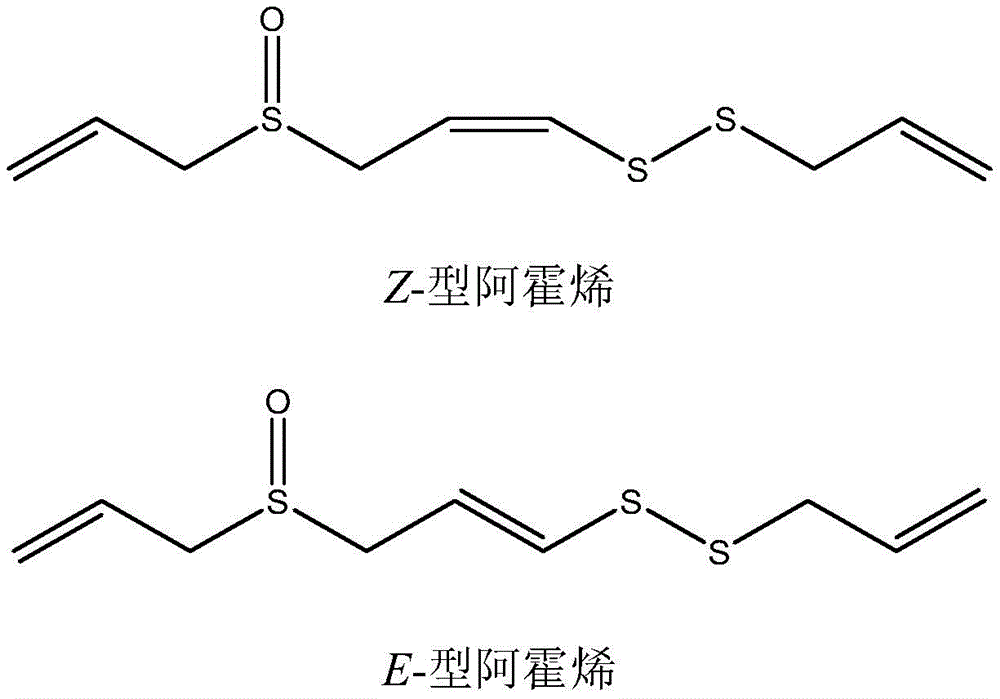
Preparation method of natural garlic ajoene
Technical Field
The invention relates to the technical field of extraction and separation of traditional Chinese medicines, in particular to a preparation method of natural garlic ajoene.
Background
Garlic has been used as a herbal medicine and food for over two thousand years. Garlic has many pharmacological actions, such as sterilization, prevention and treatment of cardiovascular diseases, prevention and treatment of tumors and cancers, and has been used as both medicine and food for thousands of years in folks.
Garlic is rich in Alliin (Alliin), which is mainly present in the garlic cytoplasm in a stable, odorless form. Alliin is a precursor of main functional components in garlic, and Alliinase (Alliinase) can rapidly decompose alliin into thiosulfinate under the conditions of cutting, smashing, chewing and the like, wherein the main compound is Allicin. Allicin and other thiosulfinates are very unstable at room temperature and decompose into the sulfide form, vinyldithiines, ajoenes, for several hours. Ajoene is the second degradation product of allicin, and can stably exist in oil-immersed garlic[1]。
Ajoene is a sulfide with high biological activity, and has physiological and pharmacological activities of preventing cardiovascular diseases, resisting oxidation, resisting thrombosis, lowering blood pressure, reducing incidence rate of senile dementia and cancer, resisting pathogenic bacteria (including drug-resistant bacteria), resisting virus, and improving immunity.
Chinese patent publication No. CN103525878A, entitled preparation method of a composition rich in ajoene, discloses the following technical scheme: alliin dissolved in buffer solution reacts under the catalysis of alliinase, and natural alliin extracted from garlic is converted into diallyl thiosulfinate to obtain reaction liquid containing the diallyl thiosulfinate; concentrating the reaction solution through a membrane, extracting and enriching diallyl thiosulfinate by using an organic solvent, and then recovering the solvent and extracting for multiple times to obtain the ajoene composition. The technical scheme uses a plurality of organic solvents, and the process is complex, so that the product yield is low.
So far, no method for preparing ajoene with purity of over 90 percent is reported, and no ajoene product with high content appears in the market. Therefore, the research on how to convert alliin in garlic into ajoene as much as possible and extract and separate ajoene has important significance for preparing high-purity ajoene.
[1]Yu T H,Wu C M.Stability ofallicin in garlicjuice[J].J Food Sci,1989,54(4):977-981.
Disclosure of Invention
The invention aims to provide a preparation method of natural garlic ajoene, which aims to solve the problems that ajoene in the prior art is low in purity, a large amount of organic solvent is used in an extraction process, the extraction process is complex, industrial production is difficult to realize and the like.
In order to achieve the purpose, the invention adopts the following technical scheme:
a preparation method of natural garlic ajoene comprises the following steps:
(1) crushing and juicing garlic, removing garlic residues, and separating to obtain garlic juice, namely a product A;
(2) mixing the product A with a first solvent, naturally fermenting, removing fermentation residues, and separating to obtain a product B;
(3) mixing the product B with vegetable oil to obtain a product C;
(4) extracting the product C by a second solvent to obtain an extract liquid as a product D;
(5) concentrating the product D under reduced pressure, separating by column chromatography, and eluting with a solution containing an eluant to obtain an eluant E;
(6) and decompressing the product E to remove the solvent to obtain a high-content natural garlic ajoene product.
Preferably, in the step (2), the first solvent is one or more of 1% acetic acid solution, 0.2% diluted hydrochloric acid solution, 0.5% sodium bicarbonate solution and 0.1% sodium hydroxide solution, and the addition amount is 0.2-2 times of the weight of the garlic juice.
Preferably, the first solvent in step (2) is 0.5% sodium bicarbonate solution, and is added in an amount of 1 time of the garlic juice.
Preferably, the natural fermentation temperature in the step (2) is 10-50 ℃.
Preferably, the natural fermentation temperature in step (2) is 30 ℃.
Preferably, the natural fermentation time in the step (2) is 1-6 d.
Preferably, the natural fermentation time in step (2) is 2 d.
Preferably, the added vegetable oil in the step (3) is one or more than two of sesame oil, tea oil, olive oil, rapeseed oil, peanut oil and linseed oil.
Preferably, the added vegetable oil in step (3) is olive oil.
Preferably, the adding amount of the vegetable oil in the step (3) is 1/4-2.0 times of the weight of the product B.
Preferably, the amount of the added vegetable oil in the step (3) is 1 time of the weight of the product B.
Preferably, the second solvent for extraction in step (4) is ethanol, and the content of ethanol is 50% to 95%.
Preferably, the second solvent for extraction in step (4) is ethanol, and the ethanol content is 65%.
Preferably, the extraction in the step (4) is performed for 1-5 times.
Preferably, the extraction in step (4) is performed 3 times.
Preferably, the amount of the second solvent used for the extraction is: the vegetable oil amount is 1: 1 ml/g.
PreferablyThe adsorbent for column chromatographic separation in the step (5) is carbon-eighteen bonded silica gel C18One or more than two of UniPS 10-300, UniPS 10-100, AB-8, D4006 and DA 201-B.
Preferably, the volume ratio of product D to the adsorbent is 10: 1.
preferably, the adsorbent for column chromatography separation in step (5) is carbon-octadecane bonded silica gel C18。
Preferably, the elution solvent in step (5) is one or more of ethanol, methanol or acetonitrile.
Preferably, the elution solvent in the step (5) is ethanol, so that the method is economical and easy to obtain and has a high safety coefficient.
Preferably, when the product E is prepared by elution in step (5), 10% to 40% ethanol is used for elution to remove impurities, or 30% ethanol is used for elution to remove impurities, and then 60% to 95% ethanol is used for elution of ajoene, or 80% ethanol is used for elution of ajoene.
In the technical scheme of the invention, the ethanol content in the ethanol solvent is calculated by volume fraction unless otherwise specified.
Compared with the prior art, the invention has the advantages that: 1. crushing and juicing garlic, and fully contacting alliin with allinase to promote the alliin to be converted into ajoene during fermentation;
2. adding a first solvent, namely vinegar and other solutions, so that the garlic juice can promote the layering of water and fat-soluble components during fermentation;
3. the proper fermentation temperature ensures that the allinase activity is optimal;
4. adding vegetable oil to enrich ajoene in vegetable oil, and removing water and polar impurities in fermented liposoluble components.
5. The ajoene enriched in the vegetable oil is extracted into ethanol by adopting ethanol extraction, so that part of fat-soluble impurities which are not contained in the ethanol can be removed, and the effect of enriching and purifying the ajoene is achieved.
After the garlic is fermented, a high-content ajoene sample is prepared by adopting solvent extraction and column chromatography purification, the process is simple, the solvent is safe and easy to obtain, the ajoene purity is high, and the ajoene can be used for industrial production and has very high practical value.
Drawings
FIG. 1 is a high performance liquid chromatogram of an olive oil mixture in step 3 of example 1;
FIG. 2 is a high performance liquid chromatogram of the 65% ethanol extract concentrate of step 4 in example 1;
FIG. 3 is a high performance liquid chromatogram of the final ajoene sample in step 8 of example 1.
Detailed Description
The invention will be described in detail with reference to the drawings and specific embodiments, which are illustrative of the invention and are not to be construed as limiting the invention.
Example 1
1. 10Kg of garlic produced in Shandong is taken, crushed and squeezed by a juicer to obtain garlic juice, and the yield of the garlic juice is 30 percent.
2. Adding 3Kg of 0.5% sodium bicarbonate solution into the above garlic juice, mixing, placing in a fermentation tank with controllable temperature, adjusting temperature to 30 deg.C, and fermenting for 2 days.
3. After the mixture is fermented for 2 days, the oily matter on the upper layer of the mixture is taken, 500g of olive oil is added, and the mixture is uniformly mixed for later use.
4. Extracting the above oleum Olivarum mixture with 65% ethanol for 3 times (500 mL each time), and mixing 3 times the 65% ethanol extractive solution. And (3) concentrating the extract under reduced pressure at the temperature of 55-75 ℃ to remove ethanol in the extract to obtain an ajoene oily substance.
5. Taking carbon eighteen bonded silica gel C181Kg, put into a glass column for chromatography, and dry-load the ajoene oil.
6. Collecting 30% ethanol 5Kg elution chromatographic column with elution flow rate of 1BV/h, collecting 15 min as one portion, detecting by high performance liquid chromatograph without ajoene, mixing eluates, and treating.
7. Taking 5Kg of 80% ethanol to elute a chromatographic column with the elution flow rate of 1BV/h, collecting 15 minutes to obtain one part until the eluate is detected by a high performance liquid chromatograph to contain no ajoene.
8. And combining the ajoene-containing 80% ethanol eluent, and performing reduced pressure concentration to remove ethanol in the eluent at the temperature of 55-75 ℃ to obtain an ajoene sample. The ajoene purity is 91.5% by high performance liquid chromatography detection.
Example 2
1. 10Kg of garlic produced in Gansu province is taken, crushed and then squeezed by a juicer, and the garlic juice is taken, wherein the yield of the garlic juice is 30 percent.
2. Adding 6Kg of 0.1% sodium hydroxide solution into the above garlic juice, mixing, placing in a fermentation tank with controllable temperature, adjusting temperature to 10 deg.C, and fermenting for 6 days.
3. After the mixture is fermented for 6 days, taking the oily matter on the upper layer of the mixture, adding 1000g of rapeseed oil, and uniformly mixing for later use.
4. The rapeseed oil mixture was extracted 1 time with 1000mL of 95% ethanol. And (3) concentrating the extract under reduced pressure at the temperature of 55-75 ℃ to remove ethanol in the extract to obtain an ajoene oily substance.
5. 10-3001Kg of UniPS is taken and loaded into a glass column for chromatography, and the ajoene oily matter is loaded by a dry method.
6. Collecting 40% ethanol 5Kg elution chromatographic column with elution flow rate of 1BV/h, collecting 15 min as one portion, detecting by high performance liquid chromatograph without ajoene, mixing eluates, and treating.
7. Taking 5Kg of 95% ethanol to elute a chromatographic column with the elution flow rate of 1BV/h, collecting 15 minutes to obtain one part until the eluate is detected by a high performance liquid chromatograph to contain no ajoene.
8. And combining 95% ethanol eluent containing ajoene, and performing reduced pressure concentration to remove ethanol in the eluent at the temperature of 55-75 ℃ to obtain an ajoene sample. The ajoene purity is 90.7% by high performance liquid chromatography detection.
Example 3
1. Collecting 20Kg of garlic from Jilin, pulverizing, and squeezing with a juicer to obtain garlic juice with yield of 30%.
2. Adding 1.2Kg of 0.2% diluted hydrochloric acid solution into the above garlic juice, mixing, placing in a fermentation tank with controllable temperature, adjusting temperature to 50 deg.C, and fermenting for 1 day.
3. After the mixture is fermented for 1 day, taking the oily matter on the upper layer of the mixture, adding 250g of linseed oil, and uniformly mixing for later use.
4. Extracting the above oleum Lini mixture with 50% ethanol for 5 times (250 mL each time), and mixing 5 times of 50% ethanol extractive solutions. And (3) concentrating the extract under reduced pressure at the temperature of 55-75 ℃ to remove ethanol in the extract to obtain an ajoene oily substance.
5. Loading AB-82Kg of macroporous resin into a glass column for chromatography, and loading the ajoene oily matter by a dry method.
6. Collecting 10% ethanol 10Kg elution chromatographic column with elution flow rate of 2BV/h, collecting 15 min as one portion, detecting by high performance liquid chromatograph without ajoene, mixing eluates, and treating.
7. Taking 10Kg of elution chromatographic column of 60 percent ethanol, wherein the elution flow rate is 2BV/h, collecting 15 minutes into one part until the eluate is detected by a high performance liquid chromatograph to contain no ajoene.
8. And combining 60% ethanol eluent containing ajoene, and performing reduced pressure concentration to remove ethanol in the eluent at the temperature of 55-75 ℃ to obtain an ajoene sample. The ajoene purity is 90.1% by high performance liquid chromatography detection.
The technical solutions provided by the embodiments of the present invention are described in detail above, and the principles and embodiments of the present invention are explained herein by using specific examples, and the descriptions of the embodiments are only used to help understanding the principles of the embodiments of the present invention; meanwhile, for a person skilled in the art, according to the embodiments of the present invention, there may be variations in the specific implementation manners and application ranges, and in summary, the content of the present description should not be construed as a limitation to the present invention.