CN107344112B - Hydrocracking catalyst for producing high-quality catalytic reforming raw material and preparation method and application thereof - Google Patents
Hydrocracking catalyst for producing high-quality catalytic reforming raw material and preparation method and application thereof Download PDFInfo
- Publication number
- CN107344112B CN107344112B CN201610288622.8A CN201610288622A CN107344112B CN 107344112 B CN107344112 B CN 107344112B CN 201610288622 A CN201610288622 A CN 201610288622A CN 107344112 B CN107344112 B CN 107344112B
- Authority
- CN
- China
- Prior art keywords
- molecular sieve
- pressure
- kettle
- pore volume
- stirring
- Prior art date
- Legal status (The legal status is an assumption and is not a legal conclusion. Google has not performed a legal analysis and makes no representation as to the accuracy of the status listed.)
- Active
Links
- 239000003054 catalyst Substances 0.000 title claims abstract description 77
- 238000004517 catalytic hydrocracking Methods 0.000 title claims abstract description 43
- 238000002360 preparation method Methods 0.000 title claims abstract description 23
- 239000002994 raw material Substances 0.000 title claims abstract description 13
- 238000001833 catalytic reforming Methods 0.000 title claims abstract description 9
- URGAHOPLAPQHLN-UHFFFAOYSA-N sodium aluminosilicate Chemical compound [Na+].[Al+3].[O-][Si]([O-])=O.[O-][Si]([O-])=O URGAHOPLAPQHLN-UHFFFAOYSA-N 0.000 claims abstract description 164
- 239000002808 molecular sieve Substances 0.000 claims abstract description 161
- 229910021536 Zeolite Inorganic materials 0.000 claims abstract description 42
- HNPSIPDUKPIQMN-UHFFFAOYSA-N dioxosilane;oxo(oxoalumanyloxy)alumane Chemical compound O=[Si]=O.O=[Al]O[Al]=O HNPSIPDUKPIQMN-UHFFFAOYSA-N 0.000 claims abstract description 42
- 239000010457 zeolite Substances 0.000 claims abstract description 42
- 239000002253 acid Substances 0.000 claims abstract description 39
- PNEYBMLMFCGWSK-UHFFFAOYSA-N aluminium oxide Inorganic materials [O-2].[O-2].[O-2].[Al+3].[Al+3] PNEYBMLMFCGWSK-UHFFFAOYSA-N 0.000 claims abstract description 38
- 238000000034 method Methods 0.000 claims abstract description 37
- 238000001035 drying Methods 0.000 claims abstract description 27
- 229910052751 metal Inorganic materials 0.000 claims abstract description 21
- 239000002184 metal Substances 0.000 claims abstract description 21
- 238000002156 mixing Methods 0.000 claims abstract description 14
- 239000000843 powder Substances 0.000 claims abstract description 11
- 238000005096 rolling process Methods 0.000 claims abstract description 11
- 239000011148 porous material Substances 0.000 claims description 94
- 238000003756 stirring Methods 0.000 claims description 83
- VYPSYNLAJGMNEJ-UHFFFAOYSA-N Silicium dioxide Chemical compound O=[Si]=O VYPSYNLAJGMNEJ-UHFFFAOYSA-N 0.000 claims description 53
- 239000003570 air Substances 0.000 claims description 32
- HEMHJVSKTPXQMS-UHFFFAOYSA-M Sodium hydroxide Chemical compound [OH-].[Na+] HEMHJVSKTPXQMS-UHFFFAOYSA-M 0.000 claims description 27
- 238000010438 heat treatment Methods 0.000 claims description 26
- XLYOFNOQVPJJNP-UHFFFAOYSA-N water Substances O XLYOFNOQVPJJNP-UHFFFAOYSA-N 0.000 claims description 25
- 238000007789 sealing Methods 0.000 claims description 23
- IJGRMHOSHXDMSA-UHFFFAOYSA-N Atomic nitrogen Chemical compound N#N IJGRMHOSHXDMSA-UHFFFAOYSA-N 0.000 claims description 20
- 238000006243 chemical reaction Methods 0.000 claims description 19
- 239000003921 oil Substances 0.000 claims description 17
- 239000000377 silicon dioxide Substances 0.000 claims description 16
- 239000004094 surface-active agent Substances 0.000 claims description 15
- 238000005406 washing Methods 0.000 claims description 14
- 229910001868 water Inorganic materials 0.000 claims description 14
- 239000003513 alkali Substances 0.000 claims description 12
- TWNQGVIAIRXVLR-UHFFFAOYSA-N oxo(oxoalumanyloxy)alumane Chemical compound O=[Al]O[Al]=O TWNQGVIAIRXVLR-UHFFFAOYSA-N 0.000 claims description 12
- 229910052593 corundum Inorganic materials 0.000 claims description 11
- 229910052814 silicon oxide Inorganic materials 0.000 claims description 11
- 238000000967 suction filtration Methods 0.000 claims description 11
- 229910001845 yogo sapphire Inorganic materials 0.000 claims description 11
- XUIMIQQOPSSXEZ-UHFFFAOYSA-N Silicon Chemical compound [Si] XUIMIQQOPSSXEZ-UHFFFAOYSA-N 0.000 claims description 10
- 229910052782 aluminium Inorganic materials 0.000 claims description 10
- XAGFODPZIPBFFR-UHFFFAOYSA-N aluminium Chemical compound [Al] XAGFODPZIPBFFR-UHFFFAOYSA-N 0.000 claims description 10
- 238000001816 cooling Methods 0.000 claims description 10
- 238000002425 crystallisation Methods 0.000 claims description 10
- 230000008025 crystallization Effects 0.000 claims description 10
- 239000008367 deionised water Substances 0.000 claims description 10
- 229910021641 deionized water Inorganic materials 0.000 claims description 10
- 238000011010 flushing procedure Methods 0.000 claims description 10
- 239000011261 inert gas Substances 0.000 claims description 10
- 229910052757 nitrogen Inorganic materials 0.000 claims description 10
- 229910052710 silicon Inorganic materials 0.000 claims description 10
- 239000010703 silicon Substances 0.000 claims description 10
- 239000007787 solid Substances 0.000 claims description 10
- 229940073455 tetraethylammonium hydroxide Drugs 0.000 claims description 9
- LRGJRHZIDJQFCL-UHFFFAOYSA-M tetraethylazanium;hydroxide Chemical compound [OH-].CC[N+](CC)(CC)CC LRGJRHZIDJQFCL-UHFFFAOYSA-M 0.000 claims description 9
- 229910021485 fumed silica Inorganic materials 0.000 claims description 8
- 239000001257 hydrogen Substances 0.000 claims description 8
- 229910052739 hydrogen Inorganic materials 0.000 claims description 8
- HWCKGOZZJDHMNC-UHFFFAOYSA-M tetraethylammonium bromide Chemical compound [Br-].CC[N+](CC)(CC)CC HWCKGOZZJDHMNC-UHFFFAOYSA-M 0.000 claims description 8
- -1 VIB group metals Chemical class 0.000 claims description 7
- 230000008569 process Effects 0.000 claims description 7
- 238000011282 treatment Methods 0.000 claims description 7
- 239000003795 chemical substances by application Substances 0.000 claims description 6
- 239000000463 material Substances 0.000 claims description 6
- 238000009740 moulding (composite fabrication) Methods 0.000 claims description 6
- DGAQECJNVWCQMB-PUAWFVPOSA-M Ilexoside XXIX Chemical compound C[C@@H]1CC[C@@]2(CC[C@@]3(C(=CC[C@H]4[C@]3(CC[C@@H]5[C@@]4(CC[C@@H](C5(C)C)OS(=O)(=O)[O-])C)C)[C@@H]2[C@]1(C)O)C)C(=O)O[C@H]6[C@@H]([C@H]([C@@H]([C@H](O6)CO)O)O)O.[Na+] DGAQECJNVWCQMB-PUAWFVPOSA-M 0.000 claims description 5
- 229910052708 sodium Inorganic materials 0.000 claims description 5
- 239000011734 sodium Substances 0.000 claims description 5
- UFHFLCQGNIYNRP-UHFFFAOYSA-N Hydrogen Chemical compound [H][H] UFHFLCQGNIYNRP-UHFFFAOYSA-N 0.000 claims description 4
- KKCBUQHMOMHUOY-UHFFFAOYSA-N Na2O Inorganic materials [O-2].[Na+].[Na+] KKCBUQHMOMHUOY-UHFFFAOYSA-N 0.000 claims description 4
- DIZPMCHEQGEION-UHFFFAOYSA-H aluminium sulfate (anhydrous) Chemical compound [Al+3].[Al+3].[O-]S([O-])(=O)=O.[O-]S([O-])(=O)=O.[O-]S([O-])(=O)=O DIZPMCHEQGEION-UHFFFAOYSA-H 0.000 claims description 4
- VSCWAEJMTAWNJL-UHFFFAOYSA-K aluminium trichloride Chemical compound Cl[Al](Cl)Cl VSCWAEJMTAWNJL-UHFFFAOYSA-K 0.000 claims description 4
- 239000006229 carbon black Substances 0.000 claims description 4
- 229910052681 coesite Inorganic materials 0.000 claims description 4
- 229910052906 cristobalite Inorganic materials 0.000 claims description 4
- 239000007788 liquid Substances 0.000 claims description 4
- 229910052682 stishovite Inorganic materials 0.000 claims description 4
- VDZOOKBUILJEDG-UHFFFAOYSA-M tetrabutylammonium hydroxide Chemical compound [OH-].CCCC[N+](CCCC)(CCCC)CCCC VDZOOKBUILJEDG-UHFFFAOYSA-M 0.000 claims description 4
- 229910052905 tridymite Inorganic materials 0.000 claims description 4
- BNGXYYYYKUGPPF-UHFFFAOYSA-M (3-methylphenyl)methyl-triphenylphosphanium;chloride Chemical compound [Cl-].CC1=CC=CC(C[P+](C=2C=CC=CC=2)(C=2C=CC=CC=2)C=2C=CC=CC=2)=C1 BNGXYYYYKUGPPF-UHFFFAOYSA-M 0.000 claims description 2
- 150000002431 hydrogen Chemical class 0.000 claims description 2
- 238000000926 separation method Methods 0.000 claims description 2
- LPSKDVINWQNWFE-UHFFFAOYSA-M tetrapropylazanium;hydroxide Chemical compound [OH-].CCC[N+](CCC)(CCC)CCC LPSKDVINWQNWFE-UHFFFAOYSA-M 0.000 claims description 2
- GETQZCLCWQTVFV-UHFFFAOYSA-N trimethylamine Chemical compound CN(C)C GETQZCLCWQTVFV-UHFFFAOYSA-N 0.000 claims description 2
- 150000002739 metals Chemical class 0.000 claims 1
- 230000000694 effects Effects 0.000 abstract description 11
- 239000000243 solution Substances 0.000 description 37
- 230000004048 modification Effects 0.000 description 15
- 238000012986 modification Methods 0.000 description 15
- 238000005984 hydrogenation reaction Methods 0.000 description 8
- MUBZPKHOEPUJKR-UHFFFAOYSA-N oxalic acid Substances OC(=O)C(O)=O MUBZPKHOEPUJKR-UHFFFAOYSA-N 0.000 description 8
- CSDREXVUYHZDNP-UHFFFAOYSA-N alumanylidynesilicon Chemical compound [Al].[Si] CSDREXVUYHZDNP-UHFFFAOYSA-N 0.000 description 7
- 239000000047 product Substances 0.000 description 7
- ANBBXQWFNXMHLD-UHFFFAOYSA-N aluminum;sodium;oxygen(2-) Chemical compound [O-2].[O-2].[Na+].[Al+3] ANBBXQWFNXMHLD-UHFFFAOYSA-N 0.000 description 6
- KRKNYBCHXYNGOX-UHFFFAOYSA-N citric acid Chemical compound OC(=O)CC(O)(C(O)=O)CC(O)=O KRKNYBCHXYNGOX-UHFFFAOYSA-N 0.000 description 6
- 229910001388 sodium aluminate Inorganic materials 0.000 description 6
- 150000004945 aromatic hydrocarbons Chemical class 0.000 description 5
- 238000005336 cracking Methods 0.000 description 5
- 238000010335 hydrothermal treatment Methods 0.000 description 5
- 239000000203 mixture Substances 0.000 description 5
- 238000002715 modification method Methods 0.000 description 5
- 238000011160 research Methods 0.000 description 5
- BGQMOFGZRJUORO-UHFFFAOYSA-M tetrapropylammonium bromide Chemical compound [Br-].CCC[N+](CCC)(CCC)CCC BGQMOFGZRJUORO-UHFFFAOYSA-M 0.000 description 5
- 239000004215 Carbon black (E152) Substances 0.000 description 4
- LZZYPRNAOMGNLH-UHFFFAOYSA-M Cetrimonium bromide Chemical compound [Br-].CCCCCCCCCCCCCCCC[N+](C)(C)C LZZYPRNAOMGNLH-UHFFFAOYSA-M 0.000 description 4
- 230000000052 comparative effect Effects 0.000 description 4
- 239000013078 crystal Substances 0.000 description 4
- 238000004519 manufacturing process Methods 0.000 description 4
- QGZKDVFQNNGYKY-UHFFFAOYSA-O Ammonium Chemical compound [NH4+] QGZKDVFQNNGYKY-UHFFFAOYSA-O 0.000 description 3
- GRYLNZFGIOXLOG-UHFFFAOYSA-N Nitric acid Chemical compound O[N+]([O-])=O GRYLNZFGIOXLOG-UHFFFAOYSA-N 0.000 description 3
- 238000010306 acid treatment Methods 0.000 description 3
- 230000009286 beneficial effect Effects 0.000 description 3
- 230000003197 catalytic effect Effects 0.000 description 3
- 238000005516 engineering process Methods 0.000 description 3
- 229930195733 hydrocarbon Natural products 0.000 description 3
- 150000002430 hydrocarbons Chemical class 0.000 description 3
- 239000002609 medium Substances 0.000 description 3
- 229910017604 nitric acid Inorganic materials 0.000 description 3
- 239000000126 substance Substances 0.000 description 3
- VGGSQFUCUMXWEO-UHFFFAOYSA-N Ethene Chemical compound C=C VGGSQFUCUMXWEO-UHFFFAOYSA-N 0.000 description 2
- 239000005977 Ethylene Substances 0.000 description 2
- 238000009792 diffusion process Methods 0.000 description 2
- 238000011156 evaluation Methods 0.000 description 2
- 230000002349 favourable effect Effects 0.000 description 2
- 239000000446 fuel Substances 0.000 description 2
- 239000000295 fuel oil Substances 0.000 description 2
- 230000006872 improvement Effects 0.000 description 2
- 229920002521 macromolecule Polymers 0.000 description 2
- 239000011259 mixed solution Substances 0.000 description 2
- 235000006408 oxalic acid Nutrition 0.000 description 2
- 238000012545 processing Methods 0.000 description 2
- 238000007142 ring opening reaction Methods 0.000 description 2
- 229910001948 sodium oxide Inorganic materials 0.000 description 2
- 238000004065 wastewater treatment Methods 0.000 description 2
- NWUYHJFMYQTDRP-UHFFFAOYSA-N 1,2-bis(ethenyl)benzene;1-ethenyl-2-ethylbenzene;styrene Chemical compound C=CC1=CC=CC=C1.CCC1=CC=CC=C1C=C.C=CC1=CC=CC=C1C=C NWUYHJFMYQTDRP-UHFFFAOYSA-N 0.000 description 1
- MTJGVAJYTOXFJH-UHFFFAOYSA-N 3-aminonaphthalene-1,5-disulfonic acid Chemical compound C1=CC=C(S(O)(=O)=O)C2=CC(N)=CC(S(O)(=O)=O)=C21 MTJGVAJYTOXFJH-UHFFFAOYSA-N 0.000 description 1
- DDFHBQSCUXNBSA-UHFFFAOYSA-N 5-(5-carboxythiophen-2-yl)thiophene-2-carboxylic acid Chemical compound S1C(C(=O)O)=CC=C1C1=CC=C(C(O)=O)S1 DDFHBQSCUXNBSA-UHFFFAOYSA-N 0.000 description 1
- BPQQTUXANYXVAA-UHFFFAOYSA-N Orthosilicate Chemical compound [O-][Si]([O-])([O-])[O-] BPQQTUXANYXVAA-UHFFFAOYSA-N 0.000 description 1
- ZLMJMSJWJFRBEC-UHFFFAOYSA-N Potassium Chemical compound [K] ZLMJMSJWJFRBEC-UHFFFAOYSA-N 0.000 description 1
- 230000002378 acidificating effect Effects 0.000 description 1
- 229910001413 alkali metal ion Inorganic materials 0.000 description 1
- 239000012670 alkaline solution Substances 0.000 description 1
- 150000001412 amines Chemical class 0.000 description 1
- 239000011959 amorphous silica alumina Substances 0.000 description 1
- 238000013459 approach Methods 0.000 description 1
- 239000007864 aqueous solution Substances 0.000 description 1
- 239000002585 base Substances 0.000 description 1
- 230000001588 bifunctional effect Effects 0.000 description 1
- 239000007853 buffer solution Substances 0.000 description 1
- 150000001768 cations Chemical class 0.000 description 1
- 230000008859 change Effects 0.000 description 1
- 239000013064 chemical raw material Substances 0.000 description 1
- 125000000753 cycloalkyl group Chemical group 0.000 description 1
- 230000007547 defect Effects 0.000 description 1
- 239000002283 diesel fuel Substances 0.000 description 1
- 238000009826 distribution Methods 0.000 description 1
- SNRUBQQJIBEYMU-UHFFFAOYSA-N dodecane Chemical compound CCCCCCCCCCCC SNRUBQQJIBEYMU-UHFFFAOYSA-N 0.000 description 1
- 238000005265 energy consumption Methods 0.000 description 1
- 229910017053 inorganic salt Inorganic materials 0.000 description 1
- 239000003456 ion exchange resin Substances 0.000 description 1
- 229920003303 ion-exchange polymer Polymers 0.000 description 1
- 239000010687 lubricating oil Substances 0.000 description 1
- 230000014759 maintenance of location Effects 0.000 description 1
- 229940094933 n-dodecane Drugs 0.000 description 1
- 150000007524 organic acids Chemical class 0.000 description 1
- 125000001477 organic nitrogen group Chemical group 0.000 description 1
- 239000003208 petroleum Substances 0.000 description 1
- 231100000572 poisoning Toxicity 0.000 description 1
- 230000000607 poisoning effect Effects 0.000 description 1
- 125000005575 polycyclic aromatic hydrocarbon group Chemical group 0.000 description 1
- 229910052700 potassium Inorganic materials 0.000 description 1
- 239000011591 potassium Substances 0.000 description 1
- 238000004537 pulping Methods 0.000 description 1
- 230000009257 reactivity Effects 0.000 description 1
- 238000004064 recycling Methods 0.000 description 1
- 238000007670 refining Methods 0.000 description 1
- 238000002407 reforming Methods 0.000 description 1
- 239000007320 rich medium Substances 0.000 description 1
- 239000012266 salt solution Substances 0.000 description 1
- RMAQACBXLXPBSY-UHFFFAOYSA-N silicic acid Chemical compound O[Si](O)(O)O RMAQACBXLXPBSY-UHFFFAOYSA-N 0.000 description 1
- LIVNPJMFVYWSIS-UHFFFAOYSA-N silicon monoxide Chemical compound [Si-]#[O+] LIVNPJMFVYWSIS-UHFFFAOYSA-N 0.000 description 1
- 239000002002 slurry Substances 0.000 description 1
- 229910001415 sodium ion Inorganic materials 0.000 description 1
- 239000013589 supplement Substances 0.000 description 1
- 230000001502 supplementing effect Effects 0.000 description 1
- JRMUNVKIHCOMHV-UHFFFAOYSA-M tetrabutylammonium bromide Chemical compound [Br-].CCCC[N+](CCCC)(CCCC)CCCC JRMUNVKIHCOMHV-UHFFFAOYSA-M 0.000 description 1
- 239000002351 wastewater Substances 0.000 description 1
Classifications
-
- B—PERFORMING OPERATIONS; TRANSPORTING
- B01—PHYSICAL OR CHEMICAL PROCESSES OR APPARATUS IN GENERAL
- B01J—CHEMICAL OR PHYSICAL PROCESSES, e.g. CATALYSIS OR COLLOID CHEMISTRY; THEIR RELEVANT APPARATUS
- B01J29/00—Catalysts comprising molecular sieves
- B01J29/04—Catalysts comprising molecular sieves having base-exchange properties, e.g. crystalline zeolites
- B01J29/06—Crystalline aluminosilicate zeolites; Isomorphous compounds thereof
- B01J29/80—Mixtures of different zeolites
-
- B—PERFORMING OPERATIONS; TRANSPORTING
- B01—PHYSICAL OR CHEMICAL PROCESSES OR APPARATUS IN GENERAL
- B01J—CHEMICAL OR PHYSICAL PROCESSES, e.g. CATALYSIS OR COLLOID CHEMISTRY; THEIR RELEVANT APPARATUS
- B01J35/00—Catalysts, in general, characterised by their form or physical properties
- B01J35/60—Catalysts, in general, characterised by their form or physical properties characterised by their surface properties or porosity
- B01J35/61—Surface area
- B01J35/617—500-1000 m2/g
-
- B—PERFORMING OPERATIONS; TRANSPORTING
- B01—PHYSICAL OR CHEMICAL PROCESSES OR APPARATUS IN GENERAL
- B01J—CHEMICAL OR PHYSICAL PROCESSES, e.g. CATALYSIS OR COLLOID CHEMISTRY; THEIR RELEVANT APPARATUS
- B01J35/00—Catalysts, in general, characterised by their form or physical properties
- B01J35/60—Catalysts, in general, characterised by their form or physical properties characterised by their surface properties or porosity
- B01J35/63—Pore volume
- B01J35/635—0.5-1.0 ml/g
-
- B—PERFORMING OPERATIONS; TRANSPORTING
- B01—PHYSICAL OR CHEMICAL PROCESSES OR APPARATUS IN GENERAL
- B01J—CHEMICAL OR PHYSICAL PROCESSES, e.g. CATALYSIS OR COLLOID CHEMISTRY; THEIR RELEVANT APPARATUS
- B01J35/00—Catalysts, in general, characterised by their form or physical properties
- B01J35/60—Catalysts, in general, characterised by their form or physical properties characterised by their surface properties or porosity
- B01J35/63—Pore volume
- B01J35/638—Pore volume more than 1.0 ml/g
-
- C—CHEMISTRY; METALLURGY
- C10—PETROLEUM, GAS OR COKE INDUSTRIES; TECHNICAL GASES CONTAINING CARBON MONOXIDE; FUELS; LUBRICANTS; PEAT
- C10G—CRACKING HYDROCARBON OILS; PRODUCTION OF LIQUID HYDROCARBON MIXTURES, e.g. BY DESTRUCTIVE HYDROGENATION, OLIGOMERISATION, POLYMERISATION; RECOVERY OF HYDROCARBON OILS FROM OIL-SHALE, OIL-SAND, OR GASES; REFINING MIXTURES MAINLY CONSISTING OF HYDROCARBONS; REFORMING OF NAPHTHA; MINERAL WAXES
- C10G47/00—Cracking of hydrocarbon oils, in the presence of hydrogen or hydrogen- generating compounds, to obtain lower boiling fractions
- C10G47/02—Cracking of hydrocarbon oils, in the presence of hydrogen or hydrogen- generating compounds, to obtain lower boiling fractions characterised by the catalyst used
- C10G47/10—Cracking of hydrocarbon oils, in the presence of hydrogen or hydrogen- generating compounds, to obtain lower boiling fractions characterised by the catalyst used with catalysts deposited on a carrier
- C10G47/12—Inorganic carriers
- C10G47/16—Crystalline alumino-silicate carriers
- C10G47/20—Crystalline alumino-silicate carriers the catalyst containing other metals or compounds thereof
-
- C—CHEMISTRY; METALLURGY
- C10—PETROLEUM, GAS OR COKE INDUSTRIES; TECHNICAL GASES CONTAINING CARBON MONOXIDE; FUELS; LUBRICANTS; PEAT
- C10G—CRACKING HYDROCARBON OILS; PRODUCTION OF LIQUID HYDROCARBON MIXTURES, e.g. BY DESTRUCTIVE HYDROGENATION, OLIGOMERISATION, POLYMERISATION; RECOVERY OF HYDROCARBON OILS FROM OIL-SHALE, OIL-SAND, OR GASES; REFINING MIXTURES MAINLY CONSISTING OF HYDROCARBONS; REFORMING OF NAPHTHA; MINERAL WAXES
- C10G2300/00—Aspects relating to hydrocarbon processing covered by groups C10G1/00 - C10G99/00
- C10G2300/70—Catalyst aspects
Landscapes
- Chemical & Material Sciences (AREA)
- Engineering & Computer Science (AREA)
- Organic Chemistry (AREA)
- Chemical Kinetics & Catalysis (AREA)
- Materials Engineering (AREA)
- Crystallography & Structural Chemistry (AREA)
- Oil, Petroleum & Natural Gas (AREA)
- Inorganic Chemistry (AREA)
- General Chemical & Material Sciences (AREA)
- Catalysts (AREA)
- Production Of Liquid Hydrocarbon Mixture For Refining Petroleum (AREA)
Abstract
The invention discloses a hydrocracking catalyst for producing high-quality catalytic reforming raw materials and a preparation method and application thereof. The preparation method of the catalyst comprises the following steps: uniformly mixing the macroporous alumina powder, the modified USY molecular sieve, the Beta zeolite and the active metal component, then adding an acid solution, fully rolling and forming, then drying and roasting to obtain the hydrocracking catalyst. The hydrocracking catalyst prepared by the method has the characteristics of high hydrocracking activity, good naphtha product selectivity, high quality and the like, and can be used for producing high-quality catalytic reforming raw materials.
Description
Technical Field
The invention relates to a hydrocracking catalyst for producing high-quality catalytic reforming raw materials and a preparation method thereof.
Background
The hydrocracking technology has the characteristics of strong raw material adaptability, large flexibility of production operation and product schemes, good product quality and the like, can directly convert various heavy inferior feeds into high-quality jet fuel, diesel oil and lubricating oil base stocks which are urgently needed by the market, and ethylene raw materials prepared by cracking chemical naphtha and tail oil steam, becomes one of the most important heavy oil deep processing technologies in modern oil refining and petrochemical industries, and is an important reforming and ethylene raw material source in China. The hydrocracking catalyst is a bifunctional catalyst consisting of a hydrogenation function and a cracking function, wherein the hydrogenation function is provided by hydrogenation active metal, so that the hydrogenation performance of the hydrocracking catalyst is improved, and the saturation of aromatic hydrocarbon is facilitated; the cracking function is provided by amorphous silica-alumina or molecular sieve, which can crack the macromolecules of long chain and further open the ring of saturated polycyclic aromatic hydrocarbon. It is therefore a viable approach to improve the performance of catalysts by improving the performance of molecular sieves.
Kouming et al (MCM-22 molecular sieve modification research progress [ J)]Contemporary chemical industry, 2015, 44 (11): 2629-2634) through the structural change of the molecular sieve after the alkali treatment and the hydrothermal treatment of the MCM-22 molecular sieve, the molecular sieve after the alkali treatment maintains the original microporous structure and has more mesoporous structures and macroporous structures. Engineering and time of year (influence of modification of Y molecular sieve on its structure and acidity [ J)]Petrochemical technology and applications, 2011, 29 (5): 401-405), which shows that a large number of secondary pores can be formed on the Y molecular sieve after modification such as hydrothermal treatment, hydrothermal-oxalic acid treatment and the like, and this shows that the water vapor treatment can play a role in expanding pores, the mesoporous pore volume can be further increased after non-framework aluminum is removed by oxalic acid, the acid type and acid amount of the Y molecular sieve can be adjusted in a large range, the total acid amount is reduced after modification, the strong L acid amount is increased after hydrothermal treatment, and the strong B acid amount can be increased by hydrothermal-oxalic acid combined dealumination. Qin Zhen et al (physicochemical properties of small-grain Y molecular sieves with different Si/Al ratios and hydrocracking performance [ J ]]Petrochemical, 2013, 42 (10): 1080-1085) shows that the framework stability of the small-grain Y molecular sieve is increased along with the increase of the silicon-aluminum ratio; the acid amount is reduced along with the increase of the silicon-aluminum ratio, and small crystal grain Y molecular sieves with different silicon-aluminum ratios have different acid center distributions; the pore structure of the small-grain Y molecular sieve is not obviously changed along with the ratio of silicon to aluminum, and compared with the industrial Y molecular sieve, the small-grain Y molecular sieve has larger specific surface area, which is beneficial to heavy oil conversion. The small crystal grain Y molecular sieve with the silicon-aluminum ratio of 5.2 has moderate acidity, developed pore passages and better framework stability, and the hydrocracking catalyst taking the small crystal grain Y molecular sieve as the carrier has high activity, high light oil selectivity and high chemical raw material yield, thereby being the active component of the preferable light oil type hydrocracking catalyst. Wangyangmajun et al (research progress on modification of ultrastable Y molecular sieves [ J)]Silicate report, 2015, 34 (11): 3243-3250) introduces methods of dealumination modification, loaded acid modification, loaded cation or oxide modification and molecular sieve compound modification of the ultrastable Y molecular sieve, and shows that the ultrastable Y molecular sieve has good crystallinity, higher silicon-aluminum ratio and larger molecular sieve compound modification after modificationThe pore size and pore volume, high specific surface area and hydrothermal stability, and proper acid amount and acid strength, so that the catalyst prepared by using the catalyst as a carrier or an acidic component has better catalytic performance. Meanwhile, the modification research of the ultrastable Y molecular sieve is considered to be continued, on one hand, the research on the aspect of acid center, namely the USY molecular sieve has B acid and L acid centers, and how to prepare the catalyst with specific acid centers to achieve the optimal catalytic activity is a problem to be overcome; on the other hand, the recycling frequency of the catalyst prepared by the ultrastable Y molecular sieve (or the modified ultrastable Y molecular sieve) is required to be improved, the production cost is reduced, and the production efficiency is improved. Penghua et al (influence of modified Y molecular sieves on middle distillate selective hydrocracking catalysts [ J)]Petro-chemical (petroleum processing), 2006 (supplement): 171-173) shows that the modified Y molecular sieve has lower total acid content and higher L acid ratio, which is beneficial to improving the middle distillate selectivity of the catalyst and keeping better activity; in the product (A)<370 ℃ distillate) conversion of 60%, the middle distillate (150 ℃ distillate and 370 ℃) selectivity of the pilot-sized catalyst HC-670 is 68.3%, while the middle distillate selectivity of the same industrial catalyst is only 61.8%. Li Ming Xiao et al (influence of hydrothermal and nitric acid treatments on the Performance of modified Y molecular sieves [ J)]Petrochemical, 2012, 43 (4): 412-419) shows that the dealumination amount of the Y molecular sieve is increased, the specific surface area is reduced and the total acid amount is reduced along with the increase of the hydrothermal treatment temperature; with the increase of the concentration of nitric acid, non-framework aluminum in the Y molecular sieve is removed, and the relative crystallinity, the specific surface area and the silicon-aluminum ratio are increased. The activity and selectivity of the hydrocracking catalyst prepared by the modified Y molecular sieve are improved, wherein the hydrocracking catalyst prepared by the Y molecular sieve after being subjected to hydro-thermal treatment at 680 ℃ and nitric acid treatment at 0.6mol/L has good medium oil (C) on the premise of keeping higher n-dodecane conversion rate4~8Hydrocarbon) selectivity, yield of medium oil 51.07%. Kingwenlan (hydrocracking performance of combined modified Y-type molecular sieve [ J)]Journal of fuel chemistry, 2009, 37 (4): 454-458) shows that the addition of CTAB can keep the Y-type molecular sieve at a high relative crystallinity and improve the SiO performance during the dealumination of oxalic acid in the Y-type molecular sieve2/Al2O3In contrast, the unit cell constant is reduced. The acid content of the Y-type molecular sieve with CTAB participating in modification is obviously reduced, and the reason is determined by the improvement of the silicon-aluminum ratio and the amine poisoning of partial acid sites. The hydrocracking catalyst prepared by CTAB participating in the modified Y-shaped molecular sieve has higher activity and yield of middle distillate oil, and has the VGO conversion rate 2.42 percent higher and the yield of the middle distillate oil 4.20 percent higher than that of the middle distillate oil type hydrocracking catalyst which is industrially applied at present. The reason is that the Y-type molecular sieve with CTAB participating in modification has richer mesopores, so that macromolecules in VGO can be more close to the acid sites of the catalyst, and simultaneously, a cracked product can quickly leave the active sites of the catalyst to avoid secondary cracking, so that the catalyst has higher activity and the yield of middle distillate oil.
Patent 200610001864.0 describes a method for modifying a Y-type molecular sieve, which comprises adding a surfactant during the acid dealumination process to obtain a Y-type molecular sieve with a high silica-alumina ratio (the molar silica-alumina ratio of silica to alumina is 9-15), and maintaining a high crystallinity, wherein the secondary pores of the modified Y-type molecular sieve are greatly increased, and the acid structure is further improved. Patent 200810104303.2 describes a modification method of an HY type molecular sieve, which comprises the steps of impregnating an HY type molecular sieve with a certain amount of 5-10% silica sol, drying at 120 ℃, roasting at 450 ℃, and finally dealuminizing with an ammonium fluoride aqueous solution with a certain concentration to obtain a micro-mesoporous modified molecular sieve. Patent 200810105644.1 describes a method for modifying NaY type molecular sieve, which uses a screen to separate the ion exchange resin from the molecular sieve slurry, and uses the concentration difference to realize the exchange between hydrogen ions and sodium ions without contacting the two, thereby alleviating the problem of subsequent wastewater treatment. The sodium oxide content of the obtained modified molecular sieve can be reduced to below 1wt%, and the crystallinity is kept above 80%. Patent 201110331019.0 discloses a method for modifying NaY molecular sieve, which comprises adding mixed acid into a mixture of NaY molecular sieve, buffer solution and water, pulping uniformly, adjusting the pH value to 4.0-6.5, carrying out exchange reaction at 70-95 ℃, washing, and drying. The method realizes no ammonium discharge and alleviates the problem of subsequent wastewater treatment. The sodium oxide content of the obtained modified molecular sieve can be reduced to below 0.5wt%, and the crystallinity is kept above 85%. Patent 201310114414.2 discloses a modification method of a USY molecular sieve, which comprises the steps of modifying 0.10-0.35 mol/L citric acid at 50-120 ℃, adding 0.1-3.5 ml/min ammonium fluosilicate solution after the temperature is raised to 60-90 ℃, reacting for 1-6 hours after the ammonium fluosilicate solution is added, washing, and drying to obtain the modified USY molecular sieve. The specific surface, the secondary pore volume and the proportion of the medium and strong acid of the molecular sieve are obviously improved. Patents 201310240740.8 and 201410131823.8 describe a combined modification method of a mesoporous-rich ultrastable Y molecular sieve, which comprises the steps of mixing a solution of an organic acid and an inorganic salt solution, heating the mixed solution in a closed container under the condition of stirring, carrying out a reaction for a set time, washing the reaction, carrying out suction filtration to neutrality, and drying to obtain the modified molecular sieve. The modified molecular sieve has obviously raised secondary pore content, increased Si/Al ratio and reduced unit cell constant. Patent 201410131458.0 discloses a method for modifying USY molecular sieve, which comprises modifying ammonium fluorosilicate and citric acid mixed solution at 50-120 deg.C to obtain modified USY molecular sieve rich in secondary pore structure, high crystallinity and rich medium and strong acid. Patent 201510131458.0 discloses a modified Y-type molecular sieve and its modification method, which comprises treating Y-type molecular sieve with alkaline solution, and removing aluminum and supplementing silicon to obtain Y-type molecular sieve with high Si/Al ratio. The modified molecular sieve has the characteristics of large proportion of strong acid, especially large proportion of strong B acid.
The existing research results show that the physicochemical properties of the molecular sieve can be changed by adopting different modification methods, so that the performance of the molecular sieve is effectively improved. The improvement of the molecular sieve performance can greatly improve the activity of the catalyst and the selectivity of a target product.
Disclosure of Invention
Aiming at the defects of the prior art, the invention provides a hydrocracking catalyst for producing high-quality catalytic reforming raw materials and a preparation method thereof. The hydrocracking catalyst has the characteristics of high hydrocracking activity, good naphtha product selectivity, high quality and the like, and can be used for producing high-quality catalytic reforming raw materials.
The preparation method of the catalyst comprises the following steps:
uniformly mixing the macroporous alumina powder, the modified USY molecular sieve, the Beta zeolite and the active metal component, then adding an acid solution, fully rolling and forming, then drying and roasting to obtain the hydrocracking catalyst.
In the method, the modified USY molecular sieve has the following properties after being roasted: the total pore volume is 0.76-1.25 ml/g, preferably 0.80-1.10 ml/g; wherein the mesoporous pore volume is 0.55-1.05 ml/g, preferably 0.60-0.95 ml/g, and more preferably 0.68-0.90 ml/g; the mesoporous volume accounts for 65-90%, preferably 70-85% of the total pore volume; the molar ratio of the silicon oxide to the aluminum oxide is 10-35, preferably 12-30; the specific surface area is 680-1050 m2Per g, preferably 800 to 950m2/g。
In the method, the modified USY molecular sieve is prepared by the following steps:
adding the Y-type molecular sieve into a pressure-resistant container filled with one or more organic alkali solutions of tetraethylammonium hydroxide, tetrapropylammonium hydroxide or tetrabutylammonium hydroxide with the concentration of 0.05-0.35 mol/L under the condition of stirring, sealing the system, introducing compressed air, nitrogen or inert gas and the like into the pressure-resistant container to increase the pressure to 0.2-1.0 MPa, then heating to 50-90 ℃, carrying out constant-temperature treatment for 0.5-3 hours, releasing the pressure, carrying out suction filtration until the pH value is less than 9, drying for 6-24 hours at 80-120 ℃, and then roasting for 2-8 hours at 450-650 ℃ to obtain the modified USY-type molecular sieve. The Y-type molecular sieve added into the organic alkali solution is in a hydrogen type, and the molar ratio of silicon oxide to aluminum oxide is 10-55, preferably 18-45; the specific surface area is 650 to 950m2Per g, preferably 750 to 900m2(ii)/g; the mass ratio of the addition amount of the Y-type molecular sieve to the water in the organic alkali solution is 1: 5-20, and preferably 1: 7.5-15.
In the method, the Beta zeolite has the following properties: the total pore volume is 0.45-0.99 ml/g, preferably 0.55-0.95 ml/g, and further preferably 0.70-0.90 ml/g; wherein the mesoporous pore volume is 0.25-0.89 ml/g, preferably 0.35 ml/g-0.85 ml/g, and further preferably 0.50-0.80 ml/g; the specific surface area is 550-1000 m2Per g, youSelecting 650-900 m2(ii)/g; wherein the specific surface area of the intermediate holes is 200 to 600m2Per g, preferably 240 to 450m2(ii)/g; the volume ratio of the mesoporous volume to the total pore volume is 0.56-0.9, preferably 0.65-0.85; the amount of the acid is 0.30 to 0.85mmol/g, preferably 0.40 to 0.8 mmol/g.
In the method of the invention, the preparation method of the Beta zeolite comprises the following steps:
(1) uniformly mixing deionized water, a surfactant and a silicon source in a stirring kettle, sealing the stirring kettle, heating to 120-180 ℃, introducing air to maintain the pressure in the kettle between 0.1-1.0 MPa, stirring at a constant temperature for 1-6 hours, cooling to 30-80 ℃, adding a template agent, an aluminum source and sodium hydroxide into the stirring kettle, and uniformly stirring;
(2) sealing the stirring kettle, heating to 130-160 ℃, stirring at constant temperature for 1-8 days, preferably 2-7 days, controlling the pressure in the kettle to be 0.25-0.50 MPa through a pressure relief valve, and crystallizing at constant temperature for 1-4 days;
(3) closing the pressure release valve, continuously crystallizing at the constant temperature of 130-160 ℃ for 1-8 days, flushing the kettle after crystallization is finished, rapidly reducing the temperature in the kettle to be below 80 ℃, then releasing the pressure, carrying out solid-liquid separation on crystallized products, washing, drying and roasting the obtained solid to obtain the Beta zeolite.
The silicon source in the Beta zeolite preparation method is fumed silica and/or white carbon black, and the specific surface of the silicon source is 50-300 m2Preferably 100 to 200 m/g2(ii)/g; the surfactant is CnH2n+1(CH3)3NBr, where n may be 12, 14, 16 or 18; the template agent is tetraethyl ammonium hydroxide (TEAOH) and/or tetraethyl ammonium bromide; the aluminum source can be one or more of aluminum sulfate, aluminum nitrate, aluminum chloride and sodium metaaluminate, and sodium metaaluminate is preferred; the feeding molar ratio of the materials is as follows: (20-100) SiO2:Al2O3:(1.6~3.2)Na2O:(10~20)TEA+:(1.2~3.8)CnH2n+1(CH3)3N Br:(350~1250)H2O; wherein the silicon source is SiO2Calculated by Al as the aluminum source2O3In terms of template agent, TEA is used+In terms of surfactant CnH2n+1(CH3)3NBr meter; the conditions of sealing and heating the stirring kettle are preferably as follows: heating to 130-170 ℃, and introducing air to maintain the pressure in the kettle between 0.3-0.8 MPa; the pressure in the kettle is controlled by the pressure relief valve and preferably ranges from 0.35 MPa to 0.40 MPa; the roasting conditions are as follows: roasting for 6-10 hours at 550-600 ℃ in air atmosphere.
In the method, the hydrocracking catalyst comprises the following components in percentage by weight: the modified USY molecular sieve is generally 20-70%, preferably 30-50%; the content of the modified Beta zeolite is generally 2-10%, and preferably 4-8%; the content of the aluminum oxide is generally 30-70%, preferably 40-60%; the group VIB metal (calculated by oxide) is generally 6-15%, preferably 8-12%; the amount of the group VIII metal (calculated as oxide) is generally 2% to 8%, preferably 3% to 6%.
When the catalyst is used for treating VGO, the reaction conditions are all in the presence of hydrogen, the reaction pressure is 10-20 MPa, the reaction temperature is 350-430 ℃, the volume ratio of hydrogen to oil is 500-1800, and the liquid hourly volume space velocity is 0.5-5.0 h-1。
Compared with the prior art, the method has the following advantages: the modified USY molecular sieve obtained by high-pressure alkali treatment is adopted in the preparation process, has larger pore volume and specific surface area, and better accessibility and diffusion performance of active sites, and improves the accessibility of the reactive active sites of the catalyst and the diffusion performance of the molecular sieve. In the method, the molecular sieve is subjected to desiliconization by adopting organic alkali under the high pressure condition, and more and larger secondary pore structures are formed in the molecular sieve crystal. The organic alkali treated molecular sieve can modify the molecular sieve under the condition of not introducing alkali metal ions (such as sodium, potassium and the like), so that the steps of the molecular sieve modification process are reduced, the discharge of waste water and the production energy consumption are reduced, and the preparation cost of the molecular sieve is reduced. In the hydrocracking process, the method is beneficial to improving the hydrogenation ring-opening reaction of the cyclic hydrocarbon in the raw material and reducing the occurrence of excessive cracking reaction, and can greatly improve the yield of naphtha components. The Beta zeolite added in the catalyst has the characteristics of high external specific surface area and large pore volume, and is favorable for improving the yield of naphtha components, and meanwhile, the Beta zeolite has the characteristic of light retaining capacity of monocyclic aromatic hydrocarbon and naphthenic hydrocarbon, and is favorable for retaining the aromatic hydrocarbon and the naphthenic hydrocarbon in the naphtha components, so that the aromatic hydrocarbon potential content of the naphtha components is improved. The catalyst is adopted to ensure that the naphtha component selectivity is better and the aromatic hydrocarbon content is higher in the hydrocracking process.
Detailed Description
The following examples further illustrate the preparation of the present invention, but are not to be construed as limiting the process of the present invention.
Example 1
Uniformly mixing macroporous alumina powder, a modified USY molecular sieve and an active metal component, adding an acid solution, fully rolling and forming, drying for 8 hours at 110 ℃, and finally roasting for 4 hours at 500 ℃ to obtain the hydrocracking catalyst. The catalyst properties are given in table 1.
The preparation steps of the modified USY molecular sieve are as follows: preparing 0.25mol/L tetrapropylammonium bromide solution, adding silica/alumina molar ratio of 35 and specific surface area of 780m into the solution2The mass ratio of the addition amount of the USY molecular sieve to water in the solution is 1:8, the system is sealed, compressed air, nitrogen or inert gas and the like are introduced into a pressure-resistant container to be pressurized to 0.30MPa, then the pressure is increased to 1.5 hours at 70 ℃, the pressure is relieved, and the USY molecular sieve is washed until the pH value is less than 10, so that the modified USY molecular sieve is obtained. The modified USY molecular sieve has the following properties after roasting: the pore volume with the pore diameter of 3-6 nm accounts for 28% of the total pore volume of the USY molecular sieve; the pore volume with the pore diameter of 7-11 nm accounts for 32% of the total pore volume of the USY molecular sieve; the mole ratio of silicon oxide to aluminum oxide in the molecular sieve is 18, the specific surface area is 896m2The pore volume was 0.96 ml/g.
The Beta zeolite is prepared by the following steps: adding deionized water into a stirring kettle, starting a stirrer, adding a surfactant, adding fumed silica into the stirring kettle, sealing the stirring kettle, heating to 150 ℃, selectively introducing air to maintain the pressure in the kettle at 0.5MPa, stirring at constant temperature for 4 hours, and cooling to 50 ℃; adding tetraethyl ammonium bromide, sodium aluminate and sodium hydroxidePutting the mixture into a stirring kettle, and uniformly stirring; sealing the stirring kettle, heating to 140 ℃, stirring at constant temperature for 5 days, controlling the pressure to be 0.38MPa by controlling the pressure relief valve, and crystallizing at constant temperature for 2 days; closing the pressure release valve, continuously crystallizing at the constant temperature of 140 ℃ for 3 days, flushing the kettle after crystallization is finished, rapidly reducing the temperature in the kettle to be below 80 ℃, then releasing the pressure, and carrying out suction filtration, washing and drying on the obtained solid. Finally, roasting for 6 hours at 560 ℃ in air flow to obtain the Beta zeolite with large mesoporous pore volume. The physicochemical properties of the zeolite are shown in table 1. The feeding molar ratio of the materials in the step (1) is as follows: 40SiO 22:Al2O3:2.0Na2O:15TEA+:2.5C12H25(CH3)3NBr:650H2O。
Example 2
Uniformly mixing the macroporous alumina powder, the modified USY molecular sieve and the active metal component, adding an acid solution, fully rolling and forming, drying for 6 hours at 100 ℃, and finally roasting for 4 hours at 490 ℃ to obtain the hydrocracking catalyst. The catalyst properties are given in table 1.
The preparation steps of the modified USY molecular sieve are as follows: preparing 0.25mol/L tetrapropylammonium bromide solution, adding silica/alumina molar ratio of 35 and specific surface area of 780m into the solution2The mass ratio of the addition amount of the USY molecular sieve to water in the solution is 1:8, the system is sealed, compressed air, nitrogen or inert gas and the like are introduced into a pressure-resistant container to be pressurized to 0.30MPa, then the pressure is increased to 1.5 hours at 70 ℃, the pressure is relieved, and the USY molecular sieve is washed until the pH value is less than 10, so that the modified USY molecular sieve is obtained. The modified USY molecular sieve has the following properties after roasting: the pore volume with the pore diameter of 3-6 nm accounts for 28% of the total pore volume of the USY molecular sieve; the pore volume with the pore diameter of 7-11 nm accounts for 32% of the total pore volume of the USY molecular sieve; the mole ratio of silicon oxide to aluminum oxide in the molecular sieve is 18, the specific surface area is 896m2The pore volume was 0.96 ml/g.
The Beta zeolite is prepared by the following steps: adding deionized water into a stirring kettle, starting a stirrer, adding a surfactant, adding white carbon black into the stirring kettle, sealing the stirring kettle, heating to 140 ℃, selectively introducing air to maintain the pressure in the kettle at 0.7MPa, stirring at constant temperature for 3 hours, and cooling to 50 ℃; adding tetraethyl ammonium hydroxide, aluminum sulfate and sodium hydroxide into a stirring kettle, and uniformly stirring;
sealing the stirring kettle, heating to 150 ℃, stirring at constant temperature for 2 days, controlling the pressure to be 0.36MPa by controlling the pressure relief valve, and crystallizing at constant temperature for 4 days; closing the pressure release valve, continuously crystallizing at the constant temperature of 145 ℃ for 6 days, flushing the kettle after crystallization is finished, rapidly reducing the temperature in the kettle to be below 80 ℃, then releasing the pressure, and carrying out suction filtration, washing and drying on the obtained solid. Finally, roasting the mixture for 8 hours at 550 ℃ in air flow to obtain the Beta zeolite with large mesoporous pore volume. The physicochemical properties of the zeolite are shown in table 1. The feeding molar ratio in the step (1) is as follows: 50SiO 22:Al2O3:1.8Na2O:16TEA+:3.2C16H33(CH3)3NBr:860H2O。
Example 3
Uniformly mixing the macroporous alumina powder, the modified USY molecular sieve and the active metal component, then adding an acid solution, fully rolling and forming, then drying for 8 hours at the temperature of 110 ℃, and finally roasting for 3 hours at the temperature of 520 ℃ to obtain the hydrocracking catalyst. The catalyst properties are given in table 1.
The preparation steps of the modified USY molecular sieve are as follows: tetraethyl ammonium bromide solution with the concentration of 0.30mol/L is prepared, and silica/alumina molar ratio of 25 and specific surface area of 785m are added into the solution2The mass ratio of the addition amount of the USY molecular sieve to water in the solution is 1:11, the system is sealed, compressed air, nitrogen or inert gas and the like are introduced into a pressure-resistant container to be pressurized to 0.7MPa, then the pressure is increased to 1.0 hour at 80 ℃, the pressure is relieved, and the USY molecular sieve is washed until the pH value is less than 10, so that the modified USY molecular sieve is obtained. The modified USY molecular sieve has the following properties after roasting: the pore volume with the pore diameter of 3-6 nm accounts for 28% of the total pore volume of the USY molecular sieve; the pore volume with the pore diameter of 7-11 nm accounts for 40% of the total pore volume of the USY molecular sieve; the mole ratio of silicon oxide to aluminum oxide in the molecular sieve is 15, and the specific surface area is 904m2The pore volume is 0.86 ml/g.
The Beta zeolite is prepared by the following steps: adding deionized water into a stirring kettle, starting a stirrer, adding a surfactant, adding fumed silica into the stirring kettle, sealing the stirring kettle, heating to 160 ℃, selectively introducing air to maintain the pressure in the kettle to be 0.45MPa, stirring at constant temperature for 2 hours, and cooling to 70 ℃; adding tetraethyl ammonium hydroxide, sodium aluminate and sodium hydroxide into a stirring kettle, and uniformly stirring; sealing the stirring kettle, heating to 150 ℃, stirring at constant temperature for 2 days, controlling the pressure to be 0.36MPa by controlling the pressure relief valve, and crystallizing at constant temperature for 4 days; closing the pressure release valve, continuously crystallizing at the constant temperature of 142 ℃ for 5 days, flushing the kettle after crystallization is finished, rapidly reducing the temperature in the kettle to be below 80 ℃, then releasing the pressure, and carrying out suction filtration, washing and drying on the obtained solid. Finally, roasting for 6 hours at 560 ℃ in air flow to obtain the Beta zeolite with large mesoporous pore volume. The physicochemical properties of the zeolite are shown in table 1. The feeding molar ratio in the step (1) is as follows: 28SiO2:Al2O3:1.8Na2O:18TEA+:3.6C12H25(CH3)3NBr:425H2O。
Example 4
Uniformly mixing macroporous alumina powder, a modified USY molecular sieve and an active metal component, adding an acid solution, fully rolling and forming, drying for 8 hours at 100 ℃, and finally roasting for 6 hours at 480 ℃ to obtain the hydrocracking catalyst. The catalyst properties are given in table 1.
The preparation steps of the modified USY molecular sieve are as follows: tetraethyl ammonium bromide solution with the concentration of 0.30mol/L is prepared, and silica/alumina molar ratio of 25 and specific surface area of 785m are added into the solution2The mass ratio of the addition amount of the USY molecular sieve to water in the solution is 1:11, the system is sealed, compressed air, nitrogen or inert gas and the like are introduced into a pressure-resistant container to be pressurized to 0.7MPa, then the pressure is increased to 1.0 hour at 80 ℃, the pressure is relieved, and the USY molecular sieve is washed until the pH value is less than 10, so that the modified USY molecular sieve is obtained. The modified USY molecular sieve has the following properties after roasting: the pore volume with the pore diameter of 3-6 nm accounts for USY28% of the total pore volume of the sub-sieve; the pore volume with the pore diameter of 7-11 nm accounts for 40% of the total pore volume of the USY molecular sieve; the mole ratio of silicon oxide to aluminum oxide in the molecular sieve is 15, and the specific surface area is 904m2The pore volume is 0.86 ml/g.
The Beta zeolite is prepared by the following steps: adding deionized water into a stirring kettle, starting a stirrer, adding a surfactant, adding fumed silica into the stirring kettle, sealing the stirring kettle, heating to 150 ℃, selectively introducing air to maintain the pressure in the kettle at 0.5MPa, stirring at constant temperature for 4 hours, and cooling to 50 ℃; adding tetraethyl ammonium bromide, sodium aluminate and sodium hydroxide into a stirring kettle, and uniformly stirring; sealing the stirring kettle, heating to 140 ℃, stirring at constant temperature for 5 days, controlling the pressure to be 0.38MPa by controlling the pressure relief valve, and crystallizing at constant temperature for 2 days; closing the pressure release valve, continuously crystallizing at the constant temperature of 140 ℃ for 3 days, flushing the kettle after crystallization is finished, rapidly reducing the temperature in the kettle to be below 80 ℃, then releasing the pressure, and carrying out suction filtration, washing and drying on the obtained solid. Finally, roasting for 6 hours at 560 ℃ in air flow to obtain the Beta zeolite with large mesoporous pore volume. The physicochemical properties of the zeolite are shown in table 1. The feeding molar ratio of the materials in the step (1) is as follows: 40SiO 22:Al2O3:2.0Na2O:15TEA+:2.5C12H25(CH3)3NBr:650H2O。
Example 5
Uniformly mixing the macroporous alumina powder, the modified USY molecular sieve and the active metal component, then adding an acid solution, fully rolling and forming, then drying for 6 hours at 120 ℃, and finally roasting for 4 hours at 500 ℃ to obtain the hydrocracking catalyst. The catalyst properties are given in table 1.
The preparation steps of the modified USY molecular sieve are as follows: preparing tetrabutylammonium bromide solution with the concentration of 0.20mol/L, adding silica/alumina molar ratio of 32 and specific surface area of 740m into the solution2The mass ratio of the added amount of the USY molecular sieve to the water in the solution is 1:18, the system is sealed, and compressed air, nitrogen or inert gas and the like are introduced into a pressure-resistant container to be pressurized to 0.55MPand a, treating at 75 ℃ for 1.5 hours, releasing pressure, and washing until the pH value is less than 10 to obtain the modified USY molecular sieve. The modified USY molecular sieve has the following properties after roasting: the pore volume with the pore diameter of 3-6 nm accounts for 25% of the total pore volume of the USY molecular sieve; the pore volume with the pore diameter of 7-11 nm accounts for 38% of the total pore volume of the USY molecular sieve; the mole ratio of silicon oxide to aluminum oxide in the molecular sieve is 13, the specific surface area is 875m2The pore volume is 0.90 ml/g.
The Beta zeolite is prepared by the following steps: adding deionized water into a stirring kettle, starting a stirrer, adding a surfactant, adding fumed silica into the stirring kettle, sealing the stirring kettle, heating to 150 ℃, selectively introducing air to maintain the pressure in the kettle at 0.5MPa, stirring at constant temperature for 4 hours, and cooling to 50 ℃; adding tetraethyl ammonium bromide, sodium aluminate and sodium hydroxide into a stirring kettle, and uniformly stirring; sealing the stirring kettle, heating to 140 ℃, stirring at constant temperature for 5 days, controlling the pressure to be 0.38MPa by controlling the pressure relief valve, and crystallizing at constant temperature for 2 days; closing the pressure release valve, continuously crystallizing at the constant temperature of 140 ℃ for 3 days, flushing the kettle after crystallization is finished, rapidly reducing the temperature in the kettle to be below 80 ℃, then releasing the pressure, and carrying out suction filtration, washing and drying on the obtained solid. Finally, roasting for 6 hours at 560 ℃ in air flow to obtain the Beta zeolite with large mesoporous pore volume. The physicochemical properties of the zeolite are shown in table 1. The feeding molar ratio of the materials in the step (1) is as follows: 40SiO 22:Al2O3:2.0Na2O:15TEA+:2.5C12H25(CH3)3NBr:650H2O。
Example 6
Uniformly mixing the macroporous alumina powder, the modified USY molecular sieve and the active metal component, adding an acid solution, fully rolling and forming, drying for 6 hours at 100 ℃, and finally roasting for 4 hours at 490 ℃ to obtain the hydrocracking catalyst. The catalyst properties are given in table 1.
The preparation steps of the modified USY molecular sieve are as follows: preparing 0.15mol/L tetrapropylammonium bromide solution, adding 29 parts of silica/alumina molar ratio into the solution, and obtaining 716m specific surface area2Hydrogen per gramThe mass ratio of the addition amount of the USY molecular sieve to water in the solution is 1:12, the system is sealed, compressed air, nitrogen or inert gas and the like are introduced into a pressure-resistant container to be pressurized to 0.45MPa, then the pressure is increased to 1.0 hour at 70 ℃, the pressure is relieved, and the USY molecular sieve is washed until the pH value is less than 10, so that the modified USY molecular sieve is obtained. The modified USY molecular sieve has the following properties after roasting: the pore volume with the pore diameter of 3-6 nm accounts for 31% of the total pore volume of the USY molecular sieve; the pore volume with the pore diameter of 7-11 nm accounts for 32% of the total pore volume of the USY molecular sieve; the molecular sieve has a mole ratio of 15 to 864m of silica/alumina2The pore volume is 0.95 ml/g.
The Beta zeolite is prepared by the following steps: adding deionized water into a stirring kettle, starting a stirrer, adding a surfactant, adding white carbon black into the stirring kettle, sealing the stirring kettle, heating to 140 ℃, selectively introducing air to maintain the pressure in the kettle at 0.7MPa, stirring at constant temperature for 3 hours, and cooling to 50 ℃; adding tetraethyl ammonium hydroxide, aluminum sulfate and sodium hydroxide into a stirring kettle, and uniformly stirring;
sealing the stirring kettle, heating to 150 ℃, stirring at constant temperature for 2 days, controlling the pressure to be 0.36MPa by controlling the pressure relief valve, and crystallizing at constant temperature for 4 days; closing the pressure release valve, continuously crystallizing at the constant temperature of 145 ℃ for 6 days, flushing the kettle after crystallization is finished, rapidly reducing the temperature in the kettle to be below 80 ℃, then releasing the pressure, and carrying out suction filtration, washing and drying on the obtained solid. Finally, roasting the mixture for 8 hours at 550 ℃ in air flow to obtain the Beta zeolite with large mesoporous pore volume. The physicochemical properties of the zeolite are shown in table 1. The feeding molar ratio in the step (1) is as follows: 50SiO 22:Al2O3:1.8Na2O:16TEA+:3.2C16H33(CH3)3NBr:860H2O。
Example 7
Uniformly mixing the macroporous alumina powder, the modified USY molecular sieve and the active metal component, then adding an acid solution, fully rolling and forming, then drying for 8 hours at the temperature of 110 ℃, and finally roasting for 3 hours at the temperature of 520 ℃ to obtain the hydrocracking catalyst. The catalyst properties are given in table 1.
The preparation steps of the modified USY molecular sieve are as follows: preparing 0.32mol/L tetrapropylammonium bromide solution, adding silica/alumina molar ratio of 31 and specific surface area of 765m2The mass ratio of the addition amount of the USY molecular sieve to water in the solution is 1:16, the system is sealed, compressed air, nitrogen or inert gas and the like are introduced into a pressure-resistant container to be pressurized to 0.55MPa, then the pressure is increased to 1.5 hours at 70 ℃, the pressure is relieved, and the USY molecular sieve is washed until the pH value is less than 10, so that the modified USY molecular sieve is obtained. The modified USY molecular sieve has the following properties after roasting: the pore volume with the pore diameter of 3-6 nm accounts for 28% of the total pore volume of the USY molecular sieve; the pore volume with the pore diameter of 7-11 nm accounts for 32% of the total pore volume of the USY molecular sieve; the molecular sieve has a silica/alumina molar ratio of 19 and a specific surface area of 886m2The pore volume is 1.06 ml/g.
The Beta zeolite is prepared by the following steps: adding deionized water into a stirring kettle, starting a stirrer, adding a surfactant, adding fumed silica into the stirring kettle, sealing the stirring kettle, heating to 160 ℃, selectively introducing air to maintain the pressure in the kettle to be 0.45MPa, stirring at constant temperature for 2 hours, and cooling to 70 ℃; adding tetraethyl ammonium hydroxide, sodium aluminate and sodium hydroxide into a stirring kettle, and uniformly stirring; sealing the stirring kettle, heating to 150 ℃, stirring at constant temperature for 2 days, controlling the pressure to be 0.36MPa by controlling the pressure relief valve, and crystallizing at constant temperature for 4 days; closing the pressure release valve, continuously crystallizing at the constant temperature of 142 ℃ for 5 days, flushing the kettle after crystallization is finished, rapidly reducing the temperature in the kettle to be below 80 ℃, then releasing the pressure, and carrying out suction filtration, washing and drying on the obtained solid. Finally, roasting for 6 hours at 560 ℃ in air flow to obtain the Beta zeolite with large mesoporous pore volume. The physicochemical properties of the zeolite are shown in table 1. The feeding molar ratio in the step (1) is as follows: 28SiO2:Al2O3:1.8Na2O:18TEA+:3.6C12H25(CH3)3NBr:425H2O。
Example 8
Uniformly mixing macroporous alumina powder, a modified USY molecular sieve and an active metal component, adding an acid solution, fully rolling and forming, drying for 8 hours at 100 ℃, and finally roasting for 6 hours at 480 ℃ to obtain the hydrocracking catalyst. The catalyst properties are given in table 1.
The preparation steps of the modified USY molecular sieve are as follows: preparing 0.32mol/L tetrapropylammonium bromide solution, adding silica/alumina molar ratio of 31 and specific surface area of 765m2The mass ratio of the addition amount of the USY molecular sieve to water in the solution is 1:16, the system is sealed, compressed air, nitrogen or inert gas and the like are introduced into a pressure-resistant container to be pressurized to 0.55MPa, then the pressure is increased to 1.5 hours at 70 ℃, the pressure is relieved, and the USY molecular sieve is washed until the pH value is less than 10, so that the modified USY molecular sieve is obtained. The modified USY molecular sieve has the following properties after roasting: the pore volume with the pore diameter of 3-6 nm accounts for 28% of the total pore volume of the USY molecular sieve; the pore volume with the pore diameter of 7-11 nm accounts for 32% of the total pore volume of the USY molecular sieve; the molecular sieve has a silica/alumina molar ratio of 19 and a specific surface area of 886m2The pore volume is 1.06 ml/g.
The Beta zeolite is prepared by the following steps: adding deionized water into a stirring kettle, starting a stirrer, adding a surfactant, adding fumed silica into the stirring kettle, sealing the stirring kettle, heating to 150 ℃, selectively introducing air to maintain the pressure in the kettle at 0.5MPa, stirring at constant temperature for 4 hours, and cooling to 50 ℃; adding tetraethyl ammonium bromide, sodium aluminate and sodium hydroxide into a stirring kettle, and uniformly stirring; sealing the stirring kettle, heating to 140 ℃, stirring at constant temperature for 5 days, controlling the pressure to be 0.38MPa by controlling the pressure relief valve, and crystallizing at constant temperature for 2 days; closing the pressure release valve, continuously crystallizing at the constant temperature of 140 ℃ for 3 days, flushing the kettle after crystallization is finished, rapidly reducing the temperature in the kettle to be below 80 ℃, then releasing the pressure, and carrying out suction filtration, washing and drying on the obtained solid. Finally, roasting for 6 hours at 560 ℃ in air flow to obtain the Beta zeolite with large mesoporous pore volume. The physicochemical properties of the zeolite are shown in table 1. The feeding molar ratio of the materials in the step (1) is as follows: 40SiO 22:Al2O3:2.0Na2O:15TEA+:2.5C12H25(CH3)3NBr:650H2O。
Comparative example 1
The same as example 2, except that the USY molecular sieve was not modified, the hydrocracking catalyst properties were as shown in Table 1.
Comparative example 2
The same as example 2, except that no zeolite Beta was added, the hydrocracking catalyst had the catalyst properties shown in Table 1.
Comparative example 3
The difference from example 2 is that the USY molecular sieve modification treatment is carried out under normal pressure conditions, and the hydrocracking catalyst properties are as shown in table 1.
And (5) evaluating the catalytic performance.
The evaluation apparatus was a 200m1 compact hydrogenation apparatus, and the catalyst was presulfided before the activity evaluation. The properties of the raw oil and the reaction process conditions used for evaluating the catalyst activity are shown in tables 2 and 3, and the results of comparing the catalyst reaction performance are shown in table 4. When the catalyst is evaluated, raw oil firstly passes through a hydrofining catalyst bed layer and then directly enters a hydrocracking catalyst bed layer, and the organic nitrogen content in the raw oil is controlled to be lower than 20ppm when the raw oil passes through the hydrofining catalyst bed layer.
TABLE 1 composition of the catalyst

TABLE 2 Process conditions
TABLE 3 Properties of the raw materials
TABLE 4 catalyst reactivity
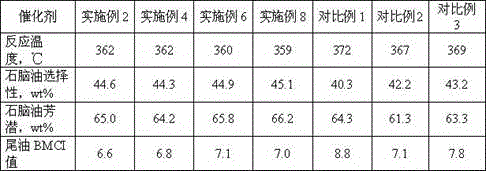
The hydrocracking reaction result shows that when the conversion rate of the catalyst prepared by the method is the same as that of a comparative catalyst, the reaction temperature is reduced by 5-13 ℃, the naphtha selectivity and the arene potential are greatly improved, and the BMCI value of the hydrocracking tail oil is lower. The catalyst prepared by the method has the characteristics of high hydrogenation activity, good hydrogenation ring-opening performance and strong monocyclic aromatic hydrocarbon and naphthenic hydrocarbon retention capacity.
Claims (16)
1. A preparation method of a hydrocracking catalyst for producing high-quality catalytic reforming raw materials is characterized by comprising the following steps:
uniformly mixing macroporous alumina powder, a modified USY molecular sieve, Beta zeolite and an active metal component, adding an acid solution, fully rolling, forming, drying and roasting to obtain a hydrocracking catalyst;
the modified USY molecular sieve has the following properties after being roasted: the total pore volume is 0.76-1.25 mL/g; wherein the mesoporous volume is 0.55-1.05 mL/g; the mesoporous volume accounts for 65-90% of the total pore volume; the molar ratio of the silicon oxide to the aluminum oxide is 10-35; the specific surface area is 680-1050 m2/g。
2. The method of claim 1, wherein: the modified USY molecular sieve has the following properties after being roasted: the total pore volume is 0.80-1.10 mL/g; wherein the mesoporous volume is 0.60-0.95 mL/g; the mesoporous volume accounts for 70-85% of the total pore volume; the molar ratio of the silicon oxide to the aluminum oxide is 12-30; the specific surface area is 800-950 m2/g。
3. The method of claim 1, wherein: the preparation steps of the modified USY molecular sieve are as follows:
adding the USY type molecular sieve into a pressure-resistant container filled with one or more organic alkali solutions of tetraethylammonium hydroxide, tetrapropylammonium hydroxide or tetrabutylammonium hydroxide with the concentration of 0.05-0.35 mol/L under the condition of stirring, sealing the system, introducing compressed air, nitrogen or inert gas into the pressure-resistant container to increase the pressure to 0.2-1.0 MPa, then heating to 50-90 ℃, carrying out constant-temperature treatment for 0.5-3 hours, releasing the pressure, carrying out suction filtration until the pH value is less than 9, drying for 6-24 hours at 80-120 ℃, and then roasting for 2-8 hours at 450-650 ℃ to obtain the modified USY type molecular sieve.
4. The method of claim 3, wherein: the USY type molecular sieve added into the organic alkali solution is in a hydrogen type, and the molar ratio of silicon oxide to aluminum oxide is 10-55; the specific surface area is 650 to 950m2(ii)/g; the mass ratio of the addition amount of the USY type molecular sieve to the water in the organic alkali solution is 1: 5-20.
5. The method of claim 4, wherein: in the USY type molecular sieve, the molar ratio of silicon oxide to aluminum oxide is 18-45; the specific surface area is 750-900 m2(ii)/g; the mass ratio of the addition amount of the USY type molecular sieve to the water in the organic alkali solution is 1: 7.5-15.
6. The method of claim 1, wherein: the Beta zeolite has the following properties: the total pore volume is 0.45-0.99 ml/g; wherein the mesoporous volume is 0.25-0.89 ml/g; the specific surface area is 550-1000 m2(ii)/g; wherein the specific surface area of the intermediate holes is 200 to 600m2(ii)/g; the volume ratio of the mesoporous volume to the total pore volume is 0.56-0.9; the amount of acid is 0.30 to 0.85 mmol/g.
7. The method of claim 6, wherein: the Beta zeolite has the following properties: the total pore volume is 0.55-0.95 mL/g; wherein the mesoporous volume is 0.35 mL/g-0.85 mL/g; the specific surface area is 650-900 m2(ii)/g; wherein the mesoporous specific surface is 240-450 m2(ii)/g; the volume ratio of the mesoporous volume to the total pore volume is 0.65-0.85; the amount of acid is 0.40 to 0.8 mmol/g.
8. The method of claim 6, wherein: the Beta zeolite has the following properties: the total pore volume is 0.70-0.90 mL/g; wherein the mesoporous pore volume is 0.50-0.80 mL/g.
9. The method of claim 1, wherein: the preparation method of the Beta zeolite comprises the following steps:
(1) uniformly mixing deionized water, a surfactant and a silicon source in a stirring kettle, sealing the stirring kettle, heating to 120-180 ℃, introducing air to maintain the pressure in the kettle between 0.1-1.0 MPa, stirring at a constant temperature for 1-6 hours, cooling to 30-80 ℃, adding a template agent, an aluminum source and sodium hydroxide into the stirring kettle, and uniformly stirring;
(2) sealing the stirring kettle, heating to 130-160 ℃, stirring at constant temperature for 1-8 days, controlling the pressure in the kettle to be 0.25-0.50 MPa through a pressure release valve, and crystallizing at constant temperature for 1-4 days;
(3) closing the pressure release valve, continuously crystallizing at the constant temperature of 130-160 ℃ for 1-8 days, flushing the kettle after crystallization is finished, rapidly reducing the temperature in the kettle to be below 80 ℃, then releasing the pressure, carrying out solid-liquid separation on crystallized products, washing, drying and roasting the obtained solid to obtain the Beta zeolite.
10. The method of claim 9, wherein: the silicon source is fumed silica and/or white carbon black, and the specific surface of the silicon source is 50-300 m2/g。
11. The method of claim 9, wherein: the surfactant is CnH2n+1(CH3)3NBr, wherein n is 12, 14, 16 or 18; the template agent is tetraethyl ammonium hydroxide and/or tetraethyl ammonium bromide; the aluminum source is one or more of aluminum sulfate, aluminum nitrate, aluminum chloride and sodium metaaluminate.
12. The method of claim 11, wherein: in the step (1), the feeding molar ratio of the materials is as follows: (20-100) SiO2:Al2O3:(1.6~3.2)Na2O:(10~20)TEA+:(1.2~3.8)CnH2n+1(CH3)3N Br:(350~1250)H2O; wherein the silicon source is SiO2Calculated by Al as the aluminum source2O3In terms of template agent, TEA is used+In terms of surfactant CnH2n+1(CH3)3And (4) measuring NBr.
13. The method of claim 9, wherein: the stirring kettle is sealed and the temperature rise conditions are as follows: heating to 130-170 ℃, and introducing air to maintain the pressure in the kettle between 0.3-0.8 MPa; the pressure in the kettle is controlled to be 0.35-0.40 MPa through the pressure relief valve; the roasting conditions are as follows: roasting for 6-10 hours at 550-600 ℃ in air atmosphere.
14. A catalyst prepared by the process of any one of claims 1 to 13, wherein: the active metal components are VIB group metals and VIII group metals; the hydrocracking catalyst comprises the following components in percentage by weight: the modified USY molecular sieve is 20-50%; 2-10% of Beta zeolite; 30% -70% of macroporous alumina; the VIB group metal accounts for 6-15% of oxides; the VIII group metal accounts for 2-8% of oxide.
15. The catalyst of claim 14, wherein: the method is characterized in that: the catalyst comprises the following components in percentage by weight: 20-50% of a modified USY molecular sieve; 4-8% of Beta zeolite; 30-60% of macroporous alumina; the VIB group metal accounts for 8-12% of oxides; the amount of the group VIII metal is 3-6% by weight of oxide.
16. Use of a catalyst according to claim 14 or 15 for treating VGO to produce a catalytic reforming feed comprising: the reaction conditions are all under the existence of hydrogen, the reaction pressure is 10-20 MPa, the reaction temperature is 350-430 ℃, the volume ratio of hydrogen to oil is 500-1800, and the liquid hourly space velocity is 0.5-5.0 h-1。
Priority Applications (1)
| Application Number | Priority Date | Filing Date | Title |
|---|---|---|---|
| CN201610288622.8A CN107344112B (en) | 2016-05-05 | 2016-05-05 | Hydrocracking catalyst for producing high-quality catalytic reforming raw material and preparation method and application thereof |
Applications Claiming Priority (1)
| Application Number | Priority Date | Filing Date | Title |
|---|---|---|---|
| CN201610288622.8A CN107344112B (en) | 2016-05-05 | 2016-05-05 | Hydrocracking catalyst for producing high-quality catalytic reforming raw material and preparation method and application thereof |
Publications (2)
| Publication Number | Publication Date |
|---|---|
| CN107344112A CN107344112A (en) | 2017-11-14 |
| CN107344112B true CN107344112B (en) | 2020-02-14 |
Family
ID=60252887
Family Applications (1)
| Application Number | Title | Priority Date | Filing Date |
|---|---|---|---|
| CN201610288622.8A Active CN107344112B (en) | 2016-05-05 | 2016-05-05 | Hydrocracking catalyst for producing high-quality catalytic reforming raw material and preparation method and application thereof |
Country Status (1)
| Country | Link |
|---|---|
| CN (1) | CN107344112B (en) |
Cited By (2)
| Publication number | Priority date | Publication date | Assignee | Title |
|---|---|---|---|---|
| US12304824B2 (en) | 2022-01-06 | 2025-05-20 | Saudi Arabian Oil Company | Methods of synthesis of mesoporous nano-sized beta zeolites by desilication and uses thereof |
| US12378130B2 (en) | 2022-01-06 | 2025-08-05 | Saudi Arabian Oil Company | Methods of synthesis of mesoporous nano-sized zeolite beta by hydrothermal treatment and uses thereof |
Families Citing this family (2)
| Publication number | Priority date | Publication date | Assignee | Title |
|---|---|---|---|---|
| CN112439444B (en) * | 2020-12-03 | 2023-07-04 | 榆林学院 | Preparation method and application of supported hierarchical pore solid acid bifunctional catalyst |
| CN115974095B (en) * | 2022-12-07 | 2024-05-31 | 广东能源集团科学技术研究院有限公司 | Hollow hierarchical pore composite molecular sieve and preparation method and application thereof |
Citations (6)
| Publication number | Priority date | Publication date | Assignee | Title |
|---|---|---|---|---|
| CN1069427A (en) * | 1991-08-16 | 1993-03-03 | 国际壳版研究有限公司 | The carbon monoxide-olefin polymeric that contains modified zeolite of Y-type |
| US5208197A (en) * | 1988-03-30 | 1993-05-04 | Uop | Octane gasoline catalyst |
| CN101077481A (en) * | 2007-07-04 | 2007-11-28 | 太原理工大学 | Double-micropore zeolites and method of making thereof |
| CN101376506A (en) * | 2007-08-27 | 2009-03-04 | 中国石油化工股份有限公司 | Composite double microporous material and preparation thereof |
| CN103100417A (en) * | 2011-11-09 | 2013-05-15 | 中国石油化工股份有限公司 | Hydrocracking catalyst and preparation method thereof |
| CN105413741A (en) * | 2014-09-11 | 2016-03-23 | 中国石油化工股份有限公司 | Hydrocracking catalyst and preparation method thereof, and hydrocracking reaction method |
-
2016
- 2016-05-05 CN CN201610288622.8A patent/CN107344112B/en active Active
Patent Citations (6)
| Publication number | Priority date | Publication date | Assignee | Title |
|---|---|---|---|---|
| US5208197A (en) * | 1988-03-30 | 1993-05-04 | Uop | Octane gasoline catalyst |
| CN1069427A (en) * | 1991-08-16 | 1993-03-03 | 国际壳版研究有限公司 | The carbon monoxide-olefin polymeric that contains modified zeolite of Y-type |
| CN101077481A (en) * | 2007-07-04 | 2007-11-28 | 太原理工大学 | Double-micropore zeolites and method of making thereof |
| CN101376506A (en) * | 2007-08-27 | 2009-03-04 | 中国石油化工股份有限公司 | Composite double microporous material and preparation thereof |
| CN103100417A (en) * | 2011-11-09 | 2013-05-15 | 中国石油化工股份有限公司 | Hydrocracking catalyst and preparation method thereof |
| CN105413741A (en) * | 2014-09-11 | 2016-03-23 | 中国石油化工股份有限公司 | Hydrocracking catalyst and preparation method thereof, and hydrocracking reaction method |
Non-Patent Citations (1)
| Title |
|---|
| Y型分子筛碱处理改性的研究;梁筱敏等;《中国化学会第29届学术年会摘要集——第27分会:多孔功能材料》;20140711;论文摘要 * |
Cited By (2)
| Publication number | Priority date | Publication date | Assignee | Title |
|---|---|---|---|---|
| US12304824B2 (en) | 2022-01-06 | 2025-05-20 | Saudi Arabian Oil Company | Methods of synthesis of mesoporous nano-sized beta zeolites by desilication and uses thereof |
| US12378130B2 (en) | 2022-01-06 | 2025-08-05 | Saudi Arabian Oil Company | Methods of synthesis of mesoporous nano-sized zeolite beta by hydrothermal treatment and uses thereof |
Also Published As
| Publication number | Publication date |
|---|---|
| CN107344112A (en) | 2017-11-14 |
Similar Documents
| Publication | Publication Date | Title |
|---|---|---|
| CN107344110B (en) | Catalyst for producing hydrocracking tail oil with low straight-chain alkane content and preparation method and application thereof | |
| CN109775716B (en) | Hierarchical pore Y-type molecular sieve rich in L acid and preparation method thereof | |
| CN107344111B (en) | Hydrocracking catalyst for maximum production of low-freezing diesel oil and preparation method and application thereof | |
| CN107344113B (en) | Hydrocracking catalyst for producing high aromatic hydrocarbon latent naphtha and preparation method and application thereof | |
| CN109423336B (en) | Hydrocracking method | |
| CN115624986A (en) | A kind of core-shell molecular sieve containing phosphorus and metal and its synthesis method | |
| CN116265107B (en) | A method for preparing a high-yield diesel catalytic cracking catalyst | |
| CN101632938A (en) | Middle distillate type hydrocracking catalyst | |
| CN107344719B (en) | Y-Y type isomorphous composite molecular sieve and preparation method thereof | |
| CN107344112A (en) | A kind of hydrocracking catalyst for producing high-quality catalytic reforming raw material and its preparation method and application | |
| CN109775718A (en) | A kind of modified Y-Y isomorphous molecular sieve and its preparation method and application | |
| CN107344115B (en) | Modified Y-Beta composite molecular sieve and preparation method and application thereof | |
| CN107344108A (en) | A kind of catalyst for improving hydrocracking tail oil viscosity index (VI) and preparation method thereof | |
| CN106672997A (en) | Modified Y type molecular sieve and preparation method thereof | |
| CN107344114B (en) | Modified Y/ZSM-48 composite molecular sieve and preparation method and application thereof | |
| CN116265108B (en) | Preparation method of catalytic cracking catalyst for producing more gasoline | |
| CN111097486B (en) | A Y molecular sieve and its preparation method and application | |
| CN107344103B (en) | Hydrocracking catalyst for maximum production of high-quality ethylene raw material and preparation method and application thereof | |
| CN107344109A (en) | Produce hydrocracking catalyst of high-quality hydrocracking tail oil and preparation method thereof | |
| CN107344104B (en) | Hydrocracking catalyst for producing high-quality ethylene raw material and preparation method and application thereof | |
| CN116060106B (en) | Al-SBA-15/beta core-shell composite molecular sieve and preparation method and application thereof | |
| CN116265109B (en) | A method for preparing a heavy oil high-efficiency conversion catalyst | |
| CN106140281A (en) | A kind of preparation method of middle oil type hydrocracking catalyst | |
| CN111689504A (en) | Preparation method of mesoporous-microporous Y-type zeolite molecular sieve | |
| CN104826653B (en) | A kind of method for preparing hydrocracking catalyst |
Legal Events
| Date | Code | Title | Description |
|---|---|---|---|
| PB01 | Publication | ||
| PB01 | Publication | ||
| SE01 | Entry into force of request for substantive examination | ||
| SE01 | Entry into force of request for substantive examination | ||
| GR01 | Patent grant | ||
| GR01 | Patent grant |