CN1073992C - Efficient synthesis of 1,4-dihydro-2H-3, 1-benzoxazine-2-one - Google Patents
Efficient synthesis of 1,4-dihydro-2H-3, 1-benzoxazine-2-one Download PDFInfo
- Publication number
- CN1073992C CN1073992C CN98802445A CN98802445A CN1073992C CN 1073992 C CN1073992 C CN 1073992C CN 98802445 A CN98802445 A CN 98802445A CN 98802445 A CN98802445 A CN 98802445A CN 1073992 C CN1073992 C CN 1073992C
- Authority
- CN
- China
- Prior art keywords
- dihydro
- benzoxazine
- ketone
- preparation
- alkyl
- Prior art date
- Legal status (The legal status is an assumption and is not a legal conclusion. Google has not performed a legal analysis and makes no representation as to the accuracy of the status listed.)
- Expired - Fee Related
Links
Classifications
-
- C—CHEMISTRY; METALLURGY
- C07—ORGANIC CHEMISTRY
- C07D—HETEROCYCLIC COMPOUNDS
- C07D265/00—Heterocyclic compounds containing six-membered rings having one nitrogen atom and one oxygen atom as the only ring hetero atoms
- C07D265/04—1,3-Oxazines; Hydrogenated 1,3-oxazines
- C07D265/12—1,3-Oxazines; Hydrogenated 1,3-oxazines condensed with carbocyclic rings or ring systems
- C07D265/14—1,3-Oxazines; Hydrogenated 1,3-oxazines condensed with carbocyclic rings or ring systems condensed with one six-membered ring
- C07D265/18—1,3-Oxazines; Hydrogenated 1,3-oxazines condensed with carbocyclic rings or ring systems condensed with one six-membered ring with hetero atoms directly attached in position 2
-
- C—CHEMISTRY; METALLURGY
- C07—ORGANIC CHEMISTRY
- C07C—ACYCLIC OR CARBOCYCLIC COMPOUNDS
- C07C271/00—Derivatives of carbamic acids, i.e. compounds containing any of the groups, the nitrogen atom not being part of nitro or nitroso groups
- C07C271/06—Esters of carbamic acids
- C07C271/08—Esters of carbamic acids having oxygen atoms of carbamate groups bound to acyclic carbon atoms
- C07C271/26—Esters of carbamic acids having oxygen atoms of carbamate groups bound to acyclic carbon atoms with the nitrogen atom of at least one of the carbamate groups bound to a carbon atom of a six-membered aromatic ring
- C07C271/28—Esters of carbamic acids having oxygen atoms of carbamate groups bound to acyclic carbon atoms with the nitrogen atom of at least one of the carbamate groups bound to a carbon atom of a six-membered aromatic ring to a carbon atom of a non-condensed six-membered aromatic ring
-
- C—CHEMISTRY; METALLURGY
- C07—ORGANIC CHEMISTRY
- C07C—ACYCLIC OR CARBOCYCLIC COMPOUNDS
- C07C2601/00—Systems containing only non-condensed rings
- C07C2601/02—Systems containing only non-condensed rings with a three-membered ring
Landscapes
- Chemical & Material Sciences (AREA)
- Organic Chemistry (AREA)
- Heterocyclic Carbon Compounds Containing A Hetero Ring Having Nitrogen And Oxygen As The Only Ring Hetero Atoms (AREA)
- Pharmaceuticals Containing Other Organic And Inorganic Compounds (AREA)
- Organic Low-Molecular-Weight Compounds And Preparation Thereof (AREA)
Abstract
本发明公开了采用氨基醇中间体和烷基或芳基氯甲酸酯和碱的环化反应得到化合物(-)-6-氯-4-环丙基乙炔基-4-三氟甲基-1,4-二氢-2H-3,1-苯并嗪-2-酮,也称为DMP-266,一种逆转录酶抑制剂的有效制备方法。The invention discloses a compound (-)-6-chloro-4-cyclopropylethynyl-4-trifluoromethyl- 1,4-Dihydro-2H-3,1-benzoxazin-2-one, also known as DMP-266, a potent preparation of reverse transcriptase inhibitors.
Description
发明背景Background of the invention
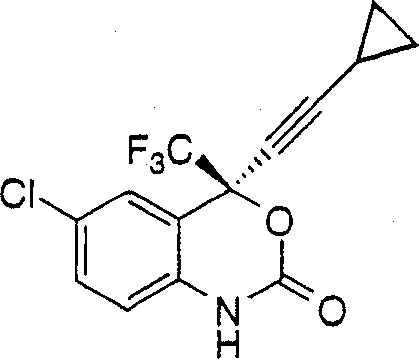
逆转录酶抑制剂,(-)-6-氯-4-环丙基乙炔基-4-三氟甲基-1,4-二氢-2H-3,1-苯并噁嗪-2-酮,也称为DMP-266的合成的关键步骤是使用光气进行氨基醇的环化。Reverse transcriptase inhibitor, (-)-6-Chloro-4-cyclopropylethynyl-4-trifluoromethyl-1,4-dihydro-2H-3,1-benzoxazin-2-one , also known as DMP-266, is the cyclization of aminoalcohols using phosgene.
DMP-266和结构类似的逆转录酶的合成在US5519021和相应的1995年8月3公开的PCT国际专利申请WO95/20389中公开。此外,Thompson等的Tetrahedron Letters 1995,36,8937-8940以及1996年11月28日公开的PCT公开WO96/37457中描述了通过高对映选择性的乙炔化物加成和环化方法进行对映体苯并噁嗪的不对称合成。The synthesis of DMP-266 and structurally similar reverse transcriptases is disclosed in US5519021 and the corresponding PCT International Patent Application WO95/20389 published August 3,1995. In addition, Tetrahedron Letters 1995, 36, 8937-8940 by Thompson et al. and PCT Publication WO 96/37457, published on November 28, 1996, describe the enantiomeric reaction by highly enantioselective acetylide addition and cyclization methods. Asymmetric synthesis of benzoxazines.
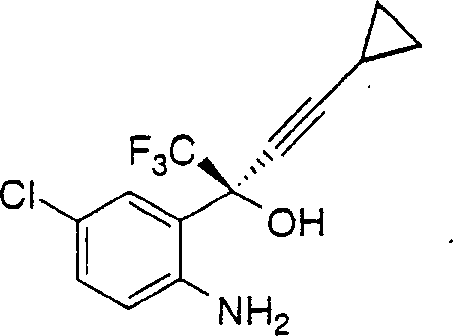
本发明公开了使用氯甲酸酯和碱在溶剂中环化下式氨基醇: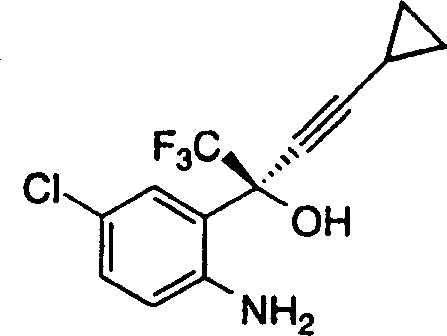

环化方法使用芳基或烷基氯甲酸酯,避免使用光气,一种需要特殊操作的有毒和十分有害的气体。Cyclization methods using aryl or alkyl chloroformates avoid the use of phosgene, a poisonous and highly hazardous gas that requires special handling.
发明概述Summary of the invention
本发明涉及使用氯甲酸酯和碱在溶剂中环化下式氨基醇:以得到下式的1,4-二氢-2H-3,1-苯并噁嗪-2-酮的有效方法。发明详述The present invention relates to the cyclization of aminoalcohols of the formula: An efficient method for obtaining 1,4-dihydro-2H-3,1-benzoxazin-2-one of the following formula. Detailed description of the invention
本发明公开了制备下式1,4-二氢-2H-3,1-苯并噁嗪-2-酮的有效方法:其包括如下步骤:1)在约0℃-约25℃的温度和在惰性气氛下在下式的氨基醇在有机溶剂和碱中的搅拌混合物中加入芳基氯甲酸酯: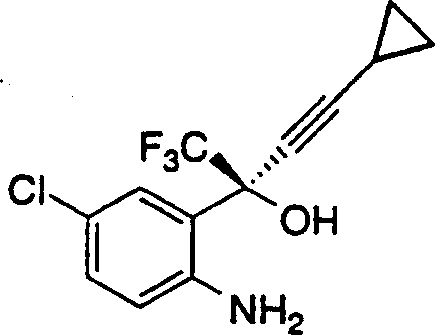
用于制备上述1,4-二氢-2H-3,1-苯并噁嗪-2-酮的方法,其中芳基氯甲酸酯的芳基定义为苯基或萘基,它任选地被一个、两个或三个选自卤素(F、Cl、Br、I)、CF3、CO2C1-C6-烷基和NO2的取代基取代。用于本发明的芳基氯甲酸酯的实例定义为苯基氯甲酸酯,其中苯基任选地被一个、两个或三个选自卤素(F、Cl、Br、I)、CF3和NO2的取代基取代。用于本发明方法的优选芳基氯甲酸酯是4-硝基苯基氯甲酸酯。A method for preparing the above-mentioned 1,4-dihydro-2H-3,1-benzoxazin-2-one, wherein the aryl group of the aryl chloroformate is defined as phenyl or naphthyl, which optionally Substituted by one, two or three substituents selected from halogen (F, Cl, Br, I), CF 3 , CO 2 C 1 -C 6 -alkyl and NO 2 . An example of an aryl chloroformate useful in the present invention is defined as phenyl chloroformate, wherein phenyl is optionally selected by one, two or three from halogen (F, Cl, Br, I), CF Substituents of 3 and NO 2 are substituted. A preferred aryl chloroformate for use in the process of the invention is 4-nitrophenyl chloroformate.
用于制备上述1,4-二氢-2H-3,1-苯并噁嗪-2-酮的方法,其中碱定义为氢氧化钾、氢氧化钠、氢氧化锂、碳酸钾、碳酸钠、碳酸锂、碳酸氢钾、碳酸氢钠、碳酸氢锂和它们的混合物的固体或溶液。用于制备上述1,2-二氢-2H-3,1-苯并噁嗪,其中优选的碱定义为氢氧化钾、氢氧化钠、碳酸钾、碳酸钠、碳酸氢钾、碳酸氢钠或所述碱的混合物的固体或溶液。The method for preparing the above-mentioned 1,4-dihydro-2H-3,1-benzoxazin-2-one, wherein the base is defined as potassium hydroxide, sodium hydroxide, lithium hydroxide, potassium carbonate, sodium carbonate, Solid or solution of lithium carbonate, potassium bicarbonate, sodium bicarbonate, lithium bicarbonate and mixtures thereof. For the preparation of the above-mentioned 1,2-dihydro-2H-3,1-benzoxazine, wherein the preferred base is defined as potassium hydroxide, sodium hydroxide, potassium carbonate, sodium carbonate, potassium bicarbonate, sodium bicarbonate or The solid or solution of the mixture of bases.
用于制备如上所述的1,4-二氢-2H-3,1-苯并噁嗪的-2-酮方法,其中有机溶剂选自甲基叔丁基醚、甲苯、四氢呋喃、乙腈、二甲基乙酰胺、N-甲基吡咯烷酮或所述溶剂的混合物。A-2-one process for the preparation of 1,4-dihydro-2H-3,1-benzoxazine as described above, wherein the organic solvent is selected from the group consisting of methyl tert-butyl ether, toluene, tetrahydrofuran, acetonitrile, di Methylacetamide, N-methylpyrrolidone or a mixture of said solvents.
本发明的优选实施方案是制备下式1,4-二氢-2H-3,1-苯并噁嗪-2-酮的方法: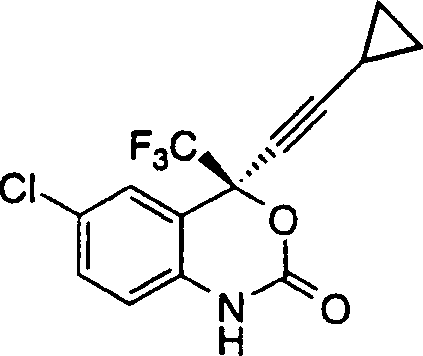
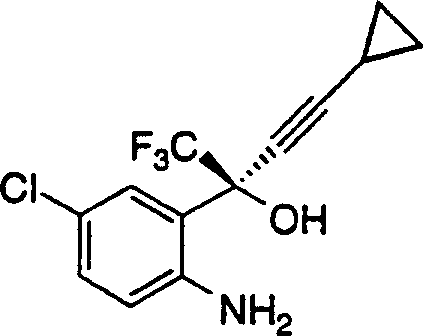
本发明制备下式1,4-二氢-2H-3,1-苯并噁嗪-2-酮的方法: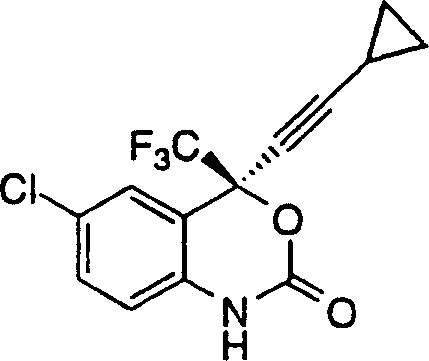


用于制备上述1,4-二氢-2H-3,1-苯并噁嗪-2-酮的方法,其中芳基氯甲酸酯的芳基定义为苯基或萘基,它任选地被一个、两个或三个选自卤素(F、Cl、Br、I)、CF3、CO2C1-C6-烷基和NO2的取代基取代。A method for preparing the above-mentioned 1,4-dihydro-2H-3,1-benzoxazin-2-one, wherein the aryl group of the aryl chloroformate is defined as phenyl or naphthyl, which optionally Substituted by one, two or three substituents selected from halogen (F, Cl, Br, I), CF 3 , CO 2 C 1 -C 6 -alkyl and NO 2 .
用于制备上述1,4-二氢-2H-3,1-苯并噁嗪-2-酮的方法,其中碱定义为氢氧化钾、氢氧化钠、氢氧化锂、碳酸钾、碳酸钠、碳酸锂、碳酸氢钾、碳酸氢钠、碳酸氢锂和它们的混合物的固体或溶液。The method for preparing the above-mentioned 1,4-dihydro-2H-3,1-benzoxazin-2-one, wherein the base is defined as potassium hydroxide, sodium hydroxide, lithium hydroxide, potassium carbonate, sodium carbonate, Solid or solution of lithium carbonate, potassium bicarbonate, sodium bicarbonate, lithium bicarbonate and mixtures thereof.
用于制备如上所述的1,4-二氢-2H-3,1-苯并噁嗪的-2-酮方法,其中有机溶剂选自甲基叔丁基醚、甲苯或所述溶剂的混合物。2-one process for the preparation of 1,4-dihydro-2H-3,1-benzoxazine as described above, wherein the organic solvent is selected from methyl tert-butyl ether, toluene or mixtures of said solvents .
用于制备上述1,4-二氢-2H-3,1-苯并噁嗪-2-酮的方法,其中芳基氯甲酸酯的芳基定义为苯基氯甲酸酯,其中苯基任选地被一个、两个或三个选自卤素(F、Cl、Br、I)、CF3和NO2的取代基取代。A process for the preparation of the above-mentioned 1,4-dihydro-2H-3,1-benzoxazin-2-one, wherein the aryl group of the aryl chloroformate is defined as phenyl chloroformate, wherein phenyl Optionally substituted with one, two or three substituents selected from halogen (F, Cl, Br, I), CF3 and NO2 .
用于制备上述1,4-二氢-2H-3,1-苯并噁嗪-2-酮的方法,其中碱定义为氢氧化钾、氢氧化钠、碳酸钾、碳酸钠、碳酸氢钾、碳酸氢钠或所述碱的混合物的固体或液体。The method for preparing the above-mentioned 1,4-dihydro-2H-3,1-benzoxazin-2-one, wherein the base is defined as potassium hydroxide, sodium hydroxide, potassium carbonate, sodium carbonate, potassium bicarbonate, Sodium bicarbonate or mixtures of said bases as solid or liquid.
用于制备如上所述的1,4-二氢-2H-3,1-苯并噁嗪的-2-酮方法,其中芳基氯甲酸酯的芳基定义为4-硝基苯基氯甲酸酯。The 2-one process for the preparation of 1,4-dihydro-2H-3,1-benzoxazine as described above, wherein the aryl group of the aryl chloroformate is defined as 4-nitrophenyl chloride Formate.
本发明的另一方面是制备下式1,4-二氢-2H-3,1-苯并噁嗪-2-酮的方法:其包括如下步骤:1)在约0℃-约25℃的温度和在惰性气氛下将烷基氯甲酸酯加入下式的氨基醇在第一种有机溶剂和第一种碱中的搅拌混合物中:

用于制备上述1,4-二氢-2H-3,1-苯并噁嗪-2-酮的方法,其中烷基氯甲酸酯的烷基定义为C1-C10-烷基,它任选地被一个、两个或三个选自卤素(F、Cl、Br、I)、CF3、C3-C7-环烷基、CO2C1-C6-烷基和NO2的取代基取代。用于制备1,4-二氢-2H-3,1-苯并噁嗪-2-酮的方法的烷基氯甲酸酯的实例是甲基或乙基氯甲酸酯。A process for the preparation of the above-mentioned 1,4-dihydro-2H-3,1-benzoxazin-2-one, wherein the alkyl group of the alkyl chloroformate is defined as C 1 -C 10 -alkyl, which optionally by one, two or three selected from halogen (F, Cl, Br, I), CF 3 , C 3 -C 7 -cycloalkyl, CO 2 C 1 -C 6 -alkyl and NO 2 of substituents. An example of an alkyl chloroformate used in the process for the preparation of 1,4-dihydro-2H-3,1-benzoxazin-2-one is methyl or ethyl chloroformate.
用于制备上述1,4-二氢-2H-3,1-苯并噁嗪-2-酮的方法,其中第一种碱定义为氢氧化钾、氢氧化钠、氢氧化锂、碳酸钾、碳酸钠、碳酸锂、碳酸氢钾、碳酸氢钠、碳酸氢锂和它们的混合物的固体或溶液。用于制备上述1,4-二氢-2H-3,1-苯并噁嗪-2-酮的方法,其中第二种碱定义为KOC1-C6-烷基、NaOC1-C6-烷基、LiOC1-C6-烷基、KC1-C6-烷基、NaC1-C6-烷基、LiC1-C6-烷基、KHMDS、NaHMDS、LiHMDS、LDA或所述碱的混合物的固体或溶液。The method for preparing the above-mentioned 1,4-dihydro-2H-3,1-benzoxazin-2-one, wherein the first base is defined as potassium hydroxide, sodium hydroxide, lithium hydroxide, potassium carbonate, Solid or solution of sodium carbonate, lithium carbonate, potassium bicarbonate, sodium bicarbonate, lithium bicarbonate and mixtures thereof. A process for the preparation of the above-mentioned 1,4-dihydro-2H-3,1-benzoxazin-2-one, wherein the second base is defined as KOC 1 -C 6 -alkyl, NaOC 1 -C 6 - Alkyl, LiOC 1 -C 6 -alkyl, KC 1 -C 6 -alkyl, NaC 1 -C 6 -alkyl, LiC 1 -C 6 -alkyl, KHMDS, NaHMDS, LiHMDS, LDA or the bases mentioned mixtures of solids or solutions.
用于制备如上所述的1,4-二氢-2H-3,1-苯并噁嗪-2-酮的方法,其中第一种有机溶剂选自甲基叔丁基醚、甲苯、四氢呋喃、乙腈或所述溶剂的混合物。用于制备如上所述的1,4-二氢-2H-3,1-苯并噁嗪的-2-酮方法,其中反萃溶剂是庚烷。用于制备如上所述的1,4-二氢-2H-3,1-苯并噁嗪的-2-酮方法,其中第二种有机溶剂选自甲基叔丁基醚、甲苯、四氢呋喃、C1-C6烷基醇或所述溶剂的混合物。A method for preparing 1,4-dihydro-2H-3,1-benzoxazin-2-one as described above, wherein the first organic solvent is selected from the group consisting of methyl tert-butyl ether, toluene, tetrahydrofuran, Acetonitrile or a mixture of said solvents. The 2-one process for the preparation of 1,4-dihydro-2H-3,1-benzoxazine as described above, wherein the stripping solvent is heptane. A 2-one process for the preparation of 1,4-dihydro-2H-3,1-benzoxazine as described above, wherein the second organic solvent is selected from the group consisting of methyl tert-butyl ether, toluene, tetrahydrofuran, C 1 -C 6 alkyl alcohols or mixtures of said solvents.
用于制备如上所述的1,4-二氢-2H-3,1-苯并噁嗪-2-酮的方法,其中酸选自盐酸、硝酸、硫酸和乙酸。A process for the preparation of 1,4-dihydro-2H-3,1-benzoxazin-2-one as described above, wherein the acid is selected from hydrochloric acid, nitric acid, sulfuric acid and acetic acid.
用于制备如上所述的1,4-二氢-2H-3,1-苯并噁嗪-2-酮的方法,其包括附加步骤:由甲苯-庚烷或甲基叔丁基醚-庚烷中结晶在步骤4中产生的烷基氨基甲酸酯,以得到晶体烷基氨基甲酸酯。Process for the preparation of 1,4-dihydro-2H-3,1-benzoxazin-2-one as described above, comprising the additional step of: from toluene-heptane or methyl tert-butyl ether-heptane The alkyl carbamate produced in step 4 is crystallized from alkanes to obtain a crystalline alkyl carbamate.
本发明的另一方面是下式的烷基氨基甲酸酯: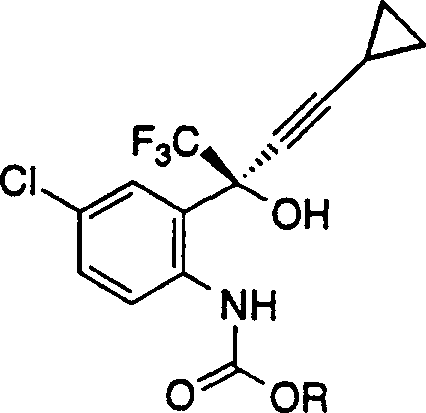
用于本文的术语“烷基”包括规定原子数目的直链、支链或环构型的烷基,它任选地被选自卤素(F、Cl、Br、I)、CF3、CO2C1-C6-烷基、C3-C7-环烷基和NO2的取代基取代。“烷基”的实例包括甲基、乙基、丙基、异丙基、丁基、仲和叔丁基、戊基、己基、庚基、环丙基、环丁基、环戊基、环己基、环庚基、降冰片基等。术语“芳基”定义为苯基或萘基环,它在任何可利用的碳原子上被一个、两个或三个选自卤素(F、Cl、Br、I)、CF3、CO2C1-C6-烷基和NO2的取代基取代。The term "alkyl" as used herein includes alkyl groups of the specified number of atoms in straight chain, branched chain or ring configuration, which are optionally selected from halogen (F, Cl, Br, I), CF3 , CO2 Substituents of C 1 -C 6 -alkyl, C 3 -C 7 -cycloalkyl and NO 2 . Examples of "alkyl" include methyl, ethyl, propyl, isopropyl, butyl, sec- and tert-butyl, pentyl, hexyl, heptyl, cyclopropyl, cyclobutyl, cyclopentyl, cyclo Hexyl, cycloheptyl, norbornyl, etc. The term "aryl" is defined as a phenyl or naphthyl ring which is replaced on any available carbon atom by one, two or three selected from halogen (F, Cl, Br, I), CF3 , CO2C Substituents of 1 -C 6 -alkyl and NO 2 .
术语惰性气氛理解为氩气或氮气,优选氮气气氛。The term inert atmosphere is understood to mean an argon or nitrogen, preferably nitrogen atmosphere.
方案1说明了合成(-)-6-氯-4-环丙基乙炔基-4-三氟甲基-1,4-二氢-2H-3,1-苯并噁嗪-2-酮(DMP-266)的关键步骤。手性加成步骤在化合物1的三氟甲基酮上对映选择性地加成环丙基乙炔化物。生成的PMB保护的氨基醇2随后脱保护得到氨基醇3。该氨酸醇随后用氯甲酸酯和碱环化得到DMP-266。Scheme 1 illustrates the synthesis of (-)-6-chloro-4-cyclopropylethynyl-4-trifluoromethyl-1,4-dihydro-2H-3,1-benzoxazin-2-one ( DMP-266) key steps. Chiral addition step Enantioselective addition of cyclopropylacetylide to the trifluoromethyl ketone of compound 1. The resulting PMB-protected aminoalcohol 2 is subsequently deprotected to give aminoalcohol 3. The amino acid alcohol is then cyclized with chloroformate and base to give DMP-266.
方案1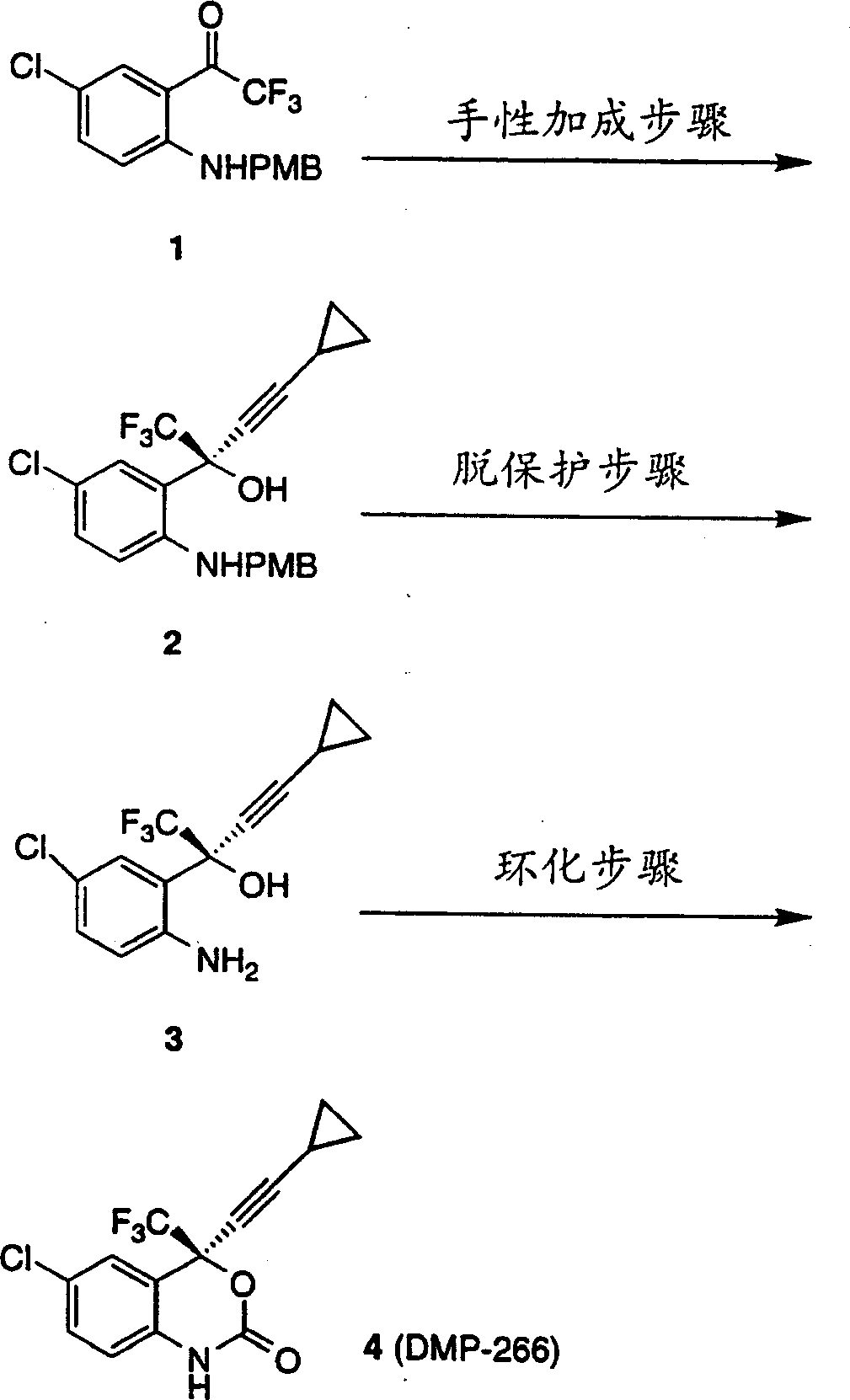
环化氨基醇3以生成1,4-二氢-2H-3,1-苯并噁嗪-2-酮的过程在方案2中说明。反应可作为一步方法进行或依据所使用的氯甲酸酯的可能的中间体氨基甲酸酯分离的两步方法。已表明在一步方法中芳基氯甲酸酯形成不太稳定的氨基甲酸酯,使得当它们用含水碱处理时它们环化成产物。此外,烷基氯甲酸酯得到烷基氨基甲酸酯,一种在进行环化步骤之前能够分离和纯化的关键中间体。根据烷基氨基甲酸酯的稳定性,已开发了可行的制备DMP-266的两步方法,其包括形成烷基氨基甲酸酯中间体5,随后环化氨基甲酸酯得到所需的产物4。The cyclization of amino alcohol 3 to generate 1,4-dihydro-2H-3,1-benzoxazin-2-one is illustrated in Scheme 2. The reaction can be carried out as a one-step process or a two-step process with possible intermediate carbamate isolations depending on the chloroformate used. Aryl chloroformates have been shown to form less stable carbamates in a one-step process such that they cyclize to the product when they are treated with aqueous base. Furthermore, alkyl chloroformates give alkyl carbamates, a key intermediate that can be isolated and purified before proceeding to the cyclization step. Based on the stability of the alkyl carbamate, a feasible two-step process for the preparation of DMP-266 has been developed, which involves formation of the alkyl carbamate intermediate 5 followed by cyclization of the carbamate to give the desired product 4.
方案2 Scenario 2
表1列出了当进行采用芳基氯甲酸酯的一步方法时可以使用的溶剂和碱。此外,可结合如下列出的碱,例如使用碳酸氢盐和氢氧化物或碳酸氢盐和碳酸盐。反应可在单相或两相反应混合物中进行。碱可以在开始加入氯甲酸酯时加入,或在芳基氯甲酸酯加完后加入。碱优选在开始加入氯甲酸酯时加入,以中和产生的盐酸。
表2列出了当进行采用烷基氯甲酸酯的两步方法时可以使用的溶剂和碱。两步骤方法的步骤1,烷基氨基甲酸酯的形成可在单相或两相反应混合物中进行。两步方法的步骤2,烷基氨基甲酸酯的环闭合可在标注的溶剂和碱中进行。
如下实施例用于说明本发明,这些实施例用于举例说明本发明,而不构成对发明范围的限制。The following examples are used to illustrate the present invention. These examples are intended to illustrate the present invention and not to limit the scope of the invention.
实施例1
向装备有机械搅拌器、氮气管线和热电偶的三颈圆底烧瓶中加入固体氨基醇3、THF(100ml)和固体碳酸氢钾。将得到的混合物冷却至5℃,然后一次加入固体4-硝基苯基氯甲酸酯。反应是放热的。随着该硝基苯基氯甲酸酯的溶解/反应,温度上升了4℃(最终为9℃)。混合物在20-25℃搅拌2小时。分批取样,用ACN和5%碳酸氢钠稀释,得到黄色均匀溶液。在220nm的HPLC分析显示硝基苯酚(43%)、化合物4(49%)、硝基苯基碳酸酯(7%)和若干低含量(<0.3%)杂质。以这种方式分批取样和稀释对于可重复的数据是重要的。如果分批的取样用ACN稀释和用HPLC分析,主要的峰是硝基苯基氨基甲酸酯5。在加入含水碱后转化为化合物4。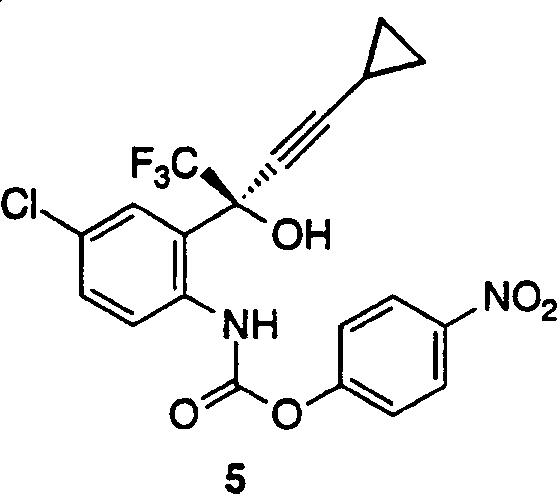
通过加入含水碳酸钾(在150ml水中的10g)中上反应,得到的两相混合物在25℃剧烈搅拌2小时。加入MTBE(100ml),分层,有机层用5%含水碳酸钾(2×50ml)和水(2×50ml)洗涤。溶剂转换为乙醇或异丙醇(IPA),由乙醇或IPA和水中结晶产物。参见实施例10和11。The resulting biphasic mixture was stirred vigorously at 25° C. for 2 hours by adding aqueous potassium carbonate (10 g in 150 ml water) to the reaction. MTBE (100ml) was added, the layers were separated and the organic layer was washed with 5% aqueous potassium carbonate (2 x 50ml) and water (2 x 50ml). The solvent was switched to ethanol or isopropanol (IPA), and the product was crystallized from ethanol or IPA and water. See Examples 10 and 11.
实施例2
向装备有机械搅拌器、氮气管线和热电偶的三颈圆底烧瓶中加入固体氨基醇12、MTBE(100ml)和含水碳酸钾(在120ml水中的10g,3当量),在25℃一次加入固体4-硝基苯基氯甲酸酯。混合物在20-25℃搅拌2小时,此时将两相混合物加热至50℃3小时以有效转化硝基苯基碳酸酯为硝基苯酚。在冷却至25℃后分层,MTBE层用含水碳酸钾(在150ml水中的10g,分两次,各75ml)和水(2×50ml)洗涤。此时将混合物的溶剂转换为乙醇/IPA,实施例10和11中所述结晶。To a three necked round bottom flask equipped with a mechanical stirrer, nitrogen line and thermocouple was added solid aminoalcohol 12, MTBE (100 ml) and aqueous potassium carbonate (10 g in 120 ml of water, 3 equiv) at 25 °C in one addition to the solid 4-Nitrophenyl chloroformate. The mixture was stirred at 20-25°C for 2 hours at which time the biphasic mixture was heated to 50°C for 3 hours to efficiently convert the nitrophenyl carbonate to nitrophenol. After cooling to 25°C the layers were separated and the MTBE layer was washed with aqueous potassium carbonate (10 g in 150 ml water, in two portions of 75 ml each) and water (2 x 50 ml). At this point the solvent of the mixture was switched to ethanol/IPA, crystallization as described in Examples 10 and 11.
实施例3
向装备有机械搅拌器、氮气管线和热电偶的三颈圆底烧瓶中加入固体氨基醇3、MTBE(500ml)和含水碳酸氢钾(在654ml水中的45g),在25℃一次加入固体4-硝基苯基氯甲酸酯。在加入过程中监测溶液pH,在反应过程中pH维持在8.5-4,最终为8.0。混合物在20-25℃搅拌2小时,在20分钟内加入含水KOH(2N),直至水层的pH达到11.0。To a three-neck round bottom flask equipped with a mechanical stirrer, nitrogen line, and thermocouple was added solid aminoalcohol 3, MTBE (500 ml) and aqueous potassium bicarbonate (45 g in 654 ml of water), and solid 4- Nitrophenyl chloroformate. The pH of the solution was monitored during the addition and was maintained at 8.5-4 during the reaction, eventually at 8.0. The mixture was stirred at 20-25°C for 2 hours and aqueous KOH (2N) was added over 20 minutes until the pH of the aqueous layer reached 11.0.
分层,MTBE层用pH7缓冲液(500ml)和盐水(500ml)洗涤。此时将混合物的溶剂转换为乙醇/IPA,并如实施例10和11中所述结晶。The layers were separated and the MTBE layer was washed with pH 7 buffer (500ml) and brine (500ml). At this point the solvent of the mixture was switched to ethanol/IPA and crystallized as described in Examples 10 and 11.
实施例4
向装备有机械搅拌器、氮气管线和热电偶的三颈圆底烧瓶中加入固体氨基醇3、MTBE(500ml)和含水碳酸氢钾(在654ml水中的45g),在25℃分4次次加入固体4-硝基苯基氯甲酸酯。在加入过程中监测溶液pH,在反应过程中pH维持在8.5-4,最终为8.0.混合物在20-25℃搅拌2小时,在20分钟内加入含水KOH(2N),直至水层的pH达到11.0。To a three necked round bottom flask equipped with a mechanical stirrer, nitrogen line and thermocouple was added solid aminoalcohol 3, MTBE (500 ml) and aqueous potassium bicarbonate (45 g in 654 ml of water) in 4 portions at 25 °C Solid 4-nitrophenyl chloroformate. The pH of the solution was monitored during the addition, and the pH was maintained at 8.5-4 during the reaction, and finally 8.0. The mixture was stirred at 20-25°C for 2 hours, and aqueous KOH (2N) was added within 20 minutes until the pH of the aqueous layer reached 11.0.
分层,在MTBE层中加入500mL盐水。加入0.1N乙酸直至pH为6-7。分层,有机层用盐水(500ml)洗涤。此时将混合物的溶剂转换为乙醇/IPA,并如实施例10和11中所述结晶。The layers were separated, and 500 mL of brine was added to the MTBE layer. 0.1 N Acetic acid was added until the pH was 6-7. The layers were separated and the organic layer was washed with brine (500ml). At this point the solvent of the mixture was switched to ethanol/IPA and crystallized as described in Examples 10 and 11.
实施例5步骤A:氨基甲酸酯5的制备
在500ml 3颈烧瓶中装备顶部搅拌器、温度探针和氮气管线,加入氨基醇3(35.38mmol,10.25ml)和MTBE(100ml),形成浅色浆状物,加入水(100ml),然后加入碳酸氢钾(2当量,7.08g)。经注射管加入甲基氯甲酸酯(2当量,5.46ml),在20-25℃下剧烈搅拌两相混合物。用HPLC分析样品直至残留<0.5%氨基醇3(约8.5小时),分层,有机层用盐水(100ml)洗涤,用硫酸镁干燥。在过滤后,溶剂转换(50-60℃,真空)为总体积为102ml(10ml/g起始物料)的MTBE-庚烷混合物(用1H NMR测量约5%MTBE(体积))。在溶剂转换过程容易地结晶出甲基氨基甲酸酯5。浆状物在20-25℃陈化约30分钟后,过滤物质。固体用母液洗涤,随后用1滤饼体积的庚烷洗涤。以92%的收率分离出无水甲基氨基甲酸酯5(11.32g),1-2%损失在母液中。步骤B:环闭合化合物4的制备
在500ml 3颈圆底烧瓶中装备顶部搅拌器、温度探针和氮气管线,将甲基氨基甲酸酯5(32.55mmol,11.32g)溶解在MTBE(170ml)中,加入LiOtBu(1当量,32.6ml)反应混合物立即变成浆状物,浆状物随着时间变稀,在30分钟内为透明黄色溶液。反应混合物在20-25℃陈化,用HPLC跟踪反应。在8小时后,残留<1%的甲基氯甲酸酯5。在约16小时后,残留少于0.3%的甲基氨基甲酸酯。用0.5N盐酸(150ml)中止反应,分层,有机层用盐水(150ml)洗涤,用硫酸镁干燥并过滤。HPLC分析化合物4的收率为96.0%,该物质在乙醇-水结晶的制备中溶剂转换为乙醇,参见实施例10和11。In a 500ml 3-neck round bottom flask equipped with overhead stirrer, temperature probe and nitrogen line, methylcarbamate 5 (32.55mmol, 11.32g) was dissolved in MTBE (170ml), LiOtBu (1 eq, 32.6 ml) The reaction mixture immediately turned into a slurry which thinned over time to a clear yellow solution within 30 minutes. The reaction mixture was aged at 20-25°C and followed by HPLC. After 8 hours, <1% of methyl chloroformate 5 remained. After about 16 hours, less than 0.3% methyl carbamate remained. The reaction was quenched with 0.5N hydrochloric acid (150ml), the layers were separated, the organic layer was washed with brine (150ml), dried over magnesium sulfate and filtered. The yield of compound 4 analyzed by HPLC was 96.0%, and the solvent of this substance was changed to ethanol in the preparation of ethanol-water crystallization, see Examples 10 and 11.
实施例6
根据上述实施例5步骤A的方法,只是使用甲苯作为溶剂,由甲苯-庚烷混合物中分离氨基甲酸酯。步骤B:环闭合化合物4的制备The carbamate was isolated from the toluene-heptane mixture according to the method of step A of Example 5 above, except that toluene was used as the solvent. Step B: Preparation of Ring Closure Compound 4
根据上述实施例5步骤B的方法,只是使用甲苯作为溶剂,通过由甲苯-庚烷混合物中结晶分离产物4。Product 4 was isolated by crystallization from a toluene-heptane mixture according to the procedure of Example 5, step B above, except that toluene was used as solvent.
实施例7
在500ml 3颈烧瓶中装备顶部搅拌器、温度探针和氮气管线,加入氨基醇3(35.38mmol,10.25ml)和MTBE(100ml),形成浅色浆状物,加入水(100ml),然后加入碳酸氢钾(2当量,7.08g)。经注射管加入乙基氯甲酸酯(2当量,6.76ml),在20-25℃下剧烈搅拌两相混合物。用HPLC分析样品直至残留<2%氨基醇3(约30小时),分层,有机层用盐水(100ml)洗涤,用硫酸镁干燥。在过滤后,溶剂转换(50-60℃,真空)为总体积为102ml(10ml/g起始物料)的MTBE-庚烷混合物(用1HNMR测量约5%MTBE(体积))。在溶剂转换过程容易地结晶出甲基氨基甲酸酯5。浆状物在20-25℃陈化约30分钟后,过滤物质。固体用母液洗涤,随后用1滤饼体积的庚烷洗涤。以92%的收率分离出无水乙基氨基甲酸酯5(11.77g),1-2%损失在母液中。步骤B:环闭合化合物4的制备
在500ml 3颈圆底烧瓶中装备顶部搅拌器、温度探针和氮气管线,将乙基氨基甲酸酯5(32.55mmol,11.32g)溶解在MTBE(170ml)中,加入LiOtBu(1当量,32.6ml)反应混合物立即变成浆状物,浆状物随着时间变稀,在30分钟内为透明黄色溶液。反应混合物在20-25℃陈化,用HPLC跟踪反应。在26小时后,残留<1%的乙基氯甲酸酯5。用0.5盐酸(150ml)中止反应,分层,有机层用盐水(150ml)洗涤,用硫酸镁干燥并过滤。HPLC分析化合物4的收率为96.0%,该物质在乙醇-水结晶的制备中溶剂转换为乙醇,参见实施例10和11。In a 500ml 3-neck round bottom flask equipped with overhead stirrer, temperature probe and nitrogen line, ethyl carbamate 5 (32.55mmol, 11.32g) was dissolved in MTBE (170ml), LiOtBu (1 eq, 32.6 ml) The reaction mixture immediately turned into a slurry which thinned over time to a clear yellow solution within 30 minutes. The reaction mixture was aged at 20-25°C and followed by HPLC. After 26 hours, <1% ethyl chloroformate 5 remained. The reaction was quenched with 0.5 hydrochloric acid (150ml), the layers were separated, the organic layer was washed with brine (150ml), dried over magnesium sulfate and filtered. The yield of compound 4 analyzed by HPLC was 96.0%, and the solvent of this substance was changed to ethanol in the preparation of ethanol-water crystallization, see Examples 10 and 11.
实施例8
根据上述实施例7步骤A的方法,只是使用甲苯作为溶剂,由甲苯-庚烷混合物中分离氨基甲酸酯。步骤B:环闭合化合物4的制备The carbamate was isolated from the toluene-heptane mixture according to the method of step A of Example 7 above, except that toluene was used as the solvent. Step B: Preparation of Ring Closure Compound 4
根据上述实施例7步骤B的方法,只是使用甲苯作为溶剂,通过由甲苯-庚烷混合物中结晶分离产物4。Product 4 was isolated by crystallization from toluene-heptane mixtures following the procedure of Example 7, step B above, except that toluene was used as solvent.
实施例9步骤A:氨基甲酸酯5的制备Example 9 Step A: Preparation of Carbamate 5
根据上述实施例7步骤A的方法。步骤B:环闭合化合物4的制备
在500ml 3颈圆底烧瓶中装备顶部搅拌器、温度探针和氮气管线,将乙基氨基甲酸酯5(32.55mmol,11.32g)溶解在MTBE(170ml)中,加入nBuLi(1当量,13.0ml),反应混合物在20-25℃陈化,用HPLC跟踪反应。在30小时后,残留<1%的乙基氯甲酸酯5。用pH7的缓冲溶液(150ml)中止反应,分层,有机层用盐水(150ml)洗涤,用硫酸镁干燥并过滤。HPLC分析化合物4的收率为96.0%,该物质在乙醇-水结晶的制备中溶剂转换为乙醇,参见实施例10和11。In a 500ml 3-neck round bottom flask equipped with overhead stirrer, temperature probe and nitrogen line, ethyl carbamate 5 (32.55mmol, 11.32g) was dissolved in MTBE (170ml), nBuLi (1 eq, 13.0 ml), the reaction mixture was aged at 20-25°C, and the reaction was followed by HPLC. After 30 hours, <1% ethyl chloroformate 5 remained. The reaction was quenched with pH 7 buffer solution (150ml), the layers were separated, the organic layer was washed with brine (150ml), dried over magnesium sulfate and filtered. The yield of compound 4 analyzed by HPLC was 96.0%, and the solvent of this substance was changed to ethanol in the preparation of ethanol-water crystallization, see Examples 10 and 11.
实施例10控制的反溶剂添加结晶方法The anti-solvent addition crystallization method controlled by embodiment 10
将400g DMP-266粗物料溶解在2.400L乙醇中,过滤溶液以除了外来的物质。在30-60分钟内在溶液中加入2.088L去离子(DI)水。在溶液中加入20g DMP-266晶种,晶种层陈化1小时,优选使用Intermig搅拌器混合浆状物。如果需要(存在太长结晶或稠浆状物),湿磨浆状物15-约60秒。在4-6小时内加入1.512L DI水,如果需要(存在太长结晶或稠浆状物),在加入过程中湿磨浆状物15-约60秒。将浆状物陈化1-3小时,然后冷却至10℃3小时。将浆状物陈化2-16小时直至在上清液中产物的浓度保持恒定。过滤浆状物以分离结晶湿滤饼。湿滤饼用1-2床层体积的在水中的40%乙醇洗涤,然后用2L DI水洗涤两次,在50℃的真空下干燥湿滤饼。400 g of DMP-266 crude material was dissolved in 2.400 L of ethanol, and the solution was filtered to remove extraneous material. 2.088 L of deionized (DI) water was added to the solution over 30-60 minutes. 20 g of DMP-266 seeds are added to the solution and the seed layer is aged for 1 hour, preferably using an Intermig mixer to mix the slurry. If desired (existence of too long crystals or thick slurry), wet grind the slurry for 15 to about 60 seconds. Add 1.512 L of DI water over 4-6 hours, wet grinding the slurry for 15 to about 60 seconds during the addition if necessary (too long crystals or thick slurry present). The slurry was aged for 1-3 hours, then cooled to 10 °C for 3 hours. The slurry was aged for 2-16 hours until the concentration of product in the supernatant remained constant. The slurry was filtered to isolate a crystalline wet cake. The wet cake was washed with 1-2 bed volumes of 40% ethanol in water, then twice with 2 L of DI water, and the wet cake was dried under vacuum at 50°C.
实施例11半连续尾料结晶过程Example 11 Semi-continuous tailings crystallization process
将400g DMP-266粗物料溶解在2.400L乙醇中,通过将20g在0.3L的40%(v/v)乙醇水产生尾料浆状物。在6小时内将溶解的料和3.6LDI水同时加入尾料浆状物中以保持在结晶器中恒定的溶剂组成。在结晶过程中优选使用Intermig搅拌器,在添加过程中如果结晶长度变得过长或浆状物变得太稠,则湿磨浆状物。将浆状物陈化1-3小时,然后冷却至10℃3小时。将浆状物陈化2-16小时直至在上清液中产物的浓度保持恒定。过滤浆状物以分离结晶湿滤饼。湿滤饼用1-2床层体积的40%乙醇水洗涤,然后用2L DI水洗涤两次,在50℃的真空下干燥湿滤饼。400 g of DMP-266 crude material was dissolved in 2.400 L of ethanol and a tailings slurry was generated by dissolving 20 g of 40% (v/v) ethanol in 0.3 L of water. The dissolved feed and 3.6 LDI of water were added simultaneously to the tailings slurry over 6 hours to maintain a constant solvent composition in the crystallizer. It is preferred to use an Intermig mixer during crystallization and wet grind the slurry during addition if the crystal length becomes too long or the slurry becomes too thick. The slurry was aged for 1-3 hours, then cooled to 10 °C for 3 hours. The slurry was aged for 2-16 hours until the concentration of product in the supernatant remained constant. The slurry was filtered to isolate a crystalline wet cake. The wet filter cake was washed with 1-2 bed volumes of 40% ethanol water, then washed twice with 2L DI water, and the wet filter cake was dried under vacuum at 50°C.
Claims (24)




Applications Claiming Priority (5)
| Application Number | Priority Date | Filing Date | Title |
|---|---|---|---|
| US3705997P | 1997-02-12 | 1997-02-12 | |
| US60/037059 | 1997-02-12 | ||
| US60/037,059 | 1997-02-12 | ||
| GBGB9706082.6A GB9706082D0 (en) | 1997-03-24 | 1997-03-24 | Efficient synthesis of A 1,4-dihydro-2H-3,1-benzoxazin-2-one |
| GB9706082.6 | 1997-03-24 |
Publications (2)
| Publication Number | Publication Date |
|---|---|
| CN1246852A CN1246852A (en) | 2000-03-08 |
| CN1073992C true CN1073992C (en) | 2001-10-31 |
Family
ID=26311250
Family Applications (1)
| Application Number | Title | Priority Date | Filing Date |
|---|---|---|---|
| CN98802445A Expired - Fee Related CN1073992C (en) | 1997-02-12 | 1998-02-09 | Efficient synthesis of 1,4-dihydro-2H-3, 1-benzoxazine-2-one |
Country Status (13)
| Country | Link |
|---|---|
| EP (1) | EP0968197B1 (en) |
| CN (1) | CN1073992C (en) |
| AR (1) | AR011128A1 (en) |
| AT (1) | ATE294165T1 (en) |
| AU (1) | AU6152598A (en) |
| BR (1) | BR9807213A (en) |
| DE (1) | DE69829956T2 (en) |
| EA (1) | EA001784B1 (en) |
| ES (1) | ES2239798T3 (en) |
| HR (1) | HRP980056A2 (en) |
| SK (1) | SK108999A3 (en) |
| TW (1) | TW480253B (en) |
| WO (1) | WO1998034928A1 (en) |
Families Citing this family (2)
| Publication number | Priority date | Publication date | Assignee | Title |
|---|---|---|---|---|
| AR011731A1 (en) * | 1997-05-16 | 2000-08-30 | Merck & Co Inc | AN EFFICIENT ENANTIOSELECTIVE ADDITION REACTION PROCESS USING AN ORGANOZINC REAGENT. |
| US7205402B2 (en) * | 2004-09-02 | 2007-04-17 | Bristol-Myers Squibb Company | Synthesis of a benzoxazinone |
Citations (1)
| Publication number | Priority date | Publication date | Assignee | Title |
|---|---|---|---|---|
| WO1996037457A1 (en) * | 1995-05-25 | 1996-11-28 | Merck & Co., Inc. | Asymmetric synthesis of (-) 6-chloro-4-cyclopropyl-ethynyl-4-trifluoromethyl-1,4-dihydro-2h-3,1-benzoxazin-2-one |
-
1998
- 1998-02-04 HR HR9706082.6A patent/HRP980056A2/en not_active Application Discontinuation
- 1998-02-04 TW TW087101435A patent/TW480253B/en not_active IP Right Cessation
- 1998-02-09 AU AU61525/98A patent/AU6152598A/en not_active Abandoned
- 1998-02-09 SK SK1089-99A patent/SK108999A3/en unknown
- 1998-02-09 WO PCT/US1998/002495 patent/WO1998034928A1/en not_active Ceased
- 1998-02-09 ES ES98906255T patent/ES2239798T3/en not_active Expired - Lifetime
- 1998-02-09 DE DE69829956T patent/DE69829956T2/en not_active Expired - Lifetime
- 1998-02-09 EP EP98906255A patent/EP0968197B1/en not_active Expired - Lifetime
- 1998-02-09 BR BR9807213-7A patent/BR9807213A/en not_active IP Right Cessation
- 1998-02-09 AT AT98906255T patent/ATE294165T1/en not_active IP Right Cessation
- 1998-02-09 CN CN98802445A patent/CN1073992C/en not_active Expired - Fee Related
- 1998-02-09 EA EA199900736A patent/EA001784B1/en not_active IP Right Cessation
- 1998-02-10 AR ARP980100589A patent/AR011128A1/en not_active Application Discontinuation
Patent Citations (1)
| Publication number | Priority date | Publication date | Assignee | Title |
|---|---|---|---|---|
| WO1996037457A1 (en) * | 1995-05-25 | 1996-11-28 | Merck & Co., Inc. | Asymmetric synthesis of (-) 6-chloro-4-cyclopropyl-ethynyl-4-trifluoromethyl-1,4-dihydro-2h-3,1-benzoxazin-2-one |
Also Published As
| Publication number | Publication date |
|---|---|
| HRP980056A2 (en) | 1998-12-31 |
| DE69829956T2 (en) | 2006-03-02 |
| SK108999A3 (en) | 2000-05-16 |
| DE69829956D1 (en) | 2005-06-02 |
| EP0968197A1 (en) | 2000-01-05 |
| CN1246852A (en) | 2000-03-08 |
| EA199900736A1 (en) | 2000-02-28 |
| EA001784B1 (en) | 2001-08-27 |
| TW480253B (en) | 2002-03-21 |
| AU6152598A (en) | 1998-08-26 |
| EP0968197B1 (en) | 2005-04-27 |
| WO1998034928A1 (en) | 1998-08-13 |
| ES2239798T3 (en) | 2005-10-01 |
| ATE294165T1 (en) | 2005-05-15 |
| BR9807213A (en) | 2000-05-23 |
| AR011128A1 (en) | 2000-08-02 |
Similar Documents
| Publication | Publication Date | Title |
|---|---|---|
| EP0981520B1 (en) | Efficient enantioselective addition reaction using an organozinc reagent | |
| CN1073992C (en) | Efficient synthesis of 1,4-dihydro-2H-3, 1-benzoxazine-2-one | |
| US5922864A (en) | Efficient synthesis of a 1,4-dihydro2H-3,1-benzoxazin-2-one | |
| CN1308319C (en) | Method for synthesizing HIV protease inhibitors | |
| JPH09508107A (en) | Novel highly enantioselective process for the preparation of pure enantiomeric cyclopentane and cyclopentene .BETA.-amino acids | |
| US20240083889A1 (en) | Scalable process for the preparation of a GlyT-1 Inhibitor | |
| JP4157272B2 (en) | Method for enhancing the optical purity of 2R- [1-hydroxy-1-trifluoromethyl-3-cyclopropylpropyn-2-yl] -4-chloroaniline | |
| CN1442403A (en) | Chiral alkamine ligand and its application in asymmetrical addition of terminal alkyne para imine | |
| US5952528A (en) | Process for enhancing the optical purity | |
| CN1171869C (en) | Novel carbamate compound with N-substituted thiocarbamoyl group and its preparation method | |
| CN1167482A (en) | Novel carbamate compound containing aminothiocarbonyl group and its preparation method | |
| CN1116424A (en) | Preparation method of 3-amino-2-hydroxyl-1-propanol derivative | |
| CN1051725A (en) | Glutaric acid derivative and its preparation method | |
| JP2000290265A (en) | Preparation of oxazolidine-2-ones | |
| WO2002044136A1 (en) | PROCESSES FOR PREPARATION OF N-PROTECTED-ss-AMINO ALCOHOLS AND N-PROTECTED-ss-AMINO EPOXIDES | |
| CZ286999A3 (en) | Process for preparing 1,4-dihydro-2H-3,1-benzoxazin-2-one | |
| JP2831776B2 (en) | Isomer separation method | |
| CZ2000801A3 (en) | Method of increasing optical purity | |
| MXPA00002220A (en) | Process for enhancing the optical purity of 2r-[1-hydroxy- 1-trifluoromethyl- 3 -cyclopropylpropyn- 2yl]-4-chloroaniline | |
| JP2002234878A (en) | Method for producing 4-amino-2-aza-1-oxybicyclo [3.3.0] oct-2-ene-6-carboxylate | |
| JP2005281237A (en) | Process for producing optically active phthalimide derivatives | |
| JP2004315397A (en) | Purification method of optically active N-alkoxycarbonyl-tert-leucine |
Legal Events
| Date | Code | Title | Description |
|---|---|---|---|
| C06 | Publication | ||
| PB01 | Publication | ||
| C10 | Entry into substantive examination | ||
| SE01 | Entry into force of request for substantive examination | ||
| C14 | Grant of patent or utility model | ||
| GR01 | Patent grant | ||
| C19 | Lapse of patent right due to non-payment of the annual fee | ||
| CF01 | Termination of patent right due to non-payment of annual fee | ||
| REG | Reference to a national code |
Ref country code: HK Ref legal event code: GR Ref document number: 1049731 Country of ref document: HK |