CN107635236B - Wireless backhaul optimization method for 5G network - Google Patents
Wireless backhaul optimization method for 5G network Download PDFInfo
- Publication number
- CN107635236B CN107635236B CN201710733856.3A CN201710733856A CN107635236B CN 107635236 B CN107635236 B CN 107635236B CN 201710733856 A CN201710733856 A CN 201710733856A CN 107635236 B CN107635236 B CN 107635236B
- Authority
- CN
- China
- Prior art keywords
- scbs
- user
- mbs
- transmission
- ban
- Prior art date
- Legal status (The legal status is an assumption and is not a legal conclusion. Google has not performed a legal analysis and makes no representation as to the accuracy of the status listed.)
- Active
Links
- 238000005457 optimization Methods 0.000 title claims abstract description 54
- 238000000034 method Methods 0.000 title claims abstract description 20
- 238000004364 calculation method Methods 0.000 claims abstract description 6
- 230000005540 biological transmission Effects 0.000 claims description 63
- 235000016936 Dendrocalamus strictus Nutrition 0.000 claims description 8
- 230000001413 cellular effect Effects 0.000 claims description 8
- 239000013307 optical fiber Substances 0.000 claims description 7
- 239000011159 matrix material Substances 0.000 claims description 6
- 238000012790 confirmation Methods 0.000 claims description 5
- 238000001228 spectrum Methods 0.000 claims description 4
- 230000002776 aggregation Effects 0.000 claims description 3
- 238000004220 aggregation Methods 0.000 claims description 3
- 238000004891 communication Methods 0.000 description 4
- 238000005516 engineering process Methods 0.000 description 4
- 238000011161 development Methods 0.000 description 1
- 238000010586 diagram Methods 0.000 description 1
- 230000000694 effects Effects 0.000 description 1
- 239000002360 explosive Substances 0.000 description 1
- 238000005562 fading Methods 0.000 description 1
- 238000010295 mobile communication Methods 0.000 description 1
- 238000011160 research Methods 0.000 description 1
- 238000013468 resource allocation Methods 0.000 description 1
- 230000009466 transformation Effects 0.000 description 1
Images


Landscapes
- Nitrogen And Oxygen Or Sulfur-Condensed Heterocyclic Ring Systems (AREA)
- Mobile Radio Communication Systems (AREA)
Abstract
本发明公开了一种面向5G网络的无线回程优化方法,首先,在所构建的网络系统模型的基础上,分析各个节点的干扰,从而得到各个节点的信噪比计算公式;继而,定义一个基于实际数据重发的时间间隔,提出数据重发模型,再根据所得信噪比计算得到重传时延;进而,建立以时延最小化、吞吐量最大化为目标的优化模型,并且,在分析用户数目变化的基础上,提出了针对特殊情况的优化模型;最后,针对所提出的优化模型提出了一种基于分支定界理论的启发式算法。本发明的方法在尽可能保证对每个用户公平的基础上,尽可能的满足每个用户的需求;并且,在考虑资源平衡的基础上,实现网络总体平均时延最小、网络吞吐量最大,进而提升用户体验。

The invention discloses a 5G network-oriented wireless backhaul optimization method. First, on the basis of the constructed network system model, the interference of each node is analyzed to obtain the signal-to-noise ratio calculation formula of each node; For the actual data retransmission time interval, a data retransmission model is proposed, and then the retransmission delay is calculated according to the obtained signal-to-noise ratio; furthermore, an optimization model aiming at minimizing the delay and maximizing the throughput is established. Based on the change of the number of users, an optimization model for special cases is proposed. Finally, a heuristic algorithm based on branch and bound theory is proposed for the proposed optimization model. The method of the invention meets the needs of each user as much as possible on the basis of ensuring fairness to each user as much as possible; and on the basis of considering resource balance, the overall average network delay is minimized and the network throughput is maximized. In order to improve the user experience.
Description
技术领域technical field
本发明涉及一种面向5G网络的无线回程优化方法,属于无线通信技术领域。The invention relates to a 5G network-oriented wireless backhaul optimization method, and belongs to the technical field of wireless communication.
背景技术Background technique
随着无线通信技术的迅猛发展,以及用户需求的日益多样化,支持高速率、低时延、海量设备连接的第五代移动通信(5G)技术应运而生。5G网络可看作是由分层的网络构成,因此,5G网络的资源分配问题变得更加复杂。5G网络的传输可分为接入和回程两个阶段。其中,回程网络主要承担核心网和接入网之间的通信任务,是基站控制器和基站之间的信息传输网络。在5G网络中,为了应对流量的爆炸性增长,Femtocell、Picocell、Microcell等小基站的部署会具有超密集、随机等特点,使得为小基站提供费用低、高质量的回程连接成为一种挑战。With the rapid development of wireless communication technology and the increasingly diverse needs of users, the fifth-generation mobile communication (5G) technology that supports high-speed, low-latency, and massive device connections has emerged. The 5G network can be seen as a layered network, therefore, the resource allocation problem of the 5G network becomes more complicated. The transmission of 5G network can be divided into two stages: access and backhaul. Among them, the backhaul network mainly undertakes the communication task between the core network and the access network, and is an information transmission network between the base station controller and the base station. In 5G networks, in order to cope with the explosive growth of traffic, the deployment of small cells such as Femtocell, Picocell, and Microcell will be ultra-dense and random, making it a challenge to provide low-cost, high-quality backhaul connections for small cells.
目前,对5G环境下的无线回程研究主要集中在部署成本、传输速率、无线传输技术以及回程结点部署等方面。却忽略了,在小基站的无线回程网络中引入回程聚集节点的同时,使得,相比与直接连接到宏基站络进行传输,无线回程增加了一次无线传输,这就导致了整体时延的增加。因此,在对回程链路进行优化时,需要将时延问题一同进行分析,以便提高网络系统的性能。At present, research on wireless backhaul in the 5G environment mainly focuses on deployment cost, transmission rate, wireless transmission technology, and backhaul node deployment. However, it is neglected that when the backhaul aggregation node is introduced into the wireless backhaul network of the small base station, compared with the transmission directly connected to the macro base station network, one wireless transmission is added to the wireless backhaul, which leads to an increase in the overall delay. . Therefore, when optimizing the backhaul link, it is necessary to analyze the delay problem together in order to improve the performance of the network system.
发明内容SUMMARY OF THE INVENTION
针对上述技术问题,本发明提供一种面向5G网络的无线回程优化方法。In view of the above technical problems, the present invention provides a wireless backhaul optimization method for 5G networks.
本发明为解决上述技术问题采用以下技术方案:The present invention adopts the following technical solutions for solving the above-mentioned technical problems:
本发明提供一种面向5G网络的无线回程优化方法,用于覆盖若干小基站的宏蜂窝网络,其中,用户通过无线连接的方式连接到宏基站MBS或者一个小基站SCBS,MBS通过光纤与核心网相连,SCBS通过无线连接的方式连接到回程聚集节点BAN,BAN再通过光纤与核心网相连进行回程传输。The present invention provides a 5G network-oriented wireless backhaul optimization method for a macro cellular network covering several small base stations, wherein a user is connected to a macro base station MBS or a small base station SCBS through a wireless connection, and the MBS communicates with the core network through an optical fiber. The SCBS is connected to the backhaul aggregation node BAN through a wireless connection, and the BAN is connected to the core network through an optical fiber for backhaul transmission.
该方法的具体步骤如下:The specific steps of this method are as follows:
步骤1,基于宏蜂窝网络的频谱分配以及干扰,构造信噪比计算公式;Step 1, based on the spectrum allocation and interference of the macro cellular network, construct a signal-to-noise ratio calculation formula;
步骤2,定义重发的时间间隔,提出基于数据重发的传输模型,并计算数据重传的平均时延,其中传输模型具体为:每个数据包会被反复地传输直到被成功接收,若成功接收时的重传次数小于等于预定义的最大重传次数,则用户向MBS或SCBS发送确认信息,否则令成功接收时的重传次数等于预定义的最大重传次数,且用户向MBS或SCBS发送非确认信息Step 2: Define the retransmission time interval, propose a transmission model based on data retransmission, and calculate the average delay of data retransmission. The transmission model is specifically: each data packet will be repeatedly transmitted until it is successfully received, if If the number of retransmissions upon successful reception is less than or equal to the predefined maximum number of retransmissions, the user sends confirmation information to the MBS or SCBS; SCBS sends non-acknowledged messages
步骤3,通过比较用户数与系统容量,建立优化模型;Step 3, establish an optimization model by comparing the number of users and the system capacity;
步骤4,采用基于分支定界的求解算法对步骤3中的优化模型进行求解,从而得到用户信道分配集合Step 4, adopt the solution algorithm based on branch and bound to solve the optimization model in step 3, so as to obtain the user channel allocation set
作为本发明的进一步技术方案,步骤1中构造的信噪比计算公式具体为:As a further technical solution of the present invention, the SNR calculation formula constructed in step 1 is specifically:
连接到MBS的用户的接收信噪比为:The received signal-to-noise ratio for users connected to the MBS is:

其中,
连接到SCBS的用户的接收信噪比为:The received signal-to-noise ratio for users connected to SCBS is:

其中,

SCBS端的接收信噪比为:The received signal-to-noise ratio at the SCBS end is:

其中,

作为本发明的进一步技术方案,步骤2中所述数据重传的平均时延的计算公式为:As a further technical solution of the present invention, the calculation formula of the average delay of data retransmission described in step 2 is:
数据包由MBS到用户成功传输的平均时延为:The average delay of successful transmission of data packets from MBS to users is:

其中,pm为数据包由MBS到用户成功下行传输一次的概率,R0为数据包由MBS到用户成功下行传输的重传次数,T0为数据包由MBS传送到用户从而完成一次数据传输的时间;Among them, pm is the probability of a successful downlink transmission of the data packet from the MBS to the user, R 0 is the number of retransmissions of the data packet from the MBS to the user successfully downlink transmission, and T 0 is the data packet transmitted from the MBS to the user to complete a data transmission. time;
数据包由SCBS到用户成功传输的平均时延为:The average delay for successful transmission of data packets from SCBS to users is:

其中,ps为数据包由SCBS到用户成功下行传输一次的概率,R1为数据包由SCBS到用户成功下行传输的重传次数,T1为数据包由SCBS传送到用户从而完成一次数据传输的时间;Among them, ps is the probability of successful downlink transmission of the data packet from the SCBS to the user once, R 1 is the number of retransmissions of the data packet from the SCBS to the user successfully downlink transmission, T 1 is the data packet transmitted from the SCBS to the user to complete a data transmission time;
数据包由BAN到SCBS成功传输的平均时延为:The average delay of successful transmission of data packets from BAN to SCBS is:

其中,pb为数据包由BAN到SCBS成功下行传输一次的概率,R2为数据包由BAN到SCBS成功下行传输的重传次数,T2为数据包由BAN传送到SCBS从而完成一次数据传输的时间。Among them, p b is the probability of the successful downlink transmission of the data packet from BAN to SCBS once, R 2 is the number of retransmissions of successful downlink transmission of the data packet from BAN to SCBS, T 2 is the data packet transmitted from BAN to SCBS to complete one data transmission time.
作为本发明的进一步技术方案,步骤3具体为:As a further technical solution of the present invention, step 3 is specifically:
若|N|≤|K0|+|K1|·|M|,则建立的优化模型为:If |N|≤|K 0 |+|K 1 |·|M|, the established optimization model is:
maxRtotal-ετtotal maxR total -ετ total
s.t.s.t.





其中,K0表示MBS可分配给用户的信道集合,K1表示SCBS可分配用户的信道集合,N表示用户集合,M表示SCBS的集合,|·|表示集合内的元素数量;τtotal表示网络总的平均传输时延;ε表示第一权值,Rtotal表示网络的总吞吐量;


若|N|>|K0|+|K1|·|M|,则建立的优化模型为:If |N|>|K 0 |+|K 1 |·|M|, the established optimization model is:
maxRtotal-ετtotal+ω||X||1 maxR total -ετ total +ω||X|| 1
s.t.s.t.


其中,ω表示第二权值,X表示用户的连接矩阵,||X||1表示连接矩阵X中元素为1的元素数量。Among them, ω represents the second weight, X represents the user's connection matrix, and ||X|| 1 represents the number of elements whose element is 1 in the connection matrix X.
作为本发明的进一步技术方案,步骤4中采用基于分支定界的求解算法对优化模型进行求解的具体步骤为:As a further technical solution of the present invention, in step 4, the specific steps for solving the optimization model by adopting a branch-and-bound solving algorithm are:
第一步:令n=1,k=1,n′=1,k′=1,其中,n∈N,N=N(0)∪N(1);k∈K,K=K0∪K1;Step 1: Let n=1, k=1, n′=1, k′=1, where n∈N, N=N (0) ∪N (1) ; k∈K, K=K 0 ∪ K 1 ;
第二步:若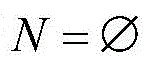

第三步:令


第四步:若没有遍历所有k值,将当前
第五步:若没有遍历所有n值,令n′=(n′+1)%|N|,并将集合N中的第n′个元素的值赋给n,转第三步;否则,令

第六步:输出解,运算停止。Step 6: Output the solution and stop the operation.
作为本发明的进一步技术方案,第三步中利用MATLAB的linprog函数求解优化模型。As a further technical solution of the present invention, in the third step, the linprog function of MATLAB is used to solve the optimization model.
作为本发明的进一步技术方案,所述宏蜂窝网络中,MBS的接入链路使用6GHz以下频段与用户进行连接,SCBS使用28GHz频段与用户进行连接,SCBS使用60GHz的毫米波与BAN进行回程传输;不同基站内部以及不同BAN内部存在信道复用的情况。As a further technical solution of the present invention, in the macro cellular network, the access link of the MBS uses the frequency band below 6GHz to connect with the user, the SCBS uses the 28GHz frequency band to connect with the user, and the SCBS uses the millimeter wave of 60GHz to perform backhaul transmission with the BAN ; There is channel multiplexing in different base stations and in different BANs.
作为本发明的进一步技术方案,所述宏蜂窝网络中,不同SCBS接入链路间存在来自邻近小区的SCBS的干扰,SCBS接入链路与MBS接入链路间不存在干扰,SCBS回程链路与其接入链路间也不存在干扰,不同BAN内的SCBS的回程链路间存在来自相邻BAN的干扰,连接到MBS的用户只受到来自其它相邻宏基站的干扰。As a further technical solution of the present invention, in the macrocellular network, there is interference from the SCBS of adjacent cells between different SCBS access links, there is no interference between the SCBS access link and the MBS access link, and the SCBS backhaul link There is no interference between the MBS and its access link, there is interference from adjacent BANs between the backhaul links of SCBSs in different BANs, and users connected to MBS only receive interference from other adjacent macro base stations.
本发明采用以上技术方案与现有技术相比,具有以下技术效果:本发明的面向5G网络的无线回程优化方法,从系统模型出发,分析干扰,构造信噪比,计算重传时延;进而,综合考虑吞吐量、时延、用户数、功率分配等因素,建立以时延最小化、吞吐量最大化为目标的优化模型;最后,由所提出的基于分支定界思想的求解算法进行求解。一方面,在保证对每个用户公平的基础上,尽可能的满足了每个用户的需求;另一方面,在考虑资源平衡的基础上,使得基于用户选择后的网络总体平均时延最小、吞吐量最大。Compared with the prior art, the present invention adopts the above technical solution, and has the following technical effects: the wireless backhaul optimization method for 5G network of the present invention starts from a system model, analyzes interference, constructs a signal-to-noise ratio, and calculates the retransmission delay; , and comprehensively consider factors such as throughput, delay, number of users, and power allocation, and establish an optimization model aiming at minimizing delay and maximizing throughput. . On the one hand, on the basis of ensuring fairness to each user, the needs of each user are satisfied as much as possible; maximum throughput.
附图说明Description of drawings
图1为本发明提供的所研究系统的系统图。FIG. 1 is a system diagram of the studied system provided by the present invention.
图2为本发明提供的一种面向5G网络的无线回程优化方法流程图。FIG. 2 is a flowchart of a wireless backhaul optimization method for a 5G network provided by the present invention.
具体实施方式Detailed ways
下面结合附图对本发明的技术方案做进一步的详细说明:Below in conjunction with accompanying drawing, the technical scheme of the present invention is described in further detail:
本发明一种面向5G网络的无线回程优化方法,用于宏蜂窝网络,具体步骤如图2所示。The present invention is a 5G network-oriented wireless backhaul optimization method, which is used in a macro cellular network, and the specific steps are shown in FIG. 2 .
步骤1,分析所研究的系统模型,包含系统模型的结构和频谱分配两个方面,具体为:Step 1, analyze the system model under study, including the structure of the system model and spectrum allocation, specifically:
步骤1.1,本发明所分析研究的系统是一个宏蜂窝网络,其中覆盖有许多小基站。用户可以通过无线连接的方式连接到宏基站(macro base station,MBS)或者一个小基站(small cell base station,SCBS)。MBS通过专用的光纤与核心网相连;SCBS需要通过无线连接的方式连接到回程聚集节点(Backhaul aggregate node,BAN),而BAN再通过专用的光纤与核心网相连进行回程传输;Step 1.1, the system analyzed and studied in the present invention is a macrocellular network, which covers many small base stations. A user can connect to a macro base station (MBS) or a small cell base station (SCBS) through a wireless connection. The MBS is connected to the core network through a dedicated optical fiber; the SCBS needs to be connected to the backhaul aggregate node (BAN) through a wireless connection, and the BAN is connected to the core network through a dedicated optical fiber for backhaul transmission;
步骤1.2,分析所研究系统的频谱分配。其中,MBS的接入链路使用6GHz以下频段与用户进行连接,SCBS使用28GHz频段与用户进行连接,SCBS使用60GHz的毫米波与BAN进行回程传输,而MBS与核心网之间以及BAN与核心网之间通过专用的、高速率的光纤进行传输。另外,不同基站内部,以及不同BAN内部,存在信道复用的情况。Step 1.2, analyze the spectrum allocation of the system under study. Among them, the access link of MBS uses the frequency band below 6GHz to connect with users, SCBS uses the 28GHz frequency band to connect with users, SCBS uses 60GHz millimeter wave for backhaul transmission with BAN, and between MBS and core network and between BAN and core network They are transmitted through dedicated, high-speed optical fibers. In addition, within different base stations and within different BANs, there are cases of channel multiplexing.
步骤2,分析各节点的干扰,具体为:Step 2, analyze the interference of each node, specifically:
不同SCBS接入链路间存在来自邻近小区的SCBS的干扰,而SCBS接入链路与MBS接入链路间不存在干扰,SCBS回程链路与其接入链路间也不存在干扰,而不同BAN内的SCBS的回程链路间存在来自相邻BAN的干扰。同时,我们假定连接到MBS的用户只受到噪声功率为N1的干扰,该干扰来自其它相邻宏基站。There is interference from the SCBS of neighboring cells between different SCBS access links, but there is no interference between the SCBS access link and the MBS access link, and there is no interference between the SCBS backhaul link and its access link. There is interference from neighboring BANs between backhaul links of SCBSs within a BAN. At the same time, we assume that users connected to MBS only experience interference with noise power N1 from other neighboring macro base stations.
步骤3,构造信噪比计算公式,具体为:Step 3, construct a formula for calculating the signal-to-noise ratio, specifically:

该公式表示连接到MBS的用户的接收信噪比,其中,

该公式表示连接到SCBS的用户的接收信噪比,其中,


该公式表示SCBS端的接收信噪比,其中,

步骤4,在定义重发的时间间隔的基础上,提出基于数据重发的传输模型,具体为:Step 4: On the basis of defining the retransmission time interval, a transmission model based on data retransmission is proposed, specifically:
步骤4.1,在无线接入端,MBS与用户之间以及SCBS与用户之间通过无线方式连接,存在数据重发的可能性。当接收失败需要重发时,无线传输会产生时延。造成重发的原因有多种,这里,主要考虑来自其它发射器和信道衰落的干扰。此外,考虑如下这样一个模型,每个数据包会被反复地传输直到被成功接收,若成功接收时的重传次数小于等于预定义的最大重传次数,则用户向MBS或SCBS发送一个1bit的确认信息,否则令成功接收时的重传次数等于预定义的最大重传次数,且用户向MBS或SCBS发送一个1bit的非确认信息。需要说明的是,此处假设这些1bit的确认信息传输的时延和误差可以忽略。Step 4.1, at the wireless access end, the MBS and the user and between the SCBS and the user are connected wirelessly, and there is a possibility of data retransmission. When the reception fails and needs to be retransmitted, the wireless transmission will cause a delay. There are many reasons for retransmission. Here, interference from other transmitters and channel fading are mainly considered. In addition, consider the following model, each data packet will be repeatedly transmitted until it is successfully received, if the number of retransmissions during successful reception is less than or equal to the predefined maximum number of retransmissions, the user sends a 1-bit message to the MBS or SCBS. Confirmation information, otherwise the number of retransmissions when successfully received is equal to the predefined maximum number of retransmissions, and the user sends a 1-bit non-confirmation information to the MBS or SCBS. It should be noted that it is assumed here that the delay and error in the transmission of these 1-bit acknowledgment information can be ignored.
步骤4.2,在无线回程端,SCBS到BAN的链路为无线回程链路,存在重发的可能性,其时延的产生类似于无线接入端时延的产生。Step 4.2, at the wireless backhaul end, the link from the SCBS to the BAN is a wireless backhaul link, there is a possibility of retransmission, and the generation of the delay is similar to the generation of the delay of the wireless access end.
步骤5,计算重传时延,具体为:Step 5: Calculate the retransmission delay, specifically:
假设数据包由MBS到用户成功下行传输一次的概率是pm,且数据包由MBS到用户成功下行传输的重传次数为R0。假定一个数据包从MBS传送到用户从而完成一次数据传输的时间花费是T0,则成功传输的平均时延为:It is assumed that the probability of successful downlink transmission of a data packet from the MBS to the user once is p m , and the number of retransmissions of the successful downlink transmission of the data packet from the MBS to the user is R 0 . Assuming that the time for a data packet to be transmitted from the MBS to the user to complete a data transmission is T 0 , the average delay of successful transmission is:

假设数据包由SCBS到用户成功下行传输一次的概率是ps,且数据包由SCBS到用户成功下行传输的重传次数为R1。假定一个数据包从SCBS传送到用户从而完成一次数据传输的时间花费是T1,则成功传输的平均时延为:It is assumed that the probability of a successful downlink transmission of the data packet from the SCBS to the user once is p s , and the number of retransmissions of the successful downlink transmission of the data packet from the SCBS to the user is R 1 . Assuming that the time for a data packet to be transmitted from SCBS to the user to complete a data transmission is T 1 , the average delay of successful transmission is:

假设数据包由BAN到SCBS成功下行传输一次的概率是pb,且数据包由BAN到SCBS成功下行传输的重传次数为R2。假定一个数据包从BAN到SCBS从而完成一次数据传输的时间花费是T2,则成功传输的平均时延为:It is assumed that the probability of a successful downlink transmission of a data packet from the BAN to the SCBS once is p b , and the number of retransmissions of the successful downlink transmission of the data packet from the BAN to the SCBS is R 2 . Assuming that the time spent for a data packet from BAN to SCBS to complete a data transmission is T 2 , the average delay of successful transmission is:

步骤6,判断用户数是否超出系统容量,具体为:Step 6: Determine whether the number of users exceeds the system capacity, specifically:
系统中的最大容量为|K0|+|K1|·|M|,其中,K0表示MBS可分配给用户的信道集合,则|K0|表示MBS可分配给用户的信道数目;K1表示SCBS可分配用户的信道集合,则|K1|表示SCBS可分配用户的信道数目;M表示SCBS的集合,而|M|表示SCBS的数量;此外,N表示用户集合,|N|表示用户数量。所以,当|N|≤|K0|+|K1|·|M|,则说明用户数不超过系统容量;反之,则说明用户数超过系统容量。The maximum capacity in the system is |K 0 |+|K 1 |·|M|, where K 0 represents the set of channels that MBS can allocate to users, and |K 0 | represents the number of channels that MBS can allocate to users; K 1 represents the channel set of SCBS assignable users, then |K 1 | represents the number of channels of SCBS assignable users; M represents the set of SCBS, and |M| represents the number of SCBS; in addition, N represents the set of users, |N| represents amount of users. Therefore, when |N|≤|K 0 |+|K 1 |·|M|, it means that the number of users does not exceed the system capacity; otherwise, it means that the number of users exceeds the system capacity.
步骤7,若用户数没有超出系统容量,则建立普通优化模型,具体为:Step 7, if the number of users does not exceed the system capacity, establish a general optimization model, specifically:
maxRtotal-ετtotal maxR total -ετ total
s.t.s.t.


这里,τtotal表示网络总的平均传输时延。Rtotal表示网络的总吞吐量。


这里,前三个约束分别表示了MBS节点的功率约束、SBS节点的功率约束、BAN节点的功率约束;四、五、六约束分别限定了在各自链路上,同一信道只能被单独使用;更重要的是,第七个约束保证了任意一个用户必然使用某一条链路与MBS或者SBS进行连接;第八个约束保证了BAN内的任一SBS必然占用一条链路与BAN进行连接;最后是对变量的限定。Here, the first three constraints respectively represent the power constraints of MBS nodes, the power constraints of SBS nodes, and the power constraints of BAN nodes; the fourth, fifth, and sixth constraints are respectively limited to their respective links, and the same channel can only be used alone; More importantly, the seventh constraint ensures that any user must use a certain link to connect to the MBS or SBS; the eighth constraint ensures that any SBS in the BAN must occupy a link to connect to the BAN; finally is a restriction on the variable.
步骤8,若用户数超出系统容量,则建立特殊优化模型,具体为:Step 8: If the number of users exceeds the system capacity, a special optimization model is established, specifically:
当实际用户数量超过该系统下的最大容量时,即|N|>K0+K1·|M|时,此时必然有用户不能分配到带宽,从而不能满足用户的通信需求。此时普通优化模型中的第七个约束应松弛为When the actual number of users exceeds the maximum capacity under the system, that is, |N|>K 0 +K 1 ·|M|, there must be users who cannot be allocated bandwidth at this time, so that the communication requirements of users cannot be met. At this point the seventh constraint in the ordinary optimization model should be relaxed as

在此种情况下,为了尽可能的使得更多的用户可以进行通信,我们对普通优化模型的目标函数进行处理。定义用户的连接矩阵为X。||X||1表示此连接矩阵中的1的数目,即获得连接的用户数。同时,定义一个权值ω,将原优化模型的目标函数修改为:In this case, in order to allow as many users as possible to communicate, we process the objective function of the general optimization model. Define the user's connection matrix as X. ||X|| 1 represents the number of 1s in this connection matrix, i.e. the number of users who get connected. At the same time, define a weight ω, and modify the objective function of the original optimization model to:
maxRtotal-ετtotal+ω||X||1。maxR total -ετ total +ω||X|| 1 .
最后,将普通优化模型中的约束、目标函数进行相应的替换,从而建立特殊优化模型如下:Finally, the constraints and objective functions in the general optimization model are replaced accordingly, so as to establish a special optimization model as follows:
maxRtotal-ετtotal+ω||X||1 maxR total -ετ total +ω||X|| 1
s.t.s.t.


步骤9,根据所提出的基于分支定界的求解算法,对优化模型进行求解,得到信道分配,具体为:Step 9, according to the proposed solution algorithm based on branch and bound, the optimization model is solved to obtain the channel allocation, specifically:
由所建立模型中的约束条件


其详细步骤为:The detailed steps are:
第一步:令n=1,k=1,n′=1,k′=1。其中,n∈N,N=N(0)∪N(1);k∈K,K=K0∪K1。Step 1: Let n=1, k=1, n′=1, k′=1. Among them, n∈N, N=N (0) ∪N (1) ; k∈K, K=K 0 ∪K 1 .
第二步:若

第三步:令


第四步:若没有遍历所有k值,就将
第五步:若没有遍历所有n值,令n′=(n′+1)%|N|,并将集合N中的第n′个元素的值赋给n,转第三步;否则,令

第六步:输出解,运算停止。Step 6: Output the solution and stop the operation.
以上所述,仅为本发明中的具体实施方式,但本发明的保护范围并不局限于此,任何熟悉该技术的人在本发明所揭露的技术范围内,可理解想到的变换或替换,都应涵盖在本发明的包含范围之内,因此,本发明的保护范围应该以权利要求书的保护范围为准。The above is only a specific embodiment of the present invention, but the protection scope of the present invention is not limited to this, any person familiar with the technology can understand the transformation or replacement that comes to mind within the technical scope disclosed by the present invention, All should be included within the scope of the present invention, therefore, the protection scope of the present invention should be subject to the protection scope of the claims.
Claims (5)


Priority Applications (1)
| Application Number | Priority Date | Filing Date | Title |
|---|---|---|---|
| CN201710733856.3A CN107635236B (en) | 2017-08-24 | 2017-08-24 | Wireless backhaul optimization method for 5G network |
Applications Claiming Priority (1)
| Application Number | Priority Date | Filing Date | Title |
|---|---|---|---|
| CN201710733856.3A CN107635236B (en) | 2017-08-24 | 2017-08-24 | Wireless backhaul optimization method for 5G network |
Publications (2)
| Publication Number | Publication Date |
|---|---|
| CN107635236A CN107635236A (en) | 2018-01-26 |
| CN107635236B true CN107635236B (en) | 2021-01-19 |
Family
ID=61100183
Family Applications (1)
| Application Number | Title | Priority Date | Filing Date |
|---|---|---|---|
| CN201710733856.3A Active CN107635236B (en) | 2017-08-24 | 2017-08-24 | Wireless backhaul optimization method for 5G network |
Country Status (1)
| Country | Link |
|---|---|
| CN (1) | CN107635236B (en) |
Families Citing this family (6)
| Publication number | Priority date | Publication date | Assignee | Title |
|---|---|---|---|---|
| CN108200585B (en) * | 2018-02-02 | 2021-06-29 | 南京邮电大学 | Wireless backhaul optimization method in 5G two-layer heterogeneous scenario |
| US10356552B1 (en) | 2018-09-20 | 2019-07-16 | International Business Machines Corporation | Determining hardware requirements for a wireless network event using crowdsourcing |
| US10693730B2 (en) | 2018-11-20 | 2020-06-23 | International Business Machines Corporation | Communication quality management |
| CN110417847B (en) * | 2019-01-09 | 2020-09-01 | 北京邮电大学 | Method and device for user access and content caching of unmanned aerial vehicle communication network |
| CN109699040B (en) * | 2019-03-05 | 2020-03-03 | 深圳大学 | Resource optimization method of URLLC system based on retransmission mechanism of heuristic algorithm |
| CN113676979B (en) * | 2021-08-03 | 2024-04-26 | 哈尔滨工业大学 | End-to-end routing relay link selection method, system and device based on branch and bound method |
Citations (1)
| Publication number | Priority date | Publication date | Assignee | Title |
|---|---|---|---|---|
| CN106912074A (en) * | 2017-02-09 | 2017-06-30 | 电子科技大学 | A kind of user-association method based on return link capacity in heterogeneous network |
Family Cites Families (1)
| Publication number | Priority date | Publication date | Assignee | Title |
|---|---|---|---|---|
| CN103596233B (en) * | 2013-10-24 | 2016-10-12 | 西安电子科技大学 | A kind of interference elimination method alignd based on scheduling and two benches interference |
-
2017
- 2017-08-24 CN CN201710733856.3A patent/CN107635236B/en active Active
Patent Citations (1)
| Publication number | Priority date | Publication date | Assignee | Title |
|---|---|---|---|---|
| CN106912074A (en) * | 2017-02-09 | 2017-06-30 | 电子科技大学 | A kind of user-association method based on return link capacity in heterogeneous network |
Non-Patent Citations (2)
| Title |
|---|
| Joint TDD Backhaul and Access Optimization in Dense Small-Cell Networks;Mehrdad Shariat等;《IEEE Transactions on Vehicular Technology》;20141231;全文 * |
| 超密集蜂窝回程网络性能优化研究;涂松;《华中科技大学硕士学位论文》;20170501;全文 * |
Also Published As
| Publication number | Publication date |
|---|---|
| CN107635236A (en) | 2018-01-26 |
Similar Documents
| Publication | Publication Date | Title |
|---|---|---|
| CN107635236B (en) | Wireless backhaul optimization method for 5G network | |
| CN110784284B (en) | System and method for joint transmission over licensed and unlicensed frequency bands using fountain codes | |
| JP5213279B2 (en) | Computing device and apparatus | |
| US10021596B2 (en) | Communication system, communication device, base station and method thereof for D2D communications | |
| KR100849327B1 (en) | Combined Scheduling Method and Apparatus for Improving Frequency Efficiency and Fairness in Distributed Antenna Systems Using Frequency Recycling and Joint Power Control | |
| CN106465471B (en) | Systems and methods for wirelessly transmitting communications across licensed and unlicensed spectrum | |
| Jamil et al. | Improving the capacity of future IEEE 802.11 high efficiency WLANs | |
| CN105704824B (en) | A kind of method of the multi dimensional resource distribution of wireless network | |
| CN102823305B (en) | Communication control method, communication system and management server | |
| WO2013071719A1 (en) | System, method and base station for coordinating power of downlink control channel | |
| CN103974435A (en) | Method for performing radio resource management and wireless communication system thereof | |
| CN102821391A (en) | Distance ratio based D2D (dimension to dimension) link spectrum allocation method | |
| Tang et al. | Delay-aware dynamic resource allocation and ABS configuration algorithm in HetNets based on Lyapunov optimization | |
| JP5360653B2 (en) | Power control apparatus and communication network system including the same | |
| CN115226231A (en) | A wireless resource allocation method for high-speed rail communication based on information freshness | |
| CN105992219A (en) | Method and device for obtaining management strategy of heterogeneous network | |
| CN108174448A (en) | The resource allocation methods of honeycomb D2D communications and the application in wisdom traffic network | |
| WO2012037819A1 (en) | Device and method for allocating downlink relay backhaul resources | |
| Wei et al. | System-level simulations for multi-hop D2D communications overlay LTE networks | |
| CN113271614B (en) | Device and method for handling physical uplink control channel collision | |
| CN108200585B (en) | Wireless backhaul optimization method in 5G two-layer heterogeneous scenario | |
| CN102726102B (en) | Base station, mobile station and method in wireless heterogeneous network | |
| Afzal et al. | M2M meets D2D: Harnessing D2D interfaces for the aggregation of M2M data | |
| Yin et al. | Tradeoff between co-channel interference and collision probability in LAA systems | |
| CN107070627A (en) | A kind of equitable proportion frequency spectrum resource allocation method based on multi-hop mixing backhaul network |
Legal Events
| Date | Code | Title | Description |
|---|---|---|---|
| PB01 | Publication | ||
| PB01 | Publication | ||
| SE01 | Entry into force of request for substantive examination | ||
| SE01 | Entry into force of request for substantive examination | ||
| CB02 | Change of applicant information |
Address after: 210003, 66 new model street, Gulou District, Jiangsu, Nanjing Applicant after: NANJING University OF POSTS AND TELECOMMUNICATIONS Address before: 210003 no.9-1 GuangYue Road, Qixia street, Qixia District, Nanjing City, Jiangsu Province Applicant before: NANJING University OF POSTS AND TELECOMMUNICATIONS |
|
| CB02 | Change of applicant information | ||
| GR01 | Patent grant | ||
| GR01 | Patent grant | ||
| TR01 | Transfer of patent right |
Effective date of registration: 20210602 Address after: 210042 18 Xuanwu Road, Xuanwu District, Nanjing, Jiangsu, 699-22 Patentee after: CERTUSNET Corp. Address before: 210003, 66 new model street, Gulou District, Jiangsu, Nanjing Patentee before: NANJING University OF POSTS AND TELECOMMUNICATIONS |
|
| TR01 | Transfer of patent right |