This application claims the benefit of U.S. provisional patent application serial No. 62/138,002 filed 3/25/2015 and incorporated by reference into this document as if fully set forth herein.
Background
Vertical electric fumigators generally comprise: a vertical box type cooking and smoking chamber; a vertical front door for the cooking chamber; and internal electrical components. Electrical components are commonly used both to (a) heat the interior of a cooking chamber used to cook food and (b) heat small amounts of wood (e.g., wood chips, pellets, or other chips) to produce smoke within the cooking chamber. Often, the erected box will be built with insulated walls, windows in the door, and an electronic controller, including a remote control in some cases. Also, a single exhaust vent is typically provided in or near the top of the upright bin to allow smoke to flow out of the cooking chamber after contacting the food.
Examples of existing vertical electric fumigators are shown in us patent numbers D615798, D616243 and 7,426,885. In the vertical electric smoking machine of us patent No. 7,426,885, wood chips are placed in a loading chute that is inserted through an opening in the side of the cooking chamber. In such an arrangement, small amounts of wood chips, typically limited to less than one cup, must be added multiple times during the course of the cooking and smoking process.
Thus, when using existing upright electric smokers of the type shown in U.S. patent No. 7,426,885 for smoking a plurality of large pieces of food in a cooking chamber during a long, slow cooking cycle, the user must frequently assess when a new pile of wood chips is needed, typically by visually observing the amount and color of smoke exiting the cooking and smoking chambers. Then, in order to add each new pile of wood chips, the user must withdraw the wood loading chute, refill the chute with a new small pile of wood chips, and reinsert the loading chute into the cooking chamber.
Since this reloading process may need to be repeated multiple times during slow cooking and smoking cycles, a considerable amount of time and attention is required. Moreover, the amount of smoke generated within the cooking chamber is periodic such that: (a) for at least several minutes before the used stack of wood chips is replaced, the amount of smoke produced can be undesirably low; and (b) for several minutes after inserting a new pile of wood chips, initially little or no smoke will be generated.
In order to complete the entire cooking and smoking process without having to repeatedly replace the wood chips, the amount of wood chips placed in the cooking and smoking chamber at the beginning of the cooking cycle will have to be up to four times or more the amount of wood chips currently used in each of the individual stacks. Unfortunately, however, placing such a large pile of wood chips or pellets in close proximity to the electrical heating element for the purpose of generating smoke would cause various problems.
First, placing such a large amount of fuel in close proximity to a heat source can cause a fire in the cooking chamber. Second, even if the fire is suppressed, a higher rate of combustion will still occur, which will deplete the wood more quickly, while also generating more heat rather than smoke. Third, associated with the second problem, undesirably large amounts of dense smoke can accumulate within the cooking chamber and create an unpleasant cooking environment, which can result in excessive condensation of smoke and water vapor from the combustion process onto relatively cooler meat or other food products within the cooking and smoking chamber, and so forth.
Disclosure of Invention
The present invention satisfies the needs and alleviates the problems discussed above.
In one aspect, an upright electric heating apparatus for cooking and smoking is provided, wherein at least one air intake vent is provided in a lower portion of a cooking and smoking chamber of the apparatus and at least one exhaust vent is provided in an upper portion of the cooking and smoking chamber. Preferably, the apparatus comprises a pair of lower air intake vents on opposite sides of the cooking and smoking chamber and a pair of upper exhaust vents on opposite sides of the cooking and smoking chamber.
The ventilation arrangement structure of the inventionIn addition and surprisingly work to: (a) creating a balanced flow of ventilation air through the cooking and smoking chamber, thereby providing a more even distribution of smoke and heat within the chamber; (b) reduction of CO produced in a plant2The amount of (c); (c) the temperature in the cooking and smoking chamber is only slightly reduced for the first hour of operation, after which the temperature is similar; (d) consistently producing a desired concentration of smoke that is not excessively dark or excessively rich; (e) reducing the amount of smoke and water vapor condensing on the surface of the food; (f) reducing the working pressure within the cooking and smoking chamber to allow a much larger pile of wood chips to be placed in the apparatus; and (g) more uniformly filling the chamber with smoke without any voids in the cooking and smoking areas.
In another aspect, an improved heating element assembly is provided, comprising: (a) a tray holding one or more electric heating elements for the cooking and smoking apparatus; and (b) a smoke box holding table. The holding station receives the bottom of the smoke box (i.e., the container in which the wood chips or other wood chips are held and burned to produce smoke) and holds the smoke box above the electrical heating element. The holding stage preferably comprises: (a) a cover plate at least partially covering the electric heating element and serving as a bottom plate of the holding stage; (b) a plurality of spacers (standoffs) protruding from the upper surface of the cover plate to create an air gap between the cover plate and the bottom of the smoke box; and (c) a reflector extending rearwardly from the receiving station for shielding a rear portion of the smoke box.
These features of the heating element assembly operate to: (a) the temperature and heat transfer at the bottom of the smoke box are sufficiently reduced to increase the smoking time; (b) providing uniform heating of the wood chips throughout the lower floor of the chamber, so that the chips are simultaneously activated; and (c) eliminating the hot recess within the smoke box.
In another aspect, an improved smoke box is provided for holding wood chips or other debris and slowly burning the wood in an oxygen deficient environment to produce smoke of the wood for use in the cooking and smoking chambers of the inventive apparatus. The smoke box has a false bottom that creates an internal gap in the container below the wood chips. Further, the lid of the smoke box, one or more vertical sidewalls of the box, or a combination thereof, includes an exhaust flow assembly that defines a circuitous flow path in which smoke is required to flow through an inner flow gap (horizontal or vertical) and then change direction and flow through an outer flow gap (horizontal or vertical) as it travels to a smoke exhaust. In addition, one or more obstruction features (e.g., flow rail members with offset flow ports as discussed below) are preferably provided in each of the inner and outer flow gaps to encourage the smoke to also change direction, at least to some extent, as it flows from one end of the flow gap to the other.
This circuitous path for the exhaust of smoke products from the smoke box acts as a flame suppression mechanism to prevent and contain any fire in the smoke box, and additionally provides cooling and mixing of the generated smoke in the smoke box so that the exhaust smoke products have a relatively uniform temperature and smoke concentration. The length of the circuitous path also allows the temperature of the smoke to be hot enough to remain suspended in the atmosphere, but cold enough to remain well below any potential ignition point of the smoke as it exits the smoke box.
Furthermore, the advantageous features of the inventive smoke box work together with the inventive ventilation arrangement for the cooking and smoking chamber and the novel features of the inventive heating element assembly to allow a sufficient amount of wood chips to be placed in the smoke box to complete the cooking and smoking work without reloading.
In another aspect, an apparatus for cooking and smoking food is provided, comprising: (a) a vertically extending cooking and smoking chamber having a left side wall, a right side wall, a rear wall, a front opening, and a floor; (b) a door positionable over the front opening for closing and opening the front opening; (c) one or more air intake vents disposed in a lower portion of the cooking and smoking chamber; (d) one or more exhaust vents disposed in an upper portion of the cooking and smoking chamber; and (e) one or more electrical heating elements positioned in a lower portion of the cooking and smoking chamber, the one or more electrical heating elements being spaced above the floor of the cooking and smoking chamber.
The apparatus preferably includes two of the air intake vents and two of the exhaust vents, wherein a first of the air intake vents is disposed through a lower portion of the right sidewall, a second of the air intake vents is disposed through a lower portion of the left sidewall, a first of the exhaust vents is disposed through an upper portion of the right sidewall, and a second of the exhaust vents is disposed through an upper portion of the left sidewall. The first and second air intake vents are preferably located at a height at or below the height of the electric heating elements. Further, the cooking and smoking chamber has an uppermost food support shelf positioned therein, and the first and second exhaust vents are preferably positioned at a height above the height of the uppermost food support shelf in the cooking and smoking chamber.
The apparatus also preferably comprises: (a) a smoke box for producing smoke; and (b) a smoke box placement station in the cooking and smoking chamber for placing the smoke box at least partially over the one or more electrical heating elements. Preferably, the apparatus further comprises an element tray in which the one or more electric heating elements are positioned, the element tray being spaced above the floor of the cooking and smoking chamber. Further, the smoke box placing table preferably includes: (i) a cover plate on the element tray, the cover plate at least partially covering the one or more electric heating elements; and (ii) a plurality of spacer elements on the upper surface of the cover plate on which the smoke box can be placed to provide an air gap between the bottom of the smoke box and the cover plate.
The element tray of the device also preferably has a reflective upper surface positioned below the one or more electrical heating elements. In addition, the apparatus preferably comprises: (a) an air gap between the element tray and the rear wall of the cooking and smoking chamber; and (b) a horizontal reflector plate extending rearwardly from the element pan toward the rear wall of the cooking and smoking chamber, shielding the vertical rear side of the smoke box from radiant energy emitted from the one or more electric heating elements, reflected from the reflective upper surface of the element pan, or both.
In another aspect, a smoke box apparatus is provided that can be used in the inventive smoker or can be used in other applications. The inventive smoke box apparatus preferably comprises: (a) a vessel having an inner combustion zone for combusting wood chips or other debris in an oxygen deficient environment to produce smoke; and (b) an exhaust flow assembly defining a circuitous exhaust flow path for the smoke, wherein the smoke must flow in a first direction through an inner flow gap formed by the exhaust flow assembly and then must flow in a second direction different from the first direction through an outer flow gap formed by the exhaust flow assembly.
The container of the inventive smoke box also preferably has a false bottom positioned in the container at the bottom of the inner combustion zone, the false bottom being spaced above the true bottom of the container such that a bottom air space is defined between the false bottom and the true bottom of the container.
Furthermore, the exhaust flow assembly of the inventive smoke box preferably further comprises: (i) a first obstruction in the inner flow gap that at least temporarily alters the flow path of the smoke as it travels from the inlet end to the outlet end of the inner flow gap; and (ii) a second obstruction in the outer flow gap that at least temporarily alters the flow path of the smoke as it travels from the inlet end to the outlet end of the outer flow gap. The first and second obstruction features preferably each comprise an upstream track and a parallel downstream track, the upstream and downstream tracks each having a plurality of apertures for smoke to flow through the tracks, wherein the apertures of the downstream track are preferably misaligned with the apertures of the upstream track.
The exhaust flow assembly of the inventive smoke box may be formed in the lid of the container. As another alternative, the vent flow assembly may be formed in the vertical sidewall of the container. As yet another alternative, the vent flow assembly may be formed in multiple vertical sidewalls of the container.
Additional aspects, features and advantages of the present invention will become apparent to those of ordinary skill in the art upon careful consideration of the accompanying drawings and the following detailed description of the preferred embodiments.
Detailed Description
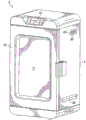
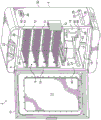
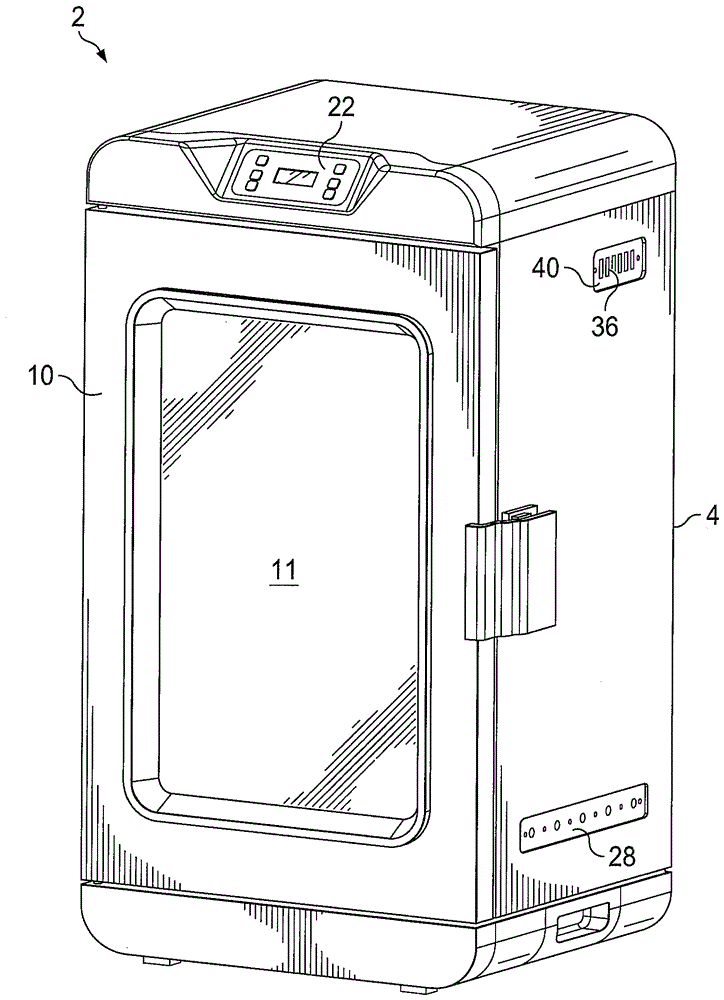
An embodiment 2 of the vertical electric cooking and smoking machine provided by the present invention is shown in fig. 1 and 2. The inventive electric cooking and smoking device 2 comprises: an upright rectangular box 4 having a vertical front opening 6; a cooking and smoking chamber 8 inside the upright box 4; a vertical front door 10, preferably having a window 11 therein, the vertical front door 10 being pivotally attached to the upright case 4 for opening and sealing closing the front opening 6 of the cooking and smoking chamber 8; a plurality of food holding shelves 12 removably positionable in the cooking and smoking chamber 8; an electric heating element assembly 14 spaced above the floor 16 of the cooking and smoking chamber 8; a smoke box 18 removably positionable on the heating element assembly 14; a removable tray or other container 20 adjacent the heating element assembly 14 for holding water or other liquid to maintain a desired level of moisture or flavorant vapor in the cooking and smoking chamber 8; and an electronic display and control panel 22 at the top of the box 4 above the door 10 for controlling the electric heating system and/or monitoring the temperature, cooking time and/or other parameters within the cooking and smoking chamber 8 in any desired manner.
Preferably, a plurality of food holding racks 12 are mounted on the opposing pressed side panels 15 using the common structure found in indoor ovens for holding cooking racks. However, the pressed detail 15 is not preferably integral with the side walls of the cooking and smoking chamber 8 as is otherwise typical in indoor ovens, but is more preferably attached as a separate part as depicted for additional flexibility in the manufacture and construction of the inventive apparatus 2.
As shown in FIGS. 1 and 2, two air intake vents 24 and 28 are provided in the lower portion of the cooking and smoking chamber 8. One of the lower air intake vents 24 is disposed through a left side wall 30 of the upright box 4 and the other air intake vent 28 is disposed through a right side wall 32 of the upright box 4, preferably directly opposite the left side intake vent 24. The air intake vents 24 and 28 are preferably located in the side walls 30 and 32 at or below the height of the heating element assembly 14.
Each of the side air intake vents 24 and 28 preferably comprises an opening (e.g., an elongated slit) or a series of openings 25 that (a) preferably extend laterally through at least 30% of the width of the side wall 30 or 32 (more preferably from about 75% to about 85% of the width of the side wall 30 or 32) in the side wall 30 or 32 of the upright box 4 and (b) are preferably centrally located in a lower portion of the side wall 30 or 32. Proportionally, the total flow (open) area provided by each of the air intake vents 24 and 28 per 2.94 cubic feet of volume of the cooking and smoking chamber 8 is preferably in the range of from about 1.0 to about 4.0 square inches, more preferably from about 2.0 to about 3.0 square inches. Although it is preferred that the air intake vents 24 and 28 be non-adjustable, the inventive apparatus 2 may alternatively include louvers, sliding covers, or other features for selectively varying the open area of the intake vents 24 and 28.
As further shown in FIGS. 1 and 2, two exhaust vents 34 and 36 are provided in the upper portion of the cooking and smoking chamber 8, preferably above the uppermost food support shelf 12 near the top of the cooking and smoking chamber 8. Preferably, one of the upper exhaust vents 34 is disposed through the left sidewall 30 of the upright tank 4 and the other upper exhaust vent 36 is disposed through the right sidewall 32 of the upright tank 4, preferably directly opposite the left exhaust vent 34.
Each of the exhaust vents 34 and 36 preferably: (a) is positioned from about 1.5 to about 6.5 inches from the upper end of the cooking and smoking chamber 8; (b) is positioned within a range of from about 2.5 to about 4.5 inches from the rear wall 38 of the cooking and smoking chamber 8; (c) having a louvered outer cover 40, the louvered outer cover 40 operative to direct smoke from a front end 94 of the cover assembly 82 of the smoke box 18 up and through the plurality of food holding shelves 12; and (d) providing a total effective proportional flow area through the lid 40 (if present) in the range of from about 4.0 to about 9.0 square inches, more preferably from about 6.0 to about 7.0 square inches per 2.94 cubic feet of volume of the cooking and smoking chamber 8.
The inventive placement of the lower pair of air intake vents 24 and 28 and the upper pair of exhaust vents 34 and 36 on each side of the cooking and smoking chamber 8 creates a balanced flow of ventilation air through the cooking and smoking chamber 8 on both sides, thereby providing a more even distribution of smoke and heat within the chamber 8. The cool, fresh outside air intake also reduced the CO as shown in the testing of inventive device 22And (4) generating. In these tests, the CO of the exhaust from the inventive cooking and smoking chamber 8 was above the space of the first two hours of operation2The concentration does not exceed 0.78%, normally between 0.10% and 0.15%. However, in the absence of air intake vents 24 and 28, CO is generated2Concentrations as high as 2.25%, normally between 1.3% and 2.1%.
Moreover, these tests additionally show that the cooling air flow provided by the inventive ventilation arrangement unexpectedly only slightly reduces the average internal temperature in the cooking and smoking chamber 8 for the first hour of operation, after which the temperature is similar. Although the reason for this surprising result is not known with certainty, it is believed to be the result of the predominant mode of cooking and smoking chamber 8 interior as a whole reaching a state of radiant heat equilibrium after one hour of operation with radiant energy becoming a heat transfer.
The visual effect of the use of the inventive ventilation arrangement with a large fuel load of the type described below is that the smoke of the wood does not become too dark or too rich but retains the desired light grayish blue color. The inventive venting arrangement also reduces the amount of smoke and water vapor condensing on the food surface during cooking.
In addition, the ventilation arrangement reduces the operating pressure within the cooking and smoking chamber 8 and, therefore, in conjunction with the larger size of the smoke box 18 (discussed below) and the inventive design and structure, allows for a much larger (up to as much as four cups or more) load of wood chips, pellets, or other debris to be used in the smoke box 18. Heretofore, in prior single top ventilated electric fume cupboards, the amount of wood chips that could be used in the cupboards was only about 3/4 cups or less due to the pressure caused by the partial combustion of the wood chips and the generation of smoke from the wood chips and the accumulation of unburned combustible hydrocarbons.
Moreover, by providing the lower air intake vents 24 and 28 and the upper exhaust vents 34 and 36 on both sides of the cooking and smoking chamber 8 of the inventive apparatus 2, the cooking and smoking chamber 8 is more uniformly filled with smoke without any voids in the cooking and smoking area. The inventive ventilation arrangement additionally assists in directing smoke upwardly through the food support shelf 12 to uniformly contact and cover the food product in a desired amount of smoke.
The improved electric heating element assembly 14 for use in the inventive vertical electric cooking and smoking machine 2 preferably comprises: a tray 46 having a reflective inner bottom surface 48; one or more electrical heating elements 50 positioned in the tray 46 above the reflective bottom surface 48; a rear accessory bracket 52; and a plurality of bottom legs 53. Rear bracket 52 secures heating element assembly 14 to rear wall 38 of cooking and smoking chamber 8 and provides an air gap between tray 46 and smoke box 18 and rear wall 38 of chamber 8. The bottom legs 53 preferably space the tray 46 about 2.25 inches above the bottom 16 of the cooking and smoking chamber 8. Also, a pair of spacers 54 and 57 project from the sides of the tray 46 for spacing the tray 46 and smoke box 18 from the inner surface of the right side wall 32 of the upright box 4 to provide an air gap of about 0.40 inches.
As seen in fig. 2 and 3, the position of the smoke box 18 relative to the heating element 50 is established with novel and effective features to control the heating of the wood chips or other chips contained in the box 18. This includes a unique retaining station 55 disposed on the tray 46, which retaining station 55 is used to receive the bottom of the smoke box 18 and retain the smoke box 18 above the electrical heating element 50.
The holding table 55 preferably includes: (a) a cover plate 56 at least partially covering the electric heating element 50 and serving as a bottom plate of the holding stage 55; (b) a plurality of spacers (standoffs) 58 protruding from the upper surface of the lid 56 to create an air gap 60 between the surface of the lid 56 and the bottom surface of the smoke box 18; (c) a receiving slot arrangement 65, the receiving slot arrangement 65 comprising two short upright side walls 62 and 64, a short upright rear wall 66 and an open front end 68 for receiving and aligning the bottom of the smoke box 18 on top of the cover plate 56; and (d) a reflective plate 70 extending rearwardly from the top of the short rear wall 66 of the smoke box receiving slot arrangement 65 for shielding the rear of the smoke box 18 from radiant energy emitted or reflected by the heating element 50 and/or the reflective surface 48.
The height of the standoffs 58 above the cover 56 is preferably at least 0.12 inches but no more than 0.25 inches. More preferably, the height of the stand-offs 58 is in the range of from about 0.10 inches to about 0.14 inches. By way of example, and not by way of limitation, the cap plate 56 is preferably formed from aluminized steel, mild steel, stainless steel, ceramic coated decarburized (de-carb) steel, cast iron, or cast aluminum, and the standoffs 58 are preferably formed from aluminized steel, mild steel, stainless steel, ceramic coated decarburized, cast iron, or cast aluminum.
Instead of the use of standoffs 58, a washer, a screw assembly, an extruded turned-over hole, a square extrusion, a plurality of elongated standoffs, for example, in the receiving slot arrangement 65 or in the bottom of the smoke box 18 may alternatively be used to create or provide a space between the cover plate 56 and the bottom of the smoke box 18.
In the inventive upright cooking and smoking device 2, a cover plate 56 that acts as a shield over the heating element 50, spacers (stand-offs) 58 that elevate the bottom of the smoke box 18 away from the cover plate 56, spacers 54 and 57 that provide an air gap between the sides of the smoke box 18 and the inside walls of the cooking and smoking chamber 8, and a rear reflector 70 that shields the rear of the smoke box 18 work together to: (a) sufficiently reduce the temperature and heat transfer at the bottom of the smoke box 18 to increase the smoking time; (b) providing uniform heating at the bottom of the smoke box 18 so that the entire lower bed of wood chips in the box 18 will start at the same time; and (c) eliminating hot pockets within the smoke box 18.
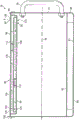
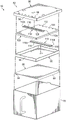
An embodiment 18 of the inventive smoke generating box for use in the upright electric cooking and smoking device 2 is illustrated in fig. 3-6. The inventive smoke box 18 comprises: a rectangular box 75 having a longitudinal axis 76; a front handle 78; a cold plate or "false bottom" 80 that fits within the rectangular box 75; and a removable cover assembly 82. The false bottom 80 has a pair of downwardly extending side spacer rails 84 and 86 that support and space the false bottom 80 above the bottom 81 of the tank 75 to provide an air gap 88 between the false bottom 80 and the true bottom 81 of the tank 75 of from about 0.20 inches to about 0.50 inches, more preferably from about 0.33 inches to about 0.38 inches. This additional air gap 88 in the bottom of the box 75 operates to further stabilize the heating of the wood chips or other wood chips in the smoke box 18.
The rectangular box 75 will preferably be sized to hold at least four cups of wood chips or other debris above the false bottom 80. The interior of the rectangular box 75 will preferably have: (a) a longitudinal length in a range from about 6.0 inches to about 6.25 inches; (b) a width in a range from about 4.25 inches to about 4.40 inches; and (c) a height in the range of from about 3.0 inches to about 3.25 inches.
The lid assembly 82 of the inventive smoke generating box 18 comprises: (a) a lower cover member 90, the lower cover member 90 having a row of transverse smoke ports 92 extending through the lower cover member 90 adjacent a front end 94 of the cover member 82; (b) an upper cover 96, the upper cover 96 having a row of transverse smoke ports 98 extending through the upper cover 96 adjacent the front end 94 of the cover assembly 82; (c) a middle cover 100 positioned between the upper cover 96 and the lower cover 90, the middle cover 100 having a row of lateral smoke ports 102 extending through the middle cover 100 adjacent a rear end 104 of the cover assembly 82; (d) a lower horizontal flow gap 106 formed between the lower cover 90 and the middle cover 100; (e) an upper horizontal flow gap 108 formed between the middle cap 100 and the upper cap 96; (f) a lower flow rail member 110 extending laterally in the lower flow gap 106; and (g) an upper flow rail member 112 extending laterally in the upper flow gap 108.
Each of the laterally extending upper and lower flow rail members 110 and 112 includes a pair of parallel pass-through rails 110a and 110b and 112a and 112b that extend laterally across and block the upper and lower horizontal flow gaps 106 and 108. The upstream rail 110a, 112a of each rail member 110, 112 has a series of smoke inlet apertures 114, 116 disposed therethrough. The downstream tracks 110b, 112b of each track member 110, 112 have a series of smoke outlet apertures 118, 120 disposed therethrough. Preferably, the smoke outlet apertures 118, 120 of each rail member 110, 112 are not aligned with the smoke inlet apertures 114, 116 of the rail members 110, 112. Thus, smoke flowing into the inlet apertures 114, 116 cannot flow directly (e.g., in a straight line) through the outlet apertures 118, 120, but instead is forced to change direction at least to some extent within the rail members 110, 112.
The lower track member 110 is preferably positioned in the lower flow gap 106 at a distance from the inlet end 122 to the outlet end 124 of the lower flow gap 106 of from about 1/3 to about 4/5, more preferably from about 1/2 to about 3/4. Similarly, the upper track member 112 is preferably positioned in the upper flow gap 108 at a distance from the inlet end 126 to the outlet end 128 of the upper flow gap 108 of from about 1/3 to about 4/5, more preferably from about 1/2 to about 3/4.
For each of the lower cover 90, upper cover 96 and middle cover 100, the total proportional flow area of the smoke ports of the respective row 92, 98 or 102 disposed therethrough will preferably be in the range of from about 0.9 to about 2.6 square inches, more preferably from about 1.3 to about 1.6 square inches per 80 cubic inch of volume of the cooking and smoking chamber 18.
The lower flow gap 106 and the upper flow gap 108 formed between the covers will preferably each have a height in the range of from about 0.10 to about 0.17 inches, more preferably from about 0.12 to about 0.15 inches.
The total proportional flow area of the smoke inlet or smoke outlet apertures 114, 116, 118, or 120 disposed through each of the separate upstream and downstream tracks 110a, 110b, 112a, or 112b of the track members 110 and 112 will preferably be in the range of from about 0.25 to about 1.0 square inches, more preferably from about 0.44 to about 0.62 square inches, per 80 cubic inches of volume of the cooking and smoking chamber 18. For each of the track members 110 and 112, the distance between its upstream track 110a, 112a and downstream track 110b, 112b will preferably be in the range of from about 0.25 to about 0.50 inches, more preferably from about 0.36 to about 0.40 inches.
In the inventive smoke box 18, smoke produced by the wood chips in the heating box 75 is forced to flow along a defined circuitous flow path 130 in which the smoke travels into the smoke port 92 of the lower cover member 90, through the first portion of the lower horizontal flow gap 106 to the lower track member 110, through the offset apertures 110a and 110b of the lower track member, from the lower track member 110 to the smoke port 102 of the middle cover member 100, through the first portion of the upper horizontal flow gap 108 to the upper track member 112, through the offset apertures 112a and 112b of the upper track member 112, from the upper track member 112 to the smoke port 98 of the upper cover member 96, and out of the smoke port 98 into the cooking and smoking chamber 2 of the inventive vertical electrical appliance.
This circuitous path 130 acts as a flame suppression mechanism to prevent and contain any fire in the smoke box and additionally provides cooling and mixing of the generated smoke in the inventive smoke box 18 so that the smoke exiting the lid outlet opening 98 has a relatively uniform temperature and smoke concentration. The length of the circuitous path 130 also allows the temperature of the smoke to be hot enough to maintain the smoke particles suspended in the atmosphere, but cold enough to remain well below any ignition point as the smoke exits the smoke box 18.
An alternative embodiment 150 of the inventive smoke box is illustrated in figures 7 and 8. The inventive smoke box 150 is substantially identical to the inventive smoke box 18, except that instead of providing a circuitous exit path for smoke through the lid of the box, a substantially similar flow path 152 is provided in one, two, three or all four of the vertical sides 154, 156, 158, 160 of the inventive smoke box 150.
In the inventive smoke box 150, each of the one or more vertical sides in which the circuitous smoke exit path 152 is disposed comprises: (a) an inner vertical wall 162 having a discharge port 164, the discharge port 164 extending across an upper end portion of the inner vertical wall 162; (b) an outer vertical wall 166 having an open upper end 168; (c) a middle vertical wall 170 positioned between the inner vertical wall 162 and the outer vertical wall 166 and having a discharge outlet 175, the discharge outlet 175 extending across a bottom portion of the middle vertical wall 170; (d) an inner vertical flow gap 172 formed between the inner vertical wall 162 and the middle vertical wall 170; (e) an outer vertical flow gap 174 formed between the middle vertical wall 170 and the outer vertical wall 166; (f) an inner flow rail member 176 extending horizontally in the inner flow gap 172; (g) an outer flow rail member 178 extending horizontally in the outer vertical flow gap 174; and (h) a row of smoke evacuation ports 180 formed through the top of the lid 182 of the bin along the edge of the lid 182 for placement over the open upper end 168 of the outer vertical wall 166.
Thus, in the circuitous flow path 152 defined in the inventive smoke box 150, smoke is forced to flow into the smoke ports 164 at the upper end of the inner vertical wall 162, downwardly through the inner flow gap 172 to the inner track member 176, from the inner track member 176 to the flow ports at the bottom of the middle vertical wall 170, upwardly through the outer vertical flow gap 174 to the outer track member 178, and from the outer track member 178 to the smoke outlet 180 of the lid 182 and out of the smoke outlet 180 of the lid 182. Alternatively, the smoke may exit through a side exhaust provided at the upper end of the outer wall 166 rather than through the lid 182.
The flow port areas for the walls and lid of the circuitous flow path 152 of the inventive smoke box 150, the rail member flow port areas, and the flow gap widths will preferably be the same as those of the flow path 130 provided in the lid assembly of the inventive smoke box 18.
Accordingly, the present invention is well adapted to carry out the objects and attain the ends and advantages mentioned as well as those inherent therein. Although a presently preferred embodiment has been described for purposes of this disclosure, many variations and modifications will be apparent to those of ordinary skill in the art. Such changes and modifications are intended to be included within the scope of the present invention.