CN107952425B - Preparation method of antitumor drug NVP-BEZ235 intermediate - Google Patents
Preparation method of antitumor drug NVP-BEZ235 intermediate Download PDFInfo
- Publication number
- CN107952425B CN107952425B CN201711442658.8A CN201711442658A CN107952425B CN 107952425 B CN107952425 B CN 107952425B CN 201711442658 A CN201711442658 A CN 201711442658A CN 107952425 B CN107952425 B CN 107952425B
- Authority
- CN
- China
- Prior art keywords
- attapulgite
- tin
- catalyst
- chloro
- nitroquinoline
- Prior art date
- Legal status (The legal status is an assumption and is not a legal conclusion. Google has not performed a legal analysis and makes no representation as to the accuracy of the status listed.)
- Active
Links
- JOGKUKXHTYWRGZ-UHFFFAOYSA-N dactolisib Chemical compound O=C1N(C)C2=CN=C3C=CC(C=4C=C5C=CC=CC5=NC=4)=CC3=C2N1C1=CC=C(C(C)(C)C#N)C=C1 JOGKUKXHTYWRGZ-UHFFFAOYSA-N 0.000 title abstract description 14
- 229950006418 dactolisib Drugs 0.000 title abstract description 13
- 238000002360 preparation method Methods 0.000 title abstract description 11
- 239000002246 antineoplastic agent Substances 0.000 title abstract description 10
- 229940041181 antineoplastic drug Drugs 0.000 title abstract description 10
- 239000003054 catalyst Substances 0.000 claims abstract description 91
- 229910052625 palygorskite Inorganic materials 0.000 claims abstract description 67
- 229960000892 attapulgite Drugs 0.000 claims abstract description 66
- 238000006243 chemical reaction Methods 0.000 claims abstract description 58
- QTBSBXVTEAMEQO-UHFFFAOYSA-N Acetic acid Chemical compound CC(O)=O QTBSBXVTEAMEQO-UHFFFAOYSA-N 0.000 claims abstract description 49
- 239000011973 solid acid Substances 0.000 claims abstract description 41
- KHKPVEMMXJCWGP-UHFFFAOYSA-N 6-bromo-4-chloro-3-nitroquinoline Chemical compound C1=CC(Br)=CC2=C(Cl)C([N+](=O)[O-])=CN=C21 KHKPVEMMXJCWGP-UHFFFAOYSA-N 0.000 claims abstract description 29
- MCMNRKCIXSYSNV-UHFFFAOYSA-N ZrO2 Inorganic materials O=[Zr]=O MCMNRKCIXSYSNV-UHFFFAOYSA-N 0.000 claims abstract description 25
- VXDPOGVDHHJTDY-UHFFFAOYSA-N 2-(4-aminophenyl)-2-methylpropanenitrile Chemical compound N#CC(C)(C)C1=CC=C(N)C=C1 VXDPOGVDHHJTDY-UHFFFAOYSA-N 0.000 claims abstract description 23
- 238000001354 calcination Methods 0.000 claims abstract description 23
- 239000002253 acid Substances 0.000 claims abstract description 22
- QAOWNCQODCNURD-UHFFFAOYSA-N sulfuric acid Substances OS(O)(=O)=O QAOWNCQODCNURD-UHFFFAOYSA-N 0.000 claims abstract description 19
- ATJFFYVFTNAWJD-UHFFFAOYSA-N Tin Chemical compound [Sn] ATJFFYVFTNAWJD-UHFFFAOYSA-N 0.000 claims abstract description 11
- 229910021627 Tin(IV) chloride Inorganic materials 0.000 claims abstract description 9
- XPGAWFIWCWKDDL-UHFFFAOYSA-N propan-1-olate;zirconium(4+) Chemical compound [Zr+4].CCC[O-].CCC[O-].CCC[O-].CCC[O-] XPGAWFIWCWKDDL-UHFFFAOYSA-N 0.000 claims abstract description 9
- HPGGPRDJHPYFRM-UHFFFAOYSA-J tin(iv) chloride Chemical compound Cl[Sn](Cl)(Cl)Cl HPGGPRDJHPYFRM-UHFFFAOYSA-J 0.000 claims abstract description 9
- 238000007598 dipping method Methods 0.000 claims abstract description 4
- OKKJLVBELUTLKV-UHFFFAOYSA-N Methanol Chemical compound OC OKKJLVBELUTLKV-UHFFFAOYSA-N 0.000 claims description 54
- WYURNTSHIVDZCO-UHFFFAOYSA-N Tetrahydrofuran Chemical compound C1CCOC1 WYURNTSHIVDZCO-UHFFFAOYSA-N 0.000 claims description 36
- 239000002904 solvent Substances 0.000 claims description 21
- 238000000034 method Methods 0.000 claims description 20
- VEXZGXHMUGYJMC-UHFFFAOYSA-N Hydrochloric acid Chemical compound Cl VEXZGXHMUGYJMC-UHFFFAOYSA-N 0.000 claims description 19
- YLQBMQCUIZJEEH-UHFFFAOYSA-N tetrahydrofuran Natural products C=1C=COC=1 YLQBMQCUIZJEEH-UHFFFAOYSA-N 0.000 claims description 18
- 238000003756 stirring Methods 0.000 claims description 17
- XLYOFNOQVPJJNP-UHFFFAOYSA-N water Substances O XLYOFNOQVPJJNP-UHFFFAOYSA-N 0.000 claims description 16
- 239000012299 nitrogen atmosphere Substances 0.000 claims description 15
- 238000004128 high performance liquid chromatography Methods 0.000 claims description 13
- 239000002245 particle Substances 0.000 claims description 13
- XEKOWRVHYACXOJ-UHFFFAOYSA-N Ethyl acetate Chemical compound CCOC(C)=O XEKOWRVHYACXOJ-UHFFFAOYSA-N 0.000 claims description 12
- 239000012065 filter cake Substances 0.000 claims description 12
- 239000000706 filtrate Substances 0.000 claims description 12
- 238000001914 filtration Methods 0.000 claims description 12
- 239000000843 powder Substances 0.000 claims description 12
- 238000005406 washing Methods 0.000 claims description 11
- YMWUJEATGCHHMB-UHFFFAOYSA-N Dichloromethane Chemical compound ClCCl YMWUJEATGCHHMB-UHFFFAOYSA-N 0.000 claims description 8
- LFQSCWFLJHTTHZ-UHFFFAOYSA-N Ethanol Chemical compound CCO LFQSCWFLJHTTHZ-UHFFFAOYSA-N 0.000 claims description 8
- BDERNNFJNOPAEC-UHFFFAOYSA-N propan-1-ol Chemical compound CCCO BDERNNFJNOPAEC-UHFFFAOYSA-N 0.000 claims description 8
- 238000009210 therapy by ultrasound Methods 0.000 claims description 8
- 238000001816 cooling Methods 0.000 claims description 7
- 238000001514 detection method Methods 0.000 claims description 7
- 238000001035 drying Methods 0.000 claims description 7
- IMNFDUFMRHMDMM-UHFFFAOYSA-N N-Heptane Chemical compound CCCCCCC IMNFDUFMRHMDMM-UHFFFAOYSA-N 0.000 claims description 6
- YXFVVABEGXRONW-UHFFFAOYSA-N Toluene Chemical compound CC1=CC=CC=C1 YXFVVABEGXRONW-UHFFFAOYSA-N 0.000 claims description 6
- 239000012296 anti-solvent Substances 0.000 claims description 6
- 150000001875 compounds Chemical class 0.000 claims description 6
- 230000007935 neutral effect Effects 0.000 claims description 6
- 239000002244 precipitate Substances 0.000 claims description 6
- BFZRWFNXSNWGCF-UHFFFAOYSA-N 2-[4-[(6-bromo-3-nitroquinolin-4-yl)amino]phenyl]-2-methylpropanenitrile Chemical compound C1=CC(C(C)(C#N)C)=CC=C1NC1=C([N+]([O-])=O)C=NC2=CC=C(Br)C=C12 BFZRWFNXSNWGCF-UHFFFAOYSA-N 0.000 claims description 5
- 238000006555 catalytic reaction Methods 0.000 claims description 5
- 239000004927 clay Substances 0.000 claims description 5
- 230000008569 process Effects 0.000 claims description 5
- 238000000967 suction filtration Methods 0.000 claims description 5
- OFBQJSOFQDEBGM-UHFFFAOYSA-N Pentane Chemical group CCCCC OFBQJSOFQDEBGM-UHFFFAOYSA-N 0.000 claims description 4
- JWUJQDFVADABEY-UHFFFAOYSA-N 2-methyltetrahydrofuran Chemical compound CC1CCCO1 JWUJQDFVADABEY-UHFFFAOYSA-N 0.000 claims description 3
- VHUUQVKOLVNVRT-UHFFFAOYSA-N Ammonium hydroxide Chemical compound [NH4+].[OH-] VHUUQVKOLVNVRT-UHFFFAOYSA-N 0.000 claims description 3
- 230000032683 aging Effects 0.000 claims description 3
- 235000011114 ammonium hydroxide Nutrition 0.000 claims description 3
- CTOTZVJGUWEKLV-UHFFFAOYSA-N propan-1-ol;zirconium(4+) Chemical compound [Zr+4].CCCO CTOTZVJGUWEKLV-UHFFFAOYSA-N 0.000 claims description 3
- 238000010992 reflux Methods 0.000 claims description 3
- 125000000218 acetic acid group Chemical group C(C)(=O)* 0.000 claims 1
- 230000003197 catalytic effect Effects 0.000 abstract description 13
- -1 3-nitro-6-bromoquinoline-4-yl Chemical group 0.000 abstract description 10
- CIUQDSCDWFSTQR-UHFFFAOYSA-N [C]1=CC=CC=C1 Chemical compound [C]1=CC=CC=C1 CIUQDSCDWFSTQR-UHFFFAOYSA-N 0.000 abstract description 6
- QCWXUUIWCKQGHC-UHFFFAOYSA-N Zirconium Chemical compound [Zr] QCWXUUIWCKQGHC-UHFFFAOYSA-N 0.000 abstract description 4
- 230000015572 biosynthetic process Effects 0.000 abstract description 4
- LRDFRRGEGBBSRN-UHFFFAOYSA-N isobutyronitrile Chemical compound CC(C)C#N LRDFRRGEGBBSRN-UHFFFAOYSA-N 0.000 abstract description 4
- 238000003786 synthesis reaction Methods 0.000 abstract description 4
- 229910052726 zirconium Inorganic materials 0.000 abstract description 4
- 230000003321 amplification Effects 0.000 abstract description 3
- 239000003814 drug Substances 0.000 abstract description 3
- 238000003199 nucleic acid amplification method Methods 0.000 abstract description 3
- 229940079593 drug Drugs 0.000 abstract description 2
- 238000004519 manufacturing process Methods 0.000 abstract description 2
- 125000002924 primary amino group Chemical group [H]N([H])* 0.000 abstract description 2
- 239000000243 solution Substances 0.000 description 23
- 239000011148 porous material Substances 0.000 description 11
- CSCPPACGZOOCGX-UHFFFAOYSA-N Acetone Chemical compound CC(C)=O CSCPPACGZOOCGX-UHFFFAOYSA-N 0.000 description 10
- 239000002994 raw material Substances 0.000 description 10
- 239000000758 substrate Substances 0.000 description 10
- 230000000694 effects Effects 0.000 description 8
- 238000010438 heat treatment Methods 0.000 description 5
- 238000010534 nucleophilic substitution reaction Methods 0.000 description 5
- IJGRMHOSHXDMSA-UHFFFAOYSA-N Atomic nitrogen Chemical compound N#N IJGRMHOSHXDMSA-UHFFFAOYSA-N 0.000 description 4
- 102000038030 PI3Ks Human genes 0.000 description 4
- 108091007960 PI3Ks Proteins 0.000 description 4
- VYPSYNLAJGMNEJ-UHFFFAOYSA-N Silicium dioxide Chemical compound O=[Si]=O VYPSYNLAJGMNEJ-UHFFFAOYSA-N 0.000 description 4
- 102000013530 TOR Serine-Threonine Kinases Human genes 0.000 description 4
- 108010065917 TOR Serine-Threonine Kinases Proteins 0.000 description 4
- 239000012295 chemical reaction liquid Substances 0.000 description 4
- BJMBNXMMZRCLFY-UHFFFAOYSA-N [N].[N].CN(C)C=O Chemical compound [N].[N].CN(C)C=O BJMBNXMMZRCLFY-UHFFFAOYSA-N 0.000 description 3
- 238000010306 acid treatment Methods 0.000 description 3
- 230000004913 activation Effects 0.000 description 3
- 125000003118 aryl group Chemical group 0.000 description 3
- 230000009286 beneficial effect Effects 0.000 description 3
- 230000009849 deactivation Effects 0.000 description 3
- 239000000047 product Substances 0.000 description 3
- 150000003248 quinolines Chemical class 0.000 description 3
- 238000004064 recycling Methods 0.000 description 3
- 238000002791 soaking Methods 0.000 description 3
- 239000000126 substance Substances 0.000 description 3
- JHCDHLDBDYBPBQ-UHFFFAOYSA-N 2-chloroquinoline-8-carbonitrile Chemical compound Clc1ccc2cccc(C#N)c2n1 JHCDHLDBDYBPBQ-UHFFFAOYSA-N 0.000 description 2
- GIMHFTJFCRTQRS-UHFFFAOYSA-N 6-chloro-5-nitroquinoline Chemical compound C1=CC=C2C([N+](=O)[O-])=C(Cl)C=CC2=N1 GIMHFTJFCRTQRS-UHFFFAOYSA-N 0.000 description 2
- GKJSZXGYFJBYRQ-UHFFFAOYSA-N 6-chloroquinoline Chemical compound N1=CC=CC2=CC(Cl)=CC=C21 GKJSZXGYFJBYRQ-UHFFFAOYSA-N 0.000 description 2
- WQZQFYRSYLXBGP-UHFFFAOYSA-N 7-chloro-2-methylquinoline Chemical compound C1=CC(Cl)=CC2=NC(C)=CC=C21 WQZQFYRSYLXBGP-UHFFFAOYSA-N 0.000 description 2
- IAZDPXIOMUYVGZ-WFGJKAKNSA-N Dimethyl sulfoxide Chemical compound [2H]C([2H])([2H])S(=O)C([2H])([2H])[2H] IAZDPXIOMUYVGZ-WFGJKAKNSA-N 0.000 description 2
- CSNNHWWHGAXBCP-UHFFFAOYSA-L Magnesium sulfate Chemical compound [Mg+2].[O-][S+2]([O-])([O-])[O-] CSNNHWWHGAXBCP-UHFFFAOYSA-L 0.000 description 2
- 150000004982 aromatic amines Chemical class 0.000 description 2
- 239000012298 atmosphere Substances 0.000 description 2
- 150000001793 charged compounds Chemical class 0.000 description 2
- 239000002734 clay mineral Substances 0.000 description 2
- CTQMJYWDVABFRZ-UHFFFAOYSA-N cloxiquine Chemical compound C1=CN=C2C(O)=CC=C(Cl)C2=C1 CTQMJYWDVABFRZ-UHFFFAOYSA-N 0.000 description 2
- 230000007547 defect Effects 0.000 description 2
- 230000008021 deposition Effects 0.000 description 2
- 125000006575 electron-withdrawing group Chemical group 0.000 description 2
- 238000002474 experimental method Methods 0.000 description 2
- 125000000524 functional group Chemical group 0.000 description 2
- 238000005470 impregnation Methods 0.000 description 2
- 238000011068 loading method Methods 0.000 description 2
- 238000002156 mixing Methods 0.000 description 2
- 229910052757 nitrogen Inorganic materials 0.000 description 2
- 239000003960 organic solvent Substances 0.000 description 2
- 239000008213 purified water Substances 0.000 description 2
- 125000002943 quinolinyl group Chemical group N1=C(C=CC2=CC=CC=C12)* 0.000 description 2
- 230000036632 reaction speed Effects 0.000 description 2
- 230000035484 reaction time Effects 0.000 description 2
- 239000000377 silicon dioxide Substances 0.000 description 2
- 239000007787 solid Substances 0.000 description 2
- 238000001291 vacuum drying Methods 0.000 description 2
- 239000002699 waste material Substances 0.000 description 2
- 238000005160 1H NMR spectroscopy Methods 0.000 description 1
- 102000004190 Enzymes Human genes 0.000 description 1
- 108090000790 Enzymes Proteins 0.000 description 1
- 102000001253 Protein Kinase Human genes 0.000 description 1
- MTCFGRXMJLQNBG-UHFFFAOYSA-N Serine Natural products OCC(N)C(O)=O MTCFGRXMJLQNBG-UHFFFAOYSA-N 0.000 description 1
- UIIMBOGNXHQVGW-DEQYMQKBSA-M Sodium bicarbonate-14C Chemical compound [Na+].O[14C]([O-])=O UIIMBOGNXHQVGW-DEQYMQKBSA-M 0.000 description 1
- 238000009825 accumulation Methods 0.000 description 1
- 238000007171 acid catalysis Methods 0.000 description 1
- 230000002378 acidificating effect Effects 0.000 description 1
- 230000004075 alteration Effects 0.000 description 1
- 229910052782 aluminium Inorganic materials 0.000 description 1
- SNAAJJQQZSMGQD-UHFFFAOYSA-N aluminum magnesium Chemical compound [Mg].[Al] SNAAJJQQZSMGQD-UHFFFAOYSA-N 0.000 description 1
- 238000004458 analytical method Methods 0.000 description 1
- 229940111121 antirheumatic drug quinolines Drugs 0.000 description 1
- 229940027991 antiseptic and disinfectant quinoline derivative Drugs 0.000 description 1
- 239000007864 aqueous solution Substances 0.000 description 1
- 150000004945 aromatic hydrocarbons Chemical class 0.000 description 1
- 239000006227 byproduct Substances 0.000 description 1
- 238000004364 calculation method Methods 0.000 description 1
- 239000003153 chemical reaction reagent Substances 0.000 description 1
- 239000013065 commercial product Substances 0.000 description 1
- 230000002860 competitive effect Effects 0.000 description 1
- LBJNMUFDOHXDFG-UHFFFAOYSA-N copper;hydrate Chemical compound O.[Cu].[Cu] LBJNMUFDOHXDFG-UHFFFAOYSA-N 0.000 description 1
- 229940125436 dual inhibitor Drugs 0.000 description 1
- 238000002330 electrospray ionisation mass spectrometry Methods 0.000 description 1
- 238000003912 environmental pollution Methods 0.000 description 1
- 239000012467 final product Substances 0.000 description 1
- 239000007789 gas Substances 0.000 description 1
- 238000000227 grinding Methods 0.000 description 1
- 239000002638 heterogeneous catalyst Substances 0.000 description 1
- 238000003837 high-temperature calcination Methods 0.000 description 1
- 239000001257 hydrogen Substances 0.000 description 1
- 229910052739 hydrogen Inorganic materials 0.000 description 1
- 125000002887 hydroxy group Chemical group [H]O* 0.000 description 1
- 239000012535 impurity Substances 0.000 description 1
- 239000003112 inhibitor Substances 0.000 description 1
- 230000002401 inhibitory effect Effects 0.000 description 1
- 238000005342 ion exchange Methods 0.000 description 1
- JMMWKPVZQRWMSS-UHFFFAOYSA-N isopropyl acetate Chemical compound CC(C)OC(C)=O JMMWKPVZQRWMSS-UHFFFAOYSA-N 0.000 description 1
- 238000004895 liquid chromatography mass spectrometry Methods 0.000 description 1
- 239000011777 magnesium Substances 0.000 description 1
- 229910052749 magnesium Inorganic materials 0.000 description 1
- 229910052943 magnesium sulfate Inorganic materials 0.000 description 1
- 235000019341 magnesium sulphate Nutrition 0.000 description 1
- 239000011159 matrix material Substances 0.000 description 1
- 239000011259 mixed solution Substances 0.000 description 1
- 239000012046 mixed solvent Substances 0.000 description 1
- 239000000203 mixture Substances 0.000 description 1
- 150000002894 organic compounds Chemical class 0.000 description 1
- 230000020477 pH reduction Effects 0.000 description 1
- 125000001997 phenyl group Chemical group [H]C1=C([H])C([H])=C(*)C([H])=C1[H] 0.000 description 1
- FVSKHRXBFJPNKK-UHFFFAOYSA-N propionitrile Chemical compound CCC#N FVSKHRXBFJPNKK-UHFFFAOYSA-N 0.000 description 1
- 108060006633 protein kinase Proteins 0.000 description 1
- 238000000926 separation method Methods 0.000 description 1
- 230000019491 signal transduction Effects 0.000 description 1
- 150000003384 small molecules Chemical class 0.000 description 1
- 238000001179 sorption measurement Methods 0.000 description 1
- 238000006467 substitution reaction Methods 0.000 description 1
- 230000002194 synthesizing effect Effects 0.000 description 1
- 238000002560 therapeutic procedure Methods 0.000 description 1
- 239000002351 wastewater Substances 0.000 description 1
Classifications
-
- B—PERFORMING OPERATIONS; TRANSPORTING
- B01—PHYSICAL OR CHEMICAL PROCESSES OR APPARATUS IN GENERAL
- B01J—CHEMICAL OR PHYSICAL PROCESSES, e.g. CATALYSIS OR COLLOID CHEMISTRY; THEIR RELEVANT APPARATUS
- B01J23/00—Catalysts comprising metals or metal oxides or hydroxides, not provided for in group B01J21/00
- B01J23/14—Catalysts comprising metals or metal oxides or hydroxides, not provided for in group B01J21/00 of germanium, tin or lead
-
- B—PERFORMING OPERATIONS; TRANSPORTING
- B01—PHYSICAL OR CHEMICAL PROCESSES OR APPARATUS IN GENERAL
- B01J—CHEMICAL OR PHYSICAL PROCESSES, e.g. CATALYSIS OR COLLOID CHEMISTRY; THEIR RELEVANT APPARATUS
- B01J35/00—Catalysts, in general, characterised by their form or physical properties
- B01J35/60—Catalysts, in general, characterised by their form or physical properties characterised by their surface properties or porosity
- B01J35/61—Surface area
- B01J35/615—100-500 m2/g
-
- B—PERFORMING OPERATIONS; TRANSPORTING
- B01—PHYSICAL OR CHEMICAL PROCESSES OR APPARATUS IN GENERAL
- B01J—CHEMICAL OR PHYSICAL PROCESSES, e.g. CATALYSIS OR COLLOID CHEMISTRY; THEIR RELEVANT APPARATUS
- B01J35/00—Catalysts, in general, characterised by their form or physical properties
- B01J35/60—Catalysts, in general, characterised by their form or physical properties characterised by their surface properties or porosity
- B01J35/63—Pore volume
- B01J35/633—Pore volume less than 0.5 ml/g
-
- B—PERFORMING OPERATIONS; TRANSPORTING
- B01—PHYSICAL OR CHEMICAL PROCESSES OR APPARATUS IN GENERAL
- B01J—CHEMICAL OR PHYSICAL PROCESSES, e.g. CATALYSIS OR COLLOID CHEMISTRY; THEIR RELEVANT APPARATUS
- B01J35/00—Catalysts, in general, characterised by their form or physical properties
- B01J35/60—Catalysts, in general, characterised by their form or physical properties characterised by their surface properties or porosity
- B01J35/64—Pore diameter
- B01J35/647—2-50 nm
-
- B—PERFORMING OPERATIONS; TRANSPORTING
- B01—PHYSICAL OR CHEMICAL PROCESSES OR APPARATUS IN GENERAL
- B01J—CHEMICAL OR PHYSICAL PROCESSES, e.g. CATALYSIS OR COLLOID CHEMISTRY; THEIR RELEVANT APPARATUS
- B01J37/00—Processes, in general, for preparing catalysts; Processes, in general, for activation of catalysts
- B01J37/02—Impregnation, coating or precipitation
- B01J37/0201—Impregnation
-
- B—PERFORMING OPERATIONS; TRANSPORTING
- B01—PHYSICAL OR CHEMICAL PROCESSES OR APPARATUS IN GENERAL
- B01J—CHEMICAL OR PHYSICAL PROCESSES, e.g. CATALYSIS OR COLLOID CHEMISTRY; THEIR RELEVANT APPARATUS
- B01J37/00—Processes, in general, for preparing catalysts; Processes, in general, for activation of catalysts
- B01J37/02—Impregnation, coating or precipitation
- B01J37/03—Precipitation; Co-precipitation
- B01J37/031—Precipitation
- B01J37/035—Precipitation on carriers
-
- B—PERFORMING OPERATIONS; TRANSPORTING
- B01—PHYSICAL OR CHEMICAL PROCESSES OR APPARATUS IN GENERAL
- B01J—CHEMICAL OR PHYSICAL PROCESSES, e.g. CATALYSIS OR COLLOID CHEMISTRY; THEIR RELEVANT APPARATUS
- B01J37/00—Processes, in general, for preparing catalysts; Processes, in general, for activation of catalysts
- B01J37/08—Heat treatment
- B01J37/082—Decomposition and pyrolysis
-
- C—CHEMISTRY; METALLURGY
- C07—ORGANIC CHEMISTRY
- C07D—HETEROCYCLIC COMPOUNDS
- C07D215/00—Heterocyclic compounds containing quinoline or hydrogenated quinoline ring systems
- C07D215/02—Heterocyclic compounds containing quinoline or hydrogenated quinoline ring systems having no bond between the ring nitrogen atom and a non-ring member or having only hydrogen atoms or carbon atoms directly attached to the ring nitrogen atom
- C07D215/16—Heterocyclic compounds containing quinoline or hydrogenated quinoline ring systems having no bond between the ring nitrogen atom and a non-ring member or having only hydrogen atoms or carbon atoms directly attached to the ring nitrogen atom with hetero atoms or with carbon atoms having three bonds to hetero atoms with at the most one bond to halogen, e.g. ester or nitrile radicals, directly attached to ring carbon atoms
- C07D215/38—Nitrogen atoms
-
- C—CHEMISTRY; METALLURGY
- C07—ORGANIC CHEMISTRY
- C07D—HETEROCYCLIC COMPOUNDS
- C07D215/00—Heterocyclic compounds containing quinoline or hydrogenated quinoline ring systems
- C07D215/02—Heterocyclic compounds containing quinoline or hydrogenated quinoline ring systems having no bond between the ring nitrogen atom and a non-ring member or having only hydrogen atoms or carbon atoms directly attached to the ring nitrogen atom
- C07D215/16—Heterocyclic compounds containing quinoline or hydrogenated quinoline ring systems having no bond between the ring nitrogen atom and a non-ring member or having only hydrogen atoms or carbon atoms directly attached to the ring nitrogen atom with hetero atoms or with carbon atoms having three bonds to hetero atoms with at the most one bond to halogen, e.g. ester or nitrile radicals, directly attached to ring carbon atoms
- C07D215/38—Nitrogen atoms
- C07D215/42—Nitrogen atoms attached in position 4
- C07D215/44—Nitrogen atoms attached in position 4 with aryl radicals attached to said nitrogen atoms
-
- C—CHEMISTRY; METALLURGY
- C07—ORGANIC CHEMISTRY
- C07D—HETEROCYCLIC COMPOUNDS
- C07D215/00—Heterocyclic compounds containing quinoline or hydrogenated quinoline ring systems
- C07D215/02—Heterocyclic compounds containing quinoline or hydrogenated quinoline ring systems having no bond between the ring nitrogen atom and a non-ring member or having only hydrogen atoms or carbon atoms directly attached to the ring nitrogen atom
- C07D215/16—Heterocyclic compounds containing quinoline or hydrogenated quinoline ring systems having no bond between the ring nitrogen atom and a non-ring member or having only hydrogen atoms or carbon atoms directly attached to the ring nitrogen atom with hetero atoms or with carbon atoms having three bonds to hetero atoms with at the most one bond to halogen, e.g. ester or nitrile radicals, directly attached to ring carbon atoms
- C07D215/48—Carbon atoms having three bonds to hetero atoms with at the most one bond to halogen
Landscapes
- Chemical & Material Sciences (AREA)
- Organic Chemistry (AREA)
- Engineering & Computer Science (AREA)
- Materials Engineering (AREA)
- Chemical Kinetics & Catalysis (AREA)
- Physics & Mathematics (AREA)
- Thermal Sciences (AREA)
- Catalysts (AREA)
- Low-Molecular Organic Synthesis Reactions Using Catalysts (AREA)
- Organic Low-Molecular-Weight Compounds And Preparation Thereof (AREA)
Abstract
The invention belongs to the technical field of drug synthesis, and particularly relates to a preparation method of an antitumor drug NVP-BEZ235 intermediate. The invention takes the attapulgite as a load carrier, zirconium n-propoxide as a zirconium source and SnCl4·5H2O is a tin source, and is sequentially subjected to codeposition and calcination under the alkaline condition, dipping in mixed acid consisting of acetic acid/concentrated sulfuric acid and calcination to obtain the novel tin-modified ZrO2A attapulgite solid acid catalyst. The novel solid acid catalyst prepared by the invention can catalyze 4-chloro-6-bromo-3-nitroquinoline to react with 2-methyl-2- (4-aminophenyl) propionitrile to prepare the intermediate 2- [4- [ (3-nitro-6-bromoquinoline-4-yl) amino ] of the antitumor drug NVP-BEZ235]Phenyl radical]2-methyl propionitrile, the catalytic system has high catalytic efficiency, is green and pollution-free, and is suitable for production amplification; moreover, the catalyst can be used for catalyzing other SNAr reaction and good universality.
Description
Technical Field
The invention belongs to the technical field of drug synthesis, and particularly relates to a preparation method of an antitumor drug NVP-BEZ235 intermediate.
Background
NVP-BEZ235, chemical name 2-methyl-2- [4- [ 3-methyl-2-oxo-8- (quinolin-3-yl) -2, 3-dihydro-1HImidazo [4,5-c]Quinolin-1-yl) phenyl]Propionitrile, of the formula (1):
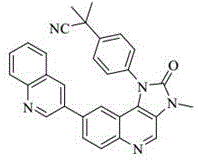
NVP-BEZ235 is an ATP competitive inhibitor which acts on a PI3K/mTOR signaling pathway and is developed by Nowa company, and can block PI3K and mTOR kinase activities by binding to an ATP binding groove of an enzyme, wherein IC50 of the NVP-BEZ235 on p110 α/gamma/delta/β and mTOR (p70S6K) is 4,5, 7, 75 and 6nmol/L respectively, and IC50 for inhibiting serine protein kinase ATR in cells is 21 nmol/L.
A key intermediate is generated in the synthesis process of NVP-BEZ235, and the structural formula of the intermediate is shown as the formula (2):

(2) the compound of formula (I) is 2- [4- [ (3-nitro-6-bromoquinolin-4-yl) amino]Phenyl radical]-2-methylpropanenitrile) is prepared by reacting 4-chloro-6-bromo-3-nitroquinoline of chloroquinoline compound with 2-methyl-2- (4-aminophenyl) propionitrile of arylamine compoundNAr is prepared by the reaction of Scheme 1:
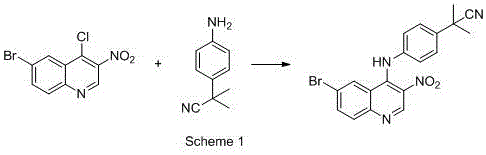
the existing method for synthesizing the compound of the formula (2) is to carry out S by chloroquinoline compound and arylamine compound under the catalysis of acetic acidNAr (aromatic nucleophilic substitution) reaction, for example, in document 1 (seeJournal of national medicine industry, 2016, 47 (2): 135-loop 139, synthesis of PI3K/mTOR dual inhibitor NVP-BEZ 235), reference 2 (Bioorganic)&Medicinal Chemistry Letters 18 (2008) 1027–1030,Imidazo[4,5-c]quinolines asinhibitors of the PI 3K/PKB-pathway), reference 3 (JAK PI3K/mTORcombination therapy: WO2013023119A 1). The prior art disclosed at present adopts a large excess of acetic acid as a solvent and an acid promoter to carry out reaction, water is added in the post-treatment as an anti-solvent to precipitate the compound of the formula (2), and then the precipitated product is dissolved in a solution of ethyl acetate/tetrahydrofuran, washed by sodium bicarbonate, dried by magnesium sulfate and concentrated to obtain the light yellow compound of the formula (2). The reaction has great environmental pollution, generates a large amount of acid wastewater, and has low reaction yield of only about 50 percent.
Attapulgite Clay (ATP) has the reputation of 'the king of thousands of used earth and ten thousand of earth', and the Xuyi Attapulgite resource amount in Jiangsu province of China accounts for 49% of the world reserves and 74% of the national reserves. ATP is a hydrous magnesium aluminum silicate clay mineral with a natural chain lamellar structure and the molecular formula of the clay mineral is (Mg, Al)4(Si)8(O,OH,H2O)26·nH2O and ATP have certain acidity, and structural hydroxyl in the layer structure can form Br ö nsted acid site to expose Al3+ATP is used as a catalyst after acidification or ion exchange, and is less in direct application.
The attapulgite is modified to prepare a solid acid catalyst which is used for catalyzing the reaction to prepare the intermediate 2- [4- [ (3-nitro-6-bromoquinoline-4-yl) amino ] phenyl ] -2-methylpropanenitrile of the antitumor drug NVP-BEZ235, and the report on the literature does not exist.
Disclosure of Invention
The invention aims to overcome the defect that 2- [4- [ (3-nitro-6-bromoquinoline-4-yl) amino as an intermediate for preparing an antitumor drug NVP-BEZ235 in the prior art]Phenyl radical]The preparation method has the defects of large amount of waste acid and low yield in the preparation process of the (2-methyl propionitrile), and provides a solid acid catalysis method for preparing the intermediate. The invention takes the attapulgite as a load carrier, zirconium n-propoxide as a zirconium source and SnCl4·5H2O is a tin source, and is codeposited and calcined in sequence under the alkaline condition,soaking in mixed acid composed of acetic acid/concentrated sulfuric acid, and calcining to obtain tin-modified ZrO2A attapulgite solid acid catalyst. The novel solid acid catalyst prepared by the invention can catalyze 4-chloro-6-bromo-3-nitroquinoline to react with 2-methyl-2- (4-aminophenyl) propionitrile to prepare the intermediate 2- [4- [ (3-nitro-6-bromoquinoline-4-yl) amino ] of the antitumor drug NVP-BEZ235]Phenyl radical]2-methyl propionitrile, the catalytic system has high catalytic efficiency, is green and pollution-free, and is suitable for production amplification; moreover, the catalyst can be used for catalyzing other SNAr reaction and good universality.
According to one aspect of the present invention, there is provided a novel tin-modified ZrO2The preparation method of the attapulgite solid acid catalyst comprises the following steps:
1) the attapulgite clay pretreatment process comprises: crushing attapulgite airflow to particles with the particle size of 100 meshes, then placing the particles in tetrahydrofuran solution of hydrochloric acid for ultrasonic treatment for 24 hours, filtering, drying and crushing to obtain attapulgite powder with the particle size of 200-300 meshes;
2) a codeposition procedure: the attapulgite powder was placed in n-propanol, then 70% wt of zirconium (IV) n-propanol solution and SnCl were added4·5H2Stirring and mixing evenly, heating to 60-70 ℃, and stirring intensively for 30min at the rotating speed of 1000 rpm; slowly dropwise adding 0.5-2.0mol/L ammonia water solution to adjust the pH of the solution to 9.5-10.5, and then preserving heat, stirring and aging for 12-24 h; cooling to room temperature, carrying out suction filtration and washing until the filtrate becomes neutral, collecting a filter cake, calcining for 1-2h at the temperature of 100-130 ℃ in the nitrogen atmosphere, and obtaining a codeposition precipitate;
3) acid dipping procedure: putting the codeposition precipitate into mixed acid consisting of acetic acid and concentrated sulfuric acid, stirring, refluxing for 12h in nitrogen atmosphere, cooling to room temperature, filtering, washing with water until the filtrate is neutral, and calcining the filter cake in nitrogen atmosphere to obtain the novel tin-modified ZrO2A attapulgite solid acid catalyst.
Preferably, the concentration of the hydrochloric acid in the tetrahydrofuran solution of the hydrochloric acid in the step 1) can be 1-3mol/L, and the tetrahydrofuran solution of the hydrochloric acid can be prepared or purchased as a commercial product by introducing hydrochloric acid gas into tetrahydrofuran;
in the step 2), zirconium (IV) n-propoxide and SnCl can be adjusted4·5H2The molar ratio of O is used for adjusting the loading amounts of zirconium and tin in the catalyst, so that the catalytic performance of the catalyst is adjusted; preferably, zirconium (IV) n-propoxide and SnCl are used in step 2)4·5H2The molar ratio of O is 1:0.1-0.6, SnCl4·5H2The weight ratio of the O to the attapulgite powder is 0.5-10: 100; more preferably, zirconium (IV) n-propoxide and SnCl are used in step 2)4·5H2The molar ratio of O is 1:0.3, SnCl4·5H2The weight ratio of the O to the attapulgite powder is 2: 100;
preferably, the mixed acid composed of acetic acid/concentrated sulfuric acid in the step 3) refers to a mixture composed of acetic acid and concentrated sulfuric acid, wherein the weight ratio of acetic acid to concentrated sulfuric acid is 1: 2;
preferably, the step 3) of calcining the filter cake in a nitrogen atmosphere refers to calcining at 200-400 ℃ for 6-12h, preferably at 260-300 ℃ for 6-12h in a nitrogen atmosphere;
according to another aspect of the present invention, there is provided a novel tin-modified ZrO2Use of attapulgite solid acid catalyst in preparation of 2- [4- [ (3-nitro-6-bromoquinolin-4-yl) amino by catalyzing reaction of 4-chloro-6-bromo-3-nitroquinoline with 2-methyl-2- (4-aminophenyl) propionitrile in the presence of solvent]Phenyl radical]-2-methylpropanenitrile; the method comprises the following specific steps:
1) 4-chloro-6-bromo-3-nitroquinoline, 2-methyl-2- (4-aminophenyl) propionitrile and tin-modified ZrO2Adding the attapulgite solid acid catalyst into a solvent, and stirring for reaction at 10-80 ℃;
2) after the 4-chloro-6-bromo-3-nitroquinoline completely reacts, the HPLC detection is carried out to remove the tin modified ZrO by filtration2Obtaining filtrate by using a attapulgite solid acid catalyst;
3) concentrating the filtrate or adding an anti-solvent for post-treatment to obtain 2- [4- [ (3-nitro-6-bromoquinoline-4-yl) amino ] phenyl ] -2-methylpropanenitrile.
Preferably, the molar ratio of 4-chloro-6-bromo-3-nitroquinoline to 2-methyl-2- (4-aminophenyl) propionitrile in step 1) is 1:1-1.2, 4-chloro-6-bromo-3-nitroquinoline to tin-modified ZrO2The weight ratio of the attapulgite solid acid catalyst is 1: 0.01-0.20; more preferably, 4-chloro-6-bromo is used in step 1)The molar ratio of the (E) -3-nitroquinoline to the 2-methyl-2- (4-aminophenyl) propionitrile is 1:1.1, 4-chloro-6-bromo-3-nitroquinoline and tin-modified ZrO2The weight ratio of the attapulgite solid acid catalyst is 1: 0.06;
preferably, the solvent in step 1) is acetic acid, methanol, ethanol, tetrahydrofuran, 2-methyltetrahydrofuran, ethyl acetate, dichloromethane or a compound solvent thereof, and more preferably methanol;
the antisolvent in the step 3) is n-pentane, n-heptane, toluene or water, and more preferably water;
heterogeneous catalysts generally undergo catalyst deactivation, and solid acid catalysts are often deposited on the surface or in the channels of the catalyst by some basic substances to block catalytically active centers, or narrow or block the pore openings of the catalyst due to the deposition of small molecular organic compounds during the reaction process and covering up the catalytically active centers. Tin-modified ZrO of the invention2The attapulgite solid acid catalyst also has the phenomenon of catalyst deactivation to different degrees after the catalytic reaction is circulated for 5 times. In order to solve the problem of catalyst deactivation, the invention provides tin-modified ZrO2The activation method of the attapulgite solid acid catalyst comprises the following steps:
1) preparing 2- [4- [ (3-nitro-6-bromoquinolin-4-yl) amino by reacting catalytic 4-chloro-6-bromo-3-nitroquinoline with 2-methyl-2- (4-aminophenyl) propionitrile]Phenyl radical]Tin-modified ZrO of (E) -2-methylpropanenitrile2After recovering the attapulgite solid acid catalyst, putting the attapulgite solid acid catalyst into a nitrogen-nitrogen dimethylformamide/tetrahydrofuran solution, heating to 60 ℃, ultrasonically treating for 1-2h, filtering, washing with acetone, and drying to obtain a pretreatment catalyst;
2) soaking the pretreated catalyst in concentrated sulfuric acid at 60-80 deg.C for 24 hr, filtering, washing with acetone, and vacuum drying at 100 deg.C to obtain acid treated catalyst;
3) placing the acid treatment catalyst in a calcining furnace, calcining for 10-30min at the temperature of 350-400 ℃ in the atmosphere of nitrogen to obtain the activated tin modified ZrO2A attapulgite solid acid catalyst.
The method comprises the following steps of firstly carrying out high-temperature ultrasonic treatment on the recovered catalyst in an organic solvent to remove most organic micromolecules adsorbed on the surface or in a pore channel of the catalyst, then carrying out acid impregnation by adopting pure sulfuric acid, and finally calcining at high temperature for a short time to obtain the activated catalyst; experiments prove that if the organic solvent ultrasonic treatment is not carried out in the early stage, the calcination temperature required in the later stage is high, and the calcination time is long, but the catalyst is easily collapsed due to long-time high-temperature calcination, so that the tin source loss is caused, and the catalytic effect is influenced.
To verify the catalyst pair S of the inventionNThe universality of Ar (aromatic nucleophilic substitution reaction) reaction is kept, and the invention respectively reacts with 5-chloro-8-hydroxyquinoline, 6-chloroquinoline, 2-chloro-8-cyanoquinoline, 6-chloro-5-nitroquinoline and 7-chloro-2-methylquinoline without changing 2-methyl-2- (4-aminophenyl) propionitrile, thereby having better effect; wherein the conversion rate of the substrate containing the electron-withdrawing group on the quinoline ring is higher than that of the substrate containing the electron-donating group, and the reaction is also verified to belong to nucleophilic substitution reaction.
The 4-chloro-6-bromo-3-nitroquinoline reaction completely means that HPLC detection results show that the content of the reaction liquid is less than 0.5 percent or less according to area percentage; the anti-solvent is a solvent with low solubility to 2- [4- [ (3-nitro-6-bromoquinolin-4-yl) amino ] phenyl ] -2-methylpropanenitrile at room temperature, such as a solvent with less than 1mg/ml or less solubility; the concentrated sulfuric acid is commercially available 95.0-98.0 wt% concentrated sulfuric acid.
Compared with the prior art, the invention has the following advantages:
1) the invention provides a novel tin-modified ZrO2The preparation method of the attapulgite solid acid catalyst is simple and convenient and is beneficial to operation;
2) novel tin-modified ZrO prepared by the invention2The attapulgite solid acid catalyst has higher acid sites, can catalyze halogenated aromatic hydrocarbon and arylamine to generate aromatic nucleophilic substitution reaction for preparing 2- [4- [ (3-nitro-6-bromoquinoline-4-yl) amino as an intermediate of an antitumor drug NVP-BEZ235]Phenyl radical]2-methyl propionitrile, so that a large amount of waste acid is avoided, and the yield is improved;
3) novel tin-modified ZrO prepared by the invention2The attapulgite solid acid catalyst can be recycled and activated;
4) novel tin-modified ZrO prepared by the invention2The attapulgite solid acid catalyst has good universality, good functional group compatibility to a substrate in the reaction and capability of catalyzing other SNAr reaction is used for preparing the intermediate analogue of the antitumor drug.
Detailed Description
In order to make the objects, technical solutions and advantages of the present invention more apparent, the present invention is further described in detail with reference to the following embodiments. It should be understood that the description is intended to be exemplary only, and is not intended to limit the scope of the present invention.
The 4-chloro-6-bromo-3-nitroquinoline and the 2-methyl-2- (4-aminophenyl) propionitrile are from Nanjing Conman chemical industry Co., Ltd, and the purity is more than 99.5 wt%; zirconium n-propoxide is available from sigma aldrich (shanghai) trade ltd as a 70% wt solution of zirconium n-propoxide in n-propanol, cat # 333972; SnCl4·5H2O is from (krama) shanghai purple reagent plant.
Example 1
Preparation of novel tin-modified ZrO2The attapulgite solid acid catalyst comprises the following steps:
1) the attapulgite clay pretreatment process comprises: crushing 100g of attapulgite into particles with the particle size of 100 meshes by air flow, then placing the particles in 500ml of tetrahydrofuran solution of hydrochloric acid (the concentration of the hydrochloric acid is 2 mol/L) for ultrasonic treatment for 24 hours, filtering, drying at 100 ℃, and grinding the particles to obtain the attapulgite powder with the particle size of 200 meshes and 300 meshes;
2) a codeposition procedure: 10g of attapulgite powder are placed in n-propanol, then 0.89g of a 70% wt solution of zirconium (IV) n-propanol and 0.20 g of SnCl are added4·5H2Stirring and mixing evenly, heating to 60-70 ℃, and stirring intensively for 30min at the rotating speed of 1000 rpm; slowly adding 1mol/L ammonia water solution dropwise to adjust the pH value of the solution to 10.0, and then preserving heat, stirring and aging for 24 hours; cooling to room temperature, carrying out suction filtration and water washing until the filtrate becomes neutral, collecting the filter cake, calcining for 1-2h at the temperature of 100-130 ℃ in the nitrogen atmosphere to obtain the catalystDepositing a precipitate;
3) acid dipping procedure: placing 10.0g of codeposition precipitate in 30ml of mixed acid consisting of acetic acid/concentrated sulfuric acid, stirring (the weight ratio of the acetic acid to the concentrated sulfuric acid in the mixed acid is 1: 2), refluxing for 12h in nitrogen atmosphere, cooling to room temperature, filtering, washing with water until the filtrate is neutral, calcining the filter cake at 280 +/-20 ℃ in nitrogen atmosphere for 6-12h to obtain the novel tin-modified ZrO2A attapulgite solid acid catalyst.
Example 1-A
Compared with example 1, the difference is that no SnCl is added in step 2)4·5H2O, otherwise identical with example 1.
Example 1-B
Compared with the example 1, the difference is that the mixed acid composed of 30ml of acetic acid/concentrated sulfuric acid is replaced by 30ml of acetic acid in the step 3) (the weight ratio of the acetic acid to the concentrated sulfuric acid in the mixed acid is 1: 2), and the rest is completely consistent with the example 1.
Example 1-C
The difference compared to the examples is that silica is used for the loading, i.e. equal mass of silica is used instead of attapulgite.
The specific surface area and pore diameter of the attapulgite of example 1 and its carrier were measured by an Autosorb-1 MP/Kr apparatus (gas adsorption method), and the results are shown in Table 1:
TABLE 1 specific surface area of catalysts obtained by different preparation methods
| Specific surface area (m)2/g) | Pore volume (cm)3/g) | Average pore diameter (nm) | |
| Raw material attapulgite clay | 180 | 0.32 | 5.1 |
| Attapulgite powder | 242 | 0.52 | 7.8 |
| Example 1 | 178 | 0.31 | 7.9 |
Note: the raw material attapulgite is the initial raw material for the test; the attapulgite powder is a product obtained by treating attapulgite with a tetrahydrofuran solution of hydrochloric acid; example 1 represents the final product prepared in example 1, i.e. tin-modified ZrO2A attapulgite solid acid catalyst.
Test results show that the specific surface area, the pore volume and the average pore diameter of the raw material attapulgite are increased in different degrees after being treated by tetrahydrofuran solution of hydrochloric acid, thereby being beneficial to the subsequent deposition of zirconium and tin; compared with the carrier attapulgite, the specific surface area and the pore volume of the finally prepared catalyst are not obviously changed, but the pore diameter is partially increased, thereby being beneficial to the entrance and exit of small molecules into and out of a pore channel in the later catalytic reaction.
Example 2
The catalyst prepared in example 1, examples 1-A, 1-B, 1-C was used to catalyze the reaction of 4-chloro-6-bromo-3-nitroquinoline with 2-methyl-2- (4-aminophenyl) propionitrile to prepare 2- [4- [ (3-nitro-6-bromoquinolin-4-yl) amino ] phenyl ] -2-methylpropanenitrile:
10mmol of 4-chloro-6-bromo-3-nitroquinoline, 11mmol of 2-methyl-2- (4-aminophenyl) propionitrile, 0.17g of catalyst and 50ml of methanol are added into a 100ml reaction bottle, stirred at 40 ℃ for reaction, and the reaction is stopped after HPLC (high performance liquid chromatography) detects that the raw materials in the reaction liquid are not converted any more.
Table 2 shows the conversion of the feedstocks and their selectivities for different catalysts
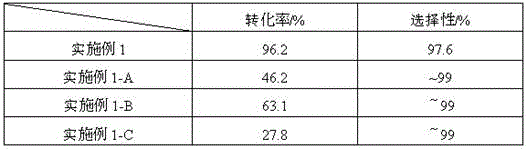
Note: because 6-site in the 4-chloro-6-bromo-3-nitroquinoline can be reacted to generate a byproduct, certain selectivity exists. The conversion rate refers to the conversion rate of the substrate 4-chloro-6-bromo-3-nitroquinoline.
Example 3
Effect of different calcination temperatures on the reaction: the calcination temperature in step 3) in example 1 was varied by a one-factor variable method to evaluate the catalytic reaction performance, and the influence of different calcination temperatures on the catalyst was examined: the operation process is as follows
10mmol of 4-chloro-6-bromo-3-nitroquinoline, 11mmol of 2-methyl-2- (4-aminophenyl) propionitrile, 0.17g of catalyst (obtained at different calcination temperatures) and 50ml of methanol are added into a 100ml reaction flask, stirred at 40 ℃ for reaction, and after 2 hours, raw materials in the reaction solution are detected by HPLC.
Table 3 shows the effect of different solvents on the reaction
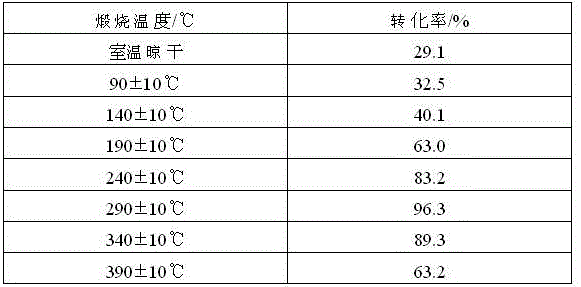
The results show that different calcination temperatures directly affect the catalytic performance of the catalyst, and the catalyst cannot be activated at low temperatures, for example, at temperatures less than 100 ℃; the optimal different catalytic performance is obtained at about 300 ℃, so that the tin modified ZrO2Can be tightly combined with the attapulgite matrix; due to the poor thermal stability of the catalyst, the acid sites of the catalyst are destroyed by the over-high temperature (more than 400 ℃), and the catalytic activity is reduced.
Example 4
Effect of different solvents on the reaction: a100 ml reaction flask was charged with 10mmol of 4-chloro-6-bromo-3-nitroquinoline, 11mmol of 2-methyl-2- (4-aminophenyl) propionitrile, and 0.17g of a catalyst (tin-modified ZrO prepared in example 1)2Attapulgite solid acid catalysisReagent), 50ml of solvent at 40 ℃ and stopping the reaction after HPLC detection, the results are shown in Table 4.
Table 4 shows the effect of different solvents on the reaction
| Solvent(s) | Reaction time/h | Conversion rate/% | Selectivity/%) |
| Acetic acid | 2h | 99.2 | 92.1 |
| Methanol | 3h | 99.4 | 97.2 |
| Ethanol | 4h | 90.2 | 95.6 |
| Tetrahydrofuran (THF) | 4h | 90.0 | 96.1 |
| 2-methyltetrahydrofuran | 8h | 83.1 | 96.2 |
| Ethyl acetate | 8h | 76.3 | 96.5 |
| Acetic acid isopropyl ester | 10h | 69.3 | 96.1 |
| Methylene dichloride | 24h | 43.2 | 97.1 |
| methanol/H2O (volume ratio 10/1) | 0.5h | 99.4 | 96.1 |
The results show that different solvents have larger influence on the catalyst, mainly influence the conversion rate of the substrate and have little influence on the selectivity; wherein, the solvent containing hydrogen bond has better reaction effect, the methanol is the most excellent, and the rest solvents have longer reaction time; in addition, methanol/H with the volume ratio of 10:1 is adopted2The mixed solvent of O can accelerate the reaction speed, and the addition of water can accelerate the reaction speed, but the excessive water can cause the loss of the catalyst, so the water consumption must be controlled in the reaction, and the volume ratio of methanol to water is preferably kept between 90 and 100: 5.
Example 5
Adopting optimized conditions to carry out post-treatment and amplification research on the reaction
1) 4-chloro-6-bromo-3-nitroquinoline (1 mol, 287.5 g) and tin-modified ZrO2Adding a attapulgite solid acid catalyst (17.3 g) into 2.5L of 95% V methanol, dropwise adding 500ml of a methanol solution of 2-methyl-2- (4-aminophenyl) propionitrile (containing 1.1mol of 2-methyl-2- (4-aminophenyl) propionitrile, 176.2 g), and stirring at 45 ℃ for reacting for 1h after the dropwise adding is finished;
2) HPLC (high performance liquid chromatography) detects the reaction liquid (the conversion rate is 99.7 percent), and after the reaction is completed, tin modified ZrO is filtered and removed2The catalyst is washed by 500ml of methanol, and the filtrates are combined;
3) distilling the filtrate under reduced pressure to obtain 0.8-1.2L methanol, heating to 55 deg.C under normal pressure, and stirring; and (2) dropwise adding purified water into the system, stopping dropwise adding when the system becomes turbid (dropwise adding 1.2L at the stage), keeping the temperature at 55-60 ℃, stirring for 1-2h, then continuously dropwise adding the purified water until all solids are separated out (dropwise adding 2.0L at the stage, totaling 1.2+2.0L = 3.2L), cooling to room temperature, carrying out suction filtration, washing a filter cake with acetone, and drying to obtain 378g (the yield is 92%) of light yellow solids, wherein the HPLC purity is 99.3%.
ESI-MS(m/z): 411[M+H]+;1H-NMR(400 MHz,DMSO-d6)δ: 9.08(s, 1H, NH),8.62(s, 1H, CH),7.91(s, 1H, CH), 7.94(d,J=8.7 Hz, 1H, CH), 7.82(d,J=8.3 Hz,1H, CH), 7.46(d,J=8.3 Hz, 2H, 2CH),7.17(d,J=8.2 Hz, 2H, 2CH), 1.66(s, 6H,2CH3)
Example 6
Tin-modified ZrO from the suction filtration separation of example 52Drying the attapulgite solid acid catalyst at 60 ℃ to remove the solvent, and then recycling and reusing: 4-chloro-6-bromo-3-nitroquinoline (10 mmol, 2.88 g) and tin-modified ZrO2Adding a attapulgite solid acid catalyst (0.17 g) into 25mL of 95% V methanol, dropwise adding 5mL of a methanol solution of 2-methyl-2- (4-aminophenyl) propionitrile (containing 11mol of 2-methyl-2- (4-aminophenyl) propionitrile, 1.76 g), stirring and reacting at 45 ℃ for 1h after the dropwise adding is finished, and detecting a reaction solution by HPLC; the reaction conditions for different cycle times are shown in table 5:
TABLE 5 reaction conditions for recycling of catalyst
| Number of times of recycling | Conversion rate/% |
| R1 | 99.0 |
| R2 | 94.3 |
| R3 | 88.1 |
| R4 | 75.4 |
| R5 | 63.1 |
With the increase of the number of times of the catalyst application, the conversion rate of the raw materials is sharply reduced, which is probably because excessive impurities block acid sites of the catalyst, so that the conversion rate is only about 60% after the catalyst is applied for five times, and the reaction is not sufficiently maintained.
The invention activates the catalyst which is recycled for 3 times (namely the catalyst used in the R3 batch), and the activation method comprises the following steps:
1) 1.0g of tin-modified ZrO2After the attapulgite solid acid catalyst is recovered (the catalyst is recycled for three times, namely R3 batches and obtained by multiple accumulation), putting the attapulgite solid acid catalyst into 5ml of nitrogen-nitrogen dimethylformamide/tetrahydrofuran solution (volume ratio is DMF/THF =1: 1), heating to 60 ℃, carrying out ultrasonic treatment for 1-2h, filtering, washing with acetone, and drying to obtain a pretreatment catalyst;
2) soaking the pretreated catalyst in 5ml of concentrated sulfuric acid at 70 ℃ for 24h, filtering, washing with acetone, and vacuum-drying at 100 ℃ to obtain an acid treatment catalyst;
3) placing the acid treatment catalyst in a calcining furnace, calcining for 10-30min at 360 ℃ in the atmosphere of nitrogen to obtain the activated tin modified ZrO2A attapulgite solid acid catalyst.
Carrying out reaction detection on the activated catalyst (the molar ratio of 4-chloro-6-bromo-3-nitroquinoline/2-methyl-2- (4-aminophenyl) propionitrile =1:1.1, the weight of the activated catalyst is 6 wt% of 4-chloro-6-bromo-3-nitroquinoline, and the solvent is 95% of methanol aqueous solution), after 1h, carrying out HPLC (high performance liquid chromatography) detection to detect that the conversion rate of the raw material is 97.2%, and recovering the catalytic activity; however, in the experiment, if ultrasonic treatment at 60 ℃ in a nitrogen-nitrogen dimethylformamide/tetrahydrofuran solution is not carried out on the recovered catalyst, the conversion rate of the activated catalyst raw material is only 80.2%, and the activation effect is not obvious, so that small molecular compounds on the surface and in the inner pore channels of the catalyst are removed by ultrasonic treatment by using a DMF/THF mixed solution before sulfuric acid impregnation, and more acidic binding sites are released.
Example 7
In order to verify the catalytic effect of the catalyst prepared by the invention on other substrates reacted by the functional group, the fixed substrate 2-methyl-2- (4-aminophenyl) propionitrile of the invention is unchanged and is respectively reacted with 5-chloro-8-hydroxyquinoline, 6-chloroquinoline, 2-chloro-8-cyanoquinoline, 6-chloro-5-nitroquinoline and 7-chloro-2-methylquinoline under the following reaction conditions: 11mmol of 2-methyl-2- (4-aminophenyl) propionitrile and quinoline derivative 10mmol, the tin-modified ZrO prepared in example 120.15g of attapulgite solid acid catalyst reacts in 50ml of methanol, LC-MS is adopted to detect the residual amount of quinoline derivatives in reaction liquid every 0.5h and detect whether molecular ion peaks of target products are generated, and after the detection raw materials are not converted again at the last two times, the calculation conversion rate results are shown in Table 6:
TABLE 6 reaction of different substrates
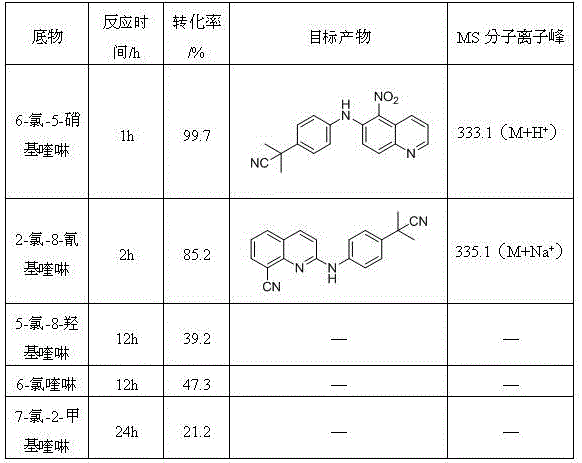
Note: "-" indicates that the reaction solution was not subjected to analysis of molecular ion peak
Test results show that the catalyst prepared by the invention has better catalytic effect on the reactions; wherein the conversion rate of the substrate containing the electron-withdrawing group on the quinoline ring is higher than that of the substrate containing the electron-donating group, and the reaction is also verified to belong to nucleophilic substitution reaction.
Although the embodiments of the present invention have been described in detail, it should be understood that various changes, substitutions, and alterations can be made hereto without departing from the spirit and scope of the invention.
Claims (8)
1. Tin-modified ZrO2Use of a attapulgite solid acid catalyst, characterized in that: in the presence of a solvent, 4-chloro-6-bromo-3-nitroquinoline is catalyzed to react with 2-methyl-2- (4-aminophenyl) propionitrile to prepare 2- [4- [ (3-nitro-6-bromoquinoline-4-yl) amino]Phenyl radical]-2-methylpropanenitrile; the catalytic reaction comprises the following specific steps:
1) 4-chloro-6-bromo-3-nitroquinoline, 2-methyl-2- (4-aminophenyl) propionitrile and tin-modified ZrO2Adding the attapulgite solid acid catalyst into a solvent, and stirring for reaction at 10-80 ℃;
2) after the 4-chloro-6-bromo-3-nitroquinoline completely reacts, the HPLC detection is carried out to remove the tin modified ZrO by filtration2Obtaining filtrate by using a attapulgite solid acid catalyst;
3) concentrating the filtrate or adding an anti-solvent for post-treatment to obtain 2- [4- [ (3-nitro-6-bromoquinoline-4-yl) amino ] phenyl ] -2-methylpropanenitrile;
the tin-modified ZrO2The attapulgite solid acid catalyst is prepared by the following method, comprising the following steps:
1) the attapulgite clay pretreatment process comprises: crushing attapulgite airflow to particles with the particle size of 100 meshes, then placing the particles in tetrahydrofuran solution of hydrochloric acid for ultrasonic treatment for 24 hours, filtering, drying and crushing to obtain attapulgite powder with the particle size of 200-300 meshes;
2) a codeposition procedure: the attapulgite powder was placed in n-propanol, then 70% wt of zirconium (IV) n-propanol solution and SnCl were added4·5H2O is stirred and mixed evenly and L is addedHeating to 60-70 deg.C, and stirring at 1000rpm for 30 min; slowly dropwise adding 0.5-2.0mol/L ammonia water solution to adjust the pH of the solution to 9.5-10.5, and then preserving heat, stirring and aging for 12-24 h; cooling to room temperature, carrying out suction filtration and washing until the filtrate becomes neutral, collecting a filter cake, calcining for 1-2h at the temperature of 100-130 ℃ in the nitrogen atmosphere, and obtaining a codeposition precipitate;
3) acid dipping procedure: putting the codeposition precipitate into mixed acid consisting of acetic acid and concentrated sulfuric acid, stirring, refluxing for 12h in nitrogen atmosphere, cooling to room temperature, filtering, washing with water until the filtrate is neutral, and calcining the filter cake in nitrogen atmosphere to obtain the novel tin-modified ZrO2A attapulgite solid acid catalyst.
2. Use according to claim 1, characterized in that: zirconium (IV) n-propoxide and SnCl4·5H2The molar ratio of O is 1:0.1-0.6, SnCl4·5H2The weight ratio of the O to the attapulgite powder is 0.5-10: 100.
3. Use according to claim 2, characterized in that: zirconium (IV) n-propoxide and SnCl4·5H2The molar ratio of O is 1:0.3, SnCl4·5H2The weight ratio of O to attapulgite powder is 2: 100.
4. Use according to claim 1, characterized in that: the filter cake is calcined under the nitrogen atmosphere, namely the filter cake is calcined under the nitrogen atmosphere at the temperature of 200-400 ℃ for 6-12 h.
5. Use according to claim 4, characterized in that: the filter cake is calcined under the nitrogen atmosphere, namely the filter cake is calcined under the nitrogen atmosphere at the temperature of 260-300 ℃ for 6-12 h.
6. Use according to claim 1, characterized in that: the molar ratio of the 4-chloro-6-bromo-3-nitroquinoline to the 2-methyl-2- (4-aminophenyl) propionitrile is 1:1-1.2, 4-chloro-6-bromo-3-nitroquinoline to tin-modified ZrO2The weight ratio of the attapulgite solid acid catalyst is 1: 0.01-0.20.
7. Use according to claim 6, characterized in that: the molar ratio of the 4-chloro-6-bromo-3-nitroquinoline to the 2-methyl-2- (4-aminophenyl) propionitrile is 1:1.1, 4-chloro-6-bromo-3-nitroquinoline to tin-modified ZrO2The weight ratio of the attapulgite solid acid catalyst is 1: 0.06.
8. Use according to claim 6, characterized in that: the solvent is acetic acid, methanol, ethanol, tetrahydrofuran, 2-methyltetrahydrofuran, ethyl acetate, dichloromethane or a compound solvent thereof; the anti-solvent is n-pentane, n-heptane, toluene or water.
Priority Applications (1)
| Application Number | Priority Date | Filing Date | Title |
|---|---|---|---|
| CN201711442658.8A CN107952425B (en) | 2017-12-27 | 2017-12-27 | Preparation method of antitumor drug NVP-BEZ235 intermediate |
Applications Claiming Priority (1)
| Application Number | Priority Date | Filing Date | Title |
|---|---|---|---|
| CN201711442658.8A CN107952425B (en) | 2017-12-27 | 2017-12-27 | Preparation method of antitumor drug NVP-BEZ235 intermediate |
Publications (2)
| Publication Number | Publication Date |
|---|---|
| CN107952425A CN107952425A (en) | 2018-04-24 |
| CN107952425B true CN107952425B (en) | 2020-05-08 |
Family
ID=61957033
Family Applications (1)
| Application Number | Title | Priority Date | Filing Date |
|---|---|---|---|
| CN201711442658.8A Active CN107952425B (en) | 2017-12-27 | 2017-12-27 | Preparation method of antitumor drug NVP-BEZ235 intermediate |
Country Status (1)
| Country | Link |
|---|---|
| CN (1) | CN107952425B (en) |
Families Citing this family (1)
| Publication number | Priority date | Publication date | Assignee | Title |
|---|---|---|---|---|
| CN118373771A (en) * | 2023-01-20 | 2024-07-23 | 江苏柯菲平医药股份有限公司 | A quinoline derivative compound or a pharmaceutically acceptable salt thereof and a preparation method and application thereof |
Citations (5)
| Publication number | Priority date | Publication date | Assignee | Title |
|---|---|---|---|---|
| CN101437808A (en) * | 2006-03-21 | 2009-05-20 | 耶鲁大学 | Process for the synthesis of arylamines from the reaction ofan aromaticcompounds with ammonia or a metal amide |
| CN102898329A (en) * | 2012-09-29 | 2013-01-30 | 西安近代化学研究所 | Method for synthesizing N-aryl ketoimine by acidic catalytic dehydration |
| CN105085439A (en) * | 2015-08-31 | 2015-11-25 | 江苏七洲绿色化工股份有限公司 | Preparation method for epoxiconazole intermediate |
| CN105693536A (en) * | 2016-03-08 | 2016-06-22 | 温州永宏科技孵化有限公司 | Preparation method for synthesizing quinacridone pigment intermediate DXTA |
| CN106748801A (en) * | 2016-12-28 | 2017-05-31 | 华东师范大学 | A kind of synthetic method of 3,5 dichloroaniline |
Family Cites Families (1)
| Publication number | Priority date | Publication date | Assignee | Title |
|---|---|---|---|---|
| US20170321281A1 (en) * | 2016-04-25 | 2017-11-09 | The Trustees Of Columbia University In The City Of New York | Methods and compositions for treatment of glioblastoma |
-
2017
- 2017-12-27 CN CN201711442658.8A patent/CN107952425B/en active Active
Patent Citations (5)
| Publication number | Priority date | Publication date | Assignee | Title |
|---|---|---|---|---|
| CN101437808A (en) * | 2006-03-21 | 2009-05-20 | 耶鲁大学 | Process for the synthesis of arylamines from the reaction ofan aromaticcompounds with ammonia or a metal amide |
| CN102898329A (en) * | 2012-09-29 | 2013-01-30 | 西安近代化学研究所 | Method for synthesizing N-aryl ketoimine by acidic catalytic dehydration |
| CN105085439A (en) * | 2015-08-31 | 2015-11-25 | 江苏七洲绿色化工股份有限公司 | Preparation method for epoxiconazole intermediate |
| CN105693536A (en) * | 2016-03-08 | 2016-06-22 | 温州永宏科技孵化有限公司 | Preparation method for synthesizing quinacridone pigment intermediate DXTA |
| CN106748801A (en) * | 2016-12-28 | 2017-05-31 | 华东师范大学 | A kind of synthetic method of 3,5 dichloroaniline |
Non-Patent Citations (3)
| Title |
|---|
| "PI13K/mTOR双重抑制剂NVP-BEZ235的合成";雷飞等;《中国医药工业杂志》;20160218;第47卷(第2期);第135-139页 * |
| "高岭土基固体酸催化剂的研制及应用";刘珊珊;《中国优秀硕士学位论文全文数据库工程科技I辑》;20170315(第3期);B014-910 * |
| 刘珊珊."高岭土基固体酸催化剂的研制及应用".《中国优秀硕士学位论文全文数据库工程科技I辑》.2017,(第3期),B014-910. * |
Also Published As
| Publication number | Publication date |
|---|---|
| CN107952425A (en) | 2018-04-24 |
Similar Documents
| Publication | Publication Date | Title |
|---|---|---|
| CN113731465A (en) | Pd/N-CNTs catalyst, and preparation method and application thereof | |
| CN106000466A (en) | Immobilized metal phthalocyanines catalyst prepared by aid of synchronous synthesis and immobilization processes and methods for preparing and applying immobilized metal phthalocyanines catalyst | |
| CN102432608B (en) | Catalytic synthesis of optically active tetrahydro-β-carboline derivatives by chiral spirocyclic phosphoric acid | |
| CN107952425B (en) | Preparation method of antitumor drug NVP-BEZ235 intermediate | |
| CN101781296B (en) | Method for producing nicergoline | |
| CN114369240B (en) | Porphyrin-based porous organic polymer, preparation method and preparation method and use of palladium-supported catalyst thereof | |
| CN102329263A (en) | Preparation method of N-acetyl-5-methoxytryptamine | |
| CN114082442B (en) | Succinimide-based ionic liquid and method for catalytically synthesizing quinazoline-2,4(1H,3H)-dione | |
| CN112206808A (en) | Catalyst for synthesizing isobutyl isobutyrate and preparation method and application thereof | |
| CN107987028B (en) | A kind of preparation method of medicine intermediate for treating type Ⅱ diabetes | |
| CN110961151B (en) | A kind of ruthenium-copper bimetallic catalyst, preparation method and application thereof | |
| CN109970659B (en) | A kind of method that adopts supported nickel catalyst to prepare benzimidazole and quinazoline compounds | |
| CN103769211A (en) | Preparation method of organic-inorganic hybrid material ruthenium-loaded catalyst for synthesizing L-alaninol | |
| CN118724687A (en) | Method for synthesizing 4-hexene-3-one using zinc chloride as catalyst | |
| CN107597157B (en) | A kind of solid acid catalyst and preparation method thereof being used to prepare antitumor drug intermediate | |
| CN112500412B (en) | A kind of Peganumine A alkaloid structural simplification and its application | |
| CN1295212C (en) | Reduction of 4,4'-diamino-diphenylethylene-2,2' disulfonic acid | |
| CN111298834A (en) | Preparation method of pharmaceutical intermediate for department of respiration | |
| CN118440001B (en) | A method for synthesizing a duvelisib intermediate | |
| CN113929610A (en) | Method for catalyzing nitrogen heterocycle aerobic dehydrogenation based on ionic liquid porous carbon material | |
| CN110105219B (en) | Method for preparing intermediate for antiviral drug | |
| CN114773385A (en) | Diphosphine-containing o-carborane bivalent copper complex and preparation and application thereof | |
| CN108311155B (en) | Method for catalytically preparing apalumide intermediate serving as medicine for treating prostate cancer | |
| CN111116531A (en) | A kind of preparation method of ramelteon intermediate | |
| CN113072452A (en) | Method for catalytically synthesizing o-aminophenol |
Legal Events
| Date | Code | Title | Description |
|---|---|---|---|
| PB01 | Publication | ||
| PB01 | Publication | ||
| SE01 | Entry into force of request for substantive examination | ||
| SE01 | Entry into force of request for substantive examination | ||
| TA01 | Transfer of patent application right | ||
| TA01 | Transfer of patent application right |
Effective date of registration: 20200408 Address after: 611930 Middle Section 588 Peony Avenue, Tianpeng Town, Pengzhou City, Chengdu City, Sichuan Province Applicant after: SICHUAN XIELI PHARMACEUTICAL Co.,Ltd. Address before: 721000 Baoji City, Shaanxi province Jintai District of Yongxing dongin Xiang Town Applicant before: Gao Jun |
|
| GR01 | Patent grant | ||
| GR01 | Patent grant |