CN108123745B - A data transmission method, receiver and transmitter - Google Patents
A data transmission method, receiver and transmitter Download PDFInfo
- Publication number
- CN108123745B CN108123745B CN201611201319.6A CN201611201319A CN108123745B CN 108123745 B CN108123745 B CN 108123745B CN 201611201319 A CN201611201319 A CN 201611201319A CN 108123745 B CN108123745 B CN 108123745B
- Authority
- CN
- China
- Prior art keywords
- training
- transmitter
- receiver
- offset information
- beams
- Prior art date
- Legal status (The legal status is an assumption and is not a legal conclusion. Google has not performed a legal analysis and makes no representation as to the accuracy of the status listed.)
- Active
Links
Images






Classifications
-
- H—ELECTRICITY
- H04—ELECTRIC COMMUNICATION TECHNIQUE
- H04B—TRANSMISSION
- H04B7/00—Radio transmission systems, i.e. using radiation field
- H04B7/02—Diversity systems; Multi-antenna system, i.e. transmission or reception using multiple antennas
- H04B7/04—Diversity systems; Multi-antenna system, i.e. transmission or reception using multiple antennas using two or more spaced independent antennas
- H04B7/06—Diversity systems; Multi-antenna system, i.e. transmission or reception using multiple antennas using two or more spaced independent antennas at the transmitting station
- H04B7/0613—Diversity systems; Multi-antenna system, i.e. transmission or reception using multiple antennas using two or more spaced independent antennas at the transmitting station using simultaneous transmission
- H04B7/0615—Diversity systems; Multi-antenna system, i.e. transmission or reception using multiple antennas using two or more spaced independent antennas at the transmitting station using simultaneous transmission of weighted versions of same signal
- H04B7/0617—Diversity systems; Multi-antenna system, i.e. transmission or reception using multiple antennas using two or more spaced independent antennas at the transmitting station using simultaneous transmission of weighted versions of same signal for beam forming
-
- H—ELECTRICITY
- H04—ELECTRIC COMMUNICATION TECHNIQUE
- H04B—TRANSMISSION
- H04B7/00—Radio transmission systems, i.e. using radiation field
- H04B7/02—Diversity systems; Multi-antenna system, i.e. transmission or reception using multiple antennas
- H04B7/04—Diversity systems; Multi-antenna system, i.e. transmission or reception using multiple antennas using two or more spaced independent antennas
- H04B7/06—Diversity systems; Multi-antenna system, i.e. transmission or reception using multiple antennas using two or more spaced independent antennas at the transmitting station
-
- H—ELECTRICITY
- H04—ELECTRIC COMMUNICATION TECHNIQUE
- H04B—TRANSMISSION
- H04B7/00—Radio transmission systems, i.e. using radiation field
- H04B7/02—Diversity systems; Multi-antenna system, i.e. transmission or reception using multiple antennas
- H04B7/04—Diversity systems; Multi-antenna system, i.e. transmission or reception using multiple antennas using two or more spaced independent antennas
- H04B7/08—Diversity systems; Multi-antenna system, i.e. transmission or reception using multiple antennas using two or more spaced independent antennas at the receiving station
-
- H—ELECTRICITY
- H04—ELECTRIC COMMUNICATION TECHNIQUE
- H04B—TRANSMISSION
- H04B7/00—Radio transmission systems, i.e. using radiation field
- H04B7/02—Diversity systems; Multi-antenna system, i.e. transmission or reception using multiple antennas
- H04B7/04—Diversity systems; Multi-antenna system, i.e. transmission or reception using multiple antennas using two or more spaced independent antennas
- H04B7/08—Diversity systems; Multi-antenna system, i.e. transmission or reception using multiple antennas using two or more spaced independent antennas at the receiving station
- H04B7/0868—Hybrid systems, i.e. switching and combining
- H04B7/088—Hybrid systems, i.e. switching and combining using beam selection
Landscapes
- Engineering & Computer Science (AREA)
- Computer Networks & Wireless Communication (AREA)
- Signal Processing (AREA)
- Mobile Radio Communication Systems (AREA)
- Radio Transmission System (AREA)
Abstract
本申请公开了一种数据传输方法、接收机及发射机,其中,该方法包括:接收机通过固定波束接收发射机通过多个训练波束发送的多个训练序列,所述多个训练波束是基于所述发射机当前数据传输的第一数据波束确定出的;所述接收机基于所述多个训练序列确定所述第一数据波束的偏移信息;所述接收机向所述发射机发送所述偏移信息,以使得所述发射机基于所述偏移信息确定用于后续数据传输的第二数据波束。采用本申请,能够提升数据传输效率,降低系统开销。

The present application discloses a data transmission method, a receiver and a transmitter, wherein the method includes: the receiver receives, through a fixed beam, a plurality of training sequences sent by a transmitter through a plurality of training beams, the plurality of training beams being based on Determined by the first data beam currently transmitted by the transmitter; the receiver determines the offset information of the first data beam based on the multiple training sequences; the receiver sends the data to the transmitter. and the offset information, so that the transmitter determines a second data beam for subsequent data transmission based on the offset information. By adopting the present application, the data transmission efficiency can be improved and the system overhead can be reduced.
Description
技术领域technical field
本申请涉及通信技术领域,尤其涉及一种数据传输方法、接收机及发射机。The present application relates to the field of communication technologies, and in particular, to a data transmission method, a receiver and a transmitter.
背景技术Background technique
随着网络容量需求持续增加,用户对频谱资源的需求越来越高。而传统频段的频谱资源非常有限,因此需采用更高频段进行通信,以获取丰富的频谱资源,如采用毫米波段通信。在实际通信中,由于毫米波频段的空间损耗大于低频段,同样发射功率下传输的距离相比于其他低频段将更小,因而毫米通信系统通常使用定向波束建立基站与用户设备之间的通信,以降低空间损耗。As the demand for network capacity continues to increase, users have higher and higher demand for spectrum resources. However, the spectrum resources of traditional frequency bands are very limited, so higher frequency bands need to be used for communication to obtain abundant spectrum resources, such as millimeter-wave band communication. In actual communication, since the space loss of the millimeter wave frequency band is greater than that of the low frequency band, the transmission distance under the same transmit power will be smaller than that of other low frequency bands, so the millimeter communication system usually uses the directional beam to establish the communication between the base station and the user equipment. , to reduce space loss.
通信系统中的定向波束一般是利用一定的时间和频率资源在基站和用户设备间进行训练得到,且训练波束的数量随着用户设备的移动情况、波束的宽度变化等因素而变化,如移动速度越快,波束宽度越窄,需要的训练波束越多,系统开销越大。而且,用于数据传输的波束只能从使用的训练波束中选取,这就导致波束调整精度受训练波束的设计影响,使得数据传输效率较低。The directional beams in the communication system are generally obtained by training between the base station and the user equipment using certain time and frequency resources, and the number of training beams varies with the movement of the user equipment, the width of the beam and other factors, such as the moving speed. The faster, the narrower the beamwidth, the more training beams are required, and the higher the system overhead. Moreover, the beams used for data transmission can only be selected from the used training beams, which causes the beam adjustment accuracy to be affected by the design of the training beams, resulting in low data transmission efficiency.
发明内容SUMMARY OF THE INVENTION
本申请提供一种数据传输方法、接收机及发射机,能够提升数据传输效率,降低系统开销。The present application provides a data transmission method, a receiver and a transmitter, which can improve data transmission efficiency and reduce system overhead.
第一方面,本申请提供了一种数据传输方法,该方法可具体应用于接收机中,包括:In a first aspect, the present application provides a data transmission method, which can be specifically applied to a receiver, including:
接收机通过固定波束接收发射机通过多个训练波束发送的多个训练序列;The receiver receives, through the fixed beam, multiple training sequences sent by the transmitter through multiple training beams;
接收机基于该多个训练序列确定第一数据波束的偏移信息;the receiver determines offset information of the first data beam based on the plurality of training sequences;
接收机向该发射机发送偏移信息,以使得该发射机基于该偏移信息确定用于后续数据传输的第二数据波束。The receiver sends offset information to the transmitter so that the transmitter determines a second data beam for subsequent data transmission based on the offset information.
可选的,该接收机可以是移动台(英文:Mobile Station,简称MS),也可以是基站台(英文:Base Station,简称BS);相应地,该发射机可以是BS,也可以是MS。Optionally, the receiver may be a mobile station (English: Mobile Station, MS for short) or a base station (English: Base Station, BS for short); correspondingly, the transmitter may be a BS or an MS .
其中,该第一数据波束可以是指发射机当前用于进行数据传输的波束,也即波束训练前发射机用于进行数据传输的波束。该多个训练波束可以是基于该发射机当前数据传输的第一数据波束确定出的,该训练波束可以与该训练序列一一对应。The first data beam may refer to a beam currently used by the transmitter for data transmission, that is, a beam used by the transmitter for data transmission before beam training. The plurality of training beams may be determined based on a first data beam currently transmitted by the transmitter, and the training beams may correspond one-to-one with the training sequence.
在一些可能的实现中,该多个训练波束可以是基于预置的角度扰动量和该第一数据波束的方向确定出的。In some possible implementations, the plurality of training beams may be determined based on a preset angular disturbance amount and the direction of the first data beam.
在一些可能的实现中,该偏移信息可以包括以下至少一种:该发射机的波离方位角(英文:Azimuth angle of departure,简称AoD)、该发射机的波离顶角(英文:Zinthangle of departure,简称ZoD)、每一个训练波束与该第一数据波束的最强径的比值、该第一数据波束的角度偏移量。其中,该角度偏移量可以是指物理角度偏移量,也可以是指虚拟域的角度偏移量。In some possible implementations, the offset information may include at least one of the following: an Azimuth angle of departure (English: Azimuth angle of departure, AoD for short) of the transmitter, a Zinthangle (English: Zinthangle) of the transmitter of departure, ZoD for short), the ratio of the strongest diameter of each training beam to the first data beam, and the angle offset of the first data beam. The angular offset may refer to a physical angular offset, or may refer to an angular offset of a virtual domain.
在一些可能的实现中,该接收机基于该多个训练序列确定该第一数据波束的偏移信息,包括:In some possible implementations, the receiver determines offset information of the first data beam based on the plurality of training sequences, including:
接收机接收该发射机发射该多个训练序列的天线配置信息,根据该多个训练序列计算该多个训练波束的功率时延响应,并根据该多个训练波束的功率时延响应和该天线配置信息确定该第一数据波束的偏移信息。从而能够基于该偏移信息快速调整数据传输波束,由此提升了数据传输效率,降低了系统开销。The receiver receives the antenna configuration information of the multiple training sequences transmitted by the transmitter, calculates the power delay responses of the multiple training beams according to the multiple training sequences, and calculates the power delay responses of the multiple training beams according to the power delay responses of the multiple training beams and the antenna. The configuration information determines offset information of the first data beam. Therefore, the data transmission beam can be quickly adjusted based on the offset information, thereby improving the data transmission efficiency and reducing the system overhead.
其中,该天线配置信息可包括天线阵列的列数、行数以及列天线间距、行天线间距的一种或多种。The antenna configuration information may include the number of columns, the number of rows, and one or more of the column antenna spacing and the row antenna spacing of the antenna array.
在一些可能的实现中,该接收机基于该多个训练序列确定该第一数据波束的偏移信息,包括:In some possible implementations, the receiver determines offset information of the first data beam based on the plurality of training sequences, including:
接收机根据该多个训练序列计算该多个训练波束的功率时延响应;根据该多个训练波束的功率时延响应,确定幅度响应最大的时延;根据该幅度响应最大的时延,计算每一个训练波束与所述第一数据波束的最强径的比值。这种实现方式能够通过将该训练波束与该第一数据波束的最强径的比值发送给发射机,以使得发射机基于该最强径比值计算出发射机的角度偏移量,从而基于该角度偏移量确定出新的数据传输波束即第二数据波束,而不再由MS计算该角度偏移量或方向,由此减少MS计算,降低MS功耗。The receiver calculates the power delay responses of the multiple training beams according to the multiple training sequences; determines the delay with the largest amplitude response according to the power delay responses of the multiple training beams; and calculates the delay with the largest amplitude response according to the delay response of the multiple training beams The ratio of the strongest diameter of each training beam to the first data beam. In this implementation, the ratio of the strongest diameter of the training beam to the first data beam can be sent to the transmitter, so that the transmitter can calculate the angular offset of the transmitter based on the ratio of the strongest diameter, and based on the ratio of the strongest diameter The angle offset determines a new data transmission beam, that is, the second data beam, and the MS is no longer required to calculate the angle offset or direction, thereby reducing MS calculation and reducing MS power consumption.
在一些可能的实现中,该接收机还可获取该第一数据波束的功率时延响应。则该接收机根据该多个训练波束的功率时延响应和该天线配置信息确定该第一数据波束的偏移信息,包括:In some possible implementations, the receiver may also obtain a power delay response of the first data beam. Then the receiver determines the offset information of the first data beam according to the power delay responses of the multiple training beams and the antenna configuration information, including:
该接收机根据该第一数据波束的功率时延响应、该多个训练波束的功率时延响应和该天线配置信息确定该第一数据波束的偏移信息。也就是说,该偏移信息还可进一步结合该第一数据波束的功率时延响应确定出,由此提升了确定出的偏移信息的准确性。The receiver determines offset information of the first data beam according to the power delay responses of the first data beam, the power delay responses of the plurality of training beams, and the antenna configuration information. That is, the offset information may be further determined in combination with the power delay response of the first data beam, thereby improving the accuracy of the determined offset information.
在一些可能的实现中,接收机还可接收发射机发送的训练通知消息,该训练通知消息指示有下一次波束训练的时间或波束训练的训练时间间隔。In some possible implementations, the receiver may also receive a training notification message sent by the transmitter, where the training notification message indicates that there is a next beam training time or a training time interval of the beam training.
其中,该下一次波束训练的时间或波束训练的训练时间间隔可以是基于该偏移信息确定出的,从而能够基于偏移信息及时地调整波束训练的时间,以减少训练开销,进一步降低系统开销。The time of the next beam training or the training time interval of the beam training may be determined based on the offset information, so that the beam training time can be adjusted in time based on the offset information to reduce training overhead and further reduce system overhead .
第二方面,本申请还提供了一种数据传输方法,该方法可具体应用于发射机中,包括:In a second aspect, the present application also provides a data transmission method, which can be specifically applied to a transmitter, including:
发射机生成一个或多个训练序列;通过多个训练波束发送该一个或多个训练序列至接收机;接收来自该接收机发送的该第一数据波束的偏移信息;根据该偏移信息确定用于后续数据传输的第二数据波束。The transmitter generates one or more training sequences; sends the one or more training sequences to the receiver through a plurality of training beams; receives the offset information of the first data beam sent from the receiver; determines according to the offset information A second data beam for subsequent data transmission.
其中,该第一数据波束可以是指发射机当前用于进行数据传输的波束,也即波束训练前发射机用于进行数据传输的波束。该多个训练波束可以是基于该发射机当前数据传输的第一数据波束确定出的,该训练波束可以与该训练序列一一对应。从而发射机能够基于接收机发送的该偏移信息快速调整数据传输波束,以维护通信链路的质量,进而提升了数据传输效率,降低了系统开销。The first data beam may refer to a beam currently used by the transmitter for data transmission, that is, a beam used by the transmitter for data transmission before beam training. The plurality of training beams may be determined based on a first data beam currently transmitted by the transmitter, and the training beams may correspond one-to-one with the training sequence. Therefore, the transmitter can quickly adjust the data transmission beam based on the offset information sent by the receiver, so as to maintain the quality of the communication link, thereby improving the data transmission efficiency and reducing the system overhead.
在一些可能的实现中,该多个训练波束可以是基于预置的角度扰动量和该第一数据波束的方向确定出的。其中,该角度扰动量可以是该发射机实时确定出并发送给该接收机的,也可以是预先配置得到的,如该接收机与发射机预先协商确定的;该第一数据波束的方向可以是该发射机发送给该接收机的。In some possible implementations, the plurality of training beams may be determined based on a preset angular disturbance amount and the direction of the first data beam. The angular disturbance amount may be determined by the transmitter in real time and sent to the receiver, or may be pre-configured, such as determined by the receiver and the transmitter through pre-negotiation; the direction of the first data beam may be is sent by the transmitter to the receiver.
在一些可能的实现中,该偏移信息可以包括以下至少一种:该发射机的AoD、该发射机的ZoD、每一个训练波束与该第一数据波束的最强径的比值、该第一数据波束的角度偏移量。In some possible implementations, the offset information may include at least one of the following: the AoD of the transmitter, the ZoD of the transmitter, the ratio of each training beam to the strongest path of the first data beam, the first Angular offset of the data beam.
在一些可能的实现中,该发射机还可向该接收机发送该发射机发射该一个或多个训练序列的天线配置信息,以使该接收机基于该天线配置信息和该训练序列确定该偏移信息。In some possible implementations, the transmitter may also send antenna configuration information for the transmitter to transmit the one or more training sequences to the receiver, so that the receiver determines the bias based on the antenna configuration information and the training sequence move information.
其中,该天线配置信息可包括天线阵列的列数、行数以及列天线间距、行天线间距的一种或多种。The antenna configuration information may include the number of columns, the number of rows, and one or more of the column antenna spacing and the row antenna spacing of the antenna array.
在一些可能的实现中,在发射机接收来自接收机发送的该第一数据波束的偏移信息之后,该发射机还可根据该偏移信息确定下一次波束训练的时间或波束训练的训练时间间隔;发射机生成包括该下一次波束训练的时间或该训练时间间隔的训练通知消息,并向该接收机发送该训练通知消息。从而能够基于偏移信息及时地调整波束训练的时间,以减少训练开销,进一步降低系统开销。In some possible implementations, after the transmitter receives the offset information of the first data beam sent from the receiver, the transmitter may further determine the next beam training time or the beam training training time according to the offset information interval; the transmitter generates a training notification message including the time of the next beam training or the training time interval, and sends the training notification message to the receiver. Therefore, the beam training time can be adjusted in time based on the offset information, so as to reduce the training overhead and further reduce the system overhead.
在一些可能的实现中,该发射机根据该偏移信息确定下一次波束训练的时间或波束训练的训练时间间隔,包括:In some possible implementations, the transmitter determines the next beam training time or beam training training time interval according to the offset information, including:
当该偏移信息指示的值高于预设的第一偏移阈值时,该发射机将波束训练的训练时间间隔调整为比当前的训练时间间隔小预设阈值的时间间隔;When the value indicated by the offset information is higher than the preset first offset threshold, the transmitter adjusts the training time interval of beam training to a time interval smaller than the current training time interval by the preset threshold;
当该偏移信息指示的值低于或等于预设的第二偏移阈值时,该发射机将波束训练的训练时间间隔调整为比当前的训练时间间隔大预设阈值的时间间隔。When the value indicated by the offset information is lower than or equal to the preset second offset threshold, the transmitter adjusts the training time interval of beam training to a time interval greater than the current training time interval by the preset threshold.
其中,该第一偏移阈值和该第二偏移阈值可以设置为相同,或者该第一偏移阈值可设置为大于该第二偏移阈值。可选的,该偏移信息指示的值可以是指角度偏移量,或者角度偏移量在单位时间内的平均偏移量。该平均偏移量可根据该角度偏移量以及当前波束训练时间计算出。Wherein, the first offset threshold and the second offset threshold may be set to be the same, or the first offset threshold may be set to be greater than the second offset threshold. Optionally, the value indicated by the offset information may refer to an angular offset, or an average offset of the angular offset within a unit time. The average offset can be calculated according to the angle offset and the current beam training time.
第三方面,本申请还提供了一种接收机,所述接收机包括:接收模块、确定模块和发送模块,该接收机通过上述模块实现上述第一方面的数据传输方法的部分或全部步骤。In a third aspect, the present application further provides a receiver, the receiver includes: a receiving module, a determining module and a sending module, the receiver implements some or all of the steps of the data transmission method of the first aspect above through the above-mentioned modules.
第四方面,本申请还提供了一种发射机,该发射机包括:序列生成模块、发送模块、接收模块和波束确定模块,该发射机通过上述模块实现上述第二方面的数据传输方法的部分或全部步骤。In a fourth aspect, the present application also provides a transmitter, the transmitter includes: a sequence generation module, a transmission module, a reception module and a beam determination module, the transmitter implements part of the data transmission method of the second aspect above through the above modules or all steps.
第五方面,本申请还提供了一种计算机存储介质,所述计算机存储介质存储有程序,所述程序执行时包括上述第一方面的数据传输方法的部分或全部的步骤。In a fifth aspect, the present application further provides a computer storage medium, where a program is stored in the computer storage medium, and when the program is executed, the program includes part or all of the steps of the data transmission method of the first aspect.
第六方面,本申请还提供了一种计算机存储介质,所述计算机存储介质存储有程序,所述程序执行时包括上述第二方面的数据传输方法的部分或全部的步骤。In a sixth aspect, the present application further provides a computer storage medium, where the computer storage medium stores a program, and when the program is executed, the program includes part or all of the steps of the data transmission method of the second aspect.
第七方面,本申请还提供了一种接收机,包括:通信接口、存储器和处理器,所述处理器分别与所述通信接口及所述存储器连接;其中,In a seventh aspect, the present application further provides a receiver, comprising: a communication interface, a memory, and a processor, the processor is respectively connected to the communication interface and the memory; wherein,
所述存储器用于存储程序指令;the memory is used to store program instructions;
所述处理器用于调用所述存储器中的程序指令执行:The processor is configured to invoke program instructions in the memory to execute:
基于所述通信接口并通过固定波束接收发射机通过多个训练波束发送的多个训练序列,所述多个训练波束是基于所述发射机当前数据传输的第一数据波束确定出的,所述训练波束与所述训练序列一一对应;Multiple training sequences sent by the transmitter through multiple training beams are received based on the communication interface and through the fixed beam, the multiple training beams are determined based on the first data beam currently transmitted by the transmitter, the training beams are in one-to-one correspondence with the training sequence;
基于所述多个训练序列确定所述第一数据波束的偏移信息;determining offset information of the first data beam based on the plurality of training sequences;
通过所述通信接口向所述发射机发送所述偏移信息,以使得所述发射机基于所述偏移信息确定用于后续数据传输的第二数据波束。The offset information is sent to the transmitter over the communication interface such that the transmitter determines a second data beam for subsequent data transmission based on the offset information.
可选的,所述处理器用于执行上述第一方面的数据传输方法的部分或全部步骤。Optionally, the processor is configured to execute part or all of the steps of the data transmission method of the first aspect.
第八方面,本申请还提供了一种发射机,包括:通信接口、存储器和处理器,所述处理器分别与所述通信接口及所述存储器连接;其中,In an eighth aspect, the present application further provides a transmitter, comprising: a communication interface, a memory, and a processor, wherein the processor is respectively connected to the communication interface and the memory; wherein,
所述存储器用于存储程序指令;the memory is used to store program instructions;
所述处理器用于调用所述存储器中的程序指令执行:The processor is configured to invoke program instructions in the memory to execute:
生成一个或多个训练序列;generate one or more training sequences;
基于所述通信接口并通过多个训练波束发送所述一个或多个训练序列至接收机,所述多个训练波束是基于所述发射机当前数据传输的第一数据波束确定出的,所述训练波束与所述训练序列一一对应;The one or more training sequences are sent to the receiver based on the communication interface and through a plurality of training beams, the plurality of training beams being determined based on the first data beam of the current data transmission of the transmitter, the training beams are in one-to-one correspondence with the training sequence;
基于所述通信接口接收来自所述接收机发送的所述第一数据波束的偏移信息;receiving offset information from the first data beam sent by the receiver based on the communication interface;
根据所述偏移信息确定用于后续数据传输的第二数据波束。A second data beam for subsequent data transmission is determined according to the offset information.
可选的,所述处理器用于执行上述第二方面的数据传输方法的部分或全部步骤。Optionally, the processor is configured to execute part or all of the steps of the data transmission method of the second aspect.
第九方面,本申请还提供了一种数据传输系统,包括发射机和接收机;其中,In a ninth aspect, the present application also provides a data transmission system, including a transmitter and a receiver; wherein,
所述发射机,用于生成一个或多个训练序列,通过多个训练波束发送所述一个或多个训练序列至接收机,其中,所述多个训练波束是基于所述发射机当前数据传输的第一数据波束确定出的,所述训练波束与所述训练序列一一对应;the transmitter, configured to generate one or more training sequences, and send the one or more training sequences to the receiver through a plurality of training beams, wherein the plurality of training beams are based on the current data transmission of the transmitter determined by the first data beam of , the training beam is in one-to-one correspondence with the training sequence;
所述接收机,用于通过固定波束接收发射机通过多个训练波束发送的多个训练序列,基于所述多个训练序列确定所述第一数据波束的偏移信息,并向所述发射机发送所述偏移信息;The receiver is configured to receive, through a fixed beam, multiple training sequences sent by a transmitter through multiple training beams, determine offset information of the first data beam based on the multiple training sequences, and report to the transmitter sending the offset information;
所述发射机,还用于接收来自所述接收机发送的所述偏移信息,并根据所述偏移信息确定用于后续数据传输的第二数据波束。The transmitter is further configured to receive the offset information sent from the receiver, and determine a second data beam for subsequent data transmission according to the offset information.
可选的,所述发射机用于执行上述第一方面的数据传输方法的部分或全部步骤;所述接收机用于执行上述第二方面的数据传输方法的部分或全部步骤。Optionally, the transmitter is configured to perform part or all of the steps of the data transmission method of the first aspect; the receiver is configured to perform some or all of the steps of the data transmission method of the second aspect.
第十方面,本申请还提供了一种数据传输方法,该方法应用于接收机中,包括:In a tenth aspect, the present application also provides a data transmission method, which is applied in a receiver, including:
接收机通过多个训练波束接收发射机通过固定波束发送的多个训练序列,所述多个训练波束是基于所述接收机当前数据传输的第一数据波束确定出的,所述训练波束与所述训练序列一一对应;The receiver receives multiple training sequences sent by the transmitter through fixed beams through multiple training beams, the multiple training beams are determined based on the first data beam currently transmitted by the receiver, and the training beams are the same as all the training beams. The training sequences are in one-to-one correspondence;
所述接收机基于所述多个训练序列确定所述第一数据波束的偏移信息;the receiver determines offset information for the first data beam based on the plurality of training sequences;
所述接收机基于所述偏移信息确定用于后续数据传输的第二数据波束。The receiver determines a second data beam for subsequent data transmission based on the offset information.
其中,所述多个训练波束是基于预置的角度扰动量和所述第一数据波束的方向确定出的。The multiple training beams are determined based on a preset angular disturbance amount and the direction of the first data beam.
在一些可能的实现中,所述偏移信息可包括以下至少一种:In some possible implementations, the offset information may include at least one of the following:
所述接收机的波达方位角(英文:Azimuth angle of arrival,简称AoA)、所述接收机的波达顶角(英文:Zinth angle of arrival,简称ZoA)、每一个训练波束与所述第一数据波束的最强径的比值、所述第一数据波束的角度偏移量。The azimuth angle of arrival (English: Azimuth angle of arrival, referred to as AoA) of the receiver, the apex angle of arrival (English: Zinth angle of arrival, referred to as ZoA) of the receiver, each training beam and the first A ratio of the strongest diameters of a data beam, and an angular offset of the first data beam.
在一些可能的实现中,所述接收机基于所述多个训练序列确定所述第一数据波束的偏移信息,包括:In some possible implementations, the receiver determines offset information of the first data beam based on the plurality of training sequences, including:
所述接收机获取所述接收机接收所述多个训练序列的天线配置信息;acquiring, by the receiver, antenna configuration information for the receiver to receive the plurality of training sequences;
所述接收机根据所述多个训练序列计算所述多个训练波束的功率时延响应;calculating, by the receiver, power delay responses of the plurality of training beams according to the plurality of training sequences;
所述接收机根据所述多个训练波束的功率时延响应和所述天线配置信息确定所述第一数据波束的偏移信息。The receiver determines offset information of the first data beam according to the power delay responses of the multiple training beams and the antenna configuration information.
在一些可能的实现中,所述接收机基于所述多个训练序列确定所述第一数据波束的偏移信息,包括:In some possible implementations, the receiver determines offset information of the first data beam based on the plurality of training sequences, including:
所述接收机根据所述多个训练序列计算所述多个训练波束的功率时延响应;calculating, by the receiver, power delay responses of the plurality of training beams according to the plurality of training sequences;
所述接收机根据所述多个训练波束的功率时延响应,确定幅度响应最大的时延;The receiver determines the delay with the largest amplitude response according to the power delay responses of the multiple training beams;
所述接收机根据所述幅度响应最大的时延,计算每一个训练波束与所述第一数据波束的最强径的比值。The receiver calculates the ratio of each training beam to the strongest diameter of the first data beam according to the maximum time delay of the amplitude response.
其中,所述天线配置信息可包括天线阵列的列数、行数以及列天线间距、行天线间距中的一种或多种。The antenna configuration information may include the number of columns, the number of rows, and one or more of the column antenna spacing and the row antenna spacing of the antenna array.
在一些可能的实现中,所述接收机还可获取所述第一数据波束的功率时延响应;进一步的,所述接收机根据每一个训练波束的功率时延响应和所述天线配置信息确定所述第一数据波束的偏移信息,包括:In some possible implementations, the receiver may also obtain a power delay response of the first data beam; further, the receiver determines the power delay response of each training beam and the antenna configuration information The offset information of the first data beam includes:
所述接收机根据所述第一数据波束的功率时延响应、每一个训练波束的功率时延响应和所述天线配置信息确定所述第一数据波束的偏移信息。The receiver determines the offset information of the first data beam according to the power delay response of the first data beam, the power delay response of each training beam, and the antenna configuration information.
在一些可能的实现中,所述方法还包括:In some possible implementations, the method further includes:
所述接收机向所述发射机发送所述偏移信息;the receiver sends the offset information to the transmitter;
所述接收机接收所述发射机发送的训练通知消息,所述训练通知消息指示有下一次波束训练的时间或波束训练的训练时间间隔。The receiver receives a training notification message sent by the transmitter, where the training notification message indicates that there is a next beam training time or a training time interval of the beam training.
其中,所述下一次波束训练的时间或所述波束训练的训练时间间隔是基于所述偏移信息确定出的。The time of the next beam training or the training time interval of the beam training is determined based on the offset information.
第十一方面,本申请还提供了一种数据传输方法,该方法应用于发射机中,包括:In an eleventh aspect, the present application also provides a data transmission method, which is applied in the transmitter, including:
发射机生成一个或多个训练序列;The transmitter generates one or more training sequences;
所述发射机通过固定波束发送所述一个或多个训练序列至接收机,以使所述接收机基于所述一个或多个序列确定当前数据传输的第一数据波束的偏移信息,并根据所述偏移信息确定用于后续数据传输的第二数据波束。The transmitter sends the one or more training sequences to the receiver through a fixed beam, so that the receiver determines the offset information of the first data beam of the current data transmission based on the one or more sequences, and according to The offset information determines a second data beam for subsequent data transmission.
在一些可能的实现中,所述方法还包括:In some possible implementations, the method further includes:
所述发射机接收来自所述接收机发送的所述第一数据波束的偏移信息;the transmitter receives offset information of the first data beam sent from the receiver;
所述发射机根据所述偏移信息确定下一次波束训练的时间或波束训练的训练时间间隔;The transmitter determines the next beam training time or beam training training time interval according to the offset information;
所述发射机生成包括所述下一次波束训练的时间或所述训练时间间隔的训练通知消息,并向所述接收机发送所述训练通知消息。The transmitter generates a training notification message including the time of the next beam training or the training time interval, and sends the training notification message to the receiver.
在一些可能的实现中,所述偏移信息包括以下至少一种:In some possible implementations, the offset information includes at least one of the following:
所述接收机的AoA、所述接收机的ZoA、每一个训练波束与所述第一数据波束的最强径的比值、所述第一数据波束的角度偏移量。The AoA of the receiver, the ZoA of the receiver, the ratio of each training beam to the strongest diameter of the first data beam, and the angular offset of the first data beam.
在一些可能的实现中,所述发射机根据所述偏移信息确定下一次波束训练的时间或波束训练的训练时间间隔,包括:In some possible implementations, the transmitter determines the next beam training time or beam training training time interval according to the offset information, including:
当所述偏移信息指示的值高于预设的第一偏移阈值时,所述发射机将波束训练的训练时间间隔调整为比当前的训练时间间隔小预设阈值的时间间隔;When the value indicated by the offset information is higher than the preset first offset threshold, the transmitter adjusts the training time interval of beam training to a time interval smaller than the current training time interval by the preset threshold;
当所述偏移信息指示的值低于或等于预设的第二偏移阈值时,所述发射机将波束训练的训练时间间隔调整为比当前的训练时间间隔大预设阈值的时间间隔。When the value indicated by the offset information is lower than or equal to the preset second offset threshold, the transmitter adjusts the training time interval of beam training to a time interval greater than the current training time interval by the preset threshold.
第十二方面,本申请还提供了一种接收机,所述接收机包括:接收模块和确定模块,该接收机通过上述模块实现上述第十方面的数据传输方法的部分或全部步骤。In a twelfth aspect, the present application further provides a receiver, the receiver includes: a receiving module and a determining module, the receiver implements some or all of the steps of the data transmission method of the tenth aspect above through the above-mentioned modules.
第十三方面,本申请还提供了一种发射机,该发射机包括:生成模块和发送模块,该发射机通过上述模块实现上述第十一方面的数据传输方法的部分或全部步骤。In a thirteenth aspect, the present application further provides a transmitter, the transmitter includes: a generating module and a sending module, the transmitter implements some or all of the steps of the data transmission method of the eleventh aspect above through the above-mentioned modules.
第十四方面,本申请还提供了一种计算机存储介质,所述计算机存储介质存储有程序,所述程序执行时包括上述第十方面的数据传输方法的部分或全部的步骤。In a fourteenth aspect, the present application further provides a computer storage medium, where the computer storage medium stores a program, and when the program is executed, the program includes part or all of the steps of the data transmission method of the tenth aspect.
第十五方面,本申请还提供了一种计算机存储介质,所述计算机存储介质存储有程序,所述程序执行时包括上述第十一方面的数据传输方法的部分或全部的步骤。In a fifteenth aspect, the present application further provides a computer storage medium, where a program is stored in the computer storage medium, and when the program is executed, the program includes part or all of the steps of the data transmission method of the eleventh aspect.
第十六方面,本申请还提供了一种接收机,包括:通信接口、存储器和处理器,所述处理器分别与所述通信接口及所述存储器连接;其中,所述处理器用于执行上述第十方面的数据传输方法的部分或全部步骤。In a sixteenth aspect, the present application further provides a receiver, including: a communication interface, a memory, and a processor, the processor is connected to the communication interface and the memory, respectively; wherein, the processor is configured to execute the above Some or all of the steps of the data transmission method of the tenth aspect.
第十七方面,本申请还提供了一种发射机,包括:通信接口、存储器和处理器,所述处理器分别与所述通信接口及所述存储器连接;其中,所述处理器用于执行上述第十一方面的数据传输方法的部分或全部步骤。In a seventeenth aspect, the present application further provides a transmitter, comprising: a communication interface, a memory, and a processor, wherein the processor is respectively connected to the communication interface and the memory; wherein, the processor is configured to execute the above Part or all of the steps of the data transmission method of the eleventh aspect.
第十八方面,本申请还提供了一种数据传输系统,包括发射机和接收机;其中,In an eighteenth aspect, the present application further provides a data transmission system, including a transmitter and a receiver; wherein,
该发射机,用于执行上述第十方面的数据传输方法的部分或全部步骤;the transmitter, configured to perform part or all of the steps of the data transmission method of the tenth aspect;
该接收机,用于执行上述第十一方面的数据传输方法的部分或全部步骤。The receiver is configured to execute part or all of the steps of the data transmission method of the eleventh aspect.
在本申请提供的技术方案中,接收机可通过固定波束接收发射机通过多个训练波束发送的多个训练序列,从而能够基于该多个训练序列确定出当前数据传输的第一数据波束的偏移信息并发送给发射机,使得发射机能够基于该偏移信息确定用于后续数据传输的第二数据波束,从而提升了数据传输效率,降低了系统开销。In the technical solution provided by the present application, the receiver can receive multiple training sequences sent by the transmitter through multiple training beams through the fixed beam, so that the offset of the first data beam of the current data transmission can be determined based on the multiple training sequences The offset information is sent to the transmitter, so that the transmitter can determine the second data beam for subsequent data transmission based on the offset information, thereby improving the data transmission efficiency and reducing the system overhead.
附图说明Description of drawings
图1是本发明实施例提供的一种通信系统的架构图;1 is an architecture diagram of a communication system provided by an embodiment of the present invention;
图2a是图1所示的通信系统中的一种发射机的结构示意图;Figure 2a is a schematic structural diagram of a transmitter in the communication system shown in Figure 1;
图2b是图1所示的通信系统中的一种接收机的结构示意图;Fig. 2b is a schematic structural diagram of a receiver in the communication system shown in Fig. 1;
图3是本发明实施例提供的一种数据传输方法的交互示意图;3 is an interactive schematic diagram of a data transmission method provided by an embodiment of the present invention;
图4a是本发明实施例提供的一种波束扰动示意图;4a is a schematic diagram of a beam disturbance provided by an embodiment of the present invention;
图4b是本发明实施例提供的另一种波束扰动示意图;FIG. 4b is a schematic diagram of another beam disturbance provided by an embodiment of the present invention;
图4c是本发明实施例提供的又一种波束扰动示意图;FIG. 4c is a schematic diagram of another beam disturbance provided by an embodiment of the present invention;
图4d是本发明实施例提供的又一种波束扰动示意图;FIG. 4d is a schematic diagram of another beam disturbance provided by an embodiment of the present invention;
图5a是本发明实施例提供的一种天线配置的坐标系的示意图;5a is a schematic diagram of a coordinate system of an antenna configuration provided by an embodiment of the present invention;
图5b是本发明实施例提供的一种球面坐标系的示意图;5b is a schematic diagram of a spherical coordinate system provided by an embodiment of the present invention;
图6是本发明实施例提供的一种角度偏移示意图;6 is a schematic diagram of an angle offset provided by an embodiment of the present invention;
图7是本发明实施例提供的另一种数据传输方法的交互示意图;7 is an interactive schematic diagram of another data transmission method provided by an embodiment of the present invention;
图8是本发明实施例提供的又一种数据传输方法的交互示意图;8 is an interactive schematic diagram of another data transmission method provided by an embodiment of the present invention;
图9是本发明实施例提供的又一种数据传输方法的交互示意图;9 is an interactive schematic diagram of another data transmission method provided by an embodiment of the present invention;
图10是本发明实施例提供的又一种数据传输方法的交互示意图;10 is an interactive schematic diagram of another data transmission method provided by an embodiment of the present invention;
图11是本发明实施例提供的一种接收机的结构示意图;11 is a schematic structural diagram of a receiver according to an embodiment of the present invention;
图12是本发明实施例提供的一种发射机的结构示意图;12 is a schematic structural diagram of a transmitter according to an embodiment of the present invention;
图13是本发明实施例提供的一种数据传输系统的结构示意图;13 is a schematic structural diagram of a data transmission system provided by an embodiment of the present invention;
图14是本发明实施例提供的另一种接收机的结构示意图;14 is a schematic structural diagram of another receiver provided by an embodiment of the present invention;
图15是本发明实施例提供的另一种发射机的结构示意图。FIG. 15 is a schematic structural diagram of another transmitter provided by an embodiment of the present invention.
具体实施方式Detailed ways
下面将结合本发明实施例中的附图,描述本申请中的技术方案。The technical solutions in the present application will be described below with reference to the accompanying drawings in the embodiments of the present invention.
本申请涉及的“第一”、“第二”等是用于区别不同对象,而非用于描述特定顺序。此外,术语“包括”以及它们任何变形,意图在于覆盖不排他的包含。例如包含了一系列步骤或模块的过程、方法、系统、产品或设备没有限定于已列出的步骤或模块,而是可选地还包括没有列出的步骤或模块,或可选地还包括对于这些过程、方法、产品或设备固有的其它步骤或模块。The "first", "second", etc. mentioned in this application are used to distinguish different objects, rather than to describe a specific order. Furthermore, the term "comprising" and any variations thereof are intended to cover non-exclusive inclusion. For example, a process, method, system, product or device comprising a series of steps or modules is not limited to the listed steps or modules, but optionally also includes unlisted steps or modules, or optionally also includes Other steps or modules inherent to these processes, methods, products or devices.
应理解,本申请的技术方案可应用于使用阵列天线进行通信的各种通信系统,如码分多址(英文:Code Division Multiple Access,简称CDMA)、宽带码分多址(英文:Wideband Code Division Multiple Access,简称WCDMA)、时分同步码分多址(英文:TimeDivision-Synchronous Code Division Multiple Access,简称TD-SCDMA)、通用移动通信系统(英文:Universal Mobile Telecommunication System,简称UMTS)、长期演进(英文:Long Term Evolution,简称LTE)系统等,随着通信技术的不断发展,本申请的技术方案还可用于未来网络,如第五代移动通信技术(英文:The Fifth Generation MobileCommunication Technology,简称5G)网络,本发明实施例不做限定。It should be understood that the technical solutions of the present application can be applied to various communication systems using array antennas for communication, such as Code Division Multiple Access (English: Code Division Multiple Access, CDMA for short), Wideband Code Division Multiple Access (English: Wideband Code Division Multiple Access, referred to as WCDMA), Time Division Synchronous Code Division Multiple Access (English: TimeDivision-Synchronous Code Division Multiple Access, referred to as TD-SCDMA), Universal Mobile Telecommunication System (English: Universal Mobile Telecommunication System, referred to as UMTS), Long Term Evolution (English : Long Term Evolution, referred to as LTE) system, etc. With the continuous development of communication technology, the technical solution of the present application can also be used in future networks, such as the fifth generation mobile communication technology (English: The Fifth Generation Mobile Communication Technology, referred to as 5G) network , the embodiments of the present invention are not limited.
在本申请中,移动台(英文:Mobile Station,简称MS)还可称之为用户设备(英文:User Equipment,简称UE)、终端或移动终端等。其可以经无线接入网(如RAN,radio accessnetwork)与一个或多个核心网进行通信,用户设备可以是移动终端,如移动电话(或称为“蜂窝”电话)和具有移动终端的计算机,还可以是便携式、袖珍式、手持式、计算机内置的或者车载的移动装置,它们与无线接入网交换语言和/或数据,等等。在本发明实施例中,该BS可以是GSM或CDMA中的基站,如基站收发台(英文:Base Transceiver Station,简称BTS),也可以是WCDMA中的基站,如NodeB,还可以是LTE中的演进型基站,如eNB或e-NodeB(evolutional Node B),或未来网络中的基站,本发明实施例不做限定。In this application, a mobile station (English: Mobile Station, referred to as MS) may also be referred to as user equipment (English: User Equipment, referred to as UE), a terminal, or a mobile terminal. It may communicate with one or more core networks via a radio access network (such as a RAN, radio access network), and the user equipment may be a mobile terminal, such as a mobile phone (or "cellular" phone) and a computer with a mobile terminal, There may also be portable, pocket-sized, hand-held, computer built-in or vehicle mounted mobile devices that exchange language and/or data with the wireless access network, among others. In this embodiment of the present invention, the BS may be a base station in GSM or CDMA, such as a base transceiver station (English: Base Transceiver Station, BTS for short), or a base station in WCDMA, such as a NodeB, or a base station in LTE An evolved base station, such as an eNB or an e-NodeB (evolutional Node B), or a base station in a future network, is not limited in this embodiment of the present invention.
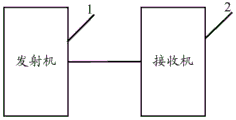
下面对本发明实施例的应用场景进行介绍。请参见图1,图1是本发明实施例提供的一种通信系统的架构图。具体的,如图1所示,该通信系统中包括发射机和接收机,该发射机可以是BS,也可以是MS,相应地,该接收机可以是MS,也可以是BS。发射机与接收机之间可通过波束训练确定出用于进行数据传输的波束,从而实现数据传输。The following describes application scenarios of the embodiments of the present invention. Please refer to FIG. 1. FIG. 1 is an architecture diagram of a communication system provided by an embodiment of the present invention. Specifically, as shown in FIG. 1 , the communication system includes a transmitter and a receiver, the transmitter may be a BS or an MS, and accordingly, the receiver may be an MS or a BS. The beam used for data transmission can be determined through beam training between the transmitter and the receiver, thereby realizing data transmission.
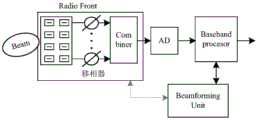
进一步的,请一并参见图2a和图2b,图2a为图1所示的通信系统中的一种发射机的结构示意图,图2b为图1所示的通信系统中的一种接收机的结构示意图。如图2a所示,发射机可以包括射频前端(Radio Front)、数模转换器(英文:Digital to Analog Converter,简称DAC)、基带处理器(Baseband processor)和波束成型单元(Beamforming Unit)。发射机的基带处理器用于实现对所发送或接收的信号的处理,包括层映射、预编码、调制/解调、编码/编译等,进一步的,还可对于物理控制信道、物理数据信道、物理广播信道、参考信号等进行处理。例如,基带处理器可对来自于MAC的01数据进行调制、成型和成帧等处理,并输入给数模转换器,数模转换器的数据再通过射频前端将信号上变频调制到载波频率通过天线发射出去。发射机射频前端通常包括功率分配网络(Divider)、移相器和天线阵列,以实现波束成型功能。波束成型单元则根据基带处理器反馈的信息控制射频前端进行移相操作,实现波束成型。Further, please refer to FIG. 2a and FIG. 2b together, FIG. 2a is a schematic structural diagram of a transmitter in the communication system shown in FIG. 1 , and FIG. 2b is a schematic diagram of a receiver in the communication system shown in FIG. 1 . Schematic. As shown in FIG. 2a, the transmitter may include a radio front (Radio Front), a digital to analog converter (English: Digital to Analog Converter, DAC for short), a baseband processor (Baseband processor) and a beamforming unit (Beamforming Unit). The baseband processor of the transmitter is used to process the transmitted or received signals, including layer mapping, precoding, modulation/demodulation, coding/coding, etc. Broadcast channels, reference signals, etc. are processed. For example, the baseband processor can modulate, shape and frame the 01 data from the MAC, and input it to the digital-to-analog converter. The data from the digital-to-analog converter then up-converts and modulates the signal to the carrier frequency through the RF front-end. The antenna emits. The transmitter RF front end usually includes a power distribution network (Divider), a phase shifter and an antenna array for beamforming. The beamforming unit controls the RF front-end to perform phase-shifting operations according to the information fed back by the baseband processor to realize beamforming.
如图2b所示,接收机侧也包括射频前端、模数转换器、基带处理器和波束成型单元。接收机射频前端除了包括天线阵列和移相器外,还可包括功率合成网络。接收机射频前端将接收信号从某个载波频率的信号下变频到基带的模拟信号,基带模拟信号通过模数转换成数字信号,基带处理器通过信道估计和解调等操作即可提取出发射数据。接收机的波束成型单元与发射机波束成型单元功能一致,均能够用于通过控制移相器移相值调整波束指向。As shown in Figure 2b, the receiver side also includes an RF front-end, an analog-to-digital converter, a baseband processor, and a beamforming unit. In addition to the antenna array and phase shifter, the receiver RF front end can also include a power combining network. The RF front-end of the receiver down-converts the received signal from a signal of a certain carrier frequency to a baseband analog signal, the baseband analog signal is converted into a digital signal through analog-to-digital conversion, and the baseband processor can extract the transmitted data through channel estimation and demodulation operations. . The beamforming unit of the receiver has the same function as the beamforming unit of the transmitter, and both can be used to adjust the beam pointing by controlling the phase shift value of the phase shifter.
应理解,本发明实施例的波束训练可以是指发射机发射多个训练波束、接收机固定接收波束进行发射训练,或者发射机固定发射波束、接收机用多个训练波束进行接收训练,等等,本发明实施例不做限定。其中,该多个训练波束可以同时发送,也可以一个一个发送,两个一组发送等等,其发送方式取决于发射机的是否具备发射多个波束的能力以及接收机是否具备多个波束的接收能力。进一步的,不同训练波束对应的训练序列可以以码分方式发送,也可以以频分方式发送。It should be understood that the beam training in this embodiment of the present invention may refer to that the transmitter transmits multiple training beams, the receiver fixes the receive beam for transmission training, or the transmitter fixes the transmit beam, and the receiver uses multiple training beams to perform receive training, etc. , the embodiments of the present invention are not limited. The multiple training beams can be sent at the same time, or sent one by one, in groups of two, etc. The sending method depends on whether the transmitter has the ability to transmit multiple beams and whether the receiver has the ability to transmit multiple beams. Receiving ability. Further, the training sequences corresponding to different training beams may be sent in a code division manner or in a frequency division manner.
本申请公开了一种数据传输方法、接收机、发射机及系统,能够提升数据传输效率,降低系统开销。以下分别详细说明。The present application discloses a data transmission method, receiver, transmitter and system, which can improve data transmission efficiency and reduce system overhead. Detailed descriptions are given below.
请参见图3,图3是本发明实施例的一种数据传输方法的交互示意图。具体的,如图3所示,本发明实施例的所述数据传输方法可包括以下步骤:Please refer to FIG. 3 , which is an interactive schematic diagram of a data transmission method according to an embodiment of the present invention. Specifically, as shown in FIG. 3 , the data transmission method according to the embodiment of the present invention may include the following steps:
101、发射机生成一个或多个训练序列。101. The transmitter generates one or more training sequences.
可选的,该接收机可以是MS,也可以是BS;相应地,该发射机可以是BS,也可以是MS,本发明实施例以发射机为BS,接收机为MS为例进行说明。Optionally, the receiver may be an MS or a BS; correspondingly, the transmitter may be a BS or an MS. The embodiment of the present invention is described by taking the transmitter as the BS and the receiver as the MS as an example.
其中,该训练序列可以是导频序列,如ZC序列。Wherein, the training sequence may be a pilot sequence, such as a ZC sequence.
102、发射机通过多个训练波束发送一个或多个训练序列和天线配置信息至接收机。102. The transmitter sends one or more training sequences and antenna configuration information to the receiver through multiple training beams.
其中,该多个训练波束可以是基于BS当前数据传输的第一数据波束确定出的,该训练波束可以与该训练序列一一对应。该第一数据波束可以是指当前用于进行数据传输的波束,也即波束训练前用于进行数据传输的波束。该天线配置信息可包括BS天线阵列的列数、行数以及列天线间距、行天线间距的一种或多种。The multiple training beams may be determined based on the first data beams currently transmitted by the BS, and the training beams may be in one-to-one correspondence with the training sequence. The first data beam may refer to a beam currently used for data transmission, that is, a beam used for data transmission before beam training. The antenna configuration information may include the number of columns, the number of rows, and one or more of the column antenna spacing and the row antenna spacing of the BS antenna array.
可选的,该多个训练波束可以是基于预置的角度扰动量和该第一数据波束的方向确定出的。其中,该角度扰动量可以是BS实时确定出的,也可以是预先配置得到的,如BS与MS预先协商确定的。Optionally, the multiple training beams may be determined based on a preset angular disturbance amount and the direction of the first data beam. The angular disturbance amount may be determined in real time by the BS, or may be pre-configured, for example, determined through pre-negotiation between the BS and the MS.
假设训练波束为Be,1,Be,2,Bv,1,Bv,2,该训练波束Be,1,Be,2,Bv,1,Bv,2通常是按照一定的角度扰动量对当前数据波束即第一数据波束Bbs,c进行扰动得到。例如可通过

具体的,在确定训练波束时,假设BS通过权值WBS(Ωbs,C),WBS(ΩE,1),WBS(ΩE,2),WBS(ΩA,1),WBS(ΩA,2)形成多个训练波束Bbs,c,Be,1,Be,2,Bv,1,Bv,2,并通过该训练波束Bbs,c,Be,1,Be,2,Bv,1,Bv,2发射训练序列,MS的AoD和ZoD方向用固定权值WMS(Ωms,C)形成固定波束以接收训练序列。其中,该WBS(Ωbs,C)为当前数据传输波束即第一数据波束Bms,c的权值;WBS(ΩE,1),WBS(ΩE,2)为俯仰方向的训练波束的权值,用于估计俯仰方向的角度偏移;WBS(ΩA,1),WBS(ΩA,2)为水平方向的训练波束的权值,用于估计水平方向的角度偏移。WMS(Ωms,C)为当前MS进行数据传输所使用的固定波束的权值。上述各权值可以按照以下公式分别计算得出:Specifically, when determining the training beam, it is assumed that the BS passes through the weights W BS (Ω bs,C ), W BS (Ω E,1 ), W BS (Ω E,2 ), W BS (Ω A,1 ), W BS (Ω A,2 ) forms a plurality of training beams B bs ,c,B e,1 ,B e,2 ,B v,1 ,B v,2 , and passes the training beams B bs,c ,B e ,1 ,B e,2 ,B v,1 ,B v,2 transmit the training sequence, and the AoD and ZoD directions of the MS form a fixed beam with a fixed weight W MS (Ω ms,C ) to receive the training sequence. Wherein, the W BS (Ω bs,C ) is the weight of the current data transmission beam, that is, the first data beam B ms,c ; W BS (Ω E,1 ), W BS (Ω E,2 ) are the pitch direction The weight of the training beam is used to estimate the angle offset in the pitch direction; W BS (Ω A,1 ), W BS (Ω A,2 ) are the weights of the training beam in the horizontal direction, used to estimate the angle in the horizontal direction offset. W MS (Ω ms,C ) is the weight of the fixed beam used by the current MS for data transmission. The above weights can be calculated separately according to the following formulas:
WBS(Ωbs,C)=a(Ωbs,C),W BS (Ω bs,C )=a(Ω bs,C ),
WBS(ΩE,1)=a(ΩE,1),W BS (Ω E,1 )=a(Ω E,1 ),
WBS(ΩE,2)=a(ΩE,2),W BS (Ω E,2 )=a(Ω E,2 ),
WBS(ΩA,1)=a(ΩA,1),W BS (Ω A,1 )=a(Ω A,1 ),
WBS(ΩA,2)=a(ΩA,2),W BS (Ω A,2 )=a(Ω A,2 ),
WMS(Ωms,C)=a(Ωms,C),W MS (Ω ms,C )=a(Ω ms,C ),
其中,in,

Ωbs,C=[θbs,c,φbs,c],ΩE,1=[θE,1,φbs,c],ΩE,2=[θE,2,φbs,c],ΩV,1=[θbs,c,φV,1],ΩV,2=[θbs,c,φV,2],Ωms,C=[θms,c,φms,c]。Ω bs,C =[θ bs,c ,φ bs,c ],Ω E,1 =[θ E,1 ,φ bs,c ],Ω E,2 =[θ E,2 ,φ bs,c ] , Ω V,1 =[θ bs,c ,φ V,1 ],Ω V,2 =[θ bs,c ,φ V,2 ],Ω ms,C =[θ ms,c ,φ ms,c ].
103、接收机基于该训练序列计算每一训练波束的功率时延响应,并基于每一训练波束的功率时延响应和该天线配置信息计算角度偏移量。103. The receiver calculates a power delay response of each training beam based on the training sequence, and calculates an angle offset based on the power delay response of each training beam and the antenna configuration information.
可选的,MS可通过固定波束接收BS通过多个训练波束发送的训练序列,并可基于该训练序列确定出该第一数据波束的偏移信息,如确定出发射机的发射角度偏移量。Optionally, the MS can receive the training sequence sent by the BS through multiple training beams through the fixed beam, and can determine the offset information of the first data beam based on the training sequence, such as determining the transmission angle offset of the transmitter. .
其中,该角度偏移量可以是指物理角度偏移量,也可以是指虚拟域的角度偏移量。可选的,以均匀平面阵列为列,假设BS和MS的天线被放置在YoZ平面上,如图5a所示,其波束成型过程中的球面坐标系如图5b所示。其中,θ为俯仰角,其取值[0,π],并可假设与Z轴正方向的夹角为正,负方向的夹角值为负;φ为水平方向的方位角,其取值范围为(-π,π],假设角度为X轴正方向与向量(x,y,z)在XoY平面的投影的夹角,方向延X轴正半轴向Y轴正半轴方向确定该φ的角度。则该角度偏移量可以是在物理角度坐标θ和φ上的偏移量ΔΩ=[Δθ,Δφ],也可以是变换域上的虚拟角度偏移量ΔΨ=[Δα,Δβ]。进一步可选的,从物理角度域到虚拟角度域的变换公式可以为:The angular offset may refer to a physical angular offset, or may refer to an angular offset of a virtual domain. Optionally, taking a uniform plane array as a column, it is assumed that the antennas of the BS and MS are placed on the YoZ plane, as shown in Figure 5a, and the spherical coordinate system during the beamforming process is shown in Figure 5b. Among them, θ is the pitch angle, which takes the value [0, π], and it can be assumed that the included angle with the positive direction of the Z axis is positive, and the included angle in the negative direction is negative; φ is the azimuth angle in the horizontal direction, and its value The range is (-π, π], assuming that the angle is the angle between the positive direction of the X axis and the projection of the vector (x, y, z) on the XoY plane, and the direction extends along the positive half axis of the X axis to determine the direction of the positive half axis of the Y axis. The angle of φ. Then the angle offset can be the offset ΔΩ=[Δθ,Δφ] on the physical angle coordinates θ and φ, or the virtual angle offset ΔΨ=[Δα,Δβ on the transformation domain ]. Further optional, the transformation formula from the physical angle domain to the virtual angle domain can be:
Gp->v(·):Ω=[θ,φ]→Ψ=[α,β]G p->v (·):Ω=[θ,φ]→Ψ=[α,β]
α=πdyλ-1Nysin(φ)sin(θ)α=πd y λ -1 N y sin(φ)sin(θ)
β=πdzλ-1Nzcos(θ)β=πd z λ -1 N z cos(θ)
其中,λ为载波的波长,dy,dz分别为Y轴和Z轴方向天线间距。Ny为平面阵列的列数,Nz为平面阵列的行数,则平面阵列的总天线数为N=Ny*Nz。Among them, λ is the wavelength of the carrier, and dy and d z are the antenna spacings in the Y-axis and Z-axis directions, respectively. N y is the number of columns of the planar array, and N z is the number of rows of the planar array, so the total number of antennas of the planar array is N=N y *N z .
从虚拟角度域到物理角度域的变换公式可以为:The transformation formula from the virtual angle domain to the physical angle domain can be:
Gv->p(·):Ψ=[α,β]→Ω=[θ,φ]G v->p (·):Ψ=[α,β]→Ω=[θ,φ]


其中,α和β需满足

可选的,该角度偏移量可以是指当前数据波束方向(即第一数据波束的方向)偏离信道中心方向的角度值或当前数据波束方向偏离最佳波束方向的角度值。在本发明实施例中,该信道中心方向可以为信道的AoD和ZoD方向,如图6所示,是本发明实施例提供的一种角度偏移示意图。信道中心方向可以为一个等效的真实的物理方向也可以是指一个等效的虚拟的方向,与具体的物理信道相关。本发明实施例以均匀的平面阵列(英文:UniformPlanar Array,简称UPA)为例进行说明。假设角度偏移量为ΔΩ,ΔΩ=[Δθ,Δφ],其中,该Δθ为俯仰方向的角度偏移,Δφ为水平方向的角度偏移。可选的,在均匀的线性阵列(英文:Uniform Linear Array,简称ULA)中,可以只包含Δθ和Δφ之一,即对应的训练波束只有Be,1,Be,2或Bv,1,Bv,2。Optionally, the angular offset may refer to the angle value at which the current data beam direction (ie the direction of the first data beam) deviates from the channel center direction or the angle value at which the current data beam direction deviates from the optimal beam direction. In the embodiment of the present invention, the center direction of the channel may be the AoD and ZoD directions of the channel, as shown in FIG. 6 , which is a schematic diagram of an angular offset provided by the embodiment of the present invention. The channel center direction may be an equivalent real physical direction or an equivalent virtual direction, which is related to a specific physical channel. The embodiments of the present invention are described by taking a uniform plane array (English: UniformPlanar Array, UPA for short) as an example. It is assumed that the angular offset is ΔΩ, ΔΩ=[Δθ, Δφ], where Δθ is the angular offset in the pitch direction, and Δφ is the angular offset in the horizontal direction. Optionally, in a uniform linear array (English: Uniform Linear Array, ULA for short), only one of Δθ and Δφ may be included, that is, the corresponding training beam is only B e,1 ,B e,2 or B v,1 ,B v,2 .
进一步的,在计算角度偏移量时,BS可通过训练波束Be,1,Be,2,Bv,1,Bv,2发送训练序列,或者通过训练波束Be,1,Be,2,Bv,1,Bv,2和Bbs,c发送训练序列。MS采用固定波束Bms,c接收训练序列,并基于该训练序列计算出每一训练波束的功率时延响应

进一步可选的,在计算角度偏移量时,MS可从计算出的各功率时延响应中确定出幅度响应最大的时延,即按照以下公式确定出:Further optionally, when calculating the angle offset, the MS may determine the delay with the largest amplitude response from the calculated power delay responses, that is, determine it according to the following formula:

在确定出幅度响应最大的时延之后,MS则可计算水平和俯仰方向下训练波束的时延l*下的幅度与波束Bbs,c在时延l*下的幅度比,即最强径的比值,如下:After determining the delay with the largest amplitude response, the MS can calculate the ratio of the amplitude of the training beam at the time delay l * in the horizontal and pitch directions to the amplitude ratio of the beam B bs,c at the delay l * , that is, the strongest path ratio, as follows:


此外,还可对下面的公式求逆计算出


并使得and make


其中,μ用于调节计算
进一步的,该


可选的,还可预先配置一个查找表,该查找表中包括多组


其中,in,
ΔΨE,i=[ΔαE,i,0]=Gp→v(ΩE,i)-Ψbs,c,i=1,2;ΔΨ E,i =[Δα E,i ,0]=G p→v (Ω E,i )-Ψ bs,c ,i=1,2;
ΔΨA,i=[0,ΔβA,i]=Gp→v(ΩA,i)-Ψbs,c,i=1,2;ΔΨ A,i =[0,Δβ A,i ]=G p→v (Ω A,i )-Ψ bs,c ,i=1,2;
Ψbs,c=Gp→v(Ωbs,c)Ψ bs,c =G p→v (Ω bs,c )
则虚拟域的角度偏移量


可选的,还可根据该虚拟域的角度偏移量转换得到物理角度域的角度偏移量

从而可确定出第一数据波束对应的角度偏移量,以基于该角度偏移量确定出新的数据传输波束。Thus, the angle offset corresponding to the first data beam can be determined, so as to determine a new data transmission beam based on the angle offset.
104、接收机向发射机发送该角度偏移量。104. The receiver sends the angular offset to the transmitter.
105、发射机基于该角度偏移量确定用于后续数据传输的第二数据波束。105. The transmitter determines a second data beam for subsequent data transmission based on the angular offset.
106、发射机使用该第二数据波束与接收机进行数据传输。106. The transmitter uses the second data beam to perform data transmission with the receiver.
可选的,在MS计算出该角度偏移量之后,即可将该角度偏移量发送给BS。BS接收MS发送的角度偏移量,并基于该角度偏移量修正当前数据波束的方向,使得数据波束的方向为信道的中心方向,并可基于该角度偏移量计算出后续数据传输波束的权值向量,即确定出新的数据传输波束也就是第二数据波束,从而可基于该第二数据波束进行数据传输。其中,MS发送给BS的角度偏移量可以是物理角度偏移量,也可以是虚拟域的角度偏移量,且MS可通过高频网络发送也可以通过低频网络发送,本发明实施例不做限定。Optionally, after the MS calculates the angular offset, the angular offset may be sent to the BS. The BS receives the angular offset sent by the MS, and corrects the direction of the current data beam based on the angular offset, so that the direction of the data beam is the center direction of the channel, and can calculate the direction of the subsequent data transmission beam based on the angular offset. The weight vector, that is, a new data transmission beam, that is, a second data beam is determined, so that data transmission can be performed based on the second data beam. The angle offset sent by the MS to the BS may be a physical angle offset or an angle offset in a virtual domain, and the MS may be sent through a high-frequency network or a low-frequency network. This embodiment of the present invention does not Do limit.
在本发明实施例中,MS可通过固定波束接收BS通过多个训练波束发送的多个训练序列,从而能够基于该多个训练序列确定出当前数据传输的第一数据波束的偏移信息并发送给BS,使得BS能够基于该偏移信息确定用于后续数据传输的第二数据波束,从而在MS的位置或姿态发生着改变时能够及时更新数据传输的波束,以维护通信链路的质量,进而提升了数据传输效率,降低了系统开销。In this embodiment of the present invention, the MS can receive, by using a fixed beam, multiple training sequences sent by the BS through multiple training beams, so that the offset information of the first data beam of current data transmission can be determined based on the multiple training sequences and sent to the MS To the BS, so that the BS can determine the second data beam for subsequent data transmission based on the offset information, so that the beam for data transmission can be updated in time when the position or attitude of the MS changes, so as to maintain the quality of the communication link, This further improves data transmission efficiency and reduces system overhead.
请参见图7,图7是本发明实施例的另一种数据传输方法的交互示意图。具体的,如图7所示,本发明实施例的所述数据传输方法可包括以下步骤:Please refer to FIG. 7. FIG. 7 is an interactive schematic diagram of another data transmission method according to an embodiment of the present invention. Specifically, as shown in FIG. 7 , the data transmission method according to the embodiment of the present invention may include the following steps:
201、发射机生成一个或多个训练序列。201. The transmitter generates one or more training sequences.
202、发射机通过多个训练波束发送一个或多个训练序列至接收机。202. The transmitter sends one or more training sequences to the receiver through multiple training beams.
具体的,BS生成并发送训练序列的具体方式请参见上述实施例中的相关描述,此处不再赘述。Specifically, for the specific manner in which the BS generates and sends the training sequence, please refer to the relevant descriptions in the foregoing embodiments, which will not be repeated here.
203、接收机基于该训练序列计算每一训练波束的功率时延响应,并基于每一训练波束的功率时延响应计算波束方向信息。203. The receiver calculates the power delay response of each training beam based on the training sequence, and calculates beam direction information based on the power delay response of each training beam.
其中,该波束方向信息可包括发射机的AoD、ZoD角度偏移量。可选的,该方向信息可基于MS确定出的角度偏移量和当前数据传输波束即第一数据波束的方向计算得到。其中,该第一数据波束的方向可以是BS发送给MS的,也可以是MS计算出的。该角度偏移量的确定方式请参照上述实施例的相关描述,此处不赘述。例如,BS可根据虚拟域的角度偏移量计算出物理角度域的波束方向

进而可根据该
204、接收机向发射机发送该波束方向信息。204. The receiver sends the beam direction information to the transmitter.
在确定出用于后续数据传输的第二数据波束的方向信息如AoD、ZoD之后,MS即可将该方向信息发送给BS。After determining the direction information such as AoD and ZoD of the second data beam used for subsequent data transmission, the MS can send the direction information to the BS.
205、发射机基于该波束方向信息确定用于后续数据传输的第二数据波束。205. The transmitter determines a second data beam for subsequent data transmission based on the beam direction information.
206、发射机使用该第二数据波束与接收机进行数据传输。206. The transmitter uses the second data beam to perform data transmission with the receiver.
可选的,在MS计算出新的数据传输波束的方向信息之后,即可将该方向信息发送给BS。BS接收MS发送的方向信息,并可基于该方向信息生成波束权值,以确定后续数据传输的第二数据波束,从而可基于该第二数据波束进行数据传输。Optionally, after the MS calculates the direction information of the new data transmission beam, the direction information may be sent to the BS. The BS receives the direction information sent by the MS, and can generate a beam weight based on the direction information to determine a second data beam for subsequent data transmission, so that data transmission can be performed based on the second data beam.
在本发明实施例中,MS可通过固定波束接收BS通过多个训练波束发送的多个训练序列,从而能够基于该多个训练序列估计出需要调整的角度偏移量,进而确定出新的数据传输波束即第二数据波束的方向信息并发送给BS,使得BS能够基于该方向信息确定用于后续数据传输的第二数据波束,从而在MS的位置或姿态发生着改变时能够及时更新数据传输的波束,以维护通信链路的质量,进而提升了数据传输效率,降低了系统开销。In this embodiment of the present invention, the MS can receive, through a fixed beam, multiple training sequences sent by the BS through multiple training beams, so as to estimate the angular offset to be adjusted based on the multiple training sequences, and then determine new data The direction information of the transmission beam, that is, the second data beam, is sent to the BS, so that the BS can determine the second data beam for subsequent data transmission based on the direction information, so that the data transmission can be updated in time when the position or attitude of the MS changes to maintain the quality of the communication link, thereby improving the data transmission efficiency and reducing the system overhead.
请参见图8,图8是本发明实施例的又一种数据传输方法的交互示意图。具体的,如图8所示,本发明实施例的所述数据传输方法可包括以下步骤:Please refer to FIG. 8. FIG. 8 is an interactive schematic diagram of still another data transmission method according to an embodiment of the present invention. Specifically, as shown in FIG. 8 , the data transmission method according to the embodiment of the present invention may include the following steps:
301、发射机生成一个或多个训练序列。301. The transmitter generates one or more training sequences.
302、发射机通过多个训练波束发送一个或多个训练序列至接收机。302. The transmitter sends one or more training sequences to the receiver through multiple training beams.
具体的,BS生成并发送训练序列的具体方式请参见上述实施例中的相关描述,此处不再赘述。Specifically, for the specific manner in which the BS generates and sends the training sequence, please refer to the relevant descriptions in the foregoing embodiments, which will not be repeated here.
303、接收机基于该训练序列计算每一训练波束的功率时延响应,并基于每一训练波束的功率时延响应计算每一个训练波束与第一数据波束的最强径的比值。303. The receiver calculates the power delay response of each training beam based on the training sequence, and calculates the ratio of the strongest diameter of each training beam to the first data beam based on the power delay response of each training beam.
其中,该训练波束与第一数据波束的最强径的比值(简称“最强径比值”)即为上述实施例中的
304、接收机向发射机发送该最强径的比值。304. The receiver sends the ratio of the strongest path to the transmitter.
305、发射机基于该最强径的比值确定用于后续数据传输的第二数据波束。305. The transmitter determines a second data beam for subsequent data transmission based on the ratio of the strongest paths.
306、发射机使用该第二数据波束与接收机进行数据传输。306. The transmitter uses the second data beam to perform data transmission with the receiver.
可选的,MS在确定出该最强径比值之后,即可向BS发送该最强径比值

在本发明实施例中,MS可通过固定波束接收BS通过多个训练波束发送的多个训练序列,从而能够基于该多个训练序列确定出每一个训练波束与第一数据波束的最强径的比值并发送给BS,使得BS能够基于该最强径比值计算出角度偏移量或方向信息等偏移信息,并基于该偏移信息确定出用于后续数据传输的第二数据波束,从而在MS的位置或姿态发生着改变时,能够及时更新数据传输的波束,以维护通信链路的质量,进而提升了数据传输效率,且节省了MS开销。In this embodiment of the present invention, the MS may receive, through a fixed beam, multiple training sequences sent by the BS through multiple training beams, so that the difference between each training beam and the strongest path of the first data beam can be determined based on the multiple training sequences. The ratio is sent to the BS, so that the BS can calculate offset information such as angle offset or direction information based on the strongest diameter ratio, and determine the second data beam for subsequent data transmission based on the offset information, so as to When the position or attitude of the MS changes, the beam for data transmission can be updated in time to maintain the quality of the communication link, thereby improving the data transmission efficiency and saving the MS overhead.
请参见图9,图9是本发明实施例的又一种数据传输方法的交互示意图。具体的,如图9所示,本发明实施例的所述数据传输方法包括以下步骤:Please refer to FIG. 9. FIG. 9 is an interactive schematic diagram of still another data transmission method according to an embodiment of the present invention. Specifically, as shown in FIG. 9 , the data transmission method according to the embodiment of the present invention includes the following steps:
401、发射机生成一个或多个训练序列。401. The transmitter generates one or more training sequences.
402、发射机通过多个训练波束发送一个或多个训练序列。402. The transmitter sends one or more training sequences through multiple training beams.
具体的,BS生成并发送训练序列的具体方式请参见上述实施例中的相关描述,此处不赘述。Specifically, for the specific manner in which the BS generates and sends the training sequence, please refer to the relevant descriptions in the foregoing embodiments, which will not be repeated here.
403、接收机基于训练序列确定所述第一数据波束的偏移信息。403. The receiver determines offset information of the first data beam based on the training sequence.
其中,该偏移信息可以包括发射机的AoD、ZoD、每一个训练波束与第一数据波束的最强径的比值、BS角度偏移量等等,其计算方式可以参照上述实施例的相关描述,此处不赘述。The offset information may include the AoD, ZoD of the transmitter, the ratio of the strongest diameter of each training beam to the first data beam, the BS angle offset, etc., and the calculation method may refer to the relevant descriptions of the above embodiments , will not be repeated here.
404、接收机向发射机发送该偏移信息。404. The receiver sends the offset information to the transmitter.
405、发射机基于该偏移信息确定下一次波束训练的时间或波束训练的训练时间间隔。405. The transmitter determines the next beam training time or the beam training training time interval based on the offset information.
406、发射机向接收机发送包括该下一次波束训练的时间或训练时间间隔的训练通知消息。406. The transmitter sends a training notification message including the next beam training time or training time interval to the receiver.
可选的,BS在接收到MS发送的偏移信息之后,BS还可根据该偏移信息确定下一次波束训练的时间或波束训练的训练时间间隔,生成包括所述下一次波束训练的时间或该训练时间间隔的训练通知消息,并向MS发送该训练通知消息,以实现调整波束训练的周期。Optionally, after the BS receives the offset information sent by the MS, the BS can also determine the time of the next beam training or the training time interval of the beam training according to the offset information, and generate a time including the next beam training time or The training notification message of the training time interval is sent to the MS, so as to adjust the period of the beam training.
进一步可选的,BS根据该偏移信息确定下一次波束训练的时间或波束训练的训练时间间隔时,可以具体为:当该偏移信息指示的值高于预设的第一偏移阈值时,BS可将波束训练的训练时间间隔调整为比当前的训练时间间隔小预设阈值的时间间隔;当该偏移信息指示的值低于或等于预设的第二偏移阈值时,BS可将波束训练的训练时间间隔调整为比当前的训练时间间隔大预设阈值的时间间隔。其中,该第一偏移阈值和该第二偏移阈值可以相同也可以不同。可选的,该偏移信息指示的值可以是指角度偏移量,或者角度偏移量在单位时间内的平均偏移量。该平均偏移量可根据该角度偏移量以及当前波束训练时间计算出。Further optionally, when the BS determines the time of the next beam training or the training time interval of the beam training according to the offset information, it may be specifically: when the value indicated by the offset information is higher than the preset first offset threshold. , the BS may adjust the training time interval of the beam training to a time interval smaller than the current training time interval by the preset threshold; when the value indicated by the offset information is lower than or equal to the preset second offset threshold, the BS may Adjust the training time interval of beam training to a time interval larger than the current training time interval by the preset threshold. The first offset threshold and the second offset threshold may be the same or different. Optionally, the value indicated by the offset information may refer to an angular offset, or an average offset of the angular offset within a unit time. The average offset can be calculated according to the angle offset and the current beam training time.
举例来说,假设MS发送给BS的偏移信息为虚拟角度偏移量


407、发射机与接收机基于该下一次波束训练的时间或训练时间间隔进行波束训练。407. The transmitter and the receiver perform beam training based on the next beam training time or training time interval.
在本发明实施例中,MS可通过固定波束接收BS通过多个训练波束发送的多个训练序列,从而能够基于该多个训练序列确定出当前数据传输的第一数据波束的偏移信息并发送给BS,使得BS能够基于该偏移信息确定用于后续数据传输的第二数据波束,进一步的,BS还可基于该偏移信息调整波束训练周期,控制下一次波束训练的时间,从而能够根据波束偏移信息及时更新数据传输的波束,减少训练开销,并能够较好地维护通信链路的质量,提升了数据传输效率,降低了系统开销。In this embodiment of the present invention, the MS can receive, by using a fixed beam, multiple training sequences sent by the BS through multiple training beams, so that the offset information of the first data beam of current data transmission can be determined based on the multiple training sequences and sent to the MS To the BS, so that the BS can determine the second data beam for subsequent data transmission based on the offset information, and further, the BS can also adjust the beam training period based on the offset information, and control the time of the next beam training, so as to be able to The beam offset information updates the data transmission beam in time, reduces training overhead, and can better maintain the quality of the communication link, improve data transmission efficiency, and reduce system overhead.
请参见图10,图10是本发明实施例的又一种数据传输方法的交互示意图。具体的,在本发明实施例中,发射机固定发射波束、接收机用多个训练波束进行接收训练。如图10所示,本发明实施例的所述数据传输方法包括以下步骤:Please refer to FIG. 10. FIG. 10 is an interactive schematic diagram of still another data transmission method according to an embodiment of the present invention. Specifically, in the embodiment of the present invention, the transmitter fixes a transmit beam, and the receiver uses multiple training beams for receiving training. As shown in FIG. 10 , the data transmission method according to the embodiment of the present invention includes the following steps:
501、发射机生成一个或多个训练序列。501. The transmitter generates one or more training sequences.
该发射机可以是BS,也可以是MS;相应地,该接收机可以是MS,也可以是BS,在本发明实施例中,以发射机为BS,接收机为MS为例进行说明。The transmitter may be a BS or an MS; correspondingly, the receiver may be an MS or a BS. In the embodiment of the present invention, the transmitter is a BS and the receiver is an MS as an example for description.
502、发射机通过固定波束发送一个或多个训练序列至接收机。502. The transmitter sends one or more training sequences to the receiver through a fixed beam.
503、接收机通过多个训练序列接收发射机发送的训练序列,并基于该训练序列确定第一数据波束的偏移信息。503. The receiver receives the training sequence sent by the transmitter through multiple training sequences, and determines offset information of the first data beam based on the training sequence.
可选的,该多个训练波束可以是基于预置的角度扰动量和该第一数据波束的方向确定出的。其中,该第一数据波束为接收机当前进行数据传输的波束。基于该训练序列确定出的偏移信息可包括MS的AOA、ZOA、每一个训练波束与该第一数据波束的最强径的比值、MS的角度偏移量等等。Optionally, the multiple training beams may be determined based on a preset angular disturbance amount and the direction of the first data beam. Wherein, the first data beam is a beam currently performing data transmission by the receiver. The offset information determined based on the training sequence may include the AOA, ZOA of the MS, the ratio of each training beam to the strongest diameter of the first data beam, the angular offset of the MS, and the like.
可选的,MS可基于MS通过多个训练波束接收的多个训练序列计算该多个训练波束的功率时延响应,并根据每一个训练波束的功率时延响应和MS的天线配置信息确定该偏移信息。其中,该MS的天线配置与BS的天线配置可以不同。Optionally, the MS may calculate the power delay responses of the multiple training beams based on multiple training sequences received by the MS through multiple training beams, and determine the power delay response of each training beam and the antenna configuration information of the MS. offset information. Wherein, the antenna configuration of the MS may be different from that of the BS.
具体的,本发明实施例中的训练波束的确定方法、偏移信息的确定方法与上述发射机发射多个训练波束、接收机固定接收波束进行发射训练的实施例中的方法类似,此处不赘述。Specifically, the method for determining the training beam and the method for determining the offset information in the embodiment of the present invention are similar to the methods in the above-mentioned embodiments in which the transmitter transmits multiple training beams and the receiver fixes the receiving beam for transmission training, and is not used here. Repeat.
504、接收机基于该偏移信息确定用于后续数据传输的第二数据波束。504. The receiver determines a second data beam for subsequent data transmission based on the offset information.
可选的,在MS确定出该偏移信息之后,即可基于该偏移信息修正当前数据波束的方向,使得数据波束的方向为信道的中心方向,并可基于该角度偏移量计算出后续数据传输波束的权值向量,即确定出新的数据传输波束也就是第二数据波束,并可基于该第二数据波束进行数据传输。Optionally, after the MS determines the offset information, it can correct the direction of the current data beam based on the offset information, so that the direction of the data beam is the center direction of the channel, and can calculate the follow-up based on the angular offset. The weight vector of the data transmission beam is to determine a new data transmission beam, that is, the second data beam, and data transmission can be performed based on the second data beam.
505、接收机向发射机发送该偏移信息。505. The receiver sends the offset information to the transmitter.
506、发射机基于该偏移信息确定下一次波束训练的时间或波束训练的训练时间间隔。506. The transmitter determines the next beam training time or the beam training training time interval based on the offset information.
507、发射机向接收机发送包括该下一次波束训练的时间或训练时间间隔的训练通知消息。507. The transmitter sends a training notification message including the next beam training time or training time interval to the receiver.
508、发射机与接收机基于该下一次波束训练的时间或训练时间间隔进行波束训练。508. The transmitter and the receiver perform beam training based on the next beam training time or training time interval.
可选的,BS在接收到来自MS发送的偏移信息之后,BS还可根据该偏移信息确定下一次波束训练的时间或波束训练的训练时间间隔,并生成包括下一次波束训练的时间或训练时间间隔的训练通知消息发送给MS,从而MS和BS可基于该下一次波束训练的时间或该训练时间间隔进行波束训练。具体的,本发明实施例中的该下一次波束训练的时间或训练时间间隔的确定方法可参照上述实施例中的相关描述,此处不赘述。Optionally, after the BS receives the offset information sent from the MS, the BS may also determine the time of the next beam training or the training time interval of the beam training according to the offset information, and generate a time or training interval including the next beam training. The training notification message of the training time interval is sent to the MS, so that the MS and the BS can perform beam training based on the time of the next beam training or the training time interval. Specifically, for the method for determining the time of the next beam training or the training time interval in the embodiment of the present invention, reference may be made to the relevant descriptions in the foregoing embodiments, and details are not described herein.
在本发明实施例中,MS可通过多个训练波束接收BS通过固定波束发送的多个训练序列,从而MS能够基于该多个训练序列确定出当前数据传输的第一数据波束的偏移信息,以基于该偏移信息确定用于后续数据传输的第二数据波束,从而能够根据波束偏移信息及时更新数据传输的波束,以维护通信链路的质量,进而提升了数据传输效率,降低了系统开销。进一步的,MS还可将该偏移信息发送给BS,使得BS能够基于该偏移信息调整波束训练周期,从而减少训练开销。In this embodiment of the present invention, the MS can receive multiple training sequences sent by the BS through the fixed beam through multiple training beams, so that the MS can determine the offset information of the first data beam for current data transmission based on the multiple training sequences, The second data beam used for subsequent data transmission is determined based on the offset information, so that the beam for data transmission can be updated in time according to the beam offset information, so as to maintain the quality of the communication link, thereby improving the data transmission efficiency and reducing the system cost. overhead. Further, the MS can also send the offset information to the BS, so that the BS can adjust the beam training period based on the offset information, thereby reducing training overhead.
请参见图11,图11是本发明实施例的一种接收机的结构示意图。具体的,如图11所示,本发明实施例的接收机可包括接收模块11、确定模块12以及发送模块13。其中,Referring to FIG. 11, FIG. 11 is a schematic structural diagram of a receiver according to an embodiment of the present invention. Specifically, as shown in FIG. 11 , the receiver in the embodiment of the present invention may include a receiving
所述接收模块11,用于通过固定波束接收发射机通过多个训练波束发送的多个训练序列,所述多个训练波束是基于所述发射机当前数据传输的第一数据波束确定出的,所述训练波束与所述训练序列一一对应;The receiving
所述确定模块12,用于基于所述多个训练序列确定所述第一数据波束的偏移信息;the determining
所述发送模块13,用于向所述发射机发送所述偏移信息,以使得所述发射机基于所述偏移信息确定用于后续数据传输的第二数据波束。The sending
其中,该第一数据波束可以是指当前用于进行数据传输的波束,也即波束训练前用于进行数据传输的波束。该训练序列可以是导频序列,如ZC序列。The first data beam may refer to a beam currently used for data transmission, that is, a beam used for data transmission before beam training. The training sequence may be a pilot sequence, such as a ZC sequence.
可选的,该偏移信息包括以下至少一种:Optionally, the offset information includes at least one of the following:
所述发射机的AoD、所述发射机的ZoD、每一个训练波束与所述第一数据波束的最强径的比值、所述第一数据波束的角度偏移量。The AoD of the transmitter, the ZoD of the transmitter, the ratio of each training beam to the strongest diameter of the first data beam, and the angular offset of the first data beam.
可选的,所述接收模块11可具体用于:Optionally, the receiving
接收所述发射机发射所述多个训练序列的天线配置信息;receiving, by the transmitter, antenna configuration information for transmitting the plurality of training sequences;
所述确定模块12可具体用于:The determining
根据所述多个训练序列计算所述多个训练波束的功率时延响应;calculating power delay responses of the plurality of training beams according to the plurality of training sequences;
根据所述多个训练波束的功率时延响应和所述天线配置信息确定所述第一数据波束的偏移信息。Offset information of the first data beam is determined according to the power delay responses of the plurality of training beams and the antenna configuration information.
其中,该天线配置信息可包括发射机的天线阵列的列数、行数以及列天线间距、行天线间距的一种或多种。The antenna configuration information may include the number of columns, the number of rows, and one or more of the column antenna spacing and the row antenna spacing of the antenna array of the transmitter.
可选的,所述确定模块12可具体用于:Optionally, the determining
根据所述多个训练序列计算所述多个训练波束的功率时延响应;calculating power delay responses of the plurality of training beams according to the plurality of training sequences;
根据所述多个训练波束的功率时延响应,确定幅度响应最大的时延;determining the delay with the largest amplitude response according to the power delay responses of the multiple training beams;
根据所述幅度响应最大的时延,计算每一个训练波束与所述第一数据波束的最强径的比值。According to the maximum time delay of the amplitude response, the ratio of each training beam to the strongest diameter of the first data beam is calculated.
进一步的,在可选的实施例中,所述接收机还可包括:Further, in an optional embodiment, the receiver may further include:
获取模块14,用于获取所述第一数据波束的功率时延响应;an
所述确定模块12在根据所述多个训练波束的功率时延响应和所述天线配置信息确定所述第一数据波束的偏移信息时,可具体用于:When determining the offset information of the first data beam according to the power delay responses of the multiple training beams and the antenna configuration information, the determining
根据所述第一数据波束的功率时延响应、所述多个训练波束的功率时延响应和所述天线配置信息确定所述第一数据波束的偏移信息。The offset information of the first data beam is determined according to the power delay responses of the first data beam, the power delay responses of the plurality of training beams, and the antenna configuration information.
进一步的,在可选的实施例中,Further, in an optional embodiment,
所述接收模块11,还用于接收所述发射机发送的训练通知消息,所述训练通知消息指示有下一次波束训练的时间或波束训练的训练时间间隔。The receiving
其中,该下一次波束训练的时间或波束训练的训练时间间隔可以是基于该偏移信息确定出的,从而能够基于偏移信息及时地调整波束训练的时间,以减少训练开销。The time of the next beam training or the training time interval of the beam training may be determined based on the offset information, so that the beam training time can be adjusted in time based on the offset information to reduce training overhead.
应理解,本发明实施例是对应方法实施例的装置实施例,对方法实施例的描述,也适用于本发明实施例。It should be understood that the embodiments of the present invention are apparatus embodiments corresponding to the method embodiments, and the descriptions of the method embodiments are also applicable to the embodiments of the present invention.
请参见图12,图12是本发明实施例的一种发射机的结构示意图。具体的,如图12所示,本发明实施例的接收机可包括序列生成模块21、发送模块22、接收模块23以及波束确定模块24。其中,Please refer to FIG. 12, which is a schematic structural diagram of a transmitter according to an embodiment of the present invention. Specifically, as shown in FIG. 12 , the receiver in this embodiment of the present invention may include a
所述序列生成模块21,用于生成一个或多个训练序列;The
所述发送模块22,用于通过多个训练波束发送所述一个或多个训练序列至接收机,所述多个训练波束是基于所述发射机当前数据传输的第一数据波束确定出的,所述训练波束与所述训练序列一一对应;The sending
所述接收模块23,用于接收来自所述接收机发送的所述第一数据波束的偏移信息;the receiving
所述波束确定模块24,用于根据所述偏移信息确定用于后续数据传输的第二数据波束。The
可选的,该偏移信息可包括以下至少一种:Optionally, the offset information may include at least one of the following:
所述发射机的AoD、所述发射机的ZoD、每一个训练波束与所述第一数据波束的最强径的比值、所述第一数据波束的角度偏移量。The AoD of the transmitter, the ZoD of the transmitter, the ratio of each training beam to the strongest diameter of the first data beam, and the angular offset of the first data beam.
进一步的,在可选的实施例中,Further, in an optional embodiment,
所述发送模块22,还可用于向所述接收机发送所述发射机发射所述一个或多个训练序列的天线配置信息,以使所述接收机基于所述天线配置信息和所述训练序列确定所述偏移信息。The sending
其中,该天线配置信息包括天线阵列的列数、行数以及列天线间距、行天线间距的一种或多种。The antenna configuration information includes the number of columns, the number of rows, and one or more of the column antenna spacing and the row antenna spacing of the antenna array.
可选的,该多个训练波束可以是基于预置的角度扰动量和所述第一数据波束的方向确定出的。其中,该角度扰动量可以是该发射机实时确定出并发送给该接收机的,也可以是预先配置得到的,如该接收机与发射机预先协商确定的。Optionally, the multiple training beams may be determined based on a preset angular disturbance amount and the direction of the first data beam. The angular disturbance amount may be determined by the transmitter in real time and sent to the receiver, or may be pre-configured, for example, determined by the receiver and the transmitter through pre-negotiation.
进一步的,在可选的实施例中,所述发射机还包括:Further, in an optional embodiment, the transmitter further includes:
训练确定模块25,用于根据所述偏移信息确定下一次波束训练的时间或波束训练的训练时间间隔;A
消息生成模块26,用于生成包括所述下一次波束训练的时间或所述训练时间间隔的训练通知消息;A
所述发送模块22,还用于向所述接收机发送所述训练通知消息。The sending
可选的,所述训练确定模块25可具体用于:Optionally, the
当所述偏移信息指示的值高于预设的第一偏移阈值时,将波束训练的训练时间间隔调整为比当前的训练时间间隔小预设阈值的时间间隔;When the value indicated by the offset information is higher than the preset first offset threshold, adjusting the training time interval of beam training to a time interval smaller than the current training time interval by the preset threshold;
当所述偏移信息指示的值低于或等于预设的第二偏移阈值时,将波束训练的训练时间间隔调整为比当前的训练时间间隔大预设阈值的时间间隔。When the value indicated by the offset information is lower than or equal to the preset second offset threshold, the training time interval of beam training is adjusted to a time interval greater than the current training time interval by the preset threshold.
其中,该第一偏移阈值和该第二偏移阈值可以设置为相同,或者该第一偏移阈值可设置为大于该第二偏移阈值。可选的,该偏移信息指示的值可以是指角度偏移量,或者角度偏移量在单位时间内的平均偏移量。该平均偏移量可根据该角度偏移量以及当前波束训练时间计算出。Wherein, the first offset threshold and the second offset threshold may be set to be the same, or the first offset threshold may be set to be greater than the second offset threshold. Optionally, the value indicated by the offset information may refer to an angular offset, or an average offset of the angular offset within a unit time. The average offset can be calculated according to the angle offset and the current beam training time.
在本发明实施例中,接收机可通过固定波束接收发射机通过多个训练波束发送的多个训练序列,从而能够基于该多个训练序列确定出当前数据传输的第一数据波束的偏移信息并发送给发射机,使得发射机能够基于该偏移信息确定用于后续数据传输的第二数据波束,从而提升了数据传输效率,降低了系统开销。应理解,本发明实施例是对应方法实施例的装置实施例,对方法实施例的描述,也适用于本发明实施例。In this embodiment of the present invention, the receiver may receive multiple training sequences sent by the transmitter through multiple training beams through a fixed beam, so that offset information of the first data beam currently being transmitted for data transmission can be determined based on the multiple training sequences and send it to the transmitter, so that the transmitter can determine the second data beam for subsequent data transmission based on the offset information, thereby improving the data transmission efficiency and reducing the system overhead. It should be understood that the embodiments of the present invention are apparatus embodiments corresponding to the method embodiments, and the descriptions of the method embodiments are also applicable to the embodiments of the present invention.
请参见图13,图13是本发明实施例的一种数据传输系统的结构示意图。具体的,如图13所示,本发明实施例的数据传输系统可包括发射机1和接收机2。其中,Please refer to FIG. 13, which is a schematic structural diagram of a data transmission system according to an embodiment of the present invention. Specifically, as shown in FIG. 13 , the data transmission system according to the embodiment of the present invention may include a
所述发射机1,用于生成一个或多个训练序列,通过多个训练波束发送所述一个或多个训练序列至接收机2,其中,所述多个训练波束是基于所述发射机当前数据传输的第一数据波束确定出的,所述训练波束与所述训练序列一一对应;The
所述接收机2,用于通过固定波束接收发射机1通过多个训练波束发送的多个训练序列,基于所述多个训练序列确定所述第一数据波束的偏移信息,并向所述发射机1发送所述偏移信息;The
所述发射机1,还用于接收来自所述接收机2发送的所述偏移信息,并根据所述偏移信息确定用于后续数据传输的第二数据波束。The
具体的,本发明实施例的发射机1和接收机2可参照图3至图10对应实施例中的发射机和接收机的相关描述,此处不赘述。Specifically, for the
请参见图14,图14是本发明实施例提供的另一种接收机的结构示意图。具体的,如图14所示,本发明实施例的所述接收机可包括:通信接口300、存储器200和处理器100,所述处理器100分别与所述通信接口300及所述存储器200连接。Referring to FIG. 14, FIG. 14 is a schematic structural diagram of another receiver provided by an embodiment of the present invention. Specifically, as shown in FIG. 14, the receiver in this embodiment of the present invention may include: a
所述通信接口300、存储器200以及处理器100之间可以通过总线进行数据连接,也可以通过其他方式数据连接。本实施例中以总线连接进行说明。The
所述处理器100可以是中央处理器(英文:Central Processing Unit,简称CPU),网络处理器(英文:Network Processor,简称NP)或CPU和NP的组合。The
所述处理器100还可以进一步包括硬件芯片。上述硬件芯片可以是专用集成电路(英文:Application-Specific Integrated Circuit,简称ASIC),可编程逻辑器件(英文:Programmable Logic Device,简称PLD)或其组合。上述PLD可以是复杂可编程逻辑器件(英文:Complex Programmable Logic Device,简称CPLD),现场可编程逻辑门阵列(英文:Field-Programmable Gate Array,简称FPGA),通用阵列逻辑(英文:Generic ArrayLogic,简称GAL)或其任意组合。The
所述存储器200可以包括易失性存储器(英文:Volatile Memory),例如随机存取存储器(英文:Random-Access Memory,简称RAM);存储器也可以包括非易失性存储器(英文:non-volatile memory),例如快闪存储器(英文:flash memory),硬盘(英文:Hard DiskDrive,简称HDD)或固态硬盘(英文:Solid-State Drive,简称SSD);存储器200还可以包括上述种类的存储器的组合。The
可选的,存储器200可以用于存储程序指令,处理器100调用该存储器200中存储的程序指令,可以执行图3至图10所示实施例中的一个或多个步骤,或其中可选的实施方式,使得该接收机实现上述方法中的功能。Optionally, the
所述处理器100用于基于所述通信接口并通过固定波束接收发射机通过多个训练波束发送的多个训练序列,所述多个训练波束是基于所述发射机当前数据传输的第一数据波束确定出的,所述训练波束与所述训练序列一一对应;The
基于所述多个训练序列确定所述第一数据波束的偏移信息;determining offset information of the first data beam based on the plurality of training sequences;
通过通信接口300向所述发射机发送所述偏移信息,以使得所述发射机基于所述偏移信息确定用于后续数据传输的第二数据波束。The offset information is sent to the transmitter through the
可选的,该偏移信息包括以下至少一种:Optionally, the offset information includes at least one of the following:
发射机的AoD、发射机的ZoD、每一个训练波束与该第一数据波束的最强径的比值、第一数据波束的角度偏移量。The AoD of the transmitter, the ZoD of the transmitter, the ratio of each training beam to the strongest diameter of the first data beam, and the angular offset of the first data beam.
可选的,处理器100执行所述接收机基于所述多个训练序列确定所述第一数据波束的偏移信息时,可具体执行以下步骤:Optionally, when the
通过通信接口300接收所述发射机发射所述多个训练序列的天线配置信息;receiving, through the
根据所述多个训练序列计算所述多个训练波束的功率时延响应;calculating power delay responses of the plurality of training beams according to the plurality of training sequences;
根据所述多个训练波束的功率时延响应和所述天线配置信息确定所述第一数据波束的偏移信息。Offset information of the first data beam is determined according to the power delay responses of the plurality of training beams and the antenna configuration information.
可选的,处理器100在执行所述多个训练序列确定所述第一数据波束的偏移信息,可具体执行以下步骤:Optionally, when the
根据所述多个训练序列计算所述多个训练波束的功率时延响应;calculating power delay responses of the plurality of training beams according to the plurality of training sequences;
根据所述多个训练波束的功率时延响应,确定幅度响应最大的时延;determining the delay with the largest amplitude response according to the power delay responses of the multiple training beams;
根据所述幅度响应最大的时延,计算每一个训练波束与所述第一数据波束的最强径的比值。According to the maximum time delay of the amplitude response, the ratio of each training beam to the strongest diameter of the first data beam is calculated.
其中,该天线配置信息包括天线阵列的列数、行数以及列天线间距、行天线间距中的一种或多种。The antenna configuration information includes the number of columns, the number of rows, and one or more of the column antenna spacing and the row antenna spacing of the antenna array.
可选的,处理器100还用于执行:Optionally, the
获取所述第一数据波束的功率时延响应;obtaining a power delay response of the first data beam;
处理器100在执行所述根据所述多个训练波束的功率时延响应和所述天线配置信息确定所述第一数据波束的偏移信息,可具体执行以下步骤:When the
根据所述第一数据波束的功率时延响应、所述多个训练波束的功率时延响应和所述天线配置信息确定所述第一数据波束的偏移信息。The offset information of the first data beam is determined according to the power delay responses of the first data beam, the power delay responses of the plurality of training beams, and the antenna configuration information.
可选的,处理器100还用于执行:Optionally, the
通过通信接口300接收所述发射机发送的训练通知消息,所述训练通知消息指示有下一次波束训练的时间或波束训练的训练时间间隔。A training notification message sent by the transmitter is received through the
请参见图15,图15是本发明实施例提供的另一种发射机的结构示意图。具体的,如图15所示,本发明实施例的发射机可包括:通信接口600、存储器500和处理器400,该处理器400分别与通信接口600及存储器500连接。Referring to FIG. 15, FIG. 15 is a schematic structural diagram of another transmitter provided by an embodiment of the present invention. Specifically, as shown in FIG. 15 , the transmitter in this embodiment of the present invention may include: a
所述通信接口600、存储器500以及处理器400之间可以通过总线进行数据连接,也可以通过其他方式数据连接。本实施例中以总线连接进行说明。The
所述处理器400可以是中央处理器(英文:Central Processing Unit,简称CPU),网络处理器(英文:Network Processor,简称NP)或CPU和NP的组合。The
所述处理器400还可以进一步包括硬件芯片。上述硬件芯片可以是专用集成电路(英文:Application-Specific Integrated Circuit,简称ASIC),可编程逻辑器件(英文:Programmable Logic Device,简称PLD)或其组合。上述PLD可以是复杂可编程逻辑器件(英文:Complex Programmable Logic Device,简称CPLD),现场可编程逻辑门阵列(英文:Field-Programmable Gate Array,简称FPGA),通用阵列逻辑(英文:Generic ArrayLogic,简称GAL)或其任意组合。The
所述存储器500可以包括易失性存储器(英文:Volatile Memory),例如随机存取存储器(英文:Random-Access Memory,简称RAM);存储器也可以包括非易失性存储器(英文:non-volatile memory),例如快闪存储器(英文:flash memory),硬盘(英文:Hard DiskDrive,简称HDD)或固态硬盘(英文:Solid-State Drive,简称SSD);存储器500还可以包括上述种类的存储器的组合。The
可选的,存储器500可以用于存储程序指令,处理器400调用该存储器500中存储的程序指令,可以执行图3至图10所示实施例中的一个或多个步骤,或其中可选的实施方式,使得该发射机实现上述方法中的功能。Optionally, the
所述处理器400用于:生成一个或多个训练序列;基于通信接口600并通过多个训练波束发送所述一个或多个训练序列至接收机,所述多个训练波束是基于所述发射机当前数据传输的第一数据波束确定出的,所述训练波束与所述训练序列一一对应;基于通信接口600接收来自所述接收机发送的所述第一数据波束的偏移信息;根据所述偏移信息确定用于后续数据传输的第二数据波束。The
可选的,该偏移信息可包括以下至少一种:Optionally, the offset information may include at least one of the following:
所述发射机的AoD、所述发射机的ZoD、每一个训练波束与所述第一数据波束的最强径的比值、所述第一数据波束的角度偏移量。The AoD of the transmitter, the ZoD of the transmitter, the ratio of each training beam to the strongest diameter of the first data beam, and the angular offset of the first data beam.
可选的,处理器400还用于执行:Optionally, the
通过通信接口600向所述接收机发送所述发射机发射所述一个或多个训练序列的天线配置信息,以使所述接收机基于所述天线配置信息和所述训练序列确定所述偏移信息。The antenna configuration information for the transmitter to transmit the one or more training sequences is sent to the receiver over the
其中,该天线配置信息可包括天线阵列的列数、行数以及列天线间距、行天线间距中的一种或多种。The antenna configuration information may include the number of columns, the number of rows, and one or more of the column antenna spacing and the row antenna spacing of the antenna array.
可选的,该多个训练波束可以是基于预置的角度扰动量和所述第一数据波束的方向确定出的。Optionally, the multiple training beams may be determined based on a preset angular disturbance amount and the direction of the first data beam.
可选的,处理器400在执行所述接收来自所述接收机发送的所述第一数据波束的偏移信息之后,还用于执行:Optionally, after performing the receiving of the offset information of the first data beam sent from the receiver, the
根据所述偏移信息确定下一次波束训练的时间或波束训练的训练时间间隔;determining the time of the next beam training or the training time interval of the beam training according to the offset information;
生成包括所述下一次波束训练的时间或所述训练时间间隔的训练通知消息,并基于通信接口600向所述接收机发送所述训练通知消息。A training notification message including the time of the next beam training or the training time interval is generated, and the training notification message is sent to the receiver based on the
处理器400在执行所述发射机根据所述偏移信息确定下一次波束训练的时间或波束训练的训练时间间隔时,可具体执行以下步骤:The
当所述偏移信息指示的值高于预设的第一偏移阈值时,所述发射机将波束训练的训练时间间隔调整为比当前的训练时间间隔小预设阈值的时间间隔;When the value indicated by the offset information is higher than the preset first offset threshold, the transmitter adjusts the training time interval of beam training to a time interval smaller than the current training time interval by the preset threshold;
当所述偏移信息指示的值低于或等于预设的第二偏移阈值时,所述发射机将波束训练的训练时间间隔调整为比当前的训练时间间隔大预设阈值的时间间隔。When the value indicated by the offset information is lower than or equal to the preset second offset threshold, the transmitter adjusts the training time interval of beam training to a time interval greater than the current training time interval by the preset threshold.
在本发明实施例中,接收机可通过固定波束接收发射机通过多个训练波束发送的多个训练序列,从而可基于该多个训练序列确定出当前数据传输的第一数据波束的偏移信息并发送给发射机,使得发射机能够基于该偏移信息确定用于后续数据传输的第二数据波束,从而提升了数据传输效率,降低了系统开销。In this embodiment of the present invention, the receiver may receive, by using a fixed beam, multiple training sequences sent by the transmitter through multiple training beams, so that offset information of the first data beam of current data transmission may be determined based on the multiple training sequences and send it to the transmitter, so that the transmitter can determine the second data beam for subsequent data transmission based on the offset information, thereby improving the data transmission efficiency and reducing the system overhead.
在本发明所提供的几个实施例中,应该理解到,所揭露的装置和方法,可以通过其它的方式实现。例如,以上所描述的装置实施例仅仅是示意性的,例如,所述模块的划分,仅仅为一种逻辑功能划分,实际实现时可以有另外的划分方式,例如多个模块或组件可以结合或者可以集成到另一个系统,或一些特征可以忽略,或不执行。另一点,所显示或讨论的相互之间的耦合或直接耦合或通信连接可以是通过一些接口,装置或模块的间接耦合或通信连接,可以是电性,机械或其它的形式。In the several embodiments provided by the present invention, it should be understood that the disclosed apparatus and method may be implemented in other manners. For example, the apparatus embodiments described above are only illustrative. For example, the division of the modules is only a logical function division. In actual implementation, there may be other division methods. For example, multiple modules or components may be combined or Can be integrated into another system, or some features can be ignored, or not implemented. On the other hand, the shown or discussed mutual coupling or direct coupling or communication connection may be through some interfaces, indirect coupling or communication connection of devices or modules, and may be in electrical, mechanical or other forms.
所述该作为分离部件说明的模块可以是或者也可以不是物理上分开的,作为模块显示的部件可以是或者也可以不是物理模块,即可以位于一个地方,或者也可以分布到多个网络模块上。可以根据实际的需要选择其中的部分或者全部模块来实现本实施例方案的目的。The modules described as separate components may or may not be physically separated, and the components shown as modules may or may not be physical modules, that is, they may be located in one place, or may be distributed to multiple network modules. . Some or all of the modules may be selected according to actual needs to achieve the purpose of the solution in this embodiment.
另外,在本发明各个实施例中的各功能模块可以集成在一个处理模块中,也可以是各个模块单独物理存在,也可以两个或两个以上模块集成在一个模块中。上述集成的模块既可以采用硬件的形式实现,也可以采用硬件加软件功能模块的形式实现。In addition, each functional module in each embodiment of the present invention may be integrated into one processing module, or each module may exist physically alone, or two or more modules may be integrated into one module. The above-mentioned integrated modules can be implemented in the form of hardware, or can be implemented in the form of hardware plus software function modules.
上述以软件功能模块的形式实现的集成的模块,可以存储在一个计算机可读取存储介质中。上述软件功能模块存储在一个存储介质中,包括若干指令用以使得一台计算机设备(可以是个人计算机,服务器,或者网络设备等)或处理器(processor)执行本发明各个实施例所述方法的部分步骤。而前述的存储介质包括:U盘、移动硬盘、只读存储器(英文:Read-Only Memory,简称ROM)、随机存取存储器(英文:Random Access Memory,简称RAM)、磁碟或者光盘等各种可以存储程序代码的介质。The above-mentioned integrated modules implemented in the form of software functional modules may be stored in a computer-readable storage medium. The above-mentioned software function modules are stored in a storage medium, and include several instructions to enable a computer device (which may be a personal computer, a server, or a network device, etc.) or a processor (processor) to execute the methods described in the various embodiments of the present invention. some steps. The aforementioned storage media include: U disk, mobile hard disk, read-only memory (English: Read-Only Memory, referred to as ROM), random access memory (English: Random Access Memory, referred to as RAM), magnetic disk or optical disk and other various A medium on which program code can be stored.
最后应说明的是:以上各实施例仅用以说明本发明的技术方案,而非对其限制;尽管参照前述各实施例对本发明进行了详细的说明,本领域的普通技术人员应当理解:其依然可以对前述各实施例所记载的技术方案进行修改,或者对其中部分或者全部技术特征进行等同替换;而这些修改或者替换,并不使相应技术方案的本质脱离本发明各实施例技术方案的范围。Finally, it should be noted that the above embodiments are only used to illustrate the technical solutions of the present invention, but not to limit them; although the present invention has been described in detail with reference to the foregoing embodiments, those of ordinary skill in the art should understand that: The technical solutions described in the foregoing embodiments can still be modified, or some or all of the technical features thereof can be equivalently replaced; and these modifications or replacements do not make the essence of the corresponding technical solutions deviate from the technical solutions of the embodiments of the present invention. scope.
Claims (35)
Priority Applications (1)
| Application Number | Priority Date | Filing Date | Title |
|---|---|---|---|
| PCT/CN2017/105708 WO2018099190A1 (en) | 2016-11-29 | 2017-10-11 | Method for transmitting data, receiver and transmitter |
Applications Claiming Priority (2)
| Application Number | Priority Date | Filing Date | Title |
|---|---|---|---|
| CN201611086861 | 2016-11-29 | ||
| CN2016110868611 | 2016-11-29 |
Publications (2)
| Publication Number | Publication Date |
|---|---|
| CN108123745A CN108123745A (en) | 2018-06-05 |
| CN108123745B true CN108123745B (en) | 2021-08-20 |
Family
ID=62227497
Family Applications (1)
| Application Number | Title | Priority Date | Filing Date |
|---|---|---|---|
| CN201611201319.6A Active CN108123745B (en) | 2016-11-29 | 2016-12-22 | A data transmission method, receiver and transmitter |
Country Status (2)
| Country | Link |
|---|---|
| CN (1) | CN108123745B (en) |
| WO (1) | WO2018099190A1 (en) |
Families Citing this family (5)
| Publication number | Priority date | Publication date | Assignee | Title |
|---|---|---|---|---|
| DE102020101300A1 (en) * | 2019-04-12 | 2020-10-15 | Samsung Electronics Co., Ltd. | Apparatus and method for wireless communication including beam training |
| KR20200120458A (en) * | 2019-04-12 | 2020-10-21 | 삼성전자주식회사 | Apparatus and method for wireless communication including beam training |
| CN114449099B (en) * | 2020-11-02 | 2023-07-28 | 华为技术有限公司 | Method for adjusting device orientation, terminal device and readable storage medium |
| WO2023178582A1 (en) * | 2022-03-24 | 2023-09-28 | Zte Corporation | Fast beam alignment techniques |
| WO2024251141A1 (en) * | 2023-06-06 | 2024-12-12 | Mediatek Inc. | Method and apparatus for beam management in mobile communications |
Citations (4)
| Publication number | Priority date | Publication date | Assignee | Title |
|---|---|---|---|---|
| CN103141130A (en) * | 2011-01-26 | 2013-06-05 | 阿尔卡特朗讯 | Base station and method of operating a base station |
| CN105246086A (en) * | 2015-10-08 | 2016-01-13 | 北京邮电大学 | Method and equipment for determining antenna angles |
| CN105262523A (en) * | 2015-08-31 | 2016-01-20 | 中国人民解放军理工大学 | A Lightweight Channel State Information Feedback Method in MU-MIMO Networks |
| EP3068060A1 (en) * | 2013-11-04 | 2016-09-14 | LG Electronics Inc. | Method and apparatus for transmitting signal in wireless communication system |
Family Cites Families (5)
| Publication number | Priority date | Publication date | Assignee | Title |
|---|---|---|---|---|
| US7889809B2 (en) * | 2001-10-18 | 2011-02-15 | Sas Technologies Co., Ltd. | Weight vector calculation unit for beamforming using received and/or integrated signal without training signal |
| CN102468879B (en) * | 2010-10-29 | 2015-08-05 | 日电(中国)有限公司 | For the beamforming training method, apparatus and system of wireless communication system |
| CN104025469B (en) * | 2011-12-28 | 2017-09-01 | 三星电子株式会社 | Beam forming method and device for acquiring transmit beam diversity in wireless communication system |
| EP2988431B1 (en) * | 2013-06-28 | 2018-11-14 | Chung-Ang University Industry-Academy Cooperation Foundation | Beam training device and method |
| CN104734759B (en) * | 2013-12-20 | 2019-12-03 | 中兴通讯股份有限公司 | Beam identification method, related equipment and system in MIMO beamforming communication system |
-
2016
- 2016-12-22 CN CN201611201319.6A patent/CN108123745B/en active Active
-
2017
- 2017-10-11 WO PCT/CN2017/105708 patent/WO2018099190A1/en not_active Ceased
Patent Citations (4)
| Publication number | Priority date | Publication date | Assignee | Title |
|---|---|---|---|---|
| CN103141130A (en) * | 2011-01-26 | 2013-06-05 | 阿尔卡特朗讯 | Base station and method of operating a base station |
| EP3068060A1 (en) * | 2013-11-04 | 2016-09-14 | LG Electronics Inc. | Method and apparatus for transmitting signal in wireless communication system |
| CN105262523A (en) * | 2015-08-31 | 2016-01-20 | 中国人民解放军理工大学 | A Lightweight Channel State Information Feedback Method in MU-MIMO Networks |
| CN105246086A (en) * | 2015-10-08 | 2016-01-13 | 北京邮电大学 | Method and equipment for determining antenna angles |
Non-Patent Citations (1)
| Title |
|---|
| AoD and AoA tracking with directional sounding beam design for millimeter wave MIMO systems;Qiyou Duan等;《2015 IEEE 26th Annual International Symposium on Personal, Indoor, and Mobile Radio Communications (PIMRC)》;20151203;全文 * |
Also Published As
| Publication number | Publication date |
|---|---|
| CN108123745A (en) | 2018-06-05 |
| WO2018099190A1 (en) | 2018-06-07 |
Similar Documents
| Publication | Publication Date | Title |
|---|---|---|
| US11570628B2 (en) | Method and apparatus for adjusting a reception beam | |
| CN108123745B (en) | A data transmission method, receiver and transmitter | |
| EP3609086B1 (en) | Apparatuses and methods of user equipment specific codebook design | |
| Obara et al. | Joint processing of analog fixed beamforming and CSI-based precoding for super high bit rate massive MIMO transmission using higher frequency bands | |
| CN114616763B (en) | Apparatus, method and medium for instantaneous beam alignment and management | |
| US10270509B2 (en) | Training beam transmission method, apparatus, and system | |
| CN108463952B (en) | Method, system and device | |
| US12261719B2 (en) | Method and device(s) for supporting calibration of a multi-antenna array comprised in an antenna device operative with a wireless communication network | |
| CN117220732A (en) | A beam management method and device | |
| CN112020077B (en) | Communication method and device | |
| CN116547866B (en) | Method and apparatus for wireless communication | |
| JP6542143B2 (en) | base station | |
| WO2016008528A1 (en) | Method, apparatus and system | |
| EP4214856B1 (en) | METHOD FOR DUAL-POLARIZED BEAM SHAPING | |
| WO2025223118A1 (en) | Communication method and apparatus | |
| EP4038759B1 (en) | Method and network device for beam vector selection | |
| CN108234007A (en) | A kind of data transmission method, relevant device and system | |
| WO2023206556A1 (en) | Method and apparatus for csi feedback | |
| WO2023016116A1 (en) | Signal processing method and related apparatus | |
| CN112055942B (en) | Method and apparatus for configuring multiple-input multiple-output wireless transmission | |
| US20230396296A1 (en) | Phase correction method and communication apparatus | |
| US20250167457A1 (en) | Wireless communication device, operating method, and system | |
| WO2019014889A1 (en) | Beam tracking method, rru, bbu and base station | |
| EP4728663A1 (en) | Phase shifted transmission of signals with one or more antennas | |
| CN120786424A (en) | Method performed by a user equipment in a wireless communication system, method performed by a network node, user equipment and network node |
Legal Events
| Date | Code | Title | Description |
|---|---|---|---|
| PB01 | Publication | ||
| PB01 | Publication | ||
| SE01 | Entry into force of request for substantive examination | ||
| SE01 | Entry into force of request for substantive examination | ||
| GR01 | Patent grant | ||
| GR01 | Patent grant |