CN108123786B - TDCS multiple access method based on interleaving multiple access - Google Patents
TDCS multiple access method based on interleaving multiple access Download PDFInfo
- Publication number
- CN108123786B CN108123786B CN201711361835.XA CN201711361835A CN108123786B CN 108123786 B CN108123786 B CN 108123786B CN 201711361835 A CN201711361835 A CN 201711361835A CN 108123786 B CN108123786 B CN 108123786B
- Authority
- CN
- China
- Prior art keywords
- multiple access
- user
- variance
- module
- spectrum
- Prior art date
- Legal status (The legal status is an assumption and is not a legal conclusion. Google has not performed a legal analysis and makes no representation as to the accuracy of the status listed.)
- Active
Links
Images


Classifications
-
- H—ELECTRICITY
- H04—ELECTRIC COMMUNICATION TECHNIQUE
- H04L—TRANSMISSION OF DIGITAL INFORMATION, e.g. TELEGRAPHIC COMMUNICATION
- H04L5/00—Arrangements affording multiple use of the transmission path
- H04L5/0001—Arrangements for dividing the transmission path
- H04L5/0003—Two-dimensional division
- H04L5/0005—Time-frequency
- H04L5/0007—Time-frequency the frequencies being orthogonal, e.g. OFDM(A) or DMT
- H04L5/001—Time-frequency the frequencies being orthogonal, e.g. OFDM(A) or DMT the frequencies being arranged in component carriers
-
- H—ELECTRICITY
- H04—ELECTRIC COMMUNICATION TECHNIQUE
- H04L—TRANSMISSION OF DIGITAL INFORMATION, e.g. TELEGRAPHIC COMMUNICATION
- H04L1/00—Arrangements for detecting or preventing errors in the information received
- H04L1/004—Arrangements for detecting or preventing errors in the information received by using forward error control
- H04L1/0056—Systems characterized by the type of code used
- H04L1/0071—Use of interleaving
-
- H—ELECTRICITY
- H04—ELECTRIC COMMUNICATION TECHNIQUE
- H04L—TRANSMISSION OF DIGITAL INFORMATION, e.g. TELEGRAPHIC COMMUNICATION
- H04L5/00—Arrangements affording multiple use of the transmission path
- H04L5/0091—Signalling for the administration of the divided path, e.g. signalling of configuration information
- H04L5/0096—Indication of changes in allocation
- H04L5/0098—Signalling of the activation or deactivation of component carriers, subcarriers or frequency bands
-
- H—ELECTRICITY
- H04—ELECTRIC COMMUNICATION TECHNIQUE
- H04W—WIRELESS COMMUNICATION NETWORKS
- H04W72/00—Local resource management
- H04W72/04—Wireless resource allocation
- H04W72/044—Wireless resource allocation based on the type of the allocated resource
- H04W72/0453—Resources in frequency domain, e.g. a carrier in FDMA
Landscapes
- Engineering & Computer Science (AREA)
- Signal Processing (AREA)
- Computer Networks & Wireless Communication (AREA)
- Mobile Radio Communication Systems (AREA)
- Error Detection And Correction (AREA)
- Detection And Prevention Of Errors In Transmission (AREA)
Abstract
本发明提出了一种基于交织多址(Interleave‑Division Multiple Access)IDMA的变换域通信系统(Transform Domain Communication System,TDCS)多址接入方法,以提高多址接入能力。该方法是在传统双极性调制变换域通信系统基础上,在发射端用基础调制波形对发送数据进行双极性调制,然后每个用户的数据进入各自独特的码片级交织器进行交织,交织后的数据经过傅里叶逆变换生成发送信号。在接收端,按照传统IDMA解调方法对接收信号进行解调和判决。该发明引入交织多址的思想和架构,能够在保持TDCS系统自身优势的前提下,有效地提高多址接入能力。
The present invention proposes a multiple access method for a Transform Domain Communication System (TDCS) based on Interleave-Division Multiple Access (Interleave-Division Multiple Access) IDMA, so as to improve the multiple access capability. The method is based on the traditional bipolar modulation transform domain communication system, the transmitting end uses the basic modulation waveform to perform bipolar modulation on the transmitted data, and then the data of each user enters its own unique chip-level interleaver for interleaving. The interleaved data is subjected to inverse Fourier transform to generate a transmission signal. At the receiving end, the received signal is demodulated and judged according to the traditional IDMA demodulation method. The invention introduces the idea and architecture of interleaving multiple access, which can effectively improve the multiple access capability on the premise of maintaining the advantages of the TDCS system.
Description
技术领域technical field
本发明属于无线通信技术领域,具体涉及一种多用户变换域通信系统(TDCS,Transform Domain Communication System)及其实现方法。The invention belongs to the technical field of wireless communication, and in particular relates to a multi-user Transform Domain Communication System (TDCS, Transform Domain Communication System) and an implementation method thereof.
背景技术Background technique
随着新一代无线通信业务量的急剧增长,频谱资源紧缺的问题日益严重,尤其是在频率需求非常紧张的6GHz以下无线频带中。然而,大多数频段的频谱并没有被充分使用。一些非授权频段占用拥挤,而有些授权频段则经常空闲。变换域通信系统为合理利用频谱资源提供了一种新的思路。With the rapid growth of the new generation of wireless communication traffic, the problem of shortage of spectrum resources is becoming more and more serious, especially in the wireless frequency band below 6GHz where the frequency demand is very tight. However, spectrum in most frequency bands is not fully utilized. Some unlicensed bands are crowded, while some licensed bands are often idle. The transform domain communication system provides a new idea for rational utilization of spectrum resources.
在变换域通信系统中,为了充分利用空闲的频谱资源,TDCS系统把空闲频段分解为一系列独立频谱,结合随机相位生成模块,产生TDCS系统基本调制波形,通过双极性调制或者圆周循环调制(Circular Cyclic Shift Keying,CCSK)生成最终的发送信号。通过上述方式,发送信号具有类似于噪声的统计特性,因此具有较低的检测概率(主要针对非授权用户)。TDCS能适应快速变化的无线通信环境,主动避开干扰,以其良好的自适应性和兼容性受到越来越广泛的关注。In the transform domain communication system, in order to make full use of the idle spectrum resources, the TDCS system decomposes the idle frequency band into a series of independent spectrums, and combines the random phase generation module to generate the basic modulation waveform of the TDCS system. Circular Cyclic Shift Keying, CCSK) generates the final transmit signal. In the above manner, the transmitted signal has statistical properties similar to noise and thus has a lower detection probability (mainly for unauthorized users). TDCS can adapt to the rapidly changing wireless communication environment and actively avoid interference. It has received more and more attention due to its good adaptability and compatibility.
发明内容SUMMARY OF THE INVENTION
本发明的目的是提供一种基于交织多址的TDCS系统的改进方法。在保持TDCS系统优势的条件下,可有效提高系统的多址接入能力。The purpose of the present invention is to provide an improved method of tDCS system based on interleaved multiple access. Under the condition of maintaining the advantages of the TDCS system, the multiple access capability of the system can be effectively improved.
一种基于交织多址的TDCS多址接入方法,假设子载波数目为N,用户数为U,其发射端数据处理步骤如下:A tDCS multiple access method based on interleaving multiple access, assuming that the number of subcarriers is N, the number of users is U, and the data processing steps at the transmitter are as follows:
(1)频谱感知模块对其工作的空间电磁频谱环境进行采样,将采样得到的所有子载波发送至频谱判决模块;(1) The spectrum sensing module samples the spatial electromagnetic spectrum environment in which it works, and sends all the subcarriers obtained by sampling to the spectrum decision module;
(2)频谱判决模块根据预设定门限确定所有子载波的可用性,即如果该子载波功率谱幅度超过门限值,则认为该子载波已经被占用或者存在干扰,并将其标记为0;如果该子载波功率谱幅度没有超过门限值,则认为该子载波未被占用或者不存在干扰,并将其标记为1,得到的频谱效用序列A;(2) The spectrum decision module determines the availability of all sub-carriers according to the preset threshold, that is, if the power spectrum amplitude of the sub-carrier exceeds the threshold value, it is considered that the sub-carrier has been occupied or there is interference, and it is marked as 0; If the magnitude of the power spectrum of the subcarrier does not exceed the threshold value, it is considered that the subcarrier is not occupied or there is no interference, and it is marked as 1, and the spectrum utility sequence A is obtained;
(3)随机序列生成模块生成长度为N的元素为±1的随机序列P;所述的N为子载波数目;(3) the random sequence generation module generates a random sequence P with a length of N whose elements are ±1; the N is the number of subcarriers;
(4)乘法器将随机序列P与频谱效用序列A相乘,得到基础调制波形B并存入缓存模块,所述的基础调制波形的频域表达式为:(4) The multiplier multiplies the random sequence P and the spectrum utility sequence A to obtain the basic modulation waveform B and stores it in the buffer module. The frequency domain expression of the basic modulation waveform is:
B=A·P=[B0,B1,…,Bk,…,BN-1]B=A·P=[B 0 ,B 1 ,...,B k ,...,B N-1 ]
(5)第k个用户的双极性调制模块接收该用户发送的数据,并从缓存模块调用基础调制波形;若用户发送数据比特dk为1,则将基础调制波形发送至码片级交织器πk,若用户发送数据比特dk为0,则将基础调制波形的负数发送至码片级交织器πk;其中,k=1,2,…,U,U为用户数;(5) The bipolar modulation module of the kth user receives the data sent by the user, and calls the basic modulation waveform from the buffer module; if the data bit d k sent by the user is 1, the basic modulation waveform is sent to the chip-level interleaving If the data bit d k sent by the user is 0, the negative number of the basic modulation waveform is sent to the chip-level interleaver π k ; wherein, k =1,2,...,U, U is the number of users;
(6)码片级交织器将步骤(5)输入的基础调制波形进行打乱,生成被打乱顺序的频域码片序列Xk,并发送至逆傅里叶变换模块;其中,码片级交织器避开频谱效用序列为0的点,即已被占用的子载波对应数据不进行交织;(6) The chip-level interleaver scrambles the basic modulation waveform input in step (5) to generate a frequency-domain chip sequence X k in a scrambled order, and sends it to the inverse Fourier transform module; The stage interleaver avoids the point where the spectrum utility sequence is 0, that is, the data corresponding to the occupied subcarriers is not interleaved;
(7)傅里叶逆变换模块将频域码片序列Xk进行逆傅里叶变换得到时域码片序列xk,并通过发射天线发送出去,即完成了发送端工作;(7) The inverse Fourier transform module performs inverse Fourier transform on the frequency domain chip sequence X k to obtain the time domain chip sequence x k , and sends it out through the transmitting antenna, that is, the work of the transmitting end is completed;
接收端数据处理过程:Receiver data processing process:
(8)接收端对经过信道作用的接收信号进行接收并完成信道估计;所述的接收信号为所有用户信号的叠加;(8) The receiving end receives the received signal subjected to the channel action and completes the channel estimation; the received signal is the superposition of all user signals;
(9)设定迭代次数为Iter,将接收信号通过FFT模块,得到频域接收信号;(9) The number of iterations is set to Iter, and the received signal is passed through the FFT module to obtain the received signal in the frequency domain;
(10)令计数器m=0,初始化所有用户信号的均值和方差,根据信道估计结果和接收信号计算接收信号的均值和方差;(10) make counter m=0, initialize the mean value and variance of all user signals, and calculate the mean value and variance of the received signal according to the channel estimation result and the received signal;
(11)根据接收信号的均值和方差计算每个用户干扰信号的均值和方差,按照交织多址的接收处理方法,得到每个用户信号的软信息,并更新每个用户信号的均值和方差;(11) Calculate the mean value and variance of each user's interference signal according to the mean value and variance of the received signal, obtain the soft information of each user signal according to the reception processing method of interleaved multiple access, and update the mean value and variance of each user signal;
(12)判断m>Iter是否成立,若成立,则对每个用户的软信息进行硬判决;否则令m=m+1,回到步骤(11)。(12) Determine whether m>Iter is established, if so, make a hard decision on the soft information of each user; otherwise, set m=m+1, and go back to step (11).
本发明与背景技术相比具有以下优点:Compared with the background technology, the present invention has the following advantages:
本发明是在传统的TDCS系统上提出的一种基于交织多址的可提高多址接入能力的方法。该方法是在传统的变换域通信系统基础上,发射端由基础调制波形对发射数据进行双极性调制,然后将调制后的数据通过码片级的交织器进行交织。码片级交织器是区分不同用户的唯一标志。在接收端,按照传统IDMA系统的迭代检测算法进行解调和判决,可得到不同用户的发送数据。采用本发明所提出的基于IDMA的TDCS多址方法,不仅可以灵活利用空闲频谱资源进行数据传输,还可以有效提高TDCS的多址接入能力。The present invention is a method based on interleaved multiple access, which can improve the multiple access capability, proposed on the traditional TDCS system. The method is based on the traditional transform domain communication system, the transmitting end performs bipolar modulation on the transmitted data by the basic modulation waveform, and then interleaves the modulated data through a chip-level interleaver. The chip-level interleaver is the only sign that distinguishes different users. At the receiving end, demodulation and judgment are performed according to the iterative detection algorithm of the traditional IDMA system, and the transmitted data of different users can be obtained. By adopting the IDMA-based TDCS multiple access method proposed by the present invention, not only the idle spectrum resources can be flexibly used for data transmission, but also the multiple access capability of the TDCS can be effectively improved.
附图说明Description of drawings
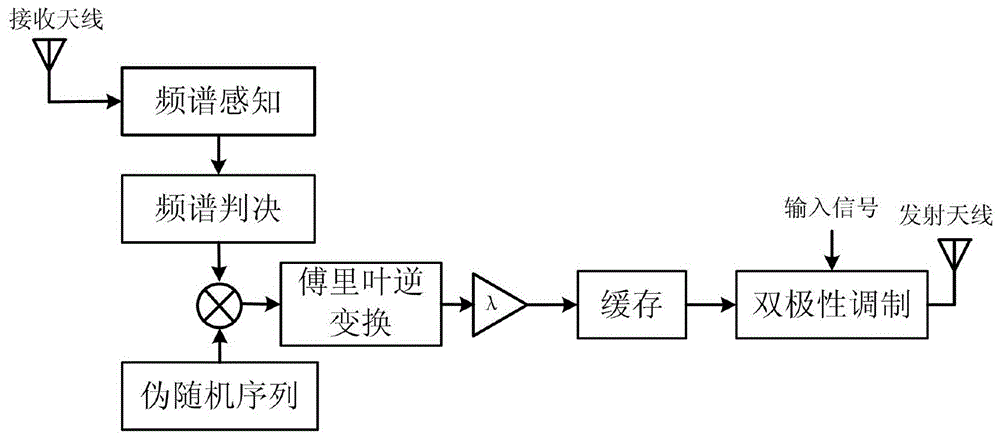
图1是传统双极性调制TDCS系统发送端结构图;Fig. 1 is the structure diagram of the transmitting end of the traditional bipolar modulation TDCS system;
图2是传统双极性调制TDCS系统接收端结构图;Fig. 2 is the structure diagram of the receiving end of the traditional bipolar modulation TDCS system;
图3是本发明基于交织多址的TDCS系统发送端结构图;Fig. 3 is the structure diagram of the transmitting end of the TDCS system based on interleaving multiple access of the present invention;
图4是本发明基于交织多址的TDCS系统接收端结构图。FIG. 4 is a structural diagram of the receiving end of the TDCS system based on interleaved multiple access according to the present invention.
具体实施方式Detailed ways
为便于本领域技术人员理解本发明的技术内容,下面结合附图对本发明内容进一步阐释。In order to facilitate those skilled in the art to understand the technical content of the present invention, the content of the present invention will be further explained below with reference to the accompanying drawings.
传统双极性调制TDCS的发射机、接收机框图分别如图1、图2所示。发射机主要包括频谱感知与判决模块、伪随机序列生成模块、幅度调整模块、傅里叶逆变换模块、数据调制模块。接收机主要包括频谱感知与判决模块、伪随机序列生成模块、傅里叶变换模块、相关接收模块。本发明在传统TDCS结构的基础上,通过给不同用户分配唯一的随机交织器,实现区分不同用户的目的。本申请的基于交织多址的TDCS的发射机、接收机框图分别如图3、4所示,设子载波数目为N,用户数为U,数据处理如下:The block diagrams of the transmitter and receiver of the traditional bipolar modulation TDCS are shown in Figure 1 and Figure 2, respectively. The transmitter mainly includes a spectrum sensing and decision module, a pseudo-random sequence generation module, an amplitude adjustment module, an inverse Fourier transform module, and a data modulation module. The receiver mainly includes a spectrum sensing and decision module, a pseudo-random sequence generation module, a Fourier transform module, and a correlation receiving module. On the basis of the traditional TDCS structure, the present invention realizes the purpose of distinguishing different users by allocating unique random interleavers to different users. The block diagrams of the transmitter and receiver of the tDCS based on interleaved multiple access of the present application are shown in Figures 3 and 4 respectively. Let the number of subcarriers be N, the number of users be U, and the data processing is as follows:
1、发送端数据处理,具体包括以下分步骤(如图3所示):1. Data processing at the sending end, including the following sub-steps (as shown in Figure 3):
(1)频谱感知模块对其工作的空间电磁频谱环境进行采样,频谱判决模块根据预设定门限确定所有子载波的可用性,即如果该子载波功率谱幅度超过门限值,则认为该子载波已经被占用或者存在干扰,并将其标记为0;如果该子载波功率谱幅度没有超过门限值,则认为该子载波未被占用或者不存在干扰,并将其标记为1。设得到的频谱效用序列为A=[A0,A1,…,Ak,…,AN-1];(1) The spectrum sensing module samples the spatial electromagnetic spectrum environment in which it works, and the spectrum decision module determines the availability of all sub-carriers according to the preset threshold, that is, if the power spectrum amplitude of the sub-carrier exceeds the threshold, it is considered that the sub-carrier is If the subcarrier is occupied or there is interference, it is marked as 0; if the magnitude of the power spectrum of the subcarrier does not exceed the threshold value, it is considered that the subcarrier is not occupied or there is no interference, and it is marked as 1. Let the obtained spectrum utility sequence be A=[A 0 , A 1 ,...,A k ,...,A N-1 ];
(2)随机序列生成模块生成长度为N的元素为±1的随机序列P;(2) The random sequence generation module generates a random sequence P with a length of N whose elements are ±1;
(3)乘法器将随机序列P与频谱效用序列A相乘,得到基础调制波形(FundamentalModulation Waveform,FMW)频域表达式:(3) The multiplier multiplies the random sequence P and the spectrum utility sequence A to obtain the fundamental modulation waveform (Fundamental Modulation Waveform, FMW) frequency domain expression:
B=A·P=[B0,B1,…,Bk,…,BN-1]B=A·P=[B 0 ,B 1 ,...,B k ,...,B N-1 ]
(4)第k个用户的双极性调制模块接收该用户发送的数据,并从缓存模块调用基础调制波形,(k=1,2,…,U),若发送数据比特dk为1,则双极性调制模块发送FMW至交织器,若dk为0,则双极性调制模块发送FMW的负数至交织器;(4) The bipolar modulation module of the kth user receives the data sent by the user, and calls the basic modulation waveform from the buffer module, (k=1,2,...,U), if the transmitted data bit dk is 1, Then the bipolar modulation module sends the FMW to the interleaver, and if d k is 0, the bipolar modulation module sends the negative number of the FMW to the interleaver;
(5)步骤(4)产生的序列进入第k个用户的码片级交织器πk,生成被打乱顺序的频域码片序列Xk={Xk(n),n=0,...,N-1};码片级交织器应避开频谱效用序列为0的点,即已被占用的子载波对应数据不进行交织;(5) The sequence generated in step (4) enters the chip-level interleaver π k of the kth user, and generates a shuffled frequency-domain chip sequence X k ={X k (n),n=0,. ..,N-1}; the chip-level interleaver should avoid the point where the spectrum utility sequence is 0, that is, the data corresponding to the occupied subcarriers are not interleaved;
(6)将频域码片序列Xk进行逆傅里叶变换得到时域码片序列xk,将上述发送信号通过发射天线发送出去,即完成了发送端工作。(6) Perform inverse Fourier transform on the frequency-domain chip sequence X k to obtain the time-domain chip sequence x k , and send the above-mentioned transmitted signal through the transmitting antenna, that is, the work of the transmitting end is completed.
2、接收端采用迭代译码,设迭代次数为Iter,数据处理过程如下(如图4所示):2. The receiving end adopts iterative decoding, and the number of iterations is set to Iter, and the data processing process is as follows (as shown in Figure 4):
(1)首先对经过信道作用的到达信号进行接收并完成信道估计,接收到的信号为所有用户信号的叠加,接收信号可以表示为:(1) First, receive the arriving signal through the channel action and complete the channel estimation. The received signal is the superposition of all user signals, and the received signal can be expressed as:

式中,hk表示第k个用户的信道系数,w(n)是均值为0、方差为σ2的高斯白噪声。In the formula, h k represents the channel coefficient of the kth user, and w(n) is Gaussian white noise with mean 0 and variance σ 2 .
(2)将信号r通过一个FFT模块,得到频域接收信号y;(2) Passing the signal r through an FFT module to obtain the received signal y in the frequency domain;
(3)将频域接收信号y按照IDMA的解调方式进行迭代解调,首先令计数器m=0,初始化所有用户信号


(4)得到每个用户干扰信号
E(ζk(n))=E(r(n))-hkE(xk(n))E(ζ k (n))=E( r (n))-h k E(x k (n))
Var(ζk(n))=Var(r(n))-|hk|2Var(xk(n))Var(ζ k (n))=Var(r(n))-|h k | 2 Var(x k (n))
(5)计算ESE输出的每个用户发送信号

(6)接下来进入DEC模块完成软译码,首先执行解扩操作,为叙述方便,下面仅考虑第k个用户的第1个编码符号bk(1)的译码,其它编码符号的译码过程一样。利用ESE反馈的外信息Lpriori(ck)进行解扩频,得到编码符号bk(1)的先验软信息,(6) Next, enter the DEC module to complete soft decoding, and first perform the despreading operation. For the convenience of description, only the decoding of the first coded symbol b k (1) of the kth user is considered below, and the decoding of other coded symbols The coding process is the same. Use the external information L priori (c k ) fed back by the ESE to perform despreading to obtain the prior soft information of the coded symbol b k (1),

其中,s(n)代表扩频序列,在这里即是基础调制波形的频域表达式。Among them, s(n) represents the spread spectrum sequence, which is the frequency domain expression of the fundamental modulation waveform here.
接着,FEC译码器利用软信息Lpriori(bk)进行软译码,得到编码序列bk的软信息LAPP(bk)。再对LAPP(bk)进行扩频,得到扩频序列ck的后验软信息:Next, the FEC decoder performs soft decoding using the soft information L priori (b k ) to obtain the soft information L APP (b k ) of the encoded sequence b k . Then spread the spectrum on L APP (b k ) to obtain the a posteriori soft information of the spread spectrum sequence ck :
Lposteriori(ck(n))=s(n)LAPP(bk(1)),n=0,1,...,N-1L posteriori (c k (n))=s(n)L APP (b k (1)),n=0,1,...,N-1
最后,计算DEC译码器输出的外信息:Finally, calculate the extrinsic information output by the DEC decoder:
eDEC(ck(n))=Lposteriori(ck(n))-Lpriori(ck(n))e DEC (c k (n))=L posteriori (c k (n))-L priori (c k (n))
(7)再次让eDEC(ck(n))通过随机交织器πk,得到xk的先验信息,从而更新所有用户信号

Var(xk(n))=1-(E(xk(n)))2 Var(x k (n))=1-(E(x k (n))) 2
(8)判断m>Iter是否成立,若成立,则对译码结果进行硬判决;否则令m=m+1,回到步骤(4),取值,Iter为设定的迭代次数。(8) Determine whether m>Iter is established, if so, make a hard decision on the decoding result; otherwise, set m=m+1, go back to step (4), take a value, and Iter is the set number of iterations.
最后说明的是,以上实施例仅仅是对于本发明专利精神作举例说明。本发明专利所属技术领域的技术人员可以对所描述的具体实施例做各种各样的修改或补充或采用类似的方法替代,且并不具体仅限于实施例步骤的顺序。Finally, it should be noted that the above embodiments are merely examples to illustrate the spirit of the present invention. Those skilled in the art to which the patent of the present invention pertains can make various modifications or additions to the specific embodiments described or substitute with similar methods, and are not specifically limited to the order of the steps of the embodiments.
Claims (3)


Priority Applications (1)
| Application Number | Priority Date | Filing Date | Title |
|---|---|---|---|
| CN201711361835.XA CN108123786B (en) | 2017-12-18 | 2017-12-18 | TDCS multiple access method based on interleaving multiple access |
Applications Claiming Priority (1)
| Application Number | Priority Date | Filing Date | Title |
|---|---|---|---|
| CN201711361835.XA CN108123786B (en) | 2017-12-18 | 2017-12-18 | TDCS multiple access method based on interleaving multiple access |
Publications (2)
| Publication Number | Publication Date |
|---|---|
| CN108123786A CN108123786A (en) | 2018-06-05 |
| CN108123786B true CN108123786B (en) | 2020-11-06 |
Family
ID=62230082
Family Applications (1)
| Application Number | Title | Priority Date | Filing Date |
|---|---|---|---|
| CN201711361835.XA Active CN108123786B (en) | 2017-12-18 | 2017-12-18 | TDCS multiple access method based on interleaving multiple access |
Country Status (1)
| Country | Link |
|---|---|
| CN (1) | CN108123786B (en) |
Families Citing this family (5)
| Publication number | Priority date | Publication date | Assignee | Title |
|---|---|---|---|---|
| CN110875794B (en) * | 2018-08-13 | 2022-04-15 | 中兴通讯股份有限公司 | Multi-access method and device, and terminal |
| CN109327232B (en) * | 2018-12-12 | 2019-11-05 | 中国电子科技集团公司第五十四研究所 | The extremely low fast R-T unit of transform domain iteration |
| CN111490854B (en) * | 2020-04-16 | 2022-08-30 | 重庆邮电大学 | Logistic sequence-based IDMA (inverse discrete cosine transform) interleaving method |
| CN114362883A (en) * | 2021-12-31 | 2022-04-15 | 杭州电子科技大学 | Multiple access coding method and system based on cyclic shift |
| CN116032703B (en) * | 2023-03-29 | 2023-06-27 | 中国人民解放军海军工程大学 | Method and system for estimating number of signal code elements of transform domain communication system |
Citations (3)
| Publication number | Priority date | Publication date | Assignee | Title |
|---|---|---|---|---|
| CN106230573A (en) * | 2016-08-31 | 2016-12-14 | 电子科技大学 | A kind of TDCS multiple access based on sequential design accesses improved method |
| CN106453185A (en) * | 2016-08-31 | 2017-02-22 | 电子科技大学 | IDMA system improvement method based on CCSK modulation |
| EP3143620A1 (en) * | 2014-05-15 | 2017-03-22 | Telefonaktiebolaget LM Ericsson (publ) | Audio signal classification and coding |
-
2017
- 2017-12-18 CN CN201711361835.XA patent/CN108123786B/en active Active
Patent Citations (3)
| Publication number | Priority date | Publication date | Assignee | Title |
|---|---|---|---|---|
| EP3143620A1 (en) * | 2014-05-15 | 2017-03-22 | Telefonaktiebolaget LM Ericsson (publ) | Audio signal classification and coding |
| CN106230573A (en) * | 2016-08-31 | 2016-12-14 | 电子科技大学 | A kind of TDCS multiple access based on sequential design accesses improved method |
| CN106453185A (en) * | 2016-08-31 | 2017-02-22 | 电子科技大学 | IDMA system improvement method based on CCSK modulation |
Also Published As
| Publication number | Publication date |
|---|---|
| CN108123786A (en) | 2018-06-05 |
Similar Documents
| Publication | Publication Date | Title |
|---|---|---|
| CN103841065B (en) | Nonopiate multiple access is sent and joint receives demodulation coding system and method | |
| CN105554865B (en) | A kind of MIMO-SCMA system down link design method based on STBC | |
| CN101984612A (en) | Method for estimating discontinuous orthogonal frequency division multiplying channel based on compressed sensing | |
| CN107612863B (en) | A Bandwidth Compression High Spectral Efficient Multi-Carrier Communication Method | |
| CN106788946A (en) | Data diversity merging method and system in a kind of repeated encoding system | |
| CN108123786A (en) | TDCS multiple access methods based on interlacing multi-address | |
| CN108833341B (en) | Physical layer secure transmission method based on subcarrier sorting and XOR operation in OFDM system | |
| CN100544239C (en) | Interleaving Method for Orthogonal Frequency Division Multiplexing Communication | |
| CN101505291A (en) | Hydroacoustic communication differential decoding method based on OFDM coding | |
| CN101848184A (en) | Selective mapping scrambling method for reducing peak-to-average power ratio of orthogonal frequency division multiplexing system | |
| CN1638373A (en) | Apparatus and method for canceling interference signal in an orthogonal frequency division multiplexing system using multiple antennas | |
| CN106063212B (en) | Method and apparatus for generating a non-Gaussian interference channel in a wireless communication system | |
| CN107612861B (en) | A Communication Method of IDMA System Based on CCSK Modulation | |
| CN102437995A (en) | Iterative carrier synchronizing method and system based on code-by-code iterative detection | |
| CN102904690A (en) | Method and device for inter-cell interference suppression of high-order modulation signal based on OFDM-IDMA | |
| CN104901911A (en) | Iterative inter-cell interference suppression method and apparatus | |
| CN112350971A (en) | Code domain index modulation method for covert communication | |
| CN103209156A (en) | Improved dual carrier demodulation method based on mixed decision | |
| Kumar et al. | Design and implementation of OFDM system using QPSK & QAM | |
| CN108370365A (en) | Method and system for demodulating Higher Order QAM Signals | |
| CN107979453B (en) | Weighted Soft Decoding Method Based on Single Carrier Frequency Division Multiple Access System | |
| Yu et al. | Iterative decoder for coded SEFDM systems | |
| CN105681242A (en) | Multi-antenna OFDM index modulation method based on cyclic shift | |
| CN100505725C (en) | Channel equalization method of OFDM system | |
| CN102916924A (en) | Adjustable bandwidth offset modulation multi-carrier frequency division multiple access transmission method |
Legal Events
| Date | Code | Title | Description |
|---|---|---|---|
| PB01 | Publication | ||
| PB01 | Publication | ||
| SE01 | Entry into force of request for substantive examination | ||
| SE01 | Entry into force of request for substantive examination | ||
| GR01 | Patent grant | ||
| GR01 | Patent grant |