CN1082011C - an absorbent pad - Google Patents
an absorbent pad Download PDFInfo
- Publication number
- CN1082011C CN1082011C CN97192497A CN97192497A CN1082011C CN 1082011 C CN1082011 C CN 1082011C CN 97192497 A CN97192497 A CN 97192497A CN 97192497 A CN97192497 A CN 97192497A CN 1082011 C CN1082011 C CN 1082011C
- Authority
- CN
- China
- Prior art keywords
- pad
- thin layer
- layer
- absorbent
- microporous
- Prior art date
- Legal status (The legal status is an assumption and is not a legal conclusion. Google has not performed a legal analysis and makes no representation as to the accuracy of the status listed.)
- Expired - Fee Related
Links
Images














Classifications
-
- B—PERFORMING OPERATIONS; TRANSPORTING
- B65—CONVEYING; PACKING; STORING; HANDLING THIN OR FILAMENTARY MATERIAL
- B65D—CONTAINERS FOR STORAGE OR TRANSPORT OF ARTICLES OR MATERIALS, e.g. BAGS, BARRELS, BOTTLES, BOXES, CANS, CARTONS, CRATES, DRUMS, JARS, TANKS, HOPPERS, FORWARDING CONTAINERS; ACCESSORIES, CLOSURES, OR FITTINGS THEREFOR; PACKAGING ELEMENTS; PACKAGES
- B65D81/00—Containers, packaging elements, or packages, for contents presenting particular transport or storage problems, or adapted to be used for non-packaging purposes after removal of contents
- B65D81/18—Containers, packaging elements, or packages, for contents presenting particular transport or storage problems, or adapted to be used for non-packaging purposes after removal of contents providing specific environment for contents, e.g. temperature above or below ambient
-
- B—PERFORMING OPERATIONS; TRANSPORTING
- B65—CONVEYING; PACKING; STORING; HANDLING THIN OR FILAMENTARY MATERIAL
- B65D—CONTAINERS FOR STORAGE OR TRANSPORT OF ARTICLES OR MATERIALS, e.g. BAGS, BARRELS, BOTTLES, BOXES, CANS, CARTONS, CRATES, DRUMS, JARS, TANKS, HOPPERS, FORWARDING CONTAINERS; ACCESSORIES, CLOSURES, OR FITTINGS THEREFOR; PACKAGING ELEMENTS; PACKAGES
- B65D81/00—Containers, packaging elements, or packages, for contents presenting particular transport or storage problems, or adapted to be used for non-packaging purposes after removal of contents
- B65D81/24—Adaptations for preventing deterioration or decay of contents; Applications to the container or packaging material of food preservatives, fungicides, pesticides or animal repellants
- B65D81/26—Adaptations for preventing deterioration or decay of contents; Applications to the container or packaging material of food preservatives, fungicides, pesticides or animal repellants with provision for draining away, or absorbing, or removing by ventilation, fluids, e.g. exuded by contents; Applications of corrosion inhibitors or desiccators
- B65D81/264—Adaptations for preventing deterioration or decay of contents; Applications to the container or packaging material of food preservatives, fungicides, pesticides or animal repellants with provision for draining away, or absorbing, or removing by ventilation, fluids, e.g. exuded by contents; Applications of corrosion inhibitors or desiccators for absorbing liquids
-
- Y—GENERAL TAGGING OF NEW TECHNOLOGICAL DEVELOPMENTS; GENERAL TAGGING OF CROSS-SECTIONAL TECHNOLOGIES SPANNING OVER SEVERAL SECTIONS OF THE IPC; TECHNICAL SUBJECTS COVERED BY FORMER USPC CROSS-REFERENCE ART COLLECTIONS [XRACs] AND DIGESTS
- Y10—TECHNICAL SUBJECTS COVERED BY FORMER USPC
- Y10T—TECHNICAL SUBJECTS COVERED BY FORMER US CLASSIFICATION
- Y10T428/00—Stock material or miscellaneous articles
- Y10T428/23—Sheet including cover or casing
- Y10T428/239—Complete cover or casing
Landscapes
- Engineering & Computer Science (AREA)
- Mechanical Engineering (AREA)
- Food Science & Technology (AREA)
- Laminated Bodies (AREA)
- Absorbent Articles And Supports Therefor (AREA)
- Thermotherapy And Cooling Therapy Devices (AREA)
- Packages (AREA)
Abstract
Description
发明领域field of invention
本发明涉及一种吸收垫,特别是在食品工业中用作生物液吸收剂的吸收垫,或者用作冷却垫的吸收垫。The present invention relates to an absorbent pad, in particular an absorbent pad used in the food industry as an absorbent for biological fluids, or as a cooling pad.
背景技术Background technique
吸收垫已经熟知并在食品工业中得到广泛应用。有一类吸收垫用作生物液的吸收体,它放在鲜肉与塑料肉盘之间。垫的功能是吸收从肉中渗出的生物液。Absorbent pads are well known and widely used in the food industry. One type of absorbent pad is used as an absorbent for biological fluids and is placed between the fresh meat and the plastic meat tray. The function of the pad is to absorb biological fluids that seep from the meat.
第二类已知的垫是用作冷却垫,它先用水泡胀,冷冻,然后与食品或其它需要保冷的制品一起放置。A second type of known pad is used as a cooling pad, which is inflated with water, frozen and then placed with food or other items that need to be kept cold.
两种垫具有内部的吸收剂,通常采用超级吸收聚合物(SAP)。这种聚合物也已经熟知,典型的聚合物是交联聚丙烯酸钠。为了使得内部的吸收剂有效地吸收液体,通常把聚合物磨得很细。Both pads have an internal absorbent, usually superabsorbent polymer (SAP). Such polymers are also well known and a typical polymer is cross-linked sodium polyacrylate. In order for the inner absorbent to effectively absorb liquid, the polymer is usually finely ground.
如果要使垫能安全和在商业上成功使用,内部的超级吸收聚合物造成了一些必须克服的困难。首先,必须保证聚合物永远留在垫内,即使被泡胀成凝胶状态。超级吸收聚合物的另一个问题是:它们是侵蚀性的液体吸收剂,由于吸收的比刚渗出的生物液还多,会使肉制品变干。The internal superabsorbent polymer presents several difficulties that must be overcome if the pad is to be used safely and commercially successfully. First, it must be ensured that the polymer remains in the pad forever, even if it is swollen into a gel state. Another problem with superabsorbent polymers is that they are aggressive liquid absorbents that can dry out meat products by absorbing more than just seeped biological fluids.
为了克服聚合物的侵蚀性吸收性质,已知办法是采用可渗水的底壁(通常为非织造织物)和完全不渗液的顶壁来形成吸收垫。In order to overcome the aggressive absorbent properties of polymers, it is known to form absorbent pads with a water-permeable bottom wall (usually a nonwoven fabric) and a completely liquid-impermeable top wall.
具有不渗液顶薄层的缺点是生物液从顶薄层溢出而从垫上离开,不能通过底薄层来吸收生物液。特别是如果肉制品盘倾斜贮存或放置,就更是这样。不渗液顶薄层的另一个缺点是:如果肉盘放平,则生物液可积聚在顶薄层上,由于细菌滋长而使肉变质。A disadvantage of having a liquid impermeable top sheet is that biological fluids overflow from the top sheet off the pad and cannot be absorbed by the bottom sheet. This is especially the case if the meat pans are stored or placed at an angle. Another disadvantage of a liquid-impermeable top sheet is that if the meat pan is laid flat, biological fluids can accumulate on the top sheet, spoiling the meat due to bacterial growth.
已想出办法在垫的顶壁中开一条宽缝或几条细缝,来克服上述缺点。但生物液仍不能被有效地吸收,并在顶薄层上有溢出或积聚的倾向。It has been devised to overcome the above-mentioned disadvantages by creating a wide slit or several slits in the top wall of the pad. However, biological fluids are still not effectively absorbed and tend to spill or pool on the top sheet.
冷却垫的另一个问题是:当垫用水泡胀时,超级吸收聚合物变成凝胶,对垫壁施加很大的压力,并可通过垫壁渗出。特别是如果垫的顶壁具有一条宽缝或几条细缝,就更是这样。Another problem with cooling pads is that when the pad swells with water, the superabsorbent polymer turns into a gel, exerts a lot of pressure on the pad walls, and can seep through the pad walls. This is especially the case if the top wall of the pad has a wide slit or several thin slits.
发明目的purpose of invention
已研究的本发明来提供一种吸收垫,它既可用作生物液吸收体,也可用作冷却垫,它至少能减少上述缺点,或为大众提供有用的或商业的选择。The present invention has been studied to provide an absorbent pad which can be used both as a biological fluid absorber and as a cooling pad which at least alleviates the above disadvantages, or provides the public with a useful or commercial choice.
在一种形式中,本发明属于一种吸收垫,它具有顶薄层和底薄层,薄层连在一起,至少形成一个格子,吸收剂放在格子内,垫的特征在于:至少一个薄层是由含微孔的不渗液材料制成,以使液体通过微孔并进入格子内。In one form, the invention is an absorbent pad having a top sheet and a bottom sheet, the sheets joined together to form at least one cell within which the absorbent is placed, the pad being characterized in that at least one sheet The layer is made of a liquid-impermeable material that contains pores to allow liquid to pass through the pores and into the lattice.
顶薄层最好是用有带微孔材料制成。底薄层可用相似的材料制成,或者用不同的材料,如可渗水的非织造织物,纸张,或完全不渗水层等制成。The top sheet is preferably made of a microporous material. The base sheet can be made of a similar material, or a different material, such as a water permeable nonwoven, paper, or a completely impermeable layer.
我们发现,微孔减善了格子内超级吸收聚合物的侵蚀性。也就是说,微孔使造成肉制品变干的不良抽吸效应降到最低。在吸收垫薄层上作出大量极小的孔,看来可使抽吸效应减到最低,从而可把吸收垫放在肉制品下面。We have found that the microvoids reduce the aggressiveness of the superabsorbent polymer within the lattice. That is, the micropores minimize undesirable suction effects that would cause the meat product to dry out. Making a large number of very small holes in the thin layer of the absorbent pad appears to minimize the suction effect, allowing the absorbent pad to be placed under the meat product.
看来微孔也可减少或者防止生物液在吸收垫顶上的积聚,如果微孔在吸收垫的整个顶薄层上分布,则与只有开槽的垫相比,可在更大的表面上吸收生物液。It also appears that the micropores can reduce or prevent the accumulation of biological fluids on top of the absorbent pad, if the micropores are distributed over the entire top sheet of the absorbent pad, over a larger surface area than a pad with only grooves Absorbs biological fluids.
微孔通常以基本上均匀的方式在顶薄层上分布。但可以设想,层的有些部分没有微孔,这些部分可包括相邻格子的连接区。The microvoids are typically distributed in a substantially uniform manner across the top sheet. It is conceivable, however, that there are portions of the layer which do not have micropores, and these portions may include junctions of adjacent lattices.
微孔可具有不同的形状和尺寸,可以是圆形、椭圆形(雪茄烟形)、多边形(包括矩形、三角形和菱形)、不规则形,等等。与在薄层上穿孔的工艺有关,所形成的穿孔可在孔附近有一个舌片或折片,但它仍可使液体通过穿孔。Microwells can be of various shapes and sizes, and can be circular, oval (cigar-shaped), polygonal (including rectangular, triangular, and rhombus), irregular, and the like. In relation to the process of perforating a thin layer, the perforation formed may have a tongue or flap near the hole, but which still allows liquid to pass through the perforation.
可采用热销穿孔、冷销穿孔、开口框穿孔、激光穿孔,以及其它合适的技术来形成微孔。不同的穿孔工艺可形成孔的不同尺寸和形状。Microholes may be formed using hot pin perforation, cold pin perforation, open frame perforation, laser perforation, and other suitable techniques. Different perforation processes can form holes of different sizes and shapes.
微孔的典型尺寸可在10到200微米之间。例如,如果孔是椭圆的,可具有约20微米×90微米的尺寸,但它可在10微米到200微米之间变化,或者可能更大,较大的尺寸由吸收聚合物或其它类型吸收剂的侵蚀性确定。Typical sizes of micropores can be between 10 and 200 microns. For example, if the pores are elliptical, they may have dimensions of about 20 microns by 90 microns, but it may vary from 10 microns to 200 microns, or possibly larger, with the larger dimensions being formed by absorbent polymers or other types of absorbents. The corrosivity is determined.
在薄层中的微孔数目也可改变,微孔可以是有规则或无规则。每平方英寸上可有10到500个微孔,我们发现对于我们的用途,每平方英寸上330个微孔是合适的。我们发现,每平方英寸上孔的数目似乎只影响制品的吸收率。The number of pores in the layer may also vary, the pores may be regular or random. From 10 to 500 micropores per square inch are possible, we have found 330 micropores per square inch to be suitable for our purposes. We have found that the number of pores per square inch only appears to affect the absorbency of the article.
吸收垫本身的尺寸也可根据其用途而改变。我们发现,典型的垫可为约400mm宽,而长度不限,用户可沿长度方向作简单切割来适应需要。每个垫可具有一个格子或几个格子,我们发现,对于具有400mm宽度的垫,可提供6个左右的格子。每个格子可采取任何形状或尺寸,我们发现合适的尺寸是在40mm到100mm宽。The size of the absorbent pad itself may also vary depending on its use. We have found that a typical pad can be about 400mm wide and of any length, the user can simply cut along the length to suit needs. Each pad may have one cell or several cells, we have found that for a pad having a width of 400mm, 6 or so cells may be provided. Each grid can take any shape or size, we have found suitable sizes to be between 40mm and 100mm wide.
具有微孔的薄层(通常是顶薄层)可用塑料薄膜制成。塑料薄膜可以是单层薄膜、叠层膜或其它形式的薄膜。一种有用的薄膜是用聚酯和聚乙烯制成的叠层。我们发现,合适的厚度是把12微米的聚酯薄膜叠加到30微米的聚乙烯薄膜上。如果需要也可采用其它的膜厚。我们发现可采用其它形式的塑料,如尼龙,其它形式的多烯薄膜,包括所有类型的聚乙烯和聚丙烯。我们也发现可采用聚胺酯和聚乙烯薄膜。我们发现,薄膜所需的主要特性是它能强到足以抵抗使用时的磨损和撕裂。我们也发现,希望能选择一种可接受印刷墨水的薄膜,使得在垫的各层,或至少在一层上可以印刷。我们发现,从用户的观点看,希望薄膜有良好的不透明性。如果我们把顶薄层和底薄层热封一起来制成垫,则我们最好采用可热封的薄膜。The microporous sheet (usually the top sheet) can be made of plastic film. The plastic film can be a single layer film, laminated film or other forms of film. A useful film is a laminate of polyester and polyethylene. We have found that a suitable thickness is to laminate a 12 micron polyester film to a 30 micron polyethylene film. Other film thicknesses can be used if desired. We have found that other forms of plastic can be used, such as nylon, other forms of polyene films, including all types of polyethylene and polypropylene. We have also found polyurethane and polyethylene films to be useful. We found that the main property required for the film was that it be strong enough to resist wear and tear in use. We have also found that it is desirable to be able to select a film that will accept printing ink so that it can be printed on each layer of the pad, or at least on one layer. We have found that good opacity of the film is desirable from the user's standpoint. If we heat seal the top and bottom sheets together to make a pad, we preferably use a heat sealable film.
如果吸收垫包括带微孔的顶薄层和不同形式的底薄层,一种优选的底薄层形式是非织造织物。先有技术中已有许多种非织造织物,合适的织物是每平方米40g的双成分连续纤维,由加压加温胶接而成。纤维可用聚酯的芯和聚乙烯的外皮制成,这种材料类型已经知道。纤维可具有不同类型的塑料外皮,如聚丙烯或聚丙烯/聚乙烯共聚物。这些纤维均可采用,因为在非织造织物中可形成坚强的热封。这些非织造织物具有良好的纤维随机分布,保证织物中空隙尺寸或孔小到足以防止聚合物从垫上抖落,也可防止泡胀的水化聚合物通过织物挤出。If the absorbent pad comprises a microporous topsheet and a different form of backsheet, one preferred form of the backsheet is a nonwoven fabric. There are many kinds of nonwoven fabrics in the prior art, and a suitable fabric is a bicomponent continuous fiber of 40 g per square meter, which is formed by pressure and heat bonding. The fibers can be made with a core of polyester and a sheath of polyethylene, a material type which is known. The fibers can have different types of plastic sheaths, such as polypropylene or polypropylene/polyethylene copolymers. These fibers can be used because a strong heat seal can be formed in the nonwoven fabric. These nonwoven fabrics have a good random distribution of fibers, ensuring that the void size or pores in the fabric are small enough to prevent the polymer from shaking off the pad and also prevent the swelling of the hydrated polymer from extruding through the fabric.
应该能理解到,在市场上有许多可满足我们要求的非织造织物品种。It should be appreciated that there are many varieties of nonwoven fabrics on the market that meet our requirements.
如果顶薄层带微孔,则我们可希望底薄层完全不渗液,可以用任何合适的不渗水塑料薄膜类型,或者用随时都有的其它薄膜类型,来制成这种底薄层。If the top sheet is microporous, it is desirable for the bottom sheet to be completely impermeable to liquids, which can be made from any suitable type of impermeable plastic film, or other film types readily available.
为了减少从垫的格子中渗出吸收剂的可能性,可在带微孔的薄层下面再放一个隔层。隔层类型最好是可使液体通过隔层排出或吸出,但仍作为吸收剂的屏障。各种纸张可作为隔层。To reduce the possibility of absorbent seeping through the cells of the pad, an additional barrier layer may be placed below the microporous sheet. The type of barrier is preferably one that allows liquid to drain or be drawn through the barrier, but still acts as a barrier to the absorbent. Various papers are available as compartments.
在另一个改型中,顶薄层可以是预成形的多层复合材料。例如,顶薄层可包括一个最外面的微孔层、一个中间隔层和一个最里面的微孔层,形成三层复合材料。这种多层可制成吸收垫的顶薄层和/或底薄层。In another variation, the top sheet may be a preformed multilayer composite. For example, the top sheet may include an outermost microporous layer, a middle spacer layer, and an innermost microporous layer, forming a three-layer composite. Such multiple layers may form the top and/or bottom sheet of the absorbent pad.
为了加强微孔层,可提供另一个增强层。有时可以发现,吸收垫内的压力可对微孔层施加一个不希望的应变量。该层由于有微孔而被削弱,因而微孔层有可能被撕裂或开缝。例如,当把垫用作冰的替代垫时,它用水泡胀,然后冷冻。泡胀和冷冻将在垫内产生很大的压力。通常提供一种有许多吸收剂格子的柔性薄层。柔性薄层可用水泡胀,冷冻,然后包在要保冷的制品上。可以发现,当制品冷冻时,微孔层可达到它的冷弯温度,这意味着薄膜抵抗弯曲,易于形成开裂和撕裂。To reinforce the microporous layer, another reinforcing layer can be provided. It has sometimes been found that the pressure within the absorbent pad can impart an undesired amount of strain on the microporous layer. The layer is weakened due to the microporosity, and the microporous layer has the potential to tear or split. For example, when a pad is used as an ice replacement pad, it is swollen with water and then frozen. Bulging and freezing will create a lot of pressure inside the pad. Usually a flexible sheet with a plurality of absorbent cells is provided. The flexible sheet can be inflated with water, frozen, and then wrapped around the article to be kept cold. It was found that when the article was frozen, the microporous layer reached its cold bending temperature, which meant that the film resisted bending, prone to cracking and tearing.
为此,吸收垫可包括增强层。增强层可放在微孔层的后面。最好是,增强层明显地不能阻止液体进入吸收剂中。因此,优选的增强层是非织造织物,或者是带微孔的薄膜。To this end, the absorbent pad may include a reinforcement layer. A reinforcement layer may be placed behind the microporous layer. Preferably, the reinforcing layer does not significantly prevent the ingress of liquid into the absorbent. Therefore, the preferred reinforcing layer is a nonwoven fabric, or a microporous film.
在垫的格子中的吸收剂可为单种吸收剂或混合物。虽然以经知道许多种吸收剂,并已用于吸收垫中,但我们发现,希望采用超级吸收聚合物,因为这种聚合物可以吸收为它们重量许多倍的液体,虽然这些聚会物是侵蚀性吸收剂,但我们可采用开微孔办法来克服或减少这种不良性质。The absorbents in the cells of the pad can be a single absorbent or a mixture. Although many kinds of absorbents are known and used in absorbent pads, we have found that superabsorbent polymers are desirable because such polymers can absorb many times their weight in liquid, although these conglomerates are aggressive Absorbent, but we can overcome or reduce this undesirable property by opening micropores.
希望的超级吸收聚合物类型包括一族聚丙烯酸钠,它们是交联聚丙烯酸/聚乙醇接枝共聚物的钠盐。已经知道这些聚合物,也知道它们已用在吸收垫中。我们发现有用的其它吸收剂类型是羧基甲基纤维素钠,它们能与许多铝化合物交联,以改进它们的凝胶强度性能。当然,其它吸收剂类型也可用于我门的微孔垫。Desirable types of superabsorbent polymers include a family of sodium polyacrylates which are sodium salts of crosslinked polyacrylic acid/polyethylene glycol graft copolymers. These polymers are known and are known for use in absorbent pads. Another type of absorbent that we have found useful is sodium carboxymethylcellulose, which can be crosslinked with a number of aluminum compounds to improve their gel strength properties. Of course, other absorbent types can also be used with our microporous pads.
我们发现,商用的超级吸收聚合物流行两种不同形状。最普通的形状是不规则的颗粒或碎石形,而另一种形状是较圆的球形。We found that commercially available superabsorbent polymers are prevalent in two different shapes. The most common shape is irregular grains or gravel, while the other shape is a rounder sphere.
我们也发现,商用超级吸收聚合物具有不同的颗粒尺寸,典型的颗粒尺寸如下:We have also found that commercially available superabsorbent polymers come in different particle sizes, typical particle sizes are as follows:
850微米和以上: 0~2%850 microns and above: 0~2%
850~600微米: 24~32%850-600 microns: 24-32%
600~500微米: 20~28%600-500 microns: 20-28%
500~300微米: 32~40%500-300 microns: 32-40%
300~180微米: 4~12%300 ~ 180 microns: 4 ~ 12%
180~90微米: 0~4%180-90 microns: 0-4%
90~45微米: 0~2%90 ~ 45 microns: 0 ~ 2%
45微米及以下: 0~0.1%45 microns and below: 0~0.1%
不同聚合物批次可具有不同的尺寸范围,最大尺寸可高达或甚至超过2000微米,可以理解到,我们可以调整微孔的形状和尺寸,来与格子内所用的吸收剂形状和尺寸相协调,使得通过格子壁的吸收剂损失成为最小,或至少被减少。Different polymer batches can have different size ranges up to or even exceeding 2000 microns in maximum size, it will be appreciated that we can adjust the shape and size of the micropores to coordinate with the shape and size of the absorbent used in the grid, Absorbent loss through the cell walls is minimized, or at least reduced.
当然,我们能够根据吸收剂的能力和速率,以及我们需要吸收的液体量,来改变吸收剂的量。对于典型的超级吸收聚合物,每克聚合物可在任何地方吸收100g到500g流出的水。Of course, we can vary the amount of absorbent depending on the capacity and rate of the absorbent, and the amount of liquid we need to absorb. For a typical superabsorbent polymer, each gram of polymer can absorb anywhere from 100 grams to 500 grams of runoff water.
最好是,在格子内的聚合物用量使得聚合物能够充分水化,并且不妨碍它充分水化。为此,在每个格子中最好不要添加太多的聚合物。我们发现,当把垫用作冷却垫时,用户不认为冷却垫能从周围区域吸收其它任何液体,而仅起冷却的功能。为此,我们要保证,如果聚合物用作冷却垫,它能在冷冻前充分水化。Preferably, the amount of polymer in the cells is such that the polymer is fully hydrated and does not prevent it from fully hydrating. For this reason, it is best not to add too much polymer in each lattice. We have found that when the pad is used as a cooling pad, the user does not perceive the cooling pad to absorb any other liquid from the surrounding area, but only to function as a cooling pad. For this, we want to ensure that, if the polymer is used as a cooling pad, it is fully hydrated before freezing.
垫本身可以许多不同的方式来形成。一种优选的方式,也是一种已经用在其它已知垫上的方式,是把顶薄层和底薄层热封在一起。为此,顶薄层和底薄层最好是由可热熔材料制成,并且这些材料是已知的。当然,我们也希望能简单地把各薄层胶在一起,或者用其它方法来连结它们。The pad itself can be formed in many different ways. A preferred approach, and one that has been used on other known mats, is to heat seal the top and bottom sheets together. For this reason, the top and bottom sheets are preferably made of heat-fusible materials, and such materials are known. Of course, we would also like to be able to simply glue the layers together, or otherwise join them.
附图简述Brief description of the drawings
现将参照以下附图来描述垫的各个实施例,其中:Various embodiments of the mat will now be described with reference to the following figures, in which:
图1A和1B说明了一个液体吸收垫,它具有均带微孔的顶薄层和底薄层。Figures 1A and 1B illustrate a liquid-absorbent pad having top and bottom sheets, both of which are microporous.
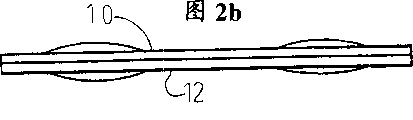
图2A和2B说明了一个液体吸收垫,它具有带微孔的顶薄层和非织造织物的底薄层。Figures 2A and 2B illustrate a liquid absorbent pad having a top microporous sheet and a bottom nonwoven sheet.
图3A和3B说明了一个液体吸收垫,它具有带微孔的顶薄层和纸的底薄层。Figures 3A and 3B illustrate a liquid absorbent pad having a microporous top sheet and a paper bottom sheet.
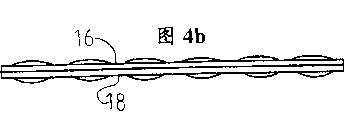
图4A和4B说明了一个冷却垫,它具有均带微孔的顶薄层和底薄层。Figures 4A and 4B illustrate a cooling pad having top and bottom sheets, both of which are microporous.
图5A和5B说明了一个冷却垫,它具有带微孔的顶薄层和不渗水的底薄层。Figures 5A and 5B illustrate a cooling pad having a microporous top sheet and a water impermeable bottom sheet.
图6A和6B说明了一个冷却垫,它具有带微孔的顶薄层和非织造织物的底薄层。Figures 6A and 6B illustrate a cooling pad having a microporous top sheet and a nonwoven bottom sheet.
图7A和7B说明了一个液体吸收垫,它具有均带微孔、并由三层制成的顶薄层和底薄层。Figures 7A and 7B illustrate a liquid-absorbent pad having top and bottom sheets, each microporous, made of three layers.
图8A和8B说明了一个液体吸收垫,顶薄层为带微孔并由三层制成,底薄层为非织造织物。Figures 8A and 8B illustrate a liquid absorbent pad with the top sheet being microporous and made of three layers and the bottom sheet being a nonwoven fabric.
图9A和9B说明了一个液体吸收垫,顶薄层为带微孔并由三层制成,底薄层为纸。Figures 9A and 9B illustrate a liquid absorbent pad in which the top sheet is microporous and made of three layers and the bottom sheet is paper.
图10A和10B说明了一个冷却垫,顶薄层为带微孔并由三层制成,底薄层为非织造织物。Figures 10A and 10B illustrate a cooling pad in which the top sheet is microporous and made of three layers and the bottom sheet is a nonwoven fabric.
图11A和11B说明了一个冷却垫,顶薄层为带微孔并由三层制成,底薄层也由三层制成。Figures 11A and 11B illustrate a cooling pad in which the top sheet is microporous and made of three layers, and the bottom sheet is also made of three layers.
图12A和12B说明了一个冷却垫,顶薄层为带微孔并由三层制成,底薄层为不渗水。Figures 12A and 12B illustrate a cooling pad in which the top sheet is microporous and made of three layers and the bottom sheet is impermeable.
图13A和13B说明了一个冷却垫,顶薄层为带微孔并由两层制成,底薄层由一层制成。Figures 13A and 13B illustrate a cooling pad in which the top sheet is microporous and made of two layers and the bottom sheet is made of one.
图14A和14B说明了一个冷却垫,顶薄层和底薄层均由两层制成。Figures 14A and 14B illustrate a cooling pad in which the top and bottom sheets are each made of two layers.
图15A和15B说明了一个液体吸收垫,顶薄层和底薄层均由两层制成,一个微孔层和一个中间纸层。Figures 15A and 15B illustrate a liquid absorbent pad in which the top and bottom sheets are each made of two layers, a microporous layer and a middle paper layer.
图16A和16B说明了一个液体吸收垫,顶薄层由两层制成,一个微孔层和一个中间纸层,底薄层为非织造织物。Figures 16A and 16B illustrate a liquid absorbent pad with a top sheet made of two layers, a microporous layer and a middle paper layer, and a bottom sheet of nonwoven fabric.
图17A和17B说明了一个液体吸收垫,顶薄层由两层制成,一个微孔层和一个中间纸层,底薄层为纸。Figures 17A and 17B illustrate a liquid absorbent pad with a top sheet made of two layers, a microporous layer and a middle paper layer, and a bottom sheet of paper.
图18A和18B说明了一个冷却垫,顶薄层和底薄层均由两层制成,一个微孔层和一个非织造织物层。Figures 18A and 18B illustrate a cooling pad in which the top and bottom sheets are each made of two layers, a microporous layer and a nonwoven layer.
图19A和19B说明了一个冷却垫,顶薄层由两层制成,一个微孔层和一个非织造织物层,底薄层为非织造织物。Figures 19A and 19B illustrate a cooling pad with a top sheet made of two layers, a microporous layer and a nonwoven fabric layer, and a bottom sheet of nonwoven fabric.
图20说明了一个液体吸收垫,顶薄层由两层制成,一个带微孔的共挤压层和一个非织造织物层,底薄层由两层非织造织物制成。Figure 20 illustrates a liquid absorbent pad with a top sheet made of two layers, a microporous coextruded layer and a nonwoven layer, and a bottom sheet made of two nonwoven layers.
最佳模式best mode
参照附图,这里表示了两类吸收垫,一类特别适合于吸收生物液(图1~3,7~9)一类特别适合用作冷却垫或加热垫(图4~6,10~12)。垫的格子尺寸不同,垫的底薄层形式不同;每个垫的顶薄层均带微孔。Referring to the accompanying drawings, there are shown two types of absorbent pads, one particularly suitable for absorbing biological fluids (Figs. 1-3, 7-9) and one particularly suitable for use as a cooling or heating pad (Figs. ). The lattice sizes of the pads are different, and the bottom sheet of the pad is of a different form; the top sheet of each pad is microporous.
先参照图1~3的垫,这些垫可用作牛羊肉或禽类垫,并放在肉制品和肉盘之间。这些垫特别适用于在超级市场、肉店等地方出售的肉盘。With reference to the pads of Figures 1-3, these pads can be used as beef and mutton or poultry pads and placed between meat products and meat trays. These pads are especially suitable for meat trays sold in supermarkets, butchers, etc.
吸收垫流行两种主要的尺寸和吸收量。一种垫具有外部尺寸113mm×169mm,其内部格子尺寸为50mm×72.8mm。在每个格子中提供0.48g的Favor Pac 100号超级吸收剂粉末,它为聚丙烯酸钠,并已商品化。垫的总吸收量为约108g的小鸡生物液。吸收垫的另一种主要尺寸特别适用于禽类市场,这种垫具有外部尺寸141mm×169mm,其内部格子尺寸为64mm×72.8mm。0.75g同样的超级吸收聚合物放在每个格子中,为垫提供120g生物液的吸收量。Absorbent pads are popular in two main sizes and absorbent capacities. One pad had external dimensions of 113mm x 169mm and its internal cell dimensions were 50mm x 72.8mm. 0.48 g of Favor Pac Superabsorbent Powder No. 100, commercially available as sodium polyacrylate, is provided in each compartment. The total absorption capacity of the pad is about 108 g of chick biological fluid. Another main dimension of the absorbent pad is particularly suitable for the poultry market, this pad has external dimensions of 141mm x 169mm, with internal cell dimensions of 64mm x 72.8mm. 0.75g of the same superabsorbent polymer is placed in each cell to provide the pad with an absorbent capacity of 120g of biological fluid.
图1~3的吸收垫具有由塑料叠层薄膜构成的顶薄层10,它是胶在30微米聚乙烯薄膜上的12微米聚酯薄膜。薄膜被穿微孔,穿孔率为每平方英寸330个孔。穿孔沿顶薄层均匀分布,每个穿孔为雪茄烟形,穿孔尺寸为20微米宽×90微米长。The absorbent pad of Figures 1-3 has a
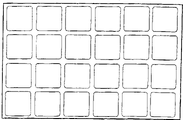
每个垫有许多放吸收剂的格子或袋子14。格子沿其周边用热封或其它方法完全密封。Each pad has a plurality of cells or pockets 14 for absorbent. The grid is completely sealed around its perimeter by heat sealing or other means.
图1吸收垫的底薄层11与顶薄层相同,因此这种特殊垫是两面带微孔。在图2中,底薄层12是渗水的非织造织物,而在图3中,底薄层13是可热熔纸。其它变化方式也可设想到。The bottom sheet 11 of the absorbent pad of Figure 1 is the same as the top sheet, so this particular pad is microporous on both sides. In Figure 2, the base sheet 12 is a water permeable nonwoven fabric, while in Figure 3 the
作为供选择方案,图1~3的吸收垫可包括一层或两层轻质的可热熔纸。这些纸层的作用是作为阻止任何聚合物迁移的分子筛。纸层重量为每平方米16.5g,是纤维素和热塑纤维的混合物,纸层本身已商品化。Alternatively, the absorbent pad of Figures 1-3 may comprise one or two layers of lightweight, heat-fusible paper. These paper layers act as molecular sieves to prevent any polymer migration. The weight of the paper layer is 16.5g per square meter, it is a mixture of cellulose and thermoplastic fibers, and the paper layer itself has been commercialized.
在图2中,底薄层12是白色聚酯/粘胶纤维的混合物,它采用树脂胶接,并在制品内侧具有低密度聚乙烯分散涂层。织物典型重量为每平方米65g,其中有每平方米45g的纤维/胶粘剂的混合物。由于在制品内侧具有低密度聚乙烯分散涂层,我们发现,织物与其它基材具有合适的热胶接性。非织造织物可即刻湿润,并一旦被接触就把液体吸入织物,并把它送到超级吸收聚合物中。In Figure 2, the base sheet 12 is a white polyester/viscose blend which is resin bonded and has a low density polyethylene dispersion coating on the inside of the article. The typical weight of the fabric is 65 grams per square meter with 45 grams per square meter of the fiber/binder mixture. With the low density polyethylene dispersion coating on the inside of the article, we have found that the fabric has suitable thermal bonding properties to other substrates. Nonwoven fabrics wet out instantly and upon contact draw liquid into the fabric and transport it to the superabsorbent polymer.
在图3中,底薄层13是一种较重的可热熔纸,它是纤维素和热塑纤维的混合物,重量为每平方米5~100g。通常,纸具有22%热塑纤维和78%纤维素,并用树脂胶接,得到良好的湿强度。纸具有良好的湿润和吸水作用,有助于把液体吸入超级吸收聚合物中。In Fig. 3, the
图4~6表示了如冷却垫的热垫。该垫也具有一组可放吸收剂的分隔的格子15。在这些实施例中,冷却垫的顶薄层16用与图1~3吸收垫相同的材料制成。在图5中,冷却垫的底薄层17由完全不渗水塑料或叠层薄膜制成,使得水只可通过带微孔的顶薄层而被吸收。因为格子内的聚合物最好被完全水化,所以我们未发现,象吸收垫中那样在冷却垫中采用中间纸层有什么用处,因为纸层倾向于减低胶接强度,并且,由于在冷却垫冷冻前,冷却垫的聚合物吸收了非常多的水,冷却垫所受的应变要比吸收垫大得多。在图4中,底薄层18与顶薄层相同,而在图6中,底薄层19是非织造织物。Figures 4-6 illustrate thermal pads such as cooling pads. The pad also has a set of separate cells 15 in which absorbent can be placed. In these embodiments, the
图7~9说明了本发明垫的另外的一些实施例。在这些实施例中,每个垫的顶薄层20本身由三层组成。三层的最外面层是带微孔的12微米聚酯薄膜21。紧接该层后面是纸层22,它的重量为每平方米38g。紧接纸层22后面是厚度25微米的第二穿孔聚乙烯层23。因此可看到,顶薄层20可看作由三层制成的单薄层,在两层微孔层中间夹了一层纸。在图7中,底薄层24也用与顶薄层相同的复合层制成,使得图7的吸收垫由均具三层结构的两个薄层制成。Figures 7-9 illustrate additional embodiments of the pads of the present invention. In these embodiments, the
图8的垫也具有三层结构的顶薄层21~23,但在该垫中,底薄层是由非织造织物30制成。The pad of FIG. 8 also has a top sheet 21-23 of a three-layer structure, but in this pad the bottom sheet is made of a nonwoven fabric 30 .
图9说明了一种垫,其顶薄层也用三层21~23制成,而底薄层由重的纸31制成。Figure 9 illustrates a pad whose top sheet is also made of three layers 21-23, while the bottom sheet is made of
图10~12表示了另外的热垫,它们可用作冷却垫或加热垫,或者可看作是冰的替代垫(如图4~6的垫)。在图10~12中说明的垫中,顶薄层还是用上述三层21~23制成。在图10中,底薄层32A由非织造织物制成。在图11中,底薄层32B由与顶薄层相同的三层结构制成,而在图12中,底薄层由不穿孔的塑料叠层薄膜32C制成。Figures 10-12 show additional thermal pads which can be used as cooling pads or heating pads, or which can be considered as a substitute for ice (like the pads of Figures 4-6). In the pads illustrated in Figures 10-12, the top sheet is again made of the three layers 21-23 described above. In Fig. 10, the
在图7~12中说明的三层结构的顶薄层,具有12微米的微孔聚酯顶层,它为制品赋于了优良的强度,并在制造最终产品时提供了所需的高温和高压性质。这种特殊的薄层可作反向印刷,用于制品描述和广告宣传。中间纸层作为非常好的分子筛,可挡住未水化聚合物和已水化凝胶通过薄膜的迁移。我们发现,纸也可作为通过两微孔层的液体传送体,它可沿Z轴和X-Y轴同时进行。只要中间纸层能对已水化和未水化形式均适当保持吸收剂粉末,纸重量可为每平方米5g~100g。三层结构的第三层可以是带微孔的聚乙烯薄膜,为了可热封到底薄层上形成垫,这种薄膜可以是低密度聚乙烯和线性低密度聚乙烯的混合物。当然,如上所述,可采用许多不同的薄膜,例如,尼龙、所有聚丙烯类、所有聚乙烯类、它们的混合物、聚胺酯和聚乙烯树脂。The top sheet of the three-layer structure illustrated in Figures 7-12, has a 12 micron microporous polyester top layer, which imparts excellent strength to the article and provides the high temperature and pressure required to manufacture the final product nature. This special thin layer can be used for reverse printing for product description and advertising. The middle paper layer acts as a very good molecular sieve, blocking the migration of unhydrated polymers and hydrated gels through the membrane. We have found that paper can also act as a liquid transport body through two microporous layers, which can be done simultaneously along the Z axis and the X-Y axis. Paper weights may range from 5 g to 100 g per square meter as long as the middle paper layer is capable of adequately retaining the absorbent powder in both hydrated and unhydrated forms. The third layer of the three layer structure may be a microporous polyethylene film which may be a blend of low density polyethylene and linear low density polyethylene for heat sealing to the backsheet to form the pad. Of course, as mentioned above, many different films can be used, for example, nylon, all polypropylenes, all polyethylenes, blends thereof, polyurethane and polyethylene resins.
在一个实施例中,三层的薄层可形成如下。首先,把三层胶接叠合在一起并固化。把未穿孔的已固化薄层通过一个细微穿孔机,并仅在一侧穿孔,保证穿孔销不通过中间纸层。然后把薄层翻身,再通过细微穿孔机,穿孔销也只通过最外层,而不通过中间纸层。由于中间纸层保持原样未穿孔,它能有效地起到分子筛作用,不容许聚合物通过薄膜作迁移。In one embodiment, a thin layer of three layers may be formed as follows. First, the three layers of glue are laminated together and cured. Pass the unperforated cured sheet through a microperforator and perforate on one side only, ensuring that the perforation pins do not pass through the middle paper layer. Then the thin layer is turned over, and then passed through a fine perforator, and the perforated pins only pass through the outermost layer, not through the middle paper layer. Since the middle paper layer remains intact and unperforated, it effectively acts as a molecular sieve and does not allow polymer migration through the film.
应注意到,当生物液与该三层薄层的最外层接触时,由纸的毛细管作用把液体通过微孔吸入结构中。薄层的每侧穿孔不需要对齐,因而通过三层吸入的液体不需要采取线性路线。这对保持格子内的聚合物也有同样的好处。It should be noted that when biological fluid comes into contact with the outermost layer of the three-layer sheet, the liquid is drawn into the structure through the micropores by the capillary action of the paper. The perforations on each side of the lamellae do not need to be aligned, so liquid drawn through the three layers does not need to take a linear route. This has the same benefit of keeping the polymer inside the lattice.
参照图13A和13B,说明了一个冷却垫70,其顶薄层71由如上所述的微孔层制成。紧接微孔层后面的是非织造织物72。在该实施例中非织造织物为ELEVESTM织物。织物为白色非织造的、每平方米40g的双成分连续纤维织物。底薄层73由不穿孔的塑料叠层薄膜制成。Referring to Figures 13A and 13B, there is illustrated a cooling pad 70 having a top sheet 71 made of a microporous layer as described above. Immediately behind the microporous layer is a
除了底薄层75与顶薄层76相同外,图14A和14B表示了相似的结构,两个薄层均包括最外面的微孔叠合塑料薄膜77A、77B,紧接后面的是非织造织物78A、78B,它的一个例子是ELEVESTM织物。Figures 14A and 14B show a similar construction except that the bottom sheet 75 is identical to the top sheet 76, both sheets comprising outermost microporous laminated plastic films 77A, 77B followed by a nonwoven fabric 78A. , 78B, an example of which is the ELEVES( TM) fabric.
在图13A、13B、14A和14B中说明的制品具有非织造织物形式的增强层。增强层对微孔层给予了更大的支持,并为整个制品提供了强度。由于微孔层的确削弱了叠合薄膜,当制品充分水化和薄层被弯曲或扭曲时,微孔叠层有可能开裂和撕裂,使得穿孔尺寸变得更大,并可能使超级吸收聚合物通过垫。由于垫的冷冻和把包含冷冻垫的薄层包在需保冷的物品周围,压力可能被加重。当冷到它的冷弯温度时,将使薄膜抵抗弯曲和阻碍把薄膜强迫包在物品周围,已经削弱的薄膜可能产生开裂和撕裂。如果微孔层仍发生开裂和撕裂,ELEVESTM织物具有一种基本上含有聚合物的非织造设计。The articles illustrated in Figures 13A, 13B, 14A and 14B have a reinforcement layer in the form of a nonwoven fabric. The reinforcement layer gives greater support to the microporous layer and provides strength to the entire article. Since the microporous layer does weaken the laminated film, the microporous laminate has the potential to crack and tear when the article is sufficiently hydrated and the sheet is bent or twisted, allowing the perforation size to become larger and possibly polymerizing the superabsorbent objects through the pad. Stress may be exacerbated by the freezing of the pad and wrapping the thin layer containing the frozen pad around the item to be kept cold. When cooled to its cold bending temperature, which will make the film resist bending and prevent the film from being forced around the item, the already weakened film may crack and tear. If the microporous layer still cracks and tears, the ELEVES ™ fabric has a nonwoven design that essentially contains polymers.
图15A和15B说明了一种有四个格子41的液体吸收垫40(格子数目是任选的)。垫由一个顶薄层和一个底薄层组成。顶薄层为两层,一层微孔塑料叠合层42,紧接其后是中间纸层43。底薄层为相同的两层,外面的微孔塑料叠合层44和中间的纸层45。Figures 15A and 15B illustrate a liquid absorbent pad 40 having four cells 41 (the number of cells is optional). The pad consists of a top and a bottom lamina. The top sheet is two layers, a
图16A和16B表示了一种有四个格子46的垫45。垫是吸液垫,其顶薄层具有两层:外面的微孔塑料叠合层47和中间的纸层48。在这种垫中,底薄层49由一层非织造织物制成。Figures 16A and 16B show a mat 45 having four cells 46 . The pad is an absorbent pad with a top sheet having two layers: an outer microporous plastic laminate layer 47 and a middle paper layer 48 . In this pad, the bottom sheet 49 is formed from a layer of nonwoven fabric.
图17A和17B表示了一种有四个格子51的吸液垫50,顶薄层具有两层:最外面的微孔塑料叠合层52和中间的纸层53,而底薄层54是一层纸。Figures 17A and 17B show a absorbent pad 50 with four
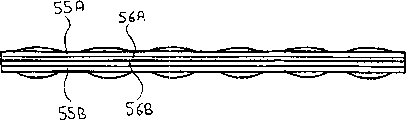
图18是冷却垫的侧视图,顶薄层和底薄层均具有两层:最外面的微孔塑料叠合层55A、55B和中间的非织造织物层56A、56B。Figure 18 is a side view of a cooling pad with top and bottom sheets each having two layers: an outermost microporous
图19说明了另一个冷却垫,顶薄层具有两层:最外面的微孔塑料叠合层60和中间的非织造织物层61,而底薄层为一层非织造织物62。FIG. 19 illustrates another cooling pad with a top sheet having two layers: an outermost microporous plastic laminate layer 60 and a middle nonwoven layer 61 , while the bottom sheet is a
图20A和20B说明了一种液体吸收垫65,其中具有许多隔开的格子。垫的顶薄层具有两层:最外面的微孔塑料共挤压层66,其后面的非织造织物层67。底薄层具有两层68、69,均为非织造织物。Figures 20A and 20B illustrate a liquid
吸收垫分成三种主要尺寸:400mm×141mm或200mm×280mm的12个格子垫,以极200mm×211mm的9个格子垫。也可有其它尺寸。Absorbent pads are divided into three main sizes: 12 grid pads of 400mm x 141mm or 200mm x 280mm, and 9 grid pads of 200mm x 211mm. Other sizes are also available.
在图20中,吸收垫是四层垫。塑料采用了一种多层共挤压薄膜的不同形式。三个不同层由高密度聚乙烯或低密度聚乙烯/线性低密度聚乙烯的混合物制成,以调整熔化温度。垫的顶层是共挤压塑料,其第二层是非织造织物。底薄层是由两层非织造织物制成。In Figure 20, the absorbent pad is a four layer pad. The plastic takes the form of a multilayer coextruded film. The three different layers are made of HDPE or a blend of LDPE/Linear Low Density Polyethylene to adjust the melting temperature. The top layer of the pad is co-extruded plastic and its second layer is a non-woven fabric. The bottom sheet is made of two layers of nonwoven fabric.
应该理解到,对本发明可作其它各种变化和修改。也就是说,应该理解到,只要至少一个薄层带有微孔,垫的尺寸和形状可变,顶薄层和底薄层的形式可变,聚合物的类型和聚合物的量也可作适当改变。垫可用作生物液吸收垫、冷却垫和加热垫(应理解到,冷却垫一旦泡胀后,可被加热起到“热包”作用)。垫可用作包装中的湿度控制,在鲜花工业中也可找到其用途。It should be understood that various other changes and modifications can be made to the present invention. That is, it should be understood that the size and shape of the pad can be varied, the form of the top and bottom sheets can be varied, and the type of polymer and the amount of polymer can also be used as long as at least one of the sheets is microporous. Appropriate changes. The pad can be used as a biological fluid absorbent pad, a cooling pad, and a heating pad (it will be understood that the cooling pad, once inflated, can be heated to act as a "heat pack"). Mats can be used as humidity control in packaging and also find their use in the flower industry.
Claims (19)
Applications Claiming Priority (4)
| Application Number | Priority Date | Filing Date | Title |
|---|---|---|---|
| AUPN8248 | 1996-02-22 | ||
| AUPN8248A AUPN824896A0 (en) | 1996-02-22 | 1996-02-22 | An absorbent pad |
| AUPN8949A AUPN894996A0 (en) | 1996-03-27 | 1996-03-27 | An absorbent pad |
| AUPN8949 | 1996-03-27 |
Publications (2)
| Publication Number | Publication Date |
|---|---|
| CN1211958A CN1211958A (en) | 1999-03-24 |
| CN1082011C true CN1082011C (en) | 2002-04-03 |
Family
ID=25645115
Family Applications (1)
| Application Number | Title | Priority Date | Filing Date |
|---|---|---|---|
| CN97192497A Expired - Fee Related CN1082011C (en) | 1996-02-22 | 1997-02-19 | an absorbent pad |
Country Status (8)
| Country | Link |
|---|---|
| US (1) | US6270873B1 (en) |
| EP (1) | EP0885152A4 (en) |
| JP (1) | JP2000504660A (en) |
| KR (1) | KR100620482B1 (en) |
| CN (1) | CN1082011C (en) |
| CA (1) | CA2247209C (en) |
| NZ (1) | NZ331799A (en) |
| WO (1) | WO1997030909A1 (en) |
Families Citing this family (44)
| Publication number | Priority date | Publication date | Assignee | Title |
|---|---|---|---|---|
| KR20000022356A (en) * | 1996-07-06 | 2000-04-25 | 헬무트 클림멕 | Absorbent inserts, method of producing them and their use |
| US7048976B2 (en) * | 1997-04-03 | 2006-05-23 | Cryomed France | Cooling article involving evaporation of water from a polymer absorbent |
| JP2001514126A (en) * | 1997-08-26 | 2001-09-11 | ザ、プロクター、エンド、ギャンブル、カンパニー | Multipurpose sheet material |
| AU5484800A (en) * | 1999-06-18 | 2001-01-09 | Procter & Gamble Company, The | Absorbent sheet material having cut-resistant layer and method for making the same |
| US7919160B2 (en) * | 1999-07-12 | 2011-04-05 | Bigpaper America, Inc. | Composite packaging material having a base layer of paper and an attached additional layer or tubular sleeve envelope of plastic material, particularly for food products, and method for obtaining it |
| US6991844B2 (en) | 2000-10-02 | 2006-01-31 | S.C. Johnson Home Storage, Inc. | Disposable cutting sheet |
| US7056569B2 (en) | 2000-10-02 | 2006-06-06 | S.C. Johnson Home Storage, Inc. | Disposable cutting sheet |
| US7063879B2 (en) | 2000-10-02 | 2006-06-20 | S.C. Johnson Home Storage, Inc. | Disposable cutting sheet |
| US7022395B2 (en) | 2000-10-02 | 2006-04-04 | S.C. Johnson Home Storage, Inc. | Disposable cutting sheet |
| US7078088B2 (en) | 2000-10-02 | 2006-07-18 | S.C. Johnson Home Storage, Inc. | Disposable cutting sheet |
| US6979485B2 (en) | 2000-10-02 | 2005-12-27 | S.C. Johnson Home Storage, Inc. | Processing substrate and/or support surface |
| US7063880B2 (en) | 2000-10-02 | 2006-06-20 | S.C. Johnson Home Storage, Inc. | Sheet material and manufacturing method and apparatus therefor |
| US6986931B2 (en) | 2000-10-02 | 2006-01-17 | S.C. Johnson & Son, Inc. | Disposable cutting sheet |
| US7776416B2 (en) | 2001-08-20 | 2010-08-17 | Cryovac, Inc. | Case-ready package having absorbent pad |
| US6869464B2 (en) * | 2002-02-06 | 2005-03-22 | John Klemic | Atmospheric water absorption and retrieval device |
| US20030203164A1 (en) * | 2002-04-04 | 2003-10-30 | New Pig Corporation | Anti-fatigue mat |
| US7025198B2 (en) * | 2002-12-31 | 2006-04-11 | Cryovac, Inc. | Absorbent pad with controlled rate of wicking |
| US7026034B2 (en) | 2003-02-11 | 2006-04-11 | S.C. Johnson Home Storage, Inc. | Processing substrate and method of manufacturing same |
| CA2519292C (en) * | 2003-03-17 | 2011-07-12 | Paper Pak Industries | Shaped absorbent pads |
| US8029893B2 (en) | 2004-04-02 | 2011-10-04 | Curwood, Inc. | Myoglobin blooming agent, films, packages and methods for packaging |
| US7867531B2 (en) | 2005-04-04 | 2011-01-11 | Curwood, Inc. | Myoglobin blooming agent containing shrink films, packages and methods for packaging |
| US8470417B2 (en) | 2004-04-02 | 2013-06-25 | Curwood, Inc. | Packaging inserts with myoglobin blooming agents, packages and methods for packaging |
| US8741402B2 (en) | 2004-04-02 | 2014-06-03 | Curwood, Inc. | Webs with synergists that promote or preserve the desirable color of meat |
| US8545950B2 (en) | 2004-04-02 | 2013-10-01 | Curwood, Inc. | Method for distributing a myoglobin-containing food product |
| US8110259B2 (en) | 2004-04-02 | 2012-02-07 | Curwood, Inc. | Packaging articles, films and methods that promote or preserve the desirable color of meat |
| US7771812B2 (en) * | 2005-12-02 | 2010-08-10 | Paper Pak Industries | Non-slip absorbent pad |
| ES2383508T3 (en) | 2006-09-11 | 2012-06-21 | Friesland Brands B.V. | Spray container |
| US20220332491A1 (en) * | 2007-05-10 | 2022-10-20 | The Hillshire Brands Company | Moisture degraded packaging seal |
| WO2012064862A2 (en) * | 2010-11-10 | 2012-05-18 | Sara Lee Corporation | Packaging for food product |
| US20120114808A1 (en) * | 2010-11-10 | 2012-05-10 | Sara Lee Corporation | Packaging for food product |
| US9988200B2 (en) * | 2008-05-06 | 2018-06-05 | The Hillshire Brands Company | Packaging for food product |
| WO2010078658A1 (en) * | 2009-01-12 | 2010-07-15 | Calon Jamie W | Sweat management system |
| US9623622B2 (en) | 2010-02-24 | 2017-04-18 | Michael Baines | Packaging materials and methods |
| US8937212B2 (en) | 2010-08-24 | 2015-01-20 | Michelle Fogg | Feminine cooling pad |
| US9572709B2 (en) | 2010-08-24 | 2017-02-21 | Michelle Lynn FOGG | Feminine cooling pad |
| CN102125380B (en) * | 2011-03-25 | 2012-09-05 | 刘奕荣 | Cup pad with water absorption function |
| US8828516B2 (en) | 2012-05-03 | 2014-09-09 | Biovation Ii Llc | Biodegradable polymer non-woven absorbent pad with absorbency and antimicrobial chemistry |
| US20210179335A1 (en) * | 2014-05-15 | 2021-06-17 | William Birgen | Device to Force Moisture Removal Inside a Food Container |
| US11001432B1 (en) * | 2014-05-15 | 2021-05-11 | SAVR Pak Inc. | Food container with forced moisture removal |
| US11952196B1 (en) | 2014-05-15 | 2024-04-09 | SAVR Pak, LLC | Devices to force moisture removal inside a food container |
| US20180273275A1 (en) * | 2014-05-15 | 2018-09-27 | Kyllburg Technologies, LLC | Food Container With Forced Moisture Removal |
| CN111970949A (en) * | 2018-02-13 | 2020-11-20 | 冷蒸汽解决方案公司 | Method and composition for humidifying and cooling a gas stream |
| JP7192146B2 (en) * | 2019-09-30 | 2022-12-19 | 富士フイルム株式会社 | Immunological examination method and concentrating jig |
| EP4099017A4 (en) * | 2020-01-31 | 2023-02-15 | FUJIFILM Corporation | IMMUNOLOGICAL TEST METHOD |
Citations (1)
| Publication number | Priority date | Publication date | Assignee | Title |
|---|---|---|---|---|
| AU1157395A (en) * | 1994-02-07 | 1995-08-17 | Showa Denko Kabushiki Kaisha | Liquid-absorbent sheet and method for storing food using the same |
Family Cites Families (9)
| Publication number | Priority date | Publication date | Assignee | Title |
|---|---|---|---|---|
| US3156402A (en) * | 1961-07-03 | 1964-11-10 | Continental Can Co | Liquid absorbing and concealing device |
| US4275811A (en) * | 1979-08-23 | 1981-06-30 | Cellu Products Company | Receptacle for containing and displaying food products |
| US4802574A (en) * | 1987-12-01 | 1989-02-07 | Yosuke Akiba | Absorbent for a gas preservative atomosphere |
| EP0353334A1 (en) * | 1988-08-05 | 1990-02-07 | Kimberly-Clark Corporation | Absorbent structure for absorbing food product liquids |
| US4940621A (en) * | 1988-09-19 | 1990-07-10 | Clean-Pak, Inc. | Absorbent pad and method for constructing same |
| FR2636928B1 (en) * | 1988-09-23 | 1990-11-02 | Enora Philippe | RIGID SUPPORT FOR FOOD PRODUCT PACKAGING |
| AU4215193A (en) * | 1992-07-23 | 1994-01-27 | Aci Operations Pty. Limited | Absorbent pad |
| US5274865A (en) * | 1992-11-25 | 1994-01-04 | Sanwa Life Cela Kabushiki Kaisha | Cooling device |
| TW317850U (en) * | 1994-02-07 | 1997-10-11 | Showa Denko Kk | Liquid absorbing sheet |
-
1997
- 1997-02-19 CA CA002247209A patent/CA2247209C/en not_active Expired - Fee Related
- 1997-02-19 JP JP9529658A patent/JP2000504660A/en active Pending
- 1997-02-19 NZ NZ331799A patent/NZ331799A/en not_active IP Right Cessation
- 1997-02-19 CN CN97192497A patent/CN1082011C/en not_active Expired - Fee Related
- 1997-02-19 EP EP97904299A patent/EP0885152A4/en not_active Withdrawn
- 1997-02-19 WO PCT/AU1997/000086 patent/WO1997030909A1/en not_active Ceased
- 1997-02-19 KR KR1019980706538A patent/KR100620482B1/en not_active Expired - Fee Related
- 1997-02-19 US US09/125,615 patent/US6270873B1/en not_active Expired - Lifetime
Patent Citations (1)
| Publication number | Priority date | Publication date | Assignee | Title |
|---|---|---|---|---|
| AU1157395A (en) * | 1994-02-07 | 1995-08-17 | Showa Denko Kabushiki Kaisha | Liquid-absorbent sheet and method for storing food using the same |
Also Published As
| Publication number | Publication date |
|---|---|
| JP2000504660A (en) | 2000-04-18 |
| CN1211958A (en) | 1999-03-24 |
| KR19990087146A (en) | 1999-12-15 |
| CA2247209C (en) | 2002-10-08 |
| KR100620482B1 (en) | 2006-10-24 |
| EP0885152A1 (en) | 1998-12-23 |
| WO1997030909A1 (en) | 1997-08-28 |
| NZ331799A (en) | 2000-03-27 |
| CA2247209A1 (en) | 1997-08-28 |
| EP0885152A4 (en) | 2004-06-09 |
| US6270873B1 (en) | 2001-08-07 |
Similar Documents
| Publication | Publication Date | Title |
|---|---|---|
| CN1211958A (en) | an absorbent pad | |
| CA2452584C (en) | Self-absorbing gas-barrier receptacle for food packaging and food package obtained therefrom | |
| CN1095357C (en) | Assorbent member for absorbent article and method for manufacturing the same | |
| US7377828B2 (en) | Multi-layered sports board | |
| CN1117660C (en) | Laminated packaging materials and packaging containers produced therefrom | |
| EP0831033A1 (en) | Disiccant container | |
| EP0743844A1 (en) | Absorbent materials and preparation thereof | |
| EP1184075B1 (en) | Liquid absorbent | |
| AU2002331335A1 (en) | Self-absorbing gas-barrier receptacle for food packaging and food package obtained therefrom | |
| US20080190786A1 (en) | Absorbent Insert for Foodstuff Packaging | |
| JP2009022924A (en) | Hygroscopic / deodorant sheet | |
| US20060283996A1 (en) | Reinforced absorbent article | |
| JP4972342B2 (en) | Hygroscopic sheet | |
| JP2002300848A (en) | Liquid absorption sheet | |
| JP2709813B2 (en) | Method for producing water-absorbent sheet | |
| JP6545014B2 (en) | Blister pack laminate and blister pack using the same | |
| DE602004006652T2 (en) | Absorbent element and packaging for it | |
| EP1238795A1 (en) | Self-absorbing gas-barrier thermoformable sheet and receptacle for food packaging obtained therefrom | |
| CN221022678U (en) | Anti-slip anti-seepage type liquid absorbing sheet | |
| CN1886109A (en) | Absorbent article and method of manufacturing the same | |
| JPH031934A (en) | Packaging material for deoxidizer | |
| AU708949B2 (en) | An absorbent pad | |
| JP2546263Y2 (en) | Water absorption sheet for fresh food | |
| JP2024098916A (en) | Dehumidifier | |
| JP2862263B2 (en) | Water-absorbing sheet that preserves the freshness of fruits and vegetables |
Legal Events
| Date | Code | Title | Description |
|---|---|---|---|
| C06 | Publication | ||
| PB01 | Publication | ||
| C10 | Entry into substantive examination | ||
| SE01 | Entry into force of request for substantive examination | ||
| C14 | Grant of patent or utility model | ||
| GR01 | Patent grant | ||
| C17 | Cessation of patent right | ||
| CF01 | Termination of patent right due to non-payment of annual fee |
Granted publication date: 20020403 |