Disclosure of Invention
The invention provides a voiceprint verification method and a voiceprint verification device, which are used for solving the problem that voiceprints of malicious simulation users can pass identity verification.
In order to solve the technical problems, the invention solves the problems by the following technical scheme:
the invention provides a voiceprint verification method, which comprises the following steps: collecting voice information to be verified; extracting voiceprint features from a voice waveform corresponding to the voice information; performing waveform matching on the sound waveform and a pre-stored standard sound waveform, and performing feature matching on the voiceprint features and the pre-stored standard voiceprint features; and if the waveform matching and the feature matching are matched successfully, the voiceprint verification is passed.
Before the collecting the voice information to be verified, the method further comprises the following steps: intercepting a voice segment input by a user; and storing the sound waveform of the voice segment as a standard voiceprint waveform.
Before the collecting the voice information to be verified, the method further comprises the following steps: and generating a random password according to the intercepted voice segment and storing the random password.
Wherein, the collecting the voice information to be verified comprises: acquiring a pre-stored random password; prompting a user to input the acquired random password in a voice mode; and collecting the random password input by the user in a voice mode to serve as voice information to be verified.
Wherein, will sound waveform and the standard sound waveform of prestoring carry out the waveform matching, will voiceprint characteristic and prestoring standard voiceprint characteristic carry out the characteristic matching, include: carrying out waveform matching on the sound waveform and a pre-stored standard sound waveform; if the waveform matching is successful, performing feature matching on the voiceprint features and pre-stored standard voiceprint features, otherwise, failing to pass voiceprint verification; if the feature matching is successful, the voiceprint verification is passed, otherwise, the voiceprint verification is not passed; or, performing feature matching on the voiceprint features and pre-stored standard voiceprint features; if the feature matching is successful, performing waveform matching on the sound waveform and a pre-stored standard sound waveform, otherwise, failing to pass the sound pattern verification; if the waveform matching is successful, voiceprint verification is passed, otherwise, voiceprint verification is not passed.
The invention also provides a voiceprint verification device, comprising: the acquisition module is used for acquiring voice information to be verified; the extraction module is used for extracting voiceprint characteristics from the sound waveform corresponding to the voice information; the verification module is used for carrying out waveform matching on the sound waveform and a pre-stored standard sound waveform and carrying out feature matching on the voiceprint features and the pre-stored standard voiceprint features; and if the waveform matching and the feature matching are matched successfully, the voiceprint verification is passed.
Wherein, the collection module is further configured to: intercepting a voice segment input by a user before acquiring voice information to be verified; and storing the sound waveform of the voice segment as a standard sound waveform.
Wherein, the collection module is further configured to: and generating a random password according to the intercepted voice segment and storing the random password before acquiring the voice information to be verified.
Wherein the acquisition module is further configured to: acquiring a pre-stored random password; prompting a user to input the acquired random password in a voice mode; and collecting the random password input by the user in a voice mode to serve as voice information to be verified.
Wherein the verification module is further to: carrying out waveform matching on the sound waveform and a pre-stored standard sound waveform; if the waveform matching is successful, performing feature matching on the voiceprint features and pre-stored standard voiceprint features, otherwise, failing to pass voiceprint verification; if the feature matching is successful, the voiceprint verification is passed, otherwise, the voiceprint verification is not passed; or, performing feature matching on the voiceprint features and pre-stored standard voiceprint features; if the feature matching is successful, performing waveform matching on the sound waveform and a pre-stored standard sound waveform, otherwise, failing to pass the sound pattern verification; if the waveform matching is successful, voiceprint verification is passed, otherwise, voiceprint verification is not passed.
The invention has the following beneficial effects:
the invention not only carries out matching verification on the voiceprint characteristics, but also carries out matching verification on the sound waveform, and the voiceprint verification is determined to pass only if the two matching verifications pass. Therefore, even if the voiceprint characteristics of the user are simulated maliciously, the situation that the voiceprint characteristics and the sound waveform are simulated simultaneously can not occur, and the problem that the voiceprint characteristics of the user are simulated maliciously and can pass identity authentication is solved through the method and the system.
Detailed Description
The present invention will be described in further detail below with reference to the drawings and examples. It should be understood that the specific embodiments described herein are merely illustrative of the invention and do not limit the invention.
Example one
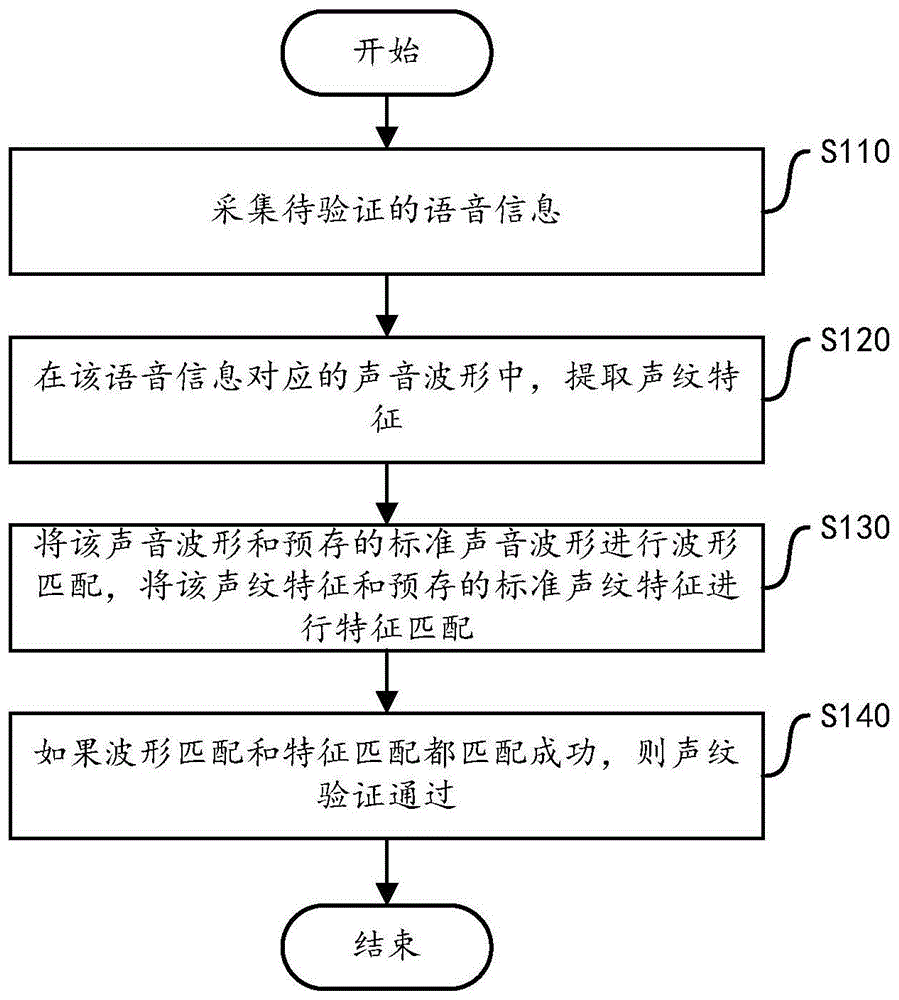
The embodiment provides a voiceprint verification method. Fig. 1 is a flow chart of a voiceprint authentication method according to a first embodiment of the present invention. The execution subject of the embodiment is a terminal device.
Step S110, collecting voice information to be verified.
After the voiceprint verification function is started, voice information input by a user is collected, and the voice information is to-be-verified voice information. In this embodiment, the voice information may be a voice password input by the user.
Collecting voice information may include the following steps:
step 1, starting a voiceprint verification function and prompting a user to input a voice password by voice. The voice password may be a segment of text or numbers, and the user may read the segment of text or numbers through the microphone.
And 2, acquiring the voice password input by the user through the microphone. The voice signal is a carrier of voice information, the voice signal is a sound with a waveform, and a voice password read by a user is carried in the sound waveform.
Step S120 is to extract a voiceprint feature from the voice waveform corresponding to the voice information.
The acoustic waveform is a waveform that carries speech information input by a user. When the same voice information is input, the voice waveforms of different users are different due to different voices of different users and different speaking modes.
The sound waveform is converted into a sound wave spectrum, and voiceprint features are extracted from the sound wave spectrum. Voiceprint features include, but are not limited to: wavelength, frequency, intensity, rhythm of the sound. Each user's voiceprint feature is unique.
Step S130, performing waveform matching on the sound waveform and a pre-stored standard sound waveform, and performing feature matching on the voiceprint feature and a pre-stored standard voiceprint feature.
The standard sound waveform is a sound waveform when a legal user inputs voice information in advance.
A voice segment input by a user can be intercepted; storing the intercepted sound waveform of the voice segment as a standard voiceprint waveform; and generating a random password according to the intercepted voice segment and storing the random password (voice password). The speech segment means: and intercepting part of voice information input by a user. For example: the user inputs the voice message 'weather is good today', a part of the voice message 'weather is good' is intercepted from the voice message, and the 'weather is good', namely the voice fragment. Further, the random password may be text information formed by performing voice recognition on the voice segment.
When voice information to be verified is collected, a pre-stored random password can be obtained; prompting a user to input the acquired random password in a voice mode; and collecting the random password input by the user in a voice mode so as to be used as voice information to be verified.
The standard voiceprint waveform is a voiceprint characteristic of a legitimate user. The voice information input by the legal user can be collected in advance, and the voiceprint characteristics of the legal user are extracted and stored according to the voice information.
The waveform matching and feature matching may be performed simultaneously or sequentially. According to the sequence, the waveform matching can be carried out firstly, and then the characteristic matching is carried out; or the feature matching can be performed first and then the waveform matching can be performed.
The waveform matching is to calculate the similarity between the sound waveform of the voice signal input by the user and the standard sound waveform, if the similarity of the waveforms is greater than a preset waveform similarity threshold, the waveforms are determined to be matched, otherwise, the waveforms are determined to be unmatched. The waveform similarity threshold is an empirical value or an experimentally obtained value, for example, 98%.
The feature matching is to calculate the similarity between the voiceprint feature of the voice signal input by the user and the standard voiceprint feature, if the similarity of the features is greater than a preset feature similarity threshold, the features are determined to be matched, otherwise, the features are determined to be unmatched. The feature similarity threshold is an empirical value or an experimentally obtained value, for example, 98%.
In step S140, if the waveform matching and the feature matching are both successful, the voiceprint verification is passed.
And when the voiceprint verification is passed, the voice information to be verified is legal, and the user inputting the voice information to be verified is a legal user.
Voiceprint verification fails if one or both of the waveform match and feature match fail. And if the voiceprint verification fails, the user inputting the voice information to be verified is an illegal user.
In the embodiment, the voiceprint feature is subjected to matching verification, the sound waveform is subjected to matching verification, and the voiceprint verification is determined to pass after the two matching verifications pass. Under the condition, even if the voiceprint characteristics of the user are simulated maliciously, the voiceprint characteristics and the sound waveform cannot be simulated simultaneously, so that the voiceprint characteristics of the user are prevented from being simulated maliciously through the method and the device, and the accuracy of identity verification can be improved through the problem of identity verification.
Example two
A more specific example is given below to illustrate the voiceprint authentication method of the present invention.
In this embodiment, a sound waveform is first waveform-matched with a pre-stored standard sound waveform; if the waveform matching is successful, then carrying out feature matching on the voiceprint features and the pre-stored standard voiceprint features, otherwise, failing to pass the voiceprint verification; if the feature matching is successful, the voiceprint verification is passed, otherwise, the voiceprint verification is not passed. Of course, the voiceprint features can be matched with the pre-stored standard voiceprint features; if the feature matching is successful, performing waveform matching on the sound waveform and a pre-stored standard sound waveform, otherwise, failing to pass the voiceprint verification; if the waveform matching is successful, the voiceprint verification is passed, otherwise, the voiceprint verification is not passed.
Fig. 2 is a flow chart of a voiceprint authentication method according to a second embodiment of the present invention.
Step S210, extracting standard voiceprint features of the user.
Prompting the user to input voice information, recording the voice information input by the user, extracting the voiceprint characteristics of the user from the voice information, and storing the voiceprint characteristics of the user into a voiceprint model library.
This step S210 may be performed at the time of initialization of the terminal device.
Step S220, intercepting the voice segment input by the user.
In order to improve the security of the voiceprint authentication, after each voiceprint authentication is passed, a voice segment input by a user is intercepted, a standard voice waveform corresponding to the voice segment and a random password generated according to the voice segment are used in the next voiceprint authentication, and therefore, the user can input a newly generated random password and use the newly stored standard voice waveform when each voiceprint authentication is performed. Of course, when voiceprint authentication is performed for the first time, a voice segment may be intercepted from the voice information used when the standard voiceprint feature is extracted, a random password may be generated according to the voice segment, and the sound waveform of the voice segment may be used as the standard sound waveform.
Step S230, generating and storing a random password according to the voice segment, and storing the sound waveform of the voice segment as a standard sound waveform.
Specifically, in the process of using the voice function by the user, recording the voice information input by the user; intercepting a plurality of voice segments from the recorded voice information; and storing the sound waveforms of a plurality of the voice segments as standard sound waveforms. Generating a random password according to each voice segment; and storing random passwords corresponding to the voice segments respectively.
For example: in the conversation process of a user, conversation contents are recorded, a voice segment of the user is intercepted, a random password is generated according to the voice segment, and the sound waveform of the voice segment is used as a standard sound waveform.
Step S240, when the voiceprint authentication is performed, prompting the user to input the random password corresponding to the voice segment.
And starting a voiceprint verification function to perform the voiceprint verification. One random password is obtained from the stored random passwords, the random password is displayed on a screen, and a user is prompted to input the random password in a voice mode. For example: if the voice segment is 'good weather', the user is prompted to input 'good weather'.
And step S250, acquiring the random password input by the user according to the prompt voice to form voice information to be verified.
In step S260, the sound waveform of the speech information is waveform-matched with the standard sound waveform. If the waveform matching is successful, go to step S270; if the waveform matching fails, step S290 is performed.
Step S270, the voice print characteristic of the voice information is matched with the standard voice print characteristic. If the feature matching is successful, go to step S280; if the feature matching fails, step S290 is performed.
In step S280, the voiceprint verification is passed.
In step S290, the voiceprint authentication is not passed.
In the embodiment, the voice segments required to be input by the user are different every time, the used standard voice waveforms are different, before feature matching is performed, whether the voice waveform of the user is matched with the voice waveform of the stored voice segment is determined, and on the premise that the waveform matching is successful, the feature matching is performed, so that the accuracy of user identity verification is improved.
EXAMPLE III
The embodiment provides a voiceprint authentication device. Fig. 3 is a structural diagram of a voiceprint authentication apparatus according to a third embodiment of the present invention. The apparatus of this embodiment may be disposed in a terminal device.
The device includes:
the collecting module 310 is configured to collect voice information to be verified.
An extracting module 320, configured to extract a voiceprint feature from a sound waveform corresponding to the voice information.
The verification module 330 is configured to perform waveform matching on the sound waveform and a pre-stored standard sound waveform, and perform feature matching on the voiceprint feature and a pre-stored standard voiceprint feature; and if the waveform matching and the feature matching are matched successfully, the voiceprint verification is passed.
In one embodiment, the collecting module 310 is further configured to intercept a voice segment input by the user before collecting the voice information to be verified; and storing the sound waveform of the voice segment as a standard voiceprint waveform.
In another embodiment, the collecting module 310 is further configured to generate a random password according to the intercepted voice segment and store the random password before the voice information to be verified is collected.
In yet another embodiment, a pre-stored random password is obtained; prompting a user to input the acquired random password in a voice mode; and acquiring the random password input by the user in a voice mode as voice information to be verified.
In yet another embodiment, the verification module 330 is further configured to: carrying out waveform matching on the sound waveform and a pre-stored standard sound waveform; if the waveform matching is successful, performing feature matching on the voiceprint features and pre-stored standard voiceprint features, otherwise, failing to pass voiceprint verification; if the feature matching is successful, the voiceprint verification is passed, otherwise, the voiceprint verification is not passed; alternatively, the verification module 330 is further configured to: performing feature matching on the voiceprint features and pre-stored standard voiceprint features; if the feature matching is successful, performing waveform matching on the sound waveform and a pre-stored standard sound waveform, otherwise, failing to pass the voiceprint verification; if the waveform matching is successful, voiceprint verification is passed, otherwise, voiceprint verification is not passed.
The functions of the apparatus in this embodiment have already been described in the method embodiments shown in fig. 1 to 2, so that reference may be made to the related descriptions in the foregoing embodiments for details not described in this embodiment.
Although the preferred embodiments of the present invention have been disclosed for illustrative purposes, those skilled in the art will appreciate that various modifications, additions and substitutions are possible, and the scope of the invention should not be limited to the embodiments described above.