CN108347319B - A method and device for resource allocation - Google Patents
A method and device for resource allocation Download PDFInfo
- Publication number
- CN108347319B CN108347319B CN201710059356.6A CN201710059356A CN108347319B CN 108347319 B CN108347319 B CN 108347319B CN 201710059356 A CN201710059356 A CN 201710059356A CN 108347319 B CN108347319 B CN 108347319B
- Authority
- CN
- China
- Prior art keywords
- type
- users
- current
- user
- resources
- Prior art date
- Legal status (The legal status is an assumption and is not a legal conclusion. Google has not performed a legal analysis and makes no representation as to the accuracy of the status listed.)
- Expired - Fee Related
Links
Images


Classifications
-
- H—ELECTRICITY
- H04—ELECTRIC COMMUNICATION TECHNIQUE
- H04L—TRANSMISSION OF DIGITAL INFORMATION, e.g. TELEGRAPHIC COMMUNICATION
- H04L5/00—Arrangements affording multiple use of the transmission path
- H04L5/003—Arrangements for allocating sub-channels of the transmission path
- H04L5/0037—Inter-user or inter-terminal allocation
-
- H—ELECTRICITY
- H04—ELECTRIC COMMUNICATION TECHNIQUE
- H04L—TRANSMISSION OF DIGITAL INFORMATION, e.g. TELEGRAPHIC COMMUNICATION
- H04L5/00—Arrangements affording multiple use of the transmission path
- H04L5/0001—Arrangements for dividing the transmission path
- H04L5/0003—Two-dimensional division
- H04L5/0005—Time-frequency
- H04L5/0007—Time-frequency the frequencies being orthogonal, e.g. OFDM(A) or DMT
- H04L5/001—Time-frequency the frequencies being orthogonal, e.g. OFDM(A) or DMT the frequencies being arranged in component carriers
-
- H—ELECTRICITY
- H04—ELECTRIC COMMUNICATION TECHNIQUE
- H04L—TRANSMISSION OF DIGITAL INFORMATION, e.g. TELEGRAPHIC COMMUNICATION
- H04L5/00—Arrangements affording multiple use of the transmission path
- H04L5/003—Arrangements for allocating sub-channels of the transmission path
- H04L5/0044—Allocation of payload; Allocation of data channels, e.g. PDSCH or PUSCH
-
- H—ELECTRICITY
- H04—ELECTRIC COMMUNICATION TECHNIQUE
- H04L—TRANSMISSION OF DIGITAL INFORMATION, e.g. TELEGRAPHIC COMMUNICATION
- H04L5/00—Arrangements affording multiple use of the transmission path
- H04L5/003—Arrangements for allocating sub-channels of the transmission path
- H04L5/0053—Allocation of signalling, i.e. of overhead other than pilot signals
-
- H—ELECTRICITY
- H04—ELECTRIC COMMUNICATION TECHNIQUE
- H04L—TRANSMISSION OF DIGITAL INFORMATION, e.g. TELEGRAPHIC COMMUNICATION
- H04L5/00—Arrangements affording multiple use of the transmission path
- H04L5/003—Arrangements for allocating sub-channels of the transmission path
- H04L5/0078—Timing of allocation
-
- H—ELECTRICITY
- H04—ELECTRIC COMMUNICATION TECHNIQUE
- H04W—WIRELESS COMMUNICATION NETWORKS
- H04W72/00—Local resource management
- H04W72/04—Wireless resource allocation
- H04W72/044—Wireless resource allocation based on the type of the allocated resource
- H04W72/0453—Resources in frequency domain, e.g. a carrier in FDMA
-
- H—ELECTRICITY
- H04—ELECTRIC COMMUNICATION TECHNIQUE
- H04W—WIRELESS COMMUNICATION NETWORKS
- H04W72/00—Local resource management
- H04W72/50—Allocation or scheduling criteria for wireless resources
- H04W72/52—Allocation or scheduling criteria for wireless resources based on load
Landscapes
- Engineering & Computer Science (AREA)
- Signal Processing (AREA)
- Computer Networks & Wireless Communication (AREA)
- Mobile Radio Communication Systems (AREA)
Abstract
本发明提供了一种资源分配的方法、装置,其中该方法将等待分配资源的用户队列按照优先级别由高至低分为第一类用户的队列、第二类用户的队列,第一类用户为一个方向的业务正在传输、另一个方向有业务到达的用户,第二类用户为有业务到达的所有用户,在当前的调度分配周期开始时,由第一类用户的队列中依次取出等待分配资源的第一类用户,并为每个第一类用户分配另一个方向的资源;当所有的第一类用户均结束当前调度分配周期的资源分配过程时,为第二类用户的队列中等待分配资源的第二类用户分配资源,这样将同一子带的上行方向资源和下行方向资源分配给不同的终端用户,从而避免子带中某一方向资源闲置,有效提高子带利用率。
The present invention provides a method and device for resource allocation, wherein the method divides the user queue waiting for resource allocation into a queue of users of the first type, a queue of users of the second type, and a queue of users of the first type according to the priority level from high to low. For users whose services are being transmitted in one direction and services arrive in the other direction, the second type of users are all users with services arriving. At the beginning of the current scheduling and allocation cycle, the users of the first type are taken out from the queue for waiting for allocation in turn. The first type of users of resources, and allocate resources in the other direction for each first type of user; when all the first type of users have finished the resource allocation process of the current scheduling allocation cycle, wait in the queue for the second type of users The second type of user that allocates resources allocates resources. In this way, resources in the uplink direction and downlink direction of the same subband are allocated to different terminal users, thereby avoiding idle resources in a certain direction in the subband and effectively improving the utilization rate of the subband.
Description
技术领域technical field
本发明涉及移动通信技术领域,特别涉及一种资源分配的方法、装置。The present invention relates to the technical field of mobile communication, and in particular, to a method and device for resource allocation.
背景技术Background technique
在无线通信系统中,MAC层的调度算法起着至关重要的作用,一个好的调度算法可以保证终端用户间的公平性,降低系统复杂度,提高系统吞吐量的作用。In the wireless communication system, the scheduling algorithm of the MAC layer plays a crucial role. A good scheduling algorithm can ensure the fairness among end users, reduce the system complexity and improve the system throughput.
目前,无线通信系统的调度算法通常分为上行调度算法和下行调度算法。上行调度算法职位用户分配上行的资源,并维护上行资源池;而下行调度算法只为用户分配下行的资源,并维护下行资源池。At present, scheduling algorithms of wireless communication systems are generally divided into uplink scheduling algorithms and downlink scheduling algorithms. The uplink scheduling algorithm allocates uplink resources to users and maintains the uplink resource pool; while the downlink scheduling algorithm only allocates downlink resources to users and maintains the downlink resource pool.
通常,如果某一用户具有上行(或下行)方向业务产生,上行(或下行)调度算法会将某一频带的上行(或下行)资源分配给该用户;如果之后该用户又有下行(或上行)方向业务到达,下行(或上行)调度算法会将另一频带的下行(或上行)的资源分配给该用户。如果上述两个频带的不是同一频带,就要求终端用户可以同时工作在两个或者更多的频带上,从而增大终端设计和实现的复杂度。因此,规定终端用户都只能在一个频带上工作。Usually, if a user has services in the uplink (or downlink) direction, the uplink (or downlink) scheduling algorithm will allocate the uplink (or downlink) resources of a certain frequency band to the user; if the user has downlink (or uplink) resources later ) direction traffic arrives, and the downlink (or uplink) scheduling algorithm will allocate downlink (or uplink) resources of another frequency band to the user. If the above two frequency bands are not the same frequency band, the terminal user is required to work on two or more frequency bands at the same time, thereby increasing the complexity of terminal design and implementation. Therefore, it is stipulated that end users can only work on one frequency band.
但是,如果终端用户都只能在一个频带上工作时,会存在如下的问题,当某一终端用户有上行(或下行)业务到达时,调度算法会将频带M的上行(或下行)方向资源分配给该终端用户使用,同时,该频带M的下行(或上行)资源将预留给该终端用户的下行(或上行)方向业务使用,且不再分配给其他终端用户使用。这样,如果该终端用户只有上行方向或者下行方向业务时,频带M的另一方向仍不能分配给其他终端用户使用,导致频带M的另一方向的资源闲置而浪费。However, if all terminal users can only work on one frequency band, there will be the following problems. When a certain terminal user has uplink (or downlink) services arriving, the scheduling algorithm will allocate the uplink (or downlink) direction resources of frequency band M It is allocated to the terminal user for use, and at the same time, the downlink (or uplink) resources of the frequency band M will be reserved for the terminal user's downlink (or uplink) direction service use, and will no longer be allocated to other terminal users. In this way, if the terminal user only has services in the uplink or downlink direction, the other direction of the frequency band M still cannot be allocated to other terminal users, resulting in idle and waste of resources in the other direction of the frequency band M.
有鉴于此,本发明提供了一种资源分配的方法,可将同一子带的上行方向资源和下行方向资源分配给不同的终端用户,从而避免子带中某一方向资源闲置,有效提高子带利用率。In view of this, the present invention provides a resource allocation method, which can allocate resources in the uplink direction and downlink direction of the same subband to different terminal users, so as to avoid idle resources in a certain direction in the subband, and effectively improve the subband. utilization.
发明内容SUMMARY OF THE INVENTION
本发明提供了一种资源分配的方法,该方法将等待分配资源的用户队列安装优先级别进行划分,并可将同一子带的两个方向上的资源分配给不同的用户,从而可避免子带的两个方向的资源捆绑必须分配给同一个用户时的资源闲置,提高了子带资源的利用率。The present invention provides a method for resource allocation. The method divides the installation priority levels of user queues waiting to allocate resources, and can allocate resources in two directions of the same subband to different users, thereby avoiding subbands. The resource bundling in the two directions must be allocated to the same user when the resources are idle, which improves the utilization rate of the subband resources.
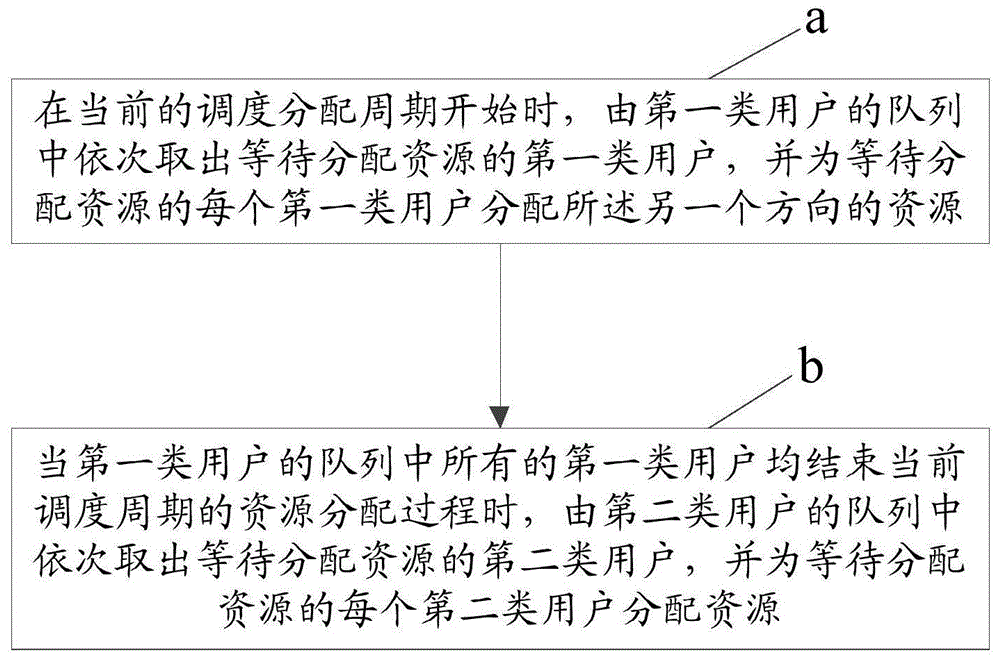
本发明提供了一种资源分配的方法,该方法将等待分配资源的用户队列按照优先级别由高至低分为第一类用户的队列、第二类用户的队列,所述第一类用户为一个方向的业务正在传输、另一个方向有业务到达的用户,第二类用户为有业务到达的所有用户,并且该方法包括周期性执行的如下步骤:The present invention provides a method for resource allocation. The method divides user queues waiting to be allocated resources into a queue of users of the first type and a queue of users of the second type according to the priority levels from high to low. The first type of users is: The service in one direction is being transmitted and the user in the other direction has service arrival, the second type of user is all users with service arrival, and the method includes the following steps that are periodically executed:
a、在当前的调度分配周期开始时,由第一类用户的队列中依次取出等待分配资源的第一类用户,并为等待分配资源的每个第一类用户分配所述另一个方向的资源;a. At the beginning of the current scheduling allocation cycle, the first type of users waiting to be allocated resources are sequentially taken out from the queue of the first type of users, and the resources in the other direction are allocated to each of the first type of users waiting to be allocated resources ;
b、当第一类用户的队列中所有的第一类用户均结束当前调度分配周期的资源分配过程时,由第二类用户的队列中依次取出等待分配资源的第二类用户,并为等待分配资源的每个第二类用户分配资源。b. When all the first type of users in the queue of the first type of users have finished the resource allocation process of the current scheduling and allocation cycle, the second type of users waiting to be allocated resources are sequentially taken out from the queue of the second type of users, and the waiting Each second type of user that allocates resources allocates resources.
可选地,每个第一类用户在两个方向上被分配的资源属于同一子带。Optionally, the resources allocated in the two directions for each user of the first type belong to the same subband.
可选地,步骤a包括:Optionally, step a includes:
a1、读取由第一类用户的队列中取出的等待分配资源的当前的第一类用户的属性列表,获取当前的第一类用户正在传输业务方向所占用的子带信息;a1. Read the attribute list of the current first-type users waiting to allocate resources taken out from the queue of the first-type users, and obtain the subband information occupied by the current first-type users in the direction of the transmission service;
a2、当所占用的子带中与当前的第一类用户的当前业务到达方向对应的资源空闲时,将该子带中与当前的第一类用户的当前业务到达方向对应的子带资源分配给当前的第一类用户;a2. When the resource corresponding to the current service arrival direction of the current first-type user in the occupied subband is idle, allocate the subband resource corresponding to the current service arrival direction of the current first-type user in the subband to the current first-class user;
a3、当所占用的子带中与当前的第一类用户的当前业务到达方向对应的子带资源已被其他用户占用时,当前的第一类用户等待下一调度分配周期。a3. When the subband resources corresponding to the current service arrival direction of the current first-type user in the occupied subband have been occupied by other users, the current first-type user waits for the next scheduling and allocation cycle.
可选地,步骤b进一步识别第二类用户的队列中的各第二类用户是否已有业务到达方向上的资源,并跳过对已有业务到达方向上的资源的第二类用户的资源分配。Optionally, step b further identifies whether each second-type user in the queue of the second-type user has resources in the service arrival direction, and skips the resources of the second-type users that have resources in the service arrival direction. distribute.
可选地,步骤b包括:Optionally, step b includes:
b1、读取由第二类用户的队列中依次取出等待分配资源的当前的第二类用户的属性列表,获取当前的第二类用户的当前业务达到方向的子带资源分配状态;b1, read the attribute list of the current second-type users waiting to be allocated resources from the queue of the second-type users in turn, and obtain the sub-band resource allocation status of the current service reaching direction of the current second-type users;
b2、若当前的第二类用户的当前业务达到方向已分配子带资源,则跳过为当前的第二类用户的当前业务达到方向分配子带资源;b2. If the current service arrival direction of the current second-type user has already allocated subband resources, skip the allocation of subband resources for the current service arrival direction of the current second-type user;
b3、若当前的第二类用户的当前业务达到方向未分配子带资源,当资源池中具有与当前业务达到方向对应的空闲的子带资源时,将该空闲的子带资源分配给当前的第二类用户,当资源池中无与当前业务到达方向对应的子带资源时,当前的第二类用户等待下一调度分配周期。b3. If there is no subband resource allocated in the current service arrival direction of the current second-type user, when there is an idle subband resource corresponding to the current service arrival direction in the resource pool, allocate the idle subband resource to the current service arrival direction. For the second type of user, when there is no subband resource corresponding to the current service arrival direction in the resource pool, the current second type of user waits for the next scheduling and allocation cycle.
本发明还提供一种资源分配的装置,该装置将等待分配资源的用户队列按照优先级别由高至低分为第一类用户的队列、第二类用户的队列,所述第一类用户为一个方向的业务正在传输、另一个方向有业务到达的用户,第二类用户为有业务到达的所有用户,并且该装置包括周期性运行的如下模块:The present invention also provides a resource allocation device, which divides the user queue waiting for resource allocation into a queue of users of the first type and a queue of users of the second type according to the priority level from high to low, and the first type of users is Users whose services are being transmitted in one direction and services arrive in the other direction, the second type of users are all users who have services arriving, and the device includes the following modules that run periodically:
第一分配模块、在当前的调度分配周期开始时,由第一类用户的队列中依次取出等待分配资源的第一类用户,并为等待分配资源的每个第一类用户分配所述另一个方向的资源;The first allocation module, at the beginning of the current scheduling allocation cycle, sequentially takes out the first type of users waiting to be allocated resources from the queue of the first type of users, and allocates the other type of users waiting for allocation of resources to each first type of user. direction resources;
第二分配模块、当第一类用户的队列中所有的第一类用户均结束当前调度周期的资源分配过程时,由第二类用户的队列中依次取出等待分配资源的第二类用户,并为等待分配资源的每个第二类用户分配资源。The second allocation module: when all the first type of users in the queue of the first type of users have finished the resource allocation process of the current scheduling period, sequentially take out the second type of users waiting to allocate resources from the queue of the second type of users, and Allocate resources to each second type of user waiting to be allocated resources.
可选地,每个第一类用户在两个方向上被分配的资源属于同一子带。Optionally, the resources allocated in the two directions for each user of the first type belong to the same subband.
可选地,第一分配模块包括:Optionally, the first distribution module includes:
第一读取属性子模块,读取由第一类用户的队列中取出的等待分配资源的当前的第一类用户的属性列表,获取当前的第一类用户正在传输业务方向所占用的子带信息;The first reading attribute sub-module reads the attribute list of the current first-type users who are waiting to allocate resources from the queue of the first-type users, and obtains the subbands occupied by the current first-type users in the direction of transmitting services information;
第一分配子模块,当所占用的子带中与当前的第一类用户的当前业务到达方向对应的资源空闲时,将该子带中与当前的第一类用户的当前业务到达方向对应的子带资源分配给当前的第一类用户;The first allocation sub-module, when the resource corresponding to the current service arrival direction of the current first-type user in the occupied subband is idle, the subband corresponding to the current service arrival direction of the current first-type user in the subband. With resources allocated to the current first-class user;
第一等待子模块,当所占用的子带中与当前的第一类用户的当前业务到达方向对应的子带资源已被其他用户占用时,当前的第一类用户等待下一调度分配周期。The first waiting sub-module, when the sub-band resources corresponding to the current service arrival direction of the current first-type user in the occupied sub-band have been occupied by other users, the current first-type user waits for the next scheduling allocation period.
可选地,第二分配模块进一步识别第二类用户的队列中的各第二类用户是否已有业务到达方向上的资源,并跳过对已有业务到达方向上的资源的第二类用户的资源分配。Optionally, the second allocation module further identifies whether each second type of user in the queue of the second type of users has resources in the service arrival direction, and skips the second type of users who have resources in the service arrival direction. resource allocation.
可选地,第二分配模块包括:Optionally, the second distribution module includes:
第二读取属性子模块,读取由第二类用户的队列中依次取出等待分配资源的当前的第二类用户的属性列表,获取当前的第二类用户的当前业务达到方向的子带资源分配状态;The second read attribute sub-module reads the attribute list of the current second-type users waiting to be allocated resources from the queue of the second-type users in turn, and obtains the sub-band resources of the current service arrival direction of the current second-type users allocation status;
第二识别子模块,若当前的第二类用户的当前业务达到方向已分配子带资源,则跳过为当前的第二类用户的当前业务达到方向分配子带资源;The second identification sub-module, if the current service arrival direction of the current second type of user has allocated subband resources, then skips the allocation of subband resources for the current service arrival direction of the current second type of user;
第二分配子模块,若当前的第二类用户的当前业务达到方向未分配子带资源,当资源池中具有与当前业务达到方向对应的空闲的子带资源时,将该空闲的子带资源分配给当前的第二类用户,当资源池中无与当前业务到达方向对应的子带资源时,当前的第二类用户等待下一调度分配周期。The second allocation sub-module, if the current service arrival direction of the current second-type user has no subband resources allocated, and when there are idle subband resources corresponding to the current service arrival direction in the resource pool, the idle subband resources It is allocated to the current second type of user. When there is no subband resource corresponding to the current service arrival direction in the resource pool, the current second type of user waits for the next scheduling and allocation cycle.
附图说明Description of drawings
图1为本发明具体实施例中方法的示意图;Fig. 1 is the schematic diagram of the method in the specific embodiment of the present invention;
图2为本发明中为第一类用户分配资源的方法示意图;2 is a schematic diagram of a method for allocating resources for users of the first type in the present invention;
图3为本发明中为第二类用户分配资源的方法示意图;3 is a schematic diagram of a method for allocating resources for the second type of users in the present invention;
图4为本发明中资源分配过程的流程图;Fig. 4 is the flow chart of the resource allocation process in the present invention;
图5为本发明中具体资源分配装置的示意图。FIG. 5 is a schematic diagram of a specific resource allocation apparatus in the present invention.
具体实施方式Detailed ways
为了使本发明的目的、技术方案和优点更加清楚,下面结合附图和具体实施例对本发明进行详细描述。In order to make the objectives, technical solutions and advantages of the present invention clearer, the present invention will be described in detail below with reference to the accompanying drawings and specific embodiments.
在无线通信系统中为用户分配资源时,现行的MAC层的调度算法将同一子带的上下行两个方向的资源必须分配给同一个用户,也就是说,对于一个子带而言,其上行资源和下行资源采用捆绑分配的方式进行分配,这样,当用户仅需要子带的一个方向的资源时,其另一个方向的资源被闲置而浪费。When allocating resources to users in a wireless communication system, the current scheduling algorithm of the MAC layer must allocate resources in both uplink and downlink directions of the same subband to the same user, that is, for a subband, its uplink and downlink resources must be allocated to the same user. Resources and downlink resources are allocated in a bundled allocation manner. In this way, when a user only needs resources in one direction of the subband, resources in the other direction are idle and wasted.
针对该问题,本发明提供了一种资源分配的方法,结合图1所示,图1为本发明具体实施例中方法的示意图。In response to this problem, the present invention provides a method for resource allocation, which is shown in conjunction with FIG. 1 , which is a schematic diagram of the method in a specific embodiment of the present invention.
该方法将等待分配资源的用户队列按照优先级由高至低分为第一类用户的队列、第二类用户的队列,第一类用户为一个方向的业务正在传输、另一个方向有业务到达的用户,第二类用户为有业务到达的所有用户,并且该方法包括周期性执行的如下步骤:The method divides the queues of users waiting to be allocated resources into queues of users of the first type and queues of users of the second type according to the priority from high to low. users, the second type of users are all users with service arrivals, and the method includes the following steps that are periodically executed:
a、在当前的调度分配周期开始时,由第一类用户的队列中依次取出等待分配资源的第一类用户,并为等待分配资源的每个第一类用户分配另一个方向的资源;a. At the beginning of the current scheduling and allocation cycle, the first type of users waiting to be allocated resources are sequentially taken out from the queue of the first type of users, and the resources in the other direction are allocated to each of the first type of users waiting to be allocated resources;
b、当第一类用户的队列中所有的第一类用户均结束当前调度周期的资源分配过程时,由第二类用户的队列中依次取出等待分配资源的第二类用户,并为等待分配资源的每个第二类用户分配资源。b. When all the first type of users in the queue of the first type of users have finished the resource allocation process of the current scheduling cycle, the second type of users waiting to be allocated resources are sequentially taken out from the queue of the second type of users, and the Each second type of user of the resource allocates the resource.
在该方法中,第一类用户为一个方向的业务正在传输、另一个方向有业务到达的用户,即第一类用户占用了一个自带的其中一个方向的资源,而另一方向的资源并未与占用方向的资源进行捆绑一并分配给第一类用户,这样,当第一类用户的另一方向有业务到达之前,可以将子带上的另一个方向上的资源分配给其他的用户使用,降低子带资源闲置而出现的浪费。In this method, the first type of user is the user whose service is being transmitted in one direction and the service arrives in the other direction, that is, the first type of user occupies a built-in resource in one of the directions, while the resources in the other direction are not used. It is not bundled with the resources in the occupied direction and allocated to the first type of users. In this way, before the service arrives in the other direction of the first type of users, the resources in the other direction of the subband can be allocated to other users. Use, reduce the waste caused by idle subband resources.
对于一个周期的资源分配,在当前调度分配周期开始时,首先,由优先级高的第一类用户的队列中依次取出等待分配资源的第一类用户,第一类用户的取出顺序可按照各第一类用户的业务到达的先后顺序。然后,为取出的当前的第一类用户的另一方向分配资源,直至为等待分配资源的每个第一类用户分配另一个方向的资源。For a period of resource allocation, at the beginning of the current scheduling and allocation period, firstly, the first type of users waiting to be allocated resources are taken out from the queue of the first type of users with high priority. The order in which the services of the first type of users arrive. Then, resources are allocated to the other direction of the current users of the first type that are taken out, until the resources of the other direction are allocated to each user of the first type waiting to be allocated resources.
其中,在当前调度分配周期中,第一类用户的队列中所有的第一类用户进行资源分配的过程,当资源池中具有可分配给当前第一类用户的空闲子带资源时,将其对应的空闲的子带资源分配给当前第一类用户,使该第一类用户结束当前调度分配周期,而当资源池中没有可分配给当前第一类用户的空闲子带资源时,直接使该第一类用户结束当前调度分配周期。也就是说,在一个调度分配周期中,每个第一类用户均进行资源分配的过程,当没有空闲的可分配给该第一类用户时,同样结束该第一类用户在本调度分配周期中的资源分配过程,而等待下一个调度分配周期中再分配。Among them, in the current scheduling and allocation cycle, in the process of allocating resources to all the first-type users in the queue of the first-type users, when there are idle subband resources that can be allocated to the current first-type users in the resource pool, the The corresponding idle subband resources are allocated to the current first-type users, so that the first-type users end the current scheduling and allocation cycle, and when there is no idle subband resources that can be allocated to the current first-type users in the resource pool, the The first type of users ends the current scheduling allocation period. That is to say, in a scheduling and allocation period, each first-type user performs the process of resource allocation. When there is no idle user that can be allocated to the first-type user, it also ends the first-type user in this scheduling and allocation period. During the resource allocation process, it waits for re-allocation in the next scheduling allocation cycle.
这样,当第一类用户的队列中所有的第一类用户均结束当前调度周期的资源分配过程时,由第二类用户的队列中依次取出等待分配资源的第二类用户,并为等待分配资源的每个第二类用户分配资源。In this way, when all the users of the first type in the queue of the users of the first type have finished the resource allocation process of the current scheduling cycle, the users of the second type waiting to be allocated resources are sequentially taken out from the queue of the users of the second type. Each second type of user of the resource allocates the resource.
通过上述可知,在一个调度分配周期中,优先对每个第一类用户进行一次资源分配,当无法分配给第一类用户相应的空闲的子带资源时,将结束该第一类用户在当前调度分配周期中的资源分配过程,需要等待下一个调度分配周期。并且,只有当所有的第一类用户结束在当前周期中的资源分配过程后,才开始为第二类用户进行资源分配。It can be seen from the above that in a scheduling and allocation cycle, each first type of user is given priority to allocate resources once, and when the corresponding idle subband resources cannot be allocated to the first type of user, the current The resource allocation process in the scheduling and allocation cycle needs to wait for the next scheduling and allocation cycle. In addition, only after all the users of the first type complete the resource allocation process in the current cycle, the resource allocation for the users of the second type is started.
这样,优先为第一类用户分配子带资源,可使已经占有子带一个方向的第一类用户进行优先选择子带,将该第一类用户占用的同一子带的另一方向的资源分配给该第一类用户。In this way, the subband resources are preferentially allocated to the first type of users, so that the first type of users who have already occupied the subband in one direction can preferentially select the subband, and the resources of the same subband occupied by the first type of users in the other direction can be allocated. to the first type of user.
通过上述的方法可知,在为第一类用户和第二类用户分配资源时,按照优先级别进行分配,而无需将子带的两个方向的资源进行捆绑后,必须分配给同一个用户,这样,可灵活为等待分配资源的用户分配子带资源,避免某一用户独占子带的资源,有效充分的利用子带另一方向空闲的资源,提高了子带利用率。It can be seen from the above method that when allocating resources to users of the first type and users of the second type, the allocation is performed according to the priority level, and it is not necessary to allocate resources in both directions of the subband to the same user after bundling. , which can flexibly allocate subband resources to users waiting for resource allocation, avoid a user from monopolizing the resources of the subband, effectively and fully utilize the idle resources in the other direction of the subband, and improve the utilization rate of the subband.
对于第一类用户,每个第一类用户在两个方向上被分配的资源属于同一个子带。为此,结合附图2所示,步骤a包括如下步骤:For users of the first type, the resources allocated in both directions for each user of the first type belong to the same subband. For this reason, in conjunction with accompanying drawing 2, step a includes the following steps:
a1、读取由第一类用户的队列中取出的等待分配资源的当前的第一类用户的属性列表,获取当前的第一类用户正在传输业务方向所占用的子带信息;a1. Read the attribute list of the current first-type users waiting to allocate resources taken out from the queue of the first-type users, and obtain the subband information occupied by the current first-type users in the direction of the transmission service;
a2、当所占用的子带中与当前的第一类用户的当前业务到达方向对应的资源空闲时,将该子带中与当前的第一类用户的当前业务到达方向对应的子带资源分配给当前的第一类用户;a2. When the resource corresponding to the current service arrival direction of the current first-type user in the occupied subband is idle, allocate the subband resource corresponding to the current service arrival direction of the current first-type user in the subband to the current first-class user;
a3、当所占用的子带中与当前的第一类用户的当前业务到达方向对应的子带资源已被其他用户占用时,当前的第一类用户等待下一调度分配周期。a3. When the subband resources corresponding to the current service arrival direction of the current first-type user in the occupied subband have been occupied by other users, the current first-type user waits for the next scheduling and allocation cycle.
第一类用户为一个方向的业务正在传输、另一方向有业务到达的用户,也就是说,在一个方向上已经分配了子带的对应方向上的资源,当进入调度分配周期中时,优先为第一类用户分配资源时,需要获取该第一类用户正在传输业务方向上所占用的子带信息,读取该子带属性列表,进而获取所占用的子带的与该第一类用户的业务到达方向所需方向的资源是否处于空闲状态。当获取所占用的子带的中与当前的第一类用户的当前业务到达方向对应的资源处于空闲状态时,则将其分配给当前的第一类用户。而当获取所占用的子带的中与当前的第一类用户的当前业务到达方向对应的资源在上一调度分配周期已分配给其他用户,且正在占用时,则跳过为该第一类用户分配资源,使该第一类用户等待下一个调度分配周期。采用这样的方法,使子带的资源在空闲的状态时,充分被各个用户使用,即一个子带可同时为两个不同的用户提供资源,避免一个子带仅利用一个方向的资源,而另一个方向一直处于空闲等待状态,有效提高了子带的利用率。The first type of user is the user whose service is being transmitted in one direction and the service arrives in the other direction. That is, the resource in the corresponding direction of the subband has been allocated in one direction. When entering the scheduling allocation cycle, priority is given to the user. When allocating resources for the first type of user, it is necessary to obtain the information of the subband occupied by the first type of user in the direction of the transmission service, read the subband attribute list, and then obtain the occupied subband and the first type of user. Whether the resources in the required direction of the service arrival direction are in an idle state. When the resource corresponding to the current service arrival direction of the current first-type user in the acquired occupied subband is in an idle state, it is allocated to the current first-type user. However, when the resource corresponding to the current service arrival direction of the current first-type user in the occupied subband has been allocated to other users in the previous scheduling and allocation cycle and is being occupied, it is skipped as the first-type user. The user allocates resources so that the first type of users waits for the next scheduling allocation cycle. By adopting this method, the resources of the subband can be fully used by each user when the resources are in an idle state, that is, one subband can provide resources for two different users at the same time, avoiding that one subband only uses the resources in one direction, while the other One direction is always in the idle waiting state, which effectively improves the utilization of the subband.
结合图3所示,步骤b中进一步识别第二类用户的队列中的各第二类用户是否已有业务到达方向上的资源,并跳过对已有业务到达方向上的资源的第二类用户的资源分配。With reference to Fig. 3, in step b, it is further identified whether each second type of user in the queue of the second type of user has resources in the service arrival direction, and skips the second type of resources in the existing service arrival direction. User resource allocation.
具体地,步骤b包括:Specifically, step b includes:
b1、读取由第二类用户的队列中依次取出等待分配资源的当前的第二类用户的属性列表,获取当前的第二类用户的当前业务达到方向的子带资源分配状态;b1, read the attribute list of the current second-type users waiting to be allocated resources from the queue of the second-type users in turn, and obtain the sub-band resource allocation status of the current service reaching direction of the current second-type users;
b2、若当前的第二类用户的当前业务达到方向已分配子带资源,则跳过为当前的第二类用户的当前业务达到方向分配子带资源;b2. If the current service arrival direction of the current second-type user has already allocated subband resources, skip the allocation of subband resources for the current service arrival direction of the current second-type user;
b3、若当前的第二类用户的当前业务达到方向未分配子带资源,当资源池中具有与当前业务达到方向对应的空闲的子带资源时,将该空闲的子带资源分配给当前的第二类用户,当资源池中无与当前业务到达方向对应的子带资源时,当前的第二类用户等待下一调度分配周期。b3. If there is no subband resource allocated in the current service arrival direction of the current second-type user, when there is an idle subband resource corresponding to the current service arrival direction in the resource pool, allocate the idle subband resource to the current service arrival direction. For the second type of user, when there is no subband resource corresponding to the current service arrival direction in the resource pool, the current second type of user waits for the next scheduling and allocation cycle.
对于第二类用户,其为一个方向有业务到达的用户。因此,第二类用户可包括第一类用户,还包括两个方向上均没有业务传输,而有一个或两个方向业务到达的用户,还包括当前方向正在传输业务,又有当前方向业务到达的用户,其中,第一类用户优先级别高于其他的两种用户。For the second type of user, it is a user with services arriving in one direction. Therefore, the second type of users may include the first type of users, and also include users who have no service transmission in both directions, but have services arriving in one or two directions, and include users who are transmitting services in the current direction, and have services arriving in the current direction. users, of which the first type of user has a higher priority than the other two types of users.
对于当前方向正在传输业务,又有当前方向业务到达的用户,由于当前方向正在进行业务传输,即其已经分配了当前业务到达方向上的资源,因此,可直接将资源继续被该用户的当前业务到达方向所使用,在当前调度分配周期中跳过为该第二类用户的当前业务到达方向分配资源。For users who are transmitting services in the current direction and have services arriving in the current direction, because the current direction is transmitting services, that is, resources in the direction of current service arrival have been allocated, so the resources can be directly transferred to the current service of the user. It is used in the direction of arrival, and in the current scheduling and allocation cycle, the allocation of resources for the current service arrival direction of the second type of users is skipped.
而对于当前的第二类用户的当前业务到达方向未分配子带资源时,例如,当前第二类用户的两个方向上均没有业务传输,其中一个或两个方向上有业务到达时,需要从资源池中将相应的空闲的子带资源分配给该第二类用户。当资源池中具有与当前业务到达方向对应的空闲的子带资源时,将该空闲的子带资源分配给当前的第二类用户,当资源池中无与当前业务到达方向对应的子带资源时,当前的第二类用户同样需要等待下一调度分配周期。When no subband resources are allocated in the current service arrival direction of the current second-type user, for example, when there is no service transmission in both directions of the current second-type user, and services arrive in one or both directions, it is necessary to The corresponding idle subband resources are allocated to the second type of users from the resource pool. When there is an idle subband resource corresponding to the current service arrival direction in the resource pool, the idle subband resource is allocated to the current second-type user, and when there is no subband resource corresponding to the current service arrival direction in the resource pool , the current second-type users also need to wait for the next scheduling allocation cycle.
结合附图4可知,在一个调度分配周期中,第一类用户的优先级别高于第二类用户,对第一类用户的队列中的每一个第一类用户均进行资源分配的过程,当第一类用户队列中的各个第一类用户的资源分配成功或者资源分配失败后,开始为第二类用户分配资源。With reference to Figure 4, it can be seen that in a scheduling allocation cycle, the priority level of the first type of users is higher than that of the second type of users, and the process of allocating resources to each of the first type of users in the queue of the first type of users, when After each first-type user in the first-type user queue is successfully allocated resources or fails to allocate resources, resources are allocated to the second-type users.
上述对资源分配的方法进行了详细阐述,本发明还提供一种对应的资源分配的装置。具体请见附图5所示。The method for resource allocation is described in detail above, and the present invention also provides a corresponding device for resource allocation. Please refer to Figure 5 for details.
该资源分配装置将等待分配资源的用户队列按照优先级别由高至低分为第一类用户的队列、第二类用户的队列,所述第一类用户为一个方向的业务正在传输、另一个方向有业务到达的用户,第二类用户为有业务到达的所有用户,并且该装置包括周期性运行的如下模块:The resource allocation device divides the queues of users waiting to be allocated resources into a queue of users of the first type and a queue of users of the second type according to the priority level from high to low. The direction is for users with service arrivals, the second type of users is all users with service arrivals, and the device includes the following modules that run periodically:
第一分配模块、在当前的调度分配周期开始时,由第一类用户的队列中依次取出等待分配资源的第一类用户,并为等待分配资源的每个第一类用户分配所述另一个方向的资源;The first allocation module, at the beginning of the current scheduling allocation cycle, sequentially takes out the first type of users waiting to be allocated resources from the queue of the first type of users, and allocates the other type of users waiting for allocation of resources to each first type of user. direction resources;
第二分配模块、当第一类用户的队列中所有的第一类用户均结束当前调度周期的资源分配过程时,由第二类用户的队列中依次取出等待分配资源的第二类用户,并为等待分配资源的每个第二类用户分配资源。The second allocation module: when all the first type of users in the queue of the first type of users have finished the resource allocation process of the current scheduling period, sequentially take out the second type of users waiting to allocate resources from the queue of the second type of users, and Allocate resources to each second type of user waiting to be allocated resources.
为了使每个第一类用户在两个方向上被分配的资源属于同一子带。第一分配模块包括:In order for each first type of user to be allocated resources in both directions belong to the same subband. The first distribution module includes:
第一读取属性子模块,读取由第一类用户的队列中取出的等待分配资源的当前的第一类用户的属性列表,获取当前的第一类用户正在传输业务方向所占用的子带信息;The first reading attribute sub-module reads the attribute list of the current first-type users who are waiting to allocate resources from the queue of the first-type users, and obtains the subbands occupied by the current first-type users in the direction of transmitting services information;
第一分配子模块,当所占用的子带中与当前的第一类用户的当前业务到达方向对应的资源空闲时,将该子带中与当前的第一类用户的当前业务到达方向对应的子带资源分配给当前的第一类用户;The first allocation sub-module, when the resource corresponding to the current service arrival direction of the current first-type user in the occupied subband is idle, the subband corresponding to the current service arrival direction of the current first-type user in the subband. With resources allocated to the current first-class user;
第一等待子模块,当所占用的子带中与当前的第一类用户的当前业务到达方向对应的子带资源已被其他用户占用时,当前的第一类用户等待下一调度分配周期。The first waiting sub-module, when the sub-band resources corresponding to the current service arrival direction of the current first-type user in the occupied sub-band have been occupied by other users, the current first-type user waits for the next scheduling allocation period.
对于第二分配模块,如图5所示,其进一步识别第二类用户的队列中的各第二类用户是否已有业务到达方向上的资源,并跳过对已有业务到达方向上的资源的第二类用户的资源分配。For the second allocation module, as shown in FIG. 5 , it further identifies whether each second-type user in the queue of the second-type user already has resources in the service arrival direction, and skips the resources in the existing service arrival direction. The resource allocation of the second type of users.
相应地,第二分配模块包括:Accordingly, the second distribution module includes:
第二读取属性子模块,读取由第二类用户的队列中依次取出等待分配资源的当前的第二类用户的属性列表,获取当前的第二类用户的当前业务达到方向的子带资源分配状态;The second read attribute sub-module reads the attribute list of the current second-type users waiting to be allocated resources from the queue of the second-type users in turn, and obtains the sub-band resources of the current service arrival direction of the current second-type users allocation status;
第二识别子模块,若当前的第二类用户的当前业务达到方向已分配子带资源,则跳过为当前的第二类用户的当前业务达到方向分配子带资源;The second identification sub-module, if the current service arrival direction of the current second type of user has allocated subband resources, then skips the allocation of subband resources for the current service arrival direction of the current second type of user;
第二分配子模块,若当前的第二类用户的当前业务达到方向未分配子带资源,当资源池中具有与当前业务达到方向对应的空闲的子带资源时,将该空闲的子带资源分配给当前的第二类用户,当资源池中无与当前业务到达方向对应的子带资源时,当前的第二类用户等待下一调度分配周期。The second allocation sub-module, if the current service arrival direction of the current second-type user has no subband resources allocated, and when there are idle subband resources corresponding to the current service arrival direction in the resource pool, the idle subband resources It is allocated to the current second type of user. When there is no subband resource corresponding to the current service arrival direction in the resource pool, the current second type of user waits for the next scheduling and allocation cycle.
以上所述仅为本发明的较佳实施例而已,并不用以限制本发明,凡在本发明的精神和原则之内,所做的任何修改、等同替换、改进等,均应包含在本发明保护的范围之内。The above descriptions are only preferred embodiments of the present invention, and are not intended to limit the present invention. Any modifications, equivalent replacements, improvements, etc. made within the spirit and principles of the present invention shall be included in the present invention. within the scope of protection.
Claims (6)
Priority Applications (1)
| Application Number | Priority Date | Filing Date | Title |
|---|---|---|---|
| CN201710059356.6A CN108347319B (en) | 2017-01-24 | 2017-01-24 | A method and device for resource allocation |
Applications Claiming Priority (1)
| Application Number | Priority Date | Filing Date | Title |
|---|---|---|---|
| CN201710059356.6A CN108347319B (en) | 2017-01-24 | 2017-01-24 | A method and device for resource allocation |
Publications (2)
| Publication Number | Publication Date |
|---|---|
| CN108347319A CN108347319A (en) | 2018-07-31 |
| CN108347319B true CN108347319B (en) | 2020-10-20 |
Family
ID=62963105
Family Applications (1)
| Application Number | Title | Priority Date | Filing Date |
|---|---|---|---|
| CN201710059356.6A Expired - Fee Related CN108347319B (en) | 2017-01-24 | 2017-01-24 | A method and device for resource allocation |
Country Status (1)
| Country | Link |
|---|---|
| CN (1) | CN108347319B (en) |
Citations (3)
| Publication number | Priority date | Publication date | Assignee | Title |
|---|---|---|---|---|
| CN1909440A (en) * | 2005-08-01 | 2007-02-07 | 上海原动力通信科技有限公司 | Communication method for broad band time-division duplex system |
| CN101667985A (en) * | 2008-09-04 | 2010-03-10 | 中兴通讯股份有限公司 | Method and device for allocating resource units |
| CN103716891A (en) * | 2013-12-31 | 2014-04-09 | 大唐移动通信设备有限公司 | Method and system for allocating PUCCH resource positions in LTE-A system |
Family Cites Families (2)
| Publication number | Priority date | Publication date | Assignee | Title |
|---|---|---|---|---|
| US9397801B2 (en) * | 2011-04-08 | 2016-07-19 | Lg Electronics Inc. | Method for transmitting/receiving data in a wireless access system and base station for same |
| WO2012148161A2 (en) * | 2011-04-26 | 2012-11-01 | 엘지전자 주식회사 | Method for transmitting channel state information in wireless access system and terminal therefor |
-
2017
- 2017-01-24 CN CN201710059356.6A patent/CN108347319B/en not_active Expired - Fee Related
Patent Citations (3)
| Publication number | Priority date | Publication date | Assignee | Title |
|---|---|---|---|---|
| CN1909440A (en) * | 2005-08-01 | 2007-02-07 | 上海原动力通信科技有限公司 | Communication method for broad band time-division duplex system |
| CN101667985A (en) * | 2008-09-04 | 2010-03-10 | 中兴通讯股份有限公司 | Method and device for allocating resource units |
| CN103716891A (en) * | 2013-12-31 | 2014-04-09 | 大唐移动通信设备有限公司 | Method and system for allocating PUCCH resource positions in LTE-A system |
Non-Patent Citations (1)
| Title |
|---|
| "Dynamic resource allocation of different numerologies";Huawei,HiSilicon;《3GPP》;20170120;全文 * |
Also Published As
| Publication number | Publication date |
|---|---|
| CN108347319A (en) | 2018-07-31 |
Similar Documents
| Publication | Publication Date | Title |
|---|---|---|
| CN103931262B (en) | A data scheduling method and device | |
| CN106358295B (en) | A kind of resource allocation methods and device | |
| CN109429343B (en) | A resource allocation method and device based on multi-slot scheduling | |
| CN106998590B (en) | Uplink resource scheduling method and device | |
| US10349409B2 (en) | Method and system for transmission schedule instruction for allocating resources in an unlicensed spectrum | |
| CN112996116A (en) | Resource allocation method and system for guaranteeing quality of power time delay sensitive service | |
| CN103347301B (en) | Method and device for distributing wireless resources for multi-sub-band user terminal | |
| CN101827447A (en) | Method for scheduling uplink logic channel by LTE terminal | |
| CN111356244A (en) | A resource allocation method and device | |
| CN105323765B (en) | A kind of method for distributing frequency band sources | |
| CN102469602B (en) | Method for user multi-service dispatching | |
| CN108024341B (en) | A scheduling method, terminal and base station | |
| WO2006082616A1 (en) | Wireless communication system, and base station and terminals used in that system | |
| JP2000069548A (en) | Communication bandwidth allocation method | |
| CN108347319B (en) | A method and device for resource allocation | |
| WO2012155711A1 (en) | Scheduling method and device for interference coordination | |
| CN108347315B (en) | A multi-subband service scheduling method in a power wireless private network | |
| CN110719610A (en) | Method and device for seizing service resources | |
| CN104009935A (en) | Priority scheduling method and device | |
| CN108811142A (en) | Resource allocation methods, relevant apparatus and system | |
| CN101778433B (en) | Method and device for scheduling radio resources | |
| JP3977639B2 (en) | Line assignment control method and line assignment apparatus | |
| CN104684097B (en) | A kind of method, apparatus and base station for distributing backhaul link resource for multi-hop user | |
| CN110933699B (en) | Packet forwarding method and device | |
| CN102833786A (en) | Method for scheduling independent carrier in multi-carrier system |
Legal Events
| Date | Code | Title | Description |
|---|---|---|---|
| PB01 | Publication | ||
| PB01 | Publication | ||
| SE01 | Entry into force of request for substantive examination | ||
| SE01 | Entry into force of request for substantive examination | ||
| GR01 | Patent grant | ||
| GR01 | Patent grant | ||
| CF01 | Termination of patent right due to non-payment of annual fee |
Granted publication date: 20201020 Termination date: 20220124 |
|
| CF01 | Termination of patent right due to non-payment of annual fee |