CN108564117B - SVM-based poverty and life assisting identification method - Google Patents
SVM-based poverty and life assisting identification method Download PDFInfo
- Publication number
- CN108564117B CN108564117B CN201810290654.0A CN201810290654A CN108564117B CN 108564117 B CN108564117 B CN 108564117B CN 201810290654 A CN201810290654 A CN 201810290654A CN 108564117 B CN108564117 B CN 108564117B
- Authority
- CN
- China
- Prior art keywords
- student
- kernel function
- svm
- probability
- optimal
- Prior art date
- Legal status (The legal status is an assumption and is not a legal conclusion. Google has not performed a legal analysis and makes no representation as to the accuracy of the status listed.)
- Expired - Fee Related
Links
Images

Classifications
-
- G—PHYSICS
- G06—COMPUTING OR CALCULATING; COUNTING
- G06F—ELECTRIC DIGITAL DATA PROCESSING
- G06F18/00—Pattern recognition
- G06F18/20—Analysing
- G06F18/24—Classification techniques
- G06F18/241—Classification techniques relating to the classification model, e.g. parametric or non-parametric approaches
- G06F18/2411—Classification techniques relating to the classification model, e.g. parametric or non-parametric approaches based on the proximity to a decision surface, e.g. support vector machines
-
- G—PHYSICS
- G06—COMPUTING OR CALCULATING; COUNTING
- G06Q—INFORMATION AND COMMUNICATION TECHNOLOGY [ICT] SPECIALLY ADAPTED FOR ADMINISTRATIVE, COMMERCIAL, FINANCIAL, MANAGERIAL OR SUPERVISORY PURPOSES; SYSTEMS OR METHODS SPECIALLY ADAPTED FOR ADMINISTRATIVE, COMMERCIAL, FINANCIAL, MANAGERIAL OR SUPERVISORY PURPOSES, NOT OTHERWISE PROVIDED FOR
- G06Q50/00—Information and communication technology [ICT] specially adapted for implementation of business processes of specific business sectors, e.g. utilities or tourism
- G06Q50/10—Services
- G06Q50/20—Education
Landscapes
- Engineering & Computer Science (AREA)
- Business, Economics & Management (AREA)
- Theoretical Computer Science (AREA)
- Physics & Mathematics (AREA)
- Data Mining & Analysis (AREA)
- Tourism & Hospitality (AREA)
- General Physics & Mathematics (AREA)
- Computer Vision & Pattern Recognition (AREA)
- Life Sciences & Earth Sciences (AREA)
- Evolutionary Biology (AREA)
- General Engineering & Computer Science (AREA)
- Bioinformatics & Computational Biology (AREA)
- Bioinformatics & Cheminformatics (AREA)
- Artificial Intelligence (AREA)
- Educational Administration (AREA)
- Educational Technology (AREA)
- Evolutionary Computation (AREA)
- Health & Medical Sciences (AREA)
- Economics (AREA)
- General Health & Medical Sciences (AREA)
- Human Resources & Organizations (AREA)
- Marketing (AREA)
- Primary Health Care (AREA)
- Strategic Management (AREA)
- General Business, Economics & Management (AREA)
- Management, Administration, Business Operations System, And Electronic Commerce (AREA)
Abstract
本发明公开了一种基于SVM的贫困生辅助认定方法,包括以下步骤:采集学生数据,并对学生数据进行预处理;对预处理学生数据提取特征,通过随机森林对特征重要性进行排名;在满足Mercer条件下,构造混合核函数,并植入SVM中;使用遗传算法对混合核函数参数进行寻优,得到最优混合核函数参数;将最优混合核函数参数代入SVM,并对学生数据进行训练,得到分类器模型;将需要认定的学生数据输入分类器模型,输出分类结果;本发明采用遗传算法对基于SVM混合核函数参数进行寻优,用适应度作为评价依据,通过随机重组重要基因,让群体中的个体不断进化,获取最优解,减少全局搜索时间,提高了分类器的推广泛化能力,并降低成本。

The invention discloses an auxiliary identification method for poor students based on SVM, comprising the following steps: collecting student data, and preprocessing the student data; extracting features from the preprocessing student data, and ranking the feature importance through random forest; Under the condition of Mercer, the hybrid kernel function is constructed and implanted into SVM; the parameters of hybrid kernel function are optimized by genetic algorithm, and the optimal hybrid kernel function parameters are obtained; the optimal hybrid kernel function parameters are substituted into SVM, and the student data is analyzed. Carry out training to obtain a classifier model; input the student data that needs to be identified into the classifier model, and output the classification result; the present invention adopts genetic algorithm to optimize the parameters based on the SVM mixed kernel function, and uses the fitness as the evaluation basis. Genes allow the individuals in the group to continuously evolve, obtain the optimal solution, reduce the global search time, improve the generalization ability of the classifier, and reduce the cost.
Description
技术领域technical field
本发明涉及SVM核函数研究领域,特别涉及一种基于SVM的贫困生辅助认定方法。The invention relates to the field of SVM kernel function research, in particular to an SVM-based auxiliary identification method for poor students.
背景技术Background technique
随着高等教育的发展,越来越多贫困生进入大学,资助贫困生也成为高校重要的学生工作。而贫困生资格认定是高校资助工作的前提和基础。With the development of higher education, more and more impoverished students enter universities, and funding impoverished students has also become an important student work in colleges and universities. The identification of poor students' qualifications is the premise and foundation of the funding work of colleges and universities.
目前主流的认定方式是通过人工甄别申请材料,认定过程中存在认定程序僵化、责任主体缺乏伦理监督等问题,难以保证公平客观公正。在信息爆炸时代,兴起的机器学习方法尚不能提出很好的解决方案,在分类器的训练上、分类器的拟合上都存着各种各样的问题。基于统计学习理论提出的支持向量机SVM遵循结构风险最小化原则,有效地避免了维数灾难,但其算法训练时间复杂度较高,泛化能力不够理想,在贫困生辅助认定的应用中始终乏力。At present, the mainstream identification method is to manually screen the application materials. In the identification process, there are problems such as rigid identification procedures and the lack of ethical supervision of the responsible subject, which makes it difficult to ensure fairness, objectivity and impartiality. In the era of information explosion, the emerging machine learning methods have not been able to provide a good solution, and there are various problems in the training and fitting of the classifier. The support vector machine (SVM) proposed based on statistical learning theory follows the principle of structural risk minimization and effectively avoids the disaster of dimensionality. However, its algorithm training time complexity is high, and its generalization ability is not ideal. fatigue.
发明内容SUMMARY OF THE INVENTION
本发明的主要目的在于克服现有技术的缺点与不足,提供一种基于SVM的贫困生辅助认定方法。The main purpose of the present invention is to overcome the shortcomings and deficiencies of the prior art, and to provide a method for identifying poor students based on SVM.
本发明的目的通过以下的技术方案实现:The object of the present invention is achieved through the following technical solutions:
一种基于SVM的贫困生辅助认定方法,包括以下步骤:A method for identifying poverty-stricken students based on SVM, including the following steps:
S1、采集学生数据,并对学生数据进行预处理;S1. Collect student data and preprocess student data;
S2、对预处理学生数据提取特征,通过随机森林对特征重要性进行排名;S2. Extract features from preprocessed student data, and rank feature importance through random forest;
S3、在满足Mercer条件下,构造混合核函数,并植入支持向量机SVM中;S3. Construct a mixed kernel function under the condition of Mercer, and implant it into the support vector machine SVM;
S4、使用遗传算法对混合核函数参数进行寻优,得到最优混合核函数参数;S4, using the genetic algorithm to optimize the parameters of the mixed kernel function to obtain the optimal mixed kernel function parameters;
S5、将最优混合核函数参数代入SVM中进行训练,训练之后得到分类器模型;S5. Substitute the optimal mixed kernel function parameters into the SVM for training, and obtain a classifier model after training;
S6、将学生数据输入分类器模型,输出分类结果。S6. Input the student data into the classifier model, and output the classification result.
步骤S1中,所述学生数据包含学生一卡通流水记录、学生基本信息、学生成绩和贫困生名单;所述学生基本信息包含学生ID、学生性别、学生名字;学生基本信息包含学生ID、学生性别、学生名字。In step S1, the student data includes the student card flow record, the basic information of the student, the student achievement and the list of poor students; the basic student information includes the student ID, the student's gender, and the student's name; the student's basic information includes the student ID, the student's gender, student name.
步骤S1中,所述预处理包含去重、缺失值处理和格式化;In step S1, the preprocessing includes deduplication, missing value processing and formatting;
所述去重为:将学生数据按学生ID进行排序,通过比较邻近记录是否相似来检测记录是否重复,重复则删除重复记录;The deduplication is: sorting the student data according to the student ID, detecting whether the records are repeated by comparing whether the adjacent records are similar, and deleting the repeated records if they are repeated;
所述缺失值处理为:学生数据中某个记录的某个字段为空,则使用平均值进行填充;The missing value processing is as follows: if a field of a certain record in the student data is empty, the average value is used to fill it;
所述格式化为:将消费时间格式化为yyyy-MM-dd;消费金额统一单位为分,超限则四舍五入;通过预处理,是数据更合理。The format is as follows: the consumption time is formatted as yyyy-MM-dd; the unified unit of the consumption amount is cents, and if it exceeds the limit, it is rounded up; through preprocessing, the data is more reasonable.
步骤S2具体过程为:The specific process of step S2 is:
U1、从学生一卡通流水记录构造特征;从时间维度、地点维度和交易维度统计均值和方差;U1. Construct features from the student card flow record; count the mean and variance from the time dimension, location dimension and transaction dimension;
U2、将学生一卡通流水记录和学生基本信息、学生成绩、贫困生名单,进行归一化数据特征;U2. Normalize the data characteristics of the student's one-card flow record, basic student information, student achievement, and list of poor students;
U3、使用随机森林对特征重要性进行排名,根据排名,选择前30个特征。U3. Use random forest to rank feature importance, and select the top 30 features according to the ranking.
使用随机森林对特征重要性进行排名,具体为:Feature importance is ranked using random forest as:
Y1、设定N个样本,每个样本有M个特征;Y1, set N samples, each sample has M features;
Y2、从N个样本中有放回的随机抽取,抽取N次,作为训练一棵决策树的样本;Y2. There are random selections with replacement from N samples, and N times are selected as samples for training a decision tree;
Y3、每个节点随机抽取m个特征,m<M,从中选取信息增益最大的特征作为决策树的分裂节点,在决策树成长的过程中,m值保持不变;Y3. Each node randomly extracts m features, m<M, and selects the feature with the largest information gain as the split node of the decision tree. During the growth of the decision tree, the m value remains unchanged;
Y4、重复步骤Y2、Y3,建立大量的决策树,构成随机森林;Y4. Repeat steps Y2 and Y3 to establish a large number of decision trees to form a random forest;
Y5、计算每个特征在随机森林中每棵树上的评分均值,作为特征重要性依据。Y5. Calculate the mean score of each feature on each tree in the random forest as the basis for feature importance.
步骤S3,具体过程为:Step S3, the specific process is:
基于对局部核函数和全局核函数,构造混合核函数,并植入支持向量机SVM中:Based on the local kernel function and the global kernel function, a hybrid kernel function is constructed and implanted into the support vector machine SVM:

其中,ρ为混合核函数权系数;Among them, ρ is the weight coefficient of the mixed kernel function;
步骤S4中,所述寻优过程具体如下:In step S4, the optimization process is specifically as follows:
V1、设置参数:初始种群数量为60,选择代购为0.8,交叉概率为0.6,变异概率为0.06;V1. Setting parameters: the initial population is 60, the purchasing agent is 0.8, the crossover probability is 0.6, and the mutation probability is 0.06;
V2、使用遗传算法确认混合核函数最优混合核函数参数,确认惩罚因子和确认混合核函数权系数;V2. Use genetic algorithm to confirm the optimal mixed kernel function parameters of the mixed kernel function, confirm the penalty factor and confirm the weight coefficient of the mixed kernel function;
V3、混合核函数参数、混合核函数权系数和惩罚因子采用二进制编码,并把其二进制编码组合得到个体染色体基因串,构造出多个染色体组合一个初始种群;V3. The parameters of the mixed kernel function, the weight coefficient of the mixed kernel function and the penalty factor are binary coded, and the binary codes are combined to obtain an individual chromosome gene string, and an initial population of multiple chromosome combinations is constructed;
V4、根据初始种群计算适应度值:V4. Calculate the fitness value according to the initial population:


其中,P为查准率,R为查全率,TP为真正例数目,FP为假正例数目,FN为假反例数目;Among them, P is the precision rate, R is the recall rate, TP is the number of true examples, FP is the number of false positive examples, and FN is the number of false negative examples;
ρ决定了核函数在混合核函数中的比重;若ρ>0.5,则全局核函数占主导;若ρ<0.5,局部核函数占主导;否则二者重要程度相当。可通过调节ρ来灵活组合局部核函数和全局核函数,同时发挥二者长处。ρ determines the proportion of the kernel function in the mixed kernel function; if ρ>0.5, the global kernel function dominates; if ρ<0.5, the local kernel function dominates; otherwise, the two are equally important. The local kernel function and the global kernel function can be flexibly combined by adjusting ρ, and the advantages of both can be exploited at the same time.
设遗传算法中的适应度值为f(Xi),即10折交叉验证的macroF1值,则有:Assuming that the fitness value in the genetic algorithm is f(X i ), that is, the macroF1 value of the 10-fold cross-validation, there are:


其中,Pi为第i次训练查准率;macroP为宏查准率,是10次训练查准率平均值;Ri为第i次训练查全率;macroR为宏查全率,是10次训练查全率平均值;macroF1为宏F1,是基于宏查准率和宏查全率的调和平均值,即为适应度值;Among them, Pi is the ith training precision; macroP is the macro precision, which is the average of 10 training precisions; R i is the ith training recall; macroR is the macro recall, which is 10 The average value of the recall rate of the sub-training; macroF1 is the macro F1, which is based on the harmonic average of the macro precision rate and the macro recall rate, which is the fitness value;
V5、根据适应度值计算染色体入选种群概率:V5. Calculate the probability of chromosome selection according to the fitness value:

其中,p(Xi)为第i个染色体入选种群概率,Xi为第i个染色体;Among them, p(X i ) is the probability of the i-th chromosome being selected into the population, and X i is the i-th chromosome;
V6、根据入选种群概率的高低,选择代沟为0.8,即保留概率较高的80%染色体,将保留的染色体进行交叉运算和变异运算:V6. According to the probability of the selected population, select the generation gap to be 0.8, that is, 80% chromosomes with a higher probability of retention, and perform crossover and mutation operations on the retained chromosomes:
所述交叉运算为随机选取两条染色体,随机选择一个交配点做单点杂交,将产生的新的两条染色体代替原来的染色体,放回初始种群;交叉运算概率为0.6;The crossover operation is to randomly select two chromosomes, randomly select a mating point for single-point hybridization, and replace the original two chromosomes with the new two chromosomes and put them back into the initial population; the crossover operation probability is 0.6;
所述变异运算为杂交后的个体进行变异运算,随机选取一条染色体;The mutation operation is that the individual after the hybridization performs the mutation operation, and a chromosome is randomly selected;
V7、通过不断进化,获取最优混合核函数系数、最优确认惩罚因子和最优确认混合核函数权系数。V7. Through continuous evolution, obtain the optimal mixed kernel function coefficient, the optimal confirmation penalty factor and the optimal confirmation mixed kernel function weight coefficient.
步骤S5,具体过程为:Step S5, the specific process is:
根据步骤S4获得的最优混合核函数系数,使用SMO算法通过训练学生数据得到最优的


其中,ai、aj为拉格朗日乘子;yi为第i个学生标识,yj为第j个学生标识;Among them, a i and a j are Lagrange multipliers; y i is the i-th student identification, and y j is the j-th student identification;
获得更新后的ai、aj;Obtain the updated a i , a j ;
求解非线性支持向量机和其对偶问题,重复选取和求解,得到
其中非线性支持向量机为:The nonlinear support vector machine is:

其中,ω为分类超平面法向量,ξ为松弛变量,Φ(xi)为将xi映射后的特征向量;Among them, ω is the normal vector of the classification hyperplane, ξ is the slack variable, and Φ( xi ) is the feature vector after mapping xi ;
对偶问题:Dual problem:

通过

其中,x为需要认定的学生数据特征值。Among them, x is the characteristic value of the student data to be identified.
步骤S6,具体如下:Step S6 is as follows:
将需要认定的学生数据输入到分类器模型中,通过分类器模型,得出f(x),若为正则表示这个学生大概率为贫困生,若为负则表示这个学生大概率不是贫困生,再通过实际考核,认定新的贫困生,添加到贫困生名单中,得到新的贫困生名单。Input the student data to be identified into the classifier model, and obtain f(x) through the classifier model. If it is positive, it means that the student is likely to be a poor student. If it is negative, it means that the student is not a poor student. Then through the actual assessment, new poor students are identified and added to the list of poor students to obtain a new list of poor students.
本发明与现有技术相比,具有如下优点和有益效果:Compared with the prior art, the present invention has the following advantages and beneficial effects:
本发明采用遗传算法对混合核函数参数进行寻优,模拟生物的自然选择和遗传机制,用编码空间代替问题参数空间,用适应度作为评价依据,通过随机重组重要基因,让群体中的个体不断进化,逐步接近最优解,减少全局搜索时间,充分发挥局部核函数和全局核函数的优势,在不增加训练时间复杂度的前提下,提高了分类器的推广泛化能力,降低成本。The invention uses genetic algorithm to optimize the parameters of the mixed kernel function, simulates the natural selection and genetic mechanism of organisms, replaces the problem parameter space with the coding space, uses the fitness as the evaluation basis, and randomly reorganizes the important genes, so that the individuals in the group can continue to Evolution, gradually approaching the optimal solution, reducing the global search time, giving full play to the advantages of the local kernel function and the global kernel function, improving the generalization ability of the classifier and reducing the cost without increasing the training time complexity.
附图说明Description of drawings
图1是本发明一种基于SVM的贫困生辅助认定的方法流程框图;Fig. 1 is a kind of method flow chart of poverty-stricken student assistance identification based on SVM of the present invention;
具体实施方式Detailed ways
下面结合实施例及附图对本发明作进一步详细的描述,但本发明的实施方式不限于此。The present invention will be described in further detail below with reference to the embodiments and the accompanying drawings, but the embodiments of the present invention are not limited thereto.
实施例Example
如图1所示,一种基于SVM的贫困生辅助认定方法,包括以下步骤:As shown in Figure 1, a method for identifying poor students based on SVM includes the following steps:
第一步:采集学生数据,并对学生数据进行预处理;学生数据包含学生一卡通流水记录、学生基本信息、学生成绩和贫困生名单;学生基本信息包含学生ID、学生性别、学生名字;Step 1: Collect student data and preprocess student data; student data includes student card flow record, student basic information, student achievement and list of poor students; student basic information includes student ID, student gender, and student name;
预处理包含去重、缺失值处理和格式化;Preprocessing includes deduplication, missing value handling and formatting;
去重为:将学生数据按学生ID进行排序,通过比较邻近记录是否相似来检测记录是否重复,重复则删除重复记录;Deduplication: sort the student data by student ID, check whether the records are duplicates by comparing whether the adjacent records are similar, and delete the duplicate records if they are duplicated;
缺失值处理为:学生数据中某个记录的摸个字段为空,则使用平均值进行填充;The missing value processing is: if a field of a record in the student data is empty, the average value is used to fill it;
格式化为:将消费时间格式化为yyyy-MM-dd;消费金额统一单位为分,超限则四舍五入。The format is: the consumption time is formatted as yyyy-MM-dd; the unified unit of consumption amount is cents, and if it exceeds the limit, it will be rounded up.
第二步:对预处理学生数据提取特征,通过随机森林对特征重要性进行排名;从一卡通流水记录中构造特征,即各时间段、各地点的消费、充值等行为的总额、均值计数等统计量。其中,时间维度可分为一天、周末、早、中、晚等几个时间段,地点维度可分为饭堂、商铺、图书馆、西餐厅,交易维度分为消费和充值,对交易金额的统计量分为均值、方差、计数等。比如学生周末在图书馆的消费总额、早上八点前在饭堂的消费均值、在商铺西餐厅的消费次数和均值等;具体过程为:Step 2: Extract features from the preprocessed student data, and use random forest to rank the importance of features; construct features from the flow records of the one-card card, that is, the total amount, mean count and other statistics of consumption and recharge in each time period and location quantity. Among them, the time dimension can be divided into several time periods such as one day, weekends, morning, noon, and evening, the location dimension can be divided into canteens, shops, libraries, and western restaurants, and the transaction dimension can be divided into consumption and recharge. Statistics are divided into mean, variance, count, etc. For example, the total consumption of students in the library on weekends, the average consumption in the dining hall before 8:00 in the morning, the number and average consumption in the western restaurant of the shop, etc. The specific process is as follows:
从学生一卡通流水记录构造特征;从时间维度、地点维度和交易维度统计均值和方差;Construct features from student card flow records; count mean and variance from time dimension, location dimension and transaction dimension;
将学生一卡通流水记录和学生基本信息、学生成绩、贫困生名单,进行归一化数据特征;Normalize the data characteristics of the student card flow record, basic student information, student achievement, and poor student list;
使用随机森林对特征重要性进行排名,根据排名,选择前30个特征。Feature importance is ranked using random forest, and according to the ranking, the top 30 features are selected.
第三步:在满足Mercer条件下,构造混合核函数,并植入支持向量机SVM中;基于对局部核函数和全局核函数,构造混合核函数:Step 3: Construct a hybrid kernel function under the conditions of Mercer, and implant it into the support vector machine SVM; construct a hybrid kernel function based on the local kernel function and the global kernel function:

其中,ρ为混合核函数权系数,
第四步:使用遗传算法对混合核函数参数进行寻优,得到最优混合核函数参数;寻优过程具体如下:Step 4: Use the genetic algorithm to optimize the parameters of the mixed kernel function to obtain the optimal mixed kernel function parameters; the optimization process is as follows:
设置参数:初始种群数量为60,选择代购为0.8,交叉概率为0.6,变异概率为0.06;Setting parameters: the initial population is 60, the purchasing agent is 0.8, the crossover probability is 0.6, and the mutation probability is 0.06;
使用遗传算法确认混合核函数最优混合核函数参数,确认惩罚因子和确认混合核函数权系数;Use genetic algorithm to confirm the optimal hybrid kernel function parameters of the hybrid kernel function, confirm the penalty factor and confirm the weight coefficient of the hybrid kernel function;
混合核函数参数(σ、c、d)、混合核函数权系数ρ和惩罚因子C采用二进制编码,并把其二进制编码组合得到个体染色体基因串,群体空间如下:The mixed kernel function parameters (σ, c, d), the mixed kernel function weight coefficient ρ and the penalty factor C are binary coded, and the binary codes are combined to obtain individual chromosome gene strings. The population space is as follows:

假设n1=n2=n3=n4=7,则这五个参数的二进制编码都是七位,每一位取值0或1,则每个参数的取值范围是0~127。比如:Assuming that n 1 =n 2 =n 3 =n 4 =7, the binary codes of these five parameters are all seven bits, and each bit takes a value of 0 or 1, and the value range of each parameter is 0-127. for example:
其中一个染色体,表示五个参数都是127。One of the chromosomes indicates that all five parameters are 127.
另外一个染色体,表示五个参数都是0。以此类推,可以构造出多个染色体构成一个初始种群。而后,根据这个初始种群计算适应度值。Another chromosome, indicating that all five parameters are 0. By analogy, multiple chromosomes can be constructed to form an initial population. Then, the fitness value is calculated according to this initial population.
用个体染色体基因串,构造出多个染色体组合一个初始种群;Using individual chromosome gene strings to construct an initial population of multiple chromosome combinations;
根据初始种群计算适应度值:Calculate the fitness value based on the initial population:
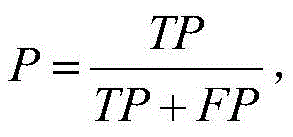

其中,P为查准率,R为查全率,TP为真正例数目,FP为假正例数目,FN为假反例数目;Among them, P is the precision rate, R is the recall rate, TP is the number of true examples, FP is the number of false positive examples, and FN is the number of false negative examples;
设遗传算法中的适应度值为f(Xi),即10折交叉验证的macroF1值,则有:Assuming that the fitness value in the genetic algorithm is f(X i ), that is, the macroF1 value of the 10-fold cross-validation, there are:


其中,Pi为第i次训练查准率;macroP为宏查准率,是10次训练查准率平均值;Ri为第i次训练查全率;macroR为宏查全率,是10次训练查全率平均值;macroF1为宏F1,是基于宏查准率和宏查全率的调和平均值,即为适应度值;Among them, Pi is the ith training precision; macroP is the macro precision, which is the average of 10 training precisions; R i is the ith training recall; macroR is the macro recall, which is 10 The average value of the recall rate of the sub-training; macroF1 is the macro F1, which is based on the harmonic average of the macro precision rate and the macro recall rate, which is the fitness value;
根据适应度值计算染色体入选种群概率:Calculate the probability of chromosome selection into the population according to the fitness value:

其中,p(Xi)为第i个染色体入选种群概率,Xi为第i个染色体,f(Xj)为第j个染色体的适应度值;Among them, p(X i ) is the probability of the i-th chromosome being selected into the population, X i is the i-th chromosome, and f(X j ) is the fitness value of the j-th chromosome;
根据入选种群概率的高低,选择代沟为0.8,即保留概率较高的80%染色体,将保留的染色体进行交叉运算和变异运算:According to the probability of the selected population, the generation gap is selected to be 0.8, that is, 80% of chromosomes with a higher probability are retained, and the retained chromosomes are subjected to crossover and mutation operations:
交叉运算为随机选取两条染色体,随机选择一个交配点做单点杂交,将产生的新的两条染色体代替原来的染色体,放回初始种群;交叉运算概率为0.6;The crossover operation is to randomly select two chromosomes, randomly select a mating point for single-point hybridization, and replace the original two chromosomes with the new two chromosomes and put them back into the initial population; the probability of crossover operation is 0.6;
单点杂交后:After single point hybridization:
变异运算为杂交后的个体进行变异运算,随机选取一条染色体;The mutation operation is to perform mutation operation on the hybridized individuals, and randomly select a chromosome;
变异运算后:After mutation operation:
遗传算法模拟生物的自然选择和遗传机制,用编码空间代替问题的参数空间,用适应度函数作为评价依据。通过随机重组重要的基因,让群体中的个体不断进化,逐步接近最优解,并减少全局搜索时间。The genetic algorithm simulates the natural selection and genetic mechanism of organisms, replaces the parameter space of the problem with the coding space, and uses the fitness function as the evaluation basis. By randomly recombining important genes, the individuals in the group are constantly evolving, gradually approaching the optimal solution, and reducing the global search time.
通过不断进化,获取最优混合核函数系数、最优确认惩罚因子和最优确认混合核函数权系数,即得到多项式核函数与径向基核函数的调整比重,混合核函数的权系数ρ=0.8253,以及C=5.9801、σ=0.0192、c=0、d=2。Through continuous evolution, the optimal mixed kernel function coefficient, the optimal confirmation penalty factor and the optimal confirmation mixed kernel function weight coefficient are obtained, that is, the adjusted proportions of the polynomial kernel function and the radial basis kernel function are obtained, and the weight coefficient of the mixed kernel function ρ= 0.8253, and C=5.9801, σ=0.0192, c=0, d=2.
第五步:将最优混合函数系数代入最优分类函数,并对学生数据进行训练,得到分类器模型;具体过程为:Step 5: Substitute the optimal mixing function coefficients into the optimal classification function, and train the student data to obtain a classifier model; the specific process is:
根据步骤S4获得的最优混合核函数系数,使用SMO算法通过训练学生数据得到最优的


其中,ai、aj为拉格朗日乘子;yi为第i个学生标识,yj为第j个学生标识;Among them, a i and a j are Lagrange multipliers; y i is the i-th student identification, and y j is the j-th student identification;
获得更新后的ai、aj;Obtain the updated a i , a j ;
求解非线性支持向量机和其对偶问题,重复选取和求解,得到
其中非线性支持向量机为:The nonlinear support vector machine is:

对偶问题:Dual problem:

通过

其中,x为需要认定的学生数据特征值。Among them, x is the characteristic value of the student data to be identified.
第六步:将需要认定的学生数据输入到分类器模型中,通过分类器模型计算,得出f(x),若f(x)为正则表示这个学生大概率为贫困生,若f(x)为负则表示这个学生大概率不是贫困生,再通过实际考核,认定新的贫困生,添加到贫困生名单中,得到新的贫困生名单。Step 6: Input the student data to be identified into the classifier model, and calculate f(x) through the classifier model. If f(x) is regular, it means that the student is likely to be a poor student. If f(x) ) is negative, indicating that the student has a high probability of not being a poor student, and then through the actual assessment, a new poor student is identified and added to the list of poor students to obtain a new list of poor students.
上述实施例为本发明较佳的实施方式,但本发明的实施方式并不受上述实施例的限制,其他的任何未背离本发明的精神实质与原理下所作的改变、修饰、替代、组合、简化,均应为等效的置换方式,都包含在本发明的保护范围之内。The above-mentioned embodiments are preferred embodiments of the present invention, but the embodiments of the present invention are not limited by the above-mentioned embodiments, and any other changes, modifications, substitutions, combinations, The simplification should be equivalent replacement manners, which are all included in the protection scope of the present invention.
Claims (7)


Priority Applications (1)
| Application Number | Priority Date | Filing Date | Title |
|---|---|---|---|
| CN201810290654.0A CN108564117B (en) | 2018-03-30 | 2018-03-30 | SVM-based poverty and life assisting identification method |
Applications Claiming Priority (1)
| Application Number | Priority Date | Filing Date | Title |
|---|---|---|---|
| CN201810290654.0A CN108564117B (en) | 2018-03-30 | 2018-03-30 | SVM-based poverty and life assisting identification method |
Publications (2)
| Publication Number | Publication Date |
|---|---|
| CN108564117A CN108564117A (en) | 2018-09-21 |
| CN108564117B true CN108564117B (en) | 2022-03-29 |
Family
ID=63533802
Family Applications (1)
| Application Number | Title | Priority Date | Filing Date |
|---|---|---|---|
| CN201810290654.0A Expired - Fee Related CN108564117B (en) | 2018-03-30 | 2018-03-30 | SVM-based poverty and life assisting identification method |
Country Status (1)
| Country | Link |
|---|---|
| CN (1) | CN108564117B (en) |
Families Citing this family (9)
| Publication number | Priority date | Publication date | Assignee | Title |
|---|---|---|---|---|
| CN109472299A (en) * | 2018-10-19 | 2019-03-15 | 浙江正元智慧科技股份有限公司 | A kind of Impoverished University Students recognition methods based on smart card big data |
| CN111144430B (en) * | 2018-11-05 | 2023-08-01 | 中国移动通信集团广东有限公司 | Recognition method and device for maintenance card number based on genetic algorithm |
| CN109670998A (en) * | 2018-12-27 | 2019-04-23 | 三盟科技股份有限公司 | Based on the multistage identification of accurate subsidy and system under the big data environment of campus |
| CN109871992A (en) * | 2019-01-30 | 2019-06-11 | 北京工业大学 | TFT-LCD industrial intelligent prediction technique based on R-SVM |
| CN111178699B (en) * | 2019-12-15 | 2023-05-23 | 贵州电网有限责任公司 | Method for constructing intelligent check system for dispatching operation ticket |
| CN112215385B (en) * | 2020-03-24 | 2024-03-19 | 北京桃花岛信息技术有限公司 | Student difficulty degree prediction method based on greedy selection strategy |
| CN113780637B (en) * | 2021-08-27 | 2023-10-17 | 广东工业大学 | Support vector machine learning method based on auxiliary optimization and Lagrangian optimization |
| CN113962834A (en) * | 2021-10-29 | 2022-01-21 | 重庆医药高等专科学校 | A method for identifying poor students in colleges and universities based on user consumption data |
| CN114155607A (en) * | 2021-12-07 | 2022-03-08 | 华东交通大学 | Driving risk monitoring and alarming method, device, equipment and storage medium |
Citations (5)
| Publication number | Priority date | Publication date | Assignee | Title |
|---|---|---|---|---|
| CN102058413A (en) * | 2010-12-03 | 2011-05-18 | 上海交通大学 | Method for detecting EEG (electroencephalogram) alertness based on continuous wavelet transform |
| CN104009886A (en) * | 2014-05-23 | 2014-08-27 | 南京邮电大学 | Intrusion Detection Method Based on Support Vector Machine |
| CN106897703A (en) * | 2017-02-27 | 2017-06-27 | 辽宁工程技术大学 | Remote Image Classification based on AGA PKF SVM |
| US9721181B2 (en) * | 2015-12-07 | 2017-08-01 | The Climate Corporation | Cloud detection on remote sensing imagery |
| CN107357966A (en) * | 2017-06-21 | 2017-11-17 | 山东科技大学 | A kind of surrounding rock of actual mining roadway stability prediction and appraisal procedure |
-
2018
- 2018-03-30 CN CN201810290654.0A patent/CN108564117B/en not_active Expired - Fee Related
Patent Citations (5)
| Publication number | Priority date | Publication date | Assignee | Title |
|---|---|---|---|---|
| CN102058413A (en) * | 2010-12-03 | 2011-05-18 | 上海交通大学 | Method for detecting EEG (electroencephalogram) alertness based on continuous wavelet transform |
| CN104009886A (en) * | 2014-05-23 | 2014-08-27 | 南京邮电大学 | Intrusion Detection Method Based on Support Vector Machine |
| US9721181B2 (en) * | 2015-12-07 | 2017-08-01 | The Climate Corporation | Cloud detection on remote sensing imagery |
| CN106897703A (en) * | 2017-02-27 | 2017-06-27 | 辽宁工程技术大学 | Remote Image Classification based on AGA PKF SVM |
| CN107357966A (en) * | 2017-06-21 | 2017-11-17 | 山东科技大学 | A kind of surrounding rock of actual mining roadway stability prediction and appraisal procedure |
Non-Patent Citations (3)
| Title |
|---|
| 华南理工大学节能监管平台建设;彭新一;《建设科技》;20100131(第2期);第22-23页 * |
| 基于校园一卡通消费数据对高校贫困生分类的应用研究;张玺,呙森林,孙宗良;《数字技术与应用》;20160831(第8期);第100页 * |
| 基于遗传算法和SVM的遥感图像检索;彭晏飞等;《小型微型计算机系统》;20160430;第37卷(第4期);第875-880页 * |
Also Published As
| Publication number | Publication date |
|---|---|
| CN108564117A (en) | 2018-09-21 |
Similar Documents
| Publication | Publication Date | Title |
|---|---|---|
| CN108564117B (en) | SVM-based poverty and life assisting identification method | |
| CN112070125A (en) | Prediction method of unbalanced data set based on isolated forest learning | |
| Kozeny | Genetic algorithms for credit scoring: Alternative fitness function performance comparison | |
| CN111754345B (en) | Bit currency address classification method based on improved random forest | |
| CN107169628B (en) | Power distribution network reliability assessment method based on big data mutual information attribute reduction | |
| CN109949152A (en) | A kind of personal credit's violation correction method | |
| CN110544011A (en) | An Intelligent System Combat Effectiveness Evaluation and Optimization Method | |
| CN113327047A (en) | Power marketing service channel decision method and system based on fuzzy comprehensive model | |
| CN114580762A (en) | An error correction method for hydrological forecast based on XGBoost | |
| Peng et al. | The health care fraud detection using the pharmacopoeia spectrum tree and neural network analytic contribution hierarchy process | |
| CN114519508A (en) | Credit risk assessment method based on time sequence deep learning and legal document information | |
| Aghayi et al. | Robust efficiency measurement with common set of weights under varying degrees of conservatism and data uncertainty | |
| CN111415099A (en) | A method for identifying poor students based on multi-class BP-Adaboost | |
| CN119153099A (en) | Symptom management and prognosis evaluation method and system for tumor radiotherapy patient | |
| CN104850868A (en) | Customer segmentation method based on k-means and neural network cluster | |
| CN109992592B (en) | Identification method of impoverished students in colleges and universities based on campus consumption card flow data | |
| CN111178580A (en) | Supermarket site selection method based on improved BP neural network | |
| CN115185732B (en) | A software defect prediction method integrating genetic algorithm and deep neural network | |
| CN111967937A (en) | E-commerce recommendation system based on time series analysis and implementation method | |
| CN115860918A (en) | Enterprise credit evaluation automatic rule mining method and device based on improved decision tree | |
| CN112070336A (en) | Manufacturing industry information quantitative analysis method and device based on analytic hierarchy process | |
| CN102663230A (en) | Method for land resource evaluation factor level classification based on genetic algorithm | |
| Repollo et al. | Applying clustering algorithm on poverty analysis in a community in the philippines | |
| CN110942391A (en) | Method for determining main activity label of multi-activity label user in block chain | |
| CN116883070A (en) | Bank generation payroll customer loss early warning method |
Legal Events
| Date | Code | Title | Description |
|---|---|---|---|
| PB01 | Publication | ||
| PB01 | Publication | ||
| SE01 | Entry into force of request for substantive examination | ||
| SE01 | Entry into force of request for substantive examination | ||
| GR01 | Patent grant | ||
| GR01 | Patent grant | ||
| CF01 | Termination of patent right due to non-payment of annual fee |
Granted publication date: 20220329 |
|
| CF01 | Termination of patent right due to non-payment of annual fee |