CN108564227B - A prediction method of rail transit passenger flow based on spatiotemporal features - Google Patents

A prediction method of rail transit passenger flow based on spatiotemporal features Download PDF

Info

Publication number
CN108564227B
CN108564227B CN201810382245.3A CN201810382245A CN108564227B CN 108564227 B CN108564227 B CN 108564227B CN 201810382245 A CN201810382245 A CN 201810382245A CN 108564227 B CN108564227 B CN 108564227B
Authority
CN
China
Prior art keywords
time
station
representing
passenger flow
input
Prior art date
Legal status (The legal status is an assumption and is not a legal conclusion. Google has not performed a legal analysis and makes no representation as to the accuracy of the status listed.)
Active
Application number
CN201810382245.3A
Other languages
Chinese (zh)
Other versions
CN108564227A (en
Inventor
杨梦宁
唐启铖
杨滢
徐玲
赵小超
陈开润
Current Assignee (The listed assignees may be inaccurate. Google has not performed a legal analysis and makes no representation or warranty as to the accuracy of the list.)
Chongqing University
Original Assignee
Chongqing University
Priority date (The priority date is an assumption and is not a legal conclusion. Google has not performed a legal analysis and makes no representation as to the accuracy of the date listed.)
Filing date
Publication date
Application filed by Chongqing University filed Critical Chongqing University
Priority to CN201810382245.3A priority Critical patent/CN108564227B/en
Publication of CN108564227A publication Critical patent/CN108564227A/en
Application granted granted Critical
Publication of CN108564227B publication Critical patent/CN108564227B/en
Active legal-status Critical Current
Anticipated expiration legal-status Critical

Links

Images

Classifications

    • GPHYSICS
    • G06COMPUTING OR CALCULATING; COUNTING
    • G06QINFORMATION AND COMMUNICATION TECHNOLOGY [ICT] SPECIALLY ADAPTED FOR ADMINISTRATIVE, COMMERCIAL, FINANCIAL, MANAGERIAL OR SUPERVISORY PURPOSES; SYSTEMS OR METHODS SPECIALLY ADAPTED FOR ADMINISTRATIVE, COMMERCIAL, FINANCIAL, MANAGERIAL OR SUPERVISORY PURPOSES, NOT OTHERWISE PROVIDED FOR
    • G06Q10/00Administration; Management
    • G06Q10/04Forecasting or optimisation specially adapted for administrative or management purposes, e.g. linear programming or "cutting stock problem"
    • GPHYSICS
    • G06COMPUTING OR CALCULATING; COUNTING
    • G06NCOMPUTING ARRANGEMENTS BASED ON SPECIFIC COMPUTATIONAL MODELS
    • G06N3/00Computing arrangements based on biological models
    • G06N3/02Neural networks
    • G06N3/08Learning methods
    • GPHYSICS
    • G06COMPUTING OR CALCULATING; COUNTING
    • G06NCOMPUTING ARRANGEMENTS BASED ON SPECIFIC COMPUTATIONAL MODELS
    • G06N3/00Computing arrangements based on biological models
    • G06N3/02Neural networks
    • G06N3/04Architecture, e.g. interconnection topology
    • G06N3/044Recurrent networks, e.g. Hopfield networks
    • GPHYSICS
    • G06COMPUTING OR CALCULATING; COUNTING
    • G06NCOMPUTING ARRANGEMENTS BASED ON SPECIFIC COMPUTATIONAL MODELS
    • G06N3/00Computing arrangements based on biological models
    • G06N3/02Neural networks
    • G06N3/04Architecture, e.g. interconnection topology
    • G06N3/044Recurrent networks, e.g. Hopfield networks
    • G06N3/0442Recurrent networks, e.g. Hopfield networks characterised by memory or gating, e.g. long short-term memory [LSTM] or gated recurrent units [GRU]
    • GPHYSICS
    • G06COMPUTING OR CALCULATING; COUNTING
    • G06NCOMPUTING ARRANGEMENTS BASED ON SPECIFIC COMPUTATIONAL MODELS
    • G06N3/00Computing arrangements based on biological models
    • G06N3/02Neural networks
    • G06N3/08Learning methods
    • G06N3/09Supervised learning
    • GPHYSICS
    • G06COMPUTING OR CALCULATING; COUNTING
    • G06QINFORMATION AND COMMUNICATION TECHNOLOGY [ICT] SPECIALLY ADAPTED FOR ADMINISTRATIVE, COMMERCIAL, FINANCIAL, MANAGERIAL OR SUPERVISORY PURPOSES; SYSTEMS OR METHODS SPECIALLY ADAPTED FOR ADMINISTRATIVE, COMMERCIAL, FINANCIAL, MANAGERIAL OR SUPERVISORY PURPOSES, NOT OTHERWISE PROVIDED FOR
    • G06Q50/00Information and communication technology [ICT] specially adapted for implementation of business processes of specific business sectors, e.g. utilities or tourism
    • G06Q50/40Business processes related to the transportation industry

Landscapes

  • Engineering & Computer Science (AREA)
  • Theoretical Computer Science (AREA)
  • Physics & Mathematics (AREA)
  • General Physics & Mathematics (AREA)
  • General Health & Medical Sciences (AREA)
  • Health & Medical Sciences (AREA)
  • Business, Economics & Management (AREA)
  • Software Systems (AREA)
  • Data Mining & Analysis (AREA)
  • Evolutionary Computation (AREA)
  • Computational Linguistics (AREA)
  • Molecular Biology (AREA)
  • Computing Systems (AREA)
  • General Engineering & Computer Science (AREA)
  • Biophysics (AREA)
  • Mathematical Physics (AREA)
  • Biomedical Technology (AREA)
  • Artificial Intelligence (AREA)
  • Life Sciences & Earth Sciences (AREA)
  • Economics (AREA)
  • Human Resources & Organizations (AREA)
  • Strategic Management (AREA)
  • General Business, Economics & Management (AREA)
  • Marketing (AREA)
  • Tourism & Hospitality (AREA)
  • Game Theory and Decision Science (AREA)
  • Entrepreneurship & Innovation (AREA)
  • Operations Research (AREA)
  • Quality & Reliability (AREA)
  • Development Economics (AREA)
  • Primary Health Care (AREA)
  • Traffic Control Systems (AREA)
  • Management, Administration, Business Operations System, And Electronic Commerce (AREA)

Abstract

本发明涉及一种基于时空特征的轨道交通客流量预测方法,包括如下步骤:S1采集轨道交通客流量的历史数据;S2从S1步骤采集的历史数据中,提取0至t时刻目标站点的空间特征和时序特征;S3将步骤S2中0至t时刻目标站点历史数据的空间特征和时序特征对应的合成0至t时刻目标站点的二维向量;S4建立LSTM人工神经网络模型,将0至t时刻目标站点的二维向量作为输入对LSTM人工神经网络模型进行训练,然后再将t时刻目标站点的二维向量输入训练后的LSTM人工神经网络模型,得到t+1时刻目标站点的出站客流量。本发明方法将空间特征和时序特征进行结合,用于预测轨道交通目标站点的客流量,预测精度高。

Figure 201810382245

The invention relates to a method for predicting rail transit passenger flow based on space-time features, comprising the following steps: S1 collecting historical data of rail transit passenger flow; S2 extracting spatial features of a target station from time 0 to t from the historical data collected in step S1 and the time sequence feature; S3 synthesizes the two-dimensional vector of the target site at time 0 to t corresponding to the spatial feature of the historical data of the target site at time 0 to t in step S2 and the time sequence feature; S4 establishes the LSTM artificial neural network model, and the time 0 to t The two-dimensional vector of the target site is used as input to train the LSTM artificial neural network model, and then the two-dimensional vector of the target site at time t is input into the trained LSTM artificial neural network model, and the outbound passenger flow of the target site at time t+1 is obtained. . The method of the invention combines the spatial feature and the time sequence feature, and is used for predicting the passenger flow of the rail transit target station, and the prediction accuracy is high.

Figure 201810382245

Description

Rail transit passenger flow volume prediction method based on space-time characteristics
Technical Field
The invention relates to the technical field of rail transit passenger flow volume prediction, in particular to a rail transit passenger flow volume prediction method based on space-time characteristics.
Background
The rail transit passenger flow prediction has high value, and can provide support for projects such as operation regulation, line planning and the like on a macroscopic level; on a microscopic level, suggestions can be provided for the travel selection of the public users. How to accurately predict rail transit passenger flow becomes a hot issue.
The rail transit data has a remarkable characteristic that the rail transit data has a time dimension, and the conventional artificial neural networks such as CNN (neural network) and RNN (neural network) cannot well process time sequence data, so that the rail transit passenger flow cannot be well predicted according to historical data. Later researchers proposed some models which can well process time series data, but the models have low prediction accuracy on rail transit passenger flow and have no practicability in the field of rail transit passenger flow prediction.
Disclosure of Invention
Aiming at the defects of the prior art, the invention provides a rail transit passenger flow prediction method which is high in prediction accuracy based on time sequence characteristics.
In order to achieve the purpose, the invention adopts the following technical scheme: a rail transit passenger flow volume prediction method based on space-time characteristics comprises the following steps:
s1, collecting historical data of rail transit passenger flow;
s2, extracting the spatial characteristics and the time sequence characteristics of the target station from 0 to t from the historical data collected in the step S1;
s3, synthesizing the spatial features and the time sequence features of the historical data of the target station at the time 0 to t in the step S2 into a two-dimensional vector of the target station at the time 0 to t correspondingly;
and S4, establishing an LSTM artificial neural network model, training the LSTM artificial neural network model by taking the two-dimensional vector of the target station from 0 to t as input, and then inputting the two-dimensional vector of the target station at t into the trained LSTM artificial neural network model to obtain the outbound passenger flow of the target station at t + 1.
As an improvement, in step S1, historical data of rail transit passenger flow is collected, and the historical data is described using the following formula:
xy,t,in=∑i∈M{i|i.otime∈t;i.ostation=j} (1-1);
xj,t,out=∑i∈M{i|i.dtime∈t;i.dstation=j} (1-2);
wherein i represents a piece of data in the whole track traffic data set M, and the otime, dtime, attitude and dstation are attributes of the data i and respectively represent the card swiping time for entering the station, the card swiping time for exiting the station, the number of the starting station and the number of the terminal station.
As an improvement, the spatial characteristics of the target station at time 0 to t in step S2 are calculated by the following method:
Figure GDA0003005748240000021
wherein: sj,rThe total number of passenger flows of other stations which are going to reach the target station j at the moment r, namely the spatial characteristics of the target station at the moment r;
n is the set of rail transit total network stations;
n represents the total data volume of the site set N;
Pk,j,rthe space association factor refers to the space association factor of a station k and a target station j at the moment r at the moment t;
Ink,t-ΔTrepresenting the number of the arrival people of the station k in the r-delta T time period;
Δ T is the average travel time difference between site k and target site j;
Figure GDA0003005748240000022
Figure GDA0003005748240000023
Figure GDA0003005748240000024
Figure GDA0003005748240000025
wherein, Ink,t-ΔTRepresenting the number of the arrival people of the station k in the r-delta T time period;
i represents one piece of data in the whole track traffic data set M;
m represents the total data volume of the track traffic data set M;
xk,j,r-ΔTthe representative is the r- Δ T time period, the number of people in the passenger flow from station k to destination station j;
w represents a time period;
Pk,j,rthat is, all historical contemporaneous p at time rk,j,rAverage value of (a).
As an improvement, the timing characteristics of the target station from 0 to t in step S2 are obtained by the following method:
Tj,r=(tj,rtj,r-1…tj,r-time_step)T (3);
wherein, Tj,rThe total number of outbound passenger flows of a target station j in a historical time period at r moment;
tj,rthe number of the people who go out of the target site j at the moment r is represented;
time step represents a time step.
As an improvement, in step S3, the spatial feature and the temporal feature of the target station at time 0 to time t are correspondingly synthesized into the two-dimensional vector Input of the target station at time 0 to time tj,tThe following were used:
Figure GDA0003005748240000031
as an improvement, the LSTM artificial neural network model established in step S4 is as follows:
ar=σ(Wa,r·xr+ba,r) (4-1);
fr=σ(Wf,r·[hr-1,ar]+bf,r) (4-2);
ir=σ(Wi,r·[hr-1,ar]+bi,r) (4-3);
Figure GDA0003005748240000032
Figure GDA0003005748240000033
or=σ(Wo,r·[hr-1,ar]+bo,r) (4-6);
hr=or*tanh(Cr) (4-7);
wherein, arIndicating full link layer output at time r, Wa,rRepresenting full connection layer weight at time r, ba,rDenotes the offset of the fully-connected layer at time r, xrAn input representing time r;
frrepresents the forgetting threshold at time r, hr-1Representing the output of the cell at time r-1, Wf,rRepresenting the weight of forgetting to gate at time r, bf,rA bias indicating a forgetting gate at time r;
irrepresenting the input threshold at time r, Wi,rRepresenting entry gate weight at time r, bi,rRepresents the offset of the input gate at time r;
Figure GDA0003005748240000034
new state, W, of cell generation at time rc,rRepresents the weight of the cell at time r, bC,rRepresenting the bias of the cell at the r moment;
Figure GDA0003005748240000035
representing the cell state at the r-1 moment;
Crrepresenting the total state of the cell at the r moment;
orrepresenting the output threshold at time r, Wo,rRepresenting the weight of the output gate at time r, bo,rRepresents the offset of the output gate at time r;
hrindicating the output at time r.
As an improvement, the training process of the LSTM artificial neural network model established in step S4 is as follows:
1) let r be 1;
2) two-dimensional vector Inputj,rAs input, i.e. order xr=Inputj,rAnd performing the calculation of the following relation:
ar=σ(Wa,r·xr+ba,r) (4-1);
fr=σ(Wf,r·[hr-1,ar]+bf,r) (4-2);
ir=σ(Wi,r·[hr-1,ar]+bi,r) (4-3);
Figure GDA0003005748240000041
Figure GDA0003005748240000042
or=σ(Wo,r·[hr-1,ar]+bo,r) (4-6);
hr=or*tanh(Cr) (4-7);
3) when r > t, executing the next step, otherwise, making r equal to r +1, and returning to 2);
and outputting the current LSTM artificial neural network model, wherein the model is the trained LSTM artificial neural network model.
As an improvement, in step S3, the two-dimensional vector of the target site at time t is used as an input, and the trained LSTM artificial neural network model is input, that is, let x ber=t=Inputj,tThen output hj=t=yt+1
yt+1And the predicted result, namely the predicted outbound passenger flow of the target station j at the time of the rail transit t +1 is shown.
The invention has the following beneficial effects:
the invention innovatively introduces two dimensionality characteristics of rail transit, namely time characteristics and space characteristics, combines the two dimensionality characteristics to form a two-dimensional vector, trains an LSTM artificial neural network model by taking the two-dimensional vector of the target station at 0-t as input, and predicts the outbound passenger flow of the target station at t +1 time by taking the two-dimensional vector of the target station at t as input, and has high prediction precision.
Drawings
FIG. 1 is a schematic flow diagram of the process of the present invention.
FIG. 2 is a flow chart of the method of the present invention.
Detailed Description
In order to make the objects, technical solutions and advantages of the present invention more apparent, the present invention will be described in further detail with reference to the accompanying drawings in conjunction with the following detailed description. It should be understood that the description is intended to be exemplary only, and is not intended to limit the scope of the present invention. Moreover, in the following description, descriptions of well-known structures and techniques are omitted so as to not unnecessarily obscure the concepts of the present invention.
The rail transit data has space-time two-dimension.
The timeliness is as follows: the passenger flow data in a certain time period has a certain rule, and the data in adjacent time periods have a certain correlation.
Spatiality: there is a spatial relationship between the two sites. Every two different sites have certain rules in the traffic of different time periods.
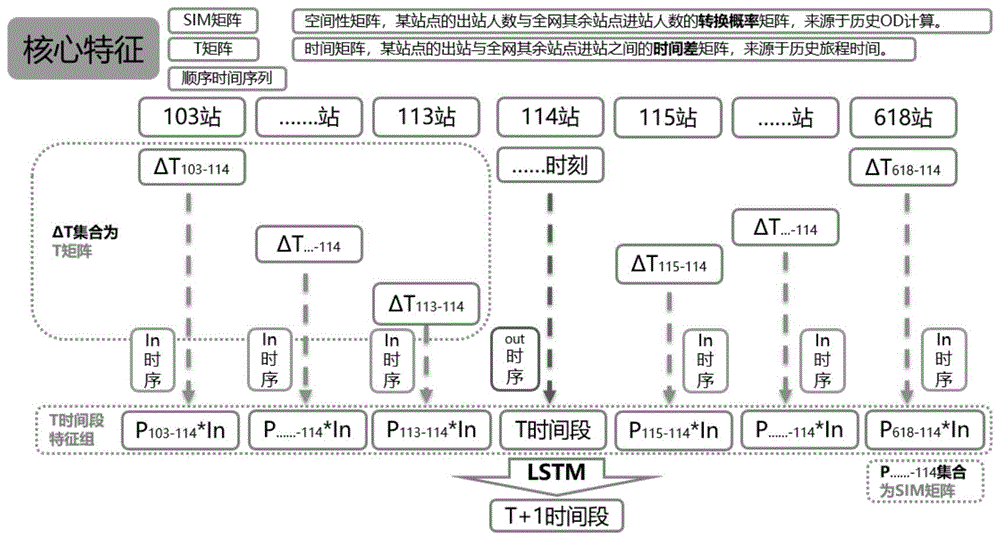
Due to the fact that the rail transit data is spatial besides temporal, a certain correlation exists between every two stations in space, and the most direct embodiment of the correlation is the travel time of a passenger. The spatial relationship between the two sites can be expressed by converting the spatial distance between the two sites into the travel time, namely the time difference delta T. In addition, for a given time period, the traffic volume between every two stations has a certain rule, and the relation is introduced by introducing a space influence factor matrix SIM.
In the framework provided by the invention, the space influence quantity is converted into the time difference to be processed, so that the spatiality can be processed by an artificial neural network for processing time series data. The time sequence data and the space influence quantity are combined to predict the station entering and exiting data of the station, and a good effect is obtained.
Referring to fig. 1 and 2, a rail transit passenger flow volume prediction method based on space-time characteristics includes the following steps:
s1, collecting historical data of rail transit passenger flow;
specifically, historical data of rail transit passenger flow is collected, and the historical data is described by using the following formula:
xj,t,in=∑i∈M{i|i.otime∈t;i.ostation=j} (1-1);
xj,t,out=∑i∈M{i|i.dtime∈t;i.dstation=j} (1-2);
wherein i represents a piece of data in the whole track traffic data set M, and the otime, dtime, attitude and dstation are attributes of the data i and respectively represent the card swiping time for entering the station, the card swiping time for exiting the station, the number of the starting station and the number of the terminal station.
S2, extracting the spatial characteristics and the time sequence characteristics of the target station from 0 to t from the historical data collected in the step S1;
specifically, the spatial feature of the target station at time 0 to t in step S2 is calculated by the following method:
Figure GDA0003005748240000051
wherein: sj,rThe total number of passenger flows of other stations which are going to reach the target station j at the moment r, namely the spatial characteristics of the target station at the moment r;
n is the set of rail transit total network stations;
n represents the total data volume of the site set N;
Pk,j,rthe space association factor refers to the space association factor of a station k and a target station j at the moment r at the moment t;
Ink,t-ΔTrepresenting the number of the arrival people of the station k in the r-delta T time period;
Δ T is the average travel time difference between site k and target site j; the Δ T between every two stations constitutes a T matrix, which is described in detail below), and all P form an SIM matrix (which is described in detail below), that is, a transition probability matrix (time period, ratio of the number of inbound people from station k to station j to the total number of inbound people from station k) of the outbound people of the target station j to the number of inbound people of the rest stations in the whole network.
Figure GDA0003005748240000061
Figure GDA0003005748240000062
Figure GDA0003005748240000063
Figure GDA0003005748240000064
Wherein, Ink,t-ΔTRepresenting the number of the arrival people of the station k in the r-delta T time period;
i represents one piece of data in the whole track traffic data set M;
m represents the total data volume of the track traffic data set M;
xk,j,r-ΔTthe representative is the r- Δ T time period, the number of people in the passenger flow from station k to destination station j;
w represents a time period;
Pk,j,rthat is, all historical contemporaneous p at time rk,j,rAverage value of (a).
History synchronization: the same time period of each week, such as 8 o 'clock 30 of Monday on all weeks, constitutes a historical contemporaneous group of 8 o' clock 30 of Monday, noting that: here, 8 points 30 points refers to a period of time, which represents 8: 21-8 points 30. This time is 10 minutes because the prediction accuracy in our experiment is 10 minutes, and if the prediction accuracy is v, the time period t refers to the time period t-v to t.
Specifically, the time sequence characteristics of the target station at time 0 to t are obtained by the following method:
Tj,r=(tj,rtj,r-1…tj,r-time_step)T (3);
wherein, Tj,rThe total number of outbound passenger flows of a target station j in a historical time period at r moment;
tj,rthe number of the people who go out of the target site j at the moment r is represented;
time step represents a time step. The constants in the LSTM neural network are specified by the user as specific values.
S3, synthesizing the spatial features and the time sequence features of the historical data of the target station at the time 0 to t in the step S2 into a two-dimensional vector of the target station at the time 0 to t correspondingly;
specifically, in step S3, the spatial feature and the time sequence feature of the target site at time 0 to time t are correspondingly synthesized into the two-dimensional vector Input of the target site at time 0 to time tj,tThe following were used:
Figure GDA0003005748240000071
namely, a two-dimensional vector with the length of time step is used as the input of an LSTM artificial neural network model, the processing of a full connection layer is carried out, and the Output of the full connection layer is OutputfullAn input as an input layer; finally, a one-dimensional vector with the length of 1 is output. The output is the predicted value of the total number of passenger flows of the destination station j. The output of the LSTM artificial neural network model is a specific number.
Multiple experiments show that the two-dimensional vector is adopted as a station with small input and output number and large data fluctuation, and the performance is generally good.
S4: establishing an LSTM artificial neural network model, training the LSTM artificial neural network model by taking the two-dimensional vector corresponding to the time from 0 to t as input, and then inputting the two-dimensional vector corresponding to the time t into the trained LSTM artificial neural network model to obtain the outbound passenger flow of the target station at the time t + 1.
Specifically, the LSTM artificial neural network model established in step S4 is as follows:
ar=σ(Wa,r·xr+ba,r) (4-1);
fr=σ(Wf,r·[hr-1,ar]+bf,r) (4-2);
ir=σ(Wi,r·[hr-1,ar]+bi,r) (4-3);
Figure GDA0003005748240000072
Figure GDA0003005748240000073
or=σ(Wo,r·[hr-1,ar]+bo,r) (4-6);
hr=or*tanh(Cr) (4-7);
wherein, arIndicating full link layer output at time r, Wa,rRepresenting full connection layer weight at time r, ba,rDenotes the offset of the fully-connected layer at time r, xrAn input representing time r;
frrepresents the forgetting threshold at time r, hr-1Representing the output of the cell at time r-1, Wf,rRepresenting the weight of forgetting to gate at time r, bf,rA bias indicating a forgetting gate at time r;
irrepresenting the input threshold at time r, Wi,rRepresenting entry gate weight at time r, bi,rRepresents the offset of the input gate at time r;
Figure GDA0003005748240000074
new state, W, of cell generation at time rc,rRepresents the weight of the cell at time r, bC,rRepresenting the bias of the cell at the r moment;
Figure GDA0003005748240000075
representing the cell state at the r-1 moment;
Crrepresenting the total state of the cell at the r moment;
orrepresenting the output threshold at time r, Wo,rRepresenting the weight of the output gate at time r, bo,rRepresents the offset of the output gate at time r;
hrindicating the output at time r.
Adding a full connection layer before the input layer of the traditional LSTM artificial neural network, wherein the full connection layer has the function of connecting the above
The vector of [ time _ step, 2] is converted into a vector of [ time _ step, rnn _ unit ] (rnn _ unit is the number of cells, constant in the LSTM neural network, specific values given by the user), and the converted vector is input into the input layer of the LSTM.
Specifically, the training process of the LSTM artificial neural network model established in step S4 is as follows:
1) let r be 1;
2) two-dimensional vector Inputj,rAs input, i.e. order xr=Inputj,rAnd performing the calculation of the following relation:
ar=σ(Wa,r·xr+ba,r) (4-1);
fr=σ(Wf,r·[hr-1,ar]+bf,r) (4-2);
ir=σ(Wi,r·[hr-1,ar]+bi,r) (4-3);
Figure GDA0003005748240000081
Figure GDA0003005748240000082
or=σ(Wo,r·[hr-1,ar]+bo,r) (4-6);
hr=or*tanh(Cr) (4-7);
3) when r > t, executing the next step, otherwise, making r equal to r +1, and returning to 2);
and outputting the current LSTM artificial neural network model, wherein the model is the trained LSTM artificial neural network model. The two-dimensional vector synthesized in the step S3 is used as the input in the step S4 to train the LSTM artificial neural network model to obtain Wa,r、ba,r、Wf,r、bf,r、Wi,r、bi,r、Wc,r、bC,r、Wo,rAnd bo,rAnd determining the trained LSTM artificial neural network model.
In the step S3, the two-dimensional vector of the target site at the time t is used as input, and the trained LSTM artificial neural network model is input, namely, x is orderedr=t=Inpuj,tThen output hj=r=yt+1
yt+1And the predicted result, namely the predicted outbound passenger flow of the target station j at the time of the rail transit t +1 is shown.
The model takes time characteristic data and space characteristic data as input and outputs outbound passenger flow data at the future moment. The input time characteristic and space characteristic data innovatively introduce the characteristics of two dimensions of rail transit, namely time characteristic and space characteristic. And combining the time characteristic and the space characteristic to form a two-dimensional vector as the input of the model, wherein the output is the outbound passenger flow at the time of the target station t + 1.
The structure of the T matrix is as follows:
Figure GDA0003005748240000091
Ttrepresented is a time difference matrix T for the T period.
ΔTk,jRepresenting a history of time differences from site k to site j for time period tAverage of the term of the same term (and calculate P)k,j,tHistorical averaging method of time is the same):
Figure GDA0003005748240000092
(i∈M,i.dtime∈t,i.ostation=k,i.dstation=j)
Figure GDA0003005748240000093
Δtk,j,trepresented is the average travel time from station k to station j at time t.
ΔTk,j,tIs the delta t of all historical synchronizationk,j,tW in the formula represents one week.
N is the set of full-network sites, which is 122 sites in the full network, i.e., m-122.
H is a set of all time segments, each day is 7 days a week, subway operation is 1000 minutes each day, and the time segment length (prediction accuracy) is 10 minutes, so that there are 7 × 1000/10-700 time segments in total.
For a given time period T, a T matrix is corresponded, the size of the matrix is the station number by the station number (122 by 122, the total network is 122 stations), and the travel time of the time period T between every two stations in the total network is described. In the prediction experiment, there were 100 time periods in a day. It has also been found that the travel time for each site varies from day to day, but is cycled roughly on a weekly cycle (with different travel times between sites throughout the network from monday to sunday). Therefore, we have a total of 7 x 100T matrices, each with a size of 122 x 122.
The structure of the SIM matrix is as follows:
Figure GDA0003005748240000094
SIMtthe spatial impact factor matrix SIM at time t is represented.
Pk,jRepresented is the historical contemporaneous average of the spatial impact factors for site k to site j at time t.
N is the set of full-network sites, which is 122 sites in the full network, i.e., m-122.
H is a set of all time segments, each day is 7 days a week, subway operation is 1000 minutes each day, and the time segment length (prediction accuracy) is 10 minutes, so that there are 7 × 1000/10-700 time segments in total.
For a given time t, the method corresponds to an SIM matrix, the size of the matrix is the station number (122 station number, 122 station numbers in the whole network), and the correlation degree between every two stations in the whole network and the number of the station entering people and the number of the battle exiting people at the time t is depicted. In the prediction experiment, there were 100 time periods in a day. Moreover, the relevance rules of the number of the coming-in persons and the number of the coming-out persons at two stations are different from day to day, but the rules are approximately circulated in a week period (the relevance rules are different between every two stations in the whole network from Monday to Sunday). Therefore, we have a total of 7 × 100 SIM matrices, each with a size of 122 × 122.
Test of
Experimental data set and experimental subject
A data source: whole-network rail transit card swiping data of Chongqing city of 3 months in 2017
Prediction of objects: number of people who come out of 100 rail transit stations in Chongqing
Precision: 10 minutes
Data volume: each station has incoming passenger flow data and outgoing passenger flow data, and each station has 100 × 30 × 2 (1000/10) × 600000 data, wherein training is performed on the first 28 days and testing is performed on the last 2 days.
Training times are as follows: 3000 times.
Testing the model: conventional models that predict only from time to time data, and spatio-temporal prediction models that incorporate the amount of spatial impact.
Accuracy measure index
1) Maximum error
The maximum value of the absolute values of the differences between the predicted value and the actual value in the prediction result.
Figure GDA0003005748240000101
2) Mean error
In the prediction result, the absolute value of the difference between the predicted value and the actual value is averaged.
Figure GDA0003005748240000102
3) Root mean square error
In the prediction result, the sum of squares of absolute values of the differences between the predicted value and the actual value is set to the square.
Figure GDA0003005748240000103
4) Relative accuracy
The average percentage of the absolute value of the difference between the predicted value and the actual value in the prediction result.
Figure GDA0003005748240000111
Test results
Model name Maximum error Mean error Root mean square error Relative accuracy
Two-dimensional input space-time prediction model 127.90 19.06 27.87 83.81%
Time sequence prediction model 182.88 24.81 37.51 79.16%
Conclusion of the experiment
After the experiment of 100 sites, the space-time prediction model of the two combination modes has good performance, each index is obviously higher than that of the traditional time sequence prediction model, and the prediction accuracy is obviously improved.
To prevent the loss of meaning indicated by the letters, the following list is made:
Figure GDA0003005748240000112
Figure GDA0003005748240000121
the above description is only an embodiment of the present invention, but the scope of the present invention is not limited thereto, and any person skilled in the art can easily conceive of changes or substitutions within the technical scope of the present invention, and all such changes or substitutions are included in the scope of the present invention. Therefore, the protection scope of the present invention shall be subject to the protection scope of the claims.

Claims (5)

1. A rail transit passenger flow volume prediction method based on space-time characteristics is characterized by comprising the following steps: the method comprises the following steps:
s1, collecting historical data of rail transit passenger flow;
in step S1, historical data of the rail transit passenger flow volume is collected, and the historical data is described by using the following formula:
xj,t,in=∑i∈M{i|i.otime∈t;i.ostation=j} (1-1);
xj,t,out=∑i∈M{i|i.dtime∈t;i.dstation=j} (1-2);
wherein i represents a piece of data in the whole track traffic data set M, and the otime, dtime, attitude and dstation are attributes of the data i and respectively represent the card swiping time for entering a station, the card swiping time for exiting the station, the number of a starting station and the number of a terminal station;
s2, extracting the spatial characteristics and the time sequence characteristics of the target station from 0 to t from the historical data collected in the step S1;
in the step S2, the spatial characteristics of the target station at time 0 to t are calculated by the following method:
Figure FDA0003133129590000011
wherein: sj,rThe total number of passenger flows of other stations which are going to reach the target station j at the moment r, namely the spatial characteristics of the target station at the moment r;
n is the total data volume of site set N;
n is the set of rail transit total network stations;
Pk,j,rthe space association factor refers to space association factors of a station k and a target station j at the moment r;
Ink,r-ΔTrepresenting the number of the arrival people of the station k in the r-delta T time period;
Δ T is the average travel time difference between site k and target site j;
Figure FDA0003133129590000012
Figure FDA0003133129590000013
Figure FDA0003133129590000014
Figure FDA0003133129590000015
wherein, Ink,r-ΔTRepresenting the number of the arrival people of the station k in the r-delta T time period;
i represents one piece of data in the whole track traffic data set M;
m represents the total data volume of the track traffic data set M;
xk,j,r-ΔTthe representative is the r- Δ T time period, the number of people in the passenger flow from station k to destination station j;
w represents a time period;
Pk,j,rthat is, all historical contemporaneous p at time rk,j,rAverage value of (d);
the time sequence characteristics of the target station at the time 0 to t in the step S2 are obtained by the following method:
Tj,r=(tj,rtj,r-1…tj,r-time_step)T (3);
wherein, Tj,rThe total number of outbound passenger flows of a target station j in a historical time period at r moment;
tj,rthe number of the people who go out of the target site j at the moment r is represented;
time _ step represents a time step;
s3, synthesizing the spatial features and the time sequence features of the historical data of the target station at the time 0 to t in the step S2 into a two-dimensional vector of the target station at the time 0 to t correspondingly;
and S4, establishing an LSTM artificial neural network model, training the LSTM artificial neural network model by taking the two-dimensional vector of the target station from 0 to t as input, and then inputting the two-dimensional vector of the target station at t into the trained LSTM artificial neural network model to obtain the outbound passenger flow of the target station at t + 1.
2. The rail transit passenger flow volume prediction method based on spatiotemporal features as claimed in claim 1, characterized in that: correspondingly synthesizing the spatial features and the time sequence features of the target site at the time 0 to t in the step S3 into a two-dimensional vector Input of the target site at the time 0 to tj,rThe following were used:
Figure FDA0003133129590000021
3. the rail transit passenger flow volume prediction method based on spatiotemporal features as claimed in claim 2, characterized in that: the LSTM artificial neural network model established in step S4 is as follows:
ar=σ(Wa,r·xr+ba,r) (4-1);
fr=σ(Wf,r·[hr-1,ar]+bf,r) (4-2);
ir=σ(Wi,r·[hr-1,ar]+bi,r) (4-3);
Figure FDA0003133129590000022
Figure FDA0003133129590000023
or=σ(Wo,r·[hr-1,ar]+bo,r) (4-6);
hr=or*tanh(Cr) (4-7);
wherein, arIndicates r time is fullConnection layer output, Wa,rRepresenting full connection layer weight at time r, ba,rDenotes the offset of the fully-connected layer at time r, xrAn input representing time r;
frrepresents the forgetting threshold at time r, hr-1Representing the output of the cell at time r-1, Wf,rRepresenting the weight of forgetting to gate at time r, bf,rA bias indicating a forgetting gate at time r;
irrepresenting the input threshold at time r, Wi,rRepresenting entry gate weight at time r, bi,rRepresents the offset of the input gate at time r;
Figure FDA0003133129590000031
new state, W, of cell generation at time rc,rRepresents the weight of the cell at time r, bC,rRepresenting the bias of the cell at the r moment;
Figure FDA0003133129590000032
representing the cell state at the r-1 moment;
Crrepresenting the total state of the cell at the r moment;
orrepresenting the output threshold at time r, Wo,rRepresenting the weight of the output gate at time r, bo,rRepresents the offset of the output gate at time r;
hrindicating the output at time r.
4. The method for predicting rail transit passenger flow based on spatio-temporal characteristics as claimed in claim 3, wherein the training process of the LSTM artificial neural network model established in the step S4 is as follows:
1) let r be 1;
2) two-dimensional vector Inputj,rAs input, i.e. order xr=Inputj,rAnd performing the calculation of the following relation:
ar=σ(Wa,r·xr+ba,r) (4-1);
fr=σ(Wf,r·[hr-1,ar]+bf,r) (4-2);
ir=σ(Wi,r·[hr-1,ar]+bi,r) (4-3);
Figure FDA0003133129590000033
Figure FDA0003133129590000034
or=σ(Wo,r·[hr-1,ar]+bo,r) (4-6);
hr=or*tanh(Cr) (4-7);
3) when r > t, executing the next step, otherwise, making r ═ r +1, and returning to 2);
and outputting the current LSTM artificial neural network model, wherein the model is the trained LSTM artificial neural network model.
5. The rail transit passenger flow volume prediction method based on spatiotemporal features as claimed in claim 4, characterized in that: in the step S3, the two-dimensional vector of the target site at the time t is used as input, and the trained LSTM artificial neural network model is input, namely, x is orderedr=t=Inputj,tThen output hj=t=yt+1
yt+1And the predicted result, namely the predicted outbound passenger flow of the target station j at the time of the rail transit t +1 is shown.
CN201810382245.3A 2018-04-26 2018-04-26 A prediction method of rail transit passenger flow based on spatiotemporal features Active CN108564227B (en)

Priority Applications (1)

Application Number Priority Date Filing Date Title
CN201810382245.3A CN108564227B (en) 2018-04-26 2018-04-26 A prediction method of rail transit passenger flow based on spatiotemporal features

Applications Claiming Priority (1)

Application Number Priority Date Filing Date Title
CN201810382245.3A CN108564227B (en) 2018-04-26 2018-04-26 A prediction method of rail transit passenger flow based on spatiotemporal features

Publications (2)

Publication Number Publication Date
CN108564227A CN108564227A (en) 2018-09-21
CN108564227B true CN108564227B (en) 2021-08-06

Family

ID=63536801

Family Applications (1)

Application Number Title Priority Date Filing Date
CN201810382245.3A Active CN108564227B (en) 2018-04-26 2018-04-26 A prediction method of rail transit passenger flow based on spatiotemporal features

Country Status (1)

Country Link
CN (1) CN108564227B (en)

Families Citing this family (14)

* Cited by examiner, † Cited by third party
Publication number Priority date Publication date Assignee Title
CN110462594B (en) * 2018-11-02 2023-11-14 创新先进技术有限公司 Methods and systems for monitoring multiple system indicators
CN109523082B (en) * 2018-11-20 2023-12-22 广东机场白云信息科技股份有限公司 A method for predicting normal flight release rate based on CNN-LSTM
CN109583656B (en) * 2018-12-06 2022-05-10 重庆邮电大学 Prediction method of urban rail transit passenger flow based on A-LSTM
CN110210656B (en) * 2019-05-21 2021-07-13 上海交通大学 Method and system of shared bicycle traffic flow prediction based on site behavior analysis
CN110298486B (en) * 2019-05-29 2023-06-09 成都理工大学 Rail transit passenger flow prediction method based on convolutional neural network
CN110619419B (en) * 2019-07-30 2022-08-05 北京交通大学 Passenger flow prediction method for urban rail transit
CN110458351A (en) * 2019-08-06 2019-11-15 重庆仙桃前沿消费行为大数据有限公司 Area management method, device, equipment and readable storage medium storing program for executing based on flow of the people
CN110633853A (en) * 2019-09-12 2019-12-31 北京彩云环太平洋科技有限公司 Training method and device of space-time data prediction model and electronic equipment
CN110866649B (en) * 2019-11-19 2022-09-20 中国科学院深圳先进技术研究院 Method and system for predicting short-term subway passenger flow and electronic equipment
CN113239198B (en) * 2021-05-17 2023-10-31 中南大学 Subway passenger flow prediction method and device and computer storage medium
CN113850439A (en) * 2021-09-29 2021-12-28 广州新科佳都科技有限公司 Energy consumption prediction method, device, equipment and storage medium for rail transit station equipment
CN114170550B (en) * 2021-12-08 2025-03-28 李雪冰 A method for detecting abnormal passenger flow in public transportation
CN114399344B (en) * 2022-03-24 2022-07-08 北京骑胜科技有限公司 Data processing method and data processing device
CN117272848B (en) * 2023-11-22 2024-02-02 上海随申行智慧交通科技有限公司 Subway passenger flow prediction method and model training method based on space-time influence

Citations (4)

* Cited by examiner, † Cited by third party
Publication number Priority date Publication date Assignee Title
WO2016054360A1 (en) * 2014-10-03 2016-04-07 Drive Time Metrics, Inc. Cross channel in-vehicle media consumption measurement and analysis
CN106372722A (en) * 2016-09-18 2017-02-01 中国科学院遥感与数字地球研究所 Subway short-time flow prediction method and apparatus
CN107103394A (en) * 2017-05-27 2017-08-29 重庆大学 A kind of real-time passenger flow forecasting of track traffic based on neutral net
CN107529651A (en) * 2017-08-18 2018-01-02 北京航空航天大学 A kind of urban transportation passenger flow forecasting and equipment based on deep learning

Patent Citations (4)

* Cited by examiner, † Cited by third party
Publication number Priority date Publication date Assignee Title
WO2016054360A1 (en) * 2014-10-03 2016-04-07 Drive Time Metrics, Inc. Cross channel in-vehicle media consumption measurement and analysis
CN106372722A (en) * 2016-09-18 2017-02-01 中国科学院遥感与数字地球研究所 Subway short-time flow prediction method and apparatus
CN107103394A (en) * 2017-05-27 2017-08-29 重庆大学 A kind of real-time passenger flow forecasting of track traffic based on neutral net
CN107529651A (en) * 2017-08-18 2018-01-02 北京航空航天大学 A kind of urban transportation passenger flow forecasting and equipment based on deep learning

Non-Patent Citations (1)

* Cited by examiner, † Cited by third party
Title
面向公共安全的时空数据挖掘综述;王永坤等;《重庆邮电大学学报》;20180228;第45-30页 *

Also Published As

Publication number Publication date
CN108564227A (en) 2018-09-21

Similar Documents

Publication Publication Date Title
CN108564227B (en) A prediction method of rail transit passenger flow based on spatiotemporal features
CN108537392B (en) A method for predicting outbound passenger flow of rail transit stations based on spatiotemporal features
CN111653088B (en) Vehicle driving quantity prediction model construction method, prediction method and system
Wang et al. DEFSI: Deep learning based epidemic forecasting with synthetic information
CN111210633B (en) Short-term traffic flow prediction method based on deep learning
CN107529651B (en) A method and device for predicting urban traffic passenger flow based on deep learning
Al-Molegi et al. STF-RNN: Space time features-based recurrent neural network for predicting people next location
CN111738535A (en) Rail transit spatiotemporal short-term passenger flow prediction method, device, equipment and storage medium
JP6761789B2 (en) People flow forecasters, systems and programs
Berg et al. Comparison of static ambulance location models
CN111985710A (en) Bus passenger trip station prediction method, storage medium and server
CN109308543A (en) Short-term subway passenger flow prediction method based on LS-SVM and real-time big data
CN114626585B (en) Urban rail transit short-time passenger flow prediction method based on generation countermeasure network
CN115238952A (en) A Bi-LSTM-Attention Short-Term Electric Load Forecasting Method
CN112419131B (en) Method for estimating traffic origin-destination demand
US20240412008A1 (en) Methods, systems, devices and neural networks for forecasting a time series
CN115906235B (en) Public building energy-saving diagnosis system and method
CN118378746A (en) A method, device, computer equipment, readable storage medium and program product for providing accessibility information of public service facilities in a complete residential community
CN113128788A (en) Power emergency material conveying path optimization method and device and storage medium
CN113761020B (en) Urban rail transit abnormal large passenger flow real-time prediction method
CN116308480A (en) Demand forecasting model training method, device, electronic equipment and storage medium
CN112784177B (en) Spatial distance adaptive next interest point recommendation method
TW200814708A (en) Power save method and system for a mobile device
CN111581318B (en) Shared bicycle riding purpose inference method and device and storage medium
CN117312685B (en) A method for recommending location of urban terminal buildings based on hypergraph network

Legal Events

Date Code Title Description
PB01 Publication
PB01 Publication
SE01 Entry into force of request for substantive examination
GR01 Patent grant
GR01 Patent grant