CN1087355A - Composition and method that the preparation synthetic glass is used - Google Patents
Composition and method that the preparation synthetic glass is used Download PDFInfo
- Publication number
- CN1087355A CN1087355A CN93119834.8A CN93119834A CN1087355A CN 1087355 A CN1087355 A CN 1087355A CN 93119834 A CN93119834 A CN 93119834A CN 1087355 A CN1087355 A CN 1087355A
- Authority
- CN
- China
- Prior art keywords
- composition
- allyl
- weight
- component
- many
- Prior art date
- Legal status (The legal status is an assumption and is not a legal conclusion. Google has not performed a legal analysis and makes no representation as to the accuracy of the status listed.)
- Pending
Links
- 239000000203 mixture Substances 0.000 title claims abstract description 104
- 239000011521 glass Substances 0.000 title claims abstract description 46
- 238000000034 method Methods 0.000 title claims abstract description 34
- 238000002360 preparation method Methods 0.000 title claims abstract description 25
- -1 allyl carbonates Chemical class 0.000 claims abstract description 79
- 150000001875 compounds Chemical class 0.000 claims abstract description 44
- LFQSCWFLJHTTHZ-UHFFFAOYSA-N Ethanol Chemical compound CCO LFQSCWFLJHTTHZ-UHFFFAOYSA-N 0.000 claims abstract description 21
- 125000001931 aliphatic group Chemical group 0.000 claims abstract description 4
- JKJWYKGYGWOAHT-UHFFFAOYSA-N bis(prop-2-enyl) carbonate Chemical compound C=CCOC(=O)OCC=C JKJWYKGYGWOAHT-UHFFFAOYSA-N 0.000 claims description 80
- 238000006116 polymerization reaction Methods 0.000 claims description 44
- 239000000975 dye Substances 0.000 claims description 35
- 239000000178 monomer Substances 0.000 claims description 33
- MTHSVFCYNBDYFN-UHFFFAOYSA-N diethylene glycol Chemical compound OCCOCCO MTHSVFCYNBDYFN-UHFFFAOYSA-N 0.000 claims description 27
- 239000007788 liquid Substances 0.000 claims description 25
- SLCVBVWXLSEKPL-UHFFFAOYSA-N neopentyl glycol Chemical compound OCC(C)(C)CO SLCVBVWXLSEKPL-UHFFFAOYSA-N 0.000 claims description 25
- 125000004435 hydrogen atom Chemical group [H]* 0.000 claims description 18
- 125000000217 alkyl group Chemical group 0.000 claims description 14
- 125000001997 phenyl group Chemical group [H]C1=C([H])C([H])=C(*)C([H])=C1[H] 0.000 claims description 13
- 238000002156 mixing Methods 0.000 claims description 12
- 229910052799 carbon Inorganic materials 0.000 claims description 11
- 239000000463 material Substances 0.000 claims description 11
- 229940059574 pentaerithrityl Drugs 0.000 claims description 11
- WXZMFSXDPGVJKK-UHFFFAOYSA-N pentaerythritol Chemical compound OCC(CO)(CO)CO WXZMFSXDPGVJKK-UHFFFAOYSA-N 0.000 claims description 11
- 239000001301 oxygen Substances 0.000 claims description 10
- 229910052760 oxygen Inorganic materials 0.000 claims description 10
- 239000000049 pigment Substances 0.000 claims description 9
- IJGRMHOSHXDMSA-UHFFFAOYSA-N Atomic nitrogen Chemical compound N#N IJGRMHOSHXDMSA-UHFFFAOYSA-N 0.000 claims description 8
- 150000003254 radicals Chemical class 0.000 claims description 8
- 239000007858 starting material Substances 0.000 claims description 8
- QZHPTGXQGDFGEN-UHFFFAOYSA-N chromene Chemical compound C1=CC=C2C=C[CH]OC2=C1 QZHPTGXQGDFGEN-UHFFFAOYSA-N 0.000 claims description 7
- 150000002148 esters Chemical group 0.000 claims description 7
- 238000010438 heat treatment Methods 0.000 claims description 7
- UXFQFBNBSPQBJW-UHFFFAOYSA-N 2-amino-2-methylpropane-1,3-diol Chemical compound OCC(N)(C)CO UXFQFBNBSPQBJW-UHFFFAOYSA-N 0.000 claims description 6
- WKBOTKDWSSQWDR-UHFFFAOYSA-N Bromine atom Chemical compound [Br] WKBOTKDWSSQWDR-UHFFFAOYSA-N 0.000 claims description 6
- ZAMOUSCENKQFHK-UHFFFAOYSA-N Chlorine atom Chemical compound [Cl] ZAMOUSCENKQFHK-UHFFFAOYSA-N 0.000 claims description 6
- PXGOKWXKJXAPGV-UHFFFAOYSA-N Fluorine Chemical compound FF PXGOKWXKJXAPGV-UHFFFAOYSA-N 0.000 claims description 6
- QVGXLLKOCUKJST-UHFFFAOYSA-N atomic oxygen Chemical compound [O] QVGXLLKOCUKJST-UHFFFAOYSA-N 0.000 claims description 6
- 125000001797 benzyl group Chemical group [H]C1=C([H])C([H])=C(C([H])=C1[H])C([H])([H])* 0.000 claims description 6
- GDTBXPJZTBHREO-UHFFFAOYSA-N bromine Substances BrBr GDTBXPJZTBHREO-UHFFFAOYSA-N 0.000 claims description 6
- 229910052794 bromium Inorganic materials 0.000 claims description 6
- WERYXYBDKMZEQL-UHFFFAOYSA-N butane-1,4-diol Chemical compound OCCCCO WERYXYBDKMZEQL-UHFFFAOYSA-N 0.000 claims description 6
- 239000000460 chlorine Substances 0.000 claims description 6
- 229910052801 chlorine Inorganic materials 0.000 claims description 6
- 229910052731 fluorine Inorganic materials 0.000 claims description 6
- 239000011737 fluorine Substances 0.000 claims description 6
- 125000005843 halogen group Chemical group 0.000 claims description 6
- 125000002496 methyl group Chemical group [H]C([H])([H])* 0.000 claims description 6
- PYKYMHQGRFAEBM-UHFFFAOYSA-N anthraquinone Natural products CCC(=O)c1c(O)c2C(=O)C3C(C=CC=C3O)C(=O)c2cc1CC(=O)OC PYKYMHQGRFAEBM-UHFFFAOYSA-N 0.000 claims description 5
- 150000004056 anthraquinones Chemical class 0.000 claims description 5
- 125000002887 hydroxy group Chemical group [H]O* 0.000 claims description 5
- XUWHAWMETYGRKB-UHFFFAOYSA-N piperidin-2-one Chemical compound O=C1CCCCN1 XUWHAWMETYGRKB-UHFFFAOYSA-N 0.000 claims description 5
- PEDCQBHIVMGVHV-UHFFFAOYSA-N Glycerine Chemical compound OCC(O)CO PEDCQBHIVMGVHV-UHFFFAOYSA-N 0.000 claims description 4
- JCXJVPUVTGWSNB-UHFFFAOYSA-N Nitrogen dioxide Chemical class O=[N]=O JCXJVPUVTGWSNB-UHFFFAOYSA-N 0.000 claims description 4
- DZBUGLKDJFMEHC-UHFFFAOYSA-N acridine Chemical compound C1=CC=CC2=CC3=CC=CC=C3N=C21 DZBUGLKDJFMEHC-UHFFFAOYSA-N 0.000 claims description 4
- 125000000484 butyl group Chemical group [H]C([*])([H])C([H])([H])C([H])([H])C([H])([H])[H] 0.000 claims description 4
- 125000004093 cyano group Chemical group *C#N 0.000 claims description 4
- 125000000113 cyclohexyl group Chemical group [H]C1([H])C([H])([H])C([H])([H])C([H])(*)C([H])([H])C1([H])[H] 0.000 claims description 4
- 125000000664 diazo group Chemical group [N-]=[N+]=[*] 0.000 claims description 4
- 125000000325 methylidene group Chemical group [H]C([H])=* 0.000 claims description 4
- 125000000449 nitro group Chemical group [O-][N+](*)=O 0.000 claims description 4
- 229910052757 nitrogen Inorganic materials 0.000 claims description 4
- 125000004433 nitrogen atom Chemical group N* 0.000 claims description 4
- IEQIEDJGQAUEQZ-UHFFFAOYSA-N phthalocyanine Chemical compound N1C(N=C2C3=CC=CC=C3C(N=C3C4=CC=CC=C4C(=N4)N3)=N2)=C(C=CC=C2)C2=C1N=C1C2=CC=CC=C2C4=N1 IEQIEDJGQAUEQZ-UHFFFAOYSA-N 0.000 claims description 4
- 230000000379 polymerizing effect Effects 0.000 claims description 4
- 238000010526 radical polymerization reaction Methods 0.000 claims description 4
- XDTMQSROBMDMFD-UHFFFAOYSA-N Cyclohexane Chemical compound C1CCCCC1 XDTMQSROBMDMFD-UHFFFAOYSA-N 0.000 claims description 3
- OUUQCZGPVNCOIJ-UHFFFAOYSA-M Superoxide Chemical compound [O-][O] OUUQCZGPVNCOIJ-UHFFFAOYSA-M 0.000 claims description 3
- 239000000654 additive Substances 0.000 claims description 3
- 125000003118 aryl group Chemical group 0.000 claims description 3
- 125000000623 heterocyclic group Chemical group 0.000 claims description 3
- OKKJLVBELUTLKV-UHFFFAOYSA-N methanol Natural products OC OKKJLVBELUTLKV-UHFFFAOYSA-N 0.000 claims description 3
- GOAHRBQLKIZLKG-UHFFFAOYSA-N 1-tert-butylperoxybutane Chemical compound CCCCOOC(C)(C)C GOAHRBQLKIZLKG-UHFFFAOYSA-N 0.000 claims description 2
- 125000003903 2-propenyl group Chemical group [H]C([*])([H])C([H])=C([H])[H] 0.000 claims description 2
- AYDQIZKZTQHYIY-UHFFFAOYSA-N OC(=O)C1(C)CC(C(O)=O)=CC=C1 Chemical compound OC(=O)C1(C)CC(C(O)=O)=CC=C1 AYDQIZKZTQHYIY-UHFFFAOYSA-N 0.000 claims description 2
- ALQSHHUCVQOPAS-UHFFFAOYSA-N Pentane-1,5-diol Chemical compound OCCCCCO ALQSHHUCVQOPAS-UHFFFAOYSA-N 0.000 claims description 2
- JUJWROOIHBZHMG-UHFFFAOYSA-N Pyridine Chemical compound C1=CC=NC=C1 JUJWROOIHBZHMG-UHFFFAOYSA-N 0.000 claims description 2
- NRCMAYZCPIVABH-UHFFFAOYSA-N Quinacridone Chemical compound N1C2=CC=CC=C2C(=O)C2=C1C=C1C(=O)C3=CC=CC=C3NC1=C2 NRCMAYZCPIVABH-UHFFFAOYSA-N 0.000 claims description 2
- PJANXHGTPQOBST-VAWYXSNFSA-N Stilbene Natural products C=1C=CC=CC=1/C=C/C1=CC=CC=C1 PJANXHGTPQOBST-VAWYXSNFSA-N 0.000 claims description 2
- 239000006096 absorbing agent Substances 0.000 claims description 2
- 125000005073 adamantyl group Chemical group C12(CC3CC(CC(C1)C3)C2)* 0.000 claims description 2
- 230000000996 additive effect Effects 0.000 claims description 2
- 150000001412 amines Chemical class 0.000 claims description 2
- 150000004054 benzoquinones Chemical class 0.000 claims description 2
- 125000003262 carboxylic acid ester group Chemical group [H]C([H])([*:2])OC(=O)C([H])([H])[*:1] 0.000 claims description 2
- FNIATMYXUPOJRW-UHFFFAOYSA-N cyclohexylidene Chemical group [C]1CCCCC1 FNIATMYXUPOJRW-UHFFFAOYSA-N 0.000 claims description 2
- 125000001559 cyclopropyl group Chemical group [H]C1([H])C([H])([H])C1([H])* 0.000 claims description 2
- SZXQTJUDPRGNJN-UHFFFAOYSA-N dipropylene glycol Chemical compound OCCCOCCCO SZXQTJUDPRGNJN-UHFFFAOYSA-N 0.000 claims description 2
- 125000001495 ethyl group Chemical group [H]C([H])([H])C([H])([H])* 0.000 claims description 2
- 125000000524 functional group Chemical group 0.000 claims description 2
- 235000011187 glycerol Nutrition 0.000 claims description 2
- 125000005842 heteroatom Chemical group 0.000 claims description 2
- VKYKSIONXSXAKP-UHFFFAOYSA-N hexamethylenetetramine Chemical group C1N(C2)CN3CN1CN2C3 VKYKSIONXSXAKP-UHFFFAOYSA-N 0.000 claims description 2
- XXMIOPMDWAUFGU-UHFFFAOYSA-N hexane-1,6-diol Chemical compound OCCCCCCO XXMIOPMDWAUFGU-UHFFFAOYSA-N 0.000 claims description 2
- 239000000314 lubricant Substances 0.000 claims description 2
- 239000002184 metal Substances 0.000 claims description 2
- 125000000018 nitroso group Chemical group N(=O)* 0.000 claims description 2
- 125000005936 piperidyl group Chemical group 0.000 claims description 2
- 125000001436 propyl group Chemical group [H]C([*])([H])C([H])([H])C([H])([H])[H] 0.000 claims description 2
- PJANXHGTPQOBST-UHFFFAOYSA-N stilbene Chemical compound C=1C=CC=CC=1C=CC1=CC=CC=C1 PJANXHGTPQOBST-UHFFFAOYSA-N 0.000 claims description 2
- 235000021286 stilbenes Nutrition 0.000 claims description 2
- 125000000020 sulfo group Chemical group O=S(=O)([*])O[H] 0.000 claims description 2
- 125000001973 tert-pentyl group Chemical group [H]C([H])([H])C([H])([H])C(*)(C([H])([H])[H])C([H])([H])[H] 0.000 claims description 2
- UWHCKJMYHZGTIT-UHFFFAOYSA-N tetraethylene glycol Chemical compound OCCOCCOCCOCCO UWHCKJMYHZGTIT-UHFFFAOYSA-N 0.000 claims description 2
- ZIBGPFATKBEMQZ-UHFFFAOYSA-N triethylene glycol Chemical compound OCCOCCOCCO ZIBGPFATKBEMQZ-UHFFFAOYSA-N 0.000 claims description 2
- XLYOFNOQVPJJNP-UHFFFAOYSA-N water Substances O XLYOFNOQVPJJNP-UHFFFAOYSA-N 0.000 claims description 2
- 125000004432 carbon atom Chemical group C* 0.000 claims 3
- GTTSNKDQDACYLV-UHFFFAOYSA-N Trihydroxybutane Chemical compound CCCC(O)(O)O GTTSNKDQDACYLV-UHFFFAOYSA-N 0.000 claims 2
- 150000003527 tetrahydropyrans Chemical class 0.000 claims 2
- BPXVHIRIPLPOPT-UHFFFAOYSA-N 1,3,5-tris(2-hydroxyethyl)-1,3,5-triazinane-2,4,6-trione Chemical compound OCCN1C(=O)N(CCO)C(=O)N(CCO)C1=O BPXVHIRIPLPOPT-UHFFFAOYSA-N 0.000 claims 1
- 101100493820 Caenorhabditis elegans best-1 gene Proteins 0.000 claims 1
- 125000005907 alkyl ester group Chemical group 0.000 claims 1
- 125000004573 morpholin-4-yl group Chemical group N1(CCOCC1)* 0.000 claims 1
- CFHIDWOYWUOIHU-UHFFFAOYSA-N oxomethyl Chemical group O=[CH] CFHIDWOYWUOIHU-UHFFFAOYSA-N 0.000 claims 1
- 230000003287 optical effect Effects 0.000 abstract description 17
- 239000003999 initiator Substances 0.000 abstract description 11
- 238000012662 bulk polymerization Methods 0.000 abstract description 2
- 150000003999 cyclitols Chemical class 0.000 abstract description 2
- MYMOFIZGZYHOMD-UHFFFAOYSA-N Dioxygen Chemical compound O=O MYMOFIZGZYHOMD-UHFFFAOYSA-N 0.000 abstract 1
- 239000000047 product Substances 0.000 description 23
- 238000005266 casting Methods 0.000 description 15
- 238000002834 transmittance Methods 0.000 description 14
- 238000005516 engineering process Methods 0.000 description 13
- 230000002779 inactivation Effects 0.000 description 13
- 239000005357 flat glass Substances 0.000 description 11
- 239000007795 chemical reaction product Substances 0.000 description 9
- 239000001257 hydrogen Substances 0.000 description 8
- 229910052739 hydrogen Inorganic materials 0.000 description 8
- BCHZICNRHXRCHY-UHFFFAOYSA-N 2h-oxazine Chemical compound N1OC=CC=C1 BCHZICNRHXRCHY-UHFFFAOYSA-N 0.000 description 7
- UFHFLCQGNIYNRP-UHFFFAOYSA-N Hydrogen Chemical compound [H][H] UFHFLCQGNIYNRP-UHFFFAOYSA-N 0.000 description 7
- 238000006243 chemical reaction Methods 0.000 description 6
- 239000000126 substance Substances 0.000 description 6
- 230000004913 activation Effects 0.000 description 5
- 238000009661 fatigue test Methods 0.000 description 5
- 238000005809 transesterification reaction Methods 0.000 description 5
- OMPJBNCRMGITSC-UHFFFAOYSA-N Benzoylperoxide Chemical compound C=1C=CC=CC=1C(=O)OOC(=O)C1=CC=CC=C1 OMPJBNCRMGITSC-UHFFFAOYSA-N 0.000 description 4
- LYCAIKOWRPUZTN-UHFFFAOYSA-N Ethylene glycol Chemical compound OCCO LYCAIKOWRPUZTN-UHFFFAOYSA-N 0.000 description 4
- ATUOYWHBWRKTHZ-UHFFFAOYSA-N Propane Chemical compound CCC ATUOYWHBWRKTHZ-UHFFFAOYSA-N 0.000 description 4
- 230000008901 benefit Effects 0.000 description 4
- 235000019400 benzoyl peroxide Nutrition 0.000 description 4
- 150000001721 carbon Chemical group 0.000 description 4
- MMCOUVMKNAHQOY-UHFFFAOYSA-N carbonoperoxoic acid Chemical compound OOC(O)=O MMCOUVMKNAHQOY-UHFFFAOYSA-N 0.000 description 4
- 230000000694 effects Effects 0.000 description 4
- 229920000642 polymer Polymers 0.000 description 4
- 238000007669 thermal treatment Methods 0.000 description 4
- VGGSQFUCUMXWEO-UHFFFAOYSA-N Ethene Chemical compound C=C VGGSQFUCUMXWEO-UHFFFAOYSA-N 0.000 description 3
- ZJCCRDAZUWHFQH-UHFFFAOYSA-N Trimethylolpropane Chemical compound CCC(CO)(CO)CO ZJCCRDAZUWHFQH-UHFFFAOYSA-N 0.000 description 3
- XEKOWRVHYACXOJ-UHFFFAOYSA-N ethyl acetate Substances CCOC(C)=O XEKOWRVHYACXOJ-UHFFFAOYSA-N 0.000 description 3
- 230000002688 persistence Effects 0.000 description 3
- 229920000915 polyvinyl chloride Polymers 0.000 description 3
- 239000004800 polyvinyl chloride Substances 0.000 description 3
- LVTJOONKWUXEFR-FZRMHRINSA-N protoneodioscin Natural products O(C[C@@H](CC[C@]1(O)[C@H](C)[C@@H]2[C@]3(C)[C@H]([C@H]4[C@@H]([C@]5(C)C(=CC4)C[C@@H](O[C@@H]4[C@H](O[C@H]6[C@@H](O)[C@@H](O)[C@@H](O)[C@H](C)O6)[C@@H](O)[C@H](O[C@H]6[C@@H](O)[C@@H](O)[C@@H](O)[C@H](C)O6)[C@H](CO)O4)CC5)CC3)C[C@@H]2O1)C)[C@H]1[C@H](O)[C@H](O)[C@H](O)[C@@H](CO)O1 LVTJOONKWUXEFR-FZRMHRINSA-N 0.000 description 3
- YHWMFDLNZGIJSD-UHFFFAOYSA-N 2h-1,4-oxazine Chemical class C1OC=CN=C1 YHWMFDLNZGIJSD-UHFFFAOYSA-N 0.000 description 2
- 229940090898 Desensitizer Drugs 0.000 description 2
- ZDQWESQEGGJUCH-UHFFFAOYSA-N Diisopropyl adipate Chemical compound CC(C)OC(=O)CCCCC(=O)OC(C)C ZDQWESQEGGJUCH-UHFFFAOYSA-N 0.000 description 2
- MHAJPDPJQMAIIY-UHFFFAOYSA-N Hydrogen peroxide Chemical compound OO MHAJPDPJQMAIIY-UHFFFAOYSA-N 0.000 description 2
- 230000032683 aging Effects 0.000 description 2
- XXROGKLTLUQVRX-UHFFFAOYSA-N allyl alcohol Chemical compound OCC=C XXROGKLTLUQVRX-UHFFFAOYSA-N 0.000 description 2
- 230000005540 biological transmission Effects 0.000 description 2
- 230000008859 change Effects 0.000 description 2
- 239000000539 dimer Substances 0.000 description 2
- DCAYPVUWAIABOU-UHFFFAOYSA-N hexadecane Chemical compound CCCCCCCCCCCCCCCC DCAYPVUWAIABOU-UHFFFAOYSA-N 0.000 description 2
- WGCNASOHLSPBMP-UHFFFAOYSA-N hydroxyacetaldehyde Natural products OCC=O WGCNASOHLSPBMP-UHFFFAOYSA-N 0.000 description 2
- ZFSLODLOARCGLH-UHFFFAOYSA-N isocyanuric acid Chemical compound OC1=NC(O)=NC(O)=N1 ZFSLODLOARCGLH-UHFFFAOYSA-N 0.000 description 2
- UHOVQNZJYSORNB-UHFFFAOYSA-N monobenzene Natural products C1=CC=CC=C1 UHOVQNZJYSORNB-UHFFFAOYSA-N 0.000 description 2
- 239000001294 propane Substances 0.000 description 2
- 238000003860 storage Methods 0.000 description 2
- JSDZSLGMRRSAHD-UHFFFAOYSA-N 3-methylbutan-2-ylcyclopropane Chemical compound CC(C)C(C)C1CC1 JSDZSLGMRRSAHD-UHFFFAOYSA-N 0.000 description 1
- OXGOEZHUKDEEKS-UHFFFAOYSA-N 3-tert-butylperoxy-1,1,5-trimethylcyclohexane Chemical compound CC1CC(OOC(C)(C)C)CC(C)(C)C1 OXGOEZHUKDEEKS-UHFFFAOYSA-N 0.000 description 1
- RGPBQGGBWIMGMA-BJMVGYQFSA-N 5-[(e)-[5-(4-bromophenyl)-6-hydroxy-3,6-dihydro-1,3,4-oxadiazin-2-ylidene]methyl]-1h-pyrimidine-2,4-dione Chemical compound OC1O\C(=C\C=2C(NC(=O)NC=2)=O)NN=C1C1=CC=C(Br)C=C1 RGPBQGGBWIMGMA-BJMVGYQFSA-N 0.000 description 1
- KYNSBQPICQTCGU-UHFFFAOYSA-N Benzopyrane Chemical compound C1=CC=C2C=CCOC2=C1 KYNSBQPICQTCGU-UHFFFAOYSA-N 0.000 description 1
- MQCYJQMMCFDTRC-UHFFFAOYSA-N C1CCCCCCCC1.[O] Chemical compound C1CCCCCCCC1.[O] MQCYJQMMCFDTRC-UHFFFAOYSA-N 0.000 description 1
- OKTJSMMVPCPJKN-UHFFFAOYSA-N Carbon Chemical compound [C] OKTJSMMVPCPJKN-UHFFFAOYSA-N 0.000 description 1
- 239000004793 Polystyrene Substances 0.000 description 1
- DHXVGJBLRPWPCS-UHFFFAOYSA-N Tetrahydropyran Chemical compound C1CCOCC1 DHXVGJBLRPWPCS-UHFFFAOYSA-N 0.000 description 1
- XSTXAVWGXDQKEL-UHFFFAOYSA-N Trichloroethylene Chemical compound ClC=C(Cl)Cl XSTXAVWGXDQKEL-UHFFFAOYSA-N 0.000 description 1
- 230000006750 UV protection Effects 0.000 description 1
- 239000002250 absorbent Substances 0.000 description 1
- 238000010521 absorption reaction Methods 0.000 description 1
- 238000000862 absorption spectrum Methods 0.000 description 1
- 239000002253 acid Substances 0.000 description 1
- 230000009471 action Effects 0.000 description 1
- 238000003556 assay Methods 0.000 description 1
- 230000015572 biosynthetic process Effects 0.000 description 1
- 125000004181 carboxyalkyl group Chemical group 0.000 description 1
- 230000015556 catabolic process Effects 0.000 description 1
- 239000003054 catalyst Substances 0.000 description 1
- 238000012993 chemical processing Methods 0.000 description 1
- 239000003795 chemical substances by application Substances 0.000 description 1
- 239000011248 coating agent Substances 0.000 description 1
- 238000000576 coating method Methods 0.000 description 1
- 230000002508 compound effect Effects 0.000 description 1
- 230000009514 concussion Effects 0.000 description 1
- 230000008602 contraction Effects 0.000 description 1
- 230000006378 damage Effects 0.000 description 1
- 230000007547 defect Effects 0.000 description 1
- 238000006731 degradation reaction Methods 0.000 description 1
- 238000013461 design Methods 0.000 description 1
- 150000002009 diols Chemical class 0.000 description 1
- 238000002474 experimental method Methods 0.000 description 1
- 150000002191 fatty alcohols Chemical class 0.000 description 1
- 230000005484 gravity Effects 0.000 description 1
- 150000002431 hydrogen Chemical class 0.000 description 1
- 238000007373 indentation Methods 0.000 description 1
- 229910052500 inorganic mineral Inorganic materials 0.000 description 1
- 230000002452 interceptive effect Effects 0.000 description 1
- 125000000468 ketone group Chemical group 0.000 description 1
- 239000005340 laminated glass Substances 0.000 description 1
- 239000002932 luster Substances 0.000 description 1
- 238000005259 measurement Methods 0.000 description 1
- 239000011707 mineral Substances 0.000 description 1
- 125000001624 naphthyl group Chemical group 0.000 description 1
- 229920000620 organic polymer Polymers 0.000 description 1
- 239000003960 organic solvent Substances 0.000 description 1
- 150000004893 oxazines Chemical class 0.000 description 1
- 150000004880 oxines Chemical class 0.000 description 1
- 239000003973 paint Substances 0.000 description 1
- 229920000058 polyacrylate Polymers 0.000 description 1
- 239000004417 polycarbonate Substances 0.000 description 1
- 229920000515 polycarbonate Polymers 0.000 description 1
- 229920002223 polystyrene Polymers 0.000 description 1
- 238000012805 post-processing Methods 0.000 description 1
- 238000003825 pressing Methods 0.000 description 1
- 230000008569 process Effects 0.000 description 1
- 238000012545 processing Methods 0.000 description 1
- DNIAPMSPPWPWGF-UHFFFAOYSA-N propylene glycol Substances CC(O)CO DNIAPMSPPWPWGF-UHFFFAOYSA-N 0.000 description 1
- 230000004224 protection Effects 0.000 description 1
- 230000005855 radiation Effects 0.000 description 1
- 239000011347 resin Substances 0.000 description 1
- 229920005989 resin Polymers 0.000 description 1
- 230000004044 response Effects 0.000 description 1
- DCKVNWZUADLDEH-UHFFFAOYSA-N sec-butyl acetate Chemical group CCC(C)OC(C)=O DCKVNWZUADLDEH-UHFFFAOYSA-N 0.000 description 1
- 239000007787 solid Substances 0.000 description 1
- 125000000999 tert-butyl group Chemical group [H]C([H])([H])C(*)(C([H])([H])[H])C([H])([H])[H] 0.000 description 1
- 238000012360 testing method Methods 0.000 description 1
- GBXQPDCOMJJCMJ-UHFFFAOYSA-M trimethyl-[6-(trimethylazaniumyl)hexyl]azanium;bromide Chemical compound [Br-].C[N+](C)(C)CCCCCC[N+](C)(C)C GBXQPDCOMJJCMJ-UHFFFAOYSA-M 0.000 description 1
- 238000002211 ultraviolet spectrum Methods 0.000 description 1
- 229940070710 valerate Drugs 0.000 description 1
- 239000002699 waste material Substances 0.000 description 1
- 229910052724 xenon Inorganic materials 0.000 description 1
- FHNFHKCVQCLJFQ-UHFFFAOYSA-N xenon atom Chemical compound [Xe] FHNFHKCVQCLJFQ-UHFFFAOYSA-N 0.000 description 1
Images

Classifications
-
- C—CHEMISTRY; METALLURGY
- C08—ORGANIC MACROMOLECULAR COMPOUNDS; THEIR PREPARATION OR CHEMICAL WORKING-UP; COMPOSITIONS BASED THEREON
- C08F—MACROMOLECULAR COMPOUNDS OBTAINED BY REACTIONS ONLY INVOLVING CARBON-TO-CARBON UNSATURATED BONDS
- C08F18/00—Homopolymers and copolymers of compounds having one or more unsaturated aliphatic radicals, each having only one carbon-to-carbon double bond, and at least one being terminated by an acyloxy radical of a saturated carboxylic acid, of carbonic acid or of a haloformic acid
- C08F18/24—Esters of carbonic or haloformic acids
Landscapes
- Chemical & Material Sciences (AREA)
- Chemical Kinetics & Catalysis (AREA)
- Medicinal Chemistry (AREA)
- Polymers & Plastics (AREA)
- Organic Chemistry (AREA)
- Health & Medical Sciences (AREA)
- Polymerisation Methods In General (AREA)
- Acyclic And Carbocyclic Compounds In Medicinal Compositions (AREA)
- Glass Compositions (AREA)
- Addition Polymer Or Copolymer, Post-Treatments, Or Chemical Modifications (AREA)
- Compositions Of Macromolecular Compounds (AREA)
- Eyeglasses (AREA)
- Non-Silver Salt Photosensitive Materials And Non-Silver Salt Photography (AREA)
- Polymerization Catalysts (AREA)
Abstract
The composition and the method for preparation synthetic glass are disclosed.Said composition contains many (allyl carbonates), the organic peroxy radical initiator (being selected from ketal) of many alcohol of polymerisable aliphatic series or fat cyclitol, and can add organic dye and/or photochromic compounds.Said composition can be transformed into synthetic glass painted, colourless or photochromic and that have good optical and mechanical property by mass polymerization.
Description
The present invention relates to can be grouped to colourless, painted or photochromic liquid composition with good optical and mechanical characteristics by free radical.The invention still further relates to a kind of method of described synthetic glass and synthetic glass that obtains thus of preparing.
Multiple organic polymer can be used for the technology of the synthetic glass used such as optical field.That wherein, can mention has polyacrylic ester, polycarbonate and a polystyrene.But, according to F.Stein for example in " Encyclopedia of Chemical Processing and Design " (first version, Dekker Inc., N.Y., second volume, the 452nd page and back) and " Encyclopedia of Polymer Science and Technology " (first roll, Interscience Publishers, New York, 1964, the 799th page and back) and European patent 35,304 disclosed contents, the synthetic glass with maximum commercial benefits is to produce by the allyl carbonate of polymer diol or many alcohol.
The optics of polymerized product and mechanical characteristics a kind ofly be widely used in two (allyl carbonates) that this purpose allyl carbonate is a glycol ether, because can make it be used to produce the sheet glass and the lens (plate and lense) of ophthalmic.However, also used the carbon ester allyl ester that contains the many alcohol of three or more hydroxyl family in other aliphatic series or alicyclic diol and the molecule, purpose is to improve some characteristic of synthetic glass, for example wear resistance and thermostability, or reduce water-absorbent (by for example United States Patent (USP) 4,713,433 and 4,874,821 and european patent application 321,057 introduce).
Synthetic glass generally is to prepare by the mass polymerization allyl carbonate by means of the action of evocating that can produce free radical under polymerizing condition, and the type of known used initiator has vital role.Therefore, at present commercially available different radical initiators, industrial use is several.Azo derivative, peroxide ketone or hydrogen peroxide initiator and mistake ester, it is invalid fully for example to cross hecanoic acid t-butyl ester, perhaps can not make the polymerization degree reach sufficiently high level, even also not all right under the high density condition.
In fact, industrial circle almost all uses peroxocarbonate class initiator (as the percarbonic acid diisopropyl ester, percarbonic acid two cyclohexyls and percarbonic acid di-secondary butyl ester), they can be dissolved in allyl carbonate and by selecting polymerisable allyl carbonate and polymerizing condition can guarantee the superperformance of polymerisate suitably.But, use peroxocarbonate that many shortcomings are arranged, be included in storage and operational phase and adopt harsh especially measure.Specifically, require reserve temperature to be lower than 0 ℃, under the situation of the most widely used compound-percarbonic acid diisopropyl ester, even be lower than-15 ℃.The dissolving of crystalline solid peroxocarbonate in allyl carbonate is a slow growth process, several hours, particularly under the situation of the allyl carbonate of viscosity higher.Therefore, be air and wet the entering of dividing of avoiding damaging gained polymerisate final response, dissolving is normally under inert environments or carry out in a vacuum, has therefore increased cost.At last,, must use the initiator of suitable high depth, account for the 3-5% of polymerisable compound weight usually in order to obtain to have the synthetic glass of superperformance.
As the surrogate of peroxocarbonate, preferably use dibenzoyl peroxide in some cases, this material has the reserve temperature higher than peroxocarbonate.Dibenzoyl peroxide is normally sold as itself and the mixture of the desensitizer (water or phthalic ester) of susceptibility that can reduce concussion and danger.But exist desensitizer to bring inconsistent problem with the allyl carbonate polymkeric substance, and might damage it and learn light characteristic.In addition, dibenzoyl peroxide is because of the ultraviolet resistance radiation of its aromatics chemical property impact polymer.Specifically, even the polymkeric substance that obtains with this initiator adds the ultraviolet stablizer, when exposing also obviously flavescence after the certain hour under ultraviolet ray to the open air.
As seen from the above description, in order to overcome the shortcoming of above-mentioned prior art, must improve polymerisable compound and the method for preparing synthetic glass based on allyl carbonate.
Also knew in the past in the present technique field and to add photochromic compound in the synthetic glass to give glass photochromic characteristic own.Mention as following document, multiple known substance with photochromism is arranged, they belong to different organic and mineral compound class [referring to " photochromism " of G.H.Brown, Weissberger series " Techniques of Organic Chemistry " second volume, Wiley Interscience, New York(1971) and H.Purr ﹠amp; H.Bouas-Laurent's " Photochromism, Molecules and Systems ", " Studies in Organic Chemistry " series the 40th the volume, Elsevier(199).] in the photochromic compound of organic attribute, the material that belongs to spiro-pyrans, spirooxazine, chromene, fulgides has industrial interest.Wherein, especially use the material that belongs to spirooxazine, because this compounds is compared with other known photochromic compounds, combine the high photochromic activity and the better advantage of stability to aging, this does explanation in the literature (as referring to H.Durr, Angew.Chem.Int.Ed.Engl., the 28th volume (1989) 413-431 pages or leaves, and N.Y.C.Chu, above-mentioned document " Photochromism, Molecules and Systems " the 24th chapter).
Known already in the present technique field with most dyestuffs and prepared painted synthetic glass with organic property.
Be with regard to the synthetic glass of base with poly-(allyl carbonate) just, dyestuff or photochromic compound generally are deposited on the surperficial or inner limited area of premolding purpose product (for example lens) (for example referring to United States Patent (USP) 4,286,957 and european patent application 141,407).Several different methods is arranged for this purpose, for example synthetic glass is immersed dyestuff or photochromic material in the solution of appropriate organic solvent.Be that heat shifts and will dye or the photochromic compound vapour phase is transferred on the synthetic glass with this method similar techniques.In addition, dyestuff or photochromic compound also can be dispersed in paint or the resin, and then are deposited on the synthetic glass with form of film.However, all these methods are all taken rate power.In addition, dyestuff or photochromic compound are present in the thin layer and generally are on the surface of purpose product, have therefore influenced its stability.In fact know that the oxygen in the air (mainly with its activated form) is very big to degradation of dye and photochromic compound effect.Can avoid contacting with oxygen in the air, method is the laminated glass that preparation is made of two-layer synthetic glass, puts into dyestuff or photochromic compound between two-layer.But, obvious this method cost costliness and waste of manpower, and gained purpose product reason unlike material and tackiness agent constitute together, often lost the usability of its structure unicity or synthetic glass.
A kind of simple method that dyestuff or photochromic compound are added in the synthetic glass is their to be added want in the polymeric monomer.By the casting polymerization of mixtures of reactive monomer, polymerization starter and dyestuff or photochromic compound (in the mould with), prepare painted or photochromic purpose product with acrylic polymers, this technology can obtain satisfied result.But working as dyestuff or photochromic compound introduces by the allyl carbonate [as glycol ether two (carbon ester allyl ester)] of many alcohol and the polymerisable compound of a kind of polymerization starter (be selected from percarbonic acid two different esters usually, cross carbon ester two cyclohexyls and dibenzoyl peroxide) formation, heating the gained mixture then carries out polymerization and is, painted or the photochromic activity of resulting product is reduced to zero, and this may be because the superoxide of being deposited makes dyestuff or photochromic compound degraded.
Therefore, wishing to have with the allyl carbonate is the composition of base and the method for preparing synthetic glass, wherein can contain a large amount of dyestuffs or photochromic compound and does not have the shortcoming of above-mentioned known technology.
According to the present invention, have now found that the allyl carbonates of many alcohol under the effect of a small amount of ketal polymerization starter excessively can carry out polymerization, the synthetic glass that obtains has good optical and mechanical property.
Crossing ketal class (perketals) is the compound that is generally liquid and is soluble in allyl carbonate.In addition, they can be preserved in higher temperature (up to about 30 ℃).
Find that also this polymerization is that any being added under the situation that organic dye in the polymerisable compound or photochromic compounds degrade in fact carried out.Therefore, can introduce organic dye or photochromic compound and obtain painted or photochromic synthetic glass in batches in mode easily and easily.
At last, found that this batch adds color and luster or photochromism and the photochromic active persistence that mode can be improved synthetic glass for the synthetic glass that contains the known technology of dyestuff or photochromic compound in glass surface or limited area.
According to this situation, a first aspect of the present invention relates to the polymerizable liquid composition that can synthesize painted and/or photochromic synthetic glass by radical polymerization, it comprises polymerisable allyl carbonate, a kind of polymerization starter that can produce free radical under polymerizing condition, but also can contain dyestuff and/or photochromic compound, it is characterized in that:
(A) this polymerisable allyl carbonate is a kind of straight or branched aliphatics C at least
3-C
10Many (allyl carbonates) of many alcohol, or cycloaliphatic ring C
5-C
16Many (allyl carbonates) of many alcohol, this polyvalent alcohol contains 2 to 6 hydroxyls in molecule, and these many (allyl carbonates) are monomer or monomer and relevant oligomer mixture;
(B) this polymerization starter (radical source) is a kind of compound of selecting from full reduced ketone groups at least;
(C) this photochromic compound is the photochromic compounds of selecting in the group of a kind of spiro-pyrans, Luo oxazine, chromene and fulgide at least; And
(D) this dyestuff is a kind of pigment dyestuff at least.
Component A
As mentioned above, be applicable to that the object of the invention allyl carbonate is C
3-C
10Many (allyl carbonates) of straight or branched Fatty Alcohol(C12-C14 and C12-C18).Many (allyl carbonates) that contain the fat cyclitol of 5-16 carbon atom in the molecule also are applicable to this purpose.The many alcohol of this class generally contain 2-6 hydroxyl in molecule.Preferred 2-4.Also can use blended many (allyl carbonates), promptly by two or more how pure deutero-, it can obtain by many (allyl carbonates) of the single a kind of many alcohol of mechanically mixing, or directly obtain by the chemical reaction that originates in allyl carbonate and many alcohol mixtures, will elaborate to this later on.At last, all these many (allyl carbonates) can be monomeric form, or are monomer and the form of mixtures of relevant oligomer.In general, many (allyl carbonates) at room temperature are liquid (A), and measuring viscosity in 25 ℃ is 10-500CST, and its oligomer content can change in wide region, for example the about 80%(weight of 0-).
According to the present invention, many (allyl carbonate) example (A) is:
Two (allyl carbonate) of-glycol, the example of glycol is glycol ether, dipropylene glycol, triglycol, Tetraglycol 99,1, ammediol, 1,4-butyleneglycol, 1,5-pentanediol, 1,6-hexylene glycol, neopentyl glycol, 3-methyl isophthalic acid, 5-propylene glycol, 2-methyl-2-ethyl-1, ammediol, 2,2-diethyl-1, ammediol, 2,2,4-trimethylammonium-1,3-pentanediol, 1,4-hydroxymethyl-cyclohexane and 4, two (the methylol) [5.2.1.0 of 8-
2,6] three hexanaphthenes;
Three (allyl carbonates) of-triol, the example of triol are glycerine, TriMethylolPropane(TMP) and isocyanuric acid three (hydroxyl ethyl ester);
Four (allyl carbonates) of-tetramethylolmethane;
Six (allyl carbonates) of-Dipentaerythritol;
-be selected from the mixing two (allyl carbonates) of above-mentioned at least two kinds of glycol; And
-being selected from above-mentioned at least a two pure and mild at least a many pure mixing gathers (allyl carbonate).
Below be preferred many (allyl carbonate) example (A) that is applicable to the object of the invention:
-(ⅰ) two (allyl carbonate) of the mixture of glycol ether monomer or this monomer and relevant oligomer.
Two (allyl carbonates) of glycol ether monomer can be represented with following formula:

Wherein R is that glycol ether base and n are 1.
This compound can add and should prepare by making glycol ether two (chloro-formic ester) and vinyl carbinol reaction, and this illustrates in for example " Encyclopedia of Chemical Technology " (Kirk-othmer, the third edition, the 2nd volume, 111-112 page or leaf).
Two (allyl carbonate) of glycol ether, be that n is that n is that the mixture of the oligomer of 2-about 10 can be simply and easily by carrying out under the condition of basic catalyst that transesterification prepares between allyl carbonate and the glycol ether existing in 1 monomer and one or more formulas (1) in the formula I, this is for example illustrating in the European patent 35,304.This class monomer/oligomer mixture generally can contain up to about 80%(weight) oligomer.
-(ⅱ) two (allyl carbonate) of the mixture of neopentyl glycol monomer or this monomer and relevant oligomer.
This two (allyl carbonate) is similar with heading (ⅰ), and wherein glycol ether is substituted by neopentyl glycol.
-(ⅲ) blended many (allyl carbonates) of glycol ether and three (hydroxyethyl) cyanic acid urea ester.
This many (allyl carbonate) can obtain by carry out transesterification between carbonic acid diallyl and glycol ether and three (hydroxyethyl) isocyanic acid urea ester mixture, and this is for example illustrating in the United States Patent (USP) 4,812,545.
-(ⅳ) mixing many (allyl carbonates) of neopentyl glycol and three (hydroxyethyl) isocyanuric acid ester.
This many (allyl carbonate) is similar with heading (ⅲ), and wherein glycol ether is substituted by neopentyl glycol.
-(ⅴ) 1, the mixing many (allyl carbonates) of 4-butyleneglycol and three (hydroxyethyl) isocyanuric acid ester.
This many (allyl carbonate) is similar with heading (ⅲ), and wherein glycol ether is by 1, and the 4-butyleneglycol substitutes.
-(ⅵ) mixing many (allyl carbonates) of glycol ether and tetramethylolmethane, this is for example illustrating in the european patent application 302,537.
-(ⅶ) three (allyl carbonates) of three hydroxyls, four basic propane, it can be produced by make the reaction of carbonic acid diallyl and triethylol propane under the transesterification condition.
-(ⅷ) four (allyl carbonates) of tetramethylolmethane, it can be produced by make the reaction of carbonic acid diallyl and tetramethylolmethane under the transesterification condition.
Suitable transesterification condition is for example illustrating in the above-mentioned European patent of quoting 35,304.
B component
The ketal of crossing as polymerization starter of the present invention is the known compound that belongs to together with-diperoxy thing class:

R wherein
111Represent tertiary alkyl, preferred tertiary butyl or tert-pentyl; R
1And R
11Represent alkyl independently of one another, for example methyl, ethyl, propyl group and butyl, described alkyl can have non-interfering functional group, for example has alkyl group on the end of the chain; Perhaps R
1And R
2Constitute cycloalkylidene with the carbon atom that they connected, preferably can have one or more alkyl substituents, the cyclohexylidene of 1-3 methyl preferably.
The example together with-diperoxy thing like this is: 2, and 2-two (t-butyl peroxy) butane; 4,4-two (t-butyl peroxy) butyl valerate; 3,3-two (t-butyl peroxy) Valeric acid ethylester; 1,1-two (t-butyl peroxy) hexanaphthene; With 1,1-two (t-butyl peroxy) 3,3,5-trimethyl-cyclohexane.
For this purpose, ring-type together with-diperoxy thing and ring-type together with-three superoxide, for example 3,3,6,6-tetramethyl--1,2,4,5-Si oxane; 7,8,15,16-four oxa-s, two spiral shells [5.2.5.2] n-Hexadecane; And 3,3,6,6,9,9-vegolysen, 2,4,5-four oxygen cyclononane.
Crossing the content of ketal in the present composition is 0.5-5.0 part, preferred 0.8-2.5 part (weight) (in the component (A) of per 100 parts of weight).
Component (C)
The photochromic compound that is applicable to the object of the invention is selected from spiro-pyrans, spirooxazine, chromene and fulgide class.Except aforementioned documents, United States Patent (USP) 3,100,788 and the specification sheets of English Patent 1,418,089 in specifically noted the example of spiro-pyrans; At United States Patent (USP) 3,578,602,4,215,010 and 4,342,668 and the specification sheets of european patent application 134,633,141,407,146,135,432,839 and 432,841 in provide the example of Luo oxazine; And the example that has provided the benzene pyrans in the specification sheets of United States Patent (USP) 3,567,605.
In above photochromic compound, preferably belong to the compound of Luo oxazine and benzo pyran.
Preferred Luo oxazine can be represented with following formula:

Wherein:
R
1, R
2Represent hydrogen atom independently of one another; Halogen atom (fluorine, chlorine or bromine); Or straight or branched C
1-C
5Alkyl; C
1-5Alkoxyl group; Nitro or cyano group;
R
3And R
4Represent the C of straight or branched independently of one another
1-C
5Alkyl; Phenyl; Or benzyl; Or R
3And R
4Constitute C with the carbon atom that they connected
5-C
8Cycloalkyl;
R
5Represent the C of straight or branched
1-C
5Alkoxyl group or C
1-C
5The similar alkyl that carboxyalkyl replaces; Phenyl; Benzyl; Or allyl group;
R
6Represent hydrogen atom; The C of straight or branched
1-C
5Alkyl; Or-NR
8R
9Base, wherein R
6Represent the C of straight or branched
1-C
6Alkyl, phenyl, or benzyl and R
9Represent hydrogen atom, or have R
8Identical definition, or think R
8And R
9Form 5-12 unit ring texture with the nitrogen-atoms that they connected, can contain the further heteroatoms that is selected from oxygen and nitrogen on the loop chain;
R
7Represent hydrogen atom; Halogen atom (fluorine, chlorine or bromine) or straight or branched C
1-C
5Alkyl; C
1-C
5Alkoxyl group; Cyano group; Nitro; Sulfo group; The carboxylic acid ester groups that contains 1-3 carbon atom in the ester moiety; C
1-C
5Oxyalkyl or oxygen aryl; Or R
7Represent aromatic ring or annelated heterocycles; And
X represents CH or N.
Especially, work as R
1And R
2When base was not hydrogen atom, they can be connected on any position of 4,5,6 and 7 of drawing the diindyl part of molecule.In addition, work as R
7When not being hydrogen atom or condensed aromatic ring or heterocycle, it can be present in molecule naphthalene part 7 ', 8 ', 9 ' and any position of 10 ' position on.
In preferred embodiments, use such photochromic compound, wherein each substituting group has to give a definition:
R
1And R
2Represent hydrogen atom or methyl independently;
R
3And R
4Equal represent methylidenes or represent cyclohexyl together;
R
5Represent methylidene;
R
6Represent hydrogen atom or-NR
8R, R
8And R
9Constitute with the nitrogen-atoms that connects them have piperidyl, the structure of morpholino, pyrrolidyl or hexamethylene amine ring;
R
7Represent hydrogen atom, nitro or oxygen methyl, oxygen ethyl or oxygen phenyl; And
X represents CH.
In addition, in preferred embodiments, work as R
1And R
2When being not hydrogen, they are connected to 5 and 6 of molecule.
Preferred chromene is pressed the following formula definition:
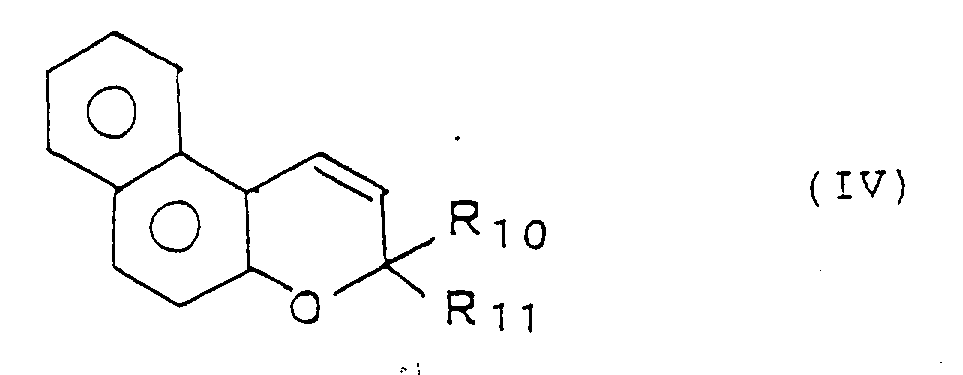
R wherein
10And R
11Represent hydrogen atom, straight or branched C independently of one another
1-C
5Alkyl, phenyl or the similar phenyl, cyclopropyl or the R that are replaced by 1-5 halogen atom (fluorine, chlorine or bromine)
10And R
11Represent C together
5Or C
6Alicyclic radical or adamantyl.
In polymerizable liquid composition of the present invention, the consumption of component (C) (when existing) is counted 0.01-0.5 part (weight), preferred about 0.05 part (weight) with the component (A) of per 100 parts of weight.
Component (D)
The organic dye that can be used for painted synthetic glass belongs to the number of chemical class, for example acridine, forming mould in, be heated 50-120 ℃, polymerization time was generally 1-100 hour.
According to the present invention,, used ketal to have various advantages with regard to the characteristic of this method and gained synthetic glass.Specifically, crossing the ketal storage does not need the special protection measure, and can be dissolved in rapidly in the allyl carbonate (A).Can obtain complete hardened polymerisate with the polymerization of crossing ketal catalyzed carbon allyl propionate (A), it is optical good, therefore can be used for the optics project effectively, for example the sheet glass of ophthalmology safety and lens (plate and lenses).
In addition, according to the present invention, with regard to surface coating technique, have countless by adding in batches the advantage that dyestuff or photochromic compound obtain:
At first, technology is quite easy, and the technology cost reduces greatly, and productive rate improves, and this is owing to the post-processing operation of having eliminated premolding purpose product;
In addition, guaranteed the circulation ratio of the hue and luminance of good persistence and color, this be with the technology that relates to surface-coated can not obtain, so these technology depend on the character (for example its hardness) of premolding purpose product strongly;
At last, can go out from following experimental section, photochromism and photochromic active persistence (life-span of activation/inactivation) are greatly enhanced.
In the following embodiment that the present invention will be further described, used following allyl carbonate (A):
(A
1) reaction product (mol ratio is 12/1) of carbonic acid diallyl (DAC) and glycol ether (DEG).The product that obtains thus is the monomer and the oligomer mixture of two (allyl carbonates) with glycol ether of following composition:
Anthraquinone, azine, monoazo-dyes, disazo dyes, metal pair nitrogen complex, piperidone, benzoquinones, nitro, nitroso-group, phthalocyanine pigment, quinacridone and stilbene.The organic dye that preferably has of the present invention belongs to anthraquinone, piperidone, monoazo-dyes, disazo dyes and phthalocyanine material class.The example that is used for the commercial dyes of this purpose is BLU ESTOFIL RR, the commerical prod of ROSSO ESTOFIL BR and GIALLO ESTOFIL 2R(Sandoz); SOLVAPERM RED BB, the commerical prod of SOLVAPERM YELLOW G and SOLVAPERM BLUEB(Hoechst).According to supplier's difference, such dyestuff has monoazo-dyes, piperidone or anthraquinone class.
In polymerizable liquid composition of the present invention, the consumption of component (D) (when existing) is counted 0.005-0.1 part (weight), preferred 0.02 part (weight) with the component (A) of per 100 parts of weight.
In the specific form of embodiment of the present invention, with the mixture of dyestuff and/or photochromic compound as component (C) with (D) to improve the tone in the optics project, for example if desired or the expectation words, make tone become grey or brown, this is to select by the human consumer in the optics project field is preferential.
Polymerisable liquid composition can contain one or more typical additives in addition in total amount, the for example stable bulky amine (Hals) of light, lubricant, UV.IR light absorber or the like, but the amount of additive is no more than 1 part of the component (A) (weight) of per 100 parts (weight).
A second aspect of the present invention relates to a kind of preparation pigmentable or photochromic synthetic glass, comprises making above-mentioned polymerizable liquid composition carry out radical polymerization.
More particularly, used casting technique comprise polymerisable compound is poured into suitable

Monomer (n=1) 83.3% weight
Dimer (n=2) 10.5% weight
Tripolymer (n=3) 1.1% weight
The tetramer (n=4) 0.1% weight
Physicochemical characteristic:
Viscosity, 25 ℃ of (cst)=13.3
Density, 20 ℃ of (g/ml)=1.1519
(A
2) reaction product (mol ratio 8/1) of carbonic acid diallyl (DAC) and neopentyl glycol (NPG).
The product that obtains thus is monomer and the oligomer mixture with two (allyl carbonate) following composition, neopentyl glycol:

Monomer (n=1) 82% weight
Dimer (n=2) 15% weight
Tripolymer (n=3) 2.4% weight
The tetramer (n=4) 0.4% weight
Physicochemical characteristic:
Viscosity, 25 ℃ of (cst)=53
Density, 20 ℃ of (g/ml)=1.096
(A
3) carbonic acid diallyl (DAC) and glycol ether (DEG) and three (hydroxyethyl) isocyanuric acid ester (THEIC) mixture (have a following ratio: DEG70% weight; THEIC30% weight) reaction product, mol ratio are DAC/(DEG+THEIC)=4/1.
The product that obtains thus is the complex mixture that contains following material:
-according to (A
1) shown in two (allyl carbonate) (monomer and oligomers) of glycol ether of structural formula;
Three (allyl carbonates) (monomer and oligomer) of-three (hydroxyethyl) isocyanuric acid ester:

The allyl carbonate of-blended glycol ether and three (hydroxyethyl) isocyanuric acid ester.
Physicochemical characteristic:
Viscosity, 25 ℃ of (cst)=70
Density, 20 ℃ of (g/ml)=1.2110
(A
4) carbonic acid diallyl (DAC) and neopentyl glycol (NPG) and three (hydroxyethyl) isocyanuric acid ester (THEIC) mixture (have a following ratio: NPG70% weight; THEIC30% weight) reaction product, mol ratio are DAC/(NPG+THEIC)=5/1.
The product that obtains thus is the complex mixture that contains following material:
-by (A
2) shown in two (allyl carbonate) (monomer and oligomers) of neopentyl glycol of structural formula;
-by (A
3) shown in three (allyl carbonates) (monomer and oligomer) of three (hydroxyethyl) isocyanuric acid ester of structural formula; And
The allyl carbonate of-blended neopentyl glycol and three (hydroxyethyl) isocyanuric acid ester.
Physicochemical characteristic:
Viscosity, 25 ℃ of (cst)=80
Density, 20 ℃ of (g/ml)=1.1411
(A
5) carbonic acid diallyl (DAC) and neopentyl glycol (NPG) and three (hydroxyethyl) isocyanuric acid ester (THEIC) mixture (have a following ratio: NPG50% weight; THEIC50% weight) reaction product, mol ratio DAC/(NPG+THEIC)=5/1.
The product that obtains thus is and (A
4) shown in similar mixture, have following physicochemical characteristic:
-viscosity, 25 ℃ of (cst)=261
-density, 20 ℃ of (g/ml)=1.1820
-n
20
D=1.4680
(A
6) carbonic acid diallyl (DAC) and 1,4-butyleneglycol (BD) and three (hydroxyethyl) isocyanuric acid ester (THEIC) mixture (have a following ratio: BD70% weight; THEIC30% weight) reaction product, mol ratio DAC/(BD+THEIC)=4/1.
The product that obtains thus is the complex mixture of following material:
-1, two (allyl carbonate) (monomer and oligomers) of 4-butyleneglycol;
-by (A
3) shown in three (allyl carbonates) (monomer and oligomer) of three (hydroxyethyl) isocyanuric acid ester of structural formula; And
-blended 1, the allyl carbonate of 4-butyleneglycol and three (hydroxyethyl) isocyanuric acid ester.
Physicochemical characteristic:
Viscosity, 25 ℃ of (cst)=39
Density, 20 ℃ of (g/ml)=1.1555
(A
7) carbonic acid diallyl (DAC) and 1,4-butyleneglycol (BD) and three (hydroxyethyl) isocyanuric acid ester (THEIC) mixture (have a following ratio: BD60% weight; THEIC40% weight) reaction product, mol ratio DAC/(BD+THEIC)=3/1.
The product that obtains thus is and (A
6) shown in similar mixture, have following physicochemical characteristic:
Viscosity, 25 ℃ of (cst)=128
Density, 20 ℃ of (g/ml)=1.1880
(A
8) make three (allyl carbonates) of the TriMethylolPropane(TMP) that the carbonic acid diallyl obtains with 18/1 molar ratio reaction with TriMethylolPropane(TMP).
This product (mainly being monomer) can be represented by following formula:

(A
9) make four (allyl carbonates) of the tetramethylolmethane that the carbonic acid diallyl obtains with 24/1 molar ratio reaction with tetramethylolmethane.
This product (mainly being monomer) can be represented by following formula:
(A
10) carbonic acid diallyl (DAC) and neopentyl glycol (NPG), three (hydroxyethyl) isocyanuric acid ester (THEIC) and tetramethylolmethane (PE) mixture (have a following ratio: NPG70% weight; THEIC10% weight; PE20% weight) reaction product, mol ratio DAC/(NPG+THEIC+PE)=3/1.
The product that obtains thus is the monomer of allyl carbonate of used many alcohol and the complex mixture of oligomer, has following physicochemical characteristic:
Viscosity, 25 ℃ of (cst)=92
Density, 20 ℃ of (g/ml)=1.1367
(A
11) carbonic acid diallyl (DAC) and neopentyl glycol (NPG) and tetramethylolmethane (PE) mixture (have a following ratio: NPG70% weight; PE30% weight) reaction product, mol ratio DAC/(NPG+PE)=5/1.
The product that obtains thus is the monomer of allyl carbonate of used many alcohol and the complex mixture of oligomer, has following physicochemical characteristic:
Viscosity, 25 ℃ of (cst)=97.8
Density, 20 ℃ of (g/ml)=1.1355
In an embodiment, also can use the Luo oxazine, it is represented with following formula:

(C
1) 1,3-dihydro-1,3,3-trimethylammonium-spiral shell [2H-indoles-2,3 '-[3H]-naphtho--(2,1-b]-(1,4) oxazines; (III is middle R a) to be equivalent to formula
12-R
16All substituting group is a hydrogen;
(C
2) 1,3-dihydro-1,3,3,4,5-pentamethyl--spiral shell [2H-indoles-2,3 '-[3H]-naphtho--(2,1-b]-((III is middle R a) to be equivalent to formula for (1,4)-oxazines
12=R
13=-CH
3, other substituting group is a hydrogen) and 1,3-dihydro-1,3,3,5,6-pentamethyl--spiral shell [2H-indoles-2,3 '-[3H]-naphthalene-(2,1-b)-(1,4) oxazine [is equivalent to R among the formula III a
13=R
14=-CH
3, all other substituting groups are hydrogen) mixture;
(C
3) 1,3-dihydro-6 '-piperidino-(1-position only)-1,3,3-trimethylammonium-spiral shell [2H-indoles-2,3 '-[3H]-naphtho--(2,1-b) (1,4)-oxazines are to (III is middle R a) corresponding to general formula
15Be the N-piperidyl, other all substituting groups all are hydrogen;
(C
4) 1,3-dihydro-8 '-oxo phenyl-1,3,3-trimethylammonium-spiral shell [2H-indoles-2,3 '-[3H]-naphtho--(2,1-b)-(1,4) oxazine]; (III is middle R a) corresponding to general formula
16For-C(0)-and phenyl, other all substituting groups are hydrogen;
(C
5) 1,3-dihydro-8 '-nitro-1,3,3-trimethylammonium-spiral shell-[2H-indoles-2,3 '-[3H]-naphtho--(2,1-b)-(1,4)-oxazines]; (III is middle R a) corresponding to general formula
16For-NO
2, other all substituting groups are hydrogen;
(C
6) 1,3-dihydro-8 '-oxoethyl-1,3,3-trimethylammonium-spiral shell [2H-indoles-2,3 '-[3H]-naphtho--(2,1-b)-(1,4)-oxazines]; (III is middle R a) corresponding to general formula
16=-C(O)-CH
2-CH
3, wherein its all substituting group all is a hydrogen;
Also use chromene in an embodiment.
(C
7) 3,3-phenylbenzene-3H-naphtho-[2,1-b] pyrans has with general formula:

Wherein Ph is a phenyl.
In embodiment 1 to 12, by following method operation preparation photochromic lens.
With allyl carbonate (A), the ketal 1 excessively of indicatrix among the embodiment, 1-two (t-butylperoxy)-3,3, the photochromic compound (C) of indicatrix mixes among 5-trimethyl-cyclohexane (B component) and the embodiment, and homogenize prepares polymerisable liquid composition.Adopt casting technique commonly used that resulting composition is transformed into the thick lens of 2mm by polymerization.The liquid composition that will contain catalyzer by this technology is poured in the mould cavity of being made up of two glass elements, and its gap seals with the multipolymer (EVA) of plasticity polyvinyl chloride or ethene and vinyl-acetic ester.Make liquid composition in mould, carry out polymerization, promptly in the forced air circulation baking oven, 85 ℃ of heating 5 hours, again 90 ℃ of heating 15 hours, further 100 ℃ of heating 7 hours by thermal treatment.After thermal treatment finishes, open mould, take out polymerisate and measure the following properties of gained photochromic lens:
-Rockwell hardness (scale M) is pressed the ASTMD-785 method
-photochromic characteristic is with the activation in 60 seconds of HP8452A(UVA light irradiation, inwardly radiance 9W/m
2), measure by writing down under 23 ℃ of activation and the inactivated state visible UV spectrum.It is as follows that following properties under activation and the inactivated state is annotated record:
A) O.D.(lambda
Max.UVA) and O.D.(lambda
Max.Vis.): the optical density value that is respectively ultraviolet and visible region under maximum absorption wavelength.
B) Y: tristimulus value, its indication are defined in (the mathematics processing by the two states absorption spectrum obtains) in the 1931CIE rule in the light transmission values of visible region.
C) photochromic activity: be expressed as delta O.D.(lambda
Max.Vis), i.e. lambda in the visible region between activation and the inactivated state
Max.O.D. difference and dealta Y, i.e. difference between the Y light transmission values.
-resistance to fatigue is with having 6, the Atlas Weather-O-Meter(WOM of 500W xenon lamp (Continuous irradiation)) measure, operating on the black contrast dial plate and under 50% the relative humidity condition in 63 ℃.Be exposed to WOM after the different time limits, measure ageing resistance by the residual value shi of measuring photic sex change.
It is heavy that preparation contains 97.5%() allyl carbonate A
4Heavy with 2.5%() 1,1-two (t-butyl peroxy)-3,3, the composition of 5-trimethyl-cyclohexane.Adding 0.1%(weight in composition) photochromic compound C
3, polymerization under Zhi Shi the condition in front.Obtaining Rockwell hardness is 90(M), have the lens of following photochromic characteristic:
The inactivation attitude
O.D.(lambda
maxUVA) 2.551(362nm)
O.D.(lambda
max.vis.) 0.108(572nm)
Y,23℃ 77.8
Activated state
O.D.(lambda
max.vis.) 0.682(572nm)
Y,23℃ 33.6
delta O.D.(lambda
max.vis.) 0.574(572nm)
delta Y 44.2
Be exposed to nearly 150 hours following results of resistance to fatigue experiment generation in the WOM:
50 hours 100 hours 150 hours exposure duration
delta O.D.(lambda
max.vis.)
Residue (572nm) 0.241 0.155 0.087
Delta Y, 23 ℃ of residues 29.3 17.6 11.1
Embodiment 2
It is heavy that preparation contains 97.5%() allyl carbonate A
4Heavy with 2.5%() 1,1-two (t-butyl peroxy)-3,3, the composition of 5-trimethyl-cyclohexane.Adding 0.1%(weight in composition) photochromic compound C
1, polymerization under Zhi Shi the condition in front.Obtaining Rlckwell hardness is 86(M), have the lens of following photochromic characteristic:
The inactivation attitude
O.D.(lambda
maxUVA) 2.808(344nm)
O.D.(lambda
max.vis.) 0.050(598nm)
Y,23℃ 76.0
Activated state
O.D.(lambda
max.vis.) 0.316(598nm)
Y,23℃ 50.9
delta O.D.(lambda
max.vis.) 0.266(598nm)
delta Y 25.1
Be exposed in the WOM resistance to fatigue test in nearly 150 hours and obtain following result:
50 hours 100 hours 150 hours exposure duration
delta O.D.(lambda
max.vis.)
Remaining (600nm) 0.267 0.244 0.250
Delta Y, 23 ℃, remaining 25.4 26.2 24.5
Embodiment 3
It is heavy that preparation contains 97.5%() allyl carbonate A
4Heavy with 2.5%() 1,1-two (t-butyl peroxy)-3,3, the composition of 5-trimethyl-cyclohexane.Adding 0.5%(weight in composition) photochromic compound C
2, polymerization under Zhi Shi the condition in front.Obtaining Rockwell hardness is 91(M), have the lens of following photochromic characteristic:
The inactivation attitude
O.D.(lambda
maxUVA) 3.203(348nm)
O.D.(lambda
max.vis.) 0.063(610nm)
Y,23℃ 73.8
Activated state
O.D.(lambda
max.vis.) 0.386(610nm)
Y,23℃ 44.7
delta O.D.(lambda
max.vis.) 0.323(610nm)
delta Y 25.1
Be exposed to nearly 150 hours following results of resistance to fatigue test generation in the WOM:
50 hours 100 hours 150 hours exposure duration
delta O.D.(lambda
max.vis.)
Remaining (610nm) 0.263 0.235 0.225
Delta Y, 23 ℃, remnants---21.0 20.6
It is heavy that preparation contains 97.5%() allyl carbonate A
4Heavy with 2.5%() 1,1-two (t-butyl peroxy)-3,3, the composition of 5-trimethyl-cyclohexane.Adding 0.1%(weight in composition) photochromic compound C
3Heavy with 0.2%() the commercial HALS stablizer of UVASIL299 type, polymerization under Zhi Shi the condition in front.Obtaining Rockwell hardness is 90.5(M), the lens with following photochromism:
The inactivation attitude
O.D.(lambda
maxUVA) 2.793(360nm)
O.D.(lambda
max.vis.) 0.125(574nm)
Y,23℃ 75.4
Activated state
O.D.(lambda
max.vis.) 0.995(574nm)
Y,23℃ 23.6
delta O.D.(lambda
max.vis.) 0.870(574nm)
delta Y 51.8
Be exposed to nearly 150 hours following results of resistance to fatigue test generation in the WOM:
50 hours 100 hours 150 hours exposure duration
delta O.D.(lambda
max.vis.)
Remaining (572nm) 0.402 0.250 0.223
Delta Y, 23 ℃, remaining 33.0 23.3 19.0
Embodiment 5
It is heavy that preparation contains 97.5%() allyl carbonate A
4Heavy with 2.5%() 1,1-two (t-butyl peroxy)-3,3, the composition of 5-trimethyl-cyclohexane.Adding 0.1%(weight in composition) photochromic compound C
3The 0.2%(weight) HALS stablizer 2,2,6,6-tetramethyl piperidine-4-alcohol, polymerization under Zhi Shi the condition in front.Obtaining Rockwell hardness is 90(M), have the lens of following photochromic characteristic:
The inactivation attitude
O.D.(lambda
maxUVA) 2.774(362nm)
O.D.(lambda
max.vis.) 0.114(572nm)
Y,23℃ 77.1
Activated state
O.D.(lambda
max.vis.) 0.853(572nm)
Y,23℃ 28.1
delta O.D.(lambda
max.vis.) 0.739(572nm)
delta Y 49.0
Be exposed to nearly 150 hours following results of resistance to fatigue test test generation in the WOM:
50 hours 100 hours 150 hours exposure duration
delta O.D.(lambda
max.vis.)
Remaining (570nm) 0.738 0.365 0.282
Delta Y, 23 ℃, remaining 31.2 26.4 19.9
Embodiment 6
It is heavy that preparation contains 99%() allyl carbonate A
4Heavy with 1.0%() 1,1-two (t-butyl peroxy)-3,3, the composition of 5-trimethyl-cyclohexane.Adding 0.1%(weight in composition) photochromic compound C
3, polymerization under Zhi Shi the condition in front.Obtaining Rockwell hardness is 86(M), have the lens of following photochromic characteristic:
The inactivation attitude
O.D.(lambda
maxUVA) 3.159(362nm)
O.D.(lambda
max.vis.) 0.116(572nm)
Y,23℃ 77.0
Activated state
O.D.(lambda
max.vis.) 0.996(572nm)
Y,23℃ 24.2
delta O.D.(lambda
max.vis.) 0.880(572nm)
delta Y 52.8
Be exposed to nearly 150 hours following results of resistance to fatigue generation in the WOM:
60 hours 100 hours 150 hours exposure duration
delta O.D.(lambda
max.vis.)
Remaining (572nm) 0.488 0.424 0.416
Delta Y, 23 ℃, remaining 37.6 35.8 35.0
Embodiment 7
It is heavy that preparation contains 99%() allyl carbonate A
7Heavy with 1.0%() 1,1-two (t-butylperoxy)-3,3, the composition of 5-trimethyl-cyclohexane.Adding 0.1%(weight in composition) photochromic compound C
3, polymerization under Zhi Shi the condition in front.Obtaining Rockwell hardness is 76(M), have the lens of following photochromic characteristic:
The inactivation attitude
O.D.(lambda
maxUVA) 3.142(364nm)
O.D.(lambda
max.vis.) 0.121(572nm)
Y,23℃ 76.1
Activated state
O.D.(lambda
max.vis.) 1.010(572nm)
Y,23℃ 23.5
delta O.D.(lambda
max.vis.) 0.889(572nm)
delta Y 52.6
Be exposed to nearly 150 hours following results of resistance to fatigue test generation in the WOM:
60 hours 100 hours 150 hours exposure duration
delta O.D.(lambda
max.vis.)
Remaining (572nm) 0.447 0.328 0.286
Delta Y, 23 ℃, remaining 34.1 28.5 25.7
Embodiment 8
It is heavy that preparation contains 99%() allyl carbonate A
3Heavy with 1.0%() 1,1-two (t-butyl peroxy)-3,3, the composition of 5-trimethyl-cyclohexane.Adding 0.1%(weight in composition) photochromic compound C
3, polymerization under Zhi Shi the condition in front.Obtaining Rockwell hardness is 80.5(M), have the lens of following photochromic characteristic:
The inactivation attitude
O.D.(lambda
maxUVA) 2.672(378nm)
O.D.(lambda
max.vis.) 0.111(574nm)
Y,23℃ 77.9
Activated state
O.D.(lambda
max.vis.) 0.630(574nm)
Y,23℃ 36.7
delta O.D.(lambda
max.vis.) 0.519(574nm)
delta Y 41.2
It is heavy that preparation contains 97.5%() allyl carbonate A
5Heavy with 2.5%() 1,1-two (t-butyl peroxy)-3,3, the composition of 5-trimethyl-cyclohexane.Adding 0.1%(weight in composition) photochromic compound C
7, polymerization under Zhi Shi the condition in front.Obtaining Rockwell hardness is 95(M), have the lens of following photochromic characteristic:
The inactivation attitude
O.D.(lambda
maxUVA) 1.341(360nm)
O.D.(lambda
max.vis.) 0.341(412nm)
Y,23℃ 90.1
Activated state
O.D.(lambda
max.vis.) 1.026(412nm)
Y,23℃ 82.8
delta O.D.(lambda
max.vis.) 0.685(412nm)
delta Y 7.3
Be exposed to nearly 150 hours following results of resistance to fatigue generation in the WOM:
50 hours 115 hours exposure duration
delta O.D.(lambda
max.vis.) 0.567(412nm) 0.495(430nm)
Remaining
Delta Y, 23 ℃, remaining 7.0 5.7
Embodiment 10
It is heavy that preparation contains 97.5%() allyl carbonate A
5Heavy with 2.5%() 1,1-two (t-butyl peroxy)-3,3, the composition of 5-trimethyl-cyclohexane.Adding 0.06%(weight in composition) photochromic compound C
4, polymerization under Zhi Shi the condition in front.Obtaining Rockwell hardness is 94(M), have the lens of following photochromic characteristic:
The inactivation attitude
O.D.(lambda
maxUVA) 2.969(340nm)
O.D.(lambda
max.vis.) 0.062(614nm)
Y,23℃ 62.5
Activated state
O.D.(lambda
max.vis.) 0.868(614nm)
Y,23℃ 25.2
delta O.D.(lambda
max.vis.) 0.806(614nm)
delta Y 37.3
Embodiment 11
It is heavy that preparation contains 97.5%() allyl carbonate A
5Heavy with 2.5%() 1,1-two (t-butyl peroxy)-3,3, the composition of 5-trimethyl-cyclohexane.Adding 0.06%(weight in composition) photochromic compound C
5, polymerization under Zhi Shi the condition in front.Obtaining Rockwell hardness is 94(M), have the lens of following photochromic characteristic:
The inactivation attitude
O.D.(lambda
maxUVA) 1.661(330nm)
O.D.(lambda
max.vis.) 0.066(612nm)
Y,23℃ 72.6
Activated state
O.D.(lambda
max.vis.) 0.195(612nm)
Y,23℃ 60.6
5 delta O.D.(lambda
max.vis.) 0.129(612nm)
delta Y 12.0
Embodiment 12
It is heavy that preparation contains 97.5%() allyl carbonate A
5Heavy with 2.5%() 1,1-two (t-butylperoxy)-3,3, the composition of 5-trimethyl-cyclohexane.Adding 0.06%(weight in composition) photochromic compound C
6, polymerization under Zhi Shi the condition in front.Obtaining Rockwell hardness is 92(M), have the lens of following photochromic characteristic:
The inactivation attitude
O.D.(lambda
maxUVA) 2.904(334nm)
O.D.(lambda
max.vis.) 0.070(614nm)
Y,23℃ 63.2
Activated state
O.D.(lambda
max.vis.) 0.762(614nm)
Y,23℃ 28
delta O.D.(lambda
max.vis.) 0.692(614nm)
delta Y 35.2
Method operation preparation tinted lenses below embodiment 13 presses in 27.
Indicatrix among allyl carbonate (A), the embodiment is crossed ketal 1,1-two (t-butyl peroxy)-3,3, the mixing of the pigment (D) of explanation amount, homogenize among 5-trimethyl-cyclohexane (B component) and the embodiment, preparation polymerizable liquid composition.Adopt casting technique commonly used, the composition polymerization is transformed into 2mm or the thick lens of 3mm.Make the composition polymerization with heat treating method, that is: procedure operation below pressing in forced air circulation furnace: 85 ℃ of heating 5 hours, 90 ℃ were heated 15 hours, and 100 ℃ (were heated 7 hours.Thermal treatment is opened mould after finishing, and obtains polymerization product, and measures the following properties of gained lens:
-in the transmittance (%) of visible region: measure with Gardner Hazegard XL-211 instrument (ASTM D-10003);
-Rockwell hardness (M) is measured with Rockwell sclerometer (ASTM D-785);
-color is used colour L
*, a
*And b
*Expression is measured by CIE rule in 1976.Operate under the measuring condition below with MACBETH 1500 PLUS spectrometers: light source is a C/2 ° of type; Do not comprise specular light, do not comprise UV.
Embodiment 13-20
It is heavy that preparation contains 97.5%() allyl carbonate A
5Heavy with 2.5%() 1,1-two (t-butyl peroxy)-3,3, the composition of 5-trimethyl-cyclohexane.The pigment of representing with its trade(brand)name below adding in composition adds by the indicatrix that is expressed as the composition itself weight percent:
-embodiment 13:BLU ESTOFIL RR, 0.025%;
-embodiment 14:SOLVAPERM BLUE B, 0.025%;
-embodiment 15:SOLVAPERM RED BB, 0.025%;
-embodiment 16:GIALLO ESTOFIL 2R, 0.050%;
-embodiment 17:ROSSO ESTOFIL BR, 0.050%;
-embodiment 18:BLU ESTOFIL RR, 0.015%;
-embodiment 19:GIALLO ESTOFIL 2R; 0.050%;
-embodiment 20:SOLVAPERM RED BB, 0.020%.
Polymerization is carried out under these conditions, and producing thickness is 3mm(embodiment 13-17) or 2mm(embodiment 18-20) lens, measure the characteristic that the according to the form below of lens is listed.
Embodiment hardness transmittance (%) L
*a
*b
*
13 111 8.7 34.6 30.1 -61.1
14 110 4.6 24.4 7.9 -24.9
15 111 20.3 51.8 75.9 30.7
16 111 89.1 95.3 -24.9 76.4
17 111 22.8 53.5 64.8 98.3
18 103 33.6 64.2 5.4 -39.8
19 108 89.7 95.2 -24.6 72.3
20 109 24.1 60.1 73.8 2.3
Embodiment 21-23
It is heavy that preparation contains 97.5%() allyl carbonate A
1Heavy with 2.5%() 1,1-two (t-butyl peroxy)-3,3, the composition of 5-trimethyl-cyclohexane.The pigment that provides with its trade(brand)name below in composition, adding, the indicatrix of representing by the composition itself weight percent adds:
-embodiment 21:BLU ESTOFIL RR, 0.015%;
-embodiment 22:GIALLO ESTOFIL 2R, 0.050%;
-embodiment 23:SOLVAPERM RED BB, 0.020%.
Polymerization is carried out under these conditions, produces the thick lens of 2mm, characteristic shown in the following table of mensuration lens:
Embodiment hardness transmittance (%) L
*a
*b
*
21 86 46.3 71.8 -2.2 -18.0
22 85 90.3 94.5 -23.9 67.8
23 85 46.4 70.6 46.8 -3.5
Embodiment 24-27
Embodiment 24-27
It is heavy that preparation contains 98.5%() allyl carbonate A
3Heavy with 1.5%() 1,1-two (t-butylperoxy)-3,3, the composition of 5-trimethyl-cyclohexane.The pigment that provides with its trade(brand)name below in composition, adding, the indicatrix of representing by the composition itself weight percent adds:
-embodiment 24:BLU ESTOFIL RR, 0.015%;
-embodiment 25:GIALLO ESTOFIL 2R, 0.050%;
-embodiment 26:SOLVAPERM RED BB, 0.020%.
-embodiment 27:SOLVAPERM YELLOW G, 0.050%.
Polymerization is carried out under these conditions, produces the thick lens of 2mm, characteristic shown in the following table of mensuration lens:
Embodiment hardness transmittance (%) L
*a
*b
*
24 90 29.9 62.3 1.5 -34.9
25 94 89.9 95.3 -24.6 70.7
26 90 32.5 63.0 69.6 -4.1
27 84 84.3 93.1 -18.5 99.6
Embodiment 13-27 the results are shown among appended 1,2,3 and 4 figure, wherein a
*And b
*A pair of value allows to observe apace the tone of each product.
In the following example 28-34, prepare colourless sheet glass.
In detail, accounting for 1 of mixture weight 2.5%, 1-two (t-butyl peroxy)-3,3 prepares sheet glass in 5-trimethyl-cyclohexane (as initiator) the adding allyl carbonate.With casting technique commonly used the composition polymerization that contains catalyzer is transformed into the thick sheet glass of 3mm.By this technology the liquid composition that contains catalyzer is poured in the mould cavity of being made up of two glass elements, its gap seals with the multipolymer of plasticity polyvinyl chloride or ethene and vinyl-acetic ester (EVA).By following program, make the composition polymerization by heat treating method in the forced air circulation baking oven: 85 ℃ were heated 7 hours, and 90 ℃ were heated 16 hours, and 100 ℃ were heated 7 hours.After the thermal treatment, open mould, take out polymerization product, and make it keep decomposing in 2 hours the residual initiator of possibility again, make possible inner tensions lax at 110 ℃.
The following properties of assay plate glass:
A) optical characteristics:
-specific refractory power (n
20
D): measure with Abbe refractometer (ASTM D-542);
The transmittance of-optical haze and visible region (%):
Hazegard XL-21 device (ASTM D-1003) with Gardner is measured;
-yellowness index (YI) (ASTM D-1925) is defined as:
YI= 100/(Y) (1.277X-1.06Z)
With MACBETH1500 and spectrometer measurement
B) physics and mechanical characteristics:
-density: measure (ASTM D-792) with specific gravity balance at 20 ℃;
Volumetric shrinkage in the-polymerization (contraction), calculate with following formula:
Shrinking percentage %=((density polymer-monomer density))/((density polymer)) * 100
-Rockwell hardness (M): measure with Rockwell sclerometer (ASTM D-785);
-beam type intensity (not indentation, ASTM D256)
Heat-drawn wire under the-year 1.82MPa (℃) (HDT) (ASTM D-648)
Embodiment 28
Preparation contains 97.5%(weight) allyl carbonate A
1With 2.5%(weight) 1,1-two (t-butyl peroxy)-3,3, the polymerizable liquid composition of 5-trimethyl-cyclohexane, carry out polymerization by casting under these conditions, sheets thus obtained glass be complete polymeric, transparent, do not have optical defect and have following properties:
Optical haze (%) 0.17
Transmittance (%) 92.6
YI 1.80
Density, 20 ℃ 1.2105
Shrink (%) 9.5
Rockwell hardness, M 100
Beam type intensity (DJ/m
2) 6.7
HDT(℃) 72.5
Embodiment 29
Preparation contains 97.5%(weight) allyl carbonate A
2With 2.5%(weight) 1,1-two (t-butyl peroxy)-3,3, the polymerizable liquid composition of 5-trimethyl-cyclohexane carries out polymerization by casting under these conditions, sheets thus obtained glass has following properties:
Optical haze (%) 0.18
Transmittance (%) 92.5
YI 2.3
Density, 20 ℃ 1.2485
Shrink (%) 8.6
Rockwell hardness, M 105
Beam type intensity (DJ/m
2) 17.3
HDT(℃) 76
Embodiment 30
Preparation contains 97.5%(weight) allyl carbonate A
3With 2.5%(weight) 1,1-two (t-butyl peroxy)-3,3, the polymerizable liquid composition of 5-trimethyl-cyclohexane carries out polymerization by casting under these conditions, sheets thus obtained glass has following properties:
Optical haze (%) 0.22
Transmittance (%) 91.4
YI 4.6
Density, 20 ℃ 1.2910
Shrink (%) 8.5
Rockwell hardness, M 116
Beam type intensity (DJ/m
2) 10.7
HDT(℃) 100
Embodiment 31
Preparation contains 97.5%(weight) allyl carbonate A
2And A
8(weight ratio is 70/30) and 2.5%(weight) 1,1-two (t-butyl peroxy)-3,3, the polymerizable liquid composition of 5-trimethyl-cyclohexane carries out polymerization by casting under these conditions, sheets thus obtained glass has following properties:
Optical haze (%) 0.3
Transmittance (%) 92.2
YI 2.0
Density, 20 ℃ 1.2282
Rockwell hardness, M 104
Beam type intensity (DJ/m
2) 6.3
HDT(℃) >130
Embodiment 32
Preparation contains 97.5%(weight) allyl carbonate A
2And A
9(weight ratio 70/30) mixture and 2.5%(weight) 1,1-two (t-butyl peroxy)-3,3, the polymerizable liquid composition of 5-trimethyl-cyclohexane carries out polymerization by casting under these conditions, sheets thus obtained glass has following properties:
Optical haze (%) 0.4
Transmittance (%) 92.0
YI 2.9
Density, 20 ℃ 1.2426
Rockwell hardness, M 117
Beam type intensity (DJ/m
2) 6.1
HDT(℃) >130
Embodiment 33
Preparation contains 97.5%(weight) allyl carbonate A
6With 2.5%(weight) 1,1-two (t-butyl peroxy)-3,3, the polymerizable liquid composition of 5-trimethyl-cyclohexane carries out polymerization by casting under these conditions, sheets thus obtained glass has following properties:
Optical haze (%) 0.26
Transmittance (%) 92.5
YI 1.87
Density, 20 ℃ 1.2882
Shrink (%) 10.3
Rockwell hardness, M 96
Beam type intensity (DJ/m
2) 19.5
HDT(℃) 60
Embodiment 34
Preparation contains 97.5%(weight) allyl carbonate A
7With 2.5%(weight) 1,1-two (t-butyl peroxy)-3,3, the polymerizable liquid composition of 5-trimethyl-cyclohexane carries out polymerization by casting under these conditions, sheets thus obtained glass has following properties:
Optical haze (%) 0.22
Transmittance (%) 92.0
YI 3.89
Density, 20 ℃ 1.3064
Shrink (%) 9.1
Rockwell hardness, M 98
Beam type intensity (DJ/m
2) 30.5
HDT(℃) 66
Among the embodiment 35 and 36, prepare colourless sheet glass below.In detail, accounting for 1 of mixture weight 2.0%, 1-two (t-butyl peroxy)-3,3 prepares sheet glass in 5-trimethyl-cyclohexane (as initiator) the adding allyl carbonate.By polymerization the composition that contains catalyzer is transformed into the thick sheet glass of 3mm with casting technique commonly used.By this technology the liquid composition that contains catalyzer is poured in the mould cavity of being made up of two glass elements, its gap seals with the multipolymer of plasticity polyvinyl chloride or ethene and vinyl-acetic ester (EVA).In the forced air circulation baking oven, make composition in 95 ℃ of heating 24 hours by heat treating method, last, open mould, take out polymerization product, and make it keep decomposing in 2 hours the residual initiator of possibility again at 110 ℃, make possible inner tensions lax.
Gained sheet glass is estimated above-mentioned characteristic.
Embodiment 35
Preparation contains 98%(weight) allyl carbonate A
10With 2%(weight) 1,1-two (t-butyl peroxy)-3,3, the polymerizable liquid composition of 5-trimethyl-cyclohexane carries out polymerization by casting under these conditions, the sheet glass that obtains thus has following characteristic:
Optical haze (%) 0.25
Transmittance (%) 92.7
YI 1.60
Density, 20 ℃ 1.2483
Shrink (%) 9.0
Rockwell hardness, M 105
Beam type intensity (DJ/m
2) 22
HDT(℃) 101
Embodiment 36
Preparation contains 98%(weight) allyl carbonate A
7With 2%(weight) 1,1-two (t-butyl peroxy)-3,3, the polymerizable liquid composition of 5-trimethyl-cyclohexane carries out polymerization by casting under these conditions.Sheets thus obtained glass has following properties:
Optical haze (%) 0.30
Transmittance (%) 92.8
YI 1.25
Density, 20 ℃ 1.2501
Shrink (%) 9.2
Rockwell hardness, M 108
Beam type intensity (DJ/m
2) 16
HDT(℃) >170
Claims (17)
- The liquid composition that 1, can synthesize colorable and/or photochromic synthetic glass by radical polymerization, it comprises polymerisable allyl carbonate, under polymerizing condition, can produce the polymerization starter of free radical and also possible a kind of dyestuff and/or photochromic compound, it is characterized in that:(A) this polymerisable allyl carbonate is a kind of straight or branched aliphatics C at least 3-C 10Many (allyl carbonates) of many alcohol, or cycloaliphatic ring C 5-C 16Many (allyl carbonates) of many alcohol, the many alcohol of this in the molecule close 2 to 6 hydroxyls, and these many (allyl carbonates) present the mixture of monomer or monomer and relevant oligomer;(B) this polymerization starter, promptly radical source is a kind of compound of selecting from cross ketal group at least;(C) this photochromic compound is a kind of photochromic compounds of selecting from the group of spiro-pyrans, spirooxazine, chromene and fulgide at least; And(D) this dyestuff is a kind of pigment dyestuff at least.
- 2,, it is characterized in that these many (allyl carbonates) according to the composition in the claim 1(A) select from following:Two (allyl carbonate) of-dibasic alcohol: glycol ether, dipropylene glycol, triglycol, Tetraglycol 99,1, ammediol, 1,4-butyleneglycol, 1,5-pentanediol, 1,6-hexylene glycol, neopentyl glycol, 3-methyl isophthalic acid, 5-pentanediol, 2-methyl-2-ethyl-1, ammediol, 2,2-diethyl-1, ammediol, 2,2,4-trimethylammonium-1,3-pentanediol, 1,4-dimethanol hexanaphthene, 4, two (methylol)-(5210 of 8- 2,6) tristane.Three (allyl carbonates) of-trivalent alcohol: glycerine, trihydroxymethyl propane and trihydroxyethyl isocyanuric ester;Four (allyl carbonates) of-tetramethylolmethane;Own (allyl carbonate) of-Dipentaerythritol;-from the above-mentioned blended two (allyl carbonate) of enumerating at least two kinds of dibasic alcohol selecting the thing; And-at least a the dibasic alcohol of from above-mentioned act row thing, selecting and the mixing many (allyl carbonates) of at least a polyvalent alcohol.
- 3,, it is characterized in that these many (allyl carbonates) are according to the composition in the claim 2:-(ⅰ) two (allyl carbonate) of the mixture of glycol ether monomer or monomer and corresponding oligomer;-(ⅱ) two (allyl carbonate) of neopentyl glycol monomer or monomer and the mixture of relevant oligomer;-(ⅲ) mixing many (allyl carbonates) of glycol ether and tris(2-hydroxy ethyl)isocyanurate;-(ⅳ) mixing many (allyl carbonates) of neopentyl glycol and three (hydroxyethyl) isocyanuric acid ester;-(ⅴ) 1, the mixing many (allyl carbonates) of 4-butyleneglycol and three (hydroxyethyl) isocyanuric acid ester;-(ⅵ) mixing many (allyl carbonates) of glycol ether and tetramethylolmethane;-(ⅶ) three (allyl carbonates) of trihydroxymethyl propane; Or-(ⅷ) four (allyl carbonates) of tetramethylolmethane.
- 4,, it is characterized in that component (B) is from together with selecting the diperoxy thing according to the composition in the claim 1:Wherein, R represents tertiary alkyl, preferably the tertiary butyl or tert-pentyl; R ' and R " represent alkyl alone, as methyl, ethyl, propyl group, butyl, this alkyl can contain non-interferential functional group, as the alkyl ester group of chain end; Perhaps R ' and R " form a cycloalkylidene with the carbon atom that is connected them, cyclohexylidene preferably, it can have one or more alkyl substituents, best 1 to 3 methyl; Ring is together with the diperoxy thing; With the ring together with three superoxide.
- 5,, it is characterized in that this component (B) selects from following compound according to the composition in the claim 4: 2,2-two (t-butyl peroxy) butane; 4,4-two (t-butylperoxy) valeric acid n-butyl; 3,3-two (t-butylperoxy) valeric acid ethyl ester; 1,1-two (t-butylperoxy) hexanaphthene; 1,1-two (t-butylperoxy) 3,3,5-trimethylammonium-hexanaphthene; 3,3,6,6-tetramethyl--1,2,4,5-four oxanes; 3,6-diethyl-3,6-dimethyl-1,2,4,5-four oxanes; 7,8,15,16-four oxa-s two spiral shells (5,2,5,2)-n-Hexadecane; With 3,3,6,6,9,9-vegolysen, 2,4,5-four oxygen basic ring nonanes.
- 6,, it is characterized in that it contains the component of per 100 parts of weights (A), 0.5 to 5.0 part of weight, the component (B) of best 0.8 to 2.5 part of weight according to the composition in the claim 1.
- 7,, it is characterized in that this component (C) selects from the spirooxazine with following formula according to the composition in the claim 1:
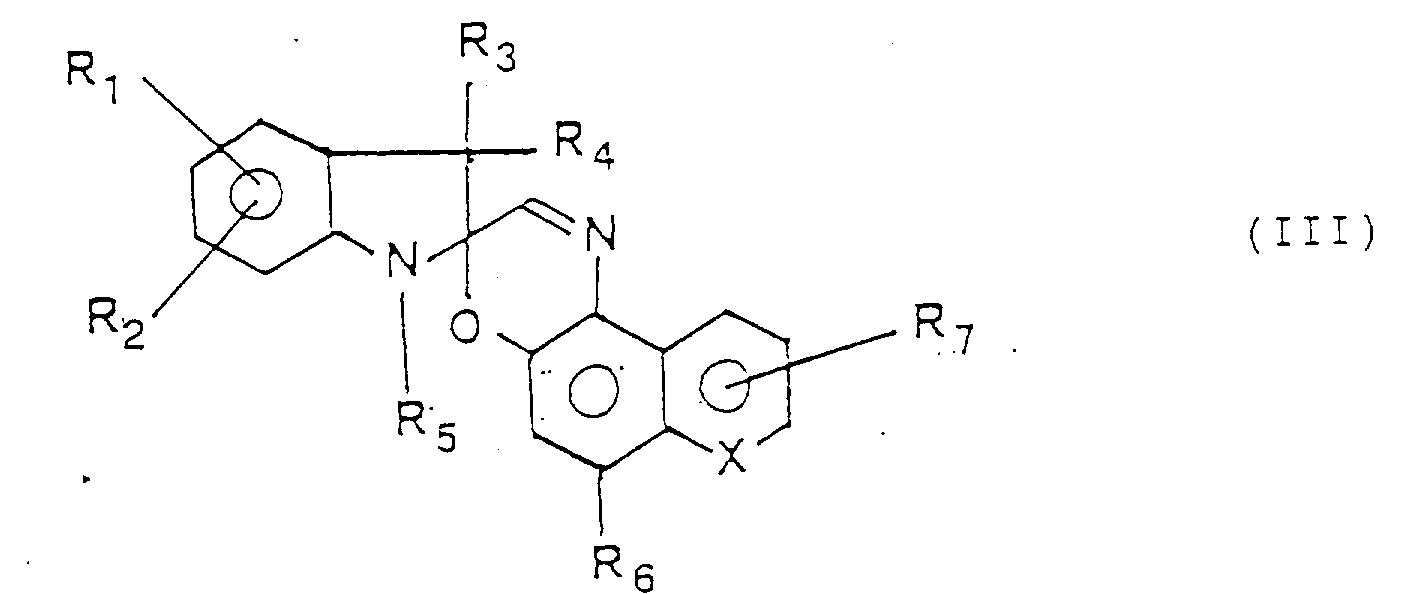 Wherein: R 1, R 2Represent hydrogen atom alone, halogen atom (fluorine, chlorine, bromine); Or C 1-C 5The straight or branched alkyl; C 1-C 5Alkoxyl group; Nitro or cyano group;R 3And R 4Represent C alone 1-C 5The straight or branched alkyl; Phenyl or benzyl; Or R 3And R 4Form C with the carbon atom that connects them 5-C 8Cycloalkyl;R 5Represent C 1-C 5Straight or branched alkyl, or the similar alkyl of one or more hydroxyl replacement, C 1-C 5Alkoxyl group or C 1-C 5Carboxyalkyl; Phenyl, benzyl; Or allyl group;R 6Represent hydrogen atom; C 1-C 5The straight or branched alkyl; Or-NR 8R 9Base, wherein R 8Represent C 1-C 5The straight or branched alkyl, phenyl, benzyl, R 9Represent hydrogen atom, or and R 8Same definition is arranged, or R 8And R 9Form in 5 to 12 ring structures and the chain with the nitrogen-atoms that connects them and may contain the heteroatoms of from oxygen and nitrogen, selecting;R 7Represent hydrogen atom; Halogen atom (fluorine, chlorine, bromine), or straight or branched C 1-C 5Alkyl; C 1-C 5Alkoxyl group; Cyano group; Nitro; Sulfo group; Ester moiety contains the carboxylic acid ester groups of 1 to 3 carbon atom; C 1-C 5Oxoalkyl group or oxo aryl; Or R 7Represent aromatic ring or annelated heterocycles;AndX represents CH or N
 - 8,, it is characterized in that in this logical formula III according to the composition in the claim 7:R 1And R 2Represent hydrogen atom or methyl alone;R 3And R 4Represent methylidenes or represent cyclohexyl together all;R 5Represent methylidene;R 6Represent hydrogen atom or-NR 8R 9Base, R 8And R 9Form one with the nitrogen-atoms that connects them and contain piperidyl, pyrrolidyl, the structure of morpholino or inferior hexamethyl amine ring;R 7Represent hydrogen atom, nitro, or oxo methyl, oxoethyl, or oxygen base phenyl; AndX represents CH.
- 9,, it is characterized in that selecting in the chromene of this component (C) from following general formula according to the composition in the claim 1:
 Wherein, R 10And R 11Represent hydrogen atom alone, straight or branched C 1-C 5Alkyl, phenyl is by the similar phenyl that 1 to 5 halogen atom (fluorine, chlorine, bromine) replaces, cyclopropyl, or R 10And R 11Represent 5 yuan or 6 yuan of alicyclic radicals or adamantyl together.
 - 10,, it is characterized in that it contains 0.01 to 0.05 part of weight of the component of per 100 parts of weights (A), the component of preferably about 0.05 part of weight (C) according to the composition in the claim 1.
- 11,, it is characterized in that this component (D) selects from following material: acridine, anthraquinone, azine, monoazo-dyes according to the composition in the claim 1, disazo dyes, metal pair nitrogen complex, piperidone, benzoquinones, nitro, nitroso-group, phthalocyanine pigment, quinacridone and stilbene.
- 12,, it is characterized in that this component (D) selects from following material: anthraquinone, piperidone, monoazo-dyes, disazo dyes and phthalocyanine pigment class according to the composition in the claim 11.
- 13,, it is characterized in that it contains component (D), the component (D) of 0.005 to 0.1 part of weight of the component of wherein per 100 parts of weights (A), the component of preferably about 0.02 part of weight (D) according to the composition in the claim 1.
- 14,, it is characterized in that it also comprises additive below one or more in addition according to the composition in the claim 1: stablize bulky amine (Hals) as light, lubricant, UV, IR light absorber or the like, but its total amount is no more than 1% of component (A) weight.
- 15, the method for preparing pigmentable or photochromic synthetic glass is characterized in that the polymerizable liquid composition among the claim 1-14 adopts radical polymerization.
- 16, according to the method in the claim 15, it is characterized in that adopting and water foundry engieering, polymerisable compound to be poured into the mould internal heating in 50-120 ℃ of scope, carry out polymerization, polymerization time was generally 1 to 100 hour.
- 17, according to the synthetic glass of the method for claim 15 or 16 preparation.
Applications Claiming Priority (2)
| Application Number | Priority Date | Filing Date | Title |
|---|---|---|---|
| ITMI92A002492 | 1992-10-30 | ||
| ITMI922492A IT1257700B (en) | 1992-10-30 | 1992-10-30 | COMPOSITION AND PROCEDURE FOR THE PREPARATION OF ORGANIC GLASS |
Publications (1)
| Publication Number | Publication Date |
|---|---|
| CN1087355A true CN1087355A (en) | 1994-06-01 |
Family
ID=11364202
Family Applications (1)
| Application Number | Title | Priority Date | Filing Date |
|---|---|---|---|
| CN93119834.8A Pending CN1087355A (en) | 1992-10-30 | 1993-10-30 | Composition and method that the preparation synthetic glass is used |
Country Status (12)
| Country | Link |
|---|---|
| US (1) | US5599876A (en) |
| EP (1) | EP0595424B1 (en) |
| JP (1) | JPH072938A (en) |
| CN (1) | CN1087355A (en) |
| AT (1) | ATE166076T1 (en) |
| AU (1) | AU660565B2 (en) |
| BR (1) | BR9304435A (en) |
| DE (1) | DE69318511T2 (en) |
| DK (1) | DK0595424T3 (en) |
| ES (1) | ES2115007T3 (en) |
| IT (1) | IT1257700B (en) |
| SG (1) | SG74542A1 (en) |
Cited By (3)
| Publication number | Priority date | Publication date | Assignee | Title |
|---|---|---|---|---|
| CN101386473B (en) * | 2008-09-09 | 2011-05-25 | 山东嘉业日用制品有限公司 | Method for producing tie-dyeing texture colored glass products |
| CN106905455A (en) * | 2017-02-22 | 2017-06-30 | 江苏康耐特光学有限公司 | A kind of refractive index is 1.50 photochromic resin lens and preparation method thereof |
| CN107949583A (en) * | 2015-09-16 | 2018-04-20 | 三井化学株式会社 | Polymerizable composition, polymerizable composition, using said composition organic glass manufacture method and organic glass |
Families Citing this family (10)
| Publication number | Priority date | Publication date | Assignee | Title |
|---|---|---|---|---|
| EP0805363B1 (en) * | 1996-04-29 | 2001-09-05 | VISUAL OPTICAL SYSTEM di Casati Carla & C. s.a.s. | Photochromatic polymeric material for lenses and screens with filtering properties for near IR radiation |
| US6316570B1 (en) | 1999-06-23 | 2001-11-13 | Ppg Industries Ohio, Inc. | Polymerizable composition of aliphatic polyol (allyl carbonate) |
| IT1313659B1 (en) * | 1999-10-01 | 2002-09-09 | Great Lakes Chemical Europ | POLYMERIZABLE LIQUID COMPOSITION IN PHOTOCROMATIC ORGANIC GLASSES. |
| IT1318450B1 (en) * | 2000-04-06 | 2003-08-25 | Great Lakes Chemical Europ | MARBLE OR ARTIFICIAL GRANITE FORMING COMPOSITION. |
| US10407540B2 (en) * | 2015-09-08 | 2019-09-10 | Ppg Industries Ohio, Inc. | Composition for optical articles and optical articles made therewith |
| JP6607958B2 (en) | 2015-11-27 | 2019-11-20 | 三井化学株式会社 | Polymerizable composition for optical material, optical material obtained from the composition, and plastic lens |
| ITUA20162086A1 (en) | 2016-03-29 | 2017-09-29 | Mitsui Chemicals Inc | POLYMERIZED COMPOSITION BASED ON MONOMERI ALLILCARBONATO, A POLYMERIZED PRODUCT OBTAINED FROM SUCH COMPOSITION AND RELATED USES. |
| KR102160368B1 (en) * | 2016-08-16 | 2020-09-25 | 피피지 인더스트리즈 오하이오 인코포레이티드 | Polymerizable composition for optical articles |
| CN110291122B (en) | 2017-02-21 | 2022-03-01 | 三井化学株式会社 | Polymerizable composition for optical material, optical material obtained from the composition, and plastic lens |
| IT201900020979A1 (en) | 2019-11-12 | 2021-05-12 | Mitsui Chemicals Inc | WHITENING AGENT, PREPARATION AND USE OF THE SAME WITH CURABLE COMPOSITIONS FOR OPTICAL MATERIALS. |
Family Cites Families (10)
| Publication number | Priority date | Publication date | Assignee | Title |
|---|---|---|---|---|
| GB1186987A (en) * | 1967-08-30 | 1970-04-08 | Fuji Photo Film Co Ltd | Photochromic Compounds |
| US4215010A (en) * | 1978-09-08 | 1980-07-29 | American Optical Corporation | Photochromic compounds |
| US4396737A (en) * | 1981-11-19 | 1983-08-02 | Ppg Industries, Inc. | Polymerization of polyol allyl carbonate using polymerization initiators of short and long half lives |
| EP0080339A3 (en) * | 1981-11-23 | 1983-07-20 | Ppg Industries, Inc. | Colored monomer composition, method of polymerizing the composition, and polymerizate formed thereby |
| JPS58167124A (en) * | 1982-03-29 | 1983-10-03 | Nippon Oil & Fats Co Ltd | Manufacture of plastic lens |
| US4829136A (en) * | 1988-05-13 | 1989-05-09 | Ppg Industries, Inc. | Compositions for producing polymers of high refractive index |
| US4994208A (en) * | 1989-04-18 | 1991-02-19 | Ppg Industries, Inc. | Photochromic polymeric article |
| US5034485A (en) * | 1990-05-30 | 1991-07-23 | The Dow Chemical Company | Multifunctional cyclobutarene peroxide polymerization initiators |
| IT1243977B (en) * | 1990-08-29 | 1994-06-28 | Enichem Sintesi | POLYMERIZABLE LIQUID COMPOSITION IN LOW COLORING ORGANIC GLASSES AND GOOD COLORABILITY |
| US5200483A (en) * | 1991-11-07 | 1993-04-06 | Ppg Industries, Inc. | Polyol(allyl carbonate) composiitons and articles prepared there from |
-
1992
- 1992-10-30 IT ITMI922492A patent/IT1257700B/en active IP Right Grant
-
1993
- 1993-10-26 AU AU50261/93A patent/AU660565B2/en not_active Ceased
- 1993-10-27 SG SG1995002328A patent/SG74542A1/en unknown
- 1993-10-27 ES ES93203005T patent/ES2115007T3/en not_active Expired - Lifetime
- 1993-10-27 US US08/143,940 patent/US5599876A/en not_active Expired - Lifetime
- 1993-10-27 DK DK93203005T patent/DK0595424T3/en active
- 1993-10-27 DE DE69318511T patent/DE69318511T2/en not_active Expired - Fee Related
- 1993-10-27 AT AT93203005T patent/ATE166076T1/en not_active IP Right Cessation
- 1993-10-27 EP EP93203005A patent/EP0595424B1/en not_active Expired - Lifetime
- 1993-10-29 BR BR9304435A patent/BR9304435A/en not_active IP Right Cessation
- 1993-10-30 CN CN93119834.8A patent/CN1087355A/en active Pending
- 1993-11-01 JP JP5296139A patent/JPH072938A/en active Pending
Cited By (4)
| Publication number | Priority date | Publication date | Assignee | Title |
|---|---|---|---|---|
| CN101386473B (en) * | 2008-09-09 | 2011-05-25 | 山东嘉业日用制品有限公司 | Method for producing tie-dyeing texture colored glass products |
| CN107949583A (en) * | 2015-09-16 | 2018-04-20 | 三井化学株式会社 | Polymerizable composition, polymerizable composition, using said composition organic glass manufacture method and organic glass |
| CN106905455A (en) * | 2017-02-22 | 2017-06-30 | 江苏康耐特光学有限公司 | A kind of refractive index is 1.50 photochromic resin lens and preparation method thereof |
| CN106905455B (en) * | 2017-02-22 | 2021-10-26 | 江苏康耐特光学有限公司 | Photochromic resin lens with refractive index of 1.50 and preparation method thereof |
Also Published As
| Publication number | Publication date |
|---|---|
| IT1257700B (en) | 1996-02-01 |
| US5599876A (en) | 1997-02-04 |
| AU5026193A (en) | 1994-05-12 |
| DE69318511D1 (en) | 1998-06-18 |
| ATE166076T1 (en) | 1998-05-15 |
| EP0595424B1 (en) | 1998-05-13 |
| DE69318511T2 (en) | 1998-11-26 |
| JPH072938A (en) | 1995-01-06 |
| EP0595424A2 (en) | 1994-05-04 |
| ITMI922492A1 (en) | 1994-04-30 |
| ES2115007T3 (en) | 1998-06-16 |
| EP0595424A3 (en) | 1995-07-05 |
| SG74542A1 (en) | 2000-08-22 |
| BR9304435A (en) | 1994-08-16 |
| DK0595424T3 (en) | 1999-01-18 |
| ITMI922492A0 (en) | 1992-10-30 |
| AU660565B2 (en) | 1995-06-29 |
Similar Documents
| Publication | Publication Date | Title |
|---|---|---|
| CN1087355A (en) | Composition and method that the preparation synthetic glass is used | |
| CN1216938C (en) | Curable composition, cured product thereof, photochromic optical material, and manufacturing method thereof | |
| CN1156834C (en) | Optical recording medium | |
| CN1059501C (en) | Protective cover for display devices comprising high-hard transparent resin | |
| CN1513175A (en) | Optical data carrier comprising merocyanine dyes as light-absorbing compounds in the information layer | |
| CN1032791A (en) | The amphyl of tetrahydrochysene sulfo-pyrans | |
| CN1733740A (en) | Candle wax compositions stabilized with UV absorber-metal combinations | |
| CN1070650A (en) | Preparation method of bridged metallocene compound and catalyst component and olefin polymerization method | |
| CN1025206C (en) | Coatings and methods of coating articles thereof | |
| CN1545700A (en) | Optical data carrier comprising cationic aminoheterocyclic dye as light absorber compound in information layer | |
| CN1875034A (en) | Styrene copolymer and process for producing the same | |
| CN1427990A (en) | Use of light-absorbing compounds in information layer of optical data carriers, and optical data carriers | |
| CN1289617C (en) | Method for coloring wood with water-based wood stain | |
| CN1249050C (en) | Acrylate compounds and use | |
| CN1243812C (en) | Nematic crystal composition, its producing process and liquid crystal display element | |
| CN1214240C (en) | Computer color matching method and apparatus | |
| CN1729266A (en) | Photochromic compositions and light-transmitting articles | |
| CN1531724A (en) | Optical data storage medium containing heterocyclic azo dye as light-absorbing compound in information layer | |
| CN1174398C (en) | Optical recording medium and dipyrromethene metal chelate compound for use therein | |
| CN1778854A (en) | Acetacetic acid alkyl ester metal chelate coating drier and production thereof | |
| CN1163363C (en) | optical recording medium | |
| CN1636999A (en) | Benzobisazole-base compound | |
| CN1748004A (en) | Azo metal dyes and optical data carriers containing such azo metal dyes as light-absorbing compounds in the information layer | |
| CN1237985A (en) | New polymer compositions, graft copolymers and thermoplastic compounds with cross-linking gradients made of such compositions | |
| CN101040010A (en) | 4,4'-diazobenzanilide dyestuffs |
Legal Events
| Date | Code | Title | Description |
|---|---|---|---|
| C06 | Publication | ||
| PB01 | Publication | ||
| C10 | Entry into substantive examination | ||
| SE01 | Entry into force of request for substantive examination | ||
| C01 | Deemed withdrawal of patent application (patent law 1993) | ||
| WD01 | Invention patent application deemed withdrawn after publication |