Detailed Description
The principles and features of this invention are described below in conjunction with the following drawings, which are set forth by way of illustration only and are not intended to limit the scope of the invention.
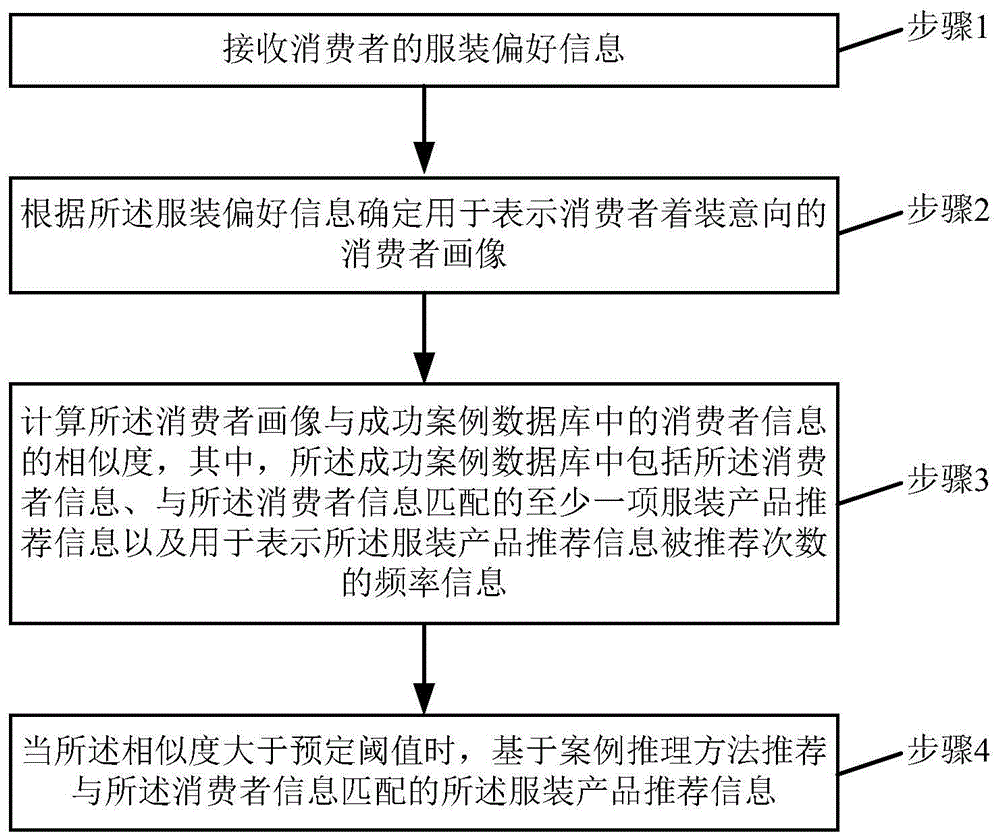
As shown in fig. 1, the case-based reasoning clothing recommendation method provided by the embodiment of the invention includes:
step 1, receiving clothing preference information of a consumer.
And 2, determining a consumer portrait for expressing the intention of the consumer to dress according to the clothing preference information.
And 3, calculating the similarity between the consumer representation and the consumer information in a success case database, wherein the success case database comprises the consumer information, at least one item of clothing product recommendation information matched with the consumer information and frequency information used for representing the recommended times of the clothing product recommendation information.
And 4, recommending the clothing product recommendation information matched with the consumer information based on a case reasoning method when the similarity is larger than a preset threshold value.
In the embodiment, when a consumer selects a clothing product through the e-commerce platform, for example, body type data, style keywords and the like can be input through the display terminal as clothing preference information, and a consumer representation which can determine and represent the costume intention of the consumer is generated according to the preference information. Based on a successful case database including a successful recommended case, comparing the similarity between the consumer representation of the current consumer and the consumer information of the past consumer in the successful case, and recommending the clothing product information which is successfully recommended to the past consumer to the current consumer when the similarity is larger than a certain threshold value. Because the recommended clothing products selected by the past consumers possibly comprise multi-directional judgment, the clothing recommendation method is more in line with actual trend or real feeling, has certain representativeness, is beneficial to the consumers using the successful case database to obtain more satisfactory clothing recommendation information, helps the current consumers to obtain online purchased clothing with higher satisfaction, and simultaneously improves the selection efficiency and sales volume of the online purchased clothing.
Preferably, the success case database is obtained according to the following steps:
historical garment preference information is received and a historical consumer representation is determined based on the historical garment preference information.
And determining expected clothing product information according to the historical customer image and the recommendation knowledge base, calculating the similarity between the expected clothing product information and the pre-stored clothing product information, and taking the clothing product information corresponding to the maximum similarity as the clothing product recommendation information.
And enabling the historical consumer representation to be the consumer information, adding the matched consumer information and the clothing product recommendation information into the success case database, and recording the recommended times of the clothing product recommendation information in the success case database as the frequency information.
It should be noted that since the garment recommendation method based on the success case database needs to be implemented on the basis of the prior work of the recommendation knowledge base, the establishment and use of the recommendation knowledge base also needs the garment preference information related to the consumer. In order to distinguish the clothing preference information in the successful case database from the clothing preference information required by the recommendation knowledge base, the relevant parameters of the recommendation knowledge base established before the successful case database are distinguished in a historical mode to represent the past data. The successful case database and the recommendation knowledge base can be updated and the like in the using process, and the history does not limit the sequence of the operations such as updating and the like.
Preferably, the recommendation knowledge base is obtained according to the following steps:
and carrying out weighted operation on the collected clothing preference information of a plurality of consumers and a preset evaluation standard to obtain a consumer information mapping matrix.
Carrying out weighting operation on the acquired expected clothing product information of a plurality of clothing products and the evaluation standard to obtain a clothing product information mapping matrix; the evaluation criterion includes a plurality of evaluation items for standard evaluation.
And performing composite mapping operation on the consumer information mapping matrix and the clothing product information mapping matrix to obtain the recommendation knowledge base.
Specifically, establishing the recommendation knowledge base requires acquiring a plurality of pieces of input information of the consumer in advance, that is, clothing preference information and information of the desired clothing product, wherein the clothing preference information may include information items such as body type data, style keywords and style pictures, the style pictures are clothing pictures matched with the style keywords, and the information of the desired clothing product includes description items such as fitness, waist details, foot mouth details and decoration details. In order to quantitatively evaluate the customer clothing preference information and the expected clothing product information, the evaluation criteria are subjected to statistical processing.
E={e1,e2,…,epLet p be 8, the evaluation criterion includes 8 evaluation terms, e respectively1: informal-formal; e.g. of the type2: complex-simple; e.g. of the type3: popular-unique; e.g. of the type4: fashion-traditional; e.g. of the type5: lovely-ripe; e.g. of the type6: relaxed-serious; e.g. of the type7: urban-rural; e.g. of the type8: known-arbitrary. Each assessment item is classified into five grades, e.g., very complex, relatively complex, moderate, relatively simple, very simple.
If the garment preference information comprises body type data, style keywords and style pictures, calculation based on the body type data and the evaluation standard is experiment one, calculation based on the style keywords and the evaluation standard is experiment two, and calculation based on the style pictures and the evaluation standard is experiment three. Each experiment is scored by the eight evaluation standard items, namely the relationship between the body type data and the evaluation standard; experiment II is the relationship between style keywords and evaluation standards; experiment three is the relationship between the style picture and the evaluation criteria.
BS={bs1,…,bsmLet m be 20, the body type data includes 20 individual type data items. According to Chinese human standard GB/T1335.2-1997, the height is divided into five grades, and the fat is divided into four grades. Let the height step be X1: short, X2: shorter, X3: moderate, X4: higher, X5: high; fat and thin grading is Y1: lean, Y2: normal, Y3: fat, Y4: obesity. At this time, the 20 individual type data items are: "X1 × Y1", "X2 × Y1", "X3 × 0Y 1", "X4 × 1Y 1", "X5 × 2Y 1", "X1 × 3Y 2", "X2 × 4Y 2", "X3 × 5Y 2", "X4 × 6Y 2", "X5 × 7Y 2", "X1 × 8Y 3", "X2 × 9Y 3", "X3 × Y3", "X4 × Y3", "X5 × Y3", "X1 × Y4", "X2 × Y4", "X3 × Y4", "X4 × Y4" and "X5 × Y4".
S={s1,…,snThe formula keyword is a formula keyword, and n is 8, the formula keyword has 8 selectable vocabularies, which are: "elegant", "female", "young", "sexy", "classic", "romantic", "rural" and "sporty".
C={c1…ckThe style picture has 6 selectable pictures, where k is 6. Aiming at the problem that some consumers cannot well express own preference in language, a picture can be selected to express own preference.
Since the body type data, the style keywords and the style pictures are used as input variables, that is, information items of the garment preference information, let N be the number of the input variables, and then N is equal to m + N + k.
And carrying out statistics and weighted average processing on the clothes preference information and the evaluation standard in the matrix form to obtain a consumer information mapping matrix. That is, the description of BS (body conformation data) and E (evaluation target) in the customer information mapping matrix is obtained through experimentsQuasi) between the sameBSIt can be represented by an (m × p) order matrix; obtaining a mapping relation KB describing a mapping relation between S (style keywords) and E (evaluation criteria) in a consumer information mapping matrix through experiment twoSIt can be represented by an (n × p) order matrix; mapping relation KB describing between C (style picture) and E (evaluation criterion) in consumer information mapping matrix is obtained through experiment threeCAnd can be represented by an (k × p) order matrix.
Let KB1 be a customer information mapping matrix describing the mapping relationship between N input variables and E, and composed of a combination of three matrices obtained by experiment one, experiment two, and experiment three, which can be expressed as a (N × p) order matrix.
Taking jeans as an example, the expected clothing product information, that is, the clothing design information, including fit, waist details, leg opening details, and decoration details, makes the calculation based on the expected clothing product information and the evaluation criteria an experiment four. It should be noted that in addition to jeans, design information for other types of apparel may be combined to determine desired apparel product information that matches other apparel products.
G={g1,…,ghThe "fit" is 5, and the fit includes 5 levels, i.e., "loose", "moderate", "tight", and "tight".
DW={dw1,…,dwxLet x be 3, the waist details include 3 types, i.e., "high waist", "middle waist", and "low waist".
DF={df1,…,dfyThe foot opening details are 3, namely 3 types, namely 'horn trousers', 'common trousers' and 'pencil trousers'.
DO={do1,…,dozLet z be 2, then the device details include 2 types, i.e. "more decor" and "less decor".
And the fitness, the waist detail, the foot opening detail and the decoration detail are used as output variables, namely the indication items of the expected clothing product information, and M is the number of the output variables, so that M is h + x + y + z.
And carrying out statistics and weighted average processing on the evaluation standard in the matrix form and the expected clothing product information to obtain a clothing product information mapping matrix. That is, the mapping relation KB describing the mapping relation between E (evaluation standard) and G (fitness) in the clothing product information mapping matrix is obtained through experiment fourGIt can be represented by a (p × h) order matrix; describe the mapping relationship KB between E (evaluation criteria) and DW (waist detail)DWIt can be represented by a (p × x) order matrix; describe the mapping KB between E (evaluation criteria) and DF (foot-mouth details)DFIt can be represented by a (p × y) order matrix; and describe the mapping KB between E (evaluation criteria) and DO (decoration details)DOAnd can be represented by an (p × z) order matrix.
Let KB2 be the clothing product information mapping matrix, which describes the mapping relationship between E and M output variables, and is composed of four matrices obtained by experiment four, which can be expressed as a (p × M) order matrix.
Let KB be the recommended knowledge base, and perform the complex mapping operation on the consumer information mapping matrix and the clothing product information mapping matrix to obtain the recommended knowledge base, that is, KB1 degree KB 2. KB is an (N M) order matrix that describes the relationship between the consumer's clothing preference information and the desired clothing product information.
After the recommendation knowledge base is established, a consumer can obtain corresponding clothing recommendation information through the recommendation knowledge base, meanwhile, related case information which is successfully recommended can be stored in the successful case database, a subsequent consumer can obtain clothing recommendation information through the recommendation knowledge base and can also obtain clothing recommendation information through the successful case database, and because successful cases in the successful case database are actually selected by other consumers and are probably closer to the real preference of most consumers, the clothing recommendation accuracy of clothing product recommendation can be further improved through the clothing recommendation method based on the successful case database.
When the recommendation knowledge base is used for obtaining the expected clothing product information, the expected clothing product information is compared with different pieces of inventory clothing product information respectively due to the fact that the inventory clothing products have various styles and colors, the product information with the maximum similarity to the expected clothing product information is obtained and serves as clothing product recommendation information, and the clothing product recommendation information is recommended to consumers using the recommendation knowledge base.
Meanwhile, historical consumer figures, namely the consumer figures using a recommendation knowledge base are used as the consumer information, the matched consumer information and the clothing product recommendation information are added into the success case database, and the recommended times of the clothing product recommendation information are recorded in the success case database as the frequency information.
It should be noted that, since different consumers may choose according to their needs, several different products may be accepted by consumers having the same consumer information in a real shopping experience. Therefore, multiple cases entering the success case database may show that the same customer information can be matched with multiple items of clothing product recommendation information at the same time, and the same clothing product recommendation information can be matched with multiple items of customer information at the same time. That is, the same type of consumer may be recommended multiple types of apparel products, and the same type of apparel product may be recommended to multiple types of consumers. Accordingly, the recommended number of times of the clothing product is taken as the frequency information. For example, the number of times of recommending type a jeans to the consumer corresponding to type 1 consumer information is 100, the number of times of recommending type B jeans is 10, and the number of times of recommending type C jeans is 1, and the above information may be described as frequency information.
Specifically, the success case database may be represented as:
DB_SC={<CPi,{<SRPPi (k),Tj (k)>|k=1,…,p(i)}>|i=1,…,w}。
wherein DB _ SC represents the success case database, CPiIndicating the ith consumer information in DB _ SC, SRPPi (k)Indicates success to CPiRecommended k item of clothing item recommendation information, Tj (k)Frequency information indicating recommendation information of the clothing product, p (i) indicating recommendation to the CPiW represents the CPiTotal number of terms of (c).
Preferably, the step 2 specifically includes:
and 2.1, determining a consumer portrait weight matrix according to the body type data, the style keywords and the style pictures by adopting a fuzzy analytic hierarchy process.
And 2.2, performing matrix operation on the clothing preference information and the consumer portrait weight matrix to obtain the consumer portrait.
Specifically, in step 2, since the information items of the clothing preference information have different proportions, the weight of each information item can be adjusted through the weight matrix to serve as a consumer portrait which more reasonably represents the wearing intention of the consumer, or the consumer portrait can be adjusted by adjusting the weight according to the actual requirement.
The consumer representation weight matrix I ═ { I ═ I can be obtained using, for example, fuzzy analytic hierarchy process1,…,I1,I2,…,I2,I3,…,I3In which I1、I2And I3Representing the weight vectors of BS, S and C, respectively. The CP represents the consumer representation, which may be specifically represented as an N-th order vector matrix: CP ═ I (I)1×bs1,…,I1×bsm,I2×s1,…,I2×sn,I3×c1,…,I3×ck)。
It should be noted that historical consumer representations, i.e., consumer representations processed by the recommendation knowledge base and eventually entered the success case database, are also processed by the consumer representation weight matrix, and different data information items also have corresponding weight coefficients.
Accordingly, the consumer representation, i.e., consumer information, in DB _ SC may be expressed as: CP (CP)i=(I1×bs1i,…,I1×bsmi,I2×s1i,…,I2×sni,I3×c1i,…,I3×cki). Wherein bs1i,…,bsmiRepresents CPiCorresponding m (m is 20) individual shape data; s1i,…,sniRepresents CPiCorresponding n (n ═ 8) style keywords; c. C1i…ckiRepresents CPiCorresponding k (k ═ 6) stylistic pictures.
In the process of establishing the recommended knowledge base, the consumer portrait CP and the recommended knowledge base KB are subjected to composite mapping operation to obtain expected clothing product information.
The desired apparel product information Y determined from the consumer image and the recommendation knowledge base may be represented as an M-order vector matrix: y — CP ° KB, i.e. a complex mapping operation of the consumer representation CP and the recommended knowledge base KB.
In the process of utilizing the recommendation knowledge base and determining the similarity, the CP is made to be CPiIn the set of (1), Y is YjKB is KBijWhere i e {1,2, …, N }, and j e {1,2, …, M }. Y — CP ° KB may also be represented as:
yj=(cp1∧kbij)∨(cp2∧kb2j)...∨(cpN∧kbNj)。
y is expected clothing product information of M order, let YiDetermining similarity N (Y, Y) of the expected clothing product information and the product information of the ith inventory product according to a similarity formula for the M-order product information of the ith inventory producti) The similarity formula is as follows:
wherein j represents an order ranging from 1 to M.
The stored clothing products have various styles and colors, so that the clothing has the i sets of clothing, the information of the expected clothing products is compared with the product information of the i sets of clothing respectively, the product information with the maximum similarity to the information of the expected clothing products is obtained and used as the recommendation information of the clothing products, and the consumer figures and the recommendation information of the clothing products which are successfully matched are added into the success case database.
In addition, the recommendation knowledge base can be updated according to the feedback of the consumer, so that the successful cases obtained through the recommendation knowledge base are more in line with the actual requirements of the consumer.
Preferably, the step 3 is implemented as follows: determining the similarity between the consumer representation and the consumer information in the successful case database using fuzzy set similarity, the similarity having a value range of 0 to 1.
Specifically, the similarity is determined by a fuzzy set similarity formula, which can be expressed as follows:
wherein I, m, n, k, I1、I2And I3The meaning is the same as it is in the success case database and the consumer representation, i.e., I is the number of items of consumer information, m, n, and k are the number of items of information items bs, s, and c, respectively, of the style parameter, the style keyword, and the style picture in the consumer information, I1、I2And I3Weight vectors of body type parameters, style keywords and style pictures respectively, and j is a variable from 1.
The similarity varies between 0 and 1, if the consumer image CP and the consumer information CPiThe closer they are, the closer they are to 1.
Preferably, the step 4 specifically includes:
and 4.1, when the similarity between only one item of the consumer information and the consumer portrait in the success case database is larger than the preset threshold value, sequentially recommending at least one item of the clothing product recommendation information matched with the consumer information in a descending manner according to the recommendation times indicated by the frequency information.
And 4.2, when the similarity between a plurality of items of the consumer information and the consumer portrait in the success case database is larger than the preset threshold value, sequentially recommending the clothing product recommendation information corresponding to each item of the similarity in a descending order according to the size of the similarity, and sequentially recommending at least one item of the clothing product recommendation information matched with the consumer information in a descending order according to the recommendation times indicated by the frequency information when recommending the clothing product recommendation information corresponding to each item of the similarity.
In particular, the case-based reasoning method is essentially based on the k-nearest neighbor algorithm, and the reasoning thereof consists of the following three rules, where epsilon is a predetermined threshold:
rule 1: when Similarity (CP, CP)i) ≦ ε, i ∈ {1,2, …, w }, which indicates that there is no successful result in the successful case database DB _ SC similar to the consumer representation CP, and that no recommendation can be made by the successful case database, and that recommendations can be made in other ways.
Rule 2: when there is only one CPiSatisfy the Similarity (CP, CP)i) > ε, i ∈ {1,2, …, w }, means that there is only one item of customer information CP in the successful case database DB _ SCiSimilar to the consumer representation CP if it isiIf the matched clothing item recommendation information at least comprises one item, the frequency information T is usedi (k)The descending order arrangement mode of (1) sequentially recommends recommendation information of all the clothing products, wherein the first recommendation is maximum frequency information max { T }i (k)1., p (i) } corresponding clothing product recommendation information. For example, if the current consumer representation and consumer information No. 1 are most similar, matching consumer information No. 1 with A, B, C jeans in three, the current consumer is recommended with jeans a, jeans B, and jeans C, respectively, 100 recommended times, 10 recommended times, in that order.
This rule corresponds to step 4.1.
Rule 3: when there are multiple CPsj(j=1,2,…,g,1<g is less than or equal to w) satisfies the similarity (CP, CP)j) When the value is larger than epsilon, it should be noted that j and i have similar meanings, but since there are a plurality of consumer information satisfying the similarity condition at this time, i is adjusted to j to distinguish. Illustrating that there are multiple items of consumer information in the success case database DB _ SC similar to the consumer representation CP. First, the consumer information is sorted in descending order of similarity, the firstOne bit is the maximum Similarity max (CP, CP)j) And l j equals to 1, …, g, and in the consumer information corresponding to each similarity, the clothing product information is recommended according to the rule 2.
This rule corresponds to step 4.2.
Preferably, the method further comprises:
and 5, generating a three-dimensional fitting model according to the clothing product recommendation information, and sending the three-dimensional fitting model to a display terminal.
Specifically, for example, a Clo 3D three-dimensional fitting model is generated according to the clothing product recommendation information and sent to the display terminal, so that consumers can feel fitting effects more intuitively.
As shown in fig. 2, the case-based reasoning clothing recommendation apparatus provided in the embodiment of the present invention includes:
the receiving module is used for receiving the clothing preference information of the consumer.
A processing module to determine a consumer representation indicative of a consumer's intent to dress based on the clothing preference information; the system comprises a database, a database and a database server, wherein the database server is used for storing a customer portrait and customer information in the database, and the database server is used for calculating the similarity between the customer portrait and the customer information in a success case database, wherein the success case database comprises the customer information, at least one item of clothing product recommendation information matched with the customer information and frequency information used for representing the recommended times of the clothing product recommendation information; and recommending the clothing product recommendation information matched with the consumer information based on a case-based reasoning method when the similarity is larger than a preset threshold value.
Preferably, the apparatus further comprises:
and the output module is used for generating a three-dimensional fitting model according to the clothing product recommendation information and sending the three-dimensional fitting model to a display terminal.
In another embodiment of the present invention, a case-based reasoning garment recommendation device includes a memory and a processor. The memory is used for storing the computer program. The processor is configured to implement the case-based reasoning clothing recommendation method as described above when executing the computer program.
In another embodiment of the present invention, a computer-readable storage medium has stored thereon a computer program which, when executed by a processor, implements the case-based reasoning garment recommendation method as described above.
The reader should understand that in the description of this specification, reference to the description of the terms "one embodiment," "some embodiments," "an example," "a specific example" or "some examples," etc., means that a particular feature, structure, material, or characteristic described in connection with the embodiment or example is included in at least one embodiment or example of the invention. In this specification, the schematic representations of the terms used above are not necessarily intended to refer to the same embodiment or example. Furthermore, the particular features, structures, materials, or characteristics described may be combined in any suitable manner in any one or more embodiments or examples. Furthermore, various embodiments or examples and features of different embodiments or examples described in this specification can be combined and combined by one skilled in the art without contradiction.
Although embodiments of the present invention have been shown and described above, it is understood that the above embodiments are exemplary and should not be construed as limiting the present invention, and that variations, modifications, substitutions and alterations can be made to the above embodiments by those of ordinary skill in the art within the scope of the present invention.