CN109642009B - Silane-functional polymeric polyurethanes - Google Patents
Silane-functional polymeric polyurethanes Download PDFInfo
- Publication number
- CN109642009B CN109642009B CN201780048302.8A CN201780048302A CN109642009B CN 109642009 B CN109642009 B CN 109642009B CN 201780048302 A CN201780048302 A CN 201780048302A CN 109642009 B CN109642009 B CN 109642009B
- Authority
- CN
- China
- Prior art keywords
- groups
- reaction
- group
- isocyanate
- compound
- Prior art date
- Legal status (The legal status is an assumption and is not a legal conclusion. Google has not performed a legal analysis and makes no representation as to the accuracy of the status listed.)
- Active
Links
Classifications
-
- C—CHEMISTRY; METALLURGY
- C08—ORGANIC MACROMOLECULAR COMPOUNDS; THEIR PREPARATION OR CHEMICAL WORKING-UP; COMPOSITIONS BASED THEREON
- C08G—MACROMOLECULAR COMPOUNDS OBTAINED OTHERWISE THAN BY REACTIONS ONLY INVOLVING UNSATURATED CARBON-TO-CARBON BONDS
- C08G18/00—Polymeric products of isocyanates or isothiocyanates
- C08G18/06—Polymeric products of isocyanates or isothiocyanates with compounds having active hydrogen
- C08G18/28—Polymeric products of isocyanates or isothiocyanates with compounds having active hydrogen characterised by the compounds used containing active hydrogen
- C08G18/40—High-molecular-weight compounds
- C08G18/62—Polymers of compounds having carbon-to-carbon double bonds
- C08G18/6216—Polymers of alpha-beta ethylenically unsaturated carboxylic acids or of derivatives thereof
- C08G18/625—Polymers of alpha-beta ethylenically unsaturated carboxylic acids; hydrolyzed polymers of esters of these acids
- C08G18/6258—Polymers of alpha-beta ethylenically unsaturated carboxylic acids; hydrolyzed polymers of esters of these acids the acid groups being esterified with polyhydroxy compounds or epoxy compounds during or after polymerization
-
- C—CHEMISTRY; METALLURGY
- C08—ORGANIC MACROMOLECULAR COMPOUNDS; THEIR PREPARATION OR CHEMICAL WORKING-UP; COMPOSITIONS BASED THEREON
- C08G—MACROMOLECULAR COMPOUNDS OBTAINED OTHERWISE THAN BY REACTIONS ONLY INVOLVING UNSATURATED CARBON-TO-CARBON BONDS
- C08G18/00—Polymeric products of isocyanates or isothiocyanates
- C08G18/06—Polymeric products of isocyanates or isothiocyanates with compounds having active hydrogen
- C08G18/70—Polymeric products of isocyanates or isothiocyanates with compounds having active hydrogen characterised by the isocyanates or isothiocyanates used
- C08G18/72—Polyisocyanates or polyisothiocyanates
- C08G18/80—Masked polyisocyanates
- C08G18/8061—Masked polyisocyanates masked with compounds having only one group containing active hydrogen
- C08G18/8083—Masked polyisocyanates masked with compounds having only one group containing active hydrogen with compounds containing at least one heteroatom other than oxygen or nitrogen
- C08G18/809—Masked polyisocyanates masked with compounds having only one group containing active hydrogen with compounds containing at least one heteroatom other than oxygen or nitrogen containing silicon
-
- C—CHEMISTRY; METALLURGY
- C08—ORGANIC MACROMOLECULAR COMPOUNDS; THEIR PREPARATION OR CHEMICAL WORKING-UP; COMPOSITIONS BASED THEREON
- C08G—MACROMOLECULAR COMPOUNDS OBTAINED OTHERWISE THAN BY REACTIONS ONLY INVOLVING UNSATURATED CARBON-TO-CARBON BONDS
- C08G18/00—Polymeric products of isocyanates or isothiocyanates
- C08G18/06—Polymeric products of isocyanates or isothiocyanates with compounds having active hydrogen
- C08G18/08—Processes
- C08G18/16—Catalysts
- C08G18/22—Catalysts containing metal compounds
- C08G18/227—Catalysts containing metal compounds of antimony, bismuth or arsenic
-
- C—CHEMISTRY; METALLURGY
- C08—ORGANIC MACROMOLECULAR COMPOUNDS; THEIR PREPARATION OR CHEMICAL WORKING-UP; COMPOSITIONS BASED THEREON
- C08G—MACROMOLECULAR COMPOUNDS OBTAINED OTHERWISE THAN BY REACTIONS ONLY INVOLVING UNSATURATED CARBON-TO-CARBON BONDS
- C08G18/00—Polymeric products of isocyanates or isothiocyanates
- C08G18/06—Polymeric products of isocyanates or isothiocyanates with compounds having active hydrogen
- C08G18/08—Processes
- C08G18/16—Catalysts
- C08G18/22—Catalysts containing metal compounds
- C08G18/24—Catalysts containing metal compounds of tin
- C08G18/244—Catalysts containing metal compounds of tin tin salts of carboxylic acids
- C08G18/246—Catalysts containing metal compounds of tin tin salts of carboxylic acids containing also tin-carbon bonds
-
- C—CHEMISTRY; METALLURGY
- C08—ORGANIC MACROMOLECULAR COMPOUNDS; THEIR PREPARATION OR CHEMICAL WORKING-UP; COMPOSITIONS BASED THEREON
- C08G—MACROMOLECULAR COMPOUNDS OBTAINED OTHERWISE THAN BY REACTIONS ONLY INVOLVING UNSATURATED CARBON-TO-CARBON BONDS
- C08G18/00—Polymeric products of isocyanates or isothiocyanates
- C08G18/06—Polymeric products of isocyanates or isothiocyanates with compounds having active hydrogen
- C08G18/28—Polymeric products of isocyanates or isothiocyanates with compounds having active hydrogen characterised by the compounds used containing active hydrogen
- C08G18/2805—Compounds having only one group containing active hydrogen
- C08G18/288—Compounds containing at least one heteroatom other than oxygen or nitrogen
- C08G18/289—Compounds containing at least one heteroatom other than oxygen or nitrogen containing silicon
-
- C—CHEMISTRY; METALLURGY
- C08—ORGANIC MACROMOLECULAR COMPOUNDS; THEIR PREPARATION OR CHEMICAL WORKING-UP; COMPOSITIONS BASED THEREON
- C08G—MACROMOLECULAR COMPOUNDS OBTAINED OTHERWISE THAN BY REACTIONS ONLY INVOLVING UNSATURATED CARBON-TO-CARBON BONDS
- C08G18/00—Polymeric products of isocyanates or isothiocyanates
- C08G18/06—Polymeric products of isocyanates or isothiocyanates with compounds having active hydrogen
- C08G18/28—Polymeric products of isocyanates or isothiocyanates with compounds having active hydrogen characterised by the compounds used containing active hydrogen
- C08G18/40—High-molecular-weight compounds
- C08G18/4009—Two or more macromolecular compounds not provided for in one single group of groups C08G18/42 - C08G18/64
- C08G18/4063—Mixtures of compounds of group C08G18/62 with other macromolecular compounds
-
- C—CHEMISTRY; METALLURGY
- C08—ORGANIC MACROMOLECULAR COMPOUNDS; THEIR PREPARATION OR CHEMICAL WORKING-UP; COMPOSITIONS BASED THEREON
- C08G—MACROMOLECULAR COMPOUNDS OBTAINED OTHERWISE THAN BY REACTIONS ONLY INVOLVING UNSATURATED CARBON-TO-CARBON BONDS
- C08G18/00—Polymeric products of isocyanates or isothiocyanates
- C08G18/06—Polymeric products of isocyanates or isothiocyanates with compounds having active hydrogen
- C08G18/28—Polymeric products of isocyanates or isothiocyanates with compounds having active hydrogen characterised by the compounds used containing active hydrogen
- C08G18/40—High-molecular-weight compounds
- C08G18/42—Polycondensates having carboxylic or carbonic ester groups in the main chain
- C08G18/4205—Polycondensates having carboxylic or carbonic ester groups in the main chain containing cyclic groups
- C08G18/4208—Polycondensates having carboxylic or carbonic ester groups in the main chain containing cyclic groups containing aromatic groups
- C08G18/4211—Polycondensates having carboxylic or carbonic ester groups in the main chain containing cyclic groups containing aromatic groups derived from aromatic dicarboxylic acids and dialcohols
- C08G18/4219—Polycondensates having carboxylic or carbonic ester groups in the main chain containing cyclic groups containing aromatic groups derived from aromatic dicarboxylic acids and dialcohols from aromatic dicarboxylic acids and dialcohols in combination with polycarboxylic acids and/or polyhydroxy compounds which are at least trifunctional
-
- C—CHEMISTRY; METALLURGY
- C08—ORGANIC MACROMOLECULAR COMPOUNDS; THEIR PREPARATION OR CHEMICAL WORKING-UP; COMPOSITIONS BASED THEREON
- C08G—MACROMOLECULAR COMPOUNDS OBTAINED OTHERWISE THAN BY REACTIONS ONLY INVOLVING UNSATURATED CARBON-TO-CARBON BONDS
- C08G18/00—Polymeric products of isocyanates or isothiocyanates
- C08G18/06—Polymeric products of isocyanates or isothiocyanates with compounds having active hydrogen
- C08G18/28—Polymeric products of isocyanates or isothiocyanates with compounds having active hydrogen characterised by the compounds used containing active hydrogen
- C08G18/40—High-molecular-weight compounds
- C08G18/62—Polymers of compounds having carbon-to-carbon double bonds
- C08G18/6216—Polymers of alpha-beta ethylenically unsaturated carboxylic acids or of derivatives thereof
- C08G18/625—Polymers of alpha-beta ethylenically unsaturated carboxylic acids; hydrolyzed polymers of esters of these acids
- C08G18/6254—Polymers of alpha-beta ethylenically unsaturated carboxylic acids and of esters of these acids containing hydroxy groups
-
- C—CHEMISTRY; METALLURGY
- C08—ORGANIC MACROMOLECULAR COMPOUNDS; THEIR PREPARATION OR CHEMICAL WORKING-UP; COMPOSITIONS BASED THEREON
- C08G—MACROMOLECULAR COMPOUNDS OBTAINED OTHERWISE THAN BY REACTIONS ONLY INVOLVING UNSATURATED CARBON-TO-CARBON BONDS
- C08G18/00—Polymeric products of isocyanates or isothiocyanates
- C08G18/06—Polymeric products of isocyanates or isothiocyanates with compounds having active hydrogen
- C08G18/28—Polymeric products of isocyanates or isothiocyanates with compounds having active hydrogen characterised by the compounds used containing active hydrogen
- C08G18/67—Unsaturated compounds having active hydrogen
- C08G18/68—Unsaturated polyesters
- C08G18/683—Unsaturated polyesters containing cyclic groups
-
- C—CHEMISTRY; METALLURGY
- C08—ORGANIC MACROMOLECULAR COMPOUNDS; THEIR PREPARATION OR CHEMICAL WORKING-UP; COMPOSITIONS BASED THEREON
- C08G—MACROMOLECULAR COMPOUNDS OBTAINED OTHERWISE THAN BY REACTIONS ONLY INVOLVING UNSATURATED CARBON-TO-CARBON BONDS
- C08G18/00—Polymeric products of isocyanates or isothiocyanates
- C08G18/06—Polymeric products of isocyanates or isothiocyanates with compounds having active hydrogen
- C08G18/70—Polymeric products of isocyanates or isothiocyanates with compounds having active hydrogen characterised by the isocyanates or isothiocyanates used
- C08G18/71—Monoisocyanates or monoisothiocyanates
- C08G18/718—Monoisocyanates or monoisothiocyanates containing silicon
-
- C—CHEMISTRY; METALLURGY
- C08—ORGANIC MACROMOLECULAR COMPOUNDS; THEIR PREPARATION OR CHEMICAL WORKING-UP; COMPOSITIONS BASED THEREON
- C08G—MACROMOLECULAR COMPOUNDS OBTAINED OTHERWISE THAN BY REACTIONS ONLY INVOLVING UNSATURATED CARBON-TO-CARBON BONDS
- C08G18/00—Polymeric products of isocyanates or isothiocyanates
- C08G18/06—Polymeric products of isocyanates or isothiocyanates with compounds having active hydrogen
- C08G18/70—Polymeric products of isocyanates or isothiocyanates with compounds having active hydrogen characterised by the isocyanates or isothiocyanates used
- C08G18/72—Polyisocyanates or polyisothiocyanates
- C08G18/73—Polyisocyanates or polyisothiocyanates acyclic
-
- C—CHEMISTRY; METALLURGY
- C08—ORGANIC MACROMOLECULAR COMPOUNDS; THEIR PREPARATION OR CHEMICAL WORKING-UP; COMPOSITIONS BASED THEREON
- C08G—MACROMOLECULAR COMPOUNDS OBTAINED OTHERWISE THAN BY REACTIONS ONLY INVOLVING UNSATURATED CARBON-TO-CARBON BONDS
- C08G18/00—Polymeric products of isocyanates or isothiocyanates
- C08G18/06—Polymeric products of isocyanates or isothiocyanates with compounds having active hydrogen
- C08G18/70—Polymeric products of isocyanates or isothiocyanates with compounds having active hydrogen characterised by the isocyanates or isothiocyanates used
- C08G18/72—Polyisocyanates or polyisothiocyanates
- C08G18/74—Polyisocyanates or polyisothiocyanates cyclic
- C08G18/75—Polyisocyanates or polyisothiocyanates cyclic cycloaliphatic
- C08G18/751—Polyisocyanates or polyisothiocyanates cyclic cycloaliphatic containing only one cycloaliphatic ring
- C08G18/752—Polyisocyanates or polyisothiocyanates cyclic cycloaliphatic containing only one cycloaliphatic ring containing at least one isocyanate or isothiocyanate group linked to the cycloaliphatic ring by means of an aliphatic group
- C08G18/753—Polyisocyanates or polyisothiocyanates cyclic cycloaliphatic containing only one cycloaliphatic ring containing at least one isocyanate or isothiocyanate group linked to the cycloaliphatic ring by means of an aliphatic group containing one isocyanate or isothiocyanate group linked to the cycloaliphatic ring by means of an aliphatic group having a primary carbon atom next to the isocyanate or isothiocyanate group
- C08G18/755—Polyisocyanates or polyisothiocyanates cyclic cycloaliphatic containing only one cycloaliphatic ring containing at least one isocyanate or isothiocyanate group linked to the cycloaliphatic ring by means of an aliphatic group containing one isocyanate or isothiocyanate group linked to the cycloaliphatic ring by means of an aliphatic group having a primary carbon atom next to the isocyanate or isothiocyanate group and at least one isocyanate or isothiocyanate group linked to a secondary carbon atom of the cycloaliphatic ring, e.g. isophorone diisocyanate
-
- C—CHEMISTRY; METALLURGY
- C08—ORGANIC MACROMOLECULAR COMPOUNDS; THEIR PREPARATION OR CHEMICAL WORKING-UP; COMPOSITIONS BASED THEREON
- C08G—MACROMOLECULAR COMPOUNDS OBTAINED OTHERWISE THAN BY REACTIONS ONLY INVOLVING UNSATURATED CARBON-TO-CARBON BONDS
- C08G18/00—Polymeric products of isocyanates or isothiocyanates
- C08G18/06—Polymeric products of isocyanates or isothiocyanates with compounds having active hydrogen
- C08G18/70—Polymeric products of isocyanates or isothiocyanates with compounds having active hydrogen characterised by the isocyanates or isothiocyanates used
- C08G18/72—Polyisocyanates or polyisothiocyanates
- C08G18/77—Polyisocyanates or polyisothiocyanates having heteroatoms in addition to the isocyanate or isothiocyanate nitrogen and oxygen or sulfur
- C08G18/78—Nitrogen
- C08G18/79—Nitrogen characterised by the polyisocyanates used, these having groups formed by oligomerisation of isocyanates or isothiocyanates
- C08G18/797—Nitrogen characterised by the polyisocyanates used, these having groups formed by oligomerisation of isocyanates or isothiocyanates containing carbodiimide and/or uretone-imine groups
-
- C—CHEMISTRY; METALLURGY
- C09—DYES; PAINTS; POLISHES; NATURAL RESINS; ADHESIVES; COMPOSITIONS NOT OTHERWISE PROVIDED FOR; APPLICATIONS OF MATERIALS NOT OTHERWISE PROVIDED FOR
- C09D—COATING COMPOSITIONS, e.g. PAINTS, VARNISHES OR LACQUERS; FILLING PASTES; CHEMICAL PAINT OR INK REMOVERS; INKS; CORRECTING FLUIDS; WOODSTAINS; PASTES OR SOLIDS FOR COLOURING OR PRINTING; USE OF MATERIALS THEREFOR
- C09D175/00—Coating compositions based on polyureas or polyurethanes; Coating compositions based on derivatives of such polymers
- C09D175/04—Polyurethanes
-
- C—CHEMISTRY; METALLURGY
- C09—DYES; PAINTS; POLISHES; NATURAL RESINS; ADHESIVES; COMPOSITIONS NOT OTHERWISE PROVIDED FOR; APPLICATIONS OF MATERIALS NOT OTHERWISE PROVIDED FOR
- C09D—COATING COMPOSITIONS, e.g. PAINTS, VARNISHES OR LACQUERS; FILLING PASTES; CHEMICAL PAINT OR INK REMOVERS; INKS; CORRECTING FLUIDS; WOODSTAINS; PASTES OR SOLIDS FOR COLOURING OR PRINTING; USE OF MATERIALS THEREFOR
- C09D175/00—Coating compositions based on polyureas or polyurethanes; Coating compositions based on derivatives of such polymers
- C09D175/04—Polyurethanes
- C09D175/14—Polyurethanes having carbon-to-carbon unsaturated bonds
-
- C—CHEMISTRY; METALLURGY
- C09—DYES; PAINTS; POLISHES; NATURAL RESINS; ADHESIVES; COMPOSITIONS NOT OTHERWISE PROVIDED FOR; APPLICATIONS OF MATERIALS NOT OTHERWISE PROVIDED FOR
- C09J—ADHESIVES; NON-MECHANICAL ASPECTS OF ADHESIVE PROCESSES IN GENERAL; ADHESIVE PROCESSES NOT PROVIDED FOR ELSEWHERE; USE OF MATERIALS AS ADHESIVES
- C09J175/00—Adhesives based on polyureas or polyurethanes; Adhesives based on derivatives of such polymers
- C09J175/04—Polyurethanes
-
- C—CHEMISTRY; METALLURGY
- C09—DYES; PAINTS; POLISHES; NATURAL RESINS; ADHESIVES; COMPOSITIONS NOT OTHERWISE PROVIDED FOR; APPLICATIONS OF MATERIALS NOT OTHERWISE PROVIDED FOR
- C09J—ADHESIVES; NON-MECHANICAL ASPECTS OF ADHESIVE PROCESSES IN GENERAL; ADHESIVE PROCESSES NOT PROVIDED FOR ELSEWHERE; USE OF MATERIALS AS ADHESIVES
- C09J175/00—Adhesives based on polyureas or polyurethanes; Adhesives based on derivatives of such polymers
- C09J175/04—Polyurethanes
- C09J175/14—Polyurethanes having carbon-to-carbon unsaturated bonds
-
- C—CHEMISTRY; METALLURGY
- C08—ORGANIC MACROMOLECULAR COMPOUNDS; THEIR PREPARATION OR CHEMICAL WORKING-UP; COMPOSITIONS BASED THEREON
- C08G—MACROMOLECULAR COMPOUNDS OBTAINED OTHERWISE THAN BY REACTIONS ONLY INVOLVING UNSATURATED CARBON-TO-CARBON BONDS
- C08G2150/00—Compositions for coatings
-
- C—CHEMISTRY; METALLURGY
- C08—ORGANIC MACROMOLECULAR COMPOUNDS; THEIR PREPARATION OR CHEMICAL WORKING-UP; COMPOSITIONS BASED THEREON
- C08G—MACROMOLECULAR COMPOUNDS OBTAINED OTHERWISE THAN BY REACTIONS ONLY INVOLVING UNSATURATED CARBON-TO-CARBON BONDS
- C08G2170/00—Compositions for adhesives
-
- C—CHEMISTRY; METALLURGY
- C08—ORGANIC MACROMOLECULAR COMPOUNDS; THEIR PREPARATION OR CHEMICAL WORKING-UP; COMPOSITIONS BASED THEREON
- C08G—MACROMOLECULAR COMPOUNDS OBTAINED OTHERWISE THAN BY REACTIONS ONLY INVOLVING UNSATURATED CARBON-TO-CARBON BONDS
- C08G2190/00—Compositions for sealing or packing joints
Landscapes
- Chemical & Material Sciences (AREA)
- Organic Chemistry (AREA)
- Health & Medical Sciences (AREA)
- Chemical Kinetics & Catalysis (AREA)
- Medicinal Chemistry (AREA)
- Polymers & Plastics (AREA)
- Materials Engineering (AREA)
- Engineering & Computer Science (AREA)
- Life Sciences & Earth Sciences (AREA)
- Wood Science & Technology (AREA)
- Polyurethanes Or Polyureas (AREA)
- Sealing Material Composition (AREA)
- Paints Or Removers (AREA)
- Adhesives Or Adhesive Processes (AREA)
- Addition Polymer Or Copolymer, Post-Treatments, Or Chemical Modifications (AREA)
- Silicon Polymers (AREA)
Abstract
本发明涉及用于制备含硅烷基团的聚氨酯的方法、通过所述方法可得到的产物以及其用于制备特别是用于漆料原料、密封剂原料或胶粘剂原料的可交联的粘合剂的用途。The present invention relates to a process for the preparation of silane-group-containing polyurethanes, the products obtainable by the process and their use for the preparation of crosslinkable adhesives, in particular for paint materials, sealant materials or adhesive materials the use of.
Description
The invention relates to a method for producing polyurethanes containing silane groups, to polyurethanes containing silane groups that can be obtained by this method, to the use thereof as binders in crosslinkable paint, sealant or adhesive raw materials, and to crosslinkable binders having the polyurethanes containing silane groups according to the invention.
Silane-functional polyurethanes have long been known and have been described several times as binders for adhesives, sealants or coatings.
Polyurethanes bearing silane groups can be prepared in various ways, for example by reaction of polyisocyanates or isocyanate-functional prepolymers with silane compounds reactive toward isocyanate groups, for example secondary aminoalkylsilanes or mercaptoalkylsilanes.
One method which is often preferred since it leads to silane-functional polyurethanes having a particularly low viscosity is the reaction of hydroxyl-functional compounds, such as polyether polyols, polyurethane polyols or polyester polyols, with isocyanatoorganosilanes, such as isocyanatoalkylalkoxysilanes as described in U.S. Pat. No. 3,494,951 or EP-A0649850. By using such isocyanatoalkylsilanes, it is possible, for example, to prepare low-viscosity silane-terminated polyurethane prepolymers from hydroxyl-functional polyurethane prepolymers or polyether polyols, which can serve as binders for moisture-crosslinking adhesives and sealants (see, for example, EP-A0070475 and EP-A0372561).
According to the teaching of WO 2009/115079, the reaction of isocyanatopropyltrimethoxysilane or isocyanatopropyltriethoxysilane with polyols produces polyurethanes containing alkoxysilane groups which can be cured thermally in the presence of suitable catalysts even with the exclusion of water and enable, for example, the formulation of automotive paints having very high scratch resistance. One example describes the reaction of a polyol mixture consisting of two polyacrylate polyols and low molecular weight 1, 6-hexanediol with HDI biuret and isocyanatopropyltrimethoxysilane.
The adducts of isocyanatoalkylalkoxysilanes, for example isocyanatopropyltrimethoxysilane, and low molecular weight branched diols or polyols containing up to 20 carbon atoms and their use as curing agents for self-crosslinking binders or as hydroxy-functional binders in two-component coating systems are the subject of EP-A2641925. In addition to the low molecular weight branched diols or polyols, other diols and/or polyols may also be used together in the preparation of the adducts in amounts of up to 40% by weight, including, for example, also hydroxyl-containing polyesters or polyacrylates.
WO 2013/189882 describes adducts of isocyanatotrialkoxysilanes and polyols as further crosslinkers in nonaqueous two-component polyurethane paints (two-component PURs). Preferably, the polyols used are low molecular weight branched diols and/or polyols, which may also contain hydroxyl-containing polymers, for example polyester polyols or polyacrylate polyols, in a content of up to 40% by weight.
WO 2014/180623 describes moisture-crosslinking coating materials which contain at least one adduct of an isocyanatosilane on a hydroxyl-functional compound, a tin-containing catalyst and an aminosilane. As suitable hydroxy-functional compounds for preparing the adducts, mono-or polyols and polyols are mentioned, which include a long list of suitable polymeric polyols and hydroxy-functional polyacrylates. However, in the examples of this disclosure, only isocyanatopropyltrimethoxysilane and the low molecular weight 2 of 1, 9-nonanediol were used by means of Vestanat M95: 1 adduct (mol).
WO 2008/034409 describes, for example, the partial reaction of the commercially available polyester polyol Desmophen 1145 (Covestro Deutschland AG) with a deficiency of isocyanatopropyltriethoxysilane. Due to the selected equivalent ratio, less than 15% of the hydroxyl groups originally present in the polyol are carbamated.
WO 2014/037265 describes the preparation of silane-functional binders having a thiourethane structure by reaction of a polyol with a poor monomer diisocyanate/mercaptosilane adduct. The polymeric polyacrylate polyols and polyester polyols mentioned in the examples are reacted only in mixtures with a relatively large amount of low molecular weight diols, based on the hydroxyl equivalent weight.
It has not hitherto been described that all of the hydroxyl groups of the polymeric polyester polyols and/or polyacrylate polyols are reacted completely with isocyanatoalkoxysilanes, preferably without concomitant use of relatively large amounts of low molecular weight, low functionality alcohols. As a result of its own experiments, gelling of the reaction batch takes place under customary reaction conditions, for example when only polymeric polyols are used at temperatures above 60 ℃, even before the urethanization reaction has ended.
It is therefore an object of the present invention to provide a novel process for preparing alkoxysilane-modified polyurethanes which enables polymeric polyols, such as polyester polyols and/or polyacrylate polyols, to be reacted completely with isocyanatoalkoxysilanes in a safe and reproducible manner, preferably even without concomitant use of low molecular weight alcohols. The products obtainable by this process should be suitable for all fields of use of silane-functional polyurethanes, in particular as binders for moisture-crosslinking or thermally curable adhesives, sealants or coatings.
This object is achieved by the process of the invention which is described in more detail below. The process of the invention is based on the following surprising observation: the carboxyl groups contained in the polymer, as are commercially available, for example, as binder components of two-component PUR lacquers, of the polymerized polyester polyols and/or polyacrylate polyols, are preferably reacted completely chemically (preferably even in the absence of low molecular weight alcohols) with isocyanatosilanes without problems, particularly preferably completely, to give silane-functional polyurethanes.
The invention provides a process for preparing polyurethanes containing silane groups, which comprises the reaction of A) with B) to obtain a reaction product and the reaction of the reaction product with C):
A) at least one polymeric polyol having a molecular weight according to DIN EN ISO 2114: an acid value of 0.01 to 30.0mg KOH/g as determined in 2002-06, based on the solid content,
B) at least one compound having at least one group reactive with a carboxyl group and containing at least one epoxy group, carbodiimide group and/or 2-oxazoline group,
C) at least one alkoxysilane-functional isocyanate.
In a first preferred embodiment, the polymeric polyols A) are at least difunctional polymeric polyols having a number-average molecular weight MnFrom 270 to 22000g/mol, preferably from 500 to 18000g/mol, particularly preferably from 800 to 12000 g/mol. Likewise preferred, particularly preferred in combination with the above-mentioned number average molecular weights, is that the polymeric polyol a) is at least one difunctional polyol and has a molecular weight according to DIN EN ISO 2114: the acid number, determined 2002-06, is from 0.01 to 30mg KOH/g, preferably from 0.1 to 25.0mg KOH/g, particularly preferably from 0.2 to 20.0mg KOH/g, in each case based on the solids content.
In the present document, "polymeric polyol" is understood to mean a molecule having at least two hydroxyl groups, which is formed from a plurality of identical or different repeating base units and can be prepared by macromolecular chemical processes known per se, for example by polymerization, polycondensation or polyaddition. The term "polymeric polyol" shall also include so-called oligomeric polyols, which are usually formed from only a few, e.g. 3 to 20, base units, wherein the transition from oligomer to low molecular weight polymer is smooth.
Number average molecular weight M of the polymeric polyol A) mentioned in this documentnBy means of Gel Permeation Chromatography (GPC) according to DIN 55672-1 by using polystyrene standards and tetrahydrofuran as eluent: 2016-03.
According to the present invention, the term "comprising" or "containing" preferably means "consisting essentially of, and particularly preferably means" consisting of.
Suitable polymeric polyols A) for the process according to the invention are in particular polyester polyols, polycarbonate polyols and/or polyacrylate polyols. Preferably, these polyols have an average OH functionality of from 2 to 6, particularly preferably an average functionality of from 2 to 4.
Suitable polyester polyols A) are, for example, those of the type mentioned on EP-A0978523, page 5, line 17 to line 47, or page 6, line 32 to line 45 of EP-A0659792, provided that they satisfy the above-mentioned specifications with respect to functionality and molecular weight. Particularly preferred polyester polyols are condensation products of polyhydric alcohols, such as 1, 2-ethanediol, 1, 2-propanediol, diethylene glycol, 1, 4-butanediol, 1, 6-hexanediol, neopentyl glycol, cyclohexane-1, 4-dimethanol, 1, 4-cyclohexanediol, perhydrobisphenol, 1,1, 1-trimethylolpropane, 1,2, 3-propanetriol, pentaerythritol and/or sorbitol, with insufficient amounts of polycarboxylic acids or carboxylic anhydrides, such as succinic acid, adipic acid, sebacic acid, dodecanedioic acid, glutaric anhydride, maleic anhydride, phthalic anhydride, isophthalic acid, terephthalic acid, trimellitic acid, hexahydrophthalic anhydride and/or tetrahydrophthalic anhydride, or else from lactones, such as epsilon-caprolactone, and simple monoalcohols, such as the above exemplified above, in a manner known per se And those obtainable by ring opening as starter molecules.
Suitable polycarbonate polyols A) are in particular the reaction products known per se of dihydric alcohols, such as those mentioned above by way of example in the polyol list, with diaryl carbonates, for example diphenyl carbonate, dimethyl carbonate or phosgene. Suitable polycarbonate polyols A) also include those which, in addition to a carbonate structure, also contain ester groups. In particular polyestercarbonate diols known per se, which are obtainable, for example, according to the teaching of DE-AS 1770245 by reaction of diols with lactones, such AS in particular epsilon-caprolactone, and subsequent reaction of the polyesterdiols obtained here with diphenyl carbonate or dimethyl carbonate. Likewise suitable polycarbonate polyols A) are those which contain ether groups in addition to carbonate structures. In particular polyether carbonate polyols known per se, as are obtainable, for example, according to the process of EP-A2046861 by catalytic reaction of alkylene oxides (epoxides) and carbon dioxide in the presence of H-functional starter substances.
Suitable polyacrylate polyols A) are, for example, those of the type mentioned in WO 2011/124710, page 10, line 32 to page 13, line 18, provided that they satisfy the above-mentioned specifications with regard to functionality and molecular weight. Particularly preferred polyacrylate polyols A) are polymers or copolymers of hydroxyalkyl acrylates or methacrylates, such as hydroxyethyl acrylate, hydroxypropyl acrylate, hydroxybutyl acrylate, hydroxyethyl methacrylate, hydroxypropyl methacrylate or hydroxybutyl methacrylate, optionally together with alkyl acrylates and/or methacrylates, such as methyl acrylate, ethyl acrylate, n-butyl acrylate, isobutyl acrylate, 2-ethylhexyl acrylate, cyclohexyl acrylate, isobornyl acrylate, lauryl acrylate, methyl methacrylate, ethyl methacrylate, n-butyl methacrylate, styrene or other copolymerizable ethylenically unsaturated monomers, Isobutyl methacrylate, 2-ethylhexyl methacrylate, cyclohexyl methacrylate, isobornyl methacrylate, lauryl methacrylate.
Suitable polyols a) are also, for example, the known polyacetal polyols obtainable by reaction of simple diols, such as diethylene glycol, triethylene glycol, 4' -bis ((2-hydroxyethoxy) phenyl) -dimethylmethane (adduct of 2 mol of ethylene oxide on bisphenol a) or hexanediol with formaldehyde, or polyacetals prepared by polycondensation of cyclic acetals, such as trioxane.
Further suitable polyols A) are also the specific polyols described, for example, in EP-A0689556 and EP-A0937110, which are obtainable, for example, by reacting epoxidized fatty acid esters with aliphatic or aromatic polyols by epoxide ring opening.
Also useful as polyol A) are hydroxyl-containing polybutadienes.
The polymeric polyols A) can be used in the process according to the invention individually or in any mixture with one another. They may be either in a solvent-free form or in a form dissolved in a conventional solvent.
Suitable solvents are in particular those which are inert to the reactive groups of the alkoxysilane-functional isocyanates C), for example the known conventional aprotic paint solvents, for example ethyl acetate, butyl acetate, ethylene glycol monomethyl-or ethyl ether acetate, 1-methoxyprop-2-yl acetate, 3-methoxy-n-butyl acetate, acetone, 2-butanone, 4-methyl-2-pentanone, cyclohexanone, toluene, xylene, chlorobenzene, petroleum spirits, aromatic compounds having a higher degree of substitution, for example those commercially available under the names of solvent naphtha, Solvesso, Isopar, Nappar (Deutsche EXXON CHEMICAL GmbH, K lN, DE) and Shellsol (Deutsche Shell Chemie GmbH, Eschborn DE), and solvents such as propylene glycol diacetate, diethylene glycol dimethyl ether, Dipropylene glycol dimethyl ether, diethylene glycol ethyl-and-butyl ether acetate, ethyl ethoxypropionate, propylene carbonate, N-methylpyrrolidone and N-methylcaprolactam, or any mixtures of such solvents.
Component B) used in the process of the invention is any compound which has at least one group reactive toward carboxyl groups and contains at least one epoxy, carbodiimide and/or 2-oxazoline group and preferably has a number-average molecular weight of from 44 to 2000, preferably from 128 to 1500, particularly preferably from 250 to 1000, for example as are generally known in paint technology as acid scavengers (S ä uref ä nger).
In a further preferred embodiment, the compounds B) having at least one group reactive toward carboxyl groups contain one to three, particularly preferably one or two, very particularly preferably exactly one epoxy group, carbodiimide group and/or 2-oxazoline group.
Suitable epoxy-group-containing compounds B) are, for example, 1, 2-ethylene oxide, 1, 2-propylene oxide, 1, 2-butylene oxide, 1, 2-cyclohexene oxide, 1, 2-heptane oxide, 1, 2-decane oxide, 1, 2-dodecane oxide, 1, 2-tetradecane oxide, 1, 2-hexadecane oxide, 1, 2-octadecane oxide, 1, 2-cyclopentane oxide, 1-methyl-1, 2-cyclopentane oxide, 1, 2-cyclohexane oxide, 1, 2-cycloheptane oxide, 1, 2-cyclooctane oxide, isophorone oxide, styrene oxide, (2, 3-glycidyl) benzene, trans-stilbene oxide, 3-glycidoxypropyltrimethoxysilane, 3-glycidoxypropyltriethoxysilane, 3-glycidoxypropylmethyldiethoxysilane, 2- (3, 4-epoxycyclohexyl) ethyltrimethoxysilane, 2- (3, 4-epoxycyclohexyl) ethyltriethoxysilane, 1,2,7, 8-diepoxyoctane, 1,2,5, 6-diepoxycyclooctane, butyl glycidyl ether, 2-ethylhexyl glycidyl ether, Versatic acid glycidyl ester, hexahydrophthalic acid diglycidyl ester, bisphenol-A-diglycidyl ether (BADGE), glycerol glycidyl ether and triglycidyl isocyanurate (TGIC).
Suitable carbodiimide group-containing compounds B) are in principle any monomeric or polymeric carbodiimides as are obtainable, for example, in a manner known per se by catalytic thermal polycondensation of aliphatic, cycloaliphatic, araliphatic and/or aromatic mono-and/or diisocyanates.
They are, for example, cycloaliphatic carbodiimides, such as dicyclohexylcarbodiimide or carbodiimides based on 1-isocyanato-3, 3, 5-trimethyl-5-isocyanatomethylcyclohexane (isophorone diisocyanate; IPDI), 2,4 '-and 4,4' -diisocyanatodicyclohexylmethane and/or cyclohexyl isocyanate, which are described in DE 2301725, DE 2358038 and EP 0890604; are carbodiimides made from tertiary (tert ä r) bonded isocyanate groups, such as the carbodiimides described in US 4419294 based on 1, 3-bis (1-isocyanato-1-methylethyl) benzene (TMXDI) and 1-isocyanato-4- (1-isocyanato-1-methylethyl) -1-methyl-cyclohexane; are aromatic carbodiimides, such as those based on 2, 4-and 2, 6-tolylene diisocyanate, 2,4 '-and 4,4' -diphenylmethane diisocyanate, 1, 3-and 1, 4-phenylene diisocyanate; in particular those based on aromatic isocyanates, each bearing an aliphatic substituent having from 1 to 6 carbon atoms, preferably an isopropyl group, in at least one of the ortho positions relative to the isocyanate groups, for example o-tolylisocyanate, 2, 6-diisopropylphenylisocyanate and/or 1,3, 5-triisopropylbenzene-2, 4-diisocyanate.
Suitable oxazoline group-containing compounds B) are, for example, 2-methyl-2-oxazoline, 2-hydroxyethyl-2-oxazoline, 2-hydroxypropyl-2-oxazoline, 5-hydroxypentyl-2-oxazoline and/or 1, 3-phenylenebis-2-oxazoline.
Particularly preferred compounds B) having groups reactive toward carboxyl groups are mono-and polycarbodiimides based on 2, 6-diisopropylphenyl isocyanate and/or 1,3, 5-triisopropylbenzene-2, 4-diisocyanate, as are known, for example, from Rheinchemie Rheinau GmbH (Germany) under the trade name Stabaxol®And (4) obtaining. Very particular preference is given to using bis- (2, 6-diisopropylphenyl) -carbodiimide (Stabaxol)® I)。
The compounds B) having groups reactive toward carboxyl groups can be used in the process according to the invention both as single components and in the form of arbitrary mixtures with one another. Depending on the nature of the polyol A) used and of the compound B) having groups reactive toward carboxyl groups, even a molar deficiency of groups reactive toward carboxyl groups may be sufficient to achieve the stabilizing effect according to the invention. However, in another preferred embodiment, the reaction of the polymeric polyol a) with at least one compound B) having groups reactive toward carboxyl groups is carried out following the following equivalent ratio of carboxyl groups to groups reactive toward carboxyl groups: 1.5: 1-1: 5, preferably 1.2: 1-1: 2, particularly preferably 1.1: 1-1: 1.1.
very particularly preferably, the metered addition of the compound B) is carried out in such an amount that for each carboxyl group of the polymeric polyol A) there is at least one group reactive toward carboxyl groups.
In the process of the invention, after the reaction, preferably after the reaction of the polymeric polyol a) with the compound B) reactive toward carboxyl groups, the reaction product obtained is reacted in a further process step with at least one alkoxysilane-functional isocyanate C). The reaction product obtained from the reaction of a) with B), optionally before reaction with C), may be subjected to further arbitrary intermediate steps, as long as a sufficient amount of hydroxyl groups are still present in the reaction product during the reaction with the at least one alkoxysilane-functional isocyanate C). However, it is particularly preferred that the reaction of the reaction product with the alkoxysilane-functional isocyanate C) takes place without an intermediate step.
Alkoxysilane-functional isocyanates C) are any compounds in which at least one, preferably exactly one, isocyanate group and at least one, preferably exactly one, silane group having at least one alkoxy substituent are present at the same time as one another. Alkoxysilane-functional isocyanates C) are also referred to below as isocyanatoalkoxysilanes C).
Suitable isocyanatoalkoxysilanes C) are, for example, isocyanatoalkylalkoxysilanes, which are obtainable, for example, by phosgene-free cleavage of the corresponding urethanes or ureas according to the processes described in U.S. Pat. No. 8, 3494951, EP-A0649850, WO 2014/063895 and WO 2016/010900.
In a further preferred embodiment, the alkoxysilane-functional isocyanates C) used are at least one compound of the formula (I)

Wherein
R1、R2And R3Independently of one another, represent identical or different, saturated or unsaturated, linear or branched, aliphatic or cycloaliphatic or optionally substituted aromatic or araliphatic radicals having up to 18 carbon atoms, which may optionally contain up to 3 heteroatoms from the group consisting of oxygen, sulfur, nitrogen, preferably alkyl radicals having in each case up to 6 carbon atoms and/or alkoxy radicals having up to 6 carbon atoms, which may contain up to 3 oxygen atoms, particularly preferably in each case methyl, methoxy and/or ethoxy, with the proviso that the radicals R1、R2And R3Is bonded to the silicon atom through an oxygen atom, and
x represents a linear or branched organic radical having up to 6, preferably 1 to 4, carbon atoms, particularly preferably propylene (-CH2-CH2-CH 2-).
Examples of such isocyanatoalkoxysilanes are isocyanatomethyltrimethoxysilane, isocyanatomethyltriethoxysilane, isocyanatomethyltriisopropoxysilane, 2-isocyanatoethyltrimethoxysilane, 2-isocyanatoethyltriethoxysilane, 2-isocyanatoethyltriisopropoxysilane, 3-isocyanatopropyltrimethoxysilane, 3-isocyanatopropyltriethoxysilane, 3-isocyanatopropylmethyldimethoxysilane, 3-isocyanatopropylmethyldiethoxysilane, 3-isocyanatopropylethyldiethoxysilane, 3-isocyanatopropyldimethylethoxysilane, 3-isocyanatopropyldiisopropylethoxysilane, 3-isocyanatopropyltripropoxysilane, isocyanatomethyltrimethoxysilane, isocyanatoethyltriethoxysilane, isocyanatopropyltriethoxysilane, isocyanatoethyltriethoxysilane, isocyanatopropyltrimethoxysilane, isocyanatopropyltriethoxysilane, isocyanatoethyltriethoxysilane, isocyanatopropyltrimethoxysilane, isocyanatopropyltriethoxysilane, isocyanatopropyltrimethoxysilane, isocyanato-propyltrimethoxysilane, isocyanato-propyltriethoxysilane, isocyanato-isopropyltrimethoxysilane, isocyanato-propyltriethoxysilane, isocyanato-methyl-propyl-methyl-propyl-2-methyl-ethyl-methyl-ethyl-propyl-ethyl-propyl-ethyl-propyl-ethyl-propyl-ethyl-propyl-, 3-isocyanatopropyltriisopropoxysilane, 3-isocyanatopropyltributoxysilane, 3-isocyanatopropylmethyldibutoxysilane, 3-isocyanatopropylphenyldimethoxysilane, 3-isocyanatopropylphenyldiethoxysilane, 3-isocyanatopropyltris (methoxyethoxyethoxy) silane, 2-isocyanatoisopropyltrimethoxysilane, 4-isocyanatobutyltrimethoxysilane, 4-isocyanatobutyltriethoxysilane, 4-isocyanatobutyltriisopropoxysilane, 4-isocyanatobutylmethyldimethoxysilane, 4-isocyanatobutylmethyldiethoxysilane, 4-isocyanatobutylethyldimethoxysilane, 3-isocyanatopropyltriisopropoxysilane, 3-isocyanatopropyltributoxysilane, 3-isocyanatopropylmethyldibutoxysilane, 3-isocyanatopropyltrimethoxysilane, 2-isocyanatoisopropyltrimethoxysilane, 4-isocyanatobutyltrimethoxysilane, 3-isocyanatobutyltriethoxysilane, 3-isocyanatobutylmethyldiethoxysilane, 4-isocyanatobutyldimethoxysilane, 3-isocyanatobutylmethyldiethoxysilane, 3-isocyanatobutyldimethoxysilane, 3-isocyanatopropylmethyldiethoxysilane, 3-isocyanatobutyltrimethoxysilane, 2-isocyanatobutyltrimethoxysilane, 4-butyltrimethoxysilane, 4-isocyanatobutyltriethoxysilane, and the like-isocyanatobutyltrimethoxysilane, or, 4-isocyanatobutylethyldiethoxysilane, 4-isocyanatobutyldimethylmethoxysilane, 4-isocyanatobutylphenyl-dimethoxysilane, 4-isocyanatobutylphenyl-diethoxysilane, 4-isocyanato (3-methylbutyl) trimethoxysilane, 4-isocyanato (3-methylbutyl) triethoxysilane, 4-isocyanato (3-methylbutyl) methyldimethoxysilane, 4-isocyanato (3-methylbutyl) methyldiethoxysilane and 11-isocyanatoundecyltrimethoxysilane or any desired mixtures of such isocyanatoalkoxysilanes.
Suitable isocyanatoalkoxysilanes C) are also, for example, isocyanatosilanes having a thiourethane structure which can be reacted, for example, according to the process of WO2014/037279 with any mercaptosilane via any aliphatic, cycloaliphatic, araliphatic or aromatic diisocyanate in a molar ratio of 6: 1 to 40: 1 NCO: reaction of the SH ratio and subsequent removal of excess unconverted monomeric diisocyanate by thin-layer distillation.
In another preferred embodiment, the isocyanatoalkoxysilane C) used is at least one compound of the formula (II)

Which is present in admixture with a minor amount of a silane-functional compound of the general formula (III),

wherein in the formulae (II) and (III)
R1、R2And R3Independently of one another, represent identical or different, saturated or unsaturated, linear or branched, aliphatic or cycloaliphatic or optionally substituted aromatic or araliphatic radicals having up to 18 carbon atoms, which may optionally contain up to 3 heteroatoms from the group consisting of oxygen, sulfur, nitrogen, preferably alkyl radicals having in each case up to 6 carbon atoms and/or alkoxy radicals having up to 6 carbon atoms, which may contain up to 3 oxygen atoms, particularly preferably in each case methyl, methoxy and/or ethoxy, with the proviso that the radicals R1、R2And R3Is bonded to the silicon atom through an oxygen atom,
x represents a linear or branched organic radical having up to 6, preferably from 1 to 4, carbon atoms, particularly preferably propylene (-CH2-CH2-CH2-), and
y represents a linear or branched aliphatic or cycloaliphatic radical having from 4 to 18 carbon atoms or an optionally substituted aromatic or araliphatic radical having from 6 to 18 carbon atoms, preferably a linear or branched aliphatic or cycloaliphatic radical having from 6 to 13 carbon atoms, and
wherein the compound of the formula (III) preferably accounts for a content of 2 to 15% by weight, particularly preferably 2 to 10% by weight, of the total mass of the compounds of the formulae (II) and (III).
Particularly preferred examples of such isocyanatosilanes having a thiocarbamate structure are 2-mercaptoethyltrimethylsilane, 2-mercaptoethylmethyldimethoxysilane, 2-mercaptoethyltrimethoxysilane, 2-mercaptoethyltriethoxysilane, 3-mercaptopropylmethyldimethoxysilane, 3-mercaptopropyldimethylmethoxysilane, 3-mercaptopropyltrimethoxysilane, 3-mercaptopropylmethyldiethoxysilane, 3-mercaptopropyltriethoxysilane, 3-mercaptopropylethyldimethoxysilane, 3-mercaptopropylethyldiethoxysilane and/or 4-mercaptobutyltrimethoxysilane with 1, 5-diisocyanatopentane, 1, 6-diisocyanatohexane, 1-isocyanato-3, 3, 5-trimethyl-5-isocyanatomethylcyclohexane, 2,4 '-and/or 4,4' -diisocyanatodicyclohexylmethane or the reaction product of any mixtures of these diisocyanates.
Likewise suitable isocyanatoalkoxysilanes C) are also, for example, those having a formylurea structure, which can be obtained, for example, by reaction of a formamide group-containing silane with a molar excess of any aliphatic, cycloaliphatic, araliphatic or aromatic diisocyanate and subsequent distillative separation of the unconverted monomeric diisocyanate according to the process of WO 2014/113923.
In another preferred embodiment, the isocyanatoalkoxysilane C) used is at least one compound of the formula (IV)

Which is present in admixture with a minor amount of a silane-functional compound of the formula (V),

wherein in the formulae (IV) and (V)
R1、R2And R3Independently of one another, represent identical or different, saturated or unsaturated, linear or branched, aliphatic or cycloaliphaticOr an optionally substituted aromatic or araliphatic radical having up to 18 carbon atoms, which may optionally contain up to 3 heteroatoms from the group consisting of oxygen, sulfur, nitrogen, preferably alkyl having in each case up to 6 carbon atoms and/or alkoxy having up to 6 carbon atoms, which may contain up to 3 oxygen atoms, particularly preferably in each case methyl, methoxy and/or ethoxy, with the proviso that the radical R is a radical1、R2And R3Is bonded to the silicon atom through an oxygen atom,
x represents a linear or branched organic radical having up to 6, preferably from 1 to 4, carbon atoms, particularly preferably propylene (-CH2-CH2-CH2-), and
y represents a linear or branched aliphatic or cycloaliphatic radical having from 4 to 18 carbon atoms or an optionally substituted aromatic or araliphatic radical having from 6 to 18 carbon atoms, preferably a linear or branched aliphatic or cycloaliphatic radical having from 6 to 13 carbon atoms, and
wherein the compound of the formula (V) is preferably present in an amount of from 2 to 15% by weight, particularly preferably from 2 to 10% by weight, based on the total mass of the compounds of the formulae (IV) and (V).
Examples of such isocyanatosilanes having a formylurea structure are the reaction products of formamide silanes, it can be prepared, for example, by aminosilane with primary amino groups according to the process disclosed in WO 2015/113923, in particular 3-aminopropyltrimethoxysilane and/or 3-aminopropyltriethoxysilane with alkyl formates, preferably with methyl formate and/or ethyl formate, with elimination of alcohol, with aliphatic and/or cycloaliphatic diisocyanates, preferably 1, 5-diisocyanatopentane, 1, 6-diisocyanatohexane, 1-isocyanato-3, 3, 5-trimethyl-5-isocyanatomethylcyclohexane, 2,4 '-and/or 4,4' -diisocyanatodicyclohexylmethane or any mixtures of these diisocyanates.
Further suitable isocyanatoalkoxysilanes C) are also, for example, the 1: 1 Monoadduct, aspartates known from EP-A0596360 obtainable by reaction of dialkyl maleates with aminosilanes, in which the coreactants are reacted with each other by using a large molar excess of isocyanate, followed by separation of the unconverted monomeric diisocyanate by distillation.
Preferred alkoxysilane-functional isocyanates C) for the process of the invention are isocyanatomethyltrimethoxysilane, isocyanatomethyltriethoxysilane, 3-isocyanatopropyltrimethoxysilane and 3-isocyanatopropyltriethoxysilane by reaction of 3-mercaptopropyltrimethoxysilane and/or 3-mercaptopropyltriethoxysilane with 1, 5-diisocyanatopentane according to the process of WO2014/037279, isocyanatosilanes having a thiourethane structure obtainable by reaction of 1, 6-diisocyanatohexane, 1-isocyanato-3, 3, 5-trimethyl-5-isocyanatomethylcyclohexane, 2,4 '-and/or 4,4' -diisocyanatodicyclohexylmethane and any mixtures of such isocyanatosilanes.
The isocyanatosilanes having a thiourethane structure as described above are particularly preferably used.
To carry out the process of the invention, at least one polymeric polyol A) is reacted in a first process step with at least one compound B) which is reactive toward the carboxyl groups of the polyol A). The reaction is preferably carried out at a temperature of from 20 ℃ to 200 ℃, preferably from 30 ℃ to 120 ℃, particularly preferably from 40 ℃ to 100 ℃, in each case optionally in the presence of at least one of the abovementioned aprotic solvents and in each case preferably following the abovementioned equivalent ratio of carboxyl groups to groups reactive toward carboxyl groups. Depending on the nature of the selected coreactants A) and B) and the reaction temperature selected, the reaction proceeds at different rates and is generally terminated after a period of from 5 minutes to 48 hours, preferably from 10 minutes to 12 hours, particularly preferably from 15 minutes to 4 hours.
The present reaction product of a polymeric polyol A) and a compound B) reactive toward carboxyl groups is reacted in a further step with at least one alkoxysilane-functional isocyanate C). This reaction to give the polyurethane containing silane groups is preferably carried out at a temperature of from 20 ℃ to 200 ℃, preferably from 40 ℃ to 160 ℃, particularly preferably from 60 ℃ to 120 ℃, in each case optionally in the presence of at least one of the abovementioned aprotic solvents. Here and generally as a further preferred embodiment, the reaction of the hydroxyl groups of the reaction product with the alkoxysilane-functional isocyanate C) is carried out following the following equivalent ratio of isocyanate groups to hydroxyl groups: 0.7: 1 to 1.5: 1, preferably 0.8: 1 to 1.2: 1, particularly preferably 0.9: 1 to 1.1: 1, and very particularly preferably 1: 1 to 1.05: 1.
the process of the present invention can be carried out in an uncatalyzed manner. However, in particular for accelerating the urethanization reaction, it is optionally also possible to use catalysts customary in isocyanate chemistry in combination. Examples herein include tertiary amines, such as triethylamine, tributylamine, dimethylbenzylamine, diethylbenzylamine, pyridine, picoline, dicyclohexylmethylamine, dimethylcyclohexylamine, N, N, N ', N ' -tetramethyldiaminodiethyl ether, bis (dimethylaminopropyl) urea, N-methyl-or N-ethylmorpholine, N-coco-morpholine, N-cyclohexyl-morpholine, N, N, N ', N ' -tetramethylethylenediamine, N, N, N ', N ' -tetramethyl-1, 3-butanediamine, N, N, N ', N ' -tetramethyl-1, 6-hexanediamine, pentamethyldiethylenetriamine, N-methylpiperidine, N-dimethylaminoethylpiperidine, N, N ' -dimethylpiperazine, N-methyl-N ' -dimethylaminopiperazine, pyridine, picoline, dicyclohexylmethylamine, dimethylcyclohexylamine, N, N, N ', N ' -tetramethyldiaminodiethyl ether, N, N, N ', N ' -tetramethylethylenediamine, N, N, N ' -dimethylaminopiperazine, N, N, N ' -dimethylpiperazine, N, N ' -dimethylaminopiperazine, N, N, 1, 2-dimethylimidazole, 2-methylimidazole, N, N-dimethylimidazole-. beta. -phenylethylamine, 1, 4-diazabicyclo [2.2.2] octane (DABCO) and bis (N, N-dimethylaminoethyl) adipate, amidines, such as 1, 5-diazabicyclo [4.3.0] nonene (DBN), 1, 8-diazabicyclo [5.4.0] undec-7-ene (DBU) and 2, 3-dimethyl-3, 4,5, 6-tetrahydropyrimidine, alkanolamine compounds, such as triethanolamine, triisopropanolamine, N-methyldiethanolamine, N-ethyldiethanolamine, dimethylaminoethanol and 2- (N, N-dimethylaminoethoxy) ethanol, N, N', N-tris (dialkylaminoalkyl) hexahydrotriazine, such as N, N', N ″ -tris (dimethylaminopropyl) -s-hexahydrotriazine, bis (dimethylaminoethyl) ether and metal salts, such as inorganic and/or organic compounds of the metal conventional oxidation state of iron, lead, bismuth, zinc and/or tin, for example iron (II) chloride, iron (III) chloride, bismuth (III) 2-ethylhexanoate, bismuth (III) octoate, bismuth (III) neodecanoate, ytterbium (III) pimelate, ytterbium (III) acetylacetonate and ytterbium (III) chloride, zinc 2-ethylhexanoate, tin (II) octoate, tin (II) ethylhexanoate, tin (II) palmitate, dibutyltin (IV) Dilaurate (DBTL), dibutyltin (IV) dichloride or lead octoate.
Preferred catalysts used are bismuth compounds and tin compounds of the type mentioned. Particularly preferred catalysts are bismuth (III) 2-ethylhexanoate and dibutyltin (IV) Dilaurate (DBTL).
In the process of the present invention, these catalysts may be used individually or in any mixture with one another and, if used here, are used in amounts of from 0.001 to 1.0% by weight, preferably from 0.01 to 0.5% by weight, based on the total weight of the coreactants A), B) and C), calculated on the total weight of the catalyst used.
To prevent premature crosslinking of the silane groups during the process of the present invention, it may be advantageous to add water scavengers, such as orthoformates, for example triethyl orthoformate, or vinylsilanes, for example vinyltrimethoxysilane. If used, the water scavenger is used in an amount of up to 5 wt. -%, preferably up to 2 wt. -%, based on the total weight of the co-reactants a), B) and C), calculated on the total weight of the water scavenger used.
In a preferred embodiment of the process of the present invention, the alkoxysilane-functional isocyanate C) is placed beforehand at a temperature of from 20 to 100 ℃ optionally under an inert gas, for example nitrogen, and optionally in the presence of a suitable solvent of the type in question. Subsequently, the reaction product of the polymeric polyol a) or of the mixture of polymeric polyols a) with one or more compounds B) reactive toward carboxyl groups is added, optionally together with other solvents, successively in any order or in the form of a mixture of the above-mentioned equivalent ratios of isocyanate groups to hydroxyl groups, and the reaction temperature for the urethanization is set, optionally by using suitable measures (heating or cooling), to 40 ℃ to 160 ℃. In the case of co-use of catalysts and/or water scavengers, these can be added to the reaction product of alkoxysilane-functional isocyanates C) and/or A) and B) before the actual urethanization reaction has begun. However, these auxiliaries can also be added to the reaction mixture at any point during or after the termination of the urethanization reaction. In order to remove residual moisture from the polyol component A), water scavengers, optionally co-used, are preferably added to the actual reaction before it is started.
In the process of the invention, the reaction can be carried out, for example, by reacting a compound according to DIN EN ISO 11909: the NCO content was determined by titration 2007-05 or the progress of the carbamation reaction was followed by IR spectroscopy. The silane group-containing polyurethanes of the invention are obtained as products of the process of the invention after the urethanization reaction, preferably after complete reaction of the isocyanate groups and the hydroxyl groups.
The invention further provides polyurethanes containing silane groups, prepared or preparable according to the process of the invention.
The polyurethanes containing silane groups according to the invention are valuable binders for producing lacquer raw materials, sealant raw materials or adhesive raw materials which are crosslinkable via silane structures.
The invention further provides for the use of the inventive silane group-containing polyurethanes for producing crosslinkable binders, in particular for paint raw materials, sealant raw materials or adhesive raw materials, and also to crosslinkable binders comprising the inventive silane group-containing polyurethanes.
The polyurethanes containing silane groups according to the invention can be used in solvent-free form as binders for the preparation of lacquer raw materials, sealant raw materials or adhesive raw materials, but can, if desired, also be diluted in the process according to the invention by customary solvents, for example the inert lacquer solvents mentioned above which are optionally used jointly in the process according to the invention, without clouding.
The curing of the silane group-containing polyurethanes of the invention can be carried out both by wet crosslinking in the context of the sol-gel reaction and also by heat, for example in the absence of moisture.
It is also possible here to use jointly catalysts which accelerate the hydrolysis and condensation or thermally induced condensation of the alkoxysilane groups.
In addition to the above-mentioned carbamation catalysts, such catalysts are, for example, acids, such as organic carboxylic acids, for example acetic acid and trifluoroacetic acid, sulfuric acid, p-toluenesulfonic acid, trifluoromethanesulfonic acid, dodecylbenzenesulfonic acid, phosphoric acid mono-and diesters of phosphoric acid, for example dibutyl phosphate, 2-ethylhexyl phosphate, phenyl phosphate and bis (2-ethylhexyl) phosphate, and phosphonic acids, phosphonic diesters and diphosphonic diesters, for example as described in WO 2007/033786.
Also suitable as catalysts for the silane crosslinking are bases, such as N-substituted amidine 1, 5-diazabicyclo [4.3.0] non-5-ene (DBN) and 1, 5-diazabicyclo [5.4.0] undec-7-ene (DBU), or metal salts and metal chelates, such as tetraisopropyl titanate, tetrabutyl titanate, titanium (IV) acetylacetonate, aluminum tri-sec-butoxide, aluminum acetylacetonate, aluminum trifluoromethanesulfonate, tin trifluoromethanesulfonate or zirconium ethylacetoacetate, for example as described in WO 2006/042658.
Suitable catalysts for silane crosslinking are also phosphates and phosphonates of the type described above, which are present in amine-blocked, preferably tertiary amine-blocked, form. Particularly preferred catalysts of this type are those which, by elimination of the blocked amine, liberate again the acidic phosphates and phosphonates which constitute the actual active catalyst in the temperature range from 80 ℃ to 150 ℃. Suitable amine-terminated phosphoric acid catalysts are described, for example, in WO 2008/074489 and WO 2009/077180.
Likewise suitable catalysts for silane crosslinking are organic sulfonic acids of the type mentioned above, which are used in blocked form, for example in amine-neutralized form, or as adducts on epoxides (as described in DE 2356768B 1) and release the catalytically active sulfonic acid again above, for example, 80 ℃.
Other catalysts suitable for crosslinking of silane groups are tetraalkylammonium carboxylates, such as tetramethylammonium formate, tetramethylammonium acetate, tetramethylammonium propionate, tetramethylammonium butyrate, tetramethylammonium benzoate, tetraethylammonium formate, tetraethylammonium acetate, tetraethylammonium propionate, tetraethylammonium butyrate, tetraethylammonium benzoate, tetrapropylammonium formate, tetrapropylammonium acetate, tetrapropylammonium propionate, tetrapropylammonium butyrate, tetrapropylammonium benzoate, tetrabutylammonium formate, tetrabutylammonium acetate, tetrabutylammonium propionate, tetrabutylammonium butyrate and/or tetrabutylammonium benzoate.
Suitable catalysts for crosslinking of silane groups are also quaternary ammonium polyfluorides and phosphonium polyfluorides, which are known, for example, from EP-A0798299, EP-A0896009 and EP-A0962455 as trimerization catalysts for isocyanate groups.
Suitable catalysts for silane crosslinking are finally also zinc-amidine complexes, which can be prepared by reaction of one or more zinc (II) dicarboxylates with amidines according to the process of WO 2014/016019.
Preferred catalysts for crosslinking silane groups are acidic phosphates, phosphonates and sulfonic acids of the type described (which may optionally be in amine-blocked form), amidine bases and tetraalkylammonium carboxylates of the type described.
These catalysts are used, if at all, in amounts of up to 5% by weight, preferably up to 2% by weight, based on the total weight of the catalyst used, based on the weight of the urethane containing silane groups used as binder. Depending on the type and amount of catalyst used, the curing of the coatings, sealants or adhesives formulated from the process products of the invention can be carried out over a wide temperature range, for example from-20 ℃ to 200 ℃, preferably from 0 ℃ to 180 ℃, particularly preferably from 20 ℃ to 160 ℃.
It is also possible optionally to add any other hydrolyzable silane compounds to the coatings, sealants or adhesives formulated with the silane group-containing polyurethanes of the invention, such as tetramethoxysilane, tetraethoxysilane, methyltrimethoxysilane, methyltriethoxysilane, ethyltriethoxysilane, isobutyltrimethoxysilane, isobutyltriethoxysilane, octyltriethoxysilane, octyltrimethoxysilane, 3-aminopropyltrimethoxysilane, 3-aminopropyltriethoxysilane, (3-glycidoxypropyl) methyldiethoxysilane, (3-glycidoxypropyl) trimethoxysilane, phenyltrimethoxysilane, phenyltriethoxysilane or silane-functional copolymers of the type described in U.S. Pat. No. 4, 4499150, or mixtures of such silane compounds as coreactants.
In the formulation of paints, sealants or adhesives, it is also possible to add to the silane group-containing polyurethanes of the invention any other conventional auxiliaries and additives, such as UV stabilizers, antioxidants, water scavengers, slip additives, defoamers, levelling agents, rheology agents, flame retardants, fillers and/or pigments.
In addition to use as a separate adhesive, the process product of the invention can also be added, for example, as an additive to conventional one-component or two-component polyurethane systems, for example, to achieve very specific properties, for example, for improving adhesion.
The application of the coatings, sealants or adhesives formulated by using the silane group-containing polyurethanes of the invention can be carried out by methods known per se, for example by spraying, painting, dipping, flow coating, or in one or more layers by means of a roller or doctor blade. Substrates that come into consideration include any substrate, for example metals, wood, glass, stone, ceramic materials, concrete, hard and soft plastics, leather and paper, which may optionally also be provided with a conventional primer before coating.
Accordingly, the present invention also provides the above-described substrates coated with the silane group-containing polyurethane of the present invention.
The invention is illustrated in more detail below with the aid of examples and comparative examples, without the invention being restricted thereto.
Examples
All percentage data are on a weight basis unless otherwise stated.
NCO content according to DIN EN ISO 11909: 2007-05 was determined by titration.
OH number to DIN 53240-2: 2007-11 was determined by titration, the acid number being in accordance with DIN EN ISO 2114: 2002-06. The OH contents indicated are calculated from the OH values determined by analysis. In each case, the values indicated are based on the total weight of the respective composition including the solvent optionally used.
All viscosity measurements were carried out with a Physica MCR 51 rheometer from the company Anton Paar Germany GmbH (DE) according to DIN EN ISO 3219: 1994-10 at a shear rate of 250 s-1The process is carried out.
Residual monomer content to DIN EN ISO 10283: 2007-11 was measured by gas chromatography using an internal standard.
The content of bis-adduct (made from two molecules of mercaptosilane and one molecule of diisocyanate) in alkoxysilane-functional isocyanate C) was determined by gel permeation chromatography based on DIN 55672-1: 2016-03 (gel permeation chromatography (GPC) -fraction 1: Tetrahydrofuran (THF)) as elution solvent, with the change being effected by a flow rate of 0.6 ml/min instead of 1.0 ml/min. The bis-adduct contents in area% taken from the chromatogram (which are determined with the aid of software) are each approximately equal to the content in weight% and are shown as being based on the total amount of mono-and bis-adduct.
Starting compounds
Polymeric polyol A)
Polymeric polyol A1)
Polyacrylate polyol dissolved at 70% in butyl acetate, prepared from 34.0% hydroxyethyl methacrylate, 25.1% n-butyl acrylate, 40.0% styrene and 0.9% acrylic acid.
OH number (OH content) 98 mg KOH/g (3.0%)
Equivalent weight: 572 g/equivalent OH
Acid value: 7.5 mg KOH/g
Viscosity (23 ℃): 3500 mPas.
Polymeric polyol A2)
A polyacrylate polyol dissolved at 60% in solvent naphtha 100, prepared from 23.2% hydroxypropyl methacrylate, 29.6% n-butyl acrylate, 44.7% styrene and 1.9% methyl methacrylate and 0.6% acrylic acid.
OH number (OH content) 53 mg KOH/g (1.6%)
Equivalent weight: 1062 g/equivalent OH
Acid value: 4.0 mg KOH/g
Viscosity (23 ℃): 2800 mPas.
Polymeric polyol A3)
A mixture of 63 parts by weight of a polyacrylate polyol prepared from 32.5% hydroxyethyl methacrylate, 24.5% n-butyl acrylate, 41.9% styrene and 1.1% acrylic acid dissolved at 65% in butyl acetate/xylene (3: 1) and 37 parts by weight of a polyester polyol prepared from 10.0% adipic acid, 20.2% 2-ethylhexanoic acid, 41.2% trimethylolpropane, 27.0% phthalic anhydride and 1.6% maleic anhydride.
OH number (OH content) 96 mg KOH/g (2.9%)
Equivalent weight: 585 g/equivalent OH
Acid value: 9.0 mg KOH/g
Viscosity (23 ℃): 3000 mPas.
Polymeric polyol A4)
A solvent-free polyester polyol prepared from 11.9% adipic acid, 33.7% isophthalic acid, 10.7% trimethylolpropane, 37.7% 1, 6-hexanediol, and 6.0% phthalic anhydride.
OH number (OH content) 143 mg KOH/g (4.3%)
Equivalent weight: 392 g/equivalent OH
Acid value: 1 mg KOH/g
Viscosity (23 ℃): 3500 mPas.
Compounds B) reactive with carboxyl groups
Compounds reactive with carboxyl groups B1)
Bis (2, 6-diisopropylphenyl) carbodiimide (Stabaxol)®I, Rheinchemie Rheinau GmbH, Germany)
Carbodiimide content: 20.4% (calculated as-N = C = N-, molecular weight = 40).
Compounds reactive with carboxyl groups B2)
2-ethylhexyl glycidyl ether (Sigma-Aldrich Chemie GmbH, Germany)
Epoxide content:23.1% (according to C)2H3O, molecular weight = 43 calculation).
Alkoxysilane-functional isocyanates C)
Alkoxysilane-functional isocyanates C1)
1680 g (10 mol) of Hexamethylene Diisocyanate (HDI) were added 196 g (1.0 mol) of mercaptopropyltrimethoxysilane under dry nitrogen at a temperature of 80 ℃ and stirred for 1 hour after addition of 0.05 g (25 ppm) of 1, 4-diazabicyclo [2.2.2] octane (DABCO) until an NCO content of 42.5% had been reached, which corresponds to complete reaction. Subsequently, unconverted monomeric HDI was separated off on a thin-layer evaporator at a temperature of 140 ℃ and a pressure of 0.1 mbar. An almost colorless, clear isocyanatosilane is obtained which has the following characteristic data:
NCO content: 11.2 percent of
Monomeric HDI: 0.19 percent
Viscosity (23 ℃): 80 mPas
Content of bis adduct: 4.1 percent
Si content (calculated): 8.1 percent.
Alkoxysilane-functional isocyanates C2)
To 1680 g (10 mol) of Hexamethylene Diisocyanate (HDI) were added 238 g (1.0 mol) of mercaptopropyltriethoxysilane at a temperature of 80 ℃ under dry nitrogen and stirred for 1 hour after addition of 0.05 g (25 ppm) of 1, 4-diazabicyclo [2.2.2] octane (DABCO) until an NCO content of 41.6% was reached, which corresponds to a complete reaction. Subsequently, unconverted monomeric HDI was separated off on a thin-layer evaporator at a temperature of 140 ℃ and a pressure of 0.1 mbar. An almost colorless, clear isocyanatosilane is obtained which has the following characteristic data:
NCO content: 9.8 percent
Monomeric HDI: 0.15 percent
Viscosity (23 ℃): 92 mPas
Content of bis adduct: 7.8 percent
Si content (calculated): 7.6 percent.
Alkoxysilane-functional isocyanates C3)
To 2220 g (10 mol) of isophorone diisocyanate (IPDI) at a temperature of 80 ℃ under dry nitrogen, 196 g (1.0 mol) of mercaptopropyltrimethoxysilane were added and, after addition of 0.06g (25 ppm) of dibutyltin (IV) Dilaurate (DBTL), stirring was carried out for 3 hours until an NCO content of 33.0% was reached, which corresponds to complete reaction. Subsequently, unconverted monomeric IPDI was separated off on a thin-layer evaporator at a temperature of 150 ℃ and a pressure of 0.1 mbar. An almost colorless, clear isocyanatosilane is obtained which has the following characteristic data:
NCO content: 9.7 percent
Monomeric IPDI: 0.23 percent
Viscosity (23 ℃): 5400 mPas
Content of bis adduct: 4.8 percent
Si content (calculated): 6.9 percent.
Alkoxysilane-functional isocyanates C4)
3-isocyanatopropyltrimethoxysilane (Geniosil)®GF 40, Wacker Chemie AG, Germany)
NCO content: 20.1% (theoretical value: 20.4%)
Si content (calculated): 13.6 percent.
Example 1 (not according to the invention)
375.0g (1.0 eq) of an alkoxysilane-functional isocyanate C1) and 345g of butyl acetate, 9.5g of triethyl orthoformate as water scavenger and 0.06g of dibutyltin (IV) Dilaurate (DBTL) as catalyst were placed together in advance under dry nitrogen at 80 ℃ and 572g (1.0 eq) of polymeric polyol A1 were added over 30 minutes, after which the stirring was continued at this temperature. After a reaction time of about 2 hours, a significant viscosity increase of the reaction batch was observed. After 2.5 hours, the reaction mixture gelled completely and was no longer stirrable.
Example 2 (inventive)
572g (1.0 eq) of polymeric polyol A1) were diluted with 200g of butyl acetate and 15g of Stabaxol were added®After I (which corresponds to an equivalent ratio of carboxyl groups to groups reactive toward carboxyl groups of 1: 1) stirring is carried out for 3 hours at 50 ℃ under dry nitrogen.
The mixture thus obtained is then added dropwise over the course of 30 minutes to a solution of 375.0g (1.0 eq) of an alkoxysilane-functional isocyanate C1), 9.5g of triethyl orthoformate and 0.06g of DBTL in 145g of butyl acetate, previously placed under dry nitrogen at 80 ℃, corresponding to an isocyanate group to hydroxyl group equivalence ratio of 1: 1. after the end of the addition, stirring was continued at 80 ℃ until after about 8 hours no more isocyanate could be detected by IR spectroscopy. After cooling to room temperature, the polyurethane containing silane groups according to the invention is present in the form of a colorless solution.
Solid content: 60 percent of
Viscosity (23 ℃): 1450 mPas
Si content (calculated): 3.8% (based on solids).
Example 3 (not according to the invention)
375.0g (1.0 eq) of an alkoxysilane-functional isocyanate C1) and 250 g of butyl acetate, 10 g of triethyl orthoformate as water scavenger and 0.08 g of DBTL as catalyst were placed together in advance under dry nitrogen at 80 ℃ and 1062 g (1.0 eq) of polymeric polyol A2 were added over 30 minutes, stirring being continued at this temperature after the end of the addition. After a reaction time of 1.5 hours, a significant viscosity increase of the reaction batch was observed. After 2 hours, the reaction mixture gelled completely and was no longer stirrable.
Example 4 (inventive)
1062 g (1.0 eq) of polymeric polyol A2) were diluted with 200g of butyl acetate and 14.8 g of Stabaxol were added®After I (which corresponds to an equivalent ratio of carboxyl groups to groups reactive toward carboxyl groups of 1: 1) stirring is carried out for 3 hours at 50 ℃ under dry nitrogen.
The mixture thus obtained is subsequently added dropwise over the course of 30 minutes to a solution of 375.0g (1.0 eq) of alkoxysilane-functional isocyanate C1), 10 g of triethyl orthoformate and 0.06g of DBTL in 60g of butyl acetate, previously placed under dry nitrogen at 80 ℃, corresponding to an equivalent ratio of isocyanate groups to hydroxyl groups of 1: 1. after the end of the addition, stirring was continued at 80 ℃ until after about 8 hours no more isocyanate could be detected by IR spectroscopy. After cooling to room temperature, the polyurethane containing silane groups according to the invention is present in the form of a colorless solution.
Solid content: 60 percent of
Viscosity (23 ℃): 3250 mPas
Si content (calculated): 2.9% (based on solids).
Example 5 (not according to the invention)
209.0 g (1.0 eq) of 3-isocyanatopropyltrimethoxysilane (alkoxysilane-functional isocyanate C4)) and 238 g of butyl acetate, 6.0 g of triethyl orthoformate as water scavenger and 0.05 g of dibutyltin (IV) Dilaurate (DBTL) as catalyst e were placed together in advance under dry nitrogen at 80 ℃ and 572g (1.0 eq) of polymeric polyol A1 were added over 30 minutes, after which stirring was continued at this temperature. After a reaction time of about 1 hour, a significant viscosity increase of the reaction batch was observed. After 2 hours, the reaction mixture gelled completely and was no longer stirrable.
Example 6 (inventive)
572g (1.0 eq) of polymeric polyol A1) were diluted with 200g of butyl acetate and 15g of Stabaxol were added®After I (which corresponds to an equivalent ratio of carboxyl groups to groups reactive toward carboxyl groups of 1: 1) stirring is carried out for 3 hours at 50 ℃ under dry nitrogen.
The mixture thus obtained was subsequently added dropwise over the course of 30 minutes to a solution of 209.0 g (1.0 eq) of 3-isocyanatopropyltrimethoxysilane (alkoxysilane-functional isocyanate C4)), 6.0 g of triethyl orthoformate and 0.05 g of DBTL in 48 g of butyl acetate, previously placed under dry nitrogen at 80 ℃, corresponding to an equivalent ratio of isocyanate groups to hydroxyl groups of 1: 1. after the end of the addition, stirring was continued at 80 ℃ until after about 6 hours no more isocyanate could be detected by IR spectroscopy. After cooling to room temperature, the polyurethane containing silane groups according to the invention is present in the form of a colorless solution.
Solid content: 60 percent of
Viscosity (23 ℃): 1320 mPas
The Si content (calculated) was 4.5% (based on solids).
Comparison of examples 1,3 and 5 which are not according to the invention with examples 2,4 and 6 according to the invention shows that, after reaction of the carboxyl groups contained in the polymer with compounds which are reactive toward carboxyl groups, completely silane-functionalized polyurethanes can be prepared without problems from the polymerized polyacrylate polyols (examples 2,4 and 6), whereas the experiment of reacting the same polyacrylate polyols without said pre-reaction (examples 1,3 and 5) with silane-functionalized isocyanates leads to gelling of the reaction batch.
Example 7 (inventive)
585 g (1.0 eq) of polymeric polyol A3) were diluted with 200g of butyl acetate and 18.4 g of Stabaxol were added®After I (which corresponds to an equivalent ratio of carboxyl groups to groups reactive toward carboxyl groups of 1: 1) stirring is carried out for 3 hours at 50 ℃ under dry nitrogen.
The mixture thus obtained is subsequently added dropwise over the course of 30 minutes to a solution of 375.0g (1.0 eq) of alkoxysilane-functional isocyanate C1), 8 g of triethyl orthoformate and 0.06g of DBTL in 115 g of butyl acetate, previously placed under dry nitrogen at 80 ℃, corresponding to an isocyanate group to hydroxyl group equivalence ratio of 1: 1. after the end of the addition, stirring was continued at 80 ℃ until after about 8 hours no more isocyanate could be detected by IR spectroscopy. After cooling to room temperature, the polyurethane containing silane groups according to the invention is present in the form of a colorless solution.
Solid content: 60 percent of
Viscosity (23 ℃): 2900 mPas
Si content (calculated): 3.9% (based on solids).
Example 8 (inventive)
392 g (1.0 eq) of polymeric polyol A4) were diluted with 350 g of butyl acetate and 1.4 g of Stabaxol were added®After I (which corresponds to an equivalent ratio of carboxyl groups to groups reactive toward carboxyl groups of 1: 1) stirring is carried out for 3 hours at 50 ℃ under dry nitrogen.
The mixture thus obtained was subsequently added dropwise over 30 minutes to a solution of 375.0g (1.0 eq) of alkoxysilane-functional isocyanate C1), 8 g of triethyl orthoformate and 0.06g of DBTL in 162 g of 1-methoxy-2-propyl acetate, previously placed under dry nitrogen at 80 ℃, corresponding to an equivalent ratio of isocyanate groups to hydroxyl groups of 1: 1. after the end of the addition, stirring was continued at 80 ℃ until after about 8 hours no more isocyanate could be detected by IR spectroscopy. After cooling to room temperature, the polyurethane containing silane groups according to the invention is present in the form of a colorless solution.
Solid content: 60 percent of
Viscosity (23 ℃): 2450 mPas
Si content (calculated): 3.9% (based on solids).
Example 9 (inventive)
572g (1.0 eq) of polymeric polyol A1) were diluted with 200g of butyl acetate and 15g of Stabaxol were added®After I (which corresponds to an equivalent ratio of carboxyl groups to groups reactive toward carboxyl groups of 1: 1) stirring is carried out for 3 hours at 50 ℃ under dry nitrogen.
The mixture thus obtained is subsequently added dropwise within 30 minutes to a solution of 428.5 g (1.0 eq) of alkoxysilane-functional isocyanate C2), 10.0 g of triethyl orthoformate and 0.06g of DBTL in 190 g of butyl acetate, previously placed under dry nitrogen at 80 ℃, corresponding to an isocyanate group to hydroxyl group equivalence ratio of 1: 1. after the end of the addition, stirring was continued at 80 ℃ until after about 8 hours no more isocyanate could be detected by IR spectroscopy. After cooling to room temperature, the polyurethane containing silane groups according to the invention is present in the form of a colorless solution.
Solid content: 60 percent of
Viscosity (23 ℃): 1450 mPas
Si content (calculated): 3.9% (based on solids).
Example 10 (inventive)
572g (1.0 eq) of polymeric polyol A1) were diluted with 200g of butyl acetate and 15g of Stabaxol were added®After I (which corresponds to an equivalent ratio of carboxyl groups to groups reactive toward carboxyl groups of 1: 1) stirring is carried out for 3 hours at 50 ℃ under dry nitrogen.
The mixture thus obtained is then added dropwise within 30 minutes to a solution of 262.5 g (0.7 eq) of alkoxysilane-functional isocyanate C1), 129.9g (0.3 eq) of alkoxysilane-functional isocyanate C3), 12.0 g of triethyl orthoformate and 0.06g of DBTL in 175 g of butyl acetate, previously placed at 80 ℃ under dry nitrogen, corresponding to an equivalent ratio of isocyanate groups to hydroxyl groups of 1: 1. after the end of the addition, stirring was continued at 80 ℃ until after about 8 hours no more isocyanate could be detected by IR spectroscopy. After cooling to room temperature, the polyurethane containing silane groups according to the invention is present in the form of a colorless solution.
Solid content: 60 percent of
Viscosity (23 ℃): 1840 mPas
Si content (calculated): 3.7% (based on solids).
Example 11 (inventive)
572g (1.0 equivalent) of polymeric polyol A1) were diluted with 200g of butyl acetate and, after addition of 13.5 g (0.077 equivalent) of 2-ethylhexyl glycidyl ether (which corresponds to an equivalent ratio of carboxyl groups to groups reactive toward carboxyl groups of 1: 1) stirred at 50 ℃ for 3 hours under dry nitrogen.
The mixture thus obtained is subsequently added dropwise over the course of 30 minutes to a solution of 403.9 g (1.077 equivalents) of alkoxysilane-functional isocyanate C1), 9.5g of triethyl orthoformate and 0.06g of DBTL in 165 g of butyl acetate, previously placed under dry nitrogen at 80 ℃, corresponding to an equivalent ratio of isocyanate groups to hydroxyl groups of 1: 1 (taking into account the additional hydroxyl groups formed during the carboxyl/epoxide reaction). After the end of the addition, stirring was continued at 80 ℃ until after about 8 hours no more isocyanate could be detected by IR spectroscopy. After cooling to room temperature, the polyurethane containing silane groups according to the invention is present in the form of a colorless solution.
Solid content: 60 percent of
Viscosity (23 ℃): 1370 mPas
Si content (calculated): 4.0% (based on solids).
Claims (24)
1. A process for preparing a polyurethane containing silane groups, comprising the reaction of a) with B) to obtain a reaction product and the reaction of the reaction product with C):
A) at least one polymeric polyol having a molecular weight according to DIN EN ISO 2114: an acid value of 0.01 to 30.0mg KOH/g as determined in 2002-06, based on the solid content,
B) at least one compound having at least one group reactive with carboxyl groups, which contains at least one epoxy group, carbodiimide group and/or 2-oxazoline group,
C) at least one alkoxysilane-functional isocyanate.
2. The method of claim 1, wherein: the polymeric polyols A) are at least difunctional polymeric polyols having a number-average molecular weight MnIs 270-22000 g/mol.
3. The method of claim 1 or 2, wherein: the polymeric polyols A) are polyester polyols, polycarbonate polyols and/or polyacrylate polyols.
4. The method of claim 1 or 2, wherein: the compound B) having at least one group reactive toward carboxyl groups is at least one mono-or polycarbodiimide based on 2, 6-diisopropylphenyl isocyanate and/or 1,3, 5-triisopropylbenzene-2, 4-diisocyanate.
5. The method of claim 4, wherein: the compound B) having at least one group reactive toward carboxyl groups is bis (2, 6-diisopropylphenyl) carbodiimide.
6. The method according to claim 1 or 2, characterized in that: the reaction of the polymeric polyol a) with the compound B) having at least one group reactive with carboxyl groups is carried out following the following equivalent ratio of carboxyl groups to groups reactive with carboxyl groups: 1.5: 1-1: 5.
7. the method according to claim 1 or 2, characterized in that: the reaction of the polymeric polyol a) with the compound B) having at least one group reactive with carboxyl groups is carried out following the following equivalent ratio of carboxyl groups to groups reactive with carboxyl groups: 1.2: 1-1: 2.
8. the method according to claim 1 or 2, characterized in that: the reaction of the polymeric polyol a) with the compound B) having at least one group reactive with carboxyl groups is carried out following the following equivalent ratio of carboxyl groups to groups reactive with carboxyl groups: 1.1: 1-1: 1.1.
9. the method of claim 1 or 2, wherein: the alkoxysilane-functional isocyanate C) used is at least one compound which comprises exactly one isocyanate group and exactly one silane group having at least one alkoxy substituent.
10. The method of claim 1 or 2, wherein: the alkoxysilane-functional isocyanate C) used is at least one compound of the formula (I)

Wherein
R1、R2And R3Independently of one another, represent identical or different, saturated or unsaturated, linear or branched, aliphatic or cycloaliphatic, or optionally substituted aromatic or araliphatic radicals having up to 18 carbon atoms, which may optionally contain up to 3 heteroatoms selected from the group consisting of oxygen, sulfur, nitrogen, with the proviso that the radicals R1、R2Or R3Is bonded to the silicon atom through an oxygen atom, and
x represents a linear or branched organic group having up to 6 carbon atoms.
11. The method of claim 10, wherein: in the formula (I)
R1、R2And R3Independently of one another, represent identical or different alkyl radicals having up to 6 carbon atoms and/or alkoxy radicals having up to 6 carbon atoms, which may contain up to 3 oxygen atoms, with the proviso that the radicals R1、R2Or R3At least one of them represents an alkoxy group, and
x represents a linear or branched organic group having 1 to 4 carbon atoms.
12. The method of claim 1 or 2, wherein: the alkoxysilane-functional isocyanate C) used is at least one compound of the formula (II)
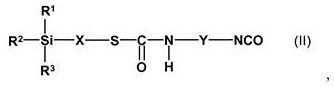
Which is present in admixture with a minor amount of a silane-functional compound of the general formula (III),

wherein in the formulae (II) and (III)
R1、R2、R3And X has the meaning given for formula (I) in claim 10, and
y represents a linear or branched aliphatic or cycloaliphatic radical having from 4 to 18 carbon atoms or an optionally substituted aromatic or araliphatic radical having from 6 to 18 carbon atoms, and
wherein the compound of the formula (III) is present in an amount of 2 to 15% by weight based on the total mass of the compounds of the formulae (II) and (III).
13. The method of claim 12, wherein: in the formulae (II) and (III)
R1、R2、R3And X has the definition given for formula (I) in claim 11.
14. The method of claim 12, wherein: the alkoxysilane-functional isocyanates C) used are at least one reaction product of 3-mercaptopropyltrimethoxysilane and/or 3-mercaptopropyltriethoxysilane with 1, 5-diisocyanatopentane, 1, 6-diisocyanatohexane, 1-isocyanato-3, 3, 5-trimethyl-5-isocyanatomethylcyclohexane, 2,4 '-and/or 4,4' -diisocyanatodicyclohexylmethane or any mixtures of these diisocyanates.
15. The method of claim 1 or 2, wherein: the alkoxysilane-functional isocyanate C) used is at least one compound of the formula (IV)
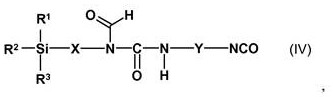
Which is present in admixture with a minor amount of a silane-functional compound of the formula (V),

wherein in the formulae (IV) and (V)
R1、R2、R3And X has the meaning given for formula (I) in claim 10, and
y has the meaning given in claim 12 for the formulae (II) and (III), and
wherein the compound of the formula (V) is contained in an amount of 2 to 15% by weight based on the total mass of the compounds of the formulae (IV) and (V).
16. The method of claim 15, wherein: wherein in the formulae (IV) and (V)
R1、R2、R3And X has the definition given for formula (I) in claim 11.
17. The method according to claim 1 or 2, characterized in that: the reaction of the reaction product with the alkoxysilane-functional isocyanate C) is carried out following the following equivalent ratio of isocyanate groups to hydroxyl groups: 0.7: 1-1.5: 1.
18. the method according to claim 1 or 2, characterized in that: the reaction of the reaction product with the alkoxysilane-functional isocyanate C) is carried out following the following equivalent ratio of isocyanate groups to hydroxyl groups: 0.8: 1-1.2: 1.
19. the method according to claim 1 or 2, characterized in that: the reaction of the reaction product with the alkoxysilane-functional isocyanate C) is carried out following the following equivalent ratio of isocyanate groups to hydroxyl groups: 0.9: 1-1.1: 1.
20. the method according to claim 1 or 2, characterized in that: the reaction of the reaction product with the alkoxysilane-functional isocyanate C) is carried out following the following equivalent ratio of isocyanate groups to hydroxyl groups: 1: 1-1.05: 1.
21. a polyurethane containing silane groups prepared by the method of any one of claims 1 to 20.
22. Use of a urethane group-containing polyurethane according to claim 21 for the preparation of a crosslinkable binder.
23. Use according to claim 22 for the preparation of crosslinkable paint, sealant or adhesive raw materials.
24. A crosslinkable binder comprising the silane group-containing polyurethane according to claim 21.
Applications Claiming Priority (3)
| Application Number | Priority Date | Filing Date | Title |
|---|---|---|---|
| EP16183429.6 | 2016-08-09 | ||
| EP16183429 | 2016-08-09 | ||
| PCT/EP2017/070078 WO2018029197A1 (en) | 2016-08-09 | 2017-08-08 | Silane-functional polymeric polyurethanes |
Publications (2)
| Publication Number | Publication Date |
|---|---|
| CN109642009A CN109642009A (en) | 2019-04-16 |
| CN109642009B true CN109642009B (en) | 2021-12-10 |
Family
ID=56618039
Family Applications (1)
| Application Number | Title | Priority Date | Filing Date |
|---|---|---|---|
| CN201780048302.8A Active CN109642009B (en) | 2016-08-09 | 2017-08-08 | Silane-functional polymeric polyurethanes |
Country Status (7)
| Country | Link |
|---|---|
| US (1) | US10844161B2 (en) |
| EP (1) | EP3497146B1 (en) |
| JP (1) | JP6997761B2 (en) |
| KR (1) | KR102442964B1 (en) |
| CN (1) | CN109642009B (en) |
| ES (1) | ES2927985T3 (en) |
| WO (1) | WO2018029197A1 (en) |
Families Citing this family (16)
| Publication number | Priority date | Publication date | Assignee | Title |
|---|---|---|---|---|
| CN117045653A (en) | 2013-01-23 | 2023-11-14 | 奥尔德拉医疗公司 | Diseases and treatments associated with toxic aldehydes |
| CN110540795B (en) * | 2018-05-28 | 2021-10-15 | 广东华润涂料有限公司 | Non-isocyanate-cured solvent-borne two-component coating compositions |
| US11326017B2 (en) * | 2018-09-10 | 2022-05-10 | Evonik Operations Gmbh | Tin-free catalysis of silane-functional polyurethane crosslinkers |
| JP2022505990A (en) | 2018-10-30 | 2022-01-14 | コベストロ・インテレクチュアル・プロパティ・ゲゼルシャフト・ミット・ベシュレンクテル・ハフツング・アンド・コー・カーゲー | Multi-layer paint structure with improved layer adhesion |
| WO2020089019A1 (en) | 2018-10-30 | 2020-05-07 | Covestro Deutschland Ag | Method for producing a multilayer coating structure with a top layer made of silane group-containing prepolymers |
| CN109651578B (en) * | 2018-12-12 | 2021-09-17 | 中昊北方涂料工业研究设计院有限公司 | Ablation-resistant flame-retardant organic-inorganic resin and preparation thereof |
| EP3722346A1 (en) * | 2019-04-09 | 2020-10-14 | Covestro Deutschland AG | 2-component polyurethane coatings with improved pot life without lost weathering stability |
| CN115803354A (en) * | 2020-07-06 | 2023-03-14 | 瓦克化学股份公司 | Crosslinkable substances based on silane-terminated polymers |
| CN112812680A (en) * | 2021-01-26 | 2021-05-18 | 广东爱上体育产业股份有限公司 | Strong-permeability sealing primer for improving strength of cement concrete and preparation method thereof |
| EP4294881A1 (en) | 2021-02-18 | 2023-12-27 | PPG Industries Ohio Inc. | Coating compositions and methods including carbodiimides |
| CN117715951A (en) * | 2021-07-16 | 2024-03-15 | 汉高股份有限及两合公司 | Two-component polyurethane adhesive composition for film lamination in hot-fill applications |
| ES3033003T3 (en) | 2021-07-16 | 2025-07-29 | Henkel Ag & Co Kgaa | Two-component polyurethane adhesive composition for film lamination |
| CN116239741B (en) * | 2021-12-07 | 2024-08-20 | 万华化学集团股份有限公司 | Epoxy modified waterborne polyurethane resin, preparation method and application thereof |
| CN116284102A (en) * | 2022-09-08 | 2023-06-23 | 吉祥三宝高科纺织有限公司 | A preparation method of silane coupling agent and its application in polylactic acid composite materials |
| CN116102930B (en) * | 2022-12-29 | 2023-09-12 | 广东邦固化学科技有限公司 | Protective layer coating for cold stamping film and preparation method thereof |
| CN119638942B (en) * | 2025-02-19 | 2025-07-15 | 盛虹炼化(连云港)有限公司 | Polyol composition, foaming composition, and preparation methods and applications thereof |
Citations (7)
| Publication number | Priority date | Publication date | Assignee | Title |
|---|---|---|---|---|
| DD132969A1 (en) * | 1977-07-29 | 1978-11-22 | Klaus Walter | METHOD OF PREPARING STABILIZED POLYESTER POLYOLS AND ESTER GROUPS OF PLASTIC MATERIALS |
| CN1942500A (en) * | 2005-03-23 | 2007-04-04 | 德古萨公司 | Low-viscosity polyaddition compounds containing uretdione groups, their preparation and use |
| CN101311201A (en) * | 2007-05-22 | 2008-11-26 | 拜尔材料科学股份公司 | polyester prepolymer |
| DE102010015683A1 (en) * | 2010-04-21 | 2011-10-27 | Basf Coatings Gmbh | Coating agent based on aprotic solvents, useful e.g. as clear coat for automotive repair lacquering, comprises at least one oligomeric and/or polymeric hydroxyl group-containing compound (A) and at least one compound (B) |
| CN104350077A (en) * | 2012-05-03 | 2015-02-11 | 莱茵化学莱瑙有限公司 | Method for improving the hydrolysis resistance of polyurethane (PU) based systems |
| CN104583260A (en) * | 2012-09-04 | 2015-04-29 | 拜耳材料科技股份有限公司 | Silane functional binder with thiourethane structure |
| WO2015113923A1 (en) * | 2014-01-31 | 2015-08-06 | Bayer Materialscience Ag | Silane modified formamides |
Family Cites Families (37)
| Publication number | Priority date | Publication date | Assignee | Title |
|---|---|---|---|---|
| US3517001A (en) | 1967-09-20 | 1970-06-23 | Gen Electric | Nitrogen-containing organosilicon materials |
| DE1770245C3 (en) | 1968-04-23 | 1979-11-15 | Bayer Ag, 5090 Leverkusen | Process for the production of optionally crosslinked polyurethanes |
| DE2301725A1 (en) | 1973-01-13 | 1974-07-18 | Bayer Ag | Cycloaliphatic carbodiimides useful as pigment binders - produced by heating isocyanates with polyurethane catalysts |
| FR2250808B1 (en) | 1973-11-14 | 1978-10-13 | Huels Chemische Werke Ag | |
| DE2358038A1 (en) | 1973-11-21 | 1975-05-28 | Bayer Ag | Cycloaliphatic carbodiimides prodn. - by heating isocyanates with a cycloaliphatic monourethane catalyst |
| US4345053A (en) | 1981-07-17 | 1982-08-17 | Essex Chemical Corp. | Silicon-terminated polyurethane polymer |
| US4419294A (en) | 1982-03-08 | 1983-12-06 | American Cyanamid Company | Carbodiimide oligomers of tertiary aliphatic isocyanates |
| US4499150A (en) | 1983-03-29 | 1985-02-12 | Ppg Industries, Inc. | Color plus clear coating method utilizing addition interpolymers containing alkoxy silane and/or acyloxy silane groups |
| US5068304A (en) | 1988-12-09 | 1991-11-26 | Asahi Glass Company, Ltd. | Moisture-curable resin composition |
| DE4237468A1 (en) | 1992-11-06 | 1994-05-11 | Bayer Ag | Compounds containing alkoxysilane and amino groups |
| DE4308097A1 (en) | 1993-03-15 | 1994-09-22 | Henkel Kgaa | Polyol for an isocyanate casting resin and coatings |
| US5393910A (en) | 1993-10-20 | 1995-02-28 | Osi Specialties, Inc. | Process for making isocyanatoorganosilanes |
| US5502147A (en) | 1993-12-21 | 1996-03-26 | Bayer Corporation | Aliphatic rim elastomers |
| DE19611849A1 (en) | 1996-03-26 | 1997-10-02 | Bayer Ag | New isocyanate trimer and isocyanate trimer mixtures, their production and use |
| DE19646424A1 (en) | 1996-11-11 | 1998-05-14 | Henkel Kgaa | Use of polyols for isocyanate casting resins and coating compositions |
| US5973024A (en) | 1997-07-09 | 1999-10-26 | Nisshinbo Industries, Inc. | Method for control of biodegradation rate of biodegradable plastic |
| DE19734048A1 (en) | 1997-08-06 | 1999-02-11 | Bayer Ag | Process for the preparation of polyisocyanates, polyisocyanates produced therewith and their use |
| DE59903289D1 (en) | 1998-06-02 | 2002-12-12 | Bayer Ag | Process for the preparation of polyisocyanates containing iminooxadiazinedione groups |
| DE19835113A1 (en) | 1998-08-04 | 2000-02-10 | Basf Ag | Process for the production of compact, transparent polyisocyanate polyaddition products |
| DE10013628A1 (en) | 2000-03-18 | 2001-09-20 | Degussa | Stable 1:1 monoadduct used for polyurethane lacquers and dispersions comprises aminoalkyl alkoxysilanes and diisocyanates and containing below 0.6 wt.% free diisocyanates |
| US7635388B1 (en) * | 2000-05-04 | 2009-12-22 | Tyler Thomas D | Device and method for incremental correction of sight disorders and occular diseases |
| DE102004050748A1 (en) | 2004-10-19 | 2006-04-20 | Basf Coatings Aktiengesellschaft | High scratch resistant and highly elastic coating agents based on alkoxysilanes |
| DE102005045228A1 (en) | 2005-09-22 | 2007-04-05 | Basf Coatings Ag | Use of phosphonic diesters and diphosphonic diesters, and silane-containing, curable mixtures containing phosphonic and Diphosphonsäurediester |
| US7977501B2 (en) | 2006-07-24 | 2011-07-12 | Bayer Materialscience Llc | Polyether carbonate polyols made via double metal cyanide (DMC) catalysis |
| DE102006044310A1 (en) | 2006-09-18 | 2008-03-27 | Nano-X Gmbh | Silane coating material and method of making a silane coating material |
| JP5637687B2 (en) | 2006-12-19 | 2014-12-10 | ビーエーエスエフ コーティングス ゲゼルシャフト ミット ベシュレンクテル ハフツングBASF Coatings GmbH | Coating material with high scratch resistance and weather resistance |
| DE102007061854A1 (en) | 2007-12-19 | 2009-06-25 | Basf Coatings Ag | Coating agent with high scratch resistance and weathering stability |
| JP2011514255A (en) | 2008-03-18 | 2011-05-06 | ナノ−エックス ゲーエムベーハー | Method for producing highly wear resistant vehicle paint, vehicle paint and use thereof |
| JP2012111786A (en) | 2009-03-17 | 2012-06-14 | Asahi Glass Co Ltd | Adhesive material |
| WO2011124710A1 (en) | 2010-04-09 | 2011-10-13 | Basf Se | Coatings that can be repaired by the application of energy |
| DE102012204290A1 (en) | 2012-03-19 | 2013-09-19 | Evonik Degussa Gmbh | Adducts of isocyanatoalkyl-trialkoxysilanes and aliphatic, alkyl-branched diols or polyols |
| EP2864383B1 (en) | 2012-06-20 | 2019-10-02 | Evonik Degussa GmbH | Coating agent having high scratch resistance |
| WO2014016019A1 (en) | 2012-07-25 | 2014-01-30 | Basf Coatings Gmbh | Polyurethane coating agent compositions, multi-stage coating methods |
| ES2720191T3 (en) | 2012-09-04 | 2019-07-18 | Covestro Deutschland Ag | Isocyanates with thiouretane structure |
| DE102012219324A1 (en) | 2012-10-23 | 2014-04-24 | Evonik Industries Ag | Compositions comprising alkoxysilane-containing isocyanates and acidic stabilizers |
| DE102013208356A1 (en) | 2013-05-07 | 2014-11-13 | Evonik Industries Ag | Crosslinking of IPMS adducts with aminosilanes |
| WO2016010900A1 (en) | 2014-07-14 | 2016-01-21 | Momentive Performance Materials Inc. | Process for producing low-color and color-stable isocyanatoorganosilanes and products derived therefrom |
-
2017
- 2017-08-08 CN CN201780048302.8A patent/CN109642009B/en active Active
- 2017-08-08 EP EP17749466.3A patent/EP3497146B1/en active Active
- 2017-08-08 WO PCT/EP2017/070078 patent/WO2018029197A1/en not_active Ceased
- 2017-08-08 ES ES17749466T patent/ES2927985T3/en active Active
- 2017-08-08 US US16/323,604 patent/US10844161B2/en active Active
- 2017-08-08 KR KR1020197003583A patent/KR102442964B1/en active Active
- 2017-08-08 JP JP2019506726A patent/JP6997761B2/en not_active Expired - Fee Related
Patent Citations (8)
| Publication number | Priority date | Publication date | Assignee | Title |
|---|---|---|---|---|
| DD132969A1 (en) * | 1977-07-29 | 1978-11-22 | Klaus Walter | METHOD OF PREPARING STABILIZED POLYESTER POLYOLS AND ESTER GROUPS OF PLASTIC MATERIALS |
| CN1942500A (en) * | 2005-03-23 | 2007-04-04 | 德古萨公司 | Low-viscosity polyaddition compounds containing uretdione groups, their preparation and use |
| CN101311201A (en) * | 2007-05-22 | 2008-11-26 | 拜尔材料科学股份公司 | polyester prepolymer |
| DE102010015683A1 (en) * | 2010-04-21 | 2011-10-27 | Basf Coatings Gmbh | Coating agent based on aprotic solvents, useful e.g. as clear coat for automotive repair lacquering, comprises at least one oligomeric and/or polymeric hydroxyl group-containing compound (A) and at least one compound (B) |
| CN104350077A (en) * | 2012-05-03 | 2015-02-11 | 莱茵化学莱瑙有限公司 | Method for improving the hydrolysis resistance of polyurethane (PU) based systems |
| CN104364284A (en) * | 2012-05-03 | 2015-02-18 | 莱茵化学莱瑙有限公司 | Methods for controlling (extending) the pot life in chain-extended polyurethane (pu)-based systems |
| CN104583260A (en) * | 2012-09-04 | 2015-04-29 | 拜耳材料科技股份有限公司 | Silane functional binder with thiourethane structure |
| WO2015113923A1 (en) * | 2014-01-31 | 2015-08-06 | Bayer Materialscience Ag | Silane modified formamides |
Non-Patent Citations (2)
| Title |
|---|
| Kinetics of the reaction between polyester acid and carbodiimide in dry polyester diols and in a polyester polyurethane;Daniel W. Brown等;《Macromolecules》;19810501;第14卷(第3期);659-663 * |
| 碳化二亚胺的制备及其水解稳定作用;徐海涛 等;《弹性体》;20031231;第13卷(第6期);71-73 * |
Also Published As
| Publication number | Publication date |
|---|---|
| KR102442964B1 (en) | 2022-09-14 |
| KR20190039505A (en) | 2019-04-12 |
| JP6997761B2 (en) | 2022-01-18 |
| CN109642009A (en) | 2019-04-16 |
| JP2019524957A (en) | 2019-09-05 |
| ES2927985T3 (en) | 2022-11-14 |
| EP3497146A1 (en) | 2019-06-19 |
| WO2018029197A1 (en) | 2018-02-15 |
| EP3497146B1 (en) | 2022-08-31 |
| US20190202973A1 (en) | 2019-07-04 |
| US10844161B2 (en) | 2020-11-24 |
Similar Documents
| Publication | Publication Date | Title |
|---|---|---|
| CN109642009B (en) | Silane-functional polymeric polyurethanes | |
| JP5751789B2 (en) | High functionality polyisocyanate containing allophanate and silane groups | |
| CN104583260B (en) | The adhesive of silane-functional with thiocarbamate structure | |
| JP6602794B2 (en) | Silane-containing thioallophanate polyisocyanate | |
| JP6892825B2 (en) | Silane group-containing polyisocyanate based on 1,5-diisocyanatopentane | |
| JP5311904B2 (en) | Polyisocyanates containing allophanate and silane groups | |
| CN111479629B (en) | Method for producing mixed silane-terminated polymers | |
| CN108026237A (en) | The bicomponent polyurethane coating of damage resistant | |
| CN106414463B (en) | Silane-modified carboxamides | |
| US10040808B2 (en) | Silane-modified formamides | |
| CN117545786A (en) | Coating composition and coating obtainable therefrom with improved stain resistance and (self) cleaning properties | |
| CN112638978A (en) | Desiccant for moisture-curing compositions | |
| WO2026012958A1 (en) | Waterproofing coating formed from a silane-terminated polymer | |
| KR20130091157A (en) | Urethane modified silicon polymer and preparation method of the same |
Legal Events
| Date | Code | Title | Description |
|---|---|---|---|
| PB01 | Publication | ||
| PB01 | Publication | ||
| SE01 | Entry into force of request for substantive examination | ||
| SE01 | Entry into force of request for substantive examination | ||
| GR01 | Patent grant | ||
| GR01 | Patent grant |