CN109727207B - Hyperspectral Image Sharpening Method Based on Spectral Prediction Residual Convolutional Neural Network - Google Patents
Hyperspectral Image Sharpening Method Based on Spectral Prediction Residual Convolutional Neural Network Download PDFInfo
- Publication number
- CN109727207B CN109727207B CN201811485313.5A CN201811485313A CN109727207B CN 109727207 B CN109727207 B CN 109727207B CN 201811485313 A CN201811485313 A CN 201811485313A CN 109727207 B CN109727207 B CN 109727207B
- Authority
- CN
- China
- Prior art keywords
- hyperspectral image
- layer
- convolution
- output
- neural network
- Prior art date
- Legal status (The legal status is an assumption and is not a legal conclusion. Google has not performed a legal analysis and makes no representation as to the accuracy of the status listed.)
- Active
Links
Images


Landscapes
- Image Processing (AREA)
Abstract
本发明公开了一种基于光谱预测残差卷积神经网络的高光谱图像锐化方法,包括读取原始高光谱图像;利用高光谱图像的可见光波段合成相应的全色图像;对图像数据进行预处理,获取训练样本对;构造光谱预测残差卷积神经网络结构;将训练样本对输入光谱预测残差卷积神经网络,利用自适应矩估计算法,使训练误差降低至最小值,从而得到最优的网络结构参数;将经过相同预处理的测试样本对输入至最优光谱预测残差卷积神经网络结构中,输出高分辨率的高光谱图像。本发明能有效地缓解光谱失真的现象,增强其锐化效果。
The invention discloses a hyperspectral image sharpening method based on a spectral prediction residual convolutional neural network, which includes reading the original hyperspectral image; using the visible light band of the hyperspectral image to synthesize a corresponding panchromatic image; and pre-processing the image data. processing to obtain the training sample pair; construct the spectral prediction residual convolutional neural network structure; input the training sample pair into the spectral prediction residual convolutional neural network, and use the adaptive moment estimation algorithm to reduce the training error to the minimum value, thereby obtaining the optimal Excellent network structure parameters; the same preprocessed test sample pairs are input into the optimal spectral prediction residual convolutional neural network structure, and high-resolution hyperspectral images are output. The invention can effectively alleviate the phenomenon of spectrum distortion and enhance its sharpening effect.
Description
技术领域technical field
本发明涉及遥感图像领域,具体涉及一种基于光谱预测残差卷积神经网络的高光谱图像锐化方法。The invention relates to the field of remote sensing images, in particular to a hyperspectral image sharpening method based on a spectral prediction residual convolutional neural network.
背景技术Background technique
随着成像光谱技术日益成熟,遥感图像处理领域从多光谱图像时代逐渐过渡至高光谱图像时代。与多光谱图像相比,高光谱图像不仅包含更加丰富的地物信息,而且能对更加细致的光谱分析提供数据支持。虽然高光谱图像在诸多遥感应用领域拥有不可或缺的地位,但是其较低的空间分辨率一直为人所诟病。为了提高其空间分辨率,其中一种策略是将高光谱图像和与其配准的高空间分辨率的全色图像进行融合,利用全色图像中的丰富的空间细节信息锐化高光谱图像,从而得到高空间分辨率的高光谱图像。常用的高光谱图像锐化算法包括有主成分分析、导向滤波法、矩阵分解和贝叶斯法等。从它们的处理结果上来看,均存在或多或少的不足。例如,主成分分析虽然能较好地修复高光谱图像所丢失地空间细节信息,但是处理结果存在明显的光谱失真现象;另外,贝叶斯法在空间细节修复和光谱维护上处理得相对较好,但它的运算量大,而且需要依靠极强的先验信息才能达到最佳效果,故在实际应用中存在一定的限制。With the increasing maturity of imaging spectroscopy technology, the field of remote sensing image processing has gradually transitioned from the era of multispectral images to the era of hyperspectral images. Compared with multispectral images, hyperspectral images not only contain richer ground object information, but also provide data support for more detailed spectral analysis. Although hyperspectral images play an indispensable role in many remote sensing applications, their low spatial resolution has always been criticized. In order to improve its spatial resolution, one of the strategies is to fuse the hyperspectral image with its registered high-spatial-resolution panchromatic image, and use the rich spatial detail information in the panchromatic image to sharpen the hyperspectral image, thereby Obtain hyperspectral images with high spatial resolution. Commonly used hyperspectral image sharpening algorithms include principal component analysis, guided filtering, matrix decomposition, and Bayesian methods. From their processing results, there are more or less deficiencies. For example, although principal component analysis can better restore the lost spatial detail information of hyperspectral images, there are obvious spectral distortions in the processing results; in addition, the Bayesian method is relatively good at spatial detail restoration and spectral maintenance. , but it has a large amount of computation and needs to rely on extremely strong prior information to achieve the best results, so there are certain limitations in practical applications.
近年来,卷积神经网络在各种图像处理领域中展示出优越的性能,受到日益广泛关注。In recent years, convolutional neural networks have shown superior performance in various image processing fields and have received increasing attention.
发明内容Contents of the invention
为了克服现有技术存在的缺点与不足,本发明提供基于光谱预测残差卷积神经网络的高光谱图像锐化方法,增强卷积神经网络应用于高光谱图像锐化时的空间信息修复能力和光谱信息保护能力。In order to overcome the shortcomings and deficiencies in the prior art, the present invention provides a hyperspectral image sharpening method based on spectral prediction residual convolutional neural network, which enhances the spatial information repair ability and Spectral information protection capability.
本发明采用如下技术方案:The present invention adopts following technical scheme:
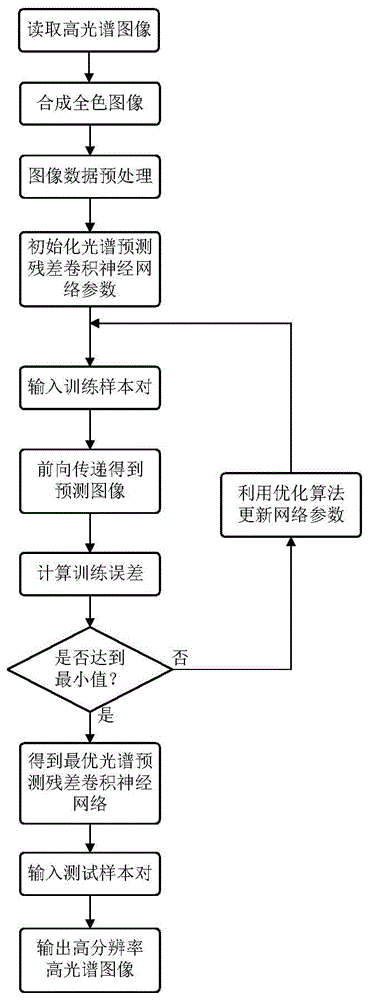
一种基于光谱预测残差卷积神经网络的高光谱图像锐化方法,包括如下步骤:A hyperspectral image sharpening method based on spectral prediction residual convolutional neural network, comprising the following steps:
S1获取训练样本集:获取高光谱图像

S2搭建光谱预测残差卷积神经网络模型:模型包括光谱预测和空间细节修复两部分,两部分均由卷积层构成,网络的激活函数采用线性整流函数;S2 Build a spectral prediction residual convolutional neural network model: the model includes two parts: spectral prediction and spatial detail restoration, both of which are composed of convolutional layers, and the activation function of the network adopts a linear rectification function;
S3训练光谱预测残差卷积神经网络模型:利用零均值的高斯分布初始化网络各层的卷积核的权重和偏置,采用自适应矩估计算法对网络模型进行迭代优化得到最优光谱预测残卷积神经网络模型;S3 training spectral prediction residual convolutional neural network model: use zero-mean Gaussian distribution to initialize the weights and biases of the convolution kernels of each layer of the network, and use the adaptive moment estimation algorithm to iteratively optimize the network model to obtain the optimal spectral prediction residual Convolutional neural network model;
S4利用训练好的光谱预测残差卷积神经网络模型,锐化处理低分辨率的高光谱图像。S4 uses the trained spectral prediction residual convolutional neural network model to sharpen and process low-resolution hyperspectral images.
进一步地,所述全色图像进行预处理,得到训练样本对,具体包括:Further, the panchromatic image is preprocessed to obtain a training sample pair, which specifically includes:
预处理步骤:选取高光谱图像的部分区域


分块采样步骤:以一定的间隔对训练对训练样本


进一步地,所述搭建光谱预测残差卷积神经网络模型,具体为:Further, the construction of the spectral prediction residual convolutional neural network model is specifically:
S2.1光谱预测卷积层Conv1,输入训练数据


S2.2光谱预测卷积层Conv2,输入上一层的输出,与64个空间大小为1×1的卷积核进行卷积运算,并经过线性整流函数激活处理,输出得到64个特征图Y2 (i),本层与Conv1协同作用,用于对高光谱图像的有效光谱波段进行预测处理;S2.2 Spectral prediction convolution layer Conv2, input the output of the previous layer, perform convolution operation with 64 convolution kernels with a spatial size of 1×1, and activate the linear rectification function, and output 64 feature maps Y 2 (i) , this layer cooperates with Conv1 to predict the effective spectral band of the hyperspectral image;
S2.3拼接层Concat,输入上一层的输出,并将其与相应的全色图像训练数据
S2.4空间细节修复卷积层Conv3,输入上一层的输出,与64个空间大小为3×3的卷积核进行卷积运算,并经过线性整流函数激活处理,输出64个特征图Y3 (i);S2.4 Spatial detail repair convolution layer Conv3, input the output of the previous layer, perform convolution operation with 64 convolution kernels with a spatial size of 3×3, and activate the linear rectification function to output 64 feature maps Y 3 (i) ;
S2.5空间细节修复卷积层Conv4,输入上一层的输出,与32个空间大小为3×3的卷积核进行卷积运算,并经过线性整流函数激活处理,输出32个特征图Y4 (i);S2.5 Spatial detail repair convolutional layer Conv4, input the output of the previous layer, perform convolution operation with 32 convolution kernels with a spatial size of 3×3, and activate the linear rectification function to output 32 feature maps Y 4 (i) ;
S2.6空间细节修复卷积层Conv5,输入上一层的输出,与64个空间大小为3×3的卷积核进行卷积运算,并经过线性整流函数激活处理,输出64个特征图Y5 (i);S2.6 Spatial detail repair convolution layer Conv5, input the output of the previous layer, perform convolution operation with 64 convolution kernels with a spatial size of 3×3, and activate the linear rectification function to output 64 feature maps Y 5 (i) ;
S2.7求和层Sum,输入上一层的输出和光谱预测层Conv2输出Y2 (i),即经过光谱预测后的高光谱图像的有效波段,两个输入数据进行逐元素相加,输出64个特征图YSum (i);S2.7 Summing layer Sum, input the output of the previous layer and the output Y 2 (i) of the spectral prediction layer Conv2, that is, the effective band of the hyperspectral image after spectral prediction, the two input data are added element by element, and the output 64 feature maps Y Sum (i) ;
S2.8光谱预测卷积层Conv6,输入上一层的输出,与64个空间大小为1×1的卷积核进行卷积运算,并经过线性整流函数激活处理,输出64个特征图Y6 (i);S2.8 Spectral prediction convolutional layer Conv6, input the output of the previous layer, perform convolution operation with 64 convolution kernels with a spatial size of 1×1, and activate the linear rectification function to output 64 feature maps Y 6 (i) ;
S2.9光谱预测卷积层Conv7,输入上一层的输出,与b个空间大小为1×1的卷积核进行卷积运算,并经过线性整流函数激活处理,输出网络处理得到的高分辨高光谱图像O(i),本层与Conv6协同作用,用于预测高光谱图像完整的所有波段。S2.9 Spectrum prediction convolutional layer Conv7, input the output of the previous layer, perform convolution operation with b convolution kernels with a spatial size of 1×1, and activate the linear rectification function, and output the high-resolution network processing Hyperspectral image O (i) , this layer cooperates with Conv6 to predict all bands of hyperspectral image integrity.
进一步地,S3中光谱预测残差卷积神经网络训练时选用欧式距离损失函数作为输出层,得到网络输出高光谱图像与理想高光谱图像之间的欧氏距离,即训练误差,其表达式为:Furthermore, the Euclidean distance loss function is selected as the output layer during the training of the spectral prediction residual convolutional neural network in S3, and the Euclidean distance between the network output hyperspectral image and the ideal hyperspectral image is obtained, that is, the training error, and its expression is :

当训练误差降低至最小值时,权重和偏置为最优解,即得到最优光谱预测残差卷积神经网络模型。When the training error is reduced to the minimum value, the weight and bias are the optimal solution, that is, the optimal spectral prediction residual convolutional neural network model is obtained.
进一步地,所述S4中,测试样本经过预处理后,输入最优光谱预测残卷积神经网络模型,得到高分辨率的高光谱图像。Further, in S4, after the test samples are preprocessed, they are input into the optimal spectral prediction residual convolutional neural network model to obtain high-resolution hyperspectral images.
本发明的有益效果:Beneficial effects of the present invention:
(1)本发明是高光谱图像锐化传统方法的延伸,利用卷积神经网络强大的优化能力,构建相应的锐化模型,直接学习退化的高光谱图像与原始高光谱图像的映射关系,使得模型的鲁棒性得到极大的提升,进而增强高光谱图像的锐化效果;(1) The present invention is an extension of the traditional method of hyperspectral image sharpening. It uses the powerful optimization ability of convolutional neural network to construct a corresponding sharpening model, and directly learns the mapping relationship between the degraded hyperspectral image and the original hyperspectral image, so that The robustness of the model has been greatly improved, thereby enhancing the sharpening effect of hyperspectral images;
(2)本发明将整个锐化过程分为三部分,第一部分利用1×1卷积核对高光谱图像进行光谱预测,提取高光谱图像有效的光谱波段,第二部分利用3×3卷积核对预测后的高光谱图像提取有效特征,进行空间细节修复,最后一部分再次利用光谱预测操作,恢复原始高光谱图像的光谱信息,与普通的卷积神经网络相比,本发明所设计的模型能准确预测高光谱图像的有效光谱成分,增强全色图像光谱覆盖范围以外的波段锐化效果。(2) The present invention divides the whole sharpening process into three parts. The first part uses 1×1 convolution kernel to perform spectrum prediction on hyperspectral image, and extracts the effective spectral band of hyperspectral image. The second part uses 3×3 convolution kernel to perform spectral prediction. The predicted hyperspectral image extracts effective features and restores the spatial details. The last part uses the spectral prediction operation again to restore the spectral information of the original hyperspectral image. Compared with the ordinary convolutional neural network, the model designed by the present invention can accurately Predict the effective spectral composition of hyperspectral images and enhance the sharpening effect of bands outside the spectral coverage of panchromatic images.
附图说明Description of drawings
图1是本发明的流程图;Fig. 1 is a flow chart of the present invention;
图2是本发明光谱预测残差卷积神经网络的结构图;Fig. 2 is the structural diagram of spectral prediction residual convolutional neural network of the present invention;
图3(a)为HYDICE高光谱参照图;Figure 3(a) is the HYDICE hyperspectral reference map;
图3(b)为采用双三次插值处理后的图像;Fig. 3 (b) is the image processed by bicubic interpolation;
图3(c)为采用矩阵分解算法处理后的图像;Fig. 3 (c) is the image processed by matrix decomposition algorithm;
图3(d)为采用贝叶斯算法处理后的图像;Fig. 3 (d) is the image processed by Bayesian algorithm;
图3(e)为采用本方法处理后的图像。Figure 3(e) is the image processed by this method.
具体实施方式detailed description
下面结合实施例及附图,对本发明作进一步地详细说明,但本发明的实施方式不限于此。The present invention will be described in further detail below in conjunction with the embodiments and the accompanying drawings, but the embodiments of the present invention are not limited thereto.
实施例Example
如图1及图2所示,一种基于光谱预测残差卷积神经网络的高光谱图像锐化方法,主要是包括如下步骤:As shown in Figure 1 and Figure 2, a hyperspectral image sharpening method based on spectral prediction residual convolutional neural network mainly includes the following steps:
S1获取训练样本集:获取高光谱图像

对获取的高光谱图像的前n个连续波段进行加权求和,得到相应的全色图像,此n个波段所覆盖的光谱范围对应可见光谱。The weighted summation of the first n consecutive bands of the acquired hyperspectral image is performed to obtain the corresponding panchromatic image, and the spectral range covered by the n bands corresponds to the visible spectrum.
选取高光谱图像的部分区域及其对应的全色图像区域作为训练样本对,将样本对预处理后,进行分块采样,得到多个训练样本块,具体步骤为;Select a part of the hyperspectral image and its corresponding panchromatic image area as a training sample pair, preprocess the sample pair, and perform block sampling to obtain multiple training sample blocks. The specific steps are as follows;
S1.1对训练样本的预处理:对选取的高光谱图像训练样本


S1.2对训练样本进行分块采样:以一定的间隔对训练样本对


S2搭建光谱预测残差卷积神经网络模型:模型包括光谱预测和空间细节修复两部分,两部分均由卷积层构成,网络的激活函数采用线性整流函数,具体包括如下步骤:S2 Build a spectral prediction residual convolutional neural network model: The model includes two parts: spectral prediction and spatial detail restoration, both of which are composed of convolutional layers. The activation function of the network adopts a linear rectification function, which specifically includes the following steps:
S2.1光谱预测卷积层Conv1,输入训练数据


S2.2光谱预测卷积层Conv2,输入上一层的输出,与64个空间大小为1×1的卷积核进行卷积运算,并经过线性整流函数激活处理,输出得到64个特征图Y2 (i),本层与Conv1协同作用,用于对高光谱图像的有效光谱波段进行预测处理;S2.2 Spectral prediction convolution layer Conv2, input the output of the previous layer, perform convolution operation with 64 convolution kernels with a spatial size of 1×1, and activate the linear rectification function, and output 64 feature maps Y 2 (i) , this layer cooperates with Conv1 to predict the effective spectral band of the hyperspectral image;
S2.3拼接层Concat,输入上一层的输出,并将其与相应的全色图像训练数据
S2.4空间细节修复卷积层Conv3,输入上一层的输出,与64个空间大小为3×3的卷积核进行卷积运算,并经过线性整流函数激活处理,输出64个特征图Y3 (i);S2.4 Spatial detail repair convolution layer Conv3, input the output of the previous layer, perform convolution operation with 64 convolution kernels with a spatial size of 3×3, and activate the linear rectification function to output 64 feature maps Y 3 (i) ;
S2.5空间细节修复卷积层Conv4,输入上一层的输出,与32个空间大小为3×3的卷积核进行卷积运算,并经过线性整流函数激活处理,输出32个特征图Y4 (i);S2.5 Spatial detail repair convolutional layer Conv4, input the output of the previous layer, perform convolution operation with 32 convolution kernels with a spatial size of 3×3, and activate the linear rectification function to output 32 feature maps Y 4 (i) ;
S2.6空间细节修复卷积层Conv5,输入上一层的输出,与64个空间大小为3×3的卷积核进行卷积运算,并经过线性整流函数激活处理,输出64个特征图Y5 (i);S2.6 Spatial detail repair convolution layer Conv5, input the output of the previous layer, perform convolution operation with 64 convolution kernels with a spatial size of 3×3, and activate the linear rectification function to output 64 feature maps Y 5 (i) ;
S2.7求和层Sum,输入上一层的输出和光谱预测层Conv2输出Y2(i),即经过光谱预测后的高光谱图像的有效波段,两个输入数据进行逐元素相加,输出64个特征图YSum (i) S2.7 Summing layer Sum, input the output of the previous layer and output Y 2 ( i) of the spectral prediction layer Conv2, that is, the effective band of the hyperspectral image after spectral prediction, the two input data are added element by element, and the output 64 feature maps Y Sum (i)
S2.8光谱预测卷积层Conv6,输入上一层的输出,与64个空间大小为1×1的卷积核进行卷积运算,并经过线性整流函数激活处理,输出64个特征图Y6 (i);S2.8 Spectral prediction convolutional layer Conv6, input the output of the previous layer, perform convolution operation with 64 convolution kernels with a spatial size of 1×1, and activate the linear rectification function to output 64 feature maps Y 6 (i) ;
S2.9光谱预测卷积层Conv7,输入上一层的输出,与b个空间大小为1×1的卷积核进行卷积运算,并经过线性整流函数激活处理,输出网络处理得到的高分辨高光谱图像O(i),本层与Conv6协同作用,用于预测高光谱图像完整的所有波段。S2.9 Spectrum prediction convolutional layer Conv7, input the output of the previous layer, perform convolution operation with b convolution kernels with a spatial size of 1×1, and activate the linear rectification function, and output the high-resolution network processing Hyperspectral image O (i) , this layer cooperates with Conv6 to predict all bands of hyperspectral image integrity.
S3训练光谱预测残差卷积神经网络模型:利用零均值的高斯分布初始化网络各层的卷积核的权重W和偏置B,选用欧氏距离损失函数作为输出层,得到网络输出高光谱图像与理想高光谱图像之间的欧氏距离,即训练误差;S3 training spectral prediction residual convolutional neural network model: use zero-mean Gaussian distribution to initialize the weight W and bias B of the convolution kernel of each layer of the network, select the Euclidean distance loss function as the output layer, and obtain the network output hyperspectral image The Euclidean distance from the ideal hyperspectral image, that is, the training error;
具体为:光谱预测残差卷积神经网络训练时所选用的欧式距离损失函数表达式为:
采用自适应矩估计算法对网络模型进行迭代优化,即当训练误差降低至最小值时,权重和偏置为最优解,得到最优光谱预测残卷积神经网络模型;The adaptive moment estimation algorithm is used to iteratively optimize the network model, that is, when the training error is reduced to the minimum value, the weight and bias are the optimal solution, and the optimal spectral prediction residual convolutional neural network model is obtained;
S4利用训练好的光谱预测残差卷积神经网络模型,锐化处理低分辨率的高光谱图像,具体为:S4 uses the trained spectral prediction residual convolutional neural network model to sharpen and process low-resolution hyperspectral images, specifically:
选取原始高光谱图像另外一部分区域,及与其相应的全色图像区域作为测试样本,对该样本对进行与S2相同的预处理;Select another part of the original hyperspectral image area and its corresponding panchromatic image area as a test sample, and perform the same preprocessing as S2 on this sample pair;
将处理后的侧视样本直接输入训练好的光谱预测残差卷积神经网络模型,即可得到高分辨率的高光谱图像。High-resolution hyperspectral images can be obtained by directly inputting the processed side-view samples into the trained spectral prediction residual convolutional neural network model.
本实施例采用来自HYDICE卫星的高光谱图像数据。这幅图像最初由210个波段组成,这些波段在去除水汽吸收带之后选取了其中的191个波段。全色图像和高光谱图像空间分辨率之比为5∶1,全色图像的尺寸为1280*300,高光谱图像的尺寸为256*60。This embodiment uses hyperspectral image data from the HYDICE satellite. The image originally consisted of 210 bands, 191 of which were selected after removal of water vapor absorption bands. The spatial resolution ratio of the panchromatic image and the hyperspectral image is 5:1, the size of the panchromatic image is 1280*300, and the size of the hyperspectral image is 256*60.
图3(a)为HYDICE高光谱参照图,图3(b)为采用双三次插值处理后的图像,图3(c)为采用矩阵分解算法处理后的图像,图3(d)为采用贝叶斯算法处理后的图像,图3(e)为采用本实施例所述方法处理后的图像。从图中可以看出:利用双三次插值得到的锐化结果与参考图相比较,空间细节修复程度较差,存在明显的模糊现象;基于矩阵分解和贝叶斯算法所得到的锐化结果相对较好,但仍存在光谱失真现象,即灰度值的不同;而本实施例所提出的算法得到的结果更加接近于参考图,空间细节修复程度较好,说明本实施例具有相较于现有算法,具有更佳的锐化效果。Figure 3(a) is the HYDICE hyperspectral reference map, Figure 3(b) is the image processed by bicubic interpolation, Figure 3(c) is the image processed by matrix decomposition algorithm, Figure 3(d) is the image processed by Bay The image processed by the Yeesian algorithm, Fig. 3(e) is the image processed by the method described in this embodiment. It can be seen from the figure that compared with the reference image, the sharpening result obtained by using bicubic interpolation has poor spatial detail restoration and obvious blurring; the sharpening result based on matrix decomposition and Bayesian algorithm is relatively It is better, but there is still spectral distortion phenomenon, that is, the difference in gray value; and the result obtained by the algorithm proposed in this embodiment is closer to the reference image, and the degree of spatial detail restoration is better, which shows that this embodiment has the advantages compared with the existing image. There are algorithms with better sharpening effect.
本发明利用卷积神经网络完善现有的高光谱图像锐化的不足。考虑到高光谱图像的光谱波段覆盖范围广,且相邻波段间相似度高,使得全色图像难以精确地修复每个波段的空间细节信息,因此本发明提出一种基于光谱预测残差卷积神经网络的高光谱图像锐化方法,在空间细节修复前,先对高光谱图像进行光谱预测处理,提取真正有效的光谱波段,在空间成分修复完成后,再次利用光谱预测处理,还原原始高光谱图像的所有波段信息。在整个过程中,难免会出现光谱信息的重复利用,因此加入了跳跃连接,将底层的光谱信息直接传递到顶层,缓解神经网络的学习压力,也能进一步有效地保护高光谱图像的光谱信息不受破坏。The invention utilizes a convolutional neural network to improve the deficiencies of existing hyperspectral image sharpening. Considering that the spectral bands of hyperspectral images cover a wide range and the similarity between adjacent bands is high, it is difficult for panchromatic images to accurately repair the spatial detail information of each band, so the present invention proposes a residual convolution based on spectral prediction The hyperspectral image sharpening method of the neural network, before the spatial details are restored, the spectral prediction process is performed on the hyperspectral image to extract the real and effective spectral bands, and after the spatial component restoration is completed, the spectral prediction process is used again to restore the original hyperspectral All band information of the image. In the whole process, it is inevitable that there will be repeated use of spectral information. Therefore, skip connections are added to directly transfer the spectral information from the bottom layer to the top layer, so as to relieve the learning pressure of the neural network and further effectively protect the spectral information of the hyperspectral image. damaged.
上述实施例为本发明较佳的实施方式,但本发明的实施方式并不受所述实施例的限制,其他的任何未背离本发明的精神实质与原理下所作的改变、修饰、替代、组合、简化,均应为等效的置换方式,都包含在本发明的保护范围之内。The above-mentioned embodiment is a preferred embodiment of the present invention, but the embodiment of the present invention is not limited by the embodiment, and any other changes, modifications, substitutions and combinations made without departing from the spirit and principle of the present invention , simplification, all should be equivalent replacement methods, and are all included in the protection scope of the present invention.
Claims (6)


Priority Applications (1)
| Application Number | Priority Date | Filing Date | Title |
|---|---|---|---|
| CN201811485313.5A CN109727207B (en) | 2018-12-06 | 2018-12-06 | Hyperspectral Image Sharpening Method Based on Spectral Prediction Residual Convolutional Neural Network |
Applications Claiming Priority (1)
| Application Number | Priority Date | Filing Date | Title |
|---|---|---|---|
| CN201811485313.5A CN109727207B (en) | 2018-12-06 | 2018-12-06 | Hyperspectral Image Sharpening Method Based on Spectral Prediction Residual Convolutional Neural Network |
Publications (2)
| Publication Number | Publication Date |
|---|---|
| CN109727207A CN109727207A (en) | 2019-05-07 |
| CN109727207B true CN109727207B (en) | 2022-12-16 |
Family
ID=66295629
Family Applications (1)
| Application Number | Title | Priority Date | Filing Date |
|---|---|---|---|
| CN201811485313.5A Active CN109727207B (en) | 2018-12-06 | 2018-12-06 | Hyperspectral Image Sharpening Method Based on Spectral Prediction Residual Convolutional Neural Network |
Country Status (1)
| Country | Link |
|---|---|
| CN (1) | CN109727207B (en) |
Families Citing this family (16)
| Publication number | Priority date | Publication date | Assignee | Title |
|---|---|---|---|---|
| CN110544212B (en) * | 2019-07-31 | 2023-04-25 | 华南理工大学 | Convolutional Neural Network Hyperspectral Image Sharpening Method Based on Hierarchical Feature Fusion |
| CN110487403A (en) * | 2019-09-02 | 2019-11-22 | 常州市武进区半导体照明应用技术研究院 | A kind of prediction technique of LED light spectral power distributions |
| CN110706166B (en) * | 2019-09-17 | 2022-03-18 | 中国科学院空天信息创新研究院 | An image super-resolution reconstruction method and device for sharpening label data |
| CN110807746B (en) * | 2019-10-30 | 2023-03-21 | 华南理工大学 | Hyperspectral image sharpening method based on detail embedded injection convolutional neural network |
| CN111028182B (en) * | 2019-12-24 | 2024-04-26 | 北京金山云网络技术有限公司 | Image sharpening method, device, electronic device and computer-readable storage medium |
| CN111007021A (en) * | 2019-12-31 | 2020-04-14 | 北京理工大学重庆创新中心 | Hyperspectral water quality parameter inversion system and method based on one-dimensional convolutional neural network |
| CN112052829B (en) * | 2020-09-25 | 2023-06-30 | 中国直升机设计研究所 | Pilot behavior monitoring method based on deep learning |
| CN115221932A (en) * | 2021-04-19 | 2022-10-21 | 上海与光彩芯科技有限公司 | Spectral recovery method, device and electronic device based on neural network |
| CN113284067B (en) * | 2021-05-31 | 2024-02-09 | 西安理工大学 | Hyperspectral panchromatic sharpening method based on depth detail injection network |
| CN114638761B (en) * | 2022-03-24 | 2024-07-09 | 华南理工大学 | A hyperspectral image full color sharpening method, device and medium |
| CN114638762B (en) * | 2022-03-24 | 2024-05-24 | 华南理工大学 | A modular scene-adaptive pan-sharpening method for hyperspectral images |
| CN114897714B (en) * | 2022-04-15 | 2024-07-09 | 华南理工大学 | Hyperspectral image sharpening method based on dual-scale fusion network |
| CN114820358B (en) * | 2022-04-15 | 2024-12-17 | 华南理工大学 | Full-color sharpening method and system for hyperspectral image with arbitrary resolution |
| CN114662248B (en) * | 2022-04-24 | 2024-10-29 | 武汉理工大学 | A convolutional neural network-based optical micro-nanostructure optimization method |
| CN116309111A (en) * | 2023-01-10 | 2023-06-23 | 上海科技大学 | Image processing method, device, electronic device and storage medium |
| CN117237212B (en) * | 2023-08-29 | 2025-07-18 | 中国科学院长春光学精密机械与物理研究所 | A hyperspectral panchromatic sharpening method and system based on U-shaped convolutional neural network |
Citations (3)
| Publication number | Priority date | Publication date | Assignee | Title |
|---|---|---|---|---|
| CN106447630A (en) * | 2016-09-18 | 2017-02-22 | 清华大学 | High-spectral image sharpening method based on probability matrix decomposition |
| CN107622479A (en) * | 2017-09-04 | 2018-01-23 | 南京理工大学 | A contourlet subband adaptive detail injection method for panchromatic sharpening of multispectral images |
| CN108564109A (en) * | 2018-03-21 | 2018-09-21 | 天津大学 | A kind of Remote Sensing Target detection method based on deep learning |
Family Cites Families (1)
| Publication number | Priority date | Publication date | Assignee | Title |
|---|---|---|---|---|
| US10692000B2 (en) * | 2017-03-20 | 2020-06-23 | Sap Se | Training machine learning models |
-
2018
- 2018-12-06 CN CN201811485313.5A patent/CN109727207B/en active Active
Patent Citations (3)
| Publication number | Priority date | Publication date | Assignee | Title |
|---|---|---|---|---|
| CN106447630A (en) * | 2016-09-18 | 2017-02-22 | 清华大学 | High-spectral image sharpening method based on probability matrix decomposition |
| CN107622479A (en) * | 2017-09-04 | 2018-01-23 | 南京理工大学 | A contourlet subband adaptive detail injection method for panchromatic sharpening of multispectral images |
| CN108564109A (en) * | 2018-03-21 | 2018-09-21 | 天津大学 | A kind of Remote Sensing Target detection method based on deep learning |
Non-Patent Citations (3)
| Title |
|---|
| Deep residual learning for remote sensed imagery pansharpening;Yancong Wei et al;《2017 International Workshop on Remote Sensing with Intelligent Processing (RSIP)》;20171231;第1-4页 * |
| Hyperspectral Pansharpening With Guided Filter;Jiahui Qu et al;《IEEE GEOSCIENCE AND REMOTE SENSING LETTERS》;20171130;第14卷(第11期);第2152-2156页 * |
| 基于实测数据处理的统计优化反卷积实波束锐化算法;黄柏圣 等;《现代雷达》;20161130;第38卷(第11期);第44-48页 * |
Also Published As
| Publication number | Publication date |
|---|---|
| CN109727207A (en) | 2019-05-07 |
Similar Documents
| Publication | Publication Date | Title |
|---|---|---|
| CN109859110B (en) | Panchromatic Sharpening Method of Hyperspectral Image Based on Spectral Dimension Control Convolutional Neural Network | |
| CN109102469B (en) | Remote sensing image panchromatic sharpening method based on convolutional neural network | |
| CN114119444B (en) | A multi-source remote sensing image fusion method based on deep neural network | |
| CN110544212B (en) | Convolutional Neural Network Hyperspectral Image Sharpening Method Based on Hierarchical Feature Fusion | |
| CN111127374B (en) | A Pan-sharpening Method Based on Multi-scale Dense Networks | |
| CN109003239B (en) | Multispectral image sharpening method based on transfer learning neural network | |
| CN109727207A (en) | High spectrum image sharpening method based on Forecast of Spectra residual error convolutional neural networks | |
| US8693771B2 (en) | Method for pan-sharpening panchromatic and multispectral images using dictionaries | |
| CN103020939B (en) | Method for removing large-area thick clouds for optical remote sensing images through multi-temporal data | |
| CN117197008B (en) | Remote sensing image fusion method and system based on fusion correction | |
| CN115100075B (en) | Hyperspectral pan-sharpening method based on spectral constraint and residual attention network | |
| Li et al. | ConvFormerSR: Fusing transformers and convolutional neural networks for cross-sensor remote sensing imagery super-resolution | |
| CN110490799B (en) | Super-resolution method of hyperspectral remote sensing image based on self-fusion convolutional neural network | |
| CN114820358A (en) | Method and system for panchromatic sharpening of hyperspectral image at any resolution | |
| CN114511470A (en) | A dual-branch panchromatic sharpening method based on attention mechanism | |
| Liu et al. | An efficient residual learning neural network for hyperspectral image superresolution | |
| CN115082344A (en) | Detail injection based panchromatic sharpening method for dual-branch network | |
| CN111914909A (en) | Hyperspectral change detection method based on space-spectrum combined three-direction convolution network | |
| CN114565835A (en) | Hyperspectral space spectrum quality enhancement method based on multistage detail injection | |
| CN120107112A (en) | A panchromatic sharpening method based on cross-modal feature decomposition and recombination | |
| CN119273547A (en) | Blind super-resolution reconstruction method for hyperspectral images based on meta-transfer learning | |
| Xiong et al. | Gradient boosting for single image super-resolution | |
| CN117764867A (en) | A full-color sharpening method for remote sensing images based on CNN-Transformer hybrid model | |
| CN117689578A (en) | A pan-color sharpening method for extreme resolution ratio hyperspectral images | |
| CN115994855B (en) | Full-color sharpening method capable of obtaining super-resolution fusion image |
Legal Events
| Date | Code | Title | Description |
|---|---|---|---|
| PB01 | Publication | ||
| PB01 | Publication | ||
| SE01 | Entry into force of request for substantive examination | ||
| SE01 | Entry into force of request for substantive examination | ||
| GR01 | Patent grant | ||
| GR01 | Patent grant |