Supported catalyst for preparing 1, 4-butynediol and co-producing propiolic alcohol and preparation method and application thereof
Technical Field
The invention relates to a supported catalyst for preparing 1, 4-butynediol and coproducing propiolic alcohol, a preparation method and application thereof, in particular to a supported catalyst for preparing 1, 4-butynediol and coproducing propiolic alcohol by formaldehyde ethynylation, and a preparation method and application thereof.
Background
The process for industrially producing the 1, 4-butynediol mainly adopts an alkynal method (Reppe method), and domestic production enterprises such as Shanxi three-dimensional, Sichuan Tianhua, Xinjiang Meike chemical industry, China electric China petrochemical Ningxia energyThe technology is adopted in chemical industry, Xinjiang Tianye, inner Mongolia Gouydong, Sichuan Veney wheel factories and the like. In the 70's of the 20 th century, a modified Reppe process was developed, which employs a slurry bed or suspension bed technique, and the reaction was carried out under normal or low pressure. However, the improved Reppe process requires higher catalyst and process operating conditions. In an industrial device, in order to avoid catalyst deactivation, the mass percentage concentration of formaldehyde serving as a reaction raw material is generally lower during reaction, and due to the existence of a large amount of water in a reaction liquid, copper ions on the surface of the catalyst are continuously washed by the water and are easier to wash away by the water. The catalyst used in industry at present has a small amount of Cu in the reaction liquid under normal operation conditions2+There is a slight fluctuation in operating conditions, which results in more Cu2+Loss of Cu not only affecting the activity of the alkyne hydroformylation reaction2+The reaction product flows into a subsequent reaction section and is adsorbed on the surface of the nickel-aluminum alloy catalyst, so that the number of active centers on the surface of the nickel-aluminum alloy is reduced, and the activity of the catalyst is reduced. In addition, the profit of enterprises is reduced continuously due to the continuous reduction of the price of the 1, 4-butynediol in recent years, and the profit of enterprises is increased as the price of the propiolic alcohol is higher due to the continuous increase of the downstream product market, so that the more the propiolic alcohol is co-produced while the 1, 4-butynediol is produced.
US4110249 and US4584418 and CN1118342A disclose unsupported malachite, unsupported copper/bismuth oxide catalysts, respectively, which are not attrition resistant and are prone to metal component loss.
US3920759 and CN102125856A disclose a copper bismuth supported catalyst using magnesium silicate and kaolin as carriers, respectively, for the catalytic reaction of synthesizing 1, 4-butynediol by the reaction of formaldehyde and acetylene. However, the catalyst has the following defects: (1) the carrier magnesium silicate is unstable and can be dissolved in a reaction system, so that the service life is short; (2) the catalyst has more dosage and higher content of metal copper oxide, is easy to agglomerate, cannot fully exert the catalytic effect of each active center, and causes the waste of copper resources.
CN201210157882.3 discloses a copper bismuth catalyst and a preparation method thereof, the steps of which are as follows: dripping alcohol solution of organic silicon source into mixed solution containing copper salt, bismuth salt, magnesium salt and dispersant, regulating pH value of the mixed solution with alkali solution to obtain mixed precipitate, further aging, washing the precipitate with dispersant as medium, and roasting in inert atmosphere. The catalyst has high activity, but has high cost and poor mechanical strength, and is difficult to realize industrialization.
CN20121039739X discloses a catalyst for the production of 1, 4-butynediol and a preparation method thereof, wherein nano-silica is adopted as a carrier, and copper and bismuth are adsorbed on the carrier by a precipitation deposition method. The catalyst prepared by the method has better activity and selectivity, but because urea is used as a precipitator, the reaction process is slow, a large amount of ammonia gas can be generated, and the environmental pollution is caused.
CN103157500A discloses a preparation method of a supported catalyst, which adopts a mesoporous molecular sieve as a carrier, and utilizes an impregnation method to load soluble copper salt and bismuth salt on the carrier, wherein the particle size of the prepared catalyst is 10-80 nanometers. CN103480382A discloses a catalyst for producing 1, 4-butynediol and a preparation method thereof, wherein the method adopts acidified nano-silica as a carrier, copper and bismuth are adsorbed on the carrier by impregnation and deposition precipitation methods, and then the finished product of the catalyst is obtained by drying and roasting. The activity stability of the above catalyst is to be improved.
In summary, the supported catalyst for producing 1, 4-butynediol in the prior art generally has the defects of low activity, especially, the stability of the activity in long-period operation needs to be further improved, and the yield of the propargyl alcohol co-produced while producing 1, 4-butynediol is very small.
Disclosure of Invention
The invention aims to overcome the defects in the prior art and provides a supported catalyst for preparing 1, 4-butynediol and coproducing propiolic alcohol, and a preparation method and application thereof. The catalyst has the advantages of high activity, good long-period running stability, high propiolic alcohol yield and the like, and the preparation method is simple.
The supported catalyst for preparing the 1, 4-butynediol and the propargyl alcohol is characterized in that the supported catalyst comprises, by weight, 40-70 wt% of a carrier, preferably 45-65 wt%, further preferably 55-60 wt%, 30-60 wt% of a copper-bismuth-magnesium composite oxide, preferably 35-55 wt%, further preferably 40-45 wt%, the copper-bismuth-magnesium composite oxide is supported on the carrier, the carrier is at least one of an SBA-15 molecular sieve, alumina, titanium oxide, a molecular sieve, magnesium oxide, zirconium oxide and silicon-containing alumina, the copper-bismuth-magnesium composite oxide comprises 20-60 wt% of copper oxide, 1.0-10.0 wt% of bismuth oxide, 0.5-3.5 wt% of magnesium oxide, and preferably 25-50 wt% of copper oxide, 2.5-6.5 wt% of bismuth oxide, 1.0-2.5 wt% of magnesium oxide, 30-40 wt% of copper oxide, 4.0-5.0 wt% of bismuth oxide and 1.5-2.0 wt% of magnesium oxide.
In the catalyst, the carrier is an SBA-15 molecular sieve, and the index requirement is as follows: the specific surface area is not less than 600m after being roasted at 650 DEG C2·g-1The dry basis is not less than 80%.
A method for preparing a catalyst for co-production of propynol and 1, 4-butynediol comprises the steps of impregnating a carrier with a solution containing magnesium, copper and bismuth, drying and roasting after impregnation to obtain the final catalyst.
In the above method, the magnesium in the solution containing magnesium, copper and bismuth is derived from magnesium salt, and is at least one selected from magnesium nitrate, magnesium sulfate and magnesium chloride, preferably magnesium nitrate. The molar concentration of the magnesium salt in the solution is 0.15-0.55 mol/L, preferably 0.25-0.40 mol/L. The copper is derived from copper salt, is selected from at least one of copper sulfate, copper nitrate, copper acetate or copper chloride, and is preferably copper nitrate, and the molar concentration of the copper salt is controlled to be 1.0-8.0 mol/L, and is preferably 2.5-7.0 mol/L; the bismuth is derived from bismuth salt, is selected from at least one of bismuth nitrate, bismuth sulfate and bismuth acetate, and is preferably bismuth nitrate. The molar concentration of the bismuth salt is controlled to be 0.03-0.25 mol/L, preferably 0.05-0.20 mol/L. The pH value of the solution is 0-2.0, preferably 0.5-1.0.
In the above method, the solution containing magnesium, copper and bismuth further contains C8F17SO2NH(CH2)3N(CH2COO) Na is marked as C8F17, and the concentration of the C8F17 in the solution is 20-100 g/L, preferably 40-80 g/L. The impregnation liquid containing C8F17 can improve the hydrophobic property of the catalyst, reduce the influence of water on the surface of the catalyst and obviously improve the long-period running stability of the catalyst.
In the method, the impregnation process adopts one or more times of impregnation, and the specific times of impregnation are determined by a skilled person according to the loading amount. The impregnation can be over-volume impregnation, equal volume impregnation or spray impregnation.
In the method, when the SBA-15 molecular sieve is adopted, the SBA-15 molecular sieve is preferably subjected to high-temperature roasting treatment, wherein the high-temperature roasting temperature is 650-1000 ℃, the high-temperature roasting temperature is preferably 700-800 ℃, and the treatment time is 2-6 hours, and the high-temperature roasting treatment is preferably 3-5 hours. The template agent in the molecular sieve can be thoroughly removed in the high-temperature treatment process, and the number of hydroxyl groups on the surface of the molecular sieve can be obviously reduced, so that the purpose of reducing the proportion of strong acid centers on the surface of the molecular sieve is achieved.
In the above method, the impregnation is followed by drying in an oven. The drying temperature is 100-180 ℃, preferably 120-140 ℃. The drying time is 2-8 hours, preferably 3-5 hours; the roasting temperature is 300-550 ℃, and preferably 350-400 ℃. The temperature rise rate of the catalyst is 50-100 ℃/h, preferably 60-80 ℃/h. The roasting time is 2-8 hours, preferably 3-5 hours.
The method for preparing the 1, 4-butynediol and coproducing the propiolic alcohol by using the catalyst comprises the following steps: the reaction temperature is 100-180 ℃, preferably 120-150 ℃, the reaction pressure is 0.5-2.0 MPa, preferably 1.0-1.5 MPa, the flow rate of acetylene is 40-120 ml/min, preferably 60-100 ml/min, the mass concentration of the formaldehyde aqueous solution is 1.0-5%, preferably 2-4%, and the mass-volume ratio of the catalyst to the added formaldehyde aqueous solution is 1: 10-1: 40, preferably 1: 20-1: 30.
The catalyst of the invention loads the copper bismuth magnesium composite oxide on the carrier, and the magnesium oxide can neutralize stronger acid centers on the surface of the carrier, improve the proportion of medium and weak alkali centers, effectively adjust the size of copper oxide grains on the surface of the carrier and obviously improve the activity and the selectivity of the supported catalyst.
Detailed Description
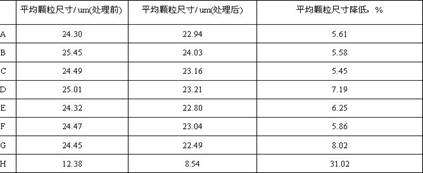
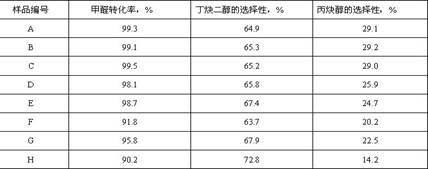
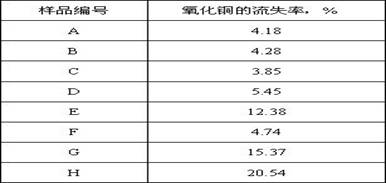
The technical solutions of the present invention are further illustrated by the following examples and comparative examples, but the scope of the present invention is not limited by the examples. The wear resistance of the catalyst is subjected to ultrasonic treatment by a cell disruptor and then analyzed by a BT-9300ST laser particle size analyzer in Dandongboet, the ultrasonic treatment frequency is 3000 times, and the power of the ultrasonic disruptor is 600W. The evaluation of the reactivity of the catalyst is carried out on a slurry bed, a formaldehyde and acetylene reaction system is adopted, the reaction temperature is 130 ℃, the reaction pressure is 1.0MPa, the acetylene flow rate is 90mL/min, the catalyst dosage is 20g, and the formaldehyde addition with the concentration of 3 wt% is 600 mL. The catalyst reacted for 3 months was discharged from the reactor, washed, and then incinerated at 800 ℃ using a high temperature incinerator, and composition analysis was performed using XRF, and table 3 shows the% loss of copper oxide after 3 months of catalyst operation. The following examples and comparative examples are all% by mass unless otherwise specified.
Example 1
(1) 431g of SBA-15 dry rubber powder is weighed and put into a roasting furnace, the temperature is raised to 700 ℃, and roasting treatment is carried out for 5 hours.
(2) 68.9g of magnesium nitrate was weighed, 700mL of deionized water was added, and 683g of copper nitrate, 58.3g of bismuth nitrate, 52.9g of nitric acid and 28g of C were added8F17And the temperature was raised to 50 ℃ and dissolved with stirring.
(3) And (3) putting the roasted SBA-15 into an aqueous solution containing copper, bismuth and magnesium, and carrying out one or more times of impregnation.
(4) Filtering the impregnated SBA-15, and drying in an oven at 120 ℃ for 3 hours.
(5) The mixture is put into a roasting furnace and is heated to 400 ℃ at the heating rate of 70 ℃/h for 4 hours. The copper bismuth magnesium supported catalyst is prepared. Sample number is a, sample composition is: 37.8 percent of CuO and Bi2O34.7 percent of MgO and 1.8 percent of MgO. The particle size distribution of the catalyst is shown in Table 1, and the evaluation results are shown in Table 2.
Example 2
(1) 458g of SBA-15 dry rubber powder is weighed and put into a roasting furnace, the temperature is raised to 750 ℃, and roasting treatment is carried out for 4 hours.
(2) 74.5g of magnesium nitrate is measured, 800mL of deionized water is added, and 802g of copper nitrate, 64.8g of bismuth nitrate, 53.9g of nitric acid and 40g of C are added simultaneously8F17And the temperature was raised to 50 ℃ and dissolved with stirring.
(3) And (3) putting the roasted SBA-15 into an aqueous solution containing copper, bismuth and magnesium and a surfactant, and carrying out one or more times of impregnation.
(4) Filtering the impregnated SBA-15, and drying in an oven at 120 ℃ for 3 hours.
(5) The mixture is put into a roasting furnace and is roasted for 4 hours at the temperature rising speed of 70 ℃/h to 450 ℃. The copper bismuth magnesium supported catalyst is prepared. Sample number B, sample composition: 34.5% of CuO and Bi2O34.0 percent and 1.5 percent of MgO. The particle size distribution of the catalyst is shown in Table 1, and the evaluation results are shown in Table 2.
Example 3
(1) 512g of SBA-15 dry glue powder is weighed and put into a roasting furnace, the temperature is raised to 780 ℃, and roasting treatment is carried out for 3 hours.
(2) 75.8g of magnesium nitrate is weighed, 800mL of deionized water is added, and 748g of copper nitrate, 72.3g of bismuth nitrate, 52.9g of nitric acid and 48g of C are added simultaneously8F17And the temperature was raised to 50 ℃ and dissolved with stirring.
(3) And (3) putting the roasted SBA-15 into an aqueous solution containing copper, bismuth and magnesium, and carrying out one or more times of impregnation.
(4) Filtering the impregnated SBA-15, and drying in an oven at 120 ℃ for 3 hours.
(5) The mixture is put into a roasting furnace and is roasted for 4 hours at the temperature rising speed of 70 ℃/h to 450 ℃. The copper bismuth magnesium supported catalyst is prepared. Sample number is C, sample composition is: 34.0% of CuO and Bi2O34.7 percent of MgO and 1.6 percent of MgO. The particle size distribution of the catalyst is shown in Table 1, and the evaluation results are shown in Table 2.
Example 4
(1) 415g of SBA-15 dry glue powder is weighed and put into a roasting furnace, the temperature is raised to 580 ℃, and roasting treatment is carried out for 4 hours.
(2) 72.8g of magnesium nitrate was measured, 800mL of deionized water was added, and 665g of copper nitrate, 69.3g of bismuth nitrate, 57.6g of nitric acid, and 35g of C were added8F17And the temperature was raised to 50 ℃ and dissolved with stirring.
(3) And (3) putting the roasted SBA-15 into an aqueous solution containing copper, bismuth and magnesium, and carrying out one or more times of impregnation.
(4) Filtering the impregnated SBA-15, and drying in an oven at 120 ℃ for 3 hours.
(5) The mixture is put into a roasting furnace and is roasted for 4 hours at the temperature rising speed of 70 ℃/h to 450 ℃. And preparing the copper-bismuth supported catalyst. Sample number D, sample composition: 33.4% of CuO and Bi2O35.0 percent and 1.7 percent of MgO. The particle size distribution of the catalyst is shown in Table 1, and the evaluation results are shown in Table 2.
Example 5
(1) 458g of SBA-15 dry rubber powder is weighed and put into a roasting furnace, the temperature is raised to 750 ℃, and roasting treatment is carried out for 4 hours.
(2) 50.8g of magnesium nitrate was measured, 800mL of deionized water was added, and 809g of copper nitrate, 66.9g of bismuth nitrate and 51.6g of nitric acid were simultaneously added, and the temperature was raised to 50 ℃ and dissolved with stirring.
(3) And (3) putting the roasted SBA-15 into an aqueous solution containing copper, bismuth and magnesium, and carrying out one or more times of impregnation.
(4) Filtering the impregnated SBA-15, and drying in an oven at 120 ℃ for 3 hours.
(5) The mixture is put into a roasting furnace and is roasted for 4 hours at the temperature rising speed of 70 ℃/h to 450 ℃. And preparing the copper-bismuth supported catalyst. Sample number E, sample composition: 34.2% of CuO and Bi2O34.1 percent and 1.7 percent of MgO. The particle size distribution of the catalyst is shown in Table 1, and the evaluation results are shown in Table 2.
Comparative example 1
The difference from example 3 is that magnesium nitrate was not added in step (2), sample No. F, particle size distribution shown in Table 1, and evaluation results shown in Table 2.
Comparative example 2
The difference from example 3 is that the high temperature calcination treatment of SBA-15 in step (1) is omitted and C is not added in step (2)8F17The surfactant, sample number G, particle size distribution are shown in Table 1, and the evaluation results are shown in Table 2.
Comparative example 3
A catalyst having the same composition as in example 3 was prepared according to the technical scheme of cn201210397351. x example 1, with sample number H, particle size distribution as shown in table 1, and evaluation results as shown in table 2.
TABLE 1 particle distribution of the catalyst
TABLE 2 evaluation results of initial Activity of catalyst
TABLE 3 copper loss in catalyst (catalyst run 3 months)