CN109772447B - Composite molecular sieve catalyst for isomerization of carbon octa-arene and preparation method thereof - Google Patents
Composite molecular sieve catalyst for isomerization of carbon octa-arene and preparation method thereof Download PDFInfo
- Publication number
- CN109772447B CN109772447B CN201910101949.3A CN201910101949A CN109772447B CN 109772447 B CN109772447 B CN 109772447B CN 201910101949 A CN201910101949 A CN 201910101949A CN 109772447 B CN109772447 B CN 109772447B
- Authority
- CN
- China
- Prior art keywords
- molecular sieve
- hours
- catalyst
- composite molecular
- preparation
- Prior art date
- Legal status (The legal status is an assumption and is not a legal conclusion. Google has not performed a legal analysis and makes no representation as to the accuracy of the status listed.)
- Active
Links
- 239000002808 molecular sieve Substances 0.000 title claims abstract description 62
- URGAHOPLAPQHLN-UHFFFAOYSA-N sodium aluminosilicate Chemical compound [Na+].[Al+3].[O-][Si]([O-])=O.[O-][Si]([O-])=O URGAHOPLAPQHLN-UHFFFAOYSA-N 0.000 title claims abstract description 60
- 239000003054 catalyst Substances 0.000 title claims abstract description 58
- 239000002131 composite material Substances 0.000 title claims abstract description 36
- 238000002360 preparation method Methods 0.000 title claims abstract description 28
- OKTJSMMVPCPJKN-UHFFFAOYSA-N Carbon Chemical compound [C] OKTJSMMVPCPJKN-UHFFFAOYSA-N 0.000 title claims abstract description 17
- 229910052799 carbon Inorganic materials 0.000 title claims abstract description 17
- 238000006317 isomerization reaction Methods 0.000 title description 13
- 238000001035 drying Methods 0.000 claims abstract description 19
- HEMHJVSKTPXQMS-UHFFFAOYSA-M Sodium hydroxide Chemical compound [OH-].[Na+] HEMHJVSKTPXQMS-UHFFFAOYSA-M 0.000 claims abstract description 18
- 239000002253 acid Substances 0.000 claims abstract description 15
- VYPSYNLAJGMNEJ-UHFFFAOYSA-N Silicium dioxide Chemical compound O=[Si]=O VYPSYNLAJGMNEJ-UHFFFAOYSA-N 0.000 claims abstract description 11
- 238000004898 kneading Methods 0.000 claims abstract description 11
- DGAQECJNVWCQMB-PUAWFVPOSA-M Ilexoside XXIX Chemical compound C[C@@H]1CC[C@@]2(CC[C@@]3(C(=CC[C@H]4[C@]3(CC[C@@H]5[C@@]4(CC[C@@H](C5(C)C)OS(=O)(=O)[O-])C)C)[C@@H]2[C@]1(C)O)C)C(=O)O[C@H]6[C@@H]([C@H]([C@@H]([C@H](O6)CO)O)O)O.[Na+] DGAQECJNVWCQMB-PUAWFVPOSA-M 0.000 claims abstract description 7
- 239000013078 crystal Substances 0.000 claims abstract description 7
- 238000002156 mixing Methods 0.000 claims abstract description 7
- 229910052708 sodium Inorganic materials 0.000 claims abstract description 7
- 239000011734 sodium Substances 0.000 claims abstract description 7
- 239000006229 carbon black Substances 0.000 claims abstract description 6
- 238000002425 crystallisation Methods 0.000 claims abstract description 6
- 230000008025 crystallization Effects 0.000 claims abstract description 6
- 239000007787 solid Substances 0.000 claims description 26
- 239000007788 liquid Substances 0.000 claims description 23
- PNEYBMLMFCGWSK-UHFFFAOYSA-N aluminium oxide Inorganic materials [O-2].[O-2].[O-2].[Al+3].[Al+3] PNEYBMLMFCGWSK-UHFFFAOYSA-N 0.000 claims description 14
- 239000000243 solution Substances 0.000 claims description 13
- 229910052782 aluminium Inorganic materials 0.000 claims description 10
- XAGFODPZIPBFFR-UHFFFAOYSA-N aluminium Chemical compound [Al] XAGFODPZIPBFFR-UHFFFAOYSA-N 0.000 claims description 10
- 239000007864 aqueous solution Substances 0.000 claims description 10
- 239000000843 powder Substances 0.000 claims description 10
- 229910052710 silicon Inorganic materials 0.000 claims description 10
- 239000010703 silicon Substances 0.000 claims description 10
- GRYLNZFGIOXLOG-UHFFFAOYSA-N Nitric acid Chemical compound O[N+]([O-])=O GRYLNZFGIOXLOG-UHFFFAOYSA-N 0.000 claims description 8
- 238000007598 dipping method Methods 0.000 claims description 8
- 229910017604 nitric acid Inorganic materials 0.000 claims description 8
- 239000008367 deionised water Substances 0.000 claims description 5
- 229910021641 deionized water Inorganic materials 0.000 claims description 5
- XLYOFNOQVPJJNP-UHFFFAOYSA-N water Chemical compound O XLYOFNOQVPJJNP-UHFFFAOYSA-N 0.000 claims description 5
- 229950006187 hexamethonium bromide Drugs 0.000 claims description 4
- FAPSXSAPXXJTOU-UHFFFAOYSA-L trimethyl-[6-(trimethylazaniumyl)hexyl]azanium;dibromide Chemical compound [Br-].[Br-].C[N+](C)(C)CCCCCC[N+](C)(C)C FAPSXSAPXXJTOU-UHFFFAOYSA-L 0.000 claims description 4
- TWNQGVIAIRXVLR-UHFFFAOYSA-N oxo(oxoalumanyloxy)alumane Chemical compound O=[Al]O[Al]=O TWNQGVIAIRXVLR-UHFFFAOYSA-N 0.000 claims description 3
- 238000003756 stirring Methods 0.000 claims description 3
- 241000872198 Serjania polyphylla Species 0.000 claims 1
- URLKBWYHVLBVBO-UHFFFAOYSA-N Para-Xylene Chemical group CC1=CC=C(C)C=C1 URLKBWYHVLBVBO-UHFFFAOYSA-N 0.000 abstract description 26
- KDLHZDBZIXYQEI-UHFFFAOYSA-N Palladium Chemical compound [Pd] KDLHZDBZIXYQEI-UHFFFAOYSA-N 0.000 abstract description 12
- BASFCYQUMIYNBI-UHFFFAOYSA-N platinum Chemical compound [Pt] BASFCYQUMIYNBI-UHFFFAOYSA-N 0.000 abstract description 12
- ZOKXTWBITQBERF-UHFFFAOYSA-N Molybdenum Chemical compound [Mo] ZOKXTWBITQBERF-UHFFFAOYSA-N 0.000 abstract description 6
- 229910052750 molybdenum Inorganic materials 0.000 abstract description 6
- 239000011733 molybdenum Substances 0.000 abstract description 6
- 229910052763 palladium Inorganic materials 0.000 abstract description 6
- 229910052697 platinum Inorganic materials 0.000 abstract description 6
- WFKWXMTUELFFGS-UHFFFAOYSA-N tungsten Chemical compound [W] WFKWXMTUELFFGS-UHFFFAOYSA-N 0.000 abstract description 6
- 229910052721 tungsten Inorganic materials 0.000 abstract description 6
- 239000010937 tungsten Substances 0.000 abstract description 6
- QGZKDVFQNNGYKY-UHFFFAOYSA-O Ammonium Chemical compound [NH4+] QGZKDVFQNNGYKY-UHFFFAOYSA-O 0.000 abstract description 4
- 239000011230 binding agent Substances 0.000 abstract description 4
- 238000009826 distribution Methods 0.000 abstract description 4
- 150000007522 mineralic acids Chemical class 0.000 abstract description 3
- 230000002195 synergetic effect Effects 0.000 abstract description 3
- 238000002288 cocrystallisation Methods 0.000 abstract description 2
- YNQLUTRBYVCPMQ-UHFFFAOYSA-N Ethylbenzene Chemical compound CCC1=CC=CC=C1 YNQLUTRBYVCPMQ-UHFFFAOYSA-N 0.000 description 16
- CTQNGGLPUBDAKN-UHFFFAOYSA-N O-Xylene Chemical group CC1=CC=CC=C1C CTQNGGLPUBDAKN-UHFFFAOYSA-N 0.000 description 11
- VEXZGXHMUGYJMC-UHFFFAOYSA-N Hydrochloric acid Chemical compound Cl VEXZGXHMUGYJMC-UHFFFAOYSA-N 0.000 description 8
- IVSZLXZYQVIEFR-UHFFFAOYSA-N m-xylene Chemical group CC1=CC=CC(C)=C1 IVSZLXZYQVIEFR-UHFFFAOYSA-N 0.000 description 8
- 239000000203 mixture Substances 0.000 description 7
- UHOVQNZJYSORNB-UHFFFAOYSA-N Benzene Chemical compound C1=CC=CC=C1 UHOVQNZJYSORNB-UHFFFAOYSA-N 0.000 description 6
- 150000004945 aromatic hydrocarbons Chemical class 0.000 description 5
- 239000008096 xylene Substances 0.000 description 5
- 150000001875 compounds Chemical class 0.000 description 4
- WOZVHXUHUFLZGK-UHFFFAOYSA-N dimethyl terephthalate Chemical compound COC(=O)C1=CC=C(C(=O)OC)C=C1 WOZVHXUHUFLZGK-UHFFFAOYSA-N 0.000 description 4
- 238000005470 impregnation Methods 0.000 description 4
- KKEYFWRCBNTPAC-UHFFFAOYSA-N Terephthalic acid Chemical compound OC(=O)C1=CC=C(C(O)=O)C=C1 KKEYFWRCBNTPAC-UHFFFAOYSA-N 0.000 description 3
- 230000003197 catalytic effect Effects 0.000 description 3
- 230000000052 comparative effect Effects 0.000 description 3
- 229910052593 corundum Inorganic materials 0.000 description 3
- 230000000694 effects Effects 0.000 description 3
- 229940078552 o-xylene Drugs 0.000 description 3
- 229910001845 yogo sapphire Inorganic materials 0.000 description 3
- UFHFLCQGNIYNRP-UHFFFAOYSA-N Hydrogen Chemical compound [H][H] UFHFLCQGNIYNRP-UHFFFAOYSA-N 0.000 description 2
- FUECGUJHEQQIFK-UHFFFAOYSA-N [N+](=O)([O-])[O-].[W+4].[N+](=O)([O-])[O-].[N+](=O)([O-])[O-].[N+](=O)([O-])[O-] Chemical compound [N+](=O)([O-])[O-].[W+4].[N+](=O)([O-])[O-].[N+](=O)([O-])[O-].[N+](=O)([O-])[O-] FUECGUJHEQQIFK-UHFFFAOYSA-N 0.000 description 2
- APUPEJJSWDHEBO-UHFFFAOYSA-P ammonium molybdate Chemical compound [NH4+].[NH4+].[O-][Mo]([O-])(=O)=O APUPEJJSWDHEBO-UHFFFAOYSA-P 0.000 description 2
- 239000011609 ammonium molybdate Substances 0.000 description 2
- 229940010552 ammonium molybdate Drugs 0.000 description 2
- 235000018660 ammonium molybdate Nutrition 0.000 description 2
- 238000006555 catalytic reaction Methods 0.000 description 2
- 238000006243 chemical reaction Methods 0.000 description 2
- 229910052739 hydrogen Inorganic materials 0.000 description 2
- 239000001257 hydrogen Substances 0.000 description 2
- 229910052751 metal Inorganic materials 0.000 description 2
- 239000002184 metal Substances 0.000 description 2
- PIBWKRNGBLPSSY-UHFFFAOYSA-L palladium(II) chloride Chemical compound Cl[Pd]Cl PIBWKRNGBLPSSY-UHFFFAOYSA-L 0.000 description 2
- 239000011148 porous material Substances 0.000 description 2
- 239000000377 silicon dioxide Substances 0.000 description 2
- 230000009286 beneficial effect Effects 0.000 description 1
- 238000009835 boiling Methods 0.000 description 1
- 238000001833 catalytic reforming Methods 0.000 description 1
- 239000013064 chemical raw material Substances 0.000 description 1
- 238000000576 coating method Methods 0.000 description 1
- 229910052681 coesite Inorganic materials 0.000 description 1
- 229910052906 cristobalite Inorganic materials 0.000 description 1
- 230000007547 defect Effects 0.000 description 1
- 239000003814 drug Substances 0.000 description 1
- 239000000975 dye Substances 0.000 description 1
- 238000005984 hydrogenation reaction Methods 0.000 description 1
- 230000008676 import Effects 0.000 description 1
- 239000011159 matrix material Substances 0.000 description 1
- 238000000034 method Methods 0.000 description 1
- 238000012986 modification Methods 0.000 description 1
- 238000000465 moulding Methods 0.000 description 1
- 239000003921 oil Substances 0.000 description 1
- GPNDARIEYHPYAY-UHFFFAOYSA-N palladium(ii) nitrate Chemical compound [Pd+2].[O-][N+]([O-])=O.[O-][N+]([O-])=O GPNDARIEYHPYAY-UHFFFAOYSA-N 0.000 description 1
- 238000005070 sampling Methods 0.000 description 1
- 238000000926 separation method Methods 0.000 description 1
- 229910052682 stishovite Inorganic materials 0.000 description 1
- 239000000126 substance Substances 0.000 description 1
- 239000000758 substrate Substances 0.000 description 1
- 238000004227 thermal cracking Methods 0.000 description 1
- 229910052905 tridymite Inorganic materials 0.000 description 1
Classifications
-
- Y—GENERAL TAGGING OF NEW TECHNOLOGICAL DEVELOPMENTS; GENERAL TAGGING OF CROSS-SECTIONAL TECHNOLOGIES SPANNING OVER SEVERAL SECTIONS OF THE IPC; TECHNICAL SUBJECTS COVERED BY FORMER USPC CROSS-REFERENCE ART COLLECTIONS [XRACs] AND DIGESTS
- Y02—TECHNOLOGIES OR APPLICATIONS FOR MITIGATION OR ADAPTATION AGAINST CLIMATE CHANGE
- Y02P—CLIMATE CHANGE MITIGATION TECHNOLOGIES IN THE PRODUCTION OR PROCESSING OF GOODS
- Y02P20/00—Technologies relating to chemical industry
- Y02P20/50—Improvements relating to the production of bulk chemicals
- Y02P20/52—Improvements relating to the production of bulk chemicals using catalysts, e.g. selective catalysts
Landscapes
- Organic Low-Molecular-Weight Compounds And Preparation Thereof (AREA)
- Catalysts (AREA)
Abstract
The invention discloses a composite molecular sieve catalyst for isomerizing carbon octa-arene and a preparation method thereof; comprises the following components: EU-1/EU-2 composite molecular sieve, one or more oxides of platinum, palladium, tungsten and molybdenum; the EU-1/EU-2 composite molecular sieve is prepared by mixing sodium hydroxide, ammonium hexamethobromide, white carbon black and sodium metaaluminate, and then adding EU-2 crystal seeds for crystallization; mixing an EU-1/EU-2 composite molecular sieve and an oxide binder, kneading with an inorganic acid solution, drying and roasting to obtain a catalyst carrier; then one or more oxides of platinum, palladium, tungsten and molybdenum and a catalyst carrier are impregnated together and roasted to obtain the catalyst; due to the synergistic effect of the EU-1 and EU-2 molecular sieves forming the cocrystallization, the catalyst has more reasonable acid distribution and good hydrothermal stability, overcomes the limitation of a single component, and has the advantages of high selectivity of p-xylene and less loss of carbon octaarene.
Description
Technical Field
The invention relates to the technical field of chemical catalysts, in particular to a composite molecular sieve catalyst for isomerizing C-eight aromatic hydrocarbons and a preparation method thereof.
Background
The carbon octa-arene mainly comprises a mixture of p-xylene (PX), o-xylene (OX), m-xylene (MX) and Ethylbenzene (EX), wherein the p-xylene (PX) is an important chemical raw material, mainly Produces Terephthalic Acid (PTA) and dimethyl terephthalate (DMT), and has important application in the fields of coatings, dyes, medicaments and the like. At present, China still has the difference between huge demand and insufficient self-supply, and the import of p-xylene gradually increases every year along with the rapid development of economy. Therefore, how to effectively increase the yield of p-xylene by using the catalyst is an important petrochemical project.
At present, the carbon-eight aromatic hydrocarbon mainly comes from naphtha thermal cracking and catalytic reforming, wherein paraxylene, o-xylene, m-xylene and ethylbenzene are isomers, boiling points are close, separation is difficult, and as the application of ethylbenzene is far less extensive than that of paraxylene, how to treat ethylbenzene becomes an important link, and at present, two methods mainly exist for solving the problem: first, ethylbenzene is converted to useful para-xylene using an isomerization catalyst; secondly, ethylbenzene is converted into benzene by using a de-ethyl catalyst, and the benzene is easily separated from the carbon eight aromatic hydrocarbon.
The carbon eight aromatic hydrocarbon isomerization catalyst mainly comprises a metal component and a molecular sieve component, wherein the metal component mainly provides a hydrogenation active center, and the molecular sieve component provides an isomerization center. The research focus of the current catalyst is mainly focused on the application of a novel molecular sieve and the post-modification of the molecular sieve, so as to expect higher activity, higher selectivity and lower carbon eight loss.
To date, researchers have developed various molecular sieves for catalyzing the isomerization of a carbon octaarene to p-xylene, among which EU-1 molecular sieves exhibit excellent catalytic performance in the isomerization of a carbon octaarene, and published patents CN104888848A, CN102909057A, CN102441419A, CN102039161A, US4482773, US4487731, US4939110, US5077254, etc. all use EU-1 molecular sieves as a substrate to catalyze the isomerization of a carbon octaarene.
The EU-1 molecular sieve has a one-dimensional microporous channel structure, contains a 10-membered ring straight channel and a 12-membered ring side bag vertical to the 10-membered ring straight channel, and has an excellent catalytic performance on a xylene isomerization reaction due to the unique channel structure; the EU-2 molecular sieve is composed of one-dimensional 10-membered ring straight channels, and the pore size of the EU-2 molecular sieve is close to that of the EU-1 molecular sieve, so that the EU-2 molecular sieve becomes a preferable molecular sieve for xylene isomerization catalysis. The composite molecular sieve is a co-crystal formed by two or more molecular sieves, has more reasonable acid distribution and good hydrothermal stability, overcomes the limitation of a single component, is a common option for modulating the high activity of a more molecular sieve catalyst, and has wide application potential.
Disclosure of Invention
The invention overcomes the defects of the prior art and provides a carbon octaarene isomerization composite molecular sieve catalyst and a preparation method thereof.
A composite molecular sieve catalyst for isomerizing a carbon octa-arene comprises the following components in percentage by weight: 10-70% of EU-1/EU-2 composite molecular sieve; 0.01-6.0% of one or more oxides of platinum, palladium, tungsten and molybdenum; the balance of oxide binder, which meets the total weight of 100%.
The preparation method of the EU-1/EU-2 composite molecular sieve comprises the steps of mixing deionized water, sodium hydroxide, ammonium hexamethobromide, white carbon black and sodium metaaluminate, adding EU-2 crystal seeds, fully stirring, placing in a crystallization kettle, and crystallizing at 180 ℃ for 80 hours to obtain the EU-1/EU-2 composite molecular sieve; SiO in the EU-1/EU-2 composite molecular sieve2With Al2O3In a molar ratio of 30 to 120: 1.
preferably, the weight percentage of the EU-1/EU-2 composite molecular sieve is 30-60%.
Preferably, the EU-1/EU-2 composite molecular sieve contains SiO2With Al2O3In a molar ratio of 40-80: 1.
preferably, the weight percentage of one or more oxides of platinum, palladium, tungsten and molybdenum is 0.5-5.0%.
Preferably, the oxide binder is alumina or silica or a mixture of both.
A preparation method of a composite molecular sieve catalyst for isomerizing a carbon octaarene comprises the following steps:
1) mixing 5.5-6.5 parts by weight of deionized water, 0.2-0.23 part by weight of sodium hydroxide, 0.45-0.55 part by weight of hexamethonium bromide, 1-1.4 parts by weight of white carbon black and 0.12-0.16 part by weight of sodium metaaluminate, adding 0.35-0.37 part by weight of EU-2 seed crystal, fully stirring for 2-2.5h, placing in a crystallization kettle, crystallizing at 160-; SiO in the EU-1/EU-2 composite molecular sieve2With Al2O3In a molar ratio of 30 to 120: 1.
2) uniformly mixing the EU-1/EU-2 composite molecular sieve and an oxide binder, adding an inorganic acid solution with the mass concentration of 0.5-6.0% of the total mass of 40%, kneading and molding, drying at the temperature of 100 ℃ and 120 ℃ for 4-24h, and roasting at the temperature of 400 ℃ and 600 ℃ for 6-24h to obtain the catalyst carrier.
3) One or more oxides of platinum, palladium, tungsten and molybdenum and the catalyst carrier are placed in an impregnation liquid together, the mass ratio of the catalyst carrier to the impregnation liquid is 1:3-5, the mixture is kept stand for 20 hours at normal temperature, then the liquid is separated out, the catalyst carrier is dried for 4-24 hours at the temperature of 100-120 ℃, and then the catalyst is roasted for 6-24 hours at the temperature of 400-600 ℃ to obtain the catalyst.
Preferably, the inorganic acid is hydrochloric acid or nitric acid with the mass concentration of 1-5%.
Preferably, the platinum-containing compound is one or two of chloroplatinic acid or ammonium chloroplatinate; the palladium-containing compound is one or two of palladium chloride or palladium nitrate; the tungsten-containing compound is tungsten nitrate and the molybdenum-containing compound is ammonium molybdate.
The EU-1 molecular sieve has a one-dimensional microporous channel structure, contains a 10-membered ring straight channel and a 12-membered ring side bag vertical to the 10-membered ring straight channel, and has an excellent catalytic performance on a xylene isomerization reaction due to the unique channel structure; the EU-2 molecular sieve is composed of one-dimensional 10-membered ring straight channels, and the pore size of the EU-2 molecular sieve is close to that of the EU-1 molecular sieve, so that the EU-2 molecular sieve becomes a preferable molecular sieve for xylene isomerization catalysis. According to the invention, EU-1 and EU-2 are crystallized, so that the composite molecular sieve formed by combining the EU-1 and the EU-2 has more reasonable acid distribution and good hydrothermal stability, the limitation of a single component is overcome, the synergistic effect of the EU-1 and EU-2 molecular sieves is exerted, the concentration of p-xylene in a product is close to a thermodynamic equilibrium value, the ethylbenzene conversion rate and the p-xylene selectivity are higher, and the loss amount of C8 aromatic hydrocarbon is lower.
Compared with the prior art, the invention has the beneficial effects that.
The invention provides a carbon octaarene isomerization catalyst taking an EU-1/EU-2 composite molecular sieve as a matrix, which has more reasonable acid distribution and good hydrothermal stability due to the synergistic effect of cocrystallization formed by the EU-1 molecular sieve and the EU-2 molecular sieve, overcomes the limitation of a single component, and ensures that the generated catalyst has the advantages of high selectivity to xylene and less loss of carbon octaarene.
Detailed Description
In order to make the technical problems, technical solutions and advantageous effects to be solved by the present invention more clearly apparent, the present invention is further described in detail with reference to the embodiments. It should be understood that the specific embodiments described herein are merely illustrative of the invention and are not intended to limit the invention. The technical solutions of the present invention are described in detail below with reference to examples, but the scope of protection is not limited thereto.
Comparative example 1
1) Preparation of catalyst support
Taking the molar ratio of silicon to aluminum as 40: 1, 500g of EU-1 molecular sieve and 500g of alumina powder, 400ml of a 5% hydrochloric acid aqueous solution was added and kneaded, and a cylindrical bar having a diameter of 2.0mm was extruded, dried at 100 ℃ for 12 hours, and calcined at 600 ℃ for 6 hours.
2) Preparation of the catalyst
Taking 100g of the sample in the step 1), adding the sample into a dipping solution containing 0.5g of chloroplatinic acid, standing for 20 hours at room temperature according to the mass ratio of the solid to the liquid of 1:3, collecting the solid after separating the liquid, drying for 12 hours at 100 ℃, and roasting for 12 hours at 580 ℃ to obtain a catalyst, wherein the catalyst is marked as E1.
Comparative example 2
1) Preparing an EU-1/EU-2 composite molecular sieve: 5.5g of deionized water, 0.2g of sodium hydroxide, 0.55g of hexamethonium bromide, 1.4g of white carbon black (92 mass percent) and 0.16g of sodium metaaluminate (the mass fraction of aluminum oxide is 41 percent) are mixed, 0.37g of EU-2 seed crystal is added, the mixture is stirred for 2.5 hours and is placed in a crystallization kettle for 80 hours at the temperature of 160 ℃. Obtaining the EU-1/EU-2 composite molecular sieve.
2) Preparation of catalyst support
Taking the molar ratio of silicon to aluminum as 80: 300g of EU-1/EU-2 composite molecular sieve 1 and 700g of alumina powder are fully mixed, 400ml of nitric acid aqueous solution with the mass concentration of 2% is added for kneading, cylindrical strips with the diameter of 2.0mm are extruded, drying is carried out for 4 hours at 120 ℃, and roasting is carried out for 6 hours at 600 ℃.
3) Preparation of the catalyst
Taking 100g of the sample prepared in the step 2), adding the sample into a dipping solution containing 5.0g of chloroplatinic acid, standing for 20 hours at room temperature according to the mass ratio of solid to liquid of 1:5, collecting the solid after separating the liquid, drying for 6 hours at 120 ℃, and roasting for 15 hours at 550 ℃ to obtain a catalyst, wherein the catalyst is marked as E2.
The preparation method of the EU-1/EU-2 composite molecular sieve described in the following examples 1 to 7 comprises the following steps: 6g of deionized water, 0.22g of sodium hydroxide, 0.5g of hexamethonium bromide, 1.2g of white carbon black (92 mass percent) and 0.14g of sodium metaaluminate (the mass fraction of aluminum oxide is 41 percent) are mixed, 0.36g of EU-2 seed crystal is added, the mixture is stirred for 2 hours and is placed in a crystallization kettle for 80 hours at the temperature of 170 ℃. Obtaining the EU-1/EU-2 composite molecular sieve.
Example 1
1) Preparation of catalyst support
Taking the molar ratio of silicon to aluminum as 40: 1 EU-1/EU-2 composite molecular sieve 500g and alumina powder 500g are fully mixed, 400ml of hydrochloric acid aqueous solution with the mass concentration of 5% is added for kneading, cylindrical strips with the diameter of 2.0mm are extruded, drying is carried out at 100 ℃ for 12 hours, and roasting is carried out at 600 ℃ for 6 hours.
2) Preparation of the catalyst
Taking 100g of the sample prepared in the step 1), adding the sample into a dipping solution containing 0.5g of chloroplatinic acid, standing for 20 hours at room temperature according to the mass ratio of the solid to the liquid of 1:3, collecting the solid after separating the liquid, drying for 12 hours at 100 ℃, and roasting for 12 hours at 580 ℃ to obtain a catalyst which is marked as C1.
Example 2
1) Preparation of catalyst support
Taking the molar ratio of silicon to aluminum as 80: 300g of EU-1/EU-2 composite molecular sieve 1 and 700g of alumina powder are fully mixed, 400ml of nitric acid aqueous solution with the mass concentration of 2% is added for kneading, cylindrical strips with the diameter of 2.0mm are extruded, drying is carried out for 4 hours at 120 ℃, and roasting is carried out for 6 hours at 600 ℃.
2) Preparation of the catalyst
Taking 100g of the sample prepared in the step 1), adding the sample into a dipping solution containing 5.0g of chloroplatinic acid, standing for 20 hours at room temperature according to the mass ratio of solid to liquid of 1:5, collecting the solid after separating the liquid, drying for 6 hours at 120 ℃, and roasting for 15 hours at 550 ℃ to obtain a catalyst which is marked as C2.
Example 3
1) Preparation of catalyst support
Taking the molar ratio of silicon to aluminum as 60: 600g of EU-1/EU-2 composite molecular sieve 1 and 400g of alumina powder are fully mixed, 400ml of nitric acid aqueous solution with the mass concentration of 5% is added for kneading, cylindrical strips with the diameter of 2.0mm are extruded, the cylindrical strips are dried at the temperature of 110 ℃ for 12 hours, and the cylindrical strips are roasted at the temperature of 400 ℃ for 24 hours.
2) Preparation of the catalyst
Taking 100g of the sample prepared in the step 1), adding the sample into an impregnation solution containing 3.0g of chloroplatinic acid and 0.5g of palladium chloride, standing the mixture at room temperature for 20 hours according to the mass ratio of the solid to the liquid of 1:4, collecting the solid after separating the liquid, drying the solid at 110 ℃ for 12 hours, and roasting the solid at 450 ℃ for 20 hours to obtain a catalyst C3.
Example 4
1) Preparation of catalyst support
Taking the molar ratio of silicon to aluminum as 40: 1 EU-1/EU-2 composite molecular sieve 400g and alumina powder 600g are fully mixed, 400ml of nitric acid aqueous solution with the mass concentration of 1% is added for kneading, cylindrical strips with the diameter of 2.0mm are extruded, drying is carried out for 6 hours at 100 ℃, and roasting is carried out for 10 hours at 600 ℃.
2) Preparation of the catalyst
Taking 100g of the sample in the step 1), adding the sample into an impregnation solution containing 0.5g of chloroplatinic acid and 2.5 g of tungsten nitrate, standing the mixture at room temperature for 20 hours according to the mass ratio of the solid to the liquid of 1:3.5, collecting the solid after separating the liquid, drying the solid at 100 ℃ for 6 hours, and roasting the solid at 400 ℃ for 24 hours to obtain a catalyst C4.
Example 5
1) Preparation of catalyst support
Taking the molar ratio of silicon to aluminum as 60: 1 EU-1/EU-2 composite molecular sieve 500g and alumina powder 500g are fully mixed, 400ml of hydrochloric acid aqueous solution with the mass concentration of 4% is added for kneading, cylindrical strips with the diameter of 2.0mm are extruded, drying is carried out at 100 ℃ for 16 hours, and roasting is carried out at 450 ℃ for 20 hours.
2) Preparation of the catalyst
Taking 100g of the sample prepared in the step 1), adding the sample into a dipping solution containing 1.5g of chloroplatinic acid and 1.5g of ammonium chloroplatinate, standing at room temperature for 20 hours according to the mass ratio of solid to liquid of 1:4.5, collecting the solid after separating the liquid, drying at 120 ℃ for 16 hours, and roasting at 550 ℃ for 10 hours to obtain a catalyst C5.
Example 6
1) Preparation of catalyst support
Taking the molar ratio of silicon to aluminum as 80: 1 EU-1/EU-2 composite molecular sieve 500g and alumina powder 500g are fully mixed, 400ml of nitric acid aqueous solution with the mass concentration of 2.0% is added for kneading, cylindrical strips with the diameter of 2.0mm are extruded, the drying is carried out for 24 hours at the temperature of 100 ℃, and the roasting is carried out for 10 hours at the temperature of 500 ℃.
2) Preparation of the catalyst
Taking 100g of the sample prepared in the step 1), adding the sample into a dipping solution containing 0.5g of chloroplatinic acid and 3.0g of ammonium molybdate, standing the sample at room temperature for 20 hours according to the mass ratio of the solid to the liquid of 1:3.5, collecting the solid after separating the liquid, drying the solid at 100 ℃ for 24 hours, and roasting the solid at 500 ℃ for 10 hours to obtain a catalyst C6.
Example 7
1) Preparation of catalyst support
Taking the molar ratio of silicon to aluminum as 60: 1, 400g of EU-1/EU-2 composite molecular sieve, 500g of alumina powder and 100g of silicon dioxide powder are fully mixed, 400ml of nitric acid aqueous solution with the mass concentration of 3.0% is added for kneading, cylindrical strips with the diameter of 2.0mm are extruded, the cylindrical strips are dried at the temperature of 110 ℃ for 12 hours, and the cylindrical strips are roasted at the temperature of 600 ℃ for 10 hours.
2) Preparation of the catalyst
Taking 100g of the sample prepared in the step 1), adding the sample into a dipping solution containing 2.0g of chloroplatinic acid, standing for 20 hours at room temperature according to the mass ratio of solid to liquid of 1:5, collecting the solid after separating the liquid, drying for 16 hours at 110 ℃, and roasting for 15 hours at 500 ℃ to obtain a catalyst C7.
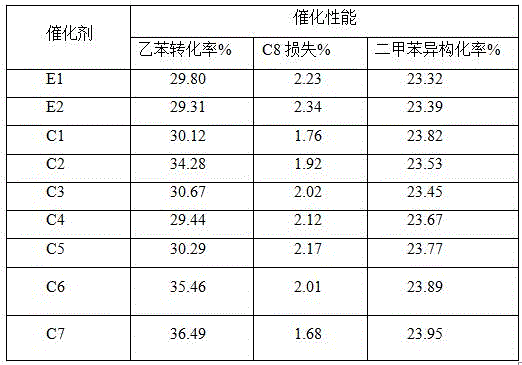
The catalysts of comparative examples 1-2 and examples 1-7 used fixed bed reactors fed with 15% ethylbenzene and 85% meta-xylene, hydrogen pressure 0.5MP, flow rate 70mL/min, reaction temperature 360 ℃, molar ratio of hydrogen to oil 2.0, mass space velocity 4.5h-, and reactor sampling for 6 hours, and the results are shown in the following table.
While the invention has been described in further detail with reference to specific preferred embodiments thereof, it will be understood by those skilled in the art that various changes in form and details may be made therein without departing from the spirit and scope of the invention as defined by the appended claims.
Claims (1)
1. A preparation method of a composite molecular sieve catalyst for isomerizing a carbon octaarene is characterized by comprising the following steps:
1) mixing 6g of deionized water, 0.22g of sodium hydroxide, 0.5g of hexamethonium bromide, 1.2g of white carbon black with the mass ratio of 92% and 0.14g of sodium metaaluminate, adding 0.36g of EU-2 seed crystal, stirring for 2 hours, placing in a crystallization kettle at 170 ℃ for 80 hours to obtain the EU-1/EU-2 composite molecular sieve; wherein the mass fraction of aluminum oxide in the sodium metaaluminate is 41 percent;
2) taking the molar ratio of silicon to aluminum as 60: 1, fully mixing 400g of EU-1/EU-2 composite molecular sieve, 500g of alumina powder and 100g of silicon dioxide powder, adding 400ml of nitric acid aqueous solution with the mass concentration of 3.0%, kneading, extruding into cylindrical strips with the diameter of 2.0mm, drying at 110 ℃ for 12 hours, and roasting at 600 ℃ for 10 hours;
3) preparation of the catalyst
Taking 100g of the sample prepared in the step 1), adding the sample into a dipping solution containing 2.0g of chloroplatinic acid, standing for 20 hours at room temperature according to the mass ratio of solid to liquid of 1:5, collecting the solid after separating the liquid, drying for 16 hours at 110 ℃, and roasting for 15 hours at 500 ℃.
Priority Applications (1)
| Application Number | Priority Date | Filing Date | Title |
|---|---|---|---|
| CN201910101949.3A CN109772447B (en) | 2019-01-18 | 2019-01-18 | Composite molecular sieve catalyst for isomerization of carbon octa-arene and preparation method thereof |
Applications Claiming Priority (1)
| Application Number | Priority Date | Filing Date | Title |
|---|---|---|---|
| CN201910101949.3A CN109772447B (en) | 2019-01-18 | 2019-01-18 | Composite molecular sieve catalyst for isomerization of carbon octa-arene and preparation method thereof |
Publications (2)
| Publication Number | Publication Date |
|---|---|
| CN109772447A CN109772447A (en) | 2019-05-21 |
| CN109772447B true CN109772447B (en) | 2022-04-12 |
Family
ID=66504176
Family Applications (1)
| Application Number | Title | Priority Date | Filing Date |
|---|---|---|---|
| CN201910101949.3A Active CN109772447B (en) | 2019-01-18 | 2019-01-18 | Composite molecular sieve catalyst for isomerization of carbon octa-arene and preparation method thereof |
Country Status (1)
| Country | Link |
|---|---|
| CN (1) | CN109772447B (en) |
Families Citing this family (2)
| Publication number | Priority date | Publication date | Assignee | Title |
|---|---|---|---|---|
| CN110496643B (en) * | 2019-09-03 | 2022-04-12 | 太原大成环能化工技术有限公司 | Auxiliary preparation method of carbon octa-arene isomerization catalyst seed crystal |
| CN115414961B (en) * | 2022-09-22 | 2023-09-08 | 太原大成环能化工技术有限公司 | Preparation method of deethylation type carbon octaarene isomerization catalyst |
Citations (4)
| Publication number | Priority date | Publication date | Assignee | Title |
|---|---|---|---|---|
| CN1044052A (en) * | 1988-12-22 | 1990-07-25 | 帝国化学工业公司 | Catalytic reactions using zeolites |
| CN104556138A (en) * | 2013-10-18 | 2015-04-29 | Sk新技术株式会社 | Activated EU-2 zeolite and use thereof |
| WO2016107914A1 (en) * | 2014-12-31 | 2016-07-07 | Shell Internationale Research Maatschappij B.V. | Process for preparing a base oil having a reduced cloud point |
| CN108745408A (en) * | 2018-05-29 | 2018-11-06 | 河南师范大学 | The preparation method of EU-1/ZSM-48 composite molecular sieve catalysts |
Family Cites Families (9)
| Publication number | Priority date | Publication date | Assignee | Title |
|---|---|---|---|---|
| ZA997664B (en) * | 1998-12-23 | 2001-06-14 | Inst Francais Du Petrole | Euo zeolite comprising crystals and aggregates of crystals with specific granulometrys and its use as a catalyst in the isomerisation of C8 aromatic compounds. |
| US6660896B1 (en) * | 2003-04-16 | 2003-12-09 | Exxonmobil Chemical Patents Inc. | Isomerization of ethylbenzene and xylenes |
| US7122496B2 (en) * | 2003-05-01 | 2006-10-17 | Bp Corporation North America Inc. | Para-xylene selective adsorbent compositions and methods |
| CN100540471C (en) * | 2007-04-26 | 2009-09-16 | 太原理工大学 | Method for preparing EUO structure molecular sieve from silicon aluminum oxide powder |
| FR2920423B1 (en) * | 2007-09-04 | 2009-11-13 | Inst Francais Du Petrole | PREPARATION OF A POROUS COMPOSITE MATERIAL BASED ON ZEOLITHE EU-1 AND ITS IMPLEMENTATION IN ISOMERIZATION OF AROMATIC C8. |
| FR2997948B1 (en) * | 2012-11-15 | 2014-11-28 | IFP Energies Nouvelles | PROCESS FOR ISOMERIZING AN AROMATIC C8 CUT IN THE PRESENCE OF A CATALYST BASED ON A EUO ZEOLITE AND A PARTICULAR SODIUM CONTENT |
| CN106311321B (en) * | 2015-07-03 | 2019-08-02 | 中国石油天然气股份有限公司 | Catalyst containing EU-1/ZSM-5 eutectic zeolite, preparation method and application |
| CN105000571B (en) * | 2015-07-08 | 2017-06-16 | 中国石油大学(北京) | A kind of coexisting molecular sieves of EU 1/ZSM 48 and its preparation and application |
| CN105536864B (en) * | 2016-01-13 | 2018-05-04 | 太原理工大学 | The preparation method of ZSM-5/EU-1 composite molecular screens with core shell structure feature |
-
2019
- 2019-01-18 CN CN201910101949.3A patent/CN109772447B/en active Active
Patent Citations (4)
| Publication number | Priority date | Publication date | Assignee | Title |
|---|---|---|---|---|
| CN1044052A (en) * | 1988-12-22 | 1990-07-25 | 帝国化学工业公司 | Catalytic reactions using zeolites |
| CN104556138A (en) * | 2013-10-18 | 2015-04-29 | Sk新技术株式会社 | Activated EU-2 zeolite and use thereof |
| WO2016107914A1 (en) * | 2014-12-31 | 2016-07-07 | Shell Internationale Research Maatschappij B.V. | Process for preparing a base oil having a reduced cloud point |
| CN108745408A (en) * | 2018-05-29 | 2018-11-06 | 河南师范大学 | The preparation method of EU-1/ZSM-48 composite molecular sieve catalysts |
Non-Patent Citations (1)
| Title |
|---|
| EU-1/ZSM-48分子筛的合成及其负载铂催化剂的加氢异构性能;张淼;《第18届全国分子筛学术大会论文集》;20151025;第11页 * |
Also Published As
| Publication number | Publication date |
|---|---|
| CN109772447A (en) | 2019-05-21 |
Similar Documents
| Publication | Publication Date | Title |
|---|---|---|
| EP0923512B1 (en) | A stabilized dual bed xylene isomerization catalyst system | |
| EP1699556A2 (en) | Process and catalyst for c8 alkylaromatic isomerization | |
| CN1043740C (en) | Alleyl aromatics isomerizating catalyzer | |
| EP2773603B1 (en) | Catalyst and process for hydrocarbon conversion | |
| JP5123810B2 (en) | Aromatic isomerization catalyst | |
| CN112023978A (en) | A kind of xylene isomerization catalyst and its preparation method and application | |
| CN109772447B (en) | Composite molecular sieve catalyst for isomerization of carbon octa-arene and preparation method thereof | |
| BRPI0615139A2 (en) | xylene isomers production methods | |
| CN102616801A (en) | Method for modification of zeolite NU-85 and aromatic isomerization catalyst containing modified zeolite NU-85 | |
| RU2727190C2 (en) | Improved catalyst for converting ethylbenzene in a method for isomerisation of xylene | |
| CN110961143A (en) | Molecular sieve catalyst, its preparation method and its application in ethylbenzene dealkylation reaction and xylene isomerization reaction | |
| CN106311321A (en) | A kind of catalyst containing EU-1/ZSM-5 eutectic zeolite and its preparation method and application | |
| CN102909057B (en) | Catalyst comprising EUO type zeolite, preparation method and applications thereof | |
| CN113042097A (en) | Molecular sieve catalyst, preparation method thereof and application of molecular sieve catalyst | |
| US20050143615A1 (en) | Process and bimetallic catalyst for C8 alkylaromatic isomerization | |
| CN113492016A (en) | Toluene disproportionation and transalkylation double-component catalyst and preparation method thereof | |
| CN120001414B (en) | Catalyst for producing mesitylene from C9 mixed aromatic hydrocarbon and preparation method thereof | |
| CN115974644B (en) | Heavy aromatic hydrocarbon lightening and alkyl transfer methods | |
| CN103120949A (en) | Methylbenzene methylation catalyst for increasing production of o-xylene and p-xylene and preparation method thereof | |
| CN115709096A (en) | High-activity catalyst for preparing benzene by disproportionation of toluene | |
| CN116786158A (en) | Preparation method and application of catalyst for producing mesitylene by catalyzing pseudocumene | |
| CN119909738A (en) | A xylene isomerization catalyst and its preparation method and application | |
| CN116023228A (en) | A kind of xylene isomerization method | |
| KR20220117338A (en) | UZM-54 and transalkylation method using same | |
| CN118663318A (en) | Xylene isomerization catalyst and method for liquid phase non-hydrogenated xylene isomerization |
Legal Events
| Date | Code | Title | Description |
|---|---|---|---|
| PB01 | Publication | ||
| PB01 | Publication | ||
| SE01 | Entry into force of request for substantive examination | ||
| SE01 | Entry into force of request for substantive examination | ||
| GR01 | Patent grant | ||
| GR01 | Patent grant |