CN109852182B - Composition for improving solder resist ink adhesion and use method thereof - Google Patents
Composition for improving solder resist ink adhesion and use method thereof Download PDFInfo
- Publication number
- CN109852182B CN109852182B CN201910140236.8A CN201910140236A CN109852182B CN 109852182 B CN109852182 B CN 109852182B CN 201910140236 A CN201910140236 A CN 201910140236A CN 109852182 B CN109852182 B CN 109852182B
- Authority
- CN
- China
- Prior art keywords
- composition
- solder resist
- resist ink
- functional group
- group
- Prior art date
- Legal status (The legal status is an assumption and is not a legal conclusion. Google has not performed a legal analysis and makes no representation as to the accuracy of the status listed.)
- Active
Links
Landscapes
- Manufacturing Of Printed Circuit Boards (AREA)
- Adhesives Or Adhesive Processes (AREA)
Abstract
The invention discloses a composition for improving solder resist ink adhesion and a use method thereof, the composition mainly comprises a silicon-containing polymer accounting for 0.05-1.0 wt.% of the total mass of the composition, a hydrophilic polymer accounting for 0.01-3.0 wt.% of the total mass of the composition and the balance of a mixed solvent, wherein the silicon-containing polymer is prepared from a monomer CH2=CHR5、CH2=C(R1)COOR2And CH2=C(R3)COO(CH2)3Si(OR4)3Obtained by thermally initiated free radical solution polymerization copolymerization, and R5Is a nitrogen-containing heterocyclic group; the composition can obviously improve the adhesive force between the solder resist ink and the copper surface, has good acid-resistant and alkali-resistant adhesive force, has simple process, does not need to coarsen the metal surface, does not need to form other metal layers on the metal surface to improve the adhesive force, and is particularly suitable for preparing superfine circuits and high-frequency circuits which are not beneficial to brushing or micro-etching.
Description
Technical Field
The invention relates to an auxiliary agent for improving adhesion, in particular to a composition for improving the adhesion of solder resist ink and a use method thereof, which are suitable for improving the adhesion between the solder resist ink and a copper layer of a copper-clad plate in a PCB (printed circuit board) process and belong to the technical field of reagents for PCB process.
Background
In the production process of Printed Circuit Boards (PCBs), in order to improve soldering efficiency and to protect portions that do not require soldering, it is necessary to protect these portions with solder resist ink. Generally, solder mask ink is coated on the surface of a PCB by a gravure printing method, a screen printing method or an ink-jet printing method, and a solder mask can be formed after curing treatment. With the development of PCB production process, soldering conditions and wiring requirements, solder resist ink also goes through several stages: the development-sensitive solder resist ink is used in large quantities in the industry from the early dry film type to the current stage of the development.
The key performance and reliability of multilayer PCBs is mainly reflected in the reliability of the bond between the dielectric material and the conductive copper. In the industry at present, the adhesion between solder resist ink and copper is improved mainly through chemical roughening of the copper surface, the contact area between conductor copper and a dielectric material can be obviously increased through chemical roughening, the adhesion between the conductor copper and the dielectric material is further improved through physical acting force between boundaries, and a commonly used copper surface chemical roughening agent is a strong acid serving as a single-component roughening agent or a compound roughening agent consisting of the strong acid and strong oxidants such as hydrogen peroxide. However, as the size of the PCB is smaller and smaller, the signal transmission frequency is increased, and the roughness of the surface of the conductor has a greater and greater influence on the transmission of the conductor signal, so that the adhesion force is increased by roughening the surface, which gradually fails to meet the technical requirements of the novel PCB.
In view of the above problems, k.h. dietz reports a method of improving adhesion between a Dry Film and a conductive copper using chemical bonding force in Dry Film photo Technology, Electrochemical Publications ltd, 2001. The method adopts the anti-tarnish agent to self-assemble a layer of organic film on the surface of the conductor copper, the organic film and the conductor copper have better chemical bonding force with a dry film, however, the anti-tarnish agent generally adopts benzotriazole or derivatives thereof as main components, and the acid resistance is poor.
EP0260977 discloses an adhesion promoter capable of reacting chemically with copper or copper oxide, which employs an alcohol-water mixture solution of a coupling agent as an active ingredient, the coupling agent being an arylamine, a nitrogen-containing heterocyclic, an acrylate, a thiol-containing or a thiochain, wherein the nitrogen-containing heterocyclic coupling agent is most effective, the coupling agent is capable of undergoing a complex reaction with copper, the promoting efficiency is high, and a more desirable effect can be achieved with a low addition amount, but the effective ingredient of the promoter is mainly a small-molecule coupling agent, which is liable to be aggregated in a large amount in some areas of the copper surface, and the aggregation amount in other areas is small, resulting in poor uniformity of the copper surface, and the improvement effect of the adhesion is not particularly desirable.
TW201806756A discloses a composition for forming a coating film, which contains an amino and aryl aromatic silane coupling agent, a polybasic acid having two or more carboxyl groups, and halide ions in one molecule, and which can directly form a metal conversion film on a metal surface, significantly improve adhesion between the metal surface and an upper resin, and has good acid resistance.
Disclosure of Invention
In order to solve the technical problems, the invention provides a composition for improving the adhesion of solder resist ink and a use method thereof.
The technical scheme of the invention is as follows:
the invention discloses a composition for improving solder resist ink adhesion, which mainly comprises the following components:
a) a silicon-containing polymer, the silicon-containing polymer comprising 0.05 to 1.0 wt.% of the total mass of the composition, and the silicon-containing polymer having the general formula shown in formula (I)


Wherein: l + m + n is 1, 0<1 is less than or equal to 0.75, 0< m is less than or equal to 0.50, and 0< n is less than or equal to 0.20;
R1and R3Is a hydrogen atom or a methyl group, and R1And R3Are the same or different;
R2is saturated alkyl with 4-18 carbon atoms;
R4is saturated alkyl with 1-4 carbon atoms;
R5is a nitrogen-containing heterocyclic group which is a triazole functional group, a triazole functional group-containing group, a benzotriazole functional group-containing group, an imidazole functional group-containing group, a benzimidazole functional group-containing group, a pyridine functional group-containing group, a pyrrole functional group-containing group, a thiazole functional group-containing group, a purine functional group and a purine functional group-containing group.
The silicon-containing polymer is prepared from a monomer CH2=CHR5Monomer CH2=C(R1)COOR2And monomer CH2=C(R3)COO(CH2)3Si(OR4)3The resulting product is prepared by thermally initiated free radical solution polymerization copolymerization of the mixture of (a) and (b). Wherein the monomer CH2=CHR5Preferably at least one of N-vinylimidazole, 4-vinylpyridine and 4-methyl-5-vinylthiazole; monomer CH2=C(R1)COOR2Preferably at least one of isooctyl acrylate, cetyl acrylate, and stearyl methacrylate; monomer CH2=C(R3)COO(CH2)3Si(OR4)3At least one of gamma-methacryloxypropyltriethoxysilane and gamma-methacryloxypropyltrimethoxysilane is preferable. The solvent in the thermal initiation type free radical solution polymerization system adopts a solvent capable of dissolving the three monomers and the initiator, preferably an alcohol solvent, and more preferably isopropanol; the initiator used in the system is a conventional thermal initiator such as azobisisobutyronitrile; copolymerizing according to the reaction temperature and the reaction time of the conventional thermal initiation free radical copolymerization. The specific operation and process conditions of the copolymerization reaction are conventional technical means in the field, and are not described in detail in the application.
b) A hydrophilic polymer, wherein the hydrophilic polymer accounts for 0.01-3.0 wt% of the total mass of the composition, and the hydrophilic polymer is at least one of polyethylene glycol, polypropylene glycol, ethylene oxide-propylene oxide copolymer and polyvinyl alcohol, wherein the ethylene oxide-propylene oxide copolymer is preferably at least one of ricinoleic polyoxyethylene ether and stearyl amino polyoxyethylene ether.
c) And the mixed solvent accounts for the balance of the total mass of the composition, and consists of at least one of water-soluble alcohol and water-soluble alcohol ether accounting for 15-95 wt% of the total mass of the mixed solvent and water accounting for 5-85 wt% of the total mass of the mixed solvent. Wherein the water-soluble alcohol is at least one of methanol, ethanol, isopropanol and ethylene glycol, and the water-soluble alcohol ether is at least one of ethylene glycol methyl ether, ethylene glycol ethyl ether, ethylene glycol propyl ether, ethylene glycol butyl ether, diethylene glycol methyl ether, diethylene glycol ethyl ether, diethylene glycol propyl ether and diethylene glycol butyl ether. The mixed solvent formed by mixing the water-soluble alcohol or the water-soluble alcohol ether and the water according to a certain proportion can effectively improve the storage stability of the silicon-containing polymer, and cannot influence the adhesive force between the surface of the copper layer and the solder resist ink.
In addition, in the composition for improving solder resist ink adhesion described herein, other components used depending on the application and the actual situation, such as an antifoaming agent, a wetting agent, and the like, may be included in addition to the above-mentioned essential components, and the amount thereof may be used in accordance with the conventionally suggested amount.
The invention also discloses a using method of the composition, which comprises the steps of firstly pretreating the surface of the copper layer of the PCB in an acid washing mode, and removing dirt on the surface of the copper layer, such as organic residues, fingerprint grease, an oxide layer and the like, through pretreatment, so that the composition can better act. Then, applying the composition to the surface of the PCB copper layer subjected to acid cleaning pretreatment in a soaking or spraying mode (specifically according to the requirements of field production process) for chemical treatment, wherein the chemical treatment time is 10s-6min, and the chemical treatment temperature of the composition is 10-50 ℃, and more preferably 25-35 ℃; and after the chemical treatment is finished, the surface of the PCB copper layer is washed and dried, and the whole treatment process is completed.
The beneficial technical effects of the invention are as follows: the composition mainly comprises 0.05-1.0 wt.% of silicon-containing polymer, 0.01-3.0 wt.% of hydrophilic polymer andthe balance of mixed solvent, wherein the silicon-containing polymer is composed of monomer CH2=CHR5Monomer CH2=C(R1)COOR2And monomer CH2=C(R3)COO(CH2)3Si(OR4)3Obtained by thermally initiated free radical solution polymerization copolymerization, and R5Is a nitrogen-containing heterocyclic group; the composition can obviously improve the adhesive force between the solder resist ink and the copper surface, has good acid-resistant adhesive force and alkali-resistant adhesive force, has simple process, does not need to coarsen the metal surface, does not need to form other metal layers (flash tin plating) on the metal surface to improve the adhesive force, and is particularly suitable for preparing superfine circuits and high-frequency circuits which are not beneficial to brush grinding or micro etching.
Detailed Description
In order to clearly understand the technical means of the present invention and to implement the technical means according to the content of the specification, the following embodiments are further described in detail in the following with reference to the specific examples, which are used for illustrating the present invention and are not intended to limit the scope of the present invention. The process parameters, modes of operation and methods of detection not mentioned in the examples below are all conventional methods used by those skilled in the art or may be obtained by limited experimentation.
Preparation of adhesion promoter A:
adding 4.8g N-vinyl imidazole, 18.5g of acrylate isooctyl ester and 2.0g of gamma-methacryloxypropyl triethoxysilane into 100ml of anhydrous isopropanol, adding azobisisobutyronitrile under stirring, reacting at 70 ℃ for half an hour while stirring, and then heating to 85 ℃ for reacting for 2 hours to obtain a silicon-containing polymer solution I. The obtained silicon-containing polymer solution I is prepared by adjusting the mass concentration of the prepared silicon-containing polymer to 0.5 wt.% by using a mixed solvent formed by mixing ethylene glycol butyl ether and water (the mass ratio is 15:85), adding 0.5 wt.% of polyethylene glycol 1000, and adjusting the pH to 5-6 by using acetic acid to obtain the adhesion promoter a.
Preparation of adhesion promoter B:
4.8g of 4-vinylpyridine, 20g of hexadecyl acrylate and 2.5g of gamma-methacryloxypropyltrimethoxysilane are added into 100ml of anhydrous isopropanol, azobisisobutyronitrile is added under the stirring state, the mixture reacts at 70 ℃ for half an hour under the stirring, and then the temperature is raised to 85 ℃ for reaction for 2 hours to obtain the silicon-containing polymer solution II. The obtained silicon-containing polymer solution II was adjusted to 0.8 wt.% by using a mixed solvent formed by mixing isopropyl alcohol and water (mass ratio of 1:1), 2 wt.% of castor oil-based polyoxyethylene ether (EL-40 produced by the petrochemical industry of haian in Jiangsu province) was added, and then the pH was adjusted to 5 to 6 with acetic acid to obtain an adhesion promoter B.
Preparation of adhesion promoter C:
5.0g of 4-methyl-5-vinyl thiazole, 20g of acrylic ester cetyl ester and 1.5g of gamma-methacryloxypropyl trimethoxy silane were added into 100ml of anhydrous isopropanol, azobisisobutyronitrile was added under stirring, and the mixture was reacted at 70 ℃ for half an hour under stirring, and then heated to 85 ℃ for 2 hours to obtain a silicon-containing polymer solution III. The obtained silicon-containing polymer solution III is prepared by adjusting the mass concentration of the prepared silicon-containing polymer to 0.8 wt.% with a mixed solvent formed by mixing diethylene glycol butyl ether and water (in a mass ratio of 20:80), adding 2 wt.% polyvinyl alcohol, and adjusting the pH to 5-6 with acetic acid to obtain an adhesion promoter C.
Preparation of adhesion promoter D:
4.8g N-vinyl imidazole, 18.5g of stearyl methacrylate and 2.0g of gamma-methacryloxypropyl triethoxysilane were added to 100ml of anhydrous isopropanol, azobisisobutyronitrile was added under stirring, and the mixture was reacted at 70 ℃ for half an hour under stirring, and then heated to 85 ℃ for 2 hours to obtain a silicon-containing polymer solution IV. The obtained silicon-containing polymer solution IV is mixed with ethylene glycol butyl ether and water (the mass ratio is 20:80) to form a mixed solvent, the mass concentration of the prepared silicon-containing polymer is adjusted to 1.0 wt.%, then 3.0 wt.% of stearylaminopolyoxyethylene ether is added, and then the pH value is adjusted to 5-6 with acetic acid to obtain the adhesion promoter D.
The prepared adhesion promoter is applied to the surface of the copper layer of the copper-clad plate, and the film forming uniformity, acid resistance and alkali resistance are inspected by comparing the mode of treating the surface of the copper layer of the copper-clad plate without using the adhesion promoter with the mode of treating the surface of the copper layer of the copper-clad plate by using the existing copper surface chemical roughening agent.
Specific examples 1 to 4
Pretreating an electroplated copper-clad plate: cutting an electrolytic copper foil (an HTG electrolytic copper foil produced by using a Tabber copper-clad plate and having the thickness of 35 mu m) into a square shape of 5 x 5cm, deoiling by using a 5 wt.% sulfuric acid aqueous solution, and washing and drying for later use;
soaking the four pretreated copper foils in the adhesion promoters A, B, C and D (both at 25 ℃) for 1min, washing with water, then placing the copper foils in an oven at 80 ℃ for baking for 2min, and testing the film forming uniformity of the surfaces of the copper foils;
and respectively coating solder resist ink layers with the thickness of 25 mu m on the copper foil treated by the adhesion promoter, prebaking at 80 ℃ for 3h after the coating is finished, then baking at 155 ℃ for 1h to finish curing to form a cured solder resist ink layer, and carrying out acid resistance test and alkali resistance test on the cured solder resist ink layer.
Comparative example 1
Cutting an electrolytic copper foil (an HTG electrolytic copper foil produced by using a Tabber copper-clad plate and having the thickness of 35 mu m) into a square shape of 5 x 5cm, deoiling by using a 5 wt.% sulfuric acid aqueous solution, and washing and drying for later use; testing the film forming uniformity of the surface of the copper foil; and then printing a solder resist ink layer with the thickness of 25 mu m on the surface of the copper foil of the copper-clad plate in a screen printing missing mode, prebaking at 80 ℃ for 3h after printing is finished, then baking at 155 ℃ for 1h to finish curing to form a cured solder resist ink layer, and performing acid resistance test and alkali resistance test on the cured solder resist ink layer.
Comparative example 2
Cutting an electrolytic copper foil (an HTG electrolytic copper foil produced by using a Tabber copper-clad plate and having the thickness of 35 mu m) into a square shape of 5 x 5cm, deoiling by using a 5 wt.% sulfuric acid aqueous solution, and washing and drying for later use; the surface of the copper foil is treated by a coarsening copper surface chemical coarsening agent BTH-2063 (a copper surface treating agent of a sulfuric acid-hydrogen peroxide system) of a plated-ammonia-technology company, and the film forming uniformity of the surface of the copper foil is tested after the treatment; and then printing a solder resist ink layer with the thickness of 25 mu m on the surface of the copper foil of the copper-clad plate in a screen printing missing mode, prebaking at 80 ℃ for 3h after printing is finished, then baking at 155 ℃ for 1h to finish curing to form a cured solder resist ink layer, and performing acid resistance test and alkali resistance test on the cured solder resist ink layer.
The performance test method comprises the following steps:
1. testing the uniformity of film formation: according to the specific examples 1-4 and the comparative examples 1-2, the electrolytic copper foil treated or not treated by the adhesion promoter is selected as a test piece, three points are randomly selected on the surface of the test piece, and the deionized water is used for measuring the surface contact angle, so as to examine the film forming condition of the composition on the surface of the copper foil. The film formation evaluation criteria were as follows: the contact angles of the three points are all larger than 90 degrees, and the uniformity mark is good; the three point contact angles were equal to 90 degrees or both were less than 90 degrees and the uniformity mark was poor.
2. Acid-resistant adhesion test: the evaluation was made with reference to patent document TW201806756A, specifically, after cutting cuts at 1cm intervals on the surface of the cured solder resist ink, soaking the surface in 6N hydrochloric acid for 10 minutes, washing the surface with water and drying the dried surface, and then attaching the surface to the surface of the solder resist ink adhesive film with a 3M600 series tape to peel off the surface, and the acid adhesion resistance was evaluated from the peel-off condition of the solder resist ink adhesive film.
3. And (3) testing alkali-resistant adhesive force: cutting cuts on the surface of the cured solder resist ink at intervals of 1cm, soaking the surface of the cured solder resist ink in 10 wt.% sodium hydroxide solution at 25 ℃ for 30min, washing and drying the surface of the cured solder resist ink, attaching a 3M600 series adhesive tape to the surface of a solder resist ink adhesive film, peeling off the solder resist ink adhesive film, and judging the alkali-resistant adhesion according to the peeling condition of the solder resist ink adhesive film.
The specific evaluation criteria for the above-mentioned acid-resistant adhesion and alkali-resistant adhesion are as follows:
4: maintaining the adhesion state of the solder resist ink adhesive film and the copper surface;
3: stripping the solder resist ink adhesive film from the copper layer along the cut part;
2: the solder resist ink adhesive film is stripped from the copper layer along the cut part and the peripheral part of the cut;
1: the solder resist ink film is peeled from the copper layer along the notch portion, the notch peripheral portion, and portions other than the notch peripheral portion.
The results of the above performance tests are shown in table 1.
TABLE 1 comparison of Performance between specific examples 1-4 and comparative examples 1-2


As can be seen from the results of the performance comparison in Table 1 above, the compositions of the present application used in examples 1 to 4 exhibited excellent film-forming uniformity after the surface of the copper foil was treated; after the solder resist ink is coated, the composition can obviously improve the adhesive force between the solder resist ink and the copper surface, and still has very good adhesive force after acid resistance test and alkali resistance test. In comparative example 1, the surface of copper foil is not treated by the composition, and the film forming uniformity of the surface of copper layer of copper-clad plate after acid cleaning, water cleaning and drying is directly measured, so that the film forming property is poor; after the solder resist ink is directly coated on the solder resist ink, the adhesive force of the solder resist ink after being soaked in acid solution and alkaline solution is far lower than that of the solder resist ink after being treated by the composition. In the comparative example 2, after the surface of the copper clad laminate is subjected to acid pickling, water washing and drying, the copper foil surface is treated by using a medium coarsening copper surface chemical coarsening agent BTH-2063 (copper surface treating agent of a sulfuric acid-hydrogen peroxide system) commonly used in the prior art, which can also achieve very excellent film forming uniformity, an adhesion test after acid resistance and an adhesion test after alkali resistance, but the system used in the comparative example 2 can damage the copper foil surface and greatly improve the coarsening degree of the copper foil surface, and the copper foil is used as a conductor, the higher the roughness of the surface of the copper foil is, the greater the influence on the transmission of conductor signals is, so the copper foil is not suitable for solder resistance in the manufacture of superfine circuits and high-frequency circuits, compared with the technical scheme of the comparative example 2, on the basis of ensuring the equal performance of film forming uniformity, acid resistance and, the method can also ensure that the surface of the copper layer has no obvious condition of increasing roughness, and is suitable for preparing superfine and high-frequency circuit boards.
The above description is only a preferred embodiment of the present invention and is not intended to limit the present invention, it should be noted that, for those skilled in the art, many modifications and variations can be made without departing from the technical principle of the present invention, and these modifications and variations should also be regarded as the protection scope of the present invention.
Claims (8)
1. A composition for improving solder resist ink adhesion is characterized by mainly comprising the following components:
a) a silicon-containing polymer, the silicon-containing polymer comprising 0.05 to 1.0 wt.% of the total mass of the composition, and the silicon-containing polymer having the general formula shown in formula (I)
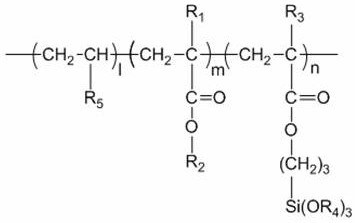
(1)
Wherein: 1 is I + m + n, 0< I < 0.75, 0< m < 0.50 and 0< n < 0.20;
R1 and R3Is a hydrogen atom or a methyl group, and R1And R3Are the same or different;
R2is saturated alkyl with 4-18 carbon atoms;
R4is saturated alkyl with 1-4 carbon atoms;
R5is a nitrogen-containing heterocyclic group, and the nitrogen-containing heterocyclic group is a triazole functional group, a triazole functional group-containing group, a benzotriazole functional group-containing group, an imidazole functional group-containing group, a benzimidazole functional group-containing group, a pyridine functional group-containing group, a pyrrole functional group-containing group, a thiazole functional group, a pyridine functional group,a thiazole functional group-containing group, a purine functional group, and a purine functional group-containing group;
b) a hydrophilic polymer, which constitutes 0.01-3.0 wt.% of the total mass of the composition;
c) the mixed solvent accounts for the balance of the total mass of the composition, and consists of at least one of water-soluble alcohol and water-soluble alcohol ether accounting for 15-95 wt.% of the total mass of the mixed solvent and water accounting for 5-85 wt.% of the total mass of the mixed solvent;
the silicon-containing polymer is prepared from a monomer CH2=CHR5Monomer CH2=C(R1)COOR2And monomer CH2=C(R3)COO(CH2)3Si(OR4)3The mixture is polymerized and copolymerized by thermally-initiated free radical solution to prepare the obtained product;
the hydrophilic polymer is at least one of polyethylene glycol, polypropylene glycol, ethylene oxide-propylene oxide copolymer and polyvinyl alcohol.
2. The composition for improving solder resist ink adhesion of claim 1, wherein the monomer CH is2=CHR5Is at least one of N-vinyl imidazole, 4-vinyl pyridine and 4-methyl-5-vinyl thiazole.
3. The composition for improving solder resist ink adhesion of claim 1, wherein the monomer CH is2=C(R1)COOR2Is at least one of isooctyl acrylate, cetyl acrylate and stearyl methacrylate.
4. The composition for improving solder resist ink adhesion of claim 1, wherein the monomer CH is2=C(R3)COO(CH2)3Si(OR4)3Is gamma-methacryloxypropyltriethoxysilane and gamma-methacryloxypropyltrimethoxysilaneAt least one of (1).
5. The composition for improving solder resist ink adhesion according to claim 1, wherein the water-soluble alcohol is at least one of methanol, ethanol, isopropanol and ethylene glycol.
6. The composition for improving adhesion of solder resist ink according to claim 1, wherein the water-soluble alcohol ether is at least one of ethylene glycol methyl ether, ethylene glycol ethyl ether, ethylene glycol propyl ether, ethylene glycol butyl ether, diethylene glycol methyl ether, diethylene glycol ethyl ether, diethylene glycol propyl ether and diethylene glycol butyl ether.
7. The use method of the composition as claimed in any one of claims 1 to 6, wherein the composition is applied to the surface of the PCB copper layer after the acid cleaning pretreatment by soaking or spraying for chemical treatment for 10s-6min, and the chemical treatment temperature of the composition is 10-50 ℃; and after the chemical treatment is finished, washing and drying the surface of the PCB copper layer.
8. Use according to claim 7, wherein the chemical treatment temperature of the composition is between 25 and 35 ℃.
Priority Applications (1)
| Application Number | Priority Date | Filing Date | Title |
|---|---|---|---|
| CN201910140236.8A CN109852182B (en) | 2019-02-26 | 2019-02-26 | Composition for improving solder resist ink adhesion and use method thereof |
Applications Claiming Priority (1)
| Application Number | Priority Date | Filing Date | Title |
|---|---|---|---|
| CN201910140236.8A CN109852182B (en) | 2019-02-26 | 2019-02-26 | Composition for improving solder resist ink adhesion and use method thereof |
Publications (2)
| Publication Number | Publication Date |
|---|---|
| CN109852182A CN109852182A (en) | 2019-06-07 |
| CN109852182B true CN109852182B (en) | 2021-06-11 |
Family
ID=66899017
Family Applications (1)
| Application Number | Title | Priority Date | Filing Date |
|---|---|---|---|
| CN201910140236.8A Active CN109852182B (en) | 2019-02-26 | 2019-02-26 | Composition for improving solder resist ink adhesion and use method thereof |
Country Status (1)
| Country | Link |
|---|---|
| CN (1) | CN109852182B (en) |
Families Citing this family (3)
| Publication number | Priority date | Publication date | Assignee | Title |
|---|---|---|---|---|
| EP3916059B1 (en) * | 2020-05-27 | 2023-07-26 | Agfa-Gevaert Nv | Inkjet ink for printed circuit boards |
| CN112980237B (en) * | 2021-02-25 | 2022-07-19 | 艺壹佳文化科技(广东)有限公司 | Propaganda logo product with strong plasticity and 36D crystal carving process thereof |
| TWI795879B (en) * | 2021-08-20 | 2023-03-11 | 柏群科技有限公司 | Surface binding agent and method of treating substrate surface |
Citations (1)
| Publication number | Priority date | Publication date | Assignee | Title |
|---|---|---|---|---|
| EP0651034A1 (en) * | 1992-07-08 | 1995-05-03 | Dainippon Pharmaceutical Co., Ltd. | Antifouling paint composition |
Family Cites Families (4)
| Publication number | Priority date | Publication date | Assignee | Title |
|---|---|---|---|---|
| US4732858A (en) * | 1986-09-17 | 1988-03-22 | Brewer Science, Inc. | Adhesion promoting product and process for treating an integrated circuit substrate |
| CN1865366B (en) * | 2005-05-16 | 2010-12-15 | 3M创新有限公司 | Method and composition for improving adhesion of organic polymer coating to copper surface |
| CN103838085B (en) * | 2014-02-19 | 2017-09-05 | 昆山市板明电子科技有限公司 | Non-etching against photoresist adhesion promoter |
| CN106883719B (en) * | 2017-03-17 | 2019-04-16 | 昆山市板明电子科技有限公司 | Improve the adhesion promoter and its application method of photoresist and copper adhesive force |
-
2019
- 2019-02-26 CN CN201910140236.8A patent/CN109852182B/en active Active
Patent Citations (1)
| Publication number | Priority date | Publication date | Assignee | Title |
|---|---|---|---|---|
| EP0651034A1 (en) * | 1992-07-08 | 1995-05-03 | Dainippon Pharmaceutical Co., Ltd. | Antifouling paint composition |
Also Published As
| Publication number | Publication date |
|---|---|
| CN109852182A (en) | 2019-06-07 |
Similar Documents
| Publication | Publication Date | Title |
|---|---|---|
| CN111020584B (en) | Copper surface micro-etching roughening solution and preparation method thereof | |
| KR100610649B1 (en) | Resin composition, prepreg, laminate sheet and printed wiring board using the same | |
| CN100396817C (en) | Surface treatment copper foil | |
| CN110546313A (en) | Surface treated copper foil | |
| CN106883719B (en) | Improve the adhesion promoter and its application method of photoresist and copper adhesive force | |
| CN116285830B (en) | Thermosetting adhesive, adhesive tape and preparation method thereof | |
| EP3122920A1 (en) | Method of forming a metal layer and method of manufacturing a substrate having such metal layer | |
| CN109852182A (en) | For improving the composition and its application method of solder mask adhesive force | |
| JP5688522B2 (en) | Copper surface treatment agent | |
| CN111424272A (en) | A browning liquid for printed circuit boards | |
| CN116162933B (en) | Acidic microetching solution for copper alloy surface and preparation method thereof | |
| CN107645852A (en) | A kind of two-sided surface treatment process of copper foil of high frequency printed circuit boards | |
| US20220192033A1 (en) | Circuit board and method for producing circuit board | |
| CN114423173B (en) | Copper-clad ceramic substrate with high bonding strength and preparation process thereof | |
| JP3620453B2 (en) | Adhesive composition | |
| CN113564569A (en) | Chemical roughening and metallization process of LCP plastics | |
| CN116949448B (en) | Coarsening microetching solution for high-frequency signal transmission copper-clad plate and application thereof | |
| US6569491B1 (en) | Platable dielectric materials for microvia technology | |
| JP4330865B2 (en) | Chemically treated copper foil and method for producing the same | |
| EP1006130A1 (en) | Fumaric acid diester resin composition, cross-linked fumaric acid diester resin and process | |
| CN111850562A (en) | Preparation method of copper surface super-roughening surface treating agent suitable for 5G communication | |
| CN119640248B (en) | A browning additive and a method for browning an IC substrate using the same | |
| CN116397289B (en) | A method for surface treatment of electrolytic copper foil | |
| JP3258739B2 (en) | Manufacturing method of surface treated steel sheet with excellent adhesion | |
| TWI922076B (en) | Surface treatment agent for copper foil |
Legal Events
| Date | Code | Title | Description |
|---|---|---|---|
| PB01 | Publication | ||
| PB01 | Publication | ||
| SE01 | Entry into force of request for substantive examination | ||
| SE01 | Entry into force of request for substantive examination | ||
| GR01 | Patent grant | ||
| GR01 | Patent grant |