Detailed Description
Hereinafter, preferred embodiments of the present disclosure will be described in detail with reference to the accompanying drawings. Before the description, it should be understood that the terms or words used in the specification and the appended claims should not be construed as limited to general and dictionary meanings, but interpreted based on the meanings and concepts corresponding to technical aspects of the present disclosure on the basis of the principle that the inventor is allowed to define terms appropriately for the best explanation.
Therefore, the embodiments described herein and the illustrations shown in the drawings are only the most preferred embodiments of the present disclosure, but are not intended to fully describe the technical aspects of the present disclosure, and therefore it should be understood that various other equivalents and modifications can be made thereto at the time of filing this application.
In addition, in describing the present disclosure, when a detailed description of related known elements or functions is considered to make the key subject matter of the present disclosure unclear, the detailed description is omitted herein.
Terms including ordinal numbers such as "first," "second," etc., are used to distinguish one element from another element, but are not intended to limit the elements by the terms.
Unless the context clearly indicates otherwise, it will be understood that the term "comprises" or "comprising" when used in this specification, specifies the presence of stated elements, but does not preclude the presence or addition of one or more other elements. In addition, the term "control unit" used herein refers to at least one processing unit of a function or operation, and this may be implemented by hardware or software alone or in combination.
In addition, throughout the specification, it will be further understood that when an element is referred to as being "connected to" another element, it can be directly connected to the other element or intervening elements may be present.
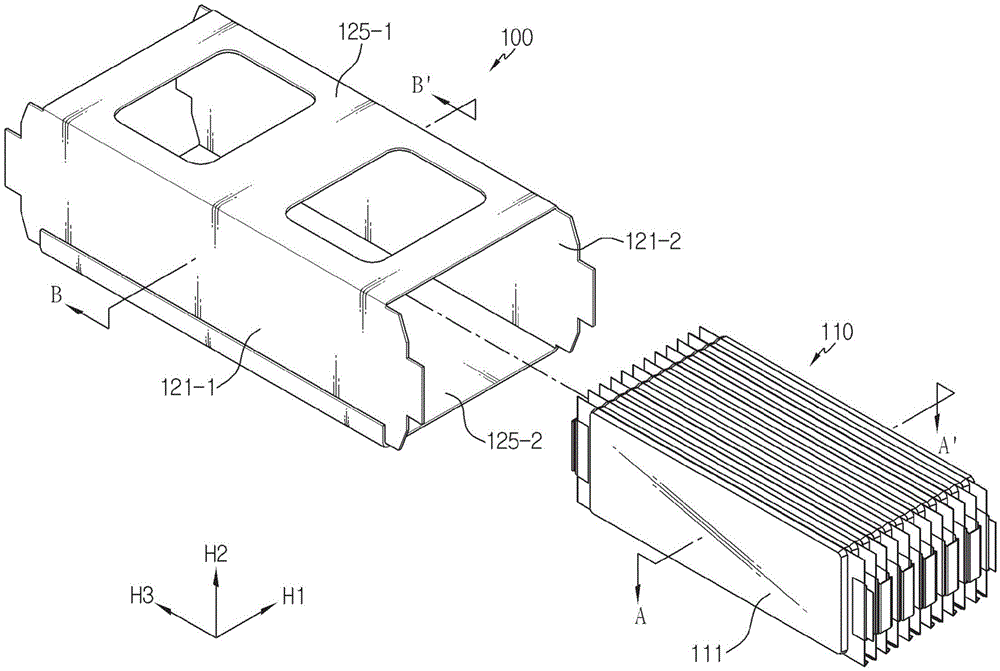
Fig. 1 is a schematic diagram of a battery module 100 according to an embodiment of the present disclosure.
Referring to fig. 1, a battery module 100 includes a cell stack 110 and a case 120. The battery module 100 may be mounted in a vehicle, such as a hybrid electric vehicle, to supply electric energy for driving a motor provided in the vehicle. Of course, the battery module 100 may also be installed in an energy storage system and a smart phone.
In fig. 1, it is assumed that the H1 axis corresponds to the width direction of the battery module 100 and the thickness direction of the battery cells 111, the H2 axis corresponds to the height direction of the battery module 100, and the H3 axis corresponds to the length direction of the battery module 100.
The cell stack 110 includes a plurality of cells 111. In the battery stack 110, a plurality of battery cells 111 are sequentially stacked in a predetermined direction (e.g., H1 axis). To this end, the cell stack 110 may optionally further include an outer case.
The type of the battery cells 111 included in the battery stack 110 is not limited to a specific type. The battery cells 111 may include any type of rechargeable battery cells, such as lithium ion batteries, lithium polymer batteries, nickel cadmium batteries, nickel hydrogen batteries, and nickel zinc batteries. In addition, the battery cells 111 may be classified into a pouch type, a cylindrical type, and a prismatic type according to the type of the case. The battery cells 111 included in the battery stack 110 may be electrically connected to each other through a series structure, a parallel structure, or a combined series-parallel structure.
Each of the cases is mechanically coupled with at least one battery cell 111 to provide a structure in which the battery cell 111 is stably fixed in the battery stack 110. In addition, the outer box may have a shape capable of being coupled with another adjacent outer box directly or by bolts.
The module housing 120 includes a pair of end plates 121-1, 121-2 and at least one strap 125. Each end plate 121 and each band 125 may be coupled to each other by various methods (e.g., welding, bolts). Alternatively, the module case 120 may be integrally formed by an insert molding method.
The module case 120 has an empty space inside, and provides a structure in which the cell stack 110 is accommodated in the empty space. In addition, a module case 120 may be provided such that the cell stack 110 can be inserted or replaced through an opening portion of the module case 120.
When the cell stack 110 is received in the module case 120, one 121-1 of the pair of end plates 121-1, 121-2 abuts a first surface of the cell stack 110 and the other 121-2 abuts a second surface of the cell stack 110. The first and second surfaces of the cell stack 110 may face in opposite directions. Thus, each of the pair of end plates 121-1, 121-2 supports the cell stack 110 by pressing the cell stack 110 in two directions. That is, end plate 121-1 may press a first surface of cell stack 110 against a second surface, and end plate 121-2 may press a second surface of cell stack 110 against the first surface.
Fig. 2 is a diagram illustrating a variation of the battery cell 111 related to the embodiment of the present disclosure. Fig. 2 is a cross-sectional view of the battery cell 111 when the cell stack 110 is taken along the line a-a' of fig. 1.
Referring to fig. 2, each of the battery cells 111 may have a first thickness L1 when in a stable state, and may have a second thickness L2 when in a limited state. Here, the thickness of the battery cell 111 may refer to the maximum length of the single battery cell 111 in the stacking direction of the battery stack 110 (i.e., the H1 axis in fig. 1).
In addition, the stable state may refer to a state in which there is no or little swelling of the battery cell 111 caused by swelling. For example, the battery cell 111 is determined to be in a steady state when the state of health (SOH) is in a predetermined range (e.g., 80% or more), the state of charge (SOC) is in a predetermined range (e.g., less than 70%), and the temperature is in a predetermined range (e.g., less than 30 degrees).
In addition, the limited state may refer to a state in which the battery cell 111 is expanded to the maximum due to swelling. For example, when the SOH is within a predetermined range (e.g., less than 80%), the SOC is within a predetermined range (e.g., 70% or more), and the temperature is a predetermined range (e.g., 45 degrees or more), the battery cell 111 is determined to be in the limited state. The first thickness L1 and the second thickness L1 may be predetermined through previous experiments of a predetermined number of battery cells 111.
As the battery cell 111 enters the restricted state from the stable state, the central portion of the battery cell 111 gradually swells, and the maximum value of the thickness deformation amount of the battery cell 111 may be equal to L2-L1.
When the battery cell 111 is in a stable state, the load applied to the end plate 121 by the expansion of the battery cell 111 is small or negligibly small. In contrast, when the battery cells 111 gradually enter the restrained state, the load applied to the end plates 121 by the expansion of the battery cells 111 gradually increases and is no longer negligible.
Therefore, before actually manufacturing the end plates 121 designed by engineers, it is necessary to check in advance whether the end plates 121 can correctly press the cell stack 110.
Fig. 3 is a schematic diagram illustrating a configuration of a test apparatus 200 according to an embodiment of the present disclosure.
Referring to fig. 3, the test apparatus 200 is configured to test whether an end plate 121 mounted in the battery module 100 as shown in fig. 1 has appropriate strength to support the cell stack 110, and may include an interface unit 210, a memory unit 220, and a control unit 230.
The interface unit 210 is communicatively connected with an external device such as a user PC to transmit and receive data to and from the external device. The interface unit 210 is an optional component and may be omitted from the test apparatus 200 if necessary. Data received at the interface unit 210 from an external device may be stored in the memory unit 220.
Memory unit 220 is configured to store various types of software and data associated with the operation of test endplate 121. At least a portion of all data stored in the memory unit 220 may be provided from an external device through the interface unit 210. The memory unit 220 may include at least one type of storage medium among a flash memory type, a hard disk type, a Solid State Disk (SSD) type, a Silicon Disk Drive (SDD) type, a multimedia card micro type, a Random Access Memory (RAM), a Static Random Access Memory (SRAM), a Read Only Memory (ROM), an Electrically Erasable Programmable Read Only Memory (EEPROM), and a Programmable Read Only Memory (PROM).
The memory unit 220 stores the first parameter, the second parameter, and the third parameter. The first parameter indicates the number of the battery cells 111 to be included in the battery stack 110. The second parameter represents the spring constant of the individual cells 111. The third parameter represents the spring constant of the end plate 121. The memory unit 220 may further store second reference data as described below, and the second reference data represents a second force-distance (F-D) curve. The second F-D curve corresponds to the relationship between the amount of deformation of the single battery cell 111 and the reaction force in the limited state.
The control unit 230 is connected to the interface unit 210 and the memory unit 220, allows communication, and manages transmission and reception of data through the interface unit 210, and performs a test operation on the end plate 121 based on data supplied from the memory unit 220. The control unit 230 may be implemented in hardware using at least one of an Application Specific Integrated Circuit (ASIC), a Digital Signal Processor (DSP), a Digital Signal Processing Device (DSPD), a Programmable Logic Device (PLD), a Field Programmable Gate Array (FPGA), a microcontroller, a microprocessor, and an electrical unit for performing other functions.
Specifically, the control unit 230 generates a one-dimensional model corresponding to the battery module 100 based on the first parameter. The one-dimensional model will be described in more detail below with reference to fig. 6.
In addition, the control unit 230 calculates a first F-D curve based on the second parameter, the third parameter, and the one-dimensional model. The first F-D curve may correspond to a relationship between the amount of deformation of the end plates 121 and the load according to the number of battery cells 111 indicated by the first parameter. That is, the first F-D curve may define the load transferred from the cell stack to the end plate 121 caused by the expansion of the battery cells 111 included in the cell stack 110, and thus how much warpage occurs in the end plate 121. The control unit 230 may store first reference data representing the calculated first F-D curve in the memory unit 220.
Fig. 4 is a schematic cross-sectional view of the battery module 100 taken along line B-B' of fig. 1. With reference to fig. 4, the deformation of the end plates 121-1, 121-2 caused by the expansion of the battery cells 111 included in the battery stack 110 shown in fig. 1 can be more easily understood.
When the respective battery cells 111 expand due to the swelling, the battery cells 111 are deformed more at the central portion than at other portions, and thus the pair of end plates 121 are also deformed most at the central portion. That is, buckling deformation occurs at the central portion of each end plate 121.
I1 of fig. 4 relates to the load transferred from the cell stack 110 to the end plate 121, and I2 relates to the deformation of the end plate 121 according to I1. In addition, W1 of fig. 4 represents the width of the module case 120 when the battery cells 111 included in the cell stack are in a stable state, and W2 of fig. 4 represents the width of the module case 120 when the battery cells 111 included in the battery electrodes are in a restrained state. That is, each end plate 121 may be deformed by Δ x when the battery cell 111 reaches the limited state from the stable statee. It is apparent to those skilled in the art that as the number of the battery cells 111 included in the battery stack 110 increases, the difference between W2 and W1 will also increase.
When the rigidity of the end plates 121 is very large, the overall width variation of the battery module 100 will be absent or very small although the battery cells 111 included in the cell stack 110 reach a restrained state. That is, the deformation of the battery cells 111 included in the battery stack 110 is too much restricted, and as a result, a sudden explosion of the battery cells 111 may occur.
In contrast, when the rigidity of the end plates 121 is very small, the end plates 121 cannot sufficiently restrict the thickness variation of the cell stack 110. That is, when the battery cells 111 included in the battery stack 110 reach the restrained state, the width of the battery module 100 is deformed too much, and as a result, a problem in which the electrical connection between the battery cells 111 included in the electrode assembly is broken may occur.
Fig. 5 is a schematic diagram of a one-dimensional model for simulating deformation of the battery module 100 according to an embodiment of the present disclosure.
In the present disclosure, the one-dimensional model simulates a structure in which the front surface (the first surface in fig. 1) and the rear surface (the second surface in fig. 1) of the cell stack 110 including the number of cells 111, which are sequentially stacked and represented by the first parameter, are supported by the two end plates 121-1, 121-2, respectively.
One-dimensional model toolThere is a basic structure in which the springs S corresponding to the number of the battery cells 111 indicated by the first parameterCTwo springs S connected in series corresponding to the pair of end plates 121-1, 121-2EIn the meantime. Hereinafter, it is assumed that n battery cells 111 form the battery stack 110 for convenience of description.
First, (a) of fig. 5 shows a one-dimensional model when the battery cell 111 is in a steady state. In this case, along the axis H1 (see fig. 1), each spring SCMay have a first basic length and each spring SEMay have a second base length. In addition, K1 may be spring S represented by a second parameterCAnd K2 may be the spring S represented by the third parameterEThe spring constant of (2).
Subsequently, (b) of fig. 5 shows a one-dimensional model when the battery cells 111 in the cell stack 110 are in a restrained state. In this case, each spring SEAt a second basic length, while each spring SCHaving a length Δ x longer than the first basic lengthcLength of (d). That is, Δ xcMay be a difference between the thickness of each battery cell 111 when each battery cell 111 is in a stable state and the thickness of each battery cell 111 when each battery cell 111 is in a restrained state while no load is applied from the end portion 121. Therefore, the total deformation amount of the cell stack 110 is (n × Δ x)c)。
Subsequently, (c) of fig. 5 shows when each spring SCThe one-dimensional model is returned to the first basic length while the cell 111 is in a restrained state by applying a force F from one end plate 121 to the other end plate 121. That is, the force F may be equal to (n × Δ x) compressing the cell stack 110 in the state as shown in (b) of fig. 5c) The required force.
At the same time, when the spring SCIn one-dimensional model, springs S are connected in seriesEIn between, the control unit 230 may calculate an equivalent spring constant of the one-dimensional model using the following equation 1.
< equation 1>
K of equation 1eqRepresenting the equivalent spring constant of the one-dimensional model.
Meanwhile, the load F in (c) of fig. 5 may be calculated using the following equation 2.
< equation 2>
F=Keq×n×Δxc=K2×Δxe
Amount of deformation Δ x of end plate 121eCan be written by the following equation 3 according to equations 1 and 2.
< equation 3>
The control unit 230 may calculate a first F-D curve (see C1 of fig. 8) corresponding to the relationship between the deformation amount and the load of the end plate 121 according to equations 2 and 3.
Fig. 6 is a graph showing a second F-D curve C2 corresponding to the relationship between the thickness deformation amount and the reaction force of the single cell 111 in the restrained state, and fig. 7 is a graph showing a third F-D curve C3 corresponding to the relationship between the thickness deformation amount and the reaction force of the cell stack 110.
The magnitude of the reaction force of the single battery cell 111 may be equal to the magnitude of the load applied from the single battery cell 111 to the end plate 121.
The X-axis of the graph shown in fig. 6 is the thickness deformation amount of the single battery cell 111, and since the single battery cell 111 is in the limited state, the minimum value of the thickness deformation amount may be 0, and the maximum value may be L2-L1. In addition, the Y-axis of the graph shown in fig. 6 is the reaction force of the single battery cell 111, and is the maximum value F1 when the thickness deformation amount of the single battery cell 111 is 0, and is 0 when the thickness deformation amount of the single battery cell 111 is L2-L1. That is, the thickness deformation amount 0 of the single cell 111 in the restrained state means that the rigidity of pressing the end plates 121 of the cell stack 110 in both directions is so high that the expansion of the single cell 111 is completely restrained.
In addition, the reaction force 0 of the single cell 111 in the restrained state indicates that the rigidity of the end plate 121 is too low to affect the expansion of the single cell 111 from the first thickness L1 to the second thickness L1. Here, the unit of the X axis is a unit of length (e.g., "mm"), and the unit of the Y axis is a unit of force or weight (e.g., "kgf").
The second F-D curve C2 shown in fig. 6 may be obtained by repeatedly performing the process of measuring the thickness while continuously or discretely increasing or decreasing the load applied to each of the plurality of battery cells 111 in a limited state.
The graph of fig. 7 shows the third F-D curve C3, and may correspond to a result of correcting the second F-D curve of fig. 6 based on the total number (═ n) of the battery cells 111 included in the battery stack 110. That is, it is apparent that when the number of the battery cells 111 included in the battery stack 110 is 2 or more, the maximum value of the thickness deformation amount of the battery stack 110 is greater than the maximum values L2-L1 of the thickness deformation amount of the individual battery cell 111, and the maximum value F2 of the reaction force of the battery stack 110 is greater than the maximum value of the reaction force of the individual battery cell 111 (F1, see fig. 6).
The control unit 230 may generate data representing the third F-D curve C3 shown in fig. 7 based on the data representing the second F-D curve C2 shown in fig. 6 and the number of battery cells 111 included in the battery stack 110. For example, when the first parameter is equal to n, a line passing through two points F2 and M that are n times each of the x and y intercepts of the second F-D curve shown in fig. 6 may be the third F-D curve of fig. 7.
Although fig. 6 and 7 show each of the second and third F-D curves C2 and C3 to have a straight line shape, this is for illustration only, and it is understood that the shapes of the second and third F-D curves C2 and C3 may vary depending on the structure and material of the battery cell 111.
Fig. 8 is a diagram regarding an operation of testing the end plate 121 by the testing apparatus 200 according to the embodiment of the present disclosure. That is, fig. 8 is a reference diagram describing an operation of evaluating whether the end plates 121 have an appropriate stiffness range to support the cell stack 110 in both directions.
Referring to FIG. 8, the relationship between an exemplary first F-D curve C1 and the third F-D curve C3 shown in FIG. 7 can be seen. As described above, since the first F-D curve C1 shows the relationship between the load and the deformation amount of the end plate 121, the deformation amount of the end plate 121 and the load applied to the end plate 121 may have a proportional relationship. In addition, since the third F-D curve C3 shows the relationship between the reaction force and the deformation amount of the cell stack 110, the deformation amount of the cell stack 110 and the reaction force of the cell stack 110 may have an inversely proportional relationship.
Thus, as shown in FIG. 8, the first F-D curve and the third F-D curve intersect at a point P. At the point P where the first F-D curve and the third F-D curve intersect, the load applied from the cell stack 110 to the end plate 121 and the load applied from the end plate 121 to the cell stack 110 reach equilibrium.
The control unit 230 may calculate coordinates of a point P where the first F-D curve C1 and the third F-D curve C3 intersect. In addition, the control unit 230 may determine the load applied to the end plate 121 while the n battery cells 111 indicated by the first parameter are in the limited state and the cell stack 110 and the end plate 121 are in equilibrium, and the deformation amount of their respective end plates 121, based on the calculated coordinates of the intersection point P. That is, the x value of the coordinates of the intersection point P is the deformation amount of the end plate 121, and the y value is the load applied to the end plate 121.
The control unit 230 may compare the coordinates of the intersection point P with the reference range. That is, the control unit 230 may determine whether the intersection point P is located within the reference range. The memory unit 220 may store information associated with at least one of the first reference range and the second reference range for evaluating the strength of the end plate 121. The first reference range may be defined by a lower limit value G1 and an upper limit value G2 associated with the amount of deformation of the end plate 121, and the second reference range may be defined by a lower limit value J1 and an upper limit value J2 associated with the load applied to the end plate 121. That is, when the x value of the intersection point P is located within the first reference range and the y value of the intersection point P is located within the second reference range, the end plate 121 is determined to have sufficient rigidity to pass the design standard, and in other examples, the end plate 121 is not determined to have sufficient rigidity to pass the design standard. Of course, in the case where only information associated with the first reference range is stored in the memory unit 220, when the x value of the intersection point P is within the first reference range, the processor 230 may determine that the end plate 121 has sufficient rigidity to pass the design criterion regardless of the y value of the intersection point P.
The control unit 230 may output a first test result signal when the coordinates of the intersection point P are within the preset first and second reference ranges. The first test result signal may inform the end plate 121 to pass a predefined design criterion.
In contrast, when the coordinates of the intersection point P are outside the first reference range or the second reference range, the control unit 230 may output a second test result signal. The second test result signal may inform the end plate 121 that the predefined design criteria are not passed.
An x-axis value of the intersection point P larger than the upper limit value G2 of the first reference range and/or a y-axis value of the intersection point P smaller than the lower limit value J1 of the second reference range may indicate that the rigidity of the end plate 121 is insufficient. Accordingly, when the x-axis value of the intersection point P is greater than the upper limit value of the first reference range or the y-axis value of the intersection point P is less than the lower limit value of the second reference range, the control unit 230 may output a third test result signal informing that at least one of a decrease in the first parameter and an increase in the third parameter is necessary.
An x-axis value of the intersection point P smaller than the lower limit value G1 of the first reference range and/or a y-axis value of the intersection point P larger than the upper limit value J2 of the second reference range may indicate that the rigidity of the end plate 121 is too large. Accordingly, when the x-axis value of the intersection point P is less than the lower limit value of the first reference range or the y-axis value of the intersection point P is greater than the upper limit value of the second reference range, the control unit 230 may output a fourth test result signal informing that at least one of an increase of the first parameter and a decrease of the third parameter is necessary.
Together with or separately from the operation of outputting the second to fourth test result signals, the control unit 230 may adjust at least one of the first parameter and the third parameter. For example, the control unit 230 may perform at least one of an operation of decreasing the first parameter by a first value or an operation of increasing the third parameter by a second value before and after outputting the third test result signal. As another example, the control unit 230 may perform at least one of an operation of increasing the first parameter by a third value or an operation of decreasing the third parameter by a fourth value before and after outputting the fourth test result signal. In this case, the first to fourth values are positive numbers and may be preset.
Fig. 9 is a schematic flow diagram of a method for testing end plate 121 according to another embodiment of the present disclosure.
At 910, the control unit 230 generates a one-dimensional model associated with the battery module 100 based on the first parameters. The first parameter indicates the number of the battery cells 111 included in the battery module 100. In addition, the one-dimensional model simulates a structure in which the front surface and the rear surface of the cell stack 110 including the number of the battery cells 111, which are sequentially stacked and expressed by the first parameter, are supported on opposite sides by the two end plates 121-1, 121-2.
In 915, the control unit 230 calculates a first F-D curve based on the second parameter, the third parameter and the one-dimensional model. The second parameter represents the spring constant of the individual battery cell 111, and the third parameter represents the spring constant of the end plate 121. In addition, the first F-D curve corresponds to the relationship between the amount of deformation of the end plates 121 and the load according to the number of battery cells 111 indicated by the first parameter. The control unit 230 may store first reference data representing the calculated first F-D curve in the memory unit 220.
In 920, the control unit 230 may calculate a third F-D curve based on the first parameter and the second F-D curve. The control unit 230 may determine the second F-D curve from the second reference data previously stored in the memory unit 220. The second F-D curve corresponds to the relationship between the deformation amount and the reaction force of the single cell 111, and the third F-D curve corresponds to the relationship between the deformation amount and the reaction force of the cell stack 110. The amount of deformation of the cell stack 110 is a result of reflecting the corresponding expansion of the battery cells 111 included in the cell stack 110.
At 925, the control unit 230 calculates coordinates of the intersection of the first F-D curve and the third F-D curve. The intersection point represents the balance between the reaction force of the cell stack 110 and the force applied by the end plate 121. The control unit 230 determines the amount of deformation and load of the end plates 121 caused by the expansion of the number of battery cells 111 indicated by the first parameter from the calculation coordinates based on the intersection points. The load of the end plate 121 corresponds to the force applied to the cell stack 110 by the end plate 121.
In 930, the control unit 230 determines whether the intersection is located within a preset reference range.
At 935, the control unit 230 outputs a first test result signal when the coordinates of the intersection point are within a preset reference range. The first test result signal may inform the end plate 121 to pass a predefined design criterion. After 935, the method ends.
At 940, the control unit 230 outputs a second test result signal when the coordinates of the intersection point are outside the reference range. The second test result signal may inform the end plate 121 that the predefined design criteria are not passed.
At 945, the control unit 230 adjusts at least one of the first parameter and the third parameter. In this case, the amount of increase or decrease of the first parameter or the third parameter may be determined by the control unit 230 according to the relationship between the intersection point and the reference range. When the first parameter is adjusted at 945, the method returns to 910. In contrast, when only the third parameter is adjusted, the control unit 230 returns to 915 instead of 910.
The embodiments of the present disclosure described above are not achieved only by the apparatuses and methods, and may be achieved by a program implementing functions corresponding to the configuration of the embodiments of the present disclosure or a recording medium having the program recorded thereon, and those skilled in the art can easily implement this from the disclosure of the previously described embodiments.
Although the present disclosure has been described above with respect to a limited number of embodiments and drawings, the present disclosure is not limited thereto, and it will be apparent to those skilled in the art that various modifications and variations can be made thereto within the technical scope of the present disclosure and the equivalent scope of the appended claims.
In addition, many substitutions, modifications and changes may be made to the present disclosure described herein by those skilled in the art without departing from the technical aspects of the present disclosure, and the present disclosure is not limited to the above-described embodiments and drawings, and each embodiment may be selectively combined partially or entirely to allow various modifications.