CN109923091B - Method for preparing graphite flake - Google Patents
Method for preparing graphite flake Download PDFInfo
- Publication number
- CN109923091B CN109923091B CN201780065296.7A CN201780065296A CN109923091B CN 109923091 B CN109923091 B CN 109923091B CN 201780065296 A CN201780065296 A CN 201780065296A CN 109923091 B CN109923091 B CN 109923091B
- Authority
- CN
- China
- Prior art keywords
- coating
- substrate
- coating liquid
- graphite sheet
- liquid
- Prior art date
- Legal status (The legal status is an assumption and is not a legal conclusion. Google has not performed a legal analysis and makes no representation as to the accuracy of the status listed.)
- Active
Links
Images


Classifications
-
- C—CHEMISTRY; METALLURGY
- C04—CEMENTS; CONCRETE; ARTIFICIAL STONE; CERAMICS; REFRACTORIES
- C04B—LIME, MAGNESIA; SLAG; CEMENTS; COMPOSITIONS THEREOF, e.g. MORTARS, CONCRETE OR LIKE BUILDING MATERIALS; ARTIFICIAL STONE; CERAMICS; REFRACTORIES; TREATMENT OF NATURAL STONE
- C04B35/00—Shaped ceramic products characterised by their composition; Ceramics compositions; Processing powders of inorganic compounds preparatory to the manufacturing of ceramic products
- C04B35/515—Shaped ceramic products characterised by their composition; Ceramics compositions; Processing powders of inorganic compounds preparatory to the manufacturing of ceramic products based on non-oxide ceramics
- C04B35/52—Shaped ceramic products characterised by their composition; Ceramics compositions; Processing powders of inorganic compounds preparatory to the manufacturing of ceramic products based on non-oxide ceramics based on carbon, e.g. graphite
- C04B35/522—Graphite
-
- C—CHEMISTRY; METALLURGY
- C01—INORGANIC CHEMISTRY
- C01B—NON-METALLIC ELEMENTS; COMPOUNDS THEREOF; METALLOIDS OR COMPOUNDS THEREOF NOT COVERED BY SUBCLASS C01C
- C01B32/00—Carbon; Compounds thereof
- C01B32/20—Graphite
- C01B32/205—Preparation
-
- C—CHEMISTRY; METALLURGY
- C01—INORGANIC CHEMISTRY
- C01B—NON-METALLIC ELEMENTS; COMPOUNDS THEREOF; METALLOIDS OR COMPOUNDS THEREOF NOT COVERED BY SUBCLASS C01C
- C01B32/00—Carbon; Compounds thereof
- C01B32/20—Graphite
-
- C—CHEMISTRY; METALLURGY
- C04—CEMENTS; CONCRETE; ARTIFICIAL STONE; CERAMICS; REFRACTORIES
- C04B—LIME, MAGNESIA; SLAG; CEMENTS; COMPOSITIONS THEREOF, e.g. MORTARS, CONCRETE OR LIKE BUILDING MATERIALS; ARTIFICIAL STONE; CERAMICS; REFRACTORIES; TREATMENT OF NATURAL STONE
- C04B35/00—Shaped ceramic products characterised by their composition; Ceramics compositions; Processing powders of inorganic compounds preparatory to the manufacturing of ceramic products
- C04B35/515—Shaped ceramic products characterised by their composition; Ceramics compositions; Processing powders of inorganic compounds preparatory to the manufacturing of ceramic products based on non-oxide ceramics
- C04B35/52—Shaped ceramic products characterised by their composition; Ceramics compositions; Processing powders of inorganic compounds preparatory to the manufacturing of ceramic products based on non-oxide ceramics based on carbon, e.g. graphite
-
- C—CHEMISTRY; METALLURGY
- C04—CEMENTS; CONCRETE; ARTIFICIAL STONE; CERAMICS; REFRACTORIES
- C04B—LIME, MAGNESIA; SLAG; CEMENTS; COMPOSITIONS THEREOF, e.g. MORTARS, CONCRETE OR LIKE BUILDING MATERIALS; ARTIFICIAL STONE; CERAMICS; REFRACTORIES; TREATMENT OF NATURAL STONE
- C04B35/00—Shaped ceramic products characterised by their composition; Ceramics compositions; Processing powders of inorganic compounds preparatory to the manufacturing of ceramic products
- C04B35/622—Forming processes; Processing powders of inorganic compounds preparatory to the manufacturing of ceramic products
-
- C—CHEMISTRY; METALLURGY
- C04—CEMENTS; CONCRETE; ARTIFICIAL STONE; CERAMICS; REFRACTORIES
- C04B—LIME, MAGNESIA; SLAG; CEMENTS; COMPOSITIONS THEREOF, e.g. MORTARS, CONCRETE OR LIKE BUILDING MATERIALS; ARTIFICIAL STONE; CERAMICS; REFRACTORIES; TREATMENT OF NATURAL STONE
- C04B35/00—Shaped ceramic products characterised by their composition; Ceramics compositions; Processing powders of inorganic compounds preparatory to the manufacturing of ceramic products
- C04B35/622—Forming processes; Processing powders of inorganic compounds preparatory to the manufacturing of ceramic products
- C04B35/62222—Forming processes; Processing powders of inorganic compounds preparatory to the manufacturing of ceramic products obtaining ceramic coatings
-
- C—CHEMISTRY; METALLURGY
- C04—CEMENTS; CONCRETE; ARTIFICIAL STONE; CERAMICS; REFRACTORIES
- C04B—LIME, MAGNESIA; SLAG; CEMENTS; COMPOSITIONS THEREOF, e.g. MORTARS, CONCRETE OR LIKE BUILDING MATERIALS; ARTIFICIAL STONE; CERAMICS; REFRACTORIES; TREATMENT OF NATURAL STONE
- C04B41/00—After-treatment of mortars, concrete, artificial stone or ceramics; Treatment of natural stone
- C04B41/80—After-treatment of mortars, concrete, artificial stone or ceramics; Treatment of natural stone of only ceramics
- C04B41/81—Coating or impregnation
- C04B41/82—Coating or impregnation with organic materials
- C04B41/83—Macromolecular compounds
-
- D—TEXTILES; PAPER
- D06—TREATMENT OF TEXTILES OR THE LIKE; LAUNDERING; FLEXIBLE MATERIALS NOT OTHERWISE PROVIDED FOR
- D06M—TREATMENT, NOT PROVIDED FOR ELSEWHERE IN CLASS D06, OF FIBRES, THREADS, YARNS, FABRICS, FEATHERS OR FIBROUS GOODS MADE FROM SUCH MATERIALS
- D06M11/00—Treating fibres, threads, yarns, fabrics or fibrous goods made from such materials, with inorganic substances or complexes thereof; Such treatment combined with mechanical treatment, e.g. mercerising
- D06M11/73—Treating fibres, threads, yarns, fabrics or fibrous goods made from such materials, with inorganic substances or complexes thereof; Such treatment combined with mechanical treatment, e.g. mercerising with carbon or compounds thereof
- D06M11/74—Treating fibres, threads, yarns, fabrics or fibrous goods made from such materials, with inorganic substances or complexes thereof; Such treatment combined with mechanical treatment, e.g. mercerising with carbon or compounds thereof with carbon or graphite; with carbides; with graphitic acids or their salts
-
- D—TEXTILES; PAPER
- D06—TREATMENT OF TEXTILES OR THE LIKE; LAUNDERING; FLEXIBLE MATERIALS NOT OTHERWISE PROVIDED FOR
- D06M—TREATMENT, NOT PROVIDED FOR ELSEWHERE IN CLASS D06, OF FIBRES, THREADS, YARNS, FABRICS, FEATHERS OR FIBROUS GOODS MADE FROM SUCH MATERIALS
- D06M15/00—Treating fibres, threads, yarns, fabrics, or fibrous goods made from such materials, with macromolecular compounds; Such treatment combined with mechanical treatment
- D06M15/19—Treating fibres, threads, yarns, fabrics, or fibrous goods made from such materials, with macromolecular compounds; Such treatment combined with mechanical treatment with synthetic macromolecular compounds
- D06M15/37—Macromolecular compounds obtained otherwise than by reactions only involving carbon-to-carbon unsaturated bonds
- D06M15/59—Polyamides; Polyimides
-
- D—TEXTILES; PAPER
- D06—TREATMENT OF TEXTILES OR THE LIKE; LAUNDERING; FLEXIBLE MATERIALS NOT OTHERWISE PROVIDED FOR
- D06M—TREATMENT, NOT PROVIDED FOR ELSEWHERE IN CLASS D06, OF FIBRES, THREADS, YARNS, FABRICS, FEATHERS OR FIBROUS GOODS MADE FROM SUCH MATERIALS
- D06M15/00—Treating fibres, threads, yarns, fabrics, or fibrous goods made from such materials, with macromolecular compounds; Such treatment combined with mechanical treatment
- D06M15/70—Treating fibres, threads, yarns, fabrics, or fibrous goods made from such materials, with macromolecular compounds; Such treatment combined with mechanical treatment combined with mechanical treatment
- D06M15/71—Cooling; Steaming or heating, e.g. in fluidised beds; with molten metals
-
- D—TEXTILES; PAPER
- D06—TREATMENT OF TEXTILES OR THE LIKE; LAUNDERING; FLEXIBLE MATERIALS NOT OTHERWISE PROVIDED FOR
- D06M—TREATMENT, NOT PROVIDED FOR ELSEWHERE IN CLASS D06, OF FIBRES, THREADS, YARNS, FABRICS, FEATHERS OR FIBROUS GOODS MADE FROM SUCH MATERIALS
- D06M7/00—Treating fibres, threads, yarns, fabrics, or fibrous goods made of other substances with subsequent freeing of the treated goods from the treating medium, e.g. swelling, e.g. polyolefins
-
- D—TEXTILES; PAPER
- D21—PAPER-MAKING; PRODUCTION OF CELLULOSE
- D21H—PULP COMPOSITIONS; PREPARATION THEREOF NOT COVERED BY SUBCLASSES D21C OR D21D; IMPREGNATING OR COATING OF PAPER; TREATMENT OF FINISHED PAPER NOT COVERED BY CLASS B31 OR SUBCLASS D21G; PAPER NOT OTHERWISE PROVIDED FOR
- D21H17/00—Non-fibrous material added to the pulp, characterised by its constitution; Paper-impregnating material characterised by its constitution
- D21H17/20—Macromolecular organic compounds
- D21H17/33—Synthetic macromolecular compounds
-
- D—TEXTILES; PAPER
- D21—PAPER-MAKING; PRODUCTION OF CELLULOSE
- D21H—PULP COMPOSITIONS; PREPARATION THEREOF NOT COVERED BY SUBCLASSES D21C OR D21D; IMPREGNATING OR COATING OF PAPER; TREATMENT OF FINISHED PAPER NOT COVERED BY CLASS B31 OR SUBCLASS D21G; PAPER NOT OTHERWISE PROVIDED FOR
- D21H19/00—Coated paper; Coating material
- D21H19/10—Coatings without pigments
- D21H19/14—Coatings without pigments applied in a form other than the aqueous solution defined in group D21H19/12
-
- D—TEXTILES; PAPER
- D21—PAPER-MAKING; PRODUCTION OF CELLULOSE
- D21H—PULP COMPOSITIONS; PREPARATION THEREOF NOT COVERED BY SUBCLASSES D21C OR D21D; IMPREGNATING OR COATING OF PAPER; TREATMENT OF FINISHED PAPER NOT COVERED BY CLASS B31 OR SUBCLASS D21G; PAPER NOT OTHERWISE PROVIDED FOR
- D21H25/00—After-treatment of paper not provided for in groups D21H17/00 - D21H23/00
- D21H25/04—Physical treatment, e.g. heating, irradiating
-
- C—CHEMISTRY; METALLURGY
- C01—INORGANIC CHEMISTRY
- C01P—INDEXING SCHEME RELATING TO STRUCTURAL AND PHYSICAL ASPECTS OF SOLID INORGANIC COMPOUNDS
- C01P2006/00—Physical properties of inorganic compounds
- C01P2006/10—Solid density
-
- C—CHEMISTRY; METALLURGY
- C01—INORGANIC CHEMISTRY
- C01P—INDEXING SCHEME RELATING TO STRUCTURAL AND PHYSICAL ASPECTS OF SOLID INORGANIC COMPOUNDS
- C01P2006/00—Physical properties of inorganic compounds
- C01P2006/32—Thermal properties
-
- C—CHEMISTRY; METALLURGY
- C01—INORGANIC CHEMISTRY
- C01P—INDEXING SCHEME RELATING TO STRUCTURAL AND PHYSICAL ASPECTS OF SOLID INORGANIC COMPOUNDS
- C01P2006/00—Physical properties of inorganic compounds
- C01P2006/40—Electric properties
-
- D—TEXTILES; PAPER
- D06—TREATMENT OF TEXTILES OR THE LIKE; LAUNDERING; FLEXIBLE MATERIALS NOT OTHERWISE PROVIDED FOR
- D06M—TREATMENT, NOT PROVIDED FOR ELSEWHERE IN CLASS D06, OF FIBRES, THREADS, YARNS, FABRICS, FEATHERS OR FIBROUS GOODS MADE FROM SUCH MATERIALS
- D06M2101/00—Chemical constitution of the fibres, threads, yarns, fabrics or fibrous goods made from such materials, to be treated
- D06M2101/02—Natural fibres, other than mineral fibres
- D06M2101/04—Vegetal fibres
- D06M2101/06—Vegetal fibres cellulosic
Landscapes
- Chemical & Material Sciences (AREA)
- Engineering & Computer Science (AREA)
- Ceramic Engineering (AREA)
- Organic Chemistry (AREA)
- Manufacturing & Machinery (AREA)
- Structural Engineering (AREA)
- Materials Engineering (AREA)
- Inorganic Chemistry (AREA)
- Textile Engineering (AREA)
- Geology (AREA)
- General Life Sciences & Earth Sciences (AREA)
- Life Sciences & Earth Sciences (AREA)
- Chemical Kinetics & Catalysis (AREA)
- Mechanical Engineering (AREA)
- Carbon And Carbon Compounds (AREA)
- Laminated Bodies (AREA)
- Cooling Or The Like Of Semiconductors Or Solid State Devices (AREA)
- Paints Or Removers (AREA)
Abstract
本实施方案涉及一种在不使用昂贵的聚酰亚胺膜的情况下以低成本制备具有高导热率的石墨片的方法。
The present embodiment relates to a method of producing a graphite sheet having high thermal conductivity at low cost without using an expensive polyimide film.
Description
技术领域technical field
本实施方案涉及一种以方便和经济的方式制备具有高导热率的石墨片的方法。The present embodiment relates to a method for producing a graphite sheet with high thermal conductivity in a convenient and economical manner.
背景技术Background technique
随着电子设备技术的发展,电子设备近来变得更短、更小、更薄,因此必须有效地散发设备中产生的热量。为此目的,已经开发出各种散热材料,并以散热垫、散热片、散热涂料等形式销售。其中散热片以石墨片、聚合物-陶瓷复合片、多层薄金属片等形式制备。石墨片轻薄,并且具有与铜相当或甚至更高的导热率。因此,它们被用在电子电路板之间、等离子电视的PDP等中。With the development of electronic device technology, electronic devices have recently become shorter, smaller, and thinner, and thus the heat generated in the device must be efficiently dissipated. For this purpose, various heat-dissipating materials have been developed and sold in the form of heat-dissipating pads, heat-dissipating fins, heat-dissipating paints, and the like. The heat sinks are prepared in the form of graphite sheets, polymer-ceramic composite sheets, multi-layer thin metal sheets and the like. Graphite flakes are thin and light and have thermal conductivity comparable to or even higher than copper. Therefore, they are used between electronic circuit boards, PDPs for plasma TVs, and the like.
制备膜状石墨的代表性实例是称为“石墨膨胀法”的方法。在该方法中,将天然石墨浸入浓硫酸和浓乙酸的混合物中,然后快速加热以使石墨膨胀。在通过洗涤膨胀的石墨除去酸之后,使用高压压制将由此获得的石墨形成膜状。然而通过该方法制备的膜状石墨强度弱,没有优异的物理性质,并且存在含有残留酸的问题。A representative example of the preparation of film-like graphite is a method called "graphite expansion method". In this method, natural graphite is immersed in a mixture of concentrated sulfuric acid and concentrated acetic acid and then rapidly heated to expand the graphite. After removing the acid by washing the expanded graphite, the graphite thus obtained is formed into a film using high pressure pressing. However, the film-like graphite prepared by this method is weak in strength, does not have excellent physical properties, and has a problem of containing residual acid.
为了解决上述问题,已经开发了一种方法,其中将一特别的聚合物膜直接热处理以石墨化(下文中称为“聚合物石墨化法”)。用于该方法的聚合物膜包括,例如聚噁二唑、聚酰亚胺、聚亚苯基亚乙烯基、聚苯并咪唑、聚苯并噁唑、聚噻唑和聚酰胺薄膜。与常规石墨膨胀法相比,聚合物石墨化法非常简单。此外,它基本上不涉及掺入诸如酸的杂质,并且提供具有优异的导热率和优异的与单晶石墨接近的导电性的石墨片(参见日本特开专利公开号1995-109171和1987-275116)。In order to solve the above-mentioned problems, a method has been developed in which a special polymer film is directly heat-treated to be graphitized (hereinafter referred to as "polymer graphitization method"). Polymer films used in this method include, for example, polyoxadiazole, polyimide, polyphenylene vinylene, polybenzimidazole, polybenzoxazole, polythiazole, and polyamide films. Compared with conventional graphite expansion methods, the polymer graphitization method is very simple. In addition, it does not substantially involve the incorporation of impurities such as acids, and provides graphite sheets having excellent thermal conductivity and excellent electrical conductivity close to that of single-crystal graphite (see Japanese Laid-Open Patent Publication Nos. 1995-109171 and 1987-275116 ).
发明内容SUMMARY OF THE INVENTION
技术问题technical problem
然而,与石墨膨胀法相比,聚合物石墨化法难以生产厚膜形式的石墨。并且聚合物石墨化法还存在制造成本高的问题。However, the polymer graphitization method is difficult to produce graphite in thick film form compared to the graphite expansion method. In addition, the polymer graphitization method also has the problem of high manufacturing cost.
因此,本实施方案旨在提供一种方法,该方法能够以方便和经济的方式制备具有高导热率和相对大厚度的石墨片,而无需使用昂贵的聚酰亚胺膜。Therefore, the present embodiment aims to provide a method capable of producing a graphite sheet with high thermal conductivity and a relatively large thickness in a convenient and economical manner without using an expensive polyimide film.
问题的解决方案solution to the problem
为了实现上述目的,一实施方案提供了一种制备石墨片的方法,其包含:In order to achieve the above object, an embodiment provides a method for preparing a graphite sheet, comprising:
(a)提供包含天然纤维、合成纤维或纸的基材;(a) providing a substrate comprising natural fibers, synthetic fibers or paper;
(b)用涂覆液涂覆所述基材的一面或两面;和(b) coating one or both sides of the substrate with a coating liquid; and
(c)对经涂覆的基材进行热处理以使其石墨化,(c) heat treating the coated substrate to graphitize it,
其中所述涂覆液包含液体树脂、溶剂、脱水剂和催化剂。Wherein the coating liquid contains liquid resin, solvent, dehydrating agent and catalyst.
另一实施方案提供了一种制备石墨片的方法,其包含:Another embodiment provides a method of making graphite flakes, comprising:
(1)提供包含天然纤维、合成纤维或纸的基材;(1) Provide a substrate comprising natural fibers, synthetic fibers or paper;
(2)用涂覆液对基材的一面或两面进行第一涂覆;(2) carry out the first coating on one or both sides of the substrate with the coating liquid;
(3)用所述涂覆液对经第一涂覆的基材进行第二涂覆;和(3) subjecting the first coated substrate to a second coating with the coating liquid; and
(4)对经第二涂覆的基材进行热处理以使其石墨化,(4) heat treating the second coated substrate to graphitize it,
其中,所述第一涂覆在至少0.1MPa的压力下挤压进行。Wherein, the first coating is performed by extrusion under a pressure of at least 0.1 MPa.
又另一实施例方案提供一种制备石墨片的方法,其包含:Yet another embodiment provides a method for preparing a graphite sheet, comprising:
在多孔基材的内部或外部布置包含液态树脂的涂覆液;disposing a coating liquid containing a liquid resin inside or outside the porous substrate;
除去所述多孔基材和所述涂覆液中所含的气泡;和removing air bubbles contained in the porous substrate and the coating liquid; and
将所述多孔基材和所述涂覆液进行石墨化。The porous substrate and the coating liquid are graphitized.
发明效果Invention effect
根据本实施方案的制备石墨片的方法,可以以方便的方式生产具有高导热率和相对大的厚度的石墨片。另外,由于该方法使用相对便宜的纤维基材代替昂贵的聚酰亚胺膜,因此该方法可以以经济的方式生产石墨片。According to the method for producing a graphite sheet of the present embodiment, a graphite sheet having a high thermal conductivity and a relatively large thickness can be produced in a convenient manner. In addition, the method can produce graphite flakes in an economical manner because it uses a relatively inexpensive fiber substrate instead of an expensive polyimide membrane.
此外,在根据本实施方案的制备石墨片的方法中,将涂覆液布置在诸如纤维基材的多孔基材的内部或外部,并且除去包含在所述多孔基材和所述涂覆液中的气泡。于是,在石墨化处理前,多孔基材和涂覆液的复合片材可以具有致密的结构。因此,可以最大限度地抑制石墨化处理后最终生成的石墨片中孔隙。Furthermore, in the method for producing a graphite sheet according to the present embodiment, the coating liquid is disposed inside or outside of a porous substrate such as a fibrous substrate, and removal of the coating liquid contained in the porous substrate and the coating liquid is removed. of air bubbles. Thus, before the graphitization treatment, the composite sheet of the porous substrate and the coating liquid can have a dense structure. Therefore, the pores in the graphite sheets finally generated after the graphitization treatment can be suppressed to the maximum extent.
因此,根据该实施方案的石墨片具有高密度并且可以具有改善的导热率。Therefore, the graphite sheet according to this embodiment has high density and can have improved thermal conductivity.
附图说明Description of drawings
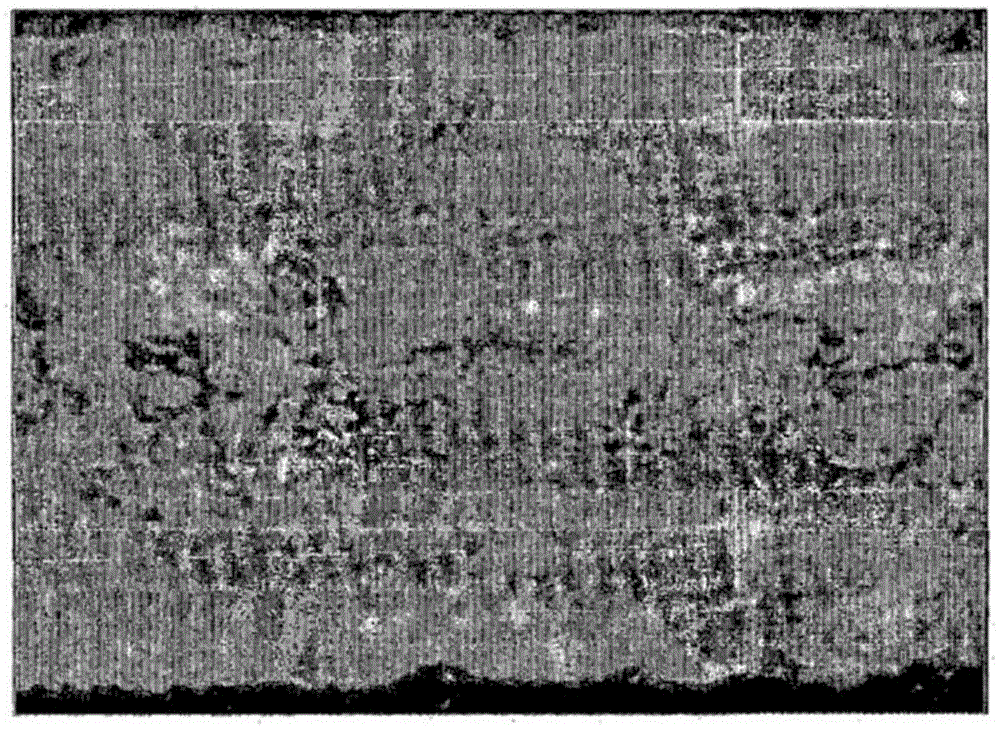
图1和3分别是对比例2的石墨片的表面照片和横截面的放大照片。1 and 3 are a surface photograph and an enlarged photograph of a cross section of the graphite sheet of Comparative Example 2, respectively.
图2和4分别是实施例2的石墨片的表面照片和横截面的放大照片。2 and 4 are a surface photograph and an enlarged photograph of a cross section of the graphite sheet of Example 2, respectively.
图5是一实施例的第一涂覆的示意图,其是用挤压辊涂覆的示意图。5 is a schematic view of a first coating of an embodiment, which is a schematic view of coating with a squeeze roll.
图6是一实施例的第二涂覆的示意图。6 is a schematic diagram of a second coating of an embodiment.
本发明的最佳实施方式BEST MODE FOR CARRYING OUT THE INVENTION
在整个实施方案的描述中,在提及每个膜、薄膜、嵌板或层形成在另一膜、薄膜、嵌板或层“上”或“下”的情况下,其不仅意味着一元件是直接形成在另一元件上或下,还意味着一元件间接地形成在另一元件上或下,其他元件插入它们之间。而且,关于每个元件的术语“上”或“下”可以参考附图。为了进行描述,附图中的各个元件的尺寸可能被夸大地描绘,其并不表示实际尺寸。Throughout the description of the embodiments, where each film, film, panel or layer is referred to as being formed "on" or "under" another film, film, panel or layer, it does not mean only an element Formed directly on or under another element also means that an element is formed indirectly over or under another element with the other element interposed therebetween. Also, the term "upper" or "lower" with respect to each element may refer to the accompanying drawings. For the purpose of description, the size of various elements in the drawings may be exaggerated, which does not represent the actual size.
根据一实施方案制备石墨片的方法,其包含(a)提供包含天然纤维、合成纤维或纸的基材;According to an embodiment, a method of making graphite flakes, comprising (a) providing a substrate comprising natural fibers, synthetic fibers, or paper;
(b)用涂覆液涂覆所述基材的一面或两面;和(b) coating one or both sides of the substrate with a coating liquid; and
(c)对经涂覆的基材进行热处理以使其石墨化,(c) heat treating the coated substrate to graphitize it,
其中所述涂覆液包含液体树脂、溶剂、脱水剂和催化剂。Wherein the coating liquid contains liquid resin, solvent, dehydrating agent and catalyst.
步骤(a)step (a)
在该步骤中,提供包含天然纤维、合成纤维或纸的基材。所述基材可以具有许多孔隙。也就是说,所述基材可以是多孔基材。In this step, a substrate comprising natural fibers, synthetic fibers or paper is provided. The substrate can have many pores. That is, the substrate may be a porous substrate.
通常,所述天然纤维可主要分为纤维素纤维,蛋白质纤维和矿物纤维。所述纤维素纤维可包括(i)种子纤维,如棉花和木棉;(ii)茎纤维,如亚麻、苎麻、大麻和黄麻;(iii)水果纤维,如椰壳纤维;和(iv)叶纤维,如马尼拉麻、蕉麻和剑麻。此外,所述蛋白质纤维可包括(i)羊毛纤维、(ii)丝纤维,和(iii)毛发纤维。在构成根据本实施方案的石墨片的基材由天然纤维构成的情况下,所述天然纤维可以是选自棉、麻、毛和丝中的至少一种。Generally, the natural fibers can be mainly classified into cellulose fibers, protein fibers and mineral fibers. The cellulosic fibers may include (i) seed fibers such as cotton and kapok; (ii) stem fibers such as flax, ramie, hemp and jute; (iii) fruit fibers such as coir; and (iv) leaf fibers , such as Manila hemp, abaca and sisal. Additionally, the protein fibers may include (i) wool fibers, (ii) silk fibers, and (iii) hair fibers. In the case where the base material constituting the graphite sheet according to the present embodiment is composed of natural fibers, the natural fibers may be at least one selected from the group consisting of cotton, hemp, wool, and silk.
通常,所述合成纤维可主要分为有机纤维和无机纤维。所述有机纤维可包括(i)再生纤维,其包括纤维素纤维如人造丝(rayon)、天丝(tencil)(或莱赛尔纤维(lyocell))和莫代尔(modale),以及蛋白质基纤维;(ii)半合成纤维,其包括纤维素基纤维如乙酸酯和三乙酸酯;和(iii)合成纤维,如聚酰胺纤维、聚酯纤维、聚氨酯纤维、聚乙烯纤维、聚氯乙烯纤维、聚氟乙烯纤维、聚乙烯醇纤维、丙烯酸纤维和聚丙烯纤维。在根据本实施方案的石墨片的基材由合成纤维构成的情况下,所述合成纤维可以是选自尼龙、聚酯、聚氨酯、聚乙烯、聚氯乙烯、聚氟乙烯、聚乙烯醇、丙烯酸和聚丙烯中的至少一种;或选自人造丝、乙酸酯和三乙酸酯的纤维素基纤维中的至少一种。Generally, the synthetic fibers can be mainly classified into organic fibers and inorganic fibers. The organic fibers may include (i) regenerated fibers, including cellulosic fibers such as rayon, tencil (or lyocell) and modale, and protein-based fibers; (ii) semi-synthetic fibers, including cellulose-based fibers such as acetate and triacetate; and (iii) synthetic fibers such as polyamide fibers, polyester fibers, polyurethane fibers, polyethylene fibers, polyvinyl chloride fibers , polyvinyl fluoride fiber, polyvinyl alcohol fiber, acrylic fiber and polypropylene fiber. In the case where the base material of the graphite sheet according to the present embodiment is composed of synthetic fibers, the synthetic fibers may be selected from nylon, polyester, polyurethane, polyethylene, polyvinyl chloride, polyvinyl fluoride, polyvinyl alcohol, acrylic and at least one of polypropylene; or at least one of cellulose-based fibers selected from rayon, acetate and triacetate.
所述纸没有特别限制,通常只要其可以购买或制备即可。The paper is not particularly limited, generally as long as it can be purchased or prepared.
步骤(b)step (b)
在该步骤中,所述基材的一面或两面涂有涂覆液。In this step, one or both sides of the substrate are coated with the coating liquid.
所述涂覆液包含液体树脂、溶剂、脱水剂和催化剂。具体地,所述涂覆液可包含70至85%重量的所述液体树脂、2至10%重量的所述溶剂、10至20%重量的所述脱水剂和1至5%重量的所述催化剂。The coating liquid contains liquid resin, solvent, dehydrating agent and catalyst. Specifically, the coating liquid may contain 70 to 85% by weight of the liquid resin, 2 to 10% by weight of the solvent, 10 to 20% by weight of the dehydrating agent, and 1 to 5% by weight of the catalyst.
所述液态树脂可以是包含选自聚酰亚胺、聚酰胺酸、聚氯乙烯、聚酯、聚氨酯、聚乙烯、聚氟乙烯、聚乙烯醇、丙烯酸和聚丙烯的树脂中的至少一种。具体地,所述液态树脂可包含选自聚酰亚胺、聚酰胺酸和聚氯乙烯的树脂中的至少一种。更具体地,所述液体树脂可包含重均分子量为200,000至300,000克/摩尔的聚酰胺酸。The liquid resin may be a resin containing at least one selected from the group consisting of polyimide, polyamic acid, polyvinyl chloride, polyester, polyurethane, polyethylene, polyvinyl fluoride, polyvinyl alcohol, acrylic, and polypropylene. Specifically, the liquid resin may contain at least one resin selected from the group consisting of polyimide, polyamic acid, and polyvinyl chloride. More specifically, the liquid resin may contain polyamic acid having a weight average molecular weight of 200,000 to 300,000 g/mol.
也就是说,所述液态树脂可诸如聚酰胺酸的树脂的固体组分,和诸如有机溶剂的液体组分。基于液体树脂的总重量,所述液体树脂的固体含量可以为15至25%重量。That is, the liquid resin may be a solid component of a resin such as polyamic acid, and a liquid component such as an organic solvent. The solid content of the liquid resin may be 15 to 25% by weight based on the total weight of the liquid resin.
所述涂覆液可以包含70至85%重量,特别是70至80%重量的液体树脂。The coating liquid may contain 70 to 85% by weight, especially 70 to 80% by weight of liquid resin.
所述脱水剂可以是乙酸酐。The dehydrating agent may be acetic anhydride.
所述涂覆液可包含10至20%重量,特别是12至16%重量的所述脱水剂。如果涂覆液包含的脱水剂的量在上述范围内,则由于优异的脱水效果和适当的酰亚胺化速度,可以改善可加工性。The coating liquid may contain 10 to 20% by weight, particularly 12 to 16% by weight of the dehydrating agent. If the amount of the dehydrating agent contained in the coating liquid is within the above range, workability can be improved due to an excellent dehydration effect and an appropriate imidization speed.
所述催化剂可包含选自3-甲基吡啶和异喹啉中的至少一种。具体地,所述催化剂可以是3-甲基吡啶或异喹啉。The catalyst may contain at least one selected from 3-picoline and isoquinoline. Specifically, the catalyst may be 3-picoline or isoquinoline.
所述涂覆液可含有1至5%重量,特别是1至2.5%重量的所述催化剂。如果所述涂覆液包含的催化剂的量在上述范围内,则定向效果增加,使得由此制备的石墨片具有优异的热性能,并且由于适当的酰亚胺化速度,可以改善可加工性。The coating liquid may contain 1 to 5% by weight, especially 1 to 2.5% by weight of the catalyst. If the amount of the catalyst contained in the coating liquid is within the above range, the orientation effect is increased, so that the graphite sheet thus prepared has excellent thermal properties, and due to an appropriate imidization speed, workability can be improved.
所述溶剂可包含选自二甲基甲酰胺、N-甲基吡咯烷酮、二甲基乙酰胺和二甲基亚砜中的至少一种。具体地,所述溶剂可以是二甲基甲酰胺、N-甲基吡咯烷酮,二甲基乙酰胺或二甲基亚砜。The solvent may contain at least one selected from the group consisting of dimethylformamide, N-methylpyrrolidone, dimethylacetamide, and dimethylsulfoxide. Specifically, the solvent may be dimethylformamide, N-methylpyrrolidone, dimethylacetamide or dimethylsulfoxide.
所述涂覆液可包含2至10%重量,特别是4至6%重量的所述溶剂。如果所述涂覆液包含的溶剂的量在上述范围内,则可以防止涂覆液由于其高粘度而难以充分消泡和难以控制涂覆厚度。The coating liquid may contain 2 to 10% by weight, especially 4 to 6% by weight of the solvent. If the amount of the solvent contained in the coating liquid is within the above range, the coating liquid can be prevented from being difficult to defoaming sufficiently and controlling the coating thickness due to its high viscosity.
所述涂覆没有特别限制,只要它是用于涂覆基材的方法即可。例如,所述涂覆可以通过轧制工艺、棒式工艺、浸涂工艺、喷涂工艺等进行。具体地,所述涂覆可以通过以下方法进行,其中将涂覆液施加到基材的一面或两面,并且所述基材从彼此相对的上辊和下辊之间通过。在这种情况下,聚酯保护膜可以放置在基材的涂覆面,然后所述基材可以从辊之间通过,同时将所述涂覆液注入所述基材和所述保护膜之间。The coating is not particularly limited as long as it is a method for coating a substrate. For example, the coating may be performed by a rolling process, a bar process, a dip coating process, a spray coating process, or the like. Specifically, the coating may be performed by a method in which a coating liquid is applied to one or both sides of a substrate, and the substrate passes between upper and lower rollers opposed to each other. In this case, a polyester protective film can be placed on the coated side of the substrate, and then the substrate can be passed between rollers while the coating liquid is injected between the substrate and the protective film .
在涂覆时,所述基材可以涂覆0.1至1g/cm3的所述涂覆液。具体地,在涂覆时,所述基材可以涂覆0.2至0.5g/cm3的所述涂覆液。At the time of coating, the substrate may be coated with 0.1 to 1 g/cm 3 of the coating liquid. Specifically, at the time of coating, the substrate may be coated with 0.2 to 0.5 g/cm 3 of the coating liquid.
如果需要,在上述步骤(b)中,用所述涂覆液对所述基材的一面或两面进行第一涂覆后,可以用所述涂覆液对经第一涂覆的基材进行第二涂覆。所述第一涂覆是将所述涂覆液填充在所述基材的纤维之间以使所述基材表面平整,并且所述第二涂覆是调整片材的厚度并增强密度。If necessary, in the above step (b), after the first coating is performed on one or both sides of the substrate with the coating liquid, the first coated substrate may be coated with the coating liquid. Second coating. The first coating is to fill the coating liquid between the fibers of the substrate to flatten the surface of the substrate, and the second coating is to adjust the thickness of the sheet and enhance the density.
在所述第一涂覆中,所述基材可以涂覆有使其表面平整的量的涂覆液。In the first coating, the substrate may be coated with a coating liquid in an amount to flatten the surface.
所述第二涂覆可以进行一至三次。另外,在所述第二涂覆中,所述涂覆液可以以0.1至0.3g/cm3的量施加在经第一涂覆的基材上。The second coating may be performed one to three times. In addition, in the second coating, the coating liquid may be applied on the first-coated substrate in an amount of 0.1 to 0.3 g/cm 3 .
在所述涂覆液包含聚酰胺酸作为液体树脂的情况下,步骤(b)后和步骤(c)前可以进一步包含酰亚胺化的步骤。In the case where the coating liquid contains a polyamic acid as the liquid resin, a step of imidization may be further included after the step (b) and before the step (c).
所述酰亚胺化可以在100至600℃下进行。具体地,所述酰亚胺化可以在100至600℃下进行20至25分钟。The imidization may be performed at 100 to 600°C. Specifically, the imidization may be performed at 100 to 600° C. for 20 to 25 minutes.
步骤(c)step (c)
在该步骤中,对经涂覆的基材进行热处理以使其石墨化。In this step, the coated substrate is heat treated to graphitize it.
所述热处理可以在900至3,000℃下进行1至20小时。具体地,所述热处理可包含在1,000至1,600℃下进行0.5至10小时的第一热处理,然后在温度升至2,600至2,900℃下进行0.5至10小时的第二热处理。在如上所述的二次热处理的情况下,在较低温度下对片材进行碳化处理,然后在较高温度下进行石墨化处理,从而提高由此制备的石墨片的石墨化程度。The heat treatment may be performed at 900 to 3,000° C. for 1 to 20 hours. Specifically, the heat treatment may include a first heat treatment at 1,000 to 1,600° C. for 0.5 to 10 hours, and then a second heat treatment at a temperature of 2,600 to 2,900° C. for 0.5 to 10 hours. In the case of the secondary heat treatment as described above, the carbonization treatment is performed on the sheet at a lower temperature, and then the graphitization treatment is performed at a higher temperature, thereby increasing the degree of graphitization of the graphite sheet thus prepared.
所述制备方法在步骤(c)后,可以进一步包含(d)轧制石墨化片材。所述轧制可以在20至50N/cm2的压力下进行。另外,所述轧制可以进行一至三次。第一次轧制是使石墨化片材的表面平整,第二次轧制是将石墨化片材的厚度调整到所需的厚度,第三次轧制可以是提高石墨化片材的密度。After step (c), the preparation method may further comprise (d) rolling the graphitized sheet. The rolling may be performed under a pressure of 20 to 50 N/cm 2 . In addition, the rolling may be performed one to three times. The first rolling is to flatten the surface of the graphitized sheet, the second rolling is to adjust the thickness of the graphitized sheet to a desired thickness, and the third rolling may be to increase the density of the graphitized sheet.
根据上述制备石墨片的方法,可以以方便和经济的方式制备具有高导热率和低电阻的石墨片,而无需使用昂贵的聚酰亚胺膜。According to the above-described method for preparing a graphite sheet, a graphite sheet having high thermal conductivity and low electrical resistance can be prepared in a convenient and economical manner without using an expensive polyimide film.
通过上述制备方法制备的石墨片可以具有900W/m·K以上的高导热率和小于1,000MΩ的低电阻,以及可以具有0.01至0.3mm的厚度。The graphite sheet prepared by the above-mentioned preparation method may have a high thermal conductivity of 900 W/m·K or more and a low resistance of less than 1,000 MΩ, and may have a thickness of 0.01 to 0.3 mm.
根据一实施方案的制备石墨片的方法包含(1)提供包含天然纤维、合成纤维或纸的基材;The method for producing a graphite sheet according to an embodiment includes (1) providing a substrate comprising natural fibers, synthetic fibers or paper;
(2)用涂覆液对所述基材的一面或两面进行第一涂覆;(2) carrying out the first coating on one or both sides of the base material with the coating liquid;
(3)用涂覆液对经第一涂覆的基材进行第二涂覆;和(3) subjecting the first coated substrate to a second coating with a coating liquid; and
(4)对经第二涂覆的基材进行热处理以使其石墨化,(4) heat treating the second coated substrate to graphitize it,
其中所述第一涂覆通过在至少0.1MPa的压力下挤压进行。wherein the first coating is performed by extrusion under a pressure of at least 0.1 MPa.
步骤(1)step 1)
在该步骤中,提供包含天然纤维、合成纤维或纸的基材。所述天然纤维、合成纤维和纸如上述步骤(a)中所述。In this step, a substrate comprising natural fibers, synthetic fibers or paper is provided. The natural fibers, synthetic fibers and paper are as described in step (a) above.
步骤(2)Step (2)
在该步骤中,用涂覆液在所述基材的一面或两面进行第一涂覆。In this step, a first coating is performed on one or both sides of the substrate with a coating liquid.
所述第一涂覆的过程可以通过以下步骤进行。The first coating process can be performed through the following steps.
首先,将所述涂覆液喷涂在基材的一面或两面,并且所述涂覆液可以布置在基材的内部和/或外部。此外,所述涂覆液可以布置在基材的上侧和下侧,并且部分涂覆液可以渗透到基材中。First, the coating liquid is sprayed on one or both sides of the substrate, and the coating liquid may be arranged inside and/or outside the substrate. In addition, the coating liquid may be arranged on the upper and lower sides of the substrate, and part of the coating liquid may penetrate into the substrate.
然后,除去所述基材和所述涂覆液中含有的气泡。气泡除去过程可以被定义为挤压过程。Then, the base material and the air bubbles contained in the coating liquid are removed. The bubble removal process can be defined as a squeezing process.
所述气泡除去过程通过在至少0.1MPa的压力下挤压进行。具体地,可以通过将涂覆液施加在基材的一面或两面上,并使基材在0.1MPa或更高的压力下,从彼此相对的上挤压辊和下挤压辊之间进行所述第一涂覆。在这种情况下,聚酯保护膜可以放置在所述基材的涂层表面上,然后基材可以从挤压辊之间通过,同时将所述涂覆液注入基材和保护膜之间。更具体地,当涂有涂覆液的基材从挤压辊之间通过时,可以除去所述基材中含有的气泡。The bubble removal process is carried out by pressing at a pressure of at least 0.1 MPa. Specifically, the coating can be carried out by applying the coating liquid on one or both sides of the substrate, and subjecting the substrate to a pressure of 0.1 MPa or more, from between the upper and lower squeezing rolls opposed to each other. Describe the first coating. In this case, a polyester protective film can be placed on the coated surface of the substrate, and then the substrate can be passed between squeeze rolls while the coating liquid is injected between the substrate and the protective film . More specifically, when the substrate coated with the coating liquid passes between the squeeze rolls, air bubbles contained in the substrate can be removed.
通过上述挤压工艺,所述基材外部的涂覆液可以更好地渗透到基材中。也就是说,当所述涂覆液仅部分浸渍或根本不浸渍到基材中时,所述涂覆液可通过挤压过程填充所述基材中的所有孔隙。Through the above extrusion process, the coating liquid outside the substrate can better penetrate into the substrate. That is, when the coating liquid is only partially impregnated or not impregnated into the substrate at all, the coating liquid can fill all the pores in the substrate through the extrusion process.
参考图5,可以通过在基材(200)两面放置聚酯保护膜(400),然后使基材从挤压辊(510和520)之间通过,同时将涂覆液(300)注入基材和保护膜之间进行第一涂覆。Referring to FIG. 5, the coating liquid (300) can be injected into the substrate by placing the polyester protective film (400) on both sides of the substrate (200), and then passing the substrate between the squeeze rollers (510 and 520) while injecting the coating liquid (300). The first coating is carried out between the protective film.
另外,所述第一涂覆通过在至少0.1MPa的压力下进行挤压来进行,特别地,可以通过在0.1至0.3MPa的压力下进行挤压来进行。In addition, the first coating is performed by extrusion under a pressure of at least 0.1 MPa, and in particular, may be performed by extrusion under a pressure of 0.1 to 0.3 MPa.
所述涂覆液可包含70至85%重量的液体树脂、2至10%重量的溶剂、10至20%重量的脱水剂和1至5%重量的催化剂。所述液态树脂、所述溶剂、所述脱水剂和所述催化剂如上所述。The coating liquid may contain 70 to 85% by weight of a liquid resin, 2 to 10% by weight of a solvent, 10 to 20% by weight of a dehydrating agent, and 1 to 5% by weight of a catalyst. The liquid resin, the solvent, the dehydrating agent and the catalyst are as described above.
在所述第一涂覆中,所述基材的涂覆量可以为0.1至1g/cm3。特别地,在所述第一涂覆中,所述基材的涂覆量可以为0.2至0.5g/cm3。In the first coating, the coating amount of the substrate may be 0.1 to 1 g/cm 3 . In particular, in the first coating, the coating amount of the substrate may be 0.2 to 0.5 g/cm 3 .
所述第一涂覆中的涂层厚度可以为30至50μm。The coating thickness in the first coating may be 30 to 50 μm.
在所述第一涂覆过程完成之后,所述基材和所述涂覆液的总厚度可以为80至250μm。After the first coating process is completed, the total thickness of the substrate and the coating liquid may be 80 to 250 μm.
步骤(3)Step (3)
在该步骤中,用涂覆液对经第一涂覆的基材进行第二涂覆。In this step, the first coated substrate is subjected to a second coating with the coating liquid.
可以通过在经所述第一涂覆的基材的一面或两面上施加涂覆液,并使基材从彼此相对的上辊和下辊之间通过来进行所述第二涂覆。在这种情况下,聚酯保护膜可以放置在经第一涂覆的基材的涂层表面上,然后可以将基材从挤压辊之间通过,同时将涂覆液注入经第一涂覆的基材和保护膜之间。The second coating can be carried out by applying a coating liquid to one or both sides of the first coated substrate and passing the substrate between upper and lower rolls opposite each other. In this case, a polyester protective film can be placed on the coated surface of the first-coated substrate, and the substrate can then be passed between squeeze rolls while the coating liquid is injected into the first-coated substrate. between the coated substrate and the protective film.
参考图6,可以通过将聚酯保护膜(400)放置在经第一涂覆的基材(210)的两面上,然后使基材从挤压辊(610和620)之间通过,同时将涂覆液(300)注入经第一涂覆的基材和保护膜之间进行所述第二涂覆。Referring to Figure 6, a polyester protective film (400) can be placed on both sides of the first coated substrate (210), and then the substrate is passed between the squeeze rolls (610 and 620), while the The coating liquid (300) is injected between the first-coated substrate and the protective film to perform the second coating.
在所述第二涂覆中,经第一涂覆的基材的涂覆量可以为0.1至0.5g/cm3。具体地,在所述第二涂覆中,经第一涂覆的基材的涂覆量可以为0.1至0.3g/cm3。In the second coating, the coating amount of the first coated substrate may be 0.1 to 0.5 g/cm 3 . Specifically, in the second coating, the coating amount of the first coated substrate may be 0.1 to 0.3 g/cm 3 .
因此,在基材的上侧和/或下侧形成涂层。用于形成涂层的涂覆液可以与用于第一涂覆过程的涂覆液基本相同。Thus, a coating is formed on the upper and/or lower side of the substrate. The coating liquid used to form the coating layer may be substantially the same as the coating liquid used for the first coating process.
所述第二涂覆的涂层厚度可以为30至50μm。如果在第二涂覆中在基材的上侧和下侧形成涂层,则涂层的总厚度(即第一涂层和第二涂层的厚度)可以为60至100μm。The coating thickness of the second coating may be 30 to 50 μm. If the coating layers are formed on the upper and lower sides of the substrate in the second coating, the total thickness of the coating layers (ie, the thicknesses of the first coating layer and the second coating layer) may be 60 to 100 μm.
另外,完成第二涂覆过程之后的基材和涂层的总厚度可以是140至350μm。In addition, the total thickness of the substrate and the coating layer after completing the second coating process may be 140 to 350 μm.
所述第二涂覆用于调节片材的厚度。如果在仅进行第二涂覆,而不进行如上所述的使用挤压辊的第一涂覆,则在基材的两面都进行涂覆时,基材(纤维)中包含的气泡不会被除去,从而片材中将包含气泡。如上所述,如果片材含有气泡,则气泡可能成为瑕疵,其可能导致片材导热性降低的问题。具体地,气泡会形成间隙(空气层),其作为阻碍热扩散的因素会导致片材的导热率降低。The second coating is used to adjust the thickness of the sheet. If only the second coating is performed without the first coating using squeeze rolls as described above, the air bubbles contained in the substrate (fibers) will not be removed when the coating is performed on both sides of the substrate. removed so that the sheet will contain air bubbles. As described above, if the sheet contains air bubbles, the air bubbles may become defects, which may cause a problem that the thermal conductivity of the sheet is lowered. Specifically, the air bubbles form gaps (air layers), which, as a factor hindering heat diffusion, lead to a decrease in the thermal conductivity of the sheet.
在涂覆液包含聚酰胺酸作为液体树脂的情况下,在步骤(3)后和步骤(4)前可以进一步包含酰亚胺化的步骤。In the case where the coating liquid contains a polyamic acid as the liquid resin, a step of imidization may be further included after the step (3) and before the step (4).
所述酰亚胺化可以在100至600℃下进行。具体地,所述酰亚胺化可以在100至600℃下进行20至25分钟。The imidization may be performed at 100 to 600°C. Specifically, the imidization may be performed at 100 to 600° C. for 20 to 25 minutes.
步骤(4)Step (4)
在该步骤中,可以对经第二涂覆的基材进行热处理以使其石墨化。In this step, the second coated substrate may be heat treated to graphitize it.
所述热处理可以在900至3,000℃下进行1至20小时。具体地,所述热处理可包含在1,000至1,600℃下进行0.5至10小时的第一热处理,然后在温度升至2,600至2,900℃下进行0.5至10小时的第二热处理。在如上所述的二次热处理的情况下,在较低温度下对片材进行碳化处理,然后在较高温度下进行石墨化处理,从而提高由此制备的石墨片的石墨化程度。The heat treatment may be performed at 900 to 3,000° C. for 1 to 20 hours. Specifically, the heat treatment may include a first heat treatment at 1,000 to 1,600° C. for 0.5 to 10 hours, and then a second heat treatment at a temperature of 2,600 to 2,900° C. for 0.5 to 10 hours. In the case of the secondary heat treatment as described above, the carbonization treatment is performed on the sheet at a lower temperature, and then the graphitization treatment is performed at a higher temperature, thereby increasing the degree of graphitization of the graphite sheet thus prepared.
所述制备方法在步骤(4)后,可以进一步包含(5)轧制石墨化片材。After step (4), the preparation method may further include (5) rolling the graphitized sheet.
所述轧制可以在20至50N/cm2的压力下进行。另外,所述轧制可以进行一至三次。第一次轧制用于使石墨化板的表面平整,第二次轧制用于将石墨化板的厚度调整到所需的厚度,第三次轧制可以是用于提高石墨片的密度。The rolling may be performed under a pressure of 20 to 50 N/cm 2 . In addition, the rolling may be performed one to three times. The first rolling is for flattening the surface of the graphitized sheet, the second rolling is for adjusting the thickness of the graphitized sheet to a desired thickness, and the third rolling may be for increasing the density of the graphite sheet.
根据一实施方案的制备石墨片的方法包含在多孔基材的内部或外部布置包含液态树脂的涂覆液;A method of producing a graphite sheet according to an embodiment includes disposing a coating liquid including a liquid resin inside or outside a porous substrate;
除去多孔基材和涂覆液中所含的气泡;和remove air bubbles contained in porous substrates and coating fluids; and
使所述多孔基材和所述涂覆液石墨化。The porous substrate and the coating liquid are graphitized.
所述多孔基材和所述涂覆液如上所述。The porous substrate and the coating liquid are as described above.
在气泡除去步骤之后,可以进一步包含在多孔基材的一面或两面上形成涂层的步骤。所述涂层在石墨化步骤中可以被石墨化。具体地,所述涂层具有30至50μm的厚度并且可以包含液体树脂。After the bubble removal step, a step of forming a coating layer on one or both sides of the porous substrate may be further included. The coating may be graphitized during the graphitization step. Specifically, the coating has a thickness of 30 to 50 μm and may contain a liquid resin.
所述石墨化步骤的工艺条件如上所述。The process conditions for the graphitization step are as described above.
在气泡除去步骤中,可以对所述多孔基材和所述涂覆液施加0.1MPa或更高的压力。所述气泡除去步骤如上的气泡除去过程中所述。In the bubble removing step, a pressure of 0.1 MPa or more may be applied to the porous substrate and the coating liquid. The bubble removal step is as described in the bubble removal procedure above.
根据所述制备石墨片的方法,通过除去基材中含有的气泡以提高涂覆液的浸渍程度,可以制备具有高导热率的石墨片。此外,根据制备石墨片的方法,可以以方便和经济的方式生产具有高导热率的石墨片,而无需使用昂贵的聚酰亚胺膜。According to the method for preparing a graphite sheet, a graphite sheet with high thermal conductivity can be prepared by removing the air bubbles contained in the base material to increase the degree of impregnation of the coating liquid. In addition, according to the method for preparing the graphite sheet, the graphite sheet having high thermal conductivity can be produced in a convenient and economical manner without using an expensive polyimide film.
通过上述制备方法制备的石墨片具有900W/m·K或更高的高导热率,并且可以具有0.01至0.3mm的均匀厚度。The graphite sheet produced by the above-described production method has a high thermal conductivity of 900 W/m·K or higher, and may have a uniform thickness of 0.01 to 0.3 mm.
发明方式way of invention
以下通过实施例详细说明本发明。以下实施例旨在进一步说明本发明而不限制其范围。The present invention will be described in detail below by means of examples. The following examples are intended to further illustrate the present invention without limiting its scope.
[实施例][Example]
制备实施例:制备涂覆液Preparation Example: Preparation of Coating Liquid
将78%重量的液态聚酰胺酸(制造商:KOLON PI,产品名称:PAA清漆,重均分子量:250,000克/摩尔,固体含量:18%重量)、6%重量的二甲基甲酰胺作为溶剂、15%重量的无水乙酸作为脱水剂和1%重量的3-甲基吡啶作为催化剂混合并以1,500rpm分散2分钟以制备涂覆液。78% by weight of liquid polyamic acid (manufacturer: KOLON PI, product name: PAA varnish, weight average molecular weight: 250,000 g/mol, solid content: 18% by weight), 6% by weight of dimethylformamide as a solvent , 15% by weight of anhydrous acetic acid as a dehydrating agent, and 1% by weight of 3-picoline as a catalyst were mixed and dispersed at 1,500 rpm for 2 minutes to prepare a coating liquid.
实施例1:石墨片的制备Example 1: Preparation of graphite sheets
使用棉纤物(制造商:Han Textile,产品名称:cotton 100su)作为基材。在25℃下将聚对苯二甲酸乙二醇酯(PET)保护膜放置在基材的两面,然后辊压基材,同时将制备实施例中制备的涂覆液注入基材和保护膜之间,以使用量为0.3g/cm3(第一涂覆)的涂覆液涂覆在基材的两面。对经第一涂覆的基材进行与上述相同的涂覆步骤,以使用量为0.2g/cm3(第二涂覆)的涂覆液涂覆在基材的两面。Cotton fiber (manufacturer: Han Textile, product name: cotton 100su) was used as a substrate. A polyethylene terephthalate (PET) protective film was placed on both sides of the substrate at 25°C, and then the substrate was rolled, while the coating liquid prepared in the preparation example was injected between the substrate and the protective film During this time, the coating liquid was coated on both sides of the substrate with a usage amount of 0.3 g/cm 3 (first coating). The first-coated substrate was subjected to the same coating procedure as described above, and the coating solution was applied in an amount of 0.2 g/cm 3 (second coating) on both sides of the substrate.
然后,在热空气炉中,将经涂覆的基材在约150℃下处理10分钟,在约250℃下处理5分钟,在约400℃下处理5分钟以制备厚度为120μm的酰亚胺化的基材膜。Then, in a hot air oven, the coated substrates were treated at about 150°C for 10 minutes, at about 250°C for 5 minutes, and at about 400°C for 5 minutes to produce imides with a thickness of 120 μm denatured substrate film.
加热酰亚胺化的基材膜,同时在氮气气氛中(约100托压力)以1℃/分钟的速率升温,并在约1000℃的最终温度下进行7个小时的第一热处理。然后,以5℃/分钟的速度升温,将基材膜在约2,700℃下进行2小时的第二热处理,从而制备石墨化片材。The imidized substrate film was heated while raising the temperature at a rate of 1°C/min in a nitrogen atmosphere (about 100 Torr pressure), and a first heat treatment was performed at a final temperature of about 1000°C for 7 hours. Then, the temperature was raised at a rate of 5° C./min, and the base film was subjected to a second heat treatment at about 2,700° C. for 2 hours to prepare a graphitized sheet.
将石墨化片材在50N/cm2压力下从彼此相对的上辊和下辊之间通过以进行辊压。进行三次轧制以制备厚度为40μm的石墨片。The graphitized sheet was passed between the upper and lower rolls opposed to each other under a pressure of 50 N/cm 2 for rolling. Rolling was performed three times to prepare a graphite sheet with a thickness of 40 μm.
对比例1:合成石墨片Comparative Example 1: Synthetic Graphite Sheet
使用来自CX-Carbon的SGS 40μm(产品名称)的商用石墨片。Commercially available graphite flakes of SGS 40 μm (product name) from CX-Carbon were used.
测试实施例1Test Example 1
测量实施例1的石墨片和对比例1的石墨片如下所示的性质,结果示于下表1和2中。The properties shown below of the graphite flakes of Example 1 and the graphite flakes of Comparative Example 1 were measured, and the results are shown in Tables 1 and 2 below.
(1)比热和热扩散率(1) Specific heat and thermal diffusivity
使用NETZSCH的LFA 447型测量石墨片在50℃下的比热和热扩散率。The specific heat and thermal diffusivity of graphite flakes at 50°C were measured using the LFA 447 model from NETZSCH.
(2)密度(2) Density
使用Alfa Mirage的阿基米德密度计测量石墨片的密度。The density of the graphite flakes was measured using an Archimedes densitometer from Alfa Mirage.
(3)导热率(3) Thermal conductivity
通过热扩散率×密度×比热计算石墨片的导热率。The thermal conductivity of the graphite sheet was calculated by thermal diffusivity×density×specific heat.
(4)电感和电阻(4) Inductance and resistance
使用阻抗分析仪(制造商:Agilent,型号:Agilent 4294A)在6.78MHz下测量电感和电阻。The inductance and resistance were measured at 6.78 MHz using an impedance analyzer (manufacturer: Agilent, model: Agilent 4294A).
[表1][Table 1]

[表2][Table 2]

如表2所示,实施例1的石墨片的电阻比对比例1的合成石墨片的电阻低。另外,如表1所示,实施例1的石墨片的导热率高于900W/m·K。As shown in Table 2, the resistance of the graphite sheet of Example 1 was lower than that of the synthetic graphite sheet of Comparative Example 1. In addition, as shown in Table 1, the thermal conductivity of the graphite sheet of Example 1 was higher than 900 W/m·K.
实施例2Example 2
使用棉纤物(制造商:Han Textile,产品名称:cotton 100su)作为基材。在25℃下将聚对苯二甲酸乙二醇酯(PET)保护膜放置在基材的两面,然后辊压基材,同时将作为涂覆液的液态聚酰胺酸(制造商:KOLON PI,产品名称:PAA清漆)注入基材和保护膜之间,以使用量为0.3g/cm3(第一涂覆)的涂覆液涂覆在基材的两面。从经第一涂覆的基材的两侧除去PET保护膜,并在其上放置新的PET保护膜。然后对基材进行辊压,同时将涂覆液注入经第一涂覆的基材和保护膜之间,以使用量为0.2g/cm3(第二涂覆)的涂覆液涂覆在基材的两面。Cotton fiber (manufacturer: Han Textile, product name: cotton 100su) was used as a substrate. A polyethylene terephthalate (PET) protective film was placed on both sides of the substrate at 25°C, and then the substrate was rolled, while liquid polyamic acid (manufacturer: KOLON PI, Product name: PAA varnish) was injected between the substrate and the protective film, and was coated on both sides of the substrate with a coating liquid in an amount of 0.3 g/cm 3 (first coating). The PET protective film was removed from both sides of the first coated substrate and a new PET protective film was placed thereon. The substrate was then rolled while the coating liquid was injected between the first-coated substrate and the protective film, and the coating liquid was applied in an amount of 0.2 g/cm 3 (second coating) on the both sides of the substrate.
具体地,参考图5,通过使基材(100)在0.2MPa的压力下从彼此相对的上挤压辊和下上挤压辊(410和420)之间通过来进行第一涂覆。另外,参考图6,通过使经第一涂覆的基材(110)在彼此面对的上辊和下辊(510和520)之间通过来进行第二涂覆。Specifically, referring to FIG. 5 , the first coating was performed by passing the substrate ( 100 ) under a pressure of 0.2 MPa between the upper and lower squeeze rolls ( 410 and 420 ) opposed to each other. 6, the second coating is performed by passing the first coated substrate (110) between the upper and lower rollers (510 and 520) facing each other.
此后,在热空气炉中,将经第二涂覆的基材在约150℃下处理10分钟,在约250℃下处理5分钟,在约400℃下处理5分钟以制备具有厚度为120μm的酰亚胺化的基材膜。Thereafter, in a hot air oven, the second coated substrate was treated at about 150° C. for 10 minutes, at about 250° C. for 5 minutes, and at about 400° C. for 5 minutes to prepare a substrate having a thickness of 120 μm. imidized substrate film.
加热酰亚胺化的基材膜,同时在氮气气氛中(约100托压力)以1℃/分钟的速率升温,并在约1000℃的最终温度下进行7个小时的第一热处理。然后,以5℃/分钟的速度升温,将基材膜在约2,700℃下进行2小时的第二热处理,从而制备石墨化片材。The imidized substrate film was heated while raising the temperature at a rate of 1°C/min in a nitrogen atmosphere (about 100 Torr pressure), and a first heat treatment was performed at a final temperature of about 1000°C for 7 hours. Then, the temperature was raised at a rate of 5° C./min, and the base film was subjected to a second heat treatment at about 2,700° C. for 2 hours to prepare a graphitized sheet.
将石墨化片材在50N/cm2压力下从彼此相对的上辊和下辊之间通过以进行辊压。进行三次轧制以制备厚度为40μm的石墨片。The graphitized sheet was passed between the upper and lower rolls opposed to each other under a pressure of 50 N/cm 2 for rolling. Rolling was performed three times to prepare a graphite sheet with a thickness of 40 μm.
对比例2Comparative Example 2
以与实施例2中相同的方式制备石墨片,不同之处在于仅进行第二涂覆(主要涂覆)而不在挤压下进行第一涂覆。Graphite sheets were prepared in the same manner as in Example 2, except that only the second coating (main coating) was performed without the first coating under extrusion.
测试实施例2Test Example 2
测量实施例2的石墨片和比较例2的石墨片如下所示的性质。此外,将如此制备的石墨片切割成130mm×130mm的宽度和长度,将其用作测试样品。另外,结果显示在下表3和4中。The graphite flakes of Example 2 and the graphite flakes of Comparative Example 2 were measured for the properties shown below. In addition, the thus prepared graphite sheet was cut into a width and length of 130 mm×130 mm, which was used as a test sample. Additionally, the results are shown in Tables 3 and 4 below.
(1)评价是否含有气泡(1) Evaluate whether there are air bubbles
用肉眼观察石墨片的表面,评价片材是否含有气泡。结果如图1和图2所示。此外,使用光学显微镜放大20倍观察石墨片的横截面,结果示于图3和图4所示。The surface of the graphite sheet was observed with the naked eye to evaluate whether or not the sheet contained air bubbles. The results are shown in Figures 1 and 2. In addition, the cross-section of the graphite sheet was observed at 20 times magnification using an optical microscope, and the results are shown in FIGS. 3 and 4 .
具体而言,图1和图3分别是根据对比例2的石墨片的表面照片和横截面的放大照片。图2和图4分别是根据实施例2的石墨片的表面照片和横截面的放大照片。Specifically, FIGS. 1 and 3 are a surface photograph and an enlarged photograph of a cross section of a graphite sheet according to Comparative Example 2, respectively. 2 and 4 are a surface photograph and an enlarged photograph of a cross section of the graphite sheet according to Example 2, respectively.
(2)评价涂层的厚度偏差和涂覆液的浸渍程度(2) Evaluation of the thickness deviation of the coating and the degree of immersion of the coating liquid
切割石墨片以显示横截面,并且用含有环氧溶液(制造商:UNI-LAB&Co.GMBH,产品名称:CO-Cast Resin)和硬化剂(制造商:UNI-LAB&Co。GMBH,产品名称:CO-Cast Hardener)重量比为4:1的溶液,制备装配样品。然后,用#2000砂纸抛光,用光学显微镜评价涂层的厚度偏差和涂覆液的浸渍程度。Graphite sheets were cut to show the cross-section and treated with epoxy solution (manufacturer: UNI-LAB & Co. GMBH, product name: CO-Cast Resin) and hardener (manufacturer: UNI-LAB & Co. GMBH, product name: CO-Cast Resin) Cast Hardener) in a 4:1 weight ratio solution to prepare assembled samples. Then, it was polished with #2000 sandpaper, and the thickness deviation of the coating and the degree of impregnation of the coating liquid were evaluated with an optical microscope.
(3)重量(3) Weight
使用Alfa Mirage的阿基米德密度计测量石墨片的重量。The weight of the graphite flakes was measured using an Archimedes densitometer from Alfa Mirage.
(4)比热、密度、热扩散率和导热率(4) Specific heat, density, thermal diffusivity and thermal conductivity
以与测试实施例1的(1)至(3)中相同的方式测量或计算石墨片的比热、密度、热扩散率和导热率。The specific heat, density, thermal diffusivity, and thermal conductivity of the graphite sheet were measured or calculated in the same manner as in (1) to (3) of Test Example 1.
[表3][table 3]

[表4][Table 4]

如图1至4和表3所示,实施例2的石墨片通过挤压工艺(即第一涂覆工艺)不含气泡,其中在涂覆液浸渍到基材中的同时预先除去气泡。相反,由于涂覆液部分浸渍在比较例2的石墨片的基材中,所以基材含有气泡(图1中的圆圈和图3中的数字100)。此外,与比较例2的石墨片相比,实施例2的石墨片在涂层厚度偏差小于2μm的范围内具有均匀厚度的涂层。As shown in FIGS. 1 to 4 and Table 3, the graphite sheet of Example 2 was free of air bubbles by the extrusion process (ie, the first coating process) in which air bubbles were removed in advance while the coating liquid was impregnated into the substrate. In contrast, since the coating liquid was partially impregnated in the base material of the graphite sheet of Comparative Example 2, the base material contained air bubbles (circles in FIG. 1 and numeral 100 in FIG. 3 ). In addition, compared with the graphite sheet of Comparative Example 2, the graphite sheet of Example 2 had a coating of uniform thickness within a range of coating thickness deviation of less than 2 μm.
此外,如表4所示,实施例2的石墨片的热扩散率显着高于比较例2的石墨片。In addition, as shown in Table 4, the thermal diffusivity of the graphite sheet of Example 2 was significantly higher than that of the graphite sheet of Comparative Example 2.
参考数字的解释Explanation of reference numbers
100:石墨片中的气泡100: Air bubbles in graphite flakes
200:基材200: Substrate
210:经第一涂覆的基材210: First Coated Substrate
300:涂覆液300: coating liquid
400:聚酯保护膜400: Polyester protective film
510,520:上挤压辊和下挤压辊510, 520: Upper and lower squeeze rolls
610,620:上辊和下辊610, 620: Upper and lower rolls
Claims (10)
Applications Claiming Priority (3)
| Application Number | Priority Date | Filing Date | Title |
|---|---|---|---|
| KR1020160137698A KR101851752B1 (en) | 2016-10-21 | 2016-10-21 | Method for preparing graphite sheet |
| KR10-2016-0137698 | 2016-10-21 | ||
| PCT/KR2017/011669 WO2018074889A2 (en) | 2016-10-21 | 2017-10-20 | Method for preparing graphite sheet |
Publications (2)
| Publication Number | Publication Date |
|---|---|
| CN109923091A CN109923091A (en) | 2019-06-21 |
| CN109923091B true CN109923091B (en) | 2022-08-23 |
Family
ID=62018802
Family Applications (1)
| Application Number | Title | Priority Date | Filing Date |
|---|---|---|---|
| CN201780065296.7A Active CN109923091B (en) | 2016-10-21 | 2017-10-20 | Method for preparing graphite flake |
Country Status (6)
| Country | Link |
|---|---|
| US (1) | US11155466B2 (en) |
| JP (1) | JP6854069B2 (en) |
| KR (1) | KR101851752B1 (en) |
| CN (1) | CN109923091B (en) |
| TW (1) | TWI660910B (en) |
| WO (1) | WO2018074889A2 (en) |
Families Citing this family (6)
| Publication number | Priority date | Publication date | Assignee | Title |
|---|---|---|---|---|
| KR102094925B1 (en) | 2018-05-03 | 2020-03-30 | 에스케이씨 주식회사 | Multilayer graphite sheet having excellent electromagnetic shielding property and thermal conductivity, and preparation method thereof |
| KR102342310B1 (en) * | 2019-08-01 | 2021-12-21 | 코오롱인더스트리 주식회사 | Method for preparing graphite sheet |
| WO2021049218A1 (en) * | 2019-09-12 | 2021-03-18 | 株式会社カネカ | Surface layer porous graphite sheet |
| CN112266260B (en) * | 2020-10-21 | 2022-11-15 | 安徽国风新材料股份有限公司 | Preparation method of polyimide graphite film |
| KR102701467B1 (en) * | 2021-10-12 | 2024-09-02 | 피아이첨단소재 주식회사 | Polyimide film for graphite sheet and graphite sheet prepraed therefrom |
| KR20250049698A (en) | 2023-10-05 | 2025-04-14 | 대원케미칼(주) | Manufacturing method of eco-friendly artificial graphite sheet |
Citations (4)
| Publication number | Priority date | Publication date | Assignee | Title |
|---|---|---|---|---|
| CN104203817A (en) * | 2012-03-22 | 2014-12-10 | 松下电器产业株式会社 | Method for producing graphite sheet |
| CN104629051A (en) * | 2013-11-13 | 2015-05-20 | 财团法人工业技术研究院 | polyamic acid, polyimide and method for producing graphite sheet |
| WO2016117856A1 (en) * | 2015-01-21 | 2016-07-28 | 에스케이씨코오롱피아이 주식회사 | Method for preparing polyimide film using porous particles, and low dielectric constant polyimide film |
| KR20160090608A (en) * | 2015-01-22 | 2016-08-01 | 에스케이씨 주식회사 | Graphite sheet and method for preparing same |
Family Cites Families (12)
| Publication number | Priority date | Publication date | Assignee | Title |
|---|---|---|---|---|
| US3927186A (en) * | 1973-02-28 | 1975-12-16 | Chemotronics International Inc | Method for the preparation of carbon structures |
| JPS5829129Y2 (en) * | 1977-12-14 | 1983-06-25 | 呉羽化学工業株式会社 | Multilayer molded insulation material for vacuum furnaces |
| JPS61275116A (en) | 1985-05-30 | 1986-12-05 | Res Dev Corp Of Japan | Production of graphite film and fiber |
| JPS6246909A (en) * | 1985-08-23 | 1987-02-28 | Kureha Chem Ind Co Ltd | Production of carbonaceous sheet |
| JPH06671B2 (en) * | 1988-09-29 | 1994-01-05 | 王子製紙株式会社 | Highly graphitized porous carbon fiber sheet and method for producing the same |
| JP3345986B2 (en) | 1993-10-15 | 2002-11-18 | 松下電器産業株式会社 | Graphite heat conductor and cold plate using the same |
| KR100378163B1 (en) * | 2000-02-24 | 2003-03-29 | 삼성전자주식회사 | Sheet coating apparatus |
| KR101509831B1 (en) * | 2010-12-31 | 2015-04-08 | 코오롱인더스트리 주식회사 | Method for Preparing Polyimide Film |
| KR101830797B1 (en) * | 2012-04-16 | 2018-02-21 | 한국전자통신연구원 | Method of forming a Graphene fiber |
| JP6423633B2 (en) * | 2014-07-11 | 2018-11-14 | 東レ・デュポン株式会社 | Polyimide film for graphite sheet and method for producing the same |
| KR20160109191A (en) | 2015-03-10 | 2016-09-21 | 리모트솔루션주식회사 | Manufacturing method of graphite heat-spreading sheet with high graphite content and low thickness |
| KR101669204B1 (en) * | 2015-04-30 | 2016-10-25 | 에스케이씨 주식회사 | Graphite sheet and method for preparing same |
-
2016
- 2016-10-21 KR KR1020160137698A patent/KR101851752B1/en active Active
-
2017
- 2017-10-20 TW TW106136150A patent/TWI660910B/en active
- 2017-10-20 JP JP2019521137A patent/JP6854069B2/en active Active
- 2017-10-20 US US16/343,722 patent/US11155466B2/en active Active
- 2017-10-20 CN CN201780065296.7A patent/CN109923091B/en active Active
- 2017-10-20 WO PCT/KR2017/011669 patent/WO2018074889A2/en not_active Ceased
Patent Citations (4)
| Publication number | Priority date | Publication date | Assignee | Title |
|---|---|---|---|---|
| CN104203817A (en) * | 2012-03-22 | 2014-12-10 | 松下电器产业株式会社 | Method for producing graphite sheet |
| CN104629051A (en) * | 2013-11-13 | 2015-05-20 | 财团法人工业技术研究院 | polyamic acid, polyimide and method for producing graphite sheet |
| WO2016117856A1 (en) * | 2015-01-21 | 2016-07-28 | 에스케이씨코오롱피아이 주식회사 | Method for preparing polyimide film using porous particles, and low dielectric constant polyimide film |
| KR20160090608A (en) * | 2015-01-22 | 2016-08-01 | 에스케이씨 주식회사 | Graphite sheet and method for preparing same |
Also Published As
| Publication number | Publication date |
|---|---|
| KR101851752B1 (en) | 2018-04-24 |
| TWI660910B (en) | 2019-06-01 |
| WO2018074889A3 (en) | 2018-08-09 |
| JP2019534231A (en) | 2019-11-28 |
| CN109923091A (en) | 2019-06-21 |
| US11155466B2 (en) | 2021-10-26 |
| JP6854069B2 (en) | 2021-04-07 |
| US20190270645A1 (en) | 2019-09-05 |
| TW201821362A (en) | 2018-06-16 |
| WO2018074889A2 (en) | 2018-04-26 |
Similar Documents
| Publication | Publication Date | Title |
|---|---|---|
| CN109923091B (en) | Method for preparing graphite flake | |
| JP6961238B2 (en) | Gels and nanocomposites containing ANFS | |
| KR101669204B1 (en) | Graphite sheet and method for preparing same | |
| CN102120825B (en) | Polyimide film and process for producing the same | |
| TWI314599B (en) | Carbon electrode base material using carbon paper for fuel cell made | |
| CN112437723B (en) | Multilayer graphite sheet having excellent electromagnetic shielding property and thermal conductivity and method for preparing the same | |
| CN106928744B (en) | A kind of composite material containing filler, sheet material and the circuit substrate containing it | |
| JP5956314B2 (en) | Electric insulating resin sheet for motor | |
| CN111346524A (en) | Complex | |
| Salehian et al. | Two-dimensional (2D) particle coating on membranes for pervaporation dehydration of isopropanol: A new approach to seal defects and enhance separation performance | |
| CN109853135B (en) | Polybenzimidazole coated polyimide nanofiber core-shell structure nanofiber membrane and preparation method thereof | |
| CN112717728A (en) | PTFE macroporous membrane and preparation method and application thereof | |
| JPWO2018221556A1 (en) | Plate-like composite material containing polytetrafluoroethylene and filler | |
| CN106928650B (en) | A kind of polyaryletherketone composite material containing filler, sheet material and the circuit substrate containing it | |
| CN114411282B (en) | Preparation method of high-strength skin-core structure porous aerogel fiber, product and application thereof | |
| WO2020149352A1 (en) | Carbon membrane for fluid separation use | |
| CN118895010A (en) | A polyimide film for preparing ultra-thick graphite film, preparation method and application thereof | |
| CN112251153B (en) | Carbon nanofiber membrane/silica gel composite material and preparation method thereof | |
| JP2002138385A (en) | Nonwoven fabric of staple fiber of polyimide, method for producing the same and prepreg using the nonwoven fabric | |
| KR101317641B1 (en) | Manufacturing method of polyamideimide-based porous membrane | |
| CN112937006A (en) | Multilayer composite impact-resistant plate based on high-strength polyethylene microporous membrane and preparation method thereof | |
| JP2014180639A (en) | Method for manufacturing semipermeable membrane | |
| CN112717729A (en) | PTFE porous membrane and preparation method and application thereof | |
| CN120815452B (en) | Expanded polytetrafluoroethylene composite film and its preparation method | |
| TW201400584A (en) | High adhesive and heat resistant silicone sheet and manufacturing method thereof |
Legal Events
| Date | Code | Title | Description |
|---|---|---|---|
| PB01 | Publication | ||
| PB01 | Publication | ||
| SE01 | Entry into force of request for substantive examination | ||
| SE01 | Entry into force of request for substantive examination | ||
| GR01 | Patent grant | ||
| GR01 | Patent grant |