Background
Polyoxometalates (POMs), abbreviated As polyacids, are inorganic oxygen cluster materials formed by bridging of early transition metals through oxygen atoms, and are classified into heteropolyacids (central heteroatoms are generally Si, P, B, Al, Co, Ge, As, etc.) and isopolyacids. Because polyoxometallate has high-precision structure, better solubility, the diversity of structures such as adjustable configuration, size and charge, rich oxygen atoms on the surface, multiple pairs of reversible electron transfer and the like and excellent physicochemical characteristics, polyoxometallate is often used as a basic building module to build functional materials and has potential application in the fields of photoelectric display materials, organic catalysis, sensors, electrodes, fuel cells, superconducting materials, nonlinear optical materials, photoelectric catalysis, magnetism, biomedical chemistry, proton conduction and the like.
However, the polyacid has good solubility in water and polar organic solvents, so that the polyacid is difficult to maintain the original structure and has low specific surface area due to agglomeration, and the practical application of the polyacid is limited, in order to overcome the defect, the polyacid-based Metal-organic frameworks (momfs) are loaded into Metal-organic frameworks (MOFs) with an open structure and huge surface areas (inner surfaces and outer surfaces), so that the polyacid-based Metal-organic frameworks (POMOFs) are formed, not only is the specific surface area of the polyacid increased, but also the introduction of the Metal ion complex promotes the electron transfer of the ligand atoms, so that the catalytic and adsorption capabilities of the polyacid are remarkably enhanced, and the polyacid has wide application prospects in the fields of adsorbents, heterogeneous catalysts, various carriers, ion exchangers and the like.
Compared with a single nitrogen-containing ligand, the 1H-1,2, 4-triazole-3-carboxyl ligand has strong coordination capacity, has both nitrogen coordination sites and oxygen coordination sites, has abundant and diverse models when being coordinated with metal ions, and generates the 1H-1,2, 4-triazole ligand in situ under hydrothermal high-temperature and high-pressure conditions. In addition, the molecular weight of the 1H-1,2, 4-triazole is small, the steric hindrance in the coordination process is small, and the coordination model is diversified and combined with four advantages of continuous nitrogen-containing electron donor atoms, so that a high-dimensional network structure with a novel structure is formed more easily. And found by extensive research on the literature that the reaction is carried out by using 1H-1,2, 4-triazoleμ 3The formation of polyacid-based metal-organic framework crystalline materials with high nuclear nanocages by coordination modeling has been rarely reported. Further, polyacid-based metal-organic framework crystalline materials with polyacid-templated 32-core silver nanocages have not been prepared. Therefore, the design and preparation of such materials are both interesting and challenging, and are a technical problem in the polyacid field at present.
Disclosure of Invention
The invention aims to solve the problems that the synthesis of a polyacid-based metal organic framework crystal material with a 32-core silver nanocage structure by using a polyacid as a template in the prior art is difficult and the traditional polyacid as a template has few coordination points and is difficult to form a high-dimensional framework structure, and provides the polyacid-based metal organic framework crystal material with the 32-core silver nanocage structure by using the polyacid as the template and a preparation method thereof.
Polyacid gold of 32-core silver nano cage structure with polyacid as templateBelongs to the chemical formula of organic framework crystal material [ (trz)6Ag10][SiW12O40]Wherein trz is triazole; the crystal is monoclinic; space group isP2(1)/n(ii) a Unit cell parameter ofa=90,b=91.2630(10),g=90,a =12.4231(6) Å,b =12.0036(6) Å ,c=18.8994(9) Å,Z=8。
A preparation method of a polyacid-based metal organic framework crystal material with a 32-core silver nanocage structure and taking polyacid as a template is completed according to the following steps:
firstly, preparing a reaction solution with a pH value of 2.92: dissolving silicotungstic acid and silver nitrate into deionized water, and then adding 1H-1,2, 4-triazole-3-carboxyl organic flexible ligand to obtain reaction liquid; then adjusting the pH value of the reaction solution to 2.92 to obtain a reaction solution with the pH value of 2.92;
the molar ratio of the silicotungstic acid to the metal silver salt in the step one is as follows: 0.1: (0.2 to 1);
the molar ratio of the silicotungstic acid to the 1H-1,2, 4-triazole-3-carboxyl organic ligand in the first step is as follows: 0.1: (0.2 to 0.5);
the volume ratio of the silicotungstic acid substance in the step one to the distilled water is as follows: 0.1 mmol: (15 ml-20 ml);
secondly, adding the reaction solution with the pH value of 2.92 into a polytetrafluoroethylene reaction kettle, reacting for 4 days at the temperature of 120 ℃, cooling to room temperature to obtain yellow-green polyhedral block crystals, namely 32-nucleus [ Ag ] with polyacid as a template32(trz)24]Polyacid-based metal-organic framework crystal materials with a nanocage structure;
the chemical formula of the polyacid-based metal organic framework crystal material with the 32-core silver nanocage structure and the polyacid as the template in the step two is [ (trz)6Ag10][SiW12O40]Wherein trz is triazole; the crystal is monoclinic; space group isP2 (1)/n(ii) a Unit cell parameter ofa=90,b=91.2630(10),g=90,a =12.4231(6) Å,b =12.0036(6) Å,c=18.8994(9) Å,Z =8。
Compared with the prior art, the invention has the following characteristics:
in the crystal material, Keggin type polyacid is used as a ten-tooth connected template agent in the crystal structure and is encapsulated in an approximately hexagonal metal-ligand nanocage [ Ag-trz constructed by Ag-trz32(trz)24]Furthermore, adjacent metal-ligand cages are covalently linked to form a complex three-dimensional nanocage structure. The method combines the advantages of the ligand, adopts the method of introducing the 1H-1,2, 4-triazole-3-carboxyl ligand into the reaction system, and prepares the 1H-1,2, 4-triazole in situ under hydrothermal conditions to prepare the polyacid-based microporous crystalline material with the 32-core silver nanocage structure by taking polyacid as a template, and the method avoids the defect that the traditional method for preparing the polyacid-based crystalline hybrid material is difficult to form the high-core nanocage by directly adding the 1H-1,2, 4-triazole into the reaction system.
The invention can obtain the polyacid-based metal organic framework crystal material with the 32-core silver nanocage structure and taking polyacid as a template.
Detailed Description
The process parameters and process routes of the present invention are not limited to the specific embodiments listed below, which are illustrative only and are not limiting of the process parameters and process routes described in the examples of the present invention. It should be understood by those skilled in the art that the present invention can be modified or substituted with equivalents in practical applications to achieve the same technical effects. As long as the application requirements are met, the invention is within the protection scope.
The first embodiment is as follows: the chemical formula of the polyacid-based metal organic framework crystal material of the 32-core silver nanocage taking polyacid as the template is [ (trz)6Ag10][SiW12O40]Wherein trz is triazole; the crystal is monoclinic; space group isP2(1)/n(ii) a Unit cell parameter ofa=90,b=91.2630(10),g=90,a =12.4231(6) Å,b =12.0036(6) Å ,c=18.8994(9) Å,Z =8。
Description of the preferred embodiments [ (trz)6Ag10][SiW12O40]The valence of the middle Ag is +1, and the coordination mode is 3, 4 and 5; keggin type polyacid is used as a ten-tooth connector, the envelope is wrapped in an approximately hexagonal silver-triazole nano cage which takes the polyacid as a template, and further, adjacent silver-triazole nano cages are connected through covalent bond to form a complex three-dimensional structure.
Compared with the prior art, the implementation mode has the following characteristics:
the invention adopts a simple one-step hydrothermal synthesis method, and successfully prepares a polyacid-based metal organic framework crystal material of a 32-nuclear silver nanocage with polyacid as a template by using 1H-1,2, 4-triazole-3-carboxyl organic ligand, silver nitrate and silicotungstic acid for the first time; the single crystal X-ray diffraction result shows that the 32-nucleus [ Ag ] with polyacid as the template prepared by the invention32(trz)24]The polyacid-based metal organic framework crystal material of the nanocage not only has a three-dimensional pore channel formed by high-core Ag-trz, but also has a two-dimensional layered structure formed by combining polyacid inorganic structural units in the pore channel with metal through chemical bonds, and the unique structure ensures that the polyacid is used as the multi-core silver nanocage of the 32-core silver nanocage with the template of the inventionThe acid-based metal organic framework crystal material can be used for immobilizing active functional groups with certain sizes, and the polyacid inorganic unit structure of the active component can be used for multiple times according to a more stable bonding mode and a space arrangement mode.
The embodiment can obtain the polyacid-based metal-organic framework crystal material of the 32-core silver nanocage with polyacid as the template.
The second embodiment is as follows: the preparation method of the polyacid-based metal-organic framework crystal material of the 32-core silver nanocage by taking polyacid as a template is completed according to the following steps:
firstly, preparing a reaction solution with a pH value of 2.92: dissolving silicotungstic acid and silver nitrate into deionized water, and then adding 1H-1,2, 4-triazole-3-carboxyl organic ligand to obtain reaction liquid; then adjusting the pH value of the reaction solution to 2.92 to obtain a reaction solution with the pH value of 2.92;
the molar ratio of the silicotungstic acid to the metal silver salt in the step one is as follows: 0.1: (0.2 to 1);
the molar ratio of the silicotungstic acid to the 1H-1,2, 4-triazole-3-carboxyl organic ligand in the step one is as follows: 0.1: (0.2 to 0.5);
the volume ratio of the silicotungstic acid substance in the step one to the distilled water is as follows: 0.1 mmol: (15 ml-20 ml);
secondly, adding the reaction solution with the pH value of 2.92 into a polytetrafluoroethylene reaction kettle, reacting for 4 days at the temperature of 120 ℃, cooling to room temperature to obtain a yellow-green polyhedral block crystal, namely the polyacid-based metal organic framework crystal material with the 32-core silver nanocage structure and taking polyacid as a template;
the chemical formula of the polyacid-based metal-organic framework crystal material of the Ag-trz assembled polyacid-based 32-core silver nanocage is [ (trz)6Ag10][SiW12O40]Wherein trz is triazole; the crystal is monoclinic; space group isP2(1)/n(ii) a Unit cell parameter ofa=90,b=91.2630(10),g=90,a =12.4231(6) Å,b =12.0036(6) Å ,c=18.8994(9) Å,Z =8。
Compared with the prior art, the implementation mode has the following characteristics:
the invention adopts a simple one-step hydrothermal synthesis method, and successfully prepares a polyacid-based metal organic framework crystal material of a 32-nuclear silver nanocage with polyacid as a template by using 1H-1,2, 4-triazole-3-carboxyl organic ligand, silver nitrate and silicotungstic acid for the first time; the single crystal X-ray diffraction result shows that the polyacid-based metal-organic framework crystal material of the 32-core silver nanocage with polyacid as the template not only forms 32 cores [ Ag ]32(trz)24]The polyacid of the polyacid-based template 32-core silver nanocage structure can be used for multiple times because the polyacid inorganic unit structure of the active component is in a more stable bonding mode and a spatial arrangement mode. The embodiment can obtain the polyacid-based metal organic framework crystal material with the polyacid as the template and the 32-core silver nanocage structure.
The third concrete implementation mode: the present embodiment is different from the second embodiment in that: the metal silver salt in the step one is silver nitrate, silver acetate or silver sulfate. The rest is the same as the second embodiment.
The fourth concrete implementation mode: the present embodiment differs from the second to third embodiments in that: the molar ratio of the silicotungstic acid to the metal silver salt in the step one is as follows: 0.1:1. The other embodiments are the same as the second or third embodiment.
The fifth concrete implementation mode: the present embodiment differs from the second to fourth embodiments in that: the molar ratio of the silicotungstic acid to the 1H-1,2, 4-triazole-3-carboxyl in the first step is as follows: 0.1:0.2. The other points are the same as those in the second to fourth embodiments.
The sixth specific implementation mode: the present embodiment differs from the second to fifth embodiments in that: the volume ratio of the silicotungstic acid substance in the step one to the distilled water is as follows: 0.1 mmol: 35 ml. The rest is the same as the second to fifth embodiments.
The seventh embodiment: the present embodiment differs from the second to sixth embodiments in that: in the step one, 0.1 mol/L-2 mol/L HNO is used for adjusting the pH value of the reaction solution to 2.923The solution and 0.1 mol/L-2 mol/L NaOH solution. The rest is the same as the second to sixth embodiments.
The following examples were used to demonstrate the beneficial effects of the present invention:
the first embodiment is as follows: a method for preparing a polyacid-based metal-organic framework crystal material of a 32-core silver nanocage with polyacid as a template is completed according to the following steps:
firstly, preparing a reaction solution with a pH value of 2.92: dissolving 0.1mmol of silicotungstic acid and 1mol of metal silver salt into 15ml of deionized water, and then adding 0.2mol of 1H-1,2, 4-triazole-3-carboxyl organic ligand into the solution to obtain a reaction solution: using 1mol/L HNO3Regulating the pH value of the reaction solution to 2.92 by using the solution and 1mol/L NaOH solution to obtain reaction solution with the pH value of 2.92;
the volume ratio of the silicotungstic acid substance in the step one to the deionized water is 0.1 mmol: 15 ml;
secondly, adding the reaction solution with the pH value of 2.92 into a polytetrafluoroethylene reaction kettle, reacting for 4 days at the temperature of 120 ℃, cooling to room temperature to obtain a yellow-green polyhedral block crystal, namely the polyacid-based metal organic framework crystal material of the 32-core silver nanocage with the polyacid as the template.
Example one prepared polyacid-templated polyacid-based metal organic framework crystalline material of 32-core silver nanocages had the X-single crystal diffraction structure analysis data shown in table 1, using the instrument, the ApexII single crystal diffractometer from bruker; table one is X-single crystal diffraction structure analysis data of polyacid-based metal-organic framework crystalline materials of polyacid-based 32-core silver nanocages prepared in example one.
TABLE 1
| Compound (I)
|
[(trz)6Ag10][SiW12O40]
|
| Molecular formula
|
C12H12N18Ag10SiW12O40 |
| Molecular weight
|
4361.27
|
| Crystal system
|
Monocline
|
| Space group
|
P2(1)/n
|
| a/Å
|
12.4231(6)
|
| b/Å
|
12.0036(6)
|
| c/Å
|
18.8994(9)
|
| V/Å3 |
2817.6(2)
|
| α /°
|
90
|
| β/°
|
91.2630(10)
|
| γ/°
|
90
|
|
Z
|
8
|
| Theoretical density/g cm-3 |
5.141
|
| temperature/K
|
293(2)
|
| Absorption coefficient/mm-1 |
27.890
|
|
R
int
|
0.0637
|
| GoF on F 2 |
1.028
|
| R 1/wR 2 [I≥2σ(I)]
|
0.0699/0.1696 |
a R 1 = ∑║F o│─│F c║/∑│F o│, b wR 2 = ∑[w(F o 2─F c 2)2]/∑[w(F o 2)2]1/2
As can be seen from Table 1, the polyacid-based metal-organic framework crystalline material of the polyacid-based 32-core silver nanocage prepared in example one has the chemical formula [ (trz)6Ag10][SiW12O40]Molecular formula is C12H12N18Ag10SiW12O40Example one prepared polyacid-templated polyacid-based metal-organic framework crystalline material of 32-core silver nanocages has a three-dimensional pomofos structure with metal-organic nanocage structure characteristics, with polyacid clusters SiW in the structure12Are all 10 linked, with 6 bridging oxygens and 4 terminal oxygens per polyacid molecule and Ag respectively+Coordination, regular and ordered formation of two-dimensional layers embedded in metal organic channels, and few stable connection modes are reported at present.
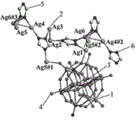
X-ray single crystal diffraction analysis showed that the polyacid-based metal-organic framework crystalline material of polyacid-based 32-core silver nanocage prepared in example one [ (trz)6Ag10][SiW12O40]The unit cell of (A) is a multi-anion [ SiW ]12O40]5-(abbreviated as SiW)12) 10 silver ions, 6 trz organic ligands, as shown in fig. 1: FIG. 1 is a schematic diagram of the polyacid-based metal-organic framework crystalline material of a polyacid-based templated 32-core silver nanocage prepared in example one, where 1 is W, 2 is Ag, 3 is Si, 4 is O, 5 is C, and 6 is N in FIG. 1;
EXAMPLE one prepared polyacid templated 32-core silver nanoparticlesThe structure of the polyacid-based metal organic framework crystal material of the rice cage is provided with 6 crystallographically independent Ag ions, and three coordination modes are adopted; ag3 is in a 3-coordinate "T" geometry, coordinated to 2 nitrogen atoms from different trz organic ligands, 1 Ag atom; both Ag1 and Ag2 adopt a four-coordinate "+" geometry, in which Ag1 is associated with 2 nitrogen atoms from a trz organic ligand and 2 nitrogen atoms from SiW12The terminal oxygen atom of the polyanion coordinates, Ag2 coordinates to 2 nitrogen atoms from the trz organic ligand, 2 silver atoms; ag4, Ag5 and Ag6 all adopt penta-coordination, wherein Ag4, Ag5 and 2 nitrogen atoms from trz organic ligands and 2 nitrogen atoms from SiW12The terminal oxygen atom of the polyanion is coordinated to 1 silver atom; where Ag6 is coordinated to 3 nitrogen atoms, 2 silver atoms, from the trz organic ligand. The Ag-N bond length range is from 2.007 to 1.982, the Ag-O bond length range is 2.552-2.868A, and the Ag-Ag bond length range is 3.084-3.174A, all of which are within a reasonable range.
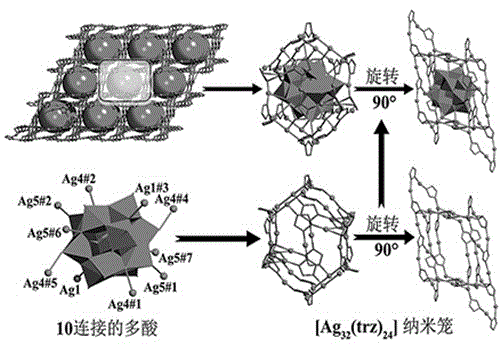
Polyacid-based metal-organic framework crystalline materials of 32-core silver nanocages templated on polyacid prepared in example one [ (trz)6Ag10][SiW12O40]One particular structural feature is a metal organic framework structure with a three-dimensional nanocage structure; the metal-organic framework with nanoscale three-dimensional nanocages is formed as follows: three independent organic trz ligands trzμ 3Coordination mode and Ag ion coordination, wherein two independent trz organic ligands coordinate with 3 Ag ions, and the other independent trz organic ligand coordinates with 4 Ag ions in a 5-connection mode to form a silver ion [ Ag ] with 32 nuclei32(trz)24]The nanocage (see figure 2 for structural details). Of 2 silver ions per core [ Ag ]32(trz)24]The nanocages are sequentially circulated in a covalent connection mode through Ag ions and trz organic ligands to form a 3-dimensional nanocage framework structure. The polyacid with ten teeth connection is embedded in the nano cage structure as a template. Fig. 3 is a schematic diagram of the formation process of the metal-organic framework in the polyacid-based metal-organic framework crystalline material structure of the polyacid-based templated 32-core silver nanocage prepared in example one. From the perspective of high-core nanocages, the method32-core silver ion [ Ag ] with polyacid as template with ten-tooth connection32(trz)24]The polyacid-based metal-organic framework crystalline materials of nanocages have not been reported in the past.
FIG. 4 is an infrared spectrum of a polyacid-based metal-organic framework crystalline material of a polyacid-templated 32-core silver nanocage prepared in example one; as can be seen from FIG. 4, the attributes at 966.4, 926.0, 795.4, 660.1 are assignedv(Si-Oa),v(W=Ot),v as(W-Ob-W) andv as(W-Oc-W) telescopic vibration; at 1000-−1A vibrational peak within the range ascribed to the vibrational peak of trz after decarboxylation of the organic ligand; at 1635, 1507.6, 1291.4, 1171.7 and 1083.1 cm−1The absorption peak is the vibration absorption peak of the skeleton ring of triazole molecule. Further, the vibration peak was 3120cm-1Belongs to the vibration expansion peak of water molecules in the compound.
FIG. 5 is a powder X-ray diffraction pattern of the polyacid-based metal-organic framework crystalline material of the polyacid-templated 32-core silver nanocage prepared in example one; wherein 1 is a polyacid-based crystalline material of the 32-core silver nanocage with polyacid as a template prepared in the second test, and 2 is a simulated peak position;
in conclusion, the polyacid-based metal organic framework compound of the 32-core silver nanocage with polyacid as the template is successfully synthesized by using a one-step hydrothermal synthesis method and using the polydentate ligand 1H-1,2, 4-triazole-3-carboxyl as a precursor to generate the 1H-1,2, 4-triazole organic ligand in situ.