Disclosure of Invention
The invention provides a method and a device for correcting a seismic velocity body of a work area, which improve the accuracy of velocity gradient at non-well points on the basis of ensuring the accuracy of velocity gradient at well points, thereby improving the correction accuracy of the seismic velocity body of the work area.
According to a first aspect of the invention, there is provided a method for correcting a seismic velocity volume of a work area, comprising:
acquiring a first seismic layer velocity corresponding to a target layer and each of a plurality of control layers, and calculating to obtain a first seismic layer velocity gradient of the target layer and each control layer according to the first seismic layer velocity;
acquiring a well point velocity gradient coefficient ratio of a well point position, and correcting the first seismic interval velocity gradient by using the well point velocity gradient coefficient ratio to obtain a corrected second seismic interval velocity gradient, wherein the well point velocity gradient coefficient ratio is the ratio of the first seismic interval velocity gradient to a well point reference velocity gradient, and the well point reference velocity gradient is a velocity gradient determined according to well point reference velocities of all well points at the target interval and all control intervals;
correcting the first seismic interval velocity by the second seismic interval velocity gradient to obtain a corrected second seismic interval velocity;
and obtaining a corrected work area seismic velocity body according to the second seismic layer velocity and the time horizon information of the target layer and each control layer.
As an implementation manner, the calculating and obtaining the first seismic interval velocity gradient of the target interval and each control interval according to the first seismic interval velocity includes:
obtaining seismic velocity values at each point of the same horizon velocity plane according to the first seismic horizon velocities of the target horizon and each control horizon;
obtaining a first seismic layer velocity gradient of a target layer and each control layer according to the following formula I;
▽vearthquake=dvEarthquakeThe first formula of/dl
Wherein vEarthquakeFirst seismic interval velocity gradient, dv, for a interval velocity planeEarthquakeThe variation of the seismic velocity values between each point of the horizon velocity plane is defined, and dl is the position distance of each point of the horizon velocity plane.
As one implementation, the obtaining a well point velocity gradient coefficient ratio of a well point location includes:
acquiring the well point reference speed of each well point on the target layer and each control layer;
determining a well point reference velocity gradient according to the following formula II;
▽vwell=dvWellDl formula two
Wherein vWellFor a well point reference velocity gradient, dv, of a layer velocity planeWellThe variation of the well point reference speed between the well points of the stratum speed plane is shown, and dl is the position distance of each well point of the stratum speed plane;
obtaining a well point velocity gradient coefficient ratio of a well point position according to the following formula III;
r=(▽vearthquake/▽vWell) Formula three
Wherein r is a well point velocity gradient coefficient ratio of the well point position ^ vEarthquakeIs a first seismic interval velocity gradient, [ v ] of the well site locationWellA well point reference velocity gradient for the well point location.
As one implementation, the correcting the first seismic interval velocity gradient by the well point velocity gradient coefficient ratio to obtain a corrected second seismic interval velocity gradient includes:
interpolating the well point velocity gradient coefficient ratio of each well point on the target layer and each control layer to obtain a velocity gradient coefficient ratio plane corresponding to the target layer and each control layer, wherein the value in the gradient coefficient ratio plane is the velocity gradient coefficient ratio of the corresponding point of the target layer and each control layer;
dividing the velocity gradient of the first seismic layer corresponding to the target layer and each control layer by the value in the velocity gradient coefficient ratio plane corresponding to the target layer and each control layer to obtain a velocity gradient correction plane corresponding to the target layer and each control layer;
determining the first seismic interval velocity gradient at the well point as a second seismic interval velocity gradient at the well point, and correcting the velocity gradient at the non-well point by a velocity gradient corresponding to the plane to determine the second seismic interval velocity gradient at the non-well point;
and correcting the first seismic interval velocity by the second seismic interval velocity gradient to obtain a corrected second seismic interval velocity.
As one implementation, the correcting the first seismic interval velocity by the second seismic interval velocity gradient to obtain a corrected second seismic interval velocity includes:
obtaining a velocity correction plane corresponding to the target layer and each control layer according to the velocity gradient of the second seismic layer and the velocity of the first seismic layer at each well point;
determining the first seismic interval velocity at a well point as a second seismic interval velocity at the well point;
determining a seismic interval velocity of the velocity correction plane at a non-well point as a second seismic interval velocity at the non-well point.
As one implementation, before the obtaining the well point velocity gradient coefficient ratio of the well point position, the method further includes:
acquiring seismic velocity values of the first seismic layer velocity at each well point;
acquiring the well point reference speed of each well point on the target layer and each control layer
And judging whether the variation trends of the seismic velocity value and the well point reference velocity at each well point are consistent, if not, executing the well point velocity gradient coefficient ratio of the well point position.
As one implementation, the well point reference velocity comprises a logging velocity value, or a vertical seismic profile VSP velocity value, or a drilling stratification velocity value;
the acquiring of the well point reference speeds of the well points at the target layer and the control layers comprises:
obtaining the logging speed values of all well points on the target layer and all control layers by using an acoustic logging method; or
Obtaining VSP speed values of each well point in the target layer and each control layer from the VSP data; or
And obtaining a drilling layering depth value delta h from the drilling layering data, obtaining the double travel time T0 of the target layer and each control layer, and obtaining the drilling layering velocity value v of each well point in the target layer and each control layer, wherein the drilling layering velocity value v is delta h/delta T0-2000.
As one implementation, the obtaining a first seismic interval velocity corresponding to each of the target interval and the plurality of control intervals includes:
determining a target layer and a plurality of control layers positioned above the target layer in a work area;
acquiring an original velocity body of a depth domain corresponding to each of a target layer and a plurality of control layers;
performing depth-time conversion on the original velocity body of the depth domain to obtain an original velocity body of a time domain and an equal T0 map used for indicating time horizon information of the target layer and each control layer;
and obtaining a first seismic interval velocity corresponding to each of the target interval and the plurality of control intervals from the original velocity body of the time domain.
According to a second aspect of the present invention, there is provided a work area seismic velocity body correction apparatus comprising:
the first seismic interval velocity gradient obtaining module is used for obtaining a first seismic interval velocity corresponding to a target interval and each of a plurality of control intervals and calculating to obtain first seismic interval velocity gradients of the target interval and each of the control intervals according to the first seismic interval velocity;
the first correction module is used for acquiring a well point velocity gradient coefficient ratio of a well point position, correcting the first seismic interval velocity gradient by using the well point velocity gradient coefficient ratio to obtain a corrected second seismic interval velocity gradient, wherein the well point velocity gradient coefficient ratio is the ratio of the first seismic interval velocity gradient to a well point reference velocity gradient, and the well point reference velocity gradient is a velocity gradient determined according to well point reference velocities of all well points at the target interval and all control intervals;
the second correction module is used for correcting the first seismic interval velocity by the second seismic interval velocity gradient to obtain a corrected second seismic interval velocity;
and the work area seismic velocity body establishing module is used for obtaining a corrected work area seismic velocity body according to the second seismic layer velocity and the time horizon information of the target layer and each control layer.
As an implementation, the first seismic interval velocity gradient obtaining module is specifically configured to:
obtaining seismic velocity values at each point of the same horizon velocity plane according to the first seismic horizon velocities of the target horizon and each control horizon;
obtaining a first seismic layer velocity gradient of a target layer and each control layer according to the following formula I;
▽vearthquake=dvEarthquakeThe first formula of/dl
Wherein vEarthquakeFirst seismic interval velocity gradient, dv, for a interval velocity planeEarthquakeThe variation of the seismic velocity values between each point of the horizon velocity plane is defined, and dl is the position distance of each point of the horizon velocity plane.
The invention provides a method and a device for correcting seismic velocity bodies of a work area, which are characterized in that a first seismic interval velocity corresponding to a target layer and each of a plurality of control layers is obtained, and a first seismic interval velocity gradient of the target layer and each control layer is obtained through calculation according to the first seismic interval velocity, so that an object to be corrected is obtained; then, obtaining a well point velocity gradient coefficient ratio of a well point position, correcting the first seismic interval velocity gradient by the well point velocity gradient coefficient ratio, improving the correction accuracy, and obtaining a corrected second seismic interval velocity gradient, wherein the well point velocity gradient coefficient ratio is the ratio of the first seismic interval velocity gradient to a well point reference velocity gradient, and the well point reference velocity gradient is a velocity gradient determined according to the well point reference velocities of the well points at a target interval and each control interval; then, correcting the first seismic interval velocity by using a second seismic interval velocity gradient to obtain a corrected second seismic interval velocity, and obtaining a more accurate second seismic interval velocity at a well point and a non-well point; and finally, obtaining a corrected work area seismic velocity body according to the second seismic interval velocity and the time horizon information of the target layer and each control layer, determining the plane gradient distribution rule of the seismic velocity data body by combining the well point reference velocities of the target layer and each control layer, effectively correcting the seismic interval velocity plane trend, and improving the accuracy of the seismic work area velocity body of the basin area.
Detailed Description
In order to make the objects, technical solutions and advantages of the embodiments of the present invention clearer, the technical solutions in the embodiments of the present invention will be clearly and completely described below with reference to the drawings in the embodiments of the present invention, and it is obvious that the described embodiments are only a part of the embodiments of the present invention, and not all of the embodiments. All other embodiments, which can be derived by a person skilled in the art from the embodiments given herein without making any creative effort, shall fall within the protection scope of the present invention.
The terms "first," "second," "third," "fourth," and the like in the description and in the claims, as well as in the drawings, if any, are used for distinguishing between similar elements and not necessarily for describing a particular sequential or chronological order. It is to be understood that the data so used is interchangeable under appropriate circumstances such that the embodiments of the invention described herein are capable of operation in sequences other than those illustrated or described herein.
It should be understood that, in the various embodiments of the present application, the size of the serial number of each process does not mean the execution sequence, and the execution sequence of each process should be determined by its function and inherent logic, and should not constitute any limitation to the implementation process of the embodiments of the present application.
It should be understood that, in this application, "comprises" and "comprising," and any variations thereof, are intended to cover a non-exclusive inclusion, such that a process, method, system, article, or apparatus that comprises a list of steps or elements is not necessarily limited to those steps or elements expressly listed, but may include other steps or elements not expressly listed or inherent to such process, method, article, or apparatus.
It should be understood that in this application, "plurality" means two or more. "and/or" is merely an association describing an associated object, meaning that three relationships may exist, for example, and/or B, may mean: a exists alone, A and B exist simultaneously, and B exists alone. The character "/" generally indicates that the former and latter associated objects are in an "or" relationship.
It should be understood that in this application, "B corresponding to A" means that B is associated with A, from which B can be determined. Determining B from a does not mean determining B from a alone, but may be determined from a and/or other information. And the matching of A and B means that the similarity of A and B is greater than or equal to a preset threshold value.
As used herein, "if" may be interpreted as "at … …" or "when … …" or "in response to a determination" or "in response to a detection", depending on the context.
The technical solution of the present invention will be described in detail below with specific examples. The following several specific embodiments may be combined with each other, and details of the same or similar concepts or processes may not be repeated in some embodiments.
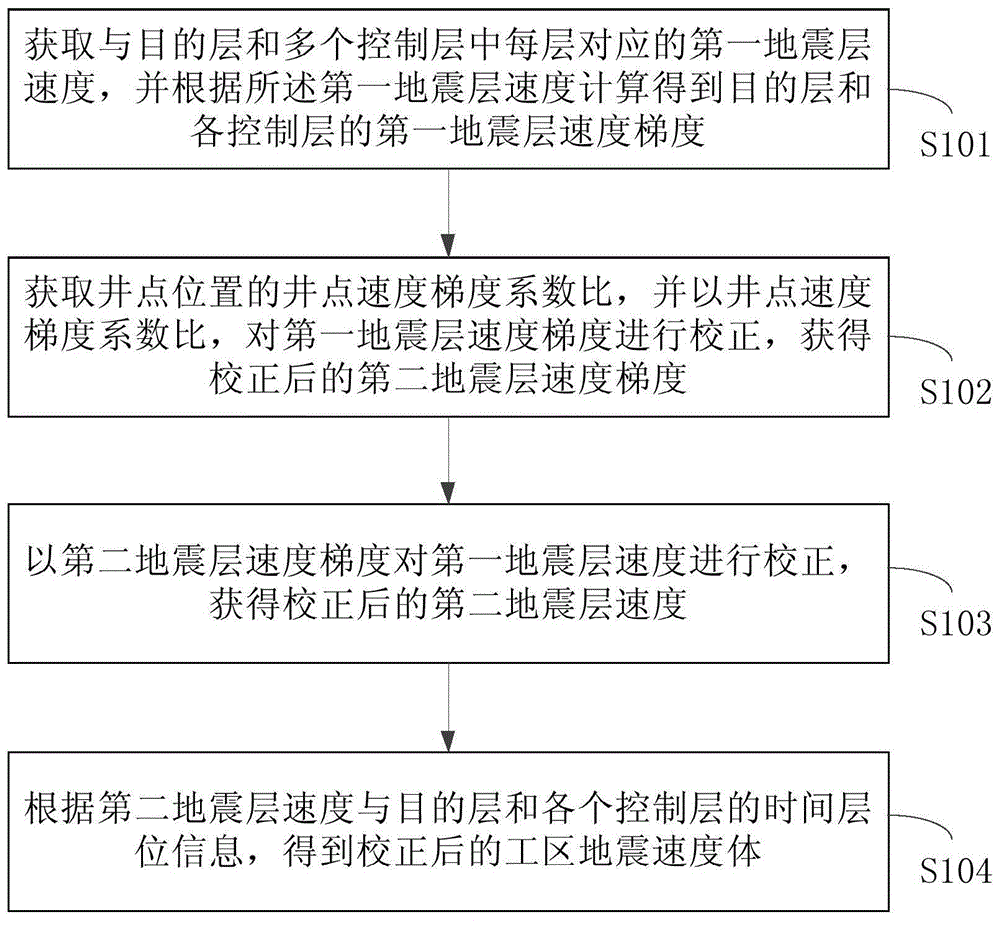
Fig. 1 is a schematic flow chart of a work area seismic velocity body correction method provided by an embodiment of the present invention. The method flow shown in fig. 1 may be implemented by a work area seismic velocity body correction device, which may be a dedicated correction device, or may be a built-in module included in a work area management system. The parameter obtaining mode can be obtained from pre-stored data, or can be obtained by measurement through a related detecting instrument and a related acquisition module. The method shown in fig. 1 may comprise the following steps:
s101, acquiring a first seismic layer velocity corresponding to a target layer and each of a plurality of control layers, and calculating to obtain a first seismic layer velocity gradient of the target layer and each control layer according to the first seismic layer velocity.
The seismic interval velocity is the velocity at which seismic waves propagate in each of the divided intervals in the stratified formation. The strata of different structures have different seismic layer velocities, which directly reflect the lithology of the strata and can also divide the strata by the seismic layer velocities. Such as the destination layer and multiple control layers in this embodiment. Accordingly, the first seismic interval velocity corresponding to each of the target interval and the plurality of control intervals may be understood as a propagation velocity of a seismic wave in the target interval and a propagation velocity of a seismic wave in the plurality of control intervals, respectively.
FIG. 2 is a first seismic interval velocity diagram of a target interval according to an embodiment of the invention. The circles in fig. 2 all represent well points and are distinguished by the characters A, B, C, D, E and F. Wherein the first seismic interval velocity measured to the left of the A and B well points is 3358m/s and the first seismic interval velocity measured to the left of the E well point is 3301 m/s. The curves in fig. 2 are used to illustrate the velocity contours. The layer velocity plane of the destination layer is formed by a plurality of velocity contours in fig. 2. The black arrows indicate the direction of decrease of the first seismic interval velocity.
The target zone may be understood as a formation that requires production of hydrocarbons and the plurality of control zones may be understood as a relatively important formation located above the target zone. In preparation for hydrocarbon production, not only the analysis of the target zone but also the structural condition of the control zone need to be considered.
One way to obtain the first seismic interval velocity may be to obtain the first seismic interval velocity from pre-stored formation data, for example, by seismic logging or sonic logging, measuring the measurement result to obtain a measurement result including a velocity spectrum of the formation, and interpreting the formation as a destination interval, a plurality of control intervals, and other unimportant intervals according to the first seismic interval velocity, wherein each interval corresponds to the first seismic interval velocity. The pre-measured information is stored in a database, and when the work area seismic velocity body is corrected, the first seismic interval velocity corresponding to each of the target layer and the control layers is directly obtained from the pre-stored data in the database.
Another way of acquiring the first seismic interval velocity may be a field survey. For example, sending a measurement instruction to the measurement sub-module to cause the measurement sub-module to start seismic logging or sonic logging of the formation of the work area to measure a first seismic interval velocity corresponding to each of the target zone and the plurality of control zones.
FIG. 3 is a schematic diagram of a first seismic interval velocity gradient of a control layer according to an embodiment of the invention.
After the first seismic interval velocity is obtained, the first seismic interval velocity gradient of the target interval and each control interval can be calculated through a preset formula. The first seismic interval velocity gradient reflects how fast the first seismic interval velocity changes at different points in each interval. For example, in the first seismic interval velocity gradient plot of one of the control layers shown in FIG. 3, the circles each represent a well point and are distinguished by the characters A, B, C, D, E and F, and the curves are used to illustrate velocity gradient contours.
S102, obtaining a well point velocity gradient coefficient ratio of a well point position, and correcting the first seismic layer velocity gradient according to the well point velocity gradient coefficient ratio to obtain a corrected second seismic layer velocity gradient.
The well point velocity gradient coefficient ratio is the ratio of the first seismic interval velocity gradient to the well point reference velocity gradient, and the well point reference velocity gradient is the velocity gradient determined according to the well point reference velocities of the well points at the target interval and the control intervals.
Specifically, well point reference velocity gradients are determined according to well point reference velocities of the well points at a target layer and each control layer, and then the ratio of the first seismic layer velocity gradient to the well point reference velocity gradient is used as a well point velocity gradient coefficient ratio. The well velocity gradient coefficient ratio is still the velocity gradient ratio derived from the well data. Since the first seismic interval velocity gradient is continuous gradient plane data, it is not a discrete point value. Therefore, before correcting the velocity gradient of the first seismic interval with the well point velocity gradient coefficient ratio, it is necessary to perform distance weighted meshing using a meshing algorithm such as the least square method on the well point velocity gradient coefficient ratio, perform interpolation and smoothing, and change discrete data into continuous data. And after a gradient plane distributed similarly to the first seismic interval velocity gradient is obtained, correcting the first seismic interval velocity gradient.
The well point reference velocity may be understood as a logging velocity value, or a Vertical Seismic Profiling (VSP) velocity value, or a well zonal velocity value.
The logging speed value is the well point reference speed of each well point at the target layer and each control layer acquired in the logging process. During petroleum drilling, logging must be performed after the drilling to the designed well depth, so as to obtain various petroleum geology and engineering technical data as the original data for well completion and oil field development.
In one implementation, the well point reference speed is a logging speed value, and obtaining the well point reference speed of each well point at the target zone and each control zone may be understood as: and obtaining the logging speed values of all well points on the target stratum and all control stratums by using an acoustic logging method.
In another implementation, the well point reference speed is a drilling layered speed value, and obtaining the well point reference speed of each well point at the target layer and each control layer may be understood as: and obtaining a drilling layered depth value delta h of each well point between the target layer and each control layer from the drilling layered data, and obtaining a drilling layered velocity value v which is delta h/delta t0 and 2000 from the two-way travel time values delta t0 of the target layer and each control layer obtained in the seismic data interpretation process.
In yet another implementation, the well point reference speed is a VSP speed value, and obtaining the well point reference speed of each well point at the destination layer and each control layer may be understood as: VSP velocity values of the well points at the target layer and the control layers are obtained from the VSP data. The VSP velocity value is a reference velocity of each well point at the destination layer and each control layer obtained by the VSP. VSPs correspond to seismic profiles typically observed at the surface, where seismic waves are excited at points near the surface and observed at several multi-level, multi-component survey points located at different depths along the borehole.
FIG. 4 is a second seismic interval velocity gradient diagram of a control layer according to an embodiment of the present invention. In FIG. 4, circles each represent a well point and are distinguished by characters A, B, C, D, E and F, with curves illustrating velocity gradient contours. Fig. 4 is an example of the corrected gradient map shown in fig. 3.
S103, correcting the first seismic interval velocity by using the second seismic interval velocity gradient to obtain a corrected second seismic interval velocity.
The second seismic interval velocity gradient is a corrected gradient, and the corrected gradient is combined with the first seismic interval velocity at the well point to correct the first seismic interval velocity at the non-well point, so that the corrected velocity can be obtained. Specifically, the second seismic interval velocity at the non-well point can be obtained by taking the first seismic interval velocity at each well point as a fixed value and the second seismic interval velocity gradient as a velocity change rate. The second seismic interval velocity at the well point coincides with its first seismic interval velocity.
FIG. 5 is a second seismic interval velocity diagram of a target interval according to an embodiment of the invention. In FIG. 5, the circles each represent a well point and are distinguished by the characters A, B, C, D, E and F, with the curves illustrating velocity gradient contours. Fig. 5 is an example of the corrected velocity profile of fig. 2.
And S104, obtaining a corrected work area seismic velocity body according to the second seismic layer velocity and the time horizon information of the target layer and each control layer.
The temporal horizon information may be understood as an equal T0 graph. The T0 plots can be directly plotted from the time-sliced data, and reflect the basic form of the structure, with small deviations. The T0 images are also obtained by performing depth-time conversion on depth data after field seismic acquisition and indoor seismic data processing.
The second seismic layer velocity is a velocity plane corresponding to the target layer and each control layer, and the work area seismic velocity body can be obtained by combining the time horizon information of the target layer and each control layer.
The embodiment of the invention provides a working area seismic velocity volume correction method, which comprises the steps of obtaining a first seismic interval velocity corresponding to a target layer and each of a plurality of control layers, and calculating to obtain a first seismic interval velocity gradient of the target layer and each control layer according to the first seismic interval velocity so as to obtain an object to be corrected; then, obtaining a well point velocity gradient coefficient ratio of a well point position, correcting the first seismic interval velocity gradient by the well point velocity gradient coefficient ratio, improving the correction accuracy, and obtaining a corrected second seismic interval velocity gradient, wherein the well point velocity gradient coefficient ratio is the ratio of the first seismic interval velocity gradient to a well point reference velocity gradient, and the well point reference velocity gradient is a velocity gradient determined according to the well point reference velocities of the well points at a target interval and each control interval; then, correcting the first seismic interval velocity by using a second seismic interval velocity gradient to obtain a corrected second seismic interval velocity, and obtaining a more accurate second seismic interval velocity at a well point and a non-well point; and finally, obtaining a corrected work area seismic velocity body according to the second seismic interval velocity and the time horizon information of the target layer and each control layer, determining the plane gradient distribution rule of the seismic velocity data body by combining the well point reference velocities of the target layer and each control layer, effectively correcting the seismic interval velocity plane trend, and improving the accuracy of the seismic work area velocity body of the basin area.
FIG. 6 is an example of a comparison of a seismic velocity value with a trend of a well point reference velocity at a plurality of well points provided by an embodiment of the present invention. Referring to fig. 6, an evaluation and judgment means is provided for whether the seismic velocity distribution is accurate and needs to be corrected. On the basis of the embodiment shown in fig. 1, before obtaining the well point velocity gradient coefficient ratio of the well point position, a step of determining whether correction is required may also be performed, specifically: the method comprises the steps of firstly obtaining seismic velocity values of first seismic interval velocities at all well points, obtaining well point reference velocities of all the well points at a target layer and all control layers, wherein the obtained seismic velocity values and the well point reference velocities are point values at the well points, and accordingly numerical values of the same dimension can be compared. And judging whether the variation trends of the seismic velocity value and the well point reference velocity at all the well points are consistent, for example, comparing the trends of the seismic velocity value and the well point reference velocity at a plurality of well points by using a histogram shown in fig. 5. Each set of columns represents, from left to right, seismic velocity values, logging velocity values, and VSP velocity values at a well point. Wherein the fifth group does not add VSP velocity values in the fourth combination. The two dashed lines show the trend of change, Q1 is the trend of change in log velocity values, and Q2 is the trend of change in seismic velocity values. As can be seen from the figure, Q1 shows a trend of first falling and then rising between the first group and the third group, while Q2 shows only a trend of rising. It can be seen that the seismic velocity values shown in fig. 5 do not correspond to the trend of the well point reference velocity at each well point.
If the variation trend of the seismic velocity value and the well point reference velocity at each well point is inconsistent, the error of the work area seismic velocity body is larger, and the well point velocity gradient coefficient ratio of the well point position is obtained; if the variation trend of the seismic velocity value and the well point reference velocity at each well point is consistent, the error of the work area seismic velocity body is negligible, and the work area seismic velocity body does not need to be corrected.
On the basis of the above embodiment, the process of calculating the first seismic interval velocity gradient of the target interval and each control interval according to the first seismic interval velocity may be:
firstly, obtaining the seismic velocity values at each point position of the same interval velocity plane according to the first seismic interval velocities of the target interval and each control interval.
Then, obtaining a first seismic layer velocity gradient of a target layer and each control layer according to the following formula I;
▽vearthquake=dvEarthquakeThe first formula of/dl
Wherein vEarthquakeFirst seismic interval velocity gradient, dv, for a interval velocity planeEarthquakeThe variation of the seismic velocity values between points of the horizon velocity plane is shown, and dl is the position distance of each point of the horizon velocity plane.
The change of the underground geological condition in a work area is not severe on the whole, the change gradient of the stratum speed of the ground is determined by the gentle degree of the lithological change of each stratum, and the change of the stratum speed gradient of the stratum is restrained by the speed gradient rule of the known well point by combining with the factors of the tectonic geology under the conditions that the distribution of the drilled well point is reasonable and the fracture strength of the fault is small.
And because of causing the reason that the seismic velocity data volume used in the current well control processing is abnormally distributed, the embodiment of the invention reflects the abnormal distribution of the interval velocity of the control layer above the target layer in the seismic interval velocity gradient without the well to a certain extent, and corrects the seismic velocity gradient distribution rule by adopting the well point velocity gradient coefficient ratio which reflects the velocity gradient distribution rule above the well to obtain a more accurate three-dimensional seismic velocity field.
On the basis of the foregoing embodiment, the process of obtaining the well point velocity gradient coefficient ratio at the well point position after obtaining the first seismic interval velocity gradient may be:
firstly, acquiring the well point reference speed of each well point on a target layer and each control layer.
And secondly, determining a well point reference velocity gradient according to the following formula II.
▽vWell=dvWellDl formula two
Wherein vWellFor a well point reference velocity gradient, dv, of a layer velocity planeWellThe variation of the well point reference speed between the well points of the stratum speed plane, and dl is the position distance of the well points of the stratum speed plane.
And thirdly, obtaining the well point velocity gradient coefficient ratio of the well point position according to the following formula III.
r=(▽vEarthquake'/▽vWell') formula three
Wherein r is a well point velocity gradient coefficient ratio of the well point position ^ vEarthquake' first seismic interval velocity gradient, [ v ] v, being the well point locationWell' is the well point reference velocity gradient at the well point location.
On the basis of the above embodiment, the process of correcting the velocity gradient of the first seismic interval by using the well point velocity gradient coefficient ratio to obtain the corrected velocity gradient of the second seismic interval may be:
firstly, interpolation processing is carried out on the well point velocity gradient coefficient ratio of each well point on the target layer and each control layer to obtain a velocity gradient coefficient ratio plane corresponding to the target layer and each control layer, and the value in the gradient coefficient ratio plane is the velocity gradient coefficient ratio of the corresponding point of the target layer and each control layer. The interpolation processing may be based on regular grid processing or irregular grid processing, and the distance weighting method, the orientation method, the trend surface method, the superposition method, the weighted least square method, the kriging method and the like are used for carrying out grid numeralization, and finally, the isoline is generated to form a speed gradient coefficient ratio plane. The irregular mesh processing may be, for example, triangular mesh processing, arbitrary quadrilateral mesh processing, or the like. The interpolation processing may be, for example, distance weighted mesh calculation using a mesh algorithm such as a least square method, and a velocity gradient coefficient ratio plane is obtained by performing well velocity gradient coefficient ratio smoothing processing on each well point. The well point velocity gradient coefficient ratio for each well point is a discrete data point at each well point, and the gradient coefficient ratio plane is a continuous data plane over the destination zone and each control layer.
And then, dividing the velocity gradient of the first seismic layer corresponding to the target layer and each control layer by the value in the velocity gradient coefficient ratio plane corresponding to the target layer and each control layer to obtain a velocity gradient correction plane corresponding to the target layer and each control layer. Specifically, the first seismic interval velocity gradient corresponding to the target interval and each control interval and the velocity gradient coefficient ratio plane corresponding to the target interval and each control interval are planes formed by continuous data, and the velocity gradient correction planes corresponding to the target interval and each control interval are obtained after the phase positions.
And then, determining the first seismic interval velocity gradient at the well point as a second seismic interval velocity gradient at the well point, and correcting the velocity gradient at the non-well point by the velocity gradient corresponding to the plane to determine the second seismic interval velocity gradient at the non-well point.
And finally, correcting the first seismic layer velocity by using the second seismic layer velocity gradient to obtain a corrected second seismic layer velocity. Specifically, the velocity correction planes corresponding to the target horizon and each control horizon may be obtained according to the second seismic horizon velocity gradient and the first seismic horizon velocity at each well point. For example, using the first seismic interval velocity at each well point as the fixed point and the second seismic interval velocity gradient as the velocity change rate, the seismic velocities at non-well points can be extrapolated from the fixed point. The first seismic interval velocity at the well point is determined as a second seismic interval velocity at the well point, and the velocity at the non-well point is corrected to the planar seismic interval velocity as the second seismic interval velocity at the non-well point. Thus, the corrected second seismic interval velocity is obtained.
On the basis of the above embodiment, the process of acquiring the first seismic interval velocity corresponding to each of the target interval and the plurality of control intervals may specifically be: after field seismic acquisition and indoor seismic data processing, an earthquake interpreter interprets the data according to actual production conditions, and firstly, a target layer and a plurality of control layers positioned above the target layer are determined in a work area. Then, the original velocity volume of the depth domain corresponding to each of the destination layer and the plurality of control layers is acquired, and the original data is usually depth domain data. Then, the original velocity volume in the depth domain is subjected to depth-time conversion, and an equal T0 map of the original velocity volume in the time domain and time horizon information used for indicating a target layer and each control layer is obtained. And finally, obtaining a first seismic interval velocity corresponding to each of the target interval and the control intervals from the original velocity body of the time domain.
The deep-time conversion is a process of converting seismic data from a depth domain to a time domain, and the structural condition of the stratum is shown by means of speed information.
The embodiment of the invention analyzes the abnormal velocity gradient distribution condition of the velocity field based on well control processing, and corrects the seismic velocity gradient by using the velocity gradient obtained by well logging, VSP and layered data of known well points in combination with the factors of the underground stratum structure, thereby scientifically and effectively correcting the original seismic velocity gradient distribution and practically improving the structure implementation precision. The embodiment of the invention corrects the seismic velocity by using the logging information, VSP (vertical seismic profiling) information and velocity gradient information of well drilling layered data at the well points, not only uses the velocity information at the well points in the correction, but also obtains control means among wells and in the areas far away from the wells, and improves the precision of a velocity body.
Fig. 7 is a schematic structural diagram of a work area seismic velocity body correction device according to an embodiment of the present invention. The apparatus shown in fig. 7 mainly comprises:
the first seismic interval velocity gradient obtaining module 11 is configured to obtain a first seismic interval velocity corresponding to a target interval and each of a plurality of control intervals, and calculate a first seismic interval velocity gradient of the target interval and each of the plurality of control intervals according to the first seismic interval velocity.
The first correction module 12 is configured to obtain a well point velocity gradient coefficient ratio of a well point position, correct the first seismic interval velocity gradient according to the well point velocity gradient coefficient ratio, and obtain a corrected second seismic interval velocity gradient, where the well point velocity gradient coefficient ratio is a ratio of the first seismic interval velocity gradient to a well point reference velocity gradient, and the well point reference velocity gradient is a velocity gradient determined according to well point reference velocities of the well points at the destination interval and at the control intervals.
And the second correction module 13 is configured to correct the first seismic interval velocity by using the second seismic interval velocity gradient, so as to obtain a corrected second seismic interval velocity.
And the work area seismic velocity body establishing module 14 is used for obtaining a corrected work area seismic velocity body according to the second seismic layer velocity and the time horizon information of the target layer and each control layer.
The work area seismic velocity body correction device of the embodiment shown in fig. 7 can be correspondingly used for executing the steps in the method embodiment shown in fig. 1, and the implementation principle and the technical effect are similar, and are not repeated here.
On the basis of the above embodiment, the first seismic interval velocity gradient acquisition module is specifically configured to:
obtaining seismic velocity values at each point of the same horizon velocity plane according to the first seismic horizon velocities of the target horizon and each control horizon;
obtaining a first seismic layer velocity gradient of a target layer and each control layer according to the following formula I;
▽vearthquake=dvEarthquakeThe first formula of/dl
Wherein vEarthquakeFirst seismic interval velocity gradient, dv, for a interval velocity planeEarthquakeThe variation of the seismic velocity values between each point of the horizon velocity plane is defined, and dl is the position distance of each point of the horizon velocity plane.
Finally, it should be noted that: the above embodiments are only used to illustrate the technical solution of the present invention, and not to limit the same; while the invention has been described in detail and with reference to the foregoing embodiments, it will be understood by those skilled in the art that: the technical solutions described in the foregoing embodiments may still be modified, or some or all of the technical features may be equivalently replaced; and the modifications or the substitutions do not make the essence of the corresponding technical solutions depart from the scope of the technical solutions of the embodiments of the present invention.