CN1100534C - 2-(1H-4(5)-imidazoyl cyclopropyl derivatives - Google Patents
2-(1H-4(5)-imidazoyl cyclopropyl derivatives Download PDFInfo
- Publication number
- CN1100534C CN1100534C CN96195925A CN96195925A CN1100534C CN 1100534 C CN1100534 C CN 1100534C CN 96195925 A CN96195925 A CN 96195925A CN 96195925 A CN96195925 A CN 96195925A CN 1100534 C CN1100534 C CN 1100534C
- Authority
- CN
- China
- Prior art keywords
- imidazolyl
- cyclopropanamide
- triphenylmethyl
- cyclopropyl
- compound
- Prior art date
- Legal status (The legal status is an assumption and is not a legal conclusion. Google has not performed a legal analysis and makes no representation as to the accuracy of the status listed.)
- Expired - Fee Related
Links
Classifications
-
- A—HUMAN NECESSITIES
- A61—MEDICAL OR VETERINARY SCIENCE; HYGIENE
- A61K—PREPARATIONS FOR MEDICAL, DENTAL OR TOILETRY PURPOSES
- A61K31/00—Medicinal preparations containing organic active ingredients
- A61K31/33—Heterocyclic compounds
- A61K31/395—Heterocyclic compounds having nitrogen as a ring hetero atom, e.g. guanethidine or rifamycins
- A61K31/41—Heterocyclic compounds having nitrogen as a ring hetero atom, e.g. guanethidine or rifamycins having five-membered rings with two or more ring hetero atoms, at least one of which being nitrogen, e.g. tetrazole
- A61K31/415—1,2-Diazoles
-
- C—CHEMISTRY; METALLURGY
- C07—ORGANIC CHEMISTRY
- C07D—HETEROCYCLIC COMPOUNDS
- C07D233/00—Heterocyclic compounds containing 1,3-diazole or hydrogenated 1,3-diazole rings, not condensed with other rings
- C07D233/54—Heterocyclic compounds containing 1,3-diazole or hydrogenated 1,3-diazole rings, not condensed with other rings having two double bonds between ring members or between ring members and non-ring members
- C07D233/64—Heterocyclic compounds containing 1,3-diazole or hydrogenated 1,3-diazole rings, not condensed with other rings having two double bonds between ring members or between ring members and non-ring members with substituted hydrocarbon radicals attached to ring carbon atoms, e.g. histidine
-
- A—HUMAN NECESSITIES
- A61—MEDICAL OR VETERINARY SCIENCE; HYGIENE
- A61P—SPECIFIC THERAPEUTIC ACTIVITY OF CHEMICAL COMPOUNDS OR MEDICINAL PREPARATIONS
- A61P43/00—Drugs for specific purposes, not provided for in groups A61P1/00-A61P41/00
-
- C—CHEMISTRY; METALLURGY
- C07—ORGANIC CHEMISTRY
- C07D—HETEROCYCLIC COMPOUNDS
- C07D233/00—Heterocyclic compounds containing 1,3-diazole or hydrogenated 1,3-diazole rings, not condensed with other rings
- C07D233/54—Heterocyclic compounds containing 1,3-diazole or hydrogenated 1,3-diazole rings, not condensed with other rings having two double bonds between ring members or between ring members and non-ring members
- C07D233/56—Heterocyclic compounds containing 1,3-diazole or hydrogenated 1,3-diazole rings, not condensed with other rings having two double bonds between ring members or between ring members and non-ring members with only hydrogen atoms or radicals containing only hydrogen and carbon atoms, attached to ring carbon atoms
- C07D233/60—Heterocyclic compounds containing 1,3-diazole or hydrogenated 1,3-diazole rings, not condensed with other rings having two double bonds between ring members or between ring members and non-ring members with only hydrogen atoms or radicals containing only hydrogen and carbon atoms, attached to ring carbon atoms with hydrocarbon radicals, substituted by oxygen or sulfur atoms, attached to ring nitrogen atoms
Landscapes
- Chemical & Material Sciences (AREA)
- Organic Chemistry (AREA)
- Health & Medical Sciences (AREA)
- Life Sciences & Earth Sciences (AREA)
- Veterinary Medicine (AREA)
- Public Health (AREA)
- General Health & Medical Sciences (AREA)
- Medicinal Chemistry (AREA)
- Animal Behavior & Ethology (AREA)
- Pharmacology & Pharmacy (AREA)
- General Chemical & Material Sciences (AREA)
- Nuclear Medicine, Radiotherapy & Molecular Imaging (AREA)
- Engineering & Computer Science (AREA)
- Chemical Kinetics & Catalysis (AREA)
- Bioinformatics & Cheminformatics (AREA)
- Epidemiology (AREA)
- Pharmaceuticals Containing Other Organic And Inorganic Compounds (AREA)
- Nitrogen Condensed Heterocyclic Rings (AREA)
- Plural Heterocyclic Compounds (AREA)
- Paints Or Removers (AREA)
- Silver Salt Photography Or Processing Solution Therefor (AREA)
- Photoreceptors In Electrophotography (AREA)
Abstract
Description
技术领域
本发明涉及具有药理学活性的化合物、含有这些化合物的组合物、以及使用这些化合物和组合物的治疗方法。更具体地讲,本发明涉及某些1H-4(5)-取代的咪唑衍生物及其盐或溶剂化物。这些化合物具有H3组胺受体拮抗剂活性。本发明还涉及含有这些化合物的药物组合物,以及治疗需要阻断组胺H3受体之疾病的方法。The present invention relates to pharmacologically active compounds, compositions containing these compounds, and methods of treatment using these compounds and compositions. More particularly, the present invention relates to certain 1H-4(5)-substituted imidazole derivatives and salts or solvates thereof. These compounds possess H3 histamine receptor antagonist activity. The present invention also relates to pharmaceutical compositions containing these compounds, and methods of treating diseases requiring blockade of histamine H3 receptors.
发明背景Background of the Invention
组胺是一种涉及多种复杂生物学作用的化学递质。当释放后,组胺与细胞表面或靶细胞内的特异性大分子受体相互作用,引起多种机体功能的变化。通过刺激细胞内信号的生成,包括磷脂酰肌醇和腺苷酸环化酶的形成,使多种细胞类型,包括平滑肌、血细胞、免疫系统细胞、内分泌和外分泌细胞以及神经元对组胺产生反应。在70年代中后期证实组胺可以起到神经递质的作用(Schwartz,1975),生命科学,17:503-518。免疫组织化学研究证实,组胺能神经细胞体存在于下丘脑后部的乳头样结节核并在dicencephalon和端脑广泛投射(Inagaki等,1988),J.Comp.Neurol.273:283-300。Histamine is a chemical transmitter involved in a variety of complex biological actions. When released, histamine interacts with specific macromolecular receptors on the cell surface or in target cells, causing changes in various body functions. Multiple cell types, including smooth muscle, blood cells, immune system cells, endocrine and exocrine cells, and neurons, respond to histamine by stimulating the generation of intracellular signals, including the formation of phosphatidylinositol and adenylate cyclase. It was confirmed in the mid-to-late 1970s that histamine could function as a neurotransmitter (Schwartz, 1975), Life Sciences, 17: 503-518. Immunohistochemical studies confirmed the presence of histaminergic nerve cell bodies in the papillary tuberculosis of the posterior hypothalamus and extensive projections in the dicencephalon and telencephalon (Inagaki et al., 1988), J. Comp. Neurol. 273: 283-300 .
据报道,有两种组胺受体(H1和H2)介导组胺对神经元的生物化学作用。近期研究证实还存在第三亚型组胺受体,即组胺H3受体(Schwartz,1986),TIPS 8:24-28。各种研究证实,在许多种属(包括人)的脑内组胺能神经末梢存在组胺H3受体(Arrang等,1983),自然,302:832-837。在组胺能神经末梢发现的H3受体被定义为自身受体,能密切控制从神经元释放的组胺量。天然化合物组胺能刺激这种自身受体,但用已知的H1和H2受体激动剂和拮抗剂进行试验时,出现了一种独特的药理学作用。此外,已经在周围神经系统(PNS)和中枢神经系统(包括大脑皮质和脑血管)的胆碱能、5-羟色氨能和单胺神经末梢上发现了H3受体。这些观察结果提示H3受体被独特地定位以调控组胺以及其它神经递质的释放,H3拮抗剂可能是神经元活性的重要介质。Two histamine receptors (H 1 and H 2 ) have been reported to mediate the biochemical effects of histamine on neurons. Recent studies have demonstrated that there is also a third subtype of histamine receptors, the histamine H3 receptor (Schwartz, 1986), TIPS 8:24-28. Various studies have demonstrated the presence of histamine H3 receptors on histaminergic nerve terminals in the brain of many species, including humans (Arrang et al., 1983), Nature, 302:832-837. H3 receptors found on histaminergic nerve terminals are defined as autoreceptors that closely control the amount of histamine released from neurons. The natural compound histamine stimulates this autoreceptor, but when tested with known agonists and antagonists of H1 and H2 receptors, a unique pharmacological effect emerged. In addition, H3 receptors have been found on cholinergic, serotonergic and monoaminergic nerve endings of the peripheral nervous system (PNS) and central nervous system (including the cerebral cortex and cerebrovascular). These observations suggest that H3 receptors are uniquely positioned to regulate the release of histamine as well as other neurotransmitters, and that H3 antagonists may be important mediators of neuronal activity.
如上所述,在下丘脑乳突样区的大细胞核发现了CNS组胺能细胞体,这些神经元分散地投射到前脑的大部分区域。组胺能细胞体存在于下丘脑后部的乳头样结节核内(涉及维持清醒的脑部区域)以及其向大脑皮质的投射提示其调控觉醒状态或睡眠-清醒的作用。组胺能投射于许多缘结构如海马形成和扁桃样复合体提示其与自动调节、情绪控制、动机行为和记忆过程等有关。As noted above, CNS histaminergic cell bodies were found in the large nuclei of the hypothalamic mastoid area, and these neurons projected diffusely to most areas of the forebrain. The presence of histaminergic cell bodies in the papillary nucleus of the posterior hypothalamus (a brain region involved in maintaining wakefulness) and their projections to the cerebral cortex suggest a role in the regulation of wakefulness or sleep-wake. Histamine can project to many limbic structures such as the hippocampus and the amygdala complex, suggesting that it is involved in autoregulation, emotional control, motivated behavior, and memory processes.
正如组胺能通路的定位所提示的,组胺对觉醒状态很重要这一概念受到其它类型证据的支持。众所周知,下丘脑后部的损伤导致睡眠。神经化学和电生理的研究也表明组胺能神经元的活性在清醒期最大,并受巴比土酸盐和其它催眠药的抑制。心室内的组胺导致兔出现清醒FFG图形,在经盐水和戊巴比妥处理的大鼠中出现增加的自发性运动的活动、整饰和探查行为。The notion that histamine is important for the state of wakefulness is supported by other types of evidence, as suggested by the localization of histaminergic pathways. Damage to the posterior hypothalamus is known to induce sleep. Neurochemical and electrophysiological studies have also shown that the activity of histaminergic neurons is greatest during wakefulness and is inhibited by barbiturates and other hypnotics. Intraventricular histamine resulted in conscious FFG patterns in rabbits and increased spontaneous locomotor activity, grooming, and exploratory behavior in saline- and pentobarbital-treated rats.
相反,高选择性的组氨酸脱羧酶(负责组胺合成的唯一酶)抑制剂证明可削弱大鼠的清醒状态。这些资料支持组胺可能有调节行为觉醒功能的假设。最近已经证实H3受体在睡眠-清醒参数中的作用(Lin等,1990),大脑研究,529:325-330。RAMHA(一种H3激动剂)的口服给药可引起猫深慢波睡眠的显著增加。相反,thioperamide(一种H3拮抗剂)可以剂量依赖的方式增加清醒。还证实thioperamide可增加大鼠清醒及减少慢波和REM睡眠。这些发现与体内研究一致,即thioperamide可引起组胺合成和释放的增加。这些证据一起证实,选择性H3拮抗剂可能用于觉醒状态和睡眠紊乱的治疗。In contrast, a highly selective inhibitor of histidine decarboxylase (the only enzyme responsible for histamine synthesis) was shown to impair wakefulness in rats. These data support the hypothesis that histamine may have a function in modulating behavioral arousal. A role for H3 receptors in sleep-wake parameters has recently been demonstrated (Lin et al., 1990) Brain Res. 529:325-330. Oral administration of RAMHA, an H3 agonist, induces a significant increase in deep slow-wave sleep in cats. In contrast, thioperamide (an H3 antagonist) increased wakefulness in a dose-dependent manner. It has also been confirmed that thioperamide can increase wakefulness and reduce slow wave and REM sleep in rats. These findings are consistent with in vivo studies showing that thioperamide causes increased histamine synthesis and release. Together, these lines of evidence demonstrate that selective H3 antagonists may be useful in the treatment of wakefulness and sleep disturbances.
已证实早老性痴呆(AD)患者脑内的5-羟色氨、组胺和乙酰胆碱均减少。已证实组胺H3受体调节这些神经递质的释放。因而,预期H3受体拮抗剂可增加脑内这些神经递质的释放。由于证实了组胺对觉醒和不眠症很重要,因此H3受体拮抗剂可能通过增加神经递质的释放水平而增加觉醒和不眠症并改善认知。因此,支持H3受体拮抗剂在AD、注意缺陷多动症(ADHD)、与衰老有关的记忆障碍和其它认知障碍中应用。It has been confirmed that 5-hydroxytryptamine, histamine and acetylcholine in the brain of patients with Alzheimer's disease (AD) are all reduced. Histamine H3 receptors have been shown to modulate the release of these neurotransmitters. Thus, H3 receptor antagonists are expected to increase the release of these neurotransmitters in the brain. Since histamine has been shown to be important for wakefulness and insomnia, H3 receptor antagonists may increase wakefulness and insomnia and improve cognition by increasing the level of neurotransmitter release. Therefore, the use of H3 receptor antagonists is supported in AD, attention deficit hyperactivity disorder (ADHD), memory impairment associated with aging and other cognitive disorders.
H3受体拮抗剂可用于治疗多种其它CNS疾病。已证实组胺可能参与控制睡眠/清醒状态、觉醒和警觉状态、脑循环、能量代谢和下丘脑的激素分泌。近期的证据提示可将H3拮抗剂用于治疗癫痫。已有研究证实阵挛性惊厥的持续时间与脑组胺水平呈负相关。H3拮抗剂thioperamide也显示出显著地、剂量依赖地减少电诱导惊厥后的惊厥期持续时间并增加电惊厥阈值。 H3 receptor antagonists are useful in the treatment of a variety of other CNS disorders. Histamine has been shown to be involved in the control of sleep/wake states, states of wakefulness and alertness, cerebral circulation, energy metabolism, and hormone secretion in the hypothalamus. Recent evidence suggests that H3 antagonists may be useful in the treatment of epilepsy. Studies have shown that the duration of clonic convulsions is negatively correlated with the level of brain histamine. The H3 antagonist thioperamide was also shown to significantly, dose-dependently reduce the duration of the convulsive phase and increase the electrical convulsive threshold after electrically induced convulsions.
尽管H3受体结合位点密度低,但仍可在脑外检测到。许多研究揭示了胃肠道中和呼吸道神经元上存在H3异型受体。因此,H3受体拮抗剂也可用于治疗例如哮喘、鼻炎、呼吸道充血、炎症、胃肠道的高动力和低动力以及酸分泌等疾病。阻断外周或中枢的H3受体可用于改变血压、心率和心血管输出量,从而可用于治疗心血管疾病。Despite the low density of H3 receptor binding sites, it can still be detected outside the brain. Numerous studies have revealed the presence of H3 heteroreceptors in the gastrointestinal tract and on respiratory neurons. Thus, H3 receptor antagonists are also useful in the treatment of diseases such as asthma, rhinitis, airway congestion, inflammation, hypermotility and hypomotility of the gastrointestinal tract, and acid secretion. Blockade of peripheral or central H3 receptors can be used to alter blood pressure, heart rate, and cardiovascular output and thus be useful in the treatment of cardiovascular disease.
US 4,707,487公开了下面通式的化合物:


WO 92/15567公开了下面通式的化合物:
其中R6=(C1-C3)烷基,R7=(C1-C3)烷基;X表示S,NH或CH2;R1代表氢,(C1-C3)烷基,芳基(C1-C10)烷基,其中芳基可任意被取代,芳基,(C5-C7)环烷基,(C1-C10)烷基,或下式基团: Where R 6 = (C 1 -C 3 ) alkyl, R 7 = (C 1 -C 3 ) alkyl; X represents S, NH or CH 2 ; R 1 represents hydrogen, (C 1 -C 3 ) alkyl , aryl(C 1 -C 10 )alkyl, wherein aryl may be optionally substituted, aryl, (C 5 -C 7 )cycloalkyl, (C 1 -C 10 )alkyl, or a group of the formula :
其中n=1-4,R8是芳基,芳基(C1-C10)烷基,(C5-C7)环烷基或(C5-C7)环烷基(C1-C10)烷基,R9是氢,(C1-C10)烷基或芳基;R2和R5代表氢,(C1-C3)烷基,芳基或芳烷基,其中芳基可任意被取代;R3代表氢,(C1-C3)烷基,芳基或芳烷基,其中芳基可任意被取代;及R4代表氢,氨基,硝基,氰基,卤素,(C1-C3)烷基,芳基或芳烷基,其中芳基可被取代;其中芳基是苯基,取代的苯基,萘基,取代的萘基,吡啶基或取代的吡啶基。据报道这些化合物在组胺H3受体上有激动和拮抗活性。Where n=1-4, R 8 is aryl, aryl(C 1 -C 10 )alkyl, (C 5 -C 7 )cycloalkyl or (C 5 -C 7 )cycloalkyl(C 1 - C 10 ) alkyl, R 9 is hydrogen, (C 1 -C 10 ) alkyl or aryl; R 2 and R 5 represent hydrogen, (C 1 -C 3 ) alkyl, aryl or aralkyl, wherein Aryl can be optionally substituted; R 3 represents hydrogen, (C 1 -C 3 ) alkyl, aryl or aralkyl, wherein aryl can be optionally substituted; and R 4 represents hydrogen, amino, nitro, cyano , halogen, (C 1 -C 3 )alkyl, aryl or aralkyl, where aryl may be substituted; where aryl is phenyl, substituted phenyl, naphthyl, substituted naphthyl, pyridyl or Substituted pyridyl. These compounds are reported to have agonistic and antagonistic activity at the histamine H3 receptor.
US 5,217,986公开了下式化合物:
据称,该化合物在H3受体测定时有活性,在几内亚豚鼠回肠中是H3拮抗剂,因此可用于治疗一些疾病和症状,如哮喘,鼻炎,气道充血,炎症,心律不齐,高血压,运动过强和运动不足,胃肠道内酸分泌,以及中枢神经系统过度兴奋,偏头痛和青光眼。The compound is said to be active in the H3 receptor assay and is an H3 antagonist in the ileum of guinea guinea pigs, thus being useful in the treatment of several diseases and conditions such as asthma, rhinitis, airway congestion, inflammation, arrhythmia, Hypertension, hyperactivity and inactivity, acid secretion in the gastrointestinal tract, and hyperactivity of the central nervous system, migraine, and glaucoma.
WO 92/14070公开了下面通式的化合物: WO 92/14070 discloses compounds of the general formula:
链A代表长度为1-6个碳原子的饱和或不饱和烃链;X代表-O-,-S-,-NH-,-NHCO-,-N(烷基)CO-,-NHCONH-,-NH-CS-NH-,-NHCS-,-O-CO-,-CO-O-,-OCONH-,-OCON(烷基)-,-OCONH-CO-,-CONH-,-CON(烷基)-,-SO-,-CO-,-CHOH-,-NR-C(=NR”)-NR’,R和R’可以是氢或烷基,R”是氢或氰基,或COY1,Y1是烷氧基。链B代表烷基-(CH2)n-,n=0-5,或代表其中被一个氧或硫原子所间断的2-8个碳原子的烷基链或-(CH2)n-O-或-(CH2)n-S-,其中n=1或2。Y代表(C1-C8)烷基,(C3-C6)环烷基,双环烷基,芳基,环烯基,杂环基。Chain A represents a saturated or unsaturated hydrocarbon chain with a length of 1-6 carbon atoms; X represents -O-, -S-, -NH-, -NHCO-, -N(alkyl)CO-, -NHCONH-, -NH-CS-NH-, -NHCS-, -O-CO-, -CO-O-, -OCONH-, -OCON(alkyl)-, -OCONH-CO-, -CONH-, -CON(alkane base)-, -SO-, -CO-, -CHOH-, -NR-C(=NR")-NR', R and R' can be hydrogen or alkyl, R" is hydrogen or cyano, or COY 1 , Y 1 is an alkoxy group. Chain B represents an alkyl group -(CH 2 ) n -, n=0-5, or represents an alkyl chain of 2-8 carbon atoms interrupted by an oxygen or sulfur atom or -(CH 2 ) n -O -or-(CH 2 ) n -S-, where n=1 or 2. Y represents (C 1 -C 8 )alkyl, (C 3 -C 6 )cycloalkyl, bicycloalkyl, aryl, cycloalkenyl, heterocyclyl.
US 5,290,790公开了与US 4,707,487具有同样通式结构的化合物: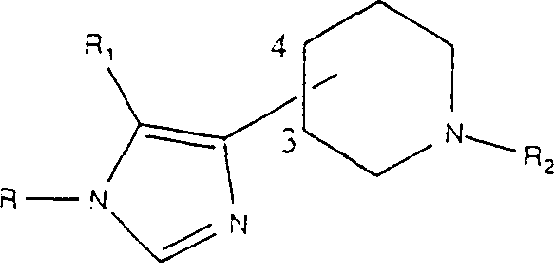
发明概述Invention Summary
本发明主要提供了通式(1.0)化合物: The present invention mainly provides the compound of general formula (1.0):
其中in
R2是氢或甲基或乙基; R is hydrogen or methyl or ethyl;
R3是氢或甲基或乙基; R is hydrogen or methyl or ethyl;
n是0,1,2,3,4,5,或6;及n is 0, 1, 2, 3, 4, 5, or 6; and
R1选自(a)C3-C8环烷基;(b)苯基或取代的苯基;(c)烷基;(d)杂环;(e)十氢化萘;和(f)八氢化茚; R is selected from (a) C 3 -C 8 cycloalkyl; (b) phenyl or substituted phenyl; (c) alkyl; (d) heterocycle; (e) decahydronaphthalene; octahydroindene;
条件是requirement is
当X是H时,A可以是-CH2CH2-,-COCH2-,-CONH-,-CON(CH3)-,-CH=CH-,-C≡C-,-CH2-NH-,-CH2-N(CH3)-,-CH(OH)CH2-,-NH-CH2-,-N(CH3)-CH2-,-CH2O-,-CH2S-,或-NHCOO-;When X is H, A can be -CH2CH2- , -COCH2- , -CONH- , -CON( CH3 )-, -CH=CH-, -C≡C-, -CH2- NH -, -CH 2 -N(CH 3 )-, -CH(OH)CH 2 -, -NH-CH 2 -, -N(CH 3 )-CH 2 -, -CH 2 O-, -CH 2 S -, or -NHCOO-;
当X是NH2,NH(CH3),N(CH3)2,OH,OCH3,CH3,SH或SCH3时,A可以是-NHCO-,-N(CH3)-CO-,-NHCH2-,-N(CH3)-CH2-,-CH=CH-,-COCH2-,-CH2CH2-,-CH(OH)CH2-,或-C≡C-;以及When X is NH 2 , NH(CH 3 ), N(CH 3 ) 2 , OH, OCH 3 , CH 3 , SH or SCH 3 , A can be -NHCO-, -N(CH 3 )-CO-, -NHCH 2 -, -N(CH 3 )-CH 2 -, -CH═CH-, -COCH 2 -, -CH 2 CH 2 -, -CH(OH)CH 2 -, or -C≡C-; as well as
当R1和X一起表示一个5,6或6,6饱和双环结构时,X可以是NH,O,或S。When R 1 and X together represent a 5,6 or 6,6 saturated bicyclic structure, X can be NH, O, or S.
结构式(1.0)化合物的可药用盐,水合物和单个立体异构体以及它们的混合物也属于本发明范围。Pharmaceutically acceptable salts, hydrates and individual stereoisomers of compounds of formula (1.0) as well as mixtures thereof also fall within the scope of the present invention.
本发明还提供了含有可药用载体与有效量式(1.0)化合物相结合的药物组合物。The present invention also provides a pharmaceutical composition comprising a pharmaceutically acceptable carrier in combination with an effective amount of the compound of formula (1.0).
本发明还提供了其中由组胺H3受体的拮抗性起重要治疗作用的治疗疾病的方法。这些疾病包括过敏,炎症,心血管疾病(即高血压或低血压),胃肠道内疾病(酸分泌,蠕动)和包括注意或识别能力疾病在内的CNS疾病(即阿尔茨海默症,注意力缺乏过度兴奋症,老年性记忆力衰退,休克等),精神病和运动疾病(即抑郁症,精神分裂症,迷乱-强迫性紊乱,图雷特综合征等)和睡眠紊乱(即发作性睡眠病,睡眠窒息,失眠症,生物和昼夜节律紊乱,过度和过少嗜睡,以及与睡眠有关的疾病),癫痫,下丘脑功能减退(即饮食疾病,如肥胖症,厌食/贪食,温度调节,释放荷尔蒙)。该方法包括给需要这种治疗的患者使用有效量的式(1.0)化合物。The present invention also provides methods of treating diseases in which antagonism of the histamine H3 receptor plays an important therapeutic role. These disorders include allergies, inflammation, cardiovascular disease (ie, hypertension or hypotension), disorders of the gastrointestinal tract (acid secretion, peristalsis), and CNS disorders including disorders of attention or recognition (ie, Alzheimer's disease, attention dyskinesia, senile memory loss, shock, etc.), psychiatric and motor disorders (i.e. depression, schizophrenia, confusion-compulsive disorder, Tourette syndrome, etc.) and sleep disturbances (i.e. narcolepsy sleep apnea, insomnia, biological and circadian rhythm disturbances, excessive and hyposomnia, and sleep-related disorders), epilepsy, hypothalamic hypofunction (ie, eating disorders such as obesity, anorexia/bulimia, thermoregulation , release hormones). The method comprises administering to a patient in need of such treatment an effective amount of a compound of formula (1.0).
发明详述 Detailed description of the invention
优选的式(1.0)化合物,其位于咪唑环的4(5)位的环丙烷具有反式构型,而且Preferred formula (1.0) compound, its cyclopropane at the 4 (5) position of imidazole ring has trans-configuration, and
当X是H时,A可以是-CH2CH2-,-COCH2-,-CONH-,-CON(CH3)-,-CH=CH-,-C≡C-,-CH2-NH-,-CH2-N(CH3)-,-CH(OH)CH2-,-NH-CH2-,-N(CH3)-CH2-,-CH2O-,-CH2S-,或-NHCOO-;When X is H, A can be -CH2CH2- , -COCH2- , -CONH- , -CON( CH3 )-, -CH=CH-, -C≡C-, -CH2 -NH -, -CH 2 -N(CH 3 )-, -CH(OH)CH 2 -, -NH-CH 2 -, -N(CH 3 )-CH 2 -, -CH 2 O-, -CH 2 S -, or -NHCOO-;
R2是氢或甲基或乙基; R is hydrogen or methyl or ethyl;
R3是氢或甲基或乙基; R is hydrogen or methyl or ethyl;
n是0,1,2,3,4,5,或6;及n is 0, 1, 2, 3, 4, 5, or 6; and
R1选自(a)C3-C8环烷基;(b)苯基或取代的苯基;(c)烷基;(d)杂环;(e)十氢化萘;和(f)八氢化茚; R is selected from (a) C 3 -C 8 cycloalkyl; (b) phenyl or substituted phenyl; (c) alkyl; (d) heterocycle; (e) decahydronaphthalene; octahydroindene;
当X是NH2,NH(CH3),N(CH3)2,OH,OCH3,CH3,SH或SCH3时,A可以是-NHCO-,-N(CH3)-CO-,-NHCH2-,-N(CH3)-CH2-,-CH=CH-,-COCH2-,-CH2CH2-,-CH(OH)CH2-,或-C≡C-;以及When X is NH 2 , NH(CH 3 ), N(CH 3 ) 2 , OH, OCH 3 , CH 3 , SH or SCH 3 , A can be -NHCO-, -N(CH 3 )-CO-, -NHCH 2 -, -N(CH 3 )-CH 2 -, -CH═CH-, -COCH 2 -, -CH 2 CH 2 -, -CH(OH)CH 2 -, or -C≡C-; as well as
R2是氢或甲基或乙基; R is hydrogen or methyl or ethyl;
R3是氢或甲基或乙基; R is hydrogen or methyl or ethyl;
n是0,1,2,3,4,5,或6;n is 0, 1, 2, 3, 4, 5, or 6;
R1选自(a)C3-C8环烷基;(b)苯基或取代的苯基;(c)烷基;(d)杂环;(e)十氢化萘;和(f)八氢化茚; R is selected from (a) C 3 -C 8 cycloalkyl; (b) phenyl or substituted phenyl; (c) alkyl; (d) heterocycle; (e) decahydronaphthalene; octahydroindene;
当R1和X一起表示一个5,6或6,6饱和双环结构时,X可以是NH,O,或S;及When R and X together represent a 5,6 or 6,6 saturated bicyclic structure, X can be NH, O, or S; and
当X被约束在一个5,6或6,6饱和双环结构中时,例如,当X=NH时,R1和X可以表示一个直接连在A上的八氢化茚结构。When X is constrained in a 5,6 or 6,6 saturated bicyclic structure, for example, when X=NH, R1 and X can represent an octahydroindane structure directly attached to A.
更优选地,本发明提供了下面通式的化合物: More preferably, the present invention provides compounds of the following general formula:
其中A是-CONH-,-CH=CH-,-NHCOO-,或-C≡C-;Wherein A is -CONH-, -CH=CH-, -NHCOO-, or -C≡C-;
X是H或NH2;X is H or NH2 ;
R2和R3是H; R2 and R3 are H;
n是0,1,2或3;n is 0, 1, 2 or 3;
R1是C6环己基,苯基或取代的苯基。R 1 is C 6 cyclohexyl, phenyl or substituted phenyl.
上述结构式(1.0)化合物的可药用盐,水合物和单个立体异构体以及它们的混合物也属于本发明范围。本发明代表性的化合物为式(2.0)-(51.0)化合物: 
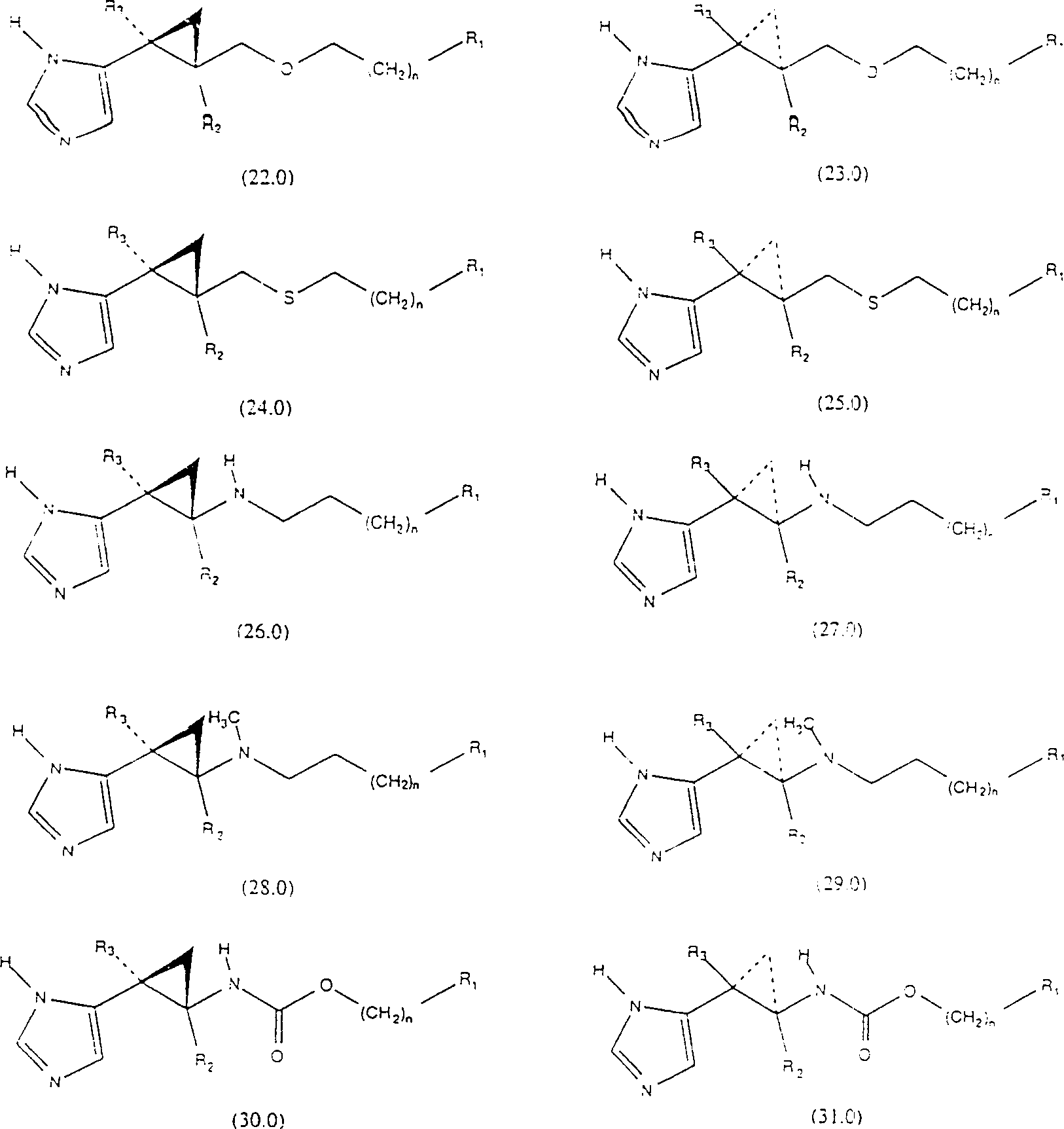


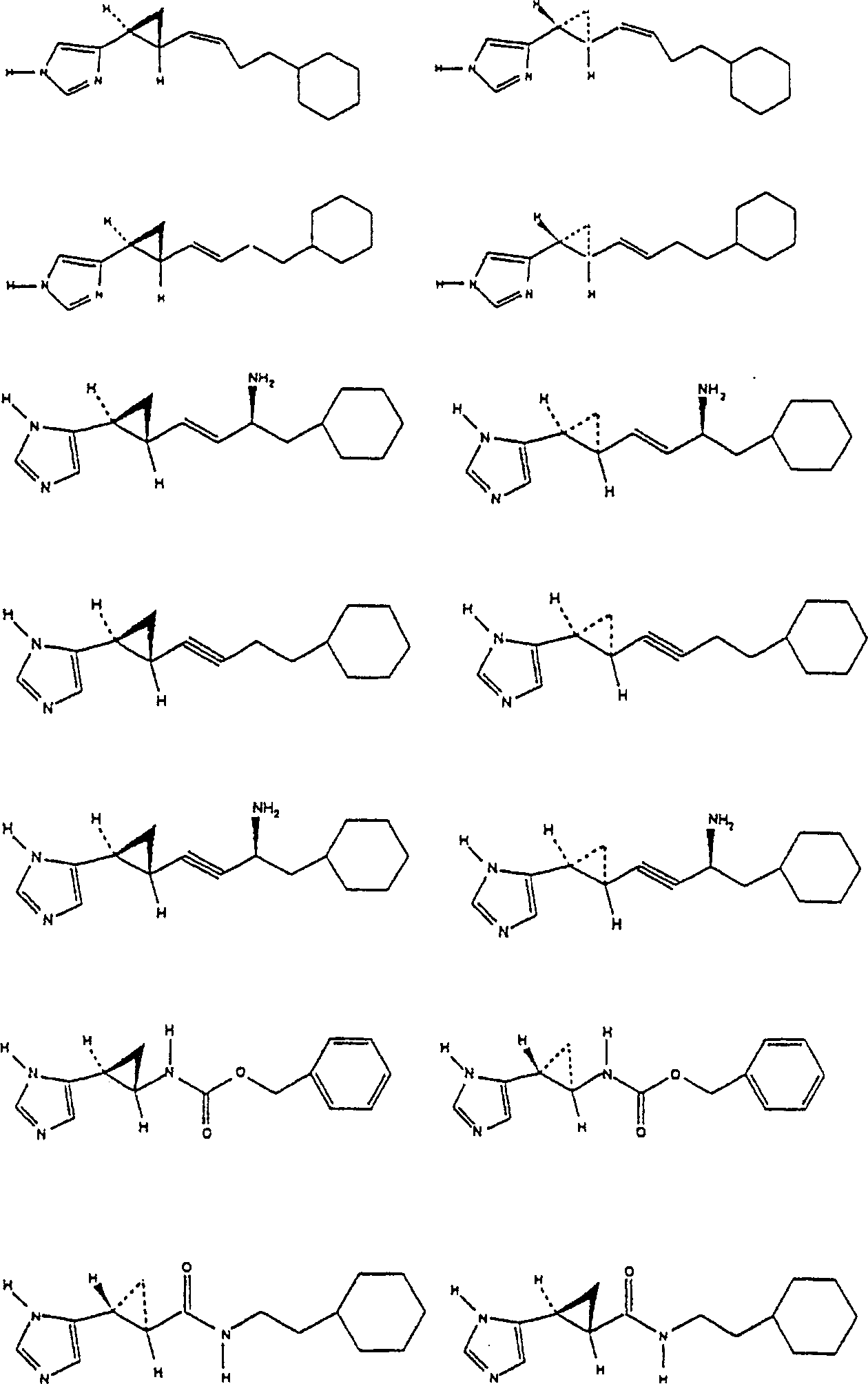
本发明某些化合物可以不同的异构体(如对映体和非对映体)形式存在。本发明包括所有这些纯的和混合形式的异构体,包括外消旋混合物,也包括其烯醇形式。Certain compounds of the present invention may exist in different isomeric (eg, enantiomeric and diastereomeric) forms. The present invention includes all such isomers in pure and admixture, including racemic mixtures, and also in their enol forms.
式(1.0)化合物可以来水合或水合形式存在,如半水合物,单-,四-,十水合物等。可以通过加热或其它方法除去水,形成无水化合物。总之,由可药用溶剂如水,乙醇等形成的水合物形式与本发明范围内的非水合物形式是等价的。The compound of formula (1.0) may exist in a hydrated or hydrated form, such as hemihydrate, mono-, tetra-, decahydrate and the like. Water can be removed by heating or other methods to form anhydrous compounds. In general, the hydrated forms formed from pharmaceutically acceptable solvents such as water, ethanol, etc. are equivalent to the unhydrated forms within the scope of the present invention.
本发明某些化合物可形成可药用盐,如酸加成盐。例如,氮原子可与酸形成盐。适合形成盐的酸的实例有盐酸,硫酸,磷酸,乙酸,柠檬酸,草酸,丙二酸,水杨酸,苹果酸,富马酸,琥珀酸,抗坏血酸,马来酸,甲磺酸和其它本领域技术人员熟知的无机酸和羧酸。这些盐可以通过将其游离碱形式与制备盐所需的充足的酸接触以常规方法制备。可以通过用适当稀的碱性水溶液如稀氢氧化物水溶液,碳酸钾,氨水和碳酸氢钠处理盐得到再生的游离碱。游离碱的某些物理性质不同于它们各自的盐,如在极性溶剂中的溶解性,但对于本发明的目的来说,酸性盐与它们各自的游离碱是等同的。(例如,参见S.M.Berge等人,“药物盐(Pharmaceutical Salts)”,《药物学会志》(J.Pharm.Sci.), 66:1-19(1977),该文献在此全部引作参考。)Certain compounds of the present invention may form pharmaceutically acceptable salts, such as acid addition salts. For example, nitrogen atoms can form salts with acids. Examples of acids suitable for forming salts are hydrochloric acid, sulfuric acid, phosphoric acid, acetic acid, citric acid, oxalic acid, malonic acid, salicylic acid, malic acid, fumaric acid, succinic acid, ascorbic acid, maleic acid, methanesulfonic acid and others Inorganic acids and carboxylic acids are well known to those skilled in the art. These salts may be prepared in conventional manner by contacting the free base form with sufficient acid to prepare the salt. The regenerated free base can be obtained by treating the salt with an appropriate dilute aqueous alkaline solution, such as dilute aqueous hydroxide solution, potassium carbonate, ammonia and sodium bicarbonate. The free bases differ from their respective salts in certain physical properties, such as solubility in polar solvents, but acidic salts are equivalent to their respective free bases for the purposes of the present invention. (See, eg, SM Berge et al., "Pharmaceutical Salts," J. Pharm. Sci., 66 :1-19 (1977), which is hereby incorporated by reference in its entirety.)
在本说明书和权利要求书中,下列术语的定义如下:In this specification and claims, the following terms are defined as follows:
这里所用术语“烷基”指通过除去一个氢原子而从饱和烃衍生的直链或支链基团。具有代表性的烷基包括甲基,乙基,正丙基,异丙基,正丁基,仲丁基,异丁基,叔丁基等。The term "alkyl" as used herein refers to a straight or branched chain group derived from a saturated hydrocarbon by removal of one hydrogen atom. Representative alkyl groups include methyl, ethyl, n-propyl, isopropyl, n-butyl, sec-butyl, isobutyl, t-butyl and the like.
这里所用术语“杂环”指环上一个或多个原子不是碳元素的闭环结构。具有代表性的杂环优选饱和的,包括吡咯烷,四氢呋喃,四氢噻吩,四氢异喹啉和八氢吲哚基团。The term "heterocyclic ring" as used herein refers to a closed ring structure in which one or more atoms in the ring are not carbon elements. Representative heterocycles, preferably saturated, include pyrrolidine, tetrahydrofuran, tetrahydrothiophene, tetrahydroisoquinoline and octahydroindole groups.
这里所用术语“取代的苯基”指被一个或多个基团如烷基,卤素,氨基,甲氧基和氰基取代的苯基。The term "substituted phenyl" as used herein refers to phenyl substituted with one or more groups such as alkyl, halo, amino, methoxy and cyano.
这里所用术语“双环烷基”指有两个连接到烷基的环结构的有机化合物。两个环可以相同或者不同,而且可以被一个或多个基团取代。具有代表性的双环烷基包括金刚烷基,十氢萘和降冰片烷(norbornane)。The term "bicycloalkyl" as used herein refers to an organic compound having two ring structures attached to an alkyl group. The two rings can be the same or different, and can be substituted by one or more groups. Representative bicycloalkyl groups include adamantyl, decahydronaphthalene and norbornane.
本发明化合物个体对映体形式可以采用本领域已知技术从它们的混合物中分离得到。例如,可以将本发明化合物与酸的光学纯形式反应形成非对映体盐的混合物,然后经过重结晶或色谱分离来纯化这些非对映体混合物,随后通过将盐碱化从其中回收拆分的化合物。或者,采用在旋光活性色谱介质上分离的色谱技术,相互分离得到本发明化合物的旋光异构体。Individual enantiomeric forms of the compounds of the invention may be isolated from their mixtures using techniques known in the art. For example, a compound of the invention may be reacted with an acid in optically pure form to form a mixture of diastereomeric salts, these diastereomeric mixtures may then be purified by recrystallization or chromatographic separation, and subsequently recovered and resolved by basifying the salt. compound of. Alternatively, the optical isomers of the compounds of the invention are separated from one another using chromatographic techniques on optically active chromatographic media.
本发明还提供含有一种或多种上述式(1.0)化合物,并配有一种或多种无毒可药用载体的药物组合物。这些药物组合物尤其可制成固体或液体的口服给药形式,胃肠外注射或直肠给药的制剂。The present invention also provides a pharmaceutical composition containing one or more compounds of the above formula (1.0) together with one or more non-toxic pharmaceutically acceptable carriers. These pharmaceutical compositions can especially be prepared in solid or liquid form for oral administration, parenteral injection or rectal administration.
可根据本发明,给人和其它动物进行本发明药物组合物的口服,直肠,胃肠外,脑池内,阴道内,腹膜内和表面给药。Oral, rectal, parenteral, intracisternal, intravaginal, intraperitoneal and topical administration of the pharmaceutical composition of the present invention can be carried out in accordance with the present invention to humans and other animals.
用于胃肠外注射的本发明药物组合物包括可药用无菌水溶液或非水溶液,分散液,悬浮液或乳浊液,以及在使用前再配成无菌注射溶液或分散液的无菌粉末。适宜的水性或非水性载体,稀释剂,溶剂或赋形剂包括水,乙醇,多元醇(如甘油,丙二醇,聚乙二醇等),以及它们适当的混合物,植物油(如橄榄油)和可注射有机酯如油酸乙酯。例如,通过使用包衣材料如卵磷脂,通过在分散液中保持所要的颗粒尺寸,以及通过使用表面活性剂可以保持适当的流动性。The pharmaceutical composition of the present invention for parenteral injection includes pharmaceutically acceptable sterile aqueous or non-aqueous solutions, dispersions, suspensions or emulsions, and sterile injectable solutions or dispersions before use. powder. Suitable aqueous or non-aqueous carriers, diluents, solvents or vehicles include water, ethanol, polyols (such as glycerol, propylene glycol, polyethylene glycol, etc.), and suitable mixtures thereof, vegetable oils (such as olive oil) and can Inject organic esters such as ethyl oleate. For example, proper fluidity can be maintained by the use of coating materials such as lecithin, by maintaining the desired particle size in the dispersion, and by the use of surfactants.
本发明还可以含有辅助剂,如防腐剂,润湿剂和乳化剂。The present invention may also contain adjuvants such as preservatives, wetting agents and emulsifiers.
在有些情况下,为了延长药效,需要减缓对栓剂或肌肉内注射的药物的吸收,这可以通过使用水溶性差的结晶或非晶形物质的悬浮液体来实现。于是,药物的吸收率就取决于它的溶解率,而溶解率又取决于晶体大小和结晶形状。或者,通过将药物溶解或悬浮于油性载体中来延缓胃肠外所给药物的吸收。In some cases, in order to prolong the drug effect, it is necessary to slow the absorption of the suppository or intramuscular injection of the drug, which can be achieved by using a suspension of poorly water-soluble crystalline or amorphous material. The rate of absorption of the drug then depends upon its rate of dissolution, which, in turn, depends upon crystal size and crystalline shape. Alternatively, delayed absorption of a parenterally administered drug is accomplished by dissolving or suspending the drug in an oil vehicle.
注射剂的储存形式可以通过在可生物降解的聚合物如聚交酯-聚乙交酯中形成药物的微囊基体(matrices)制成。根据药物与聚合物的比例和所用基体聚合物的性质,可以控制药物释放的速率。其它可降解聚合物的实例包括聚(原酸酯)和聚(酐)。储存形式的注射剂还可以通过将药物包在与身体组织相容的脂质体或微乳状液中来制备。Injectable depot forms are made by forming microencapsule matrices of the drug in biodegradable polymers such as polylactide-polyglycolide. Depending on the ratio of drug to polymer and the nature of the matrix polymer employed, the rate of drug release can be controlled. Examples of other degradable polymers include poly(orthoesters) and poly(anhydrides). Injectable depot forms are also prepared by entrapping the drug in liposomes or microemulsions which are compatible with body tissues.
例如,注射剂可通过用滞留细菌的滤膜过滤,或采用无菌固体组合物形式的联合灭菌剂进行灭菌,所说固体组合物可在使用前溶解或分散在无菌水或其它可注射无菌介质中。For example, injections can be sterilized by filtration through bacteria-retaining membranes, or by using combined sterilizing agents in the form of sterile solid compositions that can be dissolved or dispersed in sterile water or other injectable preparations before use. in a sterile medium.
口服给药的固体剂型包括胶囊剂,片剂,丸剂,粉剂和粒剂。在这些固体剂型中,活性化合物与至少一种惰性的可药用赋形剂或载体如柠檬酸钠或磷酸二钙,和/或a)填充剂(或补充剂如淀粉,乳糖,蔗糖,葡萄糖,甘露糖醇和硅酸),b)粘结剂如羧甲基纤维素,藻酸盐,明胶,聚乙烯吡咯烷酮,蔗糖和阿拉伯树胶,c)湿润剂如甘油,d)崩解剂如琼脂,碳酸钙,马铃薯或木薯淀粉,藻酸,某些硅酸盐和碳酸钠,e)溶液阻滞剂如石蜡,f)加速吸收剂如季铵化合物,g)润湿剂如鲸蜡醇和一硬脂酸甘油酯,h)吸收剂如高岭土和膨润土,及i)润滑剂如硬脂酸钙,硬脂酸镁,固体聚乙二醇,月桂基硫酸钠,和它们的混合物混合。对于胶囊剂,片剂和丸剂,这些剂型还可以含有缓冲剂。Solid dosage forms for oral administration include capsules, tablets, pills, powders and granules. In these solid dosage forms, the active compound is combined with at least one inert pharmaceutically acceptable excipient or carrier such as sodium citrate or dicalcium phosphate, and/or a) fillers (or supplements such as starch, lactose, sucrose, glucose , mannitol and silicic acid), b) binders such as carboxymethylcellulose, alginate, gelatin, polyvinylpyrrolidone, sucrose and gum arabic, c) wetting agents such as glycerin, d) disintegrants such as agar, Calcium carbonate, potato or tapioca starch, alginic acid, certain silicates and sodium carbonate, e) solution retarders such as paraffin, f) absorption accelerating agents such as quaternary ammonium compounds, g) wetting agents such as cetyl alcohol and monohard Glyceryl fatty acid, h) absorbents such as kaolin and bentonite, and i) lubricants such as calcium stearate, magnesium stearate, solid polyethylene glycol, sodium lauryl sulfate, and mixtures thereof are mixed. In the case of capsules, tablets and pills, these dosage forms can also contain buffering agents.
相似类型的固体组合物也可以在软和硬明胶胶囊中用作填充剂,例如,用作赋形剂的乳糖或奶糖,以及高分子量聚乙二醇等等。Solid compositions of a similar type can also be used as fillers in soft and hard gelatine capsules, for example, lactose or milk sugar as excipients, high molecular weight polyethylene glycols, and the like.
片剂,糖锭剂,胶囊剂,丸剂和粒剂等固体剂型可通过包衣和包壳如肠衣和其它药物制剂领域熟知的包衣技术制备。它们可以任意含有遮光剂(opacifying agent),也可以是仅仅在,或优先在肠道的某个部位释放活性成分,而且可选择延迟释放方式。可用的包埋组合物的实例包括聚合物质和蜡。The solid dosage forms of tablets, dragees, capsules, pills, and granules can be prepared by coatings and shells such as enteric coatings and other coating techniques well known in the pharmaceutical formulating art. They may optionally contain an opacifying agent, and may release the active ingredient only, or preferentially, in a certain part of the intestinal tract, and optionally in a delayed manner. Examples of useful embedding compositions include polymeric substances and waxes.
活性化合物也可以是微囊形式,如果需要,与一种或多种上述赋形剂一起使用。The active compounds can also be in micro-encapsulated form, if desired, with one or more of the above-mentioned excipients.
用于口服给药的液体剂型包括可药用乳化液,溶液,悬浮液,糖浆和酏剂。除了活性化合物之外,液体剂型可以含有常用于该领域的惰性稀释剂,如乙醇,异丙醇,碳酸乙酯,乙酸乙酯,苄醇,苯甲酸苄酯,丙二醇,1,3-丁二醇,二甲基甲酰胺,油(特别是棉籽油,花生油,玉米油,胎芽(germ)油,橄榄油,蓖麻油和芝麻油),甘油,四氢糠醇,聚乙二醇和脱水山梨糖醇的脂肪酸酯,以及它们的混合物。Liquid dosage forms for oral administration include pharmaceutically acceptable emulsions, solutions, suspensions, syrups and elixirs. In addition to the active compound, liquid dosage forms may contain inert diluents commonly used in the field, such as ethanol, isopropanol, ethyl carbonate, ethyl acetate, benzyl alcohol, benzyl benzoate, propylene glycol, 1,3-butanediol Alcohols, dimethylformamide, oils (especially cottonseed oil, peanut oil, corn oil, germ oil, olive oil, castor oil, and sesame oil), glycerin, tetrahydrofurfuryl alcohol, polyethylene glycol, and sorbitan Fatty acid esters, and mixtures thereof.
除惰性稀释剂外口服组合物还可以含有辅助剂,如润湿剂,乳化剂和悬浮剂,甜味剂,调味剂和增香剂。Besides inert diluents, the oral compositions can also contain adjuvants such as wetting agents, emulsifying and suspending agents, sweetening, flavoring and perfuming agents.
除活性化合物外悬浮液还可以含有某些悬浮剂,如乙氧基化异硬脂醇,聚氧乙烯山梨糖醇和脱水山梨醇酯,微晶纤维素,甲醇铝(aluminum methydroxide),膨润土,琼脂和黄蓍胶,以及它们的混合物。Suspensions may contain, in addition to the active compound, certain suspending agents such as ethoxylated isostearyl alcohols, polyoxyethylene sorbitol and sorbitan esters, microcrystalline cellulose, aluminum metoxide, bentonite, agar and tragacanth, and mixtures thereof.
直肠或阴道给药的组合物优选栓剂,它可以通过将本发明化合物与适当无刺激性赋形剂或载体,如可可油,聚乙二醇或一种在室温是固体而在体温下是液体的栓剂蜡(这样,它可以在直肠或阴道腔内熔化并释放出活性化合物)混合制成。Compositions for rectal or vaginal administration are preferably suppositories, which may be prepared by combining a compound of the present invention with a suitable non-irritating excipient or carrier, such as cocoa butter, polyethylene glycol, or a compound that is solid at room temperature and liquid at body temperature. Suppositories are made by mixing wax (so that it melts in the rectum or vaginal canal and releases the active compound).
本发明化合物也可以脂质体形式给药。正如本领域已知的,脂质体一般是从磷脂或其它脂类物质衍生而来。因此,可将单-或多-片状水合液体晶体分散在水性介质中形成脂质体。任何无毒的生理上可接受的和可代谢的,能够形成脂质体的脂类都可以使用。除本发明化合物外本发明脂质体形式的组合物还可以含有稳定剂,防腐剂,赋形剂等等。优选的脂类物质有天然的和合成的磷脂和磷脂酰胆碱(卵磷脂)。The compounds of the invention can also be administered in liposome form. As is known in the art, liposomes are generally derived from phospholipids or other lipid substances. Thus, mono- or multi-lamellar hydrated liquid crystals can be dispersed in an aqueous medium to form liposomes. Any nontoxic physiologically acceptable and metabolizable lipid capable of forming liposomes can be used. The present invention compositions in liposome form can contain, in addition to a compound of the present invention, stabilizers, preservatives, excipients, and the like. Preferred lipids are natural and synthetic phospholipids and phosphatidylcholines (lecithins).
制备磷脂的方法是本领域已知的,例如,参见Prescott编辑,《细胞生物学中的方法》(Methods in Cell Biology),XIV卷,AcademicPress,New York,N.Y.(1976),p.33,以及下列参考文献等等。Methods for preparing phospholipids are known in the art, see, e.g., Prescott, ed., Methods in Cell Biology, Volume XIV, Academic Press, New York, N.Y. (1976), p.33, and The following references, etc.
本发明化合物用于表面给药的剂型包括粉剂,喷雾剂,油膏和吸入剂。在无菌条件下活性化合物与可药用载体以及任何需要的防腐剂,缓冲剂或可能需要的喷射剂基质混合。眼药,眼膏,粉剂和溶液也属于本发明范围。Dosage forms for topical administration of a compound of this invention include powders, sprays, ointments and inhalants. The active compound is mixed under sterile conditions with a pharmaceutically acceptable carrier and any required preservatives, buffers or propellant base which may be required. Eye drops, eye ointments, powders and solutions are also within the scope of this invention.
下列方法和技术可以用于制备式(1.0)化合物。反应在适合于反应试剂和所用原料的溶剂中进行,而且适于进行转化。有机合成领域的技术人员应该理解,分子中存在的官能团必须与所要进行的化学变化相符。因此,常常需要对合成步骤的顺序,需要的保护基和脱保护条件作出必要的判断。The following methods and techniques can be used to prepare compounds of formula (1.0). The reactions are performed in solvents appropriate to the reagents and starting materials employed and are suitable for the transformations to be effected. Those skilled in the art of organic synthesis will understand that the functional groups present in the molecule must be compatible with the chemical changes to be performed. Therefore, necessary judgments are often required regarding the sequence of synthetic steps, desired protecting groups and deprotection conditions.
A.A是-CONH-或-CON(CH3)-的化合物的制备AA is the preparation of -CONH- or -CON(CH 3 )-compounds
流程I 
流程IProcess I
根据上述反应流程I,用Burger等人,《药物化学杂志》(J.Med.Chem.),(1970), 13:33-35所述方法制备的反式环丙烷外消旋混合物3-(1-三苯基甲基-5-咪唑基)环丙烷羧酸(1)通过氯甲酸乙酯和三乙胺的作用被转变成活性酯。该活性酯当场与胺(2)反应生成3-(1-三苯基甲基-5-咪唑基)环丙烷甲酰胺(3)。三苯甲基保护基可用酸,优选2N HCl水溶液除去,得到3-(1H-5-咪唑基)环丙烷甲酰胺(4)。According to above-mentioned reaction scheme 1, use the people such as Burger, "Journal of Medicinal Chemistry" (J.Med.Chem.), (1970), 13 : the trans-cyclopropane racemic mixture 3-( 1-Triphenylmethyl-5-imidazolyl)cyclopropanecarboxylic acid (1) was converted into the active ester by the action of ethyl chloroformate and triethylamine. The active ester reacts with amine (2) in situ to give 3-(1-triphenylmethyl-5-imidazolyl)cyclopropanecarboxamide (3). The trityl protecting group can be removed with an acid, preferably aqueous 2N HCl, to give 3-(1H-5-imidazolyl)cyclopropanecarboxamide (4).
B.A是-CH2NH-或-CH2NCH2-的化合物的制备Preparation of compounds in which BA is -CH 2 NH- or -CH 2 NCH 2 -
流程II Process II
流程IIProcess II
根据上述反应流程II,用过量复合物硼烷-甲硫醚处理流程I制备的3-(1-三苯基甲基-5-咪唑基)环丙烷甲酰胺(3),生成3-(1-三苯基甲基-5-咪唑基)环丙胺(5)。用2N HCl水溶液除去三苯甲基保护基,得到3-(1H-5-咪唑基)环丙胺(6)。According to the above reaction scheme II, the 3-(1-triphenylmethyl-5-imidazolyl) cyclopropane carboxamide (3) prepared by excess complex borane-methyl sulfide treatment scheme I generates 3-(1 - Triphenylmethyl-5-imidazolyl)cyclopropylamine (5). Removal of the trityl protecting group with 2N aqueous HCl affords 3-(1H-5-imidazolyl)cyclopropylamine (6).
C.A是-CH(OH)CH2-的化合物的制备Preparation of compounds where CA is -CH(OH)CH 2 -
流程III 
流程IIIProcess III
根据上述反应流程III,用过量DIBALH在-78℃处理3-(1-三苯基甲基-5-咪唑基)环丙烷羧酸酯(7),得到醇(8)。用草酰氯和DMSO氧化醇(8),生成3-(1-三苯基甲基-5-咪唑基)环丙基丙醛(9)。通过砜与强碱(优选n-BuLi)的反应制成砜(10)的阴离子,然后优选在-78℃让该阴离子与醛(9)反应。在室温用过量阮内镍(W-2)处理生成的非对映体混合物β羟基-砜(11),得到醇的混合物(12)。如上所述除去三苯甲基保护基,得到1-(1H-5-咪唑基)环丙醇(13)。According to Reaction Scheme III above, treatment of 3-(1-triphenylmethyl-5-imidazolyl)cyclopropanecarboxylate (7) with excess DIBALH at -78°C affords alcohol (8). Oxidation of alcohol (8) with oxalyl chloride and DMSO yields 3-(1-triphenylmethyl-5-imidazolyl)cyclopropylpropanal (9). The anion of the sulfone (10) is prepared by reaction of the sulfone with a strong base, preferably n-BuLi, which is then reacted with the aldehyde (9), preferably at -78°C. Treatment of the resulting diastereomeric mixture β-hydroxy-sulfone (11) with excess Raney nickel (W-2) at room temperature affords a mixture of alcohols (12). Removal of the trityl protecting group as described above affords 1-(1H-5-imidazolyl)cyclopropanol (13).
D.A是-CH=CH-的化合物(反式链烯)的制备D.A is the preparation of the compound (trans-alkene) of -CH=CH-
流程IV 
流程IVProcess IV
根据上述反应流程IV,在4当量磷酸氢钠缓冲液存在下用过量2-3% Na(Hg)的甲醇处理流程III合成的非对映体混合物β羟基-砜(10),分离链烯异构体后得到1-(1-三苯基甲基-5-咪唑基)环丙基反式链烯(13)。除去三苯甲基保护基后得到1-(1H-5-咪唑基)环丙基反式链烯(14)。According to the above reaction scheme IV, in the presence of 4 equivalents of sodium hydrogen phosphate buffer, the diastereomeric mixture β-hydroxyl-sulfone (10) synthesized by scheme III is treated with methanol with an excess of 2-3% Na (Hg), and the alkenyl isocyanate is separated. After conformation, 1-(1-triphenylmethyl-5-imidazolyl)cyclopropyltrans-alkene (13) was obtained. Removal of the trityl protecting group affords 1-(1H-5-imidazolyl)cyclopropyltrans-alkene (14).
E.A是-CH=CH-的化合物(顺式链烯)的制备E.A is the preparation of the compound (cis-alkene) of -CH=CH-
流程V Process V
流程VProcess V
根据上述反应流程V,通过Wittig试剂的处理将3-(1-三苯基甲基-5-咪唑基)环丙基丙醛(8)转化成链烯(16),Wittig试剂是通过用强碱,优选NaNH2,处理碘化鏻盐(15)得到的。如上所述,通过用2N HCl水溶液处理除去三苯甲基保护基,得到1-(1H-5-咪唑基)环丙基顺式链烯(17)。According to the above reaction scheme V, 3-(1-triphenylmethyl-5-imidazolyl)cyclopropylpropanal (8) was converted into alkene (16) by treatment with Wittig reagent, which was obtained by using strong A base, preferably NaNH2 , is obtained by treating the phosphonium iodide salt (15). Removal of the trityl protecting group by treatment with 2N aqueous HCl affords 1-(1H-5-imidazolyl)cyclopropylcis-alkene (17), as described above.
F.A是-COCH2-的化合物的制备Preparation of compounds in which FA is -COCH 2 -
流程VI Process VI
流程VIProcess VI
根据上述反应流程VI,在-78℃用2.5当量从(10)得到的砜阴离子处理1-(1-三苯基甲基-5-咪唑基)环丙基羧酸酯(7),得到酮-砜(18)。用Al(Hg)或Na(Hg)处理后得到1-(1-三苯基甲基-5-咪唑基)环丙基酮(19)。用2N HCl处理除去三苯甲基保护基,得到1-(1H-5-咪唑基)环丙基酮(20)。Treatment of 1-(1-triphenylmethyl-5-imidazolyl)cyclopropylcarboxylate (7) with 2.5 equivalents of the sulfone anion from (10) at -78 °C according to Reaction Scheme VI above gave the ketone -sulfone (18). Treatment with Al(Hg) or Na(Hg) affords 1-(1-triphenylmethyl-5-imidazolyl)cyclopropylketone (19). Treatment with 2N HCl removes the trityl protecting group to give 1-(1H-5-imidazolyl)cyclopropylketone (20).
G.A是-C≡C-CH2-的化合物的制备Preparation of compounds where GA is -C≡C-CH 2 -
流程VII 
流程VIIProcess VII
根据上述反应流程VII,在HMPA存在下用NaH,然后用磷酰氯二乙酯处理流程VI制备的1-(1-三苯基甲基-5-咪唑基)环丙基酮砜(18),得到磷酸烯醇(21)。用过量的在THF/HMPA中的Sml2处理磷酸烯醇(21),得到1-(1-三苯基甲基-5-咪唑基)环丙基乙炔(22)。最后,用2N HCl除去三苯甲基保护基,得到1-(1H-5-咪唑基)环丙基乙炔(23)。According to the above reaction scheme VII, the 1-(1-triphenylmethyl-5-imidazolyl)cyclopropyl ketone sulfone (18) prepared in scheme VI was treated with NaH in the presence of HMPA, followed by diethyl phosphoryl chloride, The phosphoenol (21) is obtained. Treatment of phosphoenol (21) with an excess of Sml 2 in THF/HMPA affords 1-(1-triphenylmethyl-5-imidazolyl)cyclopropylacetylene (22). Finally, removal of the trityl protecting group with 2N HCl affords 1-(1H-5-imidazolyl)cyclopropylacetylene (23).
H.A是-CH2CH2-的化合物的制备Preparation of compounds where HA is -CH 2 CH 2 -
流程VIII 
流程VIIIProcess VIII
根据上述反应流程VIII,在Zervas等人,《美国化学协会杂志》(J.Am.Chem.Soc.), 78:1359(1956),所述条件下将1-(1-三苯基甲基-5-咪唑基)环丙烷反式链烯(13)进行催化氢化反应,还原碳-碳双键,并脱掉三苯甲基保护基,得到1-(1H-5-咪唑基)环丙烷(24)。According to the above reaction scheme VIII, 1- (1-triphenylmethyl -5-imidazolyl) cyclopropane trans-alkene (13) carries out catalytic hydrogenation reaction, reduces carbon-carbon double bond, and takes off trityl protecting group, obtains 1-(1H-5-imidazolyl) cyclopropane (twenty four).
I.A是-CH2O-的化合物的制备Preparation of compounds where IA is -CH 2 O-
流程IX Process IX
流程IXProcess IX
根据上述反应流程IX,用氢化钠处理按照流程III概括的方法制备的1-(1-三苯基甲基-5-咪唑基)环丙基醇(8)的外消旋混合物,并与碘化物(25)反应,得到1-(1-三苯基甲基-5-咪唑基)环丙基醚(26)。用2N HCl水溶液除去三苯甲基保护基,得到1-(1H-5-咪唑基)环丙基醚(27)。According to Reaction Scheme IX above, the racemic mixture of 1-(1-triphenylmethyl-5-imidazolyl)cyclopropyl alcohol (8), prepared as outlined in Scheme III, was treated with sodium hydride and reacted with iodine Compound (25) was reacted to give 1-(1-triphenylmethyl-5-imidazolyl)cyclopropyl ether (26). Removal of the trityl protecting group with 2N aqueous HCl afforded 1-(1H-5-imidazolyl)cyclopropyl ether (27).
J.A是-CH2S-的化合物的制备Preparation of compounds where JA is -CH 2 S-
流程X 
流程XProcess X
根据上述反应流程X,用甲磺酰氯和三乙胺处理1-(1-三苯基甲基-5-咪唑基)环丙基醇(8)的外消旋混合物,得到相应的甲磺酸酯(28)。用硫醇盐(29)处理该甲磺酸酯(28),得到1-(1-三苯基甲基-5-咪唑基)环丙基硫化物(30)。用2N HCl水溶液除去三苯甲基保护基,得到1-(1H-5-咪唑基)环丙基硫化物(31)。According to Reaction Scheme X above, treatment of a racemic mixture of 1-(1-triphenylmethyl-5-imidazolyl)cyclopropyl alcohol (8) with methanesulfonyl chloride and triethylamine affords the corresponding methanesulfonic acid Esters (28). Treatment of the mesylate (28) with thiolate (29) affords 1-(1-triphenylmethyl-5-imidazolyl)cyclopropylsulfide (30). Removal of the trityl protecting group with 2N aqueous HCl afforded 1-(1H-5-imidazolyl)cyclopropylsulfide (31).
K.A是-NH-(COO)-R的化合物的制备K.A is the preparation of the compound of -NH-(COO)-R
流程XI Process XI
流程XIProcess XI
根据上述反应流程XI,通过氯甲酸乙酯和三乙胺的作用使3-(1-三苯基甲基-5-咪唑基)环丙烷羧酸(1)转化为活化的酯。将活化酯当场与叠氮化钠反应,得到酰基叠氮,然后在醇存在下在甲苯中加热回流,生成1-(1-三苯基甲基-5-咪唑基)环丙基氨基甲酸酯(32)。用2N HCl除去三苯甲基保护基,得到1-(1H-5-咪唑基)环丙基氨基甲酸酯(33)。3-(1-Triphenylmethyl-5-imidazolyl)cyclopropanecarboxylic acid (1) was converted to the activated ester by the action of ethyl chloroformate and triethylamine according to Reaction Scheme XI above. Reaction of the activated ester with sodium azide in situ gives the acyl azide, which is then heated to reflux in toluene in the presence of alcohol to give 1-(1-triphenylmethyl-5-imidazolyl)cyclopropylcarbamate Esters (32). Removal of the trityl protecting group with 2N HCl afforded 1-(1H-5-imidazolyl)cyclopropylcarbamate (33).
L.A是-NHCO-或-N(CH3)CO-和X是H或NH2的化合物的制备Preparation of compounds where LA is -NHCO- or -N( CH3 )CO- and X is H or NH2
流程XII Process XII
流程XIIProcess XII
根据上述反应流程XII,将根据Burger等人,《药物化学杂志》(J.Med.Chem.),(1970), 13:33-35所述方法制备的2-(1H-5-咪唑基)-(2R)-1(S)-环丙胺(R=H)和2-(1H-5-咪唑基)-2(S)-1(R)-环丙胺(32)外消旋混合物在使用DCC和HOBT的标准肽偶合条件下与适当的氨基酸(31)(天然L构型)反应。反应完成之后(TLC或HPLC分析),用CH3CN/H2O/0.1%TFA作洗脱剂对酰胺(33)非对映体混合物进行反相HPLC色谱分离,得到纯非对映体(34)和(35)。According to the above reaction scheme XII, the 2-(1H-5-imidazolyl) prepared according to the method described in Burger et al., "Journal of Medicinal Chemistry" (J.Med.Chem.), (1970), 13 :33-35 A racemic mixture of -(2R)-1(S)-cyclopropylamine (R=H) and 2-(1H-5-imidazolyl)-2(S)-1(R)-cyclopropylamine (32) was used DCC and HOBT were reacted with the appropriate amino acid (31) (native L configuration) under standard peptide coupling conditions. After completion of the reaction (TLC or HPLC analysis), the amide (33) diastereomeric mixture was subjected to reverse phase HPLC chromatography using CH 3 CN/H 2 O/0.1% TFA as eluent to obtain pure diastereomers ( 34) and (35).
M. 手性环丙烷化合物的制备 M. Preparation of Chiral Cyclopropane Compounds
流程XIII Process XIII
流程XIIIProcess XIII
要求保护的作为组胺H3受体拮抗剂的含手性环丙烷化合物是由3-[(1-三苯基甲基-5-咪唑基)]-2(R)-3(S)-环丙酸丁酯(36)或3-[(1-三苯基甲基-5-咪唑基)]-2(S)-3(R)-环丙酸丁酯(37)制成的。用手性柱(Regis系列号0112201)和流动相90/10己烷/异丙醇分离这些对映体的外消旋混合物。使用该柱,对映体(37)有7.315分钟保留时间,对映体(36)有5.787分钟保留时间。The claimed chiral cyclopropane-containing compound as histamine H3 receptor antagonist is composed of 3-[(1-triphenylmethyl-5-imidazolyl)]-2(R)-3(S)- Butyl cyclopropionate (36) or 3-[(1-triphenylmethyl-5-imidazolyl)]-2(S)-3(R)-butyl cyclopropionate (37). The racemic mixture of these enantiomers was separated using a chiral column (Regis serial number 0112201) and mobile phase 90/10 hexane/isopropanol. Using this column, enantiomer (37) had a retention time of 7.315 minutes and enantiomer (36) had a retention time of 5.787 minutes.
本发明将由下列代表性实施例进一步加以说明。The invention will be further illustrated by the following representative examples.
实施例1Example 1
N-(1-苄基)-3-[(1H-咪唑-5-基)]-2(R)-3(S)-环丙酰胺和N-(1-苄基)-3-[(1H-咪唑-5-基)]-2(S)-3(R)-环丙酰胺盐酸盐外消旋混合物的制备
将根据Burger等人,《药物化学杂志》(J.Med.Chem.),(1970),13:33-35所述方法制备的3-[(1-三苯基甲基-5-咪唑基)]-2(R)-3(S)-环丙酸和3-[(1-三苯基甲基-5-咪唑基)]-2(S)-3(R)-环丙酸外消旋混合物(0.334g,0.84mM)悬浮于5mL蒸馏水。在整个溶液中加入足够的丙酮(35mL),并将均匀后的溶液冷却到0-5℃。加入三乙胺(0.101g,1.0mM)的5mL丙酮,接着滴加氯甲酸乙酯(0.108g,1.0mM)。将反应混合物在0℃搅拌30分钟,然后滴加苄胺(0.16g,1.5mM)的10mL丙酮溶液。在0-5℃搅拌反应混合物1小时,然后滴加冷饱和氯化铵溶液(100mL),并用乙酸乙酯萃取(2×100mL)。分离合并的乙酸乙酯萃取液,用硫酸镁干燥,过滤,真空蒸发,得到黄色粗油。将黄色粗油直接溶解于5mL甲醇,加入10mL 2NHCl,并将混合物加热回流40分钟。将反应混合物冷却到室温,过滤,真空蒸发滤液至干。用1∶1乙酸乙酯/己烷混合物(2×30mL)研制剩余固体,过滤收集固体,真空干燥,得到109mg N-(1-苄基)-3-[(1H-咪唑-5-基)]-2(R)-3(S)-环丙酰胺和N-(1-苄基)-3-[(1H-咪唑-5-基)]-2(S)-3(R)-环丙酰胺盐酸盐外消旋混合物(47%)。3-[(1-triphenylmethyl-5-imidazolyl) prepared according to the method described in Burger et al., "Journal of Medicinal Chemistry" (J.Med.Chem.), (1970), 13 :33-35 )]-2(R)-3(S)-cyclopropionic acid and 3-[(1-triphenylmethyl-5-imidazolyl)]-2(S)-3(R)-cyclopropionic acid The racemic mixture (0.334 g, 0.84 mM) was suspended in 5 mL of distilled water. Sufficient acetone (35 mL) was added throughout the solution and the homogenized solution was cooled to 0-5°C. Triethylamine (0.101 g, 1.0 mM) in 5 mL of acetone was added, followed by the dropwise addition of ethyl chloroformate (0.108 g, 1.0 mM). The reaction mixture was stirred at 0 °C for 30 minutes, then benzylamine (0.16 g, 1.5 mM) in 10 mL of acetone was added dropwise. The reaction mixture was stirred at 0-5°C for 1 hour, then cold saturated ammonium chloride solution (100 mL) was added dropwise and extracted with ethyl acetate (2 x 100 mL). The combined ethyl acetate extracts were separated, dried over magnesium sulfate, filtered and evaporated in vacuo to give a crude yellow oil. The yellow crude oil was directly dissolved in 5 mL of methanol, 10 mL of 2N HCl was added, and the mixture was heated to reflux for 40 minutes. The reaction mixture was cooled to room temperature, filtered and the filtrate was evaporated to dryness in vacuo. The remaining solid was triturated with a 1:1 ethyl acetate/hexane mixture (2 x 30 mL), collected by filtration and dried in vacuo to yield 109 mg of N-(1-benzyl)-3-[(1H-imidazol-5-yl) ]-2(R)-3(S)-cyclopropanamide and N-(1-benzyl)-3-[(1H-imidazol-5-yl)]-2(S)-3(R)-cyclopropanamide Propionamide hydrochloride racemic mixture (47%).
NMR(CD3OD),300MHz):d7.74(s,1H),7.30(m,5H),6.92(s,1H), 4.37(AB q,2H),NMR (CD 3 OD), 300 MHz): d7.74 (s, 1H), 7.30 (m, 5H), 6.92 (s, 1H), 4.37 (AB q, 2H),
2.35(m,1H),1.88(m,1H),1.42(m,1H),1.24(m,1H).2.35(m, 1H), 1.88(m, 1H), 1.42(m, 1H), 1.24(m, 1H).
质谱(DCl/NH3)242(M+1)+,MW=241.2942,C14H15N3O1.Mass spectrum (DCl/NH 3 ) 242(M+1) + , MW=241.2942, C 14 H 15 N 3 O 1 .
实施例2Example 2
N-(1-环己基甲基)-3-(1H-咪唑-5-基)-2(R)-3(S)-环丙酰胺和N-(1-环己基甲基)-3-(1H-咪唑-5-基)-2(S)-3(R)-环丙酰胺盐酸盐外消旋混合物的制备
除用环己烷甲胺代替苄胺外,其它按实施例1所述方法进行,得到N-(1-环己基甲基)-3-(1H-咪唑-5-基)-2(R)-3(S)-环丙酰胺和N-(1-环己基甲基)-3-(1H-咪唑-5-基)-2(S)-3(R)-环丙酰胺盐酸盐外消旋混合物。NMR(CD3OD,300MHz):d7.78(s,1H),6.92(s,1H),3.02(m,2H),2.30(m,1H),1.84(m,1H),1.74(m,4H),1.45(m,1H),1.35(m,1H),1.22(m,3H),0.94(m,2H)质谱(DCl/NH3):248(M+1)+,MW=247.3422,C14H21N3O1.Except that benzylamine is replaced with cyclohexanemethylamine, the method described in Example 1 is followed to obtain N-(1-cyclohexylmethyl)-3-(1H-imidazol-5-yl)-2(R) -3(S)-cyclopropanamide and N-(1-cyclohexylmethyl)-3-(1H-imidazol-5-yl)-2(S)-3(R)-cyclopropanamide hydrochloride racemic mixture. NMR (CD 3 OD, 300MHz): d7.78(s, 1H), 6.92(s, 1H), 3.02(m, 2H), 2.30(m, 1H), 1.84(m, 1H), 1.74(m, 4H), 1.45(m, 1H), 1.35(m, 1H), 1.22(m, 3H), 0.94(m, 2H) mass spectrum (DCl/NH 3 ): 248(M+1) + , MW=247.3422, C 14 H 21 N 3 O 1 .
实施例3Example 3
N-[1-(3-氨基丙基)-2-甲基哌啶]-3-(1H-咪唑-5-基)-2(R)-3(S)-环丙酰胺和N-[1-(3-氨基丙基)-2-甲基哌啶]-3-(1H-咪唑-5-基)-2(S)-3(R)-环丙酰胺盐酸盐外消旋混合物的制备 N-[1-(3-aminopropyl)-2-methylpiperidine]-3-(1H-imidazol-5-yl)-2(R)-3(S)-cyclopropanamide and N-[ 1-(3-aminopropyl)-2-methylpiperidine]-3-(1H-imidazol-5-yl)-2(S)-3(R)-cyclopropanamide hydrochloride racemic mixture preparation of
除用1-(3-氨基丙基)-2-甲基哌啶代替苄胺外,其它按实施例1所述方法进行,得到N-[1-(3-氨基丙基)-2-甲基哌啶]-3-(1H-咪唑-5-基)-2(R)-3(S)-环丙酰胺和N-[1-(3-氨基丙基)-2-甲基哌啶]-3-(1H-咪唑-5-基)-2(S)-3(R)-环丙酰胺盐酸盐外消旋混合物。NMR(CD3OD,300MHz):d8.80(s,1H),7.38(s,1H),3.55(m,1H),3.3(m,3H),3.1(m,3H),2.44(m,1H),1.96(m,4H),1.8(m,2H),1.55(m,2H),1.39(d,3H,J=6Hz),1.35(m,4H)质谱(DCl/NH3):291(M+1)+,MW=290.4109,C16H26N4O1.Except that 1-(3-aminopropyl)-2-methylpiperidine is used instead of benzylamine, the method described in Example 1 is followed to obtain N-[1-(3-aminopropyl)-2-methylpiperidine Basepiperidine]-3-(1H-imidazol-5-yl)-2(R)-3(S)-cyclopropanamide and N-[1-(3-aminopropyl)-2-methylpiperidine ]-3-(1H-Imidazol-5-yl)-2(S)-3(R)-cyclopropanamide hydrochloride racemic mixture. NMR (CD 3 OD, 300MHz): d8.80(s, 1H), 7.38(s, 1H), 3.55(m, 1H), 3.3(m, 3H), 3.1(m, 3H), 2.44(m, 1H), 1.96(m, 4H), 1.8(m, 2H), 1.55(m, 2H), 1.39(d, 3H, J=6Hz), 1.35(m, 4H) mass spectrum (DCl/NH 3 ): 291 (M+1) + , MW=290.4109, C 16 H 26 N 4 O 1 .
实施例4Example 4
N-[4-(3-氨基丙基)吗啉]-3-(1H-咪唑-5-基)-2(R)-3(S)-环丙酰胺和N-[4-(3-氨基丙基)吗啉]-3-(1H-咪唑-5-基)-2(S)-3(R)-环丙酰胺盐酸盐外消旋混合物的制备 N-[4-(3-aminopropyl)morpholine]-3-(1H-imidazol-5-yl)-2(R)-3(S)-cyclopropanamide and N-[4-(3- Preparation of racemic mixture of aminopropyl)morpholine]-3-(1H-imidazol-5-yl)-2(S)-3(R)-cyclopropanamide hydrochloride
除用4-(3-氨基丙基)吗啉代替苄胺外,其它按实施例1所述方法进行,得到N-[4-(3-氨基丙基)吗啉]-3-(1H-咪唑-5-基)-2(R)-3(S)-环丙酰胺和N-[4-(3-氨基丙基)吗啉]-3-(1H-咪唑-5-基)-2(S)-3(R)-环丙酰胺盐酸盐外消旋混合物。NMR(CD3OD,300MHz):d8.80(s,1H),7.38(s,1H),4.05(m,2H),3.80(m,2H),3.50(m,2H),3.32(m,3H),3.16(m,4H),2.44(m,1H),2.00(m,3H),1.54(m,1H),1.35(m,1H).质谱:(DCl/NH3):279(M+1)+,MW=278.3422,C14H22N4O1.Except using 4-(3-aminopropyl) morpholine instead of benzylamine, others are carried out according to the method described in Example 1 to obtain N-[4-(3-aminopropyl) morpholine]-3-(1H- Imidazol-5-yl)-2(R)-3(S)-cyclopropanamide and N-[4-(3-aminopropyl)morpholine]-3-(1H-imidazol-5-yl)-2 (S)-3(R)-Cyclopropanamide hydrochloride racemic mixture. NMR (CD 3 OD, 300MHz): d8.80(s, 1H), 7.38(s, 1H), 4.05(m, 2H), 3.80(m, 2H), 3.50(m, 2H), 3.32(m, 3H), 3.16(m, 4H), 2.44(m, 1H), 2.00(m, 3H), 1.54(m, 1H), 1.35(m, 1H). Mass Spectrum: (DCl/NH 3 ): 279(M +1) + , MW=278.3422, C 14 H 22 N 4 O 1 .
实施例5Example 5
N-(苯基)-3-(1H-咪唑-5-基)-2(R)-3(S)-环丙酰胺和N-(苯基)-3-(1H-咪唑-5-基)-2(S)-3(R)-环丙酰胺盐酸盐外消旋混合物的制备 N-(phenyl)-3-(1H-imidazol-5-yl)-2(R)-3(S)-cyclopropanamide and N-(phenyl)-3-(1H-imidazol-5-yl Preparation of )-2(S)-3(R)-cyclopropanamide hydrochloride racemic mixture
除用苯胺代替苄胺外,其它按实施例1所述方法进行,得到N-(苯基)-3-(1H-咪唑-5-基)-2(R)-3(S)-环丙酰胺和N-(苯基)-3-(1H-咪唑-5-基)-2(S)-3(R)-环丙酰胺盐酸盐外消旋混合物。NMR(CD3OD,300MHz):d7.56(s,1H),7.53(dd,2H),7.28(m,2H),7.06(m,1H),6.91(s,1H),2.42(m,1H),2.02(m,1H),1.48(m,1H),1.33(m,1H).质谱(DCl/NH3):228(M+1)+,MW=227.2672,C13H13N3O1.Except that benzylamine was replaced by aniline, others were carried out according to the method described in Example 1 to obtain N-(phenyl)-3-(1H-imidazol-5-yl)-2(R)-3(S)-cyclopropane Racemic mixture of amide and N-(phenyl)-3-(1H-imidazol-5-yl)-2(S)-3(R)-cyclopropanamide hydrochloride. NMR (CD 3 OD, 300MHz): d7.56(s, 1H), 7.53(dd, 2H), 7.28(m, 2H), 7.06(m, 1H), 6.91(s, 1H), 2.42(m, 1H), 2.02(m, 1H), 1.48(m, 1H), 1.33(m, 1H). Mass spectrum (DCl/NH 3 ): 228(M+1) + , MW=227.2672, C 13 H 13 N 3 O 1 .
实施例6Example 6
N-[(R)-1-环己基乙基]-3-(1H-咪唑-5-基)-2(R)-3(S)-环丙酰胺和N-[(R)-1-环己基乙基]-3-(1H-咪唑-5-基)-2(S)-3(R)-环丙酰胺盐酸盐外消旋混合物的制备
除用(R)-1-环己基乙胺代替苄胺外,其它按实施例1所述方法进行,得到N-[(R)-1-环己基乙基]-3-(1H-咪唑-5-基)-2(R)-3(S)-环丙酰胺和N-[(R)-1-环己基乙基]-3-(1H-咪唑-5-基)-2(S)-3(R)-环丙酰胺盐酸盐外消旋混合物。NMR(CD3OD,300MHz):d8.78(s,1H),7.36(s,1H),3.73(m,1H),2.41(m,1H),1.97(m,1H),1.74(m,6H),1.50(m,2H),1.40-0.91(m,5H),1.09(d,3H).质谱(DCl/NH3);262(M+1)+MW=261.343;C15H23N3O1.Except that (R)-1-cyclohexylethylamine is used instead of benzylamine, the method described in Example 1 is followed to obtain N-[(R)-1-cyclohexylethyl]-3-(1H-imidazole- 5-yl)-2(R)-3(S)-cyclopropanamide and N-[(R)-1-cyclohexylethyl]-3-(1H-imidazol-5-yl)-2(S) -3(R)-Cyclopropanamide hydrochloride racemic mixture. NMR (CD 3 OD, 300MHz): d8.78(s, 1H), 7.36(s, 1H), 3.73(m, 1H), 2.41(m, 1H), 1.97(m, 1H), 1.74(m, 6H), 1.50(m, 2H), 1.40-0.91(m, 5H), 1.09(d, 3H). Mass spectrum (DCl/NH 3 ); 262(M+1) + MW=261.343; C 15 H 23 N 3 O 1 .
实施例7Example 7
N-[(S)-1-环己基乙基]-3-(1H-咪唑-5-基)-2(R)-3(S)-环丙酰胺和N-[(S)-1-环己基乙基]-3-(1H-咪唑-5-基)-2(S)-3(R)-环丙酰胺盐酸盐外消旋混合物的制备
除用(S)-1-环己基乙胺代替苄胺外,其它按实施例1所述方法进行,得到N-[(S)-1-环己基乙基]-3-(1H-咪唑-5-基)-2(R)-3(S)-环丙酰胺和N-[(S)-1-环己基乙基]-3-(1H-咪唑-5-基)-2(S)-3(R)-环丙酰胺盐酸盐外消旋混合物。Except that (S)-1-cyclohexylethylamine was used instead of benzylamine, other methods were carried out as described in Example 1 to obtain N-[(S)-1-cyclohexylethyl]-3-(1H-imidazole- 5-yl)-2(R)-3(S)-cyclopropanamide and N-[(S)-1-cyclohexylethyl]-3-(1H-imidazol-5-yl)-2(S) -3(R)-Cyclopropanamide hydrochloride racemic mixture.
NMR(CD3OD,300MHz):d8.78(s,1H),7.36(s,1H),3.73(m,1H),2.41(m,1H),NMR (CD 3 OD, 300MHz): d8.78(s, 1H), 7.36(s, 1H), 3.73(m, 1H), 2.41(m, 1H),
1.97(m,1H),1.74(m,6H),1.50(m,2H),1.40-0.91(m,5H),1.09(d,3H).1.97(m, 1H), 1.74(m, 6H), 1.50(m, 2H), 1.40-0.91(m, 5H), 1.09(d, 3H).
质谱(DCl/NH3):262(M+1)+ MW=261.343,C15H23N3O1.Mass spectrum (DCl/NH 3 ): 262(M+1) + MW=261.343, C 15 H 23 N 3 O 1 .
实施例8Example 8
N-[1-金刚烷基甲基]-3-(1H-咪唑-5-基)-2(R)-3(S)-环丙酰胺和N-[1-金刚烷基甲基]-3-(1H-咪唑-5-基)-2(S)-3(R)-环丙酰胺盐酸盐外消旋混合物的制备 N-[1-adamantylmethyl]-3-(1H-imidazol-5-yl)-2(R)-3(S)-cyclopropanamide and N-[1-adamantylmethyl]- Preparation of 3-(1H-imidazol-5-yl)-2(S)-3(R)-cyclopropanamide hydrochloride racemic mixture
除用1-金刚烷基甲胺代替苄胺外,其它按实施例1所述方法进行,得到N-[1-金刚烷基甲基]-3-(1H-咪唑-5-基)-2(R)-3(S)-环丙酰胺和N-[1-金刚烷基甲基]-3-(1H-咪唑-5-基)-2(S)-3(R)-环丙酰胺盐酸盐外消旋混合物。Except using 1-adamantylmethylamine instead of benzylamine, others were carried out according to the method described in Example 1 to obtain N-[1-adamantylmethyl]-3-(1H-imidazol-5-yl)-2 (R)-3(S)-cyclopropanamide and N-[1-adamantylmethyl]-3-(1H-imidazol-5-yl)-2(S)-3(R)-cyclopropanamide Hydrochloride racemic mixture.
NMR(CD3OD,300MHz):d8.58(s,1H),6.84(s,1H),3.36(m,1H),2.31(m,1H),NMR (CD 3 OD, 300MHz): d8.58(s, 1H), 6.84(s, 1H), 3.36(m, 1H), 2.31(m, 1H),
2.08-1.06(m,14H).2.08-1.06(m, 14H).
质谱(DCl/NH3):300(M+1)+ MW=299.4181,C14H25N3O1.Mass spectrum (DCl/NH 3 ): 300(M+1) + MW=299.4181, C 14 H 25 N 3 O 1 .
实施例9Example 9
N-[2-苯基乙基]-3-(1H-咪唑-5-基)-2(R)-3(S)-环丙酰胺和N-[2-苯基乙基]-3-(1H-咪唑-5-基)-2(S)-3(R)-环丙酰胺盐酸盐外消旋混合物的制备 N-[2-phenylethyl]-3-(1H-imidazol-5-yl)-2(R)-3(S)-cyclopropanamide and N-[2-phenylethyl]-3- Preparation of (1H-imidazol-5-yl)-2(S)-3(R)-cyclopropanamide hydrochloride racemic mixture
除用2-苯基乙胺代替苄胺外,其它按实施例1所述方法进行,得到N-[2-苯基乙基]-3-(1H-咪唑-5-基)-2(R)-3(S)-环丙酰胺和N-[2-苯基乙基]-3-(1H-咪唑-5-基)-2(S)-3(R)-环丙酰胺盐酸盐外消旋混合物。NMR(CD3OD,300MHz):d8.78(s,1H),7.32(s,1H),7.22(m,5H),3.44(t,2H),2.8(t,2H),2.40(m,1H),1.95(m,1H),1.50(m,1H),1.31(m,1H).质谱(DCl/NH3):256(M+1)+ MW=255.3211,C15H17N3O1.Except that 2-phenylethylamine is used to replace benzylamine, others are carried out according to the method described in Example 1 to obtain N-[2-phenylethyl]-3-(1H-imidazol-5-yl)-2(R )-3(S)-cyclopropanamide and N-[2-phenylethyl]-3-(1H-imidazol-5-yl)-2(S)-3(R)-cyclopropanamide hydrochloride racemic mixture. NMR (CD 3 OD, 300MHz): d8.78(s, 1H), 7.32(s, 1H), 7.22(m, 5H), 3.44(t, 2H), 2.8(t, 2H), 2.40(m, 1H), 1.95(m, 1H), 1.50(m, 1H), 1.31(m, 1H). Mass spectrum (DCl/NH 3 ): 256(M+1) + MW=255.3211, C 15 H 17 N 3 O 1 .
实施例10Example 10
3-(1H-咪唑-5-基)-2(S)-3(R)-环丙基-3’-环己基丙酮和3-(1H-咪唑-5-基)-2(R)-3(S)-环丙基-3’-环己基丙酮外消旋混合物的制备 3-(1H-imidazol-5-yl)-2(S)-3(R)-cyclopropyl-3'-cyclohexylacetone and 3-(1H-imidazol-5-yl)-2(R)- Preparation of 3(S)-cyclopropyl-3'-cyclohexylacetone racemic mixture
步骤1 step 1
3-(1-三苯基甲基-5-咪唑基)-2(S)-3(R)-环丙基-3’-环己基丙酮和3-(1-三苯基甲基-5-咪唑基)-2(R)-3(S)-环丙基-3’-环己基丙酮外消旋混合物3-(1-triphenylmethyl-5-imidazolyl)-2(S)-3(R)-cyclopropyl-3'-cyclohexylacetone and 3-(1-triphenylmethyl-5 -Imidazolyl)-2(R)-3(S)-cyclopropyl-3'-cyclohexylacetone racemic mixture
在放于N2中并装有金属镁(0.076g,3.12mM)和3mL无水乙醚的100mL烧瓶中,滴加(25min)3-环己基-丙基碘化物(0.756g,3.0mM)的乙醚溶液(15mL)。3小时后在室温下将N,O-(二甲基)-3-(1-三苯基甲基-5-咪唑基)-2(S)-3(R)-环丙酰胺和N,O-(二甲基)-3-(1-三苯基甲基-5-咪唑基)-2(R)-3(S)-环丙酰胺外消旋体滴加到0℃的Grignard溶液中。在0℃1小时后将反应温热至50℃,并保持此温度15小时。冷却反应混合物,加入饱和氯化铵(100mL)淬灭反应,用乙酸乙酯萃取(2×100mL)。合并乙酸乙酯萃取液,硫酸镁干燥,过滤,真空蒸发得到黄色粗油。用硅胶柱色谱纯化该油(乙酸乙酯;己烷,1∶1),得到250mg 3-(1-三苯基甲基-5-咪唑基)-2(S)-3(R)-环丙基-3’-环己基丙酮和3-(1-三苯基甲基-5-咪唑基)-2(R)-3(S)-环丙基-3’-环己基丙酮外消旋混合物(18%)。In a 100mL flask placed under N2 and equipped with metallic magnesium (0.076g, 3.12mM) and 3mL of anhydrous ether, add dropwise (25min) a solution of 3-cyclohexyl-propyl iodide (0.756g, 3.0mM) Ether solution (15 mL). After 3 hours at room temperature, N, O-(dimethyl)-3-(1-triphenylmethyl-5-imidazolyl)-2(S)-3(R)-cyclopropanamide and N, Add O-(dimethyl)-3-(1-triphenylmethyl-5-imidazolyl)-2(R)-3(S)-cyclopropanamide racemate dropwise to the Grignard solution at 0°C middle. After 1 hour at 0°C the reaction was warmed to 50°C and held at this temperature for 15 hours. The reaction mixture was cooled, quenched by adding saturated ammonium chloride (100 mL), and extracted with ethyl acetate (2 x 100 mL). The ethyl acetate extracts were combined, dried over magnesium sulfate, filtered, and evaporated in vacuo to give a yellow crude oil. The oil was purified by silica gel column chromatography (ethyl acetate; hexane, 1:1) to obtain 250 mg of 3-(1-triphenylmethyl-5-imidazolyl)-2(S)-3(R)-cyclo Propyl-3'-cyclohexylacetone and 3-(1-triphenylmethyl-5-imidazolyl)-2(R)-3(S)-cyclopropyl-3'-cyclohexylacetone racemization Mixture (18%).
NMR(CDCl3,300MHz):d7.3(m,12H),7.10(m,4H),6.72(d,1H),2.38(m,3H),NMR (CDCl 3 , 300MHz): d7.3(m, 12H), 7.10(m, 4H), 6.72(d, 1H), 2.38(m, 3H),
1.8-1.6(m,2H),1.5(m,9H),1.20(m,7H)1.8-1.6(m, 2H), 1.5(m, 9H), 1.20(m, 7H)
步骤2 Step 2
将3-(1-三苯基甲基-5-咪唑基)-2(S)-3(R)-环丙基-3’-环己基丙酮和3-(1-三苯基甲基-5-咪唑基)-2(R)-3(S)-环丙基-3’-环己基丙酮外消旋混合物(0.250g,0.5mM)在10mL 2N HCl和2mL甲醇中加热回流40分钟。冷却反应混合物,过滤,然后用5%氢氧化钠溶液中和至pH7,用氯仿萃取(2×50mL)。合并氯仿萃取液,硫酸镁干燥,过滤,真空蒸发得到黄色粗油。用制备性TLC纯化该油(CHCl3∶MeOH,80∶20),得到75mg 3-(1H-咪唑-5-基)-2(S)-3(R)-环丙基-3’-环己基丙酮和3-(1H-咪唑-5-基)-2(R)-3(S)-环丙基-3’-环己基丙酮外消旋混合物(58%)。3-(1-triphenylmethyl-5-imidazolyl)-2(S)-3(R)-cyclopropyl-3'-cyclohexylacetone and 3-(1-triphenylmethyl- 5-Imidazolyl)-2(R)-3(S)-cyclopropyl-3'-cyclohexylacetone racemic mixture (0.250 g, 0.5 mM) was heated at reflux in 10 mL of 2N HCl and 2 mL of methanol for 40 minutes. The reaction mixture was cooled, filtered, then neutralized to pH 7 with 5% sodium hydroxide solution and extracted with chloroform (2 x 50 mL). The combined chloroform extracts were dried over magnesium sulfate, filtered, and evaporated in vacuo to give a yellow crude oil. The oil was purified by preparative TLC (CHCl 3 :MeOH, 80:20) to give 75 mg of 3-(1H-imidazol-5-yl)-2(S)-3(R)-cyclopropyl-3'-cyclo Racemic mixture of hexylacetone and 3-(1H-imidazol-5-yl)-2(R)-3(S)-cyclopropyl-3'-cyclohexylacetone (58%).
NMR(CD3OD,300MHz):d8.8(d,1H),7.37(m,1H),2.47(m,2H),2.14(d1,2H),1.69NMR ( CD3OD , 300MHz): d8.8(d, 1H), 7.37(m, 1H), 2.47(m, 2H), 2.14(d1, 2H), 1.69
(m,1H),1.55(m,1H),1.44(m,1H),1.32-1.10(m,13H),0.87(m,2H)(m, 1H), 1.55(m, 1H), 1.44(m, 1H), 1.32-1.10(m, 13H), 0.87(m, 2H)
质谱(DCl/NH3);261(M+1)+ MW=260.3814;C16H24N2O1.Mass spectrum (DCl/NH 3 ); 261 (M+1) + MW = 260.3814; C 16 H 24 N 2 O 1 .
实施例11Example 11
N,N-(1-甲基,1-环己烷甲基)-3-[(1H-咪唑-5-基)]-2(R)-3(S)-环丙酰胺和N,N-(1-甲基,1-环己烷甲基)-3-[(1H-咪唑-5-基)]-2(S)-3(R)-环丙酰胺外消旋混合物的制备
除用N,N-(1-甲基,1-环己烷甲基)胺代替苄胺外,其它按实施例1所述方法进行,得到N,N-(1-甲基,1-环己烷甲基)-3-[(1H-咪唑-5-基)]-2(R)-3(S)-环丙酰胺和N,N-(1-甲基,1-环己烷甲基)-3-[(1H-咪唑-5-基)]-2(S)-3(R)-环丙酰胺。用硅胶柱色谱(乙酸乙酯∶己烷,4∶6)纯化中间体N,N-(1-甲基,1-环己烷甲基)-3-[(1-三苯基甲基-5-咪唑基)]-2(R)-3(S)-环丙酰胺和N,N-(1-甲基,1-环己烷甲基)-3-[(1-三苯基甲基-5-咪唑基)]-2(S)-3(R)-环丙酰胺。在三苯甲基脱保护基步骤产生的N,N-(1-甲基,1-环己烷甲基)-3-[(1H-咪唑-5-基)]-2(R)-3(S)-环丙酰胺和N,N-(1-甲基,1-环己烷甲基)-3-[(1H-咪唑-5-基)]-2(S)-3(R)-环丙酰胺盐酸盐用5%氢氧化钠中和,CHCl3萃取,硫酸镁干燥,过滤,真空蒸发得到白色泡沫。NMR(CD3OD,300MHz):d7.78(s,1H),6.92(s,1H),3.02(m,2H),2.30(m,1H),2.20(s,3H),1.84(m,1H),1.74(m,4H),1.45(m,1H),1.35(m,1H),1.22(m,3H),0.94(m,2H).Except that N, N-(1-methyl, 1-cyclohexanemethyl) amine is used to replace benzylamine, others are carried out according to the method described in Example 1 to obtain N, N-(1-methyl, 1-cyclohexane Hexylmethyl)-3-[(1H-imidazol-5-yl)]-2(R)-3(S)-cyclopropanamide and N,N-(1-methyl,1-cyclohexanemethanol base)-3-[(1H-imidazol-5-yl)]-2(S)-3(R)-cyclopropanamide. The intermediate N, N-(1-methyl, 1-cyclohexanemethyl)-3-[(1-triphenylmethyl- 5-imidazolyl)]-2(R)-3(S)-cyclopropanamide and N,N-(1-methyl, 1-cyclohexanemethyl)-3-[(1-triphenylmethane Base-5-imidazolyl)]-2(S)-3(R)-cyclopropanamide. N,N-(1-methyl, 1-cyclohexanemethyl)-3-[(1H-imidazol-5-yl)]-2(R)-3 produced in the trityl deprotection step (S)-cyclopropanamide and N,N-(1-methyl, 1-cyclohexanemethyl)-3-[(1H-imidazol-5-yl)]-2(S)-3(R) - Cyclopropanamide hydrochloride was neutralized with 5% NaOH, extracted with CHCl3 , dried over MgSO4, filtered and evaporated in vacuo to give a white foam. NMR (CD 3 OD, 300MHz): d7.78(s, 1H), 6.92(s, 1H), 3.02(m, 2H), 2.30(m, 1H), 2.20(s, 3H), 1.84(m, 1H), 1.74(m, 4H), 1.45(m, 1H), 1.35(m, 1H), 1.22(m, 3H), 0.94(m, 2H).
质谱(DCl/NH3):262(M+1)+,MW=261.3692,C15,H23N3O1.Mass spectrum (DCl/NH 3 ): 262(M+1) + , MW=261.3692, C 15 , H 23 N 3 O 1 .
实施例12和13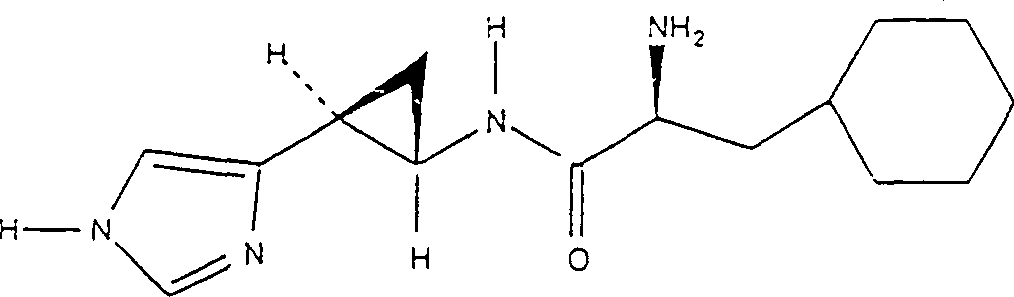
3(S)-(1H-5-咪唑基)-2(R)-环丙胺L-环己基丙氨酸酰胺和3(R)-(1H-5-咪唑基)-2(S)-环丙胺L-环己基丙氨酸酰胺的制备3(S)-(1H-5-imidazolyl)-2(R)-cyclopropylamine L-cyclohexylalanine amide and 3(R)-(1H-5-imidazolyl)-2(S)-cyclo Preparation of Alanine L-Cyclohexylalanine Amide
将Boc-环己基丙氨酸-二环己胺盐(0.497g,1.1mM)加到乙酸乙酯(25mL)和0.5N HCl(25mL)的混合物中30分钟。分离乙酸乙酯相,用水(3×100mL)洗涤,MgSO4干燥,蒸发后得到Boc-环己基丙氨酸游离酸(1.1mM)。将该酸溶解于25mL THF,并在N2中冷却到5℃。通过用N-甲基吗啉(110μL,1mM)和氯甲酸异丁酯(130μL,1mM)处理将该酸转化成混合酐。搅拌20分钟后加入2(R)-3(S)-(1H-5-咪唑基)-环丙胺和2(S)-3(R)-(1H-5-咪唑基)-环丙胺外消旋混合物(200mg,1mM)和三乙胺(284μL,2mM)的2mL水溶液。2小时后将反应混合物在乙酸乙酯(50mL)和水(50mL)之间分配,先后用饱和碳酸氢钠溶液和水洗涤乙酸乙酯相,硫酸钠干燥,过滤,并真空蒸发,得到BOC保护的胺3(S)-(1H-5-咪唑基)-2(R)-环丙胺L-环己基丙氨酸酰胺及其非对映体3(R)-(1H-5-咪唑基)-2(S)-环丙胺L-环己基丙氨酸酰胺。在室温下直接用三氟乙酸(5mL)处理粗胺30分钟除去BOC保护基。蒸发TFA,剩余物用乙醚研制,得到3(S)-(1H-5-咪唑基)-2(R)-环丙胺L-环己基丙氨酸酰胺和3(R)-(1H-5-咪唑基)-2(S)-环丙胺L-环己基丙氨酸酰胺非对映体混合物的二-三氟乙酸盐(300mg)。用反相HPLC分离该非对映体。

NMH(D2O,300MHz):d8.44(s,1H),7.18(s,1H),3.88(m,1H),2.87(m,1H),NMH (D 2 O, 300MHz): d8.44(s, 1H), 7.18(s, 1H), 3.88(m, 1H), 2.87(m, 1H),
2.06(m,1H),1.6(m,6H),1.27(m,2H),1.1(m,5H),0.88(m,2H)2.06(m, 1H), 1.6(m, 6H), 1.27(m, 2H), 1.1(m, 5H), 0.88(m, 2H)
质谱:(+FAB):[277(M+1)+,100%]MW=276.3839,C15H24N4O1.Mass spectrum: (+FAB): [277(M+1) + , 100%] MW=276.3839, C 15 H 24 N 4 O 1 .
HPLC分析:CH3CN/H2O/0.1% TFA;梯度:1n,0%,25ms,25%,30ms,100%:HPLC analysis: CH 3 CN/H 2 O/0.1% TFA; Gradient: 1n, 0%, 25ms, 25%, 30ms, 100%:
rt.18.773min.rt.18.773min.
实施例14和15Example 14 and 15
3(S)-(1H-5-咪唑基)-2(R)-环丙胺L-八氢-吲哚基-2-羧酸酰胺和3(R)-(1H-5-咪唑基)-2(S)-环丙胺L-八氢-吲哚基-2-羧酸酰胺的制备3(S)-(1H-5-imidazolyl)-2(R)-cyclopropylamine L-octahydro-indolyl-2-carboxylic acid amide and 3(R)-(1H-5-imidazolyl)- Preparation of 2(S)-cyclopropylamine L-octahydro-indolyl-2-carboxamide
除用L-八氢-吲哚基-2-羧酸代替L-环己基丙氨酸外,其它按实施例12和13所述方法进行,得到3(S)-(1H-5-咪唑基)-2(R)-环丙胺L-八氢-吲哚基-2-羧酸酰胺和3(R)-(1H-5-咪唑基)-2(S)-环丙胺L-八氢-吲哚基-2-羧酸酰胺。Except replacing L-cyclohexylalanine with L-octahydro-indolyl-2-carboxylic acid, other methods were carried out as described in Examples 12 and 13 to obtain 3(S)-(1H-5-imidazolyl )-2(R)-cyclopropylamine L-octahydro-indolyl-2-carboxamide and 3(R)-(1H-5-imidazolyl)-2(S)-cyclopropylamine L-octahydro- Indolyl-2-carboxylic acid amide.
实施例14 Example 14
二-三氟乙酸盐NMR(D2O,300MHz):d8.4(s,1H),7.06(s,1H),4.25(m,1H),3.65(m,1H),2.8(m,1H),2.30(m,2H),2.2-0.90(m,12H).质谱(+FAB):[275(M+1)+,100%]MW=274.3678,O15H22N4O1.HPLC分析:CH3CN/H2O/0.1%TFA;梯度:1nn,0%,20ms,20%,25ms,100%,30ms,0%;rt.14.54min.Di-trifluoroacetate NMR (D 2 O, 300MHz): d8.4(s, 1H), 7.06(s, 1H), 4.25(m, 1H), 3.65(m, 1H), 2.8(m, 1H), 2.30(m, 2H), 2.2-0.90(m, 12H). Mass spectrum (+FAB): [275(M+1) + , 100%] MW=274.3678, O 15 H 22 N 4 O 1 . HPLC analysis: CH 3 CN/H 2 O/0.1%TFA; Gradient: 1nn, 0%, 20ms, 20%, 25ms, 100%, 30ms, 0%; rt.14.54min.
实施例15 Example 15
二-三氟乙酸盐NMR(D2O,300MHz):d8.4(s,1H),7.06(s,1H),4.25(m,1H),3.65(m,1H),2.8(m,1H),2.30(m,2H),2.1-1.0(m,12H).质谱(+FAB):[275(M+1)+,100%]MW=274.3678,C15H22N4O1.HPLC分析:CH3CN/H2O/0.1%TFA;梯度:1nn,0%,20ms.20%,25ms,100%,30ms,0%:rt.16.03min.实施例16
步骤1 step 1
1(R)-[(1-三苯基甲基-5-咪唑基)]-2(S)-环丙基-6-环己基-顺-3-己烯和1(S)-[(1-三苯基甲基-5-咪唑基)]-2(R)-环丙基-6-环己基-顺-3-己烯外消旋混合物的制备1(R)-[(1-triphenylmethyl-5-imidazolyl)]-2(S)-cyclopropyl-6-cyclohexyl-cis-3-hexene and 1(S)-[( Preparation of 1-triphenylmethyl-5-imidazolyl)]-2(R)-cyclopropyl-6-cyclohexyl-cis-3-hexene racemic mixture
在室温和N2中将3-环己基-丙基三苯基碘化鏻(1.36g,2.64mM).悬浮于100mL无水THF。加入氨化钠(0.102g,2.64mM),并在室温搅拌所得橙红色溶液1小时。将由3-环己基-丙基三苯基碘化鏻产生的内鎓盐溶液冷却到-78℃,并在1小时之内滴加完3(R)-[(1-三苯基甲基-5-咪唑基)]-2(S)-环丙基甲醛和3(S)-[(1-三苯基甲基-5-咪唑基)]-2(R)-环丙基甲醛外消旋混合物(1.0g,2.64mM)的THF溶液(35mL)。加完醛后用5小时将反应缓慢升至室温。用氯化铵饱和溶液(100mL)淬灭反应,并用2×150mL乙酸乙酯萃取。分离乙酸乙酯相,硫酸镁干燥,过滤,真空蒸发得到粗链烯。用硅胶柱色谱纯化,得到327mg 1(R)-[(1-三苯基甲基-5-咪唑基)]-2(S)-环丙基-6-环己基-顺-3-己烯和1(S)-[(1-三苯基甲基-5-咪唑基)]-2(R)-环丙基-6-环己基-顺-3-己烯外消旋混合物。NMR(CDCl3,300MHz):d7.34-7.08(m,15H),6.96(d,1H),6.55(d,1H),5.30(m,1H).4.84(m,1H),2.14(m,1H),2.00(m,1H),1.93(m,1H),1.78-0.76(18H).Ma质谱:(DCl/NH3):[488(M+1)+]MW=486.7024,C25H38N2.3-Cyclohexyl-propyltriphenylphosphonium iodide (1.36 g, 2.64 mM). was suspended in 100 mL of anhydrous THF at room temperature under N2 . Sodium amide (0.102 g, 2.64 mM) was added and the resulting orange-red solution was stirred at room temperature for 1 hour. Cool the ylide solution produced by 3-cyclohexyl-propyltriphenylphosphonium iodide to -78°C, and add 3(R)-[(1-triphenylmethyl- 5-imidazolyl)]-2(S)-cyclopropylcarbaldehyde and 3(S)-[(1-triphenylmethyl-5-imidazolyl)]-2(R)-cyclopropylcarbaldehyde The mixture (1.0 g, 2.64 mM) was spun in THF (35 mL). After the addition of the aldehyde was complete, the reaction was slowly warmed to room temperature over 5 hours. The reaction was quenched with saturated ammonium chloride solution (100 mL) and extracted with 2 x 150 mL ethyl acetate. The ethyl acetate phase was separated, dried over magnesium sulfate, filtered and evaporated in vacuo to give the crude alkene. Purify by silica gel column chromatography to obtain 327 mg of 1(R)-[(1-triphenylmethyl-5-imidazolyl)]-2(S)-cyclopropyl-6-cyclohexyl-cis-3-hexene And 1(S)-[(1-triphenylmethyl-5-imidazolyl)]-2(R)-cyclopropyl-6-cyclohexyl-cis-3-hexene racemic mixture. NMR (CDCl 3 , 300MHz): d7.34-7.08(m, 15H), 6.96(d, 1H), 6.55(d, 1H), 5.30(m, 1H).4.84(m, 1H), 2.14(m , 1H), 2.00(m, 1H), 1.93(m, 1H), 1.78-0.76(18H).Ma mass spectrum: (DCl/NH 3 ): [488(M+1) + ]MW=486.7024, C 25 H 38 N 2 .
步骤2 Step 2
将1(R)-[(1-三苯基甲基-5-咪唑基)]-2(S)-环丙基-6-环己基-顺-3-己烯和1(S)-[(1-三苯基甲基-5-咪唑基)]-2(R)-环丙基-6-环己基-顺-3-己烯外消旋混合物(0.320g,0.657mM)溶解于10mL 90%乙酸/10%水。将反应混合物在60℃加热2小时。冷却反应混合物,加入50mL 10%氢氧化钠溶液,用氯仿萃取(2×50mL)。合并氯仿萃取液,MgSO4干燥并真空蒸发。经硅胶色谱纯化后得到103mg 1(R)-[(1H-5-咪唑基)1-2(S)-环丙基-6-环己基-顺-3-己烯和1(S)-[(1H-5-咪唑基)]-2(R)-环丙基-6-环己基-顺-3-己烯外消旋混合物,为黄色粘稠玻璃状物质。NMR(CD3OD,300MHz):d7.6(s,1H),6.82(s,1H),5.34(m,1H)4.90(m,1H),2.18(m,2H),1.90(m,3H),1.60(5H),1.4-0.7(m,9H).质谱(DCl/NH3):[245(M+1)+,100%] MW=244.3814,C16H24N2.1(R)-[(1-triphenylmethyl-5-imidazolyl)]-2(S)-cyclopropyl-6-cyclohexyl-cis-3-hexene and 1(S)-[ (1-Triphenylmethyl-5-imidazolyl)]-2(R)-cyclopropyl-6-cyclohexyl-cis-3-hexene racemic mixture (0.320g, 0.657mM) was dissolved in 10mL 90% acetic acid/10% water. The reaction mixture was heated at 60 °C for 2 hours. The reaction mixture was cooled, added 50 mL of 10% sodium hydroxide solution, and extracted with chloroform (2×50 mL). The combined chloroform extracts were dried over MgSO4 and evaporated in vacuo. After purification by silica gel chromatography, 103 mg of 1(R)-[(1H-5-imidazolyl)1-2(S)-cyclopropyl-6-cyclohexyl-cis-3-hexene and 1(S)-[ (1H-5-imidazolyl)]-2(R)-cyclopropyl-6-cyclohexyl-cis-3-hexene racemic mixture, yellow viscous glassy substance. NMR (CD 3 OD, 300MHz): d7.6(s, 1H), 6.82(s, 1H), 5.34(m, 1H), 4.90(m, 1H), 2.18(m, 2H), 1.90(m, 3H ), 1.60(5H), 1.4-0.7(m, 9H). Mass spectrum (DCl/NH 3 ): [245(M+1) + , 100%] MW=244.3814, C 16 H 24 N 2 .
实施例17 Example 17
1(R)-[(1H-5-咪唑基)]-2(S)-环丙基-6-环己基-反-3-己烯和1(S)-[(1H-5-咪唑基)]-2(R)-环丙基-6-环己基-反-3-己烯外消旋混合物的制备1(R)-[(1H-5-imidazolyl)]-2(S)-cyclopropyl-6-cyclohexyl-trans-3-hexene and 1(S)-[(1H-5-imidazolyl) )]-2(R)-Cyclopropyl-6-cyclohexyl-trans-3-hexene racemic mixture
步骤1 step 1
3-环己基丙基二苯砜(1.1g,4.13mM)溶解于40mL无水THF,并在N2中冷却到-78℃。滴加n-BuLi(1.65mL,4.13mM),在-78℃搅拌溶液1小时。在15分钟之内滴加完3(R)-[(1-三苯基甲基-5-咪唑基)]-2(S)-环丙基甲醛和3(S)-[(1-三苯基甲基-5-咪唑基)]-2(R)-环丙基甲醛外消旋混合物(1.56g,4.13mM)的THF溶液(40mL)。加完醛后将反应搅拌30分钟,然后用氯化铵饱和溶液(200mL)淬灭反应。用2×150mL乙酸乙酯萃取反应混合物。分离乙酸乙酯相,硫酸镁干燥,真空蒸发得到粗产链烯。用硅胶柱色谱纯化,得到1.01g1(R)-[(1-三苯基甲基-5-咪唑基)]-2(S)-环丙基-3-羟基-4-二苯砜-6-环己基-己烷和1(S)-[(1-三苯基甲基-5-咪唑基)]-2(R)-环丙基-3-羟基-4-苯砜-6-环己基-己烷外消旋混合物。NMR(CDCl3,300MHz):d7.92-7.5(m,5H),7.34-7.04(m,15H),6.6-6.46(4双重峰,2H),3.76(m,0.5H),3.67(m,0.5H),3.14(m,0.5H),3.02(m,0.5H),2.2-0.6(m,19H).3-Cyclohexylpropyldiphenylsulfone (1.1 g, 4.13 mM) was dissolved in 40 mL of anhydrous THF and cooled to -78 °C under N2 . n-BuLi (1.65 mL, 4.13 mM) was added dropwise, and the solution was stirred at -78°C for 1 hour. Add 3(R)-[(1-triphenylmethyl-5-imidazolyl)]-2(S)-cyclopropylcarbaldehyde and 3(S)-[(1-tri phenylmethyl-5-imidazolyl)]-2(R)-cyclopropylcarbaldehyde racemic mixture (1.56 g, 4.13 mM) in THF (40 mL). The reaction was stirred for 30 minutes after the aldehyde addition was complete, then quenched with saturated ammonium chloride (200 mL). The reaction mixture was extracted with 2 x 150 mL ethyl acetate. The ethyl acetate phase was separated, dried over magnesium sulfate, and evaporated in vacuo to give the crude alkene. Purified by silica gel column chromatography to obtain 1.01 g of 1(R)-[(1-triphenylmethyl-5-imidazolyl)]-2(S)-cyclopropyl-3-hydroxyl-4-diphenylsulfone-6 -cyclohexyl-hexane and 1(S)-[(1-triphenylmethyl-5-imidazolyl)]-2(R)-cyclopropyl-3-hydroxy-4-phenylsulfone-6-cyclo Hexyl-hexane racemic mixture. NMR (CDCl 3 , 300MHz): d7.92-7.5(m, 5H), 7.34-7.04(m, 15H), 6.6-6.46(4 doublet, 2H), 3.76(m, 0.5H), 3.67(m , 0.5H), 3.14(m, 0.5H), 3.02(m, 0.5H), 2.2-0.6(m, 19H).
步骤2 Step 2
在室温和N2中将1(R)-[(1-三苯基甲基-5-咪唑基)]-2(S)-环丙基-3-羟基-4-二苯砜-6-环己基-己烷和1(S)-[(1-三苯基甲基-5-咪唑基)]-2(R)-环丙基-3-羟基-4-二苯砜-6-环己基-己烷外消旋混合物(0.260g,0.40mM)溶解于20mL无水二氯甲烷。先后加入三乙胺(0.116mL,0.80mM)和乙醛(0.047mL)。将反应在室温搅拌5天,加水。分离二氯甲烷相,硫酸镁干燥,过滤并真空蒸发。经硅胶柱色谱纯化和乙酸乙酯/己烷(3∶7)洗脱后得到260mg 1(R)-[(1-三苯基甲基-5-咪唑基)]-2(S)-环丙基-3-乙酸基-4-二苯砜-6-环己基-己烷和1(S)-[(1-三苯基甲基-5-咪唑基)]-2(R)-环丙基-3-乙酸基-4-二苯砜-6-环己基-己烷外消旋混合物,为白色泡沫。NMR(CDCl3,300MHz):d7.92-7.5(m,5H),7.34-7.04(m,15H),6.6-6.46(4双重峰,2H),5.17(m,0.5H),5.04(m,0.5H),3.76(m,0.5H),3.02(m,0.5H),2.2-0.6(m,19H),2.1(s,3H)CHN:C43H46N2S1O4,MW=686.9144,计算值:C:75.19,H:6.75,N:4.07;实测值:C:74.79,H:6.89,N:4.101(R)-[(1-triphenylmethyl-5-imidazolyl)]-2(S)-cyclopropyl-3- hydroxy -4-diphenylsulfone-6- Cyclohexyl-hexane and 1(S)-[(1-triphenylmethyl-5-imidazolyl)]-2(R)-cyclopropyl-3-hydroxy-4-diphenylsulfone-6-cyclo Hexyl-hexane racemic mixture (0.260 g, 0.40 mM) was dissolved in 20 mL of anhydrous dichloromethane. Triethylamine (0.116 mL, 0.80 mM) was added followed by acetaldehyde (0.047 mL). The reaction was stirred at room temperature for 5 days and water was added. The dichloromethane phase was separated, dried over magnesium sulfate, filtered and evaporated in vacuo. Purification by column chromatography on silica gel and eluting with ethyl acetate/hexane (3:7) gave 260 mg of 1(R)-[(1-triphenylmethyl-5-imidazolyl)]-2(S)-cyclo Propyl-3-acetoxy-4-diphenylsulfone-6-cyclohexyl-hexane and 1(S)-[(1-triphenylmethyl-5-imidazolyl)]-2(R)-cyclo Propyl-3-acetoxy-4-diphenylsulfone-6-cyclohexyl-hexane racemic mixture as white foam. NMR (CDCl 3 , 300MHz): d7.92-7.5(m, 5H), 7.34-7.04(m, 15H), 6.6-6.46(4 doublet, 2H), 5.17(m, 0.5H), 5.04(m , 0.5H), 3.76(m, 0.5H), 3.02(m, 0.5H), 2.2-0.6(m, 19H), 2.1(s, 3H) CHN: C 43 H 46 N 2 S 1 O 4 , MW = 686.9144, calculated: C: 75.19, H: 6.75, N: 4.07; found: C: 74.79, H: 6.89, N: 4.10
步骤3 Step 3
在0℃和N2中将1(R)-[(1-三苯基甲基-5-咪唑基)]-2(S)-环丙基-3-乙酸基-4-二苯砜-6-环己基-己烷和1(S)-[(1-三苯基甲基-5-咪唑基)]-2(R)-环丙基-3-乙酸基-4-二苯砜-6-环己基-己烷外消旋混合物(0.103g,0.15mM)溶解于8mL无水甲醇。先后加入Na2HPO4(0.084g,0.60mM)和3g 2%Na(Hg)。将反应混合物在0-5℃搅拌2小时,然后经硅藻土垫过滤。蒸发滤液,剩余物在CHCl3和水之间分配。分离CHCl3相,MgSO4干燥,过滤并真空蒸发。经TLC纯化后得到52mg 1(R)-[(1-三苯基甲基-5-咪唑基)]-2(S)-环丙基-6-环己基-反-3-己烯和1(S)-[(1-三苯基甲基-5-咪唑基)]-2(R)-环丙基-6-环己基-反-3-己烯外消旋混合物,为黄色粘稠玻璃状物质。1( R )-[(1-triphenylmethyl-5-imidazolyl)]-2(S)-cyclopropyl-3-acetoxy-4-diphenylsulfone- 6-cyclohexyl-hexane and 1(S)-[(1-triphenylmethyl-5-imidazolyl)]-2(R)-cyclopropyl-3-acetoxy-4-diphenylsulfone- 6-Cyclohexyl-hexane racemic mixture (0.103 g, 0.15 mM) was dissolved in 8 mL of dry methanol. Na 2 HPO 4 (0.084 g, 0.60 mM) was added followed by 3 g of 2% Na(Hg). The reaction mixture was stirred at 0-5°C for 2 hours, then filtered through a pad of celite. The filtrate was evaporated and the residue was partitioned between CHCl3 and water. The CHCl 3 phase was separated, dried over MgSO 4 , filtered and evaporated in vacuo. After purification by TLC, 52 mg of 1(R)-[(1-triphenylmethyl-5-imidazolyl)]-2(S)-cyclopropyl-6-cyclohexyl-trans-3-hexene and 1 (S)-[(1-Triphenylmethyl-5-imidazolyl)]-2(R)-cyclopropyl-6-cyclohexyl-trans-3-hexene racemic mixture, yellow viscous Glassy substance.
NMR(CDCl3,300MHz):d7.34-7.08(m,15H),6.50(d,1H),6.53(d,1H),5.50(m.NMR (CDCl 3 , 300MHz): d7.34-7.08(m, 15H), 6.50(d, 1H), 6.53(d, 1H), 5.50(m.
0.5H),5.30(m,0.5H),5.06(m,0.5H),4.84 (m,0.5H),2.14(m,1H),2.00(m,1H),0.5H), 5.30(m, 0.5H), 5.06(m, 0.5H), 4.84(m, 0.5H), 2.14(m, 1H), 2.00(m, 1H),
1.93(m,1H),1.78-0.76(18H).1.93(m, 1H), 1.78-0.76(18H).
步骤4 Step 4
在1(R)-[(1-三苯基甲基-5-咪唑基)]-2(S)-环丙基-6-环己基-反-3-己烯和1(S)-[(1-三苯基甲基-5-咪唑基)]-2(R)-环丙基-6-环己基-反-3-己烯外消旋混合物(0.052g,0.106mM)在1N HCl(6mL)和乙醇(2mL)中和80℃加热30分钟。通过旋转蒸发除去挥发物,剩余物在CHCl3(20mL)和10%NaOH溶液之间分配。分离CHCl3相,MgSO4干燥,过滤并真空蒸发。经硅TLC纯化后得到17mg 1(R)-[(1H-5-咪唑基)]-2(S)-环丙基-6-环己基-反-3-己烯和1(S)-[(1H-5-咪唑基)]-2(R)-环丙基-6-环己基-反-3-己烯外消旋混合物。In 1(R)-[(1-triphenylmethyl-5-imidazolyl)]-2(S)-cyclopropyl-6-cyclohexyl-trans-3-hexene and 1(S)-[ (1-Triphenylmethyl-5-imidazolyl)]-2(R)-cyclopropyl-6-cyclohexyl-trans-3-hexene racemic mixture (0.052g, 0.106mM) in 1N HCl (6 mL) and ethanol (2 mL) and heated at 80°C for 30 minutes. Volatiles were removed by rotary evaporation and the residue was partitioned between CHCl3 (20 mL) and 10% NaOH solution. The CHCl 3 phase was separated, dried over MgSO 4 , filtered and evaporated in vacuo. Purification by silica TLC afforded 17 mg of 1(R)-[(1H-5-imidazolyl)]-2(S)-cyclopropyl-6-cyclohexyl-trans-3-hexene and 1(S)-[ (1H-5-Imidazolyl)]-2(R)-cyclopropyl-6-cyclohexyl-trans-3-hexene racemic mixture.
NMR(CDCl3,300MHz):d7.34-7.08(m,15H),6.50(d,1H),6.53(d,1H),5.50(m,NMR (CDCl 3 , 300MHz): d7.34-7.08(m, 15H), 6.50(d, 1H), 6.53(d, 1H), 5.50(m,
0.5H),5.30(m,0.5H),5.06(m,0.5H),4.84(m,0.5H),2.14(m,1H),2.00(m,1H),0.5H), 5.30(m, 0.5H), 5.06(m, 0.5H), 4.84(m, 0.5H), 2.14(m, 1H), 2.00(m, 1H),
1.93(m,1H),1.78-0.76(18H).1.93(m, 1H), 1.78-0.76(18H).
质谱(DCl/NH3):[245(M+1)+,100%]MW=244.3814,C16H24N2.Mass spectrum (DCl/NH 3 ): [245(M+1) + , 100%] MW=244.3814, C 16 H 24 N 2 .
实施例183(S)-(1H-5-咪唑基)-2(R)-环丙基-3’-环己基丙醚和3(R)-(1H-5-咪唑基)-2(S)-环丙基-3’-环己基丙醚外消旋混合物的制备 Example 183 (S)-(1H-5-imidazolyl)-2(R)-cyclopropyl-3'-cyclohexyl propyl ether and 3(R)-(1H-5-imidazolyl)-2(S Preparation of )-cyclopropyl-3'-cyclohexyl propyl ether racemic mixture
在0℃和N2中向NaH(0.024g,1mM)的无水DMF(3mL)悬浮液内加入3(R)-(1-三苯基甲基-5-咪唑基)-2(S)-环丙醇和3(S)-(1-三苯基甲基-5-咪唑基)-2(R)-环丙醇外消旋混合物(0.190g,0.5mM)。搅拌30分钟后加入3-环己基丙基碘化物(0.372g,1.5mM)的1mL DMF,并在0℃搅拌反应20分钟。用水(20mL)淬灭反应,用乙酸乙酯(2×30mL)萃取。乙酸乙酯相用盐水洗涤,分离,MgSO4干燥,过滤并真空蒸发,得到3(R)-(1-三苯基甲基-5-咪唑基)-2(S)-环丙基-3’-环己基丙醚和3(S)-(1-三苯基甲基-5-咪唑基)-2(R)-环丙基-3’-环己基丙醚外消旋混合物。直接用2N HCl(10mL)处理并在80℃加热30分钟,除去三苯甲基保护基。冷却反应混合物,过滤并真空蒸发滤液,用乙醚研制后得到50mg3(S)-(1H-5-咪唑基)-2(R)-环丙基-3’-环己基丙醚和3(R)-(1H-5-咪唑基)-2(S)-环丙基-3’-环己基丙醚外消旋混合物。To a suspension of NaH (0.024 g, 1 mM) in anhydrous DMF (3 mL) at 0 °C under N2 was added 3(R)-(1-triphenylmethyl-5-imidazolyl)-2(S) - Racemic mixture of cyclopropanol and 3(S)-(1-triphenylmethyl-5-imidazolyl)-2(R)-cyclopropanol (0.190 g, 0.5 mM). After stirring for 30 minutes, 3-cyclohexylpropyl iodide (0.372 g, 1.5 mM) in 1 mL of DMF was added and the reaction was stirred at 0 °C for 20 minutes. The reaction was quenched with water (20 mL), extracted with ethyl acetate (2 x 30 mL). The ethyl acetate phase was washed with brine, separated, dried over MgSO , filtered and evaporated in vacuo to give 3(R)-(1-triphenylmethyl-5-imidazolyl)-2(S)-cyclopropyl-3 Racemic mixture of '-cyclohexylpropyl ether and 3(S)-(1-triphenylmethyl-5-imidazolyl)-2(R)-cyclopropyl-3'-cyclohexylpropyl ether. The trityl protecting group was removed by direct treatment with 2N HCl (10 mL) and heating at 80°C for 30 minutes. The reaction mixture was cooled, filtered and the filtrate evaporated in vacuo to give 50 mg of 3(S)-(1H-5-imidazolyl)-2(R)-cyclopropyl-3'-cyclohexylpropyl ether and 3(R) -(1H-5-Imidazolyl)-2(S)-cyclopropyl-3'-cyclohexylpropyl ether racemic mixture.
NMR(CDCl3,300MHz):d:8.00(d,1H),7.26(d,1H),3.60(m,3H),1.72(m,1H),1.48NMR (CDCl 3 , 300MHz): d: 8.00 (d, 1H), 7.26 (d, 1H), 3.60 (m, 3H), 1.72 (m, 1H), 1.48
(m,1H),1.58(m,11H),1.24(4H),0.96(m,1H),0.75(m,1H).(m, 1H), 1.58(m, 11H), 1.24(4H), 0.96(m, 1H), 0.75(m, 1H).
质谱:(DCl/NH3)[M+1,263,100%)]MW=262.3974:C16H25O1N2 Mass spectrum: (DCl/NH 3 )[M+1, 263, 100%)] MW=262.3974: C 16 H 25 O 1 N 2
实施例191(S)-(1H-5-咪唑基)-2(R)-环丙基-3-羟基-6-环己基己烷和1(R)-(1H-5-咪唑基)-2(S)-环丙基-3-羟基-6-环己基己烷外消旋混合物的制备 Example 191(S)-(1H-5-imidazolyl)-2(R)-cyclopropyl-3-hydroxy-6-cyclohexylhexane and 1(R)-(1H-5-imidazolyl)- Preparation of 2(S)-cyclopropyl-3-hydroxy-6-cyclohexylhexane racemic mixture
10分钟内在冷却到-20℃的3-(1-三苯基甲基-5-咪唑基)-2(S)-3(R)-环丙基-3’-环己基丙酮和3-(1-三苯基甲基-5-咪唑基)-2(R)-3(S)-环丙基-3’-环己基丙酮外消旋混合物(251mg,0.5mM)的15mL甲醇溶液中分批加入NaBH4(185mg,5mM)。10分钟后反应用KHSO4溶液(5mL)淬灭。将反应混合物在乙酸乙酯和水(50/50)之间分配。分离乙酸乙酯相,MgSO4干燥,过滤并真空蒸发,得到粗醇。将该醇加到2N HCl(10mL)中并在80℃加热30分钟。冷却反应混合物,过滤并真空蒸发滤液,用乙醚研制后得到48mg 1(S)-(1H-5-咪唑基)-2(R)-环丙基-3-羟基-6-环己基己烷和1(R)-(1H-5-咪唑基)-2(S)-环丙基-3-羟基-6-环己基己烷外消旋混合物。3-(1-triphenylmethyl-5-imidazolyl)-2(S)-3(R)-cyclopropyl-3'-cyclohexylacetone and 3-( 1-Triphenylmethyl-5-imidazolyl)-2(R)-3(S)-cyclopropyl-3'-cyclohexylacetone racemic mixture (251mg, 0.5mM) in 15mL methanol solution NaBH4 (185mg, 5mM) was added in batches. After 10 min the reaction was quenched with KHSO 4 solution (5 mL). The reaction mixture was partitioned between ethyl acetate and water (50/50). The ethyl acetate phase was separated, dried over MgSO4 , filtered and evaporated in vacuo to give crude alcohol. The alcohol was added to 2N HCl (10 mL) and heated at 80 °C for 30 minutes. The reaction mixture was cooled, filtered and the filtrate evaporated in vacuo to give 48 mg of 1(S)-(1H-5-imidazolyl)-2(R)-cyclopropyl-3-hydroxy-6-cyclohexylhexane after trituration with ether and 1(R)-(1H-5-imidazolyl)-2(S)-cyclopropyl-3-hydroxy-6-cyclohexylhexane racemic mixture.
NMR(CD3OD,300MHz):d8.8(d,1H),7.37(m,1H),2.07(m,2H),1.74(m,2H),NMR (CD 3 OD, 300MHz): d8.8(d, 1H), 7.37(m, 1H), 2.07(m, 2H), 1.74(m, 2H),
1.69(m,1H),1.55(m,1H),1.44(m,1H),1.32-1.10(m,13H),0.87(m,2H).1.69(m, 1H), 1.55(m, 1H), 1.44(m, 1H), 1.32-1.10(m, 13H), 0.87(m, 2H).
质谱(DCl/NH3);263(M+1)+ MW=262.3974;C16H26N2O1.Mass spectrum (DCl/NH 3 ); 263 (M+1) + MW = 262.3974; C 16 H 26 N 2 O 1 .
实施例20和211(S)-(1H-5-咪唑基)-2(R)-环丙基-5(S)-氨基-6-环己基-3-顺-己烯和1(S)-(1H-5-咪唑基)-2(R)-环丙基-5(S)-氨基-6-环己基-3-反-己烯外消旋混合物的制备
步骤1 step 1
将3-环己基-1N-BOC-氨基-丙基二苯砜(3.4g,9.2mmol)溶解于150mL无水THF,并在N2中冷却到-78℃。通过注射器滴加n-BuLi(2.5M,7.3mL,18.3mmol),并在-78℃搅拌反应混合物1小时。将3-(1-三苯基甲基-5-咪唑基)-2-环丙基丙醛(3.5g,9.2mmol)溶解于100mL无水THF,并通过注射器缓慢加到砜阴离子的THF溶液中。加完后将反应搅拌1小时。通过加入氯化铵饱和溶液(500mL)淬灭反应,然后用乙酸乙酯(2×150mL)萃取。分离乙酸乙酯相,MgSO4干燥,过滤并真空蒸发,得到黄色粘稠的油。粗产物经硅胶柱色谱纯化,用乙酸乙酯/己烷(3∶7)洗脱,得到4.6g 1-(1-三苯基甲基-5-咪唑基)-环丙基-3-羟基-4-二苯砜-5-(N-BOC)-氨基-6-环己基-己烷外消旋混合物,为白色固体。3-Cyclohexyl-1N-BOC-amino-propyldiphenylsulfone (3.4 g, 9.2 mmol) was dissolved in 150 mL of anhydrous THF and cooled to -78 °C under N2 . n-BuLi (2.5M, 7.3 mL, 18.3 mmol) was added dropwise via syringe, and the reaction mixture was stirred at -78 °C for 1 h. 3-(1-Triphenylmethyl-5-imidazolyl)-2-cyclopropylpropanal (3.5 g, 9.2 mmol) was dissolved in 100 mL of anhydrous THF and slowly added to the THF solution of the sulfone anion via syringe middle. The reaction was stirred for 1 hour after the addition was complete. The reaction was quenched by adding a saturated solution of ammonium chloride (500 mL), then extracted with ethyl acetate (2 x 150 mL). The ethyl acetate phase was separated, dried over MgSO4 , filtered and evaporated in vacuo to give a yellow viscous oil. The crude product was purified by silica gel column chromatography, eluting with ethyl acetate/hexane (3:7), to obtain 4.6 g of 1-(1-triphenylmethyl-5-imidazolyl)-cyclopropyl-3-hydroxy -4-Diphenylsulfone-5-(N-BOC)-amino-6-cyclohexyl-hexane racemic mixture as a white solid.
步骤2 Step 2
将1-(1-三苯基甲基-5-咪唑基)-环丙基-3-羟基-4-二苯砜-5-(N-BOC)-氨基-6-环己基-己烷(4.6g,6.06mmol)溶解于无水甲醇,并在N2中将反应冷却到0℃。加入2%Na(Hg)(两份15g),并将反应混合物搅拌1小时。之后,加入第二份Na(Hg),并在升至室温的同时搅拌1小时。用硅藻土垫过滤反应混合物,用100cc乙酸乙酯洗涤该垫。真空蒸发滤液,剩余物在CH2Cl2和水(100∶100mL)之间分配。分离CH2Cl2相,MgSO4干燥,过滤并真空浓缩,得到黄色油。粗产物经柱色谱纯化和乙酸乙酯/己烷(4∶6)洗脱后得到1-(1-三苯基甲基-5-咪唑基)-环丙基-5-(N-BOC)-氨基-6-环己基-己烯,为白色固体。1-(1-triphenylmethyl-5-imidazolyl)-cyclopropyl-3-hydroxyl-4-diphenylsulfone-5-(N-BOC)-amino-6-cyclohexyl-hexane ( 4.6 g, 6.06 mmol) was dissolved in anhydrous methanol and the reaction was cooled to 0 °C under N2 . 2% Na(Hg) (two 15 g portions) was added and the reaction mixture was stirred for 1 hour. Afterwards, a second portion of Na(Hg) was added and stirred for 1 h while warming to room temperature. The reaction mixture was filtered through a pad of celite, and the pad was washed with 100 cc of ethyl acetate. The filtrate was evaporated in vacuo and the residue was partitioned between CH2Cl2 and water (100:100 mL). The CH2Cl2 phase was separated, dried over MgSO4 , filtered and concentrated in vacuo to give a yellow oil. The crude product was purified by column chromatography and eluted with ethyl acetate/hexane (4:6) to give 1-(1-triphenylmethyl-5-imidazolyl)-cyclopropyl-5-(N-BOC) -Amino-6-cyclohexyl-hexene as a white solid.
NMR(CDCl3,300MHz):d:7.30(m,9H),7.12(m,7H),6.58(m,1H),6.53(m,NMR (CDCl 3 , 300MHz): d: 7.30(m, 9H), 7.12(m, 7H), 6.58(m, 1H), 6.53(m,
1H),5.40(dd,1H),5.20(m,1H),4.9(m,1H),4.48(m,1H),4.30(m,1H),4.101H), 5.40(dd, 1H), 5.20(m, 1H), 4.9(m, 1H), 4.48(m, 1H), 4.30(m, 1H), 4.10
(m,1H),1.96(m,1H),1.74(m,2H),1.64(m,2H),1.58(s,9H),1.42(s,9H),(m, 1H), 1.96(m, 1H), 1.74(m, 2H), 1.64(m, 2H), 1.58(s, 9H), 1.42(s, 9H),
1.36-0.76(m,11H)NMR is of a 60∶40反:顺链烯的混合物。1.36-0.76 (m, 11H) NMR is of a 60:40 trans:cis alkenes mixture.
步骤3 Step 3
将1-(1-三苯基甲基-5-咪唑基)-环丙基-5-(N-BOC)-氨基-6-环己基-己烯(1.87g,3.1mmol)溶解于15cc乙醇。加入50cc 2N HCl,并将混合物在90℃加热1小时。冷却反应混合物,过滤,并用10% NaOH溶液中和到pH7-8。真空蒸发中和的溶液,剩余物在氯仿和水(每个100mL)之间分配。分离氯仿相,硫酸钠干燥,过滤并真空蒸发,得到粗油。该油经硅胶柱色谱纯化并用MeOH/乙酸乙酯/NH4OH(9∶90∶1)洗脱后得到1(S)-(1H-5-咪唑基)-2(R)-环丙基-5-(S)-氨基-6-环己基-3-反-己烯,为浅黄色固体,和1(S)-(1H-5-咪唑基)-2(R)-环丙基-5-(S)-氨基-6-环己基-3-顺-己烯,为黄色油。Dissolve 1-(1-triphenylmethyl-5-imidazolyl)-cyclopropyl-5-(N-BOC)-amino-6-cyclohexyl-hexene (1.87 g, 3.1 mmol) in 15 cc of ethanol . 50cc of 2N HCl was added and the mixture was heated at 90°C for 1 hour. The reaction mixture was cooled, filtered, and neutralized to pH 7-8 with 10% NaOH solution. The neutralized solution was evaporated in vacuo and the residue was partitioned between chloroform and water (100 mL each). The chloroform phase was separated, dried over sodium sulfate, filtered and evaporated in vacuo to give a crude oil. The oil was purified by column chromatography on silica gel eluting with MeOH/ethyl acetate/ NH4OH (9:90:1) to give 1(S)-(1H-5-imidazolyl)-2(R)-cyclopropyl -5-(S)-amino-6-cyclohexyl-3-trans-hexene, as a pale yellow solid, and 1(S)-(1H-5-imidazolyl)-2(R)-cyclopropyl- 5-(S)-Amino-6-cyclohexyl-3-cis-hexene as a yellow oil.
NMR(CDCl3,300MHz)反异构体:d7.49(s,1H),6.76(s,1H),5.46(dd,1H),NMR (CDCl 3 , 300MHz) anti-isomers: d7.49(s, 1H), 6.76(s, 1H), 5.46(dd, 1H),
5.20(dd,1H),3.33(q,1H),1.82(m,1H),1.76-1.66(m,6H),1.36-1.12(m,5.20(dd, 1H), 3.33(q, 1H), 1.82(m, 1H), 1.76-1.66(m, 6H), 1.36-1.12(m,
8H),0.98-0.80(m,3H)8H), 0.98-0.80(m, 3H)
顺异物体:d7.49(s,1H),6.76(s,1H),5.21(t,1H),4.94(t,1H),3.86(q,1H),Cis-different objects: d7.49(s, 1H), 6.76(s, 1H), 5.21(t, 1H), 4.94(t, 1H), 3.86(q, 1H),
2.401.96(m,5H),1.86(m,2H),1.68(m,4H),1.40-1.10(m,5H),0.92(m,2.401.96(m, 5H), 1.86(m, 2H), 1.68(m, 4H), 1.40-1.10(m, 5H), 0.92(m,
2H).2H).
质谱(DCl/NH3):260(M+1)+,MW=259.3835,C16H25N3.Mass spectrum (DCl/NH 3 ): 260(M+1) + , MW=259.3835, C 16 H 25 N 3 .
实施例22 Example 22
手性1(S)-(1H-5-咪唑基)-2(R)-环丙基-6-环己基-3-反-己烯的制备Preparation of chiral 1(S)-(1H-5-imidazolyl)-2(R)-cyclopropyl-6-cyclohexyl-3-trans-hexene
用化合物36(见流程XIII)3-(1-三苯基甲基-5-咪唑基)-2(R)-3(S)-环丙酸丁酯制备手性1(S)-(1H-5-咪唑基)-2(R)-环丙基-6-环己基-3-反-己烯。所用方法与实施例17所述相同。Preparation of chiral 1(S)-(1H -5-imidazolyl)-2(R)-cyclopropyl-6-cyclohexyl-3-trans-hexene. The method used was the same as described in Example 17.
步骤1 step 1
在0℃下将1(S)-(1-三苯基甲基-5-咪唑基)-2(R)-环丙基-3-羟基-4-二苯砜-6-环己基己烷(羟基砜的非对映体混合物)(0.85g,1.32mmol)溶解于50cc甲醇。先后加入二价硫酸钠(1.30g)和11.30g 2% Na(Hg)。将反应混合物在0℃搅拌1小时。除去冰浴,再加入另一份10g 2%Na(Hg),然后将反应混合物在室温搅拌1小时。最后,加入第三批10g 2%Na(Hg),并搅拌反应混合物2小时。用硅藻土垫过滤反应混合物,先后用50cc甲醇和50cc乙醇洗涤该垫。真空蒸发滤液,剩余物在水(100cc)和乙酸乙酯(100cc)之间分配。分离乙酸乙酯相,MgSO4干燥,过滤并真空蒸发。粗产物经硅胶柱色谱纯化,用乙酸乙酯/己烷(1∶9)洗脱,得到485mg粘稠的无色油,为1(S)-(1-三苯基甲基-5-咪唑基)-2(R)-环丙基-6-环己基-3-反-己烯和1(S)-(1-三苯基甲基-5-咪唑基)-2(R)-环丙基-6-环己基-3-顺-己烯的1∶1混合物。1(S)-(1-triphenylmethyl-5-imidazolyl)-2(R)-cyclopropyl-3-hydroxyl-4-diphenylsulfone-6-cyclohexylhexane at 0°C (Mixture of diastereomers of hydroxysulfone) (0.85 g, 1.32 mmol) was dissolved in 50 cc of methanol. Sodium sulfate dibasic (1.30 g) was added followed by 11.30 g of 2% Na(Hg). The reaction mixture was stirred at 0 °C for 1 hour. The ice bath was removed and another 10 g portion of 2% Na(Hg) was added and the reaction mixture was stirred at room temperature for 1 hour. Finally, a third batch of 10 g of 2% Na(Hg) was added and the reaction mixture was stirred for 2 hours. The reaction mixture was filtered through a pad of celite, and the pad was washed with 50 cc of methanol followed by 50 cc of ethanol. The filtrate was evaporated in vacuo and the residue was partitioned between water (100cc) and ethyl acetate (100cc). The ethyl acetate phase was separated, dried over MgSO4 , filtered and evaporated in vacuo. The crude product was purified by silica gel column chromatography, eluting with ethyl acetate/hexane (1:9), to obtain 485 mg of viscous colorless oil as 1(S)-(1-triphenylmethyl-5-imidazole Base)-2(R)-cyclopropyl-6-cyclohexyl-3-trans-hexene and 1(S)-(1-triphenylmethyl-5-imidazolyl)-2(R)-cyclo 1:1 mixture of propyl-6-cyclohexyl-3-cis-hexene.
NMR(CDCl3,300MHz):d7.30(m,9H),7.12(m,7H),6.55(br s,1H),6.52(br s,NMR (CDCl 3 , 300MHz): d7.30(m, 9H), 7.12(m, 7H), 6.55(br s, 1H), 6.52(br s,
1H),5.5(m,1H),5.3(m,1H),5.06(m,1H),4.84(m,1H),2.14(m,2H),1.96(m.1H), 5.5(m, 1H), 5.3(m, 1H), 5.06(m, 1H), 4.84(m, 1H), 2.14(m, 2H), 1.96(m.
2H),1.68(m,5H),1.16(m,5H),0.82(m,3H).NMR是几何异构体的1∶1顺/反混合物。2H), 1.68 (m, 5H), 1.16 (m, 5H), 0.82 (m, 3H). NMR is a 1:1 cis/trans mixture of geometric isomers.
步骤2 Step 2
将1(S)-(1-三苯基甲基-5-咪唑基)-2(R)-环丙基-6-环己基-3-反-己烯和1(S)-(1-三苯基甲基-5-咪唑基)-2(R)-环丙基-6-环己基-3-顺-己烯的1∶1混合物(0.475g)溶解于3cc乙醇。加入40cc 2N HCl,并将混合物在90℃加热1小时。冷却反应混合物,过滤并用10%氢氧化钠溶液中和到pH7。用乙酸乙酯(2×100cc)萃取混合物,分离乙酸乙酯相,MgSO4干燥,过滤并真空蒸发。粗产物经硅胶柱色谱纯化,用乙酸乙酯洗脱,得到66mg(小极性馏分)无色玻璃状物质,为1(S)-(1H-5-咪唑基)-2(R)-环丙基-6-环己基-3-顺-己烯和78mg 1(S)-(1H-5-咪唑基)-2(R)-环丙基-6-环己基-3-反-己烯。1(S)-(1-triphenylmethyl-5-imidazolyl)-2(R)-cyclopropyl-6-cyclohexyl-3-trans-hexene and 1(S)-(1- A 1:1 mixture of triphenylmethyl-5-imidazolyl)-2(R)-cyclopropyl-6-cyclohexyl-3-cis-hexene (0.475 g) was dissolved in 3 cc of ethanol. 40cc 2N HCl was added and the mixture was heated at 90°C for 1 hour. The reaction mixture was cooled, filtered and neutralized to pH7 with 10% sodium hydroxide solution. The mixture was extracted with ethyl acetate (2 x 100cc), the ethyl acetate phase was separated, dried over MgSO4 , filtered and evaporated in vacuo. The crude product was purified by column chromatography on silica gel, eluting with ethyl acetate, to give 66 mg (small polar fraction) of a colorless glassy substance as 1(S)-(1H-5-imidazolyl)-2(R)-cyclo Propyl-6-cyclohexyl-3-cis-hexene and 78mg 1(S)-(1H-5-imidazolyl)-2(R)-cyclopropyl-6-cyclohexyl-3-trans-hexene .
NMR(CDCl3,300MHz):d7.49(d,1H),6.74(d,1H),5.5(dt,1H),5.08(m,1H),NMR (CDCl 3 , 300MHz): d7.49(d, 1H), 6.74(d, 1H), 5.5(dt, 1H), 5.08(m, 1H),
2.90(br s,1H),1.98(m,2H),1.79(m,1H),1.65(m,5H),1.18(m,6H),0.84(m,2.90(br s, 1H), 1.98(m, 2H), 1.79(m, 1H), 1.65(m, 5H), 1.18(m, 6H), 0.84(m,
2H).2H).
实施例23
见实施例22手性1(S)-(1H-5-咪唑基)-2(R)-环丙基-5(S)-氨基-6-环己基-3-顺-己烯的制备。NMR(CDCl3,300MHz):d7.50(d,1H),6.76(d,1H),5.33(dt,1H),4.86(m,1H),2.90(br s,1H),1.88(m,1H),1.82(m,2H),1.85(m,5H),1.20(m,6H),0.86(m,2H).See Example 22 for the preparation of chiral 1(S)-(1H-5-imidazolyl)-2(R)-cyclopropyl-5(S)-amino-6-cyclohexyl-3-cis-hexene. NMR (CDCl 3 , 300MHz): d7.50(d, 1H), 6.76(d, 1H), 5.33(dt, 1H), 4.86(m, 1H), 2.90(br s, 1H), 1.88(m, 1H), 1.82(m, 2H), 1.85(m, 5H), 1.20(m, 6H), 0.86(m, 2H).
实施例24手性1(R)-(1H-5-咪唑基)-2(S)-环丙基-6-环己基-3-顺-己烯的制备Example 24 Preparation of chiral 1(R)-(1H-5-imidazolyl)-2(S)-cyclopropyl-6-cyclohexyl-3-cis-hexene
步骤1 step 1
将3-环己基丙基三苯基碘化鏻(3.6g,6.9mmol)悬浮于150cc无水THF,并将混合物在N2中冷却到0℃。用注射器滴加NaN(TMS)2(1.0M的THF溶液,6.9cc),并将反应混合物在0℃搅拌1小时。将3(R)-(1-三苯基甲基-5-咪唑基)-2(S)-环丙基丙醛(1.7g,4.5mmol)的50cc无水THF滴加到(0.5小时)0℃的上述内鎓盐溶液中。将反应物搅拌1小时,用200cc氯化铵饱和溶液淬灭反应,乙酸乙酯萃取(2×200cc)。分离乙酸乙酯相,MgSO4干燥,过滤并真空蒸发,得到粗油。粗产物经硅胶柱色谱纯化,用CH2Cl2/己烷(1∶1)洗脱,接着用乙酸乙酯/己烷(3∶7)洗脱,得到1.33g淡黄色泡沫,为1(R)-(1-三苯基甲基-5-咪唑基)-2(S)-环丙基-6-环己基-3-顺-己烯。NMR(CDCl3,300MHz):d7.30(m,9H),7.26(d,1H),7.12(m,6H),6.55(d,1H),2.14(m,1H),1.92(m,1H),1.76(m,2H),1.64(m,5H),1.20(m,6H),0.82(m,2H).3-Cyclohexylpropyltriphenylphosphonium iodide (3.6 g, 6.9 mmol) was suspended in 150 cc dry THF, and the mixture was cooled to 0 °C under N2 . NaN(TMS) 2 (1.0 M in THF, 6.9 cc) was added dropwise by syringe, and the reaction mixture was stirred at 0° C. for 1 hour. 3(R)-(1-Triphenylmethyl-5-imidazolyl)-2(S)-cyclopropylpropanal (1.7 g, 4.5 mmol) in 50 cc of anhydrous THF was added dropwise (0.5 h) In the above-mentioned ylide solution at 0°C. The reaction was stirred for 1 hour, quenched with 200 cc of saturated ammonium chloride, and extracted with ethyl acetate (2 x 200 cc). The ethyl acetate phase was separated, dried over MgSO4 , filtered and evaporated in vacuo to give a crude oil. The crude product was purified by silica gel column chromatography, eluting with CH 2 Cl 2 /hexane (1:1), followed by ethyl acetate/hexane (3:7), to give 1.33 g of light yellow foam as 1 ( R)-(1-triphenylmethyl-5-imidazolyl)-2(S)-cyclopropyl-6-cyclohexyl-3-cis-hexene. NMR (CDCl 3 , 300MHz): d7.30(m, 9H), 7.26(d, 1H), 7.12(m, 6H), 6.55(d, 1H), 2.14(m, 1H), 1.92(m, 1H ), 1.76(m, 2H), 1.64(m, 5H), 1.20(m, 6H), 0.82(m, 2H).
步骤2 Step 2
将1(R)-(1-三苯基甲基-5-咪唑基)-2(S)-环丙基-6-环己基-3-顺-己烯(1.33g)溶解于4cc无水乙醇。加入40cc 2NHCl,并将混合物在90℃加热1小时。冷却反应混合物,过滤并用10%氢氧化钠溶液中和滤液至pH7。用乙酸乙酯(2×100cc)萃取滤液,分离乙酸乙酯相,MgSO4干燥,过滤并真空蒸发,得到黄色油。粗产物经硅胶柱色谱纯化,用乙酸乙酯/己烷(6∶4)洗脱,得到488mg黄色油,为手性1(R)-(1H-5-咪唑基)-2(S)-环丙基-6-环己基-3-顺-己烯。Dissolve 1(R)-(1-triphenylmethyl-5-imidazolyl)-2(S)-cyclopropyl-6-cyclohexyl-3-cis-hexene (1.33g) in 4cc dry ethanol. 40cc 2N HCl was added and the mixture was heated at 90°C for 1 hour. The reaction mixture was cooled, filtered and the filtrate was neutralized to pH7 with 10% sodium hydroxide solution. The filtrate was extracted with ethyl acetate (2 x 100cc), the ethyl acetate phase was separated, dried over MgSO4 , filtered and evaporated in vacuo to give a yellow oil. The crude product was purified by silica gel column chromatography, eluting with ethyl acetate/hexane (6:4), to obtain 488 mg of yellow oil as chiral 1(R)-(1H-5-imidazolyl)-2(S)- Cyclopropyl-6-cyclohexyl-3-cis-hexene.
NMR(CDCl3,300MHz):d7.50(s,1H),6.78(s,1H),5.34(dt,1H),4.84(m,1H),NMR (CDCl 3 , 300MHz): d7.50(s, 1H), 6.78(s, 1H), 5.34(dt, 1H), 4.84(m, 1H),
2.14(m,2H),1.88(m,1H),1.82(m,1H),1.64(m,5H),1.20(m,7H),0.86(m,2.14(m, 2H), 1.88(m, 1H), 1.82(m, 1H), 1.64(m, 5H), 1.20(m, 7H), 0.86(m,
3H).3H).
实施例25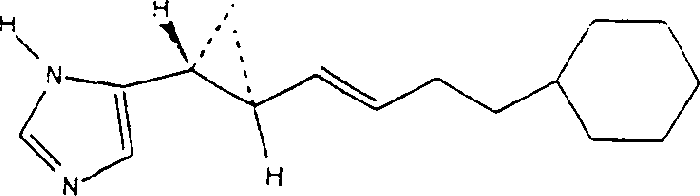
用实施例22所述方法制备手性1(R)-(1H-5-咪唑基)-2(S)-环丙基-6-环己基-3-反-己烯。NMR(CDCl3,300MHz):d7.48(s,1H),6.74(s,1H),5.52(dt,1H),5.08(m,1H),1.98(m,2H),1.88(m,1H),1.82(m,1H),1.64(m,5H),1.20(m,7H),0.86(m,3H).The chiral 1(R)-(1H-5-imidazolyl)-2(S)-cyclopropyl-6-cyclohexyl-3-trans-hexene was prepared by the method described in Example 22. NMR (CDCl 3 , 300MHz): d7.48(s, 1H), 6.74(s, 1H), 5.52(dt, 1H), 5.08(m, 1H), 1.98(m, 2H), 1.88(m, 1H ), 1.82(m, 1H), 1.64(m, 5H), 1.20(m, 7H), 0.86(m, 3H).
实施例261(R)-(1H-5-咪唑基)-2(S)-环丙胺氨基甲酸苄酯和1(S)-(1H-5-咪唑基)-2(R)-环丙胺氨基甲酸苄酯外消旋体的制备Example 26 Benzyl 1(R)-(1H-5-imidazolyl)-2(S)-cyclopropylaminecarbamate and Benzyl 1(S)-(1H-5-imidazolyl)-2(R)-cyclopropylaminecarbamate Preparation of ester racemate
用流程XI所述方法制备1(R)-(1-三苯基甲基-5-咪唑基)-2(S)-环丙胺氨基甲酸苄酯和1(S)-(1-三苯基甲基-5-咪唑基)-2(R)-环丙胺氨基甲酸苄酯外消旋体。将该外消旋体(235mg)溶解于1mL CHCl3,并加入5mL 2N HCl。将反应混合物在90℃加热45分钟,冷却,过滤,真空浓缩滤液至干。加2×25mL乙酸乙酯研制,过滤收集固体,真空干燥,得到110mg 1(R)-( 1H-5-咪唑基)-2(S)-环丙胺氨基甲酸苄酯和1(S)-(1H-5-咪唑基)-2(R)-环丙胺氨基甲酸苄酯外消旋体。1(R)-(1-triphenylmethyl-5-imidazolyl)-2(S)-cyclopropylamine benzyl carbamate and 1(S)-(1-triphenyl Benzyl methyl-5-imidazolyl)-2(R)-cyclopropylaminecarbamate racemate. The racemate (235 mg) was dissolved in 1 mL CHCl 3 and 5 mL 2N HCl was added. The reaction mixture was heated at 90°C for 45 minutes, cooled, filtered and the filtrate was concentrated to dryness in vacuo. Add 2×25mL ethyl acetate for trituration, collect the solid by filtration, and dry in vacuo to obtain 110 mg of 1(R)-(1H-5-imidazolyl)-2(S)-cyclopropylamine benzyl carbamate and 1(S)-( 1H-5-imidazolyl)-2(R)-cyclopropylaminecarbamate benzyl ester racemate.
NMR(CD3OD,300MHz):d8.85(s,1H),8.80(s,1H),7.45(s,1H),7.25(s,5H),NMR (CD 3 OD, 300MHz): d8.85(s, 1H), 8.80(s, 1H), 7.45(s, 1H), 7.25(s, 5H),
5.17(s,2H),3.10(m,1H),2.82(m,1H),2.52(m,1H),2.04(m.1H),1.60(m,5.17(s, 2H), 3.10(m, 1H), 2.82(m, 1H), 2.52(m, 1H), 2.04(m.1H), 1.60(m,
1H),1.45(m,1H),1.30(m,2H).1H), 1.45(m, 1H), 1.30(m, 2H).
实施例27
除用2-环己基乙胺代替苄胺外,根据实施例1所述方法,由3-(1-三苯基甲基-5-咪唑基)-2(S)-3(R)-环丙酸丁酯(37)制备N-(2-环己基乙基)-3(R)-(1H-5-咪唑基)-2(S)-环丙酰胺马来酸盐。Except using 2-cyclohexylethylamine instead of benzylamine, according to the method described in Example 1, from 3-(1-triphenylmethyl-5-imidazolyl)-2(S)-3(R)-cyclo Butyl propionate (37) to prepare N-(2-cyclohexylethyl)-3(R)-(1H-5-imidazolyl)-2(S)-cyclopropanamide maleate.
NMR(CD3OD,300MHz):d8.78(s,1H),7.37(s,1H),6.28(s,2H),3.23(m,1H),NMR (CD 3 OD, 300MHz): d8.78(s, 1H), 7.37(s, 1H), 6.28(s, 2H), 3.23(m, 1H),
2.52(m,2H),2.40(m,1H),1.97(m,3H),1.72(m,4H),1.62-1.18(m,6H),0.942.52(m, 2H), 2.40(m, 1H), 1.97(m, 3H), 1.72(m, 4H), 1.62-1.18(m, 6H), 0.94
(m,2H).(m, 2H).
质谱(DCl/NH3):261(M+1)+,MW=260.3612,C15H22N3O1 Mass spectrum (DCl/NH 3 ): 261 (M+1) + , MW = 260.3612, C 15 H 22 N 3 O 1
实施例28N-(2-环己基乙基)-3(S)-(1H-5-咪唑基)-2(R)-环丙酰胺盐酸盐的制备Example 28 Preparation of N-(2-cyclohexylethyl)-3(S)-(1H-5-imidazolyl)-2(R)-cyclopropanamide hydrochloride
除用2-环己基乙胺代替苄胺外,根据实施例1所述方法,由3-(1-三苯基甲基-5-咪唑基)-2(R)-3(S)-环丙酸丁酯(37)制备N-(2-环己基乙基)-3(S)-(1H-5-咪唑基)-2(R)-环丙酰胺盐酸盐。Except using 2-cyclohexylethylamine instead of benzylamine, according to the method described in Example 1, from 3-(1-triphenylmethyl-5-imidazolyl)-2(R)-3(S)-cyclo Butyl propionate (37) to prepare N-(2-cyclohexylethyl)-3(S)-(1H-5-imidazolyl)-2(R)-cyclopropanamide hydrochloride.
NMR(CD3OD,300MHz):d8.78(s,1H),7.33(s,1H),3.23(m,2H),2.52(m,2H),NMR (CD 3 OD, 300MHz): d8.78(s, 1H), 7.33(s, 1H), 3.23(m, 2H), 2.52(m, 2H),
1.96(m,3H),1.72(m,4H),1.56-1.18(m,6H),0.94(m,2H).1.96(m, 3H), 1.72(m, 4H), 1.56-1.18(m, 6H), 0.94(m, 2H).
质谱(DCl/NH3):261(M+1)+,MW=260.3612,C15H22N3O1 Mass spectrum (DCl/NH 3 ): 261 (M+1) + , MW = 260.3612, C 15 H 22 N 3 O 1
实施例29N-(3-环己基丙基)-3(R)-(1H-5-咪唑基)-2(S)-环丙酰胺和N-(3-环己基丙基)-3(S)-(1H-5-咪唑基)-2(R)-环丙酰胺外消旋体的制备Example 29 N-(3-cyclohexylpropyl)-3(R)-(1H-5-imidazolyl)-2(S)-cyclopropanamide and N-(3-cyclohexylpropyl)-3(S)- Preparation of (1H-5-imidazolyl)-2(R)-cyclopropanamide racemate
除用3-环己基丙胺代替苄胺外,根据实施例1所述方法,制备N-(3-环己基丙基)-3(R)-(1H-5-咪唑基)-2(S)-环丙酰胺和N-(3-环己基丙基)-3(S)-(1H-5-咪唑基)-2(R)-环丙酰胺外消旋体。NMR(CD3OD,300MHz):d8.80(d,1H),7.38(d,1H),3.18(m,2H),2.52(m,2H),2.40(m.1H),2.05(m,1H),1.99(m,3H),1.70(m,5H),1.62-1.15(m,7H),0.91(m,2H).Except using 3-cyclohexylpropylamine instead of benzylamine, according to the method described in Example 1, prepare N-(3-cyclohexylpropyl)-3(R)-(1H-5-imidazolyl)-2(S) - Cyclopropanamide and N-(3-cyclohexylpropyl)-3(S)-(1H-5-imidazolyl)-2(R)-cyclopropanamide racemate. NMR (CD 3 OD, 300MHz): d8.80(d, 1H), 7.38(d, 1H), 3.18(m, 2H), 2.52(m, 2H), 2.40(m.1H), 2.05(m, 1H), 1.99(m, 3H), 1.70(m, 5H), 1.62-1.15(m, 7H), 0.91(m, 2H).
质谱(DCl/NH3):276(M+1)+ MW=275.3962.C16H25N3O1 Mass spectrum (DCl/NH 3 ): 276(M+1) + MW=275.3962.C 16 H 25 N 3 O 1
实施例30手性N-(3-环己基丙基)-3(R)-(1H-5-咪唑基)-2(S)-环丙酰胺的制备Example 30 Preparation of chiral N-(3-cyclohexylpropyl)-3(R)-(1H-5-imidazolyl)-2(S)-cyclopropanamide
除用3-环己基丙胺代替苄胺外,根据实施例1所述方法,由3-(1-三苯基甲基-5-咪唑基)-2(S)-3(R)-环丙酸丁酯(36)制备手性N-(3-环己基丙基)-3(R)-(1H-5-咪唑基)-2(S)-环丙酰胺。NMR(CD3OD,300MHz):d8.74(s,1H),7.30(s,1H),3.16(m,2H),2.40(m,1H),1.92(m,1H),1.70(m,6H),1.55(m,4H),1.25(m,7H),0.91(m,2H).Except using 3-cyclohexylpropylamine instead of benzylamine, according to the method described in Example 1, from 3-(1-triphenylmethyl-5-imidazolyl)-2(S)-3(R)-cyclopropane Chiral N-(3-cyclohexylpropyl)-3(R)-(1H-5-imidazolyl)-2(S)-cyclopropanamide was prepared from butyl ester (36). NMR (CD 3 OD, 300MHz): d8.74(s, 1H), 7.30(s, 1H), 3.16(m, 2H), 2.40(m, 1H), 1.92(m, 1H), 1.70(m, 6H), 1.55(m, 4H), 1.25(m, 7H), 0.91(m, 2H).
质谱(DCl/NH3):276(M+1)+,MW=275.3962,C16H25N3O1 Mass spectrum (DCl/NH 3 ): 276(M+1) + , MW=275.3962, C 16 H 25 N 3 O 1
实施例31
除用2-环己-1-烯基-乙胺代替苄胺外,根据实施例1所述方法,制备N-(2-环己-1-烯基-乙基)-3(R)-(1H-5-咪唑基)-2(S)-环丙酰胺盐酸盐和N-(2-环己-1-烯基-乙基)-3(S)-(1H-5-咪唑基)-2(R)-环丙酰胺盐酸盐外消旋体。Except using 2-cyclohex-1-enyl-ethylamine instead of benzylamine, according to the method described in Example 1, prepare N-(2-cyclohex-1-enyl-ethyl)-3(R)- (1H-5-imidazolyl)-2(S)-cyclopropanamide hydrochloride and N-(2-cyclohex-1-enyl-ethyl)-3(S)-(1H-5-imidazolyl )-2(R)-cyclopropanamide hydrochloride racemate.
NMR(CD3OD,300MHz):d8.9(s,1H),7.55(s,1H),5.60(m,1H) 3.70(m,2H)NMR (CD 3 OD, 300MHz): d8.9(s, 1H), 7.55(s, 1H), 5.60(m, 1H) 3.70(m, 2H)
3.0(m,4H),2.30(m,1H),2.20(m,1H),1.95(m,3H),1.60(m,7H).3.0(m, 4H), 2.30(m, 1H), 2.20(m, 1H), 1.95(m, 3H), 1.60(m, 7H).
质谱(DCl/NH3):260(M+1)+,MW=259.3532,C15H21N3O1 Mass spectrum (DCl/NH 3 ): 260(M+1) + , MW=259.3532, C 15 H 21 N 3 O 1
实施例32
N-(1-环丙基甲基)-3(R)-(1H-5-咪唑基)-2(S)-环丙酰胺盐酸盐和N-(1-环丙基甲基)-3(S)-(1H-5-咪唑基)-2(R)-环丙酰胺盐酸盐外消旋体的制备N-(1-cyclopropylmethyl)-3(R)-(1H-5-imidazolyl)-2(S)-cyclopropanamide hydrochloride and N-(1-cyclopropylmethyl)- Preparation of racemate of 3(S)-(1H-5-imidazolyl)-2(R)-cyclopropanamide hydrochloride
除用(氨基甲基)环丙烷代替苄胺外,根据实施例1所述方法,制备N-(1-环丙基甲基)-3(R)-(1H-5-咪唑基)-2(S)-环丙酰胺盐酸盐和N-(1-环丙基甲基)-3(S)-(1H-5-咪唑基)-2(R)-环丙酰胺盐酸盐外消旋体。Except using (aminomethyl) cyclopropane instead of benzylamine, according to the method described in Example 1, prepare N-(1-cyclopropylmethyl)-3(R)-(1H-5-imidazolyl)-2 (S)-cyclopropanamide hydrochloride and N-(1-cyclopropylmethyl)-3(S)-(1H-5-imidazolyl)-2(R)-cyclopropanamide hydrochloride racemic Spin body.
NMR(CD3OD,300MHz):d8.80(s,1H),7.38(s,1H),3.0(d,1H),2.30(d,1H)2.40(m,1H),1.98(m,1H),1.50(m,1H),1.32(m,1H),0.98(m,1H),0.50(m2H),0.20(m,2H).NMR (CD 3 OD, 300MHz): d8.80(s, 1H), 7.38(s, 1H), 3.0(d, 1H), 2.30(d, 1H) 2.40(m, 1H), 1.98(m, 1H) ), 1.50(m, 1H), 1.32(m, 1H), 0.98(m, 1H), 0.50(m2H), 0.20(m, 2H).
质谱(CDl/NH3):206(M+1)+,MW=205.2612,C11H15N3O1 Mass spectrum (CDl/NH 3 ): 206(M+1) + , MW=205.2612, C 11 H 15 N 3 O 1
实施例33N-(3-苯基丙基)-3(R)-(1H-5-咪唑基)-2(S)-环丙酰胺盐酸盐和N-(3-苯基丙基)-3(S)-(1H-5-咪唑基)-2(R)-环丙酰胺盐酸盐外消旋体的制备Example 33 N-(3-phenylpropyl)-3(R)-(1H-5-imidazolyl)-2(S)-cyclopropanamide hydrochloride and N-(3-phenylpropyl)-3( Preparation of racemate of S)-(1H-5-imidazolyl)-2(R)-cyclopropanamide hydrochloride
除用3-苯基丙胺代替苄胺外,根据实施例1所述方法,制备N-(3-苯基丙基)-3(R)-(1H-5-咪唑基)-2(S)环丙酰胺盐酸盐和N-(3-苯基丙基)-3(S)-(1H-5-咪唑基)-2(R)-环丙酰胺盐酸盐外消旋体。Except using 3-phenylpropylamine instead of benzylamine, according to the method described in Example 1, prepare N-(3-phenylpropyl)-3(R)-(1H-5-imidazolyl)-2(S) Cyclopropanamide hydrochloride and N-(3-phenylpropyl)-3(S)-(1H-5-imidazolyl)-2(R)-cyclopropanamide hydrochloride racemate.
NMR(CD3OD,300MHz):d8.78(d,1H),7.34(d,1H),7.22(m,5H),3.22(t,2H),NMR (CD 3 OD, 300MHz): d8.78(d, 1H), 7.34(d, 1H), 7.22(m, 5H), 3.22(t, 2H),
2.92(t,1H),2.72(t,2H),2.64(t,2H),2.40(m,1H),1.96(m,1H),1.83(m,1H),2.92(t, 1H), 2.72(t, 2H), 2.64(t, 2H), 2.40(m, 1H), 1.96(m, 1H), 1.83(m, 1H),
1.52(m,1H),1.33(m,1H).1.52(m, 1H), 1.33(m, 1H).
质谱(DCl/NH3):270(M+1)+,MW=269.3482,C16H19N2O1 Mass spectrum (DCl/NH 3 ): 270(M+1) + , MW=269.3482, C 16 H 19 N 2 O 1
实施例34
根据实施例1所述方法,但用N-(2-(4)-咪唑基乙基)胺代替苄胺,制备N-(2-(4)-咪唑基乙基)-3(R)-(1H-5-咪唑基)-2(S)-环丙酰胺盐酸盐和N-(2-(4)-咪唑基乙基)-3(S)-(1H-5-咪唑基)-2(R)-环丙酰胺盐酸盐外消旋体。According to the method described in Example 1, but using N-(2-(4)-imidazolylethyl)amine instead of benzylamine, N-(2-(4)-imidazolylethyl)-3(R)- (1H-5-imidazolyl)-2(S)-cyclopropanamide hydrochloride and N-(2-(4)-imidazolylethyl)-3(S)-(1H-5-imidazolyl)- 2(R)-cyclopropanamide hydrochloride racemate.
NMR(CD3OD,300MHz):d8.82(s,1H),8.79(s,1H),7.39(s,1H),7.36(s,1H),NMR (CD 3 OD, 300MHz): d8.82(s, 1H), 8.79(s, 1H), 7.39(s, 1H), 7.36(s, 1H),
3.54(m,2H),3.30(m,1H),2.94(m,1H),2.40(,1H),2.02(m,1H),1.48(m,3.54(m, 2H), 3.30(m, 1H), 2.94(m, 1H), 2.40(, 1H), 2.02(m, 1H), 1.48(m,
1H),1.32(m,1H).1H), 1.32(m, 1H).
实施例35
N-[3-(2-氨基乙基)吲哚]-3(R)-(1H-5-咪唑基)-2(S)-环丙酰胺盐酸盐和N-[3-(2-氨基乙基)吲哚]-3(S)-(1H-5-咪唑基)-2(R)-环丙酰胺盐酸盐外消旋体的制备N-[3-(2-aminoethyl)indole]-3(R)-(1H-5-imidazolyl)-2(S)-cyclopropanamide hydrochloride and N-[3-(2- Preparation of racemate of aminoethyl)indole]-3(S)-(1H-5-imidazolyl)-2(R)-cyclopropanamide hydrochloride
根据实施例1所述方法,但用N-[3-(2-氨基乙基)吲哚]代替苄胺,制备N-[3-(2-氨基乙基)吲哚]-3(R)-(1H-5-咪唑基)-2(S)-环丙酰胺盐酸盐和N-[3-(2-氨基乙基)吲哚]-3(S)-(1H-5-咪唑基)-2(R)-环丙酰胺盐酸盐外消旋体。According to the method described in Example 1, but using N-[3-(2-aminoethyl)indole] instead of benzylamine, N-[3-(2-aminoethyl)indole]-3(R) was prepared -(1H-5-imidazolyl)-2(S)-cyclopropanamide hydrochloride and N-[3-(2-aminoethyl)indole]-3(S)-(1H-5-imidazolyl )-2(R)-cyclopropanamide hydrochloride racemate.
NMR(CD3OD,300MHz):d7.55(d,1H),7.52(s,1H),7.31(d,1H),7.06(m,2H),NMR (CD 3 OD, 300MHz): d7.55(d, 1H), 7.52(s, 1H), 7.31(d, 1H), 7.06(m, 2H),
6.96(m,1H),6.84(s,1H),3.48(m,2H),3.30(m,2H),2.95(m,2H),2.32(m,6.96(m, 1H), 6.84(s, 1H), 3.48(m, 2H), 3.30(m, 2H), 2.95(m, 2H), 2.32(m,
1H),1.80(m,1H),1.38(m,1H),1.20(m,1H).1H), 1.80(m, 1H), 1.38(m, 1H), 1.20(m, 1H).
实施例36 Example 36
N-[3-环己基-2-羟基-丙基]-3(R)-[1 H-5-咪唑基]-2(S)-环丙酰胺和N-[3-环己基-2-羟基-丙基]-3(S)-[1H-5-咪唑基]-2(R)-环丙酰胺盐酸盐外消旋体的制备N-[3-cyclohexyl-2-hydroxy-propyl]-3(R)-[1 H-5-imidazolyl]-2(S)-cyclopropanamide and N-[3-cyclohexyl-2- Preparation of Hydroxy-Propyl]-3(S)-[1H-5-Imidazolyl]-2(R)-Cyclopropanamide Hydrochloride Racemate
根据实施例1所述方法,但用3-环己基-2-羟基-丙胺代替苄胺,制备N-[3-环己基-2-羟基-丙基]-3(R)-[1H-5-咪唑基]-2(S)-环丙酰胺和N-[3-环己基-2-羟基-丙基]-3(S)-[1H-5-咪唑基]-2(R)-环丙酰胺盐酸盐外消旋体。According to the method described in Example 1, but using 3-cyclohexyl-2-hydroxyl-propylamine instead of benzylamine, N-[3-cyclohexyl-2-hydroxyl-propyl]-3(R)-[1H-5 -imidazolyl]-2(S)-cyclopropanamide and N-[3-cyclohexyl-2-hydroxy-propyl]-3(S)-[1H-5-imidazolyl]-2(R)-cyclo Propionamide hydrochloride racemate.
NMR(CD3OD,300MHz):d8.80(d,1H),7.38(d,1H),4.46(d,1H),4.42(d,1H),NMR (CD 3 OD, 300MHz): d8.80(d, 1H), 7.38(d, 1H), 4.46(d, 1H), 4.42(d, 1H),
4.18(d,1H),4.12(d,1H),4.02(m,1H),3.76(d,1H),3.72(d,1H),3.60(m.1H),4.18(d,1H), 4.12(d,1H), 4.02(m,1H), 3.76(d,1H), 3.72(d,1H), 3.60(m.1H),
3.52(m,1H),3.47(t,2H),2.60(m,1H),2.50(m,1H),2.40(m,1H),2.20(m,3.52(m, 1H), 3.47(t, 2H), 2.60(m, 1H), 2.50(m, 1H), 2.40(m, 1H), 2.20(m,
1H),1.96(m,1H),1.70(m,5H),1.62-1.15(m,7H),0.91(m,2H).1H), 1.96(m, 1H), 1.70(m, 5H), 1.62-1.15(m, 7H), 0.91(m, 2H).
实施例37N-[4-环己基丁基]-3(R)-[1H-5-咪唑基]-2(S)-环丙酰胺和N-[4-环己基丁基]-3(S)-[1H-5-咪唑基]-2(R)-环丙酰胺盐酸盐外消旋体的制备Example 37 N-[4-cyclohexylbutyl]-3(R)-[1H-5-imidazolyl]-2(S)-cyclopropanamide and N-[4-cyclohexylbutyl]-3(S)- Preparation of racemate of [1H-5-imidazolyl]-2(R)-cyclopropanamide hydrochloride
根据实施例1所述方法,但用4-环己基丁胺代替苄胺,制备N-[4-环己基丁基]-3(R)-[1H-5-咪唑基]-2(S)-环丙酰胺和N-[4-环己基丁基]-3(S)-[1H-5-咪唑基]-2(R)-环丙酰胺盐酸盐外消旋体。According to the method described in Example 1, but using 4-cyclohexylbutylamine instead of benzylamine, N-[4-cyclohexylbutyl]-3(R)-[1H-5-imidazolyl]-2(S) was prepared - Cyclopropanamide and N-[4-cyclohexylbutyl]-3(S)-[1H-5-imidazolyl]-2(R)-cyclopropanamide hydrochloride racemate.
NMR(CD3Cl,300MHz):d8.00(s,1H),6.62(s,1H),5.65(m,1H) 3.44(m,1H)NMR (CD 3 Cl, 300MHz): d8.00(s, 1H), 6.62(s, 1H), 5.65(m, 1H) 3.44(m, 1H)
3.22(m,1H),2.68(t,1H),2.30(m,1H),2.0(m,1H),1.78(m,2H),1.66(m,4H)3.22(m, 1H), 2.68(t, 1H), 2.30(m, 1H), 2.0(m, 1H), 1.78(m, 2H), 1.66(m, 4H)
1.42(m,2H),1.20(m,6H),0.82(m,2H).1.42(m, 2H), 1.20(m, 6H), 0.82(m, 2H).
本发明化合物是组胺H3受体拮抗剂。本发明化合物对H3受体的亲和力结合可用以下方法加以说明:The compounds of the present invention are histamine H3 receptor antagonists. Affinity binding of the compounds of the invention to the H3 receptor can be demonstrated by the following method:
体外组胺H3受体结合测定In vitro histamine H3 receptor binding assay
根据West等人,《分子药物学》(Mol.Pharmacal.),38:610-613(1990),所述方法并加以改进,使用H3选择性激动剂配位体[3H]-Nα-甲基组胺(78.9 Ci/mmol,Dupont NEN Research produets,Boston,MA),在鼠皮质(cortical)膜上进行组胺H3受体亲和力的测定。简言之,砍下动物头颅并迅速取出大脑皮层。将鼠的皮质在10倍体积(wt/vol)的Krebs-Ringers Hepes缓冲液(pH7.4)中用Omni 1000电动机驱动的均质器机械搅匀,所说缓冲液含有下列蛋白酶抑制剂:EDTA(10mM),PMSF(0.1mM),抑凝乳蛋白酶素(0.2mg/50mL)和亮抑蛋白肽(0.2mg/50mL)。将所得匀液在Sorvall中以约40,000×g的速度离心30分钟。通过机械搅匀将所得丸状物重新悬浮于25mL水,并在冰上熔化30分钟。再次离心匀液,并重复膜的溶解过程。再次离心匀液,最后将沉淀物重新悬浮于14倍体积的水中,得到约200μg蛋白/100μL的最终浓度。使用前将所得悬浮液储存于-80℃。蛋白浓度用CoomassiePlus Protein Array(蛋白测定法)(Pierce,Rockord,IL)测定。Based on the method described by West et al., Mol. Pharmacal., 38: 610-613 (1990), with modifications, using the H 3 selective agonist ligand [ 3 H]-N α - Methylhistamine (78.9 Ci/mmol, Dupont NEN Research produets, Boston, MA), histamine H3 receptor affinity assays were performed on murine cortical membranes. Briefly, the animals were decapitated and the cerebral cortex was rapidly removed. The rat cortex was mechanically agitated with an Omni 1000 motor-driven homogenizer in 10 volumes (wt/vol) of Krebs-Ringers Hepes buffer (pH 7.4) containing the following protease inhibitors: EDTA (10mM), PMSF (0.1mM), chymostatin (0.2mg/50mL) and leupeptin (0.2mg/50mL). The resulting homogenate was centrifuged at approximately 40,000 x g for 30 minutes in a Sorvall. The resulting pellet was resuspended in 25 mL of water by mechanical homogenization and thawed on ice for 30 minutes. Centrifuge the homogenate again, and repeat the membrane dissolution process. Centrifuge the homogenate again, and finally resuspend the pellet in 14 times the volume of water to obtain a final concentration of about 200 μg protein/100 μL. The resulting suspension was stored at -80°C until use. Protein concentrations were determined using the CoomassiePlus Protein Array (Pierce, Rockord, IL).
结合的测定在盛有整个体积为0.4mL的50mM Na+磷酸盐缓冲剂(pH7.4)的聚丙烯试管中进行,该缓冲剂含有150-200μg组织蛋白,0.8-1.2nM[3H]-Nα-甲基组胺和0.3-10,000nM GT-2016。通过加入硫代多酰胺(thioperamide)(10μM)测定非特定结合(NSB)。样品在25℃培养40分钟。用事先用0.3%聚乙烯亚胺洗过的玻璃纤维带过滤样品,用Brandell细胞收集。迅速用含有145mM NaCl(pH7.4,4℃)的4mL 25mm Tris缓冲剂洗涤3次。将滤液装入聚乙烯微型瓶中,并用3.5mL闪烁流体计数器)(Ecolume,ICN Biomedicasls,Inc.)计数。采用这种方法,非特异性结合小于整个结合的10%,对玻璃纤维过滤器的结合可以忽略不计。饱和和竞争实验用ReceptorFit饱和和竞争曲线拟合程序(Lundon Software,Inc.,Cleveland,OH)进行分析。各Ki用公式Ki=IC50/(1+([配位体]/[Kd])计算,结果示于表1。Binding assays were performed in polypropylene tubes containing a total volume of 0.4 mL of 50 mM Na + phosphate buffer (pH 7.4) containing 150-200 μg histone, 0.8-1.2 nM [ 3 H]- N α -methylhistamine and 0.3-10,000 nM GT-2016. Non-specific binding (NSB) was determined by addition of thioperamide (10 [mu]M). Samples were incubated at 25°C for 40 minutes. Samples were collected by Brandell cells by filtration through glass fiber strips previously washed with 0.3% polyethyleneimine. Wash rapidly 3 times with 4 mL of 25 mm Tris buffer containing 145 mM NaCl (pH 7.4, 4°C). The filtrate was filled into polyethylene microvials and counted with a 3.5 mL scintillation fluid counter) (Ecolume, ICN Biomedicasls, Inc.). Using this method, non-specific binding is less than 10% of total binding and binding to glass fiber filters is negligible. Saturation and competition experiments were analyzed using the ReceptorFit saturation and competition curve fitting program (Lundon Software, Inc., Cleveland, OH). Each K i was calculated by the formula K i =IC 50 /(1+([ligand]/[K d ]), and the results are shown in Table 1.
表1 Table 1
组胺H3受体结合力化合物 结构 H3 受体 K1 (nM)实施例1
53±2实施例2


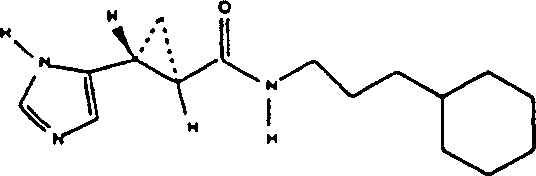





Claims (13)


Applications Claiming Priority (2)
| Application Number | Priority Date | Filing Date | Title |
|---|---|---|---|
| US08/453,359 US5652258A (en) | 1995-05-30 | 1995-05-30 | 2-(4-imidazoyl) cyclopropyl derivatives |
| US08/453,359 | 1995-05-30 |
Publications (2)
| Publication Number | Publication Date |
|---|---|
| CN1192143A CN1192143A (en) | 1998-09-02 |
| CN1100534C true CN1100534C (en) | 2003-02-05 |
Family
ID=23800267
Family Applications (1)
| Application Number | Title | Priority Date | Filing Date |
|---|---|---|---|
| CN96195925A Expired - Fee Related CN1100534C (en) | 1995-05-30 | 1996-05-29 | 2-(1H-4(5)-imidazoyl cyclopropyl derivatives |
Country Status (17)
| Country | Link |
|---|---|
| US (2) | US5652258A (en) |
| EP (1) | EP0837679B1 (en) |
| JP (1) | JP2001503013A (en) |
| KR (1) | KR19990022137A (en) |
| CN (1) | CN1100534C (en) |
| AT (1) | ATE207354T1 (en) |
| AU (1) | AU713767B2 (en) |
| CA (1) | CA2222101A1 (en) |
| DE (1) | DE69616328T2 (en) |
| DK (1) | DK0837679T3 (en) |
| ES (1) | ES2163019T3 (en) |
| FI (1) | FI974363A7 (en) |
| MX (1) | MX9709211A (en) |
| NO (1) | NO975484D0 (en) |
| NZ (1) | NZ308410A (en) |
| PT (1) | PT837679E (en) |
| WO (1) | WO1996038141A1 (en) |
Families Citing this family (39)
| Publication number | Priority date | Publication date | Assignee | Title |
|---|---|---|---|---|
| US5652258A (en) * | 1995-05-30 | 1997-07-29 | Gliatech, Inc. | 2-(4-imidazoyl) cyclopropyl derivatives |
| US6008240A (en) * | 1997-12-15 | 1999-12-28 | Gliatech, Inc. | 2-(1H-4(5)-imidazoyl) cyclopropyl derivatives |
| JP2002534511A (en) | 1999-01-18 | 2002-10-15 | ノボ ノルディスク アクティーゼルスカブ | Substituted imidazoles, their preparation and use |
| US7265115B2 (en) | 1999-01-29 | 2007-09-04 | Abbott Laboratories | Diazabicyclic CNS active agents |
| US6908926B1 (en) | 1999-04-16 | 2005-06-21 | Novo Nordisk A/S | Substituted imidazoles, their preparation and use |
| US6114350A (en) * | 1999-04-19 | 2000-09-05 | Nen Life Science Products, Inc. | Cyanine dyes and synthesis methods thereof |
| US6437147B1 (en) | 2000-03-17 | 2002-08-20 | Novo Nordisk | Imidazole compounds |
| US6610721B2 (en) | 2000-03-17 | 2003-08-26 | Novo Nordisk A/S | Imidazo heterocyclic compounds |
| CA2419073A1 (en) | 2000-08-17 | 2002-02-21 | Gliatech, Inc. | Novel alicyclic imidazoles as h3 agents |
| AU2001283573A1 (en) * | 2000-08-21 | 2002-03-04 | Gliatech, Inc. | The use of histamine H3 receptor inverse agonists for the control of appetite and treatment of obesity |
| WO2002067938A2 (en) * | 2000-10-30 | 2002-09-06 | Schering Corporation | Treating or reducing the risk of cardiovascular disease |
| CA2477391A1 (en) * | 2002-03-01 | 2003-09-12 | Denis Schrier | Method of treating osteoarthritis |
| BRPI0507374A (en) * | 2004-02-02 | 2007-07-10 | Pfizer Prod Inc | histamine-3 receptor modulators |
| EP1720861A2 (en) | 2004-02-25 | 2006-11-15 | Eli Lilly And Company | Histamine h3 receptor antagonists, preparation and therapeutic uses |
| CN1960969B (en) | 2004-04-01 | 2012-03-28 | 伊莱利利公司 | Histamine H3 receptor drug, its preparation method and therapeutic use |
| AU2005252178B2 (en) * | 2004-06-02 | 2011-04-21 | Eli Lilly And Company | Histamine H3 receptor agents, preparation and therapeutic uses |
| US7705025B2 (en) | 2004-08-23 | 2010-04-27 | Eli Lilly And Company | Histamine H3 receptor agents, preparation and therapeutic uses |
| US7846950B2 (en) | 2004-10-18 | 2010-12-07 | Eli Lilly And Company | Histamine H3 receptor inhibitors, preparation and therapeutic uses |
| ES2335305T3 (en) * | 2005-03-17 | 2010-03-24 | Eli Lilly And Company | PIRROLIDINE DERIVATIVES AS ANTAGONISTS OF H3 HISTAMINE RECEIVER. |
| WO2006107661A1 (en) | 2005-04-01 | 2006-10-12 | Eli Lilly And Company | Histamine h3 receptor agents, preparation and therapeutic uses |
| EP1707203A1 (en) | 2005-04-01 | 2006-10-04 | Bioprojet | Treatment of parkinson's disease obstructive sleep apnea, dementia with lewy bodies, vascular dementia with non-imidazole alkylamines histamine H3- receptor ligands |
| EP1717233A1 (en) * | 2005-04-29 | 2006-11-02 | Bioprojet | Histamine H3-receptor ligands and their therapeutic application |
| EP1717235A3 (en) | 2005-04-29 | 2007-02-28 | Bioprojet | Phenoxypropylpiperidines and -pyrrolidines and their use as histamine H3-receptor ligands |
| CA2622597A1 (en) * | 2005-09-15 | 2007-03-22 | Banyu Pharmaceutical Co., Ltd. | Histamine h3 agonist for use as therapeutic agent for lipid/glucose metabolic disorder |
| EP1942104A1 (en) | 2006-12-20 | 2008-07-09 | sanofi-aventis | Heteroarylcyclopropanecarboxamides and their use as pharmaceuticals |
| US8993808B2 (en) | 2009-01-21 | 2015-03-31 | Oryzon Genomics, S.A. | Phenylcyclopropylamine derivatives and their medical use |
| US8859555B2 (en) | 2009-09-25 | 2014-10-14 | Oryzon Genomics S.A. | Lysine Specific Demethylase-1 inhibitors and their use |
| EP2486002B1 (en) | 2009-10-09 | 2019-03-27 | Oryzon Genomics, S.A. | Substituted heteroaryl- and aryl- cyclopropylamine acetamides and their use |
| US9616058B2 (en) | 2010-02-24 | 2017-04-11 | Oryzon Genomics, S.A. | Potent selective LSD1 inhibitors and dual LSD1/MAO-B inhibitors for antiviral use |
| WO2011106573A2 (en) | 2010-02-24 | 2011-09-01 | Oryzon Genomics, S.A. | Lysine demethylase inhibitors for diseases and disorders associated with hepadnaviridae |
| MX2012012111A (en) * | 2010-04-19 | 2013-05-30 | Oryzon Genomics Sa | Lysine specific demethylase-1 inhibitors and their use. |
| WO2012013727A1 (en) | 2010-07-29 | 2012-02-02 | Oryzon Genomics S.A. | Cyclopropylamine derivatives useful as lsd1 inhibitors |
| SI2598482T1 (en) | 2010-07-29 | 2018-09-28 | Oryzon Genomics, S.A. | Arylcyclopropylamine based demethylase inhibitors of lsd1 and their medical use |
| WO2012045883A1 (en) | 2010-10-08 | 2012-04-12 | Oryzon Genomics S.A. | Cyclopropylamine inhibitors of oxidases |
| WO2012072713A2 (en) | 2010-11-30 | 2012-06-07 | Oryzon Genomics, S.A. | Lysine demethylase inhibitors for diseases and disorders associated with flaviviridae |
| WO2012107498A1 (en) | 2011-02-08 | 2012-08-16 | Oryzon Genomics S.A. | Lysine demethylase inhibitors for myeloproliferative disorders |
| RS58475B1 (en) | 2011-10-20 | 2019-04-30 | Oryzon Genomics Sa | (hetero)aryl cyclopropylamine compounds as lsd1 inhibitors |
| CN107266345B (en) | 2011-10-20 | 2021-08-17 | 奥瑞泽恩基因组学股份有限公司 | (hetero) arylcyclopropylamine compounds as LSD1 inhibitors |
| WO2013151982A1 (en) | 2012-04-03 | 2013-10-10 | Arena Pharmaceuticals, Inc. | Methods and compounds useful in treating pruritus, and methods for identifying such compounds |
Citations (1)
| Publication number | Priority date | Publication date | Assignee | Title |
|---|---|---|---|---|
| US5217986A (en) * | 1992-03-26 | 1993-06-08 | Harbor Branch Oceanographic Institution, Inc. | Anti-allergy agent |
Family Cites Families (5)
| Publication number | Priority date | Publication date | Assignee | Title |
|---|---|---|---|---|
| FR2579596B1 (en) * | 1985-03-26 | 1987-11-20 | Inst Nat Sante Rech Med | (IMIDAZOLYL-4) PIPERIDINES, THEIR PREPARATION AND THEIR THERAPEUTIC APPLICATION |
| FR2671083B1 (en) * | 1990-12-31 | 1994-12-23 | Inst Nat Sante Rech Med | NEWS 4- (4-IMIDAZOLYL) PIPERIDINES SUBSTITUTED IN 1, THEIR PREPARATION AND THEIR THERAPEUTIC APPLICATIONS. |
| EP0573542B1 (en) * | 1991-02-27 | 1997-10-15 | Seed Capital Investments( Sci) B.V. | Imidazole-derivatives having antagonistic activity on the histamine h3-receptor |
| FR2686084B1 (en) * | 1992-01-10 | 1995-12-22 | Bioprojet Soc Civ | NEW IMIDAZOLE DERIVATIVES, THEIR PREPARATION AND THEIR THERAPEUTIC APPLICATIONS. |
| US5652258A (en) * | 1995-05-30 | 1997-07-29 | Gliatech, Inc. | 2-(4-imidazoyl) cyclopropyl derivatives |
-
1995
- 1995-05-30 US US08/453,359 patent/US5652258A/en not_active Expired - Fee Related
-
1996
- 1996-05-29 KR KR1019970708616A patent/KR19990022137A/en not_active Ceased
- 1996-05-29 AU AU58047/96A patent/AU713767B2/en not_active Ceased
- 1996-05-29 CN CN96195925A patent/CN1100534C/en not_active Expired - Fee Related
- 1996-05-29 AT AT96914788T patent/ATE207354T1/en not_active IP Right Cessation
- 1996-05-29 ES ES96914788T patent/ES2163019T3/en not_active Expired - Lifetime
- 1996-05-29 DE DE69616328T patent/DE69616328T2/en not_active Expired - Fee Related
- 1996-05-29 WO PCT/US1996/007833 patent/WO1996038141A1/en not_active Ceased
- 1996-05-29 US US08/945,915 patent/US5990317A/en not_active Expired - Fee Related
- 1996-05-29 CA CA002222101A patent/CA2222101A1/en not_active Abandoned
- 1996-05-29 NZ NZ308410A patent/NZ308410A/en unknown
- 1996-05-29 PT PT96914788T patent/PT837679E/en unknown
- 1996-05-29 FI FI974363A patent/FI974363A7/en not_active IP Right Cessation
- 1996-05-29 JP JP08536597A patent/JP2001503013A/en not_active Ceased
- 1996-05-29 DK DK96914788T patent/DK0837679T3/en active
- 1996-05-29 EP EP96914788A patent/EP0837679B1/en not_active Expired - Lifetime
-
1997
- 1997-11-27 MX MX9709211A patent/MX9709211A/en not_active IP Right Cessation
- 1997-11-28 NO NO975484A patent/NO975484D0/en unknown
Patent Citations (1)
| Publication number | Priority date | Publication date | Assignee | Title |
|---|---|---|---|---|
| US5217986A (en) * | 1992-03-26 | 1993-06-08 | Harbor Branch Oceanographic Institution, Inc. | Anti-allergy agent |
Also Published As
| Publication number | Publication date |
|---|---|
| US5990317A (en) | 1999-11-23 |
| DE69616328T2 (en) | 2002-07-04 |
| EP0837679B1 (en) | 2001-10-24 |
| CN1192143A (en) | 1998-09-02 |
| NZ308410A (en) | 2001-06-29 |
| ES2163019T3 (en) | 2002-01-16 |
| US5652258A (en) | 1997-07-29 |
| AU713767B2 (en) | 1999-12-09 |
| DK0837679T3 (en) | 2002-02-11 |
| AU5804796A (en) | 1996-12-18 |
| MX9709211A (en) | 1998-07-31 |
| EP0837679A4 (en) | 1999-03-03 |
| CA2222101A1 (en) | 1996-12-05 |
| EP0837679A1 (en) | 1998-04-29 |
| WO1996038141A1 (en) | 1996-12-05 |
| KR19990022137A (en) | 1999-03-25 |
| FI974363A0 (en) | 1997-11-28 |
| ATE207354T1 (en) | 2001-11-15 |
| FI974363L (en) | 1997-11-28 |
| DE69616328D1 (en) | 2001-11-29 |
| PT837679E (en) | 2002-03-28 |
| FI974363A7 (en) | 1997-11-28 |
| JP2001503013A (en) | 2001-03-06 |
| NO975484D0 (en) | 1997-11-28 |
Similar Documents
| Publication | Publication Date | Title |
|---|---|---|
| CN1192143A (en) | 2-(1H-4(5)-imidazolylcyclopropyl derivatives | |
| CN1072220C (en) | 1-benzoyl-2-(indolyl-3-alkyl)-piperazine derivs. as neurokinin receptor antagonists | |
| CN1037348C (en) | Substituted 5-(2-(2-(2-aryl-2 hydroxyethyl) amino) propyl)-1,3-benzodioxoles | |
| CN1216864C (en) | Positive modulators of nicotinic receptor agonists | |
| CN1163484C (en) | 4-Aroyl-piperidine-CCR-3 receptor antagonist Ⅲ | |
| CN1111529C (en) | Piperazino-derivatives as neurokinin | |
| CN1688544A (en) | Fluoro- and sulfonylamino-containing 3,6-disubstituted azabicyclo(3.1.0)hexane derivatives as muscarinic receptor antagonists | |
| CN1060285A (en) | Fused ring analogues of nitrogen-containing non-aromatic heterocycles | |
| CN1211982A (en) | Tropane derivatives, their preparation and use | |
| CN1150165C (en) | 1-arylsulfonyl-2-aryl-pyrrolidine derivatives for the treatment of central nervous system disorders | |
| CN1922161A (en) | 1-Piperazine- and 1-homopiperazine-carboxylate derivatives, preparation and therapeutic use thereof | |
| CN1094723A (en) | Carboxamide Derivatives | |
| CN1688548A (en) | Process for preparing quinolin antibiotic intermediates | |
| CN1303364A (en) | Aminocyclohexyl ether compounds and uses thereof | |
| CN1064080A (en) | Peptide compound, its preparation method and pharmaceutical composition containing such compound | |
| CN1118467C (en) | 1,3,8-triaza-spiro [4,5] decan-4-on derivatives | |
| CN1067889A (en) | The preparation method of N-(the 1-alkyl-3-hydroxy-4-piperidinyl base) benzamide that replaces | |
| CN1859914A (en) | Phenyl pyrrolidine ether tachykinin receptor antagonists | |
| CN1309654A (en) | Biphenyl derivs. | |
| CN1022322C (en) | Fused pyrazole 3-oxo-propionitrile derivatives | |
| CN1226825A (en) | Use of amines to produce drugs for preventing tumour cell proliferation | |
| CN1127488C (en) | Compounds with growth hormone releasing properties | |
| CN1794985A (en) | Azabicyclo derivatives as muscarinic receptor antagonists | |
| CN1291186A (en) | Cyclic amide compounds | |
| CN1178923C (en) | 1, 4-diazepan-2, 5-dione derivatives and their use as NK-1 receptor antagonists |
Legal Events
| Date | Code | Title | Description |
|---|---|---|---|
| C06 | Publication | ||
| PB01 | Publication | ||
| C10 | Entry into substantive examination | ||
| SE01 | Entry into force of request for substantive examination | ||
| C14 | Grant of patent or utility model | ||
| GR01 | Patent grant | ||
| C19 | Lapse of patent right due to non-payment of the annual fee | ||
| CF01 | Termination of patent right due to non-payment of annual fee | ||
| REG | Reference to a national code |
Ref country code: HK Ref legal event code: GR Ref document number: 1052954 Country of ref document: HK |