SBS-based anion exchange membrane and preparation method thereof
Technical Field
The invention belongs to the field of polymer membranes, relates to an anion exchange membrane based on styrene-butadiene block copolymer (SBS), and particularly relates to a low-cost and high-performance anion exchange membrane and a preparation method thereof.
Background
Nowadays, people are keenly expected to develop new clean energy due to the increasing problems of environmental pollution and energy shortage. The fuel cell is a device which can directly convert fuel (such as hydrogen, methanol and the like) into electric energy without combustion, so that the efficiency is not limited by the carnot cycle. Due to the advantages of high efficiency and cleanliness of fuel cells, the fuel cells are receiving more and more attention. The polymer electrolyte membrane serves as a core component of the fuel cell, and the performance of the polymer electrolyte membrane directly influences the operation of the cell. In general, fuel cells are classified into Proton Exchange Membrane Fuel Cells (PEMFC) and Anion Exchange Membrane Fuel Cells (AEMFC) according to the polymer electrolyte membrane used for the fuel cells. At present, a proton exchange membrane Nafion membrane is mainly used in the market, the proton conductivity of the Nafion membrane strongly depends on water, and when the temperature is increased, the electric conductivity of the Nafion membrane is reduced due to volatilization of the water, so that the performance of a Proton Exchange Membrane (PEM) is seriously influenced. Meanwhile, the proton exchange membrane fuel cell needs to use noble metals such as Pt and the like as catalysts, so that the cost of the cell is high, and the development of the proton exchange membrane fuel cell is further limited.
Anion Exchange Membranes (AEMs) serve the dual purpose of separating fuel and oxygen and ion transport within Anion Exchange Membrane Fuel Cells (AEMFCs). Since the anion exchange membrane fuel cell has higher cathode reaction power and does not need precious metal as a catalyst. Therefore, the proton exchange membrane can be considered as the core of a next generation of low-cost fuel cell system in the 21 st century. More typically, anion exchange membranes are prepared by grafting cationic groups (e.g., quaternary ammonium, imidazole, piperidine, pyrrole, etc.) onto a polymer (e.g., polyphenylene ether, polysulfone, polybenzimidazole, polyetheretherketone, polyethylene, etc.) backbone. Among these organic cationic groups, however, quaternary ammonium-based anion exchange membranes are most widely studied due to their simple, inexpensive preparation process. It is generally believed that the polymer backbone will affect the mechanical properties, thermal stability, etc. of the film; the cationic group will affect the conductivity, alkali resistance, etc. of the membrane. An ideal Anion Exchange Membrane (AEM) must have high ionic conductivity, excellent alkali resistance, good mechanical strength and thermal stability.
However, AEM reported so far mainly has several disadvantages: (1) OH group-Intrinsic ionic mobility and the degree of dissociation of quaternary ammonium groups are both low, resulting in low AEM conductivity; (2) the cationic group has Hofmann degradation, nucleophilic substitution degradation and other reactions under the conditions of high temperature and strong alkali, so that the alkali resistance of the membrane is poor; (3) the more complex membrane preparation process and the more expensive raw materials result in higher cost of the membrane and do not have a price advantage over traditional energy sources.
SBS is used as thermoelastic plastic with highest production yield in the current industrialized production, and has excellent mechanical property and low price; the block structure of the AEM is favorable for forming hydrophilic/hydrophobic phase separation structure. Studies have reported the preparation of SBS-based anion exchange membranes, however, most of them graft functional groups onto benzene rings, but the quaternary ammonium groups on the benzene rings have poor alkali stability (Macromolecules,2016,49(9), 3361-3372); there are also reports of functional modifications on the SBS fatty backbone, however, the preparation process requires the use of metal catalysts and is complicated (J.Membr.Sci,2018,564, 428-. Therefore, a series of low-cost and high-performance AEMs can be prepared based on SBS, and a relatively simple and green preparation method is imperative to seek.
Disclosure of Invention
The invention aims to overcome the defects of the prior art and provide a low-cost and high-performance anion exchange membrane.
In order to achieve the above purpose, the invention provides a preparation method of a low-cost and high-performance anion exchange membrane, which comprises the following steps:
(a) dissolving a certain amount of styrene-butadiene block copolymer (SBS) in an organic solvent, adding a proper amount of halopropene into a reaction system, and reacting for 24-36 hours by taking Azobisisobutyronitrile (AIBN) as an initiator;
the halopropene has a polymerization inhibition effect, and self-crosslinking only forms di-trimer, so that the invention is beneficial to grafting the halopropene onto the SBS fat main chain by adopting a milder method to graft and modify SBS, and the reaction is simple and safe.
The grafting rate of SBS is adjusted by adjusting the ratio of SBS and halopropene, and the ion exchange capacity of anion exchange membrane is controlled.
(b) Dripping the reaction liquid in the step (a) into an alcohol reagent to separate out, separating out and precipitating the grafted SBS, removing unreacted halopropene and halopropene oligomers to obtain a graft of the SBS, drying the graft of the SBS in vacuum at 60 ℃ until the mass is constant, and calculating the grafting rate of the graft of the SBS relative to the mass increment of the raw material SBS by weighing and calculating.
(c) Re-dissolving the SBS graft in the step (b) in an organic solvent, pouring the mixed solution into a clean polytetrafluoroethylene mold, and placing the polytetrafluoroethylene mold in a drying oven at 40 ℃ for drying to form a film; then soaking the membrane in an amine solution to obtain a halogen type polymer electrolyte membrane;
(d) soaking the prepared halogen type polymer electrolyte membrane in alkaline solution for ion exchange, washing off alkaline liquor remained on the membrane surface by deionized water to obtain OH-Type anion exchange membranes.
Wherein the organic solvent used in step (a) is dichloromethane or tetrahydrofuran; the using amount of the initiator is 1 percent of the total mass of the SBS and the halopropene; the reaction temperature is 40-60 ℃. The ratio of the molar amount of double bonds in SBS to the molar amount of halopropene is between 1:0.5 and 1: 3; the grafting rate of SBS is adjusted by adjusting the ratio of SBS and halopropene, and the ion exchange capacity of anion exchange membrane is controlled.
The washing solution in step (b) is methanol or ethanol.
The organic solvent in the step (c) is dichloromethane, tetrahydrofuran or chlorobenzene, etc.; the drying temperature is 40-80 ℃; the amine solution was: aqueous trimethylamine solution, aqueous triamine solution, aqueous N, N-dimethylaniline solution and aqueous dimethylisopropylamine solution. .
The alkaline solution in the step (d) is 1M KOH or NaOH at 60 ℃;
the soaking of the aqueous alkali is to exchange ions more easily at high temperature, changing the halogen type membrane into an OH-type anion exchange membrane.
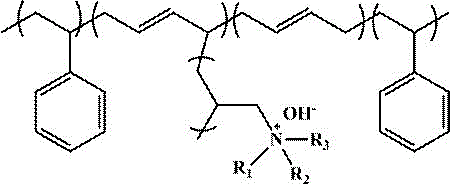
The invention discloses an anion exchange membrane based on styrene-butadiene block copolymer (SBS), which is prepared by the method of the invention, and the chemical structural general formula of the anion exchange membrane comprises a repeating unit shown in formula (1):
in the formula, R1,R2,R3Methyl, ethyl, isopropyl, phenyl, etc.
Due to the application of the technical scheme, compared with the prior art, the invention has the following advantages:
(1) the preparation method is to soak the polymer membrane in the amine solution, so that the use of the toxic substance chlorphenyl ether in the traditional quaternary ammonium type anion exchange membrane preparation process is avoided, and the preparation process is relatively simple, green and safe.
(2) The anion exchange membrane is a polymer electrolyte based on SBS, which is the engineering plastic with the largest yield in the world at present and is a thermoplastic elastomer with similar performance to rubber. Low cost, excellent mechanical performance, high plasticity and good film forming performance.
(3) The SBS and the halogenated olefin have mild reaction conditions, strong operability and high grafting rate.
(4) The cation group of the anion exchange membrane is quaternary ammonium, and the main chain of the polymer is of a block structure, so that hydrophilic/hydrophobic phase separation is favorably formed, and the improvement of the ionic conductivity and the alkali-resistant stability of AEM is promoted.
Drawings
FIG. 1 shows SBS (A), SBS grafted with bromopropene (B) and AEM (C) based on SBS in example 11H NMR chart.
Detailed Description
The invention is further described below with reference to specific embodiments:
example 1
The embodiment provides a low-cost and high-performance anion exchange membrane and a preparation method thereof, and the method comprises the following steps:
(a) 2.00g of commercial SBS (trade name: SBS791, with a double bond content of SBS of about 27.55mmol) was dissolved in 50ml of tetrahydrofuran and an excess of bromopropene (4.58g, 37.86mmol) and the initiator AIBN (used at 1% of the total mass of SBS and halopropene, 0.066g) were added. And (3) carrying out condensation reflux reaction at 60 ℃ for 36 hours, dripping the mixed solution into ethanol for washing, and drying to obtain the brominated SBS. The graft ratio was found to be 26.12%.
(b) And (3) dissolving brominated SBS in tetrahydrofuran, and pouring the solution into a film in a clean tetrafluoroethylene mold at 40 ℃. Subsequently soaking the membrane in an aqueous trimethylamine solution for 24 hours, the structure of which is
A halogen type polymer electrolyte membrane was obtained.
(c) The prepared halogen-containing polymer electrolyte membrane was immersed in a 1M KOH solution at 60 ℃ for 24 hours to allow halogen anions to be exchanged with OH-And removing the residual KOH on the surface of the halogen-containing polymer electrolyte membrane by using deionized water.
The prepared anion exchange membrane has the ion exchange capacity of 1.72meq g-1(ii) a The water absorption rate and the swelling degree at room temperature are 45.28 percent and 2.56 percent respectively; the tensile strength and the elongation at break are respectively 1.23MPa and 249 percent; the ionic conductivity at room temperature is 17.97mS cm-1(ii) a The membrane is soaked in 1M KOH solution at 60 ℃ for 240 hours, and the conductivity of the membrane is only reduced by 21.48 percent when tested at room temperature, thus proving that the membrane has better alkali-resistant stability.
Example 2
This example provides a method for preparing a low-cost, high-performance anion-exchange membrane, the preparation process of which is substantially the same as the steps in example one
(a) 2.00g of commercial SBS (trade name: SBS791, the double bond content in SBS is about 27.55mmol) was dissolved in 50ml of tetrahydrofuran, excess bromopropene (2.75g, 22.72mmol) and initiator AIBN (1% in the total mass of SBS and halopropene, 0.048g) were added, the reaction was condensed at 60 ℃ under reflux for 36 hours, the mixed solution was dropped into ethanol to wash out, and dried to give brominated SBS having a graft ratio of 14.86%.
The other steps are the same as in example 1.
OH was finally determined-The performance parameters of the type anion exchange membrane are as follows: ion exchange capacity of 1.07meq g-1(ii) a The water absorption rate and the swelling degree at room temperature are respectively 12.23 percent and 0.88 percent; the tensile strength and the elongation at break are respectively 2.1MPa and 165 percent; ion conductivity of 9.21mS cm at room temperature-1(ii) a The membrane is soaked in 1M KOH solution at 60 ℃ for 240 hours, and the conductivity of the membrane is only reduced by 12.26 percent under room temperature test, thus proving that the membrane has better alkali-resistant stability.
Example 3
This example provides a method for preparing a low-cost, high-performance anion-exchange membrane, the preparation process of which is substantially the same as the steps in example one.
(a) 2.00g of commercial SBS (trade name: SBS791, the double bond content in SBS is about 27.55mmol) was dissolved in 50ml of tetrahydrofuran, excess chloropropene (2.47g, 32.33mmol) and AIBN initiator (1% in total mass of SBS and halopropene, 0.093g) were added, the reaction was condensed under reflux at 60 ℃ for 36 hours, the mixture was dropped into ethanol to wash out and dry to obtain chlorinated SBS.
In addition, the amine solution used in the step b is an aqueous solution of N, N-dimethylaniline, and the structure of the amine solution is
The rest is the same as example 1.
OH was finally determined-The performance parameters of the type anion exchange membrane are as follows: ion exchange capacity 1.69meq g-1(ii) a The water absorption rate and the swelling degree at room temperature are 35.23 percent and 1.67 percent respectively; the tensile strength and the elongation at break are respectively 2.0MPa and 152 percent; the ionic conductivity at room temperature is 12.22mS cm-1(ii) a The membrane is soaked in 1M KOH solution at 60 ℃ for 240 hours, and the conductivity of the membrane is only reduced by 22.33 percent under the test of room temperature, thereby proving that the membrane has better alkali-resistant stability.
Example 4
This example provides a low cost, high performance anion exchange membrane preparation process that is substantially identical to the procedure in example 1.
(a) 2.00g of commercial SBS (trade name: SBS791, the double bond content in SBS is about 27.55mmol) was dissolved in 50ml of tetrahydrofuran, excess iodopropene (7.30g, 43.48mmol) and the initiator AIBN (1% in amount of SBS and halopropene, 0.093g) were added, the reaction was condensed under reflux at 60 ℃ for 36 hours, the mixture was dropwise added to ethanol to wash out and dry to obtain iodinated SBS.
In addition, the amine solution used in the step b is a solution of a trihexylamine with a structure of
The other steps are the same as in example 1.
OH was finally determined-The performance parameters of the type anion exchange membrane are as follows: ion exchange capacity of 1.90meq g-1(ii) a The water absorption rate and the swelling degree at room temperature are 46.22 percent and 3.02 percent respectively; the tensile strength and the elongation at break are respectively 1.9MPa and 158 percent; the ionic conductivity at room temperature was 17.11mS cm-1(ii) a The membrane is soaked in 1M KOH solution at 60 ℃ for 240 hours, and the conductivity of the membrane is only reduced by 25.66 percent when tested at room temperature, thus proving that the membrane has better alkali-resistant stability.
Example 5
This example provides a method for preparing a low-cost, high-performance anion exchange membrane, the preparation process of which is substantially the same as the steps in example 1
(a) 2.00g of commercial SBS (brand: SBS791, the double bond content in SBS is about 27.55mmol) is dissolved in 50ml of tetrahydrofuran, a proper amount of chloropropene (4.43g, 57.97mmol) and initiator AIBN (1% of the total mass of SBS and halopropene, 0.090g) are added, condensation reflux reaction is carried out at 60 ℃ for 36 hours, the mixed liquid is dripped into ethanol to be washed out, and drying is carried out, thus obtaining chlorinated SBS.
In addition, the amine solution used in step b is an aqueous solution of dimethylisopropylamine having the structure
OH was finally determined-The performance parameters of the type anion exchange membrane are as follows: ion exchange capacity of 2.01meq g-1(ii) a The water absorption rate and the swelling degree at room temperature are 57.27 percent and 4.97 percent respectively; the tensile strength and the elongation at break are respectively 1.3MPa and 286%; the ionic conductivity at room temperature was 14.23mS cm-1(ii) a The membrane is soaked in 1M KOH solution at 60 ℃ for 240 hours, and the conductivity of the membrane is only reduced by 28.12 percent when tested at room temperature, thus proving that the membrane has excellent alkali-resistant stability.
The above-mentioned embodiments are merely illustrative of the technical ideas and features of the present invention, and the purpose thereof is to enable those skilled in the art to understand the contents of the present invention and to implement the present invention, and not to limit the scope of the present invention, and all equivalent changes or modifications made according to the spirit of the present invention should be covered in the scope of the present invention.