Disclosure of Invention
The method aims to solve the defects in the prior art, provide a method for molding the metal organic polyhedron composite material, and simultaneously solve the problems of close packing of metal organic polyhedrons and easy contraction of alginic acid frameworks.
In order to solve the technical problems, the invention provides the following technical scheme:
the first purpose of the invention is to provide a preparation method of a copper-based metal organic polyhedral composite material, which comprises the following steps: firstly, adding a sodium alginate solution into a divalent copper ion aqueous solution, standing, filtering and washing to obtain a copper-based alginic acid hydrogel; then reacting the copper-based alginic acid hydrogel with silicate ester, filtering and washing to obtain the copper-based alginic acid-silicon dioxide hydrogel; and finally, reacting the copper-based alginic acid-silica hydrogel with a ligand (isophthalic acid or 5-substituent isophthalic acid), filtering, washing and drying to obtain the copper-based metal organic polyhedral composite material.
The method comprises the following specific steps:
(1) preparing copper-based alginic acid hydrogel:
adding sodium alginate into deionized water, wherein the mass ratio of the sodium alginate to the deionized water is 1: 25-1: 200, stirring for 4-12 hours at the temperature of 20-40 ℃ until the sodium alginate is completely dissolved;
adding a sodium alginate solution into an aqueous solution of divalent copper ions, wherein the volume ratio of the sodium alginate solution to the aqueous solution of the divalent copper ions is 1: 1-1: 5, the concentration of the divalent copper ions in the divalent copper ion aqueous solution is 0.05-0.5 mol/L, standing for 6-12 h at 20-40 ℃, filtering, washing, and crosslinking the divalent copper ions and sodium alginate to obtain the copper-based alginate hydrogel;
(2) preparing copper-based alginic acid-silicon dioxide hydrogel:
placing the copper-based alginic acid hydrogel prepared in the step (1) into a silicate solution, wherein the volume ratio of the copper-based alginic acid hydrogel to the silicate solution is 1: 1-1: 5, the concentration of the silicate solution is 60-80 v/v%, the reaction time is 6-24 h, and the copper-based alginic acid-silicon dioxide hydrogel is obtained by filtering and washing;
(3) preparing a copper-based metal organic polyhedral composite material:
washing the copper-based alginic acid-silica hydrogel prepared in the step (2) by methanol or N' N-dimethylformamide for 3-5 times, and then adding the copper-based alginic acid-silica hydrogel into a ligand solution, wherein the ligand solution comprises a ligand and a deprotonating solvent, the ligand is isophthalic acid or 5-substituent isophthalic acid, the deprotonating solvent is 2, 6-dimethylpyridine or pyridine, preferably, the deprotonating solvent is 2, 6-dimethylpyridine; standing for 6-12 h, filtering, washing, and drying at 40-100 ℃ for 6-12 h to obtain the copper-based metal organic polyhedral composite material.
Further, in the step (1), the mass ratio of sodium alginate to deionized water is 1: 50-1: 100.
the copper-based metal organic polyhedron is prepared from divalent copper ions and isophthalic acid or 5-substituent isophthalic acid.
Further, the divalent copper ions in the step (1) are one or two of copper nitrate trihydrate or copper chloride; the concentration of the divalent copper ions in the divalent copper ion aqueous solution is 0.1-0.3 mol/L.
Further, the volume ratio of the sodium alginate solution to the aqueous solution of the divalent copper ions in the step (1) is 1: 2-1: 3.
according to thermogravimetric analysis, the amount of the cross-linked divalent copper ions in the copper-based alginic acid hydrogel prepared by the method is 21 wt% of the mass of sodium alginate.
Further, in the step (2), the volume ratio of the copper-based alginic acid hydrogel to the silicate solution is 1: 2-1: 3.
the silicate is methyl orthosilicate, ethyl orthosilicate, propyl orthosilicate and butyl orthosilicate, and preferably ethyl orthosilicate;
the solvent of the silicate solution is methanol or ethanol, preferably ethanol;
the concentration of the silicate solution is 65-70 v/v%.
Further, in the step (2), the reaction time of the copper-based alginic acid hydrogel and the silicate solution is 10-12 hours.
Further, in the step (3), the content of the ligand in the ligand solution is that, in the step (1), the molar ratio of the cross-linked divalent copper ions in the copper-based alginic acid hydrogel to the ligand is 1: 1-1: 2, preferably 1: 1.2-1: 1.5;
the solvent for dissolving the ligand in the ligand solution may be methanol or N' N-dimethylformamide.
The 5-substituent isophthalic acid is 5-hydroxyisophthalic acid, 5-aminoisophthalic acid and 5-sulfoisophthalic acid monosodium salt.
The addition amount of the deprotonated solvent is that the molar ratio of the deprotonated solvent to the ligand is 1: 2-1: 3, preferably 1: 2-1: 2.5.
further, in the step (3), the drying temperature is 60-80 ℃; the drying time is 8-10 h.
The second purpose of the invention is to provide a copper-based metal organic polyhedral composite material prepared by the preparation method.
The third purpose of the invention is to provide the copper-based metal organic polyhedral composite material as a catalyst for catalyzing propylene oxide and CO2The application of cycloaddition to the production of propylene carbonate.
The method comprises the following specific steps: adding catalyst and epoxypropane into a high-pressure reaction kettle, and introducing CO2Reacting for a certain time at a certain temperature to obtain a product propylene carbonate;
further, the propylene oxide is reacted with CO2In the reaction of cycloaddition to propylene carbonate, propylene oxide and CO2The molar ratio is 1:0.5-1: 2, preferably 1: 1-1: 1.5;
the copper-based metal organic polyhedral composite material is used as a catalyst, and the using amount of the copper-based metal organic polyhedral composite material is 1-5 wt%, preferably 2-3 wt% of the mass of the propylene oxide;
a cocatalyst is added in the application, wherein the cocatalyst is tetrabutylammonium bromide, and the using amount of the cocatalyst is 5-10 wt.%, preferably 7-9 wt.% of the mass of the propylene oxide;
the reaction pressure (gauge pressure) is 0.5 to 2MPa, preferably 1 to 1.5 MPa;
the reaction temperature is 60-120 ℃, and preferably 80-100 ℃;
the reaction time is 4-10 h, preferably 8-10 h.
In the technical scheme of the invention, the pressure is gauge pressure.
The action mechanism of the copper-based metal organic polyhedral composite material is as follows: alginic acid can be rapidly crosslinked with divalent copper ions to form hydrogel, and the divalent copper ions are uniformly distributed in the alginic acid hydrogel to obtain the copper-based alginic acid hydrogel. However, alginic acid has larger pore diameter and the skeleton structure is easy to shrink, so the copper-based alginic acid hydrogel is reacted with silicate ester to form a mutually penetrated and compact copper-based alginic acid-silicon dioxide hybrid network structure. The copper-based alginic acid-silicon dioxide hydrogel reacts with a ligand (isophthalic acid or 5-substituent isophthalic acid), a metal organic polyhedron grows in situ, and the composite material with good dispersibility of the copper-based metal organic polyhedron is obtained by filtering, washing and drying.
The invention has the beneficial effects that:
the copper-based metal organic composite material is prepared by reacting copper-based alginic acid-silicon dioxide hydrogel with isophthalic acid or 5-substituent isophthalic acid. The copper-based alginic acid-silicon dioxide hydrogel has a compact network structure, can effectively inhibit the close packing of the generated metal organic polyhedrons, and can also effectively inhibit the shrinkage of an alginic acid skeleton.
The copper-based metal organic composite material is used as a catalyst, the preparation method is simple, the stability is good, the propylene oxide conversion rate and the propylene carbonate selectivity are very high, and the catalyst is formed into a microspherical shape, is easy to recycle and is very suitable for industrial production.
Detailed Description
The present invention is further illustrated by the following examples, in which experimental procedures not specifically identified are generally performed by means well known in the art.
In the scheme of the invention, the yield calculation formula is as follows: yield ═ 100% (amount of target product produced/amount of reactant fed)
Example 1
(1) Preparing copper-based alginic acid hydrogel: weighing 600mg of sodium alginate, dissolving in 30mL of deionized water, stirring at 30 ℃ for 8h until the sodium alginate is completely dissolved, and preparing to obtain 30mL of sodium alginate solution.
Adding the sodium alginate solution into 60mL of 0.24mol/L copper nitrate aqueous solution, standing at 40 ℃ for 10h, filtering and washing to obtain 30mL of copper-based alginic acid hydrogel with the diameter of 3.5mm, wherein in the example, 126mg of copper is crosslinked by 600mg of sodium alginate, namely the amount of crosslinked divalent copper ions in the copper-based alginic acid hydrogel is 1.969 mmol.
(2) Preparing copper-based alginic acid-silicon dioxide hydrogel: and (3) placing the copper-based alginic acid hydrogel in 60mL of 60 v/v% ethyl orthosilicate ethanol solution, reacting for 24h, filtering, and washing to obtain the copper-based alginic acid-silicon dioxide hydrogel.
(3) Preparing a composite material: 392.5mg of isophthalic acid (2.4mmol) was weighed, dissolved in 50mL of methanol, and L of 2, 6-lutidine was added to prepare a ligand solution. And then adding the copper-based alginic acid-silicon dioxide hydrogel washed by methanol for 3 times into an isophthalic acid solution, standing for 12H, filtering, washing by methanol for 3 times, and drying at 60 ℃ for 8H to obtain the copper-based metal organic polyhedral composite material, wherein the diameter of the composite material is 2.5-2.8mm, and the composite material is named as MOP-H-ALG-TEOS.
According to the ultraviolet-visible spectrum analysis result of fig. 1, MOP-H-ALG-TEOS has a characteristic absorption peak of a two-copper paddle structure at 730nm, which indicates that charge transfer exists between divalent copper and a ligand, namely the MOP-H-ALG-TEOS composite material is successfully prepared.
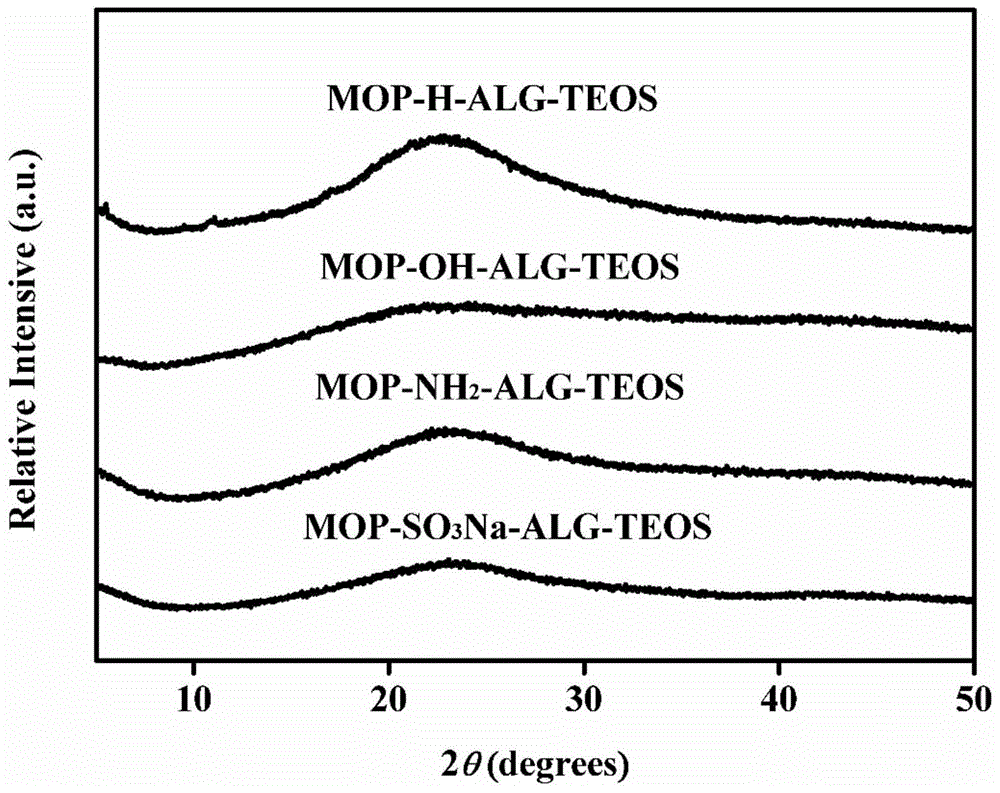
As shown in the X-ray diffraction result of FIG. 2, the XRD pattern of MOP-H-ALG-TEOS shows the amorphous structure of silicon dioxide, and has no obvious peak shape of MOP-H, thus showing that MOP-H is well dispersed in the MOP-H-ALG-TEOS composite material.
Example 2
(1) Preparing copper-based alginic acid hydrogel: weighing 600mg of sodium alginate, dissolving in 30mL of deionized water, stirring at 30 ℃ for 8h until the sodium alginate is completely dissolved, and preparing to obtain 30mL of sodium alginate solution.
Adding the sodium alginate solution into 60mL of 0.24mol/L copper nitrate aqueous solution, standing for 10h at 40 ℃, filtering and washing to obtain 30mL of copper-based alginic acid hydrogel with the diameter of 3.5 mm.
(2) Preparing copper-based alginic acid-silicon dioxide hydrogel: and (3) placing the copper-based alginic acid hydrogel in 60mL of 65 v/v% ethyl orthosilicate ethanol solution, reacting for 12h, filtering, and washing to obtain the copper-based alginic acid-silicon dioxide hydrogel.
(3) Preparing a composite material: 430.1mg of 5-hydroxyisophthalic acid was weighed, dissolved in 50mL of methanol, and added
L of 2, 6-lutidine, to prepare a ligand solution. And then adding the copper-based alginic acid-silicon dioxide hydrogel washed by methanol for 3 times into a 5-hydroxyisophthalic acid solution, standing for 12h, filtering, washing by methanol for 3 times, and drying at 60 ℃ for 8h to obtain the copper-based metal organic polyhedral composite material, wherein the diameter of the composite material is 2.5-2.8mm and the composite material is named as MOP-OH-ALG-TEOS.
According to the ultraviolet-visible spectrum analysis result of fig. 1, MOP-OH-ALG-TEOS has a characteristic absorption peak of a two-copper paddle structure at 780nm, which indicates that charge transfer exists between divalent copper and a ligand, i.e., the MOP-OH-ALG-TEOS composite material is successfully prepared.
As shown in the X-ray diffraction result of FIG. 2, the XRD pattern of MOP-OH-ALG-TEOS shows an amorphous structure of silica, and has no peak shape of MOP-OH, thus showing that MOP-OH is well dispersed in the MOP-OH-ALG-TEOS composite material.
Example 3
(1) Preparing copper-based alginic acid hydrogel: weighing 600mg of sodium alginate, dissolving in 30mL of deionized water, stirring at 30 ℃ for 8h until the sodium alginate is completely dissolved, and preparing to obtain 30mL of sodium alginate solution.
Adding the sodium alginate solution into 60mL of 0.24mol/L copper nitrate aqueous solution, standing for 10h at 40 ℃, filtering and washing to obtain 30mL of copper-based alginic acid hydrogel with the diameter of 3.5 mm.
(2) Preparing copper-based alginic acid-silicon dioxide hydrogel: and (3) placing the copper-based alginic acid hydrogel in 60mL of 70 v/v% ethyl orthosilicate ethanol solution, reacting for 10h, filtering, and washing to obtain the copper-based alginic acid-silicon dioxide hydrogel.
(3) Preparing a composite material: 428.1mg of 5-aminoisophthalic acid was weighed and dissolved in 50mL of N' -dimethylformamide, and 550L of 2, 6-lutidine was added to prepare a ligand solution. Then adding the copper-based alginic acid-silicon dioxide hydrogel washed by N' N-dimethylformamide for 3 times into a 5-amino isophthalic acid solution, standing for 12h, filtering, washing by methanol for 3 times, and drying at 80 ℃ for 10h to obtain the copper-based metal organic polyhedral composite material, wherein the diameter of the composite material is 2.5-2.8mm, and the composite material is named as MOP-NH2-ALG-TEOS。
According to the UV-Vis spectrum analysis result of FIG. 1, MOP-NH2ALG-TEOS exhibits a characteristic absorption peak at 750nm for the two-copper paddle structure, indicating the presence of charge transfer between the divalent copper and the ligand, i.e., MOP-NH2The preparation of the ALG-TEOS composite material is successful.
From the X-ray diffraction results of FIG. 2, MOP-NH2The XRD pattern of ALG-TEOS exhibits an amorphous structure of silica, free of MOP-NH2Thus indicating MOP-NH2In MOP-NH2The ALG-TEOS composite material has good dispersion.
Example 4
(1) Preparing copper-based alginic acid hydrogel: weighing 600mg of sodium alginate, dissolving in 30mL of deionized water, stirring at 30 ℃ for 8h until the sodium alginate is completely dissolved, and preparing to obtain 30mL of sodium alginate solution.
Adding the sodium alginate solution into 60mL of 0.24mol/L copper nitrate aqueous solution, standing for 10h at 40 ℃, filtering and washing to obtain 30mL of copper-based alginic acid hydrogel with the diameter of 3.5 mm.
(2) Preparing copper-based alginic acid-silicon dioxide hydrogel: and (3) placing the copper-based alginic acid hydrogel in 60mL of 80v/v% ethyl orthosilicate ethanol solution, reacting for 6h, filtering, and washing to obtain the copper-based alginic acid-silicon dioxide hydrogel.
(3) Preparing a composite material: 633.7mg of 5-sulfoisophthalic acid monosodium salt was weighed and dissolved in 50mL of methanol, and 550L of 2, 6-lutidine was added to prepare a ligand solution. Then adding the copper-based alginic acid-silicon dioxide hydrogel washed by methanol for 3 times into a 5-sulfoisophthalic acid solution, standing for 12h, filtering, washing by methanol for 3 times, and drying at 60 ℃ for 8h to obtain the copper-based metal organic polyhedral composite material, wherein the diameter of the composite material is 2.5-2.8mm, and the composite material is named as MOP-SO3Na-ALG-TEOS。
According to the UV-Vis spectrum analysis result of FIG. 1, MOP-SO3Na-ALG-TEOS shows a characteristic absorption peak of a two-copper wheel paddle structure at 780nm, which indicates that charge transfer exists between divalent copper and a ligand, namely MOP-SO3Na-ALG-TEOS is successfully prepared.
From the X-ray diffraction results of FIG. 2, MOP-SO3The XRD pattern of Na-ALG-TEOS shows the amorphous structure of silicon dioxide without MOP-SO3Na shows a peak shape, thus indicating MOP-SO3Na on MOP-SO3The Na-ALG-TEOS composite material has good dispersion.
EXAMPLE 5 application of the catalyst MOP-H-ALG-TEOS prepared in example 1 to propylene oxide and CO2Cycloaddition reaction to produce propylene carbonate.
This implementationExample 4 groups were selected, and the catalyst samples prepared in example 1 of the present invention were examined for the catalysis of propylene oxide and CO under different conditions2The catalytic effect of the cycloaddition reaction to propylene carbonate. The specific operation is as follows:
the reaction is carried out in a 50mL quick-opening miniature high-pressure reaction kettle, 24.3mg of catalyst, 96.7mg of cocatalyst tetrabutylammonium bromide and 1.1616g of propylene oxide are added, and CO is introduced2Reacting under different pressures, different temperatures and different times. And after the reaction is finished, firstly cooling, then deflating and decompressing, finally filtering to obtain a catalyst and a sample solution, and analyzing the sample solution on a gas chromatograph.
The process conditions and the reaction results are respectively listed in the following table 1:
TABLE 1
EXAMPLE 6 application of the catalyst MOP-OH-ALG-TEOS prepared in EXAMPLE 2 to propylene oxide and CO2Cycloaddition reaction to produce propylene carbonate.
This example is divided into 4 groups and examined the samples of the catalyst prepared in example 2 of the present invention for the catalysis of propylene oxide and CO respectively under different conditions2The catalytic effect of the cycloaddition reaction to propylene carbonate. The specific operation is as follows:
the reaction is carried out in a 50mL quick-opening miniature high-pressure reaction kettle, 27.5mg of catalyst, 96.7mg of cocatalyst tetrabutylammonium bromide and 1.1616g of propylene oxide are added, and CO is introduced2Reacting under different pressures, different temperatures and different times. And after the reaction is finished, firstly cooling, then deflating and decompressing, finally filtering to obtain a catalyst and a sample solution, and analyzing the sample solution on a gas chromatograph.
The process conditions and the reaction results are shown in table 2 below:
TABLE 2
Example 7 example 3 preparation of catalyst MOP-NH2Application of-ALG-TEOS to propylene oxide and CO2Cycloaddition reaction to produce propylene carbonate.
This example is divided into 4 groups and examined the samples of the catalyst prepared in example 3 of the present invention for the catalysis of propylene oxide and CO respectively under different conditions2The catalytic effect of the cycloaddition reaction to propylene carbonate. The specific operation is as follows:
the reaction is carried out in a 50mL quick-opening miniature high-pressure reaction kettle, 26.4mg of catalyst, 96.7mg of cocatalyst tetrabutylammonium bromide and 1.1616g of propylene oxide are added, and CO is introduced2Reacting under different pressures, different temperatures and different times. And after the reaction is finished, firstly cooling, then deflating and decompressing, finally filtering to obtain a catalyst and a sample solution, and analyzing the sample solution on a gas chromatograph.
The process conditions and the reaction results are shown in the following table 3:
TABLE 3
Example 8 example of the catalyst MOP-SO prepared in example 43Application of Na-ALG-TEOS in epoxypropane and CO2Cycloaddition reaction to produce propylene carbonate.
This example is divided into 4 groups and examined the samples of the catalyst prepared in example 4 of the present invention for the catalysis of propylene oxide and CO respectively under different conditions2The catalytic effect of the cycloaddition reaction to propylene carbonate. The specific operation is as follows:
the reaction is carried out in a 50mL quick-opening miniature high-pressure reaction kettle, 35.4mg of catalyst, 96.7mg of cocatalyst tetrabutylammonium bromide and 1.1616g of propylene oxide are added, and CO is introduced2Reacting under different pressures, different temperatures and different times. And after the reaction is finished, firstly cooling, then deflating and decompressing, finally filtering to obtain a catalyst and a sample solution, and analyzing the sample solution on a gas chromatograph.
The process conditions and the reaction results are shown in the following table 4:
TABLE 4
Comparative example 1
Preparation of metal organic polyhedra: 483.2mg of copper nitrate trihydrate and 332.3mg of isophthalic acid are weighed, added into 40mL of methanol solution to be completely dissolved, 0.465mL of 2, 6-lutidine is added, the mixture is kept stand at 40 ℃ for 12H, filtered, washed by methanol for 3 times and dried at 60 ℃ for 8H, and the metal organic polyhedron named as MOP-H is obtained.
According to the ultraviolet-visible spectrum analysis result of FIG. 3, MOP-H shows a characteristic absorption peak of a two-copper wheel paddle structure at 30nm, which indicates that charge transfer exists between bivalent copper and a ligand.
From the X-ray diffraction results of FIG. 4, the XRD pattern of MOP-H showed good peak shape of MOP-H and good crystal form.
Comparative example 2
(1) Preparing copper-based alginic acid hydrogel: 600mg of sodium alginate is weighed and dissolved in 30mL of deionized water, and the mixture is stirred for 8 hours at 30 ℃ until the sodium alginate is completely dissolved. Adding the sodium alginate solution into 60mL of 0.24mol/L copper nitrate aqueous solution, standing for 10h at 40 ℃, filtering and washing to obtain the copper-based alginate hydrogel with the diameter of 3.5 mm.
(2) Preparing copper-based alginic acid xerogel: drying the copper-based alginic acid hydrogel for 8 hours at 100 ℃ to obtain the copper-based alginic acid xerogel, wherein the diameter of the copper-based alginic acid xerogel is 1.2-1.5mm, and the copper-based alginic acid xerogel is named as Cu-ALG.
Comparative example 3
(1) Preparing copper-based alginic acid hydrogel: 600mg of sodium alginate is weighed and dissolved in 30mL of deionized water, and the mixture is stirred for 8 hours at 30 ℃ until the sodium alginate is completely dissolved. Adding the sodium alginate solution into 60mL of 0.24mol/L copper nitrate aqueous solution, standing for 10h at 40 ℃, filtering and washing to obtain the copper-based alginate hydrogel with the diameter of 3.5 mm.
(2) Preparing copper-based alginic acid-silicon dioxide hydrogel: and (3) placing the copper-based alginic acid hydrogel in 60mL of 20 v/v% ethyl orthosilicate ethanol solution, reacting for 24h, filtering, and washing to obtain the copper-based alginic acid-silicon dioxide hydrogel.
(3) Preparing a composite material: 392.5mg of isophthalic acid was weighed out and dissolved in 50mL of methanol, and 550L of 2, 6-lutidine was added to prepare a ligand solution. And then adding the copper-based alginic acid-silicon dioxide hydrogel washed by methanol for 3 times into an isophthalic acid solution, standing for 12H, filtering, washing by methanol for 3 times, and drying at 60 ℃ for 8H to obtain the metal organic polyhedral composite material, wherein the diameter of the composite material is 1.6-1.8mm, and the composite material is named as MOP-H-ALG-TEOS-20.
According to the ultraviolet-visible spectrum analysis result of FIG. 3, MOP-H-ALG-TEOS-20 has a characteristic absorption peak of a two-copper paddle structure at 730nm, which indicates that charge transfer exists between divalent copper and a ligand, i.e., MOP-H-ALG-TEOS-20 composite material is successfully prepared.
As shown in the X-ray diffraction results of FIG. 4, the XRD pattern of MOP-H-ALG-TEOS-20 showed good peak shape of MOP-H, indicating that MOP-H was densely packed in the MOP-H-ALG-TEOS-20 composite.
Comparative example 4 catalysts prepared in comparative examples 1, 2, 3 for propylene oxide and CO2Cycloaddition reaction to produce propylene carbonate.
This example was divided into 3 groups and examined the samples of catalysts prepared in comparative examples 1, 2 and 3 for the catalysis of propylene oxide and CO under different conditions2The catalytic effect of the cycloaddition reaction to propylene carbonate. The specific operation is as follows:
propylene oxide with CO2The reaction of cycloaddition to propylene carbonate was carried out in a 50mL quick-opening autoclave, to which 14.6mg, 17.2mg, 19.6mg of the catalysts, 96.7mg of tetrabutylammonium bromide as a cocatalyst, 1.1616g of propylene oxide, and CO were added2The pressure is increased to 1MPa (gauge pressure), the reaction temperature is 80 ℃, and the reaction time is 10 h. And after the reaction is finished, firstly cooling, then deflating and decompressing, finally filtering to obtain a catalyst and a sample solution, and analyzing the sample solution on a gas chromatograph.
The reaction results are respectively shown in the following table 5:
TABLE 5
MOP-SO prepared in example 43Compared with the Na-ALG-TEOS catalyst, the metal organic polyhedron MOP-H prepared in the comparative example 1, the copper-based alginic acid xerogel Cu-ALG prepared in the comparative example 2 and the metal organic polyhedron composite MOP-H-ALG-TEOS-20 prepared in the comparative example 3 have obviously lower catalytic activities under the same reaction conditions.
The present invention is not limited to the above embodiments, and various modifications and changes can be made without departing from the spirit of the present invention, and these modifications and changes fall within the scope of the present invention.