Background
In recent years, industrial internet gradually becomes the most concerned hotspot problem in the industrial field, with the rapid development of computer, communication and control technologies, the rapid development of industrial internet has higher and higher requirements on network architecture, and SDN architecture makes the industrial internet have more concise operation with its open programmable and flexible features. The resource allocation method of the real-time service is one of basic technologies for enhancing the controllability of the industrial SDN, can help network operators to provide better services, can effectively supervise and manage the network, and ensures the real-time performance and the dynamic performance of the network. Meanwhile, bandwidth resources can be optimized more greatly, and the resource utilization rate is improved.
Various techniques currently exist to address the above problems.
(1) Resource allocation method based on cloud network fusion
Real-time services have fixed transmission time limits and will lose timeliness beyond the time delay limit. For a traditional industrial SDN architecture which does not have sufficient computing resources to support a reasonable resource allocation algorithm, an intelligent center is constructed, state information of the whole network is collected through an SDN controller, elastic path computing resources are provided for the intelligent algorithm needed by the controller, the network state information is uploaded to a database of a cloud intelligent center for caching according to needs through ubiquitous perception of the underlying network state, and VDC (virtual Data center) Manager is adopted to centrally manage link bandwidth in the system architecture, so that inter-service communication bandwidth guarantee is achieved, but fine-grained division and bandwidth guarantee are not carried out on services in the method, and huge burden of the VDC Manager is caused.
(2) Resource allocation method based on machine learning
The hot point of research at present is mainly in an artificial intelligence resource allocation method, a decision model is constructed by using a machine learning intelligent SDN (software defined network) and is used for learning relevant heuristic algorithm routing capacity, meanwhile, in order to better learn real-time network state characteristics, service characteristics are extracted and an algorithm is used for training and establishing a learning model, and then, a calculated path is matched. However, the model complexity of the method is extremely high, the existing model does not support the selection of multi-path, and for unstable network topology detection and variable network environment resources, particularly under the condition that the real-time requirement of industrial network flow is extremely high, the performance of the model is reduced to some extent, and the accuracy is uncertain.
(3) Resource allocation method based on clock synchronization
In order to avoid collision caused by data transmission of different nodes in a network, high-precision clock synchronization of network nodes is provided, a synchronization protocol is compiled, a controller interface is used for designing and scheduling rules, the size of a transmission time slice of each node is planned based on a uniform time reference, the condition that the nodes compete to transmit data is effectively avoided, and reasonable resource distribution is carried out based on clock synchronization terminal conversation. Although the clock-based method avoids the problems caused by node competition, the method has certain limitations: the method can only be based on an IEEE1588 protocol, a uClinux operating system needs to be transplanted to an NIOSII development board, a sending and receiving program of clock synchronization application is compiled based on the uClinux operating system, and clock synchronization belongs to a scheduling strategy and does not better meet the requirement of industrial business resource allocation.
Disclosure of Invention
Aiming at the problems of the existing method, the invention aims to provide an industrial SDN resource allocation method based on real-time service configuration.
In order to achieve the purpose, the invention adopts the following technical scheme:
an industrial SDN resource allocation method based on real-time service configuration comprises the following steps:
step one, real-time services are classified;
secondly, performing resource allocation on the classified real-time services;
calculating a virtual equivalent bandwidth e value of each type of real-time service according to a calculation formula of the virtual equivalent bandwidth, and selecting different on-demand resource reservation distribution modes according to the virtual equivalent bandwidth e value and the threshold value;
step three, judging whether resource bearing reservation is carried out or not, if the resource bearing reservation is carried out, then resource allocation is not carried out, if the resource bearing reservation is not carried out, then judging whether resource reservation is allowed or not, if the resource reservation is allowed, then step four is carried out, and if the resource reservation is not allowed, then abandon is carried out;
and fourthly, the controller analyzes the resources, judges whether a resource reservation connection exists or not if the resource reservation package is found, refuses to establish the resource reservation connection for the resources if the resource reservation connection exists, establishes the resource reservation connection if the resource reservation connection does not exist, feeds back the position of the resource content bearing to the controller, and the controller adjusts the bearing reservation request according to the feedback.
The invention is further improved in that the specific process of the first step is as follows: carrying out data preprocessing on the acquired network service flow, selecting bandwidth requirements, transmission time characteristics, service flow rate and data packet size information moisture as dimensional characteristics aiming at real-time services, and sending 4-dimensional vectors V (V1, V2, V3 and V4) into a classifier for training; selecting a sample with labels as a training set to construct a classifier for training, wherein the labels are respectively 0 for the content of the large-bandwidth real-time service flow and 1 for the content of the small-bandwidth real-time service flow, and calculating the threshold value of each type of real-time service in the classifier; when the next real-time service flow to be detected enters, the classifier performs classification judgment on the next real-time service flow according to the requirement of a training set stored by the classifier, the steps are repeated, and the service flow set with the labeled category is finally output according to the output of the service flow set with the labeled category learned by the self-learning ability of machine learning; wherein, V1 represents the real-time service selection bandwidth requirement, V2 represents the transmission time characteristic, V3 represents the service flow rate, and V4 represents the packet size information.
The invention is further improved in that the first step further comprises the following processes: and comparing the calculated error with a threshold value, and resetting the weight if the error exceeds the threshold value, wherein w is 1/n, w is a weight value, and n is a set of the number of samples.
The invention is further improved in that in the step one, the error is calculated as follows:
wherein: a is the accuracy of the classification error;
n is the set of sample numbers, p is the discrete sampling probability of the traffic flow data, and w is the weight value.
The invention is further improved in that the calculation formula of the virtual equivalent bandwidth in the second step is:
where b is the maximum data packet length of the traffic flow, S is the maximum data packet length, L is the transmission rate, r is the supportable transmission rate, and D is the deterministic delay of any size.
The further improvement of the invention is that if the e value of the virtual equivalent bandwidth is larger than the threshold value, the dynamic resource pre-loading is carried out, and if the e value of the virtual equivalent bandwidth is smaller than the threshold value, the static resource pre-loading is carried out.
The further improvement of the invention is that the specific process of carrying out dynamic resource pre-loading is as follows: supposing that the terminal 2 has two types of the same type to apply for resource reservation to the content 1, the real-time service flow content 1 of the terminal 1 sends a resource reservation request, the base station forwards the resource request to the server for inquiry, the controller analyzes the resource request to find that the resource reservation packet is a resource reservation packet, judges whether a resource reservation connection exists or not, refuses to establish the resource reservation connection for the resource request if the resource reservation connection exists, establishes the resource reservation connection if the resource reservation connection does not exist, and feeds back the position of the resource content bearing to the controller, and the controller adjusts the borne reservation request according to the feedback.
A further improvement of the present invention is that if the buffered data exceeds the threshold, the reservation request of the bearer is adjusted according to the fed back resource bearer information.
The further improvement of the invention is that the specific process of carrying out the static resource pre-loading is as follows: supposing that the terminal 1 applies for resource reservation, the real-time service flow content 1 of the terminal 1 sends a reserved resource request, the base station forwards the resource request to the server for inquiry, the controller analyzes the resource request to find that the resource request is a resource reserved packet, judges whether a resource reserved connection exists or not, refuses to establish the resource reserved connection for the resource request if the resource reserved connection exists, establishes the resource reserved connection if the resource reserved connection does not exist, feeds back the position of the resource content bearing to the controller, and the controller adjusts the borne reserved request according to the feedback.
Compared with the prior art, the invention has the beneficial effects that:
the invention provides a resource allocation method based on real-time service configuration, which aims at the characteristics and dynamic requirements of real-time service types of an industrial SDN network by using the concepts of real-time service configuration and resource pre-loading. On the other hand, the method can meet the resource optimization with the transmission delay of the real-time service in the industrial internet as the target, and on the other hand, avoids a plurality of real-time service flows competing for the limited bandwidth resources at the same time. The fine-grained real-time service classification and on-demand resource reservation method based on machine learning improves the accuracy of service configuration, and the classification can more flexibly meet the requirement of industrial Internet architecture on high real-time performance, save cost and reasonably plan bandwidth resource allocation.
Further, since the industrial SDN has high requirements for the configuration of real-time services, if a resource reservation mode is directly used, the experimental effect is general, and the resource utilization rate is relatively low, which brings a large discount. The on-demand resource reservation method can bring great improvement to the resource utilization rate according to finer granularity division of the large and small broadband real-time service contents, especially at the resource demand peak stage.
Detailed Description
The invention is described in detail below with reference to the figures and examples
First, the relevant definitions are introduced:
define 1 equivalent bandwidth: setting a passing service flow M, having a delay D which does not limit the existence of the upper limit of the delay, and defining the effective bandwidth e of the service flow M as the bit rate of the service flow M in a mode of maximum delay.
The calculation formula for defining 2 the virtual equivalent bandwidth e is:
where b is the maximum data packet length of the traffic flow, S is the maximum data packet length, L is the transmission rate, r is the supportable transmission rate, and D is the deterministic delay of any size.
Definition 3 calculate classification error the classification error of the classifier (i.e. classification accuracy, the case where the decision label is not in line with the current) is calculated:
wherein: a is the accuracy of the classification error;
n is a set of sample number, p is the discrete sampling probability of the traffic flow data, and w is a weight value;
the real-time service classification module of the invention preprocesses the captured flow into features and labels by a machine learning method, selects four-dimensional features (bandwidth requirement, transmission time feature, service flow rate, data packet size information moisture) to construct a feature vector set as shown in figure 1, then constructs a classifier to train the feature vector set, inputs the feature vector set as an arriving service flow set, carries out fine-grained identification evaluation according to the features of the feature vector set, and outputs the feature vector set as a service flow set with labeled categories. And finally, after the final classification, the error, namely the accuracy rate is judged, an error threshold value is set, if the error value exceeds the threshold value or the error value is larger, the weight is reset, finally, the classifier is updated, and the corresponding output real-time service type is executed according to the rule input.
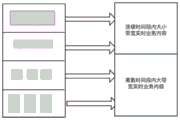
As shown in fig. 1, the results of classifying the real-time traffic according to the fine granularity are two major classes, 4 classes: large and small bandwidth traffic flows in continuous time periods and large and small bandwidth traffic flows in discrete time periods.
Based on the idea of machine learning, when some traditional supervised learning methods are used for classification in the prior art, the larger the scale of training samples is, the better the classification effect is. However, in many scenes of a real network, if the training samples are too large in scale, the training time is too much. The machine learning simulates the process of human learning, the existing knowledge is used for training a model to acquire new knowledge, corresponding output is given according to rules, and the model is corrected through continuously accumulated information to obtain a more accurate and useful new model.
Based on the concept of resource reservation on demand, because most of the traditional industrial SDN real-time service resource allocation methods do not better optimize time delay and improve the resource utilization rate, the method can not only perform effective resource allocation, but also improve the bandwidth resource utilization rate while saving the cost, thereby achieving the effect of optimizing the real-time service resources.
As shown in fig. 4, the method for allocating industrial SDN resources based on real-time service configuration according to the present invention employs two modules: a real-time service classification module and a resource allocation module.
The function of each module is described separately below.
1. Real-time traffic classification module
And a real-time business detailed classification module based on machine learning is arranged in the first real-time business classification module. Firstly, data preprocessing is carried out on captured network service flows, the processed service flow data are sent to a classifier for classification, and classification of industrial network real-time service flows is achieved. Selecting bandwidth requirements, transmission time characteristics, service flow rate and data packet size information moisture dimension characteristics for real-time services, and marking the type by adopting a 4-dimensional vector V (V1, V2, V3 and V4); the resource allocation module adopts a resource pre-bearing on-demand reservation mode, so that the whole end-to-end bandwidth resource is reserved, and the reserved resource can be directly used for transmitting data while the end-to-end transmission delay is reduced.
Model trees are constructed through machine learning continuously for the accessed real-time service flows, and each node of the model trees represents a classifier. Each classifier has a training set of known traffic types as shown in fig. 2, where the first rectangle on the left side in fig. 2 represents a large bandwidth real-time service in a continuous time period with a label, the second rectangle represents a small bandwidth real-time service in a continuous time period with a label, the third rectangle represents a large bandwidth real-time service in a discrete time period with a label, and the fourth rectangle represents a small bandwidth real-time service in a discrete time period with a label. When the next real-time service flow to be detected enters, all leaf node classifiers classify and judge the next real-time service flow according to the requirements of the training set stored by the leaf node classifiers, the steps are repeated, and finally the service flow set marked with the classes is output.
The real-time service classification module establishes a characteristic vector set by extracting multi-dimensional characteristics and trains a classifier based on machine learning to realize fine-grained and more detailed division of real-time services. And calculating the equivalent bandwidth of each type of real-time service according to the division result of the real-time service classification module so as to determine resource allocation.
2. Resource allocation module
In the second resource allocation module, an on-demand resource reservation method based on the service type is provided. Static bearer reservation as in fig. 3 is mainly for traffic flows with smaller bandwidth requirements in real-time traffic flows. Supposing that the terminal 1 applies for resource reservation, the real-time service flow content 1 of the terminal 1 sends a resource reservation request, the base station forwards the request to the server for inquiry, the controller analyzes the request to find that the request is a resource reservation packet, inquires whether resource reservation connection is allowed or not, simultaneously judges whether resource reservation connection exists or not, refuses to establish connection for the resource reservation packet if the resource reservation connection exists, otherwise, establishes resource reservation connection as required and feeds back the position of service content resource bearing. The dynamic state bearing reservation mainly aims at the service flow with larger bandwidth requirement in the real-time service flow. Supposing that the terminal 2 has two types of the same type to apply for resource reservation to the content 1, the real-time service flow content 1 of the terminal 1 sends a request for reserving resources, the base station forwards the request to the server for inquiry, the controller analyzes the request to find that the request is a resource reservation packet and inquires whether resource reservation linkage is allowed, the process is consistent with static resource reservation allocation, and the dynamic allocation point is that the server continues to forward the request in view of the fact that the dedicated bearing reservation is carried out for the content 1 before and whether reservation application exists is judged, and at this time, the equivalent bandwidth of the content 1 transmitted by the terminal 2 is calculated, and the calculation mode of the virtual equivalent bandwidth is:
where b is the maximum packet length of the traffic flow, S is the maximum packet length, L is the transmission rate, and r is the supportable transmission rate. And comparing the equivalent bandwidth of the content 1 which is allocated to the terminal 1 before, taking the maximum E value of the two values as the reserved load bearing of the content 1, and if the cached data exceeds the threshold value, adjusting the reserved request of the load bearing according to the fed back service flow resource load bearing.
Referring to fig. 4, the method for allocating industrial SDN resources based on real-time service configuration according to the present invention includes the following steps:
step one, real-time services are classified;
the step belongs to a real-time service classification module, which is mainly used for preprocessing acquired network service flow, selecting bandwidth requirements, transmission time characteristics, service flow rate and data packet size information moisture as dimensional characteristics aiming at real-time services, and sending 4-dimensional vectors V (V1, V2, V3 and V4) into a classifier for training. Selecting a sample with labels as a training set to construct a classifier for training, wherein the labels are respectively 0 for the content of the large-bandwidth real-time service flow and 1 for the content of the small-bandwidth real-time service flow, and calculating the threshold value of each type of real-time service in the classifier. When the next real-time service flow to be detected enters, the classifier classifies and judges the next real-time service flow according to the requirement of a training set stored by the classifier, the steps are repeated, the service flow set with the label type is finally output according to the output of the service flow set with the label type learned by the self-learning ability of machine learning, the weight is reset by comparing the calculation error with a threshold value, and w is 1/n (w is a weighted value, and n is a set of the number of samples). Wherein, V1 represents the real-time service selection bandwidth requirement, V2 represents the transmission time characteristic, V3 represents the service flow rate, and V4 represents the packet size information.
The error is calculated as:
wherein: a is the accuracy of the classification error;
n is a set of sample number, p is the discrete sampling probability of the traffic flow data, and w is a weight value;
the method uses the loss function kernel function and the penalty parameter c to construct and solve an optimization problem to obtain an optimal solution. The expression of the loss function in the present invention is:
0≤Bi≤c,i=1,2,…,n
wherein c is a penalty parameter, and β is an optimal solution. K is a kernel function; known training set T { (x)1,y1),(x2,y2)…(xi,yi) In which xi,yi∈Rn。
Secondly, performing resource allocation on the classified real-time services;
the calculation formula of the virtual equivalent bandwidth is as follows:
where b is the maximum data packet length of the traffic flow, S is the maximum data packet length, L is the transmission rate, r is the supportable transmission rate, and D is the deterministic delay of any size.
As shown in fig. 3, the virtual equivalent bandwidth e value of each type of real-time service is calculated according to the calculation formula of the virtual equivalent bandwidth defined in definition 2, and different on-demand resource reservation allocation manners are selected according to the comparison between the virtual equivalent bandwidth e value and the threshold (the threshold is set as the maximum value of the actually required bandwidth). If the virtual equivalent bandwidth e value is larger than the threshold value, dynamic resource pre-loading is carried out, and if the virtual equivalent bandwidth e value is smaller than the threshold value, static resource pre-loading is carried out;
the dynamic state bearing reservation mainly aims at the service flow with larger bandwidth requirement in the real-time service flow.
The specific process of performing dynamic resource pre-loading is as follows: supposing that the terminal 2 has two types of the same type to apply for resource reservation to the content 1, the real-time service flow content 1 of the terminal 1 sends a resource reservation request, the base station forwards the resource request to the server for inquiry, the controller analyzes the resource request to find that the resource reservation packet is a resource reservation packet, judges whether a resource reservation connection exists or not, refuses to establish the resource reservation connection for the resource request if the resource reservation connection exists, establishes the resource reservation connection if the resource reservation connection does not exist, and feeds back the position of the resource content bearing to the controller, and the controller adjusts the borne reservation request according to the feedback.
Since the content 1 is transmitted by the dedicated reserved bearer, the server will continue to forward the resource request, and at this time, compare the virtual equivalent bandwidth of the content 1 transmitted by the computing terminal 2 with the virtual equivalent bandwidth of the content 1 allocated to the computing terminal 1, and take the largest value of e in the two as the reserved bearer of the content 1.
And if the cached data exceeds the set threshold value, adjusting the borne reservation request according to the fed back resource bearing information.
The specific process of carrying out static resource pre-loading is as follows: supposing that the terminal 1 applies for resource reservation, the real-time service flow content 1 of the terminal 1 sends a reserved resource request, the base station forwards the resource request to the server for inquiry, the controller analyzes the resource request to find that the resource request is a resource reserved packet, judges whether a resource reserved connection exists or not, refuses to establish the resource reserved connection for the resource request if the resource reserved connection exists, establishes the resource reserved connection if the resource reserved connection does not exist, feeds back the position of the resource content bearing to the controller, and the controller adjusts the borne reserved request according to the feedback.
And step three, judging whether resource bearing reservation is carried out or not, if the resource bearing reservation is carried out, then resource allocation is not carried out, if the resource bearing reservation is not carried out, then judging whether resource reservation is allowed or not, if the resource reservation is allowed, then step four is carried out, and if the resource reservation is not allowed, then abandon is carried out.
And fourthly, the controller analyzes the resources, judges whether a resource reservation connection exists or not if the resource reservation package is found, refuses to establish the resource reservation connection for the resources if the resource reservation connection exists, establishes the resource reservation connection if the resource reservation connection does not exist, feeds back the position of the resource content bearing to the controller, and the controller adjusts the bearing reservation request according to the feedback.
The invention has the following advantages:
1. the real-time service configuration-based industrial SDN resource allocation method can meet the resource optimization aiming at the transmission delay of the real-time service in the industrial Internet, avoids the situation that a plurality of real-time service flows compete for limited bandwidth resources at the same time, and can flexibly deal with the application types which are explosively increased.
2. Because the real-time business flow data is divided into more fine-grained data, the cost of sample labeling and identification is saved by adopting the machine learning self-learning capability. And the resource pre-bearing division is carried out according to the content of the large and small broadband real-time services by adopting the on-demand resource reservation method, and the resource utilization rate can be greatly improved particularly at the stage of the peak value of the resource demand.