Disclosure of Invention
In view of this, the present invention provides a data processing method, an apparatus and an electronic device, so as to solve the problem that more training data for training to obtain an acoustic model is urgently needed to be acquired.
In order to solve the technical problems, the invention adopts the following technical scheme:
a method of data processing, comprising:
acquiring a voice sample and text information corresponding to the voice sample; the number of the voice samples is multiple;
forcibly aligning the voice sample and the text information corresponding to the voice sample to obtain a phoneme-level annotation;
and recombining and splicing the phonemes of the awakening words based on the phoneme-level annotations, the voice samples and the text information corresponding to the voice samples to obtain the target voice samples.
Preferably, the forcibly aligning the voice sample and the text information corresponding to the voice sample to obtain the phoneme-level annotation includes:
extracting audio features of the voice sample;
and performing phoneme-level forced alignment on the voice sample and the text information corresponding to the voice sample based on the text information corresponding to the voice sample and the audio characteristics to obtain the phoneme-level annotation.
Preferably, the recombining and splicing of the awakening word and the phonemes is performed based on the phoneme-level annotation, the voice sample and the text information corresponding to the voice sample, so as to obtain the target voice sample, and the method includes:
screening out a voice sample comprising a wakeup word based on the text information corresponding to the voice sample, and taking the voice sample as a normal sample;
intercepting a wake word phoneme of the wake word from the normal sample, and using the wake word phoneme as a phoneme voice unit;
and according to the front and back connection sequence between the awakening word phonemes of the awakening word, randomly selecting each awakening word phoneme of the awakening word from the phoneme voice unit in sequence, and splicing and recombining according to the front and back connection sequence to obtain the target voice sample.
Preferably, the randomly selecting each wakeup word phoneme of the wakeup word from the phoneme speech unit in sequence according to a front-back connection sequence between the wakeup word phonemes of the wakeup word includes:
screening out phoneme voice units meeting preset conditions, and taking the phoneme voice units as target phoneme voice units; the preset conditions comprise the same user or users with the same attribute value; the attribute values include age group and gender;
and sequentially and randomly selecting each awakening word phoneme of the awakening word from the target phoneme voice unit according to the front-back connection sequence of the awakening word phonemes of the awakening word.
Preferably, after the target speech sample is obtained by performing splicing and recombining according to the sequence of the front connection and the back connection, the method further includes:
and adjusting the prosodic features of the target voice sample.
Preferably, after the target speech sample is obtained by performing splicing and recombining according to the sequence of the front connection and the back connection, the method further includes:
taking a non-positive sample in the voice samples as a negative sample;
splitting the awakening word phoneme of the positive example sample and the phoneme of the negative example sample to respectively obtain a positive example phoneme group and a negative example phoneme group; the positive example phoneme set and the negative example phoneme set respectively comprise a plurality of phonemes which are continuous and have preset number;
and setting the counter example phoneme group which is not the positive example phoneme group in the counter example phoneme group as preset data.
Preferably, according to a front-back connection sequence between awakening word phonemes of the awakening word, randomly selecting each awakening word phoneme of the awakening word from the phoneme speech unit in sequence, and performing splicing recombination according to the front-back connection sequence to obtain the target speech sample, including:
according to the front and back connection sequence of the awakening word phonemes of the awakening words, randomly selecting each awakening word phoneme of the awakening words from target data in sequence, and splicing and recombining according to the front and back connection sequence to obtain the target voice sample; the target data includes the phone speech unit and a set of forward phonemes from the set of reverse phonemes.
Preferably, the method further comprises the following steps:
mixing the target sample, the target voice sample and a new counter sample obtained after setting the counter phoneme group, which is not the main phoneme group, in the counter phoneme group as preset data according to a preset proportion, and training to obtain a voice awakening model;
and adjusting the proportion of the target sample, the target voice sample and the new counter sample based on the adjustment principle of the voice awakening model, and retraining the voice awakening model.
A data processing apparatus comprising:
the system comprises a sample acquisition module, a data processing module and a data processing module, wherein the sample acquisition module is used for acquiring a voice sample and text information corresponding to the voice sample; the number of the voice samples is multiple;
the alignment module is used for forcibly aligning the voice sample and the text information corresponding to the voice sample to obtain phoneme-level annotations;
and the sample processing module is used for recombining and splicing the awakening word and the phoneme to obtain the target voice sample based on the phoneme-level annotation, the voice sample and the text information corresponding to the voice sample.
Preferably, the alignment module comprises:
the characteristic extraction submodule is used for extracting the audio characteristic of the voice sample;
and the alignment submodule is used for performing phoneme-level forced alignment on the voice sample and the text information corresponding to the voice sample based on the text information corresponding to the voice sample and the audio characteristics to obtain the phoneme-level annotation.
Preferably, the sample processing module comprises:
the sample screening submodule is used for screening out a voice sample comprising the awakening words based on the text information corresponding to the voice sample and taking the voice sample as a positive sample;
the intercepting submodule is used for intercepting the awakening word phoneme of the awakening word from the normal sample and using the awakening word phoneme as a phoneme voice unit;
and the sample splicing submodule is used for randomly selecting each awakening word phoneme of the awakening words from the phoneme voice unit in sequence according to the front-back connection sequence between the awakening word phonemes of the awakening words, and splicing and recombining according to the front-back connection sequence to obtain the target voice sample.
Preferably, the sample stitching submodule comprises:
the screening unit is used for screening out the phoneme voice units meeting the preset conditions and taking the phoneme voice units as target phoneme voice units; the preset conditions comprise the same user or users with the same attribute value; the attribute values include age group and gender;
and the selecting unit is used for sequentially and randomly selecting each awakening word phoneme of the awakening words from the target phoneme voice unit according to the front-back connection sequence between the awakening word phonemes of the awakening words.
An electronic device, comprising: a memory and a processor;
wherein the memory is used for storing programs;
the processor calls a program and is used to:
acquiring a voice sample and text information corresponding to the voice sample; the number of the voice samples is multiple;
forcibly aligning the voice sample and the text information corresponding to the voice sample to obtain a phoneme-level annotation;
and recombining and splicing the phonemes of the awakening words based on the phoneme-level annotations, the voice samples and the text information corresponding to the voice samples to obtain the target voice samples.
Compared with the prior art, the invention has the following beneficial effects:
the invention provides a data processing method, a data processing device and electronic equipment, wherein a voice sample and text information corresponding to the voice sample are obtained; forcibly aligning the voice sample and the text information corresponding to the voice sample to obtain a phoneme-level annotation; and recombining and splicing the phonemes of the awakening words based on the phoneme-level annotations, the voice samples and the text information corresponding to the voice samples to obtain the target voice samples. By recombining the awakening word phonemes of the voice samples, the invention can obtain the combination of the awakening word phonemes from different voice samples, thus obtaining a large number of voice samples.
Detailed Description
The technical solutions in the embodiments of the present invention will be clearly and completely described below with reference to the drawings in the embodiments of the present invention, and it is obvious that the described embodiments are only a part of the embodiments of the present invention, and not all of the embodiments. All other embodiments, which can be derived by a person skilled in the art from the embodiments given herein without making any creative effort, shall fall within the protection scope of the present invention.
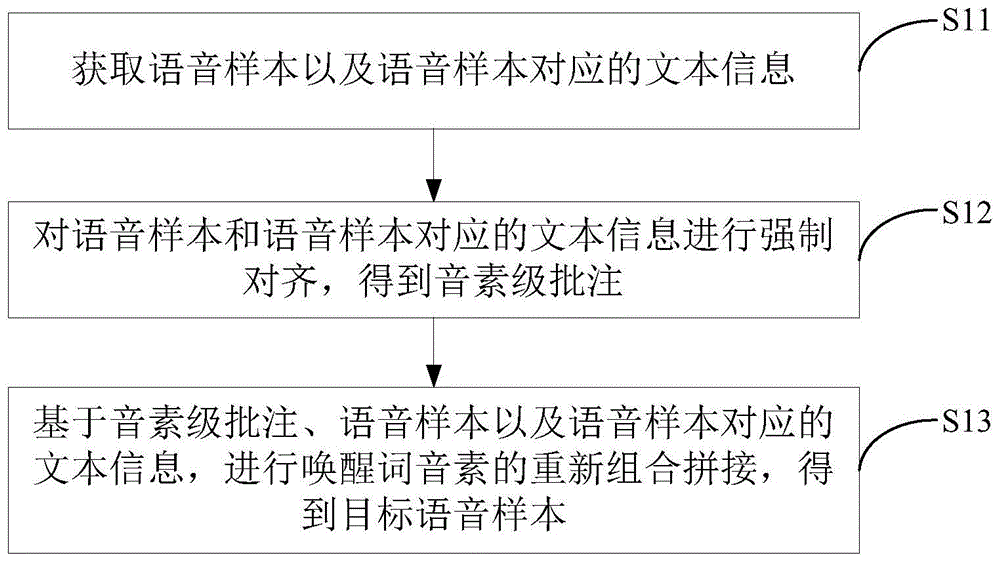
An embodiment of the present invention provides a data processing method, which mainly relates to processing of voice information, and referring to fig. 1, the data processing method may include:
and S11, acquiring a voice sample and text information corresponding to the voice sample.
The voice samples are multiple, voice information can be crawled through a web crawler, data of a traditional training acoustic model can be directly used, and the data are used as the voice samples.
After the voice sample is obtained, for accuracy of voice recognition, the voice can be manually converted into a text, and text information corresponding to the voice sample is obtained. If the requirement for accuracy of the recognition result is low, speech recognition may be performed by machine learning, weighted finite state transducer WFST model, or the like.
In this embodiment, the acoustic model is mainly used for training the device to wake up, and therefore, after the voice sample is obtained, the sample including the wake-up word is taken as a positive example, and the sample not including the wake-up word is taken as a negative example. Wherein, the awakening words can be 'Tianmaoling', 'Xiao ai classmate' and the like.
And S12, forcibly aligning the voice sample and the text information corresponding to the voice sample to obtain the phoneme-level annotation.
Because the number of the obtained voice samples is always limited, in order to achieve the data size for training, enhance the data diversity and improve the generalization capability of the model, the data is increased by synthesizing the data related to the awakening words. First, a forced alignment of the speech samples is required. Forced alignment may use a DNN-HMM model for alignment.
In another implementation manner of the present invention, step S12 may include:
1) and extracting the audio features of the voice sample.
Extracting an audio feature of the voice sample, wherein the audio feature can be a Mel-scale Frequency Cepstral coeffients (MFCC) feature or a fiber-domain Cepstral coeffients (FBANK) feature.
2) And performing phoneme-level forced alignment on the voice sample and the text information corresponding to the voice sample based on the text information corresponding to the voice sample and the audio characteristics to obtain the phoneme-level annotation.
And inputting the text information and the audio features corresponding to the voice sample into the DNN-HMM model, namely performing forced alignment.
It should be noted that the phoneme-level alignment adopted in the forced alignment in this embodiment may provide a basis for later phoneme concatenation.
And S13, based on the phoneme-level annotation, the voice sample and the text information corresponding to the voice sample, performing recombination and splicing of the awakening word and the phoneme to obtain a target voice sample.
In step S12, phoneme-level forced alignment is performed, and then phonemes of the wakeup word may be recombined, so that a larger number of target speech samples may be obtained.
In the embodiment, a voice sample and text information corresponding to the voice sample are obtained; forcibly aligning the voice sample and the text information corresponding to the voice sample to obtain a phoneme-level annotation; and recombining and splicing the phonemes of the awakening words based on the phoneme-level annotations, the voice samples and the text information corresponding to the voice samples to obtain the target voice samples. By recombining the awakening word phonemes of the voice samples, the invention can obtain the combination of the awakening word phonemes from different voice samples, thus obtaining a large number of voice samples.
In another implementation manner of the present invention, a specific implementation manner of step S13 is described, in this embodiment, regarding that the processing method of the positive example is different from that of the negative example, first, a processing manner of the positive example is described, and with reference to fig. 2, the method may include:
s21, screening out a target voice sample comprising the awakening words based on the text information corresponding to the target voice sample, and taking the target voice sample as a positive sample.
When distinguishing the positive example from the negative example, the positive example is considered if the target voice sample includes the wake-up word, and the negative example is considered if the target voice sample does not include the wake-up word.
And S22, intercepting the awakening word phoneme of the awakening word from the normal sample, and using the awakening word phoneme as a phoneme speech unit.
And intercepting a voice section containing the phoneme of the awakening word by using the phoneme level label obtained through the DNN-HMM model to obtain a corresponding phoneme voice unit, and establishing a voice library.
S23, according to the front-back connection sequence of the awakening word phonemes of the awakening words, randomly selecting each awakening word phoneme of the awakening words from the phoneme voice unit in sequence, and splicing and recombining according to the front-back connection sequence to obtain the target voice sample.
Specifically, the awakening word phonemes corresponding to the awakening words are connected in a front-back connection sequence. For example, the awakening word phonemes of "love classmates" are:
< sil > < x > < i > < ao > < a > < i > < t > < o > < ng > < x > < u > < e > < sil >, where < sil > represents silence. Each phoneme can be referred to as a primitive.
Since the phoneme speech units of the speech samples of each group include phoneme speech units of various different wake-up words, such as phoneme speech units of "kindness" spoken by men, women, children and the elderly at the same time, and these phoneme speech units have been subjected to forced alignment.
Namely, it is<sil><x><i><ao><a><i><t><o><ng><x><u><e><sil>There will be multiple groups and then the first one will be chosen randomly from these groups<sil>Then randomly selecting the second<x>Until the last one is selected<sil>And then sequential splicing is performed. Since "love classmates" collectively involve 13 phonemes, 13 can be generated by random concatenation13The voice of the little love classmates greatly increases the quantity of training data.
However, it should be noted that, since the selection and concatenation are performed randomly, two uncoordinated phonemes are spliced together, such as < x > spoken by children and < i > spoken by the elderly, which may cause unnatural speech, at this time, the prosody feature of the concatenation needs to be adjusted by the pitch synchronous superposition technique PSOLA, that is, the prosody feature of the target speech sample is adjusted.
In addition, in order to avoid the unnatural speech concatenation, the phoneme speech units can be selected from the phoneme speech units corresponding to the same person or the same type of person (in the same age group and the same gender), and then the selected phoneme speech units can be concatenated. Specifically, the method comprises the following steps:
screening out phoneme voice units meeting preset conditions, and taking the phoneme voice units as target phoneme voice units; the preset conditions comprise the same user or users with the same attribute value; and the attribute values comprise age groups and sexes, and each awakening word phoneme of the awakening words is sequentially and randomly selected from the target phoneme voice unit according to the front-back connection sequence between the awakening word phonemes of the awakening words.
Compared with the random splicing in the above embodiment, in this embodiment, the phoneme speech unit is selected from the same person or the same kind of person, and the speech of the target speech sample obtained by splicing is more natural because the speech of the same person or the same kind of person is similar.
In the above description, the processing procedure of the positive example is described, and the processing procedure of the negative example is described, specifically, referring to fig. 3, step S13 may include:
and S31, taking the non-positive sample in the voice samples as a negative sample.
S32, splitting the awakening word phoneme of the positive example sample and the phoneme of the negative example sample to respectively obtain a positive example phoneme group and a negative example phoneme group.
The positive example phoneme set and the negative example phoneme set respectively comprise a plurality of phonemes which are continuous and have preset numbers.
The preset number may be determined according to actual conditions, and may be preferably 3.
And S33, setting the reverse example phoneme group which is not the positive example phoneme group in the reverse example phoneme group as preset data.
Specifically, in an actual scene, a voice is very similar to a wake-up word, for example, the wake-up word is xiaoming, the list of the counter examples is mainly a word which is similar to the wake-up word, such as xiaoming, millet, and the like, and the word sounds like the wake-up word, so as to prevent false wake-up and perform subsequent operations.
And correcting the phoneme level label obtained by the DNN-HMM model frame by frame, marking the current frame as a filer when the current frame or the current frame is inconsistent with the phoneme of the awakening word, and otherwise, keeping the label unchanged.
For example, the "love classmates" wake word:
<sil><x><i><ao><a><i><t><o><ng><x><u><e><sil>
the three phonemes are a group of < sil > < x > < i >, < x > < i > < ao >, < …, < u > < e > < sil >, which is the set of regular phonemes.
ASR data "kids"
< sil > < x > < i > < ao > < h > < a > < i > < z > < i > < sil >, which is the counter example phoneme set.
The search finds that < sil > < x > < i >, < x > < i > < ao > in the children appears in the regular example phoneme set, and then remains.
But < h > < a > < i > since < h > preceding < a > does not conform to the text information of the "love" word, i.e. does not appear in the regular phoneme group, the modification is: the filer is the set correction tag, and is also the preset data in this embodiment.
After each counterexample sample is modified, the set of positive examples phonemes in the counterexample sample and the phoneme speech units may be combined to obtain a large number of phoneme speech units, which may also be referred to as target data, and then the operation of "randomly selecting each of the phonemes of the wake-up word in turn" described above may be performed based on the target data. Since the counterexample data is further used for the concatenation of the awakening word phonemes, the data volume obtained by concatenation is further increased.
After a large amount of training data is obtained through the embodiment, the proportion of the forward set to the reverse set is reasonably distributed according to the word bank amount in training, and then the awakening word data generated by splicing and the original recorded awakening word data are mixed in a certain proportion to train the voice awakening model. In the course of the training of the voice wake-up model,
the target sample, the target voice sample, and a new counter sample obtained after setting the counter phoneme group in the counter phoneme group, which is not the positive phoneme group, as preset data may be mixed according to a preset proportion and trained to obtain a voice wakeup model.
It should be noted that, when the wake-up model is trained, which of the phoneme, filer and sil of the wake-up word accounts for a large proportion of the total, the wake-up model is more biased to be the one. In general, the awakening words are high in awakening rate and false awakening rate. The more filers and sil, the lower the awakening rate and the lower the false awakening rate.
And when the awakening accuracy is low or the false alarm rate is high, adjusting the data contents of the new positive sample and the new negative sample, for example, increasing the negative proportion, and increasing the positive proportion when the recall rate is low. The counterexample proportion is generally between 75% and 85%.
In order to improve various indexes of the trained model, a proportion may be preset, for example, a proportion of a positive example and a negative example (i.e., a new negative example sample obtained after a negative example phoneme group other than the positive example phoneme group in the negative example phoneme group is set as preset data) accounts for 20% and 80% respectively, in the positive example data, a proportion of raw speech data (i.e., a speech sample) is higher and may be 50% to 100%, and a proportion of spliced data (i.e., a target speech sample) obtained by the above splicing method is 0% to 50%. The proportion of the positive examples and the negative examples and the proportion of the splicing data in the positive examples are respectively adjusted in training, only one of the two proportions is adjusted in each adjustment, an adjustment amplitude is preset, for example, 0.1% -0.5%, the change situations of the recall rate, the accuracy rate and the false alarm rate of the model which is trained after the proportion adjustment are recorded, and the proportion of the training data is determined according to the change situations. The adjustment principle is recall rate, accuracy rate and/or false alarm rate.
In this embodiment, data enhancement is realized through voice splicing and data reorganization, and compared with the existing data expansion technology such as noise adding, reverberation adding, speed changing, tone changing and the like, the existing change is not wide enough, and the embodiment can improve the generalization ability of the acoustic model training crowd to be awakened, and the awakened model has higher awakening recognition rate.
Optionally, on the basis of the embodiment of the data processing method, another embodiment of the present invention provides a data processing apparatus, and with reference to fig. 4, the data processing apparatus may include:
a sample obtaining module 101, configured to obtain a voice sample and text information corresponding to the voice sample; the number of the voice samples is multiple;
an alignment module 102, configured to perform forced alignment on the voice sample and text information corresponding to the voice sample to obtain a phoneme-level annotation;
and the sample processing module 103 is configured to perform recombination and concatenation of the awakening word and the phoneme to obtain a target speech sample based on the phoneme-level annotation, the speech sample, and the text information corresponding to the speech sample.
In another implementation of the present invention, the alignment module includes:
the characteristic extraction submodule is used for extracting the audio characteristic of the voice sample;
and the alignment submodule is used for performing phoneme-level forced alignment on the voice sample and the text information corresponding to the voice sample based on the text information corresponding to the voice sample and the audio characteristics to obtain the phoneme-level annotation.
In the embodiment, a voice sample and text information corresponding to the voice sample are obtained; forcibly aligning the voice sample and the text information corresponding to the voice sample to obtain a phoneme-level annotation; and recombining and splicing the phonemes of the awakening words based on the phoneme-level annotations, the voice samples and the text information corresponding to the voice samples to obtain the target voice samples. By recombining the awakening word phonemes of the voice samples, the invention can obtain the combination of the awakening word phonemes from different voice samples, thus obtaining a large number of voice samples.
It should be noted that, for the working processes of each module and sub-module in this embodiment, please refer to the corresponding description in the above embodiments, which is not described herein again.
Optionally, on the basis of any one of the above embodiments of the data processing apparatus, the sample processing module 103 may include:
the sample screening submodule is used for screening out a voice sample comprising the awakening words based on the text information corresponding to the voice sample and taking the voice sample as a positive sample;
the intercepting submodule is used for intercepting the awakening word phoneme of the awakening word from the normal sample and using the awakening word phoneme as a phoneme voice unit;
and the sample splicing submodule is used for randomly selecting each awakening word phoneme of the awakening words from the phoneme voice unit in sequence according to the front-back connection sequence between the awakening word phonemes of the awakening words, and splicing and recombining according to the front-back connection sequence to obtain the target voice sample.
Further, the sample stitching submodule includes:
the screening unit is used for screening out the phoneme voice units meeting the preset conditions and taking the phoneme voice units as target phoneme voice units; the preset conditions comprise the same user or users with the same attribute value; the attribute values include age group and gender;
and the selecting unit is used for sequentially and randomly selecting each awakening word phoneme of the awakening words from the target phoneme voice unit according to the front-back connection sequence between the awakening word phonemes of the awakening words.
Further, still include:
and the characteristic adjusting submodule is used for adjusting the prosodic characteristics of the target voice sample.
In another implementation manner of the present invention, the sample processing module 103 may further include:
the sample determination submodule is used for taking a non-positive sample in the voice samples as a negative sample;
the sample splitting submodule is used for splitting the awakening word phonemes of the positive example sample and the phonemes of the negative example sample to respectively obtain a positive example phoneme group and a negative example phoneme group; the positive example phoneme set and the negative example phoneme set respectively comprise a plurality of phonemes which are continuous and have preset number;
and the data setting submodule is used for setting the counter example phoneme group which is not the positive example phoneme group in the counter example phoneme group as preset data.
Further, the sample splicing submodule is configured to, according to a front-back connection sequence between the awakening word phonemes of the awakening word, sequentially and randomly select each awakening word phoneme of the awakening word from the phoneme speech unit, and perform splicing recombination according to the front-back connection sequence to obtain the target speech sample, and is specifically configured to:
according to the front and back connection sequence of the awakening word phonemes of the awakening words, randomly selecting each awakening word phoneme of the awakening words from target data in sequence, and splicing and recombining according to the front and back connection sequence to obtain the target voice sample; the target data includes the phone speech unit and a set of forward phonemes from the set of reverse phonemes.
Further, still include:
the data training module is used for mixing the target sample, the target voice sample and a new counter example sample obtained after the counter example phoneme group which is not the positive example phoneme group in the counter example phoneme group is set as preset data according to a preset proportion and training the new counter example sample to obtain a voice awakening model;
and the data adjusting module is used for adjusting the proportion of the target sample, the target voice sample and the new counter sample based on the adjusting principle of the voice awakening model and retraining the voice awakening model.
In this embodiment, data enhancement is realized through voice splicing and data reorganization, and compared with the existing data expansion technology such as noise adding, reverberation adding, speed changing, tone changing and the like, the existing change is not wide enough, and the embodiment can improve the generalization ability of the acoustic model training crowd to be awakened, and the awakened model has higher awakening recognition rate.
It should be noted that, for the working processes of each module and sub-module in this embodiment, please refer to the corresponding description in the above embodiments, which is not described herein again.
Optionally, on the basis of the embodiments of the data processing method and apparatus, another embodiment of the present invention provides an electronic device, including: a memory and a processor;
wherein the memory is used for storing programs;
the processor calls a program and is used to:
acquiring a voice sample and text information corresponding to the voice sample; the number of the voice samples is multiple;
forcibly aligning the voice sample and the text information corresponding to the voice sample to obtain a phoneme-level annotation;
and recombining and splicing the phonemes of the awakening words based on the phoneme-level annotations, the voice samples and the text information corresponding to the voice samples to obtain the target voice samples.
Further, the forcibly aligning the voice sample and the text information corresponding to the voice sample to obtain the phoneme-level annotation includes:
extracting audio features of the voice sample;
and performing phoneme-level forced alignment on the voice sample and the text information corresponding to the voice sample based on the text information corresponding to the voice sample and the audio characteristics to obtain the phoneme-level annotation.
Further, based on the phoneme-level annotation, the voice sample and the text information corresponding to the voice sample, performing recombination and concatenation of the awakening word and the phoneme to obtain a target voice sample, including:
screening out a voice sample comprising a wakeup word based on the text information corresponding to the voice sample, and taking the voice sample as a normal sample;
intercepting a wake word phoneme of the wake word from the normal sample, and using the wake word phoneme as a phoneme voice unit;
and according to the front and back connection sequence between the awakening word phonemes of the awakening word, randomly selecting each awakening word phoneme of the awakening word from the phoneme voice unit in sequence, and splicing and recombining according to the front and back connection sequence to obtain the target voice sample.
Further, the randomly selecting each wakeup word phoneme of the wakeup word from the phoneme speech unit in sequence according to the front-back connection sequence between the wakeup word phonemes of the wakeup word includes:
screening out phoneme voice units meeting preset conditions, and taking the phoneme voice units as target phoneme voice units; the preset conditions comprise the same user or users with the same attribute value; the attribute values include age group and gender;
and sequentially and randomly selecting each awakening word phoneme of the awakening word from the target phoneme voice unit according to the front-back connection sequence of the awakening word phonemes of the awakening word.
Further, after splicing and recombining are performed according to the front and back connection order to obtain the target voice sample, the method further includes:
and adjusting the prosodic features of the target voice sample.
Further, after splicing and recombining are performed according to the front and back connection order to obtain the target voice sample, the method further includes:
taking a non-positive sample in the voice samples as a negative sample;
splitting the awakening word phoneme of the positive example sample and the phoneme of the negative example sample to respectively obtain a positive example phoneme group and a negative example phoneme group; the positive example phoneme set and the negative example phoneme set respectively comprise a plurality of phonemes which are continuous and have preset number;
and setting the counter example phoneme group which is not the positive example phoneme group in the counter example phoneme group as preset data.
Further, according to the front-back connection sequence between the awakening word phonemes of the awakening word, randomly selecting each awakening word phoneme of the awakening word from the phoneme voice unit in sequence, and performing splicing recombination according to the front-back connection sequence to obtain the target voice sample, including:
according to the front and back connection sequence of the awakening word phonemes of the awakening words, randomly selecting each awakening word phoneme of the awakening words from target data in sequence, and splicing and recombining according to the front and back connection sequence to obtain the target voice sample; the target data includes the phone speech unit and a set of forward phonemes from the set of reverse phonemes.
Further, still include:
mixing the target sample, the target voice sample and a new counter sample obtained after setting the counter phoneme group, which is not the main phoneme group, in the counter phoneme group as preset data according to a preset proportion, and training to obtain a voice awakening model;
and adjusting the proportion of the target sample, the target voice sample and the new counter sample based on the adjustment principle of the voice awakening model, and retraining the voice awakening model.
In the embodiment, a voice sample and text information corresponding to the voice sample are obtained; forcibly aligning the voice sample and the text information corresponding to the voice sample to obtain a phoneme-level annotation; and recombining and splicing the phonemes of the awakening words based on the phoneme-level annotations, the voice samples and the text information corresponding to the voice samples to obtain the target voice samples. By recombining the awakening word phonemes of the voice samples, the invention can obtain the combination of the awakening word phonemes from different voice samples, thus obtaining a large number of voice samples.
The previous description of the disclosed embodiments is provided to enable any person skilled in the art to make or use the present invention. Various modifications to these embodiments will be readily apparent to those skilled in the art, and the generic principles defined herein may be applied to other embodiments without departing from the spirit or scope of the invention. Thus, the present invention is not intended to be limited to the embodiments shown herein but is to be accorded the widest scope consistent with the principles and novel features disclosed herein.