Detailed Description
Taihu pigs are the most litter-sized pig species in the world, and Jiaxing black pigs are one category of Taihu pigs, and the reproductive performance of the Taihu pigs is the focus of attention. Different pig breeds have different degrees of evolution due to different selection, production management modes and the like, so the degrees of evolution of the genes are also inconsistent. For example, the litter size of western breeds is not as high as that of indigenous breeds. Therefore, the Kaoxing black pig serving as a research object has more universality on the influence of the GPR54 gene polymorphism on the reproductive performance of local pig species and has reference on the influence on the reproductive performance of other foreign pig species. Western pig species have high growth speed and high lean meat percentage, Chinese local pig species have low growth speed and low feed conversion rate. In recent years, with the introduction of a large amount of western pig breeds, local pigs in China have met with unprecedented challenges, so that the breed conservation and breeding of local pigs are particularly important. Jiaxing black pigs, a category of Taihu pigs, have excellent reproductive performance, but since 2018 the outbreak of African swine fever, the survival status of local pigs is great. The method takes the local pig breed Jiaxing black pig in China as an experimental object for the first time, explores the association between the GPR54 gene polymorphism and the reproductive traits thereof, and can provide a basis for the breeding of the Jiaxing black pig.
In total, 128 Jiaxing black pigs (sows) are sampled and analyzed, the number of births of the sows is different from 1 to 11, and tracking investigation is carried out in about 5 years.
The main experimental process comprises:
1) GPR54 gene amplification
Amplifying GPR54-Exon2 and GPR54-Exon6 gene fragments (the result shows that only the No. 2 Exon and the No. 6 Exon have mutation) by taking the local pig seed gene with good reproductive performance as a template, and detecting the amplified products by using 1% agarose gel electrophoresis;
2) GPR54 genotyping
The peak pattern obtained by purifying and sequencing the PCR product of GPR54 gene was analyzed by BioEdit and DNA star software
Carrying out comparison analysis to search SNPs sites;
3) genotype frequency, gene frequency and population genetic characteristics
In the Jiaxing black pig group, dominant alleles of GPR54 gene loci calculate gene frequency, and chi 2 tests the equilibrium state of SNPs loci;
4) GPR54 gene polymorphism and correlation analysis of GPR54 gene polymorphism and Jiaxing black pig reproductive performance
Correlation analysis is carried out on each genotype of each genetic locus of the selected local pig and reproductive performance such as total litter size, number of born alive litter size, number of dead births, litter weight of born pigs and the like, and alleles with the tendency of improving the total litter size, number of born alive litter size and litter weight of the sows are found in the GPR54 gene;
the GPR54 gene is detected to have 3 SNPs, T → C mutation and C → T mutation occur at 3739bp and 3878bp of exon2 region, T → C mutation occurs at 6789bp of exon6 region, and AB and BB2 genotypes exist at each SNP site, and the SNP sites are in Hardy-Weinberg equilibrium state. The total litter size, number born alive litter size and weight average for each genotype in the total population of Jiaxing black pigs, the group of primiparous sows and multiparous sows at the T3739C site and the C3878T site were shown to be BB > AB. At the T6789C site, the weight average of the litter size born alive and the weight average of the newborn nest in the total group of Jiaxing black pigs and the group of multiparous sows showed BB > AB.
The invention is explained below with reference to the examples and the figures.
Example 1
(1) Collecting ear sample tissues:
taking 150 mg of a pig ear tissue sample, shearing the pig ear tissue sample in an EP tube, and extracting DNA according to the specification of a Tiangen genome DNA extraction kit. DNA concentration and OD value were determined using Nano 2000; the concentration was checked by 1% agarose gel electrophoresis; the extracted DNA was stored at-20 ℃ for subsequent testing.
(2) Extracting the DNA of the ear-like tissue:
the process for extracting the DNA of the ear-like tissue comprises the following steps: firstly, 0.2g of ear tissues are cut by an ophthalmologic scissors, the surface hair and alcohol of the ear tissues are removed, the ear tissues are put into a 1.5ml of tube of an eppendorf tube, and the ear tissues are cut into pieces as much as possible; secondly, extracting the DNA by using a tissue DNA extraction kit of Beijing all-purpose gold biotechnology limited; thirdly, adjusting the final concentration of the obtained DNA to 100 ng/mu L, and storing at the 2-8 hough degree; and fourthly, detecting the purity of the DNA: measuring the ratio of OD260/OD280 on SMA1000 by taking 1 mu of LDNA, wherein when the ratio of OD260/OD280 is 1.8-2.0, the purity of the extracted DNA is higher; quality detection: the DNA thus extracted was detected by electrophoresis on a 1.5% agarose gel, and the quality of the extracted product was observed for subsequent experiments.
(3) PCR amplification of a fragment of GPR54 gene interest (6 exons):
carrying out PCR amplification by taking the extracted pig genome DNA as a template, wherein the PCR reaction system is 25 mu L: 2 XTaq Master Mix 12.5. mu.L, upstream and downstream primers (10. mu. mol/L) each 1. mu.L, DNA template 2. mu.L, ddH2And O is supplemented to 25 mu L. PCR amplification conditions: pre-denaturation at 94 ℃ for 5 min; denaturation at 94 ℃ for 30 s, annealing at 55 ℃ for 30 s, and extension at 72 ℃ for 1 min for 35 cycles; extension at 72 ℃ for 4 min. The PCR amplification product is sent to Hangzhou Zhikexi biotechnology limited company for purification and sequencing. Sequencing peak patterns and sequences were analyzed using software such as BioEdit and DNA star.
(4) Population genetic characteristic analysis:
calculating the genotype frequency, the gene frequency, the Polymorphic Information Content (PIC), the group heterozygosity (He) and the effective allele factor (Ne) of each site of the GPR54 gene by using a group analysis software Genepop (http:// gene. curve. edu.au), and carrying out Chi on each site2Hardy-Weinberg equilibrium test. According to the fixed effect Model, the method is implemented by a General Linear Model (GLM) in SPSS softwareAnd (3) performing correlation analysis of the line genes and the reproductive traits, and analyzing the difference of the reproductive performance of the Jiaxing black pigs among all genotypes by a least square method:
Y
i
=μ+G
i
+e
i
in the formula, YiRecord values for reproductive traits; μ is the population mean; gi is a gene effect; e.g. of the typeiIs a random residual.
In this example, Jiaxing black pigs were used as the study subjects, and the following measurement results were obtained:
1. jiaxing black pig GPR54 gene result
The detection result of the genome DNA of the pig ear tissue is as follows:
the extracted DNA is detected by 1% agarose gel electrophoresis, the detection result is shown in figure 1, and as can be seen from figure 1, the quality of the DNA sample extracted by the test is better, the requirements of the test can be met, and the subsequent test can be carried out.
GPR54 genotyping results:
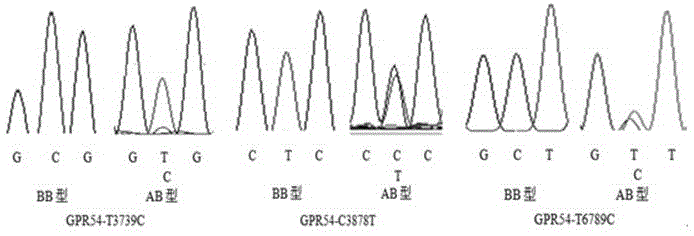
as shown in FIG. 2, the peak pattern obtained after the PCR product of GPR54 gene is purified and sequenced is analyzed by the software such as BioEdit and DNA star, and as a result, 3 SNPs sites are detected in total, as shown in FIG. 2: T3739C, C3878T and T6789C, respectively. Among them, GPR54 gene has T → C mutation and C → T mutation at 3739bp and 3878bp of exon2 region, and T → C mutation at 6789bp of exon6 region, and there are AB, BB2 genotypes at each SNP site (taking GPR54 gene 3739 site as an example, the base of the reference gene at the site is T, but only CC genotype and TC genotype are found at the site in our experiment, and wild type, TT genotype is not found.
Genotype frequency, gene frequency and population genetic trait results for GPR54 gene:
as shown in Table 1, in the Jiaxing black pig population, dominant alleles at T3739C, C3878T and T6789C sites of GPR54 gene are all B alleles, and the gene frequencies are 0.94, 0.98 and 0.98 respectively. The chi 2 test shows that 3 SNPs sites are in equilibrium. According to the criteria proposed by Botstein et al (1980) for measuring polymorphic information, the polymorphic information content PIC >0.5 is highly polymorphic, 0.25< PIC <0.5 is moderately polymorphic, and PIC <0.25 is lowly polymorphic. All mutation sites in the GPR54 gene belong to low-degree polymorphisms.
2. GPR54 gene polymorphism and correlation analysis of GPR54 gene polymorphism and Jiaxing black pig reproductive performance
The result of the analysis of the reproductive performance of the Jiaxing black pig is as follows:
as can be seen from Table 2, the average values of total litter size, number of born alive litter size, number of dead births and weight of newborn litter in the total population of Jiaxing black pigs were 12.94, 12.29, 1.44 and 14.02kg, respectively. The average values of the total litter size, the live litter size, the dead litter size and the weight of the newborn litter of the newborn sow are respectively 12.33 heads, 11.64 heads, 0.88 heads and 13.69 kg; the average values of the total litter size, the number of live litter size, the number of dead births and the weight of newborn litter of the multiparous sows are respectively 13.29 heads, 12.67 heads, 1.76 heads and 14.17 kg. The total born number, the live born number and the dead number of the multiparous sows are all remarkably higher than those of the first-born sows: (P<0.01)。
:
As can be seen from Table 3, the total litter size, number born alive litter size and weight average of newborn litter size at the GPR54-T3739C sites in the total group of Jiaxing black pigs, the newborn sows and the multiparous sows were represented by BB > AB, and the number of stillborn births was represented by AB > BB. The total litter size and number of live piglets of BB type are significantly higher than those of AB type (except for multiparous sows) (B)PLess than 0.01), and the birth weight of BB type in the first-born sow is obviously higher than that of AB type: (P<0.05)。
As can be seen from Table 4, in the female swine of Jiaxing black pig multiparous stage, the number of stillbirths of each genotype at GPR54-C3878T locus showed AB > BB, and the difference was not significant (bP> 0.05), the total litter size, number born alive, number dead births and weight birth of each genotype at that site in all populations are represented by BB > AB, and there is no significant difference (P>0.05)。
As can be seen from Table 5, in the total group of Jiaxing black pigs, the total litter size and the number of stillbirths of each genotype at the GPR54-T6789C locus were represented by AB > BB, and the number of litter size and the weight of newborn litter were represented by BB > AB. In the primiparous sow, the total born number born, the born number born alive and the weight of the primiparous litter of each genotype of the site are expressed as AB & gt BB, and the number of the dead fetus is expressed as BB & gt AB. In the multiparous sow, the total born number, the born number and the weight average of the birth nest of each genotype at the site are represented by BB & gt AB, and the number of dead fetus is represented by AB & gt BB. The difference is not significant (P>0.05)。
In conclusion, the GPR54 gene is detected to have 3 SNPs, T → C mutation and C → T mutation occur at 3739bp and 3878bp of exon2 region, T → C mutation occurs at 6789bp of exon6 region, and AB and BB2 genotypes exist at each SNP site, and the gene is in Hardy-Weinberg equilibrium state. The total litter size, number born alive litter size and weight average for each genotype in the total population of Jiaxing black pigs, the group of primiparous sows and multiparous sows at the T3739C site and the C3878T site were shown to be BB > AB. At the T6789C site, the weight average of the litter size born alive and the weight average of the newborn nest in the total group of Jiaxing black pigs and the group of multiparous sows showed BB > AB.