CN1105341C - Device diagnostic method and device special diagnostic apparatus - Google Patents
Device diagnostic method and device special diagnostic apparatus Download PDFInfo
- Publication number
- CN1105341C CN1105341C CN97101012A CN97101012A CN1105341C CN 1105341 C CN1105341 C CN 1105341C CN 97101012 A CN97101012 A CN 97101012A CN 97101012 A CN97101012 A CN 97101012A CN 1105341 C CN1105341 C CN 1105341C
- Authority
- CN
- China
- Prior art keywords
- function
- mentioned
- judged
- unusual
- mobile function
- Prior art date
- Legal status (The legal status is an assumption and is not a legal conclusion. Google has not performed a legal analysis and makes no representation as to the accuracy of the status listed.)
- Expired - Fee Related
Links
Images

Classifications
-
- G—PHYSICS
- G05—CONTROLLING; REGULATING
- G05B—CONTROL OR REGULATING SYSTEMS IN GENERAL; FUNCTIONAL ELEMENTS OF SUCH SYSTEMS; MONITORING OR TESTING ARRANGEMENTS FOR SUCH SYSTEMS OR ELEMENTS
- G05B23/00—Testing or monitoring of control systems or parts thereof
- G05B23/02—Electric testing or monitoring
- G05B23/0205—Electric testing or monitoring by means of a monitoring system capable of detecting and responding to faults
- G05B23/0259—Electric testing or monitoring by means of a monitoring system capable of detecting and responding to faults characterized by the response to fault detection
- G05B23/0267—Fault communication, e.g. human machine interface [HMI]
- G05B23/0272—Presentation of monitored results, e.g. selection of status reports to be displayed; Filtering information to the user
-
- G—PHYSICS
- G05—CONTROLLING; REGULATING
- G05B—CONTROL OR REGULATING SYSTEMS IN GENERAL; FUNCTIONAL ELEMENTS OF SUCH SYSTEMS; MONITORING OR TESTING ARRANGEMENTS FOR SUCH SYSTEMS OR ELEMENTS
- G05B23/00—Testing or monitoring of control systems or parts thereof
- G05B23/02—Electric testing or monitoring
- G05B23/0205—Electric testing or monitoring by means of a monitoring system capable of detecting and responding to faults
- G05B23/0259—Electric testing or monitoring by means of a monitoring system capable of detecting and responding to faults characterized by the response to fault detection
- G05B23/0275—Fault isolation and identification, e.g. classify fault; estimate cause or root of failure
- G05B23/0281—Quantitative, e.g. mathematical distance; Clustering; Neural networks; Statistical analysis
-
- Y—GENERAL TAGGING OF NEW TECHNOLOGICAL DEVELOPMENTS; GENERAL TAGGING OF CROSS-SECTIONAL TECHNOLOGIES SPANNING OVER SEVERAL SECTIONS OF THE IPC; TECHNICAL SUBJECTS COVERED BY FORMER USPC CROSS-REFERENCE ART COLLECTIONS [XRACs] AND DIGESTS
- Y04—INFORMATION OR COMMUNICATION TECHNOLOGIES HAVING AN IMPACT ON OTHER TECHNOLOGY AREAS
- Y04S—SYSTEMS INTEGRATING TECHNOLOGIES RELATED TO POWER NETWORK OPERATION, COMMUNICATION OR INFORMATION TECHNOLOGIES FOR IMPROVING THE ELECTRICAL POWER GENERATION, TRANSMISSION, DISTRIBUTION, MANAGEMENT OR USAGE, i.e. SMART GRIDS
- Y04S10/00—Systems supporting electrical power generation, transmission or distribution
- Y04S10/50—Systems or methods supporting the power network operation or management, involving a certain degree of interaction with the load-side end user applications
- Y04S10/52—Outage or fault management, e.g. fault detection or location
Landscapes
- Engineering & Computer Science (AREA)
- Physics & Mathematics (AREA)
- General Physics & Mathematics (AREA)
- Automation & Control Theory (AREA)
- Artificial Intelligence (AREA)
- Algebra (AREA)
- Human Computer Interaction (AREA)
- Evolutionary Computation (AREA)
- Mathematical Analysis (AREA)
- Mathematical Optimization (AREA)
- Mathematical Physics (AREA)
- Probability & Statistics with Applications (AREA)
- Pure & Applied Mathematics (AREA)
- Testing And Monitoring For Control Systems (AREA)
Abstract
在由质量/能流结构和作为其实现目标的目的呈分级结构表示的抽象功能等级设备模型上,把根据来自设备的检测值数据的正常/异常判断结果进行变换,对异常传播网络进行检测。由于选择最上位目的的优先等级为最高的网络的最底层的流动结构作为最初诊断对象,从而可对认为是功能上重要、并且靠近异常发生源的流动结构优先进行诊断。该流动结构的诊断是这样进行的,即通过假设和检验检测异常要素,通过质量/能量平衡原理等对这些异常要素进行评价,针对该评价结果根据经验规律对异常源进行推断。
On the abstract functional level equipment model represented by the quality/energy flow structure and the purpose of its realization goal in a hierarchical structure, the normal/abnormal judgment result based on the detection value data from the equipment is transformed to detect the abnormal propagation network. By selecting the flow structure at the bottom layer of the network with the highest priority of the highest destination as the initial diagnosis object, it is possible to preferentially diagnose the flow structure that is considered to be functionally important and that is close to the source of the abnormality. The diagnosis of the flow structure is performed by detecting abnormal elements through assumptions and tests, evaluating these abnormal elements through the principle of mass/energy balance, and inferring the source of the abnormality based on empirical rules based on the evaluation results.
Description
发明领域field of invention
本发明涉及下述的装置及其设备诊断方法,该装置采用抽象功能等级的设备模型通过人们易于理解的推断过程对设备进行诊断,并为操作员对设备异常提出适当的措施、判断。The present invention relates to the following device and its device diagnosis method. The device uses an abstract functional level device model to diagnose the device through an inference process that is easy for people to understand, and provides operators with appropriate measures and judgments for device abnormalities.
背景技术Background technique
在原子能发电设备或石油化工设备这样大型复杂的工业过程设备的作业中,通过较早地发现设备局部中出现的异常,并采取适当的处理来防止异常的扩大,提高操作效率,保证安全这是很重要的。因此,要设置用来把握设备作业状态的多个检测器,这些检测器中多数具有警报产生功能,从而可早期检测出异常。In the operation of large and complex industrial process equipment such as nuclear power generation equipment or petrochemical equipment, it is possible to prevent the expansion of abnormalities by early detection of abnormalities in local equipment and take appropriate measures to improve operational efficiency and ensure safety. very important. Therefore, it is necessary to install a plurality of detectors to grasp the operating status of the equipment, and most of these detectors have an alarm generation function, so that abnormalities can be detected early.
但是,经常对上述的多起警报作出快速、适合的处理会使操作员承受较大的负担,另外对设备中的全部要素状态进行检测监视也是不现实的。However, quick and appropriate handling of the above-mentioned many alarms often puts a heavy burden on the operator, and it is also unrealistic to detect and monitor the status of all elements in the equipment.
因此,人们开发了各种下述的设备诊断装置,该装置可根据这些设备的检测信号对设备的作业状态进行诊断,并对操作员的监视、诊断业务提供帮助。其代表性的装置是预先假设设备可能发生的某些异常,存储此场合下的有代表性的设备状态量的过度变化特性曲线,在发生异常时通过与该特性曲线进行比较,从而可对任何异常的产生进行辨别。采用神经网络进行的诊断也可认为是将代表性特性曲线储存于神经网络的连线中。Therefore, people have developed various devices for diagnosing equipment as follows, which can diagnose the operating status of the equipment based on the detection signals of these equipments, and provide assistance for monitoring and diagnosing operations of operators. Its representative device presupposes some abnormalities that may occur in the equipment, stores the characteristic curve of the excessive change of the representative equipment state quantity in this occasion, and compares it with the characteristic curve when an abnormality occurs, so that any Identify abnormal occurrences. Diagnosis using neural networks can also be considered as storing representative characteristic curves in the connections of the neural network.
在大型复杂的设备中还会出现可能发生的各种异常情况,而预先准备这些异常情况的变化特性曲线是不容易的。此外,即使在发生符合实际的情况的场合下,显然在具体部分中其仍与所假设的情况不同,从而会产生下述可能,即所发生的事件与所准备的特性曲线不同。此外,也往往是直到发生重大事故后再根据其它产业实例假设无法预计的多种故障。Various abnormal situations that may occur in large and complex equipment also appear, and it is not easy to prepare the change characteristic curves of these abnormal situations in advance. Furthermore, even in the event that the actual situation occurs, it is obvious that in specific parts it still differs from the assumed situation, so that the possibility arises that the event that occurs differs from the prepared characteristic curve. In addition, it is often assumed that various failures that cannot be predicted based on other industrial examples are assumed until a major accident occurs.
另外,由于操作人员对参照异常诊断装置的诊断结果进行最终判断,这样关于异常诊断装置的判断过程对该操作人员来说应是可理解、并可领会的,这一点是很重要的,但是从过去的医学领域的专家系统的实例也可完全想到:让人们将范围很大的异常原因和观测迹象的整个情况都记住是很困难的,另外人也很难理解异常诊断装置的结果。In addition, since the operator makes the final judgment with reference to the diagnosis results of the abnormality diagnosis device, it is important that the judgment process of the abnormality diagnosis device be comprehensible and comprehensible to the operator, but from Examples of expert systems in the medical field of the past are also fully conceivable: it is difficult for people to remember the whole picture of the causes and observed signs of a wide range of abnormalities, and it is also difficult for humans to understand the results of abnormal diagnostic devices.
发明内容Contents of the invention
因此本发明的目的在于提供一种即使对大型复杂的设备中的所谓的异常事件也可进行诊断的方法和装置。It is therefore an object of the present invention to provide a method and a device which enable the diagnosis of so-called abnormal events even in large and complex installations.
另外,本发明的目的在于提供一种通过人容易理解的推论过程可进行设备的异常诊断的方法和装置。Another object of the present invention is to provide a method and device capable of diagnosing equipment abnormalities through an inference process that is easy for humans to understand.
本发明的另一个目的在于提供一种下述的方法和装置,该方法和装置可针对设备的异常高效率地缩小异常发生源可能性较高的区域、从而推断异常原因。Another object of the present invention is to provide a method and apparatus capable of efficiently narrowing down an area with a high probability of an abnormality source for an abnormality of equipment, thereby inferring the cause of the abnormality.
本发明的再一个目的在于提供一种可适合于各种设备过程的诊断方法和装置。Yet another object of the present invention is to provide a diagnostic method and apparatus that can be adapted to various equipment processes.
因此,本发明的根据来自设备的检测值数据对设备的异常源进行推断的设备诊断方法,其特征在于,该方法包括:Therefore, the device diagnosis method of the present invention to infer the abnormal source of the device based on the detected value data from the device is characterized in that the method includes:
收集上述检测值数据步骤;Steps of collecting the above-mentioned detection value data;
根据所收集的检测值数据对设备中的各个功能状态是否正常进行判断的检测值判断步骤;A detection value judging step of judging whether each function state in the device is normal according to the collected detection value data;
根据在上述检测值判断步骤中所得出的信息,采用由流动功能表示的抽象功能等级的设备模型,对设备异常源进行推断的步骤。The step of inferring the source of the abnormality of the equipment by using the equipment model of the abstract functional level represented by the flow function based on the information obtained in the above detection value judgment step.
另外,本发明的根据来自设备的状态量检测信号对设备的异常源进行推断的设备异常诊断装置,其特征在于,该装置包括:In addition, the apparatus for diagnosing the abnormality of the equipment based on the state quantity detection signal from the equipment according to the present invention is characterized in that the apparatus includes:
设备模型的存储机构,该设备模型按抽象功能等级以分级结构来表示设备功能;A storage mechanism for device models that represent device functions in a hierarchical structure according to abstract function levels;
检测量判断机构,该机构根据上述检测信号计算与上述设备模型相对应的状态量、并将上述状态量计算值与相应的设定值进行比较从而进行是否正常的判断;A detection quantity judging mechanism, which calculates the state quantity corresponding to the above-mentioned equipment model according to the above-mentioned detection signal, and compares the calculation value of the above-mentioned state quantity with the corresponding set value to judge whether it is normal;
诊断机构,该机构根据由上述检测量判断机构作出的判断信息采用上述设备模型对设备异常源进行推断;其包括下述机构,该机构相对以分级结构构成上述设备模型的各个模型要素的功能状态、根据上述判断信息按从上位到下位的方向顺序进行是否正常的判断,并检测出由判断为异常的模型要素构成的异常传播网络;A diagnosis mechanism that uses the above-mentioned equipment model to infer the source of equipment abnormality based on judgment information made by the above-mentioned detection amount judgment mechanism; it includes a mechanism that compares the functional status of each model element that constitutes the above-mentioned equipment model in a hierarchical structure . According to the above judgment information, judge whether it is normal or not in the direction from the upper to the lower, and detect the abnormal propagation network composed of the model elements judged to be abnormal;
显示上述诊断机构所得出的推断过程以及诊断结果的显示装置。A display device that displays the inference process and diagnosis results obtained by the above-mentioned diagnosis mechanism.
采用本发明,可获得下述效果:Adopt the present invention, can obtain following effect:
(1)由于用于诊断的设备模型为正常功能的模型,而不是假设有特定异常的模型,这样不会发生对假设以外的事件不能进行诊断的情况;(1) Since the equipment model used for diagnosis is a model of normal function, rather than a model that assumes a specific abnormality, it will not happen that events other than those assumed cannot be diagnosed;
(2)由于采用基于人们认识过程的知识的设备模型进行诊断,因而即使是大型复杂的设备,仍可将模型缩小到人们可进行处理的程度,另外推断结果容易理解、领会。(2) Since the equipment model based on the knowledge of people's cognition process is used for diagnosis, even for large and complex equipment, the model can still be reduced to the extent that people can handle it, and the inference results are easy to understand and comprehend.
(3)通过变更设备模型可适合于各种过程,另外很容易适应于设备过程的变更。(3) It can be adapted to various processes by changing the equipment model, and it is easy to adapt to the change of the equipment process.
本发明的其它目的、特征及优点容易从根据附图进行描述的说明中得出。另外,在附图中,相同的的标号表示相同的要素。Other objects, features, and advantages of the present invention can be easily obtained from the description based on the accompanying drawings. In addition, in the drawings, the same reference numerals denote the same elements.
附图说明Description of drawings
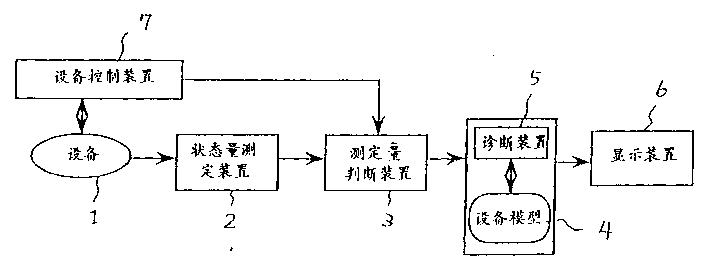
图1为本发明的设备异常诊断装置的一个实施例的方框图;Fig. 1 is the block diagram of an embodiment of equipment abnormality diagnosis device of the present invention;
图2为用于本发明设备诊断的抽象功能等级的设备模型的一个实例的示意图;2 is a schematic diagram of an example of a device model of an abstract functional level for device diagnosis of the present invention;
图3为形成用来构成设备模型的流动结构的分级结构的基本单位的示意图;Fig. 3 is a schematic diagram of the basic units forming the hierarchical structure used to form the flow structure of the plant model;
图4为通过设备模型检测出的异常传送网络的一个实例的示意图;4 is a schematic diagram of an example of an abnormal transmission network detected by a device model;
图5为说明根据设备模型的流动结构中的异常传送通路的异常要素判定方法的示意图;5 is a schematic diagram illustrating a method of determining an abnormal element based on an abnormal transmission path in a flow structure of a facility model;
图6为流动结构中的分支功能的异常判定方法的说明图;Fig. 6 is an explanatory diagram of an abnormal judgment method of a branch function in a flow structure;
图7为流动结构中的储藏功能的异常判定方法的说明图;Fig. 7 is an explanatory diagram of a method for determining abnormality of a storage function in a flow structure;
图8为流动结构中的输送功能的异常判定方法的说明图;Fig. 8 is an explanatory diagram of a method of determining abnormality of a conveying function in a flow structure;
图9为流动结构中的能障功能的异常判定方法的说明图;Fig. 9 is an explanatory diagram of an abnormal judgment method of a barrier function in a flow structure;
图10为用于说明本发明的设备诊断实例的沸水堆原子能发电设备的设备模型示意图;Fig. 10 is a schematic diagram of an equipment model of a boiling water reactor atomic power plant for illustrating an equipment diagnosis example of the present invention;
图11为附加于图10所示的设备模型上的具体流动结构的一个实例的示意图;Fig. 11 is a schematic diagram of an example of a specific flow structure attached to the equipment model shown in Fig. 10;
图12为用于说明本发明的设备诊断实例的沸水堆原子能发电设备的设备模型具体流动结构的另一实例示意图。Fig. 12 is a schematic diagram of another example of the specific flow structure of the equipment model of the boiling water reactor atomic power plant for illustrating the equipment diagnosis example of the present invention.
具体实施方式Detailed ways
图1为本发明的设备异常诊断装置的一个实施例的示意图,它包括对设备1的各种状态量进行检测的状态量检测装置2,对上述装置2所发出的各种检测量是否正常进行判断的检测量判断装置3,根据该判断结果利用预先准备的设备模型4进行异常诊断的诊断装置5,将诊断装置5所给出的诊断信息显示出来的显示装置6。一般来说,检测量判断装置3和诊断装置5由过程计算机、工作站或个人计算机中的软件来实现。设备控制装置7根据操作程序进行设备1的启动/停止控制或进行输出调整,上述操作程序用于检测量判断装置3中的检测量判断基准的调整。Fig. 1 is a schematic diagram of an embodiment of the equipment abnormal diagnosis device of the present invention, which includes a state
内部装设有诊断装置5的设备模型4为按照抽象功能等级对诊断对象的设备系统进行模型化的模型。人们知道,人在通过解决工业过程设备那样的大型复杂的系统所引起的问题时而进行的认识过程,根据抽象程度[沿目的一手段(end-means)轴线]按各种抽象等级将设备系统模型化。上述的抽象等级为分级结构,最高等级为设备的目的(purpose/goal),这样可确保发电设备电力生产的安全。相对上述最高等级的下一等级为抽象功能(abstract function),其表现为质量、能量或信息的流动等。另外相对上述最高等级的再下一等级与一般功能(generalizedfunction)、物理功能(physical function)有关,而最低等级可认为是作为最具体的等级的物理形式(physical form)。The equipment model 4 in which the diagnosis device 5 is installed is a model that models the equipment system to be diagnosed in an abstract functional level. It is known that in the cognition process that humans carry out when they solve the problems caused by large and complex systems such as industrial process equipment, the equipment system model is divided into various levels of abstraction according to the degree of abstraction [along the end-means axis]. change. The above-mentioned abstract level is a hierarchical structure, and the highest level is the purpose/goal of the equipment, so as to ensure the safety of power production of the power generation equipment. The next level relative to the highest level above is the abstract function (abstract function), which is expressed as the flow of mass, energy or information. In addition, the lower level relative to the above-mentioned highest level is related to generalized function and physical function, while the lowest level can be considered as the physical form (physical form) as the most specific level.
按上述方式,人可通过认识过程按各种抽象等级对设备系统进行模型化,其原因是:人可把考察对象提炼到较高的抽象等级中,在下述更为具体的功能等级中进行推断,该功能等级位于下位等级进一步限定的范围内,并且在推断方面运用有限资源的人脑是非常有效的。According to the above method, people can model the equipment system according to various levels of abstraction through the cognition process. The reason is that people can refine the object of investigation to a higher level of abstraction and make inferences in the following more specific functional levels , this functional level lies within the further bounds of the lower levels and is very efficient at inferring using the limited resources of the human brain.
用于本发明诊断的设备模型4对应于上述抽象分级结构中的抽象功能等级,它通过质量、能量的流动来表现设备功能。对于动力设备,能量是作为目的的输出,另外对于其它的设备,该能量的积蓄为安全的考虑对象。上述的流动可采用资源(source),吸能源(sink),储能槽(storage),输送(transport),分支(balance),能障(barrier)等功能要素来表现。另外,各个要素中的质量平衡/能量平衡是控制上述功能要素流动的原则,其在推断中可灵活采用。The equipment model 4 used for the diagnosis of the present invention corresponds to the abstract function level in the above-mentioned abstract hierarchical structure, and it expresses equipment functions through the flow of mass and energy. For power equipment, energy is the output as the purpose, and for other equipment, the storage of this energy is the object of consideration for safety. The above-mentioned flow can be represented by functional elements such as source, sink, storage, transport, balance, and barrier. In addition, the mass balance/energy balance in each element is a principle that controls the flow of the above-mentioned functional elements, and it can be flexibly adopted in the inference.
可以认为,上述要素的网络所表现的流动结构(the flow structures)呈树状连接,它构成大型的复杂工业过程设备。It can be considered that the flow structures represented by the network of the above elements are connected in a tree form, which constitute large complex industrial process equipment.
下面以举例方式对作为诊断对象的设备1的沸水堆(BWR)型原子能发电设备进行说明。对于由堆芯、再循环系统、冷凝水供给系统、主蒸气系统、涡轮发电机系统等构成的沸水堆型原子能发电设备,为构成可实现电力生产的目的,如图2所示,用来维持上述目的11的热量产生、变换过程的能流可看作为最高等级的流动结构12。A boiling water reactor (BWR) type nuclear power plant as the
此外,为了实现上述能流的过程,作为能量输送载体的冷却材料,即质量的流动是不可缺少的。在图2中,上述质量的流动由流动结构13表示。该流动结构13的目的在于维持上述热量产生、变换过程的最高等级的流动结构12的功能,如图所示,目的14连于上述两个流动结构12,13之间。因此,对于流动结构13来说,上述目的14是可实现的目的,而对于最高等级的流动结构12,该目的14构成维持其功能的条件。此外,必须要设置下述泵的驱动能量的流动结构15、16,该泵用来实现流动结构13中的质量流动中的输送功能,该流动结构15、16分别通过目的17,18与上一等级的流动结构13相连接。再有,为了维持流动结构12、13、15、16的功能,显然必须要另外设置多个流动结构,虽然该多个流动结构未在图2中示出。Furthermore, in order to realize the above-mentioned process of energy flow, the cooling material as the carrier of energy delivery, that is, the flow of mass is indispensable. In FIG. 2 , the flow of the aforementioned mass is represented by
按上述方式,可将图3所示的结构看作为形成上述流动结构的分级结构的基本单位。在图3中,目的Gp为流动结构FS的实现目标,下一等级目的Gs1、Gs2(在根据流动结构而另外设置有多个目的的场合)表示用来维持流动结构FS的条件。这样,多个上述的基本单位相组合可形成设备模型4。In the above manner, the structure shown in FIG. 3 can be regarded as the basic unit of the hierarchical structure forming the above-mentioned flow structure. In FIG. 3 , the goal G p is the realization target of the flow structure FS, and the goals G s1 and G s2 of the next level (when multiple goals are separately provided according to the flow structure) represent conditions for maintaining the flow structure FS. In this way, a plurality of the above-mentioned basic units can be combined to form the equipment model 4 .
另外,在图2所示的流动结构12、13、15、16中,虚线表示能量的流动,实线表示质量的流动。此外,标号a、b、c、d、e分别表示资源、输送、储能槽、分支、吸能源等各个功能要素。In addition, in the
虽然设备的任何要素所产生的故障作为其功能障碍会对周边产生影响,但是可认为上述故障是在由流动结构的分级结构所表示的设备模型4中从该分级结构的底部向顶部产生影响的。因此若沿设备模型4从分级结构顶部进行设备的异常监视,则可非常有效地提高设备的操作效率或安全性,从而可提早检测出功能上的主要障碍,以供对策立案之用。Although a failure caused by any element of the equipment affects the surrounding area as its malfunction, it can be considered that the above-mentioned failure has an influence from the bottom to the top of the hierarchical structure in the equipment model 4 represented by the hierarchical structure of the flow structure . Therefore, if the abnormal monitoring of equipment is carried out from the top of the hierarchical structure along the equipment model 4, the operational efficiency or safety of the equipment can be improved very effectively, so that the main functional obstacles can be detected early for countermeasure filing.
因此,检测量判断装置3根据状态量检测装置2所给出的各种检测量,计算与设备模型4中的各个目的、各个流动结构相对应的状态量,并根据界限值对该状态量是否异常进行判断。该判断结果用来确定下述的可进行诊断的顺序,该诊断指在诊断装置5中,沿设备模型4从分级结构顶部,对相应的流动结构内部的异常要素进行辨别等。Therefore, the detection
虽然诊断装置5可相对设备模型4,由分级结构基本确定各个目的间的上下关系,但是由于一般来说有多个目的(安全与操作效率等),则可分别预先确定各个目的的优先等级,根据相对全部目的的优先等级的次序确定如图3中的基本单位的处理顺序。据此,检测出有异常影响传播的网络。这样便可在设备模型4中确定上述异常的传播。Although the diagnostic device 5 can basically determine the upper and lower relationship between the various purposes with respect to the equipment model 4 by the hierarchical structure, but generally speaking, there are multiple purposes (safety, operation efficiency, etc.), the priority levels of each purpose can be determined in advance, The processing order of the basic units as in FIG. 3 is determined according to the order of priority relative to all objects. According to this, a network with anomalous influence propagation is detected. In this way, the propagation of the above-mentioned anomalies can be determined in the equipment model 4.
对于图3所示的基本单位,不可能检测(还包括根据检测值得出的计算值)流动结构FS内部的全部要素状态,而其中一部分可认为是非检测状态。在检测异常传播网络时,该非检测状态作为异常进行处理。For the basic unit shown in Fig. 3, it is impossible to detect (including the calculated value based on the detected value) all the element states inside the flow structure FS, and some of them can be considered as non-detected states. This non-detected state is treated as an anomaly when detecting an anomaly propagation network.
例如在图3中,首先求出目的Gp的状态,如果正常,异常传播网络中不包括该状态,而其它场合下的网络包括该状态。之后,如果相对流动结构FS,即使其中构成要素的检测量(还包括根据检测值计算出的状态量)中的一个发生异常,则流动结构FS仍作为异常包括于网络中。另外,即使在流动结构FS中没有检测值的情况下,仍视为异常。如果流动结构FS发生异常,则相对与此有关的目的Gs1、Gs2,求出其状态量,并按与目的Gp相同的方式对其进行处理。即使在流动结构FS正常的场合,由于上述目的Gs1、Gs2分别作为其基本单位的首要目的,根据其优先等级进行处理,这样可对全部的目的进行上述过程,从而可检测出设备1的异常传播网络。For example, in Fig. 3, the state of the destination G p is first obtained, and if it is normal, this state is not included in the anomaly propagation network, but it is included in the network in other occasions. Afterwards, even if one of the detected quantities of the constituent elements (including the state quantities calculated from the detected values) is abnormal with respect to the flow structure FS, the flow structure FS is included in the network as an abnormality. In addition, even if there is no detection value in the flow structure FS, it is regarded as abnormal. If an abnormality occurs in the flow structure FS, its state quantity is obtained with respect to the related objects G s1 and G s2 , and it is processed in the same manner as the object G p . Even when the flow structure FS is normal, since the above-mentioned objects G s1 and G s2 are respectively regarded as the primary objects of their basic units, and are processed according to their priority levels, the above-mentioned process can be carried out for all objects, so that the
接着,确定流动结构的处理顺序,该处理可对上述网络所发生的异常进行辨别。由于所检测出的异常传播网络一般由多个单独的网络形成,故按下述方式确定这些网络的优先顺序。Next, determine the processing order of the flow structure that can identify abnormalities that have occurred in the above-mentioned network. Since the detected anomalous propagation network is generally formed by a plurality of individual networks, the order of priority of these networks is determined as follows.
在图4所示的异常传播网络中,选择与下述的目的G1相连接的网络,在该包含网络的目的中,目的G1具有最高的优先等级。在该网络最底端的流动结构中,把包括通过检测量判断装置3确定为异常的状态量的流动结构FS1作为最优先处理的流动结构,接着将与该流动结构相连接的上述网络中的流动结构FS2、FS3作为进行异常辨别诊断的第2个、第3位。In the anomaly propagation network shown in FIG. 4, a network connected to the destination G1 having the highest priority among the destinations including the network is selected. In the flow structure at the bottom of the network, the flow structure FS1 including the state quantity determined to be abnormal by the detection
如图4所示,虽然要考虑流动结构FS4与两个目的G2,G3相连接的情况,但是比较此场合中两者的优先等级,具有较高优先等级的目的优先处理。在此场合目的G3的优先等级较高。因此,按照流动结构FS3,FS5,FS6的次序确定为异常辨别的处理顺序。As shown in Fig. 4, although it is necessary to consider the situation that the flow structure FS4 is connected to two destinations G2 and G3, comparing the priorities of the two in this case, the destination with a higher priority is given priority. In this case, the priority of the destination G3 is higher. Therefore, the processing sequence for abnormality discrimination is determined in the order of the flow structures FS3, FS5, and FS6.
然后,相对与下述目的G4相连接的网络,按上述相同的方式确定流动结构FS7,FS8的处理顺序,该目的G4在分开的网络中具有较低的优先等级。Then, the processing sequence of the flow structures FS7, FS8 is determined in the same manner as above with respect to the network connected to the destination G4 which has a lower priority in the separate network.
接着,诊断装置5按照通过上述方式确定的处理顺序,首先相对排在最优先位置的流动结构,进行对异常要素辨别的诊断。在由流动功能要素的网络所表示的流动结构中,不可能对其全部要素状态进行检测,一般可检测的要素仅仅包括一部分。因此,一般来说通过检测量判断装置3会作出下述判断,即上述检测要素中的一部分发生异常,而剩余的要素保持正常,将该判断结果输入给诊断装置5。该诊断装置5根据这些输入信号针对诊断对象的流动结构中的每个要素进行正常/异常的判断。Next, the diagnosis device 5 performs a diagnosis for distinguishing an abnormal element with respect to the flow structure at the highest priority in accordance with the processing sequence determined as described above. In the flow structure represented by the network of flow functional elements, it is impossible to detect the status of all elements, and generally only a part of the elements can be detected. Therefore, in general, the detection
首先,在流动结构内的要素网络中,可假设对与通过检测量判断装置3判断为异常的要素相连接的非检测要素由于流动而会产生异常传播。但是在上述的故障传播进行时,在遇到判断为正常的检测要素的场合,则上述故障的假设是不适合的,故必须撤销上述假设直到存在适当的理由要素。比如,如图5所示,在从判断为异常的检测要素e1经过要素e2、要素e3,最后到达判断为异常的检测要素e4的场合下,作为故障传播假定把上述要素e2、e3设为异常,但是在从要素e2分支,通过要素e5而到达判断为正常的检测要素e6的场合,上述要素e5可保持正常。其中的一个原因是:在发生流动的场合,将每个要素的异常作为这些要素构成的通路(环路)/全部要素的异常判断。First, in the element network in the flow structure, it can be assumed that the non-detection element connected to the element judged to be abnormal by the detection
按上述方式,诊断装置5相对对象流动结构,根据其中的部分可检测要素组的正常/异常的判断结果,找出不通过正常要素而可连接于任何异常要素之间的全部通路。如果能给出流动结构模型,则上述的故障传播通路的查找可通过软件进行。As described above, the diagnosis device 5 finds all paths that can be connected between any abnormal elements without passing through the normal elements based on the normal/abnormal judgment results of some detectable element groups with respect to the target flow structure. If the flow structure model can be given, the search for the above-mentioned fault propagation path can be carried out by software.
随后,根据下述观点,该观点为:构成流动结构的要素组中的一个要素的异常将流动结构的整个流动破坏,整个要素组被检测为异常,诊断装置5对于通过上述故障传播方法而判断为异常的要素,分别根据质量/能量平衡原理进行异常诊断、异常位置的选定或异常辨别。Then, from the viewpoint that the abnormality of one element in the group of elements constituting the flow structure destroys the entire flow of the flow structure, the entire group of elements is detected as abnormal, and the diagnostic device 5 judges that by the above-mentioned fault propagation method For the elements of abnormality, abnormal diagnosis, selection of abnormal position or identification of abnormality are carried out according to the principle of mass/energy balance.
首先推定每个要素的状态量。其中首先采用判断为正常的要素组的状态量。因此,与上述故障传播相同的方法也可用于状态量的推定。对于所计算出的状态量(比如某个要素A的输入流量),推出与该状态量相连接的要素状态量(在上述例子中,与该要素A有关的要素B的输出流量)。如果未得出该要素状态量,则反复对于与该在先要素相连接的要素,进行上述状态量的推算。由于上述的推算仅限于正常要素,故它可采用质量平衡/能量平衡原理。因此,在某个要素的流动状态量仅仅只有一个不知道的情况下,则可通过使总和=0的方式求出该未知的状态量。First, the state quantity of each element is estimated. Among them, first, the state quantity of the element group judged to be normal is used. Therefore, the same method as the above-mentioned fault propagation can also be used for estimating state quantities. For the calculated state quantity (such as the input flow rate of a certain element A), the element state quantity connected to the state quantity (in the above example, the output flow rate of the element B related to the element A) is derived. If the state quantity of the element is not obtained, the estimation of the above state quantity is repeated for the element connected to the previous element. Since the above calculation is limited to normal elements, it can use the principle of mass balance/energy balance. Therefore, when only one flow state quantity of a certain element is unknown, the unknown state quantity can be obtained by making the sum=0.
接着,仍然在异常要素之间进行上述方式的状态量的传递,从而进行状态量的推定,但是由于在此场合假设发生有异常,故上述方式的状态量的推定不适合直接采用质量平衡/能量平衡原理。因此,状态量推定步骤按下述方式进行,即相对其状态量推定步骤也结束的要素,采用该要素状态量来得出其它要素状态量,从而加快状态量的推算。这样,尽可能促进状态量的推算,对于其状态量可推算的要素,进行适合于各个要素的流动功能的异常判断。Next, the transmission of the state quantity in the above-mentioned manner is still carried out between the abnormal elements, so as to estimate the state quantity. However, since it is assumed that an abnormality occurs in this case, the estimation of the state quantity in the above-mentioned manner is not suitable for directly using mass balance/energy Principle of balance. Therefore, the state quantity estimating step is performed by using the state quantity of the element for which the state quantity estimating step is completed to obtain the state quantity of other elements, thereby speeding up the estimation of the state quantity. In this way, the estimation of state quantities is facilitated as much as possible, and for elements whose state quantities can be estimated, an abnormality judgment suitable for the flow function of each element is performed.
比如,对于分支,如图6所示,对流入、流出的流量的非平衡进行判断时,则要分别对流入、流出的分流比(分配比)进行判断。For example, for branches, as shown in FIG. 6 , when judging the unbalance of the inflow and outflow flow, it is necessary to judge the split ratio (distribution ratio) of the inflow and outflow respectively.
如图7所示,对于储能槽,对流入、流出进行与上述分支相同的判断的同时,对储存量进行判断,对储存量的时间变化率与流量非平衡之间的守恒定律的约束条件是否满足进行判断。As shown in Figure 7, for the energy storage tank, while the inflow and outflow are judged the same as the above branches, the storage capacity is judged, and the constraints of the conservation law between the time change rate of the storage capacity and the flow imbalance Judging whether it is satisfied.
输送与流动驱动力有关,适合采用物理性的泵等装置,但是如图8所示,在出现有与流入/流出流量、流入与流出之间的流量非平衡及驱动力有关的检测信号的场合下,要对驱动力和流量之间的约束条件(泵的性能特性等)是否满足进行判断。Transmission is related to the flow driving force, and it is suitable to use physical pumps and other devices, but as shown in Figure 8, when there are detection signals related to inflow/outflow flow, flow imbalance between inflow and outflow, and driving force Next, it is necessary to judge whether the constraints between the driving force and the flow rate (the performance characteristics of the pump, etc.) are satisfied.
此外,对于能障,如图9所示,在只允许止回阀单向流动的情况下,由于存在遮断隔离阀等的双向流动的情况,所以有必要对这些情况进行区分并判断。In addition, as for the energy barrier, as shown in Fig. 9, when only one-way flow is allowed by the check valve, there are cases where the two-way flow of the isolation valve and the like is blocked, so it is necessary to distinguish and judge these cases.
另外,对于不能完全推算出其状态量的要素,该要素还认为异常。In addition, an element whose state quantity cannot be fully estimated is also regarded as an abnormality.
操作员将所进行的综合判断输入知识信息、处理系统与专家系统中,之后根据通过在诊断装置5中上述诊断方法所得出的判断结果进行综合判断,这样便对操作员提供强有力的帮助。虽然在这里所采用的知识为经验规律,它随每个产业设备的不同而不同,但是对于抽象功能等级的诊断,即使输送中的每个流量检测值发生异常的情况下,如果驱动力与流量之间的约束条件得到满足,则判断该要素为正常。同样在储能槽中如果储存量的时间变化率与流量非平衡之间的守恒定律的约束条件得到满足,则判断为正常。虽然相对分支一般很难确定上述方式的优先约束条件,但是与分流比的约束条件受到破坏相比,流入与流出流量之间的非平衡更为重要。但是,分流比的异常会出现与该要素效率异常有关的情况。上述观点是根据下述事实得出的,该事实为:按前述方式,流动异常中的流动环路的其中一个构成要素所产生的异常涉及整个环路。The operator inputs the comprehensive judgment into the knowledge information, processing system and expert system, and then makes a comprehensive judgment based on the judgment result obtained by the above diagnosis method in the diagnosis device 5, thus providing powerful help to the operator. Although the knowledge used here is an empirical rule, which varies with each industrial device, but for diagnosis at the abstract functional level, even if the detection value of each flow rate during transportation is abnormal, if the driving force and flow rate If the constraint conditions between are satisfied, the element is judged to be normal. Also in the energy storage tank, if the constraint condition of the conservation law between the time change rate of the storage capacity and the flow unbalance is satisfied, it is judged as normal. Although it is generally difficult to determine the priority constraints of the above-mentioned methods relative to branching, the unbalance between inflow and outflow flow is more important than the constraint condition of split ratio being violated. However, an abnormality in the split ratio may be related to an abnormality in the efficiency of this element. The above viewpoint is based on the fact that, in the aforementioned manner, an anomaly produced by one of the constituent elements of a flow loop in a flow anomaly involves the entire loop.
在出现有因状态量无法获得而判断为判断不清楚的要素的情况下,由于可相对检测点对要素细分后的原因进行判断,故可尝试进行综合情况的判断,或采用下述的综合判断方式,该综合判断方式指在出现有多个相同类型的环路、要素,并且具体的状态量均不清楚的情况下,通过比较已知的代表性状态量,对异常环路、要素进行辨别等。In the case that there are elements that are judged to be unclear due to the inability to obtain state quantities, since the reasons for the subdivided elements can be judged relative to the detection points, it is possible to try to judge the comprehensive situation, or use the following comprehensive Judgment method, the comprehensive judgment method means that when there are multiple loops and elements of the same type, and the specific state quantities are not clear, the abnormal loops and elements are analyzed by comparing known representative state quantities. Distinguish and so on.
但是,在下述场合,即作为上述综合判断结果,通过检测量判断装置3已判断为异常的要素最后又不能判断为异常,从而出现矛盾的结果的情况下,则可认为下述情况的可能性较大,该情况为:其中一个的要素判断结果不对。其原因比如可以是在未检测状态量的情况下,当根据设备模型4的流动结构的要素连接关系判断为正常时,未对正常的状态量进行检测(检测仪故障等)。However, in the following occasions, that is, as the above-mentioned comprehensive judgment result, the elements that have been judged as abnormal by the detection
因此,在上述场合下,诊断装置5以下述方法作出反应。一种方法是一旦假设与通过检测量判断装置3判断为异常的要素相邻接的要素判断为异常,则再次进行下述的处理,该处理指将不介于判断为正常的要素之间而连接于判断为异常的要素之间的要素判断为异常。接着,对于根据该判断结果而判断为异常的要素,通过上述状态量传播手段分别计算出其状态量,根据该状态量采用该要素质量平衡/能量平衡原理或其它的状态量之间的约束条件进行正常/异常的判断。另外还有必要根据按上述方式与人们的综合判断相对应的规则基准(rule base)诊断对上述判断结果进行综合判断。Therefore, in the above case, the diagnostic device 5 responds in the following manner. One method is to assume that once an element adjacent to an element judged to be abnormal by the detection amount judging means 3 is judged to be abnormal, the following process is performed again. Elements connected between elements judged to be abnormal are judged to be abnormal. Next, for the elements that are judged to be abnormal according to the judgment result, their state quantities are respectively calculated through the above-mentioned state quantity propagation means, and the principle of mass balance/energy balance of the element or other constraints between state quantities are adopted according to the state quantities Make a normal/abnormal judgment. In addition, it is necessary to comprehensively judge the above-mentioned judgment results based on a rule base diagnosis corresponding to people's comprehensive judgment in the above-mentioned manner.
另一种方法是相对下述要素,该要素指未检测其状态量的要素中,通过要素之间的连接关系而判断为正常的要素,通过上述状态量传播手段分别计算出其状态量,根据该状态量采用该要素质量平衡、能量平衡原理或其它的状态量之间的约束条件进行正常/异常的判断。然后,有必要根据与人们的综合判断相对应的规则基准(rule base)诊断对上述判断结果进行综合判断。Another method is to compare the following elements, which refer to the elements whose state quantities have not been detected, which are judged as normal elements through the connection relationship between elements, and calculate their state quantities respectively through the above-mentioned state quantity propagation means, according to The state quantity uses the element mass balance, energy balance principle or other constraints between the state quantities to judge whether it is normal or abnormal. Then, it is necessary to comprehensively judge the above judgment results based on a rule base diagnosis corresponding to people's comprehensive judgment.
再一种方法是:由于考虑了下述情况(检测仪故障等),该情况为:作为产生矛盾结果的原因,未对正常的检测量进行检测,如果假设在通过检测量判断装置3判断为正常的要素中,与通过检测量判断装置3判断为正常的要素最靠近的要素判断为异常,则进行下述的操作,该操作指对连接于假设为异常的要素与其它的判断为异常的要素之间而避开判断为正常的要素的环路上的要素假设为异常的操作。之后,按上述方式,相对新判断为异常的要素,按上述相同的方式分别计算出其状态量,根据该状态量采用该要素质量平衡/能量平衡原理或其它的状态量之间的约束条件进行正常/异常的判断。另外还有必要根据与人们之间的综合判断相对应的规则基准(rule base)诊断对上述判断结果进行综合判断。Yet another method is: due to considering the following situation (detector failure, etc.), this situation is: as the cause of the contradictory result, the normal detection amount is not detected, if it is assumed that it is judged by the detection
按上述方式,在沸水堆型原子能发电设备中,状态量检测装置2对原子反应堆输出功率,反应堆容器压力,主蒸气流量,发电机输出功率,供水温度,堆芯流量,再循环泵流量,喷射泵流量,供给冷凝水流量,泵排出压力,原子反应堆水位,冷凝器水位等进行检测,检测量判断装置3的功能是根据状态量检测装置2所给出的检测信号相对可推出设备模型4的各个要素的状态量(目的的实现程度,质量/能量的流动,存储量等)的情况,计算出这些状态量,并提供给诊断装置5。另外检测量判断装置3对各个功能的目的,根据评价目的实现程度的评价函数进行评价,从而判断是否正常,另外对其它的状态量,通过将其与基于正常状态值的界限值进行比较,进行是否正常的判断,并将判断结果通知给诊断装置5。另外,虽然设备控制装置7可在设备启动或停止等情况下改变控制杆位置,堆芯的输出功率,供给冷凝水的流量等,从而可调整反应堆容器压力,发电机输出功率等,但是由于检测量判断装置3采用下述的操作程序,该程序中设计有由设备控制装置7得出的上述设备启动设计或设备负荷变更数据等,故要根据设备操作状态的时间变化改变下述的界限值,该界限值用于对设备模型4中相应的状态量是否为标准值或异常值进行判断,从而防止对于设计设备状态变化进行错误的异常判断。According to the above method, in the boiling water reactor type nuclear power generation equipment, the state
诊断装置5的功能是对抽象功能等级的设备模型4中的部分目的分别给予优先等级,由检测量判断装置3输入每个模型要素(目的,流动结构)的状态,检测出设备模型4中的异常传播网络,据此具有功能上最高的优先等级,同时对最靠近异常源的流动结构依次对其内部的异常部位进行辨别。The function of the diagnosis device 5 is to give priority to some objects in the equipment model 4 of the abstract functional level, and the state of each model element (purpose, flow structure) is input by the detection
此外,在原子能发电设备中,在一般运转的情况下发电为主要的目标,但是在设备发生异常过渡等情况时,在原子反应堆紧急停止的场合,堆芯的衰变热量的去除操作为主要的目标。因此,设备模型4也必须预先设有对应于上述两种情况的目标,并且可在原子反应堆紧急停止后提高衰变热量去除操作的目的优先等级。按上述方式,目的优先等级系列按根据情况而变化的方式确定。另外比如在任意运转状态下,在实现某个功能的系统的冗余度低于一般值时,要提高可实现该功能目的优先等级,以便加强监视、诊断。In addition, in nuclear power generation facilities, power generation is the main goal during normal operation, but when an abnormal transition occurs in the facility, etc., in the event of an emergency stop of the nuclear reactor, the removal of decay heat from the core is the main goal. . Therefore, the equipment model 4 must also be pre-set with targets corresponding to the above two cases, and the priority of the purpose of the decay heat removal operation can be increased after the emergency shutdown of the atomic reactor. In the above-described manner, the object priority series are determined in a manner that varies depending on the situation. In addition, for example, in any operating state, when the redundancy of the system that realizes a certain function is lower than the general value, the priority level that can realize the purpose of the function should be increased to strengthen monitoring and diagnosis.
因此,检测量判断装置3还要具有下述功能,该功能为:输入由设备控制装置7所输出的设备控制信号,通过下述方式调节目的的优先等级,该方式为:在通过安全装置发出紧急停止信号的场合,降低与一般运转有关的目的优先等级,而紧急时提高与堆芯冷却有关的优先等级等等,将这些优先等级送给诊断装置5中。Therefore, the detection
另外在诊断装置5中,为了限定各个流动结构中的异常要素的辨别结果以及出现异常的位置,相对各个流动结构中的主要要素,以该主要要素为中心,预备好附加的具体流动结构,当该要素出现异常的可能性较大时,逐行对相应的具体流动结构进行异常诊断。In addition, in the diagnosis device 5, in order to limit the identification result of the abnormal element in each flow structure and the position where the abnormality occurs, an additional specific flow structure is prepared with respect to the main element in each flow structure centering on the main element. When the element is more likely to be abnormal, the corresponding specific flow structure is diagnosed line by line.
因此,在对某个流动结构进行异常诊断过程中,如果判断某个要素为异常要素的可能性较大,则在进行上一等级的流动结构的诊断之前,以该异常要素为中心对具体流动结构进行诊断。Therefore, in the process of abnormal diagnosis of a certain flow structure, if it is judged that a certain element is more likely to be an abnormal element, before performing the diagnosis of the upper-level flow structure, the specific flow structure for diagnosis.
按上述方式,对具体流动结构按与异常传播网络不同的方式处理的原因是:The reasons for treating concrete flow structures differently than anomaly propagation networks in the above manner are:
(1)如果采用包括有全部具体流动结构的设备模型,则增加模型的复杂程度,延长诊断的时间;(1) If the equipment model including all the specific flow structures is adopted, the complexity of the model will be increased and the diagnosis time will be prolonged;
(2)由于一般异常局限于设备模型的局部,故处理较大的模型的效率较差;(2) Since the general anomaly is localized in the device model, the efficiency of processing larger models is poor;
(3)具体流动结构模型是根据异常事件的经验而新添加的,以其尺寸更换整个设备模型要花费较大的劳动力,并且还有产生错误的可能等等。(3) The specific flow structure model is newly added based on the experience of abnormal events, and it takes a lot of labor to replace the entire equipment model with its size, and there is also the possibility of errors and so on.
另一方面,对于添加具体流动结构的模型的方式,仅仅在图2所示的基本模型要素的外部添加以该要素为中心的具体模型,无需对基本模型作较大的改动,另外如有必要可通过将所添加的具体模型中的主要要素进一步展开的方式实现具体模型的添加,从而很容易将模型扩大,并可有效地积累所谓的事故经验。On the other hand, for the method of adding a model of specific flow structure, only a specific model centered on this element is added outside the basic model elements shown in Figure 2, without major changes to the basic model, and if necessary The addition of the specific model can be realized by further expanding the main elements in the added specific model, so that the model can be easily expanded and the so-called accident experience can be effectively accumulated.
为了实现采用具体流动结构模型的诊断,有必要按与采用流动结构的分级设备模型进行诊断的方式,确定诊断顺序以提高诊断的效率。因此,一般来说越靠近异常出现位置异常影响传播越大,这样可相对一个流动结构内部的异常要素,按这些异常等级的大小来排列诊断顺序。In order to realize the diagnosis using the specific flow structure model, it is necessary to determine the diagnosis sequence in the same way as the hierarchical equipment model using the flow structure to improve the efficiency of diagnosis. Therefore, generally speaking, the closer to the location where the anomaly occurs, the greater the propagation of the anomalous influence. In this way, relative to the anomalous elements inside a flow structure, the order of diagnosis can be arranged according to the magnitude of these anomalous levels.
比如,作为最高等级的异常,可认为是产生反向流动、流动消失或蓄能槽质量/能量平衡的平衡丧失。作为低一级的异常,可认为是各个流动要素输入输出流量的非平衡(虽然其本来与质量/能量平衡的平衡的丧失等效,但是如考虑检测误差或状态量推定误差的情况,则会产生差别),作为再低一级的异常,可认为是各个流动要素的流量或水位等状态量偏离标准值的情况。对于后者,可按照使检测量与标准值之比与1的差值大小排列顺序。其原因是:一般来说越靠近异常出现位置,其标准化的偏差值就越大,越远离异常出现位置,则上述偏差值就越小,同时会产生都为相同数值的现象。For example, as the highest level of abnormality, it can be considered as reverse flow, loss of flow or loss of balance of accumulator mass/energy balance. As a lower-level abnormality, it can be considered as the imbalance of the input and output flow of each flow element (although it is originally equivalent to the loss of mass/energy balance, if the detection error or state quantity estimation error is considered, it will be difference), as a lower-level abnormality, it can be considered that the flow rate or water level of each flow element deviates from the standard value. For the latter, the order can be arranged according to the difference between the ratio of the detected amount and the standard value and 1. The reason is: Generally speaking, the closer to the location where the abnormality occurs, the larger the standardized deviation value, and the farther away from the location where the abnormality occurs, the smaller the above-mentioned deviation value, and at the same time, the same value will occur.
按上述方式确定的异常要素的顺序,对是否可在具体流动结构进行展开进行调查,在可能的场合逐个对具体流动结构进行诊断。相对该具体流动结构,按照与上述流动结构的诊断的同样方法进行异常要素的辨别。另外,作为该诊断结果,在出现多个异常要素的情况下,按同样的异常等级的顺序进行评价,并调查是否可对附加的具体流动结构进行展开。按上述方式,可进行对具体流动结构的限制、异常源的选定或靠近。In the order of the abnormal elements determined in the above-mentioned manner, it is investigated whether it can be developed in a specific flow structure, and when possible, the specific flow structure is diagnosed one by one. With respect to this specific flow structure, identification of abnormal elements is carried out in the same manner as in the diagnosis of the above-mentioned flow structure. In addition, as a result of this diagnosis, when a plurality of abnormal elements appear, evaluation is performed in the order of the same abnormal level, and it is investigated whether or not it is possible to develop an additional specific flow structure. In the manner described above, restriction to specific flow structures, selection or proximity of anomalous sources can be performed.
另外诊断装置5可按下述方式构成,该方式为:在检测出多个单独的异常传播网络的情况下,分别相对所对应的网络,比如图4中的目的G1(包括目的G3)、G2、G4设置多个用来对其进行处理的处理装置,以实现并列处理。In addition, the diagnostic device 5 can be configured in the following manner, which is: in the case of detecting a plurality of separate abnormal propagation networks, respectively corresponding to the network, such as the purpose G1 (including the purpose G3) and G2 in Figure 4 , G4 is provided with a plurality of processing devices for processing it, so as to realize parallel processing.
其原因是当目的G1和G4或G2和G3的优先等级差别不大,则在时间上对流动结构FS7的处理与流动结构FS 1相比不会晚很多。因此,在第1处理装置处理与目的G1和G3有关的流动结构的同时,第2处理装置处理与G4有关的流动结构,第3处理装置处理与G2有关的流动结构。The reason is that when the priorities of the goals G1 and G4 or G2 and G3 are not much different, the processing of the flow structure FS7 will not be much later than the flow structure FS1 in terms of time. Thus, while the first processing means processes the flow structure related to the objects G1 and G3, the second processing means processes the flow structure related to G4, and the third processing means processes the flow structure related to G2.
在显示装置6中,产生异常的流动结构由整个设备模型4表示,这样可把握设备全部功能的涉及范围以及进行将来涉及范围的预测。另外,在异常辨别所采用的异常传播网络中限定产生异常的流动结构,并表示出来,从而操作员很容易把握异常辨别的判断过程以及所辨别的异常产生位置。In the
图10表示按抽象功能等级表示沸水堆原子能发电设备的设备模型4的一个实例。该设备模型4设置于图1所示的诊断装置5的内部,它用来进行异常判断,并且它是一个作为数据库储存的模型。另外,本图中所示的设备模型4的流动结构12和13与图2中所示的相同。在这里,每个功能要素配有标号,对于每个要素之间的能量或质量的流动,以在标号R后加上上游要素标号和下游要素标号的方式表示。Fig. 10 shows an example of an equipment model 4 representing a boiling water reactor nuclear power plant in abstract functional levels. The equipment model 4 is set inside the diagnosis device 5 shown in FIG. 1, it is used for abnormal judgment, and it is a model stored as a database. In addition, the
目的11表示电力生产,通过发电机送电端的输出功率可判断该目的的实现状态。另外优先顺序为:从保持安全的较高者开始依次排列。Purpose 11 represents power production, and the realization status of this purpose can be judged by the output power of the power transmission terminal of the generator. In addition, the order of priority is as follows: starting from the higher one that remains safe.
流动结构12表示以目的11作为目标的能流,在该结构中,从作为热源功能的原子能反应堆堆芯20产生的核裂变能量传送给作为输送功能的冷却材料21,之后它作为蒸气能量储存于作为能量储存功能的原子能反应堆压力容器22中。该原子能反应堆压力容器22所输出的能量通过作为输送功能的主蒸气系统23送入汽轮机24中,在这里该能量分成3路。首先一部分能量转换成运动能量/电能,它通过电力系统25传送到所需用户26。另外,由于所需用户26要消耗能量,故其表现为吸能源功能。此外,另一部分能量作为提高上述转换过程的效率的再生能量而供供水加热器29使用,之后返回到原子能反应堆压力容器22中。最后剩余一部分能量作为排出热量,通过循环水系统27排到作为吸能源功能的外部(一般为大海)28中。The
在上述能流结构12中,对作为平均堆芯输出功率(APRM)的堆芯20核裂变所产生的能量进行检测。R20,21表示堆芯20所产生的核裂变能量朝向冷却材料21的流动,一般它与所产生的能量相同。In the
通过对堆芯20进行冷却而实现核裂变所产生的能量的输送的冷却材料21的热输送功能是把平衡计算(在具体的异常诊断阶段实施)和检测值的堆芯流量作为约束条件进行评价的。The heat transfer function of the cooling
传送给冷却材料21的热能量中的一部分变成蒸气(能流R21,22)而储存于具有储存功能的原子能反应堆压力容器22中。R21,22与R20,21相同,是不能直接进行检测的,但是一般来说在运转过程中,可利用供水流量、主蒸气流量、原子反应堆压力,并通过能量平衡计算而得出上述R21,22。Part of the thermal energy transmitted to the cooling
储存蒸气能量的原子能反应堆压力容器22的功能通过作为检测值的原子能反应堆压力、并采用输入输出的平衡原理可进行评价。从原子能反应堆压力容器22流出的能量R22,23是作为主蒸气流量、压力进行检测的。对于流入能量R29,22将在本说明书后面进行描述。The function of the nuclear
输送蒸气能量的主蒸气系统23的功能由作为平衡计算和检测值的汽轮机入口蒸气流量来评价。虽然R23,24是作为汽轮机入口流量来计算的,但是在进行更为具体的能量平衡计算的场合下,必须计算入口蒸气压力以及蒸气热函。The function of the
通过对汽轮机24中流入的能量和流出的能量之间的平衡计算可进行功能评价。另外除了上述的平衡计算以外,可通过以对于流入能量而输出的电能作为约束条件进行具体的诊断。Functional evaluation can be performed by calculating the balance between the energy flowing in and the energy flowing out in the
R24,25是作为电能中的发电机送电端的输出功率进行检测的。作为送电功能的电力系统25就作为最终使用者的所需用户26来说,不包括于诊断对象中。虽然R24,27为汽轮机24所排出的热量,但是由于不能对其进行直接检测,这样在具体诊断过程中,该R24,27要由堆芯20中所产生的能量及发电机输出之间的平衡或朝向作为下述的外部28的海水排出的热量推算出来。R24, 25 are detected as the output power of the generator transmission end in the electric energy. The
R27,28为向周围环境排出的排出热量,它通过冷凝器循环水的出口温度来检测。在能量平衡计算时,要考虑循环水流量(在未检测的场合,也可采用泵操作状态的额定值。)以及海水温度。由于海水温度会对设备的热效率产生影响,故其作为排放热量地点的吸能源功能的判断值而被使用。R24,29为流入供水加热器29中的抽出蒸气能量,但是由于不能检测该抽出蒸气流量,故在具体诊断过程中,它根据供水温度的上升程度来计算。R27, 28 is the exhaust heat discharged to the surrounding environment, which is detected by the outlet temperature of the condenser circulating water. When calculating the energy balance, the circulating water flow rate (in the case of undetected, the rated value of the pump operating state can also be used.) and seawater temperature. Since the seawater temperature affects the thermal efficiency of the equipment, it is used as a judgment value of the energy absorption function of the place where the heat is discharged. R24, 29 are the extracted steam energy flowing into the
返回原子能反应堆的能量R29,22通过供水温度的检测值来判断。在具体诊断过程中的能量平衡可采用流出冷凝器时的温度、供水流量及供水压力等来计算。The energy R29, 22 returned to the nuclear reactor is judged by the detection value of the temperature of the supply water. The energy balance in the specific diagnosis process can be calculated by using the temperature when it flows out of the condenser, the flow rate of the water supply, and the pressure of the water supply.
目的14表示为了维持能流结构12而保持必要的质量,即主蒸气流量和供水流量。因此,用于判断的检测参数为主蒸气和供水流量。
流动结构13表示作为流动结构12的能量输送载体的冷却材料、即质量流,在该流动结构13中,标号31表示原子能反应堆压力容器中的冷却材料的蓄能槽功能,标号32表示堆芯的冷却材料的循环功能,标号33表示从原子能反应堆压力容器32朝向汽轮机的主蒸气输送功能,标号34表示用于加热汽轮机中的供水的蒸气抽出分配功能,标号35表示汽轮机的的排放蒸气输送功能,标号36表示抽出蒸气输送功能。标号37表示相当于冷凝器中的热井的蓄能槽功能,标号38表示朝向原子能反应堆压力容器32的供水输送功能。The
另外,能量流动结构15是维持用于实现供水输送功能38的供水泵旋转的功能,能量流动结构16是用于维持堆芯冷却材料循环功能32的马区动泵的功能。In addition, the
由于流动结构13中的原子能反应堆压力容器31为冷却材料的蓄能槽功能,这样其功能保持状态可通过水位检测值计算出。输送再循环水的冷却材料循环功能32由再循环泵和喷射泵构成。R31,32为再循环泵本身流量与喷射泵吸人流量的总合。但是,再循环泵流量是可检测的。反应堆内部再循环水流量R32,31为下述流量,该流量为再循环泵流量与喷射泵吸人流量在喷射泵内部混合后流入堆芯的流量,对于每个喷射泵可进行检测。另外,对于再循环泵的功能,可检测吸人流量、转数及排出压力以用于诊断。Since the nuclear reactor pressure vessel 31 in the
R31,33作为主蒸气管流量进行检测。主蒸气输送功能33作为主蒸气管线的状态,可根据主蒸气隔离阀、汽轮机旁通阀等阀位置状态的检测结果来判断。R33,34作为主汽轮机入口蒸气流量进行检测。虽然汽轮机34具有将蒸气流量R33,34分配到汽轮机排气侧的R34,35及抽出蒸气侧R34,36中的功能,但是由于这些流量为不可检测的,故在进行具体诊断过程中,可采用设计上的分配比对上述流量进行计算。如果其结果与包括检测值的整体评价结果不发生矛盾,则可判断汽轮机具有的蒸气分配功能34及排放蒸气输送功能35、抽出蒸气输送功能36保持正常。R31, 33 are detected as the flow rate of the main steam pipe. The main
冷凝器37将冷凝的蒸气作为冷凝水储存,其功能由冷凝器水位进行检测。R37,38为从冷凝器37朝向冷凝水泵38的流动,它作为泵吸人流量进行检测。供水输送功能38由冷凝水泵、供水泵构成,它通过排出压力、泵旋转次数进行检测。R38、31为原子能反应堆供水流量,它作为朝向原子能反应堆压力容器31的供水流量进行检测。The
目的18以保持流动结构13中的堆芯再循环流量为目的,它通过再循环泵的驱动电源进行评价。同样目的17通过冷凝水泵的驱动电源进行评价。除此之外润滑油或冷却功能也是必要的,但是在这里省略了。Objective 18 is aimed at maintaining the core recirculation flow in the
图11所示的流动结构40为流动结构13的堆芯冷却材料循环功能32的具体结构,该流动结构40和流动结构13由集合分解要素50连接。作为流动结构13的异常要素、在判断上述功能32具有较高异常可能性的场合,在对流动结构12进行异常诊断之前对流动结构40进行诊断。The flow structure 40 shown in FIG. 11 is a specific structure of the core cooling material circulation function 32 of the
在流动结构40中,E1表示原子能反应堆压力容器的下导管,它具有储存大量冷却水的储存功能。E2表示再循环泵,它从压力容器下导管E1引出冷却水R1,2、并将其送入作为喷射泵的驱动水R2,3的立管水箱E3。In the flow structure 40, E1 represents the downcomer of the nuclear reactor pressure vessel, which has a storage function for storing a large amount of cooling water. E2 represents a recirculation pump, which draws cooling water R1,2 from the downcomer E1 of the pressure vessel, and sends it to the standpipe water tank E3 as the driving water R2,3 of the jet pump.
立管水箱E3具有仅仅通过几个喷射泵将必要的驱动水分成多路的功能。在这里,对实际的设备进行了简化,以E4,E6这两个来模拟喷射泵的吸人口。喷射泵使驱动水R3,6、R3,4中的来自原子能反应堆压力容器的吸人流量R1,6及R1,4在颈部E5,E7处进行混合,之后作为喷射泵流量R5,8、R7,8送人堆芯底部空腔E10中。The riser water tank E3 has the function of dividing the necessary driving water into multiple paths through only a few jet pumps. Here, the actual equipment is simplified, and E4 and E6 are used to simulate the suction port of the jet pump. The jet pump makes the suction flow R1, 6 and R1, 4 from the nuclear reactor pressure vessel in the driving water R3, 6, R3, 4 mixed at the neck E5, E7, and then used as the jet pump flow R5, 8, R7 , 8 sent to the core bottom cavity E10.
另外,E8为以汇集两个喷射泵流量的方式来表示的假设要素,并构成#1再循环系统。虽然再循环系统包括有2个,但是为了清楚起见,E9以再与另一个#2再循环系统相组合的方式来表示。因此,R1,9以汇集相当于R1,2、R1,6、R1,4的#2再循环系统的流量的方式表示,R9,10与R8,10相对应。In addition, E8 is a hypothetical element represented by consolidating the flows of two jet pumps, and constitutes a #1 recirculation system. Although there are 2 recirculation systems, E9 is shown in combination with another #2 recirculation system for clarity. Therefore, R1,9 is shown so as to collect the flow rate of the #2 recirculation system corresponding to R1,2, R1,6, and R1,4, and R9,10 corresponds to R8,10.
如上所述,再循环系统可将再循环泵作为输送功能,将喷射泵作为分支功能,从而可实现模型化。As mentioned above, the recirculation system can be modeled with the recirculation pump as the transfer function and the injection pump as the branch function.
流入堆芯底部空腔E10中的冷却水送入堆芯部E11中,之后对堆芯进行冷却,并在加热后产生沸腾。The cooling water flowing into the cavity E10 at the bottom of the core is fed into the core part E11, and then the core is cooled and boiled after being heated.
因沸腾而产生的双相流体通过分离器E12分离成蒸气和饱和水,蒸气作为主蒸气流量R12,13送入主蒸气系统E13中。而饱和水作为R12,1返回到压力容器下导管E1中。The two-phase fluid produced by boiling is separated into steam and saturated water by the separator E12, and the steam is sent to the main steam system E13 as the main steam flow R12, 13. The saturated water is returned to the downcomer E1 of the pressure vessel as R12,1.
主蒸气在通过主蒸气系统E13驱动汽轮机/发电机而产生电力之后,流入冷凝器E14中。冷凝器14也具有储存大量冷凝水、即冷却水的储存功能。最后,冷凝器14中的冷凝水通过冷凝水供给系统E15作为原子能反应堆供水流量R15,1返回到原子能反应堆压力容器下导管E1中。The main steam flows into the condenser E14 after the main steam system E13 drives a steam turbine/generator to generate electricity. The
在上述这些流量中,通常可检测的流量包括R1,2的再循环泵吸人流量;R5,8、R7,8及R9,10的喷射泵流量;堆芯入口流量R10,11;主蒸气流量R12,13;汽轮机入口流量R13,14;冷凝水供给泵吸人流量R14,15;原子能反应堆供水流量R15,1。Among the above-mentioned flow rates, the flow rates that can usually be detected include the recirculation pump suction flow rate of R1, 2; the jet pump flow rate of R5, 8, R7, 8 and R9, 10; the core inlet flow rate R10, 11; the main steam flow rate R12, 13; steam turbine inlet flow R13, 14; condensed water supply pump suction flow R14, 15; nuclear reactor water supply flow R15, 1.
另外,虽然图中未示出,但是在异常传播网络形成后所进行的个别要素的异常判断过程中,可使用压力容器下导管E1的水位,再循环泵E2的排出压力,冷凝器E14的水位等检测值。In addition, although not shown in the figure, the water level of the downcomer E1 of the pressure vessel, the discharge pressure of the recirculation pump E2, and the water level of the condenser E14 can be used in the abnormality judgment process of individual elements after the abnormality propagation network is formed. and other detection values.
下面采用图10及图11表示的以上述的原子能反应堆再循环系统为中心展开的设备模型4对本发明的设备异常诊断方法送行更具体的说明。作为诊断对象的主要事件是由于作为再循环系统一部分的喷射泵产生故障,堆芯流量减小,随着该流量的减小,原子能反应堆输出功率、发电机输出功率有所降低,从而要进行调整。Next, the equipment abnormality diagnosis method of the present invention will be described in more detail using the equipment model 4 shown in Fig. 10 and Fig. 11 centering on the above-mentioned nuclear reactor recycling system. The main event to be diagnosed is due to the failure of the jet pump which is part of the recirculation system, the core flow rate decreases. With the decrease of the flow rate, the output power of the nuclear energy reactor and the output power of the generator are reduced, so adjustments need to be made .
在这里,按下述方式对检测值进行确定,该检测值为正常状态下的检测值以及发生异常后的每个流动结构12,13,40中的可检测的流动功能要素的检测值。这些检测值是从运转中的设备1通过状态量检测装置2进行处理而得出的。Here, detection values are determined as follows, which are detection values in a normal state and detection values of detectable flow function elements in each
[流动结构12] 正常值/异常发生后的值[Flow structure 12] Normal value/value after abnormal occurrence
目的11: 1100/1065Purpose 11: 1100/1065
堆芯20: 3293/3189Core 20: 3293/3189
R22,23: 4493/4359R22, 23: 4493/4359
R23,24: 4493/4359R23, 24: 4493/4359
R24,25: 1100/1065R24, 25: 1100/1065
R29,22: 1201/1170R29, 22: 1201/1170
另外,原子能反应堆压力暂时较低,但是通过压力控制系统使主蒸气流量减小,从而可使上述原子能反应堆压力返回到原来的压力值,并且在原子能反应堆压力容器22的储能功能中不会产生异常。In addition, the nuclear reactor pressure is temporarily low, but the main steam flow rate is reduced through the pressure control system, so that the above-mentioned nuclear reactor pressure can be returned to the original pressure value, and the energy storage function of the nuclear
[流动结构13]正常值/异常发生后的值[Flow structure 13] Normal value/value after abnormal occurrence
目的4: 72/70Objective 4: 72/70
R31,32: 480/460R31, 32: 480/460
R32,31: 480/460R32, 31: 480/460
R31,33: 72/70R31, 33: 72/70
R33,34: 72/70R33, 34: 72/70
R37,38: 72/70R37, 38: 72/70
R38,31: 72/70R38, 31: 72/70
[流动结构40]正常值/异常发生后的值[Flow structure 40] Normal value/value after abnormal occurrence
R1,2: 100/110R1, 2: 100/110
R5,8: 120/100R5, 8: 120/100
R7,8: 120/120R7, 8: 120/120
R8,10: 240/220R8, 10: 240/220
R9,10: 240/240R9, 10: 240/240
R10,11:480/460R10,11: 480/460
R12,13:72/70R12,13: 72/70
R13,14:72/70R13,14: 72/70
R14,15:72/70R14,15: 72/70
R15,1:72/70R15, 1:72/70
另外,在一般操作时的优先等级按下述方式确定。In addition, the priority level at the time of normal operation is determined as follows.
[目的优先等级][Purpose Priority]
目的11: 2Purpose 11: 2
目的14: 3Objective 14: 3
目的17: 4Objective 17: 4
目的18: 5Purpose 18: 5
按上述数据表示的方式,由于再循环流量降低,主蒸气流量减少,整个设备的质量平衡发生改变。但是,由于质量或能量未从整个设备中泄漏出来,从而表示原子能反应堆的水位、冷凝器水位等储能功能本身异常的参数未发生变化。本诊断功能的目的是高效率地从这些数据中判断出认为是异常发生源的要素。In the manner indicated by the above data, the mass balance of the entire plant changes due to the reduction in the main steam flow due to the reduction in the recirculation flow. However, since mass or energy did not leak out of the entire facility, parameters indicating abnormalities in the energy storage function itself, such as the water level of the nuclear reactor and the water level of the condenser, did not change. The purpose of this diagnosis function is to efficiently determine the element that is considered to be the source of the abnormality from these data.
诊断装置5根据通过检测量判断装置3按上述方式所确定的检测值的判断结果和各个目的优先等级,采用图10和图11所示的设备模型4进行异常诊断。The diagnostic device 5 uses the equipment model 4 shown in Fig. 10 and Fig. 11 to perform abnormality diagnosis based on the judgment result of the detection value determined by the detection
首先,从分级结构顶层到底层对图10所示的设备模型4检查下述要素,该要素为其检测值与正常时发生偏离的要素,生成异常传播网络。在这里,由于发电机输出功率降低,从而判定目的11发生异常,之后对与其相连的流动结构12进行判断。在该流动结构12中,堆输出功率、主蒸气流量(能量)、发电机输出功率出现有异常,上述异常存在于异常传播网络中。First, the device model 4 shown in FIG. 10 is checked from the top layer to the bottom layer of the hierarchical structure for elements whose detected values deviate from normal, and an abnormality propagation network is generated. Here, due to the reduction of the output power of the generator, it is judged that the object 11 is abnormal, and then the
接着对目的14进行观察,其供水、主蒸气流量减小,从而判断为异常。按相同方式相对流动结构13观测检测值,此时原子能反应堆再循环水流量、主蒸气流量、供水流量出现异常,这些异常存在于异常传播网络中。Then observe the
在目的17和目的18中,由于电源系统的异常无法观测到,从而该异常不会存在于异常传播网络中。In Objective 17 and Objective 18, since the abnormality of the power system cannot be observed, the abnormality will not exist in the abnormality propagation network.
因此,作为异常传播网络可选择目的11、流动结构12、目的14、流动结构13,并对流动结构进行单独的具体诊断。实际上,在采用更具体的设备模型而生成异常传播网络的场合,虽然可形成更大的网络,但是其基本手段未发生变化。Therefore, object 11,
作为详细诊断的顺序,由于目的11的优先等级最高,这样从该网络开始进行诊断。该诊断是按从与目的11有关的网络的最下层的流动结构(在这里为流动结构13)朝向顶层移动的方式进行的,其原因是底层的流动结构更靠近异常发生源。As the order of the detailed diagnosis, since destination 11 has the highest priority, the diagnosis is started from this network. The diagnosis is performed in such a way that the flow structure of the lowest layer (here, the flow structure 13 ) of the network related to the destination 11 is moved toward the top layer because the flow structure of the bottom layer is closer to the source of the abnormality occurrence.
对流动结构13所检测的参数包括堆芯流量(R32,31),主蒸气(R31,33,R33,34),供给冷凝水流量(R37,38,R38,31)。虽然,上述检测值均从正常值偏离而出现异常,但是,质量平衡方面是正常的。The parameters detected on the
因此,要对与正常状态发生偏离的大小进行检查,如果根据(正常值—异常值)/正常值来计算上述偏离大小,则堆芯流量(R32,31),主蒸气(R31,33、R33,34)供给冷凝水流量(R37,38、R38,31)的相应偏离大小为:Therefore, it is necessary to check the size of the deviation from the normal state. If the above-mentioned deviation is calculated according to (normal value-abnormal value)/normal value, the core flow rate (R32, 31), the main steam (R31, 33, R33 , 34) The corresponding deviation of the supply condensate flow rate (R37, 38, R38, 31) is:
堆芯流量: (480-460)/480=0.042Core flow: (480-460)/480=0.042
主蒸气: (72-70)/72=0.028Main steam: (72-70)/72=0.028
供给冷凝水流量: (72-70)/72=0.028Supply condensate flow: (72-70)/72=0.028
根据上述结果,可以判断出作为流动结构13中的异常发生源、堆芯冷却材料循环功能32发生异常可能性最高,如果要进行详细判断,则从最优先者进行详细诊断。From the above results, it can be judged that the source of the abnormality in the
在作为堆芯冷却材料循环功能32的具体流动结构的流动结构40中,首先采用根据检测值作出了状态判断的要素对非检测要素状态进行判断,之后对全部要素进行正常/异常判断。具体来说,异常要素中所夹有的非检测要素判断为异常,而正常要素中所夹有的非检测要素判断为正常。In the flow structure 40 as a specific flow structure of the core coolant circulation function 32, the elements whose states are judged based on the detected values are used to judge the states of the non-detected elements, and then all elements are judged as normal/abnormal. Specifically, the non-detection elements included in the abnormal elements are judged to be abnormal, and the non-detection elements included in the normal elements are judged to be normal.
在这里,根据检测值判断为正常的要素为原子能反应堆压力容器下导管E1,颈部E7,#2再循环系统E9,冷凝器E14。原子能反应堆压力容器下导管E1与冷凝器14为储能功能,由于分别所检测的水位未发生变化,故这些功能判断为正常。Here, the elements judged to be normal based on the detected values are nuclear reactor pressure vessel downcomer E1, neck E7, #2 recirculation system E9, and condenser E14. The nuclear reactor pressure vessel downcomer E1 and the
同样,判断为异常的要素为再循环泵E2,颈部E5,#1再循环系统E8,堆芯底部空腔E10,堆芯部E11,分离器E12,主蒸气系统E13,供给冷凝水系统E15。Similarly, the elements judged as abnormal are recirculation pump E2, neck E5, #1 recirculation system E8, core bottom cavity E10, core part E11, separator E12, main steam system E13, and condensate supply system E15 .
因此,根据检测值判断为异常的要素E2,E5的流动中所夹有的E3,E4判断为异常。作为正常要素的E1,E7中所夹有的E6判断为正常。按上述方式,可对全部要素进行正常/异常的判断。Therefore, elements E3 and E4 included in the flow of the elements E2 and E5 judged to be abnormal based on the detected values are judged to be abnormal. E1 and E6 sandwiched between E1 and E7 which are normal elements are judged to be normal. As described above, normal/abnormal judgment can be made for all elements.
接着,再次采用在下述场合中的要素对判断为异常的要素进行判断,该场合为:分别通过平衡计算进行非检测量的推测以及具有除质量平衡以外的约束条件。Next, elements judged to be abnormal are judged again using elements in the case where non-detection quantities are estimated by balance calculation and constraints other than mass balance are present.
比如,要素E2表示作为输送功能的再循环泵,对其吸人流量以及排出压力进行检测。根据该检测值,可通过下述关系确认泵的正常性,该关系指即使在该流量发生变化的情况下,仍表示泵特性的流量/压力的关系,根据表示泵特性的约束条件,该要素判断为正常。For example, element E2 represents a recirculation pump as a delivery function, and its suction flow and discharge pressure are detected. Based on this detected value, the normality of the pump can be confirmed by the relationship of flow/pressure that expresses the characteristics of the pump even when the flow rate changes, and this element judged to be normal.
送人要素E3的流量R2,3与吸入流量R1,2相等。在具有要素E3这样的分支功能的场合,预先对正常时的分配系数进行计算。在此场合,由于按基本均匀地朝向两个喷射泵吸入口E4、E6流动的方式进行设计,故流量R3,6、R3,4的分配系数在正常时为0.5。观测异常状态,由于流量R2,3为110,要素E6保持正常,从而可推算出流量R3,6与正常时的值相同,即为50。其结果是,可计算出流量R3,4为60,分配系数为0.55左右,从而判断为异常。The flow R2,3 of the delivery element E3 is equal to the suction flow R1,2. When there is a branch function such as the element E3, the normal distribution coefficient is calculated in advance. In this case, since it is designed to flow substantially uniformly toward the two jet pump suction ports E4, E6, the distribution coefficient of the flow rates R3,6, R3,4 is normally 0.5. Observing the abnormal state, since the flow rate R2,3 is 110 and the element E6 remains normal, it can be deduced that the flow rate R3,6 is the same as the normal value, that is, 50. As a result, the flow rate R3,4 was calculated to be 60, and the distribution coefficient was about 0.55, which was judged to be abnormal.
同样对于具有分支功能的要素E4,由于正常时流量R3,4为50,流量R4,5为120,这样流量R4,5与作为要素E4的分配比的流量R3,4的比值为2.4。由于在异常状态,流量R3,4为60,流量R5,8(=R4,5)为100,所以上述分配比为1.67,从而判断为异常。Also for the element E4 with the branch function, since the normal flow rate R3,4 is 50 and the flow rate R4,5 is 120, the ratio of the flow rate R4,5 to the flow rate R3,4 which is the distribution ratio of the element E4 is 2.4. Since the flow rate R3,4 is 60 and the flow rate R5,8 (=R4,5) is 100 in the abnormal state, the above distribution ratio is 1.67, and it is judged as abnormal.
要素E5的进出流量保持平衡,从而该要素E5判断为正常。要素E10仅仅具有混合的功能,如果保持正常的质量平衡,即使在分配系数异常的情况下,该要素E5仍可判断为正常。The flow in and out of the element E5 is balanced, so the element E5 is judged to be normal. Element E10 only has the function of mixing. If the normal mass balance is maintained, even if the distribution coefficient is abnormal, the element E5 can still be judged as normal.
要素E11为进出比是1∶1的分支要素,如果质量平衡保持正常,该要素判断为正常,但是必须根据该判断推测流出流量R11,12。要素E12中的流出流量R12,1可根据判断为正常的要素E1的质量平衡原理来推测出。即,要素E1的整体平衡时的流入流量R15,1=70,流出流量R10,11=460,流人流量R12,1为390。但是要素E12为分离器,在和质量平衡同时蒸气与饱和水的分配比在评价上是重要的。在堆芯流量R10,11为480,饱和水流量R12,1为408(=480-72)时,正常时的分配比为408/480=0.85。即使在出现异常时,上述蒸气和饱和水的分配比仍为390/460=0.85。因此,除了质量平衡以外,如果表示重要功能的分配比保持正常,则同样作为要素的该分配比判断为正常。另外对于要素E11,按上述方式,流量R11,12通过将主蒸气流量R12,13(=70)和饱和水流量R12,1(=390)相加而得出,即为460。其结果是,可确认上述流量R11,12与堆芯入口流量R10,11之间保持平衡,从而该要素E11判断为正常。Element E11 is a branch element with an in-out ratio of 1:1. If the mass balance remains normal, this element is judged to be normal, but outflow flows R11, 12 must be estimated based on this judgment. The outflow flow rate R12,1 in the element E12 can be estimated from the principle of mass balance of the element E1 judged to be normal. That is, the inflow flow rate R15,1=70, the outflow flow rate R10,11=460, and the inflow flow rate R12,1=390 at the time of overall balance of the element E1. However, the element E12 is a separator, and the distribution ratio of steam and saturated water is important in evaluation at the same time as mass balance. When the core flow rate R10,11 is 480, and the saturated water flow rate R12,1 is 408 (=480-72), the normal distribution ratio is 408/480=0.85. Even when abnormality occurs, the above-mentioned distribution ratio of steam and saturated water is 390/460=0.85. Therefore, in addition to the mass balance, if the distribution ratio indicating an important function remains normal, the distribution ratio which is also an element is judged to be normal. In addition, for element E11, the flow rate R11,12 is obtained by adding the main steam flow rate R12,13 (=70) and the saturated water flow rate R12,1 (=390) as described above, which is 460. As a result, it was confirmed that the balance between the above-mentioned flow rates R11, 12 and the core inlet flow rates R10, 11 was confirmed, and the element E11 was judged to be normal.
要素E13为单纯的输送功能,由于流入流量R12,13与流出流量R13,14之间保持平衡,从而该要素E13判断为正常。要素E15为输送功能,由于流入流量R14,15与流出流量R15,1之间保持流量平衡,另外通过使用图中未示出的泵排出压力的检测值而对该泵的特性评价为正常,这样该要素E13本身也判断为正常。The element E13 is a simple transport function, and since the inflow flow R12, 13 and the outflow flow R13, 14 are in balance, this element E13 is judged to be normal. The element E15 is the conveying function. Since the flow balance is maintained between the inflow flow rate R14,15 and the outflow flow rate R15,1, in addition, the characteristics of the pump are evaluated as normal by using the detection value of the pump discharge pressure not shown in the figure, so This element E13 itself is also judged to be normal.
如果对上述的结果进行综合判断,最后剩余的异常要素为E3,E4。另外该异常判断的理由是:任何一个分支功能中的的分配系数发生异常,则流路中会出现某些异常,这样可认为分配系数异常。如果按上述方式确定出出现异常的位置,则与该功能有关的异常原因可通过经验规律或事先的评价进行几次候选推举。If a comprehensive judgment is made on the above results, the last remaining abnormal elements are E3 and E4. In addition, the reason for the abnormality judgment is: if the partition coefficient in any branch function is abnormal, some abnormalities will appear in the flow path, so it can be considered that the partition coefficient is abnormal. If the position where the abnormality occurs is determined as described above, the cause of the abnormality related to the function can be recommended several times through empirical rules or prior evaluation.
在上述的异常诊断实例中,由于对设备模型4的最底层中进行了异常发生源的辨别,故诊断结束,但是在未对流动结构40内部进行异常辨别的的场合,则要对分级结构中更上一层内(流动结构13及12)的异常发生源进行辨别。In the above-mentioned abnormality diagnosis example, since the identification of the source of the abnormality in the bottom layer of the equipment model 4 is performed, the diagnosis ends. Identify the source of abnormality in the upper layer (flow
由于显示装置6显示出上述的诊断过程,这样可提供异常辨别位置及确定异常的理由,而在非特定场合下提供异常范围,从而可缩小诊断范围。Since the
按上述方式,通过本发明的上述的诊断方法,即使在下述场合,该场合为:由于成套设备机器中所产生的异常使整个过程量发生改变,此时还包括有非检测值,则仍可根据分级结构的设备模型优先对功能上更为重要的位置进行异常判断处理,在该要素中具有具体模型时,由于对该具体模型进行逐个诊断,从而从整体上看出现的错误少,并可实现快速的判断和处理。此外,推测过程与人们所进行的推测方法相接近,从而易于理解。In the above-mentioned manner, by the above-mentioned diagnosis method of the present invention, even in the case where the entire process quantity is changed due to an abnormality generated in the plant machine, and non-detection values are also included at this time, it can still be performed. According to the equipment model of the hierarchical structure, the abnormality judgment processing is given priority to the position that is more important in function. When there is a specific model in this element, since the specific model is diagnosed one by one, there are fewer errors in the overall view, and it is possible. Realize quick judgment and processing. In addition, the speculation process is close to the method of speculation that people make, so it is easy to understand.
图12表示图11所示的流动结构13中的冷凝器37和原子能反应堆压力容器31之间的冷凝水供给泵运转时的具体流动结构,下面通过该流动结构对其它的异常诊断实例进行说明。但是,为了不造成对诊断手段的说明的影响,对该流动结构进行了简化。Fig. 12 shows the specific flow structure when the condensed water supply pump between the
在图12中,要素E21为冷凝器,并构成冷凝水供给泵E22的水源。经该冷凝水供给泵22加压的供水流量R22,23在水箱E23处分成2个支路,并送向正常运转中的供水泵E24。要素E25为备用泵,在其出口处按不可逆流的方式设置有止回阀E26。供水泵E24所排出的供水流量R24,27与从水箱E27中的备用侧排出的供水流量R26,27(一般为0)一起送入原子能反应堆压力容器E28中。从该原子能反应堆压力容器E28中排出的蒸气通过主蒸气系统E29返回到冷凝器E21中,并作为供给水循环。In FIG. 12 , element E21 is a condenser, and constitutes a water source of condensed water supply pump E22 . The supply water flows R22 and 23 pressurized by the condensed
在这里,检测量为冷凝水供给泵入口流量R21,22,供水泵入口流量R23,24、R23,25;供水流量R27,28;主蒸气流量R28,29及汽轮机人口流量R29,21。与前述实例相同,按下述方式确定这些流量正常值与异常发生后的值。Here, the detected quantities are condensate water supply pump inlet flow R21, 22, water supply pump inlet flow R23, 24, R23, 25; water supply flow R27, 28; main steam flow R28, 29 and steam turbine inlet flow R29, 21. Similar to the previous examples, these normal and abnormal flow values are determined in the following manner.
正常值/异常发生后的值 Normal value/value after abnormal occurrence
R21,22:72/72R21,22:72/72
R23,24:72/80R23,24: 72/80
R23,25:0/0R23,25:0/0
R27,28:72/72R27,28:72/72
R28,29:72/72R28,29:72/72
R29,21:72/72R29,21:72/72
在这里,假设止回阀26出现异常,部分供给水通过备用泵E25反向流动。因此,由于流量计不可能对反向流动进行检测,故吸人流量R23,25未发生变化,这样可形成可使运转中的供水泵E24的吸入流量R23,24增加的闭环。Here, assuming that the
在上述状态下,发生变化的参数仅仅为1个,这样不能通过上述的诊断手段(下面称为第1诊断步骤)以下述方式来确定异常。即,首先根据检测量判断装置3所给出的判断结果判断出仅仅供水泵E24为异常。但是通过检测其排出压力,并根据泵的特性约束条件,该供水泵E24判断为正常,从而上述异常要素的确定是不对的(下面称其为第1诊断结果)。In the above-mentioned state, only one parameter changes, and thus the abnormality cannot be specified as follows by the above-mentioned diagnostic means (hereinafter referred to as the first diagnostic step). That is, first, it is judged that only the water supply pump E24 is abnormal based on the judgment result given by the detection amount judging means 3 . However, the water supply pump E24 is judged to be normal by detecting its discharge pressure and according to the characteristic constraints of the pump, so the determination of the above-mentioned abnormal factors is wrong (hereinafter referred to as the first diagnosis result).
作为上述方式的结果,下述原因具有较大可能性,该原因指有关一般判断为正常的要素不能得出正确的检测量。因此,必须设立某些假设,之后再进行推断。在这里,认为在最初的异常判断阶段,靠近判断为异常的要素的要素出现异常。同时,假设与该要素有关的检测量也不正常,之后通过质量平衡原理和约束条件再进行评价。上述假设的根据是:异常会在沿要素之间的通路传播之前发生。As a result of the above method, there is a high possibility that a correct detection amount cannot be obtained for an element generally judged to be normal. Therefore, certain assumptions must be established and extrapolated afterwards. Here, it is considered that an abnormality occurs in an element close to the element judged to be abnormal in the initial abnormality judgment stage. At the same time, it is assumed that the detection quantity related to this element is not normal, and then the evaluation is carried out through the principle of mass balance and constraints. The assumption above is based on the fact that anomalies occur before they propagate along paths between features.
因此,下一个诊断步骤是将要素E24,以及靠近该要素E24的要素E23、E27作为异进行推断。在这里,由于作为非检测量阻挡要素的E26位于作为正常要素E25的下游侧,故其判断为正常。Therefore, the next diagnostic step is to infer the element E24 and the elements E23 and E27 close to the element E24 as the difference. Here, since E26, which is a non-detection amount blocking element, is located on the downstream side of E25, which is a normal element, it is judged to be normal.
接着,根据上述的推断相对假设为异常的要素,计算各个状态量,根据质量平衡原理或其它的约束条件再次进行正常/异常的判断。针对具有表示泵的排出压力和流量之间的关系的约束条件的输送功能E24,可按上述方式通过流量和排出压力之间的关系进行正常评价。由于假设要素E23异常,故可进行质量平衡评价。由于要素E23质量平衡,流入流量R22,23与作为正常要素的输送功能E22的吸人流量R21,22相等,即为72。另外,虽然流量R23,25为检测量,但是由于具有不能按上述方式进行正确检测的可能性,故要再次通过质量平衡原理对其进行计算,该流量R23,25为:Next, according to the above-mentioned deduced elements that are assumed to be abnormal, calculate each state quantity, and make a normal/abnormal judgment again according to the principle of mass balance or other constraints. With regard to the delivery function E24 having constraints representing the relationship between the discharge pressure and the flow rate of the pump, normal evaluation can be performed by the relationship between the flow rate and the discharge pressure in the above-described manner. Since the assumption element E23 is abnormal, mass balance evaluation can be performed. Due to the mass balance of the element E23, the inflow flow R22, 23 is equal to the suction flow R21, 22 of the transport function E22 as a normal element, which is 72. In addition, although the flow rate R23, 25 is the detection amount, due to the possibility that the correct detection cannot be carried out in the above-mentioned manner, it is calculated again by the principle of mass balance. The flow rate R23, 25 is:
R22,23-R23,24=72-80=-8。R22,23-R23,24=72-80=-8.
此时,吸入流量R21,22、R23,24也可通过泵的约束条件进行评价,并且该评价的可靠性比流量R23,25的高。同样,对于要素E27,流入流量24,27与R23,25相等,即为80。经计算,流出流量R27,28为72。因此,根据质量平衡原理,流量R26,27为:At this time, the suction flow rates R21, 22, R23, 24 can also be evaluated by the constraints of the pump, and the reliability of the evaluation is higher than that of the flow rates R23, 25. Similarly, for the element E27, the
R26,27=R27,28-R24,27=72-80=-8。R26,27=R27,28-R24,27=72-80=-8.
如果根据上述诊断步骤所得出的信息进行综合判断,则根据泵的特性、输送功能E24判断为正常。对于作为分支要素的E23,由于R23,25为负流量值,其分配比为异常,这样该要素E23判断为异常。要素E27与上述情况相同。输送功能E25的检测流量R23,25与质量平衡的结果不一致,根据该部分的检测器不能对反向流动进行检测的知识,可认为上述质量平衡计算的结果是合适的。因此,由于要素E25作为输送功能的流动方向不正确,综合上述内容,该要素E25判断为异常。虽然要素E26为能障功能,但是由于R26,27出现了反向流动,故该要素E26判断为异常。If a comprehensive judgment is made based on the information obtained from the above diagnostic steps, it is judged to be normal according to the characteristics of the pump and the delivery function E24. As for E23 which is a branch element, since R23 and 25 are negative flow values, its distribution ratio is abnormal, so this element E23 is judged as abnormal. Element E27 is the same as above. The detected flow rate R23, 25 of the delivery function E25 is not consistent with the result of mass balance. Based on the knowledge that the detector in this part cannot detect the reverse flow, it can be considered that the result of the above mass balance calculation is appropriate. Therefore, since the flow direction of the element E25 as the conveying function is incorrect, the element E25 is judged to be abnormal based on the above-mentioned contents. Although the element E26 is a function of energy barrier, but because R26 and 27 have reverse flow, this element E26 is judged as abnormal.
作为上述判断的结果,判断为异常的要素为E23,E25,E26,E27。在这些要素中,对于E23、E25、E27,质量平衡保持正常,而分配比为异常。可是,要素E26作为能障的基本功能为异常,可认为因能障功能异常而产生反向流动是此情况下的异常诊断中的根本原因。As a result of the above judgment, the elements judged to be abnormal are E23, E25, E26, and E27. Among these elements, for E23, E25, E27, the mass balance remained normal, while the distribution ratio was abnormal. However, the basic function of the element E26 as a barrier is abnormal, and it is considered that the reverse flow due to the abnormal function of the barrier is the root cause in the diagnosis of the abnormality in this case.
另外,在第1诊断结果不能确认异常要素的情况下,也可采用与上述的诊断手段不同的诊断手段。该诊断手段的特征在于即使在根据在第1阶段要素之间的连接关系对无检测量的要素判断为正常的情况下,仍可采用质量平衡原理等进行流量的推测。In addition, when the abnormal element cannot be confirmed as a result of the first diagnosis, a diagnosis means different from the above-mentioned diagnosis means may be used. This diagnostic means is characterized in that even when an element with no detected amount is judged to be normal based on the connection relationship between the elements in the first stage, the flow rate can be estimated using the principle of mass balance or the like.
比如,在上述实例中,由于要素E23、E26、E27为非检测要素,故对这些要素进行质量平衡计算。对于要素E23,由于流入流量R22,23与R21,22相等,即为72,流出流量R23,24为80,流量R23,25为0,故质量平衡出现异常。对于要素E26,流入流量R25,26以及流出流量R26,27与R23,25相等,即为0。对于要素E27,由于流入流量R24,27与R23,24相等,即为80,而R26,27为0,故质量平衡出现异常。For example, in the above example, since the elements E23, E26, and E27 are non-detection elements, mass balance calculations are performed on these elements. For element E23, since the inflow R22, 23 is equal to R21, 22, which is 72, the outflow R23, 24 is 80, and the flow R23, 25 is 0, the mass balance is abnormal. For the element E26, the inflow R25, 26 and the outflow R26, 27 are equal to R23, 25, that is, zero. For element E27, since the inflow flow rate R24, 27 is equal to R23, 24, which is 80, and R26, 27 is 0, the mass balance is abnormal.
假设相关的检测量无法正确进行检测,则质量平衡异常可用来进行流量的推测。要素E23中所使用的R22,23的上游侧流量R21,22的要素E22为输送功能,以上述流量R21,22和泵排出压力之间的关系作为约束条件可确认是否正常。对R23,24也采用上述方式。对于R23,25,由于输送功能E25中的泵处于停止状态,从而不能使用与上述相同的约束条件,因此对其无法进行正确检测的可能性较大。这样,根据质量平衡计算,R23,25为负流量值。最后,根据这些信息进行综合判断,所得出的结果与上述诊断手段的相同。Mass balance anomalies can be used to make flow inferences, assuming the relevant detected quantities cannot be detected correctly. The element E22 of the flow rate R21, 22 on the upstream side of R22, 23 used in the element E23 is a delivery function, and the relationship between the flow rate R21, 22 and the pump discharge pressure can be used as a constraint to check whether it is normal. R23, 24 also adopt the above-mentioned way. For R23, 25, since the pump in the delivery function E25 is in a stopped state, the same constraints as above cannot be used, so it is more likely that it cannot be detected correctly. In this way, according to the mass balance calculation, R23, 25 are negative flow values. Finally, a comprehensive judgment is made based on these information, and the result obtained is the same as that of the above-mentioned diagnostic methods.
另外,与第1诊断结果相矛盾的场合下的其它的诊断手段包括下述方法,该方法为根据直接检测的值不正确的假设进行推断的方法。按上述方式,在该诊断手段中,假设异常的检测量最靠近检测为异常的要素。In addition, when the first diagnosis result contradicts, other diagnosis means include a method of making an inference based on the assumption that the directly detected value is incorrect. As described above, in this diagnostic means, it is assumed that the detected amount of abnormality is closest to the element detected as abnormal.
比如,在图12中,由于R23,25最靠近出现异常的要素E24的检测量R23,24,故假设R23,25为异常。在该状态下,要素E24、E25(检测量为异常)以及E23、E26、E27(夹于异常要素E24和E25之间)判断为异常。这样,在最初阶段,仅仅要素E24判断为异常,但是由于在这里假设检测量异常,故上述5个要素判断为异常。接着,对发生异常的5个要素进行质量平衡、约束条件的判断。For example, in FIG. 12, since R23, 25 is closest to the detected amount R23, 24 of the element E24 where the abnormality occurs, it is assumed that R23, 25 is abnormal. In this state, elements E24, E25 (the detected amount is abnormal) and E23, E26, E27 (interposed between abnormal elements E24 and E25) are determined to be abnormal. Thus, at the initial stage, only the element E24 is judged to be abnormal, but since the detection amount is assumed to be abnormal here, the above-mentioned five elements are judged to be abnormal. Then, judge the mass balance and constraint conditions of the five abnormal elements.
可通过流量与排出压力之间的关系对具有表示泵的排出压力和流量之间关系的约束条件的输送功能E24进行是否正常的评价。对判断为异常的要素E23进行质量平衡评价。根据要素E23的质量平衡原理可知,R22,23与上游侧的作为正常要素的输送功能E22的吸入流量R21,22相等,即为72。接着,根据质量平衡原理可知,假设不能正确进行检测的R23,25为:The normality of the delivery function E24 having constraints representing the relationship between the discharge pressure and the flow rate of the pump can be evaluated by the relationship between the flow rate and the discharge pressure. The mass balance evaluation is performed on the element E23 judged to be abnormal. According to the principle of mass balance of the element E23, R22, 23 is equal to the suction flow rate R21, 22 of the conveying function E22 as a normal element on the upstream side, which is 72. Then, according to the principle of mass balance, it is assumed that R23 and 25 that cannot be detected correctly are:
R22,23-R23,24=72-80=-8。R22,23-R23,24=72-80=-8.
因此,可依次推测出R25,26、R26,27为-8。对于要素E27,R24,27与R23,24(=80)相等,由于R27,28为检测量(=72),故质量平衡式为:Therefore, it can be inferred that R25,26, R26,27 are -8 in sequence. For element E27, R24, 27 is equal to R23, 24 (=80), since R27, 28 is the detection amount (=72), so the mass balance formula is:
R26,27+R23,27-R27,28=-8+80-72=0,故质量平衡判断为正常。R26, 27+R23, 27-R27, 28=-8+80-72=0, so the mass balance is judged to be normal.
当根据上述判断结果进行综合判断时,根据泵的约束条件要素E24判断为正常。要素E23、E27作为质量平衡是正常的,但是由于出现反向流动,故分配比为异常。因此,虽然要素出现异常,但是不能对图12所示的设备模型4中的根本原因进行判断。要素E25与上述情况相同。由于要素E26为单向能障功能(止回阀),而负流量(反向流动)表示功能丧失,故在这里该要素E26判断为最根本的异常源。When a comprehensive judgment is made based on the above judgment results, it is judged to be normal according to the constraint condition element E24 of the pump. Elements E23 and E27 are normal as a mass balance, but the distribution ratio is abnormal due to reverse flow. Therefore, although the elements are abnormal, the root cause cannot be judged in the equipment model 4 shown in FIG. 12 . Element E25 is the same as the above case. Since the element E26 is a one-way energy failure function (check valve), and a negative flow (reverse flow) indicates loss of function, this element E26 is judged as the most fundamental abnormal source here.
因此,通过采用抽象功能等级的设备模型以上述诊断方法对设备异常进行诊断,故可获得下述效果。Therefore, by diagnosing a device abnormality with the above-mentioned diagnosis method using a device model of an abstract functional level, the following effects can be obtained.
(1)由于是正常功能的模型,而不是假设有特定异常的模型,这样不会发生对假设以外的事件不能进行诊断的情况。(1) Since it is a normal function model rather than a model assuming a specific abnormality, it does not occur that events other than those assumed cannot be diagnosed.
(2)由于采用基于人们的认识过程的知识的模型,故即使是大型复杂的设备,仍可将模型缩小到人们可处理的程度,并且推断结果很容易理解、领会。(2) Since the model based on the knowledge of people's cognition process is adopted, even if it is a large and complex device, the model can still be reduced to a level that people can handle, and the inference results are easy to understand and comprehend.
(3)由于采用质量平衡、能量平衡这样的自然守恒定律的模型,故推断结果的可靠性较高。(3) Since the model of natural conservation laws such as mass balance and energy balance is adopted, the reliability of the deduction result is relatively high.
(4)由于根据设备的功能分级结构模型,按照功能上较为重要的位置优先的方式对设备异常进行诊断,从而对保证设备的操作效率或安全性是非常有益的。(4) According to the functional hierarchical structure model of the equipment, it is very beneficial to ensure the operation efficiency or safety of the equipment by diagnosing the abnormality of the equipment according to the position of the more important function.
(5)由于模型与推断机构分开,从而通过变换模型可适合于各种过程。另外很容易适应于设备工艺的变换。(5) Since the model is separated from the inference mechanism, the model can be adapted to various processes by converting the model. In addition, it is easy to adapt to the transformation of equipment technology.
(6)由于在推断中采用假设验证,从而很容易理解。同时,由于操作员可将通过异常诊断装置得出的诊断结果看作假设,并通过其本人进行验证,这样可实现人机协调的系统。(6) It is easy to understand because hypothesis verification is used in the inference. At the same time, since the operator can regard the diagnosis result obtained by the abnormality diagnosis device as a hypothesis and verify it by himself, a human-machine coordinated system can be realized.
(7)由于模型对象设置于设备内部的任何部分(系统,装置)中,通过对所说部分进行详细描述而对其它部分简化,这样可对每个对象进行快速诊断。(7) Since the model object is set in any part (system, device) inside the equipment, the other parts are simplified by describing the part in detail, so that each object can be quickly diagnosed.
(8)由于可根据采用简化的模型得出的诊断结果推出异常可能性较高的要素的顺序,在该要素中出现有具体模型时按照上述顺序逐个对上述具体模型进行诊断,从而可快速进行判断和处理,而从整体上看该判断和处理中的错误很少。(8) Since the sequence of elements with high possibility of abnormality can be deduced based on the diagnosis results obtained by using the simplified model, when a specific model appears in the element, the above-mentioned specific models are diagnosed one by one in the above order, so that it can be quickly carried out. Judgment and processing, and on the whole, there are very few errors in this judgment and processing.
(9)可根据设备异常情况的经验添加具体模型,从而有助于经验的积累。(9) Specific models can be added according to the experience of abnormal conditions of equipment, thus contributing to the accumulation of experience.
Claims (38)
Applications Claiming Priority (6)
| Application Number | Priority Date | Filing Date | Title |
|---|---|---|---|
| JP337196A JPH09190219A (en) | 1996-01-11 | 1996-01-11 | Plant abnormality diagnosis device |
| JP003371/96 | 1996-01-11 | ||
| JP003371/1996 | 1996-01-11 | ||
| JP169480/1996 | 1996-06-28 | ||
| JP16948096A JPH1020932A (en) | 1996-06-28 | 1996-06-28 | Plant abnormality diagnosis device |
| JP169480/96 | 1996-06-28 |
Publications (2)
| Publication Number | Publication Date |
|---|---|
| CN1160850A CN1160850A (en) | 1997-10-01 |
| CN1105341C true CN1105341C (en) | 2003-04-09 |
Family
ID=26336934
Family Applications (1)
| Application Number | Title | Priority Date | Filing Date |
|---|---|---|---|
| CN97101012A Expired - Fee Related CN1105341C (en) | 1996-01-11 | 1997-01-10 | Device diagnostic method and device special diagnostic apparatus |
Country Status (3)
| Country | Link |
|---|---|
| US (1) | US5914875A (en) |
| CN (1) | CN1105341C (en) |
| FR (1) | FR2743642B1 (en) |
Families Citing this family (75)
| Publication number | Priority date | Publication date | Assignee | Title |
|---|---|---|---|---|
| US6381508B1 (en) * | 1997-04-15 | 2002-04-30 | MARRIE STéPHANE | Process and equipment for optimizing production |
| JPH11122243A (en) * | 1997-10-17 | 1999-04-30 | Fujitsu Ltd | Apparatus and method for supporting determination of actual impact information, and computer-readable recording medium recording assistance program for determining actual impact information |
| DE19932193C2 (en) * | 1999-07-09 | 2003-11-27 | Framatome Anp Gmbh | Module for controlling a drive, control device for a system and method for controlling a drive using such a module |
| WO2001009694A1 (en) * | 1999-07-28 | 2001-02-08 | Siemens Aktiengesellschaft | Method and system for diagnosing a technical installation |
| US6473480B1 (en) * | 1999-12-30 | 2002-10-29 | General Electric Company | Method and apparatus for maintaining proper noble metal loading for a noble metal application process for water-cooled nuclear reactors |
| WO2001063371A2 (en) * | 2000-02-25 | 2001-08-30 | Siemens Aktiengesellschaft | Method for operating and device for monitoring a technical installation |
| WO2002007495A1 (en) * | 2000-07-22 | 2002-01-31 | Abb Research Ltd. | System for support of an error cause analysis |
| EP1303819A1 (en) * | 2000-07-22 | 2003-04-23 | ABB Research Ltd. | System and method for generating an xml-based error model |
| US7389204B2 (en) * | 2001-03-01 | 2008-06-17 | Fisher-Rosemount Systems, Inc. | Data presentation system for abnormal situation prevention in a process plant |
| US7720727B2 (en) | 2001-03-01 | 2010-05-18 | Fisher-Rosemount Systems, Inc. | Economic calculations in process control system |
| US8073967B2 (en) | 2002-04-15 | 2011-12-06 | Fisher-Rosemount Systems, Inc. | Web services-based communications for use with process control systems |
| SE522545C2 (en) * | 2001-03-06 | 2004-02-17 | Goalart Ab | System, device and method for diagnosing flow processes |
| SE522549C2 (en) * | 2001-03-06 | 2004-02-17 | Goalart Ab | An apparatus and method for sensor analysis of a flow process, for detecting erroneous alarms and indicating the reliability of alarm signals to an operator |
| JP4338354B2 (en) * | 2001-05-21 | 2009-10-07 | オムロン株式会社 | Slave |
| DE10151938A1 (en) * | 2001-10-22 | 2003-05-08 | Siemens Ag | System and method for the dynamic representation of the current status of an order in relation to a target status |
| US6785633B2 (en) * | 2001-12-28 | 2004-08-31 | General Electric Company | Method and apparatus for assessing performance of combined cycle power-plants |
| SE523732C2 (en) * | 2002-02-01 | 2004-05-11 | Goalart Ab | Device, method and computer program product for modeling causality in a flow system |
| US7136793B2 (en) * | 2003-01-14 | 2006-11-14 | Lockheed Martin Corporation | System and method for modeling a propagation and containment process |
| KR20060004697A (en) * | 2003-05-29 | 2006-01-12 | 마츠시타 덴끼 산교 가부시키가이샤 | Anomaly processing system |
| GB0325560D0 (en) * | 2003-10-31 | 2003-12-03 | Seebyte Ltd | Intelligent integrated diagnostics |
| CN1926489B (en) * | 2004-03-03 | 2012-02-15 | 费舍-柔斯芒特系统股份有限公司 | Data presentation system for preventing abnormal conditions in processing plants |
| US7079984B2 (en) * | 2004-03-03 | 2006-07-18 | Fisher-Rosemount Systems, Inc. | Abnormal situation prevention in a process plant |
| US7676287B2 (en) * | 2004-03-03 | 2010-03-09 | Fisher-Rosemount Systems, Inc. | Configuration system and method for abnormal situation prevention in a process plant |
| US20050246305A1 (en) * | 2004-03-12 | 2005-11-03 | Taiwan Semiconductor Manufacturing Co., Ltd. | Knowledge slicing and encapsulating method in a semiconductor manufacturing system |
| US7596469B2 (en) * | 2004-07-19 | 2009-09-29 | Baylis Medical Company Inc. | Method and apparatus for prioritizing errors in a medical treatment system |
| US7076399B2 (en) * | 2004-07-19 | 2006-07-11 | Baylis Medical Company Inc. | Medical generator with hierarchical error logic |
| US7181654B2 (en) * | 2004-09-17 | 2007-02-20 | Fisher-Rosemount Systems, Inc. | System and method for detecting an abnormal situation associated with a reactor |
| EP1703350B1 (en) * | 2005-03-17 | 2019-05-08 | Siemens Aktiengesellschaft | Diagnostics of an automation system |
| JP3808893B1 (en) * | 2005-07-14 | 2006-08-16 | 国立大学法人 岡山大学 | Fault diagnosis device, program and recording medium |
| US8232860B2 (en) | 2005-10-21 | 2012-07-31 | Honeywell International Inc. | RFID reader for facility access control and authorization |
| JP2007279955A (en) * | 2006-04-05 | 2007-10-25 | Yokogawa Electric Corp | Plant equipment management device |
| US8489360B2 (en) * | 2006-09-29 | 2013-07-16 | Fisher-Rosemount Systems, Inc. | Multivariate monitoring and diagnostics of process variable data |
| CN100456711C (en) * | 2007-02-09 | 2009-01-28 | 华为技术有限公司 | Network element state monitoring method and network management equipment |
| US20080255681A1 (en) * | 2007-04-10 | 2008-10-16 | Cindy Alsup Scott | Methods and apparatus to manage process plant alarms |
| WO2008144803A1 (en) * | 2007-05-28 | 2008-12-04 | Honeywell International Inc | Systems and methods for configuring access control devices |
| WO2008144804A1 (en) * | 2007-05-28 | 2008-12-04 | Honeywell International Inc | Systems and methods for commissioning access control devices |
| US8301676B2 (en) | 2007-08-23 | 2012-10-30 | Fisher-Rosemount Systems, Inc. | Field device with capability of calculating digital filter coefficients |
| US7702401B2 (en) | 2007-09-05 | 2010-04-20 | Fisher-Rosemount Systems, Inc. | System for preserving and displaying process control data associated with an abnormal situation |
| US8055479B2 (en) | 2007-10-10 | 2011-11-08 | Fisher-Rosemount Systems, Inc. | Simplified algorithm for abnormal situation prevention in load following applications including plugged line diagnostics in a dynamic process |
| US20110071929A1 (en) * | 2008-01-30 | 2011-03-24 | Honeywell International Inc. | Systems and methods for managing building services |
| US7937175B2 (en) * | 2008-07-10 | 2011-05-03 | Palo Alto Research Center Incorporated | Methods and systems for pervasive diagnostics |
| US8266092B2 (en) * | 2008-07-10 | 2012-09-11 | Palo Alto Research Center Incorporated | Methods and systems for target value path identification |
| US8165705B2 (en) * | 2008-07-10 | 2012-04-24 | Palo Alto Research Center Incorporated | Methods and systems for continuously estimating persistent and intermittent failure probabilities for production resources |
| US8145334B2 (en) * | 2008-07-10 | 2012-03-27 | Palo Alto Research Center Incorporated | Methods and systems for active diagnosis through logic-based planning |
| US8219437B2 (en) * | 2008-07-10 | 2012-07-10 | Palo Alto Research Center Incorporated | Methods and systems for constructing production plans |
| US9704313B2 (en) | 2008-09-30 | 2017-07-11 | Honeywell International Inc. | Systems and methods for interacting with access control devices |
| US8878931B2 (en) | 2009-03-04 | 2014-11-04 | Honeywell International Inc. | Systems and methods for managing video data |
| WO2010106474A1 (en) | 2009-03-19 | 2010-09-23 | Honeywell International Inc. | Systems and methods for managing access control devices |
| US8359110B2 (en) * | 2009-03-23 | 2013-01-22 | Kuhn Lukas D | Methods and systems for fault diagnosis in observation rich systems |
| US9557735B2 (en) * | 2009-12-10 | 2017-01-31 | Fisher-Rosemount Systems, Inc. | Methods and apparatus to manage process control status rollups |
| US9280365B2 (en) * | 2009-12-17 | 2016-03-08 | Honeywell International Inc. | Systems and methods for managing configuration data at disconnected remote devices |
| US8707414B2 (en) * | 2010-01-07 | 2014-04-22 | Honeywell International Inc. | Systems and methods for location aware access control management |
| US8787725B2 (en) | 2010-11-11 | 2014-07-22 | Honeywell International Inc. | Systems and methods for managing video data |
| DE112010006057T5 (en) * | 2010-12-09 | 2013-10-10 | Mitsubishi Electric Corp. | Industrial device for automatic diagnosis |
| CN102141415B (en) * | 2010-12-10 | 2013-07-10 | 聚光科技(杭州)股份有限公司 | Online diagnosis device and method of monitoring system |
| TWI515522B (en) * | 2010-12-28 | 2016-01-01 | 萬國商業機器公司 | Method, computer program, and computer for determining system situation |
| US9927788B2 (en) | 2011-05-19 | 2018-03-27 | Fisher-Rosemount Systems, Inc. | Software lockout coordination between a process control system and an asset management system |
| WO2012174603A1 (en) | 2011-06-24 | 2012-12-27 | Honeywell International Inc. | Systems and methods for presenting dvm system information |
| US10362273B2 (en) | 2011-08-05 | 2019-07-23 | Honeywell International Inc. | Systems and methods for managing video data |
| US10038872B2 (en) | 2011-08-05 | 2018-07-31 | Honeywell International Inc. | Systems and methods for managing video data |
| US9344684B2 (en) | 2011-08-05 | 2016-05-17 | Honeywell International Inc. | Systems and methods configured to enable content sharing between client terminals of a digital video management system |
| US9298182B2 (en) * | 2011-12-15 | 2016-03-29 | Xeonet Co., Ltd | Method of displaying abnormal status in plant operation monitoring system |
| US9298173B2 (en) * | 2012-02-02 | 2016-03-29 | General Electric Company | System and method to performance tune a system |
| JP2013223284A (en) * | 2012-04-13 | 2013-10-28 | Toshiba Mitsubishi-Electric Industrial System Corp | Preventive maintenance device for motor |
| CN104049578B (en) * | 2013-03-12 | 2021-01-08 | 阿斯科动力科技公司 | Method and system for infrastructure monitoring control |
| DE102013016378A1 (en) * | 2013-09-30 | 2015-04-02 | Evonik Industries Ag | Computer-implemented aggregation method and method, computer system and computer program for operational monitoring of chemical industry equipment |
| US10523903B2 (en) | 2013-10-30 | 2019-12-31 | Honeywell International Inc. | Computer implemented systems frameworks and methods configured for enabling review of incident data |
| EP3114538B1 (en) * | 2014-03-06 | 2019-10-16 | ABB Schweiz AG | Optimized method for sorting alarms |
| JP6276732B2 (en) * | 2015-07-03 | 2018-02-07 | 横河電機株式会社 | Equipment maintenance management system and equipment maintenance management method |
| CN110717838B (en) * | 2019-09-06 | 2021-03-16 | 四川大学 | Index construction and grade division method of a multi-objective dispatching evaluation system for cascade power stations |
| CN111524622B (en) * | 2020-03-19 | 2022-10-18 | 岭东核电有限公司 | Nuclear power station unit fault alarm positioning method and system, computer equipment and medium |
| CN113672924B (en) * | 2021-08-24 | 2024-09-20 | 广州信安睿网络科技有限公司 | Data intrusion detection method and device for distributed cloud computing system |
| CN113835411B (en) * | 2021-09-07 | 2023-10-27 | 北京科技大学顺德研究生院 | A comprehensive diagnosis method for quality abnormalities in steel rolling process |
| CN114023476B (en) * | 2021-09-30 | 2024-01-23 | 中国核电工程有限公司 | Method for forming running picture of digital control room of nuclear power plant |
| CN114707266B (en) * | 2022-03-31 | 2023-04-21 | 江苏苏华泵业有限公司 | Industrial centrifugal pump operation stability prediction system based on artificial intelligence |
Family Cites Families (17)
| Publication number | Priority date | Publication date | Assignee | Title |
|---|---|---|---|---|
| US4093991A (en) * | 1977-01-26 | 1978-06-06 | Hunter Associates Laboratory, Inc. | Spectrophotometer-digital data processing system for appearance measurements providing fast and accurate standardization, ease of use for different appearance measurements and fast response |
| US4725147A (en) * | 1984-09-17 | 1988-02-16 | Somanetics Corporation | Calibration method and apparatus for optical-response tissue-examination instrument |
| SU1415867A1 (en) * | 1985-10-21 | 1990-12-15 | Предприятие П/Я В-8525 | Method of calibrating wavelength scale of spectrophotometers |
| US4866644A (en) * | 1986-08-29 | 1989-09-12 | Shenk John S | Optical instrument calibration system |
| US4893259A (en) * | 1988-06-02 | 1990-01-09 | The Perkin-Elmer Corporation | Standardization of spectral lines |
| US4864842A (en) * | 1988-07-29 | 1989-09-12 | Troxler Electronic Laboratories, Inc. | Method and system for transferring calibration data between calibrated measurement instruments |
| JPH0760195B2 (en) * | 1989-08-25 | 1995-06-28 | 株式会社日立製作所 | Nuclear power plant operation control system |
| JP3224226B2 (en) * | 1989-09-22 | 2001-10-29 | 株式会社リコー | Fault diagnosis expert system |
| US5459677A (en) * | 1990-10-09 | 1995-10-17 | Board Of Regents Of The University Of Washington | Calibration transfer for analytical instruments |
| MY107458A (en) * | 1990-10-12 | 1995-12-30 | Exxon Res & Engineering Company | Special data measurement and correction |
| JPH06266727A (en) * | 1990-10-24 | 1994-09-22 | Osaka Gas Co Ltd | Method and equipment for displaying diagnosis |
| US5243546A (en) * | 1991-01-10 | 1993-09-07 | Ashland Oil, Inc. | Spectroscopic instrument calibration |
| US5357336A (en) * | 1991-08-08 | 1994-10-18 | The Dow Chemical Company | Method and apparatus for multivariate characterization of optical instrument response |
| US5347475A (en) * | 1991-09-20 | 1994-09-13 | Amoco Corporation | Method for transferring spectral information among spectrometers |
| US5303165A (en) * | 1992-02-12 | 1994-04-12 | The Perkin-Elmer Corporation | Standardizing and calibrating a spectrometric instrument |
| US5442555A (en) * | 1992-05-18 | 1995-08-15 | Argonne National Laboratory | Combined expert system/neural networks method for process fault diagnosis |
| US5341206A (en) * | 1992-12-03 | 1994-08-23 | Hewlett-Packard Company | Method for calibrating a spectrograph for gaseous samples |
-
1997
- 1997-01-10 FR FR9700178A patent/FR2743642B1/en not_active Expired - Fee Related
- 1997-01-10 US US08/782,888 patent/US5914875A/en not_active Expired - Fee Related
- 1997-01-10 CN CN97101012A patent/CN1105341C/en not_active Expired - Fee Related
Also Published As
| Publication number | Publication date |
|---|---|
| FR2743642A1 (en) | 1997-07-18 |
| FR2743642B1 (en) | 1999-05-21 |
| US5914875A (en) | 1999-06-22 |
| CN1160850A (en) | 1997-10-01 |
Similar Documents
| Publication | Publication Date | Title |
|---|---|---|
| CN1105341C (en) | Device diagnostic method and device special diagnostic apparatus | |
| EP0077080B1 (en) | Method of operating power plants | |
| CN102460529B (en) | Device abnormality monitoring method and system | |
| JP6856443B2 (en) | Equipment abnormality diagnosis system | |
| CN1036647A (en) | Automated System for Preferential Maintenance of Power Plant Equipment | |
| CN1867876A (en) | Detecting faults of system components in a continuous process | |
| CN114923287B (en) | High-voltage heater fault early warning method, system and medium | |
| JPH04217786A (en) | Method and device for controlling condenser for power plant | |
| CN104464854B (en) | Method for diagnosing abnormal oxygen index of condensed water of nuclear power plant | |
| JPH1020932A (en) | Plant abnormality diagnosis device | |
| CN111183402A (en) | Operation assistance device and operation assistance method of power plant | |
| CN107939462A (en) | Start and stop shut-down system and control method and nuclear power station secondary loop boiler circuit and operating method | |
| KR102115268B1 (en) | Fuel cell system fault diagnosis method based on fault severity | |
| CN116929670A (en) | High-voltage heater leakage diagnosis method based on self-updating MSET | |
| CN113323891B (en) | Fault diagnosis method for main pump seal of nuclear power plant based on hybrid model | |
| CN109409758B (en) | Hydropower station equipment health state evaluation method and system | |
| CN1453919A (en) | Solution to preventing power system from collapse in case of catastrophe | |
| Takizawa et al. | An intelligent man-machine system for future nuclear power plants | |
| Maitloa et al. | Recent advances in nuclear power plant for fault detection and diagnosis-a review | |
| Lo et al. | Model-based fault diagnosis in continuous dynamic systems | |
| CN114034033B (en) | Liquid level control method and terminal for heater of water supply and heat recovery system of thermal power plant | |
| CN115186986B (en) | Nuclear power plant maintenance configuration risk quantitative assessment system, method, equipment and medium | |
| CN110533308A (en) | The method for building up and usability evaluation method of process system availability databases | |
| Antory et al. | Improved process monitoring using nonlinear principal component models | |
| JPH0524521B2 (en) |
Legal Events
| Date | Code | Title | Description |
|---|---|---|---|
| C10 | Entry into substantive examination | ||
| SE01 | Entry into force of request for substantive examination | ||
| C06 | Publication | ||
| PB01 | Publication | ||
| C14 | Grant of patent or utility model | ||
| GR01 | Patent grant | ||
| C19 | Lapse of patent right due to non-payment of the annual fee | ||
| CF01 | Termination of patent right due to non-payment of annual fee |