CN1105367A - Glucosamine derivative and preparation method of the derivative and its synthetic intermediate - Google Patents
Glucosamine derivative and preparation method of the derivative and its synthetic intermediate Download PDFInfo
- Publication number
- CN1105367A CN1105367A CN94118232A CN94118232A CN1105367A CN 1105367 A CN1105367 A CN 1105367A CN 94118232 A CN94118232 A CN 94118232A CN 94118232 A CN94118232 A CN 94118232A CN 1105367 A CN1105367 A CN 1105367A
- Authority
- CN
- China
- Prior art keywords
- group
- formula
- expression
- phenyl
- substituent
- Prior art date
- Legal status (The legal status is an assumption and is not a legal conclusion. Google has not performed a legal analysis and makes no representation as to the accuracy of the status listed.)
- Pending
Links
Classifications
-
- C—CHEMISTRY; METALLURGY
- C07—ORGANIC CHEMISTRY
- C07H—SUGARS; DERIVATIVES THEREOF; NUCLEOSIDES; NUCLEOTIDES; NUCLEIC ACIDS
- C07H15/00—Compounds containing hydrocarbon or substituted hydrocarbon radicals directly attached to hetero atoms of saccharide radicals
- C07H15/02—Acyclic radicals, not substituted by cyclic structures
- C07H15/12—Acyclic radicals, not substituted by cyclic structures attached to a nitrogen atom of the saccharide radical
-
- A—HUMAN NECESSITIES
- A61—MEDICAL OR VETERINARY SCIENCE; HYGIENE
- A61P—SPECIFIC THERAPEUTIC ACTIVITY OF CHEMICAL COMPOUNDS OR MEDICINAL PREPARATIONS
- A61P37/00—Drugs for immunological or allergic disorders
-
- A—HUMAN NECESSITIES
- A61—MEDICAL OR VETERINARY SCIENCE; HYGIENE
- A61P—SPECIFIC THERAPEUTIC ACTIVITY OF CHEMICAL COMPOUNDS OR MEDICINAL PREPARATIONS
- A61P7/00—Drugs for disorders of the blood or the extracellular fluid
-
- C—CHEMISTRY; METALLURGY
- C07—ORGANIC CHEMISTRY
- C07H—SUGARS; DERIVATIVES THEREOF; NUCLEOSIDES; NUCLEOTIDES; NUCLEIC ACIDS
- C07H15/00—Compounds containing hydrocarbon or substituted hydrocarbon radicals directly attached to hetero atoms of saccharide radicals
- C07H15/02—Acyclic radicals, not substituted by cyclic structures
- C07H15/04—Acyclic radicals, not substituted by cyclic structures attached to an oxygen atom of the saccharide radical
-
- C—CHEMISTRY; METALLURGY
- C07—ORGANIC CHEMISTRY
- C07H—SUGARS; DERIVATIVES THEREOF; NUCLEOSIDES; NUCLEOTIDES; NUCLEIC ACIDS
- C07H15/00—Compounds containing hydrocarbon or substituted hydrocarbon radicals directly attached to hetero atoms of saccharide radicals
- C07H15/18—Acyclic radicals, substituted by carbocyclic rings
-
- Y—GENERAL TAGGING OF NEW TECHNOLOGICAL DEVELOPMENTS; GENERAL TAGGING OF CROSS-SECTIONAL TECHNOLOGIES SPANNING OVER SEVERAL SECTIONS OF THE IPC; TECHNICAL SUBJECTS COVERED BY FORMER USPC CROSS-REFERENCE ART COLLECTIONS [XRACs] AND DIGESTS
- Y02—TECHNOLOGIES OR APPLICATIONS FOR MITIGATION OR ADAPTATION AGAINST CLIMATE CHANGE
- Y02P—CLIMATE CHANGE MITIGATION TECHNOLOGIES IN THE PRODUCTION OR PROCESSING OF GOODS
- Y02P20/00—Technologies relating to chemical industry
- Y02P20/50—Improvements relating to the production of bulk chemicals
- Y02P20/55—Design of synthesis routes, e.g. reducing the use of auxiliary or protecting groups
Landscapes
- Chemical & Material Sciences (AREA)
- Health & Medical Sciences (AREA)
- Organic Chemistry (AREA)
- Engineering & Computer Science (AREA)
- General Health & Medical Sciences (AREA)
- Life Sciences & Earth Sciences (AREA)
- Biotechnology (AREA)
- Biochemistry (AREA)
- Molecular Biology (AREA)
- Genetics & Genomics (AREA)
- Pharmacology & Pharmacy (AREA)
- Medicinal Chemistry (AREA)
- Crystallography & Structural Chemistry (AREA)
- Animal Behavior & Ethology (AREA)
- General Chemical & Material Sciences (AREA)
- Public Health (AREA)
- Veterinary Medicine (AREA)
- Chemical Kinetics & Catalysis (AREA)
- Bioinformatics & Cheminformatics (AREA)
- Nuclear Medicine, Radiotherapy & Molecular Imaging (AREA)
- Diabetes (AREA)
- Hematology (AREA)
- Immunology (AREA)
- Pharmaceuticals Containing Other Organic And Inorganic Compounds (AREA)
- Saccharide Compounds (AREA)
Abstract
本文公开了一种式(I)表示的D-葡糖胺衍生物 及可药用盐;及它们和其合成中间体的制备方法,式 (I)中(1)X是一个下式的基团:且R1和R各都为氢 原子,或者(2)X是羟基或上式的基团;且R1和R2中 的一个是式-Y-R11表示的基团或者烷基,另一个是 氢原子,或者R1和R2中的一个是式-Y-R11表示的 基团,另一个是烷基,Y表示式:-CO-,-CS-或 -SO2-表示的基团,R11表示烷基、苯基、环烷基、三环 烷基、杂环基或烷氨基;R3表示氢原子,苯基、苯氧基、 苯硫基、苯氨基或杂环基;R4表示链烷酰基、链烯酰 基或炔酰基;且Alk代表亚烷基,假定其中X是羟 基、R1和R2中的一个是甲基,另一个是乙酰基的化 合物除外。
This paper discloses a D-glucosamine derivative represented by the formula (I) and pharmaceutically acceptable salts; and their preparation methods and their synthetic intermediates, where (1) X in the formula (I) is a group of the following formula Group: and R 1 and R are each a hydrogen atom, or (2) X is a hydroxyl group or a group of the above formula; and one of R 1 and R 2 is a group or an alkyl group represented by the formula -YR 11 , and the other One is a hydrogen atom, or one of R 1 and R 2 is a group represented by the formula -YR 11 , and the other is an alkyl group, and Y represents a group represented by the formula: -CO-, -CS- or -SO 2 - , R 11 represents alkyl, phenyl, cycloalkyl, tricycloalkyl, heterocyclyl or alkylamino; R 3 represents a hydrogen atom, phenyl, phenoxy, phenylthio, phenylamino or heterocyclic; R represents alkanoyl, alkenoyl or alkynoyl; and Alk represents alkylene, except for compounds where X is hydroxyl, one of R and R is methyl, and the other is acetyl.
Description
本发明涉及一种新的D-葡糖胺衍生物及该衍生物和其合成中间体的制备方法,该衍生物具有升高白细胞活性和预防感染的活性。The present invention relates to a new D-glucosamine derivative and the preparation method of the derivative and its synthetic intermediate. The derivative has the activity of increasing white blood cell activity and preventing infection.
已知活体内的白细胞,尤其是中性白细胞、巨噬细胞和淋巴细胞具有防止细菌或真菌感染的活性、抗肿瘤活性或者通过增加它们的作用的广谱免疫活性。It is known that leukocytes in vivo, especially neutrophils, macrophages, and lymphocytes have activity against bacterial or fungal infection, antitumor activity, or broad-spectrum immune activity by increasing their action.
具有此类活性,尤其是预防感染活性的化合物是已知的,例如糖的1位基团被N-酰基-N-烷基氨基取代的化合物(日本专利公开40036-1989)及糖的1位和2位被N-酰基-N-烷基氨基取代的化合物(日本特许公开293991/1986和311093/1989)。另一方面,“Carbohydrate Research”,Vol,45,pp.62~72(1975)中公开了6-脱氧-2,3-二-0-甲基-6-甲基-乙酰氨基-α-吡喃葡糖甲苷,及“The Journal of Biochemistry(J.Biochem.)Vol.78,p.679(1975)中公开了2-N-甲基乙酰氨基-2-脱氧吡喃葡糖甲苷,但上述化合物的药理活性均未公开。Compounds having such activity, especially infection-preventing activity, are known, such as compounds in which the 1-position group of sugar is substituted by N-acyl-N-alkylamino (Japanese Patent Laid-Open No. 40036-1989) and 1-position of sugar and compounds in which the 2-position is substituted by N-acyl-N-alkylamino (Japanese Patent Laid-Open Nos. 293991/1986 and 311093/1989). On the other hand, "Carbohydrate Research", Vol, 45, pp. 62-72 (1975) discloses that 6-deoxy-2,3-di-O-methyl-6-methyl-acetylamino-α-pyridine Glucopyranoside, and 2-N-methylacetamido-2-deoxyglucopyranoside disclosed in "The Journal of Biochemistry (J.Biochem.) Vol.78, p.679 (1975), However, none of the pharmacological activities of the above compounds has been disclosed.
本发明公开了一种具有基于升白活性的极好的预防感染活性的新化合物。The present invention discloses a novel compound having excellent infection prevention activity based on whitening activity.
式(Ⅰ)表示本发明的D-葡糖胺衍生物:Formula (I) represents the D-glucosamine derivatives of the present invention:

其中(1)X是一个由下式表示的基团:where (1) X is a group represented by the following formula:
且R1和R2各自为氢原子;或者and R and R are each a hydrogen atom; or
(2)X是羟基或由下式表示的基团:(2) X is a hydroxyl group or a group represented by the following formula:

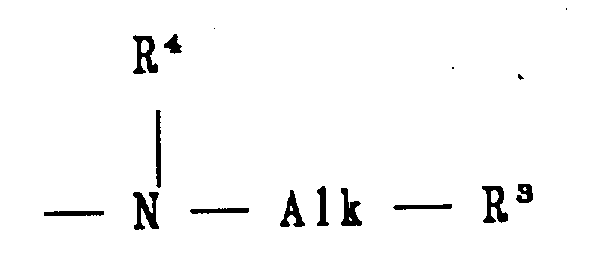
且R1和R2中的一个是式-Y-R11表示的基团或者烷基(可有取代基),另一个是氢原子;或者R1和R2中的一个是式-Y-R11表示的基团,另一个是烷基(可有取代基);Y表示一个以式-CO-,-CS-或-SO2-表示的基团;R11表示烷基(可有取代基)、低级烷氧基(可有取代基)、链烯基(可以有取代基)、炔基、苯基(可有取代基)、环烷基、三环烷基、杂环基或烷基氨基;R3表示氢原子、苯基、苯氧基、苯硫基、苯氨基(可被保护)或杂环基;R4表示链烷酰基、链烯酰基或炔酰基;且Alk代表亚烷基),假定其中X是羟基、R1和R2中的一个是甲基,另一个是乙酰基的化合物除外。And one of R 1 and R 2 is a group represented by formula -YR 11 or an alkyl group (may have a substituent), and the other is a hydrogen atom; or one of R 1 and R 2 is represented by formula -YR 11 The other is an alkyl group (may have a substituent); Y represents a group represented by the formula -CO-, -CS- or -SO 2 -; R 11 represents an alkyl group (may have a substituent), lower Alkoxy (optionally substituted), alkenyl (optionally substituted), alkynyl, phenyl (optionally substituted), cycloalkyl, tricycloalkyl, heterocyclyl or alkylamino; R 3 represents a hydrogen atom, phenyl, phenoxy, phenylthio, phenylamino (can be protected) or heterocyclic group; R 4 represents alkanoyl, alkenoyl or alkynoyl; and Alk represents an alkylene group), Compounds where X is hydroxyl, one of R1 and R2 is methyl, and the other is acetyl are assumed to be excluded.
本发明的目的化合物(I)具有极好的升白活性和预防感染的活性,是有用的药物化合物,可作为白细胞减少治疗或预防剂、感染预防剂或者抗感染活性增强剂。The object compound (I) of the present invention has excellent whitening-increasing activity and infection-preventing activity, and is a useful pharmaceutical compound, which can be used as a treatment or prevention agent for leukopenia, an infection prevention agent or an anti-infection activity enhancer.
下面将详细解释本发明。The present invention will be explained in detail below.
本发明的目的化合物(Ⅰ)中,作为可有取代基的烷基,可列举被1或2个基团取代的烷基,这些取代基选自烷氧羰基、氨基(可被保护)、羧链烷酰氨基、烷氨基、苯氨基、羧基、氨甲酰基(可被烷基取代)、羟基(可被保护)、含硫或氮原子的单环或双环杂环基(例如吡咯烷基、噻吩基、吲哚基、咪唑基或吡啶基)和苯基;作为有取代基的低级烷氧基,可列举被苯基取代的低级烷氧基;作为取代的链烯基,可列举被二甲氧苯基取代的链烯基;作为取代的苯基,可列举被卤素取代的苯基;并且作为杂环基,可列举如上述的含硫或氮原子的单环或双环的杂环基。In the object compound (I) of the present invention, as an alkyl group that may have a substituent, an alkyl group substituted by 1 or 2 groups can be cited, and these substituents are selected from alkoxycarbonyl, amino (can be protected), carboxy Alkanoylamino, alkylamino, phenylamino, carboxyl, carbamoyl (which can be substituted by alkyl), hydroxyl (which can be protected), monocyclic or bicyclic heterocyclic groups containing sulfur or nitrogen atoms (such as pyrrolidinyl, thienyl, indolyl, imidazolyl or pyridyl) and phenyl; as substituted lower alkoxy, substituted lower alkoxy substituted by phenyl; as substituted alkenyl, substituted by di Alkenyl substituted with methoxyphenyl group; as substituted phenyl group, phenyl group substituted by halogen can be cited; and as heterocyclic group, monocyclic or bicyclic heterocyclic group containing sulfur or nitrogen atom as mentioned above can be mentioned .
有取代基的烷基可以是通过脱除氨基酸上的羧基得到的基团,可列举例如通过脱去天然氨基酸上的羧基得到的基团,所述天然氨基酸如谷氨酸、谷氨酰胺、丝氨酸、肌氨酸、脯氨酸、苯丙氨酸、亮氨酸、异亮氨酸、甘氨酸、色氨酸、赖氨酸、组氨酸、酷氨酸和缬氨酸、其一种对映体或其外消旋化合物。The alkyl group having a substituent may be a group obtained by removing a carboxyl group on an amino acid, for example, a group obtained by removing a carboxyl group on a natural amino acid such as glutamic acid, glutamine, serine , sarcosine, proline, phenylalanine, leucine, isoleucine, glycine, tryptophan, lysine, histidine, tyrosine and valine, one of its enantiomers body or its racemic compound.
作为三环烷基,可列举金钢烷基。As a tricycloalkyl group, an adamantyl group is mentioned.
当有取代基的烷基是由被保护的氨基取代的烷基和/或当R3是被保护的苯基氨基时,该氨基的保护基团,可列举常见的可用作氨基保护基的保护基团,便如叔丁氧羰基和苄氧羰基。还可列举的链烷酰基如乙酰基和丁酰基作为氨基的保护基。When the alkyl group having the substituent is an alkyl group substituted by a protected amino group and/or when R 3 is a protected phenylamino group, the protecting group of the amino group can be listed as common amino protecting group Protecting groups are, for example, tert-butoxycarbonyl and benzyloxycarbonyl. Also mentioned are alkanoyl groups such as acetyl and butyryl as protecting groups for amino groups.
当有取代基的烷基是被保护的羟基取代的烷基时,作为羟基的保护基团可列举通常用作羟基保护基的基团。When the substituted alkyl group is an alkyl group substituted with a protected hydroxy group, the protecting group for the hydroxy group includes groups generally used as a hydroxy protecting group.
作为药学上优选的化合物,可列举式(Ⅰ)表示的化合物(其中X是由下式表示的基团:As pharmaceutically preferred compounds, compounds represented by formula (I) (wherein X is a group represented by the following formula:

其中的符号定义同上)。The symbols are as defined above).
作为药学上更优选的化合物,可列举式(Ⅰ)表示的化合物(基其中X是由下式表示的基团:As pharmaceutically more preferable compounds, compounds represented by formula (I) (group wherein X is represented by the following formula:
R1和R2均为氢;R3是氢,苯基、苯氧基、苯硫基、苯氨基(可被保护)或杂环基;且R4是链烷酰基,链烯酰基或炔酰基)。在这些化合物中,其中R3是氢原子、苯基或苯氨基(可被保护);且R4是链烷酰基或炔酰基的化合物是尤其优选的。 R1 and R2 are both hydrogen; R3 is hydrogen, phenyl, phenoxy, phenylthio, anilino (which may be protected) or heterocyclyl; and R4 is alkanoyl, alkenoyl or alkyne acyl). Among these compounds, those wherein R3 is a hydrogen atom, phenyl or anilino group (which may be protected); and R4 is an alkanoyl or alkynoyl group are especially preferred.
作为其它药学上优选的化合物,可列举式(Ⅰ)表示的化合物其中X是由下式表示的基团:As other pharmaceutically preferred compounds, compounds represented by formula (I) wherein X is a group represented by the following formula can be cited:
R1和R2中的一个是由式-Y-R11表示的基团,另一个是氢原子;Y是式-CO-、-CS-或-SO2表示的基团;R11是烷基(可被取代)、低级烷氧基(可被取代)、链烯基(可被取代)、炔基、苯基(可被取代)、环烷基、三环烷基、杂环基或烷氨基;R3是氢原子、苯基、苯氧基、苯硫基、苯氨基(可被保护)或杂环基;R4是链烷酰基、链烯酰基或炔酰基)。在这些化合物中,其中R3是氢原子、苯基或苯氨基(可被保护);且R4是链烷酰基或炔酰基的化合物是特别优选的。One of R 1 and R 2 is a group represented by formula -YR 11 , and the other is a hydrogen atom; Y is a group represented by formula -CO-, -CS- or -SO 2 ; R 11 is an alkyl group ( may be substituted), lower alkoxy (may be substituted), alkenyl (may be substituted), alkynyl, phenyl (may be substituted), cycloalkyl, tricycloalkyl, heterocyclyl or alkylamino ; R3 is a hydrogen atom, phenyl, phenoxy, phenylthio, anilino (can be protected) or a heterocyclic group; R4 is an alkanoyl, alkenoyl or alkynoyl). Among these compounds, those wherein R3 is a hydrogen atom, phenyl or anilino group (which may be protected); and R4 is an alkanoyl or alkynoyl group are particularly preferred.
再者,作为药学上优选的化合物中,可列举式Ⅰ表示的化合物其中X是由下式表示的基团:Furthermore, among the pharmaceutically preferred compounds, compounds represented by formula I can be cited wherein X is a group represented by the following formula:
R1和R2中的一个是式-Y-R11表示的基团,另一个是氢原子;Y是式-CO-表示的基团;R11是烷基(可被取代);R3是氢原子或苯基;且R4是链烷酰基或炔酰基)。在这些化合物中,(ⅰ)其中R11是烷基(可被1或2个基团取代,这些取代基选自低级烷氧羰基、氨基(可被保护)、羧链烷酰氨基、烷氨基、苯氨基、羧基、氨甲酰基、羟基和苯基)的化合物,或者(ⅱ)其中R11是通过脱除天然氨基酸或其一种对映体上的羧基得到的基团的化合物是特别优选的。One of R 1 and R 2 is a group represented by the formula -YR 11 , and the other is a hydrogen atom; Y is a group represented by the formula -CO-; R 11 is an alkyl group (may be substituted); R 3 is hydrogen atom or phenyl; and R4 is alkanoyl or alkynoyl). In these compounds, (i) wherein R 11 is alkyl (which may be substituted by 1 or 2 groups selected from lower alkoxycarbonyl, amino (which may be protected), carboxyalkanoylamino, alkylamino , aniline, carboxyl, carbamoyl, hydroxy and phenyl) or (ii) wherein R is a group obtained by decarboxylation of a natural amino acid or one of its enantiomers is particularly preferred of.
作为药学上最优选的化合物,可列举式Ⅰ表示的化合物(其中X是由下式表示的基团:As the most preferred compound in pharmacy, the compound represented by formula I (wherein X is a group represented by the following formula:

R1和R2中的一个是式-Y-R11表示的基团,且另一个是氢原子;Y-是式-CO-表示的基团;R11是烷基(可被有保护的氨基取代);R3是氢原子或苯基;并且R4是链烷酰基或炔酰基)。One of R 1 and R 2 is a group represented by the formula -YR 11 , and the other is a hydrogen atom; Y- is a group represented by the formula -CO-; R 11 is an alkyl group (which can be substituted by a protected amino group ); R3 is a hydrogen atom or a phenyl group; and R4 is an alkanoyl or alkynoyl group).
本发明的目的化合物(Ⅰ)包括其光学异构体和其外消旋体。The object compound (I) of the present invention includes its optical isomers and its racemates.
本发明的目的化合物(Ⅰ)可以其游离形式或以其可药用盐的形式用于医疗/药学用途。作为此类盐,可列举例如金属盐(如碱金属盐和碱土金属盐),铵盐、有机胺盐(如低级叔烷基胺)、氨基酸盐、有机酸盐(如琥珀酸盐、马来酸盐、酒石酸盐和甲磺酸盐)及无机酸盐(如盐酸盐,硫酸盐和硝酸盐)。The object compound (I) of the present invention can be used for medical/pharmaceutical use in its free form or in the form of a pharmaceutically acceptable salt thereof. As such salts, for example, metal salts (such as alkali metal salts and alkaline earth metal salts), ammonium salts, organic amine salts (such as lower tertiary alkylamines), amino acid salts, organic acid salts (such as succinate, maleic acid salts, tartrates and methanesulfonates) and inorganic acid salts (such as hydrochlorides, sulfates and nitrates).
本发明的目的化合物(Ⅰ)可口服和经非胃肠道施用,也可与适用于口服或经非胃肠道施用的载体或稀释剂结合作为药物制剂使用。该药物制剂可以是固体制剂如片剂、胶囊和粉剂,或者是液体制剂如溶液、悬浮剂和乳剂。它也可以注射形成经非胃肠道施用。The object compound (I) of the present invention can be administered orally and parenterally, and can also be used as a pharmaceutical preparation in combination with a carrier or diluent suitable for oral or parenterally. The pharmaceutical preparations may be solid preparations such as tablets, capsules and powders, or liquid preparations such as solutions, suspensions and emulsions. It can also be administered parenterally by injection.
本发明目的化合物(Ⅰ)的剂量依患者的年龄、体重和自身条件或疾病的严重程度而变化,口服剂量是1~500mg/kg/日,优选10~100mg/kg/日,经非胃肠施用剂量是0.1~500mg/kg/日,优选1~100mg/kg/日。The dose of the object compound (I) of the present invention varies according to the patient's age, body weight and the severity of the condition or disease. The oral dose is 1-500 mg/kg/day, preferably 10-100 mg/kg/day. The administration dose is 0.1-500 mg/kg/day, preferably 1-100 mg/kg/day.
依据本发明,(1)目的化合物(Ⅰ)中,式(Ⅰ-a)表示的D-葡糖胺衍生物:According to the present invention, (1) in the object compound (I), the D-glucosamine derivative represented by formula (I-a):

其中的符号定义同上,可通过将式(Ⅱ):The symbols are defined as above, and can be obtained by formula (II):

其中NHR5表示可被保护的氨基,且其它符号定义同上,表示的D-葡糖胺化合物或其盐与式(Ⅲ):R4-OH(Ⅲ)(其中R4定义同上)表示的化合物、其盐或其反应性衍生物缩合制得(必要时,除去保护基)。Where NHR 5 represents an amino group that can be protected, and other symbols are as defined above, and the D-glucosamine compound or its salt represented by the formula (Ⅲ): R 4 -OH (Ⅲ) (where R 4 is as defined above) represents the compound , Its salt or its reactive derivatives are condensed (if necessary, the protective group is removed).
(2)本发明的目的化合物(Ⅰ)中,式(Ⅰ-b):(2) Among the object compounds (I) of the present invention, formula (I-b):
(其中R21表示可被取代的烷基;X1表示羟基或下式:(wherein R 21 represents an alkyl group that may be substituted; X 1 represents a hydroxyl group or the following formula:

表示的基团(其中的符号定义同上)表示的D-葡糖胺可通过将式(Ⅳ)The D-glucosamine represented by the represented group (wherein the symbols are as defined above) can be obtained by formula (Ⅳ)

(其中的符号定义同上)表示的D-葡糖胺化合物或其盐烷基化合来制备。(wherein the symbols are as defined above) represented by alkylation of the D-glucosamine compound or its salt.
(3)本发明的目的化合物(Ⅰ)中,式(Ⅰ-c):(3) Among the object compounds (I) of the present invention, formula (I-c):
(其中R22表示氢原子或可被取代的烷基;且其它符号定义同上,假定当X1是羟基且R22是甲基时,R11-Y-不是乙酰基)表示的D-葡糖胺衍生物可通过将式(Ⅴ):(where R 22 represents a hydrogen atom or an alkyl group that may be substituted; and other symbols are as defined above, assuming that when X 1 is a hydroxyl group and R 22 is a methyl group, R 11 -Y- is not an acetyl group) represented by D-glucose Amine derivatives can be obtained by formula (Ⅴ):

(其中的符号定义同上)表示的化合物或基盐与式(Ⅵ):(wherein the symbols are defined as above) represented by the compound or base salt and the formula (Ⅵ):
(其中的符号含义同上)表示的化合物、其盐或其反应性衍生物缩合制备。(The meanings of the symbols are the same as above), prepared by condensation of the compound represented by it, its salt or its reactive derivative.
在方法(1)中,当NHR5是被保护的氨基时,可使用通常用作氨基保护基的基团作为该氨基的保护基,优选的可列举苄氧羰基和叔丁氧羰基。In the method (1), when NHR 5 is a protected amino group, a group generally used as an amino protecting group can be used as the protecting group for the amino group, preferably benzyloxycarbonyl and tert-butoxycarbonyl can be mentioned.
可使用常规的盐作为方法(1)至(3)中D-葡糖胺化合物(Ⅱ)、(Ⅳ)、或(Ⅴ)(下文称作“D-葡糖胺化合物”)的盐,例如无机酸盐包括盐酸盐和有机酸盐包括甲酸盐、马来酸盐、苹果酸盐和草酸盐。As the salt of D-glucosamine compound (II), (IV), or (V) (hereinafter referred to as "D-glucosamine compound") in methods (1) to (3), conventional salts can be used, such as Inorganic acid salts include hydrochlorides and organic acid salts include formates, maleates, malates and oxalates.
在方法(1)和(3)中,该“D-葡糖胺化合物”或其盐与化合物(Ⅲ)或(Ⅵ),或其盐的缩合反应可在脱水剂存在下在适宜的溶剂中进行。In methods (1) and (3), the condensation reaction of the "D-glucosamine compound" or its salt with compound (III) or (VI) or its salt can be carried out in a suitable solvent in the presence of a dehydrating agent conduct.
可使常规的盐例如碱金属盐和碱土金属盐作为化合物(Ⅲ)或(Ⅵ)的盐,该盐可优选作为游离化合物与D-葡糖胺化合物反应。Conventional salts such as alkali metal salts and alkaline earth metal salts can be used as salts of the compound (III) or (VI), and the salts can preferably be reacted with the D-glucosamine compound as a free compound.
作为脱水剂,可列举常规的脱水剂例如1,3-二环己基-碳化二亚胺,1-乙基-3-(3′-二甲基氨基丙基)碳化二亚胺和羰基二咪唑。As the dehydrating agent, conventional dehydrating agents such as 1,3-dicyclohexyl-carbodiimide, 1-ethyl-3-(3'-dimethylaminopropyl)carbodiimide and carbonyldiimidazole can be cited .
在方法(1)和(3)中,该“D-葡糖胺化合物”或其盐与化合物(Ⅲ)或(Ⅵ)的反应性衍生物的缩合反应可在有或没有酸受体的存在下在适宜溶剂中进行。In methods (1) and (3), the condensation reaction of the "D-glucosamine compound" or its salt with the reactive derivative of compound (III) or (VI) can be carried out with or without the presence of an acid acceptor in a suitable solvent.
可使用常规用于缩合反应的衍生物作为化合物(Ⅲ)或(Ⅵ)的反应性衍生物,例如酰氯、混合的酸酐和活性酯。另外,作为化合物(Ⅳ)的反应性衍生物,可列举异氰酸酯或异硫氰酸酯,该酯可与化合物(Ⅴ)反应生成化合物(Ⅰ-c)(其中R11是烷氨基);或者卤代甲酸酯,该酯可与化合物(Ⅴ)反应生成化合物(Ⅰ-c)(其中R11是可被取代的低级烷氧基)。As the reactive derivative of compound (III) or (VI), derivatives conventionally used in condensation reactions, such as acid chlorides, mixed acid anhydrides and active esters, can be used. In addition, as the reactive derivative of compound (IV), can enumerate isocyanate or isothiocyanate, and this ester can react with compound (V) to generate compound (I-c) (wherein R 11 is an alkylamino group); or halogen Formic acid esters, which can be reacted with compound (V) to form compound (I-c) (wherein R 11 is a lower alkoxy group which may be substituted).
作为酸受体,可列举碱金属碳酸盐如碳酸钾和碳酸钠;碱金属碳酸氢盐如碳酸氢钾和碳酸氢钠;碱金属氢氧化物如氢氧化钠和氢氧化钾;叔胺如低级三级烷胺包括三乙胺、二异丙基乙基胺、1,4-二氮杂双环[2、2、2]辛烷、1,5-二氮杂双环[4,3,0]-5-壬烯和1,8-二氮杂双环[5,4,0]-6-十一烯)和芳香胺如吡啶、二甲氨基吡啶、二甲基吡啶、可力丁和二甲基苯胺。As the acid acceptor, alkali metal carbonates such as potassium carbonate and sodium carbonate; alkali metal bicarbonates such as potassium bicarbonate and sodium bicarbonate; alkali metal hydroxides such as sodium hydroxide and potassium hydroxide; tertiary amines such as Lower tertiary alkylamines include triethylamine, diisopropylethylamine, 1,4-diazabicyclo[2,2,2]octane, 1,5-diazabicyclo[4,3,0 ]-5-nonene and 1,8-diazabicyclo[5,4,0]-6-undecene) and aromatic amines such as pyridine, dimethylaminopyridine, lutidine, collidine and di methylaniline.
可使用不影响缩合反应的惰性溶剂作为方法(1)和(3)的反应溶剂,例如可使用水;卤化溶剂如氯仿、二氯甲烷和1,2-二氯乙烷;醚类溶剂如四氢呋喃、二恶烷和二乙醚;芳香族烃如苯、甲苯和二甲苯;酰胺类溶剂如二甲基甲酰胺、和二甲基乙酰胺;芳香胺溶剂如吡啶、二甲基吡啶和可力丁;酯类溶剂如乙酸乙酯和乙酸丁酯;酮类溶剂如丙酮和甲基乙基酮;及它们的混合溶剂。该缩合反应优选在冷至该溶剂的沸点如-30℃至150℃,特别优选在-10℃至室温下进行。Inert solvents that do not affect the condensation reaction can be used as reaction solvents for methods (1) and (3), for example, water; halogenated solvents such as chloroform, dichloromethane and 1,2-dichloroethane; ether solvents such as tetrahydrofuran , dioxane and diethyl ether; aromatic hydrocarbons such as benzene, toluene and xylene; amide solvents such as dimethylformamide and dimethylacetamide; aromatic amine solvents such as pyridine, lutidine and collidine ; Ester solvents such as ethyl acetate and butyl acetate; Ketone solvents such as acetone and methyl ethyl ketone; and their mixed solvents. The condensation reaction is preferably carried out under cooling to the boiling point of the solvent, such as -30°C to 150°C, particularly preferably at -10°C to room temperature.
在方法(2)中,D-葡糖胺衍生物(Ⅳ)的烷基化反应例如可通过(2-a)将化合物(Ⅳ)与式(Ⅶ):In method (2), the alkylation reaction of D-glucosamine derivative (IV) can be, for example, by (2-a) compound (IV) and formula (VII):
(其中R24表示氢原子或可被取代的烷基)表示的化合物在有还原试剂存在下在溶剂中进行还原反应或通过催化还原来进行,或者通过(2-b)将化合物(Ⅳ)与式(Ⅷ):(wherein R 24 represents a hydrogen atom or an alkyl group that may be substituted), the compound represented by the reduction reaction in a solvent in the presence of a reducing agent or by catalytic reduction, or by (2-b) compound (IV) and Formula (Ⅷ):
(其中Z1表示一个反应性残基且其它符号的含义同上)表示的化合物在有或没有酸受体和反应促进剂的存在下在适宜的溶剂或不加溶剂中进行缩合。可使用常规的消除基团作为化合物(Ⅷ)的Z1,例如可列举卤素原子如氯原子、溴原子和碘原子、甲磺酰氧基、苯磺酰氧基和甲苯磺酰氧基。(wherein Z 1 represents a reactive residue and other symbols have the same meanings as above), the compounds represented are condensed in a suitable solvent or without a solvent in the presence or absence of an acid acceptor and a reaction accelerator. As Z₁ of compound (VIII), conventional eliminating groups can be used, for example, halogen atoms such as chlorine atom, bromine atom and iodine atom, methanesulfonyloxy group, benzenesulfonyloxy group and toluenesulfonyloxy group are exemplified.
可使用常规的金属氢化物作为还原性烷基化反应(2-a)的还原试剂,可列举例如氢硼化钠、氢化铝锂、氰基氢硼化钠、二异丁基氢化铝和二氢二(2-甲氧基-乙氧基)铝钠(Sodium dihydrobis (2-methoxy-ethoxy)aluminum)。可按常规方法进行催化还原,例如在氢气流下,使用钯碳或氧化铂为催化剂。Conventional metal hydrides can be used as the reducing agent for the reductive alkylation reaction (2-a), such as sodium borohydride, lithium aluminum hydride, sodium cyanoborohydride, diisobutylaluminum hydride and diisobutylaluminum hydride. Sodium dihydrobis (2-methoxy-ethoxy) aluminum. Catalytic reduction can be carried out by conventional methods, for example, using palladium carbon or platinum oxide as a catalyst under hydrogen flow.
使用不影响反应的惰性溶剂为溶剂,可列举例如水;醇类如乙醇和甲醇;芳香烃类如苯和甲苯;乙酸和醚类溶剂如四氢呋喃。An inert solvent that does not affect the reaction is used as the solvent, for example, water; alcohols such as ethanol and methanol; aromatic hydrocarbons such as benzene and toluene; acetic acid and ether solvents such as tetrahydrofuran.
该反应温度可从冷却至加热条件下,优选从-30℃至100℃,特别优选0℃至80℃。The reaction temperature can be from cooling to heating, preferably from -30°C to 100°C, particularly preferably from 0°C to 80°C.
通过缩合使化合物(Ⅳ)烷基化的反应(2-b)可按常规方法进行。可使用在上述方法(1)和(3)中列举的酸受体作为酸受体。可列举的反应促进剂,例如碘化钠。使用不影响反应的惰性溶剂为溶剂,可使用醇类溶剂如甲醇、乙醇、丙醇、和乙二醇;卤化溶剂如氯仿、二氯甲烷和1,2-二氯乙烷;醚类溶剂如四氢呋喃、二恶烷和1,2-二甲氧基乙烷;芳香烃如苯、甲苯和二甲苯;酰胺类溶剂如二甲基甲酰胺和二甲基乙酰胺;二甲亚砜;及它们的混合溶剂。该缩合反应例如可在0~200℃下,优选在70~150℃下进行。The reaction (2-b) in which the compound (IV) is alkylated by condensation can be carried out by a conventional method. The acid acceptors exemplified in the above methods (1) and (3) can be used as the acid acceptor. Reaction accelerators such as sodium iodide may be mentioned. Use an inert solvent that does not affect the reaction as a solvent, such as alcohol solvents such as methanol, ethanol, propanol, and ethylene glycol; halogenated solvents such as chloroform, methylene chloride, and 1,2-dichloroethane; ether solvents such as Tetrahydrofuran, dioxane, and 1,2-dimethoxyethane; aromatic hydrocarbons such as benzene, toluene, and xylene; amide solvents such as dimethylformamide and dimethylacetamide; dimethylsulfoxide; and their mixed solvents. This condensation reaction can be performed, for example at 0-200 degreeC, Preferably it is 70-150 degreeC.
上述化合物可相互转化,例如,式(Ⅰ-b)表示的化合物也可以通过下述方法制备,即化合物(Ⅳ)或其盐与式(Ⅵ-a):The above-mentioned compounds can be transformed into each other, for example, the compound represented by formula (I-b) can also be prepared by the following method, that is, compound (IV) or its salt and formula (VI-a):
R23-COOH(Ⅵ-a)R 23 -COOH (Ⅵ-a)
(其中R23表示可被取代的烷基)表示的化合物、其盐或其一种反应性衍生物缩合得到式(Ⅰ-d):(wherein R 23 represents an alkyl group which may be substituted), the compound represented by it, its salt or a reactive derivative thereof is condensed to obtain formula (I-d):

(其中符号含义同上)表示的化合物,然后还原该得到的化合物。(wherein the symbols have the same meaning as above), and then reduce the obtained compound.
化合物(Ⅳ)与化合物(Ⅳ-a)的缩合反应可在相同于方法(1)或(3)的方式下进行。The condensation reaction of compound (IV) with compound (IV-a) can be carried out in the same manner as in method (1) or (3).
化合物(Ⅰ-d)的还原反应可以相同于方法(2)的方式在有还原剂存在下在适宜的溶剂中或通过常规的催化还原方法进行。The reduction of the compound (I-d) can be carried out in the same manner as in the method (2) in a suitable solvent in the presence of a reducing agent or by a conventional catalytic reduction method.
本发明的起始化合物(Ⅱ)是一种新化合物,它可通过将式(Ⅸ):The starting compound (II) of the present invention is a novel compound which can be obtained by formula (IX):
(其中Z2表示一个消除的基团且其它符号含义同上)表示的化合物与式(X):(where Z2 represents an eliminated group and the meanings of other symbols are the same as above) the compound represented by formula (X):
(其中的符号含义同上)表示的胺化合物反应来制备。(wherein the meaning of the symbol is the same as above) to prepare by reacting the amine compound represented.
可使用常规的消除基团作为消除基Z2,例如可列举甲磺酰氧基和对甲苯磺酰氧基。A conventional eliminating group can be used as the eliminating group Z 2 , and examples thereof include methanesulfonyloxy and p-toluenesulfonyloxy.
该取代反应可在相同于上述方法(2-a)的方式下进行。This substitution reaction can be carried out in the same manner as in the above method (2-a).
在本发明的说明书中,作为烷基和亚烷基可分别列举具有1~30个碳原子的烷基和具有1-30个碳原子的亚烷基,而作为链烯基和炔基,可分别列举具有2~30个碳原子的链烯基和具有2-30个碳原子的炔基。作为链烷酰基,可列举具有2~30个碳原子的链烷酰基,作为链烯酰基和炔酰基,可分别列举具有3-30个碳原子的链烯酰基的3-30个碳原子的炔酰基。作为低级烷氧基,可列举具有1-6个碳原子的低级烷氧基。作为环烷基,可列举具有3-6个碳原子的环烷基,尤其是环己基。In the description of the present invention, as the alkyl group and the alkylene group, an alkyl group having 1 to 30 carbon atoms and an alkylene group having 1 to 30 carbon atoms can be cited respectively, and as an alkenyl group and an alkynyl group, it can be Alkenyl groups having 2 to 30 carbon atoms and alkynyl groups having 2 to 30 carbon atoms are respectively exemplified. As the alkanoyl group, there are alkanoyl groups having 2 to 30 carbon atoms, and as the alkenoyl group and the alkynoyl group, there are respectively 3 to 30 carbon atom alkynes of the alkenoyl group having 3 to 30 carbon atoms. Acyl. As the lower alkoxy group, lower alkoxy groups having 1 to 6 carbon atoms can be cited. As the cycloalkyl group, there may be mentioned a cycloalkyl group having 3 to 6 carbon atoms, especially a cyclohexyl group.
在本发明的说明书,烷基、亚烷基、链烯基、炔基、链烷酰基、链烯酰基、炔酰基和低级烷氧基各包括直链和支链的基团。In the specification of the present invention, the alkyl group, alkylene group, alkenyl group, alkynyl group, alkanoyl group, alkenoyl group, alkynoyl group and lower alkoxy group each include straight chain and branched chain groups.
实施例1Example 1
将溶于50ml水的6.91g碳酸钾水溶液加到溶于200ml四氢呋喃中的10.45g2,6-二脱氧-2-苄氧羰基氨基-6-(4-苯丁氨基)-α-D-吡喃葡糖甲苷,并将溶于20ml四氢呋喃的7.60g硬脂酰氯在冷却和搅拌的同时滴加该混合物中,之后再搅拌2小时。往该反应溶液中加入21乙酸乙酯和11水并过滤除去不溶物。分离有机层,该有机层用水洗并干燥,蒸发除去溶剂。用硅胶柱层析纯化该残留物(溶剂:乙酸乙酯),得到14.04g2,6-二脱氧-2-苄氧羰氨基-6-[N-硬脂酰-N-(4-苯基丁基)-氨基]-α-D-吡喃葡糖甲苷。An aqueous solution of 6.91 g of potassium carbonate dissolved in 50 ml of water was added to 10.45 g of 2,6-dideoxy-2-benzyloxycarbonylamino-6-(4-phenylbutylamino)-α-D-pyran dissolved in 200 ml of tetrahydrofuran Glucoside, and 7.60 g of stearyl chloride dissolved in 20 ml of tetrahydrofuran was added dropwise to the mixture while cooling and stirring, followed by further stirring for 2 hours. To the reaction solution were added 2 l of ethyl acetate and 1 l of water and filtered to remove insoluble matter. The organic layer was separated, washed with water and dried, and the solvent was removed by evaporation. The residue was purified by silica gel column chromatography (solvent: ethyl acetate) to obtain 14.04 g of 2,6-dideoxy-2-benzyloxycarbonylamino-6-[N-stearyl-N-(4-phenylbutyl base)-amino]-α-D-glucopyranoside.
IR(液体石蜡)cm-1:3600-3100,1720,1620IR (liquid paraffin) cm -1 : 3600-3100, 1720, 1620
FABMS(m/z):725(MH+)FABMS (m/z): 725 (MH + )
实施例2-5Example 2-5
用相同于实施例1的方式处理相应的起始化合物,得到表1所示的化合物。The corresponding starting compounds were treated in the same manner as in Example 1 to obtain the compounds shown in Table 1.

实施例6Example 6
往溶于300ml甲醇的14.04g 2,6-二脱氧-2-苄氧羰基氨基-6-6-[N-硬脂酰-N-(4-苯丁基)-氨基]-α-D-吡喃葡糖甲苷中加入10.0g 10%钯碳在室温和氢气压下进行催化氢化还原。4小时后,过滤除去催化剂,然后蒸馏除去甲醇。残余物用硅胶柱层析(溶剂∶氯仿∶甲醇=5∶1)纯化,得到11.25g 2,6-二脱氧-2-氨基-6-[N-硬脂酰-N-(4-苯丁基)-氨基]-α-D-吡喃葡糖甲苷。To 14.04g 2,6-dideoxy-2-benzyloxycarbonylamino-6-6-[N-stearyl-N-(4-phenylbutyl)-amino]-α-D- dissolved in 300ml methanol Add 10.0g 10% palladium carbon to glucopyranoside to carry out catalytic hydrogenation reduction at room temperature and hydrogen pressure. After 4 hours, the catalyst was removed by filtration, and then methanol was distilled off. The residue was purified by silica gel column chromatography (solvent: chloroform: methanol = 5: 1) to obtain 11.25 g of 2,6-dideoxy-2-amino-6-[N-stearyl-N-(4-benzenebutyl base)-amino]-α-D-glucopyranoside.
IR(液体石蜡)cm-1:3600-3100,1640IR (liquid paraffin) cm -1 : 3600-3100, 1640
FABMS(m/z):591(MH+)FABMS (m/z): 591 (MH + )
实施例7-9Example 7-9
用相同于实施例6的方式处理相应的起始化合物得到表2所示化合物。The corresponding starting compounds were treated in the same manner as in Example 6 to obtain the compounds shown in Table 2.

实施例10Example 10
将2ml三氟乙酸加到溶于10ml二氯甲烷的2.02g 2,6-二脱氧-2-叔丁氧羰基氨基-6-{N-硬脂酰-N-[3-(N-苯基-N-苄氧羰基氨基)-丙基]氨基}-α-D-吡喃葡糖甲苷,之后在室温下搅拌3小时,往该反应溶液中加入10%氢氧化钠水溶液,然后再加入200ml氯仿和70ml水。将有机层取出,用水洗并干燥,并蒸发除去溶剂。该残余物用硅胶柱层析(溶剂∶氯仿∶甲烷=15∶1)纯化,得到1.72g 2,6-二脱氧-2-氨基-6-{N-硬脂酰-N-[3-(N-苯基-N-苄氧羰氨基)丙基}-α-D-吡喃葡糖甲苷。Add 2ml of trifluoroacetic acid to 2.02g of 2,6-dideoxy-2-tert-butoxycarbonylamino-6-{N-stearyl-N-[3-(N-phenyl -N-benzyloxycarbonylamino)-propyl]amino}-α-D-glucopyranoside, then stirred at room temperature for 3 hours, added 10% aqueous sodium hydroxide solution to the reaction solution, and then added 200ml chloroform and 70ml water. The organic layer was taken out, washed with water and dried, and evaporated to remove the solvent. The residue was purified by silica gel column chromatography (solvent: chloroform: methane=15:1) to obtain 1.72 g of 2,6-dideoxy-2-amino-6-{N-stearyl-N-[3-( N-phenyl-N-benzyloxycarbonylamino)propyl}-α-D-glucopyranoside.
IR(液晶(neat))cm-1:3600-3100,1710,1640IR (liquid crystal (neat)) cm -1 : 3600-3100, 1710, 1640
FABMS(m/z):726(MH+)FABMS (m/z): 726 (MH + )
实施例11Example 11
以相同于实施例6的方式处理2,6-二脱氧-2-氨基-6-{N-硬脂酰-N-[3-(N-苯基-N-苄氧羰氨基)丙基]氨基}-α-D-吡喃葡糖甲苷得到2,6-二脱氧-2-氨基-6-{N-硬脂酰-N-[3-(苯氨基)丙基]氨基}-α-D-吡喃葡糖甲苷。2,6-dideoxy-2-amino-6-{N-stearyl-N-[3-(N-phenyl-N-benzyloxycarbonylamino)propyl] was treated in the same manner as in Example 6 Amino}-α-D-glucopyranoside to give 2,6-dideoxy-2-amino-6-{N-stearyl-N-[3-(phenylamino)propyl]amino}-α -D-Glucopyranoside.
IR(液体石蜡)cm-1:3600-3100,1620IR (liquid paraffin) cm -1 : 3600-3100, 1620
FABMS(m/z):592(MH+)FABMS (m/z): 592 (MH + )
实施例12Example 12
在冰浴冷却和搅拌的同时,往溶于10ml四氢呋喃的478mg 2,6-二脱氧-2-氨基-6-[N-硬脂酰-N-(4-苯丁基)氨基]-α-D-吡喃葡糖甲苷中加入溶在2ml水中的225mg碳酸钾,然后将溶在2ml四氢呋喃中的269mg硬脂酰氯加到该混合物中,随后搅拌1小时。往该反应溶液中加入50ml乙酸乙酯和10ml水,分出有机层,用水洗并干燥,再蒸除溶剂。该残余物经硅胶柱层析(溶剂∶氯仿∶甲醇=20∶1)纯化得到645mg 2,6-二脱氧-2-硬脂酰氨基-6-[N-硬脂酰-N-(4-苯丁基)-氨基]-α-D-吡喃葡糖甲苷。While cooling in an ice bath and stirring, add 478 mg of 2,6-dideoxy-2-amino-6-[N-stearyl-N-(4-phenylbutyl)amino]-α- To D-glucopyranoside was added 225 mg of potassium carbonate dissolved in 2 ml of water, and then 269 mg of stearyl chloride dissolved in 2 ml of tetrahydrofuran was added to the mixture, followed by stirring for 1 hour. To the reaction solution were added 50 ml of ethyl acetate and 10 ml of water, the organic layer was separated, washed with water and dried, and the solvent was distilled off. The residue was purified by silica gel column chromatography (solvent: chloroform: methanol = 20:1) to obtain 645 mg of 2,6-dideoxy-2-stearylamino-6-[N-stearyl-N-(4- phenylbutyl)-amino]-α-D-glucopyranoside.
m.p.∶51℃~52℃m.p.: 51℃~52℃
IR(液体石蜡)cm-1:3600-3100,1640IR (liquid paraffin) cm -1 : 3600-3100, 1640
FABMS(m/z):858(MH+)FABMS (m/z): 858 (MH + )
实施例13-35Examples 13-35
以相同于实施例12的方式处理相应的起始化合物得到表3-5所示化合物。The corresponding starting compounds were treated in the same manner as in Example 12 to obtain the compounds shown in Tables 3-5.


实施例36Example 36
在冰冷却下,往溶于25ml四氢呋喃中的1.54g 2,6-二脱氧-2-氨基-6-[N-硬脂酰-N-(4-苯丁基)氨基]-d-D-吡喃葡糖甲苷和0.75gN-叔丁氧羰基-L-亮氨酸中加入0.49g 95%氰磷酸二乙酯和0.55三乙胺,随后搅拌1小时。该混合物于室温下继续搅拌45分钟后,经蒸发除去四氢呋喃。该残渣溶于乙酸乙酯中,该乙酸乙酰层用水洗并干燥。然后,蒸发除去溶剂。该残余物经硅胶柱层析(溶剂∶乙烷∶乙酸乙酯=1∶3)纯化得到1.70g 2.6-二脱氧-2-[N-(叔丁氧羰基)-L-亮氨酰]-氨基-6-[N-硬脂酰-N-(4-苯丁基)氨基]-d-D-吡喃葡糖甲苷。Under ice cooling, add 1.54 g of 2,6-dideoxy-2-amino-6-[N-stearyl-N-(4-phenylbutyl)amino]-d-D-glucopyranose dissolved in 25 ml of tetrahydrofuran Glycoside and 0.75 g of N-tert-butoxycarbonyl-L-leucine were added with 0.49 g of 95% diethyl cyanophosphate and 0.55 of triethylamine, followed by stirring for 1 hour. After stirring the mixture for a further 45 minutes at room temperature, the tetrahydrofuran was removed by evaporation. The residue was dissolved in ethyl acetate, and the acetyl acetate layer was washed with water and dried. Then, the solvent was removed by evaporation. The residue was purified by silica gel column chromatography (solvent: ethane: ethyl acetate = 1:3) to obtain 1.70 g of 2.6-dideoxy-2-[N-(tert-butoxycarbonyl)-L-leucyl]- Amino-6-[N-stearyl-N-(4-phenylbutyl)amino]-d-D-glucopyranoside.
IR(液晶)cm-1:3600-3100,1700,1650,1630IR (liquid crystal) cm -1 : 3600-3100, 1700, 1650, 1630
FABMS(m/z):804(MH+)FABMS (m/z): 804 (MH + )
实施例37-41Examples 37-41
以相同于实施例36的方法处理相应的起始化合物得到表6所示化合物。The corresponding starting compounds were treated in the same manner as in Example 36 to obtain the compounds shown in Table 6.
实施例42Example 42
往溶于10ml二氨甲烷中的1.70g 2,6-二脱氧-2-[N-(叔丁氧羰基)-L-亮氨酰]-氨基-6-[N-硬脂酰-N-(4-苯丁基)氨基]-d-D-吡喃糖甲苷中加入2ml三氟乙酸,之后于室温搅拌5小时。往该反应溶液中加入10%氢氧化钠水溶液,然后加入150ml氯仿和50ml水,分出有机相,用水洗并干燥,经蒸发除去溶剂。得到1.47g 2,6-二脱氧-2-(L-亮氨酰)氨基-6-[N-硬脂酰-N-(4-苯丁基)氨基]-d-D-吡喃葡糖甲苷。To 1.70g of 2,6-dideoxy-2-[N-(tert-butoxycarbonyl)-L-leucyl]-amino-6-[N-stearyl-N- (4-Phenylbutyl)amino]-d-D-methylpyranoside was added with 2 ml of trifluoroacetic acid, followed by stirring at room temperature for 5 hours. To the reaction solution was added 10% aqueous sodium hydroxide solution, then 150 ml of chloroform and 50 ml of water, and the organic phase was separated, washed with water and dried, and the solvent was removed by evaporation. Obtained 1.47g 2,6-dideoxy-2-(L-leucyl)amino-6-[N-stearyl-N-(4-phenylbutyl)amino]-d-D-glucopyranoside .
IR(液态石蜡)cm-1:3600-3100,1650IR (liquid paraffin) cm -1 : 3600-3100, 1650
FABMS(m/z):750(MH+)FABMS (m/z): 750 (MH + )
实施例43-45Examples 43-45
以相同于实施例42的方法处理相应的起始化合物得到表7所示化合物。The corresponding starting compounds were treated in the same manner as in Example 42 to obtain the compounds shown in Table 7.

实施例46-47Examples 46-47
以相同于实施例6的方法处理相应的起始化合物得到表8所示化合物。The corresponding starting compounds were treated in the same manner as in Example 6 to obtain the compounds shown in Table 8.
实施例48Example 48
往溶于10ml乙醇中的400mg 2,6-二脱氧-2-(L-亮氨酰)氨基-6-[N-硬脂酰-N-(4-苯丁基)氨基]-α-D-吡喃葡糖甲苷中加入56mg琥珀酸酐,之后于室温搅拌1小时。蒸发除去乙醇并经硅胶柱层析(溶剂∶氯仿∶甲烷=10∶1)纯化该残余物,得到450mg 2,6-二脱氧-2-[N-(羧丙酰)-L-亮氨酰]氨基-6-[N-硬脂酰-N-(4-苯丁基)氨基]-α-D-吡喃葡糖甲苷。400mg 2,6-dideoxy-2-(L-leucyl)amino-6-[N-stearyl-N-(4-phenylbutyl)amino]-α-D dissolved in 10ml ethanol - Add 56 mg of succinic anhydride to glucopyranoside, followed by stirring at room temperature for 1 hour. Ethanol was removed by evaporation and the residue was purified by silica gel column chromatography (solvent: chloroform: methane = 10:1) to obtain 450 mg of 2,6-dideoxy-2-[N-(carboxypropionyl)-L-leucyl ]amino-6-[N-stearyl-N-(4-phenylbutyl)amino]-α-D-glucopyranoside.
IR(液态石蜡)cm-1:3600-3100,1720,1650IR (liquid paraffin) cm -1 : 3600-3100, 1720, 1650
FABMS(m/z):826[(M+Na+)]FABMS (m/z): 826 [(M+Na + )]
实施例49Example 49
用相同于实施例48的方法处理相应的起始原料,得到2,6-二脱氧-2-[(N-羧丙酰)-(L-亮氨酰)氨基-6-[N-月桂酰-N-十八烷氨基]-α-D-吡喃葡糖甲苷。The corresponding starting material was treated in the same manner as in Example 48 to give 2,6-dideoxy-2-[(N-carboxypropionyl)-(L-leucyl)amino-6-[N-lauroyl -N-octadecylamino]-α-D-glucopyranoside.
IR(液晶)cm-1:3600-3100,1720,1650IR (liquid crystal) cm -1 : 3600-3100, 1720, 1650
FABMS(m/z):840(MH+)FABMS (m/z): 840 (MH + )
实施例50Example 50
往溶于30ml四氢呋喃中的1.50g 2,6-二脱氧-2-氨基-6-[N-硬脂酰-N-(4-苯丁基)氨基]-α-D-吡喃葡糖甲苷中加入溶于15ml水中的1.25g碳酸钾,冰冷却下,再往该混合物中滴加溶于20ml四氢呋喃中的1.90g辛磺酰氯,之后搅拌3小时。往该反应混合物中加入150ml乙酸乙酯,该有机层用水洗并干燥。然后蒸除溶剂。该残余物经硅胶柱层析(溶析∶乙烷∶乙酸乙酯=1∶3)纯化,得到1.56g 2,6-二脱氧-2-辛磺酰氨基-6-[N-硬脂酰-N-(4-苯丁基)氨基]-α-D-吡喃葡糖甲苷。1.50g 2,6-dideoxy-2-amino-6-[N-stearyl-N-(4-phenylbutyl)amino]-α-D-glucopyranose methyl dissolved in 30ml tetrahydrofuran 1.25 g of potassium carbonate dissolved in 15 ml of water was added to the glycoside, and under ice cooling, 1.90 g of octanesulfonyl chloride dissolved in 20 ml of tetrahydrofuran was added dropwise to the mixture, followed by stirring for 3 hours. To the reaction mixture was added 150 ml of ethyl acetate, and the organic layer was washed with water and dried. Then the solvent was distilled off. The residue was purified by silica gel column chromatography (elution: ethane: ethyl acetate = 1: 3) to obtain 1.56 g of 2,6-dideoxy-2-octylsulfonylamino-6-[N-stearyl -N-(4-phenylbutyl)amino]-α-D-glucopyranoside.
IR(液晶)cm-1:3600-3100,1620IR (liquid crystal) cm -1 : 3600-3100, 1620
FABMS(m/z):767(MH+)FABMS (m/z): 767 (MH + )
实施例51Example 51
以相同于实施例50的方法处理相应的原始化合物,得到2,6-二脱氧-2-辛磺酰氨基-6-(N-月桂酰-N-十八烷氨基)-α-D-吡喃葡糖甲苷。The corresponding original compound was treated in the same manner as in Example 50 to obtain 2,6-dideoxy-2-octanesulfonylamino-6-(N-lauroyl-N-octadecylamino)-α-D-pyridine Glucopyranoside.
IR(液态石蜡)cm-1:3600-3100,1620IR (liquid paraffin) cm -1 : 3600-3100, 1620
FABMS(m/z):803(MH+)FABMS (m/z): 803 (MH + )
实施例52Example 52
用相同于实施例50的方法处理相应的起始化合物,得于2,6-二脱氧-2-甲磺酰氨基-6-(N-月桂酰-N-十八烷氨基)-α-D-吡喃葡糖甲苷。Treat the corresponding starting compound in the same manner as in Example 50 to obtain 2,6-dideoxy-2-methylsulfonylamino-6-(N-lauroyl-N-octadecylamino)-α-D - glucopyranoside.
IR(液晶)cm-1:3600-3100,1620IR (liquid crystal) cm -1 : 3600-3100, 1620
FABMS(m/z):705(MH+)FABMS (m/z): 705 (MH + )
实施例53Example 53
往溶于8ml甲醇中的300mg 2,6-二脱氧-2-氨基-6-[N-硬脂酰-N-(4-苯丁基)氨基]-α-D-吡喃葡糖甲苷和226mg苯丁醛中加入2ml乙酸。该反应混合物于室温氢气压下以10mg氧化铂进行氢化。8小时,除去催化剂并蒸除溶剂。该残余物经硅胶柱层析(溶剂∶氯仿二甲烷=10∶1)纯化,得到320mg 2,6-二脱氧-2-(4-苯丁基)氨基-6-(N-硬脂酰-N-(4-苯丁基)氨基]-α-D-吡喃葡糖甲苷。300mg 2,6-dideoxy-2-amino-6-[N-stearyl-N-(4-phenylbutyl)amino]-α-D-glucopyranoside dissolved in 8ml methanol Add 2ml acetic acid to 226mg phenylbutyraldehyde. The reaction mixture was hydrogenated with 10 mg of platinum oxide at room temperature under hydrogen pressure. After 8 hours, the catalyst was removed and the solvent was distilled off. The residue was purified by silica gel column chromatography (solvent: chloroform dimethane = 10:1) to obtain 320 mg of 2,6-dideoxy-2-(4-phenylbutyl)amino-6-(N-stearyl- N-(4-phenylbutyl)amino]-α-D-glucopyranoside.
IR(液晶)cm-1:3600-3100,1620IR (liquid crystal) cm -1 : 3600-3100, 1620
FABMS(m/z):723(MH+)FABMS (m/z): 723 (MH + )
实施例54Example 54
以相同于实施例53的方法处理相应的起始化合物,得到2,6-二脱氧-2-十八烷氨基-6-(N-月桂酰-N-十八烷氨基]-α-D-吡喃葡糖甲苷。Treat the corresponding starting compound in the same manner as in Example 53 to give 2,6-dideoxy-2-octadecylamino-6-(N-lauroyl-N-octadecylamino]-α-D- Glucopyranoside.
IR(液晶)cm-1:3600-3100,1650IR (liquid crystal) cm -1 : 3600-3100, 1650
FABMS(m/z):879(MH+)FABMS (m/z): 879 (MH + )
实施例55Example 55
以相同于实施例53的方法处理相应的起始化合物,得到2,6-二脱氧-2-丙氨基-6-[N-月桂酰-N-十八烷氨基]-α-D-吡喃葡糖甲苷。Treat the corresponding starting compound in the same manner as in Example 53 to give 2,6-dideoxy-2-propylamino-6-[N-lauroyl-N-octadecylamino]-α-D-pyran Glucoside.
IR(液晶)cm-1:3600-3100,1650IR (liquid crystal) cm -1 : 3600-3100, 1650
FABMS(m/z):669(MH+)FABMS (m/z): 669 (MH + )
实施例56Example 56
以相同于实施例12的方法处理相应的起始化合物,得到2,6-二脱氧-2-[N-(4-苯丁基)-N-硬脂酰氨基]-6-[N-(4-苯丁基)-N-硬脂酰氨基]-α-D-吡喃葡糖甲苷。Treat the corresponding starting compound in the same manner as in Example 12 to obtain 2,6-dideoxy-2-[N-(4-phenylbutyl)-N-stearylamino]-6-[N-( 4-phenylbutyl)-N-stearylamino]-α-D-glucopyranoside.
IR(液晶)cm-1:3600-3100,1650,1620IR (liquid crystal) cm -1 : 3600-3100, 1650, 1620
FABSM(m/E):1011(M+Na)FABSM (m/E): 1011 (M+Na)
实施例57-61Examples 57-61
用相同于实施例12的方法处理相应的起始化合物,得到表9所示的化合物。The corresponding starting compounds were treated in the same manner as in Example 12 to obtain the compounds shown in Table 9.

实施例62Example 62
往溶于20ml甲苯中的450mg硬脂酸中加入0.21ml三乙胺和0.32ml叠氮化二苯基磷酸(diphenylphosphoric acid azide),之后加热回流。6小时后,往该混合物中加入溶于5ml甲苯的1.02g 2,6-二脱氧-2-氨基-6-(N-月桂酰-N-十八烷氨基)-α-D-吡喃葡糖甲苷,而后回流过夜。冷却后,用水洗并干燥有机层,经蒸发除去溶剂。该残余物经硅胶粒层析(溶剂∶乙烷∶乙酸乙醋=1∶4)纯化,得到1.11g 2,6-二脱氧-2-十八烷酰氨基碳基-氨基-6-(N-月桂酰-N-十八烷酰氨基)-α-D-吡喃葡糖甲苷。0.21ml of triethylamine and 0.32ml of diphenylphosphoric acid azide were added to 450mg of stearic acid dissolved in 20ml of toluene, followed by heating to reflux. After 6 hours, 1.02 g of 2,6-dideoxy-2-amino-6-(N-lauroyl-N-octadecylamino)-α-D-glucopyranose dissolved in 5 ml of toluene was added to the mixture. Glycoside, and then reflux overnight. After cooling, the organic layer was washed with water and dried, and the solvent was removed by evaporation. The residue was purified by silica gel chromatography (solvent: ethane: ethyl acetate = 1: 4) to obtain 1.11 g of 2,6-dideoxy-2-octadecanoylaminocarbonyl-amino-6-(N -Lauroyl-N-octadecanoylamino)-α-D-glucopyranoside.
m.p.89~90°m.p.89~90°
实施例63Example 63
往溶于15ml二氯甲烷的500mg 2,6-二脱氧-2-丙氨基-6-(N-月桂酰-N-十八烷酰)氨基-α-D-吡喃葡糖甲苷中加入43mg异氰酸甲醋,之后在室温搅拌40分钟。经蒸发除去溶剂并将该残余物经硅胶柱层析(溶剂∶氯仿∶甲烷=25∶1)纯化,得到430mg 2,6-脱氧-2-(N-丙基-N-甲氨基羰基)氨基-6-(N-月桂酰-N-十八烷酰氨基)-2-D-吡喃葡糖甲苷。Add to 500mg 2,6-dideoxy-2-propylamino-6-(N-lauroyl-N-octadecanoyl)amino-α-D-glucopyranoside dissolved in 15ml of dichloromethane 43 mg of methyl isocyanate, followed by stirring at room temperature for 40 minutes. The solvent was removed by evaporation and the residue was purified by silica gel column chromatography (solvent: chloroform: methane = 25:1) to obtain 430 mg of 2,6-deoxy-2-(N-propyl-N-methylaminocarbonyl)amino -6-(N-Lauroyl-N-octadecanoylamino)-2-D-glucopyranoside.
IR(液晶)cm-1:3600-3100,1630IR (liquid crystal) cm -1 : 3600-3100, 1630
FABMS(m/z):726(MH+)FABMS (m/z): 726 (MH + )
实施例64Example 64
用相同于实施例63的方法处理相应的起始化合物,得到2,6-二脱氧-2-[N-丙基-N-(甲氨基硫羰基)氨基]-6-(N-月桂酰-N-十八烷酰氨基)-α-D-吡喃葡糖甲苷。The corresponding starting compound was treated in the same manner as in Example 63 to give 2,6-dideoxy-2-[N-propyl-N-(methylaminothiocarbonyl)amino]-6-(N-lauroyl- N-octadecanoylamino)-α-D-glucopyranoside.
IR(液晶)cm-1:3600-3100,1630IR (liquid crystal) cm -1 : 3600-3100, 1630
FABMS(m/z):742(MH+)FABMS (m/z): 742 (MH + )
实施例65Example 65
用相同于实施例6的方法处理相应的起始化合物,得到2,6-二脱氧-2-乙酰氨基-6-[N-硬脂酰-N-(3-苯氨基丙基)氨基]-α-D-吡喃葡糖甲苷。Treat the corresponding starting compound in the same manner as in Example 6 to give 2,6-dideoxy-2-acetylamino-6-[N-stearyl-N-(3-phenylaminopropyl)amino]- α-D-glucopyranoside methyl.
m.p.∶51~53℃m.p.: 51~53℃
实施例66Example 66
用相同于实施例6的方法处理相应的起始化合物,得到2,6-二脱氧-2-乙酰氨基-6-{N-硬脂酰-N-[3-(N-苯基-N-丁酰氨基)-丙基]氨基}-α-D-吡喃葡糖甲苷。Treat the corresponding starting compound in the same manner as in Example 6 to obtain 2,6-dideoxy-2-acetylamino-6-{N-stearyl-N-[3-(N-phenyl-N- butyrylamino)-propyl]amino}-α-D-glucopyranoside.
IR(液晶)cm-1:3600-3100,1720,1650IR (liquid crystal) cm -1 : 3600-3100, 1720, 1650
FABMS(m/z):704(MH+)FABMS (m/z): 704 (MH + )
实施例67Example 67
用相同于实施例6的方法处理相应的起始化合物,得到2,6-二脱氧-2-乙酰氨基-6-{N-硬脂酰-N-[3-(N-苯基-N-乙酰氨基)-丙基]氨基}-α-D-吡喃葡糖甲苷。Treat the corresponding starting compound in the same manner as in Example 6 to obtain 2,6-dideoxy-2-acetylamino-6-{N-stearyl-N-[3-(N-phenyl-N- Acetylamino)-propyl]amino}-α-D-glucopyranoside.
IR(液晶)cm-1:3600-3100,1650IR (liquid crystal) cm -1 : 3600-3100, 1650
FABMS(m/z):676(MH+)FABMS (m/z): 676 (MH + )
实施例68Example 68
往溶于20ml四氢呋喃的1.80mg 2-脱氧-2-氨基-2-D-吡喃葡糖甲苷中加入溶于20ml水的4.15g碳酸钾,并在冰冷却和搅拌下滴加溶于10ml四氢呋喃的3.0g硬脂酰氯。搅拌15分钟后,过滤沉淀的结晶,用水先并干燥,得到3.50g 2-脱氧-2-硬脂酰基-α-D-吡喃葡糖甲苷。Add 4.15g of potassium carbonate dissolved in 20ml of water to 1.80mg of 2-deoxy-2-amino-2-D-glucopyranoside dissolved in 20ml of tetrahydrofuran, and add 10ml of potassium carbonate dissolved in 10ml of 3.0 g stearyl chloride in tetrahydrofuran. After stirring for 15 minutes, the precipitated crystals were filtered, washed with water and dried to obtain 3.50 g of 2-deoxy-2-stearyl-α-D-glucopyranoside.
m.p.:154~155℃m.p.: 154~155℃
实施例69Example 69
用相同于实施例68的方法处理相应的起始化合物,得到2-脱氧-2-(4-苯丁酰)氨基-α-D-吡喃葡糖甲苷。The corresponding starting compound was treated in the same manner as in Example 68 to obtain 2-deoxy-2-(4-phenylbutyryl)amino-α-D-glucopyranoside.
m.p.:161-163℃m.p.: 161-163°C
实施例70Example 70
往悬浮于四氢呋喃/甲苯混合溶液(30ml/30ml)的3.00g 2-脱氧-2-硬脂酰氨基-α-D-吡喃葡糖甲苷中加入18ml70%二氢二(2-甲氧基乙氧基)铝钠的甲苯溶液,之后于60℃搅拌2小时。将有机层取出并干燥,蒸除溶剂。该残余物经硅胶柱层析(溶剂∶氯仿∶甲醇=5∶1)纯化,得到2.68g 2-脱氧-2-十八烷酰氨基-α-D-吡喃葡糖甲苷。Add 18ml of 70% dihydrobis(2-methoxy Ethoxy)aluminum sodium in toluene, followed by stirring at 60°C for 2 hours. The organic layer was taken out and dried, and the solvent was distilled off. The residue was purified by silica gel column chromatography (solvent: chloroform: methanol = 5:1) to obtain 2.68 g of 2-deoxy-2-octadecanoylamino-α-D-glucopyranoside.
m.p.:68-69℃m.p.: 68-69°C
实施例71Example 71
用相同于实施例70的方法处理相应的起始化合物,得到2-脱氧-2-(4-苯基丁基)氨基-α-D-吡喃葡糖甲苷。The corresponding starting compound was treated in the same manner as in Example 70 to obtain 2-deoxy-2-(4-phenylbutyl)amino-α-D-glucopyranoside.
IR(液晶)cm-1:3600-3100IR (liquid crystal) cm -1 : 3600-3100
FABMS(m/z):326(MH+)FABMS (m/z): 326 (MH + )
实施例72-75Examples 72-75
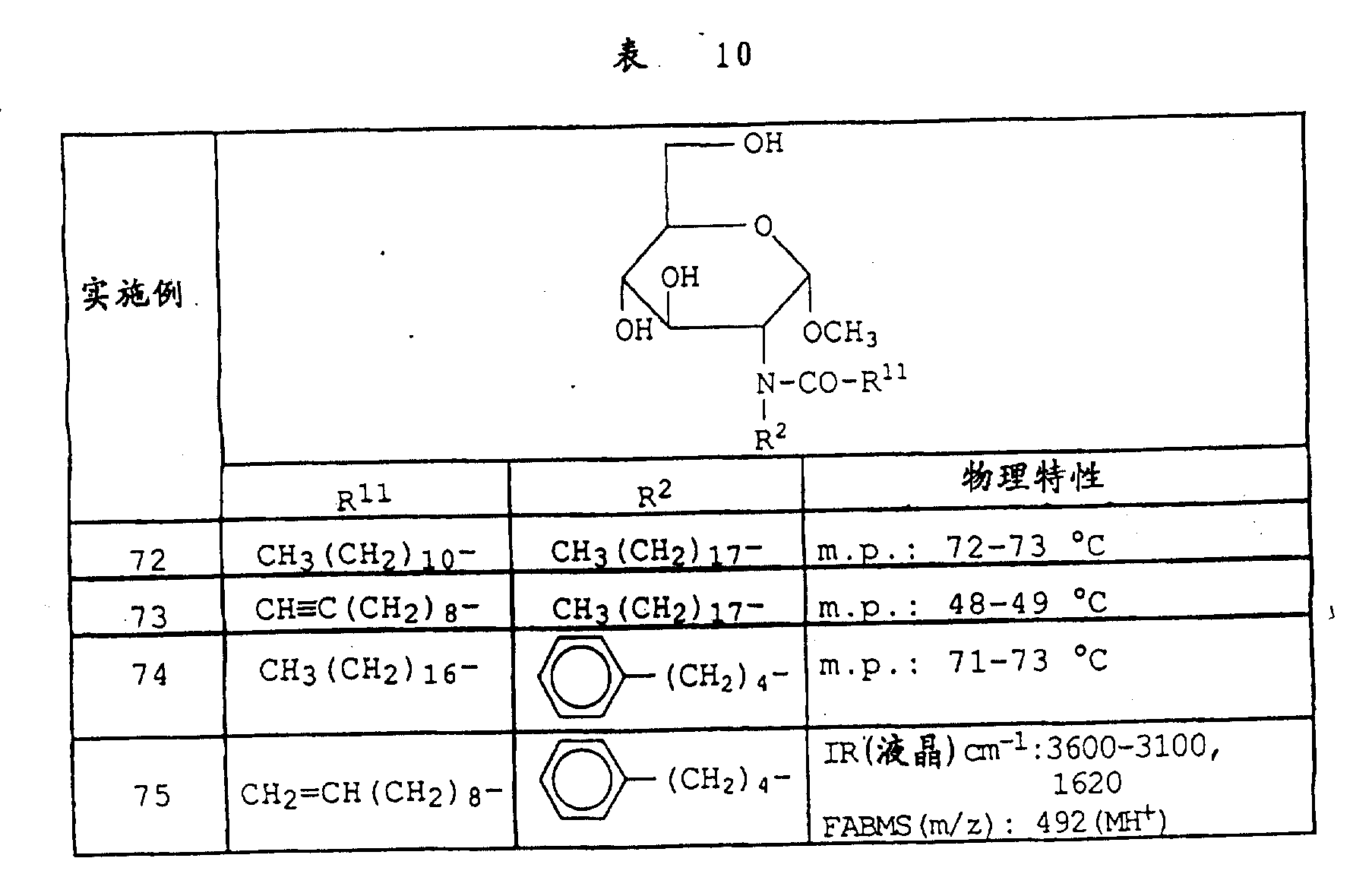
用相同于实施例12的方法处理相应的起始化合物,得到表10所示化合物。The corresponding starting compounds were treated in the same manner as in Example 12 to obtain the compounds shown in Table 10.
实施例76Example 76
往悬浮250ml甲苯的18.0g 2-脱氧-2-苄氧羰氨基-6-0-甲苯磺酰基-2-D-吡喃葡糖甲苷中加入19.5gl-氨基-4-苯丁烷,随后回流过夜。该反应在溶液冷却后,过滤除去不溶性物质,并蒸除甲苯。该残余物经柱层析[Chromatorex NH-DM1020(由FUJI SILYSZA CHEMICAL CO.,LTD制造),溶剂:四氢呋喃]纯化,得到12.5g 2,6-二脱氧-2-苄氧基-羰氨基-6-(4-苯丁基)氨基-2-D-吡喃葡糖甲苷。Add 19.5gl-amino-4-phenylbutane to 18.0g of 2-deoxy-2-benzyloxycarbonylamino-6-0-tosyl-2-D-glucopyranoside suspended in 250ml toluene, and then Reflux overnight. After the reaction was cooled, the insoluble material was removed by filtration, and the toluene was distilled off. The residue was purified by column chromatography [Chromatorex NH-DM1020 (manufactured by FUJI SILYSZA CHEMICAL CO., LTD), solvent: tetrahydrofuran] to obtain 12.5 g of 2,6-dideoxy-2-benzyloxy-carbonylamino-6 -(4-Phenylbutyl)amino-2-D-glucopyranoside.
IR(液态石蜡)cm-1:3600-3100,1720IR (liquid paraffin) cm -1 : 3600-3100, 1720
FABMS(m/z):459(MH+)FABMS (m/z): 459 (MH + )
实施例77-80Examples 77-80
用相同于实施例76的方法处理相应的起始化合物,得到表11所示化合物。The corresponding starting compounds were treated in the same manner as in Example 76 to obtain compounds shown in Table 11.

实施例81-85Examples 81-85
用相同于实施例36的方法处理相应的起始化合物,将得到的化合物再用相同于实施例6或实施例42的方法处理,得到表12所示化合物。The corresponding starting compound was treated with the same method as in Example 36, and the obtained compound was treated with the same method as in Example 6 or Example 42 to obtain the compounds shown in Table 12.
实施例86-97Examples 86-97
用相同于实施例1,实施例36和实施例6的方法处理相应的起始化合物,得到表13和表14中所示化合物。The corresponding starting compounds were treated in the same manner as in Example 1, Example 36 and Example 6 to obtain the compounds shown in Table 13 and Table 14.
实施例98-104Examples 98-104
用相同于实施例36的方法处理相应的起始化合物,得到表15和表16所示化合物。The corresponding starting compounds were treated in the same manner as in Example 36 to obtain the compounds shown in Table 15 and Table 16.


实施例105-108Examples 105-108
用相同于实施例6的方法处理相应的起始化合物,得到表17所示化合物。The corresponding starting compounds were treated in the same manner as in Example 6 to obtain the compounds shown in Table 17.
实施例109-110Examples 109-110
用相同于实施例12的方法处理相应的起始化合物,得到表18所示化合物。The corresponding starting compounds were treated in the same manner as in Example 12 to obtain the compounds shown in Table 18.

实施例111-112Examples 111-112
用相同于实施例42的方法处理相应的起始化合物,得到表19所示化合物。The corresponding starting compounds were treated in the same manner as in Example 42 to obtain the compounds shown in Table 19.

实施例113Example 113
往溶于10ml甲醇的750mg 2,6-二脱氧-2-乙氧羰基乙酰氨基-6-(N-十二烷基-N-十八烷酰氨基)-α-D-吡喃葡糖甲苷中加入溶于5ml水的290碳酸钾,然后在室温下搅拌8小时。往该反应溶液中加入10%盐酸水溶液使该溶液酸化,并用乙酸乙酯萃取该溶液。该乙酚乙酰层用水洗并干澡,再蒸除溶剂。该残余物经硅胶柱层析(溶剂∶氯仿∶甲醇=6∶1)纯化,得到2,6-二脱氧-2-羧乙酰氨基-6-(N-十二烷酰-N-十八烷酰氨基)-α-D-吡喃葡糖甲苷。To 750mg 2,6-dideoxy-2-ethoxycarbonylacetamido-6-(N-dodecyl-N-octadecanoylamino)-α-D-glucopyranose methyl dissolved in 10ml methanol 290 potassium carbonate dissolved in 5 ml of water was added to the glycoside, and stirred at room temperature for 8 hours. A 10% aqueous hydrochloric acid solution was added to the reaction solution to acidify the solution, and the solution was extracted with ethyl acetate. The acetoacetate layer was washed with water and dried, and the solvent was distilled off. The residue was purified by silica gel column chromatography (solvent: chloroform: methanol = 6:1) to obtain 2,6-dideoxy-2-carboxyacetylamino-6-(N-dodecanoyl-N-octadecane amido)-α-D-glucopyranoside.
IR(液态)cm-1:3600-3100,1640IR (liquid) cm -1 : 3600-3100, 1640
FABMS(m/z):735[(M+N+ a)]FABMS (m/z): 735 [(M+N + a )]
实施例114Example 114
用相同于实施例76的方法处理相应的起始化合物,得到2,6-二脱氧-2-叔丁氧羰基氨基-6-十八烷酰氨基-α-D-吡喃葡糖甲苷。The corresponding starting compound was treated in the same manner as in Example 76 to obtain 2,6-dideoxy-2-tert-butoxycarbonylamino-6-octadecanoylamino-α-D-glucopyranoside.
IR(液态)cm-1:3600-3100,1680IR (liquid) cm -1 : 3600-3100, 1680
FABMS(m/z):545[(MH+)]FABMS (m/z): 545 [(MH + )]
实施例115Example 115
用相同于实施例1的方法处理实施例114中得到2,6-二脱氧-2-叔丁氧羰基氨基-6-十八烷酰氨基-α-D-吡喃葡糖甲苷,得到2,6-二脱氧-2-叔丁氧羰基氨基-6-(N-10-碳炔酰基-N-十八烷酰基-α-D-吡喃葡糖甲苷。2,6-dideoxy-2-tert-butoxycarbonylamino-6-octadecanoylamino-α-D-glucopyranoside obtained in Example 114 was treated in the same manner as in Example 1 to obtain 2 , 6-dideoxy-2-tert-butoxycarbonylamino-6-(N-10-carbynoyl-N-octadecanoyl-α-D-glucopyranoside.
IR(液态)cm-1:3600-3100,1680,1650IR (liquid) cm -1 : 3600-3100, 1680, 1650
FABMS(m/z):709(MH+)FABMS (m/z): 709 (MH + )
实施例116Example 116
用相同于实施例10的方法处理实施例115中得到的2,6-二脱氧-2-叔丁氧羰基氨基-6-(N-10-十一碳炔酰基-N-十八烷酰氨基)-α-D-吡喃葡糖甲苷,得到2,6-二脱氧-2-氨基-6-(N-10-十一碳炔酰基-N-十八烷酰氨基-α-D-吡喃葡糖甲苷。2,6-dideoxy-2-tert-butoxycarbonylamino-6-(N-10-undecynoyl-N-octadecanoylamino) obtained in Example 115 was treated in the same manner as in Example 10 )-α-D-glucopyranoside to give 2,6-dideoxy-2-amino-6-(N-10-undecynoyl-N-octadecanoylamino-α-D- Glucopyranoside.
IR(液态)cm-1:3600-3100,1640IR (liquid) cm -1 : 3600-3100, 1640
FABMS(m/z):609(MH+)FABMS (m/z): 609 (MH + )
实施例117Example 117
用相同于实施例36的方法处理相应的起始化合物,得到2,6-二脱氧-2-苄氧羰基氨基乙酰氨基-6-[N-十八烷酰氨基-N-(4-苯丁基)氨基]-2-D-吡喃葡糖甲苷。The corresponding starting compound was treated in the same manner as in Example 36 to give 2,6-dideoxy-2-benzyloxycarbonylaminoacetamido-6-[N-octadecanoylamino-N-(4-phenylbutylene base) amino] -2-D-glucopyranoside.
IR(液态)cm-1:3600-3100,1720,.1640IR (liquid) cm -1 : 3600-3100, 1720, .1640
FABMS(m/z):782[(MH+)]FABMS (m/z): 782 [(MH + )]
实施例118Example 118
用相同于实施例6的方法处理相应的起始化合物,得到2,6-二脱氧-2-氨基-乙酰氨基-6-[N-十八烷酰氨基-N-(4-苯丁基)氨基]-2-D-吡喃葡糖甲苷。Treat the corresponding starting compound in the same manner as in Example 6 to give 2,6-dideoxy-2-amino-acetylamino-6-[N-octadecanoylamino-N-(4-phenylbutyl) Amino]-2-D-glucopyranoside.
IR(液态)cm-1:3600-3100,1640IR (liquid) cm -1 : 3600-3100, 1640
FABMS(m/z):648[(MH+)]FABMS (m/z): 648 [(MH + )]
参考实施例1Reference Example 1
往溶于100ml甲醇的5.00g 2-脱氧-2-苄氧羰氨基-6-0-甲苯磺酰基-α-D-吡喃葡糖甲苷和2.73g碳酸氢二叔丁酯(di-t-butyl-bicarbonate)中加入1.0g 10%钯碳,随后在室温和氢气压下进行催化还原。5小时后,除去催化剂,然后蒸除甲醇。该残余物经硅胶柱层析(溶剂∶氯仿∶甲醇=15∶1)纯化,得到4.65g 2-脱氧-2-叔丁氧羰氨基-6-0-甲苯磺酰基-α-D-吡喃葡糖甲苷。To 5.00g of 2-deoxy-2-benzyloxycarbonylamino-6-0-tosyl-α-D-glucopyranoside and 2.73g of di-tert-butyl bicarbonate (di-t) dissolved in 100ml of methanol -butyl-bicarbonate) was added with 1.0 g of 10% palladium carbon, followed by catalytic reduction at room temperature and hydrogen pressure. After 5 hours, the catalyst was removed and the methanol was distilled off. The residue was purified by silica gel column chromatography (solvent: chloroform: methanol = 15:1) to obtain 4.65 g of 2-deoxy-2-tert-butoxycarbonylamino-6-0-tosyl-α-D-pyran Glucoside.
m.p.:74~75℃m.p.: 74~75℃
本发明的目的化合物葡糖胺衍生物(Ⅰ)的结构特征在于在糖的2,6-位或2-位引入酰胺基,因为它与已知化合物1,2-二取代糖相比显示生极佳的升高白细胞活性、预防感染的活性和低毒性,故是一类有用的药物化合物,可作为白细胞升高剂、感染预防剂或抗感染活性增强剂。The structure of the object compound glucosamine derivatives (I) of the present invention is characterized in that an amide group is introduced at the 2,6-position or 2-position of the sugar, because it shows a biochemical effect compared with the known compound 1,2-disubstituted sugar. Excellent activity of raising white blood cells, preventing infection and low toxicity, so it is a kind of useful pharmaceutical compound, which can be used as white blood cell raising agent, infection prevention agent or anti-infection activity enhancer.
具体地说,本发明的化合物,表现出预防或治疗由例如放疗引起的白细胞减少的活性、预防细菌或真菌的活性和/或抗肿瘤活性,用于人类或动物感染性疾病的一般性预防,并且可优选于先天性或获得性免疫缺陷,特别是放疗或用免疫抑制活性物质治疗后的严重暂时性病症引起的获得性免疫缺陷。由于本发明的化合物能补偿免疫缺陷,因此它可优选地与抗感染或抗肿瘤抗生素或其它的化疗药剂,或都与其它药物配伍使用。Specifically, the compound of the present invention, which exhibits the activity of preventing or treating leukopenia caused by, for example, radiotherapy, the activity of preventing bacteria or fungi and/or antitumor activity, is used for the general prevention of infectious diseases in humans or animals, It may also be preferred in congenital or acquired immunodeficiency, especially acquired immunodeficiency caused by severe transient conditions after radiotherapy or treatment with immunosuppressive active substances. Since the compound of the present invention can compensate immune deficiency, it can preferably be used in combination with anti-infection or anti-tumor antibiotics or other chemotherapeutic agents, or both.
Claims (16)




Priority Applications (4)
| Application Number | Priority Date | Filing Date | Title |
|---|---|---|---|
| JP6275446A JPH07179488A (en) | 1993-11-12 | 1994-11-10 | Glucosamine derivative, production method thereof and synthetic intermediate thereof |
| EP94308306A EP0653434A1 (en) | 1993-11-12 | 1994-11-10 | Glucosamine derivative, process for preparing the same and synthetic intermediate thereof |
| CA002135536A CA2135536A1 (en) | 1993-11-12 | 1994-11-10 | Glucosamine derivative, process for preparing the same and synthetic intermediate thereof |
| CN94118232A CN1105367A (en) | 1993-11-12 | 1994-11-14 | Glucosamine derivative and preparation method of the derivative and its synthetic intermediate |
Applications Claiming Priority (2)
| Application Number | Priority Date | Filing Date | Title |
|---|---|---|---|
| JP28314793 | 1993-11-12 | ||
| CN94118232A CN1105367A (en) | 1993-11-12 | 1994-11-14 | Glucosamine derivative and preparation method of the derivative and its synthetic intermediate |
Publications (1)
| Publication Number | Publication Date |
|---|---|
| CN1105367A true CN1105367A (en) | 1995-07-19 |
Family
ID=36940131
Family Applications (1)
| Application Number | Title | Priority Date | Filing Date |
|---|---|---|---|
| CN94118232A Pending CN1105367A (en) | 1993-11-12 | 1994-11-14 | Glucosamine derivative and preparation method of the derivative and its synthetic intermediate |
Country Status (4)
| Country | Link |
|---|---|
| EP (1) | EP0653434A1 (en) |
| JP (1) | JPH07179488A (en) |
| CN (1) | CN1105367A (en) |
| CA (1) | CA2135536A1 (en) |
Cited By (2)
| Publication number | Priority date | Publication date | Assignee | Title |
|---|---|---|---|---|
| CN100491524C (en) * | 1998-07-15 | 2009-05-27 | 以生物技术资源的名义经营的Dcv公司 | Process and materials for production of glucosamine |
| CN105801634A (en) * | 2016-04-19 | 2016-07-27 | 黑龙江中医药大学 | Preparation method and application of new straight chain alcohol and glucoside compound in walnut green husks |
Families Citing this family (4)
| Publication number | Priority date | Publication date | Assignee | Title |
|---|---|---|---|---|
| US8772227B2 (en) * | 2011-03-02 | 2014-07-08 | Fahkreddin Jamali | Glucosamine pro-drug |
| JP2014517074A (en) | 2011-06-24 | 2014-07-17 | アムジエン・インコーポレーテツド | TRPM8 antagonists and their use in therapy |
| MY157429A (en) | 2011-06-24 | 2016-06-15 | Amgen Inc | Trpm8 antagonists and their use in treatments |
| US8952009B2 (en) | 2012-08-06 | 2015-02-10 | Amgen Inc. | Chroman derivatives as TRPM8 inhibitors |
Family Cites Families (12)
| Publication number | Priority date | Publication date | Assignee | Title |
|---|---|---|---|---|
| JPS4843333B1 (en) * | 1970-04-25 | 1973-12-18 | ||
| DE2708667A1 (en) * | 1977-02-28 | 1978-08-31 | Inst Pour La Rech Et La Produc | Compsn. with radiation-protection and adjuvant properties - contg. (N)-higher acyl-D-glucosamine esp. (N)-decanoyl-D-glucosamine |
| US4323561A (en) * | 1977-09-06 | 1982-04-06 | Temple University Of The Commonwealth System Of Higher Education | Process of enhancing immmunogenic response in mammals by the administration of synthetic glycolipid adjuvants |
| US4216208A (en) * | 1978-07-31 | 1980-08-05 | Proter S.P.A. | N-Acyl derivatives of glucosamines having antitumor chemotherapeutic activity |
| JPS57165398A (en) * | 1981-04-02 | 1982-10-12 | Tanabe Seiyaku Co Ltd | Nitrosourea derivative and its preparation |
| DE3346623A1 (en) * | 1983-12-14 | 1985-07-04 | Bayer Ag, 5090 Leverkusen | N-GLYCOSYLATED UREA, CARBAMATE AND THIOCARBAMATE, METHOD FOR THE PRODUCTION THEREOF AND THEIR USE |
| JPH0225494A (en) * | 1988-07-12 | 1990-01-26 | Akira Hasegawa | Glucosamine derivative |
| RU1836378C (en) * | 1989-12-11 | 1993-08-23 | Санкио Компани Лимитед | Method for obtaining lipid a analogues |
| DE3941078A1 (en) * | 1989-12-13 | 1991-06-20 | Sandoz Ag | Use of saccharide derivs. - to protect against radiation poisoning and with GM-CSF in immunosuppressive therapy |
| CA2052110A1 (en) * | 1990-11-16 | 1992-05-17 | Eric C. Angel | Termination of optical fibers |
| GB9117523D0 (en) * | 1991-08-14 | 1991-10-02 | Unilever Plc | Di and tri saccharides, methods of making them and hair growth compositions containing them |
| IL105131A (en) * | 1992-03-27 | 2000-06-01 | Igen Inc | Compounds and compositions containing such compounds comprising lipid-A analogs for eliciting therapeutic antibodies |
-
1994
- 1994-11-10 EP EP94308306A patent/EP0653434A1/en not_active Withdrawn
- 1994-11-10 JP JP6275446A patent/JPH07179488A/en active Pending
- 1994-11-10 CA CA002135536A patent/CA2135536A1/en not_active Abandoned
- 1994-11-14 CN CN94118232A patent/CN1105367A/en active Pending
Cited By (3)
| Publication number | Priority date | Publication date | Assignee | Title |
|---|---|---|---|---|
| CN100491524C (en) * | 1998-07-15 | 2009-05-27 | 以生物技术资源的名义经营的Dcv公司 | Process and materials for production of glucosamine |
| CN105801634A (en) * | 2016-04-19 | 2016-07-27 | 黑龙江中医药大学 | Preparation method and application of new straight chain alcohol and glucoside compound in walnut green husks |
| CN105801634B (en) * | 2016-04-19 | 2018-09-18 | 黑龙江中医药大学 | A kind of preparation method and application of straight chain alcohol glycoside compound in green peel of walnut |
Also Published As
| Publication number | Publication date |
|---|---|
| EP0653434A1 (en) | 1995-05-17 |
| CA2135536A1 (en) | 1995-05-13 |
| JPH07179488A (en) | 1995-07-18 |
Similar Documents
| Publication | Publication Date | Title |
|---|---|---|
| CN1310907C (en) | Heterocyclic compound and antitumour agent containing the same as active ingredient | |
| CN1468216A (en) | Nitrogenous five-membered ring compound | |
| CN1364158A (en) | Mutriptyline derivatives and their use as antibacterial agents | |
| CN1688544A (en) | Fluoro- and sulfonylamino-containing 3,6-disubstituted azabicyclo(3.1.0)hexane derivatives as muscarinic receptor antagonists | |
| CN1133642C (en) | Nucleoside 5'-phosphorothioate amino acid ester compound | |
| CN1067889A (en) | The preparation method of N-(the 1-alkyl-3-hydroxy-4-piperidinyl base) benzamide that replaces | |
| CN1620290A (en) | Indolylalkylamine derivatives as 5-hydroxytryptamine-6 ligands | |
| CN1068825A (en) | Pyrrolidine is the preparation method of [1,2-a] pyrazine-4-spiral shell-3 ' pyrrolidin derivatives also | |
| CN1231472C (en) | Pyrimidine acyclonucleoside derivatives, preparation method and use thereof | |
| CN1069640C (en) | Adhesion receptor antagonists | |
| CN1025676C (en) | Non-peptidic renin inhibitors | |
| CN1926098A (en) | Novel urea derivatives and their medical use | |
| CN1054980A (en) | Optically active 8-BAY 128039 carboxylic acid derivative, their preparation method and their intermediate | |
| CN1205704A (en) | 2,7-substituted octahydro-pyrrolo (1,2-A) pyrazine derivatives | |
| CN1071665A (en) | Oxazolidinone Derivatives | |
| CN1102527A (en) | Peripheral vasodilators | |
| CN1052474C (en) | The preparation method of sulfamide | |
| CN1343213A (en) | 2,3-0-isopropylidene derivatives of monosaccharides as cell adhesive inhibitors | |
| CN1024790C (en) | Preparation method of urea derivative and salt thereof | |
| CN1052865A (en) | New anthracycline-type drugs and preparation method thereof | |
| CN1117095C (en) | Substituted 7-acylamino-3-(methylhydrazono)methyl cephalosporins with antibacterial activity and intermediates | |
| CN1185247C (en) | Preparation method of indole pyrrolocarbazole derivative, intermediate in preparation and method for preparation of intermediate | |
| CN1043133A (en) | Imidazole-containing peptide and its preparation method | |
| CN1074440A (en) | Gastric acid secretion inhibiting and gastric cell protecting pharmaceutical composition, novel famotidine salt and preparation method thereof | |
| CN1349527A (en) | Substituted benzolactam compounds |
Legal Events
| Date | Code | Title | Description |
|---|---|---|---|
| C06 | Publication | ||
| PB01 | Publication | ||
| C01 | Deemed withdrawal of patent application (patent law 1993) | ||
| WD01 | Invention patent application deemed withdrawn after publication |