CN110545112B - Antenna switching circuit and terminal - Google Patents

Antenna switching circuit and terminal Download PDF

Info

Publication number
CN110545112B
CN110545112B CN201910797002.0A CN201910797002A CN110545112B CN 110545112 B CN110545112 B CN 110545112B CN 201910797002 A CN201910797002 A CN 201910797002A CN 110545112 B CN110545112 B CN 110545112B
Authority
CN
China
Prior art keywords
terminal
switching circuit
radio frequency
antenna
electrically connected
Prior art date
Legal status (The legal status is an assumption and is not a legal conclusion. Google has not performed a legal analysis and makes no representation as to the accuracy of the status listed.)
Active
Application number
CN201910797002.0A
Other languages
Chinese (zh)
Other versions
CN110545112A (en
Inventor
杨勇华
郑嘉伟
Current Assignee (The listed assignees may be inaccurate. Google has not performed a legal analysis and makes no representation or warranty as to the accuracy of the list.)
Vivo Mobile Communication Co Ltd
Original Assignee
Vivo Mobile Communication Co Ltd
Priority date (The priority date is an assumption and is not a legal conclusion. Google has not performed a legal analysis and makes no representation as to the accuracy of the date listed.)
Filing date
Publication date
Application filed by Vivo Mobile Communication Co Ltd filed Critical Vivo Mobile Communication Co Ltd
Priority to CN201910797002.0A priority Critical patent/CN110545112B/en
Publication of CN110545112A publication Critical patent/CN110545112A/en
Priority to PCT/CN2020/111379 priority patent/WO2021037057A1/en
Application granted granted Critical
Publication of CN110545112B publication Critical patent/CN110545112B/en
Priority to US17/677,668 priority patent/US11863214B2/en
Active legal-status Critical Current
Anticipated expiration legal-status Critical

Links

Images

Classifications

    • HELECTRICITY
    • H04ELECTRIC COMMUNICATION TECHNIQUE
    • H04BTRANSMISSION
    • H04B1/00Details of transmission systems, not covered by a single one of groups H04B3/00 - H04B13/00; Details of transmission systems not characterised by the medium used for transmission
    • H04B1/005Details of transmission systems, not covered by a single one of groups H04B3/00 - H04B13/00; Details of transmission systems not characterised by the medium used for transmission adapting radio receivers, transmitters andtransceivers for operation on two or more bands, i.e. frequency ranges
    • H04B1/0067Details of transmission systems, not covered by a single one of groups H04B3/00 - H04B13/00; Details of transmission systems not characterised by the medium used for transmission adapting radio receivers, transmitters andtransceivers for operation on two or more bands, i.e. frequency ranges with one or more circuit blocks in common for different bands
    • HELECTRICITY
    • H04ELECTRIC COMMUNICATION TECHNIQUE
    • H04BTRANSMISSION
    • H04B1/00Details of transmission systems, not covered by a single one of groups H04B3/00 - H04B13/00; Details of transmission systems not characterised by the medium used for transmission
    • H04B1/38Transceivers, i.e. devices in which transmitter and receiver form a structural unit and in which at least one part is used for functions of transmitting and receiving
    • H04B1/40Circuits
    • H04B1/401Circuits for selecting or indicating operating mode
    • HELECTRICITY
    • H04ELECTRIC COMMUNICATION TECHNIQUE
    • H04BTRANSMISSION
    • H04B1/00Details of transmission systems, not covered by a single one of groups H04B3/00 - H04B13/00; Details of transmission systems not characterised by the medium used for transmission
    • H04B1/005Details of transmission systems, not covered by a single one of groups H04B3/00 - H04B13/00; Details of transmission systems not characterised by the medium used for transmission adapting radio receivers, transmitters andtransceivers for operation on two or more bands, i.e. frequency ranges
    • H04B1/0064Details of transmission systems, not covered by a single one of groups H04B3/00 - H04B13/00; Details of transmission systems not characterised by the medium used for transmission adapting radio receivers, transmitters andtransceivers for operation on two or more bands, i.e. frequency ranges with separate antennas for the more than one band
    • HELECTRICITY
    • H04ELECTRIC COMMUNICATION TECHNIQUE
    • H04BTRANSMISSION
    • H04B1/00Details of transmission systems, not covered by a single one of groups H04B3/00 - H04B13/00; Details of transmission systems not characterised by the medium used for transmission
    • H04B1/38Transceivers, i.e. devices in which transmitter and receiver form a structural unit and in which at least one part is used for functions of transmitting and receiving
    • H04B1/40Circuits
    • HELECTRICITY
    • H04ELECTRIC COMMUNICATION TECHNIQUE
    • H04BTRANSMISSION
    • H04B7/00Radio transmission systems, i.e. using radiation field
    • H04B7/02Diversity systems; Multi-antenna system, i.e. transmission or reception using multiple antennas
    • H04B7/022Site diversity; Macro-diversity
    • H04B7/024Co-operative use of antennas of several sites, e.g. in co-ordinated multipoint or co-operative multiple-input multiple-output [MIMO] systems
    • HELECTRICITY
    • H04ELECTRIC COMMUNICATION TECHNIQUE
    • H04BTRANSMISSION
    • H04B7/00Radio transmission systems, i.e. using radiation field
    • H04B7/02Diversity systems; Multi-antenna system, i.e. transmission or reception using multiple antennas
    • H04B7/04Diversity systems; Multi-antenna system, i.e. transmission or reception using multiple antennas using two or more spaced independent antennas
    • H04B7/0404Diversity systems; Multi-antenna system, i.e. transmission or reception using multiple antennas using two or more spaced independent antennas the mobile station comprising multiple antennas, e.g. to provide uplink diversity

Landscapes

  • Engineering & Computer Science (AREA)
  • Computer Networks & Wireless Communication (AREA)
  • Signal Processing (AREA)
  • Variable-Direction Aerials And Aerial Arrays (AREA)
  • Transceivers (AREA)
  • Input Circuits Of Receivers And Coupling Of Receivers And Audio Equipment (AREA)

Abstract

本发明提供了一种天线切换电路及终端,该天线切换电路包括:第一切换电路,第一切换电路分别与至少两个第一射频通路以及至少两个第一天线电连接,第一切换电路包括至少一个第一状态,其中,在第一状态下一个第一射频通路与一个第一天线连通,第一射频通路的工作频段为第一频段;第二切换电路,第二切换电路分别与至少两个第二射频通路以及至少两个第二天线电连接,第二切换电路包括至少一个第二状态,其中,在第二状态下,一个第二射频通路与一个第二天线连通,第二射频通路的工作频段为第二频段;其中,第一频段低于第二频段。因此,本发明的方案,解决了现有技术中的多天线切换方案的线路复杂且插损较大的问题。

Figure 201910797002

The present invention provides an antenna switching circuit and a terminal. The antenna switching circuit includes: a first switching circuit, the first switching circuit is electrically connected to at least two first radio frequency paths and at least two first antennas respectively; Including at least one first state, wherein, in the first state, a first radio frequency channel is connected with a first antenna, and the working frequency band of the first radio frequency channel is the first frequency band; the second switching circuit, the second switching circuit is respectively connected with at least one The two second radio frequency paths and the at least two second antennas are electrically connected, and the second switching circuit includes at least one second state, wherein, in the second state, one second radio frequency path communicates with one second antenna, and the second radio frequency The working frequency band of the channel is the second frequency band; wherein, the first frequency band is lower than the second frequency band. Therefore, the solution of the present invention solves the problems of complicated circuits and large insertion loss in the multi-antenna switching solution in the prior art.

Figure 201910797002

Description

Antenna switching circuit and terminal
Technical Field
The invention relates to the technical field of electronics, in particular to an antenna switching circuit and a terminal.
Background
The antenna form of the terminal evolves, and the terminal is switched from the non-switched to the two antennas, and the two-antenna switching technology is applied to maturity at present. When the top antenna and the bottom antenna cannot meet the requirements of a certain scene, a third antenna or more antennas are introduced to meet the application requirements. For example, during a horizontal screen game, two hands can hold the two ends of the terminal, the performance of the antennas at the two ends can be obviously affected, the performance of the antennas at the side positions cannot be affected by the hands or the influence is extremely small, and the side antennas are switched under the horizontal screen game state, so that the communication requirement is met under the horizontal screen state.
Therefore, the current network state of the landscape game scene is one of the major complaint problems, and the pain point problem can be effectively solved through four-antenna switching. A new switch is required to be introduced for switching the four antennas, and currently, according to a switching rule of a four-antenna switching algorithm, a radio frequency frame is selected as follows:
the first method comprises the following steps: DPDT in combination with 3P 3T;
and the second method comprises the following steps: only 4P4T was used.
However, the parameter index in the 4P4T industry has not yet reached the application requirement, and according to the switch architecture, the insertion loss of 4P4T is similar to that of 3P3T plus DPDT, and the path insertion loss is greater than 3P 3T; however, if the two 3P3T switches are constructed, the wiring is very complicated, and thus the routing loss and the device insertion loss are increased seriously.
Disclosure of Invention
The embodiment of the invention provides an antenna switching circuit and a terminal, and aims to solve the problems of complex circuit and large insertion loss of a multi-antenna switching scheme in the prior art.
In a first aspect, an embodiment of the present invention provides an antenna switching circuit, including:
the first switching circuit is respectively and electrically connected with at least two first radio frequency paths and at least two first antennas, and comprises at least one first state, wherein in the first state, one first radio frequency path is communicated with one first antenna, and the working frequency band of the first radio frequency path is a first frequency band;
the second switching circuit is respectively electrically connected with at least two second radio frequency paths and at least two second antennas, and comprises at least one second state, wherein in the second state, one second radio frequency path is communicated with one second antenna, and the working frequency band of the second radio frequency path is a second frequency band; wherein the first frequency band is lower than the second frequency band.
In a second aspect, an embodiment of the present invention provides a terminal, including the above-mentioned antenna switching circuit.
The embodiment of the invention has the beneficial effects that:
in the embodiment of the invention, the path between the first antenna and the first radio frequency path working in the first frequency band and the path between the second antenna and the second radio frequency path working in the second frequency band are split, so that the first radio frequency path working in the first frequency band and the second radio frequency path working in the second frequency band are not combined at the front end, thereby reducing the insertion loss caused by the combiner. In addition, the first radio frequency path and the second radio frequency path working in different frequency bands are arranged in a split mode with the paths between the antennas, and therefore the circuit of the antenna switching circuit is simpler.
Drawings
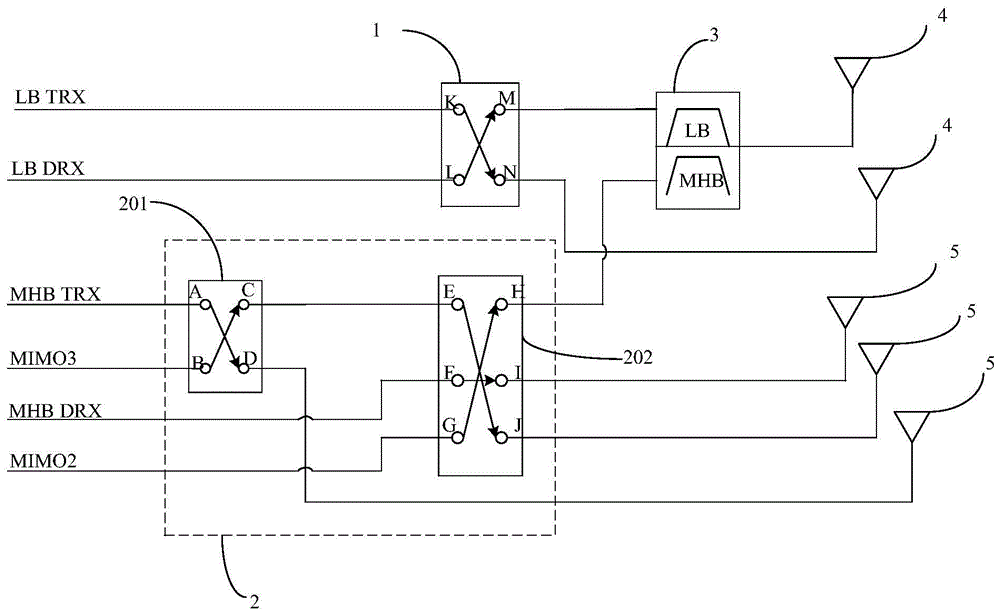
Fig. 1 shows one of the schematic circuit diagrams of an antenna switching circuit according to an embodiment of the present invention;
fig. 2 is a second schematic circuit diagram of the antenna switching circuit according to the embodiment of the invention.
Detailed Description
The technical solutions in the embodiments of the present invention will be clearly and completely described below with reference to the drawings in the embodiments of the present invention, and it is obvious that the described embodiments are some, not all, embodiments of the present invention. All other embodiments, which can be derived by a person skilled in the art from the embodiments given herein without making any creative effort, shall fall within the protection scope of the present invention.
An embodiment of the present invention provides an antenna switching circuit, as shown in fig. 1 and 2, including:
the first switching circuit is electrically connected with at least two first radio frequency paths and at least two first antennas 4 respectively, and comprises at least one first state, wherein in the first state, one first radio frequency path is communicated with one first antenna 4, and the working frequency band of the first radio frequency path is a first frequency band;
the second switching circuit 2 is electrically connected with at least two second radio frequency paths and at least two second antennas 5 respectively, and the second switching circuit 2 includes at least one second state, wherein in the second state, one second radio frequency path is communicated with one second antenna 5, and the working frequency band of the second radio frequency path is a second frequency band; the first frequency band is lower than the second frequency band, that is, all frequency points of the first frequency band are smaller than the minimum frequency point of the second frequency band. Optionally, the first frequency band is a 4G frequency band, and the second frequency band is a SUB 6G frequency band, or the first frequency band is 698MHz to 960MHz, and the second frequency band is 1710MHz to 5000 MHz; or the first frequency range is 960 MHz-1710 MHz (including 1710MHz), and the second frequency range is 1710 MHz-5000 MHz (not including 1710 MHz).
The working frequency points of any two first radio frequency channels in the at least two first radio frequency channels are different, and the working frequency points of any two second radio frequency channels in the at least two second radio frequency channels are different.
In addition, the first switching circuit is configured to conduct a path between any one of the at least two first rf paths and any one of the at least two first antennas 4, and the second switching circuit 2 is configured to conduct a path between any one of the at least two second rf paths and any one of the at least two second antennas 5.
Therefore, in the embodiment of the present invention, the path between the first antenna 4 and the first radio frequency channel operating in the lower frequency band and the path between the second antenna 5 and the second radio frequency channel operating in the second frequency band of the higher frequency band are separated, so that the first radio frequency channel and the second radio frequency channel are not combined at the front end, and thus the insertion loss caused by the combiner can be reduced. In addition, the first radio frequency path and the second radio frequency path working in different frequency bands are arranged in a split mode with the paths between the antennas, and therefore the circuit of the antenna switching circuit is simpler.
Optionally, the first switching circuit comprises:
the first control switch 1 comprises two first input ends, two first output ends and a first connecting switch, the first connecting switch can be switched between any state that the first input ends are connected with any state that the first output ends are connected, the two first input ends are respectively electrically connected with the two first radio frequency channels in a one-to-one correspondence mode, and the two first output ends are respectively electrically connected with the two first antennas 4 in a one-to-one correspondence mode.
As shown in fig. 1, the first control switch 1 is a double-pole double-throw (DPTP) switch. The first control switch 1 may conduct a path between any one of the two first radio frequency paths and any one of the two first antennas 4. Specifically, the first radio frequency path may operate at a low frequency (LB), and the first control switch 1 may be used to switch between two antennas in a low frequency band.
Optionally, the second switching circuit 2 includes:
a second control switch 201, wherein the second control switch 201 includes two second input terminals, two second output terminals, and a second connection switch, and the second connection switch can be switched between a state where any one of the second input terminals is connected to any one of the second output terminals;
a third control switch 202, wherein the third control switch 202 comprises three third input terminals, three third output terminals, and a third connecting switch, and the third connecting switch can be switched between a state in which any one of the third input terminals is connected to any one of the third output terminals;
the two second input ends and the two first target input ends are respectively and correspondingly electrically connected with the four second radio frequency channels, the first target output ends and the three third output ends are respectively and correspondingly electrically connected with the four second antennas 5, and the second target output ends are electrically connected with the second target input ends;
the second target input end is one of the three third input ends, and the first target input end is an input end of the three third input ends except the second target input end;
the first target output end is one of the two second output ends, and the second target output end is the output end of the two second output ends except the first target output end.
As shown in fig. 2, the second control switch 201 is a DPDT, and the third control switch 202 is a 3P 3T. The second control switch 201 and the third control switch 202 cooperate to conduct a path between any one of the four second rf paths and any one of the four second antennas 5. Specifically, the second radio frequency path may operate at a medium-high frequency (LMB), and then, by cooperation of the second control switch 201 and the third control switch 202, four-antenna switching at the medium-high frequency may be achieved.
Optionally, as shown in fig. 1, the antenna switching circuit further includes:
a first combiner 3, where the first combiner 3 includes a fourth input end, a fifth input end, and a fourth output end, the fourth input end is electrically connected to the first switching circuit, the fourth output end is electrically connected to a first target antenna, the first target antenna is one of the at least two first antennas 4, and the fifth input end is electrically connected to the second switching circuit 2;
the second switching circuit 2 further comprises a third state, wherein in the third state, one of the at least two second rf paths is in communication with the first target antenna.
Specifically, after the first combiner 3 in fig. 1 combines the input signals of the LB frequency band and the MHB frequency band through the combiner, one feeder is connected to one first antenna 4, which not only saves one feeder, reduces the number of the second antennas 5, but also avoids the trouble of switching different antennas. Specifically, when a path between a first radio frequency path working at a first frequency band and a first antenna 4 connected to the first combiner 3 is conducted, the first antenna 4 works at the first frequency band, and when a path between a second radio frequency path working at a second frequency band and the first antenna 4 connected to the first combiner 3 is conducted, the first antenna 4 works at the second frequency band, that is, the first combiner 3 can be directly controlled to output a signal of the first frequency band or a signal of the second frequency band, so that one antenna can work at different frequency bands, and the trouble of switching among different antennas when signals of different frequency bands need to be transmitted is avoided.
Optionally, the antenna switching circuit further includes:
a second combiner 6, where the second combiner 6 includes a sixth input end, a seventh input end, and a fifth output end, the sixth input end is electrically connected to the first switching circuit, the fifth output end is electrically connected to a second target antenna, the second target antenna is one of the at least two second antennas 5, and the seventh input end is electrically connected to the second switching circuit 2;
the first switching circuit further comprises a fourth state, wherein in the fourth state, one of the at least two first rf paths communicates with the second target antenna.
I.e. a combiner may also be arranged between the second antenna 5 and the second radio frequency path. Specifically, as shown in fig. 2, after the input signals of the LB frequency band and the MHB frequency band are combined by the second combiner 6, one feeder is connected to the second antenna 5, which not only saves one feeder, reduces the number of the first antennas 4, but also avoids the trouble of switching different antennas. Specifically, when a path between a first radio frequency path working at a first frequency band and a second antenna 5 connected to the second combiner 6 is conducted, the second antenna 5 works at the first frequency band, and when a path between a second radio frequency path working at a second frequency band and the second antenna 5 connected to the second combiner 6 is conducted, the second antenna 5 works at the second frequency band, that is, the second combiner 6 can be directly controlled to output a signal of the first frequency band or a signal of the second frequency band, so that one antenna can work at different frequency bands, and the trouble of switching among different antennas when signals of different frequency bands need to be transmitted is avoided.
Optionally, the two first input ends are electrically connected to a first terminal and a second terminal respectively, the first terminal is a common end for receiving and transmitting the main set of the first radio frequency path, and the second terminal is a diversity receiving end of the first radio frequency path.
Specifically, since the first rf path may operate in the LB frequency band, the two terminals electrically connected to the first control switch 1 may be a common terminal (LB TRX) for low frequency band main set receiving and transmitting, and a low frequency band diversity receiving terminal (LB DRX).
In addition, specifically, as shown in fig. 1, the first port K and the second port L form two first input ends of the first control switch 1, the third port M and the fourth port N form two first output ends of the first control switch 1, when the first port K is electrically connected to the third port M, a path between the LB TRX and the first combiner 3 and a path between the LB TRX and the first antenna 4 electrically connected to the first combiner 3 are conducted, and when the second port L is electrically connected to the fourth port N, a path between the DRX LB and the first antenna 4 is conducted; when the first port K is electrically connected to the fourth port N, the path between the LB TRX and the first antenna 4 is turned on, and when the second port L is electrically connected to the third port M, the path between the LB DRX and the first combiner 3 and the first antenna 5 electrically connected to the first combiner 3 is turned on. In addition, the specific conduction condition of the first control switch 1 in fig. 2 is similar to the principle in fig. 1, and is not listed here.
That is, the first control switch 1 switches among the first port K, the second port L, the third port M and the fourth port N, so that the switching of the two antennas with low frequency bands can be realized.
Optionally, the two second input ends are electrically connected to the third terminal and the fourth terminal in a one-to-one correspondence, and the two first target input ends are electrically connected to the fifth terminal and the sixth terminal in a one-to-one correspondence;
the third terminal is a common end for receiving and transmitting the main set of the second radio frequency path, the fourth terminal is a diversity receiving end of the second radio frequency path, the fifth terminal is a diversity receiving end of the second radio frequency path, and the sixth terminal is a diversity receiving end of the second radio frequency path. The third terminal, the fourth terminal, the fifth terminal and the sixth terminal are respectively terminals of different second radio frequency paths.
Specifically, since the second radio frequency path may operate in the MHB band, the two terminals electrically connected to the second control switch 201 may be a common terminal for medium-high frequency main set receiving and transmitting (MHB TRX), a third multiple input multiple output terminal (MIMO3) (i.e., a diversity receiving terminal). The two terminals electrically connected to the third control switch 202 may be, specifically, a medium and high frequency diversity receiving terminal (MHB DRX), a second multiple input multiple output terminal (MIMO2) (i.e., one diversity receiving terminal).
In addition, specifically, as shown in fig. 1, the fifth port a and the sixth port B form two second input ends of the second control switch 201, the seventh port C and the eighth port D form two second output ends of the second control switch 201, the ninth port E, the tenth port F and the eleventh port G form three third input ends of the third control switch 202, and the twelfth port H, the thirteenth port I and the fourteenth port J form three third output ends of the third control switch 202. For example, one of the conduction conditions of the second control switch 201 and the third control switch 202 is as follows:
when the fifth port a is electrically connected with the eighth port D, a path between the MHB TRX and one second antenna 5 is conducted; when the sixth port B is electrically connected to the seventh port C, and the ninth port E is electrically connected to the fourteenth port J, a path between the MIMO3 and one second antenna 5 is conducted; when the tenth port F is electrically connected with the thirteenth port I, the path between the MHB DRX and one second antenna 5 is conducted; when the eleventh port G is electrically connected to the twelfth port H, a path between the MIMO2 and the first combiner 3 and the first antenna 5 electrically connected to the first combiner 3 is turned on.
Of course, it is understood that other conduction conditions are included for the second control switch 201 and the third control switch 202, which are not listed here. Similarly, the specific conduction conditions of the second control switch 201 and the third control switch 202 in fig. 2 are similar to the principle in fig. 1, and are not listed here.
In addition, a DPDT (i.e., the second control switch 201 in fig. 1 and fig. 2) needs to be added from the MHB TRX path and the MIMO3 path, and due to the length of the radio frequency path wiring and the via hole, the path insertion loss is too large, thereby affecting the conduction performance. Therefore, to further reduce the insertion loss, the DPDT and the rf front-end device can be combined together to reduce the wiring complexity, for example, the power amplifier of QM77038 is used to replace the second control switch 201 in fig. 2, so that the insertion loss problem caused by using this architecture can be effectively reduced.
In summary, by the antenna switching circuit according to the embodiment of the present invention, the LB rf path and the MNB rf path are separated, that is, the LB and the MHB are not combined at the front end, so that the combiner loss of the combined antenna is reduced. Moreover, the LB can be switched according to a two-antenna switching algorithm, and the MHB can be switched according to the requirement and a four-antenna switching algorithm.
The embodiment of the invention also provides a terminal which comprises the antenna switching circuit.
The antenna switching circuit splits a path between the first antenna and the first radio frequency path working in the first frequency band and a path between the second antenna and the second radio frequency path working in the second frequency band, so that the first radio frequency path working in the first frequency band and the second radio frequency path working in the second frequency band are not combined at the front end, and insertion loss caused by the combiner can be reduced. In addition, the first radio frequency path and the second radio frequency path working in different frequency bands are arranged in a split mode with the paths between the antennas, and therefore the circuit of the antenna switching circuit is simpler. Therefore, the terminal according to the embodiment of the present invention can operate using the antenna switching circuit with smaller insertion loss, thereby further improving the communication performance of the terminal.
While the foregoing is directed to the preferred embodiment of the present invention, it will be understood by those skilled in the art that various changes and modifications may be made without departing from the spirit and scope of the invention as defined in the appended claims.

Claims (6)

1.一种天线切换电路,其特征在于,包括:1. An antenna switching circuit, characterized in that, comprising: 第一切换电路,所述第一切换电路分别与至少两个第一射频通路以及至少两个第一天线电连接,所述第一切换电路包括至少一个第一状态,其中,在所述第一状态下,一个所述第一射频通路与一个所述第一天线连通,所述第一射频通路的工作频段为第一频段;a first switching circuit, the first switching circuit is electrically connected to at least two first radio frequency paths and at least two first antennas, respectively, the first switching circuit includes at least one first state, wherein in the first In the state, one of the first radio frequency channels is connected to one of the first antennas, and the working frequency band of the first radio frequency channel is the first frequency band; 第二切换电路,所述第二切换电路分别与四个第二射频通路以及四个第二天线电连接,所述第二切换电路包括至少一个第二状态,其中,在所述第二状态下,一个所述第二射频通路与一个所述第二天线连通,所述第二射频通路的工作频段为第二频段;其中,所述第一频段低于所述第二频段;A second switching circuit, the second switching circuit is electrically connected to the four second radio frequency paths and the four second antennas, respectively, the second switching circuit includes at least one second state, wherein in the second state , one of the second radio frequency channels is communicated with one of the second antennas, and the working frequency band of the second radio frequency channel is a second frequency band; wherein, the first frequency band is lower than the second frequency band; 所述第二切换电路包括:The second switching circuit includes: 第二控制开关,所述第二控制开关包括两个第二输入端、两个第二输出端和第二连接开关,所述第二连接开关能够在任一所述第二输入端与任一所述第二输出端相连接的状态之间切换;A second control switch, the second control switch includes two second input ends, two second output ends and a second connection switch, and the second connection switch can connect with any one of the second input ends at any one of the second input ends. switching between the states in which the second output terminal is connected; 第三控制开关,所述第三控制开关包括三个第三输入端、三个第三输出端和第三连接开关,所述第三连接开关能够在任一所述第三输入端与任一所述第三输出端相连接的状态之间切换;A third control switch, the third control switch includes three third input terminals, three third output terminals, and a third connection switch, and the third connection switch can be connected to any one of the third input terminals at any one of the third input terminals. switching between the states in which the third output terminal is connected; 其中,所述两个第二输入端和两个第一目标输入端分别与四个所述第二射频通路一一对应电连接,第一目标输出端和所述三个第三输出端分别与四个所述第二天线一一对应电连接,第二目标输出端与第二目标输入端电连接;Wherein, the two second input terminals and the two first target input terminals are respectively electrically connected with the four second radio frequency paths in a one-to-one correspondence, and the first target output terminal and the three third output terminals are respectively connected with The four second antennas are electrically connected in one-to-one correspondence, and the second target output terminal is electrically connected with the second target input terminal; 所述第二目标输入端为所述三个第三输入端中的其中一个,所述第一目标输入端为所述三个第三输入端中除所述第二目标输入端之外的输入端;The second target input terminal is one of the three third input terminals, and the first target input terminal is the input other than the second target input terminal among the three third input terminals end; 所述第一目标输出端为所述两个第二输出端中的其中一个,所述第二目标输出端为所述两个第二输出端中除所述第一目标输出端之外的输出端;The first target output terminal is one of the two second output terminals, and the second target output terminal is the output of the two second output terminals except the first target output terminal end; 所述两个第二输入端分别与第三端子和第四端子一一对应电连接,所述两个第一目标输入端分别与第五端子和第六端子一一对应电连接;The two second input terminals are respectively electrically connected with the third terminal and the fourth terminal in a one-to-one correspondence, and the two first target input terminals are respectively electrically connected with the fifth terminal and the sixth terminal in a one-to-one correspondence; 所述第三端子为一个所述第二射频通路的主集接收和发射的公共端,所述第四端子为一个所述第二射频通路的分集接收端,所述第五端子为一个所述第二射频通路的分集接收端,所述第六端子为一个所述第二射频通路的分集接收端。The third terminal is a common terminal of the main set receiving and transmitting of the second radio frequency channel, the fourth terminal is a diversity receiving terminal of the second radio frequency channel, and the fifth terminal is a common terminal of the second radio frequency channel. The diversity receiving end of the second radio frequency channel, and the sixth terminal is a diversity receiving end of the second radio frequency channel. 2.根据权利要求1所述的天线切换电路,其特征在于,所述第一切换电路包括:2. The antenna switching circuit according to claim 1, wherein the first switching circuit comprises: 第一控制开关,所述第一控制开关包括两个第一输入端、两个第一输出端和第一连接开关,所述第一连接开关能够在任一所述第一输入端与任一所述第一输出端相连接的状态之间切换,所述两个第一输入端分别与两个所述第一射频通路一一对应电连接,所述两个第一输出端分别与两个所述第一天线一一对应电连接。A first control switch, the first control switch includes two first input ends, two first output ends and a first connection switch, and the first connection switch can connect with any one of the first input ends at any one of the first input ends. The first output ends are connected to each other, the two first input ends are electrically connected to the two first radio frequency paths in a one-to-one correspondence, and the two first output ends are respectively connected to the two radio frequency paths. The first antennas are electrically connected in a one-to-one correspondence. 3.根据权利要求1所述的天线切换电路,其特征在于,还包括:3. The antenna switching circuit according to claim 1, further comprising: 第一合路器,所述第一合路器包括第四输入端、第五输入端和第四输出端,所述第四输入端与所述第一切换电路电连接,所述第四输出端与第一目标天线电连接,所述第一目标天线为所述至少两个第一天线中的其中一个,所述第五输入端与所述第二切换电路电连接;a first combiner, the first combiner includes a fourth input terminal, a fifth input terminal and a fourth output terminal, the fourth input terminal is electrically connected to the first switching circuit, and the fourth output terminal The terminal is electrically connected to the first target antenna, the first target antenna is one of the at least two first antennas, and the fifth input terminal is electrically connected to the second switching circuit; 所述第二切换电路还包括第三状态,其中,所述第三状态下,所述至少两个第二射频通路中的一个所述第二射频通路与所述第一目标天线连通。The second switching circuit further includes a third state, wherein, in the third state, one of the at least two second radio frequency paths is in communication with the first target antenna. 4.根据权利要求1所述的天线切换电路,其特征在于,还包括:4. The antenna switching circuit according to claim 1, further comprising: 第二合路器6,所述第二合路器6包括第六输入端、第七输入端和第五输出端,所述第六输入端与所述第一切换电路电连接,所述第五输出端与第二目标天线电连接,所述第二目标天线为所述至少两个第二天线中的其中一个,所述第七输入端与所述第二切换电路电连接;A second combiner 6, the second combiner 6 includes a sixth input terminal, a seventh input terminal and a fifth output terminal, the sixth input terminal is electrically connected to the first switching circuit, and the sixth input terminal is electrically connected to the first switching circuit. The fifth output terminal is electrically connected to a second target antenna, the second target antenna is one of the at least two second antennas, and the seventh input terminal is electrically connected to the second switching circuit; 所述第一切换电路还包括第四状态,其中,所述第四状态下,所述至少两个第一射频通路中的一个所述第一射频通路与所述第二目标天线连通。The first switching circuit further includes a fourth state, wherein, in the fourth state, one of the at least two first radio frequency paths is in communication with the second target antenna. 5.根据权利要求2所述的天线切换电路,其特征在于,所述两个第一输入端分别与第一端子和第二端子电连接,所述第一端子为一个所述第一射频通路的主集接收和发射的公共端,所述第二端子为一个所述第一射频通路的分集接收端。5 . The antenna switching circuit according to claim 2 , wherein the two first input terminals are electrically connected to a first terminal and a second terminal respectively, and the first terminal is one of the first radio frequency paths. 6 . The common terminal of the main set receiving and transmitting, the second terminal is a diversity receiving terminal of the first radio frequency channel. 6.一种终端,其特征在于,包括如权利要求1至5任一项所述的天线切换电路。6. A terminal, characterized by comprising the antenna switching circuit according to any one of claims 1 to 5.
CN201910797002.0A 2019-08-27 2019-08-27 Antenna switching circuit and terminal Active CN110545112B (en)

Priority Applications (3)

Application Number Priority Date Filing Date Title
CN201910797002.0A CN110545112B (en) 2019-08-27 2019-08-27 Antenna switching circuit and terminal
PCT/CN2020/111379 WO2021037057A1 (en) 2019-08-27 2020-08-26 Antenna switching circuit and terminal
US17/677,668 US11863214B2 (en) 2019-08-27 2022-02-22 Antenna switching circuit and terminal

Applications Claiming Priority (1)

Application Number Priority Date Filing Date Title
CN201910797002.0A CN110545112B (en) 2019-08-27 2019-08-27 Antenna switching circuit and terminal

Publications (2)

Publication Number Publication Date
CN110545112A CN110545112A (en) 2019-12-06
CN110545112B true CN110545112B (en) 2021-11-19

Family

ID=68710662

Family Applications (1)

Application Number Title Priority Date Filing Date
CN201910797002.0A Active CN110545112B (en) 2019-08-27 2019-08-27 Antenna switching circuit and terminal

Country Status (3)

Country Link
US (1) US11863214B2 (en)
CN (1) CN110545112B (en)
WO (1) WO2021037057A1 (en)

Families Citing this family (9)

* Cited by examiner, † Cited by third party
Publication number Priority date Publication date Assignee Title
CN110545112B (en) 2019-08-27 2021-11-19 维沃移动通信有限公司 Antenna switching circuit and terminal
CN111193526B (en) * 2020-01-14 2021-11-05 Oppo广东移动通信有限公司 Radio frequency system and electronic equipment
EP3852277B1 (en) 2020-01-14 2023-05-24 Guangdong Oppo Mobile Telecommunications Corp., Ltd. Rf system and electronic device
CN111245469B (en) * 2020-01-17 2022-01-11 Oppo广东移动通信有限公司 Radio frequency circuit and electronic device
CN114285421B (en) * 2020-09-27 2023-03-24 Oppo广东移动通信有限公司 Radio frequency DRX device, radio frequency transceiving system and communication equipment
CN114362781B (en) * 2020-10-13 2023-03-28 华为技术有限公司 Communication system and electronic device
CN112821916B (en) * 2020-12-31 2022-06-10 Tcl通讯(宁波)有限公司 Radio frequency front-end circuit and mobile terminal
CN113098555B (en) * 2021-03-25 2022-10-18 维沃移动通信有限公司 Radio frequency structure and electronic equipment
CN115361035B (en) * 2022-08-15 2023-11-10 Oppo广东移动通信有限公司 Radio frequency system, communication equipment, communication control method and communication control device

Citations (5)

* Cited by examiner, † Cited by third party
Publication number Priority date Publication date Assignee Title
CN103856255A (en) * 2012-12-04 2014-06-11 华为终端有限公司 Communication signal processing method and terminal using same
CN105098318A (en) * 2015-06-12 2015-11-25 联想(北京)有限公司 Antenna system, communication terminal and control method of communication terminal
CN106209154A (en) * 2016-07-01 2016-12-07 乐视控股(北京)有限公司 Antenna assembly and major-minor collection antenna-switching device thereof and method
CN106788577A (en) * 2017-01-20 2017-05-31 深圳市金立通信设备有限公司 A kind of multi-line antenna change-over switch
CN107124191A (en) * 2017-05-12 2017-09-01 维沃移动通信有限公司 A kind of antenna circuit and mobile terminal

Family Cites Families (7)

* Cited by examiner, † Cited by third party
Publication number Priority date Publication date Assignee Title
US8774068B2 (en) * 2012-10-11 2014-07-08 Sony Corporation Dual swapping switches to meet linearity demands of carrier aggregation
CN105306112B (en) * 2015-09-30 2018-08-31 联想(北京)有限公司 Diversity aerial system, electronic equipment and its control method
KR102473191B1 (en) * 2016-03-10 2022-12-02 삼성전자주식회사 Apparatus comprising antenna
KR102516621B1 (en) * 2016-04-08 2023-03-31 삼성전자주식회사 Method for controlling antenna and electronic device thereof
CN109474291B (en) * 2018-11-30 2021-01-08 维沃移动通信有限公司 Radio frequency structure and terminal equipment
US10608678B1 (en) * 2019-05-31 2020-03-31 Qualcomm Incorporated Bidirectional repeaters for time division duplexed millimeter wave systems
CN110545112B (en) * 2019-08-27 2021-11-19 维沃移动通信有限公司 Antenna switching circuit and terminal

Patent Citations (5)

* Cited by examiner, † Cited by third party
Publication number Priority date Publication date Assignee Title
CN103856255A (en) * 2012-12-04 2014-06-11 华为终端有限公司 Communication signal processing method and terminal using same
CN105098318A (en) * 2015-06-12 2015-11-25 联想(北京)有限公司 Antenna system, communication terminal and control method of communication terminal
CN106209154A (en) * 2016-07-01 2016-12-07 乐视控股(北京)有限公司 Antenna assembly and major-minor collection antenna-switching device thereof and method
CN106788577A (en) * 2017-01-20 2017-05-31 深圳市金立通信设备有限公司 A kind of multi-line antenna change-over switch
CN107124191A (en) * 2017-05-12 2017-09-01 维沃移动通信有限公司 A kind of antenna circuit and mobile terminal

Also Published As

Publication number Publication date
US20220182082A1 (en) 2022-06-09
WO2021037057A1 (en) 2021-03-04
CN110545112A (en) 2019-12-06
US11863214B2 (en) 2024-01-02

Similar Documents

Publication Publication Date Title
CN110545112B (en) Antenna switching circuit and terminal
CN115589232B (en) Radio frequency L-PA Mid device, radio frequency receiving and transmitting system and communication equipment
CN111756388B (en) Radio frequency circuit and electronic equipment
CN113746496B (en) Radio frequency system and electronic equipment
CN106712795B (en) Radio frequency circuit of LTE carrier aggregation technology and communication equipment thereof
TWI603596B (en) Mobile device
CN109861735B (en) A radio frequency front-end circuit and mobile terminal
CN109873664B (en) Radio frequency front-end circuit and mobile terminal
CN111525933B (en) Radio frequency circuit and electronic equipment
CN110504982B (en) Radio frequency front-end circuit and mobile terminal
CN109951192B (en) Radio frequency front-end circuit and mobile terminal
CN111277278A (en) Radio frequency system and electronic equipment
CN105633554B (en) A kind of antenna circuit, electronic equipment
JP2004194340A (en) RF pre-stage circuit of dual-band wireless transceiver module
CN212324099U (en) RF Circuits and Electronic Equipment
US20210203375A1 (en) Switch control circuit, carrier aggregation method and device, and communication apparatus
CN113055042A (en) Radio frequency circuit and electronic device
CN112886973A (en) Radio frequency circuit and electronic equipment
CN214315261U (en) RF modules, RF circuits and electronic equipment
CN210041832U (en) Antenna switching circuit and electronic equipment
CN111800161A (en) Electronic equipment
TWI896437B (en) Enhanced WiFi Antenna System
CN214315263U (en) Radio frequency module, radio frequency circuit and electronic equipment
CN113114299B (en) Radio frequency structure and electronic equipment
CN217282934U (en) Radio frequency front end module and system

Legal Events

Date Code Title Description
PB01 Publication
PB01 Publication
SE01 Entry into force of request for substantive examination
GR01 Patent grant
GR01 Patent grant