CN110717536A - Method and device for generating training sample - Google Patents
Method and device for generating training sample Download PDFInfo
- Publication number
- CN110717536A CN110717536A CN201910944345.5A CN201910944345A CN110717536A CN 110717536 A CN110717536 A CN 110717536A CN 201910944345 A CN201910944345 A CN 201910944345A CN 110717536 A CN110717536 A CN 110717536A
- Authority
- CN
- China
- Prior art keywords
- user
- data
- sample
- recommendation information
- information
- Prior art date
- Legal status (The legal status is an assumption and is not a legal conclusion. Google has not performed a legal analysis and makes no representation as to the accuracy of the status listed.)
- Granted
Links
Images


Classifications
-
- G—PHYSICS
- G06—COMPUTING OR CALCULATING; COUNTING
- G06F—ELECTRIC DIGITAL DATA PROCESSING
- G06F18/00—Pattern recognition
- G06F18/20—Analysing
- G06F18/21—Design or setup of recognition systems or techniques; Extraction of features in feature space; Blind source separation
- G06F18/214—Generating training patterns; Bootstrap methods, e.g. bagging or boosting
-
- G—PHYSICS
- G06—COMPUTING OR CALCULATING; COUNTING
- G06F—ELECTRIC DIGITAL DATA PROCESSING
- G06F16/00—Information retrieval; Database structures therefor; File system structures therefor
- G06F16/90—Details of database functions independent of the retrieved data types
- G06F16/95—Retrieval from the web
- G06F16/953—Querying, e.g. by the use of web search engines
- G06F16/9535—Search customisation based on user profiles and personalisation
-
- G—PHYSICS
- G06—COMPUTING OR CALCULATING; COUNTING
- G06Q—INFORMATION AND COMMUNICATION TECHNOLOGY [ICT] SPECIALLY ADAPTED FOR ADMINISTRATIVE, COMMERCIAL, FINANCIAL, MANAGERIAL OR SUPERVISORY PURPOSES; SYSTEMS OR METHODS SPECIALLY ADAPTED FOR ADMINISTRATIVE, COMMERCIAL, FINANCIAL, MANAGERIAL OR SUPERVISORY PURPOSES, NOT OTHERWISE PROVIDED FOR
- G06Q30/00—Commerce
- G06Q30/02—Marketing; Price estimation or determination; Fundraising
- G06Q30/0201—Market modelling; Market analysis; Collecting market data
- G06Q30/0202—Market predictions or forecasting for commercial activities
-
- G—PHYSICS
- G06—COMPUTING OR CALCULATING; COUNTING
- G06Q—INFORMATION AND COMMUNICATION TECHNOLOGY [ICT] SPECIALLY ADAPTED FOR ADMINISTRATIVE, COMMERCIAL, FINANCIAL, MANAGERIAL OR SUPERVISORY PURPOSES; SYSTEMS OR METHODS SPECIALLY ADAPTED FOR ADMINISTRATIVE, COMMERCIAL, FINANCIAL, MANAGERIAL OR SUPERVISORY PURPOSES, NOT OTHERWISE PROVIDED FOR
- G06Q30/00—Commerce
- G06Q30/06—Buying, selling or leasing transactions
- G06Q30/0601—Electronic shopping [e-shopping]
- G06Q30/0631—Recommending goods or services
Landscapes
- Engineering & Computer Science (AREA)
- Business, Economics & Management (AREA)
- Accounting & Taxation (AREA)
- Finance (AREA)
- Development Economics (AREA)
- Theoretical Computer Science (AREA)
- Strategic Management (AREA)
- Data Mining & Analysis (AREA)
- General Physics & Mathematics (AREA)
- Physics & Mathematics (AREA)
- Entrepreneurship & Innovation (AREA)
- Databases & Information Systems (AREA)
- Marketing (AREA)
- Economics (AREA)
- General Business, Economics & Management (AREA)
- General Engineering & Computer Science (AREA)
- Game Theory and Decision Science (AREA)
- Life Sciences & Earth Sciences (AREA)
- Artificial Intelligence (AREA)
- Bioinformatics & Cheminformatics (AREA)
- Bioinformatics & Computational Biology (AREA)
- Computer Vision & Pattern Recognition (AREA)
- Evolutionary Biology (AREA)
- Evolutionary Computation (AREA)
- Information Retrieval, Db Structures And Fs Structures Therefor (AREA)
Abstract
本说明书公开了一种生成训练样本的方法及装置,在该方法中针对每个业务场景,确定推荐给用户的至少一个推荐信息,针对每个推荐信息,根据该推荐信息对应的数据标识、该用户的用户标识以及该用户在该业务场景下针对该推荐信息的操作结果,确定该推荐信息在该业务场景下对应的待填充样本并保存,在对该业务场景下进行模型训练时,根据该待填充样本中的数据标识以及用户标识,查询所述数据标识对应的推荐信息以及该用户标识对应的用户信息,从查询出的推荐信息以及该用户信息中分别提取出目标数据,通过提取出的目标数据对该待填充样本填充,生成用于对该业务场景下进行模型训练的训练样本。这就给训练样本带来维护便利,提高训练样本生成效率。
This specification discloses a method and device for generating training samples. In the method, for each business scenario, at least one recommendation information recommended to a user is determined, and for each recommendation information, according to the data identifier corresponding to the recommendation information, the The user ID of the user and the operation result of the user on the recommendation information in the business scenario, determine and save the corresponding sample to be filled in the recommendation information in the business scenario, and perform model training in the business scenario, according to the For the data identifier and user identifier in the sample to be filled, query the recommendation information corresponding to the data identifier and the user information corresponding to the user identifier, and extract the target data from the queried recommendation information and the user information, respectively. The target data is filled with the sample to be filled, and a training sample for model training in the business scenario is generated. This brings maintenance convenience to the training samples and improves the efficiency of training samples generation.
Description
技术领域technical field
本说明书涉及计算机领域,尤其涉及一种生成训练样本的方法及装置。The present specification relates to the field of computers, and in particular, to a method and apparatus for generating training samples.
背景技术Background technique
为了能够给用户提供更好的业务体验,各业务平台可以基于用户的历史业务记录、历史浏览记录等信息,分析出用户的业务喜好和习惯,以向用户进行信息推荐。In order to provide users with a better service experience, each service platform can analyze the user's service preferences and habits based on the user's historical service records, historical browsing records and other information to recommend information to the user.
通常情况下,业务平台可以通过针对业务场景设置的预测模型,实现在该业务场景下的信息推荐。而为了能够使预测模型能够适应业务变化,业务平台需要基于业务日志,对预测模型进行训练,已实现对预测模型的更新。具体的,业务平台可以从业务日志中提取出特征数据,并将该特征数据输入到预测模型中,得到预测结果,并将通过该预测结果确定出的推荐信息推荐给用户,同时监测用户基于该推荐信息所执行的操作结果。业务平台后续可以基于该推荐信息以及该操作结果,对该预测模型进行训练,实现对该预测模型的更新。Usually, the business platform can implement information recommendation under the business scenario through the prediction model set for the business scenario. In order to enable the prediction model to adapt to business changes, the business platform needs to train the prediction model based on business logs, and the prediction model has been updated. Specifically, the business platform can extract feature data from the business log, input the feature data into the prediction model, obtain the prediction result, and recommend the recommendation information determined by the prediction result to the user, and monitor the user based on the prediction result. The result of the action performed by the recommendation message. The business platform can subsequently train the prediction model based on the recommendation information and the operation result, so as to update the prediction model.
然而在现有技术中,不同业务场景的训练样本往往都是按照各自业务场景的训练样本生成方式来得到的,这就极大的增加了训练样本的维护困难。所以,如何能够降低训练样本的维护困难,则是一个亟待解决的问题。However, in the prior art, the training samples of different business scenarios are often obtained according to the training sample generation methods of the respective business scenarios, which greatly increases the difficulty of maintaining the training samples. Therefore, how to reduce the maintenance difficulty of training samples is an urgent problem to be solved.
发明内容SUMMARY OF THE INVENTION
本说明书提供一种生成训练样本的方法及装置,以部分的解决现有技术存在的上述问题。This specification provides a method and apparatus for generating training samples, so as to partially solve the above-mentioned problems existing in the prior art.
本说明书采用下述技术方案:This manual adopts the following technical solutions:
本说明书提供了一种生成训练样本的方法,包括:This specification provides a method for generating training samples, including:
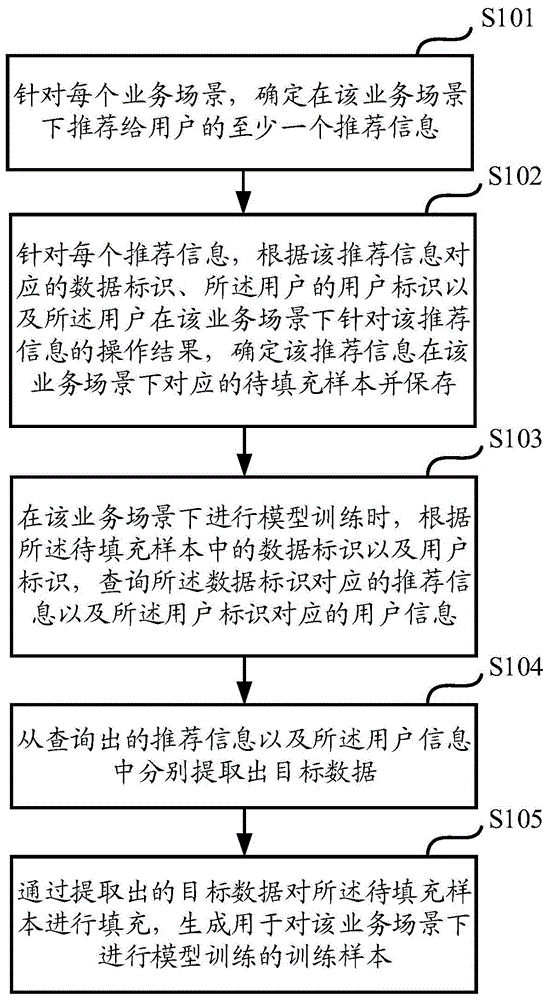
针对每个业务场景,确定在该业务场景下推荐给用户的至少一个推荐信息;For each business scenario, determine at least one recommendation information recommended to the user in the business scenario;
针对每个推荐信息,根据该推荐信息对应的数据标识、所述用户的用户标识以及所述用户在该业务场景下针对该推荐信息的操作结果,确定该推荐信息在该业务场景下对应的待填充样本并保存;For each recommendation information, according to the data identifier corresponding to the recommendation information, the user identifier of the user, and the operation result of the user on the recommendation information in the business scenario, determine the corresponding pending information of the recommendation information in the business scenario. fill the sample and save;
在该业务场景下进行模型训练时,根据所述待填充样本中的数据标识以及用户标识,查询所述数据标识对应的推荐信息以及所述用户标识对应的用户信息;When performing model training in this business scenario, according to the data identifier and user identifier in the to-be-filled sample, query the recommendation information corresponding to the data identifier and the user information corresponding to the user identifier;
从查询出的推荐信息以及所述用户信息中分别提取出目标数据;Extracting target data from the queried recommendation information and the user information respectively;
通过提取出的目标数据对所述待填充样本进行填充,生成用于对该业务场景下进行模型训练的训练样本。The samples to be filled are filled with the extracted target data to generate training samples for model training in the business scenario.
可选地,根据该推荐信息对应的数据标识、所述用户的用户标识以及所述用户在该业务场景下针对该推荐信息的操作结果,确定该推荐信息在该业务场景下对应的待填充样本并保存,具体包括:Optionally, according to the data identifier corresponding to the recommendation information, the user identifier of the user, and the operation result of the user on the recommendation information in the business scenario, determine the sample to be filled corresponding to the recommendation information in the business scenario. and save, including:
根据所述用户在该业务场景下针对该推荐信息的操作结果,确定该推荐信息在该业务场景下对应的样本标签;According to the operation result of the user on the recommendation information in the business scenario, determine the sample label corresponding to the recommendation information in the business scenario;
确定所述用户的用户信息对应的数据类别作为第一数据类别,以及确定该推荐信息对应的数据类别作为第二数据类别;determining the data category corresponding to the user information of the user as the first data category, and determining the data category corresponding to the recommendation information as the second data category;
根据所述样本标签、所述用户标识与所述第一数据类别的对应关系、所述数据标识与所述第二数据类别的对应关系,确定该推荐信息在该业务场景下对应的待填充样本并保存。According to the sample label, the corresponding relationship between the user identifier and the first data category, and the corresponding relationship between the data identifier and the second data category, determine the sample to be filled corresponding to the recommendation information in the business scenario and save.
可选地,从查询出的推荐信息以及所述用户信息中分别提取出目标数据,具体包括:Optionally, extracting target data respectively from the queried recommendation information and the user information, specifically including:
根据所述待填充样本中包含的第一数据类别,从所述用户信息中提取出所述第一数据类别所需的数据作为目标数据,根据所述待填充样本中包含的第二数据类别,从查询出的推荐信息中提取出所述第二数据类别所需的数据作为目标数据。According to the first data category included in the sample to be filled, the data required for the first data category is extracted from the user information as target data, and according to the second data category included in the sample to be filled, The data required for the second data category is extracted from the queried recommendation information as target data.
可选地,通过提取出的目标数据对所述待填充样本进行填充,生成用于对该业务场景下进行模型训练的训练样本,具体包括:Optionally, the samples to be filled are filled with the extracted target data to generate training samples for model training in the business scenario, specifically including:
将从所述用户信息中提取出的目标数据作为所述用户标识对应的第一键值,将从查询出的推荐信息中提取出的目标数据作为所述数据标识对应的第二键值;The target data extracted from the user information is used as the first key value corresponding to the user identifier, and the target data extracted from the queried recommendation information is used as the second key value corresponding to the data identifier;
通过所述第一键值和所述第二键值,对该业务场景对应的待填充样本进行填充,生成用于对该业务场景下进行模型训练的训练样本。The samples to be filled corresponding to the business scenario are filled with the first key value and the second key value, and training samples used for model training in the business scenario are generated.
可选地,所述方法还包括:Optionally, the method further includes:
确定该业务场景下线上服务系统中设置的预测模型在该业务场景下线下测试系统中对应的镜像模型,作为待训练模型;Determine the mirror model corresponding to the prediction model set in the online service system under the business scenario in the offline test system under the business scenario, as the model to be trained;
从所述训练样本所包含的目标数据中提取出所述待训练模型所需的特征数据;Extract the feature data required by the model to be trained from the target data included in the training sample;
根据所述特征数据以及所述训练样本中包含的样本标签,对所述待训练模型进行训练;According to the feature data and the sample labels included in the training samples, the to-be-trained model is trained;
通过训练后的所述待训练模型,对所述预测模型进行更新。The prediction model is updated through the trained model to be trained.
本说明书提供了一种训练样本的实时生成装置,包括:This specification provides a real-time generation device for training samples, including:
确定模块,用于针对每个业务场景,确定在该业务场景下推荐给用户的至少一个推荐信息;a determining module, configured to determine, for each business scenario, at least one piece of recommendation information recommended to the user in the business scenario;
保存模块,用于针对每个推荐信息,根据该推荐信息对应的数据标识、所述用户的用户标识以及所述用户在该业务场景下针对该推荐信息的操作结果,确定该推荐信息在该业务场景下对应的待填充样本并保存;The saving module is configured to, for each recommendation information, determine that the recommendation information is in the service according to the data identifier corresponding to the recommendation information, the user identifier of the user, and the operation result of the user on the recommendation information in the business scenario. The corresponding sample to be filled in the scene and save it;
查询模块,用于在该业务场景下进行模型训练时,根据所述待填充样本中的数据标识以及用户标识,查询所述数据标识对应的推荐信息以及所述用户标识对应的用户信息;a query module, configured to query the recommendation information corresponding to the data identifier and the user information corresponding to the user identifier according to the data identifier and the user identifier in the to-be-filled sample during model training in the business scenario;
提取模块,用于从查询出的推荐信息以及所述用户信息中分别提取出目标数据;an extraction module, configured to extract target data from the queried recommendation information and the user information respectively;
生成模块,用于通过提取出的目标数据对所述待填充样本进行填充,生成用于对该业务场景下进行模型训练的训练样本。The generating module is configured to fill the samples to be filled with the extracted target data, and generate training samples for model training in the business scenario.
可选地,所述保存模块具体用于,根据所述用户在该业务场景下针对该推荐信息的操作结果,确定该推荐信息在该业务场景下对应的样本标签;确定所述用户的用户信息对应的数据类别作为第一数据类别,以及确定该推荐信息对应的数据类别作为第二数据类别;根据所述样本标签、所述用户标识与所述第一数据类别的对应关系、所述数据标识与所述第二数据类别的对应关系,确定该推荐信息在该业务场景下对应的待填充样本并保存。Optionally, the saving module is specifically configured to, according to the operation result of the user on the recommendation information in the business scenario, determine the sample label corresponding to the recommendation information in the business scenario; determine the user information of the user The corresponding data category is taken as the first data category, and the data category corresponding to the recommendation information is determined as the second data category; according to the sample label, the correspondence between the user identifier and the first data category, the data identifier The corresponding relationship with the second data category is to determine and save the sample to be filled corresponding to the recommendation information in the business scenario.
可选地,所述提取模块具体用于,根据所述待填充样本中包含的第一数据类别,从所述用户信息中提取出所述第一数据类别所需的数据作为目标数据,根据所述待填充样本中包含的第二数据类别,从查询出的推荐信息中提取出所述第二数据类别所需的数据作为目标数据。Optionally, the extraction module is specifically configured to, according to the first data category included in the sample to be filled, extract the data required by the first data category from the user information as the target data, and according to the The second data category included in the sample to be filled is extracted, and the data required for the second data category is extracted from the queried recommendation information as the target data.
本说明书提供了一种计算机可读存储介质,所述存储介质存储有计算机程序,所述计算机程序被处理器执行时实现上述生成训练样本的方法。This specification provides a computer-readable storage medium, where the storage medium stores a computer program, and when the computer program is executed by a processor, implements the above-mentioned method for generating training samples.
本说明书提供了一种电子设备,包括存储器、处理器及存储在存储器上并可在处理器上运行的计算机程序,所述处理器执行所述程序时实现上述生成训练样本的方法。The present specification provides an electronic device, including a memory, a processor, and a computer program stored in the memory and executable on the processor, where the processor implements the above-mentioned method for generating training samples when the program is executed.
本说明书采用的上述至少一个技术方案能够达到以下有益效果:The above-mentioned at least one technical solution adopted in this specification can achieve the following beneficial effects:
在本说明书提供生成训练样本的方法中,可以针对每个业务场景,确定推荐给用户的至少一个推荐信息,针对每个推荐信息,根据该推荐信息对应的数据标识、该用户的用户标识以及该用户在该业务场景下针对该推荐信息的操作结果,确定该推荐信息在该业务场景下对应的待填充样本并保存,在对该业务场景下进行模型训练时,根据该待填充样本中的数据标识以及用户标识,查询所述数据标识对应的推荐信息以及该用户标识对应的用户信息,从查询出的推荐信息以及该用户信息中分别提取出目标数据,通过提取出的目标数据对该待填充样本进行填充,生成用于对该业务场景下进行模型训练的训练样本。In the method for generating training samples provided in this specification, at least one recommendation information recommended to the user may be determined for each business scenario, and for each recommendation information, according to the data identifier corresponding to the recommendation information, the user identifier of the user, and the The user determines and saves the sample to be filled corresponding to the recommendation information in the business scenario according to the operation result of the recommendation information in the business scenario. When training the model in the business scenario, according to the data in the sample to be filled identifier and user identifier, query the recommendation information corresponding to the data identifier and the user information corresponding to the user identifier, extract target data from the queried recommendation information and the user information, respectively, and use the extracted target data for the to-be-filled Fill in the samples to generate training samples for model training in the business scenario.
从上述方法中可以看出,由于对于每个业务场景,可以根据推荐信息以及用户在该业务场景下针对该推荐信息的操作结果,确定出该推荐信息在该业务场景下对应的待填充样本并保存,后续需要进行模型训练时,可以对保存的各待填充样本进行填充,从而生成用于对该业务场景下模型训练的训练样本。这样就实现了按照统一的方式维护不同业务场景的训练样本,给训练样本的维护带来了极大的便利,并且,极大的提高了训练样本的生成效率。It can be seen from the above method that, for each business scenario, the sample to be filled corresponding to the recommended information in the business scenario can be determined according to the recommended information and the user's operation result on the recommended information in the business scenario and Save, when model training is required later, you can fill in the saved samples to be filled, thereby generating training samples for model training in the business scenario. In this way, training samples of different business scenarios are maintained in a unified manner, which brings great convenience to the maintenance of training samples, and greatly improves the generation efficiency of training samples.
附图说明Description of drawings
此处所说明的附图用来提供对本说明书的进一步理解,构成本说明书的一部分,本说明书的示意性实施例及其说明用于解释本说明书,并不构成对本说明书的不当限定。在附图中:The accompanying drawings described herein are used to provide further understanding of the specification and constitute a part of the specification. The exemplary embodiments and descriptions of the specification are used to explain the specification and do not constitute an improper limitation of the specification. In the attached image:
图1为本说明书提供的一种生成训练样本的流程示意图;Fig. 1 is a kind of schematic flow chart of generating training samples provided by this specification;
图2为本说明书提供的确定待填充样本的示意图;2 is a schematic diagram of determining a sample to be filled provided by this specification;
图3为本说明书提供的服务器进行训练样本填充的过程示意图;3 is a schematic diagram of the process of filling training samples by the server provided in this specification;
图4为本说明书提供的一种生成训练样本的装置示意图;4 is a schematic diagram of a device for generating training samples provided in this specification;
图5为本说明书提供的对应于图1的电子设备示意图。FIG. 5 is a schematic diagram of an electronic device corresponding to FIG. 1 provided in this specification.
具体实施方式Detailed ways
为使本说明书的目的、技术方案和优点更加清楚,下面将结合本说明书具体实施例及相应的附图对本说明书中技术方案进行清楚、完整地描述。显然,所描述的实施例仅是本说明书一部分实施例,而不是全部的实施例。基于本说明书中的实施例,本领域普通技术人员在没有做出创造性劳动前提下所获得的所有其他实施例,都属于本说明书保护的范围。In order to make the purpose, technical solutions and advantages of this specification clearer, the technical solutions in this specification will be clearly and completely described below with reference to the specific embodiments of this specification and the corresponding drawings. Obviously, the described embodiments are only some of the embodiments of the present specification, but not all of the embodiments. Based on the embodiments in this specification, all other embodiments obtained by persons of ordinary skill in the art without creative efforts shall fall within the protection scope of this specification.
以下结合附图,详细说明本说明书各实施例提供的技术方案。The technical solutions provided by the embodiments of the present specification will be described in detail below with reference to the accompanying drawings.
图1为本说明书提供的一种生成训练样本的流程示意图,具体包括以下步骤:FIG. 1 is a schematic flow chart of generating training samples provided by this specification, which specifically includes the following steps:
S101:针对每个业务场景,确定在该业务场景下推荐给用户的至少一个推荐信息。S101: For each business scenario, determine at least one piece of recommendation information recommended to a user in the business scenario.
在本说明书中,在生成用于进行模型训练的训练样本之前,可以确定出推荐给用户的至少一个推荐信息。其中,确定推荐信息的执行主体可以是服务器,也可以是诸如电脑等终端设备。为了便于描述,下面将仅以服务器是执行主体为例,对本说明书提供的生成训练样本的方法进行说明。In this specification, before generating training samples for model training, at least one piece of recommendation information recommended to the user may be determined. Wherein, the execution body for determining the recommended information may be a server, or may be a terminal device such as a computer. For the convenience of description, the method for generating training samples provided in this specification will be described below only by taking the server as the execution subject as an example.
服务器可以基于用户的用户标识,确定出需要向该用户推荐的至少一个推荐信息。其中,这里提到的基于用户的用户标识向用户进行信息推荐,可以是指用户服务器发送携带有该用户的用户标识的业务请求,服务器可以根据该用户标识,确定出能够反映出该用户的喜好、兴趣、购物习惯等信息的属性信息(如用户画像),进而可以基于该用户的属性信息,通过设置于服务器中的预测模型,确定出需要向该用户进行推荐的推荐信息。The server may determine at least one recommendation information that needs to be recommended to the user based on the user identification of the user. Wherein, the information recommendation to the user based on the user's user ID mentioned here may refer to the user server sending a service request carrying the user's user ID, and the server may determine, according to the user ID, that can reflect the user's preference , interests, shopping habits and other information (such as user portrait), and then based on the user's attribute information, through the prediction model set in the server, determine the recommendation information that needs to be recommended to the user.
再例如,当用户启动终端中安装的应用(Application,App)时,终端可以基于用户在该App中登录的用户账号,向该App对应的服务器发送携带有用户标识的业务请求(该用户标识可以是指该用户账号,也可以是指通过该用户账号查询到的诸如用户的手机号、身份证号等标识信息)。相应的,服务器可以根据接收到的业务请求中携带的用户标识,查询出该用户的属性信息,进而基于该用户的属性信息,通过预测模型向该用户进行信息推荐。其他的具体形式在此就不一一举例说明了。For another example, when the user starts an application (Application, App) installed in the terminal, the terminal may send a service request carrying a user ID to the server corresponding to the App based on the user account logged in by the user in the App (the user ID may be Refers to the user account, and may also refer to identification information such as the user's mobile phone number, ID number, etc. queried through the user account). Correspondingly, the server can query the attribute information of the user according to the user identifier carried in the received service request, and then recommend information to the user through the prediction model based on the attribute information of the user. Other specific forms will not be illustrated one by one here.
需要说明的是,在实际应用中,同一信息可以作为不同业务场景的推荐信息推荐给用户。而由于不同业务场景下,用于向用户进行信息推荐所使用的模型不尽相同,所以,在本说明书中,对应同一推荐信息,需要针对每个业务场景,确定出适用于该业务场景下所使用的模型的训练样本。即,对于同一推荐信息来说,该推荐信息在不同业务场景下所对应的训练样本可能是不同的。It should be noted that, in practical applications, the same information can be recommended to users as recommended information in different business scenarios. Since the models used to recommend information to users in different business scenarios are not the same, in this specification, corresponding to the same recommendation information, it is necessary to determine the models that are suitable for each business scenario for each business scenario. The training samples of the model used. That is, for the same recommendation information, the training samples corresponding to the recommendation information in different business scenarios may be different.
S102:针对每个推荐信息,根据该推荐信息对应的数据标识、所述用户的用户标识以及所述用户在该业务场景下针对该推荐信息的操作结果,确定该推荐信息在该业务场景下对应的待填充样本并保存。S102: For each recommendation information, according to the data identifier corresponding to the recommendation information, the user identifier of the user, and the operation result of the user on the recommendation information in the business scenario, determine that the recommendation information corresponds to the business scenario of the sample to be filled and saved.
针对每个业务场景,服务器确定出向该用户发送的至少一个推荐信息后,可以进一步地获取到该用户在该业务场景下针对这些推荐信息的操作结果。其中,该操作结果可以反映出用户在该业务场景下针对这些推荐信息的具体操作情况。如,对于该用户获取到的每个推荐信息,该操作结果中记录了该用户是否对该推荐信息进行了诸如点击查看、具体的浏览时间等信息。For each business scenario, after the server determines at least one piece of recommendation information sent to the user, the server may further obtain the operation results of the user on the recommendation information in the business scenario. The operation result may reflect the specific operation situation of the user with respect to the recommended information in the business scenario. For example, for each recommendation information obtained by the user, the operation result records whether the user has performed information such as clicking to view the recommendation information, specific browsing time, and the like.
服务器可以针对确定出的每个推荐信息,根据该推荐信息对应的数据标识、该用户的用户标识以及该用户针对该推荐信息的操作结果,确定出该推荐信息在该业务场景下对应的待填充样本。这里提到的该推荐信息对应的数据标识用于唯一标识该推荐信息,而用户针对该推荐信息的操作结果主要用于确定出该推荐信息所对应的样本标签。For each determined recommendation information, the server may determine, according to the data identifier corresponding to the recommendation information, the user identifier of the user, and the operation result of the user on the recommendation information, the corresponding to-be-filled recommendation information in the business scenario sample. The data identifier corresponding to the recommendation information mentioned here is used to uniquely identify the recommendation information, and the operation result of the user on the recommendation information is mainly used to determine the sample label corresponding to the recommendation information.
具体的,若是通过该操作结果,确定出用户通过执行诸如点击、按压等指定操作查看了该推荐信息,则可以确定出该推荐信息在该业务场景下对应的样本标签为正样本,否则,可以确定出该推荐信息在该业务场景下对应的样本标签为负样本。换句话说,服务器可以通过该操作结果,对该推荐信息进行正负样本的标注。其中,这里提到的用户通过执行指定操作查看了该推荐信息,并不是指用户在推荐信息列表中查看了该推荐信息,而是指用户通过执行指定操作,打开了该推荐信息并查看到该推荐信息的具体内容。Specifically, if it is determined from the operation result that the user has viewed the recommended information by performing specified operations such as clicking, pressing, etc., it can be determined that the sample label corresponding to the recommended information in the business scenario is a positive sample, otherwise, it can be It is determined that the sample label corresponding to the recommendation information in the business scenario is a negative sample. In other words, the server can label the recommendation information with positive and negative samples through the operation result. Among them, the user mentioned here viewed the recommended information by performing a specified operation, it does not mean that the user viewed the recommended information in the recommended information list, but that the user opened the recommended information and viewed the recommended information by performing a specified operation. The specific content of the recommended information.
由于同一信息可以作为多个业务场景的推荐信息推荐给用户,而对于同一推荐信息来说,用户在不同业务场景下对该推荐信息的操作结果可能不尽相同。例如,对于一个运动鞋的推荐信息来说,如果在运动特卖会的业务场景下,用户查看该推荐信息的可能性较大,而在冬季服饰特卖会的业务场景下,用户查看该推荐信息的可能性将大大降低。Since the same information can be recommended to the user as recommendation information in multiple business scenarios, for the same recommendation information, the user's operation results on the recommended information in different business scenarios may be different. For example, for the recommendation information of sports shoes, in the business scenario of a sports sale, the user is more likely to view the recommended information, but in the business scenario of a winter clothing sale, the user views the recommended information. The likelihood will be greatly reduced.
基于此,由于用户在不同业务场景下对该推荐信息的操作结果不尽相同,所以,该推荐信息在不同业务场景下对应的样本标签也不尽相同,所以,服务器针对该推荐信息在不同业务场景下所生成的训练样本也不尽相同。Based on this, since the user's operation results on the recommended information in different business scenarios are not the same, the sample tags corresponding to the recommended information in different business scenarios are also different. The training samples generated in the scenarios are also different.
在本说明书中,服务器可以按照预设的数据格式,根据该推荐信息对应的数据标识、该用户的用户标识,以及该用户在该业务场景下针对该推荐信息的操作结果,确定出该推荐信息在该业务场景下对应的待填充样本。具体的,服务器可以根据预先保存的各信息与各数据类别的对应关系,确定出该用户的用户信息对应的数据类别为第一数据类别,以及确定出该推荐信息对应的数据类别为第二数据类别。而后,根据确定出的该推荐信息在该业务场景下对应的样本标签,该用户的用户标识与该第一数据类别的对应关系(由于用户信息属于该第一数据类别,则该第一数据类别与该用户的用户标识相对应),以及该推荐信息的数据标识与该第二数据类别的对应关系(用于该推荐信息属于该第二数据类别,所以,该第二数据类别与该推荐信息的数据标识相对应),确定出该推荐信息在该业务场景下对应的待填充样本。In this specification, the server may determine the recommendation information according to the preset data format, according to the data identifier corresponding to the recommendation information, the user identifier of the user, and the operation result of the user on the recommendation information in the business scenario The corresponding sample to be filled in this business scenario. Specifically, the server may determine that the data category corresponding to the user information of the user is the first data category, and determine that the data category corresponding to the recommendation information is the second data according to the pre-stored correspondence between each information and each data category category. Then, according to the determined sample label corresponding to the recommendation information in the business scenario, the corresponding relationship between the user ID of the user and the first data category (since the user information belongs to the first data category, the first data category corresponding to the user ID of the user), and the corresponding relationship between the data ID of the recommendation information and the second data category (for the recommendation information belongs to the second data category, therefore, the second data category and the recommendation information corresponding to the data identifier), and determine the sample to be filled corresponding to the recommendation information in the business scenario.
其中,第二数据类别中包含有多种数据类别,例如,推荐信息为广告时,属于广告数据类别,推荐信息为上下文关联信息时,该推荐信息属于上下文数据类别。而这里提到的广告数据类别和上下文数据类别均可以称之为是第二数据类别。服务器确定待填充样本具体如图2所示。The second data category includes multiple data categories. For example, when the recommended information is an advertisement, it belongs to the advertisement data category, and when the recommended information is context-related information, the recommended information belongs to the contextual data category. Both the advertisement data category and the contextual data category mentioned here may be referred to as the second data category. The server determines that the sample to be filled is specifically as shown in FIG. 2 .
图2为本说明书提供的确定待填充样本的示意图。FIG. 2 is a schematic diagram of determining a sample to be filled provided in this specification.
在图2中,服务器根据用户针对该推荐信息的操作结果,确定出该推荐信息在该业务场景下对应的训练样本为正样本,在可以在图2所示的待填充样本中positive的值置为1,即,positive的值为1时,表明该推荐信息在该业务场景下对应的训练样本为正样本。服务器可以根据预先保存的各信息与各数据类别的对应关系,确定出用户的用户信息所属的数据类别为数据类别11,则可以将该用户的用户标识添加在数据类别11,即,将用户标识:id=193475132添加在type=11处。同理,服务器确定出推荐信息为广告时,可以确定出该推荐信息所属的数据类别为数据类别13,则可以将该推荐信息的数据标识添加在数据类别13处,即,将数据标识:id=652742951添加在type=13处。而该推荐信息还属于上下文关联信息,与之关联的信息所遇上下文数据类别,其对应的数据类别为数据类别12,则服务器可以将与该推荐信息存在上下文关联的信息的数据标识添加在数据类别12处,即,将数据标识:id=456328943添加在type=12处。其中,这里提到的数据类别12和数据类别13均为第二数据类别。In Fig. 2, the server determines that the training sample corresponding to the recommendation information in the business scenario is a positive sample according to the user's operation result for the recommendation information. is 1, that is, when the value of positive is 1, it indicates that the training sample corresponding to the recommendation information in the business scenario is a positive sample. The server may determine that the data category to which the user information of the user belongs is
在图2中,待填充样本的前段50007用于唯一标识该待填充样本,而从图2中可以看出,由于该待填充样本中已经标注出了其所对应的训练样本为正样本还是负样本,并且,该待填充样本中已经记录了该用户的用户标识以及推荐信息的数据标识,这样在后续生成训练样本的过程中,只需要按照该待填充样本中记录的用户标识和数据标识,查询出相应的数据,并完成待填充样本与查询出的数据之间的组合,即可得到该推荐信息在该业务场景下的训练样本。In FIG. 2 , the
上述提到的上下文关联信息是指用户查看了一个推荐信息这一情况的发生是因为在查看了另一个推荐信息而发生的。例如,用户在查看推荐信息A的过程中,看到了推荐信息B,并对推荐信息B进行了查看,则推荐信息A和B属于上下文关联信息。The above-mentioned context-related information refers to the fact that the user has viewed one recommended information because another recommended information has been viewed. For example, in the process of viewing the recommendation information A, the user sees the recommendation information B, and checks the recommendation information B, then the recommendation information A and B belong to context-related information.
服务器在确定出待填充样本后,可以将待填充样本进行保存。而由于待填充样本中并不是训练样本的全量数据,而是记录了用于查询这些数据的数据标识以及用户标识,这样就极大的节省了服务器的存储空间。After determining the sample to be filled, the server may save the sample to be filled. However, because the samples to be filled are not the full data of the training samples, but the data identifiers and user identifiers used to query the data are recorded, which greatly saves the storage space of the server.
S103:在该业务场景下进行模型训练时,根据所述待填充样本中的数据标识以及用户标识,查询所述数据标识对应的推荐信息以及所述用户标识对应的用户信息。S103: When performing model training in the business scenario, according to the data identifier and the user identifier in the sample to be filled, query the recommendation information corresponding to the data identifier and the user information corresponding to the user identifier.
S104:从查询出的推荐信息以及所述用户信息中分别提取出目标数据。S104: Extract target data from the queried recommendation information and the user information, respectively.
为了保证能够通过预测模型在业务执行过程中向用户提供准确的推荐信息,需要对不同业务场景的预测模型进行训练。而针对每个业务场景来说,服务器在对该业务场景的预测模型进行训练时,可以根据预先保存的该业务场景的待填充样本,查询出待填充样本所需的信息,进而在后续过程中,生成用于对该业务场景的预测模型进行训练的训练样本。In order to ensure that accurate recommendation information can be provided to users during business execution through the predictive model, it is necessary to train predictive models for different business scenarios. For each business scenario, when the server trains the prediction model of the business scenario, it can query the information required for the sample to be filled according to the pre-saved samples to be filled in the business scenario, and then in the subsequent process , and generate training samples for training the prediction model of the business scenario.
具体的,对于该业务场景下任意的待填充样本来说,服务器可以根据该待填充样本中记录的用户标识以及数据标识,查询出与该用户标识对应的用户的用户信息,以及与该数据标识对应的推荐信息。Specifically, for any sample to be filled in the business scenario, the server can query the user information of the user corresponding to the user ID and the data ID corresponding to the user ID according to the user ID and data ID recorded in the sample to be filled. The corresponding recommendation information.
服务器中预先记录了各数据类别所需的数据,因此,由于用户信息与第一数据类别相对应,所以,服务器可以按照该第一数据类别,从该用户信息中提取出该第一数据类别所需的数据作为目标数据。同理,服务器可以按照待填充样本中的第二数据类别,从推荐信息中提取出该第二数据类别所需的数据作为目标数据。The data required for each data category is pre-recorded in the server. Therefore, since the user information corresponds to the first data category, the server can extract the first data category from the user information according to the first data category. The required data is used as the target data. Similarly, according to the second data category in the sample to be filled, the server may extract the data required for the second data category from the recommendation information as the target data.
需要说明的是,服务器提取出的目标数据可以理解成:服务器将各业务场景的预测模型可能需要的数据全部提取出来,这样一来,即使后续预测模型所需的特征维度发生了一些变化,服务器也可以从该目标数据中提取出相应的特征数据,从而提高了特征数据的提取效率。并且,由于该目标数据为服务器提取出的预测模型可能需要的特征维度的数据,也就是说,服务器将用户信息中一些对于模型信息无用的信息进行了剔除,因此,可以进一步地降低生成的训练样本在服务器中所占用的存储空间,节省了服务器的存储资源。It should be noted that the target data extracted by the server can be understood as: the server extracts all the data that may be required by the prediction model of each business scenario. In this way, even if the feature dimension required by the subsequent prediction model changes, the server Corresponding feature data can also be extracted from the target data, thereby improving the extraction efficiency of the feature data. Moreover, since the target data is the feature dimension data that may be required by the prediction model extracted by the server, that is to say, the server removes some information that is useless for the model information in the user information, so the generated training can be further reduced. The storage space occupied by the samples in the server saves the storage resources of the server.
S105:通过提取出的目标数据对所述待填充样本进行填充,生成用于对该业务场景下进行模型训练的训练样本。S105: Fill the samples to be filled with the extracted target data to generate training samples for model training in the business scenario.
在从用户信息以及推荐信息中提取出相应的目标数据后,服务器可以通过提取出的目标数据对该待填充样本进行填充,从而得到相应的训练样本。具体的,在本说明书中,服务器可以将从用户信息中提取出的目标数据作为该待填充样本中用户标识对应的第一键值,并且,将从查询出的推荐信息中提取出的目标数据作为待填充样本中数据标识对应的第二键值。而后,服务器可以根据该第一键值,在该待填充样本中用于存储用户信息的位置处进行填充,同时,可以根据该第二键值,在该待填充样本中用于存储推荐信息的位置处进行填充,从而得到训练样本,如图3所示。After extracting the corresponding target data from the user information and the recommendation information, the server can fill the samples to be filled with the extracted target data, thereby obtaining corresponding training samples. Specifically, in this specification, the server can use the target data extracted from the user information as the first key value corresponding to the user ID in the sample to be filled, and the target data extracted from the queried recommendation information as the second key value corresponding to the data identifier in the sample to be filled. Then, according to the first key value, the server may fill in the location used for storing user information in the sample to be filled, and at the same time, according to the second key value, the location used to store the recommendation information in the sample to be filled may be filled. Fill in the position to obtain training samples, as shown in Figure 3.
图3为本说明书提供的服务器进行训练样本填充的过程示意图。FIG. 3 is a schematic diagram of the process of filling training samples by the server provided in this specification.
服务器在对图3所示的待填充样本进行填充时,可以先根据该待填充样本中记录的用户标识以及数据标识,查询出相应的信息。其中,图3中示出的User Entity为用户信息实体,即表示服务器根据该待填充样本中记录的用户标识所查询出的用户信息。Ctx PoiEntity为上下文关联信息实体,即表示服务器根据待填充样本中记录的上下文关联信息的数据标识所查询出的推荐信息。AdEntity为广告信息实体,即表示服务器根据该待填充样本中记录的数据标识,所查询出的作为推荐信息的广告信息。When filling the sample to be filled shown in FIG. 3 , the server may first query the corresponding information according to the user identifier and the data identifier recorded in the sample to be filled. The User Entity shown in FIG. 3 is a user information entity, that is, the user information queried by the server according to the user identifier recorded in the sample to be filled. Ctx PoiEntity is a contextual association information entity, that is, it represents the recommendation information queried by the server according to the data identifier of the contextual association information recorded in the sample to be filled. AdEntity is an advertisement information entity, that is, it represents the advertisement information as recommended information queried by the server according to the data identifier recorded in the sample to be filled.
服务器查询出用户信息以及各推荐信息后,可以分别从用户信息以及推荐信息中提取出目标数据,并将提取出的目标数据按照用户信息以及推荐信息所属的数据类别,填充在该待填充样本的相应位置上。其中,用户信息属于数据类别11,则服务器可以将从用户信息中提取出的目标数据填充在待填充样本中数据类别11所对应的位置上。同理,上下文关联信息和作为推荐信息的广告信息分别属于数据类别12和13,服务器可以将从上下文关联信息和广告信息中分别提取出的目标数据分别填充在这两个数据类别相应的位置上,从而得到训练样本。After the server queries the user information and each recommendation information, it can extract the target data from the user information and the recommendation information respectively, and fill the extracted target data in the sample to be filled according to the data category to which the user information and the recommendation information belong. in the corresponding position. Wherein, if the user information belongs to the
从上述方法中可以看出,由于针对每个业务场景,可以根据推荐信息以及用户在该业务场景下针对该推荐信息的操作结果,确定出该推荐信息在该业务场景下对应的待填充样本并保存,后续需要进行模型训练时,可以对保存的各待填充样本进行填充,从而生成用于对该业务场景下模型训练的训练样本。这样就实现了按照统一的方式维护不同业务场景的训练样本,给训练样本的维护带来了极大的便利,并且,极大的提高了训练样本的生成效率。It can be seen from the above method that, for each business scenario, the sample to be filled corresponding to the recommendation information in the business scenario can be determined according to the recommendation information and the user's operation result on the recommendation information in the business scenario and the corresponding sample to be filled in the business scenario Save, when model training is required later, you can fill in the saved samples to be filled, thereby generating training samples for model training in the business scenario. In this way, training samples of different business scenarios are maintained in a unified manner, which brings great convenience to the maintenance of training samples, and greatly improves the generation efficiency of training samples.
针对每个业务场景,服务器在生成用于训练该业务场景的预测模型的训练样本后,可以将该业务场景的预测模型作为待训练模型,并从该训练样本所包含的目标数据中提取出该待训练模型所需的特征数据。而后,服务器可以根据提取出的特征数据以及该训练样本包含的样本标签,对该待训练模型进行训练。For each business scenario, after generating the training sample for training the prediction model of the business scenario, the server may take the prediction model of the business scenario as the model to be trained, and extract the training sample from the target data contained in the training sample. Feature data required by the model to be trained. Then, the server can train the to-be-trained model according to the extracted feature data and the sample labels included in the training sample.
需要说明的是,在本说明书中,一个业务场景对应线上服务系统和线下测试系统,其中,线上服务系统用于对用户在该业务场景下进行信息推荐,而线下测试系统用于对线上服务系统进行维护进行更新。具体的,线上服务系统中设有预测模型,线上服务系统中的服务器需要通过该预测模型,向用户发送推荐信息。而在线下测试系统中设有与线上服务系统中预测模型相对应的镜像模型,该镜像模型的作用在于,可以通过对该镜像模型进行训练,实现对线上服务系统中预测模型各项参数的更新。It should be noted that, in this specification, a business scenario corresponds to an online service system and an offline test system, wherein the online service system is used to recommend information to users in this business scenario, and the offline test system is used to Maintain and update the online service system. Specifically, the online service system is provided with a prediction model, and the server in the online service system needs to send recommendation information to the user through the prediction model. In the offline test system, there is a mirror model corresponding to the prediction model in the online service system. The function of the mirror model is that the parameters of the prediction model in the online service system can be adjusted by training the mirror model. 's update.
基于此,在本说明书中,线上服务系统向用户进行信息推荐后,可以将该用户的用户标识以及所发送的推荐信息的数据标识发送给线下测试系统,即,不必向线下测试系统发送用户信息和推荐信息的完整数据,从而极大的节省了数据带宽。线下测试系统在获取到用户标识和数据标识后,可以根据获取到的该用户在该业务场景下针对该推荐信息的操作结果,确定出后续生成的待填充样本的样本标签,进而根据该样本标签、用户标识以及数据标号,生成相应的待填充样本。测试系统在生成该待填充样本对应的训练样本时,可以通过该待填充样本中记录的用户标识以及数据标识,查询出相应的用户信息和推荐信息,进而基于查询到的信息,对该待填充样本进行填充,从而得到用于对线下测试系统中设置的镜像模型进行训练的训练样本。即,上述提到的在该业务场景下进行模型训练,可以是指对线下测试系统中的镜像模型进行训练。而训练后的镜像模型可以用于对该业务场景下线上服务系统中设置的预测模型进行更新。Based on this, in this specification, after the online service system recommends information to the user, it can send the user ID of the user and the data ID of the sent recommendation information to the offline testing system, that is, it is not necessary to send the offline testing system to the offline testing system. Send complete data of user information and recommended information, thus greatly saving data bandwidth. After obtaining the user ID and data ID, the offline testing system can determine the sample label of the sample to be filled subsequently generated according to the obtained operation result of the user on the recommendation information in the business scenario, and then according to the sample label. Labels, user IDs, and data labels to generate corresponding samples to be filled. When generating the training sample corresponding to the sample to be filled, the testing system can query the corresponding user information and recommendation information through the user identifier and data identifier recorded in the sample to be filled, and then based on the queried information, the to-be-filled The samples are filled to obtain training samples for training the mirror model set in the offline test system. That is, the above-mentioned model training in this business scenario may refer to training the mirror model in the offline test system. The trained mirror model can be used to update the prediction model set in the online service system under the business scenario.
在本说明书中,一个业务场景在线上服务系统中可能设有多个预测模型,同理,在线下测试系统中也将设有该业务场景下的多个镜像模型。而需要指出的是,由于服务器在从查询出的用户信息和推荐信息所提取出的目标数据,可以是该业务场景下所有预测模型所需特征维度的数据,所以,对于同一业务场景来说,无论具体采用该业务场景的哪个预测模型对用户进行信息推荐,服务器生成的该业务场景的所有训练样本,均可以用于对该业务场景所有的预测模型在线下测试系统中对应的镜像模型进行训练。In this specification, a business scenario may have multiple prediction models in the online service system, and similarly, the offline testing system will also have multiple mirror models under the business scenario. It should be pointed out that, since the target data extracted by the server from the queried user information and recommendation information can be the data of the feature dimensions required by all prediction models in the business scenario, therefore, for the same business scenario, No matter which prediction model of the business scenario is specifically used to recommend information to users, all the training samples of the business scenario generated by the server can be used to train the corresponding mirror models in the offline test system for all the prediction models of the business scenario .
以上为本说明书的一个或多个实施例提供的生成训练样本的方法,基于同样的思路,本说明书还提供了相应的生成训练样本的装置,如图4所示。The methods for generating training samples provided in one or more embodiments of the present specification above are based on the same idea, and the present specification also provides a corresponding apparatus for generating training samples, as shown in FIG. 4 .
图4为本说明书提供的一种生成训练样本的装置示意图,具体包括:FIG. 4 is a schematic diagram of a device for generating training samples provided in this specification, which specifically includes:
确定模块401,用于针对每个业务场景,确定在该业务场景下推荐给用户的至少一个推荐信息;The determining module 401 is configured to, for each business scenario, determine at least one recommendation information recommended to the user under the business scenario;
保存模块402,用于针对每个推荐信息,根据该推荐信息对应的数据标识、所述用户的用户标识以及所述用户在该业务场景下针对该推荐信息的操作结果,确定该推荐信息在该业务场景下对应的待填充样本并保存;The saving module 402 is configured to, for each recommendation information, determine that the recommendation information is stored in the recommendation information according to the data identifier corresponding to the recommendation information, the user identifier of the user, and the operation result of the user on the recommendation information in the business scenario. The corresponding sample to be filled in the business scenario and save it;
查询模块403,用于在该业务场景下进行模型训练时,根据所述待填充样本中的数据标识以及用户标识,查询所述数据标识对应的推荐信息以及所述用户标识对应的用户信息;A query module 403, configured to query the recommendation information corresponding to the data identifier and the user information corresponding to the user identifier according to the data identifier and the user identifier in the to-be-filled sample during model training in the business scenario;
提取模块404,用于从查询出的推荐信息以及所述用户信息中分别提取出目标数据;Extraction module 404, configured to extract target data from the queried recommendation information and the user information respectively;
生成模块405,用于通过提取出的目标数据对所述待填充样本进行填充,生成用于对该业务场景下进行模型训练的训练样本。The generating module 405 is configured to fill the samples to be filled with the extracted target data, and generate training samples for model training in the business scenario.
可选地,所述保存模块402具体用于,根据所述用户在该业务场景下针对该推荐信息的操作结果,确定该推荐信息在该业务场景下对应的样本标签;确定所述用户的用户信息对应的数据类别作为第一数据类别,以及确定该推荐信息对应的数据类别作为第二数据类别;根据所述样本标签、所述用户标识与所述第一数据类别的对应关系、所述数据标识与所述第二数据类别的对应关系,确定该推荐信息在该业务场景下对应的待填充样本并保存。Optionally, the saving module 402 is specifically configured to, according to the operation result of the user on the recommendation information in the business scenario, determine the sample label corresponding to the recommendation information in the business scenario; determine the user of the user The data category corresponding to the information is taken as the first data category, and the data category corresponding to the recommendation information is determined as the second data category; The corresponding relationship with the second data category is identified, and the sample to be filled corresponding to the recommendation information in the business scenario is determined and saved.
可选地,所述提取模块404具体用于,根据所述待填充样本中包含的第一数据类别,从所述用户信息中提取出所述第一数据类别所需的数据作为目标数据,根据所述待填充样本中包含的第二数据类别,从查询出的推荐信息中提取出所述第二数据类别所需的数据作为目标数据。Optionally, the extracting module 404 is specifically configured to, according to the first data category contained in the sample to be filled, extract the data required by the first data category from the user information as the target data, according to For the second data category included in the sample to be filled, data required for the second data category is extracted from the queried recommendation information as target data.
可选地,所述生成模块405具体用于,将从所述用户信息中提取出的目标数据作为所述用户标识对应的第一键值,将从查询出的推荐信息中提取出的目标数据作为所述数据标识对应的第二键值;通过所述第一键值和所述第二键值,对该业务场景对应的待填充样本进行填充,生成用于对该业务场景下进行模型训练的训练样本。Optionally, the generating module 405 is specifically configured to use the target data extracted from the user information as the first key value corresponding to the user ID, and the target data extracted from the queried recommendation information. as the second key value corresponding to the data identifier; through the first key value and the second key value, fill in the to-be-filled sample corresponding to the business scenario, and generate a model used for model training in the business scenario training samples.
可选地,所述装置还包括:Optionally, the device further includes:
训练模块406,用于针对每个业务场景,确定该业务场景下线上服务系统中设置的预测模型在该业务场景下线下测试系统中对应的镜像模型,作为待训练模型;从所述训练样本所包含的目标数据中提取出所述待训练模型所需的特征数据;根据所述特征数据以及所述训练样本中包含的样本标签,对所述待训练模型进行训练;The training module 406 is configured to, for each business scenario, determine the mirror model corresponding to the prediction model set in the offline online service system of the business scenario in the offline and offline test system of the business scenario, as the model to be trained; The feature data required by the model to be trained is extracted from the target data included in the sample; the model to be trained is trained according to the feature data and the sample label included in the training sample;
通过训练后的所述待训练模型,对所述预测模型进行更新。The prediction model is updated through the trained model to be trained.
本说明书还提供了一种计算机可读存储介质,该存储介质存储有计算机程序,计算机程序可用于执行上述生成训练样本的方法。The present specification also provides a computer-readable storage medium, where the storage medium stores a computer program, and the computer program can be used to execute the above-mentioned method for generating training samples.
本说明书还提供了图5所示的电子设备的示意结构图。如图5所述,在硬件层面,该电子设备包括处理器、内部总线、网络接口、内存以及非易失性存储器,当然还可能包括其他业务所需要的硬件。处理器从非易失性存储器中读取对应的计算机程序到内存中然后运行,以实现上述生成训练样本的方法。当然,除了软件实现方式之外,本说明书并不排除其他实现方式,比如逻辑器件抑或软硬件结合的方式等等,也就是说以下处理流程的执行主体并不限定于各个逻辑单元,也可以是硬件或逻辑器件。This specification also provides a schematic structural diagram of the electronic device shown in FIG. 5 . As shown in FIG. 5 , at the hardware level, the electronic device includes a processor, an internal bus, a network interface, a memory, and a non-volatile memory, and of course, may also include hardware required by other services. The processor reads the corresponding computer program from the non-volatile memory into the memory and executes it, so as to implement the above method for generating training samples. Of course, in addition to the software implementation, this specification does not exclude other implementations, such as logic devices or the combination of software and hardware, etc., that is to say, the execution subject of the following processing flow is not limited to each logic unit, but can also be hardware or logic device.
在20世纪90年代,对于一个技术的改进可以很明显地区分是硬件上的改进(例如,对二极管、晶体管、开关等电路结构的改进)还是软件上的改进(对于方法流程的改进)。然而,随着技术的发展,当今的很多方法流程的改进已经可以视为硬件电路结构的直接改进。设计人员几乎都通过将改进的方法流程编程到硬件电路中来得到相应的硬件电路结构。因此,不能说一个方法流程的改进就不能用硬件实体模块来实现。例如,可编程逻辑器件(ProgrammableLogic Device,PLD)(例如现场可编程门阵列(Field Programmable GateArray,FPGA))就是这样一种集成电路,其逻辑功能由用户对器件编程来确定。由设计人员自行编程来把一个数字系统“集成”在一片PLD上,而不需要请芯片制造厂商来设计和制作专用的集成电路芯片。而且,如今,取代手工地制作集成电路芯片,这种编程也多半改用“逻辑编译器(logic compiler)”软件来实现,它与程序开发撰写时所用的软件编译器相类似,而要编译之前的原始代码也得用特定的编程语言来撰写,此称之为硬件描述语言(Hardware DescriptionLanguage,HDL),而HDL也并非仅有一种,而是有许多种,如ABEL(AdvancedBoolean Expression Language)、AHDL(Altera Hardware DescriptionLanguage)、Confluence、CUPL(Cornell University Programming Language)、HDCal、JHDL(Java Hardware Description Language)、Lava、Lola、MyHDL、PALASM、RHDL(RubyHardware Description Language)等,目前最普遍使用的是VHDL(Very-High-SpeedIntegrated Circuit Hardware Description Language)与Verilog。本领域技术人员也应该清楚,只需要将方法流程用上述几种硬件描述语言稍作逻辑编程并编程到集成电路中,就可以很容易得到实现该逻辑方法流程的硬件电路。In the 1990s, improvements in a technology could be clearly differentiated between improvements in hardware (eg, improvements to circuit structures such as diodes, transistors, switches, etc.) or improvements in software (improvements in method flow). However, with the development of technology, the improvement of many methods and processes today can be regarded as a direct improvement of the hardware circuit structure. Designers almost get the corresponding hardware circuit structure by programming the improved method flow into the hardware circuit. Therefore, it cannot be said that the improvement of a method flow cannot be realized by hardware entity modules. For example, a Programmable Logic Device (PLD) (eg, Field Programmable Gate Array (FPGA)) is an integrated circuit whose logic function is determined by user programming of the device. It is programmed by the designer to "integrate" a digital system on a PLD without having to ask the chip manufacturer to design and manufacture a dedicated integrated circuit chip. And, instead of making integrated circuit chips by hand, these days, much of this programming is done using software called a "logic compiler", which is similar to the software compiler used in program development and writing, but before compiling The original code also has to be written in a specific programming language, which is called Hardware Description Language (HDL), and there is not only one HDL, but many kinds, such as ABEL (AdvancedBoolean Expression Language), (Altera Hardware Description Language), Confluence, CUPL (Cornell University Programming Language), HDCal, JHDL (Java Hardware Description Language), Lava, Lola, MyHDL, PALASM, RHDL (RubyHardware Description Language), etc. Currently, the most commonly used is VHDL ( Very-High-Speed Integrated Circuit Hardware Description Language) and Verilog. It should also be clear to those skilled in the art that a hardware circuit for implementing the logic method process can be easily obtained by simply programming the method process in the above-mentioned several hardware description languages and programming it into the integrated circuit.
控制器可以按任何适当的方式实现,例如,控制器可以采取例如微处理器或处理器以及存储可由该(微)处理器执行的计算机可读程序代码(例如软件或固件)的计算机可读介质、逻辑门、开关、专用集成电路(Application SpecificIntegrated Circuit,ASIC)、可编程逻辑控制器和嵌入微控制器的形式,控制器的例子包括但不限于以下微控制器:ARC625D、Atmel AT91SAM、MicrochipPIC18F26K20以及Silicone Labs C8051F320,存储器控制器还可以被实现为存储器的控制逻辑的一部分。本领域技术人员也知道,除了以纯计算机可读程序代码方式实现控制器以外,完全可以通过将方法步骤进行逻辑编程来使得控制器以逻辑门、开关、专用集成电路、可编程逻辑控制器和嵌入微控制器等的形式来实现相同功能。因此这种控制器可以被认为是一种硬件部件,而对其内包括的用于实现各种功能的装置也可以视为硬件部件内的结构。或者甚至,可以将用于实现各种功能的装置视为既可以是实现方法的软件模块又可以是硬件部件内的结构。The controller may be implemented in any suitable manner, for example, the controller may take the form of, for example, a microprocessor or processor and a computer readable medium storing computer readable program code (eg software or firmware) executable by the (micro)processor , logic gates, switches, application specific integrated circuits (ASICs), programmable logic controllers and embedded microcontrollers, examples of controllers include but are not limited to the following microcontrollers: ARC625D, Atmel AT91SAM, MicrochipPIC18F26K20 and Silicone Labs C8051F320, the memory controller can also be implemented as part of the control logic of the memory. Those skilled in the art also know that, in addition to implementing the controller in the form of pure computer-readable program code, the controller can be implemented as logic gates, switches, application-specific integrated circuits, programmable logic controllers and embedded devices by logically programming the method steps. The same function can be realized in the form of a microcontroller, etc. Therefore, this kind of controller can be regarded as a hardware component, and the devices included therein for realizing various functions can also be regarded as a structure in the hardware component. Or even, the means for implementing various functions can be regarded as both a software module implementing a method and a structure within a hardware component.
上述实施例阐明的系统、装置、模块或单元,具体可以由计算机芯片或实体实现,或者由具有某种功能的产品来实现。一种典型的实现设备为计算机。具体的,计算机例如可以为个人计算机、膝上型计算机、蜂窝电话、相机电话、智能电话、个人数字助理、媒体播放器、导航设备、电子邮件设备、游戏控制台、平板计算机、可穿戴设备或者这些设备中的任何设备的组合。The systems, devices, modules or units described in the above embodiments may be specifically implemented by computer chips or entities, or by products with certain functions. A typical implementation device is a computer. Specifically, the computer may be, for example, a personal computer, a laptop computer, a cellular phone, a camera phone, a smart phone, a personal digital assistant, a media player, a navigation device, an email device, a game console, a tablet computer, a wearable device, or A combination of any of these devices.
为了描述的方便,描述以上装置时以功能分为各种单元分别描述。当然,在实施本说明书时可以把各单元的功能在同一个或多个软件和/或硬件中实现。For the convenience of description, when describing the above device, the functions are divided into various units and described respectively. Of course, when implementing this specification, the functions of each unit may be implemented in one or more software and/or hardware.
本领域内的技术人员应明白,本发明的实施例可提供为方法、系统、或计算机程序产品。因此,本发明可采用完全硬件实施例、完全软件实施例、或结合软件和硬件方面的实施例的形式。而且,本发明可采用在一个或多个其中包含有计算机可用程序代码的计算机可用存储介质(包括但不限于磁盘存储器、CD-ROM、光学存储器等)上实施的计算机程序产品的形式。As will be appreciated by one skilled in the art, embodiments of the present invention may be provided as a method, system, or computer program product. Accordingly, the present invention may take the form of an entirely hardware embodiment, an entirely software embodiment, or an embodiment combining software and hardware aspects. Furthermore, the present invention may take the form of a computer program product embodied on one or more computer-usable storage media (including, but not limited to, disk storage, CD-ROM, optical storage, etc.) having computer-usable program code embodied therein.
本发明是参照根据本发明实施例的方法、设备(系统)、和计算机程序产品的流程图和/或方框图来描述的。应理解可由计算机程序指令实现流程图和/或方框图中的每一流程和/或方框、以及流程图和/或方框图中的流程和/或方框的结合。可提供这些计算机程序指令到通用计算机、专用计算机、嵌入式处理机或其他可编程数据处理设备的处理器以产生一个机器,使得通过计算机或其他可编程数据处理设备的处理器执行的指令产生用于实现在流程图一个流程或多个流程和/或方框图一个方框或多个方框中指定的功能的装置。The present invention is described with reference to flowchart illustrations and/or block diagrams of methods, apparatus (systems), and computer program products according to embodiments of the invention. It will be understood that each flow and/or block in the flowchart illustrations and/or block diagrams, and combinations of flows and/or blocks in the flowchart illustrations and/or block diagrams, can be implemented by computer program instructions. These computer program instructions may be provided to the processor of a general purpose computer, special purpose computer, embedded processor or other programmable data processing device to produce a machine such that the instructions executed by the processor of the computer or other programmable data processing device produce Means for implementing the functions specified in a flow or flow of a flowchart and/or a block or blocks of a block diagram.
这些计算机程序指令也可存储在能引导计算机或其他可编程数据处理设备以特定方式工作的计算机可读存储器中,使得存储在该计算机可读存储器中的指令产生包括指令装置的制造品,该指令装置实现在流程图一个流程或多个流程和/或方框图一个方框或多个方框中指定的功能。These computer program instructions may also be stored in a computer-readable memory capable of directing a computer or other programmable data processing apparatus to function in a particular manner, such that the instructions stored in the computer-readable memory result in an article of manufacture comprising instruction means, the instructions The apparatus implements the functions specified in the flow or flow of the flowcharts and/or the block or blocks of the block diagrams.
这些计算机程序指令也可装载到计算机或其他可编程数据处理设备上,使得在计算机或其他可编程设备上执行一系列操作步骤以产生计算机实现的处理,从而在计算机或其他可编程设备上执行的指令提供用于实现在流程图一个流程或多个流程和/或方框图一个方框或多个方框中指定的功能的步骤。These computer program instructions can also be loaded on a computer or other programmable data processing device to cause a series of operational steps to be performed on the computer or other programmable device to produce a computer-implemented process such that The instructions provide steps for implementing the functions specified in the flow or blocks of the flowcharts and/or the block or blocks of the block diagrams.
在一个典型的配置中,计算设备包括一个或多个处理器(CPU)、输入/输出接口、网络接口和内存。In a typical configuration, a computing device includes one or more processors (CPUs), input/output interfaces, network interfaces, and memory.
内存可能包括计算机可读介质中的非永久性存储器,随机存取存储器(RAM)和/或非易失性内存等形式,如只读存储器(ROM)或闪存(flash RAM)。内存是计算机可读介质的示例。Memory may include non-persistent memory in computer readable media, random access memory (RAM) and/or non-volatile memory in the form of, for example, read only memory (ROM) or flash memory (flash RAM). Memory is an example of a computer-readable medium.
计算机可读介质包括永久性和非永久性、可移动和非可移动媒体可以由任何方法或技术来实现信息存储。信息可以是计算机可读指令、数据结构、程序的模块或其他数据。计算机的存储介质的例子包括,但不限于相变内存(PRAM)、静态随机存取存储器(SRAM)、动态随机存取存储器(DRAM)、其他类型的随机存取存储器(RAM)、只读存储器(ROM)、电可擦除可编程只读存储器(EEPROM)、快闪记忆体或其他内存技术、只读光盘只读存储器(CD-ROM)、数字多功能光盘(DVD)或其他光学存储、磁盒式磁带,磁带磁磁盘存储或其他磁性存储设备或任何其他非传输介质,可用于存储可以被计算设备访问的信息。按照本文中的界定,计算机可读介质不包括暂存电脑可读媒体(transitory media),如调制的数据信号和载波。Computer-readable media includes both persistent and non-permanent, removable and non-removable media, and storage of information may be implemented by any method or technology. Information may be computer readable instructions, data structures, modules of programs, or other data. Examples of computer storage media include, but are not limited to, phase-change memory (PRAM), static random access memory (SRAM), dynamic random access memory (DRAM), other types of random access memory (RAM), read only memory (ROM), Electrically Erasable Programmable Read Only Memory (EEPROM), Flash Memory or other memory technology, Compact Disc Read Only Memory (CD-ROM), Digital Versatile Disc (DVD) or other optical storage, Magnetic tape cassettes, magnetic tape magnetic disk storage or other magnetic storage devices or any other non-transmission medium that can be used to store information that can be accessed by a computing device. As defined herein, computer-readable media does not include transitory computer-readable media, such as modulated data signals and carrier waves.
还需要说明的是,术语“包括”、“包含”或者其任何其他变体意在涵盖非排他性的包含,从而使得包括一系列要素的过程、方法、商品或者设备不仅包括那些要素,而且还包括没有明确列出的其他要素,或者是还包括为这种过程、方法、商品或者设备所固有的要素。在没有更多限制的情况下,由语句“包括一个……”限定的要素,并不排除在包括所述要素的过程、方法、商品或者设备中还存在另外的相同要素。It should also be noted that the terms "comprising", "comprising" or any other variation thereof are intended to encompass a non-exclusive inclusion such that a process, method, article or device comprising a series of elements includes not only those elements, but also Other elements not expressly listed or inherent to such a process, method, article of manufacture or apparatus are also included. Without further limitation, an element qualified by the phrase "comprising a..." does not preclude the presence of additional identical elements in the process, method, article of manufacture or device that includes the element.
本领域技术人员应明白,本说明书的实施例可提供为方法、系统或计算机程序产品。因此,本说明书可采用完全硬件实施例、完全软件实施例或结合软件和硬件方面的实施例的形式。而且,本说明书可采用在一个或多个其中包含有计算机可用程序代码的计算机可用存储介质(包括但不限于磁盘存储器、CD-ROM、光学存储器等)上实施的计算机程序产品的形式。As will be appreciated by one skilled in the art, the embodiments of the present specification may be provided as a method, a system or a computer program product. Accordingly, this description may take the form of an entirely hardware embodiment, an entirely software embodiment, or an embodiment combining software and hardware aspects. Furthermore, the present specification may take the form of a computer program product embodied on one or more computer-usable storage media (including, but not limited to, disk storage, CD-ROM, optical storage, etc.) having computer-usable program code embodied therein.
本说明书可以在由计算机执行的计算机可执行指令的一般上下文中描述,例如程序模块。一般地,程序模块包括执行特定任务或实现特定抽象数据类型的例程、程序、对象、组件、数据结构等等。也可以在分布式计算环境中实践本说明书,在这些分布式计算环境中,由通过通信网络而被连接的远程处理设备来执行任务。在分布式计算环境中,程序模块可以位于包括存储设备在内的本地和远程计算机存储介质中。This specification may be described in the general context of computer-executable instructions, such as program modules, being executed by a computer. Generally, program modules include routines, programs, objects, components, data structures, etc. that perform particular tasks or implement particular abstract data types. The specification can also be practiced in distributed computing environments where tasks are performed by remote processing devices that are linked through a communications network. In a distributed computing environment, program modules may be located in both local and remote computer storage media including storage devices.
本说明书中的各个实施例均采用递进的方式描述,各个实施例之间相同相似的部分互相参见即可,每个实施例重点说明的都是与其他实施例的不同之处。尤其,对于系统实施例而言,由于其基本相似于方法实施例,所以描述的比较简单,相关之处参见方法实施例的部分说明即可。Each embodiment in this specification is described in a progressive manner, and the same and similar parts between the various embodiments may be referred to each other, and each embodiment focuses on the differences from other embodiments. In particular, as for the system embodiments, since they are basically similar to the method embodiments, the description is relatively simple, and for related parts, please refer to the partial descriptions of the method embodiments.
以上所述仅为本说明书的实施例而已,并不用于限制本说明书。对于本领域技术人员来说,本说明书可以有各种更改和变化。凡在本说明书的精神和原理之内所作的任何修改、等同替换、改进等,均应包含在本说明书的权利要求范围之内。The above descriptions are merely examples of the present specification, and are not intended to limit the present specification. Various modifications and variations of this specification are possible for those skilled in the art. Any modification, equivalent replacement, improvement, etc. made within the spirit and principle of this specification shall be included within the scope of the claims of this specification.
Claims (10)
Priority Applications (1)
| Application Number | Priority Date | Filing Date | Title |
|---|---|---|---|
| CN201910944345.5A CN110717536B (en) | 2019-09-30 | 2019-09-30 | A method and device for generating training samples |
Applications Claiming Priority (1)
| Application Number | Priority Date | Filing Date | Title |
|---|---|---|---|
| CN201910944345.5A CN110717536B (en) | 2019-09-30 | 2019-09-30 | A method and device for generating training samples |
Publications (2)
| Publication Number | Publication Date |
|---|---|
| CN110717536A true CN110717536A (en) | 2020-01-21 |
| CN110717536B CN110717536B (en) | 2025-04-29 |
Family
ID=69212143
Family Applications (1)
| Application Number | Title | Priority Date | Filing Date |
|---|---|---|---|
| CN201910944345.5A Active CN110717536B (en) | 2019-09-30 | 2019-09-30 | A method and device for generating training samples |
Country Status (1)
| Country | Link |
|---|---|
| CN (1) | CN110717536B (en) |
Cited By (15)
| Publication number | Priority date | Publication date | Assignee | Title |
|---|---|---|---|---|
| CN111368131A (en) * | 2020-03-06 | 2020-07-03 | 咪咕音乐有限公司 | User relationship identification method, device, electronic device and storage medium |
| CN111400473A (en) * | 2020-03-18 | 2020-07-10 | 北京三快在线科技有限公司 | Method and device for training intention recognition model, storage medium and electronic equipment |
| CN112215664A (en) * | 2020-10-29 | 2021-01-12 | 支付宝(杭州)信息技术有限公司 | Information recommendation method and device |
| CN112949763A (en) * | 2021-04-01 | 2021-06-11 | 北京奇艺世纪科技有限公司 | Data extraction method, device, equipment and storage medium |
| CN113010640A (en) * | 2021-03-04 | 2021-06-22 | 北京三快在线科技有限公司 | Service execution method and device |
| CN113298106A (en) * | 2020-07-23 | 2021-08-24 | 阿里巴巴集团控股有限公司 | Sample generation method and device, server and storage medium |
| CN113344583A (en) * | 2021-06-02 | 2021-09-03 | 北京三快在线科技有限公司 | Service execution method and device |
| CN113672807A (en) * | 2021-08-05 | 2021-11-19 | 杭州网易云音乐科技有限公司 | Recommendation method, device, medium, device and computing equipment |
| CN113704117A (en) * | 2021-08-31 | 2021-11-26 | 北京三快在线科技有限公司 | Algorithm testing system, method and device |
| CN113743841A (en) * | 2020-05-27 | 2021-12-03 | 北京三快在线科技有限公司 | Order processing method and device, electronic equipment and readable storage medium |
| CN113761352A (en) * | 2021-03-25 | 2021-12-07 | 北京沃东天骏信息技术有限公司 | Information pushing method, device, equipment and storage medium |
| CN113779209A (en) * | 2021-03-02 | 2021-12-10 | 北京沃东天骏信息技术有限公司 | Model training method, user consultation information determination method, device and equipment |
| CN114298358A (en) * | 2021-12-27 | 2022-04-08 | 中国民航信息网络股份有限公司 | Training method and device for reservation prediction model, storage medium and electronic equipment |
| CN116187411A (en) * | 2022-12-16 | 2023-05-30 | 支付宝(杭州)信息技术有限公司 | Model training method, recommendation method and device based on meta-learning |
| CN117909726A (en) * | 2023-06-25 | 2024-04-19 | 上海任意门科技有限公司 | Sample information collection, model training and content recommendation method and device |
Citations (14)
| Publication number | Priority date | Publication date | Assignee | Title |
|---|---|---|---|---|
| US20130290339A1 (en) * | 2012-04-27 | 2013-10-31 | Yahoo! Inc. | User modeling for personalized generalized content recommendations |
| US20160371589A1 (en) * | 2015-06-17 | 2016-12-22 | Yahoo! Inc. | Systems and methods for online content recommendation |
| CN106951528A (en) * | 2017-03-21 | 2017-07-14 | 北京邮电大学 | A kind of recommendation information determines method and device |
| CN107203518A (en) * | 2016-03-16 | 2017-09-26 | 阿里巴巴集团控股有限公司 | Method, system and device, the electronic equipment of on-line system personalized recommendation |
| CN107424043A (en) * | 2017-06-15 | 2017-12-01 | 北京三快在线科技有限公司 | A kind of Products Show method and device, electronic equipment |
| US20180225739A1 (en) * | 2015-07-31 | 2018-08-09 | Piksel, Inc. | Recommendation system |
| CN108776689A (en) * | 2018-06-05 | 2018-11-09 | 北京玄科技有限公司 | A kind of knowledge recommendation method and device applied to intelligent robot interaction |
| GB201818360D0 (en) * | 2018-11-12 | 2018-12-26 | Healint Pte Ltd | Medication recommendation system and method for treating migraine |
| CN109165351A (en) * | 2018-08-27 | 2019-01-08 | 成都信息工程大学 | A kind of semantic-based services component search recommended method |
| CN109816483A (en) * | 2019-01-08 | 2019-05-28 | 上海上湖信息技术有限公司 | Information recommendation method and device, readable storage medium storing program for executing |
| WO2019128552A1 (en) * | 2017-12-29 | 2019-07-04 | Oppo广东移动通信有限公司 | Information pushing method, apparatus, terminal, and storage medium |
| CN110008397A (en) * | 2019-01-04 | 2019-07-12 | 华为技术有限公司 | A kind of recommended models training method and device |
| CN110163647A (en) * | 2019-03-14 | 2019-08-23 | 腾讯科技(深圳)有限公司 | A kind of data processing method and device |
| CN110263265A (en) * | 2019-04-10 | 2019-09-20 | 腾讯科技(深圳)有限公司 | User label generation method, device, storage medium and computer device |
-
2019
- 2019-09-30 CN CN201910944345.5A patent/CN110717536B/en active Active
Patent Citations (14)
| Publication number | Priority date | Publication date | Assignee | Title |
|---|---|---|---|---|
| US20130290339A1 (en) * | 2012-04-27 | 2013-10-31 | Yahoo! Inc. | User modeling for personalized generalized content recommendations |
| US20160371589A1 (en) * | 2015-06-17 | 2016-12-22 | Yahoo! Inc. | Systems and methods for online content recommendation |
| US20180225739A1 (en) * | 2015-07-31 | 2018-08-09 | Piksel, Inc. | Recommendation system |
| CN107203518A (en) * | 2016-03-16 | 2017-09-26 | 阿里巴巴集团控股有限公司 | Method, system and device, the electronic equipment of on-line system personalized recommendation |
| CN106951528A (en) * | 2017-03-21 | 2017-07-14 | 北京邮电大学 | A kind of recommendation information determines method and device |
| CN107424043A (en) * | 2017-06-15 | 2017-12-01 | 北京三快在线科技有限公司 | A kind of Products Show method and device, electronic equipment |
| WO2019128552A1 (en) * | 2017-12-29 | 2019-07-04 | Oppo广东移动通信有限公司 | Information pushing method, apparatus, terminal, and storage medium |
| CN108776689A (en) * | 2018-06-05 | 2018-11-09 | 北京玄科技有限公司 | A kind of knowledge recommendation method and device applied to intelligent robot interaction |
| CN109165351A (en) * | 2018-08-27 | 2019-01-08 | 成都信息工程大学 | A kind of semantic-based services component search recommended method |
| GB201818360D0 (en) * | 2018-11-12 | 2018-12-26 | Healint Pte Ltd | Medication recommendation system and method for treating migraine |
| CN110008397A (en) * | 2019-01-04 | 2019-07-12 | 华为技术有限公司 | A kind of recommended models training method and device |
| CN109816483A (en) * | 2019-01-08 | 2019-05-28 | 上海上湖信息技术有限公司 | Information recommendation method and device, readable storage medium storing program for executing |
| CN110163647A (en) * | 2019-03-14 | 2019-08-23 | 腾讯科技(深圳)有限公司 | A kind of data processing method and device |
| CN110263265A (en) * | 2019-04-10 | 2019-09-20 | 腾讯科技(深圳)有限公司 | User label generation method, device, storage medium and computer device |
Non-Patent Citations (1)
| Title |
|---|
| 邢玲;宋章浩;马强;: "基于混合行为兴趣度的用户兴趣模型", 计算机应用研究, no. 03, 15 March 2016 (2016-03-15) * |
Cited By (17)
| Publication number | Priority date | Publication date | Assignee | Title |
|---|---|---|---|---|
| CN111368131B (en) * | 2020-03-06 | 2023-08-18 | 咪咕音乐有限公司 | User relationship identification method, device, electronic device and storage medium |
| CN111368131A (en) * | 2020-03-06 | 2020-07-03 | 咪咕音乐有限公司 | User relationship identification method, device, electronic device and storage medium |
| CN111400473A (en) * | 2020-03-18 | 2020-07-10 | 北京三快在线科技有限公司 | Method and device for training intention recognition model, storage medium and electronic equipment |
| CN113743841A (en) * | 2020-05-27 | 2021-12-03 | 北京三快在线科技有限公司 | Order processing method and device, electronic equipment and readable storage medium |
| CN113298106A (en) * | 2020-07-23 | 2021-08-24 | 阿里巴巴集团控股有限公司 | Sample generation method and device, server and storage medium |
| CN112215664A (en) * | 2020-10-29 | 2021-01-12 | 支付宝(杭州)信息技术有限公司 | Information recommendation method and device |
| CN113779209A (en) * | 2021-03-02 | 2021-12-10 | 北京沃东天骏信息技术有限公司 | Model training method, user consultation information determination method, device and equipment |
| CN113010640A (en) * | 2021-03-04 | 2021-06-22 | 北京三快在线科技有限公司 | Service execution method and device |
| CN113761352A (en) * | 2021-03-25 | 2021-12-07 | 北京沃东天骏信息技术有限公司 | Information pushing method, device, equipment and storage medium |
| CN112949763A (en) * | 2021-04-01 | 2021-06-11 | 北京奇艺世纪科技有限公司 | Data extraction method, device, equipment and storage medium |
| CN113344583A (en) * | 2021-06-02 | 2021-09-03 | 北京三快在线科技有限公司 | Service execution method and device |
| CN113672807A (en) * | 2021-08-05 | 2021-11-19 | 杭州网易云音乐科技有限公司 | Recommendation method, device, medium, device and computing equipment |
| CN113672807B (en) * | 2021-08-05 | 2024-03-05 | 杭州网易云音乐科技有限公司 | Recommendation method, recommendation device, recommendation medium, recommendation device and computing equipment |
| CN113704117A (en) * | 2021-08-31 | 2021-11-26 | 北京三快在线科技有限公司 | Algorithm testing system, method and device |
| CN114298358A (en) * | 2021-12-27 | 2022-04-08 | 中国民航信息网络股份有限公司 | Training method and device for reservation prediction model, storage medium and electronic equipment |
| CN116187411A (en) * | 2022-12-16 | 2023-05-30 | 支付宝(杭州)信息技术有限公司 | Model training method, recommendation method and device based on meta-learning |
| CN117909726A (en) * | 2023-06-25 | 2024-04-19 | 上海任意门科技有限公司 | Sample information collection, model training and content recommendation method and device |
Also Published As
| Publication number | Publication date |
|---|---|
| CN110717536B (en) | 2025-04-29 |
Similar Documents
| Publication | Publication Date | Title |
|---|---|---|
| CN110717536B (en) | A method and device for generating training samples | |
| CN110674408B (en) | Service platform, and real-time generation method and device of training sample | |
| TWI709866B (en) | Equipment model identification method, device and processing equipment | |
| CN110569428A (en) | A method, device and device for constructing a recommendation model | |
| CN113221555B (en) | A keyword recognition method, device and equipment based on multi-task model | |
| CN107358247A (en) | A kind of method and device for determining to be lost in user | |
| CN114926437A (en) | Image quality evaluation method and device | |
| CN111401766B (en) | Model, service processing method, device and equipment | |
| CN108334513A (en) | A kind of identification processing method of Similar Text, apparatus and system | |
| CN111191132B (en) | An information recommendation method, device and electronic equipment | |
| WO2025130336A1 (en) | Data query method and apparatus for distributed database | |
| CN115048578A (en) | Recommendation method and device | |
| CN114331602A (en) | A model training method, information recommendation method and device based on transfer learning | |
| CN116484089A (en) | An information recommendation method, device, electronic device and storage medium | |
| CN113297267A (en) | Data caching and task processing method, device, equipment and storage medium | |
| CN111415210A (en) | Information display method and device | |
| CN114792256B (en) | Crowd expansion method and device based on model selection | |
| CN117034959A (en) | Data processing method, device, electronic equipment and storage medium | |
| CN107016044B (en) | Method and device for data visualization processing | |
| CN110704742B (en) | Feature extraction method and device | |
| CN118485123A (en) | A model training and information recommendation method, device, storage medium and equipment | |
| CN113344590A (en) | Method and device for model training and complaint rate estimation | |
| CN115545938B (en) | Method, device, storage medium and equipment for executing risk identification service | |
| CN115545353B (en) | Business wind control method, device, storage medium and electronic equipment | |
| CN111242195A (en) | Model, insurance risk control model training method, device and electronic equipment |
Legal Events
| Date | Code | Title | Description |
|---|---|---|---|
| PB01 | Publication | ||
| PB01 | Publication | ||
| SE01 | Entry into force of request for substantive examination | ||
| SE01 | Entry into force of request for substantive examination | ||
| GR01 | Patent grant | ||
| GR01 | Patent grant |