Lu's combined yeast and application thereof in soybean paste fermentation
Technical Field
The invention relates to a zygosaccharomyces rouxii strain and application thereof in soybean paste fermentation, belonging to the technical field of bioengineering fermentation.
Background
Yeast is a unicellular fungus and is not a unit of phylogenetic classification. A micro-unicellular microorganism invisible to the naked eye, capable of fermenting sugar into alcohol and carbon dioxide, distributed throughout the natural world, is a typical heterotrophic facultative anaerobic microorganism, capable of surviving both aerobic and anaerobic conditions, and is a natural starter culture. Generally, it refers to a variety of unicellular fungi capable of fermenting sugars, which can be used for brewing production, and also can be pathogenic bacteria, i.e., model organisms for genetic engineering and cell cycle research. Yeast is the first microorganism used in human civilization. More than 1000 kinds of yeasts are known, and yeasts can be classified into three types according to their spore-producing ability (ascospore and basidiospore): spore-forming strains belong to the group of ascomycetes and basidiomycetes. Fungi that do not sporulate but multiply mainly by budding are called incomplete fungi, or "pseudoyeasts" (yeast-like).
Zygosaccharomyces rouxii (Zygosaccharomyces rouxii) belongs to the genus Zygosaccharomyces, Saccharomycota, Ascomycota, Saccharomycota, Saccharomyces, Zygosaccharomyces, and its colony is circular.
The bean paste is a traditional fermented seasoning in China, and is usually prepared by fermenting broad beans, flour and hot peppers which are used as main raw materials through a plurality of microorganisms such as aspergillus, yeast and bacteria. The traditional bean paste production process generally adopts an open process of multi-strain mixed solid fermentation, and is essentially characterized in that components such as protein, starch, fat and the like in broad beans and flour are decomposed into micromolecular substances such as sugar, amino acid and the like under the action of various enzymes secreted by aspergillus oryzae, and then bacteria and yeast further synthesize various flavor compounds by utilizing the micromolecular substances, so that the unique flavor of the bean paste is finally formed. Wherein the yeast has important significance for the formation of flavor substances, and mainly comprises Zygosaccharomyces, Torulopsis (Torulopsis) and Candida (Candida).
However, in the traditional fermentation process, due to the inhibition of high salt on the growth of microorganisms and enzyme activity, the brewing time of the traditional soybean paste is about half a year generally, and the production period is longer. Therefore, many enterprises adopt a high-temperature quick-brewing method to accelerate fermentation, but the fermentation temperature is too high, so that the growth of beneficial bacteria is inhibited, the fermentation of alcohol is not facilitated, and the traditional flavor quality of the product is lost.
Aiming at the problems, the aroma-enhancing yeast which has good salt tolerance and flavor and can be applied to the fermentation of the soybean paste is screened, so that the flavor and the quality of the soybean paste can be effectively improved.
Disclosure of Invention
The invention aims to provide a Saccharomyces rouxii (Zygosaccharomyces rouxii) which is preserved in China general microbiological culture Collection center (CGMCC) in 25.7.2019, with the preservation number of CGMCC No.18293, and the preservation address of No. 3 Hospital No.1 of Xilu, North Cheng Yang district, Beijing, China academy of sciences microbiology institute.
The second purpose of the invention is to provide the method for culturing the zygosaccharomyces rouxii, which comprises the steps of inoculating the zygosaccharomyces rouxii into a YPD liquid culture medium and culturing for 36 h.
It is a third object of the present invention to provide a composition comprising said Zygosaccharomyces rouxii.
In one embodiment of the invention, the composition is a microbial preparation comprising the Zygosaccharomyces rouxii.
In one embodiment of the invention, the Zygosaccharomyces rouxii is shake-cultured at 30 ℃ and 200rpm to the middle and late logarithmic growth at an inoculation amount of 1% (v/v).
The fourth purpose of the invention is to provide a soybean paste brewing method, which is to inoculate the zygosaccharomyces rouxii during the production process of the soybean paste.
In one embodiment of the invention, zygosaccharomyces rouxii activated to late log is inoculated into soy sauce mash.
In one embodiment of the invention, the inoculation amount of the conjugated Roots yeast is 1-2% (w/v).
In one embodiment of the invention, the culture is carried out for 30d after inoculation with Zygosaccharomyces rouxii.
The fifth purpose of the invention is to provide the seasoning prepared by using the conjugated yeast Roux.
In one embodiment of the invention, the seasoning comprises a soybean paste or a soybean flour paste.
The fifth object of the present invention is to provide a seasoning prepared by applying the method for brewing soybean paste.
In one embodiment of the invention, the seasoning comprises a soybean paste or a soybean flour paste.
Advantageous effects
The invention provides a strain of zygosaccharomyces rouxii and application thereof in soybean paste, wherein the soybean paste brewed by the strain has 104 volatile flavor substances, and is 31 more than 73 of common soybean paste; the contents of esters, alcohols, carbonyls, alkanes, heterocycles, acids and other compounds are obviously increased in the soy sauce mash inoculated with the zygosaccharomyces rouxii Y-8, and are respectively increased by 15.5 times, 33.1 times, 1.1 times, 6.0 times, 1.8 times and 3.9 times compared with the common soy sauce, and the soy sauce has mellow and ester-fragrant soy sauce flavor. Meanwhile, the protease content and the glucoamylase content are obviously improved by 49.5 percent and 45.4 percent, and the titratable acid content is reduced by 12.3 percent, which is obviously superior to the common fermented soybean paste. And the soybean paste can grow faster in 4-8% of NaCl, and can tolerate NaCl with a certain concentration to adapt to the fermentation production of the soybean paste. Therefore, the strain provides excellent strains for the industrial production of the soybean paste.
Biological material preservation
The Zygosaccharomyces rouxii has been deposited in China general microbiological culture Collection center (CGMCC) in 2019, 7.25.month, with the preservation number of CGMCC No.18293, and the preservation address of Beijing, Naja-Kogyo No.1, Nacio-West Lu-3, institute of microbiology, China academy of sciences.
Drawings
FIG. 1 shows the growth of Saccharomyces rouxii Y-8 at different salinity.
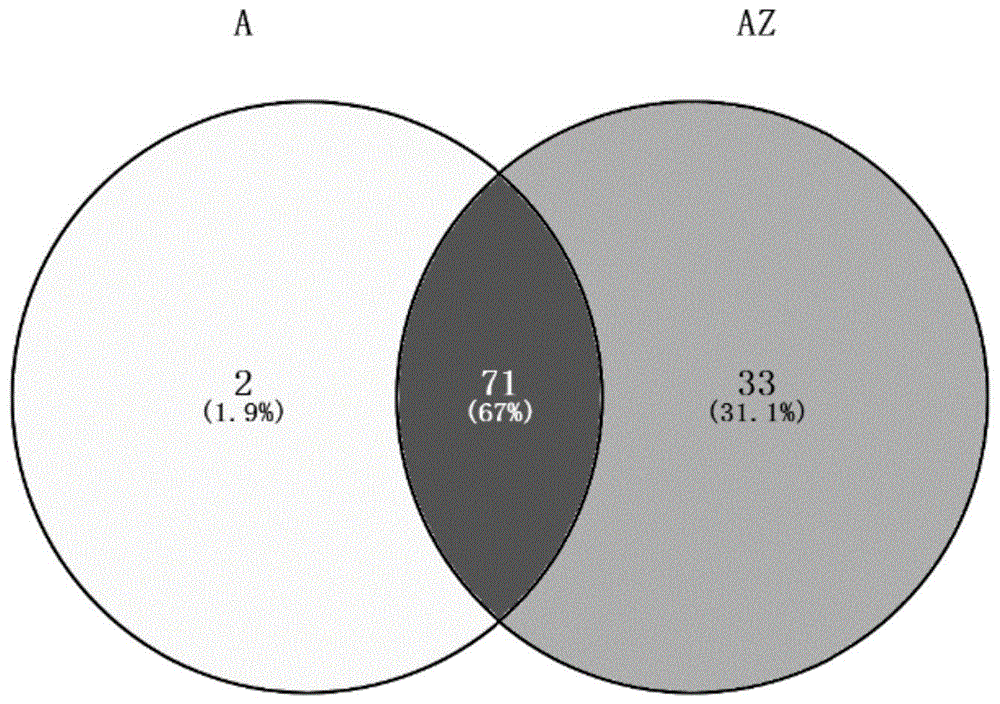
FIG. 2 is a comparison of the volatile flavor species in unskilled conjugated Rouyveromyces rouxii (A) and inoculated conjugated Rouyveromyces rouxii (AZ) soy mash.
Detailed Description
Example 1 screening of Zygosaccharomyces rouxii
Preparing a high-salt YAP culture medium: glucose 20 g.L-1Peptone20g·L-1Yeast powder 10 g.L-110 g.L of sodium propionate-160 g.L of sodium chloride-1。
Preparing a YPD culture medium: glucose 20 g.L-1Peptone 20 g.L-1Yeast powder 10 g.L-1Adding 20 g/L of solid culture medium-1Agar powder.
Adding 10g of fermented soybean paste into 90mL of sterile normal saline (0.9% sodium chloride), incubating at 200rpm and 30 deg.C for 1h, diluting, spreading on high-salt YAP plate, and culturing at 28 deg.C for 72 h. And selecting the milky single colony, and repeatedly carrying out plate streaking separation to obtain a purified single colony. Single colonies were inoculated into YPD liquid medium and cultured at 28 ℃ and 200rpm for 36 hours. An appropriate amount of the culture solution was centrifuged at 12000rpm for 2 minutes, and then the supernatant was discarded to collect the cells. Genomic DNA was extracted using a yeast genomic DNA extraction kit, and ITS internal transcriptional spacer region was amplified using primers ITS1 and ITS 4. The primer sequences are respectively as follows: ITS 1: TCCGTAGGTGAACCTGCGG, respectively; ITS 4: TCCTCCGCTTATTGATATGC are provided. The PCR product was sequenced by Shanghai worker, and as a result, as shown in SEQ ID NO.1, BLAST sequence alignment was performed on NCBI website, determined to be Zygosaccharomyces rouxii, and named as Y-8.
Example 2 salinity tolerance test in conjugated Saccharomyces rouxii
Preparing YPD culture media with different salt concentrations: glucose 20 g.L-1Peptone 20 g.L-1Yeast powder 10 g.L-1Adding 20 g/L of solid culture medium-1Agar powder was added with 0%, 4%, 8%, 12%, 16% and 20% (w/v) NaCl, respectively.
After inoculating the strain in the YPD liquid medium at an inoculation amount of 2% (by volume) and culturing for 48 hours, the growth conditions of the Zygosaccharomyces rouxii under different salinity conditions were determined to evaluate the salt tolerance.
As shown in FIG. 1, the Zygosaccharomyces rouxii strain Y-8 shows good salt tolerance, and has a fast growth rate under the conditions of 4% and 8% of the final NaCl concentration, a second growth rate under the conditions of 0%, 12% and 16% of the final NaCl concentration, and a relatively slow growth rate at 20% of the final NaCl concentration.
Example 3 use of conjugated yeast Lu's in fermentation of Soybean paste
Steaming semen Viciae Fabae at 121 deg.C under high pressure, cooling to room temperature, mixing with wheat flour at a ratio of 3:1, w/w, inoculating Aspergillus oryzae 3.042 at an inoculum size of 0.3%, and culturing at 30 deg.C for 60 hr to obtain koji. Mixing the finished koji with 20% (w/v) saline water according to the proportion of 1:1(w/w), adding into a fermentation tank for fermentation, wherein the fermentation temperature is 40 ℃. And after fermenting for 30 days, inoculating the zygosaccharomyces rouxii Y-8 activated to the middle and later logarithmic stages into the soy sauce mash, wherein the inoculation amount is 1-2% (w/v), the soy sauce mash which is not inoculated with the zygosaccharomyces rouxii is used as a reference, the fermentation temperature is 30 ℃, and the culture is continued for 30 days.
After the fermentation is finished, the flavor of the soy sauce mash inoculated with the zygosaccharomyces rouxii Y-8 is more full and the aroma is more mellow than that of the soy sauce mash not inoculated with the zygosaccharomyces rouxii. And (3) analyzing volatile flavor substances of the soy sauce mash, wherein the content and the type of volatile compounds in the soy sauce mash inoculated with the zygosaccharomyces rouxii Y-8 are obviously different from those of the non-inoculated soy sauce mash. As shown in FIG. 2, 73 and 104 volatile substances were found in the unstrained and inoculated soy sauce mash of Zygosaccharomyces rouxii Y-8, respectively, and the number of volatile flavor substances increased by 31 after inoculation of Zygosaccharomyces rouxii Y-8. As shown in Table 1, the contents of esters, alcohols, carbonyls, alkanes, heterocycles, acids and other compounds were significantly increased in the fermented soy sauce inoculated with Zygosaccharomyces rouxii Y-8. Table 2 lists the types and contents of various flavor substances detected in inoculated zygosaccharomyces rouxii and inoculated zygosaccharomyces rouxii soy sauce mash, and discovers that compared with the uninoculated strain soy sauce mash, the contents of most flavor substances in the soy sauce mash inoculated with zygosaccharomyces rouxii Y-8 are greatly increased, wherein the contents of esters, alcohols, carbonyls, alkanes, heterocycles, acids and other compounds in the soy sauce mash inoculated with the zygosaccharomyces rouxii are respectively increased by 15.5 times, 33.1 times, 1.1 times, 6.0 times, 1.8 times and 3.9 times compared with the contents of common bean sauce in the soy sauce mash inoculated with the zygosaccharomyces rouxii. Therefore, the inoculation of the zygosaccharomyces rouxii can effectively improve the flavor of the soybean paste.
TABLE 1 analysis of the content of volatile flavor substances in soy sauce mash (mg/100g dry basis) without inoculation of conjugated Rouyama yeast (A) and inoculation of conjugated Rouyama yeast Y-8(AZ)
TABLE 2 types and contents of volatile flavor substances in non-inoculated Zygosaccharomyces rouxii (A) and inoculated Zygosaccharomyces rouxii Y-8(AZ) soy sauce mash
Example 4 Effect of Zygosaccharomyces rouxii on physicochemical indices in fermentation of Soybean paste
The physical and chemical properties of the resulting soy sauce mash inoculated with the non-inoculated Zygosaccharomyces rouxii strain and the Zygosaccharomyces rouxii strain were measured and are shown in Table 3. As can be seen from Table 3, the moisture, salinity and reducing sugar content of the fermented soy sauce inoculated with the Zygosaccharomyces rouxii Y-8 strain were almost the same as those of the fermented soy sauce not inoculated with the strain, while the ammonia nitrogen content of the fermented soy sauce was 2.9%, which was 45% higher than that of the fermented soy sauce of the control group A, which was 2.0%. The enzyme activities of the protease and the glucoamylase in the soy sauce mash inoculated with the zygosaccharomyces rouxii are also higher than those of the control group A, and are respectively increased by 49.5% and 45.4% compared with the control group A; and the titratable acid content is reduced by 12.3 percent compared with the control group A. The higher the ammoniacal nitrogen content, the higher the protease and the glucoamylase activity, the better the quality of the soy sauce mash, and the results show that the quality of the soy sauce is improved by the inoculation of the zygosaccharomyces rouxii Y-8 strain.
TABLE 3 comparison of physicochemical indices and enzyme activities in soy sauce mash of non-inoculated conjugated Rouyama Yeast (A) and inoculated conjugated Rouyama Yeast Y-8(AZ)
Although the present invention has been described with reference to the preferred embodiments, it should be understood that various changes and modifications can be made therein by those skilled in the art without departing from the spirit and scope of the invention as defined in the appended claims.