CN110760498A - A kind of co-crosslinking immobilization method of glutamic acid decarboxylase - Google Patents
A kind of co-crosslinking immobilization method of glutamic acid decarboxylase Download PDFInfo
- Publication number
- CN110760498A CN110760498A CN201910417496.5A CN201910417496A CN110760498A CN 110760498 A CN110760498 A CN 110760498A CN 201910417496 A CN201910417496 A CN 201910417496A CN 110760498 A CN110760498 A CN 110760498A
- Authority
- CN
- China
- Prior art keywords
- enzyme
- water
- decarboxylase
- glutamate decarboxylase
- glutamic acid
- Prior art date
- Legal status (The legal status is an assumption and is not a legal conclusion. Google has not performed a legal analysis and makes no representation as to the accuracy of the status listed.)
- Granted
Links
- 102000008214 Glutamate decarboxylase Human genes 0.000 title claims abstract description 46
- 108091022930 Glutamate decarboxylase Proteins 0.000 title claims abstract description 46
- 238000004132 cross linking Methods 0.000 title claims abstract description 29
- 238000000034 method Methods 0.000 title claims abstract description 22
- 238000011068 loading method Methods 0.000 claims abstract description 20
- 239000003822 epoxy resin Substances 0.000 claims abstract description 12
- 229920000647 polyepoxide Polymers 0.000 claims abstract description 12
- 229920000858 Cyclodextrin Polymers 0.000 claims abstract description 11
- 239000001116 FEMA 4028 Substances 0.000 claims abstract description 9
- WHGYBXFWUBPSRW-FOUAGVGXSA-N beta-cyclodextrin Chemical compound OC[C@H]([C@H]([C@@H]([C@H]1O)O)O[C@H]2O[C@@H]([C@@H](O[C@H]3O[C@H](CO)[C@H]([C@@H]([C@H]3O)O)O[C@H]3O[C@H](CO)[C@H]([C@@H]([C@H]3O)O)O[C@H]3O[C@H](CO)[C@H]([C@@H]([C@H]3O)O)O[C@H]3O[C@H](CO)[C@H]([C@@H]([C@H]3O)O)O3)[C@H](O)[C@H]2O)CO)O[C@@H]1O[C@H]1[C@H](O)[C@@H](O)[C@@H]3O[C@@H]1CO WHGYBXFWUBPSRW-FOUAGVGXSA-N 0.000 claims abstract description 9
- 235000011175 beta-cyclodextrine Nutrition 0.000 claims abstract description 9
- 229960004853 betadex Drugs 0.000 claims abstract description 9
- 239000003431 cross linking reagent Substances 0.000 claims abstract description 6
- 239000000376 reactant Substances 0.000 claims abstract description 3
- 238000006243 chemical reaction Methods 0.000 claims description 24
- XLYOFNOQVPJJNP-UHFFFAOYSA-N water Substances O XLYOFNOQVPJJNP-UHFFFAOYSA-N 0.000 claims description 20
- OKKJLVBELUTLKV-UHFFFAOYSA-N Methanol Chemical compound OC OKKJLVBELUTLKV-UHFFFAOYSA-N 0.000 claims description 18
- 239000000243 solution Substances 0.000 claims description 17
- 239000007864 aqueous solution Substances 0.000 claims description 11
- 238000003756 stirring Methods 0.000 claims description 10
- 239000000047 product Substances 0.000 claims description 6
- 239000000203 mixture Substances 0.000 claims description 5
- 239000000126 substance Substances 0.000 claims description 5
- 150000001412 amines Chemical class 0.000 claims description 4
- 239000002244 precipitate Substances 0.000 claims description 4
- VILCJCGEZXAXTO-UHFFFAOYSA-N 2,2,2-tetramine Chemical compound NCCNCCNCCN VILCJCGEZXAXTO-UHFFFAOYSA-N 0.000 claims description 3
- 239000004841 bisphenol A epoxy resin Substances 0.000 claims description 3
- 238000001914 filtration Methods 0.000 claims description 3
- 239000007863 gel particle Substances 0.000 claims description 3
- 229940087646 methanolamine Drugs 0.000 claims description 3
- 239000008055 phosphate buffer solution Substances 0.000 claims description 3
- 229960001124 trientine Drugs 0.000 claims description 3
- 238000001035 drying Methods 0.000 claims description 2
- 150000001875 compounds Chemical class 0.000 claims 3
- JJUURNWAHSCGLQ-UHFFFAOYSA-N C(C=C)(=O)O.C(C=C)(=O)O.O1NC=CC=C1 Chemical compound C(C=C)(=O)O.C(C=C)(=O)O.O1NC=CC=C1 JJUURNWAHSCGLQ-UHFFFAOYSA-N 0.000 claims 2
- 238000002156 mixing Methods 0.000 claims 2
- 150000001408 amides Chemical class 0.000 claims 1
- 238000010438 heat treatment Methods 0.000 claims 1
- 238000005406 washing Methods 0.000 claims 1
- 102000004190 Enzymes Human genes 0.000 abstract description 48
- 108090000790 Enzymes Proteins 0.000 abstract description 48
- 230000000694 effects Effects 0.000 abstract description 28
- 108010093096 Immobilized Enzymes Proteins 0.000 abstract description 24
- 230000003197 catalytic effect Effects 0.000 abstract description 9
- 125000003277 amino group Chemical group 0.000 abstract description 5
- -1 pyridazine diacrylate Chemical compound 0.000 abstract description 5
- 238000012546 transfer Methods 0.000 abstract description 4
- 238000006845 Michael addition reaction Methods 0.000 abstract description 3
- 238000006116 polymerization reaction Methods 0.000 abstract description 2
- 239000008346 aqueous phase Substances 0.000 abstract 1
- 125000002924 primary amino group Chemical group [H]N([H])* 0.000 abstract 1
- BTCSSZJGUNDROE-UHFFFAOYSA-N gamma-aminobutyric acid Chemical compound NCCCC(O)=O BTCSSZJGUNDROE-UHFFFAOYSA-N 0.000 description 16
- 229960003692 gamma aminobutyric acid Drugs 0.000 description 10
- WEVYAHXRMPXWCK-UHFFFAOYSA-N Acetonitrile Chemical compound CC#N WEVYAHXRMPXWCK-UHFFFAOYSA-N 0.000 description 6
- 239000000758 substrate Substances 0.000 description 6
- OGNSCSPNOLGXSM-UHFFFAOYSA-N (+/-)-DABA Natural products NCCC(N)C(O)=O OGNSCSPNOLGXSM-UHFFFAOYSA-N 0.000 description 5
- 230000009286 beneficial effect Effects 0.000 description 5
- 238000004128 high performance liquid chromatography Methods 0.000 description 5
- 239000012071 phase Substances 0.000 description 5
- 238000003860 storage Methods 0.000 description 5
- BDAGIHXWWSANSR-UHFFFAOYSA-N Formic acid Chemical compound OC=O BDAGIHXWWSANSR-UHFFFAOYSA-N 0.000 description 4
- 238000006555 catalytic reaction Methods 0.000 description 4
- LOTKRQAVGJMPNV-UHFFFAOYSA-N 1-fluoro-2,4-dinitrobenzene Chemical compound [O-][N+](=O)C1=CC=C(F)C([N+]([O-])=O)=C1 LOTKRQAVGJMPNV-UHFFFAOYSA-N 0.000 description 3
- 238000005119 centrifugation Methods 0.000 description 3
- 229920000642 polymer Polymers 0.000 description 3
- 238000002360 preparation method Methods 0.000 description 3
- 239000006228 supernatant Substances 0.000 description 3
- CSCPPACGZOOCGX-UHFFFAOYSA-N Acetone Chemical compound CC(C)=O CSCPPACGZOOCGX-UHFFFAOYSA-N 0.000 description 2
- NIXOWILDQLNWCW-UHFFFAOYSA-M Acrylate Chemical compound [O-]C(=O)C=C NIXOWILDQLNWCW-UHFFFAOYSA-M 0.000 description 2
- 239000004971 Cross linker Substances 0.000 description 2
- 239000004593 Epoxy Substances 0.000 description 2
- WHUUTDBJXJRKMK-VKHMYHEASA-N L-glutamic acid Chemical compound OC(=O)[C@@H](N)CCC(O)=O WHUUTDBJXJRKMK-VKHMYHEASA-N 0.000 description 2
- 230000009471 action Effects 0.000 description 2
- 238000004220 aggregation Methods 0.000 description 2
- 230000002776 aggregation Effects 0.000 description 2
- 229940024606 amino acid Drugs 0.000 description 2
- 235000001014 amino acid Nutrition 0.000 description 2
- 150000001413 amino acids Chemical class 0.000 description 2
- 238000001212 derivatisation Methods 0.000 description 2
- 230000003993 interaction Effects 0.000 description 2
- 229920002521 macromolecule Polymers 0.000 description 2
- 239000008363 phosphate buffer Substances 0.000 description 2
- 230000008569 process Effects 0.000 description 2
- 235000018102 proteins Nutrition 0.000 description 2
- 102000004169 proteins and genes Human genes 0.000 description 2
- 108090000623 proteins and genes Proteins 0.000 description 2
- NGVDGCNFYWLIFO-UHFFFAOYSA-N pyridoxal 5'-phosphate Chemical class CC1=NC=C(COP(O)(O)=O)C(C=O)=C1O NGVDGCNFYWLIFO-UHFFFAOYSA-N 0.000 description 2
- 238000011160 research Methods 0.000 description 2
- HFHDHCJBZVLPGP-UHFFFAOYSA-N schardinger α-dextrin Chemical compound O1C(C(C2O)O)C(CO)OC2OC(C(C2O)O)C(CO)OC2OC(C(C2O)O)C(CO)OC2OC(C(O)C2O)C(CO)OC2OC(C(C2O)O)C(CO)OC2OC2C(O)C(O)C1OC2CO HFHDHCJBZVLPGP-UHFFFAOYSA-N 0.000 description 2
- 239000007787 solid Substances 0.000 description 2
- GJJFMKBJSRMPLA-HIFRSBDPSA-N (1R,2S)-2-(aminomethyl)-N,N-diethyl-1-phenyl-1-cyclopropanecarboxamide Chemical compound C=1C=CC=CC=1[C@@]1(C(=O)N(CC)CC)C[C@@H]1CN GJJFMKBJSRMPLA-HIFRSBDPSA-N 0.000 description 1
- USFZMSVCRYTOJT-UHFFFAOYSA-N Ammonium acetate Chemical compound N.CC(O)=O USFZMSVCRYTOJT-UHFFFAOYSA-N 0.000 description 1
- 239000005695 Ammonium acetate Substances 0.000 description 1
- KPYSYYIEGFHWSV-UHFFFAOYSA-N Baclofen Chemical compound OC(=O)CC(CN)C1=CC=C(Cl)C=C1 KPYSYYIEGFHWSV-UHFFFAOYSA-N 0.000 description 1
- LFQSCWFLJHTTHZ-UHFFFAOYSA-N Ethanol Chemical compound CCO LFQSCWFLJHTTHZ-UHFFFAOYSA-N 0.000 description 1
- 101710185287 Glutamate decarboxylase 3 Proteins 0.000 description 1
- WHUUTDBJXJRKMK-UHFFFAOYSA-N Glutamic acid Natural products OC(=O)C(N)CCC(O)=O WHUUTDBJXJRKMK-UHFFFAOYSA-N 0.000 description 1
- SXRSQZLOMIGNAQ-UHFFFAOYSA-N Glutaraldehyde Chemical compound O=CCCCC=O SXRSQZLOMIGNAQ-UHFFFAOYSA-N 0.000 description 1
- 208000008589 Obesity Diseases 0.000 description 1
- 229910019142 PO4 Inorganic materials 0.000 description 1
- GMZVRMREEHBGGF-UHFFFAOYSA-N Piracetam Chemical compound NC(=O)CN1CCCC1=O GMZVRMREEHBGGF-UHFFFAOYSA-N 0.000 description 1
- 239000002253 acid Substances 0.000 description 1
- 230000003213 activating effect Effects 0.000 description 1
- 238000009098 adjuvant therapy Methods 0.000 description 1
- 229940043376 ammonium acetate Drugs 0.000 description 1
- 235000019257 ammonium acetate Nutrition 0.000 description 1
- 230000003712 anti-aging effect Effects 0.000 description 1
- 208000006673 asthma Diseases 0.000 description 1
- 229960000794 baclofen Drugs 0.000 description 1
- 230000002210 biocatalytic effect Effects 0.000 description 1
- 230000002051 biphasic effect Effects 0.000 description 1
- 239000000872 buffer Substances 0.000 description 1
- 229910052799 carbon Inorganic materials 0.000 description 1
- 125000003178 carboxy group Chemical group [H]OC(*)=O 0.000 description 1
- 230000008859 change Effects 0.000 description 1
- 239000003795 chemical substances by application Substances 0.000 description 1
- 238000006114 decarboxylation reaction Methods 0.000 description 1
- 230000007423 decrease Effects 0.000 description 1
- 230000003247 decreasing effect Effects 0.000 description 1
- 230000001877 deodorizing effect Effects 0.000 description 1
- 230000001419 dependent effect Effects 0.000 description 1
- 238000001784 detoxification Methods 0.000 description 1
- PXEDJBXQKAGXNJ-QTNFYWBSSA-L disodium L-glutamate Chemical compound [Na+].[Na+].[O-]C(=O)[C@@H](N)CCC([O-])=O PXEDJBXQKAGXNJ-QTNFYWBSSA-L 0.000 description 1
- CBMPTFJVXNIWHP-UHFFFAOYSA-L disodium;hydrogen phosphate;2-hydroxypropane-1,2,3-tricarboxylic acid Chemical compound [Na+].[Na+].OP([O-])([O-])=O.OC(=O)CC(O)(C(O)=O)CC(O)=O CBMPTFJVXNIWHP-UHFFFAOYSA-L 0.000 description 1
- 238000010494 dissociation reaction Methods 0.000 description 1
- 230000005593 dissociations Effects 0.000 description 1
- 229940079593 drug Drugs 0.000 description 1
- 239000003814 drug Substances 0.000 description 1
- 238000009509 drug development Methods 0.000 description 1
- 230000002526 effect on cardiovascular system Effects 0.000 description 1
- 238000004945 emulsification Methods 0.000 description 1
- 230000002708 enhancing effect Effects 0.000 description 1
- 238000001952 enzyme assay Methods 0.000 description 1
- 206010015037 epilepsy Diseases 0.000 description 1
- 238000002474 experimental method Methods 0.000 description 1
- 235000013305 food Nutrition 0.000 description 1
- 230000006870 function Effects 0.000 description 1
- 229940049906 glutamate Drugs 0.000 description 1
- 229930195712 glutamate Natural products 0.000 description 1
- 235000013922 glutamic acid Nutrition 0.000 description 1
- 239000004220 glutamic acid Substances 0.000 description 1
- 239000008187 granular material Substances 0.000 description 1
- 230000002209 hydrophobic effect Effects 0.000 description 1
- 238000009776 industrial production Methods 0.000 description 1
- 230000002401 inhibitory effect Effects 0.000 description 1
- 238000002347 injection Methods 0.000 description 1
- 239000007924 injection Substances 0.000 description 1
- 230000003907 kidney function Effects 0.000 description 1
- 239000007791 liquid phase Substances 0.000 description 1
- 210000004185 liver Anatomy 0.000 description 1
- 230000003908 liver function Effects 0.000 description 1
- 238000004519 manufacturing process Methods 0.000 description 1
- 230000015654 memory Effects 0.000 description 1
- 230000004060 metabolic process Effects 0.000 description 1
- 239000012982 microporous membrane Substances 0.000 description 1
- 229960000600 milnacipran Drugs 0.000 description 1
- 235000013923 monosodium glutamate Nutrition 0.000 description 1
- 235000020824 obesity Nutrition 0.000 description 1
- 239000003960 organic solvent Substances 0.000 description 1
- 229960001227 oxiracetam Drugs 0.000 description 1
- IHLAQQPQKRMGSS-UHFFFAOYSA-N oxiracetam Chemical compound NC(=O)CN1CC(O)CC1=O IHLAQQPQKRMGSS-UHFFFAOYSA-N 0.000 description 1
- 238000012856 packing Methods 0.000 description 1
- 239000002245 particle Substances 0.000 description 1
- 125000001997 phenyl group Chemical group [H]C1=C([H])C([H])=C(*)C([H])=C1[H] 0.000 description 1
- NBIIXXVUZAFLBC-UHFFFAOYSA-K phosphate Chemical compound [O-]P([O-])([O-])=O NBIIXXVUZAFLBC-UHFFFAOYSA-K 0.000 description 1
- 239000010452 phosphate Substances 0.000 description 1
- 229960004526 piracetam Drugs 0.000 description 1
- 230000001737 promoting effect Effects 0.000 description 1
- 235000007682 pyridoxal 5'-phosphate Nutrition 0.000 description 1
- 239000011589 pyridoxal 5'-phosphate Substances 0.000 description 1
- 239000012429 reaction media Substances 0.000 description 1
- 230000009257 reactivity Effects 0.000 description 1
- 230000001105 regulatory effect Effects 0.000 description 1
- BHRZNVHARXXAHW-UHFFFAOYSA-N sec-butylamine Chemical compound CCC(C)N BHRZNVHARXXAHW-UHFFFAOYSA-N 0.000 description 1
- 229940073490 sodium glutamate Drugs 0.000 description 1
- 238000001179 sorption measurement Methods 0.000 description 1
- 238000005728 strengthening Methods 0.000 description 1
- 238000000825 ultraviolet detection Methods 0.000 description 1
- 239000002699 waste material Substances 0.000 description 1
Images


Classifications
-
- C—CHEMISTRY; METALLURGY
- C12—BIOCHEMISTRY; BEER; SPIRITS; WINE; VINEGAR; MICROBIOLOGY; ENZYMOLOGY; MUTATION OR GENETIC ENGINEERING
- C12N—MICROORGANISMS OR ENZYMES; COMPOSITIONS THEREOF; PROPAGATING, PRESERVING, OR MAINTAINING MICROORGANISMS; MUTATION OR GENETIC ENGINEERING; CULTURE MEDIA
- C12N11/00—Carrier-bound or immobilised enzymes; Carrier-bound or immobilised microbial cells; Preparation thereof
- C12N11/02—Enzymes or microbial cells immobilised on or in an organic carrier
- C12N11/10—Enzymes or microbial cells immobilised on or in an organic carrier the carrier being a carbohydrate
-
- C—CHEMISTRY; METALLURGY
- C12—BIOCHEMISTRY; BEER; SPIRITS; WINE; VINEGAR; MICROBIOLOGY; ENZYMOLOGY; MUTATION OR GENETIC ENGINEERING
- C12N—MICROORGANISMS OR ENZYMES; COMPOSITIONS THEREOF; PROPAGATING, PRESERVING, OR MAINTAINING MICROORGANISMS; MUTATION OR GENETIC ENGINEERING; CULTURE MEDIA
- C12N11/00—Carrier-bound or immobilised enzymes; Carrier-bound or immobilised microbial cells; Preparation thereof
- C12N11/02—Enzymes or microbial cells immobilised on or in an organic carrier
- C12N11/08—Enzymes or microbial cells immobilised on or in an organic carrier the carrier being a synthetic polymer
-
- C—CHEMISTRY; METALLURGY
- C12—BIOCHEMISTRY; BEER; SPIRITS; WINE; VINEGAR; MICROBIOLOGY; ENZYMOLOGY; MUTATION OR GENETIC ENGINEERING
- C12N—MICROORGANISMS OR ENZYMES; COMPOSITIONS THEREOF; PROPAGATING, PRESERVING, OR MAINTAINING MICROORGANISMS; MUTATION OR GENETIC ENGINEERING; CULTURE MEDIA
- C12N9/00—Enzymes; Proenzymes; Compositions thereof; Processes for preparing, activating, inhibiting, separating or purifying enzymes
- C12N9/88—Lyases (4.)
-
- C—CHEMISTRY; METALLURGY
- C12—BIOCHEMISTRY; BEER; SPIRITS; WINE; VINEGAR; MICROBIOLOGY; ENZYMOLOGY; MUTATION OR GENETIC ENGINEERING
- C12Y—ENZYMES
- C12Y401/00—Carbon-carbon lyases (4.1)
- C12Y401/01—Carboxy-lyases (4.1.1)
- C12Y401/01015—Glutamate decarboxylase (4.1.1.15)
-
- Y—GENERAL TAGGING OF NEW TECHNOLOGICAL DEVELOPMENTS; GENERAL TAGGING OF CROSS-SECTIONAL TECHNOLOGIES SPANNING OVER SEVERAL SECTIONS OF THE IPC; TECHNICAL SUBJECTS COVERED BY FORMER USPC CROSS-REFERENCE ART COLLECTIONS [XRACs] AND DIGESTS
- Y02—TECHNOLOGIES OR APPLICATIONS FOR MITIGATION OR ADAPTATION AGAINST CLIMATE CHANGE
- Y02P—CLIMATE CHANGE MITIGATION TECHNOLOGIES IN THE PRODUCTION OR PROCESSING OF GOODS
- Y02P20/00—Technologies relating to chemical industry
- Y02P20/50—Improvements relating to the production of bulk chemicals
Landscapes
- Life Sciences & Earth Sciences (AREA)
- Health & Medical Sciences (AREA)
- Chemical & Material Sciences (AREA)
- Organic Chemistry (AREA)
- Wood Science & Technology (AREA)
- Engineering & Computer Science (AREA)
- Bioinformatics & Cheminformatics (AREA)
- Genetics & Genomics (AREA)
- Zoology (AREA)
- Biochemistry (AREA)
- General Engineering & Computer Science (AREA)
- General Health & Medical Sciences (AREA)
- Microbiology (AREA)
- Biotechnology (AREA)
- Biomedical Technology (AREA)
- Molecular Biology (AREA)
- Medicinal Chemistry (AREA)
- Immobilizing And Processing Of Enzymes And Microorganisms (AREA)
- Enzymes And Modification Thereof (AREA)
Abstract
本发明是关于一种谷氨酸脱羧酶的共交联固定化方法。使用油溶性的噠嗪双丙烯酸酯作为交联剂,水相中的反应物为含有氨基的谷氨酸脱羧酶以及胺化环氧树脂与β‑环糊精形成的超分子复合物,利用双键与氨基的迈克尔加成反应,在较低的温度下发生共交联聚合反应,制备出不同负载量的固定化谷氨酸脱羧酶。通过控制交联程度,提高分散性,改善其内部的传质微环境,该固定化酶具有较高的催化活性,负载量在75mg酶/g载体时具有最高的活性,达到游离酶的94%。

The present invention relates to a co-crosslinking immobilization method of glutamic acid decarboxylase. Oil-soluble pyridazine diacrylate is used as a cross-linking agent, and the reactants in the aqueous phase are amino-containing glutamic acid decarboxylase and supramolecular complexes formed by aminated epoxy resin and β-cyclodextrin. The Michael addition reaction between the bond and the amino group, and the co-crosslinking polymerization reaction occurs at a lower temperature to prepare the immobilized glutamate decarboxylase with different loadings. By controlling the degree of cross-linking, improving dispersibility, and improving the internal mass transfer microenvironment, the immobilized enzyme has high catalytic activity, and the loading amount of 75mg enzyme/g carrier has the highest activity, reaching 94% of the free enzyme. .
Description
技术领域technical field
本发明涉及固定化酶生物催化技术领域,尤其是一种谷氨酸脱羧酶的共交联固定化方法,该新型固定化谷氨酸脱羧酶可专门用于γ-氨基丁酸的高效制备。The invention relates to the technical field of immobilized enzyme biocatalysis, in particular to a co-crosslinking and immobilization method of glutamic acid decarboxylase. The novel immobilized glutamic acid decarboxylase can be specially used for the efficient preparation of γ-aminobutyric acid.
背景技术Background technique
γ-氨基丁酸是一种四碳非蛋白组成氨基酸,被确认是哺乳动物神经中枢的一种抑制性递质,在调节哺乳动物心脑血管的活动方面起着重要的作用。在医药工业和食品工业具有广泛的用途。γ-氨基丁酸类似物和衍生物的药物开发已经成为当前研究的热点之一。已经上市的药品有巴氯芬、米那普仑、喜保宁、吡拉西坦、奥拉西坦等。γ-氨基丁酸还具有治疗癫痫、辅助治疗哮喘、强化记忆力、抗衰老、活化肝肾功能、解毒、预防肥胖、促进酒精代谢和除臭等功能。Gamma-aminobutyric acid is a four-carbon non-protein amino acid, which is confirmed to be an inhibitory transmitter in mammalian nerve center and plays an important role in regulating the activity of mammalian cardiovascular and cerebrovascular. It has a wide range of uses in the pharmaceutical industry and the food industry. The drug development of γ-aminobutyric acid analogs and derivatives has become one of the current research hotspots. The drugs that have been listed are baclofen, milnacipran, xiborine, piracetam, oxiracetam and so on. Gamma-aminobutyric acid also has the functions of treating epilepsy, adjuvant treatment of asthma, strengthening memory, anti-aging, activating liver and kidney function, detoxification, preventing obesity, promoting alcohol metabolism and deodorizing.
谷氨酸脱羧酶(EC 4.1.1.15)是一类磷酸吡哆醛依赖性酶(等电点为5.61),是生物催化法制备γ-氨基丁酸的唯一关键酶。γ-氨基丁酸是由谷氨酸在谷氨酸脱羧酶作用下,脱掉α羧基形成的。此方法单产高,纯度较高,适合大规模工业化生产。谷氨酸脱梭酶对谷氨酸的催化作用是专一的,在催化其他氨基酸进行脱羧反应上没有作用,且作用的pH为4.0~5.0时,酶活力达到最高,但谷氨酸脱羧酶在pH高于7.0、蛋白质浓度和温度较低时,容易发生解离。Glutamate decarboxylase (EC 4.1.1.15) is a class of pyridoxal phosphate-dependent enzymes (with an isoelectric point of 5.61), and is the only key enzyme for biocatalytic production of γ-aminobutyric acid. γ-aminobutyric acid is formed by removing the α carboxyl group from glutamic acid under the action of glutamic acid decarboxylase. This method has high yield and high purity, and is suitable for large-scale industrial production. The catalytic effect of glutamate decarboxylase on glutamate is specific, and it has no effect on catalyzing the decarboxylation reaction of other amino acids, and the enzyme activity reaches the highest when the pH of the action is 4.0 to 5.0, but glutamate decarboxylase Dissociation readily occurs at pH above 7.0, protein concentration and temperature are low.
固定化酶就是通过化学手段将水溶性的游离酶变成不溶性的固体酶,固定化有很多优点:例如固定化的谷氨酸脱羧酶可重复使用,使酶的使用效率提高、使用成本降低;固定化的谷氨酸脱羧酶极易与反应体系分离,简化了操作工艺;固定化的谷氨酸脱羧酶其储存稳定性和热稳定性都得到了提高;固定化酶的催化反应过程更易控制;固定化酶具有一定的机械强度,可以用搅拌或装柱的方式作用于底物溶液,便于酶催化反应的连续化和自动化操作。酶的交联是一种非常有效的固定化方法,其所形成的产物称为交联酶聚集体。最常用的交联剂为水溶性的戊二醛,它反应活性高,用量难以控制,很容易造成酶的过度交联,使酶的活性有很大的损失,此外,传统的交联法往往须要在交联之前使酶分子沉淀聚集,这样既会造成酶的浪费,又会阻断传质通道,无法充分发挥酶的催化效率。Immobilized enzyme is to change water-soluble free enzyme into insoluble solid enzyme by chemical means. Immobilization has many advantages: for example, immobilized glutamic acid decarboxylase can be reused, which improves the use efficiency of the enzyme and reduces the use cost; The immobilized glutamate decarboxylase is easily separated from the reaction system, which simplifies the operation process; the storage stability and thermal stability of the immobilized glutamate decarboxylase have been improved; the catalytic reaction process of the immobilized enzyme is easier to control ; The immobilized enzyme has a certain mechanical strength and can act on the substrate solution by stirring or packing a column, which is convenient for the continuous and automated operation of the enzyme-catalyzed reaction. Enzyme cross-linking is a very efficient immobilization method, and the resulting products are called cross-linked enzyme aggregates. The most commonly used cross-linking agent is water-soluble glutaraldehyde, which has high reactivity and is difficult to control in dosage, which can easily cause excessive cross-linking of enzymes and cause great loss of enzyme activity. In addition, traditional cross-linking methods often It is necessary to precipitate and aggregate the enzyme molecules before cross-linking, which will not only cause the waste of the enzyme, but also block the mass transfer channel, so that the catalytic efficiency of the enzyme cannot be fully utilized.
本发明专利提供一种共交联的方法用于谷氨酸脱羧酶的固定,利用谷氨酸脱羧酶分子上的氨基与丙烯酸酯类交联剂发生迈克尔加成反应,同时还引入含有β-环糊精的结构单元,这样既能为催化反应提供空间,降低传质阻力,同时还能增加亲水性,提高酶的活性。使用这种共交联方法,酶的负载量和催化活性高,稳定性好,固定化酶呈颗粒状,催化反应容易操作。The patent of the present invention provides a co-crosslinking method for the immobilization of glutamate decarboxylase, which utilizes the Michael addition reaction between the amino group on the glutamate decarboxylase molecule and the acrylate cross-linking agent, and also introduces β- The structural unit of cyclodextrin can not only provide space for the catalytic reaction, reduce the mass transfer resistance, but also increase the hydrophilicity and improve the activity of the enzyme. Using this co-crosslinking method, the loading capacity and catalytic activity of the enzyme are high, the stability is good, the immobilized enzyme is in the form of granules, and the catalytic reaction is easy to operate.
发明内容SUMMARY OF THE INVENTION
本发明所要解决的技术问题是提供一种谷氨酸脱羧酶的固定化方法,这种方法是基于谷氨酸脱羧酶与另一种含有机胺的分子复合物的共交联反应,交联反应的基础是丙烯酸酯与氨基的迈克尔加成,该反应在常温下就能快速发生,因而不会对酶的整体结构造成破坏,共交联法负载效率高,稳定性好,同时还能调节固定化酶的微环境,使其保持高的催化活性。The technical problem to be solved by the present invention is to provide a method for immobilization of glutamic acid decarboxylase, which is based on the co-crosslinking reaction of glutamic acid decarboxylase and another molecular complex containing organic amines. The basis of the reaction is the Michael addition of acrylate to amino group. The reaction can occur rapidly at room temperature, so it will not damage the overall structure of the enzyme. The co-crosslinking method has high loading efficiency, good stability, and can adjust The microenvironment of the immobilized enzyme keeps it high catalytic activity.
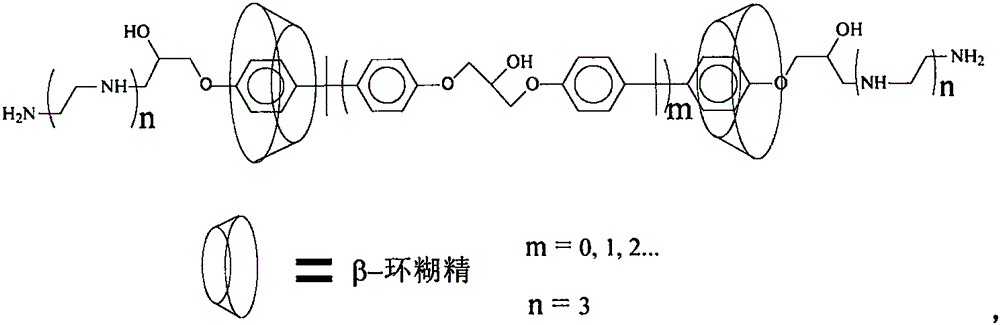
1、本发明解决技术问题所采用的技术方案为:一种水/油两相的交联反应,油相为交联剂噠嗪双丙烯酸酯,其结构如图1所示,水相中的反应物为谷氨酸脱羧酶及β-环糊精与胺化环氧树脂的超分子复合物,固定化酶的负载量是通过谷氨酸脱羧酶的浓度来调节。1. The technical scheme adopted by the present invention to solve the technical problem is: a cross-linking reaction of water/oil two-phase, and the oil phase is a cross-linking agent pyridazine diacrylate, and its structure is shown in Figure 1, and the The reactants were glutamate decarboxylase and supramolecular complexes of β-cyclodextrin and aminated epoxy resin, and the loading of the immobilized enzyme was adjusted by the concentration of glutamate decarboxylase.
非常有益的是,通过多相反应可以控制交联程度,避免酶的过度交联;Very beneficially, the degree of cross-linking can be controlled through a heterogeneous reaction, avoiding excessive cross-linking of enzymes;
非常有益的是,β-环糊精与胺化环氧树脂的分子复合物与酶分子产生强的亲和力,导致交联反应能使谷氨酸脱羧酶能以接近100%的利用率被固定化,交联反应发生后,液相中几乎没有残留的谷氨酸脱羧酶;It is very beneficial that the molecular complex of β-cyclodextrin and aminated epoxy resin has a strong affinity with the enzyme molecule, resulting in a cross-linking reaction that enables glutamate decarboxylase to be immobilized with nearly 100% utilization. , after the cross-linking reaction occurs, there is almost no residual glutamate decarboxylase in the liquid phase;
非常有益的是,β-环糊精与胺化环氧树脂的分子复合物具有弯曲的刚性结构,它带来了充足的自由体积,为生物大分子与底物相互作用提供传质通道,同时为生物大分子的构象提供稳定性,从而提高了固定化酶的催化活性。It is very beneficial that the molecular complex of β-cyclodextrin and aminated epoxy resin has a curved rigid structure, which brings sufficient free volume to provide a mass transfer channel for the interaction of biological macromolecules and substrates, and simultaneously Provides stability to the conformation of biological macromolecules, thereby enhancing the catalytic activity of the immobilized enzyme.
2、本发明解决另一个技术问题所采用的技术方案为:一种上述固定化酶的制备方法,其特征步骤为:1)将双酚A环氧树脂(牌号为E-51,环氧值为0.51,数均分子量为392)、甲醇和三乙烯四胺三种组分按照2∶2∶1.5的质量比混合,在25~35℃范围内搅拌反应4~5小时,将混合物倒入水中,沉淀物用水反复洗涤除去甲醇和少量的胺,然后放入真空烘箱中常温干燥,得到环氧树脂胺化物;2)将环氧树脂胺化物与β-环糊精按照1∶2.1~1∶2.3的摩尔比加入到水中,加热搅拌至环氧树脂胺化物全部转化为分子复合物而溶解在水中,保持该水溶液的总质量浓度在5~6wt.%范围;3)将谷氨酸脱羧酶溶解在pH=6.5的磷酸缓冲溶液中,酶的浓度保持在1.0~7.0mg/mL范围;4)分别将浓度为1.0mg/mL、2.0mg/mL、3.0mg/mL、4.0mg/mL、5.0mg/mL、6.0mg/mL、7.0mg/mL的谷氨酸脱羧酶溶液与上述分子复合物水溶液按照55mL∶20mL的比例混合,通过改变酶溶液的浓度来调节固定化酶的负载量;5)在搅拌下将1.2g噠嗪双丙烯酸酯加入到上述混合水溶液中,反应温度保持在25~30℃范围,10~15分钟后有白色凝胶颗粒形成,停止搅拌使反应体系放置4~5小时,过滤后即得到不同负载量的固定化谷氨酸脱羧酶的产物。2. The technical solution adopted by the present invention to solve another technical problem is: a preparation method of the above-mentioned immobilized enzyme, wherein the characteristic steps are: 1) bisphenol A epoxy resin (brand name is E-51, epoxy value is 0.51, the number average molecular weight is 392), methanol and triethylenetetramine are mixed according to the mass ratio of 2:2:1.5, and the reaction is stirred in the range of 25 to 35 ° C for 4 to 5 hours, and the mixture is poured into water. , the precipitate was repeatedly washed with water to remove methanol and a small amount of amine, and then dried at room temperature in a vacuum oven to obtain epoxy resin aminate; The molar ratio of 2.3 is added to water, heated and stirred until all epoxy resin aminates are converted into molecular complexes and dissolved in water, keeping the total mass concentration of the aqueous solution in the range of 5-6 wt.%; 3) Glutamate decarboxylase Dissolved in phosphate buffer solution with pH=6.5, the concentration of enzyme was kept in the range of 1.0-7.0mg/mL; The glutamate decarboxylase solution of 5.0mg/mL, 6.0mg/mL and 7.0mg/mL was mixed with the above-mentioned molecular complex aqueous solution according to the ratio of 55mL: 20mL, and the loading of the immobilized enzyme was adjusted by changing the concentration of the enzyme solution; 5) 1.2g of pyridazine diacrylate was added to the above mixed aqueous solution under stirring, and the reaction temperature was kept in the range of 25 to 30 ° C. After 10 to 15 minutes, white gel particles were formed. Stop stirring and allow the reaction system to stand for 4 to After 5 hours, different loadings of immobilized glutamate decarboxylase products were obtained after filtration.
非常有益的是,交联剂中的一个双键首先与分子复合物上的氨基发生反应,形成具有乳化作用的产物,油相在反应启动后会很快分散直至消失,谷氨酸脱羧酶首先通过吸附方式进入聚合物中,然后交联剂上的双键与酶上的氨基进行缓慢的反应,最终变成共交联的固定化酶产物;It is very beneficial that a double bond in the cross-linking agent first reacts with the amino group on the molecular complex to form a product with emulsification, the oil phase will disperse quickly after the reaction starts until it disappears, and glutamate decarboxylase first It enters the polymer by adsorption, and then the double bond on the crosslinker reacts slowly with the amino group on the enzyme, and finally becomes a co-crosslinked immobilized enzyme product;
非常有益的是,利用β-环糊精与疏水苯环的相互作用引入亲水基团,避免使用化学键,并通过交联反应使β-环糊精无法脱离聚合物,使固定化酶的制备简化;It is very beneficial to use the interaction of β-cyclodextrin with the hydrophobic benzene ring to introduce a hydrophilic group, avoid the use of chemical bonds, and make the β-cyclodextrin unable to dissociate from the polymer through the cross-linking reaction, enabling the preparation of immobilized enzymes. simplify;
非常有益的是,整个聚合过程中不加入其它有机溶剂,不需要更高的温度。It is very beneficial that no other organic solvent is added during the whole polymerization process, and higher temperature is not required.
本发明的优点在于:1)利用水/油双相反应实现酶的交联,控制了交联程度;2)引入β-环糊精超分子复合物改善了固定化谷氨酸脱羧酶的微环境,提高了酶的催化反应活性;3)共交联固定法能使谷氨酸脱羧酶以极高的效率被固定化。The advantages of the invention are: 1) the cross-linking of the enzyme is realized by using the water/oil biphasic reaction, and the degree of cross-linking is controlled; 2) the introduction of the β-cyclodextrin supramolecular complex improves the microscopic efficiency of the immobilized glutamate decarboxylase 3) The co-crosslinking immobilization method can immobilize glutamic acid decarboxylase with extremely high efficiency.
具体实施方式Detailed ways
酶的固定化Immobilization of enzymes
1)将双酚A环氧树脂(牌号为E-51,环氧值为0.51,数均分子量为392)、甲醇和三乙烯四胺三种组分按照2∶2∶1.5的质量比混合,在25~35℃范围内搅拌反应4~5小时,将混合物倒入水中,沉淀物用水反复洗涤除去甲醇和少量的胺,然后放入真空烘箱中常温干燥,得到环氧树脂胺化物;1) bisphenol A epoxy resin (brand name is E-51, epoxy value is 0.51, number-average molecular weight is 392), methanol and triethylene tetramine three components are mixed according to the mass ratio of 2: 2: 1.5, The reaction was stirred at 25 to 35°C for 4 to 5 hours, the mixture was poured into water, the precipitate was repeatedly washed with water to remove methanol and a small amount of amine, and then placed in a vacuum oven for drying at room temperature to obtain epoxy resin aminate;
2)将环氧树脂胺化物与β-环糊精按照1∶2.1~1∶2.3的摩尔比加入到水中,加热搅拌至环氧树脂胺化物全部转化为分子复合物而溶解在水中,保持该水溶液的总质量浓度在5~6wt.%范围;2) Add epoxy resin aminate and β-cyclodextrin into water according to the molar ratio of 1:2.1~1:2.3, heat and stir until epoxy resin aminate is completely converted into molecular complex and dissolve in water, keep this The total mass concentration of the aqueous solution is in the range of 5 to 6 wt.%;
3)将谷氨酸脱羧酶溶解在pH=6.5的磷酸缓冲溶液中,酶的浓度保持在1.0~7.0mg/mL范围;3) Dissolving glutamate decarboxylase in a phosphate buffer solution with pH=6.5, the concentration of the enzyme is kept in the range of 1.0-7.0 mg/mL;
4)分别将浓度为1.0mg/mL、2.0mg/mL、3.0mg/mL、4.0mg/mL、5.0mg/mL、6.0mg/mL、7.0mg/mL的谷氨酸脱羧酶溶液与上述分子复合物水溶液按照55mL∶20mL的比例混合,通过改变酶溶液的浓度来调节固定化酶的负载量;4) Glutamate decarboxylase solutions with concentrations of 1.0mg/mL, 2.0mg/mL, 3.0mg/mL, 4.0mg/mL, 5.0mg/mL, 6.0mg/mL, 7.0mg/mL were respectively mixed with the above molecules. The complex aqueous solution is mixed according to the ratio of 55mL: 20mL, and the loading amount of the immobilized enzyme is adjusted by changing the concentration of the enzyme solution;
5)在搅拌下将1.2g噠嗪双丙烯酸酯加入到上述混合水溶液中,反应温度保持在25~30℃范围10~15分钟后有白色凝胶颗粒形成,同时油相消失,停止搅拌使反应体系放置4~5小时,过滤后即得到不同负载量的固定化谷氨酸脱羧酶的产物。5) 1.2 g of pyridazine diacrylate was added to the above mixed aqueous solution under stirring, and the reaction temperature was kept in the range of 25 to 30 ° C for 10 to 15 minutes. After 10 to 15 minutes, white gel particles were formed, and the oil phase disappeared at the same time. Stop stirring to make the reaction The system was placed for 4 to 5 hours, and the products of different loadings of immobilized glutamic acid decarboxylase were obtained after filtration.
固定化酶的负载量测定:Loading determination of immobilized enzyme:
由于共交联法固定谷氨酸脱羧酶后,反应残留液中测不到谷氨酸脱羧酶的活性,说明经过交联后谷氨酸脱羧酶全部进入到固体颗粒中,所以负载量的计算用以下公式:Since glutamate decarboxylase was immobilized by the co-crosslinking method, the activity of glutamate decarboxylase could not be detected in the reaction residue, indicating that all glutamate decarboxylase entered the solid particles after cross-linking, so the calculation of the loading amount Use the following formula:

其中:C为共交联酶溶液的浓度(mg/mL);V为共交联酶溶液的体积(mL);m为固定化酶干态质量(g)。Where: C is the concentration of the co-cross-linked enzyme solution (mg/mL); V is the volume of the co-cross-linked enzyme solution (mL); m is the dry mass of the immobilized enzyme (g).
酶活力测定:Enzyme activity assay:
(1)游离酶活的测定:取400μL底物溶液(pH 4.8、0.2mol/L柠檬酸-磷酸氢二钠缓冲液,含0.01mmol/L PLP、100mmol/L底物L-MSG)加入到1.5mL离心管中,置于37℃水浴中预热,然后加入20μL纯谷氨酸脱羧酶,迅速混匀,在37℃的条件下反应40min,反应结束后,取样品0.1mL加入0.9mL的NaHCO3溶液(0.2mol/L,pH 9.8)以终止反应,离心后取上清0.5mL,再加入等量DNS-C1丙酮(8g/L)溶液,置于30℃下避光衍生1h,衍生后的样品经0.22μm微孔滤膜过滤后,采用高效液相色谱法(HPLC法)测定反应生成的GABA的含量,以测定酶活力。(1) Determination of free enzyme activity: Take 400 μL of substrate solution (pH 4.8, 0.2 mol/L citric acid-disodium hydrogen phosphate buffer, containing 0.01 mmol/L PLP, 100 mmol/L substrate L-MSG) and add it to In a 1.5mL centrifuge tube, place it in a 37°C water bath to preheat, then add 20μL of pure glutamate decarboxylase, mix quickly, and react at 37°C for 40min. After the reaction, take 0.1mL of the sample and add 0.9mL of NaHCO 3 solution (0.2mol/L, pH 9.8) was used to stop the reaction. After centrifugation, 0.5 mL of the supernatant was taken, and an equal amount of DNS-C1 acetone (8 g/L) solution was added. After the sample was filtered through a 0.22 μm microporous membrane, the content of GABA generated by the reaction was determined by high performance liquid chromatography (HPLC method) to determine the enzyme activity.
(2)固定化酶活的测定:用0.05mol/L磷酸盐(pH 5.6)缓冲液作为反应介质,加入20mg固定化谷氨酸脱羧酶,再加入0.05mol/L谷氨酸钠作为底物,以100r/min的转速于最适温度下恒温水浴振荡2h,在90℃下灭活5min,离心取上清液,定容后用高效液相色谱法(HPLC)测定溶液中γ-氨基丁酸(GABA)的含量。以每30min生成1μmol GABA作为一个酶活力单位。(2) Determination of immobilized enzyme activity: use 0.05mol/L phosphate (pH 5.6) buffer as the reaction medium, add 20 mg of immobilized glutamate decarboxylase, and then add 0.05mol/L sodium glutamate as the substrate , shake at a constant temperature of 100 r/min in a constant temperature water bath for 2 hours, inactivate at 90 °C for 5 minutes, take the supernatant by centrifugation, and use high performance liquid chromatography (HPLC) to determine the γ-aminobutane in the solution after constant volume. Acid (GABA) content. 1 μmol GABA was generated every 30 min as an enzyme activity unit.
其中,HPLC法测定GABA含量时进行柱前衍生化,具体方法为:Wherein, pre-column derivatization is performed when the GABA content is determined by HPLC, and the specific method is:
(i)GABA柱前衍生化的方法:(i) Method for pre-column derivatization of GABA:
以1%2,4-二硝基氟苯的乙腈溶液(FDNB)作为衍生剂。取10000r/min转速下离心10min后的样品上清液0.2mL于2ml离心管中,再加入0.5mol/L NaHCO3(pH=9.0)溶液0.2mL,FDNB溶液0.2mL,置于60℃水浴中暗处加热1h,取出后迅速用冷水冷却。加0.05mol/L磷酸盐缓冲液(pH=7.0)1.4mL,混合均匀后过0.45μm滤膜,以10000r/min的转速下离心10min,4℃下避光保存备用。1% 2,4-dinitrofluorobenzene in acetonitrile (FDNB) was used as a derivatizing agent. Take 0.2mL of the sample supernatant after centrifugation at 10000r/min for 10min in a 2ml centrifuge tube, then add 0.2mL of 0.5mol/L NaHCO 3 (pH=9.0) solution, 0.2mL of FDNB solution, and place it in a 60°C water bath Heated in the dark for 1h, and quickly cooled with cold water after taking it out. Add 1.4 mL of 0.05 mol/L phosphate buffer (pH=7.0), mix well, pass through a 0.45 μm filter, centrifuge at 10,000 r/min for 10 min, and store at 4°C in the dark for later use.
(ii)HPLC色谱条件:(ii) HPLC chromatographic conditions:
紫外检测波长:360nm;色谱柱:Lichrospher C18(4.6×250mm,5μm);柱温:35℃;流动相:A为20mmol/L醋酸铵水溶液,B为等体积比的乙腈水溶液;流速:1mL/min;进样量:10μL。UV detection wavelength: 360nm; Chromatographic column: Lichrospher C18 (4.6×250mm, 5μm); Column temperature: 35°C; Mobile phase: A is 20mmol/L ammonium acetate aqueous solution, B is an equal volume ratio of acetonitrile aqueous solution; flow rate: 1mL/ min; injection volume: 10 μL.
相对活性:Relative activity:
将固定化酶的活性与游离酶的活性之比定义为相对活性。The relative activity was defined as the ratio of the activity of the immobilized enzyme to the activity of the free enzyme.
实验结果:Experimental results:
实验一共得到7个不同负载量的固定化谷氨酸脱羧酶的样品,分别测定它们的活力,计算得到它们的相对活性。图2是相对活性与负载量的关系,当负载量为75mg酶/g载体时其相对活性达到最大值,其比活力是游离酶的94%,这个结果说明谷氨酸脱羧酶在这个范围处于非常适合催化的状态。当负载量小于75mg酶/g载体时,固定化酶的活性逐渐随负载量的增加而增大,这主要是因为随着酶含量增加,聚合物的结构变的松散,酶与底物的接触机会增大,其相对活性也随之提高。当负载量大于75mg酶/g载体时,固定化酶的活性逐渐随负载量的增加而变小。一般来说交联固定法都会使酶的构象变得僵硬,从而活性降低,本发明专利的共交联固定法能使酶的微环境得到改善,这与引入环糊精超分子结构单元有关,它使固定化酶的结构变的松散,同时还改善了内部的亲水性,此外共交联还能提高酶的分散性,避免了酶的聚集,从而提高其催化活性。但是当负载量过大时,酶的聚集变得不可避免,所以其活性又迅速下降。A total of 7 samples with different loadings of immobilized glutamate decarboxylase were obtained in the experiment, their activities were measured respectively, and their relative activities were calculated. Figure 2 is the relationship between the relative activity and the loading amount. When the loading amount is 75 mg enzyme/g carrier, its relative activity reaches the maximum value, and its specific activity is 94% of the free enzyme. This result shows that glutamic acid decarboxylase is in this range. Very suitable for catalytic state. When the loading amount is less than 75mg enzyme/g carrier, the activity of the immobilized enzyme gradually increases with the increase of the loading amount, which is mainly because with the increase of the enzyme content, the structure of the polymer becomes loose and the contact between the enzyme and the substrate increases. As the opportunity increases, so does its relative activity. When the loading amount was greater than 75 mg enzyme/g carrier, the activity of the immobilized enzyme gradually decreased with the increase of the loading amount. In general, the cross-linking immobilization method will make the conformation of the enzyme stiff, thereby reducing the activity. The co-cross-linking immobilization method of the patent of the present invention can improve the microenvironment of the enzyme, which is related to the introduction of cyclodextrin supramolecular structural units. It loosens the structure of the immobilized enzyme and improves the internal hydrophilicity. In addition, the co-crosslinking can improve the dispersibility of the enzyme, avoid the aggregation of the enzyme, and improve its catalytic activity. But when the load is too large, the aggregation of the enzyme becomes inevitable, so its activity decreases rapidly.
我们以负载量为61mg酶/g载体的样品为研究对象,测定固定化酶与游离酶溶液的储存稳定性,其结果如图3所示,以时间为零的起始状态的活性为100%,在4℃,pH=6.0条件下经过28天的储存,游离酶溶液只残留57%的活性,固定化酶能残留84%的活性,所以在储存稳定性方面,固定化酶要明显优于游离酶。We took the sample with a load of 61 mg enzyme/g carrier as the research object, and measured the storage stability of the immobilized enzyme and the free enzyme solution. The results are shown in Figure 3. The activity in the initial state with time zero is 100%. , after 28 days of storage at 4°C and pH=6.0, the free enzyme solution has only 57% of the activity remaining, and the immobilized enzyme can remain 84% of the activity, so in terms of storage stability, the immobilized enzyme is significantly better than free enzyme.
附图说明Description of drawings
图1交联剂的化学结构。Figure 1. Chemical structures of crosslinkers.
图2固定化的谷氨酸脱羧酶催化活性与其负载量的依赖关系。Fig. 2 The dependence of the catalytic activity of immobilized glutamate decarboxylase on its loading.
图3固定化与游离的谷氨酸脱羧酶储存稳定性比较。Figure 3 Comparison of storage stability of immobilized and free glutamate decarboxylase.
Claims (1)

Priority Applications (1)
| Application Number | Priority Date | Filing Date | Title |
|---|---|---|---|
| CN201910417496.5A CN110760498B (en) | 2019-05-07 | 2019-05-07 | Co-crosslinking immobilization method of glutamate decarboxylase |
Applications Claiming Priority (1)
| Application Number | Priority Date | Filing Date | Title |
|---|---|---|---|
| CN201910417496.5A CN110760498B (en) | 2019-05-07 | 2019-05-07 | Co-crosslinking immobilization method of glutamate decarboxylase |
Publications (2)
| Publication Number | Publication Date |
|---|---|
| CN110760498A true CN110760498A (en) | 2020-02-07 |
| CN110760498B CN110760498B (en) | 2023-03-21 |
Family
ID=69329240
Family Applications (1)
| Application Number | Title | Priority Date | Filing Date |
|---|---|---|---|
| CN201910417496.5A Active CN110760498B (en) | 2019-05-07 | 2019-05-07 | Co-crosslinking immobilization method of glutamate decarboxylase |
Country Status (1)
| Country | Link |
|---|---|
| CN (1) | CN110760498B (en) |
Cited By (1)
| Publication number | Priority date | Publication date | Assignee | Title |
|---|---|---|---|---|
| CN114292837A (en) * | 2021-12-30 | 2022-04-08 | 枣庄市杰诺生物酶有限公司 | Immobilization method of special enzyme for producing 4-aminobutyric acid and oscillation device thereof |
Citations (4)
| Publication number | Priority date | Publication date | Assignee | Title |
|---|---|---|---|---|
| WO2010055527A1 (en) * | 2008-11-14 | 2010-05-20 | Fermenta Biotech Limited | Stable biocatalysts of penicillin acylase as gel aggregates and the process of manufacture thereof |
| CN102120995A (en) * | 2010-12-02 | 2011-07-13 | 中国农业大学 | Immobilized glutamate decarboxylase and preparation method thereof |
| CN107326052A (en) * | 2017-06-28 | 2017-11-07 | 岭南师范学院 | A kind of method that glutamate decarboxylase activity is improved with D101 macroporous absorbent resins |
| CN108642039A (en) * | 2018-06-29 | 2018-10-12 | 山东阳成生物科技有限公司 | A kind of immobilized glutamate decarboxylase and its method for producing γ-aminobutyric acid |
-
2019
- 2019-05-07 CN CN201910417496.5A patent/CN110760498B/en active Active
Patent Citations (5)
| Publication number | Priority date | Publication date | Assignee | Title |
|---|---|---|---|---|
| WO2010055527A1 (en) * | 2008-11-14 | 2010-05-20 | Fermenta Biotech Limited | Stable biocatalysts of penicillin acylase as gel aggregates and the process of manufacture thereof |
| CN101970654A (en) * | 2008-11-14 | 2011-02-09 | 酵素生物技术有限公司 | Gel aggregate-like stable biocatalyst of penicillin acylase and preparation method thereof |
| CN102120995A (en) * | 2010-12-02 | 2011-07-13 | 中国农业大学 | Immobilized glutamate decarboxylase and preparation method thereof |
| CN107326052A (en) * | 2017-06-28 | 2017-11-07 | 岭南师范学院 | A kind of method that glutamate decarboxylase activity is improved with D101 macroporous absorbent resins |
| CN108642039A (en) * | 2018-06-29 | 2018-10-12 | 山东阳成生物科技有限公司 | A kind of immobilized glutamate decarboxylase and its method for producing γ-aminobutyric acid |
Non-Patent Citations (1)
| Title |
|---|
| 李佳男等: "羧基化磁性微球固定化谷氨酸脱羧酶" * |
Cited By (1)
| Publication number | Priority date | Publication date | Assignee | Title |
|---|---|---|---|---|
| CN114292837A (en) * | 2021-12-30 | 2022-04-08 | 枣庄市杰诺生物酶有限公司 | Immobilization method of special enzyme for producing 4-aminobutyric acid and oscillation device thereof |
Also Published As
| Publication number | Publication date |
|---|---|
| CN110760498B (en) | 2023-03-21 |
Similar Documents
| Publication | Publication Date | Title |
|---|---|---|
| Nilsson et al. | The use of bead polymerization of acrylic monomers for immobilization of enzymes | |
| CN113061158B (en) | A method for purifying and immobilizing proteins using divalent metal ions and histidine tags and its application | |
| CN110777129B (en) | Tannase co-crosslinking immobilization method | |
| CN110760498B (en) | Co-crosslinking immobilization method of glutamate decarboxylase | |
| CN110804604B (en) | Co-crosslinking immobilization method of tyrosinase | |
| CN108753755A (en) | A kind of cross-linked biological enzyme catalyst and its application | |
| CN110777139B (en) | Co-crosslinking immobilization method of nitrile hydratase | |
| CN110777133B (en) | Co-crosslinking immobilization method of lysozyme | |
| CN110760496B (en) | Co-crosslinking immobilization method of penicillin G acylase | |
| CN110804605A (en) | Co-crosslinking immobilization method of alkaline protease | |
| CN110804603A (en) | Co-crosslinking immobilization method of β -galactosidase | |
| CN110760505B (en) | Co-crosslinking immobilization method of alpha-acetolactate decarboxylase | |
| CN110760501B (en) | Co-crosslinking immobilization method of acetylcholinesterase | |
| CN110760497B (en) | Co-crosslinking immobilization method of chloroperoxidase | |
| CN110760502B (en) | Laccase co-crosslinking immobilization method | |
| CN110760500B (en) | Cocrosslinking immobilization method of horseradish peroxidase | |
| CN110777141B (en) | Co-crosslinking immobilization method of acid urease | |
| CN110760495B (en) | Co-crosslinking immobilization method of porcine pancreatic lipase | |
| CN104862363B (en) | A kind of synthetic method of enzymatic benzyloxycarbonyl group-alanyl-glutamine | |
| CN110760504B (en) | Co-crosslinking immobilization method of phospholipase A1 | |
| CN110760503B (en) | Co-crosslinking immobilization method of phospholipase D | |
| CN110804606A (en) | Co-crosslinking immobilization method of glucose oxidase | |
| CN1226415C (en) | Primary amide synthesis from carboxylic acids with a lipase | |
| Yu et al. | A pH-response Polyacrylate Amphiphilic Copolymer as The Carrier to Immobilize Laccase | |
| Li et al. | Synthesis and chromatographic properties of a chiral stationary phase derived from bovine serum albumin immobilized on magnesia‐zirconia using phosphonate spacers |
Legal Events
| Date | Code | Title | Description |
|---|---|---|---|
| PB01 | Publication | ||
| PB01 | Publication | ||
| SE01 | Entry into force of request for substantive examination | ||
| SE01 | Entry into force of request for substantive examination | ||
| GR01 | Patent grant | ||
| GR01 | Patent grant |