CN110760559A - Rapid detection method for microbial antibiotic sensitivity - Google Patents
Rapid detection method for microbial antibiotic sensitivity Download PDFInfo
- Publication number
- CN110760559A CN110760559A CN201810846586.1A CN201810846586A CN110760559A CN 110760559 A CN110760559 A CN 110760559A CN 201810846586 A CN201810846586 A CN 201810846586A CN 110760559 A CN110760559 A CN 110760559A
- Authority
- CN
- China
- Prior art keywords
- tested
- antibiotic
- detection method
- concentration
- microorganism
- Prior art date
- Legal status (The legal status is an assumption and is not a legal conclusion. Google has not performed a legal analysis and makes no representation as to the accuracy of the status listed.)
- Granted
Links
Images


Classifications
-
- C—CHEMISTRY; METALLURGY
- C12—BIOCHEMISTRY; BEER; SPIRITS; WINE; VINEGAR; MICROBIOLOGY; ENZYMOLOGY; MUTATION OR GENETIC ENGINEERING
- C12Q—MEASURING OR TESTING PROCESSES INVOLVING ENZYMES, NUCLEIC ACIDS OR MICROORGANISMS; COMPOSITIONS OR TEST PAPERS THEREFOR; PROCESSES OF PREPARING SUCH COMPOSITIONS; CONDITION-RESPONSIVE CONTROL IN MICROBIOLOGICAL OR ENZYMOLOGICAL PROCESSES
- C12Q1/00—Measuring or testing processes involving enzymes, nucleic acids or microorganisms; Compositions therefor; Processes of preparing such compositions
- C12Q1/02—Measuring or testing processes involving enzymes, nucleic acids or microorganisms; Compositions therefor; Processes of preparing such compositions involving viable microorganisms
- C12Q1/18—Testing for antimicrobial activity of a material
Landscapes
- Chemical & Material Sciences (AREA)
- Life Sciences & Earth Sciences (AREA)
- Health & Medical Sciences (AREA)
- Organic Chemistry (AREA)
- Engineering & Computer Science (AREA)
- Zoology (AREA)
- Wood Science & Technology (AREA)
- Proteomics, Peptides & Aminoacids (AREA)
- Analytical Chemistry (AREA)
- Toxicology (AREA)
- Immunology (AREA)
- Microbiology (AREA)
- Molecular Biology (AREA)
- Biophysics (AREA)
- Physics & Mathematics (AREA)
- Biotechnology (AREA)
- Biochemistry (AREA)
- Bioinformatics & Cheminformatics (AREA)
- General Engineering & Computer Science (AREA)
- General Health & Medical Sciences (AREA)
- Genetics & Genomics (AREA)
- Measuring Or Testing Involving Enzymes Or Micro-Organisms (AREA)
Abstract
本发明提供的一种快速微生物抗生素敏感性检测方法,采用不同浓度的待测抗生素分别与待测微生物悬浮液混合并孵育,与不含待测抗生素的阳性对照相比,当活体待测微生物受抗生素抑制细胞个数降低的百分率达到20%以上时,对应的所述待测抗生素的浓度为待测微生物的最小抑菌浓度;本发明提出的上述的快速微生物抗生素敏感性检测方法,所述方法可在3小时内即确定待测微生物的最小抑菌浓度(MIC),且与常规的方法测定的结果一致,测定的结果稳定可靠,可以在短时间内测定微生物对抗生素的敏感性,适合于临床实践,解决了现有技术中的微生物抗生素敏感性检测方法时间长,不适于临床实践的缺陷,且成本低,易操作,应用范围广。
The invention provides a rapid microbial antibiotic susceptibility detection method. Different concentrations of the antibiotic to be tested are used to mix and incubate the suspension of the microorganism to be tested. When the percentage of antibiotics inhibiting the reduction of the number of cells reaches more than 20%, the corresponding concentration of the antibiotic to be tested is the minimum inhibitory concentration of the microorganism to be tested; the above-mentioned rapid microbial antibiotic sensitivity detection method proposed by the present invention, the method The minimum inhibitory concentration (MIC) of the microorganism to be tested can be determined within 3 hours, and the results are consistent with the results of conventional methods. The results of the determination are stable and reliable, and the sensitivity of microorganisms to antibiotics can be determined in a short time, which is suitable for The clinical practice solves the defects of the prior art microbial antibiotic susceptibility detection method, which takes a long time and is not suitable for clinical practice, and has low cost, easy operation and wide application range.
Description
技术领域technical field
本发明属于微生物耐药性检测领域,具体涉及一种快速微生物抗生素敏感性检测方法。The invention belongs to the field of microbial drug resistance detection, in particular to a rapid microbial antibiotic sensitivity detection method.
背景技术Background technique
微生物在抗生素等外部环境压力下的响应特征,对生态安全性评估等十分重要,一直以来受到人们的关注。由于抗生素的滥用,微生物的耐药问题越来越严重,并快速在全球范围内广泛传播,因此,在响应特征中,目前最受关注的是微生物的耐药性。合理使用抗生素是应对微生物耐药的最核心工作,而快速的微生物抗生素敏感性检测是重中之重。因此,人们开发和应用了各种快速检测方法,用于测定抗生素敏感性或者最小抑制浓度(MIC)。The response characteristics of microorganisms to external environmental pressures such as antibiotics are very important for ecological safety assessment, and have always attracted people's attention. Due to the abuse of antibiotics, the problem of microbial resistance is becoming more and more serious, and it has spread rapidly and widely around the world. Therefore, among the response characteristics, microbial resistance is currently the most concerned. Rational use of antibiotics is the core work to deal with microbial resistance, and rapid microbial antibiotic susceptibility testing is the top priority. Therefore, various rapid assays have been developed and applied to determine antibiotic susceptibility or minimum inhibitory concentration (MIC).
抗生素敏感性检测的本质是观察抗生素对细菌生长、新陈代谢和繁殖的影响,根据体外试验观察到的抗生素对细菌生长、新陈代谢和繁殖的影响的情况,结合临床和药代学的情况推断未来用药的有效性。传统方法有扩散法和稀释法,稀释法在培养基中添加不同浓度的抗生素,通过肉眼观察液体培养基浊度或固体培养基上菌落生长情况来评估微生物对抗生素的抑制特性。上述方法的缺点是耗时较长,一般培养需要过夜,样品或试剂消耗量较大。除了上述方法之外,还可以采用E-test抑菌试纸条,通过在试纸条上固定浓度梯度的抗生素,结合平板培养方法,通过抑菌圈与纸条交点读出MIC值。上述抑菌试纸条的缺点是同样是培养时间较长。由上述可知,传统的抗生素敏感性检测方法的检测时间均较长,不能迅速的给予病患有效的治疗方案,限制了其应用广泛性。The essence of antibiotic susceptibility testing is to observe the effects of antibiotics on bacterial growth, metabolism and reproduction. According to the effects of antibiotics on bacterial growth, metabolism and reproduction observed in in vitro tests, combined with clinical and pharmacokinetics, the future use of drugs is inferred. effectiveness. The traditional methods include diffusion method and dilution method. The dilution method adds different concentrations of antibiotics to the medium, and evaluates the inhibitory properties of microorganisms against antibiotics by visually observing the turbidity of liquid medium or the growth of colonies on solid medium. The disadvantage of the above method is that it takes a long time, generally requires overnight incubation, and consumes a large amount of samples or reagents. In addition to the above methods, E-test antibacterial test strips can also be used. By fixing a concentration gradient of antibiotics on the test strips, combined with the plate culture method, the MIC value can be read out through the intersection of the inhibition zone and the strip. The disadvantage of the above-mentioned antibacterial test strips is that the incubation time is also longer. It can be seen from the above that the detection time of traditional antibiotic susceptibility detection methods is relatively long, and an effective treatment plan cannot be given to patients quickly, which limits its wide application.
为了缩短抗生素敏感性检测时间,国内外进行了大量的研究,已经探索了多种抗生素敏感性检测方法,如质谱法、振动悬臂微生物细胞称重法、等温微量产热法、磁珠旋转法、微滴检测法、实时PCR法、微阵列法、RNA测序法和噬菌体法等。但上述的方法目前只处于研究阶段,仅能进行小样本分析,并且都需要专业技术人员操作,仪器昂贵,并且是非传统的专业设备,操作复杂,性能不稳定,成本高,使用不方便,还不能广泛的应用。目前,临床上多采用全自动抗生素敏感性检测方法,其中法国梅里埃公司VITEK系统和美国BD公司Phoenix系统是最快的检测系统,其原理是光学比浊法或比色法,两个系统的可靠性和准确性已被证明,VITEK系统平均检测时间为9.8小时,Phoenix系统平均检测时间为12.1小时。上述两系统的检测时间虽然已经大大缩短,但考虑到医生工作流程和作息时间,实际上医生只能在第二天根据检测结果针对性选择用药,不能尽快的将经验性广谱抗生素治疗切换为靶向治疗,容易延误病情,导致病患死亡或提高医疗成本。鉴于质谱技术和核酸技术临床广泛应用,使细菌鉴定快速化已经基本实现,因此,上述的两系统的抗生素敏感性检测时间制约了临床实践。In order to shorten the detection time of antibiotic susceptibility, a lot of research has been carried out at home and abroad, and a variety of antibiotic susceptibility detection methods have been explored, such as mass spectrometry, vibrating cantilever microbial cell weighing method, isothermal microcalorimetry, magnetic bead rotation method, Droplet detection method, real-time PCR method, microarray method, RNA sequencing method, phage method, etc. However, the above-mentioned methods are only in the research stage at present, only small samples can be analyzed, and they all require professional and technical personnel to operate, the instruments are expensive, and they are non-traditional professional equipment with complicated operation, unstable performance, high cost, inconvenient use, and high cost. not widely used. At present, automatic antibiotic susceptibility detection methods are mostly used in clinical practice. Among them, the VITEK system of Mérieux of France and the Phoenix system of BD of the United States are the fastest detection systems. The principle is optical turbidimetry or colorimetry. Reliability and accuracy have been proven, with an average detection time of 9.8 hours for the VITEK system and 12.1 hours for the Phoenix system. Although the detection time of the above two systems has been greatly shortened, considering the doctor's work flow and work and rest time, in fact, doctors can only select drugs according to the test results on the next day, and cannot switch from empirical broad-spectrum antibiotic therapy to Targeted therapy can easily delay the disease, cause patient death or increase medical costs. In view of the wide clinical application of mass spectrometry and nucleic acid technology, the rapid identification of bacteria has been basically achieved. Therefore, the antibiotic sensitivity detection time of the above two systems restricts clinical practice.
为此,本发明提出了一种快速微生物抗生素敏感性检测方法,可以在短时间内测定微生物对抗生素的敏感性,适合于临床实践。Therefore, the present invention proposes a rapid microbial antibiotic sensitivity detection method, which can measure the microbial sensitivity to antibiotics in a short time, and is suitable for clinical practice.
发明内容SUMMARY OF THE INVENTION
因此,本发明要解决的技术问题在于克服现有技术中的微生物的药敏检测时间长,不适于临床实践的缺陷,从而提供一种快速微生物抗生素敏感性检测方法,可以在短时间内测定微生物对抗生素的敏感性,适合于临床实践。Therefore, the technical problem to be solved by the present invention is to overcome the defects in the prior art that the microorganisms in the prior art have a long drug sensitivity detection time and are not suitable for clinical practice, thereby providing a rapid microorganism antibiotic sensitivity test method, which can measure microorganisms in a short time. Sensitivity to antibiotics, suitable for clinical practice.
为此,本发明提供了一种快速微生物抗生素敏感性检测方法,采用不同浓度的待测抗生素分别与待测微生物悬浮液混合并孵育,与不含待测抗生素的阳性对照相比,活体待测微生物受抗生素抑制细胞个数降低的百分率达到20%以上时,对应的所述待测抗生素的浓度为待测微生物的最小抑菌浓度。To this end, the present invention provides a rapid microbial antibiotic susceptibility detection method. Different concentrations of the antibiotic to be tested are used to mix and incubate the suspension of the microorganism to be tested. When the percentage of microorganisms inhibited by antibiotics is reduced by more than 20%, the corresponding concentration of the antibiotic to be tested is the minimum inhibitory concentration of the microorganism to be tested.
所述的快速微生物抗生素敏感性检测方法,活体待测微生物受抗生素抑制细胞个数降低的百分率达到40%以上时,对应的所述待测抗生素的浓度为待测微生物的最小抑菌浓度。In the rapid microbial antibiotic susceptibility detection method, when the percentage of the number of cells inhibited by antibiotics in the living microorganism to be tested is reduced by more than 40%, the corresponding concentration of the tested antibiotic is the minimum inhibitory concentration of the tested microorganism.
所述的快速微生物抗生素敏感性检测方法,活体待测微生物受抗生素抑制细胞个数降低的百分率达到50%以上时,对应的所述待测抗生素的浓度为待测微生物的最小抑菌浓度。优选的,活体待测微生物受抗生素抑制细胞个数降低的百分率达到60%以上时,对应的所述待测抗生素的浓度为待测微生物的最小抑菌浓度。In the rapid microbial antibiotic susceptibility detection method, when the percentage of the number of cells inhibited by antibiotics of the living microorganisms to be tested is reduced by more than 50%, the corresponding concentration of the tested antibiotics is the minimum inhibitory concentration of the tested microorganisms. Preferably, when the percentage of the number of cells inhibited by antibiotics in the living microorganism to be tested is reduced by more than 60%, the corresponding concentration of the antibiotic to be tested is the minimum inhibitory concentration of the microorganism to be tested.
所述的快速微生物抗生素敏感性检测方法,所述孵育的时间为30分-180分。In the rapid microbial antibiotic sensitivity detection method, the incubation time is 30 minutes to 180 minutes.
所述的快速微生物抗生素敏感性检测方法,所述孵育的时间为60分-120分。优选的,所述孵育的时间为90分。In the rapid microbial antibiotic sensitivity detection method, the incubation time is 60 minutes to 120 minutes. Preferably, the incubation time is 90 minutes.
所述的快速微生物抗生素敏感性检测方法,待测微生物悬浮液的浓度为0.4-0.6个麦氏单位。优选的,待测微生物悬浮液的浓度为0.5个麦氏单位。In the rapid microbial antibiotic sensitivity detection method, the concentration of the microbial suspension to be tested is 0.4-0.6 McFarland units. Preferably, the concentration of the microorganism suspension to be tested is 0.5 McFarland units.
所述的快速微生物抗生素敏感性检测方法,采用不同浓度的待测抗生素分别与待测微生物悬浮液混合后,含菌量为(4-6)×105cfu/ml。优选的,含菌量为5×105cfu/ml。The rapid microbial antibiotic susceptibility detection method adopts different concentrations of the antibiotics to be tested and mixed with the microbial suspension to be tested, and the bacterial content is (4-6)×10 5 cfu/ml. Preferably, the bacterial content is 5×10 5 cfu/ml.
所述的快速微生物抗生素敏感性检测方法,采用流式细胞仪或荧光显微仪器检测活体待测微生物细胞个数。In the rapid microbial antibiotic sensitivity detection method, a flow cytometer or a fluorescence microscope instrument is used to detect the number of microbial cells to be tested in a living body.
所述的快速微生物抗生素敏感性检测方法,所述孵育的温度为34-36℃。优选的,所述孵育的温度为35℃。In the rapid microbial antibiotic sensitivity detection method, the incubation temperature is 34-36°C. Preferably, the incubation temperature is 35°C.
本发明技术方案,具有如下优点:The technical scheme of the present invention has the following advantages:
1.本发明提供的一种快速微生物抗生素敏感性检测方法,采用不同浓度的待测抗生素分别与待测微生物悬浮液混合并孵育,与不含待测抗生素的阳性对照相比,活体待测微生物细胞个数降低的百分率达到20%以上时,对应的所述待测抗生素的浓度为待测微生物的最小抑菌浓度;本发明研究发现,当向微生物悬浮液中加入抗生素孵育6分钟后,微生物的活体细胞数量具有统计学意义的抗生素效应变化,当与不含待测抗生素的阳性对照相比,活体待测微生物受抗生素抑制细胞个数降低的百分率达到20%以上时,对应的所述待测抗生素的浓度与通过现有的VITEK、Etest法测定的最小抑菌浓度相当,为此本发明提出了上述的快速微生物抗生素敏感性检测方法,所述方法可在3小时内即确定待测微生物的最小抑菌浓度(MIC),且与常规的方法测定的结果一致,测定的结果稳定可靠,可以在短时间内测定微生物对抗生素的敏感性,适合于临床实践,解决了现有技术中的抗生素敏感性检测方法时间长,不适于临床实践的缺陷,且成本低,易操作,应用范围广。1. A kind of rapid microbial antibiotic susceptibility detection method provided by the present invention adopts different concentrations of the antibiotic to be tested to be mixed and incubated with the suspension of the microorganism to be tested respectively. When the percentage of cell number reduction reaches more than 20%, the corresponding concentration of the antibiotic to be tested is the minimum inhibitory concentration of the microorganism to be tested; the present study found that when antibiotics were added to the microbial suspension and incubated for 6 minutes, the microorganisms The number of living cells has a statistically significant change in the antibiotic effect. When compared with the positive control without the antibiotic to be tested, the percentage of the number of cells inhibited by the antibiotic in the living organism to be tested is reduced by more than 20%, the corresponding The concentration of the measured antibiotic is equivalent to the minimum inhibitory concentration determined by the existing VITEK and Etest methods. For this reason, the present invention proposes the above-mentioned rapid microbial antibiotic susceptibility detection method, which can determine the microorganism to be tested within 3 hours. The minimum inhibitory concentration (MIC) is consistent with the results determined by conventional methods. The results of the determination are stable and reliable, and the sensitivity of microorganisms to antibiotics can be determined in a short time, which is suitable for clinical practice and solves the problems in the prior art. Antibiotic susceptibility testing methods have the disadvantages of long time, not suitable for clinical practice, low cost, easy operation and wide application range.
2.本发明提供的一种快速微生物抗生素敏感性检测方法,活体待测微生物受抗生素抑制细胞个数降低的百分率达到60%以上时,对应的所述待测抗生素的浓度为待测微生物的最小抑菌浓度,所述的最小抑菌浓度与采用常规检测的最小抑菌浓度完全一致,正确率达到了100%。2. In a rapid microbial antibiotic susceptibility detection method provided by the present invention, when the percentage of the number of cells inhibited by antibiotics in the living microorganism to be tested is reduced by more than 60%, the corresponding concentration of the antibiotic to be tested is the minimum value of the microorganism to be tested. Inhibitory concentration, the minimum inhibitory concentration is completely consistent with the minimum inhibitory concentration using routine detection, and the correct rate reaches 100%.
3.本发明提供的一种快速微生物抗生素敏感性检测方法,选择孵育时间为90分钟后进行活体待测微生物细胞个数检测,不同的微生物达到活体待测微生物细胞个数降低的百分率达到60%的孵育时间不同,但常见的微生物均可在孵育90分钟后达到与阳性对照相比,待测微生物细胞个数降低的百分率达到60%以上,抗生素敏感性测所用的时间短。3. In a rapid microbial antibiotic sensitivity detection method provided by the present invention, the incubation time is selected to be 90 minutes before the detection of the number of microbial cells to be tested in the living body. The incubation time is different, but the common microorganisms can be incubated for 90 minutes. Compared with the positive control, the percentage of cells of the microorganisms to be tested is reduced by more than 60%, and the time used for the antibiotic sensitivity test is short.
附图说明Description of drawings
为了更清楚地说明本发明具体实施方式或现有技术中的技术方案,下面将对具体实施方式或现有技术描述中所需要使用的附图作简单地介绍,显而易见地,下面描述中的附图是本发明的一些实施方式,对于本领域普通技术人员来讲,在不付出创造性劳动的前提下,还可以根据这些附图获得其他的附图。In order to illustrate the specific embodiments of the present invention or the technical solutions in the prior art more clearly, the following briefly introduces the accompanying drawings that need to be used in the description of the specific embodiments or the prior art. Obviously, the accompanying drawings in the following description The drawings are some embodiments of the present invention. For those of ordinary skill in the art, other drawings can also be obtained based on these drawings without creative efforts.
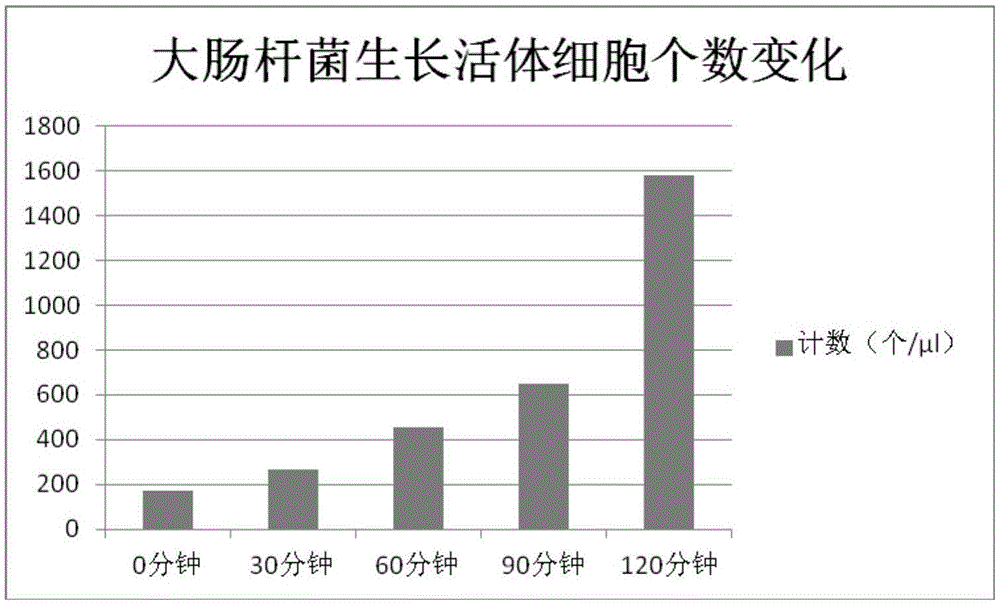
图1是本发明实验例1中的大肠杆菌不同时间活体菌数变化柱状图;Fig. 1 is the histogram of the change of Escherichia coli in different time living bacteria counts in Experimental Example 1 of the present invention;
图2是本发明实验例1中的大肠杆菌不同时间浊度变化柱状图;Fig. 2 is the bar chart of Escherichia coli different time turbidity changes in Experimental Example 1 of the present invention;
图3是本发明实验例2中的大肠杆菌对氨苄西林敏感性测试结果。3 is the test result of the sensitivity of Escherichia coli to ampicillin in Experimental Example 2 of the present invention.
具体实施方式Detailed ways
下述实施例中涉及到的主要仪器:用于检测活体待测微生物细胞个数的流式细胞仪(BD公司FACSCantoII),荧光显微仪器(奥林巴斯荧光显微镜BX43),比浊度仪(BD公司PhoenixSpec Nephelomter)。The main instruments involved in the following examples: flow cytometer (FACSCantoII of BD company) for detecting the number of microbial cells to be tested in vivo, fluorescence microscope (Olympus fluorescence microscope BX43), turbidimeter (BD PhoenixSpec Nephelomter).
下述实施例中涉及到的抗生素如氨苄西林、肉汤如AST肉汤或MH肉汤、荧光染料均为市售产品,本发明的技术方案采用不同厂家或型号的上述产品均不会产生明显的不同。The antibiotics involved in the following examples such as ampicillin, broth such as AST broth or MH broth, fluorescent dyes are all commercially available products, and the technical scheme of the present invention adopts the above-mentioned products of different manufacturers or models without producing obvious. s difference.
下述实施例中涉及到的抗生素敏感性检测用菌种的准备:将菌株接种到血琼脂培养基上,并在35℃的环境下孵育18小时,备用。所述菌株分别为ATCC25922大肠杆菌、ATCC25923金黄色葡萄球菌和ATCC27853绿脓杆菌。Preparation of strains for antibiotic susceptibility detection involved in the following examples: inoculate strains on blood agar medium, and incubate at 35° C. for 18 hours for later use. The strains are ATCC25922 Escherichia coli, ATCC25923 Staphylococcus aureus and ATCC27853 Pseudomonas aeruginosa, respectively.
抗生素敏感性检测用肉汤的制备:准备12个药敏试验管,每个药敏试验管中含有等量的药敏试验用肉汤如AST肉汤或MH肉汤,其中10个药敏试验管中依次含有具有浓度梯度的待测抗生素,不同种类待测抗生素具体浓度指标按照美国CLSL标准文件M100描述的抗生素浓度要求进行。如抗生素氨苄西林,其对应浓度依次为0.5、1、2、4、8、16、32、64、128和256,单位μg/ml。1个药敏试验管中不含待测抗生素,作为阳性对照,1个药敏试验管中在检测时不加入待测微生物悬浮液,作为阴性对照。Preparation of broth for antibiotic susceptibility testing: prepare 12 drug susceptibility test tubes, each containing an equal amount of drug susceptibility testing broth such as AST broth or MH broth, of which 10 drug susceptibility tests The tube contains the antibiotics to be tested with a concentration gradient in sequence, and the specific concentration indicators of different types of antibiotics to be tested are carried out according to the antibiotic concentration requirements described in the American CLSL standard file M100. For example, the antibiotic ampicillin, its corresponding concentration is 0.5, 1, 2, 4, 8, 16, 32, 64, 128 and 256, unit μg/ml. One drug susceptibility test tube does not contain the antibiotic to be tested, as a positive control, and one drug susceptibility test tube does not add the microorganism suspension to be tested during detection, as a negative control.
实施例1Example 1
本实施例所述的一种快速微生物抗生素敏感性检测方法,包括如下步骤:A rapid microbial antibiotic susceptibility detection method described in this embodiment includes the following steps:
S1、制备待测微生物悬浮液,挑取备用菌种菌落ATCC25922大肠杆菌,配制成浓度为0.4个麦氏单位的菌悬液,将所述待测微生物悬浮液分别与按照美国CLSL肉汤稀释浓度配制的药敏检测用AST肉汤混合,AST肉汤中含有的抗生素为氨苄西林(其对应浓度依次为0.5、1、2、4、8、16、32、64、128和265,单位μg/ml),控制含菌量为4×105cfu/ml,然后将上述混合后待测微生物悬浮液、阳性对照和阴性对照置于36℃的培养箱中孵育30分钟;S1, prepare the microbial suspension to be tested, pick the standby strain colony ATCC25922 Escherichia coli, prepare the bacterial suspension with a concentration of 0.4 McFarland units, the microbial suspension to be tested is respectively mixed with the dilution concentration of the U.S. CLSL broth according to the The prepared drug sensitivity test was mixed with AST broth, and the antibiotic contained in the AST broth was ampicillin (the corresponding concentrations were 0.5, 1, 2, 4, 8, 16, 32, 64, 128, and 265, in μg/ ml), control the bacterial content to be 4×10 5 cfu/ml, and then place the mixed microorganism suspension, positive control and negative control to be tested in a 36°C incubator for 30 minutes;
S2、在孵育时间达到30分钟时,采用荧光染料标记步骤S1中混合后的待测微生物悬浮液、阳性对照和阴性对照中的活细胞,通过荧光显微仪器检测上述活体待测微生物细胞个数,与阳性对照相比,活体待测微生物细胞个数降低的百分率,当百分率达到20%以上时,所述待测抗生素所对应的浓度即为最小抑菌浓度。S2. When the incubation time reaches 30 minutes, fluorescent dyes are used to mark the viable cells in the suspension of microorganisms to be tested, the positive control and the negative control mixed in step S1, and the number of cells of the microorganisms to be tested in the living body is detected by a fluorescence microscope. , compared with the positive control, the percentage of the decrease in the number of microbial cells to be tested in the living body, when the percentage reaches more than 20%, the concentration corresponding to the antibiotic to be tested is the minimum inhibitory concentration.
检测结果为4μg/ml,与VITEK、Etest法测定的最小抑菌浓度(MIC)(分别为4μg/ml和2μg/ml)相当。The detection result was 4μg/ml, which was equivalent to the minimum inhibitory concentration (MIC) determined by VITEK and Etest methods (4μg/ml and 2μg/ml, respectively).
实施例2Example 2
本实施例所述的一种快速微生物抗生素敏感性检测方法,包括如下步骤:A rapid microbial antibiotic susceptibility detection method described in this embodiment includes the following steps:
S1、制备待测微生物悬浮液,挑取备用抗生素敏感性菌种菌落ATCC25922大肠杆菌,配制成浓度为0.6个麦氏单位的菌悬液,将所述待测微生物悬浮液分别与按照美国CLSL肉汤稀释浓度配制的药敏检测用MH肉汤混合,MH肉汤中含有的抗生素为氨苄西林(稀释浓度同实施例1),控制含菌量为6×10⁵cfu/ml,然后将上述混合后待测微生物悬浮液、阳性对照和阴性对照置于34℃下孵育180分钟;S1, prepare the microbial suspension to be tested, pick the standby antibiotic-susceptible strain colony ATCC25922 Escherichia coli, and prepare the bacterial suspension with a concentration of 0.6 McFarland units, and the microbial suspension to be tested is respectively compared with that according to the US CLSL meat The drug susceptibility test prepared by the dilution concentration of the soup is mixed with MH broth, the antibiotic contained in the MH broth is ampicillin (the dilution concentration is the same as in Example 1), and the controlled bacterial content is 6×10 5 cfu/ml, and then the above mixture is mixed. After that, the microorganism suspension to be tested, positive control and negative control were incubated at 34°C for 180 minutes;
S2、在孵育时间达到180分钟时,采用荧光染料标记步骤S1中混合后的待测微生物悬浮液、阳性对照和阴性对照中的活细胞,通过流式细胞仪检测上述活体待测微生物细胞个数,与阳性对照相比,活体待测微生物细胞个数降低的百分率,当百分率达到40%以上时,所述待测抗生素所对应的浓度即为最小抑菌浓度。S2. When the incubation time reaches 180 minutes, fluorescent dyes are used to mark the viable cells in the suspension of microorganisms to be tested, the positive control and the negative control mixed in step S1, and the number of cells of the microorganisms to be tested in the living body is detected by flow cytometry , compared with the positive control, the percentage that the number of microbial cells to be tested in the living body is reduced, when the percentage reaches more than 40%, the concentration corresponding to the antibiotic to be tested is the minimum inhibitory concentration.
检测结果为4μg/ml,与VITEK、Etest法测定的最小抑菌浓度(MIC)(分别为4μg/ml和2μg/ml)相当。The detection result was 4μg/ml, which was equivalent to the minimum inhibitory concentration (MIC) determined by VITEK and Etest methods (4μg/ml and 2μg/ml, respectively).
实施例3Example 3
本实施例所述的一种快速微生物抗生素敏感性检测方法,包括如下步骤:A rapid microbial antibiotic susceptibility detection method described in this embodiment includes the following steps:
S1、制备待测微生物悬浮液,挑取备用抗生素敏感性菌种菌落ATCC25922大肠杆菌,配制成浓度为0.5个麦氏单位的菌悬液,将所述待测微生物悬浮液分别与按照美国CLSL肉汤稀释浓度的药敏检测用MH肉汤混合,MH肉汤中含有的抗生素为氨苄西林(稀释浓度同实施例1),控制含菌量为5×10⁵cfu/ml,然后将上述混合后待测微生物悬浮液、阳性对照和阴性对照置于35℃的培养箱中孵育60分钟;S1, prepare microbial suspension to be tested, pick standby antibiotic-susceptible bacterial strain colony ATCC25922 Escherichia coli, prepare a bacterial suspension with a concentration of 0.5 McFarland units, and described microbial suspension to be tested is respectively the same as that of CLSL meat according to U.S. CLSL The drug susceptibility detection of the dilution concentration of the soup is mixed with MH broth, the antibiotic contained in the MH broth is ampicillin (the dilution concentration is the same as that in Example 1), and the controlled bacterial content is 5 × 10 5 cfu/ml. The microorganism suspension to be tested, positive control and negative control were incubated in an incubator at 35°C for 60 minutes;
S2、在孵育时间达到60分钟时,采用荧光染料标记步骤S1中混合后的待测微生物悬浮液、阳性对照和阴性对照中的活细胞,通过荧光显微仪器检测上述活体待测微生物细胞个数,与阳性对照相比,活体待测微生物细胞个数降低的百分率,当百分率达到50%以上时,所述待测抗生素所对应的浓度即为最小抑菌浓度。S2. When the incubation time reaches 60 minutes, fluorescent dyes are used to mark the viable cells in the suspension of microorganisms to be tested, the positive control and the negative control mixed in step S1, and the number of cells of the microorganisms to be tested in the living body is detected by a fluorescence microscope. , compared with the positive control, the percentage of the decrease in the number of microbial cells to be tested in the living body, when the percentage reaches more than 50%, the concentration corresponding to the antibiotic to be tested is the minimum inhibitory concentration.
检测结果为4μg/ml,与VITEK、Etest法测定的最小抑菌浓度(MIC)(分别为4μg/ml和2μg/ml)相当。The detection result was 4μg/ml, which was equivalent to the minimum inhibitory concentration (MIC) determined by VITEK and Etest methods (4μg/ml and 2μg/ml, respectively).
实施例4Example 4
本实施例所述的一种快速微生物抗生素敏感性检测方法,包括如下步骤:A rapid microbial antibiotic susceptibility detection method described in this embodiment includes the following steps:
S1、制备待测微生物悬浮液,挑取备用抗生素敏感性菌种菌落ATCC25922大肠杆菌,配制成浓度为0.5个麦氏单位的菌悬液,将所述待测微生物悬浮液分别与按照美国CLSL肉汤稀释浓度的药敏检测用MH肉汤混合,MH肉汤中含有的抗生素为氨苄西林(稀释浓度同实施例1),控制含菌量为5×10⁵cfu/ml,然后将上述混合后待测微生物悬浮液、阳性对照和阴性对照置于35℃的培养箱中孵育120分钟;S1, prepare microbial suspension to be tested, pick standby antibiotic-susceptible bacterial strain colony ATCC25922 Escherichia coli, prepare a bacterial suspension with a concentration of 0.5 McFarland units, and described microbial suspension to be tested is respectively the same as that of CLSL meat according to U.S. CLSL The drug susceptibility detection of the dilution concentration of the soup is mixed with MH broth, the antibiotic contained in the MH broth is ampicillin (the dilution concentration is the same as that in Example 1), and the controlled bacterial content is 5 × 10 5 cfu/ml. The microorganism suspension to be tested, positive control and negative control were incubated in an incubator at 35°C for 120 minutes;
S2、在孵育时间达到120分钟时,采用荧光染料标记步骤S1中混合后的待测微生物悬浮液、阳性对照和阴性对照中的活细胞,通过荧光显微仪器检测上述活体待测微生物细胞个数,与阳性对照相比,活体待测微生物细胞个数降低的百分率,当百分率达到55%以上时,所述待测抗生素所对应的浓度即为最小抑菌浓度。S2. When the incubation time reaches 120 minutes, fluorescent dyes are used to mark the viable cells in the suspension of microorganisms to be tested, the positive control and the negative control mixed in step S1, and the number of cells of the microorganisms to be tested in the living body is detected by a fluorescence microscope. , compared with the positive control, the percentage of the decrease in the number of microbial cells to be tested in the living body, when the percentage reaches more than 55%, the concentration corresponding to the antibiotic to be tested is the minimum inhibitory concentration.
检测结果为4μg/ml,与VITEK、Etest法测定的最小抑菌浓度(MIC)(分别为4μg/ml和2μg/ml)相当。The detection result was 4μg/ml, which was equivalent to the minimum inhibitory concentration (MIC) determined by VITEK and Etest methods (4μg/ml and 2μg/ml, respectively).
实施例5Example 5
本实施例所述的一种快速微生物抗生素敏感性检测方法,包括如下步骤:A rapid microbial antibiotic susceptibility detection method described in this embodiment includes the following steps:
S1、制备待测微生物悬浮液,挑取备用抗生素敏感性菌种菌落ATCC25922大肠杆菌,配制成浓度为0.5个麦氏单位的菌悬液,将所述待测微生物悬浮液分别与按照美国CLSL肉汤稀释浓度的药敏检测用MH肉汤混合均匀,MH肉汤中含有的抗生素为氨苄西林(稀释浓度同实施例1),控制含菌量为5×10⁵cfu/ml,然后将上述混合后待测微生物悬浮液、阳性对照和阴性对照置于35℃的培养箱中孵育120分钟;S1, prepare microbial suspension to be tested, pick standby antibiotic-susceptible bacterial strain colony ATCC25922 Escherichia coli, prepare a bacterial suspension with a concentration of 0.5 McFarland units, and described microbial suspension to be tested is respectively the same as that of CLSL meat according to U.S. CLSL The susceptibility test of the dilution concentration of the soup is mixed evenly with MH broth, the antibiotic contained in the MH broth is ampicillin (the dilution concentration is the same as in Example 1), and the controlled bacterial content is 5 × 10 5 cfu/ml, and then the above mixture is mixed. Afterwards, the suspension of microorganisms to be tested, positive control and negative control were incubated in a 35°C incubator for 120 minutes;
S2、在孵育时间达到120分钟时,采用荧光染料标记步骤S1中混合后的待测微生物悬浮液、阳性对照和阴性对照中的活细胞,通过流式细胞仪检测上述活体待测微生物细胞个数,与阳性对照相比,活体待测微生物细胞个数降低的百分率,当百分率达到80%以上时,所述待测抗生素所对应的浓度即为最小抑菌浓度。S2. When the incubation time reaches 120 minutes, fluorescent dyes are used to mark the viable cells in the suspension of microorganisms to be tested, the positive control and the negative control mixed in step S1, and the number of cells of the microorganisms to be tested in the living body is detected by flow cytometry , compared with the positive control, the percentage of the decrease in the number of microbial cells to be tested in the living body, when the percentage reaches more than 80%, the concentration corresponding to the antibiotic to be tested is the minimum inhibitory concentration.
检测结果为4μg/ml,与VITEK、Etest法测定的最小抑菌浓度(MIC)(分别为4μg/ml和2μg/ml)相当。The detection result was 4μg/ml, which was equivalent to the minimum inhibitory concentration (MIC) determined by VITEK and Etest methods (4μg/ml and 2μg/ml, respectively).
实施例6Example 6
本实施例所述的一种快速微生物抗生素敏感性检测方法,包括如下步骤:A rapid microbial antibiotic susceptibility detection method described in this embodiment includes the following steps:
S1、制备待测微生物悬浮液,挑取备用抗生素敏感性菌种菌落ATCC25923金黄色葡萄球菌,配制成浓度为0.5个麦氏单位的菌悬液,将所述待测微生物悬浮液分别与按照美国CLSL肉汤稀释浓度的药敏检测用AST肉汤混合,AST肉汤中含有的抗生素为氨苄西林(稀释浓度同实施例1),控制含菌量为5×10⁵cfu/ml,然后将上述混合后待测微生物悬浮液、阳性对照和阴性对照置于35℃的培养箱中孵育90分钟;S1, prepare the microbial suspension to be tested, pick standby antibiotic-susceptible bacterial strain colony ATCC25923 Staphylococcus aureus, prepare the bacterial suspension with a concentration of 0.5 McFarland units, and separate the microbial suspension to be tested with the The drug susceptibility test of the diluted concentration of CLSL broth is mixed with AST broth, the antibiotic contained in the AST broth is ampicillin (the dilution concentration is the same as in Example 1), and the bacterial content is controlled to be 5 × 10 5 cfu/ml, and then the above After mixing, the microorganism suspension to be tested, the positive control and the negative control were placed in an incubator at 35°C for 90 minutes;
S2、在孵育时间达到90分钟时,采用荧光染料标记步骤S1中混合后的待测微生物悬浮液、阳性对照和阴性对照中的活细胞,通过流式细胞仪检测上述活体待测微生物细胞个数,与阳性对照相比,活体待测微生物细胞个数降低的百分率,当百分率达到60%以上时,所述待测抗生素所对应的浓度即为最小抑菌浓度。S2. When the incubation time reaches 90 minutes, fluorescent dyes are used to mark the viable cells in the suspension of microorganisms to be tested, the positive control and the negative control mixed in step S1, and the number of cells of the microorganisms to be tested in the living body is detected by flow cytometry , compared with the positive control, the percentage of the decrease in the number of microbial cells to be tested in the living body, when the percentage reaches more than 60%, the concentration corresponding to the antibiotic to be tested is the minimum inhibitory concentration.
实验例1本实验例考察采用本发明的快速微生物抗生素敏感性检测方法测定待测微生物生长变化的敏感性,包括如下步骤:Experimental Example 1 This experimental example investigates the use of the rapid microbial antibiotic sensitivity detection method of the present invention to measure the sensitivity of the growth changes of the microorganisms to be tested, including the following steps:
(1)、制备待测微生物悬浮液,分别挑取备用抗生素敏感性菌种菌落ATCC25922大肠杆菌、ATCC25923金黄色葡萄球菌和ATCC27853绿脓杆菌,分别配制成浓度为0.5个麦氏单位的菌悬液,将所述待测微生物悬浮液分别与按照美国CLSL肉汤稀释浓度的药敏检测用AST肉汤混合均匀,控制含菌量为5×10⁵cfu/ml,然后将上述混合后待测微生物悬浮液置于35℃的培养箱中孵育;(1), prepare microbial suspension to be tested, pick standby antibiotic-sensitive strain colonies ATCC25922 Escherichia coli, ATCC25923 Staphylococcus aureus and ATCC27853 Pseudomonas aeruginosa, respectively, and prepare a bacterial suspension with a concentration of 0.5 McFarland units respectively , the suspension of the microorganisms to be tested was mixed with the AST broth for drug susceptibility testing according to the dilution concentration of the American CLSL broth, and the bacterial content was controlled to be 5×10 5 cfu/ml, and then the microorganisms to be tested were mixed after the above-mentioned mixing. The suspension was incubated in an incubator at 35°C;
(2)、在孵育时间达到0分钟、30分钟、60分钟、90分钟、120分钟,采用荧光染料标记步骤(1)中混合后的待测微生物悬浮液中的活细胞,通过荧光显微仪器检测活体待测微生物细胞个数,测两次,取平均值,记录数据,同时通过比浊仪测2次浊度,取平均值,记录数据。(2), when the incubation time reaches 0 minutes, 30 minutes, 60 minutes, 90 minutes, and 120 minutes, use fluorescent dyes to label the living cells in the suspension of microorganisms to be tested after mixing in step (1), and pass the fluorescent microscope instrument. Detect the number of microbial cells to be tested in the living body, measure twice, take the average value, and record the data. At the same time, measure the turbidity twice by the turbidimeter, take the average value, and record the data.
(3)检测结果,细菌培养浊度和菌数变化如下表1,大肠杆菌不同时间活体菌数变化柱状图见附图1(图1中纵坐标为大肠杆菌生长活体细胞个数,单位为个/μl),大肠杆菌不同时间浊度变化柱状图见附图2(图2中纵坐标为大肠杆菌的浊度值)。由图1和图2比较可知,采用不同的方法观察大肠杆菌变化差异很大,采用浊度变化观察大肠杆菌生长,在120分钟内差异并不明显,检测敏感性较差,而通过检测活体细胞个数观察大肠杆菌生长,在30分钟内可检测出显著的差异,检测敏感性高,说明本发明的微生物抗生素敏感性检测方法检测敏感性高。(3) test result, bacterial culture turbidity and bacterial count change as following table 1, Escherichia coli different time live bacterial count change histogram is shown in accompanying drawing 1 (in Fig. 1, the ordinate is the Escherichia coli growth live cell number, the unit is individual /μl), the histogram of the turbidity change of Escherichia coli at different times is shown in Figure 2 (the ordinate in Figure 2 is the turbidity value of Escherichia coli). From the comparison of Figure 1 and Figure 2, it can be seen that the changes of Escherichia coli are very different by different methods, and the growth of Escherichia coli is observed by turbidity change, and the difference is not obvious within 120 minutes, and the detection sensitivity is poor. Observing the growth of Escherichia coli by the number, significant differences can be detected within 30 minutes, and the detection sensitivity is high, indicating that the microbial antibiotic sensitivity detection method of the present invention has high detection sensitivity.
表1细菌培养浊度和活体菌数变化Table 1 Bacterial culture turbidity and changes in the number of viable bacteria


实验例2本实验例考察采用本发明的快速微生物抗生素敏感性检测方法测定待测微生物的最小抑菌浓度与常规方法VITEK、Etest法测定的最小抑菌浓度的一致性,包括如下步骤:Experimental Example 2 This experimental example investigates the consistency of the minimum inhibitory concentration of the microorganism to be tested by the rapid microbial antibiotic sensitivity detection method of the present invention and the minimum inhibitory concentration determined by the conventional methods VITEK and Etest, including the following steps:
(1)、制备待测微生物悬浮液,挑取备用抗生素敏感性菌种菌落ATCC25922大肠杆菌,配制成浓度为0.5个麦氏单位的菌悬液,将所述待测微生物悬浮液分别与按照美国CLSL肉汤稀释浓度的药敏检测用MH肉汤混合均匀,MH肉汤中含有的抗生素为氨苄西林(稀释浓度同实施例1),控制含菌量为5×10⁵cfu/ml,然后将上述混合后待测微生物悬浮液、阳性对照和阴性对照置于35℃的培养箱中孵育;(1), prepare microbial suspension to be tested, pick standby antibiotic-sensitive bacterial strain colony ATCC25922 Escherichia coli, be mixed into the bacterial suspension that concentration is 0.5 McFarland units, described microbial suspension to be tested is respectively with according to U.S. The drug susceptibility test of the diluted concentration of CLSL broth is mixed with MH broth, the antibiotic contained in the MH broth is ampicillin (the dilution concentration is the same as that in Example 1), and the bacterial content is controlled to be 5×10 5 cfu/ml, and then the After the above mixing, the microorganism suspension to be tested, the positive control and the negative control were incubated in an incubator at 35°C;
(2)、在孵育时间达到0分钟、60分钟、90分钟、120分钟,采用荧光染料标记步骤(1)中混合后的待测微生物悬浮液、阳性对照和阴性对照中的活细胞,然后通过流式细胞仪检测活体待测微生物细胞个数,测两次,取平均值,记录数据,同时通过比浊仪测2次浊度,取平均值,记录数据。(2), when the incubation time reaches 0 minutes, 60 minutes, 90 minutes, and 120 minutes, use fluorescent dyes to label the viable cells in the suspension of microorganisms to be tested, the positive control and the negative control mixed in step (1), and then pass Flow cytometer detects the number of microbial cells in the living body to be tested, measures twice, takes the average value, and records the data; meanwhile, measures the turbidity twice by the turbidimeter, takes the average value, and records the data.
(3)检测的结果,大肠杆菌对氨苄西林敏感性测试见附图3(纵坐标为大肠杆菌生长活体细胞个数,单位为个,横坐标为氨苄西林的浓度,单位为μg/ml,每个浓度所对应的4个柱,从左至右依次对应0min、60min、90min、120min),由附图3中可知,在孵育到60分钟时,本发明的快速微生物抗生素敏感性检测方法检测,与阳性对照相比,活体待测微生物细胞个数降低的百分率达到60%以上时,所对应的待测抗生素的浓度为4μg/ml,该浓度为待测微生物的最小抑菌浓度(MIC)。(3) the result of detection, Escherichia coli is shown in accompanying drawing 3 to ampicillin sensitivity test (the ordinate is the number of Escherichia coli growth living cells, the unit is one, the abscissa is the concentration of ampicillin, the unit is μg/ml, each The four columns corresponding to each concentration correspond to 0min, 60min, 90min, and 120min from left to right. As can be seen from Figure 3, when incubated for 60 minutes, the rapid microbial antibiotic susceptibility detection method of the present invention detects, Compared with the positive control, when the percentage reduction of the number of cells of the microorganism to be tested in the living body reaches more than 60%, the corresponding concentration of the tested antibiotic is 4 μg/ml, which is the minimum inhibitory concentration (MIC) of the tested microorganism.
通过VITEK、Etest法测定上述的备用抗生素敏感性菌种菌落ATCC25922大肠杆菌的最小抑菌浓度,结果分别为4μg/ml和2μg/ml。The minimum inhibitory concentrations of E. coli ATCC25922 were determined by VITEK and Etest methods, and the results were 4 μg/ml and 2 μg/ml, respectively.
比较本发明的方法检测的最小抑菌浓度(MIC)与VITEK、Etest法测定的最小抑菌浓度(MIC)可知,本发明的方法检测的最小抑菌浓度(MIC)与VITEK、Etest法测定的最小抑菌浓度(MIC)一致。Comparing the minimum inhibitory concentration (MIC) detected by the method of the present invention and the minimum inhibitory concentration (MIC) determined by the VITEK and Etest methods, it can be known that the minimum inhibitory concentration (MIC) detected by the method of the present invention is the same as that determined by the VITEK and Etest methods. The minimum inhibitory concentration (MIC) was the same.
(4)结论,本发明的快速微生物抗生素敏感性检测方法检测的微生物的最小抑菌浓度与现有的VITEK、Etest法测定的最小抑菌浓度(MIC)一致,且本发明的方法可在60分钟内检测出MIC,可以在短时间内测定微生物对抗生素的敏感性,适合于临床实践。(4) Conclusion, the minimum inhibitory concentration of microorganisms detected by the rapid microbial antibiotic susceptibility detection method of the present invention is consistent with the minimum inhibitory concentration (MIC) determined by the existing VITEK and Etest methods, and the method of the present invention can be used in 60 The MIC can be detected within minutes, and the sensitivity of microorganisms to antibiotics can be determined in a short time, which is suitable for clinical practice.
显然,上述实施例仅仅是为清楚地说明所作的举例,而并非对实施方式的限定。对于所属领域的普通技术人员来说,在上述说明的基础上还可以做出其它不同形式的变化或变动。这里无需也无法对所有的实施方式予以穷举。而由此所引伸出的显而易见的变化或变动仍处于本发明创造的保护范围之中。Obviously, the above-mentioned embodiments are only examples for clear description, and are not intended to limit the implementation manner. For those of ordinary skill in the art, changes or modifications in other different forms can also be made on the basis of the above description. There is no need and cannot be exhaustive of all implementations here. And the obvious changes or changes derived from this are still within the protection scope of the present invention.
Claims (9)
Priority Applications (1)
| Application Number | Priority Date | Filing Date | Title |
|---|---|---|---|
| CN201810846586.1A CN110760559B (en) | 2018-07-27 | 2018-07-27 | A rapid microbial antibiotic susceptibility detection method |
Applications Claiming Priority (1)
| Application Number | Priority Date | Filing Date | Title |
|---|---|---|---|
| CN201810846586.1A CN110760559B (en) | 2018-07-27 | 2018-07-27 | A rapid microbial antibiotic susceptibility detection method |
Publications (2)
| Publication Number | Publication Date |
|---|---|
| CN110760559A true CN110760559A (en) | 2020-02-07 |
| CN110760559B CN110760559B (en) | 2023-11-17 |
Family
ID=69327088
Family Applications (1)
| Application Number | Title | Priority Date | Filing Date |
|---|---|---|---|
| CN201810846586.1A Active CN110760559B (en) | 2018-07-27 | 2018-07-27 | A rapid microbial antibiotic susceptibility detection method |
Country Status (1)
| Country | Link |
|---|---|
| CN (1) | CN110760559B (en) |
Cited By (4)
| Publication number | Priority date | Publication date | Assignee | Title |
|---|---|---|---|---|
| CN112176024A (en) * | 2020-08-07 | 2021-01-05 | 山东鑫科生物科技股份有限公司 | Method for detecting bacterial inhibition by antibiotics through single cell counting |
| CN114561441A (en) * | 2021-09-30 | 2022-05-31 | 北京威妙生物科技有限公司 | Method for detecting inhibition of antibacterial drugs on fungi |
| CN115341013A (en) * | 2022-07-06 | 2022-11-15 | 清华珠三角研究院 | Microbial drug susceptibility detection method, device, equipment and storage medium |
| CN115356309A (en) * | 2022-07-29 | 2022-11-18 | 华中农业大学 | Portable rapid bacterial antibiotic susceptibility testing method and device |
Citations (3)
| Publication number | Priority date | Publication date | Assignee | Title |
|---|---|---|---|---|
| US4236211A (en) * | 1978-09-15 | 1980-11-25 | Pfizer Inc. | Method and apparatus for determining the minimum concentration of antibiotic necessary to at least inhibit microorganism growth |
| US20150010940A1 (en) * | 2013-07-04 | 2015-01-08 | Abm Technologies, Llc | Method for the rapid determination of susceptibility or resistance of bacteria to antibiotics |
| US20180195964A1 (en) * | 2017-01-09 | 2018-07-12 | Pocared Diagnostics Ltd. | Rapid Antimicrobial Susceptibility Testing Based on a Unique Spectral Intensity Ratio Analysis via Single Fluorescence Membrane Dye Staining and Flow Cytometry |
-
2018
- 2018-07-27 CN CN201810846586.1A patent/CN110760559B/en active Active
Patent Citations (4)
| Publication number | Priority date | Publication date | Assignee | Title |
|---|---|---|---|---|
| US4236211A (en) * | 1978-09-15 | 1980-11-25 | Pfizer Inc. | Method and apparatus for determining the minimum concentration of antibiotic necessary to at least inhibit microorganism growth |
| US20150010940A1 (en) * | 2013-07-04 | 2015-01-08 | Abm Technologies, Llc | Method for the rapid determination of susceptibility or resistance of bacteria to antibiotics |
| CN105358982A (en) * | 2013-07-04 | 2016-02-24 | Abm科技公司 | Method for the rapid determination of susceptibility or resistance of bacteria to antibiotics |
| US20180195964A1 (en) * | 2017-01-09 | 2018-07-12 | Pocared Diagnostics Ltd. | Rapid Antimicrobial Susceptibility Testing Based on a Unique Spectral Intensity Ratio Analysis via Single Fluorescence Membrane Dye Staining and Flow Cytometry |
Non-Patent Citations (6)
| Title |
|---|
| 向丽等: "细菌药敏试验MTT法与常量稀释法比较性研究", 《泸州医学院学报》 * |
| 夏晓华等: "流式细胞术应用于金黄色葡萄球菌体外药敏试验的初步研究", 《中国人兽共患病杂志》 * |
| 王峰等: "微孔板阿尔玛蓝显色法检测速生长分枝杆菌药物敏感性", 《现代医院》 * |
| 顾怡明等: "美罗培南的体外抗菌活性研究", 《中国抗生素杂志》 * |
| 马筱玲等: "流式细胞术检测抗生素最低抑菌浓度", 《中华微生物学和免疫学杂志》 * |
| 高鸣等: "应用流式细胞仪检测结核分枝杆菌对左氧氟沙星的敏感性", 《现代医院》 * |
Cited By (6)
| Publication number | Priority date | Publication date | Assignee | Title |
|---|---|---|---|---|
| CN112176024A (en) * | 2020-08-07 | 2021-01-05 | 山东鑫科生物科技股份有限公司 | Method for detecting bacterial inhibition by antibiotics through single cell counting |
| CN114561441A (en) * | 2021-09-30 | 2022-05-31 | 北京威妙生物科技有限公司 | Method for detecting inhibition of antibacterial drugs on fungi |
| CN115341013A (en) * | 2022-07-06 | 2022-11-15 | 清华珠三角研究院 | Microbial drug susceptibility detection method, device, equipment and storage medium |
| CN115341013B (en) * | 2022-07-06 | 2025-03-18 | 清华珠三角研究院 | A method, device, equipment and storage medium for detecting drug sensitivity of microorganisms |
| CN115356309A (en) * | 2022-07-29 | 2022-11-18 | 华中农业大学 | Portable rapid bacterial antibiotic susceptibility testing method and device |
| CN115356309B (en) * | 2022-07-29 | 2024-04-19 | 华中农业大学 | Portable rapid bacterial antibiotic sensitivity test method and device thereof |
Also Published As
| Publication number | Publication date |
|---|---|
| CN110760559B (en) | 2023-11-17 |
Similar Documents
| Publication | Publication Date | Title |
|---|---|---|
| US20220243248A1 (en) | Method for the rapid determination of susceptibility or resistance of bacteria to antibiotics | |
| Palomino et al. | Rapid culture-based methods for drug-resistance detection in Mycobacterium tuberculosis | |
| Chandra et al. | Bacterial growth sensing in microgels using pH-dependent fluorescence emission | |
| CN110760559A (en) | Rapid detection method for microbial antibiotic sensitivity | |
| CN102131914A (en) | Apparatus and method for bacteriological testing on plasma | |
| CN112176024A (en) | Method for detecting bacterial inhibition by antibiotics through single cell counting | |
| CN102288586B (en) | Method for determining minimal inhibitory concentration of drug | |
| CN111826415A (en) | Method for detecting inhibition of antibacterial drugs on bacteria | |
| CN108279310A (en) | A kind of detection kit and its detection method of Klebsiella Pneumoniae | |
| CN108796032A (en) | A kind of method for restoring tigecycline antibacterial activity | |
| CN109762871B (en) | A kind of use of the mixture of monosulfonic acid tetrazolium salt and PMS derivative for microorganism detection and detection method thereof | |
| JP2016536592A (en) | Bacteria diagnosis | |
| CN118652955A (en) | AIE reagent and method for rapid detection of antimicrobial drug sensitivity | |
| CN103014120B (en) | Trace mycobacterium susceptibility test method | |
| US5759799A (en) | Marker for revealing contaminants and application method for performing an antibiogram carried out directly on a sample | |
| CN101225429A (en) | Liquid-solid combined culture kit for isolation, identification, quantification and drug sensitivity test of urealyticum and mycoplasma hominis and its application method | |
| CN117568441A (en) | A method for detecting drug resistance of drug-resistant Mycobacterium tuberculosis | |
| Stratton | Advanced phenotypic antimicrobial susceptibility testing methods | |
| US20230227887A1 (en) | Therapeutic Drug Monitoring | |
| CN118731121B (en) | Preparation method and application of pH sensor based on nano capillary | |
| CN103499600A (en) | A method for identifying bacterial species in ascites of liver cirrhosis | |
| RU2666257C1 (en) | Method for determining sensitivity of bacterial hemocultures to antibiotics | |
| Costa | Sample Collection, Preparation, General Assessment and Microbiology Testing of Fluids | |
| Thusoo | Antimicrobial Resistance:-Introduction and Methods for Detection | |
| Puscas | A NEW PROCEDURE FOR THE RAPID DETERMINATION OF PSEUDOMONAS AERUGIN20O2S0A BACTERIA IN MEDICATIONS |
Legal Events
| Date | Code | Title | Description |
|---|---|---|---|
| PB01 | Publication | ||
| PB01 | Publication | ||
| SE01 | Entry into force of request for substantive examination | ||
| SE01 | Entry into force of request for substantive examination | ||
| GR01 | Patent grant | ||
| GR01 | Patent grant | ||
| TR01 | Transfer of patent right | ||
| TR01 | Transfer of patent right |
Effective date of registration: 20251128 Address after: 100176 Beijing Tongzhou District, Beijing Economic and Technological Development Zone, No. 12, Jingshengbei Yijie, Courtyard 7, -1 Floor, Room 114-55 Patentee after: Beijing Ruidi Zhixun Animal Medical Technology Co.,Ltd. Country or region after: China Address before: 100050 Room 302, Unit 3, Building 10, Dongli East, Dongcheng District, Beijing Patentee before: Zhang Yuanzhen Country or region before: China |