CN110760608A - Novel rape BnFAD2 gene high oleic acid allelic mutation and development and application of SNP marker primer thereof - Google Patents
Novel rape BnFAD2 gene high oleic acid allelic mutation and development and application of SNP marker primer thereof Download PDFInfo
- Publication number
- CN110760608A CN110760608A CN201911212000.7A CN201911212000A CN110760608A CN 110760608 A CN110760608 A CN 110760608A CN 201911212000 A CN201911212000 A CN 201911212000A CN 110760608 A CN110760608 A CN 110760608A
- Authority
- CN
- China
- Prior art keywords
- oleic acid
- kasp
- high oleic
- primer
- genotype
- Prior art date
- Legal status (The legal status is an assumption and is not a legal conclusion. Google has not performed a legal analysis and makes no representation as to the accuracy of the status listed.)
- Granted
Links
Images


Classifications
-
- C—CHEMISTRY; METALLURGY
- C12—BIOCHEMISTRY; BEER; SPIRITS; WINE; VINEGAR; MICROBIOLOGY; ENZYMOLOGY; MUTATION OR GENETIC ENGINEERING
- C12Q—MEASURING OR TESTING PROCESSES INVOLVING ENZYMES, NUCLEIC ACIDS OR MICROORGANISMS; COMPOSITIONS OR TEST PAPERS THEREFOR; PROCESSES OF PREPARING SUCH COMPOSITIONS; CONDITION-RESPONSIVE CONTROL IN MICROBIOLOGICAL OR ENZYMOLOGICAL PROCESSES
- C12Q1/00—Measuring or testing processes involving enzymes, nucleic acids or microorganisms; Compositions therefor; Processes of preparing such compositions
- C12Q1/68—Measuring or testing processes involving enzymes, nucleic acids or microorganisms; Compositions therefor; Processes of preparing such compositions involving nucleic acids
- C12Q1/6876—Nucleic acid products used in the analysis of nucleic acids, e.g. primers or probes
- C12Q1/6888—Nucleic acid products used in the analysis of nucleic acids, e.g. primers or probes for detection or identification of organisms
- C12Q1/6895—Nucleic acid products used in the analysis of nucleic acids, e.g. primers or probes for detection or identification of organisms for plants, fungi or algae
-
- C—CHEMISTRY; METALLURGY
- C12—BIOCHEMISTRY; BEER; SPIRITS; WINE; VINEGAR; MICROBIOLOGY; ENZYMOLOGY; MUTATION OR GENETIC ENGINEERING
- C12Q—MEASURING OR TESTING PROCESSES INVOLVING ENZYMES, NUCLEIC ACIDS OR MICROORGANISMS; COMPOSITIONS OR TEST PAPERS THEREFOR; PROCESSES OF PREPARING SUCH COMPOSITIONS; CONDITION-RESPONSIVE CONTROL IN MICROBIOLOGICAL OR ENZYMOLOGICAL PROCESSES
- C12Q2600/00—Oligonucleotides characterized by their use
- C12Q2600/13—Plant traits
-
- C—CHEMISTRY; METALLURGY
- C12—BIOCHEMISTRY; BEER; SPIRITS; WINE; VINEGAR; MICROBIOLOGY; ENZYMOLOGY; MUTATION OR GENETIC ENGINEERING
- C12Q—MEASURING OR TESTING PROCESSES INVOLVING ENZYMES, NUCLEIC ACIDS OR MICROORGANISMS; COMPOSITIONS OR TEST PAPERS THEREFOR; PROCESSES OF PREPARING SUCH COMPOSITIONS; CONDITION-RESPONSIVE CONTROL IN MICROBIOLOGICAL OR ENZYMOLOGICAL PROCESSES
- C12Q2600/00—Oligonucleotides characterized by their use
- C12Q2600/156—Polymorphic or mutational markers
Landscapes
- Chemical & Material Sciences (AREA)
- Life Sciences & Earth Sciences (AREA)
- Analytical Chemistry (AREA)
- Engineering & Computer Science (AREA)
- Organic Chemistry (AREA)
- Proteomics, Peptides & Aminoacids (AREA)
- Health & Medical Sciences (AREA)
- Biotechnology (AREA)
- Zoology (AREA)
- Wood Science & Technology (AREA)
- Immunology (AREA)
- Mycology (AREA)
- Microbiology (AREA)
- Molecular Biology (AREA)
- Botany (AREA)
- Biophysics (AREA)
- Physics & Mathematics (AREA)
- Biochemistry (AREA)
- Bioinformatics & Cheminformatics (AREA)
- General Engineering & Computer Science (AREA)
- General Health & Medical Sciences (AREA)
- Genetics & Genomics (AREA)
- Measuring Or Testing Involving Enzymes Or Micro-Organisms (AREA)
Abstract
本发明涉及一种油菜BnFAD2基因的新型的高油酸等位突变,并且涉及这类新型的高油酸等位变异SNP分子标记开发和分子标记辅助育种技术。本发明公开了甘蓝型油菜中BnFAD2基因的两对新型的高油酸等位突变(BnAfad2a和BnCfad2a)。所述基因的核苷酸序列如SEQ ID NO:1和ID NO:2所述。本发明还同时提供了可快速筛选这类新型高油酸等位突变位点的两对特异型的KASP分子标记KASP‑421和KASP‑1073,并利用该标记进行单株基因型鉴定和高油酸株系筛选。本发明提供的两对KASP分子标记均由油菜BnFAD2基因外显子区域SNP变异开发而来,筛选结果特异性更高,检测结果更为准确可靠。本发明提供的KASP分子标记只需PCR和荧光检测两个步骤,成本低、通量高,特别适用于育种群体后代高油酸基因型的分类筛选与鉴定。本发明两个分子标记的组合使用可以筛选得到油酸含量高达88%的后代材料。
The present invention relates to a novel high oleic acid allelic mutation of rape BnFAD2 gene, and relates to the development of this novel high oleic acid allelic variation SNP molecular marker and molecular marker-assisted breeding technology. The invention discloses two pairs of novel high oleic acid allelic mutations (BnAfad2a and BnCfad2a) of the BnFAD2 gene in Brassica napus. The nucleotide sequences of the genes are set forth in SEQ ID NO:1 and ID NO:2. The present invention also provides two pairs of specific KASP molecular markers KASP-421 and KASP-1073 that can rapidly screen this new type of high oleic acid allelic mutation site, and use the markers to identify individual plant genotype and high oil Acid strain screening. The two pairs of KASP molecular markers provided by the invention are both developed from SNP variation in the exon region of the rape BnFAD2 gene, and the screening results are more specific and more accurate and reliable. The KASP molecular marker provided by the invention only needs two steps of PCR and fluorescence detection, has low cost and high throughput, and is especially suitable for the classification, screening and identification of high oleic acid genotypes of offspring of breeding populations. The combined use of the two molecular markers of the present invention can screen to obtain progeny materials with an oleic acid content as high as 88%.
Description
技术领域technical field
本申请涉及一种新型的油菜BnFAD2基因高油酸等位突变,并且涉及这类新型的高油酸等位变异SNP分子标记开发和分子标记辅助育种技术。The present application relates to a novel high oleic acid allelic mutation of the BnFAD2 gene of rapeseed, and to the development of this novel high oleic acid allelic variation SNP molecular marker and molecular marker-assisted breeding technology.
背景技术Background technique
油菜是我国继水稻、小麦、玉米和大豆之后的第五大农作物,也是世界上最重要的油料作物之一。菜籽油中脂肪酸组分对其食用品质、营养价值、存储和加工品质、用途和最终的市场价值有着决定性的影响。菜籽油的脂肪酸组成主要有棕榈酸(C16:0)、硬脂酸(C18:0)、油酸(C18:1)、亚油酸(C18:2)、亚麻酸(C18:3)、廿碳烯酸(C20:1)、芥酸(C22:1)等。其中,油酸是油菜脂肪酸的重要成分,属于单不饱和脂肪酸。油酸含量的提升对于进一步改良菜籽油品质有着重大意义:(1)能够显著降低血浆中低密度脂蛋白胆固醇,预防人类动脉硬化等心血管疾病;(2)可以在对胰岛素分泌没有影响的前提下,显著提高胰岛素敏感性,从而对于治疗糖尿病起到积极作用;(3)因其不饱和程度低,在加工、储运和煎炸时对氧化不敏感,具有很好的热稳定性,能够满足如煎炸、糕点等食品加工行业的需要,并且可使菜籽油具有更长的货架期;(4)高油酸菜籽油因其甲酯化程度高,燃烧值高,更有利于生产生物柴油,并另外,油酸还可用于制备多种化工产品和口红、皂类、唇膏、防晒霜等生活用品和日用化妆品。Rapeseed is the fifth largest crop in my country after rice, wheat, corn and soybean, and one of the most important oil crops in the world. The fatty acid composition of rapeseed oil has a decisive influence on its edible quality, nutritional value, storage and processing quality, use and final market value. The fatty acid composition of rapeseed oil mainly includes palmitic acid (C16:0), stearic acid (C18:0), oleic acid (C18:1), linoleic acid (C18:2), linolenic acid (C18:3), Eicosenoic acid (C20:1), erucic acid (C22:1), etc. Among them, oleic acid is an important component of rapeseed fatty acid and belongs to monounsaturated fatty acid. The increase of oleic acid content is of great significance for further improving the quality of rapeseed oil: (1) it can significantly reduce low-density lipoprotein cholesterol in plasma, and prevent cardiovascular diseases such as arteriosclerosis in humans; On the premise, it can significantly improve insulin sensitivity, thus playing a positive role in the treatment of diabetes; (3) because of its low degree of unsaturation, it is not sensitive to oxidation during processing, storage and frying, and has good thermal stability, It can meet the needs of food processing industries such as frying and cakes, and can make rapeseed oil have a longer shelf life; (4) high oleic acid rapeseed oil has a high degree of methyl esterification, high combustion value, and more It is beneficial to the production of biodiesel, and in addition, oleic acid can also be used to prepare a variety of chemical products and daily necessities and daily cosmetics such as lipstick, soap, lip balm, sunscreen, etc.
分子标记因其准确、快速、高效已经成为作物育种一个强有力的工具,因其具有早期选择、不受环境影响以及准确快速高效的优势,该技术已在各种作物中开展了实质性利用。分子标记的种类很多,目前在作物中已经开展实质性利用的标记包括早期的RFLP(限制性片段长度多态性,Restriction Fragment Length Polymorphism,RFLP)、RAPD(随机扩增多态性,Random Amplified Polymorphism DNA,RAPD)、AFLP(扩增片段长度多态性,Amplified Fragment Length Polymorphism,AFLP),发展到目前使用的最为广泛的SSR(简单重复序列,Simple Sequence Repeat,SSR)、CAPS(酶切扩增多态性序列,CleavedAmplified Polymorphic Sequence,CAPS)标记。但这些方法都存在低通量或高成本等局限性。KASP(竞争性等位基因特异性PCR,kompetitive allele specific PCR)是英国LGC(政府化学家实验室)公司提出的一种用于对基因组中SNPs和特定位点上InDels进行精准双等位基因判断的技术。KASP分子标记具有高稳定性、高准确性、低成本、快速、高效等优点,尤其在样本量大,SNP位点少时,KASP的应用特点最为显著。Molecular markers have become a powerful tool for crop breeding because of their accuracy, speed, and efficiency. Because of their advantages of early selection, no environmental influence, and accuracy, speed, and efficiency, this technology has been substantially utilized in various crops. There are many types of molecular markers. The markers that have been substantially used in crops include early RFLP (Restriction Fragment Length Polymorphism, RFLP), RAPD (Random Amplified Polymorphism, Random Amplified Polymorphism) DNA, RAPD), AFLP (Amplified Fragment Length Polymorphism, AFLP), developed to the most widely used SSR (Simple Sequence Repeat, SSR), CAPS (enzyme digestion amplification) Polymorphic sequence, Cleaved Amplified Polymorphic Sequence, CAPS) marker. However, these methods have limitations such as low throughput or high cost. KASP (competitive allele specific PCR, kompetitive allele specific PCR) is a method proposed by the British LGC (Government Chemist Laboratory) company for accurate biallelic judgment of SNPs and InDels at specific sites in the genome Technology. KASP molecular markers have the advantages of high stability, high accuracy, low cost, rapidity, and high efficiency. Especially when the sample size is large and the SNP sites are few, the application characteristics of KASP are the most significant.
近年来,在油菜种子高油酸含量的品系筛选及其分子定位方面取得了一定的进展。官春云等利用8~10伦琴60Co射线辐射进行辐射育种和后代连续筛选,获得若干份高油酸材料,油酸含量在70%以上(官春云,等,作物学报,2006,32(11):1625-1629)。浦惠明等利用低剂量60Co-γ射线处理甘蓝型油菜萌动种子获得了油酸含量超过80%的高油酸新种质(中国专利,专利申请号201010513722.9)。周永明等,通过聚合杂交和小孢子培养,得到油酸大于78%的高油酸油菜选系和品种(中国专利,专利申请号200910273435.2)。尽管如此,生产上高油酸种质的实际应用还不够广泛,主要是由于油菜高油酸性状的遗传机制较为复杂,遗传标志物(如:分子标记、核酸突变位点等)报道较少。尽管前期研究发现油菜油酸含量的提高主要由主效基因脂肪酸去饱和酶2(fatty acid desaturase 2,FAD2)的基因变异产生,并开发出了连锁的分子标记。例如,Yang等发现BnFAD2存在一个拷贝的变异,变异来源为一个4bp插入突变(Theor Appl Genet.2012;125(4):715-29),并利用该高油酸突变材料开发了特异的油菜高油酸共显性SCAR分子标记(中国专利,专利号CN 101824472B),一对连锁的SSR标记(中国专利,专利号CN 110305980A)和一对KASP标记(中国专利,专利号CN110326532A)。官春云等发现高油酸突变体是由于BnFAD2其中一个拷贝的基因270位的碱基G转换为碱基A,导致密码子由TGG转换为TGA(终止密码子),另外,在1044与1062的碱基突变也导致终止密码子的产生(官春云,等,作物学报,2006,32(11):1625-1629)。龙卫华等发现其高油酸突变体中存在BnFAD2的两个基因拷贝的变异,其中一个拷贝BnaA.FAD2a存在核苷酸序列316处G至A的置换,另一个拷贝BnaC.FAD2a核苷酸序列908处G至A的置换(中国专利,专利号CN 106282206A),并针对这两个宝贝的变异,开发了两对CAPS标记(中国专利,专利号CN 107828908A)。在中国专利中有以上几例可用于检测油菜BnFAD2基因突变位点的分子标记。遗憾的是,不同的高油酸突变材料,油菜含量表型有差异,多数高油酸突变体的油酸含量仅为76-77%。更为关键的是,不同的材料BnFAD2基因变异的拷贝数不相同,只有一个基因拷贝变异的分子标记无法在多拷贝变异的材料中同时检测多拷贝变异,并且即使是同一个基因位点,碱基变异位置也均不相同,这导致了这些位点特异的分子标记在不同材料间缺乏通用性。要解决以上瓶颈问题的关键在于充分挖掘油菜BnFAD2的高油酸复等位基因,并开发特异分子标记。此外,上述报道中公开的分子标记几乎均属于SCAR、SSR和CAPS等标记类型,这些类型标记存在低通量或、高成本、过程繁杂等局限性。KASP分子标记具有高稳定性、高准确性、低成本、快速、高效等优点,尤其在样本量大,SNP位点少时,KASP的应用特点最为显著,可弥补上述类型标记的不足。In recent years, some progress has been made in the screening of rapeseed seeds with high oleic acid content and their molecular localization. Guan Chunyun et al. used 8-10 roentgen 60 Co ray radiation for radiation breeding and continuous screening of offspring, and obtained several high-oleic acid materials with an oleic acid content of more than 70% (Guan Chunyun, et al., Journal of Crops, 2006, 32 ( 11): 1625-1629). Pu Huiming et al. treated the sprouted seeds of Brassica napus with low-dose 60 Co-γ rays to obtain a new germplasm with high oleic acid content exceeding 80% (Chinese Patent, Patent Application No. 201010513722.9). Zhou Yongming et al. obtained high oleic rapeseed lines and varieties with more than 78% oleic acid through polymeric hybridization and microspore culture (Chinese Patent, Patent Application No. 200910273435.2). Nevertheless, the practical application of high oleic acid germplasm in production is not widely enough, mainly because the genetic mechanism of high oleic acid in rapeseed is complex, and genetic markers (such as molecular markers, nucleic acid mutation sites, etc.) are rarely reported. Although previous studies have found that the increase of oleic acid content in rapeseed is mainly caused by the genetic variation of the major gene fatty acid desaturase 2 (FAD2), and a linked molecular marker has been developed. For example, Yang et al. found that BnFAD2 has a one-copy mutation, the source of which is a 4bp insertion mutation (Theor Appl Genet. 2012; 125(4):715-29), and used the high oleic acid mutant material to develop a specific rapeseed high Oleic acid co-dominant SCAR molecular marker (Chinese Patent, Patent No. CN 101824472B), a pair of linked SSR markers (Chinese Patent, Patent No. CN 110305980A) and a pair of KASP markers (Chinese Patent, Patent No. CN110326532A). Guan Chunyun et al. found that the high oleic acid mutant was due to the conversion of the base G at position 270 of the gene in one copy of BnFAD2 to base A, resulting in the conversion of the codon from TGG to TGA (stop codon). In addition, at 1044 and 1062 The mutation of the base also leads to the generation of stop codons (Guan Chunyun, et al., Journal of Crops, 2006, 32(11): 1625-1629). Long Weihua et al. found that there are two gene copies of BnFAD2 variation in its high oleic acid mutant, one copy BnaA.FAD2a has a G to A substitution at nucleotide sequence 316, and the other copy BnaC.FAD2a nucleotide Substitution of G to A at sequence 908 (Chinese Patent, Patent No. CN 106282206A), and two pairs of CAPS markers were developed for the variation of these two treasures (Chinese Patent, Patent No. CN 107828908A). In Chinese patents, there are several examples of molecular markers that can be used to detect the mutation site of BnFAD2 gene in rapeseed. Unfortunately, different high-oleic acid mutant materials have different phenotypes of rapeseed content, and most high-oleic acid mutants have only 76-77% oleic acid. More importantly, different materials have different copy numbers of BnFAD2 gene variation, and molecular markers with only one gene copy variation cannot simultaneously detect multi-copy variation in materials with multi-copy variation, and even in the same gene locus, the base The base variation positions are also different, which leads to the lack of versatility of these site-specific molecular markers among different materials. The key to solving the above bottlenecks is to fully exploit the high oleic acid allele of BnFAD2 in rapeseed and develop specific molecular markers. In addition, the molecular markers disclosed in the above reports almost all belong to the types of markers such as SCAR, SSR, and CAPS. These types of markers have limitations such as low throughput, high cost, and complicated processes. KASP molecular markers have the advantages of high stability, high accuracy, low cost, rapidity, and high efficiency. Especially when the sample size is large and the SNP sites are few, the application characteristics of KASP are the most significant, which can make up for the deficiencies of the above types of markers.
发明内容SUMMARY OF THE INVENTION
本申请旨在弥补已有专利或技术的不足,本申请的一个目的是提供控制甘蓝型油菜种子油酸含量的BnFAD2基因其产生高油酸表型的新型的核苷酸突变位点,分别以位于油菜A05染色体的BnAFAD2a和C05染色体的BnCFAD2a为目标基因。通过对BnAFAD2a和BnCFAD2a的分离鉴定,提供了一种能在油菜中能够指示超高油酸性状(油酸含量>85%)的新型的两个等位基因,并且基于基因编码区的SNP变异开发了高效实用的KASP分子标记。KASP分子标记可以通过计算机记录并分析PCR过程中产生的荧光信号,实现对突变位点监测,检测结果与表现型一致性高;检测过程无需电泳,彻底杜绝了PCR产物的气溶胶污染、EB对环境的污染和对人体的危害。本申请首先指示了一种新型的油菜BnFAD2基因高油酸等位突变,并基于基因编码区的SNP变异开发了高效实用的KASP分子标记,可实现快速、精确检测上述新型的核苷酸突变位点为油菜高油酸品种选育提供一种准确快速有效的检测方法。The purpose of this application is to make up for the deficiencies of existing patents or technologies, and one purpose of this application is to provide the BnFAD2 gene that controls the oleic acid content of Brassica napus seeds and produces a novel nucleotide mutation site of a high oleic acid phenotype. BnAFAD2a located on chromosome A05 of rape and BnCFAD2a located on chromosome C05 were the target genes. Through the isolation and identification of BnAFAD2a and BnCFAD2a, a novel two alleles that can indicate ultra-high oleic acid status (oleic acid content>85%) in rapeseed are provided, and developed based on SNP variation in the gene coding region An efficient and practical KASP molecular marker was developed. The KASP molecular marker can record and analyze the fluorescent signal generated during the PCR process by computer, and realize the monitoring of the mutation site, and the detection result is highly consistent with the phenotype. Environmental pollution and harm to human body. This application first indicates a novel high oleic acid allelic mutation of the BnFAD2 gene in rapeseed, and develops an efficient and practical KASP molecular marker based on the SNP variation in the gene coding region, which can rapidly and accurately detect the above-mentioned novel nucleotide mutation The point is to provide an accurate, fast and effective detection method for the breeding of rapeseed varieties with high oleic acid.
为了实现本申请的第一个目的,本申请采用了以下的技术方案:In order to realize the first purpose of the application, the application adopts the following technical solutions:
控制甘蓝型油菜种子油酸含量的BnFAD2基因其产生高油酸表型的核苷酸突变位点,该核苷酸突变位点包括以下的一种或两种:The BnFAD2 gene that controls the oleic acid content of Brassica napus seeds has a nucleotide mutation site that produces a high oleic acid phenotype, and the nucleotide mutation site includes one or both of the following:
1)位于甘蓝型油菜A05染色体的BnAFAD2a核苷酸序列421处发生了C至T的置换,即:C421T,突变基因命名为BnAfad2a,所述基因的核苷酸序列如SEQIDNO:1所述;1) the substitution of C to T has occurred at the BnAFAD2a nucleotide sequence 421 of the Brassica napus A05 chromosome, namely: C421T, the mutant gene is named BnAfad2a, and the nucleotide sequence of the gene is as described in SEQ ID NO: 1;
2)位于甘蓝型油菜C05染色体的BnAFAD2a核苷酸序列1073处发生了G至A的置换,即:G1073A,突变基因命名为BnCfad2a,所述基因的核苷酸序列如SEQIDNO:2所述。2) A substitution of G to A occurred at the BnAFAD2a nucleotide sequence 1073 of the Brassica napus C05 chromosome, namely: G1073A, the mutant gene is named BnCfad2a, and the nucleotide sequence of the gene is as described in SEQ ID NO: 2.
进一步,本申请还公开了所述的核苷酸突变位点BnAfad2a和BnCfad2a编码的蛋白质,所述蛋白质的氨基酸序列如SEQIDNO:3和IDNO:4所述。Further, the present application also discloses the proteins encoded by the nucleotide mutation sites BnAfad2a and BnCfad2a, and the amino acid sequences of the proteins are as described in SEQ ID NO: 3 and ID NO: 4.
进一步,申请还公开了所述的核苷酸突变位点BnAfad2a和BnCfad2a的KASP分子标记,其特征在于,所述分子标记为分子标记KASP-421和分子标记KASP-1073;其中,分子标记KASP-421的核苷酸序列如SEQIDNO.5所示,为:Further, the application also discloses the KASP molecular markers of the nucleotide mutation sites BnAfad2a and BnCfad2a, characterized in that the molecular markers are molecular markers KASP-421 and molecular markers KASP-1073; wherein, the molecular markers KASP- The nucleotide sequence of 421 is shown in SEQ ID NO.5, which is:
5’-gtgcggccaccacgccttcagcgactaccagtggctggacgacaccgtcggcctcatcttccactccttcctcctcgtcccttacttctcctggaagtacagt[c/t]atcgacgccaccattccaacactggctccctcgagagagacgaagtgtttgtccccaagaagaagtcagacatcaagtggtacggcaagtacctcaacaaccctttg-3’,且核酸序列自5’端起第104位碱基是SNP位点;5'-gtgcggccaccacgccttcagcgactaccagtggctggacgacaccgtcggcctcatcttccactccttcctcctcgtcccttacttctcctggaagtacagt[c/t]atcgacgccaccattccaacactggctccctcgagagagacgaagtgtttgtccccaagaagaagtcagacatcaagtggtacggcaagtacctcaca' is the 1st position from Sacccttg-04', and the base sequence is the 1st position from Sacccttg-04' of the nucleic acid;
分子标记KASP-1073的核苷酸序列如SEQIDNO.6所示,为:The nucleotide sequence of molecular marker KASP-1073 is shown in SEQ ID NO.6, which is:
5’-tctgttctccacgatgccgcattatcacgcgatggaagctaccaaggcgataaagccgatactgggagagtattatcagttcgatgggacgccggtggttaaggcgatgtgga[g/a]ggaggcgaaggagtgtatctatgtggaaccggacaggcaaggtgagaagaaaggtgtgttctggtacaacaataagttatga-3’,且核酸序列自5’端起第114位碱基是SNP位点。5'-tctgttctccacgatgccgcattatcacgcgatggaagctaccaaggcgataaagccgatactgggagagtattatcagttcgatgggacgccggtggttaaggcgatgtgga[g/a]ggaggcgaaggagtgtatctatgtggaaccggacaggcaaggtgagaagaaaggtgtgttctggtacacaataagttatga-14', and the nucleic acid sequence is the 1st base from the 5' end of Sagaacaataagttatga.
进一步,申请还公开了所述的KASP分子标记用于确定生物样本中核苷酸突变位点BnAfad2a和BnCfad2a的存在中的方法。Further, the application also discloses a method for determining the presence of nucleotide mutation sites BnAfad2a and BnCfad2a in biological samples by the KASP molecular marker.
进一步,申请还公开了所述的KASP分子标记的PCR特异性扩增引物,本申请以SNP位点为中心提取两侧100bp侧翼序列设计多个引物组,经过多次多态性筛选获得,并在多个分离群体中经多次测试验证,标记KASP-421和KASP-1073扩增效果最佳,可以明显区分出野生型和高油酸突变型在BnAFAD2a和BnCFAD2a的SNP变异。Further, the application also discloses the PCR-specific amplification primers of the KASP molecular marker. The application uses the SNP site as the center to extract 100bp flanking sequences on both sides to design multiple primer sets, which are obtained through multiple polymorphism screening and obtained. After multiple tests in multiple isolated populations, markers KASP-421 and KASP-1073 have the best amplification effect, and can clearly distinguish the SNP variation of wild type and high oleic acid mutant in BnAFAD2a and BnCFAD2a.
分子标记KASP-421的引物包括:Primers for molecular marker KASP-421 include:
1)两条特异性引物:1) Two specific primers:
Primer_AlleleFAM:5’-gttggaatggtggcgtcgatg-3’,如SEQIDNO.7所示;Primer_AlleleFAM: 5'-gttggaatggtggcgtcgatg-3', as shown in SEQIDNO.7;
Primer_AlleleHEX:5’-gtgttggaatggtggcgtcgata-3’,如SEQIDNO.8所示;Primer_AlleleHEX: 5'-gtgttggaatggtggcgtcgata-3', as shown in SEQIDNO.8;
2)一条通用引物:2) A universal primer:
Primer_Common:5’-ggacgacaccgtcggcctca-3’;如SEQIDNO.9所示;Primer_Common: 5'-ggacgacaccgtcggcctca-3'; as shown in SEQIDNO.9;
分子标记KASP-1073的引物包括:Primers for molecular marker KASP-1073 include:
1)两条特异性引物:1) Two specific primers:
Primer_AlleleFAM:5’-ggtggttaaggcgatgtggag-3’,如SEQIDNO.10所示;Primer_AlleleFAM: 5'-ggtggttaaggcgatgtggag-3', as shown in SEQIDNO.10;
Primer_AlleleHEX:5’-cggtggttaaggcgatgtggaa-3’,如SEQIDNO.11所示;Primer_AlleleHEX: 5'-cggtggttaaggcgatgtggaa-3', as shown in SEQIDNO.11;
2)一条通用引物:2) A universal primer:
Primer_Common:5’-ccggttccacatagatacactcctt-3’;如SEQIDNO.12所示。Primer_Common: 5'-ccggttccacatagatacactcctt-3'; as shown in SEQ ID NO.12.
两对KASP标记均含有三条引物,分别包含两条针对关键位点碱基差异设计的特异性引物,一条通用引物,两条特异性引物3′末端为等位变异碱基,5′端连接英国LGC(Laboratory of the Government Chemist)公司KASP反应试剂特定的FAM和HEX荧光接头序列。Both pairs of KASP markers contain three primers, including two specific primers designed for base differences at key sites, one universal primer, and two specific primers with allelic variant bases at the 3′ end, and the 5′ end is connected to the UK Specific FAM and HEX fluorescent linker sequences for KASP reaction reagents from LGC (Laboratory of the Government Chemist).
进一步,申请还公开了一种用于确定生物样本中核苷酸突变位点BnAfad2a和BnCfad2a存在的检测试剂盒,该试剂盒至少包括所述的PCR特异性扩增引物。Further, the application also discloses a detection kit for determining the existence of nucleotide mutation sites BnAfad2a and BnCfad2a in a biological sample, the kit including at least the PCR-specific amplification primers.
进一步,申请还公开了一种判断目标生物样本中产生高油酸表型的方法,该方法包括以下步骤:Further, the application also discloses a method for judging the high oleic acid phenotype in a target biological sample, the method comprising the following steps:
1)采用所述的PCR特异性扩增引物对生物样本的基因组DNA进行PCR扩增;1) using the PCR specific amplification primers to carry out PCR amplification to the genomic DNA of the biological sample;
2)采用分子标记KASP-421引物组的判断目标SNP的基因型:如果检测到第+421位碱基只为T,则判定油菜样品的BnAFAD2a为高油酸等位基因,基因型定义为AA,若只为碱基C,则判定该位点为中低油酸等位基因,基因型定义为aa,若检测位点同时检测到T和C,则判定为杂合体,基因型定义为Aa;2) Use the molecular marker KASP-421 primer set to determine the genotype of the target SNP: if the +421st base is only T, then the BnAFAD2a of the rape sample is determined to be a high oleic acid allele, and the genotype is defined as AA , if it is only the base C, the locus is determined to be a medium-low oleic acid allele, and the genotype is defined as aa; if both T and C are detected at the detection site, it is determined to be a heterozygote, and the genotype is defined as Aa ;
采用分子标记KASP-1073引物组的判断目标SNP的基因型:如果检测到第+1073位碱基只为A,则判定油菜样品的BnCFAD2a为高油酸等位基因,基因型定义为BB,若只为碱基G,则判定该位点为中低油酸等位基因,基因型定义为bb,若检测位点同时检测到A和G,则判定为杂合体,基因型定义为Bb;Using the molecular marker KASP-1073 primer set to determine the genotype of the target SNP: if the +1073 base is only A, the BnCFAD2a of the rape sample is determined to be a high oleic acid allele, and the genotype is defined as BB. If it is only the base G, the locus is determined to be a medium-low oleic acid allele, and the genotype is defined as bb. If both A and G are detected at the detection site, it is determined to be a heterozygote, and the genotype is defined as Bb;
3)将KASP-421和KASP-1073结果结合,若检测样品基因型同时含有两个高油酸等位基因,基因型为AABB,则待测样品为超高油酸单株或株系。3) Combining the results of KASP-421 and KASP-1073, if the genotype of the test sample contains two high oleic acid alleles at the same time, and the genotype is AABB, the sample to be tested is a high oleic acid individual plant or strain.
优选,所述的扩增体系均为:油菜样品DNA模板(20ng/μl)2.5μl,2×KASP Mastermix2.5μl,KASP Assay Mix(F-HEX:F-FAM:R=2:2:5的摩尔浓度比)0.07μl;Preferably, the amplification systems are: rape sample DNA template (20ng/μl) 2.5μl, 2×KASP Mastermix 2.5μl, KASP Assay Mix (F-HEX:F-FAM:R=2:2:5) molar concentration ratio) 0.07 μl;
PCR反应条件为:94℃15min;94℃20sec,61-55℃1min,每个循环退火温度降低0.6℃,共10个循环;94℃20sec,55℃1min,共26个循环;若扩增效果不理想可加循环,每次3个循环,最多可三次;反应完成后利用扫描仪Pherastar对KASP反应产物进行荧光数据读取,荧光扫描的结果会自动转化成图形;利用BMG PHERAstar仪器检测荧光信号并查看分型情况;若分型不充分,则继续扩增,每3个循环查看分型情况,直至分型完全。The PCR reaction conditions were: 94°C for 15min; 94°C for 20sec, 61-55°C for 1min, each cycle annealing temperature decreased by 0.6°C, a total of 10 cycles; 94°C for 20sec, 55°C for 1min, a total of 26 cycles; if the amplification effect If it is not ideal, you can add cycles, 3 cycles each time, up to three times; after the reaction is completed, use the scanner Pherastar to read the fluorescence data of the KASP reaction products, and the results of the fluorescence scanning will be automatically converted into graphics; use the BMG PHERAstar instrument to detect the fluorescence signal And check the typing status; if the typing is insufficient, continue to expand, and check the typing status every 3 cycles until the typing is complete.
进一步,申请还公开了一种选育种子中高油酸含量植株的方法,该方法将所述的核苷酸突变位点BnAfad2a和/或BnCfad2a导入一株植物中,并采用所述的方法检测目标生物样本。优选,所述的目标生物样本为该植物或其细胞、植物组织或器官、种子或子代。Further, the application also discloses a method for breeding plants with high oleic acid content in seeds, the method introduces the nucleotide mutation sites BnAfad2a and/or BnCfad2a into a plant, and uses the method to detect the target biological samples. Preferably, the target biological sample is the plant or its cells, plant tissues or organs, seeds or progeny.
最优选,将KASP-421和KASP-1073结果结合,选择油酸含量大于85%,基因型为AABB的高油酸材料为父本,选择综合农艺性状优良的稳定品系为母本,然后通过杂交、回交、自交,结合KASP-421和KASP-1073标记辅助选择,将上述两对新型的BnAfad2a和BnCfad2a复等位基因同时导入到综合农艺性状优良母本材料中。在对后代开展辅助选择育种中,若检测样品基因型同时含有两个高油酸等位基因,基因型为AABB,则待测样品为超高油酸单株或株系,继续自交后代也将表现持续稳定高油酸;若测样品基因型为aabb,自交后代则没有分离出高油酸株系的概率;若出现某些株系综合农艺性状优良,油酸含量处于中上水平(75%-80%),两对分子标记鉴定表型为杂合型,包括AaBB,Aabb,AaBb,AABb,aaBb,在这些株系的自交后代中,可按分离比例放大筛选群体,可以选择到综合农艺性状优良,油酸含量大于85%(AABB)的优良品系。Most preferably, combining the results of KASP-421 and KASP-1073, selecting a high-oleic acid material with an oleic acid content greater than 85% and a genotype of AABB as the male parent, selecting a stable line with excellent comprehensive agronomic traits as the female parent, and then by crossing , backcross, self-crossing, combined with KASP-421 and KASP-1073 marker-assisted selection, the above two pairs of novel BnAfad2a and BnCfad2a alleles were simultaneously introduced into the female parent material with excellent comprehensive agronomic traits. In the assisted selection breeding of offspring, if the genotype of the test sample contains two high oleic acid alleles at the same time, and the genotype is AABB, then the sample to be tested is a single plant or line of high oleic acid, and the continued selfing of the offspring will also It will show continuous and stable high oleic acid; if the genotype of the test sample is aabb, there is no probability that high oleic acid lines will be isolated from the selfed progeny; if some lines have excellent comprehensive agronomic characters, the oleic acid content is at the middle and upper level ( 75%-80%), two pairs of molecular markers identify the phenotype as heterozygous, including AaBB, Aabb, AaBb, AABb, aaBb, in the self-bred progeny of these lines, the population can be enlarged and screened according to the separation ratio, and the selection can be To the excellent line with excellent comprehensive agronomic traits and oleic acid content greater than 85% (AABB).
与现有技术相比,本申请的有益效果:Compared with the prior art, the beneficial effects of the present application:
本申请所述的突变位点与已报道的变异位点相比是一类新型的高油酸位点;(2)所述突变位点指示的油酸含量更高,两位点同时存在时油酸最高可达88.57%,超过以往公开的其它位点或分子标记对应的油酸含量;(3)前期基于BnFAD2基因开发的分子标记,多数属于与目的基因连锁的分子标记,存在由于遗传交换而造成的错误鉴定,本申请提供的KASP分子标记是基于油菜BnAFAD2和BnCFAD2基因编码区突变位点设计而开发出的功能性标记,能直接反映等位基因,不存在由于遗传交换而造成的错误鉴定。(4)本申请提供的分子标记能直接对油菜BnAFAD2基因SNP突变位点的C或T碱基,和BnCFAD2基因SNP突变位点的G或A碱基进行特异的区分和检测。(5)本申请提供的SNP分子标记的应用方法准确可靠,操作简便,无论从检测通量还是从检测精确度来讲,均优于传统的SSR,CAPS,SCAR等标记适用于油菜高油酸基因型的鉴定及辅助选择育种。(6)本申请提供的分子标记在实际应用中,低成本、高通量。目前,检测SNP的方法有测序法、DNA芯片、质谱检测法等,而这些方法大多成本高,速度慢。本申请提供的分子标记只需PCR和荧光检测两个步骤,成本低、通量高、加上特异性高,特别适用于育种群体中不同抗性基因型的分类筛选与鉴定。The mutation site described in this application is a new type of high oleic acid site compared with the reported mutation sites; (2) the oleic acid content indicated by the mutation site is higher, and when the two sites exist at the same time Oleic acid can reach up to 88.57%, which is higher than the oleic acid content corresponding to other sites or molecular markers disclosed in the past; (3) The molecular markers developed based on the BnFAD2 gene in the early stage are mostly molecular markers linked to the target gene. The KASP molecular marker provided in this application is a functional marker developed based on the design of the mutation sites of the BnAFAD2 and BnCFAD2 gene coding regions of rapeseed, which can directly reflect the allele, and there is no error caused by genetic exchange. identification. (4) The molecular marker provided in this application can directly distinguish and detect the C or T base of the SNP mutation site of the rape BnAFAD2 gene and the G or A base of the BnCFAD2 gene SNP mutation site. (5) The application method of the SNP molecular marker provided in this application is accurate, reliable, and easy to operate, and is superior to traditional SSR, CAPS, SCAR and other markers in terms of detection throughput and detection accuracy. It is suitable for rapeseed high oleic acid Identification of genotypes and assisted selective breeding. (6) The molecular markers provided in this application are low-cost and high-throughput in practical applications. At present, the methods for detecting SNPs include sequencing methods, DNA chips, mass spectrometry detection methods, etc., and most of these methods are expensive and slow. The molecular marker provided in this application only needs two steps of PCR and fluorescence detection, and has low cost, high throughput, and high specificity, and is especially suitable for the classification, screening and identification of different resistance genotypes in breeding populations.
附图说明Description of drawings
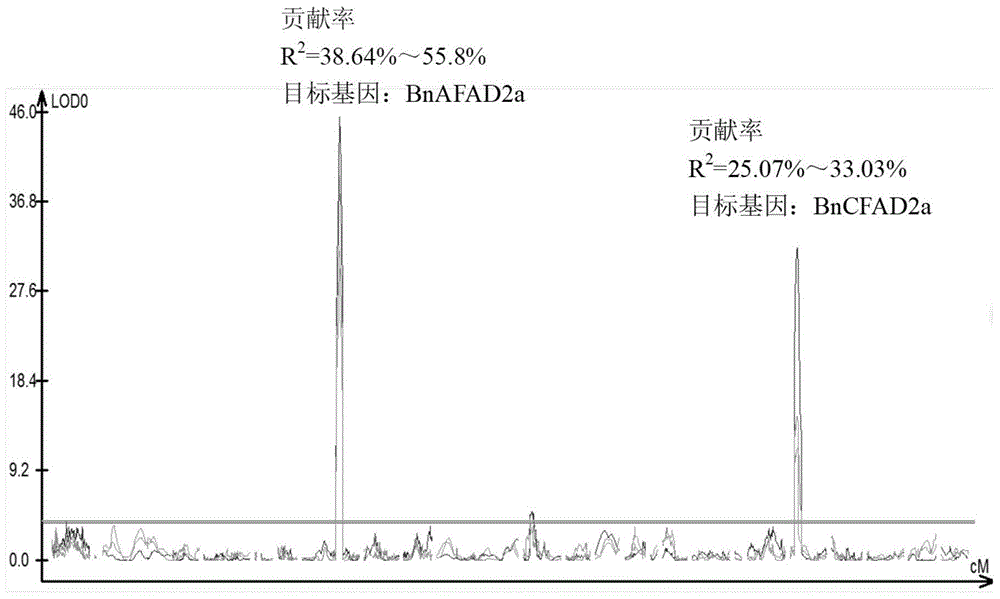
图1.本申请在F2群体中油酸QTL的定位结果。附图标记说明:图3中显示了2016-2017年、2017-2018年、2018-2019年三个自然生产年(甘蓝型油菜为跨年作物)扫描的结果,分别用红、蓝、黑三色线表示,QTL扫描的LOD值阈值为2.5(以线标明);横坐标为甘蓝型油菜不同的染色体,纵坐标为LOD值。目标QTL的贡献率和目标基因信息在QTL峰图上方注明。Figure 1. Mapping results of the present application in the F2 population of the QTL for oleic acid. Description of reference numerals: Figure 3 shows the scanning results of three natural production years in 2016-2017, 2017-2018, and 2018-2019 (Brassica oleracea is a New Year's crop), with red, blue, and black colors respectively. The color line indicates that the LOD value threshold of QTL scanning is 2.5 (marked by lines); the abscissa is the different chromosomes of Brassica napus, and the ordinate is the LOD value. The contribution rate of the target QTL and the target gene information are annotated above the QTL peak map.
图2.指示BnAFAD2基因高油酸等位基因与野生型等位基因在SNP变异位点的比较图。方框上面标识的数字为突变核苷酸在对应基因编码区的碱基位置,FC81和E183分别表示高油酸亲本和野生型亲本。Figure 2. A graph indicating the comparison of the high oleic acid allele of the BnAFAD2 gene and the wild-type allele at SNP variant sites. The numbers marked above the boxes are the base positions of the mutated nucleotides in the coding region of the corresponding gene, and FC81 and E183 represent the high-oleic acid parent and the wild-type parent, respectively.
图3.指示BnCFAD2基因高油酸等位基因与野生型等位基因在SNP变异位点的比较图。方框上面标识的数字为突变核苷酸在对应基因编码区的碱基位置,FC81和E183分别表示高油酸亲本和野生型亲本。Figure 3. A graph indicating the comparison of the high oleic acid allele of the BnCFAD2 gene and the wild-type allele at SNP variant sites. The numbers marked above the boxes are the base positions of the mutated nucleotides in the coding region of the corresponding gene, and FC81 and E183 represent the high-oleic acid parent and the wild-type parent, respectively.
图4.为本申请实施分子标记KASP-431的引物组对一个包含111个株系的F2分离群体(♀FC81×♂E183)开展于BnAFAD2等位基因分型的散点图。Figure 4. Scatter plot of BnAFAD2 allelic typing of primer sets implementing molecular marker KASP-431 for this application against an F 2 segregating population (♀FC81×♂E183) comprising 111 lines.
图5.为本申请实施分子标记KASP-1073的引物组对一个包含111个株系的F2分离群体(♀FC81×♂E183)开展于BnCFAD2等位基因分型的散点图。Figure 5. Scatter plot of BnCFAD2 allele typing of primer sets implementing molecular marker KASP-1073 for this application against an F 2 segregating population (♀FC81×♂E183) comprising 111 lines.
图6.为本申请实施分子标记KASP-431的引物组对一个包含90个株系的F2分离群体(♀FC90×♂E121)开展于BnAFAD2等位基因分型的散点图。Figure 6. Scatter plot of BnAFAD2 allelic typing of primer sets implementing molecular marker KASP-431 for this application against an F 2 segregating population (♀FC90×♂E121) comprising 90 lines.
图7.为本申请实施分子标记KASP-1073的引物组对一个包含90个株系的F2分离群体(♀FC90×♂E121)开展于BnCFAD2等位基因分型的散点图。Figure 7. Scatter plot of BnCFAD2 allelic typing of primer sets implementing molecular marker KASP-1073 for this application against an F 2 segregating population (♀FC90×♂E121) comprising 90 lines.
生物保藏声明biological deposit statement
本申请涉及生物保藏,名称:甘蓝型油菜(Brassica napus)FC81高油酸株系,保藏编号:CCTCC NO:P201923,保藏时间:2019.12.2,保藏机构:中国典型培养物保藏中心,地址:中国武汉武汉大学。This application relates to biological preservation, name: Brassica napus FC81 high oleic acid strain, preservation number: CCTCC NO: P201923, preservation time: 2019.12.2, preservation institution: China Type Culture Collection, address: China Wuhan University, Wuhan.
具体实施方式Detailed ways
实施例1、寻找并获得可用指示甘蓝型油菜高油酸性状的基于BnFAD2两个拷贝的新型等位突变。Example 1. Find and obtain novel allelic mutations based on two copies of BnFAD2 that can indicate the high oleic state of Brassica napus.
(1)我们在前期研究中,以油酸含量87.67%的高油酸纯合株系(FC81,保藏日:2019.12.2,保藏编号:CCTCC NO:P201923)为母本,以油酸含量63.56%的中低油酸纯合株系(E183,常规现有品种)为父本,杂交获得F2分离群体。从上述F2分离群体以及双亲的鲜嫩叶片中提取基因组DNA,具体制备方法参照李佳等(李佳等,一种有效提取油菜叶片总DNA的方法,华中农业大学学报,1994,13(5):521-523)报道的方法进行,用1%的琼脂糖凝胶电泳检测DNA质量,并用紫外分光光度计(型号:Pharmacia Biotech,Gene QuantII)检测DNA浓度。(1) In our previous study, a high oleic acid homozygous strain (FC81, preservation date: 2019.12.2, preservation number: CCTCC NO: P201923) with an oleic acid content of 87.67% was used as the female parent, and an oleic acid content of 63.56 % of the middle-low oleic acid homozygous line (E183, conventional existing variety) was the male parent, and the F 2 segregating population was obtained by crossing. Genomic DNA was extracted from the above-mentioned F 2 isolated population and the fresh and tender leaves of both parents, and the specific preparation method was referred to Li Jia et al. : 521-523), the DNA quality was detected by 1% agarose gel electrophoresis, and the DNA concentration was detected by an ultraviolet spectrophotometer (model: Pharmacia Biotech, Gene QuantII).
(2)油酸含量的测定:种子按单株收获后用气相色谱仪(HP6890,Genmany),分析脂肪酸含量,亲本及后代混合样随机选取30-50粒饱满种子磨碎后倒入10ml试管,在试管中加入1ml乙醚、石油醚(体积比为1∶1)混合液,然后再加入等体积的甲醇(含5%KOH)进行酯化反应,静置40分钟以上使其充分反应。最后加蒸溜水定容至10ml萃取,取上部醚层溶液取进样测定。脂肪酸成份用气相色谱法测定,色谱条件如下:(2) Determination of oleic acid content: After the seeds are harvested by individual plants, use a gas chromatograph (HP6890, Genmany) to analyze the fatty acid content. 30-50 plump seeds are randomly selected from the parent and progeny mixed sample and then poured into a 10ml test tube. Add 1 ml of ether and petroleum ether (volume ratio of 1:1) mixed solution to the test tube, then add an equal volume of methanol (containing 5% KOH) for esterification, and let stand for more than 40 minutes to fully react. Finally, distilled water was added to dilute the volume to 10ml for extraction, and the upper ether layer solution was taken for injection and determination. The fatty acid composition was determined by gas chromatography, and the chromatographic conditions were as follows:
色谱仪:Hewlett Packard(HP6890,Genmany),氢火焰离子化检测器,手动进样,进样量0.4ul(半粒分析进样量为0.8ul),分流比1∶45;色谱柱HP-inowax19091N-133,30m×0.25mm×0.25um毛细管柱;检侧器和进样室温度分别为250℃和280℃;载气:N2,30ml/min,尾吹40min/min;空气流速:300ml/min;H2流速:30min/min;炉温:持续升温,180℃保持2分钟,之后以10℃/min升至220℃保持并保持7min。脂肪酸成份由峰所在位置的保留时间与标准品对比确定,含量则用面积百分比表示。对测定的数据进行分析和整理时考虑了7种主要脂肪酸,即棕桐酸(C16:0)、硬脂酸(C18:0)、油酸(C18:1)、亚油酸(C18:2)、亚麻酸(C18:3)、花生烯酸(C20:1)、芥酸(C22:1)。Chromatograph: Hewlett Packard (HP6890, Genmany), hydrogen flame ionization detector, manual injection, injection volume 0.4ul (half particle analysis injection volume is 0.8ul), split ratio 1:45; chromatographic column HP-inowax19091N -133, 30m×0.25mm×0.25um capillary column; the temperature of side detector and injection chamber are 250℃ and 280℃ respectively; carrier gas: N 2 , 30ml/min, makeup blowing 40min/min; air flow rate: 300ml/ min; H 2 flow rate: 30 min/min; furnace temperature: keep rising at 180°C for 2 minutes, then increase to 220°C at 10°C/min and hold for 7 min. The fatty acid composition is determined by comparing the retention time at the peak position with the standard, and the content is expressed in area percentage. Seven major fatty acids, namely palmitic acid (C16:0), stearic acid (C18:0), oleic acid (C18:1), linoleic acid (C18:2), were considered in the analysis and arrangement of the measured data. ), linolenic acid (C18:3), arachidonic acid (C20:1), erucic acid (C22:1).
(3)SNP芯片分析两亲本及F2分离群体的基因型及连锁分析(3) Genotype and linkage analysis of two parents and F2 segregating population by SNP chip analysis
利用Illumina公司研制的60K油菜SNP芯片对油菜两亲本及F2分离群体DNA样品进行分型。在亲本中筛选到有多态性的SNP位点后,分析其在F2群体中的分布。通过在F2代分离群体中的分布进行数据分析,根据连锁交换规律,利用群体基因型资料构建油菜的遗传图谱,所用软件为Joinmap3.0,最小LOD值设为2.5,获得连锁图谱。将F2群体的190个单株的油酸含量数据及SNP基因型输入计算机,运行WinQTLcart4.0软件对数据进行QTL定位。将控制油酸含量的目标基因确定为位于油菜A05染色体的BnAFAD2a和C05染色体的BnCFAD2a(图1)。The 60K rapeseed SNP chip developed by Illumina was used to type the DNA samples of the two parents and F 2 segregated population of rapeseed. After screening for polymorphic SNP sites in the parents, their distribution in the F2 population was analyzed. Through data analysis of the distribution in the segregating population of F 2 generation, the genetic map of rape was constructed using the population genotype data according to the law of linkage exchange. The software used was Joinmap3.0, and the minimum LOD value was set to 2.5 to obtain the linkage map. The oleic acid content data and SNP genotypes of 190 individual plants of the F 2 population were input into the computer, and the WinQTLcart4.0 software was run to perform QTL mapping on the data. The target genes controlling oleic acid content were identified as BnAFAD2a on chromosome A05 and BnCFAD2a on chromosome C05 in rapeseed (Fig. 1).
(4)利用引物对19TA11扩增分析双亲的基因组DNA(4) Using the primer pair 19TA11 to amplify and analyze the genomic DNA of the parents
利用引物对19TA11(引物对序列见表1)分别用于扩增两个亲本FC81和E183的位于油菜A05染色体的BnAFAD2a和C05染色体的BnCFAD2a。Primer pair 19TA11 (see Table 1 for primer pair sequences) was used to amplify BnAFAD2a located on chromosome A05 of rape and BnCFAD2a located on chromosome C05 of two parents, FC81 and E183, respectively.
PCR体系PCR system

PCR程序PCR program

扩增产物在水平电泳槽上1.0%琼脂糖凝胶电泳检测,使用1×TAE缓冲液(0.04MTris-acetate,0.001MEDTA,pH8.0),电压8V/cm,电泳35min。电泳完毕,凝胶成像系统(UVP)拍照保存。The amplified products were detected by 1.0% agarose gel electrophoresis on a horizontal electrophoresis tank, using 1×TAE buffer (0.04MT Tris-acetate, 0.001 MEDTA, pH 8.0), voltage 8V/cm, electrophoresis for 35min. After electrophoresis, the gel imaging system (UVP) photographed and saved.
表1Table 1
(5)回收、克隆双亲中的BnAFAD2a和BnCFAD2a(5) Recovery and cloning of BnAFAD2a and BnCFAD2a in parents
回收上述步骤中获得的引物对19TA11在甘蓝型油菜亲本中扩增的DNA片段。操作程序按Gen Clean柱式DNA胶回收试剂盒(购自上海捷瑞生物工程公司)说明书提供的方法:用刀片从1.0%的琼脂糖胶上挖出扩增的DNA片段,放入1.5ml的离心管,按每100mg琼脂糖凝胶加入300μl Binding SolutionB,置于55℃水浴中加热10min,每隔2min混匀一次;将融化的胶溶液转移至套在收集管内的Gen Clean Column中,室温放置2min,3,000rpm离心30sec;倒掉收集管中的废液,加入500μl Wash Solution,8,000rpm室温离心30sec,此步骤重复一次;倒掉收集管中的废液,将Gen Clean Column放入同一个收集管中,10,000rpm离心1min将Gen Clean Column放入一根新的1.5ml的离心管中,在柱子膜中央加30μlElution Buffer,室温放置2min;10,000rpm离心1min,离心管中的液体即为回收的DNA片段,可立即使用或保存于-20℃备用。The DNA fragment amplified in the parent of Brassica napus by the primer pair 19TA11 obtained in the above step was recovered. The operation procedure is according to the method provided by the instructions of the Gen Clean Column DNA Gel Recovery Kit (purchased from Shanghai Jierui Bioengineering Co., Ltd.): use a blade to dig out the amplified DNA fragments from the 1.0% agarose gel, and put them into 1.5 ml of Centrifuge tube, add 300 μl Binding Solution B per 100 mg of agarose gel, heat in a 55°C water bath for 10 min, and mix every 2 min; transfer the melted gel solution to the Gen Clean Column set in the collection tube, and place at room temperature 2min, centrifuge at 3,000rpm for 30sec; pour off the waste liquid in the collection tube, add 500μl Wash Solution, centrifuge at 8,000rpm for 30sec at room temperature, repeat this step once; pour out the waste liquid in the collection tube, put the Gen Clean Column into the same collection tube In the tube, centrifuge at 10,000rpm for 1min. Put the Gen Clean Column into a new 1.5ml centrifuge tube, add 30μl Elution Buffer to the center of the column membrane, and leave it at room temperature for 2min; centrifuge at 10,000rpm for 1min, and the liquid in the centrifuge tube is recovered. DNA fragments can be used immediately or stored at -20°C for later use.
将回收的目标DNA片段连接在pMDT-18载体上(该载体购自TaKaRa公司,宝生物工程(大连)有限公司代理)。操作程序按该试剂盒的说明书介绍的方法:试剂在使用前先短暂离心将其收集在管底部;在0.5ml的离心管中进行连接反应,连接反应体系为DNA2.0μl,pMDT-18载体0.5μl和SolutionI2.5μl。用移液管来回吸几次混匀,置4℃冰箱进行过夜连接反应;准备LB液体培养基和LB固体培养基(含100mg/ml氨苄青霉素,24mg/ml的异丙基-硫代B-D-半乳糖苷和20mg/ml的5-溴-4-氯-3-吲哚-α-D-半乳糖苷);从-70℃冰箱中取出感受态细胞放在冰上待它慢慢解冻(约5min);离心收集连接反应液,取2μl反应液加入到一个已经灭菌的1.5ml离心管(放在冰上预冷);用手指轻弹装有感受态细胞的管底以混匀,取50μl感受态细胞加入装有2μl连接反应液的1.5ml离心管,用手指轻弹混匀,放在冰上20min;在42℃水浴中热激90sec(勿摇动),然后在冰上放置5min;加500μl的LB液体培养基后在37℃振荡培养1h(150rmp/min);吸取振荡培养后的转化液200μl涂在无菌的LB固体培养基上,在37℃放置16-20h;进行蓝、白斑筛选,挑选24个阳性克隆进行编号,并在无菌的液体LB培养基(含50ug/ml的氨苄青霉素)振荡培养16-20h;取振荡培养后的菌液2μl作PCR模板,用M13作引物(正向引物:5′-CAGGGTTTTCCCAGTCACGA-3′;反向引物:5′-CGGATAACAATTTCACACAGGA-3′)扩增,PCR反应如上述步骤所述。扩增结果在1.0%的琼脂糖凝胶上检测。如果所得的DNA片段比目标DNA片段大200bp左右,说明转化成功,选8份转化成功的菌液各吸取100μl送华大基因科技股份有限公司进行序列测定。剩余400μl浑浊菌液加400μl50%无菌的甘油在2ml无菌的离心管中于-70℃编号保存。The recovered target DNA fragment was ligated into the pMDT-18 vector (the vector was purchased from TaKaRa Company, the agent of Bao Bioengineering (Dalian) Co., Ltd.). The operating procedure is as described in the kit’s instructions: the reagents are briefly centrifuged to collect them at the bottom of the tube before use; the ligation reaction is carried out in a 0.5 ml centrifuge tube, and the ligation reaction system is 2.0 μl of DNA and 0.5 μl of pMDT-18 vector. μl and SolutionI 2.5 μl. Mix by pipetting back and forth several times, and place in a refrigerator at 4°C for overnight ligation reaction; prepare LB liquid medium and LB solid medium (containing 100mg/ml ampicillin, 24mg/ml isopropyl-thio-B-D- galactoside and 20mg/ml of 5-bromo-4-chloro-3-indole-α-D-galactoside); remove the competent cells from the -70°C freezer and place on ice until it is slowly thawed ( about 5min); centrifuge to collect the ligation reaction solution, add 2 μl of the reaction solution to a sterilized 1.5ml centrifuge tube (pre-cool on ice); flick the bottom of the tube containing competent cells with your fingers to mix, Take 50μl of competent cells into a 1.5ml centrifuge tube containing 2μl of ligation reaction solution, mix with fingers, and place on ice for 20min; heat shock in a 42°C water bath for 90sec (do not shake), then place on ice for 5min ; Add 500 μl of LB liquid medium and shake at 37 °C for 1 h (150 rmp/min); draw 200 μl of the transformation solution after shaking culture, spread it on sterile LB solid medium, and place it at 37 ° C for 16-20 h; , vitiligo screening, select 24 positive clones for numbering, and shake culture in sterile liquid LB medium (containing 50ug/ml ampicillin) for 16-20h; As primers (forward primer: 5'-CAGGGTTTTCCCAGTCACGA-3'; reverse primer: 5'-CGGATAACAATTTCACACAGGA-3') amplification, the PCR reaction was as described in the above steps. Amplification results were detected on a 1.0% agarose gel. If the obtained DNA fragment is about 200bp larger than the target DNA fragment, it means that the transformation is successful. Select 8 successfully transformed bacterial liquids and transfer 100 μl each to Huada Gene Technology Co., Ltd. for sequence determination. The remaining 400 μl of turbid bacterial solution was added with 400 μl of 50% sterile glycerol and stored in a 2 ml sterile centrifuge tube at -70°C.
本申请中,引物对19TA11在甘蓝型油菜两亲本中扩增的DNA片段进行各15次重复测序。引物对19TA11的扩增BnAFAD2a和BnCFAD2a基因编码序列长度均为1155bp。两亲本在位于甘蓝型油菜A05染色体的BnAFAD2a核苷酸序列421处发生了C至T的置换,即:C421T;在位于甘蓝型油菜C05染色体的BnAFAD2a核苷酸序列1073处发生了G至A的置换,即:G1073A。通过与前期研究中报道的BnFAD2基因进行序列比对,发现本申请提供的位于油菜A05染色体的BnAfad2a和C05染色体的BnCfad2a的高油酸复等位基因为新型的变异,所述基因的核苷酸序列如SEQIDNO:1和IDNO:2所述,蛋白质序列如SEQIDNO:3和IDNO:4。In the present application, the primers were sequenced 15 times each of the DNA fragments amplified by 19TA11 in the two parents of Brassica napus. Primer pair 19TA11 amplified the coding sequences of BnAFAD2a and BnCFAD2a genes were both 1155bp in length. The two parents had a C to T substitution at the BnAFAD2a nucleotide sequence 421 located on the A05 chromosome of Brassica napus, namely: C421T; a G to A substitution occurred at the BnAFAD2a nucleotide sequence 1073 located on the Brassica napus C05 chromosome. Substitution, ie: G1073A. Through the sequence alignment with the BnFAD2 gene reported in the previous study, it was found that the high oleic acid allele of BnAfad2a on the A05 chromosome of rapeseed and BnCfad2a on the C05 chromosome provided by this application are novel variants. The sequences are set forth in SEQ ID NO: 1 and ID NO: 2, and the protein sequences are set forth in SEQ ID NO: 3 and ID NO: 4.
实施例2、开发了可用于检测油菜BnFAD2基因一类新型高油酸等位突变的SNP标记。Example 2. Developed a SNP marker that can be used to detect a new type of high oleic acid allelic mutation in rape BnFAD2 gene.
以上述基因编码区的SNP位点为中心提取两侧100bp侧翼序列,并结合克隆获得的nAFAD2a和BnCFAD2a的序列差异设计引物特异扩增BnAFAD2a和BnCFAD2a基因序列片段,用于排除同源基因序列对检测产生的干扰。实验设计多个引物组,每组引物由三条引物组成。经过多次多态性筛选获得,并在多个分离群体中经多次测试验证,标记KASP-421和KASP-1073扩增效果最佳,可以明显区分出野生型和高油酸突变型在BnAFAD2a和BnCFAD2a的SNP变异。两对KASP标记均含有三条引物,分别包含两条针对关键位点碱基差异设计的特异性引物,一条通用引物。KASP-421的两条特异性引物3′末端为等位变异碱基C/T,5′端连接英国LGC(Laboratory of the Government Chemist)公司KASP反应试剂特定的FAM和HEX荧光接头序列。KASP-1073的两条特异性引物3′末端为等位变异碱基G/A,5′端连接英国LGC(Laboratory of the Government Chemist)公司KASP反应试剂特定的FAM和HEX荧光接头序列。所有引物委托英国LGC公司合成。本申请提供的KASP标记引物为以下特异性引物组合:The 100bp flanking sequences on both sides were extracted from the SNP site of the above-mentioned gene coding region, and primers were designed to specifically amplify the BnAFAD2a and BnCFAD2a gene sequence fragments in combination with the sequence differences of nAFAD2a and BnCFAD2a obtained by cloning, which were used to exclude homologous gene sequence pairs for detection. resulting interference. Multiple primer sets were designed in the experiment, and each set of primers consisted of three primers. After multiple polymorphism screening, and multiple tests in multiple isolated populations, the amplification effect of markers KASP-421 and KASP-1073 is the best, which can clearly distinguish wild type and high oleic acid mutant in BnAFAD2a and SNP variants of BnCFAD2a. Both pairs of KASP markers contain three primers, including two specific primers designed for base differences at key sites and one universal primer. The 3' end of the two specific primers of KASP-421 are allelic variant bases C/T, and the 5' end is connected to the specific FAM and HEX fluorescent linker sequences of the KASP reaction reagent of the British LGC (Laboratory of the Government Chemist) company. The 3' end of the two specific primers of KASP-1073 is an allelic variant base G/A, and the 5' end is connected to the specific FAM and HEX fluorescent linker sequences of the KASP reaction reagents from LGC (Laboratory of the Government Chemist), UK. All primers were synthesized by British LGC Company. The KASP marker primers provided in this application are the following specific primer combinations:
分子标记KASP-421的引物包括:Primers for molecular marker KASP-421 include:
两条特异性引物:Two specific primers:
Primer_AlleleFAM:5’-gttggaatggtggcgtcgatg-3’;Primer_AlleleFAM: 5'-gttggaatggtggcgtcgatg-3';
Primer_AlleleHEX:5’-gtgttggaatggtggcgtcgata-3’;Primer_AlleleHEX: 5'-gtgttggaatggtggcgtcgata-3';
一条通用引物a universal primer
Primer_Common:5’-ggacgacaccgtcggcctca-3’;Primer_Common: 5'-ggacgacaccgtcggcctca-3';
分子标记KASP-1073的引物包括:Primers for molecular marker KASP-1073 include:
两条特异性引物:Two specific primers:
Primer_AlleleFAM:5’-ggtggttaaggcgatgtggag-3’;Primer_AlleleFAM: 5'-ggtggttaaggcgatgtggag-3';
Primer_AlleleHEX:5’-cggtggttaaggcgatgtggaa-3’;Primer_AlleleHEX: 5'-cggtggttaaggcgatgtggaa-3';
一条通用引物a universal primer
Primer_Common:5’-ccggttccacatagatacactcctt-3’。Primer_Common: 5'-ccggttccacatagatacactcctt-3'.
实施例3:一种上述的可用于检测油菜BnFAD2基因一类新型高油酸等位突变的SNP标记体系的建立及在甘蓝型油菜高油酸性状辅助育种中的应用。Example 3: Establishment of the above-mentioned SNP marker system for detecting a new type of high oleic acid allelic mutation of BnFAD2 gene in rapeseed and its application in assisted breeding of high oleic acid traits in Brassica napus.
选取一个包含111个F2分离株系的F2群体(♀FC81×♂E183)和一个包含90个F2分离株系的F2群体(♀FC90×♂E121,FC90和E121均是常规品种,作为对比使用),利用上述设计的两组KASP引物KASP-421和KASP-1073,在LGCSNP line基因分型平台上进行分离群体初筛与验证。具体操作步骤如下: One F2 population (♀FC81× ♂E183 ) containing 111 F2 isolates and one F2 population ( ♀FC90 × ♂E121 ) containing 90 F2 isolates were selected, both FC90 and E121 were conventional varieties, As a comparison), the two groups of KASP primers KASP-421 and KASP-1073 designed above were used to conduct preliminary screening and verification of the isolated population on the LGCSNP line genotyping platform. The specific operation steps are as follows:
(1)用常规方法(CTAB法)提取待测材料的叶片基因组DNA;用琼脂糖电泳和Nanodrop2100分别检测所提取DNA的质量,琼脂糖电泳显示DNA条带单一,A260/280介于1.8-2.0之间,A260/230介于2.0-2.2之间,这样的DNA样品符合质量要求,稀释DNA浓度为20ng/μL备用。(1) Extract the leaf genomic DNA of the material to be tested by a conventional method (CTAB method); use agarose electrophoresis and Nanodrop2100 to detect the quality of the extracted DNA respectively. Between, A260/230 is between 2.0-2.2, such DNA samples meet the quality requirements, and the diluted DNA concentration is 20ng/μL for use.
(2)以步骤1提取的DNA为模板,采用实施例2开发的可用于检测油菜BnFAD2基因一类新型高油酸等位突变的SNP标记KASP-421和KASP-1073进行扩增PCR,得到扩增产物。(2) Using the DNA extracted in step 1 as a template, using the SNP markers KASP-421 and KASP-1073 developed in Example 2 that can be used to detect a new type of high oleic acid allelic mutation of the rape BnFAD2 gene to carry out amplification PCR, to obtain amplified PCR increase product.
KASP标记引物反应体系的配置:Configuration of KASP labeling primer reaction system:
油菜样品DNA模板(20ng/μl)2.5μl,2×KASPMastermix2.5μl,KASP Assay Mix(F-HEX:F-FAM:R=2:2:5的摩尔浓度比)0.07μl。Rape sample DNA template (20ng/μl) 2.5μl, 2×KASP Mastermix 2.5μl, KASP Assay Mix (F-HEX:F-FAM:R=2:2:5 molar ratio) 0.07μl.
PCR反应条件为:94℃15min;94℃20sec,61-55℃1min,每个循环退火温度降低0.6℃,共10个循环;94℃20sec,55℃1min,共26个循环。若扩增效果不理想可加循环,每次3个循环,最多可三次。反应完成后利用扫描仪Pherastar对KASP反应产物进行荧光数据读取,荧光扫描的结果会自动转化成图形。利用BMG PHERAstar仪器检测荧光信号并查看分型情况。若分型不充分,则继续扩增,每3个循环查看分型情况,直至分型完全。KASP-421检测结果中第+421位碱基为T,则判定油菜样品的BnAFAD2a为高油酸等位基因,基因型定义为AA,若为碱基C,则判定该位点为中低油酸等位基因,基因型定义为aa,若检测位点同时检测到T和C,则判定为杂合体,基因型定义为Aa。采用分子标记KASP-1073引物组的判断目标SNP的基因型:如果检测到第+1073位碱基只为A,则判定油菜样品的BnCFAD2a为高油酸等位基因,基因型定义为BB,若只为碱基G,则判定该位点为中低油酸等位基因,基因型定义为bb,若检测位点同时检测到A和G,则判定为杂合体,基因型定义为Bb。PCR reaction conditions were: 94°C for 15min; 94°C for 20sec, 61-55°C for 1min, annealing temperature decreased by 0.6°C for each cycle, a total of 10 cycles; 94°C for 20sec, 55°C for 1min, a total of 26 cycles. If the amplification effect is unsatisfactory, additional cycles can be added, 3 cycles each time, up to three times. After the reaction is completed, use the scanner Pherastar to read the fluorescence data of the KASP reaction products, and the results of the fluorescence scanning will be automatically converted into graphics. Use the BMG PHERAstar instrument to detect fluorescent signals and view typing. If the typing is not sufficient, continue to expand, and check the typing status every 3 cycles until the typing is complete. In the detection result of KASP-421, the +421st base is T, and the BnAFAD2a of the rape sample is determined to be a high oleic acid allele, and the genotype is defined as AA. For acid alleles, the genotype is defined as aa. If both T and C are detected at the detection site, it is determined as a heterozygote, and the genotype is defined as Aa. Using the molecular marker KASP-1073 primer set to determine the genotype of the target SNP: if the +1073 base is only A, the BnCFAD2a of the rape sample is determined to be a high oleic acid allele, and the genotype is defined as BB. If it is only the base G, the locus is determined to be a medium-low oleic acid allele, and the genotype is defined as bb. If both A and G are detected at the detection site, it is determined as a heterozygote, and the genotype is defined as Bb.
表2KASP标记KASP-421和KASP-1073初筛分离群体分型结果Table 2 KASP marker KASP-421 and KASP-1073 primary screening isolated population typing results


表3两个F2群体中KASP421和KASP1073的基因型与油酸含量Table 3 Genotypes and oleic acid content of KASP421 and KASP1073 in two F2 populations

由以上数据可知,标记KASP-421和KASP-1073能够用于精准检测这类新型的高油酸等位变异,后代基因型扩增分型效果良好,具有KASP-421这个位点中的T碱基的等位基因以及KASP-1073这个位点中的A碱基的等位基因,属于高油酸等位基因,如果材料同时聚合KASP-421这个位点中的T碱基和KASP-1073这个点中的A碱基,油酸含量表型为超高油酸含量,表型值可超过88%。From the above data, it can be seen that the markers KASP-421 and KASP-1073 can be used to accurately detect this new type of high oleic acid allelic variation, and the offspring genotype amplification and typing effect is good, with the T base in the KASP-421 locus The allele of the base and the allele of the A base in the KASP-1073 site belong to the high oleic acid allele. If the material aggregates the T base in the KASP-421 site and the KASP-1073 base at the same time The A base in the dot, the oleic acid content phenotype is ultra-high oleic acid content, and the phenotypic value can exceed 88%.
以上为对本申请实施例的描述,通过对所公开的实施例的上述说明,使本领域专业技术人员能够实现或使用本申请。对这些实施例的多种修改对本领域的专业技术人员来说将是显而易见的。本文中所定义的一般原理可以在不脱离本申请的精神或范围的情况下,在其它实施例中实现。因此,本申请将不会被限制于本文所示的这些实施列,而是要符合与本文所公开的原理和新颖点相一致的最宽的范围。The above is the description of the embodiments of the present application. The above description of the disclosed embodiments enables those skilled in the art to realize or use the present application. Various modifications to these embodiments will be apparent to those skilled in the art. The general principles defined herein may be implemented in other embodiments without departing from the spirit or scope of the present application. Therefore, this application is not intended to be limited to the embodiments shown herein, but is to be accorded the widest scope consistent with the principles and novelties disclosed herein.
序列表sequence listing
<110> 浙江省农业科学院<110> Zhejiang Academy of Agricultural Sciences
<120> 一种新型的油菜BnFAD2基因高油酸等位突变及其SNP标记引物的开发和应用<120> Development and application of a novel BnFAD2 gene high oleic acid allelic mutation in rape and its SNP marker primers
<160> 12<160> 12
<170> SIPOSequenceListing 1.0<170> SIPOSequenceListing 1.0
<210> 1<210> 1
<211> 1155<211> 1155
<212> DNA<212> DNA
<213> 甘蓝型油菜(Brassica napus)<213> Brassica napus
<400> 1<400> 1
atgggtgcag gtggaagaat gcaagtgtct cctccctcca aaaagtctga aaccgacaac 60atgggtgcag gtggaagaat gcaagtgtct cctccctcca aaaagtctga aaccgacaac 60
atcaagcgcg taccctgcga gacaccgccc ttcactgtcg gagaactcaa gaaagcaatc 120atcaagcgcg taccctgcga gacaccgccc ttcactgtcg gagaactcaa gaaagcaatc 120
ccaccgcact gtttcaaacg ctcgatccct cgctctttct cctacctcat ctgggacatc 180ccaccgcact gtttcaaacg ctcgatccct cgctctttct cctacctcat ctgggacatc 180
atcatagcct cctgcttcta ctacgtcgcc accacttact tccctctcct ccctcaccct 240atcatagcct cctgcttcta ctacgtcgcc accacttact tccctctcct ccctcaccct 240
ctctcctact tcgcctggcc tctctactgg gcctgccagg gctgcgtcct aaccggcgtc 300ctctcctact tcgcctggcc tctctactgg gcctgccagg gctgcgtcct aaccggcgtc 300
tgggtcatag cccacgagtg cggccaccac gccttcagcg actaccagtg gctggacgac 360tgggtcatag cccacgagtg cggccaccac gccttcagcg actaccagtg gctggacgac 360
accgtcggcc tcatcttcca ctccttcctc ctcgtccctt acttctcctg gaagtacagt 420accgtcggcc tcatcttcca ctccttcctc ctcgtccctt acttctcctg gaagtacagt 420
tatcgacgcc accattccaa cactggctcc ctcgagagag acgaagtgtt tgtccccaag 480tatcgacgcc accattccaa cactggctcc ctcgagagag acgaagtgtt tgtccccaag 480
aagaagtcag acatcaagtg gtacggcaag tacctcaaca accctttggg acgcaccgtg 540aagaagtcag acatcaagtg gtacggcaag tacctcaaca accctttggg acgcaccgtg 540
atgttaacgg ttcagttcac tctcggctgg cctttgtact tagccttcaa cgtctcgggg 600atgttaacgg ttcagttcac tctcggctgg cctttgtact tagccttcaa cgtctcgggg 600
agaccttacg acggcggctt cgcttgccat ttccacccca acgctcccat ctacaacgac 660agaccttacg acggcggctt cgcttgccat ttccacccca acgctcccat ctacaacgac 660
cgtgagcgtc tccagatata catctccgac gctggcatcc tcgccgtctg ctacggtctc 720cgtgagcgtc tccagatata catctccgac gctggcatcc tcgccgtctg ctacggtctc 720
taccgctacg ctgctgtcca aggagttgcc tcgatggtct gcttctacgg agttcctctt 780taccgctacg ctgctgtcca aggagttgcc tcgatggtct gcttctacgg agttcctctt 780
ctgattgtca acgggttctt agttttgatc acttacttgc agcacacgca tccttccctg 840ctgattgtca acgggttctt agttttgatc acttacttgc agcacacgca tccttccctg 840
cctcactatg actcgtctga gtgggattgg ttgaggggag ctttggccac cgttgacaga 900cctcactatg actcgtctga gtgggattgg ttgaggggag ctttggccac cgttgacaga 900
gactacggaa tcttgaacaa ggtcttccac aatatcacgg acacgcacgt ggcgcatcac 960gactacggaa tcttgaacaa ggtcttccac aatatcacgg acacgcacgt ggcgcatcac 960
ctgttctcga ccatgccgca ttatcatgcg atggaagcta cgaaggcgat aaagccgata 1020ctgttctcga ccatgccgca ttatcatgcg atggaagcta cgaaggcgat aaagccgata 1020
ctgggagagt attatcagtt cgatgggacg ccggtggtta aggcgatgtg gagggaggcg 1080ctgggagagt attatcagtt cgatgggacg ccggtggtta aggcgatgtg gagggaggcg 1080
aaggagtgta tctatgtgga accggacagg caaggtgaga agaaaggtgt gttctggtac 1140aaggagtgta tctatgtgga accggacagg caaggtgaga agaaaggtgt gttctggtac 1140
aacaataagt tatga 1155aacaataagt tatga 1155
<210> 2<210> 2
<211> 1155<211> 1155
<212> DNA<212> DNA
<213> 甘蓝型油菜(Brassica napus)<213> Brassica napus
<400> 2<400> 2
atgggtgcag gtggaagaat gcaagtgtct cctccctcca agaagtctga aaccgacacc 60atgggtgcag gtggaagaat gcaagtgtct cctccctcca agaagtctga aaccgacacc 60
atcaagcgcg taccctgcga gacaccgccc ttcactgtcg gagaactcaa gaaagcaatc 120atcaagcgcg taccctgcga gacaccgccc ttcactgtcg gagaactcaa gaaagcaatc 120
ccaccgcact gtttcaaacg ctcgatccct cgctctttct cctacctcat ctgggacatc 180ccaccgcact gtttcaaacg ctcgatccct cgctctttct cctacctcat ctgggacatc 180
atcatagcct cctgcttcta ctacgtcgcc accacttact tccctctcct ccctcaccct 240atcatagcct cctgcttcta ctacgtcgcc accacttact tccctctcct ccctcaccct 240
ctctcctact tcgcctggcc tctctactgg gcctgccaag ggtgcgtcct aaccggcgtc 300ctctcctact tcgcctggcc tctctactgg gcctgccaag ggtgcgtcct aaccggcgtc 300
tgggtcatag cccacgagtg cggccaccac gccttcagcg actaccagtg gcttgacgac 360tgggtcatag cccacgagtg cggccaccac gccttcagcg actaccagtg gcttgacgac 360
accgtcggtc tcatcttcca ctccttcctc ctcgtccctt acttctcctg gaagtacagt 420accgtcggtc tcatcttcca ctccttcctc ctcgtccctt acttctcctg gaagtacagt 420
catcgacgcc accattccaa cactggctcc ctcgagagag acgaagtgtt tgtccccaag 480catcgacgcc accattccaa cactggctcc ctcgagagag acgaagtgtt tgtccccaag 480
aagaagtcag acatcaagtg gtacggcaag tacctcaaca accctttggg acgcaccgtg 540aagaagtcag acatcaagtg gtacggcaag tacctcaaca accctttggg acgcaccgtg 540
atgttaacgg ttcagttcac tctcggctgg ccgttgtact tagccttcaa cgtctcggga 600atgttaacgg ttcagttcac tctcggctgg ccgttgtact tagccttcaa cgtctcggga 600
agaccttacg acggcggctt cgcttgccat ttccacccca acgctcccat ctacaacgac 660agaccttacg acggcggctt cgcttgccat ttccacccca acgctcccat ctacaacgac 660
cgcgagcgtc tccagatata catctccgac gctggcatcc tcgccgtctg ctacggtctc 720cgcgagcgtc tccagatata catctccgac gctggcatcc tcgccgtctg ctacggtctc 720
ttccgttacg ccgccgcgca gggagtggcc tcgatggtct gcttctacgg agtcccgctt 780ttccgttacg ccgccgcgca gggagtggcc tcgatggtct gcttctacgg agtcccgctt 780
ctgattgtca atggtttcct cgtgttgatc acttacttgc agcacacgca tccttccctg 840ctgattgtca atggtttcct cgtgttgatc acttacttgc agcacacgca tccttccctg 840
cctcactacg attcgtccga gtgggattgg ttgaggggag ctttggctac cgttgacaga 900cctcactacg attcgtccga gtgggattgg ttgaggggag ctttggctac cgttgacaga 900
gactacggaa tcttgaacaa ggtcttccac aatattaccg acacgcacgt ggcgcatcat 960gactacggaa tcttgaacaa ggtcttccac aatattaccg acacgcacgt ggcgcatcat 960
ctgttctcca cgatgccgca ttatcacgcg atggaagcta ccaaggcgat aaagccgata 1020ctgttctcca cgatgccgca ttatcacgcg atggaagcta ccaaggcgat aaagccgata 1020
ctgggagagt attatcagtt cgatgggacg ccggtggtta aggcgatgtg gaaggaggcg 1080ctgggagagt attatcagtt cgatgggacg ccggtggtta aggcgatgtg gaaggaggcg 1080
aaggagtgta tctatgtgga accggacagg caaggtgaga agaaaggtgt gttctggtac 1140aaggagtgta tctatgtgga accggacagg caaggtgaga agaaaggtgt gttctggtac 1140
aacaataagt tatga 1155aacaataagt tatga 1155
<210> 3<210> 3
<211> 384<211> 384
<212> PRT<212> PRT
<213> 甘蓝型油菜(Brassica napus)<213> Brassica napus
<400> 3<400> 3
Met Gly Ala Gly Gly Arg Met Gln Val Ser Pro Pro Ser Lys Lys SerMet Gly Ala Gly Gly Arg Met Gln Val Ser Pro Pro Ser Lys Lys Ser
1 5 10 151 5 10 15
Glu Thr Asp Asn Ile Lys Arg Val Pro Cys Glu Thr Pro Pro Phe ThrGlu Thr Asp Asn Ile Lys Arg Val Pro Cys Glu Thr Pro Pro Phe Thr
20 25 30 20 25 30
Val Gly Glu Leu Lys Lys Ala Ile Pro Pro His Cys Phe Lys Arg SerVal Gly Glu Leu Lys Lys Ala Ile Pro Pro His Cys Phe Lys Arg Ser
35 40 45 35 40 45
Ile Pro Arg Ser Phe Ser Tyr Leu Ile Trp Asp Ile Ile Ile Ala SerIle Pro Arg Ser Phe Ser Tyr Leu Ile Trp Asp Ile Ile Ile Ala Ser
50 55 60 50 55 60
Cys Phe Tyr Tyr Val Ala Thr Thr Tyr Phe Pro Leu Leu Pro His ProCys Phe Tyr Tyr Val Ala Thr Thr Tyr Phe Pro Leu Leu Pro His Pro
65 70 75 8065 70 75 80
Leu Ser Tyr Phe Ala Trp Pro Leu Tyr Trp Ala Cys Gln Gly Cys ValLeu Ser Tyr Phe Ala Trp Pro Leu Tyr Trp Ala Cys Gln Gly Cys Val
85 90 95 85 90 95
Leu Thr Gly Val Trp Val Ile Ala His Glu Cys Gly His His Ala PheLeu Thr Gly Val Trp Val Ile Ala His Glu Cys Gly His His Ala Phe
100 105 110 100 105 110
Ser Asp Tyr Gln Trp Leu Asp Asp Thr Val Gly Leu Ile Phe His SerSer Asp Tyr Gln Trp Leu Asp Asp Thr Val Gly Leu Ile Phe His Ser
115 120 125 115 120 125
Phe Leu Leu Val Pro Tyr Phe Ser Trp Lys Tyr Ser Tyr Arg Arg HisPhe Leu Leu Val Pro Tyr Phe Ser Trp Lys Tyr Ser Tyr Arg Arg His
130 135 140 130 135 140
His Ser Asn Thr Gly Ser Leu Glu Arg Asp Glu Val Phe Val Pro LysHis Ser Asn Thr Gly Ser Leu Glu Arg Asp Glu Val Phe Val Pro Lys
145 150 155 160145 150 155 160
Lys Lys Ser Asp Ile Lys Trp Tyr Gly Lys Tyr Leu Asn Asn Pro LeuLys Lys Ser Asp Ile Lys Trp Tyr Gly Lys Tyr Leu Asn Asn Pro Leu
165 170 175 165 170 175
Gly Arg Thr Val Met Leu Thr Val Gln Phe Thr Leu Gly Trp Pro LeuGly Arg Thr Val Met Leu Thr Val Gln Phe Thr Leu Gly Trp Pro Leu
180 185 190 180 185 190
Tyr Leu Ala Phe Asn Val Ser Gly Arg Pro Tyr Asp Gly Gly Phe AlaTyr Leu Ala Phe Asn Val Ser Gly Arg Pro Tyr Asp Gly Gly Phe Ala
195 200 205 195 200 205
Cys His Phe His Pro Asn Ala Pro Ile Tyr Asn Asp Arg Glu Arg LeuCys His Phe His Pro Asn Ala Pro Ile Tyr Asn Asp Arg Glu Arg Leu
210 215 220 210 215 220
Gln Ile Tyr Ile Ser Asp Ala Gly Ile Leu Ala Val Cys Tyr Gly LeuGln Ile Tyr Ile Ser Asp Ala Gly Ile Leu Ala Val Cys Tyr Gly Leu
225 230 235 240225 230 235 240
Tyr Arg Tyr Ala Ala Val Gln Gly Val Ala Ser Met Val Cys Phe TyrTyr Arg Tyr Ala Ala Val Gln Gly Val Ala Ser Met Val Cys Phe Tyr
245 250 255 245 250 255
Gly Val Pro Leu Leu Ile Val Asn Gly Phe Leu Val Leu Ile Thr TyrGly Val Pro Leu Leu Ile Val Asn Gly Phe Leu Val Leu Ile Thr Tyr
260 265 270 260 265 270
Leu Gln His Thr His Pro Ser Leu Pro His Tyr Asp Ser Ser Glu TrpLeu Gln His Thr His Pro Ser Leu Pro His Tyr Asp Ser Ser Glu Trp
275 280 285 275 280 285
Asp Trp Leu Arg Gly Ala Leu Ala Thr Val Asp Arg Asp Tyr Gly IleAsp Trp Leu Arg Gly Ala Leu Ala Thr Val Asp Arg Asp Tyr Gly Ile
290 295 300 290 295 300
Leu Asn Lys Val Phe His Asn Ile Thr Asp Thr His Val Ala His HisLeu Asn Lys Val Phe His Asn Ile Thr Asp Thr His Val Ala His His
305 310 315 320305 310 315 320
Leu Phe Ser Thr Met Pro His Tyr His Ala Met Glu Ala Thr Lys AlaLeu Phe Ser Thr Met Pro His Tyr His Ala Met Glu Ala Thr Lys Ala
325 330 335 325 330 335
Ile Lys Pro Ile Leu Gly Glu Tyr Tyr Gln Phe Asp Gly Thr Pro ValIle Lys Pro Ile Leu Gly Glu Tyr Tyr Gln Phe Asp Gly Thr Pro Val
340 345 350 340 345 350
Val Lys Ala Met Trp Arg Glu Ala Lys Glu Cys Ile Tyr Val Glu ProVal Lys Ala Met Trp Arg Glu Ala Lys Glu Cys Ile Tyr Val Glu Pro
355 360 365 355 360 365
Asp Arg Gln Gly Glu Lys Lys Gly Val Phe Trp Tyr Asn Asn Lys LeuAsp Arg Gln Gly Glu Lys Lys Gly Val Phe Trp Tyr Asn Asn Lys Leu
370 375 380 370 375 380
<210> 4<210> 4
<211> 384<211> 384
<212> PRT<212> PRT
<213> 甘蓝型油菜(Brassica napus)<213> Brassica napus
<400> 4<400> 4
Met Gly Ala Gly Gly Arg Met Gln Val Ser Pro Pro Ser Lys Lys SerMet Gly Ala Gly Gly Arg Met Gln Val Ser Pro Pro Ser Lys Lys Ser
1 5 10 151 5 10 15
Glu Thr Asp Thr Ile Lys Arg Val Pro Cys Glu Thr Pro Pro Phe ThrGlu Thr Asp Thr Ile Lys Arg Val Pro Cys Glu Thr Pro Pro Phe Thr
20 25 30 20 25 30
Val Gly Glu Leu Lys Lys Ala Ile Pro Pro His Cys Phe Lys Arg SerVal Gly Glu Leu Lys Lys Ala Ile Pro Pro His Cys Phe Lys Arg Ser
35 40 45 35 40 45
Ile Pro Arg Ser Phe Ser Tyr Leu Ile Trp Asp Ile Ile Ile Ala SerIle Pro Arg Ser Phe Ser Tyr Leu Ile Trp Asp Ile Ile Ile Ala Ser
50 55 60 50 55 60
Cys Phe Tyr Tyr Val Ala Thr Thr Tyr Phe Pro Leu Leu Pro His ProCys Phe Tyr Tyr Val Ala Thr Thr Tyr Phe Pro Leu Leu Pro His Pro
65 70 75 8065 70 75 80
Leu Ser Tyr Phe Ala Trp Pro Leu Tyr Trp Ala Cys Gln Gly Cys ValLeu Ser Tyr Phe Ala Trp Pro Leu Tyr Trp Ala Cys Gln Gly Cys Val
85 90 95 85 90 95
Leu Thr Gly Val Trp Val Ile Ala His Glu Cys Gly His His Ala PheLeu Thr Gly Val Trp Val Ile Ala His Glu Cys Gly His His Ala Phe
100 105 110 100 105 110
Ser Asp Tyr Gln Trp Leu Asp Asp Thr Val Gly Leu Ile Phe His SerSer Asp Tyr Gln Trp Leu Asp Asp Thr Val Gly Leu Ile Phe His Ser
115 120 125 115 120 125
Phe Leu Leu Val Pro Tyr Phe Ser Trp Lys Tyr Ser His Arg Arg HisPhe Leu Leu Val Pro Tyr Phe Ser Trp Lys Tyr Ser His Arg Arg His
130 135 140 130 135 140
His Ser Asn Thr Gly Ser Leu Glu Arg Asp Glu Val Phe Val Pro LysHis Ser Asn Thr Gly Ser Leu Glu Arg Asp Glu Val Phe Val Pro Lys
145 150 155 160145 150 155 160
Lys Lys Ser Asp Ile Lys Trp Tyr Gly Lys Tyr Leu Asn Asn Pro LeuLys Lys Ser Asp Ile Lys Trp Tyr Gly Lys Tyr Leu Asn Asn Pro Leu
165 170 175 165 170 175
Gly Arg Thr Val Met Leu Thr Val Gln Phe Thr Leu Gly Trp Pro LeuGly Arg Thr Val Met Leu Thr Val Gln Phe Thr Leu Gly Trp Pro Leu
180 185 190 180 185 190
Tyr Leu Ala Phe Asn Val Ser Gly Arg Pro Tyr Asp Gly Gly Phe AlaTyr Leu Ala Phe Asn Val Ser Gly Arg Pro Tyr Asp Gly Gly Phe Ala
195 200 205 195 200 205
Cys His Phe His Pro Asn Ala Pro Ile Tyr Asn Asp Arg Glu Arg LeuCys His Phe His Pro Asn Ala Pro Ile Tyr Asn Asp Arg Glu Arg Leu
210 215 220 210 215 220
Gln Ile Tyr Ile Ser Asp Ala Gly Ile Leu Ala Val Cys Tyr Gly LeuGln Ile Tyr Ile Ser Asp Ala Gly Ile Leu Ala Val Cys Tyr Gly Leu
225 230 235 240225 230 235 240
Phe Arg Tyr Ala Ala Ala Gln Gly Val Ala Ser Met Val Cys Phe TyrPhe Arg Tyr Ala Ala Ala Gln Gly Val Ala Ser Met Val Cys Phe Tyr
245 250 255 245 250 255
Gly Val Pro Leu Leu Ile Val Asn Gly Phe Leu Val Leu Ile Thr TyrGly Val Pro Leu Leu Ile Val Asn Gly Phe Leu Val Leu Ile Thr Tyr
260 265 270 260 265 270
Leu Gln His Thr His Pro Ser Leu Pro His Tyr Asp Ser Ser Glu TrpLeu Gln His Thr His Pro Ser Leu Pro His Tyr Asp Ser Ser Glu Trp
275 280 285 275 280 285
Asp Trp Leu Arg Gly Ala Leu Ala Thr Val Asp Arg Asp Tyr Gly IleAsp Trp Leu Arg Gly Ala Leu Ala Thr Val Asp Arg Asp Tyr Gly Ile
290 295 300 290 295 300
Leu Asn Lys Val Phe His Asn Ile Thr Asp Thr His Val Ala His HisLeu Asn Lys Val Phe His Asn Ile Thr Asp Thr His Val Ala His His
305 310 315 320305 310 315 320
Leu Phe Ser Thr Met Pro His Tyr His Ala Met Glu Ala Thr Lys AlaLeu Phe Ser Thr Met Pro His Tyr His Ala Met Glu Ala Thr Lys Ala
325 330 335 325 330 335
Ile Lys Pro Ile Leu Gly Glu Tyr Tyr Gln Phe Asp Gly Thr Pro ValIle Lys Pro Ile Leu Gly Glu Tyr Tyr Gln Phe Asp Gly Thr Pro Val
340 345 350 340 345 350
Val Lys Ala Met Trp Lys Glu Ala Lys Glu Cys Ile Tyr Val Glu ProVal Lys Ala Met Trp Lys Glu Ala Lys Glu Cys Ile Tyr Val Glu Pro
355 360 365 355 360 365
Asp Arg Gln Gly Glu Lys Lys Gly Val Phe Trp Tyr Asn Asn Lys LeuAsp Arg Gln Gly Glu Lys Lys Gly Val Phe Trp Tyr Asn Asn Lys Leu
370 375 380 370 375 380
<210> 5<210> 5
<211> 211<211> 211
<212> DNA<212> DNA
<213> 甘蓝型油菜(Brassica napus)<213> Brassica napus
<220><220>
<221> mutation<221> mutation
<222> (104)..(104)<222> (104)..(104)
<223> c为t<223> c is t
<400> 5<400> 5
gtgcggccac cacgccttca gcgactacca gtggctggac gacaccgtcg gcctcatctt 60gtgcggccac cacgccttca gcgactacca gtggctggac gacaccgtcg gcctcatctt 60
ccactccttc ctcctcgtcc cttacttctc ctggaagtac agtcatcgac gccaccattc 120ccactccttc ctcctcgtcc cttacttctc ctggaagtac agtcatcgac gccaccattc 120
caacactggc tccctcgaga gagacgaagt gtttgtcccc aagaagaagt cagacatcaa 180caacactggc tccctcgaga gagacgaagt gtttgtcccc aagaagaagt cagacatcaa 180
gtggtacggc aagtacctca acaacccttt g 211gtggtacggc aagtacctca acaacccttt g 211
<210> 6<210> 6
<211> 196<211> 196
<212> DNA<212> DNA
<213> 甘蓝型油菜(Brassica napus)<213> Brassica napus
<220><220>
<221> mutation<221> mutation
<222> (114)..(114)<222> (114)..(114)
<223> g为a<223> g is a
<400> 6<400> 6
tctgttctcc acgatgccgc attatcacgc gatggaagct accaaggcga taaagccgat 60tctgttctcc acgatgccgc attatcacgc gatggaagct accaaggcga taaagccgat 60
actgggagag tattatcagt tcgatgggac gccggtggtt aaggcgatgt ggagggaggc 120actgggagag tattatcagt tcgatgggac gccggtggtt aaggcgatgt ggagggaggc 120
gaaggagtgt atctatgtgg aaccggacag gcaaggtgag aagaaaggtg tgttctggta 180gaaggagtgt atctatgtgg aaccggacag gcaaggtgag aagaaaggtg tgttctggta 180
caacaataag ttatga 196caacaataag ttatga 196
<210> 7<210> 7
<211> 21<211> 21
<212> DNA<212> DNA
<213> 人工序列(Artificial Sequence)<213> Artificial Sequence
<400> 7<400> 7
gttggaatgg tggcgtcgat g 21gttggaatgg tggcgtcgat g 21
<210> 8<210> 8
<211> 23<211> 23
<212> DNA<212> DNA
<213> 人工序列(Artificial Sequence)<213> Artificial Sequence
<400> 8<400> 8
gtgttggaat ggtggcgtcg ata 23gtgttggaat ggtggcgtcg ata 23
<210> 9<210> 9
<211> 20<211> 20
<212> DNA<212> DNA
<213> 人工序列(Artificial Sequence)<213> Artificial Sequence
<400> 9<400> 9
ggacgacacc gtcggcctca 20ggacgacacc gtcggcctca 20
<210> 10<210> 10
<211> 21<211> 21
<212> DNA<212> DNA
<213> 人工序列(Artificial Sequence)<213> Artificial Sequence
<400> 10<400> 10
ggtggttaag gcgatgtgga g 21ggtggttaag gcgatgtgga g 21
<210> 11<210> 11
<211> 22<211> 22
<212> DNA<212> DNA
<213> 人工序列(Artificial Sequence)<213> Artificial Sequence
<400> 11<400> 11
cggtggttaa ggcgatgtgg aa 22cggtggttaa ggcgatgtgg aa 22
<210> 12<210> 12
<211> 25<211> 25
<212> DNA<212> DNA
<213> 人工序列(Artificial Sequence)<213> Artificial Sequence
<400> 12<400> 12
ccggttccac atagatacac tcctt 25ccggttccac atagatacac tcctt 25
Claims (10)
Priority Applications (1)
| Application Number | Priority Date | Filing Date | Title |
|---|---|---|---|
| CN201911212000.7A CN110760608B (en) | 2019-12-02 | 2019-12-02 | Development and application of a high oleic acid allelic mutation of rape BnFAD2 gene and its SNP marker primers |
Applications Claiming Priority (1)
| Application Number | Priority Date | Filing Date | Title |
|---|---|---|---|
| CN201911212000.7A CN110760608B (en) | 2019-12-02 | 2019-12-02 | Development and application of a high oleic acid allelic mutation of rape BnFAD2 gene and its SNP marker primers |
Publications (2)
| Publication Number | Publication Date |
|---|---|
| CN110760608A true CN110760608A (en) | 2020-02-07 |
| CN110760608B CN110760608B (en) | 2020-07-14 |
Family
ID=69340530
Family Applications (1)
| Application Number | Title | Priority Date | Filing Date |
|---|---|---|---|
| CN201911212000.7A Active CN110760608B (en) | 2019-12-02 | 2019-12-02 | Development and application of a high oleic acid allelic mutation of rape BnFAD2 gene and its SNP marker primers |
Country Status (1)
| Country | Link |
|---|---|
| CN (1) | CN110760608B (en) |
Cited By (5)
| Publication number | Priority date | Publication date | Assignee | Title |
|---|---|---|---|---|
| CN109554371A (en) * | 2018-11-07 | 2019-04-02 | 江苏大学 | BnGRF7a gene and application thereof |
| CN114457189A (en) * | 2022-03-14 | 2022-05-10 | 湖南省作物研究所 | Rape erucic acid content gene BnaA. FAE1 specific KASP marking method and application |
| CN114990250A (en) * | 2022-05-25 | 2022-09-02 | 中国农业科学院油料作物研究所 | Molecular marker BnMES-5A1 closely linked with rape methylselenocysteine content trait QTL and application thereof |
| CN115029465A (en) * | 2022-01-27 | 2022-09-09 | 淮阴师范学院 | KASP and dCAPS markers cosegregating with rape seed secondary dormancy major QTL and application thereof |
| CN117947203A (en) * | 2024-01-22 | 2024-04-30 | 浙江省农业科学院 | A KASP molecular marker related to regulating the contents of erucic acid, oleic acid, linoleic acid and linolenic acid in rapeseed oil and its application |
Citations (6)
| Publication number | Priority date | Publication date | Assignee | Title |
|---|---|---|---|---|
| WO2010150901A1 (en) * | 2009-06-22 | 2010-12-29 | 国立大学法人佐賀大学 | Mutant for increasing oleic acid content of soybean oil and fat, and responsible gene therefor |
| WO2012117256A2 (en) * | 2011-03-02 | 2012-09-07 | Plant Bioscience Limited | Mutants |
| CN101421406B (en) * | 2006-02-13 | 2016-08-31 | 孟山都技术有限公司 | For producing nucleic acid construct and the method that the seed oil of change forms |
| US20170105380A1 (en) * | 2011-02-09 | 2017-04-20 | Dow Agrosciences Llc | Ho/ll canola with resistance to clubroot disease |
| CN107828908A (en) * | 2017-10-27 | 2018-03-23 | 江苏省农业科学院 | The molecule labelling method of cabbage type rape seed high oleic acid content and application |
| CN105567856B (en) * | 2016-03-02 | 2018-11-13 | 四川农业大学 | A kind of genotype detection method of the fad2 genes of cabbage type rape |
-
2019
- 2019-12-02 CN CN201911212000.7A patent/CN110760608B/en active Active
Patent Citations (6)
| Publication number | Priority date | Publication date | Assignee | Title |
|---|---|---|---|---|
| CN101421406B (en) * | 2006-02-13 | 2016-08-31 | 孟山都技术有限公司 | For producing nucleic acid construct and the method that the seed oil of change forms |
| WO2010150901A1 (en) * | 2009-06-22 | 2010-12-29 | 国立大学法人佐賀大学 | Mutant for increasing oleic acid content of soybean oil and fat, and responsible gene therefor |
| US20170105380A1 (en) * | 2011-02-09 | 2017-04-20 | Dow Agrosciences Llc | Ho/ll canola with resistance to clubroot disease |
| WO2012117256A2 (en) * | 2011-03-02 | 2012-09-07 | Plant Bioscience Limited | Mutants |
| CN105567856B (en) * | 2016-03-02 | 2018-11-13 | 四川农业大学 | A kind of genotype detection method of the fad2 genes of cabbage type rape |
| CN107828908A (en) * | 2017-10-27 | 2018-03-23 | 江苏省农业科学院 | The molecule labelling method of cabbage type rape seed high oleic acid content and application |
Non-Patent Citations (2)
| Title |
|---|
| ZHOU, Y.等: "Brassica napus fatty acid desaturase BnaA.FAD2.a gene, complete cds", 《GENBANK DATABASE》 * |
| 吴新杰等: "甘蓝型油菜高油酸性状研究进展", 《作物杂志》 * |
Cited By (7)
| Publication number | Priority date | Publication date | Assignee | Title |
|---|---|---|---|---|
| CN109554371A (en) * | 2018-11-07 | 2019-04-02 | 江苏大学 | BnGRF7a gene and application thereof |
| CN115029465A (en) * | 2022-01-27 | 2022-09-09 | 淮阴师范学院 | KASP and dCAPS markers cosegregating with rape seed secondary dormancy major QTL and application thereof |
| CN114457189A (en) * | 2022-03-14 | 2022-05-10 | 湖南省作物研究所 | Rape erucic acid content gene BnaA. FAE1 specific KASP marking method and application |
| CN114457189B (en) * | 2022-03-14 | 2023-12-05 | 湖南省作物研究所 | Rape erucic acid content gene BnaA.FAE1 specific KASP marking method and application |
| CN114990250A (en) * | 2022-05-25 | 2022-09-02 | 中国农业科学院油料作物研究所 | Molecular marker BnMES-5A1 closely linked with rape methylselenocysteine content trait QTL and application thereof |
| CN114990250B (en) * | 2022-05-25 | 2025-03-04 | 中国农业科学院油料作物研究所 | Molecular marker BnMes-5A1 tightly linked to QTL for methylselenocysteine content in rapeseed and its application |
| CN117947203A (en) * | 2024-01-22 | 2024-04-30 | 浙江省农业科学院 | A KASP molecular marker related to regulating the contents of erucic acid, oleic acid, linoleic acid and linolenic acid in rapeseed oil and its application |
Also Published As
| Publication number | Publication date |
|---|---|
| CN110760608B (en) | 2020-07-14 |
Similar Documents
| Publication | Publication Date | Title |
|---|---|---|
| CN110760608B (en) | Development and application of a high oleic acid allelic mutation of rape BnFAD2 gene and its SNP marker primers | |
| CN108893551B (en) | Molecular marking method for detecting high oleic acid content of peanuts and application | |
| CN102115761B (en) | High lysine corn composition and detection method thereof | |
| CN101824472B (en) | Cabbage type rape high oleic acid molecular marker, preparation method and application thereof | |
| CN111763755A (en) | SNP molecular marker of rice cadmium uptake related gene OsNRAMP5 and its application | |
| CN107058516B (en) | Molecular marker of rice grain width gene GW2 and application thereof | |
| CN111471790B (en) | Molecular marker closely linked with wheat grain filling rate QTL QGfr. sicau-7D.1 and application thereof | |
| CN110527739B (en) | Major QTL (quantitative trait locus) site of glucosinolate content of brassica napus seeds, SNP (Single nucleotide polymorphism) molecular marker and application thereof | |
| Ma et al. | Construction of chromosome segment substitution lines of Dongxiang common wild rice (Oryza rufipogon Griff.) in the background of the japonica rice cultivar Nipponbare (Oryza sativa L.) | |
| CN105256031B (en) | Utilize the method and its primer special of high-throughput molecular labeling transformation muskmelon female series | |
| CN109593876A (en) | The KASP label serotype specific primer group and its application of high throughput detection AhFAD2B gene mutation site | |
| CN103468678A (en) | High-oleic-acid-content peanut molecular marker, assistant selection back cross breeding method and application of back cross breeding method | |
| CN104789654A (en) | Molecular marker for rice blast resistance gene Pita and application thereof | |
| CN110157833B (en) | Method for detecting high lysine corn and its special molecular marker | |
| CN117230227A (en) | SNP locus closely linked with anthocyanin content of cowpea, KASP (KASP sequence characterized by single nucleotide polymorphism) marker and application of SNP locus | |
| CN108753803B (en) | A kind of high oleic acid peanut mutated gene AhFAD2B-814 and application | |
| CN115927733B (en) | Molecular markers and their applications | |
| CN111334597B (en) | SNP loci, KASP markers and their applications for detection of watermelon powdery mildew resistance | |
| CN110157834B (en) | SNP site OE2-5 related to high lysine character of corn and application thereof | |
| CN114836561B (en) | SNP (Single nucleotide polymorphism) marker related to glucoraphanin content in broccoli, primer and application | |
| CN114196775B (en) | Molecular marker primer and primer group for improving oleic acid content of rape and application of primer and primer group in breeding | |
| CN101818196A (en) | Cabbage type rape low linolenic acid molecular marker and preparation method and application thereof | |
| CN100434534C (en) | A method for assisted breeding of rapeseed varieties using artificially synthesized molecular markers of Brassica napus | |
| NL2029020B1 (en) | NOVEL HIGH-OLEIC ACID ALLELIC MUTATION OF BRASSICA NAPUS BnFAD2 GENE AND DEVELOPMENT AND USE OF SNP LABELING PRIMER THEREOF | |
| CN117947203B (en) | A KASP molecular marker associated with regulating the content of erucic acid, oleic acid, linoleic acid and linolenic acid in rapeseed oil and its application |
Legal Events
| Date | Code | Title | Description |
|---|---|---|---|
| PB01 | Publication | ||
| PB01 | Publication | ||
| SE01 | Entry into force of request for substantive examination | ||
| SE01 | Entry into force of request for substantive examination | ||
| GR01 | Patent grant | ||
| GR01 | Patent grant |