Detailed Description
Aiming at the defects of the prior art, the inventor of the invention provides the technical scheme of the invention through long-term research and massive practice. The technical solution, its implementation and principles, etc. will be further explained as follows. It is to be understood, however, that within the scope of the present invention, the above-described features of the present invention and those specifically described below (examples) may be combined with each other to form new or preferred embodiments. Not to be reiterated herein, but to the extent of space.
As one aspect of the technical solution of the present invention, a method for preparing a rapidly curable double-crosslinked hydrogel, comprising the steps of:
(1) mixing and reacting at least gellan gum and methacrylic anhydride to obtain double-bond modified gellan gum;
(2) mixing and reacting at least glycidyl methacrylate and collagen to obtain double-bond modified collagen;
(3) and at least mixing the double-bond modified gellan gum with a photoinitiator and the double-bond modified collagen, soaking in a divalent ion bath to obtain an ion-crosslinked hydrogel, and then carrying out a photoinitiation reaction to obtain the ultraviolet light secondary cured double-crosslinked hydrogel.
In some embodiments, step (1) comprises: and (3) reacting the first mixed system containing the gellan gum and methacrylic anhydride in a volume ratio of 100: 2-8 at 50-60 ℃ for 4-6 h, and maintaining the pH value of the reaction system at 7-9 to obtain the double-bond modified gellan gum.
In some embodiments, step (1) further comprises: after the reaction is finished, dialyzing the obtained reaction mixture for 1-3 days, and then freeze-drying to obtain double-bond modified gellan gum;
further, the cut-off molecular weight of a dialysis bag adopted in dialysis is 7000-14000 KDa.
In some preferred embodiments, step (1) specifically comprises: dissolving gellan gum in deionized water at 70-90 ℃ to form a uniform and transparent solution with the concentration of 1-2 w/v%, then cooling to 50-60 ℃, dropwise adding methacrylic anhydride into the gellan gum solution to form a first mixed system, carrying out the reaction, and maintaining the pH value of the reaction system at 7-9.
In some preferred embodiments, the volume ratio of the gellan gum to methacrylic anhydride is 100: 2 to 8.
Further, the pH value thereof is preferably 8.
Further, the method specifically comprises the following steps: the method specifically comprises the following steps: and adjusting the pH value of the reaction system to 7-9 by using an alkaline substance.
Furthermore, the alkaline substance comprises a NaOH solution with the concentration of 2-5 mol/L.
In some embodiments, step (2) comprises: and reacting the second mixed system containing the collagen and the glycidyl methacrylate in the molar ratio of 60-80: 1 at room temperature for 10-30h to obtain the double-bond modified collagen.
In some preferred embodiments, step (2) specifically comprises: dissolving collagen in an acetic acid solution with the concentration of 1-2 w/v%, adjusting the pH value of the obtained collagen solution to 7-8, and dropwise adding glycidyl methacrylate to form the second mixed system.
In some preferred embodiments, step (2) specifically comprises: dissolving collagen in an acetic acid solution with the concentration of 1-2 w/v%, adding an organic base, a surfactant and glycidyl methacrylate, and uniformly mixing to obtain a second mixed system.
Further, the molar ratio of the organic alkali to the glycidyl methacrylate is 1-1.5: 1.
Further, the organic base includes triethylamine, but is not limited thereto.
Further, the surfactant includes tween 20.
Further, the second mixed system further comprises 0.05-0.15 v/v% of a surfactant, that is, the volume ratio of the surfactant to the second mixed system is 0.05-0.15: 100.
In a more specific embodiment, step (2) further includes: after the reaction is finished, mixing the obtained reaction mixture with ethanol according to the volume ratio of 1: 10-20, collecting precipitates, dissolving the collected precipitates in deionized water again, and performing freeze drying to obtain the double-bond modified collagen.
In some embodiments, step (3) comprises: dissolving the double-bond modified gellan gum in a phosphate buffer solution, then adding a photoinitiator and the double-bond modified collagen, uniformly mixing, soaking in a 0.1-0.2 mol/L calcium ion bath for 1-3 min to form an ion-crosslinked hydrogel, and then soaking in a calcium ion bath with the wavelength of 300-500 nm and the light intensity of 5-10 mW/cm2And carrying out photoinitiation reaction for 3-5 min to obtain the ultraviolet light secondary curing hydrogel.
In some preferred embodiments, step (3) specifically includes: the double-bond modified gellan gum is prepared by mixing the following components in percentage by weight of 1-3 percent: 1, adding a photoinitiator to form a photoinitiation reaction system, adding double-bond modified collagen at the temperature of 30-40 ℃ according to the concentration of 1-3mg/mL, uniformly mixing, transferring to a mold, soaking in a 0.1-0.2 mol/L calcium ion bath for 1-3 min to form an ion-crosslinked hydrogel, and then soaking in a calcium ion bath with the wavelength of 300-500 nm and the light intensity of 5-10 mW/cm2And carrying out photoinitiation reaction for 3-5 min to obtain the ultraviolet light secondary curing hydrogel.
Wherein Ca is used2+Performing ion crosslinking in a bath, and initiating double bond crosslinking reaction by using 300-500 nm ultraviolet light.
In some embodiments, the photoinitiator comprises photoinitiator I2959, i.e., 2-hydroxy-4' - (2-hydroxyethoxy) -2-methylpropiophenone.
In some embodiments, the concentration of the photoinitiator in the photoinitiated reaction system is 0.1 to 1 w/v%, preferably 0.3 to 0.6 w/v%.
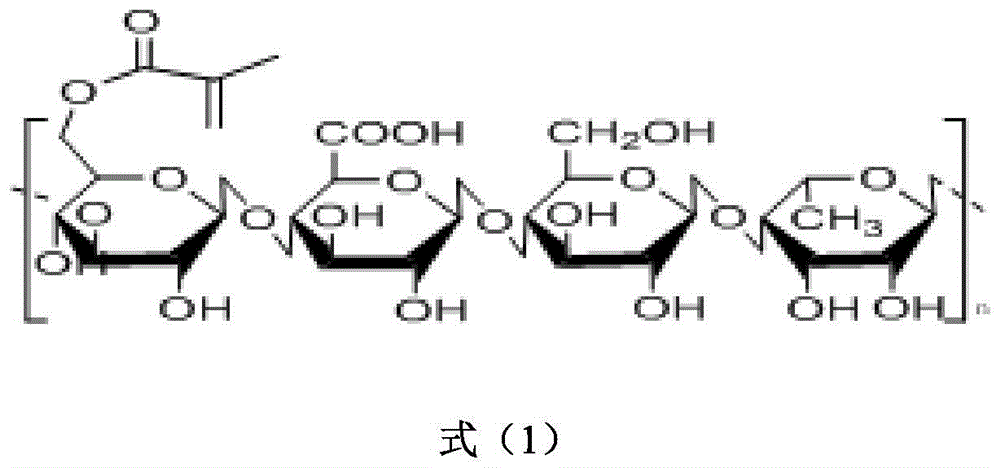
In some embodiments, the double bond modified gellan gum has a double bond structure, and the double bond modified gellan gum has the formula (1):
the double-bond modified collagen has a double-bond structure, and the structural formula of the double-bond modified collagen is shown as the formula (2):
wherein the Collagen is rat tail Collagen.
The embodiment of the invention also provides the rapidly-curable double-crosslinked hydrogel prepared by the method, the mechanical strength of the double-crosslinked hydrogel is 1KPa, the double-crosslinked hydrogel has a porous structure, and the aperture of holes contained in the double-crosslinked hydrogel is 100-300 mu m.
The embodiment of the invention also provides application of the rapidly solidified double-crosslinked hydrogel in the field of cell culture or tissue engineering.
The embodiment of the invention also provides a three-dimensional cell culture carrier, which comprises the rapidly solidified double-crosslinking hydrogel.
The embodiment of the invention also provides a cell culture method, which comprises the following steps:
the rapidly solidified double-cross-linked hydrogel is used as a three-dimensional cell culture carrier to culture stem cells, and the stem cells are promoted to proliferate and differentiate.
In some embodiments, the loading of the stem cells on the double-crosslinked hydrogel is 100-1000 ten thousand/mL.
According to the technical scheme, the double-crosslinked hydrogel carries out double-bond modification on a collagen material from a rat tail and a common food additive gellan gum, then is compounded and blended with cells, the collagen and the gellan gum are combined, the adhesion, proliferation and migration of the cells are improved, the obtained double-crosslinked hydrogel is short in curing time, uniform in internal pore distribution, good in biocompatibility and low in toxicity, can provide a required three-dimensional living environment for the cells, improves the adhesion and proliferation of stem cells on a three-dimensional scaffold, and realizes the differentiation of vascular endothelial cells; meanwhile, the preparation method is simple and can be used for mass preparation.
The technical solutions of the present invention will be described in further detail below with reference to several preferred embodiments and accompanying drawings, and it is obvious that the described embodiments are only a part of the embodiments of the present invention, and not all embodiments. All other embodiments, which can be obtained by a person skilled in the art without any inventive step based on the embodiments of the present invention, are within the scope of the present invention. The conditions used in the following examples may be further adjusted as necessary, and the conditions used in the conventional experiments are not generally indicated.
Example 1
The method comprises the following steps: dissolving gellan gum in deionized water, heating to 90 ℃ to obtain a uniform and transparent solution with the concentration of 1 w/v%, then cooling to 50 ℃, dropwise adding methacrylic anhydride, reacting for 6h, and maintaining the pH value at 8.
Wherein, the volume ratio of the methacrylic anhydride to the gellan gum is 3: 100, and the pH value of the solution is maintained at about 8 by using 5mol/L NaOH solution in the reaction process.
After the reaction is finished, removing unreacted methacrylic anhydride by using 14000KDa cut-off dialysis, freezing overnight at the temperature of-80 ℃, and freeze-drying for 3d at the temperature of-50 ℃ to obtain the double-bond modified gellan gum, wherein the structural formula of the double-bond modified gellan gum is shown as (1):
the double-bond modified gellan gum is a compound modified by methacrylic anhydride, and the grafting rate of the double-bond modified gellan gum is 60%.
The double-bond modified gellan gum is a compound modified by methacrylic anhydride, the double bond of the double-bond modified gellan gum is mainly modified on a sugar molecule, the phase change temperature is reduced, the hydrogel formed by phase change at 50-45 ℃ is adjusted to about 25 ℃ to form hydrogel, and the double-bond modified gellan gum is favorable for blending with cells.
Step two: dissolving rat tail collagen in 1% acetic acid solution, sequentially adding glycidyl methacrylate, triethylamine and tween-20, and reacting at room temperature for 24 h. Wherein the molar ratio of the rat tail collagen to the glycidyl methacrylate is 75: 1, the molar ratio of the triethylamine to the glycidyl methacrylate is 1.5: 1, and the volume ratio of the Tween 20 to the mixed system is 0.05: 100.
After the reaction in the second step is finished, precipitating in 15 times volume of absolute ethyl alcohol to obtain white flocculent precipitate, centrifuging at 12000rpm for 5min to collect the precipitate, dissolving the precipitate with deionized water, centrifuging at 12000rpm for 5min to remove undissolved floccules, freezing at-80 ℃ overnight, and freeze-drying at-50 ℃ for 3d to obtain double-bond modified collagen, wherein the structural formula of the double-bond modified collagen is shown as a formula (2):
the double-bond modified collagen is a compound modified by glycidyl methacrylate, and the double-bond modified collagen is mainly characterized in that double bonds are modified on collagen molecules, so that the water solubility of the collagen is improved, and the solubility of the collagen in water is improved.
Step three: preparing the double-bond modified gellan gum into 2% PBS solution, adding the double-bond modified collagen at 30 deg.C, wherein the concentration of the collagen is 2mg/mL, adding 0.5% photoinitiator 12959, mixing, transferring into a mold, and adding 0.1mol/L Ca2+Crosslinking 1mim in bath to form ion crosslinked hydrogel, and then performing ultraviolet irradiation at 365nm with light intensity of 7mW/cm or higher2And (3) carrying out illumination crosslinking for 3min to form ion and photocuring double-crosslinked hydrogel.
Example 2
The method comprises the following steps: dissolving gellan gum in deionized water, heating to 90 ℃ to obtain a uniform and transparent solution with the concentration of 2 w/v%, then cooling to 50 ℃, dropwise adding methacrylic anhydride, reacting for 6 hours, and maintaining the pH value at about 8.
Wherein, the volume ratio of the methacrylic anhydride to the gellan gum is 3: 100, and the pH value of the solution is maintained at about 8 by using 5mol/L NaOH solution in the reaction process.
Removing unreacted methacrylic anhydride by 7000KDa cut-off dialysis after the reaction is finished, freezing at-80 ℃ overnight, and freeze-drying at-50 ℃ for 3d to obtain the double-bond modified gellan gum, wherein the structural formula of the double-bond modified gellan gum is shown as (1):
the double-bond modified gellan gum is a compound modified by methacrylic anhydride, and the grafting rate of the double-bond modified gellan gum is 60%.
The double-bond modified gellan gum is a compound modified by methacrylic anhydride, the double bond of the double-bond modified gellan gum is mainly modified on a sugar molecule, the phase change temperature is reduced, the hydrogel formed by phase change at 50-45 ℃ is adjusted to about 25 ℃ to form hydrogel, and the double-bond modified gellan gum is favorable for blending with cells.
Step two: dissolving rat tail collagen in 1% acetic acid solution, sequentially adding glycidyl methacrylate, triethylamine and tween-20, and reacting at room temperature for 10 h. Wherein the molar ratio of the rat tail collagen to the glycidyl methacrylate is 60: 1, the molar ratio of the triethylamine to the glycidyl methacrylate is 1: 1, and the volume ratio of the Tween 20 to the mixed system is 0.15: 100.
After the reaction in the second step is finished, precipitating in 15 times volume of absolute ethyl alcohol to obtain white flocculent precipitate, centrifuging at 12000rpm for 5min to collect the precipitate, dissolving the precipitate with deionized water, centrifuging at 12000rpm for 5min to remove undissolved floccules, freezing at-80 ℃ overnight, and freeze-drying at-50 ℃ for 3d to obtain double-bond modified collagen, wherein the structural formula of the double-bond modified collagen is shown as a formula (2):
the double-bond modified collagen is a compound modified by glycidyl methacrylate, and the double bonds on collagen molecules are mainly modified to improve the water solubility of the double-bond modified collagen, so that the collagen which can only be dissolved in an acidic environment is dissolved in a water phase.
Step three: preparing the double-bond modified gellan gum into 2% PBS solution, adding the double-bond modified collagen at 40 deg.C, wherein the concentration of the collagen is 1mg/mL, adding 0.5% photoinitiator I2959, mixing, transferring into a mold, and adding 0.1mol/L Ca2+Crosslinking 1mim in bath to form ion crosslinked hydrogel, and irradiating with 365nm ultraviolet light with light intensity of 7mW/cm or higher2And (3) crosslinking for 3min under illumination to form ion and photocuring double-crosslinking hydrogel.
Example 3
The method comprises the following steps: dissolving gellan gum in deionized water, heating to 70 ℃ to obtain a uniform and transparent solution with the concentration of 1 w/v%, then cooling to 50 ℃, dropwise adding methacrylic anhydride, reacting for 6h, and maintaining the pH value at 8.
Wherein, the volume ratio of the methacrylic anhydride to the gellan gum is 2: 100, and the pH value of the solution is maintained at about 7 by using 2mol/L NaOH solution in the reaction process.
After the reaction is finished, removing unreacted methacrylic anhydride by using 14000KDa cut-off dialysis, freezing at 80 ℃ overnight, and freeze-drying at 50 ℃ for 3d to obtain the double-bond modified gellan gum, wherein the structural formula of the double-bond modified gellan gum is shown as (1):
the double-bond modified gellan gum is a compound modified by methacrylic anhydride, and the grafting rate of the double-bond modified gellan gum is 60%.
The double-bond modified gellan gum is a compound modified by methacrylic anhydride, the double bond of the double-bond modified gellan gum is mainly modified on a sugar molecule, the phase change temperature is reduced, the hydrogel formed by phase change at 50-45 ℃ is adjusted to about 25 ℃ to form hydrogel, and the double-bond modified gellan gum is favorable for blending with cells.
Step two: dissolving rat tail collagen in 2% acetic acid solution, sequentially adding glycidyl methacrylate, triethylamine and tween-20, and reacting at room temperature for 30 h.
Wherein, the molar ratio of the rat tail collagen to the glycidyl methacrylate is 80: 1, the molar ratio of the triethylamine to the glycidyl methacrylate is 1.5: 1, and the volume ratio of the Tween 20 to the mixed system is 0.15: 100.
After the reaction in the second step is finished, precipitating in 10 times volume of absolute ethyl alcohol to obtain white flocculent precipitate, centrifuging at 12000rpm for 5min to collect the precipitate, dissolving the precipitate with deionized water, centrifuging at 12000rpm for 5min to remove undissolved floccules, freezing at-80 ℃ overnight, and freeze-drying at-50 ℃ for 3d to obtain double-bond modified collagen, wherein the structural formula of the double-bond modified collagen is shown as a formula (2):
the double-bond modified collagen is a compound modified by glycidyl methacrylate, and the double-bond modified collagen is mainly characterized in that double bonds are modified on collagen molecules, so that the water solubility of the collagen is improved, and the collagen which can only be dissolved in an acidic environment is dissolved in a water phase.
Step three: preparing the double-bond modified gellan gum into 2% PBS solution, adding the double-bond modified collagen at 35 deg.C, wherein the concentration of the collagen is 2mg/mL, adding 0.5% photoinitiator I2959, mixing, transferring into a mold, and adding 0.1mol/L Ca2+Crosslinking 1mim in bath to form ion crosslinked hydrogel, and irradiating with 365nm ultraviolet light at intensity of 5mW/cm2And (3) crosslinking for 3min under illumination to form ion and photocuring double-crosslinking hydrogel.
Example 4
The method comprises the following steps: dissolving gellan gum in deionized water, heating to 80 ℃ to obtain a uniform and transparent solution with the concentration of 2 w/v%, then cooling to 60 ℃, dropwise adding methacrylic anhydride, reacting for 6h, and maintaining the pH value at 8.
Wherein, the volume ratio of the methacrylic anhydride to the gellan gum is 8: 100, and the pH value of the solution is maintained at about 9 by using 5mol/L NaOH solution in the reaction process.
After the reaction is finished, removing unreacted methacrylic anhydride by using 14000KDa cut-off dialysis, freezing at 80 ℃ overnight, and freeze-drying at 50 ℃ for 3d to obtain the double-bond modified gellan gum, wherein the structural formula of the double-bond modified gellan gum is shown as (1):
the double-bond modified gellan gum is a compound modified by methacrylic anhydride, and the grafting rate of the double-bond modified gellan gum is 60%.
The double-bond modified gellan gum is a compound modified by methacrylic anhydride, the double bond of the double-bond modified gellan gum is mainly modified on a sugar molecule, the phase change temperature is reduced, the hydrogel formed by phase change at 50-45 ℃ is adjusted to about 25 ℃ to form hydrogel, and the double-bond modified gellan gum is favorable for blending with cells.
Step two: dissolving rat tail collagen in 1% acetic acid solution, sequentially adding glycidyl methacrylate, triethylamine and tween-20, and reacting at room temperature for 24 h. Wherein the molar ratio of the rat tail collagen to the glycidyl methacrylate is 75: 1, the molar ratio of the triethylamine to the glycidyl methacrylate is 1.5: 1, and the volume ratio of the Tween 20 to the mixed system is 0.15: 100.
After the reaction in the second step is finished, precipitating in 20 times volume of absolute ethyl alcohol to obtain white flocculent precipitate, centrifuging at 12000rpm for 5min to collect the precipitate, dissolving the precipitate with deionized water, centrifuging at 12000rpm for 5min to remove undissolved floccules, freezing at-80 ℃ overnight, and freeze-drying at-50 ℃ for 3d to obtain double-bond modified collagen, wherein the structural formula of the double-bond modified collagen is shown as a formula (2):
the double-bond modified collagen is a compound modified by glycidyl methacrylate, and the double-bond modified collagen is mainly characterized in that double bonds are modified on collagen molecules, so that the water solubility of the collagen is improved, and the collagen which can only be dissolved in an acidic environment is dissolved in a water phase.
Step three: preparing the double-bond modified gellan gum into 2% PBS solution, adding 0.5% photoinitiator I2959, adding the double-bond modified collagen at 40 deg.C, mixing uniformly, transferring into a mold, and adding 0.1mol/L Ca2+Crosslinking 1mim in bath to form ion crosslinked hydrogel, and irradiating with 365nm ultraviolet light at intensity of 10mW/cm2And (3) carrying out illumination crosslinking for 3min to form ion and photocuring double-crosslinked hydrogel.
Example 5
The method comprises the following steps: dissolving gellan gum in deionized water, heating to 90 ℃ to obtain a uniform and transparent solution with the concentration of 2 w/v%, then cooling to 50 ℃, dropwise adding methacrylic anhydride, reacting for 4h, and maintaining the pH value to be 8.
Wherein, the volume ratio of the methacrylic anhydride to the gellan gum is 3: 100, and the pH value of the solution is maintained at about 8 by using 5mol/L NaOH solution in the reaction process.
After the reaction is finished, removing unreacted methacrylic anhydride by using 14000KDa cut-off dialysis, freezing at 80 ℃ overnight, and freeze-drying at 50 ℃ for 1d to obtain the double-bond modified gellan gum, wherein the structural formula of the double-bond modified gellan gum is shown as (1):
the double-bond modified gellan gum is a compound modified by methacrylic anhydride, and the grafting rate of the double-bond modified gellan gum is 60%.
The double-bond modified gellan gum is a compound modified by methacrylic anhydride, and the double bond modified gellan gum is mainly characterized in that double bonds are modified on sugar molecules, so that the phase change temperature is reduced, the hydrogel formed by the phase change at 50-45 ℃ originally is adjusted to about 25 ℃ to form hydrogel, and the double-bond modified gellan gum is favorable for blending with cells.
Step two: dissolving rat tail collagen in 1% acetic acid solution, sequentially adding glycidyl methacrylate, triethylamine and tween-20, and reacting at room temperature for 24 h. Wherein the molar ratio of the rat tail collagen to the glycidyl methacrylate is 75: 1, the molar ratio of the triethylamine to the glycidyl methacrylate is 1: 1, and the volume ratio of the Tween 20 to the mixed system is 0.15: 100.
After the reaction in the second step is finished, precipitating in 15 times volume of absolute ethyl alcohol to obtain white flocculent precipitate, centrifuging at 12000rpm for 5min to collect the precipitate, dissolving the precipitate with deionized water, centrifuging at 12000rpm for 5min to remove undissolved floccules, freezing at-80 ℃ overnight, and freeze-drying at-50 ℃ for 3d to obtain double-bond modified collagen, wherein the structural formula of the double-bond modified collagen is shown as a formula (2):
the double-bond modified collagen is a compound modified by glycidyl methacrylate, and the double-bond modified collagen is mainly characterized in that double bonds are modified on collagen molecules, so that the water solubility of the collagen is improved, and the solubility of the collagen in water is improved. Step three: preparing the double-bond modified gellan gum into 2% PBS solution, adding the double-bond modified collagen with the concentration of 2mg/mL, adding 0.5% photoinitiator I2959, mixing uniformly, transferring into a mold, and adding 0.2mol/L Ca2+Crosslinking for 3mim in bath to form ion crosslinked hydrogel, and then irradiating with 365nm ultraviolet light with light intensity of 7mW/cm or higher2And (3) carrying out illumination crosslinking for 5min to form ion and photocuring double-crosslinked hydrogel.
The above steps one to three can be represented by fig. 1.
Performance test one
The internal structure and the pore size of the double-crosslinked hydrogel obtained in the embodiment are tested on a field ring scanning electron microscope tester, and the operation method comprises the following steps:
freezing the double-crosslinked hydrogel with liquid nitrogen, freeze-drying at-50 deg.C for 24 hr, spraying gold at 0.2mA for 3min, and observing the microstructure of the hydrogel by scanning electron microscope (as shown in FIG. 2). As can be seen by a scanning electron microscope, the microstructure of the double-crosslinked hydrogel is porous, and the aperture is about 100-300 microns.
Performance test 2
Preparing the double-bond modified gellan gum into a solution with the concentration of 2% by PBS, adding the double-bond modified collagen with the concentration of 2mg/mL, adding 0.5% of photoinitiator I2959, uniformly mixing, transferring into a mold, and adding 0.1mol/L of Ca2+Crosslinking 1mim in bath to form ion crosslinked hydrogel, and irradiating with 365nm ultraviolet light with light intensity of 7mW/cm or higher2Crosslinking was performed for 3min under illumination to form an ion-and photo-cured double-crosslinked hydrogel, which was soaked in 2mL PBS and gently shaken at 37 ℃, and then the hydrogel (n ═ 3) was extracted from the PBS, and the hydrogel surface was rapidly wiped with filter paper at various time points over 24 hours. Then, the wet weight (W) of each hydrogel was measuredt) And is compared with the initial wet weight (W)0) By comparison, the swelling kinetics of the prepared hydrogel is studied, and the swelling result shows that the double-crosslinked hydrogel shrinks in PBS (phosphate buffer solution), reaches an equilibrium state within about 5 hours and has a shrinkage rate of 26 percent in figure 3
Performance test three
The above double-crosslinked hydrogel was immersed in 2mL of PBS under mild shaking at 37 ℃ and PBS was changed every 3 days, degraded in vitro for one month, the hydrogel (n ═ 3) was taken out of PBS every week, frozen in liquid nitrogen, and then freeze-dried at-50 ℃ for 24 hours, and the dry weight (W) of each hydrogel was measured2) And is compared with the initial dry weight (W)1) By comparison, the degradation rate of the prepared hydrogel in vitro is studied, and the in vitro degradation result is shown in FIG. 4, which shows that the double-crosslinked hydrogel can be degraded in PBSAnd the mass loss after one month is about 25 percent.
Performance test four
The mechanical properties of the double-crosslinked hydrogel obtained in this example were measured on a rheometer, and from the rheological results shown in fig. 5, G '> G "is linear, indicating that the hydrogel is in a gel state, and G' is around 1 KPa.
Performance test five
The obtained double-crosslinked hydrogel was used for detecting the proliferation of stem cells
The present example of the double-crosslinked hydrogel was used to determine cell survival and cell proliferation in murine bone marrow stem cells (BMSC cells) using calcein staining and tetrazolium salt colorimetry (WST method), which was performed by the following procedures:
preparing the double-bond modified gellan gum into a solution with the concentration of 2% by PBS, adding the double-bond modified collagen with the concentration of 2mg/mL, and then adding 0.5% of photoinitiator I2959 and 2M NaHCO3Adjusting the pH value of the solution to 7, digesting and counting the BMSC cells of the 4 th generation cultured by the whole culture medium, and centrifuging for 3min at 1000 rpm; mixing with the double bond modified collagen and double bond modified gellan gum mixed solution uniformly to ensure that the cell concentration is 107Per mL; taking 100 mu L of the cell blend liquid in a mould and adding 0.1mol/L of Ca2+Crosslinking 1mim in bath to form ion crosslinked hydrogel, and irradiating with 365nm ultraviolet light with light intensity of 7mW/cm or higher2Cross-linking for 3min under illumination to form ion and photo-cured double cross-linked hydrogel, blending stem cells with the double cross-linked hydrogel of the example, transferring the hydrogel to a 24-well plate, adding complete culture medium, and adding 5% CO2And cultured in an incubator at 37 ℃.
Taking out the culture medium after culturing for 1d, 3d and 7d, washing with PBS for 3 times, measuring with Live/dead kit, and observing cell activity under the excitation of laser confocal 488/561 nm; viable cells stained with calcein fluoresce green, dead cells stained red.
As shown in fig. 6a, 6b and 6c, the murine bone marrow stem cells survived well in the photo-cured hydrogel obtained in this example and showed three-dimensional structure and significant proliferation, indicating that the present invention has no effect on cell proliferation and can provide a three-dimensional growth environment for the cells.
Culturing for 1d, 3d and 7d, taking out the culture medium, adding 900 μ L of fresh culture medium into each well, adding 100 μ L of WST-1, mixing, adding 5% CO2And incubating for 4h in an incubator at 37 ℃, and taking 100 mu L to test the OD value in a 96-well plate at 450nm of an enzyme-labeling instrument.
As shown in fig. 6a, 6b, and 6c, after the BMSC were blended with the double-crosslinked hydrogel obtained in this example, the cultured cells 1d survived better, and the cultured cells 7d proliferated significantly, indicating that the double-crosslinked hydrogel obtained in this example has low toxicity and good biocompatibility.
Performance test six
Mouse derived bone marrow Stem cells differentiation assay into vascular endothelial cells in the double-crosslinked hydrogel obtained in this example
RT-PCR is used to detect the expression level of mRNA of angiogenesis related gene to judge whether stem cells are differentiated.
The 4 th generation murine bone marrow stem cells were divided into four groups:
the first group was cultured in a vascular differentiation medium as an experimental group after being blended with the obtained double-crosslinked hydrogel of this example;
the second group was cultured in complete medium after blending with the obtained double-crosslinked hydrogel of this example as experimental group;
culturing cells in a sixth-hole plate of a third group of vascular differentiation culture medium to serve as an experimental group;
cells were cultured in a fourth group of complete medium six-well plates as a control group (TCP).
Four groups of cells were placed in 5% CO2Culturing in an incubator at 37 ℃, changing fresh medium every other day, culturing for 28d, discarding medium, washing 3 times with PBS, extracting total cellular RNA from hydrogel encapsulating bone marrow stem cells cultured in non-angiogenic and angiogenic media by TRIzol Plus RNA purification kit at each time point, using bone marrow stem cells in 6-well plates as controls. RNA purity was assessed using A260/280 nm. Thereafter, 500ng of RNA was reverse transcribed into cDNA using PrimeScriptTM RT kit. RT-PCR detection was performed using SYBR Green I PCR kit. Drying the 4 th generation bone marrow on the 0 th dayCells were set as calibrator controls and target gene expression was normalized by non-regulated reference gene expression (Gapdh).
As shown in fig. 7a, 7b, 7c, and 7d, bone marrow stem cells cultured two-dimensionally failed to efficiently promote differentiation of bone marrow stem cells into vascular endothelium in both non-angiogenic and angiogenic media. In contrast, bone marrow stem cells in 3D culture promote differentiation of bone marrow stem cells into vascular endothelial cells, particularly in angiogenic media. These results suggest that the double-crosslinked hydrogel obtained in this example is effective in promoting the differentiation of bone marrow stem cells into vascular endothelial cells, and that these differentiated endothelial cells have unique phenotype and biosynthetic activity.
Comparative example 1:
generally, pure gellan gum has temperature sensitivity, hydrogel is formed at 50-45 ℃, cations can promote rapid gelation, but a higher gel temperature is not suitable for mixing with cells, thereby limiting the application of the gellan gum in biomedicine.
Compared with the comparative example 1, the hydrogel obtained in the examples 1 to 5 of the invention has double-bond modification on the gellan gum, and the gel point of the modified gellan gum is reduced to 20 to 25 ℃, so that the hydrogel has wider biological application compared with the hydrogel formed by pure gellan gum, for example, the hydrogel is blended with cells for gelation, and is easier for cell embedding compared with the three-dimensional scaffold material.
Comparative example 2
Generally, pure gellan gum has temperature sensitivity, hydrogel is formed at 50-45 ℃, cations can promote rapid gelation, but the higher gel temperature is not suitable for mixing with cells, thereby limiting the application of the gellan gum in biomedicine. Therefore, the double-bond modification is carried out on the gellan gum, the gel point of the modified gellan gum is reduced, but the gellan gum with the double-bond modification degree higher than 100% loses the temperature sensitivity and the response to cations.
Compared with the comparative example 2, the hydrogel obtained in the examples 1 to 5 of the invention has double-bond modification on the gellan gum, and the gel point of the modified gellan gum is reduced to 20 to 25 ℃, so that the hydrogel formed by the gellan gum with the double-bond modification degree higher than 100% has wider biological application, for example, the hydrogel can be blended with cells for gelation, can keep better response to cations and ultraviolet light, and has better performance than the three-dimensional scaffold material.
Comparative example 3
Generally, pure gellan gum has temperature sensitivity, hydrogel is formed at 50-45 ℃, cations can promote rapid gelation, but the higher gel temperature is not suitable for mixing with cells, thereby limiting the application of the gellan gum in biomedicine. Therefore, the double-bond modification is carried out on the gellan gum, the gel point of the modified gellan gum is reduced, but the gel point of the gellan gum with the double-bond modification degree lower than 50 percent is reduced to about 37 ℃, and the double-bond modification is not beneficial to blending with cells.
Compared with the comparative example 3, the hydrogel obtained in the examples 1 to 5 of the invention has double-bond modification on the gellan gum, and the gel point of the modified gellan gum is reduced to 20 to 25 ℃, so that the hydrogel has wider biological application compared with the hydrogel formed by the gellan gum with the double-bond modification degree lower than 50 percent, for example, the hydrogel is blended with cells for gelation, keeps better response to cations and ultraviolet light, and has better performance than the three-dimensional scaffold material.
Comparative example 4
Generally, collagen is difficult to dissolve in an aqueous solution, and the conventional method is to dissolve the collagen in an acetic acid solution to form gel through crosslinking, remove acetic acid and small molecules through dialysis, and freeze-dry to form the three-dimensional porous scaffold material. However, the gel obtained by the comparative example has a fast degradation rate, and the mechanical property of the stent is poor, so that the application of the stent in biomedicine is limited.
Compared with the comparative example 4, the hydrogel obtained in the embodiments 1 to 5 of the present invention performs double-bond modification on rat tail collagen, and the modified rat tail collagen is soluble in water, and has wider biological applications than the hydrogel formed in the acetic acid solution, for example, the present invention realizes blending gelation with cells, and is easier for cell growth than the three-dimensional scaffold material.
In conclusion, by the technical scheme, the double-crosslinked hydrogel has the advantages of short curing time, uniform distribution of pores in the hydrogel, good biocompatibility and low toxicity, can provide a three-dimensional living environment for cells, improves the adhesion and proliferation of stem cells on a three-dimensional scaffold, and realizes differentiation to vascular endothelial cells; meanwhile, the preparation method is simple and can be used for mass preparation.
In addition, the inventor also refers to the modes of examples 1 to 5, and tests are carried out by using other raw materials and conditions listed in the specification, and the double-crosslinked hydrogel which is short in curing time, good in biocompatibility, low in toxicity and capable of providing a three-dimensional living environment for cells is prepared.
It should be noted that, in the present document, in a general case, an element defined by the phrase "includes.
It should be understood that the above-mentioned examples are only for illustrating the technical idea and features of the present invention, and the purpose of the present invention is to enable those skilled in the art to understand the content of the present invention and to implement the present invention, and not to limit the protection scope of the present invention. All equivalent changes and modifications made according to the spirit of the present invention should be covered within the protection scope of the present invention.